EP3966443B1 - Reversible bleed configuration - Google Patents
Reversible bleed configuration Download PDFInfo
- Publication number
- EP3966443B1 EP3966443B1 EP20725470.7A EP20725470A EP3966443B1 EP 3966443 B1 EP3966443 B1 EP 3966443B1 EP 20725470 A EP20725470 A EP 20725470A EP 3966443 B1 EP3966443 B1 EP 3966443B1
- Authority
- EP
- European Patent Office
- Prior art keywords
- air
- engine
- arrangement
- port
- flow
- Prior art date
- Legal status (The legal status is an assumption and is not a legal conclusion. Google has not performed a legal analysis and makes no representation as to the accuracy of the status listed.)
- Active
Links
Images



Classifications
-
- F—MECHANICAL ENGINEERING; LIGHTING; HEATING; WEAPONS; BLASTING
- F04—POSITIVE - DISPLACEMENT MACHINES FOR LIQUIDS; PUMPS FOR LIQUIDS OR ELASTIC FLUIDS
- F04D—NON-POSITIVE-DISPLACEMENT PUMPS
- F04D15/00—Control, e.g. regulation, of pumps, pumping installations or systems
- F04D15/0005—Control, e.g. regulation, of pumps, pumping installations or systems by using valves
- F04D15/0011—Control, e.g. regulation, of pumps, pumping installations or systems by using valves by-pass valves
-
- F—MECHANICAL ENGINEERING; LIGHTING; HEATING; WEAPONS; BLASTING
- F02—COMBUSTION ENGINES; HOT-GAS OR COMBUSTION-PRODUCT ENGINE PLANTS
- F02C—GAS-TURBINE PLANTS; AIR INTAKES FOR JET-PROPULSION PLANTS; CONTROLLING FUEL SUPPLY IN AIR-BREATHING JET-PROPULSION PLANTS
- F02C3/00—Gas-turbine plants characterised by the use of combustion products as the working fluid
- F02C3/04—Gas-turbine plants characterised by the use of combustion products as the working fluid having a turbine driving a compressor
- F02C3/13—Gas-turbine plants characterised by the use of combustion products as the working fluid having a turbine driving a compressor having variable working fluid interconnections between turbines or compressors or stages of different rotors
-
- F—MECHANICAL ENGINEERING; LIGHTING; HEATING; WEAPONS; BLASTING
- F02—COMBUSTION ENGINES; HOT-GAS OR COMBUSTION-PRODUCT ENGINE PLANTS
- F02C—GAS-TURBINE PLANTS; AIR INTAKES FOR JET-PROPULSION PLANTS; CONTROLLING FUEL SUPPLY IN AIR-BREATHING JET-PROPULSION PLANTS
- F02C9/00—Controlling gas-turbine plants; Controlling fuel supply in air- breathing jet-propulsion plants
- F02C9/16—Control of working fluid flow
- F02C9/18—Control of working fluid flow by bleeding, bypassing or acting on variable working fluid interconnections between turbines or compressors or their stages
-
- F—MECHANICAL ENGINEERING; LIGHTING; HEATING; WEAPONS; BLASTING
- F02—COMBUSTION ENGINES; HOT-GAS OR COMBUSTION-PRODUCT ENGINE PLANTS
- F02K—JET-PROPULSION PLANTS
- F02K3/00—Plants including a gas turbine driving a compressor or a ducted fan
- F02K3/02—Plants including a gas turbine driving a compressor or a ducted fan in which part of the working fluid by-passes the turbine and combustion chamber
- F02K3/04—Plants including a gas turbine driving a compressor or a ducted fan in which part of the working fluid by-passes the turbine and combustion chamber the plant including ducted fans, i.e. fans with high volume, low pressure outputs, for augmenting the jet thrust, e.g. of double-flow type
- F02K3/075—Plants including a gas turbine driving a compressor or a ducted fan in which part of the working fluid by-passes the turbine and combustion chamber the plant including ducted fans, i.e. fans with high volume, low pressure outputs, for augmenting the jet thrust, e.g. of double-flow type controlling flow ratio between flows
-
- F—MECHANICAL ENGINEERING; LIGHTING; HEATING; WEAPONS; BLASTING
- F04—POSITIVE - DISPLACEMENT MACHINES FOR LIQUIDS; PUMPS FOR LIQUIDS OR ELASTIC FLUIDS
- F04D—NON-POSITIVE-DISPLACEMENT PUMPS
- F04D27/00—Control, e.g. regulation, of pumps, pumping installations or pumping systems specially adapted for elastic fluids
- F04D27/02—Surge control
- F04D27/0207—Surge control by bleeding, bypassing or recycling fluids
- F04D27/0215—Arrangements therefor, e.g. bleed or by-pass valves
-
- F—MECHANICAL ENGINEERING; LIGHTING; HEATING; WEAPONS; BLASTING
- F04—POSITIVE - DISPLACEMENT MACHINES FOR LIQUIDS; PUMPS FOR LIQUIDS OR ELASTIC FLUIDS
- F04D—NON-POSITIVE-DISPLACEMENT PUMPS
- F04D27/00—Control, e.g. regulation, of pumps, pumping installations or pumping systems specially adapted for elastic fluids
- F04D27/02—Surge control
- F04D27/0207—Surge control by bleeding, bypassing or recycling fluids
- F04D27/023—Details or means for fluid extraction
-
- F—MECHANICAL ENGINEERING; LIGHTING; HEATING; WEAPONS; BLASTING
- F04—POSITIVE - DISPLACEMENT MACHINES FOR LIQUIDS; PUMPS FOR LIQUIDS OR ELASTIC FLUIDS
- F04D—NON-POSITIVE-DISPLACEMENT PUMPS
- F04D27/00—Control, e.g. regulation, of pumps, pumping installations or pumping systems specially adapted for elastic fluids
- F04D27/02—Surge control
- F04D27/0207—Surge control by bleeding, bypassing or recycling fluids
- F04D27/0238—Details or means for fluid reinjection
-
- F—MECHANICAL ENGINEERING; LIGHTING; HEATING; WEAPONS; BLASTING
- F02—COMBUSTION ENGINES; HOT-GAS OR COMBUSTION-PRODUCT ENGINE PLANTS
- F02C—GAS-TURBINE PLANTS; AIR INTAKES FOR JET-PROPULSION PLANTS; CONTROLLING FUEL SUPPLY IN AIR-BREATHING JET-PROPULSION PLANTS
- F02C6/00—Plural gas-turbine plants; Combinations of gas-turbine plants with other apparatus; Adaptations of gas-turbine plants for special use
- F02C6/04—Gas-turbine plants providing heated or pressurised working fluid for other apparatus, e.g. without mechanical power output
- F02C6/06—Gas-turbine plants providing heated or pressurised working fluid for other apparatus, e.g. without mechanical power output providing compressed gas
- F02C6/08—Gas-turbine plants providing heated or pressurised working fluid for other apparatus, e.g. without mechanical power output providing compressed gas the gas being bled from the gas-turbine compressor
-
- F—MECHANICAL ENGINEERING; LIGHTING; HEATING; WEAPONS; BLASTING
- F04—POSITIVE - DISPLACEMENT MACHINES FOR LIQUIDS; PUMPS FOR LIQUIDS OR ELASTIC FLUIDS
- F04D—NON-POSITIVE-DISPLACEMENT PUMPS
- F04D29/00—Details, component parts, or accessories
- F04D29/40—Casings; Connections of working fluid
- F04D29/52—Casings; Connections of working fluid for axial pumps
- F04D29/54—Fluid-guiding means, e.g. diffusers
- F04D29/541—Specially adapted for elastic fluid pumps
- F04D29/545—Ducts
-
- F—MECHANICAL ENGINEERING; LIGHTING; HEATING; WEAPONS; BLASTING
- F05—INDEXING SCHEMES RELATING TO ENGINES OR PUMPS IN VARIOUS SUBCLASSES OF CLASSES F01-F04
- F05D—INDEXING SCHEME FOR ASPECTS RELATING TO NON-POSITIVE-DISPLACEMENT MACHINES OR ENGINES, GAS-TURBINES OR JET-PROPULSION PLANTS
- F05D2220/00—Application
- F05D2220/30—Application in turbines
- F05D2220/32—Application in turbines in gas turbines
- F05D2220/323—Application in turbines in gas turbines for aircraft propulsion, e.g. jet engines
-
- F—MECHANICAL ENGINEERING; LIGHTING; HEATING; WEAPONS; BLASTING
- F05—INDEXING SCHEMES RELATING TO ENGINES OR PUMPS IN VARIOUS SUBCLASSES OF CLASSES F01-F04
- F05D—INDEXING SCHEME FOR ASPECTS RELATING TO NON-POSITIVE-DISPLACEMENT MACHINES OR ENGINES, GAS-TURBINES OR JET-PROPULSION PLANTS
- F05D2260/00—Function
- F05D2260/60—Fluid transfer
- F05D2260/606—Bypassing the fluid
-
- F—MECHANICAL ENGINEERING; LIGHTING; HEATING; WEAPONS; BLASTING
- F05—INDEXING SCHEMES RELATING TO ENGINES OR PUMPS IN VARIOUS SUBCLASSES OF CLASSES F01-F04
- F05D—INDEXING SCHEME FOR ASPECTS RELATING TO NON-POSITIVE-DISPLACEMENT MACHINES OR ENGINES, GAS-TURBINES OR JET-PROPULSION PLANTS
- F05D2270/00—Control
- F05D2270/01—Purpose of the control system
- F05D2270/10—Purpose of the control system to cope with, or avoid, compressor flow instabilities
- F05D2270/101—Compressor surge or stall
Definitions
- the present invention is concerned with an improved gas turbine arrangement. Specifically, but not exclusively, the invention is concerned with an alternative air bleed configuration for use in conjunction with a low pressure compressor (LPC) and/or a high pressure compressor (HPC) of a gas turbine engine.
- LPC low pressure compressor
- HPC high pressure compressor
- a typical gas turbine engine comprises a pair of compressors, namely a first upstream low pressure compressor and a second, downstream, high pressure compressor.
- the pair of compressors compress air entering the engine in two-stages before the compressed gas is communicated into the combustors where fuel is introduced and the mixture ignited.
- the operation of a gas turbine engine is well known to a person skilled in the art and will not be described in detail.
- the compressors are generally optimised for in-flight conditions i.e. when the aircraft is at cruise speed and altitude. In cruise conditions sufficient air is drawn into the first low pressure compressor and compressed to a first pressure. The air is then communicated through a transition duct between the two compressors to the second high pressure compressor before being introduced into the combustors.
- compressor stalls may occur. This occurs when there is a disparity between the air being introduced into the compressor(s) and the air the compressors can compress at the given rotational speed. Stalls can result in momentary loss of power or in extreme cases engine damage.
- compressor bleed air In order to prevent compressor stall at low speeds modern gas turbine engines are provided with a flow path that allows air to be diverted away from the compressors thereby preventing stalling conditions. This air is known as compressor bleed air.
- holes are provided on the inside of the duct which channels air to the compressor(s).
- the holes form air passages that allow air to flow out of the duct to the engine bypass channel (the channel surrounding the core in a gas turbine engine).
- a butterfly valve may for example be used to automatically control the air bleed (also known in the art as 'level of handling bleed').
- a flap or door may be provided which again may be opened in the same way to release air to the bypass channel.
- a 'scoop' may extend into the duct with a suitable valve which, when opened, gathers air from the duct and again communicates it to the bypass channel.
- Airflow is also sometimes required to flow in the opposite direction i.e. ingestion of air rather than bleed.
- ingestion may be required during braking of the aircraft on landing for example.
- This is also known as "thrust reverse".
- flaps that redirect the bypass flow outwards which acts as an airbrake.
- the inventor has identified an alternative manner in which air bleed can be realised and which provides additional advantages beyond those provided for with existing air bleed systems in gas turbine engines.
- US 2015/0159560 A1 discusses a system for extracting foreign matter in a gas turbine.
- the system includes a variable bleed valve (VBV) disposed between a booster and a high pressure compressor configured to bleed at least a first flow from a core engine flow path into a bypass flow path to extract foreign particles.
- VBV variable bleed valve
- the system also includes a wedge structure disposed in the core engine flow path proximate to the variable bleed valve and configured to allow the at least first flow into the bypass flow path through an extraction passage or at least a second flow through a recovery passage into the core engine flow path.
- GB 1,472,033 A discusses a device for boosting and bleeding a gas turbine engine such as a gas turbine jet engine used for aircraft propulsion, said engine being of the kind comprising at least two independent rotating assemblies, namely a low-pressure rotating assembly comprising a low-pressure compressor, and a high pressure rotating assembly comprising a high-pressure compressor, said engine comprising a primary duct through which, in operation, there flows a primary airflow passing successively through the low pressure compressor and the high-pressure compressor, said primary duct being separated by a casing, from an air space located outside the duct.
- a gas turbine engine such as a gas turbine jet engine used for aircraft propulsion
- said engine being of the kind comprising at least two independent rotating assemblies, namely a low-pressure rotating assembly comprising a low-pressure compressor, and a high pressure rotating assembly comprising a high-pressure compressor, said engine comprising a primary duct through which, in operation, there flows a primary airflow passing successively through the low pressure compressor and the high-pressure compressor, said
- the first diffuser is configured to exhaust a first fluid flow (204).
- the device further includes a second diffuser (226) disposed adjacent the first diffuser.
- the second diffuser is coupled in flow communication with a second conduit (206).
- the second diffuser is configured to exhaust a second fluid flow (208).
- the device also includes a third diffuser (228) at least partially surrounding the first diffuser and the second diffuser.
- the third diffuser is coupled in flow communication with the first diffuser and the second diffuser.
- the third diffuser includes a body (246) with apertures (248) and is configured to exhaust a third fluid flow (244).
- the third fluid flow includes at least one of the first fluid flow and the second fluid flow.
- first air-bleed port and second air-ingress port are integrally formed in a single circumferentially extending body or a pair of circumferentially extending bodies arranged in use to abut one another, wherein the single circumferentially extending body or the pair of circumferentially extending bodies each comprise either a ring or a torus.
- an air-bleed/air-ingress arrangement for a gas turbine engine, the gas turbine engine comprising a bypass channel and an engine core, the engine core comprising a duct arranged in use to channel air towards a compressor and an air flow passage extending from the bypass channel through the core and towards the duct, the arrangement further comprising a first air-bleed port arranged in use to fluidly connect the duct and the airflow passage and configured to communicate air from the duct to the bypass channel and a second air-ingress port arranged in use to fluidly connect the duct and the airflow passage and configured to communicate air from the bypass channel to the duct.
- An invention described herein provides a novel air bleed and air ingress configuration that provides for extremely versatile control of air in the compressor (transition) duct. Specifically, the arrangement allows the volume of air being communicated to the compressor to be accurately controlled and optimised for all landing and flight conditions.
- the arrangement can additionally prevent reverse flow of air, and combustion products from the combustors, through the compressor and duct towards the front of the engine.
- the first air-bleed port and second air-ingress port is advantageously integrally formed in a single circumferentially extending body or a pair of circumferentially extending bodies arranged in use to abut one another (i.e. to be placed immediately adjacent to each other or suitably close together).
- the or each body is in the form of a ring or torus with air-flow channels extending from a surface of the ring facing the central axis of the ring and outwards towards a surface radially displaced from the axis. In effect the flow channels are formed so as to pass generally radially outwards through the ring or torus.
- the or each body may for example comprise an inner surface facing, in use, a core of an engine and an outwardly facing surface facing, in use, a bypass channel of an engine, wherein the ports extend from the inner surface to the outer surface. This allows for the selective control of air between a channel in the core of the engine towards or from a bypass channel of the engine.
- the body may be movable with respect to an engine core to open or close an air-bleed port or an air-ingress port.
- Air-bleed is intended to refer to air released from a duct or transition duct within the core of a gas turbine engine towards a bypass-channel or similar.
- Air-ingress is intended to refer to the opposite i.e. air allowed to flow from the bypass channel towards and into a duct or transition duct of a gas turbine engine upstream of one or more compressors.
- the axial movement may be achieved in any suitable way and by a range of power sources.
- axial movement may be caused by means of one or more linear actuators arranged to cause the body to move in a first and second opposing direction.
- the ports may be selectively movable to intermediate positions between the first and second positions and intermediate positions between the second and third positions.
- the ports extending from the core to the bypass channel may be any suitable aerodynamic shape or profile (cross-section) that allows for the efficient flow of air therethrough.
- one or all of the first air-bleed port(s) may be provided with a curved profile curving radially outwards so that a downstream end of the port directs air in use in a radially outward direction with respect to an axis of an engine.
- one or all of the second air-ingestion ports may be provided with a curved profile curving radially inwards so that a downstream end of the port directs air in use into a transition duct with a component of flow along an axis of the transition duct.
- an auxiliary air supply arrangement for a compressor of a gas turbine engine, the gas turbine engine comprising a bypass channel and an engine core containing a duct arranged to communicate air to a compressor, wherein one or more airflow passages is/are provided and configured to selectively operate in a first mode to supply air from the bypass channel to the duct or in a second mode to supply air from the duct to the bypass channel.
- the arrangement may advantageously be selectively controllable to operate in a first or second mode of operation and optionally a position in which no air is permitted to flow into or out of the duct.
- an air bypass arrangement for a gas turbine engine comprising a movable body arranged around a central axis of rotation of a gas turbine engine and arranged in use to reciprocate along a portion of said axis, the body comprising
- a circumferentially located body may be provided within the core of the engine which can selectively either allow air to bleed from a transition duct out of the engine (for example into the bypass channel) or allow air ingress into the transition duct from the outside of the engine (for example from the bypass channel).
- an inlet to the first up-stream channel may be upstream from an outlet of the first up-stream channel when measured along the engine in an airflow direction.
- an inlet to the second downstream channel may be upstream from an outlet of the second downstream channel when measured along the engine in an airflow direction.
- the first upstream channel is arranged in use to allow air to flow from a transition duct of a gas turbine engine towards a bypass channel of the gas turbine engine and the second down-stream channel is arranged in use to allow air flow from a bypass channel of a gas turbine engine towards a transition duct of the gas turbine engine.
- the arrangement may advantageously allow for the selection of which way the air is permitted to flow by movement of the body in an axial direction towards the front of the engine or to the rear of the engine.
- reciprocation of the body along the axis of the gas turbine engine selectively either:
- gas turbine engine comprising an arrangement as described herein and also an aircraft comprising one or more gas turbine engines as described herein.
- an aircraft may be provided with automatic control of the air flow in response to a stall determination for example.
- Figure 1 shows a cross-section of a gas turbine engine 1 which may incorporate an air bleed configuration according to an invention as described in detail below.
- the engine 1 comprises an air intake 2 which permits air to flow into the engine to the fan 3 located at the upstream end of the engine. All of the components are housed within the engine nacelle 4.
- the engine comprises a bypass channel downstream of the fan and a central engine core which contains the compressors, combustors and turbines.
- the core of the engine is formed of a first low pressure compressor (LPC) 5 and a second high pressure compressor (HPC) 6.
- LPC low pressure compressor
- HPC high pressure compressor
- the combustion gases are expelled from the rear of the combustions chamber 7 and impinge first on a high pressure turbine 9 and then on a second low pressure turbine 10 before leaving the rear of the engine through the core nozzle 11. Thrust from the engine is created by two gas flows: a first from the fan nozzle 8 (receiving thrust from the fan) and secondly from the exhaust gases from the core nozzle 11.
- the invention is concerned with the air flow within the transition duct 12 which is located between the low pressure compressor 5 and the high pressure compressor 6.
- the transition duct 12 is an annular passage that extends around the core and which channels air between the two compressors.
- Figure 2 illustrates a conventional air bleed system.
- a portion of the wall of the transition duct is opened to allow air to escape outwards instead of being channelled to the second high pressure compressor.
- this can be done in a variety of ways and different engine manufacturers have adopted different solutions to release air from the transition duct.
- a simple butterfly 13 valve is located adjacent to the wall of the duct 12 and allows for selective opening and closing.
- the valve is connected to the channel 14 which extends through a portion of the core to the bypass channel 8 where the air can escape.
- Reverse thrust essentially involves redirecting the airflow that would normally be directed out of the rear of the engine either radially outwards or fully or partially backwards i.e. in an opposing direction to the normal airflow. This dramatically reduces the thrust generated by the engine and allows the aircraft to stop more quickly. This may be achieved for example by opening panels on the outer sides of the bypass channel to allow air to flow radially outwards instead of in a rearwards direction.
- thrust reverse means an axial flow through the bypass channel (outside of the engine core) in the direction of motion of the aircraft.
- the fan can be used as a thrust reverser instead of using movable panels. There can then be a situation where the flow in the by-pass channel is slowed down or even reversed compared to the core flow so that the engine fails to function. Then, ingestion instead of bleed can be required.
- Figures 3 to 5 illustrate one example embodiment of an invention described herein in which a multi-directional air bleed/air ingestion configuration is provided.
- Figure 3 shows a schematic of the air control arrangement of the invention.
- the arrangement comprises a cylindrical body 17 that extends around the outer surface of the transition duct 12.
- the body defines two passageways 19, 20 for airflow.
- the first passageway is an air bleed passageway 19 which, when used, connects the transition duct 12 to the passageway 14. In this mode of operation a conventional air bleed path is provided to prevent compressor stall as described above. As shown the profile or shape of the passageway 19 is such that air is caused to flow smoothly out of the transition duct towards the bypass channel 8.
- the second passageway is an air ingress passageway 20 which, when used, connects the bypass channel 8 to the transition duct but with an opposing profile or shape. When connected to the channel 14 the bypass channel air is caused to be drawn into the transition duct and is communicated to the high pressure compressor (not shown in figure 3 ).
- the body is arranged to move axially with respect to the engine using a suitable actuator, such as linear actuator or actuators (or the like) which move (push or pull) the ring axially into or out of position.
- a suitable actuator such as linear actuator or actuators (or the like) which move (push or pull) the ring axially into or out of position.
- the body can thereby be moved between a first maximum position in which the air bleed path is fully open to a second maximum position where the air ingestion path is fully open.
- the body may be moved to any position therebetween depending on the desired volume of airflow and, importantly, direction of airflow i.e. into or out of the transition duct.
- the body may be positioned in a closed position (as shown in figure 3 ) in which air is neither communication into or out of the duct or bypass channel. This may be example be used in a normal flight mode of operation.
- the curvature of the ports may be selected according to the different airflow rates which must be transported into or out of the engine.
- the arrangement may be formed of a single continuous ring.
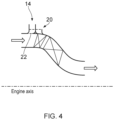
- FIG. 4 and 5 illustrate the air control arrangement in the two modes of operation.
- Figure 4 shows the arrangement in an air bleed mode where the body has been moved in an aft direction (along the axis of the engine). This aligns the air bleed port with the channel 14. As shown the second port 20 has been moved away from the port 22 allowing for air communication from the duct towards the bypass channel.
- Figure 5 shows the arrangement in an air ingress or air ingestion mode.
- the body has been moved in the opposite direction i.e. towards the front of the engine to align the passageway 20 with the channel 14 and port 22. This thereby allows air to flow from the bypass channel to into the duct.
- the aircraft control systems cannot only select the amount of air which is communicated through the transition duct but also the direction i.e. from or to the bypass channel.
- automatic control may be provided and the air control arrangement controlled to optimise the airflow within the compressors.
- the circumferential (or segmented) body may move in a simple linear manner using linear actuation as described above.
- the movement may be controlled by means of a ridge and a channel into which the ridge is located to control the movement.
- the channels may be generally S-shaped or serpentine so as to release air into the bypass channel or duct as a flow more in-line with the respective air flow.
- air being discharged into the bypass channel may be released into the bypass channel so as to have a flow direction generally corresponding to the flow direction of the air in the bypass channel.
- air being discharged into the transition duct may be released into the transition duct so as to have a flow direction generally corresponding to the flow direction in the transition duct.
Landscapes
- Engineering & Computer Science (AREA)
- Mechanical Engineering (AREA)
- General Engineering & Computer Science (AREA)
- Chemical & Material Sciences (AREA)
- Combustion & Propulsion (AREA)
- Life Sciences & Earth Sciences (AREA)
- Sustainable Development (AREA)
- Physics & Mathematics (AREA)
- Fluid Mechanics (AREA)
- Structures Of Non-Positive Displacement Pumps (AREA)
Description
- The present invention is concerned with an improved gas turbine arrangement. Specifically, but not exclusively, the invention is concerned with an alternative air bleed configuration for use in conjunction with a low pressure compressor (LPC) and/or a high pressure compressor (HPC) of a gas turbine engine.
- A typical gas turbine engine comprises a pair of compressors, namely a first upstream low pressure compressor and a second, downstream, high pressure compressor. The pair of compressors compress air entering the engine in two-stages before the compressed gas is communicated into the combustors where fuel is introduced and the mixture ignited. The operation of a gas turbine engine is well known to a person skilled in the art and will not be described in detail.
- The compressors are generally optimised for in-flight conditions i.e. when the aircraft is at cruise speed and altitude. In cruise conditions sufficient air is drawn into the first low pressure compressor and compressed to a first pressure. The air is then communicated through a transition duct between the two compressors to the second high pressure compressor before being introduced into the combustors.
- When the aircraft is not in flight, for example taxiing for take-off, very different air-flow conditions exist within the engine. For example, in situations where the engine is running at low speed (for example for taxi) the air demands of the compressor(s) will be very much lower than at cruise.
- In such situations compressor stalls may occur. This occurs when there is a disparity between the air being introduced into the compressor(s) and the air the compressors can compress at the given rotational speed. Stalls can result in momentary loss of power or in extreme cases engine damage.
- In order to prevent compressor stall at low speeds modern gas turbine engines are provided with a flow path that allows air to be diverted away from the compressors thereby preventing stalling conditions. This air is known as compressor bleed air.
- Numerous methods have been adopted by different engine manufacturers to divert air away from the compressor.
- In one example, holes are provided on the inside of the duct which channels air to the compressor(s). The holes form air passages that allow air to flow out of the duct to the engine bypass channel (the channel surrounding the core in a gas turbine engine). A butterfly valve may for example be used to automatically control the air bleed (also known in the art as 'level of handling bleed').
- In another example of an existing system, a flap or door may be provided which again may be opened in the same way to release air to the bypass channel.
- In yet another example, a 'scoop' may extend into the duct with a suitable valve which, when opened, gathers air from the duct and again communicates it to the bypass channel.
- Each of these existing arrangements has proven to be highly effective in bleeding air from the compressor duct and preventing compressor stalls.
- Airflow is also sometimes required to flow in the opposite direction i.e. ingestion of air rather than bleed. This is a special case of an engine with a variable pitch fan where ingestion may be required during braking of the aircraft on landing for example. This is also known as "thrust reverse". In conventional arrangements there are mechanical flaps that redirect the bypass flow outwards which acts as an airbrake.
- The inventor has identified an alternative manner in which air bleed can be realised and which provides additional advantages beyond those provided for with existing air bleed systems in gas turbine engines.
-
US 2015/0159560 A1 discusses a system for extracting foreign matter in a gas turbine. The system includes a variable bleed valve (VBV) disposed between a booster and a high pressure compressor configured to bleed at least a first flow from a core engine flow path into a bypass flow path to extract foreign particles. The system also includes a wedge structure disposed in the core engine flow path proximate to the variable bleed valve and configured to allow the at least first flow into the bypass flow path through an extraction passage or at least a second flow through a recovery passage into the core engine flow path. -
GB 1,472,033 A -
EP 3,184,781 A1 discusses a muffling device (214; 300) for exhausting at least one fluid flow in a gas turbine engine includes a first diffuser (224) coupled in flow communication with a first conduit (202). The first diffuser is configured to exhaust a first fluid flow (204). The device further includes a second diffuser (226) disposed adjacent the first diffuser. The second diffuser is coupled in flow communication with a second conduit (206). The second diffuser is configured to exhaust a second fluid flow (208). The device also includes a third diffuser (228) at least partially surrounding the first diffuser and the second diffuser. The third diffuser is coupled in flow communication with the first diffuser and the second diffuser. The third diffuser includes a body (246) with apertures (248) and is configured to exhaust a third fluid flow (244). The third fluid flow includes at least one of the first fluid flow and the second fluid flow. - However, none of these documents disclose at least the following features of present claim 1: wherein the first air-bleed port and second air-ingress port are integrally formed in a single circumferentially extending body or a pair of circumferentially extending bodies arranged in use to abut one another, wherein the single circumferentially extending body or the pair of circumferentially extending bodies each comprise either a ring or a torus.
- Aspects of the invention are set out in the accompanying claims.
- Viewed from a first aspect of an invention described herein there is provided an air-bleed/air-ingress arrangement for a gas turbine engine, the gas turbine engine comprising a bypass channel and an engine core, the engine core comprising a duct arranged in use to channel air towards a compressor and an air flow passage extending from the bypass channel through the core and towards the duct, the arrangement further comprising a first air-bleed port arranged in use to fluidly connect the duct and the airflow passage and configured to communicate air from the duct to the bypass channel and a second air-ingress port arranged in use to fluidly connect the duct and the airflow passage and configured to communicate air from the bypass channel to the duct.
- An invention described herein provides a novel air bleed and air ingress configuration that provides for extremely versatile control of air in the compressor (transition) duct. Specifically, the arrangement allows the volume of air being communicated to the compressor to be accurately controlled and optimised for all landing and flight conditions.
- The arrangement can additionally prevent reverse flow of air, and combustion products from the combustors, through the compressor and duct towards the front of the engine.
- According to an invention described herein it is possible to selectively either allow air to be released from the transition duct into the bypass channel or to allow air from the bypass channel to be communicated to the transition duct. This control can be achieved whilst the engine is in operation by reciprocal movement of a body incorporating the one or more channels.
- The first air-bleed port and second air-ingress port may be one of a plurality of ports arranged circumferentially with respect to the core of an engine. This may allow for airflow from particular positions around the engine or from within the engine. Depending on the engine operating conditions one or more ports may be needed.
- The first air-bleed port and second air-ingress port is advantageously integrally formed in a single circumferentially extending body or a pair of circumferentially extending bodies arranged in use to abut one another (i.e. to be placed immediately adjacent to each other or suitably close together). The or each body is in the form of a ring or torus with air-flow channels extending from a surface of the ring facing the central axis of the ring and outwards towards a surface radially displaced from the axis. In effect the flow channels are formed so as to pass generally radially outwards through the ring or torus. There may be a single body or a pair of bodies positioned back-to-back. They may for example be mirror images of each other.
- The or each body may for example comprise an inner surface facing, in use, a core of an engine and an outwardly facing surface facing, in use, a bypass channel of an engine, wherein the ports extend from the inner surface to the outer surface. This allows for the selective control of air between a channel in the core of the engine towards or from a bypass channel of the engine.
- The first air-bleed port and second air-ingress port are one or more discrete ports arranged circumferentially with respect to an engine core.
- Advantageously the body may be movable with respect to an engine core to open or close an air-bleed port or an air-ingress port. Air-bleed is intended to refer to air released from a duct or transition duct within the core of a gas turbine engine towards a bypass-channel or similar. Air-ingress is intended to refer to the opposite i.e. air allowed to flow from the bypass channel towards and into a duct or transition duct of a gas turbine engine upstream of one or more compressors.
- The body may move along the axis of the engine to cause the selective opening and closing of the ports described herein. For example, axial movement in a first direction may cause a port to open allowing air to flow radially outwards through the port. Conversely axial movement in a second opposing direction may cause a port to open allowing air to flow radially inwards through the port.
- The axial movement may be achieved in any suitable way and by a range of power sources. For example, axial movement may be caused by means of one or more linear actuators arranged to cause the body to move in a first and second opposing direction.
- Advantageously the ports may be movable between:
- (A) a first position allowing bleed air to flow radially outwards from a transition duct to a bypass channel;
- (B) a second position in which air is unable to flow to or from a transition duct; and
- (C) a third position allowing ingress-air to flow radially inwards from a bypass duct to a transition duct.
- Thus, full control of air into and out of the transition duct can be achieved including a position where air is neither permitted to leave or enter the transition duct from or to the bypass channel. For example, the ports may be selectively movable to intermediate positions between the first and second positions and intermediate positions between the second and third positions.
- The ports extending from the core to the bypass channel may be any suitable aerodynamic shape or profile (cross-section) that allows for the efficient flow of air therethrough. For example, one or all of the first air-bleed port(s) may be provided with a curved profile curving radially outwards so that a downstream end of the port directs air in use in a radially outward direction with respect to an axis of an engine.
- Similarly, one or all of the second air-ingestion ports may be provided with a curved profile curving radially inwards so that a downstream end of the port directs air in use into a transition duct with a component of flow along an axis of the transition duct.
- Viewed from another non-claimed aspect described herein there is provided an auxiliary air supply arrangement for a compressor of a gas turbine engine, the gas turbine engine comprising a bypass channel and an engine core containing a duct arranged to communicate air to a compressor, wherein one or more airflow passages is/are provided and configured to selectively operate in a first mode to supply air from the bypass channel to the duct or in a second mode to supply air from the duct to the bypass channel.
- As described herein the arrangement may advantageously be selectively controllable to operate in a first or second mode of operation and optionally a position in which no air is permitted to flow into or out of the duct.
- Viewed from a still further non-claimed aspect described herein there is provided an air bypass arrangement for a gas turbine engine comprising a movable body arranged around a central axis of rotation of a gas turbine engine and arranged in use to reciprocate along a portion of said axis, the body comprising
- at least one first upstream air-flow channel extending from a portion of the body proximate to the axis radially outwards and away from the axis to allow air-flow away from the axis, and
- at least one second downstream air-flow channel extending from a portion of the body radially disposed from the axis radially inwards and towards the axis to allow air-flow towards the axis.
- As described herein a circumferentially located body may be provided within the core of the engine which can selectively either allow air to bleed from a transition duct out of the engine (for example into the bypass channel) or allow air ingress into the transition duct from the outside of the engine (for example from the bypass channel).
- To allow for the efficient flow of air through the arrangement without causing detrimental pressure differences within the engine or the like, an inlet to the first up-stream channel may be upstream from an outlet of the first up-stream channel when measured along the engine in an airflow direction.
- Similarly, and for the same reasons, an inlet to the second downstream channel may be upstream from an outlet of the second downstream channel when measured along the engine in an airflow direction.
- Thus, as described above, the first upstream channel is arranged in use to allow air to flow from a transition duct of a gas turbine engine towards a bypass channel of the gas turbine engine and the second down-stream channel is arranged in use to allow air flow from a bypass channel of a gas turbine engine towards a transition duct of the gas turbine engine.
- The arrangement may advantageously allow for the selection of which way the air is permitted to flow by movement of the body in an axial direction towards the front of the engine or to the rear of the engine. Specifically, reciprocation of the body along the axis of the gas turbine engine selectively either:
- (A) opens the first upstream channel to allow airflow and closes the second downstream channel; or
- (B) opens the second downstream channel to allow airflow and closes the first upstream channel.
- Viewed from yet another aspect there is provided a gas turbine engine comprising an arrangement as described herein and also an aircraft comprising one or more gas turbine engines as described herein.
- Viewed from a still further aspect there is provided a method of selectively controlling the flow of air into a compressor of a gas turbine engine using an arrangement described herein, wherein air is selectively caused in use to flow either:
- (A) from a channel communicating air to a compressor to a bypass channel; or
- (B) from a bypass channel to a channel communicating air to the compressor.
- In such an arrangement an aircraft may be provided with automatic control of the air flow in response to a stall determination for example.
- Viewed from another aspect there is provided a method of manufacturing an air flow arrangement for a transition duct as described herein.
- Aspects of the invention will now be described, by way of example only, with reference to the accompanying figures in which:
-
Figure 1 shows a cross-section of a gas turbine engine incorporating an air flow arrangement according to an invention described herein; -
Figure 2 shows a schematic of a conventional air bleed arrangement for a gas turbine engine; -
Figure 3 shows a schematic of a multi-direction air flow arrangement according to an invention described herein; -
Figure 4 shows a schematic of the arrangement shown infigure 3 in an air bleed mode of operation; and -
Figure 5 shows a schematic of the arrangement shown infigure 3 in an air ingress mode of operation. - While the present teachings are susceptible to various modifications and alternative forms, specific embodiments are shown by way of example in the drawings and are herein described in detail. It should be understood, however, that drawings and detailed description thereto are not intended to limit the scope to the particular form disclosed, but on the contrary, the scope is to cover all modifications and alternatives falling within the scope defined by the appended claims.
- As used in this specification, the words "comprises", "comprising", and similar words, are not to be interpreted in an exclusive or exhaustive sense. In other words, they are intended to mean "including, but not limited to".
- It will be recognised that the invention covers not only individual embodiments but also combinations of the embodiments that have been discussed herein.
-
Figure 1 shows a cross-section of a gas turbine engine 1 which may incorporate an air bleed configuration according to an invention as described in detail below. - The skilled person will understand the principal components of a gas turbine engine and their operation. In summary the engine 1 comprises an
air intake 2 which permits air to flow into the engine to thefan 3 located at the upstream end of the engine. All of the components are housed within theengine nacelle 4. - The engine comprises a bypass channel downstream of the fan and a central engine core which contains the compressors, combustors and turbines. The core of the engine is formed of a first low pressure compressor (LPC) 5 and a second high pressure compressor (HPC) 6. This multi-stage compressor arrangement takes air from ambient pressure and temperature to high temperature and pressure. Compressed air is then communicated to the
combustion chamber 7 where fuel is injected and combustion occurs. - The combustion gases are expelled from the rear of the
combustions chamber 7 and impinge first on ahigh pressure turbine 9 and then on a secondlow pressure turbine 10 before leaving the rear of the engine through thecore nozzle 11. Thrust from the engine is created by two gas flows: a first from the fan nozzle 8 (receiving thrust from the fan) and secondly from the exhaust gases from thecore nozzle 11. - The invention is concerned with the air flow within the
transition duct 12 which is located between thelow pressure compressor 5 and thehigh pressure compressor 6. Thetransition duct 12 is an annular passage that extends around the core and which channels air between the two compressors. -
Figure 2 illustrates a conventional air bleed system. In effect a portion of the wall of the transition duct is opened to allow air to escape outwards instead of being channelled to the second high pressure compressor. As described above this can be done in a variety of ways and different engine manufacturers have adopted different solutions to release air from the transition duct. - In
figure 2 a simple butterfly 13 valve is located adjacent to the wall of theduct 12 and allows for selective opening and closing. The valve is connected to thechannel 14 which extends through a portion of the core to thebypass channel 8 where the air can escape. Thus, in conditions where only small volumes of air are required by the compressor any excess air can be released or bled into the bypass channel preventing compressor stall. As also described above, such arrangements are highly effective in preventing compressor stall. - When the butterfly valve 13 is opened, a component of air flows along the path shown by the
arrows 15. When the butterfly valve 13 is closed, all air flows along the transition duct as shown by arrow 16 and to the high pressure compressor (not shown infigure 2 ). - Reverse thrust essentially involves redirecting the airflow that would normally be directed out of the rear of the engine either radially outwards or fully or partially backwards i.e. in an opposing direction to the normal airflow. This dramatically reduces the thrust generated by the engine and allows the aircraft to stop more quickly. This may be achieved for example by opening panels on the outer sides of the bypass channel to allow air to flow radially outwards instead of in a rearwards direction.
- For conventional engines, thrust reverse means an axial flow through the bypass channel (outside of the engine core) in the direction of motion of the aircraft. For aircraft with fan blades which have an adjustable angle this presents a particular problem. In such engines the fan can be used as a thrust reverser instead of using movable panels. There can then be a situation where the flow in the by-pass channel is slowed down or even reversed compared to the core flow so that the engine fails to function. Then, ingestion instead of bleed can be required.
- In such situations it is desirable to increase the airflow into the compressors as opposed to bleeding air out of the compressors. In effect in these situations is it desirable to ingest additional air from the bypass channel into the duct and thereby into the compressor(s).
-
Figures 3 to 5 illustrate one example embodiment of an invention described herein in which a multi-directional air bleed/air ingestion configuration is provided. -
Figure 3 shows a schematic of the air control arrangement of the invention. - The arrangement comprises a
cylindrical body 17 that extends around the outer surface of thetransition duct 12. The body defines twopassageways - The first passageway is an
air bleed passageway 19 which, when used, connects thetransition duct 12 to thepassageway 14. In this mode of operation a conventional air bleed path is provided to prevent compressor stall as described above. As shown the profile or shape of thepassageway 19 is such that air is caused to flow smoothly out of the transition duct towards thebypass channel 8. - The second passageway is an
air ingress passageway 20 which, when used, connects thebypass channel 8 to the transition duct but with an opposing profile or shape. When connected to thechannel 14 the bypass channel air is caused to be drawn into the transition duct and is communicated to the high pressure compressor (not shown infigure 3 ). - Because of pressure, when the blades of the variable pitch fan are turned to reverse the flow in the bypass channel (to brake the aircraft) a flow into the high pressure compressor is required and this is achieved using a reversible bleed. In this case air will flow into the compressor due to the pressure difference.
- As shown by
arrows 21 the body is arranged to move axially with respect to the engine using a suitable actuator, such as linear actuator or actuators (or the like) which move (push or pull) the ring axially into or out of position. The body can thereby be moved between a first maximum position in which the air bleed path is fully open to a second maximum position where the air ingestion path is fully open. - Advantageously the body may be moved to any position therebetween depending on the desired volume of airflow and, importantly, direction of airflow i.e. into or out of the transition duct. Similarly the body may be positioned in a closed position (as shown in
figure 3 ) in which air is neither communication into or out of the duct or bypass channel. This may be example be used in a normal flight mode of operation. - Thus, a compressor stall can be prevented and additionally any reverse flow through the compressors can be avoided.
- As discussed above and also shown in
figure 3 a central position is also provided in which thetransition duct 12 is sealed from thechannel 14. Theport 22 in the outer wall of the transition duct is sealed by thecentral part 23 of thebody 17. - The curvature of the ports may be selected according to the different airflow rates which must be transported into or out of the engine.
- The arrangement may be formed of a single continuous ring.
-
Figure 4 and5 illustrate the air control arrangement in the two modes of operation. -
Figure 4 shows the arrangement in an air bleed mode where the body has been moved in an aft direction (along the axis of the engine). This aligns the air bleed port with thechannel 14. As shown thesecond port 20 has been moved away from theport 22 allowing for air communication from the duct towards the bypass channel. -
Figure 5 shows the arrangement in an air ingress or air ingestion mode. The body has been moved in the opposite direction i.e. towards the front of the engine to align thepassageway 20 with thechannel 14 andport 22. This thereby allows air to flow from the bypass channel to into the duct. - In use, the aircraft control systems cannot only select the amount of air which is communicated through the transition duct but also the direction i.e. from or to the bypass channel. Alternatively automatic control may be provided and the air control arrangement controlled to optimise the airflow within the compressors.
- The circumferential (or segmented) body may move in a simple linear manner using linear actuation as described above. The movement may be controlled by means of a ridge and a channel into which the ridge is located to control the movement.
- In another arrangement the channels may be generally S-shaped or serpentine so as to release air into the bypass channel or duct as a flow more in-line with the respective air flow.
- In effect air being discharged into the bypass channel may be released into the bypass channel so as to have a flow direction generally corresponding to the flow direction of the air in the bypass channel. Similarly air being discharged into the transition duct may be released into the transition duct so as to have a flow direction generally corresponding to the flow direction in the transition duct.
Claims (14)
- An air-bleed/air-ingress arrangement for a gas turbine engine (1), the gas turbine engine comprising a bypass channel and an engine core, the engine core comprising a transition duct (12) arranged in use to channel air towards one or more compressors (5, 6) and an air flow passage (14) extending from the bypass channel through the core and towards the transition duct, the arrangement further comprising a first air-bleed port (19) arranged in use to fluidly connect the transition duct and the airflow passage and configured to communicate air from the transition duct to the bypass channel and a second air-ingress port (20) arranged in use to fluidly connect the transition duct and the airflow passage and configured to communicate air from the bypass channel to the transition duct, characterised in that the first air-bleed port and second air-ingress port are integrally formed in a single circumferentially extending body or a pair of circumferentially extending bodies arranged in use to abut one another, wherein the single circumferentially extending body or the pair of circumferentially extending bodies each comprise either a ring or a torus.
- An arrangement as claimed in claim 1, wherein the first air-bleed port and second air-ingress port are one of a plurality of ports arranged circumferentially with respect to the core of an engine.
- An arrangement as claimed in claim 1, wherein the or each body comprises an inner surface facing, in use, a core of an engine and an outwardly facing surface facing, in use, a bypass channel of an engine, wherein the ports extend from the inner surface to the outer surface.
- An arrangement as claimed in any preceding claim wherein a body comprising a port is movable with respect to an engine core to open or close an air-bleed port or an air-ingress port.
- An arrangement as claimed in claim 4, wherein a body is movable in an axial direction (21) with respect to the axis of an engine.
- An arrangement and claimed in claim 5, wherein axial movement in an first direction causes a port to open allowing air to flow radially outwards through the port and axial movement in a second opposing direction causes a port to open allowing air to flow radially inwards through the port.
- An arrangement as claimed in claim 6, wherein axial movement is caused by means of one or more linear actuators arranged to cause the body to move in a first and second opposing direction.
- An arrangement as claimed in any preceding claim, wherein the ports are movable between:(A) a first position allowing bleed air to flow radially outwards from the transition duct to a bypass channel;(B) a second position in which air is unable to flow to or from the transition duct; and(C) a third position allowing ingress-air to flow radially inwards from a bypass duct to the transition duct.
- An arrangement as claimed in claim 8, wherein the ports are selectively movable to intermediate positions between the first and second positions and intermediate positions between the second and third positions.
- An arrangement as claimed in any preceding claim wherein one or all of the first air-bleed port(s) is/are provided with a curved profile curving radially outwards so that a downstream end of the port directs air in use in a radially outward direction with respect to an axis of an engine.
- An arrangement as claimed in any preceding claim wherein one or all of the second air-ingress ports is/are provided with a curved profile curving radially inwards so that a downstream end of the port directs air in use into the transition duct with a component of flow along an axis of the transition duct.
- A gas turbine engine comprising an arrangement as claimed in any preceding claim.
- An aircraft comprising one or more gas turbine engines as claimed in claim 12.
- A method of selectively controlling the flow of air into a compressor of a gas turbine engine as claimed in claim 12, wherein air is selectively caused in use to flow either:(A) from a channel communicating air to a compressor to a bypass channel; or(B) from a bypass channel to a channel communicating air to the compressor.
Applications Claiming Priority (2)
| Application Number | Priority Date | Filing Date | Title |
|---|---|---|---|
| GB1906638.0A GB2583768B (en) | 2019-05-10 | 2019-05-10 | Reversible bleed configuration |
| PCT/EP2020/062737 WO2020229305A1 (en) | 2019-05-10 | 2020-05-07 | Reversible bleed configuration |
Publications (2)
| Publication Number | Publication Date |
|---|---|
| EP3966443A1 EP3966443A1 (en) | 2022-03-16 |
| EP3966443B1 true EP3966443B1 (en) | 2025-06-25 |
Family
ID=67384617
Family Applications (1)
| Application Number | Title | Priority Date | Filing Date |
|---|---|---|---|
| EP20725470.7A Active EP3966443B1 (en) | 2019-05-10 | 2020-05-07 | Reversible bleed configuration |
Country Status (5)
| Country | Link |
|---|---|
| US (1) | US11867130B2 (en) |
| EP (1) | EP3966443B1 (en) |
| CN (1) | CN113795657B (en) |
| GB (1) | GB2583768B (en) |
| WO (1) | WO2020229305A1 (en) |
Families Citing this family (3)
| Publication number | Priority date | Publication date | Assignee | Title |
|---|---|---|---|---|
| US12085027B2 (en) * | 2021-09-09 | 2024-09-10 | General Electric Company | Compressor bleed for gas turbine engine |
| CN117869371A (en) * | 2023-12-28 | 2024-04-12 | 中国联合重型燃气轮机技术有限公司 | Compressor and gas turbine |
| US12612874B2 (en) * | 2024-01-18 | 2026-04-28 | General Electric Company | Power system having a gas turbine engine |
Family Cites Families (10)
| Publication number | Priority date | Publication date | Assignee | Title |
|---|---|---|---|---|
| FR2260697B1 (en) * | 1974-02-11 | 1976-06-25 | Snecma | |
| US7387489B2 (en) * | 2005-10-17 | 2008-06-17 | Honeywell International Inc. | Bleed valve outlet flow deflector |
| GB0908540D0 (en) * | 2009-05-19 | 2009-06-24 | Rolls Royce Plc | A gas turbine engine having a nacelle and a breather duct |
| WO2013151909A1 (en) * | 2012-04-02 | 2013-10-10 | Kraft Robert J | Compressed air injection system method and apparatus for gas turbine engines |
| US9523329B2 (en) * | 2013-03-15 | 2016-12-20 | United Technologies Corporation | Gas turbine engine with stream diverter |
| GB201319563D0 (en) * | 2013-11-06 | 2013-12-18 | Rolls Royce Plc | Pneumatic system for an aircraft |
| US20150159560A1 (en) * | 2013-12-05 | 2015-06-11 | General Electric Company | System and method for extracting foreign matter in gas turbine |
| US20160376908A1 (en) * | 2015-06-29 | 2016-12-29 | General Electric Company | Power generation system exhaust cooling |
| US10113484B2 (en) * | 2015-12-21 | 2018-10-30 | General Electric Company | High pressure exhaust muffling device with multiple sources |
| US10830179B2 (en) * | 2017-03-01 | 2020-11-10 | General Electric Company | Variable bleed valve door assembly and system for gas turbine engines |
-
2019
- 2019-05-10 GB GB1906638.0A patent/GB2583768B/en active Active
-
2020
- 2020-05-07 EP EP20725470.7A patent/EP3966443B1/en active Active
- 2020-05-07 WO PCT/EP2020/062737 patent/WO2020229305A1/en not_active Ceased
- 2020-05-07 US US17/609,824 patent/US11867130B2/en active Active
- 2020-05-07 CN CN202080033918.XA patent/CN113795657B/en active Active
Also Published As
| Publication number | Publication date |
|---|---|
| CN113795657B (en) | 2024-12-10 |
| CN113795657A (en) | 2021-12-14 |
| GB2583768A (en) | 2020-11-11 |
| GB201906638D0 (en) | 2019-06-26 |
| US20220220903A1 (en) | 2022-07-14 |
| US11867130B2 (en) | 2024-01-09 |
| GB2583768B (en) | 2022-02-16 |
| WO2020229305A1 (en) | 2020-11-19 |
| EP3966443A1 (en) | 2022-03-16 |
Similar Documents
| Publication | Publication Date | Title |
|---|---|---|
| EP2994633B1 (en) | Secondary nozzle for jet engine | |
| US8192147B2 (en) | Nacelle assembly having inlet bleed | |
| US4175384A (en) | Individual bypass injector valves for a double bypass variable cycle turbofan engine | |
| EP2060489B1 (en) | Nacelle flow assembly | |
| US6438941B1 (en) | Bifurcated splitter for variable bleed flow | |
| US6561760B2 (en) | Booster compressor deicer | |
| US6701716B2 (en) | Bleed valve assembly | |
| US8863529B2 (en) | Variable pressure ratio compressor | |
| US20110072828A1 (en) | Gas turbine engine system providing simulated boundary layer thickness increase | |
| EP1998027B1 (en) | Gas turbine engine comprising a nacelle compartment plenum for bleed air flow delivery system | |
| JP2013506082A (en) | Convertible fan engine with 2-block compressor | |
| US7353647B2 (en) | Methods and apparatus for assembling gas turbine engines | |
| JP2013506081A (en) | Convertible fan engine | |
| US20090293449A1 (en) | Gas-Turbine engine in particular aircraft engine | |
| US20130121824A1 (en) | Gas turbine engine having core auxiliary duct passage | |
| JPS6039866B2 (en) | Split fan gas turbine engine | |
| US20130340441A1 (en) | Aerodynamic intercompressor bleed ports | |
| US11867130B2 (en) | Reversible bleed configuration | |
| US20150159560A1 (en) | System and method for extracting foreign matter in gas turbine | |
| EP1760271B1 (en) | Gas turbine engine with valve assembly | |
| US11111855B2 (en) | Inlet particle separator | |
| US9759133B2 (en) | Turbofan with variable bypass flow | |
| CN119593874A (en) | Turbine engine with exhaust system | |
| CN119593873A (en) | Method of operating a turbine engine having an exhaust system | |
| WO2014055751A1 (en) | Aerodynamic intercompressor bleed ports |
Legal Events
| Date | Code | Title | Description |
|---|---|---|---|
| STAA | Information on the status of an ep patent application or granted ep patent |
Free format text: STATUS: UNKNOWN |
|
| STAA | Information on the status of an ep patent application or granted ep patent |
Free format text: STATUS: THE INTERNATIONAL PUBLICATION HAS BEEN MADE |
|
| PUAI | Public reference made under article 153(3) epc to a published international application that has entered the european phase |
Free format text: ORIGINAL CODE: 0009012 |
|
| STAA | Information on the status of an ep patent application or granted ep patent |
Free format text: STATUS: REQUEST FOR EXAMINATION WAS MADE |
|
| 17P | Request for examination filed |
Effective date: 20211208 |
|
| AK | Designated contracting states |
Kind code of ref document: A1 Designated state(s): AL AT BE BG CH CY CZ DE DK EE ES FI FR GB GR HR HU IE IS IT LI LT LU LV MC MK MT NL NO PL PT RO RS SE SI SK SM TR |
|
| DAV | Request for validation of the european patent (deleted) | ||
| DAX | Request for extension of the european patent (deleted) | ||
| STAA | Information on the status of an ep patent application or granted ep patent |
Free format text: STATUS: EXAMINATION IS IN PROGRESS |
|
| 17Q | First examination report despatched |
Effective date: 20230727 |
|
| GRAP | Despatch of communication of intention to grant a patent |
Free format text: ORIGINAL CODE: EPIDOSNIGR1 |
|
| STAA | Information on the status of an ep patent application or granted ep patent |
Free format text: STATUS: GRANT OF PATENT IS INTENDED |
|
| INTG | Intention to grant announced |
Effective date: 20250120 |
|
| GRAS | Grant fee paid |
Free format text: ORIGINAL CODE: EPIDOSNIGR3 |
|
| GRAA | (expected) grant |
Free format text: ORIGINAL CODE: 0009210 |
|
| STAA | Information on the status of an ep patent application or granted ep patent |
Free format text: STATUS: THE PATENT HAS BEEN GRANTED |
|
| P01 | Opt-out of the competence of the unified patent court (upc) registered |
Free format text: CASE NUMBER: APP_19095/2025 Effective date: 20250422 |
|
| AK | Designated contracting states |
Kind code of ref document: B1 Designated state(s): AL AT BE BG CH CY CZ DE DK EE ES FI FR GB GR HR HU IE IS IT LI LT LU LV MC MK MT NL NO PL PT RO RS SE SI SK SM TR |
|
| REG | Reference to a national code |
Ref country code: GB Ref legal event code: FG4D |
|
| REG | Reference to a national code |
Ref country code: CH Ref legal event code: EP |
|
| REG | Reference to a national code |
Ref country code: CH Ref legal event code: EP |
|
| REG | Reference to a national code |
Ref country code: IE Ref legal event code: FG4D |
|
| REG | Reference to a national code |
Ref country code: DE Ref legal event code: R096 Ref document number: 602020053299 Country of ref document: DE |
|
| PG25 | Lapsed in a contracting state [announced via postgrant information from national office to epo] |
Ref country code: FI Free format text: LAPSE BECAUSE OF FAILURE TO SUBMIT A TRANSLATION OF THE DESCRIPTION OR TO PAY THE FEE WITHIN THE PRESCRIBED TIME-LIMIT Effective date: 20250625 |
|
| REG | Reference to a national code |
Ref country code: LT Ref legal event code: MG9D |
|
| PG25 | Lapsed in a contracting state [announced via postgrant information from national office to epo] |
Ref country code: GR Free format text: LAPSE BECAUSE OF FAILURE TO SUBMIT A TRANSLATION OF THE DESCRIPTION OR TO PAY THE FEE WITHIN THE PRESCRIBED TIME-LIMIT Effective date: 20250926 Ref country code: NO Free format text: LAPSE BECAUSE OF FAILURE TO SUBMIT A TRANSLATION OF THE DESCRIPTION OR TO PAY THE FEE WITHIN THE PRESCRIBED TIME-LIMIT Effective date: 20250925 |
|
| PG25 | Lapsed in a contracting state [announced via postgrant information from national office to epo] |
Ref country code: BG Free format text: LAPSE BECAUSE OF FAILURE TO SUBMIT A TRANSLATION OF THE DESCRIPTION OR TO PAY THE FEE WITHIN THE PRESCRIBED TIME-LIMIT Effective date: 20250625 |
|
| PG25 | Lapsed in a contracting state [announced via postgrant information from national office to epo] |
Ref country code: HR Free format text: LAPSE BECAUSE OF FAILURE TO SUBMIT A TRANSLATION OF THE DESCRIPTION OR TO PAY THE FEE WITHIN THE PRESCRIBED TIME-LIMIT Effective date: 20250625 |
|
| PG25 | Lapsed in a contracting state [announced via postgrant information from national office to epo] |
Ref country code: RS Free format text: LAPSE BECAUSE OF FAILURE TO SUBMIT A TRANSLATION OF THE DESCRIPTION OR TO PAY THE FEE WITHIN THE PRESCRIBED TIME-LIMIT Effective date: 20250925 |
|
| PG25 | Lapsed in a contracting state [announced via postgrant information from national office to epo] |
Ref country code: LV Free format text: LAPSE BECAUSE OF FAILURE TO SUBMIT A TRANSLATION OF THE DESCRIPTION OR TO PAY THE FEE WITHIN THE PRESCRIBED TIME-LIMIT Effective date: 20250625 |
|
| REG | Reference to a national code |
Ref country code: NL Ref legal event code: MP Effective date: 20250625 |
|
| PG25 | Lapsed in a contracting state [announced via postgrant information from national office to epo] |
Ref country code: NL Free format text: LAPSE BECAUSE OF FAILURE TO SUBMIT A TRANSLATION OF THE DESCRIPTION OR TO PAY THE FEE WITHIN THE PRESCRIBED TIME-LIMIT Effective date: 20250625 |
|
| PG25 | Lapsed in a contracting state [announced via postgrant information from national office to epo] |
Ref country code: PT Free format text: LAPSE BECAUSE OF FAILURE TO SUBMIT A TRANSLATION OF THE DESCRIPTION OR TO PAY THE FEE WITHIN THE PRESCRIBED TIME-LIMIT Effective date: 20251027 |
|
| REG | Reference to a national code |
Ref country code: AT Ref legal event code: MK05 Ref document number: 1806645 Country of ref document: AT Kind code of ref document: T Effective date: 20250625 |
|
| PG25 | Lapsed in a contracting state [announced via postgrant information from national office to epo] |
Ref country code: IS Free format text: LAPSE BECAUSE OF FAILURE TO SUBMIT A TRANSLATION OF THE DESCRIPTION OR TO PAY THE FEE WITHIN THE PRESCRIBED TIME-LIMIT Effective date: 20251025 |
|
| PG25 | Lapsed in a contracting state [announced via postgrant information from national office to epo] |
Ref country code: AT Free format text: LAPSE BECAUSE OF FAILURE TO SUBMIT A TRANSLATION OF THE DESCRIPTION OR TO PAY THE FEE WITHIN THE PRESCRIBED TIME-LIMIT Effective date: 20250625 Ref country code: SM Free format text: LAPSE BECAUSE OF FAILURE TO SUBMIT A TRANSLATION OF THE DESCRIPTION OR TO PAY THE FEE WITHIN THE PRESCRIBED TIME-LIMIT Effective date: 20250625 |
|
| PG25 | Lapsed in a contracting state [announced via postgrant information from national office to epo] |
Ref country code: CZ Free format text: LAPSE BECAUSE OF FAILURE TO SUBMIT A TRANSLATION OF THE DESCRIPTION OR TO PAY THE FEE WITHIN THE PRESCRIBED TIME-LIMIT Effective date: 20250625 |
|
| PG25 | Lapsed in a contracting state [announced via postgrant information from national office to epo] |
Ref country code: PL Free format text: LAPSE BECAUSE OF FAILURE TO SUBMIT A TRANSLATION OF THE DESCRIPTION OR TO PAY THE FEE WITHIN THE PRESCRIBED TIME-LIMIT Effective date: 20250625 |
|
| PG25 | Lapsed in a contracting state [announced via postgrant information from national office to epo] |
Ref country code: EE Free format text: LAPSE BECAUSE OF FAILURE TO SUBMIT A TRANSLATION OF THE DESCRIPTION OR TO PAY THE FEE WITHIN THE PRESCRIBED TIME-LIMIT Effective date: 20250625 |
|
| PG25 | Lapsed in a contracting state [announced via postgrant information from national office to epo] |
Ref country code: SK Free format text: LAPSE BECAUSE OF FAILURE TO SUBMIT A TRANSLATION OF THE DESCRIPTION OR TO PAY THE FEE WITHIN THE PRESCRIBED TIME-LIMIT Effective date: 20250625 |
|
| PG25 | Lapsed in a contracting state [announced via postgrant information from national office to epo] |
Ref country code: ES Free format text: LAPSE BECAUSE OF FAILURE TO SUBMIT A TRANSLATION OF THE DESCRIPTION OR TO PAY THE FEE WITHIN THE PRESCRIBED TIME-LIMIT Effective date: 20250625 |
|
| REG | Reference to a national code |
Ref country code: DE Ref legal event code: R097 Ref document number: 602020053299 Country of ref document: DE |
|
| PGFP | Annual fee paid to national office [announced via postgrant information from national office to epo] |
Ref country code: GB Payment date: 20260313 Year of fee payment: 7 |
|
| PG25 | Lapsed in a contracting state [announced via postgrant information from national office to epo] |
Ref country code: DK Free format text: LAPSE BECAUSE OF FAILURE TO SUBMIT A TRANSLATION OF THE DESCRIPTION OR TO PAY THE FEE WITHIN THE PRESCRIBED TIME-LIMIT Effective date: 20250625 |
|
| PG25 | Lapsed in a contracting state [announced via postgrant information from national office to epo] |
Ref country code: IT Free format text: LAPSE BECAUSE OF FAILURE TO SUBMIT A TRANSLATION OF THE DESCRIPTION OR TO PAY THE FEE WITHIN THE PRESCRIBED TIME-LIMIT Effective date: 20250625 |
|
| PGFP | Annual fee paid to national office [announced via postgrant information from national office to epo] |
Ref country code: FR Payment date: 20260309 Year of fee payment: 7 |
|
| PLBE | No opposition filed within time limit |
Free format text: ORIGINAL CODE: 0009261 |
|
| STAA | Information on the status of an ep patent application or granted ep patent |
Free format text: STATUS: NO OPPOSITION FILED WITHIN TIME LIMIT |
|
| REG | Reference to a national code |
Ref country code: CH Ref legal event code: L10 Free format text: ST27 STATUS EVENT CODE: U-0-0-L10-L00 (AS PROVIDED BY THE NATIONAL OFFICE) Effective date: 20260507 |
|
| 26N | No opposition filed |
Effective date: 20260326 |
|
| PG25 | Lapsed in a contracting state [announced via postgrant information from national office to epo] |
Ref country code: LT Free format text: LAPSE BECAUSE OF FAILURE TO SUBMIT A TRANSLATION OF THE DESCRIPTION OR TO PAY THE FEE WITHIN THE PRESCRIBED TIME-LIMIT Effective date: 20250625 |
|
| PGFP | Annual fee paid to national office [announced via postgrant information from national office to epo] |
Ref country code: DE Payment date: 20260310 Year of fee payment: 7 |
|
| PG25 | Lapsed in a contracting state [announced via postgrant information from national office to epo] |
Ref country code: SE Free format text: LAPSE BECAUSE OF FAILURE TO SUBMIT A TRANSLATION OF THE DESCRIPTION OR TO PAY THE FEE WITHIN THE PRESCRIBED TIME-LIMIT Effective date: 20250625 |