EP3966215B1 - Synthesis of labeled imidazo[1,2-a]pyrimidines - Google Patents
Synthesis of labeled imidazo[1,2-a]pyrimidines Download PDFInfo
- Publication number
- EP3966215B1 EP3966215B1 EP20727123.0A EP20727123A EP3966215B1 EP 3966215 B1 EP3966215 B1 EP 3966215B1 EP 20727123 A EP20727123 A EP 20727123A EP 3966215 B1 EP3966215 B1 EP 3966215B1
- Authority
- EP
- European Patent Office
- Prior art keywords
- compound
- formula
- equiv
- mmol
- reacting
- Prior art date
- Legal status (The legal status is an assumption and is not a legal conclusion. Google has not performed a legal analysis and makes no representation as to the accuracy of the status listed.)
- Active
Links
Images
Classifications
-
- C—CHEMISTRY; METALLURGY
- C07—ORGANIC CHEMISTRY
- C07B—GENERAL METHODS OF ORGANIC CHEMISTRY; APPARATUS THEREFOR
- C07B59/00—Introduction of isotopes of elements into organic compounds ; Labelled organic compounds per se
- C07B59/002—Heterocyclic compounds
-
- C—CHEMISTRY; METALLURGY
- C07—ORGANIC CHEMISTRY
- C07D—HETEROCYCLIC COMPOUNDS
- C07D487/00—Heterocyclic compounds containing nitrogen atoms as the only ring hetero atoms in the condensed system, not provided for by groups C07D451/00 - C07D477/00
- C07D487/02—Heterocyclic compounds containing nitrogen atoms as the only ring hetero atoms in the condensed system, not provided for by groups C07D451/00 - C07D477/00 in which the condensed system contains two hetero rings
- C07D487/04—Ortho-condensed systems
-
- C—CHEMISTRY; METALLURGY
- C07—ORGANIC CHEMISTRY
- C07F—ACYCLIC, CARBOCYCLIC OR HETEROCYCLIC COMPOUNDS CONTAINING ELEMENTS OTHER THAN CARBON, HYDROGEN, HALOGEN, OXYGEN, NITROGEN, SULFUR, SELENIUM OR TELLURIUM
- C07F9/00—Compounds containing elements of Groups 5 or 15 of the Periodic Table
- C07F9/02—Phosphorus compounds
- C07F9/06—Phosphorus compounds without P—C bonds
- C07F9/22—Amides of acids of phosphorus
- C07F9/24—Esteramides
- C07F9/2454—Esteramides the amide moiety containing a substituent or a structure which is considered as characteristic
-
- C—CHEMISTRY; METALLURGY
- C07—ORGANIC CHEMISTRY
- C07B—GENERAL METHODS OF ORGANIC CHEMISTRY; APPARATUS THEREFOR
- C07B2200/00—Indexing scheme relating to specific properties of organic compounds
- C07B2200/05—Isotopically modified compounds, e.g. labelled
-
- Y—GENERAL TAGGING OF NEW TECHNOLOGICAL DEVELOPMENTS; GENERAL TAGGING OF CROSS-SECTIONAL TECHNOLOGIES SPANNING OVER SEVERAL SECTIONS OF THE IPC; TECHNICAL SUBJECTS COVERED BY FORMER USPC CROSS-REFERENCE ART COLLECTIONS [XRACs] AND DIGESTS
- Y02—TECHNOLOGIES OR APPLICATIONS FOR MITIGATION OR ADAPTATION AGAINST CLIMATE CHANGE
- Y02P—CLIMATE CHANGE MITIGATION TECHNOLOGIES IN THE PRODUCTION OR PROCESSING OF GOODS
- Y02P20/00—Technologies relating to chemical industry
- Y02P20/50—Improvements relating to the production of bulk chemicals
- Y02P20/55—Design of synthesis routes, e.g. reducing the use of auxiliary or protecting groups
Definitions
- the technology described herein generally relates to organic synthesis, and more particularly relates to synthetic pathways to molecules that are isotopically labeled and are used as imaging agents in positron emission tomography.
- NFTs Neurofibrillary tangles
- AD Alzheimer's disease
- tau plaques are comprised of aggregated hyperphosphorylated tau protein.
- the tau protein is associated with cytoskeleton and is involved in the transport of vesicles along microtubules in neurons. Under pathological conditions, tau is hyperphosphorylated and forms beta-sheet aggregates with fibrillar appearances similar to A ⁇ in senile plaques.
- Some tau-targeted therapies aim to slow disease progression by interfering with cell-to-cell transfer of soluble tau oligomers.
- Tau-specific positron emission tomography (PET) imaging biomarkers can non-invasively monitor disease progression as well as provide a direct measure of tau-targeted agent efficacy and confirmation of its mechanism of action in clinical trials (see, e.g., Mathis, C. A.; Klunk, W. E., Neuron, (2013), 79 (6), 1035-7 ; and Jensen, J. R., et al., J. Alzheimer's Disease, (2011), 26 Suppl. 3, 147-57 ).
- PET positron emission tomography
- One promising tau-specific PET imaging biomarker is a substituted benzo[4,5]imidazo[1,2-a]pyrimidin-2-amine that is both deuterated as well as labeled by a radio-isotope.
- the radio-isotope 18 F is introduced into a precursor molecule immediately prior to administration of the compound to a patient.
- an efficient synthesis of the precursor is particularly desirable because the precursor must be commercially available in large quantities that are ready for labeling.
- the benzo[4,5]imidazo[1,2-a]pyrimidin-2-amine structural element has also found utility in a number of other PET imaging agents that target tau protein plaques, and has also been incorporated into investigational tau degrader molecules. Additionally, this scaffold has been used as a PET imaging agent for the identification of other proteins associated with neurodegenerative conditions such as Huntington's disease. More generally, the benzo[4,5]imidazo[1,2-a]pyrimidine motif has been incorporated into molecules which have shown anti-neurodegenerative, anti-hypertensive, anti-microbial, and antiviral activity.
- benzo[4,5]imidazo[1,2-a]pyrimidine derivatives have been accessed via the condensation of amino-imidazoles with enones or enals bearing a leaving group in the ⁇ -position. While this approach generally provides imidazo-pyrimidine products in high yield and good isomeric selectivity, the scope of available substrates is limited to ⁇ , ⁇ -unsaturated aldehydes and ketones. To enable more efficient access to functionalized imidazo[1,2-a]pyrimidin-amines, other methods are needed.
- WO 2015/173225 A1 is directed to deuterated and optionally detectably labeled heterocyclic compounds and their use as imaging agents.
- the instant disclosure addresses the synthesis of substituted imidazopyrimidine molecules, particularly a number that are deuterated at specific positions.
- the disclosure comprises a coupling step that can make a substituted imidazo-pyrimidine in high yield.
- the disclosure further includes a compound of formula (V):
- compound (V) has a deuterium enrichment factor of 3,000 or greater at each of the positions shown as occupied by a deuterium atom.
- the disclosure further includes a compound of formula (VI):
- compound (VI) has a deuterium enrichment factor of 3,000 or greater at each of the positions shown as occupied by a deuterium atom.
- the disclosure further comprises a method of synthesizing the compound of formula (I), the method comprising: at least a step of coupling a compound of formula (II) with a compound of formula (III) in the presence of POCl 3 and EtsN in a non-aqueous solvent to give a first precursor (I-P1).
- the synthesis further comprises removing the benzoate group in I-P1 to give a second precursor (I-P2);
- the compounds include enantiomeric, diastereomeric and geometric (or conformational) isomeric forms of a given structure unless the structure is otherwise intended to be limited.
- the R and S configurations for each asymmetric center, Z and E double bond isomers, Z and E conformational isomers, single stereochemical isomers, as well as enantiomeric, diastereomeric, and geometric (or conformational) mixtures are included.
- all tautomeric forms of structures depicted herein are also included.
- tautomer or “tautomeric form” refers to structural isomers of different energies which are interconvertible via a low energy barrier.
- proton tautomers also known as prototropic tautomers
- Valence tautomers include interconversions by reorganization of some of the bonding electrons.
- structures depicted herein are also meant to include compounds that differ only in the presence of one or more isotopically enriched atoms in addition to any isotopically enriched atom that has been explicitly identified.
- compounds, wherein the independent replacement or enrichment of one or more hydrogen by deuterium or tritium, carbon by 13 C- or 14 C carbon, nitrogen by a 15 N nitrogen, sulfur by a 33 S, 34 S or 36 S sulfur, or oxygen by a 17 O or 18 O oxygen are included.
- Such compounds are useful, for example, as analytical tools, as probes in biological assays, or as therapeutic agents.
- deuterated means that a hydrogen atom is replaced by a deuterium atom at a level above its natural abundance at one or more positions of a molecule. When a particular position is deuterated, it is understood that the abundance of deuterium at that position is substantially greater than the natural abundance of deuterium, which is 0.015%.
- a deuterated position typically has a minimum isotopic enrichment factor of at least 3000 (45% deuterium incorporation).
- isotopic enrichment factor means the ratio between the isotopic abundance and the natural abundance of a specified isotope.
- a given position in a molecule has an isotopic enrichment factor of at least 3500 (52.5% deuterium incorporation), at least 4000 (60% deuterium incorporation), at least 4500 (67.5% deuterium incorporation), at least 5000 (75% deuterium incorporation), at least 5500 (82.5% deuterium incorporation), at least 6000 (90% deuterium incorporation), at least 6333.3 (95% deuterium incorporation), at least 6466.7 (97% deuterium incorporation), at least 6600 (99% deuterium incorporation), or at least 6633.3 (99.5% deuterium incorporation). In some embodiments, 100% deuterium incorporation is achieved.
- Deuterium can be incorporated into a compound of the present invention using a variety of known reagents and synthetic techniques.
- deuterium can be incorporated into a compound of formula (I) using LiAlD 4 at an earlier stage in the synthesis that leads to compound (I). It can also be incorporated into a compound of formula (I) such as through reduction, catalytic hydrogenation or isotopic exchange using appropriate deuterated reagents such as deuterium gas D 2 , and deuterated (or "heavy") forms of water such as HDO or D 2 O.
- the invention further comprises methods of synthesis of such compounds.
- each of the deuterated positions has an enrichment factor of at least 3000, and preferably at least 3500, and still more preferably at least 4000, and even more preferably at least 4500.
- a d4-compound can be further purified to ensure that the enrichment factor at each of the deuterated positions is effectively at least 5000 or more.
- the invention comprises a method of synthesizing a compound of formula (I): wherein the carbon atom labeled with a star (*) is optionally doubly-deuterated.
- compound (I) is a d4-compound as described elsewhere herein.
- the methods herein can obtain a di-deuterated (“d2") form at a purity of >95% (i.e ., D2/(D0+D1+D2) > 95%, where Dn denotes a molecule having n of the designated hydrogens substituted by deuterium atoms).
- the purity is at least 97% of the d2 form.
- the quality (i.e., isotopic enrichment factor) of lithium aluminum deuterate (LiAlD 4 ) is the principal driving force behind the actual purity of the compound obtained.
- a synthetic approach in which catalytic D 2 gas is used to introduce deuterium atoms into the molecule typically cannot produce more than 98% purity of the d2 form. Consequently, the deuterium enrichment factor for each substituted position is typically in excess of 6333.3, and preferably in excess of 6400.
- a method of synthesizing compounds of formula (I) comprises, in a first step, coupling an acrylamide compound of formula (II) with an amino-imidazole compound of formula (III) in the presence of POCl 3 and EtsN in a non-aqueous solvent to give a first precursor (I-P1)
- This reaction provides the benzo[4,5]imidazo[1,2-a]pyrimidin-2-amine or (I-P1) with excellent selectivity over the alternative isomer, a benzo[4,5]imidazo[1,2-a]pyrimidin-4-amine.
- This second step may occur in the presence of a base such as NaOH.
- a third step the hydroxyl group in I-P2 is replaced by a tosyl group to give compound (I).
- Tosylation may optionally involve an acidification step after reacting (I-P2) with tosylate.
- the carbon atom labeled (*) is also optionally doubly-deuterated.
- the reagents deployed to achieve the second and third steps may differ according to whether the carbon atom labeled (*) is doubly-deuterated.
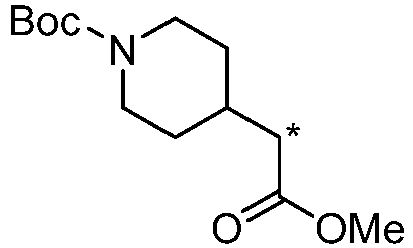
- the compound of formula (II) is synthesized by a method comprising: reacting with a first deuterating agent to produce P1).
- the first deuterating agent can be LiAlD 4 or can be D 2 gas.
- Boc protecting group is removed from (II-P2) to produce a hydrochloride salt (II-P3)
- a compound of formula (II) can be formed by reacting (II-P3) with
- compound (IVa) is formed by reacting (IV) with SOCl 2 .
- compound (II-P1) is created by reacting with a second deuterating agent to produce intermediate (II-P0) and reacting the first deuterating agent with (II-P0) to form (II-P1).
- the compound of formula (III) is synthesized by a method comprising: reacting with PCl(O)(OEt) 2 , N-methylimidazole, and MeCN.
- the phosphorylating agent, PCl(O)(OEt) 2 is formed in situ by reacting diethyl hydrogen phosphate with a chlorinating agent such as 1,3,5-trichloro-1,3,5-triazinane-2,4,6-trione.
- compounds of formula (I) can be tritiated (labeled with one or more tritium atoms), or the tosylate function can be replaced by a 18 F isotope, both according to methods known in the art.
- Example 1 describes a representative synthesis of a tracer molecule deuterated at two positions including use of a step of conjugating an acrylamide with a phosphorylated imidazole.
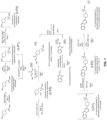
- FIG. 1 shows the synthetic pathway of Example 1 in overview, including steps to prepare starting materials.
- tert-butyl 4-(2-methoxy-2-oxoethyl)piperidine-1-carboxylate 600 g, 2.33 mol, 1.0 equiv
- MTBE 1.0 equiv
- Norit TM A Supra charcoal 120 g, 20 w%) was charged to the reactor and the jacket was warmed to 35-45 °C. The mixture was held at this temperature for 2 h, cooled to 23 °C, then filtered through a Büchner funnel containing 100.54 g of Celite ® . The funnel was then washed with MTBE (1200 mL).
- the reactor was then cooled to 23 °C, filtered through short pad of silica gel, rinsed with PhMe, and concentrated under vacuum to afford tert -butyl 4-(2-hydroxyethyl-2,2- d 2 )piperidine-1-carboxylate as a yellow oil (17.0 g, 94.5% corrected yield) in 100.0 A% HPLC purity.
- Step 2b Reduction (LiAlD 4 )
- reaction completion was confirmed, the reaction was quenched by slow addition of H 2 O (287 mL) while maintaining the internal temperature to ⁇ 15 °C (Caution was appropriate as there was significant gas evolution.)
- H 2 O 287 mL
- the reactor was then warmed to 20-25 °C and stirred for 30 min.
- An aqueous 4N NaOH solution (287 g, 250 mL) was charged to the reactor and the mixture was again stirred at 20-25 °C for 30 min.
- H 2 O (860 mL) was charged to the reactor and the mixture was again stirred at 20-25 °C for 30 min.
- the layers from the filtered mixture were then separated and the aqueous layer was discarded to waste.
- the reactor was warmed to 20-30 °C then held for 2 h after reaching the desired jacket temperature.
- a half-saturated NaHCO 3 solution (11.8 L) was charged to the reactor and stirred for 10 min. The layers were then separated and the aqueous layer drained to waste. Water (11.8 L) was then charged to the reactor and again stirred for 10 min. The layers were then separated and the aqueous layer drained to waste.
- the organic layer was then azeotropically dried via vacuum distillation with toluene (5.7 V) with the jacket temperature set to 65 °C.
- heptane was charged at temperature (jacket 45-55 °C) over 30 min to the self-seeded mixture. Following complete addition of the anti-solvent, the contents were aged for 2 h, the jacket then cooled to 0 °C over 1.5 h, and held at temperature for 1 h. The slurry was then filtered cold and washed with a pre-chilled 15% 1-PrOH: 85% heptane (12.0 L) solution at 0 °C.
- the reactor jacket was then heated to 40 °C and held at temperature for 1 h.
- water (10.5 L) was charged to the reactor over 2 h, then the reactor jacket was cooled to 20-30 °C over 2 h then aged for 12 h.
- the reaction mixture was filtered and the resulting cake was washed with two portions of a 3:1 mixture of water: IPA (8.0 L).
- MeCN 0.455 L was added to rinse the reaction vessel. This slurry was then stirred at 20 °C for a minimum of 12 h. Upon completion of reaction, the vessel was cooled to 0 °C over a minimum of 30 min and then stirred at this temperature for a minimum of 2 h. This mixture was then filtered and the wetcake was washed with two portions of MeCN (3.2 L).
- Step 7 2-(1-(benzo[4,5]imidazo[1,2- a ]pyrimidin-2-yl)piperidin-4-yl)ethyl-1,1- d 2 benzoate
- the reactor was cooled between -10 and 10 °C and POCl 3 (1.01 kg, 6.60 mol, 2.2 equiv) was added over a minimum 30 min while maintaining the internal temperature between -10 to 10 °C.
- POCl 3 (1.01 kg, 6.60 mol, 2.2 equiv) was added over a minimum 30 min while maintaining the internal temperature between -10 to 10 °C.
- the contents were then heated to 65-95 °C over a minimum of 2 h and the reaction held at an internal temperature of 80 °C for a minimum of 1.5 h.
- the reactor was cooled to 15 - 25 °C then added to a 25 w/w% solution of K 2 CO 3 (premade by mixing water (5.0 L) with K 2 CO 3 (1.67 kg) and stirring at 20 °C for a minimum of 15 min) over a minimum of 15 min while keeping the internal temperature below 30 °C. This was then stirred for a minimum of 15 min after which the layers were separated and the aqueous drained to waste. This reaction solution was then used directly in the next step.
- K 2 CO 3 premade by mixing water (5.0 L) with K 2 CO 3 (1.67 kg) and stirring at 20 °C for a minimum of 15 min
- This was then stirred for a minimum of 15 min after which the layers were separated and the aqueous drained to waste. This reaction solution was then used directly in the next step.
- Step 8 2-(1-(benzo[4,5]imidazo[1,2- a ]pyrimidin-2-yl)piperidin-4-yl)ethan-1,1- d 2 -1-ol
- Step 9 2-(1-(benzo[4,5]imidazo[1,2- a ]pyrimidin-2-yl)piperidin-4-yl)ethyl-1,1- d 2 4-methylbenzenesulfonate
- Example 2 describes a representative synthesis of a tracer molecule that is deuterated at four positions wherein the method uses a step of conjugating an acrylamide with a phosphorylated imidazole.
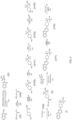
- FIG. 2 shows the synthetic pathway in overview, including steps to prepare various starting materials.
- Step 7 ( E )-2-(1-(3-ethoxyacryloyl)piperidin-4-yl)ethyl-1,1,2,2- d 4 benzoate
- Step 8 2-(1-(benzo[4,5]imidazo[1,2- a ]pyrimidin-2-yl)piperidin-4-yl)ethyl-1,1,2,2- d 4 benzoate
- reaction was then heated to 80 °C and stirred for 4 h. Upon confirmation of reaction completion, saturated aqueous NaHCO 3 (100.0 mL) was charged and the resulting aqueous layer was extracted with three portions of DCM (100.0 mL). The organic phases were then combined, died over Na 2 SO 4 , and evaporated to dryness. The crude was then slurried in EtOAc (30.0 mL) then filtered. This slurry process was repeated twice more.
- Step 10 2-(1-(benzo[4,5]imidazo[1,2- a ]pyrimidin-2-yl)piperidin-4-yl)ethyl-1,1,2,2- d 4 4-methylbenzenesulfonate
Landscapes
- Chemical & Material Sciences (AREA)
- Organic Chemistry (AREA)
- Health & Medical Sciences (AREA)
- Life Sciences & Earth Sciences (AREA)
- Biochemistry (AREA)
- General Health & Medical Sciences (AREA)
- Molecular Biology (AREA)
- Pharmaceuticals Containing Other Organic And Inorganic Compounds (AREA)
- Nitrogen Condensed Heterocyclic Rings (AREA)
- Medicines Containing Antibodies Or Antigens For Use As Internal Diagnostic Agents (AREA)
Description
- The technology described herein generally relates to organic synthesis, and more particularly relates to synthetic pathways to molecules that are isotopically labeled and are used as imaging agents in positron emission tomography.
- Neurofibrillary tangles (NFTs) are deposits in the brain that are believed to be a hallmark of several neuropathologies, including Alzheimer's disease (AD). NFT plaques are comprised of aggregated hyperphosphorylated tau protein. The tau protein is associated with cytoskeleton and is involved in the transport of vesicles along microtubules in neurons. Under pathological conditions, tau is hyperphosphorylated and forms beta-sheet aggregates with fibrillar appearances similar to Aβ in senile plaques. Some tau-targeted therapies aim to slow disease progression by interfering with cell-to-cell transfer of soluble tau oligomers. If a patient's tau burden can be reliably monitored, currently and over time, then disease progression can be better understood and such therapeutic approaches can be improved. Tau-specific positron emission tomography (PET) imaging biomarkers can non-invasively monitor disease progression as well as provide a direct measure of tau-targeted agent efficacy and confirmation of its mechanism of action in clinical trials (see, e.g., Mathis, C. A.; Klunk, W. E., Neuron, (2013), 79 (6), 1035-7; and Jensen, J. R., et al., J. Alzheimer's Disease, (2011), 26 Suppl. 3, 147-57).
- One promising tau-specific PET imaging biomarker is a substituted benzo[4,5]imidazo[1,2-a]pyrimidin-2-amine that is both deuterated as well as labeled by a radio-isotope. For clinical applications, the radio-isotope 18F is introduced into a precursor molecule immediately prior to administration of the compound to a patient. Correspondingly, an efficient synthesis of the precursor is particularly desirable because the precursor must be commercially available in large quantities that are ready for labeling.
- The benzo[4,5]imidazo[1,2-a]pyrimidin-2-amine structural element has also found utility in a number of other PET imaging agents that target tau protein plaques, and has also been incorporated into investigational tau degrader molecules. Additionally, this scaffold has been used as a PET imaging agent for the identification of other proteins associated with neurodegenerative conditions such as Huntington's disease. More generally, the benzo[4,5]imidazo[1,2-a]pyrimidine motif has been incorporated into molecules which have shown anti-neurodegenerative, anti-hypertensive, anti-microbial, and antiviral activity.
- Traditionally, benzo[4,5]imidazo[1,2-a]pyrimidine derivatives have been accessed via the condensation of amino-imidazoles with enones or enals bearing a leaving group in the β-position. While this approach generally provides imidazo-pyrimidine products in high yield and good isomeric selectivity, the scope of available substrates is limited to α,β-unsaturated aldehydes and ketones. To enable more efficient access to functionalized imidazo[1,2-a]pyrimidin-amines, other methods are needed.
WO 2015/173225 A1 is directed to deuterated and optionally detectably labeled heterocyclic compounds and their use as imaging agents. - The discussion of the background herein is included to explain the context of the technology. This is not to be taken as an admission that any of the material referred to was published, known, or part of the common general knowledge as at the priority date of any of the claims found appended hereto.
- Throughout the description and claims of the instant application the word "comprise" and variations thereof, such as "comprising" and "comprises", is not intended to exclude other additives, components, integers or steps.
- The instant disclosure addresses the synthesis of substituted imidazopyrimidine molecules, particularly a number that are deuterated at specific positions.
- In particular, the disclosure comprises a coupling step that can make a substituted imidazo-pyrimidine in high yield.
- Selective N-phosphorylation of aminoimidazoles results in a key steering element that controls isomeric selectivity in the condensation of β-ethoxy acrylamides and amino-imidazoles to furnish imidazo[1,2-a]pyrimidines. Conditions that provide highly selective (99:1) phosphorylation at the endo- or exocyclic nitrogen are disclosed. Either the 2-amino or 4-amino isomer of the (benzo)imidazo[1,2-a]pyrimidine products can be isolated in 64 - 95% yield.
- The disclosure further includes a compound of formula (V):

- In particular, compound (V) has a deuterium enrichment factor of 3,000 or greater at each of the positions shown as occupied by a deuterium atom.
- The disclosure further includes a compound of formula (VI):
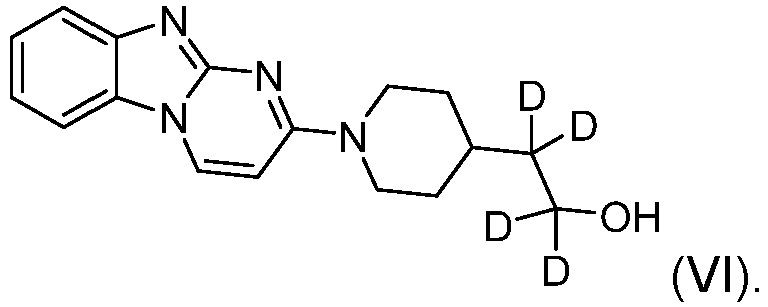
- In particular, compound (VI) has a deuterium enrichment factor of 3,000 or greater at each of the positions shown as occupied by a deuterium atom.
- The disclosure further comprises a method of synthesizing the compound of formula (I),

at least a step of coupling a compound of formula (II) with a compound of formula (III)

- The synthesis further comprises removing the benzoate group in I-P1 to give a second precursor (I-P2); and

- replacing the hydroxyl group in I-P2 by a tosyl group to give compound (I), wherein, in formulae (I), (II), (I-P1) and (I-P2), the carbon atom labeled (*) is optionally doubly-deuterated,
- wherein a deuterium enrichment factor is 3,000 or greater at each deuterium atom.
-
-
FIG. 1 shows a first flow-chart of a process as described herein. -
FIG. 2 shows a second flow-chart of a process as described herein. - Reference will now be made in detail to certain embodiments of the invention, examples of which are illustrated in the accompanying structures and formulas. While the invention will be described in conjunction with the enumerated embodiments, it will be understood that they are not intended to limit the invention to those embodiments.
- Unless otherwise defined, all technical and scientific terms used herein have the same meaning as commonly understood by one of ordinary skill in the art to which this invention belongs. The nomenclature used in this application is based on the ACS Style Guide and the The Journal of Organic Chemistry list of "Standard Abbreviations and Acronyms" (both published by the American Chemical Society, Washington, D.C.), as well as on IUPAC systematic nomenclature, unless indicated otherwise.
- Chemical elements are identified in accordance with the Periodic Table of the Elements, CAS version, Handbook of Chemistry and Physics, 75th Ed.
- Unless otherwise stated, the compounds include enantiomeric, diastereomeric and geometric (or conformational) isomeric forms of a given structure unless the structure is otherwise intended to be limited. For example, the R and S configurations for each asymmetric center, Z and E double bond isomers, Z and E conformational isomers, single stereochemical isomers, as well as enantiomeric, diastereomeric, and geometric (or conformational) mixtures are included. Unless otherwise stated, all tautomeric forms of structures depicted herein are also included.
- It is to be understood that when a compound or Example herein is shown as a specific salt, the corresponding free-base, as well as other salts of the corresponding free-base (including pharmaceutically acceptable salts of the corresponding free-base) are contemplated.
- The term "tautomer" or "tautomeric form" refers to structural isomers of different energies which are interconvertible via a low energy barrier. For example, proton tautomers (also known as prototropic tautomers) include interconversions via migration of a proton, such as keto-enol and imine-enamine isomerizations. Valence tautomers include interconversions by reorganization of some of the bonding electrons.
- Unless otherwise stated, structures depicted herein are also meant to include compounds that differ only in the presence of one or more isotopically enriched atoms in addition to any isotopically enriched atom that has been explicitly identified. For example, compounds, wherein the independent replacement or enrichment of one or more hydrogen by deuterium or tritium, carbon by 13C- or 14C carbon, nitrogen by a 15N nitrogen, sulfur by a 33S, 34S or 36S sulfur, or oxygen by a 17O or 18O oxygen are included. Such compounds are useful, for example, as analytical tools, as probes in biological assays, or as therapeutic agents.
- The term "deuterated" means that a hydrogen atom is replaced by a deuterium atom at a level above its natural abundance at one or more positions of a molecule. When a particular position is deuterated, it is understood that the abundance of deuterium at that position is substantially greater than the natural abundance of deuterium, which is 0.015%. A deuterated position typically has a minimum isotopic enrichment factor of at least 3000 (45% deuterium incorporation).
- The term "isotopic enrichment factor" as used herein means the ratio between the isotopic abundance and the natural abundance of a specified isotope. In certain embodiments, a given position in a molecule has an isotopic enrichment factor of at least 3500 (52.5% deuterium incorporation), at least 4000 (60% deuterium incorporation), at least 4500 (67.5% deuterium incorporation), at least 5000 (75% deuterium incorporation), at least 5500 (82.5% deuterium incorporation), at least 6000 (90% deuterium incorporation), at least 6333.3 (95% deuterium incorporation), at least 6466.7 (97% deuterium incorporation), at least 6600 (99% deuterium incorporation), or at least 6633.3 (99.5% deuterium incorporation). In some embodiments, 100% deuterium incorporation is achieved.
- Deuterium can be incorporated into a compound of the present invention using a variety of known reagents and synthetic techniques. For example, deuterium can be incorporated into a compound of formula (I) using LiAlD4 at an earlier stage in the synthesis that leads to compound (I). It can also be incorporated into a compound of formula (I) such as through reduction, catalytic hydrogenation or isotopic exchange using appropriate deuterated reagents such as deuterium gas D2, and deuterated (or "heavy") forms of water such as HDO or D2O.
- As between chemical names and structures shown, if there are any discrepancies, the structure prevails.
- As used herein, "a" or "an" means one or more, unless clearly indicated otherwise.
- Described herein are compounds that are deuterated at four positions (often referred to by "d4" as a prefix to the compound name), as follows:

- As described elsewhere herein, the invention further comprises methods of synthesis of such compounds.
- It should be understood that "d4" means that each of the deuterated positions has an enrichment factor of at least 3000, and preferably at least 3500, and still more preferably at least 4000, and even more preferably at least 4500.
- It should further be understood that, after synthesis, a d4-compound can be further purified to ensure that the enrichment factor at each of the deuterated positions is effectively at least 5000 or more.
- As described by way of specific synthetic schemes in the Examples that follow, the invention comprises a method of synthesizing a compound of formula (I):

- The methods herein can obtain a di-deuterated ("d2") form at a purity of >95% (i.e., D2/(D0+D1+D2) > 95%, where Dn denotes a molecule having n of the designated hydrogens substituted by deuterium atoms). In preferred embodiments, the purity is at least 97% of the d2 form. The quality (i.e., isotopic enrichment factor) of lithium aluminum deuterate (LiAlD4) is the principal driving force behind the actual purity of the compound obtained. A synthetic approach in which catalytic D2 gas is used to introduce deuterium atoms into the molecule typically cannot produce more than 98% purity of the d2 form. Consequently, the deuterium enrichment factor for each substituted position is typically in excess of 6333.3, and preferably in excess of 6400.
- A method of synthesizing compounds of formula (I) comprises, in a first step, coupling an acrylamide compound of formula (II) with an amino-imidazole compound of formula (III)

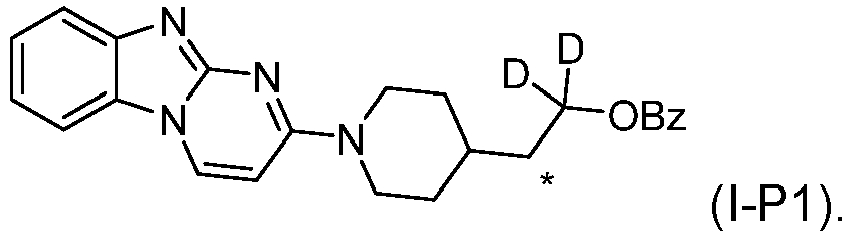
- This reaction provides the benzo[4,5]imidazo[1,2-a]pyrimidin-2-amine or (I-P1) with excellent selectivity over the alternative isomer, a benzo[4,5]imidazo[1,2-a]pyrimidin-4-amine.
- It would be understood by those of skill in the art that a number of suitable choices of non-aqueous solvent for this step exist, and also that other reagents may be suitably identified to achieve the coupling. The group Bz in (II) and (I-P1) denotes carboxyphenyl (-C(=O)Ph).
- In a second step, the benzoate group in (I-P1) is removed to give a second precursor (I-P2):

- This second step may occur in the presence of a base such as NaOH.
- In a third step, the hydroxyl group in I-P2 is replaced by a tosyl group to give compound (I). Tosylation may optionally involve an acidification step after reacting (I-P2) with tosylate.
- It is to be assumed that in formulae (II), (I-P1) and (I-P2), the carbon atom labeled (*) is also optionally doubly-deuterated. The reagents deployed to achieve the second and third steps may differ according to whether the carbon atom labeled (*) is doubly-deuterated.
- In some embodiments, the compound of formula (II) is synthesized by a method comprising: reacting

- In a subsequent step, a benzoyl group is added to the hydroxyl group of (II-P1) to produce a further intermediate

- In a further step, the Boc protecting group is removed from (II-P2) to produce a hydrochloride salt (II-P3)

- A compound of formula (II) can be formed by reacting (II-P3) with

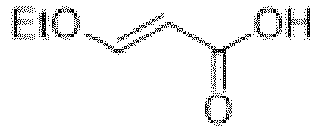
- In some embodiments, compound (IVa) is formed by reacting (IV) with SOCl2.
- In some embodiments, wherein the carbon atom labeled (*) in (II) is doubly deuterated, compound (II-P1) is created by reacting


- In some embodiments, the compound of formula (III) is synthesized by a method comprising: reacting

- In some embodiments, the phosphorylating agent, PCl(O)(OEt)2 is formed in situ by reacting diethyl hydrogen phosphate with a chlorinating agent such as 1,3,5-trichloro-1,3,5-triazinane-2,4,6-trione.
- One of skill in the art would appreciate that there are various ways to introduce a radio-isotope into a compound of formula (I) in order to make a tracer compound for use with imaging technology such as positron emission tomographay. For example, compounds of formula (I) can be tritiated (labeled with one or more tritium atoms), or the tosylate function can be replaced by a 18F isotope, both according to methods known in the art.
- Example 1 describes a representative synthesis of a tracer molecule deuterated at two positions including use of a step of conjugating an acrylamide with a phosphorylated imidazole.
FIG. 1 shows the synthetic pathway of Example 1 in overview, including steps to prepare starting materials. -

- To a reactor under nitrogen equipped with overhead agitation was charged tert-butyl 4-(2-methoxy-2-oxoethyl)piperidine-1-carboxylate (600 g, 2.33 mol, 1.0 equiv) and MTBE (4800 mL). Once full dissolution of the oil was observed, Norit™ A Supra charcoal (120 g, 20 w%) was charged to the reactor and the jacket was warmed to 35-45 °C. The mixture was held at this temperature for 2 h, cooled to 23 °C, then filtered through a Büchner funnel containing 100.54 g of Celite®. The funnel was then washed with MTBE (1200 mL).
- This procedure was repeated on another 600 g batch of tert-butyl 4-(2-methoxy-2-oxoethyl)piperidine-1-carboxylate and after filtration through Celite® and washing with MTBE (1200 mL), both solutions were combined then concentrated to dryness to obtain tert-butyl 4-(2-methoxy-2-oxoethyl)piperidine-1-carboxylate as a clear yellow oil (1137.89 g, 105.0%) in 97.33 A% HPLC purity.
- To a pressure reactor was charged tert-butyl 4-(2-methoxy-2-oxoethyl)piperidine-1-carboxylate (20 g, 77.72 mmol, 1.0 equiv), NaOMe (0.42 g, 7.77 mmol, 0.10 equiv), RuMACHO® (0.48 g, 0.78 mmol, 0.01 equiv), then PhMe (200 mL). The reactor was then sealed, the atmosphere evacuated under vacuum then backfilled with deuterium gas (20 atm) three times. The pressure reactor was then heated to 100 °C and stirred for 24 h. The reactor was then cooled to 23 °C, filtered through short pad of silica gel, rinsed with PhMe, and concentrated under vacuum to afford tert-butyl 4-(2-hydroxyethyl-2,2-d2 )piperidine-1-carboxylate as a yellow oil (17.0 g, 94.5% corrected yield) in 100.0 A% HPLC purity.
-

- To a reactor under nitrogen equipped with overhead agitation was charged anhydrous THF (20.0 L) and tert-butyl 4-(2-methoxy-2-oxoethyl)piperidine-1-carboxylate (2020 g, 7.85 mol, 1.0 equiv). The reactor was then cooled to 0-5 °C over 1-2 h then LiAlD4 (287.5 g, 6.85 mol, 0.87 equiv) was slowly charged in a portion-wise fashion. (Caution was appropriate as there was significant gas evolution.) Upon complete charging of the reagent, the reaction was stirred at 0-5 °C for 1 h. After reaction completion was confirmed, the reaction was quenched by slow addition of H2O (287 mL) while maintaining the internal temperature to ≤ 15 °C (Caution was appropriate as there was significant gas evolution.) The reactor was then warmed to 20-25 °C and stirred for 30 min. An aqueous 4N NaOH solution (287 g, 250 mL) was charged to the reactor and the mixture was again stirred at 20-25 °C for 30 min. Lastly, H2O (860 mL) was charged to the reactor and the mixture was again stirred at 20-25 °C for 30 min. The layers from the filtered mixture were then separated and the aqueous layer was discarded to waste. Na2SO4 (2500 g) was charged to the reactor containing the organic layer and the mixture was stirred at 20-25 °C for 2 h. The suspension was then filtered through a short pad of Celite (1500 g) then the pad washed with three separate portions of THF (10.0 L). The combined organic layer and washes were then concentrated under vacuum distillation (jacket temperature set to 55 °C). tert-butyl 4-(2-hydroxyethyl-2,2-d2 )piperidine-1-carboxylate was then collected as a yellow oil (1810 g, 100%) in 97.7 A% HPLC purity and used directly in the next step.
-

- To a reactor under nitrogen equipped with overhead agitation was charged tert-butyl 4-(2-hydroxyethyl-2,2-d2 )piperidine-1-carboxylate (2111 g, 9.126 mol, 1.0 equiv), toluene (16.0 L), EtsN (1.9 L, 13.65 mol, 1.5 equiv), and DMAP (109 g, 0.89 mol, 10 mol%). This mixture was stirred then the jacket was cooled to between -5 and 5 °C until the internal temperature achieved < 5 °C. Benzoyl chloride (1.4 L, 11.027 mol, 1.2 equiv) was charged slowly over 1h while maintaining the internal temperature < 5 °C. Upon complete addition of the reagent, the reactor was warmed to 20-30 °C then held for 2 h after reaching the desired jacket temperature. After completion of the reaction was confirmed, a half-saturated NaHCO3 solution (11.8 L) was charged to the reactor and stirred for 10 min. The layers were then separated and the aqueous layer drained to waste. Water (11.8 L) was then charged to the reactor and again stirred for 10 min. The layers were then separated and the aqueous layer drained to waste. The organic layer was then azeotropically dried via vacuum distillation with toluene (5.7 V) with the jacket temperature set to 65 °C. The resulting tert-butyl 4-(2-(benzoyloxy)ethyl-2,2-d2 )piperidine-1-carboxylate was obtained as a 16.0 V toluene solution in 95.6 A% HPLC purity and then used directly in the next step.
-

- To a reactor under nitrogen equipped with overhead agitation was charged 1-PrOH (5660 mL). The jacket was cooled to 0 to 5 °C then AcCl (2141 mL, 30.08 mol, 3.30 equiv) was charged slowly while maintaining the internal temperature < 5 °C. (Caution was appropriate as the reaction was exothermic.) Following complete addition of the reagent, the contents were held between 0-5 °C for 30 mins then tert-butyl 4-(2-(benzoyloxy)ethyl-2,2-d2 )piperidine-1-carboxylate (3061 g, 9.126 mol, 1.0 equiv) was charged as a toluene solution (16.0 L) then the retaining flask and transfer line were washed forward with toluene (4.0 L). The reactor jacket was then heated to 50 °C and stirred at temperature for 1 h. Upon confirmation of reaction completion, heptane was charged at temperature (jacket 45-55 °C) over 30 min to the self-seeded mixture. Following complete addition of the anti-solvent, the contents were aged for 2 h, the jacket then cooled to 0 °C over 1.5 h, and held at temperature for 1 h. The slurry was then filtered cold and washed with a pre-chilled 15% 1-PrOH: 85% heptane (12.0 L) solution at 0 °C. The solids were then dried under vacuum at 25 °C for 48 h to afford 2-(piperidin-4-yl)ethyl-1,1-d2 benzoate hydrochloride as an off-white solid (2188 g, 88% corrected yield over two steps, in 99.7 A% HPLC purity): mp 179-180 °C.
- 1H NMR (400MHz, DMSO-d6 ) δ = 9.34 -8.83 (m, 2H), 8.02 -7.92 (m, 2H), 7.70 -7.61 (m, 1H), 7.59 -7.48 (m, 2H), 3.21 (br d, J=12.5 Hz, 2H), 2.90 -2.75 (m, 2H), 1.84 (br d, J=13.4 Hz, 2H), 1.80 -1.69 (m, 1H), 1.68 -1.63 (m, 2H), 1.50 -1.35 (m, 2H). 13C NMR (101 MHz, DMSO-d6 ) δ = ppm 166.2, 133.8, 130.2, 129.6, 129.2, 62.2, 43.3, 34.5, 30.8, 28.6.
-

- To a reactor under nitrogen equipped with overhead agitation was charged 2-(piperidin-4-yl)ethyl-1,1-d2 benzoate hydrochloride (700 g, 2.576 mol, 1.0 equiv), (E)-3-ethoxyacrylic acid (389 g, 3.35 mol, 1.3 equiv), IPA (3.5 L, 5 V), and EtsN (1.8 L, 12.932 mol, 5.0 equiv). The contents were then stirred at 20-30 °C for 15 min then T3P® (50% solution in EtOAc, 1.85 L, 3.108 mol, 1.2 equiv) was charged slowly over 15 min while maintaining the temperature below 30 °C. The reactor jacket was then heated to 40 °C and held at temperature for 1 h. Upon confirmation of reaction completion by HPLC, water (10.5 L) was charged to the reactor over 2 h, then the reactor jacket was cooled to 20-30 °C over 2 h then aged for 12 h. The reaction mixture was filtered and the resulting cake was washed with two portions of a 3:1 mixture of water: IPA (8.0 L). The washed cake was then dried at 45 °C for 44 h and combined with another 700 g reaction conducted identically to the first batch, to afford (E)-2-(1-(3-ethoxyacryloyl)piperidin-4-yl)ethyl-1,1-d2 benzoate as a white solid (1457 g, 87 % corrected yield, in 99.3 A% HPLC purity): mp 106-109 °C.
- 1H NMR (400MHz, DMSO-d6 , 60 °C) δ = 7.97 (d, J=7.3 Hz, 2H), 7.69 -7.62 (m, 1H), 7.56 -7.50 (m, 2H), 7.37 (d, J=12.0 Hz, 1H), 5.82 (d, J=11.8 Hz, 1H), 4.17 (br s, 2H), 3.94 (q, J=6.9 Hz, 2H), 2.78 (br s, 2H), 1.81-1.64 (m, 5H), 1.25 (t, J=7.0 Hz, 3H), 1.16 - 1.01 (m, 2H). 13C NMR (101MHz, DMSO-d6 , 23 °C) δ = 165.2, 164.4, 159.9, 132.6, 129.5, 128.5, 128.1, 95.6, 65.9, 61.5, 42.7, 33.9, 32.2, 31.5, 13.9.
-

- To a reactor under nitrogen was charged 1H-benzo[d]imidazol-2-amine (0.7882 kg, 6.002 mol, 1.00 equiv) followed by MeCN (5.333 L). To this mixture was then added n-methylimidazole (0.6693 kg, 8.103 mol, 1.35 equiv) followed by MeCN (0.460 L) to rinse the reaction vessel. This slurry was then stirred at 20 °C for a minimum of 15 min. Next, CIP(O)(OEt)2 (1.4070 kg, 8.154 mol, 1.35 equiv) was added dropwise over 1 h keeping the internal temperature below 30 °C. Upon the completion of the CIP(O)(OEt)2 addition, MeCN (0.455 L) was added to rinse the reaction vessel. This slurry was then stirred at 20 °C for a minimum of 12 h. Upon completion of reaction, the vessel was cooled to 0 °C over a minimum of 30 min and then stirred at this temperature for a minimum of 2 h. This mixture was then filtered and the wetcake was washed with two portions of MeCN (3.2 L). The solids were dried under vacuum at 40 °C for a minimum of 12 h to afford diethyl (1H-benzo[d]imidazol-2-yl)phosphoramidate as an off-white solid (1.2144 kg, corrected yield: 73%, 99.5% HPLC purity): mp 229 °C.
- 1H NMR (400 MHz, Methanol-d4 ) δ 7.20 (dt, J = 7.6, 3.8 Hz, 2H), 7.11 (dd, J = 5.9, 3.2 Hz, 2H), 4.07 (p, J = 7.2 Hz, 4H), 1.32 (t, J = 7.1 Hz, 6H); 13C NMR (101 MHz, Methanol-d4 ) δ 123.4, 111.2, 63.4, 63.4, 16.6, 16.6; 31P NMR (162 MHz, Methanol-d4) δ 7.31.
-

- To a reactor under nitrogen was charged MeCN (5.00 L) followed by (E)-2-(1-(3-ethoxyacryloyl)piperidin-4-yl)ethyl-1,1-d2 benzoate (1.00 kg, 3.00 mol, 1.0 equiv) and diethyl (1H-benzo[d]imidazol-2-yl)phosphoramidate (888.5 g, 3.30 mol, 1.1 equiv). MeTHF (5.00 L) was charged followed by EtsN (152.0 g, 1.50 mol, 0.5 equiv). Next, the reactor was cooled between -10 and 10 °C and POCl3(1.01 kg, 6.60 mol, 2.2 equiv) was added over a minimum 30 min while maintaining the internal temperature between -10 to 10 °C. Upon completion of the addition, the contents were then heated to 65-95 °C over a minimum of 2 h and the reaction held at an internal temperature of 80 °C for a minimum of 1.5 h. After completion of reaction was confirmed, the reactor was cooled to 15 - 25 °C then added to a 25 w/w% solution of K2CO3 (premade by mixing water (5.0 L) with K2CO3 (1.67 kg) and stirring at 20 °C for a minimum of 15 min) over a minimum of 15 min while keeping the internal temperature below 30 °C. This was then stirred for a minimum of 15 min after which the layers were separated and the aqueous drained to waste. This reaction solution was then used directly in the next step.
-

- To a reactor under nitrogen containing the crude solution from the previous step was charged a 21 w/w% solution of NaOEt in EtOH (1.90 kg, 6.00 mol). The reactor was then heated to 60-80 °C and stirred for 30-90 min. After reaction completion was confirmed, the mixture was concentrated to 10 L via vacuum distillation. EtOH (10.0 L) was added and a constant-volume distillation was performed while maintaining the internal temperature below 55 °C. Water (7.5 L) was then added and the constant-volume distillation was maintained while maintaining the temperature below 60 °C. Vacuum was disabled and the solution was cooled to 5 °C over 7 h. An additional charge of a 21 w/w% solution of NaOEt in NaOH was added (300 g, 0.75 mol, 0.25 equiv) and the reaction was heated to 70-80 °C for 1.5 h. After which, the reactor was cooled to 5 °C over the course of 7 h then held at this temperature for a minimum of 2 h. The mixture was filtered and rinsed with a pre-cooled 3:1 water:EtOH solution (4.0 L) at 5-15 °C followed by a wash with water (4.0 L) at 15-25 °C. The solids were then dried under vacuum at 40 °C for a minimum of 12 h to afford 2-(1-(benzo[4,5]imidazo[1,2-a]pyrimidin-2-yl)piperidin-4-yl)ethan-1,1-d2 -1-ol as a light-yellow solid (684.0 g, corrected yield: 71%, 97.9% HPLC purity): mp 186 °C.
- 1H NMR (400 MHz, DMSO-d6 ) δ 8.93 (d, J = 7.7 Hz, 1H), 7.93 (d, J = 8.0 Hz, 1H), 7.50 (d, J = 8.0 Hz, 1H), 7.28 (t, J = 7.6 Hz, 1H), 7.13 (t, J = 7.6 Hz, 1H), 6.86 (d, J = 7.8 Hz, 1H), 4.55 (s, 2H), 4.36 (s, 1H), 2.99 (t, J = 12.7 Hz, 2H), 1.82 - 1.69 (m, 3H), 1.38 (d, J = 6.2 Hz, 2H), 1.12 (ddt, J = 15.6, 11.8, 6.0 Hz, 2H); 13C NMR (101 MHz, DMSO-d6 ) δ 157.8, 152.1, 144.1, 134.2, 127.7, 124.0, 118.9, 117.0, 110.1, 95.8, 44.6, 38.7, 32.1, 31.8.
-

- To a reactor under nitrogen was charged 2-(1-(benzo[4,5]imidazo[1,2-a]pyrimidin-2-yl)piperidin-4-yl)ethan-1,1-d2 -1-ol (0.6874 kg, 2099 mol, 1.0 equiv) followed by TsOH·H2O (0.531 kg, 2764 mmol. 1.2 equiv). MeCN (3.434 L) was then added and the reaction was stirred for a minimum of 15 min. Next, Ts2O (1.504 kg, 4607 mmol, 2.0 equiv) was added followed by MeCN (0.628 L) to rinse the reaction vessel. This slurry was then stirred at 20 °C for 16 h. After reaction completion was confirmed, H2O (0.687 L) was added. Next, NMP (4.124 L) was added while keeping the internal temperature below 30 °C and following complete addition, the reaction mixture was then stirred for a minimum of 15 min. Meanwhile, in a separate reactor was added a 20 wt% aqueous solution of K3PO4 (6.87 L). Then the crude reaction mixture was added to the basic solution over 1-3 h then the contents aged for a minimum of 1 h. The mixture was then filtered and the wetcake was washed with two portions of water (6.874 L). The solids were dried under vacuum at 20 °C for a minimum of 2 h followed by drying under vacuum at 35 °C for a minimum of 12 h to afford 2-(1-(benzo[4,5]imidazo[1,2-a]pyrimidin-2-yl)piperidin-4-yl)ethyl-1,1-d2 4-methylbenzenesulfonate as an off-white solid (888.2 g, corrected yield: 89%, 99.3% HPLC purity): mp 151°C.
- 1H NMR (400 MHz, Chloroform-d) δ 8.23 (d, J = 7.8 Hz, 1H), 7.84 - 7.77 (m, 2H), 7.71 (d, J = 8.1 Hz, 1H), 7.55 (d, J = 8.0 Hz, 1H), 7.37 (dd, J = 7.6, 5.1 Hz, 3H), 7.23 - 7.14 (m, 1H), 6.40 (d, J = 7.8 Hz, 1H), 4.58 (s, 2H), 2.94 (t, J = 12.9 Hz, 2H), 2.46 (s, 3H), 1.73 (s, 1H), 1.60 (d, J = 6.5 Hz, 2H), 1.18 (qd, J = 12.4, 4.1 Hz, 2H); 13C NMR (101 MHz, Chloroform-d) δ 157.8, 145.1, 132.7, 130.0, 128.0, 127.8, 124.8, 119.8, 118.7, 108.8, 108.8, 95.5, 95.4, 67.9, 45.2, 35.2, 32.5, 31.7, 21.8.
- Example 2 describes a representative synthesis of a tracer molecule that is deuterated at four positions wherein the method uses a step of conjugating an acrylamide with a phosphorylated imidazole.
FIG. 2 shows the synthetic pathway in overview, including steps to prepare various starting materials. -

- To a flask at 15-25 °C under nitrogen was charged 1,3,5-trichloro-1,3,5-triazinane-2,4,6-trione (5.55 g, 23.8 mmol, 0.31 equiv) and MeCN (35.0 mL). The mixture was stirred until homogenous. Diethyl hydrogen phosphate (10.3 g, 75.1 mmol, 9.69 mL, 1.00 eq) and Et3N (15.2 g, 150.2 mmol, 20.9 mL, 2.00 eq) were then added and the flask was heated to 85 °C and stirred for 30 min, at which point precipitation had occurred. The jacket was then cooled to 0 °C and 1H-benzo[d]imidazol-2-amine (10.0 g, 75.1 mmol, 1.00 equiv), dissolved in THF (35.0 mL), was charged to the flask. The reaction mixture was then warmed to 15-25 °C and stirred for 1 h. Upon confirmation of reaction completion, the reaction was quenched with water (100.0 mL) then extracted with two portions of ethyl acetate (200.0 mL). The combined organic layers were dried over Na2SO4, filtered, and then concentrated under reduced pressure to afford compound diethyl (1H-benzo[d]imidazol-2-yl)phosphoramidate as a brown solid (13.0 g, 48.2 mmol, 64% yield).
- 1H NMR (400 MHz, CDCl3) δ ppm 7.34 (dd, J = 18.03, 7.89 Hz, 2H), 7.19 (td, J = 7.67, 1.04 Hz, 1H), 7.05 (td, J = 7.70, 0.98 Hz, 1H), 6.13 - 6.74 (m, 2H), 4.20 - 4.34 (m, 2H), 4.00 - 4.19 (m, 3H), 1.33 (td, J = 7.09, 0.86 Hz, 6H).
-

- To a solution of (E)-3-ethoxyacrylic acid (4.40 g, 37.8 mmol, 1.00 equiv) in DCM (20.0 mL) was added SOCI2 (4.51 g, 37.8 mmol, 2.75 mL, 1.00 equiv) at 25 °C. The mixture was stirred at 40 °C for 1 h. After reaction completion was confirmed, the mixture was evaporated to dryness to afford (E)-3-ethoxyacryloyl chloride as a yellow oil (5.10 g, 37.9 mmol, 100% yield). This was used directly in the next step without purification.
-

- To a solution of tert-butyl 4-(2-methoxy-2-oxoethyl)piperidine-1-carboxylate (28.0 g, 108.8 mmol, 1.00 equiv) in CDsOD (35.0 mL) at 20 °C under nitrogen was added CD3ONa (15.5 g, 272.0 mmol, 2.5 equiv) then the reaction was heated to 80 °C for 12 h. After reaction completion was confirmed, the mixture was evaporated to dryness then 1N HCl was added to adjust the pH to a range of 6-7. The resulting mixture was then extracted with three portions of EtOAc (100.0 mL). The organic phases were combined, dried over Na2SO4, and then evaporated to dryness. The crude mixture was then purified via flash chromatography (3:1 heptane:ethyl acetate) to afford 2-(1-(tert-butoxycarbonyl)piperidin-4-yl)acetic-2,2-d2 acid as an off-white solid (25.0 g, 94% yield over two steps).
- 1H NMR (400 MHz, CDCl3) δ ppm 3.96 - 4.26 (m, 2H), 2.62 - 2.90 (m, 2H), 1.93 (tt, J = 11.63, 3.47 Hz, 1H), 1.73 (br d, J = 11.25 Hz, 2H), 1.46 (s, 9H), 1.04 - 1.31 (m, 2H).
-

- To a solution of LiAlD4 (8.51 g, 224.2 mmol, 11.5 mL, 2.20 equiv) in THF (175.0 mL) at -10 °C was then slowly added 2-(1-(tert-butoxycarbonyl)piperidin-4-yl)acetic-2,2-d2 acid (25.0 g, 101.9 mmol, 1.00 equiv) and upon complete addition of the starting material, the mixture was stirred for 10 min. After confirmation of reaction completion, H2O (8.50 mL) and 15% NaOH (8.50 mL) were added to the reaction. The mixture was then filtered and extracted with three portions of EtOAc (100.0 mL). The organic phases were combined, dried over Na2SO4, and evaporated to dryness to afford tert-butyl 4-(2-hydroxyethyl-1,1,2,2-d4 )piperidine-1-carboxylate as a yellow oil (11.5 g, 49.2 mmol, 48% yield).
- 1H NMR (400 MHz, CDCl3) δ ppm 3.98 - 4.17 (m, 2H), 2.59 - 2.78 (m, 2H), 1.64 - 1.73 (m, 2H), 1.53 - 1.62 (m, 1H), 1.46 (s, 9H), 1.01 - 1.20 (m, 2H).
-

- To a solution of tert-butyl 4-(2-hydroxyethyl-1,1,2,2-d4 )piperidine-1-carboxylate (11.5 g, 49.2 mmol, 1.00 equiv), Et3N (9.97 g, 98.5 mmol, 13.7 mL, 2.00 equiv), and THF (80.5 mL) at 0-10 °C was added BzCl (8.31 g, 59.1 mmol, 6.87 mL, 1.20 equiv) in a dropwise fashion. The mixture was then stirred at 0-10°C for 1 h. Upon confirmation of reaction completion, H2O (50.0 mL) was added and the aqueous layer was extracted with three portions of EtOAc (100.0 mL). The organic phases were combined, dried over Na2SO4, and evaporated to dryness. The crude was purified by flash chromatography (3:1 petroleum ether: ethyl acetate mobile phase) to afford tert-butyl 4-(2-(benzoyloxy)ethyl-1,1,2,2-d4 )piperidine-1-carboxylate as a yellow oil (10.5 g, 63% yield).
- 1H NMR (400 MHz, CDCl3) δ ppm 8.04 (d, J = 7.34 Hz, 2H), 7.52 - 7.64 (m, 1H), 7.36 -7.50 (m, 2H), 4.13 (q, J = 7.13 Hz, 2H), 2.71 (br t, J = 12.04 Hz, 2H), 1.74 (br d, J = 12.84 Hz, 2H), 1.56 - 1.65 (m, 1H), 1.46 (s, 9H), 1.07 - 1.23 (m, 2H).
-

- To a solution of tert-butyl 4-(2-(benzoyloxy)ethyl-1,1,2,2-d4 )piperidine-1-carboxylate (10.5 g, 31.1 mmol, 1.00 equiv) in EtOAc (10.5 mL) was added HCl in EtOAc (4 M, 30.0 mL) at 25 °C. The mixture was stirred at 25 °C for 1 h and after confirmation of reaction completion, the reaction was evaporated to dryness and the crude was used directly in the next step.
-

- To a solution of 2-(piperidin-4-yl)ethyl-1,1,2,2-d4 benzoate hydrochloride (8.52 g, 31.1 mmol, 1.00 equiv) and EtsN (3.15 g, 31.1 mmol, 4.33 mL, 1.00 equiv) in THF (15.0 mL) at 0-10 °C was added the crude (E)-3-ethoxyacryloyl chloride (5.02 g, 37.3 mmol, 1.2 equiv). The reaction was stirred at 0-10 °C for 1 h. Upon confirmation of reaction completion, H2O (50.0 mL) was added and resulting aqueous was extracted with three portions of EtOAc (50.0 mL). The organic phases were then combined, died over Na2SO4, and evaporated to dryness. The residue was then slurried in MTBE (10.0 mL) then filtered to afford (E)-2-(1-(3-ethoxyacryloyl)piperidin-4-yl)ethyl-1,1,2,2-d4 benzoate (3.20 g, 9.54 mmol, 31% yield) as a yellow solid.
- 1H NMR (400 MHz, DMSO-d6) δ ppm 8.03 (br d, J=7.34 Hz, 2H), 7.67 - 7.78 (m, 1H), 7.51 - 7.65 (m, 2H), 7.44 (d, J = 11.86 Hz, 1H), 5.91 (d, J = 11.86 Hz, 1H), 4.09 - 4.60 (m, 2H), 3.93 - 4.03(m, 2H), 2.66 - 3.12 (m, 2H), 1.61 - 1.89 (m, 3H), 1.29 (t, J = 7.03 Hz, 3H), 1.00 - 1.18 (m, 2H).
-

- To a solution of diethyl (1H-benzo[d]imidazol-2-yl)phosphoramidate (2.30 g, 8.53 mmol, 1.10 equiv) and (E)-2-(1-(3-ethoxyacryloyl)piperidin-4-yl)ethyl-1,1,2,2-d4 benzoate (2.60 g, 7.75 mmol, 1.00 equiv) in 2-MeTHF (13.0 mL) and MeCN (13.0 mL) at 25 °C was added Et3N (392 mg, 3.88 mmol, 539 µL, 0.50 equiv.) followed by POCl3 (2.61 g, 17.0 mmol, 1.58 mL, 2.20 equiv). The reaction was then heated to 80 °C and stirred for 4 h. Upon confirmation of reaction completion, saturated aqueous NaHCO3 (100.0 mL) was charged and the resulting aqueous layer was extracted with three portions of DCM (100.0 mL). The organic phases were then combined, died over Na2SO4, and evaporated to dryness. The crude was then slurried in EtOAc (30.0 mL) then filtered. This slurry process was repeated twice more. The resulting solids were then purified by prep-HPLC to afford 2-(1-(benzo[4,5]imidazo[1,2-a]pyrimidin-2-yl)piperidin-4-yl)ethyl-1,1,2,2-d4 benzoate (0.900 g, 2.22 mmol, 29% yield) as a yellow solid.
- 1H NMR (400 MHz, DMSO-d6) δ ppm 8.94 (d, J = 7.82 Hz, 1H), 7.89 - 8.03 (m, 3H), 7.61 - 7.72 (m, 1H), 7.45 - 7.58 (m, 3H), 7.24 - 7.34 (m, 1H), 7.07 - 7.19 (m, 1H), 6.89 (d, J = 7.82 Hz, 1H), 4.39 - 4.82 (m, 2H), 3.03 (br t, J = 11.55 Hz, 2H), 1.74 - 1.96 (m, 3H), 1.05 - 1.34 (m, 2H).
- 13C NMR (400 MHz, DMSO-d6) δ ppm 166.2, 158.3, 152.5, 144.6, 134.8, 133.7, 130.3, 129.5, 129.2, 128.2, 124.5, 119.4, 117.5, 110.6, 96.3, 44.9, 32.9, 32.0.
-

- To a solution of 2-(1-(benzo[4,5]imidazo[1,2-a]pyrimidin-2-yl)piperidin-4-yl)ethyl-1,1,2,2-d4 benzoate (0.900 g, 2.22 mmol, 1.00 equiv) in EtOH (10.0 mL) at 25 °C was added 5N NaOH (889.9 mg, 4.45 mmol, 2.00 equiv). The reaction was heated at 70 °C for 1 h. Upon confirmation of reaction completion, H2O (100.0 mL) was added and the aqueous layer was extracted with three portions of DCM (100.0 mL). The organic phases were then combined, died over Na2SO4, and evaporated to dryness. The crude was then slurried in MTBE (30.0 mL) and filtered to afford 2-(1-(benzo[4,5]imidazo[1,2-a]pyrimidin-2-yl)piperidin-4-yl)ethan-1,1,2,2-d4 -1-ol (500 mg, 1.63 mmol, 73% yield) as a yellow solid.
- 1H NMR (400 MHz, DMSO-d6) δ ppm 8.93 (d, J = 7.70 Hz, 1H), 7.93 (d, J = 7.95 Hz, 1H), 7.49 (d, J = 7.95 Hz, 1H), 7.28 (t, J = 7.58 Hz, 1H), 7.08 - 7.17 (m, 1H), 6.87 (d, J = 7.70 Hz, 1H), 4.47 - 4.73 (m, 2H), 4.36 (br s, 1H), 2.99 (br t, J = 11.62 Hz, 2H), 1.63 - 1.90 (m, 3H), 1.00 - 1.24 (m, 2H).
- 13C NMR (400 MHz, DMSO-d6) δ ppm 158.3, 152.5, 144.6, 134.7, 128.2, 124.5, 119.4, 117.5, 110.6, 96.3, 45.2, 32.5, 32.2.
-

- To a solution of 2-(1-(benzo[4,5]imidazo[1,2-a]pyrimidin-2-yl)piperidin-4-yl)ethan-1,1,2,2-d4 -1-ol (500 mg, 1.66 mmol, 1.00 equiv) and TsOH•H2O (380 mg, 2.00 mmol, 1.20 equiv) in MeCN (3.00 mL) at 25°C was charged 4-methylbenzenesulfonic anhydride (1.09 g, 3.33 mmol, 2.00 equiv). The reaction was heated to 40 °C and stirred for 12 h. Upon confirmation of reaction completion, H2O (0.500 mL) and NMP (3.00 mL) were added. A 20 w% solution of aqueous K3PO4 (5.00 mL) was then added and the resulting mixture was stirred at 25 °C for 2 h. After aging, the mixture was filtered and the cake washed with three portions of H2O (5.00 mL). The cake was then slurried in MTBE (10.0 mL) and filtered to give 2-(1-(benzo[4,5]imidazo[1,2-a]pyrimidin-2-yl)piperidin-4-yl)ethyl-1,1,2,2-d4 4-methylbenzenesulfonate (500 mg, 1.10 mmol, 66% yield, 96.9% purity) as an off-white solid.
- 1H NMR (500 MHz, DMSO-d6 ) δ 9.18 (d, J = 7.8 Hz, 1H), 8.16 (d, J = 8.1 Hz, 1H), 7.79 (d, J = 8.0 Hz, 2H), 7.57 (d, J = 7.9 Hz, 1H), 7.52 (t, J = 7.4 Hz, 1H), 7.47 (m, 3H), 7.31 (d, J = 7.9 Hz, 1H), 4.81 (d, J = 13.2 Hz, 1H), 4.32 (d, J = 13.9 Hz, 1H), 3.23 (t, J = 12.5 Hz, 1H), 3.01 (t, J = 13.3 Hz, 1H), 2.41 (s, 3H), 1.73 (m, 1H), 1.70 (m, 2H), 1.11(m, 2H); 13C NMR (126 MHz, DMSO-d6 ) δ 159.0, 148.1, 145.3, 135.8, 132.9, 130.5, 128.0, 127.2, 126.0, 123.6, 112.5, 112.1, 100.3, 68.3, 46.7, 44.5, 33.5, 31.6, 31.1, 21.4. HRMS m/z ([M+H]+) calculated for C24H22D4N4O3S 455.2050; found 455.2056.
- The foregoing description is intended to illustrate various aspects of the instant technology. It is not intended that the examples presented herein limit the scope of the appended claims.
Claims (8)
- A method of synthesizing the compound of formula (I), the method comprising:
 coupling a compound of formula (II) with a compound of formula (III)
 in the presence of POCl3 and Et3N in a non-aqueous solvent to give a first precursor (I-P1);
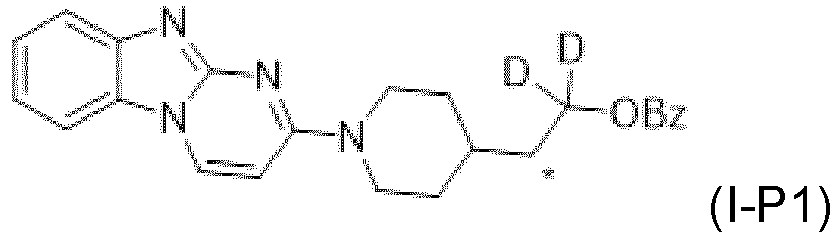 removing the benzoate group in I-P1 to give second precursor (I-P2); and
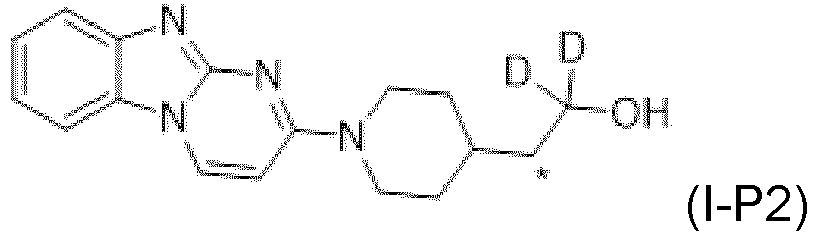 replacing the hydroxyl group in I-P2 by a tosyl group to give compound (I),wherein, in formulae (I), (II), (I-P1) and (I-P2), the carbon atom labeled (*) is optionally doubly-deuterated,wherein a deuterium enrichment factor is 3,000 or greater at each deuterium atom.
- The method of claim 1, further comprising radio-labeling the compound of formula (I) by replacing the tosylate group with an 18F atom.
- The method of claim 1, wherein the compound of formula (II) is synthesized by a method comprising:reacting

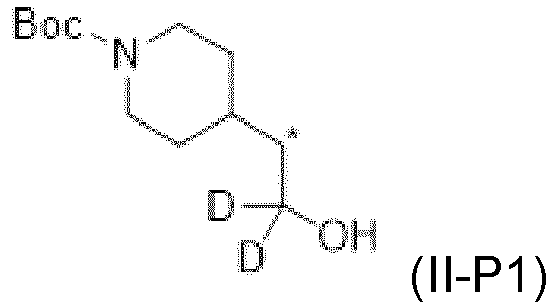 introducing a benzoyl group to the hydroxyl group of (II-P1) to produce a compound of formula (II-P2);
 removing the Boc protecting group from (II-P2) to produce a hydrochloride salt (II-P3); and
 reacting (II-P3) with

- The method of claim 3, wherein the first deuterating agent is LiAlD4.
- The method of claim 3, wherein the first deuterating agent is D2 gas.
- The method of claim 3, wherein compound (IVa) is formed by reacting
- The method of claim 3, wherein the carbon atom labeled (*) is doubly deuterated, and wherein compound d 4-(II-P1) is created by:reacting

 reacting the first deuterating agent with (II-P0) to form d 4-(II-P1).
- The method of claim 1, wherein the compound of formula (III) is synthesized by a method comprising:
reacting
Applications Claiming Priority (3)
| Application Number | Priority Date | Filing Date | Title |
|---|---|---|---|
| US201962845840P | 2019-05-09 | 2019-05-09 | |
| US201962937069P | 2019-11-18 | 2019-11-18 | |
| PCT/US2020/031952 WO2020227575A1 (en) | 2019-05-09 | 2020-05-07 | Synthesis of labeled imidazo[1,2-a]pyrimidines |
Publications (3)
| Publication Number | Publication Date |
|---|---|
| EP3966215A1 EP3966215A1 (en) | 2022-03-16 |
| EP3966215B1 true EP3966215B1 (en) | 2025-01-29 |
| EP3966215C0 EP3966215C0 (en) | 2025-01-29 |
Family
ID=70775603
Family Applications (2)
| Application Number | Title | Priority Date | Filing Date |
|---|---|---|---|
| EP20727124.8A Pending EP3966216A1 (en) | 2019-05-09 | 2020-05-07 | Regio-selective synthesis of imidazo[1,2-a]pyrimidines |
| EP20727123.0A Active EP3966215B1 (en) | 2019-05-09 | 2020-05-07 | Synthesis of labeled imidazo[1,2-a]pyrimidines |
Family Applications Before (1)
| Application Number | Title | Priority Date | Filing Date |
|---|---|---|---|
| EP20727124.8A Pending EP3966216A1 (en) | 2019-05-09 | 2020-05-07 | Regio-selective synthesis of imidazo[1,2-a]pyrimidines |
Country Status (12)
| Country | Link |
|---|---|
| US (2) | US11325912B2 (en) |
| EP (2) | EP3966216A1 (en) |
| JP (2) | JP7384926B2 (en) |
| KR (1) | KR102688397B1 (en) |
| CN (2) | CN114423763B (en) |
| AU (1) | AU2020267664B2 (en) |
| CA (1) | CA3138873C (en) |
| IL (1) | IL287887B2 (en) |
| MX (1) | MX2021013574A (en) |
| SG (1) | SG11202112064XA (en) |
| TW (2) | TWI751548B (en) |
| WO (2) | WO2020227575A1 (en) |
Families Citing this family (3)
| Publication number | Priority date | Publication date | Assignee | Title |
|---|---|---|---|---|
| CA3138873C (en) * | 2019-05-09 | 2024-01-09 | Kyle Bradley Pascual CLAGG | Synthesis of labeled imidazo[1,2-a]pyrimidines |
| CN114621191B (en) * | 2022-04-18 | 2023-08-15 | 东南大学 | EZH2 inhibitor and preparation and application thereof |
| CN115015443B (en) * | 2022-07-22 | 2023-11-10 | 浙江省疾病预防控制中心 | A method for simultaneous detection of acrylamide and methylimidazole compounds in tea and/or coffee |
Family Cites Families (10)
| Publication number | Priority date | Publication date | Assignee | Title |
|---|---|---|---|---|
| NL105826C (en) * | 1959-03-03 | 1900-01-01 | ||
| ATE538120T1 (en) * | 2007-06-26 | 2012-01-15 | Sanofi Sa | REGIOSelective, METAL-CATALYzed SYNTHESIS OF ANNATED BENZIMIDAZOLES AND AZABENZIMIDAZOLES |
| CN102438660A (en) * | 2009-03-23 | 2012-05-02 | 美国西门子医疗解决公司 | Imaging agents for detecting neurological disorders |
| US8691187B2 (en) * | 2009-03-23 | 2014-04-08 | Eli Lilly And Company | Imaging agents for detecting neurological disorders |
| MX376163B (en) | 2014-05-13 | 2025-03-07 | Hoffmann La Roche | DEUTERATED HETEROCYCLIC COMPOUNDS AND THEIR USE AS IMAGING AGENTS. |
| PL3197277T3 (en) | 2014-08-29 | 2022-04-04 | Chdi Foundation, Inc. | Probes for imaging huntingtin protein |
| CN107108604B (en) | 2014-10-27 | 2020-07-24 | 豪夫迈·罗氏有限公司 | Method for preparing tricyclic lactam compound |
| GB2548839B (en) | 2016-03-29 | 2021-02-24 | Great Matter Pharma Ab | New uses and methods |
| MX2019005007A (en) | 2016-11-01 | 2019-07-18 | Arvinas Inc | PROTAC TARGETED AT TAU PROTEIN AND ASSOCIATED METHODS OF USE. |
| CA3138873C (en) * | 2019-05-09 | 2024-01-09 | Kyle Bradley Pascual CLAGG | Synthesis of labeled imidazo[1,2-a]pyrimidines |
-
2020
- 2020-05-07 CA CA3138873A patent/CA3138873C/en active Active
- 2020-05-07 TW TW109115265A patent/TWI751548B/en active
- 2020-05-07 EP EP20727124.8A patent/EP3966216A1/en active Pending
- 2020-05-07 US US16/869,512 patent/US11325912B2/en active Active
- 2020-05-07 CN CN202080048689.9A patent/CN114423763B/en active Active
- 2020-05-07 JP JP2021566476A patent/JP7384926B2/en active Active
- 2020-05-07 US US16/869,475 patent/US11136330B2/en active Active
- 2020-05-07 AU AU2020267664A patent/AU2020267664B2/en active Active
- 2020-05-07 JP JP2021565742A patent/JP7369208B2/en active Active
- 2020-05-07 CN CN202080034738.3A patent/CN114026092B/en active Active
- 2020-05-07 EP EP20727123.0A patent/EP3966215B1/en active Active
- 2020-05-07 IL IL287887A patent/IL287887B2/en unknown
- 2020-05-07 MX MX2021013574A patent/MX2021013574A/en unknown
- 2020-05-07 WO PCT/US2020/031952 patent/WO2020227575A1/en not_active Ceased
- 2020-05-07 TW TW110144661A patent/TWI804079B/en active
- 2020-05-07 SG SG11202112064XA patent/SG11202112064XA/en unknown
- 2020-05-07 WO PCT/US2020/031953 patent/WO2020227576A1/en not_active Ceased
- 2020-05-07 KR KR1020217039376A patent/KR102688397B1/en active Active
Also Published As
Similar Documents
| Publication | Publication Date | Title |
|---|---|---|
| BR112020018562A2 (en) | PREPARATIVE PROCESS | |
| AU2022218443B2 (en) | Fused ring derivatives containing 1,4-oxazepane | |
| AU2020267664B2 (en) | Synthesis of labeled imidazo[1,2-A]pyrimidines | |
| JP2006522798A (en) | Fused N heterocyclic compounds and their use as CRF receptor antagonists | |
| KR20100051698A (en) | Imidazolone derivatives, preparation method thereof and biological use of same | |
| KR20160095161A (en) | Process methods for phosphatidylinositol 3-kinase inhibitors | |
| WO2015001348A1 (en) | Pyridazine derivatives as hedgehog pathway inhibitors | |
| SG192446A1 (en) | Process for the preparation of benzoimidazol-2-yl pyrimidine derivatives | |
| JPH051795B2 (en) | ||
| Pérez et al. | Preparative synthesis of an RP-guanosine-3′, 5′-cyclic phosphorothioate analogue, a drug candidate for the treatment of retinal degenerations | |
| AU2020410900A1 (en) | Compound used as RET kinase inhibitor and application thereof | |
| BR112021022395B1 (en) | METHOD FOR SYNTHESIZING THE COMPOUND | |
| CN114835688B (en) | Substituted 4-aryl imidazole-2-ketone derivative, preparation method and medical application thereof | |
| HK40060593A (en) | Synthesis of labeled imidazo[1,2-a]pyrimidines | |
| HK40060593B (en) | Synthesis of labeled imidazo[1,2-a]pyrimidines | |
| JP2025525290A (en) | WEE1 inhibitors and their production and use | |
| JP2024539504A (en) | process | |
| HK40064813A (en) | Regio-selective synthesis of imidazo[1,2-a]pyrimidines | |
| JP2000143589A (en) | Production of optically active hydroxy compound |
Legal Events
| Date | Code | Title | Description |
|---|---|---|---|
| STAA | Information on the status of an ep patent application or granted ep patent |
Free format text: STATUS: UNKNOWN |
|
| STAA | Information on the status of an ep patent application or granted ep patent |
Free format text: STATUS: THE INTERNATIONAL PUBLICATION HAS BEEN MADE |
|
| PUAI | Public reference made under article 153(3) epc to a published international application that has entered the european phase |
Free format text: ORIGINAL CODE: 0009012 |
|
| STAA | Information on the status of an ep patent application or granted ep patent |
Free format text: STATUS: REQUEST FOR EXAMINATION WAS MADE |
|
| 17P | Request for examination filed |
Effective date: 20211203 |
|
| AK | Designated contracting states |
Kind code of ref document: A1 Designated state(s): AL AT BE BG CH CY CZ DE DK EE ES FI FR GB GR HR HU IE IS IT LI LT LU LV MC MK MT NL NO PL PT RO RS SE SI SK SM TR |
|
| DAV | Request for validation of the european patent (deleted) | ||
| DAX | Request for extension of the european patent (deleted) | ||
| STAA | Information on the status of an ep patent application or granted ep patent |
Free format text: STATUS: EXAMINATION IS IN PROGRESS |
|
| 17Q | First examination report despatched |
Effective date: 20230630 |
|
| GRAP | Despatch of communication of intention to grant a patent |
Free format text: ORIGINAL CODE: EPIDOSNIGR1 |
|
| STAA | Information on the status of an ep patent application or granted ep patent |
Free format text: STATUS: GRANT OF PATENT IS INTENDED |
|
| INTG | Intention to grant announced |
Effective date: 20241112 |
|
| GRAS | Grant fee paid |
Free format text: ORIGINAL CODE: EPIDOSNIGR3 |
|
| GRAA | (expected) grant |
Free format text: ORIGINAL CODE: 0009210 |
|
| STAA | Information on the status of an ep patent application or granted ep patent |
Free format text: STATUS: THE PATENT HAS BEEN GRANTED |
|
| AK | Designated contracting states |
Kind code of ref document: B1 Designated state(s): AL AT BE BG CH CY CZ DE DK EE ES FI FR GB GR HR HU IE IS IT LI LT LU LV MC MK MT NL NO PL PT RO RS SE SI SK SM TR |
|
| REG | Reference to a national code |
Ref country code: GB Ref legal event code: FG4D |
|
| REG | Reference to a national code |
Ref country code: CH Ref legal event code: EP |
|
| REG | Reference to a national code |
Ref country code: DE Ref legal event code: R096 Ref document number: 602020045497 Country of ref document: DE |
|
| REG | Reference to a national code |
Ref country code: IE Ref legal event code: FG4D |
|
| U01 | Request for unitary effect filed |
Effective date: 20250219 |
|
| U07 | Unitary effect registered |
Designated state(s): AT BE BG DE DK EE FI FR IT LT LU LV MT NL PT RO SE SI Effective date: 20250225 |
|
| U20 | Renewal fee for the european patent with unitary effect paid |
Year of fee payment: 6 Effective date: 20250423 |
|
| PG25 | Lapsed in a contracting state [announced via postgrant information from national office to epo] |
Ref country code: RS Free format text: LAPSE BECAUSE OF FAILURE TO SUBMIT A TRANSLATION OF THE DESCRIPTION OR TO PAY THE FEE WITHIN THE PRESCRIBED TIME-LIMIT Effective date: 20250429 |
|
| PG25 | Lapsed in a contracting state [announced via postgrant information from national office to epo] |
Ref country code: PL Free format text: LAPSE BECAUSE OF FAILURE TO SUBMIT A TRANSLATION OF THE DESCRIPTION OR TO PAY THE FEE WITHIN THE PRESCRIBED TIME-LIMIT Effective date: 20250129 |
|
| PG25 | Lapsed in a contracting state [announced via postgrant information from national office to epo] |
Ref country code: ES Free format text: LAPSE BECAUSE OF FAILURE TO SUBMIT A TRANSLATION OF THE DESCRIPTION OR TO PAY THE FEE WITHIN THE PRESCRIBED TIME-LIMIT Effective date: 20250129 |
|
| PG25 | Lapsed in a contracting state [announced via postgrant information from national office to epo] |
Ref country code: IS Free format text: LAPSE BECAUSE OF FAILURE TO SUBMIT A TRANSLATION OF THE DESCRIPTION OR TO PAY THE FEE WITHIN THE PRESCRIBED TIME-LIMIT Effective date: 20250529 Ref country code: NO Free format text: LAPSE BECAUSE OF FAILURE TO SUBMIT A TRANSLATION OF THE DESCRIPTION OR TO PAY THE FEE WITHIN THE PRESCRIBED TIME-LIMIT Effective date: 20250429 |
|
| PG25 | Lapsed in a contracting state [announced via postgrant information from national office to epo] |
Ref country code: HR Free format text: LAPSE BECAUSE OF FAILURE TO SUBMIT A TRANSLATION OF THE DESCRIPTION OR TO PAY THE FEE WITHIN THE PRESCRIBED TIME-LIMIT Effective date: 20250129 |
|
| PG25 | Lapsed in a contracting state [announced via postgrant information from national office to epo] |
Ref country code: GR Free format text: LAPSE BECAUSE OF FAILURE TO SUBMIT A TRANSLATION OF THE DESCRIPTION OR TO PAY THE FEE WITHIN THE PRESCRIBED TIME-LIMIT Effective date: 20250430 |
|
| PG25 | Lapsed in a contracting state [announced via postgrant information from national office to epo] |
Ref country code: SM Free format text: LAPSE BECAUSE OF FAILURE TO SUBMIT A TRANSLATION OF THE DESCRIPTION OR TO PAY THE FEE WITHIN THE PRESCRIBED TIME-LIMIT Effective date: 20250129 |
|
| PG25 | Lapsed in a contracting state [announced via postgrant information from national office to epo] |
Ref country code: CZ Free format text: LAPSE BECAUSE OF FAILURE TO SUBMIT A TRANSLATION OF THE DESCRIPTION OR TO PAY THE FEE WITHIN THE PRESCRIBED TIME-LIMIT Effective date: 20250129 |
|
| PG25 | Lapsed in a contracting state [announced via postgrant information from national office to epo] |
Ref country code: SK Free format text: LAPSE BECAUSE OF FAILURE TO SUBMIT A TRANSLATION OF THE DESCRIPTION OR TO PAY THE FEE WITHIN THE PRESCRIBED TIME-LIMIT Effective date: 20250129 |
|
| PLBE | No opposition filed within time limit |
Free format text: ORIGINAL CODE: 0009261 |
|
| STAA | Information on the status of an ep patent application or granted ep patent |
Free format text: STATUS: NO OPPOSITION FILED WITHIN TIME LIMIT |
|
| REG | Reference to a national code |
Ref country code: CH Ref legal event code: L10 Free format text: ST27 STATUS EVENT CODE: U-0-0-L10-L00 (AS PROVIDED BY THE NATIONAL OFFICE) Effective date: 20251210 |
|
| 26N | No opposition filed |
Effective date: 20251030 |
|
| PG25 | Lapsed in a contracting state [announced via postgrant information from national office to epo] |
Ref country code: MC Free format text: LAPSE BECAUSE OF FAILURE TO SUBMIT A TRANSLATION OF THE DESCRIPTION OR TO PAY THE FEE WITHIN THE PRESCRIBED TIME-LIMIT Effective date: 20250129 |
|
| PGFP | Annual fee paid to national office [announced via postgrant information from national office to epo] |
Ref country code: GB Payment date: 20260317 Year of fee payment: 7 |
|
| PG25 | Lapsed in a contracting state [announced via postgrant information from national office to epo] |
Ref country code: IE Free format text: LAPSE BECAUSE OF NON-PAYMENT OF DUE FEES Effective date: 20250507 |
|
| U20 | Renewal fee for the european patent with unitary effect paid |
Year of fee payment: 7 Effective date: 20260421 |
|
| REG | Reference to a national code |
Ref country code: CH Ref legal event code: U11 Free format text: ST27 STATUS EVENT CODE: U-0-0-U10-U11 (AS PROVIDED BY THE NATIONAL OFFICE) Effective date: 20260601 |
|
| PGFP | Annual fee paid to national office [announced via postgrant information from national office to epo] |
Ref country code: CH Payment date: 20260601 Year of fee payment: 7 |
|
| U1H | Name or address of the proprietor changed after the registration of the unitary effect |
Owner name: F. HOFFMANN-LA ROCHE AG; CH |
|
| PG25 | Lapsed in a contracting state [announced via postgrant information from national office to epo] |
Ref country code: CY Free format text: LAPSE BECAUSE OF FAILURE TO SUBMIT A TRANSLATION OF THE DESCRIPTION OR TO PAY THE FEE WITHIN THE PRESCRIBED TIME-LIMIT Effective date: 20250129 |