EP3966203B1 - A method for functionalization of an aromatic amino acid or a nucleobase - Google Patents
A method for functionalization of an aromatic amino acid or a nucleobase Download PDFInfo
- Publication number
- EP3966203B1 EP3966203B1 EP20725768.4A EP20725768A EP3966203B1 EP 3966203 B1 EP3966203 B1 EP 3966203B1 EP 20725768 A EP20725768 A EP 20725768A EP 3966203 B1 EP3966203 B1 EP 3966203B1
- Authority
- EP
- European Patent Office
- Prior art keywords
- alkyl
- phenyl
- substituted
- present
- och
- Prior art date
- Legal status (The legal status is an assumption and is not a legal conclusion. Google has not performed a legal analysis and makes no representation as to the accuracy of the status listed.)
- Active
Links
Images





Classifications
-
- C—CHEMISTRY; METALLURGY
- C07—ORGANIC CHEMISTRY
- C07D—HETEROCYCLIC COMPOUNDS
- C07D347/00—Heterocyclic compounds containing rings having halogen atoms as ring hetero atoms
-
- C—CHEMISTRY; METALLURGY
- C07—ORGANIC CHEMISTRY
- C07K—PEPTIDES
- C07K1/00—General methods for the preparation of peptides, i.e. processes for the organic chemical preparation of peptides or proteins of any length
- C07K1/107—General methods for the preparation of peptides, i.e. processes for the organic chemical preparation of peptides or proteins of any length by chemical modification of precursor peptides
- C07K1/1072—General methods for the preparation of peptides, i.e. processes for the organic chemical preparation of peptides or proteins of any length by chemical modification of precursor peptides by covalent attachment of residues or functional groups
- C07K1/1077—General methods for the preparation of peptides, i.e. processes for the organic chemical preparation of peptides or proteins of any length by chemical modification of precursor peptides by covalent attachment of residues or functional groups by covalent attachment of residues other than amino acids or peptide residues, e.g. sugars, polyols, fatty acids
-
- C—CHEMISTRY; METALLURGY
- C07—ORGANIC CHEMISTRY
- C07B—GENERAL METHODS OF ORGANIC CHEMISTRY; APPARATUS THEREFOR
- C07B39/00—Halogenation
-
- C—CHEMISTRY; METALLURGY
- C07—ORGANIC CHEMISTRY
- C07C—ACYCLIC OR CARBOCYCLIC COMPOUNDS
- C07C217/00—Compounds containing amino and etherified hydroxy groups bound to the same carbon skeleton
- C07C217/54—Compounds containing amino and etherified hydroxy groups bound to the same carbon skeleton having etherified hydroxy groups bound to carbon atoms of at least one six-membered aromatic ring and amino groups bound to acyclic carbon atoms or to carbon atoms of rings other than six-membered aromatic rings of the same carbon skeleton
- C07C217/56—Compounds containing amino and etherified hydroxy groups bound to the same carbon skeleton having etherified hydroxy groups bound to carbon atoms of at least one six-membered aromatic ring and amino groups bound to acyclic carbon atoms or to carbon atoms of rings other than six-membered aromatic rings of the same carbon skeleton with amino groups linked to the six-membered aromatic ring, or to the condensed ring system containing that ring, by carbon chains not further substituted by singly-bound oxygen atoms
- C07C217/60—Compounds containing amino and etherified hydroxy groups bound to the same carbon skeleton having etherified hydroxy groups bound to carbon atoms of at least one six-membered aromatic ring and amino groups bound to acyclic carbon atoms or to carbon atoms of rings other than six-membered aromatic rings of the same carbon skeleton with amino groups linked to the six-membered aromatic ring, or to the condensed ring system containing that ring, by carbon chains not further substituted by singly-bound oxygen atoms linked by carbon chains having two carbon atoms between the amino groups and the six-membered aromatic ring or the condensed ring system containing that ring
-
- C—CHEMISTRY; METALLURGY
- C07—ORGANIC CHEMISTRY
- C07C—ACYCLIC OR CARBOCYCLIC COMPOUNDS
- C07C227/00—Preparation of compounds containing amino and carboxyl groups bound to the same carbon skeleton
- C07C227/14—Preparation of compounds containing amino and carboxyl groups bound to the same carbon skeleton from compounds containing already amino and carboxyl groups or derivatives thereof
- C07C227/16—Preparation of compounds containing amino and carboxyl groups bound to the same carbon skeleton from compounds containing already amino and carboxyl groups or derivatives thereof by reactions not involving the amino or carboxyl groups
-
- C—CHEMISTRY; METALLURGY
- C07—ORGANIC CHEMISTRY
- C07C—ACYCLIC OR CARBOCYCLIC COMPOUNDS
- C07C247/00—Compounds containing azido groups
- C07C247/02—Compounds containing azido groups with azido groups bound to acyclic carbon atoms of a carbon skeleton
- C07C247/04—Compounds containing azido groups with azido groups bound to acyclic carbon atoms of a carbon skeleton being saturated
-
- C—CHEMISTRY; METALLURGY
- C07—ORGANIC CHEMISTRY
- C07C—ACYCLIC OR CARBOCYCLIC COMPOUNDS
- C07C309/00—Sulfonic acids; Halides, esters, or anhydrides thereof
- C07C309/01—Sulfonic acids
- C07C309/28—Sulfonic acids having sulfo groups bound to carbon atoms of six-membered aromatic rings of a carbon skeleton
- C07C309/57—Sulfonic acids having sulfo groups bound to carbon atoms of six-membered aromatic rings of a carbon skeleton containing carboxyl groups bound to the carbon skeleton
- C07C309/58—Carboxylic acid groups or esters thereof
-
- C—CHEMISTRY; METALLURGY
- C07—ORGANIC CHEMISTRY
- C07C—ACYCLIC OR CARBOCYCLIC COMPOUNDS
- C07C43/00—Ethers; Compounds having groups, groups or groups
- C07C43/02—Ethers
- C07C43/20—Ethers having an ether-oxygen atom bound to a carbon atom of a six-membered aromatic ring
- C07C43/225—Ethers having an ether-oxygen atom bound to a carbon atom of a six-membered aromatic ring containing halogen
-
- C—CHEMISTRY; METALLURGY
- C07—ORGANIC CHEMISTRY
- C07C—ACYCLIC OR CARBOCYCLIC COMPOUNDS
- C07C69/00—Esters of carboxylic acids; Esters of carbonic or haloformic acids
- C07C69/02—Esters of acyclic saturated monocarboxylic acids having the carboxyl group bound to an acyclic carbon atom or to hydrogen
-
- C—CHEMISTRY; METALLURGY
- C07—ORGANIC CHEMISTRY
- C07D—HETEROCYCLIC COMPOUNDS
- C07D209/00—Heterocyclic compounds containing five-membered rings, condensed with other rings, with one nitrogen atom as the only ring hetero atom
- C07D209/02—Heterocyclic compounds containing five-membered rings, condensed with other rings, with one nitrogen atom as the only ring hetero atom condensed with one carbocyclic ring
- C07D209/04—Indoles; Hydrogenated indoles
- C07D209/10—Indoles; Hydrogenated indoles with substituted hydrocarbon radicals attached to carbon atoms of the hetero ring
- C07D209/14—Radicals substituted by nitrogen atoms, not forming part of a nitro radical
- C07D209/16—Tryptamines
-
- C—CHEMISTRY; METALLURGY
- C07—ORGANIC CHEMISTRY
- C07D—HETEROCYCLIC COMPOUNDS
- C07D233/00—Heterocyclic compounds containing 1,3-diazole or hydrogenated 1,3-diazole rings, not condensed with other rings
- C07D233/54—Heterocyclic compounds containing 1,3-diazole or hydrogenated 1,3-diazole rings, not condensed with other rings having two double bonds between ring members or between ring members and non-ring members
- C07D233/64—Heterocyclic compounds containing 1,3-diazole or hydrogenated 1,3-diazole rings, not condensed with other rings having two double bonds between ring members or between ring members and non-ring members with substituted hydrocarbon radicals attached to ring carbon atoms, e.g. histidine
-
- C—CHEMISTRY; METALLURGY
- C07—ORGANIC CHEMISTRY
- C07H—SUGARS; DERIVATIVES THEREOF; NUCLEOSIDES; NUCLEOTIDES; NUCLEIC ACIDS
- C07H1/00—Processes for the preparation of sugar derivatives
Definitions
- the invention relates to reductant-triggered functionalisation of aromatic amino acids or nucleobases with fluoroalkyl groups based on reaction of hypervalent iodine fluoroalkyl reagents with the aromatic amino acid or nucleobase (which may be incorporated in a protein or a nucleic acid) in the presence of a reductant.
- Methods for direct late-stage functionalisation of organic compounds and especially biomolecules are highly sought after.
- methods that allow fast and selective protein functionalisation ideally targeting one specific amino acid.
- Typical standard methods include lysine functionalisation with N-hydroxysuccinimide esters of carboxylic acids, or alkylation of free cysteines with iodoacetamides or maleimides.
- methods that enable direct functionalisation of aromatic amino acids are less common. Examples include ene-type functionalisation of tyrosine residues with triazolodiones or azo coupling using diazonium based reagents, such as 4-formylbenzenediazonium hexafluorophosphate.
- Tryptophan residues were selectively modified using metallocarbenes in aqueous media.
- a carbene derived from a vinyl diazo compound and rhodium catalyst reacted with both nitrogen and C(2) atom of tryptophan indole ring.
- the authors have carried out modification of horse heart myoglobin and the activity was preserved after the conjugation.
- the bioconjugation reaction was performed in ethylene glycol as a biocompatible cosolvent and using hydroxylamine hydrochloride to enhance the activity of catalyst.
- a transition metal-free procedure based on stabilized aminoxyl radicals for tryptophan-selective bioconjugation was reported by Seki et al.
- Hypervalent cyclic CF 3 -iodine reagents are known as Togni reagents ( Eisenberger P., Gischig, S., Togni A., Chem. Eur. J. 2006, 12, 2579-2586 ).
- Fluoroalkylation reagents of the Togni type suitable for fluoroalkylation of a broad variety of compounds with a broad range of fluoroalkyl-containing moieties were introduced in WO 2016/019475 and its US continuation-in-part counterpart US 2019/0040036 .
- WO 2016/019475 describes the synthesis of the Togni-type fluoroalkylation reagents, and briefly mentions their usability for fluoroalkylating certain types of reactive nucleophiles (page 8).
- fluoroalkylation reactions are carried out by contacting the substrate (nucleophile) with the Togni-type reagent.
- the substrate contains an indole ring
- the reaction is slow (overnight), has a rather low yield, and a catalysis by a copper compound is needed, i.e., it does not comply with the requirement for transition metal-free procedures.
- the aim of the present invention is to provide a transition metal-free method for direct late-stage functionalisation of aromatic amino acids or nucleobases and especially biomolecules containing these amino acids or nucleobases, which would be extremely fast, versatile and generally applicable.
- the method should be suitable for functionalization of four standard aromatic amino acids (phenylalanine, tryptophan, tyrosine, histidine) and of the nucleobases.
- the object of the invention is a method for functionalization of an aromatic amino acid or a nucleobase with a fluoroalkyl-containing moiety R F , wherein the aromatic amino acid is reacted in the presence of at least one reductant with at least one hypervalent iodine fluoroalkyl reagent (Togni-type reagent).
- Togni-type reagents used in the present invention have a general formula 1 wherein
- a 1 is a bivalent substituent, typically aliphatic or carbonyl.
- a 2 can be a monovalent substituent bound to A 1 , or it can be bivalent substituent bound to A 1 or to the iodine moiety.
- a 1 is present, A 2 is a bivalent substituent, and X 1 is not present. In another preferred embodiment, A 1 is present, A 2 is a monovalent substituent bound to A 1 , and X 1 is present.
- X 1 is chloro
- R F is selected from trifluoromethyl, omega-azido C 1-10 alkyl--1,1,2,2-tetrafluorobut-1-yl (such as 4-azido-1,1,2,2-tetrafluorobut-1-yl), 2-(N-imidazolyl)-1,1,2,2-tetrafluoroethan-1-yl.
- aromatic amino acid is intended to cover the aromatic amino acids in free form, as well as aromatic amino acids bound in peptide chains.
- Aromatic amino acids include phenylalanine, tryptophan, tyrosine, histidine, thyroxine, 5-hydroxytryptophan, L-DOPA.
- aromatic amino acids include phenylalanine, tryptophan, tyrosine, histidine. Most preferably, the aromatic amino acid is tryptophan.
- nucleobases is intended to cover adenine, cytosine, guanine, thymine, uracil, xanthine, hypoxanthine, 7-methylguanine, any of them in free form, or in the form of nucleoside, or in the form of nucleotide, or in the form of nucleotide bound in an oligonucleotide or polynucleotide chain. Most preferably, the nucleobase is cytosine.
- Me is intended to designate methyl group.
- An interesting application of the method of the present invention is a method of surface-labeling of proteins or nucleic acids which relies on the fast production of the reactive R F • radical which immediately reacts with the amino acids or nucleobases which are present on the surface of the protein or nucleic acid.
- the resulting labeled protein or nucleic acid can then be imaged (e.g., when the R F • radical bears a directly detectable group such as a fluorophore or a chromophore).
- the protein can then be digested into shorter peptides or amino acids, and the labeled amino acids can then be detected by known methods.
- the surface labelling method could be also employed for surface mapping of a protein such as an antibody, therefore constituting a protein characterisation method.
- the said surface labelling method could be applied to isolated pure proteins, as well as to protein-protein complexes, such as antibody-antigen complexes.
- the solvent accessible portion of the protein-protein complex would undergo fluoroalkylation, while the portions that are solvent-inaccessible due to binding would be protected from the surface mapping. Therefore, this method also represents an epitope-binding characterisation method.
- surface fluoroalkylation of a protein with an azidofluoroalkyl probe followed by subsequent affinity enrichment can be used to enhance the sensitivity of the method and the quality of the analytical data.
- Reductants are preferably selected from a group including sodium ascorbate, potassium ascorbate, calcium ascorbate, magnesium ascorbate, esters of ascorbic acid with carboxylic acids of the formula R 10 CO 2 H wherein R 10 is C 1-18 alkyl; sodium sulphite, sodium dithionite, tetrakis(dimethylamino)ethylene, sodium phosphite, sodium hypophosphite, and sodium hydroxymethanesulfinate (Rongalite).
- Preferred solvents for the reaction are water, aqueous buffers of pH range 4 to 10, preferably 5 to 8, dimethylsulfoxide (DMSO), acetonitrile (MeCN), dimethylformamide (DMF), dichloromethane, chloroform, methanol, and mixtures thereof.
- DMSO dimethylsulfoxide
- MeCN acetonitrile
- DMF dimethylformamide
- dichloromethane chloroform
- chloroform chloroform
- methanol and mixtures thereof.
- Preferred amount of the reductant is 0.05-1.2 equivalents relative to reagent 1, preferably 0.5-1.0 equivalents, more preferably approximately stoichiometric ratio of 0.9-1.1 equivalents.
- Preferred reaction conditions include the use of degassed or inert-gas purged solvents and buffers, or conducting the reaction under inert gas.
- Reagents 1 in the presence of reductants decompose to form R F• radicals (Scheme 1) which react with solvent-accessible aromatic amino acid residues, or with nucleobases, affording products of aromatic hydrogen substitution, such as:
- reagents 1 used in Examples section are shown below. These reagents represent preferred embodiments of the invention.
- the preferred specific structures of the reagents 1 include known compounds 1a and 1b ( Eisenberger, P.; Gischig, S.; Togni, A. Chemistry - A European Journal 2006, 12, 2586-2579 ), 1c-1f (Matou ⁇ ek, V.; Václav ⁇ k, J.; Hájek, P.; Charpentier, J.; Blastik, Z. E.; Pietrasiak, E.; Budinská, A.; Togni, A.; Beier, P.
- the method of the present invention enables a versatile, selective, mild, fast and irreversible modification of aromatic amino acid residues in free form or bound in peptides or proteins, as well as nucleobases in free form or bound in DNA or RNA chains with fluoroalkyl-bound groups of choice.
- the method has the advantage of reacting with all aromatic amino acids, with high selectivity to tryptophan; and with all nucleobases, with selectivity to cytosine.
- Scheme 1 generally shows the reaction scheme for preparation of individual reagents as described in the following examples.
- Step 1 CsF (0.45 mmol, 68 mg) and 3-oxo-1 ⁇ 3 -benzo[ d ][1,2]iodaoxol-1(3 H )-yl acetate (3 mmol, 918 mg) were disolved in dry DMF (2.5 ml) under argon atmosphere. To the well stirred suspension, solution of tert-butyl methyl(4-(1,1,2,2-tetrafluoro-2-(trimethylsilyl)ethoxy)-phenethyl)carbamate (1.5 mmol, 635 mg) in dry DMF (5 ml) was added dropwise.
- reaction mixture was dilluted with EtOAc (50 ml), washed with water (10 ml), 1 M NaHCO 3 (2 ⁇ 10 ml), 1 M LiCl (2 ⁇ 10 ml), dried over MgSO 4 , filtered and concentrated under reduced pressure.
- the crude product was purified by filtration through a pad of alumina (20 g). The impurities were washed away with Et 2 O (150 ml) and the alumina-adsorbed title product was completely eluted using MeOH (75 ml). The pure intermediate was obtained after concentration under reduced pressure as a colorless oil.
- Step 2 The iodane intermediate (3.4 mmol, 2 g) was dissolved in 1,2-dichloroethane (68 ml) in a round bottom flask. HCl (4 M in dioxane, 34 mmol, 8.5 ml) was added and the resulting mixture was stirred for 1 hour at 60 °C. The solvent was evaporated, leading to formation of white particles which were subsequently suspended in Et 2 O. The mother liquor was decanted and pure 1h was obtained as a white solid. Yield: 1.46 g (75%); m.p.
- the resulting mixture was left to react while reaching ambient temperature (2 h). Then it was poured into cold dilute solution of NaHCO 3 (250 ml, 5% w/w) and stirred for 10 min to bring about complete hydrolysis of the acetoxyiodane precursor to the insoluble hydroxy derivative. EtOAc (300 ml) was added, then the biphasic mixture was stirred and subsequently filtered through a pad of Celite. The organic phase was separated and the aqueous phase was extracted with additional EtOAc. The combined organic phases were washed twice with 5% solution of LiCl (2 ⁇ 100 ml). The organic phase was dried over Na 2 SO 4 and concentrated to near dryness.
- NaHCO 3 250 ml, 5% w/w
- N -2-Chlorocarbonylmethyl- N , N , N -trimethylammonium chloride (56 mg, 0.33 mmol) was suspended in dry CHCl 3 (1 ml) under argon atmosphere and 1a (109 mg, 0.33 mmol) was added in one portion. The suspension was stirred for 30 min under ambient temperature, then diluted with Et 2 O (1 ml). White particles were filtered and dried under reduced pressure.
- the biphasic brown reaction mixture is poured onto well-stirred cold diluted phosphoric acid (150 ml, 20%) until all magnesium salts dissolve.
- the organic phase was separated, the aqueous phase was extracted with ethyl acetate (2x70 ml).
- the pooled organic phases were washed with brine and dried over magnesium sulfate and filtered. The filtrate gave upon evaporation and drying on high vac a brown viscous oil in nearly quantitative yield (14,8 g, approx. 90% purity).
- the crude (2-iodophenyl)diphenylmethanol was taken directly into the next step.
- the precipitated isocyanuric acid was filtered off, the solution was concentrated to dryness, suspended in a mixture of pentane/diethyl ether (4/1 v/v, 70 ml) and cooled to -15 °C with stirring.
- the yellowish solid (1-chloro-3,3-diphenyl-1,3-dihydro-1 ⁇ 3-benzo[d][1,2]iodaoxole) was collected by filtration and washed with little precooled pentane and dried in high vacuum (1.83 g, 37%).
- reaction mixture was cooled to -15 °C and trifluoromethyl trimethylsilane (472 mg, 5 mmol, 2 equiv.) was added at once.
- the reaction mixture was warmed up to room temperature over the course of 5 h, then was filtered over a pad of Celite and concentrated to dryness on rotavap.
- the brownish oil was redissolved in a mixture of pentane/diethylether (3/1 v/v, 20 ml) and filtered through a pad of alumina.
- reaction mixture was cooled to -15 °C and a solution of trimethyl(1,1,2,2-tetrafluoro-2-(4-methoxyphenoxy)ethyl)silane (983 mg, 3.32 mmol, 2 equiv.) was added at once.
- the reaction mixture was warmed up to room temperature over the course of 5 h, then was filtered over a pad of Celite and concentrated to dryness on rotavap.
- the brownish oil was redissolved in a mixture of pentane/diethylether (3/1 v/v, 20 ml) and filtered through a pad of alumina.
- the solution of hypervalent iodine reagent (1.46 ⁇ l, 10 equiv.) was added and the mixture was vortexed for a few seconds.
- Bradykinin (1 equiv. as 1 mg/ml degassed solution in 20% v/v MeCN/50 mM pH 7 HEPES buffer) was mixed with sodium ascorbate (100 equiv. calculated to molar amount of aromatic residues, 20 mM solution in water) and solution of 1h was added (100 equiv. calculated to molar amount of aromatic resides, 8.7 mM in 50% v/v MeCN/H 2 O) The mixture was shaken for 15 min at 25 °C.
- MALDI MS analysis indicated partial formation of fluoroalkylated bradykinin and traces of 2 ⁇ fluoroalkylated bradykinin. MS/MS analysis revealed that Phe residue is fluoroalkylated.
- Somatostatin (1 equiv. as 1 mg/ml degassed solution in 20% v/v MeCN/50 mM pH 7 HEPES buffer) was mixed with sodium ascorbate (100 equiv. calculated to molar amount of aromatic residues, 20 mM solution in water) and solution of 1h was added (100 equiv. calculated to molar amount of aromatic resides, 8.7 mM in 50% v/v MeCN/H 2 O) . The mixture was shaken for 15 min at 25 °C.
- Bombesin (1 equiv. as 1 mg/ml degassed solution in 20% v/v MeCN/50 mM pH 7 HEPES buffer) was mixed with sodium ascorbate (100 equiv. calculated to molar amount of aromatic residues, 20 mM solution in water) and solution of 1h was added (100 equiv. calculated to molar amount of aromatic resides, 8.7 mM in 50% v/v MeCN/H 2 O). The mixture was shaken for 15 min at 25 °C.
- Masses detected 5809 1e Medium 5975 (monofluoroalkylated) 20 equiv ascorbate, 100 equiv 1e used 6141 (bis(fluoroalkylated)) 6307 (tris(fluoroalkylated)) 6474 (tetrakis(fluoroalkylated), trace) 6641 (pentakis(fluoroalkylated), trace) 6810 (hexakis(fluoroalkylated), trace) 5809 1f High 5975 (monofluoroalkylated) 20 equiv ascorbate, 100 equiv 1f used 6142 (bis(fluoroalkylated)) 6308 (tris(fluoroalkylated)) 6475 (tetrakis(fluoroalkylated), trace) 6641 (pentakis(fluoroalkylated), trace) 6807 (hexakis(fluoroalkylated), trace)
- a stock solution of ubiquitin from bovine erythrocytes in water was diluted in 50 mM amonium bicarbonate buffer (pH 7.5) to reach 58 ⁇ M concentrations (0.5 mg/ml).
- Freshly prepared solution of ascorbic acid in water (283 mM, 100 equiv. calculated to molar amount of aromatic residues) and 1e in DMSO (10 mg/1 ml, 100 equiv. calculated to molar amount of aromatic residues) were added and the reaction mixture which was incubated for 15 min at 25 °C.
- the mixture was desalted using Peptide Microtrap in the off-line holder (MichromBioresources) according manufacturer instruction, and eluted with 50 ⁇ l of 80% MeCN/5% AcOH.
- the protein was analysed using solariX XR FT-ICR mass spectrometer (Bruker Daltonics) equipped with a 15T superconducting magnet and ParaCell. The instrument was internally calibrated using Agilent tuning mix (Agilent Technologies, USA). Mass spectra were acquired in the positive mode over the m/z range 250-2500 with 2 M data points transient and 1 s ion accumulation, 8 scans were accumulated per spectrum. Data acquisition and data processing were performed using ftmsControl 2.2.0 and DataAnalysis 5.0.
- a stock solution of ubiquitin from bovine erythrocytes in water was transferred to 50 mM amonium bicarbonate buffer (pH 7.5) using a micro BioSpin 6 column (Biorad) and diluted in same buffer to reach 58 ⁇ M concentrations (0.5 mg/ml).
- Freshly prepared solution of ascorbic acid in water (50 mg/ml, 37 equiv.) and 1k in DMSO (10 mg/1 ml, 100 equiv.) were added and the reaction mixture was incubated for 1 min at 25 °C and transferred to 50mM amonium bicarbonate buffer pH 7.5 using a micro BioSpin 6 column in order to eliminate the effect of side products of radical reaction or unreacted ascorbic acid.
- the fluoroalkylated ubiquitin solution was mixed with DBCO-amine (100 equiv.) and incubated for 1 hour at 25 °C in the dark.
- the mixture was desalted using Peptide Microtrap in the off-line holder (MichromBioresources) according to manufacturer's instructions, and eluted with 50 ⁇ l of 80% MeCN/5% AcOH.
- the protein was analysed using solariX XR FT-ICR mass spectrometer (Bruker Daltonics) equipped with a 15T superconducting magnet and ParaCell. The instrument was internally calibrated using Agilent tuning mix (Agilent Technologies, USA).
- Mass spectra were acquired in the positive mode over the m/z range 250-2500 with 2 M data points transient and 1 s ion accumulation, 8 scans were accumulated per spectrum. Data acquisition and data processing were performed using ftmsControl 2.2.0 and DataAnalysis 5.0. ESI-MS indicated that ubiquitin underwent predominantly monofluoroalkylation with trace bis(fluoroalkylation) and the mono- and bis(fluoroalkylated) ubiquitin subsequently underwent clean copper-free click reaction with a dibenzocyclooctyne-amine reagent, affording the corresponding desired conjugates.
- Example XI Human Carbonic Anhydrase I - aminoacid side chains reactivity on protein
- a stock solution of carbonic anhydrase I from bovine erythrocytes (hCA I, Merck) in water was transferred to 50mM amonium bicarbonate buffer pH 7.5 using a micro BioSpin 6 column (Biorad) and diluted in same buffer to reach 17 ⁇ M concentration (0.5 mg/ml).
- Freshly prepared solution of ascorbic acid in water and one of reagents (1a, 1b, 1e and 1f) in DMSO were added in 150 ⁇ and 200 ⁇ molar excess to protein, respectively.
- reaction mixture was incubated 10 min at room temperature and mixed with 4 ⁇ concentrated LDS sample buffer (Invitrogen) containing 100 mM dithiothreitol as the reducing agent in a 3:1 (v/v) ratio.
- Samples were loaded onto a NuPage 4-12% Bis-Tris gel (80.0 ⁇ 80.0 ⁇ 1.0 mm, 10 wells, Invitrogen). Separation was performed in MES running buffer (Invitrogen) for 35 min at 200 V. After separation, the gels were stained by Coomassie Brilliant Blue R250 and destained with ethanol, water, and acetic acid in the ratio 55:35:10.
- Nano Reversed phase column (EASY-Spray column, 50 cm ⁇ 75 ⁇ m ID, PepMap C18, 2 ⁇ m particles, 100 ⁇ pore size) was used for LC/MS analysis.
- Mobile phase buffer A was composed of water and 0.1% formic acid.
- Mobile phase B was composed of acetonitrile and 0.1% formic acid.
- 1 ⁇ g of re-suspended samples were loaded onto the trap column (Acclaim PepMap300, C18, 5 ⁇ m, 300 ⁇ Wide Pore, 300 ⁇ m ⁇ 5 mm) at a flow rate of 15 ⁇ l/min.
- Loading buffer was composed of water, 2% MeCN and 0.1% TFA.
- Peptides were eluted with gradient of B from 4% to 35% over 60 min at a flow rate of 300 nl/min. Eluting peptide cations were converted to gas-phase ions by electrospray ionization and analyzed on a Thermo Orbitrap Fusion (Q-OT- qIT, Thermo). Survey scans of peptide precursors from 350 to 1400 m/z were performed at 120 K resolution (at 200 m/z) with a 5 ⁇ 10 5 ion count target. Tandem MS was performed by isolation at 1.5 Th with the quadrupole, HCD fragmentation with normalized collision energy of 30, and rapid scan MS analysis in the ion trap.
- the MS2 ion count target was set to 10 4 and the max injection time was 35 ms. Only those precursors with charge state 2-6 were selected for MS2.
- the dynamic exclusion duration was set to 45 s with a 10 ppm tolerance around the selected precursor and its isotopes. Monoisotopic precursor selection was turned on. The instrument was run in top speed mode with 2 s cycles. The data were exported to mgf files and MASCOT 2.0 search engine was used to interpret the data.
- the precursor mass error was set to 5 ppm, the fragment tolerance was set to 10 ppm, oxidation of methionine (+15.9959 a.m.u), and modification of aromatic residues (66.9784 a.m.u. for 1a,b and 166.0174 a.m.u.
- Single stranded DNA was dissolved in 50mM amonium bicarbonate buffer pH 7.5 to reach 50 ⁇ M concentration. Freshly prepared solution of ascorbic acid in water (50 mg/ml) and 1f in DMSO (10 mg/1 ml) were added each in 100 ⁇ molar excess relative to ssDNA. The reaction mixture was incubated for 5 min at room temperature. The labeling reaction was quenched by adding AcOH to 1% final concentration. The reaction products were analyzed using solariX XR FT-ICR mass spectrometer (Bruker Daltonics) equipped with a 15T superconducting magnet and ParaCell. The instrument was internally calibrated using Agilent tuning mix (Agilent Technologies, USA).
- Mass spectra were acquired in the negative ion mode over the m/z range 200-3000 with 2 M data points transient and 0.5 s ion accumulation, 8 scans were accumulated per spectrum.
- MS/MS spectra were acquired in for -4 charge state with 2 M data points transient and 2.5 s ion accumulation, 64 scans were accumulated per spectrum.
- Data acquisition and data processing were performed using ftmsControl 2.2.0 and DataAnalysis 5.0, respectively.
- the modified ssDNA was identified using MS2links software ( cit Kellersberger KA, Yu E, Kruppa GH, Young MM, Fabris D. Anal Chem.
- the MS-spectrum showed an approximately 10% conversion to the mono-fluoroalkylated derivative.
- the subsequent MS/MS fragmentation revealed that all fluoroalkylations can be traced to cytosine modification ( Figure 7 ).
- the disclosed method can be used for C-H functionalization of aromatic substrates, covalent modification of peptides and proteins containing aromatic amino acids and nucleotides containing cytosine with fluoroalkyl groups (bioconjugation), analytical biochemistry, protein surface mapping and fluoroalkylation, epitope mapping via surface modification and protein crosslinking. Proteins containing solvent exposed tryptophane residues and oligonucleotides with cytosine nucleobases represent the most suitable substrates.
Landscapes
- Chemical & Material Sciences (AREA)
- Organic Chemistry (AREA)
- General Health & Medical Sciences (AREA)
- Genetics & Genomics (AREA)
- Health & Medical Sciences (AREA)
- Life Sciences & Earth Sciences (AREA)
- Biochemistry (AREA)
- Chemical Kinetics & Catalysis (AREA)
- Molecular Biology (AREA)
- Analytical Chemistry (AREA)
- Medicinal Chemistry (AREA)
- General Chemical & Material Sciences (AREA)
- Proteomics, Peptides & Aminoacids (AREA)
- Biophysics (AREA)
- Engineering & Computer Science (AREA)
- Biotechnology (AREA)
- Organic Low-Molecular-Weight Compounds And Preparation Thereof (AREA)
- Plural Heterocyclic Compounds (AREA)
Description
- The invention relates to reductant-triggered functionalisation of aromatic amino acids or nucleobases with fluoroalkyl groups based on reaction of hypervalent iodine fluoroalkyl reagents with the aromatic amino acid or nucleobase (which may be incorporated in a protein or a nucleic acid) in the presence of a reductant.
- Methods for direct late-stage functionalisation of organic compounds and especially biomolecules are highly sought after. Of special interest are methods that allow fast and selective protein functionalisation, ideally targeting one specific amino acid. Typical standard methods include lysine functionalisation with N-hydroxysuccinimide esters of carboxylic acids, or alkylation of free cysteines with iodoacetamides or maleimides. In comparison, methods that enable direct functionalisation of aromatic amino acids are less common. Examples include ene-type functionalisation of tyrosine residues with triazolodiones or azo coupling using diazonium based reagents, such as 4-formylbenzenediazonium hexafluorophosphate.
- Tryptophan residues were selectively modified using metallocarbenes in aqueous media. A carbene derived from a vinyl diazo compound and rhodium catalyst reacted with both nitrogen and C(2) atom of tryptophan indole ring. The authors have carried out modification of horse heart myoglobin and the activity was preserved after the conjugation. The bioconjugation reaction was performed in ethylene glycol as a biocompatible cosolvent and using hydroxylamine hydrochloride to enhance the activity of catalyst. A transition metal-free procedure based on stabilized aminoxyl radicals for tryptophan-selective bioconjugation was reported by Seki et al. (Seki, Y.; Ishiyama, T.; Sasaki, D., et al., Journal of the American Chemical Society 2016, 138 (34), 10798-10801). However, methods for direct functionalisation of histidine are more scarce and this is even more so for phenylalanine residues for which there are no biocompatible and rapid bioconjugation methods.
- Hypervalent cyclic CF3-iodine reagents are known as Togni reagents (Eisenberger P., Gischig, S., Togni A., Chem. Eur. J. 2006, 12, 2579-2586). Fluoroalkylation reagents of the Togni type suitable for fluoroalkylation of a broad variety of compounds with a broad range of fluoroalkyl-containing moieties were introduced in
WO 2016/019475 and its US continuation-in-part counterpartUS 2019/0040036 .WO 2016/019475 describes the synthesis of the Togni-type fluoroalkylation reagents, and briefly mentions their usability for fluoroalkylating certain types of reactive nucleophiles (page 8). These fluoroalkylation reactions are carried out by contacting the substrate (nucleophile) with the Togni-type reagent. When the substrate contains an indole ring, the reaction is slow (overnight), has a rather low yield, and a catalysis by a copper compound is needed, i.e., it does not comply with the requirement for transition metal-free procedures. - The aim of the present invention is to provide a transition metal-free method for direct late-stage functionalisation of aromatic amino acids or nucleobases and especially biomolecules containing these amino acids or nucleobases, which would be extremely fast, versatile and generally applicable. In particular, the method should be suitable for functionalization of four standard aromatic amino acids (phenylalanine, tryptophan, tyrosine, histidine) and of the nucleobases.
- The object of the invention is a method for functionalization of an aromatic amino acid or a nucleobase with a fluoroalkyl-containing moiety RF, wherein the aromatic amino acid is reacted in the presence of at least one reductant with at least one hypervalent iodine fluoroalkyl reagent (Togni-type reagent).
- The Togni-type reagents used in the present invention have a
general formula 1
- R1 is selected from H, C1-C4 alkyl, Me(OCH2CH2) n O, wherein n = 1-10,
- X1 is not present or is selected from chloride, tetrafluoroborate, hexafluorophosphate, trifluoromethanesulfonate, methanesulfonate, toluenesulfonate, fluoride, bromide, (F(CF2)sSO2)2N-, wherein s = 1 to 4, C1-C6 carboxylate, fluorinated C1-C6 carboxylate, hexafluoroantimonate;
- A1 is not present or is selected from
- carbonyl group (C=O),
- R2-C-R3, where R2 and R3 are independently selected from fluorine, chlorine, hydrogen, CF3, C1-C4 alkyl, phenyl, phenyl substituted by fluorine, chlorine and/or C1-C4 alkyl, omega-methoxy-(C1-C4)alkyl, or R2 and R3 together with the carbon atom to which they are bound
form 1,1-cyclobutylene, 1,1-cyclopentylene, 1,1-cyclohexylene, 1,1-(4-oxacyclohexylene);
- A2 is not present or is selected from
- hydroxyl group (OH),
- oxygen (-O-),
- C1-4 alkoxy,
- OSiR4R5R6, wherein R4,R5,R6 are independently selected from methyl, ethyl, n-propyl, i-propyl and phenyl;
- R7N, wherein R7 is selected from C1-10 alkyl, phenyl-substituted C1-10 alkyl, 4-chlorophenyl-substituted C1-10 alkyl, and CH3(OCH2CH2) n ;
- R8CO-, wherein R8 is selected from C1-10 alkyl, phenyl-substituted C1-10 alkyl, CH3(OCH2CH2) o -, wherein o = 1-10, Cl-Me3N+(CH2) p -, wherein p = 1-10, -(CX2) m COOQ, - (CX2) m SO3Q, wherein m = 2-3, -phenyl-SO3Q, -phenyl-COOQ, -(CX2) m COO-, -(CX2) m SO3-, wherein m = 2-3, -phenyl-SO3-, -phenyl-COO-,
- X2 = F or Cl, X3 = H, CH3, F or Cl,
- Q is selected from lithium, sodium, potassium, rubidium, cesium, tetra (C1-C4 alkyl, phenyl, benzyl) ammonium (such as tetramethylammonium, tetraethylammonium, tetrapropylammonium, tetrabutylammonium, benzyltriethylammonium, phenyltrimethylammonium), tri (C1-C4 alkyl, phenyl, benzyl) pyridinium;
- R9C(O)O-, wherein R9 is selected from C1-10 alkyl, phenyl-substituted C1-10 alkyl, CH3(OCH2CH2) o -, wherein o = 1-10, Cl-Me3N+(CH2) p -, wherein p = 1-10, -(CX2) m COOQ, - (CX2) m SO3Q, wherein m = 2-3, -phenyl-SO3Q, -phenyl-COOQ, -(CX2) m COO-, -(CX2) m SO3-, wherein m = 2-3, -phenyl-SO3-, -phenyl-COO-,
- X2 = F or Cl, X3 = H, CH3, F or Cl,
- Q is selected from lithium, sodium, potassium, rubidium, cesium, tetra (C1-C4 alkyl, phenyl, benzyl) ammonium (such as tetramethylammonium, tetraethylammonium, tetrapropylammonium, tetrabutylammonium, benzyltriethylammonium, phenyltrimethylammonium), tri (C1-C4 alkyl, phenyl, benzyl) pyridinium;
- RF is -CF2-A3-A4, wherein
- A3 is not present and A4 is fluorine, or phenylsulfanyl (PhS) group, or
- A3 is CF2 and A4 is fluorine, C1-10 perfluoroalkyl, phenoxy, C1-10 alkoxy, phenylsulfanyl, N-imidazolyl, N-pyrazolyl, N-benzimidazolyl, N-triazoyl, N-(2-methyl)imidazolyl, CH3(OCH2CH2) n O, where n = 1-10, Cl-MeH2N+(CH2) r , wherein r = 1-10, Cl-MeH2N+(CH2)2-phenyloxy, C1-10 alkyl, ethenyl, ethynyl, omega-azido C1-10 alkyl, omega-amino C1-10 alkyl, omega-ethynyl C1-10 alkyl, C1-10 alkylthio, phenyl, chloro, bromo, iodo, azido, nitro, C1-10 alkoxycarbonyl-substituted phenyl, C2-10 alkenyl, C2-10 alkyl omega substituted with SO2F, N-succinimide-O-C(O)-, methyldiaziridine, trifluoromethyldiaziridine, rhodamine, fluorescein or coumarin; aryl p-substituted with N-succinimide-O-C(O)-, rhodamine, fluorescein or coumarin, phenoxy p-substituted with N-succinimide-O-C(O)-, rhodamine, fluorescein or coumarin, and 2-(aryliodanyl)-1,1,2,2-tetrafluoroethyl; in alkyl chains, two neighboring carbon atoms may be replaced by a methylamido group (-N(Me)-C(O)-) and/or by a phenyl group.
- It can be seen from the definition of the substituents that A1 is a bivalent substituent, typically aliphatic or carbonyl. A2 can be a monovalent substituent bound to A1, or it can be bivalent substituent bound to A1 or to the iodine moiety. A2 is typically bound to A1 via a heteroatom (O or N) or by a carbonyl (C=O) carbon.
- In one preferred embodiment, A1 is present, A2 is a bivalent substituent, and X1 is not present. In another preferred embodiment, A1 is present, A2 is a monovalent substituent bound to A1, and X1 is present.
- Preferably, X1 is chloro.
- Preferably, A1 is C=O or -C(CH3)2-, 1,1-cyclobutylene, 1,1-cyclopentylene, 1,1-cyclohexylene, 1,1-(4-oxacyclohexylene).
- Preferably, A2 is selected from -OH, -O-, R9C(O)O-, wherein R9 is selected from C1-10 alkyl, phenyl-substituted C1-10 alkyl, CH3(OCH2CH2) o -, wherein o = 1-10, Cl-Me3N+(CH2) p -, wherein p = 1-10, - (CX2) m COOQ, -(CX2) m SO3Q, wherein m = 2-3, -phenyl-SO3Q, -phenyl-COOQ, -(CX2) m COO-, - (CX2) m SO3-, wherein m = 2-3, -phenyl-SO3-, -phenyl-COO-,
- X2 = F or Cl, X3 = H, CH3, F or Cl,
- Q is selected from lithium, sodium, potassium, rubidium, cesium, tetra (C1-C4 alkyl, phenyl, benzyl) ammonium (such as tetramethylammonium, tetraethylammonium, tetrapropylammonium, tetrabutylammonium, benzyltriethylammonium, phenyltrimethylammonium), tri (C1-C4 alkyl, phenyl, benzyl) pyridinium.
- Preferably, RF is selected from trifluoromethyl, omega-azido C1-10 alkyl--1,1,2,2-tetrafluorobut-1-yl (such as 4-azido-1,1,2,2-tetrafluorobut-1-yl), 2-(N-imidazolyl)-1,1,2,2-tetrafluoroethan-1-yl.
- The term "aromatic amino acid" is intended to cover the aromatic amino acids in free form, as well as aromatic amino acids bound in peptide chains.
- Aromatic amino acids include phenylalanine, tryptophan, tyrosine, histidine, thyroxine, 5-hydroxytryptophan, L-DOPA. Preferably, aromatic amino acids include phenylalanine, tryptophan, tyrosine, histidine. Most preferably, the aromatic amino acid is tryptophan.
- The term "nucleobases" is intended to cover adenine, cytosine, guanine, thymine, uracil, xanthine, hypoxanthine, 7-methylguanine, any of them in free form, or in the form of nucleoside, or in the form of nucleotide, or in the form of nucleotide bound in an oligonucleotide or polynucleotide chain. Most preferably, the nucleobase is cytosine.
- "Me" is intended to designate methyl group.
- Within the framework of the present invention, it was suprisingly found that the reaction of the Togni-type reagent of formula I with a reductant generates the fluoroalkylating radical RF• in an extremely fast reaction (few seconds), and the fluoroalkylating radical in turn immediately reacts with available aromatic amino acids or nucleobases. This allows to label or crosslink peptides, proteins or nucleic acid on pre-determined amino acids or nucleobases. Due to the defined preference of Togni-type reagents for certain amino acids and nucleobases which can be fine tuned by the structure of the RF moiety, a pre-defined reaction may be achieved with preciseness. The exceptionally high rate of fluoroalkyl radical capture by aromatic amino acid residues is advantageous.
- An interesting application of the method of the present invention is a method of surface-labeling of proteins or nucleic acids which relies on the fast production of the reactive RF• radical which immediately reacts with the amino acids or nucleobases which are present on the surface of the protein or nucleic acid. The resulting labeled protein or nucleic acid can then be imaged (e.g., when the RF• radical bears a directly detectable group such as a fluorophore or a chromophore). Alternatively, and particularly in case of a protein, the protein can then be digested into shorter peptides or amino acids, and the labeled amino acids can then be detected by known methods.
- Furthermore, the surface labelling method could be also employed for surface mapping of a protein such as an antibody, therefore constituting a protein characterisation method.
- Advantageously, the said surface labelling method could be applied to isolated pure proteins, as well as to protein-protein complexes, such as antibody-antigen complexes. The solvent accessible portion of the protein-protein complex would undergo fluoroalkylation, while the portions that are solvent-inaccessible due to binding would be protected from the surface mapping. Therefore, this method also represents an epitope-binding characterisation method.
- More preferably, surface fluoroalkylation of a protein with an azidofluoroalkyl probe followed by subsequent affinity enrichment (click reaction with a biotin-alkyne) can be used to enhance the sensitivity of the method and the quality of the analytical data.
- Reductants are preferably selected from a group including sodium ascorbate, potassium ascorbate, calcium ascorbate, magnesium ascorbate, esters of ascorbic acid with carboxylic acids of the formula R10CO2H wherein R10 is C1-18 alkyl; sodium sulphite, sodium dithionite, tetrakis(dimethylamino)ethylene, sodium phosphite, sodium hypophosphite, and sodium hydroxymethanesulfinate (Rongalite).
- Preferred solvents for the reaction are water, aqueous buffers of pH range 4 to 10, preferably 5 to 8, dimethylsulfoxide (DMSO), acetonitrile (MeCN), dimethylformamide (DMF), dichloromethane, chloroform, methanol, and mixtures thereof.
- Preferred amount of the reductant is 0.05-1.2 equivalents relative to
reagent 1, preferably 0.5-1.0 equivalents, more preferably approximately stoichiometric ratio of 0.9-1.1 equivalents. - Preferred reaction conditions include the use of degassed or inert-gas purged solvents and buffers, or conducting the reaction under inert gas.
-
Reagents 1 in the presence of reductants decompose to form RF• radicals (Scheme 1) which react with solvent-accessible aromatic amino acid residues, or with nucleobases, affording products of aromatic hydrogen substitution, such as:
- Modification of aromatic amino acids or amino acid residues in peptides or nucleobases using hypervalent iodine reagents has not been described in literature and its practical use is only made possible by the present finding that Togni-type reagents of formula I form the RF• radicals in the presence of the reductant extremely fast. The method of the present invention has advantage over existing methods for aromatic amino acid modification in the speed of the reactions (RF radicals are formed and react within seconds), selectivity towards the target compounds, in particular towards tryptophan or cytosine under certain conditions, high stability of conjugates and the use of inexpensive, non-toxic, transition metal-free and biocompatible reductants. Furthermore, the method enables fluoroalkylation of the aromatic amino acids present on the solvent-exposed surface of a protein, thus representing a tool for surface mapping of proteins which can find use in protein-ligand binding studies and epitope mapping studies.
- Specific structures of
reagents 1 used in Examples section are shown below. These reagents represent preferred embodiments of the invention.


- The preferred specific structures of the
reagents 1 include known compounds 1a and 1b (Eisenberger, P.; Gischig, S.; Togni, A. Chemistry - A European Journal 2006, 12, 2586-2579), 1c-1f (Matoušek, V.; Václavík, J.; Hájek, P.; Charpentier, J.; Blastik, Z. E.; Pietrasiak, E.; Budinská, A.; Togni, A.; Beier, P. Chemistry - A European Journal, 2016, 22, 417-424), 1g (Václavík, J.; Zschoche, R.; Klimánková, I.; Matoušek, V.; Beier, P.; Hilvert, D.; Togni, A. Chemistry - A European Journal 2017, 23, 6490-6494). Furthermore, an example of rhodamine-substituted Togni-type reagent and its synthesis was described in Václavík, J. et al. Chemistry - A European Journal 2017, 23, 6490-6494. 1i was described in ACS Cent. Sci. 2016, 2, 5, 341-350. - Protonation with Brønstedt acids (such as HCl), acylation with carboxylic acid chlorides or anhydrides provided activated (more electrophilic) reagents in salt or acetylated forms. Addition of LiCl led to the formation of chlorido-coordinated reagents (
Figure 1 ).Compounds 1h, 1j-1t are novel compounds. - The method of the present invention enables a versatile, selective, mild, fast and irreversible modification of aromatic amino acid residues in free form or bound in peptides or proteins, as well as nucleobases in free form or bound in DNA or RNA chains with fluoroalkyl-bound groups of choice. The method has the advantage of reacting with all aromatic amino acids, with high selectivity to tryptophan; and with all nucleobases, with selectivity to cytosine.
- Additionally, novel hypervalent iodine fluoroalkyl reagents of general formula 1-1 are claimed

- R1 is selected from H, C1-C4 alkyl, Me(OCH2CH2) n O, wherein n = 1-10,
- X1 is not present or is selected from chloride, tetrafluoroborate, hexafluorophosphate, trifluoromethanesulfonate, methanesulfonate, toluenesulfonate, fluoride, bromide, (F(CF2)sSO2)2N-, wherein s = 1 to 4, C1-C6 carboxylate, fluorinated C1-C6 carboxylate, hexafluoroantimonate;
- A1 is not present or is selected from
- carbonyl group (C=O),
- R2-C-R3, where R2 and R3 are independently selected from fluorine, chlorine, hydrogen, CF3, C1-C4 alkyl, phenyl, phenyl substituted by fluorine, chlorine and/or C1-C4 alkyl, omega-methoxy-(C1-C4)alkyl; or R2 and R3 together with the carbon atom to which they are bound
form 1,1-cyclobutylene, 1,1-cyclopentylene, 1,1-cyclohexylene, 1,1-(4-oxacyclohexylene);
- A2 is not present or is selected from
- hydroxyl group (OH),
- oxygen (-O-),
- C1-4 alkoxy,
- OSiR4R5R6, wherein R4,R5,R6 are independently selected from methyl, ethyl, n-propyl, i-propyl and phenyl;
- R7N, wherein R7 is selected from C1-10 alkyl, phenyl-substituted C1-10 alkyl, 4-chlorophenyl-substituted C1-10 alkyl, and CH3(OCH2CH2) n ;
- R8CO-, wherein R8 is selected from C1-10 alkyl, phenyl-substituted C1-10 alkyl, CH3(OCH2CH2) o -, wherein o = 1-10, Cl-Me3N+(CH2) p -, wherein p = 1-10, -(CX2) m COOQ, - (CX2) m SO3Q, wherein m = 2-3, -phenyl-SO3Q, -phenyl-COOQ, -(CX2) m COO-, -(CX2) m SO3-, wherein m = 2-3, -phenyl-SO3-, -phenyl-COO-,
- X2 = F or Cl, X3 = H, CH3, F or Cl,
- Q is selected from lithium, sodium, potassium, rubidium, cesium, tetra (C1-C4 alkyl, phenyl, benzyl) ammonium, tri (C1-C4 alkyl, phenyl, benzyl) pyridinium;
- R9C(O)O-, wherein R9 is selected from C1-10 alkyl, phenyl-substituted C1-10 alkyl, CH3(OCH2CH2) o -, wherein o = 1-10, Cl-Me3N+(CH2) p -, wherein p = 1-10, -(CX2) m COOQ, - (CX2) m SO3Q, wherein m = 2-3, -phenyl-SO3Q, -phenyl-COOQ, -(CX2) m COO-, -(CX2) m SO3-, wherein m = 2-3, -phenyl-SO3-, -phenyl-COO-,
- X2 = F or Cl, X3 = H, CH3, F or Cl,
- Q is selected from lithium, sodium, potassium, rubidium, cesium, tetra (C1-C4 alkyl, phenyl, benzyl) ammonium, tri (C1-C4 alkyl, phenyl, benzyl) pyridinium;
- RF is -CF2-A3-A4, wherein
- A3 is not present and A4 is fluorine, or phenylsulfanyl (PhS) group, or
- A3 is CF2 and A4 is fluorine, C1-10 perfluoroalkyl, phenoxy, C1-10 alkoxy, phenylsulfanyl, N-imidazolyl, N-pyrazolyl, N-benzimidazolyl, N-triazoyl, N-(2-methyl)imidazolyl, CH3(OCH2CH2) n O, where n = 1-10, Cl-MeH2N+(CH2) r , wherein r = 1-10, Cl-MeH2N+(CH2)2-phenyloxy, C1-10 alkyl, ethenyl, ethynyl, omega-azido C1-10 alkyl, omega-amino C1-10 alkyl, omega-ethynyl C1-10 alkyl, C1-10 alkylthio, phenyl, chloro, bromo, iodo, azido, nitro, C1-10 alkoxycarbonyl-substituted phenyl, C2-10 alkenyl, C2-10 alkyl omega substituted with SO2F, N-succinimide-O-C(O)-, methyldiaziridine, trifluoromethyldiaziridine, rhodamine, fluorescein or coumarin; aryl p-substituted with N-succinimide-O-C(O)-, rhodamine, fluorescein or coumarin, phenoxy p-substituted with N-succinimide-O-C(O)-, rhodamine, fluorescein or coumarin, and 2-(aryliodanyl)-1,1,2,2-tetrafluoroethyl; in alkyl chains, two neighboring carbon atoms may be replaced by a methylamido group (-N(Me)-C(O)-) and/or by a phenyl group,
provided that:- A2 is not -O- or -OH, when: A1 is C=O or R2-C-R3, wherein R2 and R3 are methyls;
- A2 is not -O-C(=O)CH3, when: RF is CF3 and A1 is C=O or R2-C-R3, wherein R2 and R3 are methyls;
- A2 is not -O- or -OH, when: X1 is not present, RF is CF3 and A1 is R2-C-R3, wherein R2 and R3 are selected from alkyl and CF3 or wherein R2 is methyl and R3 is phenyl or R2 and R3 together form 1,1-cyclohexylene;
- A2 is not -O- or -OH, when: X1 is not present, RF is selected from perfluoroethyl, perfluoropropyl, perfluorobutyl, perfluorohexyl or perfluorooctyl, A1 is R2-C-R3, wherein R2 is methyl and R3 is phenyl or isopropyl;
- A2 is not R7N, wherein R7 is selected from C1-10 alkyl, phenyl-substituted C1-10 alkyl, when: X1 is not present, RF is CF3 and A1 is C=O.
-
- Ac
- acetyl
- br s
- broad signal
- d
- doublet
- DBCO
- dibenzocyclooctyne
- DCM
- dichloromethane
- DMF
- dimethylformamide
- DMSO
- dimethylsulfoxid
- DTT
- 1,4-dithiothreitol
- equiv.
- equivalent(s)
- Et
- ethyl
- ESI
- electrospray ionization
- FDR
- false discovery rate
- FT-ICR
- Fourier-transform ion cyclotron resonance
- hCa
- Human Carbonic Anhydrase
- HCD
- Higher-energy C-trap dissociation
- HEPES
- 4-(2-hydroxyethyl)piperazine-1-ethanesulfonic acid
- HRMS
- high-resolution mass spectroscopy
- HSQC
- heteronuclear single quantum coherence
- ID
- internal diameter
- LC
- liquid chromatography
- LDS
- lithium dodecyl sulfate
- m
- multiplet
- MALDI
- matrix-assisted laser desorption ionization
- Me
- methyl
- MES
- 2-(N-morpholino)ethanesulfonic acid
- mol.
- Molar
- m.p.
- melting point
- MS
- mass spectroscopy
- NMR
- nuclear magnetic resonance
- p
- pentet
- q
- quartet
- Rf
- retention factor
- s
- singlet
- ssDNA
- single-stranded deoxyribonucleic acid
- t
- triplet
- TBAT
- tetrabutylammonium triphenyldifluorosilicate
- t-Bu
- tertiary butyl
- TFA
- trifluoroacetic acid
- TRIS
- tris(hydroxymethyl)aminomethane
-
-
Figure 1 : Fluoroalkylation of peptide AFRIPLYWGRI. -
Figure 2 : Fluoroalkylation of peptide bradykinin -
Figure 3 : Fluoroalkylation of peptide somatostatin -
Figure 4 : Fluoroalkylation of peptide bombesin -
Figure 5 : Identification of hCA I tryptic peptide modified by CF3 radicals using reagent 1a. Based on the fragment spectra tryptophane (A), tyrosine (B), phenylalanine (C) and histidine (D) were determined as residues susceptible to radical fluoroalkylation. -
Figure 6 : Red spots represent Trp123, Tyr88, Phe84 and His67 residues on the surface accessible area of hCA I structural model (1hcb). -
Figure 7 : MS/MS fragmentation patterns of monofluoroalkylated ss-DNA proving fluoroalkylation on cytosine nucleobase. - The subject-matter of present invention is further illustrated by the following examples.
-
Scheme 1 generally shows the reaction scheme for preparation of individual reagents as described in the following examples.
-

- Step 1: CsF (0.45 mmol, 68 mg) and 3-oxo-1λ3-benzo[d][1,2]iodaoxol-1(3H)-yl acetate (3 mmol, 918 mg) were disolved in dry DMF (2.5 ml) under argon atmosphere. To the well stirred suspension, solution of tert-butyl methyl(4-(1,1,2,2-tetrafluoro-2-(trimethylsilyl)ethoxy)-phenethyl)carbamate (1.5 mmol, 635 mg) in dry DMF (5 ml) was added dropwise. After 2 hours, the reaction mixture was dilluted with EtOAc (50 ml), washed with water (10 ml), 1 M NaHCO3 (2 × 10 ml), 1 M LiCl (2 × 10 ml), dried over MgSO4, filtered and concentrated under reduced pressure. The crude product was purified by filtration through a pad of alumina (20 g). The impurities were washed away with Et2O (150 ml) and the alumina-adsorbed title product was completely eluted using MeOH (75 ml). The pure intermediate was obtained after concentration under reduced pressure as a colorless oil. Yield: 604 mg (69%); 1H NMR (401.00 MHz, CDCl3): δ 1.34-1.39 (bs, 9H, C(17)H3 ), 2.76-2.83 (bm, 5H, C(12)H2 and C(14)H3 ), 3.41 (t, 3JHH = 7.2 Hz, 2H, C(13)H2 ), 7.12 (d, 3JHH = 8.2 Hz, 2H, C(9)H or C(10)H), 7.16-7.25 (bm, 2H, C(9)H or C(10)H), 7.66-7.80 (m, 2H, C(4)H and C(5)H), 7.90 (d, 3JHH= 8.1 Hz, 1H, C(6)H), 8.43 (dd, 3JHH = 7.3 Hz, 4JHH = 2.1 Hz, 1H, C(3)H); 19F NMR (377.28 MHz, CDCl3): δ - 89.5 (bs, 2F, CF 2), -84.4 (bs, 2F, CF 2); 13C {1H} NMR (100.84 MHz, CDCl3): δ 28.2 (s, 1C, C(17)H3), 33.3 and 33.7 (s, 1C, C(12)H2), 34.1 and 34.6 (s, 1C, C(14)H3), 49.9 and 50.4 (s, 1C, C(13)H2), 79.3 (s, 1C, C(16)), 110.5 (tt, 1 J CF = 335.4 Hz, 2 J CF = 40.0 Hz, 1C, CF2), 114.8 (s, 1C, C(7)), 117.2 (tt, 1 J CF = 277.9 Hz, 2 J CF = 25.6 Hz, 1C, CF2), 121.4 (bs, 2C, C(9)H or C(10)H), 128.1 (t, 4 J CF = 5.7 Hz, 1C, C(6)H), 130.3 (s, 2C, C(9)H or C(10)H), 131.5 (s, 1C, C(2)), 132.3 (s, 1C, C(4)), 133.7 (s, 1C, C(3)H), 135.2 (s, 1C, C(5)), 138.8 (m, 1C, C(11)), 146.4 (s, 1C, C(8)), 155.4 (s, 1C, C(15)), 165.9 (s, 1C, C(1)); HRMS (m/z, ESI+): [M+Na]+ calc. for C23H24F4INO5Na, 620.0528, found, 620.0530. Step 2: The iodane intermediate (3.4 mmol, 2 g) was dissolved in 1,2-dichloroethane (68 ml) in a round bottom flask. HCl (4 M in dioxane, 34 mmol, 8.5 ml) was added and the resulting mixture was stirred for 1 hour at 60 °C. The solvent was evaporated, leading to formation of white particles which were subsequently suspended in Et2O. The mother liquor was decanted and pure 1h was obtained as a white solid. Yield: 1.46 g (75%); m.p. 120-123 °C; 1H NMR (401.00 MHz, DMSO-d6 ): δ 2.54 (t, 3JHH = 5.3 Hz, 3H, C(14)H3 ), 2.98-3.01 (bm, 2H, C(12)H2 , 3.06-3.21 (bm, 2H, C(13)H2 ), 7.25 (d, 3JHH = 8.0 Hz, 2H, C(9)H), 7.37 (d, 3JHH = 8.0 Hz, 2H, C(10)H), 7.70 (t, 3JHH = 7.6 Hz, 1H, C(5)H), 7.82 (t, 3JHH= 7.5 Hz, 1H, C(4)H), 8.24 (d, 3JHH= 7.6 Hz, 1H, C(6)H), 8.49 (d, 3JHH= 7.6 Hz, 1H, C(3)H), 9.17 (s, 2H, NH 2); 19F NMR (377.28 MHz, DMSO-d6 ): δ -88.5 (bs, 2F, CF2), -82.9 (t, 3JFF = 6.6 Hz, 2F, CF 2); 13C {1H} NMR (100.84 MHz, DMSO-d6 ): δ 31.1 (s, 1C, C(12)H2), 32.8 (s, 1C, C(14)H3), 49.3 (s, 1C, C(13)H2), 112.2 (tt, 1 J CF = 341.8 Hz, 2 J CF = 41.2 Hz, 1C, CF2), 116.9 (tt, 1 J CF = 275.5 Hz, 2 J CF = 26.9 Hz, 1C, CF2), 119.7 (s, 1C, C(7)), 121.5 (bs, 2C, C(9)H), 130.8 (s, 2C, C(10)H), 131.1 (s, 1C, C(2)), 132.2 (s, 1C, C(6)H), 133.1 (s, 1C, C(4)H), 135.5 (s, 1C, C(5)H), 137.0 (m, C(8)), 140.0 (s, C(3)H), 147.1 (s, C(11)), 165.5 (s, C(1)); HRMS (m/z, ESI+): [M+H]+ calc. for C18H17F4INO3, 498.0184, found, 498.0183.
-

- 1a (0.5 mmol, 165 mg) was dissolved in dry DCM (1 ml) and acetyl chloride (0.75 mmol, 0.06 ml) was added in one portion. The mixture was stirred 15 minutes at laboratory temperature. After that volatiles were removed under reduced pressure and the obtained particles were washed with pentane to give pure 1i as a white solid. Yield: 198 mg (97%); 1H NMR (401.00 MHz, CDCl3): δ 2.05 (s, 6H, C(8)H3 ), 2.19 (s, 3H, C(10)H3 ), 7.34 (ddd, 3JHH = 7.9 Hz, 3JHH = 6.5 Hz, 4JHH = 2.6 Hz, 1H, C(3)H), 7.60 - 7.73 (m, 2H, C(2)H and C(4)H), 8.38 (dd, 3JHH = 7.8 Hz, 4JHH = 1.1 Hz, 1H, C(1)H); 19F NMR (377.28 MHz, CDCl3): δ -32.7 (s, 3F, CF 3); 13C {1H} NMR (100.84 MHz, CDCl3): δ 22.9 (s, 1C, C(10)H3), 28.6 (s, 2C, C(8)H3), 82.4 (s, 1C, C(7)), 107.8 (q, 1 J CF = 388.6 Hz, 1C, CF3), 116.3 (s, 1C, C(6)), 129.1 (s, 1C, C(4)H), 131.1 (s, 1C, C(3)H), 133.2 (s, 1C, C(2)H), 141.7 (s, 1C, C(1)), 145.9 (s, 1C, C(5)), 169.5 (s, 1C, C(9)); HRMS (m/z, ESI+): [M+Na]+ calc. for C12H13O2ClF3INa, 430.9493, found, 430.9489.
-

- 1-Fluoro-3,3-dimethyl-1,3-dihydro-1λ3-benzo[d][1,2]iodaoxole (1.83 g, 6.41 mmol, 1.3 equiv.) was dissolved in MeCN (15 ml) and to the resulting solution was added TBAT (133 mg, 0.247 mmol, 0.05 equiv.) The reaction mixture was cooled to -20 °C and a solution of 4-azido-1-trimethylsilyl-1,1,2,2-tetrafluorobutane (1.5 g of 80% purity, 4.93 mmol, 1 equiv.) in MeCN (10 ml) was slowly introduced to the reaction mixture within 50 minutes. After the addition was complete, the reaction mixture was gradually warmed to room temperature within 80 minutes. The resulting brownish solution was evaporated to dryness under reduced pressure and the resulting viscous oil was redissolved in cyclohexane (35 ml). The solution was filtered through a pad of alumina (activated by heatgun drying in vacuo) and evaporated to dryness under reduced pressure. The resulting liquid was dissolved in a mixture of Et2O (3 ml) and pentane (7 ml), the solution was cooled to 0 °C and HCl in Et2O (3.3 ml of 3M solution, 9.86 mmol, 2 equiv) was slowly added. The resulting white solid was filtered off, washed with pentane and dried in vacuo. Yield: 0.97 g (49%). 1H NMR (401 MHz, CDCl3): δ 1.72 (s, 6H, CH3), 2.30-2.43 (m, 2H, CH2CF2), 3.59 (t, J= 7.0 Hz, 2H, CH2N3), 4.56 (br s, 1H, OH), 7.25-7.29 (m, 1H, CArH), 7.59-7.66 (m, 2H, CArH), 8.13 (d, J= 8.1 Hz, 1H, CArH); 19F NMR (377 MHz, CDCl3) δ - 80.6 (s, 2F, CF2), -106.4 (t, J = 18.2 Hz, 2F, CF2); 13C NMR (100.8 Hz, CDCl3) δ29.6 (t, 2JCF = 22.4 Hz, CH2CF2), 31.9 (CH3), 43.4 (t, 3JCF = 3.8 Hz, CH2N3), 74.2 (C-OH), 112.8 (C-I), 112.0-119.3 (m, CF2), 129.8, 130.1, 132.8, 139.2, 147.3; HRMS (m/z, ESI+): [M]+ calc. for C13H15ON3F4I, 432.01904, found, 432.01924.
-

- CsF (120 mg, 0.822 mmol, 0.1 equiv.) was dried with a heat gun under vacuum and then suspended under Ar together with 1-acetoxy-1λ3-benzo[d][1,2]iodaoxol-3(1H)-one (5.03 g, 16.44 mmol, 2 equiv.) in DMF (30 ml). The reaction mixture was cooled to 15 °C and a solution of 4-azido-1-trimethylsilyl-1,1,2,2-tetrafluorobutane (2.5 g in 80% purity, 8.22 mmol, 1 equiv.) in dry DMF (10 ml) was gradually added over the course of 35 minutes. After that, the resulting mixture was left to react while reaching ambient temperature (2 h). Then it was poured into cold dilute solution of NaHCO3 (250 ml, 5% w/w) and stirred for 10 min to bring about complete hydrolysis of the acetoxyiodane precursor to the insoluble hydroxy derivative. EtOAc (300 ml) was added, then the biphasic mixture was stirred and subsequently filtered through a pad of Celite. The organic phase was separated and the aqueous phase was extracted with additional EtOAc. The combined organic phases were washed twice with 5% solution of LiCl (2 × 100 ml). The organic phase was dried over Na2SO4 and concentrated to near dryness. The precipitated product was cooled to 0 °C, suspended in cold Et2O (3 ml), filtered off, washed twice with cold Et2O (2 × 5 ml) and finally dried in high vacuum. Yield: 0.63 g (23%); 1H NMR (300 MHz, CDCl3,25 °C) 2.65 - 2.37 (m, 2H), 3.70 (t, J= 7.0 Hz, 2H), 7.77 (dd, J = 11.0, 5.8 Hz, 3H), δ 8.54 - 8.40 (m, 1H); 19F NMR (282 MHz, CDCl3) δ -85.70 (s), -105.85 (t, J= 18.3 Hz).
-

- 2,1-Benzoxathiol-3-one-1,1-dioxide (184 mg, 1 mmol) was dissolved in dry DCM (5 ml) under argon atmosphere and 1a (330 mg, 1 mmol) was added in one portion. The mixture was stirred 20 minutes at room temperature. After that, the volatiles were removed under reduced pressure and the obtained particles were washed with Et2O (5 ml) to give pure 1m as a white solid. Yield: 383 mg (74%); 1H NMR (600.13 MHz, DMSO-d6 ): δ 1.99 (bs, 6H, C(8)H3 ), 7.38 (dd, 3JHH = 7.2 Hz, 4JHH = 1.8 Hz, 1H, C(15)H), 7.53-7.58 (m, 3H, C(3)H, C(13)H, and C(14)H), 7.73 (dd, 3JHH= 7.2 Hz, 4JHH = 1.9 Hz, 1H, C(12)H), 7.85 (td, 3JHH= 7.6 Hz, 4JHH= 1.3 Hz, 1H, C(2)H), 7.95 (dd, 3JHH= 8.0 Hz, 4JHH= 1.7 Hz, 1H, C(4)H), 8.75 (dd, 3JHH = 7.9 Hz, 4JHH = 1.3 Hz, 1H, C(1)H); 19F NMR (377.28 MHz, DMSO-d6 ): δ - 28.6 (s, 3F, CF 3); 13C {1H} NMR (150.92 MHz, DMSO-d6 ): δ 31.0 (only in HSQC, 2C, C(8)H3), 81.7 (s, 1C, C(7)), 100.1 (q, 1 J CF = 367.8 Hz, 1C, CF3), 115.2 (s, 1C, C(6)), 126.6 (s, 1C, C(15)H), 127.2 (s, 1C, C(12)H), 129.2 (s, 1C, C(4)H), 129.8 (s, 1C, C(13)H or C(14)H), 130.1 (s, 1C, C(13)H or C(14)H), 130.7 (s, 1C, C(11)), 131.2 (s, 1C, C(3)H), 133.5 (s, 1C, C(2)H), 140.7 (s, 1C, C(10)), 141.7 (s, 1C, C(1)), 144.5 (s, 1C, C(5)), 166.4 (s, 1C, C(9)); HRMS (m/z, ESI+): [M+Na]+ calc. for C17H14 O5SF3INa 536.9451, found, 536.9445.
- In NMR tube, 1m (10 mg, 0.02 mmol) was dissolved in DMSO-d6 (0.4 ml). To the solution was added LiCl (5.8 mg, 0.12 mmol) and after 30 minutes, 1H and 19F NMR spectra were measured. 1H NMR (401.00 MHz, DMSO-d 6): δ 2.06 (bs, 6H, C(8)H 3), 7.32 - 7.35 (m, 2H, C(3)H and C(15)H), 7.38-7.49 (m, 2H, C(13)H and C(14)H), 7.67 (t, 3JHH= 7.6 Hz, 1H, C(2)H), 7.75 (d, 3JHH= 7.5 Hz, 1H, C(12)H), 7.92 (d, 3JHH = 8.0 Hz, 1H, C(4)H), 8.40 (d, 3JHH = 7.7 Hz, 1H, C(1)H); 19F NMR (377.28 MHz, DMSO-d6 ): δ -33.4 (s, 3F, CF 3); 13C {1H} NMR (100.84 MHz, DMSO-d6 ): δ 29.1 (only in HSQC, 2C, C(8)H3), 83.6 (s, 1C, C(7)), 121.3 (s, 1C, C(6)), 127.3 (s, 1C, C(15)H), 127.9 (s, 1C, C(12)H), 129.2 (s, 1C, C(4)H), 129.2 (s, 1C, C(13)H or C(14)H), 129.5 (s, 1C, C(13)H or C(14)H), 130.5 (s, 1C, C(3)H), 132.3 (s, 1C, C(11)H), 132.5 (s, 1C, C(2)H), 141.3 (s, 1C, C(1)), 144.8 (s, 1C, C(10)), 146.4 (s, 1C, C(5)), 167.3 (s, 1C, C(9)).
-

- 1c (227 mg, 0.5 mmol) was dissolved in dry DCM (2.5 ml) under argon atmosphere and 2,1-benzoxathiol-3-one-1,1-dioxide (92 mg, 0.5 mmol) was added in one portion. The mixture was stirred 15 minutes at laboratory temperature. After that volatiles were removed under reduced pressure and crude product was precipitated from DCM/Et2O mixture to obtain pure 1o as white particles. Yield: 282 mg (88%); 1H NMR (401.00 MHz, CDCl3): δ 2.08 (s, 6H, C(8)H3 ), 7.19-7.29 (m, 3H, C(15)H and C(17)H), 7.34 (t, 3JHH = 7.4 Hz, 1H, C (19)H), 7.38-7.52 (m, 5H, C(3)H, C(13)H, C(14)H, and C(18)H), 7.80 (t, 3JHH = 7.6 Hz, 1H, C (2)H), 7.94 (dd, 3JHH = 8.0 Hz, 4JHH = 1.7 Hz 1H, C (4)H), 7.99 (d, 3JHH = 7.7 Hz, 1H, C(12)H), 8.29 (d, 3JHH = 8.0 Hz, 1H, C(1)H); 1H NMR (401.00 MHz, DMSO-d6 ): δ 2.04 (s, 6H, C(8)H3 ), 7.31 - 7.43 (m, 4H, C(15)H, C(17)H and C(19)), 7.49 - 7.59 (m, 5H, C(3)H, C(13)H, C(14)H, and C(18)H), 7.76 (dd, 3JHH = 7.1 Hz, 4JHH = 2.0 Hz, 1H, C(12)H), 7.85 (td, 3JHH = 7.7 Hz, 4JHH = 1.3 Hz, 1H, C (2)H), 7.97 (dd, 3JHH= 8.0 Hz, 4JHH = 1.7 Hz, 1H, C(4)H), 8.59 (d, 3JHH = 8.0 Hz, 1H, C(1)H); 1H NMR (401.00 MHz, CD3CN): δ 2.07 (s, 6H, C(8)H3 ), 7.27-7.44 (m, 4H, C(15)H, C(17)H and C(19)), 7.44-7.62 (m, 5H, C(3)H, C(13)H, C(14)H, and C(18)H), 7.78-7.83 (m, 1H, C(12)H), 7.90 (td, 3JHH= 7.7 Hz, 4JHH= 1.3 Hz, 1H, C (2)H), 8.03 (dd, 3JHH= 8.0 Hz, 4JHH= 1.8 Hz, 1H, C(4)H), 8.51 (dd, 3JHH = 8.0 Hz, , 4JHH = 1.3 Hz, 1H, C(1)H); 19F NMR (377.28 MHz, CDCl3): δ -84.9 (t, 3JFF = 8.2 Hz, 2F, CF 2O), -81.5 (s, 2F, CF 2I); 19F NMR (377.28 MHz, DMSO-d6 ): δ -80.5 (t, 3JFF = 6.5 Hz, 2F, CF 2O), -78.7 (bs, 2F, CF 2I); 19F NMR (377.28 MHz, CD3CN): δ -84.1 (t, 3JFF = 7.4 Hz, 2F, CF 2O), -80.4 (t, 3JFF= 7.4 Hz, 2F, CF 2I); 13C {1H} NMR (100.84 MHz, CDCl3): δ 28.5 (s, 2C, C(8)H3), 81.2 (s, 1C, C(7)), 108.5 tt, 1 J CF = 279.1 Hz, 2 J CF = 25.8 Hz, 1C, ICF2), 109.7 (s, 1C, C(6)), 115.6 (tt, 1 J CF = 337.6 Hz, 2 J CF = 41.1 Hz, 1C, OCF2), 121.3 (s, 2C, C(17)H), 126.4 (s, 1C, C(15)H), 127.7 (s, 1C, C(19)H), 127.8 (s, 1C, C(12)H), 130.0 (s, 1C, C(4)H), 130.0 (s, 1C, C(13)H or C(14)H), 130.2 (s, 2C, C(18)H), 130.3 (s, 1C, C(11)H), 131.1 (s, 1C, C(13)H or C(14)H), 131.6 (s, 1C, C(3)H), 134.3 (s, 1C, C(2)H), 140.0 (s, 1C, C(10)), 141.8 (s, 1C, C(1)), 146.0 (s, 1C, C(5)), 147.8 ((s, 1C, C(16)), 167.3 (s, 1C, C(9)); HRMS (m/z, ESI+): [M+Na]+ calc. for C24H19 O6SF4INa 660.9775, found, 660.9768.
- In NMR tube, 1o (23 mg, 35 µmol) was dissolved in DMSO-d6 (0.4 ml). To solution was added LiCl (4.2 mg, 0.1 mmol) and after 30 minutes was meassured 1H and 19F NMR. 1H NMR (401.00 MHz, DMSO-d6 ): δ 2.12 (bs, 6H, C(8)H3 ), 7.31-7.54 (m, 9H, C(3)H, C(13)H, C(14)H, C(15)H, C(17)H, C(18)H) and C(19)), 7.69-7.80 (m, 2H, C (2)H and C(12)H), 8.02 (dd, 3JHH= 8.1 Hz, 4JHH = 1.7 Hz, 1H, C(4)H), 8.44 (d, 3JHH= 7.9 Hz, 1H, C(1)H); 19F NMR (377.28 MHz, DMSO-d6 ): δ -86.7 (bs, 1F, CF 2I), -83.8 (bs, 1F, CF 2I), -81.5 (t, 3JFF= 6.3 Hz, 2F, CF 2O); 13C {1H} NMR (100.84 MHz, DMSO-d6 ): δ 28.5 (only in HSQC, 2C, C(8)H3), 83.1 (s, 1C, C(7)), 111.2 (tt, 1 J CF = 344.3 Hz, 2 J CF = 40.8 Hz, 1C, CF2), 115.2 (s, 1C, C(6)), 116.3 (tt, 1 J CF = 275.6 Hz, 2 J CF = 26.5 Hz, 1C, CF2), 121.8 (s, 2C, C(17)H), 126.9 (s, 1C, C(15)H), 127.4 (s, 1C, C(19)H), 127.5 (s, 1C, C(12)H), 128.7 (s, 1C, C(13)H or C(14)H), 129.1 (s, 1C, C(4)H), 129.6 (s, 1C, C(13)H or C(14)H), 130.3 (s, 2C, C(18)H), 130.3 (s, 1C, C(3)H), 131.8 (s, 1C, C(11)H), 132.8 (s, 1C, C(2)H), 141.7 (s, 1C, C(1)), 144.5 (s, 1C, C(10)), 146.7 (s, 1C, C(5)), 148.0 ((s, 1C, C(16)), 166.9 (s, 1C, C(9));
-

- 1c (227 mg, 0.5 mmol) was dissolved in dry CHCl3 (1 ml) under argon atmosphere and acetyl chloride (0.1 ml, 1.5 mmol) was added in one portion. The mixture was stirred 15 minutes at laboratory temperature. After that volatiles were removed under reduced pressure and residue was washed with Et2O to give pure 1q as white particles. Yield: 194 mg (73%); 1H NMR (401.00 MHz, CDCl3): δ 2.09 (s, 6H, C(8)H3 ), 2.22 (s, 3H, C(10)H3 ), 7.20 (d, 3JHH= 8.1Hz, 2H, C(17)H), 7.27-7,37 (m, 2H, C(3)H and C (19)H), 7.42 (t, 3JHH= 7.8 Hz, 2H, C(18)H), 7.63-7.78 (m, 2H, C(2)H and C(4)H), 8.37 (d, 3JHH = 8.0 Hz, 1H, C(1)H); 19F NMR (377.28 MHz, CDCl3): δ -87.8 (s, 2F, CF 2I), -84.3 (t, 3JFF = 6.8 Hz, 2F, CF 2O); 13C {1H} NMR (100.84 MHz, CDCl3): δ 22.9 (s, 1C, C(10)H3), 28.7 (s, 2C, C(8)H3), 82.2 (s, 1C, C(7)), 112.9 (tt, 1 J CF = 345.1 Hz, 2 J CF = 40.7 Hz, 1C, ICF2), 114.4 (s, 1C, C(6)), 116.5 (tt, 1 J CF = 277.2 Hz, 2 J CF = 25.8 Hz, 1C, OCF2), 121.5 (s, 2C, C(17)H), 127.3 (s, 1C, C(19)H), 129.6 (s, 1C, C(4)H), 130.0 (s, 2C, C(18)H), 131.0 (s, 1C, C(3)H), 133.2 (s, 1C, C(2)H), 141.8 (s, 1C, C(1)), 145.6 (s, 1C, C(5)), 148.2 (s, 1C, C(16)), 169.4 (s, 1C, C(9)); HRMS (m/z, ESI+): [M+Na]+ calc. for C19H18 O3ClF4INa 554.9818, found, 554.9811.
-

- N-2-Chlorocarbonylmethyl-N,N,N-trimethylammonium chloride (56 mg, 0.33 mmol) was suspended in dry CHCl3 (1 ml) under argon atmosphere and 1a (109 mg, 0.33 mmol) was added in one portion. The suspension was stirred for 30 min under ambient temperature, then diluted with Et2O (1 ml). White particles were filtered and dried under reduced pressure. Yield: 166 mg (71%, purity 75%, 25% unreacted betaine); 1H NMR (401.00 MHz, DMSO-d6 ): δ 2.00 (bs, 6H, C(8)H 3), 3.37 (bs, 9H, C(11)H 3), 4.63 (bs, 2H, C(10)H2 ), 7.43 (t, 3JHH = 7.6 Hz, 1H, C(3)H), 7.72 (t, 3JHH = 7.6 Hz, 1H, C(2)H), 7.81 (d, 3JHH = 8.0 Hz, 1H, C(4)H), 8.51 (d, 3JHH = 7.8 Hz, 1H, C(1)H); 19F NMR (377.28 MHz, DMSO-d6 ): δ -34.3 (s, 3F, CF 3); 13C {1H} NMR (100.84 MHz, DMSO-d6 ): δ 27.3 (s, 2C, C(8)H3), 53.4 (s, 3C, C(11)H3), 63.8 (s, 1C, C(10)H2Cl), 84.4 (s, 1C, C(7)), 108.4 (q, 1 J CF = 391.5 Hz, 1C, CF3), 120.7 (s, 1C, C(6)), 128.6 (s, 1C, C(4)H), 131.11 (s, 1C, C(3)H), 132.3 (s, 1C, C(2)H), 141.4 (s, 1C, C(1)), 143.0 (s, 1C, C(5)), 163.5 (s, 1C, C(9)); HRMS (m/z, ESI+): [M-Cl]+ calc. for C15H21O2NClF3I 466.0252, found 466.0248.
-

- In a 3-necked round-bottom flask equipped with a thermometer and under Ar atmosphere, a solution of phenylmagnesium bromide in diethyl ether (63 ml of 1.49 M solution, 93.8 mmol, 2.5 equiv.) was added followed by addition of further diethyl ether (40 ml). The resulting mixture was cooled in water bath to 15 °C and a solution of 2-iodobenzoylchloride (10 g, 37.5 mmol, 1 equiv.) in diethyl ether (10 ml) was added dropwise so that the internal temperature does not exceed 25 °C. After the addition was complete, the reaction mixture was stirred for 3 h at room temperature. Afterwards, the biphasic brown reaction mixture is poured onto well-stirred cold diluted phosphoric acid (150 ml, 20%) until all magnesium salts dissolve. The organic phase was separated, the aqueous phase was extracted with ethyl acetate (2x70 ml). The pooled organic phases were washed with brine and dried over magnesium sulfate and filtered. The filtrate gave upon evaporation and drying on high vac a brown viscous oil in nearly quantitative yield (14,8 g, approx. 90% purity). The crude (2-iodophenyl)diphenylmethanol was taken directly into the next step.
- The crude 2-iodophenyl)diphenylmethanol (5 g in 90% purity, 11.6 mmol, 1 equiv.) was dissolved in acetonitrile (40 ml) and heated to 70 °C. In a separate flask, trichloroisocyanuric acid "TCICA" (916 mg, 3.94 mmol, 0.34 equiv.) was dissolved in acetonitrile (10 ml). To the well-stirred solution of crude 2-iodophenyl)diphenylmethanol was slowly added the solution of TCICA and the resulting mixture was refluxed for 15 min. The precipitated isocyanuric acid was filtered off, the solution was concentrated to dryness, suspended in a mixture of pentane/diethyl ether (4/1 v/v, 70 ml) and cooled to -15 °C with stirring. The yellowish solid (1-chloro-3,3-diphenyl-1,3-dihydro-1λ3-benzo[d][1,2]iodaoxole) was collected by filtration and washed with little precooled pentane and dried in high vacuum (1.83 g, 37%).
- In a Schlenk flask equipped with a magnetic stirring bar, potassium acetate (326 mg, 3.32 mmol, 2 equiv.) was dehydrated with heatgun under vacuum and then backfilled with Ar. To the cooled Schenk was added 1-chloro-3,3-diphenyl-1,3-dihydro-1l3-benzo[d][1,2]iodaoxole (700 mg, 1.66 mmol, 1 equiv.) followed by anhydrous acetonitrile (8 ml) and the resulting mixture was stirred at room temperature for 5 h. Subsequently, the reaction mixture was cooled to -15 °C and trifluoromethyl trimethylsilane (472 mg, 5 mmol, 2 equiv.) was added at once. The reaction mixture was warmed up to room temperature over the course of 5 h, then was filtered over a pad of Celite and concentrated to dryness on rotavap. The brownish oil was redissolved in a mixture of pentane/diethylether (3/1 v/v, 20 ml) and filtered through a pad of alumina. The resulting filtrate was again concentrated to dryness and subjected to silica gel chromatography (gradient elution hexane to hexane/diethylether 1:1) to give after evaporation to dryness 1s as a yellowish viscous oil. Yield: 196 mg (26%). HRMS (m/z, ESI+): [M+Na]+ calc. for C20H14F3INaO, 476.9939, found, 476.9933.
-

- In a Schlenk flask equipped with a magnetic stirring bar, potassium acetate (326 mg, 3.32 mmol, 2 equiv.) was dehydrated with heatgun under vacuum and then backfilled with Ar. To the cooled Schenk was added 1-chloro-3,3-diphenyl-1,3-dihydro-113-benzo[d][1,2]iodaoxole (700 mg, 1.66 mmol, 1 equiv.) followed by anhydrous acetonitrile (7 ml) and the resulting mixture was stirred at room temperature for 5 h. Subsequently, the reaction mixture was cooled to -15 °C and a solution of trimethyl(1,1,2,2-tetrafluoro-2-(4-methoxyphenoxy)ethyl)silane (983 mg, 3.32 mmol, 2 equiv.) was added at once. The reaction mixture was warmed up to room temperature over the course of 5 h, then was filtered over a pad of Celite and concentrated to dryness on rotavap. The brownish oil was redissolved in a mixture of pentane/diethylether (3/1 v/v, 20 ml) and filtered through a pad of alumina. The resulting filtrate was again concentrated to dryness and subjected to silica gel chromatography (gradient elution hexane to hexane/diethylether 1:1) to give after evaporation to dryness 1t as a yellow viscous oil. Yield: 192 mg (19%). HRMS (m/z, ESI+): [M+Na]+ calc. for C28H21F4INaO3, 631.0369, found, 631.0377.
- 3-Methylindole (66 mg, 0.5 mmol) was dissolved in MeOH (2.14 ml) and the solution was kept under argon atmosphere using the Schlenk line technique. Sodium ascorbate (50 mg, 0.25 mmol, 50 mol%) was dissolved in water (0.72 ml) and added to the solution of substrate in MeOH. 1d (264 mg, 0.6 mmol, 1.2 equiv.) was dissolved in MeOH (2.14 ml) and the resulting solution was slowly (in 5 minutes) added to the mixture of substrate and sodium ascorbate. The reaction mixture was stirred for 5 minutes at room temperature. After this period, the solvent was evaporated and the mixture was partitioned between DCM (30 ml) and water (30 ml). The organic phase was washed with water (3 × 15 ml), brine (3 × 15 ml), saturated aq. NaHCOs solution (3 × 15 ml) and dried over MgSO4, followed by solvent removal under reduced pressure. Purification by flash chromatography (cyclohexane/DCM, 3:1] afforded pure product as a pale yellow oil. Yield: 140 mg (87%); Rf = 0.27 (cyclohexane/DCM, 3:1); 1H NMR (400 MHz, CD3OD): δ 2.45-2.47 (t, J = 2.2 3H, CH3), 7.07-7.14 (m, 3H, CAr H), 7.20-7.26 (m, 2H, CAr H), 7.31-7.38 (m, 2H, CArH), 7.41-7.44 (m, 1H, CAr H), 7.59-7.62 (m, 1H, CArH); 19F NMR (376 MHz, CD3OD): δ -86.46 to -86.50 (t, 3JFF = 6.4, 2F, CF2), δ -110.81 to -110.86 (tt, 3JFF = 6, 2F, CF2); 13C {1H, 19F} NMR (126 MHz, CD3OD): δ 9.20 (3H, CH3), 113.02, 115.05, 115.38, 119.75, 120.68, 120.79, 122.88, 123, 125.09, 127.91, 129.76, 131.11, 138.05, 150.82; HRMS (ESI) m/z Calcd for C17H13F4NO [M]+ 323.0933, found 323.0932.
-
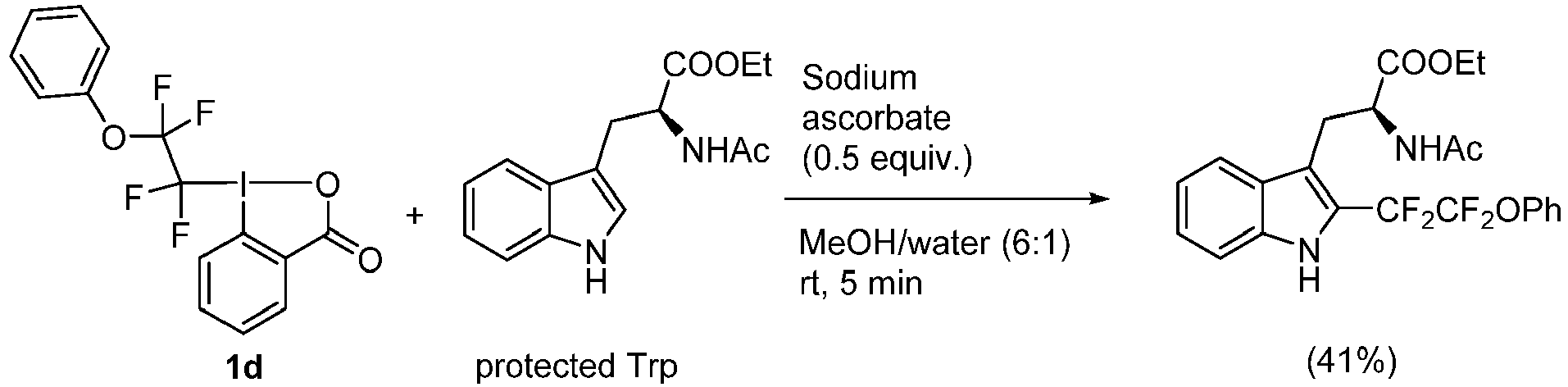
- Protected Trp derivative (137 mg, 0.5 mmol) was dissolved in MeOH (1.1 ml) and the solution was kept under argon atmosphere using the Schlenk line technique. Sodium ascorbate (50 mg, 0.25 mmol, 50 mol%) was dissolved in water (0.7 ml) and added to the solution of substrate in MeOH. 1d (264 mg, 0.6 mmol, 1.2 equiv.) was dissolved in MeOH (1 ml) and the resulting solution was slowly (in 5 minutes) added to the mixture of substrate and sodium ascorbate. The reaction mixture was stirred for 5 minutes at room temperature. After this period, the solvent was evaporated and the mixture was partitioned between DCM (30 ml) and water (30 ml). The organic phase was washed with water (3 × 15 ml), brine (3 × 15 ml), saturated aq. NaHCOs solution (3 × 15 ml) and dried over MgSO4, followed by solvent removal under reduced pressure. Purification by flash chromatography (cyclohexane/DCM, 6:1] afforded pure product as a pale brown oil. Yield: 95 mg (41%); Rf = 0.3 (cyclohexane/DCM, 6:1); 1H NMR (400 MHz, CD3OD): δ 0.95-0.99 (t, J = 7.1, 3H), 1.22-1.26 (t, J = 7.1, 1H), 1.92 (s, 2H), 2.01 (s, 1H), 3.34-3.51 (m, 2H), 4.74-4.78 (m, 1H), 7.13-7.18 (m, CArH, 3H), 7.24-7.29 (m, CArH, 2H), 7.34-7.39 (m, CArH, 2H), 7.45-7.48 (m, CArH, 1H), 7.69-7.71 (m, CArH, 1H); HRMS (ESI) m/z Calcd for C23H22F4N2O4 [M - H]+ 466.15, found 466.1520.
-


- To a solution of amino acid (0.1 mmol) in MeOH (0.2 ml) was added a solution of reagent 1b (0.12 mmol, 1.2 equiv.) in MeOH (0.65 ml). A solution of sodium ascorbate (0.05 mmol) in water or buffer of pH 5 (phosphate) or pH 9 (carbonate/acetate) (0.15 ml) was added dropwise over 2 minutes. After 2 h of stirring at 25 °C the resulting mixture was analyzed by 19F NMR to determine NMR yield using sodium trifluoroacetate as an internal standard (Table 1).
Table 1: 19F NMR yields of fluoroalkylation of amino acids with 1b Aminoacid pH Product yield (%) Trp - 76 Tyr - 9 9 20 Phe 5 0 9 2 His - 5 5 2 9 13 - In a separate experiment, stock solutions of natural amino acid standards (Trp, Tyr, Phe, His, Gly, Ala, Ser, Pro, Val, Thr, Ile, Leu, Asn, Asp, Glu, Gln, Arg, Lys, Met (Waters, 5mM standard solution at pH = 7.5) were dissolved in an ammonium bicarbonate buffer (pH = 7.5, 50 mM) to reach the final concentration 2mM for each amino acid. Reagent 1a (10 equiv. calculated to each amino acid, 30 mM solution in DMSO) was added followed by ascorbic acid (5 equiv. calculated to each amino acid, 283 mM solution in water) were added. After stirring at 25 °C for 15 minutes, semiquantitative LCMS analysis shower reactivity order as follows: Trp >>Tyr > Phe > His. Extracted-ion chromatograms indicated that only aromatic aminoacids and cystine underwent fluoroalkylation (
Figure 2 ).Amino Acid Trifluoromethylation detected? m/z Note Tip Yes 273,085 (monofluoroalkylation) 1 major isomer along with 2 minor isomers detected Tip Yes 341,072 (bis(fluoroalkylation)) 2 isomers detected Tyr Yes 250,069 (monofluoroalkylation) 1 major isomer detected Phe Yes 234,074 2 isomers detected His Yes 224,064 1 major isomer detected Gly, Ala, Ser, Pro, Val, Thr, Leu, Ile, Asn, Asp, Gln, Lys, Glu, Met, Arg No N/A No mass corresponding to trifluoromethylated amino acids could be detected - A solution of peptide AFRIPLYWGRI (1 mg) in MeCN (0.7 ml) containing 1% formic acid and water (0.3 ml) was prepared. Solution of 1d (50 mM) in MeCN and a solution of sodium ascorbate (50 mM) in water were prepared. Solution of the peptide (45 µl) was diluted with water (0.4 ml) containing methionine (20 mM) and to 0.1 ml of this solution 1.46 µl of ascorbate solution was added. Finally, the solution of hypervalent iodine reagent (1.46 µl, 10 equiv.) was added and the mixture was vortexed for a few seconds. After 1 h at ambient temperature the mixture was analyzed by MALDI MS: m/z starting peptide calcd for C69H104N19O12 [M+H]+ 1390.8112, found 1390.8065; peptide + one modification calcd for C77H108F4N19O13 [M+H]+ 1582.8310, found 1582.8227; peptide + two modifications calcd for C84CH112F8N19O14 [M+H]+ 1775.8542, found 1775.8403. MS/MS analysis confirmed that monofluoroalkylation took place only on Trp.
AFRIPLYWGRI m/z Reagent AFRIPLYWGRI approx. conversion Masses detected 1390,8065 1d High 1582,8227 (monofluoroalkylated) 1775,8403 (bis(fluoroalkylated)) - Bradykinin (1 equiv. as 1 mg/ml degassed solution in 20% v/v MeCN/50 mM pH 7 HEPES buffer) was mixed with sodium ascorbate (100 equiv. calculated to molar amount of aromatic residues, 20 mM solution in water) and solution of 1h was added (100 equiv. calculated to molar amount of aromatic resides, 8.7 mM in 50% v/v MeCN/H2O) The mixture was shaken for 15 min at 25 °C. MALDI MS analysis indicated partial formation of fluoroalkylated bradykinin and traces of 2× fluoroalkylated bradykinin. MS/MS analysis revealed that Phe residue is fluoroalkylated.
Bradykinin m/z Reagent Bradykinin approx. conversion Masses detected 1060,626 1h Low 1309,709 (monofluoroalkylated) 1559,802 (bis(fluoroalkylated)), trace) - Somatostatin (1 equiv. as 1 mg/ml degassed solution in 20% v/v MeCN/50 mM pH 7 HEPES buffer) was mixed with sodium ascorbate (100 equiv. calculated to molar amount of aromatic residues, 20 mM solution in water) and solution of 1h was added (100 equiv. calculated to molar amount of aromatic resides, 8.7 mM in 50% v/v MeCN/H2O) . The mixture was shaken for 15 min at 25 °C. MALDI MS analysis indicated formation of monofluoroalkylated somatostatin, bis(fluoroalkylated) somatostatin, tris(fluoroalkylated) somatostatin and traces of fluoroalkylated oxidized somatostatin. MS/MS analysis revealed that the only positions of first and second modification were on the Trp residue.
Somatostatin m/z Reagent Somatostatin conversion Masses detected 1637,819 1h High 1886,897 (monofluoroalkylated) 2135,979 (bis(fluoroalkylated)) 2385,073 (tris(fluoroalkylated), trace) - Bombesin (1 equiv. as 1 mg/ml degassed solution in 20% v/v MeCN/50 mM pH 7 HEPES buffer) was mixed with sodium ascorbate (100 equiv. calculated to molar amount of aromatic residues, 20 mM solution in water) and solution of 1h was added (100 equiv. calculated to molar amount of aromatic resides, 8.7 mM in 50% v/v MeCN/H2O). The mixture was shaken for 15 min at 25 °C. MALDI MS analysis indicated formation of monofluoroalkylated bombesin, bis(fluoroalkylated) bombesin and traces of tris(fluoroalkylated) bombesin and oxidized fluoroalkylated bombesin. MS/MS analysis revealed that the only positions of first and second modification were on the Trp residue.
Bombesin m/z Reagent Bombesin approx. conversion Masses detected 1619,944 1h High 1868,974 (monofluoroalkylated) 1884,967 (monofluoroalkylated, monooxidized, trace) 2118,047 (bis(fluoroalkylated)) 2134,038 (bis(fluoroalkylated), monooxidized, trace) 2369,139 (tris(fluoroalkylated), trace) -

- Human recombinant insulin in HEPES or TRIS buffer (pH 7-9) was subjected to fluoroalkylation with reagents 1e-1h (20-100 equiv. calculated to molar amount of aromatic residues) in MeCN and sodium ascorbate (20-100 equiv. calculated to molar amount of aromatic residues) at 25 °C for 15 min. The comparison of reagents 1e and 1f revealed that the "acid-type" reagent 1f gave a deeper degree of fluoroalkylation (up to 8 modifications). To determine the site of fluoroalkylation after the reaction, the A and B chains of insulin were reductively cleaved by the treatment with DTT and the individual chains were subjected to MS/MS analysis. MS/MS analysis showed (experiment with reagents 1f at pH 8) that Phe and Tyr residues were fluoroalkylated at roughly equal proportions, while there was a minor fluoroalkylation of histidine.
- Another experiments were carried out using 100 equiv. of
reagents 1g or 1h (calculated to molar amount of aromatic residues), 100 equiv. of sodium ascorbate (calculated to molar amount of aromatic residues) atpH 7, 8 and 9. It was found that at pH 9 the extent of fluoroalkylation was higher than inpH 7 and 8.Human recombinant insulin m/z Reagent, note Insulin approx. conversion Masses detected 5809 1e Medium 5975 (monofluoroalkylated) 20 equiv ascorbate, 100 equiv 1e used 6141 (bis(fluoroalkylated)) 6307 (tris(fluoroalkylated)) 6474 (tetrakis(fluoroalkylated), trace) 6641 (pentakis(fluoroalkylated), trace) 6810 (hexakis(fluoroalkylated), trace) 5809 1f High 5975 (monofluoroalkylated) 20 equiv ascorbate, 100 equiv 1f used 6142 (bis(fluoroalkylated)) 6308 (tris(fluoroalkylated)) 6475 (tetrakis(fluoroalkylated), trace) 6641 (pentakis(fluoroalkylated), trace) 6807 (hexakis(fluoroalkylated), trace) 6973 (heptakis(fluoroalkylated), trace) 7139 (octakis(fluoroalkylated), trace) Human recombinant insulin m/z Reagent pH and buffer Approx. conversion Masses detected 5809 1g pH = 7, HEPES buffer 21% 6057 (monofluoroalkylated) 6308 (bis(fluoroalkylated)) 5809 1g pH = 8, HEPES buffer 20% 6057 (monofluoroalkylated) 6308 (bis(fluoroalkylated)) 5809 1g pH = 9, TRIS buffer 63% 6057 (monofluoroalkylated) 6308 (bis(fluoroalkylated)) 5809 1h pH = 7, HEPES buffer 24% 6057 (monofluoroalkylated) 6308 (bis(fluoroalkylated)) 5809 1h pH = 8, HEPES buffer 25% 6057 (monofluoroalkylated) 6308 (bis(fluoroalkylated)) 5809 1h pH = 9, TRIS buffer 71% 6057 (monofluoroalkylated) 6308 (bis(fluoroalkylated)) -

- A stock solution of ubiquitin from bovine erythrocytes in water was diluted in 50 mM amonium bicarbonate buffer (pH 7.5) to reach 58 µM concentrations (0.5 mg/ml). Freshly prepared solution of ascorbic acid in water (283 mM, 100 equiv. calculated to molar amount of aromatic residues) and 1e in DMSO (10 mg/1 ml, 100 equiv. calculated to molar amount of aromatic residues) were added and the reaction mixture which was incubated for 15 min at 25 °C. The mixture was desalted using Peptide Microtrap in the off-line holder (MichromBioresources) according manufacturer instruction, and eluted with 50 µl of 80% MeCN/5% AcOH. The protein was analysed using solariX XR FT-ICR mass spectrometer (Bruker Daltonics) equipped with a 15T superconducting magnet and ParaCell. The instrument was internally calibrated using Agilent tuning mix (Agilent Technologies, USA). Mass spectra were acquired in the positive mode over the m/z range 250-2500 with 2 M data points transient and 1 s ion accumulation, 8 scans were accumulated per spectrum. Data acquisition and data processing were performed using ftmsControl 2.2.0 and DataAnalysis 5.0. ESI MS spectra revealed predominantly monofluoroalkylation of the protein.
Ubiquitin m/z Reaction conditions Approximate conversion Masses detected 779,15658 (11+ charge state) 10 equiv. 1e, 10 equiv. ascorbate Negligible - 779,15658 (11+ charge state) 100 equiv. 1e, 100 equiv. ascorbate Medium 794,24967 (monofluoroalkylated, 11+ charge state) 809,34281 (bis(fluoroalkylated), 11+ charge state, trace) 714,30842 (12+ charge state) 1k Medium 728,39401 (monofluoroalkylated, 12+ charge state) 794,52022 (monofluoroalkylated, 11+ charge state) 714,30842 (12+ charge state) 1k, followed by incubation with DBCO-amine Medium 751,40587 (monofluoroalkylated and ligated with DBCO-amine, 12+ charge state) 819,62388 (monofluoroalkylated, 11+ charge state) -


- A stock solution of ubiquitin from bovine erythrocytes in water was transferred to 50 mM amonium bicarbonate buffer (pH 7.5) using a
micro BioSpin 6 column (Biorad) and diluted in same buffer to reach 58 µM concentrations (0.5 mg/ml). Freshly prepared solution of ascorbic acid in water (50 mg/ml, 37 equiv.) and 1k in DMSO (10 mg/1 ml, 100 equiv.) were added and the reaction mixture was incubated for 1 min at 25 °C and transferred to 50mM amonium bicarbonate buffer pH 7.5 using amicro BioSpin 6 column in order to eliminate the effect of side products of radical reaction or unreacted ascorbic acid. In the second step, the fluoroalkylated ubiquitin solution was mixed with DBCO-amine (100 equiv.) and incubated for 1 hour at 25 °C in the dark. The mixture was desalted using Peptide Microtrap in the off-line holder (MichromBioresources) according to manufacturer's instructions, and eluted with 50 µl of 80% MeCN/5% AcOH. The protein was analysed using solariX XR FT-ICR mass spectrometer (Bruker Daltonics) equipped with a 15T superconducting magnet and ParaCell. The instrument was internally calibrated using Agilent tuning mix (Agilent Technologies, USA). Mass spectra were acquired in the positive mode over the m/z range 250-2500 with 2 M data points transient and 1 s ion accumulation, 8 scans were accumulated per spectrum. Data acquisition and data processing were performed using ftmsControl 2.2.0 and DataAnalysis 5.0. ESI-MS indicated that ubiquitin underwent predominantly monofluoroalkylation with trace bis(fluoroalkylation) and the mono- and bis(fluoroalkylated) ubiquitin subsequently underwent clean copper-free click reaction with a dibenzocyclooctyne-amine reagent, affording the corresponding desired conjugates.Ubiquitin m/z Reaction conditions Approximate conversion Masses detected 714,30842 (12+ charge state) 1k Medium 728,39401 (monofluoroalkylated, 12+ charge state) 794,52022 (monofluoroalkylated, 11+ charge state) 714,30842 (12+ charge state) 1k, followed by incubation with DBCO-amine Medium 751,40587 (monofluoroalkylated and ligated with DBCO-amine, 12+ charge state) 819,62388 (monofluoroalkylated, 11+ charge state) - For the reaction, a stock solution of carbonic anhydrase I from bovine erythrocytes (hCA I, Merck) in water was transferred to 50mM amonium bicarbonate buffer pH 7.5 using a
micro BioSpin 6 column (Biorad) and diluted in same buffer to reach 17µM concentration (0.5 mg/ml). Freshly prepared solution of ascorbic acid in water and one of reagents (1a, 1b, 1e and 1f) in DMSO were added in 150× and 200× molar excess to protein, respectively. The reaction mixture was incubated 10 min at room temperature and mixed with 4×concentrated LDS sample buffer (Invitrogen) containing 100 mM dithiothreitol as the reducing agent in a 3:1 (v/v) ratio. Samples were loaded onto a NuPage 4-12% Bis-Tris gel (80.0 × 80.0 × 1.0 mm, 10 wells, Invitrogen). Separation was performed in MES running buffer (Invitrogen) for 35 min at 200 V. After separation, the gels were stained by Coomassie Brilliant Blue R250 and destained with ethanol, water, and acetic acid in the ratio 55:35:10. Identification of modified hCA I was performed as described previously (Rozbesky, D.; Rosůlek, M.; Kukačka, Z.; Chmelik, J.; Man, P.; Novák, P. Analytical Chemistry 2018, 90 (2), 1104-1113.) Briefly, bands of the modified enzymes were excised. In gel proteolysis by trypsin was carried out for 6 hours at 37°C (enzyme:protein ratio 1:20 w/w), dryed using SpeedVac and re-suspended in water containing 2% MeCN and 0.1% TFA. - Nano Reversed phase column (EASY-Spray column, 50 cm × 75 µm ID, PepMap C18, 2 µm particles, 100 Å pore size) was used for LC/MS analysis. Mobile phase buffer A was composed of water and 0.1% formic acid. Mobile phase B was composed of acetonitrile and 0.1% formic acid. 1 µg of re-suspended samples were loaded onto the trap column (Acclaim PepMap300, C18, 5 µm, 300 Å Wide Pore, 300 µm × 5 mm) at a flow rate of 15 µl/min. Loading buffer was composed of water, 2% MeCN and 0.1% TFA. Peptides were eluted with gradient of B from 4% to 35% over 60 min at a flow rate of 300 nl/min. Eluting peptide cations were converted to gas-phase ions by electrospray ionization and analyzed on a Thermo Orbitrap Fusion (Q-OT- qIT, Thermo). Survey scans of peptide precursors from 350 to 1400 m/z were performed at 120 K resolution (at 200 m/z) with a 5 × 10⁵ ion count target. Tandem MS was performed by isolation at 1.5 Th with the quadrupole, HCD fragmentation with normalized collision energy of 30, and rapid scan MS analysis in the ion trap. The MS2 ion count target was set to 104 and the max injection time was 35 ms. Only those precursors with charge state 2-6 were selected for MS2. The dynamic exclusion duration was set to 45 s with a 10 ppm tolerance around the selected precursor and its isotopes. Monoisotopic precursor selection was turned on. The instrument was run in top speed mode with 2 s cycles. The data were exported to mgf files and MASCOT 2.0 search engine was used to interpret the data. The precursor mass error was set to 5 ppm, the fragment tolerance was set to 10 ppm, oxidation of methionine (+15.9959 a.m.u), and modification of aromatic residues (66.9784 a.m.u. for 1a,b and 166.0174 a.m.u. for 1e,f) were included as well. Only assignments passing the 1% FDR were considered as positive hits. Such comprehensive analysis revealed thryptophane, tyrosine, phenylalanine and histidine modified by fluoroalkyl radicals in all cases (
Figure 5 ). The assignment showing the selectivity of fluoralkyl radical reaction is shown for 1a. According to the MS/MS analysis the Trp123, Tyr88, Phe84 and His67 residues were modified with one CF3 group. All modified residues are solvent accessible using 1hcb structural model of hCA I (Figure 6 ), which clearly demostrated that after radical fluoroalkylation the native structure of the protein was not perturbed. - Single stranded DNA (from IDT company) was dissolved in 50mM amonium bicarbonate buffer pH 7.5 to reach 50 µM concentration. Freshly prepared solution of ascorbic acid in water (50 mg/ml) and 1f in DMSO (10 mg/1 ml) were added each in 100× molar excess relative to ssDNA. The reaction mixture was incubated for 5 min at room temperature. The labeling reaction was quenched by adding AcOH to 1% final concentration. The reaction products were analyzed using solariX XR FT-ICR mass spectrometer (Bruker Daltonics) equipped with a 15T superconducting magnet and ParaCell. The instrument was internally calibrated using Agilent tuning mix (Agilent Technologies, USA). Mass spectra were acquired in the negative ion mode over the m/z range 200-3000 with 2 M data points transient and 0.5 s ion accumulation, 8 scans were accumulated per spectrum. MS/MS spectra were acquired in for -4 charge state with 2 M data points transient and 2.5 s ion accumulation, 64 scans were accumulated per spectrum. Data acquisition and data processing were performed using ftmsControl 2.2.0 and DataAnalysis 5.0, respectively. The modified ssDNA was identified using MS2links software (cit Kellersberger KA, Yu E, Kruppa GH, Young MM, Fabris D. Anal Chem. 2004 May 1;76(9):2438-45 .)
Oligonucleotide m/z Reagent Approximate conversion Masses detected 1711,313 (3-charge state) 1f Low 2649,387 (monofluoroalkylated, 2- charge state) 1765,946 (monofluoroalkylated, 3- charge state) 1324,214 (monofluoroalkylated, 4- charge state) CID of monofluoroalkylated product ion, 4- charge state (1324,214 m/z) List of detected ions [w2]- (634.101); [a3-B]- (714.126); [w6]2- (926.143); [w6+Rf]2-(1009.149); [w4]- (1251.191); [a5-B]- (1331.214); [w10]2-(1523.723); [w5]-(1540.253); [w10+Rf]2-(1606.753); [a7-B]- (1933.331); [a12-B]2- (1728.287); [w5+Rf]- (1706.269); [AATAC]- (1725.252); [w6]- (1853.272); [w12]2- (1832.794); [w12+Rf]2-(1925.804); [AATAC+Rf]- (1891.268) - The MS-spectrum showed an approximately 10% conversion to the mono-fluoroalkylated derivative. The subsequent MS/MS fragmentation revealed that all fluoroalkylations can be traced to cytosine modification (
Figure 7 ). - The disclosed method can be used for C-H functionalization of aromatic substrates, covalent modification of peptides and proteins containing aromatic amino acids and nucleotides containing cytosine with fluoroalkyl groups (bioconjugation), analytical biochemistry, protein surface mapping and fluoroalkylation, epitope mapping via surface modification and protein crosslinking. Proteins containing solvent exposed tryptophane residues and oligonucleotides with cytosine nucleobases represent the most suitable substrates.
Claims (11)
- A method for functionalization of an aromatic amino acid or a nucleobase with a fluoroalkyl-containing moiety RF, wherein the aromatic amino acid or the nucleobase is reacted in the presence of at least one reductant with at least one hypervalent iodine fluoroalkyl reagent,wherein the hypervalent iodine fluoroalkyl reagent is of general formula 1
 R1 is selected from H, C1-C4 alkyl, Me(OCH2CH2) n O, wherein n = 1-10,X1 is not present or is selected from chloride, tetrafluoroborate, hexafluorophosphate, trifluoromethanesulfonate, methanesulfonate, toluenesulfonate, fluoride, bromide, (F(CF2)sSO2)2N-, wherein s = 1 to 4, C1-C6 carboxylate, fluorinated C1-C6 carboxylate, hexafluoroantimonate;A1 is not present or is selected from- carbonyl group (C=O),- R2-C-R3, wherein R2 and R3 are independently selected from fluorine, chlorine, hydrogen, CF3, C1-C4 alkyl, phenyl, phenyl substituted by fluorine, chlorine and/or C1-C4 alkyl, omega-methoxy-(C1-C4)alkyl; or R2 and R3 together with the carbon atom to which they are bound form 1,1-cyclobutylene, 1,1-cyclopentylene, 1,1-cyclohexylene, 1,1-(4-oxacyclohexylene);A2 is not present or is selected from- hydroxyl group (OH),- oxygen (-O-),- C1-4 alkoxy,- OSiR4R5R6, wherein R4,R5,R6 are independently selected from methyl, ethyl, n-propyl, i-propyl and phenyl;- R7N, wherein R7 is selected from C1-10 alkyl, phenyl-substituted C1-10 alkyl, 4-chlorophenyl-substituted C1-10 alkyl, and CH3(OCH2CH2) n ;- R8CO-, wherein R8 is selected from C1-10 alkyl, phenyl-substituted C1-10 alkyl, CH3(OCH2CH2) o -, wherein o = 1-10, Cl-Me3N+(CH2) p -, wherein p = 1-10, -(CX2) m COOQ, - (CX2) m SO3Q, wherein m = 2-3, -phenyl-SO3Q, -phenyl-COOQ, -(CX2) m COO-, -(CX2) m SO3-, wherein m = 2-3, -phenyl-SO3-, -phenyl-COO-,X2 = F or Cl, X3 = H, CH3, F or Cl,Q is selected from lithium, sodium, potassium, rubidium, cesium, tetra (C1-C4 alkyl, phenyl, benzyl) ammonium, tri (C1-C4 alkyl, phenyl, benzyl) pyridinium;- R9C(O)O-, wherein R9 is selected from C1-10 alkyl, phenyl-substituted C1-10 alkyl, CH3(OCH2CH2) o -, wherein o = 1-10, Cl-Me3N+(CH2) p -, wherein p = 1-10, -(CX2) m COOQ, - (CX2) m SO3Q, wherein m = 2-3, -phenyl-SO3Q, -phenyl-COOQ, -(CX2) m COO-, -(CX2) m SO3-, wherein m = 2-3, -phenyl-SO3-, -phenyl-COO-,X2 = F or Cl, X3 = H, CH3, F or Cl,Q is selected from lithium, sodium, potassium, rubidium, cesium, tetra (C1-C4 alkyl, phenyl, benzyl) ammonium, tri (C1-C4 alkyl, phenyl, benzyl) pyridinium;RF is -CF2-A3-A4, wherein- A3 is not present and A4 is fluorine, or phenylsulfanyl (PhS) group, or- A3 is CF2 and A4 is fluorine, C1-10 perfluoroalkyl, phenoxy, C1-10 alkoxy, phenylsulfanyl, N-imidazolyl, N-pyrazolyl, N-benzimidazolyl, N-triazoyl, N-(2-methyl)imidazolyl, CH3(OCH2CH2) n O, where n = 1-10, Cl-MeH2N+(CH2) r , wherein r = 1-10, Cl-MeH2N+(CH2)2-phenyloxy, C1-10 alkyl, ethenyl, ethynyl, omega-azido C1-10 alkyl, omega-amino C1-10 alkyl, omega-ethynyl C1-10 alkyl, C1-10 alkylthio, phenyl, chloro, bromo, iodo, azido, nitro, C1-10 alkoxycarbonyl-substituted phenyl, C2-10 alkenyl, C2-10 alkyl omega substituted with SO2F, N-succinimide-O-C(O)-, methyldiaziridine, trifluoromethyldiaziridine, rhodamine, fluorescein or coumarin; aryl p-substituted with N-succinimide-O-C(O)-, rhodamine, fluorescein or coumarin, phenoxy p-substituted with N-succinimide-O-C(O)-, rhodamine, fluorescein or coumarin, and 2-(aryliodanyl)-1,1,2,2-tetrafluoroethyl; in alkyl chains, two neighboring carbon atoms may be replaced by a methylamido group (-N(Me)-C(O)-) and/or by a phenyl group.
 - The method of claim 1, wherein in formula 1:- A1 is present, A2 is a bivalent substituent, and X1 is not present; or- A1 is present, A2 is a monovalent substituent bound to A1, and X1 is present.
- The method of any one of the preceding claims, wherein the aromatic amino acid is selected from phenylalanine, tryptophan, tyrosine, histidine.
- The method of any one of the preceding claims, wherein the aromatic amino acid is tryptophan.
- The method of any one of claims 1-2, wherein the nucleobase is cytosine.
- The method of any one of the preceding claims, wherein the reductant is selected from a group consisting of sodium ascorbate, potassium ascorbate, calcium ascorbate, magnesium ascorbate, esters of ascorbic acid with carboxylic acids of the formula R10CO2H wherein R10 is C1-18 alkyl, sodium sulphite, sodium dithionite, tetrakis(dimethylamino)ethylene, sodium phosphite, sodium hypophosphite, and sodium hydroxymethanesulfinate.
- The method of any one of the preceding claims, wherein the reductant is used in an amount of 0.5-1.0 equivalents, preferably of 0.9-1.1 equivalents, relative to the hypervalent iodine fluoroalkyl reagent.
- The method of any one of the preceding claims wherein aromatic amino acids incorporated in a protein are reacted in the presence of at least one reductant with at least one hypervalent iodine fluoroalkyl reagent, and subsequently it is detected which amino acids are fluoroalkylated and these amino acids are then determined to be present on the solvent-exposed surface of the protein.
- The method of any one of the preceding claims wherein the hypervalent iodine fluoroalkyl reagent is selected from the group consisting of the following reagents:


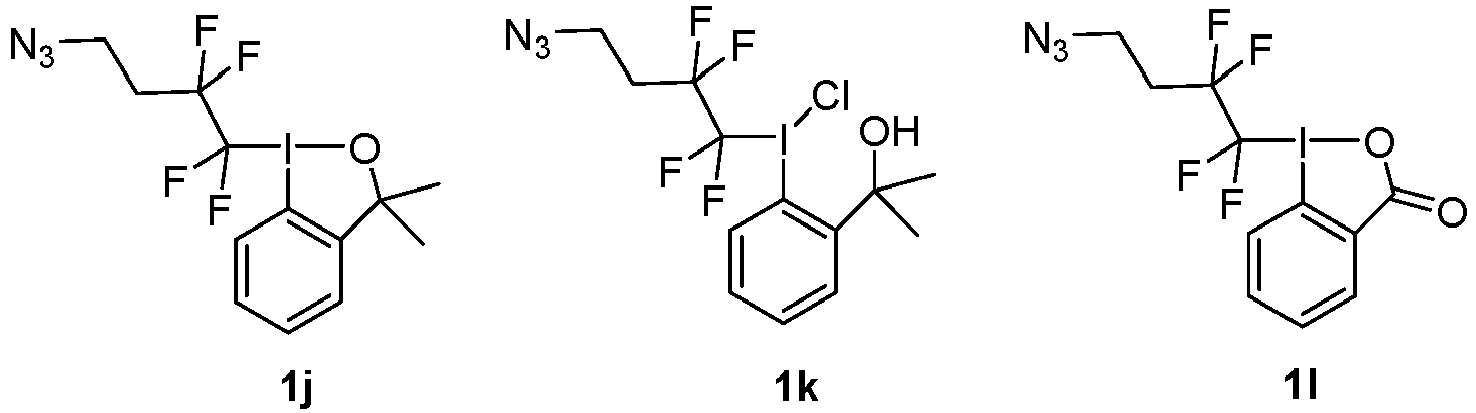


- A hypervalent iodine fluoroalkyl reagent of general formula 1-1
 R1 is selected from H, C1-C4 alkyl, Me(OCH2CH2) n O, wherein n = 1-10,X1 is not present or is selected from chloride, tetrafluoroborate, hexafluorophosphate, trifluoromethanesulfonate, methanesulfonate, toluenesulfonate, fluoride, bromide, (F(CF2)SSO2)2N-, wherein s = 1 to 4, C1-C6 carboxylate, fluorinated C1-C6 carboxylate, hexafluoroantimonate;A1 is not present or is selected from- carbonyl group (C=O),- R2-C-R3, where R2 and R3 are independently selected from fluorine, chlorine, hydrogen, CF3, C1-C4 alkyl, phenyl, phenyl substituted by fluorine, chlorine and/or C1-C4 alkyl, omega-methoxy-(C1-C4)alkyl; or R2 and R3 together with the carbon atom to which they are bound form 1,1-cyclobutylene, 1,1-cyclopentylene, 1,1-cyclohexylene, 1,1-(4-oxacyclohexylene);A2 is not present or is selected from- hydroxyl group (OH),- oxygen (-O-),- C1-4 alkoxy,- OSiR4R5R6, wherein R4,R5,R6 are independently selected from methyl, ethyl, n-propyl, i-propyl and phenyl;- R7N, wherein R7 is selected from C1-10 alkyl, phenyl-substituted C1-10 alkyl, 4-chlorophenyl-substituted C1-10 alkyl, and CH3(OCH2CH2) n ;- R8CO-, wherein R8 is selected from C1-10 alkyl, phenyl-substituted C1-10 alkyl, CH3(OCH2CH2) o -, wherein o = 1-10, Cl-Me3N+(CH2) p -, wherein p = 1-10, -(CX2) m COOQ, - (CX2) m SO3Q, wherein m = 2-3, -phenyl-SO3Q, -phenyl-COOQ, -(CX2) m COO-, -(CX2) m SO3-, wherein m = 2-3, -phenyl-SO3-, -phenyl-COO-,X2 = F or Cl, X3 = H, CH3, F or Cl,Q is selected from lithium, sodium, potassium, rubidium, cesium, tetra (C1-C4 alkyl, phenyl, benzyl) ammonium, tri (C1-C4 alkyl, phenyl, benzyl) pyridinium;- R9C(O)O-, wherein R9 is selected from C1-10 alkyl, phenyl-substituted C1-10 alkyl, CH3(OCH2CH2) o -, wherein o = 1-10, Cl-Me3N+(CH2) p -, wherein p = 1-10, -(CX2) m COOQ, - (CX2) m SO3Q, wherein m = 2-3, -phenyl-SO3Q, -phenyl-COOQ, -(CX2) m COO-, -(CX2) m SO3-, wherein m = 2-3, -phenyl-SO3-, -phenyl-COO-,X2 = F or Cl, X3 = H, CH3, F or Cl,Q is selected from lithium, sodium, potassium, rubidium, cesium, tetra (C1-C4 alkyl, phenyl, benzyl) ammonium, tri (C1-C4 alkyl, phenyl, benzyl) pyridinium;RF is -CF2-A3-A4, wherein- A3 is not present and A4 is fluorine, or phenylsulfanyl (PhS) group, or- A3 is CF2 and A4 is fluorine, C1-10 perfluoroalkyl, phenoxy, C1-10 alkoxy, phenylsulfanyl, N-imidazolyl, N-pyrazolyl, N-benzimidazolyl, N-triazoyl, N-(2-methyl)imidazolyl, CH3(OCH2CH2) n O, where n = 1-10, Cl-MeH2N+(CH2) r , wherein r = 1-10, Cl-MeH2N+(CH2)2-phenyloxy, C1-10 alkyl, ethenyl, ethynyl, omega-azido C1-10 alkyl, omega-amino C1-10 alkyl, omega-ethynyl C1-10 alkyl, C1-10 alkylthio, phenyl, chloro, bromo, iodo, azido, nitro, C1-10 alkoxycarbonyl-substituted phenyl, C2-10 alkenyl, C2-10 alkyl omega substituted with SO2F, N-succinimide-O-C(O)-, methyldiaziridine, trifluoromethyldiaziridine, rhodamine, fluorescein or coumarin; aryl p-substituted with N-succinimide-O-C(O)-, rhodamine, fluorescein or coumarin, phenoxy p-substituted with N-succinimide-O-C(O)-, rhodamine, fluorescein or coumarin, and 2-(aryliodanyl)-1,1,2,2-tetrafluoroethyl; in alkyl chains, two neighboring carbon atoms may be replaced by a methylamido group (-N(Me)-C(O)-) and/or by a phenyl group,
provided that:- A2 is not -O- or -OH, when: A1 is C=O or R2-C-R3, wherein R2 and R3 are methyls;- A2 is not -O-C(=O)CH3, when: RF is CF3 and A1 is C=O or R2-C-R3, wherein R2 and R3 are methyls;- A2 is not -O- or -OH, when: X1 is not present, RF is CF3 and A1 is R2-C-R3, wherein R2 and R3 are selected from alkyl and CF3 or wherein R2 is methyl and R3 is phenyl or R2 and R3 together form 1,1-cyclohexylene;- A2 is not -O- or -OH, when: X1 is not present, RF is selected from perfluoroethyl, perfluoropropyl, perfluorobutyl, perfluorohexyl or perfluorooctyl, A1 is R2-C-R3, wherein R2 is methyl and R3 is phenyl or isopropyl;- A2 is not R7N, wherein R7 is selected from C1-10 alkyl, phenyl-substituted C1-10 alkyl, when: X1 is not present, RF is CF3 and A1 is C=O. - A hypervalent iodine fluoroalkyl reagent according to claim 10 selected from the following compounds
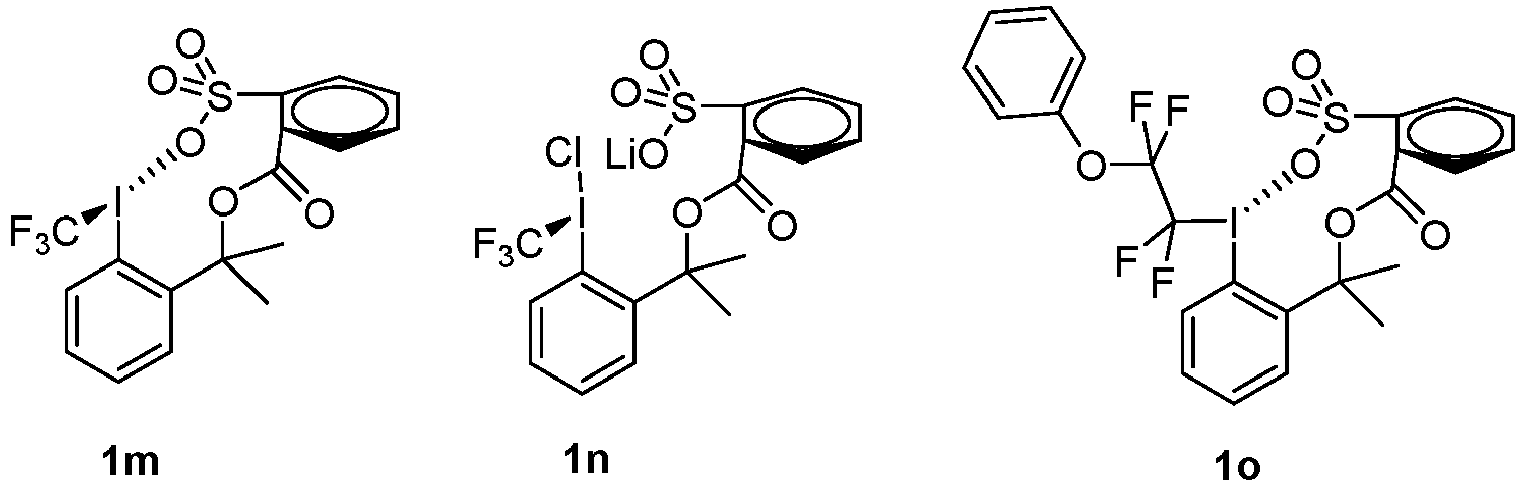
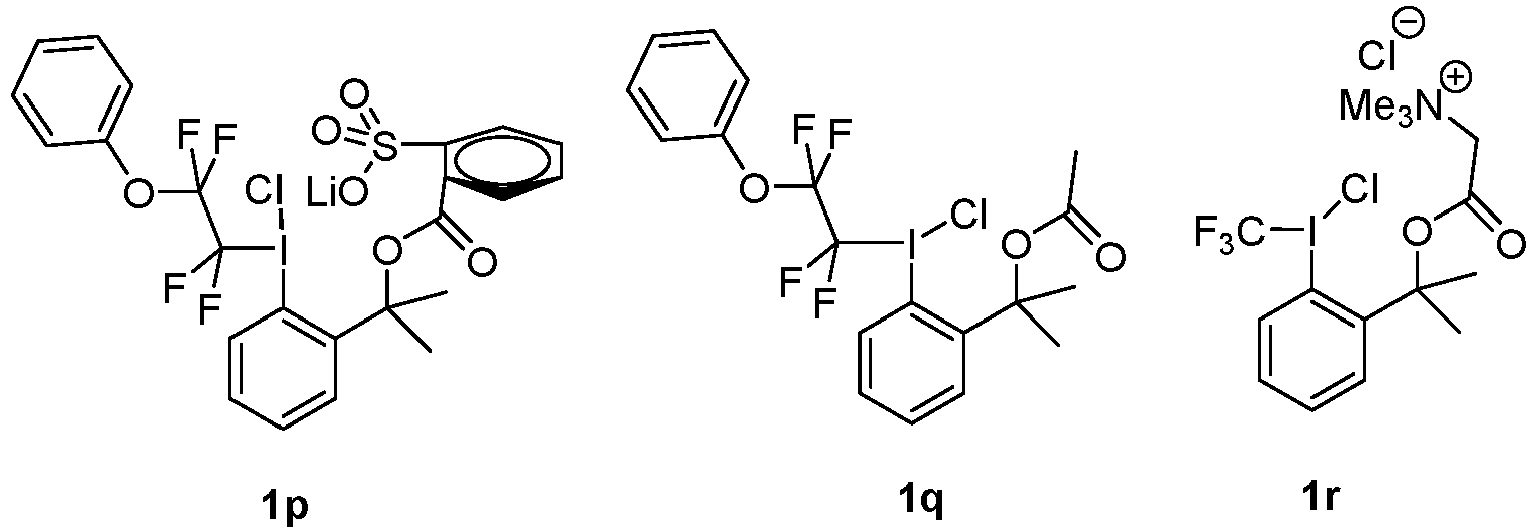

Applications Claiming Priority (2)
| Application Number | Priority Date | Filing Date | Title |
|---|---|---|---|
| EP19172756.9A EP3736269A1 (en) | 2019-05-06 | 2019-05-06 | A method for functionalization of an aromatic amino acid or a nucleobase |
| PCT/CZ2020/050029 WO2020224686A1 (en) | 2019-05-06 | 2020-05-05 | A method for functionalization of an aromatic amino acid or a nucleobase |
Publications (2)
| Publication Number | Publication Date |
|---|---|
| EP3966203A1 EP3966203A1 (en) | 2022-03-16 |
| EP3966203B1 true EP3966203B1 (en) | 2023-04-19 |
Family
ID=66429258
Family Applications (2)
| Application Number | Title | Priority Date | Filing Date |
|---|---|---|---|
| EP19172756.9A Withdrawn EP3736269A1 (en) | 2019-05-06 | 2019-05-06 | A method for functionalization of an aromatic amino acid or a nucleobase |
| EP20725768.4A Active EP3966203B1 (en) | 2019-05-06 | 2020-05-05 | A method for functionalization of an aromatic amino acid or a nucleobase |
Family Applications Before (1)
| Application Number | Title | Priority Date | Filing Date |
|---|---|---|---|
| EP19172756.9A Withdrawn EP3736269A1 (en) | 2019-05-06 | 2019-05-06 | A method for functionalization of an aromatic amino acid or a nucleobase |
Country Status (3)
| Country | Link |
|---|---|
| US (1) | US12291550B2 (en) |
| EP (2) | EP3736269A1 (en) |
| WO (1) | WO2020224686A1 (en) |
Family Cites Families (2)
| Publication number | Priority date | Publication date | Assignee | Title |
|---|---|---|---|---|
| US10669250B2 (en) * | 2014-08-07 | 2020-06-02 | Eth Zurich | Hypervalent iodine CF2CF2X reagents and their use |
| EP2982672A1 (en) | 2014-08-07 | 2016-02-10 | ETH Zurich | Hypervalent iodine CF2CF2X reagents and their use |
-
2019
- 2019-05-06 EP EP19172756.9A patent/EP3736269A1/en not_active Withdrawn
-
2020
- 2020-05-05 US US17/603,400 patent/US12291550B2/en active Active
- 2020-05-05 EP EP20725768.4A patent/EP3966203B1/en active Active
- 2020-05-05 WO PCT/CZ2020/050029 patent/WO2020224686A1/en not_active Ceased
Also Published As
| Publication number | Publication date |
|---|---|
| EP3736269A1 (en) | 2020-11-11 |
| WO2020224686A1 (en) | 2020-11-12 |
| US12291550B2 (en) | 2025-05-06 |
| EP3966203A1 (en) | 2022-03-16 |
| US20220177514A1 (en) | 2022-06-09 |
Similar Documents
| Publication | Publication Date | Title |
|---|---|---|
| CN106977584B (en) | Compound for targeted ubiquitination degradation of PLK1 and BRD4 proteins and application thereof | |
| KR102841441B1 (en) | Method for preparing O-substituted serine derivatives | |
| US7910726B2 (en) | Amidite for synthesizing modified nucleic acid and method for synthesizing modified nucleic acid | |
| RU2727151C2 (en) | Methods for producing cytotoxic benzodiazepine derivatives | |
| AU2019369192B2 (en) | Methods and compositions | |
| Bhupathiraju et al. | Improved synthesis of the bifunctional chelator p-SCN-Bn-HOPO | |
| TWI854108B (en) | Efficient preparation of dolastatin and auristatin analogs through a common intermediate | |
| TW201444840A (en) | Method for producing tricyclic compound, and tricyclic compound capable of being produced by said production method | |
| US12291550B2 (en) | Method for functionalization of an aromatic amino acid or a nucleobase | |
| US20200040392A1 (en) | Method for labeling of aldehyde containing target molecules | |
| Kakehi et al. | Synthesis using allylidenedihydropyridines. 3. Synthesis and thermolysis of functionalized 2-allylidene-1, 2-dihydropyridines | |
| EP2710380B1 (en) | Method of detection of amino acid sequence and/or identification of peptides and proteins, by use of a new derivatization reagent and synthesis of 5-formyl-benzene-1,3-disulphonic acid as derivatization reagent | |
| EP3386974B1 (en) | Water-soluble triazapyridinophane-based complexing agents and corresponding fluorescent lanthanide complexes | |
| CN105566447A (en) | Peptoid antagonist of anti-apoptosis protein and synthesis method and application of peptoid antagonist | |
| WO2019168164A1 (en) | Molecule for protein and/or peptide design | |
| US11479570B2 (en) | Pentafluorophosphate derivative, its uses and an appropriate manufacturing method | |
| Terashima et al. | Construction of fully substituted carbon centers containing a heteroatom and a CF 3 group via in situ generated p-quinone methides | |
| JP5267096B2 (en) | N, S-di-tert-butoxycarbonylglutathione fluorescent derivative and method for producing glutathione fluorescent derivative using the same as an intermediate | |
| EP3313858B1 (en) | Methods for the site-selective coupling of a first agent to a second agent | |
| WO2020086311A1 (en) | Thiophosphorodichloridate reagents for chemoselective histidine bioconjugation | |
| Gold et al. | A simple, high yield method for the nucleophilic substitution of halonitrobenzenes by thiols | |
| CN111537622B (en) | Method for detecting impurities of duloxetine and salts thereof | |
| Folliet | Towards the development of a visible light-enabled histidine-selective protein modification strategy using diazo sulfonium-based probes | |
| Buuh | Development of a Fluorine-Thiol Reaction Platform for Post-Translational Modification Analysis and Stapled Peptide Synthesis | |
| Popova et al. | Why do p-nitro-substituted aryl azides provide unintended dark reactions with proteins? |
Legal Events
| Date | Code | Title | Description |
|---|---|---|---|
| STAA | Information on the status of an ep patent application or granted ep patent |
Free format text: STATUS: UNKNOWN |
|
| STAA | Information on the status of an ep patent application or granted ep patent |
Free format text: STATUS: THE INTERNATIONAL PUBLICATION HAS BEEN MADE |
|
| PUAI | Public reference made under article 153(3) epc to a published international application that has entered the european phase |
Free format text: ORIGINAL CODE: 0009012 |
|
| STAA | Information on the status of an ep patent application or granted ep patent |
Free format text: STATUS: REQUEST FOR EXAMINATION WAS MADE |
|
| 17P | Request for examination filed |
Effective date: 20211115 |
|
| AK | Designated contracting states |
Kind code of ref document: A1 Designated state(s): AL AT BE BG CH CY CZ DE DK EE ES FI FR GB GR HR HU IE IS IT LI LT LU LV MC MK MT NL NO PL PT RO RS SE SI SK SM TR |
|
| STAA | Information on the status of an ep patent application or granted ep patent |
Free format text: STATUS: EXAMINATION IS IN PROGRESS |
|
| 17Q | First examination report despatched |
Effective date: 20220524 |
|
| DAV | Request for validation of the european patent (deleted) | ||
| DAX | Request for extension of the european patent (deleted) | ||
| GRAP | Despatch of communication of intention to grant a patent |
Free format text: ORIGINAL CODE: EPIDOSNIGR1 |
|
| STAA | Information on the status of an ep patent application or granted ep patent |
Free format text: STATUS: GRANT OF PATENT IS INTENDED |
|
| INTG | Intention to grant announced |
Effective date: 20221123 |
|
| GRAS | Grant fee paid |
Free format text: ORIGINAL CODE: EPIDOSNIGR3 |
|
| GRAA | (expected) grant |
Free format text: ORIGINAL CODE: 0009210 |
|
| STAA | Information on the status of an ep patent application or granted ep patent |
Free format text: STATUS: THE PATENT HAS BEEN GRANTED |
|
| AK | Designated contracting states |
Kind code of ref document: B1 Designated state(s): AL AT BE BG CH CY CZ DE DK EE ES FI FR GB GR HR HU IE IS IT LI LT LU LV MC MK MT NL NO PL PT RO RS SE SI SK SM TR |
|
| REG | Reference to a national code |
Ref country code: GB Ref legal event code: FG4D |
|
| REG | Reference to a national code |
Ref country code: DE Ref legal event code: R096 Ref document number: 602020009913 Country of ref document: DE |
|
| REG | Reference to a national code |
Ref country code: CH Ref legal event code: EP |
|
| REG | Reference to a national code |
Ref country code: IE Ref legal event code: FG4D |
|
| REG | Reference to a national code |
Ref country code: AT Ref legal event code: REF Ref document number: 1561100 Country of ref document: AT Kind code of ref document: T Effective date: 20230515 |
|
| REG | Reference to a national code |
Ref country code: LT Ref legal event code: MG9D |
|
| REG | Reference to a national code |
Ref country code: NL Ref legal event code: MP Effective date: 20230419 |
|
| REG | Reference to a national code |
Ref country code: AT Ref legal event code: MK05 Ref document number: 1561100 Country of ref document: AT Kind code of ref document: T Effective date: 20230419 |
|
| PG25 | Lapsed in a contracting state [announced via postgrant information from national office to epo] |
Ref country code: NL Free format text: LAPSE BECAUSE OF FAILURE TO SUBMIT A TRANSLATION OF THE DESCRIPTION OR TO PAY THE FEE WITHIN THE PRESCRIBED TIME-LIMIT Effective date: 20230419 |
|
| P01 | Opt-out of the competence of the unified patent court (upc) registered |
Effective date: 20230830 |
|
| PG25 | Lapsed in a contracting state [announced via postgrant information from national office to epo] |
Ref country code: SE Free format text: LAPSE BECAUSE OF FAILURE TO SUBMIT A TRANSLATION OF THE DESCRIPTION OR TO PAY THE FEE WITHIN THE PRESCRIBED TIME-LIMIT Effective date: 20230419 Ref country code: PT Free format text: LAPSE BECAUSE OF FAILURE TO SUBMIT A TRANSLATION OF THE DESCRIPTION OR TO PAY THE FEE WITHIN THE PRESCRIBED TIME-LIMIT Effective date: 20230821 Ref country code: NO Free format text: LAPSE BECAUSE OF FAILURE TO SUBMIT A TRANSLATION OF THE DESCRIPTION OR TO PAY THE FEE WITHIN THE PRESCRIBED TIME-LIMIT Effective date: 20230719 Ref country code: ES Free format text: LAPSE BECAUSE OF FAILURE TO SUBMIT A TRANSLATION OF THE DESCRIPTION OR TO PAY THE FEE WITHIN THE PRESCRIBED TIME-LIMIT Effective date: 20230419 Ref country code: AT Free format text: LAPSE BECAUSE OF FAILURE TO SUBMIT A TRANSLATION OF THE DESCRIPTION OR TO PAY THE FEE WITHIN THE PRESCRIBED TIME-LIMIT Effective date: 20230419 |
|
| PG25 | Lapsed in a contracting state [announced via postgrant information from national office to epo] |
Ref country code: RS Free format text: LAPSE BECAUSE OF FAILURE TO SUBMIT A TRANSLATION OF THE DESCRIPTION OR TO PAY THE FEE WITHIN THE PRESCRIBED TIME-LIMIT Effective date: 20230419 Ref country code: PL Free format text: LAPSE BECAUSE OF FAILURE TO SUBMIT A TRANSLATION OF THE DESCRIPTION OR TO PAY THE FEE WITHIN THE PRESCRIBED TIME-LIMIT Effective date: 20230419 Ref country code: LV Free format text: LAPSE BECAUSE OF FAILURE TO SUBMIT A TRANSLATION OF THE DESCRIPTION OR TO PAY THE FEE WITHIN THE PRESCRIBED TIME-LIMIT Effective date: 20230419 Ref country code: LT Free format text: LAPSE BECAUSE OF FAILURE TO SUBMIT A TRANSLATION OF THE DESCRIPTION OR TO PAY THE FEE WITHIN THE PRESCRIBED TIME-LIMIT Effective date: 20230419 Ref country code: IS Free format text: LAPSE BECAUSE OF FAILURE TO SUBMIT A TRANSLATION OF THE DESCRIPTION OR TO PAY THE FEE WITHIN THE PRESCRIBED TIME-LIMIT Effective date: 20230819 Ref country code: HR Free format text: LAPSE BECAUSE OF FAILURE TO SUBMIT A TRANSLATION OF THE DESCRIPTION OR TO PAY THE FEE WITHIN THE PRESCRIBED TIME-LIMIT Effective date: 20230419 Ref country code: GR Free format text: LAPSE BECAUSE OF FAILURE TO SUBMIT A TRANSLATION OF THE DESCRIPTION OR TO PAY THE FEE WITHIN THE PRESCRIBED TIME-LIMIT Effective date: 20230720 Ref country code: AL Free format text: LAPSE BECAUSE OF FAILURE TO SUBMIT A TRANSLATION OF THE DESCRIPTION OR TO PAY THE FEE WITHIN THE PRESCRIBED TIME-LIMIT Effective date: 20230419 |
|
| PG25 | Lapsed in a contracting state [announced via postgrant information from national office to epo] |
Ref country code: FI Free format text: LAPSE BECAUSE OF FAILURE TO SUBMIT A TRANSLATION OF THE DESCRIPTION OR TO PAY THE FEE WITHIN THE PRESCRIBED TIME-LIMIT Effective date: 20230419 |
|
| PG25 | Lapsed in a contracting state [announced via postgrant information from national office to epo] |
Ref country code: SK Free format text: LAPSE BECAUSE OF FAILURE TO SUBMIT A TRANSLATION OF THE DESCRIPTION OR TO PAY THE FEE WITHIN THE PRESCRIBED TIME-LIMIT Effective date: 20230419 |
|
| PG25 | Lapsed in a contracting state [announced via postgrant information from national office to epo] |
Ref country code: MC Free format text: LAPSE BECAUSE OF FAILURE TO SUBMIT A TRANSLATION OF THE DESCRIPTION OR TO PAY THE FEE WITHIN THE PRESCRIBED TIME-LIMIT Effective date: 20230419 |
|
| REG | Reference to a national code |
Ref country code: DE Ref legal event code: R097 Ref document number: 602020009913 Country of ref document: DE |
|
| REG | Reference to a national code |
Ref country code: BE Ref legal event code: MM Effective date: 20230531 |
|
| PG25 | Lapsed in a contracting state [announced via postgrant information from national office to epo] |
Ref country code: SM Free format text: LAPSE BECAUSE OF FAILURE TO SUBMIT A TRANSLATION OF THE DESCRIPTION OR TO PAY THE FEE WITHIN THE PRESCRIBED TIME-LIMIT Effective date: 20230419 Ref country code: SK Free format text: LAPSE BECAUSE OF FAILURE TO SUBMIT A TRANSLATION OF THE DESCRIPTION OR TO PAY THE FEE WITHIN THE PRESCRIBED TIME-LIMIT Effective date: 20230419 Ref country code: RO Free format text: LAPSE BECAUSE OF FAILURE TO SUBMIT A TRANSLATION OF THE DESCRIPTION OR TO PAY THE FEE WITHIN THE PRESCRIBED TIME-LIMIT Effective date: 20230419 Ref country code: MC Free format text: LAPSE BECAUSE OF FAILURE TO SUBMIT A TRANSLATION OF THE DESCRIPTION OR TO PAY THE FEE WITHIN THE PRESCRIBED TIME-LIMIT Effective date: 20230419 Ref country code: LU Free format text: LAPSE BECAUSE OF NON-PAYMENT OF DUE FEES Effective date: 20230505 Ref country code: EE Free format text: LAPSE BECAUSE OF FAILURE TO SUBMIT A TRANSLATION OF THE DESCRIPTION OR TO PAY THE FEE WITHIN THE PRESCRIBED TIME-LIMIT Effective date: 20230419 Ref country code: DK Free format text: LAPSE BECAUSE OF FAILURE TO SUBMIT A TRANSLATION OF THE DESCRIPTION OR TO PAY THE FEE WITHIN THE PRESCRIBED TIME-LIMIT Effective date: 20230419 Ref country code: CZ Free format text: LAPSE BECAUSE OF FAILURE TO SUBMIT A TRANSLATION OF THE DESCRIPTION OR TO PAY THE FEE WITHIN THE PRESCRIBED TIME-LIMIT Effective date: 20230419 |
|
| PLBE | No opposition filed within time limit |
Free format text: ORIGINAL CODE: 0009261 |
|
| STAA | Information on the status of an ep patent application or granted ep patent |
Free format text: STATUS: NO OPPOSITION FILED WITHIN TIME LIMIT |
|
| REG | Reference to a national code |
Ref country code: IE Ref legal event code: MM4A |
|
| 26N | No opposition filed |
Effective date: 20240122 |
|
| PG25 | Lapsed in a contracting state [announced via postgrant information from national office to epo] |
Ref country code: IE Free format text: LAPSE BECAUSE OF NON-PAYMENT OF DUE FEES Effective date: 20230505 |
|
| PG25 | Lapsed in a contracting state [announced via postgrant information from national office to epo] |
Ref country code: IE Free format text: LAPSE BECAUSE OF NON-PAYMENT OF DUE FEES Effective date: 20230505 |
|
| PG25 | Lapsed in a contracting state [announced via postgrant information from national office to epo] |
Ref country code: SI Free format text: LAPSE BECAUSE OF FAILURE TO SUBMIT A TRANSLATION OF THE DESCRIPTION OR TO PAY THE FEE WITHIN THE PRESCRIBED TIME-LIMIT Effective date: 20230419 |
|
| PG25 | Lapsed in a contracting state [announced via postgrant information from national office to epo] |
Ref country code: SI Free format text: LAPSE BECAUSE OF FAILURE TO SUBMIT A TRANSLATION OF THE DESCRIPTION OR TO PAY THE FEE WITHIN THE PRESCRIBED TIME-LIMIT Effective date: 20230419 Ref country code: IT Free format text: LAPSE BECAUSE OF FAILURE TO SUBMIT A TRANSLATION OF THE DESCRIPTION OR TO PAY THE FEE WITHIN THE PRESCRIBED TIME-LIMIT Effective date: 20230419 Ref country code: BE Free format text: LAPSE BECAUSE OF NON-PAYMENT OF DUE FEES Effective date: 20230531 |
|
| PG25 | Lapsed in a contracting state [announced via postgrant information from national office to epo] |
Ref country code: BG Free format text: LAPSE BECAUSE OF FAILURE TO SUBMIT A TRANSLATION OF THE DESCRIPTION OR TO PAY THE FEE WITHIN THE PRESCRIBED TIME-LIMIT Effective date: 20230419 |
|
| PG25 | Lapsed in a contracting state [announced via postgrant information from national office to epo] |
Ref country code: BG Free format text: LAPSE BECAUSE OF FAILURE TO SUBMIT A TRANSLATION OF THE DESCRIPTION OR TO PAY THE FEE WITHIN THE PRESCRIBED TIME-LIMIT Effective date: 20230419 |
|
| PGFP | Annual fee paid to national office [announced via postgrant information from national office to epo] |
Ref country code: DE Payment date: 20250520 Year of fee payment: 6 |
|
| PGFP | Annual fee paid to national office [announced via postgrant information from national office to epo] |
Ref country code: GB Payment date: 20250519 Year of fee payment: 6 |
|
| PGFP | Annual fee paid to national office [announced via postgrant information from national office to epo] |
Ref country code: FR Payment date: 20250516 Year of fee payment: 6 |
|
| PGFP | Annual fee paid to national office [announced via postgrant information from national office to epo] |
Ref country code: CH Payment date: 20250601 Year of fee payment: 6 |
|
| PG25 | Lapsed in a contracting state [announced via postgrant information from national office to epo] |
Ref country code: CY Free format text: LAPSE BECAUSE OF FAILURE TO SUBMIT A TRANSLATION OF THE DESCRIPTION OR TO PAY THE FEE WITHIN THE PRESCRIBED TIME-LIMIT; INVALID AB INITIO Effective date: 20200505 |
|
| PG25 | Lapsed in a contracting state [announced via postgrant information from national office to epo] |
Ref country code: HU Free format text: LAPSE BECAUSE OF FAILURE TO SUBMIT A TRANSLATION OF THE DESCRIPTION OR TO PAY THE FEE WITHIN THE PRESCRIBED TIME-LIMIT; INVALID AB INITIO Effective date: 20200505 |
|
| PG25 | Lapsed in a contracting state [announced via postgrant information from national office to epo] |
Ref country code: TR Free format text: LAPSE BECAUSE OF FAILURE TO SUBMIT A TRANSLATION OF THE DESCRIPTION OR TO PAY THE FEE WITHIN THE PRESCRIBED TIME-LIMIT Effective date: 20230419 |