EP3965445A1 - Router, network connection method and mobile terminal - Google Patents
Router, network connection method and mobile terminal Download PDFInfo
- Publication number
- EP3965445A1 EP3965445A1 EP19927153.7A EP19927153A EP3965445A1 EP 3965445 A1 EP3965445 A1 EP 3965445A1 EP 19927153 A EP19927153 A EP 19927153A EP 3965445 A1 EP3965445 A1 EP 3965445A1
- Authority
- EP
- European Patent Office
- Prior art keywords
- router
- mobile terminal
- random number
- dynamic password
- temporary key
- Prior art date
- Legal status (The legal status is an assumption and is not a legal conclusion. Google has not performed a legal analysis and makes no representation as to the accuracy of the status listed.)
- Granted
Links
Images


Classifications
-
- H—ELECTRICITY
- H04—ELECTRIC COMMUNICATION TECHNIQUE
- H04W—WIRELESS COMMUNICATION NETWORKS
- H04W12/00—Security arrangements; Authentication; Protecting privacy or anonymity
- H04W12/06—Authentication
- H04W12/069—Authentication using certificates or pre-shared keys
-
- H—ELECTRICITY
- H04—ELECTRIC COMMUNICATION TECHNIQUE
- H04W—WIRELESS COMMUNICATION NETWORKS
- H04W12/00—Security arrangements; Authentication; Protecting privacy or anonymity
- H04W12/50—Secure pairing of devices
-
- H—ELECTRICITY
- H04—ELECTRIC COMMUNICATION TECHNIQUE
- H04L—TRANSMISSION OF DIGITAL INFORMATION, e.g. TELEGRAPHIC COMMUNICATION
- H04L63/00—Network architectures or network communication protocols for network security
- H04L63/06—Network architectures or network communication protocols for network security for supporting key management in a packet data network
- H04L63/062—Network architectures or network communication protocols for network security for supporting key management in a packet data network for key distribution, e.g. centrally by trusted party
-
- H—ELECTRICITY
- H04—ELECTRIC COMMUNICATION TECHNIQUE
- H04L—TRANSMISSION OF DIGITAL INFORMATION, e.g. TELEGRAPHIC COMMUNICATION
- H04L63/00—Network architectures or network communication protocols for network security
- H04L63/08—Network architectures or network communication protocols for network security for authentication of entities
- H04L63/083—Network architectures or network communication protocols for network security for authentication of entities using passwords
-
- H—ELECTRICITY
- H04—ELECTRIC COMMUNICATION TECHNIQUE
- H04L—TRANSMISSION OF DIGITAL INFORMATION, e.g. TELEGRAPHIC COMMUNICATION
- H04L63/00—Network architectures or network communication protocols for network security
- H04L63/08—Network architectures or network communication protocols for network security for authentication of entities
- H04L63/083—Network architectures or network communication protocols for network security for authentication of entities using passwords
- H04L63/0838—Network architectures or network communication protocols for network security for authentication of entities using passwords using one-time-passwords
-
- H—ELECTRICITY
- H04—ELECTRIC COMMUNICATION TECHNIQUE
- H04L—TRANSMISSION OF DIGITAL INFORMATION, e.g. TELEGRAPHIC COMMUNICATION
- H04L9/00—Cryptographic mechanisms or cryptographic arrangements for secret or secure communications; Network security protocols
- H04L9/32—Cryptographic mechanisms or cryptographic arrangements for secret or secure communications; Network security protocols including means for verifying the identity or authority of a user of the system or for message authentication, e.g. authorization, entity authentication, data integrity or data verification, non-repudiation, key authentication or verification of credentials
- H04L9/3226—Cryptographic mechanisms or cryptographic arrangements for secret or secure communications; Network security protocols including means for verifying the identity or authority of a user of the system or for message authentication, e.g. authorization, entity authentication, data integrity or data verification, non-repudiation, key authentication or verification of credentials using a predetermined code, e.g. password, passphrase or PIN
-
- H—ELECTRICITY
- H04—ELECTRIC COMMUNICATION TECHNIQUE
- H04W—WIRELESS COMMUNICATION NETWORKS
- H04W12/00—Security arrangements; Authentication; Protecting privacy or anonymity
- H04W12/04—Key management, e.g. using generic bootstrapping architecture [GBA]
- H04W12/041—Key generation or derivation
-
- H—ELECTRICITY
- H04—ELECTRIC COMMUNICATION TECHNIQUE
- H04W—WIRELESS COMMUNICATION NETWORKS
- H04W12/00—Security arrangements; Authentication; Protecting privacy or anonymity
- H04W12/08—Access security
-
- H—ELECTRICITY
- H04—ELECTRIC COMMUNICATION TECHNIQUE
- H04W—WIRELESS COMMUNICATION NETWORKS
- H04W76/00—Connection management
- H04W76/10—Connection setup
-
- H—ELECTRICITY
- H04—ELECTRIC COMMUNICATION TECHNIQUE
- H04W—WIRELESS COMMUNICATION NETWORKS
- H04W76/00—Connection management
- H04W76/30—Connection release
-
- H—ELECTRICITY
- H04—ELECTRIC COMMUNICATION TECHNIQUE
- H04W—WIRELESS COMMUNICATION NETWORKS
- H04W12/00—Security arrangements; Authentication; Protecting privacy or anonymity
- H04W12/06—Authentication
Definitions
- the application relates to the field of intelligent communication technology, in particular, to a router, a network connection method, and a mobile terminal.
- the mobile terminal comprises a memory and a processor interconnected with each other.
- another technical solution adopted in the present application is to provide a storage medium in which program data is stored in the storage medium, and the program data can be executed to implement the network connection method described above.
- the mobile terminal identifies the image information of the router and sends a first request signal to the server, the router receives a first dynamic password from the server, the mobile terminal receives a second dynamic password from the router, the mobile terminal sends the second dynamic password to the router, and the router receives the second dynamic password.
- the second dynamic password is compared with the first dynamic password. When the comparison is matched, the connection is established and connection information generated by this connection is cleared when the connection is established, to prevent idle terminals from connecting to the router.
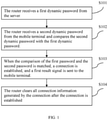
- FIG. 1 a flowchart of a first embodiment of a router network connection method of the present application is described in the following steps.
- a flowchart of a first embodiment of a mobile terminal network connection method of the present application comprises the following steps.
- step S401 the mobile terminal recognizes the image information from the router and sends a first request signal to the server when the recognition of the image information is successful.
- the router compares the second dynamic password with the first dynamic password upon reception of the second dynamic password from the mobile terminal.
- a connection is established when the first dynamic password and the second dynamic password are matched.
- a first result is sent to the mobile terminal so that when the mobile terminal receives the first result, the mobile terminal confirms that the connection is established.
- a flowchart of a second embodiment of the router network connection method of the application comprises the following steps.
- the first dynamic password is a password randomly assigned by the server, which can be a digital password, a combination of numbers and letters, such as "128963", "ad5263”, etc.
- step S202 the router generates a first master key according to the first dynamic password.
- step S204 the router receives a third random number and the first temporary key from the mobile terminal, and generates a fourth random number.
Landscapes
- Engineering & Computer Science (AREA)
- Computer Networks & Wireless Communication (AREA)
- Signal Processing (AREA)
- Computer Security & Cryptography (AREA)
- Computer Hardware Design (AREA)
- Computing Systems (AREA)
- General Engineering & Computer Science (AREA)
- Mobile Radio Communication Systems (AREA)
- Telephonic Communication Services (AREA)
Abstract
Description
- The present application claims the priority of a
Chinese patent application with application No. 201910355810.1 and invention title "Router, mobile terminal, network connection method, and storage medium" submitted to the China National Intellectual Property Administration on April 29, 2019 - The application relates to the field of intelligent communication technology, in particular, to a router, a network connection method, and a mobile terminal.
- Inventors of the present application have found through long-term research and development that most current public WiFi connections are directly connected to a router using an unencrypted connection method. After browsing a login page or advertisement page provided by the router, the router allows a connecting terminal device to access the Internet. Since a preset key and a pairwise master key (PMK) of the router are fixed values, a large number of connection sessions remain active in the router for terminal devices in idle or without authorization from a login page on the router, resulting in slow router operation and poor Internet experience.
- The main technical problem to be solved by the application is to provide a router, a mobile terminal, and a corresponding network connection method, so as to prevent resource consumption caused by excessive connection sessions of idle or unauthorized terminal devices.
- To solve the above technical problem, a technical solution adopted in the application is to provide a network connection method applicable to a router, comprising the following steps.
- The router receives a first dynamic password from a server.
- The router receives a second dynamic password from a mobile terminal and compares the second dynamic password with the first dynamic password.
- When the comparison is matched, a connection is established, and a first result signal is sent to the mobile terminal.
- The router clears connection information generated by the connection after the connection is established.
- To solve the above technical problem, another technical solution adopted in the application is to provide a network connection method applicable to a mobile terminal, comprising the following steps.
- The mobile terminal recognizes the image information from the router, and sends a first request signal to the server when the image information recognition is successful.
- The mobile terminal receives a second dynamic password from the server.
- The mobile terminal sends the second dynamic password to the router for verification.
- The mobile terminal receives a first result signal from the router.
- To solve the above technical problem, another technical solution adopted in the present application is to provide a mobile terminal, the mobile terminal comprises a memory and a processor interconnected with each other.
- The memory stores program instructions.
- The processor memory executes program instructions to carry out the following steps.
- The mobile terminal recognizes the image information from the router and sends a first request signal to the server when the image information recognition is successful, wherein the image information comprises an identification code.
- The mobile terminal receives a dynamic password from the server.
- The mobile terminal sends a dynamic password to the router.
- The mobile terminal receives a first result signal from the router.
- To solve the above technical problem, another technical solution adopted in the present application is to provide a router, the router comprises a memory and a processor interconnected with each other.
- The memory stores program instructions.
- The processor memory executes program instructions to carry out the following steps.
- The router receives a first dynamic password from the server.
- The router receives a second dynamic password from the mobile terminal and compares the second dynamic password with the first dynamic password, wherein the second dynamic password is assigned to the mobile terminal by the server.
- When the comparison is matched, a connection is established, and a first result signal is sent to the mobile terminal.
- The router clears connection information generated by the connection after the connection is established.
- To solve the above technical problem, another technical solution adopted in the present application is to provide a storage medium in which program data is stored in the storage medium, and the program data can be executed to implement the network connection method described above.
- In the network connection method proposed in the application, the mobile terminal identifies the image information of the router and sends a first request signal to the server, the router receives a first dynamic password from the server, the mobile terminal receives a second dynamic password from the router, the mobile terminal sends the second dynamic password to the router, and the router receives the second dynamic password. The second dynamic password is compared with the first dynamic password. When the comparison is matched, the connection is established and connection information generated by this connection is cleared when the connection is established, to prevent idle terminals from connecting to the router.
-
-
FIG. 1 is a flowchart of a first embodiment of a router network connection method of the present application. -
FIG. 2 is a flowchart of a second embodiment of the router network connection method of the present application. -
FIG. 3 is a flowchart of a third embodiment of the router network connection method of the present application. -
FIG. 4 is a flowchart of a first embodiment of a mobile terminal network connection method of the present application. -
FIG. 5 is a flowchart of a second embodiment of the mobile terminal network connection method of the present application. -
FIG. 6 is a flowchart of a third embodiment of the mobile terminal network connection method of the present application. -
FIG. 7 is a structural diagram of signal transmission of the network connection method of the mobile terminal and the router of the present application. -
FIG. 8 is a structural diagram of the mobile terminal/router of the present application. -
FIG. 9 is a structural diagram of an embodiment of a storage medium of the present application. - The following descriptions may clearly and completely disclose the technical solution in the embodiment of the application in combination with the drawings in the embodiment of the application. Obviously, the described embodiments are only part of the embodiments of the application, not all the embodiments. Based on the embodiments of the application, all other embodiments obtained by ordinary technical personnel in the art without creative endeavor belong to the scope of protection of the application.
- The terms "first", "second" and "third" in this application are only used for description purpose, and cannot be understood as indicating or implying relative importance or implicitly indicating the quantity of the indicated technical features. Thus, the features defined as "first", "second" and "third" may explicitly or implicitly include at least one of the features. In the description of the application, "multiple" means at least two, such as two, three, etc., unless otherwise specified. All directional indications in the embodiment of the application (such as up, down, left, right, front, back...) are merely used to explain the relative position relationships, motion situations, and etc. between the components under a certain attitude (as shown in the attached figure). If the specific attitude changes, the directional indication may change accordingly. In addition, the terms "include" and "have" and any variations thereof are intended to cover exclusive inclusions. For example, a process, method, system, product, or device that contains a series of steps or units is not limited to the listed steps or units, but may also include steps or units not listed, or may also include other steps or units inherent to these processes, methods, products, or equipment.
- The reference to "Embodiments" herein means that specific features, structures, or features described in connection with the embodiments may be included in at least one embodiment of the present application. The presence of the phrase in various places in the specification does not necessarily refer to the same embodiment, nor is it an independent or alternative embodiment mutually exclusive with other embodiments. It is explicitly and implicitly understood by those skilled in the art that the embodiments described herein may be combined with other embodiments.
- The present application is described in detail below in combination with the drawings and the embodiment.
- Refer to
FIG. 1 , a flowchart of a first embodiment of a router network connection method of the present application is described in the following steps. - In step S101, the router receives a first dynamic password from the server.
- Wherein, the first dynamic password is a password randomly assigned by the server, which can be a digital password, a combination of numbers and letters, such as "128963", "ad5263", etc.
- In step S102, the router receives a second dynamic password from the mobile terminal and compares the second dynamic password with the first dynamic password.
- The second dynamic password, in one embodiment, is the same as the first dynamic password, randomly assigned by the server. After the server receives the first request signal from the mobile terminal, the server may randomly generate a dynamic password which is then simultaneously sent to the mobile terminal and the router, respectively, so that the mobile terminal can conduct an identity verification with the router through the dynamic password. In this case, the mobile terminal sends the second dynamic password to the router for verification.
- In step S103, when the comparison of the first password and the second password is matched, a connection is established, and a first result signal is sent to the mobile terminal.
- After receiving the second dynamic password sent by the mobile terminal, the router compares the second dynamic password with the first dynamic password received from the server. If the results are inconsistent, the verification is failed so that the connection cannot be established. If the results are consistent, the verification is successful, allowing a connection to be established for the mobile terminal. A first result signal is therefore sent to the mobile terminal to prompt the mobile terminal that the network connection is established.
- In step S104, the router clears all connection information generated by the connection after the connection is established.
- After the connection is successful, the router may clear the dynamic password and information of the mobile terminal connected, such as the model and identification code of the mobile terminal, so that the mobile terminal cannot automatically establish a new connection when it enters the WiFi area next time.
- Refer to
FIG. 4 , a flowchart of a first embodiment of a mobile terminal network connection method of the present application comprises the following steps. - In step S401: the mobile terminal recognizes the image information from the router and sends a first request signal to the server when the recognition of the image information is successful.
- Wherein, the mobile terminal is a mobile phone, an iPad, and other electronic devices. The image information of the router can be an identification code information such as a two-dimensional code or a bar code, which identifies the address and factory information of the router. The mobile terminal can scan the image through a camera and other devices, and send a first request to the server after obtaining the information of the router from the scanning.
- In step S402, the mobile terminal receives the second dynamic password from the server.
- Wherein, the second dynamic password, in one embodiment, is the same as the first dynamic password in step S101, randomly assigned by the server. It can be a digital password, a combination of numbers and letters, such as "128963", "ad5263", etc.
- In step S403, the mobile terminal sends a second dynamic password to the router.
- After receiving the second dynamic password sent by the server, the mobile terminal sends the second dynamic password to the router, which is then verified by the router.
- In step S404, the mobile terminal receives a first result signal from the router.
- The router compares the second dynamic password with the first dynamic password upon reception of the second dynamic password from the mobile terminal. A connection is established when the first dynamic password and the second dynamic password are matched. A first result is sent to the mobile terminal so that when the mobile terminal receives the first result, the mobile terminal confirms that the connection is established.
- The scheme proposed in this embodiment is summarized as follows. The mobile terminal recognizes the image information of the router, sends the first request signal to the server, then receives the second dynamic password from the server. The router receives the first dynamic password from the server, the mobile terminal sends the second dynamic password to the router, and the router compares the second dynamic password with the first dynamic password. When the comparison is matched, the connection is established. When the connection is established, all connection information generated by the connection is cleared, so as to prevent the performance hits caused by automatic establishment of unwanted new connections when the mobile terminal enters the WiFi area next time.
- See
FIG. 2 , a flowchart of a second embodiment of the router network connection method of the application comprises the following steps. - In step S201: the router receives the first dynamic password from the server.
- As in the previous embodiment, the first dynamic password is a password randomly assigned by the server, which can be a digital password, a combination of numbers and letters, such as "128963", "ad5263", etc.
- In step S202: the router generates a first master key according to the first dynamic password.
- The method of generating the first master key by the router according to the first dynamic password is based on a well-known hash function PBKDF2_SHA1, shown as: PMK = PBKDF2_SHAl (first dynamic password, SSID, SSID length, 4096), where PMK denotes a master key, SSID denotes a router address, and PBKDF2_SHAl denotes a hash operation.
- The pairwise master key (PMK) is a symmetric key that the applicant (i.e., the mobile terminal) and the authenticator (i.e., the router) can share a symmetric key called a pair of master keys, which is used to control the signal access between the two. According to the embodiment of the application, the PMK comes from the passwords, and in other embodiments, the PMK can be dynamically specified.
- In step S203, the router generates the first random number and sends the first random number to the mobile terminal.
- The first random number is generated by the router, and the router sends the first random number to the mobile terminal after generating the first random number. The mobile terminal is capable of generating a second random number, which may be sent to the router as a third random number.
- In step S204, the router receives a third random number and the first temporary key from the mobile terminal, and generates a fourth random number.
- Wherein, the fourth random number, like the third random number, is a randomly generated number. The fourth random number is different from the third random number and can only be used once.
- In step S205, the router generates a second temporary key according to the third random number, the fourth random number, and the first master key.
- The second temporary key is generated according to the third random number, the fourth random number, and the first master key in a pseudo-random function PRF-X, shown as:

- It should be noted that when the mobile terminal sends the third random number to the router, it includes the Media Access Control or Medium Access Control (MAC) address of the mobile terminal, which is translated into media access control or physical address, hardware address, for defining the location of network equipment. In the Open System Interconnection/Open System Interconnection Reference Model (OSI/RM), the third network layer is responsible for the IP address and the second layer data link is responsible for the MAC address. Therefore, a host has a MAC address, and each network location has an IP address dedicated to it. The MAC address is determined by the network card and is fixed. The MAC address is the aforementioned identification address.
- In step S206, the router compares the second temporary key with the first temporary key.
- After calculating the second temporary key, the router compares the calculated second temporary key with the first temporary key received from the mobile terminal.
- In step S207, when the second temporary key matches the first temporary key, a connection is established, and a second result signal is sent to the mobile terminal.
- The router compares the second temporary key with the first temporary key. If the results are inconsistent, the verification is failed, and the connection cannot be established. If the results are consistent, the verification is successful, and connection requests from the mobile terminal are allowed, so that the connection is established. A second result signal is sent to the mobile terminal to prompt the mobile terminal about establishment of a network connection.
- In step S208, the router clears all connection information generated by the connection after the connection is established.
- After the connection is successful, the router may clear the dynamic password of the connection and information related to the connected mobile terminal. The master keys, temporary keys, device identification addresses, and random numbers of the mobile terminal generated by such connection are cleared so that the mobile terminal cannot automatically establish a new connection when it enters the WiFi area next time.
- See
FIG. 5 , which is a flowchart of a second embodiment of the mobile terminal network connection method of the present application. The steps S501 and S502 are respectively the same as S401 and S402 inFIG. 4 , and will not be explained here. - In step S503, the mobile terminal generates a second master key according to the second dynamic password.
- The mobile terminal sends a first request signal to the server after recognizing the image information of the router, and the server sends a second dynamic password to the mobile terminal upon receiving the first request signal. The mobile terminal generates a second master key by substituting the second dynamic password into a hash function of:
PMK = PBKDF2_SHAl (dynamic password, SSID, SSID length, 4096), where PMK denotes a master key, SSID denotes a router address, and PBKDF2_SHAl is a hash function. - PMK is a symmetric key that the applicant (i.e., the mobile terminal) and the authenticator (i.e., the router) can share a symmetric key called a pair of master keys, which is used to control the signal access between the two. According to the embodiment of the application, the PMK comes from the password, and in other embodiments, the PMK can be dynamically specified.
- In step S504: the mobile terminal receives a first random number from the router and generates a second random number.
- The first random number and the second random number, in one embodiment, are respectively identical to the fourth random number and the third random number. Specifically, the first random number and the fourth random number are random numbers generated by the router, the second random number and the third random number are random numbers generated by the mobile terminal, and all the random numbers can only be used once in the process for calculating and generating the temporary keys.
- In step S505, the mobile terminal generates a first temporary key according to the first random number, the second random number, and the second master key.
- The first temporary key is generated according to the first random number, the second random number, and the second master key in a pseudo-random function as below:

- It should be noted that when the router sends the first random number to the router, it includes the Media Access Control or Medium Access Control (MAC) address of the mobile terminal, which is translated into media access control or physical address, hardware address, for defining the location of network equipment. In the Open System Interconnection/Open System Interconnection Reference Model (OSI/RM), the third network layer is responsible for the IP address and the second layer data link is responsible for the MAC address. Therefore, a host has a MAC address, and each network location has an IP address dedicated to it. The MAC address is determined by the network card and is fixed. The MAC address is the aforementioned identification address.
- In step S506, the mobile terminal generates a third random number and sends the third random number and the first temporary key to the router.
- After calculating the first temporary key, the mobile terminal generates a third random number and sends the third random number to the router, which contains the MAC address of the mobile terminal, that is, the identification address.
- In step S507, a second result signal is received from the router.
- After receiving the third random number, the router calculates the second temporary key, compares the second temporary key with the first temporary key, establishes a connection after the comparison is matched, and sends the second result signal to the mobile terminal, and the mobile terminal confirms that the connection is established when the second signal is received.
- The scheme proposed in this embodiment is summarized as follows. The mobile terminal recognizes the image information of the router, sends the first request signal to the server, receives the second dynamic password from the server, and generates the second master key according to the second dynamic password. The router receives the first dynamic password from the server and generates the first master key according to the first dynamic password, so that the router generates the first random number and sends it to the mobile terminal. The mobile terminal generates a second random number after receiving the first random number, and generates a first temporary key according to the first random number, the second random number, and the second master key. The mobile terminal generates a third random number and sends the third random number and the first temporary key to the router, and the router generates the fourth random number after receiving the third random number. The second temporary key is generated according to the third random number, the fourth random number, and the first master key. After the second temporary key is generated, the second temporary key is matched with the first temporary key. After the comparison is matched, the connection is established, and all connection information generated by this connection is cleared after the connection is established, so that the mobile terminal cannot automatically establish a new connection when it enters the WiFi area next time.
- See
FIG. 3 for a flowchart of a third embodiment of the router network connection method of the present application. Compared with the second embodiment shown inFIG. 2 , the differences are found after comparing the second temporary key with the first temporary key in step S206. The steps are shown below. - In step S307, if the comparison is matched, the router sends the second temporary key to the mobile terminal.
- After the router successfully compares the first temporary key and the second temporary key, the second temporary key is sent to the mobile terminal.
- In step S308, the router receives an authentication confirmation message from the mobile terminal, establishes a connection, and sends a third result signal to the mobile terminal.
- After the mobile terminal receives the second temporary key, it compares the second temporary key with the first temporary key again. If the comparison is not matched, the connection is failed. If the comparison is matched, the authentication confirmation message is sent to the router. After receiving the confirmation message, the router establishes the connection and sends a third result signal to the mobile terminal to prompt the mobile terminal to about the connection results.
- In step S309: the router clears all connection information generated by the connection after the connection is established.
- After the connection is successful, the router may clear the dynamic password of the connection and all information relevant to the connected mobile terminal. All the master keys, temporary keys, device identification addresses, and random numbers of the mobile terminal generated by such connection are cleared, so that the mobile terminal cannot automatically establish a new connection when the mobile terminal enters the WiFi area next time.
- See
FIG. 6 for the flowchart of a third embodiment of the mobile terminal network connection method of the present application. Compared with the second embodiment shown inFIG. 5 , the difference is shown after generating a third random number and sending the third random number and the first temporary key to the router in step S506, as below. - In step S607, the terminal device receives a second temporary key from the router.
- The router sends the second temporary key to the mobile terminal after successfully comparing the second temporary key with the first temporary key.
- In step S608, the terminal device compares the second temporary key with the first temporary key.
- After receiving the second temporary key from the router, the mobile terminal compares the second temporary key with the first temporary key. When the comparison is not matched, the connection is failed.
- In step S609, when the comparison is matched, an authentication confirmation message is sent to the router.
- The mobile terminal compares the second temporary key with the first temporary key, and sends an authentication confirmation message to the router to prompt the router that the authentication is confirmed.
- In step S610: the mobile terminal receives the third result signal from the router.
- The router establishes a connection after receiving the authentication confirmation message sent by the mobile terminal, and sends a third result signal to the mobile terminal to prompt that the mobile terminal is connected successfully.
- Compared with the second embodiment (
FIGs. 2 and5 ), the differences are as summarized. The router compares the second temporary key, and after the comparison is matched, the router sends the second temporary key to the mobile terminal, and the mobile terminal then compares the second temporary key with the first temporary key once, and after the comparison is successful, an authentication confirmation message is sent to the router, the router allows the mobile terminal to connect after receiving the authentication confirmation message, and sends the first connection after the connection is established. The third result signal is sent to the mobile terminal to prompt the mobile terminal that the connection is established. In this embodiment, two comparisons are performed to further improve the security of the network connection. The router clears all connection information generated by the connection after the connection is established, so that the mobile terminal cannot automatically establish a new connection when the mobile terminal enters the WiFi area next time. - Please refer to
FIG. 7 for a structural diagram of signal transmission of mobile terminal and router in the present application. Specifically, themobile terminal 11 recognizes the image information of therouter 12 and sends a first request signal to theserver 13. After receiving the first request signal, theserver 13 sends a first dynamic password to therouter 12 and a second dynamic password to themobile terminal 11. Themobile terminal 11 generates a second master key according to the second dynamic password, and therouter 12 generates a first random number and sends the first random number to themobile terminal 11. Themobile terminal 11 generates a second random number, and generates a first temporary key according to the first random number, the second random number, and the second master key. The first temporary key is then sent to therouter 12 for verification. Therouter 12 receives a third random number and the first temporary key from the mobile terminal, generates a fourth random number, and then generates a second temporary key according to the third random number, the fourth random number, and the first master key. Therouter 12 then compares the second temporary key with the first temporary key. If the comparison is matched, therouter 12 sends the second temporary key to themobile terminal 11, and themobile terminal 11 sends an authentication confirmation message to therouter 12 after verifying the second temporary key with the first temporary key. Therouter 12 establishes a connection after receiving the authentication confirmation message, and sends a result signal to themobile terminal 11 prompting the successful connection establishment. - Please refer to
FIG. 8 , which is a structural diagram of the mobile terminal or router of the present application. The mobile terminal or router comprises aprocessor 51 and amemory 52 coupled to theprocessor 51. - The
memory 52 stores program data executable by theprocessor 51 to carry out the connection method as described in any of the aforementioned embodiments. - The
processor 51 is configured to load and execute the program data stored in thememory 52. - The
processor 51 is also referred to as the central processing unit (CPU). Theprocessor 51 may be an integrated circuit chip with signal processing capability. Theprocessor 51 may also be a general-purpose processor, a digital signal processor (DSP), an ASIC, a ready-made programmable gate array (FPGA), or other programmable logic devices, discrete gate, or transistor logic devices, and discrete hardware components. The general processor can be a microprocessor or the processor can be any conventional processor, etc. - The
memory 52 can be a memory module, a TF card, etc., which can store all the information in the mobile terminal, comprising the input original data, computer programs, intermediate operation results, and final operation results. It stores and takes out information according to the position designated by the controller. With the memory, the mobile terminal has the memory function and can ensure normal operations. The memory of mobile terminal can be divided into main memory and auxiliary memory (external memory) according to the purpose memory, and also can be classified into external memory and internal memory. The external storage is usually magnetic medium or optical disk, which can store information for a long time. The memory refers to the storage unit on the motherboard, which is used to store the currently executing data and programs. However, it is only used for temporary storage of programs and data. If the power is turned off or power outage occurs, the data may be lost. - The mobile terminal or router also comprises other devices, which are the same as other devices and functions in the mobile terminal or router in the prior art, and will not be repeated here.
- Refer to
FIG. 9 , a structural diagram of an embodiment of a storage medium of the present application is shown. The storage medium of the present applicationstores program data 61 executable by the processor to carry out the connection methods as described in the aforementioned embodiments. Theprogram data 61 can be stored in the storage medium in the form of software products, comprising a number of instructions to enable a computer device (which may be a personal computer, a server, or a network device, etc.) or a processor to execute all or part of the steps of the methods described in the various embodiments of the present application. The storage devices mentioned above may include: U disk, mobile hard disk, read-only memory (ROM), random access memory (RAM), disk or CD, and other media that can store program code, or terminal equipment such as computer, server, mobile phone, tablet, etc. - In the several embodiments provided by this application, it should be understood that the disclosed system, device, and method can be realized in alternative ways. For example, the embodiments of the device described above is only schematic. For example, the definitions of modules or units are merely based on logical functions. In actual implementation, there may be other ways to define the units, for example, multiple units or components can be combined or integrated into another system, or some features can be ignored or not implemented. On the other hand, the mutual coupling or direct coupling or communication connection shown or discussed may be indirect coupling or communication connection through some interfaces, devices, or units, and may be in the form of electrical, mechanical, or other forms.
- In addition, each functional unit in each embodiment of the present application can be integrated into a processing unit, or each unit may exist independently, or two or more units may be integrated in one unit. The integrated unit can be implemented in the form of hardware or software function unit.
- The above embodiments are merely illustrative implementations of the application, and are not intended to limit the scope of the patent of the application. All equivalent structure or equivalent process transformation made by using the description and drawings of the application, or directly or indirectly applicable to other related technical fields, are similarly included in the scope of patent protection of the application.
Claims (20)
- A network connection method applicable to a router, characterized in that the method
comprises following steps:the router receiving a first dynamic password from a server;the router receiving a second dynamic password from a mobile terminal and comparing the second dynamic password with the first dynamic password;when the comparison is matched, establishing a connection, and sending a first result signal to the mobile terminal; andthe router clearing connection information generated by the connection after the connection is established. - The network connection method according to claim 1, characterized in that after the step of the router receiving the first dynamic password from the server, the network connection method further comprises:the router generating a first master key according to the first dynamic password;the router generating a first random number and sending the first random number to the mobile terminal;receiving a third random number and a first temporary key from the mobile terminal andgenerating a fourth random number;generating a second temporary key according to the third random number, the fourth random number, and the first master key;comparing the second temporary key with the first temporary key; andwhen the comparison is matched, establishing the connection, and sending a second result signal to the mobile terminal.
- The network connection method according to claim 2, characterized in that the step of
comparing the second temporary key with the first temporary key further comprises:when the comparison is matched, the router sending the second temporary key to the mobile terminal; andthe router receiving an authentication confirmation message from the mobile terminal, establishing the connection, and sending a third result signal to the mobile terminal. - The network connection method according to claim 2, characterized in that the step of the router generating the first master key by substituting the first dynamic password into a hash function PBKDF2_SHA1:PMK=PBKDF2_SHA1 (dynamic password, SSID, SSID length, 4096);wherein PMK denotes a master key and SSID denotes an address of the router; andthe step of generating the second temporary key according to the third random number, the fourth random number, and the first master key is based on a pseudo-random function PRF-X:
 wherein PTK denotes a temporary key, ANonce denotes a random number generated by the router, SNonce denotes a random number generated by the mobile terminal, AA denotes an identification address of the router, SA denotes an identification address of the mobile terminal, and the "Pairwise key expansion" denotes a constant character string.
 - The network connection method according to claim 1, characterized in that the first dynamic password is a digital password or a combination of numbers and letters.
- The network connection method according to claim 1, characterized in that the second dynamic password is assigned to the mobile terminal by the server.
- A network connection method applicable to a mobile terminal, characterized in that the method comprises following steps:the mobile terminal recognizing an image information from a router and sending a first request signal to a server when the image information is successfully recognized;receiving a second dynamic password from the server;sending a second dynamic password to the router; andreceiving a first result signal from the router.
- The network connection method according to claim 7, characterized in that after the step of receiving the second dynamic password from the server, the network connection method further comprises:the mobile terminal generating a second master key according to the second dynamic password;receiving a first random number from the router and generating a second random number; generating a first temporary key according to second dynamic password, the second random number, and the second master key;generating a third random number and sending the third random number and the first temporary key to the router; andreceiving a second result signal from the router.
- The network connection method according to claim 8, characterized in that after the step of generating the third random number and sending the third random number and the first temporary key to the router, the network connection method also comprises:receiving a second temporary key from the router;comparing the second temporary key with the first temporary key;sending an authentication confirmation message to the router when the comparison is matched; andreceiving a third result signal from the router.
- The network connection method according to claim 7, characterized in that the image information comprises an identification code.
- The network connection method according to claim 7, characterized in that the first dynamic password is a digital password or a combination of numbers and letters.
- A mobile terminal, comprising a memory and a processor interconnected with each other, wherein the memory stores program data loadable and executable by the processor to carry out following steps:the mobile terminal recognizing an image information from a router and sending a first request signal to a server when the image information is successfully recognized, whereinthe image information comprises an identification code;receiving a second dynamic password from the server;sending the second dynamic password to the router; andreceiving a first result signal from the router.
- The mobile terminal according to claim 12, characterized in that after the step of
receiving the dynamic password from the server, the mobile terminal also comprises:the mobile terminal generating a second master key according to the second dynamic password;receiving a first random number from the router and generating a second random number;generating a first temporary key according to the first random number, the second random number, and the second master key ;generating a third random number and sending the third random number and the first temporary key to the router; andreceiving a second result signal from the router. - The mobile terminal according to claim 13, characterized in that after the step of generating the third random number and sending the third random number and the first temporary key to the router, the mobile terminal further performs following steps:receiving a second temporary key from the router;comparing the second temporary key with the first temporary key;sending an authentication confirmation message to the router when the comparison is matched; andreceiving a third result signal from the router.
- The mobile terminal according to claim 12, characterized in that the first dynamic password is a digital password or a combination of numbers and letters.
- A router, comprising a memory and a processor interconnected with each other, wherein the memory stores program data loadable and executable by the processor to carry out following steps:the router receiving a first dynamic password from a server;the router receiving a second dynamic password from a mobile terminal and comparing the second dynamic password with the first dynamic password, wherein the second dynamic password is assigned to the mobile terminal by the server;when the comparison is matched, establishing a connection, and sending a first result signal to the mobile terminal; andthe router clearing connection information generated by the connection after the connection is established.
- The router according to claim 16, characterized in that after receiving the first
dynamic password from the server, the router performs following steps:generating a first master key according to the first dynamic password;generating a first random number and sending the first random number to the mobile terminal;receiving a third random number and a first temporary key from the mobile terminal andgenerating a fourth random number;generating a second temporary key according to the third random number, the fourth random number, and the first master key;comparing the second temporary key with the first temporary key; andwhen the comparison is matched, establishing the connection, and sending a second result signal to the mobile terminal. - The router according to claim 17, characterized in that after comparing the second temporary key with the first temporary key, the router further performs following steps:when the comparison is matched, sending the second temporary key to the mobile terminal; andreceiving an authentication confirmation message from the mobile terminal, establishing the connection, and sending a third result signal to the mobile terminal.
- The router according to claim 17, characterized in that the router generates the first master key by substituting the first dynamic password into a hash function PBKDF2_SHA1:PMK=PBKDF2_SHA1 (dynamic password, SSID, SSID length, 4096);wherein PMK denotes a master key and SSID denotes an address of router; andthe step of generating the second temporary key according to the third random number,the fourth random number, and the first master key is as follows:
 wherein PTK denotes a temporary key, ANonce denotes a random number generated by the router, SNonce denotes a random number generated by the mobile terminal, AA denotes an identification address of the router, SA denotes an identification address of the mobile terminal, PRF-X denotes a pseudo-random function, and the "Pairwise key expansion" denotes a constant character string.
 - The router according to claim 16, characterized in that the first dynamic password is a digital password or a combination of numbers and letters.
Applications Claiming Priority (2)
| Application Number | Priority Date | Filing Date | Title |
|---|---|---|---|
| CN201910355810.1A CN110213760B (en) | 2019-04-29 | 2019-04-29 | Router, mobile terminal, network connection method thereof and storage medium |
| PCT/CN2019/125051 WO2020220694A1 (en) | 2019-04-29 | 2019-12-13 | Router, network connection method and mobile terminal |
Publications (3)
| Publication Number | Publication Date |
|---|---|
| EP3965445A1 true EP3965445A1 (en) | 2022-03-09 |
| EP3965445A4 EP3965445A4 (en) | 2023-01-25 |
| EP3965445B1 EP3965445B1 (en) | 2024-12-04 |
Family
ID=67786714
Family Applications (1)
| Application Number | Title | Priority Date | Filing Date |
|---|---|---|---|
| EP19927153.7A Active EP3965445B1 (en) | 2019-04-29 | 2019-12-13 | Router, network connection method and mobile terminal |
Country Status (4)
| Country | Link |
|---|---|
| US (1) | US12526628B2 (en) |
| EP (1) | EP3965445B1 (en) |
| CN (1) | CN110213760B (en) |
| WO (1) | WO2020220694A1 (en) |
Families Citing this family (5)
| Publication number | Priority date | Publication date | Assignee | Title |
|---|---|---|---|---|
| CN110213760B (en) | 2019-04-29 | 2022-02-11 | 惠州Tcl移动通信有限公司 | Router, mobile terminal, network connection method thereof and storage medium |
| US12210893B2 (en) * | 2021-07-29 | 2025-01-28 | Red Hat, Inc. | Establishing process connections utilizing an intermediary broker |
| CN113873485B (en) * | 2021-09-22 | 2024-04-23 | 联想(北京)有限公司 | Communication method and communication system |
| CN114500032B (en) * | 2022-01-24 | 2024-03-29 | 北京华云安信息技术有限公司 | Method for starting router debugging mode |
| CN118827083B (en) * | 2023-08-28 | 2026-04-17 | 中国移动通信有限公司研究院 | Authentication methods, terminal devices, business platforms, authentication platforms, and storage media |
Family Cites Families (54)
| Publication number | Priority date | Publication date | Assignee | Title |
|---|---|---|---|---|
| EP1615380A1 (en) * | 2004-07-07 | 2006-01-11 | Thomson Multimedia Broadband Belgium | Device and process for wireless local area network association |
| GB0507988D0 (en) * | 2005-04-20 | 2005-05-25 | Connect Spot Ltd | Wireless access system |
| US8295851B2 (en) * | 2005-08-03 | 2012-10-23 | Michael Edward Finnegan | Realtime, interactive and geographically defined computerized personal matching systems and methods |
| WO2007096554A2 (en) * | 2006-02-21 | 2007-08-30 | France Telecom | Method and device for securely configuring a terminal |
| US20140355592A1 (en) * | 2012-11-01 | 2014-12-04 | Datavalet Technologies | System and method for wireless device detection, recognition and visit profiling |
| US8898474B2 (en) * | 2008-11-04 | 2014-11-25 | Microsoft Corporation | Support of multiple pre-shared keys in access point |
| US8331567B2 (en) * | 2009-03-30 | 2012-12-11 | Intel Corporation | Methods and apparatuses for generating dynamic pairwise master keys using an image |
| US9119070B2 (en) * | 2009-08-31 | 2015-08-25 | Verizon Patent And Licensing Inc. | Method and system for detecting unauthorized wireless devices |
| CN103222292B (en) * | 2010-09-16 | 2016-08-10 | 诺基亚技术有限公司 | The dynamic account utilizing safe hot spot networks creates |
| US20120284785A1 (en) * | 2011-05-05 | 2012-11-08 | Motorola Mobility, Inc. | Method for facilitating access to a first access nework of a wireless communication system, wireless communication device, and wireless communication system |
| CN103249047B (en) * | 2012-02-10 | 2018-11-23 | 南京中兴新软件有限责任公司 | The access authentication method and device of WLAN hot spot |
| US9161219B2 (en) * | 2012-06-22 | 2015-10-13 | Guest Tek Interactive Entertainment Ltd. | Authorizing secured wireless access at hotspot having open wireless network and secure wireless network |
| US8977856B2 (en) * | 2012-08-31 | 2015-03-10 | Blackberry Limited | Methods and apparatus for use in sharing credentials amongst a plurality of mobile communication devices |
| WO2014103314A1 (en) * | 2012-12-27 | 2014-07-03 | パナソニック株式会社 | Electronic device capable of communication with another device |
| CN104219667B (en) * | 2013-05-31 | 2018-05-11 | 华为终端(东莞)有限公司 | For establishing the method and apparatus of connection |
| KR102143441B1 (en) * | 2013-11-15 | 2020-08-11 | 삼성전자주식회사 | Electronic device and method for updating authentication information in electronic device |
| US20150302571A1 (en) * | 2013-12-11 | 2015-10-22 | Nantmobile, Llc | Recognition-based authentication, systems and methods |
| US20150229475A1 (en) * | 2014-02-10 | 2015-08-13 | Qualcomm Incorporated | Assisted device provisioning in a network |
| US10057813B1 (en) * | 2014-05-09 | 2018-08-21 | Plume Design, Inc. | Onboarding and configuring Wi-Fi enabled devices |
| CN104394533B (en) * | 2014-11-24 | 2018-03-23 | 中国联合网络通信集团有限公司 | Wireless Fidelity WiFi connection methods, server and terminal |
| US9843579B2 (en) * | 2015-01-22 | 2017-12-12 | Sonicwall Inc. | Dynamically generated SSID |
| CN104967997B (en) * | 2015-05-28 | 2019-02-01 | Oppo广东移动通信有限公司 | A kind of Wi-Fi cut-in method, Wi-Fi equipment, terminal device and system |
| US10341939B2 (en) | 2015-07-08 | 2019-07-02 | Tencent Technology (Shenzhen) Company Limiuted | Method for identifying wireless AP, server, system, and computer storage medium |
| CN106559814B (en) * | 2015-09-28 | 2020-02-18 | 腾讯科技(深圳)有限公司 | Method and apparatus for connecting to a wireless access point |
| US10051003B2 (en) * | 2015-07-30 | 2018-08-14 | Apple Inc. | Privacy enhancements for wireless devices |
| JP6560559B2 (en) * | 2015-08-10 | 2019-08-14 | キヤノン株式会社 | Information processing apparatus, information processing apparatus control method, and program |
| CN104994118A (en) * | 2015-08-11 | 2015-10-21 | 吴培希 | WiFi authentication system and method based on dynamic password |
| WO2017031343A1 (en) * | 2015-08-19 | 2017-02-23 | Shen Winifred | Systems and methods for authenticating users accessing a secure network with one-session-only, on-demand login credentials |
| MY203124A (en) * | 2016-01-29 | 2024-06-10 | Tencent Tech Shenzhen Co Ltd | Wireless network connection method and apparatus, and storage medium |
| US10034237B2 (en) * | 2016-02-08 | 2018-07-24 | Cisco Technology, Inc. | System and method to facilitate hotspot onboarding for user equipment in a network environment |
| CN107040922B (en) * | 2016-05-05 | 2019-11-26 | 腾讯科技(深圳)有限公司 | Wireless network connecting method, apparatus and system |
| US10334438B2 (en) * | 2016-06-21 | 2019-06-25 | ANI Technologies Private Limited | System and method for creating and managing wireless networks |
| CN107659936A (en) * | 2016-07-25 | 2018-02-02 | 中兴通讯股份有限公司 | A kind of cut-in method and device of control WiFi access devices |
| US11044240B2 (en) * | 2016-08-01 | 2021-06-22 | At&T Intellectual Property I, L.P. | Method and system to manage access to a wireless local area network |
| CN106375999A (en) * | 2016-08-30 | 2017-02-01 | 福建联迪商用设备有限公司 | Method and device for quickly connecting WiFi |
| CN106412897A (en) * | 2016-10-08 | 2017-02-15 | 西安瀚炬网络科技有限公司 | WiFi authentication method based on server |
| DE102016223633A1 (en) * | 2016-11-29 | 2018-05-30 | Siemens Aktiengesellschaft | Method and devices for providing at least one service, in particular in the automotive environment |
| US10432614B2 (en) * | 2017-05-16 | 2019-10-01 | Apple Inc. | Techniques for verifying user intent and securely configuring computing devices |
| US11832100B2 (en) * | 2017-05-16 | 2023-11-28 | Apple Inc. | Secure password sharing for wireless networks |
| US10516570B1 (en) * | 2017-09-27 | 2019-12-24 | NortonLifeLock Inc. | Systems and methods for tagging client devices |
| US11689925B2 (en) * | 2017-09-29 | 2023-06-27 | Plume Design, Inc. | Controlled guest access to Wi-Fi networks |
| US11038757B2 (en) * | 2017-12-14 | 2021-06-15 | Arris Enterprises Llc | Soft configuration and data exchange for in-home devices |
| CN107864475B (en) * | 2017-12-20 | 2021-05-28 | 中电福富信息科技有限公司 | WiFi (Wireless Fidelity) shortcut authentication method based on Portal + dynamic password |
| CN108111522A (en) * | 2017-12-28 | 2018-06-01 | 武汉长光科技有限公司 | It is a kind of that the method for stablizing safe universal service protocol frame is realized on onu |
| KR102414927B1 (en) * | 2018-03-21 | 2022-06-30 | 삼성전자 주식회사 | Method and apparatus for authenticating a device using wireless local area network service |
| JP7024559B2 (en) * | 2018-03-30 | 2022-02-24 | ブラザー工業株式会社 | Computer programs for terminal devices, terminal devices, communication devices, and computer programs for communication devices |
| US20190313246A1 (en) * | 2018-04-06 | 2019-10-10 | Iot And M2M Technologies, Llc | Device default wifi credentials for simplified and secure configuration of networked transducers |
| CN108990062B (en) * | 2018-07-13 | 2022-03-08 | 全讯汇聚网络科技(北京)有限公司 | Intelligent security Wi-Fi management method and system |
| CN109548018B (en) * | 2019-01-11 | 2021-11-23 | 腾讯科技(深圳)有限公司 | Wireless network access method, device, equipment and system |
| US11405789B1 (en) * | 2019-02-12 | 2022-08-02 | Amazon Technologies, Inc. | Cloud-based secure wireless local area network (WLAN) group self-forming technologies |
| CN110213760B (en) * | 2019-04-29 | 2022-02-11 | 惠州Tcl移动通信有限公司 | Router, mobile terminal, network connection method thereof and storage medium |
| US11218374B2 (en) * | 2019-07-30 | 2022-01-04 | Microsoft Technology Licensing, Llc | Discovery and resolution of network connected devices |
| US11368994B1 (en) * | 2020-03-02 | 2022-06-21 | Amazon Technologies, Inc. | Process for managing reconnections of devices in a network |
| CN114268931B (en) * | 2020-09-14 | 2025-07-04 | 华为技术有限公司 | A management method and terminal for IoT devices |
-
2019
- 2019-04-29 CN CN201910355810.1A patent/CN110213760B/en active Active
- 2019-12-13 US US17/602,818 patent/US12526628B2/en active Active
- 2019-12-13 EP EP19927153.7A patent/EP3965445B1/en active Active
- 2019-12-13 WO PCT/CN2019/125051 patent/WO2020220694A1/en not_active Ceased
Also Published As
| Publication number | Publication date |
|---|---|
| CN110213760A (en) | 2019-09-06 |
| WO2020220694A1 (en) | 2020-11-05 |
| US20220159462A1 (en) | 2022-05-19 |
| EP3965445A4 (en) | 2023-01-25 |
| US12526628B2 (en) | 2026-01-13 |
| EP3965445B1 (en) | 2024-12-04 |
| CN110213760B (en) | 2022-02-11 |
Similar Documents
| Publication | Publication Date | Title |
|---|---|---|
| EP3965445B1 (en) | Router, network connection method and mobile terminal | |
| US12041189B2 (en) | Method for storing and recovering key for blockchain-based system, and device therefor | |
| KR101759193B1 (en) | Network authentication method for secure electronic transactions | |
| US9838205B2 (en) | Network authentication method for secure electronic transactions | |
| US8621216B2 (en) | Method, system and device for synchronizing between server and mobile device | |
| US10659226B2 (en) | Data encryption method, decryption method, apparatus, and system | |
| US20140344910A1 (en) | System and method for single-sign-on in virtual desktop infrastructure environment | |
| CN105376216A (en) | Remote access method, agent server and client end | |
| EP3282737B1 (en) | Information processing device, authentication device, system, information processing method, program, and authentication method | |
| WO2020215568A1 (en) | Communication number changing method, apparatus and system, computer device and storage medium | |
| CN111130769A (en) | Internet of things terminal encryption method and device | |
| WO2023236925A1 (en) | Authentication method and communication device | |
| CN115550002B (en) | A smart home remote control method and related device based on TEE | |
| US20250112784A1 (en) | Signature authentication methods and apparatuses | |
| CN108959990A (en) | A kind of verification method and device of two dimensional code | |
| CN112187726A (en) | Data transmission method, device, storage medium and terminal | |
| WO2025232741A1 (en) | Information transmission method and apparatus, and management server, electronic device and application server | |
| KR100901279B1 (en) | Chapter 4 Method and system for authenticating network access using challenge messages. | |
| CN118972166A (en) | Data security sharing method, system, device and product for integrated system | |
| CN113055345B (en) | Block chain-based data security authentication method and device | |
| WO2018032984A1 (en) | Access authentication method, ue, and access device | |
| CN115037549A (en) | Application protection method, device and storage medium | |
| WO2017128487A1 (en) | Authentication method, and authentication apparatus | |
| US12634700B2 (en) | Communication method and apparatus for trusted or untrusted relay, terminal, and network side device | |
| CN114650537B (en) | Credit relay communication method, device, terminal and network side equipment |
Legal Events
| Date | Code | Title | Description |
|---|---|---|---|
| STAA | Information on the status of an ep patent application or granted ep patent |
Free format text: STATUS: THE INTERNATIONAL PUBLICATION HAS BEEN MADE |
|
| PUAI | Public reference made under article 153(3) epc to a published international application that has entered the european phase |
Free format text: ORIGINAL CODE: 0009012 |
|
| STAA | Information on the status of an ep patent application or granted ep patent |
Free format text: STATUS: REQUEST FOR EXAMINATION WAS MADE |
|
| 17P | Request for examination filed |
Effective date: 20210420 |
|
| AK | Designated contracting states |
Kind code of ref document: A1 Designated state(s): AL AT BE BG CH CY CZ DE DK EE ES FI FR GB GR HR HU IE IS IT LI LT LU LV MC MK MT NL NO PL PT RO RS SE SI SK SM TR |
|
| DAV | Request for validation of the european patent (deleted) | ||
| DAX | Request for extension of the european patent (deleted) | ||
| A4 | Supplementary search report drawn up and despatched |
Effective date: 20230104 |
|
| RIC1 | Information provided on ipc code assigned before grant |
Ipc: H04W 12/50 20210101ALI20221222BHEP Ipc: H04W 12/06 20210101ALI20221222BHEP Ipc: H04W 12/041 20210101ALI20221222BHEP Ipc: H04L 9/40 20220101ALI20221222BHEP Ipc: H04W 12/08 20210101ALI20221222BHEP Ipc: H04W 12/00 20210101AFI20221222BHEP |
|
| GRAP | Despatch of communication of intention to grant a patent |
Free format text: ORIGINAL CODE: EPIDOSNIGR1 |
|
| STAA | Information on the status of an ep patent application or granted ep patent |
Free format text: STATUS: GRANT OF PATENT IS INTENDED |
|
| INTG | Intention to grant announced |
Effective date: 20240627 |
|
| GRAS | Grant fee paid |
Free format text: ORIGINAL CODE: EPIDOSNIGR3 |
|
| GRAA | (expected) grant |
Free format text: ORIGINAL CODE: 0009210 |
|
| STAA | Information on the status of an ep patent application or granted ep patent |
Free format text: STATUS: THE PATENT HAS BEEN GRANTED |
|
| P01 | Opt-out of the competence of the unified patent court (upc) registered |
Free format text: CASE NUMBER: APP_55082/2024 Effective date: 20241007 |
|
| AK | Designated contracting states |
Kind code of ref document: B1 Designated state(s): AL AT BE BG CH CY CZ DE DK EE ES FI FR GB GR HR HU IE IS IT LI LT LU LV MC MK MT NL NO PL PT RO RS SE SI SK SM TR |
|
| REG | Reference to a national code |
Ref country code: CH Ref legal event code: EP |
|
| REG | Reference to a national code |
Ref country code: DE Ref legal event code: R096 Ref document number: 602019063229 Country of ref document: DE |
|
| REG | Reference to a national code |
Ref country code: IE Ref legal event code: FG4D |
|
| REG | Reference to a national code |
Ref country code: LT Ref legal event code: MG9D |
|
| REG | Reference to a national code |
Ref country code: NL Ref legal event code: MP Effective date: 20241204 |
|
| PG25 | Lapsed in a contracting state [announced via postgrant information from national office to epo] |
Ref country code: HR Free format text: LAPSE BECAUSE OF FAILURE TO SUBMIT A TRANSLATION OF THE DESCRIPTION OR TO PAY THE FEE WITHIN THE PRESCRIBED TIME-LIMIT Effective date: 20241204 |
|
| PG25 | Lapsed in a contracting state [announced via postgrant information from national office to epo] |
Ref country code: FI Free format text: LAPSE BECAUSE OF FAILURE TO SUBMIT A TRANSLATION OF THE DESCRIPTION OR TO PAY THE FEE WITHIN THE PRESCRIBED TIME-LIMIT Effective date: 20241204 |
|
| PG25 | Lapsed in a contracting state [announced via postgrant information from national office to epo] |
Ref country code: BG Free format text: LAPSE BECAUSE OF FAILURE TO SUBMIT A TRANSLATION OF THE DESCRIPTION OR TO PAY THE FEE WITHIN THE PRESCRIBED TIME-LIMIT Effective date: 20241204 |
|
| PG25 | Lapsed in a contracting state [announced via postgrant information from national office to epo] |
Ref country code: ES Free format text: LAPSE BECAUSE OF FAILURE TO SUBMIT A TRANSLATION OF THE DESCRIPTION OR TO PAY THE FEE WITHIN THE PRESCRIBED TIME-LIMIT Effective date: 20241204 |
|
| PG25 | Lapsed in a contracting state [announced via postgrant information from national office to epo] |
Ref country code: NO Free format text: LAPSE BECAUSE OF FAILURE TO SUBMIT A TRANSLATION OF THE DESCRIPTION OR TO PAY THE FEE WITHIN THE PRESCRIBED TIME-LIMIT Effective date: 20250304 |
|
| PG25 | Lapsed in a contracting state [announced via postgrant information from national office to epo] |
Ref country code: LV Free format text: LAPSE BECAUSE OF FAILURE TO SUBMIT A TRANSLATION OF THE DESCRIPTION OR TO PAY THE FEE WITHIN THE PRESCRIBED TIME-LIMIT Effective date: 20241204 Ref country code: GR Free format text: LAPSE BECAUSE OF FAILURE TO SUBMIT A TRANSLATION OF THE DESCRIPTION OR TO PAY THE FEE WITHIN THE PRESCRIBED TIME-LIMIT Effective date: 20250305 |
|
| PG25 | Lapsed in a contracting state [announced via postgrant information from national office to epo] |
Ref country code: RS Free format text: LAPSE BECAUSE OF FAILURE TO SUBMIT A TRANSLATION OF THE DESCRIPTION OR TO PAY THE FEE WITHIN THE PRESCRIBED TIME-LIMIT Effective date: 20250304 |
|
| PG25 | Lapsed in a contracting state [announced via postgrant information from national office to epo] |
Ref country code: NL Free format text: LAPSE BECAUSE OF FAILURE TO SUBMIT A TRANSLATION OF THE DESCRIPTION OR TO PAY THE FEE WITHIN THE PRESCRIBED TIME-LIMIT Effective date: 20241204 |
|
| REG | Reference to a national code |
Ref country code: AT Ref legal event code: MK05 Ref document number: 1749439 Country of ref document: AT Kind code of ref document: T Effective date: 20241204 |
|
| PG25 | Lapsed in a contracting state [announced via postgrant information from national office to epo] |
Ref country code: SM Free format text: LAPSE BECAUSE OF FAILURE TO SUBMIT A TRANSLATION OF THE DESCRIPTION OR TO PAY THE FEE WITHIN THE PRESCRIBED TIME-LIMIT Effective date: 20241204 |
|
| PG25 | Lapsed in a contracting state [announced via postgrant information from national office to epo] |
Ref country code: PL Free format text: LAPSE BECAUSE OF FAILURE TO SUBMIT A TRANSLATION OF THE DESCRIPTION OR TO PAY THE FEE WITHIN THE PRESCRIBED TIME-LIMIT Effective date: 20241204 |
|
| PG25 | Lapsed in a contracting state [announced via postgrant information from national office to epo] |
Ref country code: IS Free format text: LAPSE BECAUSE OF FAILURE TO SUBMIT A TRANSLATION OF THE DESCRIPTION OR TO PAY THE FEE WITHIN THE PRESCRIBED TIME-LIMIT Effective date: 20250404 |
|
| PG25 | Lapsed in a contracting state [announced via postgrant information from national office to epo] |
Ref country code: PT Free format text: LAPSE BECAUSE OF FAILURE TO SUBMIT A TRANSLATION OF THE DESCRIPTION OR TO PAY THE FEE WITHIN THE PRESCRIBED TIME-LIMIT Effective date: 20250404 |
|
| PG25 | Lapsed in a contracting state [announced via postgrant information from national office to epo] |
Ref country code: EE Free format text: LAPSE BECAUSE OF FAILURE TO SUBMIT A TRANSLATION OF THE DESCRIPTION OR TO PAY THE FEE WITHIN THE PRESCRIBED TIME-LIMIT Effective date: 20241204 |
|
| PG25 | Lapsed in a contracting state [announced via postgrant information from national office to epo] |
Ref country code: AT Free format text: LAPSE BECAUSE OF FAILURE TO SUBMIT A TRANSLATION OF THE DESCRIPTION OR TO PAY THE FEE WITHIN THE PRESCRIBED TIME-LIMIT Effective date: 20241204 Ref country code: RO Free format text: LAPSE BECAUSE OF FAILURE TO SUBMIT A TRANSLATION OF THE DESCRIPTION OR TO PAY THE FEE WITHIN THE PRESCRIBED TIME-LIMIT Effective date: 20241204 |
|
| PG25 | Lapsed in a contracting state [announced via postgrant information from national office to epo] |
Ref country code: SK Free format text: LAPSE BECAUSE OF FAILURE TO SUBMIT A TRANSLATION OF THE DESCRIPTION OR TO PAY THE FEE WITHIN THE PRESCRIBED TIME-LIMIT Effective date: 20241204 |
|
| PG25 | Lapsed in a contracting state [announced via postgrant information from national office to epo] |
Ref country code: CZ Free format text: LAPSE BECAUSE OF FAILURE TO SUBMIT A TRANSLATION OF THE DESCRIPTION OR TO PAY THE FEE WITHIN THE PRESCRIBED TIME-LIMIT Effective date: 20241204 |
|
| PG25 | Lapsed in a contracting state [announced via postgrant information from national office to epo] |
Ref country code: IT Free format text: LAPSE BECAUSE OF FAILURE TO SUBMIT A TRANSLATION OF THE DESCRIPTION OR TO PAY THE FEE WITHIN THE PRESCRIBED TIME-LIMIT Effective date: 20241204 |
|
| REG | Reference to a national code |
Ref country code: CH Ref legal event code: PL |
|
| PG25 | Lapsed in a contracting state [announced via postgrant information from national office to epo] |
Ref country code: LU Free format text: LAPSE BECAUSE OF NON-PAYMENT OF DUE FEES Effective date: 20241213 |
|
| REG | Reference to a national code |
Ref country code: DE Ref legal event code: R097 Ref document number: 602019063229 Country of ref document: DE |
|
| PG25 | Lapsed in a contracting state [announced via postgrant information from national office to epo] |
Ref country code: SE Free format text: LAPSE BECAUSE OF FAILURE TO SUBMIT A TRANSLATION OF THE DESCRIPTION OR TO PAY THE FEE WITHIN THE PRESCRIBED TIME-LIMIT Effective date: 20241204 |
|
| PG25 | Lapsed in a contracting state [announced via postgrant information from national office to epo] |
Ref country code: MC Free format text: LAPSE BECAUSE OF FAILURE TO SUBMIT A TRANSLATION OF THE DESCRIPTION OR TO PAY THE FEE WITHIN THE PRESCRIBED TIME-LIMIT Effective date: 20241204 |
|
| REG | Reference to a national code |
Ref country code: BE Ref legal event code: MM Effective date: 20241231 |
|
| PG25 | Lapsed in a contracting state [announced via postgrant information from national office to epo] |
Ref country code: DK Free format text: LAPSE BECAUSE OF FAILURE TO SUBMIT A TRANSLATION OF THE DESCRIPTION OR TO PAY THE FEE WITHIN THE PRESCRIBED TIME-LIMIT Effective date: 20241204 |
|
| PLBE | No opposition filed within time limit |
Free format text: ORIGINAL CODE: 0009261 |
|
| STAA | Information on the status of an ep patent application or granted ep patent |
Free format text: STATUS: NO OPPOSITION FILED WITHIN TIME LIMIT |
|
| PG25 | Lapsed in a contracting state [announced via postgrant information from national office to epo] |
Ref country code: BE Free format text: LAPSE BECAUSE OF NON-PAYMENT OF DUE FEES Effective date: 20241231 |
|
| PG25 | Lapsed in a contracting state [announced via postgrant information from national office to epo] |
Ref country code: CH Free format text: LAPSE BECAUSE OF NON-PAYMENT OF DUE FEES Effective date: 20241231 |
|
| PG25 | Lapsed in a contracting state [announced via postgrant information from national office to epo] |
Ref country code: IE Free format text: LAPSE BECAUSE OF NON-PAYMENT OF DUE FEES Effective date: 20241213 |
|
| 26N | No opposition filed |
Effective date: 20250905 |
|
| PGFP | Annual fee paid to national office [announced via postgrant information from national office to epo] |
Ref country code: DE Payment date: 20251211 Year of fee payment: 7 |
|
| PGFP | Annual fee paid to national office [announced via postgrant information from national office to epo] |
Ref country code: GB Payment date: 20251219 Year of fee payment: 7 |
|
| PGFP | Annual fee paid to national office [announced via postgrant information from national office to epo] |
Ref country code: FR Payment date: 20251229 Year of fee payment: 7 |
|
| PG25 | Lapsed in a contracting state [announced via postgrant information from national office to epo] |
Ref country code: CY Free format text: LAPSE BECAUSE OF FAILURE TO SUBMIT A TRANSLATION OF THE DESCRIPTION OR TO PAY THE FEE WITHIN THE PRESCRIBED TIME-LIMIT Effective date: 20241204 |