EP3965416A1 - Method and device for intra-coding an image frame - Google Patents
Method and device for intra-coding an image frame Download PDFInfo
- Publication number
- EP3965416A1 EP3965416A1 EP20194958.3A EP20194958A EP3965416A1 EP 3965416 A1 EP3965416 A1 EP 3965416A1 EP 20194958 A EP20194958 A EP 20194958A EP 3965416 A1 EP3965416 A1 EP 3965416A1
- Authority
- EP
- European Patent Office
- Prior art keywords
- intra
- pixel values
- image
- block
- pixel
- Prior art date
- Legal status (The legal status is an assumption and is not a legal conclusion. Google has not performed a legal analysis and makes no representation as to the accuracy of the status listed.)
- Granted
Links
Images


Classifications
-
- H—ELECTRICITY
- H04—ELECTRIC COMMUNICATION TECHNIQUE
- H04N—PICTORIAL COMMUNICATION, e.g. TELEVISION
- H04N19/00—Methods or arrangements for coding, decoding, compressing or decompressing digital video signals
- H04N19/10—Methods or arrangements for coding, decoding, compressing or decompressing digital video signals using adaptive coding
- H04N19/102—Methods or arrangements for coding, decoding, compressing or decompressing digital video signals using adaptive coding characterised by the element, parameter or selection affected or controlled by the adaptive coding
- H04N19/103—Selection of coding mode or of prediction mode
- H04N19/11—Selection of coding mode or of prediction mode among a plurality of spatial predictive coding modes
-
- H—ELECTRICITY
- H04—ELECTRIC COMMUNICATION TECHNIQUE
- H04N—PICTORIAL COMMUNICATION, e.g. TELEVISION
- H04N19/00—Methods or arrangements for coding, decoding, compressing or decompressing digital video signals
- H04N19/10—Methods or arrangements for coding, decoding, compressing or decompressing digital video signals using adaptive coding
- H04N19/102—Methods or arrangements for coding, decoding, compressing or decompressing digital video signals using adaptive coding characterised by the element, parameter or selection affected or controlled by the adaptive coding
- H04N19/117—Filters, e.g. for pre-processing or post-processing
-
- H—ELECTRICITY
- H04—ELECTRIC COMMUNICATION TECHNIQUE
- H04N—PICTORIAL COMMUNICATION, e.g. TELEVISION
- H04N19/00—Methods or arrangements for coding, decoding, compressing or decompressing digital video signals
- H04N19/10—Methods or arrangements for coding, decoding, compressing or decompressing digital video signals using adaptive coding
- H04N19/134—Methods or arrangements for coding, decoding, compressing or decompressing digital video signals using adaptive coding characterised by the element, parameter or criterion affecting or controlling the adaptive coding
- H04N19/136—Incoming video signal characteristics or properties
- H04N19/14—Coding unit complexity, e.g. amount of activity or edge presence estimation
-
- H—ELECTRICITY
- H04—ELECTRIC COMMUNICATION TECHNIQUE
- H04N—PICTORIAL COMMUNICATION, e.g. TELEVISION
- H04N19/00—Methods or arrangements for coding, decoding, compressing or decompressing digital video signals
- H04N19/10—Methods or arrangements for coding, decoding, compressing or decompressing digital video signals using adaptive coding
- H04N19/134—Methods or arrangements for coding, decoding, compressing or decompressing digital video signals using adaptive coding characterised by the element, parameter or criterion affecting or controlling the adaptive coding
- H04N19/154—Measured or subjectively estimated visual quality after decoding, e.g. measurement of distortion
-
- H—ELECTRICITY
- H04—ELECTRIC COMMUNICATION TECHNIQUE
- H04N—PICTORIAL COMMUNICATION, e.g. TELEVISION
- H04N19/00—Methods or arrangements for coding, decoding, compressing or decompressing digital video signals
- H04N19/10—Methods or arrangements for coding, decoding, compressing or decompressing digital video signals using adaptive coding
- H04N19/134—Methods or arrangements for coding, decoding, compressing or decompressing digital video signals using adaptive coding characterised by the element, parameter or criterion affecting or controlling the adaptive coding
- H04N19/157—Assigned coding mode, i.e. the coding mode being predefined or preselected to be further used for selection of another element or parameter
- H04N19/159—Prediction type, e.g. intra-frame, inter-frame or bidirectional frame prediction
-
- H—ELECTRICITY
- H04—ELECTRIC COMMUNICATION TECHNIQUE
- H04N—PICTORIAL COMMUNICATION, e.g. TELEVISION
- H04N19/00—Methods or arrangements for coding, decoding, compressing or decompressing digital video signals
- H04N19/10—Methods or arrangements for coding, decoding, compressing or decompressing digital video signals using adaptive coding
- H04N19/134—Methods or arrangements for coding, decoding, compressing or decompressing digital video signals using adaptive coding characterised by the element, parameter or criterion affecting or controlling the adaptive coding
- H04N19/167—Position within a video image, e.g. region of interest [ROI]
-
- H—ELECTRICITY
- H04—ELECTRIC COMMUNICATION TECHNIQUE
- H04N—PICTORIAL COMMUNICATION, e.g. TELEVISION
- H04N19/00—Methods or arrangements for coding, decoding, compressing or decompressing digital video signals
- H04N19/10—Methods or arrangements for coding, decoding, compressing or decompressing digital video signals using adaptive coding
- H04N19/169—Methods or arrangements for coding, decoding, compressing or decompressing digital video signals using adaptive coding characterised by the coding unit, i.e. the structural portion or semantic portion of the video signal being the object or the subject of the adaptive coding
- H04N19/17—Methods or arrangements for coding, decoding, compressing or decompressing digital video signals using adaptive coding characterised by the coding unit, i.e. the structural portion or semantic portion of the video signal being the object or the subject of the adaptive coding the unit being an image region, e.g. an object
- H04N19/176—Methods or arrangements for coding, decoding, compressing or decompressing digital video signals using adaptive coding characterised by the coding unit, i.e. the structural portion or semantic portion of the video signal being the object or the subject of the adaptive coding the unit being an image region, e.g. an object the region being a block, e.g. a macroblock
-
- H—ELECTRICITY
- H04—ELECTRIC COMMUNICATION TECHNIQUE
- H04N—PICTORIAL COMMUNICATION, e.g. TELEVISION
- H04N19/00—Methods or arrangements for coding, decoding, compressing or decompressing digital video signals
- H04N19/10—Methods or arrangements for coding, decoding, compressing or decompressing digital video signals using adaptive coding
- H04N19/169—Methods or arrangements for coding, decoding, compressing or decompressing digital video signals using adaptive coding characterised by the coding unit, i.e. the structural portion or semantic portion of the video signal being the object or the subject of the adaptive coding
- H04N19/182—Methods or arrangements for coding, decoding, compressing or decompressing digital video signals using adaptive coding characterised by the coding unit, i.e. the structural portion or semantic portion of the video signal being the object or the subject of the adaptive coding the unit being a pixel
-
- H—ELECTRICITY
- H04—ELECTRIC COMMUNICATION TECHNIQUE
- H04N—PICTORIAL COMMUNICATION, e.g. TELEVISION
- H04N19/00—Methods or arrangements for coding, decoding, compressing or decompressing digital video signals
- H04N19/50—Methods or arrangements for coding, decoding, compressing or decompressing digital video signals using predictive coding
- H04N19/593—Methods or arrangements for coding, decoding, compressing or decompressing digital video signals using predictive coding involving spatial prediction techniques
-
- H—ELECTRICITY
- H04—ELECTRIC COMMUNICATION TECHNIQUE
- H04N—PICTORIAL COMMUNICATION, e.g. TELEVISION
- H04N19/00—Methods or arrangements for coding, decoding, compressing or decompressing digital video signals
- H04N19/60—Methods or arrangements for coding, decoding, compressing or decompressing digital video signals using transform coding
- H04N19/625—Methods or arrangements for coding, decoding, compressing or decompressing digital video signals using transform coding using discrete cosine transform [DCT]
Definitions
- the present invention relates to the field of intra-coding an image frame.
- it relates to the processing of the image frame before the intra-coding thereof.
- video sequences are usually compressed before storage or before transmission over a communications network.
- a reason for compressing the video sequences before storage is to reduce the storage resources needed as compared to the storage resources needed for storing uncompressed video sequences.
- the video sequences are compressed before transmission in order to reduce the network resources, e.g. network bandwidth, used as compared to the network resources used for transmission of the uncompressed video sequences. In case of limited available network resources, it may even be impossible to transmit the video sequences if not compressed.
- the video sequences can be compressed, i.e. encoded by an encoder, using various video encoding methods.
- two main modes are used for compressing image frames of a video sequence: intra mode and inter mode.
- intra mode compression is also referred to as intra-coding
- inter mode compression is in correspondence referred to as inter-coding.
- the luminance and chrominance channels are encoded by exploiting the spatial redundancy of the pixels in a given channel of a single frame via prediction, transform, and entropy coding.
- the encoded image frames are called intra-frames and may also be referred to as I-frames or key frames.
- intra-frame blocks of pixels or macroblocks comprising a plurality of blocks are encoded in intra-mode, meaning that they are encoded as intra-blocks, i.e. individually, with no references to other blocks.
- the inter-coding instead exploits the temporal redundancy between separate image frames and relies on a motion-compensation prediction technique that predicts parts of an image frame from one or more previous image frames by encoding the motion in pixels from one image frame to another for selected blocks of pixels.
- the motion vector and the difference in motion between pixels of the image frame and pixels of a reference frame are encoded.
- the encoded frames are called inter-frames, and may be referred to as P-frames (forward-predicted frames), which can refer to previous frames in decoding order, or B-frames (bi-directionally predicted frames), which can refer to two or more previously decoded frames, and can have any arbitrary display-order relationship of the frames used for the prediction.
- blocks of pixels may be encoded either in inter-mode, meaning that they are encoded with reference to a similar block in a previously decoded image frame, or in intra-mode, meaning that they are encoded as intra-blocks, i.e. individually, with no references to other blocks.
- the encoder When performing intra-coding of a block of pixels, the encoder will make use of intra-prediction. In intra-prediction the encoder will use values of pixels on top and to the left of the block of pixels to be intra-coded in order to predict the pixel values in the block.
- the predicted pixel values are subtracted from the real pixel values and the difference (also known as the residual) is quantized and entropy encoded before it is submitted in the bitstream. If the prediction is perfect, there will be no residual. However, in practice there will be a residual that contributes to the size of the intra-coded frame.
- AVC Advanced Video Coding
- HEVC High Efficiency Video Coding
- AV1 AOMedia Video 1
- a drawback with intra-coding image frames as compared to inter-coding of the image frames is that the resulting I-frames have a larger size giving rise to spikes in the bitstream as compared to the inter-coded P-frames.
- a reason for the larger size of the I-frames is that only spatial redundancies are exploited when performing the intra-coding as compared to the inter-coding of the P-frames wherein both spatial redundancy and temporal redundancy are exploited.
- I-frames One approach of reducing the size of intra-coded image frames, i.e. I-frames, is described in US 2013/0251279 wherein an adaptive pre-processing scheme is used in the image encoding.
- the adaptive pre-processing scheme blocks of an original image, which blocks have a determined size, are compared to blocks of a reference image (an image for which the pre-processing already has been carried out) and blocks of the reference image are replicated to blocks of the original image when the blocks have a similarity within a threshold.
- the original image frame including the replicated reference blocks is encoded. Thereafter, the encoder evaluates whether the decoded image fulfils the desired quality requirements.
- the threshold has to be upwardly controlled so that the pre-processing of an upcoming image does not result in a deteriorated image quality.
- a drawback with the prior art is that entire blocks of the original image are replaced with entire reference blocks resulting in loss of image information in those parts of the image comprising the replaced blocks. In the end, the resulting image may be useless for some purposes, such as surveillance purposes, due to the loss of image information when many blocks of the original image have been replaced with reference blocks.
- the prior art also has the drawback of requiring a previously pre-processed image comprising blocks to be used for the comparison and the replication.
- the need of adjusting the threshold is determined when at least one pre-processed and encoded image of deteriorated quality has been obtained. This results in a delay in the adjustment of the threshold. Furthermore, if the image of deteriorated quality is not to be transmitted to a receiver, the original image has to be pre-processed again using the new threshold resulting in a deteriorated compression efficiency.
- the above object is achieved by a method, performed by an image pipeline, for intra-coding an image frame
- the image pipeline comprises a processing part followed by an encoding part supporting a plurality of intra-prediction modes used for intra-coding image frames.
- the method comprises, by means of the processing part, receiving an image frame, and for at least one block of pixel values in the image frame, predicting pixel values of the at least one block of pixel values using an intra-prediction mode supported by the encoding part, and updating the image frame by adjusting at least one pixel value within the at least one block of pixel values so as to reduce a residual between the at least one pixel value and a corresponding predicted pixel value.
- the method comprises, by means of the encoding part, intra-coding the updated image frame using at least one out of the plurality of intra-prediction modes.
- the processing part preceding the encoding part in the image pipeline thus updates the image frame by adjusting the at least one pixel value so as to reduce the residual between the at least one pixel value and the corresponding predicted pixel value. Since the processing part predicts the corresponding predicted pixel value using one of the intra-prediction modes supported by the encoding part and then adjust the at least one pixel value to reduce the residual, it is more likely that the encoding part will use the same one of the intra-prediction modes when performing the prediction of pixel values in the intra-coding of the updated image frame and thus the residual determined by the encoding part will be smaller than it would have been without the adjustment made by the processing part. Thanks to the smaller residual, the size of the intra-coded image frame is reduced as compared to a scenario without the pixel value adjustment performed by the processing part. Accordingly, this method serves to reduce the size of an I-frame.
- intra-coding refers to the encoding of an image frame using one or more intra-prediction modes supported by the encoding part.
- the one or more intra-prediction modes may be one or more out of the 9 different intra-prediction modes supported by AVC, one or more out of the 35 different intra-prediction modes supported by the compression standard HEVC, and/or one or more out of the 54 different intra-prediction modes supported by the compression standard AV1, just to give some examples.
- other compression standards may support other intra-prediction modes that additionally or alternatively are supported by the encoding part.
- the supported intra-prediction modes may comprise one or more luminance (luma) intra-prediction modes and/or one or more chrominance (chroma) intra-prediction modes.
- block of pixel values is generally meant a unit of pixel values, e.g. a processing unit of pixel values, that is used in the compression.
- the processing unit may be used in image and video compression formats based on linear block transforms, typically the Discrete Cosine Transform (DCT).
- the block may sometimes be referred to as a prediction block or a transform block depending on whether it is used in prediction or in compression.
- the block may be a part of a so-called macroblock.
- the block of pixel values typically comprises 4x4 pixel values or 8x8 pixel values.
- the block size may be another such as 16x16 or 32x32 or it may be a macroblock-based size depending on the compression standard.
- the number of pixel values within the block of pixel values may vary depending on e.g. the compression technique used.
- residual when used in this disclosure is meant the difference between the real pixel value and the predicted pixel value.
- the residual is expressed as the absolute value of the difference between the real pixel value and the predicted pixel value.
- the method further comprises the step of identifying at least one region of non-interest in the image frame, wherein the at least one block of pixel values is comprised in the at least one region of non-interest.
- region of non-interest when used in this disclosure is meant a region different from a region of interest, ROI, which ROI comprises one or more objects or details of interest.
- a region of non-interest is a region not comprising any objects or details of interest, such as a background region.
- the region of non-interest may be a region comprising a part of the sky, a sea, a forest, a lawn or other vegetation, just to give some examples.
- the adjustment of the at least one pixel value comprised in a block in the region of non-interest to reduce the residual between the pixel value and a corresponding predicted pixel value as mentioned above would have the advantage of giving a better match with the intra-prediction mode the encoder will use in the subsequent encoding of the image frame without affecting the image quality of the encoded image frame since the adjustment of the at least one pixel value does not affect any object or details of interest.
- Identification of the at least one region of non-interest may be accomplished in several ways, some of which will be described below with reference to a first and a second group of embodiments.
- the identifying of the at least one region of non-interest in the image frame comprises partitioning the image frame into image segments, classifying the image segments, and identifying at least one of the image segments to be the at least one region of non-interest when the at least one of the image segments belongs to a group of predetermined classes.
- One or more of the above-mentioned steps of partitioning, classifying and identifying may be performed by an image segmentation procedure wherein a label is assigned to every pixel in the image frame such that pixels with the same label share certain characteristics and are considered to belong to the same image segment.
- the label may be associated with or indicative of one of the predetermined classes.
- the result of image segmentation is a set of image segments that collectively cover the entire image frame.
- An image segmentation procedure is semantic segmentation.
- image segmentation procedures are motion-based segmentation, and segmentation based on threshold values, histograms, or based on clustering methods, or other procedures for determining some areas of the image to be of more importance than others due to the existence of objects, people, or motion in those areas and classifying those areas as ROIs and the other areas as region of non-interest.
- the group of predetermined classes may comprise classes defining homogeneous image segments i.e. image segments being mostly uniform in composition such as mostly uniform in colour and/or texture, or image segments having a spatial variability below a threshold.
- the group of predetermined classes may comprise classes such as sky and vegetation and/or subclasses such as daytime sky, night-time sky, cloud, and tree, shrub and grass, respectively.
- the processing part may select the intra-prediction mode based on the group of predetermined classes. Thanks to the segmentation into classes an intra-prediction mode more suitable for a certain class may be more easily selected.
- the processing part calculates predicted pixel values for each pixel value in the at least one block of pixel values using at least two of the plurality of intra-prediction modes and selects the intra-prediction mode of the at least two of the plurality of intra-prediction modes giving a smallest sum of absolute values of the residuals between the pixel values and the corresponding predicted pixel values.
- the identifying of the at least one region of non-interest in the image frame comprises determining a spatial variability of pixel values comprised in at least one region of the image frame, and identifying the at least one region of non-interest to be a region comprising pixel values having a spatial variability below a region threshold value.
- the spatial variability being below a region threshold value it is indicated that the region is homogeneous, i.e. does not comprise an object or details of interest. Therefore, it is advantageous to identify that region as the region of non-interest.
- the at least one block of pixel values comprised in the region of non-interest may have a spatial variability of pixel values above a block threshold value.
- a block threshold value For example, when selecting the block wherein the at least one pixel value is to be adjusted it is advantageous to select a block wherein the spatial variability is above the block threshold values since in such a block the pixel value can be adjusted more to obtain a reduced encoded frame size without impairing the image quality.
- the adjusting of the at least one pixel value within the at least one block of pixel values comprises adjusting the at least one pixel value within the at least one block of pixel values to reduce the spatial variability of the pixel values below the block threshold value. Thereby, the residual for at least one pixel value will also be reduced.
- the intra-prediction mode used by the processing part is selected from a subset of the plurality of intra-prediction modes supported by the encoding part.
- the method may further comprise, by means of the processing part, calculating the residual between the pixel values and the corresponding predicted pixel values, and selecting the at least one pixel value to be adjusted to be a pixel value for which an absolute value of the calculated residual is larger than a pixel threshold value.
- the adjusting of the at least one pixel value within the at least one block of pixel values may comprise adjusting the at least one pixel value within the at least one block of pixel values so that an absolute value of the residual is equal to or below the pixel threshold value.
- the adjusting of the at least one pixel value comprises adjusting the at least one pixel value by a predefined amount.
- the predefined amount may be 1 or 2 steps up or down within a pixel value range.
- the at least one pixel value is an integer in the range from 0 to 255
- the pixel value range is from 0 to 1023.
- the pixel value range depends on the number of bits per pixel of the video stream and may be another range than the ranges given above as examples.
- the adjusting of the at least one pixel value comprises adjusting the at least one pixel value within the at least one block of pixel values to be equal to a neighbouring pixel value.
- the adjusting of the at least one pixel value comprises adjusting one or more but not all of the pixel values within the at least one block of pixel values.
- the number of pixel values to be adjusted is kept as low as possible to obtain the sought-after reduction in encoded frame size while at the same time avoid deteriorating the image quality of the encoded image frame.
- an image pipeline for intra-coding an image frame wherein the image pipeline comprises a processing part followed by an encoding part configured to support a plurality of intra-prediction modes used for intra-coding image frames.
- the processing part is configured to receive an image frame; and configured to, for at least one block of pixel values in the image frame, predict pixel values of the at least one block of pixel values using an intra-prediction mode supported by the encoding part and update the image frame by adjusting at least one pixel value within the at least one block of pixel values so as to reduce a residual between the at least one pixel value and a corresponding predicted pixel value.
- the encoding part is configured to intra-code the updated image frame using at least one out of the plurality of intra-prediction modes.
- the above object is achieved by a non-transitory computer-readable medium having stored thereon computer code instructions adapted to carry out the method of the first aspect when executed by a device having processing capability.
- the second and third aspects may generally have the same features and advantages as the first aspect. It is further noted that the invention relates to all possible combinations of features disclosed herein unless explicitly stated otherwise.
- Fig. 1 illustrates an embodiment of an imaging system 100.
- the imaging system 100 comprises an image source 110, and an image pipeline 120 for intra-coding one or more image frames 112.
- the image source 110 may be or may comprise an image sensor (not shown) configured to capture one or more image frames of a scene.
- the image source 110 may form part of a video camera, such as a surveillance camera.
- the image source 110 may be an image rendering engine.
- the image rendering engine is configured to render the image frames.
- the image rendering engine may be configured to render photorealistic or non-photorealistic image frames from a 2D model or a 3D model by means of computer program.
- the image source 110 may be a storage configured to store one or more image frames received from an image sensor (not shown) arranged external of and in communication with the image source 110.
- the image source 110 may be configured to transfer image frames 112 to the image pipeline 120.
- the image pipeline 120 may form part of the video camera, such as the surveillance camera, mentioned above.
- the video camera comprises the imaging system 100.
- the image pipeline 120 comprises a processing part 122 and an encoding part 124.
- the processing part 122 is arranged to precede the encoding part 124 in the image pipeline 120, and thus the encoding part 124 is arranged to succeed the processing part 122 .
- the encoding part 124 is configured to support a plurality of intra-prediction modes used for intra-coding an image frame.
- the image pipeline 120 may also comprise receiving and transmitting parts (not shown) configured to receive image frames from the image source 110 and to transmit image frames to a client device.
- the image pipeline 120 is configured to process one or more image frames 112 received from the image source 110 and to transmit processed and encoded image frames 112" in one or more bitstreams to one or more clients, e.g. over a wireless or wired communications network (not shown). Especially, the image pipeline 120 is configured to process image frames to reduce the encoded frame size of intra-coded image frames, i.e. the encoded frame size of the I-frames transmitted from the encoding part 124 in the one or more bitstreams. As also illustrated in Fig. 1 , each client may have a decoding part 130 configured to decode the received bitstream of encoded image frames 112" and to present the decoded image frames on a display device 140, such as on a video monitor.
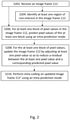
- a method for intra-coding an image frame 112 will now be described with reference to the flowchart of Fig. 2 .
- the method may be performed by the image pipeline 120 of the imaging system 100.
- the method or one or more steps thereof may be performed independently in several parts of the image pipeline 110.
- the steps of the method are performed by the processing part 122 or the encoding part 124 of the image pipeline 120.
- examples of performing some steps of the method in another part, such as in a pre-processing part (not shown) will also be given.
- some of the steps may be optional and that steps may be taken in another suitable order.
- one or more steps are described as being performed on at least one block of pixel values. This should be understood as one or more steps may be performed on a plurality of blocks of pixel values, e.g. all blocks of pixel values, of an image frame or of a part of the image frame.
- the processing part 122 receives the image frame 112.
- the processing part 122 may obtain the image frame 112 from the image source 110.
- the image frame 112 is a frame that is to be intra-coded, i.e. the frame is to be encoded using intra mode compression.
- At least one region of non-interest in the image frame 112 is identified.
- the at least one region of non-interest comprises at least one block of pixel values.
- the image frame 112 will be updated by adjusting at least one pixel value of the least one block of pixel values to reduce a residual between the at least one pixel value and a corresponding predicted pixel value.
- the at least one pixel value in a region of non-interest the possible drawback of a deteriorated image quality is not so serious since it is occurring in the non-interesting region of the image frame 112 and would not negatively impact the viewing experience. Therefore, in some embodiments, the least one block of pixel values is selected to be comprised in the region of non-interest.
- the at least one region of non-interest may be identified in several ways by the image pipeline 120.
- the at least one region of non-interest may be identified by the processing part 122 but it may alternatively be identified by another part of the image pipeline 120 such as by a pre-processing part (not shown) preceding the processing part 122.
- the image pipeline 120 may identify the at least one region of non-interest in the image frame 112 by partitioning the image frame 112 into image segments, classifying the image segments and identifying at least one of the image segments to be the at least one region of non-interest when the at least one of the image segments belongs to a group of predetermined classes.
- the group of predetermined classes may comprise classes such as sky and vegetation and/or subclasses such as daytime sky, night-time sky, cloud, and tree, shrub and grass, respectively.
- the image pipeline 120 may identify the at least one region of non-interest in the image frame 112 by determining a spatial variability of pixel values comprised in at least one region of the image frame 112, and identifying the at least region of non-interest to be a region comprising pixel values having a spatial variability below a region threshold value.
- the region threshold value may be a value below which the spatial variability is low enough to consider the region to be of non-interest.
- the region threshold value may be the value corresponding to the tenth percentile of the spatial variability of the pixels in the frame, whereby statistically ten percent of all pixel values will be below the region threshold value and may thus be considered to belong to the region of non-interest.
- the spatial variability for a region may be the variance or standard deviation of pixel values in the region.
- the at least one block of pixel values comprised in the region of non-interest may have a spatial variability of pixel values above a block threshold value. If several blocks within the region of non-interest have a spatial variability of pixel values above the block threshold value, the block having the largest spatial variability out of the several blocks may be selected. Then the processing part 122 may adjust the at least one pixel value within the at least one block of pixel values to reduce the spatial variability of the pixel values below the block threshold value.
- the block threshold value may be set to a value close to the spatial variability of the block, such as to a value within the range of ⁇ 1-10, e.g. within ⁇ 1-5, per cents of the spatial variability of the block.
- the spatial variability for a block may be the variance or standard deviation of pixel values in the block. This may be used in intra-prediction modes using a mean value of upper and left-hand samples, such as in the AVC intra-prediction mode 2 (DC).
- step S206 the processing part 122 predicts pixel values for at least one block of pixel values in the image frame 112 by using an intra-prediction mode supported by the encoding part 124.
- the at least one block of pixel values may be comprised in a region of the image frame such as a region of non-interest.
- the processing part 122 may predict pixel values for all blocks of pixel values comprised in the region of the image frame, e.g. in the region of non-interest.
- the encoding part 124 supports a plurality of intra-prediction modes.
- the processing part 122 should use one out of the plurality of intra-prediction modes support by the encoding part 124.
- the encoding part 124 may support one or more out of the 9 different intra-prediction modes supported by AVC, one or more out of the 35 different intra-prediction modes supported by the compression standard HEVC, and/or one or more out of the 54 different intra-prediction modes supported by the compression standard AV1, just to give some examples.
- the processing part 122 may select the intra-prediction mode, out of the plurality of intra-prediction modes supported by the encoding part 124, based on the group of predetermined classes.
- the processing part 122 may be configured to select the intra-prediction mode based on classification of the image segment. If the classification indicates that the region is homogeneous, an intra-prediction mode suitable for homogeneous regions should be selected and used.
- the processing part 122 may select the intra-prediction mode, out of the plurality of intra-prediction modes supported by the encoding part 124, based on the spatial variability. For example, if the spatial variability is below the region threshold value that may indicate that the region is homogeneous and that an intra-prediction mode suitable for homogeneous regions should be selected and used. However, it should be understood that different intra-prediction modes suitable for homogeneous regions may be used for different homogeneous regions. Thus, the same intra-prediction mode does not need to be used for all homogeneous regions.
- one or more additional region threshold values being successively lower than the region threshold value may be available, and when the spatial variability is below one of the one or more additional region threshold values that may indicate that another intra-prediction mode suitable for homogeneous regions should be used. For example, that may indicate that the intra-prediction mode 2 (DC) should be used instead of intra-prediction mode 0 or mode 1.
- DC intra-prediction mode 2
- Fig. 3 illustrates an example wherein the predicted pixel values in a block comprising 4x4 pixels are labelled a-p and the pixel values on top and to the left of the block are labelled M, A-H, and I-L, respectively.
- the pixel values on top and/or to the left of the block are used for predicting the pixel values a-p.
- Fig. 4 schematically illustrates the three first intra-prediction modes, i.e. mode 0, mode 1 and mode 2 (also referred to as DC mode), out of the nine intra-prediction modes for the compression standard AVC.
- mode 0, mode 1 and mode 2 also referred to as DC mode
- each of the intra-prediction modes, i.e. mode 0, mode 1 and mode 2 it is shown how the pixel values on top and/or to the left of the block are used for predicting the pixel values a-p.
- the pixel value on top of the respective column of pixel values in the block will be used for the prediction giving all pixel values in the same column the same predicated pixel value.
- the pixel values a, e, i, and m will be predicted to have the pixel value A
- the pixel values b, f, j, and n will be predicted to have the pixel value B
- the pixel values c, g, k, and o will be predicted to have the pixel value C
- the pixel values d, h, I, and p will be predicted to have the pixel value D.
- AVC intra-prediction mode 1 the pixel value on the left of the respective row of pixel values in the block will be used for the prediction giving all pixel values in the same row the same predicted pixel value.
- the mean value of the pixel values on the left and on the top of the pixel values in the block will be used for the prediction giving all pixel values in the block the same pixel value.
- one out of the three first modes, i.e. mode 0, mode 1, or mode 2 (DC), of the intra-prediction modes supported by AVC may be suitable to select for the prediction of the pixel values in the at least one block of pixel values.
- the processing part 122 may calculate predicted pixel values for each pixel value in the at least one block of pixel values using at least two of the plurality of intra-prediction modes and to select the intra-prediction mode of the at least two of the plurality of intra-prediction modes giving a smallest sum of absolute values of the residuals between the pixel values and the corresponding predicted pixel values.
- the processing part 122 may calculate predicted pixel values for each pixel value in the at least one block of pixel values using all of the plurality of intra-prediction modes supported. In such scenario, the processing part 122 may select the intra-prediction mode of the plurality of intra-prediction modes giving a smallest sum of absolute values of the residuals between the pixel values and the corresponding predicted pixel values.
- the processing part 122 may use a number of intra-prediction modes supported by the encoding part 124. In such embodiments, the processing part 122 may select one of the number of supported intra-prediction modes. For example, the processing part 122 may select the intra-prediction mode from a subset of the plurality of intra-prediction modes supported by the encoding part 124. The subset of the plurality of intra-prediction modes may be a proper subset, and may thus not include all of the intra-prediction modes supported by the encoding part 124.
- step S208 the processing part 122 updates the image frame 112 by adjusting at least one pixel value within the at least one block of pixel values in the image frame 112 so as to reduce a residual between the at least one pixel value and a corresponding predicted pixel value. It should be noted that it is not an aim to reduce the residual completely, i.e. to zero, and that is typically not the case either since a complete reduction of the residual results in a too large loss of image information. Instead, it is noted that even a smaller reduction of the residual increases the possibility that the encoding part 124 at a later stage encodes the image frame updated with the adjusted at least one pixel value with the intra-prediction mode used by the processing part 122 for the prediction. The encoding of the updated image frame 112' with the same intra-prediction mode will result in a reduced encoded frame size of the I-frame as compared to the I-frame resulting from the encoding of the original, not updated, image frame 112.
- the processing part 122 may also select the at least one pixel value to be adjusted. For example, this may be done by the processing part 122 calculating the residual between the pixel values and the corresponding predicted pixel values, and selecting the at least one pixel value to be adjusted to be a pixel value for which an absolute value of the calculated residual is larger than a pixel threshold value. Thus, if the absolute value of the difference is larger than the pixel threshold value for a specific pixel value, that pixel value may be selected for adjustment. In case several pixel values have absolute differences larger than the pixel threshold value at least one of those pixel values or all of them may be adjusted.
- the pixel threshold value may be set to a value close to the spatial variability of the block, such as to a value within the range of ⁇ 1-10, e.g. within ⁇ 1-5, per cents of the spatial variability of the block.
- This may be used in intra-prediction modes using a mean value of upper and left-hand samples, such as in the AVC intra-prediction mode 2 (DC).
- DC AVC intra-prediction mode 2
- the processing part 122 may adjust the at least one pixel value within the at least one block of pixel values so that an absolute value of the residual is equal to or below the pixel threshold value.
- the processing part 122 may adjust the at least one pixel value by a predefined amount.
- the predefined amount by which the at least one pixel value may be adjusted may be 1 or 2 steps up or down within the pixel value range.
- the pixel value range is 0 to 255 for an 8 bpp video stream and 0 to 1023 for a 10 bpp video stream, just to give two examples.
- the processing part 122 may adjust the at least one pixel value within the at least one block of pixel values to be equal to a neighbouring pixel value.
- the subsequent encoding of the image frame will be simplified since the neighbouring pixels having the same pixel value may be encoded in the same way.
- this may be advantageous for a vertical intra-prediction mode (e.g. AVC mode 0) or a horizontal intra-prediction mode (e.g. AVC mode 1).
- this may be advantageous when the adjustment results in a reduced residual, because it may simplify the encoding for the encoding part 126 and it may also require less encoding resources as compared to the case when neighbouring pixel values are different.
- the processing part 122 may adjust the at least one pixel value within the at least one block of pixel values to be equal to a pixel value that is most favourable for an intra-prediction mode to be used, i.e. to a pixel value giving the smallest residual for the intra-prediction mode to be used.
- the processing part 122 may adjust one or more but not all of the pixel values within the at least one block of pixel values. In other words, it is only a proper subset of pixel values out of the total number of pixel values in the at least one block that is adjusted. It should be noted that the proper subset does not include all the pixel values of the block. Thus, the intention is not to replace the block of pixel values by another block of pixel values since that may deteriorate the image quality too much. Instead the intention is to adjust one or more, or only as many pixel values as needed to increase the probability that the encoding part 124 will select the same intra-prediction mode as the processing part 122 used for the prediction of the pixel values. As previously mentioned, if the encoding part 124 selects the same intra-prediction mode as the one used by the processing part 122 the sought-after reduction in encoded frame size is obtained.
- the processing part 122 may adjust all of the pixel values within the at least one block of pixel values as long as the residual for at least one pixel is not reduced to zero, i.e. as long as the residual for at least one pixel is larger than zero and smaller than the pixel threshold value.
- the encoding part 124 performs intra-coding on the updated image frame 112' using at least one out of the plurality of intra-prediction modes.
- the encoding part 124 will encode different blocks of the updated image 112" differently depending on the region in which the block is located. For example, if the block is located in a homogenous region, the AVC mode 2 (DC) may give the smallest residual and thus it may be selected. As another example, if the block is located in a region comprising a vertical pattern, the AVC mode 0 (vertical) may give the smallest residual and therefore it may be selected.
- the encoding part 125 may use different intra-prediction modes for encoding different blocks of the updated image 112". For example, if the block of the updated image frame 112' is comprised in a ROI, the encoding part 124 will perform the intra-coding using an intra-prediction mode suitable for encoding objects or details, and if the block is comprised in a region of non-interest, the encoding part 124 will perform the intra-coding using an intra-prediction mode suitable for encoding a region of non-interest, e.g. one out of mode 0, mode 1 or mode 2 of the AVC.
- an intra-prediction mode suitable for encoding a region of non-interest e.g. one out of mode 0, mode 1 or mode 2 of the AVC.
- the encoding part 124 Since the encoding part 124 will calculate residuals using one or more of the intra-prediction modes supported, and select the intra-prediction mode giving the lowest residual for the intra-coding, the likelihood of the encoding part 124 selecting the same intra-prediction mode as the one used by the processing part 122 is increased after the adjustment of the at least one pixel value since the result of the adjustment is a reduced residual for the chosen intra-prediction mode. Therefore, if the encoding part 124 selects the same intra-prediction mode as the one used by the processing part 122, the size of the encoded image frame 122" will be reduced.
- the image pipeline 120 may be configured to implement a method for intra-coding the image frame 112.
- the image pipeline 120 may include circuitry which is configured to implement the various method steps described above.
- the circuitry may be dedicated and specifically designed to implement one or more of the method steps.
- the circuitry may be in the form of one or more integrated circuits, such as one or more application specific integrated circuits or one or more field-programmable gate arrays.
- the image pipeline 120 may hence comprise circuitry which, when in use, predicts pixel values of the at least one block of pixel values and adjusts at least one of the pixel values using an intra-prediction mode support by the encoding part 124.
- the circuitry may instead be in the form of a processor, such as a microprocessor, which in association with computer code instructions stored on a (non-transitory) computer-readable medium, such as a non-volatile memory, causes the image pipeline 120 to carry out any method disclosed herein.
- a processor such as a microprocessor
- non-volatile memory include read-only memory, flash memory, ferroelectric RAM, magnetic computer storage devices, optical discs, and the like.
- each of the method steps described above may thus correspond to a portion of computer code instructions stored on the computer-readable medium, that, when executed by the processor, causes the image pipeline 120 to carry out any method disclosed herein.
- the image pipeline 120 does not need to be a single unit comprising the processing part 122 and the encoding part 124 at one location but it could be a virtual unit, wherein the processing part 122 and the encoding part 124 operates together but they are provided at different locations.
- the processing part 122 may be an integrated part of the encoding part 124.
- a possible pre-processing part may be arranged external of the image pipeline 120, e.g. between the image source 110 and the image pipeline 120.
- the invention should not be limited to the shown embodiments but should only be defined by the appended claims. Additionally, as the skilled person understands, the shown embodiments may be combined.
Landscapes
- Engineering & Computer Science (AREA)
- Multimedia (AREA)
- Signal Processing (AREA)
- Physics & Mathematics (AREA)
- Discrete Mathematics (AREA)
- General Physics & Mathematics (AREA)
- Compression Or Coding Systems Of Tv Signals (AREA)
Abstract
Description
- The present invention relates to the field of intra-coding an image frame. In particular, it relates to the processing of the image frame before the intra-coding thereof.
- In digital video systems, such as network camera monitoring systems, video sequences are usually compressed before storage or before transmission over a communications network. A reason for compressing the video sequences before storage is to reduce the storage resources needed as compared to the storage resources needed for storing uncompressed video sequences. In correspondence, the video sequences are compressed before transmission in order to reduce the network resources, e.g. network bandwidth, used as compared to the network resources used for transmission of the uncompressed video sequences. In case of limited available network resources, it may even be impossible to transmit the video sequences if not compressed.
- The video sequences can be compressed, i.e. encoded by an encoder, using various video encoding methods. In many digital video encoding systems, two main modes are used for compressing image frames of a video sequence: intra mode and inter mode. In this disclosure, the intra mode compression is also referred to as intra-coding and the inter mode compression is in correspondence referred to as inter-coding.
- In the intra-coding, the luminance and chrominance channels are encoded by exploiting the spatial redundancy of the pixels in a given channel of a single frame via prediction, transform, and entropy coding. The encoded image frames are called intra-frames and may also be referred to as I-frames or key frames. Within an intra-frame, blocks of pixels or macroblocks comprising a plurality of blocks are encoded in intra-mode, meaning that they are encoded as intra-blocks, i.e. individually, with no references to other blocks.
- The inter-coding instead exploits the temporal redundancy between separate image frames and relies on a motion-compensation prediction technique that predicts parts of an image frame from one or more previous image frames by encoding the motion in pixels from one image frame to another for selected blocks of pixels. Especially, the motion vector and the difference in motion between pixels of the image frame and pixels of a reference frame are encoded. The encoded frames are called inter-frames, and may be referred to as P-frames (forward-predicted frames), which can refer to previous frames in decoding order, or B-frames (bi-directionally predicted frames), which can refer to two or more previously decoded frames, and can have any arbitrary display-order relationship of the frames used for the prediction. Within an inter-frame, blocks of pixels may be encoded either in inter-mode, meaning that they are encoded with reference to a similar block in a previously decoded image frame, or in intra-mode, meaning that they are encoded as intra-blocks, i.e. individually, with no references to other blocks.
- When performing intra-coding of a block of pixels, the encoder will make use of intra-prediction. In intra-prediction the encoder will use values of pixels on top and to the left of the block of pixels to be intra-coded in order to predict the pixel values in the block.
- After prediction of the pixel values using one of the intra-prediction modes, the predicted pixel values are subtracted from the real pixel values and the difference (also known as the residual) is quantized and entropy encoded before it is submitted in the bitstream. If the prediction is perfect, there will be no residual. However, in practice there will be a residual that contributes to the size of the intra-coded frame.
- Many encoders have different modes for making the intra-prediction and they may choose the intra-prediction mode that gives the smallest residual for a given block of pixels. For example, the compression standard Advanced Video Coding (AVC), sometimes also referred to as H.264, supports 9 different intra-prediction modes, the compression standard High Efficiency Video Coding (HEVC) supports 35 different intra-prediction modes and the compression standard AOMedia Video 1 (AV1) supports 54 different intra-prediction modes.
- A drawback with intra-coding image frames as compared to inter-coding of the image frames is that the resulting I-frames have a larger size giving rise to spikes in the bitstream as compared to the inter-coded P-frames. A reason for the larger size of the I-frames is that only spatial redundancies are exploited when performing the intra-coding as compared to the inter-coding of the P-frames wherein both spatial redundancy and temporal redundancy are exploited.
- One approach of reducing the size of intra-coded image frames, i.e. I-frames, is described in
US 2013/0251279 wherein an adaptive pre-processing scheme is used in the image encoding. In the adaptive pre-processing scheme, blocks of an original image, which blocks have a determined size, are compared to blocks of a reference image (an image for which the pre-processing already has been carried out) and blocks of the reference image are replicated to blocks of the original image when the blocks have a similarity within a threshold. After the replication, the original image frame including the replicated reference blocks is encoded. Thereafter, the encoder evaluates whether the decoded image fulfils the desired quality requirements. If the quality of the decoded image is too low the threshold has to be upwardly controlled so that the pre-processing of an upcoming image does not result in a deteriorated image quality. A drawback with the prior art is that entire blocks of the original image are replaced with entire reference blocks resulting in loss of image information in those parts of the image comprising the replaced blocks. In the end, the resulting image may be useless for some purposes, such as surveillance purposes, due to the loss of image information when many blocks of the original image have been replaced with reference blocks. The prior art also has the drawback of requiring a previously pre-processed image comprising blocks to be used for the comparison and the replication. Further, the need of adjusting the threshold is determined when at least one pre-processed and encoded image of deteriorated quality has been obtained. This results in a delay in the adjustment of the threshold. Furthermore, if the image of deteriorated quality is not to be transmitted to a receiver, the original image has to be pre-processed again using the new threshold resulting in a deteriorated compression efficiency. - Thus, there is room for improvements.
- In view of the above, it is thus an object of the present invention to mitigate the above problems and provide techniques for reducing the size of an intra-coded image frame, i.e. of an I-frame.
- According to a first aspect of the invention, the above object is achieved by a method, performed by an image pipeline, for intra-coding an image frame, wherein the image pipeline comprises a processing part followed by an encoding part supporting a plurality of intra-prediction modes used for intra-coding image frames. The method comprises, by means of the processing part, receiving an image frame, and for at least one block of pixel values in the image frame, predicting pixel values of the at least one block of pixel values using an intra-prediction mode supported by the encoding part, and updating the image frame by adjusting at least one pixel value within the at least one block of pixel values so as to reduce a residual between the at least one pixel value and a corresponding predicted pixel value. Further, the method comprises, by means of the encoding part, intra-coding the updated image frame using at least one out of the plurality of intra-prediction modes.
- The processing part preceding the encoding part in the image pipeline thus updates the image frame by adjusting the at least one pixel value so as to reduce the residual between the at least one pixel value and the corresponding predicted pixel value. Since the processing part predicts the corresponding predicted pixel value using one of the intra-prediction modes supported by the encoding part and then adjust the at least one pixel value to reduce the residual, it is more likely that the encoding part will use the same one of the intra-prediction modes when performing the prediction of pixel values in the intra-coding of the updated image frame and thus the residual determined by the encoding part will be smaller than it would have been without the adjustment made by the processing part. Thanks to the smaller residual, the size of the intra-coded image frame is reduced as compared to a scenario without the pixel value adjustment performed by the processing part. Accordingly, this method serves to reduce the size of an I-frame.
- As used herein, the term intra-coding refers to the encoding of an image frame using one or more intra-prediction modes supported by the encoding part. The one or more intra-prediction modes may be one or more out of the 9 different intra-prediction modes supported by AVC, one or more out of the 35 different intra-prediction modes supported by the compression standard HEVC, and/or one or more out of the 54 different intra-prediction modes supported by the compression standard AV1, just to give some examples. However, other compression standards may support other intra-prediction modes that additionally or alternatively are supported by the encoding part. Further, the supported intra-prediction modes may comprise one or more luminance (luma) intra-prediction modes and/or one or more chrominance (chroma) intra-prediction modes.
- By the term block of pixel values is generally meant a unit of pixel values, e.g. a processing unit of pixel values, that is used in the compression. For example, the processing unit may be used in image and video compression formats based on linear block transforms, typically the Discrete Cosine Transform (DCT). The block may sometimes be referred to as a prediction block or a transform block depending on whether it is used in prediction or in compression. The block may be a part of a so-called macroblock. In the AVC compression standard, the block of pixel values typically comprises 4x4 pixel values or 8x8 pixel values. However, it should be understood that the block size may be another such as 16x16 or 32x32 or it may be a macroblock-based size depending on the compression standard. Thus, it should be understood that the number of pixel values within the block of pixel values may vary depending on e.g. the compression technique used.
- As mentioned above, by the term residual when used in this disclosure is meant the difference between the real pixel value and the predicted pixel value. Sometimes, the residual is expressed as the absolute value of the difference between the real pixel value and the predicted pixel value.
- In some variants of the method, the method further comprises the step of identifying at least one region of non-interest in the image frame, wherein the at least one block of pixel values is comprised in the at least one region of non-interest.
- By the term region of non-interest when used in this disclosure is meant a region different from a region of interest, ROI, which ROI comprises one or more objects or details of interest. In other words, a region of non-interest is a region not comprising any objects or details of interest, such as a background region. For example, the region of non-interest may be a region comprising a part of the sky, a sea, a forest, a lawn or other vegetation, just to give some examples.
- Thus, the adjustment of the at least one pixel value comprised in a block in the region of non-interest to reduce the residual between the pixel value and a corresponding predicted pixel value as mentioned above would have the advantage of giving a better match with the intra-prediction mode the encoder will use in the subsequent encoding of the image frame without affecting the image quality of the encoded image frame since the adjustment of the at least one pixel value does not affect any object or details of interest.
- Identification of the at least one region of non-interest may be accomplished in several ways, some of which will be described below with reference to a first and a second group of embodiments.
- In the first group of embodiments, the identifying of the at least one region of non-interest in the image frame comprises partitioning the image frame into image segments, classifying the image segments, and identifying at least one of the image segments to be the at least one region of non-interest when the at least one of the image segments belongs to a group of predetermined classes.
- One or more of the above-mentioned steps of partitioning, classifying and identifying may be performed by an image segmentation procedure wherein a label is assigned to every pixel in the image frame such that pixels with the same label share certain characteristics and are considered to belong to the same image segment. The label may be associated with or indicative of one of the predetermined classes. Typically, the result of image segmentation is a set of image segments that collectively cover the entire image frame. One example of an image segmentation procedure is semantic segmentation. Some other examples of image segmentation procedures are motion-based segmentation, and segmentation based on threshold values, histograms, or based on clustering methods, or other procedures for determining some areas of the image to be of more importance than others due to the existence of objects, people, or motion in those areas and classifying those areas as ROIs and the other areas as region of non-interest.
- The group of predetermined classes may comprise classes defining homogeneous image segments i.e. image segments being mostly uniform in composition such as mostly uniform in colour and/or texture, or image segments having a spatial variability below a threshold. For example, the group of predetermined classes may comprise classes such as sky and vegetation and/or subclasses such as daytime sky, night-time sky, cloud, and tree, shrub and grass, respectively.
- In the first group of embodiments, the processing part may select the intra-prediction mode based on the group of predetermined classes. Thanks to the segmentation into classes an intra-prediction mode more suitable for a certain class may be more easily selected.
- In some variants of the method, the processing part calculates predicted pixel values for each pixel value in the at least one block of pixel values using at least two of the plurality of intra-prediction modes and selects the intra-prediction mode of the at least two of the plurality of intra-prediction modes giving a smallest sum of absolute values of the residuals between the pixel values and the corresponding predicted pixel values. By selecting the intra-prediction mode having the smallest sum of absolute values of the residuals, the likelihood increases that the encoding part will select the same intra-prediction mode when performing the intra-prediction of the image frame resulting in an even lower encoded frame size as compared to a scenario wherein the encoding part selects the other one of the two intra-prediction modes.
- In the second group of embodiments, the identifying of the at least one region of non-interest in the image frame comprises determining a spatial variability of pixel values comprised in at least one region of the image frame, and identifying the at least one region of non-interest to be a region comprising pixel values having a spatial variability below a region threshold value. By the spatial variability being below a region threshold value it is indicated that the region is homogeneous, i.e. does not comprise an object or details of interest. Therefore, it is advantageous to identify that region as the region of non-interest.
- The at least one block of pixel values comprised in the region of non-interest may have a spatial variability of pixel values above a block threshold value. Thus, when selecting the block wherein the at least one pixel value is to be adjusted it is advantageous to select a block wherein the spatial variability is above the block threshold values since in such a block the pixel value can be adjusted more to obtain a reduced encoded frame size without impairing the image quality.
- In some variants of the method, the adjusting of the at least one pixel value within the at least one block of pixel values comprises adjusting the at least one pixel value within the at least one block of pixel values to reduce the spatial variability of the pixel values below the block threshold value. Thereby, the residual for at least one pixel value will also be reduced.
- In some variants of the method, the intra-prediction mode used by the processing part is selected from a subset of the plurality of intra-prediction modes supported by the encoding part.
- The method may further comprise, by means of the processing part, calculating the residual between the pixel values and the corresponding predicted pixel values, and selecting the at least one pixel value to be adjusted to be a pixel value for which an absolute value of the calculated residual is larger than a pixel threshold value. The adjusting of the at least one pixel value within the at least one block of pixel values may comprise adjusting the at least one pixel value within the at least one block of pixel values so that an absolute value of the residual is equal to or below the pixel threshold value. By comparing the pixel value against a pixel value threshold, pixel values that might result in increased encoded frame size and spikes in the encoded bit streams if not adjusted could be selected for adjustment. Thereby, a reduced encoded frame size may be obtained.
- In some variants of the method, the adjusting of the at least one pixel value comprises adjusting the at least one pixel value by a predefined amount. The predefined amount may be 1 or 2 steps up or down within a pixel value range. For example, in a video stream having 8 bits per pixel (bpp), the at least one pixel value is an integer in the range from 0 to 255, and in a video stream having 10 bpp, the pixel value range is from 0 to 1023. Thus, it should be understood that the pixel value range depends on the number of bits per pixel of the video stream and may be another range than the ranges given above as examples.
- In some variants of the method, the adjusting of the at least one pixel value comprises adjusting the at least one pixel value within the at least one block of pixel values to be equal to a neighbouring pixel value. Thereby, the subsequent encoding of the image frame will be simplified since the neighbouring pixels having the same pixel value can be encoded in the same way. For example, this may be advantageous for a vertical intra-prediction mode (e.g. AVC mode 0) or a horizontal intra-prediction mode (e.g. AVC mode 1).
- In some variants of the method, the adjusting of the at least one pixel value comprises adjusting one or more but not all of the pixel values within the at least one block of pixel values. Typically, the number of pixel values to be adjusted is kept as low as possible to obtain the sought-after reduction in encoded frame size while at the same time avoid deteriorating the image quality of the encoded image frame.
- According to a second aspect of the invention, the above object is achieved by an image pipeline for intra-coding an image frame, wherein the image pipeline comprises a processing part followed by an encoding part configured to support a plurality of intra-prediction modes used for intra-coding image frames. The processing part is configured to receive an image frame; and configured to, for at least one block of pixel values in the image frame, predict pixel values of the at least one block of pixel values using an intra-prediction mode supported by the encoding part and update the image frame by adjusting at least one pixel value within the at least one block of pixel values so as to reduce a residual between the at least one pixel value and a corresponding predicted pixel value. The encoding part is configured to intra-code the updated image frame using at least one out of the plurality of intra-prediction modes.
- According to a third aspect of the invention, the above object is achieved by a non-transitory computer-readable medium having stored thereon computer code instructions adapted to carry out the method of the first aspect when executed by a device having processing capability.
- The second and third aspects may generally have the same features and advantages as the first aspect. It is further noted that the invention relates to all possible combinations of features disclosed herein unless explicitly stated otherwise.
- The above, as well as additional objects, features and advantages of the present invention, will be better understood through the following illustrative and non-limiting detailed description of embodiments of the present invention, with reference to the appended drawings, where the same reference numerals will be used for similar elements, wherein:
-
Fig. 1 schematically illustrates an imaging system comprising an image pipeline according to embodiments. -
Fig. 2 is a flowchart of a method for intra-coding an image frame according to embodiments. -
Fig. 3 schematically illustrates labelling of predicted pixel values in a block comprising 4x4 pixels. -
Fig. 4 schematically illustrates three intra-prediction modes, i.e.mode 0,mode 1 andmode 2, of the compression standard AVC. - The present invention will be described more fully hereinafter with reference to the accompanying drawings, in which embodiments of the invention are shown.
-
Fig. 1 illustrates an embodiment of animaging system 100. Theimaging system 100 comprises animage source 110, and animage pipeline 120 for intra-coding one or more image frames 112. - The
image source 110 may be or may comprise an image sensor (not shown) configured to capture one or more image frames of a scene. Theimage source 110 may form part of a video camera, such as a surveillance camera. Alternatively, or additionally, theimage source 110 may be an image rendering engine. The image rendering engine is configured to render the image frames. The image rendering engine may be configured to render photorealistic or non-photorealistic image frames from a 2D model or a 3D model by means of computer program. Alternatively, or additionally, theimage source 110 may be a storage configured to store one or more image frames received from an image sensor (not shown) arranged external of and in communication with theimage source 110. Further, theimage source 110 may be configured to transfer image frames 112 to theimage pipeline 120. Theimage pipeline 120 may form part of the video camera, such as the surveillance camera, mentioned above. Thus, in some embodiments, the video camera comprises theimaging system 100. - As illustrated in
Fig. 1 , theimage pipeline 120 comprises aprocessing part 122 and anencoding part 124. Theprocessing part 122 is arranged to precede theencoding part 124 in theimage pipeline 120, and thus theencoding part 124 is arranged to succeed theprocessing part 122 . Theencoding part 124 is configured to support a plurality of intra-prediction modes used for intra-coding an image frame. Theimage pipeline 120 may also comprise receiving and transmitting parts (not shown) configured to receive image frames from theimage source 110 and to transmit image frames to a client device. - Thus, the
image pipeline 120 is configured to process one or more image frames 112 received from theimage source 110 and to transmit processed and encoded image frames 112" in one or more bitstreams to one or more clients, e.g. over a wireless or wired communications network (not shown). Especially, theimage pipeline 120 is configured to process image frames to reduce the encoded frame size of intra-coded image frames, i.e. the encoded frame size of the I-frames transmitted from theencoding part 124 in the one or more bitstreams. As also illustrated inFig. 1 , each client may have adecoding part 130 configured to decode the received bitstream of encoded image frames 112" and to present the decoded image frames on adisplay device 140, such as on a video monitor. - A method for intra-coding an
image frame 112 will now be described with reference to the flowchart ofFig. 2 . The method may be performed by theimage pipeline 120 of theimaging system 100. The method or one or more steps thereof may be performed independently in several parts of theimage pipeline 110. For purposes of illustration, it is in the following assumed that the steps of the method are performed by theprocessing part 122 or theencoding part 124 of theimage pipeline 120. However, examples of performing some steps of the method in another part, such as in a pre-processing part (not shown), will also be given. Further, it should be noted that some of the steps may be optional and that steps may be taken in another suitable order. Furthermore, in this disclosure one or more steps are described as being performed on at least one block of pixel values. This should be understood as one or more steps may be performed on a plurality of blocks of pixel values, e.g. all blocks of pixel values, of an image frame or of a part of the image frame. - In step S202, the
processing part 122 receives theimage frame 112. As mentioned above, theprocessing part 122 may obtain theimage frame 112 from theimage source 110. In this disclosure, theimage frame 112 is a frame that is to be intra-coded, i.e. the frame is to be encoded using intra mode compression. - In an optional step S204, at least one region of non-interest in the
image frame 112 is identified. The at least one region of non-interest comprises at least one block of pixel values. As will be described in more detail below with reference to the steps S206 and S208, theimage frame 112 will be updated by adjusting at least one pixel value of the least one block of pixel values to reduce a residual between the at least one pixel value and a corresponding predicted pixel value. By adjusting the at least one pixel value in a region of non-interest, the possible drawback of a deteriorated image quality is not so serious since it is occurring in the non-interesting region of theimage frame 112 and would not negatively impact the viewing experience. Therefore, in some embodiments, the least one block of pixel values is selected to be comprised in the region of non-interest. - The at least one region of non-interest may be identified in several ways by the
image pipeline 120. For example, the at least one region of non-interest may be identified by theprocessing part 122 but it may alternatively be identified by another part of theimage pipeline 120 such as by a pre-processing part (not shown) preceding theprocessing part 122. - In a first group of embodiments, the
image pipeline 120 may identify the at least one region of non-interest in theimage frame 112 by partitioning theimage frame 112 into image segments, classifying the image segments and identifying at least one of the image segments to be the at least one region of non-interest when the at least one of the image segments belongs to a group of predetermined classes. For example, the group of predetermined classes may comprise classes such as sky and vegetation and/or subclasses such as daytime sky, night-time sky, cloud, and tree, shrub and grass, respectively. - In a second group of embodiments, the
image pipeline 120 may identify the at least one region of non-interest in theimage frame 112 by determining a spatial variability of pixel values comprised in at least one region of theimage frame 112, and identifying the at least region of non-interest to be a region comprising pixel values having a spatial variability below a region threshold value. Thus, the region threshold value may be a value below which the spatial variability is low enough to consider the region to be of non-interest. For example, the region threshold value may be the value corresponding to the tenth percentile of the spatial variability of the pixels in the frame, whereby statistically ten percent of all pixel values will be below the region threshold value and may thus be considered to belong to the region of non-interest. The spatial variability for a region may be the variance or standard deviation of pixel values in the region. - Alternatively, or additionally, the at least one block of pixel values comprised in the region of non-interest may have a spatial variability of pixel values above a block threshold value. If several blocks within the region of non-interest have a spatial variability of pixel values above the block threshold value, the block having the largest spatial variability out of the several blocks may be selected. Then the
processing part 122 may adjust the at least one pixel value within the at least one block of pixel values to reduce the spatial variability of the pixel values below the block threshold value. For example, the block threshold value may be set to a value close to the spatial variability of the block, such as to a value within the range of ±1-10, e.g. within ±1-5, per cents of the spatial variability of the block. The spatial variability for a block may be the variance or standard deviation of pixel values in the block. This may be used in intra-prediction modes using a mean value of upper and left-hand samples, such as in the AVC intra-prediction mode 2 (DC). - In step S206, the
processing part 122 predicts pixel values for at least one block of pixel values in theimage frame 112 by using an intra-prediction mode supported by theencoding part 124. As previously mentioned, the at least one block of pixel values may be comprised in a region of the image frame such as a region of non-interest. Further, theprocessing part 122 may predict pixel values for all blocks of pixel values comprised in the region of the image frame, e.g. in the region of non-interest. - As previously mentioned, the
encoding part 124 supports a plurality of intra-prediction modes. Thus, for the prediction of pixel values, i.e. for the intra-prediction, theprocessing part 122 should use one out of the plurality of intra-prediction modes support by theencoding part 124. For example, theencoding part 124 may support one or more out of the 9 different intra-prediction modes supported by AVC, one or more out of the 35 different intra-prediction modes supported by the compression standard HEVC, and/or one or more out of the 54 different intra-prediction modes supported by the compression standard AV1, just to give some examples. - In the first group of embodiments, the
processing part 122 may select the intra-prediction mode, out of the plurality of intra-prediction modes supported by theencoding part 124, based on the group of predetermined classes. Thus, theprocessing part 122 may be configured to select the intra-prediction mode based on classification of the image segment. If the classification indicates that the region is homogeneous, an intra-prediction mode suitable for homogeneous regions should be selected and used. - Alternatively, in the second group of embodiments, the
processing part 122 may select the intra-prediction mode, out of the plurality of intra-prediction modes supported by theencoding part 124, based on the spatial variability. For example, if the spatial variability is below the region threshold value that may indicate that the region is homogeneous and that an intra-prediction mode suitable for homogeneous regions should be selected and used. However, it should be understood that different intra-prediction modes suitable for homogeneous regions may be used for different homogeneous regions. Thus, the same intra-prediction mode does not need to be used for all homogeneous regions. For example, one or more additional region threshold values being successively lower than the region threshold value may be available, and when the spatial variability is below one of the one or more additional region threshold values that may indicate that another intra-prediction mode suitable for homogeneous regions should be used. For example, that may indicate that the intra-prediction mode 2 (DC) should be used instead ofintra-prediction mode 0 ormode 1. -
Fig. 3 illustrates an example wherein the predicted pixel values in a block comprising 4x4 pixels are labelled a-p and the pixel values on top and to the left of the block are labelled M, A-H, and I-L, respectively. Depending on the intra-prediction mode used, the pixel values on top and/or to the left of the block are used for predicting the pixel values a-p. -
Fig. 4 schematically illustrates the three first intra-prediction modes, i.e.mode 0,mode 1 and mode 2 (also referred to as DC mode), out of the nine intra-prediction modes for the compression standard AVC. In each of the intra-prediction modes, i.e.mode 0,mode 1 andmode 2, it is shown how the pixel values on top and/or to the left of the block are used for predicting the pixel values a-p. - In
AVC intra-prediction mode 0, the pixel value on top of the respective column of pixel values in the block will be used for the prediction giving all pixel values in the same column the same predicated pixel value. Thus, the pixel values a, e, i, and m will be predicted to have the pixel value A; the pixel values b, f, j, and n will be predicted to have the pixel value B, the pixel values c, g, k, and o will be predicted to have the pixel value C; and the pixel values d, h, I, and p will be predicted to have the pixel value D. - In
AVC intra-prediction mode 1, the pixel value on the left of the respective row of pixel values in the block will be used for the prediction giving all pixel values in the same row the same predicted pixel value. - In
AVC intra-prediction mode 2, the mean value of the pixel values on the left and on the top of the pixel values in the block will be used for the prediction giving all pixel values in the block the same pixel value. In our example shown inFig. 4 all pixel values of the block with be predicted to have the mean value of the pixel values A-D and I-L. - For a homogeneous region or a region comprising pixel values having a low spatial variability, i.e. being below the region threshold value, one out of the three first modes, i.e.
mode 0,mode 1, or mode 2 (DC), of the intra-prediction modes supported by AVC may be suitable to select for the prediction of the pixel values in the at least one block of pixel values. - In another alternative, the
processing part 122 may calculate predicted pixel values for each pixel value in the at least one block of pixel values using at least two of the plurality of intra-prediction modes and to select the intra-prediction mode of the at least two of the plurality of intra-prediction modes giving a smallest sum of absolute values of the residuals between the pixel values and the corresponding predicted pixel values. Thus, it should be understood that theprocessing part 122 may calculate predicted pixel values for each pixel value in the at least one block of pixel values using all of the plurality of intra-prediction modes supported. In such scenario, theprocessing part 122 may select the intra-prediction mode of the plurality of intra-prediction modes giving a smallest sum of absolute values of the residuals between the pixel values and the corresponding predicted pixel values. - In some embodiments, the
processing part 122 may use a number of intra-prediction modes supported by theencoding part 124. In such embodiments, theprocessing part 122 may select one of the number of supported intra-prediction modes. For example, theprocessing part 122 may select the intra-prediction mode from a subset of the plurality of intra-prediction modes supported by the encoding part 124.The subset of the plurality of intra-prediction modes may be a proper subset, and may thus not include all of the intra-prediction modes supported by theencoding part 124. - Returning now to
Fig. 2 , in step S208 theprocessing part 122 updates theimage frame 112 by adjusting at least one pixel value within the at least one block of pixel values in theimage frame 112 so as to reduce a residual between the at least one pixel value and a corresponding predicted pixel value. It should be noted that it is not an aim to reduce the residual completely, i.e. to zero, and that is typically not the case either since a complete reduction of the residual results in a too large loss of image information. Instead, it is noted that even a smaller reduction of the residual increases the possibility that theencoding part 124 at a later stage encodes the image frame updated with the adjusted at least one pixel value with the intra-prediction mode used by theprocessing part 122 for the prediction. The encoding of the updated image frame 112' with the same intra-prediction mode will result in a reduced encoded frame size of the I-frame as compared to the I-frame resulting from the encoding of the original, not updated,image frame 112. - The
processing part 122 may also select the at least one pixel value to be adjusted. For example, this may be done by theprocessing part 122 calculating the residual between the pixel values and the corresponding predicted pixel values, and selecting the at least one pixel value to be adjusted to be a pixel value for which an absolute value of the calculated residual is larger than a pixel threshold value. Thus, if the absolute value of the difference is larger than the pixel threshold value for a specific pixel value, that pixel value may be selected for adjustment. In case several pixel values have absolute differences larger than the pixel threshold value at least one of those pixel values or all of them may be adjusted. For example, the pixel threshold value may be set to a value close to the spatial variability of the block, such as to a value within the range of ±1-10, e.g. within ±1-5, per cents of the spatial variability of the block. This may be used in intra-prediction modes using a mean value of upper and left-hand samples, such as in the AVC intra-prediction mode 2 (DC). - When the pixel value has been selected it should be adjusted, and the adjustment may be performed in different ways. For example, the
processing part 122 may adjust the at least one pixel value within the at least one block of pixel values so that an absolute value of the residual is equal to or below the pixel threshold value. - Alternatively, or additionally, the
processing part 122 may adjust the at least one pixel value by a predefined amount. The predefined amount by which the at least one pixel value may be adjusted may be 1 or 2 steps up or down within the pixel value range. As previously mentioned, the pixel value range is 0 to 255 for an 8 bpp video stream and 0 to 1023 for a 10 bpp video stream, just to give two examples. - Alternatively, or additionally, the
processing part 122 may adjust the at least one pixel value within the at least one block of pixel values to be equal to a neighbouring pixel value. Thereby, the subsequent encoding of the image frame will be simplified since the neighbouring pixels having the same pixel value may be encoded in the same way. As previously mentioned, this may be advantageous for a vertical intra-prediction mode (e.g. AVC mode 0) or a horizontal intra-prediction mode (e.g. AVC mode 1). Further, this may be advantageous when the adjustment results in a reduced residual, because it may simplify the encoding for the encoding part 126 and it may also require less encoding resources as compared to the case when neighbouring pixel values are different. - However, it should be understood that the
processing part 122 may adjust the at least one pixel value within the at least one block of pixel values to be equal to a pixel value that is most favourable for an intra-prediction mode to be used, i.e. to a pixel value giving the smallest residual for the intra-prediction mode to be used. - Further, the
processing part 122 may adjust one or more but not all of the pixel values within the at least one block of pixel values. In other words, it is only a proper subset of pixel values out of the total number of pixel values in the at least one block that is adjusted. It should be noted that the proper subset does not include all the pixel values of the block. Thus, the intention is not to replace the block of pixel values by another block of pixel values since that may deteriorate the image quality too much. Instead the intention is to adjust one or more, or only as many pixel values as needed to increase the probability that theencoding part 124 will select the same intra-prediction mode as theprocessing part 122 used for the prediction of the pixel values. As previously mentioned, if theencoding part 124 selects the same intra-prediction mode as the one used by theprocessing part 122 the sought-after reduction in encoded frame size is obtained. - In some alternative embodiments, the
processing part 122 may adjust all of the pixel values within the at least one block of pixel values as long as the residual for at least one pixel is not reduced to zero, i.e. as long as the residual for at least one pixel is larger than zero and smaller than the pixel threshold value. - In step S210, the
encoding part 124 performs intra-coding on the updated image frame 112' using at least one out of the plurality of intra-prediction modes. As known to a skilled person in the art, theencoding part 124 will encode different blocks of the updatedimage 112" differently depending on the region in which the block is located. For example, if the block is located in a homogenous region, the AVC mode 2 (DC) may give the smallest residual and thus it may be selected. As another example, if the block is located in a region comprising a vertical pattern, the AVC mode 0 (vertical) may give the smallest residual and therefore it may be selected. Thus, the encoding part 125 may use different intra-prediction modes for encoding different blocks of the updatedimage 112". For example, if the block of the updated image frame 112' is comprised in a ROI, theencoding part 124 will perform the intra-coding using an intra-prediction mode suitable for encoding objects or details, and if the block is comprised in a region of non-interest, theencoding part 124 will perform the intra-coding using an intra-prediction mode suitable for encoding a region of non-interest, e.g. one out ofmode 0,mode 1 ormode 2 of the AVC. Since theencoding part 124 will calculate residuals using one or more of the intra-prediction modes supported, and select the intra-prediction mode giving the lowest residual for the intra-coding, the likelihood of theencoding part 124 selecting the same intra-prediction mode as the one used by theprocessing part 122 is increased after the adjustment of the at least one pixel value since the result of the adjustment is a reduced residual for the chosen intra-prediction mode. Therefore, if theencoding part 124 selects the same intra-prediction mode as the one used by theprocessing part 122, the size of the encodedimage frame 122" will be reduced. - As described above, the
image pipeline 120 may be configured to implement a method for intra-coding theimage frame 112. For this purpose, theimage pipeline 120 may include circuitry which is configured to implement the various method steps described above. - In a hardware implementation, the circuitry may be dedicated and specifically designed to implement one or more of the method steps. The circuitry may be in the form of one or more integrated circuits, such as one or more application specific integrated circuits or one or more field-programmable gate arrays. By way of example, the
image pipeline 120 may hence comprise circuitry which, when in use, predicts pixel values of the at least one block of pixel values and adjusts at least one of the pixel values using an intra-prediction mode support by theencoding part 124. - In a software implementation, the circuitry may instead be in the form of a processor, such as a microprocessor, which in association with computer code instructions stored on a (non-transitory) computer-readable medium, such as a non-volatile memory, causes the
image pipeline 120 to carry out any method disclosed herein. Examples of non-volatile memory include read-only memory, flash memory, ferroelectric RAM, magnetic computer storage devices, optical discs, and the like. In a software case, each of the method steps described above may thus correspond to a portion of computer code instructions stored on the computer-readable medium, that, when executed by the processor, causes theimage pipeline 120 to carry out any method disclosed herein. - It is to be understood that it is also possible to have a combination of a hardware and a software implementation, meaning that some method steps are implemented in hardware and others in software.
- It will be appreciated that a person skilled in the art can modify the above-described embodiments in many ways and still use the advantages of the invention as shown in the embodiments above. For example, the
image pipeline 120 does not need to be a single unit comprising theprocessing part 122 and theencoding part 124 at one location but it could be a virtual unit, wherein theprocessing part 122 and theencoding part 124 operates together but they are provided at different locations. Alternatively, theprocessing part 122 may be an integrated part of theencoding part 124. Further, a possible pre-processing part may be arranged external of theimage pipeline 120, e.g. between theimage source 110 and theimage pipeline 120. Thus, the invention should not be limited to the shown embodiments but should only be defined by the appended claims. Additionally, as the skilled person understands, the shown embodiments may be combined.
Claims (15)
- A method, performed by an image pipeline (120), for intra-coding an image frame (112), wherein the image pipeline (120) comprises a processing part (122) followed by an encoding part (124) supporting a plurality of intra-prediction modes used for intra-coding image frames, and wherein the method comprises:- by means of the processing part (122) performing the steps of:- receiving (202) an image frame;- for at least one block of pixel values in the image frame (112):- predicting (206) pixel values of the at least one block of pixel values using an intra-prediction mode supported by the encoding part (124);- updating (208) the image frame (112) by adjusting at least one pixel value within the at least one block of pixel values so as to reduce a residual between the at least one pixel value and a corresponding predicted pixel value; and- by means of the encoding part (124) performing the step of:- intra-coding (210) the updated image (112') frame using at least one out of the plurality of intra-prediction modes.
- The method of claim 1, further comprising:- identifying (204) at least one region of non-interest in the image frame (112), and wherein the at least one block of pixel values is comprised in the at least one region of non-interest.
- The method of claim 2, wherein the identifying (204) of the at least one region of non-interest in the image frame comprises:- partitioning the image frame into image segments;- classifying the image segments; and- identifying at least one of the image segments to be the at least one region of non-interest when the at least one of the image segments belongs to a group of predetermined classes.
- The method of claim 3, wherein the intra-prediction mode used by the processing part (122) is selected based on the group of predetermined classes.
- The method of claim 1 or 2, further comprising:- by means of the processing part (122), calculating predicted pixel values for each pixel value in the at least one block of pixel values using at least two of the plurality of intra-prediction modes and selecting the intra-prediction mode of the at least two of the plurality of intra-prediction modes giving a smallest sum of absolute values of the residuals between the pixel values and the corresponding predicted pixel values.
- The method of claim 2, wherein the identifying (204) of the at least one region of non-interest in the image frame (112) comprises:- determining a spatial variability of pixel values comprised in at least one region of the image frame (112); and- identifying the at least one region of non-interest to be a region comprising pixel values having a spatial variability below a region threshold value.
- The method of any one of claims 2-6, wherein the at least one block of pixel values comprised in the region of non-interest has a spatial variability of pixel values above a block threshold value.
- The method of claim 7, wherein the adjusting of the at least one pixel value within the at least one block of pixel values comprises:- adjusting the at least one pixel value within the at least one block of pixel values to reduce the spatial variability of the pixel values below the block threshold value.
- The method of any one of the preceding claims, wherein the intra-prediction mode used by the processing part (122) is selected from a subset of the plurality of intra-prediction modes supported by the encoding part (124).
- The method of any one of the preceding claims, further comprising:- by means of the processing part (122), calculating the residual between the pixel values and the corresponding predicted pixel values, and selecting the at least one pixel value to be adjusted to be a pixel value for which an absolute value of the calculated residual is larger than a pixel threshold value.
- The method of claim 10, wherein the adjusting of the at least one pixel value within the at least one block of pixel values comprises:- adjusting the at least one pixel value within the at least one block of pixel values so that an absolute value of the residual is equal to or below the pixel threshold value.
- The method of any one of the preceding claims, wherein the adjusting of the at least one pixel value comprises:- adjusting the at least one pixel value within the at least one block of pixel values to be equal to a neighbouring pixel value.
- The method of any one of the preceding claims, wherein the adjusting of the at least one pixel value comprises:- adjusting one or more but not all of the pixel values within the at least one block of pixel values.
- An image pipeline (120) for intra-coding an image frame (112), wherein the image pipeline (120) comprises a processing part (122) followed by an encoding part (124) configured to support a plurality of intra-prediction modes used for intra-coding image frames, wherein the processing part (122) is configured to:- receive an image frame (112); and- for at least one block of pixel values in the image frame (112):- predict pixel values of the at least one block of pixel values using an intra-prediction mode supported by the encoding part (124); and- update the image frame (112) by adjusting at least one pixel value within the at least one block of pixel values so as to reduce a residual between the at least one pixel value and a corresponding predicted pixel value; and wherein the encoding part (124) is configured to:- intra-code the updated image frame (112') using at least one out of the plurality of intra-prediction modes.
- A non-transitory computer-readable medium having stored thereon computer code instructions adapted to carry out the method of any one of claims 1-13 when executed by a device having processing capability.
Priority Applications (4)
| Application Number | Priority Date | Filing Date | Title |
|---|---|---|---|
| EP20194958.3A EP3965416B1 (en) | 2020-09-08 | 2020-09-08 | Method and device for intra-coding an image frame |
| US17/366,129 US11539944B2 (en) | 2020-09-08 | 2021-07-02 | Method and device for intra-coding an image frame |
| JP2021139551A JP7578566B2 (en) | 2020-09-08 | 2021-08-30 | Method and device for intracoding image frames - Patents.com |
| CN202111033054.4A CN114245114B (en) | 2020-09-08 | 2021-09-03 | Method and apparatus for intra-coding image frames |
Applications Claiming Priority (1)
| Application Number | Priority Date | Filing Date | Title |
|---|---|---|---|
| EP20194958.3A EP3965416B1 (en) | 2020-09-08 | 2020-09-08 | Method and device for intra-coding an image frame |
Publications (2)
| Publication Number | Publication Date |
|---|---|
| EP3965416A1 true EP3965416A1 (en) | 2022-03-09 |
| EP3965416B1 EP3965416B1 (en) | 2022-08-03 |
Family
ID=72428207
Family Applications (1)
| Application Number | Title | Priority Date | Filing Date |
|---|---|---|---|
| EP20194958.3A Active EP3965416B1 (en) | 2020-09-08 | 2020-09-08 | Method and device for intra-coding an image frame |
Country Status (4)
| Country | Link |
|---|---|
| US (1) | US11539944B2 (en) |
| EP (1) | EP3965416B1 (en) |
| JP (1) | JP7578566B2 (en) |
| CN (1) | CN114245114B (en) |
Families Citing this family (1)
| Publication number | Priority date | Publication date | Assignee | Title |
|---|---|---|---|---|
| CN116095316B (en) * | 2023-03-17 | 2023-06-23 | 北京中星微人工智能芯片技术有限公司 | Video image processing method and device, electronic equipment and storage medium |
Citations (3)
| Publication number | Priority date | Publication date | Assignee | Title |
|---|---|---|---|---|
| US20110002385A1 (en) * | 2009-07-01 | 2011-01-06 | Canon Kabushiki Kaisha | Image coding apparatus, control method therefor and computer program |
| US20130251279A1 (en) | 2012-03-26 | 2013-09-26 | Electronics And Telecommunications Research Institute | Image encoding method using adaptive preprocessing scheme |
| US20200021817A1 (en) * | 2018-07-16 | 2020-01-16 | Qualcomm Incorporated | Position dependent intra prediction combination with wide angle intra prediction |
Family Cites Families (7)
| Publication number | Priority date | Publication date | Assignee | Title |
|---|---|---|---|---|
| JP2001218062A (en) | 1999-11-11 | 2001-08-10 | Canon Inc | Image processing apparatus and method and storage medium |
| JP4784814B2 (en) | 2005-06-03 | 2011-10-05 | 富士ゼロックス株式会社 | Encoding apparatus, encoding method, and program |
| KR20130049525A (en) | 2011-11-04 | 2013-05-14 | 오수미 | Method for inverse transform for reconstructing residual block |
| KR20180008471A (en) * | 2015-05-12 | 2018-01-24 | 삼성전자주식회사 | Method and apparatus for coding and decoding an image |
| US10404989B2 (en) * | 2016-04-26 | 2019-09-03 | Google Llc | Hybrid prediction modes for video coding |
| EP3301917A1 (en) | 2016-09-30 | 2018-04-04 | Thomson Licensing | Method and apparatus for spatial guided prediction |
| EP3629579A1 (en) * | 2018-09-27 | 2020-04-01 | Ateme | Method for image processing and apparatus for implementing the same |
-
2020
- 2020-09-08 EP EP20194958.3A patent/EP3965416B1/en active Active
-
2021
- 2021-07-02 US US17/366,129 patent/US11539944B2/en active Active
- 2021-08-30 JP JP2021139551A patent/JP7578566B2/en active Active
- 2021-09-03 CN CN202111033054.4A patent/CN114245114B/en active Active
Patent Citations (3)
| Publication number | Priority date | Publication date | Assignee | Title |
|---|---|---|---|---|
| US20110002385A1 (en) * | 2009-07-01 | 2011-01-06 | Canon Kabushiki Kaisha | Image coding apparatus, control method therefor and computer program |
| US20130251279A1 (en) | 2012-03-26 | 2013-09-26 | Electronics And Telecommunications Research Institute | Image encoding method using adaptive preprocessing scheme |
| US20200021817A1 (en) * | 2018-07-16 | 2020-01-16 | Qualcomm Incorporated | Position dependent intra prediction combination with wide angle intra prediction |
Non-Patent Citations (1)
| Title |
|---|
| SUGIO (PANASONIC) T ET AL: "AHG6: A threshold for SAO edge offset", no. JCTVC-J0213, 10 July 2012 (2012-07-10), XP030234791, Retrieved from the Internet <URL:http://phenix.int-evry.fr/jct/doc_end_user/documents/10_Stockholm/wg11/JCTVC-J0213-v2.zip JCTVC-J0213.doc> [retrieved on 20120710] * |
Also Published As
| Publication number | Publication date |
|---|---|
| US11539944B2 (en) | 2022-12-27 |
| CN114245114B (en) | 2024-03-22 |
| CN114245114A (en) | 2022-03-25 |
| JP2022045336A (en) | 2022-03-18 |
| EP3965416B1 (en) | 2022-08-03 |
| JP7578566B2 (en) | 2024-11-06 |
| US20220078412A1 (en) | 2022-03-10 |
Similar Documents
| Publication | Publication Date | Title |
|---|---|---|
| US10148966B2 (en) | Video encoding method and apparatus, and video decoding apparatus | |
| KR101895362B1 (en) | Image encoding and decoding method and the same apparatus | |
| US8331449B2 (en) | Fast encoding method and system using adaptive intra prediction | |
| EP3598758B1 (en) | Encoder decisions based on results of hash-based block matching | |
| KR101785886B1 (en) | Image encoding device, image decoding device, encoded stream conversion device, image encoding method, and image decoding method | |
| US8767819B2 (en) | Moving picture encoding apparatus | |
| US9332279B2 (en) | Method and digital video encoder system for encoding digital video data | |
| EP2806639A1 (en) | Video image decoding device, video image and coding device, video image decoding method and video image coding method | |
| US10958912B2 (en) | Bit prediction based bit rate control method and apparatus for video coding process supporting offline CABAC | |
| US8189676B2 (en) | Advance macro-block entropy coding for advanced video standards | |
| EP3319317B1 (en) | Video encoding and decoding method and device | |
| US11539944B2 (en) | Method and device for intra-coding an image frame | |
| KR101768173B1 (en) | Intra prediction skip method and apparatus for video coding | |
| US20200204805A1 (en) | Method of encoding a video sequence | |
| KR101242560B1 (en) | Device and method for adjusting search range | |
| Adireddy et al. | Effective approach to reduce complexity for HEVC intra prediction in inter frames | |
| CN119767014A (en) | Video encoding method, device, electronic device, storage medium, program product and method for generating bit stream | |
| JP2009111712A (en) | Video encoding apparatus and method | |
| HK1122931B (en) | Advanced macro-block entropy coding for advanced video standards |
Legal Events
| Date | Code | Title | Description |
|---|---|---|---|
| STAA | Information on the status of an ep patent application or granted ep patent |
Free format text: STATUS: EXAMINATION IS IN PROGRESS |
|
| PUAI | Public reference made under article 153(3) epc to a published international application that has entered the european phase |
Free format text: ORIGINAL CODE: 0009012 |
|
| 17P | Request for examination filed |
Effective date: 20210129 |
|
| AK | Designated contracting states |
Kind code of ref document: A1 Designated state(s): AL AT BE BG CH CY CZ DE DK EE ES FI FR GB GR HR HU IE IS IT LI LT LU LV MC MK MT NL NO PL PT RO RS SE SI SK SM TR |
|
| GRAP | Despatch of communication of intention to grant a patent |
Free format text: ORIGINAL CODE: EPIDOSNIGR1 |
|
| STAA | Information on the status of an ep patent application or granted ep patent |
Free format text: STATUS: GRANT OF PATENT IS INTENDED |
|
| INTG | Intention to grant announced |
Effective date: 20220511 |
|
| GRAS | Grant fee paid |
Free format text: ORIGINAL CODE: EPIDOSNIGR3 |
|
| GRAA | (expected) grant |
Free format text: ORIGINAL CODE: 0009210 |
|
| STAA | Information on the status of an ep patent application or granted ep patent |
Free format text: STATUS: THE PATENT HAS BEEN GRANTED |
|
| AK | Designated contracting states |
Kind code of ref document: B1 Designated state(s): AL AT BE BG CH CY CZ DE DK EE ES FI FR GB GR HR HU IE IS IT LI LT LU LV MC MK MT NL NO PL PT RO RS SE SI SK SM TR |
|
| REG | Reference to a national code |
Ref country code: AT Ref legal event code: REF Ref document number: 1509694 Country of ref document: AT Kind code of ref document: T Effective date: 20220815 Ref country code: CH Ref legal event code: EP |
|
| REG | Reference to a national code |
Ref country code: DE Ref legal event code: R096 Ref document number: 602020004320 Country of ref document: DE |
|
| REG | Reference to a national code |
Ref country code: IE Ref legal event code: FG4D |
|
| REG | Reference to a national code |
Ref country code: SE Ref legal event code: TRGR |
|
| REG | Reference to a national code |
Ref country code: LT Ref legal event code: MG9D |
|
| REG | Reference to a national code |
Ref country code: NL Ref legal event code: MP Effective date: 20220803 |
|
| PG25 | Lapsed in a contracting state [announced via postgrant information from national office to epo] |
Ref country code: RS Free format text: LAPSE BECAUSE OF FAILURE TO SUBMIT A TRANSLATION OF THE DESCRIPTION OR TO PAY THE FEE WITHIN THE PRESCRIBED TIME-LIMIT Effective date: 20220803 Ref country code: PT Free format text: LAPSE BECAUSE OF FAILURE TO SUBMIT A TRANSLATION OF THE DESCRIPTION OR TO PAY THE FEE WITHIN THE PRESCRIBED TIME-LIMIT Effective date: 20221205 Ref country code: NO Free format text: LAPSE BECAUSE OF FAILURE TO SUBMIT A TRANSLATION OF THE DESCRIPTION OR TO PAY THE FEE WITHIN THE PRESCRIBED TIME-LIMIT Effective date: 20221103 Ref country code: NL Free format text: LAPSE BECAUSE OF FAILURE TO SUBMIT A TRANSLATION OF THE DESCRIPTION OR TO PAY THE FEE WITHIN THE PRESCRIBED TIME-LIMIT Effective date: 20220803 Ref country code: LV Free format text: LAPSE BECAUSE OF FAILURE TO SUBMIT A TRANSLATION OF THE DESCRIPTION OR TO PAY THE FEE WITHIN THE PRESCRIBED TIME-LIMIT Effective date: 20220803 Ref country code: LT Free format text: LAPSE BECAUSE OF FAILURE TO SUBMIT A TRANSLATION OF THE DESCRIPTION OR TO PAY THE FEE WITHIN THE PRESCRIBED TIME-LIMIT Effective date: 20220803 Ref country code: FI Free format text: LAPSE BECAUSE OF FAILURE TO SUBMIT A TRANSLATION OF THE DESCRIPTION OR TO PAY THE FEE WITHIN THE PRESCRIBED TIME-LIMIT Effective date: 20220803 Ref country code: ES Free format text: LAPSE BECAUSE OF FAILURE TO SUBMIT A TRANSLATION OF THE DESCRIPTION OR TO PAY THE FEE WITHIN THE PRESCRIBED TIME-LIMIT Effective date: 20220803 |
|
| REG | Reference to a national code |
Ref country code: AT Ref legal event code: MK05 Ref document number: 1509694 Country of ref document: AT Kind code of ref document: T Effective date: 20220803 |
|
| PG25 | Lapsed in a contracting state [announced via postgrant information from national office to epo] |
Ref country code: PL Free format text: LAPSE BECAUSE OF FAILURE TO SUBMIT A TRANSLATION OF THE DESCRIPTION OR TO PAY THE FEE WITHIN THE PRESCRIBED TIME-LIMIT Effective date: 20220803 Ref country code: IS Free format text: LAPSE BECAUSE OF FAILURE TO SUBMIT A TRANSLATION OF THE DESCRIPTION OR TO PAY THE FEE WITHIN THE PRESCRIBED TIME-LIMIT Effective date: 20221203 Ref country code: HR Free format text: LAPSE BECAUSE OF FAILURE TO SUBMIT A TRANSLATION OF THE DESCRIPTION OR TO PAY THE FEE WITHIN THE PRESCRIBED TIME-LIMIT Effective date: 20220803 Ref country code: GR Free format text: LAPSE BECAUSE OF FAILURE TO SUBMIT A TRANSLATION OF THE DESCRIPTION OR TO PAY THE FEE WITHIN THE PRESCRIBED TIME-LIMIT Effective date: 20221104 |
|
| PG25 | Lapsed in a contracting state [announced via postgrant information from national office to epo] |
Ref country code: SM Free format text: LAPSE BECAUSE OF FAILURE TO SUBMIT A TRANSLATION OF THE DESCRIPTION OR TO PAY THE FEE WITHIN THE PRESCRIBED TIME-LIMIT Effective date: 20220803 Ref country code: RO Free format text: LAPSE BECAUSE OF FAILURE TO SUBMIT A TRANSLATION OF THE DESCRIPTION OR TO PAY THE FEE WITHIN THE PRESCRIBED TIME-LIMIT Effective date: 20220803 Ref country code: DK Free format text: LAPSE BECAUSE OF FAILURE TO SUBMIT A TRANSLATION OF THE DESCRIPTION OR TO PAY THE FEE WITHIN THE PRESCRIBED TIME-LIMIT Effective date: 20220803 Ref country code: CZ Free format text: LAPSE BECAUSE OF FAILURE TO SUBMIT A TRANSLATION OF THE DESCRIPTION OR TO PAY THE FEE WITHIN THE PRESCRIBED TIME-LIMIT Effective date: 20220803 Ref country code: AT Free format text: LAPSE BECAUSE OF FAILURE TO SUBMIT A TRANSLATION OF THE DESCRIPTION OR TO PAY THE FEE WITHIN THE PRESCRIBED TIME-LIMIT Effective date: 20220803 |
|
| REG | Reference to a national code |
Ref country code: DE Ref legal event code: R097 Ref document number: 602020004320 Country of ref document: DE |
|
| REG | Reference to a national code |
Ref country code: BE Ref legal event code: MM Effective date: 20220930 |
|
| PG25 | Lapsed in a contracting state [announced via postgrant information from national office to epo] |
Ref country code: SK Free format text: LAPSE BECAUSE OF FAILURE TO SUBMIT A TRANSLATION OF THE DESCRIPTION OR TO PAY THE FEE WITHIN THE PRESCRIBED TIME-LIMIT Effective date: 20220803 Ref country code: MC Free format text: LAPSE BECAUSE OF FAILURE TO SUBMIT A TRANSLATION OF THE DESCRIPTION OR TO PAY THE FEE WITHIN THE PRESCRIBED TIME-LIMIT Effective date: 20220803 Ref country code: EE Free format text: LAPSE BECAUSE OF FAILURE TO SUBMIT A TRANSLATION OF THE DESCRIPTION OR TO PAY THE FEE WITHIN THE PRESCRIBED TIME-LIMIT Effective date: 20220803 |
|
| PLBE | No opposition filed within time limit |
Free format text: ORIGINAL CODE: 0009261 |
|
| STAA | Information on the status of an ep patent application or granted ep patent |
Free format text: STATUS: NO OPPOSITION FILED WITHIN TIME LIMIT |
|
| P01 | Opt-out of the competence of the unified patent court (upc) registered |
Effective date: 20230505 |
|
| PG25 | Lapsed in a contracting state [announced via postgrant information from national office to epo] |
Ref country code: LU Free format text: LAPSE BECAUSE OF NON-PAYMENT OF DUE FEES Effective date: 20220908 Ref country code: AL Free format text: LAPSE BECAUSE OF FAILURE TO SUBMIT A TRANSLATION OF THE DESCRIPTION OR TO PAY THE FEE WITHIN THE PRESCRIBED TIME-LIMIT Effective date: 20220803 |
|
| 26N | No opposition filed |
Effective date: 20230504 |
|
| PG25 | Lapsed in a contracting state [announced via postgrant information from national office to epo] |
Ref country code: IE Free format text: LAPSE BECAUSE OF NON-PAYMENT OF DUE FEES Effective date: 20220908 |
|
| PG25 | Lapsed in a contracting state [announced via postgrant information from national office to epo] |
Ref country code: BE Free format text: LAPSE BECAUSE OF NON-PAYMENT OF DUE FEES Effective date: 20220930 |
|
| PG25 | Lapsed in a contracting state [announced via postgrant information from national office to epo] |
Ref country code: CY Free format text: LAPSE BECAUSE OF FAILURE TO SUBMIT A TRANSLATION OF THE DESCRIPTION OR TO PAY THE FEE WITHIN THE PRESCRIBED TIME-LIMIT Effective date: 20220803 |
|
| REG | Reference to a national code |
Ref country code: CH Ref legal event code: PL |
|
| PG25 | Lapsed in a contracting state [announced via postgrant information from national office to epo] |
Ref country code: MK Free format text: LAPSE BECAUSE OF FAILURE TO SUBMIT A TRANSLATION OF THE DESCRIPTION OR TO PAY THE FEE WITHIN THE PRESCRIBED TIME-LIMIT Effective date: 20220803 Ref country code: IT Free format text: LAPSE BECAUSE OF FAILURE TO SUBMIT A TRANSLATION OF THE DESCRIPTION OR TO PAY THE FEE WITHIN THE PRESCRIBED TIME-LIMIT Effective date: 20220803 Ref country code: HU Free format text: LAPSE BECAUSE OF FAILURE TO SUBMIT A TRANSLATION OF THE DESCRIPTION OR TO PAY THE FEE WITHIN THE PRESCRIBED TIME-LIMIT; INVALID AB INITIO Effective date: 20200908 |
|
| PG25 | Lapsed in a contracting state [announced via postgrant information from national office to epo] |
Ref country code: TR Free format text: LAPSE BECAUSE OF FAILURE TO SUBMIT A TRANSLATION OF THE DESCRIPTION OR TO PAY THE FEE WITHIN THE PRESCRIBED TIME-LIMIT Effective date: 20220803 |
|
| PG25 | Lapsed in a contracting state [announced via postgrant information from national office to epo] |
Ref country code: CH Free format text: LAPSE BECAUSE OF NON-PAYMENT OF DUE FEES Effective date: 20230930 |
|
| PG25 | Lapsed in a contracting state [announced via postgrant information from national office to epo] |
Ref country code: CH Free format text: LAPSE BECAUSE OF NON-PAYMENT OF DUE FEES Effective date: 20230930 Ref country code: BG Free format text: LAPSE BECAUSE OF FAILURE TO SUBMIT A TRANSLATION OF THE DESCRIPTION OR TO PAY THE FEE WITHIN THE PRESCRIBED TIME-LIMIT Effective date: 20220803 |
|
| PG25 | Lapsed in a contracting state [announced via postgrant information from national office to epo] |
Ref country code: MT Free format text: LAPSE BECAUSE OF FAILURE TO SUBMIT A TRANSLATION OF THE DESCRIPTION OR TO PAY THE FEE WITHIN THE PRESCRIBED TIME-LIMIT Effective date: 20220803 |
|
| PGFP | Annual fee paid to national office [announced via postgrant information from national office to epo] |
Ref country code: DE Payment date: 20250820 Year of fee payment: 6 |
|
| PGFP | Annual fee paid to national office [announced via postgrant information from national office to epo] |
Ref country code: GB Payment date: 20250820 Year of fee payment: 6 |
|
| PGFP | Annual fee paid to national office [announced via postgrant information from national office to epo] |
Ref country code: FR Payment date: 20250820 Year of fee payment: 6 |
|
| PGFP | Annual fee paid to national office [announced via postgrant information from national office to epo] |
Ref country code: SE Payment date: 20250820 Year of fee payment: 6 |
|
| PG25 | Lapsed in a contracting state [announced via postgrant information from national office to epo] |
Ref country code: SI Free format text: LAPSE BECAUSE OF FAILURE TO SUBMIT A TRANSLATION OF THE DESCRIPTION OR TO PAY THE FEE WITHIN THE PRESCRIBED TIME-LIMIT Effective date: 20220803 |