EP3965002A1 - Anisotropic loss function for training a model to localise feature points - Google Patents
Anisotropic loss function for training a model to localise feature points Download PDFInfo
- Publication number
- EP3965002A1 EP3965002A1 EP20194377.6A EP20194377A EP3965002A1 EP 3965002 A1 EP3965002 A1 EP 3965002A1 EP 20194377 A EP20194377 A EP 20194377A EP 3965002 A1 EP3965002 A1 EP 3965002A1
- Authority
- EP
- European Patent Office
- Prior art keywords
- training method
- boundary
- loss function
- sample
- point
- Prior art date
- Legal status (The legal status is an assumption and is not a legal conclusion. Google has not performed a legal analysis and makes no representation as to the accuracy of the status listed.)
- Granted
Links
Images




Classifications
-
- G—PHYSICS
- G06—COMPUTING OR CALCULATING; COUNTING
- G06V—IMAGE OR VIDEO RECOGNITION OR UNDERSTANDING
- G06V10/00—Arrangements for image or video recognition or understanding
- G06V10/70—Arrangements for image or video recognition or understanding using pattern recognition or machine learning
- G06V10/74—Image or video pattern matching; Proximity measures in feature spaces
- G06V10/75—Organisation of the matching processes, e.g. simultaneous or sequential comparisons of image or video features; Coarse-fine approaches, e.g. multi-scale approaches; using context analysis; Selection of dictionaries
- G06V10/755—Deformable models or variational models, e.g. snakes or active contours
-
- G—PHYSICS
- G06—COMPUTING OR CALCULATING; COUNTING
- G06V—IMAGE OR VIDEO RECOGNITION OR UNDERSTANDING
- G06V10/00—Arrangements for image or video recognition or understanding
- G06V10/70—Arrangements for image or video recognition or understanding using pattern recognition or machine learning
- G06V10/764—Arrangements for image or video recognition or understanding using pattern recognition or machine learning using classification, e.g. of video objects
-
- G—PHYSICS
- G06—COMPUTING OR CALCULATING; COUNTING
- G06V—IMAGE OR VIDEO RECOGNITION OR UNDERSTANDING
- G06V40/00—Recognition of biometric, human-related or animal-related patterns in image or video data
- G06V40/10—Human or animal bodies, e.g. vehicle occupants or pedestrians; Body parts, e.g. hands
- G06V40/16—Human faces, e.g. facial parts, sketches or expressions
- G06V40/168—Feature extraction; Face representation
- G06V40/171—Local features and components; Facial parts ; Occluding parts, e.g. glasses; Geometrical relationships
Definitions
- the present disclosure relates to machine learning, and more specifically to the problem of detecting feature points in a sample.
- the present disclosure is directed to a training method for training a model to localise feature points in a sample, which finds applications in many fields, such as object recognition in images.
- Feature point detection aims to detect key points in a sample. These points generally have specific semantic meaning which makes them remarkable. For instance, in a two-dimensional image of a face, feature points may be facial landmarks, such as an eye corner or nose tip, which provide rich geometric information for tasks such as 3D face reconstruction, face recognition and emotion estimation.
- the present disclosure relates to a training method for training a model to localise feature points in a sample, comprising updating the model based on a loss function, wherein the loss function penalises a difference between a predicted value and a target value of at least one of the feature points differently depending on a direction of the difference.
- the model may comprise one or more mathematical expressions configured to process the sample in order to output information representative of the feature points in the sample. Weights of the model may be iteratively updated by the training method.
- the model may comprise an artificial neural network.
- the training method may train the model based on a training data set comprising annotated samples and, for each annotated sample, the model is run to localise feature points on the sample, thus outputting at least one predicted value (possibly at least one predicted value for each feature point).
- the model may know which feature points are to localise in a predetermined manner; that is, the model may be trained to localise a particular set of points, defined at training time.
- the at least one predicted value may be compared to a corresponding ground-truth, i.e. a target value which was annotated on the sample and which represents the actual value of the corresponding feature point.
- a so-called loss function or cost function
- the loss function is mostly based on a difference or distance between the predicted value and the target value: for instance, L1 (sum of absolute differences) and L2 (sum of square differences) loss functions have been used widely.
- L1 sum of absolute differences
- L2 sum of square differences
- the inventors have noticed that the choice of the loss function was particularly important for the performance of the model.
- the present disclosure introduces a loss function which takes into account the direction of the distance between the predicted value and the target value.
- the loss function (hereafter anisotropic loss, for the sake of conciseness) penalises a difference between a predicted value and a target value of at least one of the feature points differently depending on the direction of the difference. This enables not only a better overall accuracy of the model, but also a faster training, since convergence of the model weights is improved.
- the loss function may be anisotropic, as recited before, for one or more of the feature points. Conversely, for other feature points, the loss function may penalise a difference between a predicted value and a target value regardless of the direction of the difference (i.e. in an isotropic manner).
- the values may be positions of the feature points in the sample, e.g. given in terms of coordinates.
- the values may be scalars or vectors.
- the present training method is particularly adapted to models performing shape recognition in images, it can be used for any model that can be trained with a loss function that is distance-based, preferably in an at least two-dimensional space.
- the loss function L is anisotropic.
- said at least one feature point belongs to a boundary between regions of the sample, and the loss function penalises the difference more in a direction away from the boundary than in a direction along the boundary.
- a boundary may provide a separation between two regions of the sample having different properties or semantic meanings.
- a boundary may include a continuous set of points having in common properties or semantic meanings which are different from the surrounding region; the boundary still embodies a division between the regions on either side thereof.
- the boundary dimension may be N-1, e.g. a line in a 2D sample or a surface in a 3D sample.
- the boundary may separate the regions of the sample locally or totally.
- a boundary may be an edge, a contour of a shape, of an object, of a shadow, etc.
- W i is a weight matrix embodying the weights allotted to the different directions for each point i of said at least one feature point
- x i is the predicted value of point i
- z i is the target value of point i.
- the weight matrix W i is different from the identity matrix I (or unit matrix), otherwise the term E would be isotropic.
- the weight matrix W i is determined based on the directions of the largest and smallest standard deviations of said at least one feature point. Therefore, the weight matrix Wi, and thus the loss function, automatically takes into account the accuracy with which the target value of said feature point is defined.
- 1, I is an identity matrix, a 2 is a variance of the target value along direction u and b 2 is a variance of the target value along a direction orthogonal to direction u.
- Coefficients a and b may differ from a point i to another. Besides, for a given point i, a may be greater than b.
- this formula may be adapted to greater-dimension vector spaces (in 3 dimensions, we can write a 2 uu T + b 2 vv T + c 2 ww T where u, v, w are orthogonal unit vectors; higher dimensions extend in the same way).
- the penalisation level set of the loss function can be seen as an ellipse centred on the target value, having axes of relative lengths a and b.
- a continuous penalisation by the loss function applies in any direction.
- continuous penalisation represented by other shapes than ellipses are also encompassed, e.g. rhombi.
- point i belongs to a boundary between regions of the sample, and direction u forms an angle of not more than 45°, preferably not more than 30°, more preferably not more than 20°, more preferably not more than 10°, with a tangent to the boundary at point i. That is, direction u is substantially along the boundary.
- Direction u may be a tangent, or an approximation of the tangent, to the boundary at point i.
- the model is configured to localise a plurality of feature points in a sample, and the loss function uses different weights for at least two different of the features points.
- the loss functions take into account that some feature points are more accurately defined than others, and that each feature point has a different context within the sample. Therefore, the loss function can adapt to the context, which provides a better overall accuracy of the trained model.
- the at least two different of the features points each belong to a boundary between regions of the sample, and the loss function includes a relatively reduced contribution of a feature point belonging to a relatively less curved boundary.
- the contributions of less well defined feature points are relatively reduced. For instance, the more curved the boundary, the better defined the target value. Conversely, the less curved the boundary, the more the feature point may slide along the boundary without introducing a big error in the detection. In the extreme, a relatively high contribution can be given to corner points in the loss function, because they are very well defined.
- the model is configured to localise the feature points directly with regression on the sample.
- the model therefore differs from models configured to search for each point by scanning over a region with a classifier or local regressor, producing probability maps for each point, and then selecting the points having the better score.
- the sample includes an image, e.g. a photo, a picture, a drawing, a chart, etc.
- the image is a graphical representation that may be two-dimensional (2D) or three-dimensional (3D).
- 3D or 4D samples, with time or another parameter included as a dimension are also encompassed.
- the feature points include facial landmarks.
- Facial landmarks may include points belonging to at least one of the following: eye contour, eye corner, iris contour, pupil contour, eyebrow edge, eyebrow end, nasal ridge, nostril contour, nose base contour, nose tip, lip contour, lip end, tongue contour, cheek contour, chin contour, ear contour, ear tip, etc.
- the face may be a human face or an animal face.
- other kinds of landmarks may be used as the feature points, e.g. for object recognition.
- the feature points may include points belonging to a bodywork contour, a door knob, a door contour, a wheel contour, a window contour, a headlamp contour, etc.
- the present disclosure is further directed to a method for identifying preferential directions for a training method as previously described, comprising detecting a boundary between regions of the sample, determining a first direction substantially along the boundary and a second direction across the boundary, and setting the loss function of the training method to penalise the second direction more than the first direction.
- the first direction substantially along the boundary may form, with the boundary, an angle of not more than 45°, preferably not more than 30°, more preferably not more than 20°, more preferably not more than 10°.
- the loss function for training the model may be computed automatically based on an annotated training set comprising the target values of the feature points and the boundaries.
- the loss function may take the boundary curvature into account, e.g. as previously explained.
- the present disclosure is further directed to a computer program including instructions for executing the steps of the training method as previously described when said program is executed by a computer.
- This program can use any programming language and take the form of source code, object code or a code intermediate between source code and object code, such as a partially compiled form, or any other desirable form.
- the present disclosure is further directed to a recording medium readable by a computer and having recorded thereon a computer program including instructions for executing the steps of the training method as previously described.
- the recording medium can be any entity or device capable of storing the program.
- the medium can include storage means such as a ROM, for example a CD ROM or a microelectronic circuit ROM, or magnetic storage means, for example a diskette (floppy disk) or a hard disk.
- the recording medium can be an integrated circuit in which the program is incorporated, the circuit being adapted to execute the method in question or to be used in its execution.
- the present disclosure is further directed to a training method for training a model to localise a plurality of feature points in a sample, comprising updating the model based on a loss function, wherein the loss function uses different weights for at least two different of the features points.
- the training method may have any of the previously described features.
- Figure 1 illustrates a training method 10 according to an embodiment, for training a model to localise feature points in a sample.
- the training method 10 may comprise a step 12 of providing a training data set to a model configured to localise feature points.
- the training data set comprises annotated samples, i.e. samples in which ground-truth of the features points to be localised by the model was annotated beforehand (e.g. manually or with another model).
- the model is run on each sample of the training data set and outputs at least one predicted value of at least one feature point.
- a loss function compares the predicted value to the target value, i.e. the ground-truth.
- the training method comprises an updating step 18 of updating the model based on the loss function.
- CNN Convolutional Neural Network
- RNN Recurrent Neural Networks
- Auto-Encoder Networks etc.
- the present disclosure addresses an approach in which facial landmark location using CNNs is performed by predicting the point positions directly with regression on the whole face patch, i.e. on the whole sample.
- a co-variance matrix, S i at each point ⁇ z i ⁇ indicates the expected spread of errors at each point.
- the covariance matrix S i can be constructed to represent anisotropic distributions, with a variance of a 2 along direction u (where
- the weight matrix W i is anisotropic and the term E of the loss function penalises the difference between the predicted value x i and the target value z i more across direction u than along direction u. More generally, the weight matrix W i may be determined based on the directions of the largest and smallest standard deviations of point i.
- a stronger constraint may be required along the direction normal to the curve, compared to that along the curve, because points sliding along the curves are less of a concern to train the model properly.
- the curve may be a boundary between regions of the sample, for example an eye contour or a cheek edge. Therefore, optionally, when a feature point belongs to a boundary (a curve), the loss function penalises the difference more in a direction away from the boundary than in a direction along the boundary.
- the above direction u may form an angle of not more than 45° with a tangent to the boundary at point i.
- the direction u may be an approximation of the tangent to the boundary at point i.
- the points ⁇ z i ⁇ are roughly equally spaced along a boundary.
- the points ⁇ z i ⁇ are such that the greatest arc length of the boundary between two consecutive points ⁇ z i ⁇ is not greater than twice the smallest arc length of the curve between two consecutive points ⁇ z i ⁇ .
- detecting a curve is an example of detecting a boundary between regions of the sample. Determining a tangent, or approximation thereof, t i , is an example of determining a first direction substantially along the boundary. Determining a direction orthogonal to the tangent ti is an example of determining a second direction across the boundary. Setting a greater than b is an example of setting the loss function of the training method to penalise the second direction more than the first direction.
- Figure 2 represents an annotated sample, here a 2D face image 20 in which facial landmarks 22 are shown by solid gray dots.
- hatched gray dots 24 represent freedom (hence variance) orthogonal to the boundary and solid white dots 26 represent freedom to slide along the boundary.
- most of the represented landmarks 22 belong to a boundary, e.g. a cheek edge or an eye contour, and for these landmarks, the white dots 26 are farther to the landmarks 22 than the hatched dots 24, which illustrates the anisotropy associated with each feature point target value.
- Well-defined landmarks e.g. at corners, may be well-defined in a plurality of directions.
- the difference between the predicted value and the target value may be penalised by the loss function irrespective of the direction of the difference.
- weight matrices W i as above, i.e. identity for the well-defined points and based on the co-variance for less-defined points, coefficients 1/a 2 and 1/b 2 (a and b greater than or equal to 1) automatically downweight the contribution of the less-defined points in the loss function.
- the loss function may include a relatively reduced contribution of a feature point belonging to a relatively less curved boundary, noting that said feature point would be regarded as relatively less-defined. This latter property may be implemented with weight matrices W i other than those detailed above.
- the loss function may use different weights for at least two different of the landmarks.
- the coefficients a and b may vary from a landmark to another.
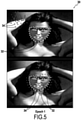
- Figures 3 to 7 display outputs of a ResNet50 model ( Kaiming He, Xiangyu Zhang, Shaoqing Ren, and Jian Sun. Deep residual learning for image recognition. In Proceedings of the IEEE conference on computer vision and pattern recognition, pages 770-778, 2016 ), which is a CNN, after a given number of epochs on the same sample 30, which is an image from the 300W dataset ( Christos Sagonas, Georgios Tzimiropoulos, Stefanos Zafeiriou, and Maja Pantic. 300 faces in-the-wild challenge: The first facial landmark localisation challenge.
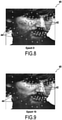
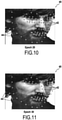
- Figures 8 to 11 show similar outputs with another sample 40, which is an image illustrating a side-facing face.
- the white dots 42 are the ground-truths (target values) and gray dots 44 are predictions (predicted values).
- Figure 8 shows that after the first epoch the 2D points (predicted values 44) have a front facing face-shape even though the input face on the image is facing a side, however within 30 epochs the predicted values 44 are much more accurate. Following this pattern, the CNN converges after 10000 epochs when trained with the above anisotropic loss.
- ResNet50 Similar performance could be obtained by training other models than ResNet50, e.g. other CNNs such as ResNet ( Kaiming He, Xiangyu Zhang, Shaoqing Ren, and Jian Sun. Deep residual learning for image recognition.
- ResNet Kaiming He, Xiangyu Zhang, Shaoqing Ren, and Jian Sun. Deep residual learning for image recognition.
- DenseNet Gao Huang, Zhuang Liu, Laurens Van Der Maaten, and Kilian Q Weinberger. Densely connected convolutional networks.
- Wide ResNet Jie Zhang, Meina Kan, Shiguang Shan, and Xilin Chen. Occlusion-free face alignment: Deep regression networks coupled with de-corrupt autoencoders.
- the model to localise feature points in a sample may be selected by the skilled person according to his needs, and not only among facial landmark localisation models.
Landscapes
- Engineering & Computer Science (AREA)
- Theoretical Computer Science (AREA)
- Health & Medical Sciences (AREA)
- Computer Vision & Pattern Recognition (AREA)
- General Health & Medical Sciences (AREA)
- Oral & Maxillofacial Surgery (AREA)
- Multimedia (AREA)
- General Physics & Mathematics (AREA)
- Physics & Mathematics (AREA)
- Software Systems (AREA)
- Computing Systems (AREA)
- Medical Informatics (AREA)
- Evolutionary Computation (AREA)
- Databases & Information Systems (AREA)
- Artificial Intelligence (AREA)
- Human Computer Interaction (AREA)
- Image Analysis (AREA)
Abstract
Description
- The present disclosure relates to machine learning, and more specifically to the problem of detecting feature points in a sample. The present disclosure is directed to a training method for training a model to localise feature points in a sample, which finds applications in many fields, such as object recognition in images.
- Feature point detection aims to detect key points in a sample. These points generally have specific semantic meaning which makes them remarkable. For instance, in a two-dimensional image of a face, feature points may be facial landmarks, such as an eye corner or nose tip, which provide rich geometric information for tasks such as 3D face reconstruction, face recognition and emotion estimation.
- In recent years, feature point detection has been investigated through a wide range of models, including neural network architectures. Although satisfactory results have been obtained, there is still room for increasing the overall accuracy of the models.
- In this respect, the present disclosure relates to a training method for training a model to localise feature points in a sample, comprising updating the model based on a loss function, wherein the loss function penalises a difference between a predicted value and a target value of at least one of the feature points differently depending on a direction of the difference.
- The model may comprise one or more mathematical expressions configured to process the sample in order to output information representative of the feature points in the sample. Weights of the model may be iteratively updated by the training method. The model may comprise an artificial neural network.
- For instance, the training method may train the model based on a training data set comprising annotated samples and, for each annotated sample, the model is run to localise feature points on the sample, thus outputting at least one predicted value (possibly at least one predicted value for each feature point). The model may know which feature points are to localise in a predetermined manner; that is, the model may be trained to localise a particular set of points, defined at training time. The at least one predicted value may be compared to a corresponding ground-truth, i.e. a target value which was annotated on the sample and which represents the actual value of the corresponding feature point.
- Then, a so-called loss function, or cost function, is used to guide updates to the model so that the predicted values iteratively converge to the respective target values. In conventional training methods, the loss function is mostly based on a difference or distance between the predicted value and the target value: for instance, L1 (sum of absolute differences) and L2 (sum of square differences) loss functions have been used widely. However, the inventors have noticed that the choice of the loss function was particularly important for the performance of the model. On this basis, the present disclosure introduces a loss function which takes into account the direction of the distance between the predicted value and the target value. Thus, the loss function (hereafter anisotropic loss, for the sake of conciseness) penalises a difference between a predicted value and a target value of at least one of the feature points differently depending on the direction of the difference. This enables not only a better overall accuracy of the model, but also a faster training, since convergence of the model weights is improved.
- The loss function may be anisotropic, as recited before, for one or more of the feature points. Conversely, for other feature points, the loss function may penalise a difference between a predicted value and a target value regardless of the direction of the difference (i.e. in an isotropic manner).
- As an example, the values (e.g. the target value, the predicted value) may be positions of the feature points in the sample, e.g. given in terms of coordinates. Besides, the values may be scalars or vectors. Although the present training method is particularly adapted to models performing shape recognition in images, it can be used for any model that can be trained with a loss function that is distance-based, preferably in an at least two-dimensional space.
- In some embodiments, if a base of vectors (ei) is defined in the vector space in which the samples are defined, and a n-uple of preference weights (ai) is defined for a given feature point, the loss function L is such that for two vectors (X,X') of the same distance from Z (∥ X-Z ∥ = ∥ X' - Z ∥), if | (X - Z) . ai ei | (absolute value of the dot product) is different from | (X' - Z) . ai ei |, then L (X) > L(X'). In other words, as mentioned above, the loss function L is anisotropic.
- In some embodiments, said at least one feature point belongs to a boundary between regions of the sample, and the loss function penalises the difference more in a direction away from the boundary than in a direction along the boundary.
- A boundary may provide a separation between two regions of the sample having different properties or semantic meanings. Alternatively, a boundary may include a continuous set of points having in common properties or semantic meanings which are different from the surrounding region; the boundary still embodies a division between the regions on either side thereof. For instance, in an N-dimensional sample, the boundary dimension may be N-1, e.g. a line in a 2D sample or a surface in a 3D sample. The boundary may separate the regions of the sample locally or totally. For instance, in a 2D image, a boundary may be an edge, a contour of a shape, of an object, of a shadow, etc.
- In these embodiments, it is relied on the fact that features points defined on a boundary are usually more accurately defined in a direction across the boundary than in a direction along the boundary. Therefore, in these embodiments, accuracy and convergence of the model are further improved. The two directions may be perpendicular to each other.
- In some embodiments, the loss function includes a term E = Σ(xi-zi)T Wi (xi-zi) where Wi is a weight matrix embodying the weights allotted to the different directions for each point i of said at least one feature point, xi is the predicted value of point i and zi is the target value of point i. The weight matrix Wi is different from the identity matrix I (or unit matrix), otherwise the term E would be isotropic.
- In some embodiments, the weight matrix Wi is determined based on the directions of the largest and smallest standard deviations of said at least one feature point. Therefore, the weight matrix Wi, and thus the loss function, automatically takes into account the accuracy with which the target value of said feature point is defined.
- In some embodiments, the weight matrix Wi is defined as Wi=Si -1, where Si is a co-variance matrix which is representative of an expected spread of errors at point i.
- In some embodiments, the co-variance matrix Si is defined as Si = a2uuT +b2(I-uuT), where u is a unit vector defining a direction of the sample, |u|=1, I is an identity matrix, a2 is a variance of the target value along direction u and b2 is a variance of the target value along a direction orthogonal to direction u. Coefficients a and b may differ from a point i to another. Besides, for a given point i, a may be greater than b. Of course, this formula may be adapted to greater-dimension vector spaces (in 3 dimensions, we can write a2uuT + b2vvT + c2wwT where u, v, w are orthogonal unit vectors; higher dimensions extend in the same way).
- In these embodiments, the penalisation level set of the loss function can be seen as an ellipse centred on the target value, having axes of relative lengths a and b. Thus, a continuous penalisation by the loss function applies in any direction. However, depending on the loss function, continuous penalisation represented by other shapes than ellipses are also encompassed, e.g. rhombi.
- In some embodiments, point i belongs to a boundary between regions of the sample, and direction u forms an angle of not more than 45°, preferably not more than 30°, more preferably not more than 20°, more preferably not more than 10°, with a tangent to the boundary at point i. That is, direction u is substantially along the boundary. Direction u may be a tangent, or an approximation of the tangent, to the boundary at point i.
- In some embodiments, the model is configured to localise a plurality of feature points in a sample, and the loss function uses different weights for at least two different of the features points. In these embodiments, the loss functions take into account that some feature points are more accurately defined than others, and that each feature point has a different context within the sample. Therefore, the loss function can adapt to the context, which provides a better overall accuracy of the trained model.
- In some embodiments, the at least two different of the features points each belong to a boundary between regions of the sample, and the loss function includes a relatively reduced contribution of a feature point belonging to a relatively less curved boundary. In these embodiments, the contributions of less well defined feature points (e.g. less well defined target values) are relatively reduced. For instance, the more curved the boundary, the better defined the target value. Conversely, the less curved the boundary, the more the feature point may slide along the boundary without introducing a big error in the detection. In the extreme, a relatively high contribution can be given to corner points in the loss function, because they are very well defined.
- In some embodiments, the model is configured to localise the feature points directly with regression on the sample. The model therefore differs from models configured to search for each point by scanning over a region with a classifier or local regressor, producing probability maps for each point, and then selecting the points having the better score.
- In some embodiments, the sample includes an image, e.g. a photo, a picture, a drawing, a chart, etc. The image is a graphical representation that may be two-dimensional (2D) or three-dimensional (3D). 3D or 4D samples, with time or another parameter included as a dimension (e.g. a 2D or 3D video), are also encompassed.
- In some embodiments, the feature points include facial landmarks. Facial landmarks may include points belonging to at least one of the following: eye contour, eye corner, iris contour, pupil contour, eyebrow edge, eyebrow end, nasal ridge, nostril contour, nose base contour, nose tip, lip contour, lip end, tongue contour, cheek contour, chin contour, ear contour, ear tip, etc. The face may be a human face or an animal face. In other embodiments, other kinds of landmarks may be used as the feature points, e.g. for object recognition. For instance, for vehicle recognition, the feature points may include points belonging to a bodywork contour, a door knob, a door contour, a wheel contour, a window contour, a headlamp contour, etc.
- The present disclosure is further directed to a method for identifying preferential directions for a training method as previously described, comprising detecting a boundary between regions of the sample, determining a first direction substantially along the boundary and a second direction across the boundary, and setting the loss function of the training method to penalise the second direction more than the first direction.
- The first direction substantially along the boundary may form, with the boundary, an angle of not more than 45°, preferably not more than 30°, more preferably not more than 20°, more preferably not more than 10°. With such a method, the loss function for training the model may be computed automatically based on an annotated training set comprising the target values of the feature points and the boundaries. The loss function may take the boundary curvature into account, e.g. as previously explained.
- The present disclosure is further directed to a computer program including instructions for executing the steps of the training method as previously described when said program is executed by a computer. This program can use any programming language and take the form of source code, object code or a code intermediate between source code and object code, such as a partially compiled form, or any other desirable form.
- The present disclosure is further directed to a recording medium readable by a computer and having recorded thereon a computer program including instructions for executing the steps of the training method as previously described. The recording medium can be any entity or device capable of storing the program. For example, the medium can include storage means such as a ROM, for example a CD ROM or a microelectronic circuit ROM, or magnetic storage means, for example a diskette (floppy disk) or a hard disk.
- Alternatively, the recording medium can be an integrated circuit in which the program is incorporated, the circuit being adapted to execute the method in question or to be used in its execution.
- The present disclosure is further directed to a training method for training a model to localise a plurality of feature points in a sample, comprising updating the model based on a loss function, wherein the loss function uses different weights for at least two different of the features points. The training method may have any of the previously described features.
- The invention and advantages thereof will be better understood upon reading the detailed description which follows, of embodiments given as non-limiting examples. This description refers to the appended drawings, wherein:
-
Fig. 1 is a flow chart of a training method according to an embodiment; -
Fig. 2 is an illustration of the principle of an anisotropic loss function according to an embodiment; -
Figs. 3 to 7 show, at increasingly advanced stages of training, a comparison between the respective performances of a model trained with anisotropic loss function according to an embodiment, and a model trained with an isotropic loss function known in the art; -
Figs. 8 to 11 show, at increasingly advanced stages of training, another example of the performances of a model trained with an anisotropic loss function according to an embodiment. -
Figure 1 illustrates atraining method 10 according to an embodiment, for training a model to localise feature points in a sample. - The
training method 10 may comprise astep 12 of providing a training data set to a model configured to localise feature points. The training data set comprises annotated samples, i.e. samples in which ground-truth of the features points to be localised by the model was annotated beforehand (e.g. manually or with another model). In astep 14, the model is run on each sample of the training data set and outputs at least one predicted value of at least one feature point. In acomparison step 16, a loss function compares the predicted value to the target value, i.e. the ground-truth. - As detailed above, the training method comprises an updating
step 18 of updating the model based on the loss function. - The embodiment will be further explained with the example of a model comprising an artificial neural network, here a Convolutional Neural Network (CNN), configured to localise facial landmarks (as feature points) in a 2D image (as a sample). However, as detailed above, other kinds of models may be used, e.g. Recurrent Neural Networks (RNN), Auto-Encoder Networks, etc., as well as other types of samples and other feature points.
- In addition, the present disclosure addresses an approach in which facial landmark location using CNNs is performed by predicting the point positions directly with regression on the whole face patch, i.e. on the whole sample.
- The
training method 10 has a specific loss function, as detailed below. It is supposed that n feature points are to be detected, and therefore the model outputs n predicted point position vectors {xi} (corresponding to the so-called predicted values) corresponding to n target points {zi} (corresponding to the so-called target values). With conventional isotropic weights, equal for all points (i.e. all displacements are equally penalised), a loss function comparing them would have the form
- In contrast, in the present embodiment, a co-variance matrix, Si at each point {zi}, indicates the expected spread of errors at each point. Then the loss function in the present embodiment includes a term

- The covariance matrix Si can be constructed to represent anisotropic distributions, with a variance of a2 along direction u (where |u|=1) and b2 along a direction orthogonal to direction u. In this case, it leads to:

- When a is greater than b, the weight matrix Wi is anisotropic and the term E of the loss function penalises the difference between the predicted value xi and the target value zi more across direction u than along direction u. More generally, the weight matrix Wi may be determined based on the directions of the largest and smallest standard deviations of point i.
- Coefficients a and b may be integers or not. Coefficients a and b may be greater than or equal to 1. Coefficient a may vary from 1 to 6. For instance, a=5. Coefficient b may vary from 1 to 5. For instance, b=3. A combination of a=5 and b=3 has shown to provide the best performance for one example of the trained model.
- When matching points (i.e. a predicted value to a target value) on curves (in the broad sense, i.e. which may be curved or not), a stronger constraint (thus lower variance) may be required along the direction normal to the curve, compared to that along the curve, because points sliding along the curves are less of a concern to train the model properly. The curve may be a boundary between regions of the sample, for example an eye contour or a cheek edge. Therefore, optionally, when a feature point belongs to a boundary (a curve), the loss function penalises the difference more in a direction away from the boundary than in a direction along the boundary.
- To this end, the above direction u may form an angle of not more than 45° with a tangent to the boundary at point i. Alternatively or additionally, the direction u may be an approximation of the tangent to the boundary at point i.
- For example, assume that the points {zi} are roughly equally spaced along a boundary. For example, the points {zi} are such that the greatest arc length of the boundary between two consecutive points {zi} is not greater than twice the smallest arc length of the curve between two consecutive points {zi}. Then for all points but the end points, the tangent ti at point i is given approximately by

- At the end points of an open boundary, the following approximation can be used:

- Thus, using the above expression of Wi with u=ti, the weight matrices Wi may be set as

- In the above embodiment, detecting a curve is an example of detecting a boundary between regions of the sample. Determining a tangent, or approximation thereof, ti, is an example of determining a first direction substantially along the boundary. Determining a direction orthogonal to the tangent ti is an example of determining a second direction across the boundary. Setting a greater than b is an example of setting the loss function of the training method to penalise the second direction more than the first direction.
- The principle of an anisotropic loss function is illustrated in
Fig. 2. Figure 2 represents an annotated sample, here a2D face image 20 in whichfacial landmarks 22 are shown by solid gray dots. For eachfacial landmark 22, hatchedgray dots 24 represent freedom (hence variance) orthogonal to the boundary and solidwhite dots 26 represent freedom to slide along the boundary. As shown inFig. 2 , most of the representedlandmarks 22 belong to a boundary, e.g. a cheek edge or an eye contour, and for these landmarks, thewhite dots 26 are farther to thelandmarks 22 than the hatcheddots 24, which illustrates the anisotropy associated with each feature point target value. - Well-defined landmarks, e.g. at corners, may be well-defined in a plurality of directions. In this case, as shown e.g. at the top-right landmark of
Fig. 2 , or the eyebrow right end landmark, the difference between the predicted value and the target value may be penalised by the loss function irrespective of the direction of the difference. For instance, for such a point i, the weight matrix may be the identity matrix (Wi=I) or the scaled identity matrix (Wi=sI, with s a scalar). In the above formula of Wi=Si, this would correspond to a=b, as can be checked inFig. 2 where the hatchedgray dots 24 and the solidwhite dots 26 are equidistant to thecorresponding landmark 22. - By defining the weight matrices Wi as above, i.e. identity for the well-defined points and based on the co-variance for less-defined points, coefficients 1/a2 and 1/b2 (a and b greater than or equal to 1) automatically downweight the contribution of the less-defined points in the loss function. Alternatively or in addition, the loss function may include a relatively reduced contribution of a feature point belonging to a relatively less curved boundary, noting that said feature point would be regarded as relatively less-defined. This latter property may be implemented with weight matrices Wi other than those detailed above.
- Besides, as also shown in
Fig. 2 , e.g. when comparing an eye contour landmark to a cheek contour landmark, the loss function may use different weights for at least two different of the landmarks. For instance, the coefficients a and b may vary from a landmark to another. - The inventors have found that such an anisotropic loss function leads to more rapid convergence.
Figures 3 to 7 display outputs of a ResNet50 model (Kaiming He, Xiangyu Zhang, Shaoqing Ren, and Jian Sun. Deep residual learning for image recognition. In Proceedings of the IEEE conference on computer vision and pattern recognition, pages 770-778, 2016), which is a CNN, after a given number of epochs on thesame sample 30, which is an image from the 300W dataset (Christos Sagonas, Georgios Tzimiropoulos, Stefanos Zafeiriou, and Maja Pantic. 300 faces in-the-wild challenge: The first facial landmark localisation challenge. In Proceedings of the IEEE International Conference on Computer Vision Workshops, pages 397-403, 2013.). Epochs are numbered from 0. In the upper parts ofFigs. 3 to 7 , the model was trained with Wing loss (Zhen-Hua Feng, Josef Kittler, Muhammad Awais, Patrik Huber, and Xiao-Jun Wu. Wing loss for robust facial landmark localisation with convolutional neural networks. In Proceedings of the IEEE Conference on Computer Vision and Pattern Recognition, pages 2235-2245, 2018), whereas in the lower parts ofFigs. 3 to 7 , the model was trained with the above-described loss function. Thewhite dots 32 are the ground-truths (target values) andgray dots 34 are predictions (predicted values). These figures show that using the above-described loss function, the model has already learned facial shape within a single epoch (seeFig. 4 ) whereas the model trained with Wing loss gives poor point predictions. - In addition, it can be noticed that without training, both the models trained with Wing Loss and with the above anisotropic loss predict all the landmarks which are on the top left corner. It demonstrates that the above-described loss function converges to good solutions more quickly than the Wing loss. By the fourth epoch (i.e. after
epoch 3, seeFig. 7 ), using the above-described loss function, the network has already found the rough location of each landmarks whereas the network trained using Wing loss is still struggling. -
Figures 8 to 11 show similar outputs with anothersample 40, which is an image illustrating a side-facing face. Again, thewhite dots 42 are the ground-truths (target values) andgray dots 44 are predictions (predicted values).Figure 8 shows that after the first epoch the 2D points (predicted values 44) have a front facing face-shape even though the input face on the image is facing a side, however within 30 epochs the predictedvalues 44 are much more accurate. Following this pattern, the CNN converges after 10000 epochs when trained with the above anisotropic loss. - Similar performance could be obtained by training other models than ResNet50, e.g. other CNNs such as ResNet (Kaiming He, Xiangyu Zhang, Shaoqing Ren, and Jian Sun. Deep residual learning for image recognition. In Proceedings of the IEEE conference on computer vision and pattern recognition, pages 770-778, 2016), DenseNet (Gao Huang, Zhuang Liu, Laurens Van Der Maaten, and Kilian Q Weinberger. Densely connected convolutional networks. In Proceedings of the IEEE conference on computer vision and pattern recognition, pages 4700-4708, 2017), Wide ResNet (Jie Zhang, Meina Kan, Shiguang Shan, and Xilin Chen. Occlusion-free face alignment: Deep regression networks coupled with de-corrupt autoencoders. In Proceedings of the IEEE Conference on Computer Vision and Pattern Recognition, pages 3428-3437, 2016), etc. Therefore, the model to localise feature points in a sample may be selected by the skilled person according to his needs, and not only among facial landmark localisation models.
- Although the present disclosure refers to specific exemplary embodiments, modifications may be provided to these examples without departing from the general scope of the invention as defined by the claims. In particular, individual characteristics of the different illustrated/mentioned embodiments may be combined in additional embodiments. Therefore, the description and the drawings should be considered in an illustrative rather than in a restrictive sense.
Claims (15)
- A training method for training a model to localise feature points in a sample (20), comprising updating (18) the model based on a loss function, wherein the loss function penalises a difference between a predicted value and a target value (22) of at least one of the feature points differently depending on a direction of the difference.
- The training method of claim 1, wherein said at least one feature point (22) belongs to a boundary between regions of the sample, and the loss function penalises the difference more in a direction away from the boundary than in a direction along the boundary.
- The training method of claim 1 or 2, wherein the loss function includes a term E = Σ(xi-zi)T Wi(xi-zi) where Wi is a weight matrix embodying the weights allotted to the different directions for each point i of said at least one feature point, xi is the predicted value of point i and zi is the target value of point i.
- The training method of claim 3, wherein the weight matrix Wi is determined based on the directions of the largest and smallest standard deviations of said at least one feature point.
- The training method of claim 3 or 4, wherein the weight matrix Wi is defined as Wi=Si -1, where Si is a co-variance matrix which is representative of an expected spread of errors at point i.
- The training method of claim 5, wherein the co-variance matrix Si is defined as Si = a2uuT +b2(I-uuT), where u is a unit vector defining a direction of the sample, |u|=1, I is an identity matrix, a2 is a variance of the target value along direction u and b2 is a variance of the target value along a direction orthogonal to direction u.
- The training method of claim 6, wherein point i belongs to a boundary between regions of the sample (20), and direction u forms an angle of not more than 45° with a tangent to the boundary at point i.
- The training method of any one of claims 1 to 7, wherein the model is configured to localise a plurality of feature points in a sample (20), and the loss function uses different weights for at least two different of the features points.
- The training method of claim 8, wherein the at least two different of the feature points each belong to a boundary between regions of the sample (20), and the loss function includes a relatively reduced contribution of a feature point belonging to a relatively less curved boundary.
- The training method of any one of claims 1 to 9, wherein the model is configured to localise the feature points directly with regression on the sample.
- The training method of any one of claims 1 to 10, wherein the sample (20) includes an image.
- The training method of any one of claims 1 to 11, wherein the feature points include facial landmarks.
- A method for identifying preferential directions for a training method according to any one of claims 1 to 12, comprising detecting a boundary between regions of the sample, determining a first direction substantially along the boundary and a second direction across the boundary, and setting the loss function of the training method to penalise the second direction more than the first direction.
- A computer program including instructions for executing the steps of the training method of any one of claims 1 to 12 when said program is executed by a computer.
- A recording medium readable by a computer and having recorded thereon a computer program including instructions for executing the steps of the training method of any one of claims 1 to 12.
Priority Applications (1)
| Application Number | Priority Date | Filing Date | Title |
|---|---|---|---|
| EP20194377.6A EP3965002B1 (en) | 2020-09-03 | 2020-09-03 | Anisotropic loss function for training a model to localise feature points |
Applications Claiming Priority (1)
| Application Number | Priority Date | Filing Date | Title |
|---|---|---|---|
| EP20194377.6A EP3965002B1 (en) | 2020-09-03 | 2020-09-03 | Anisotropic loss function for training a model to localise feature points |
Publications (2)
| Publication Number | Publication Date |
|---|---|
| EP3965002A1 true EP3965002A1 (en) | 2022-03-09 |
| EP3965002B1 EP3965002B1 (en) | 2023-08-16 |
Family
ID=72355919
Family Applications (1)
| Application Number | Title | Priority Date | Filing Date |
|---|---|---|---|
| EP20194377.6A Active EP3965002B1 (en) | 2020-09-03 | 2020-09-03 | Anisotropic loss function for training a model to localise feature points |
Country Status (1)
| Country | Link |
|---|---|
| EP (1) | EP3965002B1 (en) |
Citations (4)
| Publication number | Priority date | Publication date | Assignee | Title |
|---|---|---|---|---|
| US20070047790A1 (en) * | 2005-08-30 | 2007-03-01 | Agfa-Gevaert N.V. | Method of Segmenting Anatomic Entities in Digital Medical Images |
| US8165354B1 (en) * | 2008-03-18 | 2012-04-24 | Google Inc. | Face recognition with discriminative face alignment |
| US20180046854A1 (en) * | 2015-02-16 | 2018-02-15 | University Of Surrey | Three dimensional modelling |
| US20200193211A1 (en) * | 2018-12-18 | 2020-06-18 | Fujitsu Limited | Image processing method and information processing device |
-
2020
- 2020-09-03 EP EP20194377.6A patent/EP3965002B1/en active Active
Patent Citations (4)
| Publication number | Priority date | Publication date | Assignee | Title |
|---|---|---|---|---|
| US20070047790A1 (en) * | 2005-08-30 | 2007-03-01 | Agfa-Gevaert N.V. | Method of Segmenting Anatomic Entities in Digital Medical Images |
| US8165354B1 (en) * | 2008-03-18 | 2012-04-24 | Google Inc. | Face recognition with discriminative face alignment |
| US20180046854A1 (en) * | 2015-02-16 | 2018-02-15 | University Of Surrey | Three dimensional modelling |
| US20200193211A1 (en) * | 2018-12-18 | 2020-06-18 | Fujitsu Limited | Image processing method and information processing device |
Non-Patent Citations (5)
| Title |
|---|
| CHRISTOS SAGONASGEORGIOS TZIMIROPOULOSSTEFANOS ZAFEIRIOUMAJA PANTIC: "300 faces in-the-wild challenge: The first facial landmark localisation challenge", PROCEEDINGS OF THE IEEE INTERNATIONAL CONFERENCE ON COMPUTER VISION WORKSHOPS, 2013, pages 397 - 403, XP032575765, DOI: 10.1109/ICCVW.2013.59 |
| GAO HUANGZHUANG LIULAURENS VAN DER MAATENKILIAN Q WEINBERGER: "Densely connected convolutional networks", PROCEEDINGS OF THE IEEE CONFERENCE ON COMPUTER VISION AND PATTERN RECOGNITION, 2017, pages 4700 - 4708 |
| JIE ZHANGMEINA KANSHIGUANG SHANXILIN CHEN: "Occlusion-free face alignment: Deep regression networks coupled with de-corrupt autoencoders", PROCEEDINGS OF THE IEEE CONFERENCE ON COMPUTER VISION AND PATTERN RECOGNITION, 2016, pages 3428 - 3437, XP033021526, DOI: 10.1109/CVPR.2016.373 |
| KAIMING HEXIANGYU ZHANGSHAOQING RENJIAN SUN: "Deep residual learning for image recognition", PROCEEDINGS OF THE IEEE CONFERENCE ON COMPUTER VISION AND PATTERN RECOGNITION, 2016, pages 770 - 778, XP055536240, DOI: 10.1109/CVPR.2016.90 |
| ZHEN-HUA FENGJOSEF KITTLERMUHAMMAD AWAISPATRIK HUBERXIAO-JUN WU: "Wing loss for robust facial landmark localisation with convolutional neural networks", PROCEEDINGS OF THE IEEE CONFERENCE ON COMPUTER VISION AND PATTERN RECOGNITION, 2018, pages 2235 - 2245, XP033476189, DOI: 10.1109/CVPR.2018.00238 |
Also Published As
| Publication number | Publication date |
|---|---|
| EP3965002B1 (en) | 2023-08-16 |
Similar Documents
| Publication | Publication Date | Title |
|---|---|---|
| Martinez et al. | Local evidence aggregation for regression-based facial point detection | |
| CN100367311C (en) | Face metadata generation and face similarity calculation | |
| US7599549B2 (en) | Image processing method, image processing apparatus, and computer readable medium, in which an image processing program is recorded | |
| US7760933B2 (en) | Parameter estimation method, parameter estimation device and collation method | |
| KR101381455B1 (en) | Biometric information processing device | |
| EP1677250B1 (en) | Image collation system and image collation method | |
| US20030161500A1 (en) | System and method for probabilistic exemplar-based pattern tracking | |
| EP1496466B1 (en) | Face shape recognition from stereo images | |
| EP1727087A1 (en) | Object posture estimation/correlation system, object posture estimation/correlation method, and program for the same | |
| WO2007119870A1 (en) | Checking device and checking method | |
| US9779286B2 (en) | Feature point location estimation device, feature point location estimation method, and feature point location estimation program | |
| US10614343B2 (en) | Pattern recognition apparatus, method, and program using domain adaptation | |
| US7593566B2 (en) | Data recognition device | |
| US9355303B2 (en) | Face recognition using multilayered discriminant analysis | |
| US20240135956A1 (en) | Method and apparatus for measuring speech-image synchronicity, and method and apparatus for training model | |
| CN110827327B (en) | Fusion-based long-term target tracking method | |
| US7853082B2 (en) | Normal line information estimation device, registered image group formation device and image collation device, and normal line information estimation method | |
| US20220343214A1 (en) | Robustness evaluation device, robustness evaluation method and recording medium | |
| KR101558547B1 (en) | Age Cognition Method that is powerful to change of Face Pose and System thereof | |
| JP5557189B2 (en) | Position estimation apparatus, position estimation method and program | |
| EP3965002B1 (en) | Anisotropic loss function for training a model to localise feature points | |
| JP6434718B2 (en) | Face image recognition apparatus and face image recognition program | |
| JP2008003749A (en) | Feature point detection apparatus and method, and program | |
| KR101037758B1 (en) | Eye Coordinate Detection Using Multi-resolution Gabor Feature Vectors | |
| JP2010073138A (en) | Feature point detector, feature point detection method, and feature point detection program |
Legal Events
| Date | Code | Title | Description |
|---|---|---|---|
| PUAI | Public reference made under article 153(3) epc to a published international application that has entered the european phase |
Free format text: ORIGINAL CODE: 0009012 |
|
| STAA | Information on the status of an ep patent application or granted ep patent |
Free format text: STATUS: REQUEST FOR EXAMINATION WAS MADE |
|
| 17P | Request for examination filed |
Effective date: 20200903 |
|
| AK | Designated contracting states |
Kind code of ref document: A1 Designated state(s): AL AT BE BG CH CY CZ DE DK EE ES FI FR GB GR HR HU IE IS IT LI LT LU LV MC MK MT NL NO PL PT RO RS SE SI SK SM TR |
|
| REG | Reference to a national code |
Ref country code: DE Ref legal event code: R079 Free format text: PREVIOUS MAIN CLASS: G06K0009000000 Ipc: G06F0018213400 Ref document number: 602020015727 Country of ref document: DE |
|
| GRAP | Despatch of communication of intention to grant a patent |
Free format text: ORIGINAL CODE: EPIDOSNIGR1 |
|
| STAA | Information on the status of an ep patent application or granted ep patent |
Free format text: STATUS: GRANT OF PATENT IS INTENDED |
|
| RIC1 | Information provided on ipc code assigned before grant |
Ipc: G06V 10/764 20220101ALI20230309BHEP Ipc: G06V 10/75 20220101ALI20230309BHEP Ipc: G06V 40/16 20220101ALI20230309BHEP Ipc: G06F 18/214 20230101ALI20230309BHEP Ipc: G06F 18/2134 20230101AFI20230309BHEP |
|
| INTG | Intention to grant announced |
Effective date: 20230323 |
|
| GRAS | Grant fee paid |
Free format text: ORIGINAL CODE: EPIDOSNIGR3 |
|
| GRAA | (expected) grant |
Free format text: ORIGINAL CODE: 0009210 |
|
| STAA | Information on the status of an ep patent application or granted ep patent |
Free format text: STATUS: THE PATENT HAS BEEN GRANTED |
|
| AK | Designated contracting states |
Kind code of ref document: B1 Designated state(s): AL AT BE BG CH CY CZ DE DK EE ES FI FR GB GR HR HU IE IS IT LI LT LU LV MC MK MT NL NO PL PT RO RS SE SI SK SM TR |
|
| REG | Reference to a national code |
Ref country code: CH Ref legal event code: EP Ref country code: DE Ref legal event code: R096 Ref document number: 602020015727 Country of ref document: DE |
|
| REG | Reference to a national code |
Ref country code: IE Ref legal event code: FG4D |
|
| PGFP | Annual fee paid to national office [announced via postgrant information from national office to epo] |
Ref country code: DE Payment date: 20230926 Year of fee payment: 4 |
|
| REG | Reference to a national code |
Ref country code: LT Ref legal event code: MG9D |
|
| REG | Reference to a national code |
Ref country code: NL Ref legal event code: MP Effective date: 20230816 |
|
| REG | Reference to a national code |
Ref country code: AT Ref legal event code: MK05 Ref document number: 1600753 Country of ref document: AT Kind code of ref document: T Effective date: 20230816 |
|
| PG25 | Lapsed in a contracting state [announced via postgrant information from national office to epo] |
Ref country code: GR Free format text: LAPSE BECAUSE OF FAILURE TO SUBMIT A TRANSLATION OF THE DESCRIPTION OR TO PAY THE FEE WITHIN THE PRESCRIBED TIME-LIMIT Effective date: 20231117 |
|
| PG25 | Lapsed in a contracting state [announced via postgrant information from national office to epo] |
Ref country code: IS Free format text: LAPSE BECAUSE OF FAILURE TO SUBMIT A TRANSLATION OF THE DESCRIPTION OR TO PAY THE FEE WITHIN THE PRESCRIBED TIME-LIMIT Effective date: 20231216 |
|
| PG25 | Lapsed in a contracting state [announced via postgrant information from national office to epo] |
Ref country code: SE Free format text: LAPSE BECAUSE OF FAILURE TO SUBMIT A TRANSLATION OF THE DESCRIPTION OR TO PAY THE FEE WITHIN THE PRESCRIBED TIME-LIMIT Effective date: 20230816 Ref country code: RS Free format text: LAPSE BECAUSE OF FAILURE TO SUBMIT A TRANSLATION OF THE DESCRIPTION OR TO PAY THE FEE WITHIN THE PRESCRIBED TIME-LIMIT Effective date: 20230816 Ref country code: PT Free format text: LAPSE BECAUSE OF FAILURE TO SUBMIT A TRANSLATION OF THE DESCRIPTION OR TO PAY THE FEE WITHIN THE PRESCRIBED TIME-LIMIT Effective date: 20231218 Ref country code: NO Free format text: LAPSE BECAUSE OF FAILURE TO SUBMIT A TRANSLATION OF THE DESCRIPTION OR TO PAY THE FEE WITHIN THE PRESCRIBED TIME-LIMIT Effective date: 20231116 Ref country code: NL Free format text: LAPSE BECAUSE OF FAILURE TO SUBMIT A TRANSLATION OF THE DESCRIPTION OR TO PAY THE FEE WITHIN THE PRESCRIBED TIME-LIMIT Effective date: 20230816 Ref country code: LV Free format text: LAPSE BECAUSE OF FAILURE TO SUBMIT A TRANSLATION OF THE DESCRIPTION OR TO PAY THE FEE WITHIN THE PRESCRIBED TIME-LIMIT Effective date: 20230816 Ref country code: LT Free format text: LAPSE BECAUSE OF FAILURE TO SUBMIT A TRANSLATION OF THE DESCRIPTION OR TO PAY THE FEE WITHIN THE PRESCRIBED TIME-LIMIT Effective date: 20230816 Ref country code: IS Free format text: LAPSE BECAUSE OF FAILURE TO SUBMIT A TRANSLATION OF THE DESCRIPTION OR TO PAY THE FEE WITHIN THE PRESCRIBED TIME-LIMIT Effective date: 20231216 Ref country code: HR Free format text: LAPSE BECAUSE OF FAILURE TO SUBMIT A TRANSLATION OF THE DESCRIPTION OR TO PAY THE FEE WITHIN THE PRESCRIBED TIME-LIMIT Effective date: 20230816 Ref country code: GR Free format text: LAPSE BECAUSE OF FAILURE TO SUBMIT A TRANSLATION OF THE DESCRIPTION OR TO PAY THE FEE WITHIN THE PRESCRIBED TIME-LIMIT Effective date: 20231117 Ref country code: FI Free format text: LAPSE BECAUSE OF FAILURE TO SUBMIT A TRANSLATION OF THE DESCRIPTION OR TO PAY THE FEE WITHIN THE PRESCRIBED TIME-LIMIT Effective date: 20230816 Ref country code: AT Free format text: LAPSE BECAUSE OF FAILURE TO SUBMIT A TRANSLATION OF THE DESCRIPTION OR TO PAY THE FEE WITHIN THE PRESCRIBED TIME-LIMIT Effective date: 20230816 |
|
| PG25 | Lapsed in a contracting state [announced via postgrant information from national office to epo] |
Ref country code: PL Free format text: LAPSE BECAUSE OF FAILURE TO SUBMIT A TRANSLATION OF THE DESCRIPTION OR TO PAY THE FEE WITHIN THE PRESCRIBED TIME-LIMIT Effective date: 20230816 |
|
| PG25 | Lapsed in a contracting state [announced via postgrant information from national office to epo] |
Ref country code: ES Free format text: LAPSE BECAUSE OF FAILURE TO SUBMIT A TRANSLATION OF THE DESCRIPTION OR TO PAY THE FEE WITHIN THE PRESCRIBED TIME-LIMIT Effective date: 20230816 |
|
| PG25 | Lapsed in a contracting state [announced via postgrant information from national office to epo] |
Ref country code: SM Free format text: LAPSE BECAUSE OF FAILURE TO SUBMIT A TRANSLATION OF THE DESCRIPTION OR TO PAY THE FEE WITHIN THE PRESCRIBED TIME-LIMIT Effective date: 20230816 Ref country code: RO Free format text: LAPSE BECAUSE OF FAILURE TO SUBMIT A TRANSLATION OF THE DESCRIPTION OR TO PAY THE FEE WITHIN THE PRESCRIBED TIME-LIMIT Effective date: 20230816 Ref country code: ES Free format text: LAPSE BECAUSE OF FAILURE TO SUBMIT A TRANSLATION OF THE DESCRIPTION OR TO PAY THE FEE WITHIN THE PRESCRIBED TIME-LIMIT Effective date: 20230816 Ref country code: EE Free format text: LAPSE BECAUSE OF FAILURE TO SUBMIT A TRANSLATION OF THE DESCRIPTION OR TO PAY THE FEE WITHIN THE PRESCRIBED TIME-LIMIT Effective date: 20230816 Ref country code: DK Free format text: LAPSE BECAUSE OF FAILURE TO SUBMIT A TRANSLATION OF THE DESCRIPTION OR TO PAY THE FEE WITHIN THE PRESCRIBED TIME-LIMIT Effective date: 20230816 Ref country code: CZ Free format text: LAPSE BECAUSE OF FAILURE TO SUBMIT A TRANSLATION OF THE DESCRIPTION OR TO PAY THE FEE WITHIN THE PRESCRIBED TIME-LIMIT Effective date: 20230816 Ref country code: SK Free format text: LAPSE BECAUSE OF FAILURE TO SUBMIT A TRANSLATION OF THE DESCRIPTION OR TO PAY THE FEE WITHIN THE PRESCRIBED TIME-LIMIT Effective date: 20230816 |
|
| REG | Reference to a national code |
Ref country code: CH Ref legal event code: PL |
|
| PG25 | Lapsed in a contracting state [announced via postgrant information from national office to epo] |
Ref country code: LU Free format text: LAPSE BECAUSE OF NON-PAYMENT OF DUE FEES Effective date: 20230903 |
|
| REG | Reference to a national code |
Ref country code: DE Ref legal event code: R097 Ref document number: 602020015727 Country of ref document: DE |
|
| REG | Reference to a national code |
Ref country code: BE Ref legal event code: MM Effective date: 20230930 |
|
| PG25 | Lapsed in a contracting state [announced via postgrant information from national office to epo] |
Ref country code: LU Free format text: LAPSE BECAUSE OF NON-PAYMENT OF DUE FEES Effective date: 20230903 Ref country code: MC Free format text: LAPSE BECAUSE OF FAILURE TO SUBMIT A TRANSLATION OF THE DESCRIPTION OR TO PAY THE FEE WITHIN THE PRESCRIBED TIME-LIMIT Effective date: 20230816 |
|
| PLBE | No opposition filed within time limit |
Free format text: ORIGINAL CODE: 0009261 |
|
| STAA | Information on the status of an ep patent application or granted ep patent |
Free format text: STATUS: NO OPPOSITION FILED WITHIN TIME LIMIT |
|
| REG | Reference to a national code |
Ref country code: IE Ref legal event code: MM4A |
|
| PG25 | Lapsed in a contracting state [announced via postgrant information from national office to epo] |
Ref country code: IE Free format text: LAPSE BECAUSE OF NON-PAYMENT OF DUE FEES Effective date: 20230903 |
|
| PG25 | Lapsed in a contracting state [announced via postgrant information from national office to epo] |
Ref country code: CH Free format text: LAPSE BECAUSE OF NON-PAYMENT OF DUE FEES Effective date: 20230930 |
|
| 26N | No opposition filed |
Effective date: 20240517 |
|
| PG25 | Lapsed in a contracting state [announced via postgrant information from national office to epo] |
Ref country code: IT Free format text: LAPSE BECAUSE OF FAILURE TO SUBMIT A TRANSLATION OF THE DESCRIPTION OR TO PAY THE FEE WITHIN THE PRESCRIBED TIME-LIMIT Effective date: 20230816 Ref country code: IE Free format text: LAPSE BECAUSE OF NON-PAYMENT OF DUE FEES Effective date: 20230903 Ref country code: FR Free format text: LAPSE BECAUSE OF NON-PAYMENT OF DUE FEES Effective date: 20231016 Ref country code: CH Free format text: LAPSE BECAUSE OF NON-PAYMENT OF DUE FEES Effective date: 20230930 Ref country code: SI Free format text: LAPSE BECAUSE OF FAILURE TO SUBMIT A TRANSLATION OF THE DESCRIPTION OR TO PAY THE FEE WITHIN THE PRESCRIBED TIME-LIMIT Effective date: 20230816 |
|
| PG25 | Lapsed in a contracting state [announced via postgrant information from national office to epo] |
Ref country code: BE Free format text: LAPSE BECAUSE OF NON-PAYMENT OF DUE FEES Effective date: 20230930 |
|
| PG25 | Lapsed in a contracting state [announced via postgrant information from national office to epo] |
Ref country code: BG Free format text: LAPSE BECAUSE OF FAILURE TO SUBMIT A TRANSLATION OF THE DESCRIPTION OR TO PAY THE FEE WITHIN THE PRESCRIBED TIME-LIMIT Effective date: 20230816 |
|
| PG25 | Lapsed in a contracting state [announced via postgrant information from national office to epo] |
Ref country code: BG Free format text: LAPSE BECAUSE OF FAILURE TO SUBMIT A TRANSLATION OF THE DESCRIPTION OR TO PAY THE FEE WITHIN THE PRESCRIBED TIME-LIMIT Effective date: 20230816 |
|
| REG | Reference to a national code |
Ref country code: DE Ref legal event code: R119 Ref document number: 602020015727 Country of ref document: DE |
|
| GBPC | Gb: european patent ceased through non-payment of renewal fee |
Effective date: 20240903 |
|
| PG25 | Lapsed in a contracting state [announced via postgrant information from national office to epo] |
Ref country code: DE Free format text: LAPSE BECAUSE OF NON-PAYMENT OF DUE FEES Effective date: 20250401 |
|
| PG25 | Lapsed in a contracting state [announced via postgrant information from national office to epo] |
Ref country code: GB Free format text: LAPSE BECAUSE OF NON-PAYMENT OF DUE FEES Effective date: 20240903 |
|
| PG25 | Lapsed in a contracting state [announced via postgrant information from national office to epo] |
Ref country code: CY Free format text: LAPSE BECAUSE OF FAILURE TO SUBMIT A TRANSLATION OF THE DESCRIPTION OR TO PAY THE FEE WITHIN THE PRESCRIBED TIME-LIMIT; INVALID AB INITIO Effective date: 20200903 |
|
| PG25 | Lapsed in a contracting state [announced via postgrant information from national office to epo] |
Ref country code: HU Free format text: LAPSE BECAUSE OF FAILURE TO SUBMIT A TRANSLATION OF THE DESCRIPTION OR TO PAY THE FEE WITHIN THE PRESCRIBED TIME-LIMIT; INVALID AB INITIO Effective date: 20200903 |
|
| PG25 | Lapsed in a contracting state [announced via postgrant information from national office to epo] |
Ref country code: TR Free format text: LAPSE BECAUSE OF FAILURE TO SUBMIT A TRANSLATION OF THE DESCRIPTION OR TO PAY THE FEE WITHIN THE PRESCRIBED TIME-LIMIT Effective date: 20230816 |