EP3964883B1 - Display device and control method thereof - Google Patents
Display device and control method thereof Download PDFInfo
- Publication number
- EP3964883B1 EP3964883B1 EP21194301.4A EP21194301A EP3964883B1 EP 3964883 B1 EP3964883 B1 EP 3964883B1 EP 21194301 A EP21194301 A EP 21194301A EP 3964883 B1 EP3964883 B1 EP 3964883B1
- Authority
- EP
- European Patent Office
- Prior art keywords
- light
- photo
- switchable screen
- operation mode
- image
- Prior art date
- Legal status (The legal status is an assumption and is not a legal conclusion. Google has not performed a legal analysis and makes no representation as to the accuracy of the status listed.)
- Active
Links
Images




Classifications
-
- H—ELECTRICITY
- H04—ELECTRIC COMMUNICATION TECHNIQUE
- H04N—PICTORIAL COMMUNICATION, e.g. TELEVISION
- H04N9/00—Details of colour television systems
- H04N9/12—Picture reproducers
- H04N9/31—Projection devices for colour picture display, e.g. using electronic spatial light modulators [ESLM]
- H04N9/3141—Constructional details thereof
-
- B—PERFORMING OPERATIONS; TRANSPORTING
- B60—VEHICLES IN GENERAL
- B60K—ARRANGEMENT OR MOUNTING OF PROPULSION UNITS OR OF TRANSMISSIONS IN VEHICLES; ARRANGEMENT OR MOUNTING OF PLURAL DIVERSE PRIME-MOVERS IN VEHICLES; AUXILIARY DRIVES FOR VEHICLES; INSTRUMENTATION OR DASHBOARDS FOR VEHICLES; ARRANGEMENTS IN CONNECTION WITH COOLING, AIR INTAKE, GAS EXHAUST OR FUEL SUPPLY OF PROPULSION UNITS IN VEHICLES
- B60K35/00—Instruments specially adapted for vehicles; Arrangement of instruments in or on vehicles
- B60K35/20—Output arrangements, i.e. from vehicle to user, associated with vehicle functions or specially adapted therefor
- B60K35/21—Output arrangements, i.e. from vehicle to user, associated with vehicle functions or specially adapted therefor using visual output, e.g. blinking lights or matrix displays
- B60K35/22—Display screens
-
- G—PHYSICS
- G02—OPTICS
- G02B—OPTICAL ELEMENTS, SYSTEMS OR APPARATUS
- G02B27/00—Optical systems or apparatus not provided for by any of the groups G02B1/00 - G02B26/00, G02B30/00
- G02B27/01—Head-up displays
- G02B27/0101—Head-up displays characterised by optical features
-
- H—ELECTRICITY
- H04—ELECTRIC COMMUNICATION TECHNIQUE
- H04N—PICTORIAL COMMUNICATION, e.g. TELEVISION
- H04N9/00—Details of colour television systems
- H04N9/12—Picture reproducers
- H04N9/31—Projection devices for colour picture display, e.g. using electronic spatial light modulators [ESLM]
- H04N9/3141—Constructional details thereof
- H04N9/315—Modulator illumination systems
- H04N9/3155—Modulator illumination systems for controlling the light source
-
- H—ELECTRICITY
- H04—ELECTRIC COMMUNICATION TECHNIQUE
- H04N—PICTORIAL COMMUNICATION, e.g. TELEVISION
- H04N9/00—Details of colour television systems
- H04N9/12—Picture reproducers
- H04N9/31—Projection devices for colour picture display, e.g. using electronic spatial light modulators [ESLM]
- H04N9/3141—Constructional details thereof
- H04N9/3173—Constructional details thereof wherein the projection device is specially adapted for enhanced portability
-
- H—ELECTRICITY
- H04—ELECTRIC COMMUNICATION TECHNIQUE
- H04N—PICTORIAL COMMUNICATION, e.g. TELEVISION
- H04N9/00—Details of colour television systems
- H04N9/12—Picture reproducers
- H04N9/31—Projection devices for colour picture display, e.g. using electronic spatial light modulators [ESLM]
- H04N9/3179—Video signal processing therefor
-
- B—PERFORMING OPERATIONS; TRANSPORTING
- B60—VEHICLES IN GENERAL
- B60K—ARRANGEMENT OR MOUNTING OF PROPULSION UNITS OR OF TRANSMISSIONS IN VEHICLES; ARRANGEMENT OR MOUNTING OF PLURAL DIVERSE PRIME-MOVERS IN VEHICLES; AUXILIARY DRIVES FOR VEHICLES; INSTRUMENTATION OR DASHBOARDS FOR VEHICLES; ARRANGEMENTS IN CONNECTION WITH COOLING, AIR INTAKE, GAS EXHAUST OR FUEL SUPPLY OF PROPULSION UNITS IN VEHICLES
- B60K2360/00—Indexing scheme associated with groups B60K35/00 or B60K37/00 relating to details of instruments or dashboards
- B60K2360/20—Optical features of instruments
- B60K2360/27—Optical features of instruments using semi-transparent optical elements
-
- B—PERFORMING OPERATIONS; TRANSPORTING
- B60—VEHICLES IN GENERAL
- B60K—ARRANGEMENT OR MOUNTING OF PROPULSION UNITS OR OF TRANSMISSIONS IN VEHICLES; ARRANGEMENT OR MOUNTING OF PLURAL DIVERSE PRIME-MOVERS IN VEHICLES; AUXILIARY DRIVES FOR VEHICLES; INSTRUMENTATION OR DASHBOARDS FOR VEHICLES; ARRANGEMENTS IN CONNECTION WITH COOLING, AIR INTAKE, GAS EXHAUST OR FUEL SUPPLY OF PROPULSION UNITS IN VEHICLES
- B60K35/00—Instruments specially adapted for vehicles; Arrangement of instruments in or on vehicles
- B60K35/20—Output arrangements, i.e. from vehicle to user, associated with vehicle functions or specially adapted therefor
- B60K35/21—Output arrangements, i.e. from vehicle to user, associated with vehicle functions or specially adapted therefor using visual output, e.g. blinking lights or matrix displays
- B60K35/23—Head-up displays [HUD]
-
- B—PERFORMING OPERATIONS; TRANSPORTING
- B60—VEHICLES IN GENERAL
- B60K—ARRANGEMENT OR MOUNTING OF PROPULSION UNITS OR OF TRANSMISSIONS IN VEHICLES; ARRANGEMENT OR MOUNTING OF PLURAL DIVERSE PRIME-MOVERS IN VEHICLES; AUXILIARY DRIVES FOR VEHICLES; INSTRUMENTATION OR DASHBOARDS FOR VEHICLES; ARRANGEMENTS IN CONNECTION WITH COOLING, AIR INTAKE, GAS EXHAUST OR FUEL SUPPLY OF PROPULSION UNITS IN VEHICLES
- B60K35/00—Instruments specially adapted for vehicles; Arrangement of instruments in or on vehicles
- B60K35/60—Instruments characterised by their location or relative disposition in or on vehicles
-
- G—PHYSICS
- G02—OPTICS
- G02B—OPTICAL ELEMENTS, SYSTEMS OR APPARATUS
- G02B27/00—Optical systems or apparatus not provided for by any of the groups G02B1/00 - G02B26/00, G02B30/00
- G02B27/01—Head-up displays
- G02B27/0101—Head-up displays characterised by optical features
- G02B2027/0118—Head-up displays characterised by optical features comprising devices for improving the contrast of the display / brillance control visibility
-
- G—PHYSICS
- G02—OPTICS
- G02B—OPTICAL ELEMENTS, SYSTEMS OR APPARATUS
- G02B27/00—Optical systems or apparatus not provided for by any of the groups G02B1/00 - G02B26/00, G02B30/00
- G02B27/01—Head-up displays
- G02B2027/0192—Supplementary details
- G02B2027/0196—Supplementary details having transparent supporting structure for display mounting, e.g. to a window or a windshield
Definitions
- the disclosure relates to a display device, and more particularly to a display device that comprises a photo-switchable screen and to a corresponding control method for operating such a display device.
- US 2005/243078 A1 discloses a display device according to the preamble of claim 1 and 2, respectively, and a corresponding control method for operating such a display device, wherein a voltage is applied across confronting electrodes of a screen to subject the liquid crystal to an electric field so as to change the liquid crystal layer from the light transmissive state to the scattering state, and wherein an image is projected on the screen by the image projecting unit in synchronization with the change to the light scattering state.
- the voltage across the confronting electrodes of the screen is stopped to eliminate the electric field from the liquid crystal layer so as to change the liquid layer from the light scattering state to the light transmissive state, and the projection of the image by the image projecting unit is turned off in synchronization with the change to the light transmissive state.
- US 2015/356938 A1 discloses another display device, wherein a synchronous controller controls the image projected screen in a scattering and transmitting state of the projected image light, and controls the non-image projected screen in a transparent and transmitting state.
- the scattering and transmitting state is the visual state.
- the transparent and transmitting state is the nonvisual state.
- the synchronous controller controls the optical state of the segmented regions in the visual state where the image light is projected thereon.
- the optical state of the segmented regions in the scattering and transmitting state when the image light is not projected is not disclosed.
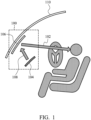
- FIG. 1 is a schematic diagram of an exemplary embodiment of a display device according to various aspects of the present disclosure.
- the display device 100 is applied to a vehicle, but the disclosure is not limited thereto.
- the display device 100 is applied in an augmented reality system, smart glass, smart window or a projection system.
- the display device 100 may be applied to an aircraft or another means of transport.
- the display device 100 is a head-up display (HUD).
- the display device 100 provides information related to driving directly to the user. Therefore, the user does not need to look down to get information about driving.
- the display device 100 comprises an image generator 104 and a photo-switchable screen 106.
- the image generator 104 outputs an output image 108. For example, in a light-emitting period, the image generator 104 outputs the output image 108. In a non-light-emitting period, the image generator 104 stops outputting the output image 108.
- the disclosure does not limit how image generator 104 may output the output image 108 by projection or by optical fiber or waveguide.
- the image generator 104 may utilize a periodicity method to output the output image 108.
- a light source or a plurality of light sources (not shown) in the image generator 104 is / are turned on. At this time, the image generator 104 outputs the output image 108.
- a light source or many light sources in the image generator 104 is / are turned off.
- the image generator 104 stops outputting the output image 108.
- the power consumption of the image generator 104 can be reduced.
- the kind of image generator 104 is not limited in the present disclosure.
- the image generator 104 is a projector.
- the image generator 104 may comprise a liquid-crystal display, or light-emitting diode (LED), wherein the light-emitting diode may comprise an organic light-emitting diode (OLED), a mini LED, a micro LED, a quantum dot (QD) (such as QLED or QDOLED), fluorescence, phosphors, another suitable material, or a combination thereof, but the disclosure is not limited thereto.
- a splicing device may be, for example, a display splicing device, but disclosure is not limited thereto.
- an electronic device can be any combination of the foregoing, but disclosure is not limited thereto.
- a display device will be used as an electronic device or a splicing device to illustrate the content of the present disclosure, but the present disclosure is not limited thereto.
- the photo-switchable screen 106 is configured to operate in a first operation mode or a second operation mode.
- the photo-switchable screen 106 has a first light-transmittance.
- the image generator 104 outputs the output image 108
- the photo-switchable screen 106 generates image information 102 according to the output image 108. Therefore, users can directly obtain driving related information, such as speed or navigation information, according to the image information 102 displayed on the photo-switchable screen 106.
- the photo-switchable screen 106 when a light-source or a plurality of light-sources (not shown) in the image generator 104 is / are turned off, the photo-switchable screen 106 is not activated.
- the period when the light-sources in the image generator 104 are turned off is referred to as a non-light-emitting period.
- the photo-switchable screen 106 may be activated or not activated.
- the period when the light-sources in the image generator 104 are turned on is referred to as a light-emitting period.
- the disclosure does not limit how the photo-switchable screen 106 generates the image information 102.
- the photo-switchable screen 106 intermittently generates the image information 102. For example, when the vehicle having the photo-switchable screen 106 is stopped in a traffic jam or at a red light, the photo-switchable screen 106 stops providing the image information 102. In this case, when the vehicle is moving, the photo-switchable screen 106 provides the image information 102. In one embodiment, the photo-switchable screen 106 may reflect the output image 108 and serve the reflected image as the image information 102.
- the photo-switchable screen 106 may utilize a projection method or a scattering method, or reduce light transmittance to block the ambient light so that the reflected image information 102 has better contrast.
- the photo-switchable screen 106 may increase reflectivity so that the reflected image information 102 has a higher brightness.
- the material of photo-switchable screen 106 is not limited in the present disclosure.
- the photo-switchable screen 106 comprises dye-doped liquid crystal, polymer-dispersed liquid-crystal (PDLC), polymer network liquid-crystal (PNLC), cholesteric liquid-crystal (CLC), electrochromic (EC) material, suspended particle device (SPD), liquid-crystal lens, photonic crystal, or a holographic optical element (HOE).
- PDLC polymer-dispersed liquid-crystal
- PNLC polymer network liquid-crystal
- CLC cholesteric liquid-crystal
- EC electrochromic
- SPD suspended particle device
- liquid-crystal lens photonic crystal
- HOE holographic optical element
- the photo-switchable screen 106 when the photo-switchable screen 106 operates in the second operation mode, the photo-switchable screen 106 has a second light-transmittance. In this embodiment, the first light-transmittance is less than the second light-transmittance. In some embodiments, the photo-switchable screen 106 determines whether to operate in the first operation mode according to a control signal (not shown). For example, when the level of the control signal is a specific level (such as a high level), the photo-switchable screen 106 operates in the first operation mode. When the level of the control signal is not the specific level, the photo-switchable screen 106 operates in the second operation mode. In some embodiments, the second light-transmittance is approximately 50% to 99%.
- the photo-switchable screen 106 when the control signal at a first level, the photo-switchable screen 106 operates in a first operation mode. In the first operation mode, the photo-switchable screen 106 has a first light-transmittance. In such case, when the control signal at a second level, the photo-switchable screen 106 operates in a second operation mode. In the second operation mode, the photo-switchable screen 106 has a second light-transmittance. When the control signal is at a third level, the photo-switchable screen 106 operates in a third operation mode. In the third operation mode, the photo-switchable screen 106 has a third light-transmittance. The first light-transmittance is less than the second light-transmittance, and the second light-transmittance is less than the third light-transmittance.
- the photo-switchable screen 106 comprises a windshield 110 or is disposed inside the windshield 110, outside of the windshield 110 or on the windshield 110, but the disclosure is not limited thereto. Since the photo-switchable screen 106 provides the low light-transmittance, the power consumption of the photo-switchable screen 106 can be reduced. In addition, the high transparency of the windshield 110 can be maintained when the photo-switchable screen 106 provides high light-transmittance. In some embodiments, the light-transmittance (or referred to as penetration rate) depends on the ratio of the intensity of penetration light to the intensity of reference light.
- the measurements of the intensity of penetration light and the intensity of reference light may be the integration of multiple light-emitting angles, or the intensity of a specific light-emitting angle, for example, the vertical angle perpendicular to the light-emitting surface is taken as the specific light-emitting angle.
- the penetration rate may be an equivalent penetration rate.
- the equivalent penetration rate is the integral sum of multiple penetration rates in a certain integration time and divided by the integration time.
- the location of the photo-switchable screen 106 is not limited in the present disclosure. In one embodiment, the photo-switchable screen 106 is disposed on the windshield 110 of the vehicle. In this case, users can directly obtain speed or navigation information according to the image information 102 provided by the photo-switchable screen 106.
- FIG. 2A is an operation schematic diagram of an exemplary embodiment of the image generator 104 and the photo-switchable screen 106 that is to serve for a better understanding of the present disclosure.
- the image generator 104 has a light-source or a plurality of light-sources. In this case, when the light-sources are turned on, the image generator 104 outputs the output image 108. When the light-source are turned off, the image generator 104 stops outputting the output image 108.
- the photo-switchable screen 106 is a cholesteric liquid-crystal display.
- the cholesteric liquid-crystal display has a high reflection rate RH, it means that the light-transmittance of the cholesteric liquid-crystal display is low.
- the cholesteric liquid-crystal display has a low reflection rate RL, it means that the light-transmittance of the cholesteric liquid-crystal display is high.
- the high reflection rate RH is larger than the low reflection rate RL.
- the light-sources of the image generator 104 are turned on. Therefore, the brightness of the light-source is the high brightness value LH. At this time, the image generator 104 outputs the output image 108. However, in the non-light-emitting periods 204, 208, and 212, the light-sources of the image generator 104 are turned off. Therefore, the brightness of the light-source is the low brightness value LL.
- the high brightness value LH is larger than the low brightness value LL (LH>LL). At this time, the image generator 104 stops outputting the output image 108. In this embodiment, since the brightness of the light-sources of the image generator 104 does not need to be continuously maintained at the high brightness value LH, the power consumption of the image generator 104 can be reduced.
- the photo-switchable screen 106 operates in the first operation mode.
- the photo-switchable screen 106 has a high reflection rate RH (i.e., a low light-transmittance).
- RH i.e., a low light-transmittance
- the photo-switchable screen 106 operates in the second operation mode. Therefore, the photo-switchable screen 106 has a low reflection rate RL (i.e., a high light-transmittance). Since the photo-switchable screen 106 does not need to continually provide the high reflection rate RH (i.e., the low light-transmittance), the power consumption of the photo-switchable screen 106 can be reduced.
- the duration of the light-emitting period 202, the duration of the light-emitting period 206, the duration of the light-emitting period 210, and the duration of the light-emitting period 214 are the same. In other embodiment, at least one of the duration of the light-emitting period 202, the duration of the light-emitting period 206, the duration of the light-emitting period 210, and the duration of the light-emitting period 214 is different from another of the duration of the light-emitting period 202, the duration of the light-emitting period 206, the duration of the light-emitting period 210, and the duration of the light-emitting period 214.
- the duration of the non-light-emitting period 204, the duration of the non-light-emitting period 208, and the duration of the non-light-emitting period 212 are the same, but the disclosure is not limited thereto. In other embodiments, one of the duration of the non-light-emitting period 204, the duration of the non-light-emitting period 208, and the duration of the light-emitting period 212 is different from another of the duration of the non-light-emitting period 204, the duration of the non-light-emitting period 208, and the duration of the light-emitting period 212. In some embodiment, the light-emitting period may be 1.6 milliseconds (ms), 4.3ms, 1 second (sec), 1 minute (min), 10min, or 0.5 hour(hr), but the disclosure is not limited thereto.
- the duration of the light-emitting period 202 and the duration of the non-light-emitting period 204 constitute frame time 216. Additionally, the duration of the light-emitting period 206 and the duration of the non-light-emitting period 208 constitute frame time 218. The duration of the light-emitting period 210 and the duration of the non-light-emitting period 212 constitute frame time 220. In one embodiment, the frame time 216, 218 and 220 is about 16.6ms.
- the duration of the light-emitting period 202 is 10% to 50% of the frame time 216. In this case, the duration of the light-emitting period 202 is about 1.6ms to 4.3ms.
- the reflection rate of the photo-switchable screen 106 is changed between the high reflection rate RH and the low reflection rate RL so that an equivalent reflection rate of the photo-switchable screen 106 is an average of the high reflection rate RH and the low reflection rate RL.
- the frequency at which the reflection rate of the photo-switchable screen 106 changes between the high reflection rate RH and the low reflection rate RL may be higher than the speed at which the human eye can see (e.g., the frequency of changing the reflection rate of the photo-switchable screen 106 may be higher than 60Hz).
- the brightness of the light-source of the image generator 104 is changed between the high brightness value LH and the low brightness value LL, an equivalent brightness of the image generator 104 is an average of the high brightness value LH and the low brightness value LL.
- FIG. 2B is an operation schematic diagram of another exemplary embodiment of the image generator 104 and the photo-switchable screen 106 according to various aspects of the present disclosure.
- the light-emitting periods 228, 232, 236, 240, and 244 the light-sources of the image generator 104 are turned on so that the brightness value of the light-source is the high brightness value LH. At this time, the image generator 104 outputs the output image 108.
- the non-light-emitting periods 230, 234, 238, and 242 the light-sources of the image generator 104 are turned off so that the brightness value of the light-source is the low brightness value LL. At this time, the image generator 104 stops outputting the output image 108.
- the durations of the light-emitting periods 228, 232, 236, 240, and 244 are the same as each other, and the durations of the non-light-emitting periods 230, 234, 238, and 242 are the same as each other.
- the photo-switchable screen 106 in the light-emitting period 228, the non-light-emitting period 230, and the light-emitting period 232, the photo-switchable screen 106 operates in the first operation mode.
- the photo-switchable screen 106 In the first operation mode, the photo-switchable screen 106 has the high reflection rate RH. At this time, since the light-transmittance of the photo-switchable screen 106 is low, the photo-switchable screen 106 is capable of reflecting the output image 108 to generate the image information 102.
- the image generator 104 stops outputting the output image 108 in the non-light-emitting period 230, the users can continually observe the image information 102 because the persistence-of-vision phenomenon occurs and the image generator 104 outputs the output image 108 again in the light-emitting period 232.
- the photo-switchable screen 106 operates in the second operation mode. At this time, the photo-switchable screen 106 has the low light-transmittance RL. Therefore, the photo-switchable screen 106 provisionally stops reflecting the output image 108.
- the photo-switchable screen 106 operates in the first operation mode again. Therefore, the photo-switchable screen 106 has the high reflection rate RH. At this time, since the light-transmittance of the photo-switchable screen 106 is low, the photo-switchable screen 106 may re-reflect the output image 108. In this case, although the image generator 104 stops outputting the output image 108 in the non-light-emitting period 242, the users still continually observe the image information 102 due to the persistence-of-vision phenomenon.
- the frequency at which the image generator 104 outputs the output image 108 is a first frequency
- the frequency at which the photo-switchable screen 106 generates the image information is a second frequency.
- the first frequency is 60Hz
- the second frequency is 30Hz.
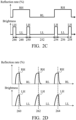
- FIG. 2C is an operation schematic diagram of another exemplary embodiment of the image generator 104 and the photo-switchable screen 106 according to various aspects of the present disclosure.
- the photo-switchable screen 106 operates in the second operation mode (i.e., the non-light-emitting period 252), the light-sources of the image generator 104 are turned off. At this time, the brightness value of the light-source of the image generator 104 is the low brightness value LL.
- the light-sources of the image generator 104 are turned on. Therefore, the image generator 104 outputs the output image 108.
- the non-light-emitting periods 248, 252, and 256 the light-sources of the image generator 104 are turned off. Since the brightness value of the light-sources of the image generator 104 is the low brightness value LL, the output image 108 cannot be output from the image generator 104.
- the durations of the light-emitting periods 246, 250, 254, and 258 are the same as each other.
- the durations of the non-light-emitting periods 248 and 256 may be the same as each other, but the duration of the non-light-emitting period 248 or 256 may be less than the duration of the non-light-emitting period 252.
- the photo-switchable screen 106 operates in the first operation mode.
- the photo-switchable screen 106 has the high reflection rate RH.
- the photo-switchable screen 106 is capable of reflecting the output image 108 to generate a reflection image and provides the reflection image as the image information 102.
- the photo-switchable screen 106 operates in the second operation mode. At this time, the photo-switchable screen 106 has the low reflection rate RL. Since the photo-switchable screen 106 has the high light-transmittance, the photo-switchable screen 106 cannot reflect the output image 108. Therefore, in the non-light-emitting period 252, the photo-switchable screen 106 stops providing the image information 102. However, the user does not discover the flickering image information 102 due to the persistence-of-vision phenomenon.
- the photo-switchable screen 106 operates in the first operation mode again. At this time, the photo-switchable screen 106 has the high reflection rate RH. Since the light-transmittance of the photo-switchable screen 106 is low, the photo-switchable screen 106 can reflect the output image 108 to generate the image information 102.
- FIG. 2D is an operation schematic diagram of another exemplary embodiment of the actual brightness of the image generator 104 and the light-transmittance of the photo-switchable screen according to various aspects of the present disclosure.
- the image generator 104 and the photo-switchable screen 106 may not match at all time points due to delays caused by various factors (such as RC delay and response time of a material). Therefore, the image generator 104 and the photo-switchable screen 106 cannot maintain the corresponding target values (e.g., the high brightness value RH, or the low brightness value LH) for a long time.
- the time point when the brightness of the light-source of the image generator 104 arrives a first target value corresponds to the time point when the reflection rate of the photo-switchable screen 106 arrives a second target value (e.g., the high reflection rate RH).
- a first target value e.g., the high brightness value LH
- the reflection rate of the photo-switchable screen 106 arrives the high reflection rate RH so that the image information 102 can be generated.
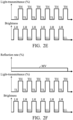
- FIG. 2E is a schematic diagram of another exemplary embodiment of the brightness of the image generator 104 and the light-transmittance of the photo-switchable screen 106 according to various aspects of the present disclosure.
- the photo-switchable screen 106 on the windshield 110 is a component (e.g., a dye-doped liquid-crystal or an electrochromic material) which has a variable light-transmittance
- the photo-switchable screen 106 at least has the high light-transmittance TH and the low light-transmittance TL.
- the photo-switchable screen 106 provides the low light-transmittance TL.
- the photo-switchable screen 106 provides the high light-transmittance TH.
- FIG. 2F is a schematic diagram of an exemplary embodiment of the light-transmittance and reflection rate of the photo-switchable screen 106 according to various aspects of the present disclosure.
- FIG. 2F is similar to FIG. 2E exception that FIG. 2F shows the reflection rate of the photo-switchable screen 106.
- the reflection rate of the photo-switchable screen 106 is maintained at a fixed value MV.
- FIG. 2G is a schematic diagram of another exemplary embodiment of the brightness of the image generator 104 and the light-transmittance of the photo-switchable screen 106 according to various aspects of the present disclosure.
- the light-transmittance of the photo-switchable screen 106 is changed between the high light-transmittance TH and the low light-transmittance TL, for example, the photo-switchable screen 106 is switched between on (activated) and off (not activated).
- the photo-switchable screen 106 displays the static image.
- the light-transmittance of the photo-switchable screen 106 is the low light-transmittance TL (e.g., the photo-switchable screen 106 is not activated or does not output any image).
- the photo-switchable screen 106 does not display any image.
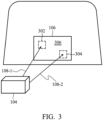
- FIG. 3 is an operation schematic diagram of another exemplary embodiment of the image generator 104 and the photo-switchable screen 106 according to various aspects of the present disclosure.
- the image generator 104 outputs the output image 108-1 to the area 302 of the photo-switchable screen 106 and outputs the output image 108-2 to the area 304 of the photo-switchable screen 106
- the photo-switchable screen 106 receives the output images from the areas 302 and 304.
- the areas 302 and 304 of the photo-switchable screen 106 may have the low light-transmittance. Therefore, the area 302 is capable of reflecting the output image 108-1, and the area 304 is capable of reflecting the output image 108-2.
- the photo-switchable screen 106 sets the area 306 to provide the high light-transmittance.
- the area 306 is the area outside of the areas 302 and 304.
- the photo-switchable screen 106 comprises many sensors (not shown) to detect which areas receive the output image. For example, when the image generator 104 outputs the output image 108-1 to the area 302, the sensor in the area 302 outputs a high level. However, when the image generator 104 stops outputting the output image 108-1, the sensor in the area 302 outputs a low level. In such cases, the output of the sensor is utilized to determine whether the area 302 receives the output image 108-1. In another embodiment, before the image generator 104 outputs the output images 108-1 and 108-2, the image generator 104 notifies the photo-switchable screen 106. In this case, the photo-switchable screen 106 sets the light-transmittance of the corresponding area (e.g., 302 and 304) to the low light-transmittance according to the information provided by the image generator 104.
- the photo-switchable screen 106 sets the light-transmittance of the corresponding area (e.g., 302
- FIG. 4 is a control schematic diagram of an exemplary embodiment of the display device according to various aspects of the present disclosure.
- the display device 400 comprises a photo-switchable screen 402 and an image generator 404.
- the image generator 404 generates an output image IMO according to external information IME.
- the image generator 404 generates a trigger signal ST.
- the photo-switchable screen 402 determines whether to operate in the first operation mode according to a control signal SC.
- the photo-switchable screen 402 when the control signal SC is at a high level (e.g., 5V), the photo-switchable screen 402 operates in the first operation mode. At this time, the photo-switchable screen 402 has a low light-transmittance (i.e., a high reflection rate). Therefore, the photo-switchable screen 402 can reflect the output image IMO to generate image information II.
- the control signal SC is at a low level (e.g., 0V)
- the photo-switchable screen 402 when the control signal SC is at a low level (e.g., 0V), the photo-switchable screen 402 operates in the second operation mode. At this time, the photo-switchable screen 402 has a high light-transmittance (i.e., a low reflection rate). Therefore, the output image IMO cannot be reflected toward human-eye via the photo-switchable screen 402.
- FIG. 5 is a control schematic diagram of another exemplary embodiment of the display device according to various aspects of the present disclosure.
- the display device 500 comprises a photo-switchable screen 502, an image generator 504, and a timing controller (TCON) 506.
- the TCON 506 provides a synchronizing signal CLK to the photo-switchable screen 502 and the image generator 504 so that the photo-switchable screen 502 operates with image generator 504.
- the image generator 504 receives and provides external information IME according to the synchronizing signal CLK to generate and output the output image IMO.
- the photo-switchable screen 502 receives a control signal SC according to the synchronizing signal CLK and determines whether to operate in the first operation mode according to the control signal SC. In one embodiment, the photo-switchable screen 502 adjusts the count value according to the synchronizing signal CLK. When the count value is equal to a predetermined value, if the control signal SC is at a first level, the photo-switchable screen 502 operates in the first operation mode. However, if the control signal is at a second level, the photo-switchable screen 502 operates in the second operation mode.
- the photo-switchable screen 502 and image generator 504 operate according to the synchronizing signal CLK to prevent the operation of the photo-switchable screen 502 from mismatching the operation of the image generator 504.
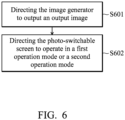
- FIG. 6 is a flowchart of an exemplary embodiment of a control method according to various aspects of the present disclosure.
- the control method is applied in a display device.
- the display device comprises an image generator and a photo-switchable screen configured to display image information.
- the image generator is directed to output an output image (step S601).
- step S601 is to turn on a light-source or a plurality of light-sources in the image generator.
- the image generator may utilize a periodicity method to turn on all of the light-sources in the image generator. In this case, when the light-sources are turned on, the image generator outputs the output image. When the light-sources are turned off, the image generator stops outputting the output image.
- the photo-switchable screen is directed to operate in a first operation mode or a second operation mode (step S602).
- the photo-switchable screen when the photo-switchable screen is directed to operate in the first operation mode, the photo-switchable screen has a first light-transmittance. In the first operation mode, the photo-switchable screen generates the image information according to the output image.
- the photo-switchable screen has a second light-transmittance.
- the first light-transmittance is less than the second light-transmittance.
- the photo-switchable screen may periodically operate in the first operation mode (step S602).
- the second light-transmittance is about 50% to 99%.
- FIG. 7 is a flowchart of another exemplary embodiment of step S601 in the control method according to various aspects of the present disclosure.
- a light-source or a plurality of light-sources in the image generator is turned on to output the output image (step S701).
- the photo-switchable screen is activated or is not activated.
- the light-sources are turned off to stop outputting the output image (step S702).
- the photo-switchable screen operates in the second operation mode.
- the photo-switchable screen provisionally stops reflecting the output image.
- the photo-switchable screen is not activated.
- the photo-switchable screen when the light-sources of the image generator are turned on, the photo-switchable screen operates in the first operation mode. In this case, when the light-sources of the image generator are turned off, the photo-switchable screen operates in the second operation mode. Taking FIG. 2A as an example, in the light-emitting periods 202, 206, 210, and 214, the light-sources of the image generator are turned on. Therefore, the photo-switchable screen operates in the second operation mode. At this time, since the light-transmittance of the photo-switchable screen is low, the photo-switchable screen is capable of reflecting the output image to generate image information.
- the photo-switchable screen operates in the second operation mode. At this time, since the light-transmittance of the photo-switchable screen is high, the photo-switchable screen may stop reflecting the output image.
- the photo-switchable screen when the light-sources of the image generator are turned off, the photo-switchable screen still operates in the first operation mode.
- FIG. 2B in the non-light-emitting periods 230 and 242, although the light-sources of the image generator are turned off, the photo-switchable screen still operates in the first operation mode.
- FIG. 2C the light-sources of the image generator are turned off in the non-light-emitting periods 248 and 256. At this time, the photo-switchable screen still operates in the first operation mode.
- the durations of the non-light-emitting periods 248 and 256 are less than the duration of the non-light-emitting period 252, and the durations of the light-emitting periods 246, 250, 254, and 258 are the same as each other.
- the photo-switchable screen when the light-sources of the image generator are turned on, the photo-switchable screen may operate in the second operation mode. Taking FIG. 2B as an example, the light-sources of the image generator are turned on in the light-emitting period 236. However, the photo-switchable screen operates in the second operation mode.
- step S701 when the output image is output to a first area of the photo-switchable screen, the photo-switchable screen sets the light-transmittance of the first area to low and sets the light-transmittance of a second area to high, wherein the second area is outside of the first area.
- the first area since the first area has a low light-transmittance, the first area is capable of reflecting the output image.
- the photo-switchable screen determines whether to operate in the first operation mode according to the level of a control signal. For example, when the level of the control signal is equal to a specific level (e.g., a high level), the photo-switchable screen operates in the first operation mode. However, when the level of the control signal is not equal to the specific level, the photo-switchable screen operates in the second operation mode.
- a specific level e.g., a high level
- the photo-switchable screen operates in the first operation mode.
- the photo-switchable screen operates in the second operation mode.
- a timing controller is used to synchronize the operations of the image generator and the photo-switchable screen.
- the timing controller provides a synchronizing signal to the image generator and the photo-switchable screen.
- the image generator receives an external image according to the synchronizing signal to generate the output image.
- the photo-switchable screen adjusts the count value according to the synchronizing signal.
- the photo-switchable screen determines whether to operate in the first operation mode according to the level of the control signal. For example, if the level of the control signal is equal to a specific level, the photo-switchable screen operates in the first operation mode. However, if the level of the control signal is not equal to the specific level, the photo-switchable screen operates in the second operation mode.
- Control methods may take the form of a program code (i.e., executable instructions) embodied in tangible media, such as floppy diskettes, CD-ROMS, hard drives, or any other machine-readable storage medium, wherein, when the program code is loaded into and executed by a machine such as a computer, the machine thereby becomes a display device for practicing the methods.
- the methods may also be embodied in the form of a program code transmitted over some transmission medium, such as electrical wiring or cabling, through fiber optics, or via any other form of transmission, wherein, when the program code is received and loaded into and executed by a machine such as a computer, the machine becomes a display device for practicing the disclosed methods.
- the program code When implemented on a general-purpose processor, the program code combines with the processor to provide a unique apparatus that operates analogously to application-specific logic circuits.
Landscapes
- Engineering & Computer Science (AREA)
- Physics & Mathematics (AREA)
- Multimedia (AREA)
- Signal Processing (AREA)
- General Physics & Mathematics (AREA)
- Optics & Photonics (AREA)
- Chemical & Material Sciences (AREA)
- Combustion & Propulsion (AREA)
- Transportation (AREA)
- Mechanical Engineering (AREA)
- Control Of Indicators Other Than Cathode Ray Tubes (AREA)
Description
- The disclosure relates to a display device, and more particularly to a display device that comprises a photo-switchable screen and to a corresponding control method for operating such a display device.
- Current display devices can be used in projection system display devices. The projection system display devices need to cooperate with the screen for display. How to achieve a better user experience with lower power consumption is one of the research topics in the industry.
-
US 2005/243078 A1 discloses a display device according to the preamble of claim 1 and 2, respectively, and a corresponding control method for operating such a display device, wherein a voltage is applied across confronting electrodes of a screen to subject the liquid crystal to an electric field so as to change the liquid crystal layer from the light transmissive state to the scattering state, and wherein an image is projected on the screen by the image projecting unit in synchronization with the change to the light scattering state. Then, the voltage across the confronting electrodes of the screen is stopped to eliminate the electric field from the liquid crystal layer so as to change the liquid layer from the light scattering state to the light transmissive state, and the projection of the image by the image projecting unit is turned off in synchronization with the change to the light transmissive state. By repeating this operation, only when the liquid crystal layer of the screen exhibits the light scattering state, an image is projected, and the viewer can see a scattered image on the screen. However, it is not disclosed that the liquid crystal layer of the screen exhibits the light scattering state when the projection of the image by the image projecting unit is turned off. -
US 2015/356938 A1 discloses another display device, wherein a synchronous controller controls the image projected screen in a scattering and transmitting state of the projected image light, and controls the non-image projected screen in a transparent and transmitting state. The scattering and transmitting state is the visual state. The transparent and transmitting state is the nonvisual state. When the image light is not projected, each of the segmented regions is controlled in the nonvisual state, that is, in the transparent and transmitting state. Moreover, the synchronous controller controls the optical state of the segmented regions in the visual state where the image light is projected thereon. However, the optical state of the segmented regions in the scattering and transmitting state when the image light is not projected is not disclosed. - It is an object of the present invention to provide a display device and a corresponding control method, implementing driving schemes for the image generator and photo-switchable screen which may provide an additional power saving advantage.
- This problem is solved by a display device as claimed in claim 1 and 2, respectively, and by a corresponding control method for operating such a display device as claimed in claim 10 and 11, respectively.
- The disclosure can be more fully understood by referring to the following detailed description and examples with references made to the accompanying drawings, wherein:
-
FIG. 1 is a schematic diagram of an exemplary embodiment of a display device according to various aspects of the present disclosure. -
FIG. 2A is an operation schematic diagram of an exemplary embodiment of an image generator and a photo-switchable screen that serves for a better understanding of the present disclosure. -
FIG. 2B is an operation schematic diagram of another exemplary embodiment of the image generator and the photo-switchable screen according to various aspects of the present disclosure. -
FIG. 2C is an operation schematic diagram of another exemplary embodiment of the image generator and the photo-switchable screen according to various aspects of the present disclosure. -
FIG. 2D is an operation schematic diagram of another exemplary embodiment of the image generator and the photo-switchable screen according to various aspects of the present disclosure. -
FIG. 2E is a schematic diagram of another exemplary embodiment of the brightness of the image generator and the light-transmittance of the photo-switchable screen according to various aspects of the present disclosure. -
FIG. 2F is a schematic diagram of an exemplary embodiment of the light-transmittance and reflection rate of the photo-switchable screen according to various aspects of the present disclosure. -
FIG. 2G is a schematic diagram of another exemplary embodiment of the brightness of the image generator and the light-transmittance of the photo-switchable screen according to various aspects of the present disclosure. -
FIG. 3 is an operation schematic diagram of another exemplary embodiment of the image generator and the photo-switchable screen according to various aspects of the present disclosure. -
FIG. 4 is a control schematic diagram of an exemplary embodiment of the heads-up display according to various aspects of the present disclosure. -
FIG. 5 is a control schematic diagram of another exemplary embodiment of the heads-up display according to various aspects of the present disclosure. -
FIG. 6 is a flowchart of an exemplary embodiment of a control method according to various aspects of the present disclosure. -
FIG. 7 is a flowchart of exemplary embodiment of the control method according to various aspects of the present disclosure. - In order to make the purpose, characteristics and advantages of the disclosure more obvious and understandable, embodiments are given in the following paragraphs and detailed explanations are made in accordance with the attached drawings. The specification of the disclosure provides different embodiments to illustrate the technical characteristics of different embodiments of the disclosure. The configuration of the components in embodiments is for illustrative purposes and is not intended to limit the present disclosure. In addition, the partial repetition of the appended drawing labels in the embodiments is for simplification and does not imply a correlation between the different embodiments.
- Throughout the specification of the disclosure and the attached claims, certain terms are used to refer to specific components. Technicians in this field should understand that electronic device manufacturers may refer to the same component by different names, and it is not intended to distinguish between components that perform the same function but have different names. In the specification of the disclosure and the attached claims, the terms "include" and "comprise" are used in an open-ended fashion, and thus should be interpreted to mean "include, but not limited to ... ".
- The directions mentioned in the following embodiments, such as: up, down, left, right, forward or rear, etc., are the directions referred to in the attached drawing. Therefore, the directional terms used are intended to illustrate and not to limit the present disclosure. It is important to understand that components with specific descriptions or icons can exist in a variety of forms familiar to the technical person. In addition, when a component or film is referred to as being "on", or "connected to" another component or film, it can be directly on, or connected to the other component or film or intervening components or films may be present (indirectly). In contrast, when a component or film is referred to as be "directly on", "directly connected to" another component or film, there are no intervening components or films present.
- The ordinal numbers used in the specifications and claims, such as the terms "first", "second", etc. to refer to the claimed components do not in themselves imply any prior ordinal number of the claimed components, nor the order in which one claimed component relates to another claimed component, or the order in the method of manufacture. The ordinal number is used to distinguish one element from another.
-
FIG. 1 is a schematic diagram of an exemplary embodiment of a display device according to various aspects of the present disclosure. In this embodiment, thedisplay device 100 is applied to a vehicle, but the disclosure is not limited thereto. In one embodiment, thedisplay device 100 is applied in an augmented reality system, smart glass, smart window or a projection system. In other embodiments, thedisplay device 100 may be applied to an aircraft or another means of transport. In one embodiment, thedisplay device 100 is a head-up display (HUD). In this case, thedisplay device 100 provides information related to driving directly to the user. Therefore, the user does not need to look down to get information about driving. In this embodiment, thedisplay device 100 comprises animage generator 104 and a photo-switchable screen 106. - The
image generator 104 outputs anoutput image 108. For example, in a light-emitting period, theimage generator 104 outputs theoutput image 108. In a non-light-emitting period, theimage generator 104 stops outputting theoutput image 108. The disclosure does not limit howimage generator 104 may output theoutput image 108 by projection or by optical fiber or waveguide. In one embodiment, theimage generator 104 may utilize a periodicity method to output theoutput image 108. In one embodiment, in the light-emitting period, a light source or a plurality of light sources (not shown) in theimage generator 104 is / are turned on. At this time, theimage generator 104 outputs theoutput image 108. In the non-light-emitting period, a light source or many light sources in theimage generator 104 is / are turned off. At this time, theimage generator 104 stops outputting theoutput image 108. In this embodiment, since theimage generator 104 does not continuously output theoutput image 108, the power consumption of theimage generator 104 can be reduced. - The kind of
image generator 104 is not limited in the present disclosure. In one embodiment, theimage generator 104 is a projector. In other embodiments, theimage generator 104 may comprise a liquid-crystal display, or light-emitting diode (LED), wherein the light-emitting diode may comprise an organic light-emitting diode (OLED), a mini LED, a micro LED, a quantum dot (QD) (such as QLED or QDOLED), fluorescence, phosphors, another suitable material, or a combination thereof, but the disclosure is not limited thereto. A splicing device may be, for example, a display splicing device, but disclosure is not limited thereto. It should be noted that an electronic device can be any combination of the foregoing, but disclosure is not limited thereto. Hereinafter, a display device will be used as an electronic device or a splicing device to illustrate the content of the present disclosure, but the present disclosure is not limited thereto. - The photo-
switchable screen 106 is configured to operate in a first operation mode or a second operation mode. In the first operation mode, the photo-switchable screen 106 has a first light-transmittance. At this time, if theimage generator 104 outputs theoutput image 108, the photo-switchable screen 106 generatesimage information 102 according to theoutput image 108. Therefore, users can directly obtain driving related information, such as speed or navigation information, according to theimage information 102 displayed on the photo-switchable screen 106. - In some embodiments, when a light-source or a plurality of light-sources (not shown) in the
image generator 104 is / are turned off, the photo-switchable screen 106 is not activated. The period when the light-sources in theimage generator 104 are turned off is referred to as a non-light-emitting period. In such cases, when a light-source or a plurality of light-sources in theimage generator 104 is / are turned on, the photo-switchable screen 106 may be activated or not activated. The period when the light-sources in theimage generator 104 are turned on is referred to as a light-emitting period. - The disclosure does not limit how the photo-
switchable screen 106 generates theimage information 102. In one embodiment, the photo-switchable screen 106 intermittently generates theimage information 102. For example, when the vehicle having the photo-switchable screen 106 is stopped in a traffic jam or at a red light, the photo-switchable screen 106 stops providing theimage information 102. In this case, when the vehicle is moving, the photo-switchable screen 106 provides theimage information 102. In one embodiment, the photo-switchable screen 106 may reflect theoutput image 108 and serve the reflected image as theimage information 102. In other embodiments, the photo-switchable screen 106 may utilize a projection method or a scattering method, or reduce light transmittance to block the ambient light so that the reflectedimage information 102 has better contrast. The photo-switchable screen 106 may increase reflectivity so that the reflectedimage information 102 has a higher brightness. The material of photo-switchable screen 106 is not limited in the present disclosure. In one embodiment, the photo-switchable screen 106 comprises dye-doped liquid crystal, polymer-dispersed liquid-crystal (PDLC), polymer network liquid-crystal (PNLC), cholesteric liquid-crystal (CLC), electrochromic (EC) material, suspended particle device (SPD), liquid-crystal lens, photonic crystal, or a holographic optical element (HOE). - However, when the photo-
switchable screen 106 operates in the second operation mode, the photo-switchable screen 106 has a second light-transmittance. In this embodiment, the first light-transmittance is less than the second light-transmittance. In some embodiments, the photo-switchable screen 106 determines whether to operate in the first operation mode according to a control signal (not shown). For example, when the level of the control signal is a specific level (such as a high level), the photo-switchable screen 106 operates in the first operation mode. When the level of the control signal is not the specific level, the photo-switchable screen 106 operates in the second operation mode. In some embodiments, the second light-transmittance is approximately 50% to 99%. - In other embodiment, when the control signal at a first level, the photo-
switchable screen 106 operates in a first operation mode. In the first operation mode, the photo-switchable screen 106 has a first light-transmittance. In such case, when the control signal at a second level, the photo-switchable screen 106 operates in a second operation mode. In the second operation mode, the photo-switchable screen 106 has a second light-transmittance. When the control signal is at a third level, the photo-switchable screen 106 operates in a third operation mode. In the third operation mode, the photo-switchable screen 106 has a third light-transmittance. The first light-transmittance is less than the second light-transmittance, and the second light-transmittance is less than the third light-transmittance. - In some embodiments, the photo-
switchable screen 106 comprises awindshield 110 or is disposed inside thewindshield 110, outside of thewindshield 110 or on thewindshield 110, but the disclosure is not limited thereto. Since the photo-switchable screen 106 provides the low light-transmittance, the power consumption of the photo-switchable screen 106 can be reduced. In addition, the high transparency of thewindshield 110 can be maintained when the photo-switchable screen 106 provides high light-transmittance. In some embodiments, the light-transmittance (or referred to as penetration rate) depends on the ratio of the intensity of penetration light to the intensity of reference light. The measurements of the intensity of penetration light and the intensity of reference light may be the integration of multiple light-emitting angles, or the intensity of a specific light-emitting angle, for example, the vertical angle perpendicular to the light-emitting surface is taken as the specific light-emitting angle. The penetration rate may be an equivalent penetration rate. The equivalent penetration rate is the integral sum of multiple penetration rates in a certain integration time and divided by the integration time. The location of the photo-switchable screen 106 is not limited in the present disclosure. In one embodiment, the photo-switchable screen 106 is disposed on thewindshield 110 of the vehicle. In this case, users can directly obtain speed or navigation information according to theimage information 102 provided by the photo-switchable screen 106. -
FIG. 2A is an operation schematic diagram of an exemplary embodiment of theimage generator 104 and the photo-switchable screen 106 that is to serve for a better understanding of the present disclosure. To brevity, assume that theimage generator 104 has a light-source or a plurality of light-sources. In this case, when the light-sources are turned on, theimage generator 104 outputs theoutput image 108. When the light-source are turned off, theimage generator 104 stops outputting theoutput image 108. Additionally, assume that the photo-switchable screen 106 is a cholesteric liquid-crystal display. In this case, when the cholesteric liquid-crystal display has a high reflection rate RH, it means that the light-transmittance of the cholesteric liquid-crystal display is low. When the cholesteric liquid-crystal display has a low reflection rate RL, it means that the light-transmittance of the cholesteric liquid-crystal display is high. In this case, the high reflection rate RH is larger than the low reflection rate RL. - In
FIG. 2A , in the light-emittingperiods image generator 104 are turned on. Therefore, the brightness of the light-source is the high brightness value LH. At this time, theimage generator 104 outputs theoutput image 108. However, in the non-light-emittingperiods image generator 104 are turned off. Therefore, the brightness of the light-source is the low brightness value LL. The high brightness value LH is larger than the low brightness value LL (LH>LL). At this time, theimage generator 104 stops outputting theoutput image 108. In this embodiment, since the brightness of the light-sources of theimage generator 104 does not need to be continuously maintained at the high brightness value LH, the power consumption of theimage generator 104 can be reduced. - In this embodiment, in the light-emitting
periods switchable screen 106 operates in the first operation mode. In the first operation mode, the photo-switchable screen 106 has a high reflection rate RH (i.e., a low light-transmittance). At this time, since theimage generator 104 outputs theoutput image 108 such that the photo-switchable screen 106 can generate theimage information 102. In the non-light-emittingperiods switchable screen 106 operates in the second operation mode. Therefore, the photo-switchable screen 106 has a low reflection rate RL (i.e., a high light-transmittance). Since the photo-switchable screen 106 does not need to continually provide the high reflection rate RH (i.e., the low light-transmittance), the power consumption of the photo-switchable screen 106 can be reduced. - In one embodiment, the duration of the light-emitting
period 202, the duration of the light-emittingperiod 206, the duration of the light-emittingperiod 210, and the duration of the light-emittingperiod 214 are the same. In other embodiment, at least one of the duration of the light-emittingperiod 202, the duration of the light-emittingperiod 206, the duration of the light-emittingperiod 210, and the duration of the light-emittingperiod 214 is different from another of the duration of the light-emittingperiod 202, the duration of the light-emittingperiod 206, the duration of the light-emittingperiod 210, and the duration of the light-emittingperiod 214. Furthermore, the duration of the non-light-emittingperiod 204, the duration of the non-light-emittingperiod 208, and the duration of the non-light-emittingperiod 212 are the same, but the disclosure is not limited thereto. In other embodiments, one of the duration of the non-light-emittingperiod 204, the duration of the non-light-emittingperiod 208, and the duration of the light-emittingperiod 212 is different from another of the duration of the non-light-emittingperiod 204, the duration of the non-light-emittingperiod 208, and the duration of the light-emittingperiod 212. In some embodiment, the light-emitting period may be 1.6 milliseconds (ms), 4.3ms, 1 second (sec), 1 minute (min), 10min, or 0.5 hour(hr), but the disclosure is not limited thereto. - In other embodiments, the duration of the light-emitting
period 202 and the duration of the non-light-emittingperiod 204 constituteframe time 216. Additionally, the duration of the light-emittingperiod 206 and the duration of the non-light-emittingperiod 208 constituteframe time 218. The duration of the light-emittingperiod 210 and the duration of the non-light-emittingperiod 212 constituteframe time 220. In one embodiment, theframe time - In another embodiment, the duration of the light-emitting
period 202 is 10% to 50% of theframe time 216. In this case, the duration of the light-emittingperiod 202 is about 1.6ms to 4.3ms. In some embodiments, the reflection rate of the photo-switchable screen 106 is changed between the high reflection rate RH and the low reflection rate RL so that an equivalent reflection rate of the photo-switchable screen 106 is an average of the high reflection rate RH and the low reflection rate RL. In another embodiment, the frequency at which the reflection rate of the photo-switchable screen 106 changes between the high reflection rate RH and the low reflection rate RL may be higher than the speed at which the human eye can see (e.g., the frequency of changing the reflection rate of the photo-switchable screen 106 may be higher than 60Hz). Furthermore, since the brightness of the light-source of theimage generator 104 is changed between the high brightness value LH and the low brightness value LL, an equivalent brightness of theimage generator 104 is an average of the high brightness value LH and the low brightness value LL. -
FIG. 2B is an operation schematic diagram of another exemplary embodiment of theimage generator 104 and the photo-switchable screen 106 according to various aspects of the present disclosure. In the light-emittingperiods image generator 104 are turned on so that the brightness value of the light-source is the high brightness value LH. At this time, theimage generator 104 outputs theoutput image 108. However, in the non-light-emittingperiods image generator 104 are turned off so that the brightness value of the light-source is the low brightness value LL. At this time, theimage generator 104 stops outputting theoutput image 108. In this case, the durations of the light-emittingperiods periods - In this embodiment, in the light-emitting
period 228, the non-light-emittingperiod 230, and the light-emittingperiod 232, the photo-switchable screen 106 operates in the first operation mode. In the first operation mode, the photo-switchable screen 106 has the high reflection rate RH. At this time, since the light-transmittance of the photo-switchable screen 106 is low, the photo-switchable screen 106 is capable of reflecting theoutput image 108 to generate theimage information 102. In this case, although theimage generator 104 stops outputting theoutput image 108 in the non-light-emittingperiod 230, the users can continually observe theimage information 102 because the persistence-of-vision phenomenon occurs and theimage generator 104 outputs theoutput image 108 again in the light-emittingperiod 232. - In the non-light-emitting
period 234, the light-emittingperiod 236, and the non-light-emittingperiod 238, the photo-switchable screen 106 operates in the second operation mode. At this time, the photo-switchable screen 106 has the low light-transmittance RL. Therefore, the photo-switchable screen 106 provisionally stops reflecting theoutput image 108. - In the light-emitting
period 240, the non-light-emittingperiod 242, and the light-emittingperiod 244, the photo-switchable screen 106 operates in the first operation mode again. Therefore, the photo-switchable screen 106 has the high reflection rate RH. At this time, since the light-transmittance of the photo-switchable screen 106 is low, the photo-switchable screen 106 may re-reflect theoutput image 108. In this case, although theimage generator 104 stops outputting theoutput image 108 in the non-light-emittingperiod 242, the users still continually observe theimage information 102 due to the persistence-of-vision phenomenon. - In one embodiment, the frequency at which the
image generator 104 outputs theoutput image 108 is a first frequency, and the frequency at which the photo-switchable screen 106 generates the image information is a second frequency. In this case, there is a multiple relationship between the first frequency and the second frequency. For example, the first frequency is 60Hz, and the second frequency is 30Hz. -
FIG. 2C is an operation schematic diagram of another exemplary embodiment of theimage generator 104 and the photo-switchable screen 106 according to various aspects of the present disclosure. When the photo-switchable screen 106 operates in the second operation mode (i.e., the non-light-emitting period 252), the light-sources of theimage generator 104 are turned off. At this time, the brightness value of the light-source of theimage generator 104 is the low brightness value LL. - In this embodiment, in the light-emitting
periods image generator 104 are turned on. Therefore, theimage generator 104 outputs theoutput image 108. In the non-light-emittingperiods image generator 104 are turned off. Since the brightness value of the light-sources of theimage generator 104 is the low brightness value LL, theoutput image 108 cannot be output from theimage generator 104. In one embodiment, the durations of the light-emittingperiods periods period period 252. - In the light-emitting
period 246, the non-light-emittingperiod 248, and the light-emittingperiod 250, the photo-switchable screen 106 operates in the first operation mode. In the first operation mode, the photo-switchable screen 106 has the high reflection rate RH. At this time, since the photo-switchable screen 106 has the low light-transmittance, the photo-switchable screen 106 is capable of reflecting theoutput image 108 to generate a reflection image and provides the reflection image as theimage information 102. - In the non-light-emitting
period 252, the photo-switchable screen 106 operates in the second operation mode. At this time, the photo-switchable screen 106 has the low reflection rate RL. Since the photo-switchable screen 106 has the high light-transmittance, the photo-switchable screen 106 cannot reflect theoutput image 108. Therefore, in the non-light-emittingperiod 252, the photo-switchable screen 106 stops providing theimage information 102. However, the user does not discover the flickeringimage information 102 due to the persistence-of-vision phenomenon. - In the light-emitting
period 254, the non-light-emittingperiod 256, and the light-emittingperiod 258, the photo-switchable screen 106 operates in the first operation mode again. At this time, the photo-switchable screen 106 has the high reflection rate RH. Since the light-transmittance of the photo-switchable screen 106 is low, the photo-switchable screen 106 can reflect theoutput image 108 to generate theimage information 102. -
FIG. 2D is an operation schematic diagram of another exemplary embodiment of the actual brightness of theimage generator 104 and the light-transmittance of the photo-switchable screen according to various aspects of the present disclosure. Theimage generator 104 and the photo-switchable screen 106 may not match at all time points due to delays caused by various factors (such as RC delay and response time of a material). Therefore, theimage generator 104 and the photo-switchable screen 106 cannot maintain the corresponding target values (e.g., the high brightness value RH, or the low brightness value LH) for a long time. However, it is required that the time point when the brightness of the light-source of theimage generator 104 arrives a first target value (e.g., the high brightness value LH) corresponds to the time point when the reflection rate of the photo-switchable screen 106 arrives a second target value (e.g., the high reflection rate RH). For example, in the time points 260, 262, and 264, the brightness of theimage generator 104 arrives the high brightness value LH, and the reflection rate of the photo-switchable screen 106 arrives the high reflection rate RH so that theimage information 102 can be generated. -
FIG. 2E is a schematic diagram of another exemplary embodiment of the brightness of theimage generator 104 and the light-transmittance of the photo-switchable screen 106 according to various aspects of the present disclosure. In one embodiment, when the photo-switchable screen 106 on thewindshield 110 is a component (e.g., a dye-doped liquid-crystal or an electrochromic material) which has a variable light-transmittance, the photo-switchable screen 106 at least has the high light-transmittance TH and the low light-transmittance TL. When the brightness of the light-source of theimage generator 104 is equal to the high brightness value LH, the photo-switchable screen 106 provides the low light-transmittance TL. When the brightness of the light-source of theimage generator 104 is equal to the low brightness value LL, the photo-switchable screen 106 provides the high light-transmittance TH. -
FIG. 2F is a schematic diagram of an exemplary embodiment of the light-transmittance and reflection rate of the photo-switchable screen 106 according to various aspects of the present disclosure.FIG. 2F is similar toFIG. 2E exception thatFIG. 2F shows the reflection rate of the photo-switchable screen 106. As shown inFIG. 2F , although the light-transmittance of the photo-switchable screen 106 is changed between the high light-transmittance TH and the low light-transmittance TL, the reflection rate of the photo-switchable screen 106 is maintained at a fixed value MV. -
FIG. 2G is a schematic diagram of another exemplary embodiment of the brightness of theimage generator 104 and the light-transmittance of the photo-switchable screen 106 according to various aspects of the present disclosure. In this embodiment, the light-transmittance of the photo-switchable screen 106 is changed between the high light-transmittance TH and the low light-transmittance TL, for example, the photo-switchable screen 106 is switched between on (activated) and off (not activated). At this time, if the brightness of the light-source of theimage generator 104 is maintained at the high brightness value LH and outputs a static image (e.g., in a first light-emitting period), the photo-switchable screen 106 displays the static image. In some embodiments, when the brightness of the light-source of theimage generator 104 is not maintained at the high brightness value LH (e.g., in a first non-light-emitting period), the light-transmittance of the photo-switchable screen 106 is the low light-transmittance TL (e.g., the photo-switchable screen 106 is not activated or does not output any image). At this time, the photo-switchable screen 106 does not display any image. -
FIG. 3 is an operation schematic diagram of another exemplary embodiment of theimage generator 104 and the photo-switchable screen 106 according to various aspects of the present disclosure. When theimage generator 104 outputs the output image 108-1 to thearea 302 of the photo-switchable screen 106 and outputs the output image 108-2 to thearea 304 of the photo-switchable screen 106, the photo-switchable screen 106 receives the output images from theareas areas switchable screen 106 may have the low light-transmittance. Therefore, thearea 302 is capable of reflecting the output image 108-1, and thearea 304 is capable of reflecting the output image 108-2. In this embodiment, since theimage generator 104 does not output the output image to thearea 306, the photo-switchable screen 106 sets thearea 306 to provide the high light-transmittance. In this case, thearea 306 is the area outside of theareas - In some embodiments, the photo-
switchable screen 106 comprises many sensors (not shown) to detect which areas receive the output image. For example, when theimage generator 104 outputs the output image 108-1 to thearea 302, the sensor in thearea 302 outputs a high level. However, when theimage generator 104 stops outputting the output image 108-1, the sensor in thearea 302 outputs a low level. In such cases, the output of the sensor is utilized to determine whether thearea 302 receives the output image 108-1. In another embodiment, before theimage generator 104 outputs the output images 108-1 and 108-2, theimage generator 104 notifies the photo-switchable screen 106. In this case, the photo-switchable screen 106 sets the light-transmittance of the corresponding area (e.g., 302 and 304) to the low light-transmittance according to the information provided by theimage generator 104. -
FIG. 4 is a control schematic diagram of an exemplary embodiment of the display device according to various aspects of the present disclosure. As shown inFIG. 4 , thedisplay device 400 comprises a photo-switchable screen 402 and animage generator 404. Theimage generator 404 generates an output image IMO according to external information IME. In this embodiment, theimage generator 404 generates a trigger signal ST. After receiving the trigger signal ST, the photo-switchable screen 402 determines whether to operate in the first operation mode according to a control signal SC. - Taking a cholesteric liquid-crystal (CLC) are an example, when the control signal SC is at a high level (e.g., 5V), the photo-
switchable screen 402 operates in the first operation mode. At this time, the photo-switchable screen 402 has a low light-transmittance (i.e., a high reflection rate). Therefore, the photo-switchable screen 402 can reflect the output image IMO to generate image information II. However, when the control signal SC is at a low level (e.g., 0V), the photo-switchable screen 402 operates in the second operation mode. At this time, the photo-switchable screen 402 has a high light-transmittance (i.e., a low reflection rate). Therefore, the output image IMO cannot be reflected toward human-eye via the photo-switchable screen 402. -
FIG. 5 is a control schematic diagram of another exemplary embodiment of the display device according to various aspects of the present disclosure. In this embodiment, thedisplay device 500 comprises a photo-switchable screen 502, animage generator 504, and a timing controller (TCON) 506. TheTCON 506 provides a synchronizing signal CLK to the photo-switchable screen 502 and theimage generator 504 so that the photo-switchable screen 502 operates withimage generator 504. - The
image generator 504 receives and provides external information IME according to the synchronizing signal CLK to generate and output the output image IMO. The photo-switchable screen 502 receives a control signal SC according to the synchronizing signal CLK and determines whether to operate in the first operation mode according to the control signal SC. In one embodiment, the photo-switchable screen 502 adjusts the count value according to the synchronizing signal CLK. When the count value is equal to a predetermined value, if the control signal SC is at a first level, the photo-switchable screen 502 operates in the first operation mode. However, if the control signal is at a second level, the photo-switchable screen 502 operates in the second operation mode. The photo-switchable screen 502 andimage generator 504 operate according to the synchronizing signal CLK to prevent the operation of the photo-switchable screen 502 from mismatching the operation of theimage generator 504. -
FIG. 6 is a flowchart of an exemplary embodiment of a control method according to various aspects of the present disclosure. The control method is applied in a display device. In one embodiment, the display device comprises an image generator and a photo-switchable screen configured to display image information. First, the image generator is directed to output an output image (step S601). In one embodiment, step S601 is to turn on a light-source or a plurality of light-sources in the image generator. In another embodiment, the image generator may utilize a periodicity method to turn on all of the light-sources in the image generator. In this case, when the light-sources are turned on, the image generator outputs the output image. When the light-sources are turned off, the image generator stops outputting the output image. - Next, the photo-switchable screen is directed to operate in a first operation mode or a second operation mode (step S602). In this embodiment, when the photo-switchable screen is directed to operate in the first operation mode, the photo-switchable screen has a first light-transmittance. In the first operation mode, the photo-switchable screen generates the image information according to the output image. However, when the photo-switchable screen is directed to operate in the second operation mode, the photo-switchable screen has a second light-transmittance. In one embodiment, the first light-transmittance is less than the second light-transmittance. In another embodiment, the photo-switchable screen may periodically operate in the first operation mode (step S602). In some embodiment, the second light-transmittance is about 50% to 99%.
-
FIG. 7 is a flowchart of another exemplary embodiment of step S601 in the control method according to various aspects of the present disclosure. First, in a light-emitting period, a light-source or a plurality of light-sources in the image generator is turned on to output the output image (step S701). In one embodiment, when the light-sources in the image generator are turned on, the photo-switchable screen is activated or is not activated. Then, in a non-light-emitting period, the light-sources are turned off to stop outputting the output image (step S702). In one embodiment, when the light-sources in the image generator are turned off, the photo-switchable screen operates in the second operation mode. At this time, since the light-transmittance of the photo-switchable screen is high, the photo-switchable screen provisionally stops reflecting the output image. In other embodiments, when the light-sources in the image generator are turned off, the photo-switchable screen is not activated. - In one embodiment, when the light-sources of the image generator are turned on, the photo-switchable screen operates in the first operation mode. In this case, when the light-sources of the image generator are turned off, the photo-switchable screen operates in the second operation mode. Taking
FIG. 2A as an example, in the light-emittingperiods periods - In other embodiments, when the light-sources of the image generator are turned off, the photo-switchable screen still operates in the first operation mode. Taking
FIG. 2B as an example, in the non-light-emittingperiods FIG. 2C , the light-sources of the image generator are turned off in the non-light-emittingperiods periods period 252, and the durations of the light-emittingperiods - In some embodiments, when the light-sources of the image generator are turned on, the photo-switchable screen may operate in the second operation mode. Taking
FIG. 2B as an example, the light-sources of the image generator are turned on in the light-emittingperiod 236. However, the photo-switchable screen operates in the second operation mode. - In one embodiment, in step S701, when the output image is output to a first area of the photo-switchable screen, the photo-switchable screen sets the light-transmittance of the first area to low and sets the light-transmittance of a second area to high, wherein the second area is outside of the first area. In this case, since the first area has a low light-transmittance, the first area is capable of reflecting the output image.
- The present disclosure does not limit when the photo-switchable screen operates in the first operation mode and the second operation mode. In one embodiment, the photo-switchable screen determines whether to operate in the first operation mode according to the level of a control signal. For example, when the level of the control signal is equal to a specific level (e.g., a high level), the photo-switchable screen operates in the first operation mode. However, when the level of the control signal is not equal to the specific level, the photo-switchable screen operates in the second operation mode.
- In other embodiments, a timing controller is used to synchronize the operations of the image generator and the photo-switchable screen. The timing controller provides a synchronizing signal to the image generator and the photo-switchable screen. In this case, the image generator receives an external image according to the synchronizing signal to generate the output image. At this time, the photo-switchable screen adjusts the count value according to the synchronizing signal. When the count value is equal to a predetermined value, the photo-switchable screen determines whether to operate in the first operation mode according to the level of the control signal. For example, if the level of the control signal is equal to a specific level, the photo-switchable screen operates in the first operation mode. However, if the level of the control signal is not equal to the specific level, the photo-switchable screen operates in the second operation mode.
- Control methods, or certain aspects or portions thereof, may take the form of a program code (i.e., executable instructions) embodied in tangible media, such as floppy diskettes, CD-ROMS, hard drives, or any other machine-readable storage medium, wherein, when the program code is loaded into and executed by a machine such as a computer, the machine thereby becomes a display device for practicing the methods. The methods may also be embodied in the form of a program code transmitted over some transmission medium, such as electrical wiring or cabling, through fiber optics, or via any other form of transmission, wherein, when the program code is received and loaded into and executed by a machine such as a computer, the machine becomes a display device for practicing the disclosed methods. When implemented on a general-purpose processor, the program code combines with the processor to provide a unique apparatus that operates analogously to application-specific logic circuits.
- Unless otherwise defined, all terms (including technical and scientific terms) used herein have the same meaning as commonly understood by one of ordinary skill in the art to which this disclosure belongs. It will be further understood that terms, such as those defined in commonly used dictionaries, should be interpreted as having a meaning that is consistent with their meaning in the context of the relevant art and will not be interpreted in an idealized or overly formal sense unless expressly so defined herein.
- While the disclosure has been described by way of example and in terms of the preferred embodiments, it should be understood that the disclosure is not limited to the disclosed embodiments. On the contrary, it is intended to cover various modifications and similar arrangements (as would be apparent to those skilled in the art). For example, it should be understood that the system, device and method may be realized in software, hardware, firmware, or any combination thereof.
Claims (15)
- A display device (100) for displaying image information (102) to a user, comprising:an image generator (104, 404, 504), configured to output an output image (108); anda photo-switchable screen (106, 402, 502), configured to generate the image information (102) according to the output image (108), the photo-switchable screen having a first light-transmittance in a first area (302) of the photo-switchable screen (106, 402, 502) in a first operation mode and having a second light-transmittance in the first area (302) of the photo-switchable screen (106, 402, 502) in a second operation mode, said first light-transmittance being less than the second light-transmittance;characterized in thatin a first light-emitting period (228), the image generator (104, 404, 504) outputs the output image to the first area and the first area (302) of the photo-switchable screen (106, 402, 502) is operated in the first operation mode,in a first non-light-emitting period (230), the image generator (104, 404, 504) stops outputting the output image and the first area (302) of the photo-switchable screen (106, 402, 502) is maintained in the first operation mode,in a second light-emitting period (232), the image generator (104, 404, 504) outputs the output image to the first area and the first area (302) of the photo-switchable screen (106, 402, 502) is maintained in the first operation mode,in a second non-light-emitting period (234), the image generator (104, 404, 504) stops outputting the output image to the first area and the photo-switchable screen (106, 402, 502) operates in the second operation mode,in a third light-emitting period (236), the image generator (104, 404, 504) outputs the output image to the first area and the photo-switchable screen (106, 402, 502) operates in the second operation mode, andin a third non-light-emitting period (238), the image generator (104, 404, 504) stops outputting the output image and the photo-switchable screen (106, 402, 502) operates in the second operation mode.
- A display device (100) for displaying image information (102) to a user, comprising:an image generator (104, 404, 504), configured to output an output image (108); anda photo-switchable screen (106, 402, 502), configured to generate the image information (102) according to the output image (108), the photo-switchable screen having a first light-transmittance in a first area (302) of the photo-switchable screen (106, 402, 502) in a first operation mode and having a second light-transmittance in the first area (302) of the photo-switchable screen (106, 402, 502) in a second operation mode, said first light-transmittance being less than the second light-transmittance;characterized in thatin a first light-emitting period (246), the image generator (104, 404, 504) outputs the output image to the first area and the first area (302) of the photo-switchable screen (106, 402, 502) is operated in the first operation mode,in a first non-light-emitting period (248), the image generator (104, 404, 504) stops outputting the output image and the first area (302) of the photo-switchable screen (106, 402, 502) is maintained in the first operation mode,in a second light-emitting period (250), the image generator (104, 404, 504) outputs the output image to the first area and the first area (302) of the photo-switchable screen (106, 402, 502) is maintained in the first operation mode,in a second non-light-emitting period (252), the image generator (104, 404, 504) stops outputting the output image and the photo-switchable screen (106, 402, 502) operates in the second operation mode,in a third light-emitting period (254), the image generator (104, 404, 504) outputs the output image to the first area and the photo-switchable screen (106, 402, 502) operates in the first operation mode,in a third non-light-emitting period (256), the image generator (104, 404, 504) stops outputting the output image and the photo-switchable screen (106, 402, 502) is maintained in the first operation mode, andin a fourth light-emitting period (258), the image generator (104, 404, 504) outputs the output image to the first area and the photo-switchable screen (106, 402, 502) is maintained in the first operation mode.
- The display device as claimed in claim 1 or 2, wherein the second light-transmittance is in the range and including 50% to 99%.
- The display device as claimed in any of the preceding claims, wherein in the first light-emitting period (228: 246) the photo-switchable screen (106, 402, 502) is activated or not activated, and in the first non-light-emitting period (230; 248), the photo-switchable screen (106, 402, 502) is not activated.
- The display device as claimed in claim 2, wherein:the duration of the first light-emitting period (246), the duration of the second light-emitting period (250), a duration of the third light-emitting period (254), and a duration of the fourth light-emitting period (258) are the same, andthe duration of the first non-light-emitting period (248) is the same as a duration of the third non-light-emitting period (256) and less than the duration of the second non-light-emitting period (252).
- The display device as claimed in any of the preceding claims, wherein:in response to the output image (108) having been output to the first area (302) of the photo-switchable screen (106, 402, 502), the photo-switchable screen sets a light-transmittance of the first area (302) to the first light-transmittance and sets a light-transmittance of a second area (306) to the second light-transmittance, andthe second area (306) is outside of the first area (302).
- The display device as claimed in any of the preceding claims, wherein:the photo-switchable screen (106, 402, 502) is configured to determine whether to operates in the first operation mode according to a control signal (SC),in response to the control signal (SC) being at a first level, the photo-switchable screen (106, 402, 502) operates in the first operation mode, andin response to the control signal (SC) being at a second level, the photo-switchable screen (106, 402, 502) operates in the second operation mode.
- The display device as claimed in any of the preceding claims, further comprising:
a timing controller (506) configured to provide a synchronizing signal (CLK) to the image generator (504) and the photo-switchable screen (502). - The display device as claimed in claim 8, wherein:the image generator (504) is configured to generate the output image (IMO) according to the synchronizing signal (CLK) and an external image (IME), and the photo-switchable screen (502) is configured to adjust a count value according to the synchronizing signal (CLK),in response to the count value being equal to a predetermined value, the photo-switchable screen (502) determines whether to operate in the first operation mode according to a control signal,in response to the control signal (SC) being at a first level, the photo-switchable screen operates in the first operation mode, andin response to the control signal (SC) being at a second level, the photo-switchable screen operates in the second operation mode.
- A control method applied for operating a display device (100) for displaying image information (102) to a user, in particular for operating a display device (100) as claimed in any of the preceding claims, said display device (100) comprising an image generator (104, 404, 504) and a photo-switchable screen (106, 402, 502) having a first light-transmittance in a first area (302) of the photo-switchable screen (106, 402, 502) in a first operation mode and having a second light-transmittance in the first area (302) of the photo-switchable screen (106, 402, 502) in a second operation mode, said first light-transmittance being less than the second light-transmittance, said control method comprising:directing the image generator (104, 404, 504) to output an output image (108); anddirecting the photo-switchable screen (106, 402, 502) to generate the image information (102) according to the output image (108) and to display the image information (102) to the user,wherein:in a first light-emitting period (228), the image generator (104, 404, 504) outputs the output image to the first area and the first area (302) of the photo-switchable screen (106, 402, 502) is operated in the first operation mode,in a first non-light-emitting period (230), the image generator (104, 404, 504) stops outputting the output image and the first area (302) of the photo-switchable screen (106, 402, 502) is maintained in the first operation mode,in a second light-emitting period (232), the image generator (104, 404, 504) outputs the output image to the first area and the first area (302) of the photo-switchable screen (106, 402, 502) is maintained in the first operation mode,in a second non-light-emitting period (234), the image generator (104, 404, 504) stops outputting the output image to the first area and the photo-switchable screen (106, 402, 502) operates in the second operation mode,in a third light-emitting period (236), the image generator (104, 404, 504) outputs the output image to the first area and the photo-switchable screen (106, 402, 502) operates in the second operation mode, andin a third non-light-emitting period (238), the image generator (104, 404, 504) stops outputting the output image and the photo-switchable screen (106, 402, 502) operates in the second operation mode.
- A control method applied for operating a display device (100) for displaying image information (102) to a user, in particular for operating a display device (100) as claimed in any of the preceding claims, said display device (100) comprising an image generator (104, 404, 504) and a photo-switchable screen (106, 402, 502) having a first light-transmittance in a first area (302) of the photo-switchable screen (106, 402, 502) in a first operation mode and having a second light-transmittance in the first area (302) of the photo-switchable screen (106, 402, 502) in a second operation mode, said first light-transmittance being less than the second light-transmittance, said control method comprising:directing the image generator (104, 404, 504) to output an output image (108); anddirecting the photo-switchable screen (106, 402, 502) to generate the image information (102) according to the output image (108) and to display the image information (102) to the user,wherein:in a fourth light-emitting period (258), the image generator (104, 404, 504) outputs the output image to the first area and the photo-switchable screen (106, 402, 502) is maintained in the first operation mode.in a first light-emitting period (246), the image generator (104, 404, 504) outputs the output image to the first area and the first area (302) of the photo-switchable screen (106, 402, 502) is operated in the first operation mode,in a first non-light-emitting period (248), the image generator (104, 404, 504) stops outputting the output image and the first area (302) of the photo-switchable screen (106, 402, 502) is maintained in the first operation mode,in a second light-emitting period (250), the image generator (104, 404, 504) outputs the output image to the first area and the first area (302) of the photo-switchable screen (106, 402, 502) is maintained in the first operation mode,in a second non-light-emitting period (252), the image generator (104, 404, 504) stops outputting the output image and the photo-switchable screen (106, 402, 502) operates in the second operation mode,in a third light-emitting period (254), the image generator (104, 404, 504) outputs the output image to the first area and the photo-switchable screen (106, 402, 502) operates in the first operation mode,in a third non-light-emitting period (256), the image generator (104, 404, 504) stops outputting the output image and the photo-switchable screen (106, 402, 502) is maintained in the first operation mode, and
- The control method as claimed in claim 10 or 11, wherein the second light-transmittance is in the range and including 50% to 99%.
- The control method as claimed in any of claims 10 or 12, further comprising:in the first light-emitting period (228; 246), activating or deactivating the photo-switchable screen (106, 402, 502); andin the first non-light-emitting period (230; 248), deactivating the photo-switchable screen (106, 402, 502).
- The control method as claimed in any of claims 10 to 13, further comprising:determining whether to operate in the first operation mode according to a control signal (SC), whereinin response to the control signal (SC) being at a first level, the photo-switchable screen (106, 402, 502) operates in the first operation mode, andin response to the control signal (SC) being at a second level, the photo-switchable screen (106, 402, 502) operates in the second operation mode.
- The control method as claimed in any of claims 10 to 14, further comprising:
providing a synchronizing signal (CLK) to the image generator (504) and the photo-switchable screen (502), wherein:the image generator (504) generates the output image (IMO) according to the synchronizing signal (CLK) and an external image (IME), and the photo-switchable screen (502) adjusts a count value according to the synchronizing signal (CLK),in response to the count value being equal to a predetermined value, the photo-switchable screen (502) determines whether to operate in the first operation mode according to a control signal,in response to the control signal (SC) being at a first level, the photo-switchable screen operates in the first operation mode, andin response to the control signal (SC) being at a second level, the photo-switchable screen operates in the second operation mode.
Applications Claiming Priority (2)
| Application Number | Priority Date | Filing Date | Title |
|---|---|---|---|
| CN202010909397 | 2020-09-02 | ||
| CN202110895596.6A CN114200673B (en) | 2020-09-02 | 2021-08-05 | Display device |
Publications (2)
| Publication Number | Publication Date |
|---|---|
| EP3964883A1 EP3964883A1 (en) | 2022-03-09 |
| EP3964883B1 true EP3964883B1 (en) | 2024-12-04 |
Family
ID=77595407
Family Applications (1)
| Application Number | Title | Priority Date | Filing Date |
|---|---|---|---|
| EP21194301.4A Active EP3964883B1 (en) | 2020-09-02 | 2021-09-01 | Display device and control method thereof |
Country Status (2)
| Country | Link |
|---|---|
| US (2) | US11624911B2 (en) |
| EP (1) | EP3964883B1 (en) |
Families Citing this family (3)
| Publication number | Priority date | Publication date | Assignee | Title |
|---|---|---|---|---|
| US11624911B2 (en) * | 2020-09-02 | 2023-04-11 | Innolux Corporation | Display device and control method thereof |
| CN116047759B (en) * | 2021-10-28 | 2025-11-07 | 北京小米移动软件有限公司 | Waveguide display device and augmented reality display apparatus |
| EP4439173A1 (en) * | 2023-03-29 | 2024-10-02 | Volvo Construction Equipment AB | Projection system, vehicle, method for projecting information on a window |
Family Cites Families (4)
| Publication number | Priority date | Publication date | Assignee | Title |
|---|---|---|---|---|
| WO2004023200A1 (en) | 2002-09-03 | 2004-03-18 | Optrex Corporation | Image display system |
| US9785028B2 (en) | 2012-03-23 | 2017-10-10 | Pioneer Corporation | Display apparatus, driving method thereof, and screen apparatus for displaying |
| EP3031654B1 (en) * | 2014-12-10 | 2018-06-06 | Valeo Schalter und Sensoren GmbH | Display apparatus for a motor vehicle comprising a screen device, driver assistance system, motor vehicle and method |
| US11624911B2 (en) * | 2020-09-02 | 2023-04-11 | Innolux Corporation | Display device and control method thereof |
-
2021
- 2021-08-31 US US17/462,494 patent/US11624911B2/en active Active
- 2021-09-01 EP EP21194301.4A patent/EP3964883B1/en active Active
-
2023
- 2023-03-07 US US18/179,550 patent/US11880037B2/en active Active
Also Published As
| Publication number | Publication date |
|---|---|
| US11624911B2 (en) | 2023-04-11 |
| EP3964883A1 (en) | 2022-03-09 |
| US11880037B2 (en) | 2024-01-23 |
| US20220066208A1 (en) | 2022-03-03 |
| US20230204956A1 (en) | 2023-06-29 |
Similar Documents
| Publication | Publication Date | Title |
|---|---|---|
| US11880037B2 (en) | Control method | |
| US10841546B2 (en) | Display device | |
| US10578866B2 (en) | Head up display device with a polarization separation element | |
| EP2763129B1 (en) | Field sequential image display device | |
| KR101441584B1 (en) | See-through display apparatus and method | |
| EP2731093B1 (en) | Heads-up display device | |
| TW594142B (en) | Display device | |
| US20160266391A1 (en) | Head up display for vehicle and control method thereof | |
| CN105940441A (en) | Image display device | |
| CN116030768B (en) | Light-emitting substrate, driving method thereof and display device | |
| KR20250047277A (en) | Method for controlling anti-peeping of liquid crystal display device and liquid crystal display device | |
| US20140340420A1 (en) | Hybrid display device and displaying method thereof | |
| CN106462044A (en) | System and method for projecting images, and display using same | |
| JP7593065B2 (en) | Liquid crystal projector and method for controlling liquid crystal projector | |
| JP6081494B2 (en) | Display device, display method, display program, and recording medium | |
| CN114200673B (en) | Display device | |
| JP2022026522A (en) | Head-up display device | |
| JP2003271112A (en) | Liquid crystal display | |
| CN109493815B (en) | Display device and backlight driving method | |
| KR20190079246A (en) | Display apparatus and method for control thereof | |
| EP1619655A2 (en) | Liquid crystal display device with coloured back light sources and white balance correction | |
| JP2008261944A (en) | Liquid crystal display | |
| KR20150029864A (en) | Transparent display apparatus using remote project light source | |
| US20250336372A1 (en) | Display control device, display device, and display control method | |
| JP2009139776A (en) | Field sequential image display device |
Legal Events
| Date | Code | Title | Description |
|---|---|---|---|
| PUAI | Public reference made under article 153(3) epc to a published international application that has entered the european phase |
Free format text: ORIGINAL CODE: 0009012 |
|
| STAA | Information on the status of an ep patent application or granted ep patent |
Free format text: STATUS: THE APPLICATION HAS BEEN PUBLISHED |
|
| AK | Designated contracting states |
Kind code of ref document: A1 Designated state(s): AL AT BE BG CH CY CZ DE DK EE ES FI FR GB GR HR HU IE IS IT LI LT LU LV MC MK MT NL NO PL PT RO RS SE SI SK SM TR |
|
| STAA | Information on the status of an ep patent application or granted ep patent |
Free format text: STATUS: REQUEST FOR EXAMINATION WAS MADE |
|
| 17P | Request for examination filed |
Effective date: 20220908 |
|
| RBV | Designated contracting states (corrected) |
Designated state(s): AL AT BE BG CH CY CZ DE DK EE ES FI FR GB GR HR HU IE IS IT LI LT LU LV MC MK MT NL NO PL PT RO RS SE SI SK SM TR |
|
| STAA | Information on the status of an ep patent application or granted ep patent |
Free format text: STATUS: EXAMINATION IS IN PROGRESS |
|
| 17Q | First examination report despatched |
Effective date: 20240123 |
|
| GRAP | Despatch of communication of intention to grant a patent |
Free format text: ORIGINAL CODE: EPIDOSNIGR1 |
|
| STAA | Information on the status of an ep patent application or granted ep patent |
Free format text: STATUS: GRANT OF PATENT IS INTENDED |
|
| INTG | Intention to grant announced |
Effective date: 20240322 |
|
| GRAJ | Information related to disapproval of communication of intention to grant by the applicant or resumption of examination proceedings by the epo deleted |
Free format text: ORIGINAL CODE: EPIDOSDIGR1 |
|
| STAA | Information on the status of an ep patent application or granted ep patent |
Free format text: STATUS: EXAMINATION IS IN PROGRESS |
|
| INTC | Intention to grant announced (deleted) | ||
| GRAP | Despatch of communication of intention to grant a patent |
Free format text: ORIGINAL CODE: EPIDOSNIGR1 |
|
| STAA | Information on the status of an ep patent application or granted ep patent |
Free format text: STATUS: GRANT OF PATENT IS INTENDED |
|
| INTG | Intention to grant announced |
Effective date: 20240826 |
|
| RAP1 | Party data changed (applicant data changed or rights of an application transferred) |
Owner name: CARUX TECHNOLOGY PTE. LTD. |
|
| GRAS | Grant fee paid |
Free format text: ORIGINAL CODE: EPIDOSNIGR3 |
|
| GRAA | (expected) grant |
Free format text: ORIGINAL CODE: 0009210 |
|
| STAA | Information on the status of an ep patent application or granted ep patent |
Free format text: STATUS: THE PATENT HAS BEEN GRANTED |
|
| AK | Designated contracting states |
Kind code of ref document: B1 Designated state(s): AL AT BE BG CH CY CZ DE DK EE ES FI FR GB GR HR HU IE IS IT LI LT LU LV MC MK MT NL NO PL PT RO RS SE SI SK SM TR |
|
| REG | Reference to a national code |
Ref country code: CH Ref legal event code: EP |
|
| REG | Reference to a national code |
Ref country code: DE Ref legal event code: R096 Ref document number: 602021022741 Country of ref document: DE |
|
| REG | Reference to a national code |
Ref country code: IE Ref legal event code: FG4D |
|
| REG | Reference to a national code |
Ref country code: LT Ref legal event code: MG9D |
|
| REG | Reference to a national code |
Ref country code: NL Ref legal event code: MP Effective date: 20241204 |
|
| PG25 | Lapsed in a contracting state [announced via postgrant information from national office to epo] |
Ref country code: HR Free format text: LAPSE BECAUSE OF FAILURE TO SUBMIT A TRANSLATION OF THE DESCRIPTION OR TO PAY THE FEE WITHIN THE PRESCRIBED TIME-LIMIT Effective date: 20241204 |
|
| PG25 | Lapsed in a contracting state [announced via postgrant information from national office to epo] |
Ref country code: FI Free format text: LAPSE BECAUSE OF FAILURE TO SUBMIT A TRANSLATION OF THE DESCRIPTION OR TO PAY THE FEE WITHIN THE PRESCRIBED TIME-LIMIT Effective date: 20241204 |
|
| PG25 | Lapsed in a contracting state [announced via postgrant information from national office to epo] |
Ref country code: BG Free format text: LAPSE BECAUSE OF FAILURE TO SUBMIT A TRANSLATION OF THE DESCRIPTION OR TO PAY THE FEE WITHIN THE PRESCRIBED TIME-LIMIT Effective date: 20241204 |
|
| PG25 | Lapsed in a contracting state [announced via postgrant information from national office to epo] |
Ref country code: ES Free format text: LAPSE BECAUSE OF FAILURE TO SUBMIT A TRANSLATION OF THE DESCRIPTION OR TO PAY THE FEE WITHIN THE PRESCRIBED TIME-LIMIT Effective date: 20241204 |
|
| PG25 | Lapsed in a contracting state [announced via postgrant information from national office to epo] |
Ref country code: NO Free format text: LAPSE BECAUSE OF FAILURE TO SUBMIT A TRANSLATION OF THE DESCRIPTION OR TO PAY THE FEE WITHIN THE PRESCRIBED TIME-LIMIT Effective date: 20250304 |
|
| PG25 | Lapsed in a contracting state [announced via postgrant information from national office to epo] |
Ref country code: LV Free format text: LAPSE BECAUSE OF FAILURE TO SUBMIT A TRANSLATION OF THE DESCRIPTION OR TO PAY THE FEE WITHIN THE PRESCRIBED TIME-LIMIT Effective date: 20241204 Ref country code: GR Free format text: LAPSE BECAUSE OF FAILURE TO SUBMIT A TRANSLATION OF THE DESCRIPTION OR TO PAY THE FEE WITHIN THE PRESCRIBED TIME-LIMIT Effective date: 20250305 |
|
| PG25 | Lapsed in a contracting state [announced via postgrant information from national office to epo] |
Ref country code: RS Free format text: LAPSE BECAUSE OF FAILURE TO SUBMIT A TRANSLATION OF THE DESCRIPTION OR TO PAY THE FEE WITHIN THE PRESCRIBED TIME-LIMIT Effective date: 20250304 |
|
| PG25 | Lapsed in a contracting state [announced via postgrant information from national office to epo] |
Ref country code: NL Free format text: LAPSE BECAUSE OF FAILURE TO SUBMIT A TRANSLATION OF THE DESCRIPTION OR TO PAY THE FEE WITHIN THE PRESCRIBED TIME-LIMIT Effective date: 20241204 |
|
| REG | Reference to a national code |
Ref country code: AT Ref legal event code: MK05 Ref document number: 1748774 Country of ref document: AT Kind code of ref document: T Effective date: 20241204 |
|
| PG25 | Lapsed in a contracting state [announced via postgrant information from national office to epo] |
Ref country code: SM Free format text: LAPSE BECAUSE OF FAILURE TO SUBMIT A TRANSLATION OF THE DESCRIPTION OR TO PAY THE FEE WITHIN THE PRESCRIBED TIME-LIMIT Effective date: 20241204 |
|
| PG25 | Lapsed in a contracting state [announced via postgrant information from national office to epo] |
Ref country code: PL Free format text: LAPSE BECAUSE OF FAILURE TO SUBMIT A TRANSLATION OF THE DESCRIPTION OR TO PAY THE FEE WITHIN THE PRESCRIBED TIME-LIMIT Effective date: 20241204 |
|
| PG25 | Lapsed in a contracting state [announced via postgrant information from national office to epo] |
Ref country code: IS Free format text: LAPSE BECAUSE OF FAILURE TO SUBMIT A TRANSLATION OF THE DESCRIPTION OR TO PAY THE FEE WITHIN THE PRESCRIBED TIME-LIMIT Effective date: 20250404 |
|
| PG25 | Lapsed in a contracting state [announced via postgrant information from national office to epo] |
Ref country code: PT Free format text: LAPSE BECAUSE OF FAILURE TO SUBMIT A TRANSLATION OF THE DESCRIPTION OR TO PAY THE FEE WITHIN THE PRESCRIBED TIME-LIMIT Effective date: 20250404 |
|
| PG25 | Lapsed in a contracting state [announced via postgrant information from national office to epo] |
Ref country code: EE Free format text: LAPSE BECAUSE OF FAILURE TO SUBMIT A TRANSLATION OF THE DESCRIPTION OR TO PAY THE FEE WITHIN THE PRESCRIBED TIME-LIMIT Effective date: 20241204 |
|
| PG25 | Lapsed in a contracting state [announced via postgrant information from national office to epo] |
Ref country code: AT Free format text: LAPSE BECAUSE OF FAILURE TO SUBMIT A TRANSLATION OF THE DESCRIPTION OR TO PAY THE FEE WITHIN THE PRESCRIBED TIME-LIMIT Effective date: 20241204 Ref country code: RO Free format text: LAPSE BECAUSE OF FAILURE TO SUBMIT A TRANSLATION OF THE DESCRIPTION OR TO PAY THE FEE WITHIN THE PRESCRIBED TIME-LIMIT Effective date: 20241204 |
|
| PG25 | Lapsed in a contracting state [announced via postgrant information from national office to epo] |
Ref country code: SK Free format text: LAPSE BECAUSE OF FAILURE TO SUBMIT A TRANSLATION OF THE DESCRIPTION OR TO PAY THE FEE WITHIN THE PRESCRIBED TIME-LIMIT Effective date: 20241204 |
|
| PG25 | Lapsed in a contracting state [announced via postgrant information from national office to epo] |
Ref country code: CZ Free format text: LAPSE BECAUSE OF FAILURE TO SUBMIT A TRANSLATION OF THE DESCRIPTION OR TO PAY THE FEE WITHIN THE PRESCRIBED TIME-LIMIT Effective date: 20241204 |
|
| PG25 | Lapsed in a contracting state [announced via postgrant information from national office to epo] |
Ref country code: IT Free format text: LAPSE BECAUSE OF FAILURE TO SUBMIT A TRANSLATION OF THE DESCRIPTION OR TO PAY THE FEE WITHIN THE PRESCRIBED TIME-LIMIT Effective date: 20241204 |
|
| REG | Reference to a national code |
Ref country code: DE Ref legal event code: R097 Ref document number: 602021022741 Country of ref document: DE |
|
| PG25 | Lapsed in a contracting state [announced via postgrant information from national office to epo] |
Ref country code: SE Free format text: LAPSE BECAUSE OF FAILURE TO SUBMIT A TRANSLATION OF THE DESCRIPTION OR TO PAY THE FEE WITHIN THE PRESCRIBED TIME-LIMIT Effective date: 20241204 |
|
| PG25 | Lapsed in a contracting state [announced via postgrant information from national office to epo] |
Ref country code: DK Free format text: LAPSE BECAUSE OF FAILURE TO SUBMIT A TRANSLATION OF THE DESCRIPTION OR TO PAY THE FEE WITHIN THE PRESCRIBED TIME-LIMIT Effective date: 20241204 |
|
| PGFP | Annual fee paid to national office [announced via postgrant information from national office to epo] |
Ref country code: DE Payment date: 20250730 Year of fee payment: 5 |
|
| PLBE | No opposition filed within time limit |
Free format text: ORIGINAL CODE: 0009261 |
|
| STAA | Information on the status of an ep patent application or granted ep patent |
Free format text: STATUS: NO OPPOSITION FILED WITHIN TIME LIMIT |
|
| PGFP | Annual fee paid to national office [announced via postgrant information from national office to epo] |
Ref country code: GB Payment date: 20250724 Year of fee payment: 5 |
|
| PGFP | Annual fee paid to national office [announced via postgrant information from national office to epo] |
Ref country code: FR Payment date: 20250808 Year of fee payment: 5 |
|
| 26N | No opposition filed |
Effective date: 20250905 |