EP3964728B1 - Method and equipment for estimating a brake temperature, method for estimating a braking factor and computer program product - Google Patents
Method and equipment for estimating a brake temperature, method for estimating a braking factor and computer program product Download PDFInfo
- Publication number
- EP3964728B1 EP3964728B1 EP20194050.9A EP20194050A EP3964728B1 EP 3964728 B1 EP3964728 B1 EP 3964728B1 EP 20194050 A EP20194050 A EP 20194050A EP 3964728 B1 EP3964728 B1 EP 3964728B1
- Authority
- EP
- European Patent Office
- Prior art keywords
- disc
- cont
- brake
- brake disc
- contact surface
- Prior art date
- Legal status (The legal status is an assumption and is not a legal conclusion. Google has not performed a legal analysis and makes no representation as to the accuracy of the status listed.)
- Active
Links
Images

Classifications
-
- B—PERFORMING OPERATIONS; TRANSPORTING
- B60—VEHICLES IN GENERAL
- B60T—VEHICLE BRAKE CONTROL SYSTEMS OR PARTS THEREOF; BRAKE CONTROL SYSTEMS OR PARTS THEREOF, IN GENERAL; ARRANGEMENT OF BRAKING ELEMENTS ON VEHICLES IN GENERAL; PORTABLE DEVICES FOR PREVENTING UNWANTED MOVEMENT OF VEHICLES; VEHICLE MODIFICATIONS TO FACILITATE COOLING OF BRAKES
- B60T17/00—Component parts, details, or accessories of power brake systems not covered by groups B60T8/00, B60T13/00 or B60T15/00, or presenting other characteristic features
- B60T17/18—Safety devices; Monitoring
- B60T17/22—Devices for monitoring or checking brake systems; Signal devices
- B60T17/221—Procedure or apparatus for checking or keeping in a correct functioning condition of brake systems
-
- F—MECHANICAL ENGINEERING; LIGHTING; HEATING; WEAPONS; BLASTING
- F16—ENGINEERING ELEMENTS AND UNITS; GENERAL MEASURES FOR PRODUCING AND MAINTAINING EFFECTIVE FUNCTIONING OF MACHINES OR INSTALLATIONS; THERMAL INSULATION IN GENERAL
- F16D—COUPLINGS FOR TRANSMITTING ROTATION; CLUTCHES; BRAKES
- F16D65/00—Parts or details
- F16D65/02—Braking members; Mounting thereof
- F16D65/12—Discs; Drums for disc brakes
-
- F—MECHANICAL ENGINEERING; LIGHTING; HEATING; WEAPONS; BLASTING
- F16—ENGINEERING ELEMENTS AND UNITS; GENERAL MEASURES FOR PRODUCING AND MAINTAINING EFFECTIVE FUNCTIONING OF MACHINES OR INSTALLATIONS; THERMAL INSULATION IN GENERAL
- F16D—COUPLINGS FOR TRANSMITTING ROTATION; CLUTCHES; BRAKES
- F16D66/00—Arrangements for monitoring working conditions, e.g. wear, temperature
-
- F—MECHANICAL ENGINEERING; LIGHTING; HEATING; WEAPONS; BLASTING
- F16—ENGINEERING ELEMENTS AND UNITS; GENERAL MEASURES FOR PRODUCING AND MAINTAINING EFFECTIVE FUNCTIONING OF MACHINES OR INSTALLATIONS; THERMAL INSULATION IN GENERAL
- F16D—COUPLINGS FOR TRANSMITTING ROTATION; CLUTCHES; BRAKES
- F16D66/00—Arrangements for monitoring working conditions, e.g. wear, temperature
- F16D2066/001—Temperature
-
- F—MECHANICAL ENGINEERING; LIGHTING; HEATING; WEAPONS; BLASTING
- F16—ENGINEERING ELEMENTS AND UNITS; GENERAL MEASURES FOR PRODUCING AND MAINTAINING EFFECTIVE FUNCTIONING OF MACHINES OR INSTALLATIONS; THERMAL INSULATION IN GENERAL
- F16D—COUPLINGS FOR TRANSMITTING ROTATION; CLUTCHES; BRAKES
- F16D66/00—Arrangements for monitoring working conditions, e.g. wear, temperature
- F16D2066/006—Arrangements for monitoring working conditions, e.g. wear, temperature without direct measurement of the quantity monitored, e.g. wear or temperature calculated form force and duration of braking
Definitions
- the present invention relates to a method for estimating a brake temperature of a brake disc of a vehicle, a method for estimating a braking factor of a disc brake of a vehicle, an equipment for estimating a brake temperature of a brake disc of a vehicle, and a respective computer program product.
- the braking factor of braking actions as transformation of a braking pressure into a braking torque acting on a wheel depends on the temperature of the brake. Accordingly, the brake temperature may be measured by suitable temperature sensors. However, such temperature sensors for braking applications are cost-intensive due to the limited installation space, rotating parts, the high temperatures occurring and required resistance against contaminants. As the relevant brake temperature is the one to be obtained in the contact area of the brake disc with the brake pad, the above problems of measuring a brake temperature become even more severe.
- the object is solved by a method for estimating a brake temperature of a brake disc of a vehicle according to claim 1, a method for estimating a braking factor of a disc brake of a vehicle according to claim 16, an equipment for estimating a brake temperature of a brake disc of a vehicle according to claim 17, and a computer program product according to claim 18. Further aspects of the present invention are subject of the dependent claims.
- the inventive method for estimating a brake temperature of a brake disc of a vehicle comprises the steps of:
- the present invention therefore provides a model approach for a model based estimation of the brake temperature.
- the brake disc as a whole has a relatively slow temperature dynamic while the surface in contact with the brake pad provides higher temperature dynamics. Accordingly, the present invention virtually separates the brake disc into a brake disc body and a brake disc contact surface layer.
- the brake disc contact surface layer in view of the brake disc body is comparably thin with a low mass, the brake disc body may be assumed as the brake disc as a whole for the ease of calculations. The resulting deficiency may be acceptable in view of the accuracy required for different utilizations of the model results.
- the brake body disc may be further specified, i.e. explicitly subtracting at least one brake disc contact surface layer.
- the temperature of the brake disc contact surface layer can now be estimated in dependence of the temperature of the braking disc body as influencing the temperature of brake disc body due to heat exchange and the heat input into the brake disc contact surface layer on a side opposite to the brake disc body due to a braking action.
- the brake disc contact surface layer is sandwiched between a brake pad and the brake disc body when the vehicle is decelerated or driving downhill. In such events, which is the relevant one for any temperature dynamics, the brake disc body functions as a heat sink.
- the temperature of the brake disc contact surface layer estimated based on the above approach corresponds to the brake temperature, which is the temperature to be determined for the braking factor.
- the term "correspond" allows the brake temperature to be set as the temperature of the brake disc contact surface layer and/or to be adapted, e.g. based on predetermined algorithms and/or coefficients.
- the braking temperature may be estimated by multiplying the brake disc contact surface temperature with a correction coefficient based on empiric data. Such correction coefficient may also vary depending on temperature of the brake disc contact surface layer.
- the estimation of the brake temperature may be used alternatively or in addition to a costly sensor technology.
- the brake temperature estimation may provide reliable temperature results with reduced complexity and therefore applicability for serial control devices.
- the thermal balance equation is based on the virtual separation of the brake disc contact surface layer from the brake disc body and corresponding heat input and heat losses in balance to a change in thermal energy.
- c cont is equal to c disc , which is a thermal capacity of the brake disc body in [J/(kgK)].
- c cont may deviate from C disc .
- the different parameters of the thermal balance equation for the temperature of the brake disc contact surface layer are physically determinable.
- the determination may be based on measurement data of sensed brake discs and/or data sheets.
- Q cont in .
- Q ⁇ cont , in 1 ⁇ ⁇ ⁇ P brk , wherein ⁇ is a transition coefficient from a braking pad to the brake disc contact surface layer, and P brk is a braking power.
- the braking power P brk is calculated based on the energy of the vehicle. According to the above energy approach, a change in the potential energy is considered, for example, with respect to a change in altitude h if a vehicle moves downhill.
- the calculation of the braking power P brk as a function of the braking torque M brk is based on a relatively precise knowledge of the brake torque M brk , which may be not available. This is due to a varying brake factor, which depends on the temperature and more again.
- the more general applicable way of calculating the brake-torque is the approach above with the braking power P brk as a function of the changes in energy, where the variables are widely measured.
- this approach is not as detailed as the one considering the braking torque M brk , since influences as the brake distribution between the wheels is not included.
- T cont,n+1 T cont,n + ⁇ t * ⁇ cont,n .
- ⁇ cont,n may also be calculated from the initial temperatures of the disc and contact surface layer.
- the temperature T cont,n+1 can be estimated based on initial conditions.
- each temperature T cont,n+1 of the brake disc contact surface layer can be estimated on the basis of the preceding temperature T cont,n and the respective change in temperature ⁇ cont,n .
- Deviations from such theoretical estimations to real temperature may be reduced by selecting small values for ⁇ t. However, the smaller the values for ⁇ t the higher the number of calculations and data transfer. Accordingly, ⁇ t may be selected to allow appropriate results within a limited number of calculations.
- T disc may be detected by a sensor.
- the senor does not need to be positioned for a measuring a temperature at the contact surface between the brake disc and the brake pad. Instead, such sensor may be arranged to detect a temperature T disc of the disc body based on a side of the brake disc body opposite to the contact surface between the brake disc and the brake pad and/or laterally displaced therefrom.
- the temperature T disc of the disc body may be equal to the detected temperature or otherwise determined based on the detected temperature, e.g. an average temperature over a predetermined period of time or the detected temperature multiplied by a predetermined coefficient.
- a combination of an estimated and sensor-based temperature T disc of the brake disc body may not only provide redundancy but may also be applied to monitor and/or adapt the estimated temperature.
- the outer area describes the surface of all areas, that facing away from the disc and may therefore be seen from outside.
- the area of the ventilation channels is not included. The reason is, that in an ideal case all radiated heat from a surface in the ventilation channels is directly heating the opposite area of the disc, so it is only an internal heat flow, that is not changing the overall balance of the disc.
- the inner area is the area inside the ventilating channels.
- ⁇ disc,n may also be calculated from the initial temperatures of the disc and contact surface layer.
- the temperature T disc,n+1 can be estimated based on initial conditions. Again, deviations from such theoretical estimations to real temperature may be reduced by selecting small values for ⁇ t. However, the smaller the values for ⁇ t the higher the number of calculations and data transfer. Accordingly, ⁇ t may be selected to allow appropriate results within a limited number of calculations.
- the present invention relates to a method for estimating a braking factor of a brake disc of a vehicle, wherein the braking factor is determined based on a brake temperature T brk as estimated by applying the method as described above.
- the braking factor may be estimated as being calculated based on the brake temperature T brk or selected from a respective data base.
- Another aspect of the present invention relates to an equipment for estimating a brake temperature T brk of a brake disc of a vehicle, comprising a control configured to estimate a temperature T cont of a brake disc contact surface layer as described above, wherein the control is configured to convert the temperature of a brake disc contact surface layer in a corresponding brake temperature.
- the brake temperature T brk may be converted in terms being set as the temperature of the brake disc contact surface layer and/or being adapted, e.g. based on predetermined algorithms and/or coefficients.
- the present invention also relates to a computer program product comprising instructions which, when the program is executed by a computer, cause the computer to carry out the method for estimating a brake temperature T brk of a brake disc of a vehicle and/or the method for estimating a braking factor of a disc brake of a vehicle, both as described above.
- the present invention is based on a virtual separation of the brake disc in a brake disc body and a brake disc contact surface layer.
- the braking torque or acceleration and altitude data of the vehicle serve as input of model of the brake temperature T brk of the brake disc.
- the respective estimation of the brake temperature may be implemented by thermal balance equations assuming, for example, point masses for the brake pad, the brake disc contact surface layer and the brake disc body.
- the thermal balance equations may be applied for the temperature of the brake disc contact surface layer and/or the brake disc body.
- the thermal flows may allocated depending on physical parameters.
- Fig. 1 shows brake disc 10 configured to be rotated around an axle 13 of the brake disc as indicated by the arrow.
- the brake disc 10 may be decelerated due to a braking pressure p brk applied on the brake disc 10 by brake pads 20. Even though Fig. 1 shows two brake pads 20, the number of pads is not limited thereto.
- the whole contact area between the brake pads 20 and the brake disc 10 may be assumed as brake disc contact surface layer 12.
- the brake disc contact surface layer 12 may also be formed of a plurality of individual brake disc contact surface layer sections distributed over the brake disc.
- the thickness of such brake disc contact surface layer 12 perpendicular to the contact area with a brake pad 20 is assumed to be significantly less than the thickness of the remaining brake disc 10 assumed as brake disc body 11.
- the disc contact surface layer 12 may be assumed to be approximately 10% of the overall thickness.
- a brake temperature T brk of a brake disc 10 of such a brake system for a vehicle To estimate a brake temperature T brk of a brake disc 10 of such a brake system for a vehicle, the brake disc and interacting components are virtually separated from each other as per Fig. 2 . Further, respective heat inputs and losses are indicated by the indexed arrows.
- the separated brake disc contact surface layer 12 in contact with the separated brake pad 20 receives a heat input in accordance with the applied braking power P brk .
- the brake disc body 11 receives an heat input as per Q ⁇ cont ,cond due to heat conduction from the brake disc contact surface to the brake disc body 11.
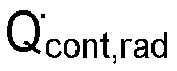
- the brake disc body 11 also transfers heat as Q ⁇ conv due to convection, Q ⁇ rad due to radiation and Q disc , cond . due to conduction towards the axle 13.
- the braking power Pbrk is supplied as energy input while energy is discharged due to convection, radiation and conduction.
- such model calculates the temperature T disc of the brake disc body 11 and the temperature T cont of the brake disc contact surface layer 12 based on the braking power in accordance with a braking torque or acceleration and altitude date, preferable under consideration of a braking force distribution.
- the calculations may be based on iteratively applying the following thermal balance equations:
- T disc and T cont are assumed to be equal to the ambient temperature T amb and ⁇ cont may be calculated from the initial temperatures.
- the estimated brake temperature T brk may be converted into a corresponding braking factor to apply control functions.
Landscapes
- Engineering & Computer Science (AREA)
- General Engineering & Computer Science (AREA)
- Mechanical Engineering (AREA)
- Transportation (AREA)
- Braking Arrangements (AREA)
Description
- The present invention relates to a method for estimating a brake temperature of a brake disc of a vehicle, a method for estimating a braking factor of a disc brake of a vehicle, an equipment for estimating a brake temperature of a brake disc of a vehicle, and a respective computer program product.
- The braking factor of braking actions as transformation of a braking pressure into a braking torque acting on a wheel depends on the temperature of the brake. Accordingly, the brake temperature may be measured by suitable temperature sensors. However, such temperature sensors for braking applications are cost-intensive due to the limited installation space, rotating parts, the high temperatures occurring and required resistance against contaminants. As the relevant brake temperature is the one to be obtained in the contact area of the brake disc with the brake pad, the above problems of measuring a brake temperature become even more severe.
- Accordingly, it is an object of the present invention to provide a method and equipment for estimating a brake temperature of a brake disc of a vehicle and thereby enabling an estimation of a braking factor in an easy manner.
- The following documents can be cited as prior art :
EP0594113 A1 ,KR20070112497 A EP1950111 A2 andFR2733830 A1 - The object is solved by a method for estimating a brake temperature of a brake disc of a vehicle according to claim 1, a method for estimating a braking factor of a disc brake of a vehicle according to claim 16, an equipment for estimating a brake temperature of a brake disc of a vehicle according to claim 17, and a computer program product according to claim 18. Further aspects of the present invention are subject of the dependent claims.
- The inventive method for estimating a brake temperature of a brake disc of a vehicle according to the present invention comprises the steps of:
- virtually separating the brake disc in a brake disc body and a brake disc contact surface layer and
- estimating the temperature of the brake disc contact surface layer in dependence of the temperature of the braking disc body and a heat input in the brake disc contact surface layer due to a braking action,
- wherein the estimated temperature of the brake disc contact surface layer corresponds to the brake temperature.
- The present invention therefore provides a model approach for a model based estimation of the brake temperature. The brake disc as a whole has a relatively slow temperature dynamic while the surface in contact with the brake pad provides higher temperature dynamics. Accordingly, the present invention virtually separates the brake disc into a brake disc body and a brake disc contact surface layer. As the brake disc contact surface layer in view of the brake disc body is comparably thin with a low mass, the brake disc body may be assumed as the brake disc as a whole for the ease of calculations. The resulting deficiency may be acceptable in view of the accuracy required for different utilizations of the model results. However, for high accuracies, the brake body disc may be further specified, i.e. explicitly subtracting at least one brake disc contact surface layer. The temperature of the brake disc contact surface layer can now be estimated in dependence of the temperature of the braking disc body as influencing the temperature of brake disc body due to heat exchange and the heat input into the brake disc contact surface layer on a side opposite to the brake disc body due to a braking action. In other words, the brake disc contact surface layer is sandwiched between a brake pad and the brake disc body when the vehicle is decelerated or driving downhill. In such events, which is the relevant one for any temperature dynamics, the brake disc body functions as a heat sink.
- The temperature of the brake disc contact surface layer estimated based on the above approach corresponds to the brake temperature, which is the temperature to be determined for the braking factor. The term "correspond" allows the brake temperature to be set as the temperature of the brake disc contact surface layer and/or to be adapted, e.g. based on predetermined algorithms and/or coefficients. For example, the braking temperature may be estimated by multiplying the brake disc contact surface temperature with a correction coefficient based on empiric data. Such correction coefficient may also vary depending on temperature of the brake disc contact surface layer.
- Due to the above approach, the estimation of the brake temperature may be used alternatively or in addition to a costly sensor technology. The brake temperature estimation may provide reliable temperature results with reduced complexity and therefore applicability for serial control devices.
- In some embodiments, the temperature of the brake disc contact surface layer is estimated by iteratively applying the thermal balance equation



- The thermal balance equation is based on the virtual separation of the brake disc contact surface layer from the brake disc body and corresponding heat input and heat losses in balance to a change in thermal energy. For brake discs made of one material, ccont is equal to cdisc, which is a thermal capacity of the brake disc body in [J/(kgK)]. However, for coated brake discs or other material differences ccont may deviate from Cdisc.
- The different parameters of the thermal balance equation for the temperature of the brake disc contact surface layer are physically determinable. For example, the determination may be based on measurement data of sensed brake discs and/or data sheets.
- Preferably,


- The heat input is caused by a braking action, i.e. due to frictional contact between the brake pad and the brake disc contact surface layer. Accordingly, the heat input may be calculated in dependency of the brake power Pbrk. This corresponds to


- The transition coefficient γ from a braking pad to the brake disc contact surface layer may be calculated based on the thermal conductivity λ for the brake disc λdisc and the brake pad λpad in [W/(m*K)] and the temperature conductivity k, also referred to as thermal diffusivity, brake disc kdisc and the brake pad kpad in [m2/s] using the intermediate value of the thermal activity coefficient ε as


- The temperature conductivity k may be calculated as

- In some embodiments, the braking power Pbrk may be calculated as

- Thus, the braking power Pbrk is calculated based on the energy of the vehicle. According to the above energy approach, a change in the potential energy is considered, for example, with respect to a change in altitude h if a vehicle moves downhill. Alternatively or in addition, the braking power Pbrk may be calculated as

- The calculation of the braking power Pbrk as a function of the braking torque Mbrk is based on a relatively precise knowledge of the brake torque Mbrk, which may be not available. This is due to a varying brake factor, which depends on the temperature and more again. Thus, the more general applicable way of calculating the brake-torque is the approach above with the braking power Pbrk as a function of the changes in energy, where the variables are widely measured. However, this approach is not as detailed as the one considering the braking torque Mbrk, since influences as the brake distribution between the wheels is not included.
- In some embodiments,


- In some embodiments,


- In some embodiments,


- Advantageously, the initial condition for Ṫcont,n and/or Tcont,n for any of the above equations is predetermined and Tcont,n+1 is calculated as Tcont,n+1 = Tcont,n + Δt * Ṫcont,n.
- Ṫcont,n may also be calculated from the initial temperatures of the disc and contact surface layer.
- For example, as initial condition for all temperatures, i.e. Tcont,0 as well as Tdisc,0, it may be assumed that before driving the temperatures are equal to the ambient temperature.
- Accordingly, the temperature Tcont,n+1 can be estimated based on initial conditions. In general, each temperature Tcont,n+1 of the brake disc contact surface layer can be estimated on the basis of the preceding temperature Tcont,n and the respective change in temperature Ṫcont,n. Deviations from such theoretical estimations to real temperature may be reduced by selecting small values for Δt. However, the smaller the values for Δt the higher the number of calculations and data transfer. Accordingly, Δt may be selected to allow appropriate results within a limited number of calculations.
- For calculations requiring the temperature Tdisc of the brake disc body, Tdisc may be detected by a sensor.
- As the temperature Tdisc of the brake disc body is the inertial temperature of the whole disc, the sensor does not need to be positioned for a measuring a temperature at the contact surface between the brake disc and the brake pad. Instead, such sensor may be arranged to detect a temperature Tdisc of the disc body based on a side of the brake disc body opposite to the contact surface between the brake disc and the brake pad and/or laterally displaced therefrom. The temperature Tdisc of the disc body may be equal to the detected temperature or otherwise determined based on the detected temperature, e.g. an average temperature over a predetermined period of time or the detected temperature multiplied by a predetermined coefficient.
- Alternatively or in addition, the temperature Tdisc of the brake disc body may be estimated by iteratively applying the thermal balance equation


- The principles of such estimation of the temperature Tdisc of the brake disc body are similar to the ones in view of the temperature Tcont of the brake disc contact surface layer.
- A combination of an estimated and sensor-based temperature Tdisc of the brake disc body may not only provide redundancy but may also be applied to monitor and/or adapt the estimated temperature.
- In some embodiments,


- The outer area describes the surface of all areas, that facing away from the disc and may therefore be seen from outside. For example, with ventilated discs, the area of the ventilation channels is not included. The reason is, that in an ideal case all radiated heat from a surface in the ventilation channels is directly heating the opposite area of the disc, so it is only an internal heat flow, that is not changing the overall balance of the disc.
- In some embodiments,


- The inner area is the area inside the ventilating channels.
- In some embodiments,


- Advantageously, the initial condition for Tdisc,n and Tcont,n, and/or Ṫdisc,n may be predetermined and Tdisc,n+1 is calculated as Tdisc,n+1 = Tdisc,n + Δt * Ṫdisc,n.
- Ṫdisc,n may also be calculated from the initial temperatures of the disc and contact surface layer.
- Similarly as already described for the temperature Tcont of the brake disc contact surface layer, the temperature Tdisc,n+1 can be estimated based on initial conditions. Again, deviations from such theoretical estimations to real temperature may be reduced by selecting small values for Δt. However, the smaller the values for Δt the higher the number of calculations and data transfer. Accordingly, Δt may be selected to allow appropriate results within a limited number of calculations.
- In another aspect, the present invention relates to a method for estimating a braking factor of a brake disc of a vehicle, wherein the braking factor is determined based on a brake temperature Tbrk as estimated by applying the method as described above.
- The braking factor may be estimated as being calculated based on the brake temperature Tbrk or selected from a respective data base.
- Another aspect of the present invention relates to an equipment for estimating a brake temperature Tbrk of a brake disc of a vehicle, comprising a control configured to estimate a temperature Tcont of a brake disc contact surface layer as described above, wherein the control is configured to convert the temperature of a brake disc contact surface layer in a corresponding brake temperature.
- As already addressed with respect to the inventive method, the brake temperature Tbrk may be converted in terms being set as the temperature of the brake disc contact surface layer and/or being adapted, e.g. based on predetermined algorithms and/or coefficients. For example, the brake temperature Tbrk may be Tbrk = Tcont or Tbrk = a * Tcont or may be follow even more complex mathematical descriptions.
- The present invention also relates to a computer program product comprising instructions which, when the program is executed by a computer, cause the computer to carry out the method for estimating a brake temperature Tbrk of a brake disc of a vehicle and/or the method for estimating a braking factor of a disc brake of a vehicle, both as described above.
- In summary, the present invention is based on a virtual separation of the brake disc in a brake disc body and a brake disc contact surface layer. The braking torque or acceleration and altitude data of the vehicle, in particular under consideration of the braking force distribution, serve as input of model of the brake temperature Tbrk of the brake disc. The respective estimation of the brake temperature may be implemented by thermal balance equations assuming, for example, point masses for the brake pad, the brake disc contact surface layer and the brake disc body. The thermal balance equations may be applied for the temperature of the brake disc contact surface layer and/or the brake disc body. The thermal flows may allocated depending on physical parameters.
- Further advantages, aspects and details of the disclosure are subject to the claims, the following description of preferred embodiments applying the principles of the disclosure and drawings. In particular:
-
Fig.1 is a schematic view on an exemplary brake disc and brake pads acting on such brake disc of a brake system; and -
Fig. 2 is a schematic view of virtually separated components according to the brake disc and a brake pad as perFig. 1 and further indicating respective heat inputs and losses. -
Fig. 1 showsbrake disc 10 configured to be rotated around anaxle 13 of the brake disc as indicated by the arrow. Thebrake disc 10 may be decelerated due to a braking pressure pbrk applied on thebrake disc 10 bybrake pads 20. Even thoughFig. 1 shows twobrake pads 20, the number of pads is not limited thereto. The whole contact area between thebrake pads 20 and thebrake disc 10 may be assumed as brake disccontact surface layer 12. Accordingly, the brake disccontact surface layer 12 may also be formed of a plurality of individual brake disc contact surface layer sections distributed over the brake disc. The thickness of such brake disccontact surface layer 12 perpendicular to the contact area with abrake pad 20 is assumed to be significantly less than the thickness of the remainingbrake disc 10 assumed asbrake disc body 11. For example, the disccontact surface layer 12 may be assumed to be approximately 10% of the overall thickness. - To estimate a brake temperature Tbrk of a
brake disc 10 of such a brake system for a vehicle, the brake disc and interacting components are virtually separated from each other as perFig. 2 . Further, respective heat inputs and losses are indicated by the indexed arrows. - The separated brake disc
contact surface layer 12 in contact with the separatedbrake pad 20 receives a heat input in accordance with the applied braking power Pbrk. the braking power Pbrk may be calculated as

- At the same time the separated brake disc
contact surface layer 12 may transfer heat by conduction to thebrake disc body 12, e.g. as
- Further heat losses may be considered due to radiation and/or convection.
- Similarly, the
brake disc body 11 receives an heat input as per
brake disc body 11. However, thebrake disc body 11 also transfers heat as


axle 13. In other words, the braking power Pbrk is supplied as energy input while energy is discharged due to convection, radiation and conduction. - Based on the separated brake disc
contact surface layer 12 and the brake disc body 11 a model for estimating the brake temperature Tbrk corresponding to the temperature Tcont of the brake disccontact surface layer 12 can be established. - According to an exemplary embodiment such model calculates the temperature Tdisc of the
brake disc body 11 and the temperature Tcont of the brake disccontact surface layer 12 based on the braking power in accordance with a braking torque or acceleration and altitude date, preferable under consideration of a braking force distribution. - As per the virtual separation according to
Fig. 2 , the calculations may be based on iteratively applying the following thermal balance equations: - a) for the temperature Tdisc of the brake disc body 11


- b) for the temperature Tcont of the brake disc contact surface layer 12


- The respective heat losses may be calculated as


- As initial condition Tdisc and Tcont are assumed to be equal to the ambient temperature Tamb and Ṫcont may be calculated from the initial temperatures.
- Thus, braking temperatures may be estimated by iteratively applying the thermal balance equations with Tcont,n+1 = Tcont,n + Δt * Ṫcont,n or Tdisc,n+1 = Tcont,n + Δt * Ṫcont,n, wherein n is an integer with n ∈ N 0 +.
- The estimated brake temperature Tbrk may be converted into a corresponding braking factor to apply control functions.
-
10 brake disc
11 brake disc body
12 brake disc contact surface layer
13 axle
20 brake pad
pbrk braking pressure
Pbrk braking power


Claims (18)
- A method for estimating a brake temperature (Tbrk) of a brake disc (10) of a vehicle, comprising the steps of:virtually separating the brake disc (10) in a brake disc body (11) and a brake disc contact surface layer (12) andestimating the temperature (Tcont) of the brake disc contact surface layer (12) in dependence of the temperature (Tdisc) of the braking disc body (11) and a heat input in the brake disc contact surface layer (12) due to a braking action,wherein the estimated temperature (Tcont) of the brake disc contact surface layer (12) corresponds to the brake temperature (Tbrk).
- The method according to claim 1, wherein the temperature (Tcont) of the brake disc contact surface layer (12) is estimated by iteratively applying the thermal balance equation



- The method according to claim 2, wherein


- The method according to claim 3, wherein Pbrk is calculated as

- The method according to claim 3, wherein Pbrk is calculated as

- The method according to anyone of the claims 2 to 5, wherein

- The method according to anyone of the claims 2 to 6, wherein


- The method according to anyone of the claims 2 to 7, wherein


- The method according to anyone of claims 2 to 8, wherein the initial condition for Ṫcont,n and/or Tcont,n as per anyone of the claims 6 to 8 is predetermined and Tcont,n+1 is calculated as Tcont,n+1 = Tcont,n + Δt * Ṫcont,n.
- The method according to claim 8 or 9, wherein Tdisc is detected by a sensor.
- The method according to claim 8 to 10, wherein the temperature (Tdisc) of the brake disc body (11) is estimated by iteratively applying the thermal balance equation


- The method according to claim 11, wherein


- The method according to claim 11 or 12, wherein


- The method according to claim 11 or 13, wherein


- The method according to anyone of the claims 11 to 14, wherein the initial condition for Tdisc,n and Tcont,n and/or Ṫdisc,n is predetermined and Tdisc,n+1 is calculated as Tdisc,n+1 = Tdisc,n + Δt * Ṫdisc,n.
- A method for estimating a braking factor of a disc brake of a vehicle, wherein the braking factor is determined based on a brake temperature (Tbrk) as estimated by applying the method of anyone of the claims 1 to 15.
- Equipment for estimating a brake temperature (Tbrk) of a brake disc (10) of a vehicle, comprising a control configured to estimate a temperature (Tcont) of a brake disc contact surface layer (12) according to anyone of the claims 1 to 15, wherein the control is configured to convert the temperature (Tcont) of a brake disc contact surface layer (12) in a corresponding brake temperature (Tbrk).
- A computer program product comprising instructions which, when the program is executed by a computer, cause the computer to carry out the method according to anyone of the claims 1 to 15 and/or 16.
Priority Applications (4)
| Application Number | Priority Date | Filing Date | Title |
|---|---|---|---|
| EP20194050.9A EP3964728B1 (en) | 2020-09-02 | 2020-09-02 | Method and equipment for estimating a brake temperature, method for estimating a braking factor and computer program product |
| PCT/EP2021/072609 WO2022048884A1 (en) | 2020-09-02 | 2021-08-13 | Method and equipment for estimating a brake temperature, method for estimating a braking factor and computer program product |
| CN202180054203.7A CN116096611A (en) | 2020-09-02 | 2021-08-13 | Method and device for evaluating brake temperature, method and computer program product for evaluating brake coefficient |
| US18/040,890 US12246689B2 (en) | 2020-09-02 | 2021-08-13 | Method and equipment for estimating a brake temperature, method for estimating a braking factor and computer program product |
Applications Claiming Priority (1)
| Application Number | Priority Date | Filing Date | Title |
|---|---|---|---|
| EP20194050.9A EP3964728B1 (en) | 2020-09-02 | 2020-09-02 | Method and equipment for estimating a brake temperature, method for estimating a braking factor and computer program product |
Publications (2)
| Publication Number | Publication Date |
|---|---|
| EP3964728A1 EP3964728A1 (en) | 2022-03-09 |
| EP3964728B1 true EP3964728B1 (en) | 2023-08-16 |
Family
ID=72340250
Family Applications (1)
| Application Number | Title | Priority Date | Filing Date |
|---|---|---|---|
| EP20194050.9A Active EP3964728B1 (en) | 2020-09-02 | 2020-09-02 | Method and equipment for estimating a brake temperature, method for estimating a braking factor and computer program product |
Country Status (4)
| Country | Link |
|---|---|
| US (1) | US12246689B2 (en) |
| EP (1) | EP3964728B1 (en) |
| CN (1) | CN116096611A (en) |
| WO (1) | WO2022048884A1 (en) |
Families Citing this family (5)
| Publication number | Priority date | Publication date | Assignee | Title |
|---|---|---|---|---|
| EP3964408B1 (en) * | 2020-09-04 | 2023-06-28 | KNORR-BREMSE Systeme für Nutzfahrzeuge GmbH | Method and equipment for estimating a braking factor for a braking system for a vehicle |
| IT202300006639A1 (en) * | 2023-04-04 | 2024-10-04 | Itt Italia Srl | MONITORING SYSTEM OF THE STATUS OF A BRAKING SYSTEM BY ACQUIRING A TEMPERATURE SIGNAL |
| CN117002464A (en) * | 2023-07-17 | 2023-11-07 | 山东省科学院自动化研究所 | A vehicle brake temperature monitoring method and system |
| CN117574692B (en) * | 2024-01-17 | 2024-04-16 | 中国第一汽车股份有限公司 | Vehicle brake disc temperature calculation method, system, device and storage medium |
| CN119664830A (en) * | 2025-02-20 | 2025-03-21 | 中路慧能检测认证科技有限公司 | An efficient thermal management system for automobile brake disc temperature regulation |
Family Cites Families (8)
| Publication number | Priority date | Publication date | Assignee | Title |
|---|---|---|---|---|
| DE4235364C2 (en) * | 1992-10-20 | 2000-02-24 | Knorr Bremse Systeme | Disc brake temperature detection method |
| FR2733830B1 (en) * | 1995-05-05 | 1997-06-06 | Gec Alsthom Transport Sa | DEVICE AND METHOD FOR EVALUATING THE INSTANTANEOUS TEMPERATURE AND / OR CONTROLLING THE HEATING AND / OR EXTRAPOLATING THE BALANCE TEMPERATURE OF MOBILE MEANS |
| KR20070112497A (en) * | 2006-05-22 | 2007-11-27 | 명화공업주식회사 | Temperature prediction method of brake disc for automobile |
| ITTO20070040A1 (en) * | 2007-01-23 | 2008-07-24 | Faiveley Transport Italia Spa | PROCEDURE FOR THE ASSESSMENT OF THE TEMPERATURE OF THE BRAKING ELEMENTS OF A VEHICLE, IN PARTICULAR OF A RAILWAY VEHICLE. |
| DE102014009681A1 (en) * | 2013-08-02 | 2015-02-05 | Wabco Europe Bvba | Method for monitoring a brake and brake, which is monitored by the method |
| DE102015117252A1 (en) * | 2015-10-09 | 2017-04-13 | Knorr-Bremse Systeme für Nutzfahrzeuge GmbH | Electric wear adjusting device of a disc brake, a corresponding disc brake and method for Lüftspielmessen, -Joint and wear measurement |
| US11047441B2 (en) * | 2018-09-28 | 2021-06-29 | GM Global Technology Operations LLC | Brake component prognosis |
| CN111169453B (en) * | 2018-11-12 | 2024-01-19 | 罗伯特·博世有限公司 | Active braking status monitoring unit and system |
-
2020
- 2020-09-02 EP EP20194050.9A patent/EP3964728B1/en active Active
-
2021
- 2021-08-13 WO PCT/EP2021/072609 patent/WO2022048884A1/en not_active Ceased
- 2021-08-13 CN CN202180054203.7A patent/CN116096611A/en active Pending
- 2021-08-13 US US18/040,890 patent/US12246689B2/en active Active
Also Published As
| Publication number | Publication date |
|---|---|
| US12246689B2 (en) | 2025-03-11 |
| CN116096611A (en) | 2023-05-09 |
| WO2022048884A1 (en) | 2022-03-10 |
| US20230322197A1 (en) | 2023-10-12 |
| EP3964728A1 (en) | 2022-03-09 |
Similar Documents
| Publication | Publication Date | Title |
|---|---|---|
| EP3964728B1 (en) | Method and equipment for estimating a brake temperature, method for estimating a braking factor and computer program product | |
| Alvarez et al. | Dynamic friction model-based tire-road friction estimation and emergency braking control | |
| KR102786049B1 (en) | Motion control of motor vehicles | |
| KR101897628B1 (en) | Method and apparatus for estimating friction coefficient of tire surface in high-speed normal driving situation | |
| US12606145B2 (en) | Method for determining a braking distance | |
| EP1950111B1 (en) | Process for assessing the temperature of the braking elements of a vehicle, in particular a railway vehicle | |
| US11590848B2 (en) | Method and system for controlling the regenerative braking torque of a vehicle | |
| EP3472008B1 (en) | A wheel controller for a vehicle | |
| EP2957440B1 (en) | Tire temperature predictive system and method | |
| CN101405183A (en) | Method for distributing brake proportioning among aircraft brakes | |
| US20110015906A1 (en) | Method and device for determining a coefficient of friction | |
| CN101331041B (en) | Method for brake proportioning in at least one brake group of an aircraft | |
| JP2008265467A (en) | Vehicle road friction coefficient estimation device | |
| US9925971B2 (en) | Brake fluid temperature monitoring | |
| US20120271490A1 (en) | Method for distributing braking torque between braked wheels fitted to at least one undercarriage of an aircraft | |
| Martínez et al. | Modelling and estimation of friction brake torque for a brake by wire system | |
| KR20220081113A (en) | Braking control method using predicted friction coeffieient of brake pad | |
| EP3862238A1 (en) | Direct and indirect methods for aircraft brake wear estimation | |
| JP2005067508A (en) | Brake pad wear warning system | |
| US20240313692A1 (en) | Braking temperature control method and system for electromechanical brake | |
| US20230192061A1 (en) | Temperature estimation method, temperature estimation device, and non-transitory computer-readable recording medium | |
| Mousavi et al. | Comparison of adaptive fuzzy sliding-mode pulse width modulation control with common model-based nonlinear controllers for slip control in antilock braking systems | |
| US20100131166A1 (en) | Method for Adjusting a Braking Pressure for a Disk Brake | |
| JP6871572B2 (en) | Tire braking simulation method | |
| US7509204B2 (en) | Method and system using tire stretch data to control braking |
Legal Events
| Date | Code | Title | Description |
|---|---|---|---|
| PUAI | Public reference made under article 153(3) epc to a published international application that has entered the european phase |
Free format text: ORIGINAL CODE: 0009012 |
|
| STAA | Information on the status of an ep patent application or granted ep patent |
Free format text: STATUS: THE APPLICATION HAS BEEN PUBLISHED |
|
| AK | Designated contracting states |
Kind code of ref document: A1 Designated state(s): AL AT BE BG CH CY CZ DE DK EE ES FI FR GB GR HR HU IE IS IT LI LT LU LV MC MK MT NL NO PL PT RO RS SE SI SK SM TR |
|
| STAA | Information on the status of an ep patent application or granted ep patent |
Free format text: STATUS: REQUEST FOR EXAMINATION WAS MADE |
|
| 17P | Request for examination filed |
Effective date: 20220908 |
|
| RBV | Designated contracting states (corrected) |
Designated state(s): AL AT BE BG CH CY CZ DE DK EE ES FI FR GB GR HR HU IE IS IT LI LT LU LV MC MK MT NL NO PL PT RO RS SE SI SK SM TR |
|
| GRAP | Despatch of communication of intention to grant a patent |
Free format text: ORIGINAL CODE: EPIDOSNIGR1 |
|
| STAA | Information on the status of an ep patent application or granted ep patent |
Free format text: STATUS: GRANT OF PATENT IS INTENDED |
|
| INTG | Intention to grant announced |
Effective date: 20230316 |
|
| GRAS | Grant fee paid |
Free format text: ORIGINAL CODE: EPIDOSNIGR3 |
|
| GRAA | (expected) grant |
Free format text: ORIGINAL CODE: 0009210 |
|
| STAA | Information on the status of an ep patent application or granted ep patent |
Free format text: STATUS: THE PATENT HAS BEEN GRANTED |
|
| AK | Designated contracting states |
Kind code of ref document: B1 Designated state(s): AL AT BE BG CH CY CZ DE DK EE ES FI FR GB GR HR HU IE IS IT LI LT LU LV MC MK MT NL NO PL PT RO RS SE SI SK SM TR |
|
| REG | Reference to a national code |
Ref country code: CH Ref legal event code: EP |
|
| REG | Reference to a national code |
Ref country code: DE Ref legal event code: R096 Ref document number: 602020015726 Country of ref document: DE |
|
| REG | Reference to a national code |
Ref country code: IE Ref legal event code: FG4D |
|
| REG | Reference to a national code |
Ref country code: SE Ref legal event code: TRGR |
|
| REG | Reference to a national code |
Ref country code: LT Ref legal event code: MG9D |
|
| REG | Reference to a national code |
Ref country code: NL Ref legal event code: MP Effective date: 20230816 |
|
| RAP4 | Party data changed (patent owner data changed or rights of a patent transferred) |
Owner name: KNORR-BREMSE SYSTEME FUER NUTZFAHRZEUGE GMBH |
|
| REG | Reference to a national code |
Ref country code: AT Ref legal event code: MK05 Ref document number: 1600339 Country of ref document: AT Kind code of ref document: T Effective date: 20230816 |
|
| PG25 | Lapsed in a contracting state [announced via postgrant information from national office to epo] |
Ref country code: GR Free format text: LAPSE BECAUSE OF FAILURE TO SUBMIT A TRANSLATION OF THE DESCRIPTION OR TO PAY THE FEE WITHIN THE PRESCRIBED TIME-LIMIT Effective date: 20231117 |
|
| PG25 | Lapsed in a contracting state [announced via postgrant information from national office to epo] |
Ref country code: IS Free format text: LAPSE BECAUSE OF FAILURE TO SUBMIT A TRANSLATION OF THE DESCRIPTION OR TO PAY THE FEE WITHIN THE PRESCRIBED TIME-LIMIT Effective date: 20231216 |
|
| PG25 | Lapsed in a contracting state [announced via postgrant information from national office to epo] |
Ref country code: RS Free format text: LAPSE BECAUSE OF FAILURE TO SUBMIT A TRANSLATION OF THE DESCRIPTION OR TO PAY THE FEE WITHIN THE PRESCRIBED TIME-LIMIT Effective date: 20230816 Ref country code: PT Free format text: LAPSE BECAUSE OF FAILURE TO SUBMIT A TRANSLATION OF THE DESCRIPTION OR TO PAY THE FEE WITHIN THE PRESCRIBED TIME-LIMIT Effective date: 20231218 Ref country code: NO Free format text: LAPSE BECAUSE OF FAILURE TO SUBMIT A TRANSLATION OF THE DESCRIPTION OR TO PAY THE FEE WITHIN THE PRESCRIBED TIME-LIMIT Effective date: 20231116 Ref country code: NL Free format text: LAPSE BECAUSE OF FAILURE TO SUBMIT A TRANSLATION OF THE DESCRIPTION OR TO PAY THE FEE WITHIN THE PRESCRIBED TIME-LIMIT Effective date: 20230816 Ref country code: LV Free format text: LAPSE BECAUSE OF FAILURE TO SUBMIT A TRANSLATION OF THE DESCRIPTION OR TO PAY THE FEE WITHIN THE PRESCRIBED TIME-LIMIT Effective date: 20230816 Ref country code: LT Free format text: LAPSE BECAUSE OF FAILURE TO SUBMIT A TRANSLATION OF THE DESCRIPTION OR TO PAY THE FEE WITHIN THE PRESCRIBED TIME-LIMIT Effective date: 20230816 Ref country code: IS Free format text: LAPSE BECAUSE OF FAILURE TO SUBMIT A TRANSLATION OF THE DESCRIPTION OR TO PAY THE FEE WITHIN THE PRESCRIBED TIME-LIMIT Effective date: 20231216 Ref country code: HR Free format text: LAPSE BECAUSE OF FAILURE TO SUBMIT A TRANSLATION OF THE DESCRIPTION OR TO PAY THE FEE WITHIN THE PRESCRIBED TIME-LIMIT Effective date: 20230816 Ref country code: GR Free format text: LAPSE BECAUSE OF FAILURE TO SUBMIT A TRANSLATION OF THE DESCRIPTION OR TO PAY THE FEE WITHIN THE PRESCRIBED TIME-LIMIT Effective date: 20231117 Ref country code: FI Free format text: LAPSE BECAUSE OF FAILURE TO SUBMIT A TRANSLATION OF THE DESCRIPTION OR TO PAY THE FEE WITHIN THE PRESCRIBED TIME-LIMIT Effective date: 20230816 Ref country code: AT Free format text: LAPSE BECAUSE OF FAILURE TO SUBMIT A TRANSLATION OF THE DESCRIPTION OR TO PAY THE FEE WITHIN THE PRESCRIBED TIME-LIMIT Effective date: 20230816 |
|
| PG25 | Lapsed in a contracting state [announced via postgrant information from national office to epo] |
Ref country code: PL Free format text: LAPSE BECAUSE OF FAILURE TO SUBMIT A TRANSLATION OF THE DESCRIPTION OR TO PAY THE FEE WITHIN THE PRESCRIBED TIME-LIMIT Effective date: 20230816 |
|
| P01 | Opt-out of the competence of the unified patent court (upc) registered |
Effective date: 20240206 |
|
| PG25 | Lapsed in a contracting state [announced via postgrant information from national office to epo] |
Ref country code: ES Free format text: LAPSE BECAUSE OF FAILURE TO SUBMIT A TRANSLATION OF THE DESCRIPTION OR TO PAY THE FEE WITHIN THE PRESCRIBED TIME-LIMIT Effective date: 20230816 |
|
| PG25 | Lapsed in a contracting state [announced via postgrant information from national office to epo] |
Ref country code: SM Free format text: LAPSE BECAUSE OF FAILURE TO SUBMIT A TRANSLATION OF THE DESCRIPTION OR TO PAY THE FEE WITHIN THE PRESCRIBED TIME-LIMIT Effective date: 20230816 Ref country code: RO Free format text: LAPSE BECAUSE OF FAILURE TO SUBMIT A TRANSLATION OF THE DESCRIPTION OR TO PAY THE FEE WITHIN THE PRESCRIBED TIME-LIMIT Effective date: 20230816 Ref country code: ES Free format text: LAPSE BECAUSE OF FAILURE TO SUBMIT A TRANSLATION OF THE DESCRIPTION OR TO PAY THE FEE WITHIN THE PRESCRIBED TIME-LIMIT Effective date: 20230816 Ref country code: EE Free format text: LAPSE BECAUSE OF FAILURE TO SUBMIT A TRANSLATION OF THE DESCRIPTION OR TO PAY THE FEE WITHIN THE PRESCRIBED TIME-LIMIT Effective date: 20230816 Ref country code: DK Free format text: LAPSE BECAUSE OF FAILURE TO SUBMIT A TRANSLATION OF THE DESCRIPTION OR TO PAY THE FEE WITHIN THE PRESCRIBED TIME-LIMIT Effective date: 20230816 Ref country code: CZ Free format text: LAPSE BECAUSE OF FAILURE TO SUBMIT A TRANSLATION OF THE DESCRIPTION OR TO PAY THE FEE WITHIN THE PRESCRIBED TIME-LIMIT Effective date: 20230816 Ref country code: SK Free format text: LAPSE BECAUSE OF FAILURE TO SUBMIT A TRANSLATION OF THE DESCRIPTION OR TO PAY THE FEE WITHIN THE PRESCRIBED TIME-LIMIT Effective date: 20230816 |
|
| REG | Reference to a national code |
Ref country code: CH Ref legal event code: PL |
|
| PG25 | Lapsed in a contracting state [announced via postgrant information from national office to epo] |
Ref country code: LU Free format text: LAPSE BECAUSE OF NON-PAYMENT OF DUE FEES Effective date: 20230902 |
|
| REG | Reference to a national code |
Ref country code: DE Ref legal event code: R097 Ref document number: 602020015726 Country of ref document: DE |
|
| REG | Reference to a national code |
Ref country code: BE Ref legal event code: MM Effective date: 20230930 |
|
| PG25 | Lapsed in a contracting state [announced via postgrant information from national office to epo] |
Ref country code: LU Free format text: LAPSE BECAUSE OF NON-PAYMENT OF DUE FEES Effective date: 20230902 Ref country code: MC Free format text: LAPSE BECAUSE OF FAILURE TO SUBMIT A TRANSLATION OF THE DESCRIPTION OR TO PAY THE FEE WITHIN THE PRESCRIBED TIME-LIMIT Effective date: 20230816 |
|
| PLBE | No opposition filed within time limit |
Free format text: ORIGINAL CODE: 0009261 |
|
| STAA | Information on the status of an ep patent application or granted ep patent |
Free format text: STATUS: NO OPPOSITION FILED WITHIN TIME LIMIT |
|
| REG | Reference to a national code |
Ref country code: IE Ref legal event code: MM4A |
|
| PG25 | Lapsed in a contracting state [announced via postgrant information from national office to epo] |
Ref country code: IE Free format text: LAPSE BECAUSE OF NON-PAYMENT OF DUE FEES Effective date: 20230902 |
|
| PG25 | Lapsed in a contracting state [announced via postgrant information from national office to epo] |
Ref country code: CH Free format text: LAPSE BECAUSE OF NON-PAYMENT OF DUE FEES Effective date: 20230930 |
|
| 26N | No opposition filed |
Effective date: 20240517 |
|
| PG25 | Lapsed in a contracting state [announced via postgrant information from national office to epo] |
Ref country code: IT Free format text: LAPSE BECAUSE OF FAILURE TO SUBMIT A TRANSLATION OF THE DESCRIPTION OR TO PAY THE FEE WITHIN THE PRESCRIBED TIME-LIMIT Effective date: 20230816 Ref country code: IE Free format text: LAPSE BECAUSE OF NON-PAYMENT OF DUE FEES Effective date: 20230902 Ref country code: FR Free format text: LAPSE BECAUSE OF NON-PAYMENT OF DUE FEES Effective date: 20231016 Ref country code: CH Free format text: LAPSE BECAUSE OF NON-PAYMENT OF DUE FEES Effective date: 20230930 Ref country code: SI Free format text: LAPSE BECAUSE OF FAILURE TO SUBMIT A TRANSLATION OF THE DESCRIPTION OR TO PAY THE FEE WITHIN THE PRESCRIBED TIME-LIMIT Effective date: 20230816 |
|
| PG25 | Lapsed in a contracting state [announced via postgrant information from national office to epo] |
Ref country code: BE Free format text: LAPSE BECAUSE OF NON-PAYMENT OF DUE FEES Effective date: 20230930 |
|
| PG25 | Lapsed in a contracting state [announced via postgrant information from national office to epo] |
Ref country code: BG Free format text: LAPSE BECAUSE OF FAILURE TO SUBMIT A TRANSLATION OF THE DESCRIPTION OR TO PAY THE FEE WITHIN THE PRESCRIBED TIME-LIMIT Effective date: 20230816 |
|
| PG25 | Lapsed in a contracting state [announced via postgrant information from national office to epo] |
Ref country code: BG Free format text: LAPSE BECAUSE OF FAILURE TO SUBMIT A TRANSLATION OF THE DESCRIPTION OR TO PAY THE FEE WITHIN THE PRESCRIBED TIME-LIMIT Effective date: 20230816 |
|
| GBPC | Gb: european patent ceased through non-payment of renewal fee |
Effective date: 20240902 |
|
| PG25 | Lapsed in a contracting state [announced via postgrant information from national office to epo] |
Ref country code: GB Free format text: LAPSE BECAUSE OF NON-PAYMENT OF DUE FEES Effective date: 20240902 |
|
| PG25 | Lapsed in a contracting state [announced via postgrant information from national office to epo] |
Ref country code: CY Free format text: LAPSE BECAUSE OF FAILURE TO SUBMIT A TRANSLATION OF THE DESCRIPTION OR TO PAY THE FEE WITHIN THE PRESCRIBED TIME-LIMIT; INVALID AB INITIO Effective date: 20200902 |
|
| PG25 | Lapsed in a contracting state [announced via postgrant information from national office to epo] |
Ref country code: HU Free format text: LAPSE BECAUSE OF FAILURE TO SUBMIT A TRANSLATION OF THE DESCRIPTION OR TO PAY THE FEE WITHIN THE PRESCRIBED TIME-LIMIT; INVALID AB INITIO Effective date: 20200902 |
|
| PGFP | Annual fee paid to national office [announced via postgrant information from national office to epo] |
Ref country code: DE Payment date: 20250926 Year of fee payment: 6 |
|
| PGFP | Annual fee paid to national office [announced via postgrant information from national office to epo] |
Ref country code: SE Payment date: 20250924 Year of fee payment: 6 |
|
| PG25 | Lapsed in a contracting state [announced via postgrant information from national office to epo] |
Ref country code: TR Free format text: LAPSE BECAUSE OF FAILURE TO SUBMIT A TRANSLATION OF THE DESCRIPTION OR TO PAY THE FEE WITHIN THE PRESCRIBED TIME-LIMIT Effective date: 20230816 |