EP3964279A1 - Solvent composition for co2 capture and a process mediated thereof - Google Patents
Solvent composition for co2 capture and a process mediated thereof Download PDFInfo
- Publication number
- EP3964279A1 EP3964279A1 EP21194989.6A EP21194989A EP3964279A1 EP 3964279 A1 EP3964279 A1 EP 3964279A1 EP 21194989 A EP21194989 A EP 21194989A EP 3964279 A1 EP3964279 A1 EP 3964279A1
- Authority
- EP
- European Patent Office
- Prior art keywords
- tshs
- composition
- prolinate
- gas
- solvent
- Prior art date
- Legal status (The legal status is an assumption and is not a legal conclusion. Google has not performed a legal analysis and makes no representation as to the accuracy of the status listed.)
- Pending
Links
- 239000002904 solvent Substances 0.000 title claims abstract description 91
- 239000000203 mixture Substances 0.000 title claims abstract description 65
- 238000000034 method Methods 0.000 title claims abstract description 33
- 230000008569 process Effects 0.000 title claims abstract description 24
- 230000001404 mediated effect Effects 0.000 title abstract 2
- 238000003795 desorption Methods 0.000 claims abstract description 14
- OKTJSMMVPCPJKN-UHFFFAOYSA-N Carbon Chemical compound [C] OKTJSMMVPCPJKN-UHFFFAOYSA-N 0.000 claims abstract description 10
- 229910052799 carbon Inorganic materials 0.000 claims abstract description 10
- 230000002194 synthesizing effect Effects 0.000 claims abstract description 4
- CURLTUGMZLYLDI-UHFFFAOYSA-N Carbon dioxide Chemical compound O=C=O CURLTUGMZLYLDI-UHFFFAOYSA-N 0.000 claims description 109
- 229910002092 carbon dioxide Inorganic materials 0.000 claims description 93
- -1 1-Amino-4-naphthyl Chemical group 0.000 claims description 53
- 150000001412 amines Chemical class 0.000 claims description 47
- 239000002105 nanoparticle Substances 0.000 claims description 42
- 239000007789 gas Substances 0.000 claims description 34
- 229920001223 polyethylene glycol Polymers 0.000 claims description 30
- 239000000412 dendrimer Substances 0.000 claims description 24
- 229920000736 dendritic polymer Polymers 0.000 claims description 22
- 239000007788 liquid Substances 0.000 claims description 22
- 238000011068 loading method Methods 0.000 claims description 21
- VYPSYNLAJGMNEJ-UHFFFAOYSA-N Silicium dioxide Chemical compound O=[Si]=O VYPSYNLAJGMNEJ-UHFFFAOYSA-N 0.000 claims description 16
- 239000002114 nanocomposite Substances 0.000 claims description 16
- 239000003381 stabilizer Substances 0.000 claims description 15
- 150000004982 aromatic amines Chemical class 0.000 claims description 13
- 239000001569 carbon dioxide Substances 0.000 claims description 11
- 229910052751 metal Inorganic materials 0.000 claims description 11
- 239000002184 metal Substances 0.000 claims description 11
- ONIBWKKTOPOVIA-UHFFFAOYSA-M prolinate Chemical class [O-]C(=O)C1CCCN1 ONIBWKKTOPOVIA-UHFFFAOYSA-M 0.000 claims description 11
- GWEVSGVZZGPLCZ-UHFFFAOYSA-N Titan oxide Chemical compound O=[Ti]=O GWEVSGVZZGPLCZ-UHFFFAOYSA-N 0.000 claims description 10
- 125000004122 cyclic group Chemical group 0.000 claims description 9
- 150000002334 glycols Chemical class 0.000 claims description 9
- 239000000543 intermediate Substances 0.000 claims description 9
- PTMVFRKAMOUORT-UHFFFAOYSA-N 4-ethylbenzene-1,3-diamine Chemical compound CCC1=CC=C(N)C=C1N PTMVFRKAMOUORT-UHFFFAOYSA-N 0.000 claims description 8
- 230000007797 corrosion Effects 0.000 claims description 8
- 238000005260 corrosion Methods 0.000 claims description 8
- SZVJSHCCFOBDDC-UHFFFAOYSA-N ferrosoferric oxide Chemical compound O=[Fe]O[Fe]O[Fe]=O SZVJSHCCFOBDDC-UHFFFAOYSA-N 0.000 claims description 8
- 125000002496 methyl group Chemical group [H]C([H])([H])* 0.000 claims description 8
- 230000008929 regeneration Effects 0.000 claims description 8
- 238000011069 regeneration method Methods 0.000 claims description 8
- 239000000377 silicon dioxide Substances 0.000 claims description 8
- XLYOFNOQVPJJNP-UHFFFAOYSA-N water Chemical compound O XLYOFNOQVPJJNP-UHFFFAOYSA-N 0.000 claims description 8
- 230000004075 alteration Effects 0.000 claims description 7
- RUFPHBVGCFYCNW-UHFFFAOYSA-N 1-naphthylamine Chemical compound C1=CC=C2C(N)=CC=CC2=C1 RUFPHBVGCFYCNW-UHFFFAOYSA-N 0.000 claims description 6
- PTBDIHRZYDMNKB-UHFFFAOYSA-N 2,2-Bis(hydroxymethyl)propionic acid Chemical compound OCC(C)(CO)C(O)=O PTBDIHRZYDMNKB-UHFFFAOYSA-N 0.000 claims description 6
- VTYYLEPIZMXCLO-UHFFFAOYSA-L Calcium carbonate Chemical compound [Ca+2].[O-]C([O-])=O VTYYLEPIZMXCLO-UHFFFAOYSA-L 0.000 claims description 6
- ZMANZCXQSJIPKH-UHFFFAOYSA-N Triethylamine Chemical compound CCN(CC)CC ZMANZCXQSJIPKH-UHFFFAOYSA-N 0.000 claims description 6
- 150000001875 compounds Chemical class 0.000 claims description 6
- 239000006185 dispersion Substances 0.000 claims description 6
- 230000002209 hydrophobic effect Effects 0.000 claims description 6
- BLWYXBNNBYXPPL-UHFFFAOYSA-N methyl pyrrolidine-2-carboxylate Chemical compound COC(=O)C1CCCN1 BLWYXBNNBYXPPL-UHFFFAOYSA-N 0.000 claims description 6
- IMNIMPAHZVJRPE-UHFFFAOYSA-N triethylenediamine Chemical compound C1CN2CCN1CC2 IMNIMPAHZVJRPE-UHFFFAOYSA-N 0.000 claims description 6
- 239000013154 zeolitic imidazolate framework-8 Substances 0.000 claims description 6
- AXCZMVOFGPJBDE-UHFFFAOYSA-L calcium dihydroxide Chemical compound [OH-].[OH-].[Ca+2] AXCZMVOFGPJBDE-UHFFFAOYSA-L 0.000 claims description 5
- 239000000292 calcium oxide Substances 0.000 claims description 5
- 239000002245 particle Substances 0.000 claims description 5
- 238000011084 recovery Methods 0.000 claims description 5
- 239000000126 substance Substances 0.000 claims description 5
- KDSNLYIMUZNERS-UHFFFAOYSA-N 2-methylpropanamine Chemical compound CC(C)CN KDSNLYIMUZNERS-UHFFFAOYSA-N 0.000 claims description 4
- PAYRUJLWNCNPSJ-UHFFFAOYSA-N Aniline Chemical compound NC1=CC=CC=C1 PAYRUJLWNCNPSJ-UHFFFAOYSA-N 0.000 claims description 4
- DJEQZVQFEPKLOY-UHFFFAOYSA-N N,N-dimethylbutylamine Chemical compound CCCCN(C)C DJEQZVQFEPKLOY-UHFFFAOYSA-N 0.000 claims description 4
- 239000002202 Polyethylene glycol Substances 0.000 claims description 4
- MCMNRKCIXSYSNV-UHFFFAOYSA-N Zirconium dioxide Chemical compound O=[Zr]=O MCMNRKCIXSYSNV-UHFFFAOYSA-N 0.000 claims description 4
- 239000011575 calcium Substances 0.000 claims description 4
- 239000000920 calcium hydroxide Substances 0.000 claims description 4
- 229910001861 calcium hydroxide Inorganic materials 0.000 claims description 4
- 239000007806 chemical reaction intermediate Substances 0.000 claims description 4
- 229910052681 coesite Inorganic materials 0.000 claims description 4
- 229910052906 cristobalite Inorganic materials 0.000 claims description 4
- 230000007423 decrease Effects 0.000 claims description 4
- 229930182480 glucuronide Natural products 0.000 claims description 4
- 150000004676 glycans Chemical class 0.000 claims description 4
- NUJOXMJBOLGQSY-UHFFFAOYSA-N manganese dioxide Chemical compound O=[Mn]=O NUJOXMJBOLGQSY-UHFFFAOYSA-N 0.000 claims description 4
- ORSUTASIQKBEFU-UHFFFAOYSA-N n,n-diethylbutan-1-amine Chemical compound CCCCN(CC)CC ORSUTASIQKBEFU-UHFFFAOYSA-N 0.000 claims description 4
- DAZXVJBJRMWXJP-UHFFFAOYSA-N n,n-dimethylethylamine Chemical compound CCN(C)C DAZXVJBJRMWXJP-UHFFFAOYSA-N 0.000 claims description 4
- GNVRJGIVDSQCOP-UHFFFAOYSA-N n-ethyl-n-methylethanamine Chemical compound CCN(C)CC GNVRJGIVDSQCOP-UHFFFAOYSA-N 0.000 claims description 4
- 229920001282 polysaccharide Polymers 0.000 claims description 4
- 239000005017 polysaccharide Substances 0.000 claims description 4
- 229910052682 stishovite Inorganic materials 0.000 claims description 4
- 229910052905 tridymite Inorganic materials 0.000 claims description 4
- GETQZCLCWQTVFV-UHFFFAOYSA-N trimethylamine Chemical compound CN(C)C GETQZCLCWQTVFV-UHFFFAOYSA-N 0.000 claims description 4
- 229910052725 zinc Inorganic materials 0.000 claims description 4
- MFLKDEMTKSVIBK-UHFFFAOYSA-N zinc;2-methylimidazol-3-ide Chemical compound [Zn+2].CC1=NC=C[N-]1.CC1=NC=C[N-]1 MFLKDEMTKSVIBK-UHFFFAOYSA-N 0.000 claims description 4
- 229910000019 calcium carbonate Inorganic materials 0.000 claims description 3
- ZLNQQNXFFQJAID-UHFFFAOYSA-L magnesium carbonate Chemical compound [Mg+2].[O-]C([O-])=O ZLNQQNXFFQJAID-UHFFFAOYSA-L 0.000 claims description 3
- 239000001095 magnesium carbonate Substances 0.000 claims description 3
- 229910000021 magnesium carbonate Inorganic materials 0.000 claims description 3
- 238000002156 mixing Methods 0.000 claims description 3
- KFZAUEBTXMCCKD-UHFFFAOYSA-N (1-aminonaphthalen-2-yl) hydrogen sulfate Chemical compound C1=CC=C2C(N)=C(OS(O)(=O)=O)C=CC2=C1 KFZAUEBTXMCCKD-UHFFFAOYSA-N 0.000 claims description 2
- BDNDQOCRJGGSJO-UHFFFAOYSA-N 1-amino-2-phenylpropan-2-ol Chemical compound NCC(O)(C)C1=CC=CC=C1 BDNDQOCRJGGSJO-UHFFFAOYSA-N 0.000 claims description 2
- YRAJNWYBUCUFBD-UHFFFAOYSA-N 2,2,6,6-tetramethylheptane-3,5-dione Chemical compound CC(C)(C)C(=O)CC(=O)C(C)(C)C YRAJNWYBUCUFBD-UHFFFAOYSA-N 0.000 claims description 2
- XWZPJRNVELUELY-GDVGLLTNSA-N 2,3-dihydroxypropyl (2s)-5-oxopyrrolidine-2-carboxylate Chemical compound OCC(O)COC(=O)[C@@H]1CCC(=O)N1 XWZPJRNVELUELY-GDVGLLTNSA-N 0.000 claims description 2
- VOZKAJLKRJDJLL-UHFFFAOYSA-N 2,4-diaminotoluene Chemical compound CC1=CC=C(N)C=C1N VOZKAJLKRJDJLL-UHFFFAOYSA-N 0.000 claims description 2
- WGIMXKDCVCTHGW-UHFFFAOYSA-N 2-(2-hydroxyethoxy)ethyl dodecanoate Chemical compound CCCCCCCCCCCC(=O)OCCOCCO WGIMXKDCVCTHGW-UHFFFAOYSA-N 0.000 claims description 2
- ASMWIUUCZFNLHL-UHFFFAOYSA-N 2-[2-[2-(2-decoxyethoxy)ethoxy]ethoxy]ethanol Chemical compound CCCCCCCCCCOCCOCCOCCOCCO ASMWIUUCZFNLHL-UHFFFAOYSA-N 0.000 claims description 2
- SEFYJVFBMNOLBK-UHFFFAOYSA-N 2-[2-[2-(oxiran-2-ylmethoxy)ethoxy]ethoxymethyl]oxirane Chemical compound C1OC1COCCOCCOCC1CO1 SEFYJVFBMNOLBK-UHFFFAOYSA-N 0.000 claims description 2
- SZGNWRSFHADOMY-UHFFFAOYSA-N 2-[2-[2-[2-[2-[2-[2-(2-methoxyethoxy)ethoxy]ethoxy]ethoxy]ethoxy]ethoxy]ethoxy]ethanol Chemical compound COCCOCCOCCOCCOCCOCCOCCOCCO SZGNWRSFHADOMY-UHFFFAOYSA-N 0.000 claims description 2
- BFSVOASYOCHEOV-UHFFFAOYSA-N 2-diethylaminoethanol Chemical compound CCN(CC)CCO BFSVOASYOCHEOV-UHFFFAOYSA-N 0.000 claims description 2
- LXBGSDVWAMZHDD-UHFFFAOYSA-N 2-methyl-1h-imidazole Chemical group CC1=NC=CN1 LXBGSDVWAMZHDD-UHFFFAOYSA-N 0.000 claims description 2
- JBIJLHTVPXGSAM-UHFFFAOYSA-N 2-naphthylamine Chemical compound C1=CC=CC2=CC(N)=CC=C21 JBIJLHTVPXGSAM-UHFFFAOYSA-N 0.000 claims description 2
- HVHNMNGARPCGGD-UHFFFAOYSA-N 2-nitro-p-phenylenediamine Chemical compound NC1=CC=C(N)C([N+]([O-])=O)=C1 HVHNMNGARPCGGD-UHFFFAOYSA-N 0.000 claims description 2
- HUWXDEQWWKGHRV-UHFFFAOYSA-N 3,3'-Dichlorobenzidine Chemical compound C1=C(Cl)C(N)=CC=C1C1=CC=C(N)C(Cl)=C1 HUWXDEQWWKGHRV-UHFFFAOYSA-N 0.000 claims description 2
- GPWHFPWZAPOYNO-UHFFFAOYSA-N 3,3-dimethylbutan-1-amine Chemical compound CC(C)(C)CCN GPWHFPWZAPOYNO-UHFFFAOYSA-N 0.000 claims description 2
- JOZZAIIGWFLONA-UHFFFAOYSA-N 3-methylbutan-2-amine Chemical compound CC(C)C(C)N JOZZAIIGWFLONA-UHFFFAOYSA-N 0.000 claims description 2
- YBRVSVVVWCFQMG-UHFFFAOYSA-N 4,4'-diaminodiphenylmethane Chemical compound C1=CC(N)=CC=C1CC1=CC=C(N)C=C1 YBRVSVVVWCFQMG-UHFFFAOYSA-N 0.000 claims description 2
- IBOFVQJTBBUKMU-UHFFFAOYSA-N 4,4'-methylene-bis-(2-chloroaniline) Chemical compound C1=C(Cl)C(N)=CC=C1CC1=CC=C(N)C(Cl)=C1 IBOFVQJTBBUKMU-UHFFFAOYSA-N 0.000 claims description 2
- WHODQVWERNSQEO-UHFFFAOYSA-N 4-Amino-2-nitrophenol Chemical compound NC1=CC=C(O)C([N+]([O-])=O)=C1 WHODQVWERNSQEO-UHFFFAOYSA-N 0.000 claims description 2
- ZYEDGEXYGKWJPB-UHFFFAOYSA-N 4-[2-(4-aminophenyl)propan-2-yl]aniline Chemical compound C=1C=C(N)C=CC=1C(C)(C)C1=CC=C(N)C=C1 ZYEDGEXYGKWJPB-UHFFFAOYSA-N 0.000 claims description 2
- UNBMPKNTYKDYCG-UHFFFAOYSA-N 4-methylpentan-2-amine Chemical compound CC(C)CC(C)N UNBMPKNTYKDYCG-UHFFFAOYSA-N 0.000 claims description 2
- RAUWPNXIALNKQM-UHFFFAOYSA-N 4-nitro-1,2-phenylenediamine Chemical compound NC1=CC=C([N+]([O-])=O)C=C1N RAUWPNXIALNKQM-UHFFFAOYSA-N 0.000 claims description 2
- CPELXLSAUQHCOX-UHFFFAOYSA-M Bromide Chemical compound [Br-] CPELXLSAUQHCOX-UHFFFAOYSA-M 0.000 claims description 2
- OYPRJOBELJOOCE-UHFFFAOYSA-N Calcium Chemical compound [Ca] OYPRJOBELJOOCE-UHFFFAOYSA-N 0.000 claims description 2
- UGFAIRIUMAVXCW-UHFFFAOYSA-N Carbon monoxide Chemical compound [O+]#[C-] UGFAIRIUMAVXCW-UHFFFAOYSA-N 0.000 claims description 2
- 229910002518 CoFe2O4 Inorganic materials 0.000 claims description 2
- 239000013148 Cu-BTC MOF Substances 0.000 claims description 2
- XTHFKEDIFFGKHM-UHFFFAOYSA-N Dimethoxyethane Chemical compound COCCOC XTHFKEDIFFGKHM-UHFFFAOYSA-N 0.000 claims description 2
- ONIBWKKTOPOVIA-BYPYZUCNSA-N L-Proline Chemical compound OC(=O)[C@@H]1CCCN1 ONIBWKKTOPOVIA-BYPYZUCNSA-N 0.000 claims description 2
- 239000002841 Lewis acid Substances 0.000 claims description 2
- 229910000708 MFe2O4 Inorganic materials 0.000 claims description 2
- 239000013132 MOF-5 Substances 0.000 claims description 2
- JGFZNNIVVJXRND-UHFFFAOYSA-N N,N-Diisopropylethylamine (DIPEA) Chemical compound CCN(C(C)C)C(C)C JGFZNNIVVJXRND-UHFFFAOYSA-N 0.000 claims description 2
- UEEJHVSXFDXPFK-UHFFFAOYSA-N N-dimethylaminoethanol Chemical compound CN(C)CCO UEEJHVSXFDXPFK-UHFFFAOYSA-N 0.000 claims description 2
- MYVLYOJYVMLSFA-UHFFFAOYSA-N N-hydroxy-4-aminobiphenyl Chemical group C1=CC(NO)=CC=C1C1=CC=CC=C1 MYVLYOJYVMLSFA-UHFFFAOYSA-N 0.000 claims description 2
- WPMWEFXCIYCJSA-UHFFFAOYSA-N Tetraethylene glycol monododecyl ether Chemical compound CCCCCCCCCCCCOCCOCCOCCOCCO WPMWEFXCIYCJSA-UHFFFAOYSA-N 0.000 claims description 2
- 229910010068 TiCl2 Inorganic materials 0.000 claims description 2
- GSEJCLTVZPLZKY-UHFFFAOYSA-N Triethanolamine Chemical compound OCCN(CCO)CCO GSEJCLTVZPLZKY-UHFFFAOYSA-N 0.000 claims description 2
- SLINHMUFWFWBMU-UHFFFAOYSA-N Triisopropanolamine Chemical compound CC(O)CN(CC(C)O)CC(C)O SLINHMUFWFWBMU-UHFFFAOYSA-N 0.000 claims description 2
- 239000013207 UiO-66 Substances 0.000 claims description 2
- QYKIQEUNHZKYBP-UHFFFAOYSA-N Vinyl ether Chemical compound C=COC=C QYKIQEUNHZKYBP-UHFFFAOYSA-N 0.000 claims description 2
- 239000013236 Zn4O(BTB)2 Substances 0.000 claims description 2
- UQGNORZJBSUDEX-UHFFFAOYSA-N [B].OS(O)(=O)=O Chemical compound [B].OS(O)(=O)=O UQGNORZJBSUDEX-UHFFFAOYSA-N 0.000 claims description 2
- LHIJANUOQQMGNT-UHFFFAOYSA-N aminoethylethanolamine Chemical compound NCCNCCO LHIJANUOQQMGNT-UHFFFAOYSA-N 0.000 claims description 2
- QMKYBPDZANOJGF-UHFFFAOYSA-K benzene-1,3,5-tricarboxylate(3-) Chemical compound [O-]C(=O)C1=CC(C([O-])=O)=CC(C([O-])=O)=C1 QMKYBPDZANOJGF-UHFFFAOYSA-K 0.000 claims description 2
- PEVMOWGDBVQWCM-HNNXBMFYSA-N benzhydryl (2s)-5-oxopyrrolidine-2-carboxylate Chemical compound O=C([C@H]1NC(=O)CC1)OC(C=1C=CC=CC=1)C1=CC=CC=C1 PEVMOWGDBVQWCM-HNNXBMFYSA-N 0.000 claims description 2
- HFACYLZERDEVSX-UHFFFAOYSA-N benzidine Chemical compound C1=CC(N)=CC=C1C1=CC=C(N)C=C1 HFACYLZERDEVSX-UHFFFAOYSA-N 0.000 claims description 2
- 230000001588 bifunctional effect Effects 0.000 claims description 2
- 229910052793 cadmium Inorganic materials 0.000 claims description 2
- 229910052791 calcium Inorganic materials 0.000 claims description 2
- QAZYYQMPRQKMAC-FDGPNNRMSA-L calcium;(z)-4-oxopent-2-en-2-olate Chemical compound [Ca+2].C\C([O-])=C\C(C)=O.C\C([O-])=C\C(C)=O QAZYYQMPRQKMAC-FDGPNNRMSA-L 0.000 claims description 2
- YBLVILVQEZRPFO-UHFFFAOYSA-N calcium;bis(trimethylsilyl)azanide Chemical compound [Ca+2].C[Si](C)(C)[N-][Si](C)(C)C.C[Si](C)(C)[N-][Si](C)(C)C YBLVILVQEZRPFO-UHFFFAOYSA-N 0.000 claims description 2
- 125000003917 carbamoyl group Chemical group [H]N([H])C(*)=O 0.000 claims description 2
- 239000001913 cellulose Substances 0.000 claims description 2
- 229920002678 cellulose Polymers 0.000 claims description 2
- IVMYJDGYRUAWML-UHFFFAOYSA-N cobalt(II) oxide Inorganic materials [Co]=O IVMYJDGYRUAWML-UHFFFAOYSA-N 0.000 claims description 2
- 229910052802 copper Inorganic materials 0.000 claims description 2
- 239000007771 core particle Substances 0.000 claims description 2
- 239000011258 core-shell material Substances 0.000 claims description 2
- 239000013078 crystal Substances 0.000 claims description 2
- YWXABWYIMLHFSQ-ZDUSSCGKSA-N decyl (2s)-5-oxopyrrolidine-2-carboxylate Chemical compound CCCCCCCCCCOC(=O)[C@@H]1CCC(=O)N1 YWXABWYIMLHFSQ-ZDUSSCGKSA-N 0.000 claims description 2
- 238000010612 desalination reaction Methods 0.000 claims description 2
- 125000004386 diacrylate group Chemical group 0.000 claims description 2
- PQZTVWVYCLIIJY-UHFFFAOYSA-N diethyl(propyl)amine Chemical compound CCCN(CC)CC PQZTVWVYCLIIJY-UHFFFAOYSA-N 0.000 claims description 2
- QPNJHVDIRZNKOX-LURJTMIESA-N ethyl (2s)-pyrrolidine-2-carboxylate Chemical compound CCOC(=O)[C@@H]1CCCN1 QPNJHVDIRZNKOX-LURJTMIESA-N 0.000 claims description 2
- 239000003546 flue gas Substances 0.000 claims description 2
- 229910052949 galena Inorganic materials 0.000 claims description 2
- QZQVBEXLDFYHSR-UHFFFAOYSA-N gallium(III) oxide Inorganic materials O=[Ga]O[Ga]=O QZQVBEXLDFYHSR-UHFFFAOYSA-N 0.000 claims description 2
- 150000008134 glucuronides Chemical class 0.000 claims description 2
- FHHGCKHKTAJLOM-UHFFFAOYSA-N hexaethylene glycol monomethyl ether Chemical compound COCCOCCOCCOCCOCCOCCO FHHGCKHKTAJLOM-UHFFFAOYSA-N 0.000 claims description 2
- BHEPBYXIRTUNPN-UHFFFAOYSA-N hydridophosphorus(.) (triplet) Chemical compound [PH] BHEPBYXIRTUNPN-UHFFFAOYSA-N 0.000 claims description 2
- 229920000587 hyperbranched polymer Polymers 0.000 claims description 2
- PJXISJQVUVHSOJ-UHFFFAOYSA-N indium(III) oxide Inorganic materials [O-2].[O-2].[O-2].[In+3].[In+3] PJXISJQVUVHSOJ-UHFFFAOYSA-N 0.000 claims description 2
- 229910052742 iron Inorganic materials 0.000 claims description 2
- 150000007517 lewis acids Chemical class 0.000 claims description 2
- VTHJTEIRLNZDEV-UHFFFAOYSA-L magnesium dihydroxide Chemical compound [OH-].[OH-].[Mg+2] VTHJTEIRLNZDEV-UHFFFAOYSA-L 0.000 claims description 2
- 239000000347 magnesium hydroxide Substances 0.000 claims description 2
- 229910001862 magnesium hydroxide Inorganic materials 0.000 claims description 2
- WYPTZCBYSQFOQS-UHFFFAOYSA-N magnesium;bis(trimethylsilyl)azanide Chemical compound [Mg+2].C[Si](C)(C)[N-][Si](C)(C)C.C[Si](C)(C)[N-][Si](C)(C)C WYPTZCBYSQFOQS-UHFFFAOYSA-N 0.000 claims description 2
- 229910052748 manganese Inorganic materials 0.000 claims description 2
- 239000002082 metal nanoparticle Substances 0.000 claims description 2
- CRVGTESFCCXCTH-UHFFFAOYSA-N methyl diethanolamine Chemical compound OCCN(C)CCO CRVGTESFCCXCTH-UHFFFAOYSA-N 0.000 claims description 2
- ZUHZZVMEUAUWHY-UHFFFAOYSA-N n,n-dimethylpropan-1-amine Chemical compound CCCN(C)C ZUHZZVMEUAUWHY-UHFFFAOYSA-N 0.000 claims description 2
- VMOWKUTXPNPTEN-UHFFFAOYSA-N n,n-dimethylpropan-2-amine Chemical compound CC(C)N(C)C VMOWKUTXPNPTEN-UHFFFAOYSA-N 0.000 claims description 2
- ISRXMEYARGEVIU-UHFFFAOYSA-N n-methyl-n-propan-2-ylpropan-2-amine Chemical compound CC(C)N(C)C(C)C ISRXMEYARGEVIU-UHFFFAOYSA-N 0.000 claims description 2
- JGXYZXHJZJYHPW-UHFFFAOYSA-N n-naphthalen-2-ylhydroxylamine Chemical compound C1=CC=CC2=CC(NO)=CC=C21 JGXYZXHJZJYHPW-UHFFFAOYSA-N 0.000 claims description 2
- 239000002101 nanobubble Substances 0.000 claims description 2
- ABMFBCRYHDZLRD-UHFFFAOYSA-N naphthalene-1,4-dicarboxylic acid Chemical compound C1=CC=C2C(C(=O)O)=CC=C(C(O)=O)C2=C1 ABMFBCRYHDZLRD-UHFFFAOYSA-N 0.000 claims description 2
- 229910052759 nickel Inorganic materials 0.000 claims description 2
- 229920000962 poly(amidoamine) Polymers 0.000 claims description 2
- 229920000435 poly(dimethylsiloxane) Polymers 0.000 claims description 2
- 229920000728 polyester Polymers 0.000 claims description 2
- 229920000642 polymer Polymers 0.000 claims description 2
- 230000000087 stabilizing effect Effects 0.000 claims description 2
- KKEYFWRCBNTPAC-UHFFFAOYSA-L terephthalate(2-) Chemical compound [O-]C(=O)C1=CC=C(C([O-])=O)C=C1 KKEYFWRCBNTPAC-UHFFFAOYSA-L 0.000 claims description 2
- XJJBXZIKXFOMLP-ZETCQYMHSA-N tert-butyl (2s)-pyrrolidine-2-carboxylate Chemical compound CC(C)(C)OC(=O)[C@@H]1CCCN1 XJJBXZIKXFOMLP-ZETCQYMHSA-N 0.000 claims description 2
- ZWYDDDAMNQQZHD-UHFFFAOYSA-L titanium(ii) chloride Chemical compound [Cl-].[Cl-].[Ti+2] ZWYDDDAMNQQZHD-UHFFFAOYSA-L 0.000 claims description 2
- IMFACGCPASFAPR-UHFFFAOYSA-N tributylamine Chemical compound CCCCN(CCCC)CCCC IMFACGCPASFAPR-UHFFFAOYSA-N 0.000 claims description 2
- YFTHZRPMJXBUME-UHFFFAOYSA-N tripropylamine Chemical compound CCCN(CCC)CCC YFTHZRPMJXBUME-UHFFFAOYSA-N 0.000 claims description 2
- 238000002525 ultrasonication Methods 0.000 claims description 2
- 229960000834 vinyl ether Drugs 0.000 claims description 2
- XLOMVQKBTHCTTD-UHFFFAOYSA-N zinc oxide Inorganic materials [Zn]=O XLOMVQKBTHCTTD-UHFFFAOYSA-N 0.000 claims description 2
- 229910003158 γ-Al2O3 Inorganic materials 0.000 claims description 2
- SQMMCABXVMTGRM-UHFFFAOYSA-N (4-aminonaphthalen-1-yl) hydrogen sulfate Chemical compound C1=CC=C2C(N)=CC=C(OS(O)(=O)=O)C2=C1 SQMMCABXVMTGRM-UHFFFAOYSA-N 0.000 claims 1
- UBEWDCMIDFGDOO-UHFFFAOYSA-N cobalt(II,III) oxide Inorganic materials [O-2].[O-2].[O-2].[O-2].[Co+2].[Co+3].[Co+3] UBEWDCMIDFGDOO-UHFFFAOYSA-N 0.000 claims 1
- 239000000243 solution Substances 0.000 description 32
- 238000010521 absorption reaction Methods 0.000 description 13
- HEMHJVSKTPXQMS-UHFFFAOYSA-M Sodium hydroxide Chemical compound [OH-].[Na+] HEMHJVSKTPXQMS-UHFFFAOYSA-M 0.000 description 12
- ZMXDDKWLCZADIW-UHFFFAOYSA-N N,N-Dimethylformamide Chemical compound CN(C)C=O ZMXDDKWLCZADIW-UHFFFAOYSA-N 0.000 description 9
- 238000012546 transfer Methods 0.000 description 9
- ODINCKMPIJJUCX-UHFFFAOYSA-N Calcium oxide Chemical compound [Ca]=O ODINCKMPIJJUCX-UHFFFAOYSA-N 0.000 description 8
- 238000006243 chemical reaction Methods 0.000 description 8
- JIAARYAFYJHUJI-UHFFFAOYSA-L zinc dichloride Chemical compound [Cl-].[Cl-].[Zn+2] JIAARYAFYJHUJI-UHFFFAOYSA-L 0.000 description 8
- 230000015556 catabolic process Effects 0.000 description 7
- 238000006731 degradation reaction Methods 0.000 description 7
- LYCAIKOWRPUZTN-UHFFFAOYSA-N Ethylene glycol Chemical compound OCCO LYCAIKOWRPUZTN-UHFFFAOYSA-N 0.000 description 5
- 238000005259 measurement Methods 0.000 description 5
- 239000011592 zinc chloride Substances 0.000 description 5
- BVKZGUZCCUSVTD-UHFFFAOYSA-L Carbonate Chemical compound [O-]C([O-])=O BVKZGUZCCUSVTD-UHFFFAOYSA-L 0.000 description 4
- GLUUGHFHXGJENI-UHFFFAOYSA-N Piperazine Chemical compound C1CNCCN1 GLUUGHFHXGJENI-UHFFFAOYSA-N 0.000 description 4
- KKEYFWRCBNTPAC-UHFFFAOYSA-N Terephthalic acid Chemical compound OC(=O)C1=CC=C(C(O)=O)C=C1 KKEYFWRCBNTPAC-UHFFFAOYSA-N 0.000 description 4
- 239000002585 base Substances 0.000 description 4
- 230000015572 biosynthetic process Effects 0.000 description 4
- 238000012986 modification Methods 0.000 description 4
- 230000004048 modification Effects 0.000 description 4
- 150000002902 organometallic compounds Chemical class 0.000 description 4
- BWHMMNNQKKPAPP-UHFFFAOYSA-L potassium carbonate Chemical compound [K+].[K+].[O-]C([O-])=O BWHMMNNQKKPAPP-UHFFFAOYSA-L 0.000 description 4
- 238000003756 stirring Methods 0.000 description 4
- 239000011550 stock solution Substances 0.000 description 4
- 238000003786 synthesis reaction Methods 0.000 description 4
- 239000011701 zinc Substances 0.000 description 4
- PVXVWWANJIWJOO-UHFFFAOYSA-N 1-(1,3-benzodioxol-5-yl)-N-ethylpropan-2-amine Chemical compound CCNC(C)CC1=CC=C2OCOC2=C1 PVXVWWANJIWJOO-UHFFFAOYSA-N 0.000 description 3
- QTBSBXVTEAMEQO-UHFFFAOYSA-N Acetic acid Chemical compound CC(O)=O QTBSBXVTEAMEQO-UHFFFAOYSA-N 0.000 description 3
- QMMZSJPSPRTHGB-UHFFFAOYSA-N MDEA Natural products CC(C)CCCCC=CCC=CC(O)=O QMMZSJPSPRTHGB-UHFFFAOYSA-N 0.000 description 3
- 230000008901 benefit Effects 0.000 description 3
- 239000000872 buffer Substances 0.000 description 3
- 239000008246 gaseous mixture Substances 0.000 description 3
- 238000002386 leaching Methods 0.000 description 3
- 230000036961 partial effect Effects 0.000 description 3
- 239000002244 precipitate Substances 0.000 description 3
- 235000005074 zinc chloride Nutrition 0.000 description 3
- 229910000975 Carbon steel Inorganic materials 0.000 description 2
- 239000012190 activator Substances 0.000 description 2
- 150000001447 alkali salts Chemical class 0.000 description 2
- 230000005587 bubbling Effects 0.000 description 2
- 239000010962 carbon steel Substances 0.000 description 2
- 239000012611 container material Substances 0.000 description 2
- 229940116318 copper carbonate Drugs 0.000 description 2
- 229910000009 copper(II) carbonate Inorganic materials 0.000 description 2
- GEZOTWYUIKXWOA-UHFFFAOYSA-L copper;carbonate Chemical compound [Cu+2].[O-]C([O-])=O GEZOTWYUIKXWOA-UHFFFAOYSA-L 0.000 description 2
- 239000011646 cupric carbonate Substances 0.000 description 2
- 235000019854 cupric carbonate Nutrition 0.000 description 2
- 239000008367 deionised water Substances 0.000 description 2
- 229910021641 deionized water Inorganic materials 0.000 description 2
- ZBCBWPMODOFKDW-UHFFFAOYSA-N diethanolamine Chemical compound OCCNCCO ZBCBWPMODOFKDW-UHFFFAOYSA-N 0.000 description 2
- 238000009792 diffusion process Methods 0.000 description 2
- 230000000694 effects Effects 0.000 description 2
- 238000002474 experimental method Methods 0.000 description 2
- 238000009472 formulation Methods 0.000 description 2
- 239000011521 glass Substances 0.000 description 2
- 238000004442 gravimetric analysis Methods 0.000 description 2
- 239000000463 material Substances 0.000 description 2
- 239000008188 pellet Substances 0.000 description 2
- 229910000027 potassium carbonate Inorganic materials 0.000 description 2
- 239000002243 precursor Substances 0.000 description 2
- 238000002360 preparation method Methods 0.000 description 2
- 239000000047 product Substances 0.000 description 2
- 230000036962 time dependent Effects 0.000 description 2
- LHYBRZAQMRWQOJ-UHFFFAOYSA-N 2-methyl-2-(methylamino)propan-1-ol Chemical compound CNC(C)(C)CO LHYBRZAQMRWQOJ-UHFFFAOYSA-N 0.000 description 1
- GNFTZDOKVXKIBK-UHFFFAOYSA-N 3-(2-methoxyethoxy)benzohydrazide Chemical compound COCCOC1=CC=CC(C(=O)NN)=C1 GNFTZDOKVXKIBK-UHFFFAOYSA-N 0.000 description 1
- 229910000851 Alloy steel Inorganic materials 0.000 description 1
- BVKZGUZCCUSVTD-UHFFFAOYSA-M Bicarbonate Chemical compound OC([O-])=O BVKZGUZCCUSVTD-UHFFFAOYSA-M 0.000 description 1
- UXVMQQNJUSDDNG-UHFFFAOYSA-L Calcium chloride Chemical compound [Cl-].[Cl-].[Ca+2] UXVMQQNJUSDDNG-UHFFFAOYSA-L 0.000 description 1
- KXDHJXZQYSOELW-UHFFFAOYSA-M Carbamate Chemical class NC([O-])=O KXDHJXZQYSOELW-UHFFFAOYSA-M 0.000 description 1
- RPNUMPOLZDHAAY-UHFFFAOYSA-N Diethylenetriamine Chemical compound NCCNCCN RPNUMPOLZDHAAY-UHFFFAOYSA-N 0.000 description 1
- LFQSCWFLJHTTHZ-UHFFFAOYSA-N Ethanol Chemical compound CCO LFQSCWFLJHTTHZ-UHFFFAOYSA-N 0.000 description 1
- 239000004809 Teflon Substances 0.000 description 1
- 229920006362 Teflon® Polymers 0.000 description 1
- 239000002250 absorbent Substances 0.000 description 1
- 230000002745 absorbent Effects 0.000 description 1
- 239000002253 acid Substances 0.000 description 1
- 238000013019 agitation Methods 0.000 description 1
- 125000003277 amino group Chemical group 0.000 description 1
- 238000004458 analytical method Methods 0.000 description 1
- 239000000337 buffer salt Substances 0.000 description 1
- 238000001354 calcination Methods 0.000 description 1
- 239000001110 calcium chloride Substances 0.000 description 1
- 229910001628 calcium chloride Inorganic materials 0.000 description 1
- BRPQOXSCLDDYGP-UHFFFAOYSA-N calcium oxide Chemical compound [O-2].[Ca+2] BRPQOXSCLDDYGP-UHFFFAOYSA-N 0.000 description 1
- 230000008859 change Effects 0.000 description 1
- 238000012512 characterization method Methods 0.000 description 1
- 238000004587 chromatography analysis Methods 0.000 description 1
- 238000004140 cleaning Methods 0.000 description 1
- 238000010276 construction Methods 0.000 description 1
- 230000007812 deficiency Effects 0.000 description 1
- 230000007850 degeneration Effects 0.000 description 1
- 239000007857 degradation product Substances 0.000 description 1
- 239000002274 desiccant Substances 0.000 description 1
- 230000007613 environmental effect Effects 0.000 description 1
- 239000003344 environmental pollutant Substances 0.000 description 1
- 230000007717 exclusion Effects 0.000 description 1
- 230000002349 favourable effect Effects 0.000 description 1
- 238000010438 heat treatment Methods 0.000 description 1
- WGCNASOHLSPBMP-UHFFFAOYSA-N hydroxyacetaldehyde Natural products OCC=O WGCNASOHLSPBMP-UHFFFAOYSA-N 0.000 description 1
- 150000002466 imines Chemical class 0.000 description 1
- 230000003993 interaction Effects 0.000 description 1
- JEIPFZHSYJVQDO-UHFFFAOYSA-N iron(III) oxide Inorganic materials O=[Fe]O[Fe]=O JEIPFZHSYJVQDO-UHFFFAOYSA-N 0.000 description 1
- 239000007791 liquid phase Substances 0.000 description 1
- 239000012621 metal-organic framework Substances 0.000 description 1
- 230000003278 mimic effect Effects 0.000 description 1
- 239000012046 mixed solvent Substances 0.000 description 1
- 238000010525 oxidative degradation reaction Methods 0.000 description 1
- 230000001590 oxidative effect Effects 0.000 description 1
- WEYVCQFUGFRXOM-UHFFFAOYSA-N perazine Chemical class C1CN(C)CCN1CCCN1C2=CC=CC=C2SC2=CC=CC=C21 WEYVCQFUGFRXOM-UHFFFAOYSA-N 0.000 description 1
- 230000002093 peripheral effect Effects 0.000 description 1
- 230000000704 physical effect Effects 0.000 description 1
- 231100000719 pollutant Toxicity 0.000 description 1
- 229920001155 polypropylene Polymers 0.000 description 1
- 125000002924 primary amino group Chemical group [H]N([H])* 0.000 description 1
- 230000001737 promoting effect Effects 0.000 description 1
- 238000005086 pumping Methods 0.000 description 1
- 230000009257 reactivity Effects 0.000 description 1
- 230000002441 reversible effect Effects 0.000 description 1
- 239000007787 solid Substances 0.000 description 1
- 238000000527 sonication Methods 0.000 description 1
- 239000010935 stainless steel Substances 0.000 description 1
- 229910001220 stainless steel Inorganic materials 0.000 description 1
- 150000003512 tertiary amines Chemical class 0.000 description 1
- 238000012360 testing method Methods 0.000 description 1
- 238000005406 washing Methods 0.000 description 1
- 238000005303 weighing Methods 0.000 description 1
Images

Classifications
-
- B—PERFORMING OPERATIONS; TRANSPORTING
- B01—PHYSICAL OR CHEMICAL PROCESSES OR APPARATUS IN GENERAL
- B01D—SEPARATION
- B01D53/00—Separation of gases or vapours; Recovering vapours of volatile solvents from gases; Chemical or biological purification of waste gases, e.g. engine exhaust gases, smoke, fumes, flue gases, aerosols
- B01D53/14—Separation of gases or vapours; Recovering vapours of volatile solvents from gases; Chemical or biological purification of waste gases, e.g. engine exhaust gases, smoke, fumes, flue gases, aerosols by absorption
- B01D53/1493—Selection of liquid materials for use as absorbents
-
- B—PERFORMING OPERATIONS; TRANSPORTING
- B01—PHYSICAL OR CHEMICAL PROCESSES OR APPARATUS IN GENERAL
- B01D—SEPARATION
- B01D53/00—Separation of gases or vapours; Recovering vapours of volatile solvents from gases; Chemical or biological purification of waste gases, e.g. engine exhaust gases, smoke, fumes, flue gases, aerosols
- B01D53/14—Separation of gases or vapours; Recovering vapours of volatile solvents from gases; Chemical or biological purification of waste gases, e.g. engine exhaust gases, smoke, fumes, flue gases, aerosols by absorption
- B01D53/1425—Regeneration of liquid absorbents
-
- B—PERFORMING OPERATIONS; TRANSPORTING
- B01—PHYSICAL OR CHEMICAL PROCESSES OR APPARATUS IN GENERAL
- B01D—SEPARATION
- B01D53/00—Separation of gases or vapours; Recovering vapours of volatile solvents from gases; Chemical or biological purification of waste gases, e.g. engine exhaust gases, smoke, fumes, flue gases, aerosols
- B01D53/14—Separation of gases or vapours; Recovering vapours of volatile solvents from gases; Chemical or biological purification of waste gases, e.g. engine exhaust gases, smoke, fumes, flue gases, aerosols by absorption
- B01D53/1456—Removing acid components
- B01D53/1475—Removing carbon dioxide
-
- B—PERFORMING OPERATIONS; TRANSPORTING
- B01—PHYSICAL OR CHEMICAL PROCESSES OR APPARATUS IN GENERAL
- B01D—SEPARATION
- B01D2252/00—Absorbents, i.e. solvents and liquid materials for gas absorption
- B01D2252/10—Inorganic absorbents
-
- B—PERFORMING OPERATIONS; TRANSPORTING
- B01—PHYSICAL OR CHEMICAL PROCESSES OR APPARATUS IN GENERAL
- B01D—SEPARATION
- B01D2252/00—Absorbents, i.e. solvents and liquid materials for gas absorption
- B01D2252/20—Organic absorbents
- B01D2252/202—Alcohols or their derivatives
- B01D2252/2023—Glycols, diols or their derivatives
- B01D2252/2026—Polyethylene glycol, ethers or esters thereof, e.g. Selexol
-
- B—PERFORMING OPERATIONS; TRANSPORTING
- B01—PHYSICAL OR CHEMICAL PROCESSES OR APPARATUS IN GENERAL
- B01D—SEPARATION
- B01D2252/00—Absorbents, i.e. solvents and liquid materials for gas absorption
- B01D2252/20—Organic absorbents
- B01D2252/204—Amines
- B01D2252/20415—Tri- or polyamines
-
- B—PERFORMING OPERATIONS; TRANSPORTING
- B01—PHYSICAL OR CHEMICAL PROCESSES OR APPARATUS IN GENERAL
- B01D—SEPARATION
- B01D2252/00—Absorbents, i.e. solvents and liquid materials for gas absorption
- B01D2252/20—Organic absorbents
- B01D2252/204—Amines
- B01D2252/20436—Cyclic amines
-
- B—PERFORMING OPERATIONS; TRANSPORTING
- B01—PHYSICAL OR CHEMICAL PROCESSES OR APPARATUS IN GENERAL
- B01D—SEPARATION
- B01D2252/00—Absorbents, i.e. solvents and liquid materials for gas absorption
- B01D2252/20—Organic absorbents
- B01D2252/204—Amines
- B01D2252/20478—Alkanolamines
-
- B—PERFORMING OPERATIONS; TRANSPORTING
- B01—PHYSICAL OR CHEMICAL PROCESSES OR APPARATUS IN GENERAL
- B01D—SEPARATION
- B01D2252/00—Absorbents, i.e. solvents and liquid materials for gas absorption
- B01D2252/20—Organic absorbents
- B01D2252/204—Amines
- B01D2252/20478—Alkanolamines
- B01D2252/20484—Alkanolamines with one hydroxyl group
-
- B—PERFORMING OPERATIONS; TRANSPORTING
- B01—PHYSICAL OR CHEMICAL PROCESSES OR APPARATUS IN GENERAL
- B01D—SEPARATION
- B01D2252/00—Absorbents, i.e. solvents and liquid materials for gas absorption
- B01D2252/50—Combinations of absorbents
- B01D2252/504—Mixtures of two or more absorbents
-
- B—PERFORMING OPERATIONS; TRANSPORTING
- B01—PHYSICAL OR CHEMICAL PROCESSES OR APPARATUS IN GENERAL
- B01D—SEPARATION
- B01D2252/00—Absorbents, i.e. solvents and liquid materials for gas absorption
- B01D2252/60—Additives
- B01D2252/604—Stabilisers or agents inhibiting degradation
-
- B—PERFORMING OPERATIONS; TRANSPORTING
- B01—PHYSICAL OR CHEMICAL PROCESSES OR APPARATUS IN GENERAL
- B01D—SEPARATION
- B01D2253/00—Adsorbents used in seperation treatment of gases and vapours
- B01D2253/10—Inorganic adsorbents
- B01D2253/106—Silica or silicates
- B01D2253/108—Zeolites
-
- B—PERFORMING OPERATIONS; TRANSPORTING
- B01—PHYSICAL OR CHEMICAL PROCESSES OR APPARATUS IN GENERAL
- B01D—SEPARATION
- B01D2253/00—Adsorbents used in seperation treatment of gases and vapours
- B01D2253/10—Inorganic adsorbents
- B01D2253/116—Molecular sieves other than zeolites
-
- B—PERFORMING OPERATIONS; TRANSPORTING
- B01—PHYSICAL OR CHEMICAL PROCESSES OR APPARATUS IN GENERAL
- B01D—SEPARATION
- B01D2257/00—Components to be removed
- B01D2257/50—Carbon oxides
- B01D2257/504—Carbon dioxide
-
- Y—GENERAL TAGGING OF NEW TECHNOLOGICAL DEVELOPMENTS; GENERAL TAGGING OF CROSS-SECTIONAL TECHNOLOGIES SPANNING OVER SEVERAL SECTIONS OF THE IPC; TECHNICAL SUBJECTS COVERED BY FORMER USPC CROSS-REFERENCE ART COLLECTIONS [XRACs] AND DIGESTS
- Y02—TECHNOLOGIES OR APPLICATIONS FOR MITIGATION OR ADAPTATION AGAINST CLIMATE CHANGE
- Y02A—TECHNOLOGIES FOR ADAPTATION TO CLIMATE CHANGE
- Y02A50/00—TECHNOLOGIES FOR ADAPTATION TO CLIMATE CHANGE in human health protection, e.g. against extreme weather
- Y02A50/20—Air quality improvement or preservation, e.g. vehicle emission control or emission reduction by using catalytic converters
-
- Y—GENERAL TAGGING OF NEW TECHNOLOGICAL DEVELOPMENTS; GENERAL TAGGING OF CROSS-SECTIONAL TECHNOLOGIES SPANNING OVER SEVERAL SECTIONS OF THE IPC; TECHNICAL SUBJECTS COVERED BY FORMER USPC CROSS-REFERENCE ART COLLECTIONS [XRACs] AND DIGESTS
- Y02—TECHNOLOGIES OR APPLICATIONS FOR MITIGATION OR ADAPTATION AGAINST CLIMATE CHANGE
- Y02C—CAPTURE, STORAGE, SEQUESTRATION OR DISPOSAL OF GREENHOUSE GASES [GHG]
- Y02C20/00—Capture or disposal of greenhouse gases
- Y02C20/40—Capture or disposal of greenhouse gases of CO2
Definitions
- the present disclosure relates generally to energy and environmental Sciences. Specifically, the present invention discloses a solvent composition and a process for obtaining purified carbon dioxide from any stream containing the mixture of gases. More specifically, the disclosure relates to improved biocompatible task specific hybrid solvent (TSHS) composition that increases carbon capture efficiency and utilizes less energy for CO 2 desorption over the existing carbon dioxide capture solvent composition. Further, the present disclosure provides a process that involves a biocompatible task specific hybrid solvent (TSHS) composition for selective capturing CO 2 from any gaseous stream.
- TSHS biocompatible task specific hybrid solvent
- the main drawback of the conventional CO 2 capture process is the low CO 2 loading capacity of the solvent, low selectivity, and huge energy requirement for solvent regeneration in the stripper. Further, the conventional solvents have several disadvantages including chemical and thermal degradation and Corrosivity. Therefore, to overcome the limitations associated with the conventional solvent system it is important to develop novel solvent systems that have high CO 2 absorption capacity, high selectivity, high stability, and low solvent regeneration energy.
- the solvent formulation has been optimized by using a mixed solvent system to improve CO 2 capture.
- US 2018/0001255 relates to a solvent composition for removing CO 2 and other gases from a gas stream by washing the gaseous stream with a solution containing a combination of physical and chemical solvents.
- the solvent composed of alkanol amine compound in an amount between 30 to 40 wt%, an activator to catalyze the reaction in an amount between 2 to 10 wt%, a physical solvent in an amount ranging between 10 to 25 wt%, and a carbonate buffer for use in an acid gas cleaning system.
- WO2012/038868 describes a solvent composition for recovery of carbon dioxide from gaseous mixture, comprising diethanolamine, piperazine or its derivative, alkali salt, optionally along with cupric carbonate.
- US 2016/0166976 describes a process, system for recovering CO 2 from gases using primary amino hindered alcohol or tertiary amine in combination with derivative of perazine with three or more amino groups as promoter and a carbonate buffer.
- EP 2618914 discloses a solvent composition for recovery of carbon dioxide from a gaseous mixture, comprising diethanolamine, piperazine or its derivative, an alkali salt, along with cupric carbonate.
- the disclosure relates to improved solvent formulations that utilize less energy and increased carbon capture efficiency.
- the disclosure also addresses the high CO 2 loading capacity and energy requirement over the existing carbon dioxide capture solvent.
- WO2016027164 A1 discloses a Methods and compositions useful, for example, for physical solvent carbon capture.
- the solvents may include an aqueous mixture of 2-amino-2-methylproponol, 2-piperazine-1-ethylamine, diethylenetriamine, 2-methylamino-2-methyl-1-propanol, and potassium carbonate or potassium carbonate buffer salt.
- the solvent may also contain less than about 75% by weight of dissolving medium (i.e., water) and may have a single liquid phase.
- the solvents and methods have favorable regeneration energies, chemical stability, vapor pressure, total heat consumption, net cyclic capacity, and reaction kinetics.
- WO2014118633 A3 represents a solvent for recovery of carbon dioxide from the gaseous mixture, having alkanolamine, reactive amines acting as promoter or activators, glycol, and a carbonate buffer.
- Degradation of solvent is another issue.
- Amines may react with CO 2 (and H 2 S, NO x , or pollutants, or O 2 etc.) to form various products that are not reversible in the regeneration step. Amines may also degrade thermally and by oxidative rout. Disposal of the degradation products may also be a concern.
- energy is also required to generate steam within the amine regenerator to strip the CO 2 from the solvent. For some particularly strongly absorbing amines and for large circulation rates, this energy requirement can be very high and represents a significant operating expense.
- TSHS task specific hybrid solvent
- Present invention is related to a biocompatible task specific hybrid solvent (TSHS) composition that synergistically increases the carbon capture efficiency and utilizes less energy for CO 2 desorption over the existing solutions. Further, the process of synthesizing such composition is discussed in this disclosure. Also, the present disclosure provides a process that involves a task specific hybrid solvent (TSHS) composition for selective capturing CO 2 from any gaseous stream.
- TSHS task specific hybrid solvent
- this disclosure provides a biocompatible task specific hybrid solvent (TSHS) composition for selective capturing of CO 2 from gaseous stream, wherein said composition comprising:
- the present invention provides a biocompatible task specific hybrid solvent (TSHS) composition for selective capturing of CO 2 from gaseous stream, wherein said composition comprising:
- the C 2 -C 10 alkalomine or hindered amine solvents are selected from Isobutyl amine, 2-amino-2-methyl-ipropanol, 2-(2- aminoethylamino)ethanol, 2-amino-2-hydroxymethyl-i,3-propanediol, N-methyldiethanolamine, dimethylmonoethanolamine, diethylmonoethanolamine, triisopropanolamine and triethanolamine), trimethylamine, triethylamine, tripropylamine, tributylamine, dimethylethylamine, dimethylpropylamine, dimethylbutylamine, diethylmethylamine, diethylpropylamine, diethylbutylamine, N,N-diisopropylmethylamine, N-ethyldiisopropylamine, N,N-dimethylethylamine, N,N-diethylbutylamine, 1,2-dimethylpropyl
- alkalomine or hindered amine has concentration in the range of 10 to 30 wt% in TSHS and said concentration depends on the feed gas CO 2 concentration.
- said hindered aromatic amines are selected from 2,4- Diaminotoluene, 2,4-diaminoethylbenzene, 2-Naphthylamine, 1-Naphthylamine, NPhenyl ⁇ 2 ⁇ naphthylamine, N-hydroxy-lnaphthylamine, N-hydroxy-2-naphthylamine, 1- Amino-2- naphthyl sulfate, l-Amino-4-naphthyl sulfate, 1-Amino-2-naphthy 1 glucuronide, 1-Amino-4-naphthyl glucuronide, 4-Am inobiphenyl, N-hydroxy-4-aminobiphenyl, methyl (tri-o-acety-d-Dglucopyranosyl bromide), N,4-biphenyl-N-hydroxy-,B-glucuroniosylamine,
- the hindered aromatic amines have concentration in the range of 2 to 10-wt% in TSHS and said concentration depends on the feed gas CO 2 concentration.
- the ratio of C 2 -C 10 alkalomine or hindered amine solvents and C 8 -C 16 hindered aromatic amines is 5:1; and the total concentration of the mixture is at 10-30 wt%.
- Prolinate derivatives are selected from 2-pyrrolidinecarboxylate, decyl 5-oxo-L-prolinate, Methyl (4S)-4-amino-1-methyl-L-prolinate dihydrochloride, Methyl Prolinate, 2,3-Dihydroxypropyl 5-oxo-L-prolinate, ethyl L-prolinate, tert-Butyl L-prolinate, Methyl 1-benzoyl-5-thioxo-L-prolinate, Benzhydryl 5-oxo-L-prolinate, Methyl 1-benzyl-L-prolinate, 3-(4-Fluorophenyl)propyl 1- ⁇ [(1R)-1-phenylethyl]carbamoyl ⁇ -L-prolinate or mixture thereof.
- the concentration of Prolinate derivatives ranges between 100-300 ppm.
- said reaction intermediate stabilizer comprise of alkyne-terminated Dendrons, Polyester bis-MPA Dendron (Bis-MPA : 2,2-Bis(hydroxymethyl)propionic acid), Poly(ethylene glycol) linear dendrimer, Amine-terminated PEG-core Dendrimers, Poly(ethylene glycol) linear dendrimer, Hyperbranched PEG Dendrimers, Hyperbranched PEG Dendrimers, Hyperbranched Polymers, PAMAM Dendrimers, PEG-core Dendrimers, Phosphorous Dendrimers, Polypropylenimine Dendrimers.
- said reaction intermediate stabilizer has concentration between 20-50 ppm.
- said glycol derivatives are selected from Tetraethyleneglycol monododecyl ether, Polyethylene glycol monolaurate, Poly(ethylene glycol) dimethacrylate, Methoxypolyethylene glycols, Poly(ethylene glycol), Poly(ethylene glycol) diacrylate, Polyethylene glycol dimethyl ether, hexaethylene glycol monomethyl ether, diethylene glycol monolaurate, octaethylene glycol monomethyl ether, Tetraethyleneglycol monooctyl ether, poly(ethylene glycol) divinyl ether, Allyloxypolyethyleneglycol, diethylene glycol diglycidyl ether, and tetraethyleneglycol monodecyl ether.
- said glycol derivatives have concentration between 1-2 wt%.
- the metal is selected from Zn, Cu, Ni, Cd or Ln.
- the CCMOs have a concentration between 300-500 ppm.
- the rough surfaced basic nanoparticle is selected from a surface modified alkaline nano particle, calcium hydroxide nanoparticles, CaO nano particles, amine functionalized silica nano particle, amine-functionalized MgFe 2 O 4 , Amine-Functionalized Fe 2 O 3 -SiO 2 Core-Shell Nanoparticles, pNTA-functionalized nanoparticles, amine functionalized TiO 2 nanoparticles along with alkaline nano particles.
- said particles have an alkaline core consisting of a substance selected from the group: calcium hydroxide, magnesium hydroxide, magnesium carbonate, calcium carbonate, magnesium bis(hexamethyldisilazide), calcium bis(hexamethyldisilazide), calcium acetylacetonate hydrate, calcium 2,2,6,6,-tetramethyl-3,5-heptanedionate (Ca(TMHD)2) or mixtures thereof and optionally a hydrophilic cellulose derivative and a stabilizing outer layer containing at least a stabilizer selected from the group: silylated hydrophobic polysaccharides, hydrophobic polysaccharides, poly(dimethylsiloxane) diglycidyl ether terminated and poly(dimethylsiloxane)aminopropyl terminated.
- a stabilizer selected from the group: silylated hydrophobic polysaccharides, hydrophobic polysaccharides, poly(dimethylsiloxane) diglycidyl
- the surfaces of the core particles are coated or covered with a polymer network so that the covered or coated particles are stable over the time in a dispersion formed thereof.
- said nanoparticles have the concentration between 100 to 150 ppm.
- the nano particles selected from SiO 2 , Al 2 O 3 , and TiO 2 , Al 2 O 3 , TiCl 2 /Nano- ⁇ -Al 2 O 3 , CoFe 2 O 4 , magnetic Fe 3 O 4
- the amount of Gas-liquid shuttle ranges between 50-100 ppm.
- the present disclosure provides a process of preparing the biocompatible task specific hybrid solvent (TSHS) composition as claimed in claim 1, wherein said process comprises the steps of:
- controlling of said dosing of gas-liquid shuttle nanocomposite leads to a decrease in loading of H 2 S/SO x /NO x and enhancement in the CO 2 capture.
- the present disclosure provides a process for CO 2 capture or recovery, wherein said process comprises the steps of:
- the pressure of CO 2 containing gas ranges from 0.1 bar to 10 bar and temperature ranges between 20-70°C.
- the regeneration step is performed at temperature ranging from 85 - 100°C.
- CO 2 solubility was measured using a continuous flow bubbling reactor (CFBR).
- CFBR continuous flow bubbling reactor
- Gas cylinders with different CO 2 mole fractions from 400 ppm to 90% were connected to the feed line of the reactor through individual mass flow controllers.
- a glass vessel with a solvent capacity of 50 mL was used as the reactor.
- the reactor temperature was maintained constant using water circulating between the reactor jacket and the heating bath. Because of negligible pressure drop in the tubing and peripherals, the reactor pressure was assumed equal to the atmospheric pressure measured.
- a N 2 and CO 2 mixed gas was purged through a glass bubbler into the solvent at a flow rate of 1 standard liter per minute (SLM).
- SLM standard liter per minute
- the gas discharged from the reactor passes through a condenser to recover water and amine vapor, and then passes through a desiccant unit (CaCl 2 column) to completely remove moisture.
- the concentration of outlet CO 2 was measured by online GC (Inficon).
- the reactor is charged with required amount of the absorbent.
- the gas inside the reactor is then purged with N 2 to ensure an inert atmosphere. Thereafter, N; is released through the gas outlet port. All the lines are closed and the reactor content attained the desired temperature.
- the reactor is then stirred at CO2 from the gas cylinder is then charged inside the considered as the starting point for the reaction.
- the reactor content is the desired speed of agitation.
- the pressure transducer monitors the decrease in system pressure due to reaction and the data are recorded for 60 seconds. These data are plotted between pCO2 and t and fitted to a third degree polynomial using the least-square regression.
- the absorption rates are calculated from the values of the slope dP co 2 / t.
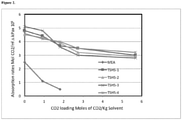
- the mass transfer efficiency of a solvent can be measured in the laboratory using a wetted wall column apparatus that is designed to mimic the gas-liquid contact occurring in typical packed absorption columns.
- the apparatus operates by counter-currently contacting an amine liquid which is flowing down over an absorption column with a gas stream travelling upwards and adjacent to the liquid before exhausting at the top.
- Such measurements combine the processes of CO 2 diffusion across the gas-liquid interface, and chemical reaction within the amine liquid acting to consume CO 2 , resulting in overall mass transfer coefficients for CO 2 absorption in each of the amine solutions over a range of CO 2 loading conditions.
- the absorption of CO 2 into with various TSHS was performed here at 40°C.
- Tightly sealed tube reactors made of Teflon coated stainless steel was used to investigate the solvent thermal degradation at high temperature. After the solvent with rich CO 2 loading was charged and a carbon steel specimen was inserted, the reactor was placed in an oven at 120 °C. Thermal degradation was analyzed for desired days. The solvents were analyzed by chromatography and the degree of thermal degeneration was expressed by the change in peak area.
- T (°C) Solvent system Rate constant (s -1 ) 25 TSHS-1 36524 TSHS-2 22685 TSHS-3 26354 TSHS-4 35698 30 TSHS-1 48558 TSHS-2 32554 TSHS-3 33022 TSHS-4 39665 40 TSHS-1 50248 TSHS-2 42115 TSHS-3 43012 TSHS-4 42356
- a large value of the rate constant means that the reaction is relatively fast for CO 2 capture.
- Cyclic capacity refers to the difference between lean and rich loading of a solvent.
- the lean loading was defined as CO 2 loading corresponding to CO 2 at equilibrium partial pressure of 0.05 kPa at 90 °C whereas the rich loading was defined as the loading values corresponding to CO 2 EPP of 0.05 kPa.
Landscapes
- Chemical & Material Sciences (AREA)
- Engineering & Computer Science (AREA)
- Analytical Chemistry (AREA)
- General Chemical & Material Sciences (AREA)
- Oil, Petroleum & Natural Gas (AREA)
- Chemical Kinetics & Catalysis (AREA)
- Gas Separation By Absorption (AREA)
- Solid-Sorbent Or Filter-Aiding Compositions (AREA)
Abstract
Description
- The present disclosure relates generally to energy and environmental Sciences. Specifically, the present invention discloses a solvent composition and a process for obtaining purified carbon dioxide from any stream containing the mixture of gases. More specifically, the disclosure relates to improved biocompatible task specific hybrid solvent (TSHS) composition that increases carbon capture efficiency and utilizes less energy for CO2 desorption over the existing carbon dioxide capture solvent composition. Further, the present disclosure provides a process that involves a biocompatible task specific hybrid solvent (TSHS) composition for selective capturing CO2 from any gaseous stream.
- The main drawback of the conventional CO2 capture process is the low CO2 loading capacity of the solvent, low selectivity, and huge energy requirement for solvent regeneration in the stripper. Further, the conventional solvents have several disadvantages including chemical and thermal degradation and Corrosivity. Therefore, to overcome the limitations associated with the conventional solvent system it is important to develop novel solvent systems that have high CO2 absorption capacity, high selectivity, high stability, and low solvent regeneration energy.
- Various processes for CO2 absorption and desorption have been disclosed in the prior art. In some inventions, the solvent formulation has been optimized by using a mixed solvent system to improve CO2 capture.
-
US 2018/0001255 relates to a solvent composition for removing CO2 and other gases from a gas stream by washing the gaseous stream with a solution containing a combination of physical and chemical solvents. The solvent composed of alkanol amine compound in an amount between 30 to 40 wt%, an activator to catalyze the reaction in an amount between 2 to 10 wt%, a physical solvent in an amount ranging between 10 to 25 wt%, and a carbonate buffer for use in an acid gas cleaning system. -
WO2012/038868 describes a solvent composition for recovery of carbon dioxide from gaseous mixture, comprising diethanolamine, piperazine or its derivative, alkali salt, optionally along with cupric carbonate. -
US 2016/0166976 describes a process, system for recovering CO2 from gases using primary amino hindered alcohol or tertiary amine in combination with derivative of perazine with three or more amino groups as promoter and a carbonate buffer. -
EP 2618914 discloses a solvent composition for recovery of carbon dioxide from a gaseous mixture, comprising diethanolamine, piperazine or its derivative, an alkali salt, along with cupric carbonate. The disclosure relates to improved solvent formulations that utilize less energy and increased carbon capture efficiency. The disclosure also addresses the high CO2 loading capacity and energy requirement over the existing carbon dioxide capture solvent. -
WO2016027164 A1 discloses a Methods and compositions useful, for example, for physical solvent carbon capture. The solvents may include an aqueous mixture of 2-amino-2-methylproponol, 2-piperazine-1-ethylamine, diethylenetriamine, 2-methylamino-2-methyl-1-propanol, and potassium carbonate or potassium carbonate buffer salt. The solvent may also contain less than about 75% by weight of dissolving medium (i.e., water) and may have a single liquid phase. The solvents and methods have favorable regeneration energies, chemical stability, vapor pressure, total heat consumption, net cyclic capacity, and reaction kinetics. -
WO2014118633 A3 represents a solvent for recovery of carbon dioxide from the gaseous mixture, having alkanolamine, reactive amines acting as promoter or activators, glycol, and a carbonate buffer. - However, in the disclosed processes, CO2 loading capacity, selectivity is limited by the concentration of the amine solution. In addition, the regenerated amine solution, although lean in CO2, still contains some absorbed CO2, which reduces its capacity. Thus, the effective, steady-state CO2 removal rate is further lowered. So, higher circulation rates are required for removal of CO2 to desired levels. Further, the solvent can corrode low alloy steel such as carbon steel. Thus, only amine solutions (in Water) with carefully controlled solution strengths are used to minimize corrosion of the absorption column, piping, and pumps. However, this diluted concentration requires higher circulation rates to achieve the desired CO2 removal. High circulation rates require larger process equipment (capital expense), increased reboiler duty (energy/operating expense) and increased pumping costs (energy/operating expense).
- Degradation of solvent is another issue. Amines may react with CO2 (and H2S, NOx, or pollutants, or O2 etc.) to form various products that are not reversible in the regeneration step. Amines may also degrade thermally and by oxidative rout. Disposal of the degradation products may also be a concern. Furthermore, energy is also required to generate steam within the amine regenerator to strip the CO2 from the solvent. For some particularly strongly absorbing amines and for large circulation rates, this energy requirement can be very high and represents a significant operating expense.
- Present invention overcomes the deficiencies in the prior arts by providing an improved biocompatible task specific hybrid solvent (TSHS) composition that synergistically increases the carbon capture efficiency and utilizes less energy for CO2 desorption over the existing solutions.
- Present invention is related to a biocompatible task specific hybrid solvent (TSHS) composition that synergistically increases the carbon capture efficiency and utilizes less energy for CO2 desorption over the existing solutions. Further, the process of synthesizing such composition is discussed in this disclosure. Also, the present disclosure provides a process that involves a task specific hybrid solvent (TSHS) composition for selective capturing CO2 from any gaseous stream.
- These and other features, aspects, and advantages of the present invention will become better understood when the following detailed description is read with reference to the accompanying drawings in which like characters represent like parts throughout the drawings wherein:
- Figure-1 illustrates corrosion behaviour of the bio amine cluster from the metal leaching of the container material.
- Figure-2 illustrates overall mass transfer coefficients.
- For the purpose of promoting an understanding of the principles of the invention, reference will now be made to the embodiments illustrated in the figures and specific language will be used to describe the same. It will nevertheless be understood that no limitation of the scope of the invention is thereby intended, such alterations and further modifications in the illustrated system, and such further applications of the principles of the invention as illustrated therein being contemplated as would normally occur to one skilled in the art to which the invention relates.
- The articles "a", "an" and "the" are used to refer to one or to more than one (i.e., to at least one) of the grammatical object of the article. The terms "comprise" and "comprising" are used in the inclusive, open sense, meaning that additional elements may be included. It is not intended to be construed as "consists of only". Throughout this specification, unless the context requires otherwise the word "comprise", and variations such as "comprises" and "comprising", will be understood to imply the inclusion of a stated element or step or group of elements or steps but not the exclusion of any other element or step or group of elements or steps.
- Unless defined otherwise, all technical and scientific terms used herein have the same meaning as commonly understood by one of ordinary skill in the art to which this disclosure belongs. Although any methods and materials similar or equivalent to those described herein can be used in the practice or testing of the disclosure, the preferred methods, and materials are now described. All publications mentioned herein are incorporated herein by reference. The present disclosure is not to be limited in scope by the specific examples described herein, which are intended for the purposes of exemplification only. Functionally- equivalent products and methods are clearly within the scope of the disclosure, as described herein.
- The terminology and structure employed herein is for describing, teaching and illuminating some embodiments and their specific features and elements and does not limit, restrict or reduce the spirit and scope of the invention.
In an aspect of the present invention, this disclosure provides a biocompatible task specific hybrid solvent (TSHS) composition for selective capturing of CO2 from gaseous stream, wherein said composition comprising: - (a) an organic component; and
- (b) an inorganic component,
- (a) an organic component comprising at least one-prolinate derivatives; and
- (b) an inorganic component,
- In another embodiment, the present invention provides a biocompatible task specific hybrid solvent (TSHS) composition for selective capturing of CO2 from gaseous stream, wherein said composition comprising:
- (a) an organic component comprising at least one C2-C10 alkalomine or hindered amine, at least one C8-C10 hindered aromatic amines, at least one intermediate stabilizer, at least one-prolinate derivatives and at least one-glycol derivatives; and
- (b) an inorganic component inorganic component comprises at least one colloidal covalent metal organic (CCMO) compound, at least one rough surfaced basic nano particle and at least one gas to liquid shuttle nano composite;
wherein said solvent composition increases carbon capture efficiency, utilizes less energy for low temperatures CO2 desorption, improves cyclic capacity, lowers corrosion and viscosity alteration. - In yet another embodiment, the C2-C10 alkalomine or hindered amine solvents are selected from Isobutyl amine, 2-amino-2-methyl-ipropanol, 2-(2- aminoethylamino)ethanol, 2-amino-2-hydroxymethyl-i,3-propanediol, N-methyldiethanolamine, dimethylmonoethanolamine, diethylmonoethanolamine, triisopropanolamine and triethanolamine), trimethylamine, triethylamine, tripropylamine, tributylamine, dimethylethylamine, dimethylpropylamine, dimethylbutylamine, diethylmethylamine, diethylpropylamine, diethylbutylamine, N,N-diisopropylmethylamine, N-ethyldiisopropylamine, N,N-dimethylethylamine, N,N-diethylbutylamine, 1,2-dimethylpropylamine, N,N- diethylmethylamine, N,N-dimethylisopropylamine, 1,3 -dimethylbutylamine, 3, 3 - dimethylbutylamine, N,N-dimethylbutylamine and mixture thereof.
- In an embodiment, alkalomine or hindered amine has concentration in the range of 10 to 30 wt% in TSHS and said concentration depends on the feed gas CO2 concentration.
- In another embodiment, said hindered aromatic amines are selected from 2,4- Diaminotoluene, 2,4-diaminoethylbenzene, 2-Naphthylamine, 1-Naphthylamine, NPhenyl·2·naphthylamine, N-hydroxy-lnaphthylamine, N-hydroxy-2-naphthylamine, 1- Amino-2- naphthyl sulfate, l-Amino-4-naphthyl sulfate, 1-Amino-2-
naphthy 1 glucuronide, 1-Amino-4-naphthyl glucuronide, 4-Am inobiphenyl, N-hydroxy-4-aminobiphenyl, methyl (tri-o-acety-d-Dglucopyranosyl bromide), N,4-biphenyl-N-hydroxy-,B-glucuroniosylamine, Benzidine, 3,3'-Dichlorobenzidine, 4-Amino-2-nitrophenol, 1,2-diamino-4-nitrobenzene, and 1,4-diamino-2-nitrobenzene, 4,4'-Methylenedianiline (MDA), 4,4'-M ethylene-bis-(2-chloroaniline), 2,2'-bis (4-Aminophenyl) propane, 4,4 '-Imidocarbonyl-bis (N,N'-Dimethyl) Aniline. - In one more embodiment, the hindered aromatic amines have concentration in the range of 2 to 10-wt% in TSHS and said concentration depends on the feed gas CO2 concentration.
- In yet another embodiment, the ratio of C2-C10 alkalomine or hindered amine solvents and C8-C16 hindered aromatic amines is 5:1; and the total concentration of the mixture is at 10-30 wt%.
- In an embodiment, Prolinate derivatives are selected from 2-pyrrolidinecarboxylate, decyl 5-oxo-L-prolinate, Methyl (4S)-4-amino-1-methyl-L-prolinate dihydrochloride, Methyl Prolinate, 2,3-Dihydroxypropyl 5-oxo-L-prolinate, ethyl L-prolinate, tert-Butyl L-prolinate, Methyl 1-benzoyl-5-thioxo-L-prolinate, Benzhydryl 5-oxo-L-prolinate, Methyl 1-benzyl-L-prolinate, 3-(4-Fluorophenyl)propyl 1-{[(1R)-1-phenylethyl]carbamoyl}-L-prolinate or mixture thereof.
- In another embodiment, the concentration of Prolinate derivatives ranges between 100-300 ppm.
- In yet another embodiment, said reaction intermediate stabilizer comprise of alkyne-terminated Dendrons, Polyester bis-MPA Dendron (Bis-MPA : 2,2-Bis(hydroxymethyl)propionic acid), Poly(ethylene glycol) linear dendrimer, Amine-terminated PEG-core Dendrimers, Poly(ethylene glycol) linear dendrimer, Hyperbranched PEG Dendrimers, Hyperbranched PEG Dendrimers, Hyperbranched Polymers, PAMAM Dendrimers, PEG-core Dendrimers, Phosphorous Dendrimers, Polypropylenimine Dendrimers.
- In one more embodiment, said reaction intermediate stabilizer has concentration between 20-50 ppm.
- In an embodiment, said glycol derivatives are selected from Tetraethyleneglycol monododecyl ether, Polyethylene glycol monolaurate, Poly(ethylene glycol) dimethacrylate, Methoxypolyethylene glycols, Poly(ethylene glycol), Poly(ethylene glycol) diacrylate, Polyethylene glycol dimethyl ether, hexaethylene glycol monomethyl ether, diethylene glycol monolaurate, octaethylene glycol monomethyl ether, Tetraethyleneglycol monooctyl ether, poly(ethylene glycol) divinyl ether, Allyloxypolyethyleneglycol, diethylene glycol diglycidyl ether, and tetraethyleneglycol monodecyl ether.
- In another embodiment, said glycol derivatives have concentration between 1-2 wt%.
- In yet another embodiment, said Colloidal covalent metal-organic (CCMO) components are selected from zeolitic imidazolate framework-8, MOF-5 [Zn4O(terephthalate)3, [Zn(mim)2] (ZIF-8; mim = 2-methylimidazolate), [Cu3- (btc)2] crystals (HKUST-1; btc = benzene-1,3,5-tricarboxylate), [Cu2(ndc)2(dabco)2] (ndc = 1,4-naphthalene dicarboxylate; dabco = 1,4-diazabicyclo- [2.2.2] octane), hydrophobic ZIF-8, f UiO-66, MOF-177.
- In one more embodiment, the metal is selected from Zn, Cu, Ni, Cd or Ln.
- In an embodiment, the CCMOs have a concentration between 300-500 ppm.
- In another embodiment, the rough surfaced basic nanoparticle is selected from a surface modified alkaline nano particle, calcium hydroxide nanoparticles, CaO nano particles, amine functionalized silica nano particle, amine-functionalized MgFe2O4, Amine-Functionalized Fe2O3-SiO2 Core-Shell Nanoparticles, pNTA-functionalized nanoparticles, amine functionalized TiO2 nanoparticles along with alkaline nano particles.
- In yet another embodiment, said particles have an alkaline core consisting of a substance selected from the group: calcium hydroxide, magnesium hydroxide, magnesium carbonate, calcium carbonate, magnesium bis(hexamethyldisilazide), calcium bis(hexamethyldisilazide), calcium acetylacetonate hydrate,
calcium - In one more embodiment, the surfaces of the core particles are coated or covered with a polymer network so that the covered or coated particles are stable over the time in a dispersion formed thereof.
- In an embodiment, said nanoparticles have the concentration between 100 to 150 ppm.
- In another embodiment, said Gas-liquid shuttle nano composite is composed on one of more of the nano particles selected from SiO2, Al2O3, and TiO2, Al2O3, TiCl2/Nano-γ-Al2O3, CoFe2O4, magnetic Fe3O4, Ga2O3, functional silica, colloidal In2O3, ZnO, CoO, MnO2, Fe3O4, PbS, MFe2O4 (M= Fe, Co, Mn, Zn), Lewis acid ZrO2, silica boron sulfuric acid nanoparticles, Ni metal nanoparticles loaded on the acid-base bifunctional support (Al2O3), CO3O4 nanoparticles.
- In yet another embodiment, the amount of Gas-liquid shuttle ranges between 50-100 ppm.
- In a second aspect of the invention, the present disclosure provides a process of preparing the biocompatible task specific hybrid solvent (TSHS) composition as claimed in
claim 1, wherein said process comprises the steps of: - preparing a base amine solution by mixing C2-C10 alkalomine or hindered amine and C8-C10 hindered aromatic amines in the ratio of 5:1;
- adding at least one prolinate derivative to the base amine solution at the rate of 0.2-0.5 ml/min.;
- adding at least one intermediate stabilizer to the solution of prolinate and amines;
- synthesizing a colloidal covalent metal-organic (CCMO) compound and adding the same to the solution of intermediate stabilizer, prolinate and amines at the rate of 2-10 ml/min. ;
- preparing the surface modified alkaline nanoparticle and gas-liquid shuttle nanocomposite;
- adding the surface modified alkaline nanoparticle and gas-liquid shuttle nanocomposite at an intermittent dosing rate of 0.4 ml-0.6 ml/min to at least one glycol derivative to obtain a homogenous colloidal solution;
- adding the colloidal solution to the solution of CCMO and other components;
- making up the volume with DI water and incubating the whole solution at 55°C for 4 hours to obtain the TSHS system.
- In an embodiment, controlling of said dosing of gas-liquid shuttle nanocomposite leads to a decrease in loading of H2S/SOx/NOx and enhancement in the CO2 capture.
- In a third aspect of the invention, the present disclosure provides a process for CO2 capture or recovery, wherein said process comprises the steps of:
- providing a CO2 source which is selected from carbon dioxide-containing flue gas, or process gas or gas from bio-methanation plants having CO2 concentration ranging from 200 ppm to 900000 ppm in the source gas;
- passing the CO2 containing gas through the solvent composition as defined in in the present invention in a device to form a fine dispersion of gas which results in an increase in contact area, sparging the carbon dioxide as a micro-bubble or a nanobubble;
- carrying out CO2 desorption by thermal or solar assisted electro desalination method and amine regeneration by thermal, ultra-sonication and microwave irradiation.
- In an embodiment, the pressure of CO2 containing gas ranges from 0.1 bar to 10 bar and temperature ranges between 20-70°C.
- In another embodiment, the regeneration step is performed at temperature ranging from 85 - 100°C.
- Having described the basic aspects of the present invention, the following non-limiting examples illustrate specific embodiment thereof.
-
- a) To synthesize TSHS (1L) first the base solvent was prepared by mixing 240 g of 2-amino-2-methyl-ipropanol and 60 g of 2, 4-diaminoethylbenzene was properly mixed for 4 h at room temperature.
- b) In another vial 100 mg of methyl prolinate was dissolved in 5 ml of DI, The solution was added to the mixed amine prepared in 'step-a' at a rate of 0.2 ml/min with constant stirring at 230 rpm followed by addition of Poly(ethylene glycol) linear dendrimer (30 mg) drop wise. The resulting solution was stored at 30°C.
- c) Synthesis of colloidal Zn-covalent metal-organic compound: A stock solution of Zinc chloride was prepared by dissolving Zinc chloride (0.9 mmol) in 30 mL of N, N Dimethylformamide (DMF). A second stock solution comprised of terephthalic acid (3.01 mmol) in 10 mL of DMF was prepared. Zinc chloride stock solution (3 mL) was added to terephthalic acid stock solution (1 mL), 20 mg F-127, and 10 mg poly(ethylene) glycol in a 10 mL vial. 1.5 M for acetic acid added drop wise to the above solution. The solution was heated at 90 °C for 18 h to yield colloidal Zn-covalent metal-organic framework. The solution was centrifuged at 10,000 rpm and the solid was dried at 55 °C overnight.
- d) 300 mg of the colloidal Zn-covalent metal-organic compound (dried) was dispersed in 25 ml of DI, and sonicated for 5 min. The well-dispersed colloidal Zn-covalent metal-organic compound is added to the solution obtained in 'step c' with a rate of 2-3 ml per min with constant stirring. A pale white solution obtained and was stored at 30°C.
- e) Synthesis of surface modified alkaline nano particle: 3g of calcium hydroxide (Ca (OH)2) was dissolved in 12.5 ml of ethylene glycol and stirred vigorously and then 1 g of sodium hydroxide (NaOH) was added into the mixture. The solution was left to settle down for 5 hours after 10 minutes of sonication. The precipitate was filtered and obtained precipitate has been repeatedly washed with deionized water for 5 times and then dried at in 100 °C, subsequently. Finally, calcium oxide nanoparticles of different size were obtained by calcining at 800 °C.
- f) Gas-liquid shuttle nano composite: Deionized water (200 mL) was added to a 500 mL flask and heated to 100° C. Then, after adding ZnCl2 (250 mmol), the mixture was agitated using a magnetic bar to prepare a precursor solution. After ZnCl2 was completely dissolved, 3g of sodium hydroxide pellets were added at once and a dispersion of ZnO nanoparticles was prepared by agitating at 100 rpm using a magnetic bar. ZnO nanoparticles were produced as white precipitate. The reaction was terminated in 10 minutes. During the preparation of the precursor solution and the addition of the sodium hydroxide pellets, the temperature was maintained at 100° C. After the reaction was terminated, the dispersion of ZnO nanoparticles was cooled to room temperature and ZnO nanoparticles were recovered by centrifuge at 10,000 rpm.
- g) In 50 ml of DI, 10 g of Poly (ethylene glycol) was added and stirred for 1 h. During stirring 100 mg of surface modified alkaline CaO particle and 50 mg of Gas-liquid shuttle nano composite (ZnO) was added. The mixture was then sonicated for 30 min intermittently to obtain a homogeneous colloidal solution.
- h) The solution obtained in 'step g' was added to the solution obtained in 'step d' at a dosing rate of 0.2 ml per min with constant stirring. After complete addition, the volume of final solution was made to 1 L using DI to obtained TSHS-1.
- Three other solvent systems were synthesized in the similar way as for TSHS -1 in Example 1 above, having the following composition as given in Table-2. The concentration, rate of addition and condition are similar for all the synthesized solvent.
Table-2: Preparation of TSHS solvent system with various composition Solvent TSHS-1 TSHS-2 TSHS-3 TSHS-4 Alkalomine or hindered amine 2-amino-2-methylipropanol 2-amino-2-methylipropanol 2-amino-2-methylipropanol 2-amino-2-methylipropanol Hindered aromatic amines 2,4- diaminoethylb enzene 2,4- diaminoethyl benzene 2,4- diaminoethylb enzene 2,4-diaminoethyl benzene Prolinate derivatives Methyl Prolinate tert-Butyl L-prolinate tert-Butyl L-prolinate Methyl Prolinate Intermediate stabilizer Poly(ethylene glycol) linear dendrimer Amine-terminated PEG-core Dendrimers Polypropyleni mine Dendrimers Polypropylen imine Dendrimers Glycol derivatives Poly(ethylene glycol) Poly(ethylene glycol) Poly(ethylene glycol) Poly(ethylene glycol) CCMO Zn-CCMO Zr-CCMO Ni-CCMO Zn-CCMO Surface modified alkaline nano particle CaO MgO CaCO3 MgCO3 GL shuttle nano composite ZnO Fe2O3 Al2O3 TiO2 - Gravimetric analysis: For CO2 absorption measurements (time-dependent CO2 uptakes of TSHS) of the TSHS, CO2 gas was flown into a reactor (100 mL) containing 20 g of solvent at a flow rate of 20 mL min-1. The weight percent of CO2 absorbed was determined by weighing the solvent at a regular interval using an electronic balance with an accuracy of ± 0.1 mg.
- CO2 solubility was measured using a continuous flow bubbling reactor (CFBR). The CFBR can be operated in various pressure modes. Gas cylinders with different CO2 mole fractions from 400 ppm to 90% were connected to the feed line of the reactor through individual mass flow controllers. A glass vessel with a solvent capacity of 50 mL was used as the reactor. The reactor temperature was maintained constant using water circulating between the reactor jacket and the heating bath. Because of negligible pressure drop in the tubing and peripherals, the reactor pressure was assumed equal to the atmospheric pressure measured. A N2 and CO2 mixed gas was purged through a glass bubbler into the solvent at a flow rate of 1 standard liter per minute (SLM). The gas discharged from the reactor passes through a condenser to recover water and amine vapor, and then passes through a desiccant unit (CaCl2 column) to completely remove moisture. The concentration of outlet CO2 was measured by online GC (Inficon).
- In each experiment, the reactor is charged with required amount of the absorbent. The gas inside the reactor is then purged with N2 to ensure an inert atmosphere. Thereafter, N; is released through the gas outlet port. All the lines are closed and the reactor content attained the desired temperature. The reactor is then stirred at CO2 from the gas cylinder is then charged inside the considered as the starting point for the reaction. The reactor content is the desired speed of agitation. The pressure transducer monitors the decrease in system pressure due to reaction and the data are recorded for 60 seconds. These data are plotted between pCO2 and t and fitted to a third degree polynomial using the least-square regression. The absorption rates are calculated from the values of the slope dPco
2 / t. - The mass transfer efficiency of a solvent can be measured in the laboratory using a wetted wall column apparatus that is designed to mimic the gas-liquid contact occurring in typical packed absorption columns. The apparatus operates by counter-currently contacting an amine liquid which is flowing down over an absorption column with a gas stream travelling upwards and adjacent to the liquid before exhausting at the top. Such measurements combine the processes of CO2 diffusion across the gas-liquid interface, and chemical reaction within the amine liquid acting to consume CO2, resulting in overall mass transfer coefficients for CO2 absorption in each of the amine solutions over a range of CO2 loading conditions. The absorption of CO2 into with various TSHS was performed here at 40°C.
- Tightly sealed tube reactors made of Teflon coated stainless steel was used to investigate the solvent thermal degradation at high temperature. After the solvent with rich CO2 loading was charged and a carbon steel specimen was inserted, the reactor was placed in an oven at 120 °C. Thermal degradation was analyzed for desired days. The solvents were analyzed by chromatography and the degree of thermal degeneration was expressed by the change in peak area.
-
T (°C) Solvent system Density (Kg/m3) Viscosity (mPa.s) 25 TSHS-1 1135.2 1.56 TSHS-2 1256.2 1.51 TSHS-3 1025.3 1.63 TSHS-4 1226.8 1.25 30 TSHS-1 1133.9 1.32 TSHS-2 1255.7 1.40 TSHS-3 1024.8 1.45 TSHS-4 1224.7 1.13 40 TSHS-1 1131.5 1.15 TSHS-2 1254.7 1.29 TSHS-3 1023.2 1.22 TSHS-4 1223.3 1.08 -
T (°C) Solvent system Rate constant (s-1) 25 TSHS-1 36524 TSHS-2 22685 TSHS-3 26354 TSHS-4 35698 30 TSHS-1 48558 TSHS-2 32554 TSHS-3 33022 TSHS-4 39665 40 TSHS-1 50248 TSHS-2 42115 TSHS-3 43012 TSHS-4 42356 - A large value of the rate constant means that the reaction is relatively fast for CO2 capture.
-
CO2 partial pressure Solvent 10kPa 5 Kpa 3 Kpa 1 Kpa TSHS-1 6.11 5.96 5.84 5.72 TSHS-2 5.91 5.66 5.53 5.45 TSHS-3 5.81 5.62 5.33 5.05 TSHS-4 5.64 5.22 5.01 4.8 - The time-dependent CO2 uptakes of TSHS-1 and other components were measured at 30 °C and 1 atm pressure using the gravimetric method.
Code Components CO2 loading (Mol/L) A 2-amino-2-methyl-ipropanol 1.4 B 2, 4-diaminoethylbenzene 1.1 C Poly(ethylene glycol) linear dendrimer ND D Methyl Prolinate 0.04 E Zn-covalent metal-organic compound 0.6 F Modified CaO nano particle+ ZnO Gas-liquid shuttle nano composite in PEG 0.08 A+B 2.48 A+C 1.94 A+D 1.54 A+E 1.28 A+F 1.33 B+C 2.17 B+D 1.88 B+E 2.25 B+F 1.92 C+D 0.03 D+E 0.62 E+F 0.59 A+B+C 2.22 A+B+D 2.29 A+B+E 2.24 A+B+F 2.23 B+C+D 1.92 B+C+E 1.99 B+C+F 1.96 C+D+E 0.59 C+D+F 0.66 A+B+C+D 2.96 A+B+C+E 2.86 A+B+C+F 1.91 B+C+D+F 1.31 A+B+C+D+E+F 5.87 - Cyclic capacity refers to the difference between lean and rich loading of a solvent. In this study, the lean loading was defined as CO2 loading corresponding to CO2 at equilibrium partial pressure of 0.05 kPa at 90 °C whereas the rich loading was defined as the loading values corresponding to CO2 EPP of 0.05 kPa.
Solvent Lean loading (mol CO2/kg-solv) Rich loading (molCO2/kg-solv) Cyclic capacity (mol CO2/kg-solv) MEA 1.68 2.52 0.84 TSHS-1 0.15 5.87 5.72 TSHS-2 0.21 5.66 5.45 TSHS-3 0.32 5.37 5.05 TSHS-4 0.23 5.03 4.8 -
Solvent % of degradation MEA 21 TSHS-1 0.94 TSHS-2 0.55 TSHS-3 0.78 TSHS-4 0.96 -
- (a) The corrosion behaviour of the bio amine cluster has been observed from the metal leaching of the container material. Experiments were performed for a continuous 750 h and the total metal contents were analyzed by ICPAES. It has been found that for MDEA/PZ, and then there was a leaching of 42 ppm of metal after 750 h of operation, whereas in TSHS-1, only 0-1.9-ppm metal was leached. This clearly indicates that TSHS showed very low corrosion activity (
Figure 1 ). - (b) The viscosity of the TSHS was measured for 30 numbers of consecutive absorption, desorption cycles, and compared with that of MDEA/PZ. It has been observed that the viscosity of MDEA/PZ increases after each absorption and desorption cycles and reaches to 38 eta/mPa·s, whereas the viscosity of IB-PEGD-Cl/AMEO/CA remains almost constant after 30 cycles of operation.
- From the mass transfer coefficients in the reactivity of the amines follows the trend TSHS-1 to 4 > MEA. In all cases here, CO2 mass transfer decreases linearly with increasing CO2 loading, which is in line with the supposition of a depletion of the bulk concentration of free "reactive" amine as CO2 loading increases, and increases in solution viscosity due to the increasing amount, and interactions, of charged species (carbonate, bicarbonate, protonated amine, carbamate etc) in the solution. The data (
Figure 2 ) demonstrate mass transfer rates up to 2 times higher than MEA the entire loading range. Importantly, mass transfer above diffusion is maintained in TSHS up to a loading of 5 mol CO2/Kg of solvent, improving the overall working range of the solvent. - The present invention has the following advantage over the prior arts:
- 1) Task specific hybrid solvent (TSHS) composition provides a faster and higher CO2 loading ability from a mixture of gases and also displays low vapor pressure.
- 2) TSHS composition further lower viscosity over commercially available solvents after CO2 capture and display low corrosive property.
- 3) High stability against thermal and oxidative degradation and allows higher desorption at low temperature.
- 4) Improved cyclic capacity compared to conventional amines over a similar temperature swing.
- It will thus be seen that the objects set forth above, among those made apparent from the preceding description, are efficiently attained, and since certain changes may be made in the constructions set forth without departing from the spirit and scope of the invention, it is intended that all matter contained in the above description shall be interpreted as illustrative and not in a limiting sense. The invention has been described with reference to preferred and alternate embodiments. Modifications and alterations will become apparent to those skilled in the art upon reading and understanding the detailed discussion of the invention provided herein. This invention is intended to include all such modifications and alterations insofar as they come within the scope of the present invention. These and other modifications of the preferred embodiments as well as other embodiments of the invention will be obvious from the disclosure herein, whereby the foregoing descriptive matter is to be interpreted merely as illustrative of the invention and not as a limitation.
- Finally, to the extent necessary to understand or complete the disclosure of the present invention, all publications, patents, and patent applications mentioned herein are expressly incorporated by reference therein to the same extent as though each were individually so incorporated.
In an embodiment, said organic component comprises at least one C2-C10 alkalomine or hindered amine, at least one C8-C10 hindered aromatic amines, at least one intermediate stabilizer, at least one-prolinate derivatives and at least one-glycol derivatives.
In another embodiment, said inorganic component comprises at least one colloidal covalent metal organic (CCMO) compound, at least one rough surfaced basic nano particle and at least one gas to liquid shuttle nano composite.
In an embodiment, the present invention provides a biocompatible task specific hybrid solvent (TSHS) composition for selective capturing of CO2 from gaseous stream, wherein said composition comprising:
In the above embodiment, said organic component comprises at least one C2-C10 alkalomine or hindered amine, at least one C8-C10 hindered aromatic amines, at least one intermediate stabilizer and at least one-glycol derivatives; and said inorganic component comprises at least one colloidal covalent metal organic (CCMO) compound, at least one rough surfaced basic nano particle and at least one gas to liquid shuttle nano composite.
| Solvent | Viscosity (mPas) at 30°C (fresh solvent) | Viscosity (mPas) at 30°C (30th cycle) |
| TSHS-1 | 1.32 | 1.53 |
| TSHS-2 | 1.40 | 1.52 |
| TSHS-3 | 1.45 | 1.66 |
| TSHS-4 | 1.13 | 1.73 |
Claims (15)
- A biocompatible task specific hybrid solvent (TSHS) composition for selective capturing of CO2 from gaseous stream, wherein said composition comprising:(a) an organic component; and(b) an inorganic component,wherein said solvent composition increases carbon capture efficiency, utilizes less energy for low temperatures CO2 desorption, improves cyclic capacity, lowers corrosion and viscosity alteration.
- The biocompatible task specific hybrid solvent (TSHS) composition as claimed in claim 1, wherein said organic component comprises at least one C2-C10 alkalomine or hindered amine, at least one C8-C10 hindered aromatic amines, at least one intermediate stabilizer, at least one-prolinate derivatives and at least one-glycol derivatives; and wherein said alkalomine or hindered amine has concentration in the range of 10 to 30 wt% in TSHS and said concentration depends on the feed gas CO2 concentration.
- The biocompatible task specific hybrid solvent (TSHS) composition as claimed in claim 1, wherein said inorganic component comprises at least one colloidal covalent metal organic (CCMO) compound, at least one rough surfaced basic nano particle and at least one gas to liquid shuttle nano composite; and wherein Colloidal covalent metal-organic (CCMO) components are selected from zeolitic imidazolate framework-8, MOF-5 [Zn4O(terephthalate)3, [Zn(mim)2] (ZIF-8; mim = 2-methylimidazolate), [Cu3- (btc)2] crystals (HKUST-1; btc = benzene-1,3,5-tricarboxylate), [Cu2(ndc)2(dabco)2] (ndc = 1,4-naphthalene dicarboxylate; dabco = 1,4-diazabicyclo- [2.2.2] octane), hydrophobic ZIF-8, f UiO-66, MOF-177.
- The biocompatible task specific hybrid solvent (TSHS) composition as claimed in claim 2, wherein the C2-C10 alkalomine or hindered amine solvents are selected from Isobutyl amine, 2-amino-2-methyl-ipropanol, 2-(2- aminoethylamino)ethanol, 2-amino-2-hydroxymethyl-i,3-propanediol, N-methyldiethanolamine, dimethylmonoethanolamine, diethylmonoethanolamine, triisopropanolamine and triethanolamine), trimethylamine, triethylamine, tripropylamine, tributylamine, dimethylethylamine, dimethylpropylamine, dimethylbutylamine, diethylmethylamine, diethylpropylamine, diethylbutylamine, N,N- diisopropylmethylamine, N-ethyldiisopropylamine, N,N-dimethylethylamine, N,N- diethylbutylamine, 1,2-dimethylpropylamine, N,N- diethylmethylamine, N,N- dimethylisopropylamine, 1,3 - dimethylbutylamine, 3, 3 - dimethylbutylamine, N,N- dimethylbutylamine and mixture thereof.
- The biocompatible task specific hybrid solvent (TSHS) composition as claimed in claim 2, wherein said hindered aromatic amines are selected from 2,4- Diaminotoluene, 2,4-diaminoethylbenzene, 2-Naphthylamine, 1-Naphthylamine, NPhenyl·2·naphthylamine, N-hydroxy-lnaphthylamine, N-hydroxy-2-naphthylamine, 1- Amino-2- naphthyl sulfate, 1-Amino-4-naphthyl sulfate, 1-Amino-2-naphthy 1 glucuronide, 1-Amino-4-naphthyl glucuronide, 4-Am inobiphenyl, N-hydroxy-4-aminobiphenyl, methyl (tri-o-acety-d-Dglucopyranosyl bromide), N,4-biphenyl-N-hydroxy-,B-glucuroniosylamine, Benzidine, 3,3'-Dichlorobenzidine, 4-Amino-2-nitrophenol, 1,2-diamino-4-nitrobenzene, and 1,4-diamino-2-nitrobenzene, 4,4'-Methylenedianiline (MDA), 4,4'-M ethylene-bis-(2-chloroaniline), 2,2'-bis (4-Aminophenyl) propane, 4,4 '-Imidocarbonyl-bis (N,N'-Dimethyl) Aniline.
- The biocompatible task specific hybrid solvent (TSHS) composition as claimed in claim 2, wherein the hindered aromatic amines have concentration in the range of 2 to 10-wt% in TSHS and said concentration depends on the feed gas CO2 concentration; and the ratio of C2-C10 alkalomine or hindered amine solvents and C8-C16 hindered aromatic amines is 5:1; and the total concentration of the mixture is at 10-30 wt%.
- The biocompatible task specific hybrid solvent (TSHS) composition as claimed in claim 2, wherein Prolinate derivatives are selected from 2-pyrrolidinecarboxylate, decyl 5-oxo-L-prolinate, Methyl (4S)-4-amino-1-methyl-L-prolinate dihydrochloride, Methyl Prolinate, 2,3-Dihydroxypropyl 5-oxo-L-prolinate, ethyl L-prolinate, tert-Butyl L-prolinate, Methyl 1-benzoyl-5-thioxo-L-prolinate, Benzhydryl 5-oxo-L-prolinate, Methyl 1-benzyl-L-prolinate, 3-(4-Fluorophenyl)propyl 1-{[(1R)-1-phenylethyl]carbamoyl}-L-prolinate or mixture thereof; and wherein the concentration of Prolinate derivatives ranges between 100-300 ppm.
- The biocompatible task specific hybrid solvent (TSHS) composition as claimed in claim 2, wherein said reaction intermediate stabilizer comprise of alkyne-terminated Dendrons, Polyester bis-MPA Dendron (Bis-MPA : 2,2-Bis(hydroxymethyl)propionic acid), Poly(ethylene glycol) linear dendrimer, Amine-terminated PEG-core Dendrimers, Poly(ethylene glycol) linear dendrimer, Hyperbranched PEG Dendrimers, Hyperbranched PEG Dendrimers, Hyperbranched Polymers, PAMAM Dendrimers, PEG-core Dendrimers, Phosphorous Dendrimers, Polypropylenimine Dendrimers; and wherein said reaction intermediate stabilizer has concentration between 20-50 ppm.
- The biocompatible task specific hybrid solvent (TSHS) composition as claimed in claim 2, wherein said glycol derivatives are selected from Tetraethyleneglycol monododecyl ether, Polyethylene glycol monolaurate, Poly(ethylene glycol) dimethacrylate, Methoxypolyethylene glycols, Poly(ethylene glycol), Poly(ethylene glycol) diacrylate, Polyethylene glycol dimethyl ether, hexaethylene glycol monomethyl ether, diethylene glycol monolaurate, octaethylene glycol monomethyl ether, Tetraethyleneglycol monooctyl ether, poly(ethylene glycol) divinyl ether, Allyloxypolyethyleneglycol, diethylene glycol diglycidyl ether, and tetraethyleneglycol monodecyl ether; and wherein said glycol derivatives have concentration between 1-2 wt%.
- The biocompatible task specific hybrid solvent (TSHS) composition as claimed in claim 3, wherein the metal is selected from Zn, Cu, Ni, Cd or Ln; and wherein the CCMOs have a concentration between 300-500 ppm.
- The biocompatible task specific hybrid solvent (TSHS) composition as claimed in claim 3, wherein the rough surfaced basic nanoparticle is selected from a surface modified alkaline nano particle, calcium hydroxide nanoparticles, CaO nano particles, amine functionalized silica nano particle, amine-functionalized MgFe2O4, Amine-Functionalized Fe2O3-SiO2 Core-Shell Nanoparticles, pNTA-functionalized nanoparticles, amine functionalized TiO2 nanoparticles along with alkaline nano particles and wherein said particles have an alkaline core consisting of a substance selected from the group: calcium hydroxide, magnesium hydroxide, magnesium carbonate, calcium carbonate, magnesium bis(hexamethyldisilazide), calcium bis(hexamethyldisilazide), calcium acetylacetonate hydrate, calcium 2,2,6,6,-tetramethyl-3,5-heptanedionate (Ca(TMHD)2) or mixtures thereof and optionally a hydrophilic cellulose derivative and a stabilizing outer layer containing at least a stabilizer selected from the group: silylated hydrophobic polysaccharides, hydrophobic polysaccharides, poly(dimethylsiloxane) diglycidyl ether terminated and poly(dimethylsiloxane)aminopropyl terminated.
- The biocompatible task specific hybrid solvent (TSHS) composition as claimed in claim 11, wherein the surfaces of the core particles are coated or covered with a polymer network so that the covered or coated particles are stable over the time in a dispersion formed thereof; and wherein said nanoparticles have the concentration between 100 to 150 ppm.
- The biocompatible task specific hybrid solvent (TSHS) composition as claimed in claim 3, wherein said Gas-liquid shuttle nano composite is composed on one of more of the nano particles selected from SiO2, Al2O3, and TiO2, Al2O3, TiCl2/Nano-γ-Al2O3, CoFe2O4, magnetic Fe3O4, Ga2O3, functional silica, colloidal In2O3, ZnO, CoO, MnO2, Fe3O4, PbS, MFe2O4 (M= Fe, Co, Mn, Zn), Lewis acid ZrO2, silica boron sulfuric acid nanoparticles, Ni metal nanoparticles loaded on the acid-base bifunctional support (Al2O3), Co3O4 nanoparticles; and wherein the amount of Gas-liquid shuttle ranges between 50-100 ppm.
- A process of preparing the biocompatible task specific hybrid solvent (TSHS) composition as claimed in claim 1, wherein said process comprises the steps of:- preparing a base amine solution by mixing C2-C10 alkalomine or hindered amine and C8-C10 hindered aromatic amines in the ratio of 5:1;- adding at least one prolinate derivative to the base amine solution at the rate of 0.2-0.5 ml/min.;- adding at least one intermediate stabilizer to the solution of prolinate and amines;- synthesizing a colloidal covalent metal-organic (CCMO) compound and adding the same to the solution of intermediate stabilizer, prolinate and amines at the rate of 2-10 ml/min.;- preparing the surface modified alkaline nanoparticle and gas-liquid shuttle nanocomposite;- adding the surface modified alkaline nanoparticle and gas-liquid shuttle nanocomposite at an intermittent dosing rate of 0.4 ml-0.6 ml/min to at least one glycol derivative to obtain a homogenous colloidal solution;- adding the colloidal solution to the solution of CCMO and other components;- making up the volume with DI water and incubating the whole solution at 55°C for 4 hours to obtain the TSHS system;
wherein controlling of said dosing of gas-liquid shuttle nanocomposite leads to a decrease in loading of H2S/SOx/NOx and enhancement in the CO2 capture. - A process for CO2 capture or recovery, wherein said process comprises the steps of:- providing a CO2 source which is selected from carbon dioxide-containing flue gas, or process gas or gas from bio-methanation plants having CO2 concentration ranging from 200 ppm to 900000 ppm in the source gas;- passing the CO2 containing gas through the solvent composition as defined in claims 1-15 in a device to form a fine dispersion of gas which results in an increase in contact area, sparging the carbon dioxide as a micro-bubble or a nanobubble;- carrying out CO2 desorption by thermal or solar assisted electro desalination method and amine regeneration by thermal, ultra-sonication and microwave irradiation;
wherein the pressure of CO2 containing gas ranges from 0.1 bar to 10 bar and temperature ranges between 20-70°C; and the regeneration step is performed at temperature ranging from 85 - 100°C.
Applications Claiming Priority (1)
| Application Number | Priority Date | Filing Date | Title |
|---|---|---|---|
| IN202021038559 | 2020-09-07 |
Publications (1)
| Publication Number | Publication Date |
|---|---|
| EP3964279A1 true EP3964279A1 (en) | 2022-03-09 |
Family
ID=77640553
Family Applications (1)
| Application Number | Title | Priority Date | Filing Date |
|---|---|---|---|
| EP21194989.6A Pending EP3964279A1 (en) | 2020-09-07 | 2021-09-06 | Solvent composition for co2 capture and a process mediated thereof |
Country Status (3)
| Country | Link |
|---|---|
| US (1) | US11786860B2 (en) |
| EP (1) | EP3964279A1 (en) |
| SA (1) | SA121430112B1 (en) |
Cited By (4)
| Publication number | Priority date | Publication date | Assignee | Title |
|---|---|---|---|---|
| CN115785806A (en) * | 2022-11-04 | 2023-03-14 | 鼎钰玻璃(扬州)有限公司 | Photovoltaic glass coated with organic-inorganic hybrid coating and processing technology thereof |
| CN116328849A (en) * | 2023-05-12 | 2023-06-27 | 郑州大学 | A kind of biochar-based MOFs catalyst and its preparation method and application |
| CN116688717A (en) * | 2023-05-30 | 2023-09-05 | 中铝郑州有色金属研究院有限公司 | Efficient composite CO 2 Trapping agent and preparation method and application thereof |
| CN118237084A (en) * | 2024-03-20 | 2024-06-25 | 安徽中医药大学 | A Fe3O4@ZIF-8 catalyst and its preparation method and application |
Families Citing this family (6)
| Publication number | Priority date | Publication date | Assignee | Title |
|---|---|---|---|---|
| CN114558424A (en) * | 2022-03-25 | 2022-05-31 | 中海石油气电集团有限责任公司 | Method for separating carbon dioxide in flue gas of gas power plant |
| CN114570178A (en) * | 2022-03-29 | 2022-06-03 | 上海交通大学 | Carbon dioxide absorbent and preparation method and application thereof |
| CN115975139A (en) * | 2022-12-05 | 2023-04-18 | 苏州西热节能环保技术有限公司 | Preparation method and application of a covalent organic framework material for CO2 desorption |
| CN116440657A (en) * | 2023-03-23 | 2023-07-18 | 华中科技大学 | Carbon dioxide capturing method and system |
| WO2025054688A1 (en) * | 2023-09-13 | 2025-03-20 | Petroleo Brasileiro S.A. – Petrobras | Use of iron- or zinc-based nanostructured compounds in drilling fluids for h2s sequestration |
| CN117777482B (en) * | 2024-02-26 | 2024-05-10 | 山东第二医科大学 | A sugar-based bimetallic porous organic polymer and its preparation method and application |
Citations (10)
| Publication number | Priority date | Publication date | Assignee | Title |
|---|---|---|---|---|
| WO2008021700A1 (en) * | 2006-08-10 | 2008-02-21 | University Of Southern California | Nano-structure supported solid regenerative polyamine and polyamine polyol absorbents for the separation of carbon dioxide from gas mixtures including the air |
| WO2012038868A1 (en) | 2010-09-20 | 2012-03-29 | Prateek Bumb | Solvent composition for carbon dioxide recovery |
| WO2014118633A2 (en) | 2013-01-31 | 2014-08-07 | Carbon Clean Solutions Pvt, Ltd | Carbon capture solvents and methods for using such solvents |
| WO2016027164A1 (en) | 2014-08-22 | 2016-02-25 | Carbon Clean Solutions Limited | Carbon capture solvents having alcohols and amines and methods for using such solvents |
| US20160166976A1 (en) | 2013-07-23 | 2016-06-16 | Prateek Bumb | Split line system, method and process for co2 recovery |
| US20170173518A1 (en) * | 2014-04-28 | 2017-06-22 | China University Of Petroleum-Beijing | Composite method of trapping carbon dioxide in gas mixture |
| US20180001255A1 (en) | 2015-01-22 | 2018-01-04 | Carbon Clean Solutions Limited | Solvent and method for removing acid gases from a gaseous mixture |
| GB2562309A (en) * | 2017-05-12 | 2018-11-14 | Univ Belfast | Porous liquids |
| WO2019241260A1 (en) * | 2018-06-11 | 2019-12-19 | Massachusetts Institute Of Technology | Branched metal-organic framework nanoparticles and associated methods |
| EP3620225A1 (en) * | 2018-08-29 | 2020-03-11 | INDIAN OIL CORPORATION Ltd. | Process for co2 capture from gaseous streams |
-
2021
- 2021-09-06 EP EP21194989.6A patent/EP3964279A1/en active Pending
- 2021-09-06 SA SA121430112A patent/SA121430112B1/en unknown
- 2021-09-07 US US17/468,388 patent/US11786860B2/en active Active
Patent Citations (11)
| Publication number | Priority date | Publication date | Assignee | Title |
|---|---|---|---|---|
| WO2008021700A1 (en) * | 2006-08-10 | 2008-02-21 | University Of Southern California | Nano-structure supported solid regenerative polyamine and polyamine polyol absorbents for the separation of carbon dioxide from gas mixtures including the air |
| WO2012038868A1 (en) | 2010-09-20 | 2012-03-29 | Prateek Bumb | Solvent composition for carbon dioxide recovery |
| EP2618914A1 (en) | 2010-09-20 | 2013-07-31 | Prateek Bumb | Solvent composition for carbon dioxide recovery |
| WO2014118633A2 (en) | 2013-01-31 | 2014-08-07 | Carbon Clean Solutions Pvt, Ltd | Carbon capture solvents and methods for using such solvents |
| US20160166976A1 (en) | 2013-07-23 | 2016-06-16 | Prateek Bumb | Split line system, method and process for co2 recovery |
| US20170173518A1 (en) * | 2014-04-28 | 2017-06-22 | China University Of Petroleum-Beijing | Composite method of trapping carbon dioxide in gas mixture |
| WO2016027164A1 (en) | 2014-08-22 | 2016-02-25 | Carbon Clean Solutions Limited | Carbon capture solvents having alcohols and amines and methods for using such solvents |
| US20180001255A1 (en) | 2015-01-22 | 2018-01-04 | Carbon Clean Solutions Limited | Solvent and method for removing acid gases from a gaseous mixture |
| GB2562309A (en) * | 2017-05-12 | 2018-11-14 | Univ Belfast | Porous liquids |
| WO2019241260A1 (en) * | 2018-06-11 | 2019-12-19 | Massachusetts Institute Of Technology | Branched metal-organic framework nanoparticles and associated methods |
| EP3620225A1 (en) * | 2018-08-29 | 2020-03-11 | INDIAN OIL CORPORATION Ltd. | Process for co2 capture from gaseous streams |
Non-Patent Citations (1)
| Title |
|---|
| LI HAI ET AL: "CO2 capture using ZIF-8/water-glycol-2-methylimidazole slurry with high capacity and low desorption heat", CHEMICAL ENGINEERING SCIENCE, vol. 182, 1 June 2018 (2018-06-01), GB, pages 189 - 199, XP055865014, ISSN: 0009-2509, DOI: 10.1016/j.ces.2018.02.022 * |
Cited By (6)
| Publication number | Priority date | Publication date | Assignee | Title |
|---|---|---|---|---|
| CN115785806A (en) * | 2022-11-04 | 2023-03-14 | 鼎钰玻璃(扬州)有限公司 | Photovoltaic glass coated with organic-inorganic hybrid coating and processing technology thereof |
| CN115785806B (en) * | 2022-11-04 | 2023-08-04 | 鼎钰玻璃(扬州)有限公司 | Photovoltaic glass coated with organic-inorganic hybrid coating and processing technology thereof |
| CN116328849A (en) * | 2023-05-12 | 2023-06-27 | 郑州大学 | A kind of biochar-based MOFs catalyst and its preparation method and application |
| CN116328849B (en) * | 2023-05-12 | 2024-05-28 | 郑州大学 | A biochar-based MOFs catalyst and its preparation method and application |
| CN116688717A (en) * | 2023-05-30 | 2023-09-05 | 中铝郑州有色金属研究院有限公司 | Efficient composite CO 2 Trapping agent and preparation method and application thereof |
| CN118237084A (en) * | 2024-03-20 | 2024-06-25 | 安徽中医药大学 | A Fe3O4@ZIF-8 catalyst and its preparation method and application |
Also Published As
| Publication number | Publication date |
|---|---|
| US11786860B2 (en) | 2023-10-17 |
| SA121430112B1 (en) | 2024-04-15 |
| US20220072472A1 (en) | 2022-03-10 |
Similar Documents
| Publication | Publication Date | Title |
|---|---|---|
| US11786860B2 (en) | Solvent composition for CO2 capture and a process mediated thereof | |
| Zhong et al. | Phenol-based ternary deep eutectic solvents for highly efficient and reversible absorption of NH3 | |
| Aghel et al. | Application of nanofluids in CO2 absorption: a review | |
| JP5794913B2 (en) | Method for removal of acid gases from absorbent and fluid streams, in particular exhaust gas | |
| JP5575122B2 (en) | Method for removal of acid gases from absorbent and fluid streams, in particular exhaust gas | |
| Yuan et al. | Boosting CO2 absorption and desorption of biphasic solvent by nanoparticles for efficient carbon dioxide capture | |
| Hafizi et al. | Enhanced CO2 absorption and desorption efficiency using DETA functionalized nanomagnetite/water nano-fluid | |
| CN107485969B (en) | A kind of carbon dioxide absorption agent and its preparation method and application | |
| US20230264141A1 (en) | Method for the bonding, transport, reaction activation, conversion, storage and release of water-soluble gases | |
| Chen et al. | Carbon dioxide capture by diethylenetriamine hydrobromide in nonaqueous systems and phase-change formation | |
| US11607646B2 (en) | Process for CO2 capture from gaseous streams | |
| Vinoba et al. | Harvesting CaCO3 polymorphs from in situ CO2 capture process | |
| CN108993098A (en) | A kind of efficiently trapping CO2Eutectic solvent system and the preparation method and application thereof | |
| US20240382899A1 (en) | Hydrophobic MOF-Based Porous Liquid Carbon Capture Absorbent and Preparation Method Therefor | |
| Rasaie et al. | Highly selective physical/chemical CO2 separation by functionalized Fe3O4 nanoparticles in hollow fiber membrane contactors: experimental and modeling approaches | |
| Islam et al. | Facile fabrication and characterization of amine-functional silica coated magnetic iron oxide nanoparticles for aqueous carbon dioxide adsorption | |
| Kim et al. | Enhanced kinetic performance of amine-infused hydrogels for separating CO2 from CH4/CO2 gas mixture | |
| Jahromi et al. | Insight into the application of amino acid-functionalized MIL-101 (Cr) micro fluids for high-efficiency CO2 absorption: Effect of amine number and surface area | |
| Mahzari et al. | Pre and post synthetic modifications of MOF-5 by graphene oxide and deep eutectic solvents for chemisorption and physisorption of CO2 | |
| CN106492754A (en) | A kind of preparation method of adsorbent, method of modifying and application | |
| Sahoo et al. | Biocatalyzed accelerated post-combustion CO2 capture and stripping in monoethanolamine | |
| CN103071457B (en) | Gel type iodine ion adsorbent and preparation method and application thereof | |
| CN114768479A (en) | Efficient absorption of carbon dioxide gas deep eutectic solvent and preparation method and application thereof | |
| CN116003337A (en) | Triazine desulfurizing agent for crude oil, preparation method and application thereof | |
| Wu et al. | A novel nanofluid containing modified carbon nanoparticles with enhanced stability and performance for CO2 absorption: Preparation, characterization and mechanism |
Legal Events
| Date | Code | Title | Description |
|---|---|---|---|
| PUAI | Public reference made under article 153(3) epc to a published international application that has entered the european phase |
Free format text: ORIGINAL CODE: 0009012 |
|
| STAA | Information on the status of an ep patent application or granted ep patent |
Free format text: STATUS: THE APPLICATION HAS BEEN PUBLISHED |
|
| AK | Designated contracting states |
Kind code of ref document: A1 Designated state(s): AL AT BE BG CH CY CZ DE DK EE ES FI FR GB GR HR HU IE IS IT LI LT LU LV MC MK MT NL NO PL PT RO RS SE SI SK SM TR |
|
| STAA | Information on the status of an ep patent application or granted ep patent |
Free format text: STATUS: REQUEST FOR EXAMINATION WAS MADE |
|
| 17P | Request for examination filed |
Effective date: 20220830 |
|
| RBV | Designated contracting states (corrected) |
Designated state(s): AL AT BE BG CH CY CZ DE DK EE ES FI FR GB GR HR HU IE IS IT LI LT LU LV MC MK MT NL NO PL PT RO RS SE SI SK SM TR |
|
| P01 | Opt-out of the competence of the unified patent court (upc) registered |
Effective date: 20230712 |