EP3964098A1 - Data generating apparatus, shoe last producing system and data generating method - Google Patents
Data generating apparatus, shoe last producing system and data generating method Download PDFInfo
- Publication number
- EP3964098A1 EP3964098A1 EP21188629.6A EP21188629A EP3964098A1 EP 3964098 A1 EP3964098 A1 EP 3964098A1 EP 21188629 A EP21188629 A EP 21188629A EP 3964098 A1 EP3964098 A1 EP 3964098A1
- Authority
- EP
- European Patent Office
- Prior art keywords
- data
- information
- shoe last
- shoe
- generating apparatus
- Prior art date
- Legal status (The legal status is an assumption and is not a legal conclusion. Google has not performed a legal analysis and makes no representation as to the accuracy of the status listed.)
- Granted
Links
Images






Classifications
-
- A—HUMAN NECESSITIES
- A43—FOOTWEAR
- A43D—MACHINES, TOOLS, EQUIPMENT OR METHODS FOR MANUFACTURING OR REPAIRING FOOTWEAR
- A43D1/00—Foot or last measuring devices; Measuring devices for shoe parts
- A43D1/02—Foot-measuring devices
-
- G—PHYSICS
- G06—COMPUTING OR CALCULATING; COUNTING
- G06F—ELECTRIC DIGITAL DATA PROCESSING
- G06F30/00—Computer-aided design [CAD]
- G06F30/20—Design optimisation, verification or simulation
-
- A—HUMAN NECESSITIES
- A43—FOOTWEAR
- A43B—CHARACTERISTIC FEATURES OF FOOTWEAR; PARTS OF FOOTWEAR
- A43B5/00—Footwear for sporting purposes
-
- A—HUMAN NECESSITIES
- A43—FOOTWEAR
- A43D—MACHINES, TOOLS, EQUIPMENT OR METHODS FOR MANUFACTURING OR REPAIRING FOOTWEAR
- A43D1/00—Foot or last measuring devices; Measuring devices for shoe parts
- A43D1/02—Foot-measuring devices
- A43D1/025—Foot-measuring devices comprising optical means, e.g. mirrors, photo-electric cells, for measuring or inspecting feet
-
- A—HUMAN NECESSITIES
- A43—FOOTWEAR
- A43D—MACHINES, TOOLS, EQUIPMENT OR METHODS FOR MANUFACTURING OR REPAIRING FOOTWEAR
- A43D1/00—Foot or last measuring devices; Measuring devices for shoe parts
- A43D1/04—Last-measuring devices
-
- G—PHYSICS
- G06—COMPUTING OR CALCULATING; COUNTING
- G06T—IMAGE DATA PROCESSING OR GENERATION, IN GENERAL
- G06T17/00—Three-dimensional [3D] modelling for computer graphics
-
- A—HUMAN NECESSITIES
- A43—FOOTWEAR
- A43D—MACHINES, TOOLS, EQUIPMENT OR METHODS FOR MANUFACTURING OR REPAIRING FOOTWEAR
- A43D2200/00—Machines or methods characterised by special features
- A43D2200/60—Computer aided manufacture of footwear, e.g. CAD or CAM
-
- G—PHYSICS
- G06—COMPUTING OR CALCULATING; COUNTING
- G06F—ELECTRIC DIGITAL DATA PROCESSING
- G06F2111/00—Details relating to CAD techniques
- G06F2111/10—Numerical modelling
-
- G—PHYSICS
- G06—COMPUTING OR CALCULATING; COUNTING
- G06F—ELECTRIC DIGITAL DATA PROCESSING
- G06F2111/00—Details relating to CAD techniques
- G06F2111/16—Customisation or personalisation
Definitions
- the present disclosure relates to a data generating apparatus, a shoe last producing system and a data generating method.
- a foot shape is measured using a measuring apparatus, and shoe last data is generated based on the obtained foot shape data. Based on the generated shoe last data, a shoe last for manufacturing the shoe is produced (e.g., Japanese Patent No. 6685303 ).
- the shoe last data is generated based on the foot shape data obtained by measuring the foot shape using the measuring apparatus, a dedicated shoe last that reflects a shape of a foot of each individual can be produced.
- information about a foot that can be measured using the measuring apparatus is limited to information about a foot size and a foot shape. Therefore, even when a custom-made shoe is manufactured using the shoe last produced based on the information, the shoe cannot in some cases have a fitting feeling that satisfies the user.
- An object of the present disclosure is to provide a data generating apparatus, a shoe last producing system and a data generating method, which generate shoe last data for manufacturing a shoe having a fitting feeling that satisfies a user.
- a data generating apparatus generates shoe last data for manufacturing a shoe from measured foot shape data.
- the data generating apparatus includes: an input unit that receives the foot shape data; a computing unit that computes the shoe last data from the foot shape data received by the input unit; and an output unit that outputs the shoe last data computed by the computing unit.
- the input unit further receives selected additional information.
- the computing unit specifies a portion of the shoe last data to be corrected, based on the additional information, and calculates an amount of correction of the specified portion based on the additional information.
- a shoe last producing system includes: a measuring apparatus that measures a foot shape and outputs the foot shape data to the data generating apparatus; the data generating apparatus described above; and a shoe last producing apparatus that produces a shoe last based on the shoe last data generated by the data generating apparatus.
- a data generating method generates shoe last data for manufacturing a shoe from measured foot shape data.
- the data generating method includes: receiving the foot shape data; further receiving selected additional information; computing the shoe last data from the foot shape data; specifying a portion of the shoe last data to be corrected, based on the additional information; calculating an amount of correction of the specified portion based on the additional information; computing the shoe last data including the specified portion corrected in accordance with the calculated amount of correction; and outputting the computed shoe last data.
- a shoe last producing system which when manufacturing a custom-made shoe tailored to a foot of a user at, for example, a store, generates shoe last data based on foot shape data obtained by measuring a foot shape using a measuring apparatus, and produces a shoe last for manufacturing the shoe based on the generated shoe last data.
- FIG. 1 is a schematic view showing a configuration example of a shoe last producing system 10 according to the first embodiment.
- shoe last producing system 10 includes a data generating apparatus 100, a measuring apparatus 200 that measures a foot shape, and a shoe last producing apparatus 400 that produces a shoe last based on shoe last data.
- the foot shape may be measured using a mobile terminal 300 such as a smartphone, instead of measuring apparatus 200.
- Data generating apparatus 100 can communicate with a data server 500 placed inside or outside a store.
- Data generating apparatus 100 generates shoe last data based on the foot shape data obtained from measuring apparatus 200 or mobile terminal 300.
- Fig. 2 is a schematic view showing a hardware configuration example of data generating apparatus 100 according to the first embodiment.
- data generating apparatus 100 includes a processor 102, a main memory 104, an input unit 106, an output unit 108, a storage 110, an optical drive 112, and a communication controller 120. These components are connected through a processor bus 118.
- Processor 102 is implemented by a CPU, a GPU or the like, and can read programs (by way of example, an OS 1102 and a processing program 1104) stored in storage 110 and deploy the programs in main memory 104 for execution.
- Processor 102 executes processing program 1104 that computes the shoe last data from the foot shape data and additional information received by input unit 106, based on a prescribed algorithm.
- Processor 102 that executes processing program 1104 corresponds to a computing unit of data generating apparatus 100.
- Main memory 104 is implemented by, for example, a volatile storage device such as a DRAM or an SRAM.
- Storage 110 is implemented by, for example, a nonvolatile storage device such as an HDD or an SSD.
- processing program 1104 for providing a function as data generating apparatus 100 is stored in storage 110. That is, processing program 1104 is executed by processor 102 of data generating apparatus 100, to thereby compute the shoe last data from the foot shape data. Furthermore, a shoe last database 1106 including a plurality of pieces of shoe last data, and a sole database 1108 including a plurality of pieces of sole data corresponding to a sole-side region of a shoe are stored in storage 110. Only a plurality of pieces of upper data corresponding to an upper-side region of a shoe may be stored in shoe last database 1106 as the shoe last data.
- shoe last database 1106 and sole database 1108 Only the frequently-used data in shoe last database 1106 and sole database 1108 may be stored in storage 110, and the other data may be stored in data server 500. Alternatively, only lists may be stored in shoe last database 1106 and sole database 1108, and the plurality of pieces of shoe last data and the plurality of pieces of sole data themselves may be stored in data server 500.
- Input unit 106 includes an input interface connected to measuring apparatus 200 or mobile terminal 300 to receive the foot shape data from measuring apparatus 200 or mobile terminal 300.
- Input unit 106 is implemented by a keyboard, a mouse, a microphone, a touch device or the like, and can further receive the additional information selected by the user.
- the additional information will be described in detail below, the additional information refers to information other than information about a foot size and a foot shape.
- Output unit 108 includes an output interface that outputs the shoe last data computed by processor 102 to shoe last producing apparatus 400.
- Output unit 108 is implemented by a display, various indicators, a printer or the like, and outputs a processing result or the like from processor 102.
- Communication controller 120 exchanges data with another control device or the like by using wired or wireless communication.
- Data generating apparatus 100 may exchange the foot shape data and the additional information with measuring apparatus 200 or mobile terminal 300 through communication controller 120, and may exchange the shoe last data with shoe last producing apparatus 400 through communication controller 120.
- a USB controller connected to processor bus 118 may be provided to exchange the data with another control device or the like through USB connection.
- Data generating apparatus 100 includes optical drive 112 that may read a computer-readable program stored in a recording medium 114 (e.g., optical recording medium such as a digital versatile disc (DVD)) in a non-transitory manner, and install the program in storage 110 or the like.
- a recording medium 114 e.g., optical recording medium such as a digital versatile disc (DVD)
- DVD digital versatile disc
- processing program 1104 and the like executed in data generating apparatus 100 may be installed through computer-readable recording medium 114, processing program 1104 and the like may be installed by being downloaded from a server device or the like on a network.
- the functions provided by data generating apparatus 100 according to the first embodiment may be implemented by using a part of a module provided by the OS.
- FIG. 2 shows the configuration example in which processor 102 executes the programs to thereby provide the functions required as data generating apparatus 100
- a part or all of these provided functions may be implemented by using a dedicated hardware circuit (such as, for example, an ASIC or an FPGA).
- the configuration of data generating apparatus 100 shown in Fig. 2 is illustrative and the present disclosure is not limited to this configuration.
- Measuring apparatus 200 is implemented by a three-dimensional foot shape scanner using laser measurement.
- a laser measurement apparatus that is built into walls provided on both sides of a foot put on a top board measures the foot while moving from a toe to a heel of the foot, thereby obtaining three-dimensional foot shape data of the user.
- a measurement method or the like of measuring apparatus 200 is not particularly limited, as long as it can measure the three-dimensional foot shape data.
- Mobile terminal 300 such as a smartphone may also be used to capture an image of the foot of the user and obtain image data of the foot, and the foot shape data may be generated from the obtained image data of the foot through preliminarily installed software.
- Figs. 3A and 3B are schematic views of foot shape data.
- Fig. 3A is a perspective view of three-dimensional foot shape data I obtained by measurement using measuring apparatus 200 or mobile terminal 300.
- An amount of foot shape data I shown in Fig. 3A is large, although it depends on a resolution. Therefore, measuring apparatus 200 or mobile terminal 300 does not transmit three-dimensional foot shape data I as it is to data generating apparatus 100, but converts three-dimensional foot shape data I into foot shape data F based on a homologous model shown in Fig. 3B and transmits foot shape data F to data generating apparatus 100.
- Foot shape data F based on the homologous model refers to foot shape data that represents a foot shape by a polyhedron having an identical-phase geometric structure, using anatomically associated two hundred and ninety-five data points.
- the foot shape data is not limited to foot shape data F based on the homologous model, and may be foot shape data based on a model created by dividing a foot shape into a plurality of prescribed cross sections and connecting a plurality of representative points specified within the cross sections, as long as it can represent an object shape of foot shape data I shown in Fig. 3A .
- measuring apparatus 200 or mobile terminal 300 converts three-dimensional foot shape data I into foot shape data F based on the homologous model
- data generating apparatus 100 may convert three-dimensional foot shape data I into foot shape data F based on the homologous model.
- mobile terminal 300 may only capture the image of the foot of the user and obtain the image data of the foot without generating the foot shape data, and data generating apparatus 100 may generate the foot shape data based on the image data of the foot obtained by mobile terminal 300.
- Shoe last producing apparatus 400 is implemented by a 3D printer, a computerized numerical control (CNC) machine tool or the like that produces a shoe last based on shoe last data.
- CNC computerized numerical control
- shoe last producing apparatus 400 is implemented by a 3D printer, a three-dimensional shoe last made of resin is produced based on the shoe last data generated by data generating apparatus 100.
- the material of the produced shoe last is not limited to resin, and may be cardboard or the like.
- shoe last producing apparatus 400 may be an apparatus that cuts the cardboard, or an apparatus that outputs a cardboard cutting shape pattern.
- shoe last producing apparatus 400 is an apparatus that varies the shoe last based on the shoe last data generated by data generating apparatus 100.
- data generating apparatus 100 When data generating apparatus 100 simply generates the shoe last data from the foot shape data obtained by measuring apparatus 200 or mobile terminal 300, information reflected in the shoe last data is limited to information about a foot size and a foot shape. Therefore, even when a custom-made shoe is manufactured using a shoe last produced based on the information, the shoe cannot in some cases have a fitting feeling that satisfies the user.
- input unit 106 further receives selected additional information, and the computing unit specifies a portion of the shoe last data to be corrected, based on the additional information and calculates an amount of correction of the specified portion based on the additional information, thereby generating the shoe last data.
- data generating apparatus 100 reflects the additional information in the shoe last data, in addition to the information about the foot size and the foot shape.
- the additional information includes at least one of information about a shape of the shoe, information about the use of the shoe, and information about the foot of the user.
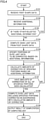
- FIG. 4 is a flowchart for illustrating the way data generating apparatus 100 according to the first embodiment generates the shoe last data from the foot shape data.
- data generating apparatus 100 receives the foot shape data obtained by measuring apparatus 200 or mobile terminal 300 (step SI01).
- data generating apparatus 100 receives the additional information (step S102). Specifically, data generating apparatus 100 receives a user's preference about the shape of the shoe as the additional information.
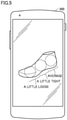
- Fig. 5 shows an example of the user's preference about the shape of the shoe input by the user using mobile terminal 300.
- a shoe last is displayed on mobile terminal 300 shown in Fig. 5 , and "a little loose” is input as a user's preference about a shape of a toe area of the shoe last, "a little tight” is input as a user's preference about a shape of a midfoot portion area of the shoe last, and "average” is input as a user's preference about a shape of a heel area of the shoe last.
- the preference about the shape of the shoe can be easily grasped for each area.
- Data generating apparatus 100 can generate the shoe last data in which the information (additional information) on the user's preference about the shape of the shoe input by the user for each area is reflected.
- the information reflected in the shoe last data is not limited to one piece of information, and a plurality of pieces of information may be reflected.
- data generating apparatus 100 determines whether or not there is other additional information selected by the user (step S103). When there is other selected additional information (YES in step S103), data generating apparatus 100 returns the process to step S102 and receives the other selected additional information.
- step S104 When there is no other selected additional information (NO in step SI03), data generating apparatus 100 computes shoe last data from the foot shape data (step S104).
- Fig. 6 is a schematic view for illustrating how data generating apparatus 100 according to the first embodiment computes the shoe last data.
- data generating apparatus 100 selects shoe last data U close to the foot shape data from a library La of a plurality of pieces of shoe last data stored in shoe last database 1106 (step S104a).
- step S104b data generating apparatus 100 selects sole data predetermined by the shoe to be manufactured or sole data selected by the user from a library Lb of a plurality of pieces of sole data stored in sole database 1108.
- Data generating apparatus 100 corrects a portion (e.g., a surface portion of an instep portion) of selected shoe last data U that is different from the foot shape data (step S104c). In addition, data generating apparatus 100 makes a correction such that selected sole data S matches selected shoe last data U (step S104d). Data generating apparatus 100 combines corrected shoe last data U and corrected sole data S to generate shoe last data K. Shoe last data K corresponds to the shoe last data computed and generated from the foot shape data in step S104.
- Fig. 6 shows the example of separately selecting and combining shoe last data U and sole data S.
- data generating apparatus 100 may select only the shoe last data close to the foot shape data from the library that stores the plurality of pieces of shoe last data, corrects upper data corresponding to an upper-side region, of the selected shoe last data, so as to match the foot shape data, and use sole data corresponding to a sole-side region as it is.
- data generating apparatus 100 may correct the upper data corresponding to the upper-side region, of the selected shoe last data, so as to match the foot shape data, and correct the sole data corresponding to the sole-side region so as to match the sole data selected by the user.
- data generating apparatus 100 may compute and generate shoe last data K from the foot shape data based on a prescribed algorithm.
- data generating apparatus 100 specifies portions of shoe last data K to be corrected, which is computed in step S104, based on the additional information (step S105).
- the areas of the shoe shown in Fig. 5 are associated with the positions in the foot shape data and the shoe last data.
- Fig. 7 shows the shoe last data on which the foot shape data is superimposed.
- Fig. 7 shows a plurality of pieces of cross section information (cross sections T1 to T3, M1 to M4 and H1 to H3) and a plurality of pieces of baseline information (baselines B) connecting the cross sections, which are obtained from the foot shape data based on the homologous model.
- baselines B baseline information
- a plurality of pieces of cross section information and a plurality of pieces of baseline information corresponding to the foot shape data are indicated by a solid line
- a plurality of pieces of cross section information and a plurality of pieces of baseline information corresponding to the shoe last data are indicated by a broken line.
- Fig. 7 does not show all of the pieces of cross section information and the pieces of baseline information based on the homologous model, but shows a part of the pieces of cross section information and the pieces of baseline information.
- the toe area shown in Fig. 5 corresponds to the positions of cross sections T1 to T3 shown in Fig. 7
- the midfoot portion area corresponds to the positions of cross sections M1 to M4
- the heel area corresponds to the positions of cross sections H1 to H3. Therefore, data generating apparatus 100 can specify, as areas to be corrected, the areas other than the heel area input as "average", of the areas of the shoe shown in Fig. 5 .
- Data generating apparatus 100 calculates amounts of correction of the specified portions based on the additional information (step S106). Specifically, data generating apparatus 100 increases the shape of the shoe last data at the positions of cross sections T1 to T3 by, for example, 3%, based on the additional information that "a little loose” is the user's preference about the shape of the toe area as shown in Fig. 5 .
- the amounts of correction are preset. For example, when "a little loose" has been input as the additional information, the shape is increased by, for example, 3%. For example, when "a little tight” has been input as the additional information, the shape is decreased by, for example, 2%.
- data generating apparatus 100 determines whether or not the amounts of correction of all of the specified portions have been calculated (step S 107). When the amounts of correction of all of the specified portions have not been calculated (NO in step S107), data generating apparatus 100 returns the process to step S106 and calculates the amounts of correction of the remaining specified portions. Specifically, data generating apparatus 100 decreases the shape of the shoe last data at the positions of cross sections HI to H3 by, for example, 2%, based on the additional information that "a little tight" is the user's preference about the shape of the heel area as shown in Fig. 5 .
- data generating apparatus 100 computes the shoe last data including the specified portions corrected in accordance with the calculated amounts of correction (step S108). Specifically, data generating apparatus 100 increases the shape of shoe last data K (computed in step S104) at the positions of cross sections T1 to T3 by, for example, 3%, and decreases the shape of shoe last data K at the positions of cross sections HI to H3 by, for example, 2%.
- Data generating apparatus 100 outputs, to shoe last producing apparatus 400, the corrected shoe last data that is a result of computation by the computing unit (step S109).
- the shoe last data output to shoe last producing apparatus 400 is shoe last data in which the information on the user's preference about the shape of the shoe is reflected. Therefore, when a custom-made shoe is manufactured using a shoe last produced based on the shoe last data, the shoe can have a fitting feeling that satisfies the user.
- data generating apparatus 100 generates shoe last data for manufacturing a shoe from measured foot shape data.
- Data generating apparatus 100 includes: input unit 106 that receives the foot shape data; processor 102 (computing unit) that computes the shoe last data from the foot shape data received by input unit 106; and output unit 108 that outputs the shoe last data computed by processor 102.
- Input unit 106 further receives selected additional information.
- Processor 102 specifies a portion of the shoe last data to be corrected, based on the additional information, and calculates an amount of correction of the specified portion based on the additional information.
- Shoe last producing system 10 includes: measuring apparatus 200 that measures a foot shape and outputs the foot shape data to data generating apparatus 100; data generating apparatus 100 described above; and shoe last producing apparatus 400 that produces a shoe last based on the shoe last data generated by data generating apparatus 100.
- data generating apparatus 100 can generate the shoe last data for manufacturing the shoe having a fitting feeling that satisfies the user.
- shoe last producing system 10 manufactures the shoe using the shoe last produced based on the shoe last data generated by data generating apparatus 100, shoe last producing system 10 can manufacture the shoe having a fitting feeling that satisfies the user.
- the shoe last data preferably includes at least one of upper data (first data) corresponding to an upper-side region of the shoe and sole data (second data) corresponding to a sole-side region of the shoe.
- first data upper data
- second data second data
- processor 102 preferably specifies a portion of the upper data to be corrected. This makes it possible to limit the portion to be corrected to the upper side.
- processor 102 preferably selects one of a plurality of pieces of preset sole data as the sole data. This makes it possible to reduce the processing burden of processor 102, as compared with the case of generating the sole data from the foot shape data by computation.
- Data generating apparatus 100 preferably further includes storage 110 that prestores a plurality of pieces of the shoe last data.
- Processor 102 may select one of the plurality of pieces of the shoe last data stored in storage 110, based on the foot shape data, and specify a portion of the selected piece of the shoe last data to be corrected. This makes it possible to reduce the processing burden of processor 102, as compared with the case of generating the shoe last data from the foot shape data by computation.
- the foot shape data is preferably data based on a model created by dividing a foot shape into a plurality of prescribed cross sections, and connecting a plurality of representative points specified within the cross sections. This makes it possible to reduce an amount of the foot shape data transmitted from measuring apparatus 200 to data generating apparatus 100.
- the foot shape data is preferably data based on a homologous model.
- processor 102 may convert the foot shape data received by input unit 106 into the data based on the homologous model.
- Processor 102 preferably obtains a plurality of pieces of cross section information and a plurality of pieces of baseline information connecting the cross sections, from the foot shape data based on the homologous model, and specifies a portion of the shoe last data to be corrected, with respect to the obtained pieces of cross section information or the obtained pieces of baseline information. This makes it possible to specify the portion of the shoe last data to be corrected in association with the foot shape data based on the homologous model.
- a data generating method for generating shoe last data includes: receiving the foot shape data (S101); further receiving selected additional information (S 102); computing the shoe last data from the foot shape data (S104); specifying a portion of the shoe last data to be corrected, based on the additional information (S105); calculating an amount of correction of the specified portion based on the additional information (S106); computing the shoe last data including the specified portion corrected in accordance with the calculated amount of correction (S108); and outputting the computed shoe last data (SI09).
- the data generating method for generating shoe last data according to the first embodiment can generate the shoe last data for manufacturing the shoe having a fitting feeling that satisfies the user.
- a second embodiment another example of the additional information reflected in the shoe last data will be described. Since a shoe last producing system and a data generating apparatus according to the second embodiment have the same configuration as that of shoe last producing system 10 and data generating apparatus 100 according to the first embodiment, the shoe last producing system and the data generating apparatus according to the second embodiment are denoted by the same reference characters as those of shoe last producing system 10 and data generating apparatus 100 according to the first embodiment, and a detailed description will not be repeated.
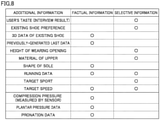
- Fig. 8 shows a list of the additional information reflected in the shoe last data.
- the additional information shown in Fig. 8 does not indicate the whole of the additional information reflected in the shoe last data, and other information may be reflected in the shoe last data.
- the additional information can be divided into information about a shape of a shoe, information about the use of a shoe, and information about a foot of a user, based on its contents.
- the information about the shape of the shoe includes information about user's preference, information about a shoe used by a user, existing shoe last data, information about a shape of a wearing opening, information about a material of an upper, information about a shape of a sole, and the like.
- the information about the use of the shoe includes running data, information about a sport in which a shoe is used, and the like.
- the information about the foot of the user includes information about a pressure of an instep portion, information about a plantar pressure, information about deformation of a foot shape, and the like.
- the additional information can also be divided into factual information and selective information, based on its contents.
- the factual information refers to objective information, and refers to information that can be represented by numerical data, such as length, pressure and speed.
- the selective information refers to subjective information for the user, and refers to information selected based on, for example, an interview with the user, such as a little loose, a little tight, fast, and slow.
- An example of the information about user's preference is information about user's taste, such as information that "a little loose” toe is the user's taste as described with reference to Fig. 5 .
- the information about user's taste is selective information that can be collected by an interview with the user, and can be obtained by causing the user to input the user's taste for each area of the shoe into mobile terminal 300 as shown in Fig. 5 .
- the information about existing shoe preference is selective information that can be collected by an interview with the user, and is, for example, information that the existing shoe is "A product" having a size of 27 cm, and the heel and the midfoot portion of "A product” are just right for the user while the toe of "A product” is slightly tight.
- data generating apparatus 100 can specify the portions of the shoe last data to be corrected, based on the additional information, and calculate the amounts of correction of the specified portions.
- An example of the information about the shoe used by the user is information about 3D data of an existing shoe.
- the information about 3D data of the existing shoe is factual information such as objective numerical data, and is, for example, shoe last data of "A product" that is the existing shoe.
- the shoe last data of the existing shoe may be data obtained by measuring the existing shoe through 3D measurement.
- Data generating apparatus 100 compares the shoe last data generated from the foot shape data with the shoe last data of "A product", specifies a portion having a difference exceeding a prescribed range, and calculates an amount of correction such that the difference falls within the prescribed range.
- An example of the existing shoe last data is previously-generated last (shoe last) data.
- the previously-generated last data is factual information such as objective numerical data.
- Data generating apparatus 100 compares the shoe last data generated from the foot shape data with the previously-generated last (shoe last) data, specifies a portion having a difference exceeding a prescribed range, and calculates an amount of correction such that the difference falls within the prescribed range.
- An example of the information about the shape of the wearing opening is information about a height of a wearing opening.
- the information about the height of the wearing opening is selective information that can be collected by an interview with the user.
- Fig. 9 shows a shoe last into which a user's favorite height of a wearing opening is written.
- a broken line shown in Fig. 9 indicates a reference line of the wearing opening, and the information is collected by causing the user to write the user's favorite height of the wearing opening into the shoe last having the reference line.
- the favorite height of the wearing opening is higher than the reference line (user A, user B)
- data generating apparatus 100 sets the wearing opening and its surroundings of the shoe last data to have a larger size in order to reduce the difficulty of wearing the shoe.
- the favorite height of the wearing opening is lower than the reference line (user C)
- data generating apparatus 100 sets the wearing opening and its surroundings of the shoe last data to have a smaller size in order to reduce the easiness of coming-off of the shoe.
- An example of the information about the material of the upper is information such as a knit material, a mesh material, artificial leather, non-woven fabric, or a heat-shrinkable material.
- the information about the material of the upper is selective information that can be collected by an interview with the user.
- data generating apparatus 100 calculates an amount of correction based on a shrinkage rate of the knit material, and adjusts the overall size of the shoe last data to a little smaller size in accordance with the amount of correction.
- the heat-shrinkable material is, for example, selected, data generating apparatus 100 adjusts the shape of the heel portion of the shoe last data.
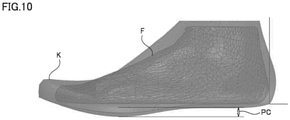
- An example of the information about the shape of the sole is information about a difference (PC) between a thickness of a sole of a heel and a thickness of a sole of a forefoot portion.
- the information about the PC is factual information such as objective numerical data, and the PC is 10 mm, for example.
- Fig. 10 shows a difference between a thickness of a sole of a heel and a thickness of a sole of a forefoot portion. Since the user stands on measuring apparatus 200 to measure a foot shape, foot shape data F has a flat bottom surface as shown in Fig. 10 . However, when the PC is 10 mm, data generating apparatus 100 makes a correction to transform shoe last data K in accordance with the PC.
- An algorithm for transforming shoe last data K in accordance with the PC is preset in data generating apparatus 100, and thus, data generating apparatus 100 specifies a portion of shoe last data K to be corrected, based on the algorithm, and calculates an amount of correction of the specified portion.
- An example of the running data included in the information about the use of the shoe is information such as a running pitch, a running stride and a running speed of the user.
- the running data is factual information such as objective numerical data obtained from an app of a smartphone, a smartwatch or the like, a sensing device worn during running, or the like.
- the running data may be selective information that can be collected by an interview with the user, such as "fast” or "slow".
- a step length per one step of a user having a large stride is longer than that of a user having a small stride. Therefore, the user having a large stride is likely to experience a gap between the foot and the shoe during running because a large load is applied to the shoe.
- data generating apparatus 100 determines from the running data whether the stride is larger or smaller than an average value, and when the stride is larger, data generating apparatus 100 adjusts the overall size of the shoe last data to a little smaller size. Specifically, when a ratio of (length of stride)/(height) is higher than a prescribed ratio, data generating apparatus 100 decreases the overall size of the shoe last data by, for example, 2%.
- An example of the information about the sport in which the shoe is used is information about a target sport.
- the information about the target sport is selective information that can be collected by an interview with the user, and is, for example, information such as soccer, basketball or walking.
- soccer is, for example, input as the information about the target sport
- data generating apparatus 100 adjusts the overall size of the shoe last data to a little smaller size, because soccer is a sport in which the movement in the front-back direction and in the right-left direction is frequent.
- walking for example, input as the information about the target sport
- data generating apparatus 100 adjusts the overall size of the shoe last data to a little larger size, because walking is a sport in which the main movement is in the front-back direction and the movement speed is low.
- the information about the sport in which the shoe is used is information about a target speed.
- the information about the target speed is factual information such as objective numerical data.
- the information about the target speed may be selective information that can be collected by an interview with the user, such as "fast” or "slow". As the running speed of the user becomes faster, a gap between the foot and the shoe becomes more likely to occur. In addition, the user tends to tie a shoelace more tightly. Therefore, data generating apparatus 100 adjusts the overall size of the shoe last data to a little smaller size.
- An example of the information about the pressure of the instep portion included in the information about the foot of the user is information about a compression pressure obtained by a pressure sensor provided at the instep portion.
- the information about the compression pressure is factual information such as objective numerical data, and is, for example, pressure data measured by a pressure sensor when the user wearing a test shoe including the pressure sensor at an instep portion runs.
- Data generating apparatus 100 corrects the shoe last data in consideration of contact of the upper with the instep portion.
- data generating apparatus 100 increases the shape of the shoe last data at the position of cross section M1 by, for example, 3%, and when a compression pressure in cross section T2 is lower than the prescribed pressure, data generating apparatus 100 decreases the shape of the shoe last data at the position of cross section T2 by, for example, 2%.
- An example of the information about the plantar pressure is plantar pressure data measured by a pressure sensor when the user wearing a test shoe runs.
- the information about the plantar pressure is factual information such as objective numerical data.
- data generating apparatus 100 decreases the shape of the shoe last data at the positions of cross sections M1 to M4 of the midfoot portion area by, for example, 2%.
- An example of the information about deformation of the foot shape is information about pronation.
- the pronation refers to such a movement that a foot contacts the ground from the outside of a heel and the heel falls inward and an inner arch collapses during running.
- an angle of the heel with respect to the foot (pronation angle) at the time of contacting the ground is, for example, measured.
- the pronation angle is factual information such as objective numerical data.
- data generating apparatus 100 decreases the shape of the shoe last data at the positions of cross sections M1 to M4 of the midfoot portion area by, for example, 2%.
- Another example of the information about deformation of the foot shape is information about a foot shape when the user has a weight, or information about a foot shape when the user raises the heel.
- the additional information preferably includes at least one of factual information and selective information selected by a user.
- the additional information preferably includes at least one of information about a shape of the shoe, information about use of the shoe, and information about a foot of a user.
- the information about the shape of the shoe preferably includes at least one of information about user's preference, information about the shoe used by the user, existing shoe last data, information about a shape of a wearing opening, information about a material of an upper, and information about a shape of a sole.
- the information about the use of the shoe preferably includes at least one of running data and information about a sport in which the shoe is used.
- the information about the foot of the user preferably includes at least one of information about a pressure of an instep portion, information about a plantar pressure, and information about deformation of a foot shape.
- information about a pressure of an instep portion preferably includes at least one of information about a pressure of an instep portion, information about a plantar pressure, and information about deformation of a foot shape.
- at least one of various types of information is reflected in the shoe last data as the additional information, and thus, the shoe last data makes it possible to manufacture the shoe having a fitting feeling that satisfies the user, as compared with the shoe last produced simply based on the information about the foot size and the foot shape.
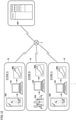
- shoe last producing system 10 is arranged in each of a plurality of stores A to C.
- store A and store C are small stores in a city.
- a salesclerk captures an image of a foot of a user using mobile terminal 300 to thereby obtain foot shape data using mobile terminal 300, or store A and store C receive foot shape data measured at home or the like by the user himself/herself using mobile terminal 300.
- store B is a large store in a shopping mall or the like.
- a salesclerk measures a foot of a user using measuring apparatus 200 to thereby obtain foot shape data.
- the foot shape data obtained in each of stores A to C is processed by data generating apparatus 100 of each store, and may be stored in data server 500 arranged in a manufacturer or the like through a network 5, together with user's personal information.
- the manufacturer generates shoe last data and sole data of existing shoes and stores the shoe last data and the sole data in a shoe last database and a sole database in data server 500. Since the shoe last data and the sole data of the existing shoes are stored in the shoe last database and the sole database in data server 500, data generating apparatus 100 provided at each store can select shoe last data close to the foot shape data from a library of the shoe last database, and select sole data selected by the user from a library of the sole database. In addition, based on information about a shoe used by the user, data generating apparatus 100 can search for shoe last data and sole data of the shoe from the shoe last database and the sole database in data server 500.
- the information stored in data server 500 is not limited to the shoe last data and the sole data of the existing shoes, and data server 500 may store running data of the user, shoe last data previously generated by the user, information about a sport in which the shoe is used, information about a material of an upper, and the like.
- data server 500 may be arranged at another location or in a certain store.
- data server 500 may be arranged in any one of stores A to C.
- a plurality of shoe last producing systems 10 may be arranged in one store, or a local data server that can communicate with the plurality of shoe last producing systems 10 may be arranged in the one store.
- Data server 500 may be implemented in the form of a cloud service.
Landscapes
- Engineering & Computer Science (AREA)
- Physics & Mathematics (AREA)
- Theoretical Computer Science (AREA)
- Life Sciences & Earth Sciences (AREA)
- Geometry (AREA)
- General Physics & Mathematics (AREA)
- Biophysics (AREA)
- Computer Hardware Design (AREA)
- Evolutionary Computation (AREA)
- General Engineering & Computer Science (AREA)
- Health & Medical Sciences (AREA)
- General Health & Medical Sciences (AREA)
- Physical Education & Sports Medicine (AREA)
- Software Systems (AREA)
- Computer Graphics (AREA)
- Footwear And Its Accessory, Manufacturing Method And Apparatuses (AREA)
Abstract
Description
- This nonprovisional application is based on
Japanese Patent Application No. 2020-148648 filed on September 4, 2020 - The present disclosure relates to a data generating apparatus, a shoe last producing system and a data generating method.
- When a custom-made shoe tailored to a foot of a user is manufactured, a foot shape is measured using a measuring apparatus, and shoe last data is generated based on the obtained foot shape data. Based on the generated shoe last data, a shoe last for manufacturing the shoe is produced (e.g.,
Japanese Patent No. 6685303 - Since the shoe last data is generated based on the foot shape data obtained by measuring the foot shape using the measuring apparatus, a dedicated shoe last that reflects a shape of a foot of each individual can be produced. However, information about a foot that can be measured using the measuring apparatus is limited to information about a foot size and a foot shape. Therefore, even when a custom-made shoe is manufactured using the shoe last produced based on the information, the shoe cannot in some cases have a fitting feeling that satisfies the user.
- An object of the present disclosure is to provide a data generating apparatus, a shoe last producing system and a data generating method, which generate shoe last data for manufacturing a shoe having a fitting feeling that satisfies a user.
- A data generating apparatus according to an aspect of the present disclosure generates shoe last data for manufacturing a shoe from measured foot shape data. The data generating apparatus includes: an input unit that receives the foot shape data; a computing unit that computes the shoe last data from the foot shape data received by the input unit; and an output unit that outputs the shoe last data computed by the computing unit. The input unit further receives selected additional information. The computing unit specifies a portion of the shoe last data to be corrected, based on the additional information, and calculates an amount of correction of the specified portion based on the additional information.
- A shoe last producing system according to an aspect of the present disclosure includes: a measuring apparatus that measures a foot shape and outputs the foot shape data to the data generating apparatus; the data generating apparatus described above; and a shoe last producing apparatus that produces a shoe last based on the shoe last data generated by the data generating apparatus.
- A data generating method according to an aspect of the present disclosure generates shoe last data for manufacturing a shoe from measured foot shape data. The data generating method includes: receiving the foot shape data; further receiving selected additional information; computing the shoe last data from the foot shape data; specifying a portion of the shoe last data to be corrected, based on the additional information; calculating an amount of correction of the specified portion based on the additional information; computing the shoe last data including the specified portion corrected in accordance with the calculated amount of correction; and outputting the computed shoe last data.
- The foregoing and other objects, features, aspects and advantages of the present disclosure will become more apparent from the following detailed description of the present disclosure when taken in conjunction with the accompanying drawings.
-
-
Fig. 1 is a schematic view showing a configuration example of a shoe last producing system according to a first embodiment. -
Fig. 2 is a schematic view showing a hardware configuration example of a data generating apparatus according to the first embodiment. -
Fig. 3A is a perspective view of three-dimensional foot shape data obtained by measurement using a measuring apparatus or a mobile terminal. -
Fig. 3B is a schematic view of the foot shape data converted into data based on a homologous model. -
Fig. 4 is a flowchart for illustrating the way the data generating apparatus according to the first embodiment generates shoe last data from the foot shape data. -
Fig. 5 shows an example of a user's preference about a shape of a shoe input by a user using a mobile terminal. -
Fig. 6 is a schematic view for illustrating how the data generating apparatus according to the first embodiment computes the shoe last data. -
Fig. 7 shows the shoe last data on which the foot shape data is superimposed. -
Fig. 8 shows a list of additional information reflected in the shoe last data. -
Fig. 9 shows a shoe last into which a user's favorite height of a wearing opening is written. -
Fig. 10 shows a difference between a thickness of a sole of a heel and a thickness of a sole of a front foot portion. -
Fig. 11A is a schematic view of shoe last data K1. -
Fig. 11B is a schematic view of shoe last data K2. -
Fig. 11C is a schematic view of shoe last data K3. -
Fig. 12 is a schematic view showing a state in which shoe last producing systems at various stores are connected to a data server. - Embodiments will be described hereinafter with reference to the drawings. In the following description, the same components are denoted by the same reference characters. Their names and functions are also the same. Therefore, a detailed description about them will not be repeated.
- In a first embodiment, an example of application of the present disclosure will be described. First, in the first embodiment, a shoe last producing system will be described, which when manufacturing a custom-made shoe tailored to a foot of a user at, for example, a store, generates shoe last data based on foot shape data obtained by measuring a foot shape using a measuring apparatus, and produces a shoe last for manufacturing the shoe based on the generated shoe last data.
-
Fig. 1 is a schematic view showing a configuration example of a shoe last producingsystem 10 according to the first embodiment. Referring toFig. 1 , shoe last producingsystem 10 includes adata generating apparatus 100, ameasuring apparatus 200 that measures a foot shape, and a shoe last producingapparatus 400 that produces a shoe last based on shoe last data. Depending on stores, or at a remote location such as a user's house, the foot shape may be measured using amobile terminal 300 such as a smartphone, instead of measuringapparatus 200.Data generating apparatus 100 can communicate with adata server 500 placed inside or outside a store. -
Data generating apparatus 100 generates shoe last data based on the foot shape data obtained from measuringapparatus 200 ormobile terminal 300.Fig. 2 is a schematic view showing a hardware configuration example ofdata generating apparatus 100 according to the first embodiment. Referring toFig. 2 ,data generating apparatus 100 includes aprocessor 102, amain memory 104, aninput unit 106, anoutput unit 108, astorage 110, anoptical drive 112, and acommunication controller 120. These components are connected through aprocessor bus 118. -
Processor 102 is implemented by a CPU, a GPU or the like, and can read programs (by way of example, anOS 1102 and a processing program 1104) stored instorage 110 and deploy the programs inmain memory 104 for execution.Processor 102 executesprocessing program 1104 that computes the shoe last data from the foot shape data and additional information received byinput unit 106, based on a prescribed algorithm.Processor 102 that executesprocessing program 1104 corresponds to a computing unit ofdata generating apparatus 100. -
Main memory 104 is implemented by, for example, a volatile storage device such as a DRAM or an SRAM.Storage 110 is implemented by, for example, a nonvolatile storage device such as an HDD or an SSD. - In addition to OS 1102 for implementing a basic function,
processing program 1104 for providing a function asdata generating apparatus 100 is stored instorage 110. That is,processing program 1104 is executed byprocessor 102 ofdata generating apparatus 100, to thereby compute the shoe last data from the foot shape data. Furthermore, a shoelast database 1106 including a plurality of pieces of shoe last data, and asole database 1108 including a plurality of pieces of sole data corresponding to a sole-side region of a shoe are stored instorage 110. Only a plurality of pieces of upper data corresponding to an upper-side region of a shoe may be stored in shoelast database 1106 as the shoe last data. Only the frequently-used data in shoelast database 1106 andsole database 1108 may be stored instorage 110, and the other data may be stored indata server 500. Alternatively, only lists may be stored in shoelast database 1106 andsole database 1108, and the plurality of pieces of shoe last data and the plurality of pieces of sole data themselves may be stored indata server 500. -
Input unit 106 includes an input interface connected to measuringapparatus 200 ormobile terminal 300 to receive the foot shape data from measuringapparatus 200 ormobile terminal 300.Input unit 106 is implemented by a keyboard, a mouse, a microphone, a touch device or the like, and can further receive the additional information selected by the user. Although the additional information will be described in detail below, the additional information refers to information other than information about a foot size and a foot shape. -
Output unit 108 includes an output interface that outputs the shoe last data computed byprocessor 102 to shoe last producingapparatus 400.Output unit 108 is implemented by a display, various indicators, a printer or the like, and outputs a processing result or the like fromprocessor 102. -
Communication controller 120 exchanges data with another control device or the like by using wired or wireless communication.Data generating apparatus 100 may exchange the foot shape data and the additional information with measuringapparatus 200 ormobile terminal 300 throughcommunication controller 120, and may exchange the shoe last data with shoe last producingapparatus 400 throughcommunication controller 120. In addition tocommunication controller 120, a USB controller connected toprocessor bus 118 may be provided to exchange the data with another control device or the like through USB connection. -
Data generating apparatus 100 includesoptical drive 112 that may read a computer-readable program stored in a recording medium 114 (e.g., optical recording medium such as a digital versatile disc (DVD)) in a non-transitory manner, and install the program instorage 110 or the like. - Although
processing program 1104 and the like executed indata generating apparatus 100 may be installed through computer-readable recording medium 114,processing program 1104 and the like may be installed by being downloaded from a server device or the like on a network. In addition, the functions provided bydata generating apparatus 100 according to the first embodiment may be implemented by using a part of a module provided by the OS. - Although
Fig. 2 shows the configuration example in whichprocessor 102 executes the programs to thereby provide the functions required asdata generating apparatus 100, a part or all of these provided functions may be implemented by using a dedicated hardware circuit (such as, for example, an ASIC or an FPGA). The configuration ofdata generating apparatus 100 shown inFig. 2 is illustrative and the present disclosure is not limited to this configuration. - Measuring
apparatus 200 is implemented by a three-dimensional foot shape scanner using laser measurement. A laser measurement apparatus that is built into walls provided on both sides of a foot put on a top board measures the foot while moving from a toe to a heel of the foot, thereby obtaining three-dimensional foot shape data of the user. A measurement method or the like of measuringapparatus 200 is not particularly limited, as long as it can measure the three-dimensional foot shape data.Mobile terminal 300 such as a smartphone may also be used to capture an image of the foot of the user and obtain image data of the foot, and the foot shape data may be generated from the obtained image data of the foot through preliminarily installed software. -
Figs. 3A and 3B are schematic views of foot shape data.Fig. 3A is a perspective view of three-dimensional foot shape data I obtained by measurement usingmeasuring apparatus 200 ormobile terminal 300. An amount of foot shape data I shown inFig. 3A is large, although it depends on a resolution. Therefore, measuringapparatus 200 ormobile terminal 300 does not transmit three-dimensional foot shape data I as it is todata generating apparatus 100, but converts three-dimensional foot shape data I into foot shape data F based on a homologous model shown inFig. 3B and transmits foot shape data F todata generating apparatus 100. Foot shape data F based on the homologous model herein refers to foot shape data that represents a foot shape by a polyhedron having an identical-phase geometric structure, using anatomically associated two hundred and ninety-five data points. The foot shape data is not limited to foot shape data F based on the homologous model, and may be foot shape data based on a model created by dividing a foot shape into a plurality of prescribed cross sections and connecting a plurality of representative points specified within the cross sections, as long as it can represent an object shape of foot shape data I shown inFig. 3A . - Although the description has been given of the example in which measuring
apparatus 200 ormobile terminal 300 converts three-dimensional foot shape data I into foot shape data F based on the homologous model,data generating apparatus 100 may convert three-dimensional foot shape data I into foot shape data F based on the homologous model. Alternatively,mobile terminal 300 may only capture the image of the foot of the user and obtain the image data of the foot without generating the foot shape data, anddata generating apparatus 100 may generate the foot shape data based on the image data of the foot obtained bymobile terminal 300. - Shoe last producing
apparatus 400 is implemented by a 3D printer, a computerized numerical control (CNC) machine tool or the like that produces a shoe last based on shoe last data. When shoe last producingapparatus 400 is implemented by a 3D printer, a three-dimensional shoe last made of resin is produced based on the shoe last data generated bydata generating apparatus 100. The material of the produced shoe last is not limited to resin, and may be cardboard or the like. When the shoe last is made of cardboard, shoe last producingapparatus 400 may be an apparatus that cuts the cardboard, or an apparatus that outputs a cardboard cutting shape pattern. When the shoe last is variable in shape, shoe last producingapparatus 400 is an apparatus that varies the shoe last based on the shoe last data generated bydata generating apparatus 100. - When
data generating apparatus 100 simply generates the shoe last data from the foot shape data obtained by measuringapparatus 200 ormobile terminal 300, information reflected in the shoe last data is limited to information about a foot size and a foot shape. Therefore, even when a custom-made shoe is manufactured using a shoe last produced based on the information, the shoe cannot in some cases have a fitting feeling that satisfies the user. Thus, indata generating apparatus 100,input unit 106 further receives selected additional information, and the computing unit specifies a portion of the shoe last data to be corrected, based on the additional information and calculates an amount of correction of the specified portion based on the additional information, thereby generating the shoe last data. That is,data generating apparatus 100 reflects the additional information in the shoe last data, in addition to the information about the foot size and the foot shape. The additional information includes at least one of information about a shape of the shoe, information about the use of the shoe, and information about the foot of the user. - A description will be given below of an example in which
data generating apparatus 100 generates the shoe last data in which information about user's preference, of the information about the shape of the shoe, is reflected.Fig. 4 is a flowchart for illustrating the waydata generating apparatus 100 according to the first embodiment generates the shoe last data from the foot shape data. First,data generating apparatus 100 receives the foot shape data obtained by measuringapparatus 200 or mobile terminal 300 (step SI01). - In the presence of the additional information selected by the user,
data generating apparatus 100 receives the additional information (step S102). Specifically,data generating apparatus 100 receives a user's preference about the shape of the shoe as the additional information.Fig. 5 shows an example of the user's preference about the shape of the shoe input by the user usingmobile terminal 300. A shoe last is displayed onmobile terminal 300 shown inFig. 5 , and "a little loose" is input as a user's preference about a shape of a toe area of the shoe last, "a little tight" is input as a user's preference about a shape of a midfoot portion area of the shoe last, and "average" is input as a user's preference about a shape of a heel area of the shoe last. By allowing the user to easily input the user's preference usingmobile terminal 300 as inFig. 5 , the preference about the shape of the shoe can be easily grasped for each area. -
Data generating apparatus 100 can generate the shoe last data in which the information (additional information) on the user's preference about the shape of the shoe input by the user for each area is reflected. The information reflected in the shoe last data is not limited to one piece of information, and a plurality of pieces of information may be reflected. Referring again toFig. 4 ,data generating apparatus 100 determines whether or not there is other additional information selected by the user (step S103). When there is other selected additional information (YES in step S103),data generating apparatus 100 returns the process to step S102 and receives the other selected additional information. - When there is no other selected additional information (NO in step SI03),
data generating apparatus 100 computes shoe last data from the foot shape data (step S104).Fig. 6 is a schematic view for illustrating howdata generating apparatus 100 according to the first embodiment computes the shoe last data. First,data generating apparatus 100 selects shoe last data U close to the foot shape data from a library La of a plurality of pieces of shoe last data stored in shoe last database 1106 (step S104a). In addition,data generating apparatus 100 selects sole data predetermined by the shoe to be manufactured or sole data selected by the user from a library Lb of a plurality of pieces of sole data stored in sole database 1108 (step S104b). -
Data generating apparatus 100 corrects a portion (e.g., a surface portion of an instep portion) of selected shoe last data U that is different from the foot shape data (step S104c). In addition,data generating apparatus 100 makes a correction such that selected sole data S matches selected shoe last data U (step S104d).Data generating apparatus 100 combines corrected shoe last data U and corrected sole data S to generate shoe last data K. Shoe last data K corresponds to the shoe last data computed and generated from the foot shape data in step S104. -
Fig. 6 shows the example of separately selecting and combining shoe last data U and sole data S. However,data generating apparatus 100 may select only the shoe last data close to the foot shape data from the library that stores the plurality of pieces of shoe last data, corrects upper data corresponding to an upper-side region, of the selected shoe last data, so as to match the foot shape data, and use sole data corresponding to a sole-side region as it is. As a matter of course,data generating apparatus 100 may correct the upper data corresponding to the upper-side region, of the selected shoe last data, so as to match the foot shape data, and correct the sole data corresponding to the sole-side region so as to match the sole data selected by the user. Instead of selecting the data from the library stored in the database and correcting the data,data generating apparatus 100 may compute and generate shoe last data K from the foot shape data based on a prescribed algorithm. - Referring again to
Fig. 4 ,data generating apparatus 100 specifies portions of shoe last data K to be corrected, which is computed in step S104, based on the additional information (step S105). The areas of the shoe shown inFig. 5 are associated with the positions in the foot shape data and the shoe last data.Fig. 7 shows the shoe last data on which the foot shape data is superimposed.Fig. 7 shows a plurality of pieces of cross section information (cross sections T1 to T3, M1 to M4 and H1 to H3) and a plurality of pieces of baseline information (baselines B) connecting the cross sections, which are obtained from the foot shape data based on the homologous model. InFig. 7 , a plurality of pieces of cross section information and a plurality of pieces of baseline information corresponding to the foot shape data are indicated by a solid line, and a plurality of pieces of cross section information and a plurality of pieces of baseline information corresponding to the shoe last data are indicated by a broken line.Fig. 7 does not show all of the pieces of cross section information and the pieces of baseline information based on the homologous model, but shows a part of the pieces of cross section information and the pieces of baseline information. - Specifically, the toe area shown in
Fig. 5 corresponds to the positions of cross sections T1 to T3 shown inFig. 7 , the midfoot portion area corresponds to the positions of cross sections M1 to M4, and the heel area corresponds to the positions of cross sections H1 to H3. Therefore,data generating apparatus 100 can specify, as areas to be corrected, the areas other than the heel area input as "average", of the areas of the shoe shown inFig. 5 . -
Data generating apparatus 100 calculates amounts of correction of the specified portions based on the additional information (step S106). Specifically,data generating apparatus 100 increases the shape of the shoe last data at the positions of cross sections T1 to T3 by, for example, 3%, based on the additional information that "a little loose" is the user's preference about the shape of the toe area as shown inFig. 5 . The amounts of correction are preset. For example, when "a little loose" has been input as the additional information, the shape is increased by, for example, 3%. For example, when "a little tight" has been input as the additional information, the shape is decreased by, for example, 2%. - After calculating the amount of correction of the toe area,
data generating apparatus 100 determines whether or not the amounts of correction of all of the specified portions have been calculated (step S 107). When the amounts of correction of all of the specified portions have not been calculated (NO in step S107),data generating apparatus 100 returns the process to step S106 and calculates the amounts of correction of the remaining specified portions. Specifically,data generating apparatus 100 decreases the shape of the shoe last data at the positions of cross sections HI to H3 by, for example, 2%, based on the additional information that "a little tight" is the user's preference about the shape of the heel area as shown inFig. 5 . - After the amount of correction of the heel area is calculated, it is determined that the amounts of correction of all of the specified portions have been calculated (YES in step S107). Therefore,
data generating apparatus 100 computes the shoe last data including the specified portions corrected in accordance with the calculated amounts of correction (step S108). Specifically,data generating apparatus 100 increases the shape of shoe last data K (computed in step S104) at the positions of cross sections T1 to T3 by, for example, 3%, and decreases the shape of shoe last data K at the positions of cross sections HI to H3 by, for example, 2%. -
Data generating apparatus 100 outputs, to shoe last producingapparatus 400, the corrected shoe last data that is a result of computation by the computing unit (step S109). The shoe last data output to shoe last producingapparatus 400 is shoe last data in which the information on the user's preference about the shape of the shoe is reflected. Therefore, when a custom-made shoe is manufactured using a shoe last produced based on the shoe last data, the shoe can have a fitting feeling that satisfies the user. - As described above,
data generating apparatus 100 according to the first embodiment generates shoe last data for manufacturing a shoe from measured foot shape data.Data generating apparatus 100 includes:input unit 106 that receives the foot shape data; processor 102 (computing unit) that computes the shoe last data from the foot shape data received byinput unit 106; andoutput unit 108 that outputs the shoe last data computed byprocessor 102.Input unit 106 further receives selected additional information.Processor 102 specifies a portion of the shoe last data to be corrected, based on the additional information, and calculates an amount of correction of the specified portion based on the additional information. Shoe last producingsystem 10 includes: measuringapparatus 200 that measures a foot shape and outputs the foot shape data todata generating apparatus 100;data generating apparatus 100 described above; and shoe last producingapparatus 400 that produces a shoe last based on the shoe last data generated bydata generating apparatus 100. - Thus,
data generating apparatus 100 according to the first embodiment can generate the shoe last data for manufacturing the shoe having a fitting feeling that satisfies the user. In addition, since shoe last producingsystem 10 manufactures the shoe using the shoe last produced based on the shoe last data generated bydata generating apparatus 100, shoe last producingsystem 10 can manufacture the shoe having a fitting feeling that satisfies the user. - The shoe last data preferably includes at least one of upper data (first data) corresponding to an upper-side region of the shoe and sole data (second data) corresponding to a sole-side region of the shoe. For example, when shoes including soles of the same shape are manufactured, the sole data can be shared. In addition,
processor 102 preferably specifies a portion of the upper data to be corrected. This makes it possible to limit the portion to be corrected to the upper side. Furthermore,processor 102 preferably selects one of a plurality of pieces of preset sole data as the sole data. This makes it possible to reduce the processing burden ofprocessor 102, as compared with the case of generating the sole data from the foot shape data by computation. -
Data generating apparatus 100 preferably further includesstorage 110 that prestores a plurality of pieces of the shoe last data.Processor 102 may select one of the plurality of pieces of the shoe last data stored instorage 110, based on the foot shape data, and specify a portion of the selected piece of the shoe last data to be corrected. This makes it possible to reduce the processing burden ofprocessor 102, as compared with the case of generating the shoe last data from the foot shape data by computation. - The foot shape data is preferably data based on a model created by dividing a foot shape into a plurality of prescribed cross sections, and connecting a plurality of representative points specified within the cross sections. This makes it possible to reduce an amount of the foot shape data transmitted from measuring
apparatus 200 todata generating apparatus 100. The foot shape data is preferably data based on a homologous model. When measuringapparatus 200 andmobile terminal 300 cannot perform conversion into the data based on the homologous model,processor 102 may convert the foot shape data received byinput unit 106 into the data based on the homologous model. -
Processor 102 preferably obtains a plurality of pieces of cross section information and a plurality of pieces of baseline information connecting the cross sections, from the foot shape data based on the homologous model, and specifies a portion of the shoe last data to be corrected, with respect to the obtained pieces of cross section information or the obtained pieces of baseline information. This makes it possible to specify the portion of the shoe last data to be corrected in association with the foot shape data based on the homologous model. - A data generating method for generating shoe last data according to the first embodiment includes: receiving the foot shape data (S101); further receiving selected additional information (S 102); computing the shoe last data from the foot shape data (S104); specifying a portion of the shoe last data to be corrected, based on the additional information (S105); calculating an amount of correction of the specified portion based on the additional information (S106); computing the shoe last data including the specified portion corrected in accordance with the calculated amount of correction (S108); and outputting the computed shoe last data (SI09). Thus, the data generating method for generating shoe last data according to the first embodiment can generate the shoe last data for manufacturing the shoe having a fitting feeling that satisfies the user.
- In the first embodiment, the description has been given of the example in which
data generating apparatus 100 generates the shoe last data in which the information about user's preference, of the information about the shape of the shoe, is reflected. In a second embodiment, another example of the additional information reflected in the shoe last data will be described. Since a shoe last producing system and a data generating apparatus according to the second embodiment have the same configuration as that of shoe last producingsystem 10 anddata generating apparatus 100 according to the first embodiment, the shoe last producing system and the data generating apparatus according to the second embodiment are denoted by the same reference characters as those of shoe last producingsystem 10 anddata generating apparatus 100 according to the first embodiment, and a detailed description will not be repeated. -
Fig. 8 shows a list of the additional information reflected in the shoe last data. The additional information shown inFig. 8 does not indicate the whole of the additional information reflected in the shoe last data, and other information may be reflected in the shoe last data. The additional information can be divided into information about a shape of a shoe, information about the use of a shoe, and information about a foot of a user, based on its contents. The information about the shape of the shoe includes information about user's preference, information about a shoe used by a user, existing shoe last data, information about a shape of a wearing opening, information about a material of an upper, information about a shape of a sole, and the like. The information about the use of the shoe includes running data, information about a sport in which a shoe is used, and the like. The information about the foot of the user includes information about a pressure of an instep portion, information about a plantar pressure, information about deformation of a foot shape, and the like. - The additional information can also be divided into factual information and selective information, based on its contents. The factual information refers to objective information, and refers to information that can be represented by numerical data, such as length, pressure and speed. The selective information refers to subjective information for the user, and refers to information selected based on, for example, an interview with the user, such as a little loose, a little tight, fast, and slow.
- The additional information will be described in more detail individually. An example of the information about user's preference is information about user's taste, such as information that "a little loose" toe is the user's taste as described with reference to
Fig. 5 . The information about user's taste is selective information that can be collected by an interview with the user, and can be obtained by causing the user to input the user's taste for each area of the shoe intomobile terminal 300 as shown inFig. 5 . - An example of the information about the shoe used by the user is information about existing shoe preference. The information about existing shoe preference is selective information that can be collected by an interview with the user, and is, for example, information that the existing shoe is "A product" having a size of 27 cm, and the heel and the midfoot portion of "A product" are just right for the user while the toe of "A product" is slightly tight. By preliminarily associating the terms such as "heel" and "midfoot portion" included in the information about existing shoe preference with the portions in the shoe data, and preliminarily associating the terms such as "slightly tight" and "loose" included in the information about existing shoe preference with the amounts of correction of the shoe data,
data generating apparatus 100 can specify the portions of the shoe last data to be corrected, based on the additional information, and calculate the amounts of correction of the specified portions. - An example of the information about the shoe used by the user is information about 3D data of an existing shoe. The information about 3D data of the existing shoe is factual information such as objective numerical data, and is, for example, shoe last data of "A product" that is the existing shoe. The shoe last data of the existing shoe may be data obtained by measuring the existing shoe through 3D measurement.
Data generating apparatus 100 compares the shoe last data generated from the foot shape data with the shoe last data of "A product", specifies a portion having a difference exceeding a prescribed range, and calculates an amount of correction such that the difference falls within the prescribed range. - An example of the existing shoe last data is previously-generated last (shoe last) data. The previously-generated last data is factual information such as objective numerical data.
Data generating apparatus 100 compares the shoe last data generated from the foot shape data with the previously-generated last (shoe last) data, specifies a portion having a difference exceeding a prescribed range, and calculates an amount of correction such that the difference falls within the prescribed range. - An example of the information about the shape of the wearing opening is information about a height of a wearing opening. The information about the height of the wearing opening is selective information that can be collected by an interview with the user.
Fig. 9 shows a shoe last into which a user's favorite height of a wearing opening is written. A broken line shown inFig. 9 indicates a reference line of the wearing opening, and the information is collected by causing the user to write the user's favorite height of the wearing opening into the shoe last having the reference line. When the favorite height of the wearing opening is higher than the reference line (user A, user B),data generating apparatus 100 sets the wearing opening and its surroundings of the shoe last data to have a larger size in order to reduce the difficulty of wearing the shoe. Conversely, when the favorite height of the wearing opening is lower than the reference line (user C),data generating apparatus 100 sets the wearing opening and its surroundings of the shoe last data to have a smaller size in order to reduce the easiness of coming-off of the shoe. - An example of the information about the material of the upper is information such as a knit material, a mesh material, artificial leather, non-woven fabric, or a heat-shrinkable material. The information about the material of the upper is selective information that can be collected by an interview with the user. When a stretchy material such as the knit material is, for example, selected,
data generating apparatus 100 calculates an amount of correction based on a shrinkage rate of the knit material, and adjusts the overall size of the shoe last data to a little smaller size in accordance with the amount of correction. When the heat-shrinkable material is, for example, selected,data generating apparatus 100 adjusts the shape of the heel portion of the shoe last data. - An example of the information about the shape of the sole is information about a difference (PC) between a thickness of a sole of a heel and a thickness of a sole of a forefoot portion. The information about the PC is factual information such as objective numerical data, and the PC is 10 mm, for example.
Fig. 10 shows a difference between a thickness of a sole of a heel and a thickness of a sole of a forefoot portion. Since the user stands on measuringapparatus 200 to measure a foot shape, foot shape data F has a flat bottom surface as shown inFig. 10 . However, when the PC is 10 mm,data generating apparatus 100 makes a correction to transform shoe last data K in accordance with the PC. An algorithm for transforming shoe last data K in accordance with the PC is preset indata generating apparatus 100, and thus,data generating apparatus 100 specifies a portion of shoe last data K to be corrected, based on the algorithm, and calculates an amount of correction of the specified portion. - An example of the running data included in the information about the use of the shoe is information such as a running pitch, a running stride and a running speed of the user. The running data is factual information such as objective numerical data obtained from an app of a smartphone, a smartwatch or the like, a sensing device worn during running, or the like. However, the running data may be selective information that can be collected by an interview with the user, such as "fast" or "slow". A step length per one step of a user having a large stride is longer than that of a user having a small stride. Therefore, the user having a large stride is likely to experience a gap between the foot and the shoe during running because a large load is applied to the shoe. In contrast, the user having a small stride is less likely to experience a gap between the foot and the shoe during running because the user contacts the ground in small steps. In consideration of a user's physique,
data generating apparatus 100 determines from the running data whether the stride is larger or smaller than an average value, and when the stride is larger,data generating apparatus 100 adjusts the overall size of the shoe last data to a little smaller size. Specifically, when a ratio of (length of stride)/(height) is higher than a prescribed ratio,data generating apparatus 100 decreases the overall size of the shoe last data by, for example, 2%. - An example of the information about the sport in which the shoe is used is information about a target sport. The information about the target sport is selective information that can be collected by an interview with the user, and is, for example, information such as soccer, basketball or walking. When soccer is, for example, input as the information about the target sport,
data generating apparatus 100 adjusts the overall size of the shoe last data to a little smaller size, because soccer is a sport in which the movement in the front-back direction and in the right-left direction is frequent. When walking is, for example, input as the information about the target sport,data generating apparatus 100 adjusts the overall size of the shoe last data to a little larger size, because walking is a sport in which the main movement is in the front-back direction and the movement speed is low. - An example of the information about the sport in which the shoe is used is information about a target speed. The information about the target speed is factual information such as objective numerical data. However, the information about the target speed may be selective information that can be collected by an interview with the user, such as "fast" or "slow". As the running speed of the user becomes faster, a gap between the foot and the shoe becomes more likely to occur. In addition, the user tends to tie a shoelace more tightly. Therefore,
data generating apparatus 100 adjusts the overall size of the shoe last data to a little smaller size. - An example of the information about the pressure of the instep portion included in the information about the foot of the user is information about a compression pressure obtained by a pressure sensor provided at the instep portion. The information about the compression pressure is factual information such as objective numerical data, and is, for example, pressure data measured by a pressure sensor when the user wearing a test shoe including the pressure sensor at an instep portion runs.
Data generating apparatus 100 corrects the shoe last data in consideration of contact of the upper with the instep portion. Specifically, when a compression pressure in cross section M1 is higher than a prescribed pressure,data generating apparatus 100 increases the shape of the shoe last data at the position of cross section M1 by, for example, 3%, and when a compression pressure in cross section T2 is lower than the prescribed pressure,data generating apparatus 100 decreases the shape of the shoe last data at the position of cross section T2 by, for example, 2%. - An example of the information about the plantar pressure is plantar pressure data measured by a pressure sensor when the user wearing a test shoe runs. The information about the plantar pressure is factual information such as objective numerical data. When plantar pressure data of the midfoot portion area is higher than a prescribed pressure,
data generating apparatus 100 decreases the shape of the shoe last data at the positions of cross sections M1 to M4 of the midfoot portion area by, for example, 2%. - An example of the information about deformation of the foot shape is information about pronation. The pronation refers to such a movement that a foot contacts the ground from the outside of a heel and the heel falls inward and an inner arch collapses during running. As the information about pronation, an angle of the heel with respect to the foot (pronation angle) at the time of contacting the ground is, for example, measured. The pronation angle is factual information such as objective numerical data. When the pronation angle is greater than, for example, 10 degrees,
data generating apparatus 100 decreases the shape of the shoe last data at the positions of cross sections M1 to M4 of the midfoot portion area by, for example, 2%. Another example of the information about deformation of the foot shape is information about a foot shape when the user has a weight, or information about a foot shape when the user raises the heel. - As described above, the additional information preferably includes at least one of factual information and selective information selected by a user. The additional information preferably includes at least one of information about a shape of the shoe, information about use of the shoe, and information about a foot of a user. The information about the shape of the shoe preferably includes at least one of information about user's preference, information about the shoe used by the user, existing shoe last data, information about a shape of a wearing opening, information about a material of an upper, and information about a shape of a sole. The information about the use of the shoe preferably includes at least one of running data and information about a sport in which the shoe is used. The information about the foot of the user preferably includes at least one of information about a pressure of an instep portion, information about a plantar pressure, and information about deformation of a foot shape. As described above, at least one of various types of information is reflected in the shoe last data as the additional information, and thus, the shoe last data makes it possible to manufacture the shoe having a fitting feeling that satisfies the user, as compared with the shoe last produced simply based on the information about the foot size and the foot shape.
-
- (1) Although
data generating apparatus 100 may output, as the shoe last data, the data of the plurality of pieces of cross section information including the specified portions corrected from the foot shape data based on the homologous model,data generating apparatus 100 may process the data to connect the cross sections and form a surface of a shoe last, and output the data as final shoe last data K.Figs. 11A to 11C are schematic views showing howdata generating apparatus 100 generates surface information of the shoe last data connecting the cross sections, based on the plurality of pieces of corrected cross section information. In shoe last data K1 shown inFig. 11A , a curved line Q1 is generated, curved line Q1 connecting the plurality of pieces of cross section information (cross sections T1 to T3, M1 to M4 and H1 to H3) including the corrected specified portions, and extending from the toe to the heel of the shoe last. Furthermore, in shoe last data K2 shown inFig. 11B , a curved line Q2 is generated, curved line Q2 connecting the plurality of pieces of cross section information, and extending from the toe or heel to the wearing opening of the shoe last.
In shoe last data K3 shown inFig. 11C , smooth surface information of the shoe last data connecting the curved lines generated inFigs. 11A and 11B is generated. Although the quality of the surface information of the shoe last data depends on, for example, a program executed indata generating apparatus 100, it is desirable to generate the surface information having a continuous normal vector and a continuous curvature. - (2) Shoe last producing
system 10 at one store includingdata generating apparatus 100, measuringapparatus 200 and shoe last producingapparatus 400 has been described with reference toFig. 1 . However, shoe last producingsystem 10 may include a store where measuringapparatus 200 is not provided and a foot shape is measured usingmobile terminal 300 such as a smartphone. Shoe last producingsystem 10 may include a store where shoe last producingapparatus 400 is not provided and a shoe last is produced using shoe last producingapparatus 400 placed at another store to manufacture a shoe.Fig. 12 is a schematic view showing a state in which the shoe last producing systems at various stores are connected todata server 500. - As shown in
Fig. 12 , shoe last producingsystem 10 is arranged in each of a plurality of stores A to C. For example, store A and store C are small stores in a city. Inside store A and store C, a salesclerk captures an image of a foot of a user usingmobile terminal 300 to thereby obtain foot shape data usingmobile terminal 300, or store A and store C receive foot shape data measured at home or the like by the user himself/herself usingmobile terminal 300. In contrast, store B is a large store in a shopping mall or the like. Inside store B, a salesclerk measures a foot of a user usingmeasuring apparatus 200 to thereby obtain foot shape data. The foot shape data obtained in each of stores A to C is processed bydata generating apparatus 100 of each store, and may be stored indata server 500 arranged in a manufacturer or the like through a network 5, together with user's personal information. - The manufacturer generates shoe last data and sole data of existing shoes and stores the shoe last data and the sole data in a shoe last database and a sole database in
data server 500. Since the shoe last data and the sole data of the existing shoes are stored in the shoe last database and the sole database indata server 500,data generating apparatus 100 provided at each store can select shoe last data close to the foot shape data from a library of the shoe last database, and select sole data selected by the user from a library of the sole database. In addition, based on information about a shoe used by the user,data generating apparatus 100 can search for shoe last data and sole data of the shoe from the shoe last database and the sole database indata server 500. The information stored indata server 500 is not limited to the shoe last data and the sole data of the existing shoes, anddata server 500 may store running data of the user, shoe last data previously generated by the user, information about a sport in which the shoe is used, information about a material of an upper, and the like. - Instead of being arranged in the manufacturer different from the stores,
data server 500 may be arranged at another location or in a certain store. For example,data server 500 may be arranged in any one of stores A to C. A plurality of shoe last producingsystems 10 may be arranged in one store, or a local data server that can communicate with the plurality of shoe last producingsystems 10 may be arranged in the one store.Data server 500 may be implemented in the form of a cloud service. - Although the embodiments of the present disclosure have been described, it should be understood that the embodiments disclosed herein are illustrative and non-restrictive in every respect. The scope of the present disclosure is defined by the terms of the claims and is intended to include any modifications within the scope and meaning equivalent to the terms of the claims.
Claims (17)
- A data generating apparatus (100) that generates shoe last data for manufacturing a shoe from measured foot shape data, the data generating apparatus comprising:an input unit (106) that receives the foot shape data;a computing unit (102) that computes the shoe last data from the foot shape data received by the input unit (106); andan output unit (108) that outputs the shoe last data computed by the computing unit (102), whereinthe input unit (106) further receives selected additional information, andthe computing unit (102)specifies a portion of the shoe last data to be corrected, based on the additional information, andcalculates an amount of correction of the specified portion based on the additional information.
- The data generating apparatus (100) according to claim 1, wherein
the shoe last data includes at least one of first data corresponding to an upper-side region of the shoe and second data corresponding to a sole-side region of the shoe. - The data generating apparatus (100) according to claim 2, wherein
the computing unit (102) specifies a portion of the first data to be corrected. - The data generating apparatus (100) according to claim 2 or 3, wherein
the computing unit (102) selects one of a plurality of pieces of preset sole data as the second data. - The data generating apparatus (100) according to any one of claims 1 to 4, further comprisinga storage unit (110) that prestores a plurality of pieces of the shoe last data, whereinthe computing unit (102)selects one of the plurality of pieces of the shoe last data stored in the storage unit (110), based on the foot shape data, andspecifies a portion of the selected piece of the shoe last data to be corrected.
- The data generating apparatus (100) according to any one of claims 1 to 5, wherein
the foot shape data is data based on a model created by dividing a foot shape into a plurality of prescribed cross sections, and connecting a plurality of representative points specified within the cross sections. - The data generating apparatus (100) according to claim 6, wherein
the foot shape data is data based on a homologous model. - The data generating apparatus (100) according to claim 7, wherein
the computing unit (102) converts the foot shape data received by the input unit (106) into the data based on the homologous model. - The data generating apparatus (100) according to claim 7 or 8, wherein the computing unit (102)obtains a plurality of pieces of cross section information and a plurality of pieces of baseline information connecting cross sections, from the foot shape data based on the homologous model, andspecifies a portion of the shoe last data to be corrected, with respect to the obtained pieces of cross section information or the obtained pieces of baseline information.
- The data generating apparatus (100) according to claim 9, wherein
the computing unit (102) generates surface information of the shoe last data connecting cross sections, based on a plurality of pieces of cross section information of the corrected shoe last data. - The data generating apparatus (100) according to any one of claims 1 to 10, wherein
the additional information includes at least one of factual information and selective information selected by a user. - The data generating apparatus (100) according to any one of claims 1 to 11, wherein
the additional information includes at least one of information about a shape of the shoe, information about use of the shoe, and information about a foot of a user. - The data generating apparatus (100) according to claim 12, wherein
the information about the shape of the shoe includes at least one of information about user's preference, information about the shoe used by the user, existing shoe last data, information about a shape of a wearing opening, information about a material of an upper, and information about a shape of a sole. - The data generating apparatus (100) according to claim 12, wherein
the information about the use of the shoe includes at least one of running data and information about a sport in which the shoe is used. - The data generating apparatus (100) according to claim 12, wherein
the information about the foot of the user includes at least one of information about a pressure of an instep portion, information about a plantar pressure, and information about deformation of a foot shape. - A shoe last producing system comprising:a measuring apparatus that measures a foot shape and outputs the foot shape data to the data generating apparatus (100);the data generating apparatus (100) as recited in any one of claims 1 to 15; anda shoe last producing apparatus that produces a shoe last based on the shoe last data generated by the data generating apparatus (100).
- A data generating method for generating shoe last data for manufacturing a shoe from measured foot shape data, the data generating method comprising:receiving the foot shape data;further receiving selected additional information;computing the shoe last data from the foot shape data;specifying a portion of the shoe last data to be corrected, based on the additional information;calculating an amount of correction of the specified portion based on the additional information;computing the shoe last data including the specified portion corrected in accordance with the calculated amount of correction; andoutputting the computed shoe last data.
Applications Claiming Priority (1)
| Application Number | Priority Date | Filing Date | Title |
|---|---|---|---|
| JP2020148648A JP7506563B2 (en) | 2020-09-04 | 2020-09-04 | DATA GENERATION DEVICE, SHOE LAST MAKING SYSTEM, AND DATA GENERATION METHOD |
Publications (2)
| Publication Number | Publication Date |
|---|---|
| EP3964098A1 true EP3964098A1 (en) | 2022-03-09 |
| EP3964098B1 EP3964098B1 (en) | 2023-12-27 |
Family
ID=77155586
Family Applications (1)
| Application Number | Title | Priority Date | Filing Date |
|---|---|---|---|
| EP21188629.6A Active EP3964098B1 (en) | 2020-09-04 | 2021-07-29 | Data generating apparatus, shoe last producing system and data generating method |
Country Status (4)
| Country | Link |
|---|---|
| US (1) | US12285080B2 (en) |
| EP (1) | EP3964098B1 (en) |
| JP (1) | JP7506563B2 (en) |
| CN (1) | CN114139332A (en) |
Families Citing this family (7)
| Publication number | Priority date | Publication date | Assignee | Title |
|---|---|---|---|---|
| JP7506563B2 (en) * | 2020-09-04 | 2024-06-26 | 株式会社アシックス | DATA GENERATION DEVICE, SHOE LAST MAKING SYSTEM, AND DATA GENERATION METHOD |
| JP7641749B2 (en) * | 2021-01-29 | 2025-03-07 | 株式会社アシックス | DESIGN ASSISTANCE DEVICE, PROGRAM, AND UPPER MANUFACTURING SYSTEM |
| CN115203768B (en) * | 2022-09-19 | 2023-02-17 | 广东时谛智能科技有限公司 | Customized design method, device, equipment and storage medium of shoe tree |
| USD1058598S1 (en) * | 2023-02-16 | 2025-01-21 | Asics Corporation | Display screen with an icon |
| US20250111381A1 (en) * | 2023-09-28 | 2025-04-03 | Ebay Inc. | Footwear authentication using pressure distribution image analysis |
| JP2025076884A (en) * | 2023-11-02 | 2025-05-16 | 株式会社アシックス | Information processing device, information processing method, and program |
| CN117731093B (en) * | 2024-01-16 | 2024-12-06 | 温州恒唯鞋材有限公司 | Shoe sole manufacturing method, shoe sole and shoe |
Citations (7)
| Publication number | Priority date | Publication date | Assignee | Title |
|---|---|---|---|---|
| JP2001204512A (en) * | 2000-01-26 | 2001-07-31 | Ja Netto:Kk | How to make lasts |
| WO2002040941A1 (en) * | 2000-11-15 | 2002-05-23 | National Institute Of Advanced Industrial Science And Technology | Footprint information distributing system |
| US20040168329A1 (en) * | 2002-06-11 | 2004-09-02 | Hisayo Ishimaru | Shoe pattern design method, shoe pattern design device, foot measurer, and foot positioning device of foot measurer |
| WO2008070537A2 (en) * | 2006-12-01 | 2008-06-12 | Ingenious Targeting Laboratory, Inc. | System and methods of making custom footwear |
| WO2016191109A1 (en) * | 2015-05-27 | 2016-12-01 | Nike Innovate C.V. | Article of footwear comprising a sole member with apertures |
| JP6685303B2 (en) | 2014-12-10 | 2020-04-22 | ナイキ イノベイト シーブイ | Portable manufacturing system for footwear articles |
| JP2020148648A (en) | 2019-03-14 | 2020-09-17 | 三菱マテリアル株式会社 | Sensor device |
Family Cites Families (26)
| Publication number | Priority date | Publication date | Assignee | Title |
|---|---|---|---|---|
| JP3312007B2 (en) * | 1999-04-13 | 2002-08-05 | 株式会社三城 | Data input device for foot shape image analysis |
| ATE291357T1 (en) * | 2000-12-21 | 2005-04-15 | Bonus Ortho System A Islandi H | METHOD FOR FITTING A SHOE TO A FOOT |
| US8406454B2 (en) * | 2005-06-27 | 2013-03-26 | Comodo Technologies Ltd. | Method and system for customized shoe fitting based on common shoe last using foot outline comparison and interchangeable insole adaptors |
| US7487116B2 (en) * | 2005-12-01 | 2009-02-03 | International Business Machines Corporation | Consumer representation rendering with selected merchandise |
| JP2007267996A (en) | 2006-03-31 | 2007-10-18 | Plat'home Co Ltd | Shoe ordering system |
| ITMI20071803A1 (en) * | 2007-09-18 | 2009-03-19 | Magari S R L | METHOD FOR CALCULATING THE GEOMETRY OF A PERSONALIZED SHOE FORM |
| US8966775B2 (en) * | 2012-10-09 | 2015-03-03 | Nike, Inc. | Digital bite line creation for shoe assembly |
| US9648926B2 (en) * | 2014-09-23 | 2017-05-16 | William H. Marks | Footwear recommendations from foot scan data describing feet of a user |
| US10366524B2 (en) * | 2015-05-29 | 2019-07-30 | Nike, Inc. | Three-dimensional body scanning and apparel recommendation |
| JP6548097B2 (en) * | 2015-10-23 | 2019-07-31 | 国立大学法人大阪大学 | Method and system for predicting morphology after treatment in human body |
| US10564628B2 (en) * | 2016-01-06 | 2020-02-18 | Wiivv Wearables Inc. | Generating of 3D-printed custom wearables |
| WO2018048902A1 (en) * | 2016-09-06 | 2018-03-15 | Platform Orthopedic Solutions Inc | A system, platform, device and method for personalized shopping |
| US11861673B2 (en) * | 2017-01-06 | 2024-01-02 | Nike, Inc. | System, platform and method for personalized shopping using an automated shopping assistant |
| IT201700047089A1 (en) * | 2017-05-02 | 2018-11-02 | Else Corp S R L | Method and modification system for shoe shapes based on the application of additional patches |
| CN110913718B (en) * | 2017-06-14 | 2022-02-15 | 惠普发展公司,有限责任合伙企业 | Customizable shoe last |
| CN111066051B (en) * | 2017-06-27 | 2024-09-10 | 耐克创新有限合伙公司 | System, platform and method for personalized shopping using automated shopping assistant |
| IT201700086288A1 (en) * | 2017-07-27 | 2019-01-27 | Else Corp S R L | A shoe last selection method, based on virtual fitting simulation and customer feedback |
| JP7294136B2 (en) * | 2017-11-02 | 2023-06-20 | Jsr株式会社 | Information processing device, information processing system, insole manufacturing system, insole manufacturing method, information processing method and program |
| RU2672445C1 (en) * | 2017-12-27 | 2018-11-15 | Александр Владимирович Куленко | Method for manufacturing an individual last for individually adjusting and shaping the inner surface of a shoe |
| CN111837152B (en) * | 2018-01-24 | 2025-07-01 | 耐克创新有限合伙公司 | System, platform and method for personalized shopping using a virtual shopping assistant |
| EP3956853A4 (en) * | 2019-04-17 | 2023-01-11 | Crabtree, John Granville | System and method for better fitting shoes |
| JP6837694B1 (en) * | 2020-08-07 | 2021-03-03 | 株式会社大島商事 | Foot shape specific data generation method, shoe making method, ready-made shoe search method, custom-made shoe manufacturing support system, ready-made shoe search system |
| JP7699915B2 (en) * | 2020-09-04 | 2025-06-30 | 株式会社アシックス | DATA GENERATION DEVICE, SHOE MANUFACTURING SYSTEM, AND DATA GENERATION METHOD |
| JP7506563B2 (en) * | 2020-09-04 | 2024-06-26 | 株式会社アシックス | DATA GENERATION DEVICE, SHOE LAST MAKING SYSTEM, AND DATA GENERATION METHOD |
| JP7641749B2 (en) * | 2021-01-29 | 2025-03-07 | 株式会社アシックス | DESIGN ASSISTANCE DEVICE, PROGRAM, AND UPPER MANUFACTURING SYSTEM |
| JP7747951B2 (en) * | 2021-09-14 | 2025-10-02 | 株式会社アシックス | Cutting support device, cutting pattern generation method, and cutting system |
-
2020
- 2020-09-04 JP JP2020148648A patent/JP7506563B2/en active Active
-
2021
- 2021-07-29 EP EP21188629.6A patent/EP3964098B1/en active Active
- 2021-08-19 US US17/406,237 patent/US12285080B2/en active Active
- 2021-08-27 CN CN202110992456.0A patent/CN114139332A/en active Pending
Patent Citations (7)
| Publication number | Priority date | Publication date | Assignee | Title |
|---|---|---|---|---|
| JP2001204512A (en) * | 2000-01-26 | 2001-07-31 | Ja Netto:Kk | How to make lasts |
| WO2002040941A1 (en) * | 2000-11-15 | 2002-05-23 | National Institute Of Advanced Industrial Science And Technology | Footprint information distributing system |
| US20040168329A1 (en) * | 2002-06-11 | 2004-09-02 | Hisayo Ishimaru | Shoe pattern design method, shoe pattern design device, foot measurer, and foot positioning device of foot measurer |
| WO2008070537A2 (en) * | 2006-12-01 | 2008-06-12 | Ingenious Targeting Laboratory, Inc. | System and methods of making custom footwear |
| JP6685303B2 (en) | 2014-12-10 | 2020-04-22 | ナイキ イノベイト シーブイ | Portable manufacturing system for footwear articles |
| WO2016191109A1 (en) * | 2015-05-27 | 2016-12-01 | Nike Innovate C.V. | Article of footwear comprising a sole member with apertures |
| JP2020148648A (en) | 2019-03-14 | 2020-09-17 | 三菱マテリアル株式会社 | Sensor device |
Also Published As
| Publication number | Publication date |
|---|---|
| CN114139332A (en) | 2022-03-04 |
| US20220071356A1 (en) | 2022-03-10 |
| US12285080B2 (en) | 2025-04-29 |
| JP2022043405A (en) | 2022-03-16 |
| JP7506563B2 (en) | 2024-06-26 |
| EP3964098B1 (en) | 2023-12-27 |
Similar Documents
| Publication | Publication Date | Title |
|---|---|---|
| EP3964098B1 (en) | Data generating apparatus, shoe last producing system and data generating method | |
| CN100571560C (en) | foot measurement and shoe manufacturing system and method | |
| EP1512337A1 (en) | Shoe pattern design method, shoe pattern design device, foot measurer, and foot positioning device of foot measurer | |
| CA3113602C (en) | Size measurement system | |
| US10264853B2 (en) | Insole design and fabricate system | |
| WO2008070537A2 (en) | System and methods of making custom footwear | |
| US12048356B2 (en) | Data generating apparatus, shoe manufacturing system and data generating method | |
| JP2018134277A (en) | Shoe manufacturing support device | |
| WO2025110172A1 (en) | Design assistance device, design assistance method, program, and storage medium for storing program | |
| US20220265003A1 (en) | Shoe making assistance apparatus | |
| JP3474534B2 (en) | Shoe last design method and last design apparatus | |
| CN116897365A (en) | Online ordering system for customized insoles | |
| CN111713806A (en) | Insole matching method and system based on depth camera, intelligent terminal and storage medium | |
| JPWO2017057388A1 (en) | Insole design system, shoes, how to combine shoes and insole | |
| KR20160007722A (en) | Design and manufacturing system and method for foot orthotic | |
| JP7669238B2 (en) | Shoe last making support device and shoe last making system | |
| JP7724150B2 (en) | Prediction device, prediction method, and prediction system | |
| KR20190042241A (en) | Apparatus for generating user customized insole data and operating method thereof | |
| KR102696572B1 (en) | Server and method for operating a 3d footwear modeling platform based on body information | |
| US20240415238A1 (en) | Insole designing apparatus, insole designing method and recording medium having program recorded thereon | |
| TWI821594B (en) | Determination system and determination method for suitable height range of high heels | |
| JP2020058464A (en) | Production method of inner sole and production system of inner sole | |
| WO2025100129A1 (en) | Design assistance device, design assistance method, and design assistance program | |
| WO2023113830A1 (en) | Insoles |
Legal Events
| Date | Code | Title | Description |
|---|---|---|---|
| PUAI | Public reference made under article 153(3) epc to a published international application that has entered the european phase |
Free format text: ORIGINAL CODE: 0009012 |
|
| STAA | Information on the status of an ep patent application or granted ep patent |
Free format text: STATUS: THE APPLICATION HAS BEEN PUBLISHED |
|
| AK | Designated contracting states |
Kind code of ref document: A1 Designated state(s): AL AT BE BG CH CY CZ DE DK EE ES FI FR GB GR HR HU IE IS IT LI LT LU LV MC MK MT NL NO PL PT RO RS SE SI SK SM TR |
|
| STAA | Information on the status of an ep patent application or granted ep patent |
Free format text: STATUS: REQUEST FOR EXAMINATION WAS MADE |
|
| 17P | Request for examination filed |
Effective date: 20220527 |
|
| RBV | Designated contracting states (corrected) |
Designated state(s): AL AT BE BG CH CY CZ DE DK EE ES FI FR GB GR HR HU IE IS IT LI LT LU LV MC MK MT NL NO PL PT RO RS SE SI SK SM TR |
|
| STAA | Information on the status of an ep patent application or granted ep patent |
Free format text: STATUS: EXAMINATION IS IN PROGRESS |
|
| 17Q | First examination report despatched |
Effective date: 20220803 |
|
| GRAP | Despatch of communication of intention to grant a patent |
Free format text: ORIGINAL CODE: EPIDOSNIGR1 |
|
| STAA | Information on the status of an ep patent application or granted ep patent |
Free format text: STATUS: GRANT OF PATENT IS INTENDED |
|
| INTG | Intention to grant announced |
Effective date: 20230717 |
|
| GRAS | Grant fee paid |
Free format text: ORIGINAL CODE: EPIDOSNIGR3 |
|
| GRAA | (expected) grant |
Free format text: ORIGINAL CODE: 0009210 |
|
| STAA | Information on the status of an ep patent application or granted ep patent |
Free format text: STATUS: THE PATENT HAS BEEN GRANTED |
|
| AK | Designated contracting states |
Kind code of ref document: B1 Designated state(s): AL AT BE BG CH CY CZ DE DK EE ES FI FR GB GR HR HU IE IS IT LI LT LU LV MC MK MT NL NO PL PT RO RS SE SI SK SM TR |
|
| REG | Reference to a national code |
Ref country code: GB Ref legal event code: FG4D |
|
| REG | Reference to a national code |
Ref country code: CH Ref legal event code: EP |
|
| REG | Reference to a national code |
Ref country code: DE Ref legal event code: R096 Ref document number: 602021008042 Country of ref document: DE |
|
| REG | Reference to a national code |
Ref country code: IE Ref legal event code: FG4D |
|
| PG25 | Lapsed in a contracting state [announced via postgrant information from national office to epo] |
Ref country code: GR Free format text: LAPSE BECAUSE OF FAILURE TO SUBMIT A TRANSLATION OF THE DESCRIPTION OR TO PAY THE FEE WITHIN THE PRESCRIBED TIME-LIMIT Effective date: 20240328 |
|
| REG | Reference to a national code |
Ref country code: LT Ref legal event code: MG9D |
|
| PG25 | Lapsed in a contracting state [announced via postgrant information from national office to epo] |
Ref country code: LT Free format text: LAPSE BECAUSE OF FAILURE TO SUBMIT A TRANSLATION OF THE DESCRIPTION OR TO PAY THE FEE WITHIN THE PRESCRIBED TIME-LIMIT Effective date: 20231227 |
|
| PG25 | Lapsed in a contracting state [announced via postgrant information from national office to epo] |
Ref country code: ES Free format text: LAPSE BECAUSE OF FAILURE TO SUBMIT A TRANSLATION OF THE DESCRIPTION OR TO PAY THE FEE WITHIN THE PRESCRIBED TIME-LIMIT Effective date: 20231227 |
|
| PG25 | Lapsed in a contracting state [announced via postgrant information from national office to epo] |
Ref country code: LT Free format text: LAPSE BECAUSE OF FAILURE TO SUBMIT A TRANSLATION OF THE DESCRIPTION OR TO PAY THE FEE WITHIN THE PRESCRIBED TIME-LIMIT Effective date: 20231227 Ref country code: GR Free format text: LAPSE BECAUSE OF FAILURE TO SUBMIT A TRANSLATION OF THE DESCRIPTION OR TO PAY THE FEE WITHIN THE PRESCRIBED TIME-LIMIT Effective date: 20240328 Ref country code: FI Free format text: LAPSE BECAUSE OF FAILURE TO SUBMIT A TRANSLATION OF THE DESCRIPTION OR TO PAY THE FEE WITHIN THE PRESCRIBED TIME-LIMIT Effective date: 20231227 Ref country code: ES Free format text: LAPSE BECAUSE OF FAILURE TO SUBMIT A TRANSLATION OF THE DESCRIPTION OR TO PAY THE FEE WITHIN THE PRESCRIBED TIME-LIMIT Effective date: 20231227 Ref country code: BG Free format text: LAPSE BECAUSE OF FAILURE TO SUBMIT A TRANSLATION OF THE DESCRIPTION OR TO PAY THE FEE WITHIN THE PRESCRIBED TIME-LIMIT Effective date: 20240327 |
|
| REG | Reference to a national code |
Ref country code: NL Ref legal event code: MP Effective date: 20231227 |
|
| REG | Reference to a national code |
Ref country code: AT Ref legal event code: MK05 Ref document number: 1643687 Country of ref document: AT Kind code of ref document: T Effective date: 20231227 |
|
| PG25 | Lapsed in a contracting state [announced via postgrant information from national office to epo] |
Ref country code: NL Free format text: LAPSE BECAUSE OF FAILURE TO SUBMIT A TRANSLATION OF THE DESCRIPTION OR TO PAY THE FEE WITHIN THE PRESCRIBED TIME-LIMIT Effective date: 20231227 |
|
| PG25 | Lapsed in a contracting state [announced via postgrant information from national office to epo] |
Ref country code: SE Free format text: LAPSE BECAUSE OF FAILURE TO SUBMIT A TRANSLATION OF THE DESCRIPTION OR TO PAY THE FEE WITHIN THE PRESCRIBED TIME-LIMIT Effective date: 20231227 Ref country code: RS Free format text: LAPSE BECAUSE OF FAILURE TO SUBMIT A TRANSLATION OF THE DESCRIPTION OR TO PAY THE FEE WITHIN THE PRESCRIBED TIME-LIMIT Effective date: 20231227 Ref country code: NO Free format text: LAPSE BECAUSE OF FAILURE TO SUBMIT A TRANSLATION OF THE DESCRIPTION OR TO PAY THE FEE WITHIN THE PRESCRIBED TIME-LIMIT Effective date: 20240327 Ref country code: NL Free format text: LAPSE BECAUSE OF FAILURE TO SUBMIT A TRANSLATION OF THE DESCRIPTION OR TO PAY THE FEE WITHIN THE PRESCRIBED TIME-LIMIT Effective date: 20231227 Ref country code: LV Free format text: LAPSE BECAUSE OF FAILURE TO SUBMIT A TRANSLATION OF THE DESCRIPTION OR TO PAY THE FEE WITHIN THE PRESCRIBED TIME-LIMIT Effective date: 20231227 Ref country code: HR Free format text: LAPSE BECAUSE OF FAILURE TO SUBMIT A TRANSLATION OF THE DESCRIPTION OR TO PAY THE FEE WITHIN THE PRESCRIBED TIME-LIMIT Effective date: 20231227 |
|
| PG25 | Lapsed in a contracting state [announced via postgrant information from national office to epo] |
Ref country code: IS Free format text: LAPSE BECAUSE OF FAILURE TO SUBMIT A TRANSLATION OF THE DESCRIPTION OR TO PAY THE FEE WITHIN THE PRESCRIBED TIME-LIMIT Effective date: 20240427 |
|
| PG25 | Lapsed in a contracting state [announced via postgrant information from national office to epo] |
Ref country code: CZ Free format text: LAPSE BECAUSE OF FAILURE TO SUBMIT A TRANSLATION OF THE DESCRIPTION OR TO PAY THE FEE WITHIN THE PRESCRIBED TIME-LIMIT Effective date: 20231227 Ref country code: AT Free format text: LAPSE BECAUSE OF FAILURE TO SUBMIT A TRANSLATION OF THE DESCRIPTION OR TO PAY THE FEE WITHIN THE PRESCRIBED TIME-LIMIT Effective date: 20231227 |
|
| PG25 | Lapsed in a contracting state [announced via postgrant information from national office to epo] |
Ref country code: SK Free format text: LAPSE BECAUSE OF FAILURE TO SUBMIT A TRANSLATION OF THE DESCRIPTION OR TO PAY THE FEE WITHIN THE PRESCRIBED TIME-LIMIT Effective date: 20231227 |
|
| PG25 | Lapsed in a contracting state [announced via postgrant information from national office to epo] |
Ref country code: SM Free format text: LAPSE BECAUSE OF FAILURE TO SUBMIT A TRANSLATION OF THE DESCRIPTION OR TO PAY THE FEE WITHIN THE PRESCRIBED TIME-LIMIT Effective date: 20231227 Ref country code: SK Free format text: LAPSE BECAUSE OF FAILURE TO SUBMIT A TRANSLATION OF THE DESCRIPTION OR TO PAY THE FEE WITHIN THE PRESCRIBED TIME-LIMIT Effective date: 20231227 Ref country code: RO Free format text: LAPSE BECAUSE OF FAILURE TO SUBMIT A TRANSLATION OF THE DESCRIPTION OR TO PAY THE FEE WITHIN THE PRESCRIBED TIME-LIMIT Effective date: 20231227 Ref country code: IT Free format text: LAPSE BECAUSE OF FAILURE TO SUBMIT A TRANSLATION OF THE DESCRIPTION OR TO PAY THE FEE WITHIN THE PRESCRIBED TIME-LIMIT Effective date: 20231227 Ref country code: IS Free format text: LAPSE BECAUSE OF FAILURE TO SUBMIT A TRANSLATION OF THE DESCRIPTION OR TO PAY THE FEE WITHIN THE PRESCRIBED TIME-LIMIT Effective date: 20240427 Ref country code: EE Free format text: LAPSE BECAUSE OF FAILURE TO SUBMIT A TRANSLATION OF THE DESCRIPTION OR TO PAY THE FEE WITHIN THE PRESCRIBED TIME-LIMIT Effective date: 20231227 Ref country code: CZ Free format text: LAPSE BECAUSE OF FAILURE TO SUBMIT A TRANSLATION OF THE DESCRIPTION OR TO PAY THE FEE WITHIN THE PRESCRIBED TIME-LIMIT Effective date: 20231227 Ref country code: AT Free format text: LAPSE BECAUSE OF FAILURE TO SUBMIT A TRANSLATION OF THE DESCRIPTION OR TO PAY THE FEE WITHIN THE PRESCRIBED TIME-LIMIT Effective date: 20231227 |
|
| PG25 | Lapsed in a contracting state [announced via postgrant information from national office to epo] |
Ref country code: PL Free format text: LAPSE BECAUSE OF FAILURE TO SUBMIT A TRANSLATION OF THE DESCRIPTION OR TO PAY THE FEE WITHIN THE PRESCRIBED TIME-LIMIT Effective date: 20231227 Ref country code: PT Free format text: LAPSE BECAUSE OF FAILURE TO SUBMIT A TRANSLATION OF THE DESCRIPTION OR TO PAY THE FEE WITHIN THE PRESCRIBED TIME-LIMIT Effective date: 20240429 |
|
| PG25 | Lapsed in a contracting state [announced via postgrant information from national office to epo] |
Ref country code: PT Free format text: LAPSE BECAUSE OF FAILURE TO SUBMIT A TRANSLATION OF THE DESCRIPTION OR TO PAY THE FEE WITHIN THE PRESCRIBED TIME-LIMIT Effective date: 20240429 Ref country code: PL Free format text: LAPSE BECAUSE OF FAILURE TO SUBMIT A TRANSLATION OF THE DESCRIPTION OR TO PAY THE FEE WITHIN THE PRESCRIBED TIME-LIMIT Effective date: 20231227 |
|
| REG | Reference to a national code |
Ref country code: DE Ref legal event code: R097 Ref document number: 602021008042 Country of ref document: DE |
|
| PG25 | Lapsed in a contracting state [announced via postgrant information from national office to epo] |
Ref country code: DK Free format text: LAPSE BECAUSE OF FAILURE TO SUBMIT A TRANSLATION OF THE DESCRIPTION OR TO PAY THE FEE WITHIN THE PRESCRIBED TIME-LIMIT Effective date: 20231227 |
|
| PG25 | Lapsed in a contracting state [announced via postgrant information from national office to epo] |
Ref country code: DK Free format text: LAPSE BECAUSE OF FAILURE TO SUBMIT A TRANSLATION OF THE DESCRIPTION OR TO PAY THE FEE WITHIN THE PRESCRIBED TIME-LIMIT Effective date: 20231227 |
|
| PLBE | No opposition filed within time limit |
Free format text: ORIGINAL CODE: 0009261 |
|
| STAA | Information on the status of an ep patent application or granted ep patent |
Free format text: STATUS: NO OPPOSITION FILED WITHIN TIME LIMIT |
|
| 26N | No opposition filed |
Effective date: 20240930 |
|
| PG25 | Lapsed in a contracting state [announced via postgrant information from national office to epo] |
Ref country code: MC Free format text: LAPSE BECAUSE OF FAILURE TO SUBMIT A TRANSLATION OF THE DESCRIPTION OR TO PAY THE FEE WITHIN THE PRESCRIBED TIME-LIMIT Effective date: 20231227 |
|
| REG | Reference to a national code |
Ref country code: CH Ref legal event code: PL |
|
| PG25 | Lapsed in a contracting state [announced via postgrant information from national office to epo] |
Ref country code: LU Free format text: LAPSE BECAUSE OF NON-PAYMENT OF DUE FEES Effective date: 20240729 |
|
| PG25 | Lapsed in a contracting state [announced via postgrant information from national office to epo] |
Ref country code: LU Free format text: LAPSE BECAUSE OF NON-PAYMENT OF DUE FEES Effective date: 20240729 |
|
| PG25 | Lapsed in a contracting state [announced via postgrant information from national office to epo] |
Ref country code: SI Free format text: LAPSE BECAUSE OF FAILURE TO SUBMIT A TRANSLATION OF THE DESCRIPTION OR TO PAY THE FEE WITHIN THE PRESCRIBED TIME-LIMIT Effective date: 20231227 Ref country code: BE Free format text: LAPSE BECAUSE OF NON-PAYMENT OF DUE FEES Effective date: 20240731 Ref country code: CH Free format text: LAPSE BECAUSE OF NON-PAYMENT OF DUE FEES Effective date: 20240731 |
|
| REG | Reference to a national code |
Ref country code: BE Ref legal event code: MM Effective date: 20240731 |
|
| PG25 | Lapsed in a contracting state [announced via postgrant information from national office to epo] |
Ref country code: IE Free format text: LAPSE BECAUSE OF NON-PAYMENT OF DUE FEES Effective date: 20240729 |
|
| PGFP | Annual fee paid to national office [announced via postgrant information from national office to epo] |
Ref country code: DE Payment date: 20250604 Year of fee payment: 5 |
|
| PG25 | Lapsed in a contracting state [announced via postgrant information from national office to epo] |
Ref country code: CY Free format text: LAPSE BECAUSE OF FAILURE TO SUBMIT A TRANSLATION OF THE DESCRIPTION OR TO PAY THE FEE WITHIN THE PRESCRIBED TIME-LIMIT; INVALID AB INITIO Effective date: 20210729 |
|
| PG25 | Lapsed in a contracting state [announced via postgrant information from national office to epo] |
Ref country code: HU Free format text: LAPSE BECAUSE OF FAILURE TO SUBMIT A TRANSLATION OF THE DESCRIPTION OR TO PAY THE FEE WITHIN THE PRESCRIBED TIME-LIMIT; INVALID AB INITIO Effective date: 20210729 |
|
| PG25 | Lapsed in a contracting state [announced via postgrant information from national office to epo] |
Ref country code: TR Free format text: LAPSE BECAUSE OF FAILURE TO SUBMIT A TRANSLATION OF THE DESCRIPTION OR TO PAY THE FEE WITHIN THE PRESCRIBED TIME-LIMIT Effective date: 20231227 |
|
| PGFP | Annual fee paid to national office [announced via postgrant information from national office to epo] |
Ref country code: GB Payment date: 20260608 Year of fee payment: 6 |
|
| PGFP | Annual fee paid to national office [announced via postgrant information from national office to epo] |
Ref country code: FR Payment date: 20260608 Year of fee payment: 6 |