EP3964087B1 - Inhaler controller - Google Patents
Inhaler controller Download PDFInfo
- Publication number
- EP3964087B1 EP3964087B1 EP21194278.4A EP21194278A EP3964087B1 EP 3964087 B1 EP3964087 B1 EP 3964087B1 EP 21194278 A EP21194278 A EP 21194278A EP 3964087 B1 EP3964087 B1 EP 3964087B1
- Authority
- EP
- European Patent Office
- Prior art keywords
- voltage
- power supply
- processor
- voltage converter
- controller
- Prior art date
- Legal status (The legal status is an assumption and is not a legal conclusion. Google has not performed a legal analysis and makes no representation as to the accuracy of the status listed.)
- Active
Links
Images






Classifications
-
- A—HUMAN NECESSITIES
- A24—TOBACCO; CIGARS; CIGARETTES; SIMULATED SMOKING DEVICES; SMOKERS' REQUISITES
- A24F—SMOKERS' REQUISITES; MATCH BOXES; SIMULATED SMOKING DEVICES
- A24F40/00—Electrically operated smoking devices; Component parts thereof; Manufacture thereof; Maintenance or testing thereof; Charging means specially adapted therefor
- A24F40/50—Control or monitoring
- A24F40/53—Monitoring, e.g. fault detection
-
- A—HUMAN NECESSITIES
- A24—TOBACCO; CIGARS; CIGARETTES; SIMULATED SMOKING DEVICES; SMOKERS' REQUISITES
- A24F—SMOKERS' REQUISITES; MATCH BOXES; SIMULATED SMOKING DEVICES
- A24F40/00—Electrically operated smoking devices; Component parts thereof; Manufacture thereof; Maintenance or testing thereof; Charging means specially adapted therefor
- A24F40/50—Control or monitoring
-
- A—HUMAN NECESSITIES
- A24—TOBACCO; CIGARS; CIGARETTES; SIMULATED SMOKING DEVICES; SMOKERS' REQUISITES
- A24F—SMOKERS' REQUISITES; MATCH BOXES; SIMULATED SMOKING DEVICES
- A24F40/00—Electrically operated smoking devices; Component parts thereof; Manufacture thereof; Maintenance or testing thereof; Charging means specially adapted therefor
- A24F40/40—Constructional details, e.g. connection of cartridges and battery parts
- A24F40/46—Shape or structure of electric heating means
-
- A—HUMAN NECESSITIES
- A24—TOBACCO; CIGARS; CIGARETTES; SIMULATED SMOKING DEVICES; SMOKERS' REQUISITES
- A24F—SMOKERS' REQUISITES; MATCH BOXES; SIMULATED SMOKING DEVICES
- A24F40/00—Electrically operated smoking devices; Component parts thereof; Manufacture thereof; Maintenance or testing thereof; Charging means specially adapted therefor
- A24F40/50—Control or monitoring
- A24F40/51—Arrangement of sensors
-
- A—HUMAN NECESSITIES
- A24—TOBACCO; CIGARS; CIGARETTES; SIMULATED SMOKING DEVICES; SMOKERS' REQUISITES
- A24F—SMOKERS' REQUISITES; MATCH BOXES; SIMULATED SMOKING DEVICES
- A24F40/00—Electrically operated smoking devices; Component parts thereof; Manufacture thereof; Maintenance or testing thereof; Charging means specially adapted therefor
- A24F40/50—Control or monitoring
- A24F40/57—Temperature control
-
- A—HUMAN NECESSITIES
- A24—TOBACCO; CIGARS; CIGARETTES; SIMULATED SMOKING DEVICES; SMOKERS' REQUISITES
- A24F—SMOKERS' REQUISITES; MATCH BOXES; SIMULATED SMOKING DEVICES
- A24F40/00—Electrically operated smoking devices; Component parts thereof; Manufacture thereof; Maintenance or testing thereof; Charging means specially adapted therefor
- A24F40/60—Devices with integrated user interfaces
-
- A—HUMAN NECESSITIES
- A61—MEDICAL OR VETERINARY SCIENCE; HYGIENE
- A61M—DEVICES FOR INTRODUCING MEDIA INTO, OR ONTO, THE BODY; DEVICES FOR TRANSDUCING BODY MEDIA OR FOR TAKING MEDIA FROM THE BODY; DEVICES FOR PRODUCING OR ENDING SLEEP OR STUPOR
- A61M11/00—Sprayers or atomisers specially adapted for therapeutic purposes
- A61M11/04—Sprayers or atomisers specially adapted for therapeutic purposes operated by the vapour pressure of the liquid to be sprayed or atomised
- A61M11/041—Sprayers or atomisers specially adapted for therapeutic purposes operated by the vapour pressure of the liquid to be sprayed or atomised using heaters
- A61M11/042—Sprayers or atomisers specially adapted for therapeutic purposes operated by the vapour pressure of the liquid to be sprayed or atomised using heaters electrical
-
- A—HUMAN NECESSITIES
- A61—MEDICAL OR VETERINARY SCIENCE; HYGIENE
- A61M—DEVICES FOR INTRODUCING MEDIA INTO, OR ONTO, THE BODY; DEVICES FOR TRANSDUCING BODY MEDIA OR FOR TAKING MEDIA FROM THE BODY; DEVICES FOR PRODUCING OR ENDING SLEEP OR STUPOR
- A61M15/00—Inhalators
- A61M15/0065—Inhalators with dosage or measuring devices
- A61M15/0068—Indicating or counting the number of dispensed doses or of remaining doses
-
- A—HUMAN NECESSITIES
- A61—MEDICAL OR VETERINARY SCIENCE; HYGIENE
- A61M—DEVICES FOR INTRODUCING MEDIA INTO, OR ONTO, THE BODY; DEVICES FOR TRANSDUCING BODY MEDIA OR FOR TAKING MEDIA FROM THE BODY; DEVICES FOR PRODUCING OR ENDING SLEEP OR STUPOR
- A61M15/00—Inhalators
- A61M15/06—Inhaling appliances shaped like cigars, cigarettes or pipes
-
- H—ELECTRICITY
- H02—GENERATION; CONVERSION OR DISTRIBUTION OF ELECTRIC POWER
- H02J—ELECTRIC POWER NETWORKS; CIRCUIT ARRANGEMENTS OR SYSTEMS FOR SUPPLYING OR DISTRIBUTING ELECTRIC POWER; SYSTEMS FOR STORING ELECTRIC ENERGY
- H02J1/00—Circuit arrangements for DC mains or DC distribution networks
- H02J1/08—Three-wire DC power distribution systems; Systems having more than three wires
- H02J1/082—DC supplies with two or more different DC voltage levels
-
- H—ELECTRICITY
- H02—GENERATION; CONVERSION OR DISTRIBUTION OF ELECTRIC POWER
- H02J—ELECTRIC POWER NETWORKS; CIRCUIT ARRANGEMENTS OR SYSTEMS FOR SUPPLYING OR DISTRIBUTING ELECTRIC POWER; SYSTEMS FOR STORING ELECTRIC ENERGY
- H02J7/00—Circuit arrangements for charging or discharging batteries or for supplying loads from batteries
- H02J7/855—Circuit arrangements for charging or discharging batteries or for supplying loads from batteries with circuits adapted for supplying loads from the battery
-
- H—ELECTRICITY
- H02—GENERATION; CONVERSION OR DISTRIBUTION OF ELECTRIC POWER
- H02J—ELECTRIC POWER NETWORKS; CIRCUIT ARRANGEMENTS OR SYSTEMS FOR SUPPLYING OR DISTRIBUTING ELECTRIC POWER; SYSTEMS FOR STORING ELECTRIC ENERGY
- H02J7/00—Circuit arrangements for charging or discharging batteries or for supplying loads from batteries
- H02J7/90—Regulation of charging or discharging current or voltage
-
- A—HUMAN NECESSITIES
- A24—TOBACCO; CIGARS; CIGARETTES; SIMULATED SMOKING DEVICES; SMOKERS' REQUISITES
- A24F—SMOKERS' REQUISITES; MATCH BOXES; SIMULATED SMOKING DEVICES
- A24F40/00—Electrically operated smoking devices; Component parts thereof; Manufacture thereof; Maintenance or testing thereof; Charging means specially adapted therefor
- A24F40/10—Devices using liquid inhalable precursors
-
- A—HUMAN NECESSITIES
- A24—TOBACCO; CIGARS; CIGARETTES; SIMULATED SMOKING DEVICES; SMOKERS' REQUISITES
- A24F—SMOKERS' REQUISITES; MATCH BOXES; SIMULATED SMOKING DEVICES
- A24F40/00—Electrically operated smoking devices; Component parts thereof; Manufacture thereof; Maintenance or testing thereof; Charging means specially adapted therefor
- A24F40/20—Devices using solid inhalable precursors
-
- A—HUMAN NECESSITIES
- A24—TOBACCO; CIGARS; CIGARETTES; SIMULATED SMOKING DEVICES; SMOKERS' REQUISITES
- A24F—SMOKERS' REQUISITES; MATCH BOXES; SIMULATED SMOKING DEVICES
- A24F40/00—Electrically operated smoking devices; Component parts thereof; Manufacture thereof; Maintenance or testing thereof; Charging means specially adapted therefor
- A24F40/30—Devices using two or more structurally separated inhalable precursors, e.g. using two liquid precursors in two cartridges
-
- A—HUMAN NECESSITIES
- A61—MEDICAL OR VETERINARY SCIENCE; HYGIENE
- A61M—DEVICES FOR INTRODUCING MEDIA INTO, OR ONTO, THE BODY; DEVICES FOR TRANSDUCING BODY MEDIA OR FOR TAKING MEDIA FROM THE BODY; DEVICES FOR PRODUCING OR ENDING SLEEP OR STUPOR
- A61M2205/00—General characteristics of the apparatus
- A61M2205/33—Controlling, regulating or measuring
- A61M2205/3368—Temperature
-
- A—HUMAN NECESSITIES
- A61—MEDICAL OR VETERINARY SCIENCE; HYGIENE
- A61M—DEVICES FOR INTRODUCING MEDIA INTO, OR ONTO, THE BODY; DEVICES FOR TRANSDUCING BODY MEDIA OR FOR TAKING MEDIA FROM THE BODY; DEVICES FOR PRODUCING OR ENDING SLEEP OR STUPOR
- A61M2205/00—General characteristics of the apparatus
- A61M2205/36—General characteristics of the apparatus related to heating or cooling
- A61M2205/3653—General characteristics of the apparatus related to heating or cooling by Joule effect, i.e. electric resistance
-
- A—HUMAN NECESSITIES
- A61—MEDICAL OR VETERINARY SCIENCE; HYGIENE
- A61M—DEVICES FOR INTRODUCING MEDIA INTO, OR ONTO, THE BODY; DEVICES FOR TRANSDUCING BODY MEDIA OR FOR TAKING MEDIA FROM THE BODY; DEVICES FOR PRODUCING OR ENDING SLEEP OR STUPOR
- A61M2205/00—General characteristics of the apparatus
- A61M2205/50—General characteristics of the apparatus with microprocessors or computers
-
- A—HUMAN NECESSITIES
- A61—MEDICAL OR VETERINARY SCIENCE; HYGIENE
- A61M—DEVICES FOR INTRODUCING MEDIA INTO, OR ONTO, THE BODY; DEVICES FOR TRANSDUCING BODY MEDIA OR FOR TAKING MEDIA FROM THE BODY; DEVICES FOR PRODUCING OR ENDING SLEEP OR STUPOR
- A61M2205/00—General characteristics of the apparatus
- A61M2205/82—Internal energy supply devices
- A61M2205/8206—Internal energy supply devices battery-operated
Definitions
- the present invention relates to an inhaler controller.
- Japanese Patent Laid-Open No. 2017-501805 discloses an apparatus that generates an aerosol that can be inhaled.
- This apparatus includes a heating resistive element R_COIL that heats a vapor formation medium in an oven chamber.
- the heating resistive element R_COIL is also used as a temperature sensor.
- the apparatus includes switches Q1 and Q2. The switches Q1 and Q2 are respectively turned on and off to heat the heating resistive element R_COIL. This forms a current path extending through the switch Q1 and the heating resistive element R_COIL.
- the switches Q1 and Q2 are respectively turned off and on to form a current path extending through the switch Q2, a voltage divider R_REF, and the heating resistive element R_COIL.
- a voltage V_MEAS at the connection node between the voltage divider R_REF and the heating resistive element R_COIL is measured.
- the apparatus disclosed in Japanese Patent Laid-Open No. 2017-501805 uses a common power-supply line for heating the heating resistive element R_COIL and for measuring the temperature of the heating resistive element R_COIL.
- the output voltage of a battery is changed to adjust or change the mode of heating the heating resistive element R_COIL
- the calculation formula for converting the voltage V_MEAS into a temperature needs to be changed accordingly.
- US 2020/260792 A1 discloses an aerosol generating apparatus including a load that generates heat upon receipt of electric power from a power supply and atomizes an aerosol source, an element that is used to acquire a value related to a temperature of the load, a retention unit that retains an aerosol source supplied from a storage to allow the retained aerosol source to be in a feasible state of being heated by the load, and a control unit configured to distinguish between a first state of the aerosol generating apparatus in which the aerosol source stored in the storage is insufficient in quantity, and a second state of the aerosol generating apparatus in which the storage is capable of supplying the aerosol source while the retained aerosol source is insufficient in quantity, on the basis of a change in the value related to the temperature.
- the inhaler controller comprises: a first path configured to connect a first voltage terminal to which a first voltage is supplied and a connection terminal to which a heater configured to heat an aerosol source is connected; a second path configured to connect a second voltage terminal to which a second voltage different from the first voltage is supplied and the connection terminal via a resistor; and a measurement circuit configured to measure a resistance value of the heater.
- the controller can further comprise a cutoff unit configured to cut off a current flowing between the first path and the second path due to a difference between the first voltage and the second voltage.
- the cutoff unit can include a diode.
- the cutoff unit can be arranged in the second path.
- the measurement circuit can include a differential amplifier arranged to detect a voltage drop caused by the heater.
- a voltage can be supplied from a node between the second voltage terminal and the cutoff unit to a power supply terminal of the differential amplifier.
- the differential amplifier can include a first input terminal to which a voltage corresponding to a voltage of the connection terminal is supplied and a second input terminal to which a predetermined voltage is supplied.
- the controller can further comprise a protection element connected to the first input terminal.
- the protection element can include one of a Zener diode and a varistor.
- the controller can further comprise: a first regulator configured to generate the first voltage; and a second regulator configured to generate the second voltage.
- the controller can further comprise a processor configured to control the first regulator and the second regulator.
- the processor can control the first regulator and the second regulator using a common enable signal.
- the processor can control a magnitude of a voltage generated by the first regulator.
- the controller can further comprise: a first switch arranged in the first path; and a second switch arranged in the second path, wherein the processor controls the first switch and the second switch.
- the processor can have a period in which a period during which the first switch is ON overlaps a period during which the second switch is ON.
- the permissivity with respect to the change in voltage supplied to the heater for heating the aerosol source can be improved.
- Fig. 1 schematically shows the arrangement of an inhaler 100 according to an embodiment.
- the inhaler 100 can be configured as an aerosol generation device.
- the inhaler 100 can be configured to provide, to a user via a suction port or a mouthpieth130, a gas containing an aerosol, a gas containing an aerosol and a flavor material, an aerosol, or an aerosol containing a flavor material in accordance with an operation requesting the aerosol (to be also referred to as an aerosol requesting operation hereinafter) such as a suction or inhaling operation by the user.
- the inhaler 100 can comprise a controller 102 and an atomizer 104.
- the inhaler 100 can comprise a holding portion 103 that detachably holds the atomizer 104.
- the controller 102 may be understood as an inhaler controller.
- the atomizer 104 can be configured to atomize an aerosol source.
- the aerosol source can be, for example, a liquid such as a multivalent alcohol such as glycerin or propylene glycol. Alternatively, the aerosol source may contain a drug.
- the aerosol source can be a liquid, a solid, or a mixture of a liquid and a solid.
- a vapor source such as water may be used in place of the aerosol source.
- the inhaler 100 may further comprise a capsule 106 containing a flavor source 131.
- the atomizer 104 can include a capsule holder 105 that detachably holds the capsule 106.
- the capsule holder 105 may be included in the controller 102 instead of the atomizer 104.
- the flavor source 131 can be a molded body obtained by molding, for example, a cigarette material. Alternatively, the flavor source 131 may be made of a plant (for example, mint, herb, Chinese medicine, coffee beans, or the like) except the cigarette. A fragrance such as menthol may be added to the flavor source.
- the flavor source 131 may be added to an aerosol source.
- the atomizer 104 and the capsule holder 105 may be integrally formed in place of an arrangement in which the inhaler 100 or the atomizer 104 includes the capsule holder 105.
- the controller 102 can include electrical components 110.
- the electrical components 110 can include a user interface 116.
- the controller 102 may be understood to include the electrical components 110 and the user interface 116.
- the user interface 116 can include, for example, a display DISP (for example, an LED (Light Emitting Diode) and/or an image display such as an LCD) and/or an operation unit OP (for example, a switch such as a button switch and/or a touch display).
- the display DISP may be understood as a notificator that notifies information.
- the holding portion 103 of the controller 102 can include a first electrical contact C1 and a second electrical contact C2.
- the first electrical contact C1 of the holding portion 103 can contact a third electrical contact C3 of the atomizer 104
- the second electrical contact C2 of the holding portion 103 can contact a fourth electrical contact C4 of the atomizer 104.
- the controller 102 can supply power to the atomizer 104 via the first electrical contact C1 and the second electrical contact C2.
- the atomizer 104 can include the third electrical contact C3 and the fourth electrical contact C4 described above.
- the atomizer 104 can include a heater HT for heating the aerosol source, a container 125 for holding the aerosol source, and a transport portion (wick) 126 for transporting the aerosol source held by the container 125 to a heating region of the heater HT and holding the aerosol source in the heating region. At least part of the heating region can be arranged in a channel 128 formed in the atomizer 104.
- the first electrical contact C1, the third electrical contact C3, the heater HT, the fourth electrical contact C4, and the second electrical contact C2 form a current path for flowing the current to the heater HT.
- the transport portion 126 can be made of a fiber element such as a glass fiber, a porous material such as a ceramic, or a combination thereof. Note that the means for transporting the aerosol source held in the container 125 to the heating region is not limited to the wick, but a spraying device such as a spray or a transporting means such as a pump may be used instead.
- the atomizer 104 can include the capsule holder 105 for detachably holding the capsule 106.
- the capsule holder 105 can hold the capsule 106 such that part of the capsule 106 is accommodated in the capsule holder 105 or the atomizer 104 and the remaining part of the capsule 106 is exposed.
- the user can hold the suction port 130 with his/her mouth and suck the gas containing the aerosol. Since the detachable capsule 106 includes the suction port 130, the inhaler 100 can be kept clean.
- the flavor material generated by the flavor source 131 is added to this aerosol, and the resultant material is transported to the suction port 130, thus allowing the user to suck the aerosol containing the flavor material. Since the flavor material generated by the flavor source 131 is added to the aerosol, the flavor material can be efficiently transported to the lungs of the user without staying in the oral cavity.
- Fig. 2 shows an example of the arrangement of the electrical components 110 of the controller 102.
- the electrical components 110 can include, for example, a power supply BAT, protection circuits 16 and 17, a control circuit CC, a first voltage converter 11, a second voltage converter (second regulator) 12, a third voltage converter (first regulator) 13, a first switch Q1, a second switch Q2, a first transistor (third switch) Q3, a second transistor (fourth switch) Q4, a measurement circuit MC, a plug PG, and a bridge circuit BC.
- a female type (concave type) receptor may be used instead of the male type (convex type) plug PG.
- the control circuit CC is configured to control the operation of the controller 102.
- the control circuit CC can include, for example, a processor 14, an LED driver 18, an LED 19, a switch 20, a puff sensor 21, and a touch sensor 22. It is possible to use, as the power supply BAT, for example, a lithium ion secondary battery, a lithium ion capacitor, a combination thereof, or another type of power supply element.
- the processor 14 can be formed by, for example, an MCU.
- the LED driver 18 and the LED 19 can form all or part of the display DISP described above.
- the LED 19 is an example of a display.
- the LED driver 18 can drive the LED 19 in accordance with commands from the processor 14.
- the puff sensor 21 can detect a puff operation by the user.
- the puff sensor 21 may be formed by, for example, a microphone condenser, a flow rate sensor, or one or a plurality of pressure sensors.
- the touch sensor 22 can form all or part of the operation unit OP described above.
- the controller 102 receives the supply of power from an external power supply EB via the plug PG. In addition, the controller 102 can communicate with an external apparatus (not shown) having the external power supply EB via the switch 20 and the plug PG.
- the processor 14 can communicate with the LED driver 18, the switch 20, the puff sensor 21, and the third voltage converter 13 via a communication interface such as I 2 C communication as one kind of serial communication using SDA (Serial DAta) lines and SCL (Serial CLock) lines.
- a communication interface such as I 2 C communication as one kind of serial communication using SDA (Serial DAta) lines and SCL (Serial CLock) lines.
- the communication interface is not limited to I 2 C communication, but another type of serial communication interface such as UART communication or SPI communication may be used instead.
- the switch 20 has an enable terminal EN. A voltage obtained by dividing the voltage applied from the external apparatus via the plug PG and the protection circuit 16 by resistors R4 and R3 can be supplied to the enable terminal EN.
- the switch 20 can set a connection state (communicable state) between the communication interface among the processor 14, the LED driver 18, the switch 20, the puff sensor 21, and the third voltage converter 13 and the external apparatus connected to the plug PG. According to another point of view, when the voltage supplied to the enable terminal EN exceeds the predetermined level, the switch 20 can set a connection state (communicable state) between the processor 14 and the external apparatus connected to the plug PG.
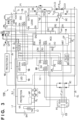
- the electrical components 110 of the controller 102 can include a first path P1, a second path P2, and the measurement circuit MC.
- the first path P1 electrically connects a first voltage terminal T1, to which a first voltage V1 is supplied, to a connection terminal C1, to which the heater HT for heating the aerosol source of the atomizer 104 is connected.
- the second path P2 electrically connects the connection terminal C1 to a second voltage terminal T2, to which a second voltage V2 different from the first voltage V1 is supplied, via a resistor Rs.
- the measurement circuit MC measures a resistance value R HTR of the heater HT.
- the first voltage V1 is a voltage for heating the heater HT.
- the second voltage V2 is a voltage for measuring the resistance value R HTR of the heater HT. If the heater HT has a positive or negative temperature coefficient characteristic that the resistance value R HTR changes in accordance with the temperature of the heater HT itself, the resistance value R HTR of the heater HT has a strong correlation with its temperature. In other words, the processor 14 can acquire the temperature of the heater HT by acquiring the resistance value R HTR of the heater HT using the measurement circuit MC. Controlling the temperature of the heater HT is closely associated with the delivery of an aerosol having an intended flavor from the inhaler 100 to the user, and hence is important.
- the second voltage V2 for measuring the resistance value R HTR of the heater HT is free from the influence of the change. Accordingly, when the first voltage V1 is changed, the processing of measuring the resistance value R HTR of the heater HT is also free from the influence of the change. That is, it is possible to improve the permissivity with respect to a change in the voltage supplied to the heater HT for heating the aerosol source.
- the first voltage V1 can be changed in accordance with information representing heating strength as will be described later. Alternatively, the first voltage V1 can be changed by changing the design or usage of the inhaler 100.
- the third voltage converter (first regulator) 13 can provide the first voltage V1.
- the third voltage converter 13 can generate the first voltage V1 by, for example, using the voltage supplied from the power supply BAT.
- the third voltage converter 13 can be formed by a buck-boost DC/DC converter.
- the buck-boost DC/DC converter may be formed by an IC chip and several elements (for example, a coil, a transistor, and a diode) connected to the IC chip.
- the third voltage converter 13 can be, for example, configured to generate the first voltage V1 in accordance with the heating strength (the heating strength of the heater HT with respect to the aerosol source) commanded by the user.
- the information representing the heating strength may be provided from the user to the processor 14 via the operation unit OP including the touch sensor 22 or the external apparatus connected to the plug PG.
- the processor 14 may be configured to transmit a command value indicating a voltage value corresponding to the information to the third voltage converter 13.
- the information representing the heating strength can be, for example, specified by the user selecting one of a plurality of modes with different heating strengths.
- the first voltage V1 can be a voltage higher than, for example, 2.5 V but is not limited to this.
- the third voltage converter 13 may be formed by a boost DC/DC converter or buck DC/DC converter instead of the buck-boost DC/DC converter.
- the third voltage converter 13 is more preferably formed by a buck-boost DC/DC converter having the broadest range of first voltages V1 that can be generated. Note that the conversion efficiency may be improved or the mounting area may be reduced by forming the third voltage converter 13 using a boost DC/DC converter or buck DC/DC converter depending on the required heating strength or the heater HT to be used.
- the second voltage converter (second regulator) 12 can provide the second voltage V2.
- the second voltage converter 12 can generate the second voltage V2 by, for example, using the voltage supplied from the power supply BAT.
- the second voltage converter 12 can be formed by, for example, an LDO (Low DropOut).
- the second voltage V2 can be, for example, 2.5 V but is not limited to this.
- the second voltage converter 12 may be formed by a switching regulator such as the above DC/DC converter instead of the LDO. Note, however, that the second voltage converter 12 is not required to change the value of the voltage to be generated in accordance with the heating strength unlike the third voltage converter 13, and the fixed second voltage V2 is preferably generated to stably measure the resistance value R HTR of the heater HT.
- the second voltage converter 12 may be formed by the LDO that can easily implement a small-size, low-cost converter. Note that since the LDO discards the difference between a voltage (power) supplied and a voltage (power) to be output as heat, it is difficult for the LDO to handle a large current as compared with a DC/DC converter. Since the current flowing in the second path P2 is smaller than the current flowing in the first path P1, the LDO can be used as the second voltage converter 12.
- the measurement circuit MC can include the second path P2 and a shunt resistor Rs connected in series with the heater HT. Unlike the heater HT, the resistance value of the shunt resistor Rs is almost invariant with respect to the temperature.
- the measurement circuit MC can include a differential amplifier 15 that detects a voltage V HTR applied to the heater HT.
- the differential amplifier 15 can be arranged to detect a voltage drop by the heater HT.
- the resistance value of the shunt resistor Rs is denoted by Rs, which is identical to the reference symbol of the resistor.
- the second switch Q2 can be arranged in series with the shunt resistor Rs and the heater HT.
- the electrical components 110 can include, for example, a cutoff unit BE that cuts off the current flowing between the first path P1 and the second path P2 owing to the difference between the voltage value V1 and the second voltage V2.
- a cutoff unit BE can protect the second voltage converter 12.
- the cutoff unit BE can include a rectifier element such as a diode.
- the rectifier element can be arranged such that the direction from the second voltage terminal T2 to the connection terminal C1 is the forward direction.
- the second switch Q2 can be controlled by a control signal generated by the processor 14.
- a voltage can be supplied from the node between the second voltage terminal T2 and the cutoff unit BE to the power supply terminal (voltage receiving terminal) of the differential amplifier 15.
- the voltage supplied to the power supply terminal of the differential amplifier 15 in this manner is higher by the extent to which the voltage is free from the influence of a drop in the forward voltage of the cutoff unit BE. That is, a different voltage and an output voltage in the differential amplifier 15 become difficult to stick to the voltage supplied to the power supply terminal.
- the processor 14 can acquire the temperature T of the heater HT with high accuracy as compared with the case in which a voltage is supplied from the downstream of the cutoff unit BE to the power supply terminal of the differential amplifier 15 in the direction in which a current flows in the second path P2.
- the differential amplifier 15 operates only when necessary, thereby also implementing the power saving of the inhaler 100.
- the voltage at the second voltage terminal T2, that is, the second voltage V2 can be supplied to the power supply terminal (voltage receiving terminal) of the differential amplifier 15.
- Equation (1) is transformed into equation (2) that gives R HTR .
- R HTR R S ⁇ V HTR / V 2 ⁇ V f ⁇ V HTR
- V AMP A ⁇ V HTR
- Equation (3) is transformed into equation (4) that gives R HTR .
- V HTR V AMP / A
- the resistance value R HTR of the heater HT can be obtained according to equations (2) and (4).
- the processor 14 can include an input terminal to which the output voltage V AMP of the differential amplifier 15 of the measurement circuit MC is input and an AD converter that converts an analog signal as a voltage input to the input terminal into a digital signal.
- the processor 14 can generate a control signal that controls the first switch Q1 for controlling heating by the heater HT in accordance with the information (V AMP in this case) obtained by using the measurement circuit MC.
- the inhaler 100 can include a temperature sensor (for example, a thermistor TM (to be described later)) that measures a temperature.
- the temperature measured by the temperature sensor can be set as the reference temperature T ref .
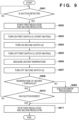
- Fig. 9 shows a procedure for temperature control on the heater HT in the inhaler 100.
- the processor 14 performs the temperature control shown in Fig. 9 .
- the processor 14 can detect suction (puff operation) by the user based on an output from the puff sensor 21.
- the puff sensor 21 can be, for example, configured to detect suction (puff operation) by the user based on, for example, at least one of a change in pressure, sound, an air flow, and the operation of the operation unit OP.
- the processor 14 starts the third voltage converter (first regulator) 13 and the second voltage converter (second regulator) 12 by activating the enable signal EN2 in step S902.
- the third voltage converter 13 allows the third voltage converter 13 to output the first voltage V1 from the first voltage terminal T1 and allows the second voltage converter 12 to output the second voltage V2 from the second voltage terminal T2.
- the first switch Q1 needs to be turned on to cause the third voltage converter 13 to output the voltage value V1 to the first path P1.
- the second switch Q2 needs to be turned on to cause the second voltage converter 12 to output the second voltage V2 to the second path P2.
- the puff sensor 21 is used to detect the above aerosol requesting operation.
- suction (puff operation) by the user corresponds to an aerosol requesting operation.
- the operation unit OP may be used to detect the above aerosol requesting operation.
- an operation on the operation unit OP corresponds to the aerosol requesting operation.
- the processor 14 may detect an aerosol requesting operation as long as an operation on the operation unit OP continues.
- step S903 the processor 14 can turn on the first switch Q1.
- step S904 the processor 14 can turn on the second switch Q2.
- step S905, the processor 14 can turn off the first switch Q1.
- step S906 the processor 14 detects the output voltage V AMP of the differential amplifier 15 and can calculate the resistance value R HTR of the heater HT according to equations (2) and (4) and the temperature T of the heater HT according to equation (5). Note that the processor 14 may calculate the temperature T of the heater HT according to one equation obtained by solving equations (2), (4), and (5) for the temperature T or may calculate the temperature T of the heater HT according to another method.
- step S907 the processor 14 turns off the second switch Q2.
- the processor 14 has a period in which the period during which the first switch Q1 is ON overlaps the period during which the second switch Q2 is ON.
- the processor 14 may control the first switch Q1 and the second switch Q2 so as not to have a period in which the period during which the first switch Q1 is ON overlaps the period during which the second switch Q2 is ON. Having a period in which the period during which the first switch Q1 is ON overlaps the period during which the second switch Q2 is ON allows the processor 14 to calculate the temperature T of the heater HT with high frequency, thereby improving the accuracy of control executed by the processor 14 based on the temperature T of the heater HT. Likewise, this will shorten the period during which the heater HT is not heated upon turning off of the first switch Q1, thereby facilitating delivering an aerosol having an intended flavor to the user.
- step S908 the processor 14 determines whether the temperature T of the heater HT calculated in step S906 is lower than a predetermined temperature (threshold). If the processor 14 determines that the temperature T of the heater HT is lower than the predetermined temperature, the process advances to step S910; otherwise, the processor 14 can execute error processing in step S909.
- the error processing can include at least one of the following: displaying an error message on the display DISP; inhibiting the heating of the heater HT; waiting for the natural cooling of the heater HT; and analyzing an error cause (for example, specifying an error cause based on the rise rate of the temperature T of the heater HT).
- step S910 the processor 14 determines whether the suction detected in step S901 has ended. If the processor 14 determined that the suction has ended, the process advances to step S911; otherwise, the process returns to step S903. In step S911, the processor 14 stops the operations of the third voltage converter (first regulator) 13 and the second voltage converter (second regulator) 12 by inactivating the enable signal EN2.
- the processor 14 can determine the timing (of turning off the first switch Q1) of step S905 thereafter based on the temperature T of the heater HT obtained in preceding step S906.
- the timing (of turning off the first switch Q1) of step S905 can be determined by, for example, PID computation based on the difference between the target temperature of the heater HT and the temperature T of the heater HT obtained in preceding step S906 such that the temperature T of the heater HT approaches the target temperature.
- the electrical components 110 of the controller 102 can include the connection terminal C1 to which the heater HT for heating the aerosol source of the atomizer 104 is connected, the control circuit CC for controlling the operation of the controller 102, the first voltage converter 11 for supplying a voltage to all or part of the control circuit CC, and the second voltage converter 12 for supplying a voltage (second voltage V2) to the connection terminal C1.
- the first period in which the first voltage converter 11 operates can differ from the second period in which the second voltage converter 12 operates.
- the periods in which the respective voltage converters operate may be interpreted as periods in which voltages converted by starting the respective voltage converters can be output or periods in which the voltages converted by the respective voltage converters are output.
- the first voltage converter 11 can be formed by, for example, an LDO (Low DropOut).
- the second voltage converter 12 can be formed by, for example, an LDO (Low DropOut).
- the first voltage converter 11 and the second voltage converter 12 may have the same specifications or have different specifications.
- the former case can contribute to a reduction in the manufacturing cost of the controller 102 (the sourcing cost of components).
- the latter case enables the selection of loads (devices) requiring different performances concerning, for example, power supply voltage, and hence is advantageous in expanding the functionality of the inhaler 100 or the controller 102.
- the loads connected to the output terminal of the first voltage converter 11 can include the LED driver 18, the LED 19, the switch 20, the puff sensor 21, and the touch sensor 22, whereas the loads connected to the output terminal of the second voltage converter 12 can include the second path P2 (heater HT) and the differential amplifier 15.
- the self-current consumption of the first voltage converter 11 is lower than the self-current consumption of the second voltage converter 12.
- the self-current consumption of the voltage converter indicates the current consumed by the voltage converter to convert the voltage (power) input to the input terminal of the voltage converter into the voltage (power) output from the output terminal of the voltage converter.
- the self-current consumption can be referred from the data sheet of the voltage converter.
- the self-current consumption generally varies in accordance with the specifications of voltage converters. A lower self-current consumption indicates more efficient voltage conversion. That is, a voltage converter with a lower self-current consumption leads to the power saving of the power supply BAT and can suppress the heating of the voltage converter.
- the inhaler 100 that has achieved power saving increases the amount of aerosol having a flavor that can be provided per charging of the power supply BAT, and hence can greatly improve its commodity value.
- the load transient response characteristic of the second voltage converter 12 may be superior to the load transient response characteristic of the first voltage converter 11.
- the load transient response characteristic of a voltage converter is an index indicating how much time it takes for an output voltage set in a transient state upon an abrupt increase or decrease in the output current of the voltage transfer to be set in a steady state.
- a load transient response characteristic is generally represented on the voltage basis.
- a smaller load transient response characteristic indicates that a steady state is set faster.
- This load transient response characteristic is especially important for a voltage converter that outputs a current or voltage only at the limited timing of acquiring the temperature T of the heater HT as in the first voltage converter 11.
- the self-current consumption and the load transient response characteristic of a general voltage converter tend to have a trade-off relationship.
- a voltage converter with a low self-current consumption tends to have a poor load transient response characteristic.
- a voltage converter with an excellent load transient response characteristic tends to have a high self-current consumption. Accordingly, it is important how to deal with this trade-off in accordance with the applications of voltage converters and the loads to be connected to the output terminals.
- the total power consumption is low and hence does not easily change abruptly.
- the requirement for an excellent load transient response characteristic is low with respect to the first voltage converter 11.
- the first period in which the first voltage converter 11 operates is long (as compared with the second period in which the second voltage converter 12 operates)
- the requirement for an excellent load transient response characteristic is high with respect to the first voltage converter 11. That is, the first voltage converter 11 is preferably formed by a voltage converter with a low self-current consumption even if its load transient response characteristic is not excellent.
- the second voltage converter 12 is preferably formed by a voltage converter with an excellent load transient response characteristic even if the self-current consumption is high.
- the first voltage converter 11 is preferably formed by a voltage converter that is lower in self-current consumption than the second voltage converter 12 and inferior in load transient response characteristic to the second voltage converter 12.
- the second voltage converter 12 is preferably formed by a voltage converter that is lower in self-current consumption than the first voltage converter 11 and superior in load transient response characteristic to the first voltage converter 11.
- the self-current consumption of the first voltage converter 11 is preferably lower than the self-current consumption of the second voltage converter 12.
- the load transient response characteristic of the second voltage converter 12 is preferably superior to the load transient response characteristic of the first voltage converter 11.
- the controller 102 can include a first power supply path SL1 for supplying a voltage from the power supply BAT to the first voltage converter 11, a second power supply path SL2 for supplying a voltage from the power supply BAT to the second voltage converter 12, and a third power supply path SL3 for supplying a voltage from the external power supply EB to the first voltage converter 11.
- power can be supplied from both the power supply BAT and the external power supply EB to the first voltage converter 11, whereas no power is supplied from the external power supply EB to the second voltage converter 12 even though power can be supplied from the power supply BAT.
- This can suppress a deterioration in the power supply BAT, which is charged with power supplied from the external power supply EB, caused when the heat generated upon the operation of the second voltage converter 12 and the heater HT is applied to the power supply BAT.
- a first rectifier element SD may be arranged in the first power supply path SL1, and a voltage can be supplied from the power supply BAT to the first voltage converter 11 via the first rectifier element SD.
- the first rectifier element SD can be arranged such that the direction from the power supply BAT to the first voltage converter 11 is the forward direction.
- the first rectifier element SD can be, for example, a Schottky diode.
- the Schottky diode uses contact between a semiconductor and a metal and is smaller in forward voltage drop than a PN junction diode, and hence is advantageous in supplying a voltage from the power supply BAT to the first voltage converter 11.
- supplying a voltage from the power supply BAT to the first voltage converter 11 via the Schottky diode SD will reduce the loss of power supplied from the power supply BAT as compared with supplying a voltage from the power supply BAT to the first voltage converter 11 via a first body diode D3 of the first transistor Q3 (to be described later).
- the positive terminal of the power supply BAT can be electrically connected to the second voltage converter 12 via the second power supply path SL2.
- the positive terminal of the power supply BAT can be directly connected to the second voltage converter 12 by using a conductive pattern (conductive trace).
- the positive terminal of the power supply BAT can be electrically connected to the second voltage converter 12 without via any electrical elements such as a resistor, a switch, and an IC.
- the positive terminal of the power supply BAT can also be electrically connected to the third voltage converter 13 via the second power supply path SL2. This makes it possible to supply power from the power supply BAT to the second voltage converter 12 and the third voltage converter 13 with minimum loss of power.
- the first transistor Q3 can be connected in parallel with the first rectifier element SD.
- the first transistor Q3 can include the first body diode D3.
- the forward direction of the first body diode D3 can be the same as the forward direction of the first Schottky diode SD.
- the power supply BAT can be charged by the external power supply EB via the first transistor Q3.
- a second rectifier element D4 can be arranged in the third power supply path SL3.
- a voltage can be supplied from the external power supply EB to the first voltage converter 11 via the second rectifier element D4.
- the second rectifier element D4 can include the second body diode provided for the second transistor Q4 arranged in the third power supply path SL3. With this arrangement, the voltage supplied from the external power supply EB undergoes a forward voltage drop by the second rectifier element D4 and is supplied to the input terminal of the first voltage converter 11.
- the first voltage converter 11 is formed by a series regulator such as an LDO, an input voltage is stepped down by discarding extra power as heat and output from the output terminal.
- the processor 14 may turn on the second transistor Q4 and turn on/off the first transistor Q3. This can supply the voltage stepped down by the first transistor Q3 and the Schottky diode SD to the input terminal of the first voltage converter 11 while suppressing the generation of heat in the second rectifier element D4, thereby improving the durability of the inhaler 100.
- the source of the first transistor Q3 can be electrically connected to the source of the second transistor Q4.
- the source of the first transistor Q3 can be electrically connected to the source of the second transistor Q4 and the power supply terminal (power receiving terminal) of the first voltage converter 11.
- the power supply BAT can be charged by the external power supply EB via the first transistor Q3 and the second transistor Q4.
- the second transistor Q4 can supply a voltage obtained by stepping down the voltage output from the protection circuit 16 to the first transistor Q3.
- the first transistor Q3 and the second transistor Q4 can form a charging circuit that charges the power supply BAT.
- the first transistor Q3 and the second transistor Q4 can be connected in series with the path in which a charging current flows.
- the processor 14 can charge the power supply BAT by turning on the second transistor Q4 and turning on or on/off the first transistor Q3.
- the processor 14 can control the charging of the power supply BAT at high speed by switching on and off the second transistor Q4 at high speed.
- the charging path CL extends, for example, from the external power supply EB to the positive electrode of the power supply BAT via the plug PG, the bridge circuit BC, the protection circuit 16, the second transistor Q4, and the first transistor Q3.
- the current path (the charging path CL) in a state in which the power supply BAT is charged is indicated by the gray arrows.
- the current path (a discharge path DL) in a state in which the power supply BAT is discharged via the heater HT is indicated by the gray arrows.
- the controller 102 includes a first line L1 connected to the positive electrode of the power supply BAT and a second line L2 connected to the negative electrode of the power supply BAT.
- the first line L1 and the second line L2 can be arranged to form part of a closed circuit including the power supply BAT as a constituent element.
- the electrical components 110 of the controller 102 can include the power supply BAT, the connection terminal C1 to which the heater HT for heating the aerosol source of the atomizer 104 by using a current supplied from the power supply BAT is connected, the processor 14, and the protection circuit 17.
- the processor 14 includes a detector DP that detects a current supplied from the power supply BAT and/or a current supplied to the power supply BAT and can control the state of the power supply BAT based on the detection result obtained by the detector DP.
- the protection circuit 17 includes a monitor MP that monitors the state of the power supply BAT and can protect the power supply BAT based on the monitoring result obtained by the monitor MP.
- the protection circuit 17 can be provided separately from the processor 14. This arrangement is advantageous in improving the protection function of the power supply BAT and also the protection function of the inhaler 100.
- the processor 14 can control the charging of the power supply BAT based on the detection result obtained by the detector DP when the detector DP detects a current supplied to the power supply BAT. More specifically, the processor 14 can control the first transistor Q3 and the second transistor Q4 described above, which form a charging circuit for charging the power supply BAT, based on the detection result obtained by the detector DP. In addition, when the detection result obtained by the detector DP indicates abnormality, the processor 14 can stop charging the power supply BAT using the charging circuit (the first transistor Q3 and the second transistor Q4). For example, when the detection result obtained by the detector DP indicates abnormality, the processor 14 can control the first transistor Q3 into the OFF state. When the first transistor Q3 is set in the OFF state, the electrical connection between the external power supply EB and the power supply BAT is cut off to stop charging the power supply BAT.
- the third voltage converter (first regulator) 13 receives the voltage supplied from the power supply BAT and generates the first voltage V1 (driving voltage) for driving the heater HT so as to heat the aerosol source of the atomizer 104.
- the second voltage converter (second regulator) 12 receives the voltage supplied from the power supply BAT and generates the second voltage V2 (measurement voltage) for measuring the resistance value R HTR of the heater HT.
- the processor 14 can stop the operation of the third voltage converter (first regulator) 13 and the second voltage converter (second regulator) 12 by inactivating the enable signal EN2.
- the processor 14 may control the first switch Q1 in the OFF state or control the first switch Q1 and the second switch Q2 in the OFF state.
- the detector DP detects the current supplied from the power supply BAT and the detection result obtained by the detector DP indicates abnormality, the processor 14 controls the first switch Q1 and the second switch Q2 in the OFF state while inactivating the enable signal EN2. In either case, the electrical connection between the power supply BAT and the heater HT is cut off, and hence discharging from the power supply BAT to the heater HT is stopped.
- the mode of stopping discharging from the power supply BAT to the heater HT by inactivating the enable signal EN2 also stops the operation of the third voltage converter 13 and the second voltage converter 12, and hence is advantageous in power saving of the power supply BAT.
- the mode of stopping discharging to the heater HT of the power supply BAT by controlling the first switch Q1 and the second switch Q2 in the OFF state is advantageous in terms of the speed of stopping the discharging because of small frequencies of current and voltage transient responses as compared with the case of stopping the operations of the third voltage converter 13 and the second voltage converter 12.
- the mode of stopping discharging to the heater HT of the power supply BAT by using both the inactivation of the enable signal EN2 and control on the first switch Q1 and the second switch Q2 in the OFF state is advantageous in terms of the capability to stop the discharging at high probability even when either the voltage converter or the switch has failed.
- a short-circuit may have occurred in one of the following: the first switch Q1, the second switch Q2, the third voltage converter 13, and the second voltage converter 12. For this reason, in order to reliably stop discharging to the heater HT of the power supply BAT, it is important to perform both the inactivation of the enable signal EN2 and control on the first switch Q1 and the second switch Q2 in the OFF state.
- the protection circuit 17 can include a switch SP arranged in the second line L2 so as to be able to cut off the second line L2.
- the switch SP is preferably formed by directly connecting two switches in different directions so as to be able to cut off a charging current for charging the power supply BAT and a discharge current discharged from the power supply BAT.
- the protection circuit 17 can cut off a current supplied from the power supply BAT and a current supplied to the power supply BAT by turning off the switch SP.
- the protection circuit 17 receives power from the first line L1.
- the detector DP includes a first resistor R D .
- the monitor MP includes a second resistor R P .
- the first resistor R D and the second resistor R P can be arranged in series with a path extending from the positive electrode of the power supply BAT to its negative electrode.
- the first resistor R D and the second resistor R P can be arranged to cause a current flowing from the positive electrode of the power supply BAT to pass through the heater HT first and then pass through the first resistor R D and the second resistor Rp.
- the first resistor R D and the second resistor R P can be arranged in series with the second line L2 (that is, so as to form part of the second line L2).
- High-side connection can be made between the first resistor R D and the second resistor R P instead of such low-side connection between the first resistor R D and the second resistor R P .
- the first resistor R D and the second resistor R P can be arranged to cause a current flowing out from the positive electrode of the power supply BAT to pass through the first resistor R D and the second resistor R P before passing through the heater HT.
- the first resistor R D and the second resistor R P can be arranged in series with the first line L1 (that is, so as to form part of the first line L1). This indicates that when the detector DP or the monitor MP includes a differential amplifier (operational amplifier), the common mode voltage of the differential amplifier can be set low or 0. A lower common mode voltage increases the number of options for differential amplifiers, and hence is advantageous in terms of cost.
- the detector DP detects a current flowing in the first resistor R D or a voltage drop caused by the first resistor R D .
- the processor 14 can detect abnormality based on the detection result obtained by the detector DP and stop the charging of the power supply BAT and/or discharging from the power supply BAT to the heater HT.
- the monitor MP can detect a current flowing in the second resistor R P or a voltage drop caused by the second resistor R P .
- the protection circuit 17 can detect abnormality based on the monitoring result obtained by the monitor MP and stop the charging of the power supply BAT and/or discharging from the power supply BAT to the heater HT.
- the condition by which the processor 14 stops the charging of the power supply BAT can differ from the condition by which the protection circuit 17 stops the charging of the power supply BAT.
- the condition by which the processor 14 stops charging from the power supply BAT can differ from the condition by which the protection circuit 17 stops charging from the power supply BAT.
- the controller 102 can include the thermistor TM having one terminal connected between the negative electrode of the power supply BAT and the switch SP in the second line L2.
- the thermistor TM is mainly used to acquire the temperature of the power supply BAT.
- the other terminal of the thermistor TM can be arranged to supply a voltage dependent on the resistance value of the thermistor TM to the processor 14.
- the processor 14 supplies a predetermined voltage from an output terminal VO to the thermistor TM via a resistor R5 and receives the voltage divided by the resistor R5 and the thermistor TM at an input terminal VI, thereby detecting the resistance value of the thermistor TM.
- the resistance value of the thermistor TM can provide information indicating a temperature.
- the output terminal VO is connected to the thermistor TM via the resistor R5 and is then connected to the negative electrode of the power supply BAT via the thermistor TM without via another element. This makes it difficult for noise to mix with a voltage input to the input terminal VI and allows the processor 14 to acquire the temperature of the thermistor TM or the power supply BAT with high accuracy.
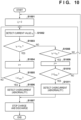
- Fig. 10 exemplarily shows the operation of the protection circuit 17.
- the protection circuit 17 initializes parameters i and j to 0.
- the protection circuit 17 detects a current value i P (a charging current value at the time of charging or a discharge current value at the time of discharging) flowing in the power supply BAT by the monitor MP.
- the current value i P is handled as an absolute value. Note that at both the time of charging and the time of discharging, the current value i P indicates only a positive value, and its minimum value is 0.
- the protection circuit 17 determines whether the current value i P exceeds a first threshold i T1 .
- step S1004 the process advances to step S1004; otherwise, the process advances to step S1008.
- detection signal step S1004 the protection circuit 17 adds 1 to the value of the parameter i.
- step S1005 the protection circuit 17 determines whether the value of the parameter i is equal to or more than i max . If the value of the parameter i is equal to or more than i max , the process advances to step S1006; otherwise, the process returns to step S1002.
- step S1006 the protection circuit 17 determines that an overcurrent (that is, abnormality) is detected, and the process advances to step S1007.
- step S1008 the protection circuit 17 determines whether the current value i P exceeds a second threshold i T2 smaller than the first threshold i T1 . If YES in step S1008, the process advances to step S1009; otherwise, the process returns to step S1001. In step S1009, the protection circuit 17 adds 1 to the value of the parameter j. In step S1010, the protection circuit 17 determines whether the value of the parameter j is equal to or more than j max . If the value of the parameter j is equal to or more than j max , the process advances to step S1011; otherwise, the process returns to step S1002.
- step S1011 the protection circuit 17 determines that an overcurrent (that is, abnormality) has been detected. The process then advances to step S1007.
- step S1007 the protection circuit 17 cuts off a current supplied from the power supply BAT and/or a current supplied to the power supply BAT by turning off the switch SP.
- This embodiment has exemplified the case in which the first threshold i T1 , the second threshold i T2 , i max , and j max are common to a charging operation and a discharging operation. Instead of this setting, at least one of the first threshold i T1 , the second threshold i T2 , i max , and j max may differ between a charging operation and a discharging operation. In addition, the sampling period f P may differ between a charging operation and a discharging operation.
- Fig. 11 exemplarily shows the operation of the processor 14.
- the processor 14 initializes the parameters k and l to 0.
- the processor 14 detects a current value in (a charging current value at the time of charging or a discharge current value at the time of discharging) flowing in the power supply BAT.
- the current value in is handled as an absolute value. Note that the current value in indicates only a positive value and its minimum value is 0 at both the time of charging and the time of discharging.
- the processor 14 determines whether the current in exceeds a third threshold i T3 . If YES in step S1103, the process advances to step S1104; otherwise, the process advances to step S1108.
- step S1104 the processor 14 adds 1 to the value of the parameter k.
- step S1108 the processor 14 determines whether the current value in exceeds a fourth threshold i T4 smaller than the third threshold i T3 . If YES in step S1108, the process advances to step S1109; otherwise, the process returns to step S1101. In step S1109, the processor 14 adds 1 to the value of the parameter l. In step S1110, the processor 14 determines whether the value of the parameter l is equal to or more than l max . If the value of the parameter l is equal to or more than l max , the process advances to step S1111; otherwise, the process returns to step S1102.
- step S1111 the processor 14 determines that an overcurrent (that is, abnormality) has been detected. The process then advances to step S1107.
- step S1107 the processor 14 cuts off a current supplied from the power supply BAT and/or a current supplied to the power supply BAT.
- This operation can be implemented by, for example, turning off the first transistor Q3 when the power supply BAT has been charged, and can be implemented by, for example, inactivating the enable signal EN2 when the power supply BAT has been discharged.
- the processor 14 may control the first switch Q1 and the second switch Q2 in the OFF state instead of or in addition to inactivating the enable signal EN2 as described above.
- This embodiment has exemplified the case in which the third threshold i T3 , the fourth threshold i T4 , k max , and l max serving as thresholds are common to a charging operation and a discharging operation.
- At least one of the third threshold i T3 , the fourth threshold i T4 , k max , and l max may differ between a charging operation and a discharging operation.
- the sampling period f D may differ between a charging operation and a discharging operation.
- Fig. 12 exemplarily shows the relationship among the first threshold i T1 , the second threshold i T2 , the third threshold i T3 , the fourth threshold i T4 , the first time t1, the second time t2, the third time t3, and the fourth time t4.
- the first threshold i T1 , the second threshold i T2 , the first time t1, and the second time t2 are criteria based on which the protection circuit 17 determines whether to charge and discharge the power supply BAT.
- the third threshold i T3 , the fourth threshold i T4 , the third time t3, and the fourth time t4 are criteria based on which the processor 14 determines whether to charge and discharge the power supply BAT.
- the first threshold i T1 and the first time t1 are criteria for detecting that a large current (for example, on the ampere order) flows instantaneously (for example, on the microsecond order).
- the third threshold i T3 and the third time t3 are criteria for detecting that a large current (for example, on the ampere order) flows instantaneously (for example, on the microsecond order).
- the second threshold i T2 and the second time t2 are criteria for detecting that a small current (for example, on the sub-ampere order) flows for a long period of time (for example, on the second order).
- the fourth threshold i T4 and the fourth time t4 are criteria for detecting that a small current (for example, on the sub-ampere order) flows for a long period of time (for example, on the second order).
- the processor 14 determines the occurrence of abnormality in accordance with a criterion stricter than that set for the protection circuit 17.
- This operation can be implemented by setting the third threshold i T3 to a value smaller than the first threshold i T1 and larger than the second threshold i T2 , setting the fourth threshold i T4 to a value smaller than the second threshold i T2 , setting the third time t3 to a time shorter than the first time t1, and setting the fourth time t4 to a time longer than the first time t1 and shorter than the second time t2.
- the protection circuit 17 stops the charging of the power supply BAT when the charging current value of the power supply BAT exceeds the first threshold i T1 under monitoring over the first time t1 and when the charging current exceeds the second threshold i T2 smaller than the first threshold i T1 under monitoring over the second time t2 longer than the first time t1.
- the processor 14 also stops the charging of the power supply BAT when the charging current value exceeds the third threshold i T3 smaller than the first threshold i T1 and larger than the second threshold i T2 in detection over the third time t3 shorter than the first time t1 and when the charging current exceeds the fourth threshold i T4 smaller than the second threshold i T2 in detection over the fourth time t4 shorter than the second time t2.
- the protection circuit 17 stops discharging from the power supply BAT when the discharge current value of the power supply BAT exceeds the first threshold i T1 under monitoring over the first time t1 and when the discharge current value exceeds the second threshold i T2 smaller than the first threshold i T1 under monitoring over the second time t2 longer than the first time t1.
- the processor 14 also stops discharging from the power supply BAT when the discharge current value exceeds the third threshold i T3 smaller than the first threshold i T1 and larger than the second threshold i T2 in detection over the third time t3 shorter than the first time t1 and when the discharge current exceeds the fourth threshold i T4 smaller than the second threshold i T2 in detection over the fourth time t4 longer than the first time t1 and shorter than the second time t2.
- the protection circuit 17 Assume that a commercially available protection IC is used as the protection circuit 17. In this case, when the first threshold i T1 , the second threshold i T2 , i max , and j max in many protection ICs are changed from predetermined initial values to other values, the inside of each protection IC must be changed. Accordingly, when a commercially available protection IC is used as the protection circuit 17, there are limitations on the determination of the occurrence of abnormality according to strict criteria different from the specification of the protection IC. In contrast to this, the third threshold i T3 , the fourth threshold i T4 , k max , and l max used by the processor 14 can be relatively easily changed from the write terminal of the processor 14 or the like.
- the processor 14 determines the occurrence of abnormality according to strict criteria (stricter than the protection circuit 17) to improve the protection function of the inhaler 100. That the processor 14 determines the occurrence of abnormality according to criteria stricter than those in the protection circuit 17 corresponds to that the processor 14 and the protection circuit 17 independently and doubly determine the occurrence of abnormality under appropriate criteria, respectively. This also improves the protection function of the inhaler 100.
- the protection circuit 17 operates the switch SP to cut off a current supplied from the power supply BAT and/or a current supplied to the power supply BAT.
- the processor 14 operates at least one of the third voltage converter 13, the second voltage converter 12, the first switch Q1, and the second switch Q2 to cut off a current supplied from the power supply BAT.
- the processor 14 operates the first transistor Q3 to cut off a current supplied to the power supply BAT.
- the protection circuit 17 and the processor 14 operate different targets to cut off a current supplied from the power supply BAT and/or a current supplied to the power supply BAT. Under a circumstance in which an overcurrent is generated, a trouble may have occurred in any of the elements forming the electrical components 110. Assume that the protection circuit 17 and the processor 14 have respectively determined the occurrence of abnormality according to different criteria described above. Even in this case, when the protection circuit 17 and the processor 14 operate the same target, the occurrence of a trouble in the target (element) makes it difficult to properly protect the inhaler 100. Making the protection circuit 17 and the processor 14 operate different targets facilitates avoiding such a situation. This makes it possible to further improve the protection function of the inhaler 100.
- the second time t2 and the fourth time t4 can be set as times longer than the time during which a current can be supplied from the power supply BAT to the heater HT in response to a first aerosol requesting operation (puff operation). Specifically, the second time t2 and the fourth time t4 can be set to times longer than the time during which the supply of a current from the power supply BAT to the heater HT is forcibly stopped even if the detection of one first aerosol requesting operation (puff operation) continues.
- the first threshold i T1 and the third threshold i T3 can be values larger than a current value flowing in the second line L2 in steps S903 to S906 in a normal state.
- the second threshold i T2 and the fourth threshold i T4 can be values larger than a current value flowing in the second line L2 in steps S903 to S906 in a normal state.
Landscapes
- Engineering & Computer Science (AREA)
- Health & Medical Sciences (AREA)
- Life Sciences & Earth Sciences (AREA)
- Animal Behavior & Ethology (AREA)
- Public Health (AREA)
- Heart & Thoracic Surgery (AREA)
- Hematology (AREA)
- Anesthesiology (AREA)
- Veterinary Medicine (AREA)
- General Health & Medical Sciences (AREA)
- Biomedical Technology (AREA)
- Power Engineering (AREA)
- Bioinformatics & Cheminformatics (AREA)
- Pulmonology (AREA)
- Human Computer Interaction (AREA)
- Biophysics (AREA)
- Control Of Resistance Heating (AREA)
Description
- The present invention relates to an inhaler controller.
-
Japanese Patent Laid-Open No. 2017-501805 - The apparatus disclosed in
Japanese Patent Laid-Open No. 2017-501805 -
US 2020/260792 A1 discloses an aerosol generating apparatus including a load that generates heat upon receipt of electric power from a power supply and atomizes an aerosol source, an element that is used to acquire a value related to a temperature of the load, a retention unit that retains an aerosol source supplied from a storage to allow the retained aerosol source to be in a feasible state of being heated by the load, and a control unit configured to distinguish between a first state of the aerosol generating apparatus in which the aerosol source stored in the storage is insufficient in quantity, and a second state of the aerosol generating apparatus in which the storage is capable of supplying the aerosol source while the retained aerosol source is insufficient in quantity, on the basis of a change in the value related to the temperature. - According to one aspect of the present invention, it is an object to improve the permissivity with respect to a change in voltage supplied to a heater for heating an aerosol source. The object of the invention is achieved by the independent claims. Dependent claims define advantageous embodiments. Examples are provided to facilitate the understanding of the present disclosure.
- One example is directed to an inhaler controller, and the inhaler controller comprises: a first path configured to connect a first voltage terminal to which a first voltage is supplied and a connection terminal to which a heater configured to heat an aerosol source is connected; a second path configured to connect a second voltage terminal to which a second voltage different from the first voltage is supplied and the connection terminal via a resistor; and a measurement circuit configured to measure a resistance value of the heater.
- The controller can further comprise a cutoff unit configured to cut off a current flowing between the first path and the second path due to a difference between the first voltage and the second voltage.
- The cutoff unit can include a diode.
- The cutoff unit can be arranged in the second path.
- The measurement circuit can include a differential amplifier arranged to detect a voltage drop caused by the heater.
- A voltage can be supplied from a node between the second voltage terminal and the cutoff unit to a power supply terminal of the differential amplifier.
- The differential amplifier can include a first input terminal to which a voltage corresponding to a voltage of the connection terminal is supplied and a second input terminal to which a predetermined voltage is supplied.
- The controller can further comprise a protection element connected to the first input terminal.
- The protection element can include one of a Zener diode and a varistor.
- The controller can further comprise: a first regulator configured to generate the first voltage; and a second regulator configured to generate the second voltage.
- The controller can further comprise a processor configured to control the first regulator and the second regulator.
- The processor can control the first regulator and the second regulator using a common enable signal.
- The processor can control a magnitude of a voltage generated by the first regulator.
- The controller can further comprise: a first switch arranged in the first path; and a second switch arranged in the second path, wherein the processor controls the first switch and the second switch.
- The processor can have a period in which a period during which the first switch is ON overlaps a period during which the second switch is ON.
- According to the above aspect of the present invention, the permissivity with respect to the change in voltage supplied to the heater for heating the aerosol source can be improved.
-
-
Fig. 1 is a view schematically showing the arrangement of an inhaler according to one embodiment; -
Fig. 2 is a circuit diagram showing an example of the arrangement of the electrical components of a controller in the inhaler shown inFig. 1 ; -
Fig. 3 is a circuit diagram for explaining the arrangement and operation of the electrical components inFig. 2 ; -
Fig. 4 is a circuit diagram for explaining the arrangement and operation of the electrical components inFig. 2 ; -
Fig. 5 is a circuit diagram for explaining the arrangement and operation of the electrical components inFig. 2 ; -
Fig. 6 is a circuit diagram for explaining the arrangement and operation of the electrical components inFig. 2 ; -
Fig. 7 is a circuit diagram for explaining the arrangement and operation of the electrical components inFig. 2 ; -
Fig. 8 is a circuit diagram for explaining the arrangement and operation of the electrical components inFig. 2 ; -
Fig. 9 is a flowchart exemplarily showing temperature control on a heater in the inhaler according to one embodiment; -
Fig. 10 is a flowchart exemplarily showing the operation of a protection circuit associated with the protection of a power supply; -
Fig. 11 is a flowchart exemplarily showing the operation of a processor associated with the protection of the power supply; and -
Fig. 12 is a graph exemplarily showing criteria associated with the protection of the power supply. - Hereinafter, embodiments will be described in detail with reference to the accompanying drawings. It should be noted that the following embodiments are not intended to limit the scope of the appended claims, and that not all the combinations of features described in the embodiments are necessarily essential to the present invention. Of a plurality of features described in the embodiments, two or more features may arbitrarily be combined. In addition, the same reference numerals denote the same or similar parts, and a repetitive description will be omitted.
-
Fig. 1 schematically shows the arrangement of aninhaler 100 according to an embodiment. Theinhaler 100 can be configured as an aerosol generation device. Theinhaler 100 can be configured to provide, to a user via a suction port or a mouthpieth130, a gas containing an aerosol, a gas containing an aerosol and a flavor material, an aerosol, or an aerosol containing a flavor material in accordance with an operation requesting the aerosol (to be also referred to as an aerosol requesting operation hereinafter) such as a suction or inhaling operation by the user. Theinhaler 100 can comprise acontroller 102 and anatomizer 104. Theinhaler 100 can comprise aholding portion 103 that detachably holds theatomizer 104. Thecontroller 102 may be understood as an inhaler controller. Theatomizer 104 can be configured to atomize an aerosol source. The aerosol source can be, for example, a liquid such as a multivalent alcohol such as glycerin or propylene glycol. Alternatively, the aerosol source may contain a drug. The aerosol source can be a liquid, a solid, or a mixture of a liquid and a solid. A vapor source such as water may be used in place of the aerosol source. - The
inhaler 100 may further comprise acapsule 106 containing aflavor source 131. Theatomizer 104 can include acapsule holder 105 that detachably holds thecapsule 106. Thecapsule holder 105 may be included in thecontroller 102 instead of theatomizer 104. Theflavor source 131 can be a molded body obtained by molding, for example, a cigarette material. Alternatively, theflavor source 131 may be made of a plant (for example, mint, herb, Chinese medicine, coffee beans, or the like) except the cigarette. A fragrance such as menthol may be added to the flavor source. Theflavor source 131 may be added to an aerosol source. Theatomizer 104 and thecapsule holder 105 may be integrally formed in place of an arrangement in which theinhaler 100 or theatomizer 104 includes thecapsule holder 105. - The
controller 102 can includeelectrical components 110. Theelectrical components 110 can include auser interface 116. Alternatively, thecontroller 102 may be understood to include theelectrical components 110 and theuser interface 116. Theuser interface 116 can include, for example, a display DISP (for example, an LED (Light Emitting Diode) and/or an image display such as an LCD) and/or an operation unit OP (for example, a switch such as a button switch and/or a touch display). The display DISP may be understood as a notificator that notifies information. - The holding
portion 103 of thecontroller 102 can include a first electrical contact C1 and a second electrical contact C2. In a state in which theatomizer 104 is held by the holdingportion 103, the first electrical contact C1 of the holdingportion 103 can contact a third electrical contact C3 of theatomizer 104, and the second electrical contact C2 of the holdingportion 103 can contact a fourth electrical contact C4 of theatomizer 104. Thecontroller 102 can supply power to theatomizer 104 via the first electrical contact C1 and the second electrical contact C2. - The
atomizer 104 can include the third electrical contact C3 and the fourth electrical contact C4 described above. In addition, theatomizer 104 can include a heater HT for heating the aerosol source, acontainer 125 for holding the aerosol source, and a transport portion (wick) 126 for transporting the aerosol source held by thecontainer 125 to a heating region of the heater HT and holding the aerosol source in the heating region. At least part of the heating region can be arranged in achannel 128 formed in theatomizer 104. The first electrical contact C1, the third electrical contact C3, the heater HT, the fourth electrical contact C4, and the second electrical contact C2 form a current path for flowing the current to the heater HT. Thetransport portion 126 can be made of a fiber element such as a glass fiber, a porous material such as a ceramic, or a combination thereof. Note that the means for transporting the aerosol source held in thecontainer 125 to the heating region is not limited to the wick, but a spraying device such as a spray or a transporting means such as a pump may be used instead. - As described above, the
atomizer 104 can include thecapsule holder 105 for detachably holding thecapsule 106. As an example, thecapsule holder 105 can hold thecapsule 106 such that part of thecapsule 106 is accommodated in thecapsule holder 105 or theatomizer 104 and the remaining part of thecapsule 106 is exposed. The user can hold thesuction port 130 with his/her mouth and suck the gas containing the aerosol. Since thedetachable capsule 106 includes thesuction port 130, theinhaler 100 can be kept clean. - When the user holds the
suction port 130 with his/her mouth and performs the suction operation, as exemplified by an arrow, air flows into thechannel 128 of theatomizer 104 via an opening (not shown). When the heater HT heats the aerosol source, the vaporized and/or aerosolized aerosol source is transported toward thesuction port 130 with the air. In the process in which the aerosol source is transported toward thesuction port 130, the vaporized and/or aerosolized aerosol source is cooled to form fine liquid droplets, thereby promoting aerosolization. In the arrangement in which theflavor source 131 is arranged, the flavor material generated by theflavor source 131 is added to this aerosol, and the resultant material is transported to thesuction port 130, thus allowing the user to suck the aerosol containing the flavor material. Since the flavor material generated by theflavor source 131 is added to the aerosol, the flavor material can be efficiently transported to the lungs of the user without staying in the oral cavity. -
Fig. 2 shows an example of the arrangement of theelectrical components 110 of thecontroller 102. Theelectrical components 110 can include, for example, a power supply BAT,protection circuits first voltage converter 11, a second voltage converter (second regulator) 12, a third voltage converter (first regulator) 13, a first switch Q1, a second switch Q2, a first transistor (third switch) Q3, a second transistor (fourth switch) Q4, a measurement circuit MC, a plug PG, and a bridge circuit BC. Note that a female type (concave type) receptor may be used instead of the male type (convex type) plug PG. The control circuit CC is configured to control the operation of thecontroller 102. The control circuit CC can include, for example, aprocessor 14, anLED driver 18, anLED 19, aswitch 20, apuff sensor 21, and atouch sensor 22. It is possible to use, as the power supply BAT, for example, a lithium ion secondary battery, a lithium ion capacitor, a combination thereof, or another type of power supply element. - The
processor 14 can be formed by, for example, an MCU. TheLED driver 18 and theLED 19 can form all or part of the display DISP described above. TheLED 19 is an example of a display. TheLED driver 18 can drive theLED 19 in accordance with commands from theprocessor 14. Thepuff sensor 21 can detect a puff operation by the user. Thepuff sensor 21 may be formed by, for example, a microphone condenser, a flow rate sensor, or one or a plurality of pressure sensors. Thetouch sensor 22 can form all or part of the operation unit OP described above. Thecontroller 102 receives the supply of power from an external power supply EB via the plug PG. In addition, thecontroller 102 can communicate with an external apparatus (not shown) having the external power supply EB via theswitch 20 and the plug PG. Theprocessor 14 can communicate with theLED driver 18, theswitch 20, thepuff sensor 21, and thethird voltage converter 13 via a communication interface such as I2C communication as one kind of serial communication using SDA (Serial DAta) lines and SCL (Serial CLock) lines. Note that the communication interface is not limited to I2C communication, but another type of serial communication interface such as UART communication or SPI communication may be used instead. Theswitch 20 has an enable terminal EN. A voltage obtained by dividing the voltage applied from the external apparatus via the plug PG and theprotection circuit 16 by resistors R4 and R3 can be supplied to the enable terminal EN. When the voltage supplied to the enable terminal EN exceeds a predetermined level, theswitch 20 can set a connection state (communicable state) between the communication interface among theprocessor 14, theLED driver 18, theswitch 20, thepuff sensor 21, and thethird voltage converter 13 and the external apparatus connected to the plug PG. According to another point of view, when the voltage supplied to the enable terminal EN exceeds the predetermined level, theswitch 20 can set a connection state (communicable state) between theprocessor 14 and the external apparatus connected to the plug PG. - According to one aspect, the
electrical components 110 of thecontroller 102 can include a first path P1, a second path P2, and the measurement circuit MC. The first path P1 electrically connects a first voltage terminal T1, to which a first voltage V1 is supplied, to a connection terminal C1, to which the heater HT for heating the aerosol source of theatomizer 104 is connected. The second path P2 electrically connects the connection terminal C1 to a second voltage terminal T2, to which a second voltage V2 different from the first voltage V1 is supplied, via a resistor Rs. The measurement circuit MC measures a resistance value RHTR of the heater HT. The first voltage V1 is a voltage for heating the heater HT. The second voltage V2 is a voltage for measuring the resistance value RHTR of the heater HT. If the heater HT has a positive or negative temperature coefficient characteristic that the resistance value RHTR changes in accordance with the temperature of the heater HT itself, the resistance value RHTR of the heater HT has a strong correlation with its temperature. In other words, theprocessor 14 can acquire the temperature of the heater HT by acquiring the resistance value RHTR of the heater HT using the measurement circuit MC. Controlling the temperature of the heater HT is closely associated with the delivery of an aerosol having an intended flavor from theinhaler 100 to the user, and hence is important. Theprocessor 14 may control a current flowing in the first path P1 based on an output from the measurement circuit MC that measures the resistance value RHTR of the heater HT such that the temperature of the heater HT converges to a target value or target range. In addition, theprocessor 14 may cut off the current flowing in the first path P1 when the temperature of the heater HT exceeds a threshold based on an output from the measurement circuit MC that measures the resistance value RHTR of the heater HT. - According to this arrangement, even when the first voltage V1 is changed to heat the heater HT, the second voltage V2 for measuring the resistance value RHTR of the heater HT is free from the influence of the change. Accordingly, when the first voltage V1 is changed, the processing of measuring the resistance value RHTR of the heater HT is also free from the influence of the change. That is, it is possible to improve the permissivity with respect to a change in the voltage supplied to the heater HT for heating the aerosol source. The first voltage V1 can be changed in accordance with information representing heating strength as will be described later. Alternatively, the first voltage V1 can be changed by changing the design or usage of the
inhaler 100. - For example, the third voltage converter (first regulator) 13 can provide the first voltage V1. The
third voltage converter 13 can generate the first voltage V1 by, for example, using the voltage supplied from the power supply BAT. For example, thethird voltage converter 13 can be formed by a buck-boost DC/DC converter. The buck-boost DC/DC converter may be formed by an IC chip and several elements (for example, a coil, a transistor, and a diode) connected to the IC chip. Thethird voltage converter 13 can be, for example, configured to generate the first voltage V1 in accordance with the heating strength (the heating strength of the heater HT with respect to the aerosol source) commanded by the user. In this case, the information representing the heating strength may be provided from the user to theprocessor 14 via the operation unit OP including thetouch sensor 22 or the external apparatus connected to the plug PG. Theprocessor 14 may be configured to transmit a command value indicating a voltage value corresponding to the information to thethird voltage converter 13. The information representing the heating strength can be, for example, specified by the user selecting one of a plurality of modes with different heating strengths. The first voltage V1 can be a voltage higher than, for example, 2.5 V but is not limited to this. Thethird voltage converter 13 may be formed by a boost DC/DC converter or buck DC/DC converter instead of the buck-boost DC/DC converter. In order to implement various heating strengths, thethird voltage converter 13 is more preferably formed by a buck-boost DC/DC converter having the broadest range of first voltages V1 that can be generated. Note that the conversion efficiency may be improved or the mounting area may be reduced by forming thethird voltage converter 13 using a boost DC/DC converter or buck DC/DC converter depending on the required heating strength or the heater HT to be used. - For example, the second voltage converter (second regulator) 12 can provide the second voltage V2. The
second voltage converter 12 can generate the second voltage V2 by, for example, using the voltage supplied from the power supply BAT. Thesecond voltage converter 12 can be formed by, for example, an LDO (Low DropOut). The second voltage V2 can be, for example, 2.5 V but is not limited to this. Thesecond voltage converter 12 may be formed by a switching regulator such as the above DC/DC converter instead of the LDO. Note, however, that thesecond voltage converter 12 is not required to change the value of the voltage to be generated in accordance with the heating strength unlike thethird voltage converter 13, and the fixed second voltage V2 is preferably generated to stably measure the resistance value RHTR of the heater HT. In consideration of this point, because there is no need to use the coil, the transistor, the diode, and the like described above, thesecond voltage converter 12 may be formed by the LDO that can easily implement a small-size, low-cost converter. Note that since the LDO discards the difference between a voltage (power) supplied and a voltage (power) to be output as heat, it is difficult for the LDO to handle a large current as compared with a DC/DC converter. Since the current flowing in the second path P2 is smaller than the current flowing in the first path P1, the LDO can be used as thesecond voltage converter 12. - The
processor 14 can be configured to control the third voltage converter (first regulator) 13 and the second voltage converter (second regulator) 12 with a common enable signal EN2. In other words, thethird voltage converter 13 and thesecond voltage converter 12 can be simultaneously started, and the operations of thethird voltage converter 13 and thesecond voltage converter 12 can be simultaneously stopped. This arrangement can easily start and stop thethird voltage converter 13 and thesecond voltage converter 12 while suppressing an increase in substrate size and complexity of wirings. Note also that since the timing when thethird voltage converter 13 generates the voltage value V1 is close to or the same as the timing when thesecond voltage converter 12 generates the second voltage V2, synchronizing the operation of thethird voltage converter 13 with the operation of thesecond voltage converter 12 has almost no adverse effect in terms of power consumption. - The measurement circuit MC can include the second path P2 and a shunt resistor Rs connected in series with the heater HT. Unlike the heater HT, the resistance value of the shunt resistor Rs is almost invariant with respect to the temperature. In addition, the measurement circuit MC can include a
differential amplifier 15 that detects a voltage VHTR applied to the heater HT. Thedifferential amplifier 15 can be arranged to detect a voltage drop by the heater HT. In this case, the resistance value of the shunt resistor Rs is denoted by Rs, which is identical to the reference symbol of the resistor. Thedifferential amplifier 15 can have a first input terminal (for example, a non-inverting input terminal) to which a voltage corresponding to a voltage at the connection terminal C1 is supplied, a second input terminal (inverting input terminal) to which a predetermined voltage is supplied, and an output terminal. A protection element PE can be connected to the first input terminal. For example, the protection element PE can be configured to prevent a voltage exceeding the second voltage V2 from being supplied to the first input terminal. The protection element PE can include, for example, a Zener diode or varistor. - In the second path P2, the second switch Q2 can be arranged in series with the shunt resistor Rs and the heater HT. The
electrical components 110 can include, for example, a cutoff unit BE that cuts off the current flowing between the first path P1 and the second path P2 owing to the difference between the voltage value V1 and the second voltage V2. As will be described later, when a period in which the first switch Q1 is ON partly overlap a period in which the second switch Q2 is ON, a current may flow from the first path P1 to the second path P2. For this reason, the cutoff unit BE can protect thesecond voltage converter 12. The cutoff unit BE can include a rectifier element such as a diode. The rectifier element can be arranged such that the direction from the second voltage terminal T2 to the connection terminal C1 is the forward direction. The second switch Q2 can be controlled by a control signal generated by theprocessor 14. A voltage can be supplied from the node between the second voltage terminal T2 and the cutoff unit BE to the power supply terminal (voltage receiving terminal) of thedifferential amplifier 15. The voltage supplied to the power supply terminal of thedifferential amplifier 15 in this manner is higher by the extent to which the voltage is free from the influence of a drop in the forward voltage of the cutoff unit BE. That is, a different voltage and an output voltage in thedifferential amplifier 15 become difficult to stick to the voltage supplied to the power supply terminal. In addition, it is possible to improve the resolution of the temperature T of the heater HT acquired by theprocessor 14 by increasing the amplification factor of thedifferential amplifier 15 to prevent the differential volage and the output voltage from sticking to the voltage supplied to the power supply terminal. That is, theprocessor 14 can acquire the temperature T of the heater HT with high accuracy as compared with the case in which a voltage is supplied from the downstream of the cutoff unit BE to the power supply terminal of thedifferential amplifier 15 in the direction in which a current flows in the second path P2. In addition, according to the arrangement in which thesecond voltage converter 12 outputs the second voltage V2 only when theprocessor 14 acquires the temperature of the heater HT, thedifferential amplifier 15 operates only when necessary, thereby also implementing the power saving of theinhaler 100. In another point of view, the voltage at the second voltage terminal T2, that is, the second voltage V2, can be supplied to the power supply terminal (voltage receiving terminal) of thedifferential amplifier 15. - When the resistance value RHTR of the heater HT is detected, the first switch Q1 can be turned off and the second switch Q2 can be turned on. At this time, letting IHTR be a current flowing in the heater HT, VHTR be a voltage at the first connection terminal C1, and Vf be a forward voltage drop at the cutoff unit BE, RHTR is given by equation (1):

- Equation (1) is transformed into equation (2) that gives RHTR.

- Letting VAMP be the output voltage of the
differential amplifier 15 and A be the amplification factor of thedifferential amplifier 15, VAMP is given by equation (3):
- Equation (3) is transformed into equation (4) that gives RHTR.

- Therefore, the resistance value RHTR of the heater HT can be obtained according to equations (2) and (4).
- The
processor 14 can include an input terminal to which the output voltage VAMP of thedifferential amplifier 15 of the measurement circuit MC is input and an AD converter that converts an analog signal as a voltage input to the input terminal into a digital signal. Theprocessor 14 can generate a control signal that controls the first switch Q1 for controlling heating by the heater HT in accordance with the information (VAMP in this case) obtained by using the measurement circuit MC. - The
processor 14 can be formed by, for example, an MCU (Micro Controller Unit). Theprocessor 14 can calculate the temperature of the heater HT according to equation (5) based on the resistance value RHTR of the heater HT.
inhaler 100 can be used instead. Theinhaler 100 can include a temperature sensor (for example, a thermistor TM (to be described later)) that measures a temperature. The temperature measured by the temperature sensor can be set as the reference temperature Tref. -
Fig. 9 shows a procedure for temperature control on the heater HT in theinhaler 100. Theprocessor 14 performs the temperature control shown inFig. 9 . In step S901, theprocessor 14 can detect suction (puff operation) by the user based on an output from thepuff sensor 21. In this case, thepuff sensor 21 can be, for example, configured to detect suction (puff operation) by the user based on, for example, at least one of a change in pressure, sound, an air flow, and the operation of the operation unit OP. Upon detecting suction by the user in step S901, theprocessor 14 starts the third voltage converter (first regulator) 13 and the second voltage converter (second regulator) 12 by activating the enable signal EN2 in step S902. This allows thethird voltage converter 13 to output the first voltage V1 from the first voltage terminal T1 and allows thesecond voltage converter 12 to output the second voltage V2 from the second voltage terminal T2. Note that the first switch Q1 needs to be turned on to cause thethird voltage converter 13 to output the voltage value V1 to the first path P1. Likewise, note that the second switch Q2 needs to be turned on to cause thesecond voltage converter 12 to output the second voltage V2 to the second path P2. This embodiment has exemplified the case in which thepuff sensor 21 is used to detect the above aerosol requesting operation. In other words, suction (puff operation) by the user corresponds to an aerosol requesting operation. Instead of this embodiment, the operation unit OP may be used to detect the above aerosol requesting operation. In this case, an operation on the operation unit OP corresponds to the aerosol requesting operation. More specifically, for example, theprocessor 14 may detect an aerosol requesting operation as long as an operation on the operation unit OP continues. - In step S903, the
processor 14 can turn on the first switch Q1. In step S904, theprocessor 14 can turn on the second switch Q2. In step S905, theprocessor 14 can turn off the first switch Q1. In step S906, theprocessor 14 detects the output voltage VAMP of thedifferential amplifier 15 and can calculate the resistance value RHTR of the heater HT according to equations (2) and (4) and the temperature T of the heater HT according to equation (5). Note that theprocessor 14 may calculate the temperature T of the heater HT according to one equation obtained by solving equations (2), (4), and (5) for the temperature T or may calculate the temperature T of the heater HT according to another method. - In step S907, the
processor 14 turns off the second switch Q2. In this case, theprocessor 14 has a period in which the period during which the first switch Q1 is ON overlaps the period during which the second switch Q2 is ON. However, theprocessor 14 may control the first switch Q1 and the second switch Q2 so as not to have a period in which the period during which the first switch Q1 is ON overlaps the period during which the second switch Q2 is ON. Having a period in which the period during which the first switch Q1 is ON overlaps the period during which the second switch Q2 is ON allows theprocessor 14 to calculate the temperature T of the heater HT with high frequency, thereby improving the accuracy of control executed by theprocessor 14 based on the temperature T of the heater HT. Likewise, this will shorten the period during which the heater HT is not heated upon turning off of the first switch Q1, thereby facilitating delivering an aerosol having an intended flavor to the user. - In step S908, the
processor 14 determines whether the temperature T of the heater HT calculated in step S906 is lower than a predetermined temperature (threshold). If theprocessor 14 determines that the temperature T of the heater HT is lower than the predetermined temperature, the process advances to step S910; otherwise, theprocessor 14 can execute error processing in step S909. The error processing can include at least one of the following: displaying an error message on the display DISP; inhibiting the heating of the heater HT; waiting for the natural cooling of the heater HT; and analyzing an error cause (for example, specifying an error cause based on the rise rate of the temperature T of the heater HT). - In step S910, the
processor 14 determines whether the suction detected in step S901 has ended. If theprocessor 14 determined that the suction has ended, the process advances to step S911; otherwise, the process returns to step S903. In step S911, theprocessor 14 stops the operations of the third voltage converter (first regulator) 13 and the second voltage converter (second regulator) 12 by inactivating the enable signal EN2. - When the process returns from step S910 to step S903, the
processor 14 can determine the timing (of turning off the first switch Q1) of step S905 thereafter based on the temperature T of the heater HT obtained in preceding step S906. The timing (of turning off the first switch Q1) of step S905 can be determined by, for example, PID computation based on the difference between the target temperature of the heater HT and the temperature T of the heater HT obtained in preceding step S906 such that the temperature T of the heater HT approaches the target temperature. - According to one aspect, the
electrical components 110 of thecontroller 102 can include the connection terminal C1 to which the heater HT for heating the aerosol source of theatomizer 104 is connected, the control circuit CC for controlling the operation of thecontroller 102, thefirst voltage converter 11 for supplying a voltage to all or part of the control circuit CC, and thesecond voltage converter 12 for supplying a voltage (second voltage V2) to the connection terminal C1. In this case, the first period in which thefirst voltage converter 11 operates can differ from the second period in which thesecond voltage converter 12 operates. Note that the periods in which the respective voltage converters operate may be interpreted as periods in which voltages converted by starting the respective voltage converters can be output or periods in which the voltages converted by the respective voltage converters are output. In other words, theprocessor 14 can control thefirst voltage converter 11 and thesecond voltage converter 12 such that the first period differs from the second period. Theprocessor 14 can be configured to control thefirst voltage converter 11 by, for example, using an enable signal EN1. The second period in which thesecond voltage converter 12 operates can be part of the first period in which thefirst voltage converter 11 operates. For example, the second period can be started after the start of the first period and before the end of the first period and can be ended before the end of the first period or at the end of the first period. This arrangement allows theprocessor 14 to separately determine the first period and the second period in accordance with a load (device) to be operated and hence is advantageous in reducing the power consumption of theinhaler 100 or thecontroller 102. - The
first voltage converter 11 can be formed by, for example, an LDO (Low DropOut). In addition, thesecond voltage converter 12 can be formed by, for example, an LDO (Low DropOut). Thefirst voltage converter 11 and thesecond voltage converter 12 may have the same specifications or have different specifications. The former case can contribute to a reduction in the manufacturing cost of the controller 102 (the sourcing cost of components). The latter case enables the selection of loads (devices) requiring different performances concerning, for example, power supply voltage, and hence is advantageous in expanding the functionality of theinhaler 100 or thecontroller 102. - A more specific example of the latter case is that the number of loads connected to the output terminal of the
first voltage converter 11 is larger than the number of loads connected to the output terminal of thesecond voltage converter 12. In the example shown inFig. 2 , the loads connected to the output terminal of thefirst voltage converter 11 include theswitch 20, thepuff sensor 21, and thetouch sensor 22, whereas the loads connected to the output terminal of thesecond voltage converter 12 include the second path P2 (heater HT) and thedifferential amplifier 15. In the example shown inFig. 2 , theLED driver 18 and theLED 19 are not connected to the output terminal of thesecond voltage converter 12 but are connected to the external power supply EB via the power supply BAT or the plug PG. In another example, the loads connected to the output terminal of thefirst voltage converter 11 can include theLED driver 18, theLED 19, theswitch 20, thepuff sensor 21, and thetouch sensor 22, whereas the loads connected to the output terminal of thesecond voltage converter 12 can include the second path P2 (heater HT) and thedifferential amplifier 15. - Alternatively, the total power consumption of the loads connected to the output terminal of the
first voltage converter 11 is lower than the total power consumption of the loads connected to the output terminal of thesecond voltage converter 12. For example, in the example shown inFig. 2 , the total power consumption of theswitch 20, thepuff sensor 21, and thetouch sensor 22 connected to the output terminal of thefirst voltage converter 11 is lower than the total power consumption of the heater HT and thedifferential amplifier 15 connected to the output terminal of thesecond voltage converter 12. This can be understood in consideration of the main use of theinhaler 100 that delivers an aerosol having a flavor, more specifically, in consideration of the fact that the power consumption of the heater HT is high. - Alternatively, the self-current consumption of the
first voltage converter 11 is lower than the self-current consumption of thesecond voltage converter 12. The self-current consumption of the voltage converter indicates the current consumed by the voltage converter to convert the voltage (power) input to the input terminal of the voltage converter into the voltage (power) output from the output terminal of the voltage converter. The self-current consumption can be referred from the data sheet of the voltage converter. The self-current consumption generally varies in accordance with the specifications of voltage converters. A lower self-current consumption indicates more efficient voltage conversion. That is, a voltage converter with a lower self-current consumption leads to the power saving of the power supply BAT and can suppress the heating of the voltage converter. In particular, when the first period in which thefirst voltage converter 11 operates is long (as compared with the second period in which thesecond voltage converter 12 operates), using a voltage converter with a low self-current consumption as thefirst voltage converter 11 is important in terms of power saving and suppressing the generation of heat. In particular, theinhaler 100 that has achieved power saving increases the amount of aerosol having a flavor that can be provided per charging of the power supply BAT, and hence can greatly improve its commodity value. - Alternatively, the load transient response characteristic of the
second voltage converter 12 may be superior to the load transient response characteristic of thefirst voltage converter 11. The load transient response characteristic of a voltage converter is an index indicating how much time it takes for an output voltage set in a transient state upon an abrupt increase or decrease in the output current of the voltage transfer to be set in a steady state. A load transient response characteristic is generally represented on the voltage basis. A smaller load transient response characteristic indicates that a steady state is set faster. This load transient response characteristic is especially important for a voltage converter that outputs a current or voltage only at the limited timing of acquiring the temperature T of the heater HT as in thefirst voltage converter 11. This is because, if the load transient response characteristic is not excellent, when the resistance value RHTR (the temperature T of the heater HT) of the heater HT is to be acquired according to equation (2), the second voltage V2 output from thesecond voltage converter 12 is difficult to exhibit a steady value and it is necessary to keep thesecond voltage converter 12 active until the second voltage V2 exhibits a steady value. In other words, using thesecond voltage converter 12 having an excellent load transient response characteristic allows theprocessor 14 to acquire the resistance value RHTR (the temperature T of the heater HT) of the heater HT fast and accurately and can shorten the period during which thesecond voltage converter 12 operates, thereby achieving the power saving of theinhaler 100. - The self-current consumption and the load transient response characteristic of a general voltage converter tend to have a trade-off relationship. A voltage converter with a low self-current consumption tends to have a poor load transient response characteristic. In addition, a voltage converter with an excellent load transient response characteristic tends to have a high self-current consumption. Accordingly, it is important how to deal with this trade-off in accordance with the applications of voltage converters and the loads to be connected to the output terminals. In this embodiment, although a large number of loads are connected to the output terminal of the
first voltage converter 11, the total power consumption is low and hence does not easily change abruptly. Since it is difficult for an output voltage to make a transition to a transient state, the requirement for an excellent load transient response characteristic is low with respect to thefirst voltage converter 11. In contrast to this, if the first period in which thefirst voltage converter 11 operates is long (as compared with the second period in which thesecond voltage converter 12 operates), the requirement for an excellent load transient response characteristic is high with respect to thefirst voltage converter 11. That is, thefirst voltage converter 11 is preferably formed by a voltage converter with a low self-current consumption even if its load transient response characteristic is not excellent. - In this embodiment, although a small number of loads are connected to the output terminal of the
second voltage converter 12, the total power consumption is high and hence easily changes abruptly. Since an output voltage easily makes a transition to a transient state, the requirement for an excellent load transient response characteristic is high with respect to thefirst voltage converter 11. In contrast to this, if the second period in which thesecond voltage converter 12 operates is long (as compared with the first period in which thefirst voltage converter 11 operates), the requirement for an excellent load transient response characteristic is low with respect to thesecond voltage converter 12. That is, thesecond voltage converter 12 is preferably formed by a voltage converter with an excellent load transient response characteristic even if the self-current consumption is high. - In other words, the
first voltage converter 11 is preferably formed by a voltage converter that is lower in self-current consumption than thesecond voltage converter 12 and inferior in load transient response characteristic to thesecond voltage converter 12. Thesecond voltage converter 12 is preferably formed by a voltage converter that is lower in self-current consumption than thefirst voltage converter 11 and superior in load transient response characteristic to thefirst voltage converter 11. In addition, the self-current consumption of thefirst voltage converter 11 is preferably lower than the self-current consumption of thesecond voltage converter 12. The load transient response characteristic of thesecond voltage converter 12 is preferably superior to the load transient response characteristic of thefirst voltage converter 11. - As exemplarily shown in
Figs. 3 ,4 , and5 , thecontroller 102 can include a first power supply path SL1 for supplying a voltage from the power supply BAT to thefirst voltage converter 11, a second power supply path SL2 for supplying a voltage from the power supply BAT to thesecond voltage converter 12, and a third power supply path SL3 for supplying a voltage from the external power supply EB to thefirst voltage converter 11. In one point of view, power can be supplied from both the power supply BAT and the external power supply EB to thefirst voltage converter 11, whereas no power is supplied from the external power supply EB to thesecond voltage converter 12 even though power can be supplied from the power supply BAT. This can suppress a deterioration in the power supply BAT, which is charged with power supplied from the external power supply EB, caused when the heat generated upon the operation of thesecond voltage converter 12 and the heater HT is applied to the power supply BAT. - As exemplarily shown in
Fig. 3 , a first rectifier element SD may be arranged in the first power supply path SL1, and a voltage can be supplied from the power supply BAT to thefirst voltage converter 11 via the first rectifier element SD. The first rectifier element SD can be arranged such that the direction from the power supply BAT to thefirst voltage converter 11 is the forward direction. The first rectifier element SD can be, for example, a Schottky diode. The Schottky diode uses contact between a semiconductor and a metal and is smaller in forward voltage drop than a PN junction diode, and hence is advantageous in supplying a voltage from the power supply BAT to thefirst voltage converter 11. More specifically, supplying a voltage from the power supply BAT to thefirst voltage converter 11 via the Schottky diode SD will reduce the loss of power supplied from the power supply BAT as compared with supplying a voltage from the power supply BAT to thefirst voltage converter 11 via a first body diode D3 of the first transistor Q3 (to be described later). - As exemplarily shown in
Fig. 4 , the positive terminal of the power supply BAT can be electrically connected to thesecond voltage converter 12 via the second power supply path SL2. The positive terminal of the power supply BAT can be directly connected to thesecond voltage converter 12 by using a conductive pattern (conductive trace). In another point of view, the positive terminal of the power supply BAT can be electrically connected to thesecond voltage converter 12 without via any electrical elements such as a resistor, a switch, and an IC. The positive terminal of the power supply BAT can also be electrically connected to thethird voltage converter 13 via the second power supply path SL2. This makes it possible to supply power from the power supply BAT to thesecond voltage converter 12 and thethird voltage converter 13 with minimum loss of power. - The first transistor Q3 can be connected in parallel with the first rectifier element SD. The first transistor Q3 can include the first body diode D3. The forward direction of the first body diode D3 can be the same as the forward direction of the first Schottky diode SD. The power supply BAT can be charged by the external power supply EB via the first transistor Q3.
- As exemplarily shown in
Fig. 5 , a second rectifier element D4 can be arranged in the third power supply path SL3. A voltage can be supplied from the external power supply EB to thefirst voltage converter 11 via the second rectifier element D4. The second rectifier element D4 can include the second body diode provided for the second transistor Q4 arranged in the third power supply path SL3. With this arrangement, the voltage supplied from the external power supply EB undergoes a forward voltage drop by the second rectifier element D4 and is supplied to the input terminal of thefirst voltage converter 11. When thefirst voltage converter 11 is formed by a series regulator such as an LDO, an input voltage is stepped down by discarding extra power as heat and output from the output terminal. For this reason, reducing the difference between an input voltage and an output voltage can further suppress the generation of heat by thefirst voltage converter 11. That is, since a forward voltage drop in the second rectifier element D4 steps down the input voltage of thefirst voltage converter 11, the generation of heat by thefirst voltage converter 11 can be suppressed. In other words, since it is possible to prevent the generation of heat from concentrating in thefirst voltage converter 11 and disperse the generation of heat to the second rectifier element D4 and thefirst voltage converter 11, the durability of theinhaler 100 can be improved. After the voltage supplied from the external power supply EB via the second rectifier element D4 is supplied to the input terminal of thefirst voltage converter 11, theprocessor 14 may turn on the second transistor Q4 and turn on/off the first transistor Q3. This can supply the voltage stepped down by the first transistor Q3 and the Schottky diode SD to the input terminal of thefirst voltage converter 11 while suppressing the generation of heat in the second rectifier element D4, thereby improving the durability of theinhaler 100. - The source of the first transistor Q3 can be electrically connected to the source of the second transistor Q4. In addition, the source of the first transistor Q3 can be electrically connected to the source of the second transistor Q4 and the power supply terminal (power receiving terminal) of the
first voltage converter 11. As exemplarily shown inFig. 6 as a charging path CL, the power supply BAT can be charged by the external power supply EB via the first transistor Q3 and the second transistor Q4. The second transistor Q4 can supply a voltage obtained by stepping down the voltage output from theprotection circuit 16 to the first transistor Q3. The first transistor Q3 and the second transistor Q4 can form a charging circuit that charges the power supply BAT. This can disperse the heat generated in the charging circuit to the first transistor Q3 and the second transistor Q4 and hence can improve the durability of theinhaler 100. The first transistor Q3 and the second transistor Q4 can be connected in series with the path in which a charging current flows. Theprocessor 14 can charge the power supply BAT by turning on the second transistor Q4 and turning on or on/off the first transistor Q3. Theprocessor 14 can control the charging of the power supply BAT at high speed by switching on and off the second transistor Q4 at high speed. The charging path CL extends, for example, from the external power supply EB to the positive electrode of the power supply BAT via the plug PG, the bridge circuit BC, theprotection circuit 16, the second transistor Q4, and the first transistor Q3. - Referring to
Fig. 7 , the current path (the charging path CL) in a state in which the power supply BAT is charged is indicated by the gray arrows. Referring toFig. 8 , the current path (a discharge path DL) in a state in which the power supply BAT is discharged via the heater HT is indicated by the gray arrows. Thecontroller 102 includes a first line L1 connected to the positive electrode of the power supply BAT and a second line L2 connected to the negative electrode of the power supply BAT. The first line L1 and the second line L2 can be arranged to form part of a closed circuit including the power supply BAT as a constituent element. - In one aspect, the
electrical components 110 of thecontroller 102 can include the power supply BAT, the connection terminal C1 to which the heater HT for heating the aerosol source of theatomizer 104 by using a current supplied from the power supply BAT is connected, theprocessor 14, and theprotection circuit 17. Theprocessor 14 includes a detector DP that detects a current supplied from the power supply BAT and/or a current supplied to the power supply BAT and can control the state of the power supply BAT based on the detection result obtained by the detector DP. Theprotection circuit 17 includes a monitor MP that monitors the state of the power supply BAT and can protect the power supply BAT based on the monitoring result obtained by the monitor MP. Theprotection circuit 17 can be provided separately from theprocessor 14. This arrangement is advantageous in improving the protection function of the power supply BAT and also the protection function of theinhaler 100. - The
processor 14 can control the charging of the power supply BAT based on the detection result obtained by the detector DP when the detector DP detects a current supplied to the power supply BAT. More specifically, theprocessor 14 can control the first transistor Q3 and the second transistor Q4 described above, which form a charging circuit for charging the power supply BAT, based on the detection result obtained by the detector DP. In addition, when the detection result obtained by the detector DP indicates abnormality, theprocessor 14 can stop charging the power supply BAT using the charging circuit (the first transistor Q3 and the second transistor Q4). For example, when the detection result obtained by the detector DP indicates abnormality, theprocessor 14 can control the first transistor Q3 into the OFF state. When the first transistor Q3 is set in the OFF state, the electrical connection between the external power supply EB and the power supply BAT is cut off to stop charging the power supply BAT. - The third voltage converter (first regulator) 13 receives the voltage supplied from the power supply BAT and generates the first voltage V1 (driving voltage) for driving the heater HT so as to heat the aerosol source of the
atomizer 104. The second voltage converter (second regulator) 12 receives the voltage supplied from the power supply BAT and generates the second voltage V2 (measurement voltage) for measuring the resistance value RHTR of the heater HT. When the detector DP detects the current supplied from the power supply BAT and the detection result obtained by the detector DP indicates abnormality, theprocessor 14 can stop the operation of the third voltage converter (first regulator) 13 and the second voltage converter (second regulator) 12 by inactivating the enable signal EN2. Alternatively, when the detector DP detects the current supplied from the power supply BAT and the detection result obtained by the detector DP indicates abnormality, theprocessor 14 may control the first switch Q1 in the OFF state or control the first switch Q1 and the second switch Q2 in the OFF state. Alternatively, the detector DP detects the current supplied from the power supply BAT and the detection result obtained by the detector DP indicates abnormality, theprocessor 14 controls the first switch Q1 and the second switch Q2 in the OFF state while inactivating the enable signal EN2. In either case, the electrical connection between the power supply BAT and the heater HT is cut off, and hence discharging from the power supply BAT to the heater HT is stopped. The mode of stopping discharging from the power supply BAT to the heater HT by inactivating the enable signal EN2 also stops the operation of thethird voltage converter 13 and thesecond voltage converter 12, and hence is advantageous in power saving of the power supply BAT. The mode of stopping discharging to the heater HT of the power supply BAT by controlling the first switch Q1 and the second switch Q2 in the OFF state is advantageous in terms of the speed of stopping the discharging because of small frequencies of current and voltage transient responses as compared with the case of stopping the operations of thethird voltage converter 13 and thesecond voltage converter 12. The mode of stopping discharging to the heater HT of the power supply BAT by using both the inactivation of the enable signal EN2 and control on the first switch Q1 and the second switch Q2 in the OFF state is advantageous in terms of the capability to stop the discharging at high probability even when either the voltage converter or the switch has failed. When the detection result obtained by the detector DP indicates an overcurrent and theprocessor 14 handles the corresponding state as abnormality, a short-circuit may have occurred in one of the following: the first switch Q1, the second switch Q2, thethird voltage converter 13, and thesecond voltage converter 12. For this reason, in order to reliably stop discharging to the heater HT of the power supply BAT, it is important to perform both the inactivation of the enable signal EN2 and control on the first switch Q1 and the second switch Q2 in the OFF state. - The
protection circuit 17 can include a switch SP arranged in the second line L2 so as to be able to cut off the second line L2. The switch SP is preferably formed by directly connecting two switches in different directions so as to be able to cut off a charging current for charging the power supply BAT and a discharge current discharged from the power supply BAT. When the monitoring result obtained by the monitor MP indicates abnormality, theprotection circuit 17 can cut off a current supplied from the power supply BAT and a current supplied to the power supply BAT by turning off the switch SP. Theprotection circuit 17 receives power from the first line L1. - The detector DP includes a first resistor RD. The monitor MP includes a second resistor RP. The first resistor RD and the second resistor RP can be arranged in series with a path extending from the positive electrode of the power supply BAT to its negative electrode. The first resistor RD and the second resistor RP can be arranged to cause a current flowing from the positive electrode of the power supply BAT to pass through the heater HT first and then pass through the first resistor RD and the second resistor Rp. Alternatively, the first resistor RD and the second resistor RP can be arranged in series with the second line L2 (that is, so as to form part of the second line L2). High-side connection can be made between the first resistor RD and the second resistor RP instead of such low-side connection between the first resistor RD and the second resistor RP. In the high-side connection, the first resistor RD and the second resistor RP can be arranged to cause a current flowing out from the positive electrode of the power supply BAT to pass through the first resistor RD and the second resistor RP before passing through the heater HT. Alternatively, the first resistor RD and the second resistor RP can be arranged in series with the first line L1 (that is, so as to form part of the first line L1). This indicates that when the detector DP or the monitor MP includes a differential amplifier (operational amplifier), the common mode voltage of the differential amplifier can be set low or 0. A lower common mode voltage increases the number of options for differential amplifiers, and hence is advantageous in terms of cost.
- The detector DP detects a current flowing in the first resistor RD or a voltage drop caused by the first resistor RD. The
processor 14 can detect abnormality based on the detection result obtained by the detector DP and stop the charging of the power supply BAT and/or discharging from the power supply BAT to the heater HT. The monitor MP can detect a current flowing in the second resistor RP or a voltage drop caused by the second resistor RP. Theprotection circuit 17 can detect abnormality based on the monitoring result obtained by the monitor MP and stop the charging of the power supply BAT and/or discharging from the power supply BAT to the heater HT. - The condition by which the
processor 14 stops the charging of the power supply BAT can differ from the condition by which theprotection circuit 17 stops the charging of the power supply BAT. In addition, the condition by which theprocessor 14 stops charging from the power supply BAT can differ from the condition by which theprotection circuit 17 stops charging from the power supply BAT. - The
controller 102 can include the thermistor TM having one terminal connected between the negative electrode of the power supply BAT and the switch SP in the second line L2. The thermistor TM is mainly used to acquire the temperature of the power supply BAT. The other terminal of the thermistor TM can be arranged to supply a voltage dependent on the resistance value of the thermistor TM to theprocessor 14. For example, theprocessor 14 supplies a predetermined voltage from an output terminal VO to the thermistor TM via a resistor R5 and receives the voltage divided by the resistor R5 and the thermistor TM at an input terminal VI, thereby detecting the resistance value of the thermistor TM. The resistance value of the thermistor TM can provide information indicating a temperature. When the thermistor TM is provided at this position, the output terminal VO is connected to the thermistor TM via the resistor R5 and is then connected to the negative electrode of the power supply BAT via the thermistor TM without via another element. This makes it difficult for noise to mix with a voltage input to the input terminal VI and allows theprocessor 14 to acquire the temperature of the thermistor TM or the power supply BAT with high accuracy. -
Fig. 10 exemplarily shows the operation of theprotection circuit 17. In step S1001, theprotection circuit 17 initializes parameters i and j to 0. In step S1001, theprotection circuit 17 detects a current value iP (a charging current value at the time of charging or a discharge current value at the time of discharging) flowing in the power supply BAT by the monitor MP. In the following description, the current value iP is handled as an absolute value. Note that at both the time of charging and the time of discharging, the current value iP indicates only a positive value, and its minimum value is 0. In step S1003, theprotection circuit 17 determines whether the current value iP exceeds a first threshold iT1. If YES in step S1003, the process advances to step S1004; otherwise, the process advances to step S1008. In detection signal step S1004, theprotection circuit 17 adds 1 to the value of the parameter i. In step S1005, theprotection circuit 17 determines whether the value of the parameter i is equal to or more than imax. If the value of the parameter i is equal to or more than imax, the process advances to step S1006; otherwise, the process returns to step S1002. In this case, that the value of the parameter i is equal to or more than imax indicates that the period during which the current value iP has exceeded the first threshold iT1 has reached a first time t1 (= imax/fP). Note that fP is the period (sampling period) during which step S1002 is executed. In step S1006, theprotection circuit 17 determines that an overcurrent (that is, abnormality) is detected, and the process advances to step S1007. - In step S1008, the
protection circuit 17 determines whether the current value iP exceeds a second threshold iT2 smaller than the first threshold iT1. If YES in step S1008, the process advances to step S1009; otherwise, the process returns to step S1001. In step S1009, theprotection circuit 17 adds 1 to the value of the parameter j. In step S1010, theprotection circuit 17 determines whether the value of the parameter j is equal to or more than jmax. If the value of the parameter j is equal to or more than jmax, the process advances to step S1011; otherwise, the process returns to step S1002. In this case, that the value of the parameter j is equal to or more than jmax indicates that the period during which the current value iP has exceeded the second threshold iT2 has reached a second time t2 (= jmax/fP) longer than the first time t1 (= imax/fP). In step S1011, theprotection circuit 17 determines that an overcurrent (that is, abnormality) has been detected. The process then advances to step S1007. In step S1007, theprotection circuit 17 cuts off a current supplied from the power supply BAT and/or a current supplied to the power supply BAT by turning off the switch SP. This indicates that if the power supply BAT has been charged, the charging is stopped, whereas if the power supply BAT has been discharged, the discharging is stopped. This embodiment has exemplified the case in which the first threshold iT1, the second threshold iT2, imax, and jmax are common to a charging operation and a discharging operation. Instead of this setting, at least one of the first threshold iT1, the second threshold iT2, imax, and jmax may differ between a charging operation and a discharging operation. In addition, the sampling period fP may differ between a charging operation and a discharging operation. -
Fig. 11 exemplarily shows the operation of theprocessor 14. In step S1101, theprocessor 14 initializes the parameters k and l to 0. In step S1102, theprocessor 14 detects a current value in (a charging current value at the time of charging or a discharge current value at the time of discharging) flowing in the power supply BAT. In the following description, the current value in is handled as an absolute value. Note that the current value in indicates only a positive value and its minimum value is 0 at both the time of charging and the time of discharging. In step S1103, theprocessor 14 determines whether the current in exceeds a third threshold iT3. If YES in step S1103, the process advances to step S1104; otherwise, the process advances to step S1108. In step S1104, theprocessor 14 adds 1 to the value of the parameter k. In step S1105, theprocessor 14 determines whether the value of the parameter k is equal to or more than kmax. If the value of the parameter k is equal to or more than kmax, the process advances to step S1106; otherwise, the process returns to step S1102. In this case, that the value of the parameter k is equal to or more than kmax indicates that the period during which the current value in has exceeded the third threshold iT3 has reached a third time t3 (= kmax/fD). Note that fD is a period (sampling period) in which step S1102 is executed. In step S1106, theprocessor 14 determines that an overcurrent (that is, abnormality) is detected. The process then advances to step S1107. - In step S1108, the
processor 14 determines whether the current value in exceeds a fourth threshold iT4 smaller than the third threshold iT3. If YES in step S1108, the process advances to step S1109; otherwise, the process returns to step S1101. In step S1109, theprocessor 14 adds 1 to the value of the parameter l. In step S1110, theprocessor 14 determines whether the value of the parameter l is equal to or more than lmax. If the value of the parameter l is equal to or more than lmax, the process advances to step S1111; otherwise, the process returns to step S1102. In this case, that the value of the parameter l is equal to or more than lmax indicates that the period during which the current in exceeds the fourth threshold iT4 has reached a fourth time t4 (= lmax/fD) longer than a third time t3 (= kmax/fD). In step S1111, theprocessor 14 determines that an overcurrent (that is, abnormality) has been detected. The process then advances to step S1107. In step S1107, theprocessor 14 cuts off a current supplied from the power supply BAT and/or a current supplied to the power supply BAT. This operation can be implemented by, for example, turning off the first transistor Q3 when the power supply BAT has been charged, and can be implemented by, for example, inactivating the enable signal EN2 when the power supply BAT has been discharged. Note that theprocessor 14 may control the first switch Q1 and the second switch Q2 in the OFF state instead of or in addition to inactivating the enable signal EN2 as described above. This embodiment has exemplified the case in which the third threshold iT3, the fourth threshold iT4, kmax, and lmax serving as thresholds are common to a charging operation and a discharging operation. However, at least one of the third threshold iT3, the fourth threshold iT4, kmax, and lmax may differ between a charging operation and a discharging operation. In addition, the sampling period fD may differ between a charging operation and a discharging operation. -
Fig. 12 exemplarily shows the relationship among the first threshold iT1, the second threshold iT2, the third threshold iT3, the fourth threshold iT4, the first time t1, the second time t2, the third time t3, and the fourth time t4. As described above, the first threshold iT1, the second threshold iT2, the first time t1, and the second time t2 are criteria based on which theprotection circuit 17 determines whether to charge and discharge the power supply BAT. The third threshold iT3, the fourth threshold iT4, the third time t3, and the fourth time t4 are criteria based on which theprocessor 14 determines whether to charge and discharge the power supply BAT. The first threshold iT1 and the first time t1 are criteria for detecting that a large current (for example, on the ampere order) flows instantaneously (for example, on the microsecond order). Likewise, the third threshold iT3 and the third time t3 are criteria for detecting that a large current (for example, on the ampere order) flows instantaneously (for example, on the microsecond order). On the other hand, the second threshold iT2 and the second time t2 are criteria for detecting that a small current (for example, on the sub-ampere order) flows for a long period of time (for example, on the second order). Likewise, the fourth threshold iT4 and the fourth time t4 are criteria for detecting that a small current (for example, on the sub-ampere order) flows for a long period of time (for example, on the second order). - For example, the
processor 14 determines the occurrence of abnormality in accordance with a criterion stricter than that set for theprotection circuit 17. This operation can be implemented by setting the third threshold iT3 to a value smaller than the first threshold iT1 and larger than the second threshold iT2, setting the fourth threshold iT4 to a value smaller than the second threshold iT2, setting the third time t3 to a time shorter than the first time t1, and setting the fourth time t4 to a time longer than the first time t1 and shorter than the second time t2. - According to the criteria exemplarily shown in
Fig. 12 , theprotection circuit 17 stops the charging of the power supply BAT when the charging current value of the power supply BAT exceeds the first threshold iT1 under monitoring over the first time t1 and when the charging current exceeds the second threshold iT2 smaller than the first threshold iT1 under monitoring over the second time t2 longer than the first time t1. Theprocessor 14 also stops the charging of the power supply BAT when the charging current value exceeds the third threshold iT3 smaller than the first threshold iT1 and larger than the second threshold iT2 in detection over the third time t3 shorter than the first time t1 and when the charging current exceeds the fourth threshold iT4 smaller than the second threshold iT2 in detection over the fourth time t4 shorter than the second time t2. - According to the criteria exemplarily shown in
Fig. 12 , theprotection circuit 17 stops discharging from the power supply BAT when the discharge current value of the power supply BAT exceeds the first threshold iT1 under monitoring over the first time t1 and when the discharge current value exceeds the second threshold iT2 smaller than the first threshold iT1 under monitoring over the second time t2 longer than the first time t1. Theprocessor 14 also stops discharging from the power supply BAT when the discharge current value exceeds the third threshold iT3 smaller than the first threshold iT1 and larger than the second threshold iT2 in detection over the third time t3 shorter than the first time t1 and when the discharge current exceeds the fourth threshold iT4 smaller than the second threshold iT2 in detection over the fourth time t4 longer than the first time t1 and shorter than the second time t2. - Assume that a commercially available protection IC is used as the
protection circuit 17. In this case, when the first threshold iT1, the second threshold iT2, imax, and jmax in many protection ICs are changed from predetermined initial values to other values, the inside of each protection IC must be changed. Accordingly, when a commercially available protection IC is used as theprotection circuit 17, there are limitations on the determination of the occurrence of abnormality according to strict criteria different from the specification of the protection IC. In contrast to this, the third threshold iT3, the fourth threshold iT4, kmax, and lmax used by theprocessor 14 can be relatively easily changed from the write terminal of theprocessor 14 or the like. Accordingly, in this embodiment, theprocessor 14 determines the occurrence of abnormality according to strict criteria (stricter than the protection circuit 17) to improve the protection function of theinhaler 100. That theprocessor 14 determines the occurrence of abnormality according to criteria stricter than those in theprotection circuit 17 corresponds to that theprocessor 14 and theprotection circuit 17 independently and doubly determine the occurrence of abnormality under appropriate criteria, respectively. This also improves the protection function of theinhaler 100. - Pay attention to targets that are operated by the
protection circuit 17 and theprocessor 14 to cut off a current supplied from the power supply BAT and/or a current supplied to the power supply BAT. As described above, theprotection circuit 17 operates the switch SP to cut off a current supplied from the power supply BAT and/or a current supplied to the power supply BAT. Theprocessor 14 operates at least one of thethird voltage converter 13, thesecond voltage converter 12, the first switch Q1, and the second switch Q2 to cut off a current supplied from the power supply BAT. In addition, theprocessor 14 operates the first transistor Q3 to cut off a current supplied to the power supply BAT. As described above, theprotection circuit 17 and theprocessor 14 operate different targets to cut off a current supplied from the power supply BAT and/or a current supplied to the power supply BAT. Under a circumstance in which an overcurrent is generated, a trouble may have occurred in any of the elements forming theelectrical components 110. Assume that theprotection circuit 17 and theprocessor 14 have respectively determined the occurrence of abnormality according to different criteria described above. Even in this case, when theprotection circuit 17 and theprocessor 14 operate the same target, the occurrence of a trouble in the target (element) makes it difficult to properly protect theinhaler 100. Making theprotection circuit 17 and theprocessor 14 operate different targets facilitates avoiding such a situation. This makes it possible to further improve the protection function of theinhaler 100. - The second time t2 and the fourth time t4 can be set as times longer than the time during which a current can be supplied from the power supply BAT to the heater HT in response to a first aerosol requesting operation (puff operation). Specifically, the second time t2 and the fourth time t4 can be set to times longer than the time during which the supply of a current from the power supply BAT to the heater HT is forcibly stopped even if the detection of one first aerosol requesting operation (puff operation) continues. In addition, the first threshold iT1 and the third threshold iT3 can be values larger than a current value flowing in the second line L2 in steps S903 to S906 in a normal state. Furthermore, the second threshold iT2 and the fourth threshold iT4 can be values larger than a current value flowing in the second line L2 in steps S903 to S906 in a normal state.
Claims (14)
- An inhaler controller (102) comprising:a first regulator (13) configured to output a first voltage (V1) from a first voltage terminal (T1);a second regulator (12) configured to output a second voltage (V2) from a second voltage terminal (T2), the second voltage (V2) being different from the first voltage (V1);a first path (P1) configured to connect the first voltage terminal (T1) and a connection terminal (C1) to which a heater (HT) configured to heat an aerosol source is connected;a second path (P2) configured to connect the second voltage terminal (T2) and the connection terminal (C1) via a resistor (Rs); anda measurement circuit (MC) configured to measure a resistance value of the heater (HT),wherein the first regulator (13) is configured to output the first voltage (V1) having a voltage value in accordance with given information which is associated with heating strength of the aerosol source by the heater (HT).
- The controller (102) according to claim 1, further comprising a cutoff unit (BE) configured to cut off a current flowing between the first path (P1) and the second path (P2) due to a difference between the first voltage (V1) and the second voltage (V2).
- The controller (102) according to claim 2, wherein the cutoff unit (BE) includes a diode.
- The controller (102) according to claim 3, wherein the cutoff unit (BE) is arranged in the second path.
- The controller (102) according to claim 4, wherein the measurement circuit (MC) includes a differential amplifier arranged to detect a voltage drop caused by the heater (HT).
- The controller (102) according to claim 5, wherein a voltage is supplied from a node between the second voltage terminal (T2) and the cutoff unit (BE) to a power supply terminal of the differential amplifier.
- The controller (102) according to claim 5 or 6, wherein the differential amplifier includes a first input terminal to which a voltage corresponding to a voltage of the connection terminal (C1) is supplied and a second input terminal to which a predetermined voltage is supplied.
- The controller (102) according to claim 7, further comprising a protection element (PE) connected to the first input terminal.
- The controller (102) according to claim 8, wherein the protection element (PE) includes one of a Zener diode and a varistor.
- The controller (102) according to any one of claims 1 to 9, further comprising a processor (14) configured to control the first regulator (13) and the second regulator (12) .
- The controller (102) according to claim 10, wherein the processor (14) controls the first regulator (13) and the second regulator (12) using a common enable signal.
- The controller (102) according to claim 10 or 11, wherein the processor (14) controls a magnitude of a voltage generated by the first regulator (13).
- The controller (102) according to any one of claims 1 to 12, further comprising:a first switch (Q1) arranged in the first path (P1); anda second switch (Q2) arranged in the second path (P2),wherein the processor (14) controls the first switch (Q1) and the second switch (Q2).
- The controller (102) according to claim 13, wherein the processor (14) is adapted to provide control such that a period during which the first switch (Q1) is ON overlaps at least part of a period during which the second switch (Q2) is ON.
Applications Claiming Priority (1)
| Application Number | Priority Date | Filing Date | Title |
|---|---|---|---|
| JP2020150100A JP6903204B1 (en) | 2020-09-07 | 2020-09-07 | Controller for aspirator |
Publications (2)
| Publication Number | Publication Date |
|---|---|
| EP3964087A1 EP3964087A1 (en) | 2022-03-09 |
| EP3964087B1 true EP3964087B1 (en) | 2023-05-24 |
Family
ID=76753168
Family Applications (1)
| Application Number | Title | Priority Date | Filing Date |
|---|---|---|---|
| EP21194278.4A Active EP3964087B1 (en) | 2020-09-07 | 2021-09-01 | Inhaler controller |
Country Status (5)
| Country | Link |
|---|---|
| US (1) | US11337461B2 (en) |
| EP (1) | EP3964087B1 (en) |
| JP (2) | JP6903204B1 (en) |
| KR (1) | KR102378299B1 (en) |
| PL (1) | PL3964087T3 (en) |
Cited By (1)
| Publication number | Priority date | Publication date | Assignee | Title |
|---|---|---|---|---|
| EP4468903A4 (en) * | 2022-01-24 | 2025-05-21 | KT&G Corporation | Aerosol-generating device |
Families Citing this family (3)
| Publication number | Priority date | Publication date | Assignee | Title |
|---|---|---|---|---|
| KR20240144443A (en) * | 2022-03-16 | 2024-10-02 | 니뽄 다바코 산교 가부시키가이샤 | Power unit of aerosol generating device and its control method |
| WO2024242338A1 (en) * | 2023-05-25 | 2024-11-28 | 주식회사 케이티앤지 | Aerosol-generating apparatus |
| US12302951B2 (en) * | 2023-07-07 | 2025-05-20 | Airo Brands Inc. | Dispensing device with an electromechanical feedback system and methods of use |
Family Cites Families (12)
| Publication number | Priority date | Publication date | Assignee | Title |
|---|---|---|---|---|
| JPH03172100A (en) * | 1989-11-30 | 1991-07-25 | Sharp Corp | Surround circuit |
| JP2005090314A (en) * | 2003-09-16 | 2005-04-07 | Kokusan Denki Co Ltd | Ptc heater current carrying control circuit of auto choke for internal combustion engine |
| JP2008034141A (en) * | 2006-07-26 | 2008-02-14 | Denso Corp | Heater device and liquid crystal display device for vehicle including heater device |
| JP5517197B2 (en) * | 2009-12-02 | 2014-06-11 | ダイヤモンド電機株式会社 | Combustion control device for internal combustion engine |
| KR102267997B1 (en) | 2013-12-23 | 2021-06-23 | 쥴 랩스, 인크. | Vaporization device systems and methods |
| WO2016082077A1 (en) * | 2014-11-24 | 2016-06-02 | 惠州市吉瑞科技有限公司 | Atomizer component, electronic cigarette having limited lifespan, and method for limiting lifespan of electronic cigarette |
| US10966460B2 (en) * | 2015-07-17 | 2021-04-06 | Rai Strategic Holdings, Inc. | Load-based detection of an aerosol delivery device in an assembled arrangement |
| JP6780907B2 (en) * | 2017-10-24 | 2020-11-04 | 日本たばこ産業株式会社 | Aerosol generator and method and program to operate it |
| US10986875B2 (en) * | 2018-06-25 | 2021-04-27 | Juul Labs, Inc. | Vaporizer device heater control |
| JP6678936B1 (en) * | 2019-05-31 | 2020-04-15 | 日本たばこ産業株式会社 | Control device for aerosol aspirator and aerosol aspirator |
| JP6625258B1 (en) | 2019-05-31 | 2019-12-25 | 日本たばこ産業株式会社 | Aerosol inhaler, control device for aerosol inhaler, control method of aerosol inhaler, and program |
| JP6749513B1 (en) * | 2020-03-05 | 2020-09-02 | 日本たばこ産業株式会社 | Controller for aspirator |
-
2020
- 2020-09-07 JP JP2020150100A patent/JP6903204B1/en active Active
-
2021
- 2021-06-21 JP JP2021102604A patent/JP2022044551A/en active Pending
- 2021-08-30 KR KR1020210114624A patent/KR102378299B1/en active Active
- 2021-09-01 EP EP21194278.4A patent/EP3964087B1/en active Active
- 2021-09-01 PL PL21194278.4T patent/PL3964087T3/en unknown
- 2021-09-02 US US17/464,681 patent/US11337461B2/en active Active
Cited By (1)
| Publication number | Priority date | Publication date | Assignee | Title |
|---|---|---|---|---|
| EP4468903A4 (en) * | 2022-01-24 | 2025-05-21 | KT&G Corporation | Aerosol-generating device |
Also Published As
| Publication number | Publication date |
|---|---|
| US11337461B2 (en) | 2022-05-24 |
| EP3964087A1 (en) | 2022-03-09 |
| PL3964087T3 (en) | 2023-07-24 |
| KR20220032487A (en) | 2022-03-15 |
| JP2022044551A (en) | 2022-03-17 |
| JP6903204B1 (en) | 2021-07-14 |
| US20220071296A1 (en) | 2022-03-10 |
| JP2022044467A (en) | 2022-03-17 |
| KR102378299B1 (en) | 2022-03-24 |
Similar Documents
| Publication | Publication Date | Title |
|---|---|---|
| EP3964087B1 (en) | Inhaler controller | |
| EP3964085A1 (en) | Inhaler controller | |
| EP3967163A1 (en) | Inhaler controller | |
| CA3053564C (en) | Aerosol generating device, control unit for aerosol generating device, method, and program | |
| US12433347B2 (en) | Aerosol generation system | |
| EP3965253B1 (en) | Power supply unit for aerosol generation device | |
| JP7615228B2 (en) | Control unit for an aerosol generating device | |
| EP3964084A1 (en) | Power supply unit for aerosol generation device | |
| EP3964086B1 (en) | Controller for inhalation device | |
| EP3965255A1 (en) | Power supply unit for aerosol generation device |
Legal Events
| Date | Code | Title | Description |
|---|---|---|---|
| PUAI | Public reference made under article 153(3) epc to a published international application that has entered the european phase |
Free format text: ORIGINAL CODE: 0009012 |
|
| STAA | Information on the status of an ep patent application or granted ep patent |
Free format text: STATUS: REQUEST FOR EXAMINATION WAS MADE |
|
| 17P | Request for examination filed |
Effective date: 20210901 |
|
| AK | Designated contracting states |
Kind code of ref document: A1 Designated state(s): AL AT BE BG CH CY CZ DE DK EE ES FI FR GB GR HR HU IE IS IT LI LT LU LV MC MK MT NL NO PL PT RO RS SE SI SK SM TR |
|
| REG | Reference to a national code |
Ref country code: DE Ref legal event code: R079 Ref document number: 602021002463 Country of ref document: DE Free format text: PREVIOUS MAIN CLASS: A24F0040570000 Ipc: H02J0001080000 |
|
| GRAP | Despatch of communication of intention to grant a patent |
Free format text: ORIGINAL CODE: EPIDOSNIGR1 |
|
| STAA | Information on the status of an ep patent application or granted ep patent |
Free format text: STATUS: GRANT OF PATENT IS INTENDED |
|
| RIC1 | Information provided on ipc code assigned before grant |
Ipc: A24F 40/50 20200101ALI20221117BHEP Ipc: H02J 1/08 20060101AFI20221117BHEP |
|
| INTG | Intention to grant announced |
Effective date: 20221207 |
|
| GRAS | Grant fee paid |
Free format text: ORIGINAL CODE: EPIDOSNIGR3 |
|
| GRAA | (expected) grant |
Free format text: ORIGINAL CODE: 0009210 |
|
| STAA | Information on the status of an ep patent application or granted ep patent |
Free format text: STATUS: THE PATENT HAS BEEN GRANTED |
|
| AK | Designated contracting states |
Kind code of ref document: B1 Designated state(s): AL AT BE BG CH CY CZ DE DK EE ES FI FR GB GR HR HU IE IS IT LI LT LU LV MC MK MT NL NO PL PT RO RS SE SI SK SM TR |
|
| REG | Reference to a national code |
Ref country code: GB Ref legal event code: FG4D |
|
| REG | Reference to a national code |
Ref country code: CH Ref legal event code: EP |
|
| REG | Reference to a national code |
Ref country code: DE Ref legal event code: R096 Ref document number: 602021002463 Country of ref document: DE |
|
| REG | Reference to a national code |
Ref country code: AT Ref legal event code: REF Ref document number: 1570147 Country of ref document: AT Kind code of ref document: T Effective date: 20230615 |
|
| REG | Reference to a national code |
Ref country code: IE Ref legal event code: FG4D |
|
| P01 | Opt-out of the competence of the unified patent court (upc) registered |
Effective date: 20230530 |
|
| REG | Reference to a national code |
Ref country code: GR Ref legal event code: EP Ref document number: 20230400894 Country of ref document: GR Effective date: 20230710 |
|
| REG | Reference to a national code |
Ref country code: LT Ref legal event code: MG9D |
|
| REG | Reference to a national code |
Ref country code: NL Ref legal event code: MP Effective date: 20230524 |
|
| REG | Reference to a national code |
Ref country code: AT Ref legal event code: MK05 Ref document number: 1570147 Country of ref document: AT Kind code of ref document: T Effective date: 20230524 |
|
| PG25 | Lapsed in a contracting state [announced via postgrant information from national office to epo] |
Ref country code: SE Free format text: LAPSE BECAUSE OF FAILURE TO SUBMIT A TRANSLATION OF THE DESCRIPTION OR TO PAY THE FEE WITHIN THE PRESCRIBED TIME-LIMIT Effective date: 20230524 Ref country code: PT Free format text: LAPSE BECAUSE OF FAILURE TO SUBMIT A TRANSLATION OF THE DESCRIPTION OR TO PAY THE FEE WITHIN THE PRESCRIBED TIME-LIMIT Effective date: 20230925 Ref country code: NO Free format text: LAPSE BECAUSE OF FAILURE TO SUBMIT A TRANSLATION OF THE DESCRIPTION OR TO PAY THE FEE WITHIN THE PRESCRIBED TIME-LIMIT Effective date: 20230824 Ref country code: NL Free format text: LAPSE BECAUSE OF FAILURE TO SUBMIT A TRANSLATION OF THE DESCRIPTION OR TO PAY THE FEE WITHIN THE PRESCRIBED TIME-LIMIT Effective date: 20230524 Ref country code: ES Free format text: LAPSE BECAUSE OF FAILURE TO SUBMIT A TRANSLATION OF THE DESCRIPTION OR TO PAY THE FEE WITHIN THE PRESCRIBED TIME-LIMIT Effective date: 20230524 Ref country code: AT Free format text: LAPSE BECAUSE OF FAILURE TO SUBMIT A TRANSLATION OF THE DESCRIPTION OR TO PAY THE FEE WITHIN THE PRESCRIBED TIME-LIMIT Effective date: 20230524 |
|
| PG25 | Lapsed in a contracting state [announced via postgrant information from national office to epo] |
Ref country code: RS Free format text: LAPSE BECAUSE OF FAILURE TO SUBMIT A TRANSLATION OF THE DESCRIPTION OR TO PAY THE FEE WITHIN THE PRESCRIBED TIME-LIMIT Effective date: 20230524 Ref country code: LV Free format text: LAPSE BECAUSE OF FAILURE TO SUBMIT A TRANSLATION OF THE DESCRIPTION OR TO PAY THE FEE WITHIN THE PRESCRIBED TIME-LIMIT Effective date: 20230524 Ref country code: LT Free format text: LAPSE BECAUSE OF FAILURE TO SUBMIT A TRANSLATION OF THE DESCRIPTION OR TO PAY THE FEE WITHIN THE PRESCRIBED TIME-LIMIT Effective date: 20230524 Ref country code: IS Free format text: LAPSE BECAUSE OF FAILURE TO SUBMIT A TRANSLATION OF THE DESCRIPTION OR TO PAY THE FEE WITHIN THE PRESCRIBED TIME-LIMIT Effective date: 20230924 Ref country code: HR Free format text: LAPSE BECAUSE OF FAILURE TO SUBMIT A TRANSLATION OF THE DESCRIPTION OR TO PAY THE FEE WITHIN THE PRESCRIBED TIME-LIMIT Effective date: 20230524 |
|
| PG25 | Lapsed in a contracting state [announced via postgrant information from national office to epo] |
Ref country code: FI Free format text: LAPSE BECAUSE OF FAILURE TO SUBMIT A TRANSLATION OF THE DESCRIPTION OR TO PAY THE FEE WITHIN THE PRESCRIBED TIME-LIMIT Effective date: 20230524 |
|
| PG25 | Lapsed in a contracting state [announced via postgrant information from national office to epo] |
Ref country code: SK Free format text: LAPSE BECAUSE OF FAILURE TO SUBMIT A TRANSLATION OF THE DESCRIPTION OR TO PAY THE FEE WITHIN THE PRESCRIBED TIME-LIMIT Effective date: 20230524 |
|
| PG25 | Lapsed in a contracting state [announced via postgrant information from national office to epo] |
Ref country code: SM Free format text: LAPSE BECAUSE OF FAILURE TO SUBMIT A TRANSLATION OF THE DESCRIPTION OR TO PAY THE FEE WITHIN THE PRESCRIBED TIME-LIMIT Effective date: 20230524 Ref country code: SK Free format text: LAPSE BECAUSE OF FAILURE TO SUBMIT A TRANSLATION OF THE DESCRIPTION OR TO PAY THE FEE WITHIN THE PRESCRIBED TIME-LIMIT Effective date: 20230524 Ref country code: EE Free format text: LAPSE BECAUSE OF FAILURE TO SUBMIT A TRANSLATION OF THE DESCRIPTION OR TO PAY THE FEE WITHIN THE PRESCRIBED TIME-LIMIT Effective date: 20230524 Ref country code: DK Free format text: LAPSE BECAUSE OF FAILURE TO SUBMIT A TRANSLATION OF THE DESCRIPTION OR TO PAY THE FEE WITHIN THE PRESCRIBED TIME-LIMIT Effective date: 20230524 |
|
| REG | Reference to a national code |
Ref country code: DE Ref legal event code: R097 Ref document number: 602021002463 Country of ref document: DE |
|
| PLBE | No opposition filed within time limit |
Free format text: ORIGINAL CODE: 0009261 |
|
| STAA | Information on the status of an ep patent application or granted ep patent |
Free format text: STATUS: NO OPPOSITION FILED WITHIN TIME LIMIT |
|
| 26N | No opposition filed |
Effective date: 20240227 |
|
| PG25 | Lapsed in a contracting state [announced via postgrant information from national office to epo] |
Ref country code: SI Free format text: LAPSE BECAUSE OF FAILURE TO SUBMIT A TRANSLATION OF THE DESCRIPTION OR TO PAY THE FEE WITHIN THE PRESCRIBED TIME-LIMIT Effective date: 20230524 |
|
| PG25 | Lapsed in a contracting state [announced via postgrant information from national office to epo] |
Ref country code: LU Free format text: LAPSE BECAUSE OF NON-PAYMENT OF DUE FEES Effective date: 20230901 |
|
| REG | Reference to a national code |
Ref country code: BE Ref legal event code: MM Effective date: 20230930 |
|
| PG25 | Lapsed in a contracting state [announced via postgrant information from national office to epo] |
Ref country code: SI Free format text: LAPSE BECAUSE OF FAILURE TO SUBMIT A TRANSLATION OF THE DESCRIPTION OR TO PAY THE FEE WITHIN THE PRESCRIBED TIME-LIMIT Effective date: 20230524 Ref country code: LU Free format text: LAPSE BECAUSE OF NON-PAYMENT OF DUE FEES Effective date: 20230901 Ref country code: MC Free format text: LAPSE BECAUSE OF FAILURE TO SUBMIT A TRANSLATION OF THE DESCRIPTION OR TO PAY THE FEE WITHIN THE PRESCRIBED TIME-LIMIT Effective date: 20230524 |
|
| REG | Reference to a national code |
Ref country code: IE Ref legal event code: MM4A |
|
| PG25 | Lapsed in a contracting state [announced via postgrant information from national office to epo] |
Ref country code: IE Free format text: LAPSE BECAUSE OF NON-PAYMENT OF DUE FEES Effective date: 20230901 |
|
| PG25 | Lapsed in a contracting state [announced via postgrant information from national office to epo] |
Ref country code: IE Free format text: LAPSE BECAUSE OF NON-PAYMENT OF DUE FEES Effective date: 20230901 |
|
| PG25 | Lapsed in a contracting state [announced via postgrant information from national office to epo] |
Ref country code: BE Free format text: LAPSE BECAUSE OF NON-PAYMENT OF DUE FEES Effective date: 20230930 |
|
| PG25 | Lapsed in a contracting state [announced via postgrant information from national office to epo] |
Ref country code: BG Free format text: LAPSE BECAUSE OF FAILURE TO SUBMIT A TRANSLATION OF THE DESCRIPTION OR TO PAY THE FEE WITHIN THE PRESCRIBED TIME-LIMIT Effective date: 20230524 |
|
| PG25 | Lapsed in a contracting state [announced via postgrant information from national office to epo] |
Ref country code: BG Free format text: LAPSE BECAUSE OF FAILURE TO SUBMIT A TRANSLATION OF THE DESCRIPTION OR TO PAY THE FEE WITHIN THE PRESCRIBED TIME-LIMIT Effective date: 20230524 |
|
| PG25 | Lapsed in a contracting state [announced via postgrant information from national office to epo] |
Ref country code: CY Free format text: LAPSE BECAUSE OF FAILURE TO SUBMIT A TRANSLATION OF THE DESCRIPTION OR TO PAY THE FEE WITHIN THE PRESCRIBED TIME-LIMIT; INVALID AB INITIO Effective date: 20210901 |
|
| PG25 | Lapsed in a contracting state [announced via postgrant information from national office to epo] |
Ref country code: HU Free format text: LAPSE BECAUSE OF FAILURE TO SUBMIT A TRANSLATION OF THE DESCRIPTION OR TO PAY THE FEE WITHIN THE PRESCRIBED TIME-LIMIT; INVALID AB INITIO Effective date: 20210901 |
|
| REG | Reference to a national code |
Ref country code: CH Ref legal event code: U11 Free format text: ST27 STATUS EVENT CODE: U-0-0-U10-U11 (AS PROVIDED BY THE NATIONAL OFFICE) Effective date: 20251001 |
|
| PGFP | Annual fee paid to national office [announced via postgrant information from national office to epo] |
Ref country code: DE Payment date: 20250919 Year of fee payment: 5 |
|
| PGFP | Annual fee paid to national office [announced via postgrant information from national office to epo] |
Ref country code: GR Payment date: 20250922 Year of fee payment: 5 |
|
| PGFP | Annual fee paid to national office [announced via postgrant information from national office to epo] |
Ref country code: PL Payment date: 20250821 Year of fee payment: 5 Ref country code: IT Payment date: 20250923 Year of fee payment: 5 |
|
| PGFP | Annual fee paid to national office [announced via postgrant information from national office to epo] |
Ref country code: GB Payment date: 20250919 Year of fee payment: 5 |
|
| PGFP | Annual fee paid to national office [announced via postgrant information from national office to epo] |
Ref country code: FR Payment date: 20250922 Year of fee payment: 5 |
|
| PGFP | Annual fee paid to national office [announced via postgrant information from national office to epo] |
Ref country code: CZ Payment date: 20250827 Year of fee payment: 5 |
|
| PGFP | Annual fee paid to national office [announced via postgrant information from national office to epo] |
Ref country code: RO Payment date: 20250825 Year of fee payment: 5 |
|
| PG25 | Lapsed in a contracting state [announced via postgrant information from national office to epo] |
Ref country code: TR Free format text: LAPSE BECAUSE OF FAILURE TO SUBMIT A TRANSLATION OF THE DESCRIPTION OR TO PAY THE FEE WITHIN THE PRESCRIBED TIME-LIMIT Effective date: 20230524 |
|
| PGFP | Annual fee paid to national office [announced via postgrant information from national office to epo] |
Ref country code: CH Payment date: 20251001 Year of fee payment: 5 |