EP3962624B1 - Use of alcohol alkoxylate mixtures as concentrated aqueous defoamers - Google Patents
Use of alcohol alkoxylate mixtures as concentrated aqueous defoamers Download PDFInfo
- Publication number
- EP3962624B1 EP3962624B1 EP20727497.8A EP20727497A EP3962624B1 EP 3962624 B1 EP3962624 B1 EP 3962624B1 EP 20727497 A EP20727497 A EP 20727497A EP 3962624 B1 EP3962624 B1 EP 3962624B1
- Authority
- EP
- European Patent Office
- Prior art keywords
- alcohol alkoxylate
- foam
- mixture
- alcohol
- moles
- Prior art date
- Legal status (The legal status is an assumption and is not a legal conclusion. Google has not performed a legal analysis and makes no representation as to the accuracy of the status listed.)
- Active
Links
Images




Classifications
-
- B—PERFORMING OPERATIONS; TRANSPORTING
- B01—PHYSICAL OR CHEMICAL PROCESSES OR APPARATUS IN GENERAL
- B01D—SEPARATION
- B01D19/00—Degasification of liquids
- B01D19/02—Foam dispersion or prevention
- B01D19/04—Foam dispersion or prevention by addition of chemical substances
- B01D19/0404—Foam dispersion or prevention by addition of chemical substances characterised by the nature of the chemical substance
-
- C—CHEMISTRY; METALLURGY
- C08—ORGANIC MACROMOLECULAR COMPOUNDS; THEIR PREPARATION OR CHEMICAL WORKING-UP; COMPOSITIONS BASED THEREON
- C08G—MACROMOLECULAR COMPOUNDS OBTAINED OTHERWISE THAN BY REACTIONS ONLY INVOLVING UNSATURATED CARBON-TO-CARBON BONDS
- C08G65/00—Macromolecular compounds obtained by reactions forming an ether link in the main chain of the macromolecule
- C08G65/02—Macromolecular compounds obtained by reactions forming an ether link in the main chain of the macromolecule from cyclic ethers by opening of the heterocyclic ring
- C08G65/26—Macromolecular compounds obtained by reactions forming an ether link in the main chain of the macromolecule from cyclic ethers by opening of the heterocyclic ring from cyclic ethers and other compounds
- C08G65/2603—Macromolecular compounds obtained by reactions forming an ether link in the main chain of the macromolecule from cyclic ethers by opening of the heterocyclic ring from cyclic ethers and other compounds the other compounds containing oxygen
- C08G65/2606—Macromolecular compounds obtained by reactions forming an ether link in the main chain of the macromolecule from cyclic ethers by opening of the heterocyclic ring from cyclic ethers and other compounds the other compounds containing oxygen containing hydroxyl groups
- C08G65/2609—Macromolecular compounds obtained by reactions forming an ether link in the main chain of the macromolecule from cyclic ethers by opening of the heterocyclic ring from cyclic ethers and other compounds the other compounds containing oxygen containing hydroxyl groups containing aliphatic hydroxyl groups
-
- C—CHEMISTRY; METALLURGY
- C09—DYES; PAINTS; POLISHES; NATURAL RESINS; ADHESIVES; COMPOSITIONS NOT OTHERWISE PROVIDED FOR; APPLICATIONS OF MATERIALS NOT OTHERWISE PROVIDED FOR
- C09D—COATING COMPOSITIONS, e.g. PAINTS, VARNISHES OR LACQUERS; FILLING PASTES; CHEMICAL PAINT OR INK REMOVERS; INKS; CORRECTING FLUIDS; WOODSTAINS; PASTES OR SOLIDS FOR COLOURING OR PRINTING; USE OF MATERIALS THEREFOR
- C09D7/00—Features of coating compositions, not provided for in group C09D5/00; Processes for incorporating ingredients in coating compositions
- C09D7/40—Additives
- C09D7/65—Additives macromolecular
Definitions
- the present invention relates to use of alcohol alkoxylates or mixtures thereof as concentrated aqueous defoamers, antifoamers and deaerators. More specifically, the alcohol alkoxylates relate to linear long chain alcohol alkoxylates, to be used as additives for foam prevention, foam destruction and deaerating in various application areas.
- Antifoams are additives that prevent or inhibit foam formation from the outset, and are typically added to a potentially foaming solution prior to foam formation.
- Defoamers are compounds that are added to mixtures in order to destroy foam that has already been generated, targeting surface foam (macro foam) and aiming to bring about rapid foam collapse.
- Deaerators function in a manner similar to defoamers, also aiming to destroy foam that has already been generated, but they target sub-surface foam (micro foam).
- US 6,534,550 describes defoamer compositions comprising alcohols, alcohol alkoxylates, emulsifier components and water to prevent and inhibit formation of foam in aqueous systems.
- the compositions of US 6,534,550 are emulsions requiring a precise mixture of a number of different components to achieve the results.
- US 6,562,875 describes the use of alkoxylated alcohols together with emulsifiers such as anionic surfactants as antifoamers in the paper industry.
- Other anti foam compositions are disclosed in WO91/00763 and US6028229 .
- the advantage of the compounds or mixture of compounds and their inventive use in aqueous systems is the provision of concentrated surfactants with ultra-low particle sizes.
- the nature of the specific alcohol alkoxylates described result in insoluble, but ultra-dispersable surfactants for the effective defoaming, antifoaming and deaeration of aqueous feeds present in various chemical, household and industrial processes.
- the present invention relates to the use a range of alcohol alkoxylates as defoamers, antifoamers and / or deaerators for aqueous phases relating to various application areas.
- These include general defoaming, antifoaming and deaerating applications, specifically useful in, but not limited to, oil and gas applications, the agrochemical field, water treatment processes, as well as technology areas such as pulp and paper, fermentation, detergents, metal working fluids, paints and coatings, emulsion polymerization and construction.
- the invention specifically teaches the use of an alcohol alkoxylate or an alcohol alkoxylate mixture as a concentrated defoamer, antifoamer and / or deaerator wherein the alcohol alkoxylate or alcohol alkoxylate mixture comprises at least an alcohol alkoxylate, wherein the alcohol alkoxylate has a molecular structure as shown in [I]: R-O-(CH 2 (CH 3 )CHO) m -(CH 2 CH 2 O) n -H [I]
- the ratio of moles of PO to moles of EO is from 14:1 to 20:1, and more preferably 20:1, and wherein the alcohol alkoxylate has an average particles size less than 45 ⁇ m.
- a feature of the invention is amongst others the extremely low dosing required.
- the alcohol alkoxylate or the alcohol alkoxylate mixture is added in a concentration of between 50 ppm and 3,000 ppm, more preferable between 100 and 2,500 ppm, and most preferable between 100 and 500 ppm.
- the compounds described in this invention display good chemical and thermal stability.
- the temperature of use can range between 20 and 100°C and more preferable between 20 and 80°C.
- the alcohol alkoxylates described provide excellent defoaming, antifoaming and deaerating performance in concentrated form and are highly active.
- the use of the alcohol alkoxylate or the alcohol alkoxylate mixture is most beneficial when no additional additives, liquids or solids, such as emulsifiers, solvents and carriers, are added.
- Additional advantages include, but are not limited, to the compounds of the invention being silicone-free, non-explosive, non-flammable, highly salt tolerant and non-corrosive.
- the invention further describes a method of defoaming and/or deaerating and/or antifoaming an aqueous foam, wherein the aqueous foam comprises an aqueous phase and a gas, and wherein the method comprises:
- the alcohol alkoxylate or alcohol alkoxylate mixture used in the present invention has an average particle size less than 45 ⁇ m, preferably less than 15 ⁇ m, and most preferably less than 4 ⁇ m.
- the low particle size improves the dispersibility of the defoamer / antifoamer in the aqueous feeds, resulting in easily dispersable compounds with minimal mixing or agitation required.
- the present invention uses a concentrate defoamer which does not require emulsifiers or the like to achieve foam reduction / prevention.
- the surfactants used in the present disclosure are effective defoamers, antifoamers and/ or deaerators for a wide variety of aqueous phases.
- the performance of the compositions can be optimally designed by tailoring the hydrophobe structures of the compounds, together with the number of propylene oxide (PO) and / or ethylene oxide (EO) units, for a specific application area.
- PO propylene oxide
- EO ethylene oxide
- Table 1 Materials used to evaluate defoaming / antifoaming / deaerating properties Alcohol Trade Name Alcohol carbon chain length Alcohol structure Number of propylene oxide units (PO) Number of ethylene oxide units (EO) ALFOL20 + C20-30 linear 35 5 ALFOL20 + C20-30 linear 35 1 ALFOL20 + C20-30 linear 35 0 ALFOL20 + C20-30 linear 20 1 ALFOL20 + C20-30 linear 19 2.5 ALFOL20 + C20-30 linear 19 0 ALFOL20 + C20-30 linear 14 5 ALFOL20 + C20-30 linear 14 1 ALFOL20 + C20-30 linear 14 0 UNILIN alcohol C20+ linear 30 0 Behenyl Alcohol C20-22 linear 20 1 ISOFOL12 C12 (Guerbet) 100% 2-alkyl branched (1.0 branch / molecule) 32 3 ISOFOL20 C20 (Guerbet
- Table 2 shows the commercial prior art defoamers that were used for comparative experiments.
- Table 3 lists the foamers that were used for the various defoaming experiments.
- Table 3 Commercial foamers used for defoaming experiments NAME DESCRIPTION HF100C* C610-3.5EO Sulfate Coconut DEA Coconut diethanolamide CAPB Cocamidopropyl Betaine C 12-16 APG C 12-16 alkyl polyglycoside C 12 LAS C 12 linear alkylate sulfate *Available from Thatcher Chemicals
- the first test parameters aimed to compare additives' ability to destroy stable surface foam and act as a true defoamer.
- the foam reduction test was aimed at comparing each defoamer's ability to knockdown or destroy foam that has already been generated.
- the test was performed by pouring 40 ml of nanopure water containing 2500 ppm commercial foamer (C610-3.5EO Sulfate) into the glass column of the foam analyzer. The solution was stirred for 30 seconds at 8000 rpm to generate foam. Stirring was stopped, and the foam was allowed to stabilize for 1 minute. After 1 minute, initial foam height was recorded and defoamer was added to the foamed solution at 2500 ppm. The solution was stirred for 1 minute at 8000 rpm and stopped. The foam was allowed to stabilize for 30 seconds, and final foam height was recorded. The test was repeated for each of the defoamers.
- a blank was also performed utilizing the same procedure except no defoamer was added. The total percentage of foam reduction from initial foam height to final foam height was calculated for each defoamer (see Figure 1 ). Final foam heights (see Figure 2 ) were also compared for all defoamers and the blank.
- Figures 1 and 2 show the defoamer performance decreases as follows: C2030-20PO-1EO > C1618-25PO-1EO> C1618-28PO-2EO> PDMS, OH terminated > PPG 400.
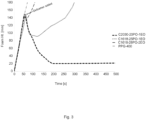
- Figure 3 clearly illustrates the superior defoaming as well as antifoaming performance of an example of an inventive compound (C2030-20PO-1EO) over an extended period of time, when compared to commercial samples.
- Figure 4 shows the defoamer performance decreases as follows: C2030-20PO-1EO > (mixture of 50/50wt% C2030-20PO-1EO/GuerbetC2426-25PO-1EO) > C2022-20PO-1EO > GuerbetC2426-25PO-1EO > GuerbetC32-15PO-1EO > GuerbetC20-20PO-1EO > GuerbetC12-32PO-3EO > C20+-30PO.
- a 2000 ml aqueous solution containing 2 500 ppm of HC100C (foaming medium) was added to a recirculating foaming apparatus and circulated at room temperature to generate foam. Once the foam height reach 30 cm, the defoamer C2030-20PO-1EO was dosed at different concentrations (100, 200, 300 and 400 ppm) while continuously circulating the foaming solution. The minimum foam height reached for each dosage was recorded and the % foam reduction calculated.
- the C2030-20PO-1EO additive exhibited superior defoaming performance over a wide range of temperatures, compared to commercial additives.
- Figure 7 illustrates the performance of an example of the described compounds in various foaming mediums, compared to the performance of commercial samples.
- the C2030-20PO-1EO additive showed superior defoaming behavior together with various foamers, when compared to commercial defoaming additives.
- An antifoaming test was performed to compare each additive's antifoaming potential and deaerating abilities to remove entrapped air by promoting liquid drainage from the lamella and bubble coalescence resulting in faster foam decay.
- An antifoaming test was performed with the Krüss DFA100 and was aimed at comparing each of the defoamer's antifoaming and deaerating abilities.
- the test was performed by pouring 40 mL of nanopure water containing 2500 ppm commercial foamer (C610-3.5EO sulfate) and 2500 ppm defoamer into the instrument's glass column. Air was then sparged from the bottom through a filter plate with pore sizes ranging from 16-40 ⁇ m at a flow rate of 0.3 L/min. Sparging was continued and foam was generated for 2 minutes or until the foam reached the maximum height of the column (210 mm). Sparging was stopped, and the foam was allowed to decay for 15 minutes.
- the test was repeated for each defoamer as well as a blank that contained no defoamer.
- the defoamers' antifoaming abilities can be determined by comparing their maximum foam heights during the 2 minute sparging period (see Table 4). Comparing the rate of foam decay as a function of foam half-life (see Figure 10), the time at which foam volume has reduced to 50% for each defoamer tested also indicated its ability at aiding in the drainage and coalescence of standing foams.
- Deaerator performance can be examined by comparing the rate of foam decay as a function of foam half- life, shown in Figures.
- Comparative deaerator performance of the additives is as follows: C2030-20PO-1 EO > PDMS, OH terminated > C1618-28PO-2EO > C1618-25PO-1EO > PPG-400.
- the ratio of moles of PO to moles of EO is from 14: 1 to 20 : 1, and preferably 20 : 1.
- Defoamers / antifoamers perform well when they are ultra-dispersible in the feed. Low particle size improves the dispersibility of the defoamer / antifoamer in the aqueous feeds. Table 5 compares the defoamers based on particle size. Table 5: Comparison of the % foam reduction and average particle size. Defoamer Foam Reduction Avg. Particle Size (micron) C 16-18 OH-28PO/2EO 28.14 67.8402 C 20-30 OH-35PO/1EO 55.83 43.5514 C 20-30 OH-14PO/1EO 71.1 13.2715 C 20-30 OH-20PO/1EO 79.93 3.9921
- the alcohol alkoxylate or alcohol alkoxylate mixture used in the present invention has a lower particle size than the prior art defoamer.
- the defoamer / antifoamer used in the present invention has an average particle size less than 45 ⁇ m, preferably less than 15 ⁇ m, and more preferably less than 4 ⁇ m.
Landscapes
- Chemical & Material Sciences (AREA)
- Health & Medical Sciences (AREA)
- Chemical Kinetics & Catalysis (AREA)
- Toxicology (AREA)
- Dispersion Chemistry (AREA)
- Organic Chemistry (AREA)
- Medicinal Chemistry (AREA)
- Polymers & Plastics (AREA)
- Engineering & Computer Science (AREA)
- Materials Engineering (AREA)
- Wood Science & Technology (AREA)
- Life Sciences & Earth Sciences (AREA)
- Degasification And Air Bubble Elimination (AREA)
- Organic Low-Molecular-Weight Compounds And Preparation Thereof (AREA)
Description
- The present invention relates to use of alcohol alkoxylates or mixtures thereof as concentrated aqueous defoamers, antifoamers and deaerators. More specifically, the alcohol alkoxylates relate to linear long chain alcohol alkoxylates, to be used as additives for foam prevention, foam destruction and deaerating in various application areas.
- In various industrial processes, occurrence of foams creates troublesome environments that could for example have a negative impact on reaction rates and prevent normal, optimised operation in general. Current methods to control foam include mechanical means such as the use of baffles and mixing control systems. In conjunction, chemical defoamers or antifoamers are often used. There are different classes of additives used in prevention, removal and mitigation of foam formation that work via differing mechanisms and are effective for different foam types (e.g. macro vs micro foams). While in principle these classes differ, the terms used to define them are often used interchangeably. In addition, many, if not most additives, do not solely perform only one function.
- Antifoams are additives that prevent or inhibit foam formation from the outset, and are typically added to a potentially foaming solution prior to foam formation. Defoamers are compounds that are added to mixtures in order to destroy foam that has already been generated, targeting surface foam (macro foam) and aiming to bring about rapid foam collapse. Deaerators function in a manner similar to defoamers, also aiming to destroy foam that has already been generated, but they target sub-surface foam (micro foam).
- Well known defoamers, antifoamers and deaerators include amongst others silicone oils as well as block copolymers of lower alkylene glycols.
US 6,534,550 describes defoamer compositions comprising alcohols, alcohol alkoxylates, emulsifier components and water to prevent and inhibit formation of foam in aqueous systems. The compositions ofUS 6,534,550 are emulsions requiring a precise mixture of a number of different components to achieve the results.US 6,562,875 describes the use of alkoxylated alcohols together with emulsifiers such as anionic surfactants as antifoamers in the paper industry. Other anti foam compositions are disclosed inWO91/00763 US6028229 . - There is however an ongoing need for stable, simple, low cost, aqueous defoamers, antifoamers and / or deaerators in concentrated form for effective application in the chemical, household and industrial process industries.
- The advantage of the compounds or mixture of compounds and their inventive use in aqueous systems, is the provision of concentrated surfactants with ultra-low particle sizes. The nature of the specific alcohol alkoxylates described result in insoluble, but ultra-dispersable surfactants for the effective defoaming, antifoaming and deaeration of aqueous feeds present in various chemical, household and industrial processes.
- The present invention relates to the use a range of alcohol alkoxylates as defoamers, antifoamers and / or deaerators for aqueous phases relating to various application areas. These include general defoaming, antifoaming and deaerating applications, specifically useful in, but not limited to, oil and gas applications, the agrochemical field, water treatment processes, as well as technology areas such as pulp and paper, fermentation, detergents, metal working fluids, paints and coatings, emulsion polymerization and construction.
- The invention specifically teaches the use of an alcohol alkoxylate or an alcohol alkoxylate mixture as a concentrated defoamer, antifoamer and / or deaerator wherein the alcohol alkoxylate or alcohol alkoxylate mixture comprises at least an alcohol alkoxylate, wherein the alcohol alkoxylate has a molecular structure as shown in [I]:
R-O-(CH2(CH3)CHO)m-(CH2CH2O)n-H [I]
- wherein R is a branched and/or linear alkyl group having from 20 to 50 carbon atoms, preferably 20 to 30 carbon atoms,
- m = 10 - 40, preferably 20-25
- n = 1 - 5, preferably 1-2.
- The ratio of moles of PO to moles of EO is from 14:1 to 20:1, and more preferably 20:1, and wherein the alcohol alkoxylate has an average particles size less than 45 µm.
- A feature of the invention is amongst others the extremely low dosing required. The alcohol alkoxylate or the alcohol alkoxylate mixture is added in a concentration of between 50 ppm and 3,000 ppm, more preferable between 100 and 2,500 ppm, and most preferable between 100 and 500 ppm.
- The compounds described in this invention display good chemical and thermal stability. The temperature of use can range between 20 and 100°C and more preferable between 20 and 80°C.
- In addition, the alcohol alkoxylates described provide excellent defoaming, antifoaming and deaerating performance in concentrated form and are highly active. The use of the alcohol alkoxylate or the alcohol alkoxylate mixture is most beneficial when no additional additives, liquids or solids, such as emulsifiers, solvents and carriers, are added.
- Additional advantages include, but are not limited, to the compounds of the invention being silicone-free, non-explosive, non-flammable, highly salt tolerant and non-corrosive.
- The invention further describes a method of defoaming and/or deaerating and/or antifoaming an aqueous foam, wherein the aqueous foam comprises an aqueous phase and a gas, and wherein the method comprises:
- i) providing a composition comprising at least:
- an alcohol alkoxylate, wherein the alcohol alkoxylate has a molecular structure as shown in [I]:
R-O-(CH2(CH3)CHO)m-(CH2CH2O)n-H [I]
- wherein R is a branched and/or linear alkyl group having from 20 to 50 carbon atoms, preferably 20 to 30 carbon atoms, m = 10 - 40, preferably 20 to 25,
- n = 1 - 5, preferably 1 to 2, and wherein the ratio of moles of propylene oxide (PO) to moles of ethylene oxide (EO) is from 14:1 to 20:1.
- an alcohol alkoxylate, wherein the alcohol alkoxylate has a molecular structure as shown in [I]:
- ii) contacting said aqueous foam with said composition whereby said aqueous foam collapses.
- The alcohol alkoxylate or alcohol alkoxylate mixture used in the present invention has an average particle size less than 45µm, preferably less than 15 µm, and most preferably less than 4 µm. The low particle size improves the dispersibility of the defoamer / antifoamer in the aqueous feeds, resulting in easily dispersable compounds with minimal mixing or agitation required.
- Unlike the prior art, the present invention uses a concentrate defoamer which does not require emulsifiers or the like to achieve foam reduction / prevention.
-
-
Fig. 1 shows a comparison of foam height reduction after dosages of additives. -
Fig. 2 shows a comparison of final foam heights after dosages of additives. -
Fig. 3 shows the defoaming performance of various defoamers. -
Fig. 4 shows the foam reduction achieved by various defoamers at a dosage of 500 ppm. -
Fig. 5 shows the defoaming performance of C2030-20PO-1EO at various dosages. -
Fig. 6 shows the defoaming performance of C2030-20PO-1EO at various temperatures. -
Fig. 7 shows the performance of defoaming agents compared to commercial samples. -
Fig. 8 shows the half-life for various defoamers. -
Fig. 9 shows the performance of defoamers with various numbers of PO and EO units. - The surfactants used in the present disclosure are effective defoamers, antifoamers and/ or deaerators for a wide variety of aqueous phases. The performance of the compositions can be optimally designed by tailoring the hydrophobe structures of the compounds, together with the number of propylene oxide (PO) and / or ethylene oxide (EO) units, for a specific application area.
- A number of surfactants, namely alkoxylated alcohols, were synthesized according to standard procedures (see Experimental section) and their properties characterized.
- The materials used in various tests to determine efficiency of compounds as defoamers / antifoamers / deaerators are shown in Table 1:
Table 1: Materials used to evaluate defoaming / antifoaming / deaerating properties Alcohol Trade Name Alcohol carbon chain length Alcohol structure Number of propylene oxide units (PO) Number of ethylene oxide units (EO) ALFOL20+ C20-30 linear 35 5 ALFOL20+ C20-30 linear 35 1 ALFOL20+ C20-30 linear 35 0 ALFOL20+ C20-30 linear 20 1 ALFOL20+ C20-30 linear 19 2.5 ALFOL20+ C20-30 linear 19 0 ALFOL20+ C20-30 linear 14 5 ALFOL20+ C20-30 linear 14 1 ALFOL20+ C20-30 linear 14 0 UNILIN alcohol C20+ linear 30 0 Behenyl Alcohol C20-22 linear 20 1 ISOFOL12 C12 (Guerbet) 100% 2-alkyl branched (1.0 branch / molecule) 32 3 ISOFOL20 C20 (Guerbet) 100% 2-alkyl branched (1.0 branch / molecule) 20 1 SAFOL23 C24-26 50% branched (2.16 branch / molecule) 25 1 ISOFOL32 C32 (Guerbet) 100% 2-alkyl branched (1.0 branch / molecule) 15 1 - All examples represented by trade names above are marketed by Sasol Performance Chemicals, except UNILIN which was sourced from Baker Hughes.
- Table 2 shows the commercial prior art defoamers that were used for comparative experiments.
Table 2: Defoamers used for comparative examples Name Description Alcohol Structure BASOPUR DF 5* C1618 - 28PO-2EO Linear EMULDAC 251 PE** C1618-25PO-1EO Linear PDMS (OH terminated) Polydimethylsiloxane (MW = 550 - 3,200 Da) N/ A Carpol PGP 400*** Polypropylene glycol (PPG-400_ Mol wt = 400 Da N/A Polypropylene glycol (PPG-900) Mol wt = 900 Da N/A *Sold by BASF
**Sold by Sasol Performance Chemicals
***Sold by Carpenter. - Table 3 lists the foamers that were used for the various defoaming experiments.
Table 3: Commercial foamers used for defoaming experiments NAME DESCRIPTION HF100C* C610-3.5EO Sulfate Coconut DEA Coconut diethanolamide CAPB Cocamidopropyl Betaine C12-16 APG C12-16 alkyl polyglycoside C12 LAS C12 linear alkylate sulfate *Available from Thatcher Chemicals - Alcohols ranging from C12-32 were propoxylated and ethoxylated utilizing wellknown alkoxylation catalysts such as double metal cyanide (DMC) or KOH catalysts. Each alcohol product was targeted to consist of between 10 to 40 moles of propylene oxide and 0-5 mole of ethylene oxide. The samples were prepared in a 600 ml Parr reactor using the alkoxylation catalyst of choice. Each alcohol was propoxylated using purified propylene oxide at 130-150 °C and 40- 60 psig and then ethoxylated using purified ethylene oxide at 150-160 °C and 40-60 psig in a single, continuous run. (1 psi = 0.07 bar).
- The first test parameters aimed to compare additives' ability to destroy stable surface foam and act as a true defoamer.
- The foam reduction test was aimed at comparing each defoamer's ability to knockdown or destroy foam that has already been generated. The test was performed by pouring 40 ml of nanopure water containing 2500 ppm commercial foamer (C610-3.5EO Sulfate) into the glass column of the foam analyzer. The solution was stirred for 30 seconds at 8000 rpm to generate foam. Stirring was stopped, and the foam was allowed to stabilize for 1 minute. After 1 minute, initial foam height was recorded and defoamer was added to the foamed solution at 2500 ppm. The solution was stirred for 1 minute at 8000 rpm and stopped. The foam was allowed to stabilize for 30 seconds, and final foam height was recorded. The test was repeated for each of the defoamers. A blank was also performed utilizing the same procedure except no defoamer was added. The total percentage of foam reduction from initial foam height to final foam height was calculated for each defoamer (see
Figure 1 ). Final foam heights (seeFigure 2 ) were also compared for all defoamers and the blank. -
Figures 1 and2 show the defoamer performance decreases as follows: C2030-20PO-1EO > C1618-25PO-1EO> C1618-28PO-2EO> PDMS, OH terminated >PPG 400. - A 40 ml solution containing 2500 ppm of HF100C (610-3.5EO sulfate - AES) in DI-
H 20 was added to the Kruss foam analyzer and sparged with air at a rate of 0.2 L/min. through a bottom fritted disc with an average pore size of 100-160 µm. Once the foam height reached ~ 150 mm, while continuing the air sparge, 2500 ppm of defoamer was added to the solution. Sparging was continued until a total sparge time of 500 seconds had elapsed or the foam height had reached the maximum capacity of the Kruss instrument. This test allowed for evaluation of the amount of initial foam knock-down immediately following the addition of defoamer (defoaming) along with the defoamer's ability to maintain this initial knock-down over time (antifoaming). -
Figure 3 clearly illustrates the superior defoaming as well as antifoaming performance of an example of an inventive compound (C2030-20PO-1EO) over an extended period of time, when compared to commercial samples. - Experiment 3: The same experimental procedure as described for Experiment 1 was used.
Figure 4 compares foam height reduction after a 500 ppm dosage of various additives, respectively. -
Figure 4 shows the defoamer performance decreases as follows:
C2030-20PO-1EO > (mixture of 50/50wt% C2030-20PO-1EO/GuerbetC2426-25PO-1EO) > C2022-20PO-1EO > GuerbetC2426-25PO-1EO > GuerbetC32-15PO-1EO > GuerbetC20-20PO-1EO > GuerbetC12-32PO-3EO > C20+-30PO. - The maximum defoaming performance obtained by different dosage rates of C2030-20PO-1EO after the lapse of an extended time period was compared.
- A 2000 ml aqueous solution containing 2 500 ppm of HC100C (foaming medium) was added to a recirculating foaming apparatus and circulated at room temperature to generate foam. Once the foam height reach 30 cm, the defoamer C2030-20PO-1EO was dosed at different concentrations (100, 200, 300 and 400 ppm) while continuously circulating the foaming solution. The minimum foam height reached for each dosage was recorded and the % foam reduction calculated.
- It follows that even at low dosage rates as 100 ppm, the described additives still exhibit superior performance.
- The same experimental procedure as used for Experiment 4 was followed.
Figure 8 compares the effectiveness of defoaming behavior of the described compounds to commercial samples at different temperatures after extended time periods. - As described in the experimental method, when no additional change in defoaming performance were observed. The C2030-20PO-1EO additive exhibited superior defoaming performance over a wide range of temperatures, compared to commercial additives.
- The same experimental procedure as used for Experiment 4 was followed.
Figure 7 illustrates the performance of an example of the described compounds in various foaming mediums, compared to the performance of commercial samples. - The C2030-20PO-1EO additive showed superior defoaming behavior together with various foamers, when compared to commercial defoaming additives.
- An antifoaming test was performed to compare each additive's antifoaming potential and deaerating abilities to remove entrapped air by promoting liquid drainage from the lamella and bubble coalescence resulting in faster foam decay.
- An antifoaming test was performed with the Krüss DFA100 and was aimed at comparing each of the defoamer's antifoaming and deaerating abilities. The test was performed by pouring 40 mL of nanopure water containing 2500 ppm commercial foamer (C610-3.5EO sulfate) and 2500 ppm defoamer into the instrument's glass column. Air was then sparged from the bottom through a filter plate with pore sizes ranging from 16-40 µm at a flow rate of 0.3 L/min. Sparging was continued and foam was generated for 2 minutes or until the foam reached the maximum height of the column (210 mm). Sparging was stopped, and the foam was allowed to decay for 15 minutes. The test was repeated for each defoamer as well as a blank that contained no defoamer. The defoamers' antifoaming abilities can be determined by comparing their maximum foam heights during the 2 minute sparging period (see Table 4). Comparing the rate of foam decay as a function of foam half-life (see Figure 10), the time at which foam volume has reduced to 50% for each defoamer tested also indicated its ability at aiding in the drainage and coalescence of standing foams.
Table 4: Comparison of the maximum foam height reached with various defoamers Defoamer Maximum Foam Height (mm) C2030-20PO-1EO 153.5 C1618-28PO-2EO 213.0 PDMS (OH Terminated) 213.1 PPG-400 213.6 C1618-25PO-1EO 213.6 BLANK 214.4 - Table 4 shows that C2030-20PO-1EO was the only observable additive to exhibit enhanced antifoaming properties. It was the only additive tested where the maximum foam height (153.5 mm) did not reach the 210 mm foam height set point which triggered an automatic shutdown of foam formation.
- Deaerator performance can be examined by comparing the rate of foam decay as a function of foam half- life, shown in Figures.
- Comparative deaerator performance of the additives is as follows: C2030-20PO-1 EO > PDMS, OH terminated > C1618-28PO-2EO > C1618-25PO-1EO > PPG-400.
- Using the experimental procedure as described for Experiment 3, variation of the number of PO and EO units, using the same hydrophobe, aimed to compare each additive's ability to destroy stable surface foam and to act as a true defoamer by optimizing the PO/EO balance.
Figure 9 depicts a comparison offoam height reduction after dosage of each additive, respectively. - The results show that the defoamer C2030-20PO-1EO performed the best, but all defoamers were able to reduce the foam to a significant extent. The ratio of moles of PO to moles of EO is from 14: 1 to 20 : 1, and preferably 20 : 1.
- Defoamers / antifoamers perform well when they are ultra-dispersible in the feed. Low particle size improves the dispersibility of the defoamer / antifoamer in the aqueous feeds. Table 5 compares the defoamers based on particle size.
Table 5: Comparison of the % foam reduction and average particle size. Defoamer Foam Reduction Avg. Particle Size (micron) C16-18OH-28PO/2EO 28.14 67.8402 C20-30OH-35PO/1EO 55.83 43.5514 C20-30OH-14PO/1EO 71.1 13.2715 C20-30OH-20PO/1EO 79.93 3.9921 - As can be seen, the alcohol alkoxylate or alcohol alkoxylate mixture used in the present invention has a lower particle size than the prior art defoamer. The defoamer / antifoamer used in the present invention has an average particle size less than 45µm, preferably less than 15 µm, and more preferably less than 4 µm.
Claims (11)
- The use of an alcohol alkoxylate or an alcohol alkoxylate mixture as a concentrated defoamer, antifoamer and / or deaerator wherein the alcohol alkoxylate or alcohol alkoxylate mixture comprises at least:
an alcohol alkoxylate, wherein said alcohol alkoxylate has a molecular structure as shown in [I]:
R-O-(CH2(CH3)CHO)m-(CH2CH2O)n-H [I]
whereinR is a branched and / or linear alkyl group having from 20 to 50carbon atoms,m = 10 - 40, andn = 1 - 5; andwherein the ratio of moles of propylene oxide (PO) to moles of ethylene oxide (EO) is from 14:1 to 20:1; andwherein the alcohol alkoxylate has an average particle size less than 45 µm. - The use of the alcohol alkoxylate or the alcohol alkoxylate mixture of claim 1 wherein R is a branched alkyl group.
- The use of the alcohol alkoxylate or the alcohol alkoxylate mixture of claim 1 wherein R is a linear alkyl group.
- The use of the alcohol alkoxylate or the alcohol alkoxylate mixture of any of claims 1 or 2 wherein R has 20 to 30 carbon atoms.
- The use of the alcohol alkoxylate or the alcohol alkoxylate mixture of any of the claims above wherein m = 20 to 25 and n = 1 to 2.
- The use of the alcohol alkoxylate or the alcohol alkoxylate mixture of any of the claims above wherein the ratio of moles of PO to moles of EO is 20:1.
- The use of the alcohol alkoxylate or the alcohol alkoxylate mixture of any of the claims above wherein the alcohol alkoxylate has an average particle size less than 15 µm, preferably less than 4 µm.
- The use of the alcohol alkoxylate or the alcohol alkoxylate mixture of any of the claims above wherein the alcohol alkoxylate or the alcohol alkoxylate mixture is added in a concentration of between 50 ppm and 3 000 ppm, more preferably between 100 and 2 500 ppm, most preferably between 100 and 500 ppm.
- The use of the alcohol alkoxylate or the alcohol alkoxylate mixture of any of the claims above wherein the temperature ranges between 20 and 100°C, more preferably between 25 and 80°C.
- The use of the alcohol alkoxylate or the alcohol alkoxylate mixture of any of the claims above wherein no additional additives, liquids or solids are added.
- A method of defoaming an aqueous foam, said aqueous foam comprising an aqueous phase and a gas, or preventing foaming in an aqueous material or deaerating an aqueous material, said method comprising:
providing a composition comprising at least:an alcohol alkoxylate, wherein said alcohol alkoxylate has a molecular structure as shown in [I]:
R-O-(CH2(CH3)CHO)m-(CH2CH2O)n-H [I]
wherein R is a branched and/or linear alkyl group having from 20 to 50 carbon atoms, m = 10 - 40,n = 1 - 5, andwherein the ratio of moles of propylene oxide (PO) to moles of ethylene oxide (EO) is from 14:1 to 20:1; andwherein the alcohol alkoxylate has an average particle size less than 45 µm;contacting the aqueous foam or the aqueous material with said composition.
Priority Applications (1)
| Application Number | Priority Date | Filing Date | Title |
|---|---|---|---|
| HRP20240387TT HRP20240387T1 (en) | 2019-05-03 | 2020-05-01 | USE OF ALCOHOL ALKOXYLATE MIXTURES AS CONCENTRATED AQUEOUS FOAMING AGENTS |
Applications Claiming Priority (2)
| Application Number | Priority Date | Filing Date | Title |
|---|---|---|---|
| US201962842669P | 2019-05-03 | 2019-05-03 | |
| PCT/US2020/030938 WO2020227056A1 (en) | 2019-05-03 | 2020-05-01 | Alcohol alkoxylate mixtures as concentrated aqueous defoamers |
Publications (2)
| Publication Number | Publication Date |
|---|---|
| EP3962624A1 EP3962624A1 (en) | 2022-03-09 |
| EP3962624B1 true EP3962624B1 (en) | 2023-12-20 |
Family
ID=70779928
Family Applications (1)
| Application Number | Title | Priority Date | Filing Date |
|---|---|---|---|
| EP20727497.8A Active EP3962624B1 (en) | 2019-05-03 | 2020-05-01 | Use of alcohol alkoxylate mixtures as concentrated aqueous defoamers |
Country Status (13)
| Country | Link |
|---|---|
| US (1) | US20230094741A1 (en) |
| EP (1) | EP3962624B1 (en) |
| CN (2) | CN114126735A (en) |
| AR (1) | AR118832A1 (en) |
| AU (1) | AU2020268823B2 (en) |
| CA (1) | CA3138660A1 (en) |
| DK (1) | DK3962624T3 (en) |
| ES (1) | ES2974659T3 (en) |
| FI (1) | FI3962624T3 (en) |
| HR (1) | HRP20240387T1 (en) |
| MX (1) | MX2021013169A (en) |
| PL (1) | PL3962624T3 (en) |
| WO (1) | WO2020227056A1 (en) |
Families Citing this family (2)
| Publication number | Priority date | Publication date | Assignee | Title |
|---|---|---|---|---|
| WO2024173679A2 (en) * | 2023-02-15 | 2024-08-22 | Viridis Chemical, Llc | Ethyl acetate production and purification |
| US12534686B2 (en) | 2023-08-25 | 2026-01-27 | Reckitt & Colman (Overseas) Hygiene Home Limited | Cooktop cleaning formulations |
Family Cites Families (7)
| Publication number | Priority date | Publication date | Assignee | Title |
|---|---|---|---|---|
| DE2532888C3 (en) * | 1975-07-23 | 1981-07-09 | Basf Ag, 6700 Ludwigshafen | Fabric deaerator for paper manufacture |
| US4445971A (en) * | 1980-06-23 | 1984-05-01 | Economics Laboratory, Inc. | Methods of foam inhibition or depression |
| IL95029A0 (en) * | 1989-07-12 | 1991-06-10 | Gaf Chemicals Corp | Low viscosity defoaming/antifoaming formulations |
| DE19500842C2 (en) * | 1995-01-13 | 1996-12-19 | Henkel Kgaa | Process for the preparation of end-capped nonionic surfactants |
| US6534550B1 (en) | 2000-03-29 | 2003-03-18 | Gerald C. Walterick, Jr. | Foam control composition and method for controlling foam in aqueous systems |
| US6562875B1 (en) | 2001-08-30 | 2003-05-13 | Ondeo Nalco Company | Aqueous defoamer composition |
| WO2005105260A1 (en) * | 2004-04-23 | 2005-11-10 | Champion Technologies, Inc. | Method of using a defoamer |
-
2020
- 2020-04-30 AR ARP200101234A patent/AR118832A1/en active IP Right Grant
- 2020-05-01 EP EP20727497.8A patent/EP3962624B1/en active Active
- 2020-05-01 CA CA3138660A patent/CA3138660A1/en active Pending
- 2020-05-01 WO PCT/US2020/030938 patent/WO2020227056A1/en not_active Ceased
- 2020-05-01 AU AU2020268823A patent/AU2020268823B2/en active Active
- 2020-05-01 FI FIEP20727497.8T patent/FI3962624T3/en active
- 2020-05-01 MX MX2021013169A patent/MX2021013169A/en unknown
- 2020-05-01 CN CN202080048035.6A patent/CN114126735A/en active Pending
- 2020-05-01 ES ES20727497T patent/ES2974659T3/en active Active
- 2020-05-01 HR HRP20240387TT patent/HRP20240387T1/en unknown
- 2020-05-01 DK DK20727497.8T patent/DK3962624T3/en active
- 2020-05-01 US US17/607,748 patent/US20230094741A1/en active Pending
- 2020-05-01 CN CN202410785286.2A patent/CN118718477A/en active Pending
- 2020-05-01 PL PL20727497.8T patent/PL3962624T3/en unknown
Also Published As
| Publication number | Publication date |
|---|---|
| WO2020227056A8 (en) | 2021-11-18 |
| EP3962624A1 (en) | 2022-03-09 |
| PL3962624T3 (en) | 2024-07-01 |
| AU2020268823A1 (en) | 2021-11-18 |
| CN114126735A (en) | 2022-03-01 |
| AR118832A1 (en) | 2021-11-03 |
| ES2974659T3 (en) | 2024-07-01 |
| DK3962624T3 (en) | 2024-03-18 |
| WO2020227056A1 (en) | 2020-11-12 |
| HRP20240387T1 (en) | 2024-06-07 |
| AU2020268823B2 (en) | 2026-01-08 |
| US20230094741A1 (en) | 2023-03-30 |
| CN118718477A (en) | 2024-10-01 |
| FI3962624T3 (en) | 2024-03-19 |
| CA3138660A1 (en) | 2020-11-12 |
| MX2021013169A (en) | 2022-03-17 |
Similar Documents
| Publication | Publication Date | Title |
|---|---|---|
| US3990905A (en) | Food process antifoam | |
| EA018168B1 (en) | Composition for producing foams from liquids, process for extracting mineral oil and/or natural gas, process for tertiary mineral oil production process and process for drilling technique that employs foamed drilling fluid | |
| AU2020268823B2 (en) | Alcohol alkoxylate mixtures as concentrated aqueous defoamers | |
| Abd El‐Ghaffar et al. | Synthesis, characterization, and evaluation of ethoxylated lauryl‐myrisityl alcohol nonionic surfactants as wetting agents, anti‐foamers, and minimum film forming temperature reducers in emulsion polymer lattices | |
| EP0213518B1 (en) | Anti-foam agents for polymer dispersions | |
| KR20020087445A (en) | Foam control composition and method for controlling foam in aqueous systems | |
| CN100396353C (en) | A method for suppressing foaming in an aqueous system | |
| BRPI0415391B1 (en) | Alkoxylate mixture, process for preparation thereof, use of an alkoxylate mixture, and, product | |
| US4753885A (en) | Foam control in the sugar industry and in the yeast industry | |
| FI53662C (en) | EXHAUST SYSTEM FOR IMMEDIATE EXHAUST SYSTEMS | |
| EP3233750A1 (en) | Ultra-high salinity surfactant formulation | |
| KR101925666B1 (en) | A method to treat flushing liquor systems in coke plants | |
| WO1997010889A1 (en) | Use of stearic acid esters of polypropylene glycol to control foam | |
| RU2822066C2 (en) | Mixtures of alkoxylates of alcohols as concentrated aqueous antifoaming agents | |
| EP0809527A1 (en) | Dispersions with optionally esterified (poly)glycerine polyglycol ethers | |
| GB2244279A (en) | Fluorosilicone anti-foam additive | |
| US4692267A (en) | Use of polymers of alkylvinyl ethers to prevent or eliminate foam on aqueous media | |
| EP4232413A1 (en) | Wastewater foam control agent | |
| WO1998003243A1 (en) | Use as antifoaming agents of ethylene oxide - propylene oxide addition compounds of glycerol or polyglycerol reacted with alpha-olefin epoxides | |
| EP4232592A1 (en) | Foam control agent | |
| US12590414B2 (en) | Paper and pulp foam control agent | |
| JP3601194B2 (en) | Defoamer | |
| JPH01231909A (en) | Antifoaming agent and antifoaming process | |
| JPH0366933B2 (en) | ||
| RU2785996C2 (en) | New anti-foaming compositions for thermal water desalination |
Legal Events
| Date | Code | Title | Description |
|---|---|---|---|
| REG | Reference to a national code |
Ref country code: HR Ref legal event code: TUEP Ref document number: P20240387T Country of ref document: HR |
|
| STAA | Information on the status of an ep patent application or granted ep patent |
Free format text: STATUS: UNKNOWN |
|
| STAA | Information on the status of an ep patent application or granted ep patent |
Free format text: STATUS: THE INTERNATIONAL PUBLICATION HAS BEEN MADE |
|
| PUAI | Public reference made under article 153(3) epc to a published international application that has entered the european phase |
Free format text: ORIGINAL CODE: 0009012 |
|
| STAA | Information on the status of an ep patent application or granted ep patent |
Free format text: STATUS: REQUEST FOR EXAMINATION WAS MADE |
|
| 17P | Request for examination filed |
Effective date: 20211125 |
|
| AK | Designated contracting states |
Kind code of ref document: A1 Designated state(s): AL AT BE BG CH CY CZ DE DK EE ES FI FR GB GR HR HU IE IS IT LI LT LU LV MC MK MT NL NO PL PT RO RS SE SI SK SM TR |
|
| DAV | Request for validation of the european patent (deleted) | ||
| DAX | Request for extension of the european patent (deleted) | ||
| STAA | Information on the status of an ep patent application or granted ep patent |
Free format text: STATUS: EXAMINATION IS IN PROGRESS |
|
| 17Q | First examination report despatched |
Effective date: 20221109 |
|
| P01 | Opt-out of the competence of the unified patent court (upc) registered |
Effective date: 20230502 |
|
| GRAP | Despatch of communication of intention to grant a patent |
Free format text: ORIGINAL CODE: EPIDOSNIGR1 |
|
| STAA | Information on the status of an ep patent application or granted ep patent |
Free format text: STATUS: GRANT OF PATENT IS INTENDED |
|
| INTG | Intention to grant announced |
Effective date: 20230628 |
|
| GRAS | Grant fee paid |
Free format text: ORIGINAL CODE: EPIDOSNIGR3 |
|
| GRAA | (expected) grant |
Free format text: ORIGINAL CODE: 0009210 |
|
| STAA | Information on the status of an ep patent application or granted ep patent |
Free format text: STATUS: THE PATENT HAS BEEN GRANTED |
|
| AK | Designated contracting states |
Kind code of ref document: B1 Designated state(s): AL AT BE BG CH CY CZ DE DK EE ES FI FR GB GR HR HU IE IS IT LI LT LU LV MC MK MT NL NO PL PT RO RS SE SI SK SM TR |
|
| REG | Reference to a national code |
Ref country code: GB Ref legal event code: FG4D |
|
| REG | Reference to a national code |
Ref country code: DE Ref legal event code: R096 Ref document number: 602020023068 Country of ref document: DE |
|
| REG | Reference to a national code |
Ref country code: CH Ref legal event code: EP |
|
| REG | Reference to a national code |
Ref country code: IE Ref legal event code: FG4D |
|
| REG | Reference to a national code |
Ref country code: DK Ref legal event code: T3 Effective date: 20240312 |
|
| REG | Reference to a national code |
Ref country code: FI Ref legal event code: FGE |
|
| REG | Reference to a national code |
Ref country code: NL Ref legal event code: FP |
|
| REG | Reference to a national code |
Ref country code: SE Ref legal event code: TRGR |
|
| PG25 | Lapsed in a contracting state [announced via postgrant information from national office to epo] |
Ref country code: GR Free format text: LAPSE BECAUSE OF FAILURE TO SUBMIT A TRANSLATION OF THE DESCRIPTION OR TO PAY THE FEE WITHIN THE PRESCRIBED TIME-LIMIT Effective date: 20240321 |
|
| RAP2 | Party data changed (patent owner data changed or rights of a patent transferred) |
Owner name: SASOL CHEMIE GMBH & CO. KG |
|
| REG | Reference to a national code |
Ref country code: LT Ref legal event code: MG9D |
|
| PG25 | Lapsed in a contracting state [announced via postgrant information from national office to epo] |
Ref country code: LT Free format text: LAPSE BECAUSE OF FAILURE TO SUBMIT A TRANSLATION OF THE DESCRIPTION OR TO PAY THE FEE WITHIN THE PRESCRIBED TIME-LIMIT Effective date: 20231220 |
|
| PG25 | Lapsed in a contracting state [announced via postgrant information from national office to epo] |
Ref country code: LT Free format text: LAPSE BECAUSE OF FAILURE TO SUBMIT A TRANSLATION OF THE DESCRIPTION OR TO PAY THE FEE WITHIN THE PRESCRIBED TIME-LIMIT Effective date: 20231220 Ref country code: GR Free format text: LAPSE BECAUSE OF FAILURE TO SUBMIT A TRANSLATION OF THE DESCRIPTION OR TO PAY THE FEE WITHIN THE PRESCRIBED TIME-LIMIT Effective date: 20240321 Ref country code: BG Free format text: LAPSE BECAUSE OF FAILURE TO SUBMIT A TRANSLATION OF THE DESCRIPTION OR TO PAY THE FEE WITHIN THE PRESCRIBED TIME-LIMIT Effective date: 20240320 |
|
| REG | Reference to a national code |
Ref country code: NL Ref legal event code: PD Owner name: SASOL CHEMIE GMBH & CO. KG; DE Free format text: DETAILS ASSIGNMENT: CHANGE OF OWNER(S), ASSIGNMENT; FORMER OWNER NAME: SASOL CHEMICALS GMBH Effective date: 20240410 |
|
| REG | Reference to a national code |
Ref country code: SK Ref legal event code: T3 Ref document number: E 43731 Country of ref document: SK |
|
| REG | Reference to a national code |
Ref country code: HR Ref legal event code: ODRP Ref document number: P20240387T Country of ref document: HR Payment date: 20240418 Year of fee payment: 5 |
|
| PG25 | Lapsed in a contracting state [announced via postgrant information from national office to epo] |
Ref country code: RS Free format text: LAPSE BECAUSE OF FAILURE TO SUBMIT A TRANSLATION OF THE DESCRIPTION OR TO PAY THE FEE WITHIN THE PRESCRIBED TIME-LIMIT Effective date: 20231220 Ref country code: LV Free format text: LAPSE BECAUSE OF FAILURE TO SUBMIT A TRANSLATION OF THE DESCRIPTION OR TO PAY THE FEE WITHIN THE PRESCRIBED TIME-LIMIT Effective date: 20231220 |
|
| REG | Reference to a national code |
Ref country code: HR Ref legal event code: T1PR Ref document number: P20240387 Country of ref document: HR |
|
| REG | Reference to a national code |
Ref country code: BE Ref legal event code: PD Owner name: SASOL CHEMIE GMBH & CO. KG; DE Free format text: DETAILS ASSIGNMENT: CHANGE OF OWNER(S), ASSIGNMENT; FORMER OWNER NAME: SASOL CHEMICALS GMBH Effective date: 20240416 |
|
| PG25 | Lapsed in a contracting state [announced via postgrant information from national office to epo] |
Ref country code: IS Free format text: LAPSE BECAUSE OF FAILURE TO SUBMIT A TRANSLATION OF THE DESCRIPTION OR TO PAY THE FEE WITHIN THE PRESCRIBED TIME-LIMIT Effective date: 20240420 |
|
| REG | Reference to a national code |
Ref country code: ES Ref legal event code: FG2A Ref document number: 2974659 Country of ref document: ES Kind code of ref document: T3 Effective date: 20240701 |
|
| PG25 | Lapsed in a contracting state [announced via postgrant information from national office to epo] |
Ref country code: CZ Free format text: LAPSE BECAUSE OF FAILURE TO SUBMIT A TRANSLATION OF THE DESCRIPTION OR TO PAY THE FEE WITHIN THE PRESCRIBED TIME-LIMIT Effective date: 20231220 |
|
| PG25 | Lapsed in a contracting state [announced via postgrant information from national office to epo] |
Ref country code: SM Free format text: LAPSE BECAUSE OF FAILURE TO SUBMIT A TRANSLATION OF THE DESCRIPTION OR TO PAY THE FEE WITHIN THE PRESCRIBED TIME-LIMIT Effective date: 20231220 Ref country code: IS Free format text: LAPSE BECAUSE OF FAILURE TO SUBMIT A TRANSLATION OF THE DESCRIPTION OR TO PAY THE FEE WITHIN THE PRESCRIBED TIME-LIMIT Effective date: 20240420 Ref country code: EE Free format text: LAPSE BECAUSE OF FAILURE TO SUBMIT A TRANSLATION OF THE DESCRIPTION OR TO PAY THE FEE WITHIN THE PRESCRIBED TIME-LIMIT Effective date: 20231220 Ref country code: CZ Free format text: LAPSE BECAUSE OF FAILURE TO SUBMIT A TRANSLATION OF THE DESCRIPTION OR TO PAY THE FEE WITHIN THE PRESCRIBED TIME-LIMIT Effective date: 20231220 |
|
| PG25 | Lapsed in a contracting state [announced via postgrant information from national office to epo] |
Ref country code: PT Free format text: LAPSE BECAUSE OF FAILURE TO SUBMIT A TRANSLATION OF THE DESCRIPTION OR TO PAY THE FEE WITHIN THE PRESCRIBED TIME-LIMIT Effective date: 20240422 |
|
| REG | Reference to a national code |
Ref country code: AT Ref legal event code: PC Ref document number: 1642012 Country of ref document: AT Kind code of ref document: T Owner name: SASOL CHEMICALS GMBH & CO. KG, DE Effective date: 20240617 |
|
| PG25 | Lapsed in a contracting state [announced via postgrant information from national office to epo] |
Ref country code: PT Free format text: LAPSE BECAUSE OF FAILURE TO SUBMIT A TRANSLATION OF THE DESCRIPTION OR TO PAY THE FEE WITHIN THE PRESCRIBED TIME-LIMIT Effective date: 20240422 |
|
| REG | Reference to a national code |
Ref country code: DE Ref legal event code: R097 Ref document number: 602020023068 Country of ref document: DE |
|
| PLBE | No opposition filed within time limit |
Free format text: ORIGINAL CODE: 0009261 |
|
| STAA | Information on the status of an ep patent application or granted ep patent |
Free format text: STATUS: NO OPPOSITION FILED WITHIN TIME LIMIT |
|
| PG25 | Lapsed in a contracting state [announced via postgrant information from national office to epo] |
Ref country code: SI Free format text: LAPSE BECAUSE OF FAILURE TO SUBMIT A TRANSLATION OF THE DESCRIPTION OR TO PAY THE FEE WITHIN THE PRESCRIBED TIME-LIMIT Effective date: 20231220 |
|
| PG25 | Lapsed in a contracting state [announced via postgrant information from national office to epo] |
Ref country code: SI Free format text: LAPSE BECAUSE OF FAILURE TO SUBMIT A TRANSLATION OF THE DESCRIPTION OR TO PAY THE FEE WITHIN THE PRESCRIBED TIME-LIMIT Effective date: 20231220 |
|
| REG | Reference to a national code |
Ref country code: AT Ref legal event code: UEP Ref document number: 1642012 Country of ref document: AT Kind code of ref document: T Effective date: 20231220 |
|
| 26N | No opposition filed |
Effective date: 20240923 |
|
| PG25 | Lapsed in a contracting state [announced via postgrant information from national office to epo] |
Ref country code: MC Free format text: LAPSE BECAUSE OF FAILURE TO SUBMIT A TRANSLATION OF THE DESCRIPTION OR TO PAY THE FEE WITHIN THE PRESCRIBED TIME-LIMIT Effective date: 20231220 |
|
| PG25 | Lapsed in a contracting state [announced via postgrant information from national office to epo] |
Ref country code: LU Free format text: LAPSE BECAUSE OF NON-PAYMENT OF DUE FEES Effective date: 20240501 |
|
| PG25 | Lapsed in a contracting state [announced via postgrant information from national office to epo] |
Ref country code: MC Free format text: LAPSE BECAUSE OF FAILURE TO SUBMIT A TRANSLATION OF THE DESCRIPTION OR TO PAY THE FEE WITHIN THE PRESCRIBED TIME-LIMIT Effective date: 20231220 Ref country code: LU Free format text: LAPSE BECAUSE OF NON-PAYMENT OF DUE FEES Effective date: 20240501 |
|
| PG25 | Lapsed in a contracting state [announced via postgrant information from national office to epo] |
Ref country code: IE Free format text: LAPSE BECAUSE OF NON-PAYMENT OF DUE FEES Effective date: 20240501 |
|
| REG | Reference to a national code |
Ref country code: HR Ref legal event code: ODRP Ref document number: P20240387 Country of ref document: HR Payment date: 20250506 Year of fee payment: 6 |
|
| PGFP | Annual fee paid to national office [announced via postgrant information from national office to epo] |
Ref country code: NL Payment date: 20250526 Year of fee payment: 6 |
|
| PGFP | Annual fee paid to national office [announced via postgrant information from national office to epo] |
Ref country code: FI Payment date: 20250526 Year of fee payment: 6 |
|
| PGFP | Annual fee paid to national office [announced via postgrant information from national office to epo] |
Ref country code: PL Payment date: 20250506 Year of fee payment: 6 Ref country code: DE Payment date: 20250529 Year of fee payment: 6 |
|
| PGFP | Annual fee paid to national office [announced via postgrant information from national office to epo] |
Ref country code: GB Payment date: 20250527 Year of fee payment: 6 Ref country code: ES Payment date: 20250602 Year of fee payment: 6 Ref country code: DK Payment date: 20250526 Year of fee payment: 6 |
|
| PGFP | Annual fee paid to national office [announced via postgrant information from national office to epo] |
Ref country code: NO Payment date: 20250530 Year of fee payment: 6 |
|
| PGFP | Annual fee paid to national office [announced via postgrant information from national office to epo] |
Ref country code: IT Payment date: 20250521 Year of fee payment: 6 Ref country code: BE Payment date: 20250527 Year of fee payment: 6 |
|
| PGFP | Annual fee paid to national office [announced via postgrant information from national office to epo] |
Ref country code: HR Payment date: 20250506 Year of fee payment: 6 |
|
| PGFP | Annual fee paid to national office [announced via postgrant information from national office to epo] |
Ref country code: FR Payment date: 20250526 Year of fee payment: 6 |
|
| PGFP | Annual fee paid to national office [announced via postgrant information from national office to epo] |
Ref country code: CH Payment date: 20250601 Year of fee payment: 6 |
|
| PGFP | Annual fee paid to national office [announced via postgrant information from national office to epo] |
Ref country code: RO Payment date: 20250506 Year of fee payment: 6 Ref country code: AT Payment date: 20250505 Year of fee payment: 6 |
|
| PGFP | Annual fee paid to national office [announced via postgrant information from national office to epo] |
Ref country code: TR Payment date: 20250502 Year of fee payment: 6 Ref country code: SK Payment date: 20250502 Year of fee payment: 6 |
|
| PGFP | Annual fee paid to national office [announced via postgrant information from national office to epo] |
Ref country code: SE Payment date: 20250527 Year of fee payment: 6 |
|
| PG25 | Lapsed in a contracting state [announced via postgrant information from national office to epo] |
Ref country code: CY Free format text: LAPSE BECAUSE OF FAILURE TO SUBMIT A TRANSLATION OF THE DESCRIPTION OR TO PAY THE FEE WITHIN THE PRESCRIBED TIME-LIMIT; INVALID AB INITIO Effective date: 20200501 |
|
| PG25 | Lapsed in a contracting state [announced via postgrant information from national office to epo] |
Ref country code: HU Free format text: LAPSE BECAUSE OF FAILURE TO SUBMIT A TRANSLATION OF THE DESCRIPTION OR TO PAY THE FEE WITHIN THE PRESCRIBED TIME-LIMIT; INVALID AB INITIO Effective date: 20200501 |