EP3962479B1 - Kcnt1 inhibitors and methods of use - Google Patents
Kcnt1 inhibitors and methods of use Download PDFInfo
- Publication number
- EP3962479B1 EP3962479B1 EP20802501.5A EP20802501A EP3962479B1 EP 3962479 B1 EP3962479 B1 EP 3962479B1 EP 20802501 A EP20802501 A EP 20802501A EP 3962479 B1 EP3962479 B1 EP 3962479B1
- Authority
- EP
- European Patent Office
- Prior art keywords
- mmol
- formula
- compound
- group
- alkyl
- Prior art date
- Legal status (The legal status is an assumption and is not a legal conclusion. Google has not performed a legal analysis and makes no representation as to the accuracy of the status listed.)
- Active
Links
Classifications
-
- C—CHEMISTRY; METALLURGY
- C07—ORGANIC CHEMISTRY
- C07C—ACYCLIC OR CARBOCYCLIC COMPOUNDS
- C07C311/00—Amides of sulfonic acids, i.e. compounds having singly-bound oxygen atoms of sulfo groups replaced by nitrogen atoms, not being part of nitro or nitroso groups
- C07C311/01—Sulfonamides having sulfur atoms of sulfonamide groups bound to acyclic carbon atoms
- C07C311/02—Sulfonamides having sulfur atoms of sulfonamide groups bound to acyclic carbon atoms of an acyclic saturated carbon skeleton
- C07C311/08—Sulfonamides having sulfur atoms of sulfonamide groups bound to acyclic carbon atoms of an acyclic saturated carbon skeleton having the nitrogen atom of at least one of the sulfonamide groups bound to a carbon atom of a six-membered aromatic ring
-
- A—HUMAN NECESSITIES
- A61—MEDICAL OR VETERINARY SCIENCE; HYGIENE
- A61K—PREPARATIONS FOR MEDICAL, DENTAL OR TOILETRY PURPOSES
- A61K31/00—Medicinal preparations containing organic active ingredients
- A61K31/16—Amides, e.g. hydroxamic acids
- A61K31/165—Amides, e.g. hydroxamic acids having aromatic rings, e.g. colchicine, atenolol, progabide
- A61K31/166—Amides, e.g. hydroxamic acids having aromatic rings, e.g. colchicine, atenolol, progabide having the carbon of a carboxamide group directly attached to the aromatic ring, e.g. procainamide, procarbazine, metoclopramide, labetalol
-
- A—HUMAN NECESSITIES
- A61—MEDICAL OR VETERINARY SCIENCE; HYGIENE
- A61K—PREPARATIONS FOR MEDICAL, DENTAL OR TOILETRY PURPOSES
- A61K31/00—Medicinal preparations containing organic active ingredients
- A61K31/16—Amides, e.g. hydroxamic acids
- A61K31/165—Amides, e.g. hydroxamic acids having aromatic rings, e.g. colchicine, atenolol, progabide
- A61K31/167—Amides, e.g. hydroxamic acids having aromatic rings, e.g. colchicine, atenolol, progabide having the nitrogen of a carboxamide group directly attached to the aromatic ring, e.g. lidocaine, paracetamol
-
- A—HUMAN NECESSITIES
- A61—MEDICAL OR VETERINARY SCIENCE; HYGIENE
- A61K—PREPARATIONS FOR MEDICAL, DENTAL OR TOILETRY PURPOSES
- A61K31/00—Medicinal preparations containing organic active ingredients
- A61K31/16—Amides, e.g. hydroxamic acids
- A61K31/18—Sulfonamides
-
- A—HUMAN NECESSITIES
- A61—MEDICAL OR VETERINARY SCIENCE; HYGIENE
- A61K—PREPARATIONS FOR MEDICAL, DENTAL OR TOILETRY PURPOSES
- A61K31/00—Medicinal preparations containing organic active ingredients
- A61K31/33—Heterocyclic compounds
- A61K31/335—Heterocyclic compounds having oxygen as the only ring hetero atom, e.g. fungichromin
- A61K31/34—Heterocyclic compounds having oxygen as the only ring hetero atom, e.g. fungichromin having five-membered rings with one oxygen as the only ring hetero atom, e.g. isosorbide
- A61K31/341—Heterocyclic compounds having oxygen as the only ring hetero atom, e.g. fungichromin having five-membered rings with one oxygen as the only ring hetero atom, e.g. isosorbide not condensed with another ring, e.g. ranitidine, furosemide, bufetolol, muscarine
-
- A—HUMAN NECESSITIES
- A61—MEDICAL OR VETERINARY SCIENCE; HYGIENE
- A61K—PREPARATIONS FOR MEDICAL, DENTAL OR TOILETRY PURPOSES
- A61K31/00—Medicinal preparations containing organic active ingredients
- A61K31/33—Heterocyclic compounds
- A61K31/38—Heterocyclic compounds having sulfur as a ring hetero atom
- A61K31/381—Heterocyclic compounds having sulfur as a ring hetero atom having five-membered rings
-
- A—HUMAN NECESSITIES
- A61—MEDICAL OR VETERINARY SCIENCE; HYGIENE
- A61K—PREPARATIONS FOR MEDICAL, DENTAL OR TOILETRY PURPOSES
- A61K31/00—Medicinal preparations containing organic active ingredients
- A61K31/33—Heterocyclic compounds
- A61K31/395—Heterocyclic compounds having nitrogen as a ring hetero atom, e.g. guanethidine or rifamycins
- A61K31/397—Heterocyclic compounds having nitrogen as a ring hetero atom, e.g. guanethidine or rifamycins having four-membered rings, e.g. azetidine
-
- A—HUMAN NECESSITIES
- A61—MEDICAL OR VETERINARY SCIENCE; HYGIENE
- A61K—PREPARATIONS FOR MEDICAL, DENTAL OR TOILETRY PURPOSES
- A61K31/00—Medicinal preparations containing organic active ingredients
- A61K31/33—Heterocyclic compounds
- A61K31/395—Heterocyclic compounds having nitrogen as a ring hetero atom, e.g. guanethidine or rifamycins
- A61K31/40—Heterocyclic compounds having nitrogen as a ring hetero atom, e.g. guanethidine or rifamycins having five-membered rings with one nitrogen as the only ring hetero atom, e.g. sulpiride, succinimide, tolmetin, buflomedil
-
- A—HUMAN NECESSITIES
- A61—MEDICAL OR VETERINARY SCIENCE; HYGIENE
- A61K—PREPARATIONS FOR MEDICAL, DENTAL OR TOILETRY PURPOSES
- A61K31/00—Medicinal preparations containing organic active ingredients
- A61K31/33—Heterocyclic compounds
- A61K31/395—Heterocyclic compounds having nitrogen as a ring hetero atom, e.g. guanethidine or rifamycins
- A61K31/40—Heterocyclic compounds having nitrogen as a ring hetero atom, e.g. guanethidine or rifamycins having five-membered rings with one nitrogen as the only ring hetero atom, e.g. sulpiride, succinimide, tolmetin, buflomedil
- A61K31/4025—Heterocyclic compounds having nitrogen as a ring hetero atom, e.g. guanethidine or rifamycins having five-membered rings with one nitrogen as the only ring hetero atom, e.g. sulpiride, succinimide, tolmetin, buflomedil not condensed and containing further heterocyclic rings, e.g. cromakalim
-
- A—HUMAN NECESSITIES
- A61—MEDICAL OR VETERINARY SCIENCE; HYGIENE
- A61K—PREPARATIONS FOR MEDICAL, DENTAL OR TOILETRY PURPOSES
- A61K31/00—Medicinal preparations containing organic active ingredients
- A61K31/33—Heterocyclic compounds
- A61K31/395—Heterocyclic compounds having nitrogen as a ring hetero atom, e.g. guanethidine or rifamycins
- A61K31/41—Heterocyclic compounds having nitrogen as a ring hetero atom, e.g. guanethidine or rifamycins having five-membered rings with two or more ring hetero atoms, at least one of which being nitrogen, e.g. tetrazole
- A61K31/415—1,2-Diazoles
-
- A—HUMAN NECESSITIES
- A61—MEDICAL OR VETERINARY SCIENCE; HYGIENE
- A61K—PREPARATIONS FOR MEDICAL, DENTAL OR TOILETRY PURPOSES
- A61K31/00—Medicinal preparations containing organic active ingredients
- A61K31/33—Heterocyclic compounds
- A61K31/395—Heterocyclic compounds having nitrogen as a ring hetero atom, e.g. guanethidine or rifamycins
- A61K31/41—Heterocyclic compounds having nitrogen as a ring hetero atom, e.g. guanethidine or rifamycins having five-membered rings with two or more ring hetero atoms, at least one of which being nitrogen, e.g. tetrazole
- A61K31/425—Thiazoles
- A61K31/426—1,3-Thiazoles
-
- A—HUMAN NECESSITIES
- A61—MEDICAL OR VETERINARY SCIENCE; HYGIENE
- A61K—PREPARATIONS FOR MEDICAL, DENTAL OR TOILETRY PURPOSES
- A61K31/00—Medicinal preparations containing organic active ingredients
- A61K31/33—Heterocyclic compounds
- A61K31/395—Heterocyclic compounds having nitrogen as a ring hetero atom, e.g. guanethidine or rifamycins
- A61K31/495—Heterocyclic compounds having nitrogen as a ring hetero atom, e.g. guanethidine or rifamycins having six-membered rings with two or more nitrogen atoms as the only ring heteroatoms, e.g. piperazine or tetrazines
- A61K31/496—Non-condensed piperazines containing further heterocyclic rings, e.g. rifampin, thiothixene or sparfloxacin
-
- A—HUMAN NECESSITIES
- A61—MEDICAL OR VETERINARY SCIENCE; HYGIENE
- A61K—PREPARATIONS FOR MEDICAL, DENTAL OR TOILETRY PURPOSES
- A61K31/00—Medicinal preparations containing organic active ingredients
- A61K31/33—Heterocyclic compounds
- A61K31/395—Heterocyclic compounds having nitrogen as a ring hetero atom, e.g. guanethidine or rifamycins
- A61K31/535—Heterocyclic compounds having nitrogen as a ring hetero atom, e.g. guanethidine or rifamycins having six-membered rings with at least one nitrogen and one oxygen as the ring hetero atoms, e.g. 1,2-oxazines
- A61K31/5375—1,4-Oxazines, e.g. morpholine
- A61K31/5377—1,4-Oxazines, e.g. morpholine not condensed and containing further heterocyclic rings, e.g. timolol
-
- A—HUMAN NECESSITIES
- A61—MEDICAL OR VETERINARY SCIENCE; HYGIENE
- A61P—SPECIFIC THERAPEUTIC ACTIVITY OF CHEMICAL COMPOUNDS OR MEDICINAL PREPARATIONS
- A61P25/00—Drugs for disorders of the nervous system
-
- A—HUMAN NECESSITIES
- A61—MEDICAL OR VETERINARY SCIENCE; HYGIENE
- A61P—SPECIFIC THERAPEUTIC ACTIVITY OF CHEMICAL COMPOUNDS OR MEDICINAL PREPARATIONS
- A61P25/00—Drugs for disorders of the nervous system
- A61P25/08—Antiepileptics; Anticonvulsants
-
- C—CHEMISTRY; METALLURGY
- C07—ORGANIC CHEMISTRY
- C07C—ACYCLIC OR CARBOCYCLIC COMPOUNDS
- C07C233/00—Carboxylic acid amides
- C07C233/01—Carboxylic acid amides having carbon atoms of carboxamide groups bound to hydrogen atoms or to acyclic carbon atoms
- C07C233/12—Carboxylic acid amides having carbon atoms of carboxamide groups bound to hydrogen atoms or to acyclic carbon atoms having the nitrogen atom of at least one of the carboxamide groups bound to a carbon atom of a hydrocarbon radical substituted by halogen atoms or by nitro or nitroso groups
- C07C233/14—Carboxylic acid amides having carbon atoms of carboxamide groups bound to hydrogen atoms or to acyclic carbon atoms having the nitrogen atom of at least one of the carboxamide groups bound to a carbon atom of a hydrocarbon radical substituted by halogen atoms or by nitro or nitroso groups with the substituted hydrocarbon radical bound to the nitrogen atom of the carboxamide group by a carbon atom of a ring other than a six-membered aromatic ring
-
- C—CHEMISTRY; METALLURGY
- C07—ORGANIC CHEMISTRY
- C07C—ACYCLIC OR CARBOCYCLIC COMPOUNDS
- C07C233/00—Carboxylic acid amides
- C07C233/64—Carboxylic acid amides having carbon atoms of carboxamide groups bound to carbon atoms of six-membered aromatic rings
- C07C233/66—Carboxylic acid amides having carbon atoms of carboxamide groups bound to carbon atoms of six-membered aromatic rings having the nitrogen atom of at least one of the carboxamide groups bound to a carbon atom of a hydrocarbon radical substituted by halogen atoms or by nitro or nitroso groups
-
- C—CHEMISTRY; METALLURGY
- C07—ORGANIC CHEMISTRY
- C07C—ACYCLIC OR CARBOCYCLIC COMPOUNDS
- C07C235/00—Carboxylic acid amides, the carbon skeleton of the acid part being further substituted by oxygen atoms
- C07C235/42—Carboxylic acid amides, the carbon skeleton of the acid part being further substituted by oxygen atoms having carbon atoms of carboxamide groups bound to carbon atoms of six-membered aromatic rings and singly-bound oxygen atoms bound to the same carbon skeleton
- C07C235/44—Carboxylic acid amides, the carbon skeleton of the acid part being further substituted by oxygen atoms having carbon atoms of carboxamide groups bound to carbon atoms of six-membered aromatic rings and singly-bound oxygen atoms bound to the same carbon skeleton with carbon atoms of carboxamide groups and singly-bound oxygen atoms bound to carbon atoms of the same non-condensed six-membered aromatic ring
- C07C235/46—Carboxylic acid amides, the carbon skeleton of the acid part being further substituted by oxygen atoms having carbon atoms of carboxamide groups bound to carbon atoms of six-membered aromatic rings and singly-bound oxygen atoms bound to the same carbon skeleton with carbon atoms of carboxamide groups and singly-bound oxygen atoms bound to carbon atoms of the same non-condensed six-membered aromatic ring having the nitrogen atoms of the carboxamide groups bound to hydrogen atoms or to acyclic carbon atoms
-
- C—CHEMISTRY; METALLURGY
- C07—ORGANIC CHEMISTRY
- C07C—ACYCLIC OR CARBOCYCLIC COMPOUNDS
- C07C235/00—Carboxylic acid amides, the carbon skeleton of the acid part being further substituted by oxygen atoms
- C07C235/42—Carboxylic acid amides, the carbon skeleton of the acid part being further substituted by oxygen atoms having carbon atoms of carboxamide groups bound to carbon atoms of six-membered aromatic rings and singly-bound oxygen atoms bound to the same carbon skeleton
- C07C235/44—Carboxylic acid amides, the carbon skeleton of the acid part being further substituted by oxygen atoms having carbon atoms of carboxamide groups bound to carbon atoms of six-membered aromatic rings and singly-bound oxygen atoms bound to the same carbon skeleton with carbon atoms of carboxamide groups and singly-bound oxygen atoms bound to carbon atoms of the same non-condensed six-membered aromatic ring
- C07C235/54—Carboxylic acid amides, the carbon skeleton of the acid part being further substituted by oxygen atoms having carbon atoms of carboxamide groups bound to carbon atoms of six-membered aromatic rings and singly-bound oxygen atoms bound to the same carbon skeleton with carbon atoms of carboxamide groups and singly-bound oxygen atoms bound to carbon atoms of the same non-condensed six-membered aromatic ring having the nitrogen atom of at least one of the carboxamide groups bound to a carbon atom of a ring other than a six-membered aromatic ring
-
- C—CHEMISTRY; METALLURGY
- C07—ORGANIC CHEMISTRY
- C07C—ACYCLIC OR CARBOCYCLIC COMPOUNDS
- C07C237/00—Carboxylic acid amides, the carbon skeleton of the acid part being further substituted by amino groups
- C07C237/28—Carboxylic acid amides, the carbon skeleton of the acid part being further substituted by amino groups having the carbon atom of at least one of the carboxamide groups bound to a carbon atom of a non-condensed six-membered aromatic ring of the carbon skeleton
- C07C237/38—Carboxylic acid amides, the carbon skeleton of the acid part being further substituted by amino groups having the carbon atom of at least one of the carboxamide groups bound to a carbon atom of a non-condensed six-membered aromatic ring of the carbon skeleton having the nitrogen atom of the carboxamide group bound to a carbon atom of a ring other than a six-membered aromatic ring
-
- C—CHEMISTRY; METALLURGY
- C07—ORGANIC CHEMISTRY
- C07C—ACYCLIC OR CARBOCYCLIC COMPOUNDS
- C07C307/00—Amides of sulfuric acids, i.e. compounds having singly-bound oxygen atoms of sulfate groups replaced by nitrogen atoms, not being part of nitro or nitroso groups
- C07C307/04—Diamides of sulfuric acids
- C07C307/10—Diamides of sulfuric acids having nitrogen atoms of the sulfamide groups bound to carbon atoms of six-membered aromatic rings
-
- C—CHEMISTRY; METALLURGY
- C07—ORGANIC CHEMISTRY
- C07C—ACYCLIC OR CARBOCYCLIC COMPOUNDS
- C07C311/00—Amides of sulfonic acids, i.e. compounds having singly-bound oxygen atoms of sulfo groups replaced by nitrogen atoms, not being part of nitro or nitroso groups
- C07C311/01—Sulfonamides having sulfur atoms of sulfonamide groups bound to acyclic carbon atoms
- C07C311/02—Sulfonamides having sulfur atoms of sulfonamide groups bound to acyclic carbon atoms of an acyclic saturated carbon skeleton
- C07C311/09—Sulfonamides having sulfur atoms of sulfonamide groups bound to acyclic carbon atoms of an acyclic saturated carbon skeleton the carbon skeleton being further substituted by at least two halogen atoms
-
- C—CHEMISTRY; METALLURGY
- C07—ORGANIC CHEMISTRY
- C07C—ACYCLIC OR CARBOCYCLIC COMPOUNDS
- C07C311/00—Amides of sulfonic acids, i.e. compounds having singly-bound oxygen atoms of sulfo groups replaced by nitrogen atoms, not being part of nitro or nitroso groups
- C07C311/14—Sulfonamides having sulfur atoms of sulfonamide groups bound to carbon atoms of rings other than six-membered aromatic rings
-
- C—CHEMISTRY; METALLURGY
- C07—ORGANIC CHEMISTRY
- C07C—ACYCLIC OR CARBOCYCLIC COMPOUNDS
- C07C311/00—Amides of sulfonic acids, i.e. compounds having singly-bound oxygen atoms of sulfo groups replaced by nitrogen atoms, not being part of nitro or nitroso groups
- C07C311/15—Sulfonamides having sulfur atoms of sulfonamide groups bound to carbon atoms of six-membered aromatic rings
- C07C311/16—Sulfonamides having sulfur atoms of sulfonamide groups bound to carbon atoms of six-membered aromatic rings having the nitrogen atom of at least one of the sulfonamide groups bound to hydrogen atoms or to an acyclic carbon atom
-
- C—CHEMISTRY; METALLURGY
- C07—ORGANIC CHEMISTRY
- C07C—ACYCLIC OR CARBOCYCLIC COMPOUNDS
- C07C311/00—Amides of sulfonic acids, i.e. compounds having singly-bound oxygen atoms of sulfo groups replaced by nitrogen atoms, not being part of nitro or nitroso groups
- C07C311/30—Sulfonamides, the carbon skeleton of the acid part being further substituted by singly-bound nitrogen atoms, not being part of nitro or nitroso groups
- C07C311/31—Sulfonamides, the carbon skeleton of the acid part being further substituted by singly-bound nitrogen atoms, not being part of nitro or nitroso groups having the sulfur atoms of the sulfonamide groups bound to acyclic carbon atoms
- C07C311/33—Sulfonamides, the carbon skeleton of the acid part being further substituted by singly-bound nitrogen atoms, not being part of nitro or nitroso groups having the sulfur atoms of the sulfonamide groups bound to acyclic carbon atoms of a saturated carbon skeleton containing rings
-
- C—CHEMISTRY; METALLURGY
- C07—ORGANIC CHEMISTRY
- C07C—ACYCLIC OR CARBOCYCLIC COMPOUNDS
- C07C317/00—Sulfones; Sulfoxides
- C07C317/26—Sulfones; Sulfoxides having sulfone or sulfoxide groups and nitrogen atoms, not being part of nitro or nitroso groups, bound to the same carbon skeleton
- C07C317/28—Sulfones; Sulfoxides having sulfone or sulfoxide groups and nitrogen atoms, not being part of nitro or nitroso groups, bound to the same carbon skeleton with sulfone or sulfoxide groups bound to acyclic carbon atoms of the carbon skeleton
-
- C—CHEMISTRY; METALLURGY
- C07—ORGANIC CHEMISTRY
- C07C—ACYCLIC OR CARBOCYCLIC COMPOUNDS
- C07C317/00—Sulfones; Sulfoxides
- C07C317/26—Sulfones; Sulfoxides having sulfone or sulfoxide groups and nitrogen atoms, not being part of nitro or nitroso groups, bound to the same carbon skeleton
- C07C317/32—Sulfones; Sulfoxides having sulfone or sulfoxide groups and nitrogen atoms, not being part of nitro or nitroso groups, bound to the same carbon skeleton with sulfone or sulfoxide groups bound to carbon atoms of six-membered aromatic rings of the carbon skeleton
-
- C—CHEMISTRY; METALLURGY
- C07—ORGANIC CHEMISTRY
- C07C—ACYCLIC OR CARBOCYCLIC COMPOUNDS
- C07C317/00—Sulfones; Sulfoxides
- C07C317/44—Sulfones; Sulfoxides having sulfone or sulfoxide groups and carboxyl groups bound to the same carbon skeleton
-
- C—CHEMISTRY; METALLURGY
- C07—ORGANIC CHEMISTRY
- C07D—HETEROCYCLIC COMPOUNDS
- C07D207/00—Heterocyclic compounds containing five-membered rings not condensed with other rings, with one nitrogen atom as the only ring hetero atom
- C07D207/02—Heterocyclic compounds containing five-membered rings not condensed with other rings, with one nitrogen atom as the only ring hetero atom with only hydrogen or carbon atoms directly attached to the ring nitrogen atom
- C07D207/04—Heterocyclic compounds containing five-membered rings not condensed with other rings, with one nitrogen atom as the only ring hetero atom with only hydrogen or carbon atoms directly attached to the ring nitrogen atom having no double bonds between ring members or between ring members and non-ring members
- C07D207/08—Heterocyclic compounds containing five-membered rings not condensed with other rings, with one nitrogen atom as the only ring hetero atom with only hydrogen or carbon atoms directly attached to the ring nitrogen atom having no double bonds between ring members or between ring members and non-ring members with hydrocarbon radicals, substituted by hetero atoms, attached to ring carbon atoms
-
- C—CHEMISTRY; METALLURGY
- C07—ORGANIC CHEMISTRY
- C07D—HETEROCYCLIC COMPOUNDS
- C07D207/00—Heterocyclic compounds containing five-membered rings not condensed with other rings, with one nitrogen atom as the only ring hetero atom
- C07D207/02—Heterocyclic compounds containing five-membered rings not condensed with other rings, with one nitrogen atom as the only ring hetero atom with only hydrogen or carbon atoms directly attached to the ring nitrogen atom
- C07D207/30—Heterocyclic compounds containing five-membered rings not condensed with other rings, with one nitrogen atom as the only ring hetero atom with only hydrogen or carbon atoms directly attached to the ring nitrogen atom having two double bonds between ring members or between ring members and non-ring members
- C07D207/34—Heterocyclic compounds containing five-membered rings not condensed with other rings, with one nitrogen atom as the only ring hetero atom with only hydrogen or carbon atoms directly attached to the ring nitrogen atom having two double bonds between ring members or between ring members and non-ring members with hetero atoms or with carbon atoms having three bonds to hetero atoms with at the most one bond to halogen, e.g. ester or nitrile radicals, directly attached to ring carbon atoms
- C07D207/36—Oxygen or sulfur atoms
-
- C—CHEMISTRY; METALLURGY
- C07—ORGANIC CHEMISTRY
- C07D—HETEROCYCLIC COMPOUNDS
- C07D231/00—Heterocyclic compounds containing 1,2-diazole or hydrogenated 1,2-diazole rings
- C07D231/02—Heterocyclic compounds containing 1,2-diazole or hydrogenated 1,2-diazole rings not condensed with other rings
- C07D231/04—Heterocyclic compounds containing 1,2-diazole or hydrogenated 1,2-diazole rings not condensed with other rings having no double bonds between ring members or between ring members and non-ring members
-
- C—CHEMISTRY; METALLURGY
- C07—ORGANIC CHEMISTRY
- C07D—HETEROCYCLIC COMPOUNDS
- C07D231/00—Heterocyclic compounds containing 1,2-diazole or hydrogenated 1,2-diazole rings
- C07D231/02—Heterocyclic compounds containing 1,2-diazole or hydrogenated 1,2-diazole rings not condensed with other rings
- C07D231/10—Heterocyclic compounds containing 1,2-diazole or hydrogenated 1,2-diazole rings not condensed with other rings having two or three double bonds between ring members or between ring members and non-ring members
- C07D231/12—Heterocyclic compounds containing 1,2-diazole or hydrogenated 1,2-diazole rings not condensed with other rings having two or three double bonds between ring members or between ring members and non-ring members with only hydrogen atoms, hydrocarbon or substituted hydrocarbon radicals, directly attached to ring carbon atoms
-
- C—CHEMISTRY; METALLURGY
- C07—ORGANIC CHEMISTRY
- C07D—HETEROCYCLIC COMPOUNDS
- C07D249/00—Heterocyclic compounds containing five-membered rings having three nitrogen atoms as the only ring hetero atoms
- C07D249/02—Heterocyclic compounds containing five-membered rings having three nitrogen atoms as the only ring hetero atoms not condensed with other rings
- C07D249/04—1,2,3-Triazoles; Hydrogenated 1,2,3-triazoles
-
- C—CHEMISTRY; METALLURGY
- C07—ORGANIC CHEMISTRY
- C07D—HETEROCYCLIC COMPOUNDS
- C07D277/00—Heterocyclic compounds containing 1,3-thiazole or hydrogenated 1,3-thiazole rings
- C07D277/02—Heterocyclic compounds containing 1,3-thiazole or hydrogenated 1,3-thiazole rings not condensed with other rings
- C07D277/20—Heterocyclic compounds containing 1,3-thiazole or hydrogenated 1,3-thiazole rings not condensed with other rings having two or three double bonds between ring members or between ring members and non-ring members
- C07D277/32—Heterocyclic compounds containing 1,3-thiazole or hydrogenated 1,3-thiazole rings not condensed with other rings having two or three double bonds between ring members or between ring members and non-ring members with hetero atoms or with carbon atoms having three bonds to hetero atoms with at the most one bond to halogen, e.g. ester or nitrile radicals, directly attached to ring carbon atoms
- C07D277/36—Sulfur atoms
-
- C—CHEMISTRY; METALLURGY
- C07—ORGANIC CHEMISTRY
- C07D—HETEROCYCLIC COMPOUNDS
- C07D305/00—Heterocyclic compounds containing four-membered rings having one oxygen atom as the only ring hetero atoms
- C07D305/02—Heterocyclic compounds containing four-membered rings having one oxygen atom as the only ring hetero atoms not condensed with other rings
- C07D305/04—Heterocyclic compounds containing four-membered rings having one oxygen atom as the only ring hetero atoms not condensed with other rings having no double bonds between ring members or between ring members and non-ring members
-
- C—CHEMISTRY; METALLURGY
- C07—ORGANIC CHEMISTRY
- C07D—HETEROCYCLIC COMPOUNDS
- C07D305/00—Heterocyclic compounds containing four-membered rings having one oxygen atom as the only ring hetero atoms
- C07D305/02—Heterocyclic compounds containing four-membered rings having one oxygen atom as the only ring hetero atoms not condensed with other rings
- C07D305/04—Heterocyclic compounds containing four-membered rings having one oxygen atom as the only ring hetero atoms not condensed with other rings having no double bonds between ring members or between ring members and non-ring members
- C07D305/08—Heterocyclic compounds containing four-membered rings having one oxygen atom as the only ring hetero atoms not condensed with other rings having no double bonds between ring members or between ring members and non-ring members with hetero atoms or with carbon atoms having three bonds to hetero atoms with at the most one bond to halogen, e.g. ester or nitrile radicals, directly attached to ring atoms
-
- C—CHEMISTRY; METALLURGY
- C07—ORGANIC CHEMISTRY
- C07D—HETEROCYCLIC COMPOUNDS
- C07D307/00—Heterocyclic compounds containing five-membered rings having one oxygen atom as the only ring hetero atom
- C07D307/02—Heterocyclic compounds containing five-membered rings having one oxygen atom as the only ring hetero atom not condensed with other rings
- C07D307/04—Heterocyclic compounds containing five-membered rings having one oxygen atom as the only ring hetero atom not condensed with other rings having no double bonds between ring members or between ring members and non-ring members
- C07D307/18—Heterocyclic compounds containing five-membered rings having one oxygen atom as the only ring hetero atom not condensed with other rings having no double bonds between ring members or between ring members and non-ring members with hetero atoms or with carbon atoms having three bonds to hetero atoms with at the most one bond to halogen, e.g. ester or nitrile radicals, directly attached to ring carbon atoms
- C07D307/24—Carbon atoms having three bonds to hetero atoms with at the most one bond to halogen
-
- C—CHEMISTRY; METALLURGY
- C07—ORGANIC CHEMISTRY
- C07D—HETEROCYCLIC COMPOUNDS
- C07D307/00—Heterocyclic compounds containing five-membered rings having one oxygen atom as the only ring hetero atom
- C07D307/02—Heterocyclic compounds containing five-membered rings having one oxygen atom as the only ring hetero atom not condensed with other rings
- C07D307/34—Heterocyclic compounds containing five-membered rings having one oxygen atom as the only ring hetero atom not condensed with other rings having two or three double bonds between ring members or between ring members and non-ring members
- C07D307/56—Heterocyclic compounds containing five-membered rings having one oxygen atom as the only ring hetero atom not condensed with other rings having two or three double bonds between ring members or between ring members and non-ring members with hetero atoms or with carbon atoms having three bonds to hetero atoms with at the most one bond to halogen, e.g. ester or nitrile radicals, directly attached to ring carbon atoms
- C07D307/64—Sulfur atoms
-
- C—CHEMISTRY; METALLURGY
- C07—ORGANIC CHEMISTRY
- C07D—HETEROCYCLIC COMPOUNDS
- C07D333/00—Heterocyclic compounds containing five-membered rings having one sulfur atom as the only ring hetero atom
- C07D333/02—Heterocyclic compounds containing five-membered rings having one sulfur atom as the only ring hetero atom not condensed with other rings
- C07D333/04—Heterocyclic compounds containing five-membered rings having one sulfur atom as the only ring hetero atom not condensed with other rings not substituted on the ring sulphur atom
- C07D333/06—Heterocyclic compounds containing five-membered rings having one sulfur atom as the only ring hetero atom not condensed with other rings not substituted on the ring sulphur atom with only hydrogen atoms, hydrocarbon or substituted hydrocarbon radicals, directly attached to the ring carbon atoms
- C07D333/24—Radicals substituted by carbon atoms having three bonds to hetero atoms with at the most one bond to halogen, e.g. ester or nitrile radicals
-
- C—CHEMISTRY; METALLURGY
- C07—ORGANIC CHEMISTRY
- C07D—HETEROCYCLIC COMPOUNDS
- C07D333/00—Heterocyclic compounds containing five-membered rings having one sulfur atom as the only ring hetero atom
- C07D333/02—Heterocyclic compounds containing five-membered rings having one sulfur atom as the only ring hetero atom not condensed with other rings
- C07D333/04—Heterocyclic compounds containing five-membered rings having one sulfur atom as the only ring hetero atom not condensed with other rings not substituted on the ring sulphur atom
- C07D333/26—Heterocyclic compounds containing five-membered rings having one sulfur atom as the only ring hetero atom not condensed with other rings not substituted on the ring sulphur atom with hetero atoms or with carbon atoms having three bonds to hetero atoms with at the most one bond to halogen, e.g. ester or nitrile radicals, directly attached to ring carbon atoms
- C07D333/30—Hetero atoms other than halogen
- C07D333/34—Sulfur atoms
-
- C—CHEMISTRY; METALLURGY
- C07—ORGANIC CHEMISTRY
- C07D—HETEROCYCLIC COMPOUNDS
- C07D333/00—Heterocyclic compounds containing five-membered rings having one sulfur atom as the only ring hetero atom
- C07D333/02—Heterocyclic compounds containing five-membered rings having one sulfur atom as the only ring hetero atom not condensed with other rings
- C07D333/04—Heterocyclic compounds containing five-membered rings having one sulfur atom as the only ring hetero atom not condensed with other rings not substituted on the ring sulphur atom
- C07D333/26—Heterocyclic compounds containing five-membered rings having one sulfur atom as the only ring hetero atom not condensed with other rings not substituted on the ring sulphur atom with hetero atoms or with carbon atoms having three bonds to hetero atoms with at the most one bond to halogen, e.g. ester or nitrile radicals, directly attached to ring carbon atoms
- C07D333/38—Carbon atoms having three bonds to hetero atoms with at the most one bond to halogen, e.g. ester or nitrile radicals
-
- C—CHEMISTRY; METALLURGY
- C07—ORGANIC CHEMISTRY
- C07D—HETEROCYCLIC COMPOUNDS
- C07D409/00—Heterocyclic compounds containing two or more hetero rings, at least one ring having sulfur atoms as the only ring hetero atoms
- C07D409/02—Heterocyclic compounds containing two or more hetero rings, at least one ring having sulfur atoms as the only ring hetero atoms containing two hetero rings
- C07D409/12—Heterocyclic compounds containing two or more hetero rings, at least one ring having sulfur atoms as the only ring hetero atoms containing two hetero rings linked by a chain containing hetero atoms as chain links
-
- C—CHEMISTRY; METALLURGY
- C07—ORGANIC CHEMISTRY
- C07C—ACYCLIC OR CARBOCYCLIC COMPOUNDS
- C07C2601/00—Systems containing only non-condensed rings
- C07C2601/02—Systems containing only non-condensed rings with a three-membered ring
-
- C—CHEMISTRY; METALLURGY
- C07—ORGANIC CHEMISTRY
- C07C—ACYCLIC OR CARBOCYCLIC COMPOUNDS
- C07C2602/00—Systems containing two condensed rings
- C07C2602/02—Systems containing two condensed rings the rings having only two atoms in common
- C07C2602/04—One of the condensed rings being a six-membered aromatic ring
- C07C2602/08—One of the condensed rings being a six-membered aromatic ring the other ring being five-membered, e.g. indane
Definitions
- KCNT1 encodes sodium-activated potassium channels known as Slack (Sequence like a calcium-activated K + channel). These channels are found in neurons throughout the brain and can mediate a sodium-activated potassium current I KNa . This delayed outward current can regulate neuronal excitability and the rate of adaption in response to maintained stimulation. Abnormal Slack activity have been associated with development of early onset epilepsies and intellectual impairment. Accordingly, pharmaceutical compounds that selectively regulate sodium-activated potassium channels, e.g., abnormal KCNT1, abnormal I KNa , are useful in treating a neurological disease or disorder or a disease or condition related to excessive neuronal excitability and/or KCNT1 gain-of-function mutations.
- Slack sodium-activated potassium channels known as Slack (Sequence like a calcium-activated K + channel). These channels are found in neurons throughout the brain and can mediate a sodium-activated potassium current I KNa . This delayed outward current can regulate neuron
- the present invention provides pharmaceutical compositions as defined in the claims useful for preventing and/or treating a disease, disorder, or condition, e.g., a neurological disease or disorder, a disease, disorder, or condition associated with excessive neuronal excitability and/or a gain-of-function mutation in a gene, for example, KCNT1.
- a disease, disorder, or condition e.g., a neurological disease or disorder, a disease, disorder, or condition associated with excessive neuronal excitability and/or a gain-of-function mutation in a gene, for example, KCNT1.
- the present invention provides a pharmaceutical composition
- a pharmaceutical composition comprising a compound of Formula I-I : or a pharmaceutically acceptable salt thereof, wherein
- the compound of Formula I-I is a compound of Formula I : or a pharmaceutically acceptable salt thereof, wherein the variables are as defined for Formula I-I .
- the compound of Formula I-I is a compound of Formula I-Ia or Formula I-Ia1 : or a pharmaceutically acceptable salt thereof, wherein the variables are as defined for Formula I-I .
- the compound of Formula I-I is a compound of Formula I-Ib or Formula I-Ib1 : or a pharmaceutically acceptable salt thereof, wherein the variables are as defined for Formula I-I .
- the compound of Formula I-I is a compound of Formula I-Ic or Formula I-Ic1 : or a pharmaceutically acceptable salt thereof, wherein the variables are as defined for Formula I-I .
- the compound of Formula I-I is a compound of Formula I-a or Formula I-a1 : or a pharmaceutically acceptable salt thereof, wherein the variables are as defined for Formula I-I.
- the compound of Formula I-I is a compound of Formula I-b or Formula I-b1: or a pharmaceutically acceptable salt thereof, wherein the variables are as defined for Formula I-I .
- the compound of Formula I-I is a compound of Formula I-c or Formula I-c1 : or a pharmaceutically acceptable salt thereof, wherein the variables are as defined for Formula I-I .
- the compound of Formula I-I is a compound of Formula I-d or Formula I-d1: or a pharmaceutically acceptable salt thereof, wherein the variables are as defined for Formula I-I .
- the present invention provides a pharmaceutical composition
- a pharmaceutical composition comprising a compound of Formula II : or a pharmaceutically acceptable salt thereof, wherein
- the compound of Formula II is a compound of Formula II-a , Formula II-a1 , or Formula II-a2 : or a pharmaceutically acceptable salt thereof.
- the compound is a compound of Formula II-b , Formula II-b1 , or Formula II-b2 : or a pharmaceutically acceptable salt thereof.
- the compound of Formula II is a compound of Formula II-c , Formula II-c1 , or Formula II-c2 : or a pharmaceutically acceptable salt thereof.
- the present invention provides a pharmaceutical composition
- a pharmaceutical composition comprising a compound of Formula III : or a pharmaceutically acceptable salt thereof, wherein
- the compound of Formula III is a compound of Formula III-a , Formula III-a1 , or Formula III-a2 : or a pharmaceutically acceptable salt thereof.
- the compound of Formula III is a compound of Formula III-b , Formula III-b1 , or Formula III-b2 : or a pharmaceutically acceptable salt thereof.
- the compound of Formula III is a compound of Formula III-c , Formula III-c1 , or Formula III-c2 : or a pharmaceutically acceptable salt thereof.
- the present invention provides a pharmaceutical composition disclosed herein (e.g., a pharmaceutical composition comprising a compound of Formula (I-I) or (I), (e.g., (I-Ia), (I-Ia1), (I-Ib), (I-Ib1), (I-Ic), (I-Ic1), (I-a), (I-a1), (I-b), (I-b1), (I-c), (I-c1), (I-d), or (I-d1)), a compound of Formula (II), (e.g., (II-a), (II-a1), (II-a2), (II-b), (II-b1), (II-b2), (II-c), (II-c1), (II-c2)), or a compound of Formula (III), (e.g., (III-a), (III-a1), (III-a2), (III-b), (III-b1), (III-b2),
- the present invention provides a pharmaceutical composition disclosed herein (e.g., a pharmaceutical composition comprising a compound of Formula (I-I) or (I), (e.g., (I-Ia), (I-Ia1), (I-Ib), (I-Ib1), (I-Ic), (I-Ic1), (I-a), (I-a1), (I-b), (I-b1), (I-c), (I-c1), (I-d), or (I-d1)), a compound of Formula (II), (e.g., (II-a), (II-a1), (II-a2), (II-b), (II-b1), (II-b2), (II-c), (II-c1), (II-c2)), or a compound of Formula (III), (e.g., (III-a), (III-a1), (III-a2), (III-b), (III-b1), (III-b2),
- the disease or condition associated with excessive neuronal excitability or the disease or condition associated with a gain-of-function mutation of KCNT1 is epilepsy, an epilepsy syndrome, or an encephalopathy.
- the disease or condition associated with excessive neuronal excitability or the disease or condition associated with a gain-of-function mutation of KCNT1 is a genetic or pediatric epilepsy or a genetic or pediatric epilepsy syndrome.
- the disease or condition associated with excessive neuronal excitability or the disease or condition associated with a gain-of-function mutation of KCNT1 is a cardiac dysfunction.
- the disease or condition associated with excessive neuronal excitability or the disease or condition associated with a gain-of-function mutation of KCNT1 is selected from epilepsy and other encephalopathies (e.g., epilepsy of infancy with migrating focal seizures (MMFSI, EIMFS), autosomal dominant nocturnal frontal lobe epilepsy (ADNFLE), West syndrome, infantile spasms, epileptic encephalopathy, focal epilepsy, Ohtahara syndrome, developmental and epileptic encephalopathy, Lennox Gastaut syndrome, seizures (e.g., Generalized tonic clonic seizures, Asymmetric Tonic Seizures), leukodystrophy, leukoencephalopathy, intellectual disability, Multifocal Epilepsy, Drug resistant epilepsy, Temporal lobe epilepsy, cerebellar ataxia).
- epilepsy and other encephalopathies e.g., epilepsy of infancy with migrating focal seizures (MMFSI, EIMFS),
- the disease or condition associated with excessive neuronal excitability or the disease or condition associated with a gain-of-function mutation of KCNT1 is selected from the group consisting of cardiac arrhythmia, sudden unexpected death in epilepsy, Brugada syndrome, and myocardial infarction.
- the disease or condition associated with excessive neuronal excitability or the disease or condition associated with a gain-of-function mutation of KCNT1 is selected from pain and related conditions (e.g. neuropathic pain, acute/chronic pain, migraine, etc).
- the disease or condition associated with excessive neuronal excitability or the disease or condition associated with a gain-of-function mutation of KCNT1 is a muscle disorder (e.g. myotonia, neuromyotonia, cramp muscle spasms, spasticity).
- a muscle disorder e.g. myotonia, neuromyotonia, cramp muscle spasms, spasticity.
- the disease or condition associated with excessive neuronal excitability or the disease or condition associated with a gain-of-function mutation of KCNT1 is selected from itch and pruritis, ataxia and cerebellar ataxias.
- the disease or condition associated with excessive neuronal excitability or the disease or condition associated with a gain-of-function mutation of KCNT1 is selected from psychiatric disorders (e.g. major depression, anxiety, bipolar disorder, schizophrenia).
- psychiatric disorders e.g. major depression, anxiety, bipolar disorder, schizophrenia.
- the disease or condition associated with excessive neuronal excitability or the disease or condition associated with a gain-of-function mutation of KCNT1 is selected from the group consisting of learning disorders, Fragile X, neuronal plasticity, and autism spectrum disorders.
- the disease or condition associated with excessive neuronal excitability or the disease or condition associated with a gain-of-function mutation of KCNT1 is selected from the group consisting of epileptic encephalopathy with SCN1A, SCN2A, SCN8A mutations, early infantile epileptic encephalopathy, Dravet syndrome, Dravet syndrome with SCN1A mutation, generalized epilepsy with febrile seizures, intractable childhood epilepsy with generalized tonic-clonic seizures, infantile spasms, benign familial neonatal-infantile seizures, SCN2A epileptic encephalopathy, focal epilepsy with SCN3A mutation, cryptogenic pediatric partial epilepsy with SCN3A mutation, SCN8A epileptic encephalopathy, sudden unexpected death in epilepsy, Rasmussen encephalitis, malignant migrating partial seizures of infancy, autosomal dominant nocturnal frontal lobe epilepsy, sudden expected death in epilepsy (SUDEP), KCN
- compositions useful for preventing and/or treating a disease, disorder, or condition described herein e.g., a disease, disorder, or condition associated with excessive neuronal excitability, and/or a disease, disorder, or condition associated with gain-of-function mutations in KCNT1.
- Exemplary diseases, disorders, or conditions include epilepsy and other encephalopathies (e.g., epilepsy of infancy with migrating focal seizures (MMFSI, EIMFS), autosomal dominant nocturnal frontal lobe epilepsy (ADNFLE), West syndrome, infantile spasms, epileptic encephalopathy, focal epilepsy, Ohtahara syndrome, developmental and epileptic encephalopathy, and Lennox Gastaut syndrome, seizures, leukodystrophy, leukoencephalopathy, intellectual disability, Multifocal Epilepsy, Generalized tonic clonic seizures, Drug resistant epilepsy, Temporal lobe epilepsy, cerebellar ataxia, Asymmetric Tonic Seizures) and cardiac dysfunctions (e.g., cardiac arrhythmia, Brugada syndrome, sudden unexpected death in epilepsy, myocardial infarction), pain and related conditions (e.g.
- epilepsy and other encephalopathies e.g., epilepsy of inf
- neuropathic pain e.g. myotonia, neuromyotonia, cramp muscle spasms, spasticity
- itch and pruritis e.g. major depression, anxiety, bipolar disorder, schizophrenia.
- Compounds described herein can comprise one or more asymmetric centers, and thus can exist in various isomeric forms, e.g., enantiomers and/or diastereomers.
- the compounds described herein can be in the form of an individual enantiomer, diastereomer or geometric isomer, or can be in the form of a mixture of stereoisomers, including racemic mixtures and mixtures enriched in one or more stereoisomer.
- Isomers can be isolated from mixtures by methods known to those skilled in the art, including chiral high pressure liquid chromatography (HPLC) and the formation and crystallization of chiral salts; or preferred isomers can be prepared by asymmetric syntheses.
- HPLC high pressure liquid chromatography
- a pure enantiomeric compound is substantially free from other enantiomers or stereoisomers of the compound (i.e ., in enantiomeric excess).
- an "S" form of the compound is substantially free from the "R” form of the compound and is, thus, in enantiomeric excess of the "R” form.
- enantiomerically pure or “pure enantiomer” denotes that the compound comprises more than 75% by weight, more than 80% by weight, more than 85% by weight, more than 90% by weight, more than 91% by weight, more than 92% by weight, more than 93% by weight, more than 94% by weight, more than 95% by weight, more than 96% by weight, more than 97% by weight, more than 98% by weight, more than 98.5% by weight, more than 99% by weight, more than 99.2% by weight, more than 99.5% by weight, more than 99.6% by weight, more than 99.7% by weight, more than 99.8% by weight or more than 99.9% by weight, of the enantiomer.
- the weights are based upon total weight of all enantiomers or stereoisomers of the compound.
- an enantiomerically pure compound can be present with other active or inactive ingredients.
- a pharmaceutical composition comprising enantiomerically pure R-compound can comprise, for example, about 90% excipient and about 10% enantiomerically pure R-compound.
- the enantiomerically pure R-compound in such compositions can, for example, comprise, at least about 95% by weight R-compound and at most about 5% by weight S-compound, by total weight of the compound.
- a pharmaceutical composition comprising enantiomerically pure S-compound can comprise, for example, about 90% excipient and about 10% enantiomerically pure S-compound.
- the enantiomerically pure S-compound in such compositions can, for example, comprise, at least about 95% by weight S-compound and at most about 5% by weight R-compound, by total weight of the compound.
- the active ingredient can be formulated with little or no excipient or carrier.
- Compound described herein may also comprise one or more isotopic substitutions.
- H may be in any isotopic form, including 1 H, 2 H (D or deuterium), and 3 H (T or tritium);
- C may be in any isotopic form, including 12 C, 13 C, and 14 C;
- O may be in any isotopic form, including 16 O and 18 O;
- F may be in any isotopic form, including 18 F and 19 F; and the like.
- analogue means one analogue or more than one analogue.
- C 1-6 alkyl is intended to encompass, C 1 , C 2 , C 3 , C 4 , C 5 , C 6 , C 1-6 , C 1-5 , C 1-4 , C 1-3 , C 1-2 , C 2-6 , C 2-5 , C 2-4 , C 2-3 , C 3-6 , C 3-5 , C 3-4 , C 4-6 , C 4-5 , and C 5-6 alkyl.
- alkyl refers to a radical of a straight-chain or branched saturated hydrocarbon group, e.g., having 1 to 20 carbon atoms (“C 1-20 alkyl”). In some embodiments, an alkyl group has 1 to 10 carbon atoms (“C 1-10 alkyl”). In some embodiments, an alkyl group has 1 to 9 carbon atoms ("C 1-9 alkyl”). In some embodiments, an alkyl group has 1 to 8 carbon atoms (“C 1-8 alkyl”). In some embodiments, an alkyl group has 1 to 7 carbon atoms (“C 1-7 alkyl”). In some embodiments, an alkyl group has 1 to 6 carbon atoms ("C 1-6 alkyl”).
- an alkyl group has 1 to 5 carbon atoms ("C 1-5 alkyl”). In some embodiments, an alkyl group has 1 to 4 carbon atoms ("C 1-4 alkyl”). In some embodiments, an alkyl group has 1 to 3 carbon atoms ("C 1-3 alkyl”). In some embodiments, an alkyl group has 1 to 2 carbon atoms ("C 1-2 alkyl”). In some embodiments, an alkyl group has 1 carbon atom (“C 1 alkyl”). Examples of C 1-6 alkyl groups include methyl, ethyl, propyl, isopropyl, butyl, isobutyl, pentyl, hexyl, and the like.
- heteroalkyl refers to an "alkyl” group in which at least one carbon atom has been replaced with an O or S atom.
- the heteroalkyl may be, for example, an -O-C 1 -C 10 alkyl group, an -C 1 -C 6 alkylene-O-C 1 -C 6 alkyl group, or a C 1 -C 6 alkylene-OH group.
- the "heteroalkyl” may be 2-8 membered heteroalkyl, indicating that the heteroalkyl contains from 2 to 8 atoms selected from the group consisting of carbon, oxygen, nitrogen, and sulfur.
- the heteroalkyl may be a 2-6 membered, 4-8 membered, or a 5-8 membered heteroalkyl group (which may contain for example 1 or 2 heteroatoms selected from the group oxygen and nitrogen).
- the heteroalkyl is an "alkyl" group in which 1-3 carbon atoms have been replaced with oxygen atoms.
- One type of heteroalkyl group is an "alkoxy" group.
- alkenyl refers to a radical of a straight-chain or branched hydrocarbon group having from 2 to 20 carbon atoms, one or more carbon-carbon double bonds (e.g., 1, 2, 3, or 4 carbon-carbon double bonds), and optionally one or more carbon-carbon triple bonds (e.g., 1, 2, 3, or 4 carbon-carbon triple bonds) ("C 2-20 alkenyl"). In certain embodiments, alkenyl does not contain any triple bonds. In some embodiments, an alkenyl group has 2 to 10 carbon atoms (“C 2-10 alkenyl”). In some embodiments, an alkenyl group has 2 to 9 carbon atoms (“C 2-9 alkenyl").
- an alkenyl group has 2 to 8 carbon atoms ("C 2-8 alkenyl”). In some embodiments, an alkenyl group has 2 to 7 carbon atoms ("C 2-7 alkenyl”). In some embodiments, an alkenyl group has 2 to 6 carbon atoms ("C 2-6 alkenyl”). In some embodiments, an alkenyl group has 2 to 5 carbon atoms ("C 2-5 alkenyl”). In some embodiments, an alkenyl group has 2 to 4 carbon atoms (“C 2-4 alkenyl”). In some embodiments, an alkenyl group has 2 to 3 carbon atoms ("C 2-3 alkenyl”).
- an alkenyl group has 2 carbon atoms ("C 2 alkenyl").
- the one or more carbon-carbon double bonds can be internal (such as in 2-butenyl) or terminal (such as in 1-butenyl).
- Examples of C 2-4 alkenyl groups include ethenyl (C 2 ), 1-propenyl (C 3 ), 2-propenyl (C 3 ), 1-butenyl (C 4 ), 2-butenyl (C 4 ), butadienyl (C 4 ), and the like.
- C 2- 6 alkenyl groups include the aforementioned C 2-4 alkenyl groups as well as pentenyl (C 5 ), pentadienyl (C 5 ), hexenyl (C 6 ), and the like. Additional examples of alkenyl include heptenyl (C 7 ), octenyl (C 8 ), octatrienyl (C 8 ), and the like.
- alkynyl refers to a radical of a straight-chain or branched hydrocarbon group having from 2 to 20 carbon atoms, one or more carbon-carbon triple bonds (e.g., 1, 2, 3, or 4 carbon-carbon triple bonds), and optionally one or more carbon-carbon double bonds (e.g., 1, 2, 3, or 4 carbon-carbon double bonds) ("C 2-20 alkynyl"). In certain embodiments, alkynyl does not contain any double bonds. In some embodiments, an alkynyl group has 2 to 10 carbon atoms (“C 2-10 alkynyl”). In some embodiments, an alkynyl group has 2 to 9 carbon atoms (“C 2-9 alkynyl").
- an alkynyl group has 2 to 8 carbon atoms ("C 2-8 alkynyl”). In some embodiments, an alkynyl group has 2 to 7 carbon atoms ("C 2-7 alkynyl”). In some embodiments, an alkynyl group has 2 to 6 carbon atoms ("C 2-6 alkynyl”). In some embodiments, an alkynyl group has 2 to 5 carbon atoms ("C 2-5 alkynyl”). In some embodiments, an alkynyl group has 2 to 4 carbon atoms (“C 2-4 alkynyl”). In some embodiments, an alkynyl group has 2 to 3 carbon atoms ("C 2-3 alkynyl”).
- an alkynyl group has 2 carbon atoms ("C 2 alkynyl").
- the one or more carbon-carbon triple bonds can be internal (such as in 2-butynyl) or terminal (such as in 1-butynyl).
- Examples of C 2-4 alkynyl groups include, without limitation, ethynyl (C 2 ), 1-propynyl (C 3 ), 2-propynyl (C 3 ), 1-butynyl (C 4 ), 2-butynyl (C 4 ), and the like.
- C 2-6 alkenyl groups include the aforementioned C 2-4 alkynyl groups as well as pentynyl (C 5 ), hexynyl (C 6 ), and the like. Additional examples of alkynyl include heptynyl (C 7 ), octynyl (C 8 ), and the like.
- alkylene As used herein, “alkylene,” “alkenylene,” and “alkynylene,” refer to a divalent radical of an alkyl, alkenyl, and alkynyl group respectively. When a range or number of carbons is provided for a particular “alkylene,” “alkenylene,” or “alkynylene,” group, it is understood that the range or number refers to the range or number of carbons in the linear carbon divalent chain.
- Alkylene,” “alkenylene,” and “alkynylene,” groups may be substituted or unsubstituted with one or more substituents as described herein.
- aryl refers to a radical of a monocyclic or polycyclic (e.g., bicyclic or tricyclic) 4n+2 aromatic ring system (e.g., having 6, 10, or 14 ⁇ electrons shared in a cyclic array) having 6-14 ring carbon atoms and zero heteroatoms provided in the aromatic ring system ("C 6-14 aryl”).
- an aryl group has six ring carbon atoms (“C 6 aryl”; e.g., phenyl).
- an aryl group has ten ring carbon atoms ("C 10 aryl”; e.g., naphthyl such as 1-naphthyl and 2-naphthyl). In some embodiments, an aryl group has fourteen ring carbon atoms ("C 14 aryl”; e.g., anthracyl).
- Aryl also includes ring systems wherein the aryl ring, as defined above, is fused with one or more carbocyclyl or heterocyclyl groups wherein the radical or point of attachment is on the aryl ring, and in such instances, the number of carbon atoms continue to designate the number of carbon atoms in the aryl ring system.
- Typical aryl groups include, but are not limited to, groups derived from aceanthrylene, acenaphthylene, acephenanthrylene, anthracene, azulene, benzene, chrysene, coronene, fluoranthene, fluorene, hexacene, hexaphene, hexalene, as-indacene, s-indacene, indane, indene, naphthalene, octacene, octaphene, octalene, ovalene, penta-2,4-diene, pentacene, pentalene, pentaphene, perylene, phenalene, phenanthrene, picene, pleiadene, pyrene, pyranthrene, rubicene, triphenylene, and trinaphthalene.
- Particularly aryl groups include pheny
- heteroaryl refers to a radical of a 5-10 membered monocyclic or bicyclic 4n+2 aromatic ring system (e.g., having 6 or 10 electrons shared in a cyclic array) having ring carbon atoms and 1-4 ring heteroatoms provided in the aromatic ring system, wherein each heteroatom is independently selected from nitrogen, oxygen and sulfur ("5-10 membered heteroaryl").
- heteroaryl groups that contain one or more nitrogen atoms, the point of attachment can be a carbon or nitrogen atom, as valency permits.
- Heteroaryl bicyclic ring systems can include one or more heteroatoms in one or both rings.
- Heteroaryl includes ring systems wherein the heteroaryl ring, as defined above, is fused with one or more carbocyclyl or heterocyclyl groups wherein the point of attachment is on the heteroaryl ring, and in such instances, the number of ring members continue to designate the number of ring members in the heteroaryl ring system.
- Heteroaryl also includes ring systems wherein the heteroaryl ring, as defined above, is fused with one or more aryl groups wherein the point of attachment is either on the aryl or heteroaryl ring, and in such instances, the number of ring members designates the number of ring members in the fused (aryl/heteroaryl) ring system.
- Bicyclic heteroaryl groups wherein one ring does not contain a heteroatom e.g., indolyl, quinolinyl, carbazolyl, and the like
- the point of attachment can be on either ring, i.e., either the ring bearing a heteroatom (e.g., 2-indolyl) or the ring that does not contain a heteroatom (e.g., 5-indolyl).
- a heteroaryl group is a 5-10 membered aromatic ring system having ring carbon atoms and 1-4 ring heteroatoms provided in the aromatic ring system, wherein each heteroatom is independently selected from nitrogen, oxygen, and sulfur ("5-10 membered heteroaryl").
- a heteroaryl group is a 5-8 membered aromatic ring system having ring carbon atoms and 1-4 ring heteroatoms provided in the aromatic ring system, wherein each heteroatom is independently selected from nitrogen, oxygen, and sulfur ("5-8 membered heteroaryl").
- a heteroaryl group is a 5-6 membered aromatic ring system having ring carbon atoms and 1-4 ring heteroatoms provided in the aromatic ring system, wherein each heteroatom is independently selected from nitrogen, oxygen, and sulfur ("5-6 membered heteroaryl").
- the 5-6 membered heteroaryl has 1-3 ring heteroatoms selected from nitrogen, oxygen, and sulfur.
- the 5-6 membered heteroaryl has 1-2 ring heteroatoms selected from nitrogen, oxygen, and sulfur.
- the 5-6 membered heteroaryl has 1 ring heteroatom selected from nitrogen, oxygen, and sulfur.
- Exemplary 5-membered heteroaryl groups containing one heteroatom include, without limitation, pyrrolyl, furanyl and thiophenyl.
- Exemplary 5-membered heteroaryl groups containing two heteroatoms include, without limitation, imidazolyl, pyrazolyl, oxazolyl, isoxazolyl, thiazolyl, and isothiazolyl.
- Exemplary 5-membered heteroaryl groups containing three heteroatoms include, without limitation, triazolyl, oxadiazolyl, and thiadiazolyl.
- Exemplary 5-membered heteroaryl groups containing four heteroatoms include, without limitation, tetrazolyl.
- Exemplary 6-membered heteroaryl groups containing one heteroatom include, without limitation, pyridinyl.
- Exemplary 6-membered heteroaryl groups containing two heteroatoms include, without limitation, pyridazinyl, pyrimidinyl, and pyrazinyl.
- Exemplary 6-membered heteroaryl groups containing three or four heteroatoms include, without limitation, triazinyl and tetrazinyl, respectively.
- Exemplary 7-membered heteroaryl groups containing one heteroatom include, without limitation, azepinyl, oxepinyl, and thiepinyl.
- Exemplary 5,6-bicyclic heteroaryl groups include, without limitation, indolyl, isoindolyl, indazolyl, benzotriazolyl, benzothiophenyl, isobenzothiophenyl, benzofuranyl, benzoisofuranyl, benzimidazolyl, benzoxazolyl, benzisoxazolyl, benzoxadiazolyl, benzthiazolyl, benzisothiazolyl, benzthiadiazolyl, indolizinyl, and purinyl.
- Exemplary 6,6-bicyclic heteroaryl groups include, without limitation, naphthyridinyl, pteridinyl, quinolinyl, isoquinolinyl, cinnolinyl, quinoxalinyl, phthalazinyl, and quinazolinyl.
- heteroaryls examples include the following: wherein each Z is selected from carbonyl, N, NR 65 , O, and S; and R 65 is independently hydrogen, C 1 -C 8 alkyl, C 3 -C 10 carbocyclyl, 4-10 membered heterocyclyl, C 6 -C 10 aryl, and 5-10 membered heteroaryl.
- carbocyclyl or “carbocyclic” refers to a radical of a non-aromatic cyclic hydrocarbon group having from 3 to 10 ring carbon atoms ("C 3-10 carbocyclyl") and zero heteroatoms in the non-aromatic ring system.
- a carbocyclyl group has 3 to 8 ring carbon atoms ("C 3-8 carbocyclyl”).
- a carbocyclyl group has 3 to 6 ring carbon atoms (“C 3-6 carbocyclyl”).
- a carbocyclyl group has 5 to 10 ring carbon atoms (“C 5-10 carbocyclyl”).
- Exemplary C 3-6 carbocyclyl groups include, without limitation, cyclopropyl (C 3 ),cyclobutyl (C 4 ), cyclobutenyl (C 4 ), cyclopentyl (C 5 ), cyclopentenyl (C 5 ), cyclohexyl (C 6 ), cyclohexenyl (C 6 ), cyclohexadienyl (C 6 ), and the like.
- Exemplary C 3-8 carbocyclyl groups include, without limitation, the aforementioned C 3-6 carbocyclyl groups as well as cycloheptyl (C 7 ), cycloheptenyl (C 7 ), cycloheptadienyl (C 7 ), cycloheptatrienyl (C 7 ), cyclooctyl (C 8 ), cyclooctenyl (C 8 ), bicyclo[2.2.1]heptanyl (C 7 ), bicyclo[2.2.2]octanyl (C 8 ), and the like.
- Exemplary C 3-10 carbocyclyl groups include, without limitation, the aforementioned C 3-8 carbocyclyl groups as well as cyclononyl (C 9 ), cyclononenyl (C 9 ), cyclodecyl (C 10 ), cyclodecenyl (C 10 ), octahydro-1 H -indenyl (C 9 ), decahydronaphthalenyl (C 10 ), spiro[4.5]decanyl (C 10 ), and the like.
- the carbocyclyl group is either monocyclic (“monocyclic carbocyclyl”) or contain a fused, bridged or spiro ring system such as a bicyclic system (“bicyclic carbocyclyl”) and can be saturated or can be partially unsaturated.
- “Carbocyclyl” also includes ring systems wherein the carbocyclyl ring, as defined above, is fused with one or more aryl or heteroaryl groups wherein the point of attachment is on the carbocyclyl ring, and in such instances, the number of carbons continue to designate the number of carbons in the carbocyclic ring system.
- cycloalkyl refers to a monovalent saturated cyclic, bicyclic, or bridged cyclic (e.g., adamantyl) hydrocarbon group of 3-12, 3-8, 4-8, or 4-6 carbons, referred to herein, e.g., as "C 4-8 cycloalkyl,” derived from a cycloalkane.
- exemplary cycloalkyl groups include, but are not limited to, cyclohexanes, cyclopentanes, cyclobutanes and cyclopropanes.
- cycloalkyl groups are optionally substituted at one or more ring positions with, for example, alkanoyl, alkoxy, alkyl, haloalkyl, alkenyl, alkynyl, amido, amidino, amino, aryl, arylalkyl, azido, carbamate, carbonate, carboxy, cyano, cycloalkyl, ester, ether, formyl, halogen, haloalkyl, heteroaryl, heterocyclyl, hydroxyl, imino, ketone, nitro, phosphate, phosphonato, phosphinato, sulfate, sulfide, sulfonamido, sulfonyl or thiocarbonyl. Cycloalkyl groups can be fused to other cycloalkyl, aryl, or heterocyclyl groups. In certain embodiments, the cycloalkyl group is not substituted, i.
- heterocyclyl or “heterocyclic” refers to a radical of a 3- to 10-membered non-aromatic ring system having ring carbon atoms and 1 to 4 ring heteroatoms, wherein each heteroatom is independently selected from nitrogen, oxygen, sulfur, boron, phosphorus, and silicon ("3-10 membered heterocyclyl”).
- the point of attachment can be a carbon or nitrogen atom, as valency permits.
- a heterocyclyl group can either be monocyclic ("monocyclic heterocyclyl”) or a fused, bridged or spiro ring system such as a bicyclic system ("bicyclic heterocyclyl”), and can be saturated or can be partially unsaturated.
- Heterocyclyl bicyclic ring systems can include one or more heteroatoms in one or both rings.
- Heterocyclyl also includes ring systems wherein the heterocyclyl ring, as defined above, is fused with one or more carbocyclyl groups wherein the point of attachment is either on the carbocyclyl or heterocyclyl ring, or ring systems wherein the heterocyclyl ring, as defined above, is fused with one or more aryl or heteroaryl groups, wherein the point of attachment is on the heterocyclyl ring, and in such instances, the number of ring members continue to designate the number of ring members in the heterocyclyl ring system.
- a heterocyclyl group is a 5-10 membered non-aromatic ring system having ring carbon atoms and 1-4 ring heteroatoms, wherein each heteroatom is independently selected from nitrogen, oxygen, sulfur, boron, phosphorus, and silicon ("5-10 membered heterocyclyl").
- a heterocyclyl group is a 5-8 membered non-aromatic ring system having ring carbon atoms and 1-4 ring heteroatoms, wherein each heteroatom is independently selected from nitrogen, oxygen, and sulfur ("5-8 membered heterocyclyl").
- a heterocyclyl group is a 5-6 membered non-aromatic ring system having ring carbon atoms and 1-4 ring heteroatoms, wherein each heteroatom is independently selected from nitrogen, oxygen, and sulfur ("5-6 membered heterocyclyl").
- the 5-6 membered heterocyclyl has 1-3 ring heteroatoms selected from nitrogen, oxygen, and sulfur.
- the 5-6 membered heterocyclyl has 1-2 ring heteroatoms selected from nitrogen, oxygen, and sulfur.
- the 5-6 membered heterocyclyl has one ring heteroatom selected from nitrogen, oxygen, and sulfur.
- Exemplary 3-membered heterocyclyl groups containing one heteroatom include, without limitation, azirdinyl, oxiranyl, thiorenyl.
- Exemplary 4-membered heterocyclyl groups containing one heteroatom include, without limitation, azetidinyl, oxetanyl and thietanyl.
- Exemplary 5-membered heterocyclyl groups containing one heteroatom include, without limitation, tetrahydrofuranyl, dihydrofuranyl, tetrahydrothiophenyl, dihydrothiophenyl, pyrrolidinyl, dihydropyrrolyl and pyrrolyl-2,5-dione.
- Exemplary 5-membered heterocyclyl groups containing two heteroatoms include, without limitation, dioxolanyl, oxasulfuranyl, disulfuranyl, and oxazolidin-2-one.
- Exemplary 5-membered heterocyclyl groups containing three heteroatoms include, without limitation, triazolinyl, oxadiazolinyl, and thiadiazolinyl.
- Exemplary 6-membered heterocyclyl groups containing one heteroatom include, without limitation, piperidinyl, tetrahydropyranyl, dihydropyridinyl, and thianyl.
- Exemplary 6-membered heterocyclyl groups containing two heteroatoms include, without limitation, piperazinyl, morpholinyl, dithianyl, dioxanyl. Exemplary 6-membered heterocyclyl groups containing two heteroatoms include, without limitation, triazinanyl. Exemplary 7-membered heterocyclyl groups containing one heteroatom include, without limitation, azepanyl, oxepanyl and thiepanyl. Exemplary 8-membered heterocyclyl groups containing one heteroatom include, without limitation, azocanyl, oxecanyl and thiocanyl.
- Exemplary 5-membered heterocyclyl groups fused to a C 6 aryl ring include, without limitation, indolinyl, isoindolinyl, dihydrobenzofuranyl, dihydrobenzothienyl, benzoxazolinonyl, and the like.
- Exemplary 6-membered heterocyclyl groups fused to an aryl ring include, without limitation, tetrahydroquinolinyl, tetrahydroisoquinolinyl, and the like.
- Hetero when used to describe a compound or a group present on a compound means that one or more carbon atoms in the compound or group have been replaced by a nitrogen, oxygen, or sulfur heteroatom. Hetero may be applied to any of the hydrocarbyl groups described above such as alkyl, e.g., heteroalkyl; carbocyclyl, e.g., heterocyclyl; aryl, e.g,. heteroaryl; and the like having from 1 to 5, and particularly from 1 to 3 heteroatoms.
- cyano refers to -CN.
- halo or halogen refers to fluoro (F), chloro (Cl), bromo (Br) and iodo (I).
- the halo group is either fluoro or chloro.
- haloalkyl refers to an alkyl group substituted with one or more halogen atoms.
- nitro refers to -NO 2 .
- substituted means that at least one hydrogen present on a group (e.g., a carbon or nitrogen atom) is replaced with a permissible substituent, e.g., a substituent which upon substitution results in a stable compound, e.g., a compound which does not spontaneously undergo transformation such as by rearrangement, cyclization, elimination, or other reaction.
- a "substituted” group has a substituent at one or more substitutable positions of the group, and when more than one position in any given structure is substituted, the substituent is either the same or different at each position.
- Nitrogen atoms can be substituted or unsubstituted as valency permits, and include primary, secondary, tertiary, and quarternary nitrogen atoms.
- pharmaceutically acceptable salt refers to those salts which are, within the scope of sound medical judgment, suitable for use in contact with the tissues of humans and lower animals without undue toxicity, irritation, allergic response and the like, and are commensurate with a reasonable benefit/risk ratio.
- Pharmaceutically acceptable salts are well known in the art. For example, Berge et al., describes pharmaceutically acceptable salts in detail in J. Pharmaceutical Sciences (1977) 66:1-19 .
- Pharmaceutically acceptable salts of the compounds of this invention include those derived from suitable inorganic and organic acids and bases.
- Examples of pharmaceutically acceptable, nontoxic acid addition salts are salts of an amino group formed with inorganic acids such as hydrochloric acid, hydrobromic acid, phosphoric acid, sulfuric acid and perchloric acid or with organic acids such as acetic acid, oxalic acid, maleic acid, tartaric acid, citric acid, succinic acid or malonic acid or by using other methods used in the art such as ion exchange.
- inorganic acids such as hydrochloric acid, hydrobromic acid, phosphoric acid, sulfuric acid and perchloric acid
- organic acids such as acetic acid, oxalic acid, maleic acid, tartaric acid, citric acid, succinic acid or malonic acid or by using other methods used in the art such as ion exchange.
- salts include adipate, alginate, ascorbate, aspartate, benzenesulfonate, benzoate, bisulfate, borate, butyrate, camphorate, camphorsulfonate, citrate, cyclopentanepropionate, digluconate, dodecylsulfate, ethanesulfonate, formate, fumarate, glucoheptonate, glycerophosphate, gluconate, hemisulfate, heptanoate, hexanoate, hydroiodide, 2-hydroxyethanesulfonate, lactobionate, lactate, laurate, lauryl sulfate, malate, maleate, malonate, methanesulfonate, 2-naphthalenesulfonate, nicotinate, nitrate, oleate, oxalate, palmitate, pamoate, pectinate, per
- Pharmaceutically acceptable salts derived from appropriate bases include alkali metal, alkaline earth metal, ammonium and N + (C 1-4 alkyl) 4 salts.
- Representative alkali or alkaline earth metal salts include sodium, lithium, potassium, calcium, magnesium, and the like.
- Further pharmaceutically acceptable salts include, when appropriate, nontoxic ammonium, quaternary ammonium, and amine cations formed using counterions such as halide, hydroxide, carboxylate, sulfate, phosphate, nitrate, lower alkyl sulfonate, and aryl sulfonate.
- a "subject" to which administration is contemplated includes, but is not limited to, humans (i.e., a male or female of any age group, e.g., a pediatric subject (e.g, infant, child, adolescent) or adult subject (e.g., young adult, middle-aged adult or senior adult)) and/or a non-human animal, e.g., a mammal such as primates (e.g., cynomolgus monkeys, rhesus monkeys), cattle, pigs, horses, sheep, goats, rodents, cats, and/or dogs.
- the subject is a human.
- the subject is a non-human animal.
- the terms "human,” “patient,” and “subject” are used interchangeably herein.
- treat contemplate an action that occurs while a subject is suffering from the specified disease, disorder or condition, which reduces the severity of the disease, disorder or condition, or retards or slows the progression of the disease, disorder or condition (also “therapeutic treatment”).
- the "effective amount" of a compound refers to an amount sufficient to elicit the desired biological response.
- the effective amount of a compound of the invention may vary depending on such factors as the desired biological endpoint, the pharmacokinetics of the compound, the disease being treated, the mode of administration, and the age, weight, health, and condition of the subject.
- a "therapeutically effective amount" of a compound is an amount sufficient to provide a therapeutic benefit in the treatment of a disease, disorder or condition, or to delay or minimize one or more symptoms associated with the disease, disorder or condition.
- a therapeutically effective amount of a compound means an amount of therapeutic agent, alone or in combination with other therapies, which provides a therapeutic benefit in the treatment of the disease, disorder or condition.
- the term "therapeutically effective amount” can encompass an amount that improves overall therapy, reduces or avoids symptoms or causes of disease or condition, or enhances the therapeutic efficacy of another therapeutic agent.
- the present invention contemplates administration of the compounds of the present invention or a pharmaceutically acceptable salt or a pharmaceutically acceptable composition thereof, as a prophylactic before a subject begins to suffer from the specified disease, disorder or condition.
- prophylactic treatment contemplates an action that occurs before a subject begins to suffer from the specified disease, disorder or condition.
- a “prophylactically effective amount" of a compound is an amount sufficient to prevent a disease, disorder or condition, or one or more symptoms associated with the disease, disorder or condition, or prevent its recurrence.
- a prophylactically effective amount of a compound means an amount of a therapeutic agent, alone or in combination with other agents, which provides a prophylactic benefit in the prevention of the disease, disorder or condition.
- the term "prophylactically effective amount” can encompass an amount that improves overall prophylaxis or enhances the prophylactic efficacy of another prophylactic agent.
- a "disease or condition associated with a gain-of-function mutation in KCNT1” refers to a disease or condition that is associated with, is partially or completely caused by, or has one or more symptoms that are partially or completely caused by, a mutation in KCNT1 that results in a gain-of-function phenotype, i.e. an increase in activity of the potassium channel encoded by KCNT1 resulting in an increase in whole cell current.
- a gain-of-function mutation is a mutation in KCNT1 that results in an increase in activity of the potassium channel encoded by KCNT1. Activity can be assessed by, for example, ion flux assay or electrophysiology (e.g. using the whole cell patch clamp technique). Typically, a gain-of-function mutation results in an increase of at least or about 20%, 30%, 40%, 50%, 60%, 70%, 80%, 90%, 100%, 125%, 150%, 175%, 200%, 225%, 250%, 275%, 300%, 325%, 350%, 375%, 400% or more compared to the activity of a potassium channel encoded by a wild-type KCNT1.
- the present disclosure features a compound of Formula I-I : or a pharmaceutically acceptable salt thereof, wherein
- the present invention features a compound of Formula I : or a pharmaceutically acceptable salt thereof, wherein
- the present disclosure features a pharmaceutical composition
- a pharmaceutical composition comprising a compound of Formula I-I : or a pharmaceutically acceptable salt thereof, wherein
- the present invention features a pharmaceutical composition of a compound of Formula I : or a pharmaceutically acceptable salt thereof, wherein
- x is NH. In some embodiments of Formula I-I, x is O. In some embodiments of Formula I-I, x is S.
- Y is N. In some embodiments of Formula I-I, Y is CH.
- Z is N. In some embodiments of Formula I-I, Z is CH. In some embodiments of Formula I-I, Z is C when Z is substituted with the -C(O)N(R 2 )- moiety.
- x is NH. In some embodiments of Formula I, x is O. In some embodiments of Formula I, x is S.
- Y is N. In some embodiments of Formula I, Y is CH.
- the compound of Formula 1-1 is a compound of Formula I (e.g., I-a, I-a1, I-b, I-b1, I-c, I-c1, I-d, or I-d1).
- the compound of Formula I-I is a compound of Formula I-Ia or Formula I-Ia1 : or a pharmaceutically acceptable salt thereof.
- the compound of Formula I-I is a compound of Formula I-Ib or Formula I-Ib1 : or a pharmaceutically acceptable salt thereof.
- the compound of Formula I-I is a compound of Formula I-Ic or Formula I-Ic1 : or a pharmaceutically acceptable salt thereof.
- the compound of Formula I-I or Formula I is a compound of Formula I-a or Formula I-a1 : or a pharmaceutically acceptable salt thereof.
- the compound of Formula I-I or Formula I is a compound of Formula I-b or Formula I-b1: or a pharmaceutically acceptable salt thereof.
- the compound of Formula I-I or Formula I is a compound of Formula I-c or Formula I-c1 : or a pharmaceutically acceptable salt thereof.
- the compound of Formula I-I or Formula I is a compound of Formula I-d or Formula I-d1: or a pharmaceutically acceptable salt thereof.
- the compound of Formula I-I is a compound of Formula I-Ia1 : or a pharmaceutically acceptable salt thereof.
- the compound of Formula I - I is a compound of Formula I-Ib1 : or a pharmaceutically acceptable salt thereof.
- the compound of Formula I-I is a compound of Formula I-Ic1: or a pharmaceutically acceptable salt thereof,
- the compound of Formula I - I or Formula I is a compound of Formula I-a1 : or a pharmaceutically acceptable salt thereof.
- the compound of Formula I - I or Formula I is a compound of Formula I-b1: or a pharmaceutically acceptable salt thereof.
- the compound of Formula I - I or Formula I is a compound of Formula I-c1 : or a pharmaceutically acceptable salt thereof.
- the compound of Formula I - I or Formula I is a compound of Formula I-d1: or a pharmaceutically acceptable salt thereof.
- R 1 is selected from the group consisting of -Cl, -F, and -CF 3 .
- R 1 is -Cl.
- R 1 is -F.
- R 1 is -CF 3 .
- each R 3 is selected from the group consisting of -Cl, methyl, methyl substituted with -NR 4 R 5 or -S(O) 2 R 6 , methoxymethyl, trifluoromethyl, ethyl, cyclopropyl, cyclohexyl, -S(O) 2 R 6 , -C(O)NR 4 R 5 , and -S(O) 2 NR 4 R 5 .
- each R 3 is selected from the group consisting of -Cl, methyl, methyl substituted with -NR 4 R 5 or -S(O) 2 R 6 , methoxymethyl, trifluoromethyl, ethyl, cyclopropyl, -S(O) 2 R 6 , -C(O)NR 4 R 5 , and - S(O) 2 NR 4 R 5 .
- each R 3 is selected from the group consisting of methyl, ethyl, cyclopropyl, cyclohexyl, and -S(O) 2 NR 4 R 5 .
- each R 3 is selected from the group consisting of methyl, cyclopropyl, and -S(O) 2 NR 4 R 5 .
- each R 3 is methyl.
- each R 3 is cyclopropyl.
- R 3 is C 1-6 alkyl substituted with -NR 4 R 5 or -S(O) 2 R 6 .
- Formula I-I e.g., (I-Ia), (I-Ia1), (I-Ib), (I-Ib1), (I-Ic), (I-Ic1), (I-a), (I-a1), (I-b), (I-b1), (I-c), (I-c1), (I-d), or (I-d1)), n is 2.
- Formula I-I e.g., (I-Ia), (I-Ia1), (I-Ib), (I-Ib1), (I-Ic), (I-Ic1), (I-a), (I-a1), (I-b), (I-b1), (I-c), (I-c1), (I-d), or (I-d1)), n is 1.
- each of R 4 and R 5 are independently selected from the group consisting of hydrogen, methyl, ethyl, cyclopropyl, and -C(O)CH 3 .
- each of R 4 and R 5 are independently hydrogen or methyl.
- each R 4 and R 5 are hydrogen.
- each R 4 and R 5 are methyl.
- R 4 is H and R 5 is methyl.
- R 4 and R 5 are taken together with the nitrogen to which R 4 and R 5 are attached to form a 4-6 membered heterocyclyl optionally substituted with -OH, methyl, or -OCH 3 .
- R 6 is selected from the group consisting of methyl, ethyl, methoxyethyl, and cyclopropyl.
- each R 3 is selected from the group consisting of -Cl, methyl, methyl substituted with -NR 4 R 5 or -S(O) 2 R 6 , methoxymethyl, trifluoromethyl, ethyl, cyclopropyl, -S(O) 2 R 6 , -C(O)NR 4 R 5 , and - S(O) 2 NR 4 R 5 wherein each of R 4 and R 5 are independently selected from the group consisting of hydrogen, methyl, and -C(O)CH 3 ; wherein R 6 is selected from the group consisting of methyl, ethyl
- Formula I-I e.g., (I-Ia), (I-Ia1), (I-Ib), (I-Ib1), (I-Ic), (I-Ic1), (I-a), (I-a1), (I-b), (I-b1), (I-c), (I-c1), (I-d), or (I-d1)), s is 2.
- Formula I-I e.g., (I-Ia), (I-Ia1), (I-Ib), (I-Ib1), (I-Ic), (I-Ic1), (I-a), (I-a1), (I-b), (I-b1), (I-c), (I-c1), (I-d), or (I-d1)), s is 1.
- R 1 is selected from the group consisting of -Cl, -F, and -CF 3 .
- R 1 is -Cl. In some embodiments of Formula I (e.g., (I-a), (I-a1), (I-b), (I-b1), (I-c), (I-c1), (I-d), or (I-d1)), or a pharmaceutically acceptable salt thereof), R 1 is -F.
- R 1 is -CF 3 .
- R 3 is selected from the group consisting of methyl, ethyl, cyclopropyl, cyclohexyl, and -S(O) 2 NR 4 R 5 .
- R 3 is selected from the group consisting of methyl, cyclopropyl, and -S(O) 2 NR 4 R 5 .
- R 3 is methyl.
- R 3 is cyclopropyl.
- R 3 is -S(O) 2 NR 4 R 5 .
- n is 1 or 2. In some embodiments of Formula I, n is 2. In some embodiments of Formula I, n is 1.
- each of R 4 and R 5 are independently hydrogen or methyl.
- each R 4 and R 5 are hydrogen.
- each R 4 and R 5 are methyl.
- R 4 is H and R 5 is methyl.
- s is 2. In some embodiments of Formula I (e.g., (1-a), (I-a1), (1-b), (I-b1), (1-c), (I-c1), (1-d), or (I-d1)), or a pharmaceutically acceptable salt thereof), s is 1.
- the compound of Formula 1-1 is selected from the group consisting of: or a pharmaceutically acceptable salt thereof.
- the present invention features a compound of Formula II: or a pharmaceutically acceptable salt thereof, wherein
- the present invention features a pharmaceutical composition
- a pharmaceutical composition comprising a compound of Formula II: or a pharmaceutically acceptable salt thereof, wherein
- the compound of Formula II is a compound of Formula II-a, Formula II-a1, or Formula II-a2: or a pharmaceutically acceptable salt thereof.
- the compound of Formula II is a compound of Formula II-b, Formula II-b1, or Formula II-b2: or a pharmaceutically acceptable salt thereof.
- the compound of Formula II is a compound of Formula II-c, Formula II-c1, or Formula II-c2: or a pharmaceutically acceptable salt thereof.
- the compound of Formula II is a compound of Formula II-a2: or a pharmaceutically acceptable salt thereof.
- the compound of Formula II is a compound of Formula II-b2: or a pharmaceutically acceptable salt thereof.
- the compound of Formula II is a compound of Formula II-c2: or a pharmaceutically acceptable salt thereof.
- R 1 is selected from the group consisting of -Cl, -F, and - CF 3 .
- R 1 is -Cl.
- R 1 is -F.
- R 1 is - CF 3 .
- R 3 is selected from the group consisting of -F, methoxy, - NH 2 ,
- R 3 is selected from the group consisting of
- R 3 is In some embodiments of Formula (II) (e.g., (11-a), (II-a1), (II-a2), (11-b), (II-b1), (II-b2), (11-c), (II-c1), (II-c2)), R 3 is In some embodiments of Formula (II) (e.g., (11-a), (II-a1), (11-a2), (11-b), (II-b1), (II-b2), (11-c), (II-c1), (II-c2)), R 3 is In some embodiments of Formula (II) (e.g., (11-a), (II-a1), (II-a2), (11-b), (II-b1), (II-b2), (II-c), (II-c1), (II-c2)), R 3 is In some embodiments of Formula (II) (e.g., (11-a), (I
- R 4 is -F or methyl.
- R 4 is -F.
- R 4 is methyl.
- n 1
- each R 5 , R 6 , R 9 , and R 10 are hydrogen.
- R 5 , R 6 , R 9 , and R 10 are methyl.
- R 5 is H and R 6 is methyl.
- R 7 is selected from the group consisting of hydrogen, methyl, ethyl, and In some embodiments of Formula (II) (e.g., (11-a), (II-a1), (II-a2), (11-b), (II-b1), (II-b2), (11-c), (II-c1), (II-c2)), R 7 is hydrogen.
- R 7 is methyl.
- R 7 is ethyl.
- R 7 is
- Formula (II) e.g., (11-a), (II-a1), (II-a2), (11-b), (II-b1), (II-b2), (11-c), (II-c1), (II-c2)), s is 1.
- Formula (II) e.g., (11-a), (II-a1), (II-a2), (11-b), (II-b1), (II-b2), (11-c), (II-c1), (II-c2)
- s is 2.
- the compound of Formula II is selected from the group consisting of: or a pharmaceutically acceptable salt thereof.
- the present invention features a compound of Formula III: or a pharmaceutically acceptable salt thereof, wherein
- the present invention features a pharmaceutical composition
- a pharmaceutical composition comprising a compound of Formula III : or a pharmaceutically acceptable salt thereof, wherein
- the compound of Formula III is a compound of Formula III-a, Formula III-a1, or Formula III-a2: or a pharmaceutically acceptable salt thereof.
- the compound of Formula III is a compound of Formula III-b, Formula III-b1, or Formula III-b2: or a pharmaceutically acceptable salt thereof.
- the compound of Formula III is a compound of Formula 111-c, Formula III-c1, or Formula III-c2: or a pharmaceutically acceptable salt thereof.
- the compound of Formula III is a compound of Formula III-a2 : or a pharmaceutically acceptable salt thereof.
- the compound of Formula III is a compound of Formula III-b2 : or a pharmaceutically acceptable salt thereof.
- the compound of Formula III is a compound of Formula III-c2 : or a pharmaceutically acceptable salt thereof.
- R 1 is selected from the group consisting of -Cl, -F, and -CF 3 .
- R 1 is -Cl.
- R 1 is -F.
- R 1 is -CF 3 .
- R 4 is selected from the group consisting of methyl, methoxy, -F, -Cl, -CF 3 , methoxy, In some embodiments of Formula III (e.g., (III-a), (III-a1), (III-a2), (111-b), (III-b1), (111-b2), (III-c), (111-c1), (III-c2)), R 4 is -F.
- R 4 is -Cl.
- R 4 is -CF 3 .
- R 4 is methoxy.
- R 4 is In some embodiments of Formula III (e.g., (111-a), (III-a1), (III-a2), (III-b), (III-b1), (III-b2), (III-c), (111-c1), (III-c2)), R 4 is In some embodiments of Formula III (e.g., (111-a), (III-a1), (III-a2), (111-b), (III-b1), (III-b2), (III-c), (III-c1), (III-c2)), R 4 is
- n is selected from the group consisting of 0, 1, and 2. In some embodiments of Formula III, n is 0 or 1. In some embodiments of Formula III, n is 1. In some embodiments of Formula III, n is 0.
- each R 7 and R 8 are independently hydrogen.
- Formula III e.g., (111-a), (III-a1), (III-a2), (111-b), (III-b1), (III-b2), (III-c), (111-c1), (III-c2)
- s is 2.
- (III-a), (III-a1), (III-a2), (111-b), (III-b1), (111-b2), (111-c), (111-c1), (III-c2) s is 1.
- the compound of Formula III is selected from the group consisting of: and or a pharmaceutically acceptable salt thereof.
- the synthetic route illustrated in Scheme 1-1 depicts an exemplary procedure for preparing carboxylic acid I-C.
- I-A is carbonylated to form ester I-B under standard carbonylation reaction conditions (e.g., CO, Pd(dppf)Cl 2 and Et 3 N in ROH).
- ester 1-B is hydrolyzed to provide carboxylic acid I-C.
- the synthetic route illustrated in Scheme 1-2 depicts an exemplary procedure for preparing I-E (a compound of Formula 1-1).
- carboxylic acid I-C is coupled with aminoindane I-D under standard peptide coupling reaction conditions (e.g., HATU and base) to provide the I-E (a compound of Formula 1-1).
- standard peptide coupling reaction conditions e.g., HATU and base
- the synthetic route illustrated in Scheme 1 depicts an exemplary procedure for preparing carboxylic acid C.
- A is carbonylated to form ester B under standard carbonylation reaction conditions (e.g., CO, Pd(dppf)Cl 2 and Et 3 N in ethanol).
- ester B is hydrolyzed to provide carboxylic acid C.
- the synthetic route illustrated in Scheme 11-3 depicts an exemplary procedure for preparing II-E (a compound of Formula II).
- carboxylic acid 11-D is coupled with aminoindane II-B under standard peptide coupling reaction conditions (e.g., HOBt and EDCI in dichloromethane in the presence of NEt 3 ) to provide II-E (a compound of Formula II).
- standard peptide coupling reaction conditions e.g., HOBt and EDCI in dichloromethane in the presence of NEt 3
- the synthetic route illustrated in Scheme 111-1 depicts an exemplary procedure for preparing III-C (a compound of Formula III).
- carboxylic acid III-A is coupled with aminoindane III-B under standard peptide coupling reaction conditions (e.g., HOBt and EDCI in dichloromethane in the presence of DMAP) to provide III-C (a compound of Formula III).
- standard peptide coupling reaction conditions e.g., HOBt and EDCI in dichloromethane in the presence of DMAP
- exemplary diseases, disorders, or conditions include epilepsy and other encephalopathies (e.g., epilepsy of infancy with migrating focal seizures (MMFSI, EIMFS), autosomal dominant nocturnal frontal lobe epilepsy (ADNFLE), West syndrome, infantile spasms, epileptic encephalopathy, developmental and epileptic encephalopathy (DEE), early infantile epileptic encephalopathy (EIEE), generalized epilepsy, focal epilepsy, multifocal epilepsy, temporal lobe epilepsy, Ohtahara syndrome, early myoclonic encephalopathy and Lennox Gastaut syndrome, drug resistant epilepsy, seizures (e.g., frontal lobe seizures, generalized tonic clonic seizures
- neuropathic pain acute/chronic pain, migraine, etc
- muscle disorders e.g. myotonia, neuromyotonia, cramp muscle spasms, spasticity
- itch and pruritis movement disorders (e.g., ataxia and cerebellar ataxias)
- psychiatric disorders e.g. major depression, anxiety, bipolar disorder, schizophrenia, attention-deficit hyperactivity disorder
- neurodevelopmental disorder e.g. major depression, anxiety, bipolar disorder, schizophrenia, attention-deficit hyperactivity disorder
- learning disorders e.g. major depression, anxiety, bipolar disorder, schizophrenia, attention-deficit hyperactivity disorder
- intellectual disability e.gile X
- neuronal plasticity e.g., autism spectrum disorders.
- the neurological disease or disorder or the disease or condition associated with excessive neuronal excitability and/or a gain-of-function mutation in a gene is selected from EIMFS, ADNFLE and West syndrome.
- the neurological disease or disorder or the disease or condition associated with excessive neuronal excitability and/or a gain-of-function mutation in a gene is selected from infantile spasms, epileptic encephalopathy, focal epilepsy, Ohtahara syndrome, developmental and epileptic encephalopathy and Lennox Gastaut syndrome.
- the neurological disease or disorder or the disease or condition associated with excessive neuronal excitability and/or a gain-of-function mutation in a gene is seizure.
- the neurological disease or disorder or the disease or condition associated with excessive neuronal excitability and/or a gain-of-function mutation in a gene is selected from cardiac arrhythmia, Brugada syndrome, and myocardial infarction.
- the neurological disease or disorder or the disease or condition associated with excessive neuronal excitability and/or a gain-of-function mutation in a gene is selected from the group consisting of the learning disorders, Fragile X, intellectual function, neuronal plasticity, psychiatric disorders, and autism spectrum disorders.
- the compounds and compositions thereof can be administered to a subject with a neurological disease or disorder or a disease or condition associated with excessive neuronal excitability and/or a gain-of-function mutation in a gene such as KCNT1 (e.g., EIMFS, ADNFLE, West syndrome, infantile spasms, epileptic encephalopathy, focal epilepsy, Ohtahara syndrome, developmental and epileptic encephalopathy, and Lennox Gastaut syndrome, seizures, cardiac arrhythmia, Brugada syndrome, and myocardial infarction).
- KCNT1 e.g., EIMFS, ADNFLE, West syndrome, infantile spasms, epileptic encephalopathy, focal epilepsy, Ohtahara syndrome, developmental and epileptic encephalopathy, and Lennox Gastaut syndrome, seizures, cardiac arrhythmia, Brugada syndrome, and myocardial infarction.
- EIMFS is a rare and debilitating genetic condition characterized by an early onset (before 6 months of age) of almost continuous heterogeneous focal seizures, where seizures appear to migrate from one brain region and hemisphere to another.
- Patients with EIMFS are generally intellectually impaired, non-verbal and non-ambulatory. While several genes have been implicated to date, the gene that is most commonly associated with EIMFS is KCNT1.
- ADNFLE has a later onset than EIMFS, generally in mid-childhood, and is generally a less severe condition. It is characterized by nocturnal frontal lobe seizures and can result in psychiatric, behavioural and cognitive disabilities in patients with the condition. While ADNFLE is associated with genes encoding several neuronal nicotinic acetylcholine receptor subunits, mutations in the KCNT1 gene have been implicated in more severe cases of the disease ( Heron et al. (2012) Nat Genet. 44: 1188-1190 ).
- West syndrome is a severe form of epilepsy composed of a triad of infantile spasms, an interictal electroencephalogram (EEG) pattern termed hypsarrhythmia, and mental retardation, although a diagnosis can be made one of these elements is missing.
- EEG interictal electroencephalogram
- Mutations in KCNT1, including G652V and R474H, have been associated with West syndrome ( Fukuoka et al. (2017) Brain Dev 39:80-83 and Ohba et al. (2015) Epilepsia 56:el21-el28 ).
- Treatment targeting the KCNT1 channel suggests that these mutations are gain-of-function mutations ( Fukuoka et al. (2017) Brain Dev 39:80-83 ).
- the present invention features a pharmaceutical composition disclosed herein (e.g., a pharmaceutical composition comprising a compound disclosed herein (e.g., a compound of Formula (I-I) or (I), (e.g., (I-Ia), (I-Ia1), (I-Ib), (I-Ib1), (I-Ic), (I-Ic1), (I-a), (I-a1), (I-b), (I-b1), (I-c), (I-c1), (I-d), or (I-d1)), a compound of Formula (II), (e.g., (II-a), (II-a1), (II-a2), (II-b), (II-b1), (II-b2), (II-c), (II-c1), (II-c2)), or a compound of Formula (III), (e.g., (III-a), (III-a1), (III-a2), (III-b),
- neuropathic pain e.g. myotonia, neuromyotonia, cramp muscle spasms, spasticity), itch and pruritis, ataxia and cerebellar ataxias, psychiatric disorders (e.g. major depression, anxiety, bipolar disorder, schizophrenia), learning disorders, Fragile X, neuronal plasticity, and autism spectrum disorders) comprising administering to a subject in need thereof the pharmaceutical composition.
- muscle disorders e.g. myotonia, neuromyotonia, cramp muscle spasms, spasticity
- itch and pruritis e.g. myotonia, neuromyotonia, cramp muscle spasms, spasticity
- itch and pruritis e.g. myotonia, neuromyotonia, cramp muscle spasms, spasticity
- itch and pruritis e.g. myotonia, neuromyotonia, cramp muscle spasms, spasticity
- itch and pruritis
- the subject presenting with a disease or condition that may be associated with a gain-of-function mutation in KCNT1 is genotyped to confirm the presence of a known gain-of-function mutation in KCNT1 prior to administration of the compounds and compositions thereof.
- whole exome sequencing can be performed on the subject.
- Gain-of-function mutations associated with EIMFS may include, but are not limited to, V271F, G288S, R428Q, R474Q, R474H, R474C, I760M, A934T, P924L, G243S, H257D, A259D, R262Q, Q270E, L274I, F346L, C377S, R398Q, P409S, A477T, F502V, M516V, Q550del, K629E, K629N, I760F, E893K, M896K, R933G, R950Q, and K1154Q.
- Gain-of-function mutations associated with ADNFLE may include, but are not limited to, M896I, R398Q, Y796H, R928C, and G288S.
- Gain-of-function mutations associated with West syndrome may include, but are not limited to, G652V and R474H.
- Gain-of-function mutations associated with temporal lobe epilepsy may include, but are not limited to, R133H and R565H.
- Gain-of-function mutations associated with Lennox-Gastaut may include, but are not limited to, R209C.
- Gain-of-function mutations associated with seizures may include, but are not limited to, A259D, G288S, R474C, R474H.
- Gain-of-function mutations associated with leukodystrophy may include, but are not limited to, G288S and Q906H.
- Gain-of-function mutations associated with Multifocal Epilepsy may include, but are not limited to, V340M.
- Gain-of-function mutations associated with EOE may include, but are not limited to, F346L and A934T.
- Gain-of-function mutations associated with Early-onset epileptic encephalopathies (EOEE) may include, but are not limited to, R428Q.
- Gain-of-function mutations associated with developmental and epileptic encephalopathies may include, but are not limited to, F346L, R474H, and A934T.
- Gain-of-function mutations associated with epileptic encephalopathies may include, but are not limited to, L437F, Y796H, P924L, R961H.
- Gain-of-function mutations associated with Early Infantile Epileptic Encephalopathy (EIEE) may include, but are not limited to, M896K.
- Gain-of-function mutations associated with drug resistent epilepsy and generalized tonic-clonic seizure may include, but are not limited to, F346L.
- Gain-of-function mutations associated with migrating partial seizures of infancy may include, but are not limited to, R428Q.
- Gain-of-function mutations associated with Leukoencephalopathy may include, but are not limited to, F932I.
- Gain-of-function mutations associated with NFLE may include, but are not limited to, A934T and R950Q.
- Gain-of-function mutations associated with Ohtahara syndrome may include, but are not limited to, A966T.
- Gain-of-function mutations associated with infantile spasms may include, but are not limited to, P924L.
- Gain-of-function mutations associated with Brugada Syndrome may include, but are not limited to, R1106Q.
- Gain-of-function mutations associated with Brugada Syndrome may include, but are not limited to, R474H.
- the subject is first genotyped to identify the presence of a mutation in KCNT1 and this mutation is then confirmed to be a gain-of-function mutation using standard in vitro assays, such as those described in Milligan et al. (2015) Ann Neurol. 75(4): 581-590 .
- the presence of a gain-of-function mutation is confirmed when the expression of the mutated KCNT1 allele results an increase in whole cell current compared to the whole cell current resulting from expression of wild-type KCNT1 as assessed using whole-cell electrophysiology (such as described in Milligan et al. (2015) Ann Neurol. 75(4): 581-590 ; Barcia et al. (2012) Nat Genet.
- This increase of whole cell current can be, for example, an increase of at least or about 50%, 100%, 150%, 200%, 250%, 300%, 350%, 400% or more.
- the subject can then be confirmed to have a disease or condition associated with a gain-of-function mutation in KCNT1.
- the subject is confirmed as having a KCNT1 allele containing a gain-of-function mutation (e.g. V271F, G288S, R398Q, R428Q, R474Q, R474H, R474C, G652V, I760M, Y796H, M896I, P924L, R928C or A934T).
- a gain-of-function mutation e.g. V271F, G288S, R398Q, R428Q, R474Q, R474H, R474C, G652V, I760M, Y796H, M896I, P924L, R928C or A934T.
- the compounds disclosed herein e.g., a compound of Formula (I-I) or (I), (e.g., (I-Ia), (I-Ia1), (I-Ib), (I-Ib1), (I-Ic), (I-Ic1), (I-a), (I-a1), (I-b), (I-b1), (I-c), (I-c1), (I-d), or (I-d1)), a compound of Formula (II), (e.g., (II-a), (II-a1), (II-a2), (II-b), (II-b1), (II-b2), (II-c), (11-c1), (II-c2)), or a compound of Formula (III), (e.g., (III-a), (III-a1), (III-a2), (III-b), (III-b1), (III-b2), (III-c), (111-c1), (III-c2)
- the compounds disclosed herein e.g., a compound of Formula (I-I) or (I), (e.g., (I-Ia), (I-Ia1), (I-Ib), (I-Ib1), (I-Ic), (I-Ic1), (I-a), (I-a1), (I-b), (I-b1), (I-c), (I-c1), (I-d), or (I-d1)), a compound of Formula (II), (e.g., (II-a), (II-a1), (II-a2), (II-b), (II-b1), (II-b2), (II-c), (II-c1), (II-c2)), or a compound of Formula (II), (e.g., (II-a), (II-a1), (II-a2), (II-b), (II-b1), (II-b2), (II-c), (I
- compositions that contain, as the active ingredient, one or more of the compounds described, or a pharmaceutically acceptable salt or ester thereof, and one or more pharmaceutically acceptable excipients, carriers, including inert solid diluents and fillers, diluents, including sterile aqueous solution and various organic solvents, permeation enhancers, solubilizers and adjuvants.
- the pharmaceutical compositions may be administered alone or in combination with other therapeutic agents.
- Such compositions are prepared in a manner well known in the pharmaceutical art (see, e.g., Remington's Pharmaceutical Sciences, Mace Publishing Co., Philadelphia, Pa. 17th Ed. (1985 ); and Modern Pharmaceutics, Marcel Dekker, Inc. 3rd Ed. (G. S. Banker & C. T. Rhodes, Eds .)
- compositions may be administered in either single or multiple doses by any of the accepted modes of administration of agents having similar utilities, including rectal, buccal, intranasal and transdermal routes, by intra-arterial injection, intravenously, intraperitoneally, parenterally, intramuscularly, subcutaneously, orally, topically, as an inhalant, or via an impregnated or coated device such as a stent, for example, or an artery-inserted cylindrical polymer.
- agents having similar utilities including rectal, buccal, intranasal and transdermal routes, by intra-arterial injection, intravenously, intraperitoneally, parenterally, intramuscularly, subcutaneously, orally, topically, as an inhalant, or via an impregnated or coated device such as a stent, for example, or an artery-inserted cylindrical polymer.
- compositions of the present invention are parenteral, particularly by injection.
- forms in which the novel compositions of the present invention may be incorporated for administration by injection include aqueous or oil suspensions, or emulsions, with sesame oil, corn oil, cottonseed oil, or peanut oil, as well as elixirs, mannitol, dextrose, or a sterile aqueous solution, and similar pharmaceutical vehicles.
- Aqueous solutions in saline are also conventionally used for injection, but less preferred in the context of the present invention.
- Ethanol, glycerol, propylene glycol, liquid polyethylene glycol, and the like (and suitable mixtures thereof), cyclodextrin derivatives, and vegetable oils may also be employed.
- the proper fluidity can be maintained, for example, by the use of a coating, such as lecithin, by the maintenance of the required particle size in the case of dispersion and by the use of surfactants.
- Sterile injectable solutions are prepared by incorporating a compound according to the present invention in the required amount in the appropriate solvent with various other ingredients as enumerated above, as required, followed by filtered sterilization.
- dispersions are prepared by incorporating the various sterilized active ingredients into a sterile vehicle which contains the basic dispersion medium and the required other ingredients from those enumerated above.
- the preferred methods of preparation are vacuum-drying and freeze-drying techniques which yield a powder of the active ingredient plus any additional desired ingredient from a previously sterile-filtered solution thereof.
- Oral administration is another route for administration of compounds in accordance with the invention. Administration may be via capsule or enteric coated tablets, or the like.
- the active ingredient is usually diluted by an excipient and/or enclosed within such a carrier that can be in the form of a capsule, sachet, paper or other container.
- the excipient serves as a diluent, it can be in the form of a solid, semi-solid, or liquid material (as above), which acts as a vehicle, carrier or medium for the active ingredient.
- compositions can be in the form of tablets, pills, powders, lozenges, sachets, cachets, elixirs, suspensions, emulsions, solutions, syrups, aerosols (as a solid or in a liquid medium), ointments containing, for example, up to 10% by weight of the active compound, soft and hard gelatin capsules, sterile injectable solutions, and sterile packaged powders.
- excipients include lactose, dextrose, sucrose, sorbitol, mannitol, starches, gum acacia, calcium phosphate, alginates, tragacanth, gelatin, calcium silicate, microcrystalline cellulose, polyvinylpyrrolidone, cellulose, sterile water, syrup, and methyl cellulose.
- the formulations can additionally include: lubricating agents such as talc, magnesium stearate, and mineral oil; wetting agents; emulsifying and suspending agents; preserving agents such as methyl and propylhydroxy-benzoates; sweetening agents; and flavoring agents.
- compositions of the invention can be formulated so as to provide quick, sustained or delayed release of the active ingredient after administration to the patient by employing procedures known in the art.
- Controlled release drug delivery systems for oral administration include osmotic pump systems and dissolutional systems containing polymer-coated reservoirs or drug-polymer matrix formulations. Examples of controlled release systems are given in U.S. Pat. Nos. 3,845,770 ; 4,326,525 ; 4,902,514 ; and 5,616,345 .
- Another formulation for use in the methods of the present invention employs transdermal delivery devices ("patches"). Such transdermal patches may be used to provide continuous or discontinuous infusion of the compounds of the present invention in controlled amounts.
- transdermal patches for the delivery of pharmaceutical agents is well known in the art. See, e.g., U.S. Pat. Nos. 5,023,252 , 4,992,445 and 5,001,139 . Such patches may be constructed for continuous, pulsatile, or on demand delivery of pharmaceutical agents.
- compositions are preferably formulated in a unit dosage form.
- unit dosage forms refers to physically discrete units suitable as unitary dosages for human subjects and other mammals, each unit containing a predetermined quantity of active material calculated to produce the desired therapeutic effect, in association with a suitable pharmaceutical excipient (e.g., a tablet, capsule, ampoule).
- the compounds are generally administered in a pharmaceutically effective amount.
- each dosage unit contains from 1 mg to 2 g of a compound described herein, and for parenteral administration, preferably from 0.1 to 700 mg of a compound a compound described herein.
- the amount of the compound actually administered usually will be determined by a physician, in the light of the relevant circumstances, including the condition to be treated, the chosen route of administration, the actual compound administered and its relative activity, the age, weight, and response of the individual patient, the severity of the patient's symptoms, and the like.
- the principal active ingredient is mixed with a pharmaceutical excipient to form a solid preformulation composition containing a homogeneous mixture of a compound of the present invention.
- a pharmaceutical excipient for preparing solid compositions such as tablets, the principal active ingredient is mixed with a pharmaceutical excipient to form a solid preformulation composition containing a homogeneous mixture of a compound of the present invention.
- these preformulation compositions as homogeneous, it is meant that the active ingredient is dispersed evenly throughout the composition so that the composition may be readily subdivided into equally effective unit dosage forms such as tablets, pills and capsules.
- the tablets or pills of the present invention may be coated or otherwise compounded to provide a dosage form affording the advantage of prolonged action, or to protect from the acid conditions of the stomach.
- the tablet or pill can comprise an inner dosage and an outer dosage component, the latter being in the form of an envelope over the former.
- the two components can be separated by an enteric layer that serves to resist disintegration in the stomach and permit the inner component to pass intact into the duodenum or to be delayed in release.
- enteric layers or coatings such materials including a number of polymeric acids and mixtures of polymeric acids with such materials as shellac, cetyl alcohol, and cellulose acetate.
- compositions for inhalation or insufflation include solutions and suspensions in pharmaceutically acceptable, aqueous or organic solvents, or mixtures thereof, and powders.
- the liquid or solid compositions may contain suitable pharmaceutically acceptable excipients as described supra.
- the compositions are administered by the oral or nasal respiratory route for local or systemic effect.
- Compositions in preferably pharmaceutically acceptable solvents may be nebulized by use of inert gases. Nebulized solutions may be inhaled directly from the nebulizing device or the nebulizing device may be attached to a facemask tent, or intermittent positive pressure breathing machine. Solution, suspension, or powder compositions may be administered, preferably orally or nasally, from devices that deliver the formulation in an appropriate manner.
- a pharmaceutical composition comprising a disclosed compound, or pharmaceutically acceptable salt thereof, and a pharmaceutically acceptable carrier.
- the compounds provided herein can be prepared from readily available starting materials using the following general methods and procedures. It will be appreciated that where typical or preferred process conditions (i.e., reaction temperatures, times, mole ratios of reactants, solvents, pressures, etc.) are given, other process conditions can also be used unless otherwise stated. Optimal reaction conditions may vary with the particular reactants or solvent used, but such conditions can be determined by one skilled in the art by routine optimization.
- protecting groups may be necessary to prevent certain functional groups from undergoing undesired reactions.
- the choice of a suitable protecting group for a particular functional group as well as suitable conditions for protection and deprotection are well known in the art. For example, numerous protecting groups, and their introduction and removal, are described in T. W. Greene and P. G. M. Wuts, Protecting Groups in Organic Synthesis, Second Edition, Wiley, New York, 1991 , and references cited therein.
- the compounds provided herein may be isolated and purified by known standard procedures. Such procedures include recrystallization, filtration, flash chromatography, trituration, high pressure liquid chromatography (HPLC), or supercritical fluid chromatography (SFC). Note that flash chromatography may either be performed manually or via an automated system.
- the compounds provided herein may be characterized by known standard procedures, such as nuclear magnetic resonance spectroscopy (NMR) or liquid chromatography mass spectrometry (LCMS). NMR chemical shifts are reported in part per million (ppm) and are generated using methods well known to those of skill in the art.
- the product was blended with another batch (36 mg, prepared from 200 mg of 5-sulfamoylthiophene-2-carboxylic acid).
- the combined solid (100 mg) was triturated from MeOH (3 mL) to give the product (82.9 mg, 232.3 ⁇ mol, 85% yield) as a solid.
- I-A-20b To a stirred solution of I-A-17a (1 g, 3.82 mmol) in DCM (20 mL) was added I-A-20a (436.57 mg, 7.65 mmol) and stirred at RT for 30 min. The reaction was quenched with water (50 mL) and diluted with DCM (50 mL x 2). The organic layer was separated, dried over Na 2 SO 4 and concentrated to give crude mixture. The crude mixture was then purified by column chromatography using 100-200 silica and 5-10 % EtOAc/Hexane as an eluent to give I-A-20b (900 mg, 3.16 mmol, 83 % yield) as a solid.
- the crude product I-A-23b was purified by chiral SFC chromatography with mobile phase: A)CO 2 B)MeOH+NH 3 ,Gradient:25-50%B in 5 min, hold 50%B till 9 min, 50-25%B at 10 min, hold 25%B till 12 min.
- the crude product was purified by flash column chromatography using 100-200 silica and 25 % of EtOAc in hexane as an eluent. The desired fractions were evaporated and the racemic compound I-A-28a was purified by chiral SFC chromatography with a mobile phase: A)CO 2 B)MeOH+NH 3 ,Gradient:25-50%B in 5 min, hold 50%B till 9 min, 50-25%B at 10 min, hold 25%B till 12 min.
- the crude product was purified by flash column chromatography using 100-200 silica and 50 % of EtOAc in hexane as an eluent. The desired fractions were evaporated and the racemic compound I-A-29a was purified by chiral SFC chromatography with mobile phase: A)COz B)MeOH+NH 3 ,Gradient:25-50%B in 5 min, hold 50%B till 9 min, 50-25%B at 10 min, hold 25%B till 12 min.
- I-A-30b To a stirred solution of I-A-19a (1 g, 4.52 mmol) in DMSO (10 mL) was added I-A-30a (630.26 mg, 5.43 mmol), copper iodide (85.95 mg, 0.45 mmol), sodium hydroxide (36.19 mg, 0.90 mmol) and L-proline (104.16 mg, 0.90 mmol) at RT and stirred at 95 °C for 16 h. The reaction mixture was diluted with water (100 mL) and extracted with EtOAc (5 x 25 mL). The combined organic layer was dried over Na 2 SO 4 and evaporated to obtain crude compound. The crude was purified by column chromatography in 100-200 silica at 8-10 % EtOAc/Hexane eluent to give I-A-30b (300 mg, 1.21 mmol, 26 % yield) as a solid.
- I-A-40b To a stirred solution of I-A-40a (0.5 g, 2.41 mmol) in DCM (10 mL) were added acetyl chloride (0.25 mL, 3.5 mmol), DIPEA (0.92 mL, 5.26 mmol) and stirred at RT for 2 h. The reaction mixture was diluted in water and extracted with DCM. The organic layer was dried over Na 2 SO 4 filtered and concentrated to give I-A-40b (300 mg, 1.4 mmol, 80% yield) as a solid.
- the combined organic phase was washed with brine (20 mL), dried over anhydrous Na 2 SO 4 , filtered and concentrated.
- the combined organic phase was washed with brine (10 mL), dried over anhydrous Na 2 SO 4 , filtered and concentrated to give the product (19.8 mg, 0.05 mmol, 9% yield) as a solid.
- Example 110 Efficacy of exemplary compounds in the inhibition of KCNT1
- KCNT1 KNa1.1, Slack
- HEK-TREX tetracycline inducible cell line
- Currents were recorded using the SyncroPatch 384PE automated, patch clamp system. Pulse generation and data collection were performed with PatchController384 V1.3.0 and DataController384 V1.2.1 (Nanion Technologies). The access resistance and apparent membrane capacitance were estimated using built-in protocols. Current were recorded in perforated patch mode (10 ⁇ M escin) from a population of cells. The cells were lifted, triturated, and resuspended at 800,000 cells/ml. The cells were allowed to recover in the cell hotel prior to experimentation. Currents were recorded at room temperature.
- the extracellular solution was used as the wash, reference and compound delivery solution.
- the compound was diluted to 1:2 when added to the recording well.
- the amount of DMSO in the extracellular solution was held constant at the level used for the highest tested concentration.
- a holding potential of -80 mV with a 100ms step to 0mV was used.
- Mean current was measured during the step to 0 mV.
- 100 ⁇ M Bepridil was used to completely inhibit KCNT1 current to allow for offline subtraction of non-KCNT1 current.
- the average mean current from 3 sweeps was calculated and the % inhibition of each compound was calculated.
- the % Inhibition as a function of the compound concentration was fit with a Hill equation to derive IC 50 , slope, min and max parameters. If KCNT1 inhibition was less than 50% at the highest tested concentration or if an IC 50 could not be calculated, then a percent inhibition was reported in place of the IC 50 .
- Results from this assay are summarized in Table 1 below.
- “A” indicates IC 50 of less than or equal to 1 ⁇ M
- “B” indicates inhibition of between 1 ⁇ M to 20 ⁇ M
- “C” indicates inhibition of greater than or equal to 20 ⁇ M.
- the invention encompasses all variations, combinations, and permutations in which one or more limitations, elements, clauses, and descriptive terms from one or more of the listed claims is introduced into another claim.
- any claim that is dependent on another claim can be modified to include one or more limitations found in any other claim that is dependent on the same base claim.
- elements are presented as lists, e.g., in Markush group format, each subgroup of the elements is also disclosed, and any element(s) can be removed from the group. It should it be understood that, in general, where the invention, or aspects of the invention, is/are referred to as comprising particular elements and/or features, certain embodiments of the invention or aspects of the invention consist, or consist essentially of, such elements and/or features.
Landscapes
- Chemical & Material Sciences (AREA)
- Health & Medical Sciences (AREA)
- Organic Chemistry (AREA)
- Pharmacology & Pharmacy (AREA)
- Veterinary Medicine (AREA)
- Public Health (AREA)
- General Health & Medical Sciences (AREA)
- Animal Behavior & Ethology (AREA)
- Life Sciences & Earth Sciences (AREA)
- Medicinal Chemistry (AREA)
- Epidemiology (AREA)
- Pain & Pain Management (AREA)
- Bioinformatics & Cheminformatics (AREA)
- Nuclear Medicine, Radiotherapy & Molecular Imaging (AREA)
- General Chemical & Material Sciences (AREA)
- Chemical Kinetics & Catalysis (AREA)
- Neurosurgery (AREA)
- Neurology (AREA)
- Biomedical Technology (AREA)
- Engineering & Computer Science (AREA)
- Pharmaceuticals Containing Other Organic And Inorganic Compounds (AREA)
- Acyclic And Carbocyclic Compounds In Medicinal Compositions (AREA)
Description
- KCNT1 encodes sodium-activated potassium channels known as Slack (Sequence like a calcium-activated K+ channel). These channels are found in neurons throughout the brain and can mediate a sodium-activated potassium current I KNa. This delayed outward current can regulate neuronal excitability and the rate of adaption in response to maintained stimulation. Abnormal Slack activity have been associated with development of early onset epilepsies and intellectual impairment. Accordingly, pharmaceutical compounds that selectively regulate sodium-activated potassium channels, e.g., abnormal KCNT1, abnormal I KNa, are useful in treating a neurological disease or disorder or a disease or condition related to excessive neuronal excitability and/or KCNT1 gain-of-function mutations.
- The present invention provides pharmaceutical compositions as defined in the claims useful for preventing and/or treating a disease, disorder, or condition, e.g., a neurological disease or disorder, a disease, disorder, or condition associated with excessive neuronal excitability and/or a gain-of-function mutation in a gene, for example, KCNT1.
- Thus, in one aspect, the present invention provides a pharmaceutical composition comprising a compound of Formula I-I:

- X is selected from the group consisting of NH, O, and S, wherein the hydrogen of NH may be substituted with R3;
- Y is selected from N and CH, wherein the hydrogen of CH may be substituted with R3;
- Z is selected from N and CH, wherein the hydrogen of CH may be substituted with R3, or Z is
- C when Z is substituted with the -C(O)N(R2)- moiety;
- R1 is selected from the group consisting of -Cl, -F, and C1-6alkyl substituted with one or more substituents independently selected from -Cl and -F;
- R2 is hydrogen;
- each R3 is independently selected from the group consisting of halogen, C1-6alkyl, C1- 6heteroalkyl, C3-7cycloalkyl, 3-7 membered heterocyclyl, -S(O)2NR4R5, -NR4S(O)R6, - C(O)NR4R5, -S(O)2R6, and -O-R6, wherein C1-6alkyl is optionally substituted with one or more substituents independently selected from halogen, -NR4R5, and -S(O)2R6;
n is selected from the group consisting of 0, 1, 2, 3, and 4; - R4 and R5 are each independently hydrogen or C1-6alkyl, wherein C1-6alkyl is optionally substituted with oxo; or R4 and R5 may be taken together with the nitrogen to which R4 and R5 are attached to form a 4-7 membered heterocyclyl optionally substituted with one or more substituents independently selected from halogen, -OH, C1-6alkyl, and C1- 6heteroalkyl;
- each R6 is independently selected from the group consisting of C1-6alkyl, C1- 6heteroalkyl, C2-6alkenyl, C2-6alkynyl, C3-7cycloalkyl, phenyl, and benzyl; and s is 1 or 2;
- In some embodiments, the compound of Formula I-I is a compound of Formula I:

- In some embodiments, the compound of Formula I-I is a compound of Formula I-Ia or Formula I-Ia1:

- In some embodiments, the compound of Formula I-I is a compound of Formula I-Ib or Formula I-Ib1:

- In some embodiments, the compound of Formula I-I is a compound of Formula I-Ic or Formula I-Ic1:

- In some embodiments, the compound of Formula I-I is a compound of Formula I-a or Formula I-a1:

- In some embodiments, the compound of Formula I-I is a compound of Formula I-b or Formula I-b1:

- In some embodiments, the compound of Formula I-I is a compound of Formula I-c or Formula I-c1:

- In some embodiments, the compound of Formula I-I is a compound of Formula I-d or Formula I-d1:

- In another aspect, the present invention provides a pharmaceutical composition comprising a compound of Formula II:

- R1 is selected from the group consisting of -Cl, -F, and C1-6alkyl substituted with one or more substituents independently selected from -Cl and -F;
- R2 is hydrogen;
- R3 is independently selected from the group consisting of halogen, C1-6alkoxy, C1- 6alkylene-S(O)2-C1-6alkyl, -C(O)NR5R6, -NR7S(O)2C1-6alkyl, -NR7S(O)2C3-7 cycloalkyl, - NR7S(O)2NR5R6, -NR9R10, -S(O)2-C3-6cycloalkyl, -S(O)2-NR5R6, -S(O)2-C1-6alkoxy, and - S(O)2-C1-6alkyl, wherein the C1-6alkyl is optionally substituted with one or more halogen or C1-6alkoxy;
- each R4 is independently selected from the group consisting of C1-6alkyl, halogen, and -OH; wherein R4 is substituted at the carbon adjacent to R3 when R4 is -OH;
n is selected from the group consisting of 0, 1, 2, 3, and 4; - R5, R6, R9, and R10 are each independently hydrogen or C1-6alkyl;
each R7 is independently selected from the group consisting of hydrogen, C1-6alkyl, and 3-7 membered heterocyclyl, wherein the C1-6alkyl is optionally substituted with one or more substituents independently selected from the group consisting of halogen, C1-6alkoxy, C1- 6haloalkoxy, -OH, -NR5R6, and -C(O)NR5R6; and - s is 1 or 2;
- In some embodiments, the compound of Formula II is a compound of Formula II-a, Formula II-a1, or Formula II-a2:


- In some embodiments, the compound is a compound of Formula II-b, Formula II-b1, or Formula II-b2:


- In some embodiments, the compound of Formula II is a compound of Formula II-c, Formula II-c1, or Formula II-c2:
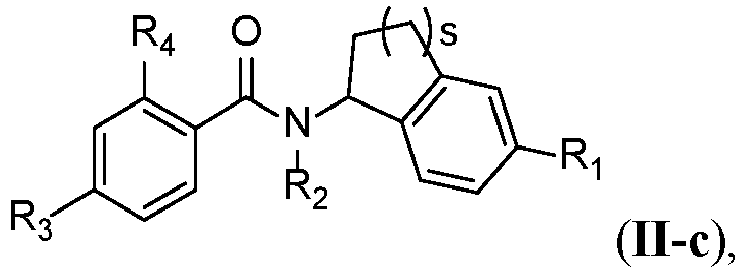

- In another aspect, the present invention provides a pharmaceutical composition comprising a compound of Formula III:

- R1 is selected from the group consisting of -Cl, -F, and C1-6alkyl substituted with one or more substituents independently selected from -Cl and -F;
- R2 is hydrogen;
- R3 is hydrogen;
- R4 is each independently selected from the group consisting of C1-6alkyl, C1-6alkoxy, halogen, C1-6haloalkyl, -NR7S(O)2C1-6alkyl, and -NR8C(O)-C1-6alkyl;
n is selected from the group consisting of 0, 1, 2, 3, and 4; - R7 and R8 are each independently hydrogen or C1-6alkyl; and
s is 1 or 2; - In some embodiments, the compound of Formula III is a compound of Formula III-a, Formula III-a1, or Formula III-a2:


- In some embodiments, the compound of Formula III is a compound of Formula III-b, Formula III-b1, or Formula III-b2:


- In some embodiments, the compound of Formula III is a compound of Formula III-c, Formula III-c1, or Formula III-c2:


- In another aspect, the present invention provides a pharmaceutical composition disclosed herein (e.g., a pharmaceutical composition comprising a compound of Formula (I-I) or (I), (e.g., (I-Ia), (I-Ia1), (I-Ib), (I-Ib1), (I-Ic), (I-Ic1), (I-a), (I-a1), (I-b), (I-b1), (I-c), (I-c1), (I-d), or (I-d1)), a compound of Formula (II), (e.g., (II-a), (II-a1), (II-a2), (II-b), (II-b1), (II-b2), (II-c), (II-c1), (II-c2)), or a compound of Formula (III), (e.g., (III-a), (III-a1), (III-a2), (III-b), (III-b1), (III-b2), (III-c), (III-c1), (III-c2))), or a pharmaceutically acceptable salt thereof, and a pharmaceutically acceptable excipient) for use in a method of treating a disease or condition associated with excessive neuronal excitability, wherein the method comprises administering to a subject in need thereof the pharmaceutical composition.
- In another aspect, the present invention provides a pharmaceutical composition disclosed herein (e.g., a pharmaceutical composition comprising a compound of Formula (I-I) or (I), (e.g., (I-Ia), (I-Ia1), (I-Ib), (I-Ib1), (I-Ic), (I-Ic1), (I-a), (I-a1), (I-b), (I-b1), (I-c), (I-c1), (I-d), or (I-d1)), a compound of Formula (II), (e.g., (II-a), (II-a1), (II-a2), (II-b), (II-b1), (II-b2), (II-c), (II-c1), (II-c2)), or a compound of Formula (III), (e.g., (III-a), (III-a1), (III-a2), (III-b), (III-b1), (III-b2), (III-c), (III-c1), (III-c2))), or a pharmaceutically acceptable salt thereof, and a pharmaceutically acceptable excipient) for use in a method of treating a disease or condition associated with a gain-of-function mutation of KCNT1, wherein the method comprises administering to a subject in need thereof the pharmaceutical composition.
- In some embodiments, the disease or condition associated with excessive neuronal excitability or the disease or condition associated with a gain-of-function mutation of KCNT1 is epilepsy, an epilepsy syndrome, or an encephalopathy.
- In some embodiments, the disease or condition associated with excessive neuronal excitability or the disease or condition associated with a gain-of-function mutation of KCNT1 is a genetic or pediatric epilepsy or a genetic or pediatric epilepsy syndrome.
- In some embodiments, the disease or condition associated with excessive neuronal excitability or the disease or condition associated with a gain-of-function mutation of KCNT1 is a cardiac dysfunction.
- In some embodiments, the disease or condition associated with excessive neuronal excitability or the disease or condition associated with a gain-of-function mutation of KCNT1 is selected from epilepsy and other encephalopathies (e.g., epilepsy of infancy with migrating focal seizures (MMFSI, EIMFS), autosomal dominant nocturnal frontal lobe epilepsy (ADNFLE), West syndrome, infantile spasms, epileptic encephalopathy, focal epilepsy, Ohtahara syndrome, developmental and epileptic encephalopathy, Lennox Gastaut syndrome, seizures (e.g., Generalized tonic clonic seizures, Asymmetric Tonic Seizures), leukodystrophy, leukoencephalopathy, intellectual disability, Multifocal Epilepsy, Drug resistant epilepsy, Temporal lobe epilepsy, cerebellar ataxia).
- In some embodiments, the disease or condition associated with excessive neuronal excitability or the disease or condition associated with a gain-of-function mutation of KCNT1 is selected from the group consisting of cardiac arrhythmia, sudden unexpected death in epilepsy, Brugada syndrome, and myocardial infarction.
- In some embodiments, the disease or condition associated with excessive neuronal excitability or the disease or condition associated with a gain-of-function mutation of KCNT1 is selected from pain and related conditions (e.g. neuropathic pain, acute/chronic pain, migraine, etc).
- In some embodiments, the disease or condition associated with excessive neuronal excitability or the disease or condition associated with a gain-of-function mutation of KCNT1 is a muscle disorder (e.g. myotonia, neuromyotonia, cramp muscle spasms, spasticity).
- In some embodiments, the disease or condition associated with excessive neuronal excitability or the disease or condition associated with a gain-of-function mutation of KCNT1 is selected from itch and pruritis, ataxia and cerebellar ataxias.
- In some embodiments, the disease or condition associated with excessive neuronal excitability or the disease or condition associated with a gain-of-function mutation of KCNT1 is selected from psychiatric disorders (e.g. major depression, anxiety, bipolar disorder, schizophrenia).
- In some embodiments, the disease or condition associated with excessive neuronal excitability or the disease or condition associated with a gain-of-function mutation of KCNT1 is selected from the group consisting of learning disorders, Fragile X, neuronal plasticity, and autism spectrum disorders.
- In some embodiments, the disease or condition associated with excessive neuronal excitability or the disease or condition associated with a gain-of-function mutation of KCNT1 is selected from the group consisting of epileptic encephalopathy with SCN1A, SCN2A, SCN8A mutations, early infantile epileptic encephalopathy, Dravet syndrome, Dravet syndrome with SCN1A mutation, generalized epilepsy with febrile seizures, intractable childhood epilepsy with generalized tonic-clonic seizures, infantile spasms, benign familial neonatal-infantile seizures, SCN2A epileptic encephalopathy, focal epilepsy with SCN3A mutation, cryptogenic pediatric partial epilepsy with SCN3A mutation, SCN8A epileptic encephalopathy, sudden unexpected death in epilepsy, Rasmussen encephalitis, malignant migrating partial seizures of infancy, autosomal dominant nocturnal frontal lobe epilepsy, sudden expected death in epilepsy (SUDEP), KCNQ2 epileptic encephalopathy, and KCNT1 epileptic encephalopathy.
- Other objects and advantages will become apparent to those skilled in the art from a consideration of the ensuing Detailed Description, Examples, and Claims.
- As generally described herein, the present invention provides compositions useful for preventing and/or treating a disease, disorder, or condition described herein, e.g., a disease, disorder, or condition associated with excessive neuronal excitability, and/or a disease, disorder, or condition associated with gain-of-function mutations in KCNT1. Exemplary diseases, disorders, or conditions include epilepsy and other encephalopathies (e.g., epilepsy of infancy with migrating focal seizures (MMFSI, EIMFS), autosomal dominant nocturnal frontal lobe epilepsy (ADNFLE), West syndrome, infantile spasms, epileptic encephalopathy, focal epilepsy, Ohtahara syndrome, developmental and epileptic encephalopathy, and Lennox Gastaut syndrome, seizures, leukodystrophy, leukoencephalopathy, intellectual disability, Multifocal Epilepsy, Generalized tonic clonic seizures, Drug resistant epilepsy, Temporal lobe epilepsy, cerebellar ataxia, Asymmetric Tonic Seizures) and cardiac dysfunctions (e.g., cardiac arrhythmia, Brugada syndrome, sudden unexpected death in epilepsy, myocardial infarction), pain and related conditions (e.g. neuropathic pain, acute/chronic pain, migraine, etc), muscle disorders (e.g. myotonia, neuromyotonia, cramp muscle spasms, spasticity), itch and pruritis, ataxia and cerebellar ataxias, and psychiatric disorders (e.g. major depression, anxiety, bipolar disorder, schizophrenia).
- Definitions of specific functional groups and chemical terms are described in more detail below. The chemical elements are identified in accordance with the Periodic Table of the Elements, CAS version, Handbook of Chemistry and Physics, 75th Ed., inside cover, and specific functional groups are generally defined as described therein. Additionally, general principles of organic chemistry, as well as specific functional moieties and reactivity, are described in Thomas Sorrell, Organic Chemistry, University Science Books, Sausalito, 1999; Smith and March, March's Advanced Organic Chemistry, 5th Edition, John Wiley & Sons, Inc., New York, 2001; Larock, Comprehensive Organic Transformations, VCH Publishers, Inc., New York, 1989; and Carruthers, Some Modern Methods of Organic Synthesis, 3rd Edition, Cambridge University Press, Cambridge, 1987.
- Compounds described herein can comprise one or more asymmetric centers, and thus can exist in various isomeric forms, e.g., enantiomers and/or diastereomers. For example, the compounds described herein can be in the form of an individual enantiomer, diastereomer or geometric isomer, or can be in the form of a mixture of stereoisomers, including racemic mixtures and mixtures enriched in one or more stereoisomer. Isomers can be isolated from mixtures by methods known to those skilled in the art, including chiral high pressure liquid chromatography (HPLC) and the formation and crystallization of chiral salts; or preferred isomers can be prepared by asymmetric syntheses. See, for example, Jacques et al., Enantiomers, Racemates and Resolutions (Wiley Interscience, New York, 1981); Wilen et al., Tetrahedron 33:2725 (1977); Eliel, Stereochemistry of Carbon Compounds (McGraw-Hill, NY, 1962); and Wilen, Tables of Resolving Agents and Optical Resolutions p. 268 (E.L. Eliel, Ed., Univ. of Notre Dame Press, Notre Dame, IN 1972). The invention additionally encompasses compounds described herein as individual isomers substantially free of other isomers, and alternatively, as mixtures of various isomers.
- As used herein a pure enantiomeric compound is substantially free from other enantiomers or stereoisomers of the compound (i.e., in enantiomeric excess). In other words, an "S" form of the compound is substantially free from the "R" form of the compound and is, thus, in enantiomeric excess of the "R" form. The term "enantiomerically pure" or "pure enantiomer" denotes that the compound comprises more than 75% by weight, more than 80% by weight, more than 85% by weight, more than 90% by weight, more than 91% by weight, more than 92% by weight, more than 93% by weight, more than 94% by weight, more than 95% by weight, more than 96% by weight, more than 97% by weight, more than 98% by weight, more than 98.5% by weight, more than 99% by weight, more than 99.2% by weight, more than 99.5% by weight, more than 99.6% by weight, more than 99.7% by weight, more than 99.8% by weight or more than 99.9% by weight, of the enantiomer. In certain embodiments, the weights are based upon total weight of all enantiomers or stereoisomers of the compound.
- In the compositions provided herein, an enantiomerically pure compound can be present with other active or inactive ingredients. For example, a pharmaceutical composition comprising enantiomerically pure R-compound can comprise, for example, about 90% excipient and about 10% enantiomerically pure R-compound. In certain embodiments, the enantiomerically pure R-compound in such compositions can, for example, comprise, at least about 95% by weight R-compound and at most about 5% by weight S-compound, by total weight of the compound. For example, a pharmaceutical composition comprising enantiomerically pure S-compound can comprise, for example, about 90% excipient and about 10% enantiomerically pure S-compound. In certain embodiments, the enantiomerically pure S-compound in such compositions can, for example, comprise, at least about 95% by weight S-compound and at most about 5% by weight R-compound, by total weight of the compound. In certain embodiments, the active ingredient can be formulated with little or no excipient or carrier.
- Compound described herein may also comprise one or more isotopic substitutions. For example, H may be in any isotopic form, including 1H, 2H (D or deuterium), and 3H (T or tritium); C may be in any isotopic form, including 12C, 13C, and 14C; O may be in any isotopic form, including 16O and 18O; F may be in any isotopic form, including 18F and 19F; and the like.
- The following terms are intended to have the meanings presented therewith below and are useful in understanding the description and intended scope of the present invention. When describing the invention, which may include compounds and pharmaceutically acceptable salts thereof, pharmaceutical compositions containing such compounds and methods of using such compounds and compositions, the following terms, if present, have the following meanings unless otherwise indicated. It should also be understood that when described herein any of the moieties defined forth below may be substituted with a variety of substituents, and that the respective definitions are intended to include such substituted moieties within their scope as set out below. Unless otherwise stated, the term "substituted" is to be defined as set out below. It should be further understood that the terms "groups" and "radicals" can be considered interchangeable when used herein. The articles "a" and "an" may be used herein to refer to one or to more than one (i.e. at least one) of the grammatical objects of the article. By way of example "an analogue" means one analogue or more than one analogue.
- When a range of values is listed, it is intended to encompass each value and sub-range within the range. For example, "C1-6 alkyl" is intended to encompass, C1, C2, C3, C4, C5, C6, C1-6, C1-5, C1-4, C1-3, C1-2, C2-6, C2-5, C2-4, C2-3, C3-6, C3-5, C3-4, C4-6, C4-5, and C5-6 alkyl.
- As used herein, "alkyl" refers to a radical of a straight-chain or branched saturated hydrocarbon group, e.g., having 1 to 20 carbon atoms ("C1-20 alkyl"). In some embodiments, an alkyl group has 1 to 10 carbon atoms ("C1-10 alkyl"). In some embodiments, an alkyl group has 1 to 9 carbon atoms ("C1-9 alkyl"). In some embodiments, an alkyl group has 1 to 8 carbon atoms ("C1-8 alkyl"). In some embodiments, an alkyl group has 1 to 7 carbon atoms ("C1-7 alkyl"). In some embodiments, an alkyl group has 1 to 6 carbon atoms ("C1-6 alkyl"). In some embodiments, an alkyl group has 1 to 5 carbon atoms ("C1-5 alkyl"). In some embodiments, an alkyl group has 1 to 4 carbon atoms ("C1-4 alkyl"). In some embodiments, an alkyl group has 1 to 3 carbon atoms ("C1-3 alkyl"). In some embodiments, an alkyl group has 1 to 2 carbon atoms ("C1-2 alkyl"). In some embodiments, an alkyl group has 1 carbon atom ("C1 alkyl"). Examples of C1-6 alkyl groups include methyl, ethyl, propyl, isopropyl, butyl, isobutyl, pentyl, hexyl, and the like.
- The term "heteroalkyl" as used herein refers to an "alkyl" group in which at least one carbon atom has been replaced with an O or S atom. The heteroalkyl may be, for example, an -O-C1-C10alkyl group, an -C1-C6alkylene-O-C1-C6alkyl group, or a C1-C6 alkylene-OH group. In certain embodiments, the "heteroalkyl" may be 2-8 membered heteroalkyl, indicating that the heteroalkyl contains from 2 to 8 atoms selected from the group consisting of carbon, oxygen, nitrogen, and sulfur. In yet other embodiments, the heteroalkyl may be a 2-6 membered, 4-8 membered, or a 5-8 membered heteroalkyl group (which may contain for example 1 or 2 heteroatoms selected from the group oxygen and nitrogen). In certain embodiments, the heteroalkyl is an "alkyl" group in which 1-3 carbon atoms have been replaced with oxygen atoms. One type of heteroalkyl group is an "alkoxy" group.
- As used herein, "alkenyl" refers to a radical of a straight-chain or branched hydrocarbon group having from 2 to 20 carbon atoms, one or more carbon-carbon double bonds (e.g., 1, 2, 3, or 4 carbon-carbon double bonds), and optionally one or more carbon-carbon triple bonds (e.g., 1, 2, 3, or 4 carbon-carbon triple bonds) ("C2-20 alkenyl"). In certain embodiments, alkenyl does not contain any triple bonds. In some embodiments, an alkenyl group has 2 to 10 carbon atoms ("C2-10 alkenyl"). In some embodiments, an alkenyl group has 2 to 9 carbon atoms ("C2-9 alkenyl"). In some embodiments, an alkenyl group has 2 to 8 carbon atoms ("C2-8 alkenyl"). In some embodiments, an alkenyl group has 2 to 7 carbon atoms ("C2-7 alkenyl"). In some embodiments, an alkenyl group has 2 to 6 carbon atoms ("C2-6 alkenyl"). In some embodiments, an alkenyl group has 2 to 5 carbon atoms ("C2-5 alkenyl"). In some embodiments, an alkenyl group has 2 to 4 carbon atoms ("C2-4 alkenyl"). In some embodiments, an alkenyl group has 2 to 3 carbon atoms ("C2-3 alkenyl"). In some embodiments, an alkenyl group has 2 carbon atoms ("C2 alkenyl"). The one or more carbon-carbon double bonds can be internal (such as in 2-butenyl) or terminal (such as in 1-butenyl). Examples of C2-4 alkenyl groups include ethenyl (C2), 1-propenyl (C3), 2-propenyl (C3), 1-butenyl (C4), 2-butenyl (C4), butadienyl (C4), and the like. Examples of C2- 6 alkenyl groups include the aforementioned C2-4 alkenyl groups as well as pentenyl (C5), pentadienyl (C5), hexenyl (C6), and the like. Additional examples of alkenyl include heptenyl (C7), octenyl (C8), octatrienyl (C8), and the like.
- As used herein, "alkynyl" refers to a radical of a straight-chain or branched hydrocarbon group having from 2 to 20 carbon atoms, one or more carbon-carbon triple bonds (e.g., 1, 2, 3, or 4 carbon-carbon triple bonds), and optionally one or more carbon-carbon double bonds (e.g., 1, 2, 3, or 4 carbon-carbon double bonds) ("C2-20 alkynyl"). In certain embodiments, alkynyl does not contain any double bonds. In some embodiments, an alkynyl group has 2 to 10 carbon atoms ("C2-10 alkynyl"). In some embodiments, an alkynyl group has 2 to 9 carbon atoms ("C2-9 alkynyl"). In some embodiments, an alkynyl group has 2 to 8 carbon atoms ("C2-8 alkynyl"). In some embodiments, an alkynyl group has 2 to 7 carbon atoms ("C2-7 alkynyl"). In some embodiments, an alkynyl group has 2 to 6 carbon atoms ("C2-6 alkynyl"). In some embodiments, an alkynyl group has 2 to 5 carbon atoms ("C2-5 alkynyl"). In some embodiments, an alkynyl group has 2 to 4 carbon atoms ("C2-4 alkynyl"). In some embodiments, an alkynyl group has 2 to 3 carbon atoms ("C2-3 alkynyl"). In some embodiments, an alkynyl group has 2 carbon atoms ("C2 alkynyl"). The one or more carbon-carbon triple bonds can be internal (such as in 2-butynyl) or terminal (such as in 1-butynyl). Examples of C2-4 alkynyl groups include, without limitation, ethynyl (C2), 1-propynyl (C3), 2-propynyl (C3), 1-butynyl (C4), 2-butynyl (C4), and the like. Examples of C2-6 alkenyl groups include the aforementioned C2-4 alkynyl groups as well as pentynyl (C5), hexynyl (C6), and the like. Additional examples of alkynyl include heptynyl (C7), octynyl (C8), and the like.
- As used herein, "alkylene," "alkenylene," and "alkynylene," refer to a divalent radical of an alkyl, alkenyl, and alkynyl group respectively. When a range or number of carbons is provided for a particular "alkylene," "alkenylene," or "alkynylene," group, it is understood that the range or number refers to the range or number of carbons in the linear carbon divalent chain. "Alkylene," "alkenylene," and "alkynylene," groups may be substituted or unsubstituted with one or more substituents as described herein.
- As used herein, "aryl" refers to a radical of a monocyclic or polycyclic (e.g., bicyclic or tricyclic) 4n+2 aromatic ring system (e.g., having 6, 10, or 14 π electrons shared in a cyclic array) having 6-14 ring carbon atoms and zero heteroatoms provided in the aromatic ring system ("C6-14 aryl"). In some embodiments, an aryl group has six ring carbon atoms ("C6 aryl"; e.g., phenyl). In some embodiments, an aryl group has ten ring carbon atoms ("C10 aryl"; e.g., naphthyl such as 1-naphthyl and 2-naphthyl). In some embodiments, an aryl group has fourteen ring carbon atoms ("C14 aryl"; e.g., anthracyl). "Aryl" also includes ring systems wherein the aryl ring, as defined above, is fused with one or more carbocyclyl or heterocyclyl groups wherein the radical or point of attachment is on the aryl ring, and in such instances, the number of carbon atoms continue to designate the number of carbon atoms in the aryl ring system. Typical aryl groups include, but are not limited to, groups derived from aceanthrylene, acenaphthylene, acephenanthrylene, anthracene, azulene, benzene, chrysene, coronene, fluoranthene, fluorene, hexacene, hexaphene, hexalene, as-indacene, s-indacene, indane, indene, naphthalene, octacene, octaphene, octalene, ovalene, penta-2,4-diene, pentacene, pentalene, pentaphene, perylene, phenalene, phenanthrene, picene, pleiadene, pyrene, pyranthrene, rubicene, triphenylene, and trinaphthalene. Particularly aryl groups include phenyl, naphthyl, indenyl, and tetrahydronaphthyl.
- As used herein, "heteroaryl" refers to a radical of a 5-10 membered monocyclic or bicyclic 4n+2 aromatic ring system (e.g., having 6 or 10 electrons shared in a cyclic array) having ring carbon atoms and 1-4 ring heteroatoms provided in the aromatic ring system, wherein each heteroatom is independently selected from nitrogen, oxygen and sulfur ("5-10 membered heteroaryl"). In heteroaryl groups that contain one or more nitrogen atoms, the point of attachment can be a carbon or nitrogen atom, as valency permits. Heteroaryl bicyclic ring systems can include one or more heteroatoms in one or both rings. "Heteroaryl" includes ring systems wherein the heteroaryl ring, as defined above, is fused with one or more carbocyclyl or heterocyclyl groups wherein the point of attachment is on the heteroaryl ring, and in such instances, the number of ring members continue to designate the number of ring members in the heteroaryl ring system. "Heteroaryl" also includes ring systems wherein the heteroaryl ring, as defined above, is fused with one or more aryl groups wherein the point of attachment is either on the aryl or heteroaryl ring, and in such instances, the number of ring members designates the number of ring members in the fused (aryl/heteroaryl) ring system. Bicyclic heteroaryl groups wherein one ring does not contain a heteroatom (e.g., indolyl, quinolinyl, carbazolyl, and the like) the point of attachment can be on either ring, i.e., either the ring bearing a heteroatom (e.g., 2-indolyl) or the ring that does not contain a heteroatom (e.g., 5-indolyl).
- In some embodiments, a heteroaryl group is a 5-10 membered aromatic ring system having ring carbon atoms and 1-4 ring heteroatoms provided in the aromatic ring system, wherein each heteroatom is independently selected from nitrogen, oxygen, and sulfur ("5-10 membered heteroaryl"). In some embodiments, a heteroaryl group is a 5-8 membered aromatic ring system having ring carbon atoms and 1-4 ring heteroatoms provided in the aromatic ring system, wherein each heteroatom is independently selected from nitrogen, oxygen, and sulfur ("5-8 membered heteroaryl"). In some embodiments, a heteroaryl group is a 5-6 membered aromatic ring system having ring carbon atoms and 1-4 ring heteroatoms provided in the aromatic ring system, wherein each heteroatom is independently selected from nitrogen, oxygen, and sulfur ("5-6 membered heteroaryl"). In some embodiments, the 5-6 membered heteroaryl has 1-3 ring heteroatoms selected from nitrogen, oxygen, and sulfur. In some embodiments, the 5-6 membered heteroaryl has 1-2 ring heteroatoms selected from nitrogen, oxygen, and sulfur. In some embodiments, the 5-6 membered heteroaryl has 1 ring heteroatom selected from nitrogen, oxygen, and sulfur.
- Exemplary 5-membered heteroaryl groups containing one heteroatom include, without limitation, pyrrolyl, furanyl and thiophenyl. Exemplary 5-membered heteroaryl groups containing two heteroatoms include, without limitation, imidazolyl, pyrazolyl, oxazolyl, isoxazolyl, thiazolyl, and isothiazolyl. Exemplary 5-membered heteroaryl groups containing three heteroatoms include, without limitation, triazolyl, oxadiazolyl, and thiadiazolyl. Exemplary 5-membered heteroaryl groups containing four heteroatoms include, without limitation, tetrazolyl. Exemplary 6-membered heteroaryl groups containing one heteroatom include, without limitation, pyridinyl. Exemplary 6-membered heteroaryl groups containing two heteroatoms include, without limitation, pyridazinyl, pyrimidinyl, and pyrazinyl. Exemplary 6-membered heteroaryl groups containing three or four heteroatoms include, without limitation, triazinyl and tetrazinyl, respectively. Exemplary 7-membered heteroaryl groups containing one heteroatom include, without limitation, azepinyl, oxepinyl, and thiepinyl. Exemplary 5,6-bicyclic heteroaryl groups include, without limitation, indolyl, isoindolyl, indazolyl, benzotriazolyl, benzothiophenyl, isobenzothiophenyl, benzofuranyl, benzoisofuranyl, benzimidazolyl, benzoxazolyl, benzisoxazolyl, benzoxadiazolyl, benzthiazolyl, benzisothiazolyl, benzthiadiazolyl, indolizinyl, and purinyl. Exemplary 6,6-bicyclic heteroaryl groups include, without limitation, naphthyridinyl, pteridinyl, quinolinyl, isoquinolinyl, cinnolinyl, quinoxalinyl, phthalazinyl, and quinazolinyl.
- Examples of representative heteroaryls include the following:


- As used herein, "carbocyclyl" or "carbocyclic" refers to a radical of a non-aromatic cyclic hydrocarbon group having from 3 to 10 ring carbon atoms ("C3-10 carbocyclyl") and zero heteroatoms in the non-aromatic ring system. In some embodiments, a carbocyclyl group has 3 to 8 ring carbon atoms ("C3-8 carbocyclyl"). In some embodiments, a carbocyclyl group has 3 to 6 ring carbon atoms ("C3-6 carbocyclyl"). In some embodiments, a carbocyclyl group has 5 to 10 ring carbon atoms ("C5-10 carbocyclyl"). Exemplary C3-6 carbocyclyl groups include, without limitation, cyclopropyl (C3),cyclobutyl (C4), cyclobutenyl (C4), cyclopentyl (C5), cyclopentenyl (C5), cyclohexyl (C6), cyclohexenyl (C6), cyclohexadienyl (C6), and the like. Exemplary C3-8 carbocyclyl groups include, without limitation, the aforementioned C3-6 carbocyclyl groups as well as cycloheptyl (C7), cycloheptenyl (C7), cycloheptadienyl (C7), cycloheptatrienyl (C7), cyclooctyl (C8), cyclooctenyl (C8), bicyclo[2.2.1]heptanyl (C7), bicyclo[2.2.2]octanyl (C8), and the like. Exemplary C3-10 carbocyclyl groups include, without limitation, the aforementioned C3-8 carbocyclyl groups as well as cyclononyl (C9), cyclononenyl (C9), cyclodecyl (C10), cyclodecenyl (C10), octahydro-1H-indenyl (C9), decahydronaphthalenyl (C10), spiro[4.5]decanyl (C10), and the like. As the foregoing examples illustrate, in certain embodiments, the carbocyclyl group is either monocyclic ("monocyclic carbocyclyl") or contain a fused, bridged or spiro ring system such as a bicyclic system ("bicyclic carbocyclyl") and can be saturated or can be partially unsaturated. "Carbocyclyl" also includes ring systems wherein the carbocyclyl ring, as defined above, is fused with one or more aryl or heteroaryl groups wherein the point of attachment is on the carbocyclyl ring, and in such instances, the number of carbons continue to designate the number of carbons in the carbocyclic ring system.
- The term "cycloalkyl" refers to a monovalent saturated cyclic, bicyclic, or bridged cyclic (e.g., adamantyl) hydrocarbon group of 3-12, 3-8, 4-8, or 4-6 carbons, referred to herein, e.g., as "C4-8cycloalkyl," derived from a cycloalkane. Exemplary cycloalkyl groups include, but are not limited to, cyclohexanes, cyclopentanes, cyclobutanes and cyclopropanes. Unless specified otherwise, cycloalkyl groups are optionally substituted at one or more ring positions with, for example, alkanoyl, alkoxy, alkyl, haloalkyl, alkenyl, alkynyl, amido, amidino, amino, aryl, arylalkyl, azido, carbamate, carbonate, carboxy, cyano, cycloalkyl, ester, ether, formyl, halogen, haloalkyl, heteroaryl, heterocyclyl, hydroxyl, imino, ketone, nitro, phosphate, phosphonato, phosphinato, sulfate, sulfide, sulfonamido, sulfonyl or thiocarbonyl. Cycloalkyl groups can be fused to other cycloalkyl, aryl, or heterocyclyl groups. In certain embodiments, the cycloalkyl group is not substituted, i.e., it is unsubstituted.
- As used herein, "heterocyclyl" or "heterocyclic" refers to a radical of a 3- to 10-membered non-aromatic ring system having ring carbon atoms and 1 to 4 ring heteroatoms, wherein each heteroatom is independently selected from nitrogen, oxygen, sulfur, boron, phosphorus, and silicon ("3-10 membered heterocyclyl"). In heterocyclyl groups that contain one or more nitrogen atoms, the point of attachment can be a carbon or nitrogen atom, as valency permits. A heterocyclyl group can either be monocyclic ("monocyclic heterocyclyl") or a fused, bridged or spiro ring system such as a bicyclic system ("bicyclic heterocyclyl"), and can be saturated or can be partially unsaturated. Heterocyclyl bicyclic ring systems can include one or more heteroatoms in one or both rings. "Heterocyclyl" also includes ring systems wherein the heterocyclyl ring, as defined above, is fused with one or more carbocyclyl groups wherein the point of attachment is either on the carbocyclyl or heterocyclyl ring, or ring systems wherein the heterocyclyl ring, as defined above, is fused with one or more aryl or heteroaryl groups, wherein the point of attachment is on the heterocyclyl ring, and in such instances, the number of ring members continue to designate the number of ring members in the heterocyclyl ring system.
- In some embodiments, a heterocyclyl group is a 5-10 membered non-aromatic ring system having ring carbon atoms and 1-4 ring heteroatoms, wherein each heteroatom is independently selected from nitrogen, oxygen, sulfur, boron, phosphorus, and silicon ("5-10 membered heterocyclyl"). In some embodiments, a heterocyclyl group is a 5-8 membered non-aromatic ring system having ring carbon atoms and 1-4 ring heteroatoms, wherein each heteroatom is independently selected from nitrogen, oxygen, and sulfur ("5-8 membered heterocyclyl"). In some embodiments, a heterocyclyl group is a 5-6 membered non-aromatic ring system having ring carbon atoms and 1-4 ring heteroatoms, wherein each heteroatom is independently selected from nitrogen, oxygen, and sulfur ("5-6 membered heterocyclyl"). In some embodiments, the 5-6 membered heterocyclyl has 1-3 ring heteroatoms selected from nitrogen, oxygen, and sulfur. In some embodiments, the 5-6 membered heterocyclyl has 1-2 ring heteroatoms selected from nitrogen, oxygen, and sulfur. In some embodiments, the 5-6 membered heterocyclyl has one ring heteroatom selected from nitrogen, oxygen, and sulfur.
- Exemplary 3-membered heterocyclyl groups containing one heteroatom include, without limitation, azirdinyl, oxiranyl, thiorenyl. Exemplary 4-membered heterocyclyl groups containing one heteroatom include, without limitation, azetidinyl, oxetanyl and thietanyl. Exemplary 5-membered heterocyclyl groups containing one heteroatom include, without limitation, tetrahydrofuranyl, dihydrofuranyl, tetrahydrothiophenyl, dihydrothiophenyl, pyrrolidinyl, dihydropyrrolyl and pyrrolyl-2,5-dione. Exemplary 5-membered heterocyclyl groups containing two heteroatoms include, without limitation, dioxolanyl, oxasulfuranyl, disulfuranyl, and oxazolidin-2-one. Exemplary 5-membered heterocyclyl groups containing three heteroatoms include, without limitation, triazolinyl, oxadiazolinyl, and thiadiazolinyl. Exemplary 6-membered heterocyclyl groups containing one heteroatom include, without limitation, piperidinyl, tetrahydropyranyl, dihydropyridinyl, and thianyl. Exemplary 6-membered heterocyclyl groups containing two heteroatoms include, without limitation, piperazinyl, morpholinyl, dithianyl, dioxanyl. Exemplary 6-membered heterocyclyl groups containing two heteroatoms include, without limitation, triazinanyl. Exemplary 7-membered heterocyclyl groups containing one heteroatom include, without limitation, azepanyl, oxepanyl and thiepanyl. Exemplary 8-membered heterocyclyl groups containing one heteroatom include, without limitation, azocanyl, oxecanyl and thiocanyl. Exemplary 5-membered heterocyclyl groups fused to a C6 aryl ring (also referred to herein as a 5,6-bicyclic heterocyclic ring) include, without limitation, indolinyl, isoindolinyl, dihydrobenzofuranyl, dihydrobenzothienyl, benzoxazolinonyl, and the like. Exemplary 6-membered heterocyclyl groups fused to an aryl ring (also referred to herein as a 6,6-bicyclic heterocyclic ring) include, without limitation, tetrahydroquinolinyl, tetrahydroisoquinolinyl, and the like.
- "Hetero" when used to describe a compound or a group present on a compound means that one or more carbon atoms in the compound or group have been replaced by a nitrogen, oxygen, or sulfur heteroatom. Hetero may be applied to any of the hydrocarbyl groups described above such as alkyl, e.g., heteroalkyl; carbocyclyl, e.g., heterocyclyl; aryl, e.g,. heteroaryl; and the like having from 1 to 5, and particularly from 1 to 3 heteroatoms.
- As used herein, "cyano" refers to -CN.
- As used herein, "halo" or "halogen" refers to fluoro (F), chloro (Cl), bromo (Br) and iodo (I). In certain embodiments, the halo group is either fluoro or chloro.
- As used herein, "haloalkyl" refers to an alkyl group substituted with one or more halogen atoms.
- As used herein, "nitro" refers to -NO2.
- As used herein, "oxo" refers to -C=O.
- In general, the term "substituted", whether preceded by the term "optionally" or not, means that at least one hydrogen present on a group (e.g., a carbon or nitrogen atom) is replaced with a permissible substituent, e.g., a substituent which upon substitution results in a stable compound, e.g., a compound which does not spontaneously undergo transformation such as by rearrangement, cyclization, elimination, or other reaction. Unless otherwise indicated, a "substituted" group has a substituent at one or more substitutable positions of the group, and when more than one position in any given structure is substituted, the substituent is either the same or different at each position.
- Nitrogen atoms can be substituted or unsubstituted as valency permits, and include primary, secondary, tertiary, and quarternary nitrogen atoms. Exemplary nitrogen atom substitutents include, but are not limited to, hydrogen, -OH, -ORaa, -N(Rcc)2, -CN, - C(=O)Raa, -C(=O)N(Rcc)2, -CO2Raa, -SO2Raa, -C(=NRbb)Raa, -C(=NRcc)ORaa, - C(=NRcc)N(Rcc)2, -SO2N(Rcc)2, -SO2Rcc, -SO2ORcc, -SORaa, -C(=S)N(Rcc)2, -C(=O)SRcc, - C(=S)SRcc, -P(=O)2Raa, -P(=O)(Raa)2, -P(=O)2N(Rcc)2, -P(=O)(NRcc)2, C1-10 alkyl, C1-10 perhaloalkyl, C2-10 alkenyl, C2-10 alkynyl, C3-10 carbocyclyl, 3-14 membered heterocyclyl, C6-14 aryl, and 5-14 membered heteroaryl, or two Rcc groups attached to a nitrogen atom are joined to form a 3-14 membered heterocyclyl or 5-14 membered heteroaryl ring, wherein each alkyl, alkenyl, alkynyl, carbocyclyl, heterocyclyl, aryl, and heteroaryl is independently substituted with 0, 1, 2, 3, 4, or 5 Rdd groups, and wherein Raa, Rbb, Rcc and Rdd are as defined above.
- These and other exemplary substituents are described in more detail in the Detailed Description, Examples, and Claims. The invention is not intended to be limited in any manner by the above exemplary listing of substituents.
- The term "pharmaceutically acceptable salt" refers to those salts which are, within the scope of sound medical judgment, suitable for use in contact with the tissues of humans and lower animals without undue toxicity, irritation, allergic response and the like, and are commensurate with a reasonable benefit/risk ratio. Pharmaceutically acceptable salts are well known in the art. For example, Berge et al., describes pharmaceutically acceptable salts in detail in J. Pharmaceutical Sciences (1977) 66:1-19. Pharmaceutically acceptable salts of the compounds of this invention include those derived from suitable inorganic and organic acids and bases. Examples of pharmaceutically acceptable, nontoxic acid addition salts are salts of an amino group formed with inorganic acids such as hydrochloric acid, hydrobromic acid, phosphoric acid, sulfuric acid and perchloric acid or with organic acids such as acetic acid, oxalic acid, maleic acid, tartaric acid, citric acid, succinic acid or malonic acid or by using other methods used in the art such as ion exchange. Other pharmaceutically acceptable salts include adipate, alginate, ascorbate, aspartate, benzenesulfonate, benzoate, bisulfate, borate, butyrate, camphorate, camphorsulfonate, citrate, cyclopentanepropionate, digluconate, dodecylsulfate, ethanesulfonate, formate, fumarate, glucoheptonate, glycerophosphate, gluconate, hemisulfate, heptanoate, hexanoate, hydroiodide, 2-hydroxyethanesulfonate, lactobionate, lactate, laurate, lauryl sulfate, malate, maleate, malonate, methanesulfonate, 2-naphthalenesulfonate, nicotinate, nitrate, oleate, oxalate, palmitate, pamoate, pectinate, persulfate, 3-phenylpropionate, phosphate, picrate, pivalate, propionate, stearate, succinate, sulfate, tartrate, thiocyanate, p-toluenesulfonate, undecanoate, valerate salts, and the like. Pharmaceutically acceptable salts derived from appropriate bases include alkali metal, alkaline earth metal, ammonium and N+(C1-4alkyl)4 salts. Representative alkali or alkaline earth metal salts include sodium, lithium, potassium, calcium, magnesium, and the like. Further pharmaceutically acceptable salts include, when appropriate, nontoxic ammonium, quaternary ammonium, and amine cations formed using counterions such as halide, hydroxide, carboxylate, sulfate, phosphate, nitrate, lower alkyl sulfonate, and aryl sulfonate.
- As used herein, a "subject" to which administration is contemplated includes, but is not limited to, humans (i.e., a male or female of any age group, e.g., a pediatric subject (e.g, infant, child, adolescent) or adult subject (e.g., young adult, middle-aged adult or senior adult)) and/or a non-human animal, e.g., a mammal such as primates (e.g., cynomolgus monkeys, rhesus monkeys), cattle, pigs, horses, sheep, goats, rodents, cats, and/or dogs. In certain embodiments, the subject is a human. In certain embodiments, the subject is a non-human animal. The terms "human," "patient," and "subject" are used interchangeably herein.
- Disease, disorder, and condition are used interchangeably herein.
- As used herein, and unless otherwise specified, the terms "treat," "treating" and "treatment" contemplate an action that occurs while a subject is suffering from the specified disease, disorder or condition, which reduces the severity of the disease, disorder or condition, or retards or slows the progression of the disease, disorder or condition (also "therapeutic treatment").
- In general, the "effective amount" of a compound refers to an amount sufficient to elicit the desired biological response. As will be appreciated by those of ordinary skill in this art, the effective amount of a compound of the invention may vary depending on such factors as the desired biological endpoint, the pharmacokinetics of the compound, the disease being treated, the mode of administration, and the age, weight, health, and condition of the subject.
- As used herein, and unless otherwise specified, a "therapeutically effective amount" of a compound is an amount sufficient to provide a therapeutic benefit in the treatment of a disease, disorder or condition, or to delay or minimize one or more symptoms associated with the disease, disorder or condition. A therapeutically effective amount of a compound means an amount of therapeutic agent, alone or in combination with other therapies, which provides a therapeutic benefit in the treatment of the disease, disorder or condition. The term "therapeutically effective amount" can encompass an amount that improves overall therapy, reduces or avoids symptoms or causes of disease or condition, or enhances the therapeutic efficacy of another therapeutic agent.
- In an alternate embodiment, the present invention contemplates administration of the compounds of the present invention or a pharmaceutically acceptable salt or a pharmaceutically acceptable composition thereof, as a prophylactic before a subject begins to suffer from the specified disease, disorder or condition. As used herein, "prophylactic treatment" contemplates an action that occurs before a subject begins to suffer from the specified disease, disorder or condition. As used herein, and unless otherwise specified, a "prophylactically effective amount" of a compound is an amount sufficient to prevent a disease, disorder or condition, or one or more symptoms associated with the disease, disorder or condition, or prevent its recurrence. A prophylactically effective amount of a compound means an amount of a therapeutic agent, alone or in combination with other agents, which provides a prophylactic benefit in the prevention of the disease, disorder or condition. The term "prophylactically effective amount" can encompass an amount that improves overall prophylaxis or enhances the prophylactic efficacy of another prophylactic agent.
- As used herein, a "disease or condition associated with a gain-of-function mutation in KCNT1" refers to a disease or condition that is associated with, is partially or completely caused by, or has one or more symptoms that are partially or completely caused by, a mutation in KCNT1 that results in a gain-of-function phenotype, i.e. an increase in activity of the potassium channel encoded by KCNT1 resulting in an increase in whole cell current.
- As used herein, a "gain-of-function mutation" is a mutation in KCNT1 that results in an increase in activity of the potassium channel encoded by KCNT1. Activity can be assessed by, for example, ion flux assay or electrophysiology (e.g. using the whole cell patch clamp technique). Typically, a gain-of-function mutation results in an increase of at least or about 20%, 30%, 40%, 50%, 60%, 70%, 80%, 90%, 100%, 125%, 150%, 175%, 200%, 225%, 250%, 275%, 300%, 325%, 350%, 375%, 400% or more compared to the activity of a potassium channel encoded by a wild-type KCNT1.
- In one aspect, the present disclosure features a compound of Formula I-I:

- X is selected from the group consisting of NH, O, and S, wherein the hydrogen of NH may be substituted with R3;
- Y is selected from N and CH, wherein the hydrogen of CH may be substituted with R3;
- Z is selected from N and CH, wherein the hydrogen of CH may be substituted with R3, or Z is C when Z is substituted with the -C(O)N(R2)- moiety;
- R1 is selected from the group consisting of -Cl, -F, and C1-6alkyl substituted with one or more substituents independently selected from -Cl and -F;
- R2 is hydrogen;
- each R3 is independently selected from the group consisting of halogen, C1-6alkyl, C1- 6heteroalkyl, C3-7cycloalkyl, 3-7 membered heterocyclyl, -S(O)2NR4R5, -NR4S(O)R6, - C(O)NR4R5, -S(O)2R6, and -O-R6, wherein C1-6alkyl is optionally substituted with one or more substituents independently selected from halogen, -NR4R5, and -S(O)2R6;
n is selected from the group consisting of 0, 1, 2, 3, and 4; - R4 and R5 are each independently hydrogen or C1-6alkyl, wherein C1-6alkyl is optionally substituted with oxo; or R4 and R5 may be taken together with the nitrogen to which R4 and R5 are attached to form a 4-7 membered heterocyclyl optionally substituted with one or more substituents independently selected from halogen, -OH, C1-6alkyl, and C1- 6heteroalkyl;
- each R6 is independently selected from the group consisting of C1-6alkyl, C1- 6heteroalkyl, C2-6alkenyl, C2-6alkynyl, C3-7cycloalkyl, phenyl, and benzyl; and s is 1 or 2.
- In some embodiments, the present invention features a compound of Formula I:

- X is selected from the group consisting of NH, O, and S, wherein the hydrogen of NH may be substituted with R3;
- Y is selected from N and CH, wherein the hydrogen of CH may be substituted with R3;
- R1 is selected from the group consisting of -Cl, -F, and C1-6alkyl substituted with one or more substituents independently selected from -Cl and -F;
- R2 is hydrogen;
- each R3 is independently selected from the group consisting of halogen, C1-6alkyl, C1- 6heteroalkyl, C3-7cycloalkyl, 3-7 membered heterocyclyl, -S(O)2NR4R5, -NR4S(O)R6, - C(O)NR4R5, -S(O)2R6, and -O-R6, wherein C1-6alkyl is optionally substituted with one or more substituents independently selected from halogen, -NR4R5, and -S(O)2R6;
- n is selected from the group consisting of 0, 1, 2, 3, and 4;
- R4 and R5 are each independently hydrogen or C1-6alkyl, or R4 and R5 may be taken together with the nitrogen to which R4 and R5 are attached to form a 4-7 membered heterocyclyl optionally substituted with one or more halogens;
- each R6 is independently selected from the group consisting of C1-6alkyl, C2-6alkenyl, C2-6alkynyl, C3-7cycloalkyl, phenyl, and benzyl; and
- s is 1 or 2.
- In another aspect, the present disclosure features a pharmaceutical composition comprising a compound of Formula I-I:

- X is selected from the group consisting of NH, O, and S, wherein the hydrogen of NH may be substituted with R3;
- Y is selected from N and CH, wherein the hydrogen of CH may be substituted with R3;
- Z is selected from N and CH, wherein the hydrogen of CH may be substituted with R3, or Z is C when Z is substituted with the -C(O)N(R2)- moiety;
- R1 is selected from the group consisting of -Cl, -F, and C1-6alkyl substituted with one or more substituents independently selected from -Cl and -F;
- R2 is hydrogen;
- each R3 is independently selected from the group consisting of halogen, C1-6alkyl, C1- 6heteroalkyl, C3-7cycloalkyl, 3-7 membered heterocyclyl, -S(O)2NR4R5, -NR4S(O)R6, - C(O)NR4R5, -S(O)2R6, and -O-R6, wherein C1-6alkyl is optionally substituted with one or more substituents independently selected from halogen, -NR4R5, and -S(O)2R6;
- n is selected from the group consisting of 0, 1, 2, 3, and 4;
- R4 and R5 are each independently hydrogen or C1-6alkyl, wherein C1-6alkyl is optionally substituted with oxo; or R4 and R5 may be taken together with the nitrogen to which R4 and R5 are attached to form a 4-7 membered heterocyclyl optionally substituted with one or more substituents independently selected from halogen, -OH, C1-6alkyl, and C1- 6heteroalkyl;
- each R6 is independently selected from the group consisting of C1-6alkyl, C1- 6heteroalkyl, C2-6alkenyl, C2-6alkynyl, C3-7cycloalkyl, phenyl, and benzyl; and
- s is 1 or 2;
- and a pharmaceutically acceptable excipient.
- In some embodiments, the present invention features a pharmaceutical composition of a compound of Formula I:

- X is selected from the group consisting of NH, O, and S, wherein the hydrogen of NH may be substituted with R3;
Y is selected from N and CH, wherein the hydrogen of CH may be substituted with R3; - R1 is selected from the group consisting of -Cl, -F, and C1-6alkyl substituted with one or more substituents independently selected from -Cl and -F;
- R2 is hydrogen;
- each R3 is independently selected from the group consisting of halogen, C1-6alkyl, C1- 6heteroalkyl, C3-7cycloalkyl, 3-7 membered heterocyclyl, -S(O)2NR4R5, -NR4S(O)R6, - C(O)NR4R5, -S(O)2R6, and -O-R6, wherein C1-6alkyl is optionally substituted with one or more substituents independently selected from halogen, -NR4R5, and -S(O)2R6;
n is selected from the group consisting of 0, 1, 2, 3, and 4; - R4 and Rs are each independently hydrogen or C1-6alkyl, or R4 and R5 may be taken together with the nitrogen to which R4 and R5 are attached to form a 4-7 membered heterocyclyl optionally substituted with one or more halogens;
- each R6 is independently selected from the group consisting of C1-6alkyl, C2-6alkenyl, C2-6alkynyl, C3-7cycloalkyl, phenyl, and benzyl; and
- s is 1 or 2;
- and a pharmaceutically acceptable excipient.
- In some embodiments of Formula I-I, x is NH. In some embodiments of Formula I-I, x is O. In some embodiments of Formula I-I, x is S.
- In some embodiments of Formula I-I, Y is N. In some embodiments of Formula I-I, Y is CH.
- In some embodiments of Formula I-I, Z is N. In some embodiments of Formula I-I, Z is CH. In some embodiments of Formula I-I, Z is C when Z is substituted with the -C(O)N(R2)- moiety.
- In some embodiments of Formula I, x is NH. In some embodiments of Formula I, x is O. In some embodiments of Formula I, x is S.
- In some embodiments of Formula I, Y is N. In some embodiments of Formula I, Y is CH.
- In some embodiments, the compound of Formula 1-1 is a compound of Formula I (e.g., I-a, I-a1, I-b, I-b1, I-c, I-c1, I-d, or I-d1).
- In some embodiments, the compound of Formula I-I is a compound of Formula I-Ia or Formula I-Ia1:

- In some embodiments, the compound of Formula I-I is a compound of Formula I-Ib or Formula I-Ib1:

- In some embodiments, the compound of Formula I-I is a compound of Formula I-Ic or Formula I-Ic1:

- In some embodiments, the compound of Formula I-I or Formula I is a compound of Formula I-a or Formula I-a1:

- In some embodiments, the compound of Formula I-I or Formula I is a compound of Formula I-b or Formula I-b1:

- In some embodiments, the compound of Formula I-I or Formula I is a compound of Formula I-c or Formula I-c1:

- In some embodiments, the compound of Formula I-I or Formula I is a compound of Formula I-d or Formula I-d1:

- In some embodiments, the compound of Formula I-I is a compound of Formula I-Ia1:

- In some embodiments, the compound of Formula I-I is a compound of Formula I-Ib1:

- In some embodiments, the compound of Formula I-I is a compound of Formula I-Ic1:

- In some embodiments, the compound of Formula I-I or Formula I is a compound of Formula I-a1:

- In some embodiments, the compound of Formula I-I or Formula I is a compound of Formula I-b1:

- In some embodiments, the compound of Formula I-I or Formula I is a compound of Formula I-c1:

- In some embodiments, the compound of Formula I-I or Formula I is a compound of Formula I-d1:

- In some embodiments of Formula I-I (e.g., (I-Ia), (I-Ia1), (I-Ib), (I-Ib1), (I-Ic), (I-Ic1), (I-a), (I-a1), (I-b), (I-b1), (I-c), (I-c1), (I-d), or (I-d1)), R1 is selected from the group consisting of -Cl, -F, and -CF3. In some embodiments of Formula I-I (e.g., (I-Ia), (I-Ia1), (I-Ib), (I-Ib1), (I-Ic), (I-Ic1), (I-a), (I-a1), (I-b), (I-b1), (I-c), (I-c1), (I-d), or (I-d1)), R1 is -Cl. In some embodiments of Formula I-I (e.g., (I-Ia), (I-Ia1), (I-Ib), (I-Ib1), (I-Ic), (I-Ic1), (I-a), (1-a1), (I-b), (I-b1), (I-c), (I-c1), (I-d), or (I-d1)), R1 is -F. In some embodiments of Formula I-I (e.g., (I-Ia), (I-Ia1), (I-Ib), (I-Ib1), (I-Ic), (I-Ic1), (I-a), (I-a1), (I-b), (I-b1), (I-c), (I-c1), (I-d), or (I-d1)), R1 is -CF3.
- In some embodiments of Formula I-I (e.g., (I-Ia), (I-Ia1), (I-Ib), (I-Ib1), (I-Ic), (I-Ic1), (I-a), (I-a1), (I-b), (I-b1), (I-c), (I-c1), (I-d), or (I-d1)), each R3 is selected from the group consisting of -Cl, methyl, methyl substituted with -NR4R5 or -S(O)2R6, methoxymethyl, trifluoromethyl, ethyl, cyclopropyl, cyclohexyl, -S(O)2R6, -C(O)NR4R5, and -S(O)2NR4R5. In some embodiments of Formula I-I (e.g., (I-Ia), (I-Ia1), (I-Ib), (I-Ib1), (I-Ic), (I-Ic1), (I-a), (I-a1), (I-b), (I-b1), (I-c), (I-c1), (I-d), or (I-d1)), each R3 is selected from the group consisting of -Cl, methyl, methyl substituted with -NR4R5 or -S(O)2R6, methoxymethyl, trifluoromethyl, ethyl, cyclopropyl, -S(O)2R6, -C(O)NR4R5, and - S(O)2NR4R5. In some embodiments of Formula I-I (e.g., (I-Ia), (I-Ia1), (I-Ib), (I-Ib1), (I-Ic), (I-Ic1), (I-a), (I-a1), (I-b), (I-b1), (I-c), (I-c1), (I-d), or (I-d1)), each R3 is selected from the group consisting of methyl, ethyl, cyclopropyl, cyclohexyl, and -S(O)2NR4R5. In some embodiments of Formula I-I (e.g., (I-Ia), (I-Ia1), (I-Ib), (I-Ib1), (I-Ic), (I-Ic1), (I-a), (I-a1), (I-b), (I-b1), (I-c), (I-c1), (I-d), or (I-d1)), each R3 is selected from the group consisting of methyl, cyclopropyl, and -S(O)2NR4R5.
- In some embodiments of Formula I-I (e.g., (I-Ia), (I-Ia1), (I-Ib), (I-Ib1), (I-Ic), (I-Ic1), (I-a), (I-a1), (I-b), (I-b1), (I-c), (I-c1), (I-d), or (I-d1)), each R3 is methyl. In some embodiments of Formula I-I (e.g., (I-Ia), (I-Ia1), (I-Ib), (I-Ib1), (I-Ic), (I-Ic1), (I-a), (I-a1), (I-b), (I-b1), (I-c), (I-c1), (I-d), or (I-d1)), each R3 is cyclopropyl. In some embodiments of Formula I-I (e.g., (I-Ia), (I-Ia1), (I-Ib), (I-Ib1), (I-Ic), (I-Ic1), (I-a), (I-a1), (I-b), (I-b1), (I-c), (I-c1), (I-d), or (I-d1)), each R3 is -S(O)2NR4R5. In some embodiments of Formula I-I (e.g., (I-Ia), (I-Ia1), (I-Ib), (I-Ib1), (I-Ic), (I-Ic1), (I-a), (I-a1), (I-b), (I-b1), (I-c), (I-c1), (I-d), or (I-d1)), R3 is C1-6alkyl substituted with -NR4R5 or -S(O)2R6.
- In some embodiments of Formula I-I (e.g., (I-Ia), (I-Ia1), (I-Ib), (I-Ib1), (I-Ic), (I-Ic1), (I-a), (I-a1), (I-b), (I-b1), (I-c), (I-c1), (I-d), or (I-d1)), n is 1 or 2. In some embodiments of Formula I-I (e.g., (I-Ia), (I-Ia1), (I-Ib), (I-Ib1), (I-Ic), (I-Ic1), (I-a), (I-a1), (I-b), (I-b1), (I-c), (I-c1), (I-d), or (I-d1)), n is 2. In some embodiments of Formula I-I (e.g., (I-Ia), (I-Ia1), (I-Ib), (I-Ib1), (I-Ic), (I-Ic1), (I-a), (I-a1), (I-b), (I-b1), (I-c), (I-c1), (I-d), or (I-d1)), n is 1.
- In some embodiments of Formula I-I (e.g., (I-Ia), (I-Ia1), (I-Ib), (I-Ib1), (I-Ic), (I-Ic1), (I-a), (I-a1), (I-b), (I-b1), (I-c), (I-c1), (I-d), or (I-d1)), each of R4 and R5 are independently selected from the group consisting of hydrogen, methyl, ethyl, cyclopropyl, and -C(O)CH3. In some embodiments of Formula I-I (e.g., (I-Ia), (I-Ia1), (I-Ib), (I-Ib1), (1-Ic), (I-Ic1), (I-a), (I-a1), (I-b), (I-b1), (I-c), (I-c1), (I-d), or (I-d1)), each of R4 and R5 are independently hydrogen or methyl. In some embodiments of Formula I-I (e.g., (I-Ia), (I-Ia1), (I-Ib), (I-Ib1), (I-Ic), (I-Ic1), (I-a), (I-a1), (I-b), (I-b1), (I-c), (I-c1), (I-d), or (I-d1)), each R4 and R5 are hydrogen. In some embodiments of Formula I-I (e.g., (I-Ia), (I-Ia1), (I-Ib), (I-Ib1), (I-Ic), (I-Ic1), (I-a), (I-a1), (I-b), (I-b1), (I-c), (I-c1), (I-d), or (I-d1)), each R4 and R5 are methyl. In some embodiments of Formula I-I (e.g., (I-Ia), (I-Ia1), (I-Ib), (I-Ib1), (I-Ic), (1-Ic1), (I-a), (I-a1), (I-b), (I-b1), (I-c), (I-c1), (I-d), or (I-d1)), R4 is H and R5 is methyl. In some embodiments of Formula I-I (e.g., (I-Ia), (I-Ia1), (I-Ib), (I-Ib1), (I-Ic), (I-Ic1), (I-a), (I-a1), (I-b), (I-b1), (I-c), (I-c1), (I-d), or (I-d1)), R4 and R5 are taken together with the nitrogen to which R4 and R5 are attached to form a 4-6 membered heterocyclyl optionally substituted with -OH, methyl, or -OCH3.
- In some embodiments of of Formula I-I (e.g., (I-Ia), (I-Ia1), (I-Ib), (I-Ib1), (1-Ic), (I-Ic1), (I-a), (I-a1), (I-b), (I-b1), (I-c), (I-c1), (I-d), or (I-d1)), R6 is selected from the group consisting of methyl, ethyl, methoxyethyl, and cyclopropyl.
- In some embodiments of Formula I-I (e.g., (I-Ia), (I-Ia1), (I-Ib), (I-Ib1), (I-Ic), (I-Ic1), (I-a), (I-a1), (I-b), (I-b1), (I-c), (I-c1), (I-d), or (I-d1)), each R3 is selected from the group consisting of -Cl, methyl, methyl substituted with -NR4R5 or -S(O)2R6, methoxymethyl, trifluoromethyl, ethyl, cyclopropyl, -S(O)2R6, -C(O)NR4R5, and - S(O)2NR4R5 wherein each of R4 and R5 are independently selected from the group consisting of hydrogen, methyl, and -C(O)CH3; wherein R6 is selected from the group consisting of methyl, ethyl, methoxyethyl, and cyclopropyl.
- In some embodiments of Formula I-I (e.g., (I-Ia), (I-Ia1), (I-Ib), (I-Ib1), (I-Ic), (I-Ic1), (I-a), (I-a1), (I-b), (I-b1), (I-c), (I-c1), (I-d), or (I-d1)), s is 2. In some embodiments of Formula I-I (e.g., (I-Ia), (I-Ia1), (I-Ib), (I-Ib1), (I-Ic), (I-Ic1), (I-a), (I-a1), (I-b), (I-b1), (I-c), (I-c1), (I-d), or (I-d1)), s is 1.
- In some embodiments of Formula I (e.g., (I-a), (I-a1), (I-b), (I-b1), (I-c), (I-c1), (I-d), or (I-d1)), or a pharmaceutically acceptable salt thereof), R1 is selected from the group consisting of -Cl, -F, and -CF3.
- In some embodiments of Formula I (e.g., (I-a), (I-a1), (I-b), (I-b1), (I-c), (I-c1), (I-d), or (I-d1)), or a pharmaceutically acceptable salt thereof), R1 is -Cl. In some embodiments of Formula I (e.g., (I-a), (I-a1), (I-b), (I-b1), (I-c), (I-c1), (I-d), or (I-d1)), or a pharmaceutically acceptable salt thereof), R1 is -F. In some embodiments of Formula I (e.g., (I-a), (I-a1), (I-b), (I-b1), (I-c), (I-c1), (I-d), or (I-d1)), or a pharmaceutically acceptable salt thereof), R1 is -CF3.
- In some embodiments of Formula I (e.g., (I-a), (I-a1), (I-b), (I-b1), (I-c), (I-c1), (I-d), or (I-d1)), or a pharmaceutically acceptable salt thereof), R3 is selected from the group consisting of methyl, ethyl, cyclopropyl, cyclohexyl, and -S(O)2NR4R5. In some embodiments of Formula I (e.g., (I-a), (I-a1), (I-b), (I-b1), (I-c), (I-c1), (I-d), or (I-d1)), or a pharmaceutically acceptable salt thereof), R3 is selected from the group consisting of methyl, cyclopropyl, and -S(O)2NR4R5. In some embodiments of Formula I (e.g., (I-a), (I-a1), (I-b), (I-b1), (I-c), (I-c1), (I-d), or (I-d1)), or a pharmaceutically acceptable salt thereof), R3 is methyl. In some embodiments of Formula I (e.g., (I-a), (I-a1), (I-b), (I-b1), (I-c), (I-c1), (I-d), or (I-d1)), or a pharmaceutically acceptable salt thereof), R3 is cyclopropyl. In some embodiments of Formula I (e.g., (I-a), (I-a1), (I-b), (I-b1), (I-c), (I-c1), (I-d), or (I-d1)), or a pharmaceutically acceptable salt thereof), R3 is -S(O)2NR4R5.
- In some embodiments of Formula I, n is 1 or 2. In some embodiments of Formula I, n is 2. In some embodiments of Formula I, n is 1.
- In some embodiments of Formula I (e.g., (I-a), (I-a1), (I-b), (I-b1), (I-c), (I-c1), (I-d), or (I-d1)), or a pharmaceutically acceptable salt thereof), each of R4 and R5 are independently hydrogen or methyl. In some embodiments of Formula I (e.g., (I-a), (I-a1), (I-b), (I-b1), (1-c), (I-c1), (1-d), or (I-d1)), or a pharmaceutically acceptable salt thereof), each R4 and R5 are hydrogen. In some embodiments of Formula I (e.g., (1-a), (I-a1), (1-b), (I-b1), (1-c), (I-c1), (1-d), or (I-d1)), or a pharmaceutically acceptable salt thereof), each R4 and R5 are methyl. In some embodiments of Formula I (e.g., (1-a), (I-a1), (1-b), (I-b1), (1-c), (I-c1), (1-d), or (I-d1)), or a pharmaceutically acceptable salt thereof), R4 is H and R5 is methyl.
- In some embodiments of Formula I (e.g., (1-a), (I-a1), (1-b), (I-b1), (1-c), (I-c1), (1-d), or (I-d1)), or a pharmaceutically acceptable salt thereof), s is 2. In some embodiments of Formula I (e.g., (1-a), (I-a1), (1-b), (I-b1), (1-c), (I-c1), (1-d), or (I-d1)), or a pharmaceutically acceptable salt thereof), s is 1.
- In some embodiments, the compound of Formula 1-1 is selected from the group consisting of:


- In another aspect, the present invention features a compound of Formula II:

- R1 is selected from the group consisting of -Cl, -F, and C1-6alkyl substituted with one or more substituents independently selected from -Cl and -F;
- R2 is hydrogen;
- R3 is independently selected from the group consisting of halogen, C1-6alkoxy, C1-6alkylene-S(O)2-C1-6alkyl, -C(O)NR5R6, -NR7S(O)2C1-6alkyl, -NR7S(O)2C3-7 cycloalkyl, - NR7S(O)2NR5R6, -NR9R10, -S(O)2-C3-6cycloalkyl, -S(O)2-NR5R6, -S(O)2-C1-6alkoxy, and - S(O)2-C1-6alkyl, wherein the C1-6alkyl is optionally substituted with one or more halogen or C1-6alkoxy;
- each R4 is independently selected from the group consisting of C1-6alkyl, halogen, and -OH; wherein R4 is substituted at the carbon adjacent to R3 when R4 is -OH;
- n is selected from the group consisting of 0, 1, 2, 3, and 4;
- R5, R6, R9, and R10 are each independently hydrogen or C1-6alkyl;
- each R7 is independently selected from the group consisting of hydrogen, C1-6alkyl, and 3-7 membered heterocyclyl, wherein the C1-6alkyl is optionally substituted with one or more substituents independently selected from the group consisting of halogen, C1-6alkoxy, C1-6haloalkoxy, -OH, -NR5R6, and -C(O)NR5R6; and
- s is 1 or 2.
- In another aspect, the present invention features a pharmaceutical composition comprising a compound of Formula II:

- R1 is selected from the group consisting of -Cl, -F, and C1-6alkyl substituted with one or more substituents independently selected from -Cl and -F;
- R2 is hydrogen;
- R3 is independently selected from the group consisting of halogen, C1-6alkoxy, C1-6alkylene-S(O)2-C1-6alkyl, -C(O)NR5R6, -NR7S(O)2C1-6alkyl, -NR7S(O)2C3-7 cycloalkyl, - NR7S(O)2NR5R6, -NR9R10, -S(O)2-C3-6cycloalkyl, -S(O)2-NR5R6, -S(O)2-C1-6alkoxy, and - S(O)2-C1-6alkyl, wherein the C1-6alkyl is optionally substituted with one or more halogen or C1-6alkoxy;
- each R4 is independently selected from the group consisting of C1-6alkyl, halogen, and -OH; wherein R4 is substituted at the carbon adjacent to R3 when R4 is -OH;
- n is selected from the group consisting of 0, 1, 2, 3, and 4;
- R5, R6, R9, and R10 are each independently hydrogen or C1-6alkyl;
- each R7 is independently selected from the group consisting of hydrogen, C1-6alkyl, and 3-7 membered heterocyclyl, wherein the C1-6alkyl is optionally substituted with one or more substituents independently selected from the group consisting of halogen, C1-6alkoxy, C1-6haloalkoxy, -OH, -NR5R6, and -C(O)NR5R6; and
- s is 1 or 2;
- and a pharmaceutically acceptable excipient.
- In some embodiments, the compound of Formula II is a compound of Formula II-a, Formula II-a1, or Formula II-a2:


- In some embodiments, the compound of Formula II is a compound of Formula II-b, Formula II-b1, or Formula II-b2:


- In some embodiments, the compound of Formula II is a compound of Formula II-c, Formula II-c1, or Formula II-c2:


- In some embodiments, the compound of Formula II is a compound of Formula II-a2:

- In some embodiments, the compound of Formula II is a compound of Formula II-b2:

- In some embodiments, the compound of Formula II is a compound of Formula II-c2:

- In some embodiments of Formula (II) (e.g., (11-a), (II-a1), (II-a2), (11-b), (11-b1), (II-b2), (11-c), (II-c1), (II-c2)), R1 is selected from the group consisting of -Cl, -F, and - CF3. In some embodiments of Formula (II) (e.g., (11-a), (II-a1), (II-a2), (11-b), (II-b1), (II-b2), (11-c), (II-c1), (II-c2)), R1 is -Cl. In some embodiments of Formula (II) (e.g., (11-a), (II-a1), (II-a2), (11-b), (II-b1), (II-b2), (II-c), (II-c1), (II-c2)), R1 is -F. In some embodiments of Formula (II) (e.g., (11-a), (II-a1), (11-a2), (11-b), (II-b1), (11-b2), (11-c), (II-c1), (II-c2)), R1 is - CF3.
- In some embodiments of Formula (II) (e.g., (11-a), (II-a1), (II-a2), (11-b), (11-b1), (II-b2), (II-c), (II-c1), (II-c2)), R3 is selected from the group consisting of -F, methoxy, - NH2,


- In some embodiments of Formula (II) (e.g., (11-a), (II-a1), (II-a2), (11-b), (II-b1), (II-b2), (11-c), (II-c1), (II-c2)), R3 is selected from the group consisting of


- In some embodiments of Formula (II) (e.g., (11-a), (II-a1), (II-a2), (11-b), (II-b1), (II-b2), (11-c), (II-c1), (II-c2)), R3 is


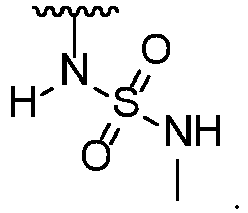


- In some embodiments of Formula (II) (e.g., (11-a), (II-a1), (II-a2), (11-b), (II-b1), (II-b2), (11-c), (II-c1), (II-c2)), R4 is -F or methyl. In some embodiments of Formula (II) (e.g., (11-a), (II-a1), (11-a2), (11-b), (II-b1), (11-b2), (11-c), (II-c1), (II-c2)), R4 is -F. In some embodiments of Formula (II) (e.g., (11-a), (II-a1), (II-a2), (11-b), (II-b1), (II-b2), (II-c), (II-c1), (II-c2)), R4 is methyl.
- In some embodiments of Formula (II), n is 1.
- In some embodiments of Formula (II) (e.g., (11-a), (II-a1), (II-a2), (11-b), (II-b1), (II-b2), (11-c), (II-c1), (II-c2)), each R5, R6, R9, and R10 are hydrogen. In some embodiments of Formula (II) (e.g., (11-a), (II-a1), (II-a2), (11-b), (II-b1), (II-b2), (II-c), (II-c1), (II-c2)), R5, R6, R9, and R10 are methyl.
- In some embodiments of Formula (II) (e.g., (11-a), (II-a1), (II-a2), (11-b), (II-b1), (11-b2), (11-c), (II-c1), (II-c2)), R5 is H and R6 is methyl.
- In some embodiments of Formula (II) (e.g., (11-a), (II-a1), (II-a2), (11-b), (II-b1), (II-b2), (11-c), (II-c1), (II-c2)), R7 is selected from the group consisting of hydrogen, methyl, ethyl, and


- In some embodiments of Formula (II) (e.g., (11-a), (II-a1), (II-a2), (11-b), (II-b1), (II-b2), (11-c), (II-c1), (II-c2)), s is 1. In some embodiments of Formula (II) (e.g., (11-a), (II-a1), (II-a2), (11-b), (II-b1), (II-b2), (11-c), (II-c1), (II-c2)), s is 2.
- In some embodiments, the compound of Formula II is selected from the group consisting of:

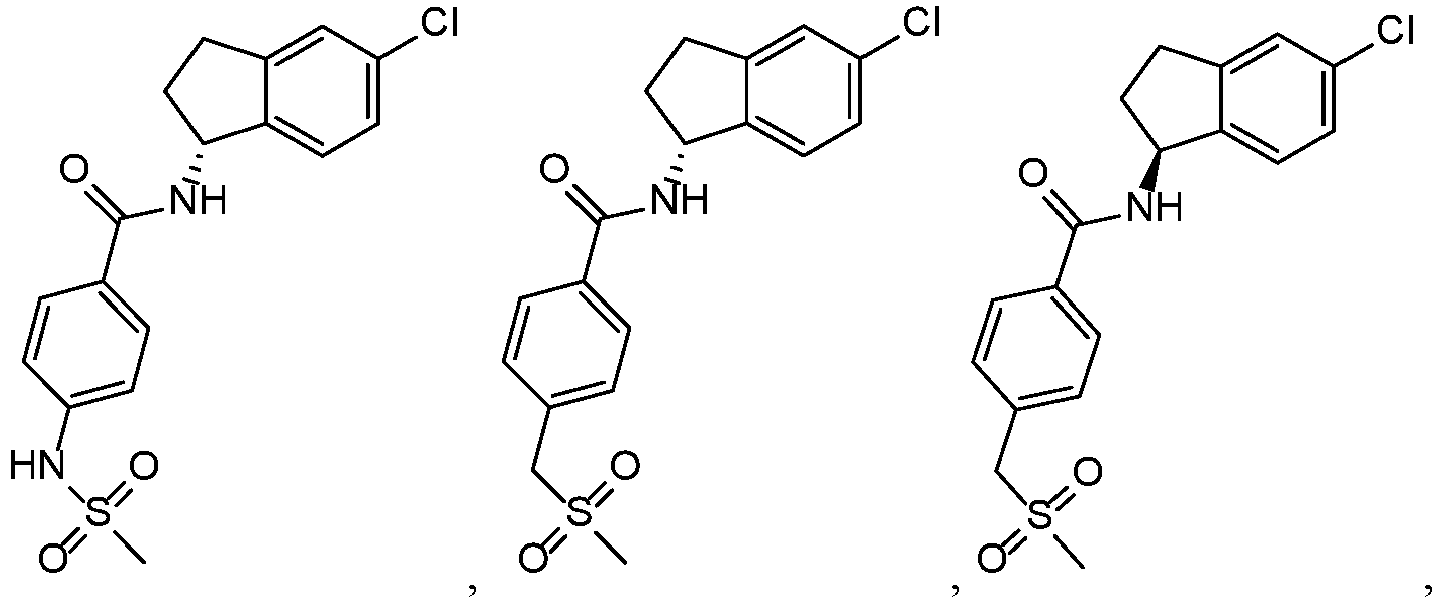


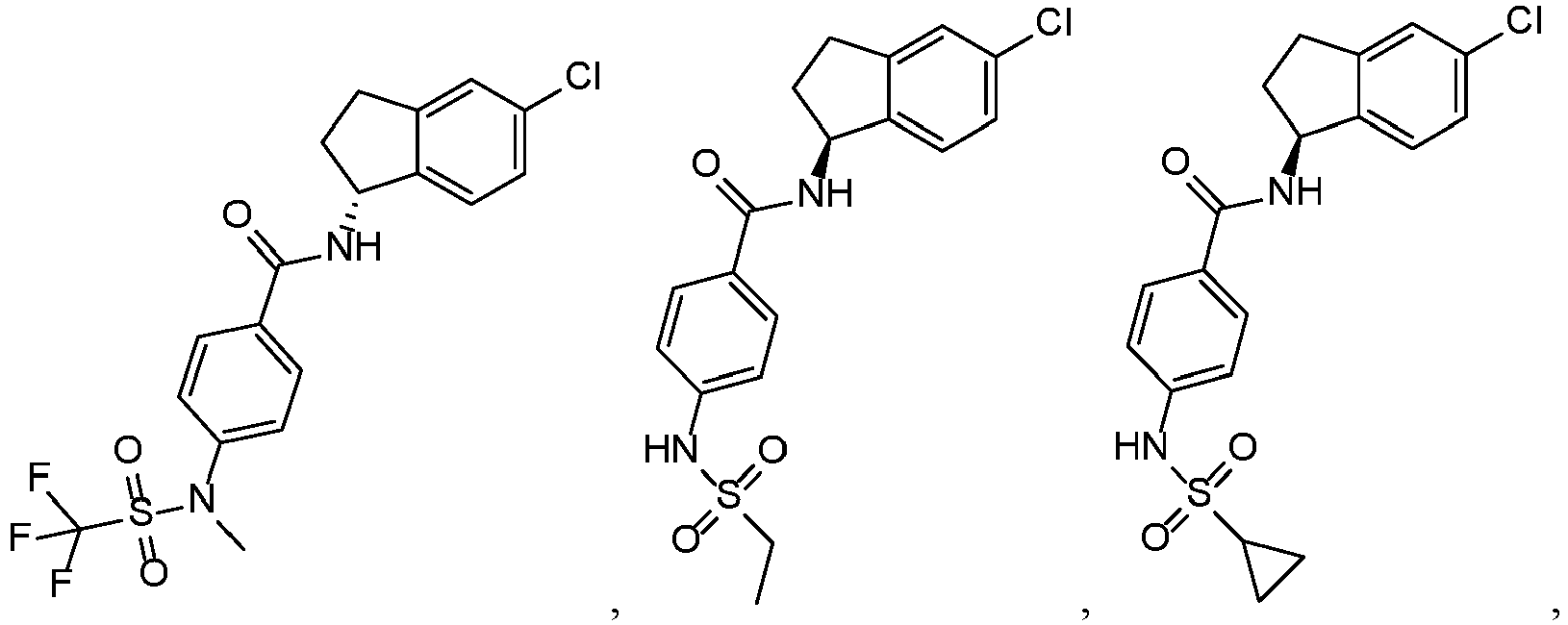


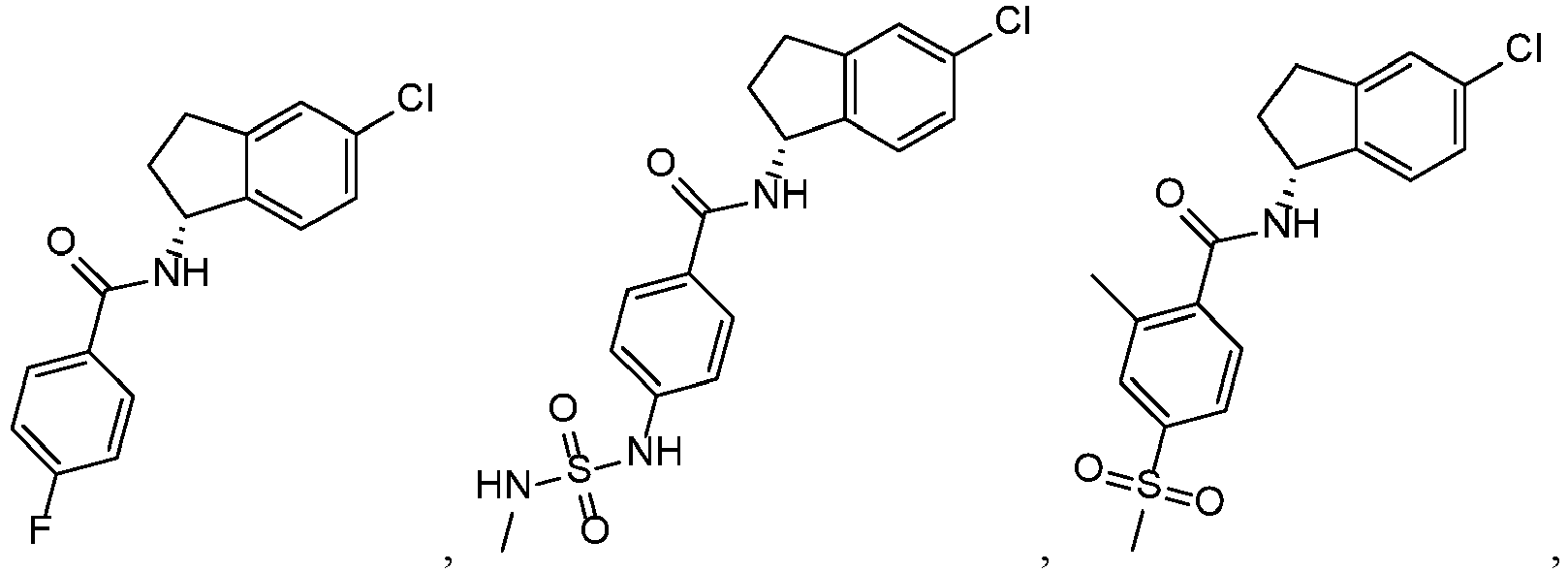


- In another aspect, the present invention features a compound of Formula III:

- R1 is selected from the group consisting of -Cl, -F, and C1-6alkyl substituted with one or more substituents independently selected from -Cl and -F;
- R2 is hydrogen;
- R3 is hydrogen;
- R4 is each independently selected from the group consisting of C1-6alkyl, C1-6alkoxy, halogen, C1-6haloalkyl, -NR7S(O)2C1-6alkyl, and -NRaC(O)-C1-6alkyl;
- n is selected from the group consisting of 0, 1, 2, 3, and 4;
- R7 and R8 are each independently hydrogen or C1-6alkyl; and
- s is 1 or 2.
- In another aspect, the present invention features a pharmaceutical composition comprising a compound of Formula III:
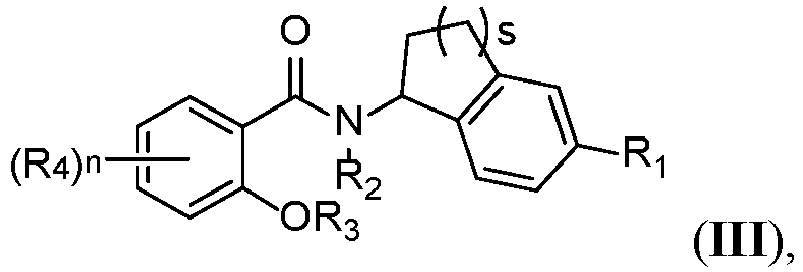
- R1 is selected from the group consisting of -Cl, -F, and C1-6alkyl substituted with one or more substituents independently selected from -Cl and -F;
- R2 is hydrogen;
- R3 is hydrogen;
- R4 is each independently selected from the group consisting of C1-6alkyl, C1-6alkoxy, halogen, C1-6haloalkyl, -NR7S(O)2C1-6alkyl, and -NRaC(O)-C1-6alkyl;
n is selected from the group consisting of 0, 1, 2, 3, and 4; - R7 and R8 are each independently hydrogen or C1-6alkyl; and
s is 1 or 2; - In some embodiments, the compound of Formula III is a compound of Formula III-a, Formula III-a1, or Formula III-a2:


- In some embodiments, the compound of Formula III is a compound of Formula III-b, Formula III-b1, or Formula III-b2:


- In some embodiments, the compound of Formula III is a compound of Formula 111-c, Formula III-c1, or Formula III-c2:


- In some embodiments, the compound of Formula III is a compound of Formula III-a2:

- In some embodiments, the compound of Formula III is a compound of Formula III-b2:

- In some embodiments, the compound of Formula III is a compound of Formula III-c2:

- In some embodiments of Formula III (e.g., (111-a), (III-a1), (III-a2), (111-b), (III-b1), (III-b2), (111-c), (111-c1), (III-c2)), R1 is selected from the group consisting of -Cl, -F, and -CF3. In some embodiments of Formula III (e.g., (111-a), (III-a1), (III-a2), (111-b), (III-b1), (III-b2), (III-c), (111-c1), (III-c2)), R1 is -Cl. In some embodiments of Formula III (e.g., (III-a), (III-a1), (III-a2), (III-b), (III-b1), (III-b2), (111-c), (111-c1), (III-c2)), R1 is -F. In some embodiments of Formula III (e.g., (111-a), (III-a1), (III-a2), (111-b), (III-b1), (III-b2), (III-c), (111-c1), (III-c2)), R1 is -CF3.
- In some embodiments of Formula III (e.g., (111-a), (III-a1), (III-a2), (111-b), (III-b1), (III-b2), (III-c), (111-c1), (III-c2)), R4 is selected from the group consisting of methyl, methoxy, -F, -Cl, -CF3, methoxy,


- In some embodiments of Formula III, n is selected from the group consisting of 0, 1, and 2. In some embodiments of Formula III, n is 0 or 1. In some embodiments of Formula III, n is 1. In some embodiments of Formula III, n is 0.
- In some embodiments of Formula III (e.g., (111-a), (III-a1), (III-a2), (111-b), (III-b1), (III-b2), (III-c), (111-c1), (III-c2)), each R7 and R8 are independently hydrogen.
- In some embodiments of Formula III (e.g., (111-a), (III-a1), (III-a2), (111-b), (III-b1), (III-b2), (III-c), (111-c1), (III-c2)), s is 2. In some embodiments of Formula III (e.g., (III-a), (III-a1), (III-a2), (111-b), (III-b1), (111-b2), (111-c), (111-c1), (III-c2)), s is 1.
- In some embodiments, the compound of Formula III is selected from the group consisting of:


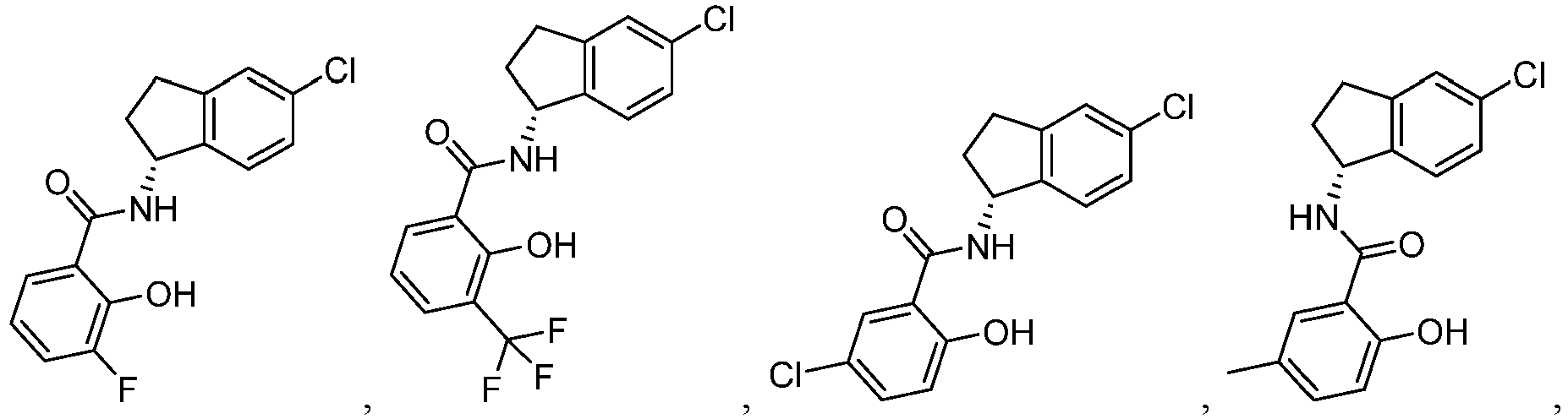


- Exemplary methods for preparing compounds described herein are illustrated in the following synthetic schemes. These schemes are given for the purpose of illustrating the invention, and should not be regarded in any manner as limiting the scope of the invention.
- The synthetic route illustrated in Scheme 1-1 depicts an exemplary procedure for preparing carboxylic acid I-C. In the first step, I-A is carbonylated to form ester I-B under standard carbonylation reaction conditions (e.g., CO, Pd(dppf)Cl2 and Et3N in ROH). Then, ester 1-B is hydrolyzed to provide carboxylic acid I-C.

- The synthetic route illustrated in Scheme 1-2 depicts an exemplary procedure for preparing I-E (a compound of Formula 1-1). In this route, carboxylic acid I-C is coupled with aminoindane I-D under standard peptide coupling reaction conditions (e.g., HATU and base) to provide the I-E (a compound of Formula 1-1).
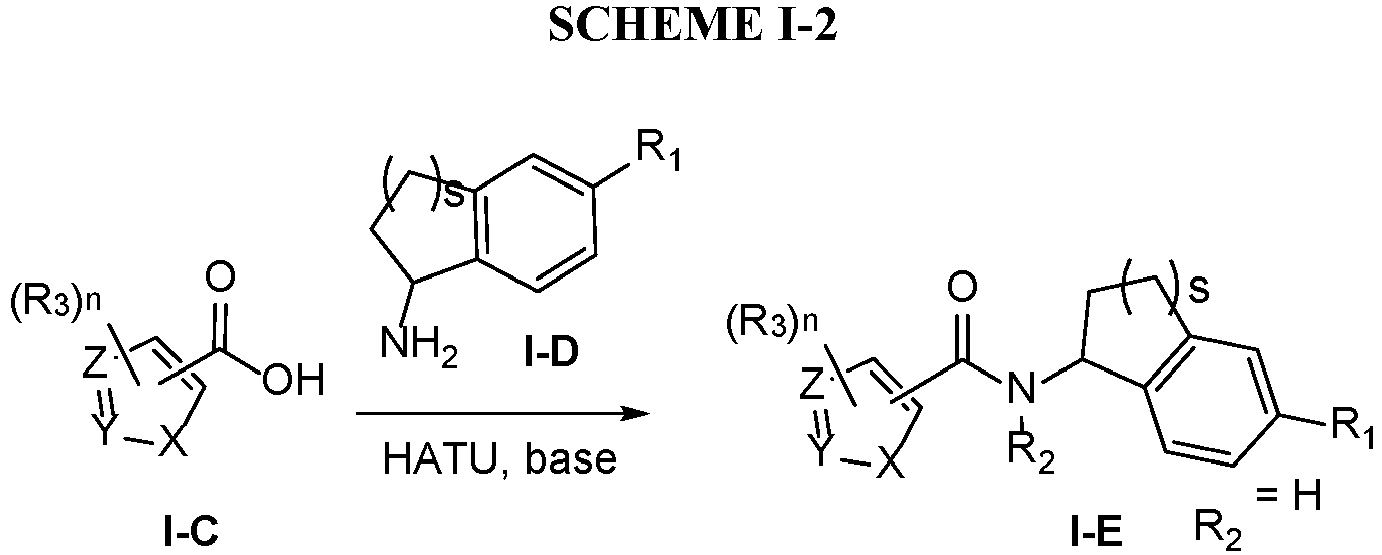
- The synthetic route illustrated in Scheme 1 depicts an exemplary procedure for preparing carboxylic acid C. In the first step, A is carbonylated to form ester B under standard carbonylation reaction conditions (e.g., CO, Pd(dppf)Cl2 and Et3N in ethanol). Then, ester B is hydrolyzed to provide carboxylic acid C.

- The synthetic route illustrated in Scheme 2 depicts an exemplary procedure for preparing E (a compound of Formula I). In this route, carboxylic acid C is coupled with aminoindane D under standard peptide coupling reaction conditions (e.g., HATU and Et3N in acetonitrile) to provide the E (a compound of Formula I).

- The synthetic route illustrated in Scheme 11-1 depicts an exemplary procedure for preparing aminoindane II-B. In this route, indanone II-A is reacted with ammonium acetate and sodium cyanoborohydride to form aminoindane II-B.

- The synthetic route illustrated in Scheme 11-2 depicts an exemplary procedure for preparing carboxylic acid II-D. In this route, ester II-C is hydrolyzed to provide carboxylic acid 11-D.

- The synthetic route illustrated in Scheme 11-3 depicts an exemplary procedure for preparing II-E (a compound of Formula II). In this route, carboxylic acid 11-D is coupled with aminoindane II-B under standard peptide coupling reaction conditions (e.g., HOBt and EDCI in dichloromethane in the presence of NEt3) to provide II-E (a compound of Formula II).
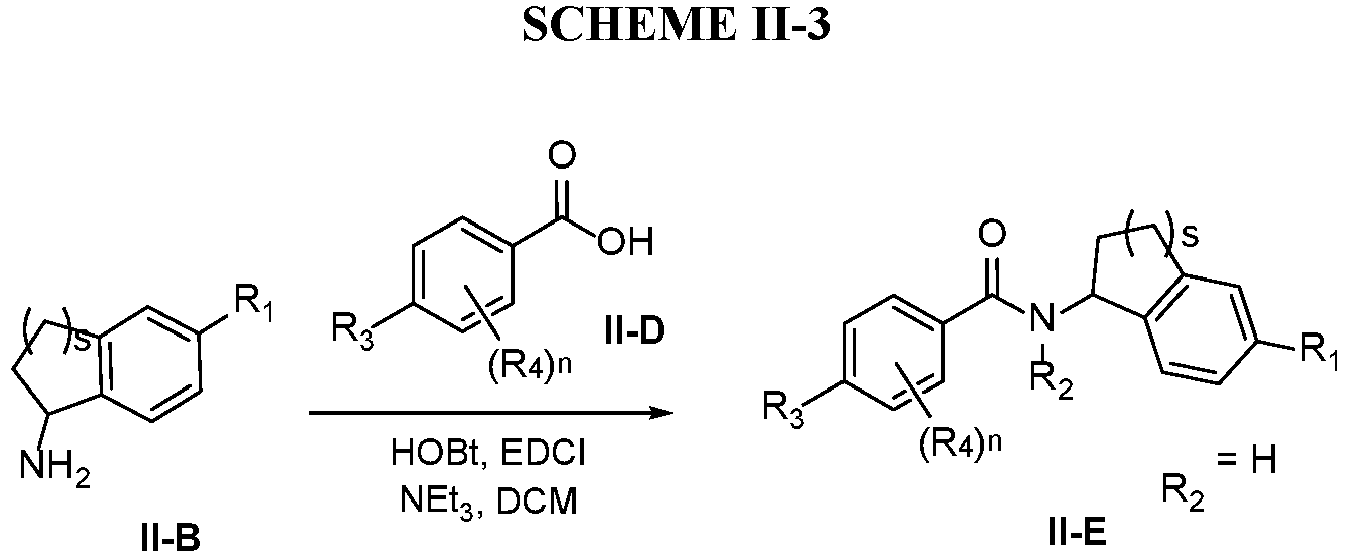
- The synthetic route illustrated in Scheme 111-1 depicts an exemplary procedure for preparing III-C (a compound of Formula III). In this route, carboxylic acid III-A is coupled with aminoindane III-B under standard peptide coupling reaction conditions (e.g., HOBt and EDCI in dichloromethane in the presence of DMAP) to provide III-C (a compound of Formula III).

- The compounds and compositions described above and herein can be used to treat a neurological disease or disorder or a disease or condition associated with excessive neuronal excitability and/or a gain-of-function mutation in a gene (e.g., KCNT1). Exemplary diseases, disorders, or conditions include epilepsy and other encephalopathies (e.g., epilepsy of infancy with migrating focal seizures (MMFSI, EIMFS), autosomal dominant nocturnal frontal lobe epilepsy (ADNFLE), West syndrome, infantile spasms, epileptic encephalopathy, developmental and epileptic encephalopathy (DEE), early infantile epileptic encephalopathy (EIEE), generalized epilepsy, focal epilepsy, multifocal epilepsy, temporal lobe epilepsy, Ohtahara syndrome, early myoclonic encephalopathy and Lennox Gastaut syndrome, drug resistant epilepsy, seizures (e.g., frontal lobe seizures, generalized tonic clonic seizures, asymmetric tonic seizures, focal seizures), leukodystrophy, hypomyelinating leukodystrophy, leukoencephalopathy, and sudden unexpected death in epilepsy, cardiac dysfunctions (e.g., cardiac arrhythmia, Brugada syndrome, , myocardial infarction), pulmonary vasculopathy / hemorrhage, pain and related conditions (e.g. neuropathic pain, acute/chronic pain, migraine, etc), muscle disorders (e.g. myotonia, neuromyotonia, cramp muscle spasms, spasticity), itch and pruritis, movement disorders (e.g., ataxia and cerebellar ataxias), psychiatric disorders (e.g. major depression, anxiety, bipolar disorder, schizophrenia, attention-deficit hyperactivity disorder), neurodevelopmental disorder, learning disorders, intellectual disability, Fragile X, neuronal plasticity, and autism spectrum disorders.
- In some embodiments, the neurological disease or disorder or the disease or condition associated with excessive neuronal excitability and/or a gain-of-function mutation in a gene (e.g., KCNT1) is selected from EIMFS, ADNFLE and West syndrome. In some embodiments, the neurological disease or disorder or the disease or condition associated with excessive neuronal excitability and/or a gain-of-function mutation in a gene (e.g., KCNT1) is selected from infantile spasms, epileptic encephalopathy, focal epilepsy, Ohtahara syndrome, developmental and epileptic encephalopathy and Lennox Gastaut syndrome. In some embodiments, the neurological disease or disorder or the disease or condition associated with excessive neuronal excitability and/or a gain-of-function mutation in a gene (e.g., KCNT1) is seizure. In some embodiments, the neurological disease or disorder or the disease or condition associated with excessive neuronal excitability and/or a gain-of-function mutation in a gene (e.g., KCNT1) is selected from cardiac arrhythmia, Brugada syndrome, and myocardial infarction.
- In some embodiments, the neurological disease or disorder or the disease or condition associated with excessive neuronal excitability and/or a gain-of-function mutation in a gene (e.g., KCNT1) is selected from the group consisting of the learning disorders, Fragile X, intellectual function, neuronal plasticity, psychiatric disorders, and autism spectrum disorders.
- Accordingly, the compounds and compositions thereof can be administered to a subject with a neurological disease or disorder or a disease or condition associated with excessive neuronal excitability and/or a gain-of-function mutation in a gene such as KCNT1 (e.g., EIMFS, ADNFLE, West syndrome, infantile spasms, epileptic encephalopathy, focal epilepsy, Ohtahara syndrome, developmental and epileptic encephalopathy, and Lennox Gastaut syndrome, seizures, cardiac arrhythmia, Brugada syndrome, and myocardial infarction).
- EIMFS is a rare and debilitating genetic condition characterized by an early onset (before 6 months of age) of almost continuous heterogeneous focal seizures, where seizures appear to migrate from one brain region and hemisphere to another. Patients with EIMFS are generally intellectually impaired, non-verbal and non-ambulatory. While several genes have been implicated to date, the gene that is most commonly associated with EIMFS is KCNT1. Several de novo mutations in KCNT1 have been identified in patients with EIMFS, including V271F, G288S, R428Q, R474Q, R474H, R474C, I760M, A934T, P924L, G243S, H257D, A259D, R262Q, Q270E, L274I, F346L, C377S, R398Q, P409S, A477T, F502V, M516V, Q550del, K629E, K629N, I760F, E893K, M896K, R933G, R950Q, K1154Q (Barcia et al. (2012) Nat Genet. 44: 1255-1260; Ishii et al. (2013) Gene 531:467-471; McTague et al. (2013) Brain. 136: 1578-1591; Epi4K Consortium & Epilepsy Phenome/Genome Project. (2013) Nature 501:217-221; Lim et al. (2016) Neurogenetics; Ohba et al. (2015) Epilepsia 56:el21-el28; Zhou et al. (2018) Genes Brain Behav. e12456; Moller et al. (2015) Epilepsia. e114-20; Numis et al. (2018) Epilepsia. 1889-1898; Madaan et al. Brain Dev. 40(3):229-232; McTague et al. (2018) Neurology. 90(1):e55-e66; Kawasaki et al. (2017) J Pediatr. 191:270-274; Kim et al. (2014) Cell Rep. 9(5):1661-1672; Ohba et al. (2015) Epilepsia. 56(9):e121-8; Rizzo et al. (2016) Mol Cell Neurosci. 72:54-63; Zhang et al. (2017) Clin Genet. 91(5):717-724; Mikati et al. (2015) Ann Neurol. 78(6):995-9; Baumer et al. (2017) Neurology. 89(21):2212; Dilena et al. (2018) Neurotherapeutics. 15(4):1112-1126). These mutations are gain-of-function, missense mutations that are dominant (i.e. present on only one allele) and result in change in function of the encoded potassium channel that causes a marked increase in whole cell current when tested in Xenopus oocyte or mammalian expression systems (see e.g. Milligan et al. (2015) Ann Neurol. 75(4): 581-590; Barcia et al. (2012) Nat Genet. 44(11): 1255-1259; and Mikati et al. (2015) Ann Neurol. 78(6): 995-999).
- ADNFLE has a later onset than EIMFS, generally in mid-childhood, and is generally a less severe condition. It is characterized by nocturnal frontal lobe seizures and can result in psychiatric, behavioural and cognitive disabilities in patients with the condition. While ADNFLE is associated with genes encoding several neuronal nicotinic acetylcholine receptor subunits, mutations in the KCNT1 gene have been implicated in more severe cases of the disease (Heron et al. (2012) Nat Genet. 44: 1188-1190). Functional studies of the mutated KCNT1 genes associated with ADNFLE indicated that the underlying mutations (M896I, R398Q, Y796H and R928C) were dominant, gain-of-function mutations (Milligan et al. (2015) Ann Neurol. 75(4): 581-590; Mikati et al. (2015) Ann Neurol. 78(6): 995-999).
- West syndrome is a severe form of epilepsy composed of a triad of infantile spasms, an interictal electroencephalogram (EEG) pattern termed hypsarrhythmia, and mental retardation, although a diagnosis can be made one of these elements is missing. Mutations in KCNT1, including G652V and R474H, have been associated with West syndrome (Fukuoka et al. (2017) Brain Dev 39:80-83 and Ohba et al. (2015) Epilepsia 56:el21-el28). Treatment targeting the KCNT1 channel suggests that these mutations are gain-of-function mutations (Fukuoka et al. (2017) Brain Dev 39:80-83).
- In one aspect, the present invention features a pharmaceutical composition disclosed herein (e.g., a pharmaceutical composition comprising a compound disclosed herein (e.g., a compound of Formula (I-I) or (I), (e.g., (I-Ia), (I-Ia1), (I-Ib), (I-Ib1), (I-Ic), (I-Ic1), (I-a), (I-a1), (I-b), (I-b1), (I-c), (I-c1), (I-d), or (I-d1)), a compound of Formula (II), (e.g., (II-a), (II-a1), (II-a2), (II-b), (II-b1), (II-b2), (II-c), (II-c1), (II-c2)), or a compound of Formula (III), (e.g., (III-a), (III-a1), (III-a2), (III-b), (III-b1), (III-b2), (III-c), (111-c1), (III-c2)))) or a pharmaceutically acceptable salt thereof), and a pharmaceutically acceptable excipient) for use in a method of treating a disease or condition associated with excessive neuronal excitability or a gain-of-function mutation of KCNT1 (for example, epilepsy and other encephalopathies (e.g., epilepsy of infancy with migrating focal seizures (MMFSI, EIMFS), autosomal dominant nocturnal frontal lobe epilepsy (ADNFLE), West syndrome, infantile spasms, epileptic encephalopathy, focal epilepsy, Ohtahara syndrome, developmental and epileptic encephalopathy (DEE), and Lennox Gastaut syndrome, seizures, leukodystrophy, leukoencephalopathy, intellectual disability, Multifocal Epilepsy, Generalized tonic clonic seizures, Drug resistant epilepsy, Temporal lobe epilepsy, cerebellar ataxia, Asymmetric Tonic Seizures) and cardiac dysfunctions (e.g., cardiac arrhythmia, Brugada syndrome, sudden unexpected death in epilepsy, myocardial infarction), pain and related conditions (e.g. neuropathic pain, acute/chronic pain, migraine, etc), muscle disorders (e.g. myotonia, neuromyotonia, cramp muscle spasms, spasticity), itch and pruritis, ataxia and cerebellar ataxias, psychiatric disorders (e.g. major depression, anxiety, bipolar disorder, schizophrenia), learning disorders, Fragile X, neuronal plasticity, and autism spectrum disorders) comprising administering to a subject in need thereof the pharmaceutical composition.
- In some examples, the subject presenting with a disease or condition that may be associated with a gain-of-function mutation in KCNT1 is genotyped to confirm the presence of a known gain-of-function mutation in KCNT1 prior to administration of the compounds and compositions thereof. For example, whole exome sequencing can be performed on the subject. Gain-of-function mutations associated with EIMFS may include, but are not limited to, V271F, G288S, R428Q, R474Q, R474H, R474C, I760M, A934T, P924L, G243S, H257D, A259D, R262Q, Q270E, L274I, F346L, C377S, R398Q, P409S, A477T, F502V, M516V, Q550del, K629E, K629N, I760F, E893K, M896K, R933G, R950Q, and K1154Q. Gain-of-function mutations associated with ADNFLE may include, but are not limited to, M896I, R398Q, Y796H, R928C, and G288S. Gain-of-function mutations associated with West syndrome may include, but are not limited to, G652V and R474H. Gain-of-function mutations associated with temporal lobe epilepsy may include, but are not limited to, R133H and R565H. Gain-of-function mutations associated with Lennox-Gastaut may include, but are not limited to, R209C. Gain-of-function mutations associated with seizures may include, but are not limited to, A259D, G288S, R474C, R474H. Gain-of-function mutations associated with leukodystrophy may include, but are not limited to, G288S and Q906H. Gain-of-function mutations associated with Multifocal Epilepsy may include, but are not limited to, V340M. Gain-of-function mutations associated with EOE may include, but are not limited to, F346L and A934T. Gain-of-function mutations associated with Early-onset epileptic encephalopathies (EOEE) may include, but are not limited to, R428Q. Gain-of-function mutations associated with developmental and epileptic encephalopathies may include, but are not limited to, F346L, R474H, and A934T. Gain-of-function mutations associated with epileptic encephalopathies may include, but are not limited to, L437F, Y796H, P924L, R961H. Gain-of-function mutations associated with Early Infantile Epileptic Encephalopathy (EIEE) may include, but are not limited to, M896K. Gain-of-function mutations associated with drug resistent epilepsy and generalized tonic-clonic seizure may include, but are not limited to, F346L. Gain-of-function mutations associated with migrating partial seizures of infancy may include, but are not limited to, R428Q. Gain-of-function mutations associated with Leukoencephalopathy may include, but are not limited to, F932I. Gain-of-function mutations associated with NFLE may include, but are not limited to, A934T and R950Q. Gain-of-function mutations associated with Ohtahara syndrome may include, but are not limited to, A966T. Gain-of-function mutations associated with infantile spasms may include, but are not limited to, P924L. Gain-of-function mutations associated with Brugada Syndrome may include, but are not limited to, R1106Q. Gain-of-function mutations associated with Brugada Syndrome may include, but are not limited to, R474H.
- In other examples, the subject is first genotyped to identify the presence of a mutation in KCNT1 and this mutation is then confirmed to be a gain-of-function mutation using standard in vitro assays, such as those described in Milligan et al. (2015) Ann Neurol. 75(4): 581-590. Typically, the presence of a gain-of-function mutation is confirmed when the expression of the mutated KCNT1 allele results an increase in whole cell current compared to the whole cell current resulting from expression of wild-type KCNT1 as assessed using whole-cell electrophysiology (such as described in Milligan et al. (2015) Ann Neurol. 75(4): 581-590; Barcia et al. (2012) Nat Genet. 44(11): 1255-1259; Mikati et al. (2015) Ann Neurol. 78(6): 995-999; or Rizzo et al. Mol Cell Neurosci. (2016) 72:54-63). This increase of whole cell current can be, for example, an increase of at least or about 50%, 100%, 150%, 200%, 250%, 300%, 350%, 400% or more. The subject can then be confirmed to have a disease or condition associated with a gain-of-function mutation in KCNT1.
- In particular examples, the subject is confirmed as having a KCNT1 allele containing a gain-of-function mutation (e.g. V271F, G288S, R398Q, R428Q, R474Q, R474H, R474C, G652V, I760M, Y796H, M896I, P924L, R928C or A934T).
- The compounds disclosed herein (e.g., a compound of Formula (I-I) or (I), (e.g., (I-Ia), (I-Ia1), (I-Ib), (I-Ib1), (I-Ic), (I-Ic1), (I-a), (I-a1), (I-b), (I-b1), (I-c), (I-c1), (I-d), or (I-d1)), a compound of Formula (II), (e.g., (II-a), (II-a1), (II-a2), (II-b), (II-b1), (II-b2), (II-c), (11-c1), (II-c2)), or a compound of Formula (III), (e.g., (III-a), (III-a1), (III-a2), (III-b), (III-b1), (III-b2), (III-c), (111-c1), (III-c2)))) or a pharmaceutically acceptable salt thereof) or the pharmaceutical composition disclosed herein (e.g., a pharmaceutical composition comprising a compound disclosed herein (e.g., a compound of Formula (I-I) or (I), (e.g., (I-Ia), (I-Ia1), (I-Ib), (I-Ib1), (I-Ic), (I-Ic 1), (I-a), (I-a1), (I-b), (I-b1), (I-c), (I-c1), (I-d), or (I-d1)), a compound of Formula (II), (e.g., (II-a), (II-a1), (II-a2), (II-b), (II-b1), (II-b2), (II-c), (II-c1), (II-c2)), or a compound of Formula (III), (e.g., (ΠI-a), (III-a1), (III-a2), (III-b), (III-b1), (III-b2), (III-c), (111-c1), (III-c2)))) or a pharmaceutically acceptable salt thereof), and a pharmaceutically acceptable excipient) can also be used therapeutically for conditions associated with excessive neuronal excitability where the excessive neuronal excitability is not necessarily the result of a gain-of-function mutation in KCNT1. Even in instances where the disease is not the result of increased KCNT1 expression and/or activity, inhibition of KCNT1 expression and/or activity can nonetheless result in a reduction in neuronal excitability, thereby providing a therapeutic effect. Thus, the compounds disclosed herein (e.g., a compound of Formula (I-I) or (I), (e.g., (I-Ia), (I-Ia1), (I-Ib), (I-Ib1), (I-Ic), (I-Ic1), (I-a), (I-a1), (I-b), (I-b1), (I-c), (I-c1), (I-d), or (I-d1)), a compound of Formula (II), (e.g., (II-a), (II-a1), (II-a2), (II-b), (II-b1), (II-b2), (II-c), (II-c1), (II-c2)), or a compound of Formula (III), (e.g., (III-a), (III-a1), (III-a2), (III-b), (III-b1), (III-b2), (III-c), (III-c1), (III-c2)))) or a pharmaceutically acceptable salt thereof) or the pharmaceutical composition disclosed herein (e.g., a pharmaceutical composition comprising a compound disclosed herein (e.g., a compound of Formula (I-I) or (I), (e.g., (I-Ia), (I-Ia1), (I-Ib), (I-Ib1), (I-Ic), (I-Ic1), (I-a), (I-a1), (I-b), (I-b1), (I-c), (I-c1), (I-d), or (I-d1)), a compound of Formula (II), (e.g., (II-a), (II-a1), (II-a2), (II-b), (II-b1), (II-b2), (II-c), (II-c1), (II-c2)), or a compound of Formula (III), (e.g., (III-a), (III-a1), (III-a2), (III-b), (III-b1), (III-b2), (III-c), (III-c1), (III-c2)))) or a pharmaceutically acceptable salt thereof), and a pharmaceutically acceptable excipient) can be used to treat a subject with conditions associated with excessive neuronal excitability, for example, epilepsy and other encephalopathies (e.g., epilepsy of infancy with migrating focal seizures (EIMFS), autosomal dominant nocturnal frontal lobe epilepsy (ADNFLE), West syndrome, infantile spasms, epileptic encephalopathy, focal epilepsy, Ohtahara syndrome, developmental and epileptic encephalopathy, and Lennox Gastaut syndrome, seizures) or cardiac dysfunctions (e.g., cardiac arrhythmia, Brugada syndrome, myocardial infarction), regardless of whether or not the disease or disorder is associated with a gain-of-function mutation in KCNT1.
- Compounds provided in accordance with the present invention are usually administered in the form of pharmaceutical compositions. This invention therefore provides pharmaceutical compositions that contain, as the active ingredient, one or more of the compounds described, or a pharmaceutically acceptable salt or ester thereof, and one or more pharmaceutically acceptable excipients, carriers, including inert solid diluents and fillers, diluents, including sterile aqueous solution and various organic solvents, permeation enhancers, solubilizers and adjuvants. The pharmaceutical compositions may be administered alone or in combination with other therapeutic agents. Such compositions are prepared in a manner well known in the pharmaceutical art (see, e.g., Remington's Pharmaceutical Sciences, Mace Publishing Co., Philadelphia, Pa. 17th Ed. (1985); and Modern Pharmaceutics, Marcel Dekker, Inc. 3rd Ed. (G. S. Banker & C. T. Rhodes, Eds.)
- The pharmaceutical compositions may be administered in either single or multiple doses by any of the accepted modes of administration of agents having similar utilities, including rectal, buccal, intranasal and transdermal routes, by intra-arterial injection, intravenously, intraperitoneally, parenterally, intramuscularly, subcutaneously, orally, topically, as an inhalant, or via an impregnated or coated device such as a stent, for example, or an artery-inserted cylindrical polymer.
- One mode for administration is parenteral, particularly by injection. The forms in which the novel compositions of the present invention may be incorporated for administration by injection include aqueous or oil suspensions, or emulsions, with sesame oil, corn oil, cottonseed oil, or peanut oil, as well as elixirs, mannitol, dextrose, or a sterile aqueous solution, and similar pharmaceutical vehicles. Aqueous solutions in saline are also conventionally used for injection, but less preferred in the context of the present invention. Ethanol, glycerol, propylene glycol, liquid polyethylene glycol, and the like (and suitable mixtures thereof), cyclodextrin derivatives, and vegetable oils may also be employed. The proper fluidity can be maintained, for example, by the use of a coating, such as lecithin, by the maintenance of the required particle size in the case of dispersion and by the use of surfactants. The prevention of the action of microorganisms can be brought about by various antibacterial and antifungal agents, for example, parabens, chlorobutanol, phenol, sorbic acid, thimerosal, and the like.
- Sterile injectable solutions are prepared by incorporating a compound according to the present invention in the required amount in the appropriate solvent with various other ingredients as enumerated above, as required, followed by filtered sterilization. Generally, dispersions are prepared by incorporating the various sterilized active ingredients into a sterile vehicle which contains the basic dispersion medium and the required other ingredients from those enumerated above. In the case of sterile powders for the preparation of sterile injectable solutions, the preferred methods of preparation are vacuum-drying and freeze-drying techniques which yield a powder of the active ingredient plus any additional desired ingredient from a previously sterile-filtered solution thereof.
- Oral administration is another route for administration of compounds in accordance with the invention. Administration may be via capsule or enteric coated tablets, or the like. In making the pharmaceutical compositions that include at least one compound described herein, the active ingredient is usually diluted by an excipient and/or enclosed within such a carrier that can be in the form of a capsule, sachet, paper or other container. When the excipient serves as a diluent, it can be in the form of a solid, semi-solid, or liquid material (as above), which acts as a vehicle, carrier or medium for the active ingredient. Thus, the compositions can be in the form of tablets, pills, powders, lozenges, sachets, cachets, elixirs, suspensions, emulsions, solutions, syrups, aerosols (as a solid or in a liquid medium), ointments containing, for example, up to 10% by weight of the active compound, soft and hard gelatin capsules, sterile injectable solutions, and sterile packaged powders.
- Some examples of suitable excipients include lactose, dextrose, sucrose, sorbitol, mannitol, starches, gum acacia, calcium phosphate, alginates, tragacanth, gelatin, calcium silicate, microcrystalline cellulose, polyvinylpyrrolidone, cellulose, sterile water, syrup, and methyl cellulose. The formulations can additionally include: lubricating agents such as talc, magnesium stearate, and mineral oil; wetting agents; emulsifying and suspending agents; preserving agents such as methyl and propylhydroxy-benzoates; sweetening agents; and flavoring agents.
- The compositions of the invention can be formulated so as to provide quick, sustained or delayed release of the active ingredient after administration to the patient by employing procedures known in the art. Controlled release drug delivery systems for oral administration include osmotic pump systems and dissolutional systems containing polymer-coated reservoirs or drug-polymer matrix formulations. Examples of controlled release systems are given in
U.S. Pat. Nos. 3,845,770 ;4,326,525 ;4,902,514 ; and5,616,345 . Another formulation for use in the methods of the present invention employs transdermal delivery devices ("patches"). Such transdermal patches may be used to provide continuous or discontinuous infusion of the compounds of the present invention in controlled amounts. The construction and use of transdermal patches for the delivery of pharmaceutical agents is well known in the art. See, e.g.,U.S. Pat. Nos. 5,023,252 ,4,992,445 and5,001,139 . Such patches may be constructed for continuous, pulsatile, or on demand delivery of pharmaceutical agents. - The compositions are preferably formulated in a unit dosage form. The term "unit dosage forms" refers to physically discrete units suitable as unitary dosages for human subjects and other mammals, each unit containing a predetermined quantity of active material calculated to produce the desired therapeutic effect, in association with a suitable pharmaceutical excipient (e.g., a tablet, capsule, ampoule). The compounds are generally administered in a pharmaceutically effective amount. Preferably, for oral administration, each dosage unit contains from 1 mg to 2 g of a compound described herein, and for parenteral administration, preferably from 0.1 to 700 mg of a compound a compound described herein. It will be understood, however, that the amount of the compound actually administered usually will be determined by a physician, in the light of the relevant circumstances, including the condition to be treated, the chosen route of administration, the actual compound administered and its relative activity, the age, weight, and response of the individual patient, the severity of the patient's symptoms, and the like.
- For preparing solid compositions such as tablets, the principal active ingredient is mixed with a pharmaceutical excipient to form a solid preformulation composition containing a homogeneous mixture of a compound of the present invention. When referring to these preformulation compositions as homogeneous, it is meant that the active ingredient is dispersed evenly throughout the composition so that the composition may be readily subdivided into equally effective unit dosage forms such as tablets, pills and capsules.
- The tablets or pills of the present invention may be coated or otherwise compounded to provide a dosage form affording the advantage of prolonged action, or to protect from the acid conditions of the stomach. For example, the tablet or pill can comprise an inner dosage and an outer dosage component, the latter being in the form of an envelope over the former. The two components can be separated by an enteric layer that serves to resist disintegration in the stomach and permit the inner component to pass intact into the duodenum or to be delayed in release. A variety of materials can be used for such enteric layers or coatings, such materials including a number of polymeric acids and mixtures of polymeric acids with such materials as shellac, cetyl alcohol, and cellulose acetate.
- Compositions for inhalation or insufflation include solutions and suspensions in pharmaceutically acceptable, aqueous or organic solvents, or mixtures thereof, and powders. The liquid or solid compositions may contain suitable pharmaceutically acceptable excipients as described supra. Preferably, the compositions are administered by the oral or nasal respiratory route for local or systemic effect. Compositions in preferably pharmaceutically acceptable solvents may be nebulized by use of inert gases. Nebulized solutions may be inhaled directly from the nebulizing device or the nebulizing device may be attached to a facemask tent, or intermittent positive pressure breathing machine. Solution, suspension, or powder compositions may be administered, preferably orally or nasally, from devices that deliver the formulation in an appropriate manner.
- In some embodiments, a pharmaceutical composition comprising a disclosed compound, or pharmaceutically acceptable salt thereof, and a pharmaceutically acceptable carrier.
- In order that the invention described herein may be more fully understood, the following examples are set forth. The synthetic and biological examples described in this application are offered to illustrate the compounds, pharmaceutical compositions and methods provided herein and are not to be construed in any way as limiting their scope.
- The compounds provided herein can be prepared from readily available starting materials using the following general methods and procedures. It will be appreciated that where typical or preferred process conditions (i.e., reaction temperatures, times, mole ratios of reactants, solvents, pressures, etc.) are given, other process conditions can also be used unless otherwise stated. Optimal reaction conditions may vary with the particular reactants or solvent used, but such conditions can be determined by one skilled in the art by routine optimization.
- Additionally, as will be apparent to those skilled in the art, conventional protecting groups may be necessary to prevent certain functional groups from undergoing undesired reactions. The choice of a suitable protecting group for a particular functional group as well as suitable conditions for protection and deprotection are well known in the art. For example, numerous protecting groups, and their introduction and removal, are described in T. W. Greene and P. G. M. Wuts, Protecting Groups in Organic Synthesis, Second Edition, Wiley, New York, 1991, and references cited therein.
- The compounds provided herein may be isolated and purified by known standard procedures. Such procedures include recrystallization, filtration, flash chromatography, trituration, high pressure liquid chromatography (HPLC), or supercritical fluid chromatography (SFC). Note that flash chromatography may either be performed manually or via an automated system. The compounds provided herein may be characterized by known standard procedures, such as nuclear magnetic resonance spectroscopy (NMR) or liquid chromatography mass spectrometry (LCMS). NMR chemical shifts are reported in part per million (ppm) and are generated using methods well known to those of skill in the art.
-
- MeI
- methyliodide
- Pd(dppf)Cl2
- [1,1'-bis(diphenylphosphino)ferrocene]palladium(II) dichloride
- Pd2(dba)3
- tris(dibenzylideneacetone)dipalladium(0)
- THF
- tetrahydrofuran
- TEA or Et3N
- triethylamine
- TFA
- trifluoroacetic acid
- FA
- formic acid
- DMF
- N,N-dimethylformamide
- MeOH
- methanol
- DCM
- dichloromethane
- MeCN or ACN
- acetonitrile
- PE
- petroleum ether
- EtOAc or EA
- ethyl acetate
- EDCI
- 1-(3-dimethylaminopropyl)-3-ethylcarbodiimide hydrochloride o-(7-azabenzotriazol-1-yl)-N,N,N',N'-tetramethyluronium hexafluorophosphate
- HOBt
- 1-hydroxybenzotriazole monohydrate
- DIPEA
- N,N,-diisopropylethylamine
- DEA
- diethylamine
- NBS
- N-bromosuccinimide
- NaOMe
- sodium methoxide
- mCPBA
- meta-chloroperoxybenzoic acid
- PPh3
- triphenylphosphine
- DEA
- diethylamine
- NH4OAc
- ammonium acetate
- DIAD
- diisopropyl azodicarboxylate
- i-PrOH
- isopropanol
- Tf2O
- trifluoromethanesulfonic anhydride
- DMAP
- 4-dimethylaminopyridine
- oxone
- potassium peroxymonosulfate
- t-BuOH
- tert-butanol
- CSI
- chlorosulfonyl isocyanate
- ODS
- octadecylsilane
- HEPES
- 4-(2-hydroxyethyl)piperazine-1-ethanesulfonic acid
- DMSO
- dimethyl sulfoxide
- EGTA
- ethylene glycol-bis(β-aminoethyl ether)-N,N,N'N'-tetraacetic acid
- NMDG
- N-methyl-D-glucamine
- IC50
- half maximal inhibitory concentration
- TLC
- thin layer chromatography
- LCMS
- liquid chromatography-mass spectrometry
- HPLC
- high-performance liquid chromatagraphy
- SFC
- supercritical fluid chromatography
- MS
- mass spectrometry
- ESI
- electrospray ionization
- NMR
- nuclear magnetic resonance
-

- To a mixture of 5-cyclopropyl-1-methyl-pyrazole-3-carboxylic acid (100 mg, 0.60 mmol), HOBt (162.63 mg, 1.2 mmol), EDCI (173.04 mg, 0.90 mmol) and (1R)-5-chloroindan-1-amine (100.88 mg, 0.60 mmol) in DCM (20 mL) was stirred at 15 °C for 16 h. The mixture was extracted with EtOAc (20 mL x 2). The combined organic phase was washed with brine (10 mL), dried over anhydrous Na2SO4, filtered and concentrated. The crude product was purified by Prep-HPLC (Xtimate C18 150 x 25 mm, 5µm) A = H2O (0.05% NH4OH) and B = CH3CN; 46-76 %B over 8.5 minutes) to give the product (89.1 mg, 0.28 mmol, 47% yield).
- 1H NMR (400MHz, DMSO-d6 ) δH = 8.23 (d, 1H), 7.30 (s, 1H), 7.24 - 7.17 (m, 1H), 7.16 - 7.11 (m, 1H), 6.31 (s, 1H), 5.42 (q, 1H), 3.86 (s, 3H), 3.01 - 2.92 (m, 1H), 2.86 - 2.75 (m, 1H), 2.42 - 2.31 (m, 1H), 2.11 - 1.99 (m, 1H), 1.94 - 1.86 (m, 1H), 1.00 - 0.92 (m, 2H), 0.68 - 0.61 (m, 2H)
- LCMS Rt = 1.28 min in 2.0 min chromatography, 10-80AB, MS ESI calcd. for C17H19ClN3O [M+H]+ 316.1, found 316.0.
-

- To a mixture of 5-cyclopropyl-2-methyl-pyrazole-3-carboxylic acid (100 mg, 0.60 mmol), HOBt (162.63 mg, 1.2 mmol), EDCI (173.04 mg, 0.90 mmol) and (1R)-5-chloroindan-1-amine (100.88 mg, 0.60 mmol) in DCM (10 mL) was stirred at 15 °C for 16 h. The mixture was extracted with EtOAc (20 mL x 2). The combined organic phase was washed with brine (10 mL), dried over anhydrous Na2SO4, filtered and concentrated. The crude product was purified by Prep-HPLC (Boston Prime C18 150 mm x 30 mm, 5µm) A = H2O (0.05% NH4OH) and B = CH3CN; 52-82%B over 8 minutes) to give the product (77.7 mg, 0.25 mmol, 41% yield).
- 1H NMR (400MHz, DMSO-d6 ) δH = 8.63 (d, 1H), 7.33 (s, 1H), 7.26 - 7.18 (m, 2H), 6.57 (s, 1H), 5.43 (q, 1H), 3.99 (s, 3H), 3.04 - 2.93 (m, 1H), 2.91 - 2.77 (m, 1H), 2.47 - 2.39 (m, 1H), 2.02 - 1.91 (m, 1H), 1.87 - 1.79 (m, 1H), 0.88 - 0.82 (m, 2H), 0.61 - 0.55 (m, 2H).
- LCMS Rt = 1.26 min in 2.0 min chromatography, 10-80AB, MS ESI calcd. for C17H19ClN3O [M+H]+ 316.1, found 316.0.
-

- A mixture of 5-sulfamoylfuran-2-carboxylic acid (100 mg, 0.52 mmol), (1R)-5-chloroindan-1-amine (131.54 mg, 0.78 mmol) and Et3N (0.14 mL, 1.05 mmol) and HATU (198.91 mg, 0.52 mmol) in CH3CN (5 mL) was stirred at 25 °C for 3 hours. The mixture was diluted with H2O (20 mL) and the mixture was extracted with EtOAc (20 mL x 2). The combined organic phase was washed with brine (30 mL), dried over anhydrous Na2SO4, filtered and concentrated. The crude product was purified by Prep-TLC (silica gel, PE: EtOAc = 1:1) to give the product (22.9 mg, 67.3 µmol, 23% yield) as a solid.
- 1H NMR (400MHz, DMSO-d6 ) δH = 8.90 (d, 1H), 7.91 (s, 2H), 7.35 (s, 1H), 7.29 (d, 1H), 7.26 - 7.21 (m, 2H), 7.06 (d, 1H), 5.47 (q, 1H), 3.05 - 2.95 (m, 1H), 2.91 - 2.79 (m, 1H), 2.48 - 2.41 (m, 1H), 2.05 - 1.94 (m, 1H).
- LCMS Rt = 1.12 min in 2.0 min chromatography, 10-80AB, MS ESI calcd. for C14H14ClN2O4S [M+H]+ 341.0, found 340.9.
-

- Synthesis of I-A-5b: A mixture of 5-bromothiophene-2-sulfonamide (2 g, 8.26 mmol) and Pd(dppf)Cl2 (906.65 mg, 1.24 mmol) and Et3N (3.43 mL, 24.78 mmol) in ethanol (20 mL) was stirred under CO (50 psi) at 80 °C for 16 hours. The mixture was filtered through Celite and the filtrate was concentrated. The crude product was purified by flash chromatography on silica gel (EtOAc in PE = 0% to 30% to 50%) to give the product (1 g, 4.25 mmol, 51% yield) as a solid.
1H NMR (400MHz, DMSO-d6 ) δH = 7.95 (s, 2H), 7.77 (d, 1H), 7.58 (d, 1H), 4.32 (q, 2H), 1.30 (t, 3H). - Synthesis of I-A-5c: A mixture of ethyl 5-sulfamoylthiophene-2-carboxylate (900 mg, 3.83 mmol) and LiOH·H2O (481.52 mg, 11.48 mmol) in THF (10 mL) and water (10 mL) was stirred at 20 °C for 1 hour. 1N HCl was added to adjust to pH = 1. The mixture was extracted with EtOAc (30 mL x 2). The combined organic phase was washed with brine (30 mL), dried over anhydrous Na2SO4, filtered and concentrated to give the crude product (450 mg, 2.17 mmol) as a solid.
1H NMR (400MHz, DMSO-d6 ) δH = 7.91 (s, 2H), 7.70 (d, 1H), 7.56 (d, 1H). - Synthesis of 1-4: A mixture of 5-sulfamoylthiophene-2-carboxylic acid (230 mg, 1.11 mmol), (1R)-5-chloroindan-1-amine (372.12 mg, 2.22 mmol), Et3N (0.31 mL, 2.22 mmol) and HATU (422.02 mg, 1.11 mmol) in MeCN (5 mL) was stirred at 20 °C for 1 hour. Water (15 mL) was added and the aqueous layer was extracted with EtOAc (20 mL x 2). The combined organic phase was washed with brine (20 mL), dried over anhydrous Na2SO4, filtered and concentrated. The crude product was purified by flash chromatography on silica gel (EtOAc in PE = 0% to 35% to 70%) to give the product (64 mg, 174.7 µmol, 15% yield) as a solid. The product was blended with another batch (36 mg, prepared from 200 mg of 5-sulfamoylthiophene-2-carboxylic acid). The combined solid (100 mg) was triturated from MeOH (3 mL) to give the product (82.9 mg, 232.3 µmol, 85% yield) as a solid.
- 1H NMR (400MHz, DMSO-d6 ) δH = 9.08 (d, 1H), 7.84 (s, 2H), 7.77 (d, 1H), 7.53 (d, 1H), 7.36 (s, 1H), 7.24 (s, 2H), 5.46 (q, 1H), 3.05 - 2.95 (m, 1H), 2.92 - 2.81 (m, 1H), 2.48 - 2.42 (m, 1H), 2.05 - 1.94 (m, 1H).
- LCMS Rt = 1.20 min in 2.0 min chromatography, 10-80AB, MS ESI calcd. for C14H14ClN2O3S2 [M+H]+ 357.0, found 356.8.
-

- A mixture of 4-sulfamoylthiophene-2-carboxylic acid (150 mg, 0.72 mmol), (1R)-5-chloroindan-1-amine (182.02 mg, 1.09 mmol), Et3N (0.2 mL, 1.45 mmol) and HATU (275.23 mg, 0.72 mmol) in MeCN (5 mL) was stirred at 25 °C for 2 hours. Water (15 mL) was added and the mixture was extracted with EtOAc (20 mL x 2). The combined organic phase was washed with brine (20 mL), dried over anhydrous Na2SO4, filtered and concentrated. The crude product was purified by flash chromatography on silica gel (EtOAc in PE = 0% to 35% to 70%) and then by Prep-HPLC (Xtimate C18 150 x 25 mm, 5µm, A = H2O (10 mM NH4HCO3) and B = CH3CN; 30-60% B over 10 minutes) to give the product (53.3 mg, 149.5 µmol, 20% yield) as a solid.
- 1H NMR (400MHz, DMSO-d6 ) δH = 9.11 (d, 1H), 8.23 (d, 1H), 8.09 (d, 1H), 7.44 (s, 2H), 7.35 (s, 1H), 7.24 (s, 2H), 5.44 (q, 1H), 3.06 - 2.95 (m, 1H), 2.91 - 2.80 (m, 1H), 2.47 - 2.41 (m, 1H), 2.05 - 1.93 (m, 1H).
- LCMS Rt = 1.11 min in 2.0 min chromatography, 10-80AB, MS ESI calcd. for C14H14ClN2O3S2 [M+H]+ 357.0, found 356.9.
-

- A mixture of (1R)-5-chloroindan-1-amine (182.02 mg, 1.09 mmol), 5-sulfamoylthiophene-3-carboxylic acid (150 mg, 0.72 mmol), Et3N (0.2 mL, 1.45 mmol) and HATU (275.23 mg, 0.72 mmol) in MeCN (0.50 mL) was stirred at 25 °C for 2 hours. Water (15 mL) was added and the mixture was extracted with EtOAc (20 mL x 2). The combined organic phase was washed with brine (20 mL), dried over anhydrous Na2SO4, filtered and concentrated. The crude product was purified by flash chromatography on silica gel (EtOAc in PE = 0% to 35% to 70%) to give the product (73.09 mg, 204.8 µmol, 28% yield) as a solid.
- 1H NMR (400MHz, DMSO-d6 ) δH = 8.85 (d, 1H), 8.41 (s, 1H), 8.01 (s, 1H), 7.74 (s, 2H), 7.34 (s, 1H), 7.23 (s, 2H), 5.46 (q, 1H), 3.04 - 2.94 (m, 1H), 2.91 - 2.80 (m, 1H), 2.45 - 2.40 (m, 1H), 2.04 - 1.93 (m, 1H).
- LCMS Rt = 1.09 min in 2.0 min chromatography, 10-80AB, MS ESI calcd. for C14H14ClN2O3S2 [M+H]+ 357.0, found 356.9.
-

- A mixture of 1-methyl-4-sulfamoyl-pyrrole-2-carboxylic acid (150 mg, 0.73 mmol), (1R)-5-chloroindan-1-amine (184.72 mg, 1.1 mmol), Et3N (0.2 mL, 1.47 mmol) and HATU (279.31 mg, 0.73 mmol) in MeCN (5 mL) was stirred at 25 °C for 2 hours. Water (15 mL) was added and the mixture was extracted with EtOAc (20 mL x 2). The combined organic phase was washed with brine (20 mL), dried over anhydrous Na2SO4, filtered and concentrated. The crude product was purified by flash chromatography on silica gel (EtOAc in PE = 0% to 35% to 70%) to give the product (78.9 mg, 222.9 µmol, 30% yield) as a solid.
- 1H NMR (400MHz, DMSO-d6 ) δH = 8.62 (d, 1H), 7.41 (d, 1H), 7.32 (s, 1H), 7.26 - 7.17 (m, 2H), 7.14 (d, 1H), 7.03 (s, 2H), 5.43 (q, 1H), 3.90 (s, 3H), 3.03 - 2.93 (m, 1H), 2.88 - 2.77 (m, 1H), 2.45 - 2.37 (m, 1H), 2.05 - 1.92 (m, 1H).
- LCMS Rt = 1.10 min in 2.0 min chromatography, 10-80AB, MS ESI calcd. for C15H17ClN3O3S [M+H]+ 354.1, found 353.9.
-

- A mixture of 5-methyl-4-sulfamoyl-thiophene-2-carboxylic acid (150 mg, 0.68 mmol), (1R)-5-chloroindan-1-amine (170.48 mg, 1.02 mmol), Et3N (0.19 mL, 1.36 mmol) and HATU (257.79 mg, 0.68 mmol) in MeCN (5 mL) was stirred at 25 °C for 2 hours. Water (15 mL) was added and the mixture was extracted with EtOAc (20 mL x 2). The combined organic phase was washed with brine (20 mL), dried over anhydrous Na2SO4, filtered and concentrated. The crude product was purified by flash chromatography on silica gel (EtOAc in PE = 0% to 35% to 70%) and then Prep-HPLC (Xtimate C18 150 x 25mm, 5µm, A = H2O (10 mM NH4HCO3) and B = CH3CN; 30-60% B over 10 minutes) to give the product (120.4 mg, 324.6 µmol, 47% yield) as a solid.
- 1H NMR (400MHz, DMSO-d6 ) δH = 9.03 (d, 1H), 8.01 (s, 1H), 7.38 (s, 2H), 7.34 (s, 1H), 7.26 - 7.19 (m, 2H), 5.42 (q, 1H), 3.04 - 2.95 (m, 1H), 2.89 - 2.79 (m, 1H), 2.64 (s, 3H), 2.46 - 2.39 (m, 1H), 2.03 - 1.92 (m, 1H).
- LCMS Rt = 1.13 min in 2.0 min chromatography, 10-80AB, MS ESI calcd. for C15H16ClN2O3S2 [M+H]+ 371.0, found 370.9.
-

- A mixture of 5-methyl-4-sulfamoyl-furan-2-carboxylic acid (150 mg, 0.73 mmol), (1R)-5-chloroindan-1-amine (183.82 mg, 1.1 mmol), Et3N (0.2 mL, 1.46 mmol) and HATU (277.97 mg, 0.73 mmol) in MeCN (5 mL) was stirred at 25 °C for 2 hours. Water (15 mL) was added and the mixture was extracted with EtOAc (20 mL x 2). The combined organic phase was washed with brine (20 mL), dried over anhydrous Na2SO4, filtered and concentrated. The crude product was purified by flash chromatography on silica gel (EtOAc in PE = 0% to 35% to 70%) and then Prep-HPLC (Xtimate C18 150 x 25mm, 5µm, A = H2O (10 mM NH4HCO3) and B = CH3CN; 30-60% B over 10 minutes) to give the product (48.2 mg, 135.8 µmol, 18% yield) as a solid.
- 1H NMR (400MHz, CD3OD) δH = 8.84 (d, 1H), 7.47 (s, 2H), 7.36 - 7.29 (m, 2H), 7.26 - 7.14 (m, 2H), 5.43 (q, 1H), 3.04 - 2.93 (m, 1H), 2.89 - 2.78 (m, 1H), 2.52 (s, 3H), 2.45 - 2.38 (m, 1H), 2.05 - 1.93 (m, 1H).
- LCMS Rt = 1.10 min in 2.0 min chromatography, 10-80AB, MS ESI calcd. for C15H16ClN2O4S [M+H]+ 355.0, found 354.9.
-

- A mixture of 3-methyl-5-sulfamoyl-thiophene-2-carboxylic acid (100 mg, 0.45 mmol), (1R)-5-chloroindan-1-amine (113.65 mg, 0.68 mmol), Et3N (0.13 mL, 0.90 mmol) and HATU (171.86 mg, 0.45 mmol) in MeCN (5 mL) was stirred at 25 °C for 2 hours. The mixture was diluted with H2O (20 mL) and the mixture was extracted with EtOAc (20 mL x 2). The combined organic phase was washed with brine (30 mL), dried over anhydrous Na2SO4, filtered and concentrated. The crude product was purified by Prep-TLC (silica gel, PE: EtOAc = 1:1) and then by Prep-HPLC (Waters Xbridge 150 x 25 mm, 5µm), A = H2O (10 mM NH4HCO3) and B = CH3CN; 35-65% B over 10 minutes) to give the product (22.8 mg, 61.6 µmol, 76% yield) as a solid.
- 1H NMR (400MHz, DMSO-d6 ) δH = 8.71 (d, 1H), 8.13 (s, 1H), 7.52 (s, 2H), 7.33 (s, 1H), 7.29 - 7.23 (m, 2H), 5.43 (q, 1H), 3.02 - 2.93 (m, 1H), 2.90 - 2.79 (m, 1H), 2.52 (s, 3H), 2.46 - 2.41 (m, 1H), 2.04 - 1.93 (m, 1H).
- LCMS Rt = 1.13 min in 2.0 min chromatography, 10-80AB, MS ESI calcd. for C15H16ClN2O3S2 [M+H]+ 371.0, found 370.9.
-

- A mixture of 2-methyl-5-sulfamoyl-furan-3-carboxylic acid (150 mg, 0.73 mmol), (1R)-5-chloroindan-1-amine (183.82 mg, 1.1 mmol), Et3N (0.2 mL, 1.46 mmol) and HATU (277.97 mg, 0.73 mmol) in MeCN (5 mL) was stirred at 25 °C for 2 hours. Water (15 mL) was added and the mixture was extracted with EtOAc (20 mL x 2). The combined organic phase was washed with brine (20 mL), dried over anhydrous Na2SO4, filtered and concentrated. The crude product was purified by flash chromatography on silica gel (EtOAc in PE = 0% to 30%) to give the product (23.7 mg, 0.07 mmol, 24% yield) as a solid.
- 1H NMR (400 MHz, DMSO-d6 ) δH = 8.54 (d, 1H), 7.76 (s, 2H), 7.51 (s, 1H), 7.34 (s, 1H), 7.27 - 7.18 (m, 2H), 5.45 (q, 1H), 3.02 - 2.95 (m, 1H), 2.89 - 2.80 (m, 1H), 2.64 (s, 3H), 2.44 - 2.39 (m, 1H), 2.00 - 1.91 (m, 1H).
- LCMS Rt = 1.13 min in 2.0 min chromatography, 10-80AB, MS ESI calcd. For C15H16ClN2O4S [M+H]+ 355.0, found 355.1.
-

- A mixture of 3-methyl-5-sulfamoyl-furan-2-carboxylic acid (150 mg, 0.73 mmol), HATU (277.97 mg, 0.73 mmol), Et3N (0.2 mL, 1.46 mmol) and (1R)-5-chloroindan-1-amine (183.82 mg, 1.1 mmol) in MeCN (5mL) was stirred at 15 °C for 16 hours. Water (15 mL) was added and the mixture was extracted with EtOAc (20 mL x 2). The combined organic phase was washed with brine (20 mL), dried over anhydrous Na2SO4, filtered and concentrated. The crude product was purified by flash chromatography on silica gel (EtOAc in PE = 0% to 30%) to give the product (19.3 mg, 0.05 mmol, 19% yield) as a solid.
- 1H NMR (400MHz, DMSO-d6 ) δH = 8.53 (d, 1H), 7.76 (s, 2H), 7.35 (s, 1H), 7.29 - 7.19 (m, 2H), 6.98 (s, 1H), 5.48 (q, 1H), 3.07 - 2.94 (m, 1H), 2.90 - 2.81 (m, 1H), 2.47 - 2.40 (m, 1H), 2.33 (s, 3H), 2.09 - 1.97 (m, 1H).
- LCMS Rt = 1.14 min in 2.0 min chromatography, 10-80AB, MS ESI calcd. For C15H16ClN2O4S [M+H]+ 355.0, found 354.9.
-

- A mixture of 1-methyl-5-sulfamoyl-pyrrole-2-carboxylic acid (150 mg, 0.73 mmol), HOBt (198.53 mg, 1.47 mmol), EDCI (281.64 mg, 1.47 mmol), DIPEA (0.22 mL, 2.2 mmol) and (1R)-5-chloroindan-1-amine (184.72 mg, 1.1 mmol) in DMF (5 mL) was stirred at 20 °C for 2 hours. Water (20 mL) was added and the mixture was extracted with EtOAc (20 mL x 2). The combined organic phase was washed with brine (30 mL), dried over anhydrous Na2SO4, filtered and concentrated. The crude product was purified by Prep-HPLC (Waters Xbridge 150 x 25 mm, 5 µm, A = H2O (10 mM NH4HCO3) and B = CH3CN; 35-65%B over 10 minutes) to give the product (79.66 mg, 225.1 µmol, 66% yield) as a solid.
- 1H NMR (400 MHz, DMSO-d6 ) δH = 8.62 (d, 1H), 7.41 (d, 1H), 7.32 (s, 1H), 7.24 - 7.18 (m, 2H), 7.14 (d, 1H), 7.03 (s, 2H), 5.43 (q, 1H), 3.90 (s, 3H), 3.02 - 2.93 (m, 1H), 2.88 - 2.78 (m, 1H), 2.43 - 2.36 (m, 1H), 2.04 - 1.93 (m, 1H).
- LCMS Rt = 1.16 min in 2.0 min chromatography, 10-80AB, MS ESI calcd. for C15H17ClN3O3S [M+H]+ 354.1, found 353.8.
-

- A mixture of 4-sulfamoyl-1H-pyrrole-2-carboxylic acid (150 mg, 0.79 mmol), EDCI (302.4 mg, 1.58 mmol), HOBt (213.16 mg, 1.58 mmol), DIPEA (0.24 mL, 2.37 mmol) and (1R)-5-chloroindan-1-amine (198.33 mg, 1.18 mmol) in DMF (5 mL)was stirred at 20 °C for 2 hours. Water (20 mL) was added and the mixture was extracted with EtOAc (20 mL x 2). The combined organic phase was washed with brine (30 mL), dried over anhydrous Na2SO4, filtered and concentrated. The crude product was purified by Prep-HPLC (Xtimate C18 150 x 25 mm, 5 µm, A = H2O (10 mM NH4HCO3) and B = CH3CN; 0-60%B over 10 minutes) to give the product (17.0 mg, 50.0 µmol, 14% yield) as a solid.
- 1H NMR (400 MHz, DMSO-d6 ) δH = 12.03 (s, 1H), 8.62 (d, 1H), 7.34 (s, 1H), 7.24 - 7.18 (m, 3H), 7.15 (d, 1H), 7.02 (s, 2H), 5.46 (q, 1H), 3.02 - 2.94 (m, 1H), 2.89 - 2.79 (m, 1H), 2.46 - 2.39 (m, 1H), 2.02 - 1.92 (m, 1H).
- LCMS Rt = 1.11 min in 2.0 min chromatography, 10-80AB, MS ESI calcd. for C14H15ClN3O3S [M+H]+ 340.0, found 339.8.
-

- Synthesis of I-A-5b: A mixture of 5-bromothiophene-2-sulfonamide (2 g, 8.26 mmol), Pd(dppf)Cl2 (906.65 mg, 1.24 mmol) and Et3N (3.43 mL, 24.78 mmol) in ethanol (20 mL) was stirred at 80 °C under CO (50 psi) for 16 hours. The mixture was filtered through Celite and the filtrate was concentrated under reduced pressure. The crude product was purified by flash chromatography on silica gel (EtOAc in PE = 0% to 30% to 50%) to give the product (1 g, 4.25 mmol, 51% yield) as a solid.
1H NMR (400MHz, DMSO-d6 ) δH = 7.95 (s, 1H), 7.77 (d, 1H), 7.58 (d, 1H), 4.32 (q, 2H), 1.30 (t, 3H). - Synthesis of I-A-16a: To a mixture of ethyl 5-sulfamoylthiophene-2-carboxylate (100 mg, 0.43 mmol) in DMF (5 mL) was added NaH (51 mg, 1.28 mmol, 60% in oil). Then iodomethane (960 mg, 6.76 mmol) was added to the above mixture. The mixture was stirred at 20 °C for 12 hours. Saturated NH4Cl solution (20 mL) was added and the mixture was extracted with EtOAc (20 mL x 2). The combined organic phase was washed with brine (20 mL), dried over anhydrous Na2SO4, filtered and concentrated to give the crude product (100 mg, 379.8 µmol) as a solid.
LCMS Rt = 0.82 min in 1.5 min chromatography, 5-95AB, MS ESI calcd. for C9H14NO4S2 [M+H]+ 264.0, found 263.8. - Synthesis of I-A-16b: A mixture of ethyl 5-(dimethylsulfamoyl)thiophene-2-carboxylate (100 mg, 0.38 mmol) and LiOH·H2O (47.8 mg, 1.14 mmol) in THF (2 mL) and water (2 mL) was stirred at 20 °C for 1 hour. 1N HCl (10 mL) was added to adjust to pH = 2. The aqueous layer was extracted with EtOAc (20 mL x 2). The combined organic phase was washed with brine (20 mL), dried over anhydrous Na2SO4, filtered and concentrated to give the crude product (85 mg, 361.3 µmol) as a solid.
1H NMR (400MHz, DMSO-d6 ) δH = 13.92 (s, 1H), 7.81 (d, 1H), 7.65 (d, 1H), 2.69 (s, 6H). - Synthesis of 1-15: A mixture of 5-(dimethylsulfamoyl)thiophene-2-carboxylic acid (120 mg, 0.51 mmol), (1R)-5-chloroindan-1-amine (102.6 mg, 0.61 mmol), DIPEA (0.15 mL, 1.53 mmol) and HATU (232.72 mg, 0.61 mmol) in DMF (5 mL) was stirred at 20 °C for 1 hour. Water (15 mL) was added and the aqueous layer was extracted with EtOAc (20 mL x 2). The combined organic phase was washed with brine (20 mL), dried over anhydrous Na2SO4, filtered and concentrated. The crude product was purified by flash chromatography on silica gel (EtOAc in PE = 0% to 35% to 50%) to give the product (71.6 mg, 186.0 µmol, 36% yield) as a solid.
- 1H NMR (400MHz, DMSO-d6 ) δH = 9.16 (d, 1H), 7.93 (d, 1H), 7.65 (d, 1H), 7.36 (s, 1H), 7.26 (s, 2H), 5.46 (q, 1H), 3.06 - 2.96 (m, 1H), 2.92 - 2.81 (m, 1H), 2.69 (s, 6H), 2.48 - 2.43 (m, 1H), 2.05 - 1.92 (m, 1H).
- LCMS Rt = 1.26 min in 2.0 min chromatography, 10-80AB, MS ESI calcd. for C16H18ClN2O3S2 [M+H]+ 385.0, found 384.9.
-

- Synthesis of I-A-17b: A mixture of 5-bromothiophene-2-sulfonyl chloride (3 g, 11.47 mmol), methanamine hydrochloride (929.39 mg, 13.76 mmol) and Et3N (4.76 mL, 34.41 mmol) in DCM (30 mL) was stirred at 20 °C for 12 hours. Water (30 mL) was added and the aqueous layer was extracted with EtOAc (30 mL x 2). The combined organic phase was washed with brine (30 mL), dried over anhydrous Na2SO4, filtered and concentrated to give the crude product (2.9 g, 11.3 mmol) as an oil.
- Synthesis of I-A-17c: A mixture of 5-bromo-N-methyl-thiophene-2-sulfonamide (2.9 g, 11.32 mmol), Pd(dppf)Cl2 (1.24 g, 1.7 mmol), Et3N (4.7 mL, 33.97 mmol) in ethanol (20 mL) was stirred under CO (50 psi) at 80 °C for 16 hours. The mixture was filtered through Celite and the filtrate was concentrated. The crude product was purified by flash chromatography on silica gel (EtOAc in PE = 0% to 30% to 50%) to give the product (2.2 g, 8.82 mmol, 77% yield) as a solid.
1H NMR (400MHz, CDCl3) δH = 7.73 (d, 1H), 7.55 (d, 1H), 4.87 - 4.79 (m, 1H), 4.38 (q, 2H), 2.78 (d, 3H), 1.39 (t, 3H). - Synthesis of I-A-17d: A mixture of ethyl 5-(methylsulfamoyl)thiophene-2-carboxylate (1 g, 4.01 mmol) and LiOH·H2O (504.91 mg, 12.03 mmol) in THF (10 mL) and water (10 mL) was stirred at 20 °C for 1 hour. 1N HCl (30 mL) was added to adjust to pH = 2. The aqueous layer was extracted with EtOAc (30 mL x 2). The combined organic phase was washed with brine (30 mL), dried over anhydrous Na2SO4, filtered and concentrated to give the crude product (880 mg, 3.97 mmol) as a solid.
1H NMR (400MHz, DMSO-d6 ) δH = 13.78 (brs, 1H), 7.91 (dd, 1H), 7.74 (d, 1H), 7.58 (d, 1H), 2.53 (d, 3H). - Synthesis of 1-16: A mixture of 5-(methylsulfamoyl)thiophene-2-carboxylic acid (200 mg, 0.90 mmol), (1R)-5-chloroindan-1-amine (181.85 mg, 1.08 mmol), DIPEA (0.27 mL, 2.71 mmol) and HATU (412.46 mg, 1.08 mmol) in DMF (10 mL) was stirred at 20 °C for 1 hour. Water (15 mL) was added and the aqueous layer was extracted with EtOAc (20 mL x 2). The combined organic phase was washed with brine (20 mL), dried over anhydrous Na2SO4, filtered and concentrated. The crude product was purified by flash chromatography on silica gel (EtOAc in PE = 0% to 35% to 50%) to give the product (201.1 mg, 542.3 µmol, 59% yield) as a solid.
- 1H NMR (400MHz, DMSO-d6 ) δH = 9.12 (d, 1H), 7.89 - 7.79 (m, 2H), 7.58 (d, 1H), 7.37 (s, 1H), 7.26 (d, 2H), 5.47 (q, 1H), 3.07 - 2.97 (m, 1H), 2.93 - 2.82 (m, 1H), 2.54 - 2.52 (m, 3H), 2.49 - 2.44 (m, 1H), 2.06 - 1.94 (m, 1H).
- LCMS Rt = 1.24 min in 2.0 min chromatography, 10-80AB, MS ESI calcd. for C15H16ClN2O3S2 [M+H]+ 371.0, found 371.0.
-

- Synthesis of I-A-18a: To a stirred solution of I-A-17a (1 g, 3.82 mmol) in DCM (30 mL) was added pyrrolidine (0.41 g, 5.74 mmol), K2CO3 (1.59 g, 11.47 mmol) and reaction mixture was stirred at RT for 1 hour. The reaction mixture was diluted with DCM (20 mL) and water (15 mL). The organic layer was separated and washed with 2 x 10 mL water and 1 × 10 mL saturated brine solution. Organic layer was dried over MgSO4 and evaporated to give the crude mixture. The crude mixture was purified by flash column chromatography eluting 50 % EtOAc in hexane to afford desired I-A-18a (1 g, 3.33 mmol, 87 % yield) as a solid, which was used for the next step without further purification.
- Synthesis of I-A-18b: To a stirred solution of I-A-18a (1 g, 3.38 mmol) in methanol (20 mL) and DMF (2 mL) was added TEA (0.34 g, 3.38 mmol), Pd(dppf)Cl2·DCM (0.28 g, 0.34 mmol) in autoclave. Then reaction mass was heated to 80° C under 100 psi CO atm pressure for 6 hours. After completion reaction mass was cooled to RT, filtered on Celite bed and concentrated to dryness. The crude was purified by flash column chromatography eluting 40 % EtOAc in hexane to afford desired I-A-18b (0.90 g, 2.57 mmol, 76 % yield) as a solid.
- Synthesis of I-A-18c: To a stirred solution of I-A-18b (0.9 g, 3.27 mmol) in THF (6 mL) were added lithium hydroxide (0.12 g, 4.9 mmol) in water (2 mL) at 0 °C. The reaction mixture was stirred at room temperature for 6 h. The reaction mixture was concentrated and residue was diluted with water and ether. Organic layer was separated. Aqueous layer was acidified with dilute HCl. Solid formed was filtered to afford desired I-A-18c (0.60 g, 2.26 mmol, 69 % yield) as a solid that was used for the next step without further purification.
- Synthesis of 1-17: To a stirred solution of I-A-18c (0.1 g, 0.38 mmol) in DCM (5 mL) was added I-A-2 (0.06 g, 0.380 mmol), HATU (0.17 g, 0.46 mmol), DIPEA (0.13 mL, 0.77 mmol) stirred at RT for 6 h. The reaction was diluted with water (10 mL) and DCM (10 mL). The organic layer was separated, washed with 1 × 20 mL saturated brine solution. Organic layer separated, dried over MgSO4 and concentrated. The crude was purified by flash column chromatography eluting 50 % EtOAc in hexane to give 1-17 (55 mg, 0.13 mmol, 34 % yield) as a solid.
- HPLC: Rt 9.26 min, 97.6 %; Column: X-select CSH C18 (4.6 x 150) mm, 5 µm; Mobile phase: A: 0.1% FA in water: ACN (95:05), B: ACN; Flow Rate: 1.0 mL/min.
- LCMS: 411.15 (M+H), Rt 2.05 min, Column: X-select CSH C18 (3 x 50) mm, 2.5 µm
- 1H NMR (400 MHz, DMSO-d6): δH = 9.13 (d, 1H), 7.90 (d, 1H), 7.69 (d, 1H), 7.36 (s, 1H), 7.25 (s, 2H), 5.5-5.4 (m,1H), 3.32 - 3.17 (m, 5H), 3.06 - 2.95 (m, 1H), 2.87 (dt, 1H), 2.06 - 1.92 (m, 1H), 1.8-1.60 (m, 4H).
-

- Synthesis of I-A-19b: To a stirred solution of I-A-19a (1 g, 4.52 mmol) and sodium methanesulfinate (553.67 mg, 5.43 mmol) in DMSO (20 mL) was added copper iodide (85.95 mg, 0.45 mmol) and L-proline (104.16 mg, 0.90 mmol) at RT, followed by addition of sodium hydroxide. The reaction mixture was then allowed to stir for 16 hr at 95 °C. The reaction was quenched by water (50 mL) added EtOAc (50 mL x 2). The organic layer was separated, dried over Na2SO4 and concentrated to give the crude mixture. The crude mixture was purified by column chromatography using 100-200 silica and 20-40 % EtOAc/Hexane to afford the desired I-A-19b (270 mg, 1.16 mmol, 26 % yield) as a solid, which was used for the next step without further purification.
- Synthesis of I-A-19c: To a stirred solution of I-A-19b (0.25 g, 1.13 mmol) in THF: water (8:2 mL) was added LiOH.HzO (57.15 mg, 1.36 mmol) at RT. Then reaction mixture was stirred for 2 hr at RT. The reaction was quenched by water (100 mL) and was diluted with EtOAc (50 mL x 2). The organic layer was separated and the water layer was acidified with 1N HCl. The precipitate formed was filtered, separated, dried on high vacuum to afford the desired I-A-19c as a solid (0.15 g, 0.69 mmol, 61 %). The I-A-19c was used for the next step without further purification.
- Synthesis of 1-18: To a stirred solution of I-A-19c (0.1 g, 0.48 mmol) and I-A-2 (97.54 mg, 0.58 mmol) in DCM (10 mL) were added DIPEA (0.17 mL, 0.97 mmol) and HATU (276.54 mg, 0.73 mmol) at RT. After that reaction mixture was stirred for 2 hr at RT. The reaction was quenched using water (100 mL) and DCM (2 x 100 mL). The organic layer was separated, dried with Na2SO4 and then filtered and concentrated. The crude was purified by column chromatography in 100-200 silica at 30-80 % EtOAc/Hexane eluent to afford 1-18 as a solid (80 mg, 0.22 mmol, 46 % yield).
- HPLC: Rt 8.31 min, 99.7%; Column: X-select CSH C18 (4.6 x 150) mm, 3.5 µm; Mobile phase: A: 0.1% FA in water: ACN (95:05), B: ACN; Flow Rate: 1.0 mL/min
- LCMS: 355.95 (M+H), Rt 1.88 min, Column: X-select CSH C18 (3 x 50) mm, 2.5 µm
- 1H NMR (400 MHz, DMSO-d6): δH = 9.17 (d, 1H), 7.88 (d, 1H), 7.81 (d, 1H), 7.36 (s, 1H), 7.25 (bs, 2H), 5.47 (q, 1H), 3.38 (s, 3H), 3.04-2.98 (m, 1H), 2.91-2.83 (m, 1H), 2.47-2.44 (m, 1H), 2.00-1.95 (m, 1H).
-

- Synthesis of I-A-20b: To a stirred solution of I-A-17a (1 g, 3.82 mmol) in DCM (20 mL) was added I-A-20a (436.57 mg, 7.65 mmol) and stirred at RT for 30 min. The reaction was quenched with water (50 mL) and diluted with DCM (50 mL x 2). The organic layer was separated, dried over Na2SO4 and concentrated to give crude mixture. The crude mixture was then purified by column chromatography using 100-200 silica and 5-10 % EtOAc/Hexane as an eluent to give I-A-20b (900 mg, 3.16 mmol, 83 % yield) as a solid.
- Synthesis of I-A-20c: To a stirred solution of I-A-20b (0.5 g, 1.77 mmol) in methanol: DMF (20:2 mL) was added TEA (179.08 mg, 1.77 mmol) at RT. The reaction mixture was degassed for 30 min using argon gas at RT and treated with Pd(dppf)Cl2·DCM (144.68 mg, 0.180 mmol). CO gas was purged into the reaction mixture (100 psi) and the reaction mixture was heated at 80 °C for 16 hr. The reaction mixture was evaporated under reduced pressure. The crude was purified by column chromatography using 100-200 silica at 10-20% EtOAc/Hexane as an eluent to afford desired I-A-20c (250 mg, 0.90 mmol, 51.25 % yield) as a solid that was used for the next step without further purification.
- Synthesis of I-A-20d: To a stirred solution of I-A-20c (0.25 g, 0.95 mmol) in THF: water (8:2 mL) was added lithium hydroxide (0.06 mg, 0.0014 mmol) at RT and stirred for 2 h. The reaction was quenched with water (100 mL) and diluted with EtOAc (50 mL x 2). The organic layer was separated and the aqueous layer was acidified with 1N HCl leading to precipitation. The precipitate formed was filtered, separated and dried over high vacuum to afford desired I-A-20d (120 mg, 0.47 mmol, 49 % yield) as a solid that was used for the next step without further purification.
- Synthesis of 1-19: To a stirred solution of I-A-20d (0.1g, 0.40 mmol) and I-A-2 (81.35 mg, 0.49 mmol) in DCM (10 mL) were added DIPEA (0.14 mL, 0.81 mmol) and HATU (230.64 mg, 0.610 mmol) at RT. The reaction mixture was stirred at RT for 2 h. The reaction was quenched with water (100 mL) and diluted with DCM (100 mL x 2). The organic layer was separated, dried over Na2SO4 and concentrated to obtain crude product. The crude was purified by column chromatography using 100-200 silica at 30-80% EtOAc/Hexane as an eluent to give 1-19 (60 mg, 0.14 mmol, 37 % yield) as a solid.
- HPLC: Rt 8.99 min, 99.6 %; Column: X-select CSH C18 (4.6 x 150) mm, 5 µm; Mobile phase: A: 0.1% FA in water: ACN (95:05), B: ACN; Flow Rate: 1.0 mL/min
- LCMS: 397 (M+H), Rt 2.01 min, Column: X-select CSH C18 (3.0 x 50) mm, 2.5 µm
- 1H NMR (400 MHz, DMSO-d6) δH = 9.19 (d, 1H), 7.99 (d, 1H), 7.74 (d, 1H), 7.37 (s, 1H), 7.29-7.24 (m, 2H), 5.48 (q, 1H), 3.77 (t, 4H), 3.02 (ddd, 1H), 2.88 (dt, 1H), 2.51 - 2.41 (m, 1H), 2.12 - 1.93 (m, 3H).
-

- Synthesis of I-A-21a: To a stirred solution of I-A-19a (1 g, 4.52 mmol) and copper(I) cyanide (0.61 g, 6.79 mmol) in DMF (10 mL) was heated at 120° C for 12 h. After completion, ice cold water was added to the reaction mixture. The solid was filtered and purified by column chromatography using silica gel (100-200) and 20 % ethyl acetate in hexane as eluent to give I-A-21a (500 mg, 2.66 mmol, 59 % yield) as a solid.
- Synthesis of I-A-21b: To a stirred solution of I-A-21a (0.5 g, 2.99 mmol) in THF (5 mL) was added NaOH (0.36 g, 8.97 mmol) in water (5 mL) and reaction was then heated at 90° C for 12 h. The solvent was removed, and the aqueous layer was cooled to 0 °C and acidified with 2N HCl. The solid was filtered and dried to give I-A-21b (0.35 g, 1.02 mmol, 34 % yield) as a solid that was used for the next step without further purification.
- Synthesis of 1-20: To a stirred solution of I-A-21b (0.1 g, 0.58 mmol) in DCM (3 mL) were added DIPEA (0.2 mL, 1.17 mmol) and HATU (0.3 g, 0.88 mmol) at 0 °C and stirred for 10 min. To the resulting reaction mixture I-A-2 (0.11 g, 0.64 mmol) was added and reaction mixture was stirred at RT for 6 h. The reaction mixture was quenched with water, extracted with DCM (10 mL x 3) and organic layer separated. The combined organic layer was dried over sodium sulphate and solvent was removed under reduced pressure to give crude product which was purified by Prep HPLC to give 1-20 (20.61 mg, 11% yield) as a solid.
- HPLC: Rt 7.64 min, 97.8 %; Column: X-select CSH C18 (4.6 x 150) mm, 5 µm; Mobile phase: A: 0.1% FA in water: ACN (95:05), B: ACN; Flow Rate: 1.0 mL/min
- LCMS: 321.05 (M+H), Rt 1.74 min, Column: X-select CSH C18 (3 x 50) mm, 2.5 µm
- 1H NMR (400 MHz, DMSO-d6) δH = 8.92 (d, 1H), 8.07 (bs, 1H), 7.76 (d, 1H), 7.68 (d, 1H), 7.57 (bs, 1H), 7.35 (s, 1H), 7.24 (d, 2H), 5.48-5.41 (m, 1H), 3.02-2.96 (m, 1H), 2.90-2.84 (m, 1H), 2.50-2.42 (m, 1H), 2.01-1.96 (m, 1H).
-

- Synthesis of I-A-22b: To a stirred solution of I-A-19a (1.5 g, 6.79 mmol) and I-A-22a (1.3 g, 10.18 mmol) in DMSO (20 mL) were added copper iodide (0.13 g, 0.68 mmol), L-proline (0.16 g, 1.36 mmol) and sodium hydroxide (0.05 g, 1.35 mmol) at RT. The reaction mixture was stirred at 95 °C for 16 h. The reaction was quenched using water (50 mL) and diluted with EtOAc (50 mL x 2). The organic layer was separated, dried over Na2SO4, filtered and evaporated under reduced pressure to give the crude product. The crude was purified by column chromatography using 100-200 silica and 20-40 % EtOAc/Hexane eluent to give I-A-22b (0.4 g, 1.54 mmol, 23 % yield) as a solid that was used for the next step without further purification.
- Synthesis of I-A-22c: To a stirred solution of I-A-22b (0.4 g, 1.62 mmol) in THF: water (10:3 mL) was added LiOH.HzO (0.1 g, 2.44 mmol) at RT. The reaction mixture was stirred at RT for 2 h. The reaction was quenched using water (100 mL) and diluted with EtOAc (50 mL x 2). The organic layer was separated and resulting aqueous layer was acidified with 1N HCl, leading to precipitation. The solid formed was filtered, separated and dried to give I-A-22c (0.23 g, 0.95 mmol, 58 % yield) as a solid that was used for the next step without further purification.
- Synthesis of 1-21: To a stirred solution of I-A-22c (0.1 g, 0.43 mmol) and I-A-2 (86.61 mg, 0.52 mmol) in DCM (10 mL) was added. To the resulting reaction mixture HATU (245.54 mg, 0.65 mmol) and DIPEA (0.15 mL, 0.86 mmol) were added at RT. The reaction mixture was stirred at RT for 2 h. The reaction was quenched by water (100 mL), diluted with DCM (100 mL x 2). The organic layer was then separated, dried by Na2SO4, filtered, evaporated under reduced pressure to give crude product. The crude mixture was purified by column chromatography using 100-200 silica and 30-80% EtOAc/Hexane eluent to give 1-21 (0.092 g, 0.24 mmol, 56 % yield) as a solid.
- HPLC: Rt 8.90 min, 99.9 %; Column: X-select CSH C18 (4.6 x 150) mm, 5 µm; Mobile phase: A: 0.1% FA in water: ACN (95:05), B: ACN; Flow Rate: 1.0 mL/min
- LCMS: 382.00 (M+H), Rt 2.00 min, Column: X-select CSH C18 (3 x 50) mm, 2.5 µm
- 1H NMR (400 MHz, DMSO-d6) δH = 9.18 (d, 1H), 7.89 (d, 1H), 7.79 (d, 1H), 7.36 (s, 1H), 7.25 (s, 2H), 5.47 (q, 1H), 3.04-2.97 (m, 2H), 2.91-2.83 (m, 1H), 2.46-2.44 (m, 1H), 2.04-1.92 (m, 1H), 1.28 - 1.08 (m, 4H).
-

- To a stirred solution of I-A-23a (160 mg, 0.90 mmol) and 5-(methylsulfamoyl)thiophene-2-carboxylic acid (210 mg, 0.90 mmol) in DCM (20 mL) were added DIPEA (0.31 mL, 1.81 mmol)) and HATU (380 mg, 0.99 mmol) at 0 °C and stirred at RT for 6 h. The reaction mixture was quenched with water (10 mL) and diluted with DCM (10 mL). The organic layer was washed with brine solution (10 mL), dried over MgSO4 and evaporated to give the crude product. The crude product I-A-23b was purified by chiral SFC chromatography with mobile phase: A)CO2 B)MeOH+NH3,Gradient:25-50%B in 5 min, hold 50%B till 9 min, 50-25%B at 10 min, hold 25%B till 12 min. Column: DAICEL CHIRALPAK-IG (250 x 4.6 mm, 5 um). Wavelength: 263nm. Flow: 3 mL/min to give 1-22 (53mg, 0.13 mmol, 15% yield) and 1-23 (53 mg, 0.13 mmol, 15% yield) as solids. Stereochemistry is randomly assigned.
- 1-22: HPLC: Rt 7.25 min, 98.5%; Column: X-Bridge C18 (4.6 x 150) mm, 5 µm; Mobile phase: A: 0.1% NH3 in water B: ACN; Flow Rate: 1.2 mL/min.
- LCMS : 384.98 (M+H), Rt 1.98 min; Column: X-select CSH C18 (3 × 50) mm, 2.5 µm.
- 1H NMR (400 MHz, DMSO-d6) δH = 9.11 (d, 1H), 7.88 - 7.80 (m, 2H), 7.56 (d, 1H), 7.26 - 7.16 (m, 3H), 5.16-5.12 (m, 1H), 2.80-2.70 (m, 2H), 2.52-2.48 (m, 3H), 2.00-1.90 (m, 2H), 1.86 - 1.68 (m, 2H).
- Chiral HPLC: Rt: 3.62 min, 100%, Column: DIACEL CHIRALPAK-IG (250 x 4.6 mm, 5 um); Mobile phase: A) CO2 B) MeOH + 0.1% NH3, Gradient: 35-50% B in 5 min, hold 50% Bt ill 9 min, 50-35% B in 10 min, hold 35% B till 12 min. Wavelength: 265 nm, Flow Rate: 3 mL/min.
- 1-23: HPLC: Rt 7.25 min, 99.4%; Column: X-Bridge C18 (4.6 x 150) mm, 5 µm; Mobile phase: A: 0.1% NH3 in water B: ACN; Flow Rate: 1.2 mL/min.
- LCMS : 384.91 (M+H), Rt 1.97 min; Column: X-select CSH C18 (3 x 50) mm, 2.5 µm.
- 1H NMR (400 MHz, DMSO-d6) δH = 9.11 (d, 1H), 7.86-7.78 (m, 2H), 7.56 (d, 1H), 7.26 - 7.12 (m, 3H), 5.16-5.10 (m, 1H), 2.82-2.72 (m, 2H), 2.52-2.44 (m, 3H), 2.00 - 1.90 (m, 2H), 1.85-1.74 (m, 2H).
- Chiral HPLC: Rt: 4.68 min, 100%, Column: DIACEL CHIRALPAK-IG (250 x4.6 mm, 5 µm) Mobile phase: A) CO2 B) MeOH + 0.1% NH3, Gradient: 35-50% B in 5 min, hold 50% B till 9 min, 50-35% B in 10 min, hold 35% B till 12 min. Wavelength: 265 nm, Flow Rate: 3 mL/min.
-

- Synthesis of I-A-24b: To a stirred solution of I-A-24a (2.3 g, 12.73 mmol) in water: THF (1:5, 60 mL) was added NH2OH (8.85 g, 127.33 mmol), sodium acetate (10.45 g, 127.33 mmol) and heated at 70 °C for 4 h. The reaction mixture was cooled, concentrated and then washed with water. The organic layer was dried over MgSO4 and evaporated to give I-A-24b (2.4 g, 11.81 mmol, 92 % yield) as a solid.
- Synthesis of I-A-23a: To a stirred solution of I-A-24b (2.4 g, 12.27 mmol) in acetic acid (50 mL) was added ammonium chloride (6.56 g, 122.67 mmol), zinc powder (8.02 g, 122.67 mmol) and stirred at RT for 24 h. The reaction mixture was evaporated to dryness; the residue was then washed with EtOAc (100 mL) and saturated NaHCO3. The organic layer was washed with (2 x 30 mL) water and then with saturated brine solution (30 mL) and dried over MgSO4 to give I-A-23a (1.4 g, 3.94 mmol, 32 % yield) as a liquid.
- Synthesis of 1-24 & 1-25: To a stirred solution of I-A-23a (132.12 mg, 0.73 mmol) and 5-(methylsulfonyl)thiophene-2-carboxylic acid (150 mg, 0.73 mmol) in DCM (10 mL) were added DIPEA (0.25 mL, 1.45 mmol) and HATU (414.82 mg, 1.09 mmol) at RT and stirred at RT for 2 h. The reaction was quenched using water (100 mL) and diluted with DCM (100 mL x 2). The combined organic layer was dried over sodium sulphate and evaporated to obtain crude product which was purified by column chromatography in 100-200 silica at 30 to 80 % of EtOAc in hexane to afford racemic mixture I-A-24c which was then purified by chiral SFC chromatography with mobile phase:
A)CO2 B)MeOH+NH3,Gradient:25-50%B in 5 min, hold 50%B till 9 min, 50-25%B at 10 min, hold 25%B till 12 min. Column: DAICEL CHIRALPAK-IG (250 x 4.6 mm, 5 um). Wavelength: 263nm. Flow: 3 mL/min. to give 1-24 (56.1 mg, 0.15 mmol, 21 % yield) and I-25 (62.5 mg, 0.16 mmol, 23 % yield) as solids. Stereochemistry is randomly assigned. - 1-24: HPLC: Rt 8.79 min, 99.2%; Column: X-Select CSH C18 (4.6 x 150) mm, 5 µm; Mobile phase: A: 0.1% FA in water: ACN (95:05), B: ACN; Flow Rate: 1.0 mL/min.
- LCMS : 369.95 (M+H), Rt 2.07 min, Column: X-select CSH C18 (3 x 50) mm, 2.5 µm.
- 1H NMR (400 MHz, DMSO-d6) δH = 9.18 (d, 1H), 7.89 (d, 1H), 7.80 (d, 1H), 7.26 - 7.16 (m, 3H), 5.16-5.12 (m, 1H), 3.38-3.30 (m, 3H), 2.84-2.70 (m, 2H), 2.01-1.92 (m, 2H), 1.90 - 1.76 (m, 2H).
- 1-25: HPLC: Rt 8.52 min, 98.2%; Column: X-Select CSH C18 (4.6 x 150) mm, 5 µm; Mobile phase: A: 0.1% FA in water: ACN (95:05), B: ACN; Flow Rate: 1.0 mL/min.
- LCMS : 369.95 (M+H), Rt 2.05 min, Column: X-select CSH C18 (3 x 50) mm, 2.5 µm.
- 1H NMR (400 MHz, DMSO-d6) δH = 9.15 (d, 1H), 7.88 (d, 1H), 7.78 (d, 1H), 7.24 - 7.14 (m, 3H), 5.16-5.10 (m, 1H), 3.36 (d, 3H), 2.78-2.72 (m, 2H), 1.96-1.88 (m, 2H), 1.84-1.55 (m, 2H).
-
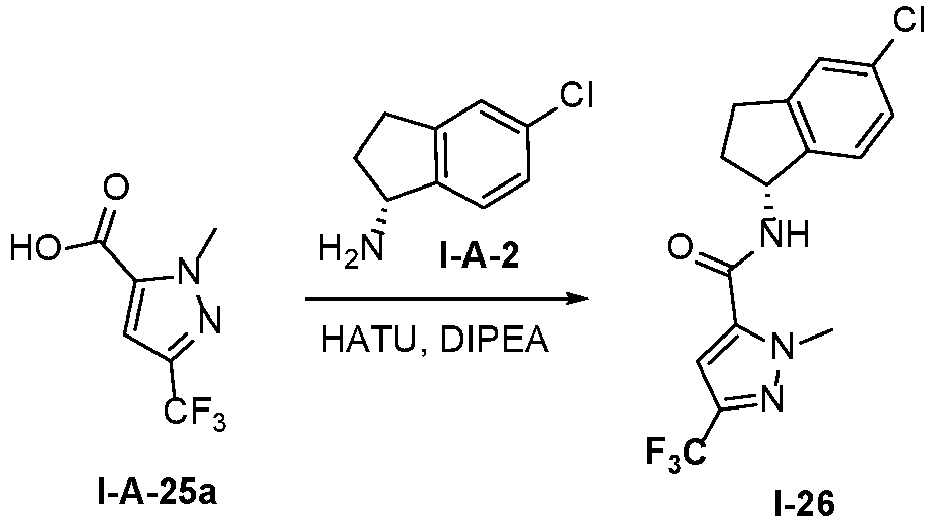
- To a stirred solution of I-A-25a (115.8 mg, 0.6 mmol) and I-A-2 (100 mg, 0.6 mmol) in DCM (2 mL) were added DIPEA (0.26 mL, 1.49 mmol) and HATU (340.2 mg, 0.89 mmol) at RT and stirred at RT for 5 h. The reaction mixture was quenched using water (10 mL) and diluted with DCM (10 mL). The organic layer was washed with brine solution (15 mL), dried over (Na2SO4) and evaporated to give the crude product. The crude product was purified by prep HPLC to give 1-26 (75 mg, 0.25 mmol, 36 % yield) as a solid.
- HPLC: Rt 9.40 min, 98.4%; Column: X-Select CSH C18 (4.6 x 150) mm, 5 µm; Mobile phase: A: 0.1% FA in water: ACN (95:05), B: ACN; Flow Rate: 1.0 mL/min.
- LCMS : 344 (M+H), Rt 2.17 min, Column: X-select CSH C18 (3 x 50) mm, 2.5 µm.
- 1H NMR (400 MHz, DMSO-d6) δH = 8.97 (d, 1H), 7.36 (d, 2H), 7.32-7.21 (m, 2H), 5.46 (q, 1H), 4.18 (s, 3H), 3.04-2.96 (m, 1H), 2.92-2.82 (m, 1H), 2.51-2.41 (m, 1H), 2.02-1.92 (m, 1H).
- Chiral method: Rt 3.20 min, 95%; SFC column: DIACEL CHIRALPAK-IG (250 x 4.6 mm, 5 um), - Mobile Phase: A) CO2 B) MeOH + 0.1% NH3, Gradient: 10-40% B in 5 min, hold 40% B till 9 min, 40-10% B in 10 min hold, hold 10% B till 12 min. Wavelength: 280 nm, Flow Rate: 3 mL/min.
-

- Synthesis of I-A-26b: To I-A-26a (2 g, 9.01 mmol), sodium methanethiolate (1.26 g, 18.01 mmol) in DMF (10 mL) was added at RT and reaction mixture was stirred at 60 °C for 2 h. The reaction was quenched using water (100 mL) and diluted with EtOAc (100 mL x 2). The organic layer was separated, dried over Na2SO4, filtered and evaporated to obtain crude product. The crude product was purified by column chromatography using 100-200 silica and 10-40% EtOAc/Hexane as an eluent to give I-A-26b (0.70 g, 3.66 mmol, 40 % yield) as a solid.
- Synthesis of I-A-26c: To a stirred solution of I-A-26b (0.5 g, 2.7 mmol) and sodium tungstate dihydrate (0.09 g, 0.0003 mmol) in acetic acid (10 mL) was added H2O2 30% in water (0.6 mL, 0.01 mmol) at RT and reaction mixture was stirred for 10 min. The reaction was quenched using water (100 mL) and diluted with EtOAc (100 mL x 2). The organic layer was separated, dried over Na2SO4, filtered and evaporated to give crude product. The crude product was purified by column chromatography using 100-200 silica and 10-40% EtOAc/Hexane as an eluent to give I-A-26c (0.50 g, 2.24 mmol, 84 % yield) as a solid.
- Synthesis of I-A-26d: To a stirred solution of I-A-26c (0.5 g, 2.27 mmol) in THF: water (10: 5 mL) was added LiOH.H2O (114.3 mg, 2.72 mmol) at RT and stirred at RT for 2 h. The reaction mixture was quenched using water (100 mL) and diluted with EtOAc (50 mL x 2). The aqueous layer was separated. The aqueous layer was acidified with 1N HCl. The precipitate thus formed was filtered and dried using high vacuum to give I-A-26d (0.30 g, 1.36 mmol, 60 % yield) as a solid.
- Synthesis of 1-27: To a stirred solution of I-A-26d (0.1 g, 0.48 mmol) and I-A-2 (97.07 mg, 0.58 mmol) in DCM (10 mL) were added HATU (275.22 mg, 0.72 mmol) followed by DIPEA (0.17 mL, 0.97 mmol) at 0 °C and stirred at RT for 2 h. The reaction mixture was diluted with water (100 mL) and DCM (100 mL x 2). The organic layer was separated, dried over Na2SO4, filtered and concentrated to give the crude product. The crude product was then purified by column chromatography using 100-200 silica and 30-80 % EtOAc in hexane as an eluent to give 1-27 (85.1 mg, 0.23 mmol, 49 % yield) as a solid.
- HPLC: Rt 8.34 min, 99.7%; Column: X-select CSH C18 (4.6 x 150) mm, 3.5 µm; Mobile phase: A- 0.1 % FA in water: Acetonitrile (95:05), B: Acetonitrile; Flow Rate: 1.0 mL/min.
- LCMS: 356.85 (M+H), Rt 2.01 min, Column: X-select CSH C18 (3.0 x 50) mm, 2.5 µm.
- 1H NMR (400 MHz, DMSO-d6): δH = 9.35 (d, 1H), 8.68 (d, 1H), 7.37 (s, 1H), 7.33 - 7.22 (m, 2H), 5.52-5.42 (m,1H), 3.50 (d, 3H), 3.05-2.98 (m, 1H), 2.93-2.84 (m, 1H), 2.06-1.92 (m, 1H). Note: 1H not observed
-

- Synthesis of I-A-27b: To a stirred solution of I-A-27a (400 mg, 2.15 mmol) and I-A-2 (432.18 mg, 2.58 mmol) in DCM (10 mL) were added HATU (1225.3 mg, 3.22 mmol) and DIPEA (0.75 mL, 4.3 mmol) at RT. The reaction was then stirred at RT for 2 h. The reaction was quenched using water (100 mL) and diluted with DCM (100 mL x 2). The combined organic layer was separated, dried over Na2SO4, filtered and evaporated to obtain crude product which was purified by column chromatography using 100-200 silica and 30-80 % of EtOAc/Hexane eluent to give I-A-27b (600 mg, 1.71 mmol, 80 % yield) as a solid.
- Synthesis of I-A-27c: To a solution of I-A-27b (500 mg, 1.49 mmol) in THF: water (10:5 mL) was added LiOH.H2O (74.97 mg, 1.79 mmol) at RT and stirred for 2 h. The reaction was quenched using water (100 mL) and diluted with EtOAc (50 mL x 2). The combined organic layer was separated and acidified with 1N HCl leading to a precipitate, which was filtered, separated and dried to give I-A-27c (0.40 g, 1.21 mmol, 81 % yield) as a solid.
- Synthesis of 1-28: To a stirred solution of I-A-27c (100 mg, 0.31 mmol) in DCM (10 mL) and methyl amine in THF (2M) (0.2 mL, 0.37 mmol) was added HATU (177.25 mg, 0.47 mmol) and DIPEA (0.11 mL, 0.62 mmol) at RT and stirred for 2 h. The reaction was quenched with water (100 mL) and diluted with DCM (100 mL x 2). The combined organic layer was separated, dried by Na2SO4, filtered and evaporated under reduced pressure to give crude product which was purified by column chromatography using 100-200 silica and 30-80% EtOAc/Hexane eluent to give 1-28 (44.1 mg, 0.13 mmol, 42 % yield) as a solid.
- HPLC: Rt 7.84 min, 99.5 %; Column: X-select CSH C18 (4.6 x 150) mm, 5 µm; Mobile phase: A: 0.1% FA in water: ACN (95:05), B: ACN; Flow Rate: 1.0 mL/min
- LCMS: 335.15 (M+H), Rt 1.95 min, Column: X-select CSH C18 (3 x 50) mm, 2.5 µm
- 1H NMR (400 MHz, DMSO-d6) δH = 8.92 (d, 1H), 8.57 (d, 1H), 7.76 (d, 1H), 7.64 (d, 1H), 7.35 (s, 1H), 7.24 (s, 2H), 5.50-5.40 (m, 1H), 3.02-2.97 (m, 1H), 2.92 - 2.73 (m, 4H), 2.48-2.42 (m, 1H), 2.03-1.96 (m, 1H).
- Chiral method: Rt 7.28 min, 98.7%; SFC column: DIACEL CHIRALPAK-IG (250 x 4.6 mm, 5 um), - Mobile Phase: A) CO2 B) MeOH+0.1% NH3, Gradient: 20-40% B in 5 min, hold 40% B till 9 min, hold 20% B till 12 min. Wavelength: 280 nm, Flow Rate: 3 mL/min.
- Synthesis of 1-29: To a stirred solution of I-A-27c (100 mg, 0.31 mmol) and dimethyl amine in THF (2M) (0.2 mL, 0.37 mmol) in DCM (10 mL) were added HATU (177.25 mg, 0.47 mmol) and DIPEA (0.11 mL, 0.62 mmol) at RT and stirred at RT for 2 h. Thereaction was quenched with water (100 mL) and diluted with DCM (100 mL x 2). The combined organic layer was separated, dried by Na2SO4, filtered and evaporated under reduced pressure. The crude product was purified by column chromatography using 100-200 silica and 30-80% EtOAc/Hexane eluent to give 1-29 (65.2 mg, 0.18 mmol, 59 % yield) as a solid.
- HPLC: Rt 7.98 min, 98.7 %; Column: X-select CSH C18 (4.6 x 150) mm, 3.5 µm; Mobile phase: A: 0.1% FA in water: ACN (95:05), B: ACN; Flow Rate: 1.0 mL/min
- LCMS: 348.95 (M+H), Rt 2.01 min, Column: X-select CSH C18 (3 x 50) mm, 2.5 µm
- 1H NMR (400 MHz, DMSO-d6) δH = 8.94 (d, 1H), 7.76 (d, 1H), 7.45 (d, 1H), 7.35 (s, 1H), 7.24 (s, 2H), 5.52-5.41 (m, 1H), 3.18 - 2.82 (m, 8H), 2.51 - 2.41 (m, 1H), 2.02-1.96 (m, 1H). Chiral method: Rt 6.35 min, 98.4%; SFC column: DIACEL CHIRALPAK-IG (250 x 4.6 mm, 5 um), - Mobile Phase: A) CO2 B) MeOH+0.1% NH3, Gradient: 35-50% B in 5 min, hold 50% B till 9 min, 50-35% B in 10 min, hold 10% B till 12 min. Wavelength: 280 nm, Flow Rate: 3 mL/min.
-

- To a stirred solution of I-A-23a (151.95 mg, 0.84 mmol) and 5-carbamoylthiophene-2-carboxylic acid (119.31 mg, 0.70 mmol) in DCM (10 mL) were added DIPEA (0.24 mL, 1.39 mmol) and HATU (318.04 mg, 0.84 mmol) at 0 °C and stirred at RT for 3 h. The reaction was quenched using water (15 mL) and diluted with DCM (30 mL). The aqueous layer was washed with (2 x 30 mL) DCM. The organic layer was washed with brine solution (20 mL) and dried over Na2SO4 and evaporated to give crude product. The crude product was purified by flash column chromatography using 100-200 silica and 25 % of EtOAc in hexane as an eluent. The desired fractions were evaporated and the racemic compound I-A-28a was purified by chiral SFC chromatography with a mobile phase: A)CO2 B)MeOH+NH3,Gradient:25-50%B in 5 min, hold 50%B till 9 min, 50-25%B at 10 min, hold 25%B till 12 min. Column: DAICEL CHIRALPAK-IG (250 x 4.6 mm, 5 um). Wavelength: 263nm. Flow: 3 mL/min. to give 1-30 (4.85 mg, 0.01 mmol, 2 % yield) and 1-31 (2.03 mg, 0.0061 mmol, 1 % yield) as solids. Stereochemistry is randomly assigned.
- 1-30: HPLC: Rt 7.74 min, 99.5% Column: X-Select CSH C18 (4.6 x 150) mm, 3.5 µm; Mobile phase: A: 0.1% FA in water: Acetonitrile (95:05), B: ACN; Flow Rate: 1.0 mL/min
- LCMS : 335.10 (M+H), Rt 1.95 min, Column: X-select CSH (3 x 50) mm, 2.5 µm
- 1H NMR (400 MHz, DMSO-d6): δH = 8.91 (d, 1H), 8.08 - 8.03 (m, 1H), 7.75 (d, 1H), 7.66 (d, 1H), 7.55 (s, 1H), 7.24 - 7.14 (m, 3H), 5.16-5.08 (m, 1H), 2.85 - 2.68 (m, 2H), 1.98-1.88 (m, 2H), 1.84-1.70 (m, 2H).
- 1-31: HPLC: Rt 7.75 min, 99.8% Column: X-select CSH C18 (4.6 x 150) mm, 3.5 µm; Mobile phase: A: 0.1% FA in water: Acetonitrile (95:05), B: ACN; Flow Rate: 1.0 mL/min
- LCMS : 335.10 (M+H), Rt 1.97 min, Column: X-select CSH C18 (3 x 50) mm, 2.5 µm
- 1H NMR (400 MHz, DMSO-d6) δH = 8.91 (d, 1H), 8.05 (s, 1H), 7.76 (d, 1H), 7.66 (d, 1H), 7.55 (s, 1H), 7.24 - 7.14 (m, 3H), 5.16-5.08 (m, 1H), 2.84 - 2.69 (m, 2H), 2.00 - 1.88 (m, 2H), 1.85 - 1.66 (m, 2H).
-

- To a stirred solution of I-A-23a (260 mg, 1.45 mmol) and 5-sulfamoylthiophene-2-carboxylic acid (300 mg, 1.45 mmol) in DCM (20 mL) were added DIPEA (0.5 mL, 2.9 mmol)) and HATU (660 mg, 1.74 mmol) at RT and stirred at RT for 6 h. The reaction mixture was quenched using water (10 mL) and diluted with DCM (10 mL). The organic layer was washed with brine solution (15 mL), dried over MgSO4 and evaporated to give the crude product. The crude product was purified by flash column chromatography using 100-200 silica and 50 % of EtOAc in hexane as an eluent. The desired fractions were evaporated and the racemic compound I-A-29a was purified by chiral SFC chromatography with mobile phase: A)COz B)MeOH+NH3,Gradient:25-50%B in 5 min, hold 50%B till 9 min, 50-25%B at 10 min, hold 25%B till 12 min. Column: DAICEL CHIRALPAK-IG (250 x 4.6 mm, 5 um). Wavelength: 263nm. Flow: 3 mL/min to give 1-32 (18 mg, 0.04 mmol, 3 % yield) and 1-33 (23 mg, 0.06 mmol, 4 % yield) as solids. Stereochemistry is randomly assigned.
- 1-32: HPLC: Rt 8.15 min, 96.3%; Column: X-Select CSH C18 (4.6 x 150) mm, 3.5 µm; Mobile phase: A: 0.1% FA in water: Acetonitrile (95:05), B: ACN; Flow Rate: 1.0 mL/min
- LCMS : 371.05 (M+H), Rt 2.05 min, Column: X-select CSH C18 (3 x 50) mm, 2.5 µm
- 1H NMR (400 MHz, DMSO-d6) δH = 9.07 (d, 1H), 7.84-7.75 (m, 3H), 7.52 (d, 1H), 7.25 - 7.10 (m, 3H), 5.16-5.08 (m, 1H), 2.85 - 2.68 (m, 2H), 2.00-1.92 (m, 2H), 1.86 - 1.70 (m, 2H).
- Chiral method: Rt 9.36 min, 100%; SFC column: DIACEL CHIRALPAK-IG (250 x 4.6 mm, 5 um), - Mobile Phase: A) CO2 B) MeOH+0.1% NH3, Gradient: 35-50% B in 5 min, hold 50% B till 9 min, 50-35% B in 10 min, hold 35% B till 12 min. Wavelength: 270 nm, Flow Rate: 3 mL/min.
- 1-33: HPLC: Rt 8.27 min, 99.6%; Column: X-select CSH C18 (4.6 x 150) mm, 5 µm; Mobile phase: A: 0.1% FA in water: Acetonitrile (95:05), B: ACN; Flow Rate: 1.0 mL/min
- LCMS : 371.05 (M+H), Rt 2.05 min, Column: X-select CSH C18 (3 x 50) mm, 2.5 µm
- 1H NMR (400 MHz, DMSO-d6): δH = 9.07 (d, 1H), 7.86 - 7.70 (m, 2H), 7.54-7.50 (m, 1H), 7.25 - 7.15 (m, 3H), 5.16-5.09 (m, 1H), 2.84-2.65 (m, 2H), 2.00-1.90 (m, 2H), 1.86 - 1.68 (m, 2H).
- Chiral method: Rt 10.64 min, 99.5 %; SFC column: DIACEL CHIRALPAK-IG (250 x 4.6 mm, 5 um), - Mobile Phase: A) CO2 B) MeOH+0.1% NH3, Gradient: 35-50% B in 5 min, hold 50 % B till 9 min, 50-35% B at 10 min, hold 35% B till 12 min. Wavelength: 270 nm, Flow Rate: 3 mL/min.
-

- Synthesis of I-A-30b: To a stirred solution of I-A-19a (1 g, 4.52 mmol) in DMSO (10 mL) was added I-A-30a (630.26 mg, 5.43 mmol), copper iodide (85.95 mg, 0.45 mmol), sodium hydroxide (36.19 mg, 0.90 mmol) and L-proline (104.16 mg, 0.90 mmol) at RT and stirred at 95 °C for 16 h. The reaction mixture was diluted with water (100 mL) and extracted with EtOAc (5 x 25 mL). The combined organic layer was dried over Na2SO4 and evaporated to obtain crude compound. The crude was purified by column chromatography in 100-200 silica at 8-10 % EtOAc/Hexane eluent to give I-A-30b (300 mg, 1.21 mmol, 26 % yield) as a solid.
- Synthesis of I-A-30c: To a stirred solution of I-A-30b (300 mg, 1.28 mmol) in THF (5 mL) was added lithium hydroxide (46 mg, 1.92 mmol) in water (1 mL) at 0 °C and stirred at RT for 2 h. The reaction mixture was concentrated to give the crude product. The crude product was diluted with cold water (10 mL), acidified with 2 N HCl aqueous solution up to pH 4 and extracted with DCM (3 x 15 mL). The Combined organic layer was separated and dried over Na2SO4 to give I-A-30c (220 mg, 0.60 mmol, 46 % yield) as a solid.
- Synthesis of 1-34: To a stirred solution of I-A-30c (100 mg, 0.45 mmol) and I-A-2 (76.11 mg, 0.45 mmol) in DCM (10 mL) were added HATU (207.14 mg, 0.54 mmol) followed by DIPEA (0.16 mL, 0.91 mmol) at 0 °C and stirred at RT for 3 h. The reaction mixture was diluted with water (100 mL) and extracted with EtOAc (5 x 25 mL). The combined organic layer was separated, dried over Na2SO4 and evaporated to give crude product. The crude product was purified by column chromatography using 100-200 mesh silica, and 20-22 % of EtOAc in hexane as an eluent to give 1-34 (130 mg, 0.34 mmol, 77 % yield) as a solid.
- HPLC: Rt 9.01 min, 99.5 %; Column: X-select CSH C18 (4.6 x 150) mm, 5 µm; Mobile phase: A: 10 mM ammonium bicarbonate in water, B: ACN; Flow Rate: 1.0 mL/min
- LCMS: 369.80 (M+H), Rt 1.97 min, Column: X-select CSH C18 (3 x 50) mm, 2.5 µm
- 1H NMR (400 MHz, DMSO-d6): δH = 9.17 (d, 1H), 7.91 (d, 1H), 7.78 (d, 1H), 7.36 (s, 1H), 7.25 (s, 2H), 5.52-5.41 (m, 1H), 3.49 - 3.35 (m, 2H), 3.29 (d, 1H), 2.98-2.82 (m, 1H), 2.5-2.45 (m, 1H), 2.02-1.96 (m, 1H), 1.18 (t, 3H).
- Chiral method: Rt 6.00 min, 98.9%; SFC column: DIACEL CHIRALPAK-IG (250 x 4.6 mm, 5 um), - Mobile Phase: A) CO2 B) MeOH+0.1% NH3, Gradient: 35-50% B in 5 min, hold 50% B till 9 min, 50-35% B in 10 min, hold 35% B till 12 min. Wavelength: 261 nm, Flow Rate: 3 mL/min.
-

- Synthesis of I-A-31b: To a stirred solution of I-A-31a (1 g, 6.4 mmol) in chloroform (10 mL) was added NBS (1.25 g, 7.04 mmol) and benzyl peroxide (0.16 g, 0.64 mmol) at RT and stirred at 70 °C for 7 h. The reaction mixture was then cooled to RT and diluted with DCM (20 mL), washed with water (2 x 20 mL) and brine solution (20 mL). The organic layer was dried over Na2SO4 and evaporated to give the crude product. The crude product was purified by column chromatography using 100-200 silica and 1-2 % EtOAc/Hexane eluent to give I-A-31b (0.50 g, 1.94 mmol, 30 % yield) as a solid.
- Synthesis of I-A-31c: To a stirred solution of I-A-31b (300 mg, 1.28 mmol) in DMF (10 mL) was added sodium methanesulfinate (156.33 mg, 1.53 mmol) and tetrabutylammonium iodide (94.27 mg, 0.26 mmol) at RT and stirred for 16 h. After completion reaction was quenched using ice cold water and extracted with ethyl acetate (10 mL x 2). The combined organic layer was washed with ice cold water (20 mL x 2) and dried over Na2SO4 and evaporated to give crude product. The crude product was purified by column chromatography using 100-200 silica and 4-5 % EtOAc/Hexane eluent to give I-A-31c (250 mg, 1.06 mmol, 83 % yield) as a solid.
- Synthesis of I-A-31d: To a stirred solution of I-A-31c (300 mg, 1.28 mmol) in THF (9 mL) was added LiOH.H2O (161.18 mg, 3.84 mmol) in water (1 mL) at RT and stirred at RT for 16 h. The reaction mixture was diluted with water (1 mL) and washed with ether (2 x 5 mL) and separated. Aqueous layer was cooled to 0-5 °C and acidified using 6M HCl then stirred at RT for 30 min leading to precipitation. The solid obtained was filtered and dried to give I-A-31d (250 mg, 1.06 mmol, 82 % yield) as a solid.
- Synthesis of 1-35: To a stirred solution of I-A-31d (100 mg, 0.45 mmol) in DCM (2 mL) were added I-A-2 (91.33 mg, 0.54 mmol), HATU (258.93 mg, 0.68 mmol) and DIPEA (0.16 mL, 0.91 mmol) at RT and stirred at RT for 2 h. The reaction mixture was diluted with DCM and washed with water (10 mL x 2). The organic layer was separated, dried by Na2SO4 and evaporated to obtain the crude product. The crude product was purified by column chromatography using 100-200 silica and 25 % EtOAc/Hexane eluent to give 1-35 (55 mg, 0.14 mmol, 31 % yield) as a solid.
- HPLC: Rt 8.07 min, 99.7 %; Column: X-select CSH C18 (4.6 x 150) mm, 5 µm; Mobile phase: A: 0.1% FA in water: ACN (95:05), B: ACN; Flow Rate: 1.0 mL/min
- LCMS: 370.05 (M+H), Rt 1.87 min, Column: X-select CSH C18 (3.0 x 50) mm, 2.5 µm
- 1H NMR (400 MHz, DMSO-d6) δH = 8.86 (d, 1H), 7.74 (dd, 1H), 7.35 (d, 1H), 7.28 - 7.17 (m, 2H), 7.15 (dd, 1H), 5.48-5.42 (m, 1H), 4.80 (s, 2H), 3.05 - 2.94 (m, 3H), 2.89-2.82 (m, 1H), 2.69 (d, 1H), 2.51 - 2.46 (m, 1H), 2.01-1.94 (m, 1H).
- Chiral method: Rt 5.19 min, 97.3%; SFC column: DIACEL CHIRALPAK-IG (250 x 4.6 mm, 5 um), - Mobile Phase: A) CO2 B) MeOH+0.1% NH3, Gradient: 35-50% B in 5 min, hold 50% B till 9 min, 50-35% B in 10 min, hold 35% B till 12 min. Wavelength: 272 nm, Flow Rate: 3 mL/min.
-

- Synthesis of I-A-32a: To a stirred solution of I-A-31b (400 mg, 1.7 mmol) in methanol (5 mL) was added NaOMe (183.82 mg, 3.4 mmol) at RT and stirred for 16 h. The reaction mixture was diluted with ethyl acetate (20 mL) and washed with water (2 x 10 mL) and brine (10 mL). The organic layer was dried over Na2SO4 and evaporated to obtain the crude product. The crude product was purified by column chromatography using 100-200 silica and 2-3 % EtOAc/Hexane eluent to give I-A-32a (120 mg, 0.59 mmol, 35 % yield) as a liquid.
- Synthesis of I-A-32b: To a stirred solution of I-A-32a (120 mg, 0.64 mmol) in THF (5 mL) was added LiOH.HzO (81.11 mg, 1.93 mmol) in water (0.50 mL) at RT and stirred for 16 h. The reaction mixture was evaporated and diluted with water (0.5 mL). The aqueous layer was cooled to 0-5 °C and acidified with 6M HCl and stirred at RT for 30 min. Solid was filtered and dried to give I-A-32b (65 mg, 0.36 mmol, 57 % yield).
- Synthesis of 1-36: To a stirred solution of I-A-32b (60 mg, 0.35 mmol) in DCM (2 mL) were added I-A-2 (70.09 mg, 0.42 mmol) HATU (198.73 mg, 0.52 mmol) and DIPEA (0.12 mL, 0.70 mmol) at RT and stirred at RT for 2 h. The reaction mixture was diluted with DCM and was washed with water (10 mL x 2). The organic layer was separated, dried using Na2SO4 and evaporated to obtain crude product. The crude product was purified by column chromatography using 100-200 silica and 25 % EtOAc/Hexane eluent to give 1-36 (30 mg, 0.09 mmol, 25 % yield) as a solid.
- HPLC: Rt 8.85 min, 96.0%; Column: X-select CSH C18 (4.6 x 150) mm, 5 µm; Mobile phase: A: 0.1% FA in water: ACN (95:05), B: ACN; Flow Rate: 1.0 mL/min
- LCMS: 321.9 (M+H), Rt 1.94 min, Column: X-select CSH C18 (3.0 x 50) mm, 2.5 µm
- 1H NMR (400 MHz, DMSO-d6) δH = 8.79 (d, 1H), 7.70 (d, 1H), 7.36 (s, 1H), 7.27-7.22 (m, 2H), 7.06 (d, 1H), 5.51-5.41 (m, 1H), 4.59 (s, 2H), 3.31 (d, 3H), 3.04-2.98 (m, 1H), 2.91-2.82 (m, 1H), 2.49-2.43 (m, 1H), 2.05-1.95 (m, 1H).
- Chiral method: Rt 7.03 min, 96.1%; SFC column: DIACEL CHIRALPAK-IG (250 x 4.6 mm, 5 um), - Mobile Phase: A) CO2 B) MeOH+0.1% NH3, Gradient: 10-40% B in 5 min, hold 40% B till 9 min, 40-10% B, at 10 min, hold 10 % B till 12 min. Wavelength: 264 nm, Flow Rate: 3 mL/min.
-

- Synthesis of I-A-33b: To cooled solution of I-A-33a (500 mg, 2.4 mmol) in DCM (10 mL) was added DIPEA (0.84 mL, 4.81 mmol), HATU (1.37 g, 3.61 mmol) and (1R)-5-chloroindan-1-amine (443.21 mg, 2.64 mmol) and the reaction was stirred at RT for 3 h. The reaction was diluted with water and extracted with DCM (10 mL x 3 times) and combined organic layer was dried over sodium sulphate and evaporated to give crude product which was purified by column chromatography using silica gel (100-200) and MeOH:DCM (1:99) as an eluent to give I-A-33b (380 mg, 1.06 mmol, 44% yield) as a solid.
- Synthesis of I-A-33c: To a solution of I-A-33b (380.mg, 1.06 mmol) in DMF (5 mL) was added K2CO3 (440.45 mg, 3.19 mmol) and (4-methoxyphenyl)methanethiol (163.87 mg, 1.06 mmol) at RT and stirred at RT for 16 h. The reaction mixture was diluted with water and extracted with ethyl acetate (10 mL x 3), combined organic layer was washed with water and brine. The organic layer was dried over sodium sulphate and evaporated to give the crude product which was purified by combi-flash chromatography using ethyl acetate:hexane as an eluent to give I-A-33c as (210 mg, 0.45 mmol, 43% yield) as a solid.
- Synthesis of I-A-33e: To a cooled solution of I-A-33c (210.mg, 0.4900 mmol) in MeCN (2 mL), water (0.5 mL) and acetic acid (0.5 mL) was added 1,3-dichloro-5,5-dimethylhydantoin (191.99 mg, 0.97 mmol) at 0 ° C and stirred at 0 ° C for 2 h. Then reaction mixture was stirred at room temp for 2 h. The reaction mixture was quenched with water and extracted with DCM (10 mL x 3). The combined organic layer was dried over sodium sulphate, evaporated to give the crude product which was purified on combi-flash chromatography using ethyl acetate: hexane as an eluent to give I-A-33e (150 mg, 0.39 mmol, 81 % yield) as a solid.
- Synthesis of 1-37: To a solution of I-A-33e (200 mg, 0.530 mmol) in DCM (10 mL), was added saturated ammonia in DCM at 0 °C and then reaction was stirred at the same temp for 30 min and then reaction was stirred for 2 h. The reaction mixture was diluted with water and extracted with DCM (10 mL x 3), combined organic layer were dried over sodium sulphate and evaporated to give crude product which was purified by combi-flash chromatography to give 1-37 (65.1 mg, 0.21 mmol, 39% yield) as a solid.
- HPLC: Rt 9.26 min, 99.3%; Column: X-Select CSH C18 (4.6 x 150) mm, 5 µm; Mobile phase: A: 0.1% FA in water: ACN (95:05), B: ACN; Flow Rate: 1.0 mL/min
- LCMS : 312.95 (M+H), Rt 2.08 min, Column: X-select CSH C18 (3 x 50) mm, 2.5 µm
- 1H NMR (400 MHz, DMSO-d6) δH = 9.12 (d, 1H), 8.28 (s, 1H), 7.36 (s, 1H), 7.28-7.24 (m, 2H), 5.43 (q, 1H), 3.03-2.96 (m, 1H), 2.90-2.82 (m, 1H), 2.52-2.41 (m, 1H), 2.02-1.92 (m, 1H).
- Chiral method: Rt 6.90 min, 98.0%; SFC column: DIACEL CHIRALPAK-IG (250 x 4.6 mm, 5 um), - Mobile Phase: A) CO2 B) MeOH+0.1% NH3, Gradient: 10-40% B in 5 min, hold 40% B till 9 min, 40-10% B in 10 min, hold 10% B till 12 min. Wavelength: 263 nm, Flow Rate: 3 mL/min.
-

- Synthesis of I-A-34a: To a stirred solution of I-A-31b (0.5 g, 2.13 mmol) and dimethylamine (0.16 mL, 3.19 mmol) in DMF (10 mL) was added K2CO3 (587.75 mg, 4.25 mmol) at RT and stirred for 2 hr. The reaction was quenched with water (100 mL) and extracted with EtOAc (100 mL x 2). The combined organic layer was separated, dried over Na2SO4, filtered and evaporated under reduced pressure to give crude product which was purified by column chromatography using 100-200 silica and 30-80% EtOAc/Hexane as an eluent to give I-A-34a (0.3 g, 1.2 mmol, 57 % yield) as a solid.
- Synthesis of I-A-34b: To a stirred solution of I-A-34a (0.3g, 1.5 mmol) in THF:water (10:5mL) was added LIOH.H2O (63.17 mg, 1.51 mmol) at RT and stirred for 2 hr. Thereaction was quenched with water (100 mL) and extracted with EtOAc (50 mL x 2). The organic layer was separated, and remaining aqueous layer was acidified with 1N HCl leading to precipitation. The precipitated solid was filtered and dried to give I-A-34b (0.1 g, 0.48 mmol, 32 % yield).
- Synthesis of 1-38: To a stirred solution of I-A-34b (0.2g, 1.08 mmol) and (1R)-5-chloroindan-1-amine (217.2 mg, 1.3 mmol) in DCM(10 mL) were added HATU (615.79 mg, 1.62 mmol) and DIPEA (0.38 mL, 2.16 mmol) at RT and stirred for 2 hr at RT. The reaction was quenched with water (100 mL) and extracted with DCM (100 mL x 2). The combined organic layer was separated, dried by Na2SO4, filtered and evaporated under reduced pressure to give crude product. The crude product was purified by column chromatography using 100-200 silica and 30-80% EtOAc/Hexane as an eluent to give 1-38 (20 mg, 0.06 mmol, 5% yield).
- HPLC: Rt 5.79 min, 99.7%; Column: X-Select CSH C18 (4.6 x 150) mm, 5 µm; Mobile phase: A: 0.1% FA in water: ACN (95:05), B: ACN; Flow Rate: 1.0 mL/min
- LCMS : 334.95 (M+H), Rt 1.46 min, Column: X-select CSH C18 (3 x 50) mm, 2.5 µm
- 1H NMR (400 MHz, DMSO-d6) δH = 8.70 (d, 1H), 7.63 (d, 1H), 7.33 (s, 1H), 7.27-7.17 (m, 2H), 6.94 (d, 1H), 5.43 (q, 1H), 3.58 (s, 2H), 3.00-2.94 (m, 1H), 2.88-2.78 (m, 1H), 2.46-2.40 (m,1H), 2.17 (s, 6H), 2.02-1.92 (m, 1H).
- Chiral method: Rt 5.98 min, 100%; SFC column: DIACEL CHIRALPAK-IG (250 x 4.6 mm, 5 um), - Mobile Phase: A) CO2 B) MeOH+0.1% NH3, Gradient: 10-40% B in 5 min, hold 40% B till 9 min, 40-10% B in 10 min, hold 10% B till 12 min. Wavelength: 280 nm, Flow Rate: 3 mL/min.
-

- Synthesis of I-A-35a: To a stirred solution of I-A-31b (0.5 g, 2.13 mmol) in DMF (10 mL), 1M methanamine in THF (132.11 mg, 4.25 mmol) and K2CO3 (587.75 mg, 4.25 mmol) was added at RT and stirred for 2 hr. The reaction mixture was quenched with water (100 mL) and extracted with EtOAc (100 mL x 2). The organic layer was separated, dried over Na2SO4, filtered and evaporated under reduced pressure. The crude product was purified by column chromatography using 100-200 silica and 30-80% EtOAc/Hexane eluent to give I-A-35a (0.2 g, 0.86 mmol, 40 % yield)
- Synthesis of I-A-35b: To a stirred solution of I-A-35a (0.2 g, 1.08 mmol) in acetic anhydride (10 mL) was added sodium acetate (177.13 mg, 2.16 mmol) at RT and stirred for 12 hr at 50 °C. The reaction was quenched with water (100 mL) diluted with EtOAc (50 mL x 2). The organic layer was separated, dried over sodium sulphate than evaporated. The crude material was purified by column chromatography using 100-200 silica and 30-50% EtOAc/Hexane as an eluent to give I-A-35b (0.15 g, 0.35 mmol, 33% yield) as a solid.
- Synthesis of I-A-35c: To a stirred solution of I-A-35b (0.3 g, 1.51 mmol) in THF:water (10:5 mL) was added LiOH.H2O (63.17 mg, 1.51 mmol) at RT and stirred for2 hr. The reaction mixture was quenched with water (100 mL) andEtOAc (50 mL x 2) added. The organic layer was separated and the water layer acidified with 1N HCl leading to precipitation. The precipitate thus formed was then filtered. The solid was separated, dried on high vacuum to give I-A-35c (0.1 g, 0.48 mmol, 32 % yield).
- Synthesis of 1-39: To a stirred solution of I-A-35c (0.1 g, 0.48 mmol) and (1R)-5-chloroindan-1-amine (96.13 mg, 0.57 mmol) in DCM (10 mL) were added HATU (272.54 mg, 0.72 mmol) and DIPEA (0.17 mL, 0.96 mmol) at RT and stirred for 2 hr. The reaction was quenched with water (100 mL) andDCM (100 mL x 2). The organic layer was separated, dried with Na2SO4, then filtered. The organic layer was evaporated, and the crude product was purified by column chromatography using 100-200 silica and 30-80% EtOAc/Hexane as eluent to give 1-39 as a solid (75 mg, 0.2 mmol, 43 % yield).
- HPLC: Rt 8.14 min, 99.5%; Column: X-Select CSH C18 (4.6 x 150) mm, 3.5 µm; Mobile phase: A: 0.1% FA in water: ACN (95:05), B: ACN; Flow Rate: 1.0 mL/min
- LCMS : 362.95 (M+H), Rt 1.87 min, Column: X-select CSH C18 (3 x 50) mm, 2.5 µm
- 1H NMR (400 MHz, DMSO-d6) (VT at 80 °C): δH = 8.48 (d, 1H), 7.63 (s, 1H), 7.30 (s, 1H), 7.29 - 7.17 (m, 2H), 6.98 (d, 1H), 5.44 (q, 1H), 4.80-4.60 (m, 2H), 3.08-2.76 (m, 5H), 2.49-2.44 (m,1H), 2.05-2.00 (m, 4H).
- Chiral method: Rt 5.08 min, 99.7%; SFC column: DIACEL CHIRALPAK-IG (250 x 4.6 mm, 5 um), - Mobile Phase: A) CO2 B) MeOH+0.1% NH3, Gradient: 10-40% B in 5 min, hold 40% B till 9 min, 40-10% B in 10 min, hold 10% B till 12 min. Wavelength: 265 nm, Flow Rate: 3 mL/min.
-

- Synthesis of I-A-36b: To a stirred solution of I-A-36a (0.5 g, 2.08 mmol) in DCM (5 mL) was added DIPEA 1.08 g, 6.23 mmol) and R-(+)-3-pyrrolidinol (0.34 mL, 4.15 mmol) at RT and stirred for 1 h. The reaction mixture was diluted with water, extracted with DCM. The organic layer was dried over Na2SO4 filtered and evaporated to give I-A-36b (250 mg, 0.86 mmol, 41 % yield) as a liquid.
- Synthesis of I-A-36c: To a stirred solution of I-A-36b (0.4 g, 1.32 mmol) in THF:water (1:1, 3 mL) were added NaOH (158 mg, 3.96 mmol) at RT and stirred at RT for 2 h. The reaction mixture was then evaporated, diluted with water (10 mL) and extracted with ethyl acetate (15 mL). The aqueous layer thus separated was acidified with 3 N HCl, leading to precipitation. The precipitate was filtered, washed with water and dried to give I-A-36c (220 mg, 0.64 mmol, 49 % yield) as a solid.
- Synthesis of 1-40: To a stirred solution of I-A-36c (200 mg, 0.72 mmol) and I-A-2 (145 mg, 0.87 mmol) in DCM (5 mL) were added DIPEA (0.38 mL, 2.16 mmol)) and HATU (411.3 mg, 1.08 mmol) at RT and stirred for 16 h. The reaction mixture was quenched with water (10 mL) and diluted with EtOAc (20 mL). The organic layer was washed with brine solution (15 mL), dried over (Na2SO4) and evaporated to give the crude product. The crude product was purified by prep HPLC to give 1-40 (40 mg, 0.09 mmol, 13 % yield) as a solid.
- HPLC: Rt 8.30 min, 96.6%; Column: X-Select CSH C18 (4.6 x 150) mm, 5 µm; Mobile phase: A: 0.1% FA in water: ACN (95:05), B: ACN; Flow Rate: 1.0 mL/min
- LCMS : 427.15 (M+H), Rt 1.89 min, Column: X-select CSH C18 (3 x 50) mm, 2.5 µm
- 1H NMR (400 MHz, DMSO-d6) δH = 9.12 (d, 1H), 7.89 (d, 1H), 7.66 (d, 1H), 7.36 (s, 1H), 7.26-7.24 (m, 2H), 5.46 (q, 1H), 4.20-4.18 (m, 1H), 3.38- 3.22 (m, 4H), 3.12-2.95 (m, 2H), 2.90-2.84 (m, 1H), 2.49-2.46 (m, 1H), 2.02-1.96 (m, 1H), 1.86- 1.63 (m, 2H).
- Chiral method: Rt 5.80 min, 99.5%; SFC column: DIACEL CHIRALPAK-IG (250 x 4.6 mm, 5 um), - Mobile Phase: A) CO2 B) MeOH+0.1% NH3, Gradient: 35-50% B in 5 min, hold 50% B till 9 min, 50-35% B in 10 min, hold 35% B till 12 min. Wavelength: 273 nm, Flow Rate: 3 mL/min.
-

- Synthesis of I-A-37a: To a stirred solution of I-A-36a (0.5 g, 2.08 mmol) in DCM (10 mL) was added DIPEA 1.08 g, 6.23 mmol) and S-(+)-3-pyrrolidinol (0.34 mL, 4.15 mmol) at RT and stirred for 1 h. The reaction mixture was diluted with water, extracted with DCM. The organic layer was dried over Na2SO4 filtered and evaporated to give I-A-37a (300 mg, 1.03 mmol, 49 % yield) as a liquid.
- Synthesis of I-A-37b: To a stirred solution of I-A-37a (0.3 g, 1.05 mmol) in THF:water (1:1, 6 mL) was added NaOH (126 mg, 3.15 mmol) at RT and stirred for 2 h. The reaction mixture was then evaporated, diluted with water (10 mL) and extracted with ethyl acetate (15 mL). The aqueous layer thus separated was acidified with 3 N HCl leading to precipitation. The precipitate was filtered, washed with water and dried to give I-A-37b (200 mg, 0.52 mmol, 49 % yield) as a solid.
- Synthesis of 1-41: To a stirred solution of I-A-37b (200 mg, 0.72 mmol) and I-A-2 (181.3 mg, 1.08 mmol) in DCM (5 mL) was added DIPEA (0.38 mL, 2.16 mmol)) and HATU (411.3 mg, 1.08 mmol) at RT and stirred for 16 h. The reaction mixture was quenched with water (10 mL) and diluted with EtOAc (20 mL). The organic layer was washed with brine solution (15 mL), dried over (Na2SO4) and evaporated to give the crude product. The crude product was purified by prep HPLC to give 1-41 (32 mg, 0.07 mmol, 10 % yield) as a solid.
- HPLC: Rt 8.29 min, 98.7%; Column: X-Select CSH C18 (4.6 x 150) mm, 5 µm; Mobile phase: A: 0.1% FA in water: ACN (95:05), B: ACN; Flow Rate: 1.0 mL/min
- LCMS : 427 (M+H), Rt 1.89 min, Column: X-select CSH C18 (3 x 50) mm, 2.5 µm
- 1H NMR (400 MHz, DMSO-d6) δH = 9.12 (d, 1H), 7.89 (d, 1H), 7.66 (d, 1H), 7.36 (s, 1H), 7.26-7.18 (m, 2H), 5.46 (q, 1H), 4.96-4.94 (m, 1H), 4.20-4.18 (m, 1H), 3.38-3.24 (m, 3H), 3.10-2.96 (m, 2H), 2.88-2.84 (m, 1H), 2.49-2.46 (m, 1H), 2.10-1.92 (m, 1H), 1.86-1.68 (m, 2H).
- Chiral method: Rt 5.86 min, 99.6%; SFC column: DIACEL CHIRALPAK-IG (250 x 4.6 mm, 5 um), - Mobile Phase: A) CO2 B) MeOH+0.1% NH3, Gradient: 35-50% B in 5 min, hold 50% B till 9 min, 50-35% B in 10 min, hold 35% B till 12 min. Wavelength: 273 nm, Flow Rate: 3 mL/min.
-

- Synthesis of I-A-36a: To a stirred solution of I-A-38a (10 g, 70.3 mmol) in chloroform (100 mL) was added dropwise chlorosulphonic acid (12.24 g, 105.5 mmol) at -10 °C and the reaction mixture was heated at 70 °C for 16 h. The reaction mixture was cooled to -10 °C and treated with pyridine (18.73 mL, 232.1 mmol) in dropwise addition manner, followed by the addition of phosphorus pentachloride (17.58 g, 84.4 mmol) in portions over 30 mins. The resulting reaction mixture was stirred at RT for 16 h. The reaction mixture was poured on to ice-cold water (300 mL) and stirred for 1h. The reaction was extracted with DCM (3 x 250 mL). The combined organic phase was washed with brine (3 x 200 mL), dried over anhydrous sodium sulphate, filtered and evaporated under reduced pressure. Crude product was purified by column chromatography (100-200 mesh silica, 2-5 % of EtOAc in hexane as an eluent) to givet I-A-36a (12 g, 48.86 mmol, 69 % yield) as an oil.
- Synthesis of I-A-38c: To a stirred solution of I-A-36a (0.5 g, 2.08 mmol) in DCM (5 mL), DIPEA (0.72 mL, 4.15 mmol) and 1-methylpiperazine (0.28 mL, 2.49 mmol) were added and the reaction mixture was stirred at RT for 16 h. The reaction mixture was diluted with water and extracted with DCM (10 mL x 3). The combined organic layer was dried over sodium sulphate and evaporated to give the crude product, which was purified by combi-flash chromatography using ethyl acetate: hexane as an eluent to give I-A-38c (300 mg, 0.88 mmol, 42 % yield) as an oil.
- Synthesis of I-A-38d: To a stirred solution of I-A-38c (300 mg, 0.99 mmol) in THF (5 mL) was added a solution of LiOH.H2O (82.71 mg, 1.97 mmol) in water (1 mL) at 0 ° C and stirred at room temp for 2 h. The reaction mixture was evaporated and residue was diluted with water and acidified with 2N HCl. Then aqueous layer was evaporated to give I-A-38d (180 mg, 0.57 mmol, 58% yield) as a solid which was used directly for next step.
- Synthesis of I-42: To a stirred solution of I-A-38d (100 mg, 0.6 mmol) and I-A-2 (207.8 mg, 0.72 mmol) in DCM (10 mL) was added DIPEA (0.21 mL, 1.19 mmol) and HATU (272.8 mg, 0.72 mmol) at 0 °C and stirred at RT for 3 h. The reaction mixture was quenched with water (10 mL) and diluted with DCM (20 mL). The separated aqueous layer was washed with DCM (20 mL). The combined organic layer was washed with brine solution, dried over Na2SO4 and evaporated to give the crude product. The crude product was purified by column chromatography using 30% EA in Hexane as an eluent to give I-42 (10 mg, 0.02 mmol, 3.6 % yield) as a solid.
- HPLC: Rt 6.27 min, 95.9%; Column: X-Select CSH C18 (4.6 x 150) mm, 5 µm; Mobile phase: A: 0.1% FA in water: ACN (95:05), B: ACN; Flow Rate: 1.0 mL/min
- LCMS : 440 (M+H), Rt 1.43 min, Column: X-select CSH C18 (3 x 50) mm, 2.5 µm
- 1H NMR (400 MHz, DMSO-d6) δH = 9.16 (d, 1H), 7.92 (d, 1H), 7.64 (d, 1H), 7.36 (s, 1H), 7.26-7.24 (m, 2H), 5.46 (q, 1H), 3.07-2.80 (m, 6H), 2.50-2.36 (m, 5H), 2.16 (s, 3H), 2.05-1.95 (m, 1H).
- Chiral method: Rt 7.87 min, 97.5 %; SFC column: DIACEL CHIRALPAK-IG (250 x 4.6 mm, 5 um), - Mobile Phase: A) CO2 B) MeOH+0.1% NH3, Gradient: 35-50% B in 5 min, hold 50% B till 9 min, 50-35% B in 10 min, hold 35% B till 12 min. Wavelength: 272 nm, Flow Rate: 3 mL/min.
-

- Synthesis of I-A-39a: To a stirred solution of I-A-36a (0.5 g, 2.08 mmol) in DCM (5 mL) was added DIPEA (0.72 mL, 4.15 mmol) and (3S)-3-methoxypyrrolidine (0.25 g, 2.49 mmol) at 0 °C and stirred at RT for 10 h. The reaction mixture was diluted with water, extracted with DCM (10 mL x 3). The combined organic layer was dried over Na2SO4, filtered and evaporated to give crude product which was purified by combi-flash chromatography using ethyl acetate: hexane as an eluent to give I-A-39a (300 mg, 1..88 mmol, 42 % yield).
- Synthesis of I-A39b: To a stirred solution of I-A-39a (0.3 g, 0.98 mmol) in THF (3 mL) were added LiOH.H2O (82.44 mg, 1.96 mmol) in water (1 mL) at 0 ° C and stirred at RT for 3 h. The reaction mixture was then evaporated to give a residue, which was dissolved in water and acidified with 2N HCl. The solid obtained was filtered and dried to give I-A-39b (250 mg, 0.7870 mmol, 80% yield) as a solid which was used for the next step.
- Synthesis of I-43: To a stirred solution of I-A-39b (208 mg, 0.72 mmol) and I-A-2 (100 mg, 0.6 mmol) in DCM (10 mL) were added DIPEA (0.21 mL, 1.19 mmol) and HATU (272 mg, 0.72 mmol) at 0 °C RT and stirred at RT for 3 h. The reaction mixture was quenched using water (20 mL) and diluted with DCM (20 mL). The organic layer was washed with brine solution, dried over Na2SO4 and evaporated to give the crude product. The crude product was purified column chromatography using silica gel 100-200 mesh and 40% EA in Hexane as an eluent to give I-43 (66 mg, 0.15 mmol, 25 % yield) as a solid.
- HPLC: Rt 8.95 min, 99.8%; Column: X-Select CSH C18 (4.6 x 150) mm, 3.5 µm; Mobile phase: A: 0.1% FA in water: ACN (95:05), B: ACN; Flow Rate: 1.0 mL/min
- LCMS : 441.05 (M+H), Rt 2.01 min, Column: X-select CSH C18 (3 x 50) mm, 2.5 µm
- 1H NMR (400 MHz, DMSO-d6) δH = 9.12 (d, 1H), 7.89 (d, 1H), 7.69 (d, 1H), 7.36 (s, 1H), 7.26-7.24 (m, 2H), 5.46 (q, 1H), 3.90-3.84 (m, 1H), 3.30-3.16 (m, 4H), 3.07 (s, 3H), 3.04-2.98 (m, 1H), 2.90-2.84 (m, 1H), 2.49-2.44 (m, 1H), 2.04-1.94 (m, 1H), 1.90-1.80 (m, 2H).
- Chiral method: Rt 5.82 min, 98.6%; SFC column: DIACEL CHIRALPAK-IG (250 x 4.6 mm, 5 um), - Mobile Phase: A) CO2 B) MeOH+0.1% NH3, Gradient: 35-50% B in 5 min, hold 50% B till 9 min, 50-35% B in 10 min, hold 35% B till 12 min. Wavelength: 273 nm, Flow Rate: 3 mL/min.
-

- Synthesis of I-A-40a: To a stirred solution of I-A-31b (1 g, 4.25 mmol) in ACN (10 mL) was added NaN3 (0.55 g, 8.51 mmol) at RT and reaction mixture was stirred at 90 °C for 1 h. The reaction mixture evaporated, treated with acetic acid (5 mL), Zn dust (556.27 mg, 8.51 mmol) in portion and stirred at RT for 3 h. The reaction mixture was filtered over Celite and diluted with 1N HCl and aqueous layer treated with ethyl acetate (30 mL). The aqueous layer was basified with NaHCO3 and extracted with ethyl acetate. The organic layer was dried over Na2SO4 filtered and evaporated to give I-A-40a (400 mg, 2.3 mmol, 54% yield) as an oil.
- Synthesis of I-A-40b: To a stirred solution of I-A-40a (0.5 g, 2.41 mmol) in DCM (10 mL) were added acetyl chloride (0.25 mL, 3.5 mmol), DIPEA (0.92 mL, 5.26 mmol) and stirred at RT for 2 h. The reaction mixture was diluted in water and extracted with DCM. The organic layer was dried over Na2SO4 filtered and concentrated to give I-A-40b (300 mg, 1.4 mmol, 80% yield) as a solid.
- Synthesis of I-A-40c: To a stirred solution of I-A-40b (0.3 g, 1.41 mmol) in THF : water (1:1) was added NaOH (56.3, 1.41 mmol) and stirred at RT for 1 h. The reaction mixture was evaporated and crude product diluted with water and treated with ethyl acetate. The aqueous layer was acidified with 2 N HCl until pH = 2 and was obtained, extracted with ethyl acetate, dried over Na2SO4, filtered and evaporated to give I-A-40c (160 mg, 0.8 mmol, 57% yield) as a solid.
- Synthesis of I-44: To a stirred solution of I-A-2 (100 mg, 0.6 mmol) and I-A-40c (119 mg, 0.6 mmol) in DCM (5 mL) was added DIPEA (0.31 mL, 1.79 mmol) and HATU (340.22 mg, 0.89 mmol) at RT and stirred at RT for 16 h. The mixture was diluted in water and extracted with DCM organic layer dried over Na2SO4 filtered off and concentrated to give the crude product. The crude product was purified by column chromatography using 5% MeOH/DCM as an eluent to give I-44 (44 mg, 0.12 mmol, 20.5% yield) as a solid.
- HPLC: Rt 7.49 min, 97%; Column: X-Select CSH C18 (4.6 x150) mm, 5 µm; Mobile phase: A: 0.1% FA in water: ACN (95:05), B: ACN; Flow Rate: 1.0 mL/min
- LCMS : 349 (M+H), Rt 1.82 min, Column: X-select CSH C18 (3 x 50) mm, 2.5 µm
- 1H NMR (400 MHz, DMSO-d6) δH = 8.72 (d, 1H), 8.51 (t, 1H), 7.62 (d, 1H), 7.34 (s, 1H), 7.26-7.18 (m, 2H), 6.94 (d, 1H), 5.44 (q, 1H), 4.39 (d, 2H), 3.04-2.92 (m, 1H), 2.88-2.82 (m, 1H), 2.46-2.40 (m, 1H), 2.00-1.94 (m, 1H), 1.85 (s, 3H).
- Chiral method: Rt 6.84 min, 99.3%; SFC column: DIACEL CHIRALPAK-IG (250 x 4.6 mm, 5 um), - Mobile Phase: A) CO2 B) MeOH+0.1% NH3, Gradient: 10-40% B in 5 min, hold 40% B till 9 min, 40-10% B in 10 min, hold 20% B till 12 min. Wavelength: 272 nm, Flow Rate: 3 mL/min.
-

- Synthesis of I-A-41a: To a stirred solution of I-A-36a (0.5 g, 2.08 mmol) in DCM (5 mL), DIPEA (0.72 mL, 4.15 mmol) and morpholine (217.2 mg, 2.49 mmol) were added at 0 °C and the reaction mixture was stirred at RT for 6 h. The reaction mixture was diluted with water (15 mL) and extracted with DCM (20 mL). The combined organic layer was dried over sodium sulphate and evaporated to give the crude product, which was purified by combi-flash chromatography using ethyl acetate : hexane as eluent to give I-A-41a (400 mg, 1.15 mmol, 55 % yield).
- Synthesis of I-A-41b: To a stirred solution of I-A-41a (300 mg, 0.99 mmol) in THF: water (1:1, 10 mL) was added a solution of LiOH.HzO (144 mg, 3.43 mmol) at 0 ° C and gradually warmed to RT. The reaction was concentrated to dryness and the residue was taken up in EtOAc and the organic layer washed with 2 x mL water then 1 x mL saturated brine solution. The organics were then separated and dried over MgSO4 before concentration to dryness. The crude product was then purified by flash column chromatography using EtOAc in Isohexane as an eluent. The desired fractions were concentrated to dryness in vacuo to give I-A-41b (320 mg, 67%) as an oil.
- Synthesis of I-45: To a stirred solution of I-A-41b (90 mg, 0.32 mmol) and I-A-2 (90 mg, 0.32 mmol) in DCM (10 mL) were added DIPEA (0.11 mL, 0.65 mmol) and HATU (148 mg, 0.39 mmol) at 0 OC and stirred at RT for 3 h. The reaction mixture was quenched using water (10 mL) and diluted with DCM (25 mL). The organic layer was washed with brine solution, dried over Na2SO4 and evaporated to give the crude product. The crude product was purified by column chromatography using 35% EA in Hexane as an eluent to give I-45 (10 mg, 0.023 mmol, 7.13% yield) as a solid.
- HPLC: Rt 8.93 min, 98.8%; Column: X-Select CSH C18 (4.6 x 150) mm, 5 µm; Mobile phase: A: 0.1% FA in water: ACN (95:05), B: ACN; Flow Rate: 1.0 mL/min
- LCMS : 427.20 (M+H), Rt 2.18 min, Column: X-select CSH C18 (3 x 50) mm, 2.5 µm
- 1H NMR (400 MHz, DMSO-d6) δH = 9.16 (d, 1H), 7.94 (d, 1H), 7.66 (d, 1H), 7.36 (s, 1H), 7.26 -7.24 (m, 2H), 5.46 (q, 1H), 3.67 (t, 4H), 3.07 -2.80 (m, 7H), 2.07-1.92 (m, 1H).
- Chiral method: Rt 9.00 min, 100%; SFC column: DIACEL CHIRALPAK-IG (250 x 4.6 mm, 5 um), - Mobile Phase: A) CO2 B) MeOH+0.1% NH3, Gradient: 35-50% B in 5 min, hold 50% B till 9 min, 50-35% B in 10 min, hold 35% B till 12 min. Wavelength: 272 nm, Flow Rate: 3 mL/min.
-

- Synthesis of I-A-42a: To a stirred solution of I-A-36a (0.5 g, 2.25 mmol) in DCM (10 mL) were added DIPEA (0.78 mL, 4.49 mmol) and (3R)-3-methoxypyrrolidine (0.27 g, 2.69 mmol) at 0 °C and stirred at RT for 3 h. The reaction mixture was diluted with water (10 mL), extracted with DCM (10 mL). The organic layer was washed using brine, dried over Na2SO4 filtered and evaporated to give I-A-42a (500 mg, 1. 64 mmol, 50 % yield) as an oil.
- Synthesis of I-A-42b: To a stirred solution of I-A-42a (0.5 g, 1.64 mmol) in THF: water (1:1, 10 mL) was added lithium hydroxide (78.43 mg, 3.27 mmol) at 0 ° C and stirred at RT for 3 h. The reaction mixture was then evaporated to give a residue, which was dissolved in water (5 mL) and acidified with 5N HCl (4 mL) leading to precipitate which was filtered and dried to give I-A-42b (300 mg, 1.0 mmol, 61% yield) as a solid which was used for the next step without further purification.
- Synthesis of I-46: To a stirred solution of I-A-42b (100 mg, 0.34 mmol) and I-A-2 (69.5 mg, 0.41 mmol) in DCM (5 mL) were added DIPEA (0.12 mL, 0.69 mmol) and HATU (157 mg, 0.41 mmol) at 0 °C and stirred at RT for 3 h. The reaction mixture was quenched using water (10 mL) and diluted with DCM (15 mL x 2). The combined organic layer was washed with brine solution (10 mL), dried over Na2SO4 and evaporated to give the crude product. The crude product was purified column chromatography using silica gel 100-200 mesh and 40% EA in Hexane as an eluent to give I-46 (30.3 mg, 0.69 mmol, 20 % yield) as a solid.
- HPLC: Rt 8.99 min, 99.9%; Column: X-Select CSH C18 (4.6 x 150) mm, 3.5 µm; Mobile phase: A: 0.1% FA in water: ACN (95:05), B: ACN; Flow Rate: 1.0 mL/min
- LCMS : 441.09 (M+H), Rt 2.02 min, Column: X-select CSH C18 (3 x 50) mm, 2.5 µm
- 1H NMR (400 MHz, DMSO-d6) δH = 9.13 (d, 1H), 7.89 (d, 1H), 7.69 (d, 1H), 7.36 (s, 1H), 7.26-7.24 (m, 2H), 5.46 (q, 1H), 3.90-3.85 (m, 1H), 3.33 - 3.18 (m, 3H), 3.07 (s, 3H), 3.00-2.96 (m, 1H), 2.89-2.84 (m, 1H), 2.49-2.44 (m, 2H), 2.02-1.96 (m, 1H), 1.90 -1.78 (m, 2H).
- Chiral method: Rt 5.33 min, 100%; column: DIACEL CHIRALPAK-IG (250 x 4.6 mm, 5 um), - Mobile Phase: A) n-Hexane+0.1%Isopropylamine B) DCM:MeOH (1:1), Isocratic: 50% B; Wavelength: 273 nm, Flow Rate: 1.0 mL/min.
-
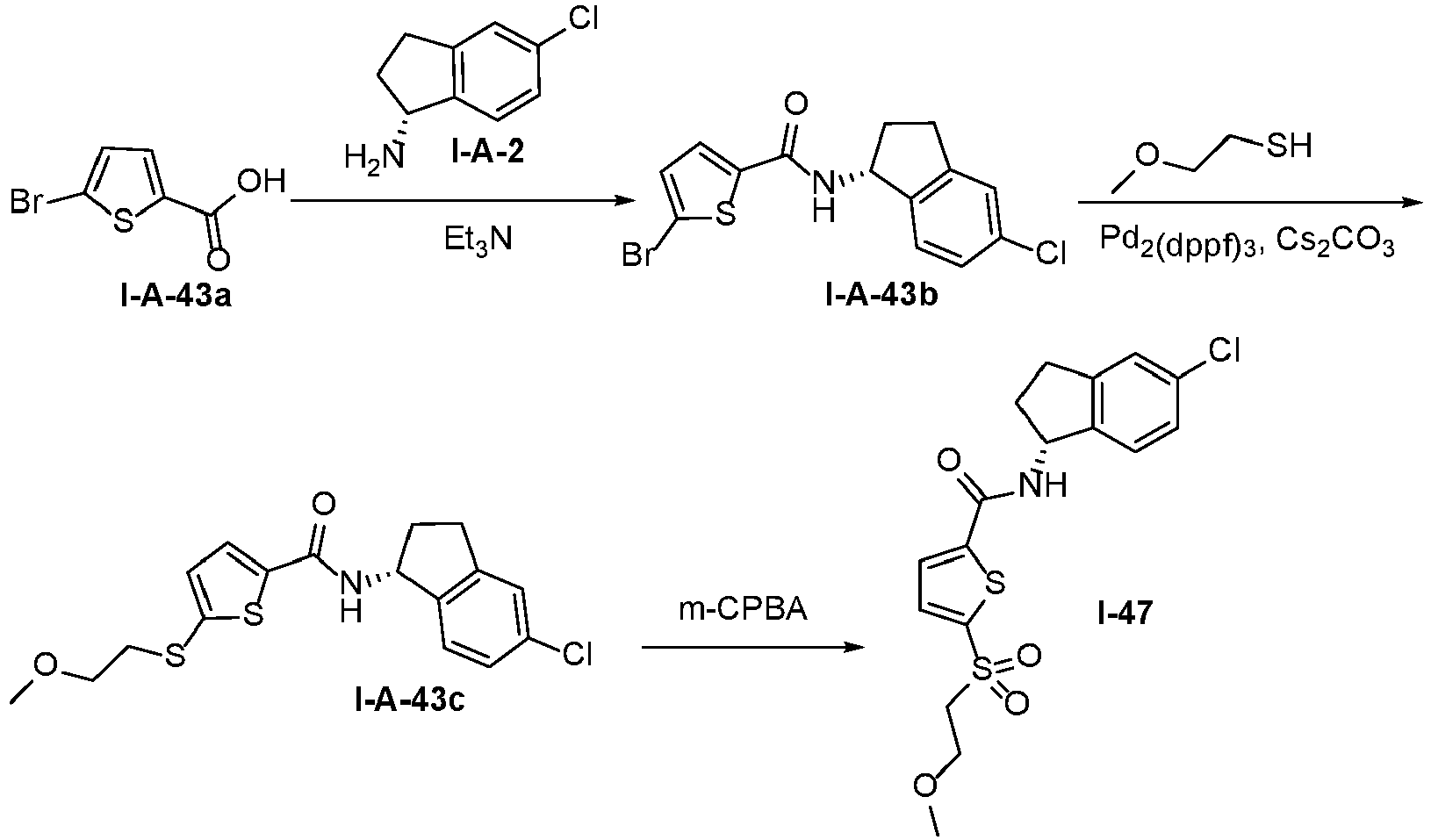
- Synthesis of I-A-43b: To a stirred solution of I-A-43a (0.5 g, 2.41 mmol) in DCM (5 mL) was added TEA (1.01 g, 7.24 mmol) at RT and reaction mixture was stirred at RT for 10 min. The reaction mixture was then treated with (1R)-5-chloroindan-1-amine (404.8 mg, 2.4 mmol) and stirred at RT for 2 h. The reaction mixture was diluted with water, extracted with DCM. The organic layer was dried over Na2SO4 filtered and evaporated to give the crude product which was purified using flash column chromatography and 10% EtOAc/hexane as eluent to give I-A-43b (310 mg, 0.78 mmol, 33% yield) as a solid.
- Synthesis of I-A-43c: To a stirred solution of I-A-43b (0.3 g, 0.84 mmol) in 1,4-dioxane (4 mL), were added 2-methoxyethanethiol (155.03 mg, 1.68 mmol) and DIPEA (0.44 mL, 2.52 mmol). The reaction mixture was purged with N2 gas for 20 min and charged with Pd2(dba)3 (77.05 mg, 0.08 mmol) and DPPF (46.63 mg, 0.08 mmol) at RT and stirred for 6 h at 100 °C. The reaction mixture was diluted in water (10 mL) and extracted with EtOAc (20 mL). The organic layer was dried over Na2SO4 filtered and evaporated to give crude product which was purified by combi-flash and 7% EtOAc /hexane as an eluent to give I-A-43c ((210 mg, 0.55 mmol, 66% yield) as a oil.
- Synthesis of I-47: To a stirred solution of I-A-2 (150 mg, 0.41 mmol) in DCM (5 mL), mCPBA (211 mg, 1.22 mmol) was added portion wise at RT and stirred at RT for 2 h. The reaction mixture was diluted using water (10 mL) and extracted with DCM (20 mL). The organic layer was washed with NaHCOs (15 mL), dried over Na2SO4, filtered and evaporated to give the crude product. The crude product was purified by prep HPLC to give I-47 (11 mg, 0.03 mmol, 7 % yield) as a solid.
- HPLC: Rt 8.49 min, 98.2%; Column: X-Select CSH C18 (4.6 x 150) mm, 5 µm; Mobile phase: A: 0.1% FA in water: ACN (95:05), B: ACN; Flow Rate: 1.0 mL/min
- LCMS : 399.8 (M+H), Rt 2.06 min, Column: X-select CSH C18 (3 x 50) mm, 2.5 µm
- 1H NMR (400 MHz, DMSO-d6) δH = 9.17 (d, 1H), 7.87 (d, 1H), 7.77 (d, 1H), 7.36 (s, 1H), 7.26-7.24 (m, 2H), 5.46 (q, 1H), 3.79-3.60 (m, 4H), 3.16 (s, 3H), 3.05-2.80 (m, 2H), 2.10-1.95 (m, 1H), 1H merged in solvent peak
- Chiral method: Rt 5.29 min, 99%; column: DIACEL CHIRALPAK-IG (250 x 4.6 mm, 5 um), - Mobile Phase: A) n-Hexane+0.1% Isopropylamine B) DCM:MeOH (1:1), Isocratic: 50% B; Wavelength: 265 nm, Flow Rate: 1.0 mL/min
-

- Synthesis of II-A-1b: To a mixture of 4-(methanesulfonamido)benzoic acid (300 mg, 1.39 mmol), HATU (795 mg, 2.09 mmol) and DIPEA (0.73 mL, 4.18 mmol) in DMF (10 mL) was added 5-chloroindan-1-amine (280 mg, 1.67 mmol). The resulting mixture was stirred at 20 °C for 2 hours. Saturated NH4Cl solution (50 mL) was added to the solution and the aqueous layer was extracted with EtOAc (50 mL x 2). The combined organic phase was washed with water (50 mL x 2) and brine (50 mL x 2), dried over anhydrous Na2SO4, filtered and concentrated. The crude product was purified by flash chromatography on silica gel (EtOAc in PE = 0% to 30% to 50%) to give the product (400 mg, 1.10 mmol, 79% yield) as a solid.
LCMS Rt = 0.78 min in 1.5 min chromatography, 5-95AB, MS ESI calcd. for C17H18ClN2O3S [M+H]+ 365.1, found 365.0. - Synthesis of II-A-1c: To a mixture of N-(5-chloroindan-1-yl)-4-(methanesulfonamido)benzamide (150 mg, 0.41 mmol) and K2CO3 (170.47 mg, 1.23 mmol) in DMF (7 mL) was added Mel (116.71 mg, 0.82 mmol). The resulting mixture was stirred at 20 °C for 2 hours. Saturated NH4Cl solution (20 mL) was added and the aqueous layer was extracted with EtOAc (20 mL x 2). The combined organic phase was washed with water (20 mL x 2) and brine (20 mL x 2), dried over anhydrous Na2SO4, filtered and concentrated to give the product (128 mg, 0.34 mmol, 82% yield) as a solid.
- 1H NMR (400MHz, CDCl3) δH = 7.89 - 7.76 (m, 2H), 7.51 - 7.40 (m, 2H), 7.27 - 7.24 (m, 2H), 7.23 - 7.17 (m, 1H), 6.29 (d, 1H), 5.66 (q, 1H), 3.36 (s, 3H), 3.08 - 2.98 (m, 1H), 2.97 - 2.88 (m, 1H), 2.85 (s, 3H), 2.76 - 2.66 (m, 1H), 2.02 - 1.88 (m, 1H).
- LCMS Rt = 0.80 min in 1.5 min chromatography, 5-95AB, MS ESI calcd. for C18H20ClN2O3S [M+H]+ 379.1, found 379.0.
- Analytical SFC: Chiralcel OJ-3 100 mm x 4.6 mm I.D, 3 µm, Mobile phase: A: CO2 B:ethanol (0.05% DEA), Gradient: from 5% to 40% of B in 5 min and hold 40% of B for 2.5 min, then 5% of B for 2.5 min. Flow rate: 2.8 mL/min, Column temp.: 35 °C) showed two peaks at 1.12 min (50%) and 3.02 min (50%).
- Synthesis of Compounds II-1 and II-2: N-(5-chloroindan-1-yl)-4-[methyl(methylsulfonyl)amino]benzamide (100 mg, 0.26 mmol) was purified by SFC (YMC CHIRAL Amylose-C (250 mm x 30 mm I.D., 10µm); A= CO2 and B = EtOH (0.1% NH3H2O); 38 °C; 80 mL/min; 55% B; 8 min run; 7 injections,) to give the enantiomer 1, randomly assigned as Compound II-1 (38.4 mg, 0.1 mmol) (Rt of peak 1 = 1.12 min) as a solid and the enantiomer 2, randomly assigned as Compound II-2 (53.3 mg, 0.14 mmol) (Rt of peak 2 = 3.02 min) as a solid.
-
- 1H NMR (400MHz, CD3CN) δH = 7.91 - 7.78 (m, 2H), 7.46 (d, 2H), 7.35-7.25 (m, 3H), 7.23 - 7.15 (m, 1H), 5.56 (q, 1H), 3.29 (s, 3H), 3.09 - 2.97 (m, 1H), 2.95 - 2.81 (m, 4H), 2.62-2.50 (m, 1H), 2.07 - 1.97 (m, 1H).
- LCMS Rt = 1.08 min in 2 min chromatography, 10-80AB, MS ESI calcd. for C18H20ClN2O3S [M+H]+ 379.1, found 379.0.
-
- 1H NMR (400MHz, CD3CN) δH = 7.89 - 7.80 (m, 2H), 7.46 (d, 2H), 7.35-7.25 (m, 3H), 7.24 - 7.17 (m, 1H), 5.56 (q, 1H), 3.30 (s, 3H), 3.09 - 2.97 (m, 1H), 2.94 - 2.84 (m, 4H), 2.62 - 2.50 (m, 1H), 2.08 - 1.98 (m, 1H).
- LCMS Rt = 1.06 min in 2 min chromatography, 10-80AB, MS ESI calcd. for C18H20ClN2O3S [M+H]+ 379.1, found 379.0.
-

- To a mixture of 4-(methanesulfonamido)benzoic acid (128.39 mg, 0.60 mmol), EDCI (171.53 mg, 0.89 mmol) and HOBt (161.21 mg, 1.19 mmol) in DCM (5 mL) were added Et3N (0.25 mL, 1.79 mmol) and (1S)-5-chloroindan-1-amine (100 mg, 0.60 mmol). The resulting mixture was stirred at 20 °C for 16 hours. The mixture was diluted with H2O (10 mL) and the mixture was extracted with EtOAc (30 mL x 2). The combined organic phase was washed with water (20 mL x 2) and brine (20 mL), dried over anhydrous Na2SO4, filtered and concentrated to give the crude product (220 mg) as a solid. The crude product (40 mg) was purified by Prep-TLC (silica gel, PE: EtOAc = 1:2) to give the product (12.2 mg, 33.5 µmol, 31% yield) as a solid.
- 1H NMR (400MHz, CD3CN) δH = 7.89 - 7.77 (m, 3H), 7.33 - 7.17 (m, 6H), 5.56 (q, 1H), 3.09 - 2.96 (m, 4H), 2.95 - 2.83 (m, 1H), 2.61 - 2.49 (m, 1H), 2.05 - 1.97 (m, 1H).
- LCMS Rt = 1.11 min in 2.0 min chromatography, 10-80AB, MS ESI calcd. for C17H18ClN2O3S [M+H]+ 365.1, found 364.9.
-

- To a mixture of 4-(methanesulfonamido)benzoic acid (89.87 mg, 0.42 mmol), EDCI (120.07 mg, 0.63 mmol) and HOBt (112.85 mg, 0.84 mmol) in DCM (5 mL) were added Et3N (0.17 mL, 1.25 mmol) and (1R)-5-chloroindan-1-amine (70 mg, 0.42 mmol). The resulting mixture was stirred at 20 °C for 16 hours. The mixture was diluted with H2O (10 mL) and the mixture was extracted with EtOAc (30 mL x 2). The combined organic phase was washed with water (20 mL x 2) and brine (20 mL), dried over anhydrous Na2SO4, filtered and concentrated. The crude product was purified by flash chromatography on silica gel (EtOAc in PE = 0% to 50% to 100%) to give the product (109.6 mg, 297.3 µmol, 71% yield) as a solid.
- 1H NMR (400MHz, CD3CN) δH = 7.90 - 7.79 (m, 3H), 7.37 - 7.19 (m, 6H), 5.59 (q, 1H), 3.11 - 2.99 (m, 4H), 2.98 - 2.86 (m, 1H), 2.64 - 2.52 (m, 1H), 2.08 - 2.01 (m, 1H).
- LCMS Rt = 1.10 min in 2.0 min chromatography, 10-80AB, MS ESI calcd. for C17H18ClN2O3S [M+H]+ 365.1, found 364.9.
-

- Synthesis of II-A-2b: A mixture of methyl 4-(methylsulfonylmethyl)benzoate (300 mg, 1.31 mmol) and NaOH (105.14 mg, 2.63 mmol) in water (4 mL) and ethanol (4 mL) was stirred at 20 °C for 16 hours. Ethanol was concentrated and the mixture was quenched with 1 N HCl to adjust to pH 2. The mixture was extracted with EtOAc (20 mL x 2). The combined organic phase was washed with brine (10 mL), dried over anhydrous Na2SO4, filtered and concentrated to give the crude product (270 mg, 1.26 mmol) as a solid.
1H NMR (400MHz, DMSO-d6 ) δH = 13.03 (br s, 1H), 7.96 (d, 2H), 7.53 (d, 2H), 4.59 (s, 2H), 2.93 (s, 3H). - Synthesis of II-A-2c: A mixture of 4-(methylsulfonylmethyl)benzoic acid (138.02 mg, 0.64 mmol) and HOBt (193.46 mg, 1.43 mmol) and EDCI (205.83 mg, 1.07 mmol) and Et3N (0.3 mL, 2.15 mmol) and 5-chloroindan-1-amine (120 mg, 0.72 mmol) in DCM (5 mL) was stirred at 20 °C for 16 hours under N2. The reaction was quenched with sat. NH4Cl (10 mL) and the mixture was extracted with DCM (20 mL x 2). The combined organic phase was washed with brine (10 mL), dried over anhydrous Na2SO4, filtered and concentrated to give the product (150 mg, 0.41 mmol) as a solid.
- LCMS Rt = 0.79 min in 1.5 min chromatography, 5-95AB, MS ESI calcd. for C18H19ClNO3S [M+H]+ 364.1, found 363.9.
- Analytical SFC: (Chiralpak OJ-3 150 mm x 4.6 mm I.D, 3 µm, Mobile phase: A: CO2 B: ethanol (0.05% DEA), Gradient: from 5% to 40% of B in 5 min and hold 40% of B for 2.5 min, then 5% of B for 2.5 min. Flow rate: 2.8 mL/min, Column temp.: 35 °C) showed two peaks at 1.23 min and 1.92 min.
- Synthesis of Compounds II-5 and II-6: N-(5-chloroindan-1-yl)-4-(methylsulfonylmethyl)benzamide (150 mg, 0.41 mmol) was purified by SFC [DAICEL CHIRALCEL OJ-H(250 mm x 30 mm I.D., 5 µm); A = CO2 and B = EtOH (0.1% NH3H2O); 38 °C; 60 mL/min; 35% B; 8 min run; 12 injections] to give the enantiomer 1, randomly assigned as Compound 5 (22.26 mg, 61.2 µmol) (Rt of Peak 1= 1.23 min) as a solid and the enantiomer 2, randomly assigned as Compound 6 (27.97 mg, 76.9 µmol) (Rt of Peak 2= 1.92 min) as a solid.
-
- 1H NMR (400MHz, CD3CN) δH = 7.85 (d, 2H), 7.49 (d, 2H), 7.37-7.24 (m, 3H), 7.23-7.14 (m, 1H), 5.61-5.51 (m, 1H), 4.37 (s, 2H), 3.09-2.97 (m, 1H), 2.95-2.85 (m, 1H), 2.82 (s, 3H), 2.61-2.50 (m, 1H), 2.08-1.98 (m, 1H).
- LCMS Rt = 1.03 min in 2 min chromatography, 10-80AB, MS ESI calcd. for C18H19ClNO3S [M+H]+ 364.1, found 364.0.
-
- 1H NMR (400MHz, CD3CN) δH = 7.85 (d, 2H), 7.49 (d, 2H), 7.37-7.23 (m, 3H), 7.23-7.16 (m, 1H), 5.61-5.51 (m, 1H), 4.37 (s, 2H), 3.09-2.98 (m, 1H), 2.96-2.84 (m, 1H), 2.82 (s, 3H), 2.61-2.51 (m, 1H), 2.07-1.98 (m, 1H).
- LCMS Rt = 1.01 min in 2 min chromatography, 10-80AB, MS ESI calcd. for C18H19ClNO3S [M+H]+ 364.1, found 364.0.
-

- Synthesis of II-A-3b: To a mixture of 4-methoxybenzoic acid (150 mg, 0.99 mmol) and HATU (562.29 mg, 1.48 mmol) and DIPEA (0.34 mL, 1.97 mmol) in DMF (5 mL) was added 5-chloroindan-1-amine (198.33 mg, 1.18 mmol). The resulting mixture was stirred at 20 oC for 2 hours. Saturated NH4Cl aqueous (30 mL) was added and the aqueous layer was extracted with EtOAc (30 mL x 2). The combined organic phase was washed with water (20 mL x 2) and brine (20 mL x 2), dried over anhydrous Na2SO4, filtered and concentrated. The crude product was purified by Prep-HPLC [Xtimate C18 (150 mm x 25 mm, 5 µm) A = H2O (0.04% NH3H2O+10 mM NH4HCO3) and B = CH3CN; 47-77% B over 7 minutes] to give the product (250 mg, 819.3 µmol, 83% yield) as a solid.
- LCMS Rt = 0.84 min in 1.5 min chromatography, 5-95AB, MS ESI calcd. for C17H17ClNO2 [M+H]+ 302.1, found 301.9.
- Analytical SFC: Chiralcel OJ-3 100 mm x 4.6 mm I.D., 3µm, Mobile phase: A: CO2, B: 40% of ethanol (0.05% DEA), Gradient: from 5% to 40% of B in 5 min and hold 40% of B for 2.5 min, then 5% of B for 2.5 min. Flow rate: 2.8 mL/min, Column temperature: 40 °C) showed two peaks at 0.94 min and 2.18 min.
- Synthesis of Compounds II-7 and II-8: N-(5-chloroindan-1-yl)-4-methoxybenzamide (250 mg, 819.3 µmol) was purified by SFC [DAICEL CHIRALPAK OJ-H(250 mm x 30 mm, 5 µm); A = CO2 and B = EtOH (0.1% NH3.H2O); 35 oC; 60 mL/min; 40% B; 13 min run; 9 injections] to give the enantiomer 1, randomly assigned as Compound II-7 (92.5 mg, 306.4 µmol) ((Rt of Peak 1= 0.94 min) as a solid and the enantiomer 2, randomly assigned as Compound II-8 (87.4 mg, 289.6 µmol) (Rt of Peak 2= 2.18 min,) as a solid.
-
- 1H NMR (400MHz, CD3OD) δH = 7.84 (dd, 2H), 7.29-7.21 (m, 2H), 7.21-7.16 (m, 1H), 7.02-6.96 (m, 2H), 5.60 (t, 1H), 3.85 (s, 3H), 3.10-3.01 (m, 1H), 2.96-2.85 (m, 1H), 2.64-2.54 (m, 1H), 2.09-1.98 (m, 1H).
- LCMS Rt = 1.13 min in 2.0 min chromatography, 10-80AB, MS ESI calcd. for C17H17ClNO2 [M+H]+ 302.1, found 301.9.
-
- 1H NMR (400MHz, CD3OD) δH = 7.84 (d, 2H), 7.28-7.22 (m, 2H), 7.21-7.17 (m, 1H), 6.98 (d, 2H), 5.60 (t, 1H), 3.87 (s, 3H), 3.10-3.00 (m, 1H), 2.96-2.85 (m, 1H), 2.64-2.54 (m, 1H), 2.10-1.97 (m, 1H).
- LCMS Rt = 1.11 min in 2.0 min chromatography, 10-80AB, MS ESI calcd. for C17H17ClNO2 [M+H]+ 302.1, found 301.9.
-

- Synthesis of II-A-4b: A mixture of 4-nitrobenzoic acid (3.99 g, 23.86 mmol) and HOBt (6.45 g, 47.72 mmol) and Et3N (9.9 mL, 71.58 mmol) and EDCI (6.86 g, 35.79 mmol) and 5-chloroindan-1-amine (4 g, 23.86 mmol) in DCM (50 mL) was stirred at 20 °C for 16 hours under N2. The reaction was quenched with sat. NH4Cl (50 mL) and the mixture was extracted with DCM (50 mL x 2). The combined organic phase was washed with brine (40 mL), dried over anhydrous Na2SO4, filtered and concentrated to give the product (6941 mg, 19.45 mmol) as a solid.
LCMS Rt = 0.84 min in 1.5 min chromatography, 5-95AB, MS ESI calcd. for C16H14ClN2O3 [M+H]+ 317.1, found 316.9. - Synthesis of II-A-4c: A mixture of N-(5-chloroindan-1-yl)-4-nitro-benzamide (3 g, 9.47 mmol) and NH4Cl (5.07 g, 94.71 mmol) and Fe (5.29 g, 94.71 mmol) in ethanol (30 mL) and water (30 mL) was stirred at 70 °C for 6 hours under N2. The mixture was filtered through Celite and the filter cake was eluted with EtOAc (50 mL x 2). The filtrate was concentrated under reduced pressure. The crude product was diluted with H2O (50 mL) and the aqueous layer was extracted with EtOAc (50 mL x 2). The combined organic phase was washed with brine (50 mL), dried over anhydrous Na2SO4, filtered and concentrated to give the crude product (1260 mg, 4.3 mmol) as a solid.
- LCMS Rt = 0.98 min in 2 min chromatography, 10-80AB, MS ESI calcd. for C16H16ClN2O [M+H]+ 287.1, found 286.9.
- Analytical SFC: (Chiralcel OJ-3 150 mm x 4.6 mm I.D, 3 µm, Mobile phase: A: CO2 B: ethanol (0.05% DEA), Gradient: from 5% to 40% of B in 5 min and hold 40% of B for 2.5 min, then 5% ofB for 2.5 min. Flow rate: 2.5 mL/min, Column temp.: 35 °C) showed two peaks at 2.24 min and 4.83 min.
- Synthesis of Compounds II-16 and II-9: 4-amino-N-(5-chloroindan-1-yl)benzamide (4 g, 13.95 mmol) was purified by SFC (DAICEL CHIRALCEL OJ (250 mm x 30 mm I.D., 5 µm); A = CO2 and B = EtOH (0.1% NH3H2O); 38 °C; 50 mL/min; 45% B; 13 min run; 10 injections) to give enantiomer 1, assigned as Compound II-16 (Rt of Peak 1= 2.26 min, 46.6 mg) as a solid and enantiomer 2, assigned as Compound II-9 (Rt of Peak 2= 4.83 min) as a solid. Stereochemistry is randomly assigned.
-
- 1H NMR (400MHz, DMSO-d6 ) δH = 8.26 (d, 1H), 7.62 (d, 2H), 7.31 (s, 1H), 7.24 - 7.14 (m, 2H), 6.53 (d, 2H), 5.61 (s, 2H), 5.47 (q, 1H), 3.03 - 2.91 (m, 1H), 2.90 - 2.75 (m, 1H), 2.52 - 2.48 (m, 1H) 2.06 - 1.92 (m, 1H).
- LCMS Rt = 1.04 min in 2 min chromatography, 10-80AB, MS ESI calcd. for C16H16ClN2O [M+H]+ 287.1, found 286.9.
- 4-amino-N-[(1R)-5-chloroindan-1-yl]benzamide (50 mg, 0.17 mmol) (Rt of Peak 2= 4.83 min) was triturated from CH2Cl2/n-hexane (5 mL, 1:5) to give the product (45.4 mg, 0.16 mmol) as a solid. The absolute stereochemistry of Compound II-9 was confirmed by X-ray crystallography.
- 1H NMR (400MHz, DMSO-d6 ) δH = 8.27 (d, 1H), 7.62 (d, 2H), 7.32 (s, 1H), 7.23 - 7.16 (m, 2H), 6.53 (d, 2H), 5.62 (s, 2H), 5.47 (q, 1H), 3.01 - 2.93 (m, 1H), 2.87 - 2.78 (m, 1H), 2.45 - 2.37 (m, 1H), 2.04 - 1.93 (m, 1H).
- LCMS Rt = 1.03 min in 2.0 min chromatography, 10-80AB, MS ESI calcd. for C16H16ClN2O [M+H]+ 287.1, found 286.9.
-

- A mixture of 4-amino-N-[(1R)-5-chloroindan-1-yl]benzamide (100 mg, 0.35 mmol) and ethanesulfonyl chloride (58.29 mg, 0.45 mmol) in pyridine (4 mL) was stirred at 15 °C for 2 hours. The reaction was quenched with 1 N HCl (5 mL) and the mixture was extracted with EtOAc (5 mL x 2). The combined organic phase was washed with brine (5 mL), dried over anhydrous Na2SO4, filtered and concentrated. The crude product was purified by Prep-HPLC (Waters Xbridge (150 mm x 25 mm, 5 µm) A = H2O (10 mM NH4HCO3) and B = CH3CN; 32-62% B over 6 minutes) to give the product (64.8 mg, 0.17 mmol, 49% yield) as a solid.
- 1H NMR (400MHz, DMSO-d6 ) δH = 10.13 (br s, 1H), 8.67 (d, 1H), 7.86 (d, 2H), 7.33 (s, 1H), 7.27 - 7.18 (m, 4H), 5.50 (q, 1H), 3.15 (q, 2H), 3.03 - 2.94 (m, 1H), 2.90 - 2.80 (m, 1H), 2.47 - 2.40 (m, 1H), 2.06 - 1.95 (m, 1H), 1.18 (t, 3H).
- LCMS Rt = 1.12 min in 2.0 min chromatography, 10-80AB, MS ESI calcd. for C18H20ClN2O3S [M+H]+ 379.1, found 378.9.
-

- A mixture of 4-amino-N-[(1R)-5-chloroindan-1-yl]benzamide (100 mg, 0.35 mmol) and cyclopropanesulfonyl chloride (63.74 mg, 0.45 mmol) in pyridine (4 mL) was stirred at 15 °C for 2 hours. The reaction was quenched with 1M HCl (5 mL) and the mixture was extracted with EtOAc (5 mL x 2). The combined organic phase was washed with brine (5 mL), dried over anhydrous Na2SO4, filtered and concentrated. The crude product was purified by Prep-HPLC (Waters Xbridge (150 mm x 25 mm, 5 µm) A = H2O (10 mM NH4HCO3) and B = CH3CN; 32-62% B over 6.5 minutes) to give the product (71.4 mg, 0.18 mmol, 52% yield) as a solid.
- 1H NMR (400MHz, DMSO-d6 ) δH = 10.08 (s, 1H), 8.68 (d, 1H), 7.87 (d, 2H), 7.34 (s, 1H), 7.27 (d, 2H), 7.25 - 7.19 (m, 2H), 5.50 (q, 1H), 3.03 - 2.95 (m, 1H), 2.90 - 2.80 (m, 1H), 2.73 - 2.66 (m, 1H), 2.48 - 2.40 (m, 1H), 2.06 - 1.95 (m, 1H), 1.00 - 0.91 (m, 4H).
- LCMS Rt = 1.14 min in 2.0 min chromatography, 10-80AB, MS ESI calcd. for C19H20ClN2O3S [M+H]+ 391.1, found 390.9.
-

- A mixture of trifluoromethylsulfonyl trifluoromethanesulfonate (177.1 mg, 0.63 mmol), Et3N (0.11 mL, 0.78 mmol) and 4-amino-N-[(1R)-5-chloroindan-1-yl]benzamide (150 mg, 0.52 mmol) in CH2Cl2 (10 mL) was stirred at 15 °C for 16 hours. The reaction was quenched with sat. NH4Cl solution (10 mL). The mixture was extracted with CH2Cl2 (10 mL x 2). The combined organic phase was washed with brine (10 mL), dried over anhydrous Na2SO4, filtered and concentrated. The crude product was purified by Prep-HPLC (Xbridge BEH C18 (250 mm x 50 mm, 10 µm) A = H2O (10 mM NH4HCO3) and B = CH3CN; 25-45% B over 9 minutes) to give the product (17.9 mg, 42.7 µmol, 8% yield) as a solid.
- 1H NMR (400MHz, CD3CN) δH = 7.82 (d, 2H), 7.36 - 7.23 (m, 5H), 7.21 - 7.18 (m, 1H), 5.56 (q, 1H), 3.06 - 2.98 (m, 1H), 2.93 - 2.84 (m, 1H), 2.59 - 2.50 (m, 1H), 2.06 - 1.97 (m, 1H).
- LCMS Rt = 1.21 min in 2.0 min chromatography, 10-80AB, MS ESI calcd. for C17H15ClF3N2O3S [M+H]+ 419.0, found 418.8.
-

- A mixture of N-[(1R)-5-chloroindan-1-yl]-4-(ethylsulfonylamino)benzamide (120 mg, 0.32 mmol) and K2CO3 (87.55 mg, 0.63 mmol) and Mel (134.87 mg, 0.95 mmol) in DMF (5 mL) was stirred at 15 °C for 3 hours. The mixture was diluted with H2O (5 mL) and the aqueous layer was extracted with EtOAc (5 mL x 2). The combined organic phase was washed with brine (5 mL), dried over anhydrous Na2SO4, filtered and concentrated. The crude product was purified by Prep-HPLC (Waters Xbridge (150 mm x 25 mm, 5 µm) A = H2O (10 mM NH4HCO3) and B = CH3CN; 38-68% B over 6 minutes) to give the product (86.8 mg, 0.22 mmol, 70% yield) as a solid.
- 1H NMR (400MHz, DMSO-d 6) δH = 8.79 (d, 1H), 7.91 (d, 2H), 7.50 (d, 2H), 7.34 (s, 1H), 7.25 - 7.19 (m, 2H), 5.51 (q, 1H), 3.30 (s, 3H), 3.19 (q, 2H), 3.03 - 2.95 (m, 1H), 2.90 - 2.80 (m, 1H), 2.47 - 2.41 (m, 1H), 2.07 - 1.96 (m, 1H), 1.17 (t, 3H).
- LCMS Rt = 1.18 min in 2.0 min chromatography, 10-80AB, MS ESI calcd. for C19H22ClN2O3S [M+H]+ 393.1, found 392.9.
-
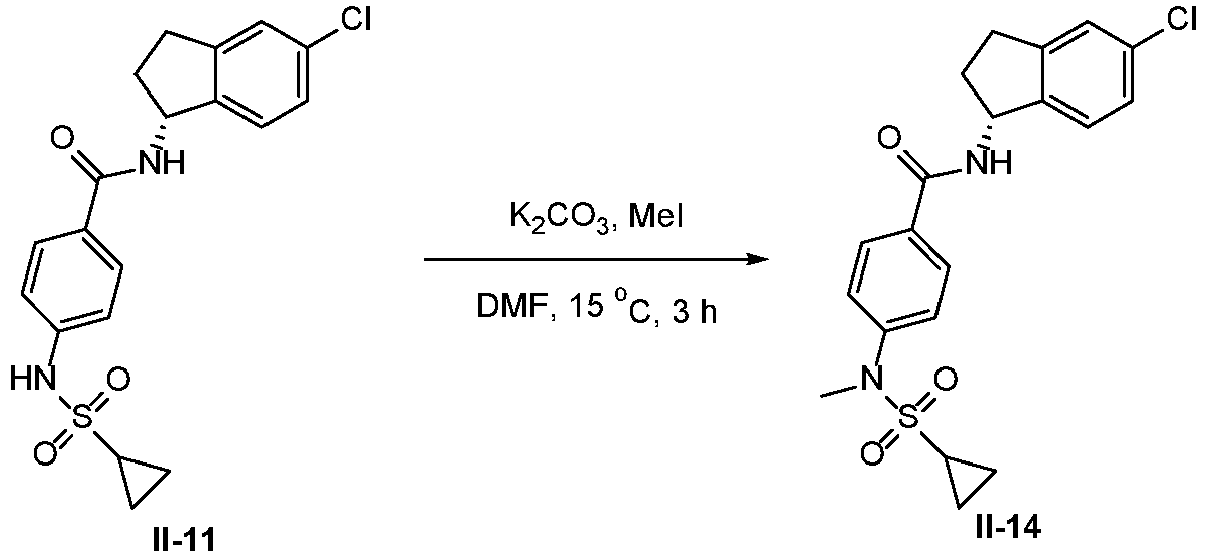
- A mixture of N-[(1R)-5-chloroindan-1-yl]-4-(cyclopropylsulfonylamino)benzamide (140 mg, 0.36 mmol) and K2CO3 (99 mg, 0.72 mmol) and Mel (152.51 mg, 1.07 mmol) in DMF (5 mL) was stirred at 15 °C for 3 hours. The mixture was diluted with H2O (5 mL) and the aqueous layer was extracted with EtOAc (5 mL x 2). The combined organic phase was washed with brine (5 mL), dried over anhydrous Na2SO4, filtered and concentrated. The crude product was purified by Prep-HPLC (Waters Xbridge (150 mm x 25 mm, 5 µm) A = H2O (10 mM NH4HCO3) and B = CH3CN; 40-70% B over 6 minutes) to give the product (83.3 mg, 0.21 mmol, 57% yield) as a solid.
- 1H NMR (400MHz, CD3CN) δH = 7.83 (dd, 2H), 7.50 (dd, 2H), 7.32 - 7.24 (m, 3H), 7.22 - 7.18 (m, 1H), 5.57 (q, 1H), 3.33 (s, 3H), 3.07 - 2.99 (m, 1H), 2.94 - 2.85 (m, 1H), 2.61 - 2.45 (m, 2H), 2.07 - 1.98 (m, 1H), 0.98 - 0.87 (m, 4H).
- LCMS Rt = 1.18 min in 2.0 min chromatography, 10-80AB, MS ESI calcd. for C20H22ClN2O3S [M+H]+ 405.1, found 404.9.
-

- A mixture of N-[(1S)-5-chloroindan-1-yl]-4-(trifluoromethylsulfonylamino)benzamide (250 mg, 0.60 mmol) and K2CO3 (165 mg, 1.19 mmol) and Mel (254.18 mg, 1.79 mmol) in DMF (10mL) was stirred at 20 °C for 3 hours. The mixture was diluted with H2O (15 mL) and the aqueous layer was extracted with EtOAc (15 mL x 2). The combined organic phase was washed with brine (15 mL), dried over anhydrous Na2SO4, filtered and concentrated. The crude product was purified by prep-HPLC (Boston Prime (150 mm x 30 mm, 5 µm) A = H2O (0.05% NH4OH) and B = CH3CN; 55-85 %B over 8 minutes) to give the product (65.9 mg, 0.15 mmol, 25% yield) as a solid.
- 1H NMR (400MHz, CD3CN) δH = 7.89 (d, 2H), 7.52 (d, 2H), 7.38 - 7.26 (m, 3H), 7.23 - 7.18 (m, 1H), 5.56 (q, 1H), 3.48 (s, 3H), 3.09 - 2.97 (m, 1H), 2.96 - 2.83 (m, 1H), 2.62 - 2.50 (m, 1H), 2.07 - 1.98 (m, 1H).
- LCMS Rt = 1.27 min in 2 min chromatography, 10-80AB, MS ESI calcd. for C18H17ClF3N2O3S [M+H]+ 433.1, found 432.8.
-
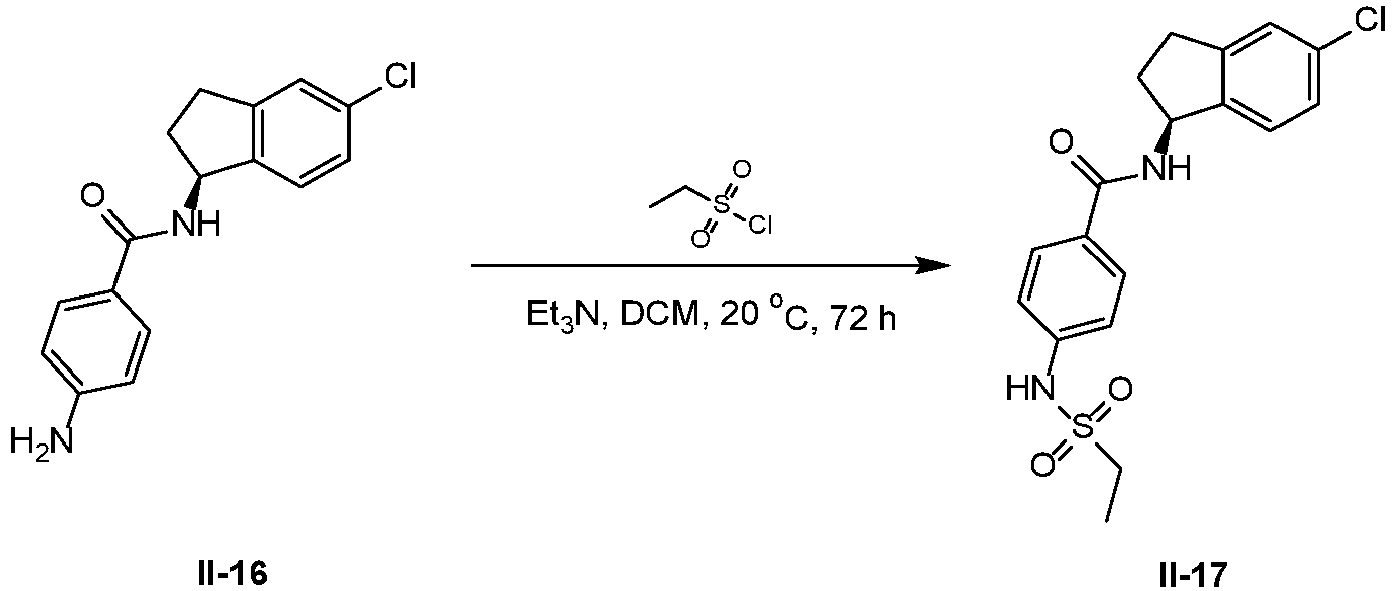
- A mixture of 4-amino-N-[(1S)-5-chloroindan-1-yl]benzamide (200 mg, 0.7 mmol) and ethanesulfonyl chloride (448.39 mg, 3.49 mmol) in pyridine (20 mL) was stirred at 20 °C for 72 hours under N2. The reaction was concentrated and quenched with sat. NH4Cl (15 mL). The mixture was extracted with EtOAc (15 mL x 2). The combined organic phase was washed with brine (15 mL), dried over anhydrous Na2SO4, filtered and concentrated. The crude product was purified by prep-HPLC (Boston Prime (150 mm x 30 mm, 5 µm) A = H2O (0.05% NH4OH) and B = CH3CN; 37-67%B over 8 minutes) to give the product (35.3 mg, 0.09 mmol, 13% yield) as a solid.
- 1H NMR (400MHz, CD3CN) δH = 7.89 - 7.74 (m, 3H), 7.32 - 7.14 (m, 6H), 5.56 (q, 1H), 3.13 (q, 2H), 3.07 - 2.96 (m, 1H), 2.95 - 2.83 (m, 1H), 2.61 - 2.49 (m, 1H), 2.06 - 1.97 (m, 1H), 1.25 (t, 3H).
- LCMS Rt = 1.02 min in 2 min chromatography, 10-80AB, MS ESI calcd. for C18H20ClN2O3S [M+H]+ 379.1, found 379.0.
-

- A mixture of 4-amino-N-[(1S)-5-chloroindan-1-yl]benzamide (200 mg, 0.7 mmol) and cyclopropanesulfonyl chloride (127.47 mg, 0.91 mmol) in pyridine (15 mL) was stirred at 20 °C for 72 hours under N2. The reaction was concentrated and quenched with sat. NH4Cl (15 mL). The mixture was extracted with EtOAc (15 mL x 2). The combined organic phase was washed with brine (15 mL), dried over anhydrous Na2SO4, filtered and concentrated. The crude product was triturated from Hexane and DCM (5:1, 5 mL) to give the product (49.5 mg, 0.13 mmol, 18% yield) as a solid.
- 1H NMR (400MHz, DMSO-d6 ) δH = 10.08 (s, 1H), 8.68 (d, 1H), 7.87 (d, 2H), 7.43 - 7.14 (m, 5H), 5.50 (q, 1H), 3.07 - 2.93 (m, 1H), 2.92 - 2.79 (m, 1H), 2.74 - 2.65 (m, 1H), 2.46 - 2.40 (m, 1H), 2.10 - 1.91 (m, 1H), 1.04 - 0.91 (m, 4H).
- LCMS Rt = 1.05 min in 2 min chromatography, 10-80AB, MS ESI calcd. for C19H20ClN2O3S [M+H]+ 391.1, found 391.0.
-

- A mixture of N-[(1S)-5-chloroindan-1-yl]-4-(ethylsulfonylamino)benzamide (220 mg, 0.58 mmol) and K2CO3 (160.51mg, 1.16 mmol) and Mel (247.26 mg, 1.74 mmol) in DMF (5mL) was stirred at 20°C for 3 hours. The mixture was diluted with H2O (5 mL) and the aqueous layer was extracted with EtOAc (15 mL x 2). The combined organic phase was washed with brine (15 mL), dried over anhydrous Na2SO4, filtered and concentrated. The crude product was purified by prep-HPLC (Boston Prime (150 mm x 30 mm, 5 µm) A = H2O (0.05% NH4OH) and B = CH3CN; 48-78 %B over 8 minutes) to give the product (119.2 mg, 0.31 mmol, 52% yield) as a solid.
- 1H NMR (400MHz, CD3CN) δH = 7.83 (dd, 2H), 7.47 (dd, 2H), 7.33 - 7.23 (m, 3H), 7.22 - 7.16 (m, 1H), 5.56 (q,1H), 3.32 (s, 3H), 3.10 (q, 2H), 3.07 - 2.97 (m, 1H), 2.95 - 2.84 (m, 1H), 2.61 - 2.51 (m, 1H), 2.07 - 1.97 (m, 1H), 1.25 (t, 3H).
- LCMS Rt = 1.04 min in 2 min chromatography, 10-80AB, MS ESI calcd. for C19H22ClN2O3S [M+H]+ 393.1, found 393.0.
-

- A mixture of N-[(1S)-5-chloroindan-1-yl]-4-(cyclopropylsulfonylamino)benzamide (150 mg, 0.38 mmol), K2CO3 (106.08 mg, 0.77 mmol), and Mel (163.41 mg, 1.15 mmol) in DMF (5 mL) was stirred at 20 °C for 3 hours. The mixture was diluted with H2O (15 mL) and extracted with EtOAc (15 mL x 2). The combined organic phase was washed with brine (15 mL), dried over Na2SO4, filtered and concentrated to give the crude product. The crude product was triturated from Hexane and DCM (5:1 5 mL) to give the product (146.5 mg, 0.36 mmol, 94% yield) as a solid.
- 1H NMR (400MHz, CD3CN) δH = 7.83 (d, 2H), 7.50 (d, 2H), 7.34 - 7.23 (m, 3H), 7.23 - 7.17 (m, 1H), 5.57 (q, 1H), 3.33 (s, 3H), 3.09 - 2.98 (m, 1H), 2.95 - 2.83 (m, 1H), 2.62 - 2.43 (m, 2H), 2.07 - 1.97 (m, 1H), 1.00 - 0.83 (m, 4H).
- LCMS Rt = 1.05 min in 2 min chromatography, 10-80AB, MS ESI calcd. for C20H22ClN2O3S [M+H]+ 405.1, found 405.0.
-
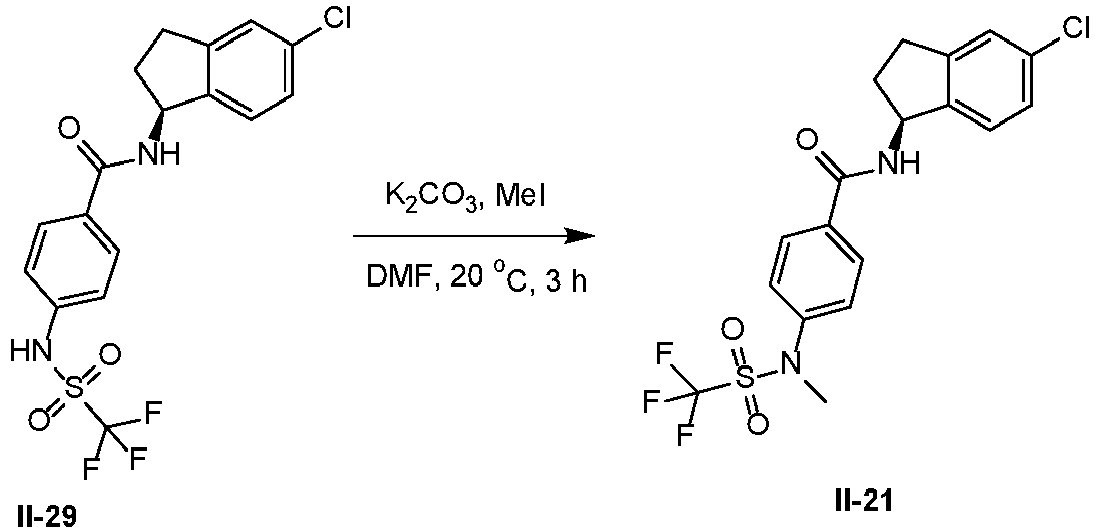
- A mixture of N-[(1S)-5-chloroindan-1-yl]-4-(trifluoromethylsulfonylamino)benzamide (250 mg, 0.60 mmol) and K2CO3 (165 mg, 1.19 mmol) and Mel (254.18 mg, 1.79 mmol) in DMF (10mL) was stirred at 20 °C for 3 hours. The mixture was diluted with H2O (15 mL) and the aqueous layer was extracted with EtOAc (15 mL x 2). The combined organic phase was washed with brine (15 mL), dried over anhydrous Na2SO4, filtered and concentrated. The crude product was purified by prep-HPLC (Boston Prime (150 mm x 30 mm, 5 µm) A = H2O (0.05% NH4OH) and B = CH3CN; 55-85 %B over 8 minutes) to give the product (65.9 mg, 0.15 mmol, 25% yield) as a solid.
- 1H NMR (400MHz, CD3CN) δH = 7.89 (d, 2H), 7.52 (d, 2H), 7.38 - 7.26 (m, 3H), 7.23 - 7.18 (m, 1H), 5.56 (q, 1H), 3.48 (s, 3H), 3.09 - 2.97 (m, 1H), 2.96 - 2.83 (m, 1H), 2.62 - 2.50 (m, 1H), 2.07 - 1.98 (m, 1H).
- LCMS Rt = 1.27 min in 2 min chromatography, 10-80AB, MS ESI calcd. for C18H17ClF3N2O3S [M+H]+ 433.1, found 432.8.
-

- To a mixture of (1R)-5-chloroindan-1-amine (50 mg, 0.30 mmol) and HOBt (80.61 mg, 0.60 mmol) and Et3N (0.21 mL, 1.49 mmol) in CH2Cl2 (5 mL) were added EDCI (114.35 mg, 0.60 mmol) and 4-methylsulfonylbenzoic acid (71.66 mg, 0.36 mmol). The reaction mixture was stirred at 15 °C for 16 hours. The mixture was diluted with sat. NH4Cl solution (5 mL) and the aqueous layer was extracted with CH2Cl2 (5 mL x 2). The combined organic phase was washed with brine (5 mL), dried over anhydrous Na2SO4, filtered and concentrated. The crude product was purified by Prep-HPLC (Waters Xbridge (150 mm x 25 mm, 5 µm) A = H2O (10 mM NH4HCO3) and B = CH3CN; 32-62% B over 7 minutes) to give the product (13.7 mg, 0.04 mmol, 13% yield) as a solid.
- 1H NMR (400MHz, CD3CN) δH = 8.03 - 7.97 (m, 4H), 7.49 - 7.39 (m, 1H), 7.32 - 7.29 (m, 2H), 7.23 - 7.19 (m, 1H), 5.58 (q, 1H), 3.08 (s, 3H), 3.07 - 3.00 (m, 1H), 2.96 - 2.86 (m, 1H), 2.62 - 2.53 (m, 1H), 2.07 - 1.99 (m, 1H).
- LCMS Rt = 1.12 min in 2.0 min chromatography, 10-80AB, MS ESI calcd. for C17H17ClNO3S [M+H]+ 350.1, found 349.9.
-

- Synthesis of II-A-6b: A mixture of N-methylmethanamine hydrochloride (500 mg, 6.13 mmol) and Et3N (2.55 mL, 18.4 mmol) and methyl 4-chlorocarbonylbenzoate (1826.71 mg, 9.2 mmol) in DCM (10 mL) was stirred at 15 °C for 16 hours. The mixture was diluted with sat. NH4Cl (10 mL) and the aqueous layer was extracted with DCM (10 mL x 2). The combined organic phase was washed with brine (10 mL), dried over anhydrous Na2SO4, filtered and concentrated. The crude product was purified by flash chromatography on silica gel (EtOAc in PE = 30% to 60%) to give the product (1100 mg, 4.70 mmol, 77% yield) as a solid.
LCMS Rt = 0.65 min in 1.5 min chromatography, 5-95AB, MS ESI calcd. for C11H13NO3 [M+H]+ 208.1, found 207.9. - Synthesis of II-A-7a: A mixture of methyl 4-(dimethylcarbamoyl)benzoate (500 mg, 2.41mmol) and LiOH.HzO (202.48 mg, 4.83 mmol) in THF (8 mL) and water (4 mL) was stirred at 15 °C for 3 hours. The mixture was acidified with 1N HCl to pH 2. The mixture was diluted with H2O (10 mL) and the aqueous layer was extracted with EtOAc (20 mL x 2). The combined organic phase was concentrated to give the crude product (518 mg, 2.45 mmol) as a solid.
LCMS Rt = 0.87 min in 2 min chromatography, 0-60AB, MS ESI calcd. for C10H12NO3 [M+H]+ 194.1, found 193.8. - Synthesis of Compound II-23: To a mixture of 4-(dimethylcarbamoyl)benzoic acid (80.67 mg, 0.42 mmol) and HOBt (112.85 mg, 0.84 mmol) and Et3N (0.29 mL, 2.09 mmol) in DCM (5 mL) were added EDCI (120.07 mg, 0.63 mmol) and (1R)-5-chloroindan-1-amine (70 mg, 0.42 mmol). The reaction mixture was stirred at 15 °C for 16 hours. The reaction was quenched with sat. NH4Cl (20 mL) and the mixture was extracted with DCM (20 mL x 2). The combined organic phase was washed with brine (20 mL), dried over anhydrous Na2SO4, filtered and concentrated. The crude product was purified by prep-HPLC (Boston Prime (150 mm x 30 mm, 5 µm) A = H2O (0.05% NH4OH) and B = CH3CN; 39-69% B over 8 minutes) to give the product (13.7 mg, 0.04 mmol, 10% yield) as a solid.
- 1H NMR (400MHz, CD3CN) δH = 7.85 (d, 2H), 7.44 (d, 2H), 7.37 - 7.26 (m, 3H), 7.24 - 7.17 (m, 1H), 5.58 (q, 1H), 3.11 - 2.96 (m, 4H), 2.96 - 2.81 (m, 4H), 2.64 - 2.50 (m, 1H), 2.06 - 1.99 (m, 1H).
- LCMS Rt = 1.15 min in 2 min chromatography, 10-80AB, MS ESI calcd. for C19H20ClN2O2 [M+H]+ 343.1, found 343.0.
-

- Synthesis of II-A-8a: A mixture of methanamine hydrochloride (500 mg, 7.41 mmol) and Et3N (3.07 mL, 22.22 mmol) and methyl 4-chlorocarbonylbenzoate (2.21g, 11.11 mmol) in DCM (15 mL) was stirred at 15 °C for 16 hours. The mixture was diluted with sat. NH4Cl (15 mL) and the aqueous layer was extracted with DCM (15 mL x 2). The combined organic phase was washed with brine (15 mL), dried over anhydrous Na2SO4, filtered and concentrated. The crude product was purified by flash chromatography on silica gel (EtOAc in PE = 30% to 60%) to give the product (712 mg, 3.69 mmol, 50% yield) as a solid.
LCMS Rt = 0.60 min in 1.5 min chromatography, 5-95AB, MS ESI calcd. for C10H12NO3 [M+H]+ 194.1, found 193.9. - Synthesis of II-A-9a: A mixture of methyl 4-(methylcarbamoyl)benzoate (500 mg, 2.59 mmol) and LiOH·H2O (217.18 mg, 5.18 mmol) in THF (4 mL) and water (2 mL) was stirred at 15 °C for 3 hours. The mixture was acidified with 1N HCl (5 mL) and diluted with H2O (10 mL). The aqueous layer was extracted with EtOAc (20 mL x 2). The combined organic phase was concentrated to give the crude product (606 mg, 3.38 mmol) as a solid.
LCMS Rt = 0.81 min in 2 min chromatography, 0-60AB, MS ESI calcd. for C9H9NO3 [M+H]+ 180.1, found 179.9. - Synthesis of II-24: To a mixture of (1R)-5-chloroindan-1-amine (100 mg, 0.6 mmol) and HOBt (161.21 mg, 1.19 mmol) and Et3N (0.41 mL, 2.98 mmol) in DCM (5 mL) were added EDCI (171.53 mg, 0.89 mmol) and 4-(methylcarbamoyl)benzoic acid (106.88 mg, 0.6 mmol). The reaction mixture was stirred at 15 °C for 16 hours. The reaction was quenched with sat. NH4Cl (20 mL) and the mixture was extracted with DCM (20 mL x 2). The combined organic phase was washed with brine (20 mL), dried over anhydrous Na2SO4, filtered and concentrated. The crude product was purified by prep-HPLC (Boston Prime (150 mm x 30 mm, 5µm) A = H2O (0.05% NH4OH) and B = CH3CN; 35-65% B over 8 minutes) to give the product (8.8 mg, 0.03 mmol, 4% yield) as a solid.
- 1H NMR (400MHz, DMSO-d6 ) δH = 8.89 (d, 1H), 8.56 (d, 1H), 8.03 - 7.80 (m, 4H), 7.34 (s, 1H), 7.24 (s, 2H), 5.52 (q, 1H), 3.07 - 2.94 (m, 1H), 2.92 - 2.83 (m, 1H), 2.79 (d, 3H), 2.47 - 2.42 (m, 1H), 2.09 - 1.95 (m, 1H).
- LCMS Rt = 1.09 min in 2 min chromatography, 10-80AB, MS ESI calcd. for C18H18ClN2O2 [M+H]+ 329.1, found 329.1.
-

- To a mixture of 4-sulfamoylbenzoic acid (72.01 mg, 0.36 mmol) and HOBt (80.61 mg, 0.60 mmol) and Et3N (0.21 mL, 1.49 mmol) in CH2Cl2 (3 mL) were added EDCI (114.35 mg, 0.60 mmol) and (1R)-5-chloroindan-1-amine (50 mg, 0.30 mmol). The reaction mixture was stirred at 35 °C for 16 hours. The mixture was diluted with sat. NH4Cl (5 mL) and extracted with EtOAc (5 mL x 2). The combined organic phase was washed with brine (5 mL), dried over anhydrous Na2SO4, filtered and concentrated. The crude product was purified by Prep-HPLC (Xtimate C18 (150 mm x 25 mm, 5 µm) A = H2O (10 mM NH4HCO3) and B = CH3CN; 40-50% B over 9 minutes) to give the product (20.6 mg, 58.6 µmol, 20% yield) as a solid.
- 1H NMR (400MHz, CD3CN) δH = 7.98 - 7.91 (m, 4H), 7.43 - 7.35 (m, 1H), 7.32 - 7.29 (m, 2H), 7.23 - 7.19 (m, 1H), 5.74 (s, 2H), 5.58 (q, 1H), 3.09 - 3.00 (m, 1H), 2.95 - 2.86 (m, 1H), 2.62 - 2.53 (m, 1H), 2.06 - 2.00 (m, 1H).
- LCMS Rt = 1.11 min in 2.0 min chromatography, 10-80AB, MS ESI calcd. for C16H16ClN2O3S [M+H]+ 351.0, found 351.1.
-

- To a mixture of 4-carbamoylbenzoic acid (75.86 mg, 0.46 mmol) and DIPEA (0.22 mL, 1.25 mmol) and HATU (317.54 mg, 0.84 mmol) in DMF (3 mL) was added (1R)-5-chloroindan-1-amine (70 mg, 0.42 mmol). The reaction mixture was stirred at 35 °C for 16 hours. The mixture was diluted with sat. NH4Cl (5 mL) and the aqueous layer was extracted with EtOAc (5 mL x 2). The combined organic phase was washed with brine (5 mL), dried over anhydrous Na2SO4, filtered and concentrated. The crude product was purified by Prep-HPLC (Waters Xbridge (150 mm x 25 mm, 5 µm) A = H2O (10 mM NH4HCO3) and B = CH3CN; 33-53% B over 7 minutes) to give the product (7.6 mg, 24.0 µmol, 6% yield) as a solid.
- 1H NMR (400MHz, DMSO-d6 ) δH = 8.95-8.82 (m, 1H), 8.07 (br s, 1H), 8.02-7.88 (m, 4H), 7.48 (br s, 1H), 7.34 (s, 1H), 7.32-7.22 (m, 2H), 5.52 (q, 1H), 3.06 - 2.96 (m, 1H), 2.92 - 2.82 (m, 1H), 2.46 - 2.42 (m, 1H), 2.08 - 1.98 (m, 1H).
- LCMS Rt = 1.07 min in 2.0 min chromatography, 10-80AB, MS ESI calcd. for C17H16ClN2O2 [M+H]+ 315.1, found 314.9.
-

- Synthesis of II-A-12b: A mixture of methanamine hydrochloride (500 mg, 7.41 mmol) and methyl 4-chlorosulfonylbenzoate (2606.56 mg, 11.11 mmol) in pyridine (10 mL) was stirred at 15 °C for 16 hours. The reaction was concentrated and acidified with 1M HCl to pH~7 and the mixture was extracted with CH2Cl2 (80 mL x 2). The combined organic phase was washed with water (80 mL) and brine (80 mL), dried over anhydrous Na2SO4, filtered and concentrated to give the crude product (1600 mg, 6.35 mmol) as a solid.
LCMS Rt = 0.65 min in 1.5 min chromatography, 5-95AB, MS ESI calcd. for C9H12NO4S [M+H]+ 230.0, found 229.9. - Synthesis of II-A-13a: A mixture of methyl 4-(methylsulfamoyl)benzoate (500 mg, 2.18 mmol) and LiOH.HzO (183.03 mg, 4.36 mmol) in THF (8 mL) and water (4 mL) was stirred at 15 °C for 3 hours. The mixture was concentrated to give the crude product (488 mg, 2.08 mmol) as a solid, which was used for next step directly without further purification.
LCMS Rt = 0.87 min in 1.5 min chromatography, 5-95AB, MS ESI calcd. for C8H10NO4S [M+H]+ 216.0, found 215.8. - Synthesis of II-27: To a mixture of (1R)-5-chloroindan-1-amine (100 mg, 0.60 mmol) and DIPEA (0.31 mL, 1.79 mmol) and HATU (453.63 mg, 1.19 mmol) in DMF (5 mL) was added lithium 4-(methylsulfamoyl)benzoate (141.23 mg, 0.66 mmol). The reaction mixture was stirred at 60 °C for 16 hours. The mixture was diluted with sat.NH4Cl (5 mL) and the aqueous layer was extracted with EtOAc (15 mL x 2). The combined organic phase was washed with brine (5 mL), dried over anhydrous Na2SO4, filtered and concentrated. The crude product was purified by Prep-HPLC (Waters Xbridge (150 mm x 25 mm, 5 µm) A = H2O (10 mM NH4HCO3) and B = CH3CN; 35-55% B over 8 minutes) to give the product (26.6 mg, 73.0 µmol, 12% yield) as a solid.
- 1H NMR (400MHz, CD3CN) δH = 7.98 (dd, 2H), 7.88 (dd, 2H), 7.45 - 7.37 (m, 1H), 7.33 - 7.28 (m, 2H), 7.23 - 7.19 (m, 1H), 5.58 (q, 1H), 5.53 - 5.47 (m, 1H), 3.09 - 3.00 (m, 1H), 2.95 - 2.86 (m, 1H), 2.62 - 2.54 (m, 1H), 2.51 (d, 3H), 2.08 - 1.98 (m, 1H).
- LCMS Rt = 1.20 min in 2.0 min chromatography, 10-80AB, MS ESI calcd. for C17H18ClN2O3S [M+H]+ 365.1, found 364.9.
-

- Synthesis of II-A-14a: A mixture of N-methylmethanamine hydrochloride (500 mg, 6.13 mmol) and Et3N (2.55 mL, 18.4 mmol) and methyl 4-chlorosulfonylbenzoate (2158.39 mg, 9.2 mmol) in CH2Cl2 (10 mL) was stirred at 15 °C for 16 hours. The mixture was quenched with sat. NH4Cl (10 mL) and the mixture was extracted with CH2Cl2 (10 mL x 2). The combined organic phase was washed with brine (10 mL), dried over anhydrous Na2SO4, filtered and concentrated to give the crude product (1700 mg, 5.7 mmol).
LCMS Rt = 0.73 min in 1.5 min chromatography, 5-95AB, MS ESI calcd. for C10H14NO4S [M+H]+ 244.1, found 243.9. - Synthesis of II-A-14b: A mixture of methyl 4-(dimethylsulfamoyl)benzoate (500 mg, 2.06 mmol) and LiOH.HzO (172.48 mg, 4.11 mmol) in THF (8 mL) and water (4 mL). The mixture was stirred at 15 °C for 3 hours. The mixture was concentrated to give the crude product (510 mg, 2.05 mmol) as a solid.
- Synthesis of II-28: To a mixture of (1R)-5-chloroindan-1-amine (100 mg, 0.60 mmol) and DIPEA (0.31 mL, 1.79 mmol) and HATU (453.63 mg, 1.19 mmol) in DMF (5 mL) was added lithium 4-(dimethylsulfamoyl)benzoate (150.43 mg, 0.66 mmol). The reaction mixture was stirred at 35 °C for 16 hours. The mixture was diluted with sat. NH4Cl solution (5 mL) and the aqueous layer was extracted with EtOAc (5 mL x 2). The combined organic phase was washed with brine (5 mL), dried over anhydrous Na2SO4, filtered and concentrated. The crude product was purified by Prep-HPLC (Xtimate C18 (150 mm x 25 mm, 5 µm) A = H2O (10 mM NH4HCO3) and B = CH3CN; 35-65% B over 9 minutes) to give the product (74.0 mg, 0.19 mmol, 33% yield) as a solid.
- 1H NMR (400MHz, CD3CN) δH = 8.01 (d, 2H), 7.83 (d, 2H), 7.49 - 7.38 (m, 1H), 7.33 - 7.28 (m, 2H), 7.23 - 7.19 (m, 1H), 5.58 (q, 1H), 3.09 - 3.00 (m, 1H), 2.96 - 2.86 (m, 1H), 2.66 (s, 6H), 2.62 - 2.53 (m, 1H), 2.09 - 2.00 (m, 1H).
- LCMS Rt = 1.25 min in 2.0 min chromatography, 10-80AB, MS ESI calcd. for C18H20ClN2O3S [M+H]+ 379.1, found 379.0.
-

- A mixture of 4-amino-N-[(1S)-5-chloroindan-1-yl]benzamide (140 mg, 0.49 mmol) and Et3N (0.1 mL, 0.73 mmol) and Tf2O (165.29 mg, 0.59 mmol) in DCM (8 mL) was stirred at -30 °C for 1 hour under N2. Then the mixture was stirred at 20 °C for 16 hours. The reaction was concentrated and quenched with sat. NH4Cl (25 mL). The mixture was extracted with DCM (25 mL x 2). The combined organic phase was washed with brine (25 mL), dried over anhydrous Na2SO4, filtered and concentrated. The crude product was purified by Prep-HPLC (Xtimate (150 mm x 25 mm, 5 µm) A = H2O (0.05% NH4OH) and B = CH3CN; 33-63% B over 8 minutes) to give the product (17.2 mg, 0.04 mmol, 8% yield) as a solid.
- 1H NMR (400MHz, CD3CN) δH = 7.83 (dd, 2H), 7.40 - 7.23 (m, 5H), 7.23 - 7.16 (m, 1H), 5.56 (q, 1H), 3.06 - 2.98 (m, 1H), 2.94 - 2.83 (m, 1H), 2.59 - 2.50 (m, 1H), 2.05 - 1.99 (m, 1H).
- LCMS Rt = 1.26 min in 2 min chromatography, 10-80AB, MS ESI calcd. for C17H15ClF3N2O3S [M+H]+ 419.0, found 418.9.
-

- Synthesis of II-A-16b: To a mixture of 4-ethylsulfanylbenzoic acid (100 mg, 0.55 mmol) in methanol (3 mL) was added oxone (673.44 mg, 1.1 mmol) in water (3 mL) at 0 °C. The mixure was stirred at 20 °C for 15 hours. Methanol was evaporated under vacuum and the reaction mixture was diluted with water (20 mL). The aqueous layer was extracted with EtOAc (30 mL x 2). The combined organic phase was washed with brine (20 mL), dried over anhydrous Na2SO4, filtered and concentrated to give the product (90 mg, 0.42 mmol) as a solid.
1H NMR (400MHz, CDCl3) δH = 8.31 (d, 2H), 8.05 (d, 2H), 3.18 (q, 2H), 1.31 (t, 3H). - Synthesis of II-30: To a mixture of (1R)-5-chloroindan-1-amine (75.12 mg, 0.45 mmol) and HOBt (75.69 mg, 0.56 mmol) and EDCI (85.9 mg, 0.45 mmol) in DCM (3 mL) were added DIPEA (0.2 mL, 1.12 mmol) and 4-ethylsulfonylbenzoic acid (80 mg, 0.37 mmol). The mixture was stirred at 20 °C for 2 hours. The mixture was diluted with water (20 mL) and the aqueous layer was extracted with DCM (30 mL x 2). The combined organic phase was washed with brine (20 mL), dried over anhydrous Na2SO4, filtered and concentrated. The crude product was purified by Prep-HPLC (Waters Xbridge 150 mm x 25 mm, 5 µm, A = water (0.05% NH4OH v/v) and B = CH3CN; 31-61 %B over 8 minutes) to give the product (25.0 mg, 68.8 µmol, 18% yield) as a solid.
- 1H NMR (400MHz, CDCl3) δH = 8.03 - 7.82 (m, 4H), 7.32 - 7.27 (m, 2H), 7.24 - 7.20 (m, 1H), 6.36 (d, 1H), 5.68 (q, 1H), 3.14 (q, 2H), 3.10 - 3.10 (m, 1H), 3.01 - 2.89 (m, 1H), 2.76 - 2.70 (m, 1H), 2.04 - 1.94 (m, 1H), 1.28 (t, 3H).
- LCMS Rt = 1.19 min in 2.0 min chromatography, 10-80AB, MS ESI calcd. for C18H19ClNO3S [M+H]+364.1, found 364.0.
-

- A mixture of (1R)-5-chloroindan-1-amine (200 mg, 1.19 mmol) and 4-fluorobenzoic acid (167.16 mg, 1.19 mmol) and HOBt (322.43 mg, 2.39 mmol) and EDCI (343.06 mg, 1.79 mmol) and TEA (603.61 mg, 5.97 mmol) in DCM (20 mL) was stirred at 20 °C for 16 hours. The mixture was diluted with H2O (10 mL) and the aqueous layer was extracted with EtOAc (20 mL × 2). The combined organic phase was washed with brine (10 mL), dried over anhydrous Na2SO4, filtered and concentrated. The crude product was purified by Prep-HPLC (Kromasil (150 mm × 30 mm, 5 µm) A = H2O (0.05% NH4OH) and B = CH3CN; 53-83%B over 8 minutes) to give the product (160.6 mg, 0.55 mmol, 46% yield) as a solid.
- 1H NMR (400MHz, CD3CN) δH= 7.91 - 7.83 (m, 2H), 7.35 - 7.24 (m, 3H), 7.23 - 7.13 (m, 3H), 5.55 (q, 1H), 3.08 - 2.98 (m, 1H), 2.94 - 2.84 (m, 1H), 2.60 - 2.50 (m, 1H), 2.07 - 1.96 (m, 1H)
- LCMS Rt = 1.28 min in 2.0 min chromatography, 10-80AB, MS ESI calcd. for C16H14ClFNO [M+H]+290.1, found 289.9.
-

- Synthesis of II-A-18b: A mixture of ethyl 4-aminobenzoate (1 g, 6.05 mmol) and DMAP (1.11 g, 9.08 mmol) in pyridine (20 mL) was added N-methylsulfamoyl chloride (1.18 g, 9.08 mmol) at 0 °C. The mixture was stirred at 20 °C for 16 hours under N2. The mixture was concentrated and diluted with H2O (10 mL). The aqueous layer was extracted with EtOAc (20 mL × 2). The combined organic phase was washed with brine (10 mL), dried over anhydrous Na2SO4, filtered and concentrated. The crude product was triturated from EtOAc (5 mL) to give the product (1100 mg, 4.12 mmol, 68% yield) as a solid.
LCMS Rt = 0.69 min in 1.5 min chromatography, 5-95AB, MS ESI calcd. for C10H15N2O4S [M+H]+ 259.1, found 259.0. - Synthesis of II-A-18c: To a solution of ethyl 4-(methylsulfamoylamino)benzoate (400 mg, 1.55 mmol) in methanol (10 mL) was added a solution of NaOH (247.78 mg, 6.19 mmol) in water (10 mL) slowly. The resulting mixture was stirred at 50 °C for 12 hours. The mixture was concentrated to remove MeOH under reduced pressure. 1N HCl (30 mL) was added to adjust to pH 2. The mixture was extracted with EtOAc (20 mL × 2). The combined organic phase was washed with brine (10 mL), dried over anhydrous Na2SO4, filtered and concentrated to give the crude product (320 mg, 1.39 mmol) as a solid.
1H NMR (400MHz, DMSO-d6 ) δH = 12.65 (s, 1H), 10.19 (s, 1H), 7.85 (d, 2H), 7.62 - 7.48 (m, 1H), 7.21 (d, 2H), 2.44 (d, 3H) - Synthesis of II-32: A mixture of 4-(methylsulfamoylamino)benzoic acid (123.61 mg, 0.54 mmol) and HOBt (161.21 mg, 1.19 mmol) and Et3N (0.25 mL, 1.79 mmol) and EDCI (171.53 mg, 0.89 mmol) and (1R)-5-chloroindan-1-amine (100 mg, 0.6 mmol) in DCM (10 mL) was stirred at 20 °C for 16 hours under N2. The mixture was quenched with sat. NH4Cl (20 mL) and the mixture was extracted with DCM (20 mL × 2). The combined organic phase was washed with brine (20 mL), dried over anhydrous Na2SO4, filtered and concentrated. The crude product was purified by prep-HPLC (Boston Prime (150 mm x 30 mm, 5 µm) A = H2O (0.05% NH4OH) and B = CH3CN; 40-70% B over 8 minutes) to give the product (11.4 mg, 0.03 mmol, 5% yield) as a solid.
- 1H NMR (400MHz, CD3CN) δH = 7.94 (br s, 1H), 7.82 (d, 2H), 7.30 (d, 2H), 7.27 - 7.18 (m, 4H), 5.65-5.52 (m, 2H), 3.11 - 2.99 (m, 1H), 2.98 - 2.85 (m, 1H), 2.63 - 2.50 (m, 4H), 2.08 - 2.00 (m, 1H).
- LCMS Rt = 1.14 min in 2.0 min chromatography, 10-80AB, MS ESI calcd. for C17H19ClN3O3S [M +H]+ 380.1, found 380.0.
-

- A mixture of (1R)-5-chloroindan-1-amine (78.25 mg, 0.47 mmol), 2-methyl-4-methylsulfonyl-benzoic acid (100 mg, 0.47 mmol) and HOBt (126.15 mg, 0.93 mmol) and EDCI (134.22 mg, 0.70 mmol) and TEA (236.16 mg, 2.33 mmol) in DCM (20 mL) was stirred at 20 °C for 16 hours. The mixture was diluted with H2O (10 mL) and the aqueous layer was extracted with EtOAc (20 mL × 2). The combined organic phase was washed with brine (10 mL), dried over anhydrous Na2SO4, filtered and concentrated. The crude product was purified by Prep-HPLC (Kromasil (150 mm × 30 mm, 5 µm) A = H2O (0.05% NH4OH) and B = CH3CN; 45-75% B over 8 minutes) to give the product (73.0 mg, 0.20 mmol, 43% yield) as a solid.
- 1H NMR (400MHz, DMSO-d6 ) δH= 8.88 (d, 1H), 7.83 (s, 1H), 7.79 (d, 1H), 7.58 (d, 1H), 7.33 (d, 2H), 7.29 - 7.25 (m, 1H), 5.47 (q, 1H), 3.22 (s, 3H), 3.03 - 2.92 (m, 1H), 2.90 - 2.79 (m, 1H), 2.50- 2.40 (m, 4H), 2.01 - 1.89 (m, 1H).
- LCMS Rt = 1.17 min in 2.0 min chromatography, 10-80AB, MS ESI calcd. for C18H19ClNO3S [M+H]+364.1, found 363.9.
-

- Synthesis of II-A-20b: A mixture of ethyl 4-aminobenzoate (500 mg, 3.03 mmol) in pyridine (20 mL) was added N,N-dimethylsulfamoyl chloride (1303.86 mg, 9.08 mmol) at 0 °C for 1 hour. Then the mixture was stirred at 90 °C for 16 hours under N2. The mixture was concentrated and diluted with H2O (10 mL). The aqueous layer was extracted with EtOAc (20 mL × 2). The combined organic phase was washed with brine (10 mL), dried over anhydrous Na2SO4, filtered and concentrated. The crude product was purified by prep-HPLC (Boston Prime (150 mm x 30 mm, 5 µm) A = H2O (0.05% NH4OH) and B = CH3CN; 35-65% B over 8 minutes) to give the product (500 mg, 1.84 mmol, 61% yield) as a solid.
LCMS Rt = 0.75 min in 1.5 min chromatography, 5-95AB, MS ESI calcd. for C11H17N2O4S [M+H]+ 273.1, found 273.2. - Synthesis of II-A-20c: To a solution of NaOH (88.13 mg, 2.2 mmol) in water (10 mL) was added ethyl 4-(dimethylsulfamoylamino)benzoate (150 mg, 0.55 mmol) in MeOH (10 mL) at 20 °C. The resulting mixture was stirred at 20 °C for 16 hours. The mixture was concentrated and water (20 mL) was added. The aqueous layer was extracted with EtOAc (20 mL × 2). The combined organic phase was washed with 1N HCl (20 mL × 4) and water (20 mL × 2) and brine (20 mL × 2), dried over anhydrous Na2SO4, filtered and concentrated to give the crude product (105 mg, 0.41 mmol) as a solid, which was used directly for next step without further purification.
LCMS Rt = 0.55 min in 1.5 min chromatography, 5-95AB, MS ESI calcd. for C9H13N2O4S [M +H]+ 245.1, found 244.9. - Synthesis of Compound II-34: A mixture of 4-(dimethylsulfamoylamino)benzoic acid (118.03 mg, 0.48 mmol) and HOBt (145.09 mg, 1.07 mmol) and Et3N (0.22 mL, 1.61 mmol) and EDCI (154.38 mg, 0.81 mmol) and (1R)-5-chloroindan-1-amine (90 mg, 0.54 mmol) in DCM (10 mL) was stirred at 20 °C for 16 hours under N2. The reaction was quenched with sat. NH4Cl (20 mL) and the mixture was extracted with DCM (20 mL × 2). The combined organic phase was washed with brine (20 mL), dried over anhydrous Na2SO4, filtered and concentrated. The crude product was purified by prep-HPLC (Boston Prime (150 mm × 30 mm, 5 µm) A = H2O (0.05% NH4OH) and B = CH3CN; 40-70% B over 8 minutes) to give the product (86.5 mg, 0.22 mmol, 41% yield) as a solid.
- 1H NMR (400MHz, CD3CN) δH = 7.91 (br s, 1H), 7.77 (d, 2H), 7.32 - 7.23 (m, 4H), 7.23-7.12 (m, 2H), 5.55 (q, 1H), 3.08 - 2.97 (m, 1H), 2.95 - 2.83 (m, 1H), 2.77 (s, 6H), 2.61 - 2.48 (m, 1H), 2.05 - 1.97 (m, 1H).
- LCMS Rt = 1.19 min in 2.0 min chromatography, 10-80AB, MS ESI calcd. for C18H21ClN3O3S [M +H]+ 394.1, found 394.0.
-

- A mixture of (1R)-5-chloroindan-1-amine (76.83 mg, 0.46 mmol), 3-fluoro-4-methylsulfonyl-benzoic acid (100 mg, 0.46 mmol) and HOBt (123.86 mg, 0.92 mmol) and EDCI (131.78 mg, 0.69 mmol) and TEA (231.87 mg, 2.29 mmol) in DCM (20 mL) was stirred at 20 °C for 16 hours. The mixture was concentrated and diluted with H2O (10 mL). The aqueous layer was extracted with EtOAc (20 mL × 2). The combined organic phase was washed with brine (10 mL), dried over anhydrous Na2SO4, filtered and concentrated. The crude product was purified by Prep-HPLC (Kromasil (150 mm × 30 mm, 5 µm) A = H2O (0.05% NH4OH) and B = CH3CN; 46-76 %B over 8 minutes) to give the product (60.0 mg, 0.16 mmol, 36% yield) as a solid.
- 1H NMR (400MHz, DMSO-d6 ) δH= 9.11 (d, 1H), 8.05 - 7.89 (m, 3H), 7.36 (s, 1H), 7.29 - 7.22 (m, 2H), 5.51 (q, 1H), 3.37 (s, 3H), 3.05 - 2.96 (m, 1H), 2.92 - 2.82 (m, 1H), 2.49 - 2.44 (m, 1H), 2.08 - 1.95 (m, 1H).
- LCMS Rt = 1.19 min in 2.0 min chromatography, 10-80AB, MS ESI calcd. for C17H16ClFNO3S [M+H]+368.0, found 368.0.
-

- A mixture of (1R)-5-chloroindan-1-amine (76.83 mg, 0.46 mmol), 2-fluoro-4-methylsulfonyl-benzoic acid (100 mg, 0.46 mmol) and HOBt (123.86 mg, 0.92 mmol) and EDCI (131.78 mg, 0.69 mmol) and TEA (231.87 mg, 2.29 mmol) in DCM (20 mL) was stirred at 20 °C for 16 hours. The mixture was diluted with H2O (10 mL) and the aqueous layer was extracted with EtOAc (20 mL × 2). The combined organic phase was washed with brine (10 mL), dried over anhydrous Na2SO4, filtered and concentrated. The crude product was purified by Prep-HPLC (Kromasil (150 mm × 30 mm, 5 µm) A = H2O (0.05% NH4OH) and B = CH3CN; 45-75 %B over 8 minutes) to give the product (56.2 mg, 0.15 mmol, 33% yield) as a solid.
- 1H NMR (400MHz, CD3OD) δH = 7.94 - 7.78 (m, 3H), 7.34 - 7.27 (m, 2H), 7.24 - 7.20 (m, 1H), 5.59 (t, 1H), 3.18 (s, 3H), 3.10 - 3.01 (m, 1H), 2.97 - 2.88 (m, 1H), 2.67 - 2.58 (m, 1H), 2.08 - 1.98 (m, 1H).
- LCMS Rt = 1.18 min in 2.0 min chromatography, 10-80AB, MS ESI calcd. for C17H16ClFNO3S [M+H]+368.0, found 368.0.
-

- Synthesis of II-A-23b: To a solution of CSI (500 mg, 3.53 mmol) and t-BuOH (261.85 mg, 3.53 mmol) in DCM (20 mL) was added methyl 4-aminobenzoate (534.01 mg, 3.53 mmol). The mixture was stirred at 20 °C for 16 hours. The reaction was quenched with sat. NH4Cl solution (15 mL). The mixture was extracted with EtOAc (20 mL × 2). The combined organic phase was washed with brine (20 mL), dried over anhydrous Na2SO4, filtered and concentrated to give the crude product (780 mg, 1.39 mmol) as a solid.
LCMS Rt = 2.04 min in 4 min chromatography, 10-80AB, MS ESI calcd. for C13H18N2O6SNa [M +Na]+353.1, found 352.9. - Synthesis of II-A-23c: To a solution of methyl 4-(tert-butoxysulfamoylamino)benzoate (550 mg, 1.82 mmol) in methanol (10 mL) and water (10 mL) was added NaOH (218.29 mg, 5.46 mmol). The mixture was stirred at 50 °C for 8 h. The mixture was diluted with sat. NH4Cl solution (15 mL) and the aqueous layer was extracted with EtOAc (20 mL × 2). The combined organic phase was washed with brine (10 mL), dried over anhydrous Na2SO4, filtered and concentrated. The aqueous phase was concentrated then the mixture was extracted with EtOAc (20 mL × 2) to give the crude product (400 mg, 1.38 mmol) as a solid.
1H NMR (400MHz, DMSO-d6 ) δH = 12.65 (br s, 1H), 11.52 (s, 1H), 10.83 (s, 1H), 7.88 (d, 2H), 7.23 (d, 2H), 1.31 (s, 9H). - Synthesis of II-A-23d: A mixture of 4-(tert-butoxycarbonylsulfamoylamino)benzoic acid (400 mg, 1.26 mmol) and HOBt (341.74 mg, 2.53 mmol) and Et3N (0.52 mL, 3.79 mmol) and EDCI (363.61 mg, 1.9 mmol) and (1R)-5-chloroindan-1-amine (211.98 mg, 1.26 mmol) in DCM (30 mL) was stirred at 20 °C for 16 hours under N2. The reaction was quenched with sat. NH4Cl (20 mL) and the mixture was extracted with DCM (20 mL × 2). The combined organic phase was washed with brine (20 mL), dried over anhydrous Na2SO4, filtered and concentrated. The crude product was triturated from DCM (1 mL) to give the product (180 mg, 0.39 mmol, 31% yield) as a solid.
LCMS Rt = 0.88 min in 1.5 min chromatography, 5-95AB, MS ESI calcd. for C21H25ClN3O5S [M+H]+ 466.1, found 466.2. - Synthesis of II-37: To a solution of tert-butyl N-[[4-[[(1R)-5-chloroindan-1-yl]carbamoyl]phenyl]sulfamoyl]carbamate (60 mg, 0.13 mmol) in DCM (15 mL) was added TFA (5 mL, 20 mmol). The mixture was stirred at 20 °C for 3 h. The reaction was quenched with sat. Na2CO3 solution (15 mL) and concentrated. The mixture was extracted with DCM (15 mL × 2) and the organic layer was concentrated. The crude product was triturated by DCM (1 mL) to give the product (36.4 mg, 0.1 mmol, 77% yield) as a solid.
- 1H NMR (400MHz, CD3CN) δH = 7.97 (s, 1H), 7.80 (d, 2H), 7.31 - 7.17 (m, 6H), 5.63 (s, 2H), 5.56 (q, 1H), 3.09 - 2.96 (m, 1H), 2.95 - 2.82 (m, 1H), 2.61 - 2.49 (m, 1H), 2.05 - 1.97 (m, 1H).
- LCMS Rt = 1.07 min in 2.0 min chromatography, 10-80AB, MS ESI calcd. for C16H17ClN3O3S [M+H]+ 366.1, found 366.0.
-

- Synthesis of II-A-24b: A mixture of KMnO4 (2000 mg, 12.66 mmol) and 4-(trifluoromethylsulfanyl)benzoic acid (500 mg, 2.25 mmol) in acetic acid (15 mL) and water (5 mL) was stirred at 20 °C for 12 hours. The mixture was diluted with water (20 mL) and the aqueous layer was extracted with EtOAc (20 mL × 2). The combined organic phase was washed with water (20 mL × 2) and brine (20 mL), dried over anhydrous Na2SO4, filtered and concentrated to give the product (500 mg, 1.97 mmol) as a solid.
1H NMR (400MHz, CD3OD) δH = 8.37 (d, 2H), 8.20 (d, 2H). - Synthesis of II-38: To a mixture of DIPEA (0.31 mL, 1.79 mmol) and 4-(trifluoromethylsulfonyl)benzoic acid (151.62 mg, 0.60 mmol) and HOBt (161.21 mg, 1.19 mmol) in DCM (3 mL) were added EDCI (171.53 mg, 0.89 mmol) and (1R)-5-chloroindan-1-amine (100 mg, 0.60 mmol). The mixture was stirred at 20 °C for 2 hours. The mixture was diluted with water (20 mL) and the aqueous layer was extracted with EtOAc (20 mL × 2). The combined organic phase was washed with water (20 mL × 2) and brine (20 mL), dried over anhydrous Na2SO4, filtered and concentrated. The crude product was purified by flash chromatography on silica gel (EtOAc in PE = 0% to 30%) to give the product (59.9 mg, 145.6 µmol, 24% yield) as a solid.
- 1H NMR (400MHz, CDCl3) δH = 8.16 - 8.10 (m, 2H), 8.09 - 8.03 (m, 2H), 7.29 - 7.27 (m, 2H), 7.24 - 7.20 (m, 1H), 6.40 (d, 1H), 5.67 (q, 1H), 3.11 - 3.01 (m, 1H), 3.00 - 2.90 (m, 1H), 2.78-2.72 (m, 1H), 2.02-1.93 (m, 1H).
- LCMS Rt = 1.32 min in 2.0 min chromatography, 10-80AB, MS ESI calcd. for C17H14ClF3NO3S [M+H]+404.0, found 404.0.
-

- Synthesis of II-A-25b: A mixture of methyl 4-iodobenzoate (750 mg, 2.86 mmol) and cyclopropylsulfinyloxysodium (440.07 mg, 3.43 mmol) and copper(I) trifluoromethanesulfonate benzene complex (144.06 mg, 0.57 mmol) and N,N-dimethylethane-1,2-diamine (100.92 mg, 1.14 mmol) in DMSO (5 mL) was stirred at 120 °C under N2 for 16 hours. After cooling to room temperature, the mixture was diluted with H2O (30 mL) and EtOAc (50 mL). The layers were separated and the aqueous layer was extracted with EtOAc (30 mL). The combined organic phase was washed with brine (20 × 2 mL), dried over anhydrous Na2SO4, filtered and concentrated. The crude product was purified by flash chromatography on silica gel (EtOAc in PE = 0% to 15% to 30%) to give the product (480 mg, 1.99 mmol, 70% yield) as a solid.
1H NMR (400MHz, CDCl3) δH = 8.22 (dd, 2H), 7.98 (dd, 2H), 3.98 (s, 3H), 2.56-2.43 (m, 1H), 1.43 - 1.35 (m, 2H), 1.12 - 1.03 (m, 2H). - Synthesis of II-A-25c: To a solution of methyl 4-cyclopropylsulfonylbenzoate (80 mg, 0.33 mmol) in methanol (2 mL) and water (2 mL) was added LiOH.H2O (41.91 mg, 1 mmol). The resulting mixture was stirred at 20 °C for 2 hours. 1N HCl aqueous (10 mL) was added and the aqueous layer was extracted with EtOAc (20 mL × 3). The combined organic phase was washed with brine (10 mL), dried over anhydrous Na2SO4, filtered and concentrated to give the crude product (75 mg, 331.5 µmol) as a solid.
1H NMR (400MHz, DMSO-d6 ) δH = 13.50 (br s, 1H), 8.17 (d, 2H), 8.02 (d, 2H), 2.98 - 2.88 (m, 1H), 1.19 - 1.03 (m, 4H). - Syntheis of Compound II-39: A mixture of 4-cyclopropylsulfonylbenzoic acid (75 mg, 0.33 mmol) and HATU (252.09 mg, 0.66 mmol) and DIPEA (0.17 mL, 0.99 mmol) and (1R)-5-chloroindan-1-amine (55.57 mg, 0.33 mmol) in DMF (5 mL) was stirred at 20 °C for 1 hour. Water (20 mL) was added and the aqueous layer was extracted with EtOAc (20 mL × 2). The combined organic phase was washed with brine (20 mL × 2), dried over anhydrous Na2SO4, filtered and concentrated. The crude product was purified by flash chromatography on silica gel (EtOAc in PE = 0% to 10% to 30%) to give the product (72.0 mg, 191.4 µmol, 58% yield) as a solid.
- 1H NMR (400MHz, CD3CN) δH= 8.02 - 7.98 (m, 2H), 7.98 - 7.93 (m, 2H), 7.45 (d, 1H), 7.33 - 7.27 (m, 2H), 7.23 - 7.18 (m, 1H), 5.57 (q, 1H), 3.10 - 2.99 (m, 1H), 2.96 - 2.85 (m, 1H), 2.64 - 2.52 (m, 2H), 2.09 - 1.98 (m, 1H), 1.24 - 1.18 (m, 2H), 1.08 - 1.01 (m, 2H).
- LCMS Rt = 1.22 min in 2.0 min chromatography, 10-80AB, MS ESI calcd. for C19H19ClNO3S [M+H]+376.1, found 376.0.
-

- Synthesis of II-A-26b: To a mixture of 4-sulfanylbenzoic acid (140 mg, 0.91 mmol) in methanol (3 mL) was added NaOH (108.96 mg, 2.72 mmol) and 1-chloro-2-methoxy-ethane (171.68 mg, 1.82 mmol) at 20 °C. The reaction mixture was stirred at 70 °C for 4 hours. After cooling to room temperature, the mixture was quenched by addition of 1 M HCl (20 mL). The mixture was extracted with EtOAc (20 mL × 2). The combined organic phase was washed with brine (20 mL), dried over anhydrous Na2SO4, filtered and concentrated to give the product (140 mg, 659.5 µmol) as a solid.
1H NMR (400MHz, DMSO-d6 ) δH = 12.88 (br s, 1H), 7.84 (d, 2H), 7.40 (d, 2H), 3.56 (t, 2H), 3.29 - 3.21 (m, 5H). - Synthesis of II-A-26c: A mixture of oxone (2081.41 mg, 3.39 mmol) and 4-(2-methoxyethylsulfanyl)benzoic acid (120 mg, 0.57 mmol) in water (4 mL) and methanol (6 mL) was stirred at 20 °C for 12 hours. The mixture was diluted with water (20 mL) and the aqueous layer was extracted with EtOAc (20 mL × 2). The combined organic phase was washed with 1M HCl (20 mL) and water (20 mL × 2) and brine (20 mL), dried over anhydrous Na2SO4, filtered and concentrated to give the product (140 mg, 573.2 µmol) as a solid.
1H NMR (400MHz, DMSO-d6 ) δH = 13.55 (br s, 1H), 8.15 (d, 2H), 8.01 (d, 2H), 3.70 - 3.60 (m, 4H), 3.06 (s, 3H). - Synthesis of II-40: To a mixture of HOBt (14.51 mg, 0.11 mmol) and EDCI (18.87 mg, 0.10 mmol) and 4-(2-methoxyethylsulfonyl)benzoic acid (24.04 mg, 0.10 mmol) in DCM (6 mL) were added DIPEA (0.05 mL, 0.27 mmol) and (1R)-5-chloroindan-1-amine (15 mg, 0.09 mmol). The mixure was stirred at 20 °C for 2 hours. The mixture was diluted with water (20 mL) and the aqueous layer was extracted with EtOAc (20 mL × 2). The combined organic phase was washed with 1M HCl (10 mL) and water (20 mL × 2) and brine (20 mL), dried over anhydrous Na2SO4, filtered and concentrated. The crude product was purified by Prep-HPLC (Waters Xbridge 150 mm × 25 mm, 5 µm), A = H2O (10 mM NH4HCO3)-ACN) and B = CH3CN; 36-66 %B over 7 minutes) to give the product (78.6 mg, 197.5 µmol) as a solid.
- 1H NMR (400MHz, CD3CN) δH = 8.02 - 7.92 (m, 4H), 7.54-7.40 (m, 1H), 7.34 - 7.28 (m, 2H), 7.23 - 7.15 (m, 1H), 5.58 (q, 1H), 3.67 (t, 2H), 3.44 (t, 2H), 3.13 (s, 3H), 3.08 - 3.00 (m, 1H), 2.96 - 2.86 (m, 1H), 2.63-2.50 (m, 1H), 2.08 - 2.00 (m, 1H).
- LCMS Rt = 1.18 min in 2.0 min chromatography, 10-80AB, MS ESI calcd. for C19H21ClNO4S [M+H]+ 394.1, found 393.9.
-

- Synthesis of II-A-27b: A mixture of 4-fluorobenzoic acid (83.58 mg, 0.60 mmol) and HOBt (161.21 mg, 1.19 mmol) and EDCI (171.53 mg, 0.89 mmol) and TEA (301.81 mg, 2.98 mmol) and 5-chloroindan-1-amine (100 mg, 0.60 mmol) in DCM (20 mL) was stirred at 20 °C for 16 hours. The mixture was diluted with H2O (10 mL) and the aqueous layer was extracted with EtOAc (20 mL × 2). The combined organic phase was washed with brine (10 mL), dried over anhydrous Na2SO4, filtered and concentrated to give the crude product (110 mg, 0.37 mmol, 62% yield) as a solid.
- LCMS Rt = 0.88 min in 2.0 min chromatography, 10-80AB, MS ESI calcd. for C16H14ClFNO [M+H]+ 290.1, found 290.0.
- Analytical SFC: (Chiralcel OD-3 150 mm x 4.6 mm I.D., 3µm, Mobile phase: A: CO2 B: ethanol (0.05% DEA), Gradient: from 5% to 40% of B in 5min and from 40% to 5% of B in 0.5 min, hold 5% of B for 1.5 min. Flow rate: 2.5 mL/min, Column temp.: 35°C) showed two peaks at 3.18 min and 3.81 min.
- Synthesis of Compounds II-41 and II-31: The product (110 mg, 0.37 mmol) was purified by SFC (DAICEL CHIRALCEL OD-H (250 mm × 30 mm, 5µm); A = CO2 and B = EtOH (0.1% NH3.H2O); 38 °C; 50 mL/min; 30% B; 9 min run; 7 injections) to give the enantiomer 1, assigned as Compound II-31 (32 mg, 0.11 mmol) (Rt of Peak 1= 3.18 min) as a solid and enantiomer 2, assigned as Compound II-41 (28.0 mg, 0.10 mmol) (Rt of Peak 2= 3.81 min) as a solid. Stereochemistry is randomly assigned.
-
- 1H NMR (400MHz, CD3CN) δH= 7.91 - 7.82 (m, 2H), 7.35 - 7.22 (m, 3H), 7.22 - 7.14 (m, 3H), 5.55 (q, 1H), 3.07 - 2.98 (m, 1H), 2.94 - 2.84 (m, 1H), 2.60 - 2.50 (m, 1H), 2.06 - 1.97 (m, 1H)
- LCMS Rt = 1.28 min in 2.0 min chromatography, 10-80AB, MS ESI calcd. for C16H14ClFNO [M+H]+ 290.1, found 289.9.
-
- 1H NMR (400MHz, CD3CN) δH= 7.91 - 7.82 (m, 2H), 7.35 - 7.22 (m, 3H), 7.22 - 7.14 (m, 3H), 5.55 (q, 1H), 3.07 - 2.98 (m, 1H), 2.94 - 2.84 (m, 1H), 2.60 - 2.50 (m, 1H), 2.06 - 1.97 (m, 1H)
- LCMS Rt = 1.28 min in 2.0 min chromatography, 10-80AB, MS ESI calcd. for C16H14ClFNO [M+H]+ 290.1, found 289.9.
-

- To a mixture of HOBt (58.04 mg, 0.43 mmol) and EDCI (75.47 mg, 0.39 mmol) and 4-(difluoromethylsulfonyl)benzoic acid (92.99 mg, 0.39 mmol) in DMF (3 mL) were added DIPEA (0.19 mL, 1.07 mmol) and (1R)-5-chloroindan-1-amine (60 mg, 0.36 mmol). The mixture was stirred at 20 °C for 2 hours. The mixture was diluted with water (20 mL) and the aqueous layer was extracted with EtOAc (30 mL × 2). The combined organic phase was washed with brine (20 mL), dried over anhydrous Na2SO4, filtered and concentrated. The crude product was purified by Prep-HPLC (Waters Xbridge (150 mm × 25 mm, 5 µm, A = H2O (10mM NH4HCO3) and B = CH3CN; 45-75 %B over 7 minutes) to give the product (56.3 mg, 146.0 µmol, 41% yield) as a solid.
- 1H NMR (400MHz, CD3CN) δH = 8.11 - 8.01 (m, 4H), 7.58-7.43 (m, 1H), 7.35 - 7.26 (m, 2H), 7.24 - 7.18 (m, 1H), 6.57 (t, 1H), 5.58 (q, 1H), 3.09 - 3.00 (m, 1H), 2.96 - 2.85 (m, 1H), 2.62-2.52 (m, 1H), 2.09 - 1.99 (m, 1H).
- LCMS Rt = 1.24 min in 2.0 min chromatography, 10-80AB, MS ESI calcd. for C17H15ClF2NO3S [M+H]+386.0, found 385.9.
-
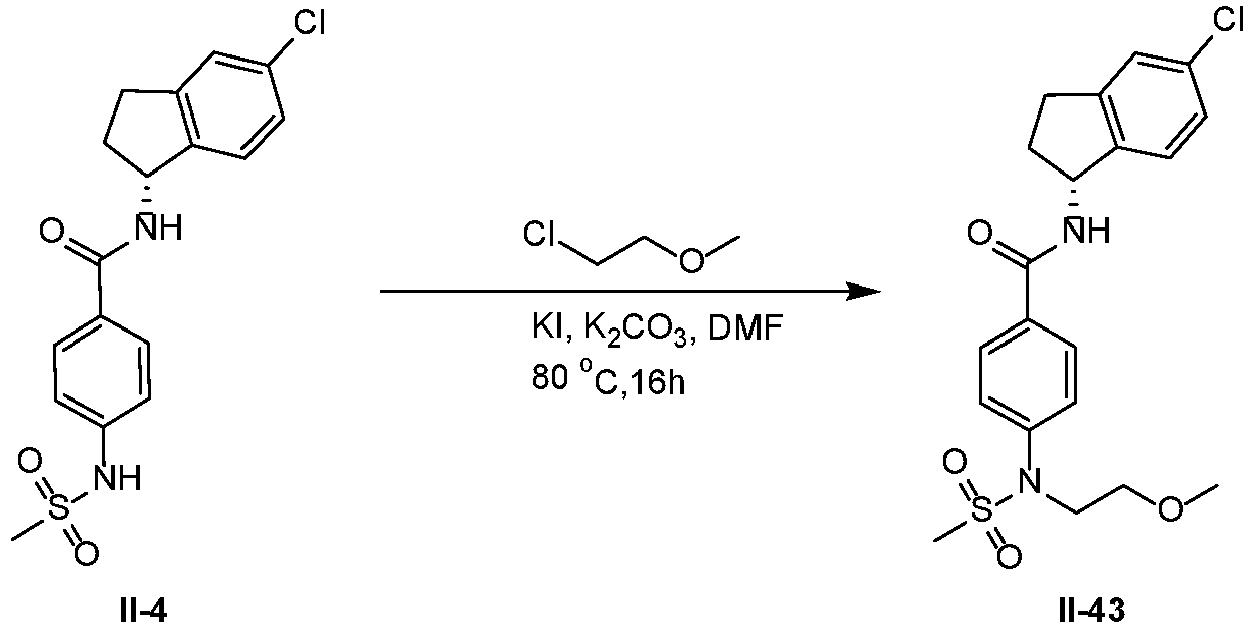
- To a mixture of N-[(1R)-5-chloroindan-1-yl]-4-(methanesulfonamido)benzamide (100 mg, 0.27 mmol) and 1-chloro-2-methoxy-ethane (116.6 mg, 1.23 mmol) and KI (13.65 mg, 0.08 mmol) in DMF (6 mL) was added K2CO3 (113.64 mg, 0.82 mmol) at 20 °C. The mixture was stirred under N2 at 80 °C for 16 hours. After cooling to room temperature, the mixture was concentrated to give the residue. The residue was diluted with H2O (30 mL) and the mixture was extracted with EtOAc (10 mL x 2). The combined organic phase was washed with brine (10 mL), dried over anhydrous Na2SO4, filtered and concentrated. The crude product was purified by Prep-HPLC (Boston Prime (150 mm x 30 mm x 5 µm) A = H2O (0.05% NH4OH) and B = CH3CN; 39-69%B over 9 minutes) to give the product (65.5 mg, 0.16 mmol, 57% yield) as a solid.
- 1H NMR (400MHz, CD3CN) δH = 7.84 (dd, 2H), 7.43 (dd, 2H), 7.35 - 7.25 (m, 3H), 7.22 - 7.17 (m, 1H), 5.56 (q, 1H), 3.83 (t, 2H), 3.37 (t, 2H), 3.23 (s, 3H), 3.07 - 2.98 (m, 1H), 2.96 (s, 3H), 2.93 - 2.84 (m, 1H), 2.60 - 2.50 (m, 1H), 2.07 - 1.97 (m, 1H).
- LCMS Rt = 1.19 min in 2.0 min chromatography, 10-80AB, MS ESI calcd. for C20H24ClN2O4S [M+H]+ 423.1, found 423.0.
-

- To a mixture of N-[(1R)-5-chloroindan-1-yl]-4-(methanesulfonamido)benzamide (100 mg, 0.27 mmol) and 2-(dimethylamino)ethanol (73.3 mg, 0.82 mmol) and Ph3P (143.79 mg, 0.55 mmol) in THF (10 mL) was added DIAD (110.85 mg, 0.55 mmol) at 0 °C. The mixture was stirred under N2 at 20 °C for 16 hours. The mixture was concentrated to dryness and diluted with H2O (10 mL). The mixture was extracted with EtOAc (10 mL × 2). The combined organic phase was washed with brine (10 mL), dried over anhydrous Na2SO4, filtered and concentrated. The crude product was purified by Prep-HPLC (Boston Prime C18 (150 mm × 30 mm × 10 um) A = H2O (0.05% ammonia hydroxide) and B = CH3CN; 45-55%B over 9 minutes) to give the product (23.7 mg, 0.05 mmol, 20% yield) as a solid.
- 1H NMR (400MHz, CD3CN) δH = 7.86 (dd, 2H), 7.45 (dd, 2H), 7.35 - 7.25 (m, 3H), 7.24 - 7.16 (m, 1H), 5.57 (q, 1H), 3.76 (t, 2H), 3.09 - 2.99 (m, 1H), 2.97 (s, 3H), 2.94 - 2.84 (m, 1H), 2.62 - 2.50 (m, 1H), 2.29 (t, 2H), 2.14 (s, 6H), 2.07 - 1.98 (m, 1H).
- LCMS Rt = 0.96 min in 2.0 min chromatography, 10-80AB, MS ESI calcd. for C21H27ClN3O3S [M+H]+ 436.1, found 436.1.
-
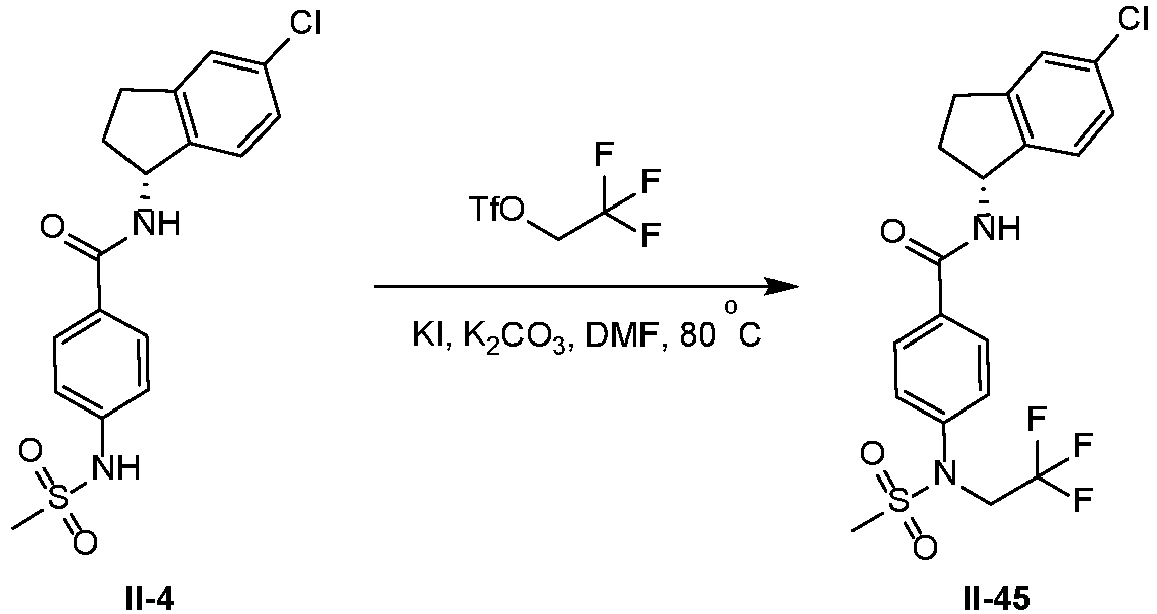
- To a mixture of N-[(1R)-5-chloroindan-1-yl]-4-(methanesulfonamido)benzamide (100 mg, 0.27 mmol), 2,2,2-trifluoroethyl trifluoromethanesulfonate (318.08 mg, 1.37 mmol) and KI (22.75 mg, 0.14 mmol) in DMF (6 mL) was added K2CO3 (113.64 mg, 0.82 mmol) at 20 °C. The mixture was stirred under N2 at 80 °C for 16 hours. After cooling to room temperature, the mixture was concentrated under reduced pressure. The residue was diluted with H2O (30 mL) and the mixture was extracted with EtOAc (10 mL × 2). The combined organic phase was washed with brine (10 mL), dried over anhydrous Na2SO4, filtered and concentrated. The crude product was triturated from i-Pr2O (10 mL) to give the product (96.3 mg, 0.22 mmol, 79% yield) as a solid.
- 1H NMR (400MHz, CD3CN) δH= 7.89 (d, 2H), 7.52 (d, 2H), 7.38-7.25 (m, 3H), 7.23 - 7.17 (m, 1H), 5.56 (q, 1H), 4.40 (q, 2H), 3.15 - 2.96 (m, 4H), 2.94 - 2.84 (m, 1H), 2.61 - 2.50 (m, 1H), 2.07 - 1.97 (m, 1H).
- LCMS Rt = 1.26 min in 2.0 min chromatography, 10-80AB, MS ESI calcd. for C19H19ClF3N2O3S [M+H]+ 447.1, found 447.1.
-

- To a mixture of N-[(1R)-5-chloroindan-1-yl]-4-(methanesulfonamido)benzamide (60 mg, 0.16 mmol), 1-chloro-2-(trifluoromethoxy)ethane (109.9 mg, 0.74 mmol) and KI (13.65 mg, 0.08 mmol) in DMF (6 mL) was added K2CO3 (68.19 mg, 0.49 mmol) at 20 °C. The mixture was stirred under N2 at 100 °C for 16 hours. The mixture was diluted with H2O (10 mL) and the mixture was extracted with EtOAc (10 mL x 2). The combined organic phase was washed with brine (10 mL), dried over anhydrous Na2SO4, filtered and concentrated. The crude product was purified by Prep-HPLC (Boston Prime C18 (150 mm x 30 mm x 5 µm) A = H2O (0.05% ammonia hydroxide) and B = CH3CN; 51-71%B over 9 minutes) to give the product (35.71 mg, 0.07 mmol, 46% yield) as a solid.
- 1H NMR (400MHz, CD3CN) δH = 7.88 (dd, 2H), 7.46 (dd, 2H), 7.38 - 7.25 (m, 3H), 7.23 - 7.16 (m, 1H), 5.57 (q, 1H), 4.10 - 4.03 (m, 2H), 4.03 - 3.95 (m, 2H), 3.09 - 2.98 (m, 1H), 2.95 (s, 3H), 2.94 - 2.84 (m, 1H), 2.62 - 2.51 (m, 1H), 2.07 - 1.98 (m, 1H).
- LCMS Rt = 1.23 min in 2.0 min chromatography, 10-80AB, MS ESI calcd. for C20H21ClF3N2O4S [M+H]+ 477.1, found 477.0.
-
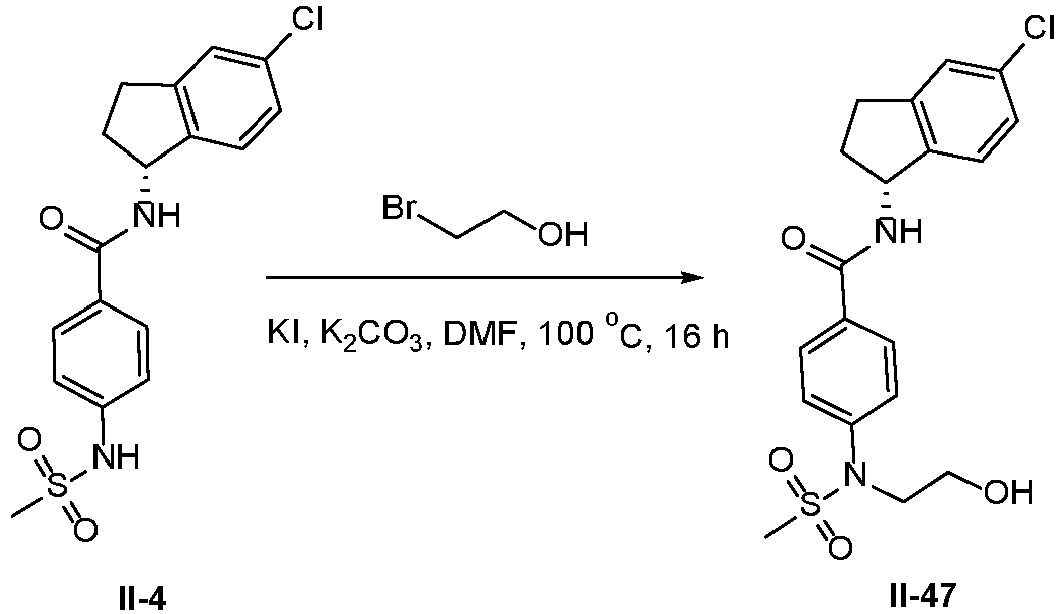
- To a mixture of N-[(1R)-5-chloroindan-1-yl]-4-(methanesulfonamido)benzamide (120 mg, 0.33 mmol) and 2-bromoethanol (184.95 mg, 1.48 mmol) and KI (16.38 mg, 0.1 mmol) in DMF (6 mL) was added K2CO3 (136.37 mg, 0.99 mmol) at 20 °C. The mixture was stirred at 100 °C for 16 hours under N2. The mixture was quenched with sat. NH4Cl (10 mL) and the mixture was extracted with EtOAc (10 mL x 2). The combined organic phase was washed with brine (10 mL), dried over anhydrous Na2SO4, filtered and concentrated. The crude product was purified by Prep-HPLC (Boston Prime (150 mm x 30 mm x 5 µm) A = H2O (0.05% NH4OH) and B = CH3CN; 30-60% B over 9 minutes) to give the product (36.3 mg, 0.09 mmol, 27% yield) as a solid.
- 1H NMR (400MHz, CD3CN) δH = 7.85 (d, 2H), 7.46 (dd, 2H), 7.36 - 7.26 (m, 3H), 7.23 - 7.16 (m, 1H), 5.57 (q, 1H), 3.77 (t, 2H), 3.50 (q, 2H), 3.08 - 2.98 (m, 1H), 2.97 (s, 3H), 2.94 - 2.84 (m, 2H), 2.63 - 2.49 (m, 1H), 2.05 - 1.97 (m, 1H).
- LCMS Rt = 1.11 min in 2.0 min chromatography, 10-80AB, MS ESI calcd. for C19H22ClN2O4S [M +H]+ 409.1, found 409.0.
-

- A mixture of 3-methyl-4-methylsulfonyl-benzoic acid (100 mg, 0.47 mmol) and HOBt (126.15 mg, 0.93 mmol) and EDCI (134.22 mg, 0.7 mmol) and TEA (0.32 mL, 2.33 mmol) and (1R)-5-chloroindan-1-amine (78.25 mg, 0.47 mmol) in DCM (10 mL) was stirred at 20 °C for 16 hours. The mixture was concentrated under reduced pressure. The residue was diluted with H2O (20 mL) and the mixture was extracted with EtOAc (20 mL x 2). The combined organic phase was washed with water (20 mL) and brine (20 mL), dried over anhydrous Na2SO4, filtered and concentrated. The crude product was purified by Prep-HPLC (Boston Prime (150 mm × 30 mm × 5 µm) A = H2O (0.05% NH4OH) and B = CH3CN; 46-76% B over 9 minutes) to give the product (56.1 mg, 0.15 mmol, 33% yield) as a solid.
- 1H NMR (400MHz, CD3CN) δH = 8.01 (d, 1H), 7.87 - 7.75 (m, 2H), 7.54 - 7.40 (m, 1H), 7.35 - 7.25 (m, 2H), 7.24 - 7.17 (m, 1H), 5.56 (q, 1H), 3.14 - 2.99 (m, 4H), 2.96 - 2.84 (m, 1H), 2.70 (s, 3H), 2.62 - 2.50 (m, 1H), 2.07 - 1.99 (m, 1H).
- LCMS Rt = 1.19 min in 2 min chromatography, 10-80AB, MS ESI calcd. C18H19ClNO3S [M+H]+ 364.1, found 364.0.
-

- To a mixture of N-[(1R)-5-chloroindan-1-yl]-4-(methanesulfonamido)benzamide (100 mg, 0.27 mmol) and 2-chloro-N,N-dimethylacetamide (166.6 mg, 1.37 mmol) and KI (13.65 mg, 0.08 mmol) in THF (10 mL) was added K2CO3 (113.64 mg, 0.82 mmol) at 0 °C. The mixture was stirred under N2 at 20 °C for 16 hours. The mixture was concentrated to dryness and diluted with H2O (10 mL). The mixture was extracted with EtOAc (10 mL × 2). The combined organic phase was washed with brine (10 mL), dried over anhydrous Na2SO4, filtered and concentrated. The crude product was purified by Prep-HPLC (Boston Prime (150 mm × 25 mm × 5 µm) A = H2O (0.05% NH4OH) and B = CH3CN; 40-60% B over 9 minutes) to give the product (37.5 mg, 0.08 mmol, 30% yield) as a solid.
- 1H NMR (400MHz, CD3CN) δH= 7.85 (d, 2H), 7.56 (d, 2H), 7.37 - 7.28 (m, 3H), 7.27 - 7.20 (m, 1H), 5.59 (q, 1H), 4.62 (s, 2H), 3.15 (s, 3H), 3.10 - 3.01 (m, 1H), 2.97 (s, 3H), 2.95 - 2.80 (m, 4H), 2.63 - 2.54 (m, 1H), 2.09 - 2.00 (m, 1H).
- LCMS Rt = 1.15 min in 2.0 min chromatography, 10-80AB, MS ESI calcd. for C21H25ClN3O4S [M+H]+ 450.1, found 450.1.
-

- To a mixture of N-[(1R)-5-chloroindan-1-yl]-4-(methanesulfonamido)benzamide (180 mg, 0.49 mmol) and oxetan-3-yl 4-methylbenzenesulfonate (1.13 g, 4.93 mmol) and Cs2CO3 (642.94 mg, 1.97 mmol) in DMF (10 mL) was added KI (409.48 mg, 2.47 mmol) at 0 °C and the mixture was stirred under N2 at 120 °C for 16 hours. After cooling to room temperature, the reaction was quenched with sat. NH4Cl (20 mL). The mixture was extracted with EtOAc (20 mL × 2). The combined organic phase was washed with brine (20 mL), dried over anhydrous Na2SO4, filtered and concentrated. The crude product was purified by prep-HPLC (Boston Green ODS (150 mm x 30 mm, 5 µm) A = water (0.075%TFA) and B = CH3CN; 42-62%B over 9 minutes) to give the product which was then neutralized with sat. NaHCO3 (10 mL) and the mixture was extracted with EtOAc (10 mL × 2). The combined organic phase was washed with brine (10 mL), dried over anhydrous Na2SO4, filtered and concentrated to give the product (19.8 mg, 0.05 mmol, 9% yield) as a solid.
- 1H NMR (400MHz, CD3CN) δH = 7.94 - 7.79 (m, 2H), 7.40 - 7.25 (m, 5H), 7.24 - 7.16 (m, 1H), 5.57 (q, 1H), 5.27-5.13 (m, 1H), 4.61 (t, 2H), 4.45 (t, 2H), 3.10 - 2.97 (m, 1H), 2.95 - 2.85 (m, 1H), 2.82 (s, 3H), 2.62 - 2.49 (m, 1H), 2.07 - 1.98 (m, 1H).
- LCMS Rt = 1.15 min in 2.0 min chromatography, 10-80AB, MS ESI calcd. for C20H22ClN2O4S [M+H]+ 421.1, found 421.2.
-

- Synthesis of II-A-26b: A mixture of 4-sulfanylbenzoic acid (500 mg, 3.24 mmol) and NaOH (389.13 mg, 9.73 mmol) in methanol (15 mL) was stirred at 45 °C for 20 min. Then 2-bromo-1,1-difluoro-ethane (940.07 mg, 6.49 mmol) was added. The reaction mixture was stirred at 45 °C for 48 h. After cooling to r. t., the mixture was diluted with H2O (20 mL) and the mixture was concentrated to remove MeOH. Then the solution was acidified to pH~3 with 1M HCl. The solid was collected by filtration and the filter cake was dried in oven to give the product (400 mg, 1.83 mmol).
1H NMR (400MHz, DMSO-d6 ) δH = 7.86 (d, 2H), 7.51 (d, 2H), 6.25 (tt, 1H), 3.64 (dt, 2H). - Synthesis of II-A-26c: A mixture of 4-(2,2-difluoroethylsulfanyl)benzoic acid (300 mg, 1.37 mmol), HOBt (371.54 mg, 2.75 mmol), EDCI (527.08 mg, 2.75 mmol), DIPEA (0.76 mL, 5.5 mmol) and (1R)-5-chloroindan-1-amine (230.46 mg, 1.37 mmol) in DCM (15 mL) was stirred at 25 °C for 16 hours. The reaction was concentrated and diluted with H2O (20 mL) and the aqueous layer was extracted with DCM (20 mL x 2). The combined organic phase was washed with brine (30 mL), dried over anhydrous Na2SO4, filtered and concentrated. The crude product was purified with flash chromatography on silica gel (DCM) to give the product (300mg, 0.8071mmol, 59% yield) as a solid.
- 1H NMR (400MHz, DMSO-d6 ) δH = 7.75 (d, 2H), 7.46 (d, 2H), 7.28 - 7.25 (m, 2H), 7.25 - 7.18 (m, 1H), 6.34 - 6.22 (m, 1H), 5.92 (tt, 1H), 5.67 (q, 1H), 3.34 (dt, 2H), 3.15 - 2.90 (m, 2H), 2.80 - 2.63 (m, 1H), 2.05-1.92 (m, 1H).
- LCMS Rt = 1.25 min in in 2.0 min chromatography, 10-80AB, MS ESI calcd. for C18H17ClF2NOS [M+H]+ 368.1, found 367.9.
- Synthesis of Compound II-51: To the solution of N-[(1R)-5-chloroindan-1-yl]-4-(2,2-difluoroethylsulfanyl)benzamide (80.mg, 0.22 mmol) in methanol (15 mL) and water (10 mL) was added oxone (800.75 mg, 1.3 mmol). The mixture was stirred at 25 °C for 24 hours. The suspension was filtered and the filtrate was concentrated under reduced pressure. The crude product was washed with H2O (10 mL) and triturated from MeOH (5 mL) to give the product (30.7 mg, 0.07 mmol, 34% yield) as a solid.
- 1H NMR (400MHz, CD3CN) δH = 8.08 - 7.96 (m, 4H), 7.55 - 7.45 (m 1H), 7.36 - 7.26 (m, 2H), 7.25 - 7.17 (m, 1H), 6.24 (tt, 1H), 5.58 (q, 1H), 3.90 (dt, 2H), 3.13 - 2.99 (m, 1H), 2.97 - 2.83 (m, 1H), 2.66 - 2.51 (m, 1H), 2.10-1.98 (m, 1H).
- LCMS Rt = 1.22 min in in 2.0 min chromatography, 10-80AB, MS ESI calcd. for C18H17ClF2NO3S [M+H]+ 400.1, found 400.0.
-

- Synthesis of II-A-5: A mixture of 6-chlorotetralin-1-one (500 mg, 2.77 mmol) and NH4OAc (2134.2 mg, 27.68 mmol) in i-PrOH (14 mL) was stirred at 20 °C for 1 hour. Then NaBH3CN (608.81 mg, 9.69 mmol) was added and the resulting mixture was heated to 85 °C. The mixture was stirred at 85 °C for 3 hours. 5 N NaOH solution (50 mL) was added and the aqueous layer was extracted with EtOAc (30 mL). The organic phase was separated and washed with brine (20 mL x 2), dried over anhydrous Na2SO4, filtered and concentrated. The residue was re-dissolved in DCM (30 mL) and extracted with 1N HCl aqueous (30 mL x 2). Saturated Na2CO3 solution (30 mL) was added to adjust to pH 9 and the aqueous layer was extracted with EtOAc (30 mL x 2). The combined organic phase was washed with water (30 mL x 2) and brine (30 mL x 2), dried over anhydrous Na2SO4, filtered and concentrated to give the crude product (270 mg, 1.49 mmol) as an oil.
1H NMR (400MHz, CDCl3) δH = 7.35 (d, 1H), 7.15 (dd, 1H), 7.08 (s, 1H), 3.99-3.89 (m, 1H), 2.85-2.63 (m, 2H), 2.06-1.87 (m, 2H), 1.82-1.62 (m, 2H). - Synthesis of II-A-27a: A mixture of 4-(methanesulfonamido)benzoic acid (170.61 mg, 0.79 mmol) and HOBt (238.04 mg, 1.76 mmol) and Et3N (0.37 mL, 2.64 mmol) and EDCI (253.26 mg, 1.32 mmol) and 6-chlorotetralin-1-amine (160 mg, 0.88 mmol) in DCM (15 mL) was stirred at 20 °C for 16 hours under N2. The reaction was quenched with sat. NH4Cl (20 mL) and the mixture was extracted with DCM (30 mL x 2). The combined organic phase was washed with brine (20 mL), dried over anhydrous Na2SO4, filtered and concentrated to give the product (301 mg, 0.79 mmol) as a solid.
- LCMS Rt = 1.06 min in 1.5 min chromatography, 5-95AB, MS ESI calcd. for C18H20ClN2O3S [M+H]+ 379.1, found 379.0.
- Analytical SFC: (Chiralpak OJ-3 150 mm × 4.6 mm I.D, 3µm, Mobile phase: A: CO2 B: ethanol (0.05% DEA), Gradient: from 5% to 40% of B in 5 min and hold 40% of B for 2.5 min, then 5% ofB for 2.5 min. Flow rate: 2.5 mL/min, Column temp.: 35 °C) showed two peaks at Rt = 5.08 min and Rt = 5.67 min.
- Synthesis of Compounds II-52 and II-53: N-(6-chlorotetralin-1-yl)-4-(methanesulfonamido)benzamide (300 mg, 0.79 mmol) was purified by SFC [DAICEL CHIRALCEL OJ-H (250 mm x 30 mm I.D., 5 µm); A = CO2 and B = EtOH (0.1% NH3H2O); 38 °C; 60 mL/min; 35% B; 12 min run; 9 injections] to give the the enantiomer 1, randomly assigned as Compound II-52 (95.6 mg, 0.25 mmol) (Rt of Peak 1= 5.08 min) as a solid and the enantiomer 2, randomly assigned as Compound II-53 (62.12 mg, 0.16 mmol) (Rt of Peak 2= 5.67 min) as a solid. Stereochemistry is randomly assigned.
-
- 1H NMR (400MHz, DMSO-d6 ) δH = 10.08 (s, 1H), 8.66 (d, 1H), 7.89 (d, 2H), 7.32-7.11 (m, 5H), 5.28-5.10 (m, 1H), 3.05 (s, 3H), 2.84-2.73 (m, 2H), 2.04-1.87 (m, 2H), 1.85-1.65 (m, 2H).
- LCMS Rt = 1.09 min in 2 min chromatography, 10-80AB, MS ESI calcd. for C18H20ClN2O3S [M+H]+ 379.1, found 379.0.
-
- 1H NMR (400MHz, DMSO-d6 ) δH = 10.08 (s, 1H), 8.66 (d,1H), 7.88 (d, 2H), 7.28-7.13 (m, 5H), 5.25-5.12 (m, 1H), 3.05 (s, 3H), 2.84-2.74 (m, 2H), 2.03-1.87 (m, 2H), 1.85-1.66 (m, 2H).
- LCMS Rt = 1.07 min in 2 min chromatography, 10-80AB, MS ESI calcd. for C18H20ClN2O3S [M+H]+ 379.1, found 379.0.
-

- To a mixture of 6-chlorotetralin-1-amine (110 mg, 0.61 mmol) and HOBt (163.65 mg, 1.21 mmol) and EDCI (174.12 mg, 0.91 mmol) in DCM (3 mL) were added DIPEA (0.32 mL, 1.82 mmol) and 4-methylsulfonylbenzoic acid (145.48 mg, 0.73 mmol). The mixture was stirred at 20 °C for 2 hours. The mixture was diluted with water (20 mL) and the aqueous layer was extracted with EtOAc (20 mL × 2). The combined organic phase was washed with 1M HCl (20 mL) and water (20mL × 2) and brine (20 mL), dried over anhydrous Na2SO4, filtered and concentrated.
Analytical SFC: (Chiralcel OJ-3 150 × 4.6 mm I.D., 3 µm, Mobile phase: A: CO2, B: ethanol (0.05% DEA), Gradient: from 5% to 40% of B in 5 min and hold 40% of B for 2.5 min, then 5% of B for 2.5 min. Flow rate: 2.5 mL/min, Column temp.: 35 °C) showed two peaks at 1.84 min and 5.65 min. - The product was purified by SFC (DAICEL CHIRALPAK AS (250 mm x 30 mm, 10 µm); A = CO2 and B = MeOH (0.1% NH3H2O); 38 °C; 70 mL/min; 50% B; 13 min run; 6 injections) to give enantiomer 1, randomly assigned as Compound II-54 (38.1 mg, 103.2 µmol) (Rt of Peak 1 = 1.84 min) as a solid and the enantiomer 2, randomly assigned as Compound II-55 (47.5 mg, 130.5 µmol) (Rt of Peak 2 = 5.65 min) as a solid. Stereochemistry is randomly assigned.
-
- 1H NMR (400MHz, CDCl3) δH = 8.05 - 8.00 (m, 2H), 7.99 - 7.93 (m, 2H), 7.25 (s, 1H), 7.20 - 7.12 (m, 2H), 6.37 (d, 1H), 5.43 - 5.34 (m, 1H), 3.07 (s, 3H), 2.91 - 2.76 (m, 2H), 2.21 - 2.11 (m, 1H), 2.00 - 1.84 (m, 3H).
- LCMS Rt = 1.20 min in 2.0 min chromatography, 10-80AB, MS ESI calcd. for C18H19ClNO3S [M+H]+364.1, found 364.0.
-
- 1H NMR (400MHz, CDCl3) δH = 8.08 - 8.00 (m, 2H), 8.00 - 7.94 (m, 2H), 7.25 (s, 1H), 7.20 - 7.13 (m, 2H), 6.35 (d, 1H), 5.46 - 5.31 (m, 1H), 3.07 (s, 3H), 2.90 - 2.74 (m, 2H), 2.22 - 2.09 (m, 1H), 2.01 - 1.84 (m, 3H).
- LCMS Rt = 1.19 min in 2.0 min chromatography, 10-80AB, MS ESI calcd. for C18H19ClNO3S [M+H]+364.1, found 364.0.
-

- Synthesis of II-A-7: A mixture of 5-(trifluoromethyl)indan-1-one (400 mg, 2 mmol) and NH4OAc (1.54 g, 19.98 mmol) in i-PrOH (10 mL) was stirred at 20 °C for 1 hour and then NaBH3CN (439.53 mg, 6.99 mmol) was added. The mixture was heated to 85 °C and stirred for 3 hours. 5 N NaOH aqueous (150 mL) was added and the aqueous layer was extracted with EtOAc (100 mL). The organic phase was separated and washed with brine (100 mL × 2), dried over anhydrous Na2SO4, filtered and concentrated. The residue was re-dissolved in DCM (100 mL) and extracted with 1N HCl aqueous (100 mL × 2). Saturated Na2CO3 aqueous (100 mL) was added to adjust to pH 9 and the aqueous layer was extracted with EtOAc (100 mL × 2). The combined organic phase was washed with water (100 mL x 2) and brine (100 mL × 2), dried over anhydrous Na2SO4, filtered and concentrated to give the crude product (210 mg, 0.94 mmol) as an oil, which was used for next step directly without further purification.
LCMS Rt = 0.74 min in 1.5 min chromatography, 5-95AB, MS ESI calcd. for C10H10F3N2 [M-NH3+H]+ 185.1, found 184.8. - Synthesis of II-A-29a: A mixture of 4-(methanesulfonamido)benzoic acid (192.56 mg, 0.89 mmol) and HOBt (268.66 mg, 1.99 mmol) and Et3N (0.41 mL, 2.98 mmol) and EDCI (285.85 mg, 1.49 mmol) and 5-(trifluoromethyl)indan-1-amine (200 mg, 0.99 mmol) in DCM (15 mL) was stirred at 20 °C for 16 hours under N2. The reaction was quenched with sat. NH4Cl (30 mL) and the mixture was extracted with DCM (30 mL x 2). The combined organic phase was washed with brine (30 mL), dried over anhydrous Na2SO4, filtered and concentrated. The crude product was triturated from DCM/n-hexane (2 mL/8 mL) to give the product (310 mg, 0.77 mmol, 78% yield) as a solid.
- LCMS Rt = 0.94 min in 1.5 min chromatography, 5-95AB, MS ESI calcd. for C18H18F3N2O3S [M +H]+ 399.1, found 398.9.
- Analytical SFC: (Chiralpak AD-3 150 x 4.6 mm I.D, 3 µm, Mobile phase: A: CO2 B: ethanol (0.05% DEA), Gradient: from 5% to 40% of B in 5 min and hold 40% of B for 2.5 min, then 5% ofB for 2.5 min. Flow rate: 2.5 mL/min, Column temp.: 35 °C) showed two peaks at 4.16 min and 4.36 min.
- Synthesis of Compounds II-58 and II-56: 4-(methanesulfonamido)-N-[5-(trifluoromethyl)indan-1-yl]benzamide (310 mg, 0.77 mmol) was purified by SFC (DAICEL CHIRALPAK AD-H (250 mm x 30 mm I.D., 5 µm); A = CO2 and B = EtOH (0.1% NH3H2O); 38 °C; 50 mL/min; 35% B; 8 min run; 24 injections) to give the enantiomer 1, randomly assigned as Compound II-58 (41.9 mg, 104.7 µmol) (Rt of Peak 1= 4.16 min) as a solid and the enantiomer 2, randomly assigned as Compound II-56 (43.4 mg, 109.0 µmol) (Rt of Peak 2= 4.36 min) as a solid. Stereochemistry is randomly assigned.
-
- 1H NMR (400MHz, CD3CN) δH = 7.91 - 7.73 (m, 3H), 7.59 (s, 1H), 7.54 - 7.43 (m, 2H), 7.37 - 7.18 (m, 3H), 5.65 (q, 1H), 3.16 - 3.05 (m, 1H), 3.03 - 2.91 (m, 4H), 2.65 - 2.54 (m, 1H), 2.09 - 2.01 (m, 1H).
- LCMS Rt = 1.18 min in 2.0 min chromatography, 10-80AB, MS ESI calcd. for C18H18F3N2O3S [M +H]+ 399.1, found 399.0.
-
- 1H NMR (400MHz, CD3CN) δH = 7.89 - 7.64 (m, 3H), 7.59 (s, 1H), 7.54 - 7.43 (m, 2H), 7.37 - 7.21 (m, 3H), 5.65 (q, 1H), 3.15 - 3.05 (m, 1H), 3.02 - 2.91 (m, 4H), 2.65 - 2.55 (m, 1H), 2.09 - 2.01 (m, 1H).
- LCMS Rt = 1.17 min in 2.0 min chromatography, 10-80AB, MS ESI calcd. for C18H18F3N2O3S [M +H]+ 399.1, found 399.0.
-

- Synthesis of II-A-9: A mixture of 5-fluoroindan-1-one (2 g, 13.32 mmol) and NH4OAc (10.27 g, 133.2 mmol) in i-PrOH (250 mL) was stirred at 20 °C for 1 hour and then NaBH3CN (2.93 g, 46.62 mmol) was added. The mixture was heated to 85 °C and stirred for 3 hours. 5 N aqueous NaOH (100 mL) was added and the mixture was extracted with EtOAc (100 mL). The organic phase was separated and washed with brine (100 mL x 2), dried over anhydrous Na2SO4, filtered and concentrated. The residue was re-dissolved in DCM (100 mL) and the organic layer was extracted with 1M HCl (100 mL x 2). Saturated Na2CO3 solution (100 mL) was added to adjust to pH = 9 and the aqueous layer was extracted with EtOAc (100 mL x 2). The combined organic phase was washed with water (100 mL x 2) and brine (100 mL x 2), dried over anhydrous Na2SO4, filtered and concentrated to give the crude product (900 mg, 4.99 mmol) as an oil.
LCMS Rt = 0.27 min in 1.5 min chromatography, 5-95AB, MS ESI calcd. for C9H10FN2 [M-NH2]+ 135.1, found 134.9. - Synthesis of II-A-30a: A mixture of 4-(methanesulfonamido)benzoic acid (384.39 mg, 1.79 mmol) and HOBt (536.3 mg, 3.97 mmol) and Et3N (0.82 mL, 5.95 mmol) and EDCI (570.61 mg, 2.98 mmol) and 5-fluoroindan-1-amine (300 mg, 1.98 mmol) in DCM (15 mL) was stirred at 20 °C for 16 hours under N2. The reaction was quenched with sat. NH4Cl (30 mL) and the mixture was extracted with DCM (30 mL x 2). The combined organic phase was washed with brine (30 mL), dried over anhydrous Na2SO4, filtered and concentrated to give the product (350 mg, 1.0 mmol, 51% yield) as a solid.
- LCMS Rt = 1.08 min in 2 min chromatography, 10-80AB, MS ESI calcd. for C17H18FN2O3S [M +H]+ 349.1, found 348.9.
- Analytical SFC: (Chiralcel OJ-3 100 mm x 4.6 mm I.D, 3 µm, Mobile phase: A: CO2 B: ethanol (0.05% DEA), Gradient: from 5% to 40% of B in 5 min and hold 40% of B for 2.5 min, then 5% ofB for 2.5 min. Flow rate: 2.5 mL/min, Column temp.: 35 °C) showed two peaks at 3.32 min and 3.67 min.
- Synthesis of II-A-9: N [5-fluoroindan-1-yl]-4-(methanesulfonamido)benzamide (200 mg, 0.57 mmol) was purified by SFC (DAICEL CHIRALCEL OJ-H (250 mm × 30 mm I.D., 5 µm); A = CO2 and B = EtOH (0.1% NH3H2O); 38 °C; 50 mL/min; 35% B; 9 min run; 14 injections) to give the enantiomer 1, randomly assigned as Compound 59 (89.7 mg, 0.26 mmol) (Rt of Peak 1= 3.32 min) as a solid and the enantiomer 2, randomly assigned as Compound 57 (81.4 mg, 0.23 mmol) (Rt of Peak 2= 3.67 min) as a solid. Stereochemistry is randomly assigned.
-
- 1H NMR (400MHz, CD3CN) δH = 7.88 - 7.72 (m, 3H), 7.33 - 7.15 (m, 4H), 7.05 - 6.97 (m, 1H), 6.97 - 6.87 (m, 1H), 5.55 (q, 1H), 3.08 - 2.95 (m, 4H), 2.94 - 2.82 (m, 1H), 2.63 - 2.49 (m, 1H), 2.08 - 1.97 (m, 1H).
- LCMS Rt = 1.09 min in 2.0 min chromatography, 10-80AB, MS ESI calcd. for C17H18FN2O3S [M+H]+ 349.1, found 348.9.
-
- 1H NMR (400MHz, CD3CN) δH = 7.86 - 7.77 (m, 3H), 7.32 - 7.17 (m, 4H), 7.05 - 6.98 (m, 1H), 6.97 - 6.88 (m, 1H), 5.55 (q, 1H), 3.09 - 2.95 (m, 4H), 2.94 - 2.83 (m, 1H), 2.63 - 2.50 (m, 1H), 2.07 - 1.96 (m, 1H).
- LCMS Rt = 1.08 min in 2.0 min chromatography, 10-80AB, MS ESI calcd. for C17H18FN2O3S [M +H]+ 349.1, found 348.9.
-

- A mixture of 2-hydroxy-4-methoxy-benzoic acid (135.41 mg, 0.81 mmol), HOBt (241.82 mg, 1.79 mmol), EDCI (257.29 mg, 1.34 mmol), Et3N (0.37 mL, 2.68 mmol) and 5-chloroindan-1-amine (150 mg, 0.89 mmol) in DCM (10 mL) was stirred at 20 °C for 16 hours under N2. The reaction was quenched with sat. NH4Cl (15 mL) and the mixture was extracted with DCM (20 mL x 2). The combined organic phase was washed with brine (15 mL), dried over anhydrous Na2SO4, filtered and concentrated. The crude product was purified by flash chromatography on silica gel (EtOAc in PE = 0 to 15% to 25% to 40%) to give the product (101 mg, 0.32 mmol, 35% yield) as a solid.
- LCMS Rt = 0.89 min in 1.5 min chromatography, 5-95AB, MS ESI calcd. for C17H17ClNO3 [M+H]+ 318.1, found 317.9.
- Analytical SFC: (Chiralcel OJ-3 100 mm x 4.6 mm I.D, 3 µm, Mobile phase: A: CO2 B: ethanol (0.05% DEA), Gradient: from 5% to 40% of B in 5 min and hold 40% for 2.5 min, then 5% ofB for 2.5 min. Flow rate: 2.5 mL/min, Column temp.: 35 °C) showed two peaks at 1.97 min (50%) and 7.57 min (50%).
- N-(5-chloroindan-1-yl)-2-hydroxy-4-methoxy-benzamide (100 mg, 0.31 mmol) was purified by SFC [DAICEL CHIRALCEL OJ (250 mm × 30 mm, 10 µm); A = CO2 and B = EtOH (0.1% NH3H2O); 38 °C; 80 mL/min; 55% B; 11 min run; 8 injections] to give the enantiomer 1, randomly assigned as Compound 1 (55.80 mg, 0.18 mmol) (Rt of Peak 1= 1.98 min) as a solid and the enantiomer 2, randomly assigned as Compound 2 (70.50 mg, 0.22 mmol) (Rt of Peak 2= 7.56 min) as a solid. Stereochemistry is randomly assigned.
-
- 1H NMR (400MHz, CD3CN) δH = 12.94 (s, 1H), 7.51 (d, 1H), 7.41-7.25 (m, 3H), 7.24-7.17 (m, 1H), 6.48-6.38 (m, 2H), 5.59 (q, 1H), 3.80 (s, 3H), 3.11-2.98 (m, 1H), 2.97-2.83 (m, 1H), 2.61-2.50 (m, 1H), 2.10-1.99 (m, 1H).
- LCMS Rt = 1.21 min in 2 min chromatography, 10-80AB, MS ESI calcd. for C17H17ClNO3 [M+H]+ 318.1, found 317.9.
-
- 1H NMR (400MHz, CD3CN) δH = 12.94 (s, 1H), 7.51 (d, 1H), 7.44-7.25 (m, 3H), 7.24-7.16 (m, 1H), 6.49-6.37 (m, 2H), 5.59 (q, 1H), 3.80 (s, 3H), 3.10-3.00 (m, 1H), 2.97-2.84 (m, 1H), 2.61-2.50 (m, 1H), 2.08-2.00 (m, 1H).
- LCMS Rt = 1.21 min in 2 min chromatography, 10-80AB, MS ESI calcd. for C17H17ClNO3 [M+H]+ 318.1, found 317.9.
-

- To a mixture of 2-hydroxybenzoic acid (63.44 mg, 0.46 mmol) and HOBt (112.85 mg, 0.84 mmol) and Et3N (0.29 mL, 2.09 mmol) in CH2Cl2 (3 mL) was added EDCI (160.09 mg, 0.84 mmol) and (1R)-5-chloroindan-1-amine (70 mg, 0.42 mmol). The reaction mixture was stirred at 35 °C for 16 hours. The mixture was diluted with sat. NH4Cl (5 mL) and the aqueous layer was extracted with CH2Cl2 (5 mL × 2). The combined organic phase was washed with brine (5 mL), dried over anhydrous Na2SO4, filtered and concentrated. The crude product was purified by Prep-HPLC (Xtimate C18 (150 mm × 25 mm, 5 µm) A = H2O (10 mM NH4HCO3) and B = CH3CN; 56 - 76% B over 9 minutes) to give the product (29.1 mg, 0.10 mmol, 24% yield) as a solid.
- 1H NMR (400MHz, CD3CN) δH = 12.66 - 12.46 (m, 1H), 7.62 - 7.48 (m, 2H), 7.44 - 7.39 (m, 1H), 7.32 - 7.28 (m, 2H), 7.23 - 7.19 (m, 1H), 6.93 (dd, 1H), 6.89 - 6.84 (m, 1H), 5.61 (q, 1H), 3.10 - 3.01 (m, 1H), 2.96 - 2.87 (m, 1H), 2.62 - 2.53 (m, 1H), 2.11 - 2.02 (m, 1H).
- LCMS Rt = 1.36 min in 2.0 min chromatography, 10-80AB, MS ESI calcd. for C16H15ClNO2 [M+H]+ 288.1, found 287.9.
-

- A mixture of 4-fluoro-2-hydroxy-benzoic acid (93.12 mg, 0.60 mmol) and HOBt (161.21 mg, 1.19 mmol) and EDCI (171.53 mg, 0.89 mmol) and TEA (301.81 mg, 2.98 mmol) and (1R)-5-chloroindan-1-amine (100 mg, 0.60 mmol) in DCM (20 mL) was stirred at 20 °C for 16 hours. The mixture was diluted with H2O (10 mL) and the aqueous layer was extracted with EtOAc (20 mL x 2). The combined organic phase was washed with brine (10 mL), dried over anhydrous Na2SO4, filtered and concentrated. The crude product was purified by Prep-HPLC (Boston Prime C18 (150 mm x 30 mm, 5 µm) A = H2O (0.05% NH4OH) and B = CH3CN; 55-85 %B over 8 minutes) to give the impure product. The impure product was purified by Prep-HPLC (Boston Green ODS (150 mm x 30 mm, 5 µm) A = H2O (0.1% TFA) and B = CH3CN; 65-95 %B over 9 minutes) to give the product (12.1 mg, 0.04 mmol, 7% yield) as a solid.
- 1H NMR (400MHz, CDCl3) δH = 12.66 (d, 1H), 7.34 - 7.20 (m, 4H), 6.71 (dd, 1H), 6.62-6.54 (m, 1H), 6.29 (d, 1H), 5.64 (q, 1H), 3.11 - 3.00 (m, 1H), 2.99 - 2.88 (m, 1H), 2.77 - 2.66 (m, 1H), 2.03 - 1.94 (m, 1H)
- LCMS Rt = 1.36 min in 2.0 min chromatography, 10-80AB, MS ESI calcd. for C16H14ClFNO2 [M+H]+ 306.1, found 305.9.
-

- To a mixture of DIPEA (0.5 mL, 2.84 mmol), 2-hydroxy-4-(methanesulfonamido)benzoic acid (218.98 mg, 0.95 mmol) and HOBt (255.94 mg, 1.89 mmol) in DCM (3 mL) were added EDCI (272.32 mg, 1.42 mmol) and (1R)-5-chloroindan-1-amine (158.76 mg, 0.95 mmol). The mixture was stirred at 20 °C for 2 hours. The mixture was diluted with 1M HCl (10 mL) and the aqueous layer was extracted with EtOAc (20 mL x 2). The combined organic phase was washed with 1M HCl (20 mL), water (20 mL x 2) and brine (20 mL), dried over anhydrous Na2SO4, filtered and concentrated. The crude product was purified by Prep-HPLC (Waters Xbridge (150 mm x 25mm, 5 µm), A = H2O (10 mM NH4HCO3) and B = CH3CN; 38-58 %B over 8 minutes) to give the product (23.0 mg, 6% yield) as a solid.
- 1H NMR (400MHz, CDCl3) δH = 12.63 (s, 1H), 7.32 - 7.20 (m, 4H), 6.77 (d, 1H), 6.69 (dd, 1H), 6.55 (br s, 1H), 6.30 (d, 1H), 5.64 (q, 1H), 3.10 (s, 3H), 3.08 - 3.01 (m, 1H), 2.99 - 2.91 (m, 1H), 2.76 - 2.67 (m, 1H), 2.04 - 1.93 (m, 1H).
- LCMS Rt = 1.22 min in 2.0 min chromatography, 10-80AB, MS ESI calcd. for C17H18ClN2O4S [M+H]+381.1, found 380.9.
-

- To a stirred solution of 5-fluoro-2-hydroxy-benzoic acid (100.0 mg, 0.64 mmol) in DMF (2.0 mL) was added EDC (184 mg, 0.96 mmol) followed by DMAP (156 mg, 1.28 mmol) and (1R)-5-chloroindan-1-amine (88 mg, 0.52 mmol). The reaction mixture was stirred for 12 h at room temperature. The reaction mixture was treated with water (20 mL) and extracted with ethyl acetate (2 x 20 mL). The organic layer was washed with brine (20 mL), dried over Na2SO4 and concentrated. The crude product was purified by column chromatography on silica gel with 10% EtOAc/PE to afford Compound III-6 (10 mg, 0.03 mmol, 6% yield) as a solid.
- LCMS: 306.0 (M+H), Rt 2.69 min. Column: ZORBAX XDB C-18 (50 X 4.6 mm), 3.5 µm. Mobile Phase: A: 0.1% HCOOH in water, B: ACN; Flow Rate:1.5 mL/min
- 1H NMR (400 MHz, DMSO-d6): δ 12.33 (s, 1H), 9.14 (s, 1H), 7.79-7.76 (m, 1H), 7.37 (s, 1H), 7.32-7.24 (m, 3H), 6.95-6.92 (m, 1H), 5.56-5.50 (m, 1H), 3.06-2.99 (m, 1H), 2.93-2.84 (m, 1H), 2.55 (m, 1H), 2.07-1.97 (m, 1H).
-
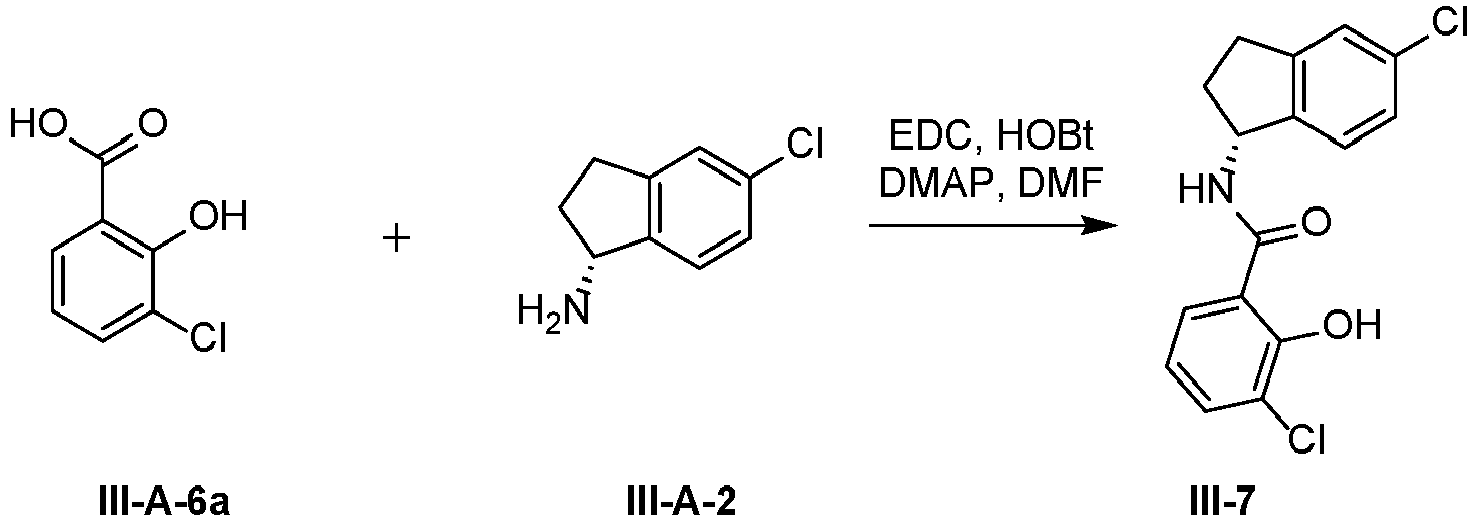
- To a stirred solution of 3-chloro-2-hydroxy-benzoic acid (III-A-6a, 102 mg, 0.59 mmol) in DMF (2.0 mL) was added EDC (170 mg, 0.89 mmol) followed by HOBt (16 mg, 0.12 mmol), DMAP (108 mg, 0.89 mmol) and (1R)-5-chloroindan-1-amine (III-A-2, 100 mg, 0.59 mmol). The reaction mixture was stirred for 12 h at room temperature. The reaction mixture was treated with water (15 mL) and extracted with ethyl acetate (2 x 15 mL). The organic layer was washed with brine (20 mL), dried over Na2SO4 and concentrated. The crude product was purified by column chromatography on silica gel with 7% EtOAc/PE to afford Compound III-7 (40 mg, 0.13 mmol, 21% yield) as a solid.
- LCMS: 322.0 (M+H), Rt 2.83 min. Column: ZORBAX XDB C-18 (50 X 4.6 mm), 3.5 µm. Mobile Phase: A: 0.1% HCOOH in water, B: ACN; Flow Rate:1.5 mL/min
- 1H NMR (400 MHz, DMSO-d6): δ 13.68 (s, 1H), 9.32 (d, 1H), 7.92 (d, 1H), 7.62 (d, 1H), 7.38 (s, 1H), 7.29-7.24 (m, 2H), 6.91 (t, 1H), 5.60-5.55 (m, 1H), 3.07-3.00 (m, 1H), 2.93-2.85 (m, 1H), 2.46 (m, 1H), 2.10-2.05 (m, 1H).
-
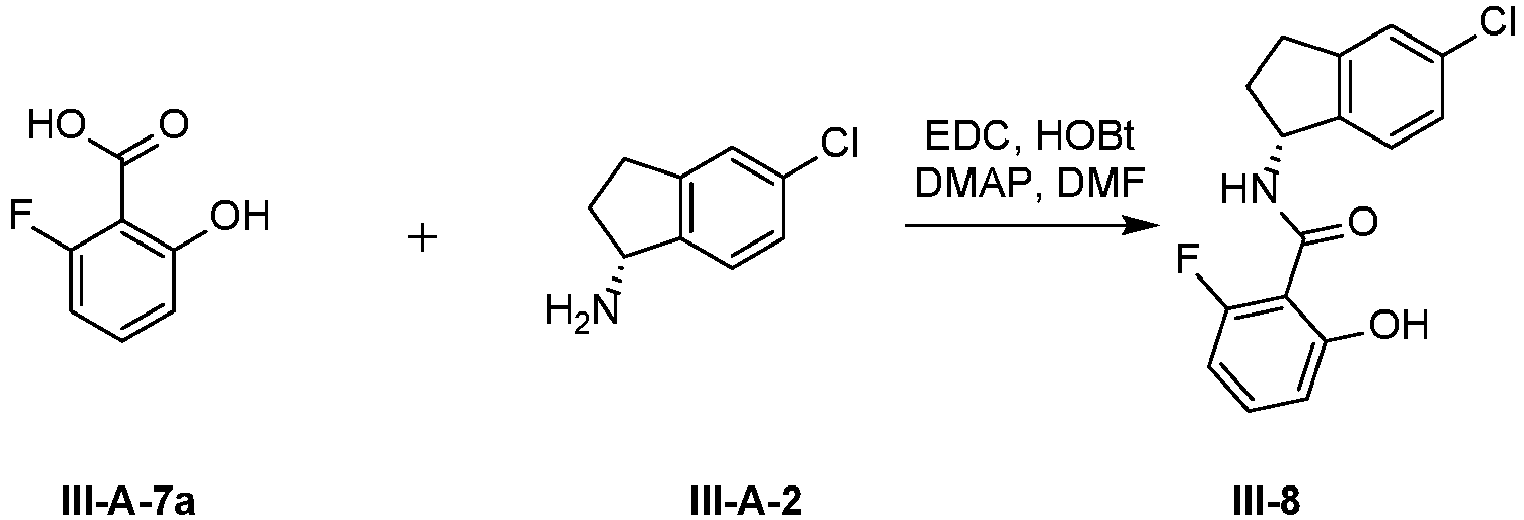
- To a stirred solution of 2-fluoro-6-hydroxy-benzoic acid (III-A-7a, 92 mg, 0.59 mmol) in DMF (2.0 mL) was added EDC (170 mg, 0.89 mmol) followed by HOBt (16 mg, 0.12 mmol), DMAP (108 mg, 0.89 mmol) and (1R)-5-chloroindan-1-amine (III-A-2, 100 mg, 0.59 mmol). The reaction mixture was stirred for 12 h at room temperature. The reaction mixture was treated with water (15 mL) and extracted with ethyl acetate (2 × 15 mL). The organic layer was washed with brine (20 mL), dried over Na2SO4 and concentrated. The crude product was purified by column chromatography on silica gel with 5% EtOAc/PE to afford Compound III-8 (62 mg, 0.19 mmol, 33% yield) as a solid.
- LCMS: 306.0 (M+H), Rt 2.87 min. Column: ZORBAX XDB C-18 (50 X 4.6 mm), 3.5 µm; Mobile Phase: A: 0.1% HCOOH in water, B: ACN; Flow Rate: 1.5 mL/min
- 1H NMR(400 MHz, DMSO-d6): δ 10.65 (brs, 1H), 8.69 (d, 1H), 7.32-7.22 (m, 4H), 6.73-6.65 (m, 2H), 5.50-5.44 (m, 1H), 2.98-2.80 (m, 2H), 2.48-2.33 (m, 1H), 2.00-1.90 (m, 1H).
-

- To a stirred solution of 3-fluoro-2-hydroxy-benzoic acid (III-A-8a, 92 mg, 0.59 mmol) in DMF (2.0 mL) was added EDC (170 mg, 0.89 mmol) followed by HOBt (16 mg, 0.12 mmol), DMAP (108 mg, 0.89 mmol) and (1R)-5-chloroindan-1-amine (III-A-2, 100 mg, 0.59 mmol). The reaction mixture was stirred for 12 h at room temperature. The reaction mixture was treated with water (15 mL) and extracted with ethyl acetate (2 × 15 mL). The organic layer was washed with brine (20 mL), dried over Na2SO4 and concentrated. The crude product was purified by column chromatography on silica gel with 18% EtOAc/PE to afford Compound III-9 (23 mg, 0.07 mmol, 12% yield) as a solid.
- LCMS: 304.0 (M-H), Rt 2.65 min. Column: ZORBAX XDB C-18 (50 × 4.6 mm), 3.5 µm; Mobile Phase: A: 0.1% HCOOH in water, B: ACN; Flow Rate:1.5 mL/min
- 1H NMR (400 MHz, DMSO-d6): δ 12.94 (brs, 1H), 9.30 (brs, 1H), 7.74 (d, 1H), 7.42-7.37 (m, 2H), 7.29-7.24 (m, 2H), 6.88-6.83 (m, 1H), 5.59-5.53 (m, 1H), 3.03-2.99 (m, 1H), 2.93-2.87 (m, 1H), 2.46 (m, 1H), 2.08-2.03 (m, 1H).
-
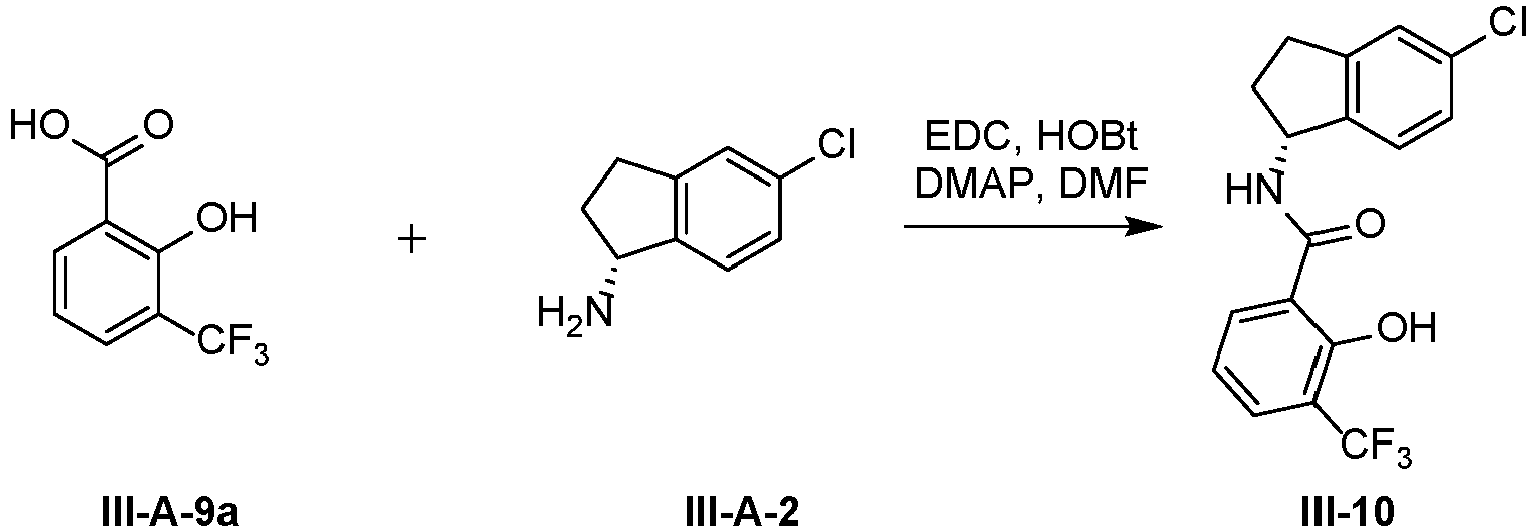
- To a stirred solution of 2-hydroxy-3-(trifluoromethyl)benzoic acid (III-A-9a, 126 mg, 0.59 mmol) in DMF (2.0 mL) was added EDC (170 mg, 0.89 mmol) followed by HOBt (16 mg, 0.12 mmol), DMAP (108 mg, 0.89 mmol) and (1R)-5-chloroindan-1-amine (III-A-2, 100 mg, 0.59 mmol). The reaction mixture was stirred for 12 h at room temperature. The reaction mixture was treated with water (15 mL) and extracted with ethyl acetate (2 x 15 mL). The organic layer was washed with brine (20 mL), dried over Na2SO4 and concentrated. The crude product was purified by column chromatography on silica gel with 8% EtOAc/PE to afford Compound III-10 (21 mg, 0.05 mmol, 9% yield) as a solid.
- LCMS: 356.0 (M+H), Rt 2.87 min. Column: ZORBAX XDB C-18 (50 × 4.6 mm), 3.5 µm; Mobile Phase: A: 0.1% HCOOH in water, B: ACN; Flow Rate:1.5 mL/min
- 1H NMR (400 MHz, DMSO-d6): δ 14.10 (s, 1H), 9.47 (brs, 1H), 8.21 (d, 1H), 7.77 (d, 1H), 7.38 (s, 1H), 7.31-7.24 (m, 2H), 7.02 (s, 1H), 5.61-5.55 (m, 1H), 3.08-3.01 (m, 1H), 2.93-2.85 (m, 1H), 2.55 (m, 1H), 2.10-2.05 (m, 1H).
-

- To a stirred solution of 5-chloro-2-hydroxy-benzoic acid (III-A-10a, 102 mg, 0.59 mmol) in DMF (2.0 mL) was added EDC (170 mg, 0.89 mmol) followed by HOBt (16 mg, 0.12 mmol), DMAP (108 mg, 0.89 mmol) and (1R)-5-chloroindan-1-amine (III-A-2, 100 mg, 0.59 mmol). The reaction mixture was stirred for 12 h at room temperature. The reaction mixture was treated with water (15 mL) and extracted with ethyl acetate (2 x 15 mL). The organic layer was washed with brine (20 mL), dried over Na2SO4 and concentrated. The crude product was purified by column chromatography on silica gel with 5% EtOAc/PE to afford Compound III-11 (46 mg, 0.14 mmol, 23% yield).
- LCMS: 322.1 (M+H), Rt 2.86 min. Column: ZORBAX XDB C-18 (50 × 4.6 mm), 3.5 µm; Mobile Phase: A: 0.1% HCOOH in water, B: ACN; Flow Rate:1.5 mL/min
- 1H NMR (400 MHz, DMSO-d6): δ 12.59 (s, 1H), 9.13 (d, 1H), 8.01 (d, 1H), 7.47-7.44 (dd, 1H), 7.37 (s, 1H), 7.30-7.24 (m, 2H), 6.96 (d, 1H), 5.56-5.50 (m, 1H), 3.05-2.99 (m, 1H), 2.92-2.86 (m, 1H), 2.46 (m, 1H), 2.06-2.00 (m, 1H).
-

- To a stirred solution of 2-hydroxy-5-methyl-benzoic acid (III-A-11a, 90 mg, 0.59 mmol) in DMF (2.0 mL) was added EDC (170 mg, 0.89 mmol) followed by HOBt (16 mg, 0.12 mmol), DMAP (108 mg, 0.89 mmol) and (1R)-5-chloroindan-1-amine (III-A-2, 100 mg, 0.59 mmol). The reaction mixture was stirred for 12 h at room temperature. The reaction mixture was treated with water (15 mL) and extracted with ethyl acetate (2 × 15 mL). The organic layer was washed with brine (20 mL), dried over Na2SO4 and concentrated. The crude product was purified by column chromatography on silica gel with 20% EtOAc/PE to afford Compound III-12 (108 mg, 0.34 mmol, 57% yield) as a solid.
- LCMS: 302.1 (M+H), Rt 2.75 min. Column: ZORBAX XDB C-18 (50 × 4.6 mm), 3.5 µm; Mobile Phase: A: 0.1% HCOOH in water, B: ACN; Flow Rate:1.5 mL/min
- 1H NMR (400 MHz, DMSO-d6): δ 12.32 (s, 1H), 9.00 (d, 1H), 7.74 (d, 1H), 7.37 (s, 1H), 7.27-7.21 (m, 3H), 6.81 (d, 1H), 5.57-5.52 (m, 1H), 3.06-2.99 (m, 1H), 2.92-2.84 (m, 1H), 2.49 (m, 1H), 2.23 (s, 3H), 2.08-1.99 (m, 1H).
-

- To a stirred solution of 2-hydroxy-6-methoxy-benzoic acid (III-A-12a, 100 mg, 0.59 mmol) in DMF (2.0 mL) was added EDC (170 mg, 0.89 mmol) followed by HOBt (16 mg, 0.12 mmol), DMAP (108 mg, 0.89 mmol) and (1R)-5-chloroindan-1-amine (III-A-2, 100 mg, 0.59 mmol). The reaction mixture was stirred for 12 h at room temperature. The reaction mixture was treated with water (15 mL) and extracted with ethyl acetate (2 x 15 mL). The organic layer was washed with brine (20 mL), dried over Na2SO4 and concentrated. The crude product was purified by column chromatography on silica gel with 15% EtOAc/PE to afford Compound III-13 (121 mg, 0.37 mmol, 63% yield) as a solid.
- LCMS: 318.0 (M+H), Rt 2.90 min. Column: ZORBAX XDB C-18 (50 X 4.6 mm), 3.5 µm; Mobile Phase: A: 0.1% HCOOH in water, B: ACN; Flow Rate:1.5 mL/min
- 1H NMR (400 MHz, DMSO-d6): δ 12.79 (s, 1H), 8.71 (d, 1H), 7.35-7.25 (m, 4H), 6.57-6.52 (m, 2H), 5.54-5.48 (m, 1H), 3.83 (s, 3H), 2.99-2.85 (m, 2H), 2.46 (m, 1H), 2.07-2.01 (m, 1H).
-

- To a stirred solution of 2-hydroxy-3-methoxy-benzoic acid (III-A-13a, 100 mg, 0.59 mmol) in DMF (2.0 mL) was added EDC (170 mg, 0.89 mmol) followed by HOBt (16 mg, 0.12 mmol), DMAP (108 mg, 0.89 mmol) and (1R)-5-chloroindan-1-amine (III-A-2, 100 mg, 0.59 mmol). The reaction mixture was stirred for 12 h at room temperature. The reaction mixture was treated with water (15 mL) and extracted with ethyl acetate (2 x 15 mL). The organic layer was washed with brine (20 mL), dried over Na2SO4 and concentrated. The crude product was purified by column chromatography on silica gel with 15% EtOAc/PE to afford Compound III-14 (122 mg, 0.36 mmol, 67% yield) as a solid.
- LCMS: 318.1 (M+H), Rt 2.51 min. Column: ZORBAX XDB C-18 (50 X 4.6 mm), 3.5 µm; Mobile Phase: A: 0.1% HCOOH in water, B: ACN; Flow Rate:1.5 mL/min
- 1H NMR (400 MHz, DMSO-d6): δ 12.69 (brs, 1H), 9.05 (d, 1H), 7.50-7.48 (m, 1H), 7.37 (s, 1H), 7.25 (m, 2H), 7.13-7.11 (m, 1H), 6.81 (t, 1H), 5.59-5.53 (m, 1H), 3.79 (s, 3H), 3.06-2.99 (m, 1H), 2.92-2.84 (m, 1H), 2.45 (m, 1H), 2.10-2.03 (m, 1H).
-

- To a stirred solution of 2-hydroxy-3-methyl-benzoic acid (III-A-14a, 100 mg, 0.66 mmol) in DMF (3.0 mL) was added EDC (188 mg, 0.99 mmol) followed by HOBt (17 mg, 0.13 mmol), DMAP (120 mg, 0.99 mmol) and (1R)-5-chloroindan-1-amine (III-A-2, 110 mg, 0.66 mmol). The reaction mixture was stirred for 12 h at room temperature. The reaction mixture was treated with water (20 mL) and extracted with ethyl acetate (2 × 20 mL). The organic layer was washed with brine (20 mL), dried over Na2SO4 and concentrated. The crude product was purified by column chromatography on silica gel with 18% EtOAc/PE to afford Compound III-15 (108 mg, 0.34 mmol, 53% yield) as a solid.
- LCMS: 302.2 (M+H), Rt 2.88 min. Column: ZORBAX XDB C-18 (50 × 4.6 mm), 3.5 µm; Mobile Phase: A: 0.1% HCOOH in water, B: ACN; Flow Rate:1.5 mL/min
- 1H NMR (400 MHz, DMSO-d6): δ 13.19 (s, 1H), 9.12 (d, 1H), 7.77-7.75 (m, 1H), 7.37-7.31 (m, 2H), 7.25-7.24 (m, 2H), 6.79-6.75 (m, 1H), 5.60-5.54 (m, 1H), 3.06-2.99 (m, 1H), 2.92-2.84 (m, 1H), 2.45 (m, 1H), 2.18 (s, 3H), 2.11-2.06 (m, 1H).
-

- To a stirred solution of 3-acetamido-2-hydroxybenzoic acid (III-A-15a, 115 mg, 0.59 mmol) in DMF (3.0 mL) was added EDC (170 mg, 0.89 mmol) followed by HOBt (16 mg, 0.12 mmol), DMAP (108 mg, 0.89 mmol) and (1R)-5-chloroindan-1-amine (III-A-2, 120 mg, 0.72 mmol). The reaction mixture was stirred for 12 h at room temperature. The reaction mixture was treated with water (20 mL) and extracted with ethyl acetate (2 × 20 mL). The organic layer was washed with brine (20 mL), dried over Na2SO4 and concentrated. The crude product was purified by column chromatography on silica gel with 60% EtOAc/PE to afford Compound III-16 (28 mg, 0.07 mmol, 13% yield) as a solid.
- LCMS: 345.1 (M+H), Rt 2.35 min. Column: ZORBAX XDB C-18 (50 × 4.6 mm), 3.5 µm; Mobile Phase: A: 0.1% HCOOH in water, B: ACN; Flow Rate:1.5 mL/min
- 1H NMR (400 MHz, DMSO-d6): δ 13.56 (s, 1H), 9.28 (s, 1H), 9.23 (s, 1H), 8.08 (d, 1H), 7.67 (d, 1H), 7.38 (s, 1H), 7.31-7.24 (m, 2H), 6.83 (t, 1H), 5.61-5.55 (m, 1H), 3.07-3.00 (m, 1H), 2.93-2.85 (m, 1H), 2.45 (m, 1H), 2.12-2.05 (m, 4H).
-

- To a stirred solution of 2-hydroxy-6-methyl-benzoic acid (III-A-16a, 90 mg, 0.59 mmol) in DMF (2.0 mL) was added EDC (170 mg, 0.89 mmol) followed by HOBt (16 mg, 0.12 mmol), DMAP (108 mg, 0.89 mmol) and (1R)-5-chloroindan-1-amine (III-A-2, 100 mg, 0.59 mmol). The reaction mixture was stirred for 12 h at room temperature. The reaction mixture was treated with water (15 mL) and extracted with ethyl acetate (2 × 15 mL). The organic layer was washed with brine (20 mL), dried over Na2SO4 and concentrated. The crude product was purified by column chromatography on silica gel with 5% EtOAc/PE to afford Compound III-17 (24 mg, 0.08 mmol, 13% yield) as a solid.
- LCMS: 302.1 (M+H), Rt 2.17 min. Column: ZORBAX XDB C-18 (50 X 4.6 mm), 3.5 µm; Mobile Phase: A: 0.1% HCOOH in water, B: ACN; Flow Rate:1.5 mL/min
- 1H NMR (400 MHz, DMSO-d6): δ 9.47 (s, 1H), 8.50 (d, 1H), 7.35 (d, 1H), 7.29 (s, 1H), 7.25-7.23 (m, 1H), 7.03 (t, 1H), 6.67-6.61 (m, 2H), 5.48-5.42 (m, 1H), 2.96-2.77 (m, 2H), 2.44-2.37 (m, 1H), 2.20 (s, 3H), 1.96-1.91 (m, 1H).
- Inhibition of KCNT1 (KNa1.1, Slack) was evaluated using a tetracycline inducible cell line (HEK-TREX). Currents were recorded using the SyncroPatch 384PE automated, patch clamp system. Pulse generation and data collection were performed with PatchController384 V1.3.0 and DataController384 V1.2.1 (Nanion Technologies). The access resistance and apparent membrane capacitance were estimated using built-in protocols. Current were recorded in perforated patch mode (10 µM escin) from a population of cells. The cells were lifted, triturated, and resuspended at 800,000 cells/ml. The cells were allowed to recover in the cell hotel prior to experimentation. Currents were recorded at room temperature. The external solution contained the following (in mM): NaCl 105, NMDG 40, KCl 4, MgClz 1, CaCl2 5 and HEPES 10 (pH = 7.4, Osmolarity ∼300 mOsm). The extracellular solution was used as the wash, reference and compound delivery solution. The internal solution contained the following (in mM): NaCl 70, KF 70, KCl 10, EGTA 5, HEPES 5 and Escin 0.01 (pH = 7.2, Osmolarity ~295 mOsm). Escin is made at a 5mM stock in water, aliquoted, and stored at -20°C. The compound plate was created at 2x concentrated in the extracellular solution. The compound was diluted to 1:2 when added to the recording well. The amount of DMSO in the extracellular solution was held constant at the level used for the highest tested concentration. A holding potential of -80 mV with a 100ms step to 0mV was used. Mean current was measured during the step to 0 mV. 100 µM Bepridil was used to completely inhibit KCNT1 current to allow for offline subtraction of non-KCNT1 current. The average mean current from 3 sweeps was calculated and the % inhibition of each compound was calculated. The % Inhibition as a function of the compound concentration was fit with a Hill equation to derive IC50, slope, min and max parameters. If KCNT1 inhibition was less than 50% at the highest tested concentration or if an IC50 could not be calculated, then a percent inhibition was reported in place of the IC50.
- Results from this assay are summarized in Table 1 below. In this table, "A" indicates IC50 of less than or equal to 1 µM; "B" indicates inhibition of between 1 µM to 20 µM; and "C" indicates inhibition of greater than or equal to 20 µM.
Table 1. Compound KCNT1 WB IC50 (µM) I-1 B I-2 B I-3 B I-4 A I-5 B I-6 A I-7 C I-8 B I-9 B I-10 B I-11 C I-12 C I-13 C I-14 C I-15 A I-16 A I-17 A I-18 A I-19 A I-20 A I-21 A I-22 A I-23 B I-24 A I-25 C I-26 A I-27 A I-28 A I-29 A I-30 C I-31 A I-32 A I-33 C I-34 A I-35 A I-36 A I-37 A I-38 B I-39 A I-40 A I-41 A I-42 A I-43 A I-44 A I-45 A I-46 A I-47 A II-1 C II-2 A II-3 C II-4 A II-5 C II-6 B II-7 C II-8 B II-9 B II-10 A II-11 B II-12 C II-13 A II-14 A II-15 B II-16 C II-17 C II-18 C II-19 B II-20 B II-21 B II-22 A II-23 B II-24 B II-25 A II-26 B II-27 A II-28 A II-29 C II-30 A II-31 C II-32 A II-33 C II-34 B II-35 A II-36 B II-37 B II-38 A II-39 A II-40 B II-41 C II-42 A II-43 B II-44 B II-45 B II-46 C II-47 B II-48 B II-49 B II-50 B II-51 B II-52 C II-53 A II-54 C II-55 B II-56 A II-57 B II-58 C II-59 C III-1 C III-2 A III-3 A III-4 A III-5 A III-6 A III-7 A III-8 B III-9 A III-10 A III-11 A III-12 A III-13 B III-14 A III-15 A III-16 A III-17 C - In the claims articles such as "a," "an," and "the" may mean one or more than one unless indicated to the contrary or otherwise evident from the context. Claims or descriptions that include "or" between one or more members of a group are considered satisfied if one, more than one, or all of the group members are present in, employed in, or otherwise relevant to a given product or process unless indicated to the contrary or otherwise evident from the context. The invention includes embodiments in which exactly one member of the group is present in, employed in, or otherwise relevant to a given product or process. The invention includes embodiments in which more than one, or all of the group members are present in, employed in, or otherwise relevant to a given product or process.
- Furthermore, the invention encompasses all variations, combinations, and permutations in which one or more limitations, elements, clauses, and descriptive terms from one or more of the listed claims is introduced into another claim. For example, any claim that is dependent on another claim can be modified to include one or more limitations found in any other claim that is dependent on the same base claim. Where elements are presented as lists, e.g., in Markush group format, each subgroup of the elements is also disclosed, and any element(s) can be removed from the group. It should it be understood that, in general, where the invention, or aspects of the invention, is/are referred to as comprising particular elements and/or features, certain embodiments of the invention or aspects of the invention consist, or consist essentially of, such elements and/or features. For purposes of simplicity, those embodiments have not been specifically set forth in haec verba herein. It is also noted that the terms "comprising" and "containing" are intended to be open and permits the inclusion of additional elements or steps. Where ranges are given, endpoints are included. Furthermore, unless otherwise indicated or otherwise evident from the context and understanding of one of ordinary skill in the art, values that are expressed as ranges can assume any specific value or sub-range within the stated ranges in different embodiments of the invention, to the tenth of the unit of the lower limit of the range, unless the context clearly dictates otherwise.
- This application refers to various issued patents, published patent applications, journal articles, and other publications. If there is a conflict between any of the references and the instant specification, the specification shall control. In addition, any particular embodiment of the present invention that falls within the prior art may be explicitly excluded from any one or more of the claims. Because such embodiments are deemed to be known to one of ordinary skill in the art, they may be excluded even if the exclusion is not set forth explicitly herein. Any particular embodiment of the invention can be excluded from any claim, for any reason, whether or not related to the existence of prior art.
- Those skilled in the art will recognize or be able to ascertain using no more than routine experimentation many equivalents to the specific embodiments described herein. The scope of the present embodiments described herein is not intended to be limited to the above Description, but rather is as set forth in the appended claims. Those of ordinary skill in the art will appreciate that various changes and modifications to this description may be made without departing from the scope of the present invention, as defined in the following claims.
Claims (14)
- A pharmaceutical composition comprising a compound of Formula I-I:
 X is selected from the group consisting of NH, O, and S, wherein the hydrogen of NH may be substituted with R3;Y is selected from N and CH, wherein the hydrogen of CH may be substituted with R3;Z is selected from N and CH, wherein the hydrogen of CH may be substituted with R3, or Z is C when Z is substituted with the -C(O)N(R2)- moiety;R1 is selected from the group consisting of -Cl, -F, and C1-6alkyl substituted with one or more substituents independently selected from -Cl and -F, preferably wherein R1 is -Cl, -F, or -CF3;R2 is hydrogen;each R3 is independently selected from the group consisting of halogen, C1-6alkyl, C1- 6heteroalkyl, C3-7cycloalkyl, 3-7 membered heterocyclyl, -S(O)2NR4R5, -NR4S(O)R6, - C(O)NR4R5, -S(O)2R6, and -O-R6, wherein C1-6alkyl is optionally substituted with one or more substituents independently selected from halogen, -NR4R5, and -S(O)2R6;
n is selected from the group consisting of 0, 1, 2, 3, and 4;R4 and R5 are each independently hydrogen or C1-6alkyl, wherein C1-6alkyl is optionally substituted with oxo; or R4 and R5 may be taken together with the nitrogen to which R4 and R5 are attached to form a 4-7 membered heterocyclyl optionally substituted with one or more substituents independently selected from halogen, -OH, C1-6alkyl, and C1- 6heteroalkyl;each R6 is independently selected from the group consisting of C1-6alkyl, C1-6heteroalkyl, C2-6alkenyl, C2-6alkynyl, C3-7cycloalkyl, phenyl, and benzyl; andand a pharmaceutically acceptable excipient.
s is 1 or 2; - The pharmaceutical composition of claim 1, wherein the compound is:a compound of Formula I-Ia or Formula I-Ia1:

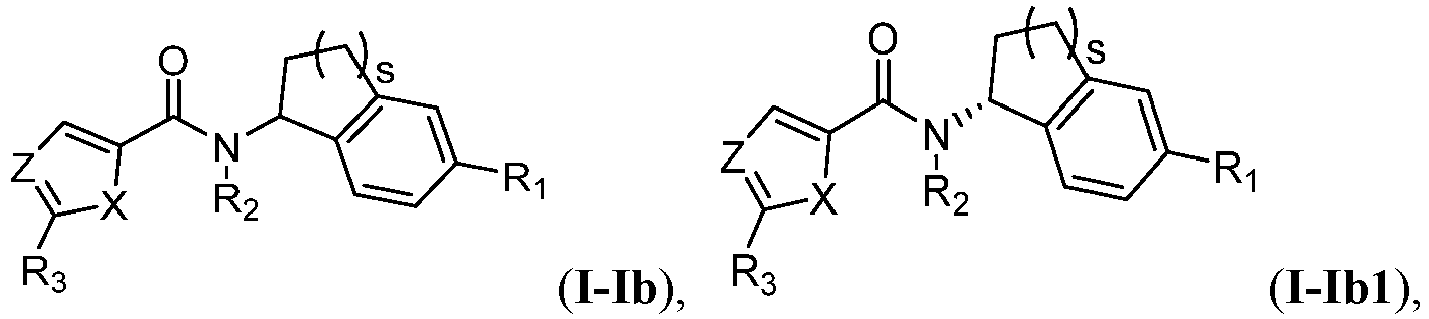 a compound of Formula I-a or Formula I-a1:
 a compound of Formula I-c or Formula I-c1:
 a compound of Formula I-d or Formula I-d1:
- The pharmaceutical composition of claim 1 or 2, wherein each R3 is selected from the group consisting of -Cl, methyl, methyl substituted with -NR4R5 or -S(O)2R6, methoxymethyl, trifluoromethyl, ethyl, cyclopropyl, cyclohexyl, -S(O)2R6, -C(O)NR4R5,-S(O)2NR4R5 and C1-6alkyl substituted with -NR4R5 or -S(O)2R6.
- The pharmaceutical composition of any one of claims 1-3, wherein n is 1 or 2.
- The pharmaceutical composition of any one of claims 1-4, wherein each of R4 and R5 are independently selected from the group consisting of hydrogen, methyl, ethyl, cyclopropyl, and -C(O)CH3, or wherein R4 and R5 are taken together with the nitrogen to which R4 and R5 are attached to form a 4-6 membered heterocyclyl optionally substituted with -OH, methyl, or -OCH3;
preferably wherein each R4 and R5 are hydrogen or methyl or R4 is H and R5 is methyl,. - The pharmaceutical composition of any one of claims 1-5, wherein R6 is selected from the group consisting of methyl, ethyl, methoxyethyl, and cyclopropyl.
- The pharmaceutical composition of claim 1, wherein the compound is selected from the group consisting of:


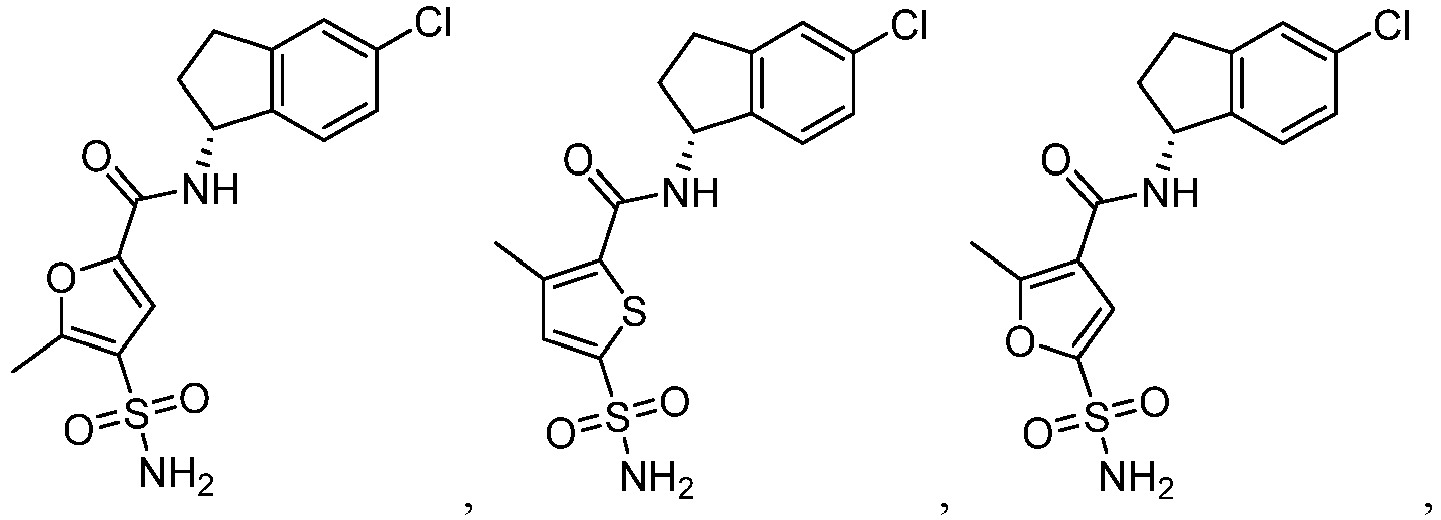


- A pharmaceutical composition comprising a compound of Formula II:
 R1 is selected from the group consisting of -Cl, -F, and C1-6alkyl substituted with one or more substituents independently selected from -Cl and -F;R2 is hydrogen;R3 is independently selected from the group consisting of halogen, C1-6alkoxy, C1-6alkylene-S(O)2-C1-6alkyl, -C(O)NR5R6, -NR7S(O)2C1-6alkyl, -NR7S(O)2C3-7 cycloalkyl, - NR7S(O)2NR5R6, -NR9R10, -S(O)2-C3-6cycloalkyl, -S(O)2-NR5R6, -S(O)2-C1-6alkoxy, and - S(O)2-C1-6alkyl, wherein the C1-6alkyl is optionally substituted with one or more halogen or C1-6alkoxy;each R4 is independently selected from the group consisting of C1-6alkyl, halogen, and -OH; wherein R4 is substituted at the carbon adjacent to R3 when R4 is -OH;n is selected from the group consisting of 0, 1, 2, 3, and 4;Rs, R6, R9, and R10 are each independently hydrogen or C1-6alkyl;each R7 is independently selected from the group consisting of hydrogen, C1-6alkyl, and 3-7 membered heterocyclyl, wherein the C1-6alkyl is optionally substituted with one or more substituents independently selected from the group consisting of halogen, C1-6alkoxy, C1-6haloalkoxy, -OH, -NR5R6, and -C(O)NR5R6; ands is 1 or 2;and a pharmaceutically acceptable excipient,preferably wherein the compound is a compound of Formula II-a, Formula II-a1, or Formula II-a2:
 a compound of Formula II-b, Formula II-bl, or Formula II-b2:
 a compound of Formula II-c, Formula II-c1, or Formula II-c2:

- The pharmaceutical composition of claim 8, wherein R3 is selected from the group consisting of -F, methoxy, -NH2,


- The pharmaceutical composition of claim 8, wherein the compound is selected from the group consisting of:

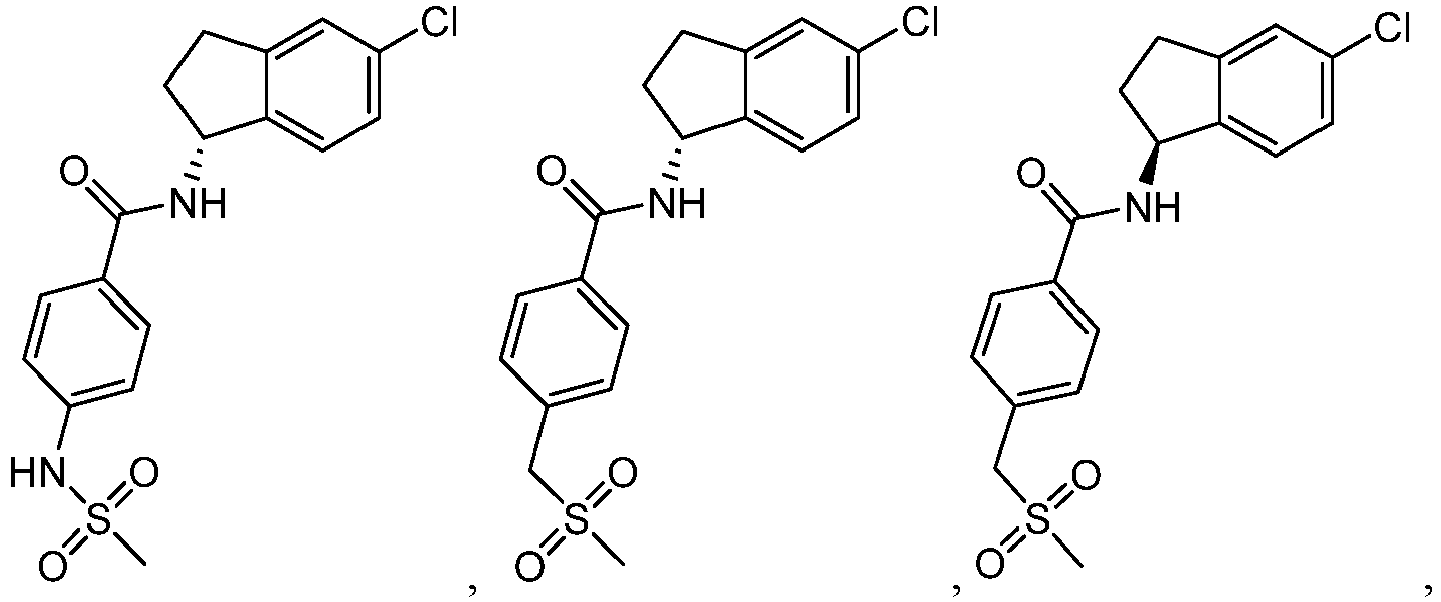


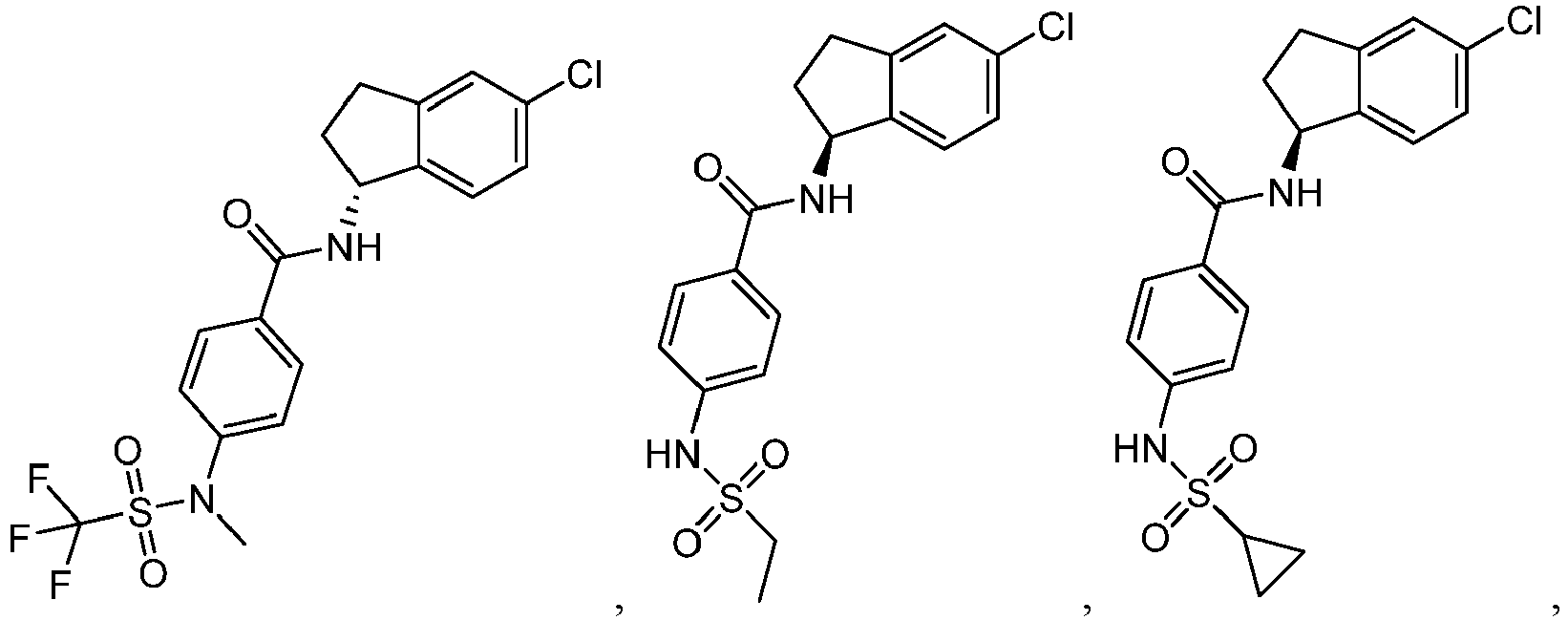


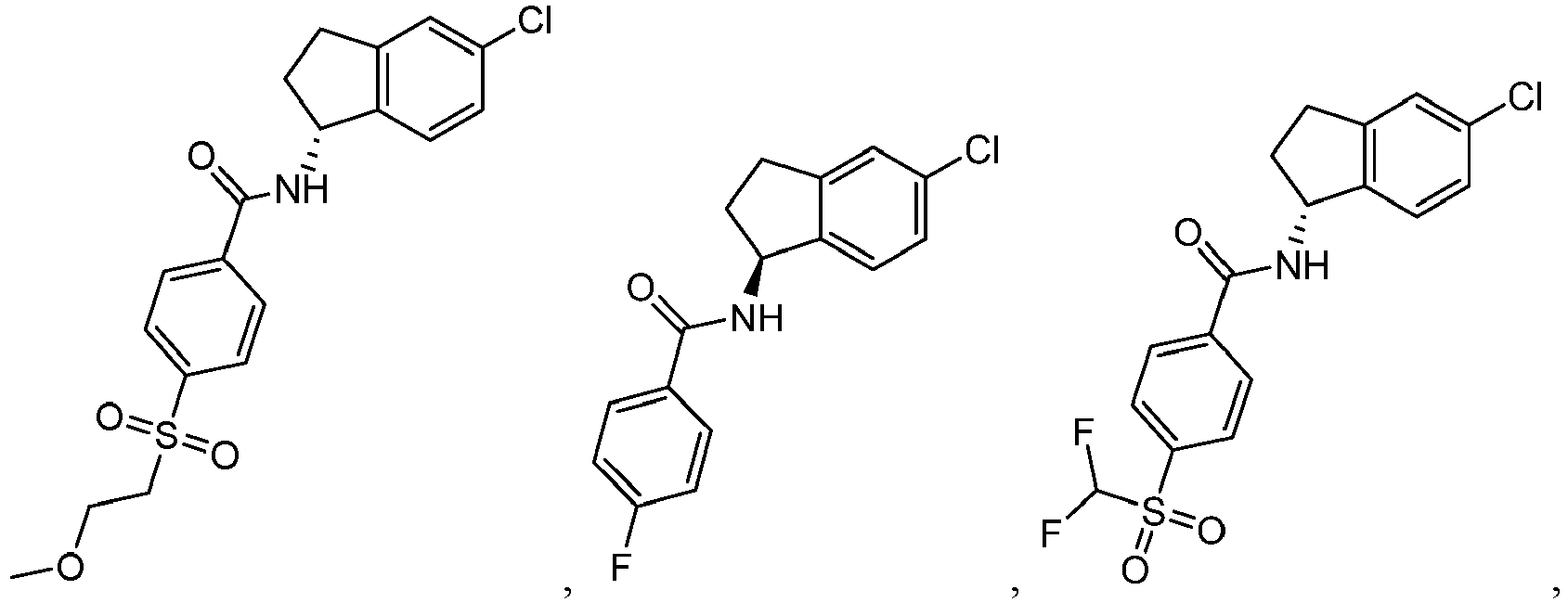


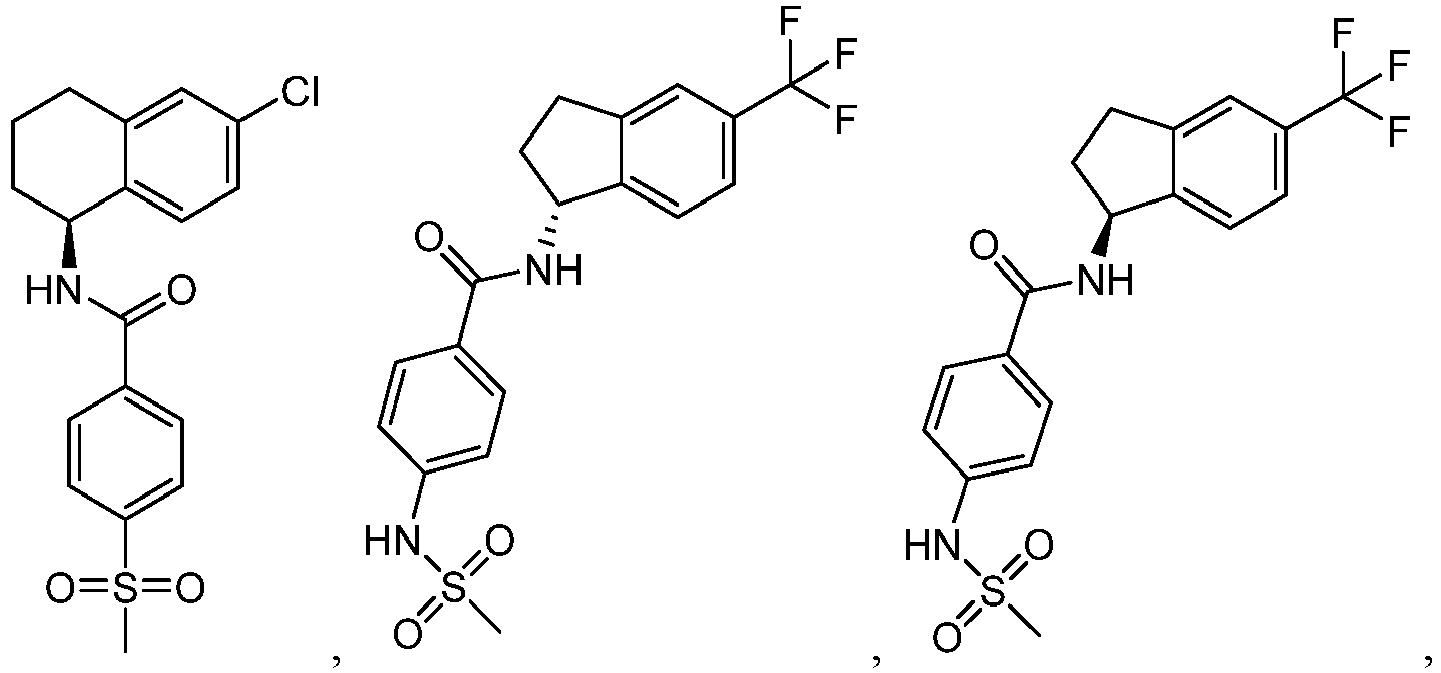

- A pharmaceutical composition comprising a compound of Formula III:
 R1 is selected from the group consisting of -Cl, -F, and C1-6alkyl substituted with one or more substituents independently selected from -Cl and -F, preferably wherein R1 is -Cl, -F, or -CF3;R2 is hydrogen;R3 is hydrogen;R4 is each independently selected from the group consisting of C1-6alkyl, C1-6alkoxy, halogen, C1-6haloalkyl, -NR7S(O)2C1-6alkyl, and -NR8C(O)-C1-6alkyl, preferably wherein R4 is selected from methyl, methoxy, -F, -Cl, -CF3, methoxy,
 n is selected from the group consisting of 0, 1, 2, 3, and 4;R7 and R8 are each independently hydrogen or C1-6alkyl; ands is 1 or 2;and a pharmaceutically acceptable excipient; preferably wherein the compound is a compound of Formula III-a, Formula III-al, or Formula III-a2:
 a compound of Formula III-b, Formula III-bl, or Formula III-b2:
 a compound of Formula III-c, Formula III-c1, or Formula III-c2:

- The pharmaceutical composition of claim 11, wherein the compound is selected from the group consisting of:


- The pharmaceutical composition of any preceding claim, for use in a method of treating a disease or condition associated with excessive neuronal excitability or a disease or condition associated with a gain-of-function mutation of KCNT1, wherein the method comprises administering to a subject in need thereof the pharmaceutical composition.
- The pharmaceutical composition for use according to claim 13, wherein the disease or condition associated with excessive neuronal excitability or the disease or condition associated with a gain-of-function mutation of KCNT1 is epilepsy, an epilepsy syndrome, an encephalopathy, such as a genetic or pediatric epilepsy or a genetic or pediatric epilepsy syndrome (e.g., epilepsy of infancy with migrating focal seizures (MMFSI, EIMFS), autosomal dominant nocturnal frontal lobe epilepsy (ADNFLE), West syndrome, infantile spasms, epileptic encephalopathy, focal epilepsy, Ohtahara syndrome, developmental and epileptic encephalopathy, Lennox Gastaut syndrome, seizures (e.g., Generalized tonic clonic seizures, Asymmetric Tonic Seizures), leukodystrophy, leukoencephalopathy, intellectual disability, Multifocal Epilepsy, Drug resistant epilepsy, Temporal lobe epilepsy, or cerebellar ataxia), a cardiac dysfunction, such as cardiac arrhythmia, sudden unexpected death in epilepsy (SUDEP), Brugada syndrome, and myocardial infarction, pain and related conditions (e.g. neuropathic pain, acute/chronic pain, migraine), a muscle disorder (e.g. myotonia, neuromyotonia, cramp muscle spasms, spasticity), itch and pruritis, ataxia and cerebellar ataxias, psychiatric disorders (e.g. major depression, anxiety, bipolar disorder, schizophrenia), learning disorders, Fragile X, neuronal plasticity, autism spectrum disorders; epileptic encephalopathy with SCN1A, SCN2A, SCN8A mutations, early infantile epileptic encephalopathy, Dravet syndrome, Dravet syndrome with SCN1A mutation, generalized epilepsy with febrile seizures, intractable childhood epilepsy with generalized tonic-clonic seizures, infantile spasms, benign familial neonatal-infantile seizures, SCN2A epileptic encephalopathy, focal epilepsy with SCN3A mutation, cryptogenic pediatric partial epilepsy with SCN3A mutation, SCN8A epileptic encephalopathy, Rasmussen encephalitis, malignant migrating partial seizures of infancy, autosomal dominant nocturnal frontal lobe epilepsy, KCNQ2 epileptic encephalopathy, and KCNT1 epileptic encephalopathy.
Priority Applications (1)
| Application Number | Priority Date | Filing Date | Title |
|---|---|---|---|
| EP24190103.2A EP4446314A3 (en) | 2019-05-03 | 2020-05-01 | Kcnt1 inhibitors and methods of use |
Applications Claiming Priority (5)
| Application Number | Priority Date | Filing Date | Title |
|---|---|---|---|
| US201962842861P | 2019-05-03 | 2019-05-03 | |
| US201962842858P | 2019-05-03 | 2019-05-03 | |
| US201962842855P | 2019-05-03 | 2019-05-03 | |
| US202062982858P | 2020-02-28 | 2020-02-28 | |
| PCT/US2020/031039 WO2020227097A1 (en) | 2019-05-03 | 2020-05-01 | Kcnt1 inhibitors and methods of use |
Related Child Applications (1)
| Application Number | Title | Priority Date | Filing Date |
|---|---|---|---|
| EP24190103.2A Division EP4446314A3 (en) | 2019-05-03 | 2020-05-01 | Kcnt1 inhibitors and methods of use |
Publications (3)
| Publication Number | Publication Date |
|---|---|
| EP3962479A1 EP3962479A1 (en) | 2022-03-09 |
| EP3962479A4 EP3962479A4 (en) | 2023-06-07 |
| EP3962479B1 true EP3962479B1 (en) | 2024-07-24 |
Family
ID=73050875
Family Applications (2)
| Application Number | Title | Priority Date | Filing Date |
|---|---|---|---|
| EP24190103.2A Pending EP4446314A3 (en) | 2019-05-03 | 2020-05-01 | Kcnt1 inhibitors and methods of use |
| EP20802501.5A Active EP3962479B1 (en) | 2019-05-03 | 2020-05-01 | Kcnt1 inhibitors and methods of use |
Family Applications Before (1)
| Application Number | Title | Priority Date | Filing Date |
|---|---|---|---|
| EP24190103.2A Pending EP4446314A3 (en) | 2019-05-03 | 2020-05-01 | Kcnt1 inhibitors and methods of use |
Country Status (17)
| Country | Link |
|---|---|
| US (1) | US20220280476A1 (en) |
| EP (2) | EP4446314A3 (en) |
| JP (1) | JP7671990B2 (en) |
| KR (2) | KR102894020B1 (en) |
| CN (1) | CN114206335B (en) |
| AU (2) | AU2020267355B2 (en) |
| BR (1) | BR112021022061A2 (en) |
| CA (1) | CA3139062A1 (en) |
| CL (1) | CL2021002876A1 (en) |
| CO (1) | CO2021016469A2 (en) |
| EC (1) | ECSP21087657A (en) |
| IL (2) | IL317949A (en) |
| MX (1) | MX2021013422A (en) |
| PE (1) | PE20220017A1 (en) |
| SA (1) | SA521430753B1 (en) |
| SG (1) | SG11202112212WA (en) |
| WO (1) | WO2020227097A1 (en) |
Families Citing this family (14)
| Publication number | Priority date | Publication date | Assignee | Title |
|---|---|---|---|---|
| EP3723883A4 (en) | 2017-12-15 | 2021-07-07 | Sironix Renewables, Inc. | REACTIVE DISTILLATION FOR THE PRODUCTION OF SURFACTS |
| EP3820844A4 (en) | 2018-07-12 | 2022-04-20 | Sironix Renewables, Inc. | SURFACTANTS MADE OF LONG-CHAIN CARBON-CONTAINING MOLECULES |
| GB201905721D0 (en) | 2019-04-24 | 2019-06-05 | Univ Dundee | Compounds |
| IL317949A (en) * | 2019-05-03 | 2025-02-01 | Praxis Prec Medicines Inc | Kcnt1 inhibitors and methods of use |
| KR20230005813A (en) | 2020-02-28 | 2023-01-10 | 프락시스 프리시젼 메디신즈, 인크. | KCNT1 Inhibitors and Methods of Use |
| US11492338B2 (en) | 2020-05-04 | 2022-11-08 | Sironix Renewables, Inc. | Furan surfactant compositions and methods |
| WO2022010880A1 (en) * | 2020-07-06 | 2022-01-13 | Praxis Precision Medicines, Inc. | Kcnt1 inhibitors and methods of use |
| US11773088B2 (en) | 2020-11-02 | 2023-10-03 | Praxis Precision Medicines, Inc. | KCNT1 inhibitors and methods of use |
| EP4267133A4 (en) * | 2020-12-22 | 2025-01-22 | Praxis Precision Medicines, Inc. | KCNT1 INHIBITORS AND METHODS OF USE |
| WO2022231872A1 (en) * | 2021-04-29 | 2022-11-03 | Praxis Precision Medicines, Inc. | Kcnt1 inhibitors and methods of use |
| CA3239548A1 (en) | 2021-12-10 | 2023-06-15 | Sironix Renewables, Inc. | Tuning sulfonation and controlling oleo-furan surfactant compositions |
| WO2023211855A1 (en) * | 2022-04-25 | 2023-11-02 | Praxis Precision Medicines, Inc. | Kcnt1 inhibitors comprising a thiophene core and methods of use |
| WO2024123717A1 (en) * | 2022-12-05 | 2024-06-13 | Praxis Precision Medicines, Inc. | Kcnt1 inhibitors comprising a phenyl, pyridine, or pyrimidine core and methods of use |
| AU2024390752A1 (en) * | 2023-11-29 | 2026-05-14 | Actio Biosciences, Inc. | Heterocyclic compounds useful as kcnt1 inhibitors |
Family Cites Families (24)
| Publication number | Priority date | Publication date | Assignee | Title |
|---|---|---|---|---|
| US3845770A (en) | 1972-06-05 | 1974-11-05 | Alza Corp | Osmatic dispensing device for releasing beneficial agent |
| US4326525A (en) | 1980-10-14 | 1982-04-27 | Alza Corporation | Osmotic device that improves delivery properties of agent in situ |
| US5364620A (en) | 1983-12-22 | 1994-11-15 | Elan Corporation, Plc | Controlled absorption diltiazem formulation for once daily administration |
| US5023252A (en) | 1985-12-04 | 1991-06-11 | Conrex Pharmaceutical Corporation | Transdermal and trans-membrane delivery of drugs |
| US5001139A (en) | 1987-06-12 | 1991-03-19 | American Cyanamid Company | Enchancers for the transdermal flux of nivadipine |
| US4992445A (en) | 1987-06-12 | 1991-02-12 | American Cyanamid Co. | Transdermal delivery of pharmaceuticals |
| US4902514A (en) | 1988-07-21 | 1990-02-20 | Alza Corporation | Dosage form for administering nilvadipine for treating cardiovascular symptoms |
| DE19929076A1 (en) * | 1999-06-25 | 2000-12-28 | Aventis Pharma Gmbh | New indanyl-substituted benzenesulfonamide derivatives, as potassium channel blockers useful as safe antiarrhythmic agents, e.g. for treating atrial fibrillation or flutter |
| AU5464901A (en) * | 2000-03-01 | 2001-09-12 | Nihon Bayer Agrochem K.K. | Dichloropyridyl- and dichloroisothiazolyl-thiocarboxamides and their use as microbicides |
| TWI243164B (en) * | 2001-02-13 | 2005-11-11 | Aventis Pharma Gmbh | Acylated indanyl amines and their use as pharmaceuticals |
| US20050148601A1 (en) * | 2003-12-19 | 2005-07-07 | Maynard George D. | Neurokinin-3 receptor modulators: diaryl imidazole derivatives |
| KR20070092297A (en) * | 2004-12-21 | 2007-09-12 | 데브젠 엔브이 | 화합물 4 compounds with ion channel activity |
| WO2018204765A1 (en) * | 2017-05-05 | 2018-11-08 | Pairnomix, Llc | Methods of treating epilepsy and kcnq2 related conditions |
| EP3638790A4 (en) * | 2017-06-13 | 2021-03-10 | The Florey Institute Of Neuroscience And Mental Health | COMPOSITIONS AND METHODS FOR DEALING WITH CONDITIONS ASSOCIATED WITH FUNCTION GAIN MUTATIONS IN KCNT1 |
| CN117964573B (en) * | 2018-01-19 | 2026-04-14 | 赛特凯恩蒂克公司 | Dihydrobenzofuran and indene analogs as myocardial segment inhibitors |
| CN108517358A (en) * | 2018-04-09 | 2018-09-11 | 重庆医科大学附属第医院 | A kind of marker and its detection kit of auxiliary Diagnosis of Epilepsy |
| EP3962481A4 (en) * | 2019-05-03 | 2023-03-22 | Praxis Precision Medicines, Inc. | KCNT1 INHIBITORS AND METHODS OF USE |
| IL317949A (en) * | 2019-05-03 | 2025-02-01 | Praxis Prec Medicines Inc | Kcnt1 inhibitors and methods of use |
| US11767325B2 (en) * | 2019-11-26 | 2023-09-26 | Praxis Precision Medicines, Inc. | Substituted [1,2,4]triazolo[4,3-a]pyrazines as ion channel modulators |
| KR20230005813A (en) * | 2020-02-28 | 2023-01-10 | 프락시스 프리시젼 메디신즈, 인크. | KCNT1 Inhibitors and Methods of Use |
| BR112022019041A2 (en) * | 2020-03-23 | 2022-12-27 | Praxis Prec Medicines Inc | KCNT1 INHIBITORS AND METHODS OF USE |
| WO2022010880A1 (en) * | 2020-07-06 | 2022-01-13 | Praxis Precision Medicines, Inc. | Kcnt1 inhibitors and methods of use |
| US11773088B2 (en) * | 2020-11-02 | 2023-10-03 | Praxis Precision Medicines, Inc. | KCNT1 inhibitors and methods of use |
| EP4267133A4 (en) * | 2020-12-22 | 2025-01-22 | Praxis Precision Medicines, Inc. | KCNT1 INHIBITORS AND METHODS OF USE |
-
2020
- 2020-05-01 IL IL317949A patent/IL317949A/en unknown
- 2020-05-01 WO PCT/US2020/031039 patent/WO2020227097A1/en not_active Ceased
- 2020-05-01 MX MX2021013422A patent/MX2021013422A/en unknown
- 2020-05-01 EP EP24190103.2A patent/EP4446314A3/en active Pending
- 2020-05-01 CN CN202080047481.5A patent/CN114206335B/en active Active
- 2020-05-01 IL IL287751A patent/IL287751B2/en unknown
- 2020-05-01 CA CA3139062A patent/CA3139062A1/en active Pending
- 2020-05-01 JP JP2021564996A patent/JP7671990B2/en active Active
- 2020-05-01 PE PE2021001829A patent/PE20220017A1/en unknown
- 2020-05-01 SG SG11202112212WA patent/SG11202112212WA/en unknown
- 2020-05-01 US US17/607,815 patent/US20220280476A1/en active Pending
- 2020-05-01 KR KR1020217039175A patent/KR102894020B1/en active Active
- 2020-05-01 EP EP20802501.5A patent/EP3962479B1/en active Active
- 2020-05-01 KR KR1020257039837A patent/KR20250172745A/en active Pending
- 2020-05-01 BR BR112021022061A patent/BR112021022061A2/en unknown
- 2020-05-01 AU AU2020267355A patent/AU2020267355B2/en active Active
-
2021
- 2021-11-02 CL CL2021002876A patent/CL2021002876A1/en unknown
- 2021-11-03 SA SA521430753A patent/SA521430753B1/en unknown
- 2021-12-02 CO CONC2021/0016469A patent/CO2021016469A2/en unknown
- 2021-12-02 EC ECSENADI202187657A patent/ECSP21087657A/en unknown
-
2025
- 2025-08-18 AU AU2025217427A patent/AU2025217427A1/en active Pending
Also Published As
| Publication number | Publication date |
|---|---|
| KR20220016469A (en) | 2022-02-09 |
| SA521430753B1 (en) | 2024-05-26 |
| CL2021002876A1 (en) | 2022-08-12 |
| ECSP21087657A (en) | 2022-01-31 |
| PE20220017A1 (en) | 2022-01-11 |
| KR20250172745A (en) | 2025-12-09 |
| CO2021016469A2 (en) | 2022-04-08 |
| MX2021013422A (en) | 2022-02-11 |
| IL287751A (en) | 2022-01-01 |
| CN114206335B (en) | 2025-03-11 |
| AU2025217427A1 (en) | 2025-09-04 |
| IL287751B2 (en) | 2025-05-01 |
| EP3962479A4 (en) | 2023-06-07 |
| EP4446314A2 (en) | 2024-10-16 |
| SG11202112212WA (en) | 2021-12-30 |
| WO2020227097A1 (en) | 2020-11-12 |
| BR112021022061A2 (en) | 2022-01-18 |
| IL317949A (en) | 2025-02-01 |
| AU2020267355B2 (en) | 2025-05-22 |
| KR102894020B1 (en) | 2025-12-04 |
| US20220280476A1 (en) | 2022-09-08 |
| EP4446314A3 (en) | 2025-03-12 |
| EP3962479A1 (en) | 2022-03-09 |
| JP2022530989A (en) | 2022-07-05 |
| JP7671990B2 (en) | 2025-05-07 |
| AU2020267355A1 (en) | 2022-01-06 |
| CN114206335A (en) | 2022-03-18 |
| CA3139062A1 (en) | 2020-11-12 |
| IL287751B1 (en) | 2025-01-01 |
Similar Documents
| Publication | Publication Date | Title |
|---|---|---|
| KR102894020B1 (en) | KCNT1 inhibitors and methods of use | |
| EP4110317B1 (en) | Kcnt1 inhibitors and methods of use | |
| CA3176609A1 (en) | Kcnt1 inhibitors and methods of use | |
| JP7824664B2 (en) | KCNT1 inhibitors and methods of use | |
| EP4329735B1 (en) | Kcnt1 inhibitors and methods of use | |
| WO2022140547A2 (en) | Kcnt1 inhibitors and methods of use | |
| HK40117527A (en) | Kcnt1 inhibitors and methods of use | |
| HK40069054B (en) | Kcnt1 inhibitors and methods of use | |
| HK40069054A (en) | Kcnt1 inhibitors and methods of use | |
| WO2022231872A1 (en) | Kcnt1 inhibitors and methods of use | |
| WO2023122152A1 (en) | Kcnt1 inhibitors and methods of use |
Legal Events
| Date | Code | Title | Description |
|---|---|---|---|
| STAA | Information on the status of an ep patent application or granted ep patent |
Free format text: STATUS: THE INTERNATIONAL PUBLICATION HAS BEEN MADE |
|
| PUAI | Public reference made under article 153(3) epc to a published international application that has entered the european phase |
Free format text: ORIGINAL CODE: 0009012 |
|
| STAA | Information on the status of an ep patent application or granted ep patent |
Free format text: STATUS: REQUEST FOR EXAMINATION WAS MADE |
|
| 17P | Request for examination filed |
Effective date: 20211201 |
|
| AK | Designated contracting states |
Kind code of ref document: A1 Designated state(s): AL AT BE BG CH CY CZ DE DK EE ES FI FR GB GR HR HU IE IS IT LI LT LU LV MC MK MT NL NO PL PT RO RS SE SI SK SM TR |
|
| DAV | Request for validation of the european patent (deleted) | ||
| DAX | Request for extension of the european patent (deleted) | ||
| REG | Reference to a national code |
Ref country code: HK Ref legal event code: DE Ref document number: 40069054 Country of ref document: HK |
|
| A4 | Supplementary search report drawn up and despatched |
Effective date: 20230509 |
|
| RIC1 | Information provided on ipc code assigned before grant |
Ipc: C07D 249/04 20060101ALI20230502BHEP Ipc: C07C 13/465 20060101ALI20230502BHEP Ipc: A61K 31/16 20060101ALI20230502BHEP Ipc: A61K 31/015 20060101ALI20230502BHEP Ipc: A61K 31/4192 20060101AFI20230502BHEP |
|
| GRAP | Despatch of communication of intention to grant a patent |
Free format text: ORIGINAL CODE: EPIDOSNIGR1 |
|
| STAA | Information on the status of an ep patent application or granted ep patent |
Free format text: STATUS: GRANT OF PATENT IS INTENDED |
|
| INTG | Intention to grant announced |
Effective date: 20240220 |
|
| GRAS | Grant fee paid |
Free format text: ORIGINAL CODE: EPIDOSNIGR3 |
|
| GRAA | (expected) grant |
Free format text: ORIGINAL CODE: 0009210 |
|
| STAA | Information on the status of an ep patent application or granted ep patent |
Free format text: STATUS: THE PATENT HAS BEEN GRANTED |
|
| RAP3 | Party data changed (applicant data changed or rights of an application transferred) |
Owner name: PRAXIS PRECISION MEDICINES, INC. |
|
| AK | Designated contracting states |
Kind code of ref document: B1 Designated state(s): AL AT BE BG CH CY CZ DE DK EE ES FI FR GB GR HR HU IE IS IT LI LT LU LV MC MK MT NL NO PL PT RO RS SE SI SK SM TR |
|
| REG | Reference to a national code |
Ref country code: GB Ref legal event code: FG4D |
|
| REG | Reference to a national code |
Ref country code: CH Ref legal event code: EP |
|
| REG | Reference to a national code |
Ref country code: DE Ref legal event code: R096 Ref document number: 602020034560 Country of ref document: DE |
|
| P01 | Opt-out of the competence of the unified patent court (upc) registered |
Free format text: CASE NUMBER: APP_40586/2024 Effective date: 20240709 |
|
| REG | Reference to a national code |
Ref country code: IE Ref legal event code: FG4D |
|
| REG | Reference to a national code |
Ref country code: LT Ref legal event code: MG9D |
|
| REG | Reference to a national code |
Ref country code: NL Ref legal event code: MP Effective date: 20240724 |
|
| PG25 | Lapsed in a contracting state [announced via postgrant information from national office to epo] |
Ref country code: PT Free format text: LAPSE BECAUSE OF FAILURE TO SUBMIT A TRANSLATION OF THE DESCRIPTION OR TO PAY THE FEE WITHIN THE PRESCRIBED TIME-LIMIT Effective date: 20241125 |
|
| REG | Reference to a national code |
Ref country code: AT Ref legal event code: MK05 Ref document number: 1705658 Country of ref document: AT Kind code of ref document: T Effective date: 20240724 |
|
| PG25 | Lapsed in a contracting state [announced via postgrant information from national office to epo] |
Ref country code: NL Free format text: LAPSE BECAUSE OF FAILURE TO SUBMIT A TRANSLATION OF THE DESCRIPTION OR TO PAY THE FEE WITHIN THE PRESCRIBED TIME-LIMIT Effective date: 20240724 |
|
| PG25 | Lapsed in a contracting state [announced via postgrant information from national office to epo] |
Ref country code: PT Free format text: LAPSE BECAUSE OF FAILURE TO SUBMIT A TRANSLATION OF THE DESCRIPTION OR TO PAY THE FEE WITHIN THE PRESCRIBED TIME-LIMIT Effective date: 20241125 Ref country code: NL Free format text: LAPSE BECAUSE OF FAILURE TO SUBMIT A TRANSLATION OF THE DESCRIPTION OR TO PAY THE FEE WITHIN THE PRESCRIBED TIME-LIMIT Effective date: 20240724 |
|
| PG25 | Lapsed in a contracting state [announced via postgrant information from national office to epo] |
Ref country code: NO Free format text: LAPSE BECAUSE OF FAILURE TO SUBMIT A TRANSLATION OF THE DESCRIPTION OR TO PAY THE FEE WITHIN THE PRESCRIBED TIME-LIMIT Effective date: 20241024 |
|
| PG25 | Lapsed in a contracting state [announced via postgrant information from national office to epo] |
Ref country code: GR Free format text: LAPSE BECAUSE OF FAILURE TO SUBMIT A TRANSLATION OF THE DESCRIPTION OR TO PAY THE FEE WITHIN THE PRESCRIBED TIME-LIMIT Effective date: 20241025 Ref country code: FI Free format text: LAPSE BECAUSE OF FAILURE TO SUBMIT A TRANSLATION OF THE DESCRIPTION OR TO PAY THE FEE WITHIN THE PRESCRIBED TIME-LIMIT Effective date: 20240724 Ref country code: PL Free format text: LAPSE BECAUSE OF FAILURE TO SUBMIT A TRANSLATION OF THE DESCRIPTION OR TO PAY THE FEE WITHIN THE PRESCRIBED TIME-LIMIT Effective date: 20240724 |
|
| PG25 | Lapsed in a contracting state [announced via postgrant information from national office to epo] |
Ref country code: BG Free format text: LAPSE BECAUSE OF FAILURE TO SUBMIT A TRANSLATION OF THE DESCRIPTION OR TO PAY THE FEE WITHIN THE PRESCRIBED TIME-LIMIT Effective date: 20240724 |
|
| PG25 | Lapsed in a contracting state [announced via postgrant information from national office to epo] |
Ref country code: LV Free format text: LAPSE BECAUSE OF FAILURE TO SUBMIT A TRANSLATION OF THE DESCRIPTION OR TO PAY THE FEE WITHIN THE PRESCRIBED TIME-LIMIT Effective date: 20240724 |
|
| PG25 | Lapsed in a contracting state [announced via postgrant information from national office to epo] |
Ref country code: AT Free format text: LAPSE BECAUSE OF FAILURE TO SUBMIT A TRANSLATION OF THE DESCRIPTION OR TO PAY THE FEE WITHIN THE PRESCRIBED TIME-LIMIT Effective date: 20240724 Ref country code: IS Free format text: LAPSE BECAUSE OF FAILURE TO SUBMIT A TRANSLATION OF THE DESCRIPTION OR TO PAY THE FEE WITHIN THE PRESCRIBED TIME-LIMIT Effective date: 20241124 |
|
| PG25 | Lapsed in a contracting state [announced via postgrant information from national office to epo] |
Ref country code: HR Free format text: LAPSE BECAUSE OF FAILURE TO SUBMIT A TRANSLATION OF THE DESCRIPTION OR TO PAY THE FEE WITHIN THE PRESCRIBED TIME-LIMIT Effective date: 20240724 |
|
| PG25 | Lapsed in a contracting state [announced via postgrant information from national office to epo] |
Ref country code: ES Free format text: LAPSE BECAUSE OF FAILURE TO SUBMIT A TRANSLATION OF THE DESCRIPTION OR TO PAY THE FEE WITHIN THE PRESCRIBED TIME-LIMIT Effective date: 20240724 |
|
| PG25 | Lapsed in a contracting state [announced via postgrant information from national office to epo] |
Ref country code: PL Free format text: LAPSE BECAUSE OF FAILURE TO SUBMIT A TRANSLATION OF THE DESCRIPTION OR TO PAY THE FEE WITHIN THE PRESCRIBED TIME-LIMIT Effective date: 20240724 Ref country code: NO Free format text: LAPSE BECAUSE OF FAILURE TO SUBMIT A TRANSLATION OF THE DESCRIPTION OR TO PAY THE FEE WITHIN THE PRESCRIBED TIME-LIMIT Effective date: 20241024 Ref country code: LV Free format text: LAPSE BECAUSE OF FAILURE TO SUBMIT A TRANSLATION OF THE DESCRIPTION OR TO PAY THE FEE WITHIN THE PRESCRIBED TIME-LIMIT Effective date: 20240724 Ref country code: IS Free format text: LAPSE BECAUSE OF FAILURE TO SUBMIT A TRANSLATION OF THE DESCRIPTION OR TO PAY THE FEE WITHIN THE PRESCRIBED TIME-LIMIT Effective date: 20241124 Ref country code: HR Free format text: LAPSE BECAUSE OF FAILURE TO SUBMIT A TRANSLATION OF THE DESCRIPTION OR TO PAY THE FEE WITHIN THE PRESCRIBED TIME-LIMIT Effective date: 20240724 Ref country code: GR Free format text: LAPSE BECAUSE OF FAILURE TO SUBMIT A TRANSLATION OF THE DESCRIPTION OR TO PAY THE FEE WITHIN THE PRESCRIBED TIME-LIMIT Effective date: 20241025 Ref country code: FI Free format text: LAPSE BECAUSE OF FAILURE TO SUBMIT A TRANSLATION OF THE DESCRIPTION OR TO PAY THE FEE WITHIN THE PRESCRIBED TIME-LIMIT Effective date: 20240724 Ref country code: ES Free format text: LAPSE BECAUSE OF FAILURE TO SUBMIT A TRANSLATION OF THE DESCRIPTION OR TO PAY THE FEE WITHIN THE PRESCRIBED TIME-LIMIT Effective date: 20240724 Ref country code: BG Free format text: LAPSE BECAUSE OF FAILURE TO SUBMIT A TRANSLATION OF THE DESCRIPTION OR TO PAY THE FEE WITHIN THE PRESCRIBED TIME-LIMIT Effective date: 20240724 Ref country code: AT Free format text: LAPSE BECAUSE OF FAILURE TO SUBMIT A TRANSLATION OF THE DESCRIPTION OR TO PAY THE FEE WITHIN THE PRESCRIBED TIME-LIMIT Effective date: 20240724 |
|
| PG25 | Lapsed in a contracting state [announced via postgrant information from national office to epo] |
Ref country code: DK Free format text: LAPSE BECAUSE OF FAILURE TO SUBMIT A TRANSLATION OF THE DESCRIPTION OR TO PAY THE FEE WITHIN THE PRESCRIBED TIME-LIMIT Effective date: 20240724 Ref country code: SM Free format text: LAPSE BECAUSE OF FAILURE TO SUBMIT A TRANSLATION OF THE DESCRIPTION OR TO PAY THE FEE WITHIN THE PRESCRIBED TIME-LIMIT Effective date: 20240724 Ref country code: RO Free format text: LAPSE BECAUSE OF FAILURE TO SUBMIT A TRANSLATION OF THE DESCRIPTION OR TO PAY THE FEE WITHIN THE PRESCRIBED TIME-LIMIT Effective date: 20240724 |
|
| PG25 | Lapsed in a contracting state [announced via postgrant information from national office to epo] |
Ref country code: EE Free format text: LAPSE BECAUSE OF FAILURE TO SUBMIT A TRANSLATION OF THE DESCRIPTION OR TO PAY THE FEE WITHIN THE PRESCRIBED TIME-LIMIT Effective date: 20240724 |
|
| PG25 | Lapsed in a contracting state [announced via postgrant information from national office to epo] |
Ref country code: CZ Free format text: LAPSE BECAUSE OF FAILURE TO SUBMIT A TRANSLATION OF THE DESCRIPTION OR TO PAY THE FEE WITHIN THE PRESCRIBED TIME-LIMIT Effective date: 20240724 |
|
| REG | Reference to a national code |
Ref country code: DE Ref legal event code: R097 Ref document number: 602020034560 Country of ref document: DE |
|
| PG25 | Lapsed in a contracting state [announced via postgrant information from national office to epo] |
Ref country code: SK Free format text: LAPSE BECAUSE OF FAILURE TO SUBMIT A TRANSLATION OF THE DESCRIPTION OR TO PAY THE FEE WITHIN THE PRESCRIBED TIME-LIMIT Effective date: 20240724 Ref country code: IT Free format text: LAPSE BECAUSE OF FAILURE TO SUBMIT A TRANSLATION OF THE DESCRIPTION OR TO PAY THE FEE WITHIN THE PRESCRIBED TIME-LIMIT Effective date: 20240724 |
|
| PLBE | No opposition filed within time limit |
Free format text: ORIGINAL CODE: 0009261 |
|
| STAA | Information on the status of an ep patent application or granted ep patent |
Free format text: STATUS: NO OPPOSITION FILED WITHIN TIME LIMIT |
|
| 26N | No opposition filed |
Effective date: 20250425 |
|
| PGFP | Annual fee paid to national office [announced via postgrant information from national office to epo] |
Ref country code: DE Payment date: 20250529 Year of fee payment: 6 |
|
| PGFP | Annual fee paid to national office [announced via postgrant information from national office to epo] |
Ref country code: GB Payment date: 20250527 Year of fee payment: 6 |
|
| PGFP | Annual fee paid to national office [announced via postgrant information from national office to epo] |
Ref country code: LU Payment date: 20250527 Year of fee payment: 6 Ref country code: BE Payment date: 20250527 Year of fee payment: 6 |
|
| PGFP | Annual fee paid to national office [announced via postgrant information from national office to epo] |
Ref country code: FR Payment date: 20250526 Year of fee payment: 6 |
|
| PGFP | Annual fee paid to national office [announced via postgrant information from national office to epo] |
Ref country code: CH Payment date: 20250601 Year of fee payment: 6 |
|
| PGFP | Annual fee paid to national office [announced via postgrant information from national office to epo] |
Ref country code: IE Payment date: 20250527 Year of fee payment: 6 |
|
| PG25 | Lapsed in a contracting state [announced via postgrant information from national office to epo] |
Ref country code: SE Free format text: LAPSE BECAUSE OF FAILURE TO SUBMIT A TRANSLATION OF THE DESCRIPTION OR TO PAY THE FEE WITHIN THE PRESCRIBED TIME-LIMIT Effective date: 20240724 |
|
| PG25 | Lapsed in a contracting state [announced via postgrant information from national office to epo] |
Ref country code: MC Free format text: LAPSE BECAUSE OF FAILURE TO SUBMIT A TRANSLATION OF THE DESCRIPTION OR TO PAY THE FEE WITHIN THE PRESCRIBED TIME-LIMIT Effective date: 20240724 |