EP3962203A1 - Uplink information transmission method, user terminal and computer-readable storage medium - Google Patents
Uplink information transmission method, user terminal and computer-readable storage medium Download PDFInfo
- Publication number
- EP3962203A1 EP3962203A1 EP20794689.8A EP20794689A EP3962203A1 EP 3962203 A1 EP3962203 A1 EP 3962203A1 EP 20794689 A EP20794689 A EP 20794689A EP 3962203 A1 EP3962203 A1 EP 3962203A1
- Authority
- EP
- European Patent Office
- Prior art keywords
- uplink
- transmission reception
- reception point
- identification information
- target transmission
- Prior art date
- Legal status (The legal status is an assumption and is not a legal conclusion. Google has not performed a legal analysis and makes no representation as to the accuracy of the status listed.)
- Withdrawn
Links
Images
Classifications
-
- H—ELECTRICITY
- H04—ELECTRIC COMMUNICATION TECHNIQUE
- H04L—TRANSMISSION OF DIGITAL INFORMATION, e.g. TELEGRAPHIC COMMUNICATION
- H04L27/00—Modulated-carrier systems
- H04L27/26—Systems using multi-frequency codes
- H04L27/2601—Multicarrier modulation systems
- H04L27/2602—Signal structure
- H04L27/261—Details of reference signals
- H04L27/2613—Structure of the reference signals
- H04L27/26136—Pilot sequence conveying additional information
-
- H—ELECTRICITY
- H04—ELECTRIC COMMUNICATION TECHNIQUE
- H04W—WIRELESS COMMUNICATION NETWORKS
- H04W72/00—Local resource management
- H04W72/20—Control channels or signalling for resource management
- H04W72/21—Control channels or signalling for resource management in the uplink direction of a wireless link, i.e. towards the network
-
- H—ELECTRICITY
- H04—ELECTRIC COMMUNICATION TECHNIQUE
- H04W—WIRELESS COMMUNICATION NETWORKS
- H04W72/00—Local resource management
- H04W72/20—Control channels or signalling for resource management
- H04W72/23—Control channels or signalling for resource management in the downlink direction of a wireless link, i.e. towards a terminal
-
- H—ELECTRICITY
- H04—ELECTRIC COMMUNICATION TECHNIQUE
- H04L—TRANSMISSION OF DIGITAL INFORMATION, e.g. TELEGRAPHIC COMMUNICATION
- H04L1/00—Arrangements for detecting or preventing errors in the information received
- H04L1/12—Arrangements for detecting or preventing errors in the information received by using return channel
- H04L1/16—Arrangements for detecting or preventing errors in the information received by using return channel in which the return channel carries supervisory signals, e.g. repetition request signals
- H04L1/18—Automatic repetition systems, e.g. Van Duuren systems
- H04L1/1829—Arrangements specially adapted for the receiver end
- H04L1/1854—Scheduling and prioritising arrangements
-
- H—ELECTRICITY
- H04—ELECTRIC COMMUNICATION TECHNIQUE
- H04L—TRANSMISSION OF DIGITAL INFORMATION, e.g. TELEGRAPHIC COMMUNICATION
- H04L1/00—Arrangements for detecting or preventing errors in the information received
- H04L1/12—Arrangements for detecting or preventing errors in the information received by using return channel
- H04L1/16—Arrangements for detecting or preventing errors in the information received by using return channel in which the return channel carries supervisory signals, e.g. repetition request signals
- H04L1/18—Automatic repetition systems, e.g. Van Duuren systems
- H04L1/1867—Arrangements specially adapted for the transmitter end
- H04L1/1896—ARQ related signaling
-
- H—ELECTRICITY
- H04—ELECTRIC COMMUNICATION TECHNIQUE
- H04L—TRANSMISSION OF DIGITAL INFORMATION, e.g. TELEGRAPHIC COMMUNICATION
- H04L25/00—Baseband systems
- H04L25/02—Details ; arrangements for supplying electrical power along data transmission lines
- H04L25/03—Shaping networks in transmitter or receiver, e.g. adaptive shaping networks
- H04L25/03828—Arrangements for spectral shaping; Arrangements for providing signals with specified spectral properties
- H04L25/03866—Arrangements for spectral shaping; Arrangements for providing signals with specified spectral properties using scrambling
-
- H—ELECTRICITY
- H04—ELECTRIC COMMUNICATION TECHNIQUE
- H04L—TRANSMISSION OF DIGITAL INFORMATION, e.g. TELEGRAPHIC COMMUNICATION
- H04L27/00—Modulated-carrier systems
- H04L27/26—Systems using multi-frequency codes
- H04L27/2601—Multicarrier modulation systems
- H04L27/2602—Signal structure
- H04L27/26025—Numerology, i.e. varying one or more of symbol duration, subcarrier spacing, Fourier transform size, sampling rate or down-clocking
-
- H—ELECTRICITY
- H04—ELECTRIC COMMUNICATION TECHNIQUE
- H04L—TRANSMISSION OF DIGITAL INFORMATION, e.g. TELEGRAPHIC COMMUNICATION
- H04L27/00—Modulated-carrier systems
- H04L27/26—Systems using multi-frequency codes
- H04L27/2601—Multicarrier modulation systems
- H04L27/2602—Signal structure
- H04L27/261—Details of reference signals
- H04L27/2613—Structure of the reference signals
-
- H—ELECTRICITY
- H04—ELECTRIC COMMUNICATION TECHNIQUE
- H04L—TRANSMISSION OF DIGITAL INFORMATION, e.g. TELEGRAPHIC COMMUNICATION
- H04L5/00—Arrangements affording multiple use of the transmission path
- H04L5/003—Arrangements for allocating sub-channels of the transmission path
- H04L5/0048—Allocation of pilot signals, i.e. of signals known to the receiver
-
- H—ELECTRICITY
- H04—ELECTRIC COMMUNICATION TECHNIQUE
- H04L—TRANSMISSION OF DIGITAL INFORMATION, e.g. TELEGRAPHIC COMMUNICATION
- H04L5/00—Arrangements affording multiple use of the transmission path
- H04L5/003—Arrangements for allocating sub-channels of the transmission path
- H04L5/0048—Allocation of pilot signals, i.e. of signals known to the receiver
- H04L5/0051—Allocation of pilot signals, i.e. of signals known to the receiver of dedicated pilots, i.e. pilots destined for a single user or terminal
-
- H—ELECTRICITY
- H04—ELECTRIC COMMUNICATION TECHNIQUE
- H04W—WIRELESS COMMUNICATION NETWORKS
- H04W72/00—Local resource management
- H04W72/04—Wireless resource allocation
- H04W72/044—Wireless resource allocation based on the type of the allocated resource
- H04W72/0466—Wireless resource allocation based on the type of the allocated resource the resource being a scrambling code
-
- H—ELECTRICITY
- H04—ELECTRIC COMMUNICATION TECHNIQUE
- H04L—TRANSMISSION OF DIGITAL INFORMATION, e.g. TELEGRAPHIC COMMUNICATION
- H04L5/00—Arrangements affording multiple use of the transmission path
- H04L5/0001—Arrangements for dividing the transmission path
- H04L5/0014—Three-dimensional division
- H04L5/0023—Time-frequency-space
-
- H—ELECTRICITY
- H04—ELECTRIC COMMUNICATION TECHNIQUE
- H04L—TRANSMISSION OF DIGITAL INFORMATION, e.g. TELEGRAPHIC COMMUNICATION
- H04L5/00—Arrangements affording multiple use of the transmission path
- H04L5/003—Arrangements for allocating sub-channels of the transmission path
- H04L5/0053—Allocation of signalling, i.e. of overhead other than pilot signals
-
- H—ELECTRICITY
- H04—ELECTRIC COMMUNICATION TECHNIQUE
- H04L—TRANSMISSION OF DIGITAL INFORMATION, e.g. TELEGRAPHIC COMMUNICATION
- H04L5/00—Arrangements affording multiple use of the transmission path
- H04L5/003—Arrangements for allocating sub-channels of the transmission path
- H04L5/0053—Allocation of signalling, i.e. of overhead other than pilot signals
- H04L5/0055—Physical resource allocation for ACK/NACK
Definitions
- the present disclosure generally relates to wireless communication technology field, and more particularly, to an uplink information transmission method, user terminal and computer-readable storage medium.
- New Radio (NR) R16 supports multiple Transmission Reception Point (multi-TRP) transmission, that is, supports a user terminal to communicate with a plurality of transmission reception points.
- multi-TRP Transmission Reception Point
- a plurality of transmission reception points may all receive the uplink information transmitted by the user terminal.
- Embodiments in the present disclosure provide a method for transmitting uplink information.
- a method for tetrahedral interpolation calculation includes: receiving network configuration information, wherein the network configuration information comprises identification information for indicating a target transmission reception point; generating uplink information corresponding to the identification information of the target transmission reception point based on the identification information of the target transmission reception point; and transmitting the uplink information.
- said generating the uplink information corresponding to the identification information of the target transmission reception point based on the identification information of the target transmission reception point includes: obtaining an initial value of an uplink reference signal based on the identification information of the target transmission reception point; and generating the uplink reference signal based on the initial value of the uplink reference signal.
- said generating the uplink information corresponding to the identification information of the target transmission reception point based on the identification information of the target transmission reception point includes: obtaining an initial value of a scrambling sequence of an uplink channel based on the identification information of the target transmission reception point; generating the scrambling sequence of the uplink channel based on the initial value of the scrambling sequence of the uplink channel; and adopting the scrambling sequence of the uplink channel to scramble the uplink information to be transmitted.
- said generating the uplink information corresponding to the identification information of the target transmission reception point based on the network configuration information includes: performing a logical AND operation on transmission data of an uplink transmission resource corresponding to the target transmission reception point and transmission data of uplink transmission resources corresponding to other transmission reception points, in response to detecting that the uplink transmission resource corresponding to the target transmission reception point and uplink transmission resources corresponding to other transmission reception points overlap; and taking a result of the logical AND operation as the uplink information.
- a user terminal includes: a receiving circuitry, adapted to receive network configuration information, wherein the network configuration information includes identification information for indicating a target transmission reception point; a generation circuitry, adapted to generate uplink information corresponding to the identification information of the target transmission reception point based on the identification information of the target transmission reception point; and a transmission circuitry, adapted to transmit the uplink information.
- the generation circuitry is adapted to obtain an initial value of an uplink reference signal based on the identification information of the target transmission reception point; and generate the uplink reference signal based on the initial value of the uplink reference signal.
- the generation circuitry is adapted to obtain an initial value of a scrambling sequence of an uplink channel based on the identification information of the target transmission reception point; generate the scrambling sequence of the uplink channel based on the initial value of the scrambling sequence of the uplink channel, and adopt the scrambling sequence of the uplink channel to scramble the uplink information to be transmitted.
- the generation circuitry is adapted to perform a logical AND operation on transmission data of an uplink transmission resource corresponding to the target transmission reception point and transmission data of uplink transmission resources corresponding to other transmission reception points, in response to detecting that the uplink transmission resource corresponding to the target transmission reception point and uplink transmission resources corresponding to other transmission reception points overlap; and take a result of the logical AND operation as the uplink information.
- a computer-readable storage medium having computer instructions stored therein is provided, the computer-readable storage medium is a non-volatile storage medium or a non-transitory storage medium, wherein once the computer instructions are executed, the method based on any one of above method is performed.
- a user terminal including a memory and a processor
- the memory has computer instructions stored therein, and the method based on any one above method is performed, once the processor executes the computer instructions.
- Embodiments of the present disclosure have following benefits: Based on identification information of a target transmission reception point in network configuration information, corresponding uplink information is generated and transmitted, so that each transmission reception point can know whether it is the target transmission reception point corresponding to the uplink information.
- a logical AND operation is performed on transmission data of an uplink transmission resource corresponding to the target transmission reception point and transmission data of uplink transmission resources corresponding to other transmission reception points, in response to detecting that the uplink transmission resource corresponding to the target transmission reception point and uplink transmission resources corresponding to other transmission reception points overlap, which can avoid that a user terminal and a transmission reception point cannot communicate normally.
- corresponding uplink information is generated and transmitted, so that each transmission reception point can know whether it is the target transmission reception point corresponding to the uplink information.
- a method for transmitting uplink information is provided, referring to FIG. 1 , detailed process is described as in S101 and S102.
- the base station when a base station indicates a user terminal to perform data transmission with a plurality of transmission reception points, the base station can transmit downward network configuration information to the user terminal.
- the network configuration information can be used to indicate which target transmission reception point the user terminal communicates with.
- network configuration information may include identification information for indicating a target transmission reception point. After the network configuration information is received by a user terminal, a user can know which transmission reception point to perform uplink information transmission with.
- a base station may transmit downward network configuration information to a user terminal through a higher layer signaling.
- a base station may transmit downward network configuration information to a user terminal through a Radio Resource control (RRC) signaling.
- RRC Radio Resource control
- DCI Downlink Control Information
- uplink information corresponding to identification information of a target transmission reception point is generated based on the network configuration information, and the uplink information is transmitted.
- identification information corresponding to uplink transmission resource configured for a same user terminal by different transmission reception points is different.
- the user terminal can determine which transmission reception point transmits downward the network configuration information based on the network configuration information.
- the user terminal can obtain identification information of a target transmission reception point based on the network configuration information.
- identification information corresponding to uplink transmission resource may be identification information corresponding to a Physical Uplink Control Channel (PUCCH) resource.
- PUCCH Physical Uplink Control Channel
- identification information corresponding to PUCCH resources configured for a user terminal by transmission reception point 1 is 0, 2, 4 and 6; identification information corresponding to PUCCH resources configured for the user terminal by transmission reception point 2 is 1, 3, 5 and 7.
- Transmission reception point 1 and transmission reception point 2 can inform the user terminal of the PUCCH resources used based on network configuration information.
- the user terminal detects that identification information corresponding to PUCCH resources in the network configuration information is 0, 2, 4 and 6, the user terminal knows that the network configuration information is transmitted by transmission reception point 1, thus, the user terminal knows that an identification of a transmission reception point is 1.
- different downlink transmission resources may be used when information is transmitted to a same user terminal through different transmission reception points, and different downlink transmission resources correspond to different transmission reception points.
- the user terminal can obtain information of a transmission reception point corresponding to the downlink transmission resource based on the downlink transmission resource.
- identification information corresponding to a downlink transmission resource may be identification information corresponding to a control resource set (CORESET).
- CORESET control resource set
- a user terminal can generate uplink information corresponding to the identification information of the target transmission reception point based on the identification information of the target transmission reception point, and transmit the uplink information.
- a user terminal may obtain an initial value of an uplink reference signal based on identification information of a target transmission reception point; generate corresponding uplink reference signal; and transmit the uplink reference signal.
- specific principle and process of generating the uplink reference signal based on the initial value of the uplink reference signal can refer to an existing protocol, and thus are not described hereinafter.
- n is related to the identification information of the target transmission reception point, and different transmission reception points correspond to different values of n ;
- l represents an OFDM symbol number within a slot, n s ,f ⁇ represents a slot number in a radio frame f with a subcarrier spacing ⁇ ;
- N ID 0 represents a scrambling ID configured by a higher layer, otherwise the N ID 0 represents a cell ID.
- n may be determined based on an uplink transmission resource or downlink transmission resource.
- the n can be determined through a PUCCH resource.
- the n can be determined through a CORESET.
- n may be determined based on a resource identification (resource ID) of Physical Uplink Control Channel (PUCCH).
- resource ID resource identification
- PUCCH Physical Uplink Control Channel
- a modulo is performed for a value of the resource ID of PUCCH on 2, and a result obtained is taken as n.
- n may be determined based on a resource set ID of PUCCH. And in the embodiment of the present disclosure, a modulo is performed for the value of the PUCCH resource set ID on 2, and a result obtained is taken as n.
- n may be determined based on a resource group ID of PUCCH. And in some embodiment, a modulo is performed for the value of the PUCCH resource group ID on 2, and a result obtained is taken as n.
- a modulo is performed for a value of a CORESET on 2, and a result obtained is taken as n.
- the user terminal may obtain an initial value of a scrambling sequence of an uplink channel based on the identification information of the target transmission reception point; generate the scrambling sequence of the uplink channel based on the initial value of the scrambling sequence of the uplink channel, and adopting the scrambling sequence of the uplink channel to scramble the uplink information to be transmitted; and transmit the scrambled information.
- specific principle and process of generating the scrambling sequence of the uplink channel based on the initial value of the scrambling sequence of the uplink channel can be referred to an existing protocol, and thus are not described hereinafter.
- n is related to the identification information of the target transmission reception point, and different transmission reception points correspond to different values of n; n RNTI is obtained based on a C-RNTI; in response to n ID being configured by a higher layer, the n ID represents a data scrambling ID of a Physical Uplink Shared Channel configured by a higher layer, otherwise the n ID represents a cell ID.
- n may be determined based on an uplink transmission resource or downlink transmission resource.
- the n can be determined through a PUCCH resource.
- the n can be determined through a CORESET.
- n may be determined based on a resource ID of PUCCH.
- a modulo is performed for a value of the resource ID of PUCCH on 2, and a result obtained is taken as n; or, a modulo is performed for a value of the resource ID of PUCCH on 1024, and a result obtained is taken as n.
- n may be determined based on a resource set ID of PUCCH.
- a modulo is performed for a value of the resource set ID of PUCCH on 2, and a result obtained is taken as n; or, a modulo is performed for a value of the resource set ID of PUCCH on 1024, and a result obtained is taken as n.
- n may be determined based on a resource group ID of PUCCH.
- a modulo is performed for a value of the resource group ID of PUCCH on 2, and a result obtained is taken as n; or, a modulo is performed for a value of the resource group ID of PUCCH on 1024, and a result obtained is taken as n.
- n may be determined based on a CORESET.
- a modulo is performed for a value of a CORESET on 2, and a result obtained is taken as n.
- the calculation rule of an initial value of an uplink reference signal generated by formula (1) and the calculation rule of an initial value of a scrambling sequence of an uplink channel generated by formula (2) can be both obtained by a user terminal and a target transmission reception point.
- uplink information transmitted by a user terminal can be generated based on identification information of a target transmission reception point.
- the uplink information can be analyzed accordingly. Due to generation rules of initial values of uplink reference signals corresponding to different transmission reception points and generation rules of initial values of scrambling sequences scrambled by uplink channels are different, and the user terminal and the target transmission reception point know these generation rules. Thus, the uplink information can be analyzed correctly by a target transmission reception point only.
- a user terminal may feed corresponding transmission data back to a target transmission reception point and other transmission reception points based on network configuration information.
- the transmission data fed back to the target transmission reception point and the other transmission reception points by the user terminal may be HARQ-ACK information, and an uplink transmission resource used by the user terminal is a PUCCH resource.
- a user terminal may detect whether an uplink transmission resource corresponding to a target transmission reception point and uplink transmission resources corresponding to other transmission reception points overlap, a logical AND operation is performed on transmission data of the uplink transmission resource corresponding to the target transmission reception point and transmission data of uplink transmission resources corresponding to other transmission reception points, in response to detecting that the uplink transmission resource corresponding to the target transmission reception point and uplink transmission resources corresponding to other transmission reception points overlap, and transmit a result of the logical AND operation as uplink information.
- HARQ-ACK information carried in a PUCCH resource transmitted to TRP1 (transmission reception 1) by a user terminal is ACK
- HARQ-ACK information carried in a PUCCH resource transmitted to TRP2 (transmission reception 2) is NACK.
- the user terminal performs a logical AND operation on the HARQ-ACK information carried in the PUCCH resource transmitted to TRP1 and the HARQ-ACK information carried in the PUCCH resource transmitted to TRP2, that is, performs a logical AND operation on ACK and NACK, and the result is NACK.
- HARQ-ACK information fed back to TRP1 and TRP2 respectively is NACK.
- the user terminal performing a logical AND operation on ACK and NACK means that taking ACK as a logical 1, and taking NACK as a logical 0, a result of the logical AND operation on ACK and NACK is 0 which is correspond to NACK.
- HARQ-ACK information carried in a PUCCH resource transmitted to TRP1 (transmission reception 1) by a user terminal is ACK
- HARQ-ACK information carried in a PUCCH resource transmitted to TRP2 (transmission reception 2) is ACK.
- the user terminal performs a logical AND operation on the HARQ-ACK information carried in the PUCCH resource transmitted to TRP1 and the HARQ-ACK information carried in the PUCCH resource transmitted to TRP2, that is, performs a logical AND operation on ACK and ACK, and the result is ACK.
- HARQ-ACK information fed back to TRP1 and TRP2 by the user terminal respectively is ACK.
- HARQ-ACK information carried in a PUCCH resource transmitted to TRP1 (transmission reception 1) by a user terminal is NACK
- HARQ-ACK information carried in a PUCCH resource transmitted to TRP2 (transmission reception 2) is NACK.
- the user terminal performs a logical AND operation on the HARQ-ACK information carried in the PUCCH resource transmitted to TRP1 and the HARQ-ACK information carried in the PUCCH resource transmitted to TRP2, that is, performs a logical AND operation on NACK and NACK, and the result is NACK.
- HARQ-ACK information fed back to TRP1 and TRP2 by the user terminal respectively is NACK.
- an uplink transmission resource overlapping in embodiments of the present disclosure may include any one of overlaps including an overlap in time domain, an overlap in a frequency domain, and an overlap in time-frequency domain.
- the uplink transmission resource overlap may be an overlap on some symbol, or a complete overlap in time domain and frequency domain.
- the user terminal can only transmit HARQ-ACK information to one of the TRPs.
- the HARQ-ACK information transmitted by the user terminal may be received by a plurality of TRPs.
- HARQ-ACK information fed back to TRP1 by a user terminal is NACK
- HARQ-ACK information fed back to TRP2by a user terminal is ACK
- the user terminal can only feed back the HARQ-ACK information corresponding to TRP1 or feed back the HARQ-ACK information corresponding to TRP2.
- TRP1 may also receive the HARQ-ACK information transmitted by the user terminal, and the HARQ-ACK information received by TRP1 is ACK.
- HARQ-ACK information corresponding to TRP1 should be NACK.
- HARQ-ACK information received by TRP1 may not be HARQ-ACK information which a user terminal needs to feed back to TRP1. If TRP1 receives ACK as HARQ-ACK information, it is determined that the user terminal receives correctly, however, the user terminal does not correctly receive data transmitted by TRP1. In this case, the user terminal may not be able to communicate with TRP1 normally.
- a logical AND operation is performed on HARQ-ACK information carried in a PUCCH resource transmitted to TRP1 and HARQ-ACK information carried in a PUCCH resource transmitted to TRP2 by a user terminal. If HARQ-ACK information carried in a PUCCH resource transmitted to any one of TRPs is NACK, HARQ-ACK information transmitted by the user terminal is NACK which makes both TRP1 and TRP2 retransmit to the user terminal, and the user terminal in return re-feed back to TRP1 and TRP2, which avoids a situation that the user terminal cannot communicate with TRP1 normally.
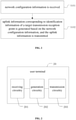
- the user terminal includes: a receiving circuitry 201, a generation circuitry 202, and a transmission circuitry 203.
- the receiving circuitry 201 is adapted to receive network configuration information, and the network configuration information includes identification information for indicating a target transmission reception point.
- the generation circuitry 202 is adapted to generate uplink information corresponding to the identification information of the target transmission reception point based on the identification information of the target transmission reception point.
- the transmission circuitry 203 is adapted to transmission the uplink information.
- the generation circuitry 202 may be adapted to obtain an initial value of an uplink reference signal based on identification information of a target transmission reception point; and generate the uplink reference signal based on the initial value of the uplink reference signal.
- the generation circuitry 202 may be adapted to obtain an initial value of a scrambling sequence of an uplink channel based on the identification information of the target transmission reception point; generate the scrambling sequence of the uplink channel based on the initial value of the scrambling sequence of the uplink channel, and adopt the scrambling sequence of the uplink channel to scramble the uplink information to be transmitted.
- the generation circuitry 202 may be adapted to perform a logical AND operation on transmission data of an uplink transmission resource corresponding to the target transmission reception point and transmission data of uplink transmission resources corresponding to other transmission reception points, in response to detecting that the uplink transmission resource corresponding to the target transmission reception point and uplink transmission resources corresponding to other transmission reception points overlap; and taking a result of the logical AND operation as the uplink information.
- a computer-readable storage medium having computer instructions stored therein is provided, the computer-readable storage medium is a non-volatile storage medium or a non-transitory storage medium, wherein once the computer instructions are executed, the method as described above can be performed.
- a user terminal comprising a memory and a processor
- the memory has computer instructions stored therein, and the method as described above can be performed, once the processor executes the computer instructions.
- the program can be stored in any computer-readable storage medium, and the storage medium may include: ROM, RAM, magnetic disk or CD, etc.
Landscapes
- Engineering & Computer Science (AREA)
- Signal Processing (AREA)
- Computer Networks & Wireless Communication (AREA)
- Physics & Mathematics (AREA)
- Mathematical Physics (AREA)
- Spectroscopy & Molecular Physics (AREA)
- Power Engineering (AREA)
- Mobile Radio Communication Systems (AREA)
Abstract
Description
- This application claims priority to
Chinese Patent Application No. 201910346117.8, filed on April 26, 2019 - The present disclosure generally relates to wireless communication technology field, and more particularly, to an uplink information transmission method, user terminal and computer-readable storage medium.
- New Radio (NR) R16 supports multiple Transmission Reception Point (multi-TRP) transmission, that is, supports a user terminal to communicate with a plurality of transmission reception points. When uplink information is transmitted by a user terminal, a plurality of transmission reception points may all receive the uplink information transmitted by the user terminal.
- If an existing method for transmitting uplink information in a R15 is adopted, a transmission reception point cannot know whether it is a target transmission reception point.
- Embodiments in the present disclosure provide a method for transmitting uplink information.
- In an embodiment of the present disclosure, a method for tetrahedral interpolation calculation is provided. The method includes: receiving network configuration information, wherein the network configuration information comprises identification information for indicating a target transmission reception point; generating uplink information corresponding to the identification information of the target transmission reception point based on the identification information of the target transmission reception point; and transmitting the uplink information.
- In some embodiment, said generating the uplink information corresponding to the identification information of the target transmission reception point based on the identification information of the target transmission reception point includes: obtaining an initial value of an uplink reference signal based on the identification information of the target transmission reception point; and generating the uplink reference signal based on the initial value of the uplink reference signal.
- In some embodiment, said obtaining the initial value of the uplink reference signal based on the identification information of the target transmission reception point includes: calculating the initial value cinit of the uplink reference signal based on following formula:


- In some embodiment, said generating the uplink information corresponding to the identification information of the target transmission reception point based on the identification information of the target transmission reception point includes: obtaining an initial value of a scrambling sequence of an uplink channel based on the identification information of the target transmission reception point; generating the scrambling sequence of the uplink channel based on the initial value of the scrambling sequence of the uplink channel; and adopting the scrambling sequence of the uplink channel to scramble the uplink information to be transmitted.
- In some embodiment, said obtaining the initial value of the scrambling sequence of the uplink channel based on the identification information of the target transmission reception point includes: calculating the initial value cinit of the scrambling sequence of the uplink channel based on following formula: cinit = nRNTI •215 + nID + n, wherein, n is related to the identification information of the target transmission reception point, and different transmission reception points correspond to different values of n; nRNTI is obtained based on a C-RNTI; in response to nID being configured by a higher layer, the nID represents a data scrambling ID of a Physical Uplink Shared Channel configured by a higher layer, otherwise the nID represents a cell ID.
- In some embodiment, said generating the uplink information corresponding to the identification information of the target transmission reception point based on the network configuration information includes: performing a logical AND operation on transmission data of an uplink transmission resource corresponding to the target transmission reception point and transmission data of uplink transmission resources corresponding to other transmission reception points, in response to detecting that the uplink transmission resource corresponding to the target transmission reception point and uplink transmission resources corresponding to other transmission reception points overlap; and taking a result of the logical AND operation as the uplink information.
- In an embodiment of the present disclosure, a user terminal is provided, the user terminal includes: a receiving circuitry, adapted to receive network configuration information, wherein the network configuration information includes identification information for indicating a target transmission reception point; a generation circuitry, adapted to generate uplink information corresponding to the identification information of the target transmission reception point based on the identification information of the target transmission reception point; and a transmission circuitry, adapted to transmit the uplink information.
- In some embodiment, the generation circuitry is adapted to obtain an initial value of an uplink reference signal based on the identification information of the target transmission reception point; and generate the uplink reference signal based on the initial value of the uplink reference signal.
- In some embodiment, the generation circuitry is adapted to calculate the initial value cinit of the uplink reference signal based on following formula:



- In some embodiment, the generation circuitry is adapted to obtain an initial value of a scrambling sequence of an uplink channel based on the identification information of the target transmission reception point; generate the scrambling sequence of the uplink channel based on the initial value of the scrambling sequence of the uplink channel, and adopt the scrambling sequence of the uplink channel to scramble the uplink information to be transmitted.
- In some embodiment, the generation circuitry is adapted to calculate the initial value cinit of the scrambling sequence of the uplink channel based on following formula: cinit = nRNTI •215 + nID + n ; wherein, n is related to the identification information of the target transmission reception point, and different transmission reception points correspond to different values of n; nRNTI is obtained based on a C-RNTI; in response to nID being configured by a higher layer, the nID represents a data scrambling ID of a physical uplink shared channel configured by a higher layer, otherwise the nID represents a cell ID.
- In some embodiment, the generation circuitry is adapted to perform a logical AND operation on transmission data of an uplink transmission resource corresponding to the target transmission reception point and transmission data of uplink transmission resources corresponding to other transmission reception points, in response to detecting that the uplink transmission resource corresponding to the target transmission reception point and uplink transmission resources corresponding to other transmission reception points overlap; and take a result of the logical AND operation as the uplink information.
- In an embodiment of the present disclosure, a computer-readable storage medium having computer instructions stored therein is provided, the computer-readable storage medium is a non-volatile storage medium or a non-transitory storage medium, wherein once the computer instructions are executed, the method based on any one of above method is performed.
- In an embodiment of the present disclosure, a user terminal including a memory and a processor is provided, wherein the memory has computer instructions stored therein, and the method based on any one above method is performed, once the processor executes the computer instructions.
- Embodiments of the present disclosure have following benefits:
Based on identification information of a target transmission reception point in network configuration information, corresponding uplink information is generated and transmitted, so that each transmission reception point can know whether it is the target transmission reception point corresponding to the uplink information. - Further, a logical AND operation is performed on transmission data of an uplink transmission resource corresponding to the target transmission reception point and transmission data of uplink transmission resources corresponding to other transmission reception points, in response to detecting that the uplink transmission resource corresponding to the target transmission reception point and uplink transmission resources corresponding to other transmission reception points overlap, which can avoid that a user terminal and a transmission reception point cannot communicate normally.
-
-
FIG. 1 schematically illustrates a flowchart of a method for transmitting uplink information according to an embodiment of the present disclosure; -
FIG. 2 schematically illustrates a schematic structural diagram of a user terminal according to an embodiment of the present disclosure. - In an existing technology, different transmission reception points cannot recognize which transmission reception point a user terminal performs data transmission.
- In embodiments of the present disclosure, based on identification information of a target transmission reception point in network configuration information, corresponding uplink information is generated and transmitted, so that each transmission reception point can know whether it is the target transmission reception point corresponding to the uplink information.
- In order to clarify the object, characteristic and advantages of embodiments of the present disclosure, the embodiments of present disclosure will be described clearly in detail in conjunction with accompanying drawings.
- In an embodiment of the present disclosure, a method for transmitting uplink information is provided, referring to
FIG. 1 , detailed process is described as in S101 and S102. - In S101, network configuration information is received.
- In some embodiment, when a base station indicates a user terminal to perform data transmission with a plurality of transmission reception points, the base station can transmit downward network configuration information to the user terminal. The network configuration information can be used to indicate which target transmission reception point the user terminal communicates with.
- In some embodiment of the present disclosure, network configuration information may include identification information for indicating a target transmission reception point. After the network configuration information is received by a user terminal, a user can know which transmission reception point to perform uplink information transmission with.
- In some embodiment, a base station may transmit downward network configuration information to a user terminal through a higher layer signaling. For example, a base station may transmit downward network configuration information to a user terminal through a Radio Resource control (RRC) signaling. Or, a base station may transmit downward network configuration information to a user terminal through Downlink Control Information (DCI).
- In S102, uplink information corresponding to identification information of a target transmission reception point is generated based on the network configuration information, and the uplink information is transmitted.
- In some embodiment, identification information corresponding to uplink transmission resource configured for a same user terminal by different transmission reception points is different. Thus, after network configuration information is received by the user terminal, and the user terminal can determine which transmission reception point transmits downward the network configuration information based on the network configuration information. Thus, the user terminal can obtain identification information of a target transmission reception point based on the network configuration information.
- In some embodiment, identification information corresponding to uplink transmission resource may be identification information corresponding to a Physical Uplink Control Channel (PUCCH) resource.
- For example, identification information corresponding to PUCCH resources configured for a user terminal by transmission reception point 1 is 0, 2, 4 and 6; identification information corresponding to PUCCH resources configured for the user terminal by transmission reception point 2 is 1, 3, 5 and 7. Transmission reception point 1 and transmission reception point 2 can inform the user terminal of the PUCCH resources used based on network configuration information. When the user terminal detects that identification information corresponding to PUCCH resources in the network configuration information is 0, 2, 4 and 6, the user terminal knows that the network configuration information is transmitted by transmission reception point 1, thus, the user terminal knows that an identification of a transmission reception point is 1.
- In some embodiment, different downlink transmission resources may be used when information is transmitted to a same user terminal through different transmission reception points, and different downlink transmission resources correspond to different transmission reception points. Thus, the user terminal can obtain information of a transmission reception point corresponding to the downlink transmission resource based on the downlink transmission resource.
- In some embodiment, identification information corresponding to a downlink transmission resource may be identification information corresponding to a control resource set (CORESET).
- A user terminal can generate uplink information corresponding to the identification information of the target transmission reception point based on the identification information of the target transmission reception point, and transmit the uplink information.
- In some embodiment, when uplink information is an uplink reference signal, a user terminal may obtain an initial value of an uplink reference signal based on identification information of a target transmission reception point; generate corresponding uplink reference signal; and transmit the uplink reference signal.
- In some embodiment, specific principle and process of generating the uplink reference signal based on the initial value of the uplink reference signal can refer to an existing protocol, and thus are not described hereinafter.
- In some embodiment, an initial value cinit of an uplink reference signal can be calculated based on following formula:

- Wherein, n is related to the identification information of the target transmission reception point, and different transmission reception points correspond to different values of n; l represents an OFDM symbol number within a slot,




- In practical applications, in above formula (1), except for n, physical meanings of other physical parameters can refer to provisions in an existing protocol.
- In some embodiment, n may be determined based on an uplink transmission resource or downlink transmission resource. When n is determined based on the uplink transmission resource, the n can be determined through a PUCCH resource. When n is determined based on a downlink transmission resource, the n can be determined through a CORESET.
- In some embodiment, n may be determined based on a resource identification (resource ID) of Physical Uplink Control Channel (PUCCH).
- In some embodiment, a modulo is performed for a value of the resource ID of PUCCH on 2, and a result obtained is taken as n.
- In some embodiment, n may be determined based on a resource set ID of PUCCH. And in the embodiment of the present disclosure, a modulo is performed for the value of the PUCCH resource set ID on 2, and a result obtained is taken as n.
- In some embodiment, n may be determined based on a resource group ID of PUCCH. And in some embodiment, a modulo is performed for the value of the PUCCH resource group ID on 2, and a result obtained is taken as n.
- In some embodiment, a modulo is performed for a value of a CORESET on 2, and a result obtained is taken as n.
- In some embodiment, when an uplink information is a scrambling sequence of an uplink channel, the user terminal may obtain an initial value of a scrambling sequence of an uplink channel based on the identification information of the target transmission reception point; generate the scrambling sequence of the uplink channel based on the initial value of the scrambling sequence of the uplink channel, and adopting the scrambling sequence of the uplink channel to scramble the uplink information to be transmitted; and transmit the scrambled information.
- In some embodiment, specific principle and process of generating the scrambling sequence of the uplink channel based on the initial value of the scrambling sequence of the uplink channel can be referred to an existing protocol, and thus are not described hereinafter.
- In some embodiment, an initial value cinit of the scrambling sequence of the uplink channel can be calculated based on following formula:

- Wherein, n is related to the identification information of the target transmission reception point, and different transmission reception points correspond to different values of n; nRNTI is obtained based on a C-RNTI; in response to nID being configured by a higher layer, the nID represents a data scrambling ID of a Physical Uplink Shared Channel configured by a higher layer, otherwise the nID represents a cell ID.
- In practical applications, in above formula (2), except for n, physical meanings of other physical parameters can be referred to provisions in an existing protocol.
- In some embodiment, n may be determined based on an uplink transmission resource or downlink transmission resource. When n is determined based on the uplink transmission resource, the n can be determined through a PUCCH resource. When n is determined based on a downlink transmission resource, the n can be determined through a CORESET.
- In some embodiment, n may be determined based on a resource ID of PUCCH. In some embodiment, a modulo is performed for a value of the resource ID of PUCCH on 2, and a result obtained is taken as n; or, a modulo is performed for a value of the resource ID of PUCCH on 1024, and a result obtained is taken as n.
- In some embodiment, n may be determined based on a resource set ID of PUCCH. In some embodiment, a modulo is performed for a value of the resource set ID of PUCCH on 2, and a result obtained is taken as n; or, a modulo is performed for a value of the resource set ID of PUCCH on 1024, and a result obtained is taken as n.
- In some embodiment, n may be determined based on a resource group ID of PUCCH. In some embodiment, a modulo is performed for a value of the resource group ID of PUCCH on 2, and a result obtained is taken as n; or, a modulo is performed for a value of the resource group ID of PUCCH on 1024, and a result obtained is taken as n.
- In some embodiment, n may be determined based on a CORESET. In some embodiment, a modulo is performed for a value of a CORESET on 2, and a result obtained is taken as n.
- In some embodiment, the calculation rule of an initial value of an uplink reference signal generated by formula (1) and the calculation rule of an initial value of a scrambling sequence of an uplink channel generated by formula (2) can be both obtained by a user terminal and a target transmission reception point.
- In some embodiment, uplink information transmitted by a user terminal can be generated based on identification information of a target transmission reception point. Thus, when the uplink information is received by a plurality of transmission reception points, the uplink information can be analyzed accordingly. Due to generation rules of initial values of uplink reference signals corresponding to different transmission reception points and generation rules of initial values of scrambling sequences scrambled by uplink channels are different, and the user terminal and the target transmission reception point know these generation rules. Thus, the uplink information can be analyzed correctly by a target transmission reception point only.
- In some embodiment, a user terminal may feed corresponding transmission data back to a target transmission reception point and other transmission reception points based on network configuration information. In the embodiment of the present disclosure, the transmission data fed back to the target transmission reception point and the other transmission reception points by the user terminal may be HARQ-ACK information, and an uplink transmission resource used by the user terminal is a PUCCH resource.
- A user terminal may detect whether an uplink transmission resource corresponding to a target transmission reception point and uplink transmission resources corresponding to other transmission reception points overlap, a logical AND operation is performed on transmission data of the uplink transmission resource corresponding to the target transmission reception point and transmission data of uplink transmission resources corresponding to other transmission reception points, in response to detecting that the uplink transmission resource corresponding to the target transmission reception point and uplink transmission resources corresponding to other transmission reception points overlap, and transmit a result of the logical AND operation as uplink information.
- For example, HARQ-ACK information carried in a PUCCH resource transmitted to TRP1 (transmission reception 1) by a user terminal is ACK, HARQ-ACK information carried in a PUCCH resource transmitted to TRP2 (transmission reception 2) is NACK. When the PUCCH resource transmitted to TRP1 and the PUCCH resource transmitted to TRP2 overlap, the user terminal performs a logical AND operation on the HARQ-ACK information carried in the PUCCH resource transmitted to TRP1 and the HARQ-ACK information carried in the PUCCH resource transmitted to TRP2, that is, performs a logical AND operation on ACK and NACK, and the result is NACK. Thus, HARQ-ACK information fed back to TRP1 and TRP2 respectively is NACK. The user terminal performing a logical AND operation on ACK and NACK means that taking ACK as a logical 1, and taking NACK as a logical 0, a result of the logical AND operation on ACK and NACK is 0 which is correspond to NACK.
- For another example, HARQ-ACK information carried in a PUCCH resource transmitted to TRP1 (transmission reception 1) by a user terminal is ACK, HARQ-ACK information carried in a PUCCH resource transmitted to TRP2 (transmission reception 2) is ACK. When the PUCCH resource transmitted to TRP1 and the PUCCH resource transmitted to TRP2 overlap, the user terminal performs a logical AND operation on the HARQ-ACK information carried in the PUCCH resource transmitted to TRP1 and the HARQ-ACK information carried in the PUCCH resource transmitted to TRP2, that is, performs a logical AND operation on ACK and ACK, and the result is ACK. Thus, HARQ-ACK information fed back to TRP1 and TRP2 by the user terminal respectively is ACK.
- For another example, HARQ-ACK information carried in a PUCCH resource transmitted to TRP1 (transmission reception 1) by a user terminal is NACK, HARQ-ACK information carried in a PUCCH resource transmitted to TRP2 (transmission reception 2) is NACK. When the PUCCH resource transmitted to TRP1 and the PUCCH resource transmitted to TRP2 overlap, the user terminal performs a logical AND operation on the HARQ-ACK information carried in the PUCCH resource transmitted to TRP1 and the HARQ-ACK information carried in the PUCCH resource transmitted to TRP2, that is, performs a logical AND operation on NACK and NACK, and the result is NACK. Thus, HARQ-ACK information fed back to TRP1 and TRP2 by the user terminal respectively is NACK.
- It should be noted that an uplink transmission resource overlapping in embodiments of the present disclosure may include any one of overlaps including an overlap in time domain, an overlap in a frequency domain, and an overlap in time-frequency domain. In embodiments of the present disclosure, the uplink transmission resource overlap may be an overlap on some symbol, or a complete overlap in time domain and frequency domain.
- In practical applications, when PUCCH resources transmitted to different TRPs by a user terminal overlap, the user terminal can only transmit HARQ-ACK information to one of the TRPs. However, the HARQ-ACK information transmitted by the user terminal may be received by a plurality of TRPs.
- Assuming that a PUCCH resource transmitted to TRP1 by the user terminal and a PUCCH resource transmitted to TRP2by the user terminal overlap, HARQ-ACK information fed back to TRP1 by a user terminal is NACK, HARQ-ACK information fed back to TRP2by a user terminal is ACK. However, the user terminal can only feed back the HARQ-ACK information corresponding to TRP1 or feed back the HARQ-ACK information corresponding to TRP2. If the user terminal feed the HARQ-ACK information back to TRP2, TRP1 may also receive the HARQ-ACK information transmitted by the user terminal, and the HARQ-ACK information received by TRP1 is ACK. However, HARQ-ACK information corresponding to TRP1 should be NACK.
- In other word, HARQ-ACK information received by TRP1 may not be HARQ-ACK information which a user terminal needs to feed back to TRP1. If TRP1 receives ACK as HARQ-ACK information, it is determined that the user terminal receives correctly, however, the user terminal does not correctly receive data transmitted by TRP1. In this case, the user terminal may not be able to communicate with TRP1 normally.
- In embodiments of the present disclosure, in order to avoid the above situation, a logical AND operation is performed on HARQ-ACK information carried in a PUCCH resource transmitted to TRP1 and HARQ-ACK information carried in a PUCCH resource transmitted to TRP2 by a user terminal. If HARQ-ACK information carried in a PUCCH resource transmitted to any one of TRPs is NACK, HARQ-ACK information transmitted by the user terminal is NACK which makes both TRP1 and TRP2 retransmit to the user terminal, and the user terminal in return re-feed back to TRP1 and TRP2, which avoids a situation that the user terminal cannot communicate with TRP1 normally.
- Referring to
FIG. 2 , a user terminal in an embodiment of the present disclosure is provided, the user terminal includes: a receivingcircuitry 201, ageneration circuitry 202, and atransmission circuitry 203. - Wherein, the receiving
circuitry 201 is adapted to receive network configuration information, and the network configuration information includes identification information for indicating a target transmission reception point. - The
generation circuitry 202 is adapted to generate uplink information corresponding to the identification information of the target transmission reception point based on the identification information of the target transmission reception point. - The
transmission circuitry 203 is adapted to transmission the uplink information. - In some embodiment, the
generation circuitry 202 may be adapted to obtain an initial value of an uplink reference signal based on identification information of a target transmission reception point; and generate the uplink reference signal based on the initial value of the uplink reference signal. - In some embodiment, the
generation circuitry 202 may be adapted to calculate an initial value cinit of an uplink reference signal based on following formula:


- In some embodiment, the
generation circuitry 202 may be adapted to obtain an initial value of a scrambling sequence of an uplink channel based on the identification information of the target transmission reception point; generate the scrambling sequence of the uplink channel based on the initial value of the scrambling sequence of the uplink channel, and adopt the scrambling sequence of the uplink channel to scramble the uplink information to be transmitted. - In some embodiment, the
generation circuitry 202 may be adapted to calculate the initial value cinit of the scrambling sequence of the uplink channel based on following formula: cinit = nRNTI •215 + nID + n; wherein, n is related to the identification information of the target transmission reception point, and different transmission reception points correspond to different values of n; nRNTI is obtained based on a C-RNTI; in response to nID being configured by a higher layer, the nID represents a data scrambling ID of a Physical Uplink Shared Channel configured by a higher layer, otherwise the nID represents a cell ID. - In some embodiment, the
generation circuitry 202 may be adapted to perform a logical AND operation on transmission data of an uplink transmission resource corresponding to the target transmission reception point and transmission data of uplink transmission resources corresponding to other transmission reception points, in response to detecting that the uplink transmission resource corresponding to the target transmission reception point and uplink transmission resources corresponding to other transmission reception points overlap; and taking a result of the logical AND operation as the uplink information. - In an embodiment of the present disclosure, a computer-readable storage medium having computer instructions stored therein is provided, the computer-readable storage medium is a non-volatile storage medium or a non-transitory storage medium, wherein once the computer instructions are executed, the method as described above can be performed.
- In an embodiment of the present disclosure, a user terminal comprising a memory and a processor is provided, wherein the memory has computer instructions stored therein, and the method as described above can be performed, once the processor executes the computer instructions.
- Those skilled in the art can understand that all or part of the processes in the various methods of the above-mentioned embodiments can be completed by a program instructing relevant hardware. The program can be stored in any computer-readable storage medium, and the storage medium may include: ROM, RAM, magnetic disk or CD, etc.
- Although the present disclosure is disclosed as above, the present disclosure is not limited to this. Those skilled in the art can make various changes and modifications without departing from the spirit and scope of the present disclosure. Therefore, the protection scope of the present disclosure should be subject to the scope defined by the claims.
Claims (14)
- A method for transmitting uplink information, characterized by comprising:receiving network configuration information, wherein the network configuration information comprises identification information for indicating a target transmission reception point;generating uplink information corresponding to the identification information of the target transmission reception point based on the identification information of the target transmission reception point; andtransmitting the uplink information.
- The method according to claim 1, characterized in that said generating the uplink information corresponding to the identification information of the target transmission reception point based on the identification information of the target transmission reception point comprises:obtaining an initial value of an uplink reference signal based on the identification information of the target transmission reception point; andgenerating the uplink reference signal based on the initial value of the uplink reference signal.
- The method according to claim 2, characterized in that said obtaining the initial value of the uplink reference signal based on the identification information of the target transmission reception point comprises:
calculating the initial value cinit of the uplink reference signal based on following formula,


- The method according to claim 1, characterized in that said generating the uplink information corresponding to the identification information of the target transmission reception point based on the identification information of the target transmission reception point comprises:obtaining an initial value of a scrambling sequence of an uplink channel based on the identification information of the target transmission reception point;generating the scrambling sequence of the uplink channel based on the initial value of the scrambling sequence of the uplink channel; andadopting the scrambling sequence of the uplink channel to scramble the uplink information to be transmitted.
- The method according to claim 4, characterized in that said obtaining the initial value of the scrambling sequence of the uplink channel based on the identification information of the target transmission reception point comprises:
calculating the initial value cinit of the scrambling sequence of the uplink channel based on following formula,
- The method according to claim 1, characterized in that said generating the uplink information corresponding to the identification information of the target transmission reception point based on the network configuration information comprises:performing a logical AND operation on transmission data of an uplink transmission resource corresponding to the target transmission reception point and transmission data of uplink transmission resources corresponding to other transmission reception points, in response to detecting that the uplink transmission resource corresponding to the target transmission reception point and uplink transmission resources corresponding to other transmission reception points overlap; andtaking a result of the logical AND operation as the uplink information.
- A user terminal, characterized by comprising:a receiving circuitry, adapted to receive network configuration information, wherein the network configuration information comprises identification information for indicating a target transmission reception point;a generation circuitry, adapted to generate uplink information corresponding to the identification information of the target transmission reception point based on the identification information of the target transmission reception point; anda transmission circuitry, adapted to transmit the uplink information.
- The user terminal according to claim 7, characterized in that the generation circuitry is adapted to obtain an initial value of an uplink reference signal based on the identification information of the target transmission reception point; and generate the uplink reference signal based on the initial value of the uplink reference signal.
- The user terminal according to claim 8, characterized in that the generation circuitry is adapted to calculate the initial value cinit of the uplink reference signal based on following formula:


- The user terminal according to claim 7, characterized in that the generation circuitry is adapted to obtain an initial value of a scrambling sequence of an uplink channel based on the identification information of the target transmission reception point; generate the scrambling sequence of the uplink channel based on the initial value of the scrambling sequence of the uplink channel, and adopt the scrambling sequence of the uplink channel to scramble the uplink information to be transmitted.
- The user terminal according to claim 10, characterized in that the generation circuitry is adapted to calculate the initial value cinit of the scrambling sequence of the uplink channel based on following formula: cinit = nRNTI •215 + nID + n; wherein, n is related to the identification information of the target transmission reception point, and different transmission reception points correspond to different values of n; nRNTI is obtained based on a C-RNTI; in response to nID being configured by a higher layer, the nID represents a data scrambling ID of a physical uplink shared channel configured by a higher layer, otherwise the nID represents a cell ID.
- The user terminal according to claim 7, characterized in that the generation circuitry is adapted to perform a logical AND operation on transmission data of an uplink transmission resource corresponding to the target transmission reception point and transmission data of uplink transmission resources corresponding to other transmission reception points, in response to detecting that the uplink transmission resource corresponding to the target transmission reception point and uplink transmission resources corresponding to other transmission reception points overlap; and take a result of the logical AND operation as the uplink information.
- A computer-readable storage medium having computer instructions stored therein, the computer-readable storage medium is a non-volatile storage medium or a non-transitory storage medium, characterized in that once the computer instructions are executed, the method based on any one of claims 1 to 6 is performed.
- A user terminal comprising a memory and a processor, characterized in that the memory has computer instructions stored therein, and the method based on any one of claims 1 to 6 is performed, once the processor executes the computer instructions.
Applications Claiming Priority (2)
| Application Number | Priority Date | Filing Date | Title |
|---|---|---|---|
| CN201910346117.8A CN111294945B (en) | 2019-04-26 | 2019-04-26 | Uplink information transmission method, user terminal and computer readable storage medium |
| PCT/CN2020/085491 WO2020216154A1 (en) | 2019-04-26 | 2020-04-20 | Uplink information transmission method, user terminal and computer-readable storage medium |
Publications (2)
| Publication Number | Publication Date |
|---|---|
| EP3962203A1 true EP3962203A1 (en) | 2022-03-02 |
| EP3962203A4 EP3962203A4 (en) | 2023-01-25 |
Family
ID=71024126
Family Applications (1)
| Application Number | Title | Priority Date | Filing Date |
|---|---|---|---|
| EP20794689.8A Withdrawn EP3962203A4 (en) | 2019-04-26 | 2020-04-20 | Uplink information transmission method, user terminal and computer-readable storage medium |
Country Status (4)
| Country | Link |
|---|---|
| US (1) | US12058685B2 (en) |
| EP (1) | EP3962203A4 (en) |
| CN (1) | CN111294945B (en) |
| WO (1) | WO2020216154A1 (en) |
Cited By (1)
| Publication number | Priority date | Publication date | Assignee | Title |
|---|---|---|---|---|
| US20210328734A1 (en) * | 2018-09-05 | 2021-10-21 | Samsung Electronics Co., Ltd. | Method and device for generating reference signal sequence for papr reduction in mobile communication system |
Families Citing this family (1)
| Publication number | Priority date | Publication date | Assignee | Title |
|---|---|---|---|---|
| CN121968334A (en) * | 2024-10-31 | 2026-05-01 | 荣耀终端股份有限公司 | Information transmission method and related equipment |
Family Cites Families (22)
| Publication number | Priority date | Publication date | Assignee | Title |
|---|---|---|---|---|
| CN101772220B (en) * | 2009-01-05 | 2012-11-14 | 电信科学技术研究院 | Method, system and device for allocating uplink reference signals |
| CN102869097B (en) | 2011-07-07 | 2015-07-08 | 华为技术有限公司 | Transmitting and receiving methods of uplink control signaling and related equipment |
| CN104137450B (en) | 2012-02-20 | 2017-12-12 | Lg 电子株式会社 | The method and apparatus that uplink signal is transmitted in wireless communication system |
| KR102210081B1 (en) | 2012-05-11 | 2021-02-01 | 팬텍 주식회사 | Method and Apparatus for Transmitting and Receiving Reference Signal in Wireless Communication System |
| KR101669701B1 (en) * | 2012-06-25 | 2016-10-26 | 주식회사 케이티 | Method for providing information mapping of physical uplink shared channel, transmission/reception point thereof, method for transitting physical uplink shared channel and terminal thereof |
| KR101475123B1 (en) * | 2012-09-14 | 2014-12-22 | 주식회사 케이티 | Methods for Transmitting and Receiving Uplink Control Channel, Terminal and Transmission Reception Point Thereof |
| CN104853339A (en) * | 2014-02-19 | 2015-08-19 | 中兴通讯股份有限公司 | Signal processing method and device |
| CN105493603A (en) * | 2014-08-05 | 2016-04-13 | 华为技术有限公司 | Interference Elimination Method and Device for Wireless Communication System |
| CN106375074A (en) * | 2015-07-21 | 2017-02-01 | 中兴通讯股份有限公司 | Transmission method and system of sounding reference signals (SRS) |
| CN106411475B (en) * | 2015-07-27 | 2019-05-24 | 中兴通讯股份有限公司 | A feedback transmission method and device |
| CN107666373B (en) * | 2016-07-27 | 2022-04-22 | 北京三星通信技术研究有限公司 | HARQ transmission method and device |
| KR102512849B1 (en) * | 2016-09-29 | 2023-03-24 | 삼성전자 주식회사 | Apparatus and method for performing measurement |
| US10609699B2 (en) * | 2017-03-16 | 2020-03-31 | Kt Corporation | Method for monitoring, transmitting, and receiving downlink pre-emption indication information in new radio networks and apparatus thereof |
| CN108988978B (en) * | 2017-06-01 | 2021-01-15 | 华为技术有限公司 | Scrambling code sequence generation method and device |
| US20180367358A1 (en) * | 2017-06-14 | 2018-12-20 | Huawei Technologies Co., Ltd. | User equipment related reference signal design, transmission and reception |
| EP3659266A4 (en) * | 2017-07-24 | 2020-07-15 | Nec Corporation | Methods and devices for reference signal configuration |
| CN109392188B (en) | 2017-08-11 | 2020-12-25 | 华为技术有限公司 | Random access method, equipment and system |
| CN110063074A (en) * | 2017-09-12 | 2019-07-26 | 联发科技股份有限公司 | The detection reference signal discontinuously calibrated in wireless communication for relative phase uses |
| WO2019136688A1 (en) | 2018-01-12 | 2019-07-18 | 北京小米移动软件有限公司 | Information feedback method and apparatus |
| WO2019191921A1 (en) * | 2018-04-04 | 2019-10-10 | Oppo广东移动通信有限公司 | Method for determining reference signal, user equipment, and computer storage medium |
| US11026226B2 (en) * | 2018-07-06 | 2021-06-01 | Qualcomm Incorporated | Feedback design for multi-transmission reception point transmission |
| US11503619B2 (en) * | 2018-07-06 | 2022-11-15 | Qualcomm Incorporated | Feedback for multi-point communications |
-
2019
- 2019-04-26 CN CN201910346117.8A patent/CN111294945B/en active Active
-
2020
- 2020-04-20 US US17/606,345 patent/US12058685B2/en active Active
- 2020-04-20 WO PCT/CN2020/085491 patent/WO2020216154A1/en not_active Ceased
- 2020-04-20 EP EP20794689.8A patent/EP3962203A4/en not_active Withdrawn
Cited By (2)
| Publication number | Priority date | Publication date | Assignee | Title |
|---|---|---|---|---|
| US20210328734A1 (en) * | 2018-09-05 | 2021-10-21 | Samsung Electronics Co., Ltd. | Method and device for generating reference signal sequence for papr reduction in mobile communication system |
| US11902201B2 (en) * | 2018-09-05 | 2024-02-13 | Samsung Electronics Co., Ltd. | Method and device for generating reference signal sequence for PAPR reduction in mobile communication system |
Also Published As
| Publication number | Publication date |
|---|---|
| CN111294945B (en) | 2023-03-28 |
| US20220256530A1 (en) | 2022-08-11 |
| WO2020216154A1 (en) | 2020-10-29 |
| US12058685B2 (en) | 2024-08-06 |
| EP3962203A4 (en) | 2023-01-25 |
| CN111294945A (en) | 2020-06-16 |
Similar Documents
| Publication | Publication Date | Title |
|---|---|---|
| US10813129B2 (en) | Method and apparatus for sending and receiving uplink data, terminal, and base station | |
| EP4047850B1 (en) | Transmission method, apparatus, first communication node, second communication node, and medium | |
| US10897779B2 (en) | HARQ-ACK information transmission method and apparatus | |
| EP2827671B1 (en) | Terminal device, base station device, and integrated circuit | |
| RU2585983C2 (en) | Method and user equipment for evaluation of resource of control channel | |
| EP3113569B1 (en) | Random access response methods and terminal | |
| EP2827670B1 (en) | Terminal device, base station device, and integrated circuit | |
| EP3322239B1 (en) | Transmission method and device for physical downlink control channel | |
| EP3306997B1 (en) | Data packet transmission method and device | |
| EP3566352B1 (en) | Method and user equipment for transmitting channel state information | |
| US20160198024A1 (en) | Information transmission method, apparatus, and system | |
| EP3525504A1 (en) | Method for transmitting uplink signal, terminal device and network side device | |
| US12058685B2 (en) | Uplink information transmission method, user terminal and computer-readable storage medium | |
| US10771197B2 (en) | Method for transmitting hybrid automatic repeat request feedback information, and user equipment | |
| EP3510712B1 (en) | Uplink control channel transmission in unlicensed communication spectrum | |
| CN116250184A (en) | Method for beam switching and transmission of uplink control information | |
| CN112492696B (en) | Uplink signal transmission method and device of communication system | |
| EP4311148A1 (en) | Harq information transmission method and device | |
| CN112533289B (en) | Uplink control information transmission method, terminal, electronic device and storage medium | |
| WO2017181401A1 (en) | Transmission of system information |
Legal Events
| Date | Code | Title | Description |
|---|---|---|---|
| STAA | Information on the status of an ep patent application or granted ep patent |
Free format text: STATUS: THE INTERNATIONAL PUBLICATION HAS BEEN MADE |
|
| PUAI | Public reference made under article 153(3) epc to a published international application that has entered the european phase |
Free format text: ORIGINAL CODE: 0009012 |
|
| STAA | Information on the status of an ep patent application or granted ep patent |
Free format text: STATUS: REQUEST FOR EXAMINATION WAS MADE |
|
| 17P | Request for examination filed |
Effective date: 20211125 |
|
| AK | Designated contracting states |
Kind code of ref document: A1 Designated state(s): AL AT BE BG CH CY CZ DE DK EE ES FI FR GB GR HR HU IE IS IT LI LT LU LV MC MK MT NL NO PL PT RO RS SE SI SK SM TR |
|
| DAV | Request for validation of the european patent (deleted) | ||
| DAX | Request for extension of the european patent (deleted) | ||
| A4 | Supplementary search report drawn up and despatched |
Effective date: 20230104 |
|
| RIC1 | Information provided on ipc code assigned before grant |
Ipc: H04L 27/26 20060101ALI20221222BHEP Ipc: H04L 5/00 20060101ALI20221222BHEP Ipc: H04W 72/04 20090101AFI20221222BHEP |
|
| STAA | Information on the status of an ep patent application or granted ep patent |
Free format text: STATUS: THE APPLICATION HAS BEEN WITHDRAWN |
|
| 18W | Application withdrawn |
Effective date: 20250410 |