EP3961842B1 - Temporal balancing of electrical stress on facts devices in facts based distributed impedance injection units - Google Patents
Temporal balancing of electrical stress on facts devices in facts based distributed impedance injection units Download PDFInfo
- Publication number
- EP3961842B1 EP3961842B1 EP21192087.1A EP21192087A EP3961842B1 EP 3961842 B1 EP3961842 B1 EP 3961842B1 EP 21192087 A EP21192087 A EP 21192087A EP 3961842 B1 EP3961842 B1 EP 3961842B1
- Authority
- EP
- European Patent Office
- Prior art keywords
- iius
- iiu
- time periods
- sub
- controller
- Prior art date
- Legal status (The legal status is an assumption and is not a legal conclusion. Google has not performed a legal analysis and makes no representation as to the accuracy of the status listed.)
- Active
Links
Images





Classifications
-
- H—ELECTRICITY
- H02—GENERATION; CONVERSION OR DISTRIBUTION OF ELECTRIC POWER
- H02J—ELECTRIC POWER NETWORKS; CIRCUIT ARRANGEMENTS OR SYSTEMS FOR SUPPLYING OR DISTRIBUTING ELECTRIC POWER; SYSTEMS FOR STORING ELECTRIC ENERGY
- H02J3/00—Circuit arrangements for AC mains or AC distribution networks
- H02J3/18—Arrangements for adjusting, eliminating or compensating reactive power in networks
- H02J3/1807—Arrangements for adjusting, eliminating or compensating reactive power in networks using series compensators, e.g. thyristor-controlled series capacitors [TCSC]
- H02J3/1814—Arrangements for adjusting, eliminating or compensating reactive power in networks using series compensators, e.g. thyristor-controlled series capacitors [TCSC] having reactive elements actively controlled by bridge converters, e.g. unified power flow controllers [UPFC] or controlled series voltage compensators
-
- G—PHYSICS
- G05—CONTROLLING; REGULATING
- G05F—SYSTEMS FOR REGULATING ELECTRIC OR MAGNETIC VARIABLES
- G05F1/00—Automatic systems in which deviations of an electric quantity from one or more predetermined values are detected at the output of the system and fed back to a device within the system to restore the detected quantity to its predetermined value or values, i.e. retroactive systems
- G05F1/70—Regulating power factor; Regulating reactive current or power
-
- H—ELECTRICITY
- H02—GENERATION; CONVERSION OR DISTRIBUTION OF ELECTRIC POWER
- H02J—ELECTRIC POWER NETWORKS; CIRCUIT ARRANGEMENTS OR SYSTEMS FOR SUPPLYING OR DISTRIBUTING ELECTRIC POWER; SYSTEMS FOR STORING ELECTRIC ENERGY
- H02J13/00—Circuit arrangements for providing remote monitoring or remote control of equipment in a power distribution network
- H02J13/12—Monitoring network conditions, e.g. electrical magnitudes or operational status
-
- H—ELECTRICITY
- H02—GENERATION; CONVERSION OR DISTRIBUTION OF ELECTRIC POWER
- H02J—ELECTRIC POWER NETWORKS; CIRCUIT ARRANGEMENTS OR SYSTEMS FOR SUPPLYING OR DISTRIBUTING ELECTRIC POWER; SYSTEMS FOR STORING ELECTRIC ENERGY
- H02J13/00—Circuit arrangements for providing remote monitoring or remote control of equipment in a power distribution network
- H02J13/18—Circuit arrangements for providing remote monitoring or remote control of equipment in a power distribution network characterised by the remotely-controlled equipment, e.g. converters or transformers
- H02J13/333—Circuit arrangements for providing remote monitoring or remote control of equipment in a power distribution network characterised by the remotely-controlled equipment, e.g. converters or transformers the equipment forming part of substations
-
- H—ELECTRICITY
- H02—GENERATION; CONVERSION OR DISTRIBUTION OF ELECTRIC POWER
- H02J—ELECTRIC POWER NETWORKS; CIRCUIT ARRANGEMENTS OR SYSTEMS FOR SUPPLYING OR DISTRIBUTING ELECTRIC POWER; SYSTEMS FOR STORING ELECTRIC ENERGY
- H02J3/00—Circuit arrangements for AC mains or AC distribution networks
- H02J3/001—Arrangements for handling faults or abnormalities, e.g. emergencies or contingencies
- H02J3/00125—Transmission line or load transient problems, e.g. overvoltage, resonance or self-excitation of inductive loads
-
- H—ELECTRICITY
- H02—GENERATION; CONVERSION OR DISTRIBUTION OF ELECTRIC POWER
- H02J—ELECTRIC POWER NETWORKS; CIRCUIT ARRANGEMENTS OR SYSTEMS FOR SUPPLYING OR DISTRIBUTING ELECTRIC POWER; SYSTEMS FOR STORING ELECTRIC ENERGY
- H02J3/00—Circuit arrangements for AC mains or AC distribution networks
- H02J3/12—Arrangements for adjusting voltage in AC networks by changing a characteristic of the network load
-
- H—ELECTRICITY
- H02—GENERATION; CONVERSION OR DISTRIBUTION OF ELECTRIC POWER
- H02J—ELECTRIC POWER NETWORKS; CIRCUIT ARRANGEMENTS OR SYSTEMS FOR SUPPLYING OR DISTRIBUTING ELECTRIC POWER; SYSTEMS FOR STORING ELECTRIC ENERGY
- H02J3/00—Circuit arrangements for AC mains or AC distribution networks
- H02J3/18—Arrangements for adjusting, eliminating or compensating reactive power in networks
-
- H—ELECTRICITY
- H02—GENERATION; CONVERSION OR DISTRIBUTION OF ELECTRIC POWER
- H02J—ELECTRIC POWER NETWORKS; CIRCUIT ARRANGEMENTS OR SYSTEMS FOR SUPPLYING OR DISTRIBUTING ELECTRIC POWER; SYSTEMS FOR STORING ELECTRIC ENERGY
- H02J2101/00—Supply or distribution of decentralised, dispersed or local electric power generation
- H02J2101/20—Dispersed power generation using renewable energy sources
- H02J2101/22—Solar energy
- H02J2101/24—Photovoltaics
- H02J2101/25—Photovoltaics involving maximum power point tracking control for photovoltaic sources
-
- H—ELECTRICITY
- H02—GENERATION; CONVERSION OR DISTRIBUTION OF ELECTRIC POWER
- H02J—ELECTRIC POWER NETWORKS; CIRCUIT ARRANGEMENTS OR SYSTEMS FOR SUPPLYING OR DISTRIBUTING ELECTRIC POWER; SYSTEMS FOR STORING ELECTRIC ENERGY
- H02J3/00—Circuit arrangements for AC mains or AC distribution networks
- H02J3/001—Arrangements for handling faults or abnormalities, e.g. emergencies or contingencies
- H02J3/0014—Arrangements for handling faults or abnormalities, e.g. emergencies or contingencies for preventing or reducing power oscillations in networks
- H02J3/00144—Arrangements for handling faults or abnormalities, e.g. emergencies or contingencies for preventing or reducing power oscillations in networks using phasor measuring units [PMU]
-
- H—ELECTRICITY
- H02—GENERATION; CONVERSION OR DISTRIBUTION OF ELECTRIC POWER
- H02J—ELECTRIC POWER NETWORKS; CIRCUIT ARRANGEMENTS OR SYSTEMS FOR SUPPLYING OR DISTRIBUTING ELECTRIC POWER; SYSTEMS FOR STORING ELECTRIC ENERGY
- H02J3/00—Circuit arrangements for AC mains or AC distribution networks
- H02J3/04—Arrangements for connecting networks of the same frequency but supplied from different sources
- H02J3/06—Controlling the transfer of power between connected networks; Controlling load sharing between connected networks
-
- Y—GENERAL TAGGING OF NEW TECHNOLOGICAL DEVELOPMENTS; GENERAL TAGGING OF CROSS-SECTIONAL TECHNOLOGIES SPANNING OVER SEVERAL SECTIONS OF THE IPC; TECHNICAL SUBJECTS COVERED BY FORMER USPC CROSS-REFERENCE ART COLLECTIONS [XRACs] AND DIGESTS
- Y02—TECHNOLOGIES OR APPLICATIONS FOR MITIGATION OR ADAPTATION AGAINST CLIMATE CHANGE
- Y02E—REDUCTION OF GREENHOUSE GAS [GHG] EMISSIONS, RELATED TO ENERGY GENERATION, TRANSMISSION OR DISTRIBUTION
- Y02E40/00—Technologies for an efficient electrical power generation, transmission or distribution
- Y02E40/10—Flexible AC transmission systems [FACTS]
-
- Y—GENERAL TAGGING OF NEW TECHNOLOGICAL DEVELOPMENTS; GENERAL TAGGING OF CROSS-SECTIONAL TECHNOLOGIES SPANNING OVER SEVERAL SECTIONS OF THE IPC; TECHNICAL SUBJECTS COVERED BY FORMER USPC CROSS-REFERENCE ART COLLECTIONS [XRACs] AND DIGESTS
- Y02—TECHNOLOGIES OR APPLICATIONS FOR MITIGATION OR ADAPTATION AGAINST CLIMATE CHANGE
- Y02E—REDUCTION OF GREENHOUSE GAS [GHG] EMISSIONS, RELATED TO ENERGY GENERATION, TRANSMISSION OR DISTRIBUTION
- Y02E40/00—Technologies for an efficient electrical power generation, transmission or distribution
- Y02E40/30—Reactive power compensation
-
- Y—GENERAL TAGGING OF NEW TECHNOLOGICAL DEVELOPMENTS; GENERAL TAGGING OF CROSS-SECTIONAL TECHNOLOGIES SPANNING OVER SEVERAL SECTIONS OF THE IPC; TECHNICAL SUBJECTS COVERED BY FORMER USPC CROSS-REFERENCE ART COLLECTIONS [XRACs] AND DIGESTS
- Y02—TECHNOLOGIES OR APPLICATIONS FOR MITIGATION OR ADAPTATION AGAINST CLIMATE CHANGE
- Y02E—REDUCTION OF GREENHOUSE GAS [GHG] EMISSIONS, RELATED TO ENERGY GENERATION, TRANSMISSION OR DISTRIBUTION
- Y02E40/00—Technologies for an efficient electrical power generation, transmission or distribution
- Y02E40/70—Smart grids as climate change mitigation technology in the energy generation sector
-
- Y—GENERAL TAGGING OF NEW TECHNOLOGICAL DEVELOPMENTS; GENERAL TAGGING OF CROSS-SECTIONAL TECHNOLOGIES SPANNING OVER SEVERAL SECTIONS OF THE IPC; TECHNICAL SUBJECTS COVERED BY FORMER USPC CROSS-REFERENCE ART COLLECTIONS [XRACs] AND DIGESTS
- Y02—TECHNOLOGIES OR APPLICATIONS FOR MITIGATION OR ADAPTATION AGAINST CLIMATE CHANGE
- Y02E—REDUCTION OF GREENHOUSE GAS [GHG] EMISSIONS, RELATED TO ENERGY GENERATION, TRANSMISSION OR DISTRIBUTION
- Y02E60/00—Enabling technologies; Technologies with a potential or indirect contribution to GHG emissions mitigation
-
- Y—GENERAL TAGGING OF NEW TECHNOLOGICAL DEVELOPMENTS; GENERAL TAGGING OF CROSS-SECTIONAL TECHNOLOGIES SPANNING OVER SEVERAL SECTIONS OF THE IPC; TECHNICAL SUBJECTS COVERED BY FORMER USPC CROSS-REFERENCE ART COLLECTIONS [XRACs] AND DIGESTS
- Y04—INFORMATION OR COMMUNICATION TECHNOLOGIES HAVING AN IMPACT ON OTHER TECHNOLOGY AREAS
- Y04S—SYSTEMS INTEGRATING TECHNOLOGIES RELATED TO POWER NETWORK OPERATION, COMMUNICATION OR INFORMATION TECHNOLOGIES FOR IMPROVING THE ELECTRICAL POWER GENERATION, TRANSMISSION, DISTRIBUTION, MANAGEMENT OR USAGE, i.e. SMART GRIDS
- Y04S10/00—Systems supporting electrical power generation, transmission or distribution
- Y04S10/22—Flexible AC transmission systems [FACTS] or power factor or reactive power compensating or correcting units
Definitions
- the present disclosure relates to improving lifetime and reliability of devices and systems used in power systems, and specifically to balancing the electrical stress on the high current handling FACTS devices used in transformer-less flexible alternating current transmission system (TL-FACTS) based impedance injection units(IIUs) of intelligent impedance injection modules (IIMs) distributed over high voltage power lines to manage power flow on high voltage (HV) transmission lines of an HV power grid.
- T-FACTS transformer-less flexible alternating current transmission system
- IIUs impedance injection units
- IIMs intelligent impedance injection modules
- FACTS alternating current transmission system
- IIMs Distributed impedance injection modules
- HV transmission lines 108 are used to transfer power from generators 104 to loads 106.
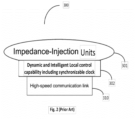
- Fig. 2 is an example improved IIM 300 (as disclosed in US Patent No. 10,218,175 , entitled “Dynamic and integrated control of total power system using distributed impedance injection modules and actuator devices within and at the edge of the power grid", that has an impedance generation and injection capability 301, a built-in dynamic and intelligent local control capability 302 with a synchronizable clock, and a high-speed (e.g., sub-cyclic) communication link capability 310.
- the IIM 300 with a synchronizable clock, uses a global clock available from the global positioning satellite (GPS) 307 as shown in Fig.
- GPS global positioning satellite
- the modules in the IIM 300 operate by extracting power from the HV transmission line 108.
- the power is extracted using a transformer 312 coupled to the HV transmission line 108 and connected to a sensor and power supply module 311 that is able to provide regulated power to the modules of the IIM 300.
- the power is extracted for control from a DC capacitor charged during operation of the circuit.
- the high-speed communication capability 310 enables the IIM 300 to effectively communicate with the neighboring IlMs 300 distributed on the high-voltage transmission lines of the power grid for providing distributed control and other FACTS based sensors and controllers on the power grid to coordinate actions for controlling the power-flow and responding to disturbances on the HV transmission lines of the power grid.
- the IIMs 300 of Fig. 2 may comprise one or more FACTS based impedance injection units (IIUs) 400 connected in sub-groups in a parallel-series configuration.
- the IIUs 400 typically used in the distributed IIM 300 are transformer-less FACTS (TL-FACTS) units connected directly in series with HV transmission line 108.
- T-FACTS transformer-less FACTS
- the parallel connected IIUs 400 forming IIU subgroups 500 are configured to carry a total line current while the series connected IIUs 400 or IIU subgroups 500 generate and inject inductive or capacitive impedance, that are cumulative, as required on to HV transmission lines 108 for power flow control.
- FIG. 4 shows a single example IIU 400 that uses four FACTS switches 405, each having a switch control 408A and a FACTS device 408B controlled by a master control 402 and a power supply 301 extracting power from the power line using the current transformer 304.
- Each of the example switches 405 use at least one FACTS device, in Fig. 4 , the FACTS device is an IGBT 408B with switch control 408A as the FACTS switch 405.
- the IIU 400 is shown as having four FACTS switches, and in this case IGBT switches, such embodiment is not meant to be limiting in terms of the number of IGBTs 408B used in each switch of each IIU 400 or the type of FACTS device used in each switch (e.g., alternating switching circuits that use thyristors or other switching devices may be used for impedance generation) as is well understood by people skilled in the art.
- the IIU 400 generates an impedance across the terminals 406A and 406B to be injected on to the HV transmission line. The injection is via terminals of the IIM 300 typically connected is series with the power line to which the IIM 300 is attached.
- the Prior Art document EP 3 614 519 A2 discloses a system for injecting impedance on to a high voltage transmission line.
- the system comprises a plurality of impedance injection units which are controller, wherein the controller is configured to synchronize the impedance injection units to provide a resulting pseudo-sinusoidal voltage.
- Document EP 2 2564 496 A1 discloses a power electronic converter for use in high voltage direct current power transmission and reactive power compensation, the power electronic converter comprising at least one converter limb including first and second DC terminals for connection in use to a DC network, and an AC terminal for connection in use to an AC network.
- Prior Art document US 6 008 633 A discloses a high-power grid-compatible converter-controlled, voltage-injecting phase-shifting transformer, comprising a converter, an energizer transformer connected the converter, and a booster transformer which has at least one phase connected to the converter.
- the converter has an excitation-side power converter with at least one phase intercoupled by a DC intermediate circuit to an output-side power converter with at least one phase
- a first aspect of the invention relates to an impedance injection unit (IIU) system.
- the system is configured to be connected to a high-voltage (HV) transmission line.
- the system has IlUs, and a controller.
- the controller is integrated with or coupled to the IIUs.
- the controller is to activate each of the IIUs in a sequence of activation in each of multiple successive time periods.
- the IIUs inject an impedance waveform onto a high voltage (HV) transmission line.
- the controller is to repeatedly change an ordering of IIUs in the sequence of activation from one successive time period to a next successive time. Changing the ordering is to equalize electrical stress across the IIUs over the successive time periods.
- the impedance injection unit (IIU) system comprise IlUs distributed across one or more impedance injection modules.
- the controller may comprise a computer readable media, preferably a tangible, non-transient computer readable media.
- the controller may be configured as a processing device connected to a computer readable media.
- the computer readable media has instructions for the processing device to perform various actions.
- the processing device is configured to activate each of multiple IIUs in sequences of activation in successive time periods. Such activation injects an impedance waveform onto a high voltage (HV) transmission line.
- HV high voltage
- the processing device is to repeat changing an ordering of IIUs in the sequences of activation in the successive time periods. The sequences of activation and changing the ordering of IIUs equalizes electrical stress across the IlUs.
- a second aspect of the invention relates to a method of operating an impedance injection unit (IIU) system.
- the method includes coupling the IIU system to a high-voltage (HV) transmission line.
- the method includes activating each of multiple IIUs in sequences of activation in successive time periods, to inject an impedance waveform onto the HV transmission line.
- the method includes repeatedly changing an ordering of IIUs in the sequences of activation in the successive time periods, to equalize electrical stress across the IlUs.
- IIMs Distributed impedance injection modules
- T-FACTS transformer-less flexible alternating current transmission system
- IIUs impedance injection units
- the first aspect of the invention relates to an impedance injection unit (IIU) system.
- the system is configured to be connected to a high-voltage (HV) transmission line.
- the system has IlUs, and a controller.
- the controller is integrated with or coupled to the IIUs.
- the controller is to activate each of the IIUs in a sequence of activation in each of multiple successive time periods.
- the IIUs inject an impedance waveform onto a high voltage (HV) transmission line.
- the controller is to repeatedly change an ordering of IlUs in the sequence of activation from one successive time periods to a next successive time. Changing the ordering is to equalize electrical stress across the IIUs over the successive time periods.
- the plurality of impedance injection units (IIU) of the system may be distributed across one or more impedance injection modules (IIM).
- the IIUs are configured typically as parallel connected sub-groups that are further connected in series to generate and inject impedance waveforms to control the power flow on high-voltage (HV) transmission lines.
- the injected waveform can be designed to be a pseudo-sinusoidal waveform by having each of the sub-groups generating impedances conforming to different start time, different durations and differing amplitudes of voltages to be injected and combined onto the HV transmission lines.
- the IIUs and/or the sub-groups of IIUs may be configured to generate a plurality of rectangular impedance injection waveforms, and a controller may be configured to control the multiple connection configurations of IIUs and/or sub-groups of IIUs to define a sequence of activation of the IIUs having a particular ordering of activation of the IIUs and/or group of IIUs for each time period.
- a controller may be configured to control the multiple connection configurations of IIUs and/or sub-groups of IIUs to define a sequence of activation of the IIUs having a particular ordering of activation of the IIUs and/or group of IIUs for each time period.
- the rectangular impedance injection waveforms are to combine and inject to the high voltage transmission line, to produce a pseudo-sinusoidal waveform on the high-voltage transmission line.
- Different sub-groups of IIUs may be connected forming groups of sub-groups of parallel connected IIUs.
- the controller may be configured to change the ordering of activation of the IIUs and/or group of IIUs in the sequence of activation in each of a plurality of successive time periods.
- the duty-cycle of operation for each sub-group may be different within the injecting sub-groups of IIUs. This duty-cycle differences proportionally impacts the electrical stress leading to variation in time-to-failure (TTF) of the components of the sub-groups.
- TTF time-to-failure
- temporal balancing may be applied by cycling the IIUs and/or subgroups of IIUs is herein described.
- Temporal balancing by cycling the IIUs and/or sub-groups of IIUs is to be interpreted as modifying the ordering of activation and/or the duty cycle and/or the duration of each injection of the IIUs and/or groups of IIUs in the sequence of activation of different time periods, so as to equalize the electrical and thermal stress received by each IIUs and/or sub-group of IIUs.
- the total time of operation of each of the IIUs (or sub-group of IIUs) along the plurality of successive time periods is equalized by means of the temporal balancing thereby equalizing the stress across.
- the reliability of any system is decided by the reliability of the component that has the highest failure rate, that is the component with the lowest reliability in operation. It is a requirement in the industry to improve the reliability and life-time of devices used in applications, especially in critical areas such as power grids supplying power across the nation.
- the application disclosed a method for improving the reliability of the FACTS based distributed IIMs 300.
- the failure of devices can be directly related to the stresses, electrical and thermal applied to the devices during operation. Hence it is advisable to ensure that the FACTS devices, currently, IGBTs 408B used in the IIU switches 401 all have similar electrical and thermal stress during operation.
- any dissimilarity in the stresses applied to the FACTS devices 408B used will result in proportional disparity in time to failure due to accelerated aging of the devices, higher applied stress resulting in shorter time to failure, for equivalent devices. It is hence a feature in various embodiments to equalize the cumulative stress on each of the FACTS devices 408B, used in the IIUs switches 401 of the IIUs 400 in the IlMs 300 distributed over the HV transmission lines 108 of the HV power grid 100.
- IIMs 300 comprising a plurality of transformer-less flexible alternating current transmission system (TL-FACTS) based impedance injection units (IIUs) 400. These IlUs 400 are used to generate impedance for injection.
- a group of IlUs 400 are configured as parallel connected sub-groups 500-x that are connected in series to generate and inject impedance to control the power flow on the HV transmission lines 108.
- the injected waveform is designed to be a pseudo-sinusoidal waveform by having each of the subgroups generate impedances conforming to different start times, different durations and different impedance voltage amplitudes to be injected and combined on to the HV transmission line.
- the duty-cycle of operation for each sub-group 500-x is different within the injecting sub-groups 500-x. This duty-cycle differences will proportionally impact the electrical stress leading to variation in time-to-failure (TTF) of the components of the sub-groups 500-x.
- TTF time-to-failure
- temporal balancing by cycling the sub-groups 500-x is herein described.
- the current trend is for using distributed impedance injection modules (IIMs) 300, to sense and control disturbances and power flow over the high voltage (HV) transmission lines 108 of the power grid 100.
- the distributed IIMs 300 comprise a plurality of transformer-less flexible alternating current transmission system (FACTS) based IlUs 400. (Though alternately IlMs with transformers may also be used.)
- the IlUs 400 generate and inject impedance of the correct magnitude and polarity onto the HV transmission lines 108 to control power flow and reduce the effect of disturbances.
- the distributed IIMs 300 are connected in series with the HV transmission line 108 and are rated to carry the maximum line current and are supported by the power lines 108 and insulated from the ground.
- each IIM 300 operates at the HV voltage of the HV transmission line 108.
- the distributed IIMs 300 operate by extracting power from the HV transmission line 108 to which they are coupled to generate and inject the impedances necessary to control and optimize the power flow over the HV power lines 108. Further, each IIM 300 is coupled directly to a high-voltage power transmission line 108 of the grid and operating by extracting power for sensing and control from the high-voltage transmission line 108 to which it is coupled.
- the plurality of IIUs 400 of each IIM 300 can be connected in a parallel-series configuration.
- Subgroups 500-n (where n is 1, 2, 3, 4, etc.) of parallel connected IlUs may be connected in series to form the IIM 300.
- the sub-groups of parallel connected IIUs 500-n within the IIM 300 are rated to carry a maximum line current.
- the series connection of the sub-groups 500-n can generate and inject impedance in a cumulative fashion on to the HV transmission line.
- Sub-groups 500-x of IIM 300 are configured to generate a rectangular impedance/voltage output 500-nv.
- IlUs 400 are described as connected in series parallel groups forming a single IIM 300, this is not to be considered limiting.
- the sub-groups of series parallel connected IIUs 500-n may be distributed over multiple IlMs as long as they are enabled to carry the rated maximum current. When so distributed they all operate under a designated controller as a master controller.
- Fig. 5 shows the use of sub-groups 500-n of IIUs 400 in parallel-serial connection for generation and injection of impedance.
- the IIU sub-blocks may be distributed across more than one IIM.
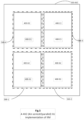
- Fig. 5 shows an example IIM 300 with four sub- groups 500-1 comprising IIUs 400-A1 and A2, 500-2 comprising IIUs 400-B1 and B2, 500-3 comprising IIUs 400-C1 and C2 and 500-4 comprising IIUs 400-D1 and D2.
- each sub-group is shown as having two IIUs 400 (e.g.
- the injected waveforms 500-1v to 500-4v are generated and injected to cumulatively add and produce the pseudo-sinusoidal injected impedance waveform 501.
- the pseudo-sinusoidal waveform is the sum of these rectangular waveforms 500-1v to 500-4v on the HV transmission line 108 smoothed to almost a sinusoidal waveform 501 as shown in Fig. 6 .
- This example describes only equal amplitude impedance generation, it should not be considered limiting.
- the pseudo-sinusoidal waveform may be generated by a combination of rectangular waveforms having differing voltage amplitudes within the understood constraints of the current application. The stress on the generating unit will then be proportional to the amplitude times total duration of generation as is well understood in the industry.
- the controller may be configured to implement a temporal balance by cycling the IIUs and/or sub-groups of IIUs such that the amplitude times total duration of generation is equalized across the plurality of IIUs.
- the IIM 300 may not have the number of IIU groups 500-1 to 500-4 available that are needed to generate the planned number of rectangular waveforms to be injected on to the HV transmission line.
- resources of more than one IIM 300 can be combined to generate the impedance steps of impedance injection waveforms 500-1v to 500-4v to be injected as they are connected in series on the HV transmission line 108. Since the local clocks 313 on the IIMs 300 operate from the same global clock from GPS 307 as previously indicated, the step impedance generation can be staggered across the IIU sub-groups 500-1 to 500-4 in the IIMs 300 generating the impedance injection waveforms 500-1v to 500-4v.
- Coordination and synchronization of impedance injection is handled by the master controller 402 within one of the IIMs 300. All the distributed IIMs 300 being configured with sufficient intelligence and processing capability and high-speed (e.g., sub-cyclic speed) communication capability of the IIM 300 for the purpose.
- one of the main problems of such impedance injection is the dissimilar electrical and thermal stress the various switching FACTS devices 408B in the IIU sub-groups 500-1 to 500-4 are subjected to. This is due to the differing switching durations defining the duration 'd' of each injection needed to generate the pseudo-sinusoidal injected waveform. Varying injection times (also called durations or injection durations) d1 to d4 are shown in the example implementation of Fig. 6 . Times d1 to d4 may create differential stresses for the FACTS devices 408B within the different IlUs of the IIU groups 500-1 to 500-4.
- the controller 402 may be further configured to cumulative count the sum of the injection durations d1 to d4 of each of the differing sub-groups of IIUs 500-1 to 500-4 in the plurality of successive time periods T1 to T4, such that the step of repeatedly change an ordering of the plurality of IIUs in the sequence of activation from one of the plurality of successive time periods T1 to T4 to a next one of the plurality of successive time periods T1 to T4 is carried out by the controller so that the sum of the injection durations d1 to d4 of each sub-group of IIUs 500-1 to 500-4 are made equal over the plurality of successive time periods T1 to T4.
- Fig. 7 shows an example and non-limiting embodiment that allow the equalization of electrical stress across the IIUs/IIU sub-groups used to generate the injected impedance waveform.
- the controller 402 (or, when the plurality of IIUs is distributed over one or more impedance injection modules IIMs, the master controller 402) may be configured to provide a rotating switching sequencing capability enabling the number of IIUs 400A1 to 400D4 forming IIU groups 500-1 to 500-4 to be sequentially switched in a predetermined order as shown by the arrows in the figure based on either a time period (i.e.
- each IIU 400 sub-group 500-1 to 500-4 is switched and sequentially rotated to generate and output a different duration of injected rectangular waveform 500-1v to 500-4v needed for the formation of the pseudo-sinusoidal waveform 501 on to the HV transmission line 108.
- Further sequences with various ordering of IIUs in sequences of activation, and various changes in ordering of IIUs in sequences of activation, to equalize electrical stress across the IIUs are readily devised in keeping with the teachings herein.
- Fig. 8 shows the effect of the rotational and sequential switching of the IIU groups 500-1 to 500-4, each IIU group generating and injecting a rectangular impedance waveform 500-1v to 500-4v in turn for generating the pseudo-sinusoidal wave form 501 of Fig. 6 according to one embodiment.
- the switched waveforms from all four example IIU groups 500-1 to 500-4 create the unequal electrical stress on the switching FACTS devices due the fixed injection durations d1 to d4 that are not equal, d1 creating the highest level of electrical and thermal stress on the FACTS devices generating the rectangular impedance waveform while d4 creating the least stress.
- the switched durations d1 to d4 from each of the IIU sub-groups 500-1 to 500-4 are changed and over the time period T each Illi sub-group in the example experience a similar electrical and thermal stress due to equal total duration D of switching.
- the total duration D of the injections performed by a given IIU or sub-group of IIUs is the sum of the injection durations d1 to d4 carried out by the respective IIU or sub-group of IIUs.
- the impedance injection related stress is therefore equalized over the different sub-groups of IIUs 500-1 to 500-4 in the timed rotational sequence.
- the total switched duration D for each sub-group of IIUs 500-1 to 500-4 and the electrical and thermal stress on the IIU sub-groups 500-1 to 500-4 and the associated FACTS devices may be equalized for each switching rotational sequence over the time period T as shown in Fig. 8 . This provides improves the operational lifetime of the FACTS devices used increasing the system reliability.
- the controller may be further configured for equalizing the electrical stress on the switching devices by changing the amplitude of the switched waveforms, equalizing the switched duration using short pulses etc. All these methods for equalizing the electrical stress are covered by the intent of this application. But, the preferred and example method for electrical stress equalization that is disclosed are the periodic rotational switching method either timed (i.e. based on a time period) or by injection count (i.e. based on the number of injected waveforms counted by the controller), that allows the stress across the number of IIU sub-groups and the FACTS devices used in the IIUs, to be equalized irrespective of the stress on each IIU and/or sub-group in any single time period.
- Fig. 9 is a flow chart of a method of operating an IIU system according to one embodiment.
- the method is practiced by the IIU system, and more specifically practiced by a controller, which could be a processing device, one or more processors, etc.
- the controller could be coupled to or integrated with the IIUs.
- the IIUs system may comprise one or more IlMs under the control of a designated master controller.
- the IIU system is coupled to a high-voltage transmission line.
- impedance injection terminals of the system are connected in series in the transmission line.
- the IIU system configured to operate under control of a master controller.
- the IIUs are activated in sequences of activation to inject an impedance voltage wave onto the HV transmission line. For example, individual IIUs or groups of IIUs are switched on and switched off for predetermined switching durations and/or or predetermined injection times, in a sequence.
- the ordering of IIUs and/or sub-groups of IIUs in sequences of activation is repeatedly changed, to equalize electrical stress across the IIUs.
- the ordering of IlUs and/or groups of IlUs that are activated for injection onto the HV line is rotated from one sequence to a next sequence (i.e. a sequence comprising a different ordering of activation of the IlUs and/or sub-group of IlUs).
- Rotational switching could proceed after a predetermined time period, or after a count of a predetermined number of injection cycles (i.e. a predetermined number of injected impedance waveforms), in various embodiments.
Landscapes
- Engineering & Computer Science (AREA)
- Power Engineering (AREA)
- Physics & Mathematics (AREA)
- Electromagnetism (AREA)
- General Physics & Mathematics (AREA)
- Radar, Positioning & Navigation (AREA)
- Automation & Control Theory (AREA)
- Inverter Devices (AREA)
- Control Of Electrical Variables (AREA)
Description
- The present disclosure relates to improving lifetime and reliability of devices and systems used in power systems, and specifically to balancing the electrical stress on the high current handling FACTS devices used in transformer-less flexible alternating current transmission system (TL-FACTS) based impedance injection units(IIUs) of intelligent impedance injection modules (IIMs) distributed over high voltage power lines to manage power flow on high voltage (HV) transmission lines of an HV power grid.
- Reliability of electronic devices is an important criterion for applications. This is especially true for flexible alternating current transmission system (FACTS) based control equipment and devices used in power distribution and on high-voltage power grids. These FACTS based devices for power flow control and for responding to disturbances on HV transmission lines have to have very high reliability as any maintenance on these equipment or devices used will require shutting down the HV power grid for a duration disrupting the delivery of power to load locations.
- Distributed impedance injection modules (IIMs) 102 are distributed and coupled to
HV transmission lines 108 as shown in an exampleHV power grid 100 ofFig. 1 . TheHV transmission lines 108 of theHV power grid 100 are used to transfer power fromgenerators 104 to loads 106. -
Fig. 2 is an example improved IIM 300 (as disclosed inUS Patent No. 10,218,175 injection capability 301, a built-in dynamic and intelligentlocal control capability 302 with a synchronizable clock, and a high-speed (e.g., sub-cyclic)communication link capability 310. Typically, the IIM 300, with a synchronizable clock, uses a global clock available from the global positioning satellite (GPS) 307 as shown inFig. 3 to synchronize its actions locally using alocal clock module 313 and an intelligent control (using sensor inputs and powerful processors included therein)capability 314. The high-speed (e.g., sub-cyclic speed) communication capability is used for synchronizing the operation of the IIM 300 with neighboringIIMs 300 and other FACTS based sensors and controllers on the power grid. The modules in the IIM 300 operate by extracting power from theHV transmission line 108. In some embodiments, the power is extracted using atransformer 312 coupled to theHV transmission line 108 and connected to a sensor andpower supply module 311 that is able to provide regulated power to the modules of the IIM 300. In other embodiments, the power is extracted for control from a DC capacitor charged during operation of the circuit. The high-speed communication capability 310 enables the IIM 300 to effectively communicate with the neighboring IlMs 300 distributed on the high-voltage transmission lines of the power grid for providing distributed control and other FACTS based sensors and controllers on the power grid to coordinate actions for controlling the power-flow and responding to disturbances on the HV transmission lines of the power grid. - Referring to
Fig. 4 , theIIMs 300 ofFig. 2 may comprise one or more FACTS based impedance injection units (IIUs) 400 connected in sub-groups in a parallel-series configuration. TheIIUs 400 typically used in thedistributed IIM 300 are transformer-less FACTS (TL-FACTS) units connected directly in series withHV transmission line 108. The parallel connectedIIUs 400 forming IIU subgroups 500 are configured to carry a total line current while the series connectedIIUs 400 or IIU subgroups 500 generate and inject inductive or capacitive impedance, that are cumulative, as required on toHV transmission lines 108 for power flow control.Fig. 4 shows a single example IIU 400 that uses fourFACTS switches 405, each having aswitch control 408A and a FACTS device 408B controlled by amaster control 402 and apower supply 301 extracting power from the power line using thecurrent transformer 304. Each of theexample switches 405 use at least one FACTS device, inFig. 4 , the FACTS device is an IGBT 408B withswitch control 408A as theFACTS switch 405. Though theIIU 400 is shown as having four FACTS switches, and in this case IGBT switches, such embodiment is not meant to be limiting in terms of the number of IGBTs 408B used in each switch of eachIIU 400 or the type of FACTS device used in each switch (e.g., alternating switching circuits that use thyristors or other switching devices may be used for impedance generation) as is well understood by people skilled in the art. In one embodiment, the IIU 400 generates an impedance across theterminals 406A and 406B to be injected on to the HV transmission line. The injection is via terminals of the IIM 300 typically connected is series with the power line to which the IIM 300 is attached. - At this point, the Prior
Art document EP 3 614 519 A2 is identified. This document discloses a system for injecting impedance on to a high voltage transmission line. The system comprises a plurality of impedance injection units which are controller, wherein the controller is configured to synchronize the impedance injection units to provide a resulting pseudo-sinusoidal voltage. - The Prior Art document
US 2015/316948 A1 discloses a method for distributing the total power of an energy conversion device between at least two coverts in said conversion device. -
Document EP 2 2564 496 A1 - HAN B ET AL: "Dynamic Characteristic Analysis of SSSC Basedon Multi bridge Inverter", IEEE TRANSACTIONS ON POWER DELIVERY, IEEE SERVICE CENTER, NEW YORK, NY, US, vol. 17, no. 2, 1 April 2002 (2002-04-01 ), pages 623-629, XP011078787, ISSN: 0885-8977, DOI: 10.1109/61.9979, this paper proposes a static synchronous series compensator based on a multibridge inverter. The proposed system consists of six H-bridge modules per phase which generate 13 pulses for each half period of power frequency.
- AINSWORTH J D ET AL: "Static VAr compensator (ST AT COM) based on single-phase chain circuit converters", IEE PROCEEDINGS: GENERATION, TRANSMISSION AND DISTRIBUTION, INSTITUTION OF ELECTRICAL ENGINEERS, GB, vol. 145, no. 4, 15 July 1998 (1998-07-15), pages 381-386, XP006011181, ISSN: 1350-2360, DOI: 10.1049/IP-GTD:19982032, this paper proposes voltage-sourced converter circuits using gate turn-off (GTO) thyristors as an alternative means of providing static VAr compensation (SVC)
- Prior Art document
US 6 008 633 A discloses a high-power grid-compatible converter-controlled, voltage-injecting phase-shifting transformer, comprising a converter, an energizer transformer connected the converter, and a booster transformer which has at least one phase connected to the converter. The converter has an excitation-side power converter with at least one phase intercoupled by a DC intermediate circuit to an output-side power converter with at least one phase - The invention is defined by the features of the
independent claims - Various embodiments of an impedance injection unit system, and related method of operation, are described herein.
- A first aspect of the invention relates to an impedance injection unit (IIU) system. The system is configured to be connected to a high-voltage (HV) transmission line. The system has IlUs, and a controller. The controller is integrated with or coupled to the IIUs. The controller is to activate each of the IIUs in a sequence of activation in each of multiple successive time periods. The IIUs inject an impedance waveform onto a high voltage (HV) transmission line. The controller is to repeatedly change an ordering of IIUs in the sequence of activation from one successive time period to a next successive time. Changing the ordering is to equalize electrical stress across the IIUs over the successive time periods.
- In one embodiment the impedance injection unit (IIU) system comprise IlUs distributed across one or more impedance injection modules.
- In one embodiment the controller may comprise a computer readable media, preferably a tangible, non-transient computer readable media. The controller may be configured as a processing device connected to a computer readable media. The computer readable media has instructions for the processing device to perform various actions. The processing device is configured to activate each of multiple IIUs in sequences of activation in successive time periods. Such activation injects an impedance waveform onto a high voltage (HV) transmission line. The processing device is to repeat changing an ordering of IIUs in the sequences of activation in the successive time periods. The sequences of activation and changing the ordering of IIUs equalizes electrical stress across the IlUs.
- A second aspect of the invention relates to a method of operating an impedance injection unit (IIU) system. The method includes coupling the IIU system to a high-voltage (HV) transmission line. The method includes activating each of multiple IIUs in sequences of activation in successive time periods, to inject an impedance waveform onto the HV transmission line. The method includes repeatedly changing an ordering of IIUs in the sequences of activation in the successive time periods, to equalize electrical stress across the IlUs.
- Embodiments of the disclosure are illustrated by way of example and not limitation in the figures of the accompanying drawings in which like references indicate similar elements.
-
Figure 1 is a diagram illustrating a conventional power grid system with a distributed and hierarchical intelligent control system. -
Figure 2 is a block diagram illustrating a conventional dynamic intelligent impedance injection module with time synchronization and high speed communication capability. -
Figure 3 is a block diagram illustrating powering an IIM from the HV power line & time synchronization of the IIM using the GPS clock. -
Figure 4 is a circuit diagram illustrating an example of a transformer-less flexible alternating current (AC) transmission system (TL-FACTS) based impedance injection unit (IIU), where one or more IIUs may constitute an impedance injection module (IIM). -
Figure 5 is an example block diagram illustrating an IIM having 4 IIU sub-blocks each with 2 IlUs in parallel, connected in series. -
Figure 6 is an example illustrative diagram of the IIM ofFig. 5 providing rectangular wave forms in a synchronized fashion (both start time, stop time and duration). The generated rectangular waveforms when injected combine to form a pseudo-sinusoidal wave on to the HV transmission line. -
Figure 7 shows an embodiment using duration based rotation of the injected output from the four groups of I IIUs ofFig. 5 with synchronized under control of the master controller to equalize the electrical stress across all injecting sub-groups of the IlUs. -
Figure 8 shows the 4 steps injection rotation and the injected wave form for generating and injecting the pseudo-sinusoidal waveform at each time duration during rotation. -
Figure 9 is a flow chart of a method of operating an IIU system according to one embodiment. -
- 100 - an exemplary grid
- 102 - Impedance injection module (IIM)
- 106 - Loads
- 104 - Generators
- 108 - High voltage (HV) transmission line
- 300 - Upgraded IIM with intelligence and high speed communication capability
- 301 - Impedance injection circuit
- 307 - GPS satellite
- 310 - High-speed wireless com-link
- 311 - Sensor and Power supply
- 312 - Transformer coupled to power line
- 313 - Synchronizable local clock
- 314 - Intelligent controller
- 400 - IIM with a single Impedance Injection Unit (IIU)
- 401 - Impedance Injection Unit
- 405 - FACTS switch
- 408A - individual FACTS device control
- injection from 408B - IGBT (FACTS)Switch device
- 402 - Master Control--Intelligent with clock
- 403 - Intelligent controller
- 406A and 406B - Impedance injection terminals
- 409 - DC Capacitor/ DC voltage
- 500-1 to 500-4 - parallel connected IIU sub- groups in the 300(4X2) IIM
- 500-n - IIU sub-group
- 500-xv - impedance injection from each IIU sub-group 500
- 501 - Smoothed injected waveform injected
- ti - start time of injection from i-th group
- ti' - stop time of injection from i-th sub-group
- T1 to T4 - Time periods for synched rotation of injection modules
- Duration of to generate exemplary pseudo sinusoidal waveform shown = d1 to d4
- Total duration of switched wave forms = D= d1+d2+d3+d4
- Rotational Sequential duration for the four Illi groups =T1 to T4
- Total rotation time used in the exemplary implementation = T1+T2+T3+T4 =T
- Distributed impedance injection modules (IIMs) comprising a plurality of transformer-less flexible alternating current transmission system (TL-FACTS) based impedance injection units (IIUs), are used to generate impedance for injection.
- The first aspect of the invention relates to an impedance injection unit (IIU) system. The system is configured to be connected to a high-voltage (HV) transmission line. The system has IlUs, and a controller. The controller is integrated with or coupled to the IIUs. The controller is to activate each of the IIUs in a sequence of activation in each of multiple successive time periods. The IIUs inject an impedance waveform onto a high voltage (HV) transmission line. The controller is to repeatedly change an ordering of IlUs in the sequence of activation from one successive time periods to a next successive time. Changing the ordering is to equalize electrical stress across the IIUs over the successive time periods.
- The plurality of impedance injection units (IIU) of the system may be distributed across one or more impedance injection modules (IIM).
- The IIUs are configured typically as parallel connected sub-groups that are further connected in series to generate and inject impedance waveforms to control the power flow on high-voltage (HV) transmission lines. The injected waveform can be designed to be a pseudo-sinusoidal waveform by having each of the sub-groups generating impedances conforming to different start time, different durations and differing amplitudes of voltages to be injected and combined onto the HV transmission lines. The IIUs and/or the sub-groups of IIUs may be configured to generate a plurality of rectangular impedance injection waveforms, and a controller may be configured to control the multiple connection configurations of IIUs and/or sub-groups of IIUs to define a sequence of activation of the IIUs having a particular ordering of activation of the IIUs and/or group of IIUs for each time period. When the rectangular impedance injection waveforms are combined and injected (i.e. they are combined by being sequentially injected following a sequence of activation) to the high voltage transmission line, this produces a pseudo-sinusoidal waveform. Thus, the rectangular impedance injection waveforms are to combine and inject to the high voltage transmission line, to produce a pseudo-sinusoidal waveform on the high-voltage transmission line. Different sub-groups of IIUs may be connected forming groups of sub-groups of parallel connected IIUs. The controller may be configured to change the ordering of activation of the IIUs and/or group of IIUs in the sequence of activation in each of a plurality of successive time periods.
- The duty-cycle of operation for each sub-group may be different within the injecting sub-groups of IIUs. This duty-cycle differences proportionally impacts the electrical stress leading to variation in time-to-failure (TTF) of the components of the sub-groups. In order to equalize the electrical stress and TTF of the components, temporal balancing may be applied by cycling the IIUs and/or subgroups of IIUs is herein described. Temporal balancing by cycling the IIUs and/or sub-groups of IIUs is to be interpreted as modifying the ordering of activation and/or the duty cycle and/or the duration of each injection of the IIUs and/or groups of IIUs in the sequence of activation of different time periods, so as to equalize the electrical and thermal stress received by each IIUs and/or sub-group of IIUs. Thus, the total time of operation of each of the IIUs (or sub-group of IIUs) along the plurality of successive time periods is equalized by means of the temporal balancing thereby equalizing the stress across.
- As is well understood, the reliability of any system (without redundancy built-in) is decided by the reliability of the component that has the highest failure rate, that is the component with the lowest reliability in operation. It is a requirement in the industry to improve the reliability and life-time of devices used in applications, especially in critical areas such as power grids supplying power across the nation. The application disclosed a method for improving the reliability of the FACTS based distributed
IIMs 300. The failure of devices can be directly related to the stresses, electrical and thermal applied to the devices during operation. Hence it is advisable to ensure that the FACTS devices, currently, IGBTs 408B used in the IIU switches 401 all have similar electrical and thermal stress during operation. Any dissimilarity in the stresses applied to the FACTS devices 408B used will result in proportional disparity in time to failure due to accelerated aging of the devices, higher applied stress resulting in shorter time to failure, for equivalent devices. It is hence a feature in various embodiments to equalize the cumulative stress on each of the FACTS devices 408B, used in the IIUs switches 401 of theIIUs 400 in theIlMs 300 distributed over theHV transmission lines 108 of theHV power grid 100. - Current impedance injection modules (IIM)s 300 comprising a plurality of transformer-less flexible alternating current transmission system (TL-FACTS) based impedance injection units (IIUs) 400. These
IlUs 400 are used to generate impedance for injection. Referring toFig. 5 , a group ofIlUs 400 are configured as parallel connected sub-groups 500-x that are connected in series to generate and inject impedance to control the power flow on theHV transmission lines 108. The injected waveform is designed to be a pseudo-sinusoidal waveform by having each of the subgroups generate impedances conforming to different start times, different durations and different impedance voltage amplitudes to be injected and combined on to the HV transmission line. The duty-cycle of operation for each sub-group 500-x is different within the injecting sub-groups 500-x. This duty-cycle differences will proportionally impact the electrical stress leading to variation in time-to-failure (TTF) of the components of the sub-groups 500-x. In order to equalize the electrical stress and TTF of the components, of theIIUs 400, temporal balancing by cycling the sub-groups 500-x is herein described. - The current trend is for using distributed impedance injection modules (IIMs) 300, to sense and control disturbances and power flow over the high voltage (HV)
transmission lines 108 of thepower grid 100. The distributedIIMs 300 comprise a plurality of transformer-less flexible alternating current transmission system (FACTS) basedIlUs 400. (Though alternately IlMs with transformers may also be used.) TheIlUs 400 generate and inject impedance of the correct magnitude and polarity onto theHV transmission lines 108 to control power flow and reduce the effect of disturbances. The distributedIIMs 300 are connected in series with theHV transmission line 108 and are rated to carry the maximum line current and are supported by thepower lines 108 and insulated from the ground. They operate at the HV voltage of theHV transmission line 108. The distributedIIMs 300 operate by extracting power from theHV transmission line 108 to which they are coupled to generate and inject the impedances necessary to control and optimize the power flow over theHV power lines 108. Further, eachIIM 300 is coupled directly to a high-voltagepower transmission line 108 of the grid and operating by extracting power for sensing and control from the high-voltage transmission line 108 to which it is coupled. - The plurality of
IIUs 400 of eachIIM 300 can be connected in a parallel-series configuration. Subgroups 500-n (where n is 1, 2, 3, 4, etc.) of parallel connected IlUs may be connected in series to form theIIM 300. The sub-groups of parallel connected IIUs 500-n within theIIM 300, are rated to carry a maximum line current. The series connection of the sub-groups 500-n can generate and inject impedance in a cumulative fashion on to the HV transmission line. Sub-groups 500-x ofIIM 300 are configured to generate a rectangular impedance/voltage output 500-nv. - Though the groups of
IlUs 400 are described as connected in series parallel groups forming asingle IIM 300, this is not to be considered limiting. The sub-groups of series parallel connected IIUs 500-n may be distributed over multiple IlMs as long as they are enabled to carry the rated maximum current. When so distributed they all operate under a designated controller as a master controller. - In order to reduce the possibility of distortion and harmonics due to the large rectangular impedance injection on the
HV transmission line 108, it is ideal if a waveform that approximates a sinusoidal waveform similar to 501, can be generated and injected on to the HV transmission line108. It is possible to generate a pseudo-sinusoidal waveform by having the various sub-groups of parallel connected IlUs 500-1 to 500-4, connected in series, activating and injecting rectangular impedances of differing durations and amplitudes (e.g., voltages) in a synchronized and timed start and stop fashion, which may be termed a sequence of activation of IIUs. These rectangular impedances, when injected on to theHV power line 108, combine together and get smoothed to form the approximation ofsinusoidal waveform 501 when on theHV power line 108. This implementation though effective may require a number of sub-groups of IIUs in series, more than the number available in eachIIM 300. It is then possible to use theIIUs 400 or IIU groups within a plurality ofIIMs 300, as theIlMs 300 are in series on theHV transmission line 108. -
Fig. 5 shows the use of sub-groups 500-n ofIIUs 400 in parallel-serial connection for generation and injection of impedance. In some embodiments, the IIU sub-blocks may be distributed across more than one IIM.Fig. 5 shows anexample IIM 300 with four sub- groups 500-1 comprising IIUs 400-A1 and A2, 500-2 comprising IIUs 400-B1 and B2, 500-3 comprising IIUs 400-C1 and C2 and 500-4 comprising IIUs 400-D1 and D2. In the figure each sub-group is shown as having two IIUs 400 (e.g. 400-A1 and A2 in group A to 400-D1 and D2 in Group D) connected in parallel to increase the current carrying capability of the series connected Illi sub-groups 500-n. These four subgroups 500-1 to 500-4 are connected in series and synchronized in time to generate and inject rectangular impedance steps that additively combine on theHV transmission line 108 as shown inFig. 6 to produce thepseudo-sinusoidal waveform 501. By staggering the start time ti and the stop time ti', the duration of each of the generated rectangular impedance injection waveform is adjusted to produce the plurality of impedance steps. The injected waveforms 500-1v to 500-4v are generated and injected to cumulatively add and produce the pseudo-sinusoidal injectedimpedance waveform 501. The pseudo-sinusoidal waveform is the sum of these rectangular waveforms 500-1v to 500-4v on theHV transmission line 108 smoothed to almost asinusoidal waveform 501 as shown inFig. 6 . Though this example describes only equal amplitude impedance generation, it should not be considered limiting. The pseudo-sinusoidal waveform may be generated by a combination of rectangular waveforms having differing voltage amplitudes within the understood constraints of the current application. The stress on the generating unit will then be proportional to the amplitude times total duration of generation as is well understood in the industry. Equalization of this type of unequal stress is also covered by the disclosure and claimed invention. Therefore, the controller may be configured to implement a temporal balance by cycling the IIUs and/or sub-groups of IIUs such that the amplitude times total duration of generation is equalized across the plurality of IIUs. - In some embodiments the
IIM 300 may not have the number of IIU groups 500-1 to 500-4 available that are needed to generate the planned number of rectangular waveforms to be injected on to the HV transmission line. In this case, resources of more than oneIIM 300 can be combined to generate the impedance steps of impedance injection waveforms 500-1v to 500-4v to be injected as they are connected in series on theHV transmission line 108. Since thelocal clocks 313 on theIIMs 300 operate from the same global clock fromGPS 307 as previously indicated, the step impedance generation can be staggered across the IIU sub-groups 500-1 to 500-4 in theIIMs 300 generating the impedance injection waveforms 500-1v to 500-4v. - Coordination and synchronization of impedance injection is handled by the
master controller 402 within one of theIIMs 300. All the distributedIIMs 300 being configured with sufficient intelligence and processing capability and high-speed (e.g., sub-cyclic speed) communication capability of theIIM 300 for the purpose. - As discussed previously, one of the main problems of such impedance injection is the dissimilar electrical and thermal stress the various switching FACTS devices 408B in the IIU sub-groups 500-1 to 500-4 are subjected to. This is due to the differing switching durations defining the duration 'd' of each injection needed to generate the pseudo-sinusoidal injected waveform. Varying injection times (also called durations or injection durations) d1 to d4 are shown in the example implementation of
Fig. 6 . Times d1 to d4 may create differential stresses for the FACTS devices 408B within the different IlUs of the IIU groups 500-1 to 500-4. This differential stress levels, if not equalized can impact the lifetime of the FACTS devices differently and reduce the reliability of the IIUs impacted by the higher stress and hence theIIMs 300. In order to maximize the reliability of the FACTS devices and achieve highest operating life-times, it is necessary to stress all FACTS devices generating the step waveforms equally over time. This means that the cumulative time the injection units are turned on has to be made equal across the number ofIIUs 400 used for generating the injected pseudo-sinusoidal waveform. In other words, thecontroller 402 may be further configured to cumulative count the sum of the injection durations d1 to d4 of each of the differing sub-groups of IIUs 500-1 to 500-4 in the plurality of successive time periods T1 to T4, such that the step of repeatedly change an ordering of the plurality of IIUs in the sequence of activation from one of the plurality of successive time periods T1 to T4 to a next one of the plurality of successive time periods T1 to T4 is carried out by the controller so that the sum of the injection durations d1 to d4 of each sub-group of IIUs 500-1 to 500-4 are made equal over the plurality of successive time periods T1 to T4. -
Fig. 7 shows an example and non-limiting embodiment that allow the equalization of electrical stress across the IIUs/IIU sub-groups used to generate the injected impedance waveform. InFig. 7 , the controller 402 (or, when the plurality of IIUs is distributed over one or more impedance injection modules IIMs, the master controller 402) may be configured to provide a rotating switching sequencing capability enabling the number of IIUs 400A1 to 400D4 forming IIU groups 500-1 to 500-4 to be sequentially switched in a predetermined order as shown by the arrows in the figure based on either a time period (i.e. by assigning a respective ordering in the sequence of activation of the IIUs and/or group of IIUs for each time period, so that the rotating switching sequence is configured to equalize the stress of the IIUs and/or sub-groups of IIUs over the plurality of successive time periods; wherein the ordering of sequence of activation may be repeated after a predetermined number of time periods) or the number of injected waveforms (i.e. by further configuring the controller to count the number of injected waveforms of each Illi and/or group of IIUs of IlUs as a basis for a sequential switching, such that the switching is carried out after a predetermined counted number of injected waveforms).Fig. 8 shows one such example sequence where eachIIU 400 sub-group 500-1 to 500-4 is switched and sequentially rotated to generate and output a different duration of injected rectangular waveform 500-1v to 500-4v needed for the formation of thepseudo-sinusoidal waveform 501 on to theHV transmission line 108. Further sequences with various ordering of IIUs in sequences of activation, and various changes in ordering of IIUs in sequences of activation, to equalize electrical stress across the IIUs are readily devised in keeping with the teachings herein. -
Fig. 8 shows the effect of the rotational and sequential switching of the IIU groups 500-1 to 500-4, each IIU group generating and injecting a rectangular impedance waveform 500-1v to 500-4v in turn for generating thepseudo-sinusoidal wave form 501 ofFig. 6 according to one embodiment. In previous embodiments for generating the pseudo-sinusoidal waveform with no sequential rotation of theIIU 400 sub-groups, the switched waveforms from all four example IIU groups 500-1 to 500-4 create the unequal electrical stress on the switching FACTS devices due the fixed injection durations d1 to d4 that are not equal, d1 creating the highest level of electrical and thermal stress on the FACTS devices generating the rectangular impedance waveform while d4 creating the least stress. - By implementing the current method of sequential rotation of IIU groups 500-1 to 500-4 that are switched in a pre-established rotational sequence of sequences of activation by instructions provided by the controller or
master controller 402, the switching durations are averaged over a rotational total time period T comprising a predetermined plurality of successive time periods as, for example: T=T1+T2+T3+T4, where T1 to T4 being equal intervals. This results in the period in each injection mode waveform 500-1v to 500-4v for each IIU group 500-1 to 500-4 being equal to T/4. The total duration D of the injected impedances comprises the sum of the individual durations 'd' of each injected rectangular impedance waveform. Thus, the total duration D of the injected/switched impedances from the four IIU sub-groups 500-1 to 500-4 shown inFig. 5 is then D= d1+d2+d3+d4 as shown inFig. 8 . By enabling such rotational switching sequence, the switched durations d1 to d4 from each of the IIU sub-groups 500-1 to 500-4 are changed and over the time period T each Illi sub-group in the example experience a similar electrical and thermal stress due to equal total duration D of switching. The total duration D of the injections performed by a given IIU or sub-group of IIUs is the sum of the injection durations d1 to d4 carried out by the respective IIU or sub-group of IIUs. The impedance injection related stress is therefore equalized over the different sub-groups of IIUs 500-1 to 500-4 in the timed rotational sequence. Hence the total switched duration D for each sub-group of IIUs 500-1 to 500-4 and the electrical and thermal stress on the IIU sub-groups 500-1 to 500-4 and the associated FACTS devices may be equalized for each switching rotational sequence over the time period T as shown inFig. 8 . This provides improves the operational lifetime of the FACTS devices used increasing the system reliability. - In another example embodiment used instead of fixing the switching time period as T1 to T4 each being an equal elapsed time period from last rotational switching, it is possible to use a count of the number of injection cycles of each IIU or sub-group of IIUs (i.e. the number of impedance waveforms injected by each IIU or sub-group of IlUs) as basis for sequential rotational switching. In this case the rotational switching happens after 'n' (predetermined number) injection cycles. Such a system is usable when the injection of impedance on to the
HV transmission line 108 is not uniform over time but is dependent on the changes in power flow and other disturbances sensed on theHV Transmission line 108. The controller or the master controller (when the plurality of IIUs is distributed over one or more impedance injection modules IIMs) has to keep a count of the injection cycles and after 'n' cycles a rotational switching is implemented. - The controller may be further configured for equalizing the electrical stress on the switching devices by changing the amplitude of the switched waveforms, equalizing the switched duration using short pulses etc. All these methods for equalizing the electrical stress are covered by the intent of this application. But, the preferred and example method for electrical stress equalization that is disclosed are the periodic rotational switching method either timed (i.e. based on a time period) or by injection count (i.e. based on the number of injected waveforms counted by the controller), that allows the stress across the number of IIU sub-groups and the FACTS devices used in the IIUs, to be equalized irrespective of the stress on each IIU and/or sub-group in any single time period.
-
Fig. 9 is a flow chart of a method of operating an IIU system according to one embodiment. The method is practiced by the IIU system, and more specifically practiced by a controller, which could be a processing device, one or more processors, etc. The controller could be coupled to or integrated with the IIUs. The IIUs system may comprise one or more IlMs under the control of a designated master controller. - In an
action 902, the IIU system is coupled to a high-voltage transmission line. For example, impedance injection terminals of the system are connected in series in the transmission line. The IIU system configured to operate under control of a master controller. - In an
action 904, the IIUs are activated in sequences of activation to inject an impedance voltage wave onto the HV transmission line. For example, individual IIUs or groups of IIUs are switched on and switched off for predetermined switching durations and/or or predetermined injection times, in a sequence. - In an
action 906, the ordering of IIUs and/or sub-groups of IIUs in sequences of activation is repeatedly changed, to equalize electrical stress across the IIUs. For example, the ordering of IlUs and/or groups of IlUs that are activated for injection onto the HV line is rotated from one sequence to a next sequence (i.e. a sequence comprising a different ordering of activation of the IlUs and/or sub-group of IlUs). Rotational switching could proceed after a predetermined time period, or after a count of a predetermined number of injection cycles (i.e. a predetermined number of injected impedance waveforms), in various embodiments. - Even though the invention disclosed is described using specific embodiments, it is intended only to be examples and non-limiting. People skilled in the art will be able to understand and modify the same based on new innovations and concepts, as they are made available. The invention is intended to encompass these modifications.
- The present disclosure has a number of aspects which may be practiced alone or in various combinations or sub-combinations, as desired. Also while certain embodiments of the present invention have been disclosed and described herein for purposes of illustration and not for purposes of limitation, it will be understood by those skilled in the art that various changes in form and detail may be made therein without departing from the spirit and scope of the invention as defined by the appended claims.
Claims (14)
- An impedance injection unit , IIU, system configured to be connected to a high voltage HV transmission line (108), comprising:a plurality of IIUs (401) configured to generate a plurality of rectangular impedance waveforms; anda controller (402), integrated with or coupled to the plurality of IIUs (400-A1, 400-A2, 400-B1, 400-B2, 400-C1, 400-C2, 400-D1, 400-D2, 400);wherein the controller is configured to:activate each of the plurality of IIUs in a sequence of activation in each of a plurality of successive time periods (T1, T2, T3, T4) such that the plurality of rectangular waveforms are injected to form a pseudo-sinusoidal impedance waveform onto a high voltage HV transmission line; andrepeatedly change an ordering of IIUs (400-A1, 400-A2, 400-B1, 400-B2, 400-C1, 400-C2, 400-D1, 400-D2, 400) in the sequence of activation from one of the plurality of successive time periods (T1, T2, T3, T4) to a next one of the plurality of successive time periods (T1, T2, T3, T4), such that the electrical stress across the plurality of IIUs (400-A1, 400-A2, 400-B1, 400-B2, 400-C1, 400-C2, 400-D1, 400-D2, 400) over the plurality of successive time periods (T1, T2, T3, T4) is equalized;wherein at least a part of the plurality of IIUs (400-A1, 400-A2, 400-B1, 400-B2, 400-C1, 400-C2, 400-D1, 400-D2) are connected forming at least one sub-group of IIUs (500-1, 500-2, 500-3, 500-4), each sub-group of IIUs (500-1, 500-2, 500-3, 500-4) comprising at least two parallel connected IIUs (400-A1, 400-A2, 400-B1, 400-B2, 400-C1, 400-C2, 400-D1, 400-D2); andwherein the controller (402) is further configured to cumulative count the sum of the injection durations (d1, d2, d3, d4) of each IIU and/or sub-groups of IIUs (500-1, 500-2, 500-3, 500-4) in the plurality of successive time periods (T1, T2, T3, T4), such that the step of repeatedly change an ordering of the plurality of IIUs (400-A1, 400-A2, 400-B1, 400-B2, 400-C1, 400-C2, 400-D1, 400-D2) in the sequence of activation from one of the plurality of successive time periods (T1, T2, T3, T4) to a next one of the plurality of successive time periods (T1, T2, T3, T4) is carried out by the controller so that the sum (D) of the injection durations (d1, d2, d3, d4) of each IIU and/or sub-group of IIUs (500-1, 500-2, 500-3, 500-4) is equal over the plurality of successive time periods (T1, T2, T3, T4).
- The IIU system of claim 1, wherein the controller (402) is further configured such that repeatedly change an ordering of the plurality of IIUs 400-A1, 400-A2, 400-B1, 400-B2, 400-C1, 400-C2, 400-D1, 400-D2, 400) in the sequence of activation from one of the plurality of successive time periods (T1, T2, T3, T4) to a next one of the plurality of successive time periods (T1, T2, T3, T4) further comprises to repeatedly change the ordering of the plurality of IIUs (400-A1, 400-A2, 400-B1, 400-B2, 400-C1, 400-C2, 400-D1, 400-D2, 400) in the sequence of activation from each of the plurality of successive time periods (T1, T2, T3, T4) to the next one of the plurality of successive time periods(T1, T2, T3, T4).
- The IIU system of claims 1 or 2, wherein the controller is further configured such that repeatedly change an ordering of IIUs in the sequence of activation from one of the plurality of successive time periods (T1, T2, T3, T4) to a next one of the plurality of successive time periods (T1, T2, T3, T4) further comprises a rotation of the sequence, preferably by implementing a rotational and sequential switching of the plurality of IIUs 400-A1, 400-A2, 400-B1, 400-B2, 400-C1, 400-C2, 400-D1, 400-D2, 400) controlled by the controller (402).
- The IIU system of any of the preceding claims, wherein the controller (402) is further configured such that the sequence of activation further comprises a plurality of differing injection durations (d1, d2, d3, d4) for the plurality of rectangular waveforms generated by the plurality of IIUs (400-A1, 400-A2, 400-B1, 400-B2, 400-C1, 400-C2, 400-D1, 400-D2).
- The IIU system of claim of any of the preceding claims,wherein the sub-groups of IIUs (500-1, 500-2, 500-3, 500-4) are series connected to each other and/or to the rest of IlUs; and/orwherein each sub-group of IIUs (500-1, 500-2, 500-3, 500-4) is configured to generate a rectangular impedance waveform.
- The IIU system of claim 5, wherein the controller (402) is further configured to perform temporal balancing of the activation across the plurality of IlUs (400-A1, 400-A2, 400-B1, 400-B2, 400-C1, 400-C2, 400-D1, 400-D2, 400), preferably by cycling IIUs and/or sub-groups of IIUs (500-1, 500-2, 500-3, 500-4).
- The IIU system of claims 5 or 6,
wherein the controller (402) is further configured such that the sequence of activation further comprises activating and deactivating differing IIUs and/or sub-groups of IIUs (500-1, 500-2, 500-3, 500-4) for differing injection durations (d1, d2, d3, d4) in the sequence. - The IIU system of any of the preceding claims, wherein to repeatedly change an ordering of the plurality of IIUs (400-A1, 400-A2, 400-B1, 400-B2, 400-C1, 400-C2, 400-D1, 400-D2) in the sequence of activation the controller (402) is further configured to count a number of injection cycles of each IIU or sub-group of IIUs (500-1, 500-2, 500-3, 500-4) as a basis for sequential rotational switching, and implement a rotational switching after a predetermined count of the injection cycles.
- The IIU system of any of the preceding claims, wherein the sequence of activation further comprises a plurality of differing voltage amplitudes for the plurality of rectangular waveforms.
- The IIU system of any of the preceding claims, wherein the plurality of IIUs is distributed over one or more impedance injection modules IIMs (300) and operates under the control of a designated master controller (402).
- The IIU system according to any of the preceding claims, wherein the controller (402) is configured as a processing device and a computer-readable media;wherein the computer-readable media comprises instructions for the processing device; andwherein the computer-readable media is preferably configured as a tangible, non-transient computer readable media.
- A method of operating an impedance injection unit IIU system according to any of the preceding claims, comprising:coupling the IIU system to a high voltage HV transmission line (108);activating, by means of the controller (402), each of the plurality of IIUs (400-A1, 400-A2, 400-B1, 400-B2, 400-C1, 400-C2, 400-D1, 400-D2, 400) in a sequence of activation in successive time periods (T1, T2, T3, T4) to generate a plurality of rectangular waveforms that are injected to form a pseudo-sinusoidal impedance waveform onto the HV transmission line (108); andrepeatedly changing, by means of the controller (402), an ordering of the plurality of IIUs (400-A1, 400-A2, 400-B1, 400-B2, 400-C1, 400-C2, 400-D1, 400-D2) in the sequence of activation in the successive time periods (T1, T2, T3, T4), so that the electrical stress across the plurality of IIUs (400-A1, 400-A2, 400-B1, 400-B2, 400-C1, 400-C2, 400-D1, 400-D2) is equalized;connecting at least a part of the plurality of IIUs (400-A1, 400-A2, 400-B1, 400-B2, 400-C1 , 400-C2, 400-D1, 400-D2) forming at least one sub-group of IIUs (500-1, 500-2, 500-3, 500-4), each sub-group of IIUs (500-1, 500-2, 500-3, 500-4) comprising at least two parallel connected IIUs (400-A1, 400-A2, 400-B1, 400-B2, 400-C1, 400-C2, 400-D1, 400-D2); andcumulative counting, by means of the controller (402), the sum of the injection durations (d1, d2, d3, d4) of each IIU and/or sub-groups of IIUs (500-1, 500-2, 500-3, 500-4) in the plurality of successive time periods (T1, T2, T3, T4), such that the step of repeatedly changing an ordering of the plurality of IIUs (400-A1, 400-A2, 400-B1, 400-B2, 400-C1 , 400-C2, 400-D1, 400-D2) in the sequence of activation from one of the plurality of successive time periods (T1, T2, T3, T4) to a next one of the plurality of successive time periods (T1, T2, T3, T4) is carried out by the controller (402) so that the sum (D) of the injection durations (d1, d2, d3, d4) of each IIU and/or sub-group of IIUs (500-1, 500-2, 500-3, 500-4) is equal over the plurality of successive time periods (T1, T2, T3, T4).
- The method of claim 12, wherein the step of activating each of the plurality of IIUs (400-A1, 400-A2, 400-B1, 400-B2, 400-C1, 400-C2, 400-D1, 400-D2, 400) in a sequence of activation in successive time periods (T1, T2, T3, T4) to generate a plurality of rectangular waveforms that are injected to form a pseudo-sinusoidal impedance waveform onto the HV transmission line (108), further comprises:
activating and deactivating, by means of the controller (402), differing IIUs and/or sub-groups of IIUs (500-1, 500-2, 500-3, 500-4) for differing injection durations (d1, d2, d3, d4) in the sequence of activation. - The method of claim 12 or 13, wherein the step of repeatedly changing an ordering of the plurality of IIUs (400-A1, 400-A2, 400-B1, 400-B2, 400-C1, 400-C2, 400-D1, 400-D2) in the sequences of activation in the successive time periods (T1, T2, T3, T4) further comprises:
counting, by means of the controller (402), a number of injection cycles of each IIU or sub-group of IIUs (500-1, 500-2, 500-3, 500-4) as a basis for sequential rotational switching, and implement a rotational switching after a predetermined count of the injection cycles.
Applications Claiming Priority (2)
| Application Number | Priority Date | Filing Date | Title |
|---|---|---|---|
| US202062706629P | 2020-08-28 | 2020-08-28 | |
| US17/332,011 US11735922B2 (en) | 2020-08-28 | 2021-05-27 | Temporal balancing of electrical stress on FACTS devices in FACTS based distributed impedance injection units |
Publications (2)
| Publication Number | Publication Date |
|---|---|
| EP3961842A1 EP3961842A1 (en) | 2022-03-02 |
| EP3961842B1 true EP3961842B1 (en) | 2023-03-15 |
Family
ID=77411602
Family Applications (1)
| Application Number | Title | Priority Date | Filing Date |
|---|---|---|---|
| EP21192087.1A Active EP3961842B1 (en) | 2020-08-28 | 2021-08-19 | Temporal balancing of electrical stress on facts devices in facts based distributed impedance injection units |
Country Status (2)
| Country | Link |
|---|---|
| US (1) | US11735922B2 (en) |
| EP (1) | EP3961842B1 (en) |
Families Citing this family (1)
| Publication number | Priority date | Publication date | Assignee | Title |
|---|---|---|---|---|
| US12015353B1 (en) * | 2021-07-12 | 2024-06-18 | Smart Wires Inc. | Attenuating harmonic current in power transmission lines |
Family Cites Families (8)
| Publication number | Priority date | Publication date | Assignee | Title |
|---|---|---|---|---|
| DE19536468A1 (en) * | 1995-09-29 | 1997-04-03 | Siemens Ag | Mains-friendly converter-controlled, voltage-impressing angular transformer of great performance |
| EP2564496A1 (en) * | 2010-04-29 | 2013-03-06 | Alstom Technology Ltd. | Converter |
| FR2972085B1 (en) * | 2011-02-25 | 2015-01-16 | Valeo Sys Controle Moteur Sas | ENERGY CONVERTING DEVICE AND ASSOCIATED DISTRIBUTION METHOD |
| GB2538270B (en) * | 2015-05-13 | 2021-07-07 | Offshore Renewable Energy Catapult | Power converter |
| US10008317B2 (en) * | 2015-12-08 | 2018-06-26 | Smart Wires Inc. | Voltage or impedance-injection method using transformers with multiple secondary windings for dynamic power flow control |
| US10218175B2 (en) | 2016-02-11 | 2019-02-26 | Smart Wires Inc. | Dynamic and integrated control of total power system using distributed impedance injection modules and actuator devices within and at the edge of the power grid |
| US11121551B2 (en) * | 2018-08-23 | 2021-09-14 | Smart Wires Inc. | Modular time synchronized injection modules |
| US11159046B1 (en) * | 2018-12-21 | 2021-10-26 | Smart Wires Inc. | Dynamic computation and control of distributed assets at the edge of a power grid |
-
2021
- 2021-05-27 US US17/332,011 patent/US11735922B2/en active Active
- 2021-08-19 EP EP21192087.1A patent/EP3961842B1/en active Active
Also Published As
| Publication number | Publication date |
|---|---|
| US11735922B2 (en) | 2023-08-22 |
| EP3961842A1 (en) | 2022-03-02 |
| US20220069582A1 (en) | 2022-03-03 |
Similar Documents
| Publication | Publication Date | Title |
|---|---|---|
| Banaei et al. | New multilevel inverter with reduction of switches and gate driver | |
| US6198178B1 (en) | Step wave power converter | |
| Wang et al. | An improved CPS-PWM scheme-based voltage balancing strategy for MMC with fundamental frequency sorting algorithm | |
| Tarisciotti et al. | Active DC voltage balancing PWM technique for high-power cascaded multilevel converters | |
| US8711586B2 (en) | Power converter and method including noise suppression by controlling phase shifting of converter cells | |
| Van Wyk | Power quality, power electronics and control | |
| US11843247B2 (en) | Modular time synchronized injection modules | |
| CN102290793B (en) | Method for blocking a rectifier with decentralised energy storage devices | |
| EP3961842B1 (en) | Temporal balancing of electrical stress on facts devices in facts based distributed impedance injection units | |
| CN103580498A (en) | High-power energy feedback type power grid analog device and control method adopted in same | |
| Ali et al. | Analysis of a seven‐level asymmetrical hybrid multilevel converter for traction systems | |
| US11641114B2 (en) | Use of the unused duration injection units in an array to reduce oscillations during impedance injection for corrections of problems | |
| Roslan et al. | Centralize control power sharing scheme of parallel connected inverters for microgrids | |
| Nik Ismail et al. | Parallel inductor multilevel current source inverter with energy‐recovery scheme for inductor currents balancing | |
| Vavilapalli et al. | A buck-chopper based energy storage system for the cascaded H-bridge inverters in PV applications | |
| US20090033266A1 (en) | Solid state switch gate firing with phase shift delay line | |
| RU195453U1 (en) | MULTILEVEL DEVICE FOR COMPENSATION OF REACTIVE POWER AND SUPPRESSION OF HIGH HARMONIC CURRENT | |
| US11394375B2 (en) | Sinusoidal wave formation for reduction of oscillations, harmonics and distortion using short pulses to reduce the number of required impedance injection units | |
| CN212231102U (en) | Device for stabilizing an AC network | |
| US20230420986A1 (en) | Injection unit level bypass | |
| Haghighat et al. | Distributed Power Reserve Control in Grid-Connected Cascaded H-Bridge Converter-Based Photovoltaic Systems | |
| Teryima et al. | A overlapping carrier based SPWM for a 5-level cascaded H-bridge multilevel inverter | |
| Lnu et al. | Development of a Smart Microgrid and Validation of a Distributive Adaptive Control to Balance State of Charge of Li-ion Batteries | |
| Liu et al. | Control Method for Smooth Switching of Micro-Grid Operation Modes Based on Virtual Synchronous Generator | |
| Munoz et al. | Series Compensated Low Frequency Transformers Emulating Multipulse Rectifiers for Harmonic Current Content Minimization in Electrical Grids |
Legal Events
| Date | Code | Title | Description |
|---|---|---|---|
| PUAI | Public reference made under article 153(3) epc to a published international application that has entered the european phase |
Free format text: ORIGINAL CODE: 0009012 |
|
| STAA | Information on the status of an ep patent application or granted ep patent |
Free format text: STATUS: THE APPLICATION HAS BEEN PUBLISHED |
|
| AK | Designated contracting states |
Kind code of ref document: A1 Designated state(s): AL AT BE BG CH CY CZ DE DK EE ES FI FR GB GR HR HU IE IS IT LI LT LU LV MC MK MT NL NO PL PT RO RS SE SI SK SM TR |
|
| STAA | Information on the status of an ep patent application or granted ep patent |
Free format text: STATUS: REQUEST FOR EXAMINATION WAS MADE |
|
| 17P | Request for examination filed |
Effective date: 20220309 |
|
| RBV | Designated contracting states (corrected) |
Designated state(s): AL AT BE BG CH CY CZ DE DK EE ES FI FR GB GR HR HU IE IS IT LI LT LU LV MC MK MT NL NO PL PT RO RS SE SI SK SM TR |
|
| STAA | Information on the status of an ep patent application or granted ep patent |
Free format text: STATUS: EXAMINATION IS IN PROGRESS |
|
| 17Q | First examination report despatched |
Effective date: 20220622 |
|
| GRAP | Despatch of communication of intention to grant a patent |
Free format text: ORIGINAL CODE: EPIDOSNIGR1 |
|
| STAA | Information on the status of an ep patent application or granted ep patent |
Free format text: STATUS: GRANT OF PATENT IS INTENDED |
|
| RIC1 | Information provided on ipc code assigned before grant |
Ipc: H02J 3/06 20060101ALN20221118BHEP Ipc: H02J 3/20 20060101ALI20221118BHEP Ipc: H02J 3/18 20060101AFI20221118BHEP |
|
| INTG | Intention to grant announced |
Effective date: 20221216 |
|
| GRAS | Grant fee paid |
Free format text: ORIGINAL CODE: EPIDOSNIGR3 |
|
| GRAA | (expected) grant |
Free format text: ORIGINAL CODE: 0009210 |
|
| STAA | Information on the status of an ep patent application or granted ep patent |
Free format text: STATUS: THE PATENT HAS BEEN GRANTED |
|
| RAP3 | Party data changed (applicant data changed or rights of an application transferred) |
Owner name: SMART WIRES INC. |
|
| AK | Designated contracting states |
Kind code of ref document: B1 Designated state(s): AL AT BE BG CH CY CZ DE DK EE ES FI FR GB GR HR HU IE IS IT LI LT LU LV MC MK MT NL NO PL PT RO RS SE SI SK SM TR |
|
| REG | Reference to a national code |
Ref country code: CH Ref legal event code: EP Ref country code: GB Ref legal event code: FG4D |
|
| REG | Reference to a national code |
Ref country code: DE Ref legal event code: R096 Ref document number: 602021001627 Country of ref document: DE |
|
| REG | Reference to a national code |
Ref country code: IE Ref legal event code: FG4D |
|
| REG | Reference to a national code |
Ref country code: AT Ref legal event code: REF Ref document number: 1554551 Country of ref document: AT Kind code of ref document: T Effective date: 20230415 |
|
| P01 | Opt-out of the competence of the unified patent court (upc) registered |
Effective date: 20230511 |
|
| REG | Reference to a national code |
Ref country code: LT Ref legal event code: MG9D |
|
| REG | Reference to a national code |
Ref country code: NL Ref legal event code: MP Effective date: 20230315 |
|
| PG25 | Lapsed in a contracting state [announced via postgrant information from national office to epo] |
Ref country code: RS Free format text: LAPSE BECAUSE OF FAILURE TO SUBMIT A TRANSLATION OF THE DESCRIPTION OR TO PAY THE FEE WITHIN THE PRESCRIBED TIME-LIMIT Effective date: 20230315 Ref country code: NO Free format text: LAPSE BECAUSE OF FAILURE TO SUBMIT A TRANSLATION OF THE DESCRIPTION OR TO PAY THE FEE WITHIN THE PRESCRIBED TIME-LIMIT Effective date: 20230615 Ref country code: LV Free format text: LAPSE BECAUSE OF FAILURE TO SUBMIT A TRANSLATION OF THE DESCRIPTION OR TO PAY THE FEE WITHIN THE PRESCRIBED TIME-LIMIT Effective date: 20230315 Ref country code: LT Free format text: LAPSE BECAUSE OF FAILURE TO SUBMIT A TRANSLATION OF THE DESCRIPTION OR TO PAY THE FEE WITHIN THE PRESCRIBED TIME-LIMIT Effective date: 20230315 Ref country code: HR Free format text: LAPSE BECAUSE OF FAILURE TO SUBMIT A TRANSLATION OF THE DESCRIPTION OR TO PAY THE FEE WITHIN THE PRESCRIBED TIME-LIMIT Effective date: 20230315 |
|
| REG | Reference to a national code |
Ref country code: AT Ref legal event code: MK05 Ref document number: 1554551 Country of ref document: AT Kind code of ref document: T Effective date: 20230315 |
|
| PG25 | Lapsed in a contracting state [announced via postgrant information from national office to epo] |
Ref country code: SE Free format text: LAPSE BECAUSE OF FAILURE TO SUBMIT A TRANSLATION OF THE DESCRIPTION OR TO PAY THE FEE WITHIN THE PRESCRIBED TIME-LIMIT Effective date: 20230315 Ref country code: NL Free format text: LAPSE BECAUSE OF FAILURE TO SUBMIT A TRANSLATION OF THE DESCRIPTION OR TO PAY THE FEE WITHIN THE PRESCRIBED TIME-LIMIT Effective date: 20230315 Ref country code: GR Free format text: LAPSE BECAUSE OF FAILURE TO SUBMIT A TRANSLATION OF THE DESCRIPTION OR TO PAY THE FEE WITHIN THE PRESCRIBED TIME-LIMIT Effective date: 20230616 Ref country code: FI Free format text: LAPSE BECAUSE OF FAILURE TO SUBMIT A TRANSLATION OF THE DESCRIPTION OR TO PAY THE FEE WITHIN THE PRESCRIBED TIME-LIMIT Effective date: 20230315 |
|
| PG25 | Lapsed in a contracting state [announced via postgrant information from national office to epo] |
Ref country code: SM Free format text: LAPSE BECAUSE OF FAILURE TO SUBMIT A TRANSLATION OF THE DESCRIPTION OR TO PAY THE FEE WITHIN THE PRESCRIBED TIME-LIMIT Effective date: 20230315 Ref country code: RO Free format text: LAPSE BECAUSE OF FAILURE TO SUBMIT A TRANSLATION OF THE DESCRIPTION OR TO PAY THE FEE WITHIN THE PRESCRIBED TIME-LIMIT Effective date: 20230315 Ref country code: PT Free format text: LAPSE BECAUSE OF FAILURE TO SUBMIT A TRANSLATION OF THE DESCRIPTION OR TO PAY THE FEE WITHIN THE PRESCRIBED TIME-LIMIT Effective date: 20230717 Ref country code: ES Free format text: LAPSE BECAUSE OF FAILURE TO SUBMIT A TRANSLATION OF THE DESCRIPTION OR TO PAY THE FEE WITHIN THE PRESCRIBED TIME-LIMIT Effective date: 20230315 Ref country code: EE Free format text: LAPSE BECAUSE OF FAILURE TO SUBMIT A TRANSLATION OF THE DESCRIPTION OR TO PAY THE FEE WITHIN THE PRESCRIBED TIME-LIMIT Effective date: 20230315 Ref country code: CZ Free format text: LAPSE BECAUSE OF FAILURE TO SUBMIT A TRANSLATION OF THE DESCRIPTION OR TO PAY THE FEE WITHIN THE PRESCRIBED TIME-LIMIT Effective date: 20230315 Ref country code: AT Free format text: LAPSE BECAUSE OF FAILURE TO SUBMIT A TRANSLATION OF THE DESCRIPTION OR TO PAY THE FEE WITHIN THE PRESCRIBED TIME-LIMIT Effective date: 20230315 |
|
| PG25 | Lapsed in a contracting state [announced via postgrant information from national office to epo] |
Ref country code: SK Free format text: LAPSE BECAUSE OF FAILURE TO SUBMIT A TRANSLATION OF THE DESCRIPTION OR TO PAY THE FEE WITHIN THE PRESCRIBED TIME-LIMIT Effective date: 20230315 Ref country code: PL Free format text: LAPSE BECAUSE OF FAILURE TO SUBMIT A TRANSLATION OF THE DESCRIPTION OR TO PAY THE FEE WITHIN THE PRESCRIBED TIME-LIMIT Effective date: 20230315 Ref country code: IS Free format text: LAPSE BECAUSE OF FAILURE TO SUBMIT A TRANSLATION OF THE DESCRIPTION OR TO PAY THE FEE WITHIN THE PRESCRIBED TIME-LIMIT Effective date: 20230715 |
|
| REG | Reference to a national code |
Ref country code: DE Ref legal event code: R097 Ref document number: 602021001627 Country of ref document: DE |
|
| PLBE | No opposition filed within time limit |
Free format text: ORIGINAL CODE: 0009261 |
|
| STAA | Information on the status of an ep patent application or granted ep patent |
Free format text: STATUS: NO OPPOSITION FILED WITHIN TIME LIMIT |
|
| PG25 | Lapsed in a contracting state [announced via postgrant information from national office to epo] |
Ref country code: SI Free format text: LAPSE BECAUSE OF FAILURE TO SUBMIT A TRANSLATION OF THE DESCRIPTION OR TO PAY THE FEE WITHIN THE PRESCRIBED TIME-LIMIT Effective date: 20230315 Ref country code: DK Free format text: LAPSE BECAUSE OF FAILURE TO SUBMIT A TRANSLATION OF THE DESCRIPTION OR TO PAY THE FEE WITHIN THE PRESCRIBED TIME-LIMIT Effective date: 20230315 |
|
| 26N | No opposition filed |
Effective date: 20231218 |
|
| PG25 | Lapsed in a contracting state [announced via postgrant information from national office to epo] |
Ref country code: MC Free format text: LAPSE BECAUSE OF FAILURE TO SUBMIT A TRANSLATION OF THE DESCRIPTION OR TO PAY THE FEE WITHIN THE PRESCRIBED TIME-LIMIT Effective date: 20230315 |
|
| PG25 | Lapsed in a contracting state [announced via postgrant information from national office to epo] |
Ref country code: MC Free format text: LAPSE BECAUSE OF FAILURE TO SUBMIT A TRANSLATION OF THE DESCRIPTION OR TO PAY THE FEE WITHIN THE PRESCRIBED TIME-LIMIT Effective date: 20230315 |
|
| PG25 | Lapsed in a contracting state [announced via postgrant information from national office to epo] |
Ref country code: LU Free format text: LAPSE BECAUSE OF NON-PAYMENT OF DUE FEES Effective date: 20230819 |
|
| PG25 | Lapsed in a contracting state [announced via postgrant information from national office to epo] |
Ref country code: LU Free format text: LAPSE BECAUSE OF NON-PAYMENT OF DUE FEES Effective date: 20230819 |
|
| REG | Reference to a national code |
Ref country code: BE Ref legal event code: MM Effective date: 20230831 |
|
| REG | Reference to a national code |
Ref country code: IE Ref legal event code: MM4A |
|
| PG25 | Lapsed in a contracting state [announced via postgrant information from national office to epo] |
Ref country code: IT Free format text: LAPSE BECAUSE OF FAILURE TO SUBMIT A TRANSLATION OF THE DESCRIPTION OR TO PAY THE FEE WITHIN THE PRESCRIBED TIME-LIMIT Effective date: 20230315 |
|
| PG25 | Lapsed in a contracting state [announced via postgrant information from national office to epo] |
Ref country code: IE Free format text: LAPSE BECAUSE OF NON-PAYMENT OF DUE FEES Effective date: 20230819 |
|
| PG25 | Lapsed in a contracting state [announced via postgrant information from national office to epo] |
Ref country code: IE Free format text: LAPSE BECAUSE OF NON-PAYMENT OF DUE FEES Effective date: 20230819 Ref country code: FR Free format text: LAPSE BECAUSE OF NON-PAYMENT OF DUE FEES Effective date: 20230831 |
|
| PG25 | Lapsed in a contracting state [announced via postgrant information from national office to epo] |
Ref country code: BE Free format text: LAPSE BECAUSE OF NON-PAYMENT OF DUE FEES Effective date: 20230831 |
|
| PG25 | Lapsed in a contracting state [announced via postgrant information from national office to epo] |
Ref country code: BG Free format text: LAPSE BECAUSE OF FAILURE TO SUBMIT A TRANSLATION OF THE DESCRIPTION OR TO PAY THE FEE WITHIN THE PRESCRIBED TIME-LIMIT Effective date: 20230315 |
|
| PG25 | Lapsed in a contracting state [announced via postgrant information from national office to epo] |
Ref country code: BG Free format text: LAPSE BECAUSE OF FAILURE TO SUBMIT A TRANSLATION OF THE DESCRIPTION OR TO PAY THE FEE WITHIN THE PRESCRIBED TIME-LIMIT Effective date: 20230315 |
|
| REG | Reference to a national code |
Ref country code: CH Ref legal event code: PL |
|
| PG25 | Lapsed in a contracting state [announced via postgrant information from national office to epo] |
Ref country code: CH Free format text: LAPSE BECAUSE OF NON-PAYMENT OF DUE FEES Effective date: 20240831 |
|
| PG25 | Lapsed in a contracting state [announced via postgrant information from national office to epo] |
Ref country code: CY Free format text: LAPSE BECAUSE OF FAILURE TO SUBMIT A TRANSLATION OF THE DESCRIPTION OR TO PAY THE FEE WITHIN THE PRESCRIBED TIME-LIMIT; INVALID AB INITIO Effective date: 20210819 |
|
| PG25 | Lapsed in a contracting state [announced via postgrant information from national office to epo] |
Ref country code: HU Free format text: LAPSE BECAUSE OF FAILURE TO SUBMIT A TRANSLATION OF THE DESCRIPTION OR TO PAY THE FEE WITHIN THE PRESCRIBED TIME-LIMIT; INVALID AB INITIO Effective date: 20210819 |
|
| PGFP | Annual fee paid to national office [announced via postgrant information from national office to epo] |
Ref country code: DE Payment date: 20250820 Year of fee payment: 5 |
|
| PGFP | Annual fee paid to national office [announced via postgrant information from national office to epo] |
Ref country code: GB Payment date: 20250820 Year of fee payment: 5 |
|
| PG25 | Lapsed in a contracting state [announced via postgrant information from national office to epo] |
Ref country code: TR Free format text: LAPSE BECAUSE OF FAILURE TO SUBMIT A TRANSLATION OF THE DESCRIPTION OR TO PAY THE FEE WITHIN THE PRESCRIBED TIME-LIMIT Effective date: 20230315 |