EP3961768A1 - Additive, electrolyte for rechargeable lithium battery and rechargeable lithium battery - Google Patents
Additive, electrolyte for rechargeable lithium battery and rechargeable lithium battery Download PDFInfo
- Publication number
- EP3961768A1 EP3961768A1 EP21190850.4A EP21190850A EP3961768A1 EP 3961768 A1 EP3961768 A1 EP 3961768A1 EP 21190850 A EP21190850 A EP 21190850A EP 3961768 A1 EP3961768 A1 EP 3961768A1
- Authority
- EP
- European Patent Office
- Prior art keywords
- chemical formula
- substituted
- unsubstituted
- independently
- additive
- Prior art date
- Legal status (The legal status is an assumption and is not a legal conclusion. Google has not performed a legal analysis and makes no representation as to the accuracy of the status listed.)
- Granted
Links
Images


Classifications
-
- C—CHEMISTRY; METALLURGY
- C07—ORGANIC CHEMISTRY
- C07F—ACYCLIC, CARBOCYCLIC OR HETEROCYCLIC COMPOUNDS CONTAINING ELEMENTS OTHER THAN CARBON, HYDROGEN, HALOGEN, OXYGEN, NITROGEN, SULFUR, SELENIUM OR TELLURIUM
- C07F9/00—Compounds containing elements of Groups 5 or 15 of the Periodic Table
- C07F9/02—Phosphorus compounds
- C07F9/547—Heterocyclic compounds, e.g. containing phosphorus as a ring hetero atom
- C07F9/6564—Heterocyclic compounds, e.g. containing phosphorus as a ring hetero atom having phosphorus atoms, with or without nitrogen, oxygen, sulfur, selenium or tellurium atoms, as ring hetero atoms
- C07F9/6571—Heterocyclic compounds, e.g. containing phosphorus as a ring hetero atom having phosphorus atoms, with or without nitrogen, oxygen, sulfur, selenium or tellurium atoms, as ring hetero atoms having phosphorus and oxygen atoms as the only ring hetero atoms
- C07F9/6574—Esters of oxyacids of phosphorus
- C07F9/65742—Esters of oxyacids of phosphorus non-condensed with carbocyclic rings or heterocyclic rings or ring systems
-
- H—ELECTRICITY
- H01—ELECTRIC ELEMENTS
- H01M—PROCESSES OR MEANS, e.g. BATTERIES, FOR THE DIRECT CONVERSION OF CHEMICAL ENERGY INTO ELECTRICAL ENERGY
- H01M10/00—Secondary cells; Manufacture thereof
- H01M10/05—Accumulators with non-aqueous electrolyte
- H01M10/052—Li-accumulators
-
- H—ELECTRICITY
- H01—ELECTRIC ELEMENTS
- H01M—PROCESSES OR MEANS, e.g. BATTERIES, FOR THE DIRECT CONVERSION OF CHEMICAL ENERGY INTO ELECTRICAL ENERGY
- H01M10/00—Secondary cells; Manufacture thereof
- H01M10/05—Accumulators with non-aqueous electrolyte
- H01M10/052—Li-accumulators
- H01M10/0525—Rocking-chair batteries, i.e. batteries with lithium insertion or intercalation in both electrodes; Lithium-ion batteries
-
- H—ELECTRICITY
- H01—ELECTRIC ELEMENTS
- H01M—PROCESSES OR MEANS, e.g. BATTERIES, FOR THE DIRECT CONVERSION OF CHEMICAL ENERGY INTO ELECTRICAL ENERGY
- H01M10/00—Secondary cells; Manufacture thereof
- H01M10/05—Accumulators with non-aqueous electrolyte
- H01M10/056—Accumulators with non-aqueous electrolyte characterised by the materials used as electrolytes, e.g. mixed inorganic/organic electrolytes
- H01M10/0564—Accumulators with non-aqueous electrolyte characterised by the materials used as electrolytes, e.g. mixed inorganic/organic electrolytes the electrolyte being constituted of organic materials only
- H01M10/0566—Liquid materials
- H01M10/0567—Liquid materials characterised by the additives
-
- H—ELECTRICITY
- H01—ELECTRIC ELEMENTS
- H01M—PROCESSES OR MEANS, e.g. BATTERIES, FOR THE DIRECT CONVERSION OF CHEMICAL ENERGY INTO ELECTRICAL ENERGY
- H01M10/00—Secondary cells; Manufacture thereof
- H01M10/05—Accumulators with non-aqueous electrolyte
- H01M10/056—Accumulators with non-aqueous electrolyte characterised by the materials used as electrolytes, e.g. mixed inorganic/organic electrolytes
- H01M10/0564—Accumulators with non-aqueous electrolyte characterised by the materials used as electrolytes, e.g. mixed inorganic/organic electrolytes the electrolyte being constituted of organic materials only
- H01M10/0566—Liquid materials
- H01M10/0568—Liquid materials characterised by the solutes
-
- H—ELECTRICITY
- H01—ELECTRIC ELEMENTS
- H01M—PROCESSES OR MEANS, e.g. BATTERIES, FOR THE DIRECT CONVERSION OF CHEMICAL ENERGY INTO ELECTRICAL ENERGY
- H01M10/00—Secondary cells; Manufacture thereof
- H01M10/42—Methods or arrangements for servicing or maintenance of secondary cells or secondary half-cells
- H01M10/4235—Safety or regulating additives or arrangements in electrodes, separators or electrolyte
-
- H—ELECTRICITY
- H01—ELECTRIC ELEMENTS
- H01M—PROCESSES OR MEANS, e.g. BATTERIES, FOR THE DIRECT CONVERSION OF CHEMICAL ENERGY INTO ELECTRICAL ENERGY
- H01M4/00—Electrodes
- H01M4/02—Electrodes composed of, or comprising, active material
- H01M4/36—Selection of substances as active materials, active masses, active liquids
- H01M4/48—Selection of substances as active materials, active masses, active liquids of inorganic oxides or hydroxides
- H01M4/50—Selection of substances as active materials, active masses, active liquids of inorganic oxides or hydroxides of manganese
- H01M4/505—Selection of substances as active materials, active masses, active liquids of inorganic oxides or hydroxides of manganese of mixed oxides or hydroxides containing manganese for inserting or intercalating light metals, e.g. LiMn2O4 or LiMn2OxFy
-
- H—ELECTRICITY
- H01—ELECTRIC ELEMENTS
- H01M—PROCESSES OR MEANS, e.g. BATTERIES, FOR THE DIRECT CONVERSION OF CHEMICAL ENERGY INTO ELECTRICAL ENERGY
- H01M4/00—Electrodes
- H01M4/02—Electrodes composed of, or comprising, active material
- H01M4/36—Selection of substances as active materials, active masses, active liquids
- H01M4/48—Selection of substances as active materials, active masses, active liquids of inorganic oxides or hydroxides
- H01M4/52—Selection of substances as active materials, active masses, active liquids of inorganic oxides or hydroxides of nickel, cobalt or iron
- H01M4/525—Selection of substances as active materials, active masses, active liquids of inorganic oxides or hydroxides of nickel, cobalt or iron of mixed oxides or hydroxides containing iron, cobalt or nickel for inserting or intercalating light metals, e.g. LiNiO2, LiCoO2 or LiCoOxFy
-
- H—ELECTRICITY
- H01—ELECTRIC ELEMENTS
- H01M—PROCESSES OR MEANS, e.g. BATTERIES, FOR THE DIRECT CONVERSION OF CHEMICAL ENERGY INTO ELECTRICAL ENERGY
- H01M4/00—Electrodes
- H01M4/02—Electrodes composed of, or comprising, active material
- H01M2004/026—Electrodes composed of, or comprising, active material characterised by the polarity
- H01M2004/028—Positive electrodes
-
- H—ELECTRICITY
- H01—ELECTRIC ELEMENTS
- H01M—PROCESSES OR MEANS, e.g. BATTERIES, FOR THE DIRECT CONVERSION OF CHEMICAL ENERGY INTO ELECTRICAL ENERGY
- H01M2300/00—Electrolytes
- H01M2300/0017—Non-aqueous electrolytes
- H01M2300/0025—Organic electrolyte
-
- H—ELECTRICITY
- H01—ELECTRIC ELEMENTS
- H01M—PROCESSES OR MEANS, e.g. BATTERIES, FOR THE DIRECT CONVERSION OF CHEMICAL ENERGY INTO ELECTRICAL ENERGY
- H01M4/00—Electrodes
- H01M4/02—Electrodes composed of, or comprising, active material
- H01M4/36—Selection of substances as active materials, active masses, active liquids
- H01M4/362—Composites
- H01M4/366—Composites as layered products
-
- H—ELECTRICITY
- H01—ELECTRIC ELEMENTS
- H01M—PROCESSES OR MEANS, e.g. BATTERIES, FOR THE DIRECT CONVERSION OF CHEMICAL ENERGY INTO ELECTRICAL ENERGY
- H01M4/00—Electrodes
- H01M4/02—Electrodes composed of, or comprising, active material
- H01M4/36—Selection of substances as active materials, active masses, active liquids
- H01M4/38—Selection of substances as active materials, active masses, active liquids of elements or alloys
- H01M4/386—Silicon or alloys based on silicon
-
- H—ELECTRICITY
- H01—ELECTRIC ELEMENTS
- H01M—PROCESSES OR MEANS, e.g. BATTERIES, FOR THE DIRECT CONVERSION OF CHEMICAL ENERGY INTO ELECTRICAL ENERGY
- H01M4/00—Electrodes
- H01M4/02—Electrodes composed of, or comprising, active material
- H01M4/36—Selection of substances as active materials, active masses, active liquids
- H01M4/58—Selection of substances as active materials, active masses, active liquids of inorganic compounds other than oxides or hydroxides, e.g. sulfides, selenides, tellurides, halogenides or LiCoFy; of polyanionic structures, e.g. phosphates, silicates or borates
- H01M4/583—Carbonaceous material, e.g. graphite-intercalation compounds or CFx
- H01M4/587—Carbonaceous material, e.g. graphite-intercalation compounds or CFx for inserting or intercalating light metals
-
- Y—GENERAL TAGGING OF NEW TECHNOLOGICAL DEVELOPMENTS; GENERAL TAGGING OF CROSS-SECTIONAL TECHNOLOGIES SPANNING OVER SEVERAL SECTIONS OF THE IPC; TECHNICAL SUBJECTS COVERED BY FORMER USPC CROSS-REFERENCE ART COLLECTIONS [XRACs] AND DIGESTS
- Y02—TECHNOLOGIES OR APPLICATIONS FOR MITIGATION OR ADAPTATION AGAINST CLIMATE CHANGE
- Y02E—REDUCTION OF GREENHOUSE GAS [GHG] EMISSIONS, RELATED TO ENERGY GENERATION, TRANSMISSION OR DISTRIBUTION
- Y02E60/00—Enabling technologies; Technologies with a potential or indirect contribution to GHG emissions mitigation
- Y02E60/10—Energy storage using batteries
Definitions
- Embodiments relate to an additive, an electrolyte for a rechargeable lithium battery, and a rechargeable lithium battery.
- a rechargeable lithium battery may be recharged and has three or more times as high energy density per unit weight as a lead storage battery, nickel-cadmium battery, nickel hydrogen battery, nickel zinc battery, or the like. It may be also charged at a high rate and thus, may be commercially manufactured for a laptop, a cell phone, an electric tool, an electric bike, or the like, and research on improvement of additional energy density have been actively made.
- Such a rechargeable lithium battery may be manufactured by injecting an electrolyte into a battery cell, which includes a positive electrode including a positive active material capable of intercalating/deintercalating lithium ions and a negative electrode including a negative active material capable of intercalating/deintercalating lithium ions.
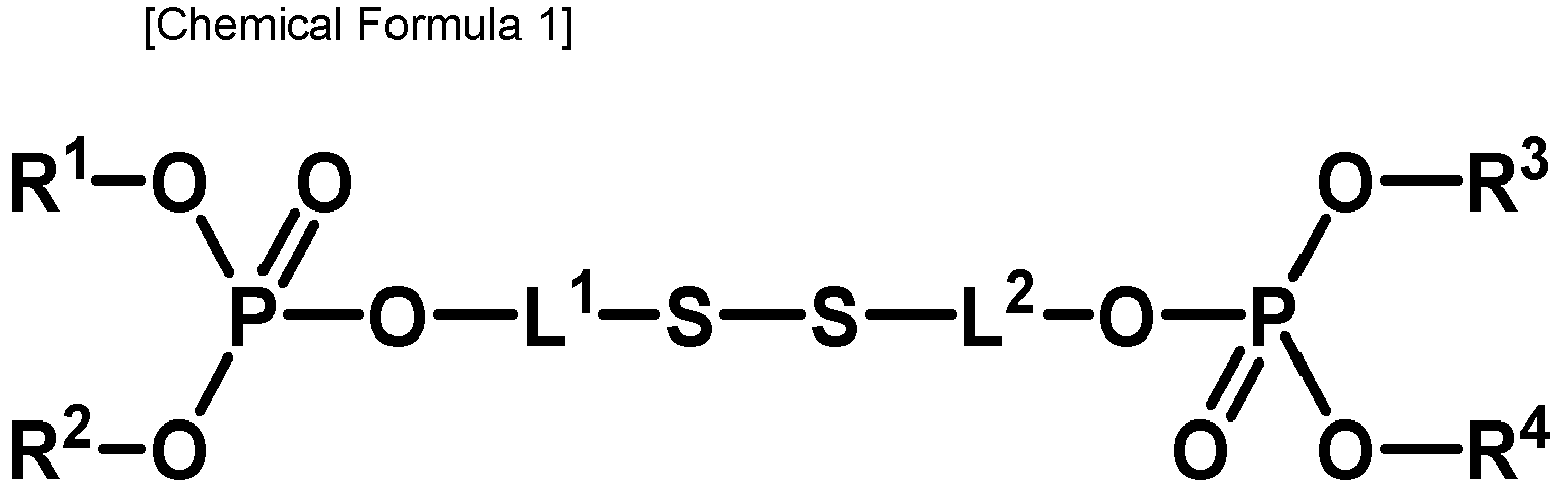
- the embodiments may be realized by providing an additive represented by Chemical Formula 1 or Chemical Formula 2: wherein, in Chemical Formula 1 and Chemical Formula 2, R 1 to R 8 are each independently a substituted or unsubstituted C1 to C10 alkyl group, a substituted or unsubstituted C2 to C10 alkenyl group, a substituted or unsubstituted C3 to C10 cycloalkyl group, a substituted or unsubstituted C3 to C10 cycloalkenyl group, a substituted or unsubstituted C2 to C10 alkynyl group, a substituted or unsubstituted C3 to C10 cycloalkynyl group, or a substituted or unsubstituted C6 to C20 aryl group, R 1 to R 8 are separately present, or at least one pair of R 1 and R 2 ; R 3 and R 4 ; R 5 and R 6 ; and R 7 and R 8 are linked to each other to provide a substitute
- the additive may be represented by Chemical Formula 1, Chemical Formula 1 may be represented by Chemical Formula 1A or Chemical Formula 1B: in Chemical Formula 1A, R 11 to R 30 may be each independently hydrogen, a halogen, or a substituted or unsubstituted C1 to C10 alkyl group, n1 to n4 may be each independently an integer of 0 to 4, and L 1 and L 2 may be each independently a substituted or unsubstituted C1 to C20 alkylene group; in Chemical Formula 1B, R 31 and R 32 may be each independently a substituted or unsubstituted C2 to C10 alkylene group, and L 1 and L 2 may be each independently a substituted or unsubstituted C1 to C20 alkylene group.
- the additive may be represented by Chemical Formula 1B
- Chemical Formula 1B may be represented by Chemical Formula 1B- I or Chemical Formula 1B- II : in Chemical Formula 1B- I and Chemical Formula 1B- II, R 101 to R 120 may be each independently hydrogen, a halogen, or a substituted or unsubstituted C1 to C10 alkyl group, and L 1 and L 2 may be each independently a substituted or unsubstituted C1 to C20 alkylene group.
- the additive is represented by Chemical Formula 2, Chemical Formula 2 may be represented by Chemical Formula 2A or Chemical Formula 2B: in Chemical Formula 2A, R 33 to R 52 may be each independently hydrogen, a halogen, or a substituted or unsubstituted C1 to C10 alkyl group, n5 to n8 may be each independently an integer of 0 to 4, and L 3 and L 4 may be each independently a substituted or unsubstituted C1 to C20 alkylene group; in Chemical Formula 2B, R 53 and R 54 may be each independently a substituted or unsubstituted C2 to C10 alkylene group, and L 3 and L 4 may be each independently a substituted or unsubstituted C1 to C20 alkylene group.
- the additive may be represented by Chemical Formula 2B, Chemical Formula 2B may be represented by Chemical Formula 2B- I or Chemical Formula 2B- II : wherein, in Chemical Formula 2B- I and Chemical Formula 2B- II, R 121 to R 140 may be each independently hydrogen, a halogen, or a substituted or unsubstituted C1 to C10 alkyl group, and L 3 and L 4 may be each independently a substituted or unsubstituted C1 to C20 alkylene group.
- the additive may be represented by Chemical Formula 1B- I -1 or Chemical Formula 2B- I - 1: in Chemical Formula 1B- I -1 and Chemical Formula 2B- I -1, R 101 to R 108 , R 121 to R 128 , and R 141 to R 156 may be each independently hydrogen, a halogen, or a substituted or unsubstituted C1 to C10 alkyl group.
- the embodiments may be realized by providing an electrolyte for a rechargeable lithium battery, the electrolyte including a non-aqueous organic solvent, a lithium salt, and the additive according to an embodiment.
- the additive may be included in an amount of about 0.1 wt% to about 10 wt%, based on a total weight of the electrolyte for a rechargeable lithium battery.
- the embodiments may be realized by providing a rechargeable lithium battery including a positive electrode including a positive active material; a negative electrode including a negative active material; and the electrolyte according to an embodiment.
- the positive active material may be represented by Chemical Formula 5: [Chemical Formula 5] Li x M 1 1-y-z M 2 y M 3 z O 2 in Chemical Formula 5, 0.5 ⁇ x ⁇ 1.8, 0 ⁇ y ⁇ 1, 0 ⁇ z ⁇ 1, 0 ⁇ y+z ⁇ 1, and M 1 , M 2 , and M 3 may be each independently Ni, Co, Mn, Al, Sr, Mg, La, or a combination thereof.
- the positive active material may be a lithium composite oxide represented by Chemical Formula 5-1, Chemical Formula 5-2, or Chemical Formula 5-3: [Chemical Formula 5-1] Li x1 Ni y1 Co z1 Al 1-y1-z1 O 2 in Chemical Formula 5-1, 1 ⁇ x1 ⁇ 1.2, 0 ⁇ y1 ⁇ 1, and 0 ⁇ z1 ⁇ 1, [Chemical Formula 5-2] Li x2 Ni y2 CO z2 Mn 1 - y2-z2 O 2 in Chemical Formula 5-2, 1 ⁇ x2 ⁇ 1.2, 0 ⁇ y2 ⁇ 1, and 0 ⁇ z2 ⁇ 1, [Chemical Formula 5-3] Li x3 CoO 2 in Chemical Formula 5-3, 0.5 ⁇ x3 ⁇ 1.
- substituted refers to that a hydrogen atom in a compound is replaced by a substituent other than hydrogen.
- the term "substituted" refers to replacement of a hydrogen atom of a compound by a substituent selected from, for example, a halogen atom (F, Br, CI, and/or I), a hydroxy group, an alkoxy group, a nitro group, a cyano group, an amino group, an azido group, an amidino group, a hydrazino group, a hydrazono group, a carbonyl group, a carbamyl group, a thiol group, an ester group, a carboxyl group or a salt thereof, a sulfonic acid group or a salt thereof, a phosphoric acid or a salt thereof, a C1 to C20 alkyl group, a C2 to C20 alkenyl group, a C2 to C20 alkynyl group, a C6 to C30 aryl group, a C7 to C30 arylalkyl group, a C1
- a rechargeable lithium battery may be classified into a lithium ion battery, a lithium ion polymer battery, and a lithium polymer battery depending on kinds of a separator and an electrolyte. It also may be classified to be cylindrical, prismatic, coin-type, pouch-type, and the like depending on shape. In addition, it may be bulk type and thin film type depending on sizes.
- FIG. 1 schematically shows the structure of a rechargeable lithium battery according to an embodiment.
- a rechargeable lithium battery 100 may include a battery cell including a positive electrode 114, a negative electrode 112 facing to the positive electrode 114, and a separator 113 between the positive electrode 114 and the negative electrode 112, an electrolyte impregnating the positive electrode 114, the negative electrode 112 and the separator 113, a battery container 120 housing the battery cell, and a sealing member 140 for sealing the container 120.
- the additive according to an embodiment of the present disclosure may be, e.g., represented by Chemical Formula 1 or Chemical Formula 2.
- R 1 to R 8 may each independently be or include, e.g., a substituted or unsubstituted C1 to C10 alkyl group, a substituted or unsubstituted C2 to C10 alkenyl group, a substituted or unsubstituted C3 to C10 cycloalkyl group, a substituted or unsubstituted C3 to C10 cycloalkenyl group, a substituted or unsubstituted C2 to C10 alkynyl group, a substituted or unsubstituted C3 to C10 cycloalkynyl group, or a substituted or unsubstituted C6 to C20 aryl group.
- the term "or” is not an exclusive term, e.g., "A or B" would include A, B, or A and B.
- R 1 to R 8 may be independently or separately present, or at least one pair of R 1 and R 2 ; R 3 and R 4 ; R 5 and R 6 ; and R 7 and R 8 may be linked to each other to provide, e.g., a substituted or unsubstituted monocyclic aliphatic heterocycle, a substituted or unsubstituted monocyclic aliphatic heterocycle, a substituted or unsubstituted monocyclic aromatic heterocycle, or a substituted or unsubstituted polycyclic aromatic heterocycle.
- L 1 to L 4 may each independently be or include, e.g., a substituted or unsubstituted C1 to C20 alkylene group.
- the additive according to an embodiment of the present disclosure may be a bisphosphate compound or a bisphosphite compound, and may have a structure linked by a disulfide linker.
- bisphosphate compounds and bisphosphite compounds may be decomposed into two phosphate compounds or two phosphite compounds centered on a disulfide linker.
- These compounds may form a film on a positive electrode and a negative electrode, and thus an increase in resistance in the film during high temperature storage may be suppressed and film stability may be improved to help enhance high temperature cycle-life and thermal safety characteristics.
- the additive may be represented by, e.g., Chemical Formula 1A or Chemical Formula 1B.
- R 11 to R 30 may each independently be, e.g., hydrogen, a halogen, or a substituted or unsubstituted C1 to C10 alkyl group.
- n1 to n4 may each independently be, e.g., an integer of 0 to 4.
- L 1 and L 2 may each independently be, e.g., a substituted or unsubstituted C1 to C20 alkylene group.
- R 31 and R 32 may each independently be, e.g., a substituted or unsubstituted C2 to C10 alkylene group.
- L 1 and L 2 may each independently be, e.g., a substituted or unsubstituted C1 to C20 alkylene group.
- R 11 to R 30 may each independently be, e.g., hydrogen, a halogen, or a substituted or unsubstituted C1 to C5 alkyl group
- n1 to n4 may each independently be, e.g., an integer of 0 to 3
- L 1 and L 2 may each independently be, e.g., a substituted or unsubstituted C2 to C20 alkylene group.
- R 11 to R 30 may each independently be, e.g., hydrogen, a halogen or a substituted or unsubstituted C1 to C3 alkyl group
- n1 to n4 may each independently be, e.g., an integer of 0 to 2
- L 1 and L 2 may each independently be, e.g., a substituted or unsubstituted C2 to C10 alkylene group.
- R 31 and R 32 may each independently be, e.g., a substituted or unsubstituted C2 to C5 alkylene group
- L 1 and L 2 may each independently be, e.g., a substituted or unsubstituted C2 to C20 alkylene group.
- R 31 and R 32 may each independently be, e.g., a substituted or unsubstituted C2 to C4 alkylene group
- L 1 and L 2 may each independently be, e.g., a substituted or unsubstituted C2 to C10 alkylene group.
- Chemical Formula 1B may be represented by, e.g., Chemical Formula 1B- I or Chemical Formula 1B- II.
- R 101 to R 120 may each independently be, e.g., hydrogen, a halogen, or a substituted or unsubstituted C1 to C10 alkyl group.
- L 1 and L 2 may be defined the same as described above.
- R 101 to R 120 may each independently be, e.g., hydrogen, a halogen, or a substituted or unsubstituted C1 to C5 alkyl group.
- R 101 to R 120 may each be hydrogen.
- the additive may be represented by, e.g., Chemical Formula 2A or Chemical Formula 2B.
- R 33 to R 52 may each independently be, e.g., hydrogen, a halogen, or a substituted or unsubstituted C1 to C10 alkyl group.
- n5 to n8 may each independently be, e.g., an integer of 0 to 4.
- L 3 and L 4 may each independently be, e.g., a substituted or unsubstituted C1 to C20 alkylene group.
- R 53 and R 54 may each independently be, e.g., a substituted or unsubstituted C2 to C10 alkylene group.
- L 3 and L 4 may each independently be, e.g., a substituted or unsubstituted C1 to C20 alkylene group.
- R 33 to R 52 may each independently be, e.g., hydrogen, a halogen, or a substituted or unsubstituted C1 to C5 alkyl group
- n5 to n8 may each independently be, e.g., an integer of 0 to 3
- L 3 and L 4 may each independently be, e.g., a substituted or unsubstituted C2 to C20 alkylene group.
- R 33 to R 52 may each independently be, e.g., hydrogen, a halogen or a substituted or unsubstituted C1 to C3 alkyl group
- n5 to n8 may each independently be, e.g., an integer of 0 to 2
- L 3 and L 4 may each independently be, e.g., a substituted or unsubstituted C2 to C10 alkylene group.
- R 53 and R 54 may each independently be, e.g., a substituted or unsubstituted C2 to C5 alkylene group and L 3 and L 4 may each independently be, e.g., a substituted or unsubstituted C2 to C20 alkylene group.
- R 53 and R 54 may each independently be, e.g., a substituted or unsubstituted C2 to C4 alkylene group and L 3 and L 4 may each independently be, e.g., a substituted or unsubstituted C2 to C10 alkylene group.
- Chemical Formula 2B may be represented by, e.g., Chemical Formula 2B- I or Chemical Formula 2B- II.
- R 121 to R 140 may each independently be, e.g., hydrogen, a halogen, or a substituted or unsubstituted C1 to C10 alkyl group.
- L 3 and L 4 may be defined the same as described above.
- R 121 to R 140 may each independently be, e.g., hydrogen, a halogen, or a substituted or unsubstituted C1 to C5 alkyl group.
- R 121 to R 140 may each be hydrogen.
- the additive may be represented by, e.g., Chemical Formula 1B- I -1 or Chemical Formula 2B- I -1.
- R 101 to R 108 , R 121 to R 128 , and R 141 to R 156 may each independently be, e.g., hydrogen, a halogen, or a substituted or unsubstituted C1 to C10 alkyl group.
- L 3 and L 4 may be defined the same as described above.
- R 101 to R 108 , R 121 to R 128 , and R 141 to R 156 may each independently be, e.g., hydrogen, a halogen, or a substituted or unsubstituted C1 to C5 alkyl group.
- R 101 to R 108 , R 121 to R 128 , and R 141 to R 156 may each be hydrogen.
- the additive according to an embodiment of the present disclosure may be synthesized by a suitable method, and may be synthesized including a process modified to a degree that can be changed as desired.
- a process of treating with a basic substance may be included in the process of synthesizing the additive, and in this case, the basic substance may be used by changing materials usable as a basic substance as well as an amine compound.
- the basic substance may be used by changing materials usable as a basic substance as well as an amine compound.
- triethylamine, 1,8-diazabicyclo [5,4,0] undec-7-ene (DBU), imidazole, dimethyl aminopyridine, 1,4-diazabicyclo [2.2.2] octane (DABCO), or diethyl propylamine may be used.
- the electrolyte for a rechargeable lithium battery according to another embodiment of the present disclosure may include a non-aqueous organic solvent, a lithium salt, and the aforementioned additive.
- the additive may be included in an amount of about 0.1 wt% to about 10 wt%, e.g., 0.1 wt% to 5.0 wt%, or 0.1 wt% to 3.0 wt%, 0.1 wt% to 7.0 wt%, 0.5 wt% to 5.0 wt%, based on the total weight of the electrolyte for a rechargeable lithium battery.
- the non-aqueous organic solvent may serve as a medium for transmitting ions taking part in the electrochemical reaction of a battery.
- the non-aqueous organic solvent may be a carbonate, ester, ether, ketone, alcohol, or aprotic solvent.
- the carbonate solvent may include dimethyl carbonate (DMC), diethyl carbonate (DEC), dipropyl carbonate (DPC), methylpropyl carbonate (MPC), ethylpropyl carbonate (EPC), methylethyl carbonate (MEC), ethylene carbonate (EC), propylene carbonate (PC), butylene carbonate (BC), and the like.
- the ester solvent may include methyl acetate, ethyl acetate, n-propyl acetate, t-butyl acetate, dimethylacetate, methylpropionate, ethylpropionate, propylpropionate, decanolide, mevalonolactone, caprolactone, and the like.
- the ether solvent may include dibutyl ether, tetraglyme, diglyme, dimethoxyethane, 2-methyltetrahydrofuran, tetrahydrofuran, and the like.
- the ketone solvent may include cyclohexanone, and the like.
- the alcohol solvent may include ethanol, isopropyl alcohol, and the like.
- the aprotic solvent may include nitriles such as R-CN (wherein R is a hydrocarbon group having a C2 to C20 linear, branched, or cyclic structure and may include a double bond, an aromatic ring, or an ether bond), and the like, dioxolanes such as 1,3-dioxolane, and the like, sulfolanes, and the like.
- R-CN nitriles
- R is a hydrocarbon group having a C2 to C20 linear, branched, or cyclic structure and may include a double bond, an aromatic ring, or an ether bond
- dioxolanes such as 1,3-dioxolane, and the like
- sulfolanes and the like.
- the non-aqueous organic solvent may be used alone or in a mixture of two or more.
- the mixture ratio may be controlled in accordance with a desirable battery performance.
- the carbonate solvent may be prepared by mixing a cyclic carbonate and a linear carbonate.
- a cyclic carbonate and linear carbonate are mixed together in a volume ratio of about 1:1 to about 1:9, an electrolyte performance may be improved.
- the non-aqueous organic solvent may further include an aromatic hydrocarbon organic solvent in addition to the carbonate solvent.
- the carbonate solvent and the aromatic hydrocarbon organic solvent may be mixed in a volume ratio of about 1:1 to about 30:1.
- the aromatic hydrocarbon organic solvent may be an aromatic hydrocarbon compound of Chemical Formula 3.
- R 201 to R 206 may each independently be, e.g., hydrogen, a halogen, a C1 to C10 alkyl group, a haloalkyl group, or a combination thereof.
- aromatic hydrocarbon organic solvent may include benzene, fluorobenzene, 1,2-difluorobenzene, 1,3-difluorobenzene, 1,4-difluorobenzene, 1,2,3-trifluorobenzene, 1,2,4-trifluorobenzene, chlorobenzene, 1,2-dichlorobenzene, 1,3-dichlorobenzene, 1,4-dichlorobenzene, 1,2,3-trichlorobenzene, 1,2,4-trichlorobenzene, iodobenzene, 1,2-diiodobenzene, 1,3-diiodobenzene, 1,4-diiodobenzene, 1,2,3-triiodobenzene, 1,2,4-triiodobenzene, toluene, fluorotoluene, 2,3-difluorotoluene, 2,4-difluorotol, to
- the electrolyte may further include vinylene carbonate or an ethylene carbonate compound represented by Chemical Formula 4 in order to help improve cycle-life of a battery.
- R 207 and R 208 may each independently be, e.g., hydrogen, a halogen, a cyano group (CN), a nitro group (NO 2 ), or a fluorinated C1 to C5 alkyl group.
- at least one of R 207 and R 208 may be a halogen, a cyano group (CN), a nitro group (NO 2 ), or a fluorinated C1 to C5 alkyl group and R 207 and R 208 may not simultaneously be hydrogen.
- Examples of the ethylene carbonate compound may include difluoroethylene carbonate, chloroethylene carbonate, dichloroethylene carbonate, bromoethylene carbonate, dibromoethylene carbonate, nitroethylene carbonate, cyanoethylene carbonate, or fluoroethylene carbonate.
- the amount of the additive for improving cycle-life may be used within an appropriate range.
- the lithium salt dissolved in the non-organic solvent may supply lithium ions in a battery, enables a basic operation of a rechargeable lithium battery, and improves transportation of the lithium ions between positive and negative electrodes.
- the lithium salt may include LiPF 6 , LiBF 4 , LiDFOP, LiDFOB, LiPO 2 F 2 , LiSbF 6 , LiAsF 6 , LiN(SO 2 C 2 F 5 ) 2 , Li(CF 3 SO 2 ) 2 N, LiN(SO 3 C 2 F 5 ) 2 , Li(FSO 2 ) 2 N (lithium bis(fluorosulfonyl)imide: LiFSI), LiC 4 F 9 SO 3 , LiClO 4 , LiAlO 2 , LiAlCl 4 , LiN(C x F 2x+1 SO 2 )(C y F 2y+1 SO 2 ), wherein x and y are natural numbers, e.g., an integer ranging from 1 to 20, LiCI, Lil
- the lithium salt may be used in a concentration ranging from about 0.1 M to about 2.0 M.
- an electrolyte may have excellent performance and lithium ion mobility due to optimal electrolyte conductivity and viscosity.
- a rechargeable lithium battery including a positive electrode including a positive active material; a negative electrode including a negative active material; and the aforementioned electrolyte.
- the positive electrode may include a positive current collector and a positive active material layer on the positive current collector, and the positive active material layer includes a positive active material.
- the positive active material may include lithiated intercalation compounds that reversibly intercalate and deintercalate lithium ions.
- a composite oxide of a metal e.g., cobalt, manganese, nickel, or a combination thereof, and lithium may be used.
- the coating layer may include a coating element compound selected from an oxide of a coating element, a hydroxide of a coating element, an oxyhydroxide of a coating element, an oxycarbonate of a coating element, and a hydroxy carbonate of a coating element.
- the compound for the coating layer may be amorphous or crystalline.
- the coating element included in the coating layer may include, e.g., Mg, Al, Co, K, Na, Ca, Si, Ti, V, Sn, Ge, Ga, B, As, Zr, or a mixture thereof.
- the coating layer may be disposed in a method having no adverse influence on properties of a positive active material by using these elements in the compound.
- the method may include a suitable coating method (e.g., spray coating, dipping, or the like).
- the positive active material may be, e.g., a lithium composite oxide represented by Chemical Formula 5.
- Chemical Formula 5 Li x M 1 1-y-z M 2 y M 3 z O 2
- M 1 , M 2 , and M 3 may each independently be, e.g., Ni, Co, Mn, Al, Sr, Mg, or La, and a combination thereof.
- M 1 may be, e.g., Co, Mn, Al, Sr, Mg, or La
- M 2 and M 3 may each independently be, e.g., Ni or Co.
- M 1 may be Mn or Al, and M 2 and M 3 may each independently be Ni or Co.
- the positive electrode active material may be a lithium composite oxide represented by at least one of Chemical Formula 5-1 to Chemical Formula 5-3.
- Chemical Formula 5-1 Li x1 Ni y1 Co z1 Al 1-y1-z1 O 2
- the positive active material may be included in an amount of about 90 wt% to about 98 wt%, based on the total weight of the positive active material layer.
- the positive active material layer may optionally include a conductive material and a binder.
- the binder may be included in an amount of about 1 wt% to about 5 wt%, based on the total weight of the positive active material layer.
- the conductive material may be included in an amount of about 1 wt% to about 5 wt%, based on the total weight of the positive active material layer.
- the conductive material may provide electrode conductivity.
- a suitable electrically conductive material may be used as a conductive material unless it causes a chemical change.
- the conductive material may include a carbon material such as natural graphite, artificial graphite, carbon black, acetylene black, Ketjen black, a carbon fiber, or the like; a metal material of a metal powder or a metal fiber including copper, nickel, aluminum, silver, or the like; a conductive polymer such as a polyphenylene derivative; or a mixture thereof.
- the binder may help improve binding properties of positive active material particles with one another and with a current collector.
- examples thereof may include polyvinyl alcohol, carboxylmethyl cellulose, hydroxypropyl cellulose, diacetyl cellulose, polyvinylchloride, carboxylated polyvinylchloride, polyvinylfluoride, an ethylene oxide-containing polymer, polyvinylpyrrolidone, polyurethane, polytetrafluoroethylene, polyvinylidene fluoride, polyethylene, polypropylene, a styrene-butadiene rubber, an acrylated styrene-butadiene rubber, an epoxy resin, nylon, or the like.
- the positive current collector may use, e.g., Al.
- the negative electrode includes a negative current collector and a negative active material layer including a negative active material and disposed on the negative current collector.
- the negative active material may include a material that reversibly intercalates/deintercalates lithium ions, a lithium metal, a lithium metal alloy, a material being capable of doping/dedoping lithium, or transition metal oxide.
- the material that reversibly intercalates/deintercalates lithium ions may include a carbon material.
- the carbon material may be a suitable carbon negative active material for a rechargeable lithium battery. Examples thereof may include crystalline carbon, amorphous carbon, or a mixture thereof.
- the crystalline carbon may be non-shaped, or sheet, flake, spherical, or fiber shaped natural graphite or artificial graphite.
- the amorphous carbon may be a soft carbon, a hard carbon, a mesophase pitch carbonization product, calcined coke, or the like.
- the lithium metal alloy may include an alloy of lithium and, e.g., Na, K, Rb, Cs, Fr, Be, Mg, Ca, Sr, Si, Sb, Pb, In, Zn, Ba, Ra, Ge, Al, or Sn.
- the material being capable of doping/dedoping lithium may be Si, a Si-C composite, SiO x (0 ⁇ x ⁇ 2), a Si-Q alloy (wherein Q is an alkali metal, an alkaline-earth metal, a Group 13 element, a Group 14 element, a Group 15 element, a Group 16 element, a transition metal, a rare earth element, or a combination thereof, and not Si), Sn, SnO 2 , a Sn-R alloy (wherein R is an alkali metal, an alkaline-earth metal, a Group 13 element, a Group 14 element, a Group 15 element, a Group 16 element, a transition metal, a rare earth element, or a combination thereof, and not Sn), and the like. At least one of these materials may be mixed with SiO 2 .
- the elements Q and R may be selected from Mg, Ca, Sr, Ba, Ra, Sc, Y, Ti, Zr, Hf, Rf, V, Nb, Ta, Db, Cr, Mo, W, Sg, Tc, Re, Bh, Fe, Pb, Ru, Os, Hs, Rh, Ir, Pd, Pt, Cu, Ag, Au, Zn, Cd, B, Al, Ga, Sn, In, TI, Ge, P, As, Sb, Bi, S, Se, Te, Po, and a combination thereof.
- the transition metal oxide may include vanadium oxide, lithium vanadium oxide, or lithium titanium oxide.
- the negative active material may be a Si-C composite including a Si active material and a carbon active material.
- an average particle diameter of the Si active material may be about 50 nm to about 200 nm.
- the average particle diameter of the Si active material is within the above range, volume expansion occurring during charging and discharging may be suppressed, and a break in a conductive path due to particle crushing during charging and discharging may be prevented.
- the Si active material may be included in an amount of about 1 wt% to about 60 wt%, e.g., about 3 wt% to about 60 wt%, based on the total weight of the Si-C composite.
- the negative active material may further include crystalline carbon together with the aforementioned Si-C composite.
- the Si-C composite and crystalline carbon may be included in the form of a mixture, and in this case, the Si-C composite and crystalline carbon may be included in a weight ratio of about 1:99 to about 50:50. In an implementation, the Si-C composite and crystalline carbon may be included in a weight ratio of about 5:95 to about 20:80.
- the crystalline carbon may include graphite, e.g., natural graphite, artificial graphite, or a mixture thereof.
- the average particle diameter of the crystalline carbon may be about 5 ⁇ m to about 30 ⁇ m.
- the average particle diameter may be a particle size (D50) at 50% by volume in a cumulative size-distribution curve.
- the Si-C composite may further include a shell surrounding the surface of the Si-C composite, and the shell may include amorphous carbon.
- the amorphous carbon may include soft carbon, hard carbon, a mesophase pitch carbonized product, calcined coke, or a mixture thereof.
- the amorphous carbon may be included in an amount of about 1 to about 50 parts by weight, e.g., about 5 to about 50 parts by weight, or about 10 to about 50 parts by weight, based on 100 parts by weight of the carbon active material.
- the negative active material may be included in an amount of about 95 wt% to about 99 wt%, based on the total weight of the negative active material layer.
- the negative active material layer may include a binder, and optionally a conductive material.
- a content of the binder may be about 1 wt% to about 5 wt%, based on the total weight of the negative active material layer.
- the negative active material layer includes a conductive material, the negative active material layer includes about 90 wt% to about 98 wt% of the negative active material, about 1 wt% to about 5 wt% of the binder, and about 1 wt% to about 5 wt% of the conductive material.
- the binder may help improve binding properties of negative active material particles with one another and with a current collector.
- the binder may include a non-water-soluble binder, a water-soluble binder, or a combination thereof.
- the non-water-soluble binder may include polyvinylchloride, carboxylated polyvinylchloride, polyvinylfluoride, polyurethane, polytetrafluoroethylene, polyvinylidene fluoride, polyethylene, polypropylene, polyamideimide, polyimide, or a combination thereof.
- the water-soluble binder may be a rubber binder or a polymer resin binder.
- the rubber binder may include a styrene-butadiene rubber, an acrylated styrene-butadiene rubber (SBR), an acrylonitrile-butadiene rubber, an acrylic rubber, a butyl rubber, a fluorine rubber, and a combination thereof.
- the polymer resin binder may include polytetrafluoroethylene, ethylenepropylenecopolymer, polyethyleneoxide, polyvinylpyrrolidone, polyepichlorohydrine, polyphosphazene, polyacrylonitrile, polystyrene, an ethylenepropylenediene copolymer, polyvinylpyridine, chlorosulfonated polyethylene, latex, a polyester resin, an acrylic resin, a phenolic resin, an epoxy resin, polyvinyl alcohol, or a combination thereof.
- a cellulose compound may be further included to provide viscosity as a thickener.
- the cellulose compound may include, e.g., carboxymethyl cellulose, hydroxypropylmethyl cellulose, methyl cellulose, or alkali metal salts thereof.
- the alkali metals may include Na, K, or Li.
- Such a thickener may be included in an amount of about 0.1 to about 3 parts by weight based on 100 parts by weight of the negative active material.
- the conductive material may provide electrode conductivity.
- a suitable electrically conductive material may be used as a conductive material unless it causes a chemical change.
- the conductive material may include a carbon material such as natural graphite, artificial graphite, carbon black, acetylene black, Ketjen black, a carbon fiber, and the like; a metal material of a metal powder or a metal fiber including copper, nickel, aluminum, silver, and the like; a conductive polymer such as a polyphenylene derivative; or a mixture thereof.
- the negative current collector may be selected from a copper foil, a nickel foil, a stainless-steel foil, a titanium foil, a nickel foam, a copper foam, a polymer substrate coated with a conductive metal, and a combination thereof.
- the rechargeable lithium battery may further include a separator between the negative electrode and the positive electrode, depending on a type of the rechargeable lithium battery.
- a separator may be a porous substrate; or a composite porous substrate.
- the porous substrate is a substrate including pores and lithium ions may move through the pores.
- the porous substrate may include, e.g., polyethylene, polypropylene, polyvinylidene fluoride, and multi-layers thereof such as a polyethylene/polypropylene double-layered separator, a polyethylene/polypropylene/polyethylene triple-layered separator, or a polypropylene/polyethylene/polypropylene triple-layered separator.
- the composite porous substrate may have a form including a porous substrate and a functional layer on the porous substrate.
- the functional layer may be, e.g., a heat-resistant layer and an adhesive layer from the viewpoint of enabling additional functions to be added.
- the heat-resistant layer may include a heat-resistant resin and optionally a filler.
- the adhesive layer may include an adhesive resin and optionally a filler.
- the filler may be an organic filler or an inorganic filler.
- a rechargeable lithium battery 100 may include a battery cell including a negative electrode 112, a positive electrode 114 facing the negative electrode 112, a separator 113 between the negative electrode 112 and the positive electrode 114, and an electrolyte (not shown) impregnating the negative electrode 112, the positive electrode 114, and the separator 113, a battery case 120 housing the battery cell, and a sealing member 140 for sealing the battery case 120.
- a compound represented by Chemical Formula b-1 was synthesized as described in Chinese Patent Reference CN111217856 .
- a compound represented by Chemical Formula b-2 was synthesized as described in [ Heteroatom chemistry 2010, 21, 515-520 ].
- Positive active material slurry was prepared by using LiNi 091 Co 0.07 Al 0.02 O 2 as a positive active material, polyvinylidene fluoride as a binder, and Ketjen black as a conductive material in a weight ratio of 97:2:1 and dispersing the resultant mixture in N-methyl pyrrolidone.
- the positive active material slurry was coated on a 14 ⁇ m-thick Al foil, dried at 110 °C, and pressed to manufacture a positive electrode.
- a negative active material was prepared by mixing graphite and an Si-C composite in a weight ratio of 93:7, and then, the negative active material, a styrene-butadiene rubber binder, and carboxylmethyl cellulose were mixed in a weight ratio of 97:1:2 and then, dispersed in distilled water to prepare negative active material slurry.
- the Si-C composite had a core including artificial graphite and silicon particles and coated with mesophase pitch carbonization product on the surface, wherein a content of the silicon was about 3 wt% based on the total weight of the Si-C composite.
- the negative active material slurry was coated on a 10 ⁇ m-thick Cu foil, dried at 100°C, and pressed to manufacture a negative electrode.
- An electrode assembly was manufactured by assembling the manufactured positive and negative electrodes, and a separator made of polyethylene having a thickness of 25 ⁇ m, and an electrolyte was injected to prepare a rechargeable lithium battery cell.
- the electrolyte has a following composition.
- wt% is based on the total weight of the electrolyte (a lithium salt + a non-aqueous organic solvent + an additive))
- a rechargeable lithium battery cell was manufactured according to the same method as Example 1 except that the compound of Chemical Formula a-1 was used in an amount of 2.0 wt%.
- a rechargeable lithium battery cell was manufactured according to the same method as Example 1 except that the compound of Chemical Formula a-1 was used in an amount of 0.5 wt%.
- a rechargeable lithium battery cell was manufactured according to the same method as Example 1 except that the compound of Chemical Formula a-1 was used in an amount of 0.4 wt%.
- a rechargeable lithium battery cell was manufactured according to the same method as Example 1 except that the compound of Chemical Formula a-2 according to Synthesis Example 2 was used in an amount of 0.5 wt%.
- a rechargeable lithium battery cell was manufactured according to the same method as Example 1 except that the compound of Chemical Formula a-2 was used in an amount of 1.0 wt%.
- a rechargeable lithium battery cell was manufactured according to the same method as Example 1 except that the compound of Chemical Formula a-2 was used in an amount of 2.0 wt%.
- a rechargeable lithium battery cell was manufactured according to the same method as Example 1 except that an electrolyte to which an additive was not added was used.
- a rechargeable lithium battery cell was manufactured according to the same method as Example 1 except that the compound of Chemical Formula b-1 according to Synthesis Example 3 was used in an amount of 1.0 wt%.
- a rechargeable lithium battery cell was manufactured according to the same method as Example 1 except that the compound of Chemical Formula b-2 according to Synthesis Example 4 was used in an amount of 1.0 wt%.
- Example 2 The electrolytes according to Example 2 and Comparative Example 1 were analyzed in a differential scanning calorimeter (DSC) method, and the results are shown in Table 1.
- Table 1 Onset temperature (°C) Comparative Example 1 210
- Example 2 230 Comparative Example 1 210
- an onset temperature of the electrolyte according to Example 2 was increased, compared with an electrolyte according to Comparative Example 1.
- thermal characteristics were improved, and accordingly, high temperature safety and reliability of a rechargeable lithium battery are expected to be improved.
- the rechargeable lithium battery cells of Examples 1, 2, and 4 and Comparative Example 1 were charged at a charge and discharge rate of 0.5 C in a mode of 4.35 V CC/CV for 3 hours and then, left in a 90 °C chamber for 90 hours to measure operation time of CID (Current Interrupt Device).
- CID Current Interrupt Device
- the CID Current Interrupt Device
- the CID is a device detecting a pressure change, that is, a pressure increase in the closed and sealed device and cutting off a current by itself, when the pressure exceeds a certain pressure.
- FIG. 2 is a graph showing operation time of CID (Current Interrupt Device) of the rechargeable lithium battery cells according to Examples 1, 2 and 4 and Comparative Example 1.
- CID Current Interrupt Device
- the CID operation time was measured to evaluate storage characteristics at a high temperature of the rechargeable lithium battery cells.
- Comparative Example 1 exhibited a sharp voltage drop before about 30 hours when stored at a high temperature of 90 °C, and the Examples including an additive according to an embodiment of the present disclosure exhibited a voltage drop after at least 80 hours, and thus an effect of delaying an open circuit voltage (OCV) drop by delaying decomposition of the electrolyte and thus suppressing a resistance increase.
- OCV open circuit voltage
- DC-IR Direct current-Internal Resistance
- the cells were charged under a condition of 0.2 C and 4.2 V and left at 60 °C for 30 days to measure DC-IR, which was used to calculate a resistance increase rate ( ⁇ DC-IR) before and after being left.
- ⁇ DC-IR resistance increase rate
- the resistance increase rate (%) is a percentage of DC-IR after being left for 30 days relative to initial DC-IR.
- FIG. 3 is a graph showing a resistance increase rate after measuring DC-internal resistance after leaving the rechargeable lithium battery cells according to Examples 1 and 6 and Comparative Examples 2 and 3 at 60 ° C for 30 days.
- an electrolyte may include an organic solvent in which a lithium salt is dissolved, and such an electrolyte may determine stability and performance of a rechargeable lithium battery.
- LiPF 6 (that is most commonly used as a lithium salt of an electrolyte) may react with an organic solvent of an electrolyte to promote depletion of a solvent and generate a large amount of gas. When LiPF 6 is decomposed, it generates LiF and PF 5 , which leads to electrolyte depletion in the battery, resulting in degradation in high temperature performance and poor safety.
- an electrolyte may have improved safety without deteriorating performance even under high temperature conditions.
- One or more embodiments may provide an additive with improved thermal stability.
- One or more embodiments may provide a rechargeable lithium battery including the additive which has improved high-temperature cycle-life characteristics and high-temperature storage characteristics by improving high-temperature safety and high-temperature reliability, and reducing a voltage drop and resistance increase rate during high-temperature storage.
- a rechargeable lithium battery having improved high temperature characteristics may be implemented by suppressing an increase in internal resistance of the battery and suppressing a voltage drop after being left at a high temperature.
Landscapes
- Chemical & Material Sciences (AREA)
- Chemical Kinetics & Catalysis (AREA)
- Electrochemistry (AREA)
- General Chemical & Material Sciences (AREA)
- Engineering & Computer Science (AREA)
- Manufacturing & Machinery (AREA)
- Inorganic Chemistry (AREA)
- Physics & Mathematics (AREA)
- Condensed Matter Physics & Semiconductors (AREA)
- General Physics & Mathematics (AREA)
- Materials Engineering (AREA)
- Organic Chemistry (AREA)
- Biochemistry (AREA)
- General Health & Medical Sciences (AREA)
- Molecular Biology (AREA)
- Life Sciences & Earth Sciences (AREA)
- Health & Medical Sciences (AREA)
- Secondary Cells (AREA)
- Organic Low-Molecular-Weight Compounds And Preparation Thereof (AREA)
Abstract
Description
- Embodiments relate to an additive, an electrolyte for a rechargeable lithium battery, and a rechargeable lithium battery.
- A rechargeable lithium battery may be recharged and has three or more times as high energy density per unit weight as a lead storage battery, nickel-cadmium battery, nickel hydrogen battery, nickel zinc battery, or the like. It may be also charged at a high rate and thus, may be commercially manufactured for a laptop, a cell phone, an electric tool, an electric bike, or the like, and research on improvement of additional energy density have been actively made.
- Such a rechargeable lithium battery may be manufactured by injecting an electrolyte into a battery cell, which includes a positive electrode including a positive active material capable of intercalating/deintercalating lithium ions and a negative electrode including a negative active material capable of intercalating/deintercalating lithium ions.
- The embodiments may be realized by providing an additive represented by Chemical Formula 1 or Chemical Formula 2:


- The additive may be represented by Chemical Formula 1, Chemical Formula 1 may be represented by Chemical Formula 1A or Chemical Formula 1B:


- The additive may be represented by Chemical Formula 1B, Chemical Formula 1B may be represented by Chemical Formula 1B- I or Chemical Formula 1B- II :


- The additive is represented by Chemical Formula 2, Chemical Formula 2 may be represented by Chemical Formula 2A or Chemical Formula 2B:


- The additive may be represented by Chemical Formula 2B, Chemical Formula 2B may be represented by Chemical Formula 2B- I or Chemical Formula 2B- II :


- The additive may be represented by Chemical Formula 1B- I -1 or Chemical Formula 2B- I - 1:


- The embodiments may be realized by providing an electrolyte for a rechargeable lithium battery, the electrolyte including a non-aqueous organic solvent, a lithium salt, and the additive according to an embodiment.
- The additive may be included in an amount of about 0.1 wt% to about 10 wt%, based on a total weight of the electrolyte for a rechargeable lithium battery.
- The embodiments may be realized by providing a rechargeable lithium battery including a positive electrode including a positive active material; a negative electrode including a negative active material; and the electrolyte according to an embodiment.
- The positive active material may be represented by Chemical Formula 5:
[Chemical Formula 5] LixM1 1-y-zM2 yM3 zO2
in Chemical Formula 5, 0.5≤x≤1.8, 0≤y≤1, 0≤z≤1, 0≤y+z<1, and M1, M2, and M3 may be each independently Ni, Co, Mn, Al, Sr, Mg, La, or a combination thereof. - The positive active material may be a lithium composite oxide represented by Chemical Formula 5-1, Chemical Formula 5-2, or Chemical Formula 5-3:
[Chemical Formula 5-1] Lix1Niy1Coz1Al1-y1-z1O2
in Chemical Formula 5-1, 1≤x1≤1.2, 0<y1<1, and 0<z1<1,
[Chemical Formula 5-2] Lix2Niy2COz2Mn1-y2-z2O2
in Chemical Formula 5-2, 1≤x2≤1.2, 0<y2<1, and 0<z2<1,
[Chemical Formula 5-3] Lix3CoO2
in Chemical Formula 5-3, 0.5< x3 ≤1. - Features will be apparent to those of skill in the art by describing in detail exemplary embodiments with reference to the attached drawings in which:
-
FIG. 1 is an exploded perspective view showing a rechargeable lithium battery according to an embodiment of the present disclosure. -
FIG. 2 is a graph showing an operation time of a CID (Current Interrupt Device) of a rechargeable lithium battery cells according to Examples 1, 2, and 4 and Comparative Example 1. -
FIG. 3 is a graph showing a resistance increase rate after measuring DC-internal resistance after leaving the rechargeable lithium battery cells according to Examples 1 and 6 and Comparative Examples 2 and 3 at 60° C for 30 days. - Example embodiments will now be described more fully hereinafter with reference to the accompanying drawings; however, they may be embodied in different forms and should not be construed as limited to the embodiments set forth herein. Rather, these embodiments are provided so that this disclosure will be thorough and complete, and will fully convey exemplary implementations to those skilled in the art.
- In the drawing figures, the dimensions of layers and regions may be exaggerated for clarity of illustration. It will also be understood that when a layer or element is referred to as being "on" another layer or element, it can be directly on the other layer or element, or intervening layers may also be present. In addition, it will also be understood that when a layer is referred to as being "between" two layers, it can be the only layer between the two layers, or one or more intervening layers may also be present. Like reference numerals refer to like elements throughout.
- As used herein, when a definition is not otherwise provided, the term "substituted" refers to that a hydrogen atom in a compound is replaced by a substituent other than hydrogen.
- In some embodiments, the term "substituted" refers to replacement of a hydrogen atom of a compound by a substituent selected from, for example, a halogen atom (F, Br, CI, and/or I), a hydroxy group, an alkoxy group, a nitro group, a cyano group, an amino group, an azido group, an amidino group, a hydrazino group, a hydrazono group, a carbonyl group, a carbamyl group, a thiol group, an ester group, a carboxyl group or a salt thereof, a sulfonic acid group or a salt thereof, a phosphoric acid or a salt thereof, a C1 to C20 alkyl group, a C2 to C20 alkenyl group, a C2 to C20 alkynyl group, a C6 to C30 aryl group, a C7 to C30 arylalkyl group, a C1 to C4 alkoxy group, a C1 to C20 heteroalkyl group, a C3 to C20 heteroarylalkyl group, a C3 to C30 cycloalkyl group, a C3 to C15 cycloalkenyl group, a C6 to C15 cycloalkynyl group, a C2 to C20 heterocycloalkyl group, and a combination thereof.
- A rechargeable lithium battery may be classified into a lithium ion battery, a lithium ion polymer battery, and a lithium polymer battery depending on kinds of a separator and an electrolyte. It also may be classified to be cylindrical, prismatic, coin-type, pouch-type, and the like depending on shape. In addition, it may be bulk type and thin film type depending on sizes.
- Herein, as an example of a rechargeable lithium battery, a cylindrical rechargeable lithium battery is described.
FIG. 1 schematically shows the structure of a rechargeable lithium battery according to an embodiment. Referring toFIG. 1 , arechargeable lithium battery 100 according to an embodiment may include a battery cell including apositive electrode 114, anegative electrode 112 facing to thepositive electrode 114, and aseparator 113 between thepositive electrode 114 and thenegative electrode 112, an electrolyte impregnating thepositive electrode 114, thenegative electrode 112 and theseparator 113, abattery container 120 housing the battery cell, and asealing member 140 for sealing thecontainer 120. - Hereinafter, an additive according to an embodiment will be described.
- The additive according to an embodiment of the present disclosure may be, e.g., represented by Chemical Formula 1 or Chemical Formula 2.


- In
Chemical Formula 1 and Chemical Formula 2, R1 to R8 may each independently be or include, e.g., a substituted or unsubstituted C1 to C10 alkyl group, a substituted or unsubstituted C2 to C10 alkenyl group, a substituted or unsubstituted C3 to C10 cycloalkyl group, a substituted or unsubstituted C3 to C10 cycloalkenyl group, a substituted or unsubstituted C2 to C10 alkynyl group, a substituted or unsubstituted C3 to C10 cycloalkynyl group, or a substituted or unsubstituted C6 to C20 aryl group. As used herein, the term "or" is not an exclusive term, e.g., "A or B" would include A, B, or A and B. - In an implementation, R1 to R8 may be independently or separately present, or at least one pair of R1 and R2; R3 and R4; R5 and R6; and R7 and R8 may be linked to each other to provide, e.g., a substituted or unsubstituted monocyclic aliphatic heterocycle, a substituted or unsubstituted monocyclic aliphatic heterocycle, a substituted or unsubstituted monocyclic aromatic heterocycle, or a substituted or unsubstituted polycyclic aromatic heterocycle.
- L1 to L4 may each independently be or include, e.g., a substituted or unsubstituted C1 to C20 alkylene group.
- The additive according to an embodiment of the present disclosure may be a bisphosphate compound or a bisphosphite compound, and may have a structure linked by a disulfide linker.
- These bisphosphate compounds and bisphosphite compounds may be decomposed into two phosphate compounds or two phosphite compounds centered on a disulfide linker.
- These compounds may form a film on a positive electrode and a negative electrode, and thus an increase in resistance in the film during high temperature storage may be suppressed and film stability may be improved to help enhance high temperature cycle-life and thermal safety characteristics.
- In an implementation, the additive may be represented by, e.g., Chemical Formula 1A or Chemical Formula 1B.

- In Chemical Formula 1A, R11 to R30 may each independently be, e.g., hydrogen, a halogen, or a substituted or unsubstituted C1 to C10 alkyl group.
- n1 to n4 may each independently be, e.g., an integer of 0 to 4.
- L1 and L2 may each independently be, e.g., a substituted or unsubstituted C1 to C20 alkylene group.

- In Chemical Formula 1B, R31 and R32 may each independently be, e.g., a substituted or unsubstituted C2 to C10 alkylene group.
- L1 and L2 may each independently be, e.g., a substituted or unsubstituted C1 to C20 alkylene group.
- In an implementation, R11 to R30 may each independently be, e.g., hydrogen, a halogen, or a substituted or unsubstituted C1 to C5 alkyl group, n1 to n4 may each independently be, e.g., an integer of 0 to 3, and L1 and L2 may each independently be, e.g., a substituted or unsubstituted C2 to C20 alkylene group.
- In an implementation, R11 to R30 may each independently be, e.g., hydrogen, a halogen or a substituted or unsubstituted C1 to C3 alkyl group, n1 to n4 may each independently be, e.g., an integer of 0 to 2, and L1 and L2 may each independently be, e.g., a substituted or unsubstituted C2 to C10 alkylene group.
- In an implementation, R31 and R32 may each independently be, e.g., a substituted or unsubstituted C2 to C5 alkylene group, and L1 and L2 may each independently be, e.g., a substituted or unsubstituted C2 to C20 alkylene group.
- In an implementation, R31 and R32 may each independently be, e.g., a substituted or unsubstituted C2 to C4 alkylene group, and L1 and L2 may each independently be, e.g., a substituted or unsubstituted C2 to C10 alkylene group.
- In an implementation, Chemical Formula 1B may be represented by, e.g., Chemical Formula 1B- I or Chemical Formula 1B- II.


- In Chemical Formula 1B- I and Chemical Formula 1B- II, R101 to R120 may each independently be, e.g., hydrogen, a halogen, or a substituted or unsubstituted C1 to C10 alkyl group.
- L1 and L2 may be defined the same as described above.
- In an implementation, R101 to R120 may each independently be, e.g., hydrogen, a halogen, or a substituted or unsubstituted C1 to C5 alkyl group.
- In an implementation, R101 to R120 may each be hydrogen.
- In an implementation, the additive may be represented by, e.g., Chemical Formula 2A or Chemical Formula 2B.

- In Chemical Formula 2A, R33 to R52 may each independently be, e.g., hydrogen, a halogen, or a substituted or unsubstituted C1 to C10 alkyl group.
- n5 to n8 may each independently be, e.g., an integer of 0 to 4.
- L3 and L4 may each independently be, e.g., a substituted or unsubstituted C1 to C20 alkylene group.

- In Chemical Formula 2B, R53 and R54 may each independently be, e.g., a substituted or unsubstituted C2 to C10 alkylene group.
- L3 and L4 may each independently be, e.g., a substituted or unsubstituted C1 to C20 alkylene group.
- In an implementation, R33 to R52 may each independently be, e.g., hydrogen, a halogen, or a substituted or unsubstituted C1 to C5 alkyl group, n5 to n8 may each independently be, e.g., an integer of 0 to 3, and L3 and L4 may each independently be, e.g., a substituted or unsubstituted C2 to C20 alkylene group.
- In an implementation, R33 to R52 may each independently be, e.g., hydrogen, a halogen or a substituted or unsubstituted C1 to C3 alkyl group, n5 to n8 may each independently be, e.g., an integer of 0 to 2, and L3 and L4 may each independently be, e.g., a substituted or unsubstituted C2 to C10 alkylene group.
- In an implementation, R53 and R54 may each independently be, e.g., a substituted or unsubstituted C2 to C5 alkylene group and L3 and L4 may each independently be, e.g., a substituted or unsubstituted C2 to C20 alkylene group.
- In an implementation, R53 and R54 may each independently be, e.g., a substituted or unsubstituted C2 to C4 alkylene group and L3 and L4 may each independently be, e.g., a substituted or unsubstituted C2 to C10 alkylene group.
- In an implementation, Chemical Formula 2B may be represented by, e.g., Chemical Formula 2B- I or Chemical Formula 2B- II.


- In Chemical Formula 2B- I and Chemical Formula 2B- II, R121 to R140 may each independently be, e.g., hydrogen, a halogen, or a substituted or unsubstituted C1 to C10 alkyl group.
- L3 and L4 may be defined the same as described above.
- In an implementation, R121 to R140 may each independently be, e.g., hydrogen, a halogen, or a substituted or unsubstituted C1 to C5 alkyl group.
- In an implementation, R121 to R140 may each be hydrogen.
- In an implementation, the additive may be represented by, e.g., Chemical Formula 1B- I -1 or Chemical Formula 2B- I -1.


- In Chemical Formula 1B- I -1 and Chemical Formula 2B- I -1, R101 to R108, R121 to R128, and R141 to R156 may each independently be, e.g., hydrogen, a halogen, or a substituted or unsubstituted C1 to C10 alkyl group.
- L3 and L4 may be defined the same as described above.
- In an implementation, R101 to R108, R121 to R128, and R141 to R156 may each independently be, e.g., hydrogen, a halogen, or a substituted or unsubstituted C1 to C5 alkyl group.
- In an implementation, R101 to R108, R121 to R128, and R141 to R156 may each be hydrogen.
- The additive according to an embodiment of the present disclosure may be synthesized by a suitable method, and may be synthesized including a process modified to a degree that can be changed as desired.
- In an implementation, a process of treating with a basic substance may be included in the process of synthesizing the additive, and in this case, the basic substance may be used by changing materials usable as a basic substance as well as an amine compound. In an implementation, triethylamine, 1,8-diazabicyclo [5,4,0] undec-7-ene (DBU), imidazole, dimethyl aminopyridine, 1,4-diazabicyclo [2.2.2] octane (DABCO), or diethyl propylamine may be used.
- The electrolyte for a rechargeable lithium battery according to another embodiment of the present disclosure may include a non-aqueous organic solvent, a lithium salt, and the aforementioned additive.
- The additive may be included in an amount of about 0.1 wt% to about 10 wt%, e.g., 0.1 wt% to 5.0 wt%, or 0.1 wt% to 3.0 wt%, 0.1 wt% to 7.0 wt%, 0.5 wt% to 5.0 wt%, based on the total weight of the electrolyte for a rechargeable lithium battery.
- When the content range of the additive is as described above, a resistance increase at high temperatures may be prevented, to provide a rechargeable lithium battery with improved cycle-life characteristics.
- When the content of the additive is less than about 0.1 wt%, high-temperature storage characteristics may be deteriorated, and when it exceeds about 10 wt%, cycle-life may be decreased due to an increase in interface resistance.
- The non-aqueous organic solvent may serve as a medium for transmitting ions taking part in the electrochemical reaction of a battery.
- The non-aqueous organic solvent may be a carbonate, ester, ether, ketone, alcohol, or aprotic solvent.
- The carbonate solvent may include dimethyl carbonate (DMC), diethyl carbonate (DEC), dipropyl carbonate (DPC), methylpropyl carbonate (MPC), ethylpropyl carbonate (EPC), methylethyl carbonate (MEC), ethylene carbonate (EC), propylene carbonate (PC), butylene carbonate (BC), and the like. The ester solvent may include methyl acetate, ethyl acetate, n-propyl acetate, t-butyl acetate, dimethylacetate, methylpropionate, ethylpropionate, propylpropionate, decanolide, mevalonolactone, caprolactone, and the like. The ether solvent may include dibutyl ether, tetraglyme, diglyme, dimethoxyethane, 2-methyltetrahydrofuran, tetrahydrofuran, and the like. In addition, the ketone solvent may include cyclohexanone, and the like. The alcohol solvent may include ethanol, isopropyl alcohol, and the like. The aprotic solvent may include nitriles such as R-CN (wherein R is a hydrocarbon group having a C2 to C20 linear, branched, or cyclic structure and may include a double bond, an aromatic ring, or an ether bond), and the like, dioxolanes such as 1,3-dioxolane, and the like, sulfolanes, and the like.
- The non-aqueous organic solvent may be used alone or in a mixture of two or more. When the non-aqueous organic solvent is used in a mixture, the mixture ratio may be controlled in accordance with a desirable battery performance.
- In an implementation, the carbonate solvent may be prepared by mixing a cyclic carbonate and a linear carbonate. When the cyclic carbonate and linear carbonate are mixed together in a volume ratio of about 1:1 to about 1:9, an electrolyte performance may be improved.
- The non-aqueous organic solvent may further include an aromatic hydrocarbon organic solvent in addition to the carbonate solvent. In an implementation, the carbonate solvent and the aromatic hydrocarbon organic solvent may be mixed in a volume ratio of about 1:1 to about 30:1.
- The aromatic hydrocarbon organic solvent may be an aromatic hydrocarbon compound of Chemical Formula 3.

- In Chemical Formula 3, R201 to R206 may each independently be, e.g., hydrogen, a halogen, a C1 to C10 alkyl group, a haloalkyl group, or a combination thereof.
- Examples of the aromatic hydrocarbon organic solvent may include benzene, fluorobenzene, 1,2-difluorobenzene, 1,3-difluorobenzene, 1,4-difluorobenzene, 1,2,3-trifluorobenzene, 1,2,4-trifluorobenzene, chlorobenzene, 1,2-dichlorobenzene, 1,3-dichlorobenzene, 1,4-dichlorobenzene, 1,2,3-trichlorobenzene, 1,2,4-trichlorobenzene, iodobenzene, 1,2-diiodobenzene, 1,3-diiodobenzene, 1,4-diiodobenzene, 1,2,3-triiodobenzene, 1,2,4-triiodobenzene, toluene, fluorotoluene, 2,3-difluorotoluene, 2,4-difluorotoluene, 2,5-difluorotoluene, 2,3,4-trifluorotoluene, 2,3,5-trifluorotoluene, chlorotoluene, 2,3-dichlorotoluene, 2,4-dichlorotoluene, 2,5-dichlorotoluene, 2,3,4-trichlorotoluene, 2,3,5-trichlorotoluene, iodotoluene, 2,3-diiodotoluene, 2,4-diiodotoluene, 2,5-diiodotoluene, 2,3,4-triiodotoluene, 2,3,5-triiodotoluene, xylene, and a combination thereof.
- The electrolyte may further include vinylene carbonate or an ethylene carbonate compound represented by Chemical Formula 4 in order to help improve cycle-life of a battery.

- In Chemical Formula 4, R207 and R208 may each independently be, e.g., hydrogen, a halogen, a cyano group (CN), a nitro group (NO2), or a fluorinated C1 to C5 alkyl group. In an implementation, at least one of R207 and R208 may be a halogen, a cyano group (CN), a nitro group (NO2), or a fluorinated C1 to C5 alkyl group and R207 and R208 may not simultaneously be hydrogen.
- Examples of the ethylene carbonate compound may include difluoroethylene carbonate, chloroethylene carbonate, dichloroethylene carbonate, bromoethylene carbonate, dibromoethylene carbonate, nitroethylene carbonate, cyanoethylene carbonate, or fluoroethylene carbonate. The amount of the additive for improving cycle-life may be used within an appropriate range.
- The lithium salt dissolved in the non-organic solvent may supply lithium ions in a battery, enables a basic operation of a rechargeable lithium battery, and improves transportation of the lithium ions between positive and negative electrodes. Examples of the lithium salt may include LiPF6, LiBF4, LiDFOP, LiDFOB, LiPO2F2, LiSbF6, LiAsF6, LiN(SO2C2F5)2, Li(CF3SO2)2N, LiN(SO3C2F5)2, Li(FSO2)2N (lithium bis(fluorosulfonyl)imide: LiFSI), LiC4F9SO3, LiClO4, LiAlO2, LiAlCl4, LiN(CxF2x+1SO2)(CyF2y+1SO2), wherein x and y are natural numbers, e.g., an integer ranging from 1 to 20, LiCI, Lil, and LiB(C2O4)2 (lithium bis(oxalato) borate; LiBOB). The lithium salt may be used in a concentration ranging from about 0.1 M to about 2.0 M. When the lithium salt is included at the above concentration range, an electrolyte may have excellent performance and lithium ion mobility due to optimal electrolyte conductivity and viscosity.
- Another embodiment of the present disclosure provides a rechargeable lithium battery including a positive electrode including a positive active material; a negative electrode including a negative active material; and the aforementioned electrolyte.
- The positive electrode may include a positive current collector and a positive active material layer on the positive current collector, and the positive active material layer includes a positive active material.
- The positive active material may include lithiated intercalation compounds that reversibly intercalate and deintercalate lithium ions.
- In an implementation, a composite oxide of a metal, e.g., cobalt, manganese, nickel, or a combination thereof, and lithium may be used.
- In an implementation, one having a coating layer on the surface of the composite oxide may be used, or a mixture of the composite oxide and a composite oxide having a coating layer may be used. The coating layer may include a coating element compound selected from an oxide of a coating element, a hydroxide of a coating element, an oxyhydroxide of a coating element, an oxycarbonate of a coating element, and a hydroxy carbonate of a coating element. The compound for the coating layer may be amorphous or crystalline. The coating element included in the coating layer may include, e.g., Mg, Al, Co, K, Na, Ca, Si, Ti, V, Sn, Ge, Ga, B, As, Zr, or a mixture thereof. The coating layer may be disposed in a method having no adverse influence on properties of a positive active material by using these elements in the compound. In an implementation, the method may include a suitable coating method (e.g., spray coating, dipping, or the like).
- The positive active material may be, e.g., a lithium composite oxide represented by Chemical Formula 5.
[Chemical Formula 5] LixM1 1-y-zM2 yM3 zO2
- In Chemical Formula 5,
0.5≤x≤1.8, 0≤y<1, 0≤z<1, 0≤y+z<1, and M1, M2, and M3 may each independently be, e.g., Ni, Co, Mn, Al, Sr, Mg, or La, and a combination thereof. - In an implementation, M1 may be, e.g., Co, Mn, Al, Sr, Mg, or La, and M2 and M3 may each independently be, e.g., Ni or Co.
- In an implementation, M1 may be Mn or Al, and M2 and M3 may each independently be Ni or Co.
- In an implementation, the positive electrode active material may be a lithium composite oxide represented by at least one of Chemical Formula 5-1 to Chemical Formula 5-3.
[Chemical Formula 5-1] Lix1Niy1Coz1Al1-y1-z1O2
- In Chemical Formula 5-1, 1≤x1≤1.2, 0<y1<1, and 0<z1<1.
[Chemical Formula 5-2] Lix2Niy2Coz2Mn1-y2-z2O2
- In Chemical Formula 5-2,
1≤x2≤1.2, 0<y2<1, and 0<z2<1.
[Chemical Formula 5-3] Lix3CoO2
- In Chemical Formula 5-3,
0.5< x3 ≤1. - In an implementation, in Chemical Formula 5-1, 1≤x1≤1.2, 0.5≤y1<1, and 0<z1≤0.5.
- In an implementation, in Chemical Formula 5-2, 1≤x2≤1.2, 0.3≤y2<1, and 0.3≤z2<1.
- The positive active material may be included in an amount of about 90 wt% to about 98 wt%, based on the total weight of the positive active material layer.
- In an implementation, the positive active material layer may optionally include a conductive material and a binder. In an implementation, the binder may be included in an amount of about 1 wt% to about 5 wt%, based on the total weight of the positive active material layer.
- The conductive material may be included in an amount of about 1 wt% to about 5 wt%, based on the total weight of the positive active material layer.
- The conductive material may provide electrode conductivity. A suitable electrically conductive material may be used as a conductive material unless it causes a chemical change. Examples of the conductive material may include a carbon material such as natural graphite, artificial graphite, carbon black, acetylene black, Ketjen black, a carbon fiber, or the like; a metal material of a metal powder or a metal fiber including copper, nickel, aluminum, silver, or the like; a conductive polymer such as a polyphenylene derivative; or a mixture thereof.
- The binder may help improve binding properties of positive active material particles with one another and with a current collector. Examples thereof may include polyvinyl alcohol, carboxylmethyl cellulose, hydroxypropyl cellulose, diacetyl cellulose, polyvinylchloride, carboxylated polyvinylchloride, polyvinylfluoride, an ethylene oxide-containing polymer, polyvinylpyrrolidone, polyurethane, polytetrafluoroethylene, polyvinylidene fluoride, polyethylene, polypropylene, a styrene-butadiene rubber, an acrylated styrene-butadiene rubber, an epoxy resin, nylon, or the like.
- The positive current collector may use, e.g., Al.
- The negative electrode includes a negative current collector and a negative active material layer including a negative active material and disposed on the negative current collector.
- The negative active material may include a material that reversibly intercalates/deintercalates lithium ions, a lithium metal, a lithium metal alloy, a material being capable of doping/dedoping lithium, or transition metal oxide.
- The material that reversibly intercalates/deintercalates lithium ions may include a carbon material. The carbon material may be a suitable carbon negative active material for a rechargeable lithium battery. Examples thereof may include crystalline carbon, amorphous carbon, or a mixture thereof. The crystalline carbon may be non-shaped, or sheet, flake, spherical, or fiber shaped natural graphite or artificial graphite. The amorphous carbon may be a soft carbon, a hard carbon, a mesophase pitch carbonization product, calcined coke, or the like.
- The lithium metal alloy may include an alloy of lithium and, e.g., Na, K, Rb, Cs, Fr, Be, Mg, Ca, Sr, Si, Sb, Pb, In, Zn, Ba, Ra, Ge, Al, or Sn.
- The material being capable of doping/dedoping lithium may be Si, a Si-C composite, SiOx(0 < x < 2), a Si-Q alloy (wherein Q is an alkali metal, an alkaline-earth metal, a
Group 13 element, a Group 14 element, a Group 15 element, a Group 16 element, a transition metal, a rare earth element, or a combination thereof, and not Si), Sn, SnO2, a Sn-R alloy (wherein R is an alkali metal, an alkaline-earth metal, aGroup 13 element, a Group 14 element, a Group 15 element, a Group 16 element, a transition metal, a rare earth element, or a combination thereof, and not Sn), and the like. At least one of these materials may be mixed with SiO2. - The elements Q and R may be selected from Mg, Ca, Sr, Ba, Ra, Sc, Y, Ti, Zr, Hf, Rf, V, Nb, Ta, Db, Cr, Mo, W, Sg, Tc, Re, Bh, Fe, Pb, Ru, Os, Hs, Rh, Ir, Pd, Pt, Cu, Ag, Au, Zn, Cd, B, Al, Ga, Sn, In, TI, Ge, P, As, Sb, Bi, S, Se, Te, Po, and a combination thereof.
- The transition metal oxide may include vanadium oxide, lithium vanadium oxide, or lithium titanium oxide.
- In an implementation, the negative active material may be a Si-C composite including a Si active material and a carbon active material.
- In the Si-C composite, an average particle diameter of the Si active material may be about 50 nm to about 200 nm.
- When the average particle diameter of the Si active material is within the above range, volume expansion occurring during charging and discharging may be suppressed, and a break in a conductive path due to particle crushing during charging and discharging may be prevented.
- The Si active material may be included in an amount of about 1 wt% to about 60 wt%, e.g., about 3 wt% to about 60 wt%, based on the total weight of the Si-C composite.
- In an implementation, the negative active material may further include crystalline carbon together with the aforementioned Si-C composite.
- When the negative active material includes a Si-C composite and crystalline carbon together, the Si-C composite and crystalline carbon may be included in the form of a mixture, and in this case, the Si-C composite and crystalline carbon may be included in a weight ratio of about 1:99 to about 50:50. In an implementation, the Si-C composite and crystalline carbon may be included in a weight ratio of about 5:95 to about 20:80.
- The crystalline carbon may include graphite, e.g., natural graphite, artificial graphite, or a mixture thereof.
- The average particle diameter of the crystalline carbon may be about 5 µm to about 30 µm.
- In the present specification, the average particle diameter may be a particle size (D50) at 50% by volume in a cumulative size-distribution curve.
- The Si-C composite may further include a shell surrounding the surface of the Si-C composite, and the shell may include amorphous carbon.
- The amorphous carbon may include soft carbon, hard carbon, a mesophase pitch carbonized product, calcined coke, or a mixture thereof.
- The amorphous carbon may be included in an amount of about 1 to about 50 parts by weight, e.g., about 5 to about 50 parts by weight, or about 10 to about 50 parts by weight, based on 100 parts by weight of the carbon active material.
- In the negative active material layer, the negative active material may be included in an amount of about 95 wt% to about 99 wt%, based on the total weight of the negative active material layer.
- In an implementation, the negative active material layer may include a binder, and optionally a conductive material. In the negative active material layer, a content of the binder may be about 1 wt% to about 5 wt%, based on the total weight of the negative active material layer. When the negative active material layer includes a conductive material, the negative active material layer includes about 90 wt% to about 98 wt% of the negative active material, about 1 wt% to about 5 wt% of the binder, and about 1 wt% to about 5 wt% of the conductive material.
- The binder may help improve binding properties of negative active material particles with one another and with a current collector. The binder may include a non-water-soluble binder, a water-soluble binder, or a combination thereof.
- The non-water-soluble binder may include polyvinylchloride, carboxylated polyvinylchloride, polyvinylfluoride, polyurethane, polytetrafluoroethylene, polyvinylidene fluoride, polyethylene, polypropylene, polyamideimide, polyimide, or a combination thereof.
- The water-soluble binder may be a rubber binder or a polymer resin binder. The rubber binder may include a styrene-butadiene rubber, an acrylated styrene-butadiene rubber (SBR), an acrylonitrile-butadiene rubber, an acrylic rubber, a butyl rubber, a fluorine rubber, and a combination thereof. The polymer resin binder may include polytetrafluoroethylene, ethylenepropylenecopolymer, polyethyleneoxide, polyvinylpyrrolidone, polyepichlorohydrine, polyphosphazene, polyacrylonitrile, polystyrene, an ethylenepropylenediene copolymer, polyvinylpyridine, chlorosulfonated polyethylene, latex, a polyester resin, an acrylic resin, a phenolic resin, an epoxy resin, polyvinyl alcohol, or a combination thereof.
- When the water-soluble binder is used as a negative electrode binder, a cellulose compound may be further included to provide viscosity as a thickener. The cellulose compound may include, e.g., carboxymethyl cellulose, hydroxypropylmethyl cellulose, methyl cellulose, or alkali metal salts thereof. The alkali metals may include Na, K, or Li. Such a thickener may be included in an amount of about 0.1 to about 3 parts by weight based on 100 parts by weight of the negative active material.
- The conductive material may provide electrode conductivity. A suitable electrically conductive material may be used as a conductive material unless it causes a chemical change. Examples of the conductive material may include a carbon material such as natural graphite, artificial graphite, carbon black, acetylene black, Ketjen black, a carbon fiber, and the like; a metal material of a metal powder or a metal fiber including copper, nickel, aluminum, silver, and the like; a conductive polymer such as a polyphenylene derivative; or a mixture thereof.
- The negative current collector may be selected from a copper foil, a nickel foil, a stainless-steel foil, a titanium foil, a nickel foam, a copper foam, a polymer substrate coated with a conductive metal, and a combination thereof.
- The rechargeable lithium battery may further include a separator between the negative electrode and the positive electrode, depending on a type of the rechargeable lithium battery. Such a separator may be a porous substrate; or a composite porous substrate.
- The porous substrate is a substrate including pores and lithium ions may move through the pores. The porous substrate may include, e.g., polyethylene, polypropylene, polyvinylidene fluoride, and multi-layers thereof such as a polyethylene/polypropylene double-layered separator, a polyethylene/polypropylene/polyethylene triple-layered separator, or a polypropylene/polyethylene/polypropylene triple-layered separator.
- The composite porous substrate may have a form including a porous substrate and a functional layer on the porous substrate. The functional layer may be, e.g., a heat-resistant layer and an adhesive layer from the viewpoint of enabling additional functions to be added. In an implementation, the heat-resistant layer may include a heat-resistant resin and optionally a filler.
- In an implementation, the adhesive layer may include an adhesive resin and optionally a filler.
- The filler may be an organic filler or an inorganic filler.
- Referring to
FIG. 1 , arechargeable lithium battery 100 according to an embodiment may include a battery cell including anegative electrode 112, apositive electrode 114 facing thenegative electrode 112, aseparator 113 between thenegative electrode 112 and thepositive electrode 114, and an electrolyte (not shown) impregnating thenegative electrode 112, thepositive electrode 114, and theseparator 113, abattery case 120 housing the battery cell, and a sealingmember 140 for sealing thebattery case 120. - The following Examples and Comparative Examples are provided in order to highlight characteristics of one or more embodiments, but it will be understood that the Examples and Comparative Examples are not to be construed as limiting the scope of the embodiments, nor are the Comparative Examples to be construed as being outside the scope of the embodiments. Further, it will be understood that the embodiments are not limited to the particular details described in the Examples and Comparative Examples.
- Synthesis Example 1: Compound of Chemical Formula a-1

- After setting a temperature at -5 °C, bis(2-hydroxyethyl)disulfide (6.8 g, 0.04 mol) and triethylamine (TEA, 8.9 g, 0.09 mol) were put in a 50 mL dried dichloromethane under a nitrogen atmosphere. This mixed solution was slowly added in a dropwise fashion to 100 mL of a dried dichloromethane solution in which 2-chloro-2-oxo-1,3,2-dioxaphospholane (COP, 12.54 g, 0.088 mol) was dissolved. After stirring the mixture for 8 hours, a salt produced therein was filtered and removed, and a filtrate therefrom was dried. Subsequently, 50 mL of toluene was added to the dried mixture to obtain a white solid produced therein (12.9 g, 88%); 1H NMR (400 MHz, CDCl3): δ 4.40 (m, 12H), 3.01 (m, 4H); 31P NMR: δ 17.98
- Synthesis Example 2: Compound of Chemical Formula a-2

- After setting a temperature at -5 °C, bis(2-hydroxyethyl) disulfide (6.8 g, 0.04 mol) and triethylamine (8.9 g, 0.09 mol) were added to 50 mL of dried dichloromethane under a nitrogen atmosphere. This mixed solution was slowly added in a dropwise fashion to 100 mL of a dried dichloromethane solution in which 2-chloro-1,3,2-dioxaphospholane (11.1 g, 0.09 mol) was dissolved. After stirring the mixture for 8 hours, a salt produced therein was filtered and removed, and a filtrate therefrom was dried. Subsequently, 50 mL of diethyl ether was added to the dried mixture to remove a salt produced therein, and a filtrate therefrom was dried to obtain transparent oil. (10.7 g, 80%); 1H NMR (400 MHz, CDCl3): δ 4.24 (m, 4H), 3.98 (m, 8H), 2.81 (m, 4H); 31P NMR: δ 137.11
- A compound represented by Chemical Formula b-1 was synthesized as described in Chinese Patent Reference
CN111217856 .
- A compound represented by Chemical Formula b-2 was synthesized as described in [
Heteroatom chemistry 2010, 21, 515-520
- Positive active material slurry was prepared by using LiNi091Co0.07Al0.02O2 as a positive active material, polyvinylidene fluoride as a binder, and Ketjen black as a conductive material in a weight ratio of 97:2:1 and dispersing the resultant mixture in N-methyl pyrrolidone.
- The positive active material slurry was coated on a 14 µm-thick Al foil, dried at 110 °C, and pressed to manufacture a positive electrode.
- A negative active material was prepared by mixing graphite and an Si-C composite in a weight ratio of 93:7, and then, the negative active material, a styrene-butadiene rubber binder, and carboxylmethyl cellulose were mixed in a weight ratio of 97:1:2 and then, dispersed in distilled water to prepare negative active material slurry.
- The Si-C composite had a core including artificial graphite and silicon particles and coated with mesophase pitch carbonization product on the surface, wherein a content of the silicon was about 3 wt% based on the total weight of the Si-C composite.
- The negative active material slurry was coated on a 10 µm-thick Cu foil, dried at 100°C, and pressed to manufacture a negative electrode.
- An electrode assembly was manufactured by assembling the manufactured positive and negative electrodes, and a separator made of polyethylene having a thickness of 25 µm, and an electrolyte was injected to prepare a rechargeable lithium battery cell.
- The electrolyte has a following composition.
- Salt: LiPF6 1.5 M
Solvent: ethylene carbonate: ethylmethyl carbonate: dimethyl carbonate (EC: EMC: DMC = a volume ratio of 20:10:70)
Additive: 1.0 wt% of the compound of Chemical Formula a-1 according to Synthesis - (Herein, in the electrolyte composition, "wt%" is based on the total weight of the electrolyte (a lithium salt + a non-aqueous organic solvent + an additive))
- A rechargeable lithium battery cell was manufactured according to the same method as Example 1 except that the compound of Chemical Formula a-1 was used in an amount of 2.0 wt%.
- A rechargeable lithium battery cell was manufactured according to the same method as Example 1 except that the compound of Chemical Formula a-1 was used in an amount of 0.5 wt%.
- A rechargeable lithium battery cell was manufactured according to the same method as Example 1 except that the compound of Chemical Formula a-1 was used in an amount of 0.4 wt%.
- A rechargeable lithium battery cell was manufactured according to the same method as Example 1 except that the compound of Chemical Formula a-2 according to Synthesis Example 2 was used in an amount of 0.5 wt%.
- A rechargeable lithium battery cell was manufactured according to the same method as Example 1 except that the compound of Chemical Formula a-2 was used in an amount of 1.0 wt%.
- A rechargeable lithium battery cell was manufactured according to the same method as Example 1 except that the compound of Chemical Formula a-2 was used in an amount of 2.0 wt%.
- A rechargeable lithium battery cell was manufactured according to the same method as Example 1 except that an electrolyte to which an additive was not added was used.
- A rechargeable lithium battery cell was manufactured according to the same method as Example 1 except that the compound of Chemical Formula b-1 according to Synthesis Example 3 was used in an amount of 1.0 wt%.
- A rechargeable lithium battery cell was manufactured according to the same method as Example 1 except that the compound of Chemical Formula b-2 according to Synthesis Example 4 was used in an amount of 1.0 wt%.
- The electrolytes according to Example 2 and Comparative Example 1 were analyzed in a differential scanning calorimeter (DSC) method, and the results are shown in Table 1.
Table 1 Onset temperature (°C) Comparative Example 1 210 Example 2 230 - Referring to Table 1, an onset temperature of the electrolyte according to Example 2 was increased, compared with an electrolyte according to Comparative Example 1. In other words, when an electrolyte containing an additive according to an embodiment of the present disclosure was used, thermal characteristics were improved, and accordingly, high temperature safety and reliability of a rechargeable lithium battery are expected to be improved.
- The rechargeable lithium battery cells of Examples 1, 2, and 4 and Comparative Example 1 were charged at a charge and discharge rate of 0.5 C in a mode of 4.35 V CC/CV for 3 hours and then, left in a 90 °C chamber for 90 hours to measure operation time of CID (Current Interrupt Device).
- The CID (Current Interrupt Device) is a device detecting a pressure change, that is, a pressure increase in the closed and sealed device and cutting off a current by itself, when the pressure exceeds a certain pressure.
-
FIG. 2 is a graph showing operation time of CID (Current Interrupt Device) of the rechargeable lithium battery cells according to Examples 1, 2 and 4 and Comparative Example 1. - The CID operation time was measured to evaluate storage characteristics at a high temperature of the rechargeable lithium battery cells.
- Referring to
FIG. 2 , Comparative Example 1 exhibited a sharp voltage drop before about 30 hours when stored at a high temperature of 90 °C, and the Examples including an additive according to an embodiment of the present disclosure exhibited a voltage drop after at least 80 hours, and thus an effect of delaying an open circuit voltage (OCV) drop by delaying decomposition of the electrolyte and thus suppressing a resistance increase. In other words, gas generation in the rechargeable lithium battery cells according to the Examples was suppressed, even when stored at a high temperature. - The rechargeable lithium battery cells according to Examples 1 to 3 and 5 to 7 and Comparative Examples 1 to 3 were left at 60 °C for 30 days in a state of charge (=100%, SOC) to evaluate an internal resistance increase rate, when stored at a high temperature of 60 °C, and the results are shown in Table 2 and
FIG. 3 . - Direct current-Internal Resistance (DC-IR) was measured in the following method.
- The cells according to Examples 1 to 3 and 5 to 7 and Comparative Examples 1 to 3 were charged at 4 A and 4.2 V and cut off at 100 mA at room temperature of 25 °C and then, paused for 30 minutes. Subsequently, the cells were respectively discharged at 10 A for 10 seconds, at 1 A for 10 seconds, and at 10 A for 4 seconds and then, measured with respect to a current and a voltage at 18 seconds and 23 seconds to calculate initial resistance (a difference between resistance at the 18 seconds and resistance at the 23 seconds) according to an equation of ΔR=ΔV/ΔI.
- The cells were charged under a condition of 0.2 C and 4.2 V and left at 60 °C for 30 days to measure DC-IR, which was used to calculate a resistance increase rate (ΔDC-IR) before and after being left. Herein, the resistance increase rate (%) is a percentage of DC-IR after being left for 30 days relative to initial DC-IR.
Table 2 Initial DC-IR (mΩ) DC-IR (mΩ) 60 °C @30 days ΔDC-IR (%) Comparative Example 1 19.33 26.75 138.4 Comparative Example 2 19.23 26.95 140.1 Comparative Example 3 19.35 27.01 139.6 Example 1 19.11 25.74 134.7 Example 2 19.61 26.67 136.0 Example 3 19.10 25.90 135.6 Example 5 19.23 26.21 136.3 Example 6 19.07 25.77 135.1 Example 7 19.55 26.71 136.6 -
FIG. 3 is a graph showing a resistance increase rate after measuring DC-internal resistance after leaving the rechargeable lithium battery cells according to Examples 1 and 6 and Comparative Examples 2 and 3 at 60 ° C for 30 days. - Referring to Table 2 and
FIG. 3 , resistance increase rates of the rechargeable lithium battery cells of Examples 1 to 3 and 5 to 7 before and after being left at a high temperature decreased, compared with those of the cells of Comparative Examples 1 to 3. Accordingly, the secondary battery cells according to Examples 1 to 3 and 5 to 7 exhibited improved high temperature stability, compared with the cells according to Comparative Examples 1 to 3. - By way of summation and review, an electrolyte may include an organic solvent in which a lithium salt is dissolved, and such an electrolyte may determine stability and performance of a rechargeable lithium battery.
- LiPF6 (that is most commonly used as a lithium salt of an electrolyte) may react with an organic solvent of an electrolyte to promote depletion of a solvent and generate a large amount of gas. When LiPF6 is decomposed, it generates LiF and PF5, which leads to electrolyte depletion in the battery, resulting in degradation in high temperature performance and poor safety.
- Accordingly, an electrolyte may have improved safety without deteriorating performance even under high temperature conditions.
- One or more embodiments may provide an additive with improved thermal stability.
- One or more embodiments may provide a rechargeable lithium battery including the additive which has improved high-temperature cycle-life characteristics and high-temperature storage characteristics by improving high-temperature safety and high-temperature reliability, and reducing a voltage drop and resistance increase rate during high-temperature storage.
- By applying an additive with improved thermal safety, a rechargeable lithium battery having improved high temperature characteristics may be implemented by suppressing an increase in internal resistance of the battery and suppressing a voltage drop after being left at a high temperature.
- Example embodiments have been disclosed herein, and although specific terms are employed, they are used and are to be interpreted in a generic and descriptive sense only and not for purpose of limitation. In some instances, as would be apparent to one of ordinary skill in the art as of the filing of the present application, features, characteristics, and/or elements described in connection with a particular embodiment may be used singly or in combination with features, characteristics, and/or elements described in connection with other embodiments unless otherwise specifically indicated. Accordingly, it will be understood by those of skill in the art that various changes in form and details may be made without departing from the scope of the present invention as set forth in the following claims.
Claims (11)
- An additive represented by Chemical Formula 1 or Chemical Formula 2:

 R1 to R8 are each independently a substituted or unsubstituted C1 to C10 alkyl group, a substituted or unsubstituted C2 to C10 alkenyl group, a substituted or unsubstituted C3 to C10 cycloalkyl group, a substituted or unsubstituted C3 to C10 cycloalkenyl group, a substituted or unsubstituted C2 to C10 alkynyl group, a substituted or unsubstituted C3 to C10 cycloalkynyl group, or a substituted or unsubstituted C6 to C20 aryl group,R1 to R8 are separately present, or at least one pair of R1 and R2; R3 and R4; R5 and R6; and R7 and R8 are linked to each other to provide a substituted or unsubstituted monocyclic aliphatic heterocycle, a substituted or unsubstituted polycyclic aliphatic heterocycle, a substituted or unsubstituted monocyclic aromatic heterocycle, or a substituted or unsubstituted polycyclic aromatic heterocycle, andL1 to L4 are each independently a substituted or unsubstituted C1 to C20 alkylene group.
 - The additive as claimed in claim 1, wherein:the additive is represented by Chemical Formula 1,Chemical Formula 1 is represented by Chemical Formula 1A or Chemical Formula 1B:
 R11 to R30 are each independently hydrogen, a halogen, or a substituted or unsubstituted C1 to C10 alkyl group,n1 to n4 are each independently an integer of 0 to 4, andL1 and L2 are each independently a substituted or unsubstituted C1 to C20 alkylene group;
 R31 and R32 are each independently a substituted or unsubstituted C2 to C10 alkylene group,
andL1 and L2 are each independently a substituted or unsubstituted C1 to C20 alkylene group. - The additive as claimed in claim 1 or 2, wherein:the additive is represented by Chemical Formula 1B,Chemical Formula 1B is represented by Chemical Formula 1B- I or Chemical Formula 1B-II:

 R101 to R120 are each independently hydrogen, a halogen, or a substituted or unsubstituted C1 to C10 alkyl group, andL1 and L2 are each independently a substituted or unsubstituted C1 to C20 alkylene group.
 - The additive as claimed in any of the preceding claims 1, wherein:the additive is represented by Chemical Formula 2,Chemical Formula 2 is represented by Chemical Formula 2A or Chemical Formula 2B:
 R33 to R52 are each independently hydrogen, a halogen, or a substituted or unsubstituted C1 to C10 alkyl group,n5 to n8 are each independently an integer of 0 to 4, andL3 and L4 are each independently a substituted or unsubstituted C1 to C20 alkylene group;
 R53 and R54 are each independently a substituted or unsubstituted C2 to C10 alkylene group,
andL3 and L4 are each independently a substituted or unsubstituted C1 to C20 alkylene group. - The additive as claimed in claim 4, wherein:the additive is represented by Chemical Formula 2B,Chemical Formula 2B is represented by Chemical Formula 2B- I or Chemical Formula 2B-II:

 R121 to R140 are each independently hydrogen, a halogen, or a substituted or unsubstituted C1 to C10 alkyl group, andL3 and L4 are each independently a substituted or unsubstituted C1 to C20 alkylene group.
 - The additive as claimed in any of the preceding claims, wherein:
the additive is represented by Chemical Formula 1B- I -1 or Chemical Formula 2B- I -1:

- An electrolyte for a rechargeable lithium battery, the electrolyte comprising:a non-aqueous organic solvent,a lithium salt, andthe additive as claimed in any of claims 1 to 6.
- The electrolyte as claimed in claim 7, wherein the additive is included in an amount of 0.1 wt% to 10 wt%, based on a total weight of the electrolyte for a rechargeable lithium battery.
- A rechargeable lithium battery (100), comprising:a positive electrode including a positive active material;a negative electrode including a negative active material; andthe electrolyte as claimed in claim 7 or 8.
- The rechargeable lithium battery (100) as claimed in claim 9, wherein:
the positive active material is represented by Chemical Formula 5:
Chemical Formula 5 LixM1 1-y-zM2 yM3 zO2
in Chemical Formula 5,
0.5≤x≤1.8, 0≤y≤1, 0≤z≤1, 0≤y+z<1, and M1, M2, and M3 are each independently Ni, Co, Mn, Al, Sr, Mg, La, or a combination thereof. - The rechargeable lithium battery (100) as claimed in claim 9 or 10, wherein:
the positive active material is a lithium composite oxide represented by Chemical Formula 5-1, Chemical Formula 5-2, or Chemical Formula 5-3:
Chemical Formula 5-1 Lix1Niy1Coz1Al1-y1-z1O2
in Chemical Formula 5-1, 1≤x1≤1.2, 0<y1<1, and 0<z1<1,
Chemical Formula 5-2 Lix2Niy2Coz2Mn1-y2-z2O2
in Chemical Formula 5-2, 1≤x2≤1.2, 0<y2<1, and 0<z2<1,
Chemical Formula 5-3 Lix3CoO2
in Chemical Formula 5-3, 0.5< x3 ≤1.
Applications Claiming Priority (1)
| Application Number | Priority Date | Filing Date | Title |
|---|---|---|---|
| KR1020200107152A KR102700152B1 (en) | 2020-08-25 | 2020-08-25 | Additive, electrolyte for rechargeable lithium battery and rechargeable lithium battery |
Publications (2)
| Publication Number | Publication Date |
|---|---|
| EP3961768A1 true EP3961768A1 (en) | 2022-03-02 |
| EP3961768B1 EP3961768B1 (en) | 2024-10-23 |
Family
ID=77300855
Family Applications (1)
| Application Number | Title | Priority Date | Filing Date |
|---|---|---|---|
| EP21190850.4A Active EP3961768B1 (en) | 2020-08-25 | 2021-08-11 | Additive, electrolyte for rechargeable lithium battery and rechargeable lithium battery |
Country Status (4)
| Country | Link |
|---|---|
| US (1) | US12218308B2 (en) |
| EP (1) | EP3961768B1 (en) |
| KR (1) | KR102700152B1 (en) |
| CN (1) | CN114106049B (en) |
Families Citing this family (2)
| Publication number | Priority date | Publication date | Assignee | Title |
|---|---|---|---|---|
| KR20240032698A (en) * | 2021-07-22 | 2024-03-12 | 삼성에스디아이 주식회사 | Electrolyte for lithium secondary batteries and lithium secondary batteries containing the same |
| KR102816122B1 (en) * | 2022-07-27 | 2025-05-30 | 삼성에스디아이 주식회사 | Positive electrode, and rechargeable lithium battery including the same |
Citations (1)
| Publication number | Priority date | Publication date | Assignee | Title |
|---|---|---|---|---|
| CN111217856A (en) | 2020-01-22 | 2020-06-02 | 恒大新能源技术(深圳)有限公司 | Five-membered cyclic phosphate compound and preparation method and application thereof |
Family Cites Families (3)
| Publication number | Priority date | Publication date | Assignee | Title |
|---|---|---|---|---|
| CN1317790C (en) | 2001-01-04 | 2007-05-23 | 三菱化学株式会社 | Non-aqueous electrolyte and its secondary lithium battery |
| KR101297172B1 (en) | 2011-06-30 | 2013-08-21 | 삼성에스디아이 주식회사 | Non-aqueous liquid electrolyte additive for lithium secondary cell, non-aqueous liquid electrolyte and lithium secondary cell comprising the same |
| JP6235313B2 (en) | 2013-11-18 | 2017-11-22 | 旭化成株式会社 | Non-aqueous electrolyte and lithium ion secondary battery using the non-aqueous electrolyte |
-
2020
- 2020-08-25 KR KR1020200107152A patent/KR102700152B1/en active Active
-
2021
- 2021-08-09 US US17/397,033 patent/US12218308B2/en active Active
- 2021-08-11 EP EP21190850.4A patent/EP3961768B1/en active Active
- 2021-08-23 CN CN202110968045.8A patent/CN114106049B/en active Active
Patent Citations (1)
| Publication number | Priority date | Publication date | Assignee | Title |
|---|---|---|---|---|
| CN111217856A (en) | 2020-01-22 | 2020-06-02 | 恒大新能源技术(深圳)有限公司 | Five-membered cyclic phosphate compound and preparation method and application thereof |
Non-Patent Citations (1)
| Title |
|---|
| HETEROATOM CHEMISTRY, vol. 21, 2010, pages 515 - 520 |
Also Published As
| Publication number | Publication date |
|---|---|
| CN114106049A (en) | 2022-03-01 |
| US20220069350A1 (en) | 2022-03-03 |
| US12218308B2 (en) | 2025-02-04 |
| EP3961768B1 (en) | 2024-10-23 |
| CN114106049B (en) | 2025-02-25 |
| KR102700152B1 (en) | 2024-08-27 |
| KR20220026300A (en) | 2022-03-04 |
Similar Documents
| Publication | Publication Date | Title |
|---|---|---|
| EP4210143A1 (en) | Additive, electrolyte comprising same for rechargeable lithium battery, and rechargeable lithium battery | |
| EP4216332A1 (en) | Electrolyte for rechargeable lithium battery and rechargeable lithium battery including same | |
| EP4142008B1 (en) | Rechargeable lithium battery | |
| EP4142005B1 (en) | Rechargeable lithium battery | |
| EP4220803A1 (en) | Electrolyte for rechargeable lithium battery and rechargeable lithium battery including same | |
| EP4283734A1 (en) | Electrolyte for rechargeable lithium battery and rechargeable lithium battery including same | |
| EP4261975A1 (en) | Rechargeable lithium battery | |
| EP4328220A1 (en) | Additive for electrolyte, and electrolyte for rechargeable lithium battery and rechargeable lithium battery including the same | |
| EP4254583A1 (en) | Electrolyte for rechargeable lithium battery and rechargeable lithium battery including same | |
| EP3817121B1 (en) | Electrolyte for rechargeable lithium battery, and rechargeable lithium battery comprising the same | |
| EP3961768B1 (en) | Additive, electrolyte for rechargeable lithium battery and rechargeable lithium battery | |
| EP4312284B1 (en) | Positive electrode, and rechargeable lithium battery including the same | |
| EP3767729B1 (en) | Electrolyte for rechargeable lithium battery and rechargeable lithium battery | |
| EP4239747A1 (en) | Electrolyte for rechargeable lithium battery and rechargeable lithium battery including same | |
| US12519136B2 (en) | Electrolyte for rechargeable lithium battery and rechargeable lithium battery comprising same | |
| US12015120B2 (en) | Additive, electrolyte for rechargeable lithium battery, and rechargeable lithium battery | |
| US20230327201A1 (en) | Electrolyte for lithium secondary battery and lithium secondary battery comprising same | |
| US20190363397A1 (en) | Electrolyte for rechargeable lithium battery and rechargeable lithium battery | |
| EP4261976A1 (en) | Electrolyte for lithium secondary battery and lithium secondary battery comprising same | |
| EP4421937A1 (en) | Rechargeable lithium battery | |
| EP3796450B1 (en) | Additive, electrolyte for rechargeable lithium battery, and rechargeable lithium battery including the same | |
| US12469882B2 (en) | Additive, and lithium secondary battery electrolyte and lithium battery which comprise same | |
| EP4329030A1 (en) | Electrolyte for rechargeable lithium battery and rechargeable lithium battery including the same | |
| EP4239748A1 (en) | Rechargeable lithium battery | |
| EP4358177A1 (en) | Rechargeable lithium battery |
Legal Events
| Date | Code | Title | Description |
|---|---|---|---|
| PUAI | Public reference made under article 153(3) epc to a published international application that has entered the european phase |
Free format text: ORIGINAL CODE: 0009012 |
|
| STAA | Information on the status of an ep patent application or granted ep patent |
Free format text: STATUS: REQUEST FOR EXAMINATION WAS MADE |
|
| 17P | Request for examination filed |
Effective date: 20210811 |
|
| AK | Designated contracting states |
Kind code of ref document: A1 Designated state(s): AL AT BE BG CH CY CZ DE DK EE ES FI FR GB GR HR HU IE IS IT LI LT LU LV MC MK MT NL NO PL PT RO RS SE SI SK SM TR |
|
| GRAP | Despatch of communication of intention to grant a patent |
Free format text: ORIGINAL CODE: EPIDOSNIGR1 |
|
| STAA | Information on the status of an ep patent application or granted ep patent |
Free format text: STATUS: GRANT OF PATENT IS INTENDED |
|
| RIC1 | Information provided on ipc code assigned before grant |
Ipc: H01M 4/587 20100101ALN20240709BHEP Ipc: H01M 4/38 20060101ALN20240709BHEP Ipc: H01M 4/36 20060101ALN20240709BHEP Ipc: H01M 10/42 20060101ALI20240709BHEP Ipc: H01M 10/0567 20100101ALI20240709BHEP Ipc: H01M 10/0525 20100101ALI20240709BHEP Ipc: H01M 4/525 20100101AFI20240709BHEP |
|
| INTG | Intention to grant announced |
Effective date: 20240807 |
|
| GRAS | Grant fee paid |
Free format text: ORIGINAL CODE: EPIDOSNIGR3 |
|
| GRAA | (expected) grant |
Free format text: ORIGINAL CODE: 0009210 |
|
| STAA | Information on the status of an ep patent application or granted ep patent |
Free format text: STATUS: THE PATENT HAS BEEN GRANTED |
|
| AK | Designated contracting states |
Kind code of ref document: B1 Designated state(s): AL AT BE BG CH CY CZ DE DK EE ES FI FR GB GR HR HU IE IS IT LI LT LU LV MC MK MT NL NO PL PT RO RS SE SI SK SM TR |
|
| REG | Reference to a national code |
Ref country code: GB Ref legal event code: FG4D |
|
| REG | Reference to a national code |
Ref country code: CH Ref legal event code: EP |
|
| REG | Reference to a national code |
Ref country code: DE Ref legal event code: R096 Ref document number: 602021020561 Country of ref document: DE |
|
| REG | Reference to a national code |
Ref country code: IE Ref legal event code: FG4D |
|
| REG | Reference to a national code |
Ref country code: LT Ref legal event code: MG9D |
|
| REG | Reference to a national code |
Ref country code: NL Ref legal event code: MP Effective date: 20241023 |
|
| REG | Reference to a national code |
Ref country code: AT Ref legal event code: MK05 Ref document number: 1735588 Country of ref document: AT Kind code of ref document: T Effective date: 20241023 |
|
| PG25 | Lapsed in a contracting state [announced via postgrant information from national office to epo] |
Ref country code: NL Free format text: LAPSE BECAUSE OF FAILURE TO SUBMIT A TRANSLATION OF THE DESCRIPTION OR TO PAY THE FEE WITHIN THE PRESCRIBED TIME-LIMIT Effective date: 20241023 |
|
| PG25 | Lapsed in a contracting state [announced via postgrant information from national office to epo] |
Ref country code: NL Free format text: LAPSE BECAUSE OF FAILURE TO SUBMIT A TRANSLATION OF THE DESCRIPTION OR TO PAY THE FEE WITHIN THE PRESCRIBED TIME-LIMIT Effective date: 20241023 |
|
| PG25 | Lapsed in a contracting state [announced via postgrant information from national office to epo] |
Ref country code: IS Free format text: LAPSE BECAUSE OF FAILURE TO SUBMIT A TRANSLATION OF THE DESCRIPTION OR TO PAY THE FEE WITHIN THE PRESCRIBED TIME-LIMIT Effective date: 20250223 Ref country code: PT Free format text: LAPSE BECAUSE OF FAILURE TO SUBMIT A TRANSLATION OF THE DESCRIPTION OR TO PAY THE FEE WITHIN THE PRESCRIBED TIME-LIMIT Effective date: 20250224 Ref country code: HR Free format text: LAPSE BECAUSE OF FAILURE TO SUBMIT A TRANSLATION OF THE DESCRIPTION OR TO PAY THE FEE WITHIN THE PRESCRIBED TIME-LIMIT Effective date: 20241023 |
|
| PG25 | Lapsed in a contracting state [announced via postgrant information from national office to epo] |
Ref country code: FI Free format text: LAPSE BECAUSE OF FAILURE TO SUBMIT A TRANSLATION OF THE DESCRIPTION OR TO PAY THE FEE WITHIN THE PRESCRIBED TIME-LIMIT Effective date: 20241023 |
|
| PG25 | Lapsed in a contracting state [announced via postgrant information from national office to epo] |
Ref country code: BG Free format text: LAPSE BECAUSE OF FAILURE TO SUBMIT A TRANSLATION OF THE DESCRIPTION OR TO PAY THE FEE WITHIN THE PRESCRIBED TIME-LIMIT Effective date: 20241023 |
|
| PG25 | Lapsed in a contracting state [announced via postgrant information from national office to epo] |
Ref country code: ES Free format text: LAPSE BECAUSE OF FAILURE TO SUBMIT A TRANSLATION OF THE DESCRIPTION OR TO PAY THE FEE WITHIN THE PRESCRIBED TIME-LIMIT Effective date: 20241023 |
|
| PG25 | Lapsed in a contracting state [announced via postgrant information from national office to epo] |
Ref country code: NO Free format text: LAPSE BECAUSE OF FAILURE TO SUBMIT A TRANSLATION OF THE DESCRIPTION OR TO PAY THE FEE WITHIN THE PRESCRIBED TIME-LIMIT Effective date: 20250123 |
|
| PG25 | Lapsed in a contracting state [announced via postgrant information from national office to epo] |
Ref country code: LV Free format text: LAPSE BECAUSE OF FAILURE TO SUBMIT A TRANSLATION OF THE DESCRIPTION OR TO PAY THE FEE WITHIN THE PRESCRIBED TIME-LIMIT Effective date: 20241023 Ref country code: AT Free format text: LAPSE BECAUSE OF FAILURE TO SUBMIT A TRANSLATION OF THE DESCRIPTION OR TO PAY THE FEE WITHIN THE PRESCRIBED TIME-LIMIT Effective date: 20241023 Ref country code: GR Free format text: LAPSE BECAUSE OF FAILURE TO SUBMIT A TRANSLATION OF THE DESCRIPTION OR TO PAY THE FEE WITHIN THE PRESCRIBED TIME-LIMIT Effective date: 20250124 |
|
| PG25 | Lapsed in a contracting state [announced via postgrant information from national office to epo] |
Ref country code: PL Free format text: LAPSE BECAUSE OF FAILURE TO SUBMIT A TRANSLATION OF THE DESCRIPTION OR TO PAY THE FEE WITHIN THE PRESCRIBED TIME-LIMIT Effective date: 20241023 |
|
| PG25 | Lapsed in a contracting state [announced via postgrant information from national office to epo] |
Ref country code: RS Free format text: LAPSE BECAUSE OF FAILURE TO SUBMIT A TRANSLATION OF THE DESCRIPTION OR TO PAY THE FEE WITHIN THE PRESCRIBED TIME-LIMIT Effective date: 20250123 |
|
| PG25 | Lapsed in a contracting state [announced via postgrant information from national office to epo] |
Ref country code: SM Free format text: LAPSE BECAUSE OF FAILURE TO SUBMIT A TRANSLATION OF THE DESCRIPTION OR TO PAY THE FEE WITHIN THE PRESCRIBED TIME-LIMIT Effective date: 20241023 |
|
| PG25 | Lapsed in a contracting state [announced via postgrant information from national office to epo] |
Ref country code: DK Free format text: LAPSE BECAUSE OF FAILURE TO SUBMIT A TRANSLATION OF THE DESCRIPTION OR TO PAY THE FEE WITHIN THE PRESCRIBED TIME-LIMIT Effective date: 20241023 |
|
| PG25 | Lapsed in a contracting state [announced via postgrant information from national office to epo] |
Ref country code: EE Free format text: LAPSE BECAUSE OF FAILURE TO SUBMIT A TRANSLATION OF THE DESCRIPTION OR TO PAY THE FEE WITHIN THE PRESCRIBED TIME-LIMIT Effective date: 20241023 |
|
| PG25 | Lapsed in a contracting state [announced via postgrant information from national office to epo] |
Ref country code: RO Free format text: LAPSE BECAUSE OF FAILURE TO SUBMIT A TRANSLATION OF THE DESCRIPTION OR TO PAY THE FEE WITHIN THE PRESCRIBED TIME-LIMIT Effective date: 20241023 |
|
| REG | Reference to a national code |
Ref country code: DE Ref legal event code: R097 Ref document number: 602021020561 Country of ref document: DE |
|
| PG25 | Lapsed in a contracting state [announced via postgrant information from national office to epo] |
Ref country code: SK Free format text: LAPSE BECAUSE OF FAILURE TO SUBMIT A TRANSLATION OF THE DESCRIPTION OR TO PAY THE FEE WITHIN THE PRESCRIBED TIME-LIMIT Effective date: 20241023 |
|
| PG25 | Lapsed in a contracting state [announced via postgrant information from national office to epo] |
Ref country code: CZ Free format text: LAPSE BECAUSE OF FAILURE TO SUBMIT A TRANSLATION OF THE DESCRIPTION OR TO PAY THE FEE WITHIN THE PRESCRIBED TIME-LIMIT Effective date: 20241023 |
|
| PG25 | Lapsed in a contracting state [announced via postgrant information from national office to epo] |
Ref country code: IT Free format text: LAPSE BECAUSE OF FAILURE TO SUBMIT A TRANSLATION OF THE DESCRIPTION OR TO PAY THE FEE WITHIN THE PRESCRIBED TIME-LIMIT Effective date: 20241023 |
|
| PLBE | No opposition filed within time limit |
Free format text: ORIGINAL CODE: 0009261 |
|
| STAA | Information on the status of an ep patent application or granted ep patent |
Free format text: STATUS: NO OPPOSITION FILED WITHIN TIME LIMIT |
|
| PG25 | Lapsed in a contracting state [announced via postgrant information from national office to epo] |
Ref country code: SE Free format text: LAPSE BECAUSE OF FAILURE TO SUBMIT A TRANSLATION OF THE DESCRIPTION OR TO PAY THE FEE WITHIN THE PRESCRIBED TIME-LIMIT Effective date: 20241023 |
|
| 26N | No opposition filed |
Effective date: 20250724 |
|
| PGFP | Annual fee paid to national office [announced via postgrant information from national office to epo] |
Ref country code: DE Payment date: 20250805 Year of fee payment: 5 |
|
| PGFP | Annual fee paid to national office [announced via postgrant information from national office to epo] |
Ref country code: GB Payment date: 20250731 Year of fee payment: 5 |
|
| PGFP | Annual fee paid to national office [announced via postgrant information from national office to epo] |
Ref country code: FR Payment date: 20250808 Year of fee payment: 5 |
|
| REG | Reference to a national code |
Ref country code: CH Ref legal event code: H13 Free format text: ST27 STATUS EVENT CODE: U-0-0-H10-H13 (AS PROVIDED BY THE NATIONAL OFFICE) Effective date: 20260324 |
|
| PG25 | Lapsed in a contracting state [announced via postgrant information from national office to epo] |
Ref country code: MC Free format text: LAPSE BECAUSE OF FAILURE TO SUBMIT A TRANSLATION OF THE DESCRIPTION OR TO PAY THE FEE WITHIN THE PRESCRIBED TIME-LIMIT Effective date: 20241023 |
|
| PG25 | Lapsed in a contracting state [announced via postgrant information from national office to epo] |
Ref country code: LU Free format text: LAPSE BECAUSE OF NON-PAYMENT OF DUE FEES Effective date: 20250811 |
|
| PG25 | Lapsed in a contracting state [announced via postgrant information from national office to epo] |
Ref country code: CH Free format text: LAPSE BECAUSE OF NON-PAYMENT OF DUE FEES Effective date: 20250831 |