EP3961297B1 - Optical frame glasses - Google Patents
Optical frame glasses Download PDFInfo
- Publication number
- EP3961297B1 EP3961297B1 EP20796391.9A EP20796391A EP3961297B1 EP 3961297 B1 EP3961297 B1 EP 3961297B1 EP 20796391 A EP20796391 A EP 20796391A EP 3961297 B1 EP3961297 B1 EP 3961297B1
- Authority
- EP
- European Patent Office
- Prior art keywords
- lens
- focus
- central area
- eye
- compensation areas
- Prior art date
- Legal status (The legal status is an assumption and is not a legal conclusion. Google has not performed a legal analysis and makes no representation as to the accuracy of the status listed.)
- Active
Links
Images


Classifications
-
- G—PHYSICS
- G02—OPTICS
- G02C—SPECTACLES; SUNGLASSES OR GOGGLES INSOFAR AS THEY HAVE THE SAME FEATURES AS SPECTACLES; CONTACT LENSES
- G02C7/00—Optical parts
- G02C7/02—Lenses; Lens systems ; Methods of designing lenses
-
- G—PHYSICS
- G02—OPTICS
- G02C—SPECTACLES; SUNGLASSES OR GOGGLES INSOFAR AS THEY HAVE THE SAME FEATURES AS SPECTACLES; CONTACT LENSES
- G02C7/00—Optical parts
- G02C7/02—Lenses; Lens systems ; Methods of designing lenses
- G02C7/06—Lenses; Lens systems ; Methods of designing lenses bifocal; multifocal ; progressive
- G02C7/061—Spectacle lenses with progressively varying focal power
- G02C7/063—Shape of the progressive surface
-
- G—PHYSICS
- G02—OPTICS
- G02C—SPECTACLES; SUNGLASSES OR GOGGLES INSOFAR AS THEY HAVE THE SAME FEATURES AS SPECTACLES; CONTACT LENSES
- G02C2202/00—Generic optical aspects applicable to one or more of the subgroups of G02C7/00
- G02C2202/24—Myopia progression prevention
-
- G—PHYSICS
- G02—OPTICS
- G02C—SPECTACLES; SUNGLASSES OR GOGGLES INSOFAR AS THEY HAVE THE SAME FEATURES AS SPECTACLES; CONTACT LENSES
- G02C7/00—Optical parts
- G02C7/02—Lenses; Lens systems ; Methods of designing lenses
- G02C7/06—Lenses; Lens systems ; Methods of designing lenses bifocal; multifocal ; progressive
Definitions
- the present application relates to the field of optical frame glasses.
- the traditional optical frame glasses are transparent medium lenses worn several millimeters in front of the patient's eyes to correct defects of vision. Through the refraction of light that is compatible with the refractive abnormality of the eye with glasses, the centrally gazed target is imaged on the retina macula of the eye with glasses. Then the eye with glasses can clearly see the centrally gazed target, thereby the defects of vision of the eye with refractive abnormality are corrected.
- such traditional optical frame glasses do not have an effect in controlling the development of myopia. Examples for lens elements for correcting myopia and methods of designing such lens elements can be found in the documents WO2007041796A1 , CN107861262A and US 5054904A .
- the human eye is not a precise and ideal refractive body.
- a spherical cylindrical optical lens is used to accurately correct the ametropia of the eye
- the paraxial light entering the eye can be clearly imaged at the retinal level, thereby correcting the ametropia in the centrally gazed area.
- the peripheral image plane formed by the off-axis light entering the eye cannot be accurately imaged at the retinal level, but forms a peripheral defocus, which blurs the peripheral image at the retinal level.
- the blurred image controls the growth of the axial length of the eye, which may lead to the occurrence and development of myopia.
- the difference between the real information of the gazed target and the visual imaging information of the eye is called aberration.
- the aberrations that can be accurately corrected by optical lenses are called low-order aberrations, including myopia, hyperopia, astigmatism, etc.; the inherent imaging defects of the eye that conventional optical lenses cannot fully compensate for are called high-order aberrations, including spherical aberration, coma, astigmatism, and so on.
- Most of the high-order aberrations of the eye come from the irregular and complex shape of the corneal surface.
- the difference of focal power of the pupil-entering light between the cornea center and the periphery forms a spherical aberration. Examples in the field of myopia prevention and control can be found in the documents CN109581690A and CN107861262A .
- a rigid air-permeable contact lens for shaping (Ortho-k lens) has been very popular. Wearing this type of contact lens can temporarily modify the shape of the cornea. After the central part of the cornea is quantitatively flattened by the lens, the positive focal power of the eye is reduced, which is used to correct myopia ametropia; the paracentral corneal focus is moderately increased, which induces the high-order aberrations of the eye to be moderately corrected after the reshaping, so that the peripheral blurred image is reduced in the field of vision of the spectacled eye. Clinical practice has confirmed that some eyes wearing this kind of contact lens witness a slowdown in the development of myopia.
- the present application designs a kind of optical frame glasses capable of controlling the development of myopia based on actual clinical tests and precise calculations.
- the embodiments of the present application provide optical frame glasses.
- the optical frame glasses comprise lens, and are characterized in that the lens has a circular central area and a plurality of annular focus-increasing compensation areas surrounding the central area, the center of the circular central area coincides with the optical center of the lens, wherein the positive focal powers of the central area and the plurality of focus-increasing compensation areas progressively increase in a radially outward direction.
- the lens has five focus-increasing compensation areas of equal width, the diameter of the central area is 2 mm, and the ring width of each of the focus-increasing compensation areas is 2 mm.
- the increase value of the positive focal powers of the five equal-width focus-increasing compensation areas, which are arranged successively in the radially outward direction, relative to the central area are 0.01D, 0.03D, 0.07D, 0.12D and 0.18D, respectively.
- the central area and the plurality of focus-increasing compensation areas constitute a static field of view of the lens.
- the optical frame glasses in the embodiments of the present application have at least the following advantages:
- the optical frame glasses of the present application can eliminate high-order aberrations of the eye, thereby limiting the occurrence and development of myopia.
- the optical frame glasses of the present application do not touch the eyeballs, the wearing method is simple, no discomfort is caused after worn, the maintenance method is simple, and the manufacturing cost is low.
- the front surface of the cornea is a portion of an arc surface in the long-axis direction of the ellipse.
- the center has the maximum curvature, exhibiting the largest focal power, while the curvature of the periphery slows down gradually, showing a decrease in focal power. Since the eccentricity of the actually measured corneal contour is greater than 0 but less than 1, the corneal contour can be virtualized as an ellipse after it is extended according to the morphological trajectory of the cornea.
- the center of the cornea and the periphery form a comparative focal power difference, resulting in defocusing of the periphery of the focal image plane (as shown in Fig. 2A ).
- the specific design plan is as follows: taking the optical center of the optical lens as the zero point, designing several annular areas in the field of view around the zero point of the lens, and moderately increasing the focus at a gradual gradient, so that the light incident on the periphery of the lens can quantitatively compensate for the spherical aberration caused by gradual reduction of the focus at the periphery of the corneal ellipse.
- the focal image surface of the peripheral area of the visual field can approach the retina appropriately (as shown in Fig. 2B ), so as to improve the imaging quality of the visual field of the eye and limit the occurrence and development of myopia.
- the projection range of the eye's field of view on the lens is the static field of view of the lens when the line of sight of the spectacled eye points to the gazed target through the optical center of the lens with the largest pupil.
- the gaze eye can rotate about 25° toward the periphery to form a larger dynamic field of view, which, however, is beyond the scope of the design of the present application.
- the pupil diameter is the maximum physiological value.
- the light incident from the edge of the pupil is refracted by the refractive system of the eye and intersects with the main optical axis of the eye at the intersection N.
- the angle ⁇ between the light incident from the edge of the pupil and the main optical axis of the eye is the visual angle of the eye when gazing at a distant target.
- the angle ⁇ can be calculated as follows: It is known that the actually measured average value of the pupil radius r1 when gazing at a distant target is about 2.386 mm, and the actually measured average value of the distance a from the pupil plane to the intersection N is about 4.133 mm.
- r can be calculated as follows: It is known that the visual angle ⁇ of the eye is about 30°, the actually measured average value b of the distance between the front central point of the cornea and the pupil plane is about 3.067 mm, and the distance c between the back vertex of the optical lens and the front central point of the cornea is about 12 mm.
- the circular diameter of the static field of view of the lens is about 22 mm.
- a circle of 2 mm is drawn at the geometric center of the lens as the central area.
- concentric circles are drawn around the central area with an increasing gradient radius of 2 mm to form 5 equal-width annular focus-increasing compensation areas, namely the first, second, third, fourth and fifth focus-increasing compensation areas.
- Positive focal powers of the central area and the five focus-increasing compensation areas progressively increase in a radially outward direction.
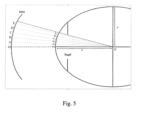
- Fig. 5 suppose the geometric central point of the lens is O, take the points A, B, C, D, and E at the midpoints of the ring widths of the 5 focus-increasing compensation areas of the lens, and draw a straight line from each of the 6 points to the intersection N, then the straight line intersects the cornea at points O1, A1, B1, C1, D1, and E1. It is known that the positive focal power of the cornea decreases gradually from the geometric center to the periphery.
- the lens can approximately compensate for the spherical aberration formed by the corneal elliptical shape.
- the central angle of each zoom arc is about 5.45°, so the distances x1, x2, x3, x4, and x5 from the five points A1, B1, C1, D1, and E1 to the center can be calculated respectively using the formula of the distance to center of ellipse, and then the positive focal power decrease value of A1, B1, C1, D1, and E1 can be calculated.
- Solution 2 According to the calculation results of the above distance to center, it can be seen that the focal power reduction ratios of A1, B1, C1, and D1 on the cornea are 4.6%, 17.9%, 38.7%, and 66.6%, respectively.
- the positive focal power increase value of the first, second, third, fourth, and fifth focus-increasing compensation areas where points A, B, C, D, and E of the lens are located relative to the central area are 0.01D, 0.03D, 0.07D, 0.12D and 0.18D, respectively.
- the focal powers of the first, second, third, fourth, and fifth focus-increasing compensation areas are -2.99D, -2.97D, -2.93D, -2.88D, and -2.82D, respectively.
- the focal powers of the first, second, third, fourth, and fifth focus-increasing compensation areas are +3.010, +3.03D, +3.070, +3.12D, and +3.18D, respectively.
- the optical frame glasses of the present application can eliminate high-order aberrations (spherical aberrations) of the eye, thereby limiting the occurrence and development of myopia. Particularly, the optical frame glasses of the present application can reduce the incidence of myopia among the children who are very likely to develop myopia. In addition, the optical frame glasses of the present application do not touch the eyeballs, the wearing method is simple, no discomfort is caused after worn, the maintenance method is simple, and the low manufacturing cost is low.
Landscapes
- Health & Medical Sciences (AREA)
- Ophthalmology & Optometry (AREA)
- Physics & Mathematics (AREA)
- General Health & Medical Sciences (AREA)
- General Physics & Mathematics (AREA)
- Optics & Photonics (AREA)
- Prostheses (AREA)
- Eyeglasses (AREA)
Description
- This application claims priority to
Chinese Patent Application No. 201910340243.2, filed on April 25, 2019 - The present application relates to the field of optical frame glasses.
- The traditional optical frame glasses are transparent medium lenses worn several millimeters in front of the patient's eyes to correct defects of vision. Through the refraction of light that is compatible with the refractive abnormality of the eye with glasses, the centrally gazed target is imaged on the retina macula of the eye with glasses. Then the eye with glasses can clearly see the centrally gazed target, thereby the defects of vision of the eye with refractive abnormality are corrected. However, such traditional optical frame glasses do not have an effect in controlling the development of myopia. Examples for lens elements for correcting myopia and methods of designing such lens elements can be found in the documents
WO2007041796A1 ,CN107861262A andUS 5054904A . - From the perspective of visual optics, the human eye is not a precise and ideal refractive body. When a spherical cylindrical optical lens is used to accurately correct the ametropia of the eye, the paraxial light entering the eye can be clearly imaged at the retinal level, thereby correcting the ametropia in the centrally gazed area. However, the peripheral image plane formed by the off-axis light entering the eye cannot be accurately imaged at the retinal level, but forms a peripheral defocus, which blurs the peripheral image at the retinal level. By affecting the retinal neurotransmitter level, the blurred image controls the growth of the axial length of the eye, which may lead to the occurrence and development of myopia.
- The difference between the real information of the gazed target and the visual imaging information of the eye is called aberration. Usually, there are two kinds of aberrations of the eye. The aberrations that can be accurately corrected by optical lenses are called low-order aberrations, including myopia, hyperopia, astigmatism, etc.; the inherent imaging defects of the eye that conventional optical lenses cannot fully compensate for are called high-order aberrations, including spherical aberration, coma, astigmatism, and so on. Most of the high-order aberrations of the eye come from the irregular and complex shape of the corneal surface. For example, the difference of focal power of the pupil-entering light between the cornea center and the periphery forms a spherical aberration. Examples in the field of myopia prevention and control can be found in the documents
CN109581690A andCN107861262A . - In recent years, a rigid air-permeable contact lens for shaping (Ortho-k lens) has been very popular. Wearing this type of contact lens can temporarily modify the shape of the cornea. After the central part of the cornea is quantitatively flattened by the lens, the positive focal power of the eye is reduced, which is used to correct myopia ametropia; the paracentral corneal focus is moderately increased, which induces the high-order aberrations of the eye to be moderately corrected after the reshaping, so that the peripheral blurred image is reduced in the field of vision of the spectacled eye. Clinical practice has confirmed that some eyes wearing this kind of contact lens witness a slowdown in the development of myopia.
- However, since the rigid air-permeable contact lens for shaping is in direct contact with the eyes when worn, the wearing method is complicated, the wearer feels uncomfortable, the maintenance is troublesome, and the manufacturing costs are very high. Under this circumstance, it is necessary to design a kind of optical
- frame glasses with the effect of controlling the occurrence and development of myopia.
- In view of the above-mentioned shortcomings in the prior art, the present application designs a kind of optical frame glasses capable of controlling the development of myopia based on actual clinical tests and precise calculations.
- The embodiments of the present application provide optical frame glasses. The optical frame glasses comprise lens, and are characterized in that the lens has a circular central area and a plurality of annular focus-increasing compensation areas surrounding the central area, the center of the circular central area coincides with the optical center of the lens, wherein the positive focal powers of the central area and the plurality of focus-increasing compensation areas progressively increase in a radially outward direction.
- According to the claimed invention, the lens has five focus-increasing compensation areas of equal width, the diameter of the central area is 2 mm, and the ring width of each of the focus-increasing compensation areas is 2 mm.
- According to the claimed invention, the increase value of the positive focal powers of the five equal-width focus-increasing compensation areas, which are arranged successively in the radially outward direction, relative to the central area are 0.01D, 0.03D, 0.07D, 0.12D and 0.18D, respectively.
- Optionally, the central area and the plurality of focus-increasing compensation areas constitute a static field of view of the lens.
- The optical frame glasses in the embodiments of the present application have at least the following advantages:
The optical frame glasses of the present application can eliminate high-order aberrations of the eye, thereby limiting the occurrence and development of myopia. In addition, the optical frame glasses of the present application do not touch the eyeballs, the wearing method is simple, no discomfort is caused after worn, the maintenance method is simple, and the manufacturing cost is low. -
-
Fig. 1 schematically shows the cornea of a human eye. -
Figs. 2A and2B schematically show the principle that the lens of the optical frame glasses of the present application compensates for the spherical aberration of the cornea. -
Fig. 3 schematically shows the visual field angle of the human eye and the static field of view of the lens when the eye is gazing at a distant target. -
Fig. 4 schematically shows the sizes of the central area and the focus-increasing compensation areas of the optical frame glasses according to the claimed invention. -
Fig. 5 schematically shows the calculation process of the zoom value of the focus-increasing compensation area of the optical frame glasses of the present application. - The embodiments of the present application are described below with reference to the drawings. In the following description, many specific details are explained to enable those skilled in the art to understand and implement the application more comprehensively. However, it is obvious to those skilled in the art that the implementation of the present application may not have some of these specific details. In addition, it should be understood that the present application is not limited to the specific embodiments described. Therefore, the following aspects, features, embodiments and advantages are for illustrative purposes only, and should not be regarded as elements or limitations of the claims, unless explicitly stated in the claims.
- As shown in
Fig. 1 , the front surface of the cornea is a portion of an arc surface in the long-axis direction of the ellipse. The center has the maximum curvature, exhibiting the largest focal power, while the curvature of the periphery slows down gradually, showing a decrease in focal power. Since the eccentricity of the actually measured corneal contour is greater than 0 but less than 1, the corneal contour can be virtualized as an ellipse after it is extended according to the morphological trajectory of the cornea. The center of the cornea and the periphery form a comparative focal power difference, resulting in defocusing of the periphery of the focal image plane (as shown inFig. 2A ). Statistics show that the individual differences in corneal elliptical eccentricity are normally distributed. If the average value of corneal elliptical eccentricity is used to design a spherical aberration compensation scheme, spherical aberrations of most glasses-worn eyes can be approximately compensated for. The specific design plan is as follows: taking the optical center of the optical lens as the zero point, designing several annular areas in the field of view around the zero point of the lens, and moderately increasing the focus at a gradual gradient, so that the light incident on the periphery of the lens can quantitatively compensate for the spherical aberration caused by gradual reduction of the focus at the periphery of the corneal ellipse. Thereby the focal image surface of the peripheral area of the visual field can approach the retina appropriately (as shown inFig. 2B ), so as to improve the imaging quality of the visual field of the eye and limit the occurrence and development of myopia. - Suppose that the projection range of the eye's field of view on the lens is the static field of view of the lens when the line of sight of the spectacled eye points to the gazed target through the optical center of the lens with the largest pupil. Of course, since the position of the frame glasses is fixed, the gaze eye can rotate about 25° toward the periphery to form a larger dynamic field of view, which, however, is beyond the scope of the design of the present application.
- When the eye is looking at a distant target, the pupil diameter is the maximum physiological value. As shown in
Fig. 3 , when the eye is looking at a distant target, the light incident from the edge of the pupil is refracted by the refractive system of the eye and intersects with the main optical axis of the eye at the intersection N. Suppose that the angle α between the light incident from the edge of the pupil and the main optical axis of the eye is the visual angle of the eye when gazing at a distant target. The angle α can be calculated as follows:
It is known that the actually measured average value of the pupil radius r1 when gazing at a distant target is about 2.386 mm, and the actually measured average value of the distance a from the pupil plane to the intersection N is about 4.133 mm. - Seek to calculate the visual angle α between the light incident from the edge of the pupil and the main optical axis of the eye.

- Suppose that the average radius of the visual angle on the projection area of the optical lens is r when the eye is gazing at a distant target, then r can be calculated as follows:
It is known that the visual angle α of the eye is about 30°, the actually measured average value b of the distance between the front central point of the cornea and the pupil plane is about 3.067 mm, and the distance c between the back vertex of the optical lens and the front central point of the cornea is about 12 mm. - Seek to calculate the radius r of the static field of view of the lens.

- According to the above calculation, the circular diameter of the static field of view of the lens is about 22 mm. As shown in
Fig. 4 , a circle of 2 mm is drawn at the geometric center of the lens as the central area. Then concentric circles are drawn around the central area with an increasing gradient radius of 2 mm to form 5 equal-width annular focus-increasing compensation areas, namely the first, second, third, fourth and fifth focus-increasing compensation areas. Positive focal powers of the central area and the five focus-increasing compensation areas progressively increase in a radially outward direction. - As shown in
Fig. 5 , suppose the geometric central point of the lens is O, take the points A, B, C, D, and E at the midpoints of the ring widths of the 5 focus-increasing compensation areas of the lens, and draw a straight line from each of the 6 points to the intersection N, then the straight line intersects the cornea at points O1, A1, B1, C1, D1, and E1. It is known that the positive focal power of the cornea decreases gradually from the geometric center to the periphery. Try to calculate the gradual decrement value of the positive focal power of the 5 points A1, B1, C1, D1 and E1 of the cornea, and then design the focus-increasing compensation areas containing the 5 points A, B, C, D and E corresponding to A1, B1, C1, D1 and E1 to have an equal increase in positive focal power, i.e. take the increase value of positive focal power of the points A, B, C, D and E as those of the first, second, third, fourth, and fifth focus-increasing compensation areas containing the points A, B, C, D and E, respectively, then the lens can approximately compensate for the spherical aberration formed by the corneal elliptical shape. - Known: Summarize the actually measured high-order aberration residual of the eye after refractive correction, suppose the decrease value of positive focal power at the corneal central point O1 to be 0, then the decrease value of positive focal power at the corneal point E1 is about -0.18D. Suppose the actually measured average value of the curvature power at the corneal geometric central point O1 is about 43.58D, then the long semi-axis x of the corneal ellipse is about 7.7444 mm; suppose the actually measured average value of eccentricity of the corneal ellipse is about 0.439, then the short semi-axis y of the corneal ellipse is about 6.958 mm. Since the center of the corneal ellipse is close to the intersection N, it can be considered that the central angle of each zoom arc is about 5.45°, so the distances x1, x2, x3, x4, and x5 from the five points A1, B1, C1, D1, and E1 to the center can be calculated respectively using the formula of the distance to center of ellipse, and then the positive focal power decrease value of A1, B1, C1, D1, and E1 can be calculated.
- Seek to calculate the increase value in the positive focal powers of the first, second, third, fourth and fifth focus-increasing compensation areas where the points A, B, C, D and E of the lens are located respectively.
- Solution 1: The distance to center x1, x2, x3, x4, and x5 of points A1, B1, C1, D1, and E1 on the cornea are calculated as follows:


- Solution 2: According to the calculation results of the above distance to center, it can be seen that the focal power reduction ratios of A1, B1, C1, and D1 on the cornea are 4.6%, 17.9%, 38.7%, and 66.6%, respectively.
- In summary, assuming that the positive focal power decrease value at the central point O1 of the cornea is 0, then the positive focal power decrease value at points A1, B1, C1, D1, and E1 are as follows:

- Then the positive focal power increase value of the points A, B, C, D, and E of the lens relative to the geometric central point O of the lens are as follows:

- Therefore, the positive focal power increase value of the first, second, third, fourth, and fifth focus-increasing compensation areas where points A, B, C, D, and E of the lens are located relative to the central area are 0.01D, 0.03D, 0.07D, 0.12D and 0.18D, respectively. For example, if the optical frame glasses are near-sighted glasses and the focal power of the central area of the lens is -3D, the focal powers of the first, second, third, fourth, and fifth focus-increasing compensation areas are -2.99D, -2.97D, -2.93D, -2.88D, and -2.82D, respectively. If the optical frame glasses are farsighted glasses and the focal power of the central area of the lens is +3D, the focal powers of the first, second, third, fourth, and fifth focus-increasing compensation areas are +3.010, +3.03D, +3.070, +3.12D, and +3.18D, respectively.
- The optical frame glasses of the present application can eliminate high-order aberrations (spherical aberrations) of the eye, thereby limiting the occurrence and development of myopia. Particularly, the optical frame glasses of the present application can reduce the incidence of myopia among the children who are very likely to develop myopia. In addition, the optical frame glasses of the present application do not touch the eyeballs, the wearing method is simple, no discomfort is caused after worn, the maintenance method is simple, and the low manufacturing cost is low.
- The above embodiments are preferred ones in the present application, but the present application is not limited thereto. Therefore, the scope of protection of the present application shall be determined by the terms of the claims.
Claims (2)
- Optical frame glasses to limit the occurrence and development of myopia, comprising a lens, wherein the lens has a circular central area and a plurality of annular focus-increasing compensation areas surrounding the central area, the center of the circular central area coincides with the optical center of the lens, wherein in a radially outward direction, positive focal powers of the central area and the plurality of focus-increasing compensation areas progressively increase,
characterized in thatthe lens has five focus-increasing compensation areas of equal width, the diameter of the central area is 2 mm, and the ring width of each of the focus-increasing compensation areas is 2 mm,wherein the increase value of the positive focal powers of the five equal-width focus-increasing compensation areas, which are arranged successively in the radially outward direction, relative to the central area are 0.01D, 0.03D, 0.07D, 0.12D and 0.18D, respectively. - The optical frame glasses according to claim 1, wherein the central area and the plurality of focus-increasing compensation areas constitute a static field of view of the lens.
Applications Claiming Priority (2)
| Application Number | Priority Date | Filing Date | Title |
|---|---|---|---|
| CN201910340243.2A CN109946849B (en) | 2019-04-25 | 2019-04-25 | Optical frame glasses |
| PCT/CN2020/086180 WO2020216257A1 (en) | 2019-04-25 | 2020-04-22 | Optical frame glasses |
Publications (3)
| Publication Number | Publication Date |
|---|---|
| EP3961297A1 EP3961297A1 (en) | 2022-03-02 |
| EP3961297A4 EP3961297A4 (en) | 2023-01-11 |
| EP3961297B1 true EP3961297B1 (en) | 2025-01-01 |
Family
ID=67016180
Family Applications (1)
| Application Number | Title | Priority Date | Filing Date |
|---|---|---|---|
| EP20796391.9A Active EP3961297B1 (en) | 2019-04-25 | 2020-04-22 | Optical frame glasses |
Country Status (4)
| Country | Link |
|---|---|
| US (1) | US12130504B2 (en) |
| EP (1) | EP3961297B1 (en) |
| CN (1) | CN109946849B (en) |
| WO (1) | WO2020216257A1 (en) |
Families Citing this family (4)
| Publication number | Priority date | Publication date | Assignee | Title |
|---|---|---|---|---|
| CN109946849B (en) | 2019-04-25 | 2024-11-26 | 江苏承启光电科技有限公司 | Optical frame glasses |
| MX2021016164A (en) * | 2019-06-28 | 2022-08-04 | Brien Holden Vision Institute Ltd | Ophthalmic lenses and methods for correcting, slowing, reducing, and/or controlling the progression of myopia. |
| US20240264470A1 (en) * | 2023-02-06 | 2024-08-08 | Path Makar, LLC | Optical lens having off-center magnification gradiant |
| CN118068464B (en) * | 2024-02-23 | 2024-08-16 | 江苏鸿晨集团有限公司 | Self-correcting high-order aberration lens and preparation process thereof |
Family Cites Families (19)
| Publication number | Priority date | Publication date | Assignee | Title |
|---|---|---|---|---|
| US5054904A (en) | 1989-05-22 | 1991-10-08 | Bristol Alexander C | Aspheric lens blank |
| WO2001046744A2 (en) * | 1999-12-22 | 2001-06-28 | Essilor International | Pair of multifocal progressive spectacle lenses |
| US7401922B2 (en) | 2005-04-13 | 2008-07-22 | Synergeyes, Inc. | Method and apparatus for reducing or eliminating the progression of myopia |
| CA2626050C (en) | 2005-10-12 | 2015-12-08 | Carl Zeiss Vision Australia Holdings Limited | Ophthalmic lens element for myopia correction |
| CA2653286C (en) * | 2006-06-08 | 2016-01-05 | Vision Crc Limited | Means for controlling the progression of myopia |
| ES2609289T3 (en) * | 2008-04-02 | 2017-04-19 | Junzhong Liang | Methods and devices for refractive corrections of presbyopia |
| MX2011001659A (en) | 2008-08-11 | 2011-03-02 | Novartis Ag | A lens design and method for preventing or slowing the progression of myopia. |
| CN201804169U (en) | 2010-09-15 | 2011-04-20 | 段亚东 | Short-sight progressive defocus correcting glasses |
| TWI516830B (en) * | 2012-05-07 | 2016-01-11 | 星歐光學股份有限公司 | Contact lens for myopia control |
| WO2014050879A1 (en) * | 2012-09-25 | 2014-04-03 | 国立大学法人大阪大学 | Contact lens having myopia progression suppression capability, and contact lens set having myopia progression suppression capability |
| US8998408B2 (en) * | 2013-01-30 | 2015-04-07 | Johnson & Johnson Vision Care, Inc. | Asymmetric lens design and method for preventing and/or slowing myopia progression |
| CN103941420A (en) * | 2014-04-08 | 2014-07-23 | 张家炳 | Far-sighted composite out-of-focus lens |
| CN205157909U (en) | 2015-12-07 | 2016-04-13 | 齐备 | Soft corneal contact lens |
| CN106842613A (en) * | 2015-12-07 | 2017-06-13 | 齐备 | soft contact lens |
| CN107861262B (en) * | 2017-12-10 | 2024-04-09 | 段亚东 | Fan-shaped concentric peripheral defocused eyeglass lenses |
| CN208421444U (en) * | 2018-05-11 | 2019-01-22 | 深圳摩方材料科技有限公司 | Glasses system and optometry system with adjustable diopter |
| CN111897141B (en) * | 2018-12-25 | 2022-11-11 | 天津医科大学眼科医院 | Peripheral out-of-focus lens and frame glasses |
| CN109946849B (en) | 2019-04-25 | 2024-11-26 | 江苏承启光电科技有限公司 | Optical frame glasses |
| CN209570761U (en) * | 2019-04-25 | 2019-11-01 | 齐备 | optical frame glasses |
-
2019
- 2019-04-25 CN CN201910340243.2A patent/CN109946849B/en active Active
-
2020
- 2020-04-22 US US17/606,298 patent/US12130504B2/en active Active
- 2020-04-22 EP EP20796391.9A patent/EP3961297B1/en active Active
- 2020-04-22 WO PCT/CN2020/086180 patent/WO2020216257A1/en not_active Ceased
Also Published As
| Publication number | Publication date |
|---|---|
| WO2020216257A1 (en) | 2020-10-29 |
| US20220206320A1 (en) | 2022-06-30 |
| EP3961297A1 (en) | 2022-03-02 |
| EP3961297A4 (en) | 2023-01-11 |
| CN109946849A (en) | 2019-06-28 |
| US12130504B2 (en) | 2024-10-29 |
| CN109946849B (en) | 2024-11-26 |
Similar Documents
| Publication | Publication Date | Title |
|---|---|---|
| CN107219640B (en) | Multifocal lens designs and methods for preventing and/or slowing the progression of myopia | |
| CN106291978B (en) | Contact lenses comprising non-coaxial lenslets for preventing and/or slowing myopia progression | |
| US10012848B2 (en) | Mask lens design and method for preventing and/or slowing myopia progression | |
| EP2762953B1 (en) | Asymmetric lens design and method for preventing and/or slowing myopia progression | |
| US9733494B2 (en) | Free form lens design and method for preventing and/or slowing myopia progression | |
| JP5422207B2 (en) | Method and apparatus for controlling myopia progression by controlling the position of peripheral vision | |
| US12130504B2 (en) | Optical frame glasses | |
| EP2988162B1 (en) | Lens design and methods for minimizing visual acuity variation experienced by myopia progressors | |
| TW202131060A (en) | Contact lens solution for myopia management | |
| CN110275316A (en) | A kind of multifunctional rigid contact lens | |
| JP2023552051A (en) | Contact lenses and related methods for use in preventing or delaying the onset or progression of myopia | |
| EP4270099A1 (en) | Spectacle lens | |
| CN207301528U (en) | A kind of peripheral hyperopia defocus control eyeglass of fixed compensation amount | |
| CN209570761U (en) | optical frame glasses | |
| US20200341296A1 (en) | Aspheric lens capable of using monocular retinal rivalry to control axial length grown rate | |
| EP4270097B1 (en) | Ophthalmic lens for preventing progression of myopia, and spectacles with the same | |
| WO2020202081A1 (en) | Contact lens and method to prevent myopia progression | |
| HK40070133B (en) | Optical frame glasses | |
| HK40070133A (en) | Optical frame glasses | |
| CN210155447U (en) | A multifunctional rigid contact lens | |
| KR20260070551A (en) | A fitting method for an astigmatism contact lens set comprising an apodized monofocal lens for correcting low astigmatism error and a toric lens for correcting high astigmatism error, and a related astigmatism lens set | |
| CN121209127A (en) | A type of astigmatism-correcting asymmetric peripheral defocus corneal contact lens | |
| CN121844249A (en) | Ophthalmic lens with microlenses for medical control | |
| CN113359320A (en) | Aspheric lens for controlling growth speed of eye axis by retina competition | |
| HK1200919B (en) | Asymmetric lens design and method for preventing and/or slowing myopia progression |
Legal Events
| Date | Code | Title | Description |
|---|---|---|---|
| STAA | Information on the status of an ep patent application or granted ep patent |
Free format text: STATUS: THE INTERNATIONAL PUBLICATION HAS BEEN MADE |
|
| PUAI | Public reference made under article 153(3) epc to a published international application that has entered the european phase |
Free format text: ORIGINAL CODE: 0009012 |
|
| STAA | Information on the status of an ep patent application or granted ep patent |
Free format text: STATUS: REQUEST FOR EXAMINATION WAS MADE |
|
| 17P | Request for examination filed |
Effective date: 20211122 |
|
| AK | Designated contracting states |
Kind code of ref document: A1 Designated state(s): AL AT BE BG CH CY CZ DE DK EE ES FI FR GB GR HR HU IE IS IT LI LT LU LV MC MK MT NL NO PL PT RO RS SE SI SK SM TR |
|
| DAV | Request for validation of the european patent (deleted) | ||
| DAX | Request for extension of the european patent (deleted) | ||
| REG | Reference to a national code |
Ref country code: HK Ref legal event code: DE Ref document number: 40070133 Country of ref document: HK |
|
| A4 | Supplementary search report drawn up and despatched |
Effective date: 20221208 |
|
| RIC1 | Information provided on ipc code assigned before grant |
Ipc: G02C 7/06 20060101ALI20221202BHEP Ipc: G02C 7/02 20060101AFI20221202BHEP |
|
| STAA | Information on the status of an ep patent application or granted ep patent |
Free format text: STATUS: EXAMINATION IS IN PROGRESS |
|
| 17Q | First examination report despatched |
Effective date: 20231204 |
|
| GRAP | Despatch of communication of intention to grant a patent |
Free format text: ORIGINAL CODE: EPIDOSNIGR1 |
|
| STAA | Information on the status of an ep patent application or granted ep patent |
Free format text: STATUS: GRANT OF PATENT IS INTENDED |
|
| INTG | Intention to grant announced |
Effective date: 20240827 |
|
| RIN1 | Information on inventor provided before grant (corrected) |
Inventor name: WU, XIAOXU Inventor name: QI, BEI |
|
| GRAS | Grant fee paid |
Free format text: ORIGINAL CODE: EPIDOSNIGR3 |
|
| GRAA | (expected) grant |
Free format text: ORIGINAL CODE: 0009210 |
|
| STAA | Information on the status of an ep patent application or granted ep patent |
Free format text: STATUS: THE PATENT HAS BEEN GRANTED |
|
| AK | Designated contracting states |
Kind code of ref document: B1 Designated state(s): AL AT BE BG CH CY CZ DE DK EE ES FI FR GB GR HR HU IE IS IT LI LT LU LV MC MK MT NL NO PL PT RO RS SE SI SK SM TR |
|
| REG | Reference to a national code |
Ref country code: GB Ref legal event code: FG4D |
|
| REG | Reference to a national code |
Ref country code: CH Ref legal event code: EP |
|
| REG | Reference to a national code |
Ref country code: DE Ref legal event code: R096 Ref document number: 602020044116 Country of ref document: DE |
|
| REG | Reference to a national code |
Ref country code: IE Ref legal event code: FG4D |
|
| REG | Reference to a national code |
Ref country code: LT Ref legal event code: MG9D |
|
| REG | Reference to a national code |
Ref country code: NL Ref legal event code: MP Effective date: 20250101 |
|
| REG | Reference to a national code |
Ref country code: AT Ref legal event code: MK05 Ref document number: 1756838 Country of ref document: AT Kind code of ref document: T Effective date: 20250101 |
|
| PG25 | Lapsed in a contracting state [announced via postgrant information from national office to epo] |
Ref country code: NL Free format text: LAPSE BECAUSE OF FAILURE TO SUBMIT A TRANSLATION OF THE DESCRIPTION OR TO PAY THE FEE WITHIN THE PRESCRIBED TIME-LIMIT Effective date: 20250101 |
|
| PG25 | Lapsed in a contracting state [announced via postgrant information from national office to epo] |
Ref country code: FI Free format text: LAPSE BECAUSE OF FAILURE TO SUBMIT A TRANSLATION OF THE DESCRIPTION OR TO PAY THE FEE WITHIN THE PRESCRIBED TIME-LIMIT Effective date: 20250101 |
|
| PG25 | Lapsed in a contracting state [announced via postgrant information from national office to epo] |
Ref country code: PL Free format text: LAPSE BECAUSE OF FAILURE TO SUBMIT A TRANSLATION OF THE DESCRIPTION OR TO PAY THE FEE WITHIN THE PRESCRIBED TIME-LIMIT Effective date: 20250101 |
|
| PGFP | Annual fee paid to national office [announced via postgrant information from national office to epo] |
Ref country code: DE Payment date: 20250429 Year of fee payment: 6 |
|
| PG25 | Lapsed in a contracting state [announced via postgrant information from national office to epo] |
Ref country code: ES Free format text: LAPSE BECAUSE OF FAILURE TO SUBMIT A TRANSLATION OF THE DESCRIPTION OR TO PAY THE FEE WITHIN THE PRESCRIBED TIME-LIMIT Effective date: 20250101 |
|
| PGFP | Annual fee paid to national office [announced via postgrant information from national office to epo] |
Ref country code: GB Payment date: 20250429 Year of fee payment: 6 |
|
| PG25 | Lapsed in a contracting state [announced via postgrant information from national office to epo] |
Ref country code: NO Free format text: LAPSE BECAUSE OF FAILURE TO SUBMIT A TRANSLATION OF THE DESCRIPTION OR TO PAY THE FEE WITHIN THE PRESCRIBED TIME-LIMIT Effective date: 20250401 Ref country code: IS Free format text: LAPSE BECAUSE OF FAILURE TO SUBMIT A TRANSLATION OF THE DESCRIPTION OR TO PAY THE FEE WITHIN THE PRESCRIBED TIME-LIMIT Effective date: 20250501 |
|
| PGFP | Annual fee paid to national office [announced via postgrant information from national office to epo] |
Ref country code: IT Payment date: 20250429 Year of fee payment: 6 |
|
| PG25 | Lapsed in a contracting state [announced via postgrant information from national office to epo] |
Ref country code: HR Free format text: LAPSE BECAUSE OF FAILURE TO SUBMIT A TRANSLATION OF THE DESCRIPTION OR TO PAY THE FEE WITHIN THE PRESCRIBED TIME-LIMIT Effective date: 20250101 |
|
| PG25 | Lapsed in a contracting state [announced via postgrant information from national office to epo] |
Ref country code: LV Free format text: LAPSE BECAUSE OF FAILURE TO SUBMIT A TRANSLATION OF THE DESCRIPTION OR TO PAY THE FEE WITHIN THE PRESCRIBED TIME-LIMIT Effective date: 20250101 Ref country code: PT Free format text: LAPSE BECAUSE OF FAILURE TO SUBMIT A TRANSLATION OF THE DESCRIPTION OR TO PAY THE FEE WITHIN THE PRESCRIBED TIME-LIMIT Effective date: 20250502 |
|
| PGFP | Annual fee paid to national office [announced via postgrant information from national office to epo] |
Ref country code: FR Payment date: 20250429 Year of fee payment: 6 |
|
| PG25 | Lapsed in a contracting state [announced via postgrant information from national office to epo] |
Ref country code: GR Free format text: LAPSE BECAUSE OF FAILURE TO SUBMIT A TRANSLATION OF THE DESCRIPTION OR TO PAY THE FEE WITHIN THE PRESCRIBED TIME-LIMIT Effective date: 20250402 Ref country code: BG Free format text: LAPSE BECAUSE OF FAILURE TO SUBMIT A TRANSLATION OF THE DESCRIPTION OR TO PAY THE FEE WITHIN THE PRESCRIBED TIME-LIMIT Effective date: 20250101 |
|
| PG25 | Lapsed in a contracting state [announced via postgrant information from national office to epo] |
Ref country code: AT Free format text: LAPSE BECAUSE OF FAILURE TO SUBMIT A TRANSLATION OF THE DESCRIPTION OR TO PAY THE FEE WITHIN THE PRESCRIBED TIME-LIMIT Effective date: 20250101 |
|
| PG25 | Lapsed in a contracting state [announced via postgrant information from national office to epo] |
Ref country code: CZ Free format text: LAPSE BECAUSE OF FAILURE TO SUBMIT A TRANSLATION OF THE DESCRIPTION OR TO PAY THE FEE WITHIN THE PRESCRIBED TIME-LIMIT Effective date: 20250101 |
|
| PG25 | Lapsed in a contracting state [announced via postgrant information from national office to epo] |
Ref country code: SE Free format text: LAPSE BECAUSE OF FAILURE TO SUBMIT A TRANSLATION OF THE DESCRIPTION OR TO PAY THE FEE WITHIN THE PRESCRIBED TIME-LIMIT Effective date: 20250101 |
|
| REG | Reference to a national code |
Ref country code: DE Ref legal event code: R097 Ref document number: 602020044116 Country of ref document: DE |
|
| PG25 | Lapsed in a contracting state [announced via postgrant information from national office to epo] |
Ref country code: SM Free format text: LAPSE BECAUSE OF FAILURE TO SUBMIT A TRANSLATION OF THE DESCRIPTION OR TO PAY THE FEE WITHIN THE PRESCRIBED TIME-LIMIT Effective date: 20250101 |
|
| PG25 | Lapsed in a contracting state [announced via postgrant information from national office to epo] |
Ref country code: DK Free format text: LAPSE BECAUSE OF FAILURE TO SUBMIT A TRANSLATION OF THE DESCRIPTION OR TO PAY THE FEE WITHIN THE PRESCRIBED TIME-LIMIT Effective date: 20250101 |
|
| PG25 | Lapsed in a contracting state [announced via postgrant information from national office to epo] |
Ref country code: EE Free format text: LAPSE BECAUSE OF FAILURE TO SUBMIT A TRANSLATION OF THE DESCRIPTION OR TO PAY THE FEE WITHIN THE PRESCRIBED TIME-LIMIT Effective date: 20250101 |
|
| PG25 | Lapsed in a contracting state [announced via postgrant information from national office to epo] |
Ref country code: RO Free format text: LAPSE BECAUSE OF FAILURE TO SUBMIT A TRANSLATION OF THE DESCRIPTION OR TO PAY THE FEE WITHIN THE PRESCRIBED TIME-LIMIT Effective date: 20250101 |
|
| PG25 | Lapsed in a contracting state [announced via postgrant information from national office to epo] |
Ref country code: SK Free format text: LAPSE BECAUSE OF FAILURE TO SUBMIT A TRANSLATION OF THE DESCRIPTION OR TO PAY THE FEE WITHIN THE PRESCRIBED TIME-LIMIT Effective date: 20250101 |
|
| PLBE | No opposition filed within time limit |
Free format text: ORIGINAL CODE: 0009261 |
|
| STAA | Information on the status of an ep patent application or granted ep patent |
Free format text: STATUS: NO OPPOSITION FILED WITHIN TIME LIMIT |
|
| REG | Reference to a national code |
Ref country code: CH Ref legal event code: L10 Free format text: ST27 STATUS EVENT CODE: U-0-0-L10-L00 (AS PROVIDED BY THE NATIONAL OFFICE) Effective date: 20251112 |
|
| REG | Reference to a national code |
Ref country code: CH Ref legal event code: H13 Free format text: ST27 STATUS EVENT CODE: U-0-0-H10-H13 (AS PROVIDED BY THE NATIONAL OFFICE) Effective date: 20251125 |
|
| 26N | No opposition filed |
Effective date: 20251002 |
|
| PG25 | Lapsed in a contracting state [announced via postgrant information from national office to epo] |
Ref country code: LU Free format text: LAPSE BECAUSE OF NON-PAYMENT OF DUE FEES Effective date: 20250422 |
|
| PG25 | Lapsed in a contracting state [announced via postgrant information from national office to epo] |
Ref country code: MC Free format text: LAPSE BECAUSE OF FAILURE TO SUBMIT A TRANSLATION OF THE DESCRIPTION OR TO PAY THE FEE WITHIN THE PRESCRIBED TIME-LIMIT Effective date: 20250101 |
|
| REG | Reference to a national code |
Ref country code: BE Ref legal event code: MM Effective date: 20250430 |
|
| PG25 | Lapsed in a contracting state [announced via postgrant information from national office to epo] |
Ref country code: BE Free format text: LAPSE BECAUSE OF NON-PAYMENT OF DUE FEES Effective date: 20250430 |
|
| PG25 | Lapsed in a contracting state [announced via postgrant information from national office to epo] |
Ref country code: CH Free format text: LAPSE BECAUSE OF NON-PAYMENT OF DUE FEES Effective date: 20250430 |
|
| PG25 | Lapsed in a contracting state [announced via postgrant information from national office to epo] |
Ref country code: IE Free format text: LAPSE BECAUSE OF NON-PAYMENT OF DUE FEES Effective date: 20250422 |
|
| PG25 | Lapsed in a contracting state [announced via postgrant information from national office to epo] |
Ref country code: CY Free format text: LAPSE BECAUSE OF FAILURE TO SUBMIT A TRANSLATION OF THE DESCRIPTION OR TO PAY THE FEE WITHIN THE PRESCRIBED TIME-LIMIT Effective date: 20250101 |
|
| PG25 | Lapsed in a contracting state [announced via postgrant information from national office to epo] |
Ref country code: LT Free format text: LAPSE BECAUSE OF FAILURE TO SUBMIT A TRANSLATION OF THE DESCRIPTION OR TO PAY THE FEE WITHIN THE PRESCRIBED TIME-LIMIT Effective date: 20250101 |
|
| PG25 | Lapsed in a contracting state [announced via postgrant information from national office to epo] |
Ref country code: RS Free format text: LAPSE BECAUSE OF FAILURE TO SUBMIT A TRANSLATION OF THE DESCRIPTION OR TO PAY THE FEE WITHIN THE PRESCRIBED TIME-LIMIT Effective date: 20250101 |