EP3961219A2 - Use of gdf-15 in the diagnosis and treatment of frailty and conditions associated with altered physiological reserve, physical fitness and exercise capacity - Google Patents
Use of gdf-15 in the diagnosis and treatment of frailty and conditions associated with altered physiological reserve, physical fitness and exercise capacity Download PDFInfo
- Publication number
- EP3961219A2 EP3961219A2 EP21193874.1A EP21193874A EP3961219A2 EP 3961219 A2 EP3961219 A2 EP 3961219A2 EP 21193874 A EP21193874 A EP 21193874A EP 3961219 A2 EP3961219 A2 EP 3961219A2
- Authority
- EP
- European Patent Office
- Prior art keywords
- mmol
- gdf
- subject
- frailty
- levels
- Prior art date
- Legal status (The legal status is an assumption and is not a legal conclusion. Google has not performed a legal analysis and makes no representation as to the accuracy of the status listed.)
- Pending
Links
- 208000036119 Frailty Diseases 0.000 title claims abstract description 102
- 206010003549 asthenia Diseases 0.000 title claims abstract description 102
- 102000000597 Growth Differentiation Factor 15 Human genes 0.000 title claims description 178
- 108010041834 Growth Differentiation Factor 15 Proteins 0.000 title claims description 178
- 238000011282 treatment Methods 0.000 title description 4
- 238000003745 diagnosis Methods 0.000 title description 3
- 239000000090 biomarker Substances 0.000 claims abstract description 82
- 238000000034 method Methods 0.000 claims abstract description 48
- DHMQDGOQFOQNFH-UHFFFAOYSA-N Glycine Chemical compound NCC(O)=O DHMQDGOQFOQNFH-UHFFFAOYSA-N 0.000 claims description 109
- 108010088751 Albumins Proteins 0.000 claims description 78
- 102000009027 Albumins Human genes 0.000 claims description 78
- 150000002327 glycerophospholipids Chemical class 0.000 claims description 75
- 102400001263 NT-proBNP Human genes 0.000 claims description 66
- 108010008064 pro-brain natriuretic peptide (1-76) Proteins 0.000 claims description 66
- ZDXPYRJPNDTMRX-UHFFFAOYSA-N glutamine Natural products OC(=O)C(N)CCC(N)=O ZDXPYRJPNDTMRX-UHFFFAOYSA-N 0.000 claims description 48
- 239000004471 Glycine Substances 0.000 claims description 41
- QNAYBMKLOCPYGJ-REOHCLBHSA-N L-alanine Chemical compound C[C@H](N)C(O)=O QNAYBMKLOCPYGJ-REOHCLBHSA-N 0.000 claims description 41
- 235000004279 alanine Nutrition 0.000 claims description 41
- 239000012472 biological sample Substances 0.000 claims description 32
- 238000002705 metabolomic analysis Methods 0.000 claims description 30
- 230000001431 metabolomic effect Effects 0.000 claims description 30
- 210000002966 serum Anatomy 0.000 claims description 28
- 230000000747 cardiac effect Effects 0.000 claims description 22
- 206010019280 Heart failures Diseases 0.000 claims description 21
- 238000012360 testing method Methods 0.000 claims description 17
- 230000004064 dysfunction Effects 0.000 claims description 14
- 230000036765 blood level Effects 0.000 claims description 12
- 230000009885 systemic effect Effects 0.000 claims description 12
- 230000035945 sensitivity Effects 0.000 claims description 11
- 238000005160 1H NMR spectroscopy Methods 0.000 claims description 10
- 206010058558 Hypoperfusion Diseases 0.000 claims description 7
- 238000000338 in vitro Methods 0.000 claims description 7
- 208000027418 Wounds and injury Diseases 0.000 claims description 5
- 230000006378 damage Effects 0.000 claims description 5
- 208000014674 injury Diseases 0.000 claims description 5
- 238000003018 immunoassay Methods 0.000 claims description 4
- 239000000523 sample Substances 0.000 claims description 4
- 238000009052 Elecsys assay kit Methods 0.000 claims description 3
- 206010012601 diabetes mellitus Diseases 0.000 claims description 3
- 210000002381 plasma Anatomy 0.000 claims description 3
- 208000027866 inflammatory disease Diseases 0.000 claims description 2
- HVYWMOMLDIMFJA-DPAQBDIFSA-N cholesterol Chemical group C1C=C2C[C@@H](O)CC[C@]2(C)[C@@H]2[C@@H]1[C@@H]1CC[C@H]([C@H](C)CCCC(C)C)[C@@]1(C)CC2 HVYWMOMLDIMFJA-DPAQBDIFSA-N 0.000 description 165
- 108010062497 VLDL Lipoproteins Proteins 0.000 description 96
- 150000002632 lipids Chemical class 0.000 description 90
- 235000012000 cholesterol Nutrition 0.000 description 67
- 230000002503 metabolic effect Effects 0.000 description 67
- 108010010234 HDL Lipoproteins Proteins 0.000 description 65
- 108010007622 LDL Lipoproteins Proteins 0.000 description 44
- 150000003904 phospholipids Chemical class 0.000 description 34
- 150000003626 triacylglycerols Chemical class 0.000 description 34
- 239000002207 metabolite Substances 0.000 description 30
- 239000002245 particle Substances 0.000 description 25
- 238000010200 validation analysis Methods 0.000 description 22
- 230000010076 replication Effects 0.000 description 21
- 238000000554 physical therapy Methods 0.000 description 20
- 108010004103 Chylomicrons Proteins 0.000 description 13
- ROHFNLRQFUQHCH-YFKPBYRVSA-N L-leucine Chemical compound CC(C)C[C@H](N)C(O)=O ROHFNLRQFUQHCH-YFKPBYRVSA-N 0.000 description 13
- 235000001014 amino acid Nutrition 0.000 description 13
- 229940024606 amino acid Drugs 0.000 description 13
- 150000001413 amino acids Chemical class 0.000 description 13
- ROHFNLRQFUQHCH-UHFFFAOYSA-N Leucine Natural products CC(C)CC(N)C(O)=O ROHFNLRQFUQHCH-UHFFFAOYSA-N 0.000 description 12
- 235000014113 dietary fatty acids Nutrition 0.000 description 12
- 208000037265 diseases, disorders, signs and symptoms Diseases 0.000 description 12
- 229930195729 fatty acid Natural products 0.000 description 12
- 239000000194 fatty acid Substances 0.000 description 12
- 150000004665 fatty acids Chemical class 0.000 description 12
- 230000001771 impaired effect Effects 0.000 description 12
- 229940126585 therapeutic drug Drugs 0.000 description 12
- 206010061218 Inflammation Diseases 0.000 description 11
- 201000010099 disease Diseases 0.000 description 11
- 230000004054 inflammatory process Effects 0.000 description 11
- 230000002612 cardiopulmonary effect Effects 0.000 description 10
- 230000002526 effect on cardiovascular system Effects 0.000 description 10
- 238000009207 exercise therapy Methods 0.000 description 10
- 235000016709 nutrition Nutrition 0.000 description 10
- 235000018102 proteins Nutrition 0.000 description 10
- 102000004169 proteins and genes Human genes 0.000 description 10
- 108090000623 proteins and genes Proteins 0.000 description 10
- 230000009469 supplementation Effects 0.000 description 10
- 210000004369 blood Anatomy 0.000 description 9
- 239000008280 blood Substances 0.000 description 9
- 230000036541 health Effects 0.000 description 8
- 238000012417 linear regression Methods 0.000 description 8
- 108090001030 Lipoproteins Proteins 0.000 description 7
- 102000004895 Lipoproteins Human genes 0.000 description 7
- 230000000875 corresponding effect Effects 0.000 description 7
- PEDCQBHIVMGVHV-UHFFFAOYSA-N Glycerine Chemical compound OCC(O)CO PEDCQBHIVMGVHV-UHFFFAOYSA-N 0.000 description 6
- 208000024891 symptom Diseases 0.000 description 6
- 102000003886 Glycoproteins Human genes 0.000 description 5
- 108090000288 Glycoproteins Proteins 0.000 description 5
- 241000502522 Luscinia megarhynchos Species 0.000 description 5
- 230000002829 reductive effect Effects 0.000 description 5
- 125000000998 L-alanino group Chemical group [H]N([*])[C@](C([H])([H])[H])([H])C(=O)O[H] 0.000 description 4
- 230000032683 aging Effects 0.000 description 4
- MBMBGCFOFBJSGT-KUBAVDMBSA-N all-cis-docosa-4,7,10,13,16,19-hexaenoic acid Chemical compound CC\C=C/C\C=C/C\C=C/C\C=C/C\C=C/C\C=C/CCC(O)=O MBMBGCFOFBJSGT-KUBAVDMBSA-N 0.000 description 4
- 238000004458 analytical method Methods 0.000 description 4
- DDRJAANPRJIHGJ-UHFFFAOYSA-N creatinine Chemical compound CN1CC(=O)NC1=N DDRJAANPRJIHGJ-UHFFFAOYSA-N 0.000 description 4
- 230000001419 dependent effect Effects 0.000 description 4
- 238000003384 imaging method Methods 0.000 description 4
- 238000007477 logistic regression Methods 0.000 description 4
- 239000003550 marker Substances 0.000 description 4
- 230000004083 survival effect Effects 0.000 description 4
- CSCPPACGZOOCGX-UHFFFAOYSA-N Acetone Chemical compound CC(C)=O CSCPPACGZOOCGX-UHFFFAOYSA-N 0.000 description 3
- AGPKZVBTJJNPAG-WHFBIAKZSA-N L-isoleucine Chemical compound CC[C@H](C)[C@H](N)C(O)=O AGPKZVBTJJNPAG-WHFBIAKZSA-N 0.000 description 3
- COLNVLDHVKWLRT-QMMMGPOBSA-N L-phenylalanine Chemical compound OC(=O)[C@@H](N)CC1=CC=CC=C1 COLNVLDHVKWLRT-QMMMGPOBSA-N 0.000 description 3
- OUYCCCASQSFEME-QMMMGPOBSA-N L-tyrosine Chemical compound OC(=O)[C@@H](N)CC1=CC=C(O)C=C1 OUYCCCASQSFEME-QMMMGPOBSA-N 0.000 description 3
- 238000008214 LDL Cholesterol Methods 0.000 description 3
- KZSNJWFQEVHDMF-UHFFFAOYSA-N Valine Natural products CC(C)C(N)C(O)=O KZSNJWFQEVHDMF-UHFFFAOYSA-N 0.000 description 3
- 230000005856 abnormality Effects 0.000 description 3
- 239000003112 inhibitor Substances 0.000 description 3
- 238000012544 monitoring process Methods 0.000 description 3
- 235000020660 omega-3 fatty acid Nutrition 0.000 description 3
- 229940012843 omega-3 fatty acid Drugs 0.000 description 3
- 239000006014 omega-3 oil Substances 0.000 description 3
- 235000020665 omega-6 fatty acid Nutrition 0.000 description 3
- 229940033080 omega-6 fatty acid Drugs 0.000 description 3
- 235000020777 polyunsaturated fatty acids Nutrition 0.000 description 3
- 208000037816 tissue injury Diseases 0.000 description 3
- 101710095342 Apolipoprotein B Proteins 0.000 description 2
- 102100040202 Apolipoprotein B-100 Human genes 0.000 description 2
- 102000012192 Cystatin C Human genes 0.000 description 2
- 108010061642 Cystatin C Proteins 0.000 description 2
- JVHXJTBJCFBINQ-ADAARDCZSA-N Dapagliflozin Chemical compound C1=CC(OCC)=CC=C1CC1=CC([C@H]2[C@@H]([C@@H](O)[C@H](O)[C@@H](CO)O2)O)=CC=C1Cl JVHXJTBJCFBINQ-ADAARDCZSA-N 0.000 description 2
- LTMHDMANZUZIPE-AMTYYWEZSA-N Digoxin Natural products O([C@H]1[C@H](C)O[C@H](O[C@@H]2C[C@@H]3[C@@](C)([C@@H]4[C@H]([C@]5(O)[C@](C)([C@H](O)C4)[C@H](C4=CC(=O)OC4)CC5)CC3)CC2)C[C@@H]1O)[C@H]1O[C@H](C)[C@@H](O[C@H]2O[C@@H](C)[C@H](O)[C@@H](O)C2)[C@@H](O)C1 LTMHDMANZUZIPE-AMTYYWEZSA-N 0.000 description 2
- JRWZLRBJNMZMFE-UHFFFAOYSA-N Dobutamine Chemical compound C=1C=C(O)C(O)=CC=1CCNC(C)CCC1=CC=C(O)C=C1 JRWZLRBJNMZMFE-UHFFFAOYSA-N 0.000 description 2
- 108010061435 Enalapril Proteins 0.000 description 2
- WHUUTDBJXJRKMK-UHFFFAOYSA-N Glutamic acid Natural products OC(=O)C(N)CCC(O)=O WHUUTDBJXJRKMK-UHFFFAOYSA-N 0.000 description 2
- 241000871495 Heeria argentea Species 0.000 description 2
- 102100034459 Hepatitis A virus cellular receptor 1 Human genes 0.000 description 2
- 101710185991 Hepatitis A virus cellular receptor 1 homolog Proteins 0.000 description 2
- 102000003810 Interleukin-18 Human genes 0.000 description 2
- 108090000171 Interleukin-18 Proteins 0.000 description 2
- DCXYFEDJOCDNAF-REOHCLBHSA-N L-asparagine Chemical compound OC(=O)[C@@H](N)CC(N)=O DCXYFEDJOCDNAF-REOHCLBHSA-N 0.000 description 2
- CKLJMWTZIZZHCS-REOHCLBHSA-N L-aspartic acid Chemical compound OC(=O)[C@@H](N)CC(O)=O CKLJMWTZIZZHCS-REOHCLBHSA-N 0.000 description 2
- KZSNJWFQEVHDMF-BYPYZUCNSA-N L-valine Chemical compound CC(C)[C@H](N)C(O)=O KZSNJWFQEVHDMF-BYPYZUCNSA-N 0.000 description 2
- OYHQOLUKZRVURQ-HZJYTTRNSA-N Linoleic acid Chemical compound CCCCC\C=C/C\C=C/CCCCCCCC(O)=O OYHQOLUKZRVURQ-HZJYTTRNSA-N 0.000 description 2
- 102000013519 Lipocalin-2 Human genes 0.000 description 2
- 108010051335 Lipocalin-2 Proteins 0.000 description 2
- 108010007859 Lisinopril Proteins 0.000 description 2
- KDXKERNSBIXSRK-UHFFFAOYSA-N Lysine Natural products NCCCCC(N)C(O)=O KDXKERNSBIXSRK-UHFFFAOYSA-N 0.000 description 2
- 238000005481 NMR spectroscopy Methods 0.000 description 2
- 108020001621 Natriuretic Peptide Proteins 0.000 description 2
- 102000004571 Natriuretic peptide Human genes 0.000 description 2
- 229940083712 aldosterone antagonist Drugs 0.000 description 2
- 239000002876 beta blocker Substances 0.000 description 2
- 229940097320 beta blocking agent Drugs 0.000 description 2
- 229960002781 bisoprolol Drugs 0.000 description 2
- VHYCDWMUTMEGQY-UHFFFAOYSA-N bisoprolol Chemical compound CC(C)NCC(O)COC1=CC=C(COCCOC(C)C)C=C1 VHYCDWMUTMEGQY-UHFFFAOYSA-N 0.000 description 2
- 210000004556 brain Anatomy 0.000 description 2
- 150000005693 branched-chain amino acids Chemical class 0.000 description 2
- 229960004195 carvedilol Drugs 0.000 description 2
- NPAKNKYSJIDKMW-UHFFFAOYSA-N carvedilol Chemical compound COC1=CC=CC=C1OCCNCC(O)COC1=CC=CC2=NC3=CC=C[CH]C3=C12 NPAKNKYSJIDKMW-UHFFFAOYSA-N 0.000 description 2
- 230000002596 correlated effect Effects 0.000 description 2
- 229940109239 creatinine Drugs 0.000 description 2
- 229960003834 dapagliflozin Drugs 0.000 description 2
- 230000006735 deficit Effects 0.000 description 2
- LTMHDMANZUZIPE-PUGKRICDSA-N digoxin Chemical compound C1[C@H](O)[C@H](O)[C@@H](C)O[C@H]1O[C@@H]1[C@@H](C)O[C@@H](O[C@@H]2[C@H](O[C@@H](O[C@@H]3C[C@@H]4[C@]([C@@H]5[C@H]([C@]6(CC[C@@H]([C@@]6(C)[C@H](O)C5)C=5COC(=O)C=5)O)CC4)(C)CC3)C[C@@H]2O)C)C[C@@H]1O LTMHDMANZUZIPE-PUGKRICDSA-N 0.000 description 2
- 229960005156 digoxin Drugs 0.000 description 2
- LTMHDMANZUZIPE-UHFFFAOYSA-N digoxine Natural products C1C(O)C(O)C(C)OC1OC1C(C)OC(OC2C(OC(OC3CC4C(C5C(C6(CCC(C6(C)C(O)C5)C=5COC(=O)C=5)O)CC4)(C)CC3)CC2O)C)CC1O LTMHDMANZUZIPE-UHFFFAOYSA-N 0.000 description 2
- 229960001089 dobutamine Drugs 0.000 description 2
- 235000020669 docosahexaenoic acid Nutrition 0.000 description 2
- 229940090949 docosahexaenoic acid Drugs 0.000 description 2
- 229940079593 drug Drugs 0.000 description 2
- 239000003814 drug Substances 0.000 description 2
- OBWASQILIWPZMG-QZMOQZSNSA-N empagliflozin Chemical compound O[C@@H]1[C@@H](O)[C@H](O)[C@@H](CO)O[C@H]1C1=CC=C(Cl)C(CC=2C=CC(O[C@@H]3COCC3)=CC=2)=C1 OBWASQILIWPZMG-QZMOQZSNSA-N 0.000 description 2
- 229960003345 empagliflozin Drugs 0.000 description 2
- 229960000873 enalapril Drugs 0.000 description 2
- GBXSMTUPTTWBMN-XIRDDKMYSA-N enalapril Chemical compound C([C@@H](C(=O)OCC)N[C@@H](C)C(=O)N1[C@@H](CCC1)C(O)=O)CC1=CC=CC=C1 GBXSMTUPTTWBMN-XIRDDKMYSA-N 0.000 description 2
- 229960001208 eplerenone Drugs 0.000 description 2
- JUKPWJGBANNWMW-VWBFHTRKSA-N eplerenone Chemical compound C([C@@H]1[C@]2(C)C[C@H]3O[C@]33[C@@]4(C)CCC(=O)C=C4C[C@H]([C@@H]13)C(=O)OC)C[C@@]21CCC(=O)O1 JUKPWJGBANNWMW-VWBFHTRKSA-N 0.000 description 2
- 230000005021 gait Effects 0.000 description 2
- 230000003862 health status Effects 0.000 description 2
- HNDVDQJCIGZPNO-UHFFFAOYSA-N histidine Natural products OC(=O)C(N)CC1=CN=CN1 HNDVDQJCIGZPNO-UHFFFAOYSA-N 0.000 description 2
- AGPKZVBTJJNPAG-UHFFFAOYSA-N isoleucine Natural products CCC(C)C(N)C(O)=O AGPKZVBTJJNPAG-UHFFFAOYSA-N 0.000 description 2
- 229960000310 isoleucine Drugs 0.000 description 2
- ACRHBAYQBXXRTO-OAQYLSRUSA-N ivabradine Chemical compound C1CC2=CC(OC)=C(OC)C=C2CC(=O)N1CCCN(C)C[C@H]1CC2=C1C=C(OC)C(OC)=C2 ACRHBAYQBXXRTO-OAQYLSRUSA-N 0.000 description 2
- 229960003825 ivabradine Drugs 0.000 description 2
- WHXMKTBCFHIYNQ-SECBINFHSA-N levosimendan Chemical compound C[C@@H]1CC(=O)NN=C1C1=CC=C(NN=C(C#N)C#N)C=C1 WHXMKTBCFHIYNQ-SECBINFHSA-N 0.000 description 2
- 229960000692 levosimendan Drugs 0.000 description 2
- 235000020778 linoleic acid Nutrition 0.000 description 2
- OYHQOLUKZRVURQ-IXWMQOLASA-N linoleic acid Natural products CCCCC\C=C/C\C=C\CCCCCCCC(O)=O OYHQOLUKZRVURQ-IXWMQOLASA-N 0.000 description 2
- 229960002394 lisinopril Drugs 0.000 description 2
- RLAWWYSOJDYHDC-BZSNNMDCSA-N lisinopril Chemical compound C([C@H](N[C@@H](CCCCN)C(=O)N1[C@@H](CCC1)C(O)=O)C(O)=O)CC1=CC=CC=C1 RLAWWYSOJDYHDC-BZSNNMDCSA-N 0.000 description 2
- 238000013160 medical therapy Methods 0.000 description 2
- 229960002237 metoprolol Drugs 0.000 description 2
- IUBSYMUCCVWXPE-UHFFFAOYSA-N metoprolol Chemical compound COCCC1=CC=C(OCC(O)CNC(C)C)C=C1 IUBSYMUCCVWXPE-UHFFFAOYSA-N 0.000 description 2
- PZRHRDRVRGEVNW-UHFFFAOYSA-N milrinone Chemical compound N1C(=O)C(C#N)=CC(C=2C=CN=CC=2)=C1C PZRHRDRVRGEVNW-UHFFFAOYSA-N 0.000 description 2
- 229960003574 milrinone Drugs 0.000 description 2
- 239000000692 natriuretic peptide Substances 0.000 description 2
- 230000002644 neurohormonal effect Effects 0.000 description 2
- COLNVLDHVKWLRT-UHFFFAOYSA-N phenylalanine Natural products OC(=O)C(N)CC1=CC=CC=C1 COLNVLDHVKWLRT-UHFFFAOYSA-N 0.000 description 2
- 230000008569 process Effects 0.000 description 2
- 230000036454 renin-angiotensin system Effects 0.000 description 2
- 229940100334 sacubitril / valsartan Drugs 0.000 description 2
- 150000004671 saturated fatty acids Chemical class 0.000 description 2
- 235000003441 saturated fatty acids Nutrition 0.000 description 2
- 229960002256 spironolactone Drugs 0.000 description 2
- LXMSZDCAJNLERA-ZHYRCANASA-N spironolactone Chemical compound C([C@@H]1[C@]2(C)CC[C@@H]3[C@@]4(C)CCC(=O)C=C4C[C@H]([C@@H]13)SC(=O)C)C[C@@]21CCC(=O)O1 LXMSZDCAJNLERA-ZHYRCANASA-N 0.000 description 2
- 238000013517 stratification Methods 0.000 description 2
- 210000001519 tissue Anatomy 0.000 description 2
- OUYCCCASQSFEME-UHFFFAOYSA-N tyrosine Natural products OC(=O)C(N)CC1=CC=C(O)C=C1 OUYCCCASQSFEME-UHFFFAOYSA-N 0.000 description 2
- 239000004474 valine Substances 0.000 description 2
- LRYZPFWEZHSTHD-HEFFAWAOSA-O 2-[[(e,2s,3r)-2-formamido-3-hydroxyoctadec-4-enoxy]-hydroxyphosphoryl]oxyethyl-trimethylazanium Chemical class CCCCCCCCCCCCC\C=C\[C@@H](O)[C@@H](NC=O)COP(O)(=O)OCC[N+](C)(C)C LRYZPFWEZHSTHD-HEFFAWAOSA-O 0.000 description 1
- WHBMMWSBFZVSSR-UHFFFAOYSA-M 3-hydroxybutyrate Chemical compound CC(O)CC([O-])=O WHBMMWSBFZVSSR-UHFFFAOYSA-M 0.000 description 1
- 206010000159 Abnormal loss of weight Diseases 0.000 description 1
- QTBSBXVTEAMEQO-UHFFFAOYSA-M Acetate Chemical compound CC([O-])=O QTBSBXVTEAMEQO-UHFFFAOYSA-M 0.000 description 1
- 241000269350 Anura Species 0.000 description 1
- 102000005666 Apolipoprotein A-I Human genes 0.000 description 1
- 108010059886 Apolipoprotein A-I Proteins 0.000 description 1
- 108010071619 Apolipoproteins Proteins 0.000 description 1
- 102000007592 Apolipoproteins Human genes 0.000 description 1
- 239000004475 Arginine Substances 0.000 description 1
- DCXYFEDJOCDNAF-UHFFFAOYSA-N Asparagine Natural products OC(=O)C(N)CC(N)=O DCXYFEDJOCDNAF-UHFFFAOYSA-N 0.000 description 1
- 241000283690 Bos taurus Species 0.000 description 1
- 101800000407 Brain natriuretic peptide 32 Proteins 0.000 description 1
- 101800002247 Brain natriuretic peptide 45 Proteins 0.000 description 1
- 206010006895 Cachexia Diseases 0.000 description 1
- 241000282472 Canis lupus familiaris Species 0.000 description 1
- 241000283707 Capra Species 0.000 description 1
- CURLTUGMZLYLDI-UHFFFAOYSA-N Carbon dioxide Chemical compound O=C=O CURLTUGMZLYLDI-UHFFFAOYSA-N 0.000 description 1
- 102000019034 Chemokines Human genes 0.000 description 1
- 108010012236 Chemokines Proteins 0.000 description 1
- KRKNYBCHXYNGOX-UHFFFAOYSA-K Citrate Chemical compound [O-]C(=O)CC(O)(CC([O-])=O)C([O-])=O KRKNYBCHXYNGOX-UHFFFAOYSA-K 0.000 description 1
- 102000004127 Cytokines Human genes 0.000 description 1
- 108090000695 Cytokines Proteins 0.000 description 1
- 241000252212 Danio rerio Species 0.000 description 1
- 241000283086 Equidae Species 0.000 description 1
- 241000282326 Felis catus Species 0.000 description 1
- 238000000729 Fisher's exact test Methods 0.000 description 1
- WQZGKKKJIJFFOK-GASJEMHNSA-N Glucose Natural products OC[C@H]1OC(O)[C@H](O)[C@@H](O)[C@@H]1O WQZGKKKJIJFFOK-GASJEMHNSA-N 0.000 description 1
- 108010023302 HDL Cholesterol Proteins 0.000 description 1
- 206010020772 Hypertension Diseases 0.000 description 1
- 102000015696 Interleukins Human genes 0.000 description 1
- 108010063738 Interleukins Proteins 0.000 description 1
- FFEARJCKVFRZRR-BYPYZUCNSA-N L-methionine Chemical compound CSCC[C@H](N)C(O)=O FFEARJCKVFRZRR-BYPYZUCNSA-N 0.000 description 1
- QIVBCDIJIAJPQS-VIFPVBQESA-N L-tryptophane Chemical compound C1=CC=C2C(C[C@H](N)C(O)=O)=CNC2=C1 QIVBCDIJIAJPQS-VIFPVBQESA-N 0.000 description 1
- 108010028554 LDL Cholesterol Proteins 0.000 description 1
- JVTAAEKCZFNVCJ-UHFFFAOYSA-M Lactate Chemical compound CC(O)C([O-])=O JVTAAEKCZFNVCJ-UHFFFAOYSA-M 0.000 description 1
- 239000004472 Lysine Substances 0.000 description 1
- 241000124008 Mammalia Species 0.000 description 1
- 241001465754 Metazoa Species 0.000 description 1
- 206010063914 Multimorbidity Diseases 0.000 description 1
- 241000699670 Mus sp. Species 0.000 description 1
- 206010028289 Muscle atrophy Diseases 0.000 description 1
- 125000003047 N-acetyl group Chemical group 0.000 description 1
- 241000283973 Oryctolagus cuniculus Species 0.000 description 1
- 241001494479 Pecora Species 0.000 description 1
- 241000288906 Primates Species 0.000 description 1
- ONIBWKKTOPOVIA-UHFFFAOYSA-N Proline Natural products OC(=O)C1CCCN1 ONIBWKKTOPOVIA-UHFFFAOYSA-N 0.000 description 1
- LCTONWCANYUPML-UHFFFAOYSA-M Pyruvate Chemical compound CC(=O)C([O-])=O LCTONWCANYUPML-UHFFFAOYSA-M 0.000 description 1
- WHBMMWSBFZVSSR-UHFFFAOYSA-N R3HBA Natural products CC(O)CC(O)=O WHBMMWSBFZVSSR-UHFFFAOYSA-N 0.000 description 1
- 241000700159 Rattus Species 0.000 description 1
- 208000001647 Renal Insufficiency Diseases 0.000 description 1
- MTCFGRXMJLQNBG-UHFFFAOYSA-N Serine Natural products OCC(N)C(O)=O MTCFGRXMJLQNBG-UHFFFAOYSA-N 0.000 description 1
- 102000000070 Sodium-Glucose Transport Proteins Human genes 0.000 description 1
- 108010080361 Sodium-Glucose Transport Proteins Proteins 0.000 description 1
- 241000282887 Suidae Species 0.000 description 1
- AYFVYJQAPQTCCC-UHFFFAOYSA-N Threonine Natural products CC(O)C(N)C(O)=O AYFVYJQAPQTCCC-UHFFFAOYSA-N 0.000 description 1
- 239000004473 Threonine Substances 0.000 description 1
- QIVBCDIJIAJPQS-UHFFFAOYSA-N Tryptophan Natural products C1=CC=C2C(CC(N)C(O)=O)=CNC2=C1 QIVBCDIJIAJPQS-UHFFFAOYSA-N 0.000 description 1
- 238000011497 Univariate linear regression Methods 0.000 description 1
- 108010069201 VLDL Cholesterol Proteins 0.000 description 1
- 241000251539 Vertebrata <Metazoa> Species 0.000 description 1
- 238000009825 accumulation Methods 0.000 description 1
- 125000000218 acetic acid group Chemical group C(C)(=O)* 0.000 description 1
- WDJHALXBUFZDSR-UHFFFAOYSA-M acetoacetate Chemical compound CC(=O)CC([O-])=O WDJHALXBUFZDSR-UHFFFAOYSA-M 0.000 description 1
- 230000021736 acetylation Effects 0.000 description 1
- 238000006640 acetylation reaction Methods 0.000 description 1
- 229940125364 angiotensin receptor blocker Drugs 0.000 description 1
- 229940126905 angiotensin receptor-neprilysin inhibitor Drugs 0.000 description 1
- 208000022531 anorexia Diseases 0.000 description 1
- 235000019789 appetite Nutrition 0.000 description 1
- 230000036528 appetite Effects 0.000 description 1
- 238000013459 approach Methods 0.000 description 1
- ODKSFYDXXFIFQN-UHFFFAOYSA-N arginine Natural products OC(=O)C(N)CCCNC(N)=N ODKSFYDXXFIFQN-UHFFFAOYSA-N 0.000 description 1
- 235000009582 asparagine Nutrition 0.000 description 1
- 229960001230 asparagine Drugs 0.000 description 1
- 235000003704 aspartic acid Nutrition 0.000 description 1
- 238000003149 assay kit Methods 0.000 description 1
- 230000008901 benefit Effects 0.000 description 1
- OQFSQFPPLPISGP-UHFFFAOYSA-N beta-carboxyaspartic acid Natural products OC(=O)C(N)C(C(O)=O)C(O)=O OQFSQFPPLPISGP-UHFFFAOYSA-N 0.000 description 1
- 235000011089 carbon dioxide Nutrition 0.000 description 1
- 238000000546 chi-square test Methods 0.000 description 1
- 208000035850 clinical syndrome Diseases 0.000 description 1
- 230000001149 cognitive effect Effects 0.000 description 1
- 230000001010 compromised effect Effects 0.000 description 1
- 230000001186 cumulative effect Effects 0.000 description 1
- 235000018417 cysteine Nutrition 0.000 description 1
- XUJNEKJLAYXESH-UHFFFAOYSA-N cysteine Natural products SCC(N)C(O)=O XUJNEKJLAYXESH-UHFFFAOYSA-N 0.000 description 1
- 230000007423 decrease Effects 0.000 description 1
- 206010061428 decreased appetite Diseases 0.000 description 1
- 238000009795 derivation Methods 0.000 description 1
- 238000011161 development Methods 0.000 description 1
- 230000018109 developmental process Effects 0.000 description 1
- 208000035475 disorder Diseases 0.000 description 1
- 230000000694 effects Effects 0.000 description 1
- 239000002792 enkephalinase inhibitor Substances 0.000 description 1
- 150000002148 esters Chemical class 0.000 description 1
- 206010016256 fatigue Diseases 0.000 description 1
- 239000012530 fluid Substances 0.000 description 1
- 102000034238 globular proteins Human genes 0.000 description 1
- 108091005896 globular proteins Proteins 0.000 description 1
- 239000008103 glucose Substances 0.000 description 1
- 235000013922 glutamic acid Nutrition 0.000 description 1
- 239000004220 glutamic acid Substances 0.000 description 1
- 230000028993 immune response Effects 0.000 description 1
- 208000026278 immune system disease Diseases 0.000 description 1
- 230000006872 improvement Effects 0.000 description 1
- 230000007380 inflammaging Effects 0.000 description 1
- 230000002757 inflammatory effect Effects 0.000 description 1
- 230000002401 inhibitory effect Effects 0.000 description 1
- 229940047122 interleukins Drugs 0.000 description 1
- 150000002576 ketones Chemical class 0.000 description 1
- 201000006370 kidney failure Diseases 0.000 description 1
- 230000007246 mechanism Effects 0.000 description 1
- 230000003340 mental effect Effects 0.000 description 1
- 229930182817 methionine Natural products 0.000 description 1
- 125000002496 methyl group Chemical group [H]C([H])([H])* 0.000 description 1
- 230000037230 mobility Effects 0.000 description 1
- 230000004048 modification Effects 0.000 description 1
- 238000012986 modification Methods 0.000 description 1
- 235000021281 monounsaturated fatty acids Nutrition 0.000 description 1
- 210000003205 muscle Anatomy 0.000 description 1
- 201000000585 muscular atrophy Diseases 0.000 description 1
- 235000015097 nutrients Nutrition 0.000 description 1
- 210000000056 organ Anatomy 0.000 description 1
- 210000004789 organ system Anatomy 0.000 description 1
- 244000052769 pathogen Species 0.000 description 1
- 230000001717 pathogenic effect Effects 0.000 description 1
- 230000001991 pathophysiological effect Effects 0.000 description 1
- 230000000144 pharmacologic effect Effects 0.000 description 1
- 150000008105 phosphatidylcholines Chemical class 0.000 description 1
- 230000037081 physical activity Effects 0.000 description 1
- 230000035479 physiological effects, processes and functions Effects 0.000 description 1
- 229920001184 polypeptide Polymers 0.000 description 1
- 238000010149 post-hoc-test Methods 0.000 description 1
- 108090000765 processed proteins & peptides Proteins 0.000 description 1
- 102000004196 processed proteins & peptides Human genes 0.000 description 1
- 230000000750 progressive effect Effects 0.000 description 1
- 230000000770 proinflammatory effect Effects 0.000 description 1
- 230000001681 protective effect Effects 0.000 description 1
- 230000004044 response Effects 0.000 description 1
- 230000002441 reversible effect Effects 0.000 description 1
- 208000001076 sarcopenia Diseases 0.000 description 1
- 238000013077 scoring method Methods 0.000 description 1
- 210000002027 skeletal muscle Anatomy 0.000 description 1
- 230000004096 skeletal muscle tissue growth Effects 0.000 description 1
- 230000003595 spectral effect Effects 0.000 description 1
- 238000001228 spectrum Methods 0.000 description 1
- 208000011580 syndromic disease Diseases 0.000 description 1
- 230000001225 therapeutic effect Effects 0.000 description 1
- 238000002560 therapeutic procedure Methods 0.000 description 1
- 230000007704 transition Effects 0.000 description 1
- 235000008979 vitamin B4 Nutrition 0.000 description 1
- 208000016261 weight loss Diseases 0.000 description 1
- 230000004580 weight loss Effects 0.000 description 1
Images






















Classifications
-
- G—PHYSICS
- G01—MEASURING; TESTING
- G01N—INVESTIGATING OR ANALYSING MATERIALS BY DETERMINING THEIR CHEMICAL OR PHYSICAL PROPERTIES
- G01N33/00—Investigating or analysing materials by specific methods not covered by groups G01N1/00 - G01N31/00
- G01N33/48—Biological material, e.g. blood, urine; Haemocytometers
- G01N33/50—Chemical analysis of biological material, e.g. blood, urine; Testing involving biospecific ligand binding methods; Immunological testing
- G01N33/74—Chemical analysis of biological material, e.g. blood, urine; Testing involving biospecific ligand binding methods; Immunological testing involving hormones or other non-cytokine intercellular protein regulatory factors such as growth factors, including receptors to hormones and growth factors
-
- A—HUMAN NECESSITIES
- A61—MEDICAL OR VETERINARY SCIENCE; HYGIENE
- A61K—PREPARATIONS FOR MEDICAL, DENTAL OR TOILETRY PURPOSES
- A61K31/00—Medicinal preparations containing organic active ingredients
- A61K31/33—Heterocyclic compounds
- A61K31/395—Heterocyclic compounds having nitrogen as a ring hetero atom, e.g. guanethidine or rifamycins
- A61K31/40—Heterocyclic compounds having nitrogen as a ring hetero atom, e.g. guanethidine or rifamycins having five-membered rings with one nitrogen as the only ring hetero atom, e.g. sulpiride, succinimide, tolmetin, buflomedil
- A61K31/401—Proline; Derivatives thereof, e.g. captopril
-
- A—HUMAN NECESSITIES
- A61—MEDICAL OR VETERINARY SCIENCE; HYGIENE
- A61K—PREPARATIONS FOR MEDICAL, DENTAL OR TOILETRY PURPOSES
- A61K31/00—Medicinal preparations containing organic active ingredients
- A61K31/70—Carbohydrates; Sugars; Derivatives thereof
- A61K31/7042—Compounds having saccharide radicals and heterocyclic rings
- A61K31/7048—Compounds having saccharide radicals and heterocyclic rings having oxygen as a ring hetero atom, e.g. leucoglucosan, hesperidin, erythromycin, nystatin, digitoxin or digoxin
-
- G—PHYSICS
- G01—MEASURING; TESTING
- G01N—INVESTIGATING OR ANALYSING MATERIALS BY DETERMINING THEIR CHEMICAL OR PHYSICAL PROPERTIES
- G01N33/00—Investigating or analysing materials by specific methods not covered by groups G01N1/00 - G01N31/00
- G01N33/48—Biological material, e.g. blood, urine; Haemocytometers
- G01N33/50—Chemical analysis of biological material, e.g. blood, urine; Testing involving biospecific ligand binding methods; Immunological testing
- G01N33/68—Chemical analysis of biological material, e.g. blood, urine; Testing involving biospecific ligand binding methods; Immunological testing involving proteins, peptides or amino acids
- G01N33/6803—General methods of protein analysis not limited to specific proteins or families of proteins
- G01N33/6806—Determination of free amino acids
- G01N33/6812—Assays for specific amino acids
-
- G—PHYSICS
- G01—MEASURING; TESTING
- G01N—INVESTIGATING OR ANALYSING MATERIALS BY DETERMINING THEIR CHEMICAL OR PHYSICAL PROPERTIES
- G01N33/00—Investigating or analysing materials by specific methods not covered by groups G01N1/00 - G01N31/00
- G01N33/48—Biological material, e.g. blood, urine; Haemocytometers
- G01N33/50—Chemical analysis of biological material, e.g. blood, urine; Testing involving biospecific ligand binding methods; Immunological testing
- G01N33/68—Chemical analysis of biological material, e.g. blood, urine; Testing involving biospecific ligand binding methods; Immunological testing involving proteins, peptides or amino acids
- G01N33/6893—Chemical analysis of biological material, e.g. blood, urine; Testing involving biospecific ligand binding methods; Immunological testing involving proteins, peptides or amino acids related to diseases not provided for elsewhere
-
- G—PHYSICS
- G01—MEASURING; TESTING
- G01N—INVESTIGATING OR ANALYSING MATERIALS BY DETERMINING THEIR CHEMICAL OR PHYSICAL PROPERTIES
- G01N33/00—Investigating or analysing materials by specific methods not covered by groups G01N1/00 - G01N31/00
- G01N33/48—Biological material, e.g. blood, urine; Haemocytometers
- G01N33/50—Chemical analysis of biological material, e.g. blood, urine; Testing involving biospecific ligand binding methods; Immunological testing
- G01N33/92—Chemical analysis of biological material, e.g. blood, urine; Testing involving biospecific ligand binding methods; Immunological testing involving lipids, e.g. cholesterol, lipoproteins, or their receptors
-
- G—PHYSICS
- G16—INFORMATION AND COMMUNICATION TECHNOLOGY [ICT] SPECIALLY ADAPTED FOR SPECIFIC APPLICATION FIELDS
- G16B—BIOINFORMATICS, i.e. INFORMATION AND COMMUNICATION TECHNOLOGY [ICT] SPECIALLY ADAPTED FOR GENETIC OR PROTEIN-RELATED DATA PROCESSING IN COMPUTATIONAL MOLECULAR BIOLOGY
- G16B25/00—ICT specially adapted for hybridisation; ICT specially adapted for gene or protein expression
- G16B25/10—Gene or protein expression profiling; Expression-ratio estimation or normalisation
-
- G—PHYSICS
- G16—INFORMATION AND COMMUNICATION TECHNOLOGY [ICT] SPECIALLY ADAPTED FOR SPECIFIC APPLICATION FIELDS
- G16B—BIOINFORMATICS, i.e. INFORMATION AND COMMUNICATION TECHNOLOGY [ICT] SPECIALLY ADAPTED FOR GENETIC OR PROTEIN-RELATED DATA PROCESSING IN COMPUTATIONAL MOLECULAR BIOLOGY
- G16B40/00—ICT specially adapted for biostatistics; ICT specially adapted for bioinformatics-related machine learning or data mining, e.g. knowledge discovery or pattern finding
-
- G—PHYSICS
- G16—INFORMATION AND COMMUNICATION TECHNOLOGY [ICT] SPECIALLY ADAPTED FOR SPECIFIC APPLICATION FIELDS
- G16B—BIOINFORMATICS, i.e. INFORMATION AND COMMUNICATION TECHNOLOGY [ICT] SPECIALLY ADAPTED FOR GENETIC OR PROTEIN-RELATED DATA PROCESSING IN COMPUTATIONAL MOLECULAR BIOLOGY
- G16B5/00—ICT specially adapted for modelling or simulations in systems biology, e.g. gene-regulatory networks, protein interaction networks or metabolic networks
- G16B5/20—Probabilistic models
-
- G—PHYSICS
- G16—INFORMATION AND COMMUNICATION TECHNOLOGY [ICT] SPECIALLY ADAPTED FOR SPECIFIC APPLICATION FIELDS
- G16H—HEALTHCARE INFORMATICS, i.e. INFORMATION AND COMMUNICATION TECHNOLOGY [ICT] SPECIALLY ADAPTED FOR THE HANDLING OR PROCESSING OF MEDICAL OR HEALTHCARE DATA
- G16H10/00—ICT specially adapted for the handling or processing of patient-related medical or healthcare data
- G16H10/60—ICT specially adapted for the handling or processing of patient-related medical or healthcare data for patient-specific data, e.g. for electronic patient records
-
- G—PHYSICS
- G16—INFORMATION AND COMMUNICATION TECHNOLOGY [ICT] SPECIALLY ADAPTED FOR SPECIFIC APPLICATION FIELDS
- G16H—HEALTHCARE INFORMATICS, i.e. INFORMATION AND COMMUNICATION TECHNOLOGY [ICT] SPECIALLY ADAPTED FOR THE HANDLING OR PROCESSING OF MEDICAL OR HEALTHCARE DATA
- G16H50/00—ICT specially adapted for medical diagnosis, medical simulation or medical data mining; ICT specially adapted for detecting, monitoring or modelling epidemics or pandemics
- G16H50/20—ICT specially adapted for medical diagnosis, medical simulation or medical data mining; ICT specially adapted for detecting, monitoring or modelling epidemics or pandemics for computer-aided diagnosis, e.g. based on medical expert systems
-
- G—PHYSICS
- G16—INFORMATION AND COMMUNICATION TECHNOLOGY [ICT] SPECIALLY ADAPTED FOR SPECIFIC APPLICATION FIELDS
- G16H—HEALTHCARE INFORMATICS, i.e. INFORMATION AND COMMUNICATION TECHNOLOGY [ICT] SPECIALLY ADAPTED FOR THE HANDLING OR PROCESSING OF MEDICAL OR HEALTHCARE DATA
- G16H50/00—ICT specially adapted for medical diagnosis, medical simulation or medical data mining; ICT specially adapted for detecting, monitoring or modelling epidemics or pandemics
- G16H50/30—ICT specially adapted for medical diagnosis, medical simulation or medical data mining; ICT specially adapted for detecting, monitoring or modelling epidemics or pandemics for calculating health indices; for individual health risk assessment
-
- G—PHYSICS
- G01—MEASURING; TESTING
- G01N—INVESTIGATING OR ANALYSING MATERIALS BY DETERMINING THEIR CHEMICAL OR PHYSICAL PROPERTIES
- G01N2333/00—Assays involving biological materials from specific organisms or of a specific nature
- G01N2333/435—Assays involving biological materials from specific organisms or of a specific nature from animals; from humans
- G01N2333/475—Assays involving growth factors
-
- G—PHYSICS
- G01—MEASURING; TESTING
- G01N—INVESTIGATING OR ANALYSING MATERIALS BY DETERMINING THEIR CHEMICAL OR PHYSICAL PROPERTIES
- G01N2333/00—Assays involving biological materials from specific organisms or of a specific nature
- G01N2333/435—Assays involving biological materials from specific organisms or of a specific nature from animals; from humans
- G01N2333/575—Hormones
- G01N2333/58—Atrial natriuretic factor complex; Atriopeptin; Atrial natriuretic peptide [ANP]; Brain natriuretic peptide [BNP, proBNP]; Cardionatrin; Cardiodilatin
-
- G—PHYSICS
- G01—MEASURING; TESTING
- G01N—INVESTIGATING OR ANALYSING MATERIALS BY DETERMINING THEIR CHEMICAL OR PHYSICAL PROPERTIES
- G01N2333/00—Assays involving biological materials from specific organisms or of a specific nature
- G01N2333/435—Assays involving biological materials from specific organisms or of a specific nature from animals; from humans
- G01N2333/76—Assays involving albumins other than in routine use for blocking surfaces or for anchoring haptens during immunisation
- G01N2333/765—Serum albumin, e.g. HSA
-
- G—PHYSICS
- G01—MEASURING; TESTING
- G01N—INVESTIGATING OR ANALYSING MATERIALS BY DETERMINING THEIR CHEMICAL OR PHYSICAL PROPERTIES
- G01N2800/00—Detection or diagnosis of diseases
- G01N2800/10—Musculoskeletal or connective tissue disorders
-
- G—PHYSICS
- G01—MEASURING; TESTING
- G01N—INVESTIGATING OR ANALYSING MATERIALS BY DETERMINING THEIR CHEMICAL OR PHYSICAL PROPERTIES
- G01N2800/00—Detection or diagnosis of diseases
- G01N2800/52—Predicting or monitoring the response to treatment, e.g. for selection of therapy based on assay results in personalised medicine; Prognosis
-
- G—PHYSICS
- G01—MEASURING; TESTING
- G01N—INVESTIGATING OR ANALYSING MATERIALS BY DETERMINING THEIR CHEMICAL OR PHYSICAL PROPERTIES
- G01N2800/00—Detection or diagnosis of diseases
- G01N2800/60—Complex ways of combining multiple protein biomarkers for diagnosis
Definitions
- This application relates to the identification, stratification, and treatment of frailty and conditions associated with altered physical reserve, physical fitness, and exercise capacity.
- Frailty is a complex multidomain syndrome characterized by a decline in systemic physiological reserve, reduced physical health and fitness, and an accumulation of multiple medical comorbidities ('multimorbidity'), including hypertension and diabetes mellitus. Frailty encompasses a conglomerate of signs, symptoms and clinical findings, including skeletal muscle wasting (sarcopenia), reduced muscle strength, progressive unintentional weight loss (cachexia), anorexia, systemic inflammation ('inflammaging'), neurohormonal maladaptation, immune dysfunction, and depression. Frailty is a serious problem because it is difficult to detect, yet once it appears, can quickly lead to increased morbidity in a patient.
- blood biomarkers that can detect, diagnose, gauge, profile, classify or stratify frailty.
- Some embodiments provide a method of monitoring frailty status over time.
- Another embodiment provides a methodological process using one or more blood biomarkers for profiling, classifying, diagnosing and risk stratifying conditions associated with altered physical reserve, physical fitness or exercise capacity.
- the blood biomarker is growth differentiation factor 15 (GDF-15), also known as macrophage inhibitory cytokine 1 (MIC-1).
- Another embodiment provides a methodological process for profiling, classifying, diagnosing and risk stratifying the clinical syndrome of frailty with/without cardiac dysfunction (CD) through the use of one or more biomarkers, including but not limited to GDF-15 and NT-proBNP (N-terminal prohormone of B-type (brain) natriuretic peptide), coupled with metabolic/metabolomic profiling.
- biomarkers including but not limited to GDF-15 and NT-proBNP (N-terminal prohormone of B-type (brain) natriuretic peptide
- Some embodiments further comprise the step of measuring the levels of one or more biomarkers selected from the group consisting of phosphoglycerides, glycine, and alanine.
- Some embodiments further comprise the step of determining frailty severity according to methods described herein, and treating the subject determined to have severe frailty.
- Yet another embodiment provides a method of using of a biomarker in combination with metabolic or metabolomic profiling to provide a comprehensive high-dimensional picture of a subject's total health condition (e.g. internal milieu).
- the total health conditions include one or more pathophysiological diagnoses and/or monitoring of such conditions.
- Another embodiment provides the use of GDF-15 and NT-proBNP, optionally with the metabolome, to identify, define, characterize, diagnose and profile the frailty and non-frailty spectrum from robust to frail status, particularly in the subphenotyping or classification of individuals with and without CD.
- biomarkers and methods provided herein solve such a problem and furthermore have several advantages over current solutions.
- the use of circulating biomarker(s) and a broad array of metabolic measures/features (metabolomics) provides quantitation of differences between disease states and/or disorders, and serves as objective measures over time.
- the provided methods provide objective testing, diagnosis and monitoring of frailty which are improvements over frailty assessment schemes based on point scoring along multidomain scales (e.g. Fried phenotype assessment [Fried 2001]) which are limited by subjectivity, recall bias, interobserver variability, require the subject to have a certain level of auditory, cognitive and mental competence, and pertain to domains that are under the influence of metabolic, neurohormonal and circulating factors in the bloodstream.
- multidomain scales e.g. Fried phenotype assessment [Fried 2001]
- the use of the 1 H-nuclear magnetic resonance (NMR) Nightingale or similar platform coupled with functional biomarkers e.g. NT-proBNP, GDF-15
- functional biomarkers e.g. NT-proBNP, GDF-15
- the combination of biomarkers with metabolomics provides a comprehensive high-dimensional picture of the internal milieu.
- the terms “comprise” or any related form such as “comprises” and “comprising", “include” (or any related forms such as “includes” or “including”), “contain” (or any related forms such as “contains” or “containing”), means including the following elements but not excluding others.
- the singular forms “a”, “an” and “the” are intended to include the plural forms as well, unless the context clearly indicates otherwise. Where a range is referred in the specification, the range is understood to include each discrete point within the range. For example, 1-7 means 1, 2, 3, 4, 5, 6, and 7.
- an "effective amount” is an amount that is effective to achieve at least a measurable amount of a desired effect.
- the amount may be effective to elicit an immune response, and/or it may be effective to elicit a protective response, against a pathogen bearing the polypeptide of interest.
- the amount may be effective to maintain stable health, increase mobility, improved ability to retain nutrients, or improve FRAIL test results.
- a "subject” refers to animals such as mammals and vertebrates, including, but not limited to, primates (e.g. humans), cows, sheep, goats, horses, pigs, dogs, cats, rabbits, rats, mice, frogs, zebrafish and the like.
- the term "treat,” “treating” or “treatment” refers to methods of alleviating, abating or ameliorating a disease or condition symptoms, preventing additional symptoms, ameliorating or preventing the underlying metabolic causes of symptoms, inhibiting the disease or condition, arresting the development of the disease or condition, relieving the disease or condition, causing regression of the disease or condition, relieving a condition caused by the disease or condition, or stopping the symptoms of the disease or condition either prophylactically and/or therapeutically.
- GDF-15 means growth differentiation factor 15.
- NT-proBNP means N-terminal prohormone of B-type (brain) natriuretic peptide, a biomarker of cardiac dysfunction.
- CD cardiac dysfunction
- CI confidence interval
- glycoprotein acetylation marker of inflammation measured clinically in blood by the presence of certain characteristic N-acetyl methyl group protons which are detectable by 1 H-NMR
- Albumin is a globular protein detectable in blood.
- Phosphoglycerides is glycerol-based phospholipids.
- Amino acids herein may be referred to by their full names or their abbreviated names, including, but not limited to, the below list: Alanine: Ala Glycine: Gly Proline: Pro Arginine: Arg Histidine: His Serine: Ser Asparagine: Asn Isoleucine: Ile Threonine: Thr Aspartic acid: Asp Leucine: Leu Tryptophan: Trp Cysteine: Cys Lysine: Lys Tyrosine: Tyr Glutamic acid: Glu Methionine: Met Valine: Val Glutamine: Gln Phenylalanine: Phe
- One aspect provides an in vitro method of determining frailty severity in a subject comprising the steps of
- Another aspect provides an in vitro method of determining frailty severity in a subject comprising the steps of
- Another aspect provides a method of determining frailty severity in a subject comprising the steps of
- Another aspect provides a method of determining frailty severity in a subject comprising the steps of
- Another aspect provides a method of determining frailty severity in a subject comprising the steps of
- the method is an in vitro method.
- the Z is 0.15 to 0.56. In some embodiments, Z is 0.259 or Youden's J statistic. In some embodiments, the value defined by Table 1 wherein the corresponding sensitivity and specificity values add up to between 1.4 and 1.5 is 0.15 to 0.56; in other embodiments, 0.259 or Youden's J statistic. In some embodiments, the score p is 0.15 to 0.56. In some embodiments, the score p is 0.259 or Youden's J statistic.
- Some embodiments further comprise the step of wherein if the subject is determined to be frail, treating the subject with exercise therapy, physical therapy, physiotherapy, nutritional supplementation (amino acid(s)/leucine (in non-cardiac failure)/protein), or administering a therapeutic drug for treating impaired cardiovascular or cardiopulmonary function.
- the therapeutic drug is a combined angiotensin receptor blocker and neprilysin inhibitor (e.g. sacubitril/valsartan), a sodium-glucose transport protein 2 (SGLT2) inhibitor or gliflozins (e.g. dapagliflozin, empagliflozin), a beta blocker (e.g.
- metoprolol metoprolol, carvedilol, bisoprolol
- renin-angiotensin system inhibitor e.g. enalapril, lisinopril
- mineralocorticoid receptor antagonist e.g. eplerenone, spironolactone
- ivabradine digoxin
- inotropes e.g. dobutamine, milrinone
- inodilator e.g. levosimendan
- Some embodiments further comprise the step of measuring the levels of NT-proBNP, wherein if NT-proBNP levels are elevated but GDF-15 levels are not, determining the subject has cardiac dysfunction without frailty; if GDF-15 levels are elevated but NT-proBNP are not, determining the subject has systemic physiological injury or inflammation, hypoperfusion, or non-cardiac frailty; and if both GDF-15 and NT-proBNP levels are elevated, determining the subject has frailty and is predicted to have heart failure.
- the subject has cardiac dysfunction, systemic tissue injury or hypoperfusion which can lead to heart failure.
- Table 1 shows thresholds and associated sensitivity, specificity values and Youden's index values ( J ) for the biosignature score p .
- Some embodiments further comprise the step of treating the subject for heart failure if NT-proBNP levels are elevated but GDF-15 levels are not; treating the subject for systemic physiological injury or inflammation, hypoperfusion, or non-cardiac frailty with a drug if GDF-15 levels are elevated but NT-proBNP are not; treating the subject with a heart failure and frailty drug if both GDF-15 and NT-proBNP levels are elevated.
- Some embodiments further comprise the step of treating the subject in accordance with guideline-directed medical therapy (GDMT); wherein if the subject has elevated levels of both NT-proBNP and GDF-15, treating the subject as advanced stage D in accordance with GDMT; if the subject has elevated levels of NT-proBNP but not elevated levels of GDF-15, conducting cardiac imaging to determine the causes of cardiac dysfunction and treating the cardiac dysfunction in accordance with stage B or C in accordance with GDMT; if the subject has elevated levels of GDF-15 but not elevated levels of NT-proBNP, conducting a clinical assessment of medical comorbidities and treating the subject in accordance with stage B or C in accordance with GDMT; and if the subject does not have elevated levels of either NT-proBNP or GDF-15, treating the patient with as stage A in accordance with GDMT, particularly when the subject experiences no symptoms and/or when there are no cardiac structural abnormalities identified by imaging.
- GDMT guideline-directed medical therapy
- NT-proBNP or GDF-15 if the subject does not have elevated levels of either NT-proBNP or GDF-15 with/without the performance of other tests to exclude functional and/or structural abnormalities in the heart as deemed appropriate by the treating physician and according to standard practice guidelines, advising the subject on lifestyle modifications and managing particular risk factors without medical or therapeutic intervention.
- the stages A through D of the GDMT are based on the American College of Cardiology/American Heart Association (ACC/AHA) staging framework.
- the treatments may be selected from one or more of pharmacological, device and other interventional therapies.
- Another aspect provides a method of identifying and treating frailty, altered physiological and physical reserve, aging, or aging-related inflammation in a subject comprising the steps of
- the score p is 0.15 to 0.56. In some embodiments, the score p is 0.259. In some embodiments, the score p is a threshold value having a maximum value of Youden's J statistic. In a further embodiment, the maximum value of Youden's J statistic is 0.553.
- Another aspect provides a method of generating a biosignature for frailty comprising the steps of
- the biomarker screen includes a disease-specific biomarker selected from one or more of a heart failure biomarker (NT-proBNP or BNP), a renal failure biomarker (serum creatinine alone or in combination with cystatin C (CysC), interleukin-18 (IL-18), kidney injury molecule-1 (KIM-1) and/or neutrophil-gelatinase-associated lipocalin (NGAL)), a panel of inflammatory biomarkers (proinflammatory cytokines, e.g. interleukins, chemokines), and a tissue-specific biomarker.
- a heart failure biomarker NT-proBNP or BNP
- a renal failure biomarker serum creatinine alone or in combination with cystatin C (CysC), interleukin-18 (IL-18), kidney injury molecule-1 (KIM-1) and/or neutrophil-gelatinase-associated lipocalin (NGAL)
- a panel of inflammatory biomarkers proinflammatory cytokines,
- Another aspect provides a system for detecting frailty in a subject comprising:
- Another aspect provides a system for detecting frailty in a subject comprising:
- Another aspect provides a method of improving the accuracy of frailty and non-frailty classification comprising using GDF-15 as a guiding biomarker with a metabolomic panel of metabolites selected from one or more of albumin, glutamine, GlycA, phosphoglycerides, glycine, and alanine; comprising the following steps:
- Another aspect provides a method of identifying subjects who will have improved survival outcomes when treated with exercise therapy, physical therapy, physiotherapy, nutritional supplementation (amino acid(s)/leucine (in non-cardiac failure)/protein), or administering a therapeutic drug for treating impaired cardiovascular or cardiopulmonary function; comprising the steps of
- Another aspect provides a method of identifying subjects who will have improved survival outcomes when treated with exercise therapy, physical therapy, physiotherapy, nutritional supplementation (amino acid(s)/leucine (in non-cardiac failure)/protein), or administering a therapeutic drug for treating impaired cardiovascular or cardiopulmonary function; comprising the steps of
- Another aspect provides a method of identifying and treating subjects who will have improved survival outcomes when treated with exercise therapy, physical therapy, physiotherapy, nutritional supplementation (amino acid(s)/leucine (in non-cardiac failure)/protein), or administering a therapeutic drug for treating impaired cardiovascular or cardiopulmonary function; comprising the steps of
- Another aspect provides a kit for evaluating frailty comprising
- the test for measuring albumin, glutamine, GlycA, and phosphoglyceride is the 1 H-NMR Nightingale system.
- tissue-specific blood biomarkers e.g. NT-proBNP
- tissue-specific blood biomarkers e.g. NT-proBNP
- elevation of both circulating NT-proBNP and GDF-15 levels indicate CD and systemic tissue injury or hypoperfusion, and increase the probability of a diagnosis of heart failure and frailty (cardiac frailty).
- sole elevation of NT-proBNP but not GDF-15 indicates cardiac dysfunction that is not so extensive as to cause systemic physiological compromise (cardiac dysfunction without frailty).
- GDF-15 elevation indicates systemic physiological injury, hypoperfusion or abnormalities that are less likely to be attributable cardiac dysfunction (noncardiac frailty).
- GDF-15 elevation broadly indicates systemic tissue injury, inflammation, compromised systemic physiology and impaired physical fitness that characterize frailty (e.g. reduced skeletal muscle growth, weight loss, reduced appetite, easy fatigability).
- GDF-15 is a useful biomarker for the classification and stratification of frailty classes.
- GDF-15 elevation is defined as having GDF-15 blood levels greater than 1000 pg/ml.
- the GDF-15 blood levels are in a range between 1,000 to 6,000 pg/ml, 1000 to 4000 pg/ml, 2000 to 4000 pg/ml, 2500 to 3500 pg/ml, or 3000 ⁇ 1000 pg/ml.
- the GDF-15 blood level is 3,206.6 ⁇ 2,565.4 pg/ml.
- Blood levels of a number of biomarkers and metabolites were measured in 306 subjects (derivation set). Blood serum levels of GDF-15 and NT-proBNP were measured using the Roche ELECSYS ® GDF-15 Assay kit and a Roche COBAS ® e immunoassay analyzer, or a compatible instrument, as per manufacturer.
- the 5-point FRAIL scale is a multi-domain instrument that assesses the key deficits and risks associated with frailty. A subject is frail if the score is 3 to 5; pre-frail if the score is 1 to 2; and robust if the score is 0.
- frailty severity can be defined by many different types of scores or methods, and there are other known frailty scoring methods that could stand in the place of the FRAIL scale, such as the Edmonton frail scale [Rolfson 2006]), or a cumulative deficit approach whereby an index is calculated from the proportion of health and medical problems relative to a predefined inventory (e.g. Rockwood frailty index)[Mitnitski 2002; Rockwood 2011].
- Table 2 shows that circulating blood levels of the biomarkers, NT-proBNP and GDF-15, can indicate non-frailty and frailty irrespective of the etiology. Table 2 also shows that subjects with GDF-15 blood levels in the range of 3,206.6 ⁇ 2,565.4 pg/ml were confirmed frail according to the FRAIL scale.
- NT-proBNP is a strong independent predictor of CD, whereas GDF-15 can independently differentiate between individuals with and without frailty.
- Table 3 Comparisons Log 10 NT-proBNP Log 10 GDF-15 OR (95% CI) P OR (95% CI) P Frailty vs. non-frailty 1.07 (0.95-1.20) NS 1.38 (1.13-1.67) 1.29 ⁇ 10 -3 CD vs. non-CD 1.47 (1.33-1.62) 5.49 ⁇ 10 -13 1.02 (0.85-1.23) NS
- Table 4 shows multiple linear regression analysis of phenotypic variables modeling on log 10 NT-proBNP and log 10 GDF-15 levels as dependent variables identifying CD and frailty as their respective explanatory factors. Table 4 further confirms that elevated GDF-15 levels are predictive of subjects with CD and frailty.
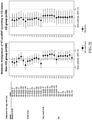
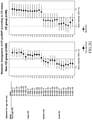
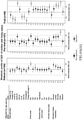
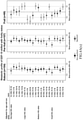
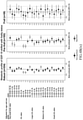
- Figs. 2A-J show metabolomic biosignatures of NT-proBNP generated using linear regression for all 250 metabolites/metabolic features and the strength of the association between NT-proBNP and the metabolites measured using the ⁇ coefficient values.
- Individuals with CD and without CD (non-CD) were classified according to whether or not echocardiographic CD was present.
- Linear regression with adjustment for age and sex was used to estimate the strength of association ( ⁇ coefficient) between each metabolite/metabolic feature and NT-proBNP in non-CD and CD groups. Refer to Table 8 for identity of metabolite number.
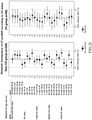
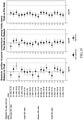
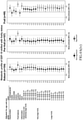
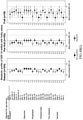
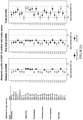
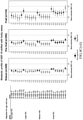
- Figs. 3A-J show that without biomarker guidance, pairwise comparisons between frail and non-frail groups (frail vs. robust; pre-frail vs. robust; frail vs. pre-frail) are possible.
- logistic regression with adjustment for age and sex is used to model each metabolite/metabolic feature on frailty status. Odds ratios are used to estimate the direction, size, and strength of the association between the metabolite/metabolic feature and the frailty or non-frailty phenotype. No biomarker is used in this analysis. Statistically significant variables are highlighted in blue. Refer to Table 8 for identity of metabolite number.
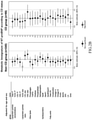
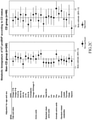
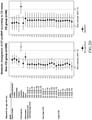
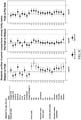
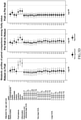
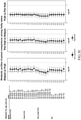
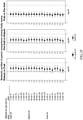
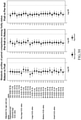
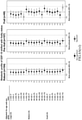
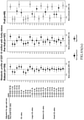
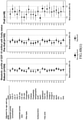
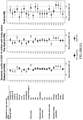
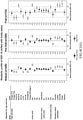
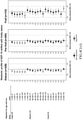
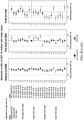
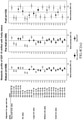
- Figs. 4A(i)-4A(x) , Figs. 4B(i)-4B(x) and Figs. 4C(i)-4C(x) show the metabolomic biosignature of GDF-15 classified according to frailty status (robust, pre-frail or frail).
- the metabolomic biosignature of GDF-15 was generated using linear regression for all 250 metabolites/metabolic features (see Table 8 for metabolites). Linear regression with adjustment for age and sex was used to estimate the strength of association ( ⁇ coefficient) between each metabolite/metabolic feature and GDF-15 in robust, pre-frail or frail groups. ⁇ coefficient values were calculated from correlating each metabolite/ metabolic feature against its respective GDF-15 level.
- NT-proBNP or GDF-15 levels impact other physical fitness measures (recognized surrogate markers of frailty and physical fitness) using Spearman's test with adjustment for age and sex.
- Both NT-proBNP or GDF-15 are markers of functional and physical domains of frailty. The data show that GDF-15 is significantly and inversely correlated with physical fitness and strength.
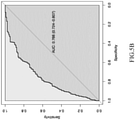
- Figs. 5A-B show the validation of the combined classifier of metabolites/metabolic features (albumin, glutamine, and glycoprotein actetylation marker of inflammation (GlycA) [Bell 1987; Otyos 2015; Ritchie 2015] that met the FDR 5% (from 4A(i)-4A(x), 4B(i)-4B(x) and 4C(i)-4C(x)) with addition of phosphoglycerides (Table 7), age, sex and GDF-15 to demonstrate an excellent predictive capacity of AUC 0.841 for prediction of frailty against non-frailty.
- GlycA glycoprotein actetylation marker of inflammation
- Fig. 6 shows a workflow of logistic regression analysis with adjustment for age and sex.
- a binary variable is modelled on each (transformed) metabolite or metabolic feature as the dependent variable.
- Table 5 Model with adjustment for age and sex Physical fitness measures NT-proBNP GDF-15 Rho P Rho P 6-minute walk distance -0.13 0.02 -0.29 4.71 ⁇ 10 -7 Gait speed -0.10 NS -0.26 3,14 ⁇ 10 -6 HGS/BMI -0.06 NS -0.20 3.80 ⁇ 10 -4 HGS/BMI, handgrip strength indexed to body mass index; NS, not significant.
- a series of biosignatures were generated for each group or subgroup using a biomarker-guided metabolomic profiling strategy ( FIGs. 6-7 and Table 7), to show the significant correlations ( ⁇ values) between the biomarker and the metabolites/metabolic feature ( Figs. 2A-J , 3A-J , 4A(i)-4A(x) , 4B(i)-4B(x) and 4C(i)-4C(x) ).
- the differences in the patterns of each group's metabolome can be visualized in a forest plot and the statistically significant findings are highlighted in the respective figures for the particular metabolites/metabolic features that reach the stringent false discovery rate (FDR) cut-off of 0.05 (5%).
- FDR stringent false discovery rate
- Table 7 shows how subjects who had GDF-15 levels that highly correlated with the following three or six biomarkers also showed the phenotype of frailty according to the FRAIL scale.
- Significant metabolites/metabolic features and area under the receiver operating curve (AUC) values at the respective false-discovery rates (FDR) are shown. Incremental lowering of the FDR threshold from 0.05 (standard) to 0.135 and beyond yields a greater number of metabolites/metabolic features.
- Table 8 shows a list of 250 metabolites/metabolic features analyzed by Nightingale's 1 H-NMR platform.
Landscapes
- Health & Medical Sciences (AREA)
- Life Sciences & Earth Sciences (AREA)
- Engineering & Computer Science (AREA)
- Molecular Biology (AREA)
- Biomedical Technology (AREA)
- General Health & Medical Sciences (AREA)
- Physics & Mathematics (AREA)
- Chemical & Material Sciences (AREA)
- Hematology (AREA)
- Immunology (AREA)
- Urology & Nephrology (AREA)
- Medical Informatics (AREA)
- Public Health (AREA)
- Biotechnology (AREA)
- Pathology (AREA)
- Medicinal Chemistry (AREA)
- Epidemiology (AREA)
- Food Science & Technology (AREA)
- Microbiology (AREA)
- Analytical Chemistry (AREA)
- Biochemistry (AREA)
- General Physics & Mathematics (AREA)
- Cell Biology (AREA)
- Biophysics (AREA)
- Bioinformatics & Cheminformatics (AREA)
- Bioinformatics & Computational Biology (AREA)
- Data Mining & Analysis (AREA)
- Databases & Information Systems (AREA)
- Primary Health Care (AREA)
- Theoretical Computer Science (AREA)
- Endocrinology (AREA)
- Spectroscopy & Molecular Physics (AREA)
- Evolutionary Biology (AREA)
- Proteomics, Peptides & Aminoacids (AREA)
- Genetics & Genomics (AREA)
- Veterinary Medicine (AREA)
- Animal Behavior & Ethology (AREA)
- Pharmacology & Pharmacy (AREA)
- Artificial Intelligence (AREA)
- Evolutionary Computation (AREA)
Abstract
Description
- This application relates to the identification, stratification, and treatment of frailty and conditions associated with altered physical reserve, physical fitness, and exercise capacity.
- Frailty is a complex multidomain syndrome characterized by a decline in systemic physiological reserve, reduced physical health and fitness, and an accumulation of multiple medical comorbidities ('multimorbidity'), including hypertension and diabetes mellitus. Frailty encompasses a conglomerate of signs, symptoms and clinical findings, including skeletal muscle wasting (sarcopenia), reduced muscle strength, progressive unintentional weight loss (cachexia), anorexia, systemic inflammation ('inflammaging'), neurohormonal maladaptation, immune dysfunction, and depression. Frailty is a serious problem because it is difficult to detect, yet once it appears, can quickly lead to increased morbidity in a patient. However, studies have shown that frailty is potentially reversible and may even transition between non-frail/pre-frail and frail states through time. For all of the above reasons, there is a strong need for new methods of identifying and treating frailty in patients.
- Provided herein is one or more blood biomarkers that can detect, diagnose, gauge, profile, classify or stratify frailty. In some embodiments, provided is a method of using one or more circulating blood biomarkers optionally in combination with metabolites or metabolomics to detect, diagnose, gauge, profile, classify or stratify frailty. Some embodiments provide a method of monitoring frailty status over time. Another embodiment provides a methodological process using one or more blood biomarkers for profiling, classifying, diagnosing and risk stratifying conditions associated with altered physical reserve, physical fitness or exercise capacity. In some embodiments, the blood biomarker is growth differentiation factor 15 (GDF-15), also known as macrophage inhibitory cytokine 1 (MIC-1).
- Another embodiment provides a methodological process for profiling, classifying, diagnosing and risk stratifying the clinical syndrome of frailty with/without cardiac dysfunction (CD) through the use of one or more biomarkers, including but not limited to GDF-15 and NT-proBNP (N-terminal prohormone of B-type (brain) natriuretic peptide), coupled with metabolic/metabolomic profiling.
- Another embodiment provides a method of determining frailty severity in a subject comprising the steps of
- a) measuring the levels of GDF-15 in a biological sample from the subject;
- b) measuring the levels of one or more biomarkers selected from the group consisting of albumin, glutamine, and GlycA.
- Some embodiments further comprise the step of measuring the levels of one or more biomarkers selected from the group consisting of phosphoglycerides, glycine, and alanine.
- Some embodiments further comprise the step of determining frailty severity according to methods described herein, and treating the subject determined to have severe frailty.
- Yet another embodiment provides a method of using of a biomarker in combination with metabolic or metabolomic profiling to provide a comprehensive high-dimensional picture of a subject's total health condition (e.g. internal milieu). In some embodiments, the total health conditions include one or more pathophysiological diagnoses and/or monitoring of such conditions.
- Another embodiment provides the use of GDF-15 and NT-proBNP, optionally with the metabolome, to identify, define, characterize, diagnose and profile the frailty and non-frailty spectrum from robust to frail status, particularly in the subphenotyping or classification of individuals with and without CD.
- Up until now there has been no available blood biomarker or imaging test that can reliably detect, diagnose, classify or risk stratify frailty. Accordingly, the biomarkers and methods provided herein solve such a problem and furthermore have several advantages over current solutions.
- In some embodiments the use of circulating biomarker(s) and a broad array of metabolic measures/features (metabolomics) provides quantitation of differences between disease states and/or disorders, and serves as objective measures over time.
- In some embodiments the provided methods provide objective testing, diagnosis and monitoring of frailty which are improvements over frailty assessment schemes based on point scoring along multidomain scales (e.g. Fried phenotype assessment [Fried 2001]) which are limited by subjectivity, recall bias, interobserver variability, require the subject to have a certain level of auditory, cognitive and mental competence, and pertain to domains that are under the influence of metabolic, neurohormonal and circulating factors in the bloodstream.
- In some embodiments, the use of the 1H-nuclear magnetic resonance (NMR) Nightingale or similar platform coupled with functional biomarkers (e.g. NT-proBNP, GDF-15) provides more accurate and advanced frailty-related diagnostics, classification of health status, and health and disease management.
- In some embodiments, the combination of biomarkers with metabolomics (biomarker-guided metabolomics) provides a comprehensive high-dimensional picture of the internal milieu.
- The disclosure will be readily understood by the following detailed description in conjunction with the accompanying figures.
-
Fig. 1 shows receiver operative characteristic (ROC) curves for CD for different biomarkers. -
Fig. 2A shows metabolomic biosignatures of NT-proBNP according to CD status for 250 metabolites/metabolic features and the strength of the association between NT-proBNP and the metabolites measured using the β coefficient values. -
Fig. 2B shows continued metabolomic biosignatures of NT-proBNP ofFig. 2A thereof. -
Fig. 2C shows continued metabolomic biosignatures of NT-proBNP ofFig. 2A thereof. -
Fig. 2D shows continued metabolomic biosignatures of NT-proBNP ofFig. 2A thereof. -
Fig. 2E shows continued metabolomic biosignatures of NT-proBNP ofFig. 2A thereof. -
Fig. 2F shows continued metabolomic biosignatures of NT-proBNP ofFig. 2A thereof. -
Fig. 2G shows continued metabolomic biosignatures of NT-proBNP ofFig. 2A thereof. -
Fig. 2H shows continued metabolomic biosignatures of NT-proBNP ofFig. 2A thereof. -
Fig. 2I shows continued metabolomic biosignatures of NT-proBNP ofFig. 2A thereof. -
Fig. 2J shows continued metabolomic biosignatures of NT-proBNP ofFig. 2A thereof. -
Fig. 3A shows metabolic profiles of paired comparisons among frailty status. -
Fig. 3B shows continued metabolic profiles ofFig. 3A thereof. -
Fig. 3C shows continued metabolic profiles ofFig. 3A thereof. -
Fig. 3D shows continued metabolic profiles ofFig. 3A thereof. -
Fig. 3E shows continued metabolic profiles ofFig. 3A thereof. -
Fig. 3F shows continued metabolic profiles ofFig. 3A thereof. -
Fig. 3G shows continued metabolic profiles ofFig. 3A thereof. -
Fig. 3H shows continued metabolic profiles ofFig. 3A thereof. -
Fig. 3I shows continued metabolic profiles ofFig. 3A thereof. -
Fig. 3J shows continued metabolic profiles ofFig. 3A thereof. -
Fig. 4A(i) shows a discovery set of metabolic profiles of GDF-15 shifted with frailty status. -
Fig. 4A(ii) shows a continued discovery set of metabolic profiles of GDF-15 ofFig. 4A(i) thereof. -
Fig. 4A(iii) shows a continued discovery set of metabolic profiles of GDF-15 ofFig. 4A(i) thereof. -
Fig. 4A(iv) shows a continued discovery set of metabolic profiles of GDF-15 ofFig. 4A(i) thereof. -
Fig. 4A(v) shows a continued discovery set of metabolic profiles of GDF-15 ofFig. 4A(i) thereof. -
Fig. 4A(vi) shows a continued discovery set of metabolic profiles of GDF-15 ofFig. 4A(i) thereof. -
Fig. 4A(vii) shows a continued discovery set of metabolic profiles of GDF-15 ofFig. 4A(i) thereof. -
Fig. 4A(viii) shows a continued discovery set of metabolic profiles of GDF-15 ofFig. 4A(i) thereof. -
Fig. 4A(ix) shows a continued discovery set of metabolic profiles of GDF-15 ofFig. 4A(i) thereof. -
Fig. 4A(x) shows a continued discovery set of metabolic profiles of GDF-15 ofFig. 4A(i) thereof. -
Fig. 4B(i) shows a replication/validation set of metabolic profiles of GDF-15 shifted with frailty status. -
Fig. 4B(ii) shows a continued replication/validation set of metabolic profiles of GDF-15 ofFig. 4B(i) thereof. -
Fig. 4B(iii) shows a continued replication/validation set of metabolic profiles of GDF-15 ofFig. 4B(i) thereof. -
Fig. 4B(iv) shows a continued replication/validation set of metabolic profiles of GDF-15 ofFig. 4B(i) thereof. -
Fig. 4B(v) shows a continued replication/validation set of metabolic profiles of GDF-15 ofFig. 4B(i) thereof. -
Fig. 4B(vi) shows a continued replication/validation set of metabolic profiles of GDF-15 ofFig. 4B(i) thereof. -
Fig. 4B(vii) shows a continued replication/validation set of metabolic profiles of GDF-15 ofFig. 4B(i) thereof. -
Fig. 4B(viii) shows a continued replication/validation set of metabolic profiles of GDF-15 ofFig. 4B(i) thereof. -
Fig. 4B(ix) shows a continued replication/validation set of metabolic profiles of GDF-15 ofFig. 4B(i) thereof. -
Fig. 4B(x) shows a continued replication/validation set of metabolic profiles of GDF-15 ofFig. 4B(i) thereof. -
Fig. 4C(i) shows a combined set of discovery and replication/validation of metabolic profiles of GDF-15 shifted with frailty status. -
Fig. 4C(ii) shows a continued combined set of discovery and replication/validation of metabolic profiles of GDF-15 ofFig. 4C(i) thereof. -
Fig. 4C(iii) shows a continued combined set of discovery and replication/validation of metabolic profiles of GDF-15 ofFig. 4C(i) thereof. -
Fig. 4C(iv) shows a continued combined set of discovery and replication/validation of metabolic profiles of GDF-15 ofFig. 4C(i) thereof. -
Fig. 4C(v) shows a continued combined set of discovery and replication/validation of metabolic profiles of GDF-15 ofFig. 4C(i) thereof. -
Fig. 4C(vi) shows a continued combined set of discovery and replication/validation of metabolic profiles of GDF-15 ofFig. 4C(i) thereof. -
Fig. 4C(vii) shows a continued combined set of discovery and replication/validation of metabolic profiles of GDF-15 ofFig. 4C(i) thereof. -
Fig. 4C(viii) shows a continued combined set of discovery and replication/validation of metabolic profiles of GDF-15 ofFig. 4C(i) thereof. -
Fig. 4C(ix) shows a continued combined set of discovery and replication/validation of metabolic profiles of GDF-15 ofFig. 4C(i) thereof. -
Fig. 4C(x) shows a continued combined set of discovery and replication/validation of metabolic profiles of GDF-15 ofFig. 4C(i) thereof. -
Fig. 5A shows receiver operating characteristic (ROC) curve for a discovery set of the combined classifiers GDF-15, albumin, glutamine, glycoprotein actetylation marker of inflammation (GlycA), and phosphoglycerides), age and sex in predicting frailty (area under the curve AUC). -
Fig. 5B shows receiver operating characteristic (ROC) curve for a set of discovery and replication/validation of the combined classifiers GDF-15, albumin, glutamine, glycoprotein actetylation marker of inflammation (GlycA), and phosphoglycerides), age and sex in predicting frailty (area under the curve AUC). -
Fig. 6 shows a workflow of logistic regression analysis with adjustment for age and sex. -
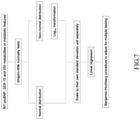
Fig. 7 shows a workflow of age- and sex-adjusted linear regression. - Throughout this description for the purposes of explanation, numerous specific details are set forth in order to provide a thorough understanding of the many aspects and embodiments disclosed herein. It will be apparent, however, to one skilled in the art that the many aspects and embodiments may be practiced without some of these specific details. In other instances, known biological and biochemical entities, mechanisms and analyses are shown herein to avoid obscuring the underlying principles of the described aspects and embodiments. The present invention is in the technical field of diagnostics, classification of health status, and human health and disease management.
- As used herein and in the claims, the terms "comprise" (or any related form such as "comprises" and "comprising"), "include" (or any related forms such as "includes" or "including"), "contain" (or any related forms such as "contains" or "containing"), means including the following elements but not excluding others. As used herein, the singular forms "a", "an" and "the" are intended to include the plural forms as well, unless the context clearly indicates otherwise. Where a range is referred in the specification, the range is understood to include each discrete point within the range. For example, 1-7
means - As used herein and in the claims, an "effective amount", is an amount that is effective to achieve at least a measurable amount of a desired effect. For example, the amount may be effective to elicit an immune response, and/or it may be effective to elicit a protective response, against a pathogen bearing the polypeptide of interest. In some embodiments, the amount may be effective to maintain stable health, increase mobility, improved ability to retain nutrients, or improve FRAIL test results.
- As used herein and in the claims, a "subject" refers to animals such as mammals and vertebrates, including, but not limited to, primates (e.g. humans), cows, sheep, goats, horses, pigs, dogs, cats, rabbits, rats, mice, frogs, zebrafish and the like.
- As used herein, the term "treat," "treating" or "treatment" refers to methods of alleviating, abating or ameliorating a disease or condition symptoms, preventing additional symptoms, ameliorating or preventing the underlying metabolic causes of symptoms, inhibiting the disease or condition, arresting the development of the disease or condition, relieving the disease or condition, causing regression of the disease or condition, relieving a condition caused by the disease or condition, or stopping the symptoms of the disease or condition either prophylactically and/or therapeutically.
- "GDF-15" means
growth differentiation factor 15. - "NT-proBNP" means N-terminal prohormone of B-type (brain) natriuretic peptide, a biomarker of cardiac dysfunction.
- "CD" means cardiac dysfunction.
- "CI" means confidence interval.
- "NS" means not significant.
- "OR" means odds ratio.
- "GlycA" means glycoprotein acetylation marker of inflammation measured clinically in blood by the presence of certain characteristic N-acetyl methyl group protons which are detectable by 1H-NMR
- "Albumin" is a globular protein detectable in blood.
- "Phosphoglycerides" is glycerol-based phospholipids.
- Amino acids herein may be referred to by their full names or their abbreviated names, including, but not limited to, the below list:
Alanine: Ala Glycine: Gly Proline: Pro Arginine: Arg Histidine: His Serine: Ser Asparagine: Asn Isoleucine: Ile Threonine: Thr Aspartic acid: Asp Leucine: Leu Tryptophan: Trp Cysteine: Cys Lysine: Lys Tyrosine: Tyr Glutamic acid: Glu Methionine: Met Valine: Val Glutamine: Gln Phenylalanine: Phe - Although the description referred to particular aspects and embodiments, the disclosure should not be construed as limited to the embodiments set forth herein.
- One aspect provides an in vitro method of determining frailty severity in a subject comprising the steps of
- a) measuring the levels of GDF-15 in a biological sample from the subject;
- b) determining the subject as being frail if the level of the biomarker in the biological sample is higher than about 2,000 pg/ml to 6,000 pg/ml; pre-frail if the level of the biomarker in the biological sample is higher than 500 pg/ml to 2000 pg/ml; and robust if the level of the biomarker in the biological sample is less than 500 pg/ml.
- Another aspect provides an in vitro method of determining frailty severity in a subject comprising the steps of
- a) measuring the levels of GDF-15 in a biological sample from the subject;
- b) measuring the levels of one or more biomarkers selected from the group consisting of albumin, glutamine, GlycA, phosphoglycerides, glycine, and alanine;
- c) determining the overall biosignature score p by inputting the subject's age in years; sex as value of 0 if female, 1 if male; and serum concentrations of biomarkers GDF-15 (pg/ml), albumin (g/1), glutamine (mmol/l), GlycA (mmol/l), phosphoglycerides (mmol/l), glycine (mmol/l), and alanine (mmol/l) of the subject into the following equation:


- d) determining the subject as being frail if the score p is a value defined in Table 1 wherein the corresponding sensitivity and specificity values add up to between 1.4 and 1.5.
- Another aspect provides a method of determining frailty severity in a subject comprising the steps of
- a) measuring the levels of GDF-15 in a biological sample from the subject;
- b) measuring the levels of one or more biomarkers selected from the group consisting of albumin, glutamine, GlycA, phosphoglycerides, glycine, and alanine;
- c) determining the overall biosignature score p; and
- d) determining the subject as being frail if p is Z; wherein Z is a value defined in Table 1 wherein the corresponding sensitivity and specificity values add up to between 1.4 and 1.5;
- i) inputting the subject's age in years; sex as value of 0 if female, 1 if male; and serum concentrations of biomarkers GDF-15 (pg/ml), albumin (g/1), glutamine (mmol/l), GlycA (mmol/l), phosphoglycerides (mmol/l), glycine (mmol/l), and alanine (mmol/l)of the subject into the following equation:


- ii) inputting the subject's age in years; sex as value of 0 if female, 1 if male; and log10-transformed serum concentrations of biomarkers GDF-15 (pg/ml), albumin (g/1), glutamine (mmol/l), GlycA (mmol/l), phosphoglycerides (mmol/l), glycine (mmol/l), and alanine (mmol/l) of the subject into the following equation:


- Another aspect provides a method of determining frailty severity in a subject comprising the steps of
- a) measuring the levels of GDF-15 in a biological sample from the subject;
- b) measuring the levels of one or more biomarkers selected from the group consisting of albumin, glutamine, GlycA, phosphoglycerides, glycine, and alanine;
- c) determining the overall biosignature score p; and
- d) determining the subject as being frail if p is Z;
- wherein Z is a value defined in Table 1 wherein the corresponding sensitivity and specificity values add up to between 1.4 and 1.5;
- wherein the score p is determined by inputting the subject's age in years; sex as value of 0 if female, 1 if male; and log10-transformed serum concentrations of biomarkers GDF-15 (pg/ml), albumin (g/1), glutamine (mmol/l), GlycA (mmol/l), phosphoglycerides (mmol/l), glycine (mmol/l), and alanine (mmol/l) of the subject into the following equation:

- wherein

- Another aspect provides a method of determining frailty severity in a subject comprising the steps of
- a) measuring the levels of GDF-15 in a biological sample from the subject;
- b) measuring the levels of one or more biomarkers selected from the group consisting of albumin, glutamine, GlycA, phosphoglycerides, glycine, and alanine;
- c) determining the overall biosignature score p; and
- d) determining the subject as being frail if p is Z; wherein Z is a value defined in Table 1 wherein the corresponding sensitivity and specificity values add up to between 1.4 and 1.5;
- wherein the score p is determined by inputting the subject's age in years; sex as value of 0 if female, 1 if male; and log10-transformed serum concentrations of biomarkers GDF-15 (pg/ml), albumin (g/1), glutamine (mmol/l), GlycA (mmol/l), phosphoglycerides (mmol/l), glycine (mmol/l), and alanine (mmol/l) of the subject into the following equation:

- wherein
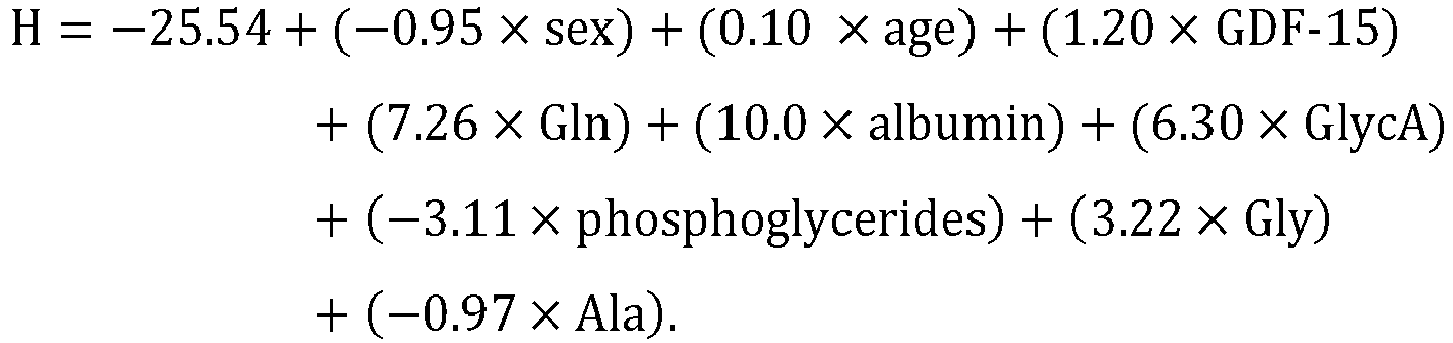
- wherein the score p is determined by inputting the subject's age in years; sex as value of 0 if female, 1 if male; and log10-transformed serum concentrations of biomarkers GDF-15 (pg/ml), albumin (g/1), glutamine (mmol/l), GlycA (mmol/l), phosphoglycerides (mmol/l), glycine (mmol/l), and alanine (mmol/l) of the subject into the following equation:
- In some embodiments, the method is an in vitro method.
- In some embodiments, the Z is 0.15 to 0.56. In some embodiments, Z is 0.259 or Youden's J statistic. In some embodiments, the value defined by Table 1 wherein the corresponding sensitivity and specificity values add up to between 1.4 and 1.5 is 0.15 to 0.56; in other embodiments, 0.259 or Youden's J statistic. In some embodiments, the score p is 0.15 to 0.56. In some embodiments, the score p is 0.259 or Youden's J statistic.
- Some embodiments further comprise the step of wherein if the subject is determined to be frail, treating the subject with exercise therapy, physical therapy, physiotherapy, nutritional supplementation (amino acid(s)/leucine (in non-cardiac failure)/protein), or administering a therapeutic drug for treating impaired cardiovascular or cardiopulmonary function. In some embodiments, the therapeutic drug is a combined angiotensin receptor blocker and neprilysin inhibitor (e.g. sacubitril/valsartan), a sodium-glucose transport protein 2 (SGLT2) inhibitor or gliflozins (e.g. dapagliflozin, empagliflozin), a beta blocker (e.g. metoprolol, carvedilol, bisoprolol), renin-angiotensin system inhibitor (e.g. enalapril, lisinopril), mineralocorticoid receptor antagonist (e.g. eplerenone, spironolactone), ivabradine, digoxin, inotropes (e.g. dobutamine, milrinone) or inodilator (e.g. levosimendan).
- Some embodiments further comprise the step of measuring the levels of NT-proBNP, wherein if NT-proBNP levels are elevated but GDF-15 levels are not, determining the subject has cardiac dysfunction without frailty; if GDF-15 levels are elevated but NT-proBNP are not, determining the subject has systemic physiological injury or inflammation, hypoperfusion, or non-cardiac frailty; and if both GDF-15 and NT-proBNP levels are elevated, determining the subject has frailty and is predicted to have heart failure. In some embodiments, the subject has cardiac dysfunction, systemic tissue injury or hypoperfusion which can lead to heart failure.
- Table 1 below shows thresholds and associated sensitivity, specificity values and Youden's index values (J) for the biosignature score p.

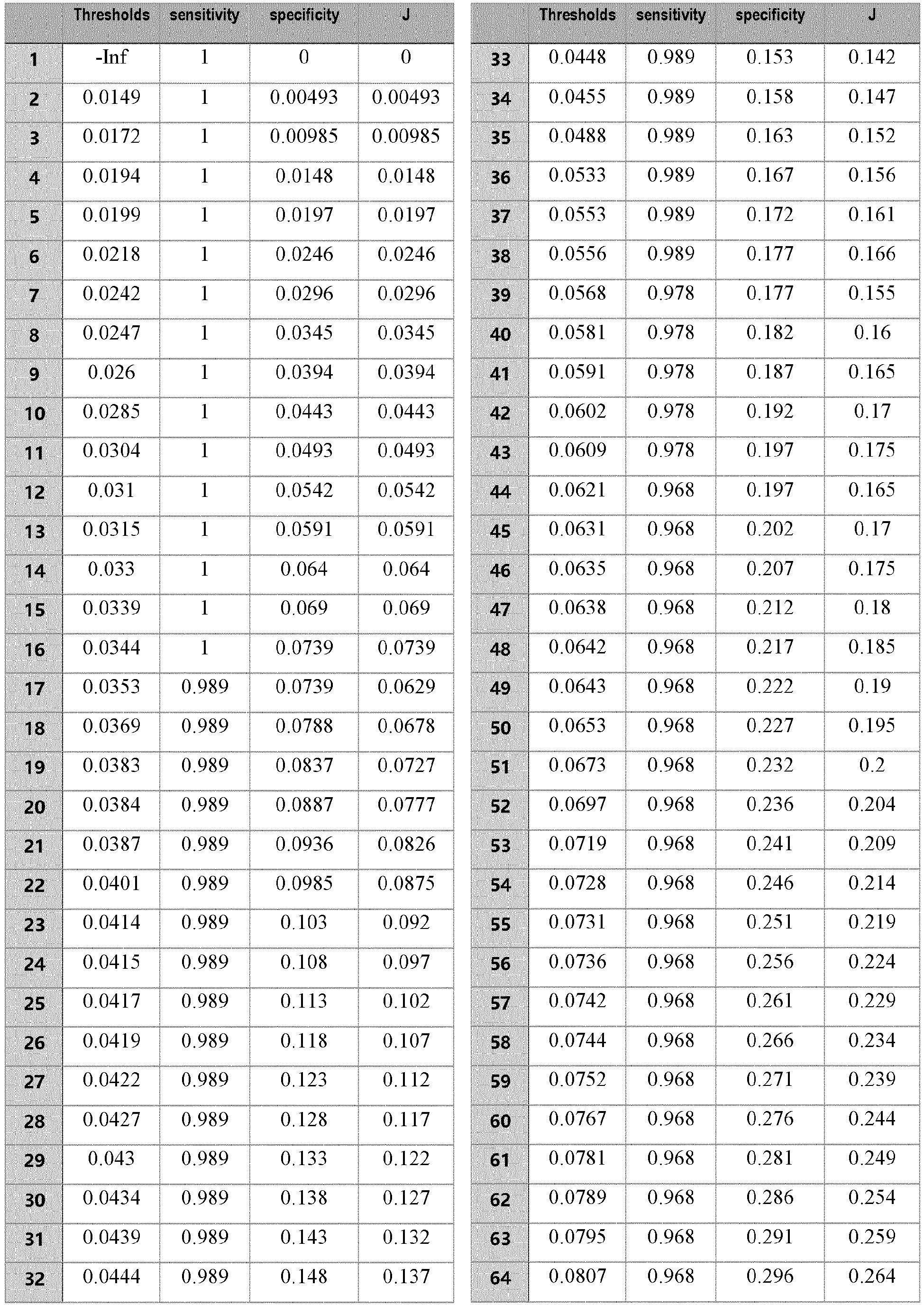


- Some embodiments further comprise the step of treating the subject for heart failure if NT-proBNP levels are elevated but GDF-15 levels are not; treating the subject for systemic physiological injury or inflammation, hypoperfusion, or non-cardiac frailty with a drug if GDF-15 levels are elevated but NT-proBNP are not; treating the subject with a heart failure and frailty drug if both GDF-15 and NT-proBNP levels are elevated.
- Some embodiments further comprise the step of treating the subject in accordance with guideline-directed medical therapy (GDMT); wherein if the subject has elevated levels of both NT-proBNP and GDF-15, treating the subject as advanced stage D in accordance with GDMT; if the subject has elevated levels of NT-proBNP but not elevated levels of GDF-15, conducting cardiac imaging to determine the causes of cardiac dysfunction and treating the cardiac dysfunction in accordance with stage B or C in accordance with GDMT; if the subject has elevated levels of GDF-15 but not elevated levels of NT-proBNP, conducting a clinical assessment of medical comorbidities and treating the subject in accordance with stage B or C in accordance with GDMT; and if the subject does not have elevated levels of either NT-proBNP or GDF-15, treating the patient with as stage A in accordance with GDMT, particularly when the subject experiences no symptoms and/or when there are no cardiac structural abnormalities identified by imaging. In some embodiments, if the subject does not have elevated levels of either NT-proBNP or GDF-15 with/without the performance of other tests to exclude functional and/or structural abnormalities in the heart as deemed appropriate by the treating physician and according to standard practice guidelines, advising the subject on lifestyle modifications and managing particular risk factors without medical or therapeutic intervention.
- In some embodiments, the stages A through D of the GDMT are based on the American College of Cardiology/American Heart Association (ACC/AHA) staging framework. In some embodiments, the treatments may be selected from one or more of pharmacological, device and other interventional therapies.
- Another aspect provides a method of identifying and treating frailty, altered physiological and physical reserve, aging, or aging-related inflammation in a subject comprising the steps of
- a) measuring the levels of GDF-15 in a biological sample from the subject;
- b) measuring the levels of one or more biomarkers selected from the group consisting of albumin, glutamine, GlycA, phosphoglycerides, glycine, and alanine;
- c) determining the overall biosignature score p by inputting the subject's age in years; sex as value of 0 if female, 1 if male; and serum concentrations of biomarkers GDF-15 (pg/ml), albumin (g/1), glutamine (mmol/l), GlycA (mmol/l), phosphoglycerides (mmol/l), glycine (mmol/l), and alanine (mmol/l) of the subject into the following equation:


specificity values of the threshold value add up to between 1.4 and 1.6; and wherein at least one of the sensitivity or specificity values is 0.5 or above. - In some embodiments, the score p is 0.15 to 0.56. In some embodiments, the score p is 0.259. In some embodiments, the score p is a threshold value having a maximum value of Youden's J statistic. In a further embodiment, the maximum value of Youden's J statistic is 0.553.
- Another aspect provides a method of generating a biosignature for frailty comprising the steps of
- Identifying a subpopulation with elevated levels of GDF-15;
- Conducting a biomarker screen/metabolic/metabolomic profiling on the subpopulation and using mathematical modeling tools to identifying biomarkers that correlate with the subpopulation.
- In some embodiments, the biomarker screen includes a disease-specific biomarker selected from one or more of a heart failure biomarker (NT-proBNP or BNP), a renal failure biomarker (serum creatinine alone or in combination with cystatin C (CysC), interleukin-18 (IL-18), kidney injury molecule-1 (KIM-1) and/or neutrophil-gelatinase-associated lipocalin (NGAL)), a panel of inflammatory biomarkers (proinflammatory cytokines, e.g. interleukins, chemokines), and a tissue-specific biomarker.
- Another aspect provides a system for detecting frailty in a subject comprising:
- a) a GDF-15 analyzer configured to analyze biological samples from the subject to provide a concentration of GDF-15 in the biological sample;
- b) a computer programmed to execute the following steps:
- i) determining the overall biosignature score p by inputting the subject's age in years; sex as value of 0 if female, 1 if male; and serum concentrations of biomarkers GDF-15 (pg/ml), albumin (g/1), glutamine (mmol/l), GlycA (mmol/l), phosphoglycerides (mmol/l), glycine (mmol/l), and alanine (mmol/l) of the subject the following equation:


- ii) determining the subject as being frail if the score p is 0.15 to 0.56.
- i) determining the overall biosignature score p by inputting the subject's age in years; sex as value of 0 if female, 1 if male; and serum concentrations of biomarkers GDF-15 (pg/ml), albumin (g/1), glutamine (mmol/l), GlycA (mmol/l), phosphoglycerides (mmol/l), glycine (mmol/l), and alanine (mmol/l) of the subject the following equation:
- Another aspect provides a system for detecting frailty in a subject comprising:
- a) a GDF-15 analyzer configured to analyze biological samples from the subject to provide a concentration of GDF-15 in the biological sample;
- b) a computer programmed to execute at least the following:
- i) inputting the subject's age in years; sex as value of 0 if female, 1 if male; and serum concentrations of biomarkers GDF-15 (pg/ml), albumin (g/1), glutamine (mmol/l), GlycA (mmol/l), phosphoglycerides (mmol/l), glycine (mmol/l), and alanine (mmol/l) of the subject into the following equation:


- ii) inputting the subject's age in years; sex as value of 0 if female, 1 if male; and log10-transformed serum concentrations of biomarkers GDF-15 (pg/ml), albumin (g/1), glutamine (mmol/l), GlycA (mmol/l), phosphoglycerides (mmol/l), glycine (mmol/l), and alanine (mmol/l) of the subject into the following equation:


- iii) determining the subject as being frail if the score p is 0.15 to 0.56.
- i) inputting the subject's age in years; sex as value of 0 if female, 1 if male; and serum concentrations of biomarkers GDF-15 (pg/ml), albumin (g/1), glutamine (mmol/l), GlycA (mmol/l), phosphoglycerides (mmol/l), glycine (mmol/l), and alanine (mmol/l) of the subject into the following equation:
- Another aspect provides a method of improving the accuracy of frailty and non-frailty classification comprising using GDF-15 as a guiding biomarker with a metabolomic panel of metabolites selected from one or more of albumin, glutamine, GlycA, phosphoglycerides, glycine, and alanine; comprising the following steps:
- a) measuring GDF-15 concentration in a blood serum or plasma sample from a subject using the Roche Elecsys Assay kit on a Roche Cobas e immunoassay analyzer;
- b) measuring the levels of one or more biomarkers selected from the group consisting of albumin, glutamine, GlycA, phosphoglycerides, glycine, and alanine using 1H-NMR Nightingale metabolomic profiling;
- c) determining the overall biosignature score p by inputting the subject's age in years; sex as value of 0 if female, 1 if male; and serum concentrations of biomarkers GDF-15 (pg/ml), albumin (g/1), glutamine (mmol/l), GlycA (mmol/l), phosphoglycerides (mmol/l), glycine (mmol/l), and alanine (mmol/l) of the subject into the following equation:


and - d) determining the subject as being frail if the score p is 0.15 to 0.56.
- Another aspect provides a method of identifying subjects who will have improved survival outcomes when treated with exercise therapy, physical therapy, physiotherapy, nutritional supplementation (amino acid(s)/leucine (in non-cardiac failure)/protein), or administering a therapeutic drug for treating impaired cardiovascular or cardiopulmonary function; comprising the steps of
- a) determining the overall biosignature score p by inputting the subject's age in years; sex as value of 0 if female, 1 if male; and serum concentrations of biomarkers GDF-15 (pg/ml), albumin (g/1), glutamine (mmol/l), GlycA (mmol/l), phosphoglycerides (mmol/l), glycine (mmol/l), and alanine (mmol/l) of the subject into the following equation:


- b) determining the subject as being frail if the score p is 0.15 to 0.56; and
- c) treating the subjects determined as being frail with exercise therapy, physical therapy, physiotherapy, nutritional supplementation (amino acid(s)/leucine (in non-cardiac failure)/protein), or administering a therapeutic drug for treating impaired cardiovascular or cardiopulmonary function.
- Another aspect provides a method of identifying subjects who will have improved survival outcomes when treated with exercise therapy, physical therapy, physiotherapy, nutritional supplementation (amino acid(s)/leucine (in non-cardiac failure)/protein), or administering a therapeutic drug for treating impaired cardiovascular or cardiopulmonary function; comprising the steps of
- a) determining the overall biosignature score p; and
- b) determining the subject as being frail if the score p is 0.15 to 0.56;
wherein the score p is determined by- i) inputting the subject's age in years; sex as value of 0 if female, 1 if male; and serum concentrations of biomarkers GDF-15 (pg/ml), albumin (g/1), glutamine (mmol/l), GlycA (mmol/l), phosphoglycerides (mmol/l), glycine (mmol/l), and alanine (mmol/l) of the subject into the following equation:


- ii) inputting the subject's age in years; sex as value of 0 if female, 1 if male; and log10-transformed serum concentrations of biomarkers GDF-15 (pg/ml), albumin (g/1), glutamine (mmol/l), GlycA (mmol/l), phosphoglycerides (mmol/l), glycine (mmol/l), and alanine (mmol/l) of the subject into the following equation:


- i) inputting the subject's age in years; sex as value of 0 if female, 1 if male; and serum concentrations of biomarkers GDF-15 (pg/ml), albumin (g/1), glutamine (mmol/l), GlycA (mmol/l), phosphoglycerides (mmol/l), glycine (mmol/l), and alanine (mmol/l) of the subject into the following equation:
- c) treating the subjects determined as being frail with exercise therapy, physical therapy, physiotherapy, nutritional supplementation (amino acid(s)/leucine (in non-cardiac failure)/protein), or administering a therapeutic drug for treating impaired cardiovascular or cardiopulmonary function.
- Another aspect provides a method of identifying and treating subjects who will have improved survival outcomes when treated with exercise therapy, physical therapy, physiotherapy, nutritional supplementation (amino acid(s)/leucine (in non-cardiac failure)/protein), or administering a therapeutic drug for treating impaired cardiovascular or cardiopulmonary function; comprising the steps of
- a) determining the overall biosignature score p; and
- b) determining the subject as being frail if the score p is 0.15 to 0.56;
wherein the score p is determined by- i) inputting the subject's age in years; sex as value of 0 if female, 1 if male; and serum concentrations of biomarkers GDF-15 (pg/ml), albumin (g/1), glutamine (mmol/l), GlycA (mmol/l), phosphoglycerides (mmol/l), glycine (mmol/l), and alanine (mmol/l) of the subject into the following equation:


- ii) inputting the subject's age in years; sex as value of 0 if female, 1 if male; and log10-transformed serum concentrations of biomarkers GDF-15 (pg/ml), albumin (g/1), glutamine (mmol/l), GlycA (mmol/l), phosphoglycerides (mmol/l), glycine (mmol/l), and alanine (mmol/l) of the subject into the following equation:


- i) inputting the subject's age in years; sex as value of 0 if female, 1 if male; and serum concentrations of biomarkers GDF-15 (pg/ml), albumin (g/1), glutamine (mmol/l), GlycA (mmol/l), phosphoglycerides (mmol/l), glycine (mmol/l), and alanine (mmol/l) of the subject into the following equation:
- c) treating the subjects determined as being frail with exercise therapy, physical therapy, physiotherapy, nutritional supplementation (amino acid(s)/leucine (in non-cardiac failure)/protein), or administering a therapeutic drug for treating impaired cardiovascular or cardiopulmonary function.
- Another aspect provides a kit for evaluating frailty comprising
- a) a test for measuring blood levels of GDF-15; and
- b) optionally one or more tests for measuring blood levels of albumin, glutamine, GlycA, phosphoglycerides, glycine, and alanine.
- In some embodiments, the test for measuring albumin, glutamine, GlycA, and phosphoglyceride is the 1H-NMR Nightingale system.
- Another embodiment provides the use of tissue-specific blood biomarkers (e.g. NT-proBNP) to identify impaired organ or organ system (e,g. cardiac failure) as a subclassification (or subphenotyping) of frailty. In one embodiment, elevation of both circulating NT-proBNP and GDF-15 levels indicate CD and systemic tissue injury or hypoperfusion, and increase the probability of a diagnosis of heart failure and frailty (cardiac frailty). In another embodiment, sole elevation of NT-proBNP but not GDF-15 indicates cardiac dysfunction that is not so extensive as to cause systemic physiological compromise (cardiac dysfunction without frailty). In yet another embodiment, elevation of GDF-15 alone (with normal NT-proBNP levels) indicates systemic physiological injury, hypoperfusion or abnormalities that are less likely to be attributable cardiac dysfunction (noncardiac frailty). In some embodiments, GDF-15 elevation broadly indicates systemic tissue injury, inflammation, compromised systemic physiology and impaired physical fitness that characterize frailty (e.g. reduced skeletal muscle growth, weight loss, reduced appetite, easy fatigability).
- In conjunction with physical measures (e.g. 6-minute walk distance (6MWD), gait speed, handgrip strength), GDF-15 is a useful biomarker for the classification and stratification of frailty classes.
- In some embodiments, GDF-15 elevation is defined as having GDF-15 blood levels greater than 1000 pg/ml. In some embodiments, the GDF-15 blood levels are in a range between 1,000 to 6,000 pg/ml, 1000 to 4000 pg/ml, 2000 to 4000 pg/ml, 2500 to 3500 pg/ml, or 3000 ± 1000 pg/ml. In some embodiments, the GDF-15 blood level is 3,206.6 ± 2,565.4 pg/ml.
- Provided herein are examples that describe in more detail certain embodiments of the present disclosure. The examples provided herein are merely for illustrative purposes and are not meant to limit the scope of the invention in any way. All references given below and elsewhere in the present application are hereby included by reference.
- Blood levels of a number of biomarkers and metabolites were measured in 306 subjects (derivation set). Blood serum levels of GDF-15 and NT-proBNP were measured using the Roche ELECSYS® GDF-15 Assay kit and a Roche COBAS® e immunoassay analyzer, or a compatible instrument, as per manufacturer.
- Subjects were also evaluated based on the FRAIL Scale [Abellan van Kan 2008; Morley 2012; Woo 2012]. The 5-point FRAIL scale is a multi-domain instrument that assesses the key deficits and risks associated with frailty. A subject is frail if the score is 3 to 5; pre-frail if the score is 1 to 2; and robust if the score is 0.
- It shall be understood that frailty severity can be defined by many different types of scores or methods, and there are other known frailty scoring methods that could stand in the place of the FRAIL scale, such as the Edmonton frail scale [Rolfson 2006]), or a cumulative deficit approach whereby an index is calculated from the proportion of health and medical problems relative to a predefined inventory (e.g. Rockwood frailty index)[Mitnitski 2002; Rockwood 2011].
- Logistic regression analysis was done with adjustments for age and sex. Biomarker levels were expressed as mean ± standard deviation (SD). Kruskal-Wallis H test with Dunn post hoc test, Chi-square or Fisher's exact test were used to compare differences between groups. a P <0.05, pre-frail vs. robust; b P <0.05, frail vs. robust; c P <0.05, frail vs. pre-frail (Table 2). The workflow of age- and sex-adjusted linear regression is shown in
Fig. 7 . The continuous variable of log10-transformed NT-proBNP or GDF-15 level, was modeled on each (transformed) metabolite or metabolic feature as the dependent variable. - Table 2 shows that circulating blood levels of the biomarkers, NT-proBNP and GDF-15, can indicate non-frailty and frailty irrespective of the etiology. Table 2 also shows that subjects with GDF-15 blood levels in the range of 3,206.6 ± 2,565.4 pg/ml were confirmed frail according to the FRAIL scale.
Table 2 Variables Robust Pre-frail Frail Overall Sample size, n 104 107 95 306 NT-proBNP, pg/ml 180.8 ± 506.1 239.4 ± 466.4a 361.0 ± 745.5b,c 257.2 ± 582.1 GDF-15,pglml 1,667.4 ± 1,114.9 2,220.0 ± 1,781.3a 3,206.6 ± 2,565.4b,c 2,338.5 ± 1,986.0 - Table 3 shows that log10-transformed GDF-15 does predict and differentiate frailty from non-frailty (P = 1.29 × 10⁻³) whereas NT-proBNP does not (P = not significant (NS)). NT-proBNP is a strong independent predictor of CD, whereas GDF-15 can independently differentiate between individuals with and without frailty.
Table 3 Comparisons Log10 NT-proBNP Log10 GDF-15 OR (95% CI) P OR (95% CI) P Frailty vs. non-frailty 1.07 (0.95-1.20) NS 1.38 (1.13-1.67) 1.29 × 10⁻³ CD vs. non-CD 1.47 (1.33-1.62) 5.49 × 10⁻¹³ 1.02 (0.85-1.23) NS - Table 4 shows multiple linear regression analysis of phenotypic variables modeling on log10 NT-proBNP and log10 GDF-15 levels as dependent variables identifying CD and frailty as their respective explanatory factors. Table 4 further confirms that elevated GDF-15 levels are predictive of subjects with CD and frailty.

-
Fig. 1 shows how NT-proBNP independently distinguishes older adults with and without CD (n = 306 subjects). Adding additional variables including frailty (FRAIL score) and/or GDF-15 did not further improve the predictive performance of NT-proBNP for CD. DeLong test was used to test for statistical difference between classifiers. -
Figs. 2A-J show metabolomic biosignatures of NT-proBNP generated using linear regression for all 250 metabolites/metabolic features and the strength of the association between NT-proBNP and the metabolites measured using the β coefficient values. Individuals with CD and without CD (non-CD) were classified according to whether or not echocardiographic CD was present. Metabolomic biosignature of NT-proBNP classified according to whether or not echocardiographic CD is present. Linear regression with adjustment for age and sex was used to estimate the strength of association (β coefficient) between each metabolite/metabolic feature and NT-proBNP in non-CD and CD groups. Refer to Table 8 for identity of metabolite number. -
Figs. 3A-J show that without biomarker guidance, pairwise comparisons between frail and non-frail groups (frail vs. robust; pre-frail vs. robust; frail vs. pre-frail) are possible. InFigs. 3A-J , logistic regression with adjustment for age and sex is used to model each metabolite/metabolic feature on frailty status. Odds ratios are used to estimate the direction, size, and strength of the association between the metabolite/metabolic feature and the frailty or non-frailty phenotype. No biomarker is used in this analysis. Statistically significant variables are highlighted in blue. Refer to Table 8 for identity of metabolite number. -
Figs. 4A(i)-4A(x) ,Figs. 4B(i)-4B(x) andFigs. 4C(i)-4C(x) show the metabolomic biosignature of GDF-15 classified according to frailty status (robust, pre-frail or frail). The metabolomic biosignature of GDF-15 was generated using linear regression for all 250 metabolites/metabolic features (see Table 8 for metabolites). Linear regression with adjustment for age and sex was used to estimate the strength of association (β coefficient) between each metabolite/metabolic feature and GDF-15 in robust, pre-frail or frail groups. β coefficient values were calculated from correlating each metabolite/ metabolic feature against its respective GDF-15 level. Refer to Table 8 for identity of metabolite number. Of note, the GDF-15-guided metabolomic biosignature for the robust and pre-frail (collectively, non-frail) groups are not markedly similar, whereas a plethora of statistically different metabolites/metabolic features highlighted as shown is evident. At the individual metabolite/metabolic feature level, the identities are shown in Table 6
- Table 5 below shows how NT-proBNP or GDF-15 levels impact other physical fitness measures (recognized surrogate markers of frailty and physical fitness) using Spearman's test with adjustment for age and sex. Both NT-proBNP or GDF-15 are markers of functional and physical domains of frailty. The data show that GDF-15 is significantly and inversely correlated with physical fitness and strength.
-
Figs. 5A-B show the validation of the combined classifier of metabolites/metabolic features (albumin, glutamine, and glycoprotein actetylation marker of inflammation (GlycA) [Bell 1987; Otyos 2015; Ritchie 2015] that met the FDR 5% (from 4A(i)-4A(x), 4B(i)-4B(x) and 4C(i)-4C(x)) with addition of phosphoglycerides (Table 7), age, sex and GDF-15 to demonstrate an excellent predictive capacity of AUC 0.841 for prediction of frailty against non-frailty. -
Fig. 6 shows a workflow of logistic regression analysis with adjustment for age and sex. A binary variable is modelled on each (transformed) metabolite or metabolic feature as the dependent variable.Table 5 Model with adjustment for age and sex Physical fitness measures NT-proBNP GDF-15 Rho P Rho P 6-minute walk distance -0.13 0.02 -0.29 4.71 × 10⁻⁷ Gait speed -0.10 NS -0.26 3,14 × 10⁻⁶ HGS/BMI -0.06 NS -0.20 3.80 × 10⁻⁴ HGS/BMI, handgrip strength indexed to body mass index; NS, not significant. - Metabolomic profiling of blood samples from 306 subjects was done using 1H-NMR (Nightingale Health Ltd (Helsinki, Finland) [Soininen P, et al. Circ Cardiovasc Genet 2015;8:192-206]). Table 8 shows the biomarkers profiled. Fresh blood serum or newly thawed specimens retrieved from -80°C storage (or in transit on dry ice) were processed on the Nightingale proprietary platform and a proprietary Nightingale algorithm was used to identify and quantify levels of GlycA, phosphoglycerides, albumin and glutamine based on 1H-NMR spectral data.
- Univariate regression, adjusted logistic (
Fig. 6 ) and linear regression analyses (Fig. 7 ) was done to identify associations represented by β values between the biomarker (e.g. NT-proBNP, GDF-15) and each metabolite/metabolic feature and the dependent variable for the different clinical phenotypes or subphenotypes under study (Figs. 2A-J ,3A-J ,4A(i)-4A(x) ,4B(i)-4B(x) and4C(i)-4C(x) ). - A series of biosignatures were generated for each group or subgroup using a biomarker-guided metabolomic profiling strategy (
Figs. 6-7 and Table 7), to show the significant correlations (β values) between the biomarker and the metabolites/metabolic feature (Figs. 2A-J ,3A-J ,4A(i)-4A(x) ,4B(i)-4B(x) and4C(i)-4C(x) ). The differences in the patterns of each group's metabolome can be visualized in a forest plot and the statistically significant findings are highlighted in the respective figures for the particular metabolites/metabolic features that reach the stringent false discovery rate (FDR) cut-off of 0.05 (5%). - Table 7 below shows how subjects who had GDF-15 levels that highly correlated with the following three or six biomarkers also showed the phenotype of frailty according to the FRAIL scale. Significant metabolites/metabolic features and area under the receiver operating curve (AUC) values at the respective false-discovery rates (FDR) are shown. Incremental lowering of the FDR threshold from 0.05 (standard) to 0.135 and beyond yields a greater number of metabolites/metabolic features.
Table 7 FDR Significant metabolic features (along with age, sex, GDF-15) AUC 0.05 Albumin, Gln, GlycA 0.8181 0.075 Albumin, Gln, GlycA 0.8181 0.1 Albumin, Gln, GlycA 0.8181 0.125 Albumin, Gln, GlycA 0.8181 0.135 Albumin, Gln, GlycA, Phosphoglycerides, Gly, Ala 0.8438 0.15 Albumin, Gln, GlycA, Phosphoglycerides, Gly, Ala 0.8438 0.175 Albumin, Gln, GlycA, Phosphoglycerides, Gly, Ala 0.8438 0.2 Albumin, Gln, GlycA, Phosphoglycerides, Gly, Ala 0.8438 - Table 8 shows a list of 250 metabolites/metabolic features analyzed by Nightingale's 1H-NMR platform.
Table 8 No. CHOLESTEROL Units 001 Total cholesterol mmol/l 002 Total cholesterol minus HDL-C mmol/l 003 Remnant cholesterol (non-HDL, non-LDL-cholesterol) mmol/l 004 VLDL cholesterol mmol/l 005 Clinical LDL cholesterol mmol/l 006 LDL cholesterol mmol/l 007 HDL cholesterol mmol/l TRIGLYCERIDES 008 Total triglycerides mmol/l 009 Triglycerides in VLDL mmol/l 010 Triglycerides in LDL mmol/l 011 Triglycerides in HDL mmol/l PHOSPHOLIPIDS 012 Total phospholipids in lipoprotein particles mmol/l 013 Phospholipids in VLDL mmol/l 014 Phospholipids in LDL mmol/l 015 Phospholipids in HDL mmol/l CHOLSTERYL ESTERS 016 Total esterified cholesterol mmol/l 017 Cholesteryl esters in VLDL mmol/l 018 Cholesteryl esters in LDL mmol/l 019 Cholesteryl esters in HDL mmol/l FREE CHOLESTEROL 020 Total free cholesterol mmol/l 021 Free cholesterol in VLDL mmol/l 022 Free cholesterol in LDL mmol/l 023 Free cholesterol in HDL mmol/l TOTAL LIPIDS 024 Total lipids in lipoprotein particles mmol/l 025 Total lipids in VLDL mmol/l 026 Total lipids in LDL mmol/l 027 Total lipids in HDL mmol/l LIPOPROTEIN PARTICLE CONCENTRATIONS 028 Total concentration of lipoprotein particles mmol/l 029 Concentration of VLDL particles mmol/l 030 Concentration of LDL particles mmol/l 031 Concentration of HDL particles mmol/l LIPOPROTEIN PARTICLE SIZES 032 Average diameter for VLDL particles nm 033 Average diameter for LDL particles nm 034 Average diameter for HDL particles nm 035 Phosphoglycerides mmol/l 036 Ratio of triglycerides to phosphoglycerides ratio (%) 037 Total cholines mmol/l 038 Phosphatidylcholines mmol/l 039 Sphingomyelins mmol/l APOLIPOPROTEINS 040 Apolipoprotein B g/l 041 Apoliproprotein A1 g/l 042 Ratio of apolipoprotein B to apolipoprotein A1 ratio (%) FATTY ACIDS 043 Total fatty acids mmol/l 044 Degree of unsaturation degree 045 Omega-3 fatty acids mmol/l 046 Omega-6 fatty acids mmol/l 047 Polyunsaturated fatty acids mmol/l 048 Monosaturated fatty acids mmol/l 049 Saturated fatty acids mmol/l 050 Linoleic acid mmol/l 051 Docosahexaenoic acid mmol/l FATTY ACID RATIOS 052 Ratio of omega-3 fatty acids to total fatty acids ratio (%) 053 Ratio of omega-6 fatty acids to total fatty acids ratio (%) 054 Ratio of polyunsaturated fatty acids to total fatty acids ratio (%) 055 Ratio of monounsaturated fatty acids to total fatty acids ratio (%) 056 Ratio of saturated fatty acids to total fatty acids ratio (%) 057 Ratio of linoleic acid to total fatty acids ratio (%) 058 Ratio of docosahexaenoic acid to total fatty acids ratio (%) 059 Ratio of polyunsaturated fatty acids to monosaturated fatty acids ratio (%) 060 Ratio of omega-6 fatty acids to omega-3 fatty acids ratio (%) AMINO ACIDS 061 Alanine mmol/l 062 Glutamine mmol/l 063 Glycine mmol/l 064 Histidine mmol/l BRANCHED-CHAIN AMINO ACIDS 065 Total concentration of branched-chain amino acids mmol/l 066 Isoleucine mmol/l 067 Leucine mmol/l 068 Valine mmol/l AROMATIC AMINO ACIDS 069 Phenylalanine mmol/l 070 Tyrosine mmol/l GLYCOLYSIS-RELATED METABOLITES 071 Glucose mmol/l 072 Lactate mmol/l 073 Pyruvate mmol/l 074 Citrate mmol/l 075 Glycerol mmol/l KETONE BODIES 076 3-Hydroxybutyrate mmol/l 077 Acetate mmol/l 078 Acetoacetate mmol/l 079 Acetone mmol/l FLUID BALANCE 080 Creatinine mmol/l 081 Albumin g/l INFLAMMATION 082 Glycoprotein acetyls mmol/l LIPOPROTEIN SUBCLASSES Chylomicrons and extremely large VLDL (diameter 75 nm upwards) 083 Concentrations of chylomicron and extremely large VLDL particles mmol/l 084 Total lipids in chylomicron and extremely large VLDL mmol/l 085 Phospholipids in chylomicrons and extremely large VLDL mmol/l 086 Cholesterol in chylomicrons and extremely large VLDL mmol/l 087 Cholesteryl esters in chylomicrons and extremely large VLDL mmol/l 088 Free cholesterol in chylomicrons and extremely large VLDL mmol/l 089 Triglycerides in chylomicrons and extremely large VLDL mmol/l Very large VLDL (average diameter 64 nm) 090 Concentration of very large VLDL particles mmol/l 091 Total lipids in very large VLDL mmol/l 092 Phospholipids in very large VLDL mmol/l 093 Cholesterol in very large VLDL mmol/l 094 Cholesteryl esters in very large VLDL mmol/l 095 Free cholesterol in very large VLDL mmol/l 096 Triglycerides in very large VLDL mmol/l Large VLDL (average diameter 53.6 nm) 097 Concentration of large VLDL particles mmol/l 098 Total lipids in large VLDL mmol/l 099 Phospholipids in large VLDL mmol/l 100 Cholesterol in large VLDL mmol/l 101 Cholesteryl esters in large VLDL mmol/l 102 Free cholesterol in large VLDL mmol/l 103 Triglycerides in large VLDL mmol/l Medium VLDL (average diameter 44.5 nm) 104 Concentration of medium VLDL particles mmol/l 105 Total lipids in medium VLDL mmol/l 106 Phospholipids in medium VLDL mmol/l 107 Cholesterol in medium VLDL mmol/l 108 Cholesteryl esters in medium VLDL mmol/l 109 Free cholesterol in medium VLDL mmol/l 110 Triglycerides in medium VLDL mmol/l Small VLDL (average diameter 36.8 nm) 111 Concentration of small VLDL particles mmol/l 112 Total lipids in small VLDL mmol/l 113 Phospholipids in small VLDL mmol/l 114 Cholesterol in small VLDL mmol/l 115 Cholesteryl esters in small VLDL mmol/l 116 Free cholesterol in small VLDL mmol/l 117 Triglycerides in small VLDL mmol/l Very small VLDL (average diameter 31.3 nm) 118 Concentration of small VLDL particles mmol/l 119 Total lipids in small VLDL mmol/l 120 Phospholipids in small VLDL mmol/l 121 Cholesterol in small VLDL mmol/l 122 Cholesteryl esters in small VLDL mmol/l 123 Free cholesterol in small VLDL mmol/l 124 Triglycerides in small VLDL mmol/l IDL (average diameter 28.6 nm) 125 Concentration of IDL particles mmol/l 126 Total lipids in IDL mmol/l 127 Phospholipids in IDL mmol/l 128 Cholesterol in IDL mmol/l 129 Cholesteryl esters in IDL mmol/l 130 Free cholesterol in IDL mmol/l 131 Triglycerides in IDL mmol/l Large LDL (average diameter 25.5 nm) 132 Concentration of large LDL particles mmol/l 133 Total lipids in large LDL mmol/l 134 Phospholipids in large LDL mmol/l 135 Cholesterol in large LDL mmol/l 136 Cholesteryl esters in large LDL mmol/l 137 Free cholesterol in large LDL mmol/l 138 Triglycerides in large LDL mmol/l Medium LDL (average diameter 23 nm) 139 Concentration of medium LDL particles mmol/l 140 Total lipids in medium LDL mmol/l 141 Phospholipids in medium LDL mmol/l 142 Cholesterol in medium LDL mmol/l 143 Cholesteryl esters in medium LDL mmol/l 144 Free cholesterol in medium LDL mmol/l 145 Triglycerides in medium LDL mmol/l Small LDL (average diameter 18.7 nm) 146 Concentration of small LDL particles mmol/l 147 Total lipids in small LDL mmol/l 148 Phospholipids in small LDL mmol/l 149 Cholesterol in small LDL mmol/l 150 Cholesteryl esters in small LDL mmol/l 151 Free cholesterol in small LDL mmol/l 152 Triglycerides in small LDL mmol/l Very large HDL (average diameter 14.3 nm) 153 Concentration of very large HDL particles mmol/l 154 Total lipids in very large HDL mmol/l 155 Phospholipids in very large HDL mmol/l 156 Cholesterol in very large HDL mmol/l 157 Cholesteryl esters in very large HDL mmol/l 158 Free cholesterol in very large HDL mmol/l 159 Triglycerides in very large HDL mmol/l Large HDL (average diameter 12.1 nm) 160 Concentration of large HDL particles mmol/l 161 Total lipids in large HDL mmol/l 162 Phospholipids in large HDL mmol/l 163 Cholesterol in large HDL mmol/l 164 Cholesteryl esters in large HDL mmol/l 165 Free cholesterol in large HDL mmol/l 166 Triglycerides in large HDL mmol/l Medium HDL (average diameter 10.9 nm) 167 Concentration of large HDL particles mmol/l 168 Total lipids in large HDL mmol/l 169 Phospholipids in large HDL mmol/l 170 Cholesterol in large HDL mmol/l 171 Cholesteryl esters in large HDL mmol/l 172 Free cholesterol in large HDL mmol/l 173 Triglycerides in large HDL mmol/l Small HDL (average diameter 8.7 nm) 174 Concentration of small HDL particles mmol/l 175 Total lipids in small HDL mmol/l 176 Phospholipids in small HDL mmol/l 177 Cholesterol in small HDL mmol/l 178 Cholesteryl esters in small HDL mmol/l 179 Free cholesterol in small HDL mmol/l 180 Triglycerides in small HDL mmol/l RELATIVE LIPOPROTEIN LIPID CONCENTRATIONS Chvlomicrons and extremely large VLDL ratios 181 Phospholipids to total lipids ratio in chylomicrons and extremely large VLDL ratio (%) 182 Cholesterol to total lipids ratio in chylomicrons and extremely large VLDL ratio (%) 183 Cholesteryl esters to total lipids ratio in chylomicrons and extremely large VLDL ratio (%) 184 Free cholesterol to total lipids ratio in chylomicrons and extremely large VLDL ratio (%) 185 Triglycerides to total lipids ratio in chylomicrons and extremely large VLDL ratio (%) Very large VLDL ratios 186 Phospholipids to total lipids ratio in very large VLDL ratio (%) 187 Cholesterol to total lipids ratio in very large VLDL ratio (%) 188 Cholesteryl esters to total lipids ratio in very large VLDL ratio (%) 189 Free cholesterol to total lipids ratio in very large VLDL ratio (%) 190 Triglycerides to total lipids ratio in very large VLDL ratio (%) Large VLDL ratios 191 Phospholipids to total lipids ratio in large VLDL ratio (%) 192 Cholesterol to total lipids ratio in large VLDL ratio (%) 193 Cholesteryl esters to total lipids ratio in large VLDL ratio (%) 194 Free cholesterol to total lipids ratio in large VLDL ratio (%) 195 Triglycerides to total lipids ratio in large VLDL ratio (%) Medium VLDL ratios 196 Phospholipids to total lipids ratio in medium VLDL ratio (%) 197 Cholesterol to total lipids ratio in medium VLDL ratio (%) 198 Cholesteryl esters to total lipids ratio in medium VLDL ratio (%) 199 Free cholesterol to total lipids ratio in medium VLDL ratio (%) 200 Triglycerides to total lipids ratio in medium VLDL ratio (%) Small VLDL ratios 201 Phospholipids to total lipids ratio in small VLDL ratio (%) 202 Cholesterol to total lipids ratio in small VLDL ratio (%) 203 Cholesteryl esters to total lipids ratio in small VLDL ratio (%) 204 Free cholesterol to total lipids ratio in small VLDL ratio (%) 205 Triglycerides to total lipids ratio in small VLDL ratio (%) Very small VLDL ratios 206 Phospholipids to total lipids ratio in very small VLDL ratio (%) 207 Cholesterol to total lipids ratio in very small VLDL ratio (%) 208 Cholesteryl esters to total lipids ratio in very small VLDL ratio (%) 209 Free cholesterol to total lipids ratio in very small VLDL ratio (%) 210 Triglycerides to total lipids ratio in very small VLDL ratio (%) IDL ratios 211 Phospholipids to total lipids ratio in IDL ratio (%) 212 Cholesterol to total lipids ratio in IDL ratio (%) 213 Cholesteryl esters to total lipids ratio in IDL ratio (%) 214 Free cholesterol to total lipids ratio in IDL ratio (%) 215 Triglycerides to total lipids ratio in IDL ratio (%) Large LDL ratios 216 Phospholipids to total lipids ratio in large LDL ratio (%) 217 Cholesterol to total lipids ratio in large LDL ratio (%) 218 Cholesteryl esters to total lipids ratio in large LDL ratio (%) 219 Free cholesterol to total lipids ratio in large LDL ratio (%) 220 Triglycerides to total lipids ratio in large LDL ratio (%) Medium LDL ratios 221 Phospholipids to total lipids ratio in medium VLDL ratio (%) 222 Cholesterol to total lipids ratio in medium VLDL ratio (%) 223 Cholesteryl esters to total lipids ratio in medium VLDL ratio (%) 224 Free cholesterol to total lipids ratio in medium VLDL ratio (%) 225 Triglycerides to total lipids ratio in medium VLDL ratio (%) Small LDL ratios 226 Phospholipids to total lipids ratio in small LDL ratio (%) 227 Cholesterol to total lipids ratio in small LDL ratio (%) 228 Cholesteryl esters to total lipids ratio in small LDL ratio (%) 229 Free cholesterol to total lipids ratio in small LDL ratio (%) 230 Triglycerides to total lipids ratio in small LDL ratio (%) Very large HDL ratios 231 Phospholipids to total lipids ratio in very large HDL ratio (%) 232 Cholesterol to total lipids ratio in very large HDL ratio (%) 233 Cholesteryl esters to total lipids ratio in very large HDL ratio (%) 234 Free cholesterol to total lipids ratio in very large HDL ratio (%) 235 Triglycerides to total lipids ratio in very large HDL ratio (%) Large HDL ratios 286 Phospholipids to total lipids ratio in large HDL ratio (%) 237 Cholesterol to total lipids ratio in large HDL ratio (%) 238 Cholesteryl esters to total lipids ratio in large HDL ratio (%) 239 Free cholesterol to total lipids ratio in large HDL ratio (%) 240 Triglycerides to total lipids ratio in large HDL ratio (%) Medium HDL ratios 241 Phospholipids to total lipids ratio in medium HDL ratio (%) 242 Cholesterol to total lipids ratio in medium HDL ratio (%) 243 Cholesteryl esters to total lipids ratio in medium HDL ratio (%) 244 Free cholesterol to total lipids ratio in medium HDL ratio (%) 245 Triglycerides to total lipids ratio in medium HDL ratio (%) Small HDL ratios 246 Phospholipids to total lipids ratio in small HDL ratio (%) 247 Cholesterol to total lipids ratio in small HDL ratio (%) 248 Cholesteryl esters to total lipids ratio in small HDL ratio (%) 249 Free cholesterol to total lipids ratio in small HDL ratio (%) 250 Triglycerides to total lipids ratio in small HDL ratio (%) -
- 1. A method of determining frailty severity in a subject comprising the steps of
- a) measuring the levels of GDF-15 in a biological sample from the subject;
- b) determining the subject as being frail if the level of the biomarker in the biological sample is higher than about 2,000 pg/ml to 6,000 pg/ml; pre-FRAIL if the level of the biomarker in the biological sample is higher than 500 pg/ml to 2000 pg/ml; and robust if the level of the biomarker in the biological sample is less than 500 pg/ml.
- 2. A method of determining frailty severity in a subject comprising the steps of
- a) measuring the levels of GDF-15 in a biological sample from the subject;
- b) measuring the levels of one or more biomarkers selected from the group consisting of albumin, glutamine, GlycA, phosphoglycerides, glycine, and alanine;
- c) determining the overall biosignature score p by inputting the subject's age in years; sex as value of 0 if female, 1 if male; and serum concentrations of biomarkers GDF-15 (pg/ml), albumin (g/1), glutamine (mmol/l), GlycA (mmol/l), phosphoglycerides (mmol/l), glycine (mmol/l), and alanine (mmol/l) of the subject into the following equation:


- d) determining the subject as being frail if the score p is a value defined by a threshold value in Table 1 wherein the corresponding sensitivity and specificity values of the threshold value add up to between 1.4 and 1.6; and wherein at least one of the sensitivity or specificity values is 0.5 or above.
- 3. The method of
embodiment 2, wherein the score p is 0.15 to 0.56. - 4. The method of
embodiment 3, wherein the score p is 0.259 or a threshold value with the maximum value of Youden's J statistic according to Table 1. - 5. The method of embodiment 4, wherein the maximum value of Youden's J statistic is 0.553.
- 6. The method of any one of embodiments 1-4, wherein if the subject is determined to be frail, treating the subject with exercise therapy, physical therapy, physiotherapy, nutritional supplementation (amino acid(s)/leucine (in non-cardiac failure)/protein), or administering a therapeutic drug for treating impaired cardiovascular or cardiopulmonary function.
- 7. The method of embodiment 5, wherein the therapeutic drug is sacubitril/valsartan, dapagliflozin, empagliflozin, beta blocker (e.g. metoprolol, carvedilol, bisoprolol), renin-angiotensin system inhibitor (e.g. enalapril, lisinopril), mineralocorticoid receptor antagonist (e.g. eplerenone, spironolactone), ivabradine, digoxin, inotropes (e.g. dobutamine, milrinone) or inodilator (e.g. levosimendan).
- 8. The method of any one of embodiments 1-7, wherein the method is an in vitro method.
- 9. A method of determining frailty severity in a subject comprising the steps of
- a) measuring the levels of GDF-15 in a biological sample from the subject; and
- b) measuring the levels of NT-proBNP,
wherein if NT-proBNP levels are elevated but GDF-15 levels are not, determining the subject has cardiac dysfunction without frailty; if GDF-15 levels are elevated but NT-proBNP are not, determining the subject has systemic physiological injury, hypoperfusion, diabetes mellitus, inflammatory disorders, or non-cardiac frailty; if both GDF-15 and NT-proBNP levels are elevated, determining the subject has frailty and is predicted to have heart failure and if neither NT-proBNP levels nor GDF-15 levels are elevated, determining the subject is at low risk for frailty and low risk for heart failure.
- 10. The method of
embodiment 9, further comprising the step of treating the subject with guideline-directed medical therapy (GDMT); wherein if the subject has elevated levels of both NT-proBNP and GDF-15, treating the subject as advanced stage D in accordance with GDMT; if the subject has elevated levels of NT-proBNP but not elevated levels of GDF-15, conducting cardiac imaging to determine the causes of cardiac dysfunction and treating the cardiac dysfunction in accordance with stage B or C in accordance with GDMT; if the subject has elevated levels of GDF-15 but not elevated levels of NT-proBNP, conducting a clinical assessment of medical comorbidities and treating the subject in accordance with stage B or C in accordance with GDMT; and if the subject does not have elevated levels of either NT-proBNP or GDF-15, treating the patient with as stage A in accordance with GDMT. - 11. A method of identifying and treating frailty, altered physiological and physical reserve, aging, or aging-related inflammation in a subject comprising the steps of
- a) measuring the levels of GDF-15 in a biological sample from the subject;
- b) measuring the levels of one or more biomarkers selected from the group consisting of albumin, glutamine, GlycA, phosphoglycerides, glycine, and alanine;
- c) determining the overall biosignature score p by inputting the subject's age in years; sex as value of 0 if female, 1 if male; and serum concentrations of biomarkers GDF-15 (pg/ml), albumin (g/1), glutamine (mmol/l), GlycA (mmol/l), phosphoglycerides (mmol/l), glycine (mmol/l), and alanine (mmol/l) of the subject into the following equation:
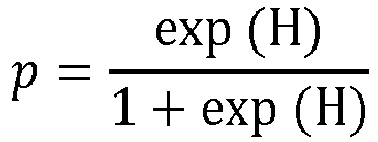

- d) determining the subject as being frail if the score p is 0.15 to 0.56.
- 12. A system for detecting frailty in a subject comprising:
- a) a GDF-15 analyzer configured to analyze biological samples from the subject to provide a concentration of GDF-15 in the biological sample;
- b) a computer programmed to execute the following steps:
- i) determining the overall biosignature score p by inputting the subject's age in years; sex as value of 0 if female, 1 if male; and serum concentrations of biomarkers GDF-15 (pg/ml), albumin (g/1), glutamine (mmol/l), GlycA (mmol/l), phosphoglycerides (mmol/l), glycine (mmol/l), and alanine (mmol/l) of the subject into the following equation:


- ii) determining the subject as being frail if the score p is 0.15 to 0.56.
- i) determining the overall biosignature score p by inputting the subject's age in years; sex as value of 0 if female, 1 if male; and serum concentrations of biomarkers GDF-15 (pg/ml), albumin (g/1), glutamine (mmol/l), GlycA (mmol/l), phosphoglycerides (mmol/l), glycine (mmol/l), and alanine (mmol/l) of the subject into the following equation:
- 13. A method of improving the accuracy of frailty and non-frailty classification comprising using GDF-15 as a guiding biomarker with a metabolomic panel of metabolites selected from one or more of albumin, glutamine, GlycA, phosphoglycerides, glycine, and alanine; comprising the following steps:
- a) measuring GDF-15 concentration in a blood serum or plasma sample from a subject using the Roche Elecsys Assay kit on a Roche Cobas e immunoassay analyzer;
- b) measuring the levels of one or more biomarkers selected from the group consisting of albumin, glutamine, GlycA, phosphoglycerides, glycine, and alanine using 1H-NMR Nightingale metabolomic profiling;
- c) determining the overall biosignature score p by inputting the subject's age in years; sex as value of 0 if female, 1 if male; and serum concentrations of biomarkers GDF-15 (pg/ml), albumin (g/1), glutamine (mmol/l), GlycA (mmol/l), phosphoglycerides (mmol/l), glycine (mmol/l), and alanine (mmol/l) of the subject into the following equation:


- d) determining the subject as being frail if the score p is 0.15 to 0.56.
- 14. A method of identifying subjects who will have improved survival outcomes when treated with exercise therapy, physical therapy, physiotherapy, nutritional supplementation (amino acid(s)/leucine (in non-cardiac failure)/protein), or administering a therapeutic drug for treating impaired cardiovascular or cardiopulmonary function; comprising the steps of
- a) determining the overall biosignature score p by inputting the subject's age in years; sex as value of 0 if female, 1 if male; and serum concentrations of biomarkers GDF-15 (pg/ml), albumin (g/1), glutamine (mmol/l), GlycA (mmol/l), phosphoglycerides (mmol/l), glycine (mmol/l), and alanine (mmol/l) of the subject into the following equation:


- b) determining the subject as being frail if the score p is 0.15 to 0.56; and
- c) treating the subjects determined as being frail with exercise therapy, physical therapy, physiotherapy, nutritional supplementation (amino acid(s)/leucine (in non-cardiac failure)/protein), or administering a therapeutic drug for treating impaired cardiovascular or cardiopulmonary function.
- a) determining the overall biosignature score p by inputting the subject's age in years; sex as value of 0 if female, 1 if male; and serum concentrations of biomarkers GDF-15 (pg/ml), albumin (g/1), glutamine (mmol/l), GlycA (mmol/l), phosphoglycerides (mmol/l), glycine (mmol/l), and alanine (mmol/l) of the subject into the following equation:
- 15. A kit for evaluating frailty comprising
- a) a test for measuring blood levels of GDF-15; and
- b) optionally one or more tests for measuring blood levels of albumin, glutamine, GlycA, phosphoglycerides, glycine, and alanine.
- 16. The kit of
embodiment 9 wherein the test for measuring albumin, glutamine, GlycA, and phosphoglyceride is the 1H-NMR Nightingale system. - The exemplary embodiments of the present invention are thus fully described. Although the description referred to particular embodiments, it will be clear to one skilled in the art that the present invention may be practiced with variation of these specific details. Hence this invention should not be construed as limited to the embodiments set forth herein.
Claims (9)
- An in vitro method of determining frailty severity in a subject comprising the steps ofa) measuring the levels of GDF-15 in a biological sample from the subject; andb) determining the subject as being frail if the level of the biomarker in the biological sample is higher than about 2,000 pg/ml to 6,000 pg/ml; pre-frail if the level of the biomarker in the biological sample is higher than 500 pg/ml to 2000 pg/ml; and robust if the level of the biomarker in the biological sample is less than 500 pg/ml.
- An in vitro method of determining frailty severity in a subject comprising the steps of:a) measuring the levels of GDF-15 in a biological sample from the subject;b) measuring the levels of one or more biomarkers selected from the group consisting of albumin, glutamine, GlycA, phosphoglycerides, glycine, and alanine;c) determining the overall biosignature score p; andd) determining the subject as being frail if p is Z;wherein Z is a value defined in Table 1 wherein the corresponding sensitivity and specificity values add up to between 1.4 and 1.5;wherein the score p is determined byi) inputting the subject's age in years; sex as value of 0 if female, 1 if male; and serum concentrations of biomarkers GDF-15 (pg/ml), albumin (g/1), glutamine (mmol/l), GlycA (mmol/l), phosphoglycerides (mmol/l), glycine (mmol/l), and alanine (mmol/l) of the subject into the following equation:

 ii) inputting the subject's age in years; sex as value of 0 if female, 1 if male; and log10-transformed serum concentrations of biomarkers GDF-15 (pg/ml), albumin (g/1), glutamine (mmol/l), GlycA (mmol/l), phosphoglycerides (mmol/l), glycine (mmol/l), and alanine (mmol/l) of the subject into the following equation:

- The method of claim 2, wherein Z is 0.15 to 0.56.
- The method of claim 3, wherein Z is 0.259 or a threshold value with the maximum value of Youden's J statistic according to Table 1.
- The method of claim 4, wherein the maximum value of Youden's J statistic is 0.553.
- The method of claim 2, wherein the biological sample is a blood serum or plasma sample from a subject; and optionally is measured using the ROCHE Elecsys Assay kit on a ROCHE Cobas e immunoassay analyzer; and optionally the levels of one or more biomarkers selected from the group consisting of albumin, glutamine, GlycA, phosphoglycerides, glycine, and alanine are measured using 1H-NMR Nightingale metabolomic profiling.
- An in vitro method of determining frailty severity in a subject comprising the steps ofa) measuring the levels of GDF-15 in a biological sample from the subject;b) measuring the levels of NT-proBNP,
wherein if NT-proBNP levels are elevated but GDF-15 levels are not, determining the subject has cardiac dysfunction without frailty; if GDF-15 levels are elevated but NT-proBNP are not, determining the subject has systemic physiological injury, hypoperfusion, diabetes mellitus, inflammatory disorders, or non-cardiac frailty; if both GDF-15 and NT-proBNP levels are elevated, determining the subject has frailty and is predicted to have heart failure and if neither NT-proBNP levels nor GDF-15 levels are elevated, determining the subject is at low risk for frailty and low risk for heart failure. - A system for detecting frailty in a subject comprising:a) a GDF-15 analyzer configured to analyze biological samples from the subject to provide a concentration of GDF-15 in the biological sample;b) a computer programmed to execute at least the steps i) or step ii) of claim 2.
- A kit for evaluating frailty comprisinga) a test for measuring blood levels of GDF-15; andb) optionally one or more tests for measuring blood levels of albumin, glutamine, GlycA, phosphoglycerides, glycine, and alanine; and
optionally wherein the test for measuring albumin, glutamine, GlycA, and phosphoglyceride is the 1H-NMR Nightingale system.
Applications Claiming Priority (1)
| Application Number | Priority Date | Filing Date | Title |
|---|---|---|---|
| US202063072917P | 2020-08-31 | 2020-08-31 |
Publications (2)
| Publication Number | Publication Date |
|---|---|
| EP3961219A2 true EP3961219A2 (en) | 2022-03-02 |
| EP3961219A3 EP3961219A3 (en) | 2022-06-22 |
Family
ID=77543439
Family Applications (1)
| Application Number | Title | Priority Date | Filing Date |
|---|---|---|---|
| EP21193874.1A Pending EP3961219A3 (en) | 2020-08-31 | 2021-08-30 | Use of gdf-15 in the diagnosis and treatment of frailty and conditions associated with altered physiological reserve, physical fitness and exercise capacity |
Country Status (3)
| Country | Link |
|---|---|
| US (1) | US20220065877A1 (en) |
| EP (1) | EP3961219A3 (en) |
| CN (1) | CN114113635A (en) |
Families Citing this family (1)
| Publication number | Priority date | Publication date | Assignee | Title |
|---|---|---|---|---|
| CN119595915B (en) * | 2024-11-27 | 2025-10-28 | 广东医科大学 | A diagnostic marker combination for senile frailty and its application |
Family Cites Families (4)
| Publication number | Priority date | Publication date | Assignee | Title |
|---|---|---|---|---|
| WO2008015254A2 (en) * | 2006-08-04 | 2008-02-07 | Medizinische Hochschule Hannover | Means and methods for assessing the risk of cardiac interventions based on gdf-15 |
| EP3152580B1 (en) * | 2014-06-05 | 2019-10-16 | Sanofi-Aventis Deutschland GmbH | New markers for the assessment of an increased risk for mortality |
| EP3184106A1 (en) * | 2015-12-23 | 2017-06-28 | Sanofi-Aventis Deutschland GmbH | Growth differentiation factor 15 as biomarker for metformin |
| CN107543873B (en) * | 2016-10-26 | 2020-10-13 | 王喜军 | Identification method of metabolic marker based on heart yang deficiency syndrome of coronary heart disease |
-
2021
- 2021-08-30 CN CN202111005107.1A patent/CN114113635A/en active Pending
- 2021-08-30 EP EP21193874.1A patent/EP3961219A3/en active Pending
- 2021-08-30 US US17/446,307 patent/US20220065877A1/en active Pending
Non-Patent Citations (3)
| Title |
|---|
| AHOLA-OLLI ARI V ET AL: "Circulating metabolites and the risk of type 2 diabetes: a prospective study of 11,896 young adults from four Finnish cohorts", DIABETOLOGIA, SPRINGER BERLIN HEIDELBERG, BERLIN/HEIDELBERG, vol. 62, no. 12, 4 October 2019 (2019-10-04), pages 2298 - 2309, XP036945453, ISSN: 0012-186X, [retrieved on 20191004], DOI: 10.1007/S00125-019-05001-W * |
| ELLUL SUSAN ET AL: "Sex differences in infant blood metabolite profile in association with weight and adiposity measures", PEDIATRIC RESEARCH, LIPPINCOTT WILLIAMS & WILKINS, NEW YORK, US, vol. 88, no. 3, 17 January 2020 (2020-01-17), pages 473 - 483, XP037231318, ISSN: 0031-3998, [retrieved on 20200117], DOI: 10.1038/S41390-020-0762-4 * |
| SOININEN P ET AL., CIRC CARDIOVASC GENET, vol. 8, 2015, pages 192 - 206 |
Also Published As
| Publication number | Publication date |
|---|---|
| CN114113635A (en) | 2022-03-01 |
| US20220065877A1 (en) | 2022-03-03 |
| EP3961219A3 (en) | 2022-06-22 |
Similar Documents
| Publication | Publication Date | Title |
|---|---|---|
| US12055535B2 (en) | Trimethylamine compounds as risk predictors of cardiovascular disease | |
| Vemuri et al. | Serial MRI and CSF biomarkers in normal aging, MCI, and AD | |
| US8916388B2 (en) | In vitro multiparameter determination method for the diagnosis and early diagnosis of neurodegenerative disorders | |
| JP6404834B2 (en) | Biomarkers associated with the progression of insulin resistance and methods of using the same | |
| JP2014521928A (en) | Method for diagnosing an increased risk of Alzheimer's disease | |
| EP2645105A1 (en) | Early biomarkers of age-related low-grade inflammation | |
| EP2950102A1 (en) | Method for the diagnosis of alzheimer s disease and mild cognitive impairment | |
| MX2014012306A (en) | Specific salivary biomarkers for risk detection, early diagnosis, prognosis and monitoring of alzheimer's and parkinson's diseases. | |
| Signoriello et al. | 12-months prospective Pentraxin-3 and metabolomic evaluation in multiple sclerosis patients treated with glatiramer acetate | |
| US9500660B2 (en) | Isovalerylglycine as biomarker for the predispositon for weight gain and obesity | |
| AU2013354356A1 (en) | Trimethylamine-N-oxide as biomarker for the predisposition for weight gain and obesity | |
| US20220065877A1 (en) | Use of GDF-15 in the Diagnosis and Treatment of Frailty and Conditions Associated with Altered Physiological Reserve, Physical Fitness and Exercise Capacity | |
| Caramelli et al. | Diagnosis of Alzheimer's disease in Brazil: Supplementary exams | |
| JP2023554414A (en) | Method for determining whether a subject is at risk of developing a musculoskeletal and/or connective tissue disease | |
| WO2018166893A1 (en) | Identification of signatures for neurodegeneration diseases diagnoses | |
| US20220178954A1 (en) | Stratification by sex and apoe genotype identifies metabolic heterogeneity in alzheimer's disease | |
| KR20160002495A (en) | Methods for Predicting or Determining Cardiovascular Disesase Using Hepatic Enzymes and Plasma Metabolites | |
| Berezhnoy et al. | Application of IVDr NMR spectroscopy to stratify Parkinson’s disease with absolute quantitation of blood serum metabolites and lipoproteins | |
| Jabbar et al. | Association of serum level of interleukin-33 and insulin resistance in overt and subclinical hypothyroidism patients | |
| Liu et al. | Altered amyloid-β42 and BACE-1 proteins in plasma astrocyte-derived exosomes in hypertensive patients with cerebral microbleeds | |
| Wang et al. | Trends in TC/HDL and LDL/HDL Ratios across the Age Span: Data from the 2007–2018 National Health and Nutrition Examination Survey (NHANES). | |
| RU2859765C1 (en) | Method for determining aging mechanism associated with development of signs of cognitive decline and emotional disorders | |
| Sousana et al. | Candidate Biomarkers for Sarcopenia and Relationship with Nutrition | |
| JPWO2019164007A1 (en) | Idiopathic scoliosis marker | |
| Fleming-Batayneh | Longitudinal Effects of Weight and Physical Activity on Alzheimer’s Disease in Down Syndrome |
Legal Events
| Date | Code | Title | Description |
|---|---|---|---|
| PUAI | Public reference made under article 153(3) epc to a published international application that has entered the european phase |
Free format text: ORIGINAL CODE: 0009012 |
|
| STAA | Information on the status of an ep patent application or granted ep patent |
Free format text: STATUS: THE APPLICATION HAS BEEN PUBLISHED |
|
| AK | Designated contracting states |
Kind code of ref document: A2 Designated state(s): AL AT BE BG CH CY CZ DE DK EE ES FI FR GB GR HR HU IE IS IT LI LT LU LV MC MK MT NL NO PL PT RO RS SE SI SK SM TR |
|
| PUAL | Search report despatched |
Free format text: ORIGINAL CODE: 0009013 |
|
| AK | Designated contracting states |
Kind code of ref document: A3 Designated state(s): AL AT BE BG CH CY CZ DE DK EE ES FI FR GB GR HR HU IE IS IT LI LT LU LV MC MK MT NL NO PL PT RO RS SE SI SK SM TR |
|
| RIC1 | Information provided on ipc code assigned before grant |
Ipc: G01N 33/68 20060101AFI20220517BHEP |
|
| STAA | Information on the status of an ep patent application or granted ep patent |
Free format text: STATUS: REQUEST FOR EXAMINATION WAS MADE |
|
| 17P | Request for examination filed |
Effective date: 20221013 |
|
| RBV | Designated contracting states (corrected) |
Designated state(s): AL AT BE BG CH CY CZ DE DK EE ES FI FR GB GR HR HU IE IS IT LI LT LU LV MC MK MT NL NO PL PT RO RS SE SI SK SM TR |
|
| P01 | Opt-out of the competence of the unified patent court (upc) registered |
Effective date: 20230515 |
|
| STAA | Information on the status of an ep patent application or granted ep patent |
Free format text: STATUS: EXAMINATION IS IN PROGRESS |
|
| 17Q | First examination report despatched |
Effective date: 20240827 |