EP3960806A1 - Resin composition, resin composition production method, cellulose fiber composition, reinforcing material, and molded article - Google Patents
Resin composition, resin composition production method, cellulose fiber composition, reinforcing material, and molded article Download PDFInfo
- Publication number
- EP3960806A1 EP3960806A1 EP20795476.9A EP20795476A EP3960806A1 EP 3960806 A1 EP3960806 A1 EP 3960806A1 EP 20795476 A EP20795476 A EP 20795476A EP 3960806 A1 EP3960806 A1 EP 3960806A1
- Authority
- EP
- European Patent Office
- Prior art keywords
- resin composition
- based polymer
- acrylic
- cellulose fibers
- mass
- Prior art date
- Legal status (The legal status is an assumption and is not a legal conclusion. Google has not performed a legal analysis and makes no representation as to the accuracy of the status listed.)
- Granted
Links
Images


Classifications
-
- C—CHEMISTRY; METALLURGY
- C08—ORGANIC MACROMOLECULAR COMPOUNDS; THEIR PREPARATION OR CHEMICAL WORKING-UP; COMPOSITIONS BASED THEREON
- C08L—COMPOSITIONS OF MACROMOLECULAR COMPOUNDS
- C08L1/00—Compositions of cellulose, modified cellulose or cellulose derivatives
- C08L1/02—Cellulose; Modified cellulose
-
- C—CHEMISTRY; METALLURGY
- C08—ORGANIC MACROMOLECULAR COMPOUNDS; THEIR PREPARATION OR CHEMICAL WORKING-UP; COMPOSITIONS BASED THEREON
- C08J—WORKING-UP; GENERAL PROCESSES OF COMPOUNDING; AFTER-TREATMENT NOT COVERED BY SUBCLASSES C08B, C08C, C08F, C08G or C08H
- C08J5/00—Manufacture of articles or shaped materials containing macromolecular substances
- C08J5/04—Reinforcing macromolecular compounds with loose or coherent fibrous material
- C08J5/045—Reinforcing macromolecular compounds with loose or coherent fibrous material with vegetable or animal fibrous material
-
- C—CHEMISTRY; METALLURGY
- C08—ORGANIC MACROMOLECULAR COMPOUNDS; THEIR PREPARATION OR CHEMICAL WORKING-UP; COMPOSITIONS BASED THEREON
- C08J—WORKING-UP; GENERAL PROCESSES OF COMPOUNDING; AFTER-TREATMENT NOT COVERED BY SUBCLASSES C08B, C08C, C08F, C08G or C08H
- C08J3/00—Processes of treating or compounding macromolecular substances
- C08J3/005—Processes for mixing polymers
-
- C—CHEMISTRY; METALLURGY
- C08—ORGANIC MACROMOLECULAR COMPOUNDS; THEIR PREPARATION OR CHEMICAL WORKING-UP; COMPOSITIONS BASED THEREON
- C08L—COMPOSITIONS OF MACROMOLECULAR COMPOUNDS
- C08L23/00—Compositions of homopolymers or copolymers of unsaturated aliphatic hydrocarbons having only one carbon-to-carbon double bond; Compositions of derivatives of such polymers
- C08L23/02—Compositions of homopolymers or copolymers of unsaturated aliphatic hydrocarbons having only one carbon-to-carbon double bond; Compositions of derivatives of such polymers not modified by chemical after-treatment
- C08L23/04—Homopolymers or copolymers of ethene
- C08L23/06—Polyethylene
-
- C—CHEMISTRY; METALLURGY
- C08—ORGANIC MACROMOLECULAR COMPOUNDS; THEIR PREPARATION OR CHEMICAL WORKING-UP; COMPOSITIONS BASED THEREON
- C08L—COMPOSITIONS OF MACROMOLECULAR COMPOUNDS
- C08L23/00—Compositions of homopolymers or copolymers of unsaturated aliphatic hydrocarbons having only one carbon-to-carbon double bond; Compositions of derivatives of such polymers
- C08L23/02—Compositions of homopolymers or copolymers of unsaturated aliphatic hydrocarbons having only one carbon-to-carbon double bond; Compositions of derivatives of such polymers not modified by chemical after-treatment
- C08L23/10—Homopolymers or copolymers of propene
- C08L23/12—Polypropene
-
- B—PERFORMING OPERATIONS; TRANSPORTING
- B29—WORKING OF PLASTICS; WORKING OF SUBSTANCES IN A PLASTIC STATE IN GENERAL
- B29K—INDEXING SCHEME ASSOCIATED WITH SUBCLASSES B29B, B29C OR B29D, RELATING TO MOULDING MATERIALS OR TO MATERIALS FOR MOULDS, REINFORCEMENTS, FILLERS OR PREFORMED PARTS, e.g. INSERTS
- B29K2201/00—Use of cellulose, modified cellulose or cellulose derivatives, e.g. viscose, as reinforcement
-
- C—CHEMISTRY; METALLURGY
- C08—ORGANIC MACROMOLECULAR COMPOUNDS; THEIR PREPARATION OR CHEMICAL WORKING-UP; COMPOSITIONS BASED THEREON
- C08F—MACROMOLECULAR COMPOUNDS OBTAINED BY REACTIONS ONLY INVOLVING CARBON-TO-CARBON UNSATURATED BONDS
- C08F220/00—Copolymers of compounds having one or more unsaturated aliphatic radicals, each having only one carbon-to-carbon double bond, and only one being terminated by only one carboxyl radical or a salt, anhydride ester, amide, imide or nitrile thereof
- C08F220/02—Monocarboxylic acids having less than ten carbon atoms; Derivatives thereof
- C08F220/52—Amides or imides
- C08F220/54—Amides, e.g. N,N-dimethylacrylamide or N-isopropylacrylamide
- C08F220/56—Acrylamide; Methacrylamide
-
- C—CHEMISTRY; METALLURGY
- C08—ORGANIC MACROMOLECULAR COMPOUNDS; THEIR PREPARATION OR CHEMICAL WORKING-UP; COMPOSITIONS BASED THEREON
- C08J—WORKING-UP; GENERAL PROCESSES OF COMPOUNDING; AFTER-TREATMENT NOT COVERED BY SUBCLASSES C08B, C08C, C08F, C08G or C08H
- C08J2323/00—Characterised by the use of homopolymers or copolymers of unsaturated aliphatic hydrocarbons having only one carbon-to-carbon double bond; Derivatives of such polymers
- C08J2323/02—Characterised by the use of homopolymers or copolymers of unsaturated aliphatic hydrocarbons having only one carbon-to-carbon double bond; Derivatives of such polymers not modified by chemical after treatment
- C08J2323/10—Homopolymers or copolymers of propene
- C08J2323/12—Polypropene
Definitions
- the present invention relates to a resin composition, a resin composition production method, a cellulose fiber composition, a reinforcing material, and a molded article.
- cellulose nanofibers are nanofillers formed from plant-derived natural raw materials and are receiving attention as composite materials for low-specific gravity, high-strength resins.
- One known resin composition can impart high mechanical strength to a molded article containing a polyolefin and cellulose nanofibers added thereto (see, for example, PTL 1).
- the resin composition of the present invention contains:
- a molded body in which the effect of addition of the cellulose fibers is exerted sufficiently and which has good mechanical strength can be produced.
- the resin composition of the invention a method for producing the resin composition, the cellulose fiber composition of the invention, the reinforcing material of the invention, and the molded article of the invention will be described in detail based on preferred embodiments.
- the resin composition of the present invention contains: an olefin-based polymer (A); cellulose fibers (B); an amide compound (C) having at least one hydrocarbon group; and an acrylic-based polymer (D) that contains a first structural unit based on an alkyl (meth)acrylate and a second structural unit based on an acrylic monomer having an amido group and has a weight average molecular weight of 5,000 to 100,000.
- the prescribed amide compound (C) and the prescribed acrylic-based polymer (D) are used in combination, and this allows the highly disintegrated cellulose fibers (B) to be dispersed uniformly and stably in the olefin-based polymer (A). Therefore, in a molded body produced from the resin composition, the effect of the addition of the cellulose fibers (B) is exerted sufficiently, and the mechanical strength of the molded article is improved.
- the olefin-based polymer (A) is a base component of the resin composition and is a component forming a matrix in the molded body.
- olefin-based polymer (A) examples include polyethylenes (high-density polyethylenes, low-density polyethylenes, and biopolyethylenes), polypropylenes, polybutylenes, polyvinyl chlorides, polystyrenes, poly(meth)acrylates, polyvinyl ethers, and ethylenepropylene copolymers. These olefin-based polymers (A) are preferred because they are inexpensive and allow the reinforcing effect of the cellulose fibers (B) to be easily obtained.
- One olefin-based polymer (A) may be used alone, or two or more olefin-based polymers (A) may be used in combination.
- the cellulose fibers (B) are a component having the function of reinforcing the molded body containing the olefin-based polymer (A) serving as the matrix.
- the cellulose fibers (B) are obtained by disintegrating aggregates of the cellulose fibers (B) (a raw material of the cellulose fibers (B)).
- the raw material of the cellulose fibers (B) used may be one or two or more types selected from: vegetable fibers (pulps) obtained from natural vegetable raw materials such as wood, bamboo, hemp, jute, kenaf, cotton, beat, agricultural waste, and cloth; waste paper such as old newsprint, old corrugated cardboard, old magazines, and waste copy paper; etc.
- vegetable fibers obtained from natural vegetable raw materials such as wood, bamboo, hemp, jute, kenaf, cotton, beat, agricultural waste, and cloth
- waste paper such as old newsprint, old corrugated cardboard, old magazines, and waste copy paper; etc.
- wood examples include Sitka spruce, cedar, cypress, eucalyptus, and acacia.
- the raw material of the cellulose fibers (B) is preferably pulp or fibrillated pulp obtained by fibrillating pulp.
- the pulp is obtained by pulping a vegetable raw material mechanically, chemically, or both mechanically and chemically.
- Preferred examples of the pulp include chemical pulp (kraft pulp (KP) and sulfite pulp (SP)), semichemical pulp (SCP), chemiground pulp (CGP), chemimechanical pulp (CMP), groundwood pulp (GP), refiner mechanical pulp (RMP), thermomechanical pulp (TMP), and chemi-thermomechanical pulp (CTMP) .
- chemical pulp kraft pulp (KP) and sulfite pulp (SP)
- SCP semichemical pulp
- CGP chemiground pulp
- CMP chemimechanical pulp
- GP groundwood pulp
- RMP refiner mechanical pulp
- TMP thermomechanical pulp
- CMP chemi-thermomechanical pulp
- the pulp used may be deinked waste paper pulp, waste corrugated cardboard pulp, waste magazine paper pulp, etc. that contain any of the above-described pulps as a main component.
- the pulp is preferably kraft pulp derived from conifers and having high fiber strength such as nadelholz unbleached kraft pulp (NUKP), nadelholz oxygen-prebleached kraft pulp (NOKP), or nadelholz bleached kraft pulp (NBKP).
- NUKP nadelholz unbleached kraft pulp
- NOKP nadelholz oxygen-prebleached kraft pulp
- NKP nadelholz bleached kraft pulp
- the pulp used may be laubholz kraft pulp such as bleached kraft pulp (LBKP), unbleached kraft pulp (LUKP), or oxygen-bleached kraft pulp (LOKP).
- LLKP bleached kraft pulp
- LKP unbleached kraft pulp
- LLKP oxygen-bleached kraft pulp
- the pulp may be optionally subjected to delignification treatment, breaching treatment, etc. to adjust the amount of lignin contained in the pulp.
- the pulp is composed mainly of cellulose, hemicellulose, and lignin.
- the content of lignin in the pulp is preferably about 0 to about 40% by mass and more preferably about 0 to about 10% by mass.
- the content of lignin can be measured by a Klason method.
- the upper limit of the freeness of the raw material of the cellulose fibers (B) is preferably about 720 cc and more preferably about 540 cc.
- the lower limit of the freeness is preferably about 15 cc and more preferably about 30 cc.
- the average fiber length of the raw material of the cellulose fibers (B) is preferably 0.5 mm or more and more preferably 2.5 mm or more. The longer the fiber length, the higher the aspect ratio of the cellulose fibers (B) disintegrated in the olefin-based polymer (A), and the higher the reinforcing effect.
- the average fiber diameter (average fiber width) of the cellulose fibers (B) obtained by disintegration is preferably about 4 nm to about 30 ⁇ m, and the average fiber length is preferably about 5 to about 100 ⁇ m.
- the average fiber diameter and the average fiber length of the cellulose fibers (B) can be represented as the averages of measurements on, for example, at least 50 cellulose fibers (B) in a viewing field of an electron microscope.
- the specific surface area of the cellulose fibers (B) is preferably about 70 to about 300 m 2 /g, more preferably about 70 to about 250 m 2 /g, and still more preferably about 100 to about 200 m 2 /g.
- the area of contact between the cellulose fibers (B) and the olefin-based polymer (A) in the resin composition can be increased, and the mechanical strength of the molded body to be produced using the resin composition can be further increased.
- the specific surface area of the cellulose fibers (B) By controlling the specific surface area of the cellulose fibers (B), aggregation of the cellulose fibers (B) in the resin composition is prevented, and a molded body having higher mechanical strength can be produced.
- the amount of the cellulose fibers (B) contained in the resin composition is preferably about 0.1 to about 35% by mass, more preferably about 0.5 to about 30% by mass, and still more preferably about 1 to about 25% by mass.
- the amide compound (C) is a component having the function of facilitating disintegration of the raw material of the cellulose fibers (B).
- the amide compound (C) is a compound having at least one hydrocarbon group and at least one amido group. Urea itself and compounds having a urea bond are excluded from the amide compound (C).
- the amido group in the amide compound (C) is thought to electrostatically act on hydroxy groups in the cellulose fibers (B) to cut hydrogen bonds between the hydroxy groups. In this manner, the aggregates of the cellulose fibers (B) may be disintegrated efficiently, and the amide compound (C) may be supported on the surface of the disintegrated cellulose fibers (B). Since the amide compound (C) has the hydrocarbon group, the amide compound (C) is unlikely to mediate electrostatic interaction between the disintegrated cellulose fibers (B), and therefore the disintegrated state of the cellulose fibers (B) can be well maintained.
- Examples of the amide compound (C) include: saturated fatty acid amides such as acetamide, propionic acid amide, isopropionic acid amide, butyramide, pivalic acid amide, dimethylpropionic acid amide, hexanamide, decanoic acid amide, lauric acid amide, palmitic acid amide, stearic acid amide, and hydroxystearic acid amide; unsaturated fatty acid amides such as oleic acid amide and erucic acid amide; N-substituted amides such as N,N-diethylacetamide, N,N-diethyldodecanamide, N-stearylstearic acid amide, N-stearyloleic acid amide, N-oleylstearic acid amide, N-stearylerucic acid amide, and N-oleyloleic acid amide; methylol amides such as methylolstearic acid amide; diamide
- the number of carbon atoms in the amide compound (C) is preferably 3 to 30, more preferably 3 to 20, and still more preferably 3 to 10.
- the amide compound (C) has appropriate hydrophilicity and hydrophobicity, so that the disintegrated state of the cellulose fibers (B) can be better maintained.
- the amide compound (C) is preferably a fatty acid amide having 3 to 30 carbon atoms and more preferably a saturated fatty acid amide such as propionic acid amide, butyramide, pivalic acid amide, lauric acid amide, or stearic acid amide.
- a saturated fatty acid amide such as propionic acid amide, butyramide, pivalic acid amide, lauric acid amide, or stearic acid amide.
- the amount of the amide compound (C) contained in the resin composition is preferably about 1 to about 30 parts by mass and more preferably about 5 to about 25 parts by mass based on 100 parts by mass of the cellulose fibers (B).
- the content of the amide compound (C) is as described above, the aggregates of the cellulose fibers (B) can be more finely disintegrated, and the disintegrated state of the cellulose fibers (B) can be better maintained.
- the acrylic-based polymer (D) is a component having the function of stably dispersing the cellulose fibers (B) in the olefin-based polymer (A) (the function as a dispersant).
- the acrylic-based polymer (D) is a copolymer that contains the first structural unit based on an alkyl (meth)acrylate and the second structural unit based on an acrylic monomer having an amido group and has a weight average molecular weight of 5,000 to 100,000.
- the acrylic-based polymer (D) is a polymer having a polyolefin structure in the main chain and an alkyl group in a side chain and therefore has high compatibility with the olefin-based polymer (A). Since the acrylic-based polymer (D) has an amido group, the acrylic-based polymer (D) has a high affinity for the cellulose fibers (B). Therefore, the acrylic-based polymer (D) can preferably function as a dispersant for the cellulose fibers (B).
- the number of carbon atoms in the alkyl group included in the first structural unit is preferably 6 to 18 and more preferably 8 to 15.
- the compatibility of the acrylic-based polymer (D) with the olefin-based polymer (A) is further increased.
- the amount of the first structural unit with respect to the total amount of the structural units forming the acrylic-based polymer (D) is preferably about 25 to about 50% by mass and more preferably about 30 to about 45% by mass.
- the number (concentration) of alkyl groups in the acrylic-based polymer (D) is appropriate, and the compatibility between the acrylic-based polymer (D) and the olefin-based polymer (A) is further improved.
- the amount of the second structural unit with respect to the total amount of the structural units forming the acrylic-based polymer (D) is preferably about 50 to about 75% by mass and more preferably about 55 to about 70% by mass. In this case, the number (concentration) of amido groups in the acrylic-based polymer (D) is appropriate.
- the concentration of the amido groups in the acrylic-based polymer (D) is preferably about 1.4 to about 9.9 mmol/g and more preferably about 2.8 to about 9.2 mmol/g.
- the concentration of the amido groups is a value computed from the amounts of monomers used as the raw materials for preparing the acrylic-based polymer (D).
- concentration of the amido groups contained is as described above, the affinity between the acrylic-based polymer (D) and the cellulose fibers (B) is further improved.
- the weight average molecular weight of the acrylic-based polymer (D) may be 5,000 to 100,000 and is preferably about 10,000 to about 50,000.
- the compatibility between the acrylic-based polymer (D) and the olefin-based polymer (A) is further increased.
- the weight average molecular weight is a polystyrene equivalent value determined by gel permeation chromatography (hereinafter referred to as "GPC") measurement.
- the amounts of the structural units contained in the acrylic-based polymer (D) are substantially the same as the amounts of monomers contained in monomer components used as the raw materials of the acrylic-based polymer (D).
- the acrylic-based polymer (D) in the present invention is obtained by polymerizing an alkyl (meth)acrylate and an acrylic monomer having an amido group. Therefore, the acrylic-based polymer (D) can be synthesized (produced) at relatively low cost.
- the notation "(meth)acrylic acid” represents one or both of “acrylic acid” and “methacrylic acid.”
- the notation “(meth)acrylate” represents one or both of “acrylate” and “methacrylate.”
- the notation “(meth)acrylamide” represents one or both of “acrylamide” and “methacrylamide.”
- alkyl group is intended to encompass cycloalkyl groups.
- alkyl (meth)acrylate examples include cyclohexyl (meth)acrylate, hexyl (meth)acrylate, 2-ethylhexyl (meth)acrylate, lauryl (meth)acrylate, and stearyl (meth)acrylate, and the alkyl (meth)acrylate is preferably lauryl (meth)acrylate.
- lauryl (meth)acrylate the compatibility of the acrylic-based polymer (D) with the olefin-based polymer (A) can be particularly increased.
- One alkyl (meth)acrylate may be used alone, or two or more alkyl (meth)acrylates may be used in combination.
- acrylic monomer having an amido group examples include (meth)acrylamide, N-methyl (meth)acrylamide, N-ethyl (meth)acrylamide, N-propyl (meth)acrylamide, N,N-dimethyl (meth)acrylamide, N,N-diethyl (meth)acrylamide, N,N-dipropyl (meth)acrylamide, N-isopropyl (meth)acrylamide, N-dodecylacrylamide, N-propoxymethylacrylamide, 6-(meth)acrylamidohexanoic acid, (meth)acryloylmorpholine, N-methylol (meth)acrylamide, N-(2-hydroxyethyl) (meth)acrylamide, N,N-dimethylaminopropyl (meth)acrylamide, and N-[2,2-dimethyl-3-(dimethylamino)propyl]acrylamide.
- One acrylic monomer may be used alone, or two or more acrylic monomers may be used
- an additional monomer other than the alkyl (meth)acrylate and the acrylic monomer having an amido group may be optionally used.
- the additional monomer examples include: monomers having a carboxyl group such as (meth)acrylic acid, maleic acid (anhydride), fumaric acid, and itaconic acid (anhydride); (meth)acrylates having a functional group such as 2-methylaminoethyl (meth)acrylate, 2-hydroxyethyl (meth)acrylate, 2-hydroxypropyl (meth)acrylate, 2-hydroxybutyl (meth)acrylate, 4-hydroxybutyl (meth)acrylate, tetrahydrofurfuryl (meth)acrylate, ⁇ -methacryloxypropyltrimethoxysilane, vinyltriethoxysilane, and glycidyl (meth)acrylate; methyl (meth)acrylate; ethyl (meth)acrylate; propyl (meth)acrylate; butyl (meth)acrylate; isobornyl (meth)acrylate; benzyl (meth)acrylate; diethylene glycol
- the acrylic-based polymer (D) can be produced, for example, by subjecting the alkyl (meth)acrylate, the acrylic monomer, and the optional additional monomer to radical polymerization in an organic solvent at a temperature of 60 to 140°C in the presence of a polymerization initiator.
- the organic solvent may be removed in a solvent removal step after the radical polymerization.
- organic solvent examples include: aromatic solvents such as toluene and xylene; alicyclic solvents such as cyclohexanone; ester solvents such as butyl acetate and ethyl acetate; isobutanol; n-butanol; isopropyl alcohol; sorbitol; cellosolve solvents such as propylene glycol monomethyl ether acetate; and ketone solvents such as methyl ethyl ketone and methyl isobutyl ketone.
- aromatic solvents such as toluene and xylene
- alicyclic solvents such as cyclohexanone
- ester solvents such as butyl acetate and ethyl acetate
- isobutanol n-butanol
- isopropyl alcohol sorbitol
- cellosolve solvents such as propylene glycol monomethyl ether acetate
- ketone solvents such as
- polymerization initiator examples include: azo compounds such as 2,2'-azobis(isobutyronitrile), 2,2'-azobis(2-methylbutyronitrile), and azobiscyanovaleric acid; organic peroxides such as tert-butyl peroxypivalate, tert-butyl peroxybenzoate, tert-butylperoxy-2-ethylhexanoate, di-tert-butyl peroxide, di-tert-butyl hydroperoxide, cumene hydroperoxide, benzoyl peroxide, and tert-butyl hydroperoxide; and inorganic peroxides such as hydrogen peroxide, ammonium persulfate, potassium persulfate, and sodium persulfate.
- One polymerization initiator may be used alone, or two or more polymerization initiators may be used in combination.
- the polymerization initiator is used in an amount of about 0.1 to about 10% by mass with respect to the total mass of the monomers used as the raw materials of the acrylic-based polymer (D).
- the amount of the acrylic-based polymer (D) contained in the resin composition is preferably about 10 to about 120 parts by mass, more preferably about 30 to about 100 parts by mass, and still more preferably about 50 to about 100 parts by mass based on 100 parts by mass of the cellulose fibers (B).
- the amount of the acrylic-based polymer (D) contained is as described above, the dispersibility of the cellulose fibers (B) in the resin composition can be further improved. The mechanical strength of the molded body is thereby further increased, and its uniformity is improved.
- the acrylic-based polymer (D) and the amide compound (C) each have an amido group, they have a high affinity for each other. This is also thought to contribute to the effect of the acrylic-based polymer (D) that allows the cellulose fibers (B) to be highly dispersed in the olefin-based polymer (A).
- the amido groups contained in the acrylic-based polymer (D) form coordinate bonds etc. with metal ions to effectively trap the metal ions and therefore also have the function of preventing deterioration of the olefin-based polymer (A) due to the metal ions or deactivating the metal ions.
- the ability to trap metal ions can be increased.
- the acrylic-based polymer (D) can prevent deterioration of the olefin-based polymer (A) due to metal ions.
- the metal ions may be various types of metal ions and are preferably at least one type of metal ions selected from copper ions, manganese ions, and cobalt ions. These metal ions have a significant effect on deterioration of the olefin-based polymer (A). Therefore, trapping these metal ions is effective, and the ability of the acrylic-based polymer (D) to trap the metal ions is particularly high.
- the resin composition of the present invention contains the olefin-based polymer (A) and the acrylic-based polymer (D).
- the ability of the acrylic-based polymer (D) to trap metal ions is high.
- metal ions may diffuse into the molded body. Even if this occurs, the acrylic-based polymer (D) traps these metal ions efficiently.
- the metal ions are thereby rendered harmless (deactivated), and deterioration of the olefin-based polymer (A) is suppressed or prevented. Therefore, the acrylic-based polymer (D) may be referred to as a deterioration inhibitor (metal deactivator) for the olefin-based polymer (A).
- the resin composition may optionally contain additives such as a compatibilizer, a surfactant, starch, polysaccharides such as alginic acid, gelatin, glue, natural proteins such as casein, tannin, zeolite, talc, cray, ceramics, inorganic compounds such as metal powders, a crystallization nucleating agent, a crosslinking agent, an anti-hydrolysis agent, an antioxidant, a lubricant, wax, a coloring agent, a stabilizer, a plasticizer, a perfume, a pigment, a flow modifier, a leveling agent, a conductive agent, an antistatic agent, an ultraviolet absorber, an ultraviolet scattering agent, and a deodorant.
- additives such as a compatibilizer, a surfactant, starch, polysaccharides such as alginic acid, gelatin, glue, natural proteins such as casein, tannin, zeolite, talc, cray, ceramics, inorganic compounds such as metal powders, a crystal
- the resin composition of the present invention can be produced by a method including kneading the olefin-based polymer (A), the aggregates of the cellulose fibers (B), the amide compound (C), and the acrylic-based polymer (D) to disintegrate the aggregates into the cellulose fibers (B) (i.e., the resin composition production method of the present invention).
- the olefin-based polymer (A), the aggregates of the cellulose fibers (B), the amide compound (C), and the acrylic-based polymer (D) may be mixed at once and kneaded.
- the aggregates of the cellulose fibers (B), the amide compound (C), and the acrylic-based polymer (D) are mixed in advance to treat the aggregates of the cellulose fibers (B) with the amide compound (C) and the acrylic-based polymer (D). Then these components are mixed with the olefin-based polymer (A), and the resulting mixture is kneaded.
- the amide compound (C) and the acrylic-based polymer (D) can be allowed to be present around the aggregates of the cellulose fibers (B) in a reliable manner. Therefore, when these components are kneaded, disintegration of the aggregates of the cellulose fibers (B) and uniform dispersion of the cellulose fibers (B) in the olefin-based polymer (A) are further facilitated.
- the aggregates of the cellulose fibers (B) treated with the amide compound (C) and the acrylic-based polymer (D) are obtained as a production intermediate.
- the treated aggregates of the cellulose fibers (B) are added to the olefin-based polymer (A) and can be used as a reinforcing material that reinforces the olefin-based polymer (A) (the reinforcing material of the present invention).
- the mixture obtained by mixing the aggregates of the cellulose fibers (B), the amide compound (C), and the acrylic-based polymer (D) forms the cellulose fiber composition of the present invention.
- the cellulose fiber composition of the present invention contains the aggregates of the cellulose fibers (B), the amide compound (C), and the acrylic-based polymer (D).
- the aggregates of the cellulose fibers (B) are disintegrated when the components are kneaded.
- a bead mill an ultrasonic homogenizer, an extruder such as a single screw extruder or a twin screw extruder, or a kneader such as a Banbury mixer, a grinder, a pressure kneader, or a two-roll mill may be used.
- the above components may be mixed in the presence of at least one of water and an organic solvent as necessary.
- organic solvent examples include: alcohols such as methanol, ethanol, n-propanol, isopropanol, n-butanol, isobutanol, 2-butanol, and tert-butanol; glycols such as ethylene glycol, propylene glycol, 1,3-butanediol, 1,4-butanediol, diethylene glycol, and triethylene glycol; glycol monoalkyl ethers such as ethylene glycol monomethyl ether, ethylene glycol monoethyl ether, ethylene glycol monobutyl ether, propylene glycol monomethyl ether, dipropylene glycol monomethyl ether, diethylene glycol monomethyl ether, diethylene glycol monoethyl ether, diethylene glycol monobutyl ether, and triethylene glycol monomethyl ether; glycol dialkyl ethers such as ethylene glycol dimethyl ether, diethylene glycol dimethyl ether, diethylene glycol diethyl
- the organic solvent is preferably methanol, ethanol, isopropanol, n-propanol, tert-butanol, acetone, diacetone alcohol, ethylene glycol, propylene glycol, 1,3-butanediol, 1,4-butanediol, diethylene glycol, triethylene glycol, ethylene glycol monomethyl ether, ethylene glycol monoethyl ether, ethylene glycol monobutyl ether, propylene glycol monomethyl ether, dipropylene glycol monomethyl ether, diethylene glycol monomethyl ether, diethylene glycol monoethyl ether, diethylene glycol monobutyl ether, ethylene glycol dimethyl ether, diethylene glycol dimethyl ether, diethylene glycol diethyl ether, triethylene glycol dimethyl ether, or N-methyl-2-pyrrolidone because they can swell the cellulose fibers (B) and allow the amide compound (C) to be dissolved or dispersed
- the molded article of the present invention includes a molded body obtained by molding the resin composition.
- the cellulose fibers (B) finely disintegrated with the aid of the amide compound (C) are uniformly and stably dispersed in the olefin-based polymer (A) with the aid of the acrylic-based polymer (D). Therefore, since the effect of the cellulose fibers (B) that reinforce the olefin-based polymer (A) is exerted preferably, the molded article has good mechanical strength.
- the acrylic-based polymer (D) prevents deterioration of the olefin-based polymer (A) due to metal ions, and therefore the weather resistance of the molded article is also good.
- To mold the resin composition for example, injection molding, extrusion molding, blow molding, compression molding, foam molding, etc. is used.
- the resin composition of the present invention a molded article having good mechanical strength is obtained, and the resin composition can be used to produce various molded articles.
- Specific examples of the application of the molded article include: interior and exterior materials and casings for transportation machines such as automobiles, motorcycles, bicycles, railroad cars, drones, rockets, aircrafts, and ships; energy machines such as wind power generators and water power generators; casings of household electrical appliances such as air conditioners, refrigerators, cleaners, microwave ovens, audiovisual systems, digital cameras, and personal computers; electronic circuit boards; casings of communication devices such as mobile phones and smartphones; medical appliances such as crutches and wheelchairs; shoes such as sneakers and business shoes; tires; sporting goods such as balls for ball games, ski boots, snowboards, golf clubs, protectors, fishing lines, and lures; outdoor goods such as tents and hammocks; wire-coating materials; civil engineering and construction materials such as water pipes and gas pipes; building materials such as pillar materials, floor materials, veneers, window frames, and heat insulating materials; furnishings such as
- the acrylic-based polymer (D) exerts the effect of preventing deterioration of the cellulose fibers (B) due to metal ions, the molded article is suitable for automobile components that often come into contact with metallic components and metallic powders.
- each of the resin composition of the invention, the cellulose fiber composition of the invention, the reinforcing material of the invention, and the molded article of the invention that have the respective structures described in the above embodiments may further include an additional component, or any component thereof may be replaced with another component having the same function.
- the resin composition production method of the present invention in the embodiment described above may further include an additional step, or any step in the method may be replaced with another step having the same function.
- IPA isopropyl alcohol
- a solution mixture containing 135.3 parts by mass of acrylamide, 108.2 parts by mass of lauryl methacrylate, 2.5 parts by mass of methyl acrylate, 246 parts by mass of IPA, 4 parts by mass of polymerization initiator ("V-59” manufactured by Wako Pure Chemical Industries, Ltd., azo initiator), and 10 parts by mass of methyl ethyl ketone (hereinafter denoted as "MEK”) was added dropwise to the IPA in the flask over 2 hours, and the resulting mixture was allowed to react at 73 to 77°C.
- the obtained resin solution was subjected to solvent removal using a decompression pump (0.08 to 0.095 MPa, 60°C), and the resulting product was heated and dried at 80°C for 30 minutes using a dryer to thereby obtain an acrylic-based polymer D1 as a solid.
- a four-neck flask equipped with a stirrer, a reflux condenser tube, a thermometer, and a nitrogen introduction tube was charged with 123 parts by mass of IPA and heated to 80°C.
- the obtained resin solution was subjected to solvent removal using a decompression pump (0.08 to 0.095 MPa, 60°C), and the resulting product was heated and dried at 80°C for 30 minutes using a dryer to thereby obtain an acrylic-based polymer D2 as a solid.
- the weight average molecular weight of each acrylic-based polymer (D) was measured under the following GPC measurement conditions.
- the weight average molecular weight of the above-obtained acrylic-based polymer D1 was 15,000, and the weight average molecular weight of the acrylic-based polymer D2 was 17,000.
- polypropylene (PP) was added to the mixture in an amount of 337.5 parts by mass based on 100 parts by mass of the pulp (aggregates of cellulose fibers), and these components were mixed for 2 minutes using a Henschel mixer.
- the resulting mixture was melted and kneaded in a twin screw extruder (manufactured by TECHNOVEL CORPORATION) heated to 180 to 230°C, and a sample was produced by extrusion molding.
- the pulp was disintegrated into cellulose fibers during the melt kneading.
- Samples were produced using the same procedure as in Example A1 except that the amount of the polypropylene added and the amount of the stearic acid amide added were changed as shown in Table 1.
- a sample was produced using the same procedure as in Example A3 except that the acrylic-based polymer D1 was changed to the acrylic-based polymer D2.
- a sample was produced using the same procedure as in Example A1 except that only 500 parts by mass of the polypropylene was used.
- a sample was produced using the same procedure as in Example A1 except that 400 parts by mass of the polypropylene and 100 parts by mass of the pulp were used.
- a sample was produced using the same procedure as in Example A1 except that 340 parts by mass of the polypropylene, 100 parts by mass of the pulp, and 60 parts by mass of the acrylic-based polymer D1 were used.
- a sample was produced using the same procedure as in Comparative Example A3 except that the acrylic-based polymer D1 was changed to the acrylic-based polymer D2.
- PE polyethylene
- Samples were produced using the same procedure as in Example B1 except that the amount of the polyethylene added, the amount of the acrylic-based polymer D1 added, and the type of fatty acid amide were changed as shown in Table 2.
- a sample was produced using the same procedure as in Example B1 except that only 500 parts by mass of the polyethylene was used.
- a sample was produced using the same procedure as in Example B1 except that 400 parts by mass of the polyethylene and 100 parts by mass of the pulp were used.
- a sample was produced using the same procedure as in Example B1 except that 340 parts by mass of the polyethylene, 100 parts by mass of the pulp, and 60 parts by mass of the acrylic-based polymer D1 were used.
- Each of the specimens was used to perform a tensile test using a tensile tester ("EZ-TEST" manufactured by Shimadzu Corporation) under the conditions of a measurement temperature of 25°C, a tensile rate of 10 mm/min, and a distance between checks of 30 mm.
- a tensile tester (“EZ-TEST” manufactured by Shimadzu Corporation) under the conditions of a measurement temperature of 25°C, a tensile rate of 10 mm/min, and a distance between checks of 30 mm.
- a 1 cm 2 piece was cut from a central portion of a sample obtained in one of the Examples and Comparative Examples and wrapped with a metal mesh, and the resin components were extracted with hot xylene. Then the cellulose fibers remaining on the metal mesh were dried, and a plurality of SEM photographs were taken at a magnification of 10000X or higher.
- the average fiber diameter of the cellulose fibers was determined by averaging the measured fiber diameters of 200 or more randomly selected cellulose fibers.
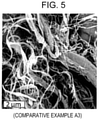
- Example A2 The SEM photographs of the samples obtained in Example A2, Example A3, Example A4, Comparative Example A2, and Comparative Example A3 are shown in Figs. 1 to 5 , respectively.
- a 1 cm 2 piece was cut from a central portion of a sample obtained in one of the Examples and Comparative Examples and wrapped with a metal mesh, and the resin components were extracted with hot xylene. Then the cellulose fibers remaining on the metal mesh were dried, and SEM photographs of a viewing field of a length of 134 ⁇ m ⁇ and a width of 134 ⁇ m were taken at a magnification of 2000X. 64 SEM photographs at different positions were taken for each sample. 50 cellulose fibers were randomly selected for each of the SEM photographs taken, and the fiber diameters of a total of 3200 cellulose fibers in the 64 SEM photographs were measured. The remaining rate of undisintegrated fibers was determined using the following formula.
- Remaining rate of undisintegrated fibers the number of fibers having a fiber diameter of 5 ⁇ m or more / 3200 ⁇ 100
- Olefin-based polymer Cellulose fibers
- Acrylic-based polymer Amide compound Tensile elastic modulus [GPa] Fiber diameter Type Amount [parts by mass] Type Type Average fiber diameter [nm] Remaining rate of undisintegrated fibers Amount [parts by mass] Amount [parts by mass] Amount [parts by mass]
- the tensile elastic modulus of each of the samples obtained in the Examples was clearly larger than the tensile elastic modulus of each of the samples obtained in the Comparative Examples.
- the cellulose fibers were disintegrated sufficiently as compared to those in the samples obtained in the Comparative Examples.
- the degree of disintegration could be controlled by changing the type of fatty acid amide and/or the amount of the fatty acid amide and changing the type of acrylic-based polymer.
- Samples were produced using the same procedures as above except that the amount of the cellulose fibers was changed to 5 parts by mass. Then results similar to those described above were obtained although the tensile elastic modulus was slightly reduced.
Landscapes
- Chemical & Material Sciences (AREA)
- Health & Medical Sciences (AREA)
- Chemical Kinetics & Catalysis (AREA)
- Medicinal Chemistry (AREA)
- Polymers & Plastics (AREA)
- Organic Chemistry (AREA)
- Engineering & Computer Science (AREA)
- Manufacturing & Machinery (AREA)
- Materials Engineering (AREA)
- Compositions Of Macromolecular Compounds (AREA)
Abstract
Description
- The present invention relates to a resin composition, a resin composition production method, a cellulose fiber composition, a reinforcing material, and a molded article.
- Recently developed cellulose nanofibers are nanofillers formed from plant-derived natural raw materials and are receiving attention as composite materials for low-specific gravity, high-strength resins.
- One known resin composition can impart high mechanical strength to a molded article containing a polyolefin and cellulose nanofibers added thereto (see, for example, PTL 1).
- However, some molded article applications require a further increase in mechanical strength.
- PTL 1:
Japanese Patent No. 6197941 - It is an object of the present invention to provide a resin composition that allows the effect of addition of cellulose fibers to be exerted sufficiently and allows a molded body having high mechanical strength to be produced and to provide a method for producing the resin composition and a molded article using the resin composition.
- The above object is achieved by the following (1) to (15) in the present invention.
- The resin composition of the present invention contains:
- an olefin-based polymer (A);
- cellulose fibers (B);
- an amide compound (C) having at least one hydrocarbon group; and
- an acrylic-based polymer (D) that contains a first structural unit based on an alkyl (meth)acrylate and a second structural unit based on an acrylic monomer having an amido group and has a weight average molecular weight of 5,000 to 100,000.
- (2) Preferably, in the resin composition of the present invention, the amount of the cellulose fibers (B) contained in the resin composition is 0.1 to 35% by mass.
- (3) Preferably, in the resin composition of the present invention, the number of carbon atoms in the amide compound (C) is 3 to 30.
- (4) Preferably, in the resin composition of the present invention, the amide compound (C) is a fatty acid amide.
- (5) Preferably, in the resin composition of the present invention, the amount of the amide compound (C) contained in the resin composition is 1 to 30 parts by mass based on 100 parts by mass of the cellulose fibers.
- (6) Preferably, in the resin composition of the present invention, the number of carbon atoms in the alkyl group included in the first structural unit in the acrylic-based polymer (D) is 6 to 18.
- (7) Preferably, in the resin composition of the present invention, the amount of the first structural unit with respect to the total amount of structural units forming the acrylic-based polymer (D) is 25 to 50% by mass.
- (8) Preferably, in the resin composition of the present invention, the amount of the second structural unit with respect to the total amount of structural units forming the acrylic-based polymer (D) is 50 to 75% by mass.
- (9) Preferably, in the resin composition of the present invention, the amount of the acrylic-based polymer (D) contained in the resin composition is 10 to 120 parts by mass based on 100 parts by mass of the cellulose fibers.
- (10) The resin composition production method of the present invention is a method for producing the above resin composition, the method including kneading the olefin-based polymer (A), aggregates of the cellulose fibers (B), the amide compound (C), and the acrylic-based polymer (D) to disintegrate the aggregates into the cellulose fibers (B) to thereby obtain the resin composition.
- (11) Preferably, in the resin composition production method of the present invention, the aggregates of the cellulose fibers (B) are treated with the amide compound (C) and the acrylic-based polymer (D) and then kneaded with the olefin-based polymer (A).
- (12) The cellulose fiber composition of the present invention contains:
- aggregates of cellulose fibers (B);
- an amide compound (C) having at least one hydrocarbon group; and
- an acrylic-based polymer (D) that contains a first structural unit based on an alkyl (meth)acrylate and a second structural unit based on an acrylic monomer having an amido group and has a weight average molecular weight of 5,000 to 100,000.
- (13) The reinforcing material of the present invention is a reinforcing material to be added to an olefin-based polymer (A) for use,
- the reinforcing material containing aggregates of cellulose fibers (B), the aggregates having been treated with an amide compound (C) having at least one hydrocarbon group and an acrylic-based polymer (D) that contains a first structural unit based on an alkyl (meth)acrylate and a second structural unit based on an acrylic monomer having an amido group and has a weight average molecular weight of 5,000 to 100,000.
- (14) The molded article of the present invention includes a molded body formed of the resin composition.
- (15) Preferably, the molded article of the present invention is an automobile component.
- According to the present invention, a molded body in which the effect of addition of the cellulose fibers is exerted sufficiently and which has good mechanical strength can be produced.
-
- [
Fig. 1] Fig. 1 is an SEM photograph of a sample obtained in Example A2. - [
Fig. 2] Fig. 2 is an SEM photograph of a sample obtained in Example A3. - [
Fig. 3] Fig. 3 is an SEM photograph of a sample obtained in Example A4. - [
Fig. 4] Fig. 4 is an SEM photograph of a sample obtained in Comparative Example A2. - [
Fig. 5] Fig. 5 is an SEM photograph of a sample obtained in Comparative Example A3. - The resin composition of the invention, a method for producing the resin composition, the cellulose fiber composition of the invention, the reinforcing material of the invention, and the molded article of the invention will be described in detail based on preferred embodiments.
- The resin composition of the present invention contains: an olefin-based polymer (A); cellulose fibers (B); an amide compound (C) having at least one hydrocarbon group; and an acrylic-based polymer (D) that contains a first structural unit based on an alkyl (meth)acrylate and a second structural unit based on an acrylic monomer having an amido group and has a weight average molecular weight of 5,000 to 100,000.
- In this resin composition, the prescribed amide compound (C) and the prescribed acrylic-based polymer (D) are used in combination, and this allows the highly disintegrated cellulose fibers (B) to be dispersed uniformly and stably in the olefin-based polymer (A). Therefore, in a molded body produced from the resin composition, the effect of the addition of the cellulose fibers (B) is exerted sufficiently, and the mechanical strength of the molded article is improved.
- The olefin-based polymer (A) is a base component of the resin composition and is a component forming a matrix in the molded body.
- Examples of the olefin-based polymer (A) include polyethylenes (high-density polyethylenes, low-density polyethylenes, and biopolyethylenes), polypropylenes, polybutylenes, polyvinyl chlorides, polystyrenes, poly(meth)acrylates, polyvinyl ethers, and ethylenepropylene copolymers. These olefin-based polymers (A) are preferred because they are inexpensive and allow the reinforcing effect of the cellulose fibers (B) to be easily obtained.
- One olefin-based polymer (A) may be used alone, or two or more olefin-based polymers (A) may be used in combination.
- The cellulose fibers (B) are a component having the function of reinforcing the molded body containing the olefin-based polymer (A) serving as the matrix.
- The cellulose fibers (B) are obtained by disintegrating aggregates of the cellulose fibers (B) (a raw material of the cellulose fibers (B)).
- The raw material of the cellulose fibers (B) used may be one or two or more types selected from: vegetable fibers (pulps) obtained from natural vegetable raw materials such as wood, bamboo, hemp, jute, kenaf, cotton, beat, agricultural waste, and cloth; waste paper such as old newsprint, old corrugated cardboard, old magazines, and waste copy paper; etc.
- Examples of the wood include Sitka spruce, cedar, cypress, eucalyptus, and acacia.
- The raw material of the cellulose fibers (B) is preferably pulp or fibrillated pulp obtained by fibrillating pulp.
- Preferably, the pulp is obtained by pulping a vegetable raw material mechanically, chemically, or both mechanically and chemically.
- Preferred examples of the pulp include chemical pulp (kraft pulp (KP) and sulfite pulp (SP)), semichemical pulp (SCP), chemiground pulp (CGP), chemimechanical pulp (CMP), groundwood pulp (GP), refiner mechanical pulp (RMP), thermomechanical pulp (TMP), and chemi-thermomechanical pulp (CTMP) .
- The pulp used may be deinked waste paper pulp, waste corrugated cardboard pulp, waste magazine paper pulp, etc. that contain any of the above-described pulps as a main component.
- In particular, the pulp is preferably kraft pulp derived from conifers and having high fiber strength such as nadelholz unbleached kraft pulp (NUKP), nadelholz oxygen-prebleached kraft pulp (NOKP), or nadelholz bleached kraft pulp (NBKP).
- Moreover, the pulp used may be laubholz kraft pulp such as bleached kraft pulp (LBKP), unbleached kraft pulp (LUKP), or oxygen-bleached kraft pulp (LOKP).
- The pulp may be optionally subjected to delignification treatment, breaching treatment, etc. to adjust the amount of lignin contained in the pulp. The pulp is composed mainly of cellulose, hemicellulose, and lignin.
- No particular limitation is imposed on the content of lignin in the pulp, and the content of lignin is preferably about 0 to about 40% by mass and more preferably about 0 to about 10% by mass. The content of lignin can be measured by a Klason method.
- The upper limit of the freeness of the raw material of the cellulose fibers (B) is preferably about 720 cc and more preferably about 540 cc. The lower limit of the freeness is preferably about 15 cc and more preferably about 30 cc. When the freeness is in the above range, the raw material (aggregates) of the cellulose fibers (B) can be easily disintegrated in the olefin-based polymer (A), and the reinforcing effect can be improved.
- The average fiber length of the raw material of the cellulose fibers (B) is preferably 0.5 mm or more and more preferably 2.5 mm or more. The longer the fiber length, the higher the aspect ratio of the cellulose fibers (B) disintegrated in the olefin-based polymer (A), and the higher the reinforcing effect.
- The average fiber diameter (average fiber width) of the cellulose fibers (B) obtained by disintegration is preferably about 4 nm to about 30 µm, and the average fiber length is preferably about 5 to about 100 µm.
- The average fiber diameter and the average fiber length of the cellulose fibers (B) can be represented as the averages of measurements on, for example, at least 50 cellulose fibers (B) in a viewing field of an electron microscope.
- The specific surface area of the cellulose fibers (B) is preferably about 70 to about 300 m2/g, more preferably about 70 to about 250 m2/g, and still more preferably about 100 to about 200 m2/g.
- By increasing the specific surface area of the cellulose fibers (B), the area of contact between the cellulose fibers (B) and the olefin-based polymer (A) in the resin composition can be increased, and the mechanical strength of the molded body to be produced using the resin composition can be further increased. By controlling the specific surface area of the cellulose fibers (B), aggregation of the cellulose fibers (B) in the resin composition is prevented, and a molded body having higher mechanical strength can be produced.
- No particular limitation is imposed on the amount of the cellulose fibers (B) contained in the resin composition because the amount is appropriately set according to the application of the molded body and the characteristics required for the molded body. The amount of the cellulose fibers (B) is preferably about 0.1 to about 35% by mass, more preferably about 0.5 to about 30% by mass, and still more preferably about 1 to about 25% by mass. By increasing the amount of the cellulose fibers (B), the effect of improving the mechanical strength of the molded body increases. By reducing the amount of the cellulose fibers (B), the effect of increasing the ease of forming the molded body and continuous productivity of the molded body can be easily obtained.
- The amide compound (C) is a component having the function of facilitating disintegration of the raw material of the cellulose fibers (B).
- The amide compound (C) is a compound having at least one hydrocarbon group and at least one amido group. Urea itself and compounds having a urea bond are excluded from the amide compound (C).
- The amido group in the amide compound (C) is thought to electrostatically act on hydroxy groups in the cellulose fibers (B) to cut hydrogen bonds between the hydroxy groups. In this manner, the aggregates of the cellulose fibers (B) may be disintegrated efficiently, and the amide compound (C) may be supported on the surface of the disintegrated cellulose fibers (B). Since the amide compound (C) has the hydrocarbon group, the amide compound (C) is unlikely to mediate electrostatic interaction between the disintegrated cellulose fibers (B), and therefore the disintegrated state of the cellulose fibers (B) can be well maintained.
- Examples of the amide compound (C) include: saturated fatty acid amides such as acetamide, propionic acid amide, isopropionic acid amide, butyramide, pivalic acid amide, dimethylpropionic acid amide, hexanamide, decanoic acid amide, lauric acid amide, palmitic acid amide, stearic acid amide, and hydroxystearic acid amide; unsaturated fatty acid amides such as oleic acid amide and erucic acid amide; N-substituted amides such as N,N-diethylacetamide, N,N-diethyldodecanamide, N-stearylstearic acid amide, N-stearyloleic acid amide, N-oleylstearic acid amide, N-stearylerucic acid amide, and N-oleyloleic acid amide; methylol amides such as methylolstearic acid amide; diamides such as malonamide, hexanediamide, maleamide, and N,N,N',N'-tetrakis(2-hydroxyethyl)hexanediamide; alkylamidoamines such as stearic acid dimethylaminopropylamide, stearic acid diethylaminoethylamide, behenamidopropyl dimethylamine, and 2-aminomalonamide; saturated fatty acid bisamides such as methylene bis-stearic acid amide, ethylene bis-capric acid amide, ethylene bis-lauric acid amide, ethylene bis-stearic acid amide, ethylene bis-hydroxystearic acid amide, ethylene bis-behenic acid amide, hexamethylene bis-stearic acid amide, hexamethylene bis-behenic acid amide, hexamethylene bis-hydroxystearic acid amide, and N,N'-distearyl adipic acid amide; unsaturated fatty acid bisamides such as ethylene bis-oleic acid amide, ethylene bis-erucic acid amide, hexamethylene bis-oleic acid amide, N,N'-dioleyl adipic acid amide, and N,N'-dioleyl sebacic acid amide; cyclic amides such as nicotinic acid amide, ε-caprolactam, and cyclohexanecarboxamide; and aromatic amides such as benzamide, 4-methoxybenzamide, and 2-phenylacetamide. One amide compound (C) may be used alone, or two or more amide compounds (C) may be used in combination.
- No particular limitation is imposed on the number of carbon atoms in the amide compound (C), but the number of carbon atoms is preferably 3 to 30, more preferably 3 to 20, and still more preferably 3 to 10. When the number of carbon atoms in the amide compound (C) is in the above range, the amide compound (C) has appropriate hydrophilicity and hydrophobicity, so that the disintegrated state of the cellulose fibers (B) can be better maintained.
- In particular, the amide compound (C) is preferably a fatty acid amide having 3 to 30 carbon atoms and more preferably a saturated fatty acid amide such as propionic acid amide, butyramide, pivalic acid amide, lauric acid amide, or stearic acid amide. When any of these amide compounds (C) is used, the above effect can be further increased.
- No particular limitation is imposed on the amount of the amide compound (C) contained in the resin composition, but the amount of the amide compound (C) is preferably about 1 to about 30 parts by mass and more preferably about 5 to about 25 parts by mass based on 100 parts by mass of the cellulose fibers (B). When the content of the amide compound (C) is as described above, the aggregates of the cellulose fibers (B) can be more finely disintegrated, and the disintegrated state of the cellulose fibers (B) can be better maintained.
- The acrylic-based polymer (D) is a component having the function of stably dispersing the cellulose fibers (B) in the olefin-based polymer (A) (the function as a dispersant).
- The acrylic-based polymer (D) is a copolymer that contains the first structural unit based on an alkyl (meth)acrylate and the second structural unit based on an acrylic monomer having an amido group and has a weight average molecular weight of 5,000 to 100,000.
- The acrylic-based polymer (D) is a polymer having a polyolefin structure in the main chain and an alkyl group in a side chain and therefore has high compatibility with the olefin-based polymer (A). Since the acrylic-based polymer (D) has an amido group, the acrylic-based polymer (D) has a high affinity for the cellulose fibers (B). Therefore, the acrylic-based polymer (D) can preferably function as a dispersant for the cellulose fibers (B).
- No particular limitation is imposed on the number of carbon atoms in the alkyl group included in the first structural unit, but the number of carbon atoms is preferably 6 to 18 and more preferably 8 to 15. When the number of carbon atoms in the alkyl group in the acrylic-based polymer (D) is as described above, the compatibility of the acrylic-based polymer (D) with the olefin-based polymer (A) is further increased.
- The amount of the first structural unit with respect to the total amount of the structural units forming the acrylic-based polymer (D) is preferably about 25 to about 50% by mass and more preferably about 30 to about 45% by mass. In this case, the number (concentration) of alkyl groups in the acrylic-based polymer (D) is appropriate, and the compatibility between the acrylic-based polymer (D) and the olefin-based polymer (A) is further improved.
- The amount of the second structural unit with respect to the total amount of the structural units forming the acrylic-based polymer (D) is preferably about 50 to about 75% by mass and more preferably about 55 to about 70% by mass. In this case, the number (concentration) of amido groups in the acrylic-based polymer (D) is appropriate.
- Specifically, the concentration of the amido groups in the acrylic-based polymer (D) is preferably about 1.4 to about 9.9 mmol/g and more preferably about 2.8 to about 9.2 mmol/g. The concentration of the amido groups is a value computed from the amounts of monomers used as the raw materials for preparing the acrylic-based polymer (D). When the concentration of the amido groups contained is as described above, the affinity between the acrylic-based polymer (D) and the cellulose fibers (B) is further improved.
- The weight average molecular weight of the acrylic-based polymer (D) may be 5,000 to 100,000 and is preferably about 10,000 to about 50,000. When the weight average molecular weight of the acrylic-based polymer (D) is as described above, the compatibility between the acrylic-based polymer (D) and the olefin-based polymer (A) is further increased.
- The weight average molecular weight is a polystyrene equivalent value determined by gel permeation chromatography (hereinafter referred to as "GPC") measurement.
- The amounts of the structural units contained in the acrylic-based polymer (D) are substantially the same as the amounts of monomers contained in monomer components used as the raw materials of the acrylic-based polymer (D).
- The acrylic-based polymer (D) in the present invention is obtained by polymerizing an alkyl (meth)acrylate and an acrylic monomer having an amido group. Therefore, the acrylic-based polymer (D) can be synthesized (produced) at relatively low cost.
- In the present description, the notation "(meth)acrylic acid" represents one or both of "acrylic acid" and "methacrylic acid." The notation "(meth)acrylate" represents one or both of "acrylate" and "methacrylate." The notation "(meth)acrylamide" represents one or both of "acrylamide" and "methacrylamide." The term "alkyl group" is intended to encompass cycloalkyl groups.
- Examples of the alkyl (meth)acrylate include cyclohexyl (meth)acrylate, hexyl (meth)acrylate, 2-ethylhexyl (meth)acrylate, lauryl (meth)acrylate, and stearyl (meth)acrylate, and the alkyl (meth)acrylate is preferably lauryl (meth)acrylate. When lauryl (meth)acrylate is used, the compatibility of the acrylic-based polymer (D) with the olefin-based polymer (A) can be particularly increased. One alkyl (meth)acrylate may be used alone, or two or more alkyl (meth)acrylates may be used in combination.
- Examples of the acrylic monomer having an amido group include (meth)acrylamide, N-methyl (meth)acrylamide, N-ethyl (meth)acrylamide, N-propyl (meth)acrylamide, N,N-dimethyl (meth)acrylamide, N,N-diethyl (meth)acrylamide, N,N-dipropyl (meth)acrylamide, N-isopropyl (meth)acrylamide, N-dodecylacrylamide, N-propoxymethylacrylamide, 6-(meth)acrylamidohexanoic acid, (meth)acryloylmorpholine, N-methylol (meth)acrylamide, N-(2-hydroxyethyl) (meth)acrylamide, N,N-dimethylaminopropyl (meth)acrylamide, and N-[2,2-dimethyl-3-(dimethylamino)propyl]acrylamide. One acrylic monomer may be used alone, or two or more acrylic monomers may be used in combination.
- To synthesize the acrylic-based polymer (D), an additional monomer other than the alkyl (meth)acrylate and the acrylic monomer having an amido group may be optionally used.
- Examples of the additional monomer include: monomers having a carboxyl group such as (meth)acrylic acid, maleic acid (anhydride), fumaric acid, and itaconic acid (anhydride); (meth)acrylates having a functional group such as 2-methylaminoethyl (meth)acrylate, 2-hydroxyethyl (meth)acrylate, 2-hydroxypropyl (meth)acrylate, 2-hydroxybutyl (meth)acrylate, 4-hydroxybutyl (meth)acrylate, tetrahydrofurfuryl (meth)acrylate, γ-methacryloxypropyltrimethoxysilane, vinyltriethoxysilane, and glycidyl (meth)acrylate; methyl (meth)acrylate; ethyl (meth)acrylate; propyl (meth)acrylate; butyl (meth)acrylate; isobornyl (meth)acrylate; benzyl (meth)acrylate; diethylene glycol di(meth)acrylate; 1,4-butanediol di(meth)acrylate; 1,6-hexanediol di(meth)acrylate; trimethylolpropane tri(meth)acrylate; glycerin di(meth)acrylate; styrene; α-methylstyrene; p-methylstyrene; and chloromethylstyrene. One additional monomer may be used alone, or two or more additional monomers may be used in combination.
- The acrylic-based polymer (D) can be produced, for example, by subjecting the alkyl (meth)acrylate, the acrylic monomer, and the optional additional monomer to radical polymerization in an organic solvent at a temperature of 60 to 140°C in the presence of a polymerization initiator. The organic solvent may be removed in a solvent removal step after the radical polymerization.
- Examples of the organic solvent that can be used include: aromatic solvents such as toluene and xylene; alicyclic solvents such as cyclohexanone; ester solvents such as butyl acetate and ethyl acetate; isobutanol; n-butanol; isopropyl alcohol; sorbitol; cellosolve solvents such as propylene glycol monomethyl ether acetate; and ketone solvents such as methyl ethyl ketone and methyl isobutyl ketone. One solvent may be used alone, or two or more solvents may be used in combination.
- Examples of the polymerization initiator include: azo compounds such as 2,2'-azobis(isobutyronitrile), 2,2'-azobis(2-methylbutyronitrile), and azobiscyanovaleric acid; organic peroxides such as tert-butyl peroxypivalate, tert-butyl peroxybenzoate, tert-butylperoxy-2-ethylhexanoate, di-tert-butyl peroxide, di-tert-butyl hydroperoxide, cumene hydroperoxide, benzoyl peroxide, and tert-butyl hydroperoxide; and inorganic peroxides such as hydrogen peroxide, ammonium persulfate, potassium persulfate, and sodium persulfate. One polymerization initiator may be used alone, or two or more polymerization initiators may be used in combination.
- Preferably, the polymerization initiator is used in an amount of about 0.1 to about 10% by mass with respect to the total mass of the monomers used as the raw materials of the acrylic-based polymer (D).
- The amount of the acrylic-based polymer (D) contained in the resin composition is preferably about 10 to about 120 parts by mass, more preferably about 30 to about 100 parts by mass, and still more preferably about 50 to about 100 parts by mass based on 100 parts by mass of the cellulose fibers (B). When the amount of the acrylic-based polymer (D) contained is as described above, the dispersibility of the cellulose fibers (B) in the resin composition can be further improved. The mechanical strength of the molded body is thereby further increased, and its uniformity is improved.
- Since the acrylic-based polymer (D) and the amide compound (C) each have an amido group, they have a high affinity for each other. This is also thought to contribute to the effect of the acrylic-based polymer (D) that allows the cellulose fibers (B) to be highly dispersed in the olefin-based polymer (A).
- The amido groups contained in the acrylic-based polymer (D) form coordinate bonds etc. with metal ions to effectively trap the metal ions and therefore also have the function of preventing deterioration of the olefin-based polymer (A) due to the metal ions or deactivating the metal ions. In particular, by increasing the number of amido groups in the acrylic-based polymer (D), the ability to trap metal ions can be increased.
- Therefore, the acrylic-based polymer (D) can prevent deterioration of the olefin-based polymer (A) due to metal ions. The metal ions may be various types of metal ions and are preferably at least one type of metal ions selected from copper ions, manganese ions, and cobalt ions. These metal ions have a significant effect on deterioration of the olefin-based polymer (A). Therefore, trapping these metal ions is effective, and the ability of the acrylic-based polymer (D) to trap the metal ions is particularly high.
- The resin composition of the present invention contains the olefin-based polymer (A) and the acrylic-based polymer (D). As described above, the ability of the acrylic-based polymer (D) to trap metal ions is high. When the molded body (resin composition) is in contact with a metal such as copper for a long time, metal ions may diffuse into the molded body. Even if this occurs, the acrylic-based polymer (D) traps these metal ions efficiently. The metal ions are thereby rendered harmless (deactivated), and deterioration of the olefin-based polymer (A) is suppressed or prevented. Therefore, the acrylic-based polymer (D) may be referred to as a deterioration inhibitor (metal deactivator) for the olefin-based polymer (A).
- The resin composition may optionally contain additives such as a compatibilizer, a surfactant, starch, polysaccharides such as alginic acid, gelatin, glue, natural proteins such as casein, tannin, zeolite, talc, cray, ceramics, inorganic compounds such as metal powders, a crystallization nucleating agent, a crosslinking agent, an anti-hydrolysis agent, an antioxidant, a lubricant, wax, a coloring agent, a stabilizer, a plasticizer, a perfume, a pigment, a flow modifier, a leveling agent, a conductive agent, an antistatic agent, an ultraviolet absorber, an ultraviolet scattering agent, and a deodorant.
- The resin composition of the present invention can be produced by a method including kneading the olefin-based polymer (A), the aggregates of the cellulose fibers (B), the amide compound (C), and the acrylic-based polymer (D) to disintegrate the aggregates into the cellulose fibers (B) (i.e., the resin composition production method of the present invention).
- In this case, I: the olefin-based polymer (A), the aggregates of the cellulose fibers (B), the amide compound (C), and the acrylic-based polymer (D) may be mixed at once and kneaded. However, it is preferable to perform the following method II. The aggregates of the cellulose fibers (B), the amide compound (C), and the acrylic-based polymer (D) are mixed in advance to treat the aggregates of the cellulose fibers (B) with the amide compound (C) and the acrylic-based polymer (D). Then these components are mixed with the olefin-based polymer (A), and the resulting mixture is kneaded.
- With the latter method II, the amide compound (C) and the acrylic-based polymer (D) can be allowed to be present around the aggregates of the cellulose fibers (B) in a reliable manner. Therefore, when these components are kneaded, disintegration of the aggregates of the cellulose fibers (B) and uniform dispersion of the cellulose fibers (B) in the olefin-based polymer (A) are further facilitated.
- With the method II, the aggregates of the cellulose fibers (B) treated with the amide compound (C) and the acrylic-based polymer (D) are obtained as a production intermediate. The treated aggregates of the cellulose fibers (B) are added to the olefin-based polymer (A) and can be used as a reinforcing material that reinforces the olefin-based polymer (A) (the reinforcing material of the present invention).
- In the method II, the mixture obtained by mixing the aggregates of the cellulose fibers (B), the amide compound (C), and the acrylic-based polymer (D) forms the cellulose fiber composition of the present invention. Specifically, the cellulose fiber composition of the present invention contains the aggregates of the cellulose fibers (B), the amide compound (C), and the acrylic-based polymer (D).
- The aggregates of the cellulose fibers (B) are disintegrated when the components are kneaded. To knead these components while the aggregates of the cellulose fibers (B) are disintegrated efficiently, a bead mill, an ultrasonic homogenizer, an extruder such as a single screw extruder or a twin screw extruder, or a kneader such as a Banbury mixer, a grinder, a pressure kneader, or a two-roll mill may be used.
- When the resin composition is produced, the above components may be mixed in the presence of at least one of water and an organic solvent as necessary.
- Examples of the organic solvent include: alcohols such as methanol, ethanol, n-propanol, isopropanol, n-butanol, isobutanol, 2-butanol, and tert-butanol; glycols such as ethylene glycol, propylene glycol, 1,3-butanediol, 1,4-butanediol, diethylene glycol, and triethylene glycol; glycol monoalkyl ethers such as ethylene glycol monomethyl ether, ethylene glycol monoethyl ether, ethylene glycol monobutyl ether, propylene glycol monomethyl ether, dipropylene glycol monomethyl ether, diethylene glycol monomethyl ether, diethylene glycol monoethyl ether, diethylene glycol monobutyl ether, and triethylene glycol monomethyl ether; glycol dialkyl ethers such as ethylene glycol dimethyl ether, diethylene glycol dimethyl ether, diethylene glycol diethyl ether, and triethylene glycol dimethyl ether; ketones such as acetone, methyl ethyl ketone, methyl isobutyl ketone, and diacetone alcohol; cyclic ethers such as tetrahydrofuran and dioxane; hydrocarbons such as toluene and cyclohexane; and esters such as ethyl acetate and butyl acetate. One organic solvent may be used alone, or two or more organic solvents may be used in combination.
- The organic solvent is preferably methanol, ethanol, isopropanol, n-propanol, tert-butanol, acetone, diacetone alcohol, ethylene glycol, propylene glycol, 1,3-butanediol, 1,4-butanediol, diethylene glycol, triethylene glycol, ethylene glycol monomethyl ether, ethylene glycol monoethyl ether, ethylene glycol monobutyl ether, propylene glycol monomethyl ether, dipropylene glycol monomethyl ether, diethylene glycol monomethyl ether, diethylene glycol monoethyl ether, diethylene glycol monobutyl ether, ethylene glycol dimethyl ether, diethylene glycol dimethyl ether, diethylene glycol diethyl ether, triethylene glycol dimethyl ether, or N-methyl-2-pyrrolidone because they can swell the cellulose fibers (B) and allow the amide compound (C) to be dissolved or dispersed therein.
- The molded article of the present invention includes a molded body obtained by molding the resin composition.
- In the above molded article, the cellulose fibers (B) finely disintegrated with the aid of the amide compound (C) are uniformly and stably dispersed in the olefin-based polymer (A) with the aid of the acrylic-based polymer (D). Therefore, since the effect of the cellulose fibers (B) that reinforce the olefin-based polymer (A) is exerted preferably, the molded article has good mechanical strength. In the molded article, the acrylic-based polymer (D) prevents deterioration of the olefin-based polymer (A) due to metal ions, and therefore the weather resistance of the molded article is also good.
- To mold the resin composition, for example, injection molding, extrusion molding, blow molding, compression molding, foam molding, etc. is used.
- With the resin composition of the present invention, a molded article having good mechanical strength is obtained, and the resin composition can be used to produce various molded articles. Specific examples of the application of the molded article include: interior and exterior materials and casings for transportation machines such as automobiles, motorcycles, bicycles, railroad cars, drones, rockets, aircrafts, and ships; energy machines such as wind power generators and water power generators; casings of household electrical appliances such as air conditioners, refrigerators, cleaners, microwave ovens, audiovisual systems, digital cameras, and personal computers; electronic circuit boards; casings of communication devices such as mobile phones and smartphones; medical appliances such as crutches and wheelchairs; shoes such as sneakers and business shoes; tires; sporting goods such as balls for ball games, ski boots, snowboards, golf clubs, protectors, fishing lines, and lures; outdoor goods such as tents and hammocks; wire-coating materials; civil engineering and construction materials such as water pipes and gas pipes; building materials such as pillar materials, floor materials, veneers, window frames, and heat insulating materials; furnishings such as book shelfs, desks, and chairs; robots such as industrial robots and household robots; hot-melt adhesives; filaments and supporting agents for deposition-type 3D printers; paints; binder resins for recording materials such as inks and toners; packaging materials such as films and tapes; resin containers such as PET bottles; eyeglass frames; and sundry goods such as dust boxes and pen cases.
- In particular, since the acrylic-based polymer (D) exerts the effect of preventing deterioration of the cellulose fibers (B) due to metal ions, the molded article is suitable for automobile components that often come into contact with metallic components and metallic powders.
- The resin composition of the invention, the method for producing the resin composition, the cellulose fiber composition of the invention, the reinforcing material of the invention, and the molded article of the invention have been described. However, the present invention is not limited to the structures of the embodiments described above.
- For example, each of the resin composition of the invention, the cellulose fiber composition of the invention, the reinforcing material of the invention, and the molded article of the invention that have the respective structures described in the above embodiments may further include an additional component, or any component thereof may be replaced with another component having the same function.
- The resin composition production method of the present invention in the embodiment described above may further include an additional step, or any step in the method may be replaced with another step having the same function.
- The present invention will next be described in more detail by way of Examples and Comparative Examples.
- First, a four-neck flask equipped with a stirrer, a reflux condenser tube, a thermometer, and a nitrogen introduction tube was charged with 123 parts by mass of isopropyl alcohol (hereinafter denoted as "IPA") and heated to 80°C.
- Next, a solution mixture containing 135.3 parts by mass of acrylamide, 108.2 parts by mass of lauryl methacrylate, 2.5 parts by mass of methyl acrylate, 246 parts by mass of IPA, 4 parts by mass of polymerization initiator ("V-59" manufactured by Wako Pure Chemical Industries, Ltd., azo initiator), and 10 parts by mass of methyl ethyl ketone (hereinafter denoted as "MEK") was added dropwise to the IPA in the flask over 2 hours, and the resulting mixture was allowed to react at 73 to 77°C.
- Then the mixture in the reaction vessel was held at 73 to 77°C for two hours, and the polymerization reaction was terminated.
- The obtained resin solution was subjected to solvent removal using a decompression pump (0.08 to 0.095 MPa, 60°C), and the resulting product was heated and dried at 80°C for 30 minutes using a dryer to thereby obtain an acrylic-based polymer D1 as a solid.
- Similarly, a four-neck flask equipped with a stirrer, a reflux condenser tube, a thermometer, and a nitrogen introduction tube was charged with 123 parts by mass of IPA and heated to 80°C.
- Next, a solution mixture containing 110.7 parts by mass of acrylamide, 110.7 parts by mass of lauryl methacrylate, 12.3 parts by mass of methyl acrylate, 12.3 parts by mass of 2-hydroxyethyl methacrylate, 246 parts by mass of IPA, 4 parts by mass of polymerization initiator ("V-59" manufactured by Wako Pure Chemical Industries, Ltd., azo initiator), and 10 parts by mass of MEK was added dropwise to the IPA in the flask over 2 hours, and the resulting mixture was allowed to react at 73 to 77°C.
- Then the mixture in the reaction vessel was held at 73 to 77°C for two hours, and the polymerization reaction was terminated.
- The obtained resin solution was subjected to solvent removal using a decompression pump (0.08 to 0.095 MPa, 60°C), and the resulting product was heated and dried at 80°C for 30 minutes using a dryer to thereby obtain an acrylic-based polymer D2 as a solid.
- The weight average molecular weight of each acrylic-based polymer (D) was measured under the following GPC measurement conditions.
-
- Measurement device: High performance GPC ("HLC-8220GPC" manufactured by TOSOH Corporation)
- Columns: The following columns manufactured by TOSOH Corporation were connected in series for use.
- "TSKgel G5000" (7.8 mm I.D. × 30 cm) × 1
- "TSKgel G4000" (7.8 mm I.D. × 30 cm) × 1
- "TSKgel G3000" (7.8 mm I.D. × 30 cm) × 1
- "TSKgel G2000" (7.8 mm I.D. × 30 cm) × 1
- Detector: RI (differential refractometer)
- Column temperature: 40°C
- Eluent: Tetrahydrofuran (THF)
- Flow rate: 1.0 mL/min
- Injection amount: 100 µL (tetrahydrofuran solution with a sample concentration of 4 mg/mL)
- Standard samples: The following monodispersed polystyrenes were used to produce a calibration curve.
-
- "TSKgel standard polystyrene A-500" manufactured by TOSOH Corporation
- "TSKgel standard polystyrene A-1000" manufactured by TOSOH Corporation
- "TSKgel standard polystyrene A-2500" manufactured by TOSOH Corporation
- "TSKgel standard polystyrene A-5000" manufactured by TOSOH Corporation
- "TSKgel standard polystyrene F-1" manufactured by TOSOH Corporation
- "TSKgel standard polystyrene F-2" manufactured by TOSOH Corporation
- "TSKgel standard polystyrene F-4" manufactured by TOSOH Corporation
- "TSKgel standard polystyrene F-10" manufactured by TOSOH Corporation
- "TSKgel standard polystyrene F-20" manufactured by TOSOH Corporation
- "TSKgel standard polystyrene F-40" manufactured by TOSOH Corporation
- "TSKgel standard polystyrene F-80" manufactured by TOSOH Corporation
- "TSKgel standard polystyrene F-128" manufactured by TOSOH Corporation
- "TSKgel standard polystyrene F-288" manufactured by TOSOH Corporation
- "TSKgel standard polystyrene F-550" manufactured by TOSOH Corporation
- The weight average molecular weight of the above-obtained acrylic-based polymer D1 was 15,000, and the weight average molecular weight of the acrylic-based polymer D2 was 17,000.
- First, 100 parts by mass of pulp (manufactured by Howe Sound Pulp and Paper) was immersed in water and then mixed with 120 parts by mass of a solution of the acrylic-based polymer D1 (solid content: 50% by mass) and 2.5 parts by mass of stearic acid amide to obtain a mixture.
- Next, polypropylene (PP) was added to the mixture in an amount of 337.5 parts by mass based on 100 parts by mass of the pulp (aggregates of cellulose fibers), and these components were mixed for 2 minutes using a Henschel mixer. The resulting mixture was melted and kneaded in a twin screw extruder (manufactured by TECHNOVEL CORPORATION) heated to 180 to 230°C, and a sample was produced by extrusion molding. The pulp was disintegrated into cellulose fibers during the melt kneading.
- Samples were produced using the same procedure as in Example A1 except that the amount of the polypropylene added and the amount of the stearic acid amide added were changed as shown in Table 1.
- A sample was produced using the same procedure as in Example A3 except that the acrylic-based polymer D1 was changed to the acrylic-based polymer D2.
- A sample was produced using the same procedure as in Example A1 except that only 500 parts by mass of the polypropylene was used.
- A sample was produced using the same procedure as in Example A1 except that 400 parts by mass of the polypropylene and 100 parts by mass of the pulp were used.
- A sample was produced using the same procedure as in Example A1 except that 340 parts by mass of the polypropylene, 100 parts by mass of the pulp, and 60 parts by mass of the acrylic-based polymer D1 were used.
- A sample was produced using the same procedure as in Comparative Example A3 except that the acrylic-based polymer D1 was changed to the acrylic-based polymer D2.
- First, 100 parts by mass of pulp (manufactured by Howe Sound Pulp and Paper) was immersed in water and then mixed with 120 parts by mass of a solution of the acrylic-based polymer D1 (solid content: 50% by mass) and 12.5 parts by mass of propionic acid amide to obtain a mixture.
- Next, polyethylene (PE) was added to the mixture in an amount of 327.5 parts by mass based on 100 parts by mass of the pulp (aggregates of cellulose fibers), and these components were mixed for 2 minutes using a Henschel mixer. The resulting mixture was melted and kneaded in a twin screw extruder (manufactured by TECHNOVEL CORPORATION) heated to 180 to 230°C, and a sample was produced by extrusion molding. The pulp was disintegrated into cellulose fibers during the melt kneading.
- Samples were produced using the same procedure as in Example B1 except that the amount of the polyethylene added, the amount of the acrylic-based polymer D1 added, and the type of fatty acid amide were changed as shown in Table 2.
- A sample was produced using the same procedure as in Example B1 except that only 500 parts by mass of the polyethylene was used.
- A sample was produced using the same procedure as in Example B1 except that 400 parts by mass of the polyethylene and 100 parts by mass of the pulp were used.
- A sample was produced using the same procedure as in Example B1 except that 340 parts by mass of the polyethylene, 100 parts by mass of the pulp, and 60 parts by mass of the acrylic-based polymer D1 were used.
- Specimens with a size of 5 mm × 50 mm were punched from the samples obtained in the Examples and Comparative Examples.
- Each of the specimens was used to perform a tensile test using a tensile tester ("EZ-TEST" manufactured by Shimadzu Corporation) under the conditions of a measurement temperature of 25°C, a tensile rate of 10 mm/min, and a distance between checks of 30 mm.
- A 1 cm2 piece was cut from a central portion of a sample obtained in one of the Examples and Comparative Examples and wrapped with a metal mesh, and the resin components were extracted with hot xylene. Then the cellulose fibers remaining on the metal mesh were dried, and a plurality of SEM photographs were taken at a magnification of 10000X or higher.
- The average fiber diameter of the cellulose fibers was determined by averaging the measured fiber diameters of 200 or more randomly selected cellulose fibers.
- The SEM photographs of the samples obtained in Example A2, Example A3, Example A4, Comparative Example A2, and Comparative Example A3 are shown in
Figs. 1 to 5 , respectively. - When an SEM photograph is taken at a magnification of 10000X or higher, the number of cellulose fibers having a fiber diameter on the order of micrometers in the viewing field is not large enough to determine their average fiber diameter. In such a case, the average fiber diameter was judged as "unmeasurable" (see
Fig. 4 ). - A 1 cm2 piece was cut from a central portion of a sample obtained in one of the Examples and Comparative Examples and wrapped with a metal mesh, and the resin components were extracted with hot xylene. Then the cellulose fibers remaining on the metal mesh were dried, and SEM photographs of a viewing field of a length of 134 µm × and a width of 134 µm were taken at a magnification of 2000X. 64 SEM photographs at different positions were taken for each sample. 50 cellulose fibers were randomly selected for each of the SEM photographs taken, and the fiber diameters of a total of 3200 cellulose fibers in the 64 SEM photographs were measured. The remaining rate of undisintegrated fibers was determined using the following formula.

[Table 1] Olefin-based polymer Cellulose fibers Acrylic-based polymer Amide compound Tensile elastic modulus [GPa] Fiber diameter Type Amount [parts by mass] Type Type Average fiber diameter [nm] Remaining rate of undisintegrated fibers Amount [parts by mass] Amount [parts by mass] Amount [parts by mass] Example A1 PP 100 D1 Stearic acid amid 4.15 169 5.3 337,5 60 2.5 A2 PP 100 D1 Stearic acid amid 4.58 154 5.0 335 60 5 A3 PP 100 D1 Stearic acid amid 5.78 144 3.9 327,5 60 12.5 A4 PP 100 D1 Stearic acid amid 4.65 155 4.9 315 60 25 A5 PP 100 D2 Stearic acid amid 4.10 162 4.4 327,5 60 12.5 Comparative example A1 PP - - - 1.70 - - 500 A2 PP 100 - - 2.18 Unmeasurable 48.2 400 A3 PP 100 D1 - 3.90 212 11.0 340 60 A4 PP 100 D2 - 2.74 221 12.5 340 60 [Table 2] Olefin-based polymer Cellulose fibers Acrylic-based polymer Amide compound Tensile elastic modulus [GPa] Fiber diameter Type Amount [parts by mass] Type Type Average fiber diameter [nm] Remaining rate of undisintegrated fibers Amount [parts by mass] Amount [parts by mass] Amount [parts by mass] Example B1 PE 100 D1 Propionic acid amide 4.56 174 8.3 327.5 60 12.5 B2 PE 100 D1 Butyramide 4.31 161 5.2 357.5 30 12.5 B3 PE 100 D1 Butyramide 5.96 157 3.5 327.5 60 12.5 B4 PE 100 D1 Butyramide 5.76 163 9.2 287.5 100 12.5 B5 PE 100 D1 Pivalic acid amid 4.80 176 6.3 327.5 60 12.5 B6 PE 100 D1 Lauric acid amide 3.50 179 5.2 327.5 60 12.5 B7 PE 100 D1 Stearic acid amid 3.26 171 6.6 327.5 60 12.5 Comparative Example B1 PE - - - 1.28 - - 500 B2 PE 100 - - 2.00 Unmeasurable 40.2 400 B3 PE 100 D1 - 2.66 230 16.1 340 60 - The tensile elastic modulus of each of the samples obtained in the Examples was clearly larger than the tensile elastic modulus of each of the samples obtained in the Comparative Examples. In the samples obtained in the Examples, the cellulose fibers were disintegrated sufficiently as compared to those in the samples obtained in the Comparative Examples. The degree of disintegration could be controlled by changing the type of fatty acid amide and/or the amount of the fatty acid amide and changing the type of acrylic-based polymer.
- Samples were produced using the same procedures as above except that the amount of the cellulose fibers was changed to 5 parts by mass. Then results similar to those described above were obtained although the tensile elastic modulus was slightly reduced.
Claims (15)
- A resin composition comprising:an olefin-based polymer (A);cellulose fibers (B);an amide compound (C) having at least one hydrocarbon group; andan acrylic-based polymer (D) that contains a first structural unit based on an alkyl (meth)acrylate and a second structural unit based on an acrylic monomer having an amido group and has a weight average molecular weight of 5,000 to 100,000.
- The resin composition according to Claim 1, wherein the amount of the cellulose fibers (B) contained in the resin composition is 0.1 to 35% by mass.
- The resin composition according to Claim 1 or 2, wherein the number of carbon atoms in the amide compound (C) is 3 to 30.
- The resin composition according to any one of Claims 1 to 3, wherein the amide compound (C) is a fatty acid amide.
- The resin composition according to any one of Claims 1 to 4, wherein the amount of the amide compound (C) contained in the resin composition is 1 to 30 parts by mass based on 100 parts by mass of the cellulose fibers.
- The resin composition according to any one of Claims 1 to 5, wherein the number of carbon atoms in the alkyl group included in the first structural unit in the acrylic-based polymer (D) is 6 to 18.
- The resin composition according to any one of Claims 1 to 6, wherein the amount of the first structural unit with respect to the total amount of structural units forming the acrylic-based polymer (D) is 25 to 50% by mass.
- The resin composition according to any one of Claims 1 to 7, wherein the amount of the second structural unit with respect to the total amount of structural units forming the acrylic-based polymer (D) is 50 to 75% by mass.
- The resin composition according to any one of Claims 1 to 8, wherein the amount of the acrylic-based polymer (D) contained in the resin composition is 10 to 120 parts by mass based on 100 parts by mass of the cellulose fibers.
- A method for producing the resin composition according to any one of Claims 1 to 9,
the method comprising kneading the olefin-based polymer (A), aggregates of the cellulose fibers (B), the amide compound (C), and the acrylic-based polymer (D) to disintegrate the aggregates into the cellulose fibers (B) to thereby obtain the resin composition. - The method for producing the resin composition according to Claim 10, wherein the aggregates of the cellulose fibers (B) are treated with the amide compound (C) and the acrylic-based polymer (D) and then kneaded with the olefin-based polymer (A).
- A cellulose fiber composition comprising:aggregates of cellulose fibers (B);an amide compound (C) having at least one hydrocarbon group; andan acrylic-based polymer (D) that contains a first structural unit based on an alkyl (meth)acrylate and a second structural unit based on an acrylic monomer having an amido group and has a weight average molecular weight of 5,000 to 100,000.
- A reinforcing material to be added to an olefin-based polymer (A) for use,
the reinforcing material comprising aggregates of cellulose fibers (B), the aggregates having been treated with an amide compound (C) having at least one hydrocarbon group and an acrylic-based polymer (D) that contains a first structural unit based on an alkyl (meth)acrylate and a second structural unit based on an acrylic monomer having an amido group and has a weight average molecular weight of 5,000 to 100,000. - A molded article comprising a molded body formed of the resin composition according to any one of Claims 1 to 9.
- The molded article according to Claim 14, wherein the molded article is an automobile component.
Applications Claiming Priority (2)
| Application Number | Priority Date | Filing Date | Title |
|---|---|---|---|
| JP2019083892 | 2019-04-25 | ||
| PCT/JP2020/017436 WO2020218398A1 (en) | 2019-04-25 | 2020-04-23 | Resin composition, resin composition production method, cellulose fiber composition, reinforcing material, and molded article |
Publications (3)
| Publication Number | Publication Date |
|---|---|
| EP3960806A1 true EP3960806A1 (en) | 2022-03-02 |
| EP3960806A4 EP3960806A4 (en) | 2022-12-21 |
| EP3960806B1 EP3960806B1 (en) | 2023-10-25 |
Family
ID=72942612
Family Applications (1)
| Application Number | Title | Priority Date | Filing Date |
|---|---|---|---|
| EP20795476.9A Active EP3960806B1 (en) | 2019-04-25 | 2020-04-23 | Resin composition, resin composition production method, cellulose fiber composition, reinforcing material, and molded article |
Country Status (5)
| Country | Link |
|---|---|
| US (1) | US20220195133A1 (en) |
| EP (1) | EP3960806B1 (en) |
| JP (1) | JP7079379B2 (en) |
| CN (1) | CN113748160B (en) |
| WO (1) | WO2020218398A1 (en) |
Families Citing this family (1)
| Publication number | Priority date | Publication date | Assignee | Title |
|---|---|---|---|---|
| US20240325185A1 (en) * | 2023-03-30 | 2024-10-03 | Kathleen Marie Halat | Appendage support |
Family Cites Families (9)
| Publication number | Priority date | Publication date | Assignee | Title |
|---|---|---|---|---|
| US3838077A (en) * | 1972-07-10 | 1974-09-24 | American Can Co | Hydrolysis process for polymer-modified cellulose fibers |
| US6743507B2 (en) * | 2002-06-07 | 2004-06-01 | Rayonier Products And Financial Services Company | Cellulose fiber reinforced composites having reduced discoloration and improved dispersion and associated methods of manufacture |
| TW200804476A (en) * | 2005-11-25 | 2008-01-16 | Fujifilm Corp | Cellulose acylate film, method of producing the same, cellulose derivative film, optically compensatory film using the same, optically-compensatory film incorporating polarizing plate, polarizing plate and liquid crystal display device |
| JP5211087B2 (en) * | 2010-02-08 | 2013-06-12 | 富士フイルム株式会社 | Cellulose acylate film, polarizing plate using the same, and image display device using them |
| JP6438392B2 (en) * | 2013-05-28 | 2018-12-12 | ハリマ化成株式会社 | Cellulose film |
| JP6215127B2 (en) * | 2014-04-23 | 2017-10-18 | 王子ホールディングス株式会社 | Method for producing fiber-containing resin composition |
| WO2015163405A1 (en) * | 2014-04-26 | 2015-10-29 | 星光Pmc株式会社 | Additive for cellulose fiber composite resin, modified cellulose fiber composition, resin composition and method for producing resin composition |
| JP2016138220A (en) * | 2015-01-29 | 2016-08-04 | Dic株式会社 | Resin composition and adhesive |
| JP6197941B1 (en) * | 2016-12-26 | 2017-09-20 | Dic株式会社 | Pulp defibrating resin composition, fiber reinforced material, and molding material |
-
2020
- 2020-04-23 EP EP20795476.9A patent/EP3960806B1/en active Active
- 2020-04-23 US US17/594,628 patent/US20220195133A1/en not_active Abandoned
- 2020-04-23 JP JP2021516193A patent/JP7079379B2/en active Active
- 2020-04-23 CN CN202080030915.0A patent/CN113748160B/en active Active
- 2020-04-23 WO PCT/JP2020/017436 patent/WO2020218398A1/en not_active Ceased
Also Published As
| Publication number | Publication date |
|---|---|
| CN113748160B (en) | 2023-06-30 |
| EP3960806A4 (en) | 2022-12-21 |
| JPWO2020218398A1 (en) | 2021-12-02 |
| CN113748160A (en) | 2021-12-03 |
| EP3960806B1 (en) | 2023-10-25 |
| JP7079379B2 (en) | 2022-06-01 |
| US20220195133A1 (en) | 2022-06-23 |
| WO2020218398A1 (en) | 2020-10-29 |
Similar Documents
| Publication | Publication Date | Title |
|---|---|---|
| CN110741020B (en) | Fine cellulose fiber, its production method, pulp and composite | |
| DE69817419T2 (en) | Polymer polyol, flame retardant polyurethane resin and foam made from it | |
| EP3560986B1 (en) | Resin composition for pulp fibrillation, fiber-reinforced material, and molding material | |
| JP7001155B2 (en) | A method for producing a thermoplastic resin composition, a thermoplastic resin composition, and a cellulose fiber composition. | |
| JP7201104B2 (en) | RESIN COMPOSITION, MOLDED PRODUCT, MASTERBATCH, AND PRODUCTION METHOD THEREOF | |
| WO2018110245A9 (en) | Latex, cellulose nanofiber-containing resin, molded body, and methods for producing these | |
| JP2013116928A (en) | Micronizing method of cellulose, cellulose nanofiber, masterbatch composition, and resin composition | |
| JP2019147861A (en) | Composition and molded body, and manufacturing method of them | |
| WO2015163405A1 (en) | Additive for cellulose fiber composite resin, modified cellulose fiber composition, resin composition and method for producing resin composition | |
| EP3960806B1 (en) | Resin composition, resin composition production method, cellulose fiber composition, reinforcing material, and molded article | |
| TWI499630B (en) | Method for producing composition containing cellulose nanofiber and molded object | |
| US3978261A (en) | Elastomeric particles having polymerizable surface layer | |
| JP5207815B2 (en) | Cellulose-containing resin composition and molded article | |
| Xiang et al. | Novel dually responsive hydrogel with rapid deswelling rate | |
| JP7517495B2 (en) | Deterioration inhibitor, resin composition and molded article | |
| JP6954884B2 (en) | Cellulose-dispersed resin composition, its production method, and cellulose resin composite material | |
| JP2958232B2 (en) | Matting thermoplastic resin composition | |
| JP2022014203A (en) | Cellulose fiber composition and method for producing the same and cellulose fiber composite composition and method for producing the same | |
| JP7340195B2 (en) | Fine cellulose fibers, their production methods, slurries and composites | |
| JP2019173186A (en) | Sizing agent for carbon fiber, carbon fiber with the sizing agent bound and manufacturing method therefor, carbon fiber reinforced plastic containing the carbon fiber | |
| JPS5853643B2 (en) | Method for producing new polymer particles | |
| JPS5851009B2 (en) | Shinkijiyugoutairiyuushinoseizohou | |
| JP2017105899A (en) | Aqueous resin composition and fiber sizing agent | |
| JP2010095572A (en) | Molded product of fiber-containing resin and method for producing the same |
Legal Events
| Date | Code | Title | Description |
|---|---|---|---|
| STAA | Information on the status of an ep patent application or granted ep patent |
Free format text: STATUS: THE INTERNATIONAL PUBLICATION HAS BEEN MADE |
|
| PUAI | Public reference made under article 153(3) epc to a published international application that has entered the european phase |
Free format text: ORIGINAL CODE: 0009012 |
|
| STAA | Information on the status of an ep patent application or granted ep patent |
Free format text: STATUS: REQUEST FOR EXAMINATION WAS MADE |
|
| 17P | Request for examination filed |
Effective date: 20211022 |
|
| AK | Designated contracting states |
Kind code of ref document: A1 Designated state(s): AL AT BE BG CH CY CZ DE DK EE ES FI FR GB GR HR HU IE IS IT LI LT LU LV MC MK MT NL NO PL PT RO RS SE SI SK SM TR |
|
| DAV | Request for validation of the european patent (deleted) | ||
| DAX | Request for extension of the european patent (deleted) | ||
| A4 | Supplementary search report drawn up and despatched |
Effective date: 20221121 |
|
| RIC1 | Information provided on ipc code assigned before grant |
Ipc: C08L 23/12 20060101ALI20221116BHEP Ipc: C08L 23/06 20060101ALI20221116BHEP Ipc: C08F 220/56 20060101ALI20221116BHEP Ipc: B29K 201/00 20060101ALI20221116BHEP Ipc: C08L 33/26 20060101ALI20221116BHEP Ipc: C08L 33/04 20060101ALI20221116BHEP Ipc: C08L 23/02 20060101ALI20221116BHEP Ipc: C08L 1/02 20060101ALI20221116BHEP Ipc: C08K 5/20 20060101AFI20221116BHEP |
|
| GRAP | Despatch of communication of intention to grant a patent |
Free format text: ORIGINAL CODE: EPIDOSNIGR1 |
|
| STAA | Information on the status of an ep patent application or granted ep patent |
Free format text: STATUS: GRANT OF PATENT IS INTENDED |
|
| INTG | Intention to grant announced |
Effective date: 20230724 |
|
| GRAS | Grant fee paid |
Free format text: ORIGINAL CODE: EPIDOSNIGR3 |
|
| GRAA | (expected) grant |
Free format text: ORIGINAL CODE: 0009210 |
|
| STAA | Information on the status of an ep patent application or granted ep patent |
Free format text: STATUS: THE PATENT HAS BEEN GRANTED |
|
| AK | Designated contracting states |
Kind code of ref document: B1 Designated state(s): AL AT BE BG CH CY CZ DE DK EE ES FI FR GB GR HR HU IE IS IT LI LT LU LV MC MK MT NL NO PL PT RO RS SE SI SK SM TR |
|
| REG | Reference to a national code |
Ref country code: GB Ref legal event code: FG4D |
|
| REG | Reference to a national code |
Ref country code: CH Ref legal event code: EP |
|
| REG | Reference to a national code |
Ref country code: DE Ref legal event code: R096 Ref document number: 602020019936 Country of ref document: DE |
|
| REG | Reference to a national code |
Ref country code: IE Ref legal event code: FG4D |
|
| REG | Reference to a national code |
Ref country code: LT Ref legal event code: MG9D |
|
| REG | Reference to a national code |
Ref country code: NL Ref legal event code: MP Effective date: 20231025 |
|
| REG | Reference to a national code |
Ref country code: AT Ref legal event code: MK05 Ref document number: 1624621 Country of ref document: AT Kind code of ref document: T Effective date: 20231025 |
|
| PG25 | Lapsed in a contracting state [announced via postgrant information from national office to epo] |
Ref country code: NL Free format text: LAPSE BECAUSE OF FAILURE TO SUBMIT A TRANSLATION OF THE DESCRIPTION OR TO PAY THE FEE WITHIN THE PRESCRIBED TIME-LIMIT Effective date: 20231025 |
|
| PG25 | Lapsed in a contracting state [announced via postgrant information from national office to epo] |
Ref country code: GR Free format text: LAPSE BECAUSE OF FAILURE TO SUBMIT A TRANSLATION OF THE DESCRIPTION OR TO PAY THE FEE WITHIN THE PRESCRIBED TIME-LIMIT Effective date: 20240126 |
|
| PG25 | Lapsed in a contracting state [announced via postgrant information from national office to epo] |
Ref country code: IS Free format text: LAPSE BECAUSE OF FAILURE TO SUBMIT A TRANSLATION OF THE DESCRIPTION OR TO PAY THE FEE WITHIN THE PRESCRIBED TIME-LIMIT Effective date: 20240225 |
|
| PG25 | Lapsed in a contracting state [announced via postgrant information from national office to epo] |
Ref country code: LT Free format text: LAPSE BECAUSE OF FAILURE TO SUBMIT A TRANSLATION OF THE DESCRIPTION OR TO PAY THE FEE WITHIN THE PRESCRIBED TIME-LIMIT Effective date: 20231025 |
|
| PG25 | Lapsed in a contracting state [announced via postgrant information from national office to epo] |
Ref country code: AT Free format text: LAPSE BECAUSE OF FAILURE TO SUBMIT A TRANSLATION OF THE DESCRIPTION OR TO PAY THE FEE WITHIN THE PRESCRIBED TIME-LIMIT Effective date: 20231025 |
|
| PG25 | Lapsed in a contracting state [announced via postgrant information from national office to epo] |
Ref country code: ES Free format text: LAPSE BECAUSE OF FAILURE TO SUBMIT A TRANSLATION OF THE DESCRIPTION OR TO PAY THE FEE WITHIN THE PRESCRIBED TIME-LIMIT Effective date: 20231025 |
|
| PG25 | Lapsed in a contracting state [announced via postgrant information from national office to epo] |
Ref country code: LT Free format text: LAPSE BECAUSE OF FAILURE TO SUBMIT A TRANSLATION OF THE DESCRIPTION OR TO PAY THE FEE WITHIN THE PRESCRIBED TIME-LIMIT Effective date: 20231025 Ref country code: IS Free format text: LAPSE BECAUSE OF FAILURE TO SUBMIT A TRANSLATION OF THE DESCRIPTION OR TO PAY THE FEE WITHIN THE PRESCRIBED TIME-LIMIT Effective date: 20240225 Ref country code: GR Free format text: LAPSE BECAUSE OF FAILURE TO SUBMIT A TRANSLATION OF THE DESCRIPTION OR TO PAY THE FEE WITHIN THE PRESCRIBED TIME-LIMIT Effective date: 20240126 Ref country code: ES Free format text: LAPSE BECAUSE OF FAILURE TO SUBMIT A TRANSLATION OF THE DESCRIPTION OR TO PAY THE FEE WITHIN THE PRESCRIBED TIME-LIMIT Effective date: 20231025 Ref country code: BG Free format text: LAPSE BECAUSE OF FAILURE TO SUBMIT A TRANSLATION OF THE DESCRIPTION OR TO PAY THE FEE WITHIN THE PRESCRIBED TIME-LIMIT Effective date: 20240125 Ref country code: AT Free format text: LAPSE BECAUSE OF FAILURE TO SUBMIT A TRANSLATION OF THE DESCRIPTION OR TO PAY THE FEE WITHIN THE PRESCRIBED TIME-LIMIT Effective date: 20231025 Ref country code: PT Free format text: LAPSE BECAUSE OF FAILURE TO SUBMIT A TRANSLATION OF THE DESCRIPTION OR TO PAY THE FEE WITHIN THE PRESCRIBED TIME-LIMIT Effective date: 20240226 |
|
| PG25 | Lapsed in a contracting state [announced via postgrant information from national office to epo] |
Ref country code: SE Free format text: LAPSE BECAUSE OF FAILURE TO SUBMIT A TRANSLATION OF THE DESCRIPTION OR TO PAY THE FEE WITHIN THE PRESCRIBED TIME-LIMIT Effective date: 20231025 Ref country code: RS Free format text: LAPSE BECAUSE OF FAILURE TO SUBMIT A TRANSLATION OF THE DESCRIPTION OR TO PAY THE FEE WITHIN THE PRESCRIBED TIME-LIMIT Effective date: 20231025 Ref country code: PL Free format text: LAPSE BECAUSE OF FAILURE TO SUBMIT A TRANSLATION OF THE DESCRIPTION OR TO PAY THE FEE WITHIN THE PRESCRIBED TIME-LIMIT Effective date: 20231025 Ref country code: NO Free format text: LAPSE BECAUSE OF FAILURE TO SUBMIT A TRANSLATION OF THE DESCRIPTION OR TO PAY THE FEE WITHIN THE PRESCRIBED TIME-LIMIT Effective date: 20240125 Ref country code: LV Free format text: LAPSE BECAUSE OF FAILURE TO SUBMIT A TRANSLATION OF THE DESCRIPTION OR TO PAY THE FEE WITHIN THE PRESCRIBED TIME-LIMIT Effective date: 20231025 Ref country code: HR Free format text: LAPSE BECAUSE OF FAILURE TO SUBMIT A TRANSLATION OF THE DESCRIPTION OR TO PAY THE FEE WITHIN THE PRESCRIBED TIME-LIMIT Effective date: 20231025 |
|
| PG25 | Lapsed in a contracting state [announced via postgrant information from national office to epo] |
Ref country code: DK Free format text: LAPSE BECAUSE OF FAILURE TO SUBMIT A TRANSLATION OF THE DESCRIPTION OR TO PAY THE FEE WITHIN THE PRESCRIBED TIME-LIMIT Effective date: 20231025 |
|
| PG25 | Lapsed in a contracting state [announced via postgrant information from national office to epo] |
Ref country code: CZ Free format text: LAPSE BECAUSE OF FAILURE TO SUBMIT A TRANSLATION OF THE DESCRIPTION OR TO PAY THE FEE WITHIN THE PRESCRIBED TIME-LIMIT Effective date: 20231025 |
|
| REG | Reference to a national code |
Ref country code: DE Ref legal event code: R097 Ref document number: 602020019936 Country of ref document: DE |
|
| PG25 | Lapsed in a contracting state [announced via postgrant information from national office to epo] |
Ref country code: SK Free format text: LAPSE BECAUSE OF FAILURE TO SUBMIT A TRANSLATION OF THE DESCRIPTION OR TO PAY THE FEE WITHIN THE PRESCRIBED TIME-LIMIT Effective date: 20231025 |
|
| PG25 | Lapsed in a contracting state [announced via postgrant information from national office to epo] |
Ref country code: SM Free format text: LAPSE BECAUSE OF FAILURE TO SUBMIT A TRANSLATION OF THE DESCRIPTION OR TO PAY THE FEE WITHIN THE PRESCRIBED TIME-LIMIT Effective date: 20231025 Ref country code: SK Free format text: LAPSE BECAUSE OF FAILURE TO SUBMIT A TRANSLATION OF THE DESCRIPTION OR TO PAY THE FEE WITHIN THE PRESCRIBED TIME-LIMIT Effective date: 20231025 Ref country code: RO Free format text: LAPSE BECAUSE OF FAILURE TO SUBMIT A TRANSLATION OF THE DESCRIPTION OR TO PAY THE FEE WITHIN THE PRESCRIBED TIME-LIMIT Effective date: 20231025 Ref country code: IT Free format text: LAPSE BECAUSE OF FAILURE TO SUBMIT A TRANSLATION OF THE DESCRIPTION OR TO PAY THE FEE WITHIN THE PRESCRIBED TIME-LIMIT Effective date: 20231025 Ref country code: EE Free format text: LAPSE BECAUSE OF FAILURE TO SUBMIT A TRANSLATION OF THE DESCRIPTION OR TO PAY THE FEE WITHIN THE PRESCRIBED TIME-LIMIT Effective date: 20231025 Ref country code: DK Free format text: LAPSE BECAUSE OF FAILURE TO SUBMIT A TRANSLATION OF THE DESCRIPTION OR TO PAY THE FEE WITHIN THE PRESCRIBED TIME-LIMIT Effective date: 20231025 Ref country code: CZ Free format text: LAPSE BECAUSE OF FAILURE TO SUBMIT A TRANSLATION OF THE DESCRIPTION OR TO PAY THE FEE WITHIN THE PRESCRIBED TIME-LIMIT Effective date: 20231025 |
|
| PLBE | No opposition filed within time limit |
Free format text: ORIGINAL CODE: 0009261 |
|
| STAA | Information on the status of an ep patent application or granted ep patent |
Free format text: STATUS: NO OPPOSITION FILED WITHIN TIME LIMIT |
|
| 26N | No opposition filed |
Effective date: 20240726 |
|
| PG25 | Lapsed in a contracting state [announced via postgrant information from national office to epo] |
Ref country code: SI Free format text: LAPSE BECAUSE OF FAILURE TO SUBMIT A TRANSLATION OF THE DESCRIPTION OR TO PAY THE FEE WITHIN THE PRESCRIBED TIME-LIMIT Effective date: 20231025 |
|
| PG25 | Lapsed in a contracting state [announced via postgrant information from national office to epo] |
Ref country code: SI Free format text: LAPSE BECAUSE OF FAILURE TO SUBMIT A TRANSLATION OF THE DESCRIPTION OR TO PAY THE FEE WITHIN THE PRESCRIBED TIME-LIMIT Effective date: 20231025 |
|
| PG25 | Lapsed in a contracting state [announced via postgrant information from national office to epo] |
Ref country code: MC Free format text: LAPSE BECAUSE OF FAILURE TO SUBMIT A TRANSLATION OF THE DESCRIPTION OR TO PAY THE FEE WITHIN THE PRESCRIBED TIME-LIMIT Effective date: 20231025 |
|
| PG25 | Lapsed in a contracting state [announced via postgrant information from national office to epo] |
Ref country code: MC Free format text: LAPSE BECAUSE OF FAILURE TO SUBMIT A TRANSLATION OF THE DESCRIPTION OR TO PAY THE FEE WITHIN THE PRESCRIBED TIME-LIMIT Effective date: 20231025 |
|
| REG | Reference to a national code |
Ref country code: CH Ref legal event code: PL |
|
| PG25 | Lapsed in a contracting state [announced via postgrant information from national office to epo] |
Ref country code: LU Free format text: LAPSE BECAUSE OF NON-PAYMENT OF DUE FEES Effective date: 20240423 |
|
| GBPC | Gb: european patent ceased through non-payment of renewal fee |
Effective date: 20240423 |
|
| REG | Reference to a national code |
Ref country code: BE Ref legal event code: MM Effective date: 20240430 |
|
| PG25 | Lapsed in a contracting state [announced via postgrant information from national office to epo] |
Ref country code: LU Free format text: LAPSE BECAUSE OF NON-PAYMENT OF DUE FEES Effective date: 20240423 |
|
| PG25 | Lapsed in a contracting state [announced via postgrant information from national office to epo] |
Ref country code: BE Free format text: LAPSE BECAUSE OF NON-PAYMENT OF DUE FEES Effective date: 20240430 |
|
| PG25 | Lapsed in a contracting state [announced via postgrant information from national office to epo] |
Ref country code: GB Free format text: LAPSE BECAUSE OF NON-PAYMENT OF DUE FEES Effective date: 20240423 |
|
| PG25 | Lapsed in a contracting state [announced via postgrant information from national office to epo] |
Ref country code: GB Free format text: LAPSE BECAUSE OF NON-PAYMENT OF DUE FEES Effective date: 20240423 Ref country code: BE Free format text: LAPSE BECAUSE OF NON-PAYMENT OF DUE FEES Effective date: 20240430 Ref country code: CH Free format text: LAPSE BECAUSE OF NON-PAYMENT OF DUE FEES Effective date: 20240430 |
|
| PG25 | Lapsed in a contracting state [announced via postgrant information from national office to epo] |
Ref country code: IE Free format text: LAPSE BECAUSE OF NON-PAYMENT OF DUE FEES Effective date: 20240423 |
|
| PGFP | Annual fee paid to national office [announced via postgrant information from national office to epo] |
Ref country code: DE Payment date: 20250319 Year of fee payment: 6 |
|
| PG25 | Lapsed in a contracting state [announced via postgrant information from national office to epo] |
Ref country code: CY Free format text: LAPSE BECAUSE OF FAILURE TO SUBMIT A TRANSLATION OF THE DESCRIPTION OR TO PAY THE FEE WITHIN THE PRESCRIBED TIME-LIMIT; INVALID AB INITIO Effective date: 20200423 |
|
| PG25 | Lapsed in a contracting state [announced via postgrant information from national office to epo] |
Ref country code: HU Free format text: LAPSE BECAUSE OF FAILURE TO SUBMIT A TRANSLATION OF THE DESCRIPTION OR TO PAY THE FEE WITHIN THE PRESCRIBED TIME-LIMIT; INVALID AB INITIO Effective date: 20200423 |
|
| PG25 | Lapsed in a contracting state [announced via postgrant information from national office to epo] |
Ref country code: FI Free format text: LAPSE BECAUSE OF FAILURE TO SUBMIT A TRANSLATION OF THE DESCRIPTION OR TO PAY THE FEE WITHIN THE PRESCRIBED TIME-LIMIT Effective date: 20231025 |
|
| PGFP | Annual fee paid to national office [announced via postgrant information from national office to epo] |
Ref country code: FR Payment date: 20260320 Year of fee payment: 7 |