EP3960561B1 - Vehicle control system based on height of obstacle, and vehicle - Google Patents
Vehicle control system based on height of obstacle, and vehicle Download PDFInfo
- Publication number
- EP3960561B1 EP3960561B1 EP20799488.0A EP20799488A EP3960561B1 EP 3960561 B1 EP3960561 B1 EP 3960561B1 EP 20799488 A EP20799488 A EP 20799488A EP 3960561 B1 EP3960561 B1 EP 3960561B1
- Authority
- EP
- European Patent Office
- Prior art keywords
- vehicle
- obstacle
- range radar
- height
- group
- Prior art date
- Legal status (The legal status is an assumption and is not a legal conclusion. Google has not performed a legal analysis and makes no representation as to the accuracy of the status listed.)
- Active
Links
Images


Classifications
-
- B—PERFORMING OPERATIONS; TRANSPORTING
- B60—VEHICLES IN GENERAL
- B60W—CONJOINT CONTROL OF VEHICLE SUB-UNITS OF DIFFERENT TYPE OR DIFFERENT FUNCTION; CONTROL SYSTEMS SPECIALLY ADAPTED FOR HYBRID VEHICLES; ROAD VEHICLE DRIVE CONTROL SYSTEMS FOR PURPOSES NOT RELATED TO THE CONTROL OF A PARTICULAR SUB-UNIT
- B60W10/00—Conjoint control of vehicle sub-units of different type or different function
- B60W10/18—Conjoint control of vehicle sub-units of different type or different function including control of braking systems
-
- B—PERFORMING OPERATIONS; TRANSPORTING
- B60—VEHICLES IN GENERAL
- B60Q—ARRANGEMENT OF SIGNALLING OR LIGHTING DEVICES, THE MOUNTING OR SUPPORTING THEREOF OR CIRCUITS THEREFOR, FOR VEHICLES IN GENERAL
- B60Q9/00—Arrangement or adaptation of signal devices not provided for in one of main groups B60Q1/00 - B60Q7/00, e.g. haptic signalling
- B60Q9/008—Arrangement or adaptation of signal devices not provided for in one of main groups B60Q1/00 - B60Q7/00, e.g. haptic signalling for anti-collision purposes
-
- B—PERFORMING OPERATIONS; TRANSPORTING
- B60—VEHICLES IN GENERAL
- B60W—CONJOINT CONTROL OF VEHICLE SUB-UNITS OF DIFFERENT TYPE OR DIFFERENT FUNCTION; CONTROL SYSTEMS SPECIALLY ADAPTED FOR HYBRID VEHICLES; ROAD VEHICLE DRIVE CONTROL SYSTEMS FOR PURPOSES NOT RELATED TO THE CONTROL OF A PARTICULAR SUB-UNIT
- B60W30/00—Purposes of road vehicle drive control systems not related to the control of a particular sub-unit, e.g. of systems using conjoint control of vehicle sub-units
- B60W30/08—Active safety systems predicting or avoiding probable or impending collision or attempting to minimise its consequences
- B60W30/09—Taking automatic action to avoid collision, e.g. braking and steering
-
- B—PERFORMING OPERATIONS; TRANSPORTING
- B60—VEHICLES IN GENERAL
- B60W—CONJOINT CONTROL OF VEHICLE SUB-UNITS OF DIFFERENT TYPE OR DIFFERENT FUNCTION; CONTROL SYSTEMS SPECIALLY ADAPTED FOR HYBRID VEHICLES; ROAD VEHICLE DRIVE CONTROL SYSTEMS FOR PURPOSES NOT RELATED TO THE CONTROL OF A PARTICULAR SUB-UNIT
- B60W30/00—Purposes of road vehicle drive control systems not related to the control of a particular sub-unit, e.g. of systems using conjoint control of vehicle sub-units
- B60W30/08—Active safety systems predicting or avoiding probable or impending collision or attempting to minimise its consequences
- B60W30/095—Predicting travel path or likelihood of collision
-
- B—PERFORMING OPERATIONS; TRANSPORTING
- B60—VEHICLES IN GENERAL
- B60W—CONJOINT CONTROL OF VEHICLE SUB-UNITS OF DIFFERENT TYPE OR DIFFERENT FUNCTION; CONTROL SYSTEMS SPECIALLY ADAPTED FOR HYBRID VEHICLES; ROAD VEHICLE DRIVE CONTROL SYSTEMS FOR PURPOSES NOT RELATED TO THE CONTROL OF A PARTICULAR SUB-UNIT
- B60W30/00—Purposes of road vehicle drive control systems not related to the control of a particular sub-unit, e.g. of systems using conjoint control of vehicle sub-units
- B60W30/08—Active safety systems predicting or avoiding probable or impending collision or attempting to minimise its consequences
- B60W30/095—Predicting travel path or likelihood of collision
- B60W30/0956—Predicting travel path or likelihood of collision the prediction being responsive to traffic or environmental parameters
-
- B—PERFORMING OPERATIONS; TRANSPORTING
- B60—VEHICLES IN GENERAL
- B60W—CONJOINT CONTROL OF VEHICLE SUB-UNITS OF DIFFERENT TYPE OR DIFFERENT FUNCTION; CONTROL SYSTEMS SPECIALLY ADAPTED FOR HYBRID VEHICLES; ROAD VEHICLE DRIVE CONTROL SYSTEMS FOR PURPOSES NOT RELATED TO THE CONTROL OF A PARTICULAR SUB-UNIT
- B60W50/00—Details of control systems for road vehicle drive control not related to the control of a particular sub-unit, e.g. process diagnostic or vehicle driver interfaces
- B60W50/08—Interaction between the driver and the control system
- B60W50/14—Means for informing the driver, warning the driver or prompting a driver intervention
-
- G—PHYSICS
- G01—MEASURING; TESTING
- G01S—RADIO DIRECTION-FINDING; RADIO NAVIGATION; DETERMINING DISTANCE OR VELOCITY BY USE OF RADIO WAVES; LOCATING OR PRESENCE-DETECTING BY USE OF THE REFLECTION OR RERADIATION OF RADIO WAVES; ANALOGOUS ARRANGEMENTS USING OTHER WAVES
- G01S13/00—Systems using the reflection or reradiation of radio waves, e.g. radar systems; Analogous systems using reflection or reradiation of waves whose nature or wavelength is irrelevant or unspecified
- G01S13/87—Combinations of radar systems, e.g. primary radar and secondary radar
- G01S13/878—Combination of several spaced transmitters or receivers of known location for determining the position of a transponder or a reflector
-
- G—PHYSICS
- G01—MEASURING; TESTING
- G01S—RADIO DIRECTION-FINDING; RADIO NAVIGATION; DETERMINING DISTANCE OR VELOCITY BY USE OF RADIO WAVES; LOCATING OR PRESENCE-DETECTING BY USE OF THE REFLECTION OR RERADIATION OF RADIO WAVES; ANALOGOUS ARRANGEMENTS USING OTHER WAVES
- G01S13/00—Systems using the reflection or reradiation of radio waves, e.g. radar systems; Analogous systems using reflection or reradiation of waves whose nature or wavelength is irrelevant or unspecified
- G01S13/88—Radar or analogous systems specially adapted for specific applications
- G01S13/93—Radar or analogous systems specially adapted for specific applications for anti-collision purposes
- G01S13/931—Radar or analogous systems specially adapted for specific applications for anti-collision purposes of land vehicles
-
- B—PERFORMING OPERATIONS; TRANSPORTING
- B60—VEHICLES IN GENERAL
- B60W—CONJOINT CONTROL OF VEHICLE SUB-UNITS OF DIFFERENT TYPE OR DIFFERENT FUNCTION; CONTROL SYSTEMS SPECIALLY ADAPTED FOR HYBRID VEHICLES; ROAD VEHICLE DRIVE CONTROL SYSTEMS FOR PURPOSES NOT RELATED TO THE CONTROL OF A PARTICULAR SUB-UNIT
- B60W50/00—Details of control systems for road vehicle drive control not related to the control of a particular sub-unit, e.g. process diagnostic or vehicle driver interfaces
- B60W50/08—Interaction between the driver and the control system
- B60W50/14—Means for informing the driver, warning the driver or prompting a driver intervention
- B60W2050/143—Alarm means
-
- B—PERFORMING OPERATIONS; TRANSPORTING
- B60—VEHICLES IN GENERAL
- B60W—CONJOINT CONTROL OF VEHICLE SUB-UNITS OF DIFFERENT TYPE OR DIFFERENT FUNCTION; CONTROL SYSTEMS SPECIALLY ADAPTED FOR HYBRID VEHICLES; ROAD VEHICLE DRIVE CONTROL SYSTEMS FOR PURPOSES NOT RELATED TO THE CONTROL OF A PARTICULAR SUB-UNIT
- B60W2420/00—Indexing codes relating to the type of sensors based on the principle of their operation
- B60W2420/40—Photo, light or radio wave sensitive means, e.g. infrared sensors
- B60W2420/408—Radar; Laser, e.g. lidar
-
- B—PERFORMING OPERATIONS; TRANSPORTING
- B60—VEHICLES IN GENERAL
- B60W—CONJOINT CONTROL OF VEHICLE SUB-UNITS OF DIFFERENT TYPE OR DIFFERENT FUNCTION; CONTROL SYSTEMS SPECIALLY ADAPTED FOR HYBRID VEHICLES; ROAD VEHICLE DRIVE CONTROL SYSTEMS FOR PURPOSES NOT RELATED TO THE CONTROL OF A PARTICULAR SUB-UNIT
- B60W2420/00—Indexing codes relating to the type of sensors based on the principle of their operation
- B60W2420/54—Audio sensitive means, e.g. ultrasound
-
- B—PERFORMING OPERATIONS; TRANSPORTING
- B60—VEHICLES IN GENERAL
- B60W—CONJOINT CONTROL OF VEHICLE SUB-UNITS OF DIFFERENT TYPE OR DIFFERENT FUNCTION; CONTROL SYSTEMS SPECIALLY ADAPTED FOR HYBRID VEHICLES; ROAD VEHICLE DRIVE CONTROL SYSTEMS FOR PURPOSES NOT RELATED TO THE CONTROL OF A PARTICULAR SUB-UNIT
- B60W2554/00—Input parameters relating to objects
- B60W2554/20—Static objects
-
- B—PERFORMING OPERATIONS; TRANSPORTING
- B60—VEHICLES IN GENERAL
- B60W—CONJOINT CONTROL OF VEHICLE SUB-UNITS OF DIFFERENT TYPE OR DIFFERENT FUNCTION; CONTROL SYSTEMS SPECIALLY ADAPTED FOR HYBRID VEHICLES; ROAD VEHICLE DRIVE CONTROL SYSTEMS FOR PURPOSES NOT RELATED TO THE CONTROL OF A PARTICULAR SUB-UNIT
- B60W2554/00—Input parameters relating to objects
- B60W2554/80—Spatial relation or speed relative to objects
-
- B—PERFORMING OPERATIONS; TRANSPORTING
- B60—VEHICLES IN GENERAL
- B60W—CONJOINT CONTROL OF VEHICLE SUB-UNITS OF DIFFERENT TYPE OR DIFFERENT FUNCTION; CONTROL SYSTEMS SPECIALLY ADAPTED FOR HYBRID VEHICLES; ROAD VEHICLE DRIVE CONTROL SYSTEMS FOR PURPOSES NOT RELATED TO THE CONTROL OF A PARTICULAR SUB-UNIT
- B60W2556/00—Input parameters relating to data
- B60W2556/35—Data fusion
-
- G—PHYSICS
- G01—MEASURING; TESTING
- G01S—RADIO DIRECTION-FINDING; RADIO NAVIGATION; DETERMINING DISTANCE OR VELOCITY BY USE OF RADIO WAVES; LOCATING OR PRESENCE-DETECTING BY USE OF THE REFLECTION OR RERADIATION OF RADIO WAVES; ANALOGOUS ARRANGEMENTS USING OTHER WAVES
- G01S13/00—Systems using the reflection or reradiation of radio waves, e.g. radar systems; Analogous systems using reflection or reradiation of waves whose nature or wavelength is irrelevant or unspecified
- G01S13/02—Systems using reflection of radio waves, e.g. primary radar systems; Analogous systems
- G01S13/06—Systems determining position data of a target
- G01S13/46—Indirect determination of position data
- G01S2013/466—Indirect determination of position data by Trilateration, i.e. two antennas or two sensors determine separately the distance to a target, whereby with the knowledge of the baseline length, i.e. the distance between the antennas or sensors, the position data of the target is determined
-
- G—PHYSICS
- G01—MEASURING; TESTING
- G01S—RADIO DIRECTION-FINDING; RADIO NAVIGATION; DETERMINING DISTANCE OR VELOCITY BY USE OF RADIO WAVES; LOCATING OR PRESENCE-DETECTING BY USE OF THE REFLECTION OR RERADIATION OF RADIO WAVES; ANALOGOUS ARRANGEMENTS USING OTHER WAVES
- G01S13/00—Systems using the reflection or reradiation of radio waves, e.g. radar systems; Analogous systems using reflection or reradiation of waves whose nature or wavelength is irrelevant or unspecified
- G01S13/88—Radar or analogous systems specially adapted for specific applications
- G01S13/93—Radar or analogous systems specially adapted for specific applications for anti-collision purposes
- G01S13/931—Radar or analogous systems specially adapted for specific applications for anti-collision purposes of land vehicles
- G01S2013/93185—Controlling the brakes
-
- G—PHYSICS
- G01—MEASURING; TESTING
- G01S—RADIO DIRECTION-FINDING; RADIO NAVIGATION; DETERMINING DISTANCE OR VELOCITY BY USE OF RADIO WAVES; LOCATING OR PRESENCE-DETECTING BY USE OF THE REFLECTION OR RERADIATION OF RADIO WAVES; ANALOGOUS ARRANGEMENTS USING OTHER WAVES
- G01S13/00—Systems using the reflection or reradiation of radio waves, e.g. radar systems; Analogous systems using reflection or reradiation of waves whose nature or wavelength is irrelevant or unspecified
- G01S13/88—Radar or analogous systems specially adapted for specific applications
- G01S13/93—Radar or analogous systems specially adapted for specific applications for anti-collision purposes
- G01S13/931—Radar or analogous systems specially adapted for specific applications for anti-collision purposes of land vehicles
- G01S2013/9327—Sensor installation details
- G01S2013/93271—Sensor installation details in the front of the vehicles
-
- G—PHYSICS
- G01—MEASURING; TESTING
- G01S—RADIO DIRECTION-FINDING; RADIO NAVIGATION; DETERMINING DISTANCE OR VELOCITY BY USE OF RADIO WAVES; LOCATING OR PRESENCE-DETECTING BY USE OF THE REFLECTION OR RERADIATION OF RADIO WAVES; ANALOGOUS ARRANGEMENTS USING OTHER WAVES
- G01S13/00—Systems using the reflection or reradiation of radio waves, e.g. radar systems; Analogous systems using reflection or reradiation of waves whose nature or wavelength is irrelevant or unspecified
- G01S13/88—Radar or analogous systems specially adapted for specific applications
- G01S13/93—Radar or analogous systems specially adapted for specific applications for anti-collision purposes
- G01S13/931—Radar or analogous systems specially adapted for specific applications for anti-collision purposes of land vehicles
- G01S2013/9327—Sensor installation details
- G01S2013/93272—Sensor installation details in the back of the vehicles
-
- G—PHYSICS
- G01—MEASURING; TESTING
- G01S—RADIO DIRECTION-FINDING; RADIO NAVIGATION; DETERMINING DISTANCE OR VELOCITY BY USE OF RADIO WAVES; LOCATING OR PRESENCE-DETECTING BY USE OF THE REFLECTION OR RERADIATION OF RADIO WAVES; ANALOGOUS ARRANGEMENTS USING OTHER WAVES
- G01S13/00—Systems using the reflection or reradiation of radio waves, e.g. radar systems; Analogous systems using reflection or reradiation of waves whose nature or wavelength is irrelevant or unspecified
- G01S13/88—Radar or analogous systems specially adapted for specific applications
- G01S13/93—Radar or analogous systems specially adapted for specific applications for anti-collision purposes
- G01S13/931—Radar or analogous systems specially adapted for specific applications for anti-collision purposes of land vehicles
- G01S2013/9327—Sensor installation details
- G01S2013/93273—Sensor installation details on the top of the vehicles
Definitions
- the present invention relates to a vehicle control system based on height of obstacle and a vehicle, and belongs to the technical field of vehicle safety.
- a radar and a camera are typically installed on the vehicle to establish a 360-degree surround view system.
- a blind spot is also formed in the height direction, which may be ignored by the driver.
- the driver empirically estimates the height information, but it is more likely to cause accidents because of the limitation of the height-based blind spot. Therefore, a laser radar is designed to be installed at the front of the vehicle.
- CN107632308A provides a contour detection method for a vehicle front barrier, the laser radar is installed at the front of the vehicle, and the measurement results of the laser radar are analyzed using the recursive superposition algorithm, so as to accurately obtain the contour height of the obstacle in front of the vehicle.
- this method can accurately obtain obstacle height information, the cost of utilizing the laser radar is high and the complicated data processing process may cause a delay of subsequent vehicle control.
- An objective of the present invention is to provide a vehicle control system based on height of obstacle so as to solve the problems of high cost and complicated data processing of an existing control system due to the use of laser radar for obstacle height detection, and also provide a vehicle so as to solve the problems of high cost and complicated data processing of an existing vehicle due to the use of laser radar for obstacle height detection.
- the present invention provides a vehicle control system based on height of obstacle.
- the present invention is directed to subject matter as defined in the appended set of claims.
- the present invention has the following beneficial effects: according to the system, the obstacle height can be detected through an upper range radar and a lower range radar which correspond to each other, the cost is greatly reduced, judgment is performed through fusion information of the two range radars, and data processing is simple, so that the vehicle can be controlled in time, and the obtained height difference or distance information between the obstacle and the vehicle is more accurate, further ensuring vehicle safety.
- a first group of detection modules and a second group of detection modules there may be two groups of detection modules arranged at the front of the vehicle, namely, a first group of detection modules and a second group of detection modules, and a first range radar of the first group of detection modules and a first range radar of the second group of detection modules may be evenly distributed horizontally on the front roof of the vehicle.
- the present invention has the following beneficial effects: two groups of detection modules are arranged, so that obstacles around the vehicle can be detected comprehensively, the detection accuracy is improved, and more complicated data processing can be avoided without too many detection modules.
- the acquisition unit may further include at least one group of detection modules arranged at a rear of the vehicle, each group of detection modules may include a third range radar arranged on a rear roof of the vehicle and a fourth range radar arranged right at a rear of the vehicle vertically below the third range radar, and the third range radar and the corresponding fourth range radar may both be configured to detect an area behind the vehicle and the detection areas are partially overlapping.
- the present invention has the following beneficial effects: arranging the detection modules at the rear of the vehicle can avoid collisions with the obstacles when the vehicle is reversing, and the driving conditions of the vehicle are comprehensively considered, further ensuring vehicle safety.
- the execution unit may further include a braking system
- the processing unit may further be configured to control the braking system for forced braking if the vehicle does not decelerate after the alarm module gives an alarm.
- the present invention has the following beneficial effects: if the driver does not decelerate the vehicle after the alarm module gives an alarm, the vehicle is controlled for forced braking, further ensuring vehicle safety.
- the processing unit may further determine a difference value between the highest point of the vehicle and the front roof of the vehicle, control the alarm module in the execution unit to give an alarm if the height difference minus the difference value is less than the safety distance, control the alarm module in the execution unit to give an alarm if the height difference minus the difference value is less than 0, and control the braking system for forced braking if the vehicle does not decelerate after the alarm.
- the present invention has the following beneficial effects: various shapes of vehicles are taken into account comprehensively, corresponding control strategies are used for different vehicles, the application range is wide and the universality is strong.
- the processing unit may further determine a difference value between the foremost point of the vehicle and the front of the vehicle, control the alarm module in the execution unit to give an alarm if the distance minus the difference value is less than the safety distance, and control the braking system for forced braking if the vehicle does not decelerate after the alarm.
- the present invention has the following beneficial effects: various shapes of vehicles are taken into account comprehensively, corresponding control strategies are used for different vehicles, the application range is wide and the versatility is strong.
- processing unit may be a vehicle control unit.
- the present invention has the following beneficial effects: using the vehicle control unit as the processing unit of the control system can save certain space and cost for the vehicle.
- the present invention further provides a vehicle, including a body and a vehicle control system based on height of obstacle.
- a front roof of the vehicle and a rear roof of the vehicle are arranged on the body.
- the present invention has the following beneficial effects: according to the vehicle control system of the vehicle, the obstacle height can be detected through an upper range radar and a lower range radar which correspond to each other, the cost is greatly reduced, judgment is performed through fusion information of the two range radars, and data processing is simple, so that the vehicle can be controlled in time, and the obtained height difference or distance information between the obstacle and the vehicle is more accurate, further ensuring vehicle safety.
- 1, 2, 3, 4, 5, 6, 7 and 8 are range radars.
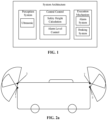
- the obstacle height-based vehicle control system has a system architecture as shown in FIG. 1 and includes an acquisition unit (i.e., a perception system in FIG. 1 ), a processing unit (i.e., a central control in FIG. 1 ) and an execution unit (i.e., an execution mechanism in FIG. 1 ).
- the acquisition unit is connected to a signal input end of the processing unit, and a signal output end of the processing unit is connected to the execution unit.
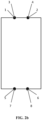
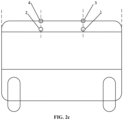
- the acquisition unit includes 8 range radars as shown in FIG. 2a , FIG. 2b , and FIG. 2c , namely a range radar 1, a range radar 2, a range radar 3, a range radar 4, a range radar 5, a range radar 6, a range radar 7, and a range radar 8.
- the distribution of the acquisition unit in a vehicle is as follows: the range radar 1 and the range radar 3 belong to a first group of detection modules, the range radar 2 and the range radar 4 belong to a second group of detection modules, the range radar 5 and the range radar 7 belong to a third group of detection modules, and the range radar 6 and the range radar 8 belong to a fourth group of detection modules.
- the range radar 1, the range radar 2, the range radar 3, and the range radar 4 are arranged at a front of the vehicle, and the range radar 3 and the range radar 4 are evenly distributed horizontally on a front roof of the vehicle.
- the range radar 1 is arranged right at a front of the vehicle vertically below the range radar 3, and the range radar 2 is arranged right at the front of the vehicle vertically below the range radar 4.
- the range radar 5, the range radar 6, the range radar 7, and the range radar 8 are arranged at a rear of the vehicle, and the range radar 7 and the range radar 8 are evenly distributed horizontally on a rear roof of the vehicle.
- the range radar 5 is arranged right at a rear of the vehicle vertically below the range radar 7, and the range radar 6 is arranged right at the rear of the vehicle vertically below the range radar 8.
- the first group of detection modules and the second group of detection modules are configured to detect an area in front of the vehicle and the detection areas of the range radars in each group of detection modules are partially overlapping.
- the third group of detection modules and the fourth group of detection modules are configured to detect an area behind the vehicle and the detection areas of the range radars in each group of detection modules are partially overlapping.
- the processing unit is a vehicle control unit, and the execution unit is an alarm module (i.e., alarm system) and a braking system.
- the spacing between the range radar 1 and the range radar 3, the range radar 2 and the range radar 4, the range radar 5 and the range radar 7, and the range radar 6 and the range radar 8 is the same, and a certain difference is also possible.
- the basis of there being an overlap between the detection areas is the distance between the range radars in each group of detection modules.
- the distance is determined by the ranging characteristics of the range radar, mainly the detection width of the range radar and the ranging detection angle.
- two groups of detection modules are distributed at the front and rear of the vehicle.
- the detection width of the used range radar is about 0.7 meter, the detection angle is at least 120°, and the installation angle between the range radar and the vehicle is 45° during installation of the range radar (the installation angle does not need to be exactly the same, as long as the detection areas are partially overlapping).
- the installation angle does not need to be exactly the same, as long as the detection areas are partially overlapping.
- 165° perception area at the front and rear of the roof is covered, and the greater the detection angle of the range radar, the greater the covered perception area.
- only one group of detection modules may be arranged at the front and rear of the vehicle, specifically, right in the middle of the front or rear of the vehicle, or three groups of detection modules may be arranged, and when only the obstacle in front of the vehicle needs to be detected, a detection module may be omitted from the rear of the vehicle.
- the range radar has the advantage of short-range detection, so it can accurately perceive the obstacle at a short range, and return a value of the detection distance during working, but cannot accurately describe the position of the obstacle, so information of two range radars is fused to obtain the height difference information between the obstacle and the vehicle.
- an ultrasonic radar is used as the range radar, and as other implementations, a range radar such as a millimeter-wave radar may be used.
- the vehicle control unit includes a data processing module and an analysis and decision module.
- the processing module is configured to analyze and calculate the received information, and the analysis and decision module is configured to determine whether to give an alarm or perform braking control.
- the alarm module further includes a vehicle buzzer and an instrument display screen.
- the alarm module gives an alarm (that is, the vehicle buzzer works)
- an alarm position is displayed on the instrument display screen to inform the driver. If the driver does not decelerate the vehicle or take other protective actions after the alarm, the braking system performs forced braking to decelerate and stop the vehicle.
- the vehicle control unit of the present invention fuses the information collected by multiple range radars, so as to accurately locate the height difference or distance information between the obstacle and the vehicle, and alarm or brake and decelerate through the execution mechanism.
- the specific control logic is as shown in FIG. 3 .
- the range radar 1 detects an obstacle, but the range radar 3 does not, it indicates that the obstacle is in the first area and affects the normal driving of the vehicle.
- the distance between the obstacle and the front end of the vehicle is calculated based on a detection distance D1, and a judgment and early warning control stage is entered.
- the range radar 3 When the range radar 3 detects an obstacle, but the range radar 1 does not, it indicates that the obstacle is in the second area and affects the normal driving of the vehicle.
- the height difference between the obstacle and the top end of the vehicle is calculated based on a detection distance D2, and a judgment and early warning control stage is entered.
- the range radar 1 and the range radar 3 both detect obstacles, there are two possibilities: 1) the obstacles are detected both in the first area and the second area respectively, and 2) an obstacle is detected in the third area.
- the position relationship between the obstacle and the vehicle is calculated to obtain a height difference H between the top of the vehicle and the obstacle. Since the height information of the obstacle does not change suddenly, if the calculated height difference basically remains unchanged in two periods before and after, it is considered to belong to the situation of 2), and the obstacle exists in the third area. If the calculated height difference changes, it is considered to belong to the situation of 1), and the obstacles are detected both in the first area and the second area respectively. Then corresponding early warning control is performed through D1 and D2 respectively.
- h is the distance between the range radar 1 and the range radar 3
- H is the height difference between the obstacle and the top end of the vehicle
- X is the distance between the obstacle and the front end of the vehicle
- D1 is an obstacle distance detected by the range radar 1
- D2 is an obstacle distance detected by the range radar 3
- ⁇ is an included angle between a straight line from the obstacle to the range radar 1 and a vehicle front plane.
- ⁇ in the triangle formed by D1, D2 and h may be an acute angle or an obtuse angle
- the basis for determining whether the obstacle affects the passage of the vehicle can be obtained by judging the value of D 1* cos ⁇ and h.
- H>0 it indicates that the obstacle is higher than the top end of the vehicle at this time, and the height difference information is used for control.
- H ⁇ 0 it indicates that the obstacle is lower than the top end of the vehicle at this time, and the distance between the obstacle and the front end of the vehicle is used for control.
- the fault may be divided into two levels, namely level I fault and level II fault.
- level II fault exists
- the vehicle control unit controls the vehicle buzzer to send out a continuous alarm sound of "beep, beep, beep" to warn the driver that there are dangerous obstacles affecting the passage of the vehicle and prompt the driver to decelerate, and displays H 0 on the instrument display screen, and at this time, H 0 is a positive value.
- H 0 ⁇ 0 the level I fault exists
- the vehicle control unit controls the vehicle buzzer to prompt the driver to decelerate, and displays H 0 on the instrument display screen, and at this time, H 0 is a negative value. If the vehicle does not decelerate within set time, the vehicle braking system is controlled for forced braking.
- the rear view mirror may extend out from the front end of some vehicles, as a result, a foremost point of the vehicle protrudes further than a front side of the vehicle (i.e., a front end of the vehicle) by X'.
- X' is compared with the obstacle distance of X for control.
- the fault is divided into two levels, namely level I fault and level II fault. Since the measuring distance of the ultrasonic radar itself is relatively short, when obstacles affecting the operation is detected in front of the vehicle and X-X' ⁇ D (D is a safety distance), the level II fault exists, the vehicle control unit controls the vehicle buzzer to prompt the driver to decelerate. When X-X' ⁇ D, the level I fault exists, the vehicle control unit controls the vehicle buzzer to prompt the driver to decelerate. If the vehicle does not decelerate within set time, the vehicle braking system is controlled for forced braking.
- the control strategies of the steps 3) or 4) may not be used, and a control strategy is implemented on the basis of the step 2), and is as follows: when H ⁇ T or X ⁇ D, the vehicle control unit controls the vehicle buzzer to prompt the driver to decelerate, and displays the value of H on the instrument display screen. If the vehicle does not decelerate within set time, the vehicle braking system is controlled for forced braking.
- the control strategy of the first group of detection modules is the control strategy of the first group of detection modules.
- the control strategies of the second group of detection modules, the third group of detection modules, and the fourth group of detection modules are the same. If an obstacle is detected by the range radar 1, the range radar 2, the range radar 3, and the range radar 4, but the height difference or distance obtained by the range radar 1 and the range radar 3 is different from the height difference or distance obtained by the range radar 2 and the range radar 4, the alarm level is judged respectively. The higher the alarm level, the higher the priority. The height difference or distance with higher priority is used for control.
- the processing unit is the vehicle control unit, and as other implementations, the processing unit may also be a separate controller, as long as the above calculation and control of the detected data can be performed.
- An embodiment of a vehicle The vehicle provided by the present embodiment includes a body and a vehicle control system based on height of obstacle. A front roof of the vehicle and a rear roof of the vehicle are arranged on the body. The structural component, installation position, and control process of the vehicle control system based on height of obstacle have been introduced in the above embodiment of the vehicle control system based on height of obstacle, and therefore will not be repeated here.
Landscapes
- Engineering & Computer Science (AREA)
- Mechanical Engineering (AREA)
- Automation & Control Theory (AREA)
- Radar, Positioning & Navigation (AREA)
- Remote Sensing (AREA)
- Transportation (AREA)
- Physics & Mathematics (AREA)
- Human Computer Interaction (AREA)
- Computer Networks & Wireless Communication (AREA)
- General Physics & Mathematics (AREA)
- Electromagnetism (AREA)
- Chemical & Material Sciences (AREA)
- Combustion & Propulsion (AREA)
- Radar Systems Or Details Thereof (AREA)
Description
- The present invention relates to a vehicle control system based on height of obstacle and a vehicle, and belongs to the technical field of vehicle safety.
- Due to the structural designs of a vehicle, blind spots are inevitable when the driver is driving. In order to solve the problem caused by the vehicle blind spots, a radar and a camera are typically installed on the vehicle to establish a 360-degree surround view system. However, for coaches or buses, a blind spot is also formed in the height direction, which may be ignored by the driver. For example, when the vehicle passes through a height restriction bar or an overpass, or meets low tree branches extending above the road, the driver empirically estimates the height information, but it is more likely to cause accidents because of the limitation of the height-based blind spot. Therefore, a laser radar is designed to be installed at the front of the vehicle. For example, the Chinese invention patent application with the publication No.
CN107632308A provides a contour detection method for a vehicle front barrier, the laser radar is installed at the front of the vehicle, and the measurement results of the laser radar are analyzed using the recursive superposition algorithm, so as to accurately obtain the contour height of the obstacle in front of the vehicle. Although this method can accurately obtain obstacle height information, the cost of utilizing the laser radar is high and the complicated data processing process may cause a delay of subsequent vehicle control. - Conventional vehicle control systems and vehicles including the same are disclosed in
DE 10 2015 100719 A1 . - An objective of the present invention is to provide a vehicle control system based on height of obstacle so as to solve the problems of high cost and complicated data processing of an existing control system due to the use of laser radar for obstacle height detection, and also provide a vehicle so as to solve the problems of high cost and complicated data processing of an existing vehicle due to the use of laser radar for obstacle height detection.
- To achieve the above objectives, the present invention provides a vehicle control system based on height of obstacle. The present invention is directed to subject matter as defined in the appended set of claims.
- Therefore, the present invention has the following beneficial effects: according to the system, the obstacle height can be detected through an upper range radar and a lower range radar which correspond to each other, the cost is greatly reduced, judgment is performed through fusion information of the two range radars, and data processing is simple, so that the vehicle can be controlled in time, and the obtained height difference or distance information between the obstacle and the vehicle is more accurate, further ensuring vehicle safety.
- Further, there may be two groups of detection modules arranged at the front of the vehicle, namely, a first group of detection modules and a second group of detection modules, and a first range radar of the first group of detection modules and a first range radar of the second group of detection modules may be evenly distributed horizontally on the front roof of the vehicle.
- Therefore, the present invention has the following beneficial effects: two groups of detection modules are arranged, so that obstacles around the vehicle can be detected comprehensively, the detection accuracy is improved, and more complicated data processing can be avoided without too many detection modules.
- Further, the acquisition unit may further include at least one group of detection modules arranged at a rear of the vehicle, each group of detection modules may include a third range radar arranged on a rear roof of the vehicle and a fourth range radar arranged right at a rear of the vehicle vertically below the third range radar, and the third range radar and the corresponding fourth range radar may both be configured to detect an area behind the vehicle and the detection areas are partially overlapping.
- Therefore, the present invention has the following beneficial effects: arranging the detection modules at the rear of the vehicle can avoid collisions with the obstacles when the vehicle is reversing, and the driving conditions of the vehicle are comprehensively considered, further ensuring vehicle safety.
- Further, the execution unit may further include a braking system, and the processing unit may further be configured to control the braking system for forced braking if the vehicle does not decelerate after the alarm module gives an alarm.
- Therefore, the present invention has the following beneficial effects: if the driver does not decelerate the vehicle after the alarm module gives an alarm, the vehicle is controlled for forced braking, further ensuring vehicle safety.
- Further, when a highest point of the vehicle is higher than a front roof of the vehicle, the processing unit may further determine a difference value between the highest point of the vehicle and the front roof of the vehicle, control the alarm module in the execution unit to give an alarm if the height difference minus the difference value is less than the safety distance, control the alarm module in the execution unit to give an alarm if the height difference minus the difference value is less than 0, and control the braking system for forced braking if the vehicle does not decelerate after the alarm.
- Therefore, the present invention has the following beneficial effects: various shapes of vehicles are taken into account comprehensively, corresponding control strategies are used for different vehicles, the application range is wide and the universality is strong.
- Further, when a foremost point of the vehicle protrudes further than a front of the vehicle, the processing unit may further determine a difference value between the foremost point of the vehicle and the front of the vehicle, control the alarm module in the execution unit to give an alarm if the distance minus the difference value is less than the safety distance, and control the braking system for forced braking if the vehicle does not decelerate after the alarm.
- Therefore, the present invention has the following beneficial effects: various shapes of vehicles are taken into account comprehensively, corresponding control strategies are used for different vehicles, the application range is wide and the versatility is strong.
- Further, the processing unit may be a vehicle control unit.
- Therefore, the present invention has the following beneficial effects: using the vehicle control unit as the processing unit of the control system can save certain space and cost for the vehicle.
- Moreover, the present invention further provides a vehicle, including a body and a vehicle control system based on height of obstacle. A front roof of the vehicle and a rear roof of the vehicle are arranged on the body.
- Therefore, the present invention has the following beneficial effects: according to the vehicle control system of the vehicle, the obstacle height can be detected through an upper range radar and a lower range radar which correspond to each other, the cost is greatly reduced, judgment is performed through fusion information of the two range radars, and data processing is simple, so that the vehicle can be controlled in time, and the obtained height difference or distance information between the obstacle and the vehicle is more accurate, further ensuring vehicle safety.
-
-
FIG. 1 is a structural diagram of a vehicle control system of the present invention; -
FIG. 2a is a side view layout of a range radar of the present invention in a vehicle; -
FIG. 2b is a top view layout of the range radar of the present invention in the vehicle; -
FIG. 2c is a front view layout of the range radar of the present invention in a front end of the vehicle; -
FIG. 3 is a control logic diagram of the vehicle control system of the present invention; -
FIG. 4a is a principle control diagram of the present invention when an obstacle is above and in front of the vehicle; and -
FIG. 4b is a principle control diagram of the present invention when the obstacle is right in front of the vehicle. - In the drawings, 1, 2, 3, 4, 5, 6, 7 and 8 are range radars.
- An embodiment of an obstacle height-based vehicle control system:
- The obstacle height-based vehicle control system provided by the present embodiment has a system architecture as shown in
FIG. 1 and includes an acquisition unit (i.e., a perception system inFIG. 1 ), a processing unit (i.e., a central control inFIG. 1 ) and an execution unit (i.e., an execution mechanism inFIG. 1 ). The acquisition unit is connected to a signal input end of the processing unit, and a signal output end of the processing unit is connected to the execution unit. - The acquisition unit includes 8 range radars as shown in
FIG. 2a ,FIG. 2b , andFIG. 2c , namely arange radar 1, arange radar 2, arange radar 3, arange radar 4, arange radar 5, arange radar 6, arange radar 7, and arange radar 8. The distribution of the acquisition unit in a vehicle is as follows: therange radar 1 and therange radar 3 belong to a first group of detection modules, therange radar 2 and therange radar 4 belong to a second group of detection modules, therange radar 5 and therange radar 7 belong to a third group of detection modules, and therange radar 6 and therange radar 8 belong to a fourth group of detection modules. Therange radar 1, therange radar 2, therange radar 3, and therange radar 4 are arranged at a front of the vehicle, and therange radar 3 and therange radar 4 are evenly distributed horizontally on a front roof of the vehicle. Therange radar 1 is arranged right at a front of the vehicle vertically below therange radar 3, and therange radar 2 is arranged right at the front of the vehicle vertically below therange radar 4. Therange radar 5, therange radar 6, therange radar 7, and therange radar 8 are arranged at a rear of the vehicle, and therange radar 7 and therange radar 8 are evenly distributed horizontally on a rear roof of the vehicle. Therange radar 5 is arranged right at a rear of the vehicle vertically below therange radar 7, and therange radar 6 is arranged right at the rear of the vehicle vertically below therange radar 8. The first group of detection modules and the second group of detection modules are configured to detect an area in front of the vehicle and the detection areas of the range radars in each group of detection modules are partially overlapping. The third group of detection modules and the fourth group of detection modules are configured to detect an area behind the vehicle and the detection areas of the range radars in each group of detection modules are partially overlapping. The processing unit is a vehicle control unit, and the execution unit is an alarm module (i.e., alarm system) and a braking system. - Generally, the spacing between the
range radar 1 and therange radar 3, therange radar 2 and therange radar 4, therange radar 5 and therange radar 7, and therange radar 6 and therange radar 8 is the same, and a certain difference is also possible. However, there shall be an overlap between the detection areas of the range radars in each group of detection modules. The basis of there being an overlap between the detection areas is the distance between the range radars in each group of detection modules. The distance is determined by the ranging characteristics of the range radar, mainly the detection width of the range radar and the ranging detection angle. In the present embodiment, two groups of detection modules are distributed at the front and rear of the vehicle. The detection width of the used range radar is about 0.7 meter, the detection angle is at least 120°, and the installation angle between the range radar and the vehicle is 45° during installation of the range radar (the installation angle does not need to be exactly the same, as long as the detection areas are partially overlapping). Through such arrangement, 165° perception area at the front and rear of the roof is covered, and the greater the detection angle of the range radar, the greater the covered perception area. As other implementations, only one group of detection modules may be arranged at the front and rear of the vehicle, specifically, right in the middle of the front or rear of the vehicle, or three groups of detection modules may be arranged, and when only the obstacle in front of the vehicle needs to be detected, a detection module may be omitted from the rear of the vehicle. - The range radar has the advantage of short-range detection, so it can accurately perceive the obstacle at a short range, and return a value of the detection distance during working, but cannot accurately describe the position of the obstacle, so information of two range radars is fused to obtain the height difference information between the obstacle and the vehicle. In the present embodiment, an ultrasonic radar is used as the range radar, and as other implementations, a range radar such as a millimeter-wave radar may be used. The vehicle control unit includes a data processing module and an analysis and decision module. The processing module is configured to analyze and calculate the received information, and the analysis and decision module is configured to determine whether to give an alarm or perform braking control. The alarm module further includes a vehicle buzzer and an instrument display screen. When the alarm module gives an alarm (that is, the vehicle buzzer works), an alarm position is displayed on the instrument display screen to inform the driver. If the driver does not decelerate the vehicle or take other protective actions after the alarm, the braking system performs forced braking to decelerate and stop the vehicle.
- The vehicle control unit of the present invention fuses the information collected by multiple range radars, so as to accurately locate the height difference or distance information between the obstacle and the vehicle, and alarm or brake and decelerate through the execution mechanism. The specific control logic is as shown in
FIG. 3 . - 1) After the vehicle is powered on, the control system performs a self-check to detect whether each range radar has reported a fault. If a fault is reported, the instrument gives a prompt to inform the driver that the system is abnormal and needs to be checked.
- 2) The range radars start to work to detect the distance of the obstacle. Since the detection principle of each group of detection modules is the same, a detection process of the first group of detection modules is taken as an example for the detailed description in the present embodiment. The detection principle is as shown in
FIG. 4a andFIG. 4b . The area which can only be perceived by therange radar 3 is a second area (i.e., anarea 2 inFIG. 4a andFIG. 4b ), the area which can only be perceived by therange radar 1 is a first area (i.e., anarea 1 inFIG. 4a andFIG. 4b ), and the area which can be perceived by both therange radar 3 and therange radar 1 is a third area (i.e., anarea 3 inFIG. 4a andFIG. 4b ). - When the
range radar 1 detects an obstacle, but therange radar 3 does not, it indicates that the obstacle is in the first area and affects the normal driving of the vehicle. The distance between the obstacle and the front end of the vehicle is calculated based on a detection distance D1, and a judgment and early warning control stage is entered. - When the
range radar 3 detects an obstacle, but therange radar 1 does not, it indicates that the obstacle is in the second area and affects the normal driving of the vehicle. The height difference between the obstacle and the top end of the vehicle is calculated based on a detection distance D2, and a judgment and early warning control stage is entered. - When the
range radar 1 and therange radar 3 both detect obstacles, there are two possibilities: 1) the obstacles are detected both in the first area and the second area respectively, and 2) an obstacle is detected in the third area. First, according to the situation of 2) the obstacle is detected in the third area, the position relationship between the obstacle and the vehicle is calculated to obtain a height difference H between the top of the vehicle and the obstacle. Since the height information of the obstacle does not change suddenly, if the calculated height difference basically remains unchanged in two periods before and after, it is considered to belong to the situation of 2), and the obstacle exists in the third area. If the calculated height difference changes, it is considered to belong to the situation of 1), and the obstacles are detected both in the first area and the second area respectively. Then corresponding early warning control is performed through D1 and D2 respectively. - When the obstacle is in the third area, the position relationship between the obstacle and the vehicle is as follows. According to the cosine law,

- h is the distance between the
range radar 1 and therange radar 3, H is the height difference between the obstacle and the top end of the vehicle, X is the distance between the obstacle and the front end of the vehicle, D1 is an obstacle distance detected by therange radar 1, D2 is an obstacle distance detected by therange radar 3, and α is an included angle between a straight line from the obstacle to therange radar 1 and a vehicle front plane. - Since α in the triangle formed by D1, D2 and h may be an acute angle or an obtuse angle, the basis for determining whether the obstacle affects the passage of the vehicle can be obtained by judging the value of D1* cos α and h. When H>0, it indicates that the obstacle is higher than the top end of the vehicle at this time, and the height difference information is used for control. When H<0, it indicates that the obstacle is lower than the top end of the vehicle at this time, and the distance between the obstacle and the front end of the vehicle is used for control.
- 3) Due to the particularity of the vehicle, batteries or air conditioning hatches may be installed on the top of many vehicles, as a result, a highest point of the vehicle is higher than the top end of the front of the vehicle (i.e., the top end of the vehicle) by H'. At this time, H' is compared with the calculated height difference of H for control. If H0=H-H'>T, it indicates that the vehicle can pass safely. T is a safety distance, and may be about 0.1 meters. If H0≤0, it indicates that the vehicle cannot pass.
- According to H0, the fault may be divided into two levels, namely level I fault and level II fault. When 0<H0≤T, the level II fault exists, the vehicle control unit controls the vehicle buzzer to send out a continuous alarm sound of "beep, beep, beep" to warn the driver that there are dangerous obstacles affecting the passage of the vehicle and prompt the driver to decelerate, and displays H0 on the instrument display screen, and at this time, H0 is a positive value. When H0≤0, the level I fault exists, the vehicle control unit controls the vehicle buzzer to prompt the driver to decelerate, and displays H0 on the instrument display screen, and at this time, H0 is a negative value. If the vehicle does not decelerate within set time, the vehicle braking system is controlled for forced braking.
- 4) The rear view mirror may extend out from the front end of some vehicles, as a result, a foremost point of the vehicle protrudes further than a front side of the vehicle (i.e., a front end of the vehicle) by X'. At this time, X' is compared with the obstacle distance of X for control. Likewise, the fault is divided into two levels, namely level I fault and level II fault. Since the measuring distance of the ultrasonic radar itself is relatively short, when obstacles affecting the operation is detected in front of the vehicle and X-X'≥D (D is a safety distance), the level II fault exists, the vehicle control unit controls the vehicle buzzer to prompt the driver to decelerate. When X-X'<D, the level I fault exists, the vehicle control unit controls the vehicle buzzer to prompt the driver to decelerate. If the vehicle does not decelerate within set time, the vehicle braking system is controlled for forced braking.
- When the highest point of the vehicle is the top end of the vehicle, and the foremost point of the vehicle is the front end of the vehicle, the control strategies of the steps 3) or 4) may not be used, and a control strategy is implemented on the basis of the step 2), and is as follows: when H<T or X<D, the vehicle control unit controls the vehicle buzzer to prompt the driver to decelerate, and displays the value of H on the instrument display screen. If the vehicle does not decelerate within set time, the vehicle braking system is controlled for forced braking.
- The above is the control strategy of the first group of detection modules. Similarly, the control strategies of the second group of detection modules, the third group of detection modules, and the fourth group of detection modules are the same. If an obstacle is detected by the
range radar 1, therange radar 2, therange radar 3, and therange radar 4, but the height difference or distance obtained by therange radar 1 and therange radar 3 is different from the height difference or distance obtained by therange radar 2 and therange radar 4, the alarm level is judged respectively. The higher the alarm level, the higher the priority. The height difference or distance with higher priority is used for control. - In the present embodiment, in order to further ensure the safety of vehicle driving, the execution unit is the alarm module and the braking system, and the braking system may be omitted if it is ensured that the vehicle decelerates after the alarm.
- In the present embodiment, in order to save vehicle space, the processing unit is the vehicle control unit, and as other implementations, the processing unit may also be a separate controller, as long as the above calculation and control of the detected data can be performed.
- An embodiment of a vehicle:
The vehicle provided by the present embodiment includes a body and a vehicle control system based on height of obstacle. A front roof of the vehicle and a rear roof of the vehicle are arranged on the body. The structural component, installation position, and control process of the vehicle control system based on height of obstacle have been introduced in the above embodiment of the vehicle control system based on height of obstacle, and therefore will not be repeated here.
Claims (8)
- A vehicle control system based on height of obstacle, characterized in that the vehicle control system comprising an acquisition unit, a processing unit and an execution unit, the execution unit comprises an alarm module; the acquisition unit comprises at least one group of detection modules arranged at a front of a vehicle; each group of detection modules comprises a first range radar (3, 4) arranged on a front roof of the vehicle and a second range radar (1, 2) arranged right at a front of the vehicle vertically below the first range radar (3, 4); the first range radar (3, 4) and the corresponding second range radar (1, 2) are both configured to detect an area in front of the vehicle and the detection areas are partially overlapping; the processing unit judges a height and distance between the vehicle and an obstacle according to obstacle information detected by the range radars;if the obstacle is detected by only one range radar in one group of detection modules, the height difference between the obstacle and the top end of the vehicle or the distance between the obstacle and the front end of the vehicle are calculated based on an obstacle distance detected by the range radar; and when the height difference between the vehicle and the obstacle or the distance between the obstacle and the front end of the vehicle is less than a safety distance, the alarm module in the execution unit is controlled to give an alarm;characterized in that if the obstacle information is detected by both the first range radar (3, 4) and the second range radar (1, 2) belonging to the same group of detection modules, a position relationship between the obstacle and the vehicle is calculated according to the obstacle detected in an overlapping detection area; an included angle (α) between a straight line from the obstacle to the second range radar (1, 2) and a vehicle front plane is calculated by using the law of cosine according to a height difference of an installation distance (h) between the first range radar (3, 4) and the second range radar (1, 2) in the group and an obstacle distance detected by the two range radars; then a height difference (H) between the obstacle and a top end of the vehicle is determined; if the height difference (H) does not change suddenly in two periods before and after, the obstacle is located in the overlapping detection area; when the height difference (H) >0, the obstacle is higher than the top end of the vehicle, when the height difference (H) <0, the obstacle is lower than the top end of the vehicle.
- The vehicle control system based on height of obstacle according to claim 1, characterized in that two groups of detection modules are arranged at the front of the vehicle, comprising a first group of detection modules and a second group of detection modules, and a first range radar (3, 4) of the first group of detection modules and a first range radar (3, 4) of the second group of detection modules are evenly distributed horizontally on the front roof of the vehicle.
- The vehicle control system based on height of obstacle according to claim 1, characterized in that the acquisition unit further comprises at least one group of detection modules arranged at a rear of the vehicle, each group of detection modules comprises a third range radar (7, 8) arranged on a rear roof of the vehicle and a fourth range radar (5, 6) arranged right at a rear of the vehicle vertically below the third range radar (7, 8), and the third range radar (7, 8) and the corresponding fourth range radar (5, 6) are both configured to detect an area behind the vehicle and the detection areas are partially overlapping.
- The vehicle control system based on height of obstacle according to claim 1, characterized in that the execution unit further comprises a braking system, and the processing unit is further configured to control the braking system for forced braking if the vehicle does not decelerate after the alarm module gives an alarm.
- The vehicle control system based on height of obstacle according to claim 4, characterized in that when a highest point of the vehicle is higher than a front roof of the vehicle, the processing unit further determines a difference value between the highest point of the vehicle and the front roof of the vehicle, the processing unit controls the alarm module in the execution unit to give an alarm if the height difference minus the difference value is less than the safety distance, the processing unit controls the alarm module in the execution unit to give an alarm if the height difference minus the difference value is less than 0, and the processing unit controls the braking system for forced braking if the vehicle does not decelerate after the alarm.
- The vehicle control system based on height of obstacle according to claim 4, characterized in that when a foremost point of the vehicle protrudes further than a front of the vehicle, the processing unit further determines a difference value between the foremost point of the vehicle and the front of the vehicle, the processing unit controls the alarm module in the execution unit to give an alarm if the distance minus the difference value is less than the safety distance, and the processing unit controls the braking system for forced braking if the vehicle does not decelerate after the alarm.
- The vehicle control system based on height of obstacle according to claim 1, characterized in that the processing unit is a vehicle control unit.
- A vehicle, comprising a body and a vehicle control system according to any one of the preceding claims, the front roof of the vehicle and a rear roof of the vehicle are arranged on the body.
Applications Claiming Priority (2)
| Application Number | Priority Date | Filing Date | Title |
|---|---|---|---|
| CN201910348817.0A CN111845730B (en) | 2019-04-28 | 2019-04-28 | Vehicle control system and vehicle based on barrier height |
| PCT/CN2020/086686 WO2020221123A1 (en) | 2019-04-28 | 2020-04-24 | Vehicle control system based on height of obstacle, and vehicle |
Publications (4)
| Publication Number | Publication Date |
|---|---|
| EP3960561A1 EP3960561A1 (en) | 2022-03-02 |
| EP3960561A4 EP3960561A4 (en) | 2022-06-22 |
| EP3960561C0 EP3960561C0 (en) | 2024-12-25 |
| EP3960561B1 true EP3960561B1 (en) | 2024-12-25 |
Family
ID=72964893
Family Applications (1)
| Application Number | Title | Priority Date | Filing Date |
|---|---|---|---|
| EP20799488.0A Active EP3960561B1 (en) | 2019-04-28 | 2020-04-24 | Vehicle control system based on height of obstacle, and vehicle |
Country Status (3)
| Country | Link |
|---|---|
| EP (1) | EP3960561B1 (en) |
| CN (1) | CN111845730B (en) |
| WO (1) | WO2020221123A1 (en) |
Families Citing this family (18)
| Publication number | Priority date | Publication date | Assignee | Title |
|---|---|---|---|---|
| CN112630791A (en) * | 2020-12-22 | 2021-04-09 | 北京北电科林电子有限公司 | Height limit measuring method for special vehicle |
| CN113219444B (en) * | 2021-04-25 | 2024-08-02 | 同致电子科技(昆山)有限公司 | Obstacle height identification system and method |
| CN113085854A (en) * | 2021-05-10 | 2021-07-09 | 东风汽车集团股份有限公司 | System and method for identifying obstacle above vehicle through radar camera |
| CN113370979B (en) * | 2021-07-09 | 2022-10-18 | 北京福田戴姆勒汽车有限公司 | Driving safety early warning method and system, vehicle, electronic equipment and storage medium |
| CN113401054A (en) * | 2021-07-22 | 2021-09-17 | 上汽通用五菱汽车股份有限公司 | Anti-collision method for vehicle, vehicle and readable storage medium |
| CN115703437B (en) * | 2021-08-11 | 2025-11-28 | 上海擎感智能科技有限公司 | Vehicle anti-collision method, system, electronic device, storage medium and vehicle |
| CN114325687B (en) * | 2021-12-22 | 2025-10-28 | 杭州海康汽车软件有限公司 | Radar data and visual information fusion processing method, device, system and equipment |
| CN114379801A (en) * | 2022-01-19 | 2022-04-22 | 上海今一科技发展有限公司 | Flying automobile driving control system |
| CN114407901B (en) * | 2022-02-18 | 2023-12-19 | 北京小马易行科技有限公司 | Control methods, devices and automatic driving systems for autonomous vehicles |
| CN114407779A (en) * | 2022-02-28 | 2022-04-29 | 海丰县极电声学科技有限公司 | Automobile radar obstacle direction reminding system |
| CN114771408A (en) * | 2022-03-28 | 2022-07-22 | 海尔(深圳)研发有限责任公司 | Top-mounted air conditioner for vehicle and control method thereof |
| CN115366600A (en) * | 2022-08-24 | 2022-11-22 | 一汽解放汽车有限公司 | Vehicle control method, device, computer equipment and computer program product |
| CN115782865A (en) * | 2022-11-02 | 2023-03-14 | 东风汽车集团股份有限公司 | High-altitude obstacle monitoring method and device and vehicle |
| CN115771511A (en) * | 2022-12-23 | 2023-03-10 | 富赛汽车电子有限公司 | Method and device for determining safe vehicle distance, electronic equipment and storage medium |
| CN115848269A (en) * | 2023-01-03 | 2023-03-28 | 重庆长安汽车股份有限公司 | Vehicle chassis scratch early warning method and device, electronic equipment and storage medium |
| CN116184411A (en) * | 2023-03-02 | 2023-05-30 | 中国铁道科学研究院集团有限公司 | A train-platform distance measurement system |
| CN116883478B (en) * | 2023-07-28 | 2024-01-23 | 广州瀚臣电子科技有限公司 | Obstacle distance confirmation system and method based on automobile camera |
| CN119459225B (en) * | 2024-11-01 | 2026-02-10 | 浙江吉利控股集团有限公司 | Vehicle and control method for vehicle |
Family Cites Families (18)
| Publication number | Priority date | Publication date | Assignee | Title |
|---|---|---|---|---|
| JPH03276313A (en) * | 1990-03-27 | 1991-12-06 | Mazda Motor Corp | Environment recognizing device for mobile vehicle |
| US5714928A (en) * | 1992-12-18 | 1998-02-03 | Kabushiki Kaisha Komatsu Seisakusho | System for preventing collision for vehicle |
| US8935086B2 (en) * | 2007-02-06 | 2015-01-13 | GM Global Technology Operations LLC | Collision avoidance system and method of detecting overpass locations using data fusion |
| US20090259399A1 (en) * | 2008-04-15 | 2009-10-15 | Caterpillar Inc. | Obstacle detection method and system |
| DE102013002650A1 (en) * | 2013-02-15 | 2014-08-21 | Volkswagen Aktiengesellschaft | Determining a distance information for a vehicle |
| DE102013104443B4 (en) * | 2013-04-30 | 2022-03-17 | Jenoptik Robot Gmbh | Traffic monitoring system for measuring the speed and allocation of moving vehicles in a multi-target recording module |
| DE102013209873B4 (en) * | 2013-05-28 | 2019-07-11 | Robert Bosch Gmbh | Apparatus and method for collision avoidance for vehicle loads and superstructures |
| JP6011489B2 (en) * | 2013-08-26 | 2016-10-19 | トヨタ自動車株式会社 | In-vehicle control device |
| DE102015100719A1 (en) * | 2015-01-20 | 2016-07-21 | Valeo Schalter Und Sensoren Gmbh | Method for operating a driver assistance system of a motor vehicle, driver assistance system and motor vehicle |
| CN205750535U (en) * | 2016-05-12 | 2016-11-30 | 深圳市朗驰欣创科技股份有限公司 | A kind of pavement detection system and automatic navigation vehicle |
| CN106004659B (en) * | 2016-08-03 | 2017-08-04 | 安徽工程大学 | Vehicle Surrounding Environment Perception System and Control Method |
| DE102017214020B4 (en) * | 2017-08-11 | 2023-12-21 | Audi Ag | Motor vehicle with several radar sensors for detecting the surroundings |
| CN107632308B (en) | 2017-08-24 | 2021-02-05 | 吉林大学 | Method for detecting contour of obstacle in front of vehicle based on recursive superposition algorithm |
| CN207189671U (en) * | 2017-08-25 | 2018-04-06 | 科沃斯机器人股份有限公司 | Self-movement robot |
| CN209514406U (en) * | 2017-08-30 | 2019-10-18 | 苏州宝时得电动工具有限公司 | from mobile device |
| CN107776558A (en) * | 2017-10-10 | 2018-03-09 | 西京学院 | A kind of automobile is anti-to cut ejection device and its application method |
| CN107845291A (en) * | 2017-10-26 | 2018-03-27 | 中国外运大件物流有限公司 | The anti-collision early warning system of vehicle and the vehicle for including it |
| CN109677377A (en) * | 2018-12-27 | 2019-04-26 | 张庭宇 | A kind of road vehicle limit for height finds out system and the anti-collision protection device that actively brakes |
-
2019
- 2019-04-28 CN CN201910348817.0A patent/CN111845730B/en active Active
-
2020
- 2020-04-24 WO PCT/CN2020/086686 patent/WO2020221123A1/en not_active Ceased
- 2020-04-24 EP EP20799488.0A patent/EP3960561B1/en active Active
Also Published As
| Publication number | Publication date |
|---|---|
| EP3960561A4 (en) | 2022-06-22 |
| EP3960561A1 (en) | 2022-03-02 |
| CN111845730A (en) | 2020-10-30 |
| EP3960561C0 (en) | 2024-12-25 |
| CN111845730B (en) | 2022-02-18 |
| WO2020221123A1 (en) | 2020-11-05 |
Similar Documents
| Publication | Publication Date | Title |
|---|---|---|
| EP3960561B1 (en) | Vehicle control system based on height of obstacle, and vehicle | |
| CN105291978B (en) | Vehicle lane change auxiliary warning system and control method thereof | |
| US8831867B2 (en) | Device and method for driver assistance | |
| EP2151809B1 (en) | Object detecting device, and object detecting method | |
| US7061373B2 (en) | Vehicle obstacle detecting device | |
| EP1304264B1 (en) | A 360 degree vision system for a vehicle | |
| US8791802B2 (en) | Driver assistance system for reducing blind-spot-detection false alerts | |
| KR101690352B1 (en) | Collision monitor for a motor vehicle | |
| CN110606082A (en) | Braking system, method and device based on automatic driving and vehicle | |
| US20130085976A1 (en) | System for predicting a driver's intention to change lanes | |
| CN108657066A (en) | Early warning system of jumping a queue and method for early warning of jumping a queue | |
| US20230322215A1 (en) | System and method of predicting and displaying a side blind zone entry alert | |
| CN113665578A (en) | Pavement pit avoiding system based on vision system and millimeter wave radar | |
| CN111469835A (en) | Vehicle auxiliary driving system and method based on topological map | |
| CN110889409B (en) | Method, device, equipment and storage medium for monitoring and optimizing automobile radar | |
| CN102632836A (en) | Blind area warning for vehicles | |
| KR20180126238A (en) | Method of predicting and warning car crush on road | |
| CN205292418U (en) | Vehicle lane change assists early warning system | |
| CN115991204A (en) | Anti-collision automobile active safety early warning system based on radar technology | |
| CN115167367A (en) | Reversing collision avoidance system based on active safety and V2X technology | |
| CN111722230B (en) | A method and system for monitoring blind spots in a full-speed area | |
| CN111762102A (en) | Object space height determination system for preventing upper part collision of vehicle | |
| CN119037446A (en) | Blind area detection method and system for heavy truck | |
| KR20150018988A (en) | Apparatus for monitoring state of road and system for providing safe driving service with the said apparatus | |
| KR101127702B1 (en) | Integrated Side/Rear Safety System for Automobile |
Legal Events
| Date | Code | Title | Description |
|---|---|---|---|
| STAA | Information on the status of an ep patent application or granted ep patent |
Free format text: STATUS: THE INTERNATIONAL PUBLICATION HAS BEEN MADE |
|
| PUAI | Public reference made under article 153(3) epc to a published international application that has entered the european phase |
Free format text: ORIGINAL CODE: 0009012 |
|
| STAA | Information on the status of an ep patent application or granted ep patent |
Free format text: STATUS: REQUEST FOR EXAMINATION WAS MADE |
|
| 17P | Request for examination filed |
Effective date: 20211125 |
|
| AK | Designated contracting states |
Kind code of ref document: A1 Designated state(s): AL AT BE BG CH CY CZ DE DK EE ES FI FR GB GR HR HU IE IS IT LI LT LU LV MC MK MT NL NO PL PT RO RS SE SI SK SM TR |
|
| A4 | Supplementary search report drawn up and despatched |
Effective date: 20220524 |
|
| RIC1 | Information provided on ipc code assigned before grant |
Ipc: G01S 13/87 20060101ALI20220518BHEP Ipc: B60W 30/095 20120101ALI20220518BHEP Ipc: B60W 10/18 20120101ALI20220518BHEP Ipc: B60W 50/14 20200101ALI20220518BHEP Ipc: G05D 1/02 20200101ALI20220518BHEP Ipc: B60W 30/09 20120101AFI20220518BHEP |
|
| DAV | Request for validation of the european patent (deleted) | ||
| DAX | Request for extension of the european patent (deleted) | ||
| RIC1 | Information provided on ipc code assigned before grant |
Ipc: G01S 13/87 20060101ALI20240712BHEP Ipc: B60W 30/095 20120101ALI20240712BHEP Ipc: B60W 10/18 20120101ALI20240712BHEP Ipc: B60W 50/14 20200101ALI20240712BHEP Ipc: B60W 30/09 20120101AFI20240712BHEP |
|
| GRAP | Despatch of communication of intention to grant a patent |
Free format text: ORIGINAL CODE: EPIDOSNIGR1 |
|
| STAA | Information on the status of an ep patent application or granted ep patent |
Free format text: STATUS: GRANT OF PATENT IS INTENDED |
|
| INTG | Intention to grant announced |
Effective date: 20240904 |
|
| RAP3 | Party data changed (applicant data changed or rights of an application transferred) |
Owner name: YUTONG BUS CO., LTD. |
|
| GRAS | Grant fee paid |
Free format text: ORIGINAL CODE: EPIDOSNIGR3 |
|
| RAP3 | Party data changed (applicant data changed or rights of an application transferred) |
Owner name: YUTONG BUS CO., LTD. |
|
| GRAA | (expected) grant |
Free format text: ORIGINAL CODE: 0009210 |
|
| STAA | Information on the status of an ep patent application or granted ep patent |
Free format text: STATUS: THE PATENT HAS BEEN GRANTED |
|
| AK | Designated contracting states |
Kind code of ref document: B1 Designated state(s): AL AT BE BG CH CY CZ DE DK EE ES FI FR GB GR HR HU IE IS IT LI LT LU LV MC MK MT NL NO PL PT RO RS SE SI SK SM TR |
|
| REG | Reference to a national code |
Ref country code: GB Ref legal event code: FG4D |
|
| REG | Reference to a national code |
Ref country code: CH Ref legal event code: EP |
|
| REG | Reference to a national code |
Ref country code: DE Ref legal event code: R096 Ref document number: 602020043748 Country of ref document: DE |
|
| REG | Reference to a national code |
Ref country code: IE Ref legal event code: FG4D |
|
| U01 | Request for unitary effect filed |
Effective date: 20250102 |
|
| U07 | Unitary effect registered |
Designated state(s): AT BE BG DE DK EE FI FR IT LT LU LV MT NL PT RO SE SI Effective date: 20250114 |
|
| PG25 | Lapsed in a contracting state [announced via postgrant information from national office to epo] |
Ref country code: HR Free format text: LAPSE BECAUSE OF FAILURE TO SUBMIT A TRANSLATION OF THE DESCRIPTION OR TO PAY THE FEE WITHIN THE PRESCRIBED TIME-LIMIT Effective date: 20241225 |
|
| PG25 | Lapsed in a contracting state [announced via postgrant information from national office to epo] |
Ref country code: NO Free format text: LAPSE BECAUSE OF FAILURE TO SUBMIT A TRANSLATION OF THE DESCRIPTION OR TO PAY THE FEE WITHIN THE PRESCRIBED TIME-LIMIT Effective date: 20250325 |
|
| PG25 | Lapsed in a contracting state [announced via postgrant information from national office to epo] |
Ref country code: GR Free format text: LAPSE BECAUSE OF FAILURE TO SUBMIT A TRANSLATION OF THE DESCRIPTION OR TO PAY THE FEE WITHIN THE PRESCRIBED TIME-LIMIT Effective date: 20250326 |
|
| PG25 | Lapsed in a contracting state [announced via postgrant information from national office to epo] |
Ref country code: RS Free format text: LAPSE BECAUSE OF FAILURE TO SUBMIT A TRANSLATION OF THE DESCRIPTION OR TO PAY THE FEE WITHIN THE PRESCRIBED TIME-LIMIT Effective date: 20250325 |
|
| U20 | Renewal fee for the european patent with unitary effect paid |
Year of fee payment: 6 Effective date: 20250429 |
|
| PG25 | Lapsed in a contracting state [announced via postgrant information from national office to epo] |
Ref country code: SM Free format text: LAPSE BECAUSE OF FAILURE TO SUBMIT A TRANSLATION OF THE DESCRIPTION OR TO PAY THE FEE WITHIN THE PRESCRIBED TIME-LIMIT Effective date: 20241225 |
|
| PG25 | Lapsed in a contracting state [announced via postgrant information from national office to epo] |
Ref country code: PL Free format text: LAPSE BECAUSE OF FAILURE TO SUBMIT A TRANSLATION OF THE DESCRIPTION OR TO PAY THE FEE WITHIN THE PRESCRIBED TIME-LIMIT Effective date: 20241225 |
|
| PG25 | Lapsed in a contracting state [announced via postgrant information from national office to epo] |
Ref country code: ES Free format text: LAPSE BECAUSE OF FAILURE TO SUBMIT A TRANSLATION OF THE DESCRIPTION OR TO PAY THE FEE WITHIN THE PRESCRIBED TIME-LIMIT Effective date: 20241225 |
|
| PG25 | Lapsed in a contracting state [announced via postgrant information from national office to epo] |
Ref country code: IS Free format text: LAPSE BECAUSE OF FAILURE TO SUBMIT A TRANSLATION OF THE DESCRIPTION OR TO PAY THE FEE WITHIN THE PRESCRIBED TIME-LIMIT Effective date: 20250425 |
|
| PG25 | Lapsed in a contracting state [announced via postgrant information from national office to epo] |
Ref country code: SK Free format text: LAPSE BECAUSE OF FAILURE TO SUBMIT A TRANSLATION OF THE DESCRIPTION OR TO PAY THE FEE WITHIN THE PRESCRIBED TIME-LIMIT Effective date: 20241225 |
|
| PG25 | Lapsed in a contracting state [announced via postgrant information from national office to epo] |
Ref country code: CZ Free format text: LAPSE BECAUSE OF FAILURE TO SUBMIT A TRANSLATION OF THE DESCRIPTION OR TO PAY THE FEE WITHIN THE PRESCRIBED TIME-LIMIT Effective date: 20241225 |
|
| PLBE | No opposition filed within time limit |
Free format text: ORIGINAL CODE: 0009261 |
|
| STAA | Information on the status of an ep patent application or granted ep patent |
Free format text: STATUS: NO OPPOSITION FILED WITHIN TIME LIMIT |
|
| REG | Reference to a national code |
Ref country code: CH Ref legal event code: L10 Free format text: ST27 STATUS EVENT CODE: U-0-0-L10-L00 (AS PROVIDED BY THE NATIONAL OFFICE) Effective date: 20251105 |
|
| REG | Reference to a national code |
Ref country code: CH Ref legal event code: H13 Free format text: ST27 STATUS EVENT CODE: U-0-0-H10-H13 (AS PROVIDED BY THE NATIONAL OFFICE) Effective date: 20251125 |
|
| 26N | No opposition filed |
Effective date: 20250926 |
|
| PG25 | Lapsed in a contracting state [announced via postgrant information from national office to epo] |
Ref country code: MC Free format text: LAPSE BECAUSE OF FAILURE TO SUBMIT A TRANSLATION OF THE DESCRIPTION OR TO PAY THE FEE WITHIN THE PRESCRIBED TIME-LIMIT Effective date: 20241225 |
|
| PG25 | Lapsed in a contracting state [announced via postgrant information from national office to epo] |
Ref country code: CH Free format text: LAPSE BECAUSE OF NON-PAYMENT OF DUE FEES Effective date: 20250430 |
|
| PGFP | Annual fee paid to national office [announced via postgrant information from national office to epo] |
Ref country code: GB Payment date: 20260304 Year of fee payment: 7 |
|
| PG25 | Lapsed in a contracting state [announced via postgrant information from national office to epo] |
Ref country code: IE Free format text: LAPSE BECAUSE OF NON-PAYMENT OF DUE FEES Effective date: 20250424 |