EP3958649B1 - Elektrische heizvorrichtung und verfahren zu deren herstellung - Google Patents
Elektrische heizvorrichtung und verfahren zu deren herstellung Download PDFInfo
- Publication number
- EP3958649B1 EP3958649B1 EP21190356.2A EP21190356A EP3958649B1 EP 3958649 B1 EP3958649 B1 EP 3958649B1 EP 21190356 A EP21190356 A EP 21190356A EP 3958649 B1 EP3958649 B1 EP 3958649B1
- Authority
- EP
- European Patent Office
- Prior art keywords
- housing
- heating device
- heating
- partition wall
- solder
- Prior art date
- Legal status (The legal status is an assumption and is not a legal conclusion. Google has not performed a legal analysis and makes no representation as to the accuracy of the status listed.)
- Active
Links
Images


Classifications
-
- B—PERFORMING OPERATIONS; TRANSPORTING
- B60—VEHICLES IN GENERAL
- B60H—ARRANGEMENTS OF HEATING, COOLING, VENTILATING OR OTHER AIR-TREATING DEVICES SPECIALLY ADAPTED FOR PASSENGER OR GOODS SPACES OF VEHICLES
- B60H1/00—Heating, cooling or ventilating devices
- B60H1/22—Heating, cooling or ventilating devices the heat source being other than the propulsion plant
- B60H1/2215—Heating, cooling or ventilating devices the heat source being other than the propulsion plant the heat being derived from electric heaters
-
- B—PERFORMING OPERATIONS; TRANSPORTING
- B60—VEHICLES IN GENERAL
- B60H—ARRANGEMENTS OF HEATING, COOLING, VENTILATING OR OTHER AIR-TREATING DEVICES SPECIALLY ADAPTED FOR PASSENGER OR GOODS SPACES OF VEHICLES
- B60H1/00—Heating, cooling or ventilating devices
- B60H1/22—Heating, cooling or ventilating devices the heat source being other than the propulsion plant
- B60H1/2215—Heating, cooling or ventilating devices the heat source being other than the propulsion plant the heat being derived from electric heaters
- B60H1/2221—Heating, cooling or ventilating devices the heat source being other than the propulsion plant the heat being derived from electric heaters arrangements of electric heaters for heating an intermediate liquid
-
- F—MECHANICAL ENGINEERING; LIGHTING; HEATING; WEAPONS; BLASTING
- F24—HEATING; RANGES; VENTILATING
- F24H—FLUID HEATERS, e.g. WATER OR AIR HEATERS, HAVING HEAT-GENERATING MEANS, e.g. HEAT PUMPS, IN GENERAL
- F24H1/00—Water heaters, e.g. boilers, continuous-flow heaters or water-storage heaters
- F24H1/0072—Special adaptations
- F24H1/009—Special adaptations for vehicle systems
-
- F—MECHANICAL ENGINEERING; LIGHTING; HEATING; WEAPONS; BLASTING
- F24—HEATING; RANGES; VENTILATING
- F24H—FLUID HEATERS, e.g. WATER OR AIR HEATERS, HAVING HEAT-GENERATING MEANS, e.g. HEAT PUMPS, IN GENERAL
- F24H1/00—Water heaters, e.g. boilers, continuous-flow heaters or water-storage heaters
- F24H1/10—Continuous-flow heaters, i.e. heaters in which heat is generated only while the water is flowing, e.g. with direct contact of the water with the heating medium
- F24H1/101—Continuous-flow heaters, i.e. heaters in which heat is generated only while the water is flowing, e.g. with direct contact of the water with the heating medium using electric energy supply
- F24H1/102—Continuous-flow heaters, i.e. heaters in which heat is generated only while the water is flowing, e.g. with direct contact of the water with the heating medium using electric energy supply with resistance
-
- F—MECHANICAL ENGINEERING; LIGHTING; HEATING; WEAPONS; BLASTING
- F24—HEATING; RANGES; VENTILATING
- F24H—FLUID HEATERS, e.g. WATER OR AIR HEATERS, HAVING HEAT-GENERATING MEANS, e.g. HEAT PUMPS, IN GENERAL
- F24H1/00—Water heaters, e.g. boilers, continuous-flow heaters or water-storage heaters
- F24H1/10—Continuous-flow heaters, i.e. heaters in which heat is generated only while the water is flowing, e.g. with direct contact of the water with the heating medium
- F24H1/12—Continuous-flow heaters, i.e. heaters in which heat is generated only while the water is flowing, e.g. with direct contact of the water with the heating medium in which the water is kept separate from the heating medium
- F24H1/121—Continuous-flow heaters, i.e. heaters in which heat is generated only while the water is flowing, e.g. with direct contact of the water with the heating medium in which the water is kept separate from the heating medium using electric energy supply
-
- F—MECHANICAL ENGINEERING; LIGHTING; HEATING; WEAPONS; BLASTING
- F24—HEATING; RANGES; VENTILATING
- F24H—FLUID HEATERS, e.g. WATER OR AIR HEATERS, HAVING HEAT-GENERATING MEANS, e.g. HEAT PUMPS, IN GENERAL
- F24H3/00—Air heaters
- F24H3/02—Air heaters with forced circulation
- F24H3/04—Air heaters with forced circulation the air being in direct contact with the heating medium, e.g. electric heating element
- F24H3/0405—Air heaters with forced circulation the air being in direct contact with the heating medium, e.g. electric heating element using electric energy supply, e.g. the heating medium being a resistive element; Heating by direct contact, i.e. with resistive elements, electrodes and fins being bonded together without additional element in-between
- F24H3/0429—For vehicles
-
- F—MECHANICAL ENGINEERING; LIGHTING; HEATING; WEAPONS; BLASTING
- F24—HEATING; RANGES; VENTILATING
- F24H—FLUID HEATERS, e.g. WATER OR AIR HEATERS, HAVING HEAT-GENERATING MEANS, e.g. HEAT PUMPS, IN GENERAL
- F24H9/00—Details
- F24H9/20—Arrangement or mounting of control or safety devices
- F24H9/2007—Arrangement or mounting of control or safety devices for water heaters
- F24H9/2014—Arrangement or mounting of control or safety devices for water heaters using electrical energy supply
-
- F—MECHANICAL ENGINEERING; LIGHTING; HEATING; WEAPONS; BLASTING
- F24—HEATING; RANGES; VENTILATING
- F24H—FLUID HEATERS, e.g. WATER OR AIR HEATERS, HAVING HEAT-GENERATING MEANS, e.g. HEAT PUMPS, IN GENERAL
- F24H9/00—Details
- F24H9/20—Arrangement or mounting of control or safety devices
- F24H9/2064—Arrangement or mounting of control or safety devices for air heaters
- F24H9/2071—Arrangement or mounting of control or safety devices for air heaters using electrical energy supply
-
- H—ELECTRICITY
- H05—ELECTRIC TECHNIQUES NOT OTHERWISE PROVIDED FOR
- H05B—ELECTRIC HEATING; ELECTRIC LIGHT SOURCES NOT OTHERWISE PROVIDED FOR; CIRCUIT ARRANGEMENTS FOR ELECTRIC LIGHT SOURCES, IN GENERAL
- H05B1/00—Details of electric heating devices
- H05B1/02—Automatic switching arrangements specially adapted to apparatus ; Control of heating devices
- H05B1/0227—Applications
- H05B1/023—Industrial applications
- H05B1/0236—Industrial applications for vehicles
-
- H—ELECTRICITY
- H05—ELECTRIC TECHNIQUES NOT OTHERWISE PROVIDED FOR
- H05B—ELECTRIC HEATING; ELECTRIC LIGHT SOURCES NOT OTHERWISE PROVIDED FOR; CIRCUIT ARRANGEMENTS FOR ELECTRIC LIGHT SOURCES, IN GENERAL
- H05B1/00—Details of electric heating devices
- H05B1/02—Automatic switching arrangements specially adapted to apparatus ; Control of heating devices
- H05B1/0227—Applications
- H05B1/023—Industrial applications
- H05B1/0244—Heating of fluids
-
- H—ELECTRICITY
- H05—ELECTRIC TECHNIQUES NOT OTHERWISE PROVIDED FOR
- H05B—ELECTRIC HEATING; ELECTRIC LIGHT SOURCES NOT OTHERWISE PROVIDED FOR; CIRCUIT ARRANGEMENTS FOR ELECTRIC LIGHT SOURCES, IN GENERAL
- H05B3/00—Ohmic-resistance heating
- H05B3/02—Details
-
- H—ELECTRICITY
- H05—ELECTRIC TECHNIQUES NOT OTHERWISE PROVIDED FOR
- H05B—ELECTRIC HEATING; ELECTRIC LIGHT SOURCES NOT OTHERWISE PROVIDED FOR; CIRCUIT ARRANGEMENTS FOR ELECTRIC LIGHT SOURCES, IN GENERAL
- H05B3/00—Ohmic-resistance heating
- H05B3/02—Details
- H05B3/03—Electrodes
-
- H—ELECTRICITY
- H05—ELECTRIC TECHNIQUES NOT OTHERWISE PROVIDED FOR
- H05B—ELECTRIC HEATING; ELECTRIC LIGHT SOURCES NOT OTHERWISE PROVIDED FOR; CIRCUIT ARRANGEMENTS FOR ELECTRIC LIGHT SOURCES, IN GENERAL
- H05B3/00—Ohmic-resistance heating
- H05B3/02—Details
- H05B3/04—Waterproof or air-tight seals for heaters
-
- H—ELECTRICITY
- H05—ELECTRIC TECHNIQUES NOT OTHERWISE PROVIDED FOR
- H05B—ELECTRIC HEATING; ELECTRIC LIGHT SOURCES NOT OTHERWISE PROVIDED FOR; CIRCUIT ARRANGEMENTS FOR ELECTRIC LIGHT SOURCES, IN GENERAL
- H05B3/00—Ohmic-resistance heating
- H05B3/02—Details
- H05B3/06—Heater elements structurally combined with coupling elements or holders
-
- H—ELECTRICITY
- H05—ELECTRIC TECHNIQUES NOT OTHERWISE PROVIDED FOR
- H05B—ELECTRIC HEATING; ELECTRIC LIGHT SOURCES NOT OTHERWISE PROVIDED FOR; CIRCUIT ARRANGEMENTS FOR ELECTRIC LIGHT SOURCES, IN GENERAL
- H05B3/00—Ohmic-resistance heating
- H05B3/10—Heating elements characterised by the composition or nature of the materials or by the arrangement of the conductor
-
- H—ELECTRICITY
- H05—ELECTRIC TECHNIQUES NOT OTHERWISE PROVIDED FOR
- H05B—ELECTRIC HEATING; ELECTRIC LIGHT SOURCES NOT OTHERWISE PROVIDED FOR; CIRCUIT ARRANGEMENTS FOR ELECTRIC LIGHT SOURCES, IN GENERAL
- H05B3/00—Ohmic-resistance heating
- H05B3/10—Heating elements characterised by the composition or nature of the materials or by the arrangement of the conductor
- H05B3/12—Heating elements characterised by the composition or nature of the materials or by the arrangement of the conductor characterised by the composition or nature of the conductive material
- H05B3/14—Heating elements characterised by the composition or nature of the materials or by the arrangement of the conductor characterised by the composition or nature of the conductive material the material being non-metallic
-
- H—ELECTRICITY
- H05—ELECTRIC TECHNIQUES NOT OTHERWISE PROVIDED FOR
- H05B—ELECTRIC HEATING; ELECTRIC LIGHT SOURCES NOT OTHERWISE PROVIDED FOR; CIRCUIT ARRANGEMENTS FOR ELECTRIC LIGHT SOURCES, IN GENERAL
- H05B3/00—Ohmic-resistance heating
- H05B3/10—Heating elements characterised by the composition or nature of the materials or by the arrangement of the conductor
- H05B3/12—Heating elements characterised by the composition or nature of the materials or by the arrangement of the conductor characterised by the composition or nature of the conductive material
- H05B3/14—Heating elements characterised by the composition or nature of the materials or by the arrangement of the conductor characterised by the composition or nature of the conductive material the material being non-metallic
- H05B3/141—Conductive ceramics, e.g. metal oxides, metal carbides, barium titanate, ferrites, zirconia, vitrous compounds
-
- H—ELECTRICITY
- H05—ELECTRIC TECHNIQUES NOT OTHERWISE PROVIDED FOR
- H05B—ELECTRIC HEATING; ELECTRIC LIGHT SOURCES NOT OTHERWISE PROVIDED FOR; CIRCUIT ARRANGEMENTS FOR ELECTRIC LIGHT SOURCES, IN GENERAL
- H05B3/00—Ohmic-resistance heating
- H05B3/10—Heating elements characterised by the composition or nature of the materials or by the arrangement of the conductor
- H05B3/12—Heating elements characterised by the composition or nature of the materials or by the arrangement of the conductor characterised by the composition or nature of the conductive material
- H05B3/14—Heating elements characterised by the composition or nature of the materials or by the arrangement of the conductor characterised by the composition or nature of the conductive material the material being non-metallic
- H05B3/146—Conductive polymers, e.g. polyethylene, thermoplastics
-
- H—ELECTRICITY
- H05—ELECTRIC TECHNIQUES NOT OTHERWISE PROVIDED FOR
- H05B—ELECTRIC HEATING; ELECTRIC LIGHT SOURCES NOT OTHERWISE PROVIDED FOR; CIRCUIT ARRANGEMENTS FOR ELECTRIC LIGHT SOURCES, IN GENERAL
- H05B3/00—Ohmic-resistance heating
- H05B3/20—Heating elements having extended surface area substantially in a two-dimensional [2D] plane, e.g. plate-heater
- H05B3/22—Heating elements having extended surface area substantially in a two-dimensional [2D] plane, e.g. plate-heater non-flexible
- H05B3/24—Heating elements having extended surface area substantially in a two-dimensional [2D] plane, e.g. plate-heater non-flexible heating conductor being self-supporting
-
- H—ELECTRICITY
- H05—ELECTRIC TECHNIQUES NOT OTHERWISE PROVIDED FOR
- H05B—ELECTRIC HEATING; ELECTRIC LIGHT SOURCES NOT OTHERWISE PROVIDED FOR; CIRCUIT ARRANGEMENTS FOR ELECTRIC LIGHT SOURCES, IN GENERAL
- H05B3/00—Ohmic-resistance heating
- H05B3/20—Heating elements having extended surface area substantially in a two-dimensional [2D] plane, e.g. plate-heater
- H05B3/22—Heating elements having extended surface area substantially in a two-dimensional [2D] plane, e.g. plate-heater non-flexible
- H05B3/32—Heating elements having extended surface area substantially in a two-dimensional [2D] plane, e.g. plate-heater non-flexible heating conductor mounted on insulators on a metallic frame
-
- H—ELECTRICITY
- H05—ELECTRIC TECHNIQUES NOT OTHERWISE PROVIDED FOR
- H05B—ELECTRIC HEATING; ELECTRIC LIGHT SOURCES NOT OTHERWISE PROVIDED FOR; CIRCUIT ARRANGEMENTS FOR ELECTRIC LIGHT SOURCES, IN GENERAL
- H05B3/00—Ohmic-resistance heating
- H05B3/40—Heating elements having the shape of rods or tubes
- H05B3/42—Heating elements having the shape of rods or tubes non-flexible
- H05B3/48—Heating elements having the shape of rods or tubes non-flexible heating conductor embedded in insulating material
- H05B3/50—Heating elements having the shape of rods or tubes non-flexible heating conductor embedded in insulating material heating conductor arranged in metal tubes, the radiating surface having heat-conducting fins
-
- H—ELECTRICITY
- H05—ELECTRIC TECHNIQUES NOT OTHERWISE PROVIDED FOR
- H05B—ELECTRIC HEATING; ELECTRIC LIGHT SOURCES NOT OTHERWISE PROVIDED FOR; CIRCUIT ARRANGEMENTS FOR ELECTRIC LIGHT SOURCES, IN GENERAL
- H05B3/00—Ohmic-resistance heating
- H05B3/78—Heating arrangements specially adapted for immersion heating
- H05B3/82—Fixedly-mounted immersion heaters
-
- B—PERFORMING OPERATIONS; TRANSPORTING
- B23—MACHINE TOOLS; METAL-WORKING NOT OTHERWISE PROVIDED FOR
- B23K—SOLDERING OR UNSOLDERING; WELDING; CLADDING OR PLATING BY SOLDERING OR WELDING; CUTTING BY APPLYING HEAT LOCALLY, e.g. FLAME CUTTING; WORKING BY LASER BEAM
- B23K1/00—Soldering, e.g. brazing, or unsoldering
- B23K1/002—Soldering by means of induction heating
-
- B—PERFORMING OPERATIONS; TRANSPORTING
- B60—VEHICLES IN GENERAL
- B60H—ARRANGEMENTS OF HEATING, COOLING, VENTILATING OR OTHER AIR-TREATING DEVICES SPECIALLY ADAPTED FOR PASSENGER OR GOODS SPACES OF VEHICLES
- B60H1/00—Heating, cooling or ventilating devices
- B60H1/22—Heating, cooling or ventilating devices the heat source being other than the propulsion plant
- B60H2001/2268—Constructional features
- B60H2001/2278—Connectors, water supply, housing, mounting brackets
-
- F—MECHANICAL ENGINEERING; LIGHTING; HEATING; WEAPONS; BLASTING
- F24—HEATING; RANGES; VENTILATING
- F24H—FLUID HEATERS, e.g. WATER OR AIR HEATERS, HAVING HEAT-GENERATING MEANS, e.g. HEAT PUMPS, IN GENERAL
- F24H2250/00—Electrical heat generating means
- F24H2250/04—Positive temperature coefficients [PTC]; Negative temperature coefficients [NTC]
-
- H—ELECTRICITY
- H05—ELECTRIC TECHNIQUES NOT OTHERWISE PROVIDED FOR
- H05B—ELECTRIC HEATING; ELECTRIC LIGHT SOURCES NOT OTHERWISE PROVIDED FOR; CIRCUIT ARRANGEMENTS FOR ELECTRIC LIGHT SOURCES, IN GENERAL
- H05B2203/00—Aspects relating to Ohmic resistive heating covered by group H05B3/00
- H05B2203/016—Heaters using particular connecting means
-
- H—ELECTRICITY
- H05—ELECTRIC TECHNIQUES NOT OTHERWISE PROVIDED FOR
- H05B—ELECTRIC HEATING; ELECTRIC LIGHT SOURCES NOT OTHERWISE PROVIDED FOR; CIRCUIT ARRANGEMENTS FOR ELECTRIC LIGHT SOURCES, IN GENERAL
- H05B2203/00—Aspects relating to Ohmic resistive heating covered by group H05B3/00
- H05B2203/017—Manufacturing methods or apparatus for heaters
-
- H—ELECTRICITY
- H05—ELECTRIC TECHNIQUES NOT OTHERWISE PROVIDED FOR
- H05B—ELECTRIC HEATING; ELECTRIC LIGHT SOURCES NOT OTHERWISE PROVIDED FOR; CIRCUIT ARRANGEMENTS FOR ELECTRIC LIGHT SOURCES, IN GENERAL
- H05B2203/00—Aspects relating to Ohmic resistive heating covered by group H05B3/00
- H05B2203/02—Heaters using heating elements having a positive temperature coefficient
-
- H—ELECTRICITY
- H05—ELECTRIC TECHNIQUES NOT OTHERWISE PROVIDED FOR
- H05B—ELECTRIC HEATING; ELECTRIC LIGHT SOURCES NOT OTHERWISE PROVIDED FOR; CIRCUIT ARRANGEMENTS FOR ELECTRIC LIGHT SOURCES, IN GENERAL
- H05B2203/00—Aspects relating to Ohmic resistive heating covered by group H05B3/00
- H05B2203/021—Heaters specially adapted for heating liquids
-
- H—ELECTRICITY
- H05—ELECTRIC TECHNIQUES NOT OTHERWISE PROVIDED FOR
- H05B—ELECTRIC HEATING; ELECTRIC LIGHT SOURCES NOT OTHERWISE PROVIDED FOR; CIRCUIT ARRANGEMENTS FOR ELECTRIC LIGHT SOURCES, IN GENERAL
- H05B2203/00—Aspects relating to Ohmic resistive heating covered by group H05B3/00
- H05B2203/022—Heaters specially adapted for heating gaseous material
- H05B2203/023—Heaters of the type used for electrically heating the air blown in a vehicle compartment by the vehicle heating system
Definitions
- the present invention relates to a method for producing an electric heating device with a housing which has a partition wall which separates a connection chamber from a heating chamber for the release of heat. At least one PTC heating device protrudes from the partition wall in the direction of the heating chamber. This PTC heating element is exposed in the heating chamber in the manner of a heating rib.
- the PTC heating device has at least one PTC element and conductor tracks which are electrically connected to it and which are assigned different polarities for supplying current to the PTC element. These conductor tracks are electrically connected to the power current in the connection chamber.
- the EP 2 428 746 A1 discloses a generic electric heating device.
- Such a heating device is known for example from EP 2 337 425 A1 known.
- the partition wall is formed as one piece with a heating device housing, which projects into the heating chamber as a heating rib.
- the partition wall is manufactured as one piece with the heating device housing using aluminum die casting. This type of production requires a considerable amount of aluminum.
- the electric heating device is therefore relatively heavy.
- a large number of heating device housings are provided, which project into the heating chamber as ribs closed on the underside. Due to the manufacturing process, these must have a certain distance from one another, which runs counter to the requirement for a compact structure.
- a PTC heating element is initially manufactured as a separate component and as such is inserted into a heating element holder that is formed on the partition wall, so that the connection-side end of the heating element housing is sealed in the heating element holder of the partition wall and the conductor tracks with their free, connection-side ends are exposed in the connection chamber in order to be electrically connected there.
- the pre-assembled PCT heating elements are held in a form-fitting manner in the heating element holder until they are pressed in.
- This pressing mount requires a certain wall thickness on the side of the partition wall.
- Another problem with this design is the tightness between the PTC heating element and the heating element mount.
- a seal made of a plastic material can age, so there is a risk that the fluid to be heated from the heating chamber will get into the connection chamber.
- the electrical connection of the PTC element to the power current takes place in the connection chamber, so that with a view to operational safety, no liquid may get into the connection chamber. Otherwise, a short circuit is to be feared.
- the electric heating device in an electrically powered vehicle, where the on-board voltage is also used for operation of the electric heating device, such defects raise significant safety concerns.
- the present invention is based on the problem of specifying a method for producing a compact electric heating device.
- the present invention provides a method having the features of claim 1.
- the present invention allows the subsequent connection of components initially made of thin sheet metal in order to define the connection chamber and/or the heating chamber or the partition provided between them.
- the electric heating device is in particular an electric heating device in a motor vehicle. Flexible hoses are usually connected to the respective connection pieces of the electric heating device and sealed against them.
- the sheet metal can have a wall thickness of less than 1 millimeter.
- a partition wall is first provided which will separate a connection chamber from a heating chamber on the housing, wherein the partition wall has at least one opening for the electrical connection of the PTC element in the connection chamber.
- the PTC element can be introduced into the heating device housing from the connection chamber through this opening.
- the heating device housing is usually closed on the underside, i.e. with its end lying in the heating chamber.
- the heating device housing can be provided in this way.
- the heating device housing is preferably formed by a piece of a cylindrical tubular body cut to length, which can be closed on the underside by deforming the sheet metal material forming the heating device housing. There, the sheet metal material can be glued, soldered, welded and/or closed by flanging or a sealed plug.
- a housing wall is connected to the partition wall by means of inductive soldering, wherein this housing wall can completely or partially surround the connection chamber and/or the heating chamber.
- the solution according to the invention offers the possibility of producing a more compact electrical heating device.
- the individual heating device housings can be provided with a small distance from each other on the partition wall.
- Inductive soldering allows for locally limited heating, so that the previously manufactured components of the electrical heating device retain good dimensional stability even after thermal joining is provided.
- inductive soldering can be used to achieve a secure, fluid-tight connection between the partition wall and the associated component, for example the heater housing or the housing wall.
- connection partners during inductive soldering also allows local heating and thus a relatively dense arrangement of several heating device housings connected to the partition wall next to or behind each other.
- the invention accordingly allows greater degrees of freedom in the design of both the heating device housing and the housing of the entire electrical heating device. Compared to the prior art, the demolding of an aluminum housing produced using a die-casting process no longer has to be taken into account when designing the electrical heating device.
- connection partners are usually made of metal, preferably a stamped metal sheet, which is usually applied over the entire surface of the partition wall, the heating element housing and/or the housing wall.
- Induction soldering leads to a full-surface and therefore tight connection between the partition wall, the heating element housing and/or the housing wall.
- Inductive soldering can preferably be carried out in such a way that a contact element is applied to the surface of the partition wall, the heating element housing and/or the housing wall, possibly after a certain amount of preheating to reduce the soldering time.
- the joint is then heated by inductive heating so that the solder at the joint heats up and liquefies. Capillary forces can pull the solder between the surfaces to be joined and thus concentrate solder at the phase boundary between the two connection partners of the soldered connection.
- a ring made of solder is preferably arranged adjacent to a gap between the connecting partners and formed by the connecting partners.
- An inductor is arranged on the outside or inside of the ring, which inductively heats the solder and the connecting partners enclosing a gap between them in the area of the gap. As a result, the solder flows into the gap, not least due to the capillary effect.
- the inductor is switched on to heat the solder and the surfaces of the connecting partners defining the gap. After the solder has melted, the inductor is switched off. The solder flows into the gap and solidifies there.
- the connecting partners can consist of or contain non-ferrous metals, ferrous metals, chromium-nickel steels and non-metallic materials as well as any combination of these materials.
- the soldering process according to the invention results in a corrosion-resistant, in particular gas- and liquid-tight connection between the connection partners.
- the cycle time of the soldering process is independent of the total connection length. Different inductors can be used at the same time. This means that soldering can be carried out at different points at the same time.
- the heating is limited locally. This offers the possibility of equipping the heating device housing before soldering. However, equipping after soldering is preferable.
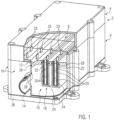
- Reference numeral 2 designates a housing with an upper housing part 4 and a lower housing part 6.
- the upper housing part 4 surrounds a connection chamber 8.
- the lower housing part 6 surrounds a heating chamber 10.
- the partition wall 12 is fluid-tight so that liquid fluid contained in the heating chamber 10 which is to be heated cannot flow to the connection chamber 8.
- the housing 2 is surmounted at the level of the heating chamber 10 by connecting pieces 14, which are used to connect fluid-carrying lines within a motor vehicle. These connecting pieces 14 protrude from opposite housing walls 16, which in this case surround the heating chamber 6. In the figure, only one of these connecting pieces 14 can be seen, and is partially cut away.
- Reference numeral 18 designates a heating device housing, which in this case is designed as a U-shaped pocket that is closed on the underside.
- a plurality of PTC elements 20 are arranged one above the other in the vertical direction of the heating device housing 18, which are arranged between contact surfaces that lie electrically conductively on the respective PTC elements 20 as conductor tracks 22 and are made of a sheet metal material and form closure tabs 23 that are electrically conductively connected in the connection chamber.
- Insulating layers 24 are located on the outside of the respective conductor track 22, so that heat emitted via the main side surfaces of the PTC elements first passes through the conductor track 22 and then the insulating layer 24 and is conducted through the walls of the heating device housing 18 that protrude into the heating chamber 10 as heating ribs.
- the heating housing 18 is made of a relatively thin sheet metal material. It rests on the outside of the insulating layers 24 without a gap. The heating housing 18 can also rest against them under pre-stress.
- EP 2 337 425 A1 Compared to the state of the art EP 2 337 425 A1 The mass of the material forming the heating fin is significantly reduced. This means that the embodiment shown can be manufactured with less weight. A wedge element can also be dispensed with, which EP 2 337 425 A1 is pressed into the receiving pocket to ensure good heat-conducting contact between the PTC element 20 and the heat-coupling surfaces of the heating fin.
- the housing 2 is also made of a relatively thin sheet metal material.
- the heating chamber 10 is surrounded by a basically cylindrical sheet metal sleeve, which is induction-soldered to a base plate 26 of the housing 2.
- the soldering point is marked with reference number 28.
- the partition wall 12 is also made of a relatively thin sheet metal material and is soldered to the inner peripheral surface of the housing 2 in a fluid-tight manner. This soldering point is also identified by reference numeral 28.
- the heating device housing 18 is also soldered to the partition wall 12.
- the heating device housing 18 is inserted into an opening 30 in the partition wall 12 and soldered to the partition wall 12 in this opening before being fitted with the PTC element(s) 20 and the conductor tracks 22 as well as the insulating layers 24.
- connection piece 14 is soldered to the housing wall 16.
- soldering point is marked with reference number 28.
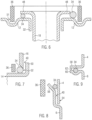
- the Figure 2 shows a sectional view of the connection point between the partition wall 12 and the heating device housing 18.
- the partition wall 12 is provided with a projecting connecting piece 32 by deep drawing.
- the connecting piece 32 is formed in one piece onto the sheet metal part forming the partition wall 12.
- the connecting piece 32 engages inside the heating device housing 18.
- the reference number 34 indicates a ring made of solder material, the inner diameter of which is slightly larger than the outer diameter of the heating device housing 18.
- the reference to the diameter does not necessarily mean that the heating device housing 18 or the ring 34 are circular in plan view. Rather, the ring 34 can also be polygonal, in particular rectangular.
- An inductor is identified by reference number 36.
- this inductor 36 is located for soldering within a protective gas housing 38, which essentially seals against the underside of the partition wall 12 facing the heating chamber 10 and against the outer peripheral surface of the heating device housing 18. It is understood that the soldering is carried out before the base plate 26 is connected to the housing lower part 6.
- the inductor 36 For soldering, the inductor 36 is switched on, which heats the solder and the overlapping walls in the area of the connecting piece 32 and the heating device housing 18.
- the solder material is a high-temperature copper-based solder.
- the protective gas housing 38 is flooded with protective gas.
- the solder melts and flows due to the capillary effect into a Figure 2b gap marked with reference number 40.
- the solder is in Figure 2b marked with reference number 42.
- the Figure 2b The solidified form of the solder 42 shown arises naturally due to the volume of solder 42 used on the one hand and the capillary effect on the other.
- Reference numeral 18 represents the heating device housing on the inside; reference numeral 32 represents the connecting piece on the outside.
- the relationships can also be reversed, ie the connecting piece 32 can be smaller than the heating device housing 18. All that is important is a certain length with an overlap.
- Reference numeral 44 represents a solder support made of an electrically non-conductive material. Due to this material, the solder support 44 is not heated by the inductor 36. The ring 34 rests on a surface of the solder support 44 before soldering. After the inductor 36 (not shown) is switched on, the solder 42 flows into the gap 40 and solidifies there. This results in a fluid-tight, secure connection. between the two overlapping sections of the connecting piece 32 on the one hand and the heater housing 18 on the other hand.
- FIG. 4 Another variant to the representation according to Figure 2 is in Figure 4 shown.
- the solder is in the form of the ring 34 before soldering in a flanged receiving ring 46 before soldering (left). After soldering, the solder has flowed into the gap 40. The receiving ring 46 is emptied. It should be noted that solder has also flowed between the front side of the flanged receiving ring 46 and the outer peripheral surface of the heating device housing 18.
- the variant according to Figure 4 offers the advantage that the ring 34 can be inserted into the annular gap between the outer and inner material. The parts that lie against one another essentially seal the receiving area for the solder 42. This reduces environmental influences during soldering in the area of the soldering point.
- the Figure 5 shows a further variant in which the heating device housing 18 is accommodated within the connecting piece 32, which is formed in one piece with the partition wall 12.
- the overlapping area extends essentially over the height of the inductor 36.
- an edge area of the overlapping area is shown, marked with reference number 47, which is not affected by the effect of the inductor 36. Accordingly, the opposing connection partners are colder there, so that the molten solder 42 entering from above inevitably solidifies in this area and prevents the solder 42 from flowing out of the gap 40.
- the solder 42 cools down - as Figure 5 right - at a distance from the lower end of the overlap area.
- the Figure 6 shows a variant in which the connecting piece 32 is provided on the outside and the heating device housing 18 on the inside.
- the heating device housing 18 is provided with a contact flange identified by reference number 48.
- This contact flange 48 is also formed by bending sheet metal material which forms the heating device housing 18.
- Ring 34 is in Figure 6 arranged on the left in an annular gap which is delimited in the longitudinal direction of the heating device housing 18 by the contact flange 48 on the one hand and the partition wall 12 on the other hand.
- the ring 34 is located radially outside the contact flange 48 before soldering.
- the inductor 36 is ring-shaped and surrounds the contact flange 48 on the outside.
- the partition wall 12 is formed radially outside the contact flange 48 in the direction of the heating chamber 10 to create an annular receiving area 51 for the shaped inductor 36.
- the Figure 7 shows a part of the connection piece 14, which is provided with a widened contact flange 50.
- the housing wall 16 has an outwardly bevelled bore 52.
- the ring 34 made of solder is provided between the material of the housing wall 16 that delimits the bore 52 and the connecting piece 14. In this embodiment, too, the solder penetrates into the gap 40 between the inner surface of the housing wall 16 and the contact flange 50 as a result of the heating by the inductor 36 and due to the capillary effect.
- FIG. 8 A variant of Figure 7 is in Figure 8 shown.
- the housing base 6 is bent outwards to form a receptacle 54 that is L-shaped in cross section.
- the free end of the housing top 4 is inserted into this L-shaped receptacle.
- the free upper end of the housing base 6 is provided with a funnel-shaped bend 56.
- the ring 34 is clamped into this before soldering. The solder flows into the gap marked with reference number 40 when the inductor 36 is activated.
- the Figure 9 shows a variant.
- the upper housing part 4 and the lower housing part 6 each have opposing flange surfaces 58, 60.
- the flange surface 60 of the lower housing part 6 is provided with an annular recess 62 in which the ring 34 is received.
- the Figure 10 shows a further variant for connecting the heating device housing 18 to the partition wall 12.
- the partition wall 12 has a connecting piece 32.
- this is shaped conically inward at its free end.
- the heating device housing 18 is shaped conically outward at its free end. This shaping results in a pre-positioning of the components joined in the longitudinal direction of the heating device housing 18.
- the ring 34 sits between the free end of the heating device housing 18 and the partition wall 12 extending above it.
Landscapes
- Engineering & Computer Science (AREA)
- Physics & Mathematics (AREA)
- Thermal Sciences (AREA)
- Mechanical Engineering (AREA)
- Chemical & Material Sciences (AREA)
- Combustion & Propulsion (AREA)
- General Engineering & Computer Science (AREA)
- Ceramic Engineering (AREA)
- General Induction Heating (AREA)
- Air-Conditioning For Vehicles (AREA)
Description
- Die vorliegende Erfindung betrifft ein Verfahren zur Herstellung einer elektrischen Heizvorrichtung mit einem Gehäuse, welches eine Trennwand aufweist, die eine Anschlusskammer von einer Heizkammer zur Abgabe von Wärme trennt. Von der Trennwand ragt zumindest eine PTC-Heizeinrichtung in Richtung auf die Heizkammer ab. Dieses PTC-Heizelement liegt nach Art einer Heizrippe in der Heizkammer frei. Die PTC-Heizeinrichtung hat zumindest ein PTC-Element und elektrisch leitend damit verbundene Leiterbahnen, die unterschiedlichen Polaritäten zur Bestromung des PTC-Elementes zugeordnet sind. Diese Leiterbahnen sind in der Anschlusskammer elektrisch an den Leistungsstrom angeschlossen. Die
EP 2 428 746 A1 offenbart eine gattungsgemäße elektrische Heizvorrichtung. - Eine derartige Heizvorrichtung ist beispielsweise aus der
EP 2 337 425 A1 bekannt. Bei einer solchen elektrischen Heizvorrichtung ist die Trennwand einteilig mit einem Heizeinrichtungsgehäuse ausgebildet, welches als Heizrippe in die Heizkammer hineinragt. Bei dem zuvor genannten Stand der Technik wird die Trennwand zusammen mit dem Heizeinrichtungsgehäuse einteilig mittels Aluminium-Druckguss hergestellt. Diese Art der Herstellung erfordert eine erhebliche Menge an Aluminium. Die elektrischen Heizvorrichtung ist daher relativ schwer. Bei der zuvor erwähnten elektrischen Heizvorrichtung sind eine Vielzahl von Heizeinrichtungsgehäusen vorgesehen, die als unterseitig geschlossene Rippen in die Heizkammer hineinragen. Herstellungsbedingt müssen diese einen gewissen Abstand zueinander aufweisen, was dem Erfordernis eines kompakten Aufbaus zuwiderläuft. - Bei der Variante nach
EP 3 334 242 A1 wird ein PTC-Heizelement zunächst als separates Bauteil hergestellten und als solches in einer Heizelementaufnahme, die an der Trennwand ausgebildet ist, eingesetzt, sodass das anschlussseitige Ende des Heizelementgehäuses abgedichtet in der Heizelementaufnahme der Trennwand aufgenommen ist und die Leiterbahnen mit ihren freien, anschlussseitigen Enden in der Anschlusskammer freiliegen, um dort elektrisch angeschlossen zu werden. Bei diesem Stand der Technik wird die so vormontierte PCT-Heizelemente formschlüssig in der Heizelementaufnahme gehalten bis eingepresst ist. - Diese verpressende Aufnahme bedingt eine gewisse Wandstärke auf Seiten der Trennwand. Problematisch bei dieser Ausgestaltung ist ferner die Dichtigkeit zwischen dem PTC-Heizelement und der Heizelementaufnahme. Bei den im Betrieb vorherrschenden Temperaturen kann eine Dichtung aus einem Kunststoffmaterial altern, sodass die Gefahr besteht, dass das zu erwärmende Fluid aus der Heizkammer in die Anschlusskammer gelangt. In der Anschlusskammer erfolgt indes der elektrische Anschluss des PTC-Elementes an den Leistungsstrom, so dass mit Blick auf die Betriebssicherheit keine Flüssigkeit in die Anschlusskammer gelangen darf. Andernfalls ist ein Kurzschluss zu befürchten. Insbesondere bei der Verwendung der elektrischen Heizvorrichtung in einem elektrisch betriebenen Fahrzeug, bei dem die Bordnetzspannung auch zum Betrieb der elektrischen Heizvorrichtung genutzt wird, begegnen solche Defekte erheblichen Sicherheitsbedenken.
- Der vorliegenden Erfindung liegt das Problem zugrunde, ein Verfahren zur Herstellung einer kompakt bauenden elektrischen Heizvorrichtung anzugeben.
- Zur Lösung des Problems wird mit der vorliegenden Erfindung ein Verfahren mit den Merkmalen von Anspruch 1 angegeben.
- Im Gegensatz zu dem zuerst diskutierten Stand der Technik, bei dem das Gehäuse und auch die Heizrippe durch Aluminiumdruckguss einteilig hergestellt werden, erlaubt die vorliegende Erfindung das nachträgliche Verbinden von zunächst aus dünnem Blech bereitgestellten Komponenten, um die Anschlusskammer und/oder die Heizkammer zu definieren bzw. die dazwischen vorgesehene Trennwand. Entsprechendes gilt für etwaige von einer Gehäusewand abragende Anschlussstutzen, beispielsweise für Fluidleitungen eines Zirkulationskreislaufs, der das in der elektrischen Heizvorrichtung zu erwärmende Fluid führt. Bei der elektrische Heizvorrichtung handelt es sich insbesondere um eine elektrische Heizvorrichtung in einem Kraftfahrzeug. Üblicherweise werden flexible Schläuche an die jeweiligen Anschlussstutzen der elektrischen Heizvorrichtung angeschlossen und dagegen abgedichtet.
- Das Blech kann eine Wandstärke von unter 1 Millimeter haben.
- Nach dem erfindungsgemäßen Vorgehen wird zunächst eine Trennwand bereitgestellt, die eine Anschlusskammer von einer Heizkammer an dem Gehäuse trennen wird, wobei die Trennwand zum elektrischen Anschluss des PTC-Elementes in der Anschlusskammer mindestens eine Öffnung aufweist. Durch diese Öffnung kann das PTC-Element von Seiten der Anschlusskammer in das Heizeinrichtungsgehäuse eingebracht werden. Das Heizeinrichtungsgehäuses ist üblicherweise unterseitig, d.h. mit seinem in der Heizkammer liegenden Ende verschlossen. Das Heizeinrichtungsgehäuse kann in dieser Weise bereitgestellt werden. Bevorzugt ist das Heizeinrichtungsgehäuse durch ein auf Länge abgeschnittenes Stücks eines zylindrischen Rohrkörpers gebildet, der unterseitig durch Verformen des das Heizeinrichtungsgehäuse ausbildenden Blechmaterials verschlossen sein kann. Dort kann das Blechmaterial verklebt, verlötet, verschweißt und/oder durch Umbördeln oder einen abgedichtet eingesetzten Stopfen geschlossen sein. Bei dem erfindungsgemäßen Verfahren wird eine Gehäusewand mittels induktivem Löten mit der Trennwand verbunden, wobei diese Gehäusewand die Anschlusskammer und/oder die Heizkammer ganz oder teilweise umgeben kann.
- Die erfindungsgemäße Lösung bietet die Möglichkeit der Herstellung einer kompakter aufgebauten elektrischen Heizvorrichtung. Im Gegensatz zu Aluminium-Druckgussteilen lassen sich die einzelnen Heizeinrichtungsgehäuse mit geringem Abstand zueinander an der Trennwand vorsehen. Dass induktive Löten erlaubt eine lokal begrenzte Erwärmung, sodass eine gute Maßhaltigkeit der zuvor hergestellten Komponenten der elektrischen Heizvorrichtung auch nach dem thermischen Fügen gegeben ist. Darüber hinaus lässt sich mit dem induktiven Löten eine sichere, fluiddichte Verbindung zwischen der Trennwand und der damit verbundenen Komponente, beispielsweise dem Heizeinrichtungsgehäuse bzw. der Gehäusewand erreichen.
- Die geringe Durchwärmung der Verbindungspartner beim induktiven Löten erlaubt auch eine lokale Erwärmung und damit eine relativ dichte Anordnung von mehreren neben- oder hintereinander mit der Trennwand verbundenen Heizeinrichtungsgehäusen. Die Erfindung erlaubt dementsprechend größere Freiheitsgrade sowohl bei der Gestaltung des Heizeinrichtungsgehäuses wie auch des Gehäuses der gesamten elektrischen Heizvorrichtung. Gegenüber dem Stand der Technik muss bei der Gestaltung der elektrischen Heizvorrichtung nicht mehr Rücksicht auf die Entformung eines mittels Druckgussverfahren hergestellten Aluminiumgehäuses genommen werden.
- Die Verfahrensführung beim Induktionslöten erlaubt dabei jede beliebige Art der Temperaturführung, solange sie nur unterhalb des Schmelzpunktes der Verbindungspartner liegt. Diese Verbindungspartner sind üblicherweise aus Metall, bevorzugt aus einem gestanzten Metallblech, welches üblicherweise vollflächig auf eine Oberfläche der Trennwand, des Heizelementgehäuses und/oder der Gehäusewand aufgebracht wird.
- Das Induktionslöten führt zu einer vollflächigen und damit dichten Verbindung zwischen der Trennwand, dem Heizelementgehäuse und/oder der Gehäusewand. Das induktive Löten kann bevorzugt so durchgeführt werden, dass ein Kontaktelement gegebenenfalls nach einer gewissen Vorwärmung zur Verringerung der Lötzeit auf die Oberfläche der Trennwand, des Heizelementgehäuses und/oder der Gehäusewand aufgebracht wird. Danach wird die Fügestelle durch induktives Erwärmen so erhitzt, dass sich das an der Fügestelle befindliche Lot erwärmt und verflüssigt. Kapillarkräfte können dabei das Lot zwischen die zu fügenden Oberflächen ziehen und damit Lot an der Phasengrenze zwischen den beiden Verbindungspartnern der Lötverbindung konzentrieren.
- Bei dem erfindungsgemäßen Verfahren wird bevorzugt ein Ring aus einem Lot benachbart zu einem Spalt zwischen den Verbindungspartnern und gebildet durch die Verbindungspartner angeordnet. Außenumfänglich bzw. innenumfänglich zu dem Ring wird ein Induktor angeordnet, der das Lot und die einen Spalt zwischen sich einschließenden Verbindungspartner im Bereich des Spalts induktiv erwärmen. Dadurch fließt das Lot nicht zuletzt aufgrund der Kapillarwirkung in den Spalt. Der Induktor wird dabei eingeschaltet, um das Lot und die den Spalt definierenden Flächen der Verbindungspartner zu erwärmen. Nachdem das Lot aufgeschmolzen worden ist, wird der Induktor ausgeschaltet. Das Lot fließt in den Spalt und erstarrt dort.
- Die Verbindungspartner können aus Nichteisenmetallen, Eisenmetallen, Chromnickelstählen und nichtmetallischen Werkstoffen sowie beliebigen Kombinationen dieser Werkstoffe bestehen oder diese enthalten.
- Das erfindungsgemäße Lötverfahren führt zu einer korrosionsbeständigen, insbesondere gas- und flüssigkeitsdichten Verbindung zwischen den Verbindungspartnern. Im Vergleich zu weiteren stoffschlüssigen Verbindungen wie das Kleben oder Schweißen ist die Taktzeit des Lötverfahrens unabhängig von der gesamten Verbindungslänge. Es lassen sich verschiedene Induktoren zeitgleich zum Einsatz bringen. So lässt sich das Löten zeitgleich an verschiedenen Stellen durchführen. Dabei ist die Erwärmung lokal begrenzt. Dies bietet die Möglichkeit, das Heizeinrichtungsgehäuse vor dem Löten zu bestücken. Eine Bestückung nach dem Löten ist indes zu bevorzugen.
- Weitere Einzelheiten und Vorteile der vorliegenden Erfindung ergeben sich aus der nachfolgenden Beschreibung eines Ausführungsbeispiels in Verbindung mit der Zeichnung. In der Zeichnung:
-
Fig. 1 eine perspektivische Seitenansicht eines Ausführungsbeispiels einer elektrischen Heizvorrichtung; -
Fig. 2a eine Schnittansicht mit einem Detail, welches die Verbindung zwischen der Trennwand und der Heizeinrichtungsgehäuse verdeutlicht; -
Fig. 2b das Detail III gemäß der Darstellung inFigur 2 ; -
Fig. 3 eine Ansicht gemäßFigur 2 für eine Variante vor dem Loten (links) und nach dem Löten (rechts); -
Fig. 4 eine Variante zu der Darstellung gemäßFigur 2 , wobei der Zustand vor dem Löten links und der Zustand nach dem Löten rechts dargestellt ist.; -
Fig. 5 eine Schnittansicht einer weiteren Variante, wobei der Zustand vor dem Löten links und der Zustand nach dem Löten rechts dargestellt ist; -
Fig. 6 eine vergrößerte Schnittansicht eines Übergangsbereichs zwischen der Trennwand und des Heizeinrichtungsgehäuses mit unterschiedlichen Varianten zur Aufbringung von Lot links und rechts; -
Fig. 7 eine Schnittansicht der Gehäusewand und eines Teils eines Anschlussstutzens; -
Fig. 8 eine Schnittansicht am Übergang zwischen dem Gehäuseoberteil und dem Gehäuseunterteil; -
Fig. 9 eine Variante für die Darstellung nachFigur 8 und -
Fig. 10 eine Variante zu der Darstellung gemäßFigur 6 . - In der
Figur 1 kennzeichnet Bezugszeichen 2 ein Gehäuse mit einem Gehäuseoberteil 4 und einem Gehäuseunterteil 6. Das Gehäuseoberteil 4 umgibt eine Anschlusskammer 8. Das Gehäuseunterteil 6 umgibt eine Heizkammer 10. Zwischen der Heizkammer 10 und der Anschlusskammer 8 befindet sich eine Trennwand 12. Die Trennwand 12 ist fluiddicht, sodass in der Heizkammer 10 enthaltenes, flüssiges Fluid, das zu erwärmen ist, nicht zu der Anschlusskammer 8 gelangen kann. Das Gehäuse 2 ist auf Höhe der Heizkammer 10 von Anschlussstutzen 14 überragt, die zum Anschluss von fluidführenden Leitungen innerhalb eines Kraftfahrzeuges dienen. Diese Anschlussstutzen 14 ragen von gegenüberliegenden Gehäusewänden 16 ab, die vorliegend umfänglich die Heizkammer 6 umgeben. In der Figur ist lediglich einer dieser Anschlussstutzen 14 zu erkennen, und zwar teilweise geschnitten. - Mit Bezugszeichen 18 ist ein Heizeinrichtungsgehäuse gekennzeichnet, welches vorliegend als U-förmige, unterseitig geschlossene Tasche ausgebildet ist. In jeder dieser Heizeinrichtungsgehäuse 18 sind in Höhenrichtung des Heizeinrichtungsgehäuses 18 mehrere PTC-Elemente 20 übereinander angeordnet, die zwischen Kontaktflächen angeordnet sind, die als Leiterbahnen 22 elektrisch leitend an den jeweiligen PTC-Elementen 20 anliegen und aus einem Blechmaterial gebildet sind und Verschlussfahnen 23 ausbilden, die in der Anschlusskammer elektrisch leitend angeschlossen sind. An der Außenseite der jeweiligen Leiterbahn 22 befinden sich Isolierlagen 24, sodass über Hauptseitenflächen der PTC-Elemente abgegebene Wärme zunächst die Leiterbahn 22 und danach die Isolierlage 24 durchsetzt und durch die als Heizrippe in die Heizkammer 10 hineinragenden Wände des Heizeinrichtungsgehäuses 18 hindurch geleitet wird.
- Das Heizgehäuse 18 wird vorliegend aus einem verhältnismäßig dünnen Blechmaterial gebildet. Es liegt ohne Spalt an der Außenseite Isolierlagen 24 an. Das Heizgehäuse 18 kann auch unter Vorspannung daran anliegend.
- Gegenüber dem Stand der Technik
EP 2 337 425 A1 ist die Masse des die Heizrippe ausbildenden Materials deutlich reduziert. So kann das gezeigte Ausführungsbeispiel mit geringerem Gewicht hergestellt werden. Auch kann auf ein Keilelement verzichtet werden, welches nachEP 2 337 425 A1 in die Aufnahmetasche eingedrückt wird, um für einen guten wärmeleitenden Kontakt zwischen dem PTC-Element 20 und den die wärmeauskoppelnden Flächen der Heizrippe zu sorgen. - Auch das Gehäuse 2 besteht aus einem relativ dünnen Blechmaterial. So ist es die Heizkammer 10 umfänglich von einer im Grunde zylindrischen Blechmanschette umgeben, die mit einer Bodenplatte 26 des Gehäuses 2 induktionsverlötet ist. Die Lötstelle ist mit Bezugszeichen 28 gekennzeichnet
Auch die Trennwand 12 ist aus einem relativ dünnen Blechmaterial gebildet und mit der Innenumfangsfläche des Gehäuses 2 umfänglich fluiddicht verlötet. Auch diese Lötstelle ist mit Bezugszeichen 28 gekennzeichnet. - Auch das Heizeinrichtungsgehäuse 18 mit der Trennwand 12 verlötet. Dazu wird das Heizeinrichtungsgehäuse 18 vor dem Bestücken mit dem oder den PTC-Elementen 20 und den Leiterbahnen 22 sowie den Isolierlagen 24 in eine Öffnung 30 der Trennwand 12 eingebracht und in dieser mit der Trennwand 12 verlötet.
- In gleicher Weise ist der Anschlussstutzen 14 mit der Gehäusewand 16 verlötet. Auch hier ist die Lötstelle mit Bezugszeichen 28 gekennzeichnet.
- Die
Figur 2 zeigt eine Schnittansicht der Verbindungsstelle zwischen der Trennwand 12 und dem Heizeinrichtungsgehäuse 18. Die Trennwand 12 ist dabei durch Tiefziehen mit einem vorspringenden Verbindungsstutzen 32 versehen. Der Verbindungsstutzen 32 ist einteilig an den die Trennwand 12 ausbildenden Blechteil angeformt. Der Verbindungsstutzen 32 greift innen in das Heizeinrichtungsgehäuse 18 ein. -
Figur 2 verdeutlicht dabei mit Bezugszeichen 34 einen Ring aus Lotmaterial, dessen Innendurchmesser geringfügig größer als der Außendurchmesser des Heizeinrichtungsgehäuses 18 ist. Der Verweis auf den Durchmesser bedeutet nicht notwendig, dass das Heizeinrichtungsgehäuse 18 bzw. der Ring 34 als in der Draufsicht kreisförmig ausgeformt sind. Vielmehr kann der Ring 34 auch vieleckig, insbesondere rechteckig ausgeformt sein. - Mit Bezugszeichen 36 ist ein Induktor gekennzeichnet. Bei dem gezeigten Ausführungsbeispiel befindet sich dieser Induktor 36 zum Löten innerhalb eines Schutzgasgehäuses 38, welches im Wesentlichen dichtend einerseits gegen die der Heizkammer 10 zugewandten Unterseite der Trennwand 12 und andererseits gegen die Außenumfangsfläche des Heizeinrichtungsgehäuses 18 anliegt. Es versteht sich, dass das Löten durchgeführt wird, bevor die Bodenplatte 26 mit dem Gehäuseunterteil 6 verbunden wird.
- Zum Löten wird der Induktor 36 eingeschaltet, dadurch werden das Lot sowie die sich überlappenden Wände im Bereich des Verbindungsstutzens 32 und des Heizeinrichtungsgehäuses 18 erwärmt. Lotmaterial ist dabei ein Hochtemperaturlot auf Kupfer-Basis. Beim Löten ist das Schutzgasgehäuse 38 mit Schutzgas geflutet. Infolge der Erwärmung durch den Induktor 36 schmilzt das Lot und fließt aufgrund der Kapillarwirkung in einen in
Figur 2b mit Bezugszeichen 40 gekennzeichneten Spalt. Das Lot ist inFigur 2b mit Bezugszeichen 42 gekennzeichnet. Die inFigur 2b gezeigte erstarrte Form des Lots 42 ergibt sich zwanglos aufgrund des verwendeten Volumens an Lot 42 einerseits und der Kapillarwirkung andererseits. - Die
Figur 3 zeigt ein alternatives Ausführungsbeispiel. Mit Bezugszeichen 18 ist das Heizeinrichtungsgehäuse innen; mit Bezugszeichen 32 der Verbindungsstutzen außen dargestellt. Die Verhältnisse können auch umgedreht verwirklicht sein, d.h. der Verbindungsstutzen 32 kann mit kleinerer Abmessung als das Heizeinrichtungsgehäuse 18 verwirklicht sein. Wesentlich ist lediglich ein gewisses Längenstück mit einer Überlappung. Mit Bezugszeichen 44 ist eine Lotstütze aus einem elektrisch nichtleitenden Material gekennzeichnet. Aufgrund dieser Materialität wird die Lotstütze 44 nicht von dem Induktor 36 erwärmt. Der Ring 34 liegt vor dem Löten auf einer Oberfläche der Lotstütze 44 auf. Nach Anschalten des Induktors 36 (nicht dargestellt) fließt das Lot 42 in den Spalt 40 und erstarrt dort. Es ergibt sich eine fluiddichte sichere Verbindung zwischen den beiden Überlappungsabschnitten des Verbindungsstutzens 32 einerseits und des Heizeinrichtungsgehäuses 18 andererseits. - Eine weitere Variante zu der Darstellung gemäß
Figur 2 ist inFigur 4 dargestellt. Dort befindet sich das Lot in Form des Ringes 34 vor dem Löten in einem umbördelten Aufnahmering 46 vor dem Löten (links). Nach dem Löten ist das Lot in den Spalt 40 geflossen. Der Aufnahmering 46 ist entleert. Dabei ist zu vermerken, dass Lot auch zwischen die Stirnseite des umbördelten Aufnahmerings 46 und der Außenumfangsfläche des Heizeinrichtungsgehäuses 18 geflossen ist. Die Variante nachFigur 4 bietet den Vorteil, dass der Ring 34 in den Ringspalt zwischen dem äußeren und dem inneren Material eingelegt werden kann. Die aneinander anliegenden Teile dichten den Aufnahmebereich für das Lot 42 im Wesentlichen ab. Dadurch werden Umwelteinflüsse beim Löten im Bereich der Lotstellte reduziert. - Die
Figur 5 zeigt eine weitere Variante, bei welcher das Heizeinrichtungsgehäuse 18 innerhalb des Verbindungsstutzens 32 aufgenommen ist, der einteilig mit der Trennwand 12 ausgeformt ist. Der Überlappungsbereich erstreckt sich im Wesentlichen über die Höhenerstreckung des Induktors 36. Allerdings ist in der Figur unten ein mit Bezugszeichen 47 gekennzeichneter Randbereich des Überlappungsbereiches gezeigt, der von der Wirkung des Induktors 36 nicht erfasst wird. Dort sind dementsprechend die einander gegenüberliegenden Verbindungspartner kälter, sodass das von oben schmelzflüssig eintretende Lot 42 in diesem Bereich zwangsläufig erstarrt und das Ausfließen des Lots 42 aus dem Spalt 40 verhindert. Das Lot 42 erkaltet - wieFigur 5 rechts andeutet - mit Abstand zu dem unteren Ende des Überlappungsbereiches. - Die
Figur 6 zeigt eine Variante, bei welcher der Verbindungsstutzen 32 außen und das Heizeinrichtungsgehäuse 18 innen vorgesehen ist. Das Heizeinrichtungsgehäuse 18 ist mit einem mit Bezugszeichen 48 gekennzeichneten Anlageflansch versehen. Auch dieser Anlageflansch 48 ist durch Biegen von Blechmaterial, welches das Heizeinrichtungsgehäuse 18 ausformt, gebildet. - Der Ring 34 ist in
Figur 6 links in einem Ringspalt angeordnet, der in Längsrichtung des Heizeinrichtungsgehäuses 18 von dem Anlageflansch 48 einerseits und der Trennwand 12 andererseits begrenzt ist. - Bei der in
Figur 6 rechts dargestellten Variante befindet sich der Ring 34 vor dem Löten radial außerhalb des Anlageflansches 48. Der Induktor 36 ist ringförmig ausgestaltet und umgibt den Anlageflansch 48 außenumfänglich. Die Trennwand 12 ist radial außerhalb des Anlageflansches 48 in Richtung der Heizkammer 10 zur Schaffung eines ringförmigen Aufnahmebereichs 51 für den förmigen Induktor 36 eingeformt. - Die
Figur 7 zeigt einen Teil des Anschlussstutzens 14, der mit einem verbreiterten Anlageflansch 50 versehen ist. Die Gehäusewand 16 hat eine nach außen abgeschrägte Bohrung 52. Zwischen dem die Bohrung 52 begrenzenden Material der Gehäusewand 16 und dem Anschlussstutzen 14 ist der Ring 34 aus Lot vorgesehen. Auch bei diesem Ausführungsbeispiel dringt das Lot infolge der Erwärmung durch den Induktor 36 und aufgrund der Kapillarwirkung in den Spalt 40 zwischen die Innenfläche der Gehäusewand 16 und den Anlageflansch 50. - Eine Variante zu
Figur 7 ist inFigur 8 dargestellt. Bei dieser Variante ist das Gehäuseunterteil 6 nach außen umbogen zur Ausbildung einer im Querschnitt L-förmigen Aufnahme 54. In dieser L-förmigen Aufnahme ist das freie Ende des Gehäuseoberteils 4 eingesetzt. Das freie obere Ende des Gehäuseunterteils 6 ist mit einer trichterförmigen Ausbiegung 56 versehen. In dieser ist der Ring 34 vor dem Löten geklemmt. In den mit Bezugszeichen 40 gekennzeichneten Spalt fließt das Lot bei Aktivierung des Induktors 36. - Die
Figur 9 zeigt eine Variante. Bei diesem Ausführungsbeispiel haben das Gehäuseoberteil 4 und das Gehäuseunterteil 6 jeweils einander gegenüberliegende Flanschflächen 58, 60. Die Flanschfläche 60 des Gehäuseunterteils 6 ist mit einer ringförmig umlaufenden Vertiefung 62 versehen, in der der Ring 34 aufgenommen ist. - Die
Figur 10 zeigt eine weitere Variante zur Verbindung des Heizeinrichtungsgehäuses 18 mit der Trennwand 12. Auch hier hat die Trennwand 12 einen Verbindungsstutzen 32. Dieser ist allerdings an seinem freien Ende konisch nach innen zulaufend ausgeformt. In korrespondierender Weise ist das Heizeinrichtungsgehäuse 18 an seinem freien Ende konisch nach außen umgeformt. Durch diese Ausformung ergibt sich eine Vorpositionierung der in Längsrichtung des Heizeinrichtungsgehäuses 18 gefügten Bauteile. Der Ring 34 sitzt vor dem Löten zwischen dem freien Ende des Heizeinrichtungsgehäuses 18 und der sich darüber erstreckenden Trennwand 12. -
- 2
- Gehäuse
- 4
- Gehäuseoberteil
- 6
- Gehäuseunterteil
- 8
- Anschlusskammer
- 10
- Heizkammer
- 12
- Trennwand
- 14
- Anschlussstutzen
- 16
- Gehäusewand
- 18
- Heizeinrichtungsgehäuse
- 20
- PTC-Element
- 22
- Leiterbahn
- 23
- Anschlussfahne
- 24
- Isolierlage
- 26
- Bodenplatte
- 28
- Lötstelle
- 30
- Öffnung
- 32
- Verbindungsstutzen
- 34
- Ring
- 36
- Induktor
- 38
- Schutzgasgehäuse
- 40
- Spalt
- 42
- Lot
- 44
- Lotstütze
- 46
- Aufnahmering
- 47
- Randbereich
- 48
- Anlageflansch
- 50
- Anlageflansch
- 51
- Aufnahmebereich
- 52
- Bohrung
- 54
- L-förmige Aufnahme
- 56
- trichterförmige Ausbiegung
- 58
- Flanschfläche
- 60
- Flanschfläche
- 62
- Vertiefung
Claims (3)
- Verfahren zur Herstellung einer elektrischen Heizvorrichtung (2), bei dem zunächst eine eine Anschlusskammer (8) von einer Heizkammer (10) zur Abgabe von Wärme trennende Trennwand (12) bereitgestellt wird, die zumindest eine Öffnung (30) zum elektrischen Anschluss eines PTC-Elementes (20) in der Anschlusskammer (8) aufweist, dadurch gekennzeichnet, dass
eine von der Trennwand (12) abragende und die Anschlusskammer (8) und/oder die Heizkammer (10) begrenzende Gehäusewand (16) und/oder ein das PTC-Element (20) und zur Bestromung des PTC-Elementes (20) mit unterschiedlicher Polarität mit diesem elektrisch leitend verbundene Leiterbahnen (22) aufnehmendes Heizeinrichtungsgehäuse (18) induktiv mit der Trennwand (12) verlötet wird bzw. werden. - Verfahren nach Anspruch 1, dadurch gekennzeichnet, dass nach dem Verlöten das PTC-Element (20) und die Leiterbahnen (22) in das Heizeinrichtungsgehäuse (18) eingebracht und die Leiterbahnen (22) elektrisch in der Anschlusskammer (8) angeschlossen werden.
- Verfahren nach Anspruch 1 oder 2, dadurch gekennzeichnet, dass ein Ring (34) aus Lot (42) benachbart zu einem Spalt (40) zwischen der Trennwand (12) und der Gehäusewand (16) oder dem Heizeinrichtungsgehäuse (18) angeordnet und induktiv aufgeschmolzen wird, sodass das Lot (42) in den Spalt (40) fließt und dort erstarrt.
Applications Claiming Priority (1)
| Application Number | Priority Date | Filing Date | Title |
|---|---|---|---|
| DE102020210284.8A DE102020210284A1 (de) | 2020-08-13 | 2020-08-13 | Elektrische Heizvorrichtung und Verfahren zu deren Herstellung |
Publications (2)
| Publication Number | Publication Date |
|---|---|
| EP3958649A1 EP3958649A1 (de) | 2022-02-23 |
| EP3958649B1 true EP3958649B1 (de) | 2024-10-02 |
Family
ID=77264994
Family Applications (1)
| Application Number | Title | Priority Date | Filing Date |
|---|---|---|---|
| EP21190356.2A Active EP3958649B1 (de) | 2020-08-13 | 2021-08-09 | Elektrische heizvorrichtung und verfahren zu deren herstellung |
Country Status (4)
| Country | Link |
|---|---|
| US (1) | US20220053610A1 (de) |
| EP (1) | EP3958649B1 (de) |
| CN (1) | CN114080070B (de) |
| DE (1) | DE102020210284A1 (de) |
Families Citing this family (2)
| Publication number | Priority date | Publication date | Assignee | Title |
|---|---|---|---|---|
| DE102020202453B4 (de) * | 2020-02-26 | 2022-09-29 | Eberspächer Catem Gmbh & Co. Kg | Elektrische Heizvorrichtung und Verfahren zu deren Herstellung |
| DE102023102629A1 (de) | 2023-02-02 | 2024-08-08 | Eberspächer Catem Gmbh & Co. Kg | Elektrische Heizvorrichtung und Verfahren zu deren Herstellung |
Family Cites Families (7)
| Publication number | Priority date | Publication date | Assignee | Title |
|---|---|---|---|---|
| EP2337425B1 (de) | 2009-12-17 | 2012-04-18 | Eberspächer catem GmbH & Co. KG | Elektrische Heizvorrichtung und wärmeerzeugendes Element einer elektrischen Heizvorrichtung |
| EP2428746B8 (de) * | 2010-09-13 | 2021-12-29 | MAHLE Behr GmbH & Co. KG | Wärmeübertrager |
| EP2440004B1 (de) * | 2010-10-08 | 2015-02-25 | Eberspächer catem GmbH & Co. KG | Elektrische Heizvorrichtung |
| CN103423871B (zh) * | 2012-05-25 | 2015-08-26 | 比亚迪股份有限公司 | 一种电加热装置的壳体、电加热装置以及电动车 |
| TW201414559A (zh) * | 2012-10-08 | 2014-04-16 | Power Mate Technology Co Ltd | 金屬外罩與板體之焊接方法 |
| DE202014006425U1 (de) * | 2014-01-24 | 2014-08-22 | Eberspächer Catem Gmbh & Co. Kg | Wasserheizer und Heizsystem für ein elektrisch zu betreibendes Fahrzeug mit einem Wasserheizer |
| DE102016224296A1 (de) | 2016-12-06 | 2018-06-07 | Eberspächer Catem Gmbh & Co. Kg | Elektrische heizvorrichtung |
-
2020
- 2020-08-13 DE DE102020210284.8A patent/DE102020210284A1/de active Pending
-
2021
- 2021-08-09 EP EP21190356.2A patent/EP3958649B1/de active Active
- 2021-08-12 CN CN202110927641.1A patent/CN114080070B/zh active Active
- 2021-08-12 US US17/400,256 patent/US20220053610A1/en active Pending
Also Published As
| Publication number | Publication date |
|---|---|
| CN114080070B (zh) | 2024-06-14 |
| EP3958649A1 (de) | 2022-02-23 |
| DE102020210284A1 (de) | 2022-02-17 |
| US20220053610A1 (en) | 2022-02-17 |
| CN114080070A (zh) | 2022-02-22 |
Similar Documents
| Publication | Publication Date | Title |
|---|---|---|
| EP1917088B1 (de) | Filtereinrichtung mit einer heizung | |
| EP2627880B1 (de) | Halterung für einen injektor | |
| EP3958649B1 (de) | Elektrische heizvorrichtung und verfahren zu deren herstellung | |
| EP1433994A1 (de) | Heizvorrichtung zur Kurbelgehäuseentlüftung für Verbrennungskraftmaschinen und Herstellverfahren | |
| EP3493650A1 (de) | Elektrische heizvorrichtung | |
| DE102009038978A1 (de) | Vorrichtung zum Erwärmen von Flüssigkeiten | |
| DE3032118C2 (de) | Matrizenschweißspule | |
| EP1507914A1 (de) | Haushaltsmaschine | |
| DE2322353A1 (de) | Vorrichtung zum befestigen von sammelbehaeltern und seitlichen backen an waermetauschern | |
| DE102012020882A1 (de) | Verfahren zur Herstellung eines Wärmetauschers für ein Kraftfahrzeug und Wärmetauscher für ein Kraftfahrzeug | |
| DE102018108407A1 (de) | Elektrisches Heizgerät | |
| EP3211190A1 (de) | Verbinderanordnung mit zumindest einem verbinder und zumindest einer medienleitung | |
| DE3230610A1 (de) | Verschliessverfahren unter verwendung eines verlorenen heizelementes | |
| WO2006005291A1 (de) | Verfahren zum verbinden mindestens eines drahtes mit einem kontaktelement | |
| DE3341156A1 (de) | Elektrode mit integriertem waermetransportrohr | |
| DE102012009615B4 (de) | Verfahren zum Löten und Baugruppe | |
| DE2918757C2 (de) | Elektrode für Lichtbogenöfen | |
| EP3820245A1 (de) | Ptc-heizeinrichtung und elektrische heizvorrichtung mit einer solchen ptc-heizeinrichtung und verfahren zur herstellung einer elektrischen heizvorrichtung | |
| EP3580767B1 (de) | Heiz- und/oder kühlvorrichtung für einen festkörper oder einen fluidstrom | |
| EP3958651B1 (de) | Elektrische heizvorrichtung | |
| DE102023102629A1 (de) | Elektrische Heizvorrichtung und Verfahren zu deren Herstellung | |
| EP1819477B1 (de) | Verfahren zum laserverschweissen zweier schweissteile mittels einer kehlnaht | |
| EP4171170B1 (de) | Heizeinrichtung und verfahren zum herstellen einer heizeinrichtung | |
| EP4421438B1 (de) | Wärmeübertragerplatte | |
| DE102023212603A1 (de) | Leistungsmodul sowie Verfahren zur Herstellung eines Leistungsmoduls, insbesondere für ein Kraftfahrzeug |
Legal Events
| Date | Code | Title | Description |
|---|---|---|---|
| PUAI | Public reference made under article 153(3) epc to a published international application that has entered the european phase |
Free format text: ORIGINAL CODE: 0009012 |
|
| STAA | Information on the status of an ep patent application or granted ep patent |
Free format text: STATUS: THE APPLICATION HAS BEEN PUBLISHED |
|
| AK | Designated contracting states |
Kind code of ref document: A1 Designated state(s): AL AT BE BG CH CY CZ DE DK EE ES FI FR GB GR HR HU IE IS IT LI LT LU LV MC MK MT NL NO PL PT RO RS SE SI SK SM TR |
|
| STAA | Information on the status of an ep patent application or granted ep patent |
Free format text: STATUS: REQUEST FOR EXAMINATION WAS MADE |
|
| 17P | Request for examination filed |
Effective date: 20220331 |
|
| RBV | Designated contracting states (corrected) |
Designated state(s): AL AT BE BG CH CY CZ DE DK EE ES FI FR GB GR HR HU IE IS IT LI LT LU LV MC MK MT NL NO PL PT RO RS SE SI SK SM TR |
|
| GRAP | Despatch of communication of intention to grant a patent |
Free format text: ORIGINAL CODE: EPIDOSNIGR1 |
|
| STAA | Information on the status of an ep patent application or granted ep patent |
Free format text: STATUS: GRANT OF PATENT IS INTENDED |
|
| INTG | Intention to grant announced |
Effective date: 20240425 |
|
| GRAS | Grant fee paid |
Free format text: ORIGINAL CODE: EPIDOSNIGR3 |
|
| P01 | Opt-out of the competence of the unified patent court (upc) registered |
Free format text: CASE NUMBER: APP_39167/2024 Effective date: 20240701 |
|
| GRAA | (expected) grant |
Free format text: ORIGINAL CODE: 0009210 |
|
| STAA | Information on the status of an ep patent application or granted ep patent |
Free format text: STATUS: THE PATENT HAS BEEN GRANTED |
|
| AK | Designated contracting states |
Kind code of ref document: B1 Designated state(s): AL AT BE BG CH CY CZ DE DK EE ES FI FR GB GR HR HU IE IS IT LI LT LU LV MC MK MT NL NO PL PT RO RS SE SI SK SM TR |
|
| REG | Reference to a national code |
Ref country code: GB Ref legal event code: FG4D Free format text: NOT ENGLISH |
|
| REG | Reference to a national code |
Ref country code: CH Ref legal event code: EP |
|
| REG | Reference to a national code |
Ref country code: DE Ref legal event code: R096 Ref document number: 502021005297 Country of ref document: DE |
|
| REG | Reference to a national code |
Ref country code: IE Ref legal event code: FG4D Free format text: LANGUAGE OF EP DOCUMENT: GERMAN |
|
| REG | Reference to a national code |
Ref country code: LT Ref legal event code: MG9D |
|
| REG | Reference to a national code |
Ref country code: NL Ref legal event code: MP Effective date: 20241002 |
|
| PG25 | Lapsed in a contracting state [announced via postgrant information from national office to epo] |
Ref country code: NL Free format text: LAPSE BECAUSE OF FAILURE TO SUBMIT A TRANSLATION OF THE DESCRIPTION OR TO PAY THE FEE WITHIN THE PRESCRIBED TIME-LIMIT Effective date: 20241002 |
|
| PG25 | Lapsed in a contracting state [announced via postgrant information from national office to epo] |
Ref country code: NL Free format text: LAPSE BECAUSE OF FAILURE TO SUBMIT A TRANSLATION OF THE DESCRIPTION OR TO PAY THE FEE WITHIN THE PRESCRIBED TIME-LIMIT Effective date: 20241002 |
|
| PG25 | Lapsed in a contracting state [announced via postgrant information from national office to epo] |
Ref country code: HR Free format text: LAPSE BECAUSE OF FAILURE TO SUBMIT A TRANSLATION OF THE DESCRIPTION OR TO PAY THE FEE WITHIN THE PRESCRIBED TIME-LIMIT Effective date: 20241002 Ref country code: IS Free format text: LAPSE BECAUSE OF FAILURE TO SUBMIT A TRANSLATION OF THE DESCRIPTION OR TO PAY THE FEE WITHIN THE PRESCRIBED TIME-LIMIT Effective date: 20250202 Ref country code: PT Free format text: LAPSE BECAUSE OF FAILURE TO SUBMIT A TRANSLATION OF THE DESCRIPTION OR TO PAY THE FEE WITHIN THE PRESCRIBED TIME-LIMIT Effective date: 20250203 |
|
| PG25 | Lapsed in a contracting state [announced via postgrant information from national office to epo] |
Ref country code: FI Free format text: LAPSE BECAUSE OF FAILURE TO SUBMIT A TRANSLATION OF THE DESCRIPTION OR TO PAY THE FEE WITHIN THE PRESCRIBED TIME-LIMIT Effective date: 20241002 |
|
| PG25 | Lapsed in a contracting state [announced via postgrant information from national office to epo] |
Ref country code: BG Free format text: LAPSE BECAUSE OF FAILURE TO SUBMIT A TRANSLATION OF THE DESCRIPTION OR TO PAY THE FEE WITHIN THE PRESCRIBED TIME-LIMIT Effective date: 20241002 |
|
| PG25 | Lapsed in a contracting state [announced via postgrant information from national office to epo] |
Ref country code: ES Free format text: LAPSE BECAUSE OF FAILURE TO SUBMIT A TRANSLATION OF THE DESCRIPTION OR TO PAY THE FEE WITHIN THE PRESCRIBED TIME-LIMIT Effective date: 20241002 |
|
| PG25 | Lapsed in a contracting state [announced via postgrant information from national office to epo] |
Ref country code: NO Free format text: LAPSE BECAUSE OF FAILURE TO SUBMIT A TRANSLATION OF THE DESCRIPTION OR TO PAY THE FEE WITHIN THE PRESCRIBED TIME-LIMIT Effective date: 20250102 |
|
| PG25 | Lapsed in a contracting state [announced via postgrant information from national office to epo] |
Ref country code: LV Free format text: LAPSE BECAUSE OF FAILURE TO SUBMIT A TRANSLATION OF THE DESCRIPTION OR TO PAY THE FEE WITHIN THE PRESCRIBED TIME-LIMIT Effective date: 20241002 Ref country code: GR Free format text: LAPSE BECAUSE OF FAILURE TO SUBMIT A TRANSLATION OF THE DESCRIPTION OR TO PAY THE FEE WITHIN THE PRESCRIBED TIME-LIMIT Effective date: 20250103 |
|
| PG25 | Lapsed in a contracting state [announced via postgrant information from national office to epo] |
Ref country code: PL Free format text: LAPSE BECAUSE OF FAILURE TO SUBMIT A TRANSLATION OF THE DESCRIPTION OR TO PAY THE FEE WITHIN THE PRESCRIBED TIME-LIMIT Effective date: 20241002 Ref country code: CZ Free format text: LAPSE BECAUSE OF FAILURE TO SUBMIT A TRANSLATION OF THE DESCRIPTION OR TO PAY THE FEE WITHIN THE PRESCRIBED TIME-LIMIT Effective date: 20241002 |
|
| PG25 | Lapsed in a contracting state [announced via postgrant information from national office to epo] |
Ref country code: RS Free format text: LAPSE BECAUSE OF FAILURE TO SUBMIT A TRANSLATION OF THE DESCRIPTION OR TO PAY THE FEE WITHIN THE PRESCRIBED TIME-LIMIT Effective date: 20250102 |
|
| PG25 | Lapsed in a contracting state [announced via postgrant information from national office to epo] |
Ref country code: SM Free format text: LAPSE BECAUSE OF FAILURE TO SUBMIT A TRANSLATION OF THE DESCRIPTION OR TO PAY THE FEE WITHIN THE PRESCRIBED TIME-LIMIT Effective date: 20241002 |
|
| REG | Reference to a national code |
Ref country code: DE Ref legal event code: R097 Ref document number: 502021005297 Country of ref document: DE |
|
| PG25 | Lapsed in a contracting state [announced via postgrant information from national office to epo] |
Ref country code: DK Free format text: LAPSE BECAUSE OF FAILURE TO SUBMIT A TRANSLATION OF THE DESCRIPTION OR TO PAY THE FEE WITHIN THE PRESCRIBED TIME-LIMIT Effective date: 20241002 |
|
| PG25 | Lapsed in a contracting state [announced via postgrant information from national office to epo] |
Ref country code: EE Free format text: LAPSE BECAUSE OF FAILURE TO SUBMIT A TRANSLATION OF THE DESCRIPTION OR TO PAY THE FEE WITHIN THE PRESCRIBED TIME-LIMIT Effective date: 20241002 |
|
| PG25 | Lapsed in a contracting state [announced via postgrant information from national office to epo] |
Ref country code: RO Free format text: LAPSE BECAUSE OF FAILURE TO SUBMIT A TRANSLATION OF THE DESCRIPTION OR TO PAY THE FEE WITHIN THE PRESCRIBED TIME-LIMIT Effective date: 20241002 |
|
| PG25 | Lapsed in a contracting state [announced via postgrant information from national office to epo] |
Ref country code: SK Free format text: LAPSE BECAUSE OF FAILURE TO SUBMIT A TRANSLATION OF THE DESCRIPTION OR TO PAY THE FEE WITHIN THE PRESCRIBED TIME-LIMIT Effective date: 20241002 |
|
| PG25 | Lapsed in a contracting state [announced via postgrant information from national office to epo] |
Ref country code: IT Free format text: LAPSE BECAUSE OF FAILURE TO SUBMIT A TRANSLATION OF THE DESCRIPTION OR TO PAY THE FEE WITHIN THE PRESCRIBED TIME-LIMIT Effective date: 20241002 |
|
| PLBE | No opposition filed within time limit |
Free format text: ORIGINAL CODE: 0009261 |
|
| STAA | Information on the status of an ep patent application or granted ep patent |
Free format text: STATUS: NO OPPOSITION FILED WITHIN TIME LIMIT |
|
| PG25 | Lapsed in a contracting state [announced via postgrant information from national office to epo] |
Ref country code: SE Free format text: LAPSE BECAUSE OF FAILURE TO SUBMIT A TRANSLATION OF THE DESCRIPTION OR TO PAY THE FEE WITHIN THE PRESCRIBED TIME-LIMIT Effective date: 20241002 |
|
| 26N | No opposition filed |
Effective date: 20250703 |
|
| PGFP | Annual fee paid to national office [announced via postgrant information from national office to epo] |
Ref country code: DE Payment date: 20250819 Year of fee payment: 5 |
|
| PGFP | Annual fee paid to national office [announced via postgrant information from national office to epo] |
Ref country code: AT Payment date: 20251020 Year of fee payment: 5 |
|
| REG | Reference to a national code |
Ref country code: CH Ref legal event code: H13 Free format text: ST27 STATUS EVENT CODE: U-0-0-H10-H13 (AS PROVIDED BY THE NATIONAL OFFICE) Effective date: 20260324 |
|
| PG25 | Lapsed in a contracting state [announced via postgrant information from national office to epo] |
Ref country code: MC Free format text: LAPSE BECAUSE OF FAILURE TO SUBMIT A TRANSLATION OF THE DESCRIPTION OR TO PAY THE FEE WITHIN THE PRESCRIBED TIME-LIMIT Effective date: 20241002 |
|
| PG25 | Lapsed in a contracting state [announced via postgrant information from national office to epo] |
Ref country code: LU Free format text: LAPSE BECAUSE OF NON-PAYMENT OF DUE FEES Effective date: 20250809 |
|
| PG25 | Lapsed in a contracting state [announced via postgrant information from national office to epo] |
Ref country code: CH Free format text: LAPSE BECAUSE OF NON-PAYMENT OF DUE FEES Effective date: 20250831 |