EP3958381B1 - Battery module and battery pack including the same - Google Patents
Battery module and battery pack including the same Download PDFInfo
- Publication number
- EP3958381B1 EP3958381B1 EP21797486.4A EP21797486A EP3958381B1 EP 3958381 B1 EP3958381 B1 EP 3958381B1 EP 21797486 A EP21797486 A EP 21797486A EP 3958381 B1 EP3958381 B1 EP 3958381B1
- Authority
- EP
- European Patent Office
- Prior art keywords
- battery
- partition wall
- module
- cell stack
- battery cell
- Prior art date
- Legal status (The legal status is an assumption and is not a legal conclusion. Google has not performed a legal analysis and makes no representation as to the accuracy of the status listed.)
- Active
Links
Images



Classifications
-
- H—ELECTRICITY
- H01—ELECTRIC ELEMENTS
- H01M—PROCESSES OR MEANS, e.g. BATTERIES, FOR THE DIRECT CONVERSION OF CHEMICAL ENERGY INTO ELECTRICAL ENERGY
- H01M50/00—Constructional details or processes of manufacture of the non-active parts of electrochemical cells other than fuel cells, e.g. hybrid cells
- H01M50/10—Primary casings; Jackets or wrappings
- H01M50/14—Primary casings; Jackets or wrappings for protecting against damage caused by external factors
- H01M50/143—Fireproof; Explosion-proof
-
- H—ELECTRICITY
- H01—ELECTRIC ELEMENTS
- H01M—PROCESSES OR MEANS, e.g. BATTERIES, FOR THE DIRECT CONVERSION OF CHEMICAL ENERGY INTO ELECTRICAL ENERGY
- H01M50/00—Constructional details or processes of manufacture of the non-active parts of electrochemical cells other than fuel cells, e.g. hybrid cells
- H01M50/20—Mountings; Secondary casings or frames; Racks, modules or packs; Suspension devices; Shock absorbers; Transport or carrying devices; Holders
- H01M50/204—Racks, modules or packs for multiple batteries or multiple cells
- H01M50/207—Racks, modules or packs for multiple batteries or multiple cells characterised by their shape
- H01M50/209—Racks, modules or packs for multiple batteries or multiple cells characterised by their shape adapted for prismatic or rectangular cells
-
- H—ELECTRICITY
- H01—ELECTRIC ELEMENTS
- H01M—PROCESSES OR MEANS, e.g. BATTERIES, FOR THE DIRECT CONVERSION OF CHEMICAL ENERGY INTO ELECTRICAL ENERGY
- H01M10/00—Secondary cells; Manufacture thereof
- H01M10/02—Details
-
- H—ELECTRICITY
- H01—ELECTRIC ELEMENTS
- H01M—PROCESSES OR MEANS, e.g. BATTERIES, FOR THE DIRECT CONVERSION OF CHEMICAL ENERGY INTO ELECTRICAL ENERGY
- H01M2220/00—Batteries for particular applications
- H01M2220/20—Batteries in motive systems, e.g. vehicle, ship, plane
-
- H—ELECTRICITY
- H01—ELECTRIC ELEMENTS
- H01M—PROCESSES OR MEANS, e.g. BATTERIES, FOR THE DIRECT CONVERSION OF CHEMICAL ENERGY INTO ELECTRICAL ENERGY
- H01M50/00—Constructional details or processes of manufacture of the non-active parts of electrochemical cells other than fuel cells, e.g. hybrid cells
- H01M50/20—Mountings; Secondary casings or frames; Racks, modules or packs; Suspension devices; Shock absorbers; Transport or carrying devices; Holders
-
- H—ELECTRICITY
- H01—ELECTRIC ELEMENTS
- H01M—PROCESSES OR MEANS, e.g. BATTERIES, FOR THE DIRECT CONVERSION OF CHEMICAL ENERGY INTO ELECTRICAL ENERGY
- H01M50/00—Constructional details or processes of manufacture of the non-active parts of electrochemical cells other than fuel cells, e.g. hybrid cells
- H01M50/20—Mountings; Secondary casings or frames; Racks, modules or packs; Suspension devices; Shock absorbers; Transport or carrying devices; Holders
- H01M50/233—Mountings; Secondary casings or frames; Racks, modules or packs; Suspension devices; Shock absorbers; Transport or carrying devices; Holders characterised by physical properties of casings or racks, e.g. dimensions
- H01M50/24—Mountings; Secondary casings or frames; Racks, modules or packs; Suspension devices; Shock absorbers; Transport or carrying devices; Holders characterised by physical properties of casings or racks, e.g. dimensions adapted for protecting batteries from their environment, e.g. from corrosion
-
- H—ELECTRICITY
- H01—ELECTRIC ELEMENTS
- H01M—PROCESSES OR MEANS, e.g. BATTERIES, FOR THE DIRECT CONVERSION OF CHEMICAL ENERGY INTO ELECTRICAL ENERGY
- H01M50/00—Constructional details or processes of manufacture of the non-active parts of electrochemical cells other than fuel cells, e.g. hybrid cells
- H01M50/20—Mountings; Secondary casings or frames; Racks, modules or packs; Suspension devices; Shock absorbers; Transport or carrying devices; Holders
- H01M50/262—Mountings; Secondary casings or frames; Racks, modules or packs; Suspension devices; Shock absorbers; Transport or carrying devices; Holders with fastening means, e.g. locks
- H01M50/264—Mountings; Secondary casings or frames; Racks, modules or packs; Suspension devices; Shock absorbers; Transport or carrying devices; Holders with fastening means, e.g. locks for cells or batteries, e.g. straps, tie rods or peripheral frames
-
- H—ELECTRICITY
- H01—ELECTRIC ELEMENTS
- H01M—PROCESSES OR MEANS, e.g. BATTERIES, FOR THE DIRECT CONVERSION OF CHEMICAL ENERGY INTO ELECTRICAL ENERGY
- H01M50/00—Constructional details or processes of manufacture of the non-active parts of electrochemical cells other than fuel cells, e.g. hybrid cells
- H01M50/40—Separators; Membranes; Diaphragms; Spacing elements inside cells
-
- H—ELECTRICITY
- H01—ELECTRIC ELEMENTS
- H01M—PROCESSES OR MEANS, e.g. BATTERIES, FOR THE DIRECT CONVERSION OF CHEMICAL ENERGY INTO ELECTRICAL ENERGY
- H01M50/00—Constructional details or processes of manufacture of the non-active parts of electrochemical cells other than fuel cells, e.g. hybrid cells
- H01M50/40—Separators; Membranes; Diaphragms; Spacing elements inside cells
- H01M50/463—Separators, membranes or diaphragms characterised by their shape
-
- Y—GENERAL TAGGING OF NEW TECHNOLOGICAL DEVELOPMENTS; GENERAL TAGGING OF CROSS-SECTIONAL TECHNOLOGIES SPANNING OVER SEVERAL SECTIONS OF THE IPC; TECHNICAL SUBJECTS COVERED BY FORMER USPC CROSS-REFERENCE ART COLLECTIONS [XRACs] AND DIGESTS
- Y02—TECHNOLOGIES OR APPLICATIONS FOR MITIGATION OR ADAPTATION AGAINST CLIMATE CHANGE
- Y02E—REDUCTION OF GREENHOUSE GAS [GHG] EMISSIONS, RELATED TO ENERGY GENERATION, TRANSMISSION OR DISTRIBUTION
- Y02E60/00—Enabling technologies; Technologies with a potential or indirect contribution to GHG emissions mitigation
- Y02E60/10—Energy storage using batteries
Definitions
- the present disclosure relates to a battery module and a battery pack including the same, and more particularly, to a battery module having a partition wall structure, and a battery pack including the same.
- a secondary battery has attracted considerable attention as an energy source for power-driven devices, such as an electric bicycle, an electric vehicle, and a hybrid electric vehicle, as well as an energy source for mobile devices, such as a mobile phone, a digital camera, a laptop computer and a wearable device.
- the middle or large-sized battery module is preferably manufactured so as to have as small a size and weight as possible. Consequently, a prismatic battery, a pouch-shaped battery or the like, which can be stacked with high integration and has a small weight relative to capacity, is usually used as a battery cell of the middle or large-sized battery module. Therefore, a middle- or large-sized battery module in which a large number of battery cells are electrically connected is used, and there is an increasing need to install more battery cells in the battery module gradually.
- the performance of the secondary battery may be deteriorated, and if it is severe, a cell event may occur.
- a thermal event such as an explosion or ignition.
- a large number of secondary batteries that is, a battery module or a battery pack having a battery cell, can add up the heat generated from the large number of battery cells in a narrow space, so that the temperature can rise more quickly and severely.
- high output can be obtained, but as the number of battery cells increases, the possibility of explosion or ignition also increases.
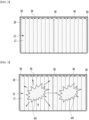
- FIG. 1 is a perspective view of a conventional battery module.
- FIG. 2 is a cross-sectional view taken along the cutting line A-A' of FIG. 1 .
- FIG. 3 is a view showing a cross-section of the battery module of FIG. 2 in which a cell event has occurred.
- the conventional battery module 10 includes a battery cell stack 12 formed by stacking a plurality of battery cells 11, a lower frame 20 on which the battery cell stack 12 is disposed, and an upper plate 30 for covering the upper portion of the battery cell stack 12.
- the battery module 10 further includes an insulating layer 40 formed between the upper plate 30 and the battery cell stack 12.
- the battery module 10 may further comprise a compression pad 50 located between battery cells adjacent to each other among the plurality of battery cells 11 and between the outermost battery cells of the battery cell stack 12 and the side surface portion of the lower frame 20. Accordingly, the compression pad 50 and the plurality of battery cells 11 may form one stack structure, and the compression pad 50 may also absorb the swelling of the battery cells 11.
- the conventional compression pad 50 cannot block ignition or induce a direction of ignition when a cell event such as ignition occurs.
- the conventional battery module 10 may be partially partitioned by the compression pad 50 in the battery cell stack 12.
- a first cell event (ce1) such as ignition occurs in a part of the plurality of battery cells
- the compression pad 50 cannot block the ignition or induce the direction of ignition, so that even for some battery cells in which the first cell event ce1 has not occurred, a second cell event (ce2) to which the first cell event (ce1) has propagated occurs.
- It is an object of the present disclosure is to provide a battery module having a partition wall structure, and a battery pack including the same.
- a battery module comprising: a battery cell stack in which a plurality of battery cells are stacked; a module frame for housing the battery cell stack; and a partition wall portion located between the battery cell stack and the module frame, wherein the partition wall portion comprises a first partition wall member located between the upper portion of the battery cell stack and the module frame, and wherein the partition wall portion comprises at least one second partition wall member extending in a vertical direction from the first partition wall member.
- the at least one second partition wall member is extended up to a lower portion of the module frame, and the battery cell stack is partitioned into a first stack and a second stack by the partition wall portion.
- the partition wall portion may block a cell event generated in the first stack from being diffused to the second stack.
- the partition wall portion may include at least two of the second partition wall members, and the second partition wall members may be located separately from each other so as to have equal intervals in the stacking direction of the battery cell stack.
- the partition wall portion may include at least two of the second partition wall members, and the second partition wall members may be located symmetrically with reference to the center of the battery cell stack.
- the at least one second partition wall member may be located between the outermost battery cell of the battery cell stack and the side portion of the module frame, or may be located between the battery cells adjacent to each other among the plurality of battery cells.
- the partition wall portion may be configured such that the two second partition wall members are respectively located between the outermost battery cells of the battery cell stack and the side portion of the module frame, and the at least one second partition wall member is located between the battery cells adjacent to each other among the plurality of battery cells.
- the partition wall portion may be composed of a functional material having flame retardancy and insulating properties.
- the module frame may include a U-shaped frame that houses the battery cell stack and has an opened upper portion, and an upper plate that covers the battery cell stack in the opened upper portion of the U-shaped frame.
- the first partition wall member is located between the upper plate and the battery cell stack
- the two second partition wall members may be respectively located between the outermost battery cells of the battery cell stack and the side portion of the U-shaped frame
- the at least one second partition wall member may be located between the battery cells adjacent to each other among the plurality of battery cells.
- a battery pack comprising the battery module according to one embodiment of the present disclosure.
- a battery module can be provided in which the battery module includes a partition wall structure to thereby block cell events occurring in some battery cells or induce a propagation direction.
- planar when referred to as “planar”, it means when a target portion is viewed from the upper side, and when referred to as “cross-sectional”, it means when a target portion is viewed from the side of a cross section cut vertically.
- the electrode for a secondary battery according to an embodiment of the present disclosure will be described.
- the description herein is made based on the front surface of the front and rear surfaces of the battery module, without being limited thereto, and even in the case of the rear surface, the same or similar contents may be described.
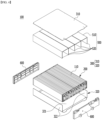
- FIG. 4 is an exploded perspective view showing a battery module according to an embodiment of the present disclosure.
- FIG. 5 is a partial perspective view showing a state in which the components of the battery module of FIG. 4 are combined.
- the partial perspective view of FIG. 5 shows a state in which the upper plate is removed from the battery module of FIG. 4 .
- a battery module 100 includes a battery cell stack 200 in which a plurality of battery cells 110 are stacked, a module frame 300 that houses the battery cell stack 200, a partition wall portion 500 located between the battery cell stack 200 and the module frame 500, and end plates 600 located on the front and rear surfaces of the battery cell stack 200.
- the module frame 300 includes a U-shaped frame 320 including a bottom portion 321 and a side portion 321, of which an upper surface, a front surface and a rear surface are opened, and an upper plate 310 that covers an upper portion of the battery cell stack 200.
- the module frame 300 is not limited thereto, and can be replaced with a frame having another shape such as a mono frame surrounding the battery cell stack 200, except for the L-shaped frame or the front and rear surfaces.
- the battery cell 110 is preferably a pouch-type battery cell.
- the battery cell can be manufactured by housing the electrode assembly in a pouch case of a laminate sheet including a resin layer and a metal layer, and then heat-sealing the sealing portion of the pouch case.
- Such a battery cell 110 may be composed of a plurality of cells, and the plurality of battery cells 110 form a battery cell stack 200 that is stacked so as to be electrically connected to each other.
- a plurality of battery cells 110 may be stacked along a direction parallel to the x-axis.
- the battery module 100 may be a large area module in which the battery cell stack 120 includes a relatively larger number of battery cells than the conventional battery module.
- the length of the battery module in the horizontal direction becomes relatively long.
- the length of the battery module in the horizontal direction may mean the length in the direction in which the battery cells are stacked. Therefore, when the battery module 100 corresponds to a large area module, as the number of battery cells 100 contained in the battery cell stack 200 increases, the heat generated may also increase. Therefore, the battery module 100 needs to prevent an additional cell event from being occurred as a cell event, that is generated in a specific battery cell among the plurality of battery cells 110, propagates to other battery cells.
- the cell event is an emergency situation that occurs in at least one battery cell among the plurality of battery cells 110 contained in the battery module 10, which involves leakage of a battery cell or a battery module, mechanical damage to battery cells, and occurrence of a thermal event that is ignited in response to a temperature rise, and the like.
- the thermal event includes the occurrence of a flame and/or a venting gas by the ignition of the battery cell.
- the thermal event can be particularly diffused in the inside of the battery pack including the battery module 100 and the battery module 100. Thus, there is a risk of raising the temperature of the surrounding battery module or the battery cells 110 in the battery module 100, thereby causing a chain of additional cell events.
- the partition wall portion 500 includes a first partition wall member 510 located between the upper portion of the battery cell stack 200 and the module frame 300, and includes at least one second partition wall member 520 extending in a vertical direction from the first partition wall member 510.
- the partition wall portion 500 may be composed of a functional material having flame retardancy and insulating properties. Consequently, the partition wall portion is excellent in insulation property and flame retardancy when a cell event occurs, and so it can prevent the cell event from becoming severe and inhibit the diffusion of cell events and induce a direction of progression.
- the first partition wall member 510 may have a shape corresponding to the upper plate 310 of the module frame 300.
- the first partition wall member 510 has a shape corresponding to the flat plate, but may have a size corresponding to the upper portion of the battery cell stack 200.
- the second partition wall member 520 is extended from the first partition wall member 510 to the lower portion 321 of the module frame 300. Accordingly, a part of the plurality of battery cells 110 contained in the battery cell stack 200 may be spatially closed by the first partition wall member 510 and the second partition wall member 520.
- the second partition wall member 520 may have a shape corresponding to the side portion 322 of the module frame 300. Further, the second partition wall member 520 may have a shape corresponding to the battery cell 110 of the battery cell stack 200. Preferably, the second partition wall member 520 has a shape corresponding to the flat plate, but may have a size corresponding to an upper surface or a lower surface of the battery cell 110.
- the partition wall portion 500 includes at least two second partition wall members 520, and the second partition wall members 520 are located separately from each other so as to have a predetermined interval in the stacking direction of the battery cell stack.
- the second partition wall members 520 are spaced apart in the stacking direction of the battery cell stack, and the interval between the second partition wall member 520 spaced apart is narrower in a the central region where the battery cells 110 than the battery cells 110 in the outer region. As the heat generated from the battery cell 110 is relatively less cooled in the battery cell 110 in the central region than in the battery cell 110 in the outer region, the probability of occurrence of a thermal event is high, so that the battery module 100 may more effectively control cell events.
- partition wall portion 500 may be configured such that at least one second partition wall member 520 is located between the outermost battery cell of the battery cell stack 200 and the module frame side portion 322, or is located between the battery cells adjacent to each other among the plurality of battery cells 110.
- the partition wall portion 500 may be configured such that two second partition wall members 520 are respectively located between the outermost battery cells of the battery cell stack 200 and the module frame side 322, and at least one second partition wall member 520 is located between the battery cells adjacent to each other among the plurality of battery cells.
- the module frame 300 of the battery module 100 may include a U-shaped frame 320 that houses the battery cell stack 200 and has an opened upper portion, and an upper plate 310 that covers the battery cell stack 200 in the opened upper portion of the U-shaped frame.
- the first partition wall member 510 is located between the upper plate 310 and the battery cell stack 200
- two second partition wall members 520 are respectively located between the outermost battery cells of the battery cell stack 200 and the module frame side portion 322
- at least one second partition wall member 520 may be located between the battery cells adjacent to each other among the plurality of battery cells 110.
- the partition wall portion 500 can protect the outermost battery cells vulnerable to external impact in the battery cell stack 200, and also can more effectively control cell events of the battery cell stack 200.
- FIG. 6 is a perspective view showing a state in which the components constituting the battery module of FIG. 4 are combined.
- FIG. 7 is a cross-sectional view showing a partial area of the cross-section taken along the cutting line B-B' of FIG. 6 .
- FIG. 7 is an enlarged view showing a partial area of the battery cell stack 200 contained in a cross section taken along the cutting line B-B' of FIG. 6 .
- the battery module 100 includes a partition wall portion 500, so that a plurality of battery cells 110 in the battery module 100 can be partitioned.
- the battery cell stack 200 is partitioned into a first stack 111 and a second stack 113 by the partition wall portion 500.
- the first stack 111 and the second stack 113 are electrically connected, but can be spatially separated.
- the first stack 111 and the second stack 113 are spatially separated from each other, but each space can be closed.
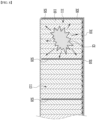
- FIG. 8 is a cross-sectional view showing the battery module of FIG. 7 in which a cell event (CE) has occurred.
- the partition wall portion 500 may block the cell event (CE) from being diffused to the outside of the partition wall portion 500.
- the partition wall portion 500 may block the cell event (CE) from being diffused to the outside of the module frame 300 or the partition in which the second stack 113 is located.
- the partition wall portion 500 can have resistance to flames and venting gases generated in the cell event (CE), thereby preventing the cell event (CE) from being diffused to the outside.
- the battery module 100 of the present disclosure may further include a thermally conductive resin layer (not shown) between the battery cell stack 200 and the partition wall portion 500 as a cooling means.
- a thermally conductive resin layer (not shown) may be further included between the partition wall portion 500 and the module frame 300.
- a thermally conductive resin layer (not shown) may be further included between the battery cell stack 200 and the lower portion of the module frame 321.
- the one or more battery modules according to the present embodiment described above can be mounted together with various control and protection systems such as a battery management system (BMS) and a cooling system to form a battery pack.
- BMS battery management system
- a cooling system to form a battery pack.
- the above-mentioned battery module or the battery pack can be applied to various devices. These devices may be applied to transportation means such as an electric bicycle, an electric vehicle, a hybrid vehicle, but the present disclosure is not limited thereto and can be applied to various devices that can use the battery module or the battery pack including the same.
Landscapes
- Chemical & Material Sciences (AREA)
- Chemical Kinetics & Catalysis (AREA)
- Electrochemistry (AREA)
- General Chemical & Material Sciences (AREA)
- Engineering & Computer Science (AREA)
- Manufacturing & Machinery (AREA)
- Battery Mounting, Suspending (AREA)
- Secondary Cells (AREA)
Description
- The present disclosure relates to a battery module and a battery pack including the same, and more particularly, to a battery module having a partition wall structure, and a battery pack including the same.
- As technology development and demands for mobile devices increase, the demand for batteries as energy sources is rapidly increasing. In particular, a secondary battery has attracted considerable attention as an energy source for power-driven devices, such as an electric bicycle, an electric vehicle, and a hybrid electric vehicle, as well as an energy source for mobile devices, such as a mobile phone, a digital camera, a laptop computer and a wearable device.
- Small-sized mobile devices use one or several battery cells for each device, whereas middle- or large-sized devices such as vehicles require high power and large capacity. The middle or large-sized battery module is preferably manufactured so as to have as small a size and weight as possible. Consequently, a prismatic battery, a pouch-shaped battery or the like, which can be stacked with high integration and has a small weight relative to capacity, is usually used as a battery cell of the middle or large-sized battery module. Therefore, a middle- or large-sized battery module in which a large number of battery cells are electrically connected is used, and there is an increasing need to install more battery cells in the battery module gradually.
-
US 2015/295212 andUS 2020/099114 disclose a battery module. - Further, when the temperature of the secondary battery is higher than an appropriate temperature, the performance of the secondary battery may be deteriorated, and if it is severe, a cell event may occur. As an example, there is also a risk of occurrence of a thermal event such as an explosion or ignition. In particular, a large number of secondary batteries, that is, a battery module or a battery pack having a battery cell, can add up the heat generated from the large number of battery cells in a narrow space, so that the temperature can rise more quickly and severely. In the case of a battery module in which a large number of battery cells are stacked and a battery pack equipped with such a battery module, high output can be obtained, but as the number of battery cells increases, the possibility of explosion or ignition also increases. Moreover, in the case of a middle- or large-sized battery module included in a vehicle battery pack, it is frequently exposed to direct sunlight and can be subjected to high temperature conditions such as summer or desert areas. Consequently, when explosion or ignition occurs in the battery module, it is necessary to prevent the ignition from being transferred to another battery cell in a specific battery cell and so prevent further ignition from proceeding.
-
FIG. 1 is a perspective view of a conventional battery module.FIG. 2 is a cross-sectional view taken along the cutting line A-A' ofFIG. 1 .FIG. 3 is a view showing a cross-section of the battery module ofFIG. 2 in which a cell event has occurred. - Referring to
FIGS. 1 and2 , theconventional battery module 10 includes abattery cell stack 12 formed by stacking a plurality ofbattery cells 11, alower frame 20 on which thebattery cell stack 12 is disposed, and anupper plate 30 for covering the upper portion of thebattery cell stack 12. In addition, for the insulation of thebattery cell stack 12, thebattery module 10 further includes aninsulating layer 40 formed between theupper plate 30 and thebattery cell stack 12. - In this case, the
battery module 10 may further comprise acompression pad 50 located between battery cells adjacent to each other among the plurality ofbattery cells 11 and between the outermost battery cells of thebattery cell stack 12 and the side surface portion of thelower frame 20. Accordingly, thecompression pad 50 and the plurality ofbattery cells 11 may form one stack structure, and thecompression pad 50 may also absorb the swelling of thebattery cells 11. However, theconventional compression pad 50 cannot block ignition or induce a direction of ignition when a cell event such as ignition occurs. - As an example, referring to
FIGS. 2 and 3 , theconventional battery module 10 may be partially partitioned by thecompression pad 50 in thebattery cell stack 12. However, when a first cell event (ce1) such as ignition occurs in a part of the plurality of battery cells, thecompression pad 50 cannot block the ignition or induce the direction of ignition, so that even for some battery cells in which the first cell event ce1 has not occurred, a second cell event (ce2) to which the first cell event (ce1) has propagated occurs. - Thereby, in the
conventional battery module 10, when a cell event such as ignition occurs in some battery cells of thebattery cell stack 12, an ignition phenomenon may propagate to other battery cells included in thebattery module 10, and thus, there is a problem in that the cell event may become more serious. - Therefore, in the trend that a demand such as an increase in capacity for a battery module continues, it is practically necessary to develop a battery module that can satisfy these various requirements together while improving cooling performance.
- It is an object of the present disclosure is to provide a battery module having a partition wall structure, and a battery pack including the same.
- The objects of the present disclosure are not limited to the aforementioned objects, and other objects which are not described herein should be clearly understood by those skilled in the art from the following detailed description and the accompanying drawings.
- The invention is given by the claims, and there is provided a battery module comprising: a battery cell stack in which a plurality of battery cells are stacked; a module frame for housing the battery cell stack; and a partition wall portion located between the battery cell stack and the module frame, wherein the partition wall portion comprises a first partition wall member located between the upper portion of the battery cell stack and the module frame, and wherein the partition wall portion comprises at least one second partition wall member extending in a vertical direction from the first partition wall member.
- The at least one second partition wall member is extended up to a lower portion of the module frame, and the battery cell stack is partitioned into a first stack and a second stack by the partition wall portion.
- The partition wall portion may block a cell event generated in the first stack from being diffused to the second stack.
- The partition wall portion may include at least two of the second partition wall members, and the second partition wall members may be located separately from each other so as to have equal intervals in the stacking direction of the battery cell stack.
- The partition wall portion may include at least two of the second partition wall members, and the second partition wall members may be located symmetrically with reference to the center of the battery cell stack.
- The at least one second partition wall member may be located between the outermost battery cell of the battery cell stack and the side portion of the module frame, or may be located between the battery cells adjacent to each other among the plurality of battery cells.
- The partition wall portion may be configured such that the two second partition wall members are respectively located between the outermost battery cells of the battery cell stack and the side portion of the module frame, and the at least one second partition wall member is located between the battery cells adjacent to each other among the plurality of battery cells.
- The partition wall portion may be composed of a functional material having flame retardancy and insulating properties.
- The module frame may include a U-shaped frame that houses the battery cell stack and has an opened upper portion, and an upper plate that covers the battery cell stack in the opened upper portion of the U-shaped frame.
- The first partition wall member is located between the upper plate and the battery cell stack, the two second partition wall members may be respectively located between the outermost battery cells of the battery cell stack and the side portion of the U-shaped frame, and the at least one second partition wall member may be located between the battery cells adjacent to each other among the plurality of battery cells.
- In addition, there can be provided a battery pack comprising the battery module according to one embodiment of the present disclosure.
- According to the invention as given in the claims a battery module can be provided in which the battery module includes a partition wall structure to thereby block cell events occurring in some battery cells or induce a propagation direction.
- Effects of the present disclosure may not be limited to the above-mentioned effects, and other effects of the present disclosure will be clearly understandable to those having ordinary skill in the art from the disclosures provided below together with accompanying drawings.
-
-
FIG. 1 is a perspective view of a conventional battery module. -
FIG. 2 is a cross-sectional view taken along the cutting line A-A' ofFIG. 1 . -
FIG. 3 is a view showing a cross-section of the battery module ofFIG. 2 in which a cell event has occurred. -
FIG. 4 is an exploded perspective view showing a battery module according to an embodiment of the present disclosure. -
FIG. 5 is a partial perspective view showing a state in which the components of the battery module ofFIG. 4 are combined. -
FIG. 6 is a perspective view showing a state in which the components constituting the battery module ofFIG. 4 are combined. -
FIG. 7 is a cross-sectional view showing a partial area of the cross-section taken along the cutting line B-B' ofFIG. 6 . -
FIG. 8 is a cross-sectional view showing the battery module ofFIG. 7 in which a cell event has occurred. - Hereinafter, various embodiments of the present disclosure will be described in detail with reference to the accompanying drawings so that those skilled in the art can easily carry out them. The present disclosure may be modified in various different ways, and is not limited to the embodiments set forth herein.
- Hereinafter, various embodiments of the present disclosure will be described in detail with reference to the accompanying drawings so that those skilled in the art can easily carry out them. The present disclosure may be modified in various different ways, and is not limited to the embodiments set forth herein.
- Portions that are irrelevant to the description will be omitted to clearly describe the present disclosure, and like reference numerals designate like elements throughout the specification.
- Further, in the figures, the size and thickness of each element are arbitrarily illustrated for convenience of description, and the present disclosure is not necessarily limited to those illustrated in the figures. In the figures, the thickness of layers, regions, etc. are exaggerated for clarity. In the figures, for convenience of description, the thicknesses of some layers and regions are shown to be exaggerated.
- Further, throughout the specification, when a portion is referred to as "including" a certain component, it means that the portion can further include other components, without excluding the other components, unless otherwise stated.
- Further, throughout the specification, when referred to as "planar", it means when a target portion is viewed from the upper side, and when referred to as "cross-sectional", it means when a target portion is viewed from the side of a cross section cut vertically.
- In the following, the electrode for a secondary battery according to an embodiment of the present disclosure will be described. However, the description herein is made based on the front surface of the front and rear surfaces of the battery module, without being limited thereto, and even in the case of the rear surface, the same or similar contents may be described.
-
FIG. 4 is an exploded perspective view showing a battery module according to an embodiment of the present disclosure.FIG. 5 is a partial perspective view showing a state in which the components of the battery module ofFIG. 4 are combined. The partial perspective view ofFIG. 5 shows a state in which the upper plate is removed from the battery module ofFIG. 4 . - Referring to
FIGS. 4 and5 , abattery module 100 according to an embodiment of the present disclosure includes abattery cell stack 200 in which a plurality ofbattery cells 110 are stacked, amodule frame 300 that houses thebattery cell stack 200, apartition wall portion 500 located between thebattery cell stack 200 and themodule frame 500, andend plates 600 located on the front and rear surfaces of thebattery cell stack 200. - The
module frame 300 includes aU-shaped frame 320 including abottom portion 321 and aside portion 321, of which an upper surface, a front surface and a rear surface are opened, and anupper plate 310 that covers an upper portion of thebattery cell stack 200. However, themodule frame 300 is not limited thereto, and can be replaced with a frame having another shape such as a mono frame surrounding thebattery cell stack 200, except for the L-shaped frame or the front and rear surfaces. - The
battery cell 110 is preferably a pouch-type battery cell. The battery cell can be manufactured by housing the electrode assembly in a pouch case of a laminate sheet including a resin layer and a metal layer, and then heat-sealing the sealing portion of the pouch case. Such abattery cell 110 may be composed of a plurality of cells, and the plurality ofbattery cells 110 form abattery cell stack 200 that is stacked so as to be electrically connected to each other. In particular, as shown inFIG. 4 , a plurality ofbattery cells 110 may be stacked along a direction parallel to the x-axis. - However, the
battery module 100 according to an embodiment of the present disclosure may be a large area module in which the battery cell stack 120 includes a relatively larger number of battery cells than the conventional battery module. In the case of a large area module, the length of the battery module in the horizontal direction becomes relatively long. Here, the length of the battery module in the horizontal direction may mean the length in the direction in which the battery cells are stacked. Therefore, when thebattery module 100 corresponds to a large area module, as the number ofbattery cells 100 contained in thebattery cell stack 200 increases, the heat generated may also increase. Therefore, thebattery module 100 needs to prevent an additional cell event from being occurred as a cell event, that is generated in a specific battery cell among the plurality ofbattery cells 110, propagates to other battery cells. - Here, the cell event is an emergency situation that occurs in at least one battery cell among the plurality of
battery cells 110 contained in thebattery module 10, which involves leakage of a battery cell or a battery module, mechanical damage to battery cells, and occurrence of a thermal event that is ignited in response to a temperature rise, and the like. In particular, the thermal event includes the occurrence of a flame and/or a venting gas by the ignition of the battery cell. The thermal event can be particularly diffused in the inside of the battery pack including thebattery module 100 and thebattery module 100. Thus, there is a risk of raising the temperature of the surrounding battery module or thebattery cells 110 in thebattery module 100, thereby causing a chain of additional cell events. - Referring to
FIGS. 4 and5 , thepartition wall portion 500 according to an embodiment of the present disclosure includes a firstpartition wall member 510 located between the upper portion of thebattery cell stack 200 and themodule frame 300, and includes at least one secondpartition wall member 520 extending in a vertical direction from the firstpartition wall member 510. Here, thepartition wall portion 500 may be composed of a functional material having flame retardancy and insulating properties. Consequently, the partition wall portion is excellent in insulation property and flame retardancy when a cell event occurs, and so it can prevent the cell event from becoming severe and inhibit the diffusion of cell events and induce a direction of progression. - The first
partition wall member 510 may have a shape corresponding to theupper plate 310 of themodule frame 300. Preferably, the firstpartition wall member 510 has a shape corresponding to the flat plate, but may have a size corresponding to the upper portion of thebattery cell stack 200. - The second
partition wall member 520 is extended from the firstpartition wall member 510 to thelower portion 321 of themodule frame 300. Accordingly, a part of the plurality ofbattery cells 110 contained in thebattery cell stack 200 may be spatially closed by the firstpartition wall member 510 and the secondpartition wall member 520. - Further, the second
partition wall member 520 may have a shape corresponding to theside portion 322 of themodule frame 300. Further, the secondpartition wall member 520 may have a shape corresponding to thebattery cell 110 of thebattery cell stack 200. Preferably, the secondpartition wall member 520 has a shape corresponding to the flat plate, but may have a size corresponding to an upper surface or a lower surface of thebattery cell 110. - The
partition wall portion 500 includes at least two secondpartition wall members 520, and the secondpartition wall members 520 are located separately from each other so as to have a predetermined interval in the stacking direction of the battery cell stack. - According to the present invention, the second
partition wall members 520 are spaced apart in the stacking direction of the battery cell stack, and the interval between the secondpartition wall member 520 spaced apart is narrower in a the central region where thebattery cells 110 than thebattery cells 110 in the outer region. As the heat generated from thebattery cell 110 is relatively less cooled in thebattery cell 110 in the central region than in thebattery cell 110 in the outer region, the probability of occurrence of a thermal event is high, so that thebattery module 100 may more effectively control cell events. - In addition, the
partition wall portion 500 may be configured such that at least one secondpartition wall member 520 is located between the outermost battery cell of thebattery cell stack 200 and the moduleframe side portion 322, or is located between the battery cells adjacent to each other among the plurality ofbattery cells 110. - As an example, the
partition wall portion 500 may be configured such that two secondpartition wall members 520 are respectively located between the outermost battery cells of thebattery cell stack 200 and themodule frame side 322, and at least one secondpartition wall member 520 is located between the battery cells adjacent to each other among the plurality of battery cells. - As an example, the
module frame 300 of thebattery module 100 may include aU-shaped frame 320 that houses thebattery cell stack 200 and has an opened upper portion, and anupper plate 310 that covers thebattery cell stack 200 in the opened upper portion of the U-shaped frame. At this time, the firstpartition wall member 510 is located between theupper plate 310 and thebattery cell stack 200, two secondpartition wall members 520 are respectively located between the outermost battery cells of thebattery cell stack 200 and the moduleframe side portion 322, and at least one secondpartition wall member 520 may be located between the battery cells adjacent to each other among the plurality ofbattery cells 110. - Thereby, the
partition wall portion 500 can protect the outermost battery cells vulnerable to external impact in thebattery cell stack 200, and also can more effectively control cell events of thebattery cell stack 200. -
FIG. 6 is a perspective view showing a state in which the components constituting the battery module ofFIG. 4 are combined.FIG. 7 is a cross-sectional view showing a partial area of the cross-section taken along the cutting line B-B' ofFIG. 6 . In particular,FIG. 7 is an enlarged view showing a partial area of thebattery cell stack 200 contained in a cross section taken along the cutting line B-B' ofFIG. 6 . - Referring to
FIGS. 4 ,5 , and7 , thebattery module 100 according to an embodiment of the present disclosure includes apartition wall portion 500, so that a plurality ofbattery cells 110 in thebattery module 100 can be partitioned. According to the invention, thebattery cell stack 200 is partitioned into afirst stack 111 and asecond stack 113 by thepartition wall portion 500. At this time, thefirst stack 111 and thesecond stack 113 are electrically connected, but can be spatially separated. Preferably, thefirst stack 111 and thesecond stack 113 are spatially separated from each other, but each space can be closed. -
FIG. 8 is a cross-sectional view showing the battery module ofFIG. 7 in which a cell event (CE) has occurred. Referring toFIGS. 7 and8 , when a cell event (CE) is occurred in thefirst stack 111, thepartition wall portion 500 may block the cell event (CE) from being diffused to the outside of thepartition wall portion 500. As an example, even if a cell event (CE) is occurred in thefirst stack 111, thepartition wall portion 500 may block the cell event (CE) from being diffused to the outside of themodule frame 300 or the partition in which thesecond stack 113 is located. Thus, thepartition wall portion 500 can have resistance to flames and venting gases generated in the cell event (CE), thereby preventing the cell event (CE) from being diffused to the outside. - Consequently, even if a cell event occurs in a
specific battery cell 110, it can prevent diffusion toother battery cells 110 and thus reduce the risk of occurrence of an additional cell event. Further, when a cell event occurs in aspecific battery cell 110, it is possible to induce the progression direction of the cell event only for the compartment in which thespecific battery cell 110 is included, and thus prevent cell events from becoming severe. In addition, for the compartment including thespecific battery cell 110 in which the cell event has occurred, the source in which the cell event has occurred can be quickly tracked and thus, product maintenance can be facilitated. - If necessary, the
battery module 100 of the present disclosure may further include a thermally conductive resin layer (not shown) between thebattery cell stack 200 and thepartition wall portion 500 as a cooling means. Alternatively, a thermally conductive resin layer (not shown) may be further included between thepartition wall portion 500 and themodule frame 300. Alternatively, a thermally conductive resin layer (not shown) may be further included between thebattery cell stack 200 and the lower portion of themodule frame 321. Thereby, thebattery module 100 of the present disclosure can prevent a cell event from occurring. - The one or more battery modules according to the present embodiment described above can be mounted together with various control and protection systems such as a battery management system (BMS) and a cooling system to form a battery pack.
- The above-mentioned battery module or the battery pack can be applied to various devices. These devices may be applied to transportation means such as an electric bicycle, an electric vehicle, a hybrid vehicle, but the present disclosure is not limited thereto and can be applied to various devices that can use the battery module or the battery pack including the same.
Claims (10)
- A battery module (100) comprising:a battery cell stack (200) in which a plurality of battery cells (110) are stacked;a module frame (300) for housing the battery cell stack (200); anda partition wall portion (500) located between the battery cell stack (200) and the module frame (300),wherein the partition wall portion (500) comprises a first partition wall member (510) located between the upper portion of the battery cell stack (200) and the module frame (300), andwherein the partition wall portion (500) comprises at least two second partition wall members (520) extending in a vertical direction from the first partition wall member (510),wherein the at least two second partition wall members (520) are extended up to a lower portion (321) of the module frame (300),the second partition wall members (520) are located separately from each other so as to have a predetermined interval in the stacking direction of the battery cell stack (200), andthe second partition wall members (520) in a central region of the battery stack (200) are spaced apart by a narrower interval than in an outer region of the battery stack (200).
- The battery module (100) of claim 1,
wherein the partition wall portion (500) blocks a cell event generated in the first stack (111) from being diffused to the second stack (113). - The battery module (100) of claim 1,
wherein the partition wall portion (500) comprises at least two of the second partition wall members (520), and the second partition wall members (520) are located separately from each other so as to have equal intervals in the stacking direction of the battery cell stack (200). - The battery module (100) of claim 1,
wherein the partition wall portion (500) comprises at least two of the second partition wall members (520), and the second partition wall members (520) are located symmetrically with reference to the center of the battery cell stack (200). - The battery module (100) of claim 1,
wherein the at least one second partition wall member (520) is located between the outermost battery cell (110) of the battery cell stack (200) and the side portion of the module frame (300), or is located between the battery cells (110) adjacent to each other among the plurality of battery cells (110). - The battery module (100) of claim 1,wherein the partition wall portion (500) is configured such that the two second partition wall members (520) are respectively located between the outermost battery cells (110) of the battery cell stack (200) and the side portion of the module frame (300), andthe at least one second partition wall member (520) is located between the battery cells (110) adjacent to each other among the plurality of battery cells (110).
- The battery module of claim 1,
wherein the partition wall portion (500) is composed of a functional material having flame retardancy and insulating properties. - The battery module of claim 1,
wherein the module frame (300) comprises a U-shaped frame that houses the battery cell stack (200) and has an opened upper portion, and an upper plate (310) that covers the battery cell stack (200) in the opened upper portion of the U-shaped frame. - The battery module of claim 8,wherein the first partition wall member (510) is located between the upper plate (310) and the battery cell stack (200),the two second partition wall members (520) are respectively located between the outermost battery cells of the battery cell stack (200) and the side portion of the U-shaped frame, and the at least one second partition wall member (520) is located between the battery cells (110) adjacent to each other among the plurality of battery cells (110).
- A battery pack comprising the battery module (100) as set forth in claim 1.
Applications Claiming Priority (2)
| Application Number | Priority Date | Filing Date | Title |
|---|---|---|---|
| KR1020200052262A KR102673791B1 (en) | 2020-04-29 | 2020-04-29 | Battery module and battery pack including the same |
| PCT/KR2021/002927 WO2021221299A1 (en) | 2020-04-29 | 2021-03-09 | Battery module and battery pack comprising same |
Publications (3)
| Publication Number | Publication Date |
|---|---|
| EP3958381A1 EP3958381A1 (en) | 2022-02-23 |
| EP3958381A4 EP3958381A4 (en) | 2022-09-28 |
| EP3958381B1 true EP3958381B1 (en) | 2025-04-30 |
Family
ID=78374159
Family Applications (1)
| Application Number | Title | Priority Date | Filing Date |
|---|---|---|---|
| EP21797486.4A Active EP3958381B1 (en) | 2020-04-29 | 2021-03-09 | Battery module and battery pack including the same |
Country Status (9)
| Country | Link |
|---|---|
| US (1) | US20220231367A1 (en) |
| EP (1) | EP3958381B1 (en) |
| JP (1) | JP7450894B2 (en) |
| KR (1) | KR102673791B1 (en) |
| CN (1) | CN113906617A (en) |
| ES (1) | ES3030333T3 (en) |
| HU (1) | HUE071837T2 (en) |
| PL (1) | PL3958381T3 (en) |
| WO (1) | WO2021221299A1 (en) |
Families Citing this family (6)
| Publication number | Priority date | Publication date | Assignee | Title |
|---|---|---|---|---|
| EP4395034A4 (en) * | 2021-12-30 | 2024-12-18 | BYD Company Limited | BATTERY MODULE, BATTERY PACK AND VEHICLE |
| EP4322289A4 (en) * | 2022-03-31 | 2025-01-01 | LG Energy Solution, Ltd. | Battery module with enhanced safety |
| KR20230171734A (en) * | 2022-06-14 | 2023-12-21 | 현대모비스 주식회사 | Housing for battery system and battery system having the same |
| WO2024112089A1 (en) * | 2022-11-21 | 2024-05-30 | 주식회사 엘지에너지솔루션 | Battery pack |
| US20260005380A1 (en) * | 2022-12-23 | 2026-01-01 | Lg Energy Solution, Ltd. | Battery pack and vehicle including the same |
| CN121773516A (en) * | 2023-08-04 | 2026-03-31 | 迪赞沃克技术股份公司 | Battery pack |
Family Cites Families (17)
| Publication number | Priority date | Publication date | Assignee | Title |
|---|---|---|---|---|
| US7964300B2 (en) * | 2005-09-30 | 2011-06-21 | Tdk-Lambda Corporation | Battery pack |
| KR100948002B1 (en) * | 2006-03-06 | 2010-03-18 | 주식회사 엘지화학 | Medium and large battery module |
| JP5639835B2 (en) * | 2010-09-30 | 2014-12-10 | 株式会社リチウムエナジージャパン | Battery pack and electric vehicle equipped with the same |
| JP5978847B2 (en) | 2012-08-09 | 2016-08-24 | 株式会社豊田自動織機 | Battery pack |
| CN105531846B (en) * | 2013-10-31 | 2019-04-05 | 松下知识产权经营株式会社 | battery module |
| KR102258973B1 (en) * | 2013-10-31 | 2021-06-02 | 타이코에이엠피 주식회사 | A sensing block and a battery package comprising thereof |
| KR102224026B1 (en) * | 2014-04-14 | 2021-03-05 | 삼성에스디아이 주식회사 | Packing container for rechargeable battery |
| US10650508B2 (en) | 2014-12-03 | 2020-05-12 | Kla-Tencor Corporation | Automatic defect classification without sampling and feature selection |
| WO2017138793A1 (en) * | 2016-02-12 | 2017-08-17 | 주식회사 엘지화학 | Cell module assembly receiving structure having improved safety |
| WO2018003478A1 (en) * | 2016-06-29 | 2018-01-04 | パナソニックIpマネジメント株式会社 | Battery module |
| CN206349470U (en) * | 2016-12-02 | 2017-07-21 | 广州极飞科技有限公司 | Battery modules and with its unmanned plane |
| WO2018099327A1 (en) * | 2016-12-02 | 2018-06-07 | 广州极飞科技有限公司 | Unmanned aerial vehicle, battery module, and charging control method |
| US10601003B2 (en) * | 2017-10-30 | 2020-03-24 | Lg Chem, Ltd. | Battery module and method of assembling the battery module |
| EP3748716B1 (en) * | 2018-01-31 | 2026-03-04 | Panasonic Energy Co., Ltd. | Battery pack |
| KR102282482B1 (en) * | 2018-02-06 | 2021-07-26 | 주식회사 엘지에너지솔루션 | Battery module and battery pack including the same |
| KR102703855B1 (en) * | 2018-08-21 | 2024-09-05 | 에스케이온 주식회사 | Battery module and Manufacturing method of the same |
| US12230820B2 (en) | 2019-01-09 | 2025-02-18 | Byd Company Limited | Power battery pack and electric vehicle |
-
2020
- 2020-04-29 KR KR1020200052262A patent/KR102673791B1/en active Active
-
2021
- 2021-03-09 CN CN202180003639.3A patent/CN113906617A/en active Pending
- 2021-03-09 WO PCT/KR2021/002927 patent/WO2021221299A1/en not_active Ceased
- 2021-03-09 US US17/615,435 patent/US20220231367A1/en active Pending
- 2021-03-09 HU HUE21797486A patent/HUE071837T2/en unknown
- 2021-03-09 ES ES21797486T patent/ES3030333T3/en active Active
- 2021-03-09 JP JP2021569543A patent/JP7450894B2/en active Active
- 2021-03-09 PL PL21797486.4T patent/PL3958381T3/en unknown
- 2021-03-09 EP EP21797486.4A patent/EP3958381B1/en active Active
Also Published As
| Publication number | Publication date |
|---|---|
| JP7450894B2 (en) | 2024-03-18 |
| HUE071837T2 (en) | 2025-09-28 |
| ES3030333T3 (en) | 2025-06-27 |
| CN113906617A (en) | 2022-01-07 |
| PL3958381T3 (en) | 2025-07-14 |
| KR20210133539A (en) | 2021-11-08 |
| US20220231367A1 (en) | 2022-07-21 |
| JP2022534701A (en) | 2022-08-03 |
| EP3958381A1 (en) | 2022-02-23 |
| EP3958381A4 (en) | 2022-09-28 |
| WO2021221299A1 (en) | 2021-11-04 |
| KR102673791B1 (en) | 2024-06-07 |
Similar Documents
| Publication | Publication Date | Title |
|---|---|---|
| EP3958381B1 (en) | Battery module and battery pack including the same | |
| US12519173B2 (en) | Battery module and battery pack including the same | |
| US12288858B2 (en) | Battery module and battery pack including the same | |
| KR102941254B1 (en) | Battery module and battery pack including the same | |
| US12614764B2 (en) | Battery module and battery pack including the same | |
| EP4170779A1 (en) | Battery module and battery pack including same | |
| US20230046419A1 (en) | Battery pack and device including the same | |
| US12573712B2 (en) | Battery module and battery pack including the same | |
| CN119013831A (en) | Battery module and battery pack including the same | |
| EP3961791A1 (en) | Battery module and battery pack including same | |
| KR20230030413A (en) | Battery module and battery pack including the same | |
| CN222029271U (en) | Battery module and battery pack including the same | |
| EP4142021B1 (en) | Battery module and battery pack including the same | |
| US20240347846A1 (en) | Battery pack and device including the same | |
| EP4131617B1 (en) | Battery module and battery pack including same | |
| EP4181290A1 (en) | Battery module and battery pack including same | |
| EP4250452A1 (en) | Battery pack and device including same | |
| EP4604297A1 (en) | Battery pack and device including same | |
| EP4645531A1 (en) | Battery module and battery pack including same | |
| EP4697473A1 (en) | Battery module and battery pack including same | |
| EP4712210A1 (en) | Battery module | |
| EP4478509A1 (en) | Battery pack and device including same | |
| EP4175025A1 (en) | Battery pack and device including same | |
| EP4648181A1 (en) | Battery module and battery pack including same | |
| KR20250141624A (en) | Battery assembly and battery pack including the same |
Legal Events
| Date | Code | Title | Description |
|---|---|---|---|
| STAA | Information on the status of an ep patent application or granted ep patent |
Free format text: STATUS: THE INTERNATIONAL PUBLICATION HAS BEEN MADE |
|
| PUAI | Public reference made under article 153(3) epc to a published international application that has entered the european phase |
Free format text: ORIGINAL CODE: 0009012 |
|
| STAA | Information on the status of an ep patent application or granted ep patent |
Free format text: STATUS: REQUEST FOR EXAMINATION WAS MADE |
|
| 17P | Request for examination filed |
Effective date: 20211117 |
|
| AK | Designated contracting states |
Kind code of ref document: A1 Designated state(s): AL AT BE BG CH CY CZ DE DK EE ES FI FR GB GR HR HU IE IS IT LI LT LU LV MC MK MT NL NO PL PT RO RS SE SI SK SM TR |
|
| RAP3 | Party data changed (applicant data changed or rights of an application transferred) |
Owner name: LG ENERGY SOLUTION, LTD. |
|
| A4 | Supplementary search report drawn up and despatched |
Effective date: 20220829 |
|
| RIC1 | Information provided on ipc code assigned before grant |
Ipc: H01M 50/24 20210101ALI20220823BHEP Ipc: H01M 50/20 20210101AFI20220823BHEP |
|
| DAV | Request for validation of the european patent (deleted) | ||
| DAX | Request for extension of the european patent (deleted) | ||
| STAA | Information on the status of an ep patent application or granted ep patent |
Free format text: STATUS: EXAMINATION IS IN PROGRESS |
|
| 17Q | First examination report despatched |
Effective date: 20231116 |
|
| GRAP | Despatch of communication of intention to grant a patent |
Free format text: ORIGINAL CODE: EPIDOSNIGR1 |
|
| STAA | Information on the status of an ep patent application or granted ep patent |
Free format text: STATUS: GRANT OF PATENT IS INTENDED |
|
| INTG | Intention to grant announced |
Effective date: 20241120 |
|
| P01 | Opt-out of the competence of the unified patent court (upc) registered |
Free format text: CASE NUMBER: APP_65649/2024 Effective date: 20241212 |
|
| GRAS | Grant fee paid |
Free format text: ORIGINAL CODE: EPIDOSNIGR3 |
|
| GRAA | (expected) grant |
Free format text: ORIGINAL CODE: 0009210 |
|
| STAA | Information on the status of an ep patent application or granted ep patent |
Free format text: STATUS: THE PATENT HAS BEEN GRANTED |
|
| AK | Designated contracting states |
Kind code of ref document: B1 Designated state(s): AL AT BE BG CH CY CZ DE DK EE ES FI FR GB GR HR HU IE IS IT LI LT LU LV MC MK MT NL NO PL PT RO RS SE SI SK SM TR |
|
| REG | Reference to a national code |
Ref country code: CH Ref legal event code: EP Ref country code: GB Ref legal event code: FG4D |
|
| REG | Reference to a national code |
Ref country code: DE Ref legal event code: R096 Ref document number: 602021030104 Country of ref document: DE |
|
| REG | Reference to a national code |
Ref country code: IE Ref legal event code: FG4D |
|
| REG | Reference to a national code |
Ref country code: ES Ref legal event code: FG2A Ref document number: 3030333 Country of ref document: ES Kind code of ref document: T3 Effective date: 20250627 |
|
| REG | Reference to a national code |
Ref country code: SE Ref legal event code: TRGR |
|
| REG | Reference to a national code |
Ref country code: NL Ref legal event code: MP Effective date: 20250430 |
|
| REG | Reference to a national code |
Ref country code: AT Ref legal event code: MK05 Ref document number: 1790961 Country of ref document: AT Kind code of ref document: T Effective date: 20250430 |
|
| REG | Reference to a national code |
Ref country code: HU Ref legal event code: AG4A Ref document number: E071837 Country of ref document: HU |
|
| PG25 | Lapsed in a contracting state [announced via postgrant information from national office to epo] |
Ref country code: PT Free format text: LAPSE BECAUSE OF FAILURE TO SUBMIT A TRANSLATION OF THE DESCRIPTION OR TO PAY THE FEE WITHIN THE PRESCRIBED TIME-LIMIT Effective date: 20250901 Ref country code: FI Free format text: LAPSE BECAUSE OF FAILURE TO SUBMIT A TRANSLATION OF THE DESCRIPTION OR TO PAY THE FEE WITHIN THE PRESCRIBED TIME-LIMIT Effective date: 20250430 |
|
| REG | Reference to a national code |
Ref country code: LT Ref legal event code: MG9D |
|
| PG25 | Lapsed in a contracting state [announced via postgrant information from national office to epo] |
Ref country code: GR Free format text: LAPSE BECAUSE OF FAILURE TO SUBMIT A TRANSLATION OF THE DESCRIPTION OR TO PAY THE FEE WITHIN THE PRESCRIBED TIME-LIMIT Effective date: 20250731 Ref country code: NO Free format text: LAPSE BECAUSE OF FAILURE TO SUBMIT A TRANSLATION OF THE DESCRIPTION OR TO PAY THE FEE WITHIN THE PRESCRIBED TIME-LIMIT Effective date: 20250730 |
|
| PG25 | Lapsed in a contracting state [announced via postgrant information from national office to epo] |
Ref country code: NL Free format text: LAPSE BECAUSE OF FAILURE TO SUBMIT A TRANSLATION OF THE DESCRIPTION OR TO PAY THE FEE WITHIN THE PRESCRIBED TIME-LIMIT Effective date: 20250430 |
|
| PG25 | Lapsed in a contracting state [announced via postgrant information from national office to epo] |
Ref country code: BG Free format text: LAPSE BECAUSE OF FAILURE TO SUBMIT A TRANSLATION OF THE DESCRIPTION OR TO PAY THE FEE WITHIN THE PRESCRIBED TIME-LIMIT Effective date: 20250430 |
|
| PG25 | Lapsed in a contracting state [announced via postgrant information from national office to epo] |
Ref country code: HR Free format text: LAPSE BECAUSE OF FAILURE TO SUBMIT A TRANSLATION OF THE DESCRIPTION OR TO PAY THE FEE WITHIN THE PRESCRIBED TIME-LIMIT Effective date: 20250430 |
|
| PG25 | Lapsed in a contracting state [announced via postgrant information from national office to epo] |
Ref country code: AT Free format text: LAPSE BECAUSE OF FAILURE TO SUBMIT A TRANSLATION OF THE DESCRIPTION OR TO PAY THE FEE WITHIN THE PRESCRIBED TIME-LIMIT Effective date: 20250430 |
|
| PG25 | Lapsed in a contracting state [announced via postgrant information from national office to epo] |
Ref country code: RS Free format text: LAPSE BECAUSE OF FAILURE TO SUBMIT A TRANSLATION OF THE DESCRIPTION OR TO PAY THE FEE WITHIN THE PRESCRIBED TIME-LIMIT Effective date: 20250731 |
|
| PG25 | Lapsed in a contracting state [announced via postgrant information from national office to epo] |
Ref country code: IS Free format text: LAPSE BECAUSE OF FAILURE TO SUBMIT A TRANSLATION OF THE DESCRIPTION OR TO PAY THE FEE WITHIN THE PRESCRIBED TIME-LIMIT Effective date: 20250830 |
|
| PG25 | Lapsed in a contracting state [announced via postgrant information from national office to epo] |
Ref country code: LV Free format text: LAPSE BECAUSE OF FAILURE TO SUBMIT A TRANSLATION OF THE DESCRIPTION OR TO PAY THE FEE WITHIN THE PRESCRIBED TIME-LIMIT Effective date: 20250430 |
|
| PG25 | Lapsed in a contracting state [announced via postgrant information from national office to epo] |
Ref country code: SM Free format text: LAPSE BECAUSE OF FAILURE TO SUBMIT A TRANSLATION OF THE DESCRIPTION OR TO PAY THE FEE WITHIN THE PRESCRIBED TIME-LIMIT Effective date: 20250430 Ref country code: DK Free format text: LAPSE BECAUSE OF FAILURE TO SUBMIT A TRANSLATION OF THE DESCRIPTION OR TO PAY THE FEE WITHIN THE PRESCRIBED TIME-LIMIT Effective date: 20250430 |
|
| PG25 | Lapsed in a contracting state [announced via postgrant information from national office to epo] |
Ref country code: CZ Free format text: LAPSE BECAUSE OF FAILURE TO SUBMIT A TRANSLATION OF THE DESCRIPTION OR TO PAY THE FEE WITHIN THE PRESCRIBED TIME-LIMIT Effective date: 20250430 |
|
| PG25 | Lapsed in a contracting state [announced via postgrant information from national office to epo] |
Ref country code: EE Free format text: LAPSE BECAUSE OF FAILURE TO SUBMIT A TRANSLATION OF THE DESCRIPTION OR TO PAY THE FEE WITHIN THE PRESCRIBED TIME-LIMIT Effective date: 20250430 |
|
| PG25 | Lapsed in a contracting state [announced via postgrant information from national office to epo] |
Ref country code: SK Free format text: LAPSE BECAUSE OF FAILURE TO SUBMIT A TRANSLATION OF THE DESCRIPTION OR TO PAY THE FEE WITHIN THE PRESCRIBED TIME-LIMIT Effective date: 20250430 Ref country code: RO Free format text: LAPSE BECAUSE OF FAILURE TO SUBMIT A TRANSLATION OF THE DESCRIPTION OR TO PAY THE FEE WITHIN THE PRESCRIBED TIME-LIMIT Effective date: 20250430 |
|
| PG25 | Lapsed in a contracting state [announced via postgrant information from national office to epo] |
Ref country code: IT Free format text: LAPSE BECAUSE OF FAILURE TO SUBMIT A TRANSLATION OF THE DESCRIPTION OR TO PAY THE FEE WITHIN THE PRESCRIBED TIME-LIMIT Effective date: 20250430 |
|
| REG | Reference to a national code |
Ref country code: DE Ref legal event code: R097 Ref document number: 602021030104 Country of ref document: DE |
|
| PLBE | No opposition filed within time limit |
Free format text: ORIGINAL CODE: 0009261 |
|
| STAA | Information on the status of an ep patent application or granted ep patent |
Free format text: STATUS: NO OPPOSITION FILED WITHIN TIME LIMIT |
|
| REG | Reference to a national code |
Ref country code: CH Ref legal event code: L10 Free format text: ST27 STATUS EVENT CODE: U-0-0-L10-L00 (AS PROVIDED BY THE NATIONAL OFFICE) Effective date: 20260311 |
|
| PGFP | Annual fee paid to national office [announced via postgrant information from national office to epo] |
Ref country code: SE Payment date: 20260223 Year of fee payment: 6 |
|
| 26N | No opposition filed |
Effective date: 20260202 |
|
| PGFP | Annual fee paid to national office [announced via postgrant information from national office to epo] |
Ref country code: GB Payment date: 20260224 Year of fee payment: 6 |
|
| PGFP | Annual fee paid to national office [announced via postgrant information from national office to epo] |
Ref country code: DE Payment date: 20260220 Year of fee payment: 6 |
|
| PGFP | Annual fee paid to national office [announced via postgrant information from national office to epo] |
Ref country code: BE Payment date: 20260220 Year of fee payment: 6 |
|
| PGFP | Annual fee paid to national office [announced via postgrant information from national office to epo] |
Ref country code: HU Payment date: 20260310 Year of fee payment: 6 |
|
| PGFP | Annual fee paid to national office [announced via postgrant information from national office to epo] |
Ref country code: FR Payment date: 20260224 Year of fee payment: 6 |
|
| PGFP | Annual fee paid to national office [announced via postgrant information from national office to epo] |
Ref country code: PL Payment date: 20260223 Year of fee payment: 6 |