EP3958267A1 - Range information encoding and matching method, and computer storage medium - Google Patents
Range information encoding and matching method, and computer storage medium Download PDFInfo
- Publication number
- EP3958267A1 EP3958267A1 EP20836578.3A EP20836578A EP3958267A1 EP 3958267 A1 EP3958267 A1 EP 3958267A1 EP 20836578 A EP20836578 A EP 20836578A EP 3958267 A1 EP3958267 A1 EP 3958267A1
- Authority
- EP
- European Patent Office
- Prior art keywords
- range
- expansion
- base
- new base
- ranges
- Prior art date
- Legal status (The legal status is an assumption and is not a legal conclusion. Google has not performed a legal analysis and makes no representation as to the accuracy of the status listed.)
- Granted
Links
Images

Classifications
-
- G—PHYSICS
- G11—INFORMATION STORAGE
- G11C—STATIC STORES
- G11C15/00—Digital stores in which information comprising one or more characteristic parts is written into the store and in which information is read-out by searching for one or more of these characteristic parts, i.e. associative or content-addressed stores
- G11C15/04—Digital stores in which information comprising one or more characteristic parts is written into the store and in which information is read-out by searching for one or more of these characteristic parts, i.e. associative or content-addressed stores using semiconductor elements
-
- H—ELECTRICITY
- H04—ELECTRIC COMMUNICATION TECHNIQUE
- H04L—TRANSMISSION OF DIGITAL INFORMATION, e.g. TELEGRAPHIC COMMUNICATION
- H04L45/00—Routing or path finding of packets in data switching networks
- H04L45/74—Address processing for routing
- H04L45/745—Address table lookup; Address filtering
- H04L45/74591—Address table lookup; Address filtering using content-addressable memories [CAM]
Definitions
- the present disclosure relates to the field of information processing, for example, to range information encoding and matching methods and a computer storage medium.
- a range needs to be decomposed and converted into prefixes if a range-type field is required in a storage entry, and the range-to-prefix conversion will lead to a significant increase in the number of entries to be stored.
- a single 16-bit range can be decomposed into up to 31 prefixes.
- the situation described above is the so-called range expansion problem, which, during product application, causes a sharp decrease in the utilization rate of TCAM resources corresponding to some packet classification rule sets.
- a solution to the range expansion problem is to use optimized general range encoding technologies and use additional TCAM resources to encode ranges so as to reduce the cost of range expansion, which is focused on any arbitrary type of rule sets and is not based on the observation of the rule sets.
- Embodiments of the present disclosure provide range information encoding and matching methods, and a computer storage medium, which can overcome the problem of range expansion of TCAMs in existing technologies.
- An embodiment of the present disclosure provides a range information encoding method, including:
- An embodiment of the present disclosure provides a computer storage medium including: a processor, and a memory storing a computer program which, when invoked by the processor, causes the processor to perform the range information encoding method described above.
- An embodiment of the present disclosure provides a range information matching method, including:
- An embodiment of the present disclosure provides a computer storage medium including: a processor, and a memory storing a computer program which, when invoked by the processor, causes the processor to perform the range information matching method described above.
- Fig. 1 is a flowchart of a range information encoding method according to an embodiment of the present disclosure. The method shown in Fig. 1 includes the following steps.
- a new base range is acquired, where the new base range is used for decomposing range information of an entry to be stored in a TCAM.
- a base range is used for decomposing range information of an entry to be stored in a TCAM, and different base ranges may not overlap with each other or may partly overlap with each other.
- an expansion operation is performed on the new base range based on pre-stored base ranges to obtain an expansion result, where each pre-stored base range has respective encoded information.
- the pre-stored base ranges are obtained in the following approach.
- the base range may be converted into a prefix(es), and the base range may be stored with the entry information corresponding to the prefix(es).
- the obtained base ranges reach a threshold number of pre-stored base ranges, the newly received base range may be processed by the method according to embodiments of the present disclosure.
- performing an expansion operation on the new base range based on pre-stored base ranges to obtain an expansion result includes: on condition that each pre-stored base range has a respective corresponding field, selecting the field including a maximum number of base ranges as a target field; and expanding the new base range by using the base range in the target field to obtain a plurality of sub-ranges after the expansion.
- All the fields that have been assigned with a base range are traversed to find the field with the most expansion entries in these fields as the target field, and then the new base range is expanded by using the base range on the target field.
- step 130 encoded information corresponding to the new base range is determined according to the expansion result.
- the embodiment of the present disclosure expands a new base range by using the pre-stored base ranges, thereby realizing the purpose of denoting the new base range by using the existing base ranges and reducing the storage consumption of the base ranges.
- the method provided by the embodiment of the present disclosure includes acquiring a new base range, performing an expansion operation on the new base range based on pre-stored base ranges to obtain an expansion result, and then determining, according to the expansion result, encoded information corresponding to the new base range, thereby realizing the purpose of encoding the new base range by using the existing base ranges, overcoming the range expansion problem of TCAM in existing technologies and improving the resource utilization rate.
- the method before performing an expansion operation on the new base range based on pre-stored base ranges to obtain an expansion result, the method also includes: determining a number of entries of the new base range after being subjected to prefix expansion; on condition that the number of entries of the new base range after being subjected to prefix expansion is not 1, performing the expansion operation on the new base range.
- the number of base-range expansion operations to be executed can be effectively restrained, thus enhancing the processing efficiency.
- expanding the new base range by using the base range in the target field includes: traversing all the base ranges in the target field, and expanding the new base range by using a minimal number of base range, where a coverage of the used base range(s) does not exceed the new base range.
- the base ranges in the target field can be combined such that the combined coverage does not exceed the new base range.
- the minimum number of base ranges the number of entries of the new base range can be minimized, thus improving the management efficiency.
- expanding the new base range by using the base range in the target field to obtain a plurality of sub-ranges after the expansion includes: after expanding the new base range by using the base range in the target field, determining whether the used base range covers the new base range entirely; in response to a determination result that the used base range cannot cover the new base range entirely, acquiring an uncovered sub-range in the new base range; and carrying out prefix expansion on the sub-range to obtain an entry corresponding to the sub-range.
- the base-range expansion and the prefix expansion are combined such that the new base range can be covered entirely.
- performing an expansion operation on the new base range based on pre-stored base ranges to obtain an expansion result includes: acquiring a number of entries of the new base range after being subjected to the expansion operation based on the pre-stored base ranges; comparing the number of entries of the new base range after being subjected to the expansion operation with a pre-acquired number of entries of the new base range after being subjected to prefix expansion; on condition that the number of entries of the new base range after being subjected to prefix expansion is less than the number of entries of the new base range after being subjected to the expansion operation, using a prefix/prefixes obtained from the prefix expansion as entry information corresponding to the new base range, or on condition that the number of entries of the new base range after being subjected to prefix expansion is greater than or equal to the number of entries of the new base range after being subjected to the expansion operation, determining entry information of the new base range based on entry information corresponding to multiple components of the expansion result of the new base
- Fig. 2 is a flowchart of a range encoding method according to an embodiment of the present disclosure. As shown in Fig. 2 , the method includes:
- the encoded information of the pre-stored base ranges includes encoded information corresponding to field information and encoded information corresponding to range information.
- Fields can be identified with the encoded information corresponding to the field information of the base range.
- the encoded information corresponding to range information may be denoted with 1 bit to simplify the occupation of codings of the base ranges.
- each single base range may be encoded in one bit and an optimized encoding strategy may be provided in combination with a hardware-based parallel comparison function to alleviate the range expansion problem of TCAMs.
- an optimized encoding strategy may be provided in combination with a hardware-based parallel comparison function to alleviate the range expansion problem of TCAMs.
- the range information encoding method according to the present disclosure includes the following steps.
- IPv4 type rule set contains N K-bit range fields, which are respectively denoted as R_FIELD_0, R_FIELD_1, whil, and R_FIELD_N.
- a width of extra M bits is made available to the entry width for range encoding to expand the N range fields that share 32 bits in total.
- a range encoding process is as follows:
- the process of expanding the ⁇ range> by using the base ranges in the field includes the following steps.
- the base-range expansion is carried out by building a tree and traversing all the base ranges so as to find the optimal combination for expansion. If a base range is not within the ⁇ range>, the base range is to be skipped. If a base range is within the ⁇ range>, the base range is to be used as a root node, and a number of expansion entries is counted after the expansion is completed.
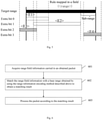
- Fig. 3 is a schematic diagram of a new base range according to an embodiment of the present disclosure.
- ⁇ E1> is selected as a root node to expand the ⁇ range>.
- the left and right endpoints of the ⁇ range> are original_min and original_max, respectively. If the ⁇ range> contains ⁇ E1>, but original_min is less than the left endpoint of ⁇ E1>, it is indicated that there is an uncovered part on the left, and this remaining range is denoted as ⁇ left_field>. Similarly, an uncovered part on the right, if any, is denoted as ⁇ right_field>.
- a left subnode and a right subnode are created to store expansion numbers of ⁇ left_field> and ⁇ right_field>, respectively.
- ⁇ E1> is in the root node, and the expansion number of the root node is 1.
- the total expansion number of the ⁇ range> is 1+num(left)+num(right), where num(left) and num(right) are the range expansion numbers stored in the left and right subnodes, respectively.
- Recursive processing is performed for expansion of the left and right remaining ranges to obtain num(left) and num (right), respectively.
- prefix expansion is attempted first. If a resulting prefix expansion number is 1, the tree building stops. If the resulting prefix expansion number is not 1, a search is conducted for a base range that can include ⁇ left_field> entirely and is within the ⁇ range>, such as ⁇ E2> shown in the figure. If such a base range is found, the tree building also stops.
- the process proceeds with traversing all the ranges that partially cover ⁇ right_field> and are included in the ⁇ range>, and continues to attempt expansion (such as ⁇ E3> + ⁇ right_field'> in the figure) until the expansion is completed or the expansion number with further decomposition is larger than the expansion number by directly using prefixes, and then the tree building stops.
- a range information encoding process includes the following steps.
- a rule mapped for a range field (the ⁇ range>) is expanded through base-range expansion. assuming that the range field is 8 bits wide, 4 extra bits are used for base-range encoding of the field, and ⁇ Ei> (i>1) corresponds to the (i-1)th bit.
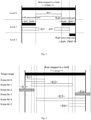
- Fig. 4 is a schematic diagram of an expansion result of a new base range as shown in Fig. 3 .
- the expansion scheme finally determined for the ⁇ range> is to use ⁇ E1>, ⁇ E2> and ⁇ E3> for expansion, and then 3 entries to be stored in the TCAM are obtained as follows: Entry 1: **** **** 1***; Entry 2: **** **** *1**; Entry 3: **** **** **1*.
- Fig. 5 is another schematic diagram of an expansion result of a new base range as shown in Fig. 3 .
- the final scheme for the expansion of the ⁇ range> is to use ⁇ E1>, ⁇ E2> and two additional prefix ranges for expansion, and then 4 entries to be stored in the TCAM are obtained as follows: Entry 1: **** **** 1***; Entry 2: **** **** *1**; Entry 3: xxxx xxxx ****; Entry 4: xxxx xxxx ****.
- the x-sequence represents a prefix-form ternary bit string, and * represents the "don't care" state of the three states.
- the range information encoding method provided by the embodiments of the present disclosure performs targeted range encoding based on prefix expansion, but excels in performance compared to prefix expansion, and the expansion number is optimized to different extents for different rule sets.
- the method of the present disclosure is completely compatible with prefix expansion encoding and rule issuing methods, so that there is a theoretical lower bound.
- the present disclosure by using a small amount of additional TCAM resources, alleviates the problem of low resource utilization rate caused by range expansion and also increases the stability of resource utilization rate as multiple base ranges can be used for encoding at the same time.
- An embodiment of the present disclosure provides a computer storage medium including: a processor, and a memory storing a computer program which, when invoked by the processor, causes the processor to perform any of the methods described in Figs. 1-5 above.
- the computer storage medium provided by the embodiment of the present disclosure acquires a new base range, performs an expansion operation on the new base range based on pre-stored base ranges to obtain an expansion result, and then determines, according to the expansion result, encoded information corresponding to the new base range, thereby realizing the purpose of encoding the new base range by using the existing base ranges, overcoming the range expansion problem of TCAM in existing technologies and improving the resource utilization rate.
- Fig. 6 is a flowchart of a range information matching method according to an embodiment of the present disclosure. The method shown in Fig. 6 includes the following steps.
- step 610 range field information carried in an obtained packet is acquired.
- the range field information is matched with a base range obtained by using the range information encoding method described above to obtain a matching result.
- a range field in an input key is compared against all the N pre-configured base range(s) in parallel.
- the key calculation method is to compare a range field of a packet against all the base range(s) of a corresponding field. If the range field of the packet falls within a base range, a corresponding bit is coded as 1. If the range field of the packet does not fall within a base range, a corresponding bit is coded as 0. All bits of a key sent to the TCAM for comparison are determined binary values (0 or 1).
- the packet is processed according to the matching result.
- the method provided by the embodiment of the present disclosure includes acquiring range field information carried in an obtained packet, matching the range field information with a base range obtained by using the range information encoding method described above to obtain a matching result, and processing the packet according to the matching result, which matches the range field information by using the coding of the base range and thus improves the search efficiency for the range field information.
- An embodiment of the present disclosure provides a computer storage medium including: a processor, and a memory storing a computer program which, when invoked by the processor, causes the processor to perform the method described in Fig. 6 above.
- the computer storage medium provided by the embodiment of the present disclosure acquires range information carried in an obtained packet, matches the range information with a base range obtained by using the range information encoding method described above to obtain a matching result, and processes the packet according to the matching result, which matches the range information by using the coding of the base range and thus improves the search efficiency for the range information.
- Such software can be distributed on computer-readable media, which can include computer storage media (or non-transitory media) and communication media (or transitory media).
- computer storage medium includes volatile and nonvolatile, removable and non-removable media implemented in any method or technology for storing information, such as computer-readable instructions, data structures, program modules or other data.
- the computer storage media include, but are not limited to, random access memory (RAM), read-only memory (ROM), electrically erasable programmable read-only memory, EEPROM), flash memory or other memory technologies, portable compact disc read-only memory (CD-ROM), digital video disc (DVD) or other optical disc storage, cassettes, magnetic tapes, magnetic disc storage or other magnetic storage devices, or any other media that can be used to store desired information and can be accessed by computers.
- communication media typically contain computer-readable instructions, data structures, program modules or other data in a modulated data signal such as a carrier wave or other transmission mechanism, and can include any information delivery media.
Landscapes
- Engineering & Computer Science (AREA)
- Computer Networks & Wireless Communication (AREA)
- Signal Processing (AREA)
- Compression, Expansion, Code Conversion, And Decoders (AREA)
- Data Exchanges In Wide-Area Networks (AREA)
Abstract
Description
- The present application claims the benefit of priority to
Chinese Patent Application No. 201910622597.6 filed to China Patent Office on July 11, 2019 - The present disclosure relates to the field of information processing, for example, to range information encoding and matching methods and a computer storage medium.
- When a ternary content addressable memory (TCAM) performs packet classification, a range needs to be decomposed and converted into prefixes if a range-type field is required in a storage entry, and the range-to-prefix conversion will lead to a significant increase in the number of entries to be stored. For example, a single 16-bit range can be decomposed into up to 31 prefixes. A typical entry for packet classification usually contains two 16-bit ranges, which can be decomposed into up to 31*31=961 prefixes. The situation described above is the so-called range expansion problem, which, during product application, causes a sharp decrease in the utilization rate of TCAM resources corresponding to some packet classification rule sets.
- In existing technologies, a solution to the range expansion problem is to use optimized general range encoding technologies and use additional TCAM resources to encode ranges so as to reduce the cost of range expansion, which is focused on any arbitrary type of rule sets and is not based on the observation of the rule sets.
- During actual usage of a rule set, the cost of range expansion is still very high due to the generality of the rule set, and the average expansion degree of two range fields cannot meet product requirements.
- Embodiments of the present disclosure provide range information encoding and matching methods, and a computer storage medium, which can overcome the problem of range expansion of TCAMs in existing technologies.
- An embodiment of the present disclosure provides a range information encoding method, including:
- acquiring a new base range, where the new base range is used for decomposing range information of an entry to be stored in a TCAM;
- performing an expansion operation on the new base range based on a plurality of pre-stored base ranges to obtain an expansion result, where each of the pre-stored base ranges has respective encoded information; and
- determining, according to the expansion result, encoded information corresponding to the new base range.
- An embodiment of the present disclosure provides a computer storage medium including: a processor, and a memory storing a computer program which, when invoked by the processor, causes the processor to perform the range information encoding method described above.
- An embodiment of the present disclosure provides a range information matching method, including:
- acquiring range field information carried in an obtained packet;
- matching the range field information with a base range obtained by using the range information encoding method described above to obtain a matching result; and
- processing the packet according to the matching result.
- An embodiment of the present disclosure provides a computer storage medium including: a processor, and a memory storing a computer program which, when invoked by the processor, causes the processor to perform the range information matching method described above.
- The accompanying drawings are used to provide an understanding of the technical schemes of the present disclosure and constitute a part of the description. The accompanying drawings are used to explain the technical schemes of the present disclosure together with the embodiments of the present disclosure, and do not constitute a restriction on the technical schemes of the present disclosure.
-
Fig. 1 is a flowchart of a range information encoding method according to an embodiment of the present disclosure; -
Fig. 2 is a flowchart of a range encoding method according to an embodiment of the present disclosure; -
Fig. 3 is a schematic diagram of a new base range according to an embodiment of the present disclosure; -
Fig. 4 is a schematic diagram of an expansion result of a new base range as shown inFig. 3 ; -
Fig. 5 is another schematic diagram of an expansion result of a new base range as shown inFig. 3 ; and -
Fig. 6 is a flowchart of a range information matching method according to an embodiment of the present disclosure. - The embodiments of the present disclosure will be described below in combination with the accompanying drawings.
- The steps shown in the flowcharts of the drawings may be performed in a computer system, such as with a set of computer-executable instructions. Moreover, although a logical order is shown in the flowcharts, the steps shown or described may be performed, in some cases, in a different order from that shown or described herein.
-
Fig. 1 is a flowchart of a range information encoding method according to an embodiment of the present disclosure. The method shown inFig. 1 includes the following steps. - At
step 110, a new base range is acquired, where the new base range is used for decomposing range information of an entry to be stored in a TCAM. - In an example embodiment, a base range is used for decomposing range information of an entry to be stored in a TCAM, and different base ranges may not overlap with each other or may partly overlap with each other.
- At
step 120, an expansion operation is performed on the new base range based on pre-stored base ranges to obtain an expansion result, where each pre-stored base range has respective encoded information. - In an example embodiment, the pre-stored base ranges are obtained in the following approach. When no base range is stored locally and a base range is received, the base range may be converted into a prefix(es), and the base range may be stored with the entry information corresponding to the prefix(es). When the obtained base ranges reach a threshold number of pre-stored base ranges, the newly received base range may be processed by the method according to embodiments of the present disclosure.
- In an example embodiment, performing an expansion operation on the new base range based on pre-stored base ranges to obtain an expansion result includes: on condition that each pre-stored base range has a respective corresponding field, selecting the field including a maximum number of base ranges as a target field; and expanding the new base range by using the base range in the target field to obtain a plurality of sub-ranges after the expansion.
- All the fields that have been assigned with a base range are traversed to find the field with the most expansion entries in these fields as the target field, and then the new base range is expanded by using the base range on the target field.
- At
step 130, encoded information corresponding to the new base range is determined according to the expansion result. - In an example embodiment, compared with the existing technologies in which the range information is decomposed first and then converted into prefixes, the embodiment of the present disclosure expands a new base range by using the pre-stored base ranges, thereby realizing the purpose of denoting the new base range by using the existing base ranges and reducing the storage consumption of the base ranges.
- The method provided by the embodiment of the present disclosure includes acquiring a new base range, performing an expansion operation on the new base range based on pre-stored base ranges to obtain an expansion result, and then determining, according to the expansion result, encoded information corresponding to the new base range, thereby realizing the purpose of encoding the new base range by using the existing base ranges, overcoming the range expansion problem of TCAM in existing technologies and improving the resource utilization rate.
- The method provided by the present disclosure is described below.
- In an example embodiment, before performing an expansion operation on the new base range based on pre-stored base ranges to obtain an expansion result, the method also includes: determining a number of entries of the new base range after being subjected to prefix expansion; on condition that the number of entries of the new base range after being subjected to prefix expansion is not 1, performing the expansion operation on the new base range.
- By determining whether the number of entries of the new base range after being subjected to prefix expansion is 1 before executing the base-range expansion operation, the number of base-range expansion operations to be executed can be effectively restrained, thus enhancing the processing efficiency.
- In an example embodiment, expanding the new base range by using the base range in the target field includes: traversing all the base ranges in the target field, and expanding the new base range by using a minimal number of base range, where a coverage of the used base range(s) does not exceed the new base range.
- On condition that the target field includes at least two base ranges, the base ranges in the target field can be combined such that the combined coverage does not exceed the new base range. By using the minimum number of base ranges, the number of entries of the new base range can be minimized, thus improving the management efficiency.
- In an example embodiment, expanding the new base range by using the base range in the target field to obtain a plurality of sub-ranges after the expansion includes: after expanding the new base range by using the base range in the target field, determining whether the used base range covers the new base range entirely; in response to a determination result that the used base range cannot cover the new base range entirely, acquiring an uncovered sub-range in the new base range; and carrying out prefix expansion on the sub-range to obtain an entry corresponding to the sub-range.
- By determining the state of coverage of the expansion result and carrying out prefix expansion on the uncovered sub-range, the base-range expansion and the prefix expansion are combined such that the new base range can be covered entirely.
- In an example embodiment, performing an expansion operation on the new base range based on pre-stored base ranges to obtain an expansion result includes: acquiring a number of entries of the new base range after being subjected to the expansion operation based on the pre-stored base ranges; comparing the number of entries of the new base range after being subjected to the expansion operation with a pre-acquired number of entries of the new base range after being subjected to prefix expansion; on condition that the number of entries of the new base range after being subjected to prefix expansion is less than the number of entries of the new base range after being subjected to the expansion operation, using a prefix/prefixes obtained from the prefix expansion as entry information corresponding to the new base range, or on condition that the number of entries of the new base range after being subjected to prefix expansion is greater than or equal to the number of entries of the new base range after being subjected to the expansion operation, determining entry information of the new base range based on entry information corresponding to multiple components of the expansion result of the new base range.
-
Fig. 2 is a flowchart of a range encoding method according to an embodiment of the present disclosure. As shown inFig. 2 , the method includes: - step 210: carrying out a prefix range expansion process on a range of a current entry and counting the number of prefixes converted from the range of the current entry, which is denoted as p_range_num;
- step 220: determining whether p_range_num is 1, and proceeding to
step 260 if p range num is 1, or proceeding tostep 230 if p range num is not 1; - step 230: carrying out a base-range expansion process and counting a base-range expansion number of the current entry, which is denoted as b_range_num;
- step 240: comparing p_range_num with b_range_num, and proceeding to
step 260 if p_range_num is less than b_range_num, or proceeding tostep 250 if p_range_num is greater than or equal to b_range_num; - step 250: storing encoded information of the range into a TCAM memory module using base-range encoding;
- step 260: storing encoded information of the range into a TCAM memory module directly through prefix decomposition.
- In this way, encoding management of a new base range can be realized.
- In an example embodiment, the encoded information of the pre-stored base ranges includes encoded information corresponding to field information and encoded information corresponding to range information.
- Fields can be identified with the encoded information corresponding to the field information of the base range. The encoded information corresponding to range information may be denoted with 1 bit to simplify the occupation of codings of the base ranges.
- The range information encoding method provided by the embodiment of the present disclosure will be described below.
- For packet classification rule sets containing ranges, each single base range may be encoded in one bit and an optimized encoding strategy may be provided in combination with a hardware-based parallel comparison function to alleviate the range expansion problem of TCAMs. As a small number of base ranges can be recombined into numerous combinational ranges, the utilization rate of resources can be maximized with limited TCAM resources.
- The range information encoding method according to the present disclosure includes the following steps.
- An Internet Protocol Version 4 (IPv4) type rule set contains N K-bit range fields, which are respectively denoted as R_FIELD_0, R_FIELD_1, ......, and R_FIELD_N. A width of extra M bits is made available to the entry width for range encoding to expand the N range fields that share 32 bits in total. A range encoding process is as follows:
- At step 10, as the rule set may be issued dynamically or all at once, base ranges represented by all the M bits may be pre-configured and the base ranges are distinguished in their fields. If no base range is pre-configured, the first M ranges encountered that cannot be directly converted into a prefix representation (i.e., the number of entries of the range after being subjected to prefix expansion is not 1) are used as the base ranges.
- At step 20, after allocation of all the M base ranges is completed, each issued rule is expanded according to the following sub-steps.
- a) Firstly, a prefix expansion number is counted. If a rule can be expanded directly, the rule will be stored in the TCAM directly with its prefix expansion result, and the process ends. If a rule cannot be expanded directly, the process proceeds to sub-step b).
- b) All the fields that have been allocated with a base range are traversed to find the field within which the rule has a maximum number of expansion entries. If the maximum number of expansion entries is 1, the rule will be stored in the TCAM directly with its prefix expansion result. If the maximum number of expansion entries is greater than 1, the process proceeds to sub-step c).
- c) The rule mapped to the field is denoted as <range>. The <range> is expanded by using base ranges in the field. All the base ranges in this field are traversed to find a minimum number of base ranges that have the largest coverage without exceeding boundaries of the <range>. The uncovered part(s) is/are expanded through prefix expansion.
- d) The total number of entries of the field expanded in the base-range expansion manner is compared with the number of entries of the field expanded directly in the prefix expansion manner, then the expansion manner providing the smaller number of entries is selected to expand the <range>, and the <range> after being expanded in the selected manner is stored in the TCAM.
- The process of expanding the <range> by using the base ranges in the field includes the following steps.
- The base-range expansion is carried out by building a tree and traversing all the base ranges so as to find the optimal combination for expansion. If a base range is not within the <range>, the base range is to be skipped. If a base range is within the <range>, the base range is to be used as a root node, and a number of expansion entries is counted after the expansion is completed.
-
Fig. 3 is a schematic diagram of a new base range according to an embodiment of the present disclosure. As shown inFig. 3 , <E1> is selected as a root node to expand the <range>. The left and right endpoints of the <range> are original_min and original_max, respectively. If the <range> contains <E1>, but original_min is less than the left endpoint of <E1>, it is indicated that there is an uncovered part on the left, and this remaining range is denoted as <left_field>. Similarly, an uncovered part on the right, if any, is denoted as <right_field>. - In the range shown in
Fig. 3 , a left subnode and a right subnode are created to store expansion numbers of <left_field> and <right_field>, respectively. In this case, <E1> is in the root node, and the expansion number of the root node is 1. Then, the total expansion number of the <range> is 1+num(left)+num(right), where num(left) and num(right) are the range expansion numbers stored in the left and right subnodes, respectively. - Recursive processing is performed for expansion of the left and right remaining ranges to obtain num(left) and num (right), respectively. Taking <left_field> as an example, prefix expansion is attempted first. If a resulting prefix expansion number is 1, the tree building stops. If the resulting prefix expansion number is not 1, a search is conducted for a base range that can include <left_field> entirely and is within the <range>, such as <E2> shown in the figure. If such a base range is found, the tree building also stops. If such a base range cannot be found, such as in the case of <right_field> in the figure, the process proceeds with traversing all the ranges that partially cover <right_field> and are included in the <range>, and continues to attempt expansion (such as <E3> + <right_field'> in the figure) until the expansion is completed or the expansion number with further decomposition is larger than the expansion number by directly using prefixes, and then the tree building stops.
- A range information encoding process includes the following steps.
- During storage operation of the TCAM, one entry is generated for each <Ei> used. A rule mapped for a range field (the <range>) is expanded through base-range expansion. assuming that the range field is 8 bits wide, 4 extra bits are used for base-range encoding of the field, and <Ei> (i>1) corresponds to the (i-1)th bit.
-
Fig. 4 is a schematic diagram of an expansion result of a new base range as shown inFig. 3 . As shown inFig. 4 , the expansion scheme finally determined for the <range> is to use <E1>, <E2> and <E3> for expansion, and then 3 entries to be stored in the TCAM are obtained as follows:
Entry 1: **** **** 1***; Entry 2: **** **** *1**; Entry 3: **** **** **1*. -
Fig. 5 is another schematic diagram of an expansion result of a new base range as shown inFig. 3 . As shown inFig. 5 , the final scheme for the expansion of the <range> is to use <E1>, <E2> and two additional prefix ranges for expansion, and then 4 entries to be stored in the TCAM are obtained as follows:
Entry 1: **** **** 1***; Entry 2: **** **** *1**; Entry 3: xxxx xxxx ****; Entry 4: xxxx xxxx ****. - The x-sequence represents a prefix-form ternary bit string, and * represents the "don't care" state of the three states.
- In a real-world rule set, the number of different ranges is usually limited. Based on this property of rule sets, the range information encoding method provided by the embodiments of the present disclosure performs targeted range encoding based on prefix expansion, but excels in performance compared to prefix expansion, and the expansion number is optimized to different extents for different rule sets. When preprocessing fails under a high system load, the method of the present disclosure is completely compatible with prefix expansion encoding and rule issuing methods, so that there is a theoretical lower bound. Compared with existing technologies, the present disclosure, by using a small amount of additional TCAM resources, alleviates the problem of low resource utilization rate caused by range expansion and also increases the stability of resource utilization rate as multiple base ranges can be used for encoding at the same time.
- An embodiment of the present disclosure provides a computer storage medium including: a processor, and a memory storing a computer program which, when invoked by the processor, causes the processor to perform any of the methods described in
Figs. 1-5 above. - The computer storage medium provided by the embodiment of the present disclosure acquires a new base range, performs an expansion operation on the new base range based on pre-stored base ranges to obtain an expansion result, and then determines, according to the expansion result, encoded information corresponding to the new base range, thereby realizing the purpose of encoding the new base range by using the existing base ranges, overcoming the range expansion problem of TCAM in existing technologies and improving the resource utilization rate.
-
Fig. 6 is a flowchart of a range information matching method according to an embodiment of the present disclosure. The method shown inFig. 6 includes the following steps. - At step 610, range field information carried in an obtained packet is acquired.
- At step 620, the range field information is matched with a base range obtained by using the range information encoding method described above to obtain a matching result.
- In an example embodiment, a range field in an input key is compared against all the N pre-configured base range(s) in parallel. The key calculation method is to compare a range field of a packet against all the base range(s) of a corresponding field. If the range field of the packet falls within a base range, a corresponding bit is coded as 1. If the range field of the packet does not fall within a base range, a corresponding bit is coded as 0. All bits of a key sent to the TCAM for comparison are determined binary values (0 or 1).
- At step 630, the packet is processed according to the matching result.
- The method provided by the embodiment of the present disclosure includes acquiring range field information carried in an obtained packet, matching the range field information with a base range obtained by using the range information encoding method described above to obtain a matching result, and processing the packet according to the matching result, which matches the range field information by using the coding of the base range and thus improves the search efficiency for the range field information.
- An embodiment of the present disclosure provides a computer storage medium including: a processor, and a memory storing a computer program which, when invoked by the processor, causes the processor to perform the method described in
Fig. 6 above. - The computer storage medium provided by the embodiment of the present disclosure acquires range information carried in an obtained packet, matches the range information with a base range obtained by using the range information encoding method described above to obtain a matching result, and processes the packet according to the matching result, which matches the range information by using the coding of the base range and thus improves the search efficiency for the range information.
- It can be understood by those having ordinary skills in the art that all or some of the steps of the methods, systems and functional modules/units in the devices disclosed above can be implemented as software, firmware, hardware and any appropriate combinations thereof. In the hardware implementation, the division between functional modules/units mentioned in the above description does not necessarily correspond to the division of physical components; for example, a physical component may have multiple functions, or a function or step may be performed cooperatively by a plurality of physical components. Some or all of the components may be implemented as software executed by a processor, such as a digital signal processor or a microprocessor, or as hardware, or as an integrated circuit, such as an application-specific integrated circuit. Such software can be distributed on computer-readable media, which can include computer storage media (or non-transitory media) and communication media (or transitory media). As well known to those of ordinary skill in the art, the term computer storage medium includes volatile and nonvolatile, removable and non-removable media implemented in any method or technology for storing information, such as computer-readable instructions, data structures, program modules or other data. The computer storage media include, but are not limited to, random access memory (RAM), read-only memory (ROM), electrically erasable programmable read-only memory, EEPROM), flash memory or other memory technologies, portable compact disc read-only memory (CD-ROM), digital video disc (DVD) or other optical disc storage, cassettes, magnetic tapes, magnetic disc storage or other magnetic storage devices, or any other media that can be used to store desired information and can be accessed by computers. Furthermore, it is well known to those of ordinary skill in the art that communication media typically contain computer-readable instructions, data structures, program modules or other data in a modulated data signal such as a carrier wave or other transmission mechanism, and can include any information delivery media.
Claims (10)
- A range information encoding method, comprising:acquiring a new base range, wherein the new base range is used for decomposing range information of an entry to be stored in a ternary content addressable memory (TCAM);performing an expansion operation on the new base range based on a plurality of pre-stored base ranges to obtain an expansion result, wherein each of the pre-stored base ranges has respective encoded information; anddetermining, according to the expansion result, encoded information corresponding to the new base range.
- The method of claim 1, before performing an expansion operation on the new base range based on a plurality of pre-stored base ranges to obtain an expansion result, further comprising:determining a number of entries of the new base range after being subjected to prefix expansion;wherein performing an expansion operation on the new base range based on a plurality of pre-stored base ranges comprises:
in response to the number of entries of the new base range after being subjected to prefix expansion being not 1, performing the expansion operation on the new base range based on the plurality of pre-stored base ranges. - The method of claim 1 or claim 2, wherein performing an expansion operation on the new base range based on a plurality of pre-stored base ranges to obtain an expansion result comprises:in response to each of the pre-stored base ranges having a respective corresponding field, selecting the field corresponding to one of the plurality of base ranges, which has a maximum number of entries after being subjected to prefix expansion, as a target field; andexpanding the new base range by using at least one of the base ranges in the target field to obtain a plurality of ranges after the expansion.
- The method of claim 3, wherein expanding the new base range by using the base range in the target field comprises:
traversing all the base ranges in the target field, and expanding the new base range by using a minimal number of base ranges, wherein a coverage of the minimal number of base ranges does not exceed the new base range. - The method of claim 3 or claim 4, wherein expanding the new base range by using at least one of the base ranges in the target field to obtain a plurality of ranges after the expansion comprises:after expanding the new base range by using the at least one base range in the target field, determining whether the at least one used base range covers the new base range entirely;in response to a determination result that the at least one used base range cannot cover the new base range entirely, acquiring a sub-range, uncovered by the at least one used base range, of the new base range; andcarrying out prefix expansion on the uncovered sub-range to obtain an entry corresponding to the uncovered sub-range.
- The method of claim 1 or claim 2, wherein performing an expansion operation on the new base range based on a plurality of pre-stored base ranges to obtain an expansion result comprises:acquiring a number of entries of the new base range after being subjected to the expansion operation based on the plurality of pre-stored base ranges;comparing the number of entries of the new base range after being subjected to the expansion operation with the acquired number of entries of the new base range after being subjected to prefix expansion;in response to the number of entries of the new base range after being subjected to prefix expansion being less than the number of entries of the new base range after being subjected to the expansion operation, using prefix information obtained from the prefix expansion as entry information corresponding to the new base range; or in response to the number of entries of the new base range after being subjected to prefix expansion being greater than or equal to the number of entries of the new base range after being subjected to the expansion operation, determining entry information of the new base range based on entry information corresponding to multiple components of the expansion result of the new base range.
- The method of claim 1, wherein the encoded information of each of the pre-stored base ranges comprises encoded information corresponding to field information and encoded information corresponding to range information.
- A range information matching method, comprising:acquiring range field information carried in an obtained packet;matching the range field information with a base range obtained by using the range information encoding method of any one of claims 1 to 7 to obtain a matching result; andprocessing the packet according to the matching result.
- A computer storage medium comprising: a processor, and a memory storing a computer program which, when invoked by the processor, causes the processor to perform the method of any one of claims 1 to 7.
- A computer storage medium comprising: a processor, and a memory storing a computer program which, when invoked by the processor, causes the processor to perform the method of claim 8.
Applications Claiming Priority (2)
| Application Number | Priority Date | Filing Date | Title |
|---|---|---|---|
| CN201910622597.6A CN112216327B (en) | 2019-07-11 | 2019-07-11 | Encoding and matching method of range information and computer storage medium |
| PCT/CN2020/101595 WO2021004543A1 (en) | 2019-07-11 | 2020-07-13 | Range information encoding and matching method, and computer storage medium |
Publications (3)
| Publication Number | Publication Date |
|---|---|
| EP3958267A1 true EP3958267A1 (en) | 2022-02-23 |
| EP3958267A4 EP3958267A4 (en) | 2022-06-29 |
| EP3958267B1 EP3958267B1 (en) | 2023-08-09 |
Family
ID=74047653
Family Applications (1)
| Application Number | Title | Priority Date | Filing Date |
|---|---|---|---|
| EP20836578.3A Active EP3958267B1 (en) | 2019-07-11 | 2020-07-13 | Range information encoding and matching method, and computer storage medium |
Country Status (3)
| Country | Link |
|---|---|
| EP (1) | EP3958267B1 (en) |
| CN (1) | CN112216327B (en) |
| WO (1) | WO2021004543A1 (en) |
Family Cites Families (9)
| Publication number | Priority date | Publication date | Assignee | Title |
|---|---|---|---|---|
| US20060078333A1 (en) * | 2003-08-20 | 2006-04-13 | Nippon Telegraph And Telephone Corporation | Protocol speed increasing device |
| US7573880B2 (en) * | 2003-11-12 | 2009-08-11 | Agere Systems Inc. | Set-associative memory architecture for routing tables |
| US7555594B2 (en) * | 2004-07-22 | 2009-06-30 | Netlogic Microsystems, Inc. | Range representation in a content addressable memory (CAM) using an improved encoding scheme |
| US7366830B1 (en) * | 2005-09-01 | 2008-04-29 | Netlogic Microsystems, Inc. | Row expansion reduction by inversion for range representation in ternary content addressable memories |
| KR100705593B1 (en) * | 2006-01-25 | 2007-04-09 | 삼성전자주식회사 | Routing system and rule entry management method of routing system |
| CN101222434B (en) * | 2008-01-31 | 2011-04-20 | 福建星网锐捷网络有限公司 | Storage policy control list, policy searching method and tri-state addressing memory |
| CN103226551B (en) * | 2012-01-31 | 2016-05-25 | 中国科学技术大学 | The matching process of the non deterministic finite automaton based on TCAM and device |
| CN103546378B (en) * | 2013-05-20 | 2018-06-01 | 北京百卓网络技术有限公司 | Scope based on TCAM matches 2 stage layered lookup methods more |
| CN105515997B (en) * | 2015-12-07 | 2018-07-06 | 刘航天 | The higher efficiency range matching process of zero scope expansion is realized based on BF_TCAM |
-
2019
- 2019-07-11 CN CN201910622597.6A patent/CN112216327B/en active Active
-
2020
- 2020-07-13 WO PCT/CN2020/101595 patent/WO2021004543A1/en not_active Ceased
- 2020-07-13 EP EP20836578.3A patent/EP3958267B1/en active Active
Also Published As
| Publication number | Publication date |
|---|---|
| EP3958267B1 (en) | 2023-08-09 |
| WO2021004543A1 (en) | 2021-01-14 |
| CN112216327B (en) | 2025-08-15 |
| EP3958267A4 (en) | 2022-06-29 |
| CN112216327A (en) | 2021-01-12 |
Similar Documents
| Publication | Publication Date | Title |
|---|---|---|
| US9390134B2 (en) | Regular expression matching method and system, and searching device | |
| US6775737B1 (en) | Method and apparatus for allocating and using range identifiers as input values to content-addressable memories | |
| EP2560327B1 (en) | Routing table establishment method and device | |
| US7650429B2 (en) | Preventing aliasing of compressed keys across multiple hash tables | |
| CN107562743B (en) | Data storage method and device, and data search request processing method and device | |
| CN111988231B (en) | Mask quintuple rule matching method and device | |
| US20130024649A1 (en) | Method and device for storing routing table entry | |
| CN109392100B (en) | Method, device and equipment for determining size of transmission block | |
| CN114710467B (en) | IP address storage method and device and hardware gateway | |
| US6970971B1 (en) | Method and apparatus for mapping prefixes and values of a hierarchical space to other representations | |
| CN118264255A (en) | Data compression method, device, computer equipment and readable storage medium | |
| US7177313B2 (en) | Method and system for converting ranges into overlapping prefixes for a longest prefix match | |
| CN106802927A (en) | A kind of date storage method and querying method | |
| CN102609509B (en) | Hash data processing method and device | |
| EP3958267B1 (en) | Range information encoding and matching method, and computer storage medium | |
| CN115865843A (en) | Rule storage method, message processing method, device, electronic equipment and medium | |
| CN107832341B (en) | AGNSS user duplicate removal statistical method | |
| US11567661B2 (en) | Virtual memory management method and processor | |
| US9396286B2 (en) | Lookup with key sequence skip for radix trees | |
| CN111819552B (en) | Access control list management method and device | |
| US10476785B2 (en) | IP routing search | |
| US20240078222A1 (en) | Selective Addition of Datum to a Tree Data Structure | |
| US9355133B2 (en) | Offline compression for limited sequence length radix tree | |
| CN119544830A (en) | Decision tree generation method, message processing method, device and storage medium | |
| US9361404B2 (en) | Offline radix tree compression with key sequence skip |
Legal Events
| Date | Code | Title | Description |
|---|---|---|---|
| STAA | Information on the status of an ep patent application or granted ep patent |
Free format text: STATUS: THE INTERNATIONAL PUBLICATION HAS BEEN MADE |
|
| PUAI | Public reference made under article 153(3) epc to a published international application that has entered the european phase |
Free format text: ORIGINAL CODE: 0009012 |
|
| STAA | Information on the status of an ep patent application or granted ep patent |
Free format text: STATUS: REQUEST FOR EXAMINATION WAS MADE |
|
| 17P | Request for examination filed |
Effective date: 20211116 |
|
| AK | Designated contracting states |
Kind code of ref document: A1 Designated state(s): AL AT BE BG CH CY CZ DE DK EE ES FI FR GB GR HR HU IE IS IT LI LT LU LV MC MK MT NL NO PL PT RO RS SE SI SK SM TR |
|
| A4 | Supplementary search report drawn up and despatched |
Effective date: 20220530 |
|
| RIC1 | Information provided on ipc code assigned before grant |
Ipc: H04L 45/00 20220101ALI20220523BHEP Ipc: G11C 15/00 20060101ALI20220523BHEP Ipc: G11C 15/04 20060101AFI20220523BHEP |
|
| DAV | Request for validation of the european patent (deleted) | ||
| DAX | Request for extension of the european patent (deleted) | ||
| RAP1 | Party data changed (applicant data changed or rights of an application transferred) |
Owner name: SANECHIPS TECHNOLOGY CO., LTD. |
|
| REG | Reference to a national code |
Ref country code: DE Ref legal event code: R079 Free format text: PREVIOUS MAIN CLASS: G11C0015040000 Ipc: H04L0045745000 Ref document number: 602020015613 Country of ref document: DE |
|
| GRAP | Despatch of communication of intention to grant a patent |
Free format text: ORIGINAL CODE: EPIDOSNIGR1 |
|
| STAA | Information on the status of an ep patent application or granted ep patent |
Free format text: STATUS: GRANT OF PATENT IS INTENDED |
|
| RIC1 | Information provided on ipc code assigned before grant |
Ipc: G11C 15/04 20060101ALI20230406BHEP Ipc: H04L 45/745 20220101AFI20230406BHEP |
|
| INTG | Intention to grant announced |
Effective date: 20230428 |
|
| GRAS | Grant fee paid |
Free format text: ORIGINAL CODE: EPIDOSNIGR3 |
|
| GRAA | (expected) grant |
Free format text: ORIGINAL CODE: 0009210 |
|
| STAA | Information on the status of an ep patent application or granted ep patent |
Free format text: STATUS: THE PATENT HAS BEEN GRANTED |
|
| AK | Designated contracting states |
Kind code of ref document: B1 Designated state(s): AL AT BE BG CH CY CZ DE DK EE ES FI FR GB GR HR HU IE IS IT LI LT LU LV MC MK MT NL NO PL PT RO RS SE SI SK SM TR |
|
| REG | Reference to a national code |
Ref country code: GB Ref legal event code: FG4D |
|
| REG | Reference to a national code |
Ref country code: CH Ref legal event code: EP |
|
| REG | Reference to a national code |
Ref country code: IE Ref legal event code: FG4D |
|
| REG | Reference to a national code |
Ref country code: DE Ref legal event code: R096 Ref document number: 602020015613 Country of ref document: DE |
|
| REG | Reference to a national code |
Ref country code: LT Ref legal event code: MG9D |
|
| REG | Reference to a national code |
Ref country code: NL Ref legal event code: MP Effective date: 20230809 |
|
| REG | Reference to a national code |
Ref country code: AT Ref legal event code: MK05 Ref document number: 1598795 Country of ref document: AT Kind code of ref document: T Effective date: 20230809 |
|
| PG25 | Lapsed in a contracting state [announced via postgrant information from national office to epo] |
Ref country code: GR Free format text: LAPSE BECAUSE OF FAILURE TO SUBMIT A TRANSLATION OF THE DESCRIPTION OR TO PAY THE FEE WITHIN THE PRESCRIBED TIME-LIMIT Effective date: 20231110 |
|
| PG25 | Lapsed in a contracting state [announced via postgrant information from national office to epo] |
Ref country code: IS Free format text: LAPSE BECAUSE OF FAILURE TO SUBMIT A TRANSLATION OF THE DESCRIPTION OR TO PAY THE FEE WITHIN THE PRESCRIBED TIME-LIMIT Effective date: 20231209 |
|
| PG25 | Lapsed in a contracting state [announced via postgrant information from national office to epo] |
Ref country code: SE Free format text: LAPSE BECAUSE OF FAILURE TO SUBMIT A TRANSLATION OF THE DESCRIPTION OR TO PAY THE FEE WITHIN THE PRESCRIBED TIME-LIMIT Effective date: 20230809 Ref country code: RS Free format text: LAPSE BECAUSE OF FAILURE TO SUBMIT A TRANSLATION OF THE DESCRIPTION OR TO PAY THE FEE WITHIN THE PRESCRIBED TIME-LIMIT Effective date: 20230809 Ref country code: PT Free format text: LAPSE BECAUSE OF FAILURE TO SUBMIT A TRANSLATION OF THE DESCRIPTION OR TO PAY THE FEE WITHIN THE PRESCRIBED TIME-LIMIT Effective date: 20231211 Ref country code: NO Free format text: LAPSE BECAUSE OF FAILURE TO SUBMIT A TRANSLATION OF THE DESCRIPTION OR TO PAY THE FEE WITHIN THE PRESCRIBED TIME-LIMIT Effective date: 20231109 Ref country code: NL Free format text: LAPSE BECAUSE OF FAILURE TO SUBMIT A TRANSLATION OF THE DESCRIPTION OR TO PAY THE FEE WITHIN THE PRESCRIBED TIME-LIMIT Effective date: 20230809 Ref country code: LV Free format text: LAPSE BECAUSE OF FAILURE TO SUBMIT A TRANSLATION OF THE DESCRIPTION OR TO PAY THE FEE WITHIN THE PRESCRIBED TIME-LIMIT Effective date: 20230809 Ref country code: LT Free format text: LAPSE BECAUSE OF FAILURE TO SUBMIT A TRANSLATION OF THE DESCRIPTION OR TO PAY THE FEE WITHIN THE PRESCRIBED TIME-LIMIT Effective date: 20230809 Ref country code: IS Free format text: LAPSE BECAUSE OF FAILURE TO SUBMIT A TRANSLATION OF THE DESCRIPTION OR TO PAY THE FEE WITHIN THE PRESCRIBED TIME-LIMIT Effective date: 20231209 Ref country code: HR Free format text: LAPSE BECAUSE OF FAILURE TO SUBMIT A TRANSLATION OF THE DESCRIPTION OR TO PAY THE FEE WITHIN THE PRESCRIBED TIME-LIMIT Effective date: 20230809 Ref country code: GR Free format text: LAPSE BECAUSE OF FAILURE TO SUBMIT A TRANSLATION OF THE DESCRIPTION OR TO PAY THE FEE WITHIN THE PRESCRIBED TIME-LIMIT Effective date: 20231110 Ref country code: FI Free format text: LAPSE BECAUSE OF FAILURE TO SUBMIT A TRANSLATION OF THE DESCRIPTION OR TO PAY THE FEE WITHIN THE PRESCRIBED TIME-LIMIT Effective date: 20230809 Ref country code: AT Free format text: LAPSE BECAUSE OF FAILURE TO SUBMIT A TRANSLATION OF THE DESCRIPTION OR TO PAY THE FEE WITHIN THE PRESCRIBED TIME-LIMIT Effective date: 20230809 |
|
| PG25 | Lapsed in a contracting state [announced via postgrant information from national office to epo] |
Ref country code: PL Free format text: LAPSE BECAUSE OF FAILURE TO SUBMIT A TRANSLATION OF THE DESCRIPTION OR TO PAY THE FEE WITHIN THE PRESCRIBED TIME-LIMIT Effective date: 20230809 |
|
| PG25 | Lapsed in a contracting state [announced via postgrant information from national office to epo] |
Ref country code: ES Free format text: LAPSE BECAUSE OF FAILURE TO SUBMIT A TRANSLATION OF THE DESCRIPTION OR TO PAY THE FEE WITHIN THE PRESCRIBED TIME-LIMIT Effective date: 20230809 |
|
| PG25 | Lapsed in a contracting state [announced via postgrant information from national office to epo] |
Ref country code: SM Free format text: LAPSE BECAUSE OF FAILURE TO SUBMIT A TRANSLATION OF THE DESCRIPTION OR TO PAY THE FEE WITHIN THE PRESCRIBED TIME-LIMIT Effective date: 20230809 Ref country code: RO Free format text: LAPSE BECAUSE OF FAILURE TO SUBMIT A TRANSLATION OF THE DESCRIPTION OR TO PAY THE FEE WITHIN THE PRESCRIBED TIME-LIMIT Effective date: 20230809 Ref country code: ES Free format text: LAPSE BECAUSE OF FAILURE TO SUBMIT A TRANSLATION OF THE DESCRIPTION OR TO PAY THE FEE WITHIN THE PRESCRIBED TIME-LIMIT Effective date: 20230809 Ref country code: EE Free format text: LAPSE BECAUSE OF FAILURE TO SUBMIT A TRANSLATION OF THE DESCRIPTION OR TO PAY THE FEE WITHIN THE PRESCRIBED TIME-LIMIT Effective date: 20230809 Ref country code: DK Free format text: LAPSE BECAUSE OF FAILURE TO SUBMIT A TRANSLATION OF THE DESCRIPTION OR TO PAY THE FEE WITHIN THE PRESCRIBED TIME-LIMIT Effective date: 20230809 Ref country code: CZ Free format text: LAPSE BECAUSE OF FAILURE TO SUBMIT A TRANSLATION OF THE DESCRIPTION OR TO PAY THE FEE WITHIN THE PRESCRIBED TIME-LIMIT Effective date: 20230809 Ref country code: SK Free format text: LAPSE BECAUSE OF FAILURE TO SUBMIT A TRANSLATION OF THE DESCRIPTION OR TO PAY THE FEE WITHIN THE PRESCRIBED TIME-LIMIT Effective date: 20230809 |
|
| REG | Reference to a national code |
Ref country code: DE Ref legal event code: R097 Ref document number: 602020015613 Country of ref document: DE |
|
| PG25 | Lapsed in a contracting state [announced via postgrant information from national office to epo] |
Ref country code: IT Free format text: LAPSE BECAUSE OF FAILURE TO SUBMIT A TRANSLATION OF THE DESCRIPTION OR TO PAY THE FEE WITHIN THE PRESCRIBED TIME-LIMIT Effective date: 20230809 |
|
| PLBE | No opposition filed within time limit |
Free format text: ORIGINAL CODE: 0009261 |
|
| STAA | Information on the status of an ep patent application or granted ep patent |
Free format text: STATUS: NO OPPOSITION FILED WITHIN TIME LIMIT |
|
| 26N | No opposition filed |
Effective date: 20240513 |
|
| PG25 | Lapsed in a contracting state [announced via postgrant information from national office to epo] |
Ref country code: SI Free format text: LAPSE BECAUSE OF FAILURE TO SUBMIT A TRANSLATION OF THE DESCRIPTION OR TO PAY THE FEE WITHIN THE PRESCRIBED TIME-LIMIT Effective date: 20230809 |
|
| PG25 | Lapsed in a contracting state [announced via postgrant information from national office to epo] |
Ref country code: BG Free format text: LAPSE BECAUSE OF FAILURE TO SUBMIT A TRANSLATION OF THE DESCRIPTION OR TO PAY THE FEE WITHIN THE PRESCRIBED TIME-LIMIT Effective date: 20230809 |
|
| PG25 | Lapsed in a contracting state [announced via postgrant information from national office to epo] |
Ref country code: BG Free format text: LAPSE BECAUSE OF FAILURE TO SUBMIT A TRANSLATION OF THE DESCRIPTION OR TO PAY THE FEE WITHIN THE PRESCRIBED TIME-LIMIT Effective date: 20230809 |
|
| PG25 | Lapsed in a contracting state [announced via postgrant information from national office to epo] |
Ref country code: MC Free format text: LAPSE BECAUSE OF FAILURE TO SUBMIT A TRANSLATION OF THE DESCRIPTION OR TO PAY THE FEE WITHIN THE PRESCRIBED TIME-LIMIT Effective date: 20230809 |
|
| REG | Reference to a national code |
Ref country code: CH Ref legal event code: PL |
|
| PG25 | Lapsed in a contracting state [announced via postgrant information from national office to epo] |
Ref country code: LU Free format text: LAPSE BECAUSE OF NON-PAYMENT OF DUE FEES Effective date: 20240713 |
|
| PG25 | Lapsed in a contracting state [announced via postgrant information from national office to epo] |
Ref country code: LU Free format text: LAPSE BECAUSE OF NON-PAYMENT OF DUE FEES Effective date: 20240713 |
|
| PG25 | Lapsed in a contracting state [announced via postgrant information from national office to epo] |
Ref country code: BE Free format text: LAPSE BECAUSE OF NON-PAYMENT OF DUE FEES Effective date: 20240731 Ref country code: CH Free format text: LAPSE BECAUSE OF NON-PAYMENT OF DUE FEES Effective date: 20240731 |
|
| REG | Reference to a national code |
Ref country code: BE Ref legal event code: MM Effective date: 20240731 |
|
| PGFP | Annual fee paid to national office [announced via postgrant information from national office to epo] |
Ref country code: GB Payment date: 20250529 Year of fee payment: 6 |
|
| PGFP | Annual fee paid to national office [announced via postgrant information from national office to epo] |
Ref country code: FR Payment date: 20250610 Year of fee payment: 6 |
|
| PG25 | Lapsed in a contracting state [announced via postgrant information from national office to epo] |
Ref country code: IE Free format text: LAPSE BECAUSE OF NON-PAYMENT OF DUE FEES Effective date: 20240713 |
|
| PGFP | Annual fee paid to national office [announced via postgrant information from national office to epo] |
Ref country code: DE Payment date: 20250604 Year of fee payment: 6 |
|
| PG25 | Lapsed in a contracting state [announced via postgrant information from national office to epo] |
Ref country code: CY Free format text: LAPSE BECAUSE OF FAILURE TO SUBMIT A TRANSLATION OF THE DESCRIPTION OR TO PAY THE FEE WITHIN THE PRESCRIBED TIME-LIMIT; INVALID AB INITIO Effective date: 20200713 |
|
| PG25 | Lapsed in a contracting state [announced via postgrant information from national office to epo] |
Ref country code: HU Free format text: LAPSE BECAUSE OF FAILURE TO SUBMIT A TRANSLATION OF THE DESCRIPTION OR TO PAY THE FEE WITHIN THE PRESCRIBED TIME-LIMIT; INVALID AB INITIO Effective date: 20200713 |