EP3957641B1 - Method for preparing naldemedine - Google Patents
Method for preparing naldemedine Download PDFInfo
- Publication number
- EP3957641B1 EP3957641B1 EP20792080.2A EP20792080A EP3957641B1 EP 3957641 B1 EP3957641 B1 EP 3957641B1 EP 20792080 A EP20792080 A EP 20792080A EP 3957641 B1 EP3957641 B1 EP 3957641B1
- Authority
- EP
- European Patent Office
- Prior art keywords
- compound
- process according
- formula
- following formula
- naldemedine
- Prior art date
- Legal status (The legal status is an assumption and is not a legal conclusion. Google has not performed a legal analysis and makes no representation as to the accuracy of the status listed.)
- Active
Links
Classifications
-
- C—CHEMISTRY; METALLURGY
- C07—ORGANIC CHEMISTRY
- C07D—HETEROCYCLIC COMPOUNDS
- C07D489/00—Heterocyclic compounds containing 4aH-8, 9 c- Iminoethano-phenanthro [4, 5-b, c, d] furan ring systems, e.g. derivatives of [4, 5-epoxy]-morphinan of the formula:
- C07D489/06—Heterocyclic compounds containing 4aH-8, 9 c- Iminoethano-phenanthro [4, 5-b, c, d] furan ring systems, e.g. derivatives of [4, 5-epoxy]-morphinan of the formula: with a hetero atom directly attached in position 14
- C07D489/08—Oxygen atom
-
- Y—GENERAL TAGGING OF NEW TECHNOLOGICAL DEVELOPMENTS; GENERAL TAGGING OF CROSS-SECTIONAL TECHNOLOGIES SPANNING OVER SEVERAL SECTIONS OF THE IPC; TECHNICAL SUBJECTS COVERED BY FORMER USPC CROSS-REFERENCE ART COLLECTIONS [XRACs] AND DIGESTS
- Y02—TECHNOLOGIES OR APPLICATIONS FOR MITIGATION OR ADAPTATION AGAINST CLIMATE CHANGE
- Y02P—CLIMATE CHANGE MITIGATION TECHNOLOGIES IN THE PRODUCTION OR PROCESSING OF GOODS
- Y02P20/00—Technologies relating to chemical industry
- Y02P20/50—Improvements relating to the production of bulk chemicals
- Y02P20/55—Design of synthesis routes, e.g. reducing the use of auxiliary or protecting groups
Definitions
- the present invention relates to a process for preparing naldemedine. More particularly, the present invention relates to a cost-effective process for preparing naldemedine having high purity with high yields.
- Opioid analgesics act on ⁇ -opioid receptors in the brain, leading to a strong analgesic action. Also, they act on ⁇ -opioid receptors in the intestinal tract as well, thereby lowering intestinal activity and causing severe constipation symptoms.
- Naldemedine represented by the following formula (1) is a peripherally acting ⁇ -opioid receptor antagonist, which is a medication approved for the treatment of opioid-induced constipation in adults.
- KR20140057410 discloses a process for the preparation of naldemedine.
- U.S. Patent No. 8,084,460 discloses a process for preparing naldemedine by total six steps of protection of naltrexone with a benzyl group, ethoxycarbonylation, protection with a benzyl group, hydrolysis, coupling, and deprotection, as shown in the following reaction scheme 1.
- the above process has problems of expensive reagents, severe reaction conditions, and low yields, so that it is not suitable for mass production.
- An object of the present invention is to provide a cost-effective process for preparing naldemedine with high yields.
- Another object of the present invention is to provide a process for preparing naldemedine having high purity only by recrystallization without a purification process using column chromatography.
- One embodiment of the present invention relates to a process for preparing naldemedine of the following formula (1), comprising the steps of:
- reaction scheme 2 represents merely a typical example, and various changes may be made to reagents and reaction conditions without limitation.
- the compound of formula (3) can be obtained by reacting the compound of formula (2) with diethyl pyrocarbonate and then treating with a base.
- sodium ethoxide potassium ethoxide, lithium ethoxide, etc.
- sodium ethoxide is preferred.
- the reaction with diethyl pyrocarbonate is preferably performed at about 100 to 120°C, and the base treatment is preferably performed at room temperature.
- the obtained compound of formula (3) may be purified by recrystallization.
- the recrystallization solvent a mixed solvent of ethyl acetate and methanol is preferred.
- the compound of formula (2) may be synthesized by protecting a compound of the following formula (6) with a benzyl group.
- the protection may be carried out by reacting the compound of formula (6) with benzyl bromide in the presence of a base.
- potassium carbonate cesium carbonate, sodium hydride, sodium hydroxide, etc.
- potassium carbonate in the form of a fine powder is preferred.
- the reaction temperature is preferably about 50 to 70°C.
- acetone dimethylformamide, etc.
- acetone is preferred in terms of a work-up process and yield.
- the compound of formula (5) can be obtained by subjecting the compound of formula (3) to a combination reaction with the compound of formula (4) and then adding hydrochloric acid thereto.
- the combination reaction may be carried out in the absence of a separate reaction reagent such as a catalyst.
- reaction temperature heating under reflux condition is preferred.
- reaction time is preferably 3 to 4 days.
- reaction solvent toluene, benzene, xylene, etc. may be used. Particularly, toluene is preferred.
- the obtained compound of formula (5) may be purified by recrystallization.
- the recrystallization solvent ethyl acetate is preferred.
- the compound of formula (1) can be obtained by deprotecting the compound of formula (5).
- the deprotection may be carried out using concentrated hydrochloric acid in acetic acid.
- the reaction temperature is preferably about 50 to 60°C.
- the obtained naldemedine of formula (1) can be solidified by adding it to aqueous ammonia at 0°C.
- the naldemedine prepared by the above process can be used for the preparation of an acid addition salt of naldemedine by adding an acid thereto, without additional purification process.
- p-toluenesulfonic acid As the acid, p-toluenesulfonic acid, acetic acid, hydrochloric acid, etc. may be used. Particularly, p-toluenesulfonic acid is preferred.
- the acid addition reaction is preferably performed at room temperature.
- the reaction solvent methanol and the like may be used.
- the prepared p-toluenesulfonic acid salt of naldemedine can be purified by recrystallization.
- the recrystallization solvent methylene chloride is preferred.
- One embodiment of the present invention relates to a compound of the following formula (5) which is an intermediate for preparing naldemedine of formula (1).
- naldemedine can be cost-effectively, efficiently, and simply prepared. Further, naldemedine having high purity can be prepared with high yields only by recrystallization without a purification process using column chromatography. Therefore, it is suitable for mass production.
- t-Butoxycarbonylamino isobutyric acid 200 g, 1.0 equiv was added to n-propyl acetate (1400 mL, 7 vol.) followed by stirring, and then N,N-diisopropylethylamine (DIPEA, 188.5 mL, 1.1 equiv) was added thereto at 0°C. Then, isobutyl chloroformate (IBCF, 134.7 mL, 1.05 equiv) was added dropwise thereto at 0°C, and the resulting mixture was stirred for 1 hour.
- DIPEA N,N-diisopropylethylamine
- IBCF isobutyl chloroformate
- the residue (300 g) was diluted with 4 N HCl in dioxane (3000 mL, 10 vol), and stirred at 20°C for 2 hours. After filtration of the resulting white solid, the filter cake was washed with methyl t-butyl ether (MTBE, 300 mL, 1 vol.). The filtrate was evaporated, and MTBE (500 mL, 10 vol.) was added and stirred, followed by filtration. The filter cake was washed with MTBE (50 mL, 1 vol.). The filter cakes were combined and dried in a vacuum oven to give the HCl salt of the compound of formula (4) (228 g, 97.6% yield) as a white solid.
- MTBE methyl t-butyl ether
- the resulting mixture was concentrated and the residue was diluted with CH 2 Cl 2 (1000 mL, 10 vol.) and water (500 mL, 5 vol.). The organic layer was separated, and the separated aqueous layer was extracted with CH 2 Cl 2 (300 mL). The organic layers were combined and dried over Na 2 SO 4 , followed by concentration.
- the crude product (65 g) was diluted with EA (688 mL, 7.5 vol.) and 4 N HCl solution (26 mL, 1.05 equiv) in dioxane was added dropwise thereto. After dropwise addition, the mixture was heated under reflux to give a clear solution. The clear solution was slowly cooled to room temperature. The formed solid was filtered, and the filter cake was washed with EA (32 mL, 0.5 vol.) and MTBE (65 mL, 1 vol.). The filter cake was dried in a vacuum oven to obtain the compound of formula (5) (47 g, 73% yield, 99.5% purity) as a white solid.
- the separated solid was diluted with EtOAc (80 mL, 8 vol.), and dried over Na 2 SO 4 , followed by concentration.
- MTBE (10 mL, 10 vol.) was added to the residue and stirred to solidify the product, followed by filtration. The product was used in the next step without additional purification.
Landscapes
- Chemical & Material Sciences (AREA)
- Organic Chemistry (AREA)
- Organic Low-Molecular-Weight Compounds And Preparation Thereof (AREA)
- Pharmaceuticals Containing Other Organic And Inorganic Compounds (AREA)
Description
- The present invention relates to a process for preparing naldemedine. More particularly, the present invention relates to a cost-effective process for preparing naldemedine having high purity with high yields.
- Opioid analgesics act on µ-opioid receptors in the brain, leading to a strong analgesic action. Also, they act on µ-opioid receptors in the intestinal tract as well, thereby lowering intestinal activity and causing severe constipation symptoms.
- Naldemedine represented by the following formula (1) is a peripherally acting µ-opioid receptor antagonist, which is a medication approved for the treatment of opioid-induced constipation in adults.

- Naldemedine relieves constipation symptoms by binding to the peripheral µ-opioid receptor to antagonize the action of the opioid analgesic without weakening the analgesic action of opioid analgesics.
KR20140057410 -
U.S. Patent No. 8,084,460 discloses a process for preparing naldemedine by total six steps of protection of naltrexone with a benzyl group, ethoxycarbonylation, protection with a benzyl group, hydrolysis, coupling, and deprotection, as shown in the following reaction scheme 1. However, the above process has problems of expensive reagents, severe reaction conditions, and low yields, so that it is not suitable for mass production.
- An object of the present invention is to provide a cost-effective process for preparing naldemedine with high yields.
- Another object of the present invention is to provide a process for preparing naldemedine having high purity only by recrystallization without a purification process using column chromatography.
- One embodiment of the present invention relates to a process for preparing naldemedine of the following formula (1), comprising the steps of:
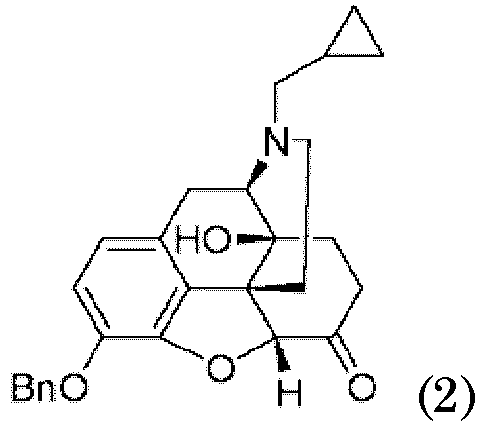
- (i) reacting a compound of the following formula (2) with diethyl pyrocarbonate, followed by treating with a base to obtain a compound of the following formula (3);
- (ii) subjecting the compound of the following formula (3) to a combination reaction with a compound of the following formula (4), followed by adding hydrochloric acid to obtain a compound of the following formula (5); and
- (iii) deprotecting the compound of the following formula (5).


- Hereinafter, the preparation process of the present invention is described in more detail referring to the following reaction scheme 2. The process depicted in the following reaction scheme 2 represents merely a typical example, and various changes may be made to reagents and reaction conditions without limitation.

- The compound of formula (3) can be obtained by reacting the compound of formula (2) with diethyl pyrocarbonate and then treating with a base.
- As shown in the following reaction scheme 3, when the compound of formula (2) is reacted with diethyl pyrocarbonate (DEPC), the hydroxyl group of the compound of formula (2) is ethoxycarbonylated to give a carbonate intermediate, and when the intermediate is treated with a base, the ethoxycarbonyl group is transferred to the α-position of the ketone group to give the compound of formula (3).

- As the base, sodium ethoxide, potassium ethoxide, lithium ethoxide, etc. may be used. Particularly, sodium ethoxide is preferred.
- The reaction with diethyl pyrocarbonate is preferably performed at about 100 to 120°C, and the base treatment is preferably performed at room temperature.
- The obtained compound of formula (3) may be purified by recrystallization. As the recrystallization solvent, a mixed solvent of ethyl acetate and methanol is preferred.
- In one aspect of the present invention, the compound of formula (2) may be synthesized by protecting a compound of the following formula (6) with a benzyl group.
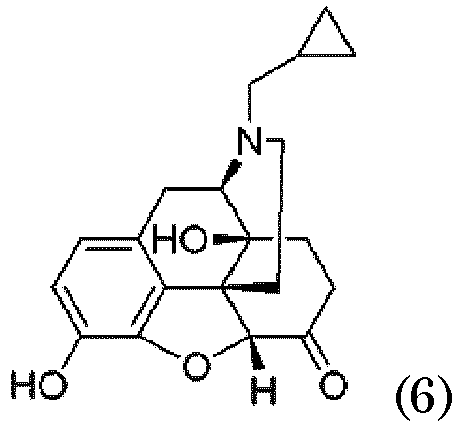
- The protection may be carried out by reacting the compound of formula (6) with benzyl bromide in the presence of a base.
- As the base, potassium carbonate, cesium carbonate, sodium hydride, sodium hydroxide, etc. may be used. Particularly, potassium carbonate in the form of a fine powder is preferred.
- The reaction temperature is preferably about 50 to 70°C.
- As the reaction solvent, acetone, dimethylformamide, etc. may be used. Particularly, acetone is preferred in terms of a work-up process and yield.
- The compound of formula (5) can be obtained by subjecting the compound of formula (3) to a combination reaction with the compound of formula (4) and then adding hydrochloric acid thereto.
- The combination reaction may be carried out in the absence of a separate reaction reagent such as a catalyst.
- As the reaction temperature, heating under reflux condition is preferred. The reaction time is preferably 3 to 4 days.
- As the reaction solvent, toluene, benzene, xylene, etc. may be used. Particularly, toluene is preferred.
- The obtained compound of formula (5) may be purified by recrystallization. As the recrystallization solvent, ethyl acetate is preferred.
- The compound of formula (1) can be obtained by deprotecting the compound of formula (5).
- The deprotection may be carried out using concentrated hydrochloric acid in acetic acid.
- The reaction temperature is preferably about 50 to 60°C.
- The obtained naldemedine of formula (1) can be solidified by adding it to aqueous ammonia at 0°C.
- The naldemedine prepared by the above process can be used for the preparation of an acid addition salt of naldemedine by adding an acid thereto, without additional purification process.
- As the acid, p-toluenesulfonic acid, acetic acid, hydrochloric acid, etc. may be used. Particularly, p-toluenesulfonic acid is preferred.
- The acid addition reaction is preferably performed at room temperature. As the reaction solvent, methanol and the like may be used.
- The prepared p-toluenesulfonic acid salt of naldemedine can be purified by recrystallization. As the recrystallization solvent, methylene chloride is preferred.
- One embodiment of the present invention relates to a compound of the following formula (5) which is an intermediate for preparing naldemedine of formula (1).

- In accordance with the preparation process of the present invention, naldemedine can be cost-effectively, efficiently, and simply prepared. Further, naldemedine having high purity can be prepared with high yields only by recrystallization without a purification process using column chromatography. Therefore, it is suitable for mass production.
- Hereinafter, the present invention will be described in more detail by the following examples. It will be obvious to those skilled in the art that these examples are merely described for illustration of the present invention and the scope of the present invention is not limited thereto.
- t-Butoxycarbonylamino isobutyric acid (200 g, 1.0 equiv) was added to n-propyl acetate (1400 mL, 7 vol.) followed by stirring, and then N,N-diisopropylethylamine (DIPEA, 188.5 mL, 1.1 equiv) was added thereto at 0°C. Then, isobutyl chloroformate (IBCF, 134.7 mL, 1.05 equiv) was added dropwise thereto at 0°C, and the resulting mixture was stirred for 1 hour. A solution of benzamide oxime (140.7 g, 1.05 equiv) in n-propyl acetate (800 mL, 4 vol.) was added and stirred at 0°C for 1 hour. Then, the resulting mixture was heated at 95°C for 5 hours. After confirming that the reaction was completed with TLC (CH2Cl2:MeOH = 20:1), the reaction product was quenched with 0.1 N HCl solution (3000 mL, 10 vol.), and the organic phase was washed with saturated NaHCO3 solution (3000 mL, 10 vol.) and water (3000 mL, 10 vol.). After drying over Na2SO4 and concentration, the residue (300 g) was diluted with 4 N HCl in dioxane (3000 mL, 10 vol), and stirred at 20°C for 2 hours. After filtration of the resulting white solid, the filter cake was washed with methyl t-butyl ether (MTBE, 300 mL, 1 vol.). The filtrate was evaporated, and MTBE (500 mL, 10 vol.) was added and stirred, followed by filtration. The filter cake was washed with MTBE (50 mL, 1 vol.). The filter cakes were combined and dried in a vacuum oven to give the HCl salt of the compound of formula (4) (228 g, 97.6% yield) as a white solid. Then, saturated sodium hydrogen carbonate solution (2 L) and MTBE (2 L) were added thereto and strongly stirred for 30 minutes, and then the organic layer was separated, followed by concentration. The obtained solid was dried in a vacuum oven to obtain the compound of formula (4) (190 g, 98% yield) as a white solid.
- 1H NMR (300 MHz, DMSO): 9.16 (3H, s), 8.05-8.02 (2H, m), 7.65-7.59 (3H, m), 1.79 (6H, s).
- m/z [M+H] = 204.1
- The compound of formula (6) (100 g, 1 equiv), BnBr (41 mL, 1.3 equiv) and K2CO3 (110 g, 3 equiv) were added to acetone (1000 mL, 10 vol.) and stirred, followed by heating at 60°C for 20 hours. After confirming that the reaction was completed with TLC (CH2Cl2:MeOH = 15:1), the reaction product was cooled to room temperature and filtered. Then, the filter cake was washed with acetone (200 mL×2, 2 vol.). The filtrate was evaporated, and the residue was diluted with 2N HCl solution (300 mL, 3 vol.) and washed with MTBE (300 mL×2, 3 vol.). After that, it was neutralized with NH3·H2O and extracted with CH2Cl2 (300 mL×2, 3 vol.). The organic phases were combined and dried over Na2SO4, followed by evaporation to obtain the compound of formula (2) (106.93 g, 93.6% yield) as a pale yellow gum.
- 1H NMR(300 MHz, CDCl3): 7.47-7.44 (2H, m), 7.37-7.25 (3H, m), 6.72-6.54 (2H, dd, J =8.1 Hz), 5.31-5.18 (3H, m), 4.68 (1H, s), 3.18-3.16 (1H, d), 3.06-3.00 (2H, m), 2.76-2.12 (7H, m), 1.96-1.83 (1H, m), 1.64-1.53 (2H, m), 0.98-0.77 (1H, m), 0.57-0.53 (2H, m), 0.15-0.13 (2H, m);
- 13C NMR(300 MHz, CDCl3): δ= 208.5, 145.5, 141.8, 137.5, 129.8, 128.3, 127.7, 125.6, 119.4, 118.0, 90.4, 72.1, 70.1, 62.0, 59.2, 50.7, 43.5, 36.2, 31.5, 30.7, 22.6, 9.4, 3.9, 3.8.
- m/z [M+H] = 432.2
- A stirred mixture of the compound of formula (2) (106.9 g, 1 equiv) and diethyl pyrocarbonate (DEPC, 1000 mL, 10 vol.) was heated at 110°C for 20 hours. The volatiles were evaporated, and the residue was diluted with EtOH (1000 mL, 10 vol.). To the resulting mixture was added dropwise EtONa (107 mL, 1 vol., 20% solution in EtOH), and the mixture was stirred at 20°C for 1 hour. After confirming that the reaction was completed with TLC (CH2Cl2:MeOH = 15:1), the reaction mixture was neutralized with 1 N HCl solution at 0°C. The resulting mixture was concentrated and the residue was diluted with CH2Cl2 (1000 mL, 10 vol.) and water (500 mL, 5 vol.). The organic layer was separated, and the separated aqueous layer was extracted with CH2Cl2 (300 mL). The organic layers were combined and dried over Na2SO4, followed by concentration. The crude product was purified by crystallization (EA:MeOH = 2 vol.:4 vol.) and filtered. The filter cake was washed with MeOH (1 vol.). The filtrate was evaporated and recrystallized again. The two filter cakes were combined and dried in a vacuum oven to obtain the compound of formula (3) (110 g, 88% yield, 98.4% purity) as a white solid.
- 1H NMR(300 MHz, CDCl3): 12.06 (1H, s), 7.43-7.39 (2H, m), 7.34-7.25 (3H, m), 6.74-6.54 (2H, dd, J =8.1 Hz), 5.20-5.18 (2H, t, J = 4.2 Hz), 4.95 (1H, s), 4.89 (1H, br), 4.17-4.14 (2H, m), 3.23-3.21 (1H, d), 3.09-3.03 (1H, d), 2.69-2.25 (7H, m), 2.03-1.98 (1H, d), 1.75-1.65 (2H, d), 1.28-1.23 (3H, t, J =6.9), 0.97-0.77 (1H, m), 0.57-0.54 (2H, m), 0.15-0.12 (2H, m);
- 13C NMR(300 MHz, CDCl3): δ= 172.1, 164.4, 145.3, 141.9, 137.3, 131.0, 128.3, 127.8, 126.2, 119.0, 117.7, 98.4, 87.0, 71.9, 70.0, 61.2, 60.9, 59.4, 46.5, 43.3, 31.1, 29.9, 22.9, 14.1, 9.3, 4.1, 3.6.
- m/z [M+H] = 504.2
- The compound of formula (3) (100 g, 1 equiv) and the compound of formula (4) (60.54 g, 1.5 equiv) were added to toluene (200 mL, 2 vol.), followed by stirring and then heating at 110°C for 4 days. After confirming that the reaction was completed with TLC (CH2Cl2:MeOH = 15:1), the reaction mixture was diluted with CH2Cl2 (1000 mL, 10 vol.), and washed with 0.1 N HCl solution (500 mL×5, 5 vol.), saturated NaHCO3 solution (500 mL, 5 vol.) and brine (500 mL, 5 vol.). The separated organic layer was dried over Na2SO4 and concentrated. The crude product (65 g) was diluted with EA (688 mL, 7.5 vol.) and 4 N HCl solution (26 mL, 1.05 equiv) in dioxane was added dropwise thereto. After dropwise addition, the mixture was heated under reflux to give a clear solution. The clear solution was slowly cooled to room temperature. The formed solid was filtered, and the filter cake was washed with EA (32 mL, 0.5 vol.) and MTBE (65 mL, 1 vol.). The filter cake was dried in a vacuum oven to obtain the compound of formula (5) (47 g, 73% yield, 99.5% purity) as a white solid.
- 1H NMR(300 MHz, DMSO): 13.30 (1H, s), 8.23 (1H, br), 8.00 (1H, s), 7.99-7.97 (2H, m), 7.59-7.53 (3H, m), 7.41-7.28 (5H, m), 6.96-6.73 (2H, dd, J =8.1 Hz), 5.17-5.12 (2H, m), 5.04 (1H, s), 4.04-4.02 (1H, d), 3.47-2.04 (9H, m), 1.72-1.70 (6H, d), 1.66-1.60 (1H, d), 1.17-1.06 (1H, m), 0.75-0.61 (2H, m), 0.55-0.39 (2H, m);
- 13C NMR(300 MHz, DMSO): δ= 183.4, 171.4, 167.8, 161.4, 145.1, 142.1, 137.2, 132.0, 129.7, 129.6, 128.8, 128.7, 128.3, 127.4, 126.6, 124.1, 120.3, 117.4, 98.4, 86.5, 70.8, 70.0, 60.4, 57.2, 52.1, 45.9, 45.0, 30.9, 28.0, 26.7, 26.5, 24.0, 6.1, 5.7, 2.8.
- m/z [M+H] = 661.3
- The compound of formula (5) (10 g, 1 equiv) and conc. HCl (20 mL, 2 vol.) were added to acetic acid (40 mL, 4 vol.) and stirred, followed by heating at 60°C for 3 hours. After confirming that the reaction was completed with TLC (CH2Cl2:MeOH = 15:1), the reaction mixture was cooled to room temperature and added dropwise to a mixture of NH3·H2O(75 mL, 7.5 vol.) and water (75 mL, 7.5 vol.) at 0°C. The precipitated white solid was filtered, and then the filter cake was washed with water (20 mL×2, 2 vol.). The separated solid was diluted with EtOAc (80 mL, 8 vol.), and dried over Na2SO4, followed by concentration. MTBE (10 mL, 10 vol.) was added to the residue and stirred to solidify the product, followed by filtration. The product was used in the next step without additional purification.
- 1H NMR(300 MHz, DMSO): 13.40 (1H,br), 9.16 (1H, br), 8.08 (1H, br), 7.99-7.95 (2H, m), 7.58-7.52 (3H, m), 6.60-6.53 (2H, m), 4.77 (1H, br), 4.72 (1H, s), 3.33-1.97 (8H, m), 1.69-1.58 (6H, m), 1.43-1.14 (2H, m), 0.88-0.81 (1H, m), 0.53-0.47 (2H, m), 0.15-0.14 (2H, m).
- m/z [M+H] = 571.2
- To a solution of the compound of formula (1) (6.5 g, 1 equiv) in MeOH (65 mL, 10 vol.) was added p-toluenesulfonic acid (PTSA, 2.1 g, 1 equiv), followed by stirring at 20°C for 16 hours. Then, the resulting mixture was evaporated, and ACN and MTBE (ACN:MTBE = 1:10) were added to the residue and stirred, followed by filtration. The filter cake was washed with MTBE (1 vol.). Then, it was diluted with MC (10 vol.) and stirred for 2 days. The resulting white solid was crystallized (unsolvated) (99.8% purity).
Claims (15)
- A process for preparing naldemedine of the following formula (1), which comprises the steps of:(i) reacting a compound of the following formula (2) with diethyl pyrocarbonate, followed by treating with a base to obtain a compound of the following formula (3);(ii) subjecting the compound of the following formula (3) to a combination reaction with a compound of the following formula (4), followed by adding hydrochloric acid to obtain a compound of the following formula (5); and(iii) deprotecting the compound of the following formula (5):


- The process according to claim 1, wherein the base of the step (i) is sodium ethoxide.
- The process according to claim 1, further comprising the step of purifying the compound of formula (3) obtained from the step (i) by recrystallization.
- The process according to claim 1, wherein the compound of formula (2) is synthesized by protecting a compound of the following formula (6) with a benzyl group:

- The process according to claim 4, wherein the protection is carried out by reacting the compound of formula (6) with benzyl bromide in the presence of a base.
- The process according to claim 5, wherein the base is potassium carbonate in the form of a fine powder.
- The process according to claim 5, wherein a solvent in the protection is acetone.
- The process according to claim 1, wherein the combination reaction of the step (ii) is carried out in the absence of a separate reaction reagent.
- The process according to claim 1, wherein the combination reaction of the step (ii) is carried out under a heating under reflux condition, and a solvent in the combination reaction is toluene.
- The process according to claim 1, further comprising the step of purifying the compound of formula (5) obtained from the step (ii) by recrystallization.
- The process according to claim 1, wherein the deprotection of the step (iii) is carried out using concentrated hydrochloric acid in acetic acid.
- The process according to any one of claims 1 to 11, which further comprises the step of adding an acid to the naldemedine to prepare an acid addition salt of naldemedine.
- The process according to claim 12, wherein the acid is p-toluenesulfonic acid, acetic acid, or hydrochloric acid.
- The process according to claim 12, wherein the acid addition salt is a p-toluenesulfonic acid salt.
- A compound of the following formula (5):

Applications Claiming Priority (2)
| Application Number | Priority Date | Filing Date | Title |
|---|---|---|---|
| KR1020190046088A KR102201609B1 (en) | 2019-04-19 | 2019-04-19 | Process for Preparing Naldemedine |
| PCT/KR2020/005007 WO2020213911A1 (en) | 2019-04-19 | 2020-04-14 | Method for preparing naldemedine |
Publications (4)
| Publication Number | Publication Date |
|---|---|
| EP3957641A1 EP3957641A1 (en) | 2022-02-23 |
| EP3957641A4 EP3957641A4 (en) | 2023-01-18 |
| EP3957641C0 EP3957641C0 (en) | 2025-05-28 |
| EP3957641B1 true EP3957641B1 (en) | 2025-05-28 |
Family
ID=72837414
Family Applications (1)
| Application Number | Title | Priority Date | Filing Date |
|---|---|---|---|
| EP20792080.2A Active EP3957641B1 (en) | 2019-04-19 | 2020-04-14 | Method for preparing naldemedine |
Country Status (5)
| Country | Link |
|---|---|
| US (2) | US12325712B2 (en) |
| EP (1) | EP3957641B1 (en) |
| JP (1) | JP7302904B2 (en) |
| KR (1) | KR102201609B1 (en) |
| WO (1) | WO2020213911A1 (en) |
Families Citing this family (1)
| Publication number | Priority date | Publication date | Assignee | Title |
|---|---|---|---|---|
| IT202300009864A1 (en) | 2023-05-16 | 2024-11-16 | Procos Spa | PROCESS FOR PREPARATION OF NALDEMEDINE |
Family Cites Families (5)
| Publication number | Priority date | Publication date | Assignee | Title |
|---|---|---|---|---|
| MXPA02005335A (en) * | 1999-11-29 | 2003-01-28 | Adolor Corp | Novel methods and compositions involving opioids and antagonists thereof. |
| WO2006126529A1 (en) * | 2005-05-25 | 2006-11-30 | Shionogi & Co., Ltd. | 6,7-unsaturated-7-carbamoyl substituted morphinan derivative |
| FR2906252B1 (en) * | 2006-09-21 | 2008-11-28 | Sanofi Aventis Sa | PROCESS FOR THE PREPARATION OF NALTREXONE N-AKLYL HALIDES |
| RU2643807C1 (en) | 2010-11-12 | 2018-02-06 | Сионоги Энд Ко., Лтд. | Crystals of 6,7-unsaturated-7-carbamoylmorphinane derivatives and method of their production |
| CN105985348B (en) | 2015-02-12 | 2019-02-01 | 正大天晴药业集团股份有限公司 | A kind of preparation method of bromomethylnaltrexone |
-
2019
- 2019-04-19 KR KR1020190046088A patent/KR102201609B1/en active Active
-
2020
- 2020-04-14 EP EP20792080.2A patent/EP3957641B1/en active Active
- 2020-04-14 WO PCT/KR2020/005007 patent/WO2020213911A1/en not_active Ceased
- 2020-04-14 JP JP2021561713A patent/JP7302904B2/en active Active
- 2020-04-14 US US17/604,605 patent/US12325712B2/en active Active
-
2025
- 2025-04-08 US US19/173,307 patent/US20250236626A1/en active Pending
Also Published As
| Publication number | Publication date |
|---|---|
| EP3957641A1 (en) | 2022-02-23 |
| US20220194953A1 (en) | 2022-06-23 |
| US20250236626A1 (en) | 2025-07-24 |
| JP7302904B2 (en) | 2023-07-04 |
| KR20200122826A (en) | 2020-10-28 |
| US12325712B2 (en) | 2025-06-10 |
| EP3957641C0 (en) | 2025-05-28 |
| KR102201609B1 (en) | 2021-01-12 |
| WO2020213911A1 (en) | 2020-10-22 |
| EP3957641A4 (en) | 2023-01-18 |
| JP2022529453A (en) | 2022-06-22 |
Similar Documents
| Publication | Publication Date | Title |
|---|---|---|
| WO2008144980A1 (en) | The preparation method and intermediates of capecitabine | |
| HUE029528T2 (en) | A process for the preparation of 6-(7-((1-aminocyclopropyl)methoxy)-6-methoxyquinolin-4-yloxy)-N-methyl-1-naphthamide and synthetic intermediates thereof | |
| EP3481201B1 (en) | Processes for the preparation of 4-alkoxy-3-(acyl or alkyl)oxypicolinamides | |
| EP3766869A1 (en) | Simple preparation method for avibactam | |
| US20250236626A1 (en) | Method for preparing naldemedine | |
| EP3807268B1 (en) | Process for the preparation of lifitegrast | |
| EP3118194B1 (en) | Method for producing 2-acyliminopyridine derivative | |
| WO2021020998A1 (en) | Method for producing roxadustat | |
| KR20140013232A (en) | Process for the preparation of n-(2-hydroxyethyl)nicotinamide and nicorandil | |
| EP2643308B1 (en) | Process for the preparation of taurolidine and its intermediates thereof | |
| WO1997036895A1 (en) | Process for the preparation of tenidap | |
| KR20210135509A (en) | Method for preparing 4-amino-5-methylpyridone | |
| US20120022282A1 (en) | Process for the preparation of 2,4,6-octatriene-1-oic acid and 2,4,6-octatriene-1-ol | |
| WO2009047797A2 (en) | Process for the preparation of perhydroisoindole derivative | |
| JPS60202859A (en) | 3-aminoazetidin compound and manufacture | |
| WO2008023205A1 (en) | Process for the manufacture of hi-6 dimethanesulfonate | |
| EP0088252B1 (en) | Process for the preparation of 1-(4-chlorbenzoyl)-5-methoxy-2-methyl-3-indolacetoxy-acetic acid | |
| JP3721540B2 (en) | Pyrrolidine derivatives | |
| EP3245190B1 (en) | Method for preparing 4-cyanopiperidine hydrochloride | |
| US4459415A (en) | Process for the preparation of 1-(4-chlorobenzoyl)-5-methoxy-2-methyl-3-indoleacetoxyacetic acid | |
| JPH051053A (en) | New method for producing 6- (3-dimethylaminopropionyl) forskolin | |
| CN107759483B (en) | A kind of preparation method of methylamino substituted alkyl cyclopentanecarboxylate | |
| CN119661386A (en) | A synthetic method and compound of 3-amino-5-(4-methoxybenzyl)-2-nitrobenzoic acid methyl ester | |
| KR100483317B1 (en) | METHOD FOR THE PREPARATION OF α-PHENYL-α-PROPOXYBENZENEACETIC ACID 1-METHYL-4-PIPERIDINYL ESTER HYDROCHLORIDE | |
| JPH072809A (en) | New process for producing aminothiazoleacetic acid derivative |
Legal Events
| Date | Code | Title | Description |
|---|---|---|---|
| STAA | Information on the status of an ep patent application or granted ep patent |
Free format text: STATUS: THE INTERNATIONAL PUBLICATION HAS BEEN MADE |
|
| PUAI | Public reference made under article 153(3) epc to a published international application that has entered the european phase |
Free format text: ORIGINAL CODE: 0009012 |
|
| STAA | Information on the status of an ep patent application or granted ep patent |
Free format text: STATUS: REQUEST FOR EXAMINATION WAS MADE |
|
| 17P | Request for examination filed |
Effective date: 20211027 |
|
| AK | Designated contracting states |
Kind code of ref document: A1 Designated state(s): AL AT BE BG CH CY CZ DE DK EE ES FI FR GB GR HR HU IE IS IT LI LT LU LV MC MK MT NL NO PL PT RO RS SE SI SK SM TR |
|
| DAV | Request for validation of the european patent (deleted) | ||
| DAX | Request for extension of the european patent (deleted) | ||
| A4 | Supplementary search report drawn up and despatched |
Effective date: 20221219 |
|
| RIC1 | Information provided on ipc code assigned before grant |
Ipc: C07D 489/08 20060101AFI20221213BHEP |
|
| GRAP | Despatch of communication of intention to grant a patent |
Free format text: ORIGINAL CODE: EPIDOSNIGR1 |
|
| STAA | Information on the status of an ep patent application or granted ep patent |
Free format text: STATUS: GRANT OF PATENT IS INTENDED |
|
| INTG | Intention to grant announced |
Effective date: 20241218 |
|
| GRAS | Grant fee paid |
Free format text: ORIGINAL CODE: EPIDOSNIGR3 |
|
| GRAA | (expected) grant |
Free format text: ORIGINAL CODE: 0009210 |
|
| STAA | Information on the status of an ep patent application or granted ep patent |
Free format text: STATUS: THE PATENT HAS BEEN GRANTED |
|
| AK | Designated contracting states |
Kind code of ref document: B1 Designated state(s): AL AT BE BG CH CY CZ DE DK EE ES FI FR GB GR HR HU IE IS IT LI LT LU LV MC MK MT NL NO PL PT RO RS SE SI SK SM TR |
|
| REG | Reference to a national code |
Ref country code: GB Ref legal event code: FG4D |
|
| REG | Reference to a national code |
Ref country code: CH Ref legal event code: EP |
|
| REG | Reference to a national code |
Ref country code: IE Ref legal event code: FG4D Ref country code: DE Ref legal event code: R096 Ref document number: 602020052043 Country of ref document: DE |
|
| U01 | Request for unitary effect filed |
Effective date: 20250617 |
|
| U07 | Unitary effect registered |
Designated state(s): AT BE BG DE DK EE FI FR IT LT LU LV MT NL PT RO SE SI Effective date: 20250627 |
|
| PG25 | Lapsed in a contracting state [announced via postgrant information from national office to epo] |
Ref country code: ES Free format text: LAPSE BECAUSE OF FAILURE TO SUBMIT A TRANSLATION OF THE DESCRIPTION OR TO PAY THE FEE WITHIN THE PRESCRIBED TIME-LIMIT Effective date: 20250528 |
|
| PG25 | Lapsed in a contracting state [announced via postgrant information from national office to epo] |
Ref country code: NO Free format text: LAPSE BECAUSE OF FAILURE TO SUBMIT A TRANSLATION OF THE DESCRIPTION OR TO PAY THE FEE WITHIN THE PRESCRIBED TIME-LIMIT Effective date: 20250828 Ref country code: GR Free format text: LAPSE BECAUSE OF FAILURE TO SUBMIT A TRANSLATION OF THE DESCRIPTION OR TO PAY THE FEE WITHIN THE PRESCRIBED TIME-LIMIT Effective date: 20250829 |
|
| PG25 | Lapsed in a contracting state [announced via postgrant information from national office to epo] |
Ref country code: PL Free format text: LAPSE BECAUSE OF FAILURE TO SUBMIT A TRANSLATION OF THE DESCRIPTION OR TO PAY THE FEE WITHIN THE PRESCRIBED TIME-LIMIT Effective date: 20250528 |
|
| PG25 | Lapsed in a contracting state [announced via postgrant information from national office to epo] |
Ref country code: HR Free format text: LAPSE BECAUSE OF FAILURE TO SUBMIT A TRANSLATION OF THE DESCRIPTION OR TO PAY THE FEE WITHIN THE PRESCRIBED TIME-LIMIT Effective date: 20250528 |
|
| PG25 | Lapsed in a contracting state [announced via postgrant information from national office to epo] |
Ref country code: RS Free format text: LAPSE BECAUSE OF FAILURE TO SUBMIT A TRANSLATION OF THE DESCRIPTION OR TO PAY THE FEE WITHIN THE PRESCRIBED TIME-LIMIT Effective date: 20250828 |
|
| PG25 | Lapsed in a contracting state [announced via postgrant information from national office to epo] |
Ref country code: IS Free format text: LAPSE BECAUSE OF FAILURE TO SUBMIT A TRANSLATION OF THE DESCRIPTION OR TO PAY THE FEE WITHIN THE PRESCRIBED TIME-LIMIT Effective date: 20250928 |
|
| PG25 | Lapsed in a contracting state [announced via postgrant information from national office to epo] |
Ref country code: SM Free format text: LAPSE BECAUSE OF FAILURE TO SUBMIT A TRANSLATION OF THE DESCRIPTION OR TO PAY THE FEE WITHIN THE PRESCRIBED TIME-LIMIT Effective date: 20250528 |
|
| PG25 | Lapsed in a contracting state [announced via postgrant information from national office to epo] |
Ref country code: CZ Free format text: LAPSE BECAUSE OF FAILURE TO SUBMIT A TRANSLATION OF THE DESCRIPTION OR TO PAY THE FEE WITHIN THE PRESCRIBED TIME-LIMIT Effective date: 20250528 |
|
| PG25 | Lapsed in a contracting state [announced via postgrant information from national office to epo] |
Ref country code: SK Free format text: LAPSE BECAUSE OF FAILURE TO SUBMIT A TRANSLATION OF THE DESCRIPTION OR TO PAY THE FEE WITHIN THE PRESCRIBED TIME-LIMIT Effective date: 20250528 |
|
| PLBE | No opposition filed within time limit |
Free format text: ORIGINAL CODE: 0009261 |
|
| STAA | Information on the status of an ep patent application or granted ep patent |
Free format text: STATUS: NO OPPOSITION FILED WITHIN TIME LIMIT |
|
| REG | Reference to a national code |
Ref country code: CH Ref legal event code: L10 Free format text: ST27 STATUS EVENT CODE: U-0-0-L10-L00 (AS PROVIDED BY THE NATIONAL OFFICE) Effective date: 20260409 |
|
| 26N | No opposition filed |
Effective date: 20260303 |