EP3957614B1 - Pre-sintered ceramic block for dental restoration, preparation method therefor and use thereof - Google Patents
Pre-sintered ceramic block for dental restoration, preparation method therefor and use thereof Download PDFInfo
- Publication number
- EP3957614B1 EP3957614B1 EP19925234.7A EP19925234A EP3957614B1 EP 3957614 B1 EP3957614 B1 EP 3957614B1 EP 19925234 A EP19925234 A EP 19925234A EP 3957614 B1 EP3957614 B1 EP 3957614B1
- Authority
- EP
- European Patent Office
- Prior art keywords
- ceramic block
- sintered ceramic
- sintering
- matrix
- matrix glass
- Prior art date
- Legal status (The legal status is an assumption and is not a legal conclusion. Google has not performed a legal analysis and makes no representation as to the accuracy of the status listed.)
- Active
Links
Images

Classifications
-
- C—CHEMISTRY; METALLURGY
- C03—GLASS; MINERAL OR SLAG WOOL
- C03C—CHEMICAL COMPOSITION OF GLASSES, GLAZES OR VITREOUS ENAMELS; SURFACE TREATMENT OF GLASS; SURFACE TREATMENT OF FIBRES OR FILAMENTS MADE FROM GLASS, MINERALS OR SLAGS; JOINING GLASS TO GLASS OR OTHER MATERIALS
- C03C10/00—Devitrified glass ceramics, i.e. glass ceramics having a crystalline phase dispersed in a glassy phase and constituting at least 50% by weight of the total composition
- C03C10/0009—Devitrified glass ceramics, i.e. glass ceramics having a crystalline phase dispersed in a glassy phase and constituting at least 50% by weight of the total composition containing silica as main constituent
-
- A—HUMAN NECESSITIES
- A61—MEDICAL OR VETERINARY SCIENCE; HYGIENE
- A61C—DENTISTRY; APPARATUS OR METHODS FOR ORAL OR DENTAL HYGIENE
- A61C13/00—Dental prostheses; Making same
- A61C13/0003—Making bridge-work, inlays, implants or the like
- A61C13/0022—Blanks or green, unfinished dental restoration parts
-
- A—HUMAN NECESSITIES
- A61—MEDICAL OR VETERINARY SCIENCE; HYGIENE
- A61C—DENTISTRY; APPARATUS OR METHODS FOR ORAL OR DENTAL HYGIENE
- A61C13/00—Dental prostheses; Making same
- A61C13/08—Artificial teeth; Making same
- A61C13/083—Porcelain or ceramic teeth
-
- C—CHEMISTRY; METALLURGY
- C03—GLASS; MINERAL OR SLAG WOOL
- C03B—MANUFACTURE, SHAPING, OR SUPPLEMENTARY PROCESSES
- C03B11/00—Pressing molten glass or performed glass reheated to equivalent low viscosity without blowing
-
- C—CHEMISTRY; METALLURGY
- C03—GLASS; MINERAL OR SLAG WOOL
- C03B—MANUFACTURE, SHAPING, OR SUPPLEMENTARY PROCESSES
- C03B19/00—Other methods of shaping glass
- C03B19/06—Other methods of shaping glass by sintering, e.g. by cold isostatic pressing of powders and subsequent sintering, by hot pressing of powders, by sintering slurries or dispersions not undergoing a liquid phase reaction
- C03B19/063—Other methods of shaping glass by sintering, e.g. by cold isostatic pressing of powders and subsequent sintering, by hot pressing of powders, by sintering slurries or dispersions not undergoing a liquid phase reaction by hot-pressing powders
-
- C—CHEMISTRY; METALLURGY
- C03—GLASS; MINERAL OR SLAG WOOL
- C03B—MANUFACTURE, SHAPING, OR SUPPLEMENTARY PROCESSES
- C03B32/00—Thermal after-treatment of glass products not provided for in groups C03B19/00, C03B25/00 - C03B31/00 or C03B37/00, e.g. crystallisation, eliminating gas inclusions or other impurities; Hot-pressing vitrified, non-porous, shaped glass products
- C03B32/02—Thermal crystallisation, e.g. for crystallising glass bodies into glass-ceramic articles
-
- C—CHEMISTRY; METALLURGY
- C03—GLASS; MINERAL OR SLAG WOOL
- C03C—CHEMICAL COMPOSITION OF GLASSES, GLAZES OR VITREOUS ENAMELS; SURFACE TREATMENT OF GLASS; SURFACE TREATMENT OF FIBRES OR FILAMENTS MADE FROM GLASS, MINERALS OR SLAGS; JOINING GLASS TO GLASS OR OTHER MATERIALS
- C03C10/00—Devitrified glass ceramics, i.e. glass ceramics having a crystalline phase dispersed in a glassy phase and constituting at least 50% by weight of the total composition
- C03C10/0018—Devitrified glass ceramics, i.e. glass ceramics having a crystalline phase dispersed in a glassy phase and constituting at least 50% by weight of the total composition containing SiO2, Al2O3 and monovalent metal oxide as main constituents
-
- C—CHEMISTRY; METALLURGY
- C03—GLASS; MINERAL OR SLAG WOOL
- C03C—CHEMICAL COMPOSITION OF GLASSES, GLAZES OR VITREOUS ENAMELS; SURFACE TREATMENT OF GLASS; SURFACE TREATMENT OF FIBRES OR FILAMENTS MADE FROM GLASS, MINERALS OR SLAGS; JOINING GLASS TO GLASS OR OTHER MATERIALS
- C03C10/00—Devitrified glass ceramics, i.e. glass ceramics having a crystalline phase dispersed in a glassy phase and constituting at least 50% by weight of the total composition
- C03C10/0018—Devitrified glass ceramics, i.e. glass ceramics having a crystalline phase dispersed in a glassy phase and constituting at least 50% by weight of the total composition containing SiO2, Al2O3 and monovalent metal oxide as main constituents
- C03C10/0027—Devitrified glass ceramics, i.e. glass ceramics having a crystalline phase dispersed in a glassy phase and constituting at least 50% by weight of the total composition containing SiO2, Al2O3 and monovalent metal oxide as main constituents containing SiO2, Al2O3, Li2O as main constituents
-
- C—CHEMISTRY; METALLURGY
- C03—GLASS; MINERAL OR SLAG WOOL
- C03C—CHEMICAL COMPOSITION OF GLASSES, GLAZES OR VITREOUS ENAMELS; SURFACE TREATMENT OF GLASS; SURFACE TREATMENT OF FIBRES OR FILAMENTS MADE FROM GLASS, MINERALS OR SLAGS; JOINING GLASS TO GLASS OR OTHER MATERIALS
- C03C3/00—Glass compositions
- C03C3/04—Glass compositions containing silica
- C03C3/076—Glass compositions containing silica with 40% to 90% silica, by weight
- C03C3/097—Glass compositions containing silica with 40% to 90% silica, by weight containing phosphorus, niobium or tantalum
-
- C—CHEMISTRY; METALLURGY
- C03—GLASS; MINERAL OR SLAG WOOL
- C03C—CHEMICAL COMPOSITION OF GLASSES, GLAZES OR VITREOUS ENAMELS; SURFACE TREATMENT OF GLASS; SURFACE TREATMENT OF FIBRES OR FILAMENTS MADE FROM GLASS, MINERALS OR SLAGS; JOINING GLASS TO GLASS OR OTHER MATERIALS
- C03C4/00—Compositions for glass with special properties
- C03C4/0007—Compositions for glass with special properties for biologically-compatible glass
- C03C4/0021—Compositions for glass with special properties for biologically-compatible glass for dental use
-
- C—CHEMISTRY; METALLURGY
- C03—GLASS; MINERAL OR SLAG WOOL
- C03C—CHEMICAL COMPOSITION OF GLASSES, GLAZES OR VITREOUS ENAMELS; SURFACE TREATMENT OF GLASS; SURFACE TREATMENT OF FIBRES OR FILAMENTS MADE FROM GLASS, MINERALS OR SLAGS; JOINING GLASS TO GLASS OR OTHER MATERIALS
- C03C4/00—Compositions for glass with special properties
- C03C4/02—Compositions for glass with special properties for coloured glass
-
- A—HUMAN NECESSITIES
- A61—MEDICAL OR VETERINARY SCIENCE; HYGIENE
- A61C—DENTISTRY; APPARATUS OR METHODS FOR ORAL OR DENTAL HYGIENE
- A61C2201/00—Material properties
- A61C2201/002—Material properties using colour effect, e.g. for identification purposes
-
- C—CHEMISTRY; METALLURGY
- C03—GLASS; MINERAL OR SLAG WOOL
- C03C—CHEMICAL COMPOSITION OF GLASSES, GLAZES OR VITREOUS ENAMELS; SURFACE TREATMENT OF GLASS; SURFACE TREATMENT OF FIBRES OR FILAMENTS MADE FROM GLASS, MINERALS OR SLAGS; JOINING GLASS TO GLASS OR OTHER MATERIALS
- C03C2204/00—Glasses, glazes or enamels with special properties
- C03C2204/04—Opaque glass, glaze or enamel
Definitions
- the present application relates to the technical field of a dental restoration, in particular to a pre-sintered ceramic block for a dental restoration, a preparation method, and use thereof.
- the ChairSide restorative system is a dental restorative system formed by introducing computer-aided design and manufacture into the field of restorative dentistry.
- the ChairSide restorative system which is convenient and rapid, and breaks through traditional denture manufacturing procedures such as teeth grinding, mold fabricating, wax carving, and porcelain, allows a 3D camera to directly capture the teeth image immediately after the teeth are ground and trimmed by a dentist, and then transfers the image to the computer in real-time, and processes the ceramic blocks into a dental restoration by the automatic ceramic block grinder with the assistance of the computer.
- lithium disilicate glass-ceramic materials have both outstanding aesthetic effects and good mechanical properties.
- lithium disilicate glass-ceramic materials have high hardness and poor processability, making it difficult to apply in ChairSide repair system.
- lithium metasilicate glass ceramics with lithium metasilicate as a main crystal phase are obtained through pre-sintering at a lower temperature, then is subjected to mechanical processing to obtain a restoration shape, and then to dense-sintering at a higher temperature, to finally obtain a glass ceramic restoration with lithium disilicate as a main crystal phase; since the hardness of lithium metasilicate is lower than that of lithium disilicate, the processability is improved.
- the Vickers hardness of the ceramic block with lithium metasilicate as the main crystal phase still reaches 5-6 GPa
- the ceramic block is only suitable for being machined by a wet method and is not suitable for dry machining, if the lithium metasilicate glass ceramic is machined by a dry method, the problem of incomplete edge or incomplete processing or even the problem of the ceramic block damage may occur, and the machine needle can be easily damaged; therefore, how to develop a pre-sintered ceramic block with lower hardness and suitable for dry machining has become a crucial problem.
- the present application provides a pre-sintered ceramic block for a dental restoration, which is used for solving the problem that lithium metasilicate glass ceramic has high hardness and not suitable for dry machining.
- the present application provides a method of preparing a pre-sintered ceramic block for a dental restoration.
- the present application also provides a method of preparing a ceramic block for the dental restoration and a method of preparing a dental restoration.
- a pre-sintered ceramic block for a dental restoration as defined in independent claim 1.
- the pre-sintered ceramic block does not contain a lithium metasilicate crystal phase.
- the pre-sintered ceramic block has a three-point bending strength of 10-110 MPa; preferably 10-90 MPa; more preferably 30-70 MPa.
- the pre-sintered ceramic block comprises the following components:
- the colorant is a glass colorant or a ceramic colorant; preferably, the glass colorant is oxides of at least one of vanadium, chromium, manganese, iron, cobalt, nickel, copper, cerium, praseodymium, neodymium, samarium, promethium, terbium, dysprosium, holmium, erbium, thulium, ytterbium, and europium; the ceramic colorant is one of or a combination of at least two of zirconium iron red, zirconium cerium praseodymium yellow, and nickel black.
- the matrix glass powder comprises the following components:
- the sintering temperature during pre-sintering is 530-560°C.
- the sintering temperature during pre-sintering is 570-590°C.
- the pre-sintered ceramic block for the components of the pre-sintered ceramic block, it has substantially the same composition as the matrix glass powder.
- the matrix glass powder may be prepared by the following method:
- the matrix glass powder may also be prepared by the following method: preparing at least two kinds of monochromatic matrix glass powder, and then mixing the prepared monochromatic matrix glass powder according to a required color ratio to obtain matrix glass powder used for preparing pre-sintered ceramic blocks; wherein each monochromatic matrix glass powder may be prepared according to the following method:
- the matrix glass powder may also be prepared by the following method:
- the colorant is added in step (C3), so that the influence on the coloring effect of the colorant in the high-temperature melting process can be avoided;
- some colorants with poor coloring capability such as CeO 2 can also be added in step (A3); other colorants are added in step (C3).
- water-quenching of the molten glass may be achieved by pouring the molten glass into cold water; the cold water is generally referred to 0-40°C of water.
- an average particle size of the matrix glass powder is 1-100 ⁇ m, preferably 1-50 ⁇ m, more preferably 5-20 ⁇ m.
- the inventors of the present application have found that the better the uniformity of the average particle size of the matrix glass powder, the better the denseness of the dense-sintered lithium disilicate glass ceramic product, and the more uniform the crystallization, resulting in higher strength and visible light transmittance and closer to the texture of natural teeth.
- a pre-sintered ceramic block for a dental restoration wherein the pre-sintered ceramic block contains a silica main crystal phase, has a Vickers hardness of 0.5-3 GPa, preferably 1-2.5 GPa, is opaque, and exhibits a gradual transmittance and/or color after dense-sintering at 800-1100°C.
- the pre-sintered ceramic block may exhibit a gradual transmittance after dense-sintering. In some embodiments, the pre-sintered ceramic block may exhibit a gradual color after dense-sintering. In other embodiments, the pre-sintered ceramic block may exhibit a gradual transmittance and color after dense-sintering. Since the pre-sintered ceramic block provided by the present application can be applied to a dental restoration, the transmittance and/or color displayed by the pre-sintered ceramic block after dense-sintering can be close to and consistent with the characteristics of natural teeth; the aesthetic effect of the restoration is improved.
- the pre-sintered ceramic block does not contain a lithium metasilicate crystal phase.
- the pre-sintered ceramic block has a three-point bending strength of 10-110 MPa; preferably 10-90 MPa; more preferably 30-70 MPa.
- the pre-sintered ceramic block comprises the following components:
- the colorant is a glass colorant or a ceramic colorant; preferably, the glass colorant is oxides and/or salts of at least one of vanadium, chromium, manganese, iron, cobalt, nickel, copper, cerium, praseodymium, neodymium, samarium, promethium, terbium, dysprosium, holmium, erbium, thulium, ytterbium, and europium; the ceramic colorant is one of or a combination of at least two of zirconium iron red, zirconium cerium praseodymium yellow, and nickel black.
- a method for preparing the pre-sintered ceramic block for a dental restoration of the third aspect described above comprising the steps of:
- the sintering temperature during pre-sintering is 530-560°C.
- the sintering temperature during pre-sintering is 570-590°C.
- step (1) may prepare three, four, five, seven, or even more matrix glass powders with different transmittance and/or color, each matrix glass powder with different transmittance and/or color after dense-sintering.
- matrix glass powder with different transmittance and/or color means that the matrix glass powder exhibits different transmittance and/or color after dense-sintering.
- the pre-sintered ceramic of "different transmittance and/or color" means that the transmittance and/or color of the pre-sintered ceramic is different after the pre-sintered ceramic is subjected to dense-sintering.
- the pre-sintered ceramic block after dense-sintering is also referred to as a lithium disilicate glass ceramic herein.
- step (1) at least two matrix glass powders with different transmittance can be prepared for preparing pre-sintered ceramic blocks that show gradual transmittance after dense-sintering; in some embodiments, in step (1), at least two matrix glass powders with different color can be prepared for preparing pre-sintered ceramic blocks that show gradual color after dense-sintering; in other embodiments, in step (1), at least two matrix glass powders with different transmittance and color can be prepared for preparing pre-sintered ceramic blocks that show gradual transmittance and color after dense-sintering.
- step (2) after one matrix glass powder is loaded into a mould and the upper surface of the powder is flattened to be flat, another matrix glass powder is loaded until all the powders are loaded into a mould, and then pressing molding is carried out.
- the pre-sintered ceramic block prepared by the method provided in the fourth aspect of the present application comprises at least two layers; when the pre-sintered ceramic block is subjected to dense-sintering, the obtained product can show multi-layer gradual transmittance and/or color.
- the matrix glass powder with different transmittance and/or color can be prepared by adjusting the amount of each component; for example, matrix glass powders with different color can be prepared by adjusting the types and amounts of colorants; although the content of the components in the matrix glass powders with different transmittance and/or color, the components of each matrix glass powder and the amount thereof still satisfy the ranges of the components and the amount thereof of the pre-sintered ceramic block described above.
- the preparation of each matrix glass powder may be achieved according to the steps of preparing the matrix glass powder of the second aspect described above.
- the pre-sintered ceramic block for a dental restoration comprises the following components: SiO 2 55-80%wt Li 2 O: 12-25%wt ZrO 2 0-8%wt Al 2 O 3 : 0.5-6%wt La 2 O 3 : 0-5%wt ZnO: 0-8%wt K 2 O: 0.1-9%wt GeO 2 : 0.1-6%wt Nucleating agent: 0-8%wt Colorant: 0-8%wt, Other additives: 0-10%wt.
- the pre-sintered ceramic block for a dental restoration comprises the following components: SiO 2 60-80%wt Li 2 O: 13-17%wt ZrO 2 0-6%wt Al 2 O 3 : 0.5-5%wt La 2 O 3 : 0-4.5%wt ZnO: 0-7%wt K 2 O: 0.1-7%wt GeO 2 : 0.3-5%wt Nucleating agent: 0.5-8%wt Colorant: 0-6%wt Other additives: 0-4%wt.
- the pre-sintered ceramic block for a dental restoration comprises the following components: SiO 2 64-75%wt Li 2 O: 13-17%wt ZrO 2 0-4%wt Al 2 O 3 : 0.5-4%wt La 2 O 3 : 0-4%wt ZnO: 0.1-5%wt K 2 O: 0.1-4.5%wt GeO 2 : 0.5-4%wt Nucleating agent: 0.5-5%wt Colorant: 0.1-5%wt Other additives: 0-4%wt.
- the addition of GeO 2 in the components of the pre-sintered ceramic block can effectively reduce the viscosity in the melting process of matrix glass, decrease the generation of bubbles in the melting process, reduce the possibility of pores in the pre-sintered ceramic block, improve the refractive index of the dense-sintered ceramic block, and improve the optical performance.
- the addition of the GeO 2 can improve the density of the dense-sintered ceramic block, thereby improving the strength thereof.
- the addition of colorant is mainly used to color the densely sintered ceramic block to match with natural teeth of a patient.
- the colorant may be a glass colorant or a ceramic colorant.
- the glass colorant refer to the colorants used in glass and glass articles; including, but not limited to, oxides of transition metals, rare earth elements, etc.; the glass colorants can be derived directly from oxides of transition metals, rare earth elements, etc., or derived from salts that produce the glass colorant oxides described above after high temperature treatment, including, but not limited to, chlorides, etc.
- the ceramic colorant refer to the colorant used in ceramics and ceramic articles, including, but not limited to, zirconium iron red, zirconium cerium praseodymium yellow, nickel black, etc.
- the ceramic colorant such as zirconium iron red, zirconium cerium praseodymium yellow, and nickel black are commercially available.
- the pre-sintered ceramic block for a dental restoration can be added with other additives in the components, and the other additives can be one of or a combination of at least two of B 2 O 3 , F, Na 2 O, BaO, SrO, CaO, and MgO; the addition of B 2 O 3 can reduce the viscosity of the matrix molten glass and the microcrystalline glass phase in the dense-sintering process and promote liquid phase sintering; F can convert surface crystallization of the lithium disilicate glass ceramic into integral crystallization; Na 2 O can reduce the high temperature viscosity of the matrix molten glass; BaO can increase the surface brightness of the matrix glass, thereby increasing the surface brightness of the glass phase in the glass ceramic.
- B 2 O 3 can reduce the viscosity of the matrix molten glass and the microcrystalline glass phase in the dense-sintering process and promote liquid phase sintering
- F can convert surface crystallization of the lithium disilicate glass ceramic into integral crystallization
- Na 2 O can reduce the high
- SrO can be used as a fluxing agent when the matrix molten glass is prepared, which may reduce the viscosity of the molten glass, meanwhile reduce the viscosity of the microcrystalline glass during the dense-sintering process, and increase the refractive index of the glass phase in the glass ceramics.
- CaO also has the effect of reducing the high temperature viscosity of the molten glass.
- the pre-sintered ceramic block provided by the present application is substantially opaque and not translucent to visible light; while the glass containing the same composition are generally transparent, the glass ceramics containing the same composition (also known as microcrystalline glass) are generally translucent; it can be seen therefrom that the pre-sintered ceramic block provided by the present application is different from glass or glass ceramic containing the same component in microstructure.
- opaque has its general meaning; in particular embodiments of the present application, the opacity characteristics of a product, such as a pre-sintered ceramic block, are visually observed.
- transmittance can be characterized by the transmittance of visible light, for example, the higher the transmittance of visible light, the better the transmittance; the lower the transmittance of visible light, the worse the transmittance; the gradual transmittance is understood the gradual visible light transmittance.
- the nucleating agent may be derived directly from oxides of P 2 O 5 , TiO 2 , V 2 O 5 , Cr 2 O 3 , Fe 2 O 3 , or derived from salts that produces oxides of the nucleating agent described above after high temperature treatment, including, but not limited to, carbonates, chlorides, etc.
- the colorant contained in the matrix glass powder is a glass colorant or a ceramic colorant; preferably, the glass colorant is oxides of at least one of vanadium, chromium, manganese, iron, cobalt, nickel, copper, cerium, praseodymium, neodymium, samarium, promethium, terbium, dysprosium, holmium, erbium, thulium, ytterbium, samarium, and europium; the ceramic colorant is one of or a combination of at least two of zirconium iron red, zirconium cerium praseodymium yellow, and nickel black.
- the glass colorant oxides described above can be derived directly from oxides of vanadium, chromium, manganese, iron, cobalt, nickel, copper, cerium, praseodymium, neodymium, samarium, promethium, terbium, dysprosium, holmium, erbium, thulium, ytterbium, samarium, europium, etc., and can also be derived from salts that produce the glass colorant oxides described above after high temperature treatment, including, but not limited to, chlorides, etc.
- the pressing molding may be dry pressing molding or isostatic pressing molding, and the pressure used in the pressing molding may be 50-300 MPa.
- the sintering temperature during pre-sintering is 530-590°C
- the inventors of the present application have unexpectedly found that within this temperature range, the prepared pre-sintered ceramic block contains silica as a main crystal phase; particularly, when the sintering temperature during pre-sintering is 530-560°C, the prepared pre-sintered ceramic block substantially does not contain a lithium metasilicate crystal phase; when the sintering temperature during pre-sintering is 570-590°C, in the prepared pre-sintered ceramic block contains a small amount of lithium metasilicate crystal phase.
- the sintering temperature during pre-sintering can be any value in a range of 530-590°C, such as 540°C, 550°C, 560°C, 570°C, etc.
- the inventors have further found that if the pre-sintering temperature continues to be enhanced, when the pre-sintering temperature is higher than 590°C, for example, up to 600°C, the lithium metasilicate crystal phase in the powder will gradually become the main crystal phase.
- the holding time for pre-sintering is 20-240 min, preferably 30-120 min, more preferably 60-120 min.
- pre-sintering and dense-sintering may be performed in a sintering furnace, which may provide a vacuum atmosphere; in a particular implementation, the vacuum condition may be 100-5000 Pa, preferably 1000-3000 Pa, in absolute pressure.
- the vacuum condition may be 100-5000 Pa, preferably 1000-3000 Pa, in absolute pressure.
- the inventors of the present application have found that when a vacuum degree is 100-5000 Pa, especially in a range of 1000-3000 Pa, the better the denseness of the resultant lithium disilicate glass ceramics, the better the transmittance.
- a method for preparing a ceramic block for a dental restoration comprising the steps of: preparing the pre-sintered ceramic block of the first aspect or the second aspect;
- the pre-sintered ceramic block can be further densified; in the dense-sintering process, the crystal amount in the ceramic block increases, the crystal grows, a large amount of lithium disilicate is precipitined, and a lithium disilicate glass ceramic or a lithium disilicate glass ceramic restoration is obtained, which takes lithium disilicate as a main crystal phase, has a strength of more than 200 MPa, and other excellent properties of which meet dental restoration requirements.
- the holding time for dense-sintering may be 1-60 min, preferably 1-40 min.
- the pre-sintered ceramic may be processed by a CAD/CAM technique, more specifically, by dry machining or wet machining.
- the pre-sintered ceramic may be processed by a CAD/CAM technique, more specifically, by dry machining or wet machining.
- dry machining also referred to as dry processing
- dry processing has its general meaning in the art and generally refers to a machining process in which cutting is performed without the use of a cutting fluid.
- wet machining also referred to as wet processing
- wet processing has its general meaning in the art and generally refers to a machining process in which cutting is performed using a cutting fluid; in the machining process, cutting fluid is sprayed on the ceramic block and the bur to reduce a large amount of heat generated in the machining process.
- the dry machining has lower machining cost and is easier to popularize due to the fact that expensive consumables such as cutting fluid and filter elements are not needed.
- the dental restoration may also be glazed and/or porcelain-finished after dense-sintering.
- the dental restoration may also be glazed and/or porcelain-finished after dense-sintering.
- Glazing has its general meaning in the art and refers to the uniform application of a layer of colored or transparent glaze to the surface of a ceramic restoration, followed by sintering in a porcelain furnace to form a thin layer of oxide on the surface of the restoration. Glazing can seal the possible micropores and cracks on the surface of ceramic restoration and restore smooth surface morphology.
- porcelain powder with different functions and color is piled on the surface of a ceramic restoration, and then the restoration is placed in a porcelain furnace for sintering, so that the shape of the restoration is more visual and personalized, and the color is more vivid.
- the pre-sintered ceramic block provided by the present application has a low pre-sintering temperature, contains a silica main crystal phase, but does not contain or contains a small amount of lithium metasilicate crystal phase.
- the pre-sintered ceramic block has a low hardness, with a Vickers hardness of 0.5-3 GPa, which is significantly lower than that of the ceramic block containing a lithium metasilicate crystal phase, and same is suitable for dry machining and also wet machining when being machined into a dental restoration.
- the matrix glass powder comprises the following components and amounts: SiO 2 : 67.1%wt Li 2 O: 14.7%wt ZrO 2 : 1.7%wt Al 2 O 3 : 1.2%wt K 2 O: 4.2%wt P 2 O 5 : 3.3%wt ZnO: 4.2%wt CeO 2 : 0.9%wt GeO 2 : 0.65%wt MgO: 0.3%wt La 2 O 3 : 0.9%wt B 2 O 3 : 0.3%wt V 2 O 5 : 0.25%wt Er 2 O 3 : 0.1% Tb 4 O 7 : 0.2%wt MnO 2 : 0.08%
- the matrix raw materials such as oxides, carbonate compounds, and phosphates corresponding to all the components were ground and mixed uniformly, the mixed matrix raw materials were placed into a platinum crucible that was put into a furnace, heating to 1550°C, holding for 1 h, and clarifying and homogenizing to obtain a matrix molten glass; water-quenching was carried out on the prepared matrix molten glass to obtain glass fragments, and the glass fragments were dried for 1 h at 120°C; and the dried glass fragments were ground to an average particle size of 5-30 ⁇ m to obtain matrix glass powders.
- the matrix glass powders were loaded into a mould, uniaxial dry pressing molding was carried out under a molding pressure of 75 MPa, and then a matrix glass body with the weight of about 9-10 g was obtained.
- the matrix glass body was sintered in a vacuum furnace under a vacuum atmosphere at 550°C for 60 min, with a pressure (absolute pressure) in the vacuum furnace of 3000 Pa, to obtain a pre-sintered ceramic block;
- the pre-sintered ceramic block was subjected to wet machining using CAD/CAM machining equipment (CEREC inLab MC XL, SIRONA) to obtain a restoration body.
- CAD/CAM machining equipment CEREC inLab MC XL, SIRONA
- the restoration body was subjected to dense-sintering in a sintering furnace under a vacuum atmosphere at 875°C for 15 min, with a pressure (absolute pressure) in the vacuum furnace of 3000 Pa, to obtain a lithium disilicate glass ceramic restoration.
- the matrix raw materials such as oxides, carbonate compounds, and phosphates corresponding to other components except for colorants (V 2 O 5 , Er 2 O 3 , MnO 2 ) were ground and mixed uniformly, the mixed raw materials were placed into a platinum crucible that was put into a furnace, heating to 1550°C, holding for 1 h, and clarifying and homogenizing to obtain a matrix molten glass; water-quenching was carried out on the prepared matrix molten glass to obtain glass fragments, and the glass fragments were dried for 1 h at 120°C; and the dried glass fragments were ground to an average particle size of 5-30 ⁇ m, followed by adding the colorants and mixing uniformly; to obtain matrix glass powder 1.
- colorants V 2 O 5 , Er 2 O 3 , MnO 2
- the matrix glass powders were loaded into a mould, uniaxial dry pressing molding was carried out under a molding pressure of 75 MPa, and then a matrix glass body with the weight of about 9-10 g was obtained.
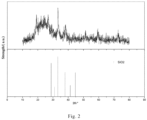
- the matrix glass body was sintered in a vacuum furnace under a vacuum atmosphere at 570°C for 60 min, with a pressure (absolute pressure) in the vacuum furnace of 3000 Pa, to obtain a pre-sintered ceramic block; the pre-sintered ceramic block was subjected to XRD detection, the result was shown in FIG. 1 , and it can be seen from FIG. 1 that the pre-sintered ceramic block prepared in this example contains a silica main crystal phase and a lithium metasilicate secondary crystal phase.
- the pre-sintered ceramic block was subjected to dry machining by using CAD/CAM machining equipment (Roland DWX 51D) to obtain a restoration body, the processed restoration was complete, and there were no problems with incomplete edges, incomplete processing, and damage to the ceramic blocks.
- CAD/CAM machining equipment Roland DWX 51D
- the restoration body was subjected to dense-sintering in a sintering furnace under a vacuum atmosphere at 930°C for 10 min, with a pressure (absolute pressure) in the vacuum furnace of 3000 Pa, to obtain a lithium disilicate ceramic restoration.
- Table 1 Component Monochromatic matrix glass powder 1 Monochromatic matrix glass powder 2 Monochromatic matrix glass powder 3 SiO 2 69.60% 69.67% 69.67% Li 2 O 14.42% 14.44% 14.44% ZrO 2 1.50% 1.50% 1.50% Al 2 O 3 1.26% 1.26% 1.26% K 2 O 3.58% 3.58% 3.58% P 2 O 5 4.00% 4.00% ZnO 2.44% 2.45% 2.45% CeO 2 1.15% 1.15% 1.15% 1.15% GeO 2 0.85% 0.85% 0.85% MgO 0.30% 0.30% 0.30% La2O3 0.60% 0.60% 0.60% V 2 O 5 - 0.2% - Er 2 O 3 0.3% - - MnO 2 - - 0.2%
- the matrix raw materials such as oxides, carbonate compounds, and phosphates corresponding to all the components were ground and mixed uniformly, the mixed raw materials were placed into a platinum crucible that was put into a furnace, heating to 1550°C, holding for 1 h, and clarifying and homogenizing to obtain a matrix molten glass; water-quenching was carried out on the prepared matrix molten glass to obtain glass fragments, and the glass fragments were dried for 1 h at 120°C; and the dried glass fragments were ground to an average particle size of 5-30 ⁇ m to obtain matrix glass powder 1, respectively.
- the pre-sintered ceramic block was obtained by molding and pre-sintering according to the method of Example 2; and the lithium disilicate ceramic restoration was obtained by wet machining and dense-sintering on the pre-sintered ceramic block according to the method of Example 1.
- Table 2 Component Monochromatic matrix glass powder 1 Monochromatic matrix glass powder 2 Monochromatic matrix glass powder 3 SiO 2 69.81% 69.81% 69.81% Li 2 O 14.47% 14.47% 14.47% ZrO 2 1.5% 1.5% 1.5% Al 2 O 3 1.26% 1.26% 1.26% K 2 O 3.60% 3.60% 3.60% P 2 O 5 4.01% 4.01% 4.01% ZnO 2.35% 2.4% 2.4% CeO 2 1.05% 1.1% 1.15% GeO 2 0.85% 0.85% 0.85% MgO 0.3% 0.3% 0.3% La2O3 0.5% 0.5% 0.5% V 1 O 5 - 0.2% - ErO 2 0.3% - - MnO 2 - - 0.15%
- the matrix glass powder comprises the following components and contents: SiO 2 : 70.42%wt Li 2 O: 14.97%wt ZrO 2 : 0.74%wt Al 2 O 3 : 1.01%wt K 2 O: 2.58%wt P 2 O 5 : 3.6%wt ZnO: 3.9%wt CeO 2 : 0.65%wt GeO 2 : 1.03%wt MgO: 0.2%wt La 2 O 3 : 0.5%wt V 2 O 5 : 0.15%wt Er 2 O 3 : 0.2%wt MnO 2 : 0.05%wt
- the matrix raw materials such as oxides, carbonate compounds, and phosphates corresponding to other components except for colorants (V 2 O 5 , Er 2 O 3 , and MnO 2 ) were ground and mixed uniformly, the mixed matrix raw materials were placed into a platinum crucible that was put into a furnace, heating to 1550°C, holding for 1 h, and clarifying and homogenizing to obtain a matrix molten glass; water-quenching was carried out on the prepared matrix molten glass to obtain glass fragments, and the glass fragments were dried for 1 h at 120°C; and the dried glass fragments were ground to an average particle size of 5-30 ⁇ m, followed by adding the colorants and mixing uniformly; to obtain a matrix glass powder.
- colorants V 2 O 5 , Er 2 O 3 , and MnO 2
- the matrix glass powders were loaded into a mould, uniaxial dry pressing molding was carried out under a molding pressure of 75 MPa, and then a matrix glass body with a weight of about 9-10 g was obtained.
- the matrix glass body was sintered in a vacuum furnace under a vacuum atmosphere at 540°C for 120 min, with a pressure (absolute pressure) in the vacuum furnace of 3000 Pa, to obtain a pre-sintered ceramic block; the pre-sintered ceramic block was subjected to XRD detection, the result was shown in FIG. 2 , it can be seen that the diffraction peaks of the sample treated at this temperature correspond to those of SiO 2 standard PDF card, and the pre-sintered ceramic block prepared in this example contains a silica crystal phase but does not contain a lithium metasilicate crystal phase.
- the pre-sintered ceramic block was subjected to dry machining using CAD/CAM machining equipment (Roland DWX-51D) to obtain a restoration body.
- the restoration body was subjected to dense-sintering in a sintering furnace under a vacuum atmosphere at 880°C for 8 min, with a pressure (absolute pressure) in the vacuum furnace of 3000 Pa, to obtain a lithium disilicate ceramic restoration.
- Example 5-10 The matrix glass powders of Examples 5-10 were prepared and molded according to the method of Example 1 and the components in Table 3.
- the matrix glass body of Examples 5-10 was pre-sintered in a vacuum furnace under a vacuum atmosphere to obtain a pre-sintered ceramic block, wherein the sintering temperature and the holding time were shown in Table 3, and the pressure (absolute pressure) in the vacuum furnace was 3000 Pa; the pre-sintered ceramic blocks of each example were machined using the corresponding CAD/CAM machining equipment in Table 3 to obtain a restoration body.
- the restoration body of Examples 5-10 was subjected to dense-sintering in a sintering furnace under a vacuum atmosphere to obtain a lithium disilicate glass ceramic restoration, wherein the sintering temperature and holding time were shown in Table 3, and the pressure (absolute pressure) in the vacuum furnace was 3000 Pa.
- Example 5 Example 6
- Example 7 Example 8
- Example 10 SiO 2 64.02% 66.5% 66.8% 70.1% 68.62% 71.17% Li 2 O 13.06% 14.05% 14.2% 14.8% 14.9% 15.23% ZrO 2 1.3% 3.92% 0.5% - 1.58% - Al 2 O 3 2.05% 1.15% 3.97% 2.25% 2.04% 0.5% K 2 O 4.05% 3.48% 3.65% 3.75% 0.5% 2.75% P 2 O 3 4.02% 3.85% 3.25% 3.65% 4.95% 2.75% ZnO 3.9% 2.6% 1.6% 2.3% 2.02% 0.1% CeO 2 1.75% 1.55% 0.5% 1.1% 1.31% 2.5% GeO 2 3.98% 1.4% 1.0% 0.5% 2.06% 2.0% La2O3 1.2% 0.8% 3.98% 0.73% 0.82% 1.7% MgO - - - - 0.2% 0.18% B 2 O 3 - - - - - 0.5% V 2 O 5 0.2% 0.15% 0.2% 0.27% 0.32% 0.20% ErO 2
- the matrix glass powders of Examples 11-15 were prepared and molded according to the method of Example 4 and the components in Table 4.
- the matrix glass body of Examples 11-15 was pre-sintered in a vacuum furnace under a vacuum atmosphere to obtain a pre-sintered ceramic block, wherein the sintering temperature and the holding time were shown in Table 4, and the pressure (absolute pressure) in the vacuum furnace was 3000 Pa; the pre-sintered ceramic blocks of each example were machined using the corresponding CAD/CAM machining equipment in Table 3 to obtain a restoration body.
- the restoration body of Examples 11-15 was subjected to dense-sintering in a sintering furnace under a vacuum atmosphere to obtain a lithium disilicate glass ceramic restoration, wherein the sintering temperature and holding time were shown in Table 4, and the pressure (absolute pressure) in the vacuum furnace was 3000 Pa.
- Example 11 Example 12
- Example 13 Example 14
- Example 15 SiO 2 70.9% 69.14% 71.28% 72.05% 74.59% Li 2 O 14.8% 14.71% 16.82% 15.60% 13.44% ZrO 2 - 0.79% 0.50% - - Al 2 O 3 1.0% 1.09% 1.09% 0.40% 0.99% K 2 O 2.95% 4.45% 3.77% 3.91% 4.08% P 2 O 5 3.9% 3.26% 3.97% 0.50% 3.33% ZnO 3.5% 3.08% 0.25% 4.91% 2.59% CeO 2 2.15% 0.91% 0.60% 0.30% - GeO 2 0.5% 0.50% 0.30% 0.50% 0.10% La 2 O 3 - - - 0.45% - MgO 0.3% 0.60% 0.20% 0.20% - B2O3 - 0.79% 0.48% 0.40% 0.36% V 2 O 3 - 0.15% 0.20% 0.18% 0.1% ErO 2 - 0.15% 0.44% 0.3% 0.07% Tb 4 O
- the matrix raw materials such as oxides, carbonate compounds, and phosphates corresponding to other components except for colorants (V 2 O 5 , ErO 2 , Tb 4 O 7 ) were ground and mixed uniformly, the mixed matrix raw materials were placed into a platinum crucible that was put into a sintering furnace, heating to 1550°C, holding for 1 h, and clarifying and homogenizing to obtain a matrix molten glass; water-quenching was carried out on the prepared matrix molten glass to obtain glass fragments, and the glass fragments were dried for 1 h at 120°C; and the dried glass fragments were ground to an average particle size of 5-30 ⁇ m, followed by adding the colorants and mixing uniformly; to obtain matrix glass powder 1.
- the matrix glass powder 2 and the matrix glass powder 3 were prepared. The obtained three matrix glass powders had the same transmittance but different color.
- the matrix glass powder 1 was added into a dry pressing mould, the upper surface of the powder was flattened to be flat, then the matrix glass powder 2 was added, the upper surface of the powder was flattened to be flat, and then the matrix glass powder 3 was added, wherein the matrix glass powder 1 has a thickness of 5.5 mm, the matrix glass powder 2 has a thickness of 5 mm, and the matrix glass powder 3 has a thickness of 5.5 mm; uniaxial dry pressing molding was carried out under a pressure of 50 MPa, and then a matrix glass body with a weight of about 9-10 g was obtained.
- the matrix glass body was sintered in a vacuum furnace under a vacuum atmosphere at 555°C for 60 min, with a pressure (absolute pressure) in the vacuum furnace of 3000 Pa, to obtain a pre-sintered ceramic block;
- the pre-sintered ceramic block was subjected to wet machining using CAD/CAM machining equipment (CEREC inLab MC XL, SIRONASIRONA) to obtain a restoration body.
- CAD/CAM machining equipment CEREC inLab MC XL, SIRONASIRONA
- the restoration body was subjected to dense-sintering in a sintering furnace under a vacuum atmosphere at 920°C for 5 min, with a pressure (absolute pressure) in the vacuum furnace of 3000 Pa, to obtain a three-layer colored lithium disilicate ceramic restoration.
- the matrix raw materials such as oxides, carbonate compounds, and phosphates compound corresponding to other components except for colorants were ground and mixed uniformly, the mixed raw materials were placed into a platinum crucible that was put into a furnace, heating to 1550°C, holding for 1 h, and clarifying and homogenizing to obtain a matrix molten glass; water-quenching was carried out on the prepared matrix molten glass to obtain glass fragments, and the glass fragments were dried for 1 h at 120°C; and the dried glass fragments were ground to an average particle size of 5-30 ⁇ m, followed by adding the colorants and mixing uniformly; to obtain matrix glass powder 1.
- the matrix glass powder 2 and the matrix glass powder 3 were prepared. The obtained three matrix glass powders were different in transmittance and color.
- the matrix glass powder 1 was added into a dry pressing mould, the upper surface of the powder was flattened to be flat, then the matrix glass powder 2 was added, the upper surface of the powder was flattened to be flat, and then the matrix glass powder 3 was added, wherein the matrix glass powder 1 has a thickness of 5.7 mm, the matrix glass powder 2 has a thickness of 4.9 mm, and the matrix glass powder 3 has a thickness of 5.4 mm; uniaxial dry pressing molding was carried out under a pressure of 50 MPa, and then a matrix glass body with a weight of about 9-10 g was obtained.
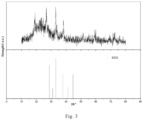
- the matrix glass body was sintered in a vacuum furnace under a vacuum atmosphere at 560°C for 120 min, with a pressure (absolute pressure) in the vacuum furnace of 3000 Pa, to obtain a pre-sintered ceramic block; the pre-sintered ceramic block was subjected to XRD detection, the result was shown in FIG. 3 , the diffraction peaks of the sample treated at this temperature correspond to those of SiO 2 standard PDF card, and the pre-sintered ceramic block prepared in this example contains a silica crystal phase but does not contain a lithium metasilicate crystal phase.
- the pre-sintered ceramic block was subjected to dry machining using CAD/CAM machining equipment (Roland DWX-51D) to obtain a restoration body.
- the restoration body was subjected to dense-sintering in a sintering furnace under a vacuum atmosphere at 875°C for 15 min, with a pressure (absolute pressure) in the vacuum furnace of 3000 Pa, to obtain a three-layered lithium disilicate glass ceramic restoration with gradual transmittance and color.
- the matrix raw materials such as oxides, carbonate compounds, and phosphates corresponding to other components except for colorants were ground and mixed uniformly, the mixed raw materials were placed into a platinum crucible that was put into a furnace, heating to 1550°C, holding for 1 h, and clarifying and homogenizing to obtain a matrix molten glass; water-quenching was carried out on the prepared matrix molten glass to obtain glass fragments, and the glass fragments were dried for 1 h at 120°C; and the dried glass fragments were ground to an average particle size of 5-30 ⁇ m, followed by adding the colorants and mixing uniformly; to obtain monochromatic matrix glass powder 18-1.
- matrix glass powder 18-L and some of matrix glass powder 18-M were mixed according to a mass ratio of 1: 1.5 to obtain glass powder 18-LM;
- the matrix glass body was sintered in a vacuum furnace under a vacuum atmosphere at 550°C for 60 min, with a pressure (absolute pressure) in the vacuum furnace of 3000 Pa, to obtain a pre-sintered ceramic block;
- the pre-sintered ceramic block was subjected to dry machining using CAD/CAM machining equipment (Roland DWX-51D) to obtain a restoration body.
- the restoration body was subjected to dense-sintering in a sintering furnace under a vacuum atmosphere at 875°C for 10 min, with a pressure (absolute pressure) in the vacuum furnace of 3000 Pa, to obtain a five-layered lithium disilicate glass ceramic restoration with gradual transmittance and color.
- XRD detection conditions for Examples 1-18 were as follows: the samples were detected using X-ray diffraction (XRD) with a D8 Advance X-ray diffractometer obtained by Bruker, Düsseldorf, Germany, wherein a radiation source is Cu target, an applied voltage is 40.0 kV, an anode current is 40.0 mA, a slit width is 1.0 mm, and a scanning range is 10°-80°.
- XRD detection conditions for Examples 1-18 were as follows: the samples were detected using X-ray diffraction (XRD) with a D8 Advance X-ray diffractometer obtained by Bruker, Düsseldorf, Germany, wherein a radiation source is Cu target, an applied voltage is 40.0 kV, an anode current is 40.0 mA, a slit width is 1.0 mm, and a scanning range is 10°-80°.
- XRD X-ray diffraction
Landscapes
- Chemical & Material Sciences (AREA)
- Engineering & Computer Science (AREA)
- Health & Medical Sciences (AREA)
- Life Sciences & Earth Sciences (AREA)
- Materials Engineering (AREA)
- Organic Chemistry (AREA)
- Chemical Kinetics & Catalysis (AREA)
- General Chemical & Material Sciences (AREA)
- Geochemistry & Mineralogy (AREA)
- Oral & Maxillofacial Surgery (AREA)
- Ceramic Engineering (AREA)
- Dispersion Chemistry (AREA)
- Public Health (AREA)
- Dentistry (AREA)
- Epidemiology (AREA)
- Animal Behavior & Ethology (AREA)
- General Health & Medical Sciences (AREA)
- Crystallography & Structural Chemistry (AREA)
- Veterinary Medicine (AREA)
- Molecular Biology (AREA)
- Manufacturing & Machinery (AREA)
- Physics & Mathematics (AREA)
- Thermal Sciences (AREA)
- Glass Compositions (AREA)
- Compositions Of Oxide Ceramics (AREA)
Description
- The present application relates to the technical field of a dental restoration, in particular to a pre-sintered ceramic block for a dental restoration, a preparation method, and use thereof.
- The ChairSide restorative system is a dental restorative system formed by introducing computer-aided design and manufacture into the field of restorative dentistry.
- The ChairSide restorative system, which is convenient and rapid, and breaks through traditional denture manufacturing procedures such as teeth grinding, mold fabricating, wax carving, and porcelain, allows a 3D camera to directly capture the teeth image immediately after the teeth are ground and trimmed by a dentist, and then transfers the image to the computer in real-time, and processes the ceramic blocks into a dental restoration by the automatic ceramic block grinder with the assistance of the computer.
- Since the emergence of ChairSide restorative systems, the development of dental restorative materials suitable for ChairSide restorative systems has become the focus of researchers at home and abroad.
- It has been found that dental restorations made from lithium disilicate glass-ceramic materials have both outstanding aesthetic effects and good mechanical properties. However, lithium disilicate glass-ceramic materials have high hardness and poor processability, making it difficult to apply in ChairSide repair system.
- In order to solve the problem, the prior art discloses that lithium metasilicate glass ceramics with lithium metasilicate as a main crystal phase are obtained through pre-sintering at a lower temperature, then is subjected to mechanical processing to obtain a restoration shape, and then to dense-sintering at a higher temperature, to finally obtain a glass ceramic restoration with lithium disilicate as a main crystal phase; since the hardness of lithium metasilicate is lower than that of lithium disilicate, the processability is improved. Even so, the Vickers hardness of the ceramic block with lithium metasilicate as the main crystal phase still reaches 5-6 GPa, the ceramic block is only suitable for being machined by a wet method and is not suitable for dry machining, if the lithium metasilicate glass ceramic is machined by a dry method, the problem of incomplete edge or incomplete processing or even the problem of the ceramic block damage may occur, and the machine needle can be easily damaged; therefore, how to develop a pre-sintered ceramic block with lower hardness and suitable for dry machining has become a crucial problem.
- The documents
CN 105217959 A andWO 2009/126317 A1 describe pre-sintered ceramic blocks for dental restorations. - The invention is set out in the appended set of claims.
- The present application provides a pre-sintered ceramic block for a dental restoration, which is used for solving the problem that lithium metasilicate glass ceramic has high hardness and not suitable for dry machining. Correspondingly, the present application provides a method of preparing a pre-sintered ceramic block for a dental restoration.
- The present application also provides a method of preparing a ceramic block for the dental restoration and a method of preparing a dental restoration.
- Specific technical solutions are as follows:
According to a first aspect of the present application, there is provided a pre-sintered ceramic block for a dental restoration as defined in independent claim 1. - In some embodiments of the first aspect of the present application, the pre-sintered ceramic block does not contain a lithium metasilicate crystal phase.
- In some embodiments of the first aspect of the present application, the pre-sintered ceramic block has a three-point bending strength of 10-110 MPa; preferably 10-90 MPa; more preferably 30-70 MPa.
- The pre-sintered ceramic block comprises the following components:
- SiO2 55-85%wt, preferably 55-80%wt, more preferably 60-80%wt, most preferably 64-75%wt,
- Li2O: 10-25%wt, preferably 12-25%wt, more preferably 13-17%wt,
- ZrO2 0-10%wt, preferably 0-8%wt, more preferably 0-6%wt, most preferably 0-4%wt,
- Al2O3: 0.3-8%wt, preferably 0.5-6%wt, more preferably 0.5-5%wt, most preferably 0.5-4%wt,
- La2O3: 0-7%wt, preferably 0-5%wt, more preferably 0-4.5%wt, most preferably 0-4%wt,
- ZnO: 0 -10%wt, preferably 0-8%wt, more preferably 0-7%wt, most preferably 0.1-5%wt,
- K2O: 0.1-10%wt, preferably 0.1-9%wt, more preferably 0.1-7%wt, most preferably 0.5-4.5%wt,
- GeO2: 0.1-7%wt, preferably 0.1-6%wt, more preferably 0.3-5%wt, most preferably 0.5-4%wt,
- nucleating agent: 0-10%wt, preferably 0-8%wt, more preferably 0.5-8%wt, most preferably 0.5-5%wt,
- colorant: 0-10%wt, preferably 0-8%wt, more preferably 0-6%wt, most preferably 0.1-5%wt, and
- other additives: 0-15%wt, preferably 0-10%wt, more preferably 0-4%wt;
- wherein the nucleating agent is one of or a combination of at least two of P2O5, TiO2, V2O3, Cr2O3, and Fe2O3;
- the other additives are one of or a combination of at least two of B2O3, F, Na2O, BaO, SrO, CaO, and MgO.
- In some embodiments of the first aspect of the present application, the colorant is a glass colorant or a ceramic colorant; preferably, the glass colorant is oxides of at least one of vanadium, chromium, manganese, iron, cobalt, nickel, copper, cerium, praseodymium, neodymium, samarium, promethium, terbium, dysprosium, holmium, erbium, thulium, ytterbium, and europium; the ceramic colorant is one of or a combination of at least two of zirconium iron red, zirconium cerium praseodymium yellow, and nickel black.
- According to a second aspect of the present application, there is provided a method for preparing the pre-sintered ceramic block for a dental restoration of the first aspect described above and defined in independent claim 11.
- The matrix glass powder comprises the following components:
- SiO2 55-85%wt, preferably 55-80%wt, more preferably 60-80%wt, most preferably 64-75%wt,
- Li2O: 10-25%wt, preferably 12-25%wt, more preferably 13-17%wt,
- ZrO2 0-10%wt, preferably 0-8%wt, more preferably 0-6%wt, most preferably 0-4%wt,
- Al2O3: 0.3-8%wt, preferably 0.5-6%wt, more preferably 0.5-5%wt, most preferably 0.5-4%wt,
- La2O3: 0-7%wt, preferably 0-5%wt, more preferably 0-4.5%wt, most preferably 0-4%wt,
- ZnO: 0 -10%wt, preferably 0-8%wt, more preferably 0-7%wt, most preferably 0.1-5%wt,
- K2O: 0.1 -10%wt, preferably 0.1-9%wt, more preferably 0.1-7%wt, most preferably 1-7%wt,
- GeO2: 0.1-7%wt, preferably 0.1-6%wt, more preferably 0.3-5%wt, most preferably 0.5-4%wt,
- nucleating agent: 0-10%wt, preferably 0-8%wt, more preferably 0.5-8%wt, most preferably 0.5-5%wt,
- colorant: 0 -10%wt, preferably 0-8%wt, more preferably 0-6%wt, most preferably 0.1-5%wt, and
- other additives: 0-15%wt, preferably 0-10%wt, more preferably 0-4%wt;
- wherein the nucleating agent is one of or a combination of at least two of P2O5, TiO2, V2O5, Cr2O3, and Fe2O3; the other additives are one of or a combination of at least two of B2O3, F, Na2O, BaO, SrO, CaO, and MgO.
- In some embodiments of the second aspect of the present application, the sintering temperature during pre-sintering is 530-560°C.
- In some embodiments of the second aspect of the present application, the sintering temperature during pre-sintering is 570-590°C.
- In the solution of the present application, for the components of the pre-sintered ceramic block, it has substantially the same composition as the matrix glass powder.
- In some embodiments of the second aspect of the present application, the matrix glass powder may be prepared by the following method:
- (A1) selecting suitable matrix raw materials such as carbonate, oxide, and fluoride according to all components contained in the matrix glass powder, grinding and mixing the matrix raw materials, and melting at 1250-1650°C for 0.5-3 h to prepare a matrix molten glass;
- (B1) water-quenching the matrix molten glass to obtain glass fragments, and then drying the glass fragments at 100-150°C for 1-2 h; and
- (C1) grinding the dried glass fragments to obtain a matrix glass powder.
- In some embodiments of the second aspect of the present application, the matrix glass powder may also be prepared by the following method:
preparing at least two kinds of monochromatic matrix glass powder, and then mixing the prepared monochromatic matrix glass powder according to a required color ratio to obtain matrix glass powder used for preparing pre-sintered ceramic blocks; wherein each monochromatic matrix glass powder may be prepared according to the following method: - (A2) selecting suitable matrix raw materials such as carbonate, oxide, and fluoride, grinding and mixing the matrix raw materials, and melting at 1250-1650°C for 0.5-3 h to prepare a monochromatic matrix molten glass;
- (B2) water-quenching the monochromatic matrix molten glass to obtain monochromatic glass fragments, and then drying the monochromatic glass fragments at 100-150°C for 1-2 h; and
- (C2) grinding the dried monochromatic glass fragments to obtain monochromatic matrix glass powder.
- In other embodiments of the second aspect of the present application, the matrix glass powder may also be prepared by the following method:
- (A3) according to the components contained in the matrix glass powder, grinding and mixing the matrix raw materials corresponding to other components except for colorants, such as carbonate, oxide, fluoride, etc., and melting at 1250-1650°C for 0.5-3 h to prepare a matrix molten glass;
- (B3) water-quenching the matrix molten glass to obtain glass fragments, and then drying the glass fragments at 100-150°C for 1-2 h; and
- (C3) grinding the dried glass fragments and uniformly mixing with the colorant to obtain a matrix glass powder.
- In this embodiment, the colorant is added in step (C3), so that the influence on the coloring effect of the colorant in the high-temperature melting process can be avoided;
In a particular implementation, some colorants with poor coloring capability such as CeO2 can also be added in step (A3); other colorants are added in step (C3). - In some embodiments of the second aspect of the present application, water-quenching of the molten glass may be achieved by pouring the molten glass into cold water; the cold water is generally referred to 0-40°C of water.
- In some embodiments of the second aspect of the present application, an average particle size of the matrix glass powder is 1-100 µm, preferably 1-50 µm, more preferably 5-20 µm. The inventors of the present application have found that the better the uniformity of the average particle size of the matrix glass powder, the better the denseness of the dense-sintered lithium disilicate glass ceramic product, and the more uniform the crystallization, resulting in higher strength and visible light transmittance and closer to the texture of natural teeth.
- According to a third aspect of the present application and not claimed, there is also provided a pre-sintered ceramic block for a dental restoration, wherein the pre-sintered ceramic block contains a silica main crystal phase, has a Vickers hardness of 0.5-3 GPa, preferably 1-2.5 GPa, is opaque, and exhibits a gradual transmittance and/or color after dense-sintering at 800-1100°C.
- In some embodiments of the third aspect of the present application, the pre-sintered ceramic block may exhibit a gradual transmittance after dense-sintering. In some embodiments, the pre-sintered ceramic block may exhibit a gradual color after dense-sintering. In other embodiments, the pre-sintered ceramic block may exhibit a gradual transmittance and color after dense-sintering. Since the pre-sintered ceramic block provided by the present application can be applied to a dental restoration, the transmittance and/or color displayed by the pre-sintered ceramic block after dense-sintering can be close to and consistent with the characteristics of natural teeth; the aesthetic effect of the restoration is improved.
- In some embodiments of the third aspect of the present application, the pre-sintered ceramic block does not contain a lithium metasilicate crystal phase.
- In some embodiments of the third aspect of the present application, the pre-sintered ceramic block has a three-point bending strength of 10-110 MPa; preferably 10-90 MPa; more preferably 30-70 MPa.
- In some embodiments of the third aspect of the present application, the pre-sintered ceramic block comprises the following components:
- SiO2 55-85%wt, preferably 55-80%wt, more preferably 60-80%wt, most preferably 64-75%wt,
- Li2O: 10-25%wt, preferably 12-25%wt, more preferably 13-17%wt,
- ZrO2 0-10%wt, preferably 0-8%wt, more preferably 0-6%wt, most preferably 0-4%wt,
- Al2O3: 0.3-8%wt, preferably 0.5-6%wt, more preferably 0.5-5%wt, most preferably 0.5-4%wt,
- La2O3: 0-7%wt, preferably 0-5%wt, more preferably 0-4.5%wt, most preferably 0-4%wt,
- ZnO: 0-10%wt, preferably 0-8%wt, more preferably 0-7%wt, most preferably 0.1-5%wt,
- K2O: 0.1-10%wt, preferably 0.1-9%wt, more preferably 0.1-7%wt, most preferably 0.5-4.5%wt,
- GeO2: 0.1-7%wt, preferably 0.1-6%wt, more preferably 0.3-5%wt, most preferably 0.5-4%wt,
- nucleating agent: 0-10%wt, preferably 0-8%wt, more preferably 0.5-8%wt, most preferably 0.5-5%wt,
- colorant: 0-10%wt, preferably 0-8%wt, more preferably 0-6%wt, most preferably 0.1-5%wt, and
- other additives: 0-15%wt, preferably 0-10%wt, more preferably 0-4%wt;
- wherein the nucleating agent is one of or a combination of at least two of P2O5, TiO2, V2O3, Cr2O3, and Fe2O3;
- the other additives are one of or a combination of at least two of B2O3, F, Na2O, BaO, SrO, CaO, and MgO.
- In some embodiments of the third aspect of the present application, the colorant is a glass colorant or a ceramic colorant; preferably, the glass colorant is oxides and/or salts of at least one of vanadium, chromium, manganese, iron, cobalt, nickel, copper, cerium, praseodymium, neodymium, samarium, promethium, terbium, dysprosium, holmium, erbium, thulium, ytterbium, and europium; the ceramic colorant is one of or a combination of at least two of zirconium iron red, zirconium cerium praseodymium yellow, and nickel black.
- According to a fourth aspect of the present application, there is provided a method for preparing the pre-sintered ceramic block for a dental restoration of the third aspect described above, comprising the steps of:
- (1) preparing at least two matrix glass powders with different transmittance and/or color;
- (2) putting the prepared at least two matrix glass powder into a mould in the order of transmittance and/or color gradient, and carrying out pressing molding to obtain a matrix glass body; and
- (3) pre-sintering the matrix glass body under a vacuum condition to obtain a pre-sintered ceramic block, wherein a sintering temperature during pre-sintering is 530-590°C.
- In some embodiments of the fourth aspect of the present application the matrix glass powder comprises the following components:
- SiO2 55-85%wt, preferably 55-80%wt, more preferably 60-80%wt, most preferably 64-75%wt,
- Li2O: 10-25%wt, preferably 12-25%wt, more preferably 13-17%wt,
- ZrO2 0-10%wt, preferably 0-8%wt, more preferably 0-6%wt, most preferably 0-4%wt,
- Al2O3: 0.3-8%wt, preferably 0.5-6%wt, more preferably 0.5-5%wt, most preferably 0.5-4%wt,
- La2O3: 0-7%wt, preferably 0-5%wt, more preferably 0-4.5%wt, most preferably 0-4%wt,
- ZnO: 0-10%wt, preferably 0-8%wt, more preferably 0-7%wt, most preferably 0.1-5%wt,
- K2O: 0.1-10%wt, preferably 0.1-9%wt, more preferably 0.1-7%wt, most preferably 1-7%wt,
- GeO2: 0.1-7%wt, preferably 0.1-6%wt, more preferably 0.3-5%wt, most preferably 0.5-4%wt,
- nucleating agent: 0-10%wt, preferably 0-8%wt, more preferably 0.5-8%wt, most preferably 0.5-5%wt,
- colorant: 0-10%wt, preferably 0-8%wt, more preferably 0-6%wt, most preferably 0.1-5%wt, and
- other additives: 0-15%wt, preferably 0-10%wt, more preferably 0-4%wt;
- wherein the nucleating agent is one of or a combination of at least two of P2O5, TiO2, V2O3, Cr2O3, and Fe2O3; the other additives are one of or a combination of at least two of B2O3, F, Na2O, BaO, SrO, CaO, and MgO.
- In some embodiments of the fourth aspect of the present application, the sintering temperature during pre-sintering is 530-560°C.
- In some embodiments of the fourth aspect of the present application, the sintering temperature during pre-sintering is 570-590°C.
- In some embodiments of the fourth aspect of the present application, step (1) may prepare three, four, five, seven, or even more matrix glass powders with different transmittance and/or color, each matrix glass powder with different transmittance and/or color after dense-sintering.
- As used herein, the term "matrix glass powder with different transmittance and/or color" means that the matrix glass powder exhibits different transmittance and/or color after dense-sintering.
- Similarly, the pre-sintered ceramic of "different transmittance and/or color" means that the transmittance and/or color of the pre-sintered ceramic is different after the pre-sintered ceramic is subjected to dense-sintering.
- Since the pre-sintered ceramic block contains a large amount of lithium disilicate crystal phase after dense-sintering, the pre-sintered ceramic block after dense-sintering is also referred to as a lithium disilicate glass ceramic herein.
- In some embodiments of the fourth aspect of the present application, in step (1), at least two matrix glass powders with different transmittance can be prepared for preparing pre-sintered ceramic blocks that show gradual transmittance after dense-sintering; in some embodiments, in step (1), at least two matrix glass powders with different color can be prepared for preparing pre-sintered ceramic blocks that show gradual color after dense-sintering; in other embodiments, in step (1), at least two matrix glass powders with different transmittance and color can be prepared for preparing pre-sintered ceramic blocks that show gradual transmittance and color after dense-sintering.
- In some embodiments of the fourth aspect of the present application, in step (2), after one matrix glass powder is loaded into a mould and the upper surface of the powder is flattened to be flat, another matrix glass powder is loaded until all the powders are loaded into a mould, and then pressing molding is carried out.
- The pre-sintered ceramic block prepared by the method provided in the fourth aspect of the present application comprises at least two layers; when the pre-sintered ceramic block is subjected to dense-sintering, the obtained product can show multi-layer gradual transmittance and/or color.
- In the present application, the matrix glass powder with different transmittance and/or color can be prepared by adjusting the amount of each component; for example, matrix glass powders with different color can be prepared by adjusting the types and amounts of colorants; although the content of the components in the matrix glass powders with different transmittance and/or color, the components of each matrix glass powder and the amount thereof still satisfy the ranges of the components and the amount thereof of the pre-sintered ceramic block described above.
- In some embodiments of the fourth aspect of the present application, the preparation of each matrix glass powder may be achieved according to the steps of preparing the matrix glass powder of the second aspect described above.
- In some embodiments of the first and third aspects of the present application, the pre-sintered ceramic block for a dental restoration comprises the following components:
SiO2 55-80%wt Li2O: 12-25%wt ZrO2 0-8%wt Al2O3: 0.5-6%wt La2O3: 0-5%wt ZnO: 0-8%wt K2O: 0.1-9%wt GeO2: 0.1-6%wt Nucleating agent: 0-8%wt Colorant: 0-8%wt, Other additives: 0-10%wt. - In some embodiments of the first and third aspects of the present application, the pre-sintered ceramic block for a dental restoration comprises the following components:
SiO2 60-80%wt Li2O: 13-17%wt ZrO2 0-6%wt Al2O3: 0.5-5%wt La2O3: 0-4.5%wt ZnO: 0-7%wt K2O: 0.1-7%wt GeO2: 0.3-5%wt Nucleating agent: 0.5-8%wt Colorant: 0-6%wt Other additives: 0-4%wt. - In some embodiments of the first and third aspects of the present application, the pre-sintered ceramic block for a dental restoration comprises the following components:
SiO2 64-75%wt Li2O: 13-17%wt ZrO2 0-4%wt Al2O3: 0.5-4%wt La2O3: 0-4%wt ZnO: 0.1-5%wt K2O: 0.1-4.5%wt GeO2: 0.5-4%wt Nucleating agent: 0.5-5%wt Colorant: 0.1-5%wt Other additives: 0-4%wt. - According to the pre-sintered ceramic block for a dental restoration provided in the present application, the addition of GeO2 in the components of the pre-sintered ceramic block can effectively reduce the viscosity in the melting process of matrix glass, decrease the generation of bubbles in the melting process, reduce the possibility of pores in the pre-sintered ceramic block, improve the refractive index of the dense-sintered ceramic block, and improve the optical performance. In addition, the addition of the GeO2 can improve the density of the dense-sintered ceramic block, thereby improving the strength thereof.
- According to the pre-sintered ceramic block for a dental restoration provided by the present application, the addition of colorant is mainly used to color the densely sintered ceramic block to match with natural teeth of a patient. In a particular implementation, the colorant may be a glass colorant or a ceramic colorant.
- As used herein, the glass colorant refer to the colorants used in glass and glass articles; including, but not limited to, oxides of transition metals, rare earth elements, etc.; the glass colorants can be derived directly from oxides of transition metals, rare earth elements, etc., or derived from salts that produce the glass colorant oxides described above after high temperature treatment, including, but not limited to, chlorides, etc.
- As used herein, the ceramic colorant refer to the colorant used in ceramics and ceramic articles, including, but not limited to, zirconium iron red, zirconium cerium praseodymium yellow, nickel black, etc. The ceramic colorant such as zirconium iron red, zirconium cerium praseodymium yellow, and nickel black are commercially available.
- The pre-sintered ceramic block for a dental restoration provided by the present application can be added with other additives in the components, and the other additives can be one of or a combination of at least two of B2O3, F, Na2O, BaO, SrO, CaO, and MgO; the addition of B2O3 can reduce the viscosity of the matrix molten glass and the microcrystalline glass phase in the dense-sintering process and promote liquid phase sintering; F can convert surface crystallization of the lithium disilicate glass ceramic into integral crystallization; Na2O can reduce the high temperature viscosity of the matrix molten glass; BaO can increase the surface brightness of the matrix glass, thereby increasing the surface brightness of the glass phase in the glass ceramic. SrO can be used as a fluxing agent when the matrix molten glass is prepared, which may reduce the viscosity of the molten glass, meanwhile reduce the viscosity of the microcrystalline glass during the dense-sintering process, and increase the refractive index of the glass phase in the glass ceramics. CaO also has the effect of reducing the high temperature viscosity of the molten glass.
- The pre-sintered ceramic block provided by the present application is substantially opaque and not translucent to visible light; while the glass containing the same composition are generally transparent, the glass ceramics containing the same composition (also known as microcrystalline glass) are generally translucent; it can be seen therefrom that the pre-sintered ceramic block provided by the present application is different from glass or glass ceramic containing the same component in microstructure.
- Herein, "opaque" has its general meaning; in particular embodiments of the present application, the opacity characteristics of a product, such as a pre-sintered ceramic block, are visually observed.
- Herein, "transmittance" can be characterized by the transmittance of visible light, for example, the higher the transmittance of visible light, the better the transmittance; the lower the transmittance of visible light, the worse the transmittance; the gradual transmittance is understood the gradual visible light transmittance.
- In some embodiments of the second and fourth aspects of the present application, the nucleating agent may be derived directly from oxides of P2O5, TiO2, V2O5, Cr2O3, Fe2O3, or derived from salts that produces oxides of the nucleating agent described above after high temperature treatment, including, but not limited to, carbonates, chlorides, etc.
- In some embodiments of the second and fourth aspects of the present application, the colorant contained in the matrix glass powder is a glass colorant or a ceramic colorant; preferably, the glass colorant is oxides of at least one of vanadium, chromium, manganese, iron, cobalt, nickel, copper, cerium, praseodymium, neodymium, samarium, promethium, terbium, dysprosium, holmium, erbium, thulium, ytterbium, samarium, and europium; the ceramic colorant is one of or a combination of at least two of zirconium iron red, zirconium cerium praseodymium yellow, and nickel black. More specifically, the glass colorant oxides described above can be derived directly from oxides of vanadium, chromium, manganese, iron, cobalt, nickel, copper, cerium, praseodymium, neodymium, samarium, promethium, terbium, dysprosium, holmium, erbium, thulium, ytterbium, samarium, europium, etc., and can also be derived from salts that produce the glass colorant oxides described above after high temperature treatment, including, but not limited to, chlorides, etc.
- In some embodiments of the second and fourth aspects of the present application, the pressing molding may be dry pressing molding or isostatic pressing molding, and the pressure used in the pressing molding may be 50-300 MPa.
- In the preparation method provided in the second and fourth aspects of the present application, the sintering temperature during pre-sintering is 530-590°C, and the inventors of the present application have unexpectedly found that within this temperature range, the prepared pre-sintered ceramic block contains silica as a main crystal phase; particularly, when the sintering temperature during pre-sintering is 530-560°C, the prepared pre-sintered ceramic block substantially does not contain a lithium metasilicate crystal phase; when the sintering temperature during pre-sintering is 570-590°C, in the prepared pre-sintered ceramic block contains a small amount of lithium metasilicate crystal phase. In a particular implementation, the sintering temperature during pre-sintering can be any value in a range of 530-590°C, such as 540°C, 550°C, 560°C, 570°C, etc.
- The inventors have further found that if the pre-sintering temperature continues to be enhanced, when the pre-sintering temperature is higher than 590°C, for example, up to 600°C, the lithium metasilicate crystal phase in the powder will gradually become the main crystal phase.
- In some embodiments of the preparation methods provided in the second and fourth aspects of the present application, the holding time for pre-sintering is 20-240 min, preferably 30-120 min, more preferably 60-120 min.
- In some embodiments of the second and fourth aspects of the present application, pre-sintering and dense-sintering may be performed in a sintering furnace, which may provide a vacuum atmosphere; in a particular implementation, the vacuum condition may be 100-5000 Pa, preferably 1000-3000 Pa, in absolute pressure. The inventors of the present application have found that when a vacuum degree is 100-5000 Pa, especially in a range of 1000-3000 Pa, the better the denseness of the resultant lithium disilicate glass ceramics, the better the transmittance.
- According to a fifth aspect of the present application, there is provided a method for preparing a ceramic block for a dental restoration, comprising the steps of: preparing the pre-sintered ceramic block of the first aspect or the second aspect; and
- dense-sintering the pre-sintered ceramic block under a vacuum condition, wherein a temperature during dense-sintering is 800-1100°C.
- according to a sixth aspect of the present application, there is provided a method for preparing a dental restoration, comprising the steps of:
- preparing the pre-sintered ceramic block of the first aspect or the second aspect; processing the pre-sintered ceramic block into a dental restoration shape to obtain a restoration body; and
- dense-sintering the restoration body under a vacuum condition to obtain a dental restoration; wherein a temperature during dense-sintering is 800-1100°C.
- Through dense-sintering, the pre-sintered ceramic block can be further densified; in the dense-sintering process, the crystal amount in the ceramic block increases, the crystal grows, a large amount of lithium disilicate is precipitined, and a lithium disilicate glass ceramic or a lithium disilicate glass ceramic restoration is obtained, which takes lithium disilicate as a main crystal phase, has a strength of more than 200 MPa, and other excellent properties of which meet dental restoration requirements.
- In some embodiments of the fifth and sixth aspects of the present application, the holding time for dense-sintering may be 1-60 min, preferably 1-40 min.
- In some embodiments of the sixth aspect of the present application, the pre-sintered ceramic may be processed by a CAD/CAM technique, more specifically, by dry machining or wet machining.
- In some embodiments of the sixth aspect of the present application, the pre-sintered ceramic may be processed by a CAD/CAM technique, more specifically, by dry machining or wet machining.
- As used herein, the term dry machining, also referred to as dry processing, has its general meaning in the art and generally refers to a machining process in which cutting is performed without the use of a cutting fluid.
- As used herein, the term wet machining, also referred to as wet processing, has its general meaning in the art and generally refers to a machining process in which cutting is performed using a cutting fluid; in the machining process, cutting fluid is sprayed on the ceramic block and the bur to reduce a large amount of heat generated in the machining process.
- Compared with wet machining, the dry machining has lower machining cost and is easier to popularize due to the fact that expensive consumables such as cutting fluid and filter elements are not needed.
- In some embodiments of the sixth aspect of the present application, the dental restoration may also be glazed and/or porcelain-finished after dense-sintering.
- In some embodiments of the sixth aspect of the present application, the dental restoration may also be glazed and/or porcelain-finished after dense-sintering.
- As used herein, "glazing" has its general meaning in the art and refers to the uniform application of a layer of colored or transparent glaze to the surface of a ceramic restoration, followed by sintering in a porcelain furnace to form a thin layer of oxide on the surface of the restoration. Glazing can seal the possible micropores and cracks on the surface of ceramic restoration and restore smooth surface morphology.
- In this context, "porcelain-finishing" has the general meaning in the art, and means that porcelain powder with different functions and color is piled on the surface of a ceramic restoration, and then the restoration is placed in a porcelain furnace for sintering, so that the shape of the restoration is more visual and personalized, and the color is more vivid.
- The pre-sintered ceramic block provided by the present application has a low pre-sintering temperature, contains a silica main crystal phase, but does not contain or contains a small amount of lithium metasilicate crystal phase. The pre-sintered ceramic block has a low hardness, with a Vickers hardness of 0.5-3 GPa, which is significantly lower than that of the ceramic block containing a lithium metasilicate crystal phase, and same is suitable for dry machining and also wet machining when being machined into a dental restoration.
- To describe the technical solutions in the examples of the present application and the prior art more clearly, the following briefly describes the drawings required for the examples and the prior art.
-
FIG. 1 is an XRD pattern of a pre-sintered ceramic block prepared in Example 2; -
FIG. 2 is an XRD pattern of a pre-sintered ceramic block prepared in Example 4; and -
FIG. 3 is an XRD pattern of a pre-sintered ceramic block prepared in Example 17. - To make the objectives, technical solutions, and advantages of this application more comprehensible, the following describes this application in detail with reference to embodiments and drawings.
- The matrix glass powder comprises the following components and amounts:
SiO2: 67.1%wt Li2O: 14.7%wt ZrO2: 1.7%wt Al2O3: 1.2%wt K2O: 4.2%wt P2O5: 3.3%wt ZnO: 4.2%wt CeO2: 0.9%wt GeO2: 0.65%wt MgO: 0.3%wt La2O3: 0.9%wt B2O3: 0.3%wt V2O5: 0.25%wt Er2O3: 0.1% Tb4O7: 0.2%wt MnO2: 0.08% - According to the components and the amounts of the matrix glass powder, the matrix raw materials such as oxides, carbonate compounds, and phosphates corresponding to all the components were ground and mixed uniformly, the mixed matrix raw materials were placed into a platinum crucible that was put into a furnace, heating to 1550°C, holding for 1 h, and clarifying and homogenizing to obtain a matrix molten glass; water-quenching was carried out on the prepared matrix molten glass to obtain glass fragments, and the glass fragments were dried for 1 h at 120°C; and the dried glass fragments were ground to an average particle size of 5-30 µm to obtain matrix glass powders.
- The matrix glass powders were loaded into a mould, uniaxial dry pressing molding was carried out under a molding pressure of 75 MPa, and then a matrix glass body with the weight of about 9-10 g was obtained.
- The matrix glass body was sintered in a vacuum furnace under a vacuum atmosphere at 550°C for 60 min, with a pressure (absolute pressure) in the vacuum furnace of 3000 Pa, to obtain a pre-sintered ceramic block;
- The pre-sintered ceramic block was subjected to wet machining using CAD/CAM machining equipment (CEREC inLab MC XL, SIRONA) to obtain a restoration body.
- The restoration body was subjected to dense-sintering in a sintering furnace under a vacuum atmosphere at 875°C for 15 min, with a pressure (absolute pressure) in the vacuum furnace of 3000 Pa, to obtain a lithium disilicate glass ceramic restoration.
- According to the components and amounts of the monochromatic matrix glass powder 1 in Table 1, the matrix raw materials such as oxides, carbonate compounds, and phosphates corresponding to other components except for colorants (V2O5, Er2O3, MnO2) were ground and mixed uniformly, the mixed raw materials were placed into a platinum crucible that was put into a furnace, heating to 1550°C, holding for 1 h, and clarifying and homogenizing to obtain a matrix molten glass; water-quenching was carried out on the prepared matrix molten glass to obtain glass fragments, and the glass fragments were dried for 1 h at 120°C; and the dried glass fragments were ground to an average particle size of 5-30 µm, followed by adding the colorants and mixing uniformly; to obtain matrix glass powder 1.
- In the same way, monochromatic matrix glass powder 2 and monochromatic matrix glass powder 3 were prepared. They are mixed uniformly according to mass ratio of monochromatic matrix glass powder 1: monochromatic matrix glass powder 2: monochromatic matrix glass powder 3=4: 3: 2, to obtain a matrix glass powder. The matrix glass powders were loaded into a mould, uniaxial dry pressing molding was carried out under a molding pressure of 75 MPa, and then a matrix glass body with the weight of about 9-10 g was obtained.
- The matrix glass body was sintered in a vacuum furnace under a vacuum atmosphere at 570°C for 60 min, with a pressure (absolute pressure) in the vacuum furnace of 3000 Pa, to obtain a pre-sintered ceramic block; the pre-sintered ceramic block was subjected to XRD detection, the result was shown in
FIG. 1 , and it can be seen fromFIG. 1 that the pre-sintered ceramic block prepared in this example contains a silica main crystal phase and a lithium metasilicate secondary crystal phase. - The pre-sintered ceramic block was subjected to dry machining by using CAD/CAM machining equipment (Roland DWX 51D) to obtain a restoration body, the processed restoration was complete, and there were no problems with incomplete edges, incomplete processing, and damage to the ceramic blocks.
- The restoration body was subjected to dense-sintering in a sintering furnace under a vacuum atmosphere at 930°C for 10 min, with a pressure (absolute pressure) in the vacuum furnace of 3000 Pa, to obtain a lithium disilicate ceramic restoration.
Table 1 Component Monochromatic matrix glass powder 1 Monochromatic matrix glass powder 2 Monochromatic matrix glass powder 3 SiO2 69.60% 69.67% 69.67% Li2O 14.42% 14.44% 14.44% ZrO2 1.50% 1.50% 1.50% Al2O3 1.26% 1.26% 1.26% K2O 3.58% 3.58% 3.58% P2O5 4.00% 4.00% 4.00% ZnO 2.44% 2.45% 2.45% CeO2 1.15% 1.15% 1.15% GeO2 0.85% 0.85% 0.85% MgO 0.30% 0.30% 0.30% La2O3 0.60% 0.60% 0.60% V2O5 - 0.2% - Er2O3 0.3% - - MnO2 - - 0.2% - According to the components and the amounts of the matrix glass powder 1 in Table 2, the matrix raw materials such as oxides, carbonate compounds, and phosphates corresponding to all the components were ground and mixed uniformly, the mixed raw materials were placed into a platinum crucible that was put into a furnace, heating to 1550°C, holding for 1 h, and clarifying and homogenizing to obtain a matrix molten glass; water-quenching was carried out on the prepared matrix molten glass to obtain glass fragments, and the glass fragments were dried for 1 h at 120°C; and the dried glass fragments were ground to an average particle size of 5-30 µm to obtain matrix glass powder 1, respectively.
- In the same way, monochromatic matrix glass powder 2 and monochromatic matrix glass powder 3 were prepared. They are mixed uniformly according to a ratio of monochromatic matrix glass powder 1: monochromatic matrix glass powder 2: monochromatic matrix glass powder 3=4: 3: 2 to obtain a matrix glass powder.
- The pre-sintered ceramic block was obtained by molding and pre-sintering according to the method of Example 2; and the lithium disilicate ceramic restoration was obtained by wet machining and dense-sintering on the pre-sintered ceramic block according to the method of Example 1.
Table 2 Component Monochromatic matrix glass powder 1 Monochromatic matrix glass powder 2 Monochromatic matrix glass powder 3 SiO2 69.81% 69.81% 69.81% Li2O 14.47% 14.47% 14.47% ZrO2 1.5% 1.5% 1.5% Al2O3 1.26% 1.26% 1.26% K2O 3.60% 3.60% 3.60% P2O5 4.01% 4.01% 4.01% ZnO 2.35% 2.4% 2.4% CeO2 1.05% 1.1% 1.15% GeO2 0.85% 0.85% 0.85% MgO 0.3% 0.3% 0.3% La2O3 0.5% 0.5% 0.5% V1O5 - 0.2% - ErO2 0.3% - - MnO2 - - 0.15% - The matrix glass powder comprises the following components and contents:
SiO2: 70.42%wt Li2O: 14.97%wt ZrO2: 0.74%wt Al2O3: 1.01%wt K2O: 2.58%wt P2O5: 3.6%wt ZnO: 3.9%wt CeO2: 0.65%wt GeO2: 1.03%wt MgO: 0.2%wt La2O3: 0.5%wt V2O5: 0.15%wt Er2O3: 0.2%wt MnO2: 0.05%wt - According to the components and amounts of the matrix glass powder, the matrix raw materials such as oxides, carbonate compounds, and phosphates corresponding to other components except for colorants (V2O5, Er2O3, and MnO2) were ground and mixed uniformly, the mixed matrix raw materials were placed into a platinum crucible that was put into a furnace, heating to 1550°C, holding for 1 h, and clarifying and homogenizing to obtain a matrix molten glass; water-quenching was carried out on the prepared matrix molten glass to obtain glass fragments, and the glass fragments were dried for 1 h at 120°C; and the dried glass fragments were ground to an average particle size of 5-30 µm, followed by adding the colorants and mixing uniformly; to obtain a matrix glass powder.
- The matrix glass powders were loaded into a mould, uniaxial dry pressing molding was carried out under a molding pressure of 75 MPa, and then a matrix glass body with a weight of about 9-10 g was obtained.
- The matrix glass body was sintered in a vacuum furnace under a vacuum atmosphere at 540°C for 120 min, with a pressure (absolute pressure) in the vacuum furnace of 3000 Pa, to obtain a pre-sintered ceramic block; the pre-sintered ceramic block was subjected to XRD detection, the result was shown in
FIG. 2 , it can be seen that the diffraction peaks of the sample treated at this temperature correspond to those of SiO2 standard PDF card, and the pre-sintered ceramic block prepared in this example contains a silica crystal phase but does not contain a lithium metasilicate crystal phase. - The pre-sintered ceramic block was subjected to dry machining using CAD/CAM machining equipment (Roland DWX-51D) to obtain a restoration body.
- The restoration body was subjected to dense-sintering in a sintering furnace under a vacuum atmosphere at 880°C for 8 min, with a pressure (absolute pressure) in the vacuum furnace of 3000 Pa, to obtain a lithium disilicate ceramic restoration.
- The matrix glass powders of Examples 5-10 were prepared and molded according to the method of Example 1 and the components in Table 3.
- The matrix glass body of Examples 5-10 was pre-sintered in a vacuum furnace under a vacuum atmosphere to obtain a pre-sintered ceramic block, wherein the sintering temperature and the holding time were shown in Table 3, and the pressure (absolute pressure) in the vacuum furnace was 3000 Pa; the pre-sintered ceramic blocks of each example were machined using the corresponding CAD/CAM machining equipment in Table 3 to obtain a restoration body.
- The restoration body of Examples 5-10 was subjected to dense-sintering in a sintering furnace under a vacuum atmosphere to obtain a lithium disilicate glass ceramic restoration, wherein the sintering temperature and holding time were shown in Table 3, and the pressure (absolute pressure) in the vacuum furnace was 3000 Pa.
Table 3 Example 5 Example 6 Example 7 Example 8 Example 9 Example 10 SiO2 64.02% 66.5% 66.8% 70.1% 68.62% 71.17% Li2O 13.06% 14.05% 14.2% 14.8% 14.9% 15.23% ZrO2 1.3% 3.92% 0.5% - 1.58% - Al2O3 2.05% 1.15% 3.97% 2.25% 2.04% 0.5% K2O 4.05% 3.48% 3.65% 3.75% 0.5% 2.75% P2O3 4.02% 3.85% 3.25% 3.65% 4.95% 2.75% ZnO 3.9% 2.6% 1.6% 2.3% 2.02% 0.1% CeO2 1.75% 1.55% 0.5% 1.1% 1.31% 2.5% GeO2 3.98% 1.4% 1.0% 0.5% 2.06% 2.0% La2O3 1.2% 0.8% 3.98% 0.73% 0.82% 1.7% MgO - - - - 0.2% 0.18% B2O3 - - - - - 0.5% V2O5 0.2% 0.15% 0.2% 0.27% 0.32% 0.20% ErO2 0.17% 0.25% 0.15% 0.15% 0.25% 0.15% Tb4O7 0.3% 0.3% 0.2% 0.4% 0.43% 0.27% Pre-sintering temperature / holding time 550°C /60min 550°C /60min 540°C /60min 560°C /60min 560°C /60min 530°C /60min Dense-sintering temperature /holding time 875°C /10min 880°C /5min 900°C /3min 910°C /5min 875°C /10min 930°C /1min Machining equipment Roland Roland CEREC inLab MC CEREC inLab MC Roland Roland DWX-51D DWX-51D XL XL DWX-51D DWX-51D - The matrix glass powders of Examples 11-15 were prepared and molded according to the method of Example 4 and the components in Table 4.
- The matrix glass body of Examples 11-15 was pre-sintered in a vacuum furnace under a vacuum atmosphere to obtain a pre-sintered ceramic block, wherein the sintering temperature and the holding time were shown in Table 4, and the pressure (absolute pressure) in the vacuum furnace was 3000 Pa; the pre-sintered ceramic blocks of each example were machined using the corresponding CAD/CAM machining equipment in Table 3 to obtain a restoration body.
- The restoration body of Examples 11-15 was subjected to dense-sintering in a sintering furnace under a vacuum atmosphere to obtain a lithium disilicate glass ceramic restoration, wherein the sintering temperature and holding time were shown in Table 4, and the pressure (absolute pressure) in the vacuum furnace was 3000 Pa.
Table 4 Example 11 Example 12 Example 13 Example 14 Example 15 SiO2 70.9% 69.14% 71.28% 72.05% 74.59% Li2O 14.8% 14.71% 16.82% 15.60% 13.44% ZrO2 - 0.79% 0.50% - - Al2O3 1.0% 1.09% 1.09% 0.40% 0.99% K2O 2.95% 4.45% 3.77% 3.91% 4.08% P2O5 3.9% 3.26% 3.97% 0.50% 3.33% ZnO 3.5% 3.08% 0.25% 4.91% 2.59% CeO2 2.15% 0.91% 0.60% 0.30% - GeO2 0.5% 0.50% 0.30% 0.50% 0.10% La2O3 - - - 0.45% - MgO 0.3% 0.60% 0.20% 0.20% - B2O3 - 0.79% 0.48% 0.40% 0.36% V2O3 - 0.15% 0.20% 0.18% 0.1% ErO2 - 0.15% 0.44% 0.3% 0.07% Tb4O7 - 0.38% 0.1% 0.30% 0.35% Pre-sintering temperature /holding time 550°C/60min 540°C/60min 550°C/60min 560°C/60min 545°C/60min Dense-sintering temperature/ holding time 875°C/15min 850°C/15min 890°C/10min 875°C/15min 875°C/10min Machining equipment CEREC inLab Roland Roland CEREC inLab Roland MC XL DWX-51D DWX-51D MC XL DWX-51D - According to the components and amounts of the matrix glass powder 1 in Table 5, the matrix raw materials such as oxides, carbonate compounds, and phosphates corresponding to other components except for colorants (V2O5, ErO2, Tb4O7) were ground and mixed uniformly, the mixed matrix raw materials were placed into a platinum crucible that was put into a sintering furnace, heating to 1550°C, holding for 1 h, and clarifying and homogenizing to obtain a matrix molten glass; water-quenching was carried out on the prepared matrix molten glass to obtain glass fragments, and the glass fragments were dried for 1 h at 120°C; and the dried glass fragments were ground to an average particle size of 5-30 µm, followed by adding the colorants and mixing uniformly; to obtain matrix glass powder 1. In the same way, the matrix glass powder 2 and the matrix glass powder 3 were prepared. The obtained three matrix glass powders had the same transmittance but different color.
- The matrix glass powder 1 was added into a dry pressing mould, the upper surface of the powder was flattened to be flat, then the matrix glass powder 2 was added, the upper surface of the powder was flattened to be flat, and then the matrix glass powder 3 was added, wherein the matrix glass powder 1 has a thickness of 5.5 mm, the matrix glass powder 2 has a thickness of 5 mm, and the matrix glass powder 3 has a thickness of 5.5 mm; uniaxial dry pressing molding was carried out under a pressure of 50 MPa, and then a matrix glass body with a weight of about 9-10 g was obtained.
- The matrix glass body was sintered in a vacuum furnace under a vacuum atmosphere at 555°C for 60 min, with a pressure (absolute pressure) in the vacuum furnace of 3000 Pa, to obtain a pre-sintered ceramic block;
- The pre-sintered ceramic block was subjected to wet machining using CAD/CAM machining equipment (CEREC inLab MC XL, SIRONASIRONA) to obtain a restoration body.
- The restoration body was subjected to dense-sintering in a sintering furnace under a vacuum atmosphere at 920°C for 5 min, with a pressure (absolute pressure) in the vacuum furnace of 3000 Pa, to obtain a three-layer colored lithium disilicate ceramic restoration.
Table 5 Component Matrix glass powder 1 Matrix glass powder 2 Matrix glass powder 3 SiO2 68.96% 68.965% 68.96% Li2O 15.22% 15.22% 15.22% ZrO2 1.67% 1.67% 1.67% Al2O3 1.00% 1.00% 1.00% K2O 3.68% 3.68% 3.68% P2O5 3.63% 3.63% 3.63% ZnO 2.69% 2.69% 2.69% CeO2 1.58% 1.58% 1.58% GeO2 0.77% 0.77% 0.77% La2O3 0.30% 0.30% 0.30% V2O5 0.11% 0.09% 0.07% ErO2 0.09% 0.08% 0.07% Tb4O7 0.30% 0.33% 0.36% - According to the components and amounts of the matrix glass powder 1 in Table 6, the matrix raw materials such as oxides, carbonate compounds, and phosphates compound corresponding to other components except for colorants were ground and mixed uniformly, the mixed raw materials were placed into a platinum crucible that was put into a furnace, heating to 1550°C, holding for 1 h, and clarifying and homogenizing to obtain a matrix molten glass; water-quenching was carried out on the prepared matrix molten glass to obtain glass fragments, and the glass fragments were dried for 1 h at 120°C; and the dried glass fragments were ground to an average particle size of 5-30 µm, followed by adding the colorants and mixing uniformly; to obtain matrix glass powder 1. In the same way, the matrix glass powder 2 and the matrix glass powder 3 were prepared. The obtained three matrix glass powders were different in transmittance and color.
- The matrix glass powder 1 was added into a dry pressing mould, the upper surface of the powder was flattened to be flat, then the matrix glass powder 2 was added, the upper surface of the powder was flattened to be flat, and then the matrix glass powder 3 was added, wherein the matrix glass powder 1 has a thickness of 5.7 mm, the matrix glass powder 2 has a thickness of 4.9 mm, and the matrix glass powder 3 has a thickness of 5.4 mm; uniaxial dry pressing molding was carried out under a pressure of 50 MPa, and then a matrix glass body with a weight of about 9-10 g was obtained.
- The matrix glass body was sintered in a vacuum furnace under a vacuum atmosphere at 560°C for 120 min, with a pressure (absolute pressure) in the vacuum furnace of 3000 Pa, to obtain a pre-sintered ceramic block; the pre-sintered ceramic block was subjected to XRD detection, the result was shown in
FIG. 3 , the diffraction peaks of the sample treated at this temperature correspond to those of SiO2 standard PDF card, and the pre-sintered ceramic block prepared in this example contains a silica crystal phase but does not contain a lithium metasilicate crystal phase. - The pre-sintered ceramic block was subjected to dry machining using CAD/CAM machining equipment (Roland DWX-51D) to obtain a restoration body.
- The restoration body was subjected to dense-sintering in a sintering furnace under a vacuum atmosphere at 875°C for 15 min, with a pressure (absolute pressure) in the vacuum furnace of 3000 Pa, to obtain a three-layered lithium disilicate glass ceramic restoration with gradual transmittance and color.
Table 6 Component Matrix glass powder 1 Matrix glass powder 2 Matrix glass powder 3 SiO2 68.96% 69.41% 69.94% Li2O 15.22% 14.58% 14.28% ZrO2 1.52% 1.49% 1.19% Al2O3 1.00% 1.24% 1.00% K2O 3.73% 3.28% 3.78% P2O5 3.63% 3.88% 4.00% ZnO 2.69% 3.00% 2.89% CeO2 1.58% 1.17% 1.10% GeO2 0.77% 0.75% 0.62% La2O3 0.40% 0.70% 0.70% V2O3 0.11% 0.09% 0.07% ErO2 0.09% 0.08% 0.07% Tb4O7 0.26% 0.30% 0.36% MnO2 0.04% 0.03% - - According to the components and amounts of the matrix glass powder 18-1 in Table 7, the matrix raw materials such as oxides, carbonate compounds, and phosphates corresponding to other components except for colorants were ground and mixed uniformly, the mixed raw materials were placed into a platinum crucible that was put into a furnace, heating to 1550°C, holding for 1 h, and clarifying and homogenizing to obtain a matrix molten glass; water-quenching was carried out on the prepared matrix molten glass to obtain glass fragments, and the glass fragments were dried for 1 h at 120°C; and the dried glass fragments were ground to an average particle size of 5-30 µm, followed by adding the colorants and mixing uniformly; to obtain monochromatic matrix glass powder 18-1. In the same way, monochromatic matrix glass powder 18-2 and monochromatic matrix glass powder 18-3 were prepared. They are mixed uniformly according to a ratio of monochromatic matrix glass powder 18-1: monochromatic matrix glass powder 18-2: monochromatic matrix glass powder 18-3=2: 4: 3 to obtain matrix glass powder 18-L.
- According to the components and amounts of each matrix glass powder in Table 8, monochromatic matrix glass powder 18-4, monochromatic matrix glass powder 18-5, and monochromatic matrix glass powder 18-6 were prepared respectively according to the preparation method of monochromatic matrix glass powder 18-1. They are mixed uniformly according to a ratio of monochromatic matrix glass powder 18-4: monochromatic matrix glass powder 18-5: the monochromatic matrix glass powder 18-6=2.5: 3.5: 3 to obtain matrix glass powder 18-M. According to the components and amounts of each matrix glass powder in Table 9, monochromatic matrix glass powder 18-7, monochromatic matrix glass powder 18-8, and monochromatic matrix glass powder 18-9 were prepared respectively according to the preparation method of monochromatic matrix glass powder 18-1. They are mixed uniformly according to a ratio of monochromatic matrix glass powder 18-7: monochromatic matrix glass powder 18-8: the monochromatic matrix glass powder 18-9=2: 3.5: 3.5 to obtain matrix glass powder 18-H.
- Some of matrix glass powder 18-L and some of matrix glass powder 18-M were mixed according to a mass ratio of 1: 1.5 to obtain glass powder 18-LM;
- Some of matrix glass powder 18-M and some of matrix glass powder 18-H were mixed according to a mass ratio of 1: 2 to obtain glass powder 18-MH;
- The matrix glass powder L was added into a dry pressing mould, the upper surface of the powder was flattened to be flat, then the matrix glass powder LM was added, the upper surface of the powder was flattened to be flat, and then the matrix glass powder M was added, the upper surface of the powder was flattened to be flat, then the matrix glass powder MH was added, the upper surface of the powder was flattened to be flat, then the matrix glass powder H was added, wherein the matrix glass powder L has a thickness of 4 mm, the matrix glass powder LM has a thickness of 3 mm, the matrix glass powder M has a thickness of 2.5 mm, the matrix glass powder MH has a thickness of 2.5 mm, and the matrix glass powder H has a thickness of 4 mm; uniaxial dry pressing molding was carried out under a pressure of 75 MPa, and then a matrix glass body with a weight of about 9-10 g was obtained.
- The matrix glass body was sintered in a vacuum furnace under a vacuum atmosphere at 550°C for 60 min, with a pressure (absolute pressure) in the vacuum furnace of 3000 Pa, to obtain a pre-sintered ceramic block;
The pre-sintered ceramic block was subjected to dry machining using CAD/CAM machining equipment (Roland DWX-51D) to obtain a restoration body. - The restoration body was subjected to dense-sintering in a sintering furnace under a vacuum atmosphere at 875°C for 10 min, with a pressure (absolute pressure) in the vacuum furnace of 3000 Pa, to obtain a five-layered lithium disilicate glass ceramic restoration with gradual transmittance and color.
Table 7 Component Matrix glass powder 18-1 Matrix glass powder 18-2 Matrix glass powder 18-3 SiO2 69.06% 69.06% 69.06% Li2O 15.25% 15.25% 15.25% ZrO2 1.52% 1.52% 1.52% Al2O3 1.01% 1.01% 1.01% K2O 3.73% 3.73% 3.73% P2O5 3.64% 3.64% 3.64% ZnO 2.69% 2.69% 2.69% CeO2 1.58% 1.58% 1.58% GeO2 0.77% 0.77% 0.77% La2O3 0.40% 0.40% 0.40% V2O5 - - 0.3% ErO2 - 0.35% - Tb4O7 0.15% - 0.05% MnO2 0.20% - - Table 8 Component Matrix glass powder 18-4 Matrix glass powder 18-5 Matrix glass powder 18-6 SiO2 69.54% 69.54% 69.54% Li2O 14.61% 14.61% 14.61% ZrO2 1.50% 1.50% 1.50% Al2O3 1.25% 1.25% 1.25% K2O 3.28% 3.28% 3.28% P2O5 3.89% 3.89% 3.89% ZnO 3.01% 3.01% 3.01% CeO2 1.18% 1.18% 1.18% GeO2 0.75% 0.75% 0.75% La2O3 0.70% 0.70% 0.70% V2O5 - - 0.24% ErO2 - 0.29% - Tb4O7 0.15% - 0.05% MnO2 0.14% - - Table 9 Component Matrix glass powder 18-7 Matrix glass powder 18-8 Matrix glass powder 18-9 SiO2 70.29% 70.29% 70.29% Li2O 14.35% 14.35% 14.35% ZrO2 1.2% 1.2% 1.2% Al2O3 1.01% 1.01% 1.01% K2O 3.75% 3.75% 3.75% P2O5 4.02% 4.02% 4.02% ZnO 2.85% 2.85% 2.85% CeO2 1.11% 1.11% 1.11% GeO2 0.62% 0.62% 0.62% La2O3 0.7% 0.7% 0.7% V2O5 - - 0.1% ErO2 - 0.1% - Tb4O7 0.05% - - MnO2 0.05% - - - In the above Tables 1-9, the percentages of each component are mass percentages.
- XRD detection conditions for Examples 1-18 were as follows: the samples were detected using X-ray diffraction (XRD) with a D8 Advance X-ray diffractometer obtained by Bruker, Karlsruhe, Germany, wherein a radiation source is Cu target, an applied voltage is 40.0 kV, an anode current is 40.0 mA, a slit width is 1.0 mm, and a scanning range is 10°-80°.
- Vickers hardness and three-point bending strength of the pre-sintered ceramic blocks, and three-point bending strength and visible light transmittance of the pre-sintered ceramic blocks subjected to dense-sintering in Examples 1-18 were tested respectively, and the test results were shown in Table 10; wherein,
- (1) Vickers hardness was measured using a HVS-50 Vickers hardness tester according to the method described in ISO 14705:2016 and calculated according to the following formula:

- HV--Vickers hardness, in GPa
- F--Load on the pressure head (N)
- d--Arithmetic average of two diagonal lines of indentation (mm)
- (2) Three-point bending strength was measured according to the method described in ISO 14704:2016 and calculated according to the following formula:
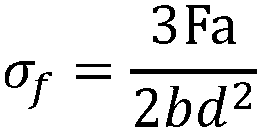
- σf--Flexural strength, in MPa
- F--Breaking load, in N
- a--Span, in mm
- b--Width of test sample, in mm
- d--Thickness of test sample, in mm
- (3) The visible light transmittance was measured according to the method described in ISO 9050: 2003, and the visible light transmittance was calculated according to the following formula:

- τv--Visible light transmittance of the sample, %;
- τ (λ)--Visible spectral transmittance of the sample, %
- Dλ --Relative spectral power distribution of standard illuminant D65
- V( λ )--Photopic vision spectral luminous efficiency
- Δλ--Wavelength interval
| Vickers hardness (Gpa) | Strength of pre-sintered ceramic block (MPa) | Strength after dense-sintering (MPa) | Visible light transmittance | |
| Example 1 | 1.84 | 41. 17 | 354. 04 | 45.23% |
| Example 2 | 2. 09 | 63.39 | 310. 72 | 54.56% |
| Example 3 | 2.12 | 55.93 | 330.29 | 55.49% |
| Example 4 | 1.71 | 40. 03 | 373.47 | 46.68% |
| Example 5 | 1.65 | 40.70 | 340.79 | 57.01% |
| Example 6 | 1.76 | 51.43 | 342.34 | 47.12% |
| Example 7 | 1.56 | 37.66 | 353.1 | 45.90% |
| Example 8 | 1.99 | 49.22 | 377. 52 | 45.95% |
| Example 9 | 1.92 | 55.38 | 360. 6 | 44.27% |
| Example 10 | 1.39 | 36.89 | 339. 05 | 41.05% |
| Example 11 | 1.87 | 39.63 | 397. 75 | 55.98% |
| Example 12 | 1.60 | 40.60 | 355. 32 | 43.44% |
| Example 13 | 1.80 | 46.14 | 369. 49 | 42.9% |
| Example 14 | 1.91 | 46.57 | 359. 07 | 38.25% |
| Example 15 | 1.80 | 41.06 | 338. 66 | 46.49% |
| Example 16 | 2.05 | 47.52 | 355. 60 | 42.74% |
| Example 17 | 1.89 | 50.94 | 376. 08Mpa | 43.08%-47.92%-54.20% (gradual) |
| Example 18 | 1.72 | 47.90 | 344. 83Mpa | 43.11%-45.01%-47.39%-50.83% -54.44% (gradual) |
| Note: the strength in the table refers to the three point bending strength |
Claims (15)
- A pre-sintered ceramic block for a dental restoration, wherein the pre-sintered ceramic block comprises following components:SiO2 55-85%wt, preferably 55-80%wt, more preferably 60-80%wt, most preferably 64-75%wt,Li2O: 10-25%wt, preferably 12-25%wt, more preferably 13-17%wt,ZrO2 0-10%wt, preferably 0-8%wt, more preferably 0-6%wt, most preferably 0-4%wt,Al2O3: 0.3-8%wt, preferably 0.5-6%wt, more preferably 0.5-5%wt, most preferably 0.5-4%wt,La2O3: 0-7%wt, preferably 0-5%wt, more preferably 0-4.5%wt, most preferably 0-4%wt,ZnO: 0-10%wt, preferably 0-8%wt, more preferably 0-7%wt, most preferably 0.1-5%wt,K2O: 0.1-10%wt, preferably 0.1-9%wt, more preferably 0.1-7%wt, most preferably 1-7%wt,GeO2: 0.1-7%wt, preferably 0.1-6%wt, more preferably 0.3-5%wt, most preferably 0.5-4%wt,nucleating agent: 0-10%wt, preferably 0-8%wt, more preferably 0.5-8%wt, most preferably 0.5-5%wt,colorant: 0-10%wt, preferably 0-8%wt, more preferably 0-6%wt, most preferably 0.1-5%wt, andother additives: 0-15%wt, preferably 0-10%wt, more preferably 0-4%wt;wherein the nucleating agent is one of or a combination of at least two of P2O5, TiO2, V2O5, Cr2O3, and Fe2O3; the other additives are one of or a combination of at least two of B2O3, F, Na2O, BaO, SrO, CaO, and MgO,wherein the pre-sintered ceramic block contains a silica main crystal phase, has a Vickers hardness of 0.5-3 GPa, preferably 1-2.5 GPa, and is opaque.
- The pre-sintered ceramic block according to claim 1, wherein the pre-sintered ceramic block has a three-point bending strength of 10-110 MPa; preferably 10-90 MPa; more preferably 30-70 MPa.
- The pre-sintered ceramic block according to claim 1 or 2, wherein the pre-sintered ceramic block does not contain a lithium metasilicate crystal phase.
- The pre-sintered ceramic block according to any one of claims 1-3, wherein the colorant is a glass colorant or a ceramic colorant.
- The pre-sintered ceramic block according to any one of claims 1-4wherein the glass colorant is oxides of at least one of vanadium, chromium, manganese, iron, cobalt, nickel, copper, cerium, praseodymium, neodymium, samarium, promethium, terbium, dysprosium, holmium, erbium, thulium, ytterbium, and europium; the ceramic colorant is one of or a combination of at least two of zirconium iron red, zirconium cerium praseodymium yellow, and nickel black.
- The pre-sintered ceramic block according to claim 1, wherein the pre-sintered ceramic block exhibits a gradual transmittance and/or color after dense-sintering of 800-1100°C.
- The pre-sintered ceramic block according to claim 6, wherein the pre-sintered ceramic block has a three-point bending strength of 10-110 MPa; preferably 10-90 MPa; more preferably 30-70 MPa.
- The pre-sintered ceramic block according to claim 6 or 7, wherein the pre-sintered ceramic block does not contain a lithium metasilicate crystal phase.
- The pre-sintered ceramic block according to any one of claims 6-8, wherein the colorant is a glass colorant or a ceramic colorant.
- The pre-sintered ceramic block according to any one of claims 6-9, wherein the glass colorant is oxides of at least one of vanadium, chromium, manganese, iron, cobalt, nickel, copper, cerium, praseodymium, neodymium, samarium, promethium, terbium, dysprosium, holmium, erbium, thulium, ytterbium, and europium; the ceramic colorant is one of or a combination of at least two of zirconium iron red, zirconium cerium praseodymium yellow, and nickel black.
- A method for preparing the pre-sintered ceramic block according to any one of claims 1-10, comprising the steps of:(1) preparing a matrix glass powder;(2) putting the prepared matrix glass powder into a mould, and carrying out pressing molding to obtain a matrix glass body; and(3) pre-sintering the matrix glass body under a vacuum condition to obtain a pre-sintered ceramic block, wherein a sintering temperature during pre-sintering is 530-590°C, preferably 530-560°C; preferably, a holding time for pre-sintering is 20-240 min, preferably 30-120 min, more preferably 60-120 min.
- A method for preparing the pre-sintered ceramic block according to claim 11, comprising the steps of:(1) preparing at least two matrix glass powder with different transmittance and/or color;(2) putting the prepared at least two matrix glass powders into a mould in the order of transmittance and/or color gradient, and carrying out pressing molding to obtain a matrix glass body; and(3) pre-sintering the matrix glass body under a vacuum condition to obtain a pre-sintered ceramic block, wherein a sintering temperature during pre-sintering is 530-590°C, preferably 530-560°C; preferably, a holding time for pre-sintering is 20-240 min, preferably 30-120 min, more preferably 60-120 min.
- A method for preparing a ceramic block for a dental restoration, comprising the steps of:preparing the pre-sintered ceramic block of any one of claims 1-10; anddense-sintering the pre-sintered ceramic block under a vacuum condition; whereina temperature during dense-sintering is 800-1100°C.
- A method for preparing a dental restoration, comprising the steps of:preparing the pre-sintered ceramic block of any one of claims 1-10;processing the pre-sintered ceramic block into a dental restoration shape to obtain a restoration body; anddense-sintering the restoration body under a vacuum condition to obtain a dental restoration; wherein a temperature during dense-sintering is 800-1100°C.
- The method for preparing a dental restoration according to claim 14, further comprising glazing and/or porcelain finishing the dental restoration after dense-sintering.
Applications Claiming Priority (1)
| Application Number | Priority Date | Filing Date | Title |
|---|---|---|---|
| PCT/CN2019/082763 WO2020210958A1 (en) | 2019-04-15 | 2019-04-15 | Pre-sintered ceramic block for dental restoration, preparation method therefor and use thereof |
Publications (4)
| Publication Number | Publication Date |
|---|---|
| EP3957614A1 EP3957614A1 (en) | 2022-02-23 |
| EP3957614A4 EP3957614A4 (en) | 2022-04-20 |
| EP3957614B1 true EP3957614B1 (en) | 2024-11-27 |
| EP3957614C0 EP3957614C0 (en) | 2024-11-27 |
Family
ID=72837621
Family Applications (1)
| Application Number | Title | Priority Date | Filing Date |
|---|---|---|---|
| EP19925234.7A Active EP3957614B1 (en) | 2019-04-15 | 2019-04-15 | Pre-sintered ceramic block for dental restoration, preparation method therefor and use thereof |
Country Status (8)
| Country | Link |
|---|---|
| US (1) | US12617711B2 (en) |
| EP (1) | EP3957614B1 (en) |
| KR (1) | KR102745377B1 (en) |
| CN (1) | CN113614044A (en) |
| AU (1) | AU2019441599B2 (en) |
| CA (1) | CA3136724C (en) |
| ES (1) | ES3009860T3 (en) |
| WO (1) | WO2020210958A1 (en) |
Families Citing this family (2)
| Publication number | Priority date | Publication date | Assignee | Title |
|---|---|---|---|---|
| CN113461336A (en) * | 2021-06-18 | 2021-10-01 | 辽宁爱尔创生物材料有限公司 | Lithium silicate glass ceramic for dentistry, preparation method thereof and lithium silicate glass ceramic restoration |
| CN118930058A (en) * | 2024-08-21 | 2024-11-12 | 深圳爱尔创口腔技术有限公司 | High-brightness lithium disilicate glass ceramics and preparation method and obtained products |
Family Cites Families (13)
| Publication number | Priority date | Publication date | Assignee | Title |
|---|---|---|---|---|
| RU2169712C1 (en) | 2000-10-26 | 2001-06-27 | Халилев Владимир Девлетович | High-strength polycrystalline glass and method of its producing |
| US7892995B2 (en) * | 2008-04-11 | 2011-02-22 | James R. Glidewell Dental Ceramics, Inc. | Lithium silicate glass ceramic and method for fabrication of dental appliances |
| JP5989770B2 (en) * | 2011-06-22 | 2016-09-07 | ヴィタ ツァーンファブリク ハー.ラウター ゲーエムベーハー ウント コー.カーゲー | Dental restoration material, method for producing the same, and glass ceramic |
| RU2612707C2 (en) | 2012-05-11 | 2017-03-13 | Ивоклар Вивадент Аг | Pre-sintered workpiece for teeth |
| IN2014DN09498A (en) | 2012-05-11 | 2015-07-17 | Ivoclar Vivadent Ag | |
| KR101524482B1 (en) | 2013-10-14 | 2015-06-02 | 주식회사 하스 | Glass-ceramics or Lithium silicate glass for Zirconia overlaying materials and preparation method thereof |
| US10377661B2 (en) | 2014-05-16 | 2019-08-13 | Ivoclar Vivadent Ag | Glass ceramic with SiO2 as the main crystalline phase |
| CN105217959A (en) * | 2014-06-18 | 2016-01-06 | 深圳爱尔创口腔技术有限公司 | A kind of lithium base glass-ceramic preparation method for dental prosthesis |
| CN105174724A (en) * | 2014-06-18 | 2015-12-23 | 深圳爱尔创口腔技术有限公司 | Preparation method of lithium base glass ceramic used for dental restoration bodies |
| CN104909571B (en) * | 2015-05-14 | 2017-06-06 | 西安交通大学 | The preparation method of dental lithium bisilicate devitrified glass |
| KR101796196B1 (en) * | 2015-08-26 | 2017-11-13 | 주식회사 하스 | Dental glass-ceramics block bonded Abutment and preparation method thereof |
| ES2914080T3 (en) * | 2015-11-11 | 2022-06-07 | Ivoclar Vivadent Ag | Procedure for manufacturing glasses and glass-ceramics with SiO2 as the main crystalline phase |
| CN112272544A (en) * | 2018-08-02 | 2021-01-26 | 义获嘉伟瓦登特公司 | Multi-colored blank for dental purposes |
-
2019
- 2019-04-15 AU AU2019441599A patent/AU2019441599B2/en active Active
- 2019-04-15 ES ES19925234T patent/ES3009860T3/en active Active
- 2019-04-15 EP EP19925234.7A patent/EP3957614B1/en active Active
- 2019-04-15 WO PCT/CN2019/082763 patent/WO2020210958A1/en not_active Ceased
- 2019-04-15 KR KR1020217034932A patent/KR102745377B1/en active Active
- 2019-04-15 US US17/603,753 patent/US12617711B2/en active Active
- 2019-04-15 CN CN201980094573.6A patent/CN113614044A/en active Pending
- 2019-04-15 CA CA3136724A patent/CA3136724C/en active Active
Also Published As
| Publication number | Publication date |
|---|---|
| ES3009860T3 (en) | 2025-04-01 |
| CN113614044A (en) | 2021-11-05 |
| US12617711B2 (en) | 2026-05-05 |
| EP3957614A1 (en) | 2022-02-23 |
| BR112021020521A2 (en) | 2021-12-07 |
| CA3136724A1 (en) | 2020-10-22 |
| US20220177358A1 (en) | 2022-06-09 |
| KR102745377B1 (en) | 2024-12-19 |
| WO2020210958A1 (en) | 2020-10-22 |
| AU2019441599A1 (en) | 2021-11-18 |
| EP3957614A4 (en) | 2022-04-20 |
| EP3957614C0 (en) | 2024-11-27 |
| CA3136724C (en) | 2023-08-01 |
| AU2019441599B2 (en) | 2023-01-12 |
| KR20210143884A (en) | 2021-11-29 |
Similar Documents
| Publication | Publication Date | Title |
|---|---|---|
| US10206761B2 (en) | Pre-sintered blank for dental purposes | |
| CN112694253A (en) | Starting glass, lithium silicate glass with core, preparation method and application thereof | |
| EP4442660A1 (en) | Ceramic material and repair material for improving surface adhesion of dental zirconia, and preparation method and bonding method for repair material | |
| CN112551894A (en) | Starting glass, lithium silicate glass with core, preparation method and application thereof | |
| KR102703217B1 (en) | High strength lithium silicate glass ceramic having high shielding property | |
| EP3225227A1 (en) | Al2o3-free lithium silicate glass composition | |
| EP4194415A1 (en) | High-transparency fluorescent glass-ceramic, and preparation method therefor and application thereof | |
| CN113461336A (en) | Lithium silicate glass ceramic for dentistry, preparation method thereof and lithium silicate glass ceramic restoration | |
| US12617711B2 (en) | Pre-sintered ceramic block for dental restoration, preparation method therefor and use thereof | |
| US20100035215A1 (en) | Machinable Porcelain Compositions and Mill Blanks Thereof | |
| EP3957613B1 (en) | Pre-sintered porcelain block for dental restoration, preparation method therefor and application thereof | |
| RU2790555C1 (en) | Ceramic block for tooth restoration, subjected to pre-sintering, its manufacturing method and its use | |
| RU2785730C1 (en) | Ceramic block for teeth restoration, subjected to pre-sintering, its manufacturing method and its use | |
| CN113860743A (en) | Multilayer glass ceramic blank and preparation method and application thereof | |
| KR102921068B1 (en) | Method for manufacturing glass ceramic blanks, glass ceramic blanks | |
| KR102724958B1 (en) | Dental bulk block for cad/cam machining process and manufacturing method of the same | |
| BR112021020521B1 (en) | Pre-sintered ceramic block for dental restoration, method of preparation thereof and use thereof. | |
| BR112021020548B1 (en) | Pre-sintered porcelain block for dental restoration, its preparation method and application. | |
| Chen et al. | Effect of Fe2O3 and CeO2 on Transmittance of Y2O3 Stabilized Tetragonal Zirconia Polycrystals | |
| CN119490305A (en) | Lithium disilicate glass ceramics containing zinc spinel as secondary crystalline phase and preparation method and product thereof | |
| CN121929907A (en) | Color-shading lithium disilicate glass ceramic and preparation method thereof |
Legal Events
| Date | Code | Title | Description |
|---|---|---|---|
| STAA | Information on the status of an ep patent application or granted ep patent |
Free format text: STATUS: THE INTERNATIONAL PUBLICATION HAS BEEN MADE |
|
| PUAI | Public reference made under article 153(3) epc to a published international application that has entered the european phase |
Free format text: ORIGINAL CODE: 0009012 |
|
| STAA | Information on the status of an ep patent application or granted ep patent |
Free format text: STATUS: REQUEST FOR EXAMINATION WAS MADE |
|
| 17P | Request for examination filed |
Effective date: 20211027 |
|
| AK | Designated contracting states |
Kind code of ref document: A1 Designated state(s): AL AT BE BG CH CY CZ DE DK EE ES FI FR GB GR HR HU IE IS IT LI LT LU LV MC MK MT NL NO PL PT RO RS SE SI SK SM TR |
|
| A4 | Supplementary search report drawn up and despatched |
Effective date: 20220321 |
|
| RIC1 | Information provided on ipc code assigned before grant |
Ipc: A61C 13/00 20060101ALI20220315BHEP Ipc: A61C 13/083 20060101ALI20220315BHEP Ipc: C03B 32/02 20060101ALI20220315BHEP Ipc: C03C 10/00 20060101ALI20220315BHEP Ipc: C03C 4/00 20060101ALI20220315BHEP Ipc: C03C 3/097 20060101ALI20220315BHEP Ipc: C03C 12/00 20060101ALI20220315BHEP Ipc: C03C 10/04 20060101AFI20220315BHEP |
|
| DAV | Request for validation of the european patent (deleted) | ||
| DAX | Request for extension of the european patent (deleted) | ||
| GRAP | Despatch of communication of intention to grant a patent |
Free format text: ORIGINAL CODE: EPIDOSNIGR1 |
|
| STAA | Information on the status of an ep patent application or granted ep patent |
Free format text: STATUS: GRANT OF PATENT IS INTENDED |
|
| INTG | Intention to grant announced |
Effective date: 20240703 |
|
| GRAS | Grant fee paid |
Free format text: ORIGINAL CODE: EPIDOSNIGR3 |
|
| GRAA | (expected) grant |
Free format text: ORIGINAL CODE: 0009210 |
|
| STAA | Information on the status of an ep patent application or granted ep patent |
Free format text: STATUS: THE PATENT HAS BEEN GRANTED |
|
| AK | Designated contracting states |
Kind code of ref document: B1 Designated state(s): AL AT BE BG CH CY CZ DE DK EE ES FI FR GB GR HR HU IE IS IT LI LT LU LV MC MK MT NL NO PL PT RO RS SE SI SK SM TR |
|
| REG | Reference to a national code |
Ref country code: GB Ref legal event code: FG4D |
|
| REG | Reference to a national code |
Ref country code: CH Ref legal event code: EP |
|
| REG | Reference to a national code |
Ref country code: IE Ref legal event code: FG4D |
|
| REG | Reference to a national code |
Ref country code: DE Ref legal event code: R096 Ref document number: 602019062789 Country of ref document: DE |
|
| U01 | Request for unitary effect filed |
Effective date: 20241211 |
|
| U07 | Unitary effect registered |
Designated state(s): AT BE BG DE DK EE FI FR IT LT LU LV MT NL PT RO SE SI Effective date: 20241220 |
|
| REG | Reference to a national code |
Ref country code: ES Ref legal event code: FG2A Ref document number: 3009860 Country of ref document: ES Kind code of ref document: T3 Effective date: 20250401 |
|
| PG25 | Lapsed in a contracting state [announced via postgrant information from national office to epo] |
Ref country code: IS Free format text: LAPSE BECAUSE OF FAILURE TO SUBMIT A TRANSLATION OF THE DESCRIPTION OR TO PAY THE FEE WITHIN THE PRESCRIBED TIME-LIMIT Effective date: 20250327 Ref country code: HR Free format text: LAPSE BECAUSE OF FAILURE TO SUBMIT A TRANSLATION OF THE DESCRIPTION OR TO PAY THE FEE WITHIN THE PRESCRIBED TIME-LIMIT Effective date: 20241127 |
|
| PG25 | Lapsed in a contracting state [announced via postgrant information from national office to epo] |
Ref country code: NO Free format text: LAPSE BECAUSE OF FAILURE TO SUBMIT A TRANSLATION OF THE DESCRIPTION OR TO PAY THE FEE WITHIN THE PRESCRIBED TIME-LIMIT Effective date: 20250227 |
|
| U20 | Renewal fee for the european patent with unitary effect paid |
Year of fee payment: 7 Effective date: 20250320 |
|
| PG25 | Lapsed in a contracting state [announced via postgrant information from national office to epo] |
Ref country code: GR Free format text: LAPSE BECAUSE OF FAILURE TO SUBMIT A TRANSLATION OF THE DESCRIPTION OR TO PAY THE FEE WITHIN THE PRESCRIBED TIME-LIMIT Effective date: 20250228 |
|
| PG25 | Lapsed in a contracting state [announced via postgrant information from national office to epo] |
Ref country code: PL Free format text: LAPSE BECAUSE OF FAILURE TO SUBMIT A TRANSLATION OF THE DESCRIPTION OR TO PAY THE FEE WITHIN THE PRESCRIBED TIME-LIMIT Effective date: 20241127 |
|
| PG25 | Lapsed in a contracting state [announced via postgrant information from national office to epo] |
Ref country code: RS Free format text: LAPSE BECAUSE OF FAILURE TO SUBMIT A TRANSLATION OF THE DESCRIPTION OR TO PAY THE FEE WITHIN THE PRESCRIBED TIME-LIMIT Effective date: 20250227 |
|
| PG25 | Lapsed in a contracting state [announced via postgrant information from national office to epo] |
Ref country code: SM Free format text: LAPSE BECAUSE OF FAILURE TO SUBMIT A TRANSLATION OF THE DESCRIPTION OR TO PAY THE FEE WITHIN THE PRESCRIBED TIME-LIMIT Effective date: 20241127 |
|
| PGFP | Annual fee paid to national office [announced via postgrant information from national office to epo] |
Ref country code: ES Payment date: 20250508 Year of fee payment: 7 |
|
| PG25 | Lapsed in a contracting state [announced via postgrant information from national office to epo] |
Ref country code: SK Free format text: LAPSE BECAUSE OF FAILURE TO SUBMIT A TRANSLATION OF THE DESCRIPTION OR TO PAY THE FEE WITHIN THE PRESCRIBED TIME-LIMIT Effective date: 20241127 |
|
| PG25 | Lapsed in a contracting state [announced via postgrant information from national office to epo] |
Ref country code: CZ Free format text: LAPSE BECAUSE OF FAILURE TO SUBMIT A TRANSLATION OF THE DESCRIPTION OR TO PAY THE FEE WITHIN THE PRESCRIBED TIME-LIMIT Effective date: 20241127 |
|
| PLBE | No opposition filed within time limit |
Free format text: ORIGINAL CODE: 0009261 |
|
| STAA | Information on the status of an ep patent application or granted ep patent |
Free format text: STATUS: NO OPPOSITION FILED WITHIN TIME LIMIT |
|
| REG | Reference to a national code |
Ref country code: CH Ref legal event code: L10 Free format text: ST27 STATUS EVENT CODE: U-0-0-L10-L00 (AS PROVIDED BY THE NATIONAL OFFICE) Effective date: 20251008 |
|
| 26N | No opposition filed |
Effective date: 20250828 |
|
| REG | Reference to a national code |
Ref country code: CH Ref legal event code: H13 Free format text: ST27 STATUS EVENT CODE: U-0-0-H10-H13 (AS PROVIDED BY THE NATIONAL OFFICE) Effective date: 20251125 |
|
| PG25 | Lapsed in a contracting state [announced via postgrant information from national office to epo] |
Ref country code: MC Free format text: LAPSE BECAUSE OF FAILURE TO SUBMIT A TRANSLATION OF THE DESCRIPTION OR TO PAY THE FEE WITHIN THE PRESCRIBED TIME-LIMIT Effective date: 20241127 |
|
| PG25 | Lapsed in a contracting state [announced via postgrant information from national office to epo] |
Ref country code: CH Free format text: LAPSE BECAUSE OF NON-PAYMENT OF DUE FEES Effective date: 20250430 |
|
| PGFP | Annual fee paid to national office [announced via postgrant information from national office to epo] |
Ref country code: GB Payment date: 20260223 Year of fee payment: 8 |
|
| PG25 | Lapsed in a contracting state [announced via postgrant information from national office to epo] |
Ref country code: IE Free format text: LAPSE BECAUSE OF NON-PAYMENT OF DUE FEES Effective date: 20250415 |
|
| U20 | Renewal fee for the european patent with unitary effect paid |
Year of fee payment: 8 Effective date: 20260310 |