EP3955903B1 - Small-molecular adjuvants and implementations thereof - Google Patents
Small-molecular adjuvants and implementations thereof Download PDFInfo
- Publication number
- EP3955903B1 EP3955903B1 EP20790881.5A EP20790881A EP3955903B1 EP 3955903 B1 EP3955903 B1 EP 3955903B1 EP 20790881 A EP20790881 A EP 20790881A EP 3955903 B1 EP3955903 B1 EP 3955903B1
- Authority
- EP
- European Patent Office
- Prior art keywords
- nhboc
- compound
- boc
- pharmaceutical composition
- mmol
- Prior art date
- Legal status (The legal status is an assumption and is not a legal conclusion. Google has not performed a legal analysis and makes no representation as to the accuracy of the status listed.)
- Active
Links
Images

Classifications
-
- A—HUMAN NECESSITIES
- A61—MEDICAL OR VETERINARY SCIENCE; HYGIENE
- A61K—PREPARATIONS FOR MEDICAL, DENTAL OR TOILETRY PURPOSES
- A61K31/00—Medicinal preparations containing organic active ingredients
- A61K31/16—Amides, e.g. hydroxamic acids
-
- A—HUMAN NECESSITIES
- A61—MEDICAL OR VETERINARY SCIENCE; HYGIENE
- A61K—PREPARATIONS FOR MEDICAL, DENTAL OR TOILETRY PURPOSES
- A61K31/00—Medicinal preparations containing organic active ingredients
- A61K31/16—Amides, e.g. hydroxamic acids
- A61K31/165—Amides, e.g. hydroxamic acids having aromatic rings, e.g. colchicine, atenolol, progabide
-
- A—HUMAN NECESSITIES
- A61—MEDICAL OR VETERINARY SCIENCE; HYGIENE
- A61K—PREPARATIONS FOR MEDICAL, DENTAL OR TOILETRY PURPOSES
- A61K31/00—Medicinal preparations containing organic active ingredients
- A61K31/16—Amides, e.g. hydroxamic acids
- A61K31/165—Amides, e.g. hydroxamic acids having aromatic rings, e.g. colchicine, atenolol, progabide
- A61K31/166—Amides, e.g. hydroxamic acids having aromatic rings, e.g. colchicine, atenolol, progabide having the carbon of a carboxamide group directly attached to the aromatic ring, e.g. procainamide, procarbazine, metoclopramide, labetalol
-
- A—HUMAN NECESSITIES
- A61—MEDICAL OR VETERINARY SCIENCE; HYGIENE
- A61K—PREPARATIONS FOR MEDICAL, DENTAL OR TOILETRY PURPOSES
- A61K31/00—Medicinal preparations containing organic active ingredients
- A61K31/33—Heterocyclic compounds
- A61K31/395—Heterocyclic compounds having nitrogen as a ring hetero atom, e.g. guanethidine or rifamycins
- A61K31/40—Heterocyclic compounds having nitrogen as a ring hetero atom, e.g. guanethidine or rifamycins having five-membered rings with one nitrogen as the only ring hetero atom, e.g. sulpiride, succinimide, tolmetin, buflomedil
- A61K31/403—Heterocyclic compounds having nitrogen as a ring hetero atom, e.g. guanethidine or rifamycins having five-membered rings with one nitrogen as the only ring hetero atom, e.g. sulpiride, succinimide, tolmetin, buflomedil condensed with carbocyclic rings, e.g. carbazole
- A61K31/404—Indoles, e.g. pindolol
- A61K31/4045—Indole-alkylamines; Amides thereof, e.g. serotonin, melatonin
-
- A—HUMAN NECESSITIES
- A61—MEDICAL OR VETERINARY SCIENCE; HYGIENE
- A61K—PREPARATIONS FOR MEDICAL, DENTAL OR TOILETRY PURPOSES
- A61K31/00—Medicinal preparations containing organic active ingredients
- A61K31/33—Heterocyclic compounds
- A61K31/395—Heterocyclic compounds having nitrogen as a ring hetero atom, e.g. guanethidine or rifamycins
- A61K31/41—Heterocyclic compounds having nitrogen as a ring hetero atom, e.g. guanethidine or rifamycins having five-membered rings with two or more ring hetero atoms, at least one of which being nitrogen, e.g. tetrazole
- A61K31/42—Oxazoles
-
- A—HUMAN NECESSITIES
- A61—MEDICAL OR VETERINARY SCIENCE; HYGIENE
- A61K—PREPARATIONS FOR MEDICAL, DENTAL OR TOILETRY PURPOSES
- A61K31/00—Medicinal preparations containing organic active ingredients
- A61K31/33—Heterocyclic compounds
- A61K31/395—Heterocyclic compounds having nitrogen as a ring hetero atom, e.g. guanethidine or rifamycins
- A61K31/41—Heterocyclic compounds having nitrogen as a ring hetero atom, e.g. guanethidine or rifamycins having five-membered rings with two or more ring hetero atoms, at least one of which being nitrogen, e.g. tetrazole
- A61K31/425—Thiazoles
- A61K31/429—Thiazoles condensed with heterocyclic ring systems
- A61K31/43—Compounds containing 4-thia-1-azabicyclo [3.2.0] heptane ring systems, i.e. compounds containing a ring system of the formula, e.g. penicillins, penems
- A61K31/431—Compounds containing 4-thia-1-azabicyclo [3.2.0] heptane ring systems, i.e. compounds containing a ring system of the formula, e.g. penicillins, penems containing further heterocyclic rings, e.g. ticarcillin, azlocillin, oxacillin
-
- A—HUMAN NECESSITIES
- A61—MEDICAL OR VETERINARY SCIENCE; HYGIENE
- A61K—PREPARATIONS FOR MEDICAL, DENTAL OR TOILETRY PURPOSES
- A61K31/00—Medicinal preparations containing organic active ingredients
- A61K31/33—Heterocyclic compounds
- A61K31/395—Heterocyclic compounds having nitrogen as a ring hetero atom, e.g. guanethidine or rifamycins
- A61K31/435—Heterocyclic compounds having nitrogen as a ring hetero atom, e.g. guanethidine or rifamycins having six-membered rings with one nitrogen as the only ring hetero atom
-
- A—HUMAN NECESSITIES
- A61—MEDICAL OR VETERINARY SCIENCE; HYGIENE
- A61K—PREPARATIONS FOR MEDICAL, DENTAL OR TOILETRY PURPOSES
- A61K31/00—Medicinal preparations containing organic active ingredients
- A61K31/33—Heterocyclic compounds
- A61K31/395—Heterocyclic compounds having nitrogen as a ring hetero atom, e.g. guanethidine or rifamycins
- A61K31/495—Heterocyclic compounds having nitrogen as a ring hetero atom, e.g. guanethidine or rifamycins having six-membered rings with two or more nitrogen atoms as the only ring heteroatoms, e.g. piperazine or tetrazines
- A61K31/496—Non-condensed piperazines containing further heterocyclic rings, e.g. rifampin, thiothixene or sparfloxacin
-
- A—HUMAN NECESSITIES
- A61—MEDICAL OR VETERINARY SCIENCE; HYGIENE
- A61K—PREPARATIONS FOR MEDICAL, DENTAL OR TOILETRY PURPOSES
- A61K31/00—Medicinal preparations containing organic active ingredients
- A61K31/33—Heterocyclic compounds
- A61K31/395—Heterocyclic compounds having nitrogen as a ring hetero atom, e.g. guanethidine or rifamycins
- A61K31/535—Heterocyclic compounds having nitrogen as a ring hetero atom, e.g. guanethidine or rifamycins having six-membered rings with at least one nitrogen and one oxygen as the ring hetero atoms, e.g. 1,2-oxazines
- A61K31/5375—1,4-Oxazines, e.g. morpholine
- A61K31/5377—1,4-Oxazines, e.g. morpholine not condensed and containing further heterocyclic rings, e.g. timolol
-
- A—HUMAN NECESSITIES
- A61—MEDICAL OR VETERINARY SCIENCE; HYGIENE
- A61K—PREPARATIONS FOR MEDICAL, DENTAL OR TOILETRY PURPOSES
- A61K31/00—Medicinal preparations containing organic active ingredients
- A61K31/56—Compounds containing cyclopenta[a]hydrophenanthrene ring systems; Derivatives thereof, e.g. steroids
- A61K31/575—Compounds containing cyclopenta[a]hydrophenanthrene ring systems; Derivatives thereof, e.g. steroids substituted in position 17 beta by a chain of three or more carbon atoms, e.g. cholane, cholestane, ergosterol, sitosterol
-
- A—HUMAN NECESSITIES
- A61—MEDICAL OR VETERINARY SCIENCE; HYGIENE
- A61K—PREPARATIONS FOR MEDICAL, DENTAL OR TOILETRY PURPOSES
- A61K31/00—Medicinal preparations containing organic active ingredients
- A61K31/65—Tetracyclines
-
- A—HUMAN NECESSITIES
- A61—MEDICAL OR VETERINARY SCIENCE; HYGIENE
- A61K—PREPARATIONS FOR MEDICAL, DENTAL OR TOILETRY PURPOSES
- A61K31/00—Medicinal preparations containing organic active ingredients
- A61K31/70—Carbohydrates; Sugars; Derivatives thereof
- A61K31/7028—Compounds having saccharide radicals attached to non-saccharide compounds by glycosidic linkages
- A61K31/7034—Compounds having saccharide radicals attached to non-saccharide compounds by glycosidic linkages attached to a carbocyclic compound, e.g. phloridzin
- A61K31/7036—Compounds having saccharide radicals attached to non-saccharide compounds by glycosidic linkages attached to a carbocyclic compound, e.g. phloridzin having at least one amino group directly attached to the carbocyclic ring, e.g. streptomycin, gentamycin, amikacin, validamycin, fortimicins
-
- A—HUMAN NECESSITIES
- A61—MEDICAL OR VETERINARY SCIENCE; HYGIENE
- A61K—PREPARATIONS FOR MEDICAL, DENTAL OR TOILETRY PURPOSES
- A61K31/00—Medicinal preparations containing organic active ingredients
- A61K31/70—Carbohydrates; Sugars; Derivatives thereof
- A61K31/7042—Compounds having saccharide radicals and heterocyclic rings
- A61K31/7048—Compounds having saccharide radicals and heterocyclic rings having oxygen as a ring hetero atom, e.g. leucoglucosan, hesperidin, erythromycin, nystatin, digitoxin or digoxin
-
- A—HUMAN NECESSITIES
- A61—MEDICAL OR VETERINARY SCIENCE; HYGIENE
- A61K—PREPARATIONS FOR MEDICAL, DENTAL OR TOILETRY PURPOSES
- A61K38/00—Medicinal preparations containing peptides
- A61K38/04—Peptides having up to 20 amino acids in a fully defined sequence; Derivatives thereof
- A61K38/12—Cyclic peptides, e.g. bacitracins; Polymyxins; Gramicidins S, C; Tyrocidins A, B or C
-
- A—HUMAN NECESSITIES
- A61—MEDICAL OR VETERINARY SCIENCE; HYGIENE
- A61K—PREPARATIONS FOR MEDICAL, DENTAL OR TOILETRY PURPOSES
- A61K38/00—Medicinal preparations containing peptides
- A61K38/04—Peptides having up to 20 amino acids in a fully defined sequence; Derivatives thereof
- A61K38/14—Peptides containing saccharide radicals; Derivatives thereof, e.g. bleomycin, phleomycin, muramylpeptides or vancomycin
-
- A—HUMAN NECESSITIES
- A61—MEDICAL OR VETERINARY SCIENCE; HYGIENE
- A61K—PREPARATIONS FOR MEDICAL, DENTAL OR TOILETRY PURPOSES
- A61K45/00—Medicinal preparations containing active ingredients not provided for in groups A61K31/00 - A61K41/00
- A61K45/06—Mixtures of active ingredients without chemical characterisation, e.g. antiphlogistics and cardiaca
-
- A—HUMAN NECESSITIES
- A61—MEDICAL OR VETERINARY SCIENCE; HYGIENE
- A61P—SPECIFIC THERAPEUTIC ACTIVITY OF CHEMICAL COMPOUNDS OR MEDICINAL PREPARATIONS
- A61P31/00—Antiinfectives, i.e. antibiotics, antiseptics, chemotherapeutics
- A61P31/04—Antibacterial agents
-
- C—CHEMISTRY; METALLURGY
- C07—ORGANIC CHEMISTRY
- C07C—ACYCLIC OR CARBOCYCLIC COMPOUNDS
- C07C231/00—Preparation of carboxylic acid amides
- C07C231/02—Preparation of carboxylic acid amides from carboxylic acids or from esters, anhydrides, or halides thereof by reaction with ammonia or amines
-
- C—CHEMISTRY; METALLURGY
- C07—ORGANIC CHEMISTRY
- C07C—ACYCLIC OR CARBOCYCLIC COMPOUNDS
- C07C233/00—Carboxylic acid amides
- C07C233/01—Carboxylic acid amides having carbon atoms of carboxamide groups bound to hydrogen atoms or to acyclic carbon atoms
- C07C233/34—Carboxylic acid amides having carbon atoms of carboxamide groups bound to hydrogen atoms or to acyclic carbon atoms having the nitrogen atom of at least one of the carboxamide groups bound to a carbon atom of a hydrocarbon radical substituted by amino groups
- C07C233/35—Carboxylic acid amides having carbon atoms of carboxamide groups bound to hydrogen atoms or to acyclic carbon atoms having the nitrogen atom of at least one of the carboxamide groups bound to a carbon atom of a hydrocarbon radical substituted by amino groups with the substituted hydrocarbon radical bound to the nitrogen atom of the carboxamide group by an acyclic carbon atom
- C07C233/40—Carboxylic acid amides having carbon atoms of carboxamide groups bound to hydrogen atoms or to acyclic carbon atoms having the nitrogen atom of at least one of the carboxamide groups bound to a carbon atom of a hydrocarbon radical substituted by amino groups with the substituted hydrocarbon radical bound to the nitrogen atom of the carboxamide group by an acyclic carbon atom having the carbon atom of the carboxamide group bound to an acyclic carbon atom of a carbon skeleton containing six-membered aromatic rings
-
- C—CHEMISTRY; METALLURGY
- C07—ORGANIC CHEMISTRY
- C07C—ACYCLIC OR CARBOCYCLIC COMPOUNDS
- C07C233/00—Carboxylic acid amides
- C07C233/64—Carboxylic acid amides having carbon atoms of carboxamide groups bound to carbon atoms of six-membered aromatic rings
- C07C233/77—Carboxylic acid amides having carbon atoms of carboxamide groups bound to carbon atoms of six-membered aromatic rings having the nitrogen atom of at least one of the carboxamide groups bound to a carbon atom of a hydrocarbon radical substituted by amino groups
- C07C233/78—Carboxylic acid amides having carbon atoms of carboxamide groups bound to carbon atoms of six-membered aromatic rings having the nitrogen atom of at least one of the carboxamide groups bound to a carbon atom of a hydrocarbon radical substituted by amino groups with the substituted hydrocarbon radical bound to the nitrogen atom of the carboxamide group by an acyclic carbon atom
-
- C—CHEMISTRY; METALLURGY
- C07—ORGANIC CHEMISTRY
- C07C—ACYCLIC OR CARBOCYCLIC COMPOUNDS
- C07C237/00—Carboxylic acid amides, the carbon skeleton of the acid part being further substituted by amino groups
- C07C237/02—Carboxylic acid amides, the carbon skeleton of the acid part being further substituted by amino groups having the carbon atoms of the carboxamide groups bound to acyclic carbon atoms of the carbon skeleton
- C07C237/04—Carboxylic acid amides, the carbon skeleton of the acid part being further substituted by amino groups having the carbon atoms of the carboxamide groups bound to acyclic carbon atoms of the carbon skeleton the carbon skeleton being acyclic and saturated
-
- C—CHEMISTRY; METALLURGY
- C07—ORGANIC CHEMISTRY
- C07C—ACYCLIC OR CARBOCYCLIC COMPOUNDS
- C07C237/00—Carboxylic acid amides, the carbon skeleton of the acid part being further substituted by amino groups
- C07C237/02—Carboxylic acid amides, the carbon skeleton of the acid part being further substituted by amino groups having the carbon atoms of the carboxamide groups bound to acyclic carbon atoms of the carbon skeleton
- C07C237/04—Carboxylic acid amides, the carbon skeleton of the acid part being further substituted by amino groups having the carbon atoms of the carboxamide groups bound to acyclic carbon atoms of the carbon skeleton the carbon skeleton being acyclic and saturated
- C07C237/06—Carboxylic acid amides, the carbon skeleton of the acid part being further substituted by amino groups having the carbon atoms of the carboxamide groups bound to acyclic carbon atoms of the carbon skeleton the carbon skeleton being acyclic and saturated having the nitrogen atoms of the carboxamide groups bound to hydrogen atoms or to acyclic carbon atoms
-
- C—CHEMISTRY; METALLURGY
- C07—ORGANIC CHEMISTRY
- C07C—ACYCLIC OR CARBOCYCLIC COMPOUNDS
- C07C237/00—Carboxylic acid amides, the carbon skeleton of the acid part being further substituted by amino groups
- C07C237/02—Carboxylic acid amides, the carbon skeleton of the acid part being further substituted by amino groups having the carbon atoms of the carboxamide groups bound to acyclic carbon atoms of the carbon skeleton
- C07C237/04—Carboxylic acid amides, the carbon skeleton of the acid part being further substituted by amino groups having the carbon atoms of the carboxamide groups bound to acyclic carbon atoms of the carbon skeleton the carbon skeleton being acyclic and saturated
- C07C237/10—Carboxylic acid amides, the carbon skeleton of the acid part being further substituted by amino groups having the carbon atoms of the carboxamide groups bound to acyclic carbon atoms of the carbon skeleton the carbon skeleton being acyclic and saturated having the nitrogen atom of at least one of the carboxamide groups bound to an acyclic carbon atom of a hydrocarbon radical substituted by nitrogen atoms not being part of nitro or nitroso groups
-
- C—CHEMISTRY; METALLURGY
- C07—ORGANIC CHEMISTRY
- C07D—HETEROCYCLIC COMPOUNDS
- C07D209/00—Heterocyclic compounds containing five-membered rings, condensed with other rings, with one nitrogen atom as the only ring hetero atom
- C07D209/02—Heterocyclic compounds containing five-membered rings, condensed with other rings, with one nitrogen atom as the only ring hetero atom condensed with one carbocyclic ring
- C07D209/04—Indoles; Hydrogenated indoles
- C07D209/10—Indoles; Hydrogenated indoles with substituted hydrocarbon radicals attached to carbon atoms of the hetero ring
- C07D209/18—Radicals substituted by carbon atoms having three bonds to hetero atoms with at the most one bond to halogen, e.g. ester or nitrile radicals
- C07D209/20—Radicals substituted by carbon atoms having three bonds to hetero atoms with at the most one bond to halogen, e.g. ester or nitrile radicals substituted additionally by nitrogen atoms, e.g. tryptophane
-
- C—CHEMISTRY; METALLURGY
- C07—ORGANIC CHEMISTRY
- C07C—ACYCLIC OR CARBOCYCLIC COMPOUNDS
- C07C2603/00—Systems containing at least three condensed rings
- C07C2603/56—Ring systems containing bridged rings
- C07C2603/58—Ring systems containing bridged rings containing three rings
- C07C2603/70—Ring systems containing bridged rings containing three rings containing only six-membered rings
- C07C2603/74—Adamantanes
-
- Y—GENERAL TAGGING OF NEW TECHNOLOGICAL DEVELOPMENTS; GENERAL TAGGING OF CROSS-SECTIONAL TECHNOLOGIES SPANNING OVER SEVERAL SECTIONS OF THE IPC; TECHNICAL SUBJECTS COVERED BY FORMER USPC CROSS-REFERENCE ART COLLECTIONS [XRACs] AND DIGESTS
- Y02—TECHNOLOGIES OR APPLICATIONS FOR MITIGATION OR ADAPTATION AGAINST CLIMATE CHANGE
- Y02A—TECHNOLOGIES FOR ADAPTATION TO CLIMATE CHANGE
- Y02A50/00—TECHNOLOGIES FOR ADAPTATION TO CLIMATE CHANGE in human health protection, e.g. against extreme weather
- Y02A50/30—Against vector-borne diseases, e.g. mosquito-borne, fly-borne, tick-borne or waterborne diseases whose impact is exacerbated by climate change
Definitions
- the present disclosure relates to the field of medicinal chemistry and more particularly to the development of select combinations as an effective therapy against resistant bacterial infections.
- the present disclosure also relates to small-molecular adjuvants, its stereoisomers, pharmaceutically acceptable salts, polymorphs, solvates and hydrates thereof, and to pharmaceutical compositions containing them.
- AMR antimicrobial resistance
- Vancomycin derivatives have been used in combination with ⁇ -lactam antibiotics like meropenem ( Yarlagadda, V et al. ACS Infect Dis. 2018, 4, 1093 ). Combination therapy of glycopeptide antibiotics like telavancin with colistin, at sub-inhibitory concentrations have shown to increase their activity against Gram-negative pathogens ( Hornsey, M et al. Antimicrob Agents Chemother. 2012, 56, 3080 ). Colistin analogues without the aliphatic chain have been used in combination with various antibiotics against Gram-negative bacteria. An example of this is SPR741, a colistin based cationic peptide developed by Spero therapeutics at Massachusetts ( Corbett, D et al. Antimicrob Agents Chemother. 2017, 61, e00200-17 ).
- WO 2015/136311 relates to polyamine conjugates, its isomers, prodrugs, and pharmaceutically acceptable salts thereof useful in the treatment, prevention, or suppression of diseases mediated by microbes.
- the present invention relates to a compound, its stereoisomers, pharmaceutically acceptable salts, polymorphs, solvates and hydrates thereof, which is selected from a group consisting of:
- the compounds of the present invention for use as small-molecular adjuvants.
- a pharmaceutical composition comprising: a) compound of the present invention or its stereoisomers, pharmaceutically acceptable salts, polymorphs, solvates and hydrates thereof as described herein; b) one or more antibiotics.
- a pharmaceutical composition as described herein in treating a disease or condition in a patient, wherein said disease or condition is caused by microorganism selected from the group consisting of bacteria, fungi, and protozoa.
- a pharmaceutical composition as to described herein in killing or inhibiting the growth of a microorganism selected from the group consisting of bacteria, fungi, and protozoa.
- Figure 1 illustrates the bactericidal kinetics according to an implementation of the present disclosure.
- Figure 1(A) displays the bactericidal kinetics of the combination of rifampicin and Compound 13 and rifampicin against A . baumannii R674, whereas
- Figure 1(B) displays the bacterial kinetics of the combination of fusidic acid and Compound 14, Compound 14 and fusidic acid against P. aeruginosa R590; Asterisks correspond to ⁇ 50 CFU/mL.
- adjuvant refers to a substance which is used in combination with a biological agent to enhance it's activity.
- Ratios, concentrations, amounts, and other numerical data may be presented herein in a range format. It is to be understood that such range format is used merely for convenience and brevity and should be interpreted flexibly to include not only the numerical values explicitly recited as the limits of the range, but also to include all the individual numerical values or sub-ranges encompassed within that range as if each numerical value and sub-range is explicitly recited.
- a temperature range of about 100°C to about 200°C should be interpreted to include not only the explicitly recited limits of about 100°C to about 200°C, but also to include sub-ranges, such as 105°C to 155°C, 160°C to 175°C, and so forth, as well as individual amounts, including fractional amounts, within the specified ranges, such as 102.2°C, 150.6°C, and 171.3°C, for example.
- Cx-y indicates the numerical range of carbon atoms that are present in the group; for example, C1-6 alkyl includes C1 alkyl (methyl), C2 alkyl (ethyl), C3 alkyl (propyl and isopropyl), and C4 alkyl (butyl, 1-methylpropyl, 2-methylpropyl, and t-butyl).
- the bonding atom of a group may be any suitable atom of that group; for example, propyl includes prop-1-yl, and prop-2-yl.
- the compound of the present invention can be its derivatives, analogs, stereoisomers, diastereomers, geometrical isomers, polymorphs, solvates, co-crystals, intermediates, metabolites, or pharmaceutically acceptable salts and compositions.
- the compounds according to the present invention may contain one or more asymmetric centers (also referred to as a chiral centers) and may, therefore, exist as individual enantiomers, diastereoisomers, or other stereoisomeric forms, or as mixtures thereof.
- Chiral centers such as chiral carbon atoms, may also be present in a substituent such as an alkyl group.
- the stereochemistry of a chiral center present in the compounds of the present invention, or in any chemical structure illustrated herein, is not specified, the structure is intended to encompass any stereoisomer and all mixtures thereof.
- compounds according to the present invention containing one or more chiral centers may be used as racemic modifications including racemic mixtures and racemates, enantiomerically-enriched mixtures, or as enantiomerically-pure individual stereoisomers.
- Compounds disclosed herein include isotopes of hydrogen, carbon, oxygen, fluorine, chlorine, iodine and sulfur which can be incorporated into the compounds, such as not limited to 2 H (D), 3 H (T), c 11 C, 13 C, 14 C, 15 N, 18 F, 35 S, 36 Cl and 125 I.
- Compounds of this invention wherein atoms were isotopically labeled for example radioisotopes such as 3 H, 13 C, 14 C, and the like can be used in metabolic studies and kinetic studies.
- Compounds of the invention where hydrogen is replaced with deuterium may improve the metabolic stability and pharmacokinetics properties of the drug such as in vivo half-life.
- Individual stereoisomers of a compound according to the present invention which contain one or more asymmetric centers may be resolved by methods known to those skilled in the art. For example, such resolution may be carried out (1) by the formation of diastereoisomeric salts, complexes or other derivatives; (2) by selective reaction with a stereoisomer-specific reagent, for example by enzymatic oxidation or reduction; or (3) by gas-liquid or liquid chromatography in a chiral environment, for example, on a chiral support such as silica with a bound chiral ligand or in the presence of a chiral solvent. It will be appreciated that where the desired stereoisomer is converted into another chemical entity by one of the separation procedures described above, a further step is required to liberate the desired form.
- stereoisomers may be synthesized by asymmetric synthesis using optically active reagents, substrates, catalysts or solvents, or by converting one enantiomer to the other by asymmetric transformation.
- references herein to compounds of the present invention and salts thereof covers the compounds of the present invention as free bases, or as salts thereof, for example as pharmaceutically acceptable salts thereof.
- the invention is directed to compounds of the present invention as the free base.
- the invention is directed to compounds of the present invention and salts thereof.
- the invention is directed to compounds of the present invention and pharmaceutically acceptable salts thereof.
- pharmaceutically acceptable salts of the compounds according to the present invention may be prepared. Indeed, in certain embodiments of the invention, pharmaceutically acceptable salts of the compounds according to the present invention may be preferred over the respective free base because such salts impart greater stability or solubility to the molecule thereby facilitating formulation into a dosage form. Accordingly, the invention is further directed to compounds of the present invention, and pharmaceutically acceptable salts thereof.
- alkyl refers to a saturated hydrocarbon chain having the specified number of carbon atoms.
- C 1-6 alkyl refers to an alkyl group having from 1 - 6 carbon atoms, or 1 - 4 carbon atoms.
- Alkyl groups may be straight or branched chained groups. Representative branched alkyl groups have one, two, or three branches.
- Preferred alkyl groups include, without limitation, methyl, ethyl, n-propyl, isopropyl, butyl, isobutyl, and t-butyl.
- alkoxy refers to an alkyl group attached via an oxygen linkage to the rest of the molecule.
- C 1-6 alkoxy refers to an alkyl group having from 1 - 6 carbon atoms, or 1 - 4 carbon atoms attached via an oxygen linkage to the rest of the molecule.
- Preferred alkoxy groups include, without limitation, -OCH 3 (methoxy), -OC 2 H 5 (ethoxy) and the like.
- haloalkyl refers to a halogen in an alkyl group as defined above attached via alkyl linkage to the rest of the molecule.
- C 1-6 haloalkyl refers to an alkyl group having from 1 - 6 carbon atoms, or 1 - 4 carbon atoms wherein one or more hydrogen atoms are replaced by the same number of identical or different halogen atoms.
- Preferred haloalkyl groups include, without limitation, -CH 2 Cl, -CHCl 2 , trifluoromethyl, 2,2,2-trifluoroethyl, and the like.
- haloalkoxy refers to a halogen in an alkoxy group as defined above attached via alkoxy linkage to the rest of the molecule.
- C 1-6 haloalkoxy refers to an alkoxy group having from 1 - 6 carbon atoms, or 1 - 4 carbon atoms wherein one or more hydrogen atoms are replaced by the same number of identical or different halogen atoms.
- Preferred haloalkoxy groups include, without limitation, -OCH 2 Cl, -OCHCl 2 , and the like
- halo or halogen refers to a halogen radical, for example, fluoro, chloro, bromo, or iodo.
- cycloalkyl refers to a saturated hydrocarbon ring having a specified number of carbon atoms, which may be monocyclic or polycyclic.
- C 3-15 cycloalkyl refers to a cycloalkyl group having from 3 to 15 member atoms.
- the polycyclic ring denotes hydrocarbon systems containing two or more ring systems with one or more ring carbon atoms in common i.e. a spiro, fused or bridged structures.
- C 3-15 cycloalkyl refers to a cycloalkyl group having from 3 to 15 membered atoms.
- Preferred cycloalkyl groups include, without limitation, cyclopropyl, cyclobutyl, cyclopentyl, cyclohexyl, cyclooctanyl, perhydronaphthyl, adamantyl, noradamantyl and norbornyl groups, bridged cyclic groups or spirobicyclic groups e.g spiro [4.4] non-2-yl, and the like.
- aryl refers to an aromatic ring having a specified number of carbon atoms.
- C 6-15 aryl refers to an aryl group having 6 to 15 member atoms, or 6 member atoms.
- Preferred aryl groups include, without limitation, phenyl, naphthyl, and the like.
- heteroaryl refers to aromatic rings containing from 1 to 5 heteroatoms in the ring. “Heteroaryl” groups may be substituted with one or one or more substituents if so defined herein.
- the "C 1-6 heteroaryl” rings having 1 or 6 carbon as member atoms.
- the term “5-15 membered heteroaryl” has 1 to 15 carbon(s) as member atoms.
- the “heteroaryl” includes pyridinyl, tetrazolyl, pyrazolyl, or azacyclics, such as carbazole, indole, phenothiazine, and the like.
- Heteroatom refers to a nitrogen, sulfur, or oxygen atom, for example, a nitrogen atom or an oxygen atom.
- heterocyclyl refers to saturated or unsaturated monocyclic aliphatic rings containing 5, 6, or 7 ring members including 1-3 heteroatoms or saturated or unsaturated bicyclic, tricyclic, tetracyclic aliphatic rings containing 5, 6 or 7 ring members including 1-3 heteroatoms, which may include spiro, fused, or bridged ring systems.
- heterocyclyl groups are saturated.
- heterocyclyl groups are unsaturated.
- Heterocyclyl groups containing more than one heteroatom may contain different heteroatoms.
- Heterocyclyl” groups may be substituted with one or more substituents as defined herein.
- C 1-10 heterocyclyl refers to rings having 1 or 10 carbon as member atoms.
- Heterocyclyl includes piperidinyl, tetrahydropyranyl, azepinyl, oxazepinyl, azabicyclo[3.1.0]hexanyl.
- phrases "pharmaceutically acceptable” refers to those compounds, materials, compositions, and dosage forms which are, within the scope of sound medical judgment, suitable for use in contact with the tissues of human beings and animals without excessive toxicity, irritation, or other problem or complication, commensurate with a reasonable benefit/risk ratio.
- pharmaceutically acceptable salts refers to salts that retain the desired biological activity of the subject compound and exhibit minimal undesired toxicological effects. These pharmaceutically acceptable salts may be prepared in situ during the final isolation and purification of the compound, or by separately reacting the purified compound in its free base form with a suitable acid.
- Salts and solvates having non-pharmaceutically acceptable counter-ions or associated solvents are within the scope of the present invention, for example, for use as intermediates in the preparation of other compounds of the present invention, and their pharmaceutically acceptable salts.
- one embodiment of the invention embraces compounds of the present invention, and salts thereof.
- Compounds according to the present invention contain a basic functional group and are therefore capable of forming pharmaceutically acceptable acid addition salts by treatment with a suitable acid.
- Suitable acids include pharmaceutically acceptable inorganic acids and pharmaceutically acceptable organic acids.
- the compound of the present invention as described herein, for use as small molecular adjuvants.
- a pharmaceutical composition comprising a compound of the present invention or its stereoisomers, pharmaceutically acceptable salts, polymorphs, solvates and hydrates thereof as described herein, together with a pharmaceutically acceptable carrier, optionally in combination with one or more other antibiotics, or their pharmaceutical composition.
- a pharmaceutical composition comprising: a) compound of the present invention or its stereoisomers, pharmaceutically acceptable salts, polymorphs, solvates and hydrates thereof, as described herein; b) one or more antibiotics.
- a pharmaceutical composition comprising: a) compound of the present invention or its stereoisomers, pharmaceutically acceptable salts, polymorphs, solvates and hydrates thereof, as described herein; b) pharmaceutical composition of one or more antibiotics.
- a pharmaceutical composition as described herein wherein the antibiotic is selected from the group consisting of rifampicin, tetracycline, fusidic acid, oxazolidinone, glycopeptides, fluoroquinolone, macrolide, beta-lactams, aminoglycosides, chloramphenicol, polymyxin, lipopeptide, and combinations thereof.
- a pharmaceutical composition as described herein wherein the antibiotic is selected from the group consisting of rifampicin, tetracycline, minocycline, fusidic acid, linezolid, vancomycin, ciprofloxacin, erythromycin, ampicillin, streptomycin, chloramphenicol, colistin, daptomycin, and combinations thereof.
- a pharmaceutical composition as described herein for use in treating disease or condition in a patient, wherein said disease or condition is caused by a microorganism selected from the group consisting of bacteria, fungi and protozoa.
- Example 4 Synthesis of N,N -bis-[(6-( L Lys)amido) propyl] 3,3-diphenyl propanamide tetrakis(trifluoroacetate) (Compound 8):_(not part of the present invention) N,N -bis-[ ⁇ 3-(Boc- L Lys)amido ⁇ propyl] 3,3-diphenylpropanamide (7c):
Landscapes
- Health & Medical Sciences (AREA)
- Chemical & Material Sciences (AREA)
- Life Sciences & Earth Sciences (AREA)
- Organic Chemistry (AREA)
- Animal Behavior & Ethology (AREA)
- Veterinary Medicine (AREA)
- Public Health (AREA)
- Medicinal Chemistry (AREA)
- General Health & Medical Sciences (AREA)
- Pharmacology & Pharmacy (AREA)
- Epidemiology (AREA)
- Immunology (AREA)
- Gastroenterology & Hepatology (AREA)
- Engineering & Computer Science (AREA)
- Bioinformatics & Cheminformatics (AREA)
- Proteomics, Peptides & Aminoacids (AREA)
- Chemical Kinetics & Catalysis (AREA)
- Molecular Biology (AREA)
- Nuclear Medicine, Radiotherapy & Molecular Imaging (AREA)
- General Chemical & Material Sciences (AREA)
- Oncology (AREA)
- Communicable Diseases (AREA)
- Pharmaceuticals Containing Other Organic And Inorganic Compounds (AREA)
- Medicines That Contain Protein Lipid Enzymes And Other Medicines (AREA)
Description
- The present disclosure relates to the field of medicinal chemistry and more particularly to the development of select combinations as an effective therapy against resistant bacterial infections. The present disclosure also relates to small-molecular adjuvants, its stereoisomers, pharmaceutically acceptable salts, polymorphs, solvates and hydrates thereof, and to pharmaceutical compositions containing them.
- The rapid emergence of antimicrobial resistance (AMR) to a majority of antibiotics has resulted in multidrug-resistant superbugs, causing high morbidity and mortality. According to a recent report published by the World Health Organization (WHO), Acinetobacter baumannii, Pseudomonas aeruginosa and carbapenem-resistant, extended spectrum β-lactamase (ESBL) producing Enterobacteriaceae are listed as critical pathogens. This urgently calls for extensive research and development to combat infections caused by these multi drug-resistant Gram-negative bacteria (GNB).
- Due to the deteriorating antibiotic pipeline and the sluggish development of novel antibiotics, there is a dire need of innovative strategies. One such promising strategy would be the repurposing of existing antibiotics, thereby reducing the legal and developmental challenges involved. This strategy has been exploited by several research groups and companies to tackle the problem of antibacterial resistance. A list of recently identified combinations can be found in this review (Tyers, M et al. Nat Rev Microbiol. 2019, 17, 141).
- Combinations of β-lactam antibiotics with β-lactamase inhibitors have already been identified as an effective therapeutic strategy and some of these combinations are also in different phases of clinical trials (Antibiotics currently in Global Clinical Development. 2018 https://www.pewtrusts.org). Vabomere, a combination of meropenem (β-lactam antibiotic) and vaborbactum (β-lactamase inhibitor) was approved by the US FDA in August, 2017.
- Vancomycin derivatives have been used in combination with β-lactam antibiotics like meropenem (Yarlagadda, V et al. ACS Infect Dis. 2018, 4, 1093). Combination therapy of glycopeptide antibiotics like telavancin with colistin, at sub-inhibitory concentrations have shown to increase their activity against Gram-negative pathogens (Hornsey, M et al. Antimicrob Agents Chemother. 2012, 56, 3080). Colistin analogues without the aliphatic chain have been used in combination with various antibiotics against Gram-negative bacteria. An example of this is SPR741, a colistin based cationic peptide developed by Spero therapeutics at Massachusetts (Corbett, D et al. Antimicrob Agents Chemother. 2017, 61, e00200-17).
- Polymeric compounds have also displayed synergy with antibiotics like tetracycline against resistant Gram-negative bacteria (Uppu, DS et al. PLoS One. 2015, 10, e0126757). Thus, the combination approach has exhibited various positive results, exhibiting its therapeutic potency. Moreover, combination therapies with membrane-active agents like colistin, colistin analogues and OAK peptides have been able to potentiate antibiotics against resistant Gram-negative bacteria. This has set up a platform to develop membrane-perturbing molecules with simpler synthetic strategies (a limitation for most of the above-mentioned adjuvants) and use them in combination with obsolete antibiotics against MDR Gram-negative bacteria.
- The combination therapies with membrane-active agents have already been tested, but none of them have been approved yet for treating infections. The major limitations of the adjuvants used in these combinations lie in the complexity of their structural design, the cost of their manufacture and in-vivo toxicity associated with them. Another challenge associated with some of the above-mentioned therapies involves the usage of an already existing antibiotic, colistin. This can lead to resistance development against colistin, which is the last resort to treat Gram-negative bacterial infections. Thus, using colistin as an adjuvant is not a very good idea as this antibiotic must be reserved for times of therapeutic crisis. Moreover, most of the membrane-targeting adjuvants which had been used until now exhibit antibacterial activity. This puts selection pressure on bacteria to develop resistance to these adjuvants. Mechanisms of resistance development to membrane-active agents have already been reported (Steinbuch, KB et al. Med. Chem. Commun. 2016, 7, 86). Colistin analogues, without the aliphatic chain exhibit mild to no antibacterial activity but they have other synthetic challenges associated with them. Moreover, these membrane-active agents have slight toxicity associated with them as well.
WO 2015/136311 relates to polyamine conjugates, its isomers, prodrugs, and pharmaceutically acceptable salts thereof useful in the treatment, prevention, or suppression of diseases mediated by microbes. - The present invention relates to a compound, its stereoisomers, pharmaceutically acceptable salts, polymorphs, solvates and hydrates thereof, which is selected from a group consisting of:


- In another aspect of the present disclosure, there is provided the compounds of the present invention for use as small-molecular adjuvants.
- In an aspect of the present disclosure, there is provided a pharmaceutical composition comprising the compounds of the present invention or its stereoisomers, pharmaceutically acceptable salts, polymorphs, solvates and hydrates thereof, together with a pharmaceutically acceptable carrier, optionally in combination with one or more other antibiotics, or their pharmaceutical composition.
- In another aspect of the present disclosure, there is provided a pharmaceutical composition comprising: a) compound of the present invention or its stereoisomers, pharmaceutically acceptable salts, polymorphs, solvates and hydrates thereof as described herein; b) one or more antibiotics.
- In one another aspect of the present disclosure, there is provided a pharmaceutical composition comprising: a) compound of the present invention or its stereoisomers, pharmaceutically acceptable salts, polymorphs, solvates and hydrates thereof as described herein; b) a pharmaceutical composition of one or more antibiotics.
- In another aspect of the present disclosure, there is provided a use of a pharmaceutical composition as described herein, in treating a disease or condition in a patient, wherein said disease or condition is caused by microorganism selected from the group consisting of bacteria, fungi, and protozoa.
- In yet another aspect of the present disclosure, there is provided a use of a pharmaceutical composition as to described herein, in killing or inhibiting the growth of a microorganism selected from the group consisting of bacteria, fungi, and protozoa.
- These and other features, aspects and advantages of the present subject matter will be better understood with reference to the following description and appended claims. This summary is provided to introduce a selection of concepts in a simplified form.
- The detailed description is described with reference to the accompanying figures. In the figures, the left-most digit(s) of a reference number identifies the figure in which the reference number first appears. The same numbers are used throughout the drawings to reference like features and components.
Figure 1 illustrates the bactericidal kinetics according to an implementation of the present disclosure.Figure 1(A) displays the bactericidal kinetics of the combination of rifampicin and Compound 13 and rifampicin against A. baumannii R674, whereasFigure 1(B) displays the bacterial kinetics of the combination of fusidic acid and Compound 14, Compound 14 and fusidic acid against P. aeruginosa R590; Asterisks correspond to <50 CFU/mL. - Those skilled in the art will be aware that the present disclosure is subject to variations and modifications other than those specifically described. It is to be understood that the present disclosure includes all such variations and modifications. The disclosure also includes all such steps, features, compositions and compounds referred to or indicated in this specification, individually or collectively and any and all combinations of any or more of such steps or features.
- For convenience, before further description of the present disclosure, certain terms employed in the specification, and examples are collected here. These definitions should be read in the light of the remainder of the disclosure and understood as by a person of skill in the art. The terms used herein have the meanings recognized and known to those of skill in the art, however, for convenience and completeness, particular terms and their meanings are set forth below.
- The articles "a", "an" and "the" are used to refer to one or to more than one (i.e., to at least one) of the grammatical object of the article.
- The terms "comprise" and "comprising" are used in the inclusive, open sense, meaning that additional elements may be included. Throughout this specification, unless the context requires otherwise the word "comprise", and variations, such as "comprises" and "comprising", will be understood to imply the inclusion of a stated element or step or group of element or steps but not the exclusion of any other element or step or group of element or steps.
- The term "including" is used to mean "including but not limited to". "Including" and "including but not limited to" are used interchangeably.
- The term "adjuvant" refers to a substance which is used in combination with a biological agent to enhance it's activity.
- In the structural formulae given herein and throughout the present disclosure, the following terms have been indicated meaning, unless specifically stated otherwise.
- Ratios, concentrations, amounts, and other numerical data may be presented herein in a range format. It is to be understood that such range format is used merely for convenience and brevity and should be interpreted flexibly to include not only the numerical values explicitly recited as the limits of the range, but also to include all the individual numerical values or sub-ranges encompassed within that range as if each numerical value and sub-range is explicitly recited. For example, a temperature range of about 100°C to about 200°C should be interpreted to include not only the explicitly recited limits of about 100°C to about 200°C, but also to include sub-ranges, such as 105°C to 155°C, 160°C to 175°C, and so forth, as well as individual amounts, including fractional amounts, within the specified ranges, such as 102.2°C, 150.6°C, and 171.3°C, for example.
- In this specification, the prefix Cx-y as used in terms such as Cx-y alkyl, and the like (where x and y are integers) indicates the numerical range of carbon atoms that are present in the group; for example, C1-6 alkyl includes C1 alkyl (methyl), C2 alkyl (ethyl), C3 alkyl (propyl and isopropyl), and C4 alkyl (butyl, 1-methylpropyl, 2-methylpropyl, and t-butyl). Unless specifically stated, the bonding atom of a group may be any suitable atom of that group; for example, propyl includes prop-1-yl, and prop-2-yl.
- Furthermore, the compound of the present invention, can be its derivatives, analogs, stereoisomers, diastereomers, geometrical isomers, polymorphs, solvates, co-crystals, intermediates, metabolites, or pharmaceutically acceptable salts and compositions.
- The compounds of the present invention and their polymorphs, stereoisomers, solvates, co-crystals, intermediates, pharmaceutically acceptable salts, and metabolites thereof can also be referred as "compounds of the present disclosure".
- The compounds according to the present invention, may contain one or more asymmetric centers (also referred to as a chiral centers) and may, therefore, exist as individual enantiomers, diastereoisomers, or other stereoisomeric forms, or as mixtures thereof. Chiral centers, such as chiral carbon atoms, may also be present in a substituent such as an alkyl group. Where the stereochemistry of a chiral center present in the compounds of the present invention, or in any chemical structure illustrated herein, is not specified, the structure is intended to encompass any stereoisomer and all mixtures thereof. Thus, compounds according to the present invention containing one or more chiral centers may be used as racemic modifications including racemic mixtures and racemates, enantiomerically-enriched mixtures, or as enantiomerically-pure individual stereoisomers.
- Compounds disclosed herein include isotopes of hydrogen, carbon, oxygen, fluorine, chlorine, iodine and sulfur which can be incorporated into the compounds, such as not limited to 2H (D), 3H (T), c 11C, 13C, 14C, 15N, 18F, 35S, 36Cl and 125I. Compounds of this invention wherein atoms were isotopically labeled for example radioisotopes such as 3H, 13C, 14C, and the like can be used in metabolic studies and kinetic studies. Compounds of the invention where hydrogen is replaced with deuterium may improve the metabolic stability and pharmacokinetics properties of the drug such as in vivo half-life.
- Individual stereoisomers of a compound according to the present invention which contain one or more asymmetric centers may be resolved by methods known to those skilled in the art. For example, such resolution may be carried out (1) by the formation of diastereoisomeric salts, complexes or other derivatives; (2) by selective reaction with a stereoisomer-specific reagent, for example by enzymatic oxidation or reduction; or (3) by gas-liquid or liquid chromatography in a chiral environment, for example, on a chiral support such as silica with a bound chiral ligand or in the presence of a chiral solvent. It will be appreciated that where the desired stereoisomer is converted into another chemical entity by one of the separation procedures described above, a further step is required to liberate the desired form.
- Alternatively, specific stereoisomers may be synthesized by asymmetric synthesis using optically active reagents, substrates, catalysts or solvents, or by converting one enantiomer to the other by asymmetric transformation.
- It is to be understood that the references herein to compounds of the present invention and salts thereof covers the compounds of the present invention as free bases, or as salts thereof, for example as pharmaceutically acceptable salts thereof. Thus, in one embodiment, the invention is directed to compounds of the present invention as the free base. In another embodiment, the invention is directed to compounds of the present invention and salts thereof. In a further embodiment, the invention is directed to compounds of the present invention and pharmaceutically acceptable salts thereof.
- It will be appreciated that pharmaceutically acceptable salts of the compounds according to the present invention, may be prepared. Indeed, in certain embodiments of the invention, pharmaceutically acceptable salts of the compounds according to the present invention may be preferred over the respective free base because such salts impart greater stability or solubility to the molecule thereby facilitating formulation into a dosage form. Accordingly, the invention is further directed to compounds of the present invention, and pharmaceutically acceptable salts thereof.
- Included within the scope of the "compounds of the invention" are all solvates (including hydrates), complexes, polymorphs, and stereoisomers, and salts thereof.
- The compounds of the invention may exist in solid or liquid form. In the solid-state, the compounds of the invention may exist in crystalline or non-crystalline form, or as a mixture thereof. For compounds of the invention that are in crystalline form, the skilled artisan will appreciate that pharmaceutically acceptable solvates may be formed wherein solvent molecules are incorporated into the crystalline lattice during crystallization. Solvates may involve nonaqueous solvents such as ethanol, isopropyl alcohol, dimethylsulfoxide (DMSO), acetic acid, ethanolamine, and ethyl acetate, or they may involve water as the solvent that is incorporated into the crystalline lattice. Solvates wherein water is the solvent that is incorporated into the crystalline lattice are typically referred to as "hydrates". Hydrates include stoichiometric hydrates as well as compositions containing variable amounts of water. The invention includes all such solvates.
- It will be further appreciated that certain compounds of the invention that exist in crystalline form, including the various solvates thereof, may exhibit polymorphism (i.e. the capacity to occur in different crystalline structures). These different crystalline forms are typically known as "polymorphs". The invention includes such polymorphs. Polymorphs have the same chemical composition but differ in packing, geometrical arrangement, and other descriptive properties of the crystalline solid state. Polymorphs, therefore, may have different physical properties such as shape, density, hardness, deformability, stability, and dissolution properties. Polymorphs typically exhibit different melting points, IR spectra, and X-ray powder diffraction patterns, which may be used for identification. It will be appreciated that different polymorphs may be produced, for example, by changing or adjusting the reaction conditions or reagents, used in making the compound. For example, changes in temperature, pressure, or solvent may result in polymorphs. In addition, one polymorph may spontaneously convert to another polymorph under certain conditions. The term "polymorphs" refers to crystal forms of the same molecule, and different polymorphs may have different physical properties such as for example, melting temperatures, heats of fusion, solubilities, dissolution rates and/or vibrational spectra as a result of the arrangement or conformation of the molecules in the crystal lattice.
- The term "substituted" in reference to a group indicates that a hydrogen atom attached to a member atom within a group is replaced. It should be understood that the term "substituted" includes the implicit provision that such substitution be in accordance with the permitted valence of the substituted atom and the substituent and that the substitution results in a stable compound (i.e. one that does not spontaneously undergo transformation such as rearrangement, cyclisation, or elimination). In certain embodiments, a single atom may be substituted with more than one substituent as long as such substitution is in accordance with the permitted valence of the atom. Suitable substituents are defined herein for each substituted or optionally substituted group.
- The term "alkyl" refers to a saturated hydrocarbon chain having the specified number of carbon atoms. For example, which is not limited, C1-6 alkyl refers to an alkyl group having from 1 - 6 carbon atoms, or 1 - 4 carbon atoms. Alkyl groups may be straight or branched chained groups. Representative branched alkyl groups have one, two, or three branches. Preferred alkyl groups include, without limitation, methyl, ethyl, n-propyl, isopropyl, butyl, isobutyl, and t-butyl.
- The term "alkoxy" refers to an alkyl group attached via an oxygen linkage to the rest of the molecule. For example, C1-6 alkoxy refers to an alkyl group having from 1 - 6 carbon atoms, or 1 - 4 carbon atoms attached via an oxygen linkage to the rest of the molecule. Preferred alkoxy groups include, without limitation, -OCH3 (methoxy), -OC2H5 (ethoxy) and the like.
- The term "haloalkyl" refers to a halogen in an alkyl group as defined above attached via alkyl linkage to the rest of the molecule. For example, C1-6 haloalkyl refers to an alkyl group having from 1 - 6 carbon atoms, or 1 - 4 carbon atoms wherein one or more hydrogen atoms are replaced by the same number of identical or different halogen atoms. Preferred haloalkyl groups include, without limitation, -CH2Cl, -CHCl2, trifluoromethyl, 2,2,2-trifluoroethyl, and the like.
- The term "haloalkoxy" refers to a halogen in an alkoxy group as defined above attached via alkoxy linkage to the rest of the molecule. For example, C1-6 haloalkoxy refers to an alkoxy group having from 1 - 6 carbon atoms, or 1 - 4 carbon atoms wherein one or more hydrogen atoms are replaced by the same number of identical or different halogen atoms. Preferred haloalkoxy groups include, without limitation, -OCH2Cl, -OCHCl2, and the like
- The term "halo" or "halogen" refers to a halogen radical, for example, fluoro, chloro, bromo, or iodo.
- The term "cycloalkyl" refers to a saturated hydrocarbon ring having a specified number of carbon atoms, which may be monocyclic or polycyclic. For example, which is not limited, C3-15 cycloalkyl refers to a cycloalkyl group having from 3 to 15 member atoms. The polycyclic ring denotes hydrocarbon systems containing two or more ring systems with one or more ring carbon atoms in common i.e. a spiro, fused or bridged structures. For example, which is not limited, C3-15 cycloalkyl refers to a cycloalkyl group having from 3 to 15 membered atoms. Preferred cycloalkyl groups include, without limitation, cyclopropyl, cyclobutyl, cyclopentyl, cyclohexyl, cyclooctanyl, perhydronaphthyl, adamantyl, noradamantyl and norbornyl groups, bridged cyclic groups or spirobicyclic groups e.g spiro [4.4] non-2-yl, and the like.
- The term "aryl" refers to an aromatic ring having a specified number of carbon atoms. For example, C6-15 aryl refers to an aryl group having 6 to 15 member atoms, or 6 member atoms. Preferred aryl groups include, without limitation, phenyl, naphthyl, and the like.
- The term "heteroaryl" refers to aromatic rings containing from 1 to 5 heteroatoms in the ring. "Heteroaryl" groups may be substituted with one or one or more substituents if so defined herein. The "C1-6 heteroaryl" rings having 1 or 6 carbon as member atoms. The term "5-15 membered heteroaryl" has 1 to 15 carbon(s) as member atoms. The "heteroaryl" includes pyridinyl, tetrazolyl, pyrazolyl, or azacyclics, such as carbazole, indole, phenothiazine, and the like. "Heteroatom" refers to a nitrogen, sulfur, or oxygen atom, for example, a nitrogen atom or an oxygen atom.
- The term "heterocyclyl" refers to saturated or unsaturated monocyclic aliphatic rings containing 5, 6, or 7 ring members including 1-3 heteroatoms or saturated or unsaturated bicyclic, tricyclic, tetracyclic aliphatic rings containing 5, 6 or 7 ring members including 1-3 heteroatoms, which may include spiro, fused, or bridged ring systems. In certain embodiments, "heterocyclyl" groups are saturated. In other embodiments, "heterocyclyl" groups are unsaturated. "Heterocyclyl" groups containing more than one heteroatom may contain different heteroatoms. "Heterocyclyl" groups may be substituted with one or more substituents as defined herein. The "C1-10 heterocyclyl" refers to rings having 1 or 10 carbon as member atoms. "Heterocyclyl" includes piperidinyl, tetrahydropyranyl, azepinyl, oxazepinyl, azabicyclo[3.1.0]hexanyl.
- The phrase "pharmaceutically acceptable" refers to those compounds, materials, compositions, and dosage forms which are, within the scope of sound medical judgment, suitable for use in contact with the tissues of human beings and animals without excessive toxicity, irritation, or other problem or complication, commensurate with a reasonable benefit/risk ratio.
- The phrase "at least one protecting group" refers to protecting groups known in the art. Examples of many of these possible groups may be found in "Protective Groups in Organic Synthesis" by T.W. Green, John Wiley and Sons, 1981. Non-limiting examples for the protecting group may be tert-butoxycarbonyl (Boc or t-Boc), carbobenzoxy (Z or Cbz), 9-fluorenylmethoxycarbonyl (Fmoc), 9-(R)3Si-Fmoc, Xmoc, DHAmoc, their derivatives, and the like.
- As used herein, the term "pharmaceutically acceptable salts" refers to salts that retain the desired biological activity of the subject compound and exhibit minimal undesired toxicological effects. These pharmaceutically acceptable salts may be prepared in situ during the final isolation and purification of the compound, or by separately reacting the purified compound in its free base form with a suitable acid.
- Salts and solvates having non-pharmaceutically acceptable counter-ions or associated solvents are within the scope of the present invention, for example, for use as intermediates in the preparation of other compounds of the present invention, and their pharmaceutically acceptable salts. Thus, one embodiment of the invention embraces compounds of the present invention, and salts thereof. Compounds according to the present invention, contain a basic functional group and are therefore capable of forming pharmaceutically acceptable acid addition salts by treatment with a suitable acid. Suitable acids include pharmaceutically acceptable inorganic acids and pharmaceutically acceptable organic acids. Representative pharmaceutically acceptable acid addition salts include hydrochloride, hydrobromide, nitrate, methylnitrate, sulfate, bisulfate, sulfamate, phosphate, acetate, trifluoroacetate, hydroxyacetate, phenyl acetate, propionate, butyrate, iso-butyrate, valerate, maleate, hydroxymaleate, acrylate, fumarate, formate, malate, tartrate, citrate, salicylate, glycollate, lactate, heptanoate, phthalate, oxalate, succinate, benzoate, o-acetoxybenzoate, chlorobenzoate, methylbenzoate, dinitrobenzoate, hydroxybenzoate, methoxybenzoate, naphthoate, hydroxynaphthoate, mandelate, tannate, formate, stearate, ascorbate, palmitate, oleate, pyruvate, pamoate, malonate, laurate, glutarate, glutamate, estolate, methanesulfonate (mesylate), ethanesulfonate (esylate), 2-hydroxyethanesulfonate, benzenesulfonate (besylate), aminobenzenesulfonate, p- toluenesulfonate (tosylate), and naphthalene-2-sulfonate.
- As discussed in the background section, the identification and development of simple, non-active and non-toxic adjuvants which can be used in combination with a number of antibiotics remains an area of immense interest. The present disclosure thus provides small molecular adjuvants which exhibit potentiation of antibiotics.
- A term once described, the same meaning applies for it, throughout the disclosure.
- There is provided a compound, or its stereoisomers, pharmaceutically acceptable salts, polymorphs, solvates and hydrates thereof, which is selected from a group consisting of


- In an embodiment of the present disclosure, there is provided a compound, or its stereoisomers, pharmaceutically acceptable salts, polymorphs, solvates and hydrates thereof, which is selected from a group consisting of


- In an embodiment of the present disclosure, there is provided the compound of the present invention as described herein, for use as small molecular adjuvants.
- In an embodiment of the present disclosure, there is provided a pharmaceutical composition comprising a compound of the present invention or its stereoisomers, pharmaceutically acceptable salts, polymorphs, solvates and hydrates thereof as described herein, together with a pharmaceutically acceptable carrier, optionally in combination with one or more other antibiotics, or their pharmaceutical composition.
- In an embodiment of the present disclosure, there is provided a pharmaceutical composition comprising: a) compound of the present invention or its stereoisomers, pharmaceutically acceptable salts, polymorphs, solvates and hydrates thereof, as described herein; b) one or more antibiotics.
- In an embodiment of the present disclosure, there is provided a pharmaceutical composition comprising: a) compound of the present invention or its stereoisomers, pharmaceutically acceptable salts, polymorphs, solvates and hydrates thereof, as described herein; b) pharmaceutical composition of one or more antibiotics.
- In an embodiment of the present disclosure, there is provided a pharmaceutical composition as described herein, wherein the antibiotic is selected from the group consisting of rifampicin, tetracycline, fusidic acid, oxazolidinone, glycopeptides, fluoroquinolone, macrolide, beta-lactams, aminoglycosides, chloramphenicol, polymyxin, lipopeptide, and combinations thereof.
- In an embodiment of the present disclosure, there is provided a pharmaceutical composition as described herein, wherein the antibiotic is selected from the group consisting of rifampicin, tetracycline, minocycline, fusidic acid, linezolid, vancomycin, ciprofloxacin, erythromycin, ampicillin, streptomycin, chloramphenicol, colistin, daptomycin, and combinations thereof.
- In an embodiment of the present disclosure, there is provided a pharmaceutical composition as described herein, for use in treating disease or condition in a patient, wherein said disease or condition is caused by a microorganism selected from the group consisting of bacteria, fungi and protozoa.
- In an embodiment of the present disclosure, there is provided a pharmaceutical composition as described herein, for use in killing or inhibiting the growth of a microorganism selected from the group consisting of bacteria, fungi, and protozoa.
- In an embodiment of the present disclosure, there is provided a use of the pharmaceutical composition as described herein, in treating a disease or condition in a patient, wherein said disease or condition is caused by microorganism selected from the group consisting of bacteria, fungi, and protozoa.
- In an embodiment of the present disclosure, there is provided a use of the pharmaceutical composition as described herein, in killing or inhibiting the growth of a microorganism selected from the group consisting of bacteria, fungi, and protozoa.
- In an embodiment of the present disclosure, there is provided a pharmaceutical composition as described herein, wherein the bacteria is Gram-positive bacteria or Gram-negative bacteria.
- In an embodiment of the present disclosure, there is provided a pharmaceutical composition as described herein, wherein the bacteria is a multi-resistant bacterium selected from a group consisting of A. baumannii, P. aeruginosa, E. coli, K. pneumoniae, or any combinations thereof.
- The disclosure will now be illustrated with working examples, which is intended to illustrate the working of disclosure. Unless defined otherwise, all technical and scientific terms used herein have the same meaning as commonly understood to one of ordinary skill in the art to which this disclosure belongs. Although methods and materials similar or equivalent to those described herein can be used in the practice of the disclosed methods and compositions, the exemplary methods, devices and materials are described herein. It is to be understood that this disclosure is not limited to particular methods, and experimental conditions described, as such methods and conditions may apply.
- The following examples provide the details about the synthesis, characterization and combination efficacies of the small-molecular adjuvants mentioned in the present invention.
- All the solvents were of reagent grade, which were distilled and dried before its use. All the reagents were purchased from Sigma-Aldrich, Alfa-Aesar, S.D. Fine, Avra and Spectrochem, and were used without further purification. Analytical thin layer chromatography (TLC) was performed on E. Merck TLC plates pre-coated with silica gel 60 F254 and visualization was carried out using UV light and Iodine. Column chromatography was performed on silica gel (60-120 mesh) using different ratio of chloroform and methanol solvent system. Nuclear magnetic resonance spectra were recorded on Bruker (AV-400) 400 MHz spectrometer in deuterated solvents. Mass spectra were obtained using 6538-UHD Accurate mass Q-TOF LC-MS instrument. For optical density measurement during bacteriology experiments, Tecan Infinite Pro series M200 Microplate Reader was used. Bacterial strains, A. baumannii (R674), P. aeruginosa (R590), E. coli (R3336) and K. pneumoniae (R3934) were used for the studies.
- The combination efficacy with antibiotics from different classes and individual antibacterial activity of the synthesized adjuvants was evaluated against the above mentioned MDR and NDM-1 strains of Gram-negative bacteria. All the bacteria were grown in peptone. The bacterial samples were freeze dried and stored at -80°C. 3 µl of these stocks were added to 3 mL of peptone and the culture was grown for 6 h at 37°C prior to the experiments.
- Small-molecular adjuvants (SMAs) where R1 = R2 = Hydrogen and R3 = Aromatic radicals were synthesized from N1 -Boc-N 3-(3-(Boc-amino)-propyl) propane-1,3-diamine and different aromatic radical bearing carboxylic acids or amino acids, through simple amide coupling reaction using O-benzotriazole-N,N,N',N'-tetramethyl-uronium-hexafluorophosphate (HBTU) as coupling agent followed by deprotection using trifluoroacetic acid to give the final compounds with CF3COO- as counterions. The final compounds can be synthesized with other counterions such as Cl-, Br- etc.
- 10 g (1 equivalent, 76.27 mmol) of norspermidine was dissolved in MeOH (50 mL) and the solution was kept at -80°C. Then 24.94 g (1.5 equivalents, 114.31 mmol) of Boc2O was dissolved in MeOH (50 mL) and added to the reaction mixture dropwise. The reaction was continued for 1 h at -80°C. Then the reaction mixture was allowed to come at RT. MeOH was removed and purification was done through column chromatography on silica gel (60-120 mesh) using methanol and chloroform (7:93) as eluent to afford the product with 50% yield. 1H-NMR (400 MHz, CDCl3) δ/ppm: 5.182 (s, NH(-CH2-CH2-CH2-NH Boc)2, 2H), 3.190-3.175 (m, NH(-C H 2-CH2-CH2-NHBoc)2, 4H), 2.649-2.616 (m, NH(-CH2-CH2-C H 2 -NHBoc)2, 4H), 1.860 (s, NH (-CH2-CH2-CH2-NHBoc)2, 1H), 1.666-1.602 (m, NH(-CH2-C H2 -CH2-NH-Boc)2, 4H), 1.417 (s, NH(-CH2-CH2-CH2-NH-COO-C(C H3 ) 3 )2, 18H). HRMS (m/z): 332.2539 [(M+H)+] (Observed), 332.2549 [(M+H)+] (Calculated).
- 4.7 g (1 equivalent, 23 mmol) of LTrp was dissolved in 50 mL water, 3.9 g (2 equivalents, 46 mmol) of NaHCO3 was added and the reaction mixture was allowed to stir for 15-20 minutes. The reaction mixture was kept at 00C and 6 g (1.2 equivalents, 27.6 mmol) of di-t-butylpyrocarbonate (Boc2O), dissolved in 50 mL of tetrahydrofuran (THF) was added to the reaction mixture dropwise. The ice-bath was removed and the reaction was allowed to happen for 16-24 hours. Then, THF was evaporated and the reaction mixture was acidified using 1N hydrochloric acid (HCl) till a pH of 3-4 was attained. The precipitate obtained after acidifiacton was extracted using dichloromethane (DCM) to afford the pure product with 89% yield. 1H-NMR (400 MHz, DMSO-d6) δ/ppm: 12.509 (s, -COOH, 1H), 10.812 (s, -N H indole , 1H), 7.527-6.925 (m, Ar H and -N H Boc, 6H), 4.174-4.119 (m, -C H NHBoc, 1H), 3.152-2.943 (m, -CH2 , 2H), 1.329 (s, -NH-COO-C(C H3)3 , 9H).
- About 1.2 equivalents of carboxylic acids with aromatic radicals (phenylacetic, naphthylacetic, biphenyl, diphenylpropionic acid) or Boc-protected tryptophan were dissolved in dry DCM (12 mL) at 0°C. In the reaction mixture, 3 equivalents of DIPEA was added followed by 1.2 equivalents of HBTU. Then DMF (3 mL) was added to the reaction mixture. After 10 minutes, 1 equivalent of 5a in dry DCM (1 mL) was added dropwise to the reaction mixture. The reaction mixture was brought to RT and allowed to stir for 24 h. Solvent was evaporated and the residue was diluted in ethyl acetate (50 mL). Then work-up was carried out at first with 1N HCl (50 mL, 3 times) followed by saturated Na2CO3 solution (50 mL, 3 times). The crude product was extracted in ethyl acetate layer. Finally, purification was accomplished through column chromatography on silica gel (60-120 mesh) using different ratios of methanol and chloroform as an eluent to afford 5b-5f with 55-80% yield.
- Yield-56%; 1H-NMR (400 MHz, CDCl3) δ/ppm: 7.333-7.297 (m, Ar H , 2H), 7.251-7.232 (m, Ar H , 3H), 5.363-4.532 (br, R-CO-N(-CH2-CH2-CH2-NH Boc)2, 2H), 3.695 (s, ArC H2 -CO- N(-CH2-CH2-CH2-NHBoc)2, 2H), 3.415-3.022 (m, R-CO-N(-C H2 -CH2-C H2 -NHBoc)2, 8H), 1.662-1.629 (br, R-CO-N((-CH2-C H 2-CH2-NHBoc)2, 4H), 1.438-1.421 (d, R-CO-N(-CH2-CH2-CH2-NH-COO-C(C H3)3 )2, 18H). HRMS (m/z): 472.2714 [(M+Na)+] (Observed), 472.2787 [(M+Na)+] (Calculated).
- Yield-55%; 1H-NMR (400 MHz, CDCl3) δ/ppm: 7.791-7.532 (m, Ar H , 3H), 7.515-7.407 (m, Ar H , 4H), 5.268-4.484 (br, R-CO-N(-CH2-CH2-CH2-NH Boc)2, 2H), 4.133(s, ArCH 2-CO-N(N(-CH2-CH2-CH2-NH Boc)2, 2H), 3.461-3.037 (m, R-CO-N(-CH 2 -CH2-C H2 -NHBoc)2, 8H), 1.709-1.670 (br, R-CO-N((-CH2-C H 2-CH2-NHBoc)2, 4H), 1.411-1.404 (d, R-CO-N(-CH2-CH2-CH2-NH-COO-C(C H3)3 )2, 18H). HRMS (m/z): 522.2935 [(M+Na)+] (Observed), 522.2944 [(M+Na)+] (Calculated).
- Yield-70%; 1H-NMR (400 MHz, CDCl3) δ/ppm: 7.642-7.355 (m, Ar H , 9H), 5.367 and 4.357 (br, R-CO-N(-CH2-CH2-CH2-NH Boc)2, 2H), 3.603-2.994 (br, R-CO-N(-CH2 -CH2-CH2 -NHBoc)2, 8H), 1.806-1.670 (br, R-CO-N((-CH2-C H 2-CH2-NHBoc)2, 4H), 1.496-1.357 (br, R-CO-N(-CH2-CH2-CH2-NH-COO-C(C H3)3 )2, 18H). HRMS (m/z): 534.2934 [(M+Na)+] (Observed), 534.2944 [(M+Na)+] (Calculated).
- Yield-74%; 1H-NMR (400 MHz, CDCl3) δ/ppm: 7.288-7.284 (ArH, 3H), 7.252-7.154 (m, Ar H , 7H), 5.227 (br, -N H Boc, 1H), 4.733-4.695 (t, ArCH CH2-CO-N(-CH2-CH2-CH2-NHBoc)2, 1H), 4.560 (br, -N H Boc, 1H), 3.337-3.055 and 2.783-2.739 (m and q, R-CO-N(-CH2 -CH2-CH2 -NHBoc)2, 8H), 3.036-3.017 (d, ArCHCH2 -CO-N(-CH2-CH2-CH2-NHBoc)2, 2H), 1.636-1.439 (br, R-CO-N(-CH2-CH 2 -CH2-NHBoc)2, 4H), 1.434 (s, R-CO-N(-CH2-CH2-CH2-NH-COO-C(C H3)3 )2, 18H). HRMS (m/z): 540.3900 [(M+H)+] (Observed), 540.3437 [(M+H)+] (Calculated).
- Yield-69%; %; 1H-NMR (400 MHz, CDCl3) δ/ppm: 8.334 (s, -N H indole , 1H), 7.717-7.698 (d, Ar H , 1H), 7.360-7.340 (d, Ar H , 1H), 7.210-7.034 (m, Ar H , 3H), 5.331-4.586 (br, ArCH2C H (N H Boc)CO-N((-CH2-CH2-CH2-N H Boc)2, 4H), 3.409-2.703 (m, ArC H2 CH(NHBoc)CO-N(-C H2 -CH2-CH2 -NHBoc)2, 10H), 1.728- 1.714 (br, R-CO-N(-CH2-CH2 -CH2-NHBoc)2, 4H), 1.452-1.434 (d, ArCH2CH(NH-COO-C(C H3)3 )CO-N(-CH2-CH2-CH2-NH-COO-C(C H3)3 )2, 27H). HRMS (m/z): 618.3531 [(M+H)+] (Observed), 618.3867 [(M+H)+] (Calculated).
- At first 1 equivalent of 5b-5f was dissolved in dry DCM. To the intensely stirred solution, 4 equivalents (excess amount) of trifluoroacetic acid (TFA) was added and allowed to stir at RT for 4h. After that reaction, solvent and unused TFA were removed to get the pure product with 100% yield with CF3COO- counterions. The final compounds can be synthesized with other counterions such as Cl-, Br- etc.
- 1H-NMR (400 MHz, DMSO-d6) δ/ppm: 7.827 (br, R-CO-N(-CH2-CH2-CH2-NH3 + ) 2, 6H), 7.327-7.290 (Ar H , 2H), 7.248-7.231 (d, Ar H , 3H), 3.700 (s, ArC H2 -CO-N(-CH2-CH2-CH2-NH3 +)2, 2H), 3.411-3.370 (t, R-CO-N(-CH2-C H2 -CH2-NH3 +)2, 2H), 3.333-3.297 (R-CON(-CH2-CH2-C H2 -NH3 +)2, 2H), 2.856-2.820 (t, R-CO-N-(CH2 -CH2-CH2-NH3 +)2, 2H), 2.731-2.695 (t, R-CO-N-(CH2 -CH2-CH2-NH3 +)2, 2H), 1.862-1.706 (m, R-CO-N(-CH2-C H 2 -CH2-NH3 +)2, 4H). HRMS (m/z): 250.9104 [(M+H)+] (Observed), 250.1919 [(M+H)+] (Calculated).
- 1H-NMR (400 MHz, DMSO-d6) δ/ppm: 7.913-7.824 (m, R-CO-N(-CH2-CH2-CH2-NH3 + ) 2 and Ar H , 8H), 7.542-7.329 (m, Ar H , 5H), 4.176 (s, ArC H2 -CO-N(-CH2-CH2-CH2-NH3 +)2, 2H), 3.556-3.517 (t, R-CO-N(-CH2-C H2 -CH2-NH3 +)2, 2H), 3.373-3.339 (t, R-CO-N(-CH2-CH2-C H2 -NH3 +)2, 2H), 2.901-2.886 (br, R-CO-N-(CH2 -CH2-CH2-NH3 +)2, 2H), 2.743-2.729 (br, R-CO-N-(CH2 -CH2-CH2-NH3 +)2, 2H), 1.987-1.889 (quint, R-CO-N(-CH2-C H2 -CH2-NH3 +)2, 2H), 1.803-1.767 (quint, R-CO-N(-CH2-C H2 -CH2-NH3 +)2, 2H). HRMS (m/z): 300.2338 [(M+H)+] (Observed), 300.2076 [(M+H)+] (Calculated).
- 1H-NMR (400 MHz, DMSO-d6) δ/ppm: 7.961-7.394 (m, Ar H and Ar-CO-N(-CH2-CH2-CH2-NH3 + )2, 15H), 3.369-3.318 (br, Ar-CO-N(-CH2-CH2-CH2 -NH3 +)2, 4H), 2.968-2.664 (br, Ar-CO-N-(CH2 -CH2-CH2-NH3 +)2, 4H), 1.903-1.735 (br, R-CO-N(-CH2-CH2 -CH2-NH3 +)2, 4H). HRMS (m/z): 312.2069 [(M+H)+] (Observed), 312.2076 [(M+H)+] (Calculated).
- 1H-NMR (400 MHz, DMSO-d6) δ/ppm: 7.845-7.648 (br, R-CO-N(-CH2-CH2-CH2-N H3 +)2, 6H), 7.326-7.140 (m, ArH, 10H), 4.555-4.517 (t, ArC H CH2-CO-N((-CH2-CH2-CH2-NH3 +)2, 1H), 3.384-3.346 (t, R-CO-N(-CH2-C H2 -CH2-NH3 +)2, 2H), 3.235-3.202 (t, R-CO-N(-CH2-CH2-C H2 -NH3 +)2, 2H), 3.119-3.100 (d, ArCHC H2 -CO-N(-CH2-CH2-CH2-NH3 +)2, 2H), 2.972-2.816 (m, R-CO-N(-C H2 -CH2 -CH2-NH3 +)2, 4H), 1.808-1.754 (quint, R-CO-N(-CH2-C H2 -CH2-NH3 +)2, 2H), 1.629-1.578 (quint, R-CO-N(-CH2-CH2 -CH2-NH3 +)2, 2H). HRMS (m/z): 340.2379 [(M+H)+] (Observed), 340.2389 [(M+H)+] (Calculated).
- 1H-NMR (400 MHz, DMSO-d6) δ/ppm: 11.071 (s, -N H indole , 1H), 8.232-7.802 (br, ArCH2CH(N H3 +)CO-N(-CH2-CH2-CH2-N H3 +)2, 9H), 7.524-7.504 (d, ArH, 1H), 7.396-6.993 (m, ArH, 4H), 4.446-4.434 (br, ArCH2C H (NH3 +)CO-N(-CH2-CH2-CH2-NH3 +)2, 1H), 3.395-3.325 (m, ArC H2 CH(NH3 +)CO-N(-CH2-CH2-CH2-NH3 +)2, 2H), 3.168-2.688 (m, R-CO-N(-C H2 -CH2-C H2 -NH3 +)2, 8H), 1.663 (br, R-CO-N(-CH2-CH2 -CH2-NH3 +)2, 4H). HRMS (m/z): 318.2097 [(M+H)+] (Observed), 318.2294 [(M+H)+] (Calculated).
- SMAs where R1 = R2 = Hydrogen and R3 = Cyclic aliphatic radical (adamantyl group) were synthesized from N1 -Boc-N3 -[3- (Boc amino) propyl] propane-1,3-diamine (5a) and N-(Adamantan-2-yl)-2-bromoethanamide (2a), through simple nucleophilic substitution reaction followed by deprotection using trifluoroacetic acid to give the final compounds with CF3COO-as counterions. The final compounds can be synthesized with other counterions such as Cl-, Br-etc.
- About 500 mg of 2-Adamantyl amine hydrochloride (1 equivalent, 2.66 mmol) was dissolved in 12 mL DCM and 552 mg of K2CO3 (1.5 equivalents, 3.99 mmol) dissolved in 10 mL of water was added to it at 50C. 806.5 mg of Bromoacetyl bromide (1.5 equivalents, 3.99 mmol) was dissolved in 8 mL DCM and slowly added to the reaction mixture using a dropper funnel. The reaction was kept at 50C for 30 minutes, until the addition of bromoacetyl bromide and then at room temperature for 12h. After 12h, the reaction was stopped, DCM layer collected, worked up with
water 3 times and finally evaporated to get the desired pure product with 85% yield. 1H-NMR (400 MHz, CDCl3) δ/ppm: 6.914 (br, Ad-NH-CO-CH2Br, 1H), 4.046-4.025 (t, AdH, 1H), 3.912 (s, Ad-NH-CO-CH2 Br, 2H), 1.944-1.612 (m, AdH, 14H). - 300 mg of N1 -Boc-N3 -(3-(Boc-amino)-propyl) propane-1,3-diamine, 5a (1 equivalent, 0.905 mmol) was dissolved in DMF. 187.6 mg of K2CO3 (1.5 equivalents, 1.36 mmol) was added to the reaction mixture. Then, 246.33 mg of N-(adamantan-2-yl)-2-bromoethanamide, 2a (1 equivalent, 0.905 mmol), dissolved in DMF was added to the reaction mixture. The reaction was stirred at room temperature for 24 hours. The reaction mixture was then dissolved in ethyl acetate and work-up was performed with ice-cold water (3 times) to remove the DMF. The ethyl acetate layer was collected and the solvent evaporated to get the pure product with 80% yield. 1H-NMR (400 MHz, CDCl3) δ/ppm: 4.747 (br, Ad-NH-CO-CH2-N(-CH2-CH2-CH2-N H Boc)2, 2H), 4.126-4.040 (m, Ad H , 1H), 3.178-3.087 (br, Ad-NH-CO-CH2 -N(-CH2-CH2-CH2 -NHBoc)2, 6H), 2.560 (br, Ad-NH-CO-CH2-N(-CH2 -CH2-CH2-NHBoc)2, 4H), 1.903-1.664(br, Ad H and Ad-NH-CO-CH2-N(-CH2-C H2 -CH2-NHBoc)2, 17H), 1.432 (s, Ad-NH-CO-CH2-N(-CH2-CH2-CH2-NH-COO-C(C H3) 3 )2, 18H). HRMS (m/z): 523.3971 [(M+H)+] (Observed), 523.3859 [(M+H)+] (Calculated).
- At first 380 mg (1 equivalent, 0.73 mmol) of 6a was dissolved in dry DCM. To the intensely stirred solution 4 equivalents (excess amount) of trifluoroacetic acid (TFA) was added and allowed to stir at RT for 4-6 h. After that reaction, solvent and unused TFA was removed to get the pure product with 100% yield with CF3COO- counterions. 1H-NMR (400 MHz, DMSO-d6) δ/ppm: 8.391 (br, AdN H COCH2-NH+(-CH2-CH2-CH2-NH3 +)2, 1H), 7.937 (br, AdNHCOCH2-NH+(-CH2-CH2-CH2-NH3 +)2, 6H), 3.922-3.905 (br, Ad H , 1H), 2.990-2.860 (br, AdNHCOC H2 -NH+(-CH2-CH2-C H2 -NH3 +)2, 6H), 1.959-1.704 (m, Ad H and AdNHCOCH2-NH+(-C H2 -CH2-CH2-NH3 +)2, 18H), 1.545-1.235 (m, AdNHCOCH2-NH+(-CH2-C H2 -CH2-NH3 +)2, 4H). HRMS (m/z): 323.2791 [(M+H)+] (Observed), 323.2811 [(M+H)+] (Calculated).
- SMAs where R1 = R2 = LLysine and R3 = Aromatic radicals were synthesized from N1 -(Boc-LLys)-N3 -[{3-(Boc-LLys)amino} propyl] propane-1,3-diamine, 7a and different aromatic radical bearing carboxylic acids or amino acids, through simple amide coupling reaction using O-benzotriazole-N,N,N',N'-tetramethyl-uronium-hexafluorophosphate (HBTU) as coupling agent followed by deprotection using trifluoroacetic acid to give the final compounds with CF3COO- as counterions. The final compounds can be synthesized with other counterions such as Cl-, Br- etc.
- About 3.17 g (2.4 equivalents, 9.14 mmol) of N, N'-DiBoc-L-Lysine was dissolved in about 25 mL of dry DCM at 0°C. In the reaction mixture, about 3.32 mL (5 equivalents, 19.05 mmol) of DIPEA was added followed by about 3.47 g (2.4 equivalents, 9.14 mmol) of HBTU. Now about 8 mL of DMF was added to the reaction mixture. After 10 minutes, about 500 mg (1 equivalent, 3.81 mmol) of norspermidine, dissolved in 10 mL of DCM was added dropwise to the reaction mixture. The reaction mixture was allowed to stir for 48 h at 0°C. Then the reaction solvent was evaporated and the residue was diluted in ethyl acetate. Thereafter work-up was done with 1N HCl (50 mL, 3 times) followed by saturated Na2CO3 solution (50 mL, 3 times). The crude product was collected in the ethyl acetate layer. Finally, column chromatography was done using different ratios of chloroform and methanol solution, to isolate the product with 42% yield. 1H-NMR (400 MHz, CDCl3) δ/ppm: 7.337 (br, NH(-(CH2)3-N H- CO-CH(NHBoc)-(CH2)4-NHBoc)2, 2H), 5.566 (br, NH(-(CH2)3-NH-CO-CH(N H Boc)-(CH2)4-NHBoc)2, 2H), 4.808 (br, NH(-(CH2)3-NH-CO-CH(NHBoc)-(CH2)4-N H Boc)2, 2H), 4.053 (br, NH(-(CH2)3-NH-CO-C H (NHBoc)-(CH2)4-NHBoc)2, 2H), 3.475-3.323 and 3.102-3.088 (br, NH(-(CH2)2-C H2 -NH-CO-CH(NHBoc)-(CH2)3-C H2 -NHBoc)2, 8H), 2.745 (br, NH(-C H2 -(CH2)2-NH-CO-CH(NHBoc)-(CH2)4-NHBoc)2, 4H), 2.349 and 1.802-1.788 (br, NH(-CH2-C H2 -CH2-NH-CO-CH(NHBoc)-C H2 -(CH2)3-NHBoc)2, 8H), 1.666-1.580 (m, NH(-CH2-CH2-CH2-NH-CO-CH(NHBoc)-(CH2)2-C H2 -CH2-NHBoc)2, 4H), 1.422 (br, NH(-(CH2)3-NH-CO-CH(NH-COO-C(C H3)3 )-CH2-C H2 -CH2-CH2-NH-COO-C(C H3)3 )2, 40H). HRMS (m/z): 788.5462 [(M+H)+] (Observed), 788.5497 [(M+H)+] (Calculated).
- 113.4 mg (1.2 equivalents, 0.609 mmol) of Naphthyl acetic acid was dissolved in dry DCM (4 mL) at 0 °C. In the reaction mixture, 265 µL (3 equivalents, 1.52 mmol) of N,N-diisopropylethylamine (DIPEA) was added followed by 231 mg (1.2 equivalents, 0.609 mmol) of N,N,N',N'-tetramethyl-O-(1H-benzotriazol-1-yl)uronium hexafluorophosphate (HBTU). Then DMF (2 mL) was added to the reaction mixture to dissolve the HBTU. After 15 min, 400 mg (1 equivalent, 0.51 mmol) of N1 -(Boc-LLys)-N 3-[{3-(Boc-LLys) amido} propyl] propane-1,3-diamine, 7a dissolved in dry DCM (4 mL) was added dropwise to the reaction mixture. The reaction mixture was brought to room temperature and allowed to stir for 24 h. Solvent was evaporated, and residue was diluted in ethyl acetate (50 mL). Then workup was carried out first with 1 N HCl (50 mL, 3 times) followed by saturated Na2CO3 solution (50 mL, 3 times). The crude product was extracted in ethyl acetate layer. Finally, purification was accomplished through column chromatography on silica gel (60-120 mesh) using different ratios of methanol and chloroform as an eluent to afford compound 7b with 51% yield. 1H-NMR (400 MHz, CDCl3) δ/ppm: 7.930-7.909 (d, ArH, 1H), 7.866-7.847 (d, Ar H , 1H), 7.844-7.775 (d, Ar H , 1H), 7.536-7.482 (quint, Ar H , 2H), 7.465-7.407 (t, Ar H , 1H), 7.387-7.321 (d, Ar H , 1H), 7.172 (br, R-CO-N(-(CH2)3-N H -CO-CH(NHBoc)-(CH2)4-NHBoc)2, 2H), 5.352 (br, R-CO-N(-(CH2)3-NH-CO-CH(N H Boc)-(CH2)4-NHBoc)2, 2H), 5.257-5.240 (br, R-CO-N(-(CH2)3-NH-CO-CH(NHBoc)-(CH2)4-N H Boc)2, 2H), 4.667 (br, R-CO-N((-(CH2)3-NH-CO-C H (NHBoc)-(CH2)4-NHBoc)2, 2H), 4.120 (s, ArCH2-CO-N(-(CH2)3-NH-CO-CH(NHBoc)-(CH2)3-C H2 -NHBoc)2, 4H), 3.473-3.362 (br, R-CO-N(-(CH2)2-C H2 -NH-CO-CH(NHBoc)-(CH2)4-NHBoc)2, 4H), 3.243 (br, ArC H2 -CO-N(-(CH2)3-NH-CO-CH(NHBoc)-(CH2)3-CH2-NHBoc)2, 2H), 3.079-3.047 (t, R-CO-N(-C H2 -(CH2)2-NH-CO-CH(NHBoc)-(CH2)3-CH2-NHBoc)2, 4H), 1.772 (br, R-CO-N(-CH2-C H2 -CH2-NH-CO-CH(NHBoc)-(CH2)3-CH2-NHBoc)2, 4H), 1.689 (br, R-CO-N(-(CH2)3-NH-CO-CH(NHBoc)-C H2 -(CH2)3-NHBoc)2, 4H), 1.595 (br, R-CO-N(-(CH2)3-NH-CO-CH(NHBoc)-(CH2)2-C H2 -CH2-NHBoc)2, 4H), 1.430-1.396 (d, R-CO-N(-(CH2)3-NH-CO-CH(NH-COO-C(C H3)3 )-(CH2)4-NH-COO-C(C H3)3 )2, 36H), 1.254 (br, R-CO-N(-(CH2)3-NH-CO-CH(NHBoc)-CH2-CH2-C H2 -CH2-CH2-NHBoc)2, 4H). HRMS (m/z): 956.5919 [(M+H)+] (Observed), 956.6072 [(M+H)+] (Calculated).
- At first 250 mg (1 equivalent, 0.26 mmol) of 7b was dissolved in dry DCM. To the intensely stirred solution, 4 equivalents (excess amount) of trifluoroacetic acid (TFA) was added and allowed to stir at RT for 4-6 h. After that reaction, solvent and unused TFA were removed to get the pure product with 100% yield with CF3COO- counterions. The final compounds can be synthesized with other counterions such as Cl-, Br- etc. 1H-NMR (400 MHz, DMSO-d6) δ/ppm: 8.581-8.426 (dt, Ar H , 2H), 8.164-8.130 (d, Ar H , -N H amide and -N H3 +, 6H), 7.947.7.753 (m, Ar H , -N H amide and -N H3 +, 9H), 7.531-7.316 (m, Ar H and -N H3 +, 4H), 4.128 (s, ArC H2 CO-N(-(CH2)3-NH-CO-CH(NH3 +)-(CH2)3-CH2-NH3 +)2, 2H), 3.699-3.686 (br, R-CO-N(-(CH2)3-NH-CO-C H (NH3 +)-(CH2)3-CH2-NH3 +)2, 2H), 3.461-3.309 (br, R-CO-N(-(CH2)3-NH-CO-CH(NH3 +)-(CH2)3-C H2 -NH3 +)2, 4H), 3.203-3.109 and 2.744-2.694 (br, R-CON(-C H2 -CH2-C H2 -NH-CO-CH(NH3 +)-(CH2)3-CH2-NH3 +)2, 8H), 1.821-1.656 (m, R-CO-N(-CH2-CH2-CH2-NH-CO-CH(NH3 +)-C H2 -CH2-C H2 -CH2-NH3 +)2, 8H), 1.533-1.457 (m, R-CON(-CH2-CH2-C H2 -NH-CO-CH(NH3')-CH2-CH2-CH2-CH2-NH3 +)2, 8H), 1.332-1.235 (m, R-CO-N(-CH2-CH2-CH2-NH-CO-CH(NH3 +)-CH2-C H2 -CH2-CH2-NH3 +)2, 4H). HRMS (m/z): 556.3870 [(M+H)+] (Observed), 556.3975 [(M+H)+] (Calculated).
- 275.6 mg (1.2 equivalents, 1.22 mmol) of 3,3-diphenyl propionic acid was dissolved in dry DCM (4 mL) at 0 °C. In the reaction mixture, 530.5 µL (3 equivalents, 3.04 mmol) of N,N-diisopropylethylamine (DIPEA) was added followed by 462 mg (1.2 equivalents, 1.22 mmol) of N,N,N',N'-tetramethyl-O-(1H-benzotriazol-1-yl)uronium hexafluorophosphate (HBTU). Then DMF (2 mL) was added to the reaction mixture to dissolve the HBTU. After 15 min, 800 mg (1 equivalent, 1.01 mmol) of N1 -(Boc-LLys)-N3 -[{3-(Boc-LLys) amido} propyl] propane-1,3-diamine, 7a dissolved in dry DCM (4 mL) was added dropwise to the reaction mixture. The reaction mixture was brought to room temperature and allowed to stir for 24 h. The solvent was evaporated, and the residue was diluted in ethyl acetate (50 mL). Then workup was carried out first with 1 N HCl (50 mL, 3 times) followed by saturated Na2CO3 solution (50 mL, 3 times). The crude product was extracted in ethyl acetate layer. Finally, purification was accomplished through column chromatography on silica gel (60-120 mesh) using different ratios of methanol and chloroform as an eluent to afford compound 7c with 57% yield. 1H-NMR (400 MHz, CDCl3) δ/ppm: 7.241-7.147 (m, Ar H , 10H), 5.345-5.235 (br, -N H amide, 3H), 4.719-4.682 (t, ArC H CH2CO-N(-(CH2)3-NH-CO-C H (NHBoc)-(CH2)3-CH2-NHBoc)2, 3H), 4.146-4.092 (q, -N H amide, 3H), 3.388-2.788 (m, ArCHC H2 CO-N(-C H2 -C H2 -C H2 -NH-CO-CH(NHBoc)-(CH2)3-C H2 -NHBoc)2, 18H), 1.691-1.590 (br, R-CO-N(-(CH2)3-NH-CO-CH(NHBoc)-C H2 -CH2-C H2 -CH2-NHBoc)2, 8H), 1.432-1.422 (d, R-CO-N(-(CH2)3-NH-CO-CH(NH-COO-C(C H3)3 -CH2-CH2-CH2-CH2-NH-COO-C(C H3)3 )2, 36H), 1.419-1.338 (br, R-CO-N(-(CH2)3-NH-CO-CH(NHBoc)-CH2-C H2 -CH2-CH2-NHBoc)2, 4H). HRMS (m/z): 996.6348 [(M+H)+] (Observed), 996.6385 [(M+H)+] (Calculated).
- At first 490 mg (1 equivalent, 0.49 mmol) of 7c was dissolved in dry DCM. To the intensely stirred solution, 4 equivalents (excess amount) of trifluoroacetic acid (TFA) was added and allowed to stir at RT for 4-6 h. After that reaction, solvent and unused TFA were removed to get the pure product with 100% yield with CF3COO- counterions. The final compounds can be synthesized with other counterions such as Cl-, Br- etc. 1H-NMR (400 MHz, DMSO-d6) δ/ppm: 8.558 (t, -N H amide, 1H), 8.318 (t, -N H amide, 1H), 8.172-7.801 (br, R-CO-N(-CH2-CH2-CH2-NH-CO-CH(N H3 +)-CH2-CH2-CH2-CH2-N H3 +)2, 12H), 7.308-7.130 (m, Ar H , 10H), 4.539-4.502 (t, ArC H CH2-CO-N(-CH2-CH2-CH2-NH-CO-CH(NH3 +)-CH2-CH2-CH2-CH2-NH3 +)2, 1H), 3.683-3.670 (br, ArCHC H 2 -CO-N(-CH2-CH2-CH2-NH-CO-C H (NH3 +)-CH2-CH2-CH2-CH2-NH3 +)2, 3H), 3.330-2.730 (m, R-CO-N(-C H 2-CH2-C H 2 -NH-CO-CH(NH3 +)-C H 2 -CH2-CH2-C H 2 -NH3 +)2, 12H), 1.700-1.235 (m, R-CO-N(-CH2-C H2 -CH2-NH-CO-CH(NH3 +)-CH2-C H2 -C H2 -CH2-NH3 +)2, 16H). HRMS (m/z): 596.4248 [(M+H)+] (Observed), 596.4288 [(M+H)+] (Calculated).
- SMAs where R1 = R2 = Lysine and R3 = Cyclic aliphatic radical (adamantyl group) were synthesized from N1 -(Boc-LLys)-N 3-[{3-(Boc-LLys)amido} propyl] propane-1,3-diamine (7a, in Example 7.1) and N-adamantyl-2-bromoethanamide (2a, in Example 2.1), through simple nucleophilic substitution reaction followed by deprotection using trifluoroacetic acid with CF-3COO- counterions. The final compounds can be synthesized with other counterions such as Cl-, Br- etc.
- 390 mg of N1 -(Boc-LLys)-N3 -[{3-(boc-LLys)amido}propyl] propane-1,6-diamine, 7a (1 equivalent, 0.77 mmol) in DMF. 154.6 mg of K2CO3 (1.5 equivalents, 1.12 mmol) was added to the reaction mixture. Then, 203 mg of N-(adamantan-2-yl)-2-bromoethanamide (1 equivalent, 0.77 mmol), dissolved in DMF was added to the reaction mixture. The reaction was stopped after 24 hours. The reaction mixture was then dissolved in ethyl acetate and work-up was performed with ice-cold water (3 times) to remove the DMF. The ethyl acetate layer was collected and the solvent evaporated to get the pure product with 40% yield. 1H-NMR (400 MHz, CDCl3) δ/ppm: 6.902 (br, AdN H -CO-CH2-N(-CH2-CH2-CH2-NH-CO-CH(NHBoc)-CH2-CH2-CH2-CH2-NHBoc)2, 1H), 5.590 (br, AdNH-CO-CH2-N(-CH2-CH2-CH2-N H -CO-CH(NHBoc)-CH2-CH2-CH2-CH2-NHBoc)2, 2H), 4.786 (br, AdNH-CO-CH2-N(-CH2-CH2-CH2-NH-CO-CH(N H Boc)-CH2-CH2-CH2-CH2-NHBoc)2, 2H), 4.123-4.027 (m, Ad H and AdNH-CO-CH2-N(-CH2-CH2-CH2-NH-CO-C H (NHBoc)-CH2-CH2-CH2-CH2-NHBoc)2, 3H), 3.461 (br, AdNH-CO-CH2-N(-CH2-CH2-CH2-NH-CO-CH(NHBoc)-CH2-CH2-CH2-CH2-NHBoc)2, 2H), 3.208-2.519 (br, AdNH-CO-C H2 -N(-CH2-CH2-C H2 -NH-CO-CH(NHBoc)-CH2-CH2-CH2-C H2 -NHBoc)2, 10H), 2.039-1.479 (br, Ad H and AdNH-CO-CH2-N(-C H2 -C H2 -CH2-NH-CO-CH(NHBoc)-C H2 -C H2 -C H2 -CH2-NHBoc)2, 34H), 1.429-1.422 (d, AdNH-CO-CH2-N(-CH2-CH2-CH2-NH-CO-CH(NH-COO-C(C H3)3 )-CH2-CH2-CH2-CH2-NH-COO-C(C H3)3 )2, 36H). HRMS (m/z): 979.6745 [(M+H)+] (Observed), 979.6807 [(M+H)+] (Calculated).
- 280 mg (1 equivalent, 0.28 mmol) of 8a was dissolved in dry DCM. To the intensely stirred solution, 4 equivalents (excess amount) of trifluoroacetic acid (TFA) was added and allowed to stir at RT for 4-6 h. After that reaction, solvent and unused TFA were removed to get the pure product with 100% yield with CF3COO- counterions. The final compounds can be synthesized with other counterions such as Cl-, Br- etc. 1H-NMR (400 MHz, DMSO-d6) δ/ppm: 9.688 (br, AdNH-CO-CH2-N H +(-CH2-CH2-CH2-NH-CO-CH(NH3 +)-CH2-CH2-CH2-CH2-NH3 +)2, 1H), 8.673 (br, AdNH-CO-CH2-NH+(-CH2-CH2-CH2-N H -CO-CH(NH3 +)-CH2-CH2-CH2-CH2-NH3 +)2, 2H), 8.482 (br, AdN H -CO-CH2-NH+(-CH2-CH2-CH2-NH-CO-CH(NH3 +)-CH2-CH2-CH2-CH2-NH3 +)2, 1H), 8.207 (bs, AdNH-CO-CH2-NH+(-CH2-CH2-CH2-NH-CO-CH(N H3 +)-CH2-CH2-CH2-CH2-N H3 +)2, 6H), 7.836 (bs, AdNH-CO-CH2-NH+(-CH2-CH2-CH2-NH-CO-CH(N H 3 +)-CH2-CH2-CH2-CH2-N H 3 +)2, 6H), 3.915-3.864 (t, AdH and AdNH-CO-CH2-NH+(-CH2-CH2-CH2-NH-CO-C H (NH3 +)-CH2-CH2-CH2-CH2-NH3 +)2, 3H), 3.820 (s, AdNH-CO-C H2 -NH+(-CH2-CH2-CH2-NH-CO-CH(NH3 +)-CH2-CH2-CH2-CH2-NH3 +)2, 2H), 3.167-3.142 (br, AdNH-CO-C H2 -NH+(-CH2-CH2-CH2-NH-CO-CH(NH3 +)-CH2-CH2-CH2-C H2 -NH3 +)2, 8H), 2.758 (br, AdNH-CO-CH2-NH+(-CH2-CH2-C H2 -NH-CO-CH(NH3 +)-CH2-CH2-CH2-CH2-NH3 +)2, 4H), 1.823-1.518 (br, AdH and AdNH-CO-CH2-NH+(-CH2-C H2 -CH2-NH-CO-CH(NH3 +)-C H2 -C H2 -C H2 -CH2-NH3 +)2, 30H). HRMS (m/z): 579.4681 [(M+H)+] (Observed), 579.4710 [(M+H)+] (Calculated).


- About 2 g (1 equivalent, 9.29 mmol) of Bis(hexamethylene) triamine was dissolved in about 20 mL of methanol and the solution was kept at -80°C. Then, 3.04 g (1.5 equivalents, 3.93 mmol) of di-tert-butyl dicarbonate (Boc2O) was dissolved in MeOH (30 mL) and added to the reaction mixture dropwise. The reaction was continued for 1h at -80 °C. Then the reaction mixture was allowed to come to room temperature. MeOH was removed under reduced pressure and purification was done through column chromatography on silica gel (60-120 mesh) using methanol and chloroform as an eluent to afford the product with 68% yield. 1H-NMR (400 MHz, CDCl3) δ/ppm: 4.541 (s, NH(-(CH2)6-NHBoc)2, 2H), 3.112-3.065 (q, NH(-(CH2)s-CH 2-NHBoc)2, 4H), 2.602-2.565 (t, NH(-CH2 -(CH2)s-NHBoc)2, 4H), 1.930 (s, NH(-(CH2)6-NHBoc)2, 1H), 1.507-1.296 (m, NH(-CH2-(CH2)4 -CH2-NH-COO-C(CH3)3 )2, 34H). HRMS (m/z): 416.3419 [(M+H) +] (Observed), 416.3488 [(M+H) +] (Calculated).
- 268.8 mg (1.2 equivalent, 1.44 mmol) of Naphthyl acetic acid was dissolved in dry DCM (4 mL) at 0 °C. In the reaction mixture, 628.6 µL (3 equivalents, 3.609 mmol) of N,N-diisopropylethylamine (DIPEA) was added followed by 547.5 mg (1.2 equivalents, 1.44 mmol) of N,N,N',N'-tetramethyl-O-(1H-benzotriazol-1-yl)uronium hexafluorophosphate (HBTU). Then DMF (2 mL) was added to the reaction mixture to dissolve the HBTU. After 15 min, 500 mg (1 equivalent, 1.2 mmol) of N1 -Boc-N6 -(6-(boc-amino)-hexyl) hexane-1,6-diamine (1a), dissolved in dry DCM (4 mL) was added dropwise to the reaction mixture. The reaction mixture was brought to room temperature and allowed to stir for 24 h. The solvent was evaporated, and residue was diluted in ethyl acetate (50 mL). Then workup was carried out first with 1 N HCl (50 mL, 3 times) followed by saturated Na2CO3 solution (50 mL, 3 times). The crude product was extracted in ethyl acetate layer. Finally, purification was accomplished through column chromatography on silica gel (60-120 mesh) using different ratios of methanol and chloroform as eluent to afford compound 1b with 68% yield. 1H-NMR (400 MHz, CDCl3) δ/ppm: 7.541-7.527 (d, ArH, 1H), 7.524-7.520 (d, ArH, 1H), 7.507-7.503 (d, ArH, 1H), 7.500-7.329 (m, ArH, 4H), 4.417 (s, R-CO-N(-(CH2)6-NHBoc)2, 2H), 4.115 (s, ArCH2 CO- N(-(CH2)6-NHBoc)2, 2H), 3.363-3.037 (m, R-CO-N(-CH2 -(CH2)4-CH2 -NHBoc)2, 8H), 1.743 (br, R-CO-N(-CH2-CH2 -(CH2)4-NHBoc)2, 4H), 1.593-1.253 (m, R-CO-N(-CH2-(CH2)3-CH2-CH2 -NH-COO-C(CH3)3 )2 , 22H), 1.187-1.171 (m, R-CO-N(-CH2-CH2-(CH2)2 -CH2-CH2-NHBoc)2, 8H). HRMS (m/z): 584.4106 [(M+H) +] (Observed), 584.40635 [(M+H) +] (Calculated).
- 480 mg (1 equivalent, 0.822 mmol) of 1b was dissolved in dry DCM. To the intensely stirred solution 4 equivalents (excess amount) of trifluoroacetic acid (TFA) was added and allowed to stir at RT for 4-6 h. After that reaction, solvent and unused TFA was removed to get the pure product with 100% yield with CF3COO- counterions. 1H-NMR (400 MHz, DMSO-d6) δ/ppm: 7.921-7.707 (m, ArH and R-CO-N-((CH2)6-NH3 +)2), 9H), 7.538-7.426 (m, ArH, 3H), 7.343-7.326 (d, ArH, 1H), 4.117 (s, ArCH2 CO- N(-(CH2)6-NH3 +)2, 2H), 3.276-3.240 (t, R-CO-N((CH2)5-CH2 -NH3 +)2, 4H), 2.772-2.722 (q, R-CO-N-(CH 2-(CH2)5-NH3 +)2, 4H), 1.536-1.440 (m, R-CO-N-(CH2-CH 2-(CH2)2-CH2 -CH2-NH3 +)2, 8H), 1.335-1.220 (m, R-CO-N-(CH2-CH2-(CH2)2 -CH2-CH2-NH3 +)2, 8H). HRMS (m/z): 384.3040 [(M+H) +] (Observed), 384.3015 [(M+H) +] (Calculated).
- 326.6 mg (1.2 equivalents, 1.44 mmol) of 3,3-Diphenyl propionic acid was dissolved in dry DCM (4 mL) at 0 °C. In the reaction mixture, 628.65 µL (3 equivalents, 3.609 mmol) of N,N-diisopropylethylamine (DIPEA) was added followed by 547.48 mg (1.2 equivalents, 1.44 mmol) of N,N,N',N'-tetramethyl-O-(1H-benzotriazol-1-yl)uronium hexafluorophosphate (HBTU). Then DMF (2 mL) was added to the reaction mixture to dissolve the HBTU. After 15 min, 500 mg (1 equivalent, 1.203 mmol) of N1-Boc-N6 -(6-(boc-amino)-hexyl) hexane-1,6-diamine (1a), dissolved in dry DCM (4 mL) was added dropwise to the reaction mixture. The reaction mixture was brought to room temperature and allowed to stir for 24 h. Solvent was evaporated, and residue was diluted in ethyl acetate (50 mL). Then workup was carried out first with 1 N HCl (50 mL, 3 times) followed by saturated Na2CO3 solution (50 mL, 3 times). The crude product was extracted in ethyl acetate layer. Finally, purification was accomplished through column chromatography on silica gel (60-120 mesh) using different ratios of methanol and chloroform as eluent to afford compounds 1c with 68% yield. 1H-NMR (400 MHz, CDCl3) δ/ppm: 7.282 (s, ArH, 1H), 7.245-7.147 (m, ArH, 9H), 4.741-4.704 (t, ArCHCH2CO-N(-(CH2)6-NHBoc)2, 1H), 4.522 (br, R-CO-N(-(CH2)6-NHBoc)2, 2H), 3.227-3.059 (m, R-CO-N(CH2 -(CH2)4-CH2 -NHBoc)2, 8H), 3.003-3.984 (d, ArCHCH2 CO-N(-(CH2)6-NHBoc)2, 2H), 1.442 (s, R-CO-N(-(CH2)6-NH-COO-C(CH3)3 )2, 18H), 1.406-1.101 (m, R-CO-N(-CH2-(CH2 )4-CH2-NHBoc)2,16H). HRMS (m/z): 624.4347 [(M+H) +] (Observed), 624.4376 [(M+H) +] (Calculated).
- 510 mg (1 equivalent, 0.817 mmol) of 1c was dissolved in dry DCM. To the intensely stirred solution 4 equivalents (excess amount) of trifluoroacetic acid (TFA) was added and allowed to stir at RT for 4-6 h. After that reaction, solvent and unused TFA was removed to get the pure product with 100% yield with CF3COO- counterions. 1H-NMR (400 MHz, DMSO-d6) δ/ppm: 7.735 (bs, R-CO-N-((CH2)6-NH3 +)2, 6H), 7.296-7.097 (m, ArH, 10H), 4.541-4.504 (t, ArCHCH2CO-N(-(CH2)6-NH3 +)2, 1H), 3.241-3.109 (dt, R-CO-N(CH2-(CH2)4-CH2 -NH3 +)2, 4H), 3.036-3.018 (d, ArCHCH2 CO-N(-(CH2)6-NH3 +)2, 2H), 2.788-2.701 (m, R-CO-N(CH2 -(CH2)4-CH2-NH3 +)2, 4H), 1.532-1.077 (m, R-CO-N(CH2-(CH2)4 -CH2-NH3 +)2, 16H). HRMS (m/z): 424.3299 [(M+H) +] (Observed), 424.3328 [(M+H)+] (Calculated).
- About 500 mg of 2-Adamantyl amine hydrochloride (1 equivalent, 2.66 mmol) was dissolved in 12 mL DCM and 552 mg of K2CO3 (1.5 equivalents, 3.99 mmol) dissolved in 10 mL of water was added to it at 50C. 806.5 mg of Bromoacetyl bromide (1.5 equivalents, 3.99 mmol) was dissolved in 8 mL DCM and slowly added to the reaction mixture using a dropper funnel. The reaction was kept at 50C for 30 minutes, till the addition of Bromoacetyl bromide and then at room temperature for 12h. After 12h, the reaction was stopped, DCM layer collected, worked up with
water 3 times and finally evaporated to get the desired pure product with 85% yield. 1H-NMR (400 MHz, CDCl3) δ/ppm: 6.914 (br, Ad-NH-CO-CH2Br, 1H), 4.046-4.025 (t, AdH, 1H), 3.912 (s, Ad-NH-CO-CH2 Br, 2H), 1.944-1.612 (m, AdH, 14H). - 300 mg of N1 -Boc-N6 -(6-(Boc-amino)-hexyl) hexane-1,6-diamine, 1a (1 equivalent, 0.72 mmol) was dissolved in DMF. 149.6 mg of K2CO3 (1.5 equivalents, 1.1 mmol) was added to the reaction mixture. Then, 196.5 mg of N-(adamantan-2-yl)-2-bromoethanamide, 2a (1 equivalent, 0.72 mmol), dissolved in DMF was added to the reaction mixture. The reaction was stirred at room temperature for 24 hours. The reaction mixture was then dissolved in ethyl acetate and work-up was performed with ice-cold water (3 times) to remove the DMF. The ethyl acetate layer was collected and the solvent evaporated to get the pure product with 61% yield. 1H-NMR (400 MHz, CDCl3) δ/ppm: 8.575 (br,Ad-NH-CO-CH2-N(-(CH2)6-NHBoc)2, 1H), 4.660-4.489 (br, Ad-NH-CO-CH2-N(-(CH2)6-NHBoc)2, 2H), 4.145-4.027 (m, AdH, 1H), 3.103 (br, Ad-NH-CO-CH 2-N(-CH2-(CH2)4-CH2 -NHBoc)2, 6H), 2.041-1.594 (m, AdH and -CH2 -(Boc-aminohexyl) ,26H), 1.440 (s, Ad-NH-CO-CH2-N(-(CH2)6-NH-COO-C(CH3)3 )2, 18H), 1.375-1.238 (m, AdH and -CH2 -(Boc-aminohexyl) ,8H). HRMS (m/z): 607.4764 [(M+H)+] (Observed), 607.4798 [(M+H)+] (Calculated).
- 270 mg (1 equivalent, 0.445 mmol) of 2b was dissolved in dry DCM. To the intensely stirred solution 4 equivalents (excess amount) of trifluoroacetic acid (TFA) was added and allowed to stir at RT for 4-6 h. After that reaction, solvent and unused TFA was removed to get the pure product with 100% yield with CF3COO- counterions. 1H-NMR (400 MHz, DMSO-d6) δ/ppm: 8.540-8.457 (br, Ad-NH-CO-CH2-NH+(-(CH2)6-NH3 +)2, 1H), 7.800 (br, Ad-NH-CO-CH2-NH+(-(CH2)6-NH3 +)2, 6H), 3.902-3.820 (m, AdH and Ad-NH-CO-CH2 -NH+(-(CH2)6-NH3 +)2, 3H), 3.082-2.669 (br, Ad-NH-CO-CH2-NH+(-CH2 -(CH2)4-CH2 -NH3 +)2, 8H), 1.967-1.235 (m, AdH and -CH2 -(aminohexyl), 30H). HRMS (m/z): 407.3724 [(M+H)+] (Observed), 407.3749 [(M+H)+] (Calculated).

- About 6.4 g (2 equivalents, 18.56 mmol) of N, N'-DiBoc-L-Lysine was dissolved in about 25 mL of dry DCM at 0°C. In the reaction mixture, about 6.5 mL (4 equivalents, 37.1 mmol) of DIPEA was added followed by about 7.0 g (2 equivalents, 18.6 mmol) of HBTU. Now about 8 mL of DMF was added to the reaction mixture. After 10 minutes, about 2 g (1 equivalent, 9.3 mmol) of Bis(hexamethylene) triamine, dissolved in 10 mL of DCM was added dropwise to the reaction mixture. The reaction mixture was allowed to stir for 48 h at 0°C. Then reaction solvent was evaporated and the residue was diluted in ethyl acetate. Thereafter work-up was done with 1N HCl (50 mL, 3 times) followed by saturated Na2CO3 solution (50 mL, 3 times). The crude product was collected in ethyl acetate layer. Finally, column was done using different ratios of chloroform and methanol solution, to isolate the product with 34% yield. 1H-NMR (400 MHz, CDCl3) δ/ppm: 6.489-6.323 (m, NH(-(CH2)6-NH-CO-CH(NHBoc)-(CH2)4-NHBoc)2, 2H), 5.296 (br, NH(-(CH2)6-NH-CO-CH(NHBoc)(CH2)4-NHBoc)2, 2H), 4.705 (br, NH(-(CH2)6-NH-CO-CH(NHBoc)((CH2)4-NHBoc)2, 2H), 4.020 (br, NH(-(CH2)6-NH-CO-CH(NHBoc)(CH2)4-NHBoc)2, 2H), 3.246-3.075 (m, NH(-(CH2)5-CH2 -NH-CO-CH(NHBoc)(CH2)3-CH2 -NHBoc)2, 8H), 2.729 (br, NH(-CH2 -(CH2)5-NH-CO-CH(NHBoc)(CH2)4-NHBoc)2, 4H), 1.836-1.480 (m, NH(-CH2-CH2 -(CH2)2-CH2 -CH2-NH-CO-CH(NHBoc)(-CH2 -CH2-CH2 -CH2-NHBoc)2, 16H), 1.431 (s, NH(-(CH2)6-NH-CO-CH(NH-COO-C(CH3)3 )(CH2)4-NH-COO-C(CH3)3 )2, 36H), 1.382-1.347 (m, NH(-CH2-CH2-(CH2)2 -CH2-CH2-NH-CO-CH(NHBoc)(-CH2-CH2 -CH2-CH2-NHBoc)2, 12H). HRMS (m/z): 872.6286 [(M+H) +] (Observed), 872.6436 [(M+H) +] (Calculated).
- 41 mg (1.2 equivalents, 0.22 mmol) of Naphthyl acetic acid was dissolved in dry DCM (4 mL) at 0 °C. In the reaction mixture, 96 µL (3 equivalents, 0.55 mmol) of N,N-diisopropylethylamine (DIPEA) was added followed by 83.5 mg (1.2 equivalents, 0.22 mmol) of N,N,N',N'-tetramethyl-O-(1H-benzotriazol-1-yl)uronium hexafluorophosphate (HBTU). Then DMF (2 mL) was added to the reaction mixture to dissolve the HBTU. After 15 min, 160 mg (1 equivalent, 0.18 mmol) of N1 -(Boc-LLys)-N6 -[{6-(boc-LLys) amino} hexyl] hexane-1,6-diamine, 3a dissolved in dry DCM (4 mL) was added dropwise to the reaction mixture. The reaction mixture was brought to room temperature and allowed to stir for 24 h. The solvent was evaporated, and the residue was diluted in ethyl acetate (50 mL). Then workup was carried out first with 1 N HCl (50 mL, 3 times) followed by saturated Na2CO3 solution (50 mL, 3 times). The crude product was extracted in ethyl acetate layer. Finally, purification was accomplished through column chromatography on silica gel (60-120 mesh) using different ratios of methanol and chloroform as an eluent to afford compound 3b with 47% yield. 1H-NMR (400 MHz, CDCl3) δ/ppm: 7.949-7.929 (d, ArH, 1H), 7.873-7.854 (d, ArH, 1H), 7.850-7.777 (d, ArH, 1H), 7.757-7.469 (m, ArH, 2H), 7.432-7.393 (t, ArH, 1H), 7.339-7.322 (d, ArH, 1H), 6.472-6.495 (d, R-CO-N(-(CH2)6-NH-CO-LLys(Boc)2)2, 2H), 5.289-5.180 (d, R-CO-N(-(CH2)6-NH-CO-CH(NHBoc)(CH2)4-NHBoc)2, 2H), 4.637 (br, R-CO-N(-(CH2)6-NH-CO-CH(NHBoc)(CH2)4-NHBoc)2, 2H), 4.123 (s, Ar-CH2 -CO- N(-(CH2)6-NH-CO-CH(NHBoc)(CH2)4-NHBoc)2, 2H), 4.005 (br, R-CO-N(-(CH2)6-NH-CO-CH(NHBoc)(CH2)4-NHBoc)2, 2H), 3.375-3.079 (m, R-CO-N(-CH2 -(CH2)4-CH2 -NH-CO-CH(NHBoc)(CH2)3-CH2 -NHBoc)2, 12H), 1.717-1.538 (m, -CH2-, 20H), 1.433 (s, R-CO-N((CH2)6-NH-CO-CH(NH-COO-C(CH3)3 )(CH2)4-NH-COO-C(CH3)3 )2, 36H), 1.346-1.219 (m, -CH2-, 8H). HRMS (m/z): 1040.6816 [(M+H)+] (Observed), 1040.7011 [(M+H)+] (Calculated).
- 90 mg (1 equivalent, 0.087 mmol) of 3b was dissolved in dry DCM. To the intensely stirred solution, 4 equivalents (excess amount) of trifluoroacetic acid (TFA) was added and allowed to stir at RT for 4-6 h. After that reaction, solvent and unused TFA were removed to get the pure product with 100% yield with CF3COO- counterions. The final compounds can be synthesized with other counterions such as Cl-, Br- etc. 1H-NMR (400 MHz, DMSO-d6) δ/ppm: 8.408-7.722 (m, ArH and R-CO-N(-(CH2)6-NH-CO-CH(NH3 +)(CH2)4-NH 3 +)2, 18H), 7.527-7.324 (m, ArH, 3H), 4.117 (s, ArCH2 CO-N-(-(CH2)6-NH-CO-CH(NH3 +)(CH2)4-NH3 +)2, 2H), 3.665 (br, R-CO-N(-(CH2)6-NH-CO-CH(NH3 +)(CH2)4-NH3 +)2, 2H), 3.273-3.077 (m, R-CO-N(-(CH2)5-CH2 -NH-CO-CH(NH3 +)(CH2)3-CH2 -NH3 +)2, 8H), 2.737 (br, R-CO-N(-CH2 -(CH2)5-NH-CO-CH(NH3 +)(CH2)3-CH2-NH3 +)2, 4H), 1.689-1.652 (m, R-CO-N(-(CH2)6-NH-CO-CH(NH3 +)(CH2 -(CH2)3- NH3 +)2, 4H), 1.519-1.235 (m, R-CO-N(-CH2-(CH2)4 -CH2-NH-CO-CH(NH3 +)(CH2-(CH2)2 -CH2-NH3 +)2, 24H). HRMS (m/z): 640.4956 [(M+H)+] (Observed), 640.4914 [(M+H)+] (Calculated).
- 233 mg (1.2 equivalents, 1.0 mmol) of 3,3-Diphenyl propionic acid was dissolved in dry DCM (4 mL) at 0 °C. In the reaction mixture, 448.9 µL (3 equivalents, 2.6 mmol) of N,N-diisopropylethylamine (DIPEA) was added followed by 390.63 mg (1.2 equivalents, 1.0 mmol) of N,N,N',N'-tetramethyl-O-(1H-benzotriazol-1-yl)uronium hexafluorophosphate (HBTU). Then DMF (2 mL) was added to the reaction mixture to dissolve the HBTU. After 15 min, 750 mg (1 equivalent, 0.859) of N1 -(Boc-LLys)-N6 -[{6-(boc-LLys) amino} hexy1] hexane-1,6-diamine, 3a dissolved in dry DCM (4 mL) was added dropwise to the reaction mixture. The reaction mixture was brought to room temperature and allowed to stir for 24 h. The solvent was evaporated, and the residue was diluted in ethyl acetate (50 mL). Then workup was carried out first with 1 N HCl (50 mL, 3 times) followed by saturated Na2CO3 solution (50 mL, 3 times). The crude product was extracted in ethyl acetate layer. Finally, purification was accomplished through column chromatography on silica gel (60-120 mesh) using different ratios of methanol and chloroform as an eluent to afford compound 3c with 59% yield. 1H-NMR (400 MHz, CDCl3) δ/ppm: 7.275 (s, ArH, 2H), 7.240-7.147 (m, ArH, 8H), 6.463-6.311 (d, R-CO-N(-(CH2)6-NH-CO-CH(NHBoc)(CH2)4-NHBoc)2, 2H), 5.310-5.159 (d, R-CO-N(-(CH2)6-NH-CO-CH(NHBoc)(CH2)4-NHBoc)2, 2H), 4.736-4.699 (t, Ar-CH-CH2-N(-(CH2)6-NH-CO-CH(NHBoc)(CH2)4-NHBoc)2, 1H), 4.640 (br, R-CO-N(-(CH2)6-NH-CO-CH(NHBoc)(CH2)4-NHBoc)2, 2H), 4.108-3.995 (br, R-CO-N(-(CH2)6-NH-CO-CH(NHBoc)(CH2)4-NHBoc)2, 2H), 3.232-3.088 (m, R-CO-N(-CH2 -(CH2)4-CH2 -NH-CO-CH(NHBoc)(CH2)3-CH2 -NHBoc)2, 12H), 3.013-2.994 (d, Ar-CH-CH2 -N(-(CH2)6-NH-CO-CH(NHBoc)(CH2)4-NHBoc)2, 2H), 1.823-1.561 (m, -CH2-, 12H), 1.433 (s, R-CO-N((CH2)6-NH-CO-CH(NH-COO-C(CH3)3 )(CH2)4-NH-COO-C(CH3)3 )2, 36H), 1.392-1.097 (m, -CH2-, 16H). HRMS (m/z): 1080.7631 [(M+H)+] (Observed), 1080.7324 [(M+H)+] (Calculated).
- 550 mg (1 equivalent, 0.51 mmol) of 3c was dissolved in dry DCM. To the intensely stirred solution, 4 equivalents (excess amount) of trifluoroacetic acid (TFA) was added and allowed to stir at RT for 4-6 h. After that reaction, solvent and unused TFA were removed to get the pure product with 100% yield with CF3COO- counterions. The final compounds can be synthesized with other counterions such as Cl-, Br- etc. 1H-NMR (400 MHz, DMSO-d6) δ/ppm: 8.459- 7.839 (m, R-CO-N(-(CH2)6-NH-CO-CH(NH3 +)(CH2)4-NH3 +)2, 12H), 7.292-7.128 (m, ArH, 10H), 5.155-5.133 (br, R-CO-N(-(CH2)6-NH-CO-CH(NH3 +)(CH2)4-NH3 +)2, 2H), 4.534-4.498 (t, ArCHCH2-CO- N(-(CH2)6-NH-CO-CH(NH3 +)(CH2)4-NH3 +)2, 1H), 3.698-3.685 (d, R-CO-N(-(CH2)6-NH-CO-CH(NH3 +)(CH2)4-NH3 +)2, 2H), 3.220-2.687 (m, ArCHCH2 -CO-N(-CH2 -(CH2)4 -CH2 -NH-CO-CH(NH3 +)(CH2)3-CH 2-NH3 +)2, 14H), 1.696-1.042 (m, R-CO-N(-CH2-(CH2)4 -CH2-NH-CO-CH(NH3 +)((CH2)3 -CH2-NH3 +)2, 28H). HRMS (m/z): 680.5191 [(M+H)+] (Observed), 680.5227 [(M+H)+] (Calculated).
- 300 mg of N 1-(Boc-LLys)-N6 -[{6-(boc-LLys)amido} hexyl] hexane-1,6-diamine, 3a (1 equivalent, 0.344 mmol) in DMF. 71.29 mg of K2CO3 (1.5 equivalents, 0.52 mmol) was added to the reaction mixture. Then, 93.60 mg of N-(adamantan-2-yl)-2-bromoethanamide (1 equivalent, 0.34 mmol), dissolved in DMF was added to the reaction mixture. The reaction was stopped after 24 hours. The reaction mixture was then dissolved in ethyl acetate and work-up was performed with ice-cold water (3 times) to remove the DMF. The ethyl acetate layer was collected and the solvent evaporated to get the pure product with 52% yield. 1H-NMR (400 MHz, CDCl3) δ/ppm: 6.517 (br, Ad-NH-CO-CH2-N(-(CH2)6-NH-CO-CH(NHBoc)(CH2)4-NHBoc)2, 2H), 5.2913 (br, Ad-NH-CO-CH2-N(-(CH2)6-NH-CO-CH(NHBoc)(CH2)4-NHBoc)2, 2H), 4.699 (br, Ad-NH-CO-CH2-N(-(CH2)6-NH-CO-CH(NHBoc)(CH2)4-NHBoc)2, 2H), 4.144-4.033 (m, AdH and Ad-NH-CO-CH2-N(-(CH2)6-NH-CO-CH(NHBoc)(CH2)4-NHBoc)2, 3H), 3.227-3.090 (br, Ad-NH-CO-CH2 -N(-(CH2)s-CH2 -NH-CO-CH(NHBoc)(CH2)3-CH2 -NHBoc)2, 10H), 2.039-1513 (m, AdH, -CH2-(Boc-Lys) amidohexyl and -CH2-(Lys), 34H), 1.430 (s, Ad-NH-CO-CH2-N(-(CH2)5-CH2-NH-CO-CH(NH-COO-C(CH3)3 )(CH2)3-CH2-NH-COO-C(CH3)3 )2, 36H), 1.357-1.236 (m, AdH, -CH2-(Boc-Lys) amidohexyl and -CH2-(Lys), 12H). HRMS (m/z): 1063.7691 [(M+H)+] (Observed), 1063.7746 [(M+H)+] (Calculated).
- 190 mg (1 equivalent, 0.18 mmol) of 4a was dissolved in dry DCM. To the intensely stirred solution, 4 equivalents (excess amount) of trifluoroacetic acid (TFA) was added and allowed to stir at RT for 4-6 h. After that reaction, solvent and unused TFA were removed to get the pure product with 100% yield with CF3COO- counterions. The final compounds can be synthesized with other counterions such as Cl-, Br- etc. 1H-NMR (400 MHz, DMSO-d6) δ/ppm: 9.509 (br, Ad-NH-CO-CH2-N(-(CH2)6-NH-CO-CH(NH3 +)(CH2)4-NH3 +)2, 1H), 8.480-8.457 (t, Ad-NH-CO-CH2-N(-(CH2)6-NH-CO-CH(NH3 +)(CH2)4-NH3 +)2, 2H), 8.149 (br, -NH3 +, 6H), 7.816 (br, -NH3 +, 6H), 3.975-3.899 (br, Ad-NH-CO-CH2-N(-(CH2)6-NH-CO-CH(NH3 +)(CH2)4-NH3 +)2, 2H), 3.820 (s, Ad-NH-CO-CH2 -N(-(CH2)6-NH-CO-CH(NH3 +)(CH2)4-NH3 +)2, 2H), 3.696-3.685 (br, AdH, 1H), 3.096-3.086 (br, Ad-NH-CO-CH2-N(-(CH2)5-CH2 -NH-CO-CH(NH3 +)(CH2)3-CH2 -NH3 +)2, 8H), 2.751 (br, Ad-NH-CO-CH2-N(-CH2 -(CH2)5-NH-CO-CH(NH3 +)(CH2)3-CH2-NH3 +)2, 4H), 1.968-1.235 (m, AdH, -CH2-(Lys amidohexyl) and -CH2-(Lys), 42H). HRMS (m/z): 663.5619 [(M+H)+] (Observed), 663.5649 [(M+H)+] (Calculated).

- All synthesized compounds were assayed for their antibacterial activity in combination with antibiotics in a modified chequerboard micro-dilution broth format. Stock solutions were made by serially diluting the compounds using autoclaved millipore water. The bacterial freeze dried stock samples were stored at -80°C. About 3 µL of these stocks were added to about 3 mL of the respective broth and the culture was grown for about 6 h at about 37°C with prior to the experiments. This 6 h grown culture gives about 108 cfu/mL in case of A. baumannii R674, P. aeruginosa R590, E. coli R3336 and K. pneumoniae R3934 which were determined by spread plating method. This 6 h grown culture was diluted to give effective cell concentration of 105 cfu/mL, and then used for the chequerboard assay. Adjuvants and antibiotics were serially diluted in two-fold, in sterile millipore water. 25 µL of these serial dilutions of the antibiotics and 25 µL of compounds were added to the wells of 96 well plate followed by the addition of about 150 µL of bacterial solution (~105 cfu/mL). The plates were then incubated at about 37°C, 150 rpm in the incubator and O.D at 600 nm was recorded at 24 h using TECAN (Infinite series, M200 pro) Plate Reader. The wells with similar OD as the media control contained the required concentration of the antibiotic and adjuvant for antibacterial efficacy. The potentiation ability of the adjuvants was determined by calculating the potentiation factor and the Fractional Inhibitory concentration (FIC) index. Fractional Inhibitory Concentration (FIC) is expressed as, FIC = [X]/MICX, where [X] is the lowest inhibitory concentration of antibiotic in the presence of the adjuvant. Whereas FIC index is expressed as, FICI = FICantibiotic + FICadjuvant. The values of FIC index give an insight about the nature of the combination. Potentiation factor which means fold-reduction in the MIC of the antibiotic, when used in combination with the adjuvant was also determined. Potentiation factor = [Minimum inhibitory concentration (MIC) of antibiotic in absence of adjuvant] / [MIC of antibiotic in presence of adjuvant]. The adjuvants exhibited decent to good potentiation of the antibiotics with potentiation factor as high as >1024. The combination efficacies of adjuvants with various antibiotics are furnished in Table 1. It should be noted that various other resistant strains of bacteria (Gram-positive and Gram-negative) can be tested with a number of other antibiotics to check the potentiation capacity of the adjuvants.
Table 1: Combination efficacies of adjuvants with antibiotics against MDR strains of Gram-negative bacteria Adjuvant Bacterial strain Antibiotic MIC of antibiotic in presence of adjuvant (µg mL-1) Potentiation factor FICI Compound 1 A. baumannii R674 Rifampicin 32 2 <0.75 Tetracycline 64 2 <0.5 Compound 2* A. baumannii R674 Rifampicin 8 8 <0.375 Tetracycline 64 2 <0.625 P. aeruginos a R590 Rifampicin 16 8 <0.375 Tetracycline 64 4 <0.5 Compound 3* A. baumannii R674 Rifampicin 16 4 <0.5 Tetracycline >64 <2 ND P. aeruginos a R590 Rifampicin 32 4 <0.5 Tetracycline >64 <4 ND Compound 4 A. baumannii R674 Rifampicin 1 64 <0.26 Tetracycline 32 4 <0.5 P. aeruginos a R590 Rifampicin 4 32 <0.28 Tetracycline 64 4 <0.5 Compound 5* A. baumannii R674 Rifampicin 8 8 <0.375 Tetracycline >64 <2 ND P. aeruginos a R590 Rifampicin 8 16 <0.3125 Tetracycline >64 <4 ND Compound 6 A. baumannii R674 Rifampicin <0.25 >256 <0.06 Tetracycline >64 <2 ND P. aeruginos a R590 Rifampicin <0.25 >512 <0.06 Tetracycline >64 <4 ND Compound 7* A. baumannii R674 Rifampicin 8 8 <0.25 Tetracycline 32 4 <0.5 P. aeruginos a R590 Rifampicin 4 32 <0.28 Tetracycline 64 4 <0.5 Compound 8* A. baumannii R674 Rifampicin 4 16 <0.19 Tetracycline >64 <2 ND Rifampicn 2 64 <0.14 P. aeruginos a R590 Tetracycline 64 4 <0.375 Compound 9* A. baumannii R674 Rifampicin 1 64 <0.14 Tetracycline 16 8 <0.25 P. aeruginos a R590 Rifampicin 0.5 256 <0.13 Tetracycline 16 16 <0.19 Compound 10 A. baumannii R674 Rifampicin 1 64 <0.14 Tetracycline 16 8 <0.375 P. aeruginos a R590 Rifampicin 1 128 <0.133 Tetracycline 32 8 <0.375 Compound 11 A. baumannii R674 Rifampicin 0.5 128 0.1328 Tetracycline 64 2 1 P. aeruginos a R590 Rifampicin 1 128 0.07 Tetracycline 32 8 0.375 Compound 12 A. baumannii R674 Rifampicin <0.125 >512 <0.252 Tetracycline 16 8 0.625 P. aeruginos a R590 Rifampicin 0.125 1024 0.251 Tetracycline 64 4 0.75 Compound 13 A. baumannii R674 Rifampicin 1 64 0.023 Tetracycline 16 8 0.375 Minocycline 0.5 16 0.1875 Fusidic acid <0.5 >128 <0.023 Linezolid 32 8 0.1875 Vancomycin 32 2 0.5625 Ciprofloxaci n 64 4 0.3125 Erythromyci n 16 32 0.156 Ampicillin No potentiation - - Streptomycin No potentiation - - P. aeruginos a R590 Rifampicin <0.5 >256 <0.019 Tetracycline 4 64 0.266 Minocycline 0.5 16 0.1875 Fusidic acid 2 32 0.094 Linezolid 32 8 0.1875 Chloramphen icol 32 4 0.375 Colistin No potentiation - - Daptomycin No potentiation - - E. coli R3336 Rifampicin 8 64 <0.031 Minocycline 0.5 64 <0.031 Fusidic acid 32 >16 <0.125 Linezolid No potentiation - - K. pneumoni ae R3934 Rifampicin 1 512 <0.064 Minocycline 0.5 128 <0.07 Fusidic acid 4 128 <0.133 Linezolid 64 >8 <0.25 Compound 14 A. baumannii R674 Rifampicin <0.125 >512 <0.017 Tetracycline 16 8 <0.25 Minocycline 1 8 <0.129 Fusidic acid <0.5 >128 <0.012 Linezolid 32 8 <0.156 Vancomycin 16 4 <0.3125 Ciprofloxaci n 64 4 <0.281 Erythromyci n 16 32 <0.0625 Ampicillin No potentiation - - Streptomycin No potentiation - - Rifampicin <0.125 >1024 <0.016 P. aeruginos a R590 Tetracycline 16 16 <0.1875 Minocycline 1 8 <0.156 Fusidic acid <0.25 >256 <0.012 Linezolid 32 8 <0.156 Chloramphen icol 32 4 <0.3125 Colistin 0.25 4 <0.266 Daptomycin No potentiation - - E. coli R3336 Rifampicin 4 128 <0.047 Minocycline <0.25 >128 <0.0156 Fusidic acid 16 >32 <0.0625 Linezolid No potentiation - - K. pneumoni ae R3934 Rifampicin 0.5 1024 <0.126 Minocycline 0.5 128 <0.1328 Fusidic acid 2 256 <0.1289 Linezolid 64 >8 <0.1328 Compound 15 A. baumannii R674 Rifampicin 0.25 256 0.1289 Tetracycline 2 64 0.5156 Minocycline 0.5 16 0.5625 Fusidic acid <0.5 >128 <0.07 Linezolid 32 8 1.125 Vancomycin 32 2 0.5625 Ciprofloxaci n 64 4 1.25 Erythromyci n 32 16 0.1875 Ampicillin No potentiation - - Streptomycin No potentiation - - P. aeruginos a R590 Rifampicin <0.125 >1024 <0.126 Tetracycline 2 128 0.5078 Minocycline 2 4 0.5 Fusidic acid <0.25 >256 <0.1289 Linezolid 64 4 0.2812 Chloramphen icol 32 4 1.25 Colistin 0.25 4 0.3125 Daptomycin No potentiation - - E. coli R3336 Rifampicin 16 32 <0.0469 Minocycline 0.5 64 <0.0469 Fusidic acid 32 >16 <0.1875 Linezolid No potentiation - - K. pneumoni ae R3934 Rifampicin 2 256 <0.1289 Minocycline 0.5 128 <0.07 Fusidic acid 8 64 <0.0781 Linezolid No potentiation - - *Not part of the present invention Table 2: Antibacterial efficacies and toxicity of Compounds 1 to 15 Adjuvants MIC against clinical isolates of bacteria (µg/mL) or HC50 (µg/mL) A. baumannii R674 P. aeruginosa R590 E. coli R3336 K. pneumoniae R3934 HC50 Compound 1 >512 ND ND ND >1024 Compound 2* >512 >512 ND ND >1024 Compound 3* >512 >512 ND ND >1024 Compound 4 >512 >512 ND ND >1024 Compound 5* >512 >512 ND ND >1024 Compound 6 512 512 ND ND >1024 Compound 7* >512 >512 ND ND >1024 Compound 8* >512 >512 ND ND >1024 Compound 9* >512 >512 ND ND >1024 Compound 10 >512 >512 ND ND >1024 Compound 11 128 256 ND ND >1024 Compound 12 64 64 ND ND >1024 Compound 13 512 512 >512 >512 >1024 Compound 14 >512 >512 >512 >512 >1024 Compound 15 128 64 >512 >512 >1024 *Not part of the present invention - Erythrocytes were isolated from freshly drawn, heparanized human blood and re-suspended to 5 vol% in PBS (pH 7.4). In a 96-well microtiter plate, 150 µl of erythrocyte suspension was added to 50 µl of serially diluted compound. Two controls were made, one without compound and other with 50 µl of 1 vol% solution of Triton X-100. The plate was incubated for 1 h at 37°C. The plate was then centrifuged at 3,500 rpm for 5 min, 100 µl of the supernatant from each well was transferred to a fresh 96-well microtiter plate, and A540 was measured. Percentage of hemolysis was determined as (A - A0)/(Atotal -A 0) x 100, where A is the absorbance of the test well, A 0 the absorbance of the negative controls (without compound), and A total the absorbance of 100% hemolysis wells (with Triton X-100), all at 540nm.
- Toxicity studies of the compounds were done on freshly drawn human RBCs. Toxicity of the compounds were defined by their HC50 values (Table 2), i.e. the concentration of compound at which 50% of the blood cells are lysed. All the compounds exhibited high HC50 values and were highly non-toxic against human red blood cells.
- Briefly, A. baumannii R674 and P. aeruginosa R590 were grown in nutrient broth at 370C for 6h. Combinations of Compound 13 and rifampicin (4 µg/mL + 2 µg/mL and 8 µg/mL + 2 µg/mL) and rifampicin alone (32 µg/mL) were inoculated with aliquots of A. baumannii R674 suspended in fresh media at ~1.8 × 10⁵ CFU/mL. Similarly, combination of Compound 15 and fusidic acid (8 µg/mL + 1 µg/mL), Compound 15 (128 µg/mL) and fusidic acid (16 µg/mL) were inoculated with aliquots of P. aeruginosa R590 suspended in fresh media at ~1.8 × 10⁵ CFU/mL. After specified time intervals (0, 1, 2, 4, 6 and 12 h), 20 µL aliquots were serially diluted 10-fold in 0.9% saline, plated on sterile MacConkey agar plates and incubated at 370C overnight. The viable colonies were counted the next day and represented as log10 (CFU/mL) (
Figure 1 ). Combination of rifampicin and Compound 13 could completely kill the bacteria in 2 h and combination of fusidic acid and Compound 14 could kill bacteria in 12 h.
Claims (11)
- A compound, its stereoisomers, pharmaceutically acceptable salts, polymorphs, solvates and hydrates thereof, which is selected from a group consisting of:


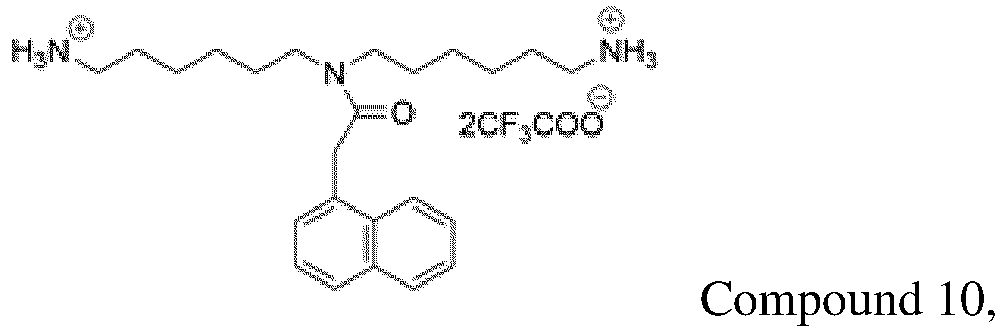


- The compounds of claim 1 for use as small molecular adjuvants.
- A pharmaceutical composition comprising a compound of claim 1 or its stereoisomers, pharmaceutically acceptable salts, polymorphs, solvates and hydrates thereof together with a pharmaceutically acceptable carrier, optionally in combination with one or more other antibiotics, or their pharmaceutical composition.
- A pharmaceutical composition comprising:a) a compound of claim 1 or its stereoisomers, pharmaceutically acceptable salts, polymorphs, solvates and hydrates; andb) one or more antibiotics.
- A pharmaceutical composition comprising:a) a compound of claim 1 or its stereoisomers, pharmaceutically acceptable salts, polymorphs, solvates and hydrates thereof; andb) a pharmaceutical composition of one or more antibiotics.
- The pharmaceutical composition as claimed in any one of the claims 4 or 5, wherein the antibiotic is selected from the group consisting of rifampicin, tetracycline, fusidic acid, oxazolidinone, glycopeptides, fluoroquinolone, macrolide, beta-lactams, aminoglycosides, chloramphenicol, polymyxin, lipopeptide, and combinations thereof.
- The pharmaceutical composition as claimed in any one of the claims 4 to 6, wherein the antibiotic is selected from the group consisting of rifampicin, tetracycline, minocycline, fusidic acid, linezolid, vancomycin, ciprofloxacin, erythromycin, ampicillin, streptomycin, chloramphenicol, colistin, daptomycin, and combinations thereof.
- The pharmaceutical composition as claimed in any one of the claims 4 to 7, for use in treating disease or condition in a patient, wherein said disease or condition is caused by a microorganism selected from the group consisting of bacteria, fungi, and protozoa.
- The pharmaceutical composition as claimed in any one of the claims 4 to 7, for use in killing or inhibiting the growth of a microorganism selected from the group consisting of bacteria, fungi, and protozoa.
- The pharmaceutical composition for the use as claimed in any one of the claims 8 or 9, wherein the bacteria is Gram-positive bacteria or Gram-negative bacteria.
- The pharmaceutical composition for the use as claimed in claim 10, wherein the bacteria is a multi-resistant bacterium selected from a group consisting of A. baumannii, P. aeruginosa, E. coli, K. pneumoniae, or any combinations thereof.
Applications Claiming Priority (2)
| Application Number | Priority Date | Filing Date | Title |
|---|---|---|---|
| IN201941015155 | 2019-04-15 | ||
| PCT/IN2020/050358 WO2020213008A1 (en) | 2019-04-15 | 2020-04-15 | Small-molecular adjuvants and implementations thereof |
Publications (3)
| Publication Number | Publication Date |
|---|---|
| EP3955903A1 EP3955903A1 (en) | 2022-02-23 |
| EP3955903A4 EP3955903A4 (en) | 2023-01-25 |
| EP3955903B1 true EP3955903B1 (en) | 2025-06-25 |
Family
ID=72837074
Family Applications (1)
| Application Number | Title | Priority Date | Filing Date |
|---|---|---|---|
| EP20790881.5A Active EP3955903B1 (en) | 2019-04-15 | 2020-04-15 | Small-molecular adjuvants and implementations thereof |
Country Status (3)
| Country | Link |
|---|---|
| US (1) | US20220323383A1 (en) |
| EP (1) | EP3955903B1 (en) |
| WO (1) | WO2020213008A1 (en) |
Families Citing this family (1)
| Publication number | Priority date | Publication date | Assignee | Title |
|---|---|---|---|---|
| EP4687865A1 (en) * | 2023-04-07 | 2026-02-11 | Université d'Aix-Marseille | Polyaminated fatty acids for use as potentiators of antibacterial activity |
Family Cites Families (3)
| Publication number | Priority date | Publication date | Assignee | Title |
|---|---|---|---|---|
| IT1313594B1 (en) * | 1999-08-03 | 2002-09-09 | Novuspharma Spa | BISPLATIN ORAL ACTIVITIES. |
| AU2002251684A1 (en) * | 2000-12-27 | 2002-08-19 | Genelab Technologies, Inc. | Polyamide analogs as dna minor groove binders |
| JP2017514887A (en) * | 2014-03-13 | 2017-06-08 | ザ セクレタリー オブ ステート フォー ヘルスThe Secretary Of State For Health | Antibacterial conjugates, their production and use |
-
2020
- 2020-04-15 US US17/594,408 patent/US20220323383A1/en not_active Abandoned
- 2020-04-15 WO PCT/IN2020/050358 patent/WO2020213008A1/en not_active Ceased
- 2020-04-15 EP EP20790881.5A patent/EP3955903B1/en active Active
Also Published As
| Publication number | Publication date |
|---|---|
| EP3955903A4 (en) | 2023-01-25 |
| US20220323383A1 (en) | 2022-10-13 |
| EP3955903A1 (en) | 2022-02-23 |
| WO2020213008A1 (en) | 2020-10-22 |
Similar Documents
| Publication | Publication Date | Title |
|---|---|---|
| AU2019260124B2 (en) | Peptide macrocycles against Acinetobacter baumannii | |
| EA021799B1 (en) | Heterocyclic nitrogenous compounds, use thereof and pharmaceutical composition comprising same | |
| Sarciaux et al. | Total synthesis and structure–activity relationships study of odilorhabdins, a new class of peptides showing potent antibacterial activity | |
| WO2018152408A9 (en) | Pleuromutilin derivatives and uses thereof | |
| SK302004A3 (en) | Heterocyclic compounds and use thereof as D-alanyl-D-alanine ligase inhibitors | |
| JP2009108054A (en) | Peptoid compound | |
| CA3023317A1 (en) | Antimicrobials and methods of making and using same | |
| US20210171533A1 (en) | Antimicrobial compounds and methods of making and using the same | |
| WO2019164880A1 (en) | Antimicrobials and methods of making and using same | |
| US20220323383A1 (en) | Small-molecular adjuvants and implementations thereof | |
| US20170144969A1 (en) | Antimicrobial conjugates, method for production and uses thereof | |
| US11279733B2 (en) | Peptide antibiotics | |
| US12152031B2 (en) | Biodefense agents | |
| WO2019234509A2 (en) | Aminomethylamidine and methylamidine antimicrobial compounds | |
| FR2676445A1 (en) | SUBSTITUTED AZETIDINYL AMINO ACID PYRIDONE DERIVATIVES, THEIR PREPARATION AND THEIR USE AS MEDICAMENTS. | |
| JP7249439B2 (en) | Imidazopyrazine derivatives and their use as pharmaceuticals | |
| US9657037B2 (en) | Pyrrole compounds with silicon incorporation | |
| BG113103A (en) | Nmda-receptor antagonist with antimicrobial activity | |
| WO2020115547A2 (en) | Pyrrolo[2,3-d]pyrimidin-2-one antimicrobial compounds | |
| WO2024207118A1 (en) | C3-diamino steroidal alkaloid compounds and antibacterial uses thereof | |
| CN106084068A (en) | One group of enterobactin antibiotic derivatives and application thereof | |
| Nessaib et al. | Full Text HTML | |
| Li | Explore the Multivalency and Self-Assembly of Small Molecules for Potential Therapeutic Applications | |
| HK40038970B (en) | Peptide macrocycles against acinetobacter baumannii | |
| CA2997851A1 (en) | Azetidinimines as carbapenemases inhibitors |
Legal Events
| Date | Code | Title | Description |
|---|---|---|---|
| STAA | Information on the status of an ep patent application or granted ep patent |
Free format text: STATUS: THE INTERNATIONAL PUBLICATION HAS BEEN MADE |
|
| PUAI | Public reference made under article 153(3) epc to a published international application that has entered the european phase |
Free format text: ORIGINAL CODE: 0009012 |
|
| STAA | Information on the status of an ep patent application or granted ep patent |
Free format text: STATUS: REQUEST FOR EXAMINATION WAS MADE |
|
| 17P | Request for examination filed |
Effective date: 20211115 |
|
| AK | Designated contracting states |
Kind code of ref document: A1 Designated state(s): AL AT BE BG CH CY CZ DE DK EE ES FI FR GB GR HR HU IE IS IT LI LT LU LV MC MK MT NL NO PL PT RO RS SE SI SK SM TR |
|
| DAV | Request for validation of the european patent (deleted) | ||
| DAX | Request for extension of the european patent (deleted) | ||
| A4 | Supplementary search report drawn up and despatched |
Effective date: 20230103 |
|
| RIC1 | Information provided on ipc code assigned before grant |
Ipc: A61K 31/575 20060101ALI20221221BHEP Ipc: A61K 38/14 20060101ALI20221221BHEP Ipc: C07C 233/78 20060101ALI20221221BHEP Ipc: A61K 45/06 20060101ALI20221221BHEP Ipc: A61P 31/04 20060101ALI20221221BHEP Ipc: C07C 233/40 20060101ALI20221221BHEP Ipc: C07C 237/04 20060101ALI20221221BHEP Ipc: A61K 38/12 20060101ALI20221221BHEP Ipc: A61K 31/7048 20060101ALI20221221BHEP Ipc: A61K 31/65 20060101ALI20221221BHEP Ipc: A61K 31/5377 20060101ALI20221221BHEP Ipc: A61K 31/496 20060101ALI20221221BHEP Ipc: A61K 31/435 20060101ALI20221221BHEP Ipc: A61K 31/165 20060101ALI20221221BHEP Ipc: C07C 237/20 20060101ALI20221221BHEP Ipc: A61K 31/16 20060101ALI20221221BHEP Ipc: C07C 237/10 20060101ALI20221221BHEP Ipc: A61K 31/00 20060101AFI20221221BHEP |
|
| STAA | Information on the status of an ep patent application or granted ep patent |
Free format text: STATUS: EXAMINATION IS IN PROGRESS |
|
| 17Q | First examination report despatched |
Effective date: 20240603 |
|
| GRAP | Despatch of communication of intention to grant a patent |
Free format text: ORIGINAL CODE: EPIDOSNIGR1 |
|
| STAA | Information on the status of an ep patent application or granted ep patent |
Free format text: STATUS: GRANT OF PATENT IS INTENDED |
|
| INTG | Intention to grant announced |
Effective date: 20250117 |
|
| GRAS | Grant fee paid |
Free format text: ORIGINAL CODE: EPIDOSNIGR3 |
|
| GRAA | (expected) grant |
Free format text: ORIGINAL CODE: 0009210 |
|
| STAA | Information on the status of an ep patent application or granted ep patent |
Free format text: STATUS: THE PATENT HAS BEEN GRANTED |
|
| AK | Designated contracting states |
Kind code of ref document: B1 Designated state(s): AL AT BE BG CH CY CZ DE DK EE ES FI FR GB GR HR HU IE IS IT LI LT LU LV MC MK MT NL NO PL PT RO RS SE SI SK SM TR |
|
| REG | Reference to a national code |
Ref country code: GB Ref legal event code: FG4D |
|
| REG | Reference to a national code |
Ref country code: CH Ref legal event code: EP |
|
| P01 | Opt-out of the competence of the unified patent court (upc) registered |
Free format text: CASE NUMBER: APP_25084/2025 Effective date: 20250527 |
|
| REG | Reference to a national code |
Ref country code: CH Ref legal event code: EP |
|
| REG | Reference to a national code |
Ref country code: IE Ref legal event code: FG4D |
|
| REG | Reference to a national code |
Ref country code: DE Ref legal event code: R096 Ref document number: 602020053390 Country of ref document: DE |
|
| PG25 | Lapsed in a contracting state [announced via postgrant information from national office to epo] |
Ref country code: FI Free format text: LAPSE BECAUSE OF FAILURE TO SUBMIT A TRANSLATION OF THE DESCRIPTION OR TO PAY THE FEE WITHIN THE PRESCRIBED TIME-LIMIT Effective date: 20250625 |
|
| REG | Reference to a national code |
Ref country code: LT Ref legal event code: MG9D |
|
| PG25 | Lapsed in a contracting state [announced via postgrant information from national office to epo] |
Ref country code: NO Free format text: LAPSE BECAUSE OF FAILURE TO SUBMIT A TRANSLATION OF THE DESCRIPTION OR TO PAY THE FEE WITHIN THE PRESCRIBED TIME-LIMIT Effective date: 20250925 Ref country code: GR Free format text: LAPSE BECAUSE OF FAILURE TO SUBMIT A TRANSLATION OF THE DESCRIPTION OR TO PAY THE FEE WITHIN THE PRESCRIBED TIME-LIMIT Effective date: 20250926 |
|
| PG25 | Lapsed in a contracting state [announced via postgrant information from national office to epo] |
Ref country code: BG Free format text: LAPSE BECAUSE OF FAILURE TO SUBMIT A TRANSLATION OF THE DESCRIPTION OR TO PAY THE FEE WITHIN THE PRESCRIBED TIME-LIMIT Effective date: 20250625 |
|
| PG25 | Lapsed in a contracting state [announced via postgrant information from national office to epo] |
Ref country code: HR Free format text: LAPSE BECAUSE OF FAILURE TO SUBMIT A TRANSLATION OF THE DESCRIPTION OR TO PAY THE FEE WITHIN THE PRESCRIBED TIME-LIMIT Effective date: 20250625 |
|
| PG25 | Lapsed in a contracting state [announced via postgrant information from national office to epo] |
Ref country code: RS Free format text: LAPSE BECAUSE OF FAILURE TO SUBMIT A TRANSLATION OF THE DESCRIPTION OR TO PAY THE FEE WITHIN THE PRESCRIBED TIME-LIMIT Effective date: 20250925 |
|
| PG25 | Lapsed in a contracting state [announced via postgrant information from national office to epo] |
Ref country code: LV Free format text: LAPSE BECAUSE OF FAILURE TO SUBMIT A TRANSLATION OF THE DESCRIPTION OR TO PAY THE FEE WITHIN THE PRESCRIBED TIME-LIMIT Effective date: 20250625 |
|
| REG | Reference to a national code |
Ref country code: NL Ref legal event code: MP Effective date: 20250625 |
|
| PG25 | Lapsed in a contracting state [announced via postgrant information from national office to epo] |
Ref country code: NL Free format text: LAPSE BECAUSE OF FAILURE TO SUBMIT A TRANSLATION OF THE DESCRIPTION OR TO PAY THE FEE WITHIN THE PRESCRIBED TIME-LIMIT Effective date: 20250625 |
|
| PG25 | Lapsed in a contracting state [announced via postgrant information from national office to epo] |
Ref country code: PT Free format text: LAPSE BECAUSE OF FAILURE TO SUBMIT A TRANSLATION OF THE DESCRIPTION OR TO PAY THE FEE WITHIN THE PRESCRIBED TIME-LIMIT Effective date: 20251027 |
|
| REG | Reference to a national code |
Ref country code: AT Ref legal event code: MK05 Ref document number: 1805744 Country of ref document: AT Kind code of ref document: T Effective date: 20250625 |
|
| PG25 | Lapsed in a contracting state [announced via postgrant information from national office to epo] |
Ref country code: IS Free format text: LAPSE BECAUSE OF FAILURE TO SUBMIT A TRANSLATION OF THE DESCRIPTION OR TO PAY THE FEE WITHIN THE PRESCRIBED TIME-LIMIT Effective date: 20251025 |
|
| PG25 | Lapsed in a contracting state [announced via postgrant information from national office to epo] |
Ref country code: AT Free format text: LAPSE BECAUSE OF FAILURE TO SUBMIT A TRANSLATION OF THE DESCRIPTION OR TO PAY THE FEE WITHIN THE PRESCRIBED TIME-LIMIT Effective date: 20250625 Ref country code: SM Free format text: LAPSE BECAUSE OF FAILURE TO SUBMIT A TRANSLATION OF THE DESCRIPTION OR TO PAY THE FEE WITHIN THE PRESCRIBED TIME-LIMIT Effective date: 20250625 |
|
| PG25 | Lapsed in a contracting state [announced via postgrant information from national office to epo] |
Ref country code: CZ Free format text: LAPSE BECAUSE OF FAILURE TO SUBMIT A TRANSLATION OF THE DESCRIPTION OR TO PAY THE FEE WITHIN THE PRESCRIBED TIME-LIMIT Effective date: 20250625 |
|
| PG25 | Lapsed in a contracting state [announced via postgrant information from national office to epo] |
Ref country code: PL Free format text: LAPSE BECAUSE OF FAILURE TO SUBMIT A TRANSLATION OF THE DESCRIPTION OR TO PAY THE FEE WITHIN THE PRESCRIBED TIME-LIMIT Effective date: 20250625 |
|
| PG25 | Lapsed in a contracting state [announced via postgrant information from national office to epo] |
Ref country code: EE Free format text: LAPSE BECAUSE OF FAILURE TO SUBMIT A TRANSLATION OF THE DESCRIPTION OR TO PAY THE FEE WITHIN THE PRESCRIBED TIME-LIMIT Effective date: 20250625 |
|
| PG25 | Lapsed in a contracting state [announced via postgrant information from national office to epo] |
Ref country code: SK Free format text: LAPSE BECAUSE OF FAILURE TO SUBMIT A TRANSLATION OF THE DESCRIPTION OR TO PAY THE FEE WITHIN THE PRESCRIBED TIME-LIMIT Effective date: 20250625 |
|
| PG25 | Lapsed in a contracting state [announced via postgrant information from national office to epo] |
Ref country code: ES Free format text: LAPSE BECAUSE OF FAILURE TO SUBMIT A TRANSLATION OF THE DESCRIPTION OR TO PAY THE FEE WITHIN THE PRESCRIBED TIME-LIMIT Effective date: 20250625 |
|
| PG25 | Lapsed in a contracting state [announced via postgrant information from national office to epo] |
Ref country code: DK Free format text: LAPSE BECAUSE OF FAILURE TO SUBMIT A TRANSLATION OF THE DESCRIPTION OR TO PAY THE FEE WITHIN THE PRESCRIBED TIME-LIMIT Effective date: 20250625 |
|
| PG25 | Lapsed in a contracting state [announced via postgrant information from national office to epo] |
Ref country code: IT Free format text: LAPSE BECAUSE OF FAILURE TO SUBMIT A TRANSLATION OF THE DESCRIPTION OR TO PAY THE FEE WITHIN THE PRESCRIBED TIME-LIMIT Effective date: 20250625 |
|
| PLBE | No opposition filed within time limit |
Free format text: ORIGINAL CODE: 0009261 |
|
| STAA | Information on the status of an ep patent application or granted ep patent |
Free format text: STATUS: NO OPPOSITION FILED WITHIN TIME LIMIT |
|
| REG | Reference to a national code |
Ref country code: CH Ref legal event code: L10 Free format text: ST27 STATUS EVENT CODE: U-0-0-L10-L00 (AS PROVIDED BY THE NATIONAL OFFICE) Effective date: 20260507 |