EP3955416A1 - Wireless charging method and system - Google Patents
Wireless charging method and system Download PDFInfo
- Publication number
- EP3955416A1 EP3955416A1 EP21189304.5A EP21189304A EP3955416A1 EP 3955416 A1 EP3955416 A1 EP 3955416A1 EP 21189304 A EP21189304 A EP 21189304A EP 3955416 A1 EP3955416 A1 EP 3955416A1
- Authority
- EP
- European Patent Office
- Prior art keywords
- charging
- detection
- subtask
- task
- subtasks
- Prior art date
- Legal status (The legal status is an assumption and is not a legal conclusion. Google has not performed a legal analysis and makes no representation as to the accuracy of the status listed.)
- Pending
Links
Images




Classifications
-
- H—ELECTRICITY
- H02—GENERATION; CONVERSION OR DISTRIBUTION OF ELECTRIC POWER
- H02J—ELECTRIC POWER NETWORKS; CIRCUIT ARRANGEMENTS OR SYSTEMS FOR SUPPLYING OR DISTRIBUTING ELECTRIC POWER; SYSTEMS FOR STORING ELECTRIC ENERGY
- H02J7/00—Circuit arrangements for charging or discharging batteries or for supplying loads from batteries
- H02J7/60—Circuit arrangements for charging or discharging batteries or for supplying loads from batteries including safety or protection arrangements
- H02J7/685—Circuit arrangements for charging or discharging batteries or for supplying loads from batteries including safety or protection arrangements using connection detecting circuits
-
- H—ELECTRICITY
- H02—GENERATION; CONVERSION OR DISTRIBUTION OF ELECTRIC POWER
- H02J—ELECTRIC POWER NETWORKS; CIRCUIT ARRANGEMENTS OR SYSTEMS FOR SUPPLYING OR DISTRIBUTING ELECTRIC POWER; SYSTEMS FOR STORING ELECTRIC ENERGY
- H02J50/00—Circuit arrangements or systems for wireless supply or distribution of electric power
- H02J50/10—Circuit arrangements or systems for wireless supply or distribution of electric power using inductive coupling
-
- H—ELECTRICITY
- H02—GENERATION; CONVERSION OR DISTRIBUTION OF ELECTRIC POWER
- H02J—ELECTRIC POWER NETWORKS; CIRCUIT ARRANGEMENTS OR SYSTEMS FOR SUPPLYING OR DISTRIBUTING ELECTRIC POWER; SYSTEMS FOR STORING ELECTRIC ENERGY
- H02J50/00—Circuit arrangements or systems for wireless supply or distribution of electric power
- H02J50/20—Circuit arrangements or systems for wireless supply or distribution of electric power using microwaves or radio frequency waves
-
- H—ELECTRICITY
- H02—GENERATION; CONVERSION OR DISTRIBUTION OF ELECTRIC POWER
- H02J—ELECTRIC POWER NETWORKS; CIRCUIT ARRANGEMENTS OR SYSTEMS FOR SUPPLYING OR DISTRIBUTING ELECTRIC POWER; SYSTEMS FOR STORING ELECTRIC ENERGY
- H02J50/00—Circuit arrangements or systems for wireless supply or distribution of electric power
- H02J50/40—Circuit arrangements or systems for wireless supply or distribution of electric power using two or more transmitting or receiving devices
- H02J50/402—Circuit arrangements or systems for wireless supply or distribution of electric power using two or more transmitting or receiving devices the two or more transmitting or the two or more receiving devices being integrated in the same unit, e.g. power mats with several coils or antennas with several sub-antennas
-
- H—ELECTRICITY
- H02—GENERATION; CONVERSION OR DISTRIBUTION OF ELECTRIC POWER
- H02J—ELECTRIC POWER NETWORKS; CIRCUIT ARRANGEMENTS OR SYSTEMS FOR SUPPLYING OR DISTRIBUTING ELECTRIC POWER; SYSTEMS FOR STORING ELECTRIC ENERGY
- H02J50/00—Circuit arrangements or systems for wireless supply or distribution of electric power
- H02J50/60—Circuit arrangements or systems for wireless supply or distribution of electric power responsive to the presence of foreign objects, e.g. detection of living beings
-
- H—ELECTRICITY
- H02—GENERATION; CONVERSION OR DISTRIBUTION OF ELECTRIC POWER
- H02J—ELECTRIC POWER NETWORKS; CIRCUIT ARRANGEMENTS OR SYSTEMS FOR SUPPLYING OR DISTRIBUTING ELECTRIC POWER; SYSTEMS FOR STORING ELECTRIC ENERGY
- H02J7/00—Circuit arrangements for charging or discharging batteries or for supplying loads from batteries
- H02J7/60—Circuit arrangements for charging or discharging batteries or for supplying loads from batteries including safety or protection arrangements
- H02J7/65—Circuit arrangements for charging or discharging batteries or for supplying loads from batteries including safety or protection arrangements against overtemperature
-
- H—ELECTRICITY
- H02—GENERATION; CONVERSION OR DISTRIBUTION OF ELECTRIC POWER
- H02J—ELECTRIC POWER NETWORKS; CIRCUIT ARRANGEMENTS OR SYSTEMS FOR SUPPLYING OR DISTRIBUTING ELECTRIC POWER; SYSTEMS FOR STORING ELECTRIC ENERGY
- H02J7/00—Circuit arrangements for charging or discharging batteries or for supplying loads from batteries
- H02J7/90—Regulation of charging or discharging current or voltage
- H02J7/971—Regulation of charging or discharging current or voltage the charge cycle being controlled or terminated in response to non-electric parameters
- H02J7/975—Regulation of charging or discharging current or voltage the charge cycle being controlled or terminated in response to non-electric parameters in response to temperature
-
- H—ELECTRICITY
- H02—GENERATION; CONVERSION OR DISTRIBUTION OF ELECTRIC POWER
- H02J—ELECTRIC POWER NETWORKS; CIRCUIT ARRANGEMENTS OR SYSTEMS FOR SUPPLYING OR DISTRIBUTING ELECTRIC POWER; SYSTEMS FOR STORING ELECTRIC ENERGY
- H02J7/00—Circuit arrangements for charging or discharging batteries or for supplying loads from batteries
- H02J7/90—Regulation of charging or discharging current or voltage
- H02J7/971—Regulation of charging or discharging current or voltage the charge cycle being controlled or terminated in response to non-electric parameters
- H02J7/975—Regulation of charging or discharging current or voltage the charge cycle being controlled or terminated in response to non-electric parameters in response to temperature
- H02J7/977—Regulation of charging or discharging current or voltage the charge cycle being controlled or terminated in response to non-electric parameters in response to temperature of the battery
-
- H—ELECTRICITY
- H02—GENERATION; CONVERSION OR DISTRIBUTION OF ELECTRIC POWER
- H02J—ELECTRIC POWER NETWORKS; CIRCUIT ARRANGEMENTS OR SYSTEMS FOR SUPPLYING OR DISTRIBUTING ELECTRIC POWER; SYSTEMS FOR STORING ELECTRIC ENERGY
- H02J50/00—Circuit arrangements or systems for wireless supply or distribution of electric power
- H02J50/80—Circuit arrangements or systems for wireless supply or distribution of electric power involving the exchange of data, concerning supply or distribution of electric power, between transmitting devices and receiving devices
-
- H—ELECTRICITY
- H02—GENERATION; CONVERSION OR DISTRIBUTION OF ELECTRIC POWER
- H02J—ELECTRIC POWER NETWORKS; CIRCUIT ARRANGEMENTS OR SYSTEMS FOR SUPPLYING OR DISTRIBUTING ELECTRIC POWER; SYSTEMS FOR STORING ELECTRIC ENERGY
- H02J7/00—Circuit arrangements for charging or discharging batteries or for supplying loads from batteries
- H02J7/50—Circuit arrangements for charging or discharging batteries or for supplying loads from batteries acting upon multiple batteries simultaneously or sequentially
Definitions
- the present disclosure relates to a wireless charging method and system, and more particularly to a wireless charging method and system with detection function.
- the existing wireless charging device detects the device placed thereon to confirm whether there are foreign objects before or during the power transmission. In addition, during the normal charging process, the existing wireless charging device must keep checking whether the foreign object or over-temperature situation exists for ensuring the charging safety. Moreover, it is also necessary to process the charging safety confirmation with the device placed on the wireless charging device frequently, so as to confirm whether to continue charging or adjust the charging power. Since the functions of the existing wireless charging devices are relatively simple, the software architecture performs foreign object detection (FOD), over-temperature detection, and wireless charging transmitter (WCT) in turn to achieve complete functions.
- FOD foreign object detection
- WCT wireless charging transmitter
- the wireless charging device can also be used as a wireless communication interface for mobile devices such as cars and mobile phones.
- the wireless charging device can charge multiple devices simultaneously.
- the wireless charging device charges the device placed thereon, the wireless charging device cannot confirm whether the device placed thereon can be charged, so it is necessary to perform a wireless detection on the device at the same time.
- the time required to perform a complete wireless detection is much longer than the cycle time of the above charging safety confirmation procedure.
- the wireless charging device will automatically shut down and restart to continue wireless charging because the charging safety confirmation is not completed or the communication is interrupted for too long. Therefore, the wireless charging is intermittent and the charging quality cannot be ensured.
- the charging safety confirmation is executed in priority when reaching the time to perform wireless detection, the complete wireless detection cannot be performed in real time. Further, if the device placed on the wireless charging device cannot be charged, which is not detected in real time, the device will be damaged due to being charged constantly.
- the wireless detection task of the charging device is split into multiple wireless detection subtasks, and the wireless charging task is interspersed among the multiple wireless detection subtasks.
- the wireless charging and wireless detection are both taken into account to ensure the quality of wireless charging, and the detection object is detected in real time to prevent the detection object from being damaged.
- a wireless charging method includes steps of: (a) providing a charging device, wherein the charging device includes at least one charging region for a smart device to be placed thereon, the charging device is configured to charge the smart device when executing a charging task, the charging task includes at least one charging subtask, and the charging device is configured to detect whether there is a detection object on the charging region when executing a detection task, and the detection task includes a plurality of detection subtasks; (b) executing charging initialization program and communication initialization program; and (c) executing the plurality of detection subtasks and at least one charging subtask, wherein the at least one charging subtask is interspersed and executed among the plurality of detection subtasks.
- a wireless charging system includes a charging device, and the charging device includes at least one charging region for a smart device to be placed thereon.
- the charging device is configured to charge the smart device when executing a charging task.
- the charging task includes at least one charging subtask, and the charging device is configured to detect whether there is a detection object on the charging region when executing a detection task.
- the detection task includes a plurality of detection subtasks.
- the at least one charging subtask is interspersed and executed among the plurality of detection subtasks.
- FIG. 1 is a schematic diagram illustrating position relations of a wireless charging system according to an embodiment of the present disclosure.
- the wireless charging system 1 includes a charging device 10, and the charging device 10 has at least one charging region 11 for a smart device 2 to be placed thereon.
- the charging device 10 is configured to charge the smart device 2 when executing a charging task.
- the charging task includes at least one charging subtask.
- the charging subtask includes at least one of the communication protocol task, the charging power calibration task and the charging power output task.
- the charging device 10 is configured to detect whether there is a detection object 3 on the charging region 11 when executing a detection task.
- the detection task includes a plurality of detection subtasks, and the at least one charging subtask is interspersed and executed among the plurality of detection subtasks.
- the smart device 2 is for example but not limited to a smartphone.
- the detection object 3 is for example but not limited to a NFC (Near Field Communication) card or any object having a common communication transmission protocol for the charging device 10 to execute the detection task thereon.
- NFC Near Field Communication
- the wireless charging and wireless detection are realized simultaneously. Therefore, the situation that the time taken to execute the complete wireless detection exceeds the cycle time of the charging safety confirmation, which causes the wireless charging device to restart constantly and incapable of executing wireless charging continuously, is avoided.
- the detection task is executed in real time completely, the detection object is prevented from being damaged.
- the smart device 2 and the detection object 3 in FIG. 1 are placed at exemplary positions, and the present disclosure is not limited thereto.
- the smart device 2 can be placed various positions on the charging region 11.
- the smart device 2 only needs to be placed within the range of charging region 11 so as to charge the smart device 2.
- the NFC detection needs to perform on the entire range of the charging region 11 rather than the positions shown in FIG. 1 .
- plurality of smart devices 2 or detection objects 3 can be placed at the same time, and the actual number of the smart devices 2 and detection objections 3 placed on the charging region 11 is not limited.
- one or more smart devices 2 can be placed on the charging region 11, and the charging tasks and detection tasks are performed on all the smart devices 2 respectively and simultaneously.
- FIG. 2 is a schematic diagram illustrating position relations of a wireless charging system according to another embodiment of the present disclosure.
- the charging device 10 has two charging regions 11, the two charging regions 11 are configured for the smart device 2 and the detection object 3 to be placed thereon respectively, or configured for two smart devices 2 to be placed thereon respectively.
- the number of charging regions 11 is not limited to one or two shown in above embodiments.
- the number of charging regions 11 can be more than two, multiple smart devices 2 and detection objects 3 are placed thereon, and the charging tasks and the detection tasks are performed on the multiple smart devices 2 and detection objects 3 respectively and simultaneously.
- the charging region 11 has sufficient space, plurality of smart devices 2 or detection objects 3 can be placed at the same time, and the actual number of the smart devices 2 and detection objections 3 placed on the charging region 11 is not limited.
- the wireless charging system 1 needs to satisfy the Qi wireless charging protocol.
- the detection task further includes the communication transmission between the charging device 10 and the detection object 3.
- a wireless communication chip such as NFC chip
- the detection object 3 such as mobile NFC
- the function of the car key is given to the mobile phone to realize functions such as keyless engine start.
- the cycle time of the charging subtask is a charging detection cycle
- the time for the charging device 10 to execute one detection subtask is a subtask time.
- the subtask time is set to be less than the charging detection cycle so as to avoid the time for executing the detection subtask exceeds the cycle time of the charging subtask.
- the charging subtask is interspersed and executed among the plurality of detection subtasks, and the charging subtask is executed through interrupting the detection subtask.
- the interruption time is set to be less than the charging detection cycle.
- the charging device 10 executes the detection task in the main program. When the interruption occurs, the charging device 10 suspends the execution of the detection task and executes the charging subtask. After the charging subtask is completed, the charging device 10 returns to the main program and continues to execute the detection task from the previously interrupted progress, and waits for the arrival of the next interruption. The above operations of the charging device 10 are repeated.
- the charging device 10 sets the priority of the charging task to be higher than that of the detection task, that is, the charging device 10 executes the charging subtask in priority. After the charging subtask is completed, the operating system will release the control right of the charging task, and the operation system dominates to start executing the detection task at the same time. There is a counting time after the charging subtask is completed, and the detection subtask is executed before the counting time reaches the charging detection cycle. The counting time needs to be less than or equal to the charging detection cycle. For example, when the execution time of the detection subtask reaches the charging detection cycle, the operating system automatically switches the control right of the CPU to the charging task, and releases the control right to the detection task again after completing a charging subtask.
- the charging device 10 is further configured to detect whether there is a foreign object (not shown) on the charging region 11 when executing a foreign object detection procedure, so as to prevent the foreign object from affecting the charging device 10 to execute a charging task or a detection task.
- Foreign object is a non-charging object that can absorb radio waves and convert them into heat or otherwise consume energy.
- the foreign object is a ferrous metal like coin.
- the charging device 10 is also configured to detect the temperature of the charging device 10 when executing a temperature detection procedure, so as to prevent the wireless charging system 1 from operating abnormally due to the excessively high temperature of the charging device 10.
- the foreign object detection procedure and the temperature detection procedure include a plurality of foreign object detection subtasks and a plurality of temperature detection subtasks, respectively, and the charging subtask is interspersed and executed among the plurality of foreign object detection subtasks and the plurality of temperature detection subtasks.
- the implementation scheme of interspersing the charging subtask in plurality of foreign object detection subtasks and plurality of temperature detection subtasks can be the same as the implementation scheme of interspersing the charging subtask in plurality of detection subtasks. For example, it can be realized by interrupting or setting priority.
- FIG. 3 is a flow chart illustrating a wireless charging method according to an embodiment of the present disclosure.
- the wireless charging method of the present disclosure is applicable for the wireless charging system 1 stated above.
- the wireless charging method includes steps S1, S2 and S3.
- step S1 providing a charging device 10.
- the charging device 10 includes at least one charging region 11 for a smart device 2 to be placed thereon.
- the charging device 10 is configured to charge the smart device 2 when executing a charging task, the charging task includes at least one charging subtask, and the charging device 10 is configured to detect whether there is a detection object 3 on the charging region 11 when executing a detection task, and the detection task includes a plurality of detection subtasks.
- step S2 executing a charging initialization program and a communication initialization program.
- step S3 executing the plurality of detection subtasks and at least one charging subtask, wherein the at least one charging subtask is interspersed and executed among the plurality of detection subtasks.
- Step S3 is performed again after performing step S3.
- the charging subtask has a charging detection cycle, and the time to execute one detection subtask is a subtask time, and the subtask time is set to be less than the charging detection cycle.
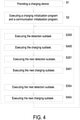
- step S3 includes sub steps. For example, in step S300, executing the detection subtask. In step S400, executing the charging subtask. In step S301, executing the next detection subtask. In step S401, executing the next charging subtask. In step S30n, executing the detection subtask. In step S40n, executing the charging subtask. In the embodiment, for example, the steps S300 ⁇ S30n are a complete detection task, and the steps S400 ⁇ 40n are a complete charging task. The steps in the FIG. 4 are only examples, and the steps of a specific detection task or charging task are not limited to this. In the entire wireless charging process, step S3 is repeatedly executed for multiple times, wherein the charging subtask is interspersed and executed in the plurality of detection subtasks.
- the charging subtask is executed through interrupting the detection subtask.
- the interrupting time is set to be less than the charging detection cycle.
- the charging device 10 executes the detection task, when the interruption occurs, the charging device 10 suspends the execution of the detection task and executes the charging subtask.
- the charging subtask is executed in priority, for example, the operating system assigns the control right to the charging task so that the charging subtask is executed firstly. After the charging subtask is completed, the operating system automatically releases the control right of the CPU to the detection task.
- the execution of the detection task has a counting time, and the detection subtask is executed before the counting time reaches the charging detection cycle.
- the operating system again assigns the control right of the CPU to the charging task to ensure the continuation of the charging task.
- the execution time of the detection task is determined by the time when the charging task releases the control right, and the operating system assigns the use of the CPU. For example, the operating system prioritizes the control right of the CPU to the charging task, that is, the priority execution of the charging subtask. After the charging subtask is completed, the operating system releases the control right to the detection task. Meanwhile, the execution time of the detection task is determined by the time when the charging task releases the control right, that is, when the charging task needs to be executed, the operating system will immediately switch the control right of the CPU to the charging task in time.
- step S3 includes steps S31 and S32.
- step S31 recording a delay time after the execution of the detection subtask.
- step S32 whether the delay time is greater than a preset time is determined.
- Another detection subtask is executed and the delay time is reset if the determination result of step S32 is satisfied.
- the charging subtask is executed and step S32 is performed again if the determination result of step S32 is not satisfied.
- the charging device 10 detects whether there is a detection object 3
- the charging device 10 needs to transmit a signal to the detection object 3, and the charging device 10 needs to wait for the response of the detection object 3.
- the waiting process generally takes 2 to 3 seconds, so during the waiting process, the charging subtask can be executed.
- the execution process time of the charging subtask is generally short. After each execution, it is judged whether the waiting time reaches the preset time. If the preset time is not reached, the charging subtask is executed continuously. If the preset time is reached, the detection subtask is executed.
- step S3 includes steps S33 and S34.
- step S33 executing one of the plurality of detection subtasks.
- step S34 whether an event is completed is determined. Another detection subtask is executed if the determination result is satisfied. The charging subtask is executed and step S34 is performed again if the determination result is not satisfied.
- the completion of the event execution is for example but not limited to the completion of the execution of the detection task or the detection subtask. It is noted that the present disclosure does not limit the sign of the event execution completion.
- the successful communication between the charging device 10 and the detection object 3 can be used as a sign of the completion of the event execution. Therefore, in an embodiment, the charging subtask can be executed before the event occurs, and the next detection subtask is executed when the event occurs.
- the wireless charging method further includes step S4.
- step S4 executing a foreign object detection procedure to detect whether there is a foreign object on the charging region 11, and executing a temperature detection procedure to detect the temperature of the charging device 10.
- Step S3 is performed again after step S4 is performed.
- the foreign object detection procedure and the temperature detection procedure have a plurality of foreign object detection subtasks and a plurality of temperature detection subtasks, respectively, and the charging subtask is interspersed and executed among the plurality of foreign object detection subtasks and the plurality of temperature detection subtasks.
- the wireless charging device 10 of the present disclosure is not limited in one way to implement the charging tasks interspersed among multiple detection subtasks.
- some charging subtasks are implemented through interruption, and some charging subtasks are implemented through event execution, and the present disclosure is not limited thereto.
- the present disclosure provides a wireless charging method and device, by dividing the detection task into plurality of detection subtasks and interspersing the charging subtask into the plurality of detection subtasks, the wireless charging and the wireless detection are realized simultaneously. Therefore, the situation that the time taken to execute the complete wireless detection exceeds the cycle time of the charging safety confirmation, which causes the wireless charging device to restart constantly and incapable of executing wireless charging continuously, is avoided. Moreover, because the detection task is executed in real time completely, the detection object is prevented from being damaged.
Landscapes
- Engineering & Computer Science (AREA)
- Power Engineering (AREA)
- Computer Networks & Wireless Communication (AREA)
- Charge And Discharge Circuits For Batteries Or The Like (AREA)
Abstract
Description
- The present disclosure relates to a wireless charging method and system, and more particularly to a wireless charging method and system with detection function.
- The existing wireless charging device detects the device placed thereon to confirm whether there are foreign objects before or during the power transmission. In addition, during the normal charging process, the existing wireless charging device must keep checking whether the foreign object or over-temperature situation exists for ensuring the charging safety. Moreover, it is also necessary to process the charging safety confirmation with the device placed on the wireless charging device frequently, so as to confirm whether to continue charging or adjust the charging power. Since the functions of the existing wireless charging devices are relatively simple, the software architecture performs foreign object detection (FOD), over-temperature detection, and wireless charging transmitter (WCT) in turn to achieve complete functions.
- With the development of the market, wireless charging technology has been rapidly developed. The demand for charging power is rapidly increased, and the fast charging technology is applied in more and more applications. The future development direction will be towards intelligent and multi-load development. For example, except for wireless charging function, the wireless charging device can also be used as a wireless communication interface for mobile devices such as cars and mobile phones. For example, the wireless charging device can charge multiple devices simultaneously. When the wireless charging device charges the device placed thereon, the wireless charging device cannot confirm whether the device placed thereon can be charged, so it is necessary to perform a wireless detection on the device at the same time. However, the time required to perform a complete wireless detection is much longer than the cycle time of the above charging safety confirmation procedure. Therefore, when the time taken for the wireless detection has exceeded the cycle time of the charging safety confirmation, the wireless charging device will automatically shut down and restart to continue wireless charging because the charging safety confirmation is not completed or the communication is interrupted for too long. Therefore, the wireless charging is intermittent and the charging quality cannot be ensured. However, if the charging safety confirmation is executed in priority when reaching the time to perform wireless detection, the complete wireless detection cannot be performed in real time. Further, if the device placed on the wireless charging device cannot be charged, which is not detected in real time, the device will be damaged due to being charged constantly.
- Therefore, there is a need of providing a wireless charging method and system to obviate the drawbacks encountered from the prior arts.
- It is an object of the present disclosure to provide a wireless charging method and system, the wireless detection task of the charging device is split into multiple wireless detection subtasks, and the wireless charging task is interspersed among the multiple wireless detection subtasks. Thus, the wireless charging and wireless detection are both taken into account to ensure the quality of wireless charging, and the detection object is detected in real time to prevent the detection object from being damaged.
- In accordance with an aspect of the present disclosure, there is provided a wireless charging method. The wireless charging method includes steps of: (a) providing a charging device, wherein the charging device includes at least one charging region for a smart device to be placed thereon, the charging device is configured to charge the smart device when executing a charging task, the charging task includes at least one charging subtask, and the charging device is configured to detect whether there is a detection object on the charging region when executing a detection task, and the detection task includes a plurality of detection subtasks; (b) executing charging initialization program and communication initialization program; and (c) executing the plurality of detection subtasks and at least one charging subtask, wherein the at least one charging subtask is interspersed and executed among the plurality of detection subtasks.
- In accordance with an aspect of the present disclosure, there is provided a wireless charging system. The wireless charging system includes a charging device, and the charging device includes at least one charging region for a smart device to be placed thereon. The charging device is configured to charge the smart device when executing a charging task. The charging task includes at least one charging subtask, and the charging device is configured to detect whether there is a detection object on the charging region when executing a detection task. The detection task includes a plurality of detection subtasks. The at least one charging subtask is interspersed and executed among the plurality of detection subtasks.
- The above contents of the present invention will become more readily apparent to those ordinarily skilled in the art after reviewing the following detailed description and accompanying drawings, in which:
-
-
FIG. 1 is a schematic diagram illustrating position relations of a wireless charging system according to an embodiment of the present disclosure; -
FIG. 2 is a schematic diagram illustrating position relations of a wireless charging system according to another embodiment of the present disclosure; -
FIG. 3 is a flow chart illustrating a wireless charging method according to an embodiment of the present disclosure; -
FIG. 4 is a flow chart illustrating a wireless charging method according to another embodiment of the present disclosure; -
FIG. 5 is a flow chart illustrating a wireless charging method according to another embodiment of the present disclosure; -
FIG. 6 is a flow chart illustrating a wireless charging method according to another embodiment of the present disclosure; and -
FIG. 7 is a flow chart illustrating a wireless charging method according to another embodiment of the present disclosure. - The present disclosure will now be described more specifically with reference to the following embodiments. It is to be noted that the following descriptions of preferred embodiments of this disclosure are presented herein for purpose of illustration and description only. It is not intended to be exhaustive or to be limited to the precise form disclosed.
-
FIG. 1 is a schematic diagram illustrating position relations of a wireless charging system according to an embodiment of the present disclosure. As shown inFIG. 1 , thewireless charging system 1 includes acharging device 10, and thecharging device 10 has at least onecharging region 11 for asmart device 2 to be placed thereon. Thecharging device 10 is configured to charge thesmart device 2 when executing a charging task. The charging task includes at least one charging subtask. In an embodiment, the charging subtask includes at least one of the communication protocol task, the charging power calibration task and the charging power output task. Thecharging device 10 is configured to detect whether there is adetection object 3 on thecharging region 11 when executing a detection task. The detection task includes a plurality of detection subtasks, and the at least one charging subtask is interspersed and executed among the plurality of detection subtasks. Thesmart device 2 is for example but not limited to a smartphone. Thedetection object 3 is for example but not limited to a NFC (Near Field Communication) card or any object having a common communication transmission protocol for thecharging device 10 to execute the detection task thereon. Further, by dividing the detection task into the plurality of detection subtasks and interspersing the charging subtask among the plurality of detection subtasks, the wireless charging and wireless detection are realized simultaneously. Therefore, the situation that the time taken to execute the complete wireless detection exceeds the cycle time of the charging safety confirmation, which causes the wireless charging device to restart constantly and incapable of executing wireless charging continuously, is avoided. Moreover, because the detection task is executed in real time completely, the detection object is prevented from being damaged. - Wherein, the
smart device 2 and thedetection object 3 inFIG. 1 are placed at exemplary positions, and the present disclosure is not limited thereto. Thesmart device 2 can be placed various positions on thecharging region 11. Thesmart device 2 only needs to be placed within the range ofcharging region 11 so as to charge thesmart device 2. Similarly, the NFC detection needs to perform on the entire range of thecharging region 11 rather than the positions shown inFIG. 1 . When thecharging region 11 has sufficient space, plurality ofsmart devices 2 ordetection objects 3 can be placed at the same time, and the actual number of thesmart devices 2 anddetection objections 3 placed on thecharging region 11 is not limited. In addition, although only onecharging region 11 is shown inFIG. 1 , in some embodiments, one or moresmart devices 2 can be placed on thecharging region 11, and the charging tasks and detection tasks are performed on all thesmart devices 2 respectively and simultaneously. - Referring to
FIG. 2, FIG. 2 is a schematic diagram illustrating position relations of a wireless charging system according to another embodiment of the present disclosure. The elements corresponding to those ofFIG. 1 are designated by identical numeral references, and the detailed descriptions thereof are omitted herein. In an embodiment, thecharging device 10 has twocharging regions 11, the twocharging regions 11 are configured for thesmart device 2 and thedetection object 3 to be placed thereon respectively, or configured for twosmart devices 2 to be placed thereon respectively. The number ofcharging regions 11 is not limited to one or two shown in above embodiments. The number of chargingregions 11 can be more than two, multiplesmart devices 2 anddetection objects 3 are placed thereon, and the charging tasks and the detection tasks are performed on the multiplesmart devices 2 anddetection objects 3 respectively and simultaneously. In an embodiment, when the chargingregion 11 has sufficient space, plurality ofsmart devices 2 ordetection objects 3 can be placed at the same time, and the actual number of thesmart devices 2 anddetection objections 3 placed on the chargingregion 11 is not limited. - In an embodiment, the
wireless charging system 1 needs to satisfy the Qi wireless charging protocol. - In an embodiment, the detection task further includes the communication transmission between the charging
device 10 and thedetection object 3. For example, a wireless communication chip (such as NFC chip) is built in the chargingdevice 10 so as to communicate with the detection object 3 (such as mobile NFC) to realize the identity authentication, task assignment and other functions. For example, after the authorized mobile phone is recognized, the function of the car key is given to the mobile phone to realize functions such as keyless engine start. - The cycle time of the charging subtask is a charging detection cycle, and the time for the charging
device 10 to execute one detection subtask is a subtask time. The subtask time is set to be less than the charging detection cycle so as to avoid the time for executing the detection subtask exceeds the cycle time of the charging subtask. By setting the subtask time of each detection subtask to be less than the charging detection cycle, it is ensured that the time interval between the execution of adjacent charging subtasks is short, thereby ensuring the uninterrupted charging subtasks in the macroscopic view, and the continuity of the wireless charging process is ensured as well. - In an embodiment, the charging subtask is interspersed and executed among the plurality of detection subtasks, and the charging subtask is executed through interrupting the detection subtask. The interruption time is set to be less than the charging detection cycle. In the embodiment, for example, the charging
device 10 executes the detection task in the main program. When the interruption occurs, the chargingdevice 10 suspends the execution of the detection task and executes the charging subtask. After the charging subtask is completed, the chargingdevice 10 returns to the main program and continues to execute the detection task from the previously interrupted progress, and waits for the arrival of the next interruption. The above operations of the chargingdevice 10 are repeated. Thereby, another detection subtask is executed after the charging subtask is completed, and this operation is repeated again and again, thereby the execution of the charging task is ensured by interrupting the detection task. Similarly, by setting the cycle of the interruption time to be less than the charging detection cycle, that is, the execution time of the detection subtask is less than the charging detection cycle, it is ensured that the time interval between the executions of adjacent charging subtasks is short. Thereby, the uninterrupted charging subtasks in the macroscopic view are ensured, and the continuity of the wireless charging process is ensured. - In an embodiment, in the operating system of the
wireless charging system 1, the chargingdevice 10 sets the priority of the charging task to be higher than that of the detection task, that is, the chargingdevice 10 executes the charging subtask in priority. After the charging subtask is completed, the operating system will release the control right of the charging task, and the operation system dominates to start executing the detection task at the same time. There is a counting time after the charging subtask is completed, and the detection subtask is executed before the counting time reaches the charging detection cycle. The counting time needs to be less than or equal to the charging detection cycle. For example, when the execution time of the detection subtask reaches the charging detection cycle, the operating system automatically switches the control right of the CPU to the charging task, and releases the control right to the detection task again after completing a charging subtask. - In an embodiment, the charging
device 10 is further configured to detect whether there is a foreign object (not shown) on the chargingregion 11 when executing a foreign object detection procedure, so as to prevent the foreign object from affecting the chargingdevice 10 to execute a charging task or a detection task. Foreign object is a non-charging object that can absorb radio waves and convert them into heat or otherwise consume energy. For example, the foreign object is a ferrous metal like coin. The chargingdevice 10 is also configured to detect the temperature of the chargingdevice 10 when executing a temperature detection procedure, so as to prevent thewireless charging system 1 from operating abnormally due to the excessively high temperature of the chargingdevice 10. Further, in an embodiment, the foreign object detection procedure and the temperature detection procedure include a plurality of foreign object detection subtasks and a plurality of temperature detection subtasks, respectively, and the charging subtask is interspersed and executed among the plurality of foreign object detection subtasks and the plurality of temperature detection subtasks. Thereby, it is avoided that the charging task is interrupted when the foreign object detection procedure or the temperature detection procedure is executed. The implementation scheme of interspersing the charging subtask in plurality of foreign object detection subtasks and plurality of temperature detection subtasks can be the same as the implementation scheme of interspersing the charging subtask in plurality of detection subtasks. For example, it can be realized by interrupting or setting priority. - Referring to
FIG. 3. FIG. 3 is a flow chart illustrating a wireless charging method according to an embodiment of the present disclosure. The wireless charging method of the present disclosure is applicable for thewireless charging system 1 stated above. As shown inFIG. 3 , the wireless charging method includes steps S1, S2 and S3. In step S1, providing acharging device 10. Wherein, the chargingdevice 10 includes at least one chargingregion 11 for asmart device 2 to be placed thereon. The chargingdevice 10 is configured to charge thesmart device 2 when executing a charging task, the charging task includes at least one charging subtask, and the chargingdevice 10 is configured to detect whether there is adetection object 3 on the chargingregion 11 when executing a detection task, and the detection task includes a plurality of detection subtasks. In step S2, executing a charging initialization program and a communication initialization program. In step S3, executing the plurality of detection subtasks and at least one charging subtask, wherein the at least one charging subtask is interspersed and executed among the plurality of detection subtasks. Step S3 is performed again after performing step S3. The charging subtask has a charging detection cycle, and the time to execute one detection subtask is a subtask time, and the subtask time is set to be less than the charging detection cycle. - In some embodiment, as shown in
FIG. 4 , step S3 includes sub steps. For example, in step S300, executing the detection subtask. In step S400, executing the charging subtask. In step S301, executing the next detection subtask. In step S401, executing the next charging subtask. In step S30n, executing the detection subtask. In step S40n, executing the charging subtask. In the embodiment, for example, the steps S300∼S30n are a complete detection task, and the steps S400∼40n are a complete charging task. The steps in theFIG. 4 are only examples, and the steps of a specific detection task or charging task are not limited to this. In the entire wireless charging process, step S3 is repeatedly executed for multiple times, wherein the charging subtask is interspersed and executed in the plurality of detection subtasks. - In an embodiment, in step S3, the charging subtask is executed through interrupting the detection subtask. The interrupting time is set to be less than the charging detection cycle. The charging
device 10 executes the detection task, when the interruption occurs, the chargingdevice 10 suspends the execution of the detection task and executes the charging subtask. In an embodiment, in step S3, the charging subtask is executed in priority, for example, the operating system assigns the control right to the charging task so that the charging subtask is executed firstly. After the charging subtask is completed, the operating system automatically releases the control right of the CPU to the detection task. The execution of the detection task has a counting time, and the detection subtask is executed before the counting time reaches the charging detection cycle. When the counting time reaches the charging detection cycle, the operating system again assigns the control right of the CPU to the charging task to ensure the continuation of the charging task. In an embodiment, the execution time of the detection task is determined by the time when the charging task releases the control right, and the operating system assigns the use of the CPU. For example, the operating system prioritizes the control right of the CPU to the charging task, that is, the priority execution of the charging subtask. After the charging subtask is completed, the operating system releases the control right to the detection task. Meanwhile, the execution time of the detection task is determined by the time when the charging task releases the control right, that is, when the charging task needs to be executed, the operating system will immediately switch the control right of the CPU to the charging task in time. - In an embodiment, as shown in
FIG. 5 , step S3 includes steps S31 and S32. In step S31, recording a delay time after the execution of the detection subtask. In step S32, whether the delay time is greater than a preset time is determined. Another detection subtask is executed and the delay time is reset if the determination result of step S32 is satisfied. The charging subtask is executed and step S32 is performed again if the determination result of step S32 is not satisfied. In an embodiment, for example, when the chargingdevice 10 detects whether there is adetection object 3, the chargingdevice 10 needs to transmit a signal to thedetection object 3, and the chargingdevice 10 needs to wait for the response of thedetection object 3. The waiting process generally takes 2 to 3 seconds, so during the waiting process, the charging subtask can be executed. The execution process time of the charging subtask is generally short. After each execution, it is judged whether the waiting time reaches the preset time. If the preset time is not reached, the charging subtask is executed continuously. If the preset time is reached, the detection subtask is executed. - In an embodiment, as shown in
FIG. 6 , step S3 includes steps S33 and S34. In step S33, executing one of the plurality of detection subtasks. In step S34, whether an event is completed is determined. Another detection subtask is executed if the determination result is satisfied. The charging subtask is executed and step S34 is performed again if the determination result is not satisfied. In the embodiment, the completion of the event execution is for example but not limited to the completion of the execution of the detection task or the detection subtask. It is noted that the present disclosure does not limit the sign of the event execution completion. For example, in an embodiment, the successful communication between the chargingdevice 10 and thedetection object 3 can be used as a sign of the completion of the event execution. Therefore, in an embodiment, the charging subtask can be executed before the event occurs, and the next detection subtask is executed when the event occurs. - In an embodiment, as shown in
FIG. 7 , the wireless charging method further includes step S4. In step S4, executing a foreign object detection procedure to detect whether there is a foreign object on the chargingregion 11, and executing a temperature detection procedure to detect the temperature of the chargingdevice 10. Step S3 is performed again after step S4 is performed. Wherein, the foreign object detection procedure and the temperature detection procedure have a plurality of foreign object detection subtasks and a plurality of temperature detection subtasks, respectively, and the charging subtask is interspersed and executed among the plurality of foreign object detection subtasks and the plurality of temperature detection subtasks. - Wherein, the
wireless charging device 10 of the present disclosure is not limited in one way to implement the charging tasks interspersed among multiple detection subtasks. For example, in an embodiment, some charging subtasks are implemented through interruption, and some charging subtasks are implemented through event execution, and the present disclosure is not limited thereto. - From the above descriptions, the present disclosure provides a wireless charging method and device, by dividing the detection task into plurality of detection subtasks and interspersing the charging subtask into the plurality of detection subtasks, the wireless charging and the wireless detection are realized simultaneously. Therefore, the situation that the time taken to execute the complete wireless detection exceeds the cycle time of the charging safety confirmation, which causes the wireless charging device to restart constantly and incapable of executing wireless charging continuously, is avoided. Moreover, because the detection task is executed in real time completely, the detection object is prevented from being damaged.
Claims (20)
- A wireless charging method, characterized by comprising:(a) providing a charging device (10), wherein the charging device (10) has at least one charging region (11) for a smart device (2) to be placed thereon, the charging device (10) is configured to charge a smart device (2) when executing a charging task, the charging task comprises at least one charging subtask, and the charging device (10) is configured to detect whether there is a detection object (3) on the charging region (11) when executing a detection task, and the detection task comprises a plurality of detection subtasks;(b) executing a charging initialization program and a communication initialization program; and(c) executing the plurality of detection subtasks and at least one charging subtask, wherein the at least one charging subtask is interspersed and executed among the plurality of detection subtasks.
- The wireless charging method according to claim 1, comprising:
(d) executing a foreign object detection procedure to detect whether there is a foreign object on the charging region (11) and executing a temperature detection procedure to detect the temperature of the charging device (10). - The wireless charging method according to claim 2, wherein the foreign object detection procedure and the temperature detection procedure comprise a plurality of foreign object detection subtasks and a plurality of temperature detection subtasks respectively, and the at least one charging subtask is interspersed and executed among the plurality of foreign object detection subtasks and the plurality of temperature detection subtasks.
- The wireless charging method according to claim 1, wherein the charging subtask has a charging detection cycle, the time for executing the detection subtask once is a subtask time, and the subtask time is set to be less than the charging detection cycle.
- The wireless charging method according to claim 4, wherein the at least one charging subtask is interspersed and executed among the plurality of detection subtasks, the charging subtask is executed through interrupting the detection subtask, and the interruption time is set to be less than the charging detection cycle.
- The wireless charging method according to claim 4, wherein the step (c) further comprises steps of:(c1) recording a delay time after the execution of the detection subtask; and(c2) determining whether the delay time is greater than a preset time, wherein another detection subtask is executed and the delay time is reset if the determination result is satisfied, the charging subtask is executed and the step (c2) is performed again if the determination result is not satisfied.
- The wireless charging method according to claim 4, wherein the step (c) further comprises steps of:(c1) executing one of the plurality of detection subtasks; and(c2) determining whether an event is completed, wherein another detection subtask is executed if the determination result is satisfied, the charging subtask is executed and the step (c2) is performed again if the determination result is not satisfied.
- The wireless charging method according to claim 4, wherein the priority of the charging task is set to be higher than the detection task; in the step (c), the charging subtask is executed in priority, and a counting time is set after the charging subtask is completed, and one of the plurality of detection subtasks is executed before the counting time reaches the charging detection cycle.
- The wireless charging method according to claim 1, wherein the charging subtask comprises at least one of the communication protocol task, the charging power calibration task and the charging power output task.
- The wireless charging method according to claim 1, wherein the detection task further comprises communication and transmission between the charging device (10) and the detection object (3).
- The wireless charging method according to claim 1, wherein the wireless charging system needs to satisfy the Qi wireless charging protocol.
- A wireless charging system (1), characterized by comprising:a charging device (10), wherein the charging device (10) has at least one charging region (11) for a smart device (2) to be placed thereon,wherein the charging device (10) is configured to charge the smart device (2) when executing a charging task, the charging task comprises at least one charging subtask, and the charging device (10) is configured to detect whether there is a detection object (3) on the charging region (11) when executing a detection task, the detection task comprises a plurality of detection subtasks, and the at least one charging subtask is interspersed and executed among the plurality of detection subtasks.
- The wireless charging system (1) according to claim 12, wherein the charging device (10) is configured to detect whether there is a foreign object on the charging region (11) when executing a foreign object detection procedure, and the charging device (10) is configured to detect the temperature of the charging device (10) when executing a temperature detection procedure.
- The wireless charging system (1) according to claim 13, wherein the foreign object detection procedure and the temperature detection procedure comprise a plurality of foreign object detection subtasks and a plurality of temperature detection subtasks respectively, and the at least one charging subtask is interspersed and executed among the plurality of foreign object detection subtasks and the plurality of temperature detection subtasks.
- The wireless charging system (1) according to claim 12, wherein the charging subtask has a charging detection cycle, the time for executing the detection subtask once is a subtask time, and the subtask time is set to be less than the charging detection cycle.
- The wireless charging system (1) according to claim 15, wherein the at least one charging subtask is interspersed and executed among the plurality of detection subtasks, and the charging subtask is executed through interrupting the detection subtask, the interruption time is set to be less than the charging detection cycle, the charging device (10) executes the detection subtask first and then executes the charging subtask.
- The wireless charging system (1) according to claim 15, wherein the priority of executing the charging task is set to be higher than the detection task, the charging device (10) executes the charging subtask in priority, there is a counting time after the charging subtask is completed, and the detection subtask is executed before the counting time reaches the charging detection cycle.
- The wireless charging system (1) according to claim 12, wherein the charging subtask comprises at least one of the communication protocol task, the charging power calibration task and the charging power output task.
- The wireless charging system (1) according to claim 12, wherein the detection task further comprises communication and transmission between the charging device (10) and the detection object (3).
- The wireless charging system (1) according to claim 12, wherein the wireless charging system (1) needs to satisfy the Qi wireless charging protocol.
Applications Claiming Priority (1)
| Application Number | Priority Date | Filing Date | Title |
|---|---|---|---|
| CN202010796080.1A CN114069754B (en) | 2020-08-10 | 2020-08-10 | Wireless charging methods and systems |
Publications (1)
| Publication Number | Publication Date |
|---|---|
| EP3955416A1 true EP3955416A1 (en) | 2022-02-16 |
Family
ID=77465783
Family Applications (1)
| Application Number | Title | Priority Date | Filing Date |
|---|---|---|---|
| EP21189304.5A Pending EP3955416A1 (en) | 2020-08-10 | 2021-08-03 | Wireless charging method and system |
Country Status (3)
| Country | Link |
|---|---|
| US (1) | US12191679B2 (en) |
| EP (1) | EP3955416A1 (en) |
| CN (1) | CN114069754B (en) |
Citations (2)
| Publication number | Priority date | Publication date | Assignee | Title |
|---|---|---|---|---|
| US20140327393A1 (en) * | 2013-05-03 | 2014-11-06 | Samsung Electronics Co., Ltd. | Method and apparatus for controlling abnormal condition in wireless power receiver |
| EP3528364A1 (en) * | 2018-02-20 | 2019-08-21 | Koninklijke Philips N.V. | Wireless power transfer system |
Family Cites Families (16)
| Publication number | Priority date | Publication date | Assignee | Title |
|---|---|---|---|---|
| KR101397624B1 (en) * | 2011-03-23 | 2014-05-22 | 주식회사 한림포스텍 | Method for controlling power transmission in wireless power transmission apparatus and wireless power transmission apparatus thereof |
| JP5713874B2 (en) * | 2011-11-14 | 2015-05-07 | 株式会社Nttドコモ | Wireless charger, foreign object detection method |
| JP6164857B2 (en) * | 2013-02-12 | 2017-07-19 | キヤノン株式会社 | Power feeding device, power feeding device control method, power receiving device, power receiving device control method, program |
| KR102051682B1 (en) * | 2013-03-15 | 2019-12-03 | 지이 하이브리드 테크놀로지스, 엘엘씨 | Apparatus and method for detecting foreign object in wireless power transmitting system |
| US9698632B2 (en) * | 2014-05-09 | 2017-07-04 | Otter Products, Llc | Wireless battery charger and charge-receiving device |
| CN204131143U (en) * | 2014-05-13 | 2015-01-28 | 陈业军 | A kind of wireless charging emitter, network and system |
| CN205407343U (en) * | 2016-03-07 | 2016-07-27 | 深圳市七彩云光电科技有限公司 | System for can wirelessly charge and NFC communication |
| CN109842218B (en) * | 2017-11-29 | 2021-01-01 | 无锡华润矽科微电子有限公司 | Device and method for detecting metal foreign matters applied to wireless charging system |
| DE102017223799A1 (en) * | 2017-12-27 | 2019-06-27 | Robert Bosch Gmbh | A method for wireless energy transmission from an energy end device to a consumer and wireless energy end device for performing the method |
| CN108923121A (en) * | 2018-05-23 | 2018-11-30 | 深圳市海德门电子有限公司 | NFC and wireless charging two-in-one antenna device and module and application method |
| CN110673944B (en) | 2018-07-03 | 2022-09-09 | 杭州海康威视数字技术股份有限公司 | Method and apparatus for performing tasks |
| CN110957770B (en) * | 2018-09-27 | 2025-04-08 | 中兴通讯股份有限公司 | A wireless charging method and system, and a computer-readable storage medium |
| CN110103743A (en) * | 2019-05-20 | 2019-08-09 | 北京新能源汽车股份有限公司 | Wireless charging system of electric automobile and control method thereof |
| CN110880803B (en) * | 2019-12-17 | 2022-02-15 | 台达电子企业管理(上海)有限公司 | wireless charging device |
| CN111190590B (en) | 2020-01-07 | 2024-03-15 | 广州虎牙科技有限公司 | Katon optimization method, device, terminal and computer readable storage medium |
| CN111245047B (en) * | 2020-01-15 | 2023-10-20 | 九阳股份有限公司 | Control method of electromagnetic device, electromagnetic device and storage medium |
-
2020
- 2020-08-10 CN CN202010796080.1A patent/CN114069754B/en active Active
-
2021
- 2021-07-27 US US17/443,765 patent/US12191679B2/en active Active
- 2021-08-03 EP EP21189304.5A patent/EP3955416A1/en active Pending
Patent Citations (2)
| Publication number | Priority date | Publication date | Assignee | Title |
|---|---|---|---|---|
| US20140327393A1 (en) * | 2013-05-03 | 2014-11-06 | Samsung Electronics Co., Ltd. | Method and apparatus for controlling abnormal condition in wireless power receiver |
| EP3528364A1 (en) * | 2018-02-20 | 2019-08-21 | Koninklijke Philips N.V. | Wireless power transfer system |
Also Published As
| Publication number | Publication date |
|---|---|
| CN114069754B (en) | 2026-05-05 |
| US12191679B2 (en) | 2025-01-07 |
| CN114069754A (en) | 2022-02-18 |
| US20220045555A1 (en) | 2022-02-10 |
Similar Documents
| Publication | Publication Date | Title |
|---|---|---|
| JP4171758B2 (en) | Apparatus and method for wirelessly sharing power supply by induction method | |
| CN107026723B (en) | Method and equipment for transmitting uplink control information | |
| JP6053442B2 (en) | COMMUNICATION SYSTEM, RECEPTION DEVICE, TRANSMISSION DEVICE, CONTROL METHOD, AND PROGRAM | |
| US20110025265A1 (en) | Electronic device, charger, and electronic device charging system | |
| EP3920647B1 (en) | Random access method and device | |
| EP3493134A1 (en) | Electronic device and method for processing remote payment | |
| US20180062453A1 (en) | Power transmission device, power reception device, power supply system, and power transmission method | |
| CN104159259A (en) | A wireless communication method and a wireless communication apparatus | |
| CN115150904A (en) | Communication path switching method and device and terminal | |
| EP3702909B1 (en) | Software update device and software update method using same | |
| US10491051B2 (en) | Power reception device, power transmission device, power supply system, and power reception method | |
| US12191679B2 (en) | Wireless charging method and system | |
| US20100262846A1 (en) | Information processing device, information processing method, and information processing system | |
| KR102442063B1 (en) | Methods and electronic devices for controlling data communication | |
| KR102686563B1 (en) | Multi communication system for transmission of vehicle digital key and method thereof | |
| US20220247228A1 (en) | Automotive key fob interference prevention in wireless chargers | |
| JP2025517022A (en) | Battery sharing device | |
| JP6643841B2 (en) | Communication device, communication device control method, and program | |
| WO2022237641A1 (en) | Beam failure recovery method, terminal and network side device | |
| CN104185155B (en) | A kind of call handling method and device | |
| US20250335373A1 (en) | System and method of automatically onboarding a peripheral device to a plurality of host information handling systems via a previously paired gateway peripheral device | |
| EP3343721A1 (en) | Wireless charging management system and method | |
| KR102967924B1 (en) | Random access method and device, communication device | |
| CN110649674B (en) | Charging method, system, apparatus, computer equipment and storage medium | |
| EP4648474A1 (en) | System and method for performing operation mode request in wireless local area network |
Legal Events
| Date | Code | Title | Description |
|---|---|---|---|
| PUAI | Public reference made under article 153(3) epc to a published international application that has entered the european phase |
Free format text: ORIGINAL CODE: 0009012 |
|
| STAA | Information on the status of an ep patent application or granted ep patent |
Free format text: STATUS: THE APPLICATION HAS BEEN PUBLISHED |
|
| AK | Designated contracting states |
Kind code of ref document: A1 Designated state(s): AL AT BE BG CH CY CZ DE DK EE ES FI FR GB GR HR HU IE IS IT LI LT LU LV MC MK MT NL NO PL PT RO RS SE SI SK SM TR |
|
| STAA | Information on the status of an ep patent application or granted ep patent |
Free format text: STATUS: REQUEST FOR EXAMINATION WAS MADE |
|
| 17P | Request for examination filed |
Effective date: 20220816 |
|
| RBV | Designated contracting states (corrected) |
Designated state(s): AL AT BE BG CH CY CZ DE DK EE ES FI FR GB GR HR HU IE IS IT LI LT LU LV MC MK MT NL NO PL PT RO RS SE SI SK SM TR |
|
| STAA | Information on the status of an ep patent application or granted ep patent |
Free format text: STATUS: EXAMINATION IS IN PROGRESS |
|
| 17Q | First examination report despatched |
Effective date: 20230426 |