EP3955356B1 - Battery pack and terminal - Google Patents
Battery pack and terminal Download PDFInfo
- Publication number
- EP3955356B1 EP3955356B1 EP21176012.9A EP21176012A EP3955356B1 EP 3955356 B1 EP3955356 B1 EP 3955356B1 EP 21176012 A EP21176012 A EP 21176012A EP 3955356 B1 EP3955356 B1 EP 3955356B1
- Authority
- EP
- European Patent Office
- Prior art keywords
- cell
- pole lug
- battery pack
- cells
- positive pole
- Prior art date
- Legal status (The legal status is an assumption and is not a legal conclusion. Google has not performed a legal analysis and makes no representation as to the accuracy of the status listed.)
- Active
Links
Images


Classifications
-
- H—ELECTRICITY
- H01—ELECTRIC ELEMENTS
- H01M—PROCESSES OR MEANS, e.g. BATTERIES, FOR THE DIRECT CONVERSION OF CHEMICAL ENERGY INTO ELECTRICAL ENERGY
- H01M50/00—Constructional details or processes of manufacture of the non-active parts of electrochemical cells other than fuel cells, e.g. hybrid cells
- H01M50/20—Mountings; Secondary casings or frames; Racks, modules or packs; Suspension devices; Shock absorbers; Transport or carrying devices; Holders
- H01M50/267—Mountings; Secondary casings or frames; Racks, modules or packs; Suspension devices; Shock absorbers; Transport or carrying devices; Holders having means for adapting to batteries or cells of different types or different sizes
-
- H—ELECTRICITY
- H01—ELECTRIC ELEMENTS
- H01M—PROCESSES OR MEANS, e.g. BATTERIES, FOR THE DIRECT CONVERSION OF CHEMICAL ENERGY INTO ELECTRICAL ENERGY
- H01M10/00—Secondary cells; Manufacture thereof
- H01M10/05—Accumulators with non-aqueous electrolyte
- H01M10/052—Li-accumulators
-
- H—ELECTRICITY
- H01—ELECTRIC ELEMENTS
- H01M—PROCESSES OR MEANS, e.g. BATTERIES, FOR THE DIRECT CONVERSION OF CHEMICAL ENERGY INTO ELECTRICAL ENERGY
- H01M10/00—Secondary cells; Manufacture thereof
- H01M10/05—Accumulators with non-aqueous electrolyte
- H01M10/052—Li-accumulators
- H01M10/0525—Rocking-chair batteries, i.e. batteries with lithium insertion or intercalation in both electrodes; Lithium-ion batteries
-
- H—ELECTRICITY
- H01—ELECTRIC ELEMENTS
- H01M—PROCESSES OR MEANS, e.g. BATTERIES, FOR THE DIRECT CONVERSION OF CHEMICAL ENERGY INTO ELECTRICAL ENERGY
- H01M10/00—Secondary cells; Manufacture thereof
- H01M10/05—Accumulators with non-aqueous electrolyte
- H01M10/058—Construction or manufacture
-
- H—ELECTRICITY
- H01—ELECTRIC ELEMENTS
- H01M—PROCESSES OR MEANS, e.g. BATTERIES, FOR THE DIRECT CONVERSION OF CHEMICAL ENERGY INTO ELECTRICAL ENERGY
- H01M10/00—Secondary cells; Manufacture thereof
- H01M10/42—Methods or arrangements for servicing or maintenance of secondary cells or secondary half-cells
- H01M10/44—Methods for charging or discharging
-
- H—ELECTRICITY
- H01—ELECTRIC ELEMENTS
- H01M—PROCESSES OR MEANS, e.g. BATTERIES, FOR THE DIRECT CONVERSION OF CHEMICAL ENERGY INTO ELECTRICAL ENERGY
- H01M50/00—Constructional details or processes of manufacture of the non-active parts of electrochemical cells other than fuel cells, e.g. hybrid cells
- H01M50/20—Mountings; Secondary casings or frames; Racks, modules or packs; Suspension devices; Shock absorbers; Transport or carrying devices; Holders
- H01M50/204—Racks, modules or packs for multiple batteries or multiple cells
- H01M50/207—Racks, modules or packs for multiple batteries or multiple cells characterised by their shape
- H01M50/209—Racks, modules or packs for multiple batteries or multiple cells characterised by their shape adapted for prismatic or rectangular cells
-
- H—ELECTRICITY
- H01—ELECTRIC ELEMENTS
- H01M—PROCESSES OR MEANS, e.g. BATTERIES, FOR THE DIRECT CONVERSION OF CHEMICAL ENERGY INTO ELECTRICAL ENERGY
- H01M50/00—Constructional details or processes of manufacture of the non-active parts of electrochemical cells other than fuel cells, e.g. hybrid cells
- H01M50/20—Mountings; Secondary casings or frames; Racks, modules or packs; Suspension devices; Shock absorbers; Transport or carrying devices; Holders
- H01M50/204—Racks, modules or packs for multiple batteries or multiple cells
- H01M50/207—Racks, modules or packs for multiple batteries or multiple cells characterised by their shape
- H01M50/213—Racks, modules or packs for multiple batteries or multiple cells characterised by their shape adapted for cells having curved cross-section, e.g. round or elliptic
-
- H—ELECTRICITY
- H01—ELECTRIC ELEMENTS
- H01M—PROCESSES OR MEANS, e.g. BATTERIES, FOR THE DIRECT CONVERSION OF CHEMICAL ENERGY INTO ELECTRICAL ENERGY
- H01M50/00—Constructional details or processes of manufacture of the non-active parts of electrochemical cells other than fuel cells, e.g. hybrid cells
- H01M50/20—Mountings; Secondary casings or frames; Racks, modules or packs; Suspension devices; Shock absorbers; Transport or carrying devices; Holders
- H01M50/247—Mountings; Secondary casings or frames; Racks, modules or packs; Suspension devices; Shock absorbers; Transport or carrying devices; Holders specially adapted for portable devices, e.g. mobile phones, computers, hand tools or pacemakers
-
- H—ELECTRICITY
- H01—ELECTRIC ELEMENTS
- H01M—PROCESSES OR MEANS, e.g. BATTERIES, FOR THE DIRECT CONVERSION OF CHEMICAL ENERGY INTO ELECTRICAL ENERGY
- H01M50/00—Constructional details or processes of manufacture of the non-active parts of electrochemical cells other than fuel cells, e.g. hybrid cells
- H01M50/50—Current conducting connections for cells or batteries
- H01M50/502—Interconnectors for connecting terminals of adjacent batteries; Interconnectors for connecting cells outside a battery casing
- H01M50/509—Interconnectors for connecting terminals of adjacent batteries; Interconnectors for connecting cells outside a battery casing characterised by the type of connection, e.g. mixed connections
-
- H—ELECTRICITY
- H01—ELECTRIC ELEMENTS
- H01M—PROCESSES OR MEANS, e.g. BATTERIES, FOR THE DIRECT CONVERSION OF CHEMICAL ENERGY INTO ELECTRICAL ENERGY
- H01M50/00—Constructional details or processes of manufacture of the non-active parts of electrochemical cells other than fuel cells, e.g. hybrid cells
- H01M50/50—Current conducting connections for cells or batteries
- H01M50/502—Interconnectors for connecting terminals of adjacent batteries; Interconnectors for connecting cells outside a battery casing
- H01M50/509—Interconnectors for connecting terminals of adjacent batteries; Interconnectors for connecting cells outside a battery casing characterised by the type of connection, e.g. mixed connections
- H01M50/51—Connection only in series
-
- H—ELECTRICITY
- H01—ELECTRIC ELEMENTS
- H01M—PROCESSES OR MEANS, e.g. BATTERIES, FOR THE DIRECT CONVERSION OF CHEMICAL ENERGY INTO ELECTRICAL ENERGY
- H01M50/00—Constructional details or processes of manufacture of the non-active parts of electrochemical cells other than fuel cells, e.g. hybrid cells
- H01M50/50—Current conducting connections for cells or batteries
- H01M50/502—Interconnectors for connecting terminals of adjacent batteries; Interconnectors for connecting cells outside a battery casing
- H01M50/514—Methods for interconnecting adjacent batteries or cells
- H01M50/516—Methods for interconnecting adjacent batteries or cells by welding, soldering or brazing
-
- H—ELECTRICITY
- H01—ELECTRIC ELEMENTS
- H01M—PROCESSES OR MEANS, e.g. BATTERIES, FOR THE DIRECT CONVERSION OF CHEMICAL ENERGY INTO ELECTRICAL ENERGY
- H01M50/00—Constructional details or processes of manufacture of the non-active parts of electrochemical cells other than fuel cells, e.g. hybrid cells
- H01M50/50—Current conducting connections for cells or batteries
- H01M50/543—Terminals
- H01M50/547—Terminals characterised by the disposition of the terminals on the cells
- H01M50/548—Terminals characterised by the disposition of the terminals on the cells on opposite sides of the cell
-
- H—ELECTRICITY
- H01—ELECTRIC ELEMENTS
- H01M—PROCESSES OR MEANS, e.g. BATTERIES, FOR THE DIRECT CONVERSION OF CHEMICAL ENERGY INTO ELECTRICAL ENERGY
- H01M2220/00—Batteries for particular applications
- H01M2220/30—Batteries in portable systems, e.g. mobile phone, laptop
-
- Y—GENERAL TAGGING OF NEW TECHNOLOGICAL DEVELOPMENTS; GENERAL TAGGING OF CROSS-SECTIONAL TECHNOLOGIES SPANNING OVER SEVERAL SECTIONS OF THE IPC; TECHNICAL SUBJECTS COVERED BY FORMER USPC CROSS-REFERENCE ART COLLECTIONS [XRACs] AND DIGESTS
- Y02—TECHNOLOGIES OR APPLICATIONS FOR MITIGATION OR ADAPTATION AGAINST CLIMATE CHANGE
- Y02E—REDUCTION OF GREENHOUSE GAS [GHG] EMISSIONS, RELATED TO ENERGY GENERATION, TRANSMISSION OR DISTRIBUTION
- Y02E60/00—Enabling technologies; Technologies with a potential or indirect contribution to GHG emissions mitigation
- Y02E60/10—Energy storage using batteries
-
- Y—GENERAL TAGGING OF NEW TECHNOLOGICAL DEVELOPMENTS; GENERAL TAGGING OF CROSS-SECTIONAL TECHNOLOGIES SPANNING OVER SEVERAL SECTIONS OF THE IPC; TECHNICAL SUBJECTS COVERED BY FORMER USPC CROSS-REFERENCE ART COLLECTIONS [XRACs] AND DIGESTS
- Y02—TECHNOLOGIES OR APPLICATIONS FOR MITIGATION OR ADAPTATION AGAINST CLIMATE CHANGE
- Y02P—CLIMATE CHANGE MITIGATION TECHNOLOGIES IN THE PRODUCTION OR PROCESSING OF GOODS
- Y02P70/00—Climate change mitigation technologies in the production process for final industrial or consumer products
- Y02P70/50—Manufacturing or production processes characterised by the final manufactured product
Definitions
- the present application relates to the technical field of cell technology and construction, and in particular to a battery pack and a terminal.
- a polymer lithium ion battery is taken as an example.
- the battery anode material is generally lithium cobalt oxide (LCO) and the cathode material is graphite (C).
- the charging mode is generally divided into two stages, in the first stage, it is charged with a constant current and a rising voltage (CC), and in the second stage, it is charged with a constant voltage and a dropping current (CV).
- CC constant current and a rising voltage
- CV dropping current
- high-current charging of a single cell is mostly used.
- it is required to reduce the coating weight of the active substance, thereby reducing the energy density of the battery.
- the high-current charging process will quickly reach the limiting voltage and start to the dropping current charging, the duration of the real high-current charging lasts for a very short time, and the optimization of the full charging time is not obvious.
- the CV stage voltage of a single cell is limited, and is usually required to be less than 4.48V. Therefore, high-power charging of a single cell with high voltage and low current cannot be realized, thereby limiting the charging speed.
- KR20180089723A relates to an auxiliary battery module in which a user can freely adjust the capacity of an auxiliary battery as needed.
- CN204204980U discloses cell sets, connected in series and juxtaposed in perpendicular directions.
- the present invention is defined in the independent claims, and the preferable features according to the present invention are defined in the dependent claims. Any embodiment in the present disclosure that does not fall within the scope of protection of the present invention shall be regarded as an example for understanding the present invention but not belonging to the present invention.
- the present application provides a battery pack and a terminal.
- a battery pack comprising:
- a positive pole lug of the first cell forms a positive pole lug of the battery pack
- a negative pole lug of the second cell forms a negative pole lug of the battery pack.
- the positive pole lug of the third cell is connected to a negative pole lug of the first cell set
- the negative pole lug of the third cell is connected to a positive pole lug of the second cell set.
- multiple first cells are stacked onto one another in the second direction; and/or multiple second cells are stacked onto one another in the second direction.
- a difference between a sum of a width of the first cell set in the first direction and a width of the second cell set in the first direction, and a width of the third cell in the first direction is within a predetermined range.
- multiple first cells are connected in series or in parallel; and/or multiple second cells are connected in series or in parallel.
- a positive pole lug of the first cell is attached to a center portion of a positive pole piece of the first cell, and a negative pole lug of the first cell is attached to a center portion of a negative pole piece of the first cell.
- a positive pole lug of the second cell is attached to a center portion of a positive pole piece of the second cell
- a negative pole lug of the second cell is attached to a center portion of a negative pole piece of the second cell.
- the battery pack further comprising an encapsulation housing in which each of the first cell set, the second cell set and the third cell is located.
- a terminal comprising:
- the present application provides multiple cells in a battery pack, and the first cell set, the third cell and the second cell set are sequentially connected in series, thereby increasing a maximum withstand voltage of a single battery pack, and enabling rapid charging of the single battery pack in a high voltage and low current state.
- the present application the positive pole lug of the third cell and the negative pole lug of the third cell are distributed at the same end of the third cell in the present application, thereby reducing the height of at least one of the pole lugs, and further reducing the space occupied by the third cell.
- the cells are stacked in a manner forming a structure in a shape like an inverted tripod (i.e., the cells are stacked in inverted triangular arrangement), which allows a compact and steady structure while increasing the withstand voltage of the battery pack by connecting more cells in series.
- a positive pole lug of the first cell forms a positive pole lug of the battery pack
- a negative pole lug of the second cell forms a negative pole lug of the battery pack.
- the positive pole lug of the third cell is connected to a negative pole lug of the first cell set
- the negative pole lug of the third cell is connected to a positive pole lug of the second cell set.
- multiple first cells are stacked onto one another in the second direction; and/or multiple second cells are stacked onto one another in the second direction.
- a difference between a sum of a width of the first cell set in the first direction and a width of the second cell set in the first direction, and a width of the third cell in the first direction is within a predetermined range.
- each of a positive pole lug of the third cell and a negative pole lug of the third cell is located at an end of the third cell facing toward the first cell and the second cell.
- a positive pole lug of the first cell and a negative pole lug of the first cell are located at different ends of the first cell.
- a positive pole lug of the second cell and a negative pole lug of the second cell are located at different ends of the second cell.
- multiple first cells are connected in series or in parallel; and/or multiple second cells are connected in series or in parallel.
- a positive pole lug of the first cell is attached to a center portion of a positive pole piece of the first cell, and a negative pole lug of the first cell is attached to a center portion of a negative pole piece of the first cell.
- a positive pole lug of the second cell is attached to a center portion of a positive pole piece of the second cell
- a negative pole lug of the second cell is attached to a center portion of a negative pole piece of the second cell.
- the battery pack further comprising an encapsulation housing in which each of the first cell set, the second cell set and the third cell is located.
- a terminal comprising:
- the present application provides multiple cells in a battery pack, and the first cell set, the third cell and the second cell set are sequentially connected in series, thereby increasing a maximum withstand voltage of a single battery pack, and enabling rapid charging of the single battery pack in a high voltage and low current state.
- the present application the positive pole lug of the third cell and the negative pole lug of the third cell are distributed at the same end of the third cell in the present application, thereby reducing the height of at least one of the pole lugs, and further reducing the space occupied by the third cell.
- the cells are stacked in a manner forming a structure in a shape like an inverted tripod (i.e., the cells are stacked in inverted triangular arrangement), which allows a compact and steady structure while increasing the withstand voltage of the battery pack by connecting more cells in series.
- FIG. 1 is a schematic structural diagram of a battery pack comprising: a first cell set comprising at least one first cell 10; a second cell set juxtaposed with the first cell set in a first direction and comprising at least one second cell 20; and a third cell 30 juxtaposed with the first cell set and the second cell set in a second direction.
- Each of a positive pole lug 31 of the third cell 30 and a negative pole lug 32 of the third cell 30 is located at an end of the third cell 30 facing toward the first cell 10 and the second cell 20.
- the first cell set, the third cell 30 and the second cell set are sequentially connected in series.
- the first direction is perpendicular to the second direction.
- the maximum withstand voltage of the single battery pack is increased, and rapid charging of the single battery pack at a high voltage and low current state can be realized.
- both the positive pole lug of the third cell and the negative pole lug of the third cell are distributed at the same end of the third cell in the present application, thus the height of at least one of the pole lugs is reduced, and the space occupied by the third cell is also reduced.
- Such arrangement of the first cell set, the second cell set, and the third cell 30 is compact in structure and easy to package. As shown in FIG. 1 , multiple cells stacked in a manner forming a structure in a shape like an inverted tripod (i.e., the cells are stacked in inverted triangular arrangement). By stacking the cells in this structure, more cells are connected in series to improve the withstand voltage of the battery pack, while a stable and compact structure is achieved.
- the first cell 10, the second cell 20, and the third cell 30 are all polymer lithium ion cells.
- the anode material of the cell is lithium cobalt oxide (LCO), and the cathode material is graphite (C).
- LCO lithium cobalt oxide
- C graphite
- the first cell set comprises a first cell 10
- the second cell set comprises a second cell 20.
- the first cell set, the second cell set, and the third cell 30 together form a rectangular shape.
- the battery pack further comprises an encapsulation housing.
- Each of the first cell set, the second cell set, and the third cell 30 is located within the encapsulation housing.
- the encapsulation housing is an aluminum-plastic film 40.
- the aluminum-plastic film 40 comprises a first punched pit 41 corresponding to the first cell set, a second punched pit 42 corresponding to the second cell set, and a third punched pit 43 corresponding to the third cell 30.
- the encapsulation housing is filled with an electrode liquid.
- the cells (comprising the first cell set, the second cell set, and the third cell 30) are immersed in the electrode liquid, which serves as a carrier for ion transport in the battery pack.
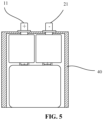
- the encapsulated battery pack is shown in FIG. 5 .
- the battery pack further comprises: a positive pole lug 11 of the first cell 10 forms a positive pole lug of the battery pack; and a negative pole lug 21 of the second cell 20 forms a negative pole lug of the battery pack; the positive pole lug 31 of the third cell 30 is connected to a negative pole lug 12 of the first cell set, and the negative pole lug 32 of the third cell 30 is connected to a positive pole lug 22 of the second cell set.
- the positive pole lug 11 of the first cell 10 forms the positive pole lug of the battery pack
- the negative pole lug 21 of the second cell 20 forms the negative pole lug of the battery pack.
- the positive pole lug 31 of the third cell 30 is connected to the negative pole lug 12 of the first cell 10
- the negative pole lug 32 of the third cell 30 is connected to the positive pole lug 22 of the second cell 20.
- the first cell set comprises at least two first cells 10
- the negative pole lug 12 of one of the first cells 10 are connected to the positive pole lug 11 of an adjacent first cell 10
- the at least two first cells 10 may be connected in series in an end-to-end manner.
- the second cell set comprises at least two second cells 20
- the at least two second cells 20 may also be connected in series in the same manner, i.e., connected in series in an end-to-end manner.
- the positive pole lug 11 of a first one in the first cell set serves as the positive pole lug of the battery pack;
- the negative pole lug 12 of the last one in the first cell set after the series connection is connected to the positive pole lug 31 of the third cell;
- the negative pole lug 21 of the first one in the second cell set serves as a negative pole lug of the battery pack;
- the positive pole lug 22 of the last one in the second cell set after the series connection is connected to the negative pole lug 32 of the third cell.
- multiple first cells 10 are stacked onto one another in a second direction; and/or multiple second cells 20 are stacked onto one another in a second direction.
- the multiple first cells 10 and the multiple second cells 20 may be arranged in another manner according to actual requirements.
- a difference between a sum of a width of the first cell set in the first direction and a width of the second cell set in the first direction, and a width of the third cell 30 in the first direction is within a predetermined range.
- the width of the first cell set in the first direction is equal to the width of a single first cell 10 in the first direction.
- the width of the second cell set in the first direction is equal to the width of the single second cell 20 in the first direction.
- the predetermined range is in the vicinity of 0, the closer the predetermined range is to 0, the closer the width of the third cell 30 in the first direction is to the sum of the width of the first cell 10 in the first direction and the width of the second cell 20 in the first direction, and the more regular the shape of the combination of the multiple cells in the battery pack, the easier it is to encapsulated.
- the positive pole lug of the first cell 10 and the negative pole lug of the first cell 10 are located at different ends of the first cell 10; the positive pole lug of the second cell 20 and the negative pole lug of the second cell 20 are located at different ends of the second cell 20.
- the different ends may be opposite ends.
- the positive lug 31 of the third cell 30 may be aligned with the negative lug 12 of one of the first cells 10.
- the negative lug 32 of the third cell 30 may be aligned with the positive lug 22 of one of the second cells 20.
- the lugs at the connection position of the cells are closer to one another, which facilitates the assembly of the cells, and which further reduces the overall space occupied by the first cell set, the second cell set and the third cell 30 after the stacked connections.
- the positive pole lug 11 of the first cell 10 is attached to a positive pole piece 13 of the first cell 10
- the negative pole lug 12 of the first cell 10 is attached to a negative pole piece 14 of the first cell 10.
- the positive pole lug of the second cell 20 is attached to a positive pole piece of the second cell
- the negative pole lug of the second cell 20 is attached to a negative pole piece of the second cell 20.
- the structure of the second cell 20 may be the same as that of the first cell 10.
- the manner of the attaching comprises, but is not limited to, welding. When the pole lug and pole piece are set in this manner and the pole piece is winded, the positive pole lug and negative pole lug can be distributed at different ends of the first cell 10.
- the positive pole lug 11 of the first cell 10 is attached to a center portion of the positive pole piece 13 of the first cell 10 and the negative pole lug 12 of the first cell 10 is attached to a center portion of the negative pole piece 14 of the first cell 10.
- the position of the lugs will affect the impedance of the cell.
- the lugs attached to a center portion of the pole piece are more conducive to obtain lower impedance and to ensure the capacity of the cell, relative to the lugs attached to the other positions such as the edge of the pole piece.
- the positive pole lug of the second cell 20 is attached to a center portion of the positive pole piece of the second cell 20 and the negative pole lug of the second cell 20 is attached to the center portion of the negative pole piece of the second cell 20.
- the lugs attached to the center portion of the pole piece are more conducive to obtain lower impedance and ensure the capacity of the cell, relative to the lugs attached to the other positions such as the edge of the pole piece.
- the lug of the first cell 10 and the lug of the second cell 20 are both located in the center portion of the respective corresponding pole pieces.
- the AC internal resistance of each cell is ensured to be within 5mQ, and the phenomenon of the battery pack fever is reduced while the fast charging effect of the battery pack is ensured.
- the positive pole piece of the third cell 30 comprises a positive pole substrate 33 and a positive pole coating 34.
- an edge of the positive pole substrate 33 protrudes upwardly to form the positive pole lugs 31 of the third cell 30.
- the positive pole coating 34 is located in a region of the positive pole substrate 33 that does not comprise the positive pole lugs 31 of the third cell 30.
- the negative pole piece of the third cell 30 comprises a negative pole substrate 35 and a negative pole coating 36. An edge of the negative pole substrate 35 protrudes upwardly to form negative pole lugs 32 of the third cell 30.
- the negative pole coating 36 is located in a region of the negative pole substrate 35 that does not comprise the negative pole lugs 32 of the third cell 30.
- the positive pole lugs 31, which are integrated with the positive pole substrate 33, or the negative pole lugs 32, which are integrated with the negative pole substrate 35, can be formed by cutting.
- the negative pole piece of the third cell 30 is attached to the positive pole piece of the third cell 30, the positive pole lug of the third cell 30 and the negative pole lug of the third cell 30 are oriented in the same direction, and the positive pole lugs of the third cell 30 are spaced apart from the negative pole lugs of the third cell 30 in the first direction.
- both of the positive pole lugs 31 and the negative pole lugs 32 of the third cell 30 are located at the same end.
- the multiple first cells 10 are connected in series or in parallel; and/or multiple second cells 20 are connected in series or in parallel.
- the charging voltage can be further increased after the first cell set, the third cell, and the second cell set are connected in series.
- the charging current can be increased after the first cell set, the third cell, and the second cell set are connected in series.
- the charging current of the battery pack does not exceed minimum value of the charging current of the first cell set, the charging current of the third cell and the charging current of the second cell set, so as to ensure the safety of charging the battery pack.
- the at least two first cells 10 when the first cell set comprises at least two first cells 10, the at least two first cells 10 may be connected in series, or may be connected in parallel, or some of the first cells may be connected in series and then connected in series with the rest.
- the second cell set comprises at least two second cells 20, the at least two second cells 20 may be connected in series, or may be connected in parallel, or some of the second cells may be connected in series and then connected in series with the rest.
- the pack length and width are divided into two equal parts, and the axes are established with the center of the pack.
- the bare cell JR1 i.e., the first cell set
- the bare cell JR3 i.e., the second cell set
- the bare cell JR2 i.e., the third cell 30
- which has a positive pole lug and a negative pole lug at a head end thereof is placed in second and third quadrants.
- the cells are stacked to form a shape like an inverted tripod (i.e., the cells are stacked in inverted triangular arrangement), and AC internal resistance of the bare cells is required to be within 5mQ.
- the first cell 10 and the second cell 20 which have pole lugs at head and tail ends thereof, adopt the lug-centered winding structure, that is, the positive pole lug and the negative pole lug are welded to the center portion of the pole pieces, and then are wound to form the first cell 10 and the second cell 20.
- the third cell 30, of which the positive pole lug and the negative lug are both located at the head end adopts a multi-lug structure.
- a base material i.e., a current collector
- the bare cell JR1 in the fourth quadrant is placed in such a way that the positive pole lug faces upwards and the negative pole lug faces downwards, and the negative pole lug of JR1 is welded to the positive pole lug of the bare cell JR2 in the second quadrant and third quadrant by ultrasonic welding.
- the negative pole lug of the bare cell JR3 in the first quadrant is oriented upwardly and the positive pole lug is oriented downwardly, the positive pole lug of JR3 is welded to the negative lug of bare cell JR2 in the second and third quadrant by ultrasonic welding, so that a single cell structure with internal series connection is formed.
- Corresponding pits are punched out in the aluminum-plastic film 40 according to the structure of the cells, and then the cells are placed into the aluminum-plastic film 40 for encapsulation.
- the final battery pack can meet that the single battery pack achieves the fast charging demand of 50W and above output power at high voltage of 5 ⁇ 20V and low current of less than 5A.
- a terminal comprises: a housing, having a battery compartment; and the battery pack of any one of the above embodiments, located in the battery compartment.
- the terminal comprises, but is not limited to, a product having a battery pack such as a mobile phone, a tablet, a notebook computer, a desktop computer, or a wearable device.
- a product having a battery pack such as a mobile phone, a tablet, a notebook computer, a desktop computer, or a wearable device.
- An embodiment of the present application further provides a method of manufacturing a battery pack, comprising the following:
- the manufacturing method refers to a method of manufacturing the battery pack according to any one of the above embodiments.
- Multiple cells are arranged in the battery pack, and the first cell set, the third cell and the second cell set are sequentially connected in series, so that the maximum withstand voltage of the single battery pack is increased, and rapid charging of the single battery pack at a high voltage and low current state can be realized.
- multiple cells stacked in a manner forming a structure in a shape like an inverted tripod (i.e., the cells are stacked in inverted triangular arrangement). By stacking the cells in this structure, more cells are connected in series to improve the withstand voltage of the battery pack, while a stable and compact structure is achieved.
- the step of juxtaposing the third cell 30 with the first cell set and the second cell set in a second direction comprises:
- the negative lug of the third cell 30 may be aligned with the positive pole lug of one of the first cells 10.
- the positive pole lug of the third cell 30 may be aligned with the negative pole lug of one of the second cells 20.
- the step of sequentially connecting the first cell set, the third cell 30, and the second cell set in series comprising:
- the welding is ultrasonic welding.
- the method of manufacturing a battery pack further comprises:
- the multiple first cells 10 and the multiple second cells 20 may be arranged in other manners according to actual requirements when performing the battery pack design.
- a difference between a sum of a width of the first cell set in the first direction and a width of the second cell set in the first direction, and a width of the third cell 30 in the first direction, is within a predetermined range.
- the width of the first cell set in the first direction is equal to the width of the single first cell 10 in the first direction.
- the width of the second cell set in the first direction is equal to the width of the single second cell 20 in the first direction.
- the predetermined range is in the vicinity of 0, the closer the preset range is to 0, the closer the width of the third cell 30 in the first direction is to the sum of the width of the first cell 10 in the first direction and the width of the second cell 20 in the first direction, and the more regular the shape of the combination of the cells in the battery pack, the easier it is to encapsulate.
- a method for manufacturing a battery pack further comprises:
- the at least two first cells 10 when the first cell set comprises at least two first cells 10, the at least two first cells 10 may be connected in series, or may be connected in parallel, or some of the first cells may be connected in series and then connected in series with the rest.
- the second battery set comprises at least two second cells 20
- the at least two second cells 20 may be connected in series, or may be connected in parallel, or some of the second cells may be connected in series and then connected in series with the rest.
Landscapes
- Chemical & Material Sciences (AREA)
- Chemical Kinetics & Catalysis (AREA)
- Electrochemistry (AREA)
- General Chemical & Material Sciences (AREA)
- Engineering & Computer Science (AREA)
- Manufacturing & Machinery (AREA)
- Materials Engineering (AREA)
- Life Sciences & Earth Sciences (AREA)
- Biophysics (AREA)
- Computer Hardware Design (AREA)
- Connection Of Batteries Or Terminals (AREA)
- Battery Mounting, Suspending (AREA)
Description
- The present application relates to the technical field of cell technology and construction, and in particular to a battery pack and a terminal.
- With the advent of the 5G era, the power consumption of cell phones and other terminals has increased, and the battery life time has shortened. Therefore, the demand for rapid charging is becoming stronger.
- A polymer lithium ion battery is taken as an example. The battery anode material is generally lithium cobalt oxide (LCO) and the cathode material is graphite (C). The charging mode is generally divided into two stages, in the first stage, it is charged with a constant current and a rising voltage (CC), and in the second stage, it is charged with a constant voltage and a dropping current (CV). In order to increase the charging speed, high-current charging of a single cell is mostly used. In this charging manner, on one hand, it is required to reduce the coating weight of the active substance, thereby reducing the energy density of the battery. On the other hand, the high-current charging process will quickly reach the limiting voltage and start to the dropping current charging, the duration of the real high-current charging lasts for a very short time, and the optimization of the full charging time is not obvious.
- Due to the limitations of the LCO and graphite material structures, the CV stage voltage of a single cell is limited, and is usually required to be less than 4.48V. Therefore, high-power charging of a single cell with high voltage and low current cannot be realized, thereby limiting the charging speed.
-
KR20180089723A CN204204980U discloses cell sets, connected in series and juxtaposed in perpendicular directions. - The present invention is defined in the independent claims, and the preferable features according to the present invention are defined in the dependent claims. Any embodiment in the present disclosure that does not fall within the scope of protection of the present invention shall be regarded as an example for understanding the present invention but not belonging to the present invention. The present application provides a battery pack and a terminal.
- According to a first aspect of the present application, there is provided a battery pack comprising:
- a first cell set, comprising at least one first cell;
- a second cell set, juxtaposed with the first cell set in a first direction and comprising at least one second cell;
- a third cell, juxtaposed with the first cell set and the second cell set in a second direction a third cell, juxtaposed with the first cell set and the second cell set in a second direction, each of a positive pole lug of the third cell and a negative pole lug of the third cell being located at an end of the third cell facing toward the first cell and the second cell;
- the first cell set, the third cell, and the second cell set are sequentially connected in series;
- the first direction is perpendicular to the second direction;
- a positive pole lug of the first cell and a negative pole lug of the first cell are located at different ends of the first cell;
- a positive pole lug of the second cell and a negative pole lug of the second cell are located at different ends of the second cell;
- the battery pack further comprises: an encapsulation housing in which each of the first cell set, the second cell set and the third cell is located.
- Optionally, a positive pole lug of the first cell forms a positive pole lug of the battery pack, and a negative pole lug of the second cell forms a negative pole lug of the battery pack. The positive pole lug of the third cell is connected to a negative pole lug of the first cell set, and the negative pole lug of the third cell is connected to a positive pole lug of the second cell set.
- Optionally, multiple first cells are stacked onto one another in the second direction; and/or multiple second cells are stacked onto one another in the second direction.
- Optionally, a difference between a sum of a width of the first cell set in the first direction and a width of the second cell set in the first direction, and a width of the third cell in the first direction, is within a predetermined range.
- Optionally, multiple first cells are connected in series or in parallel; and/or multiple second cells are connected in series or in parallel.
- Optionally, a positive pole lug of the first cell is attached to a center portion of a positive pole piece of the first cell, and a negative pole lug of the first cell is attached to a center portion of a negative pole piece of the first cell.
- Optionally, a positive pole lug of the second cell is attached to a center portion of a positive pole piece of the second cell, and a negative pole lug of the second cell is attached to a center portion of a negative pole piece of the second cell.
- According to the invention, the battery pack further comprising an encapsulation housing in which each of the first cell set, the second cell set and the third cell is located.
- According to a second aspect of the present application, there is provided a terminal comprising:
- a housing, having a battery compartment; and
- the battery pack according to the first aspect of the present application, the battery pack being located within the battery compartment.
- The technical solution provided by the embodiments of the present application comprises the following advantages:
As can be seen from the above, the present application provides multiple cells in a battery pack, and the first cell set, the third cell and the second cell set are sequentially connected in series, thereby increasing a maximum withstand voltage of a single battery pack, and enabling rapid charging of the single battery pack in a high voltage and low current state. Meanwhile, with respect to the configuration in which the positive pole lug of the third cell and the negative pole lug of the third cell are respectively distributed at different ends of the third cell, the present application the positive pole lug of the third cell and the negative pole lug of the third cell are distributed at the same end of the third cell in the present application, thereby reducing the height of at least one of the pole lugs, and further reducing the space occupied by the third cell. The cells are stacked in a manner forming a structure in a shape like an inverted tripod (i.e., the cells are stacked in inverted triangular arrangement), which allows a compact and steady structure while increasing the withstand voltage of the battery pack by connecting more cells in series. - It is should be understood that the foregoing general description and the following detailed description are exemplary and explanatory only and are not restrictive of the application.
- the first cell set, the third cell, and the second cell set are sequentially connected in series;
- the first direction is perpendicular to the second direction.
- Optionally, a positive pole lug of the first cell forms a positive pole lug of the battery pack, and a negative pole lug of the second cell forms a negative pole lug of the battery pack. The positive pole lug of the third cell is connected to a negative pole lug of the first cell set, and the negative pole lug of the third cell is connected to a positive pole lug of the second cell set.
- Optionally, multiple first cells are stacked onto one another in the second direction; and/or multiple second cells are stacked onto one another in the second direction.
- Optionally, a difference between a sum of a width of the first cell set in the first direction and a width of the second cell set in the first direction, and a width of the third cell in the first direction, is within a predetermined range.
- Optionally, each of a positive pole lug of the third cell and a negative pole lug of the third cell is located at an end of the third cell facing toward the first cell and the second cell. A positive pole lug of the first cell and a negative pole lug of the first cell are located at different ends of the first cell. A positive pole lug of the second cell and a negative pole lug of the second cell are located at different ends of the second cell.
- Optionally, multiple first cells are connected in series or in parallel; and/or multiple second cells are connected in series or in parallel.
- Optionally, a positive pole lug of the first cell is attached to a center portion of a positive pole piece of the first cell, and a negative pole lug of the first cell is attached to a center portion of a negative pole piece of the first cell.
- Optionally, a positive pole lug of the second cell is attached to a center portion of a positive pole piece of the second cell, and a negative pole lug of the second cell is attached to a center portion of a negative pole piece of the second cell.
- According to the invention, the battery pack further comprising an encapsulation housing in which each of the first cell set, the second cell set and the third cell is located.
- According to a second aspect of the present application, there is provided a terminal comprising:
- a housing, having a battery compartment; and
- the battery pack according to the first aspect of the present application, the battery pack being located within the battery compartment.
- The technical solution provided by the embodiments of the present application comprises the following advantages:
As can be seen from the above, the present application provides multiple cells in a battery pack, and the first cell set, the third cell and the second cell set are sequentially connected in series, thereby increasing a maximum withstand voltage of a single battery pack, and enabling rapid charging of the single battery pack in a high voltage and low current state. Meanwhile, with respect to the configuration in which the positive pole lug of the third cell and the negative pole lug of the third cell are respectively distributed at different ends of the third cell, the present application the positive pole lug of the third cell and the negative pole lug of the third cell are distributed at the same end of the third cell in the present application, thereby reducing the height of at least one of the pole lugs, and further reducing the space occupied by the third cell. The cells are stacked in a manner forming a structure in a shape like an inverted tripod (i.e., the cells are stacked in inverted triangular arrangement), which allows a compact and steady structure while increasing the withstand voltage of the battery pack by connecting more cells in series. - It is should be understood that the foregoing general description and the following detailed description are exemplary and explanatory only and are not restrictive of the application.
- The accompanying drawings, which are incorporated in and constitute a part of this specification, illustrate embodiments consistent with the present application, and together with the description, serve to explain the principles of the application.
-
FIG. 1 is a schematic view of the cells within a battery pack according to an exemplary embodiment. -
FIG. 2 is a schematic view of a current collector of the first cell according to an exemplary embodiment. -
FIG. 3 is a schematic view of a current collector of the third cell according to an exemplary embodiment. -
FIG. 4 is a schematic view of an aluminum-plastic film according to an exemplary embodiment. -
FIG. 5 is a schematic view of a battery pack according to an exemplary embodiment. - Reference will now be made in detail to exemplary embodiments, examples of which are illustrated in the accompanying drawings. The following description refers to the accompanying drawings in which the same numbers in different drawings represent the same or similar elements unless otherwise represented. The implementations set forth in the following description of exemplary embodiments do not represent all implementations consistent with the present application. Instead, they are merely examples of apparatuses and methods consistent with aspects related to the present application as recited in the appended claims.
-
FIG. 1 is a schematic structural diagram of a battery pack comprising: a first cell set comprising at least onefirst cell 10; a second cell set juxtaposed with the first cell set in a first direction and comprising at least onesecond cell 20; and athird cell 30 juxtaposed with the first cell set and the second cell set in a second direction. Each of apositive pole lug 31 of thethird cell 30 and anegative pole lug 32 of thethird cell 30 is located at an end of thethird cell 30 facing toward thefirst cell 10 and thesecond cell 20. The first cell set, thethird cell 30 and the second cell set are sequentially connected in series. The first direction is perpendicular to the second direction. - In the disclosed embodiment, by arranging multiple cells in the battery pack, and by successively connecting the first cell set, the
third cell 30, and the second cell set in series, the maximum withstand voltage of the single battery pack is increased, and rapid charging of the single battery pack at a high voltage and low current state can be realized. - In addition, compared to the configuration in which the positive pole lug of the third cell and the negative pole lug of the third cell are distributed at different ends of the third cell, both the positive pole lug of the third cell and the negative pole lug of the third cell are distributed at the same end of the third cell in the present application, thus the height of at least one of the pole lugs is reduced, and the space occupied by the third cell is also reduced. Such arrangement of the first cell set, the second cell set, and the
third cell 30 is compact in structure and easy to package. As shown inFIG. 1 , multiple cells stacked in a manner forming a structure in a shape like an inverted tripod (i.e., the cells are stacked in inverted triangular arrangement). By stacking the cells in this structure, more cells are connected in series to improve the withstand voltage of the battery pack, while a stable and compact structure is achieved. - By way of example only, the
first cell 10, thesecond cell 20, and thethird cell 30 are all polymer lithium ion cells. For example, the anode material of the cell is lithium cobalt oxide (LCO), and the cathode material is graphite (C).
In an example, as shown inFIG. 1 , the first cell set comprises afirst cell 10, and the second cell set comprises asecond cell 20. The first cell set, the second cell set, and thethird cell 30 together form a rectangular shape. - The battery pack further comprises an encapsulation housing. Each of the first cell set, the second cell set, and the
third cell 30 is located within the encapsulation housing. By way of example only, the encapsulation housing is an aluminum-plastic film 40. When encapsulating the cells, a corresponding shape can be punched out in the film according to the structure of the cells, and then the cells are placed into the aluminum-plastic film 40 for encapsulation. As shown inFIG. 4 , the aluminum-plastic film 40 comprises a first punchedpit 41 corresponding to the first cell set, a second punchedpit 42 corresponding to the second cell set, and a third punchedpit 43 corresponding to thethird cell 30. When the cells are placed in the aluminum-plastic film 40, the corresponding cells are aligned with the corresponding punched pits, and then the cells are sealed in the aluminum-plastic film 40. - Further, the encapsulation housing is filled with an electrode liquid. The cells (comprising the first cell set, the second cell set, and the third cell 30) are immersed in the electrode liquid, which serves as a carrier for ion transport in the battery pack. The encapsulated battery pack is shown in
FIG. 5 . - In other alternative embodiments, the battery pack further comprises:
apositive pole lug 11 of thefirst cell 10 forms a positive pole lug of the battery pack; and anegative pole lug 21 of thesecond cell 20 forms a negative pole lug of the battery pack; thepositive pole lug 31 of thethird cell 30 is connected to anegative pole lug 12 of the first cell set, and thenegative pole lug 32 of thethird cell 30 is connected to apositive pole lug 22 of the second cell set. - As shown in
FIG. 1 , when the first cell set comprises onefirst cell 10 and the second cell set comprises onesecond cell 20, thepositive pole lug 11 of thefirst cell 10 forms the positive pole lug of the battery pack, and thenegative pole lug 21 of thesecond cell 20 forms the negative pole lug of the battery pack. Thepositive pole lug 31 of thethird cell 30 is connected to thenegative pole lug 12 of thefirst cell 10, and thenegative pole lug 32 of thethird cell 30 is connected to thepositive pole lug 22 of thesecond cell 20. - By way of example only, when the first cell set comprises at least two
first cells 10, thenegative pole lug 12 of one of thefirst cells 10 are connected to thepositive pole lug 11 of an adjacentfirst cell 10, and the at least twofirst cells 10 may be connected in series in an end-to-end manner. When the second cell set comprises at least twosecond cells 20, the at least twosecond cells 20 may also be connected in series in the same manner, i.e., connected in series in an end-to-end manner. At this time, thepositive pole lug 11 of a first one in the first cell set serves as the positive pole lug of the battery pack; thenegative pole lug 12 of the last one in the first cell set after the series connection is connected to thepositive pole lug 31 of the third cell; thenegative pole lug 21 of the first one in the second cell set serves as a negative pole lug of the battery pack; thepositive pole lug 22 of the last one in the second cell set after the series connection is connected to thenegative pole lug 32 of the third cell. - In other alternative embodiments, multiple
first cells 10 are stacked onto one another in a second direction; and/or multiplesecond cells 20 are stacked onto one another in a second direction. - When manufacturing the battery pack, the multiple
first cells 10 and the multiplesecond cells 20 may be arranged in another manner according to actual requirements. - In other alternative embodiments, a difference between a sum of a width of the first cell set in the first direction and a width of the second cell set in the first direction, and a width of the
third cell 30 in the first direction, is within a predetermined range. - When the multiple
first cells 10 are stacked onto one another in the second direction, the width of the first cell set in the first direction is equal to the width of a singlefirst cell 10 in the first direction. Similarly, when the multiplesecond cells 20 are stacked onto one another in the second direction, the width of the second cell set in the first direction is equal to the width of the singlesecond cell 20 in the first direction. In the case that the predetermined range is in the vicinity of 0, the closer the predetermined range is to 0, the closer the width of thethird cell 30 in the first direction is to the sum of the width of thefirst cell 10 in the first direction and the width of thesecond cell 20 in the first direction, and the more regular the shape of the combination of the multiple cells in the battery pack, the easier it is to encapsulated. - In other alternative embodiments, the positive pole lug of the
first cell 10 and the negative pole lug of thefirst cell 10 are located at different ends of thefirst cell 10;
the positive pole lug of thesecond cell 20 and the negative pole lug of thesecond cell 20 are located at different ends of thesecond cell 20. - By way of example only, as shown in
FIG. 1 , the different ends may be opposite ends. - By way of example only, as shown in
FIG. 1 , when the first cell set and thethird cell 30 are connected in series, thepositive lug 31 of thethird cell 30 may be aligned with thenegative lug 12 of one of thefirst cells 10. When the second cell and thethird cell 30 are connected in series, thenegative lug 32 of thethird cell 30 may be aligned with thepositive lug 22 of one of thesecond cells 20. When connecting the lugs in series, the lugs at the connection position of the cells are closer to one another, which facilitates the assembly of the cells, and which further reduces the overall space occupied by the first cell set, the second cell set and thethird cell 30 after the stacked connections. - Further, as shown in
FIG. 2 , thepositive pole lug 11 of thefirst cell 10 is attached to apositive pole piece 13 of thefirst cell 10, and thenegative pole lug 12 of thefirst cell 10 is attached to anegative pole piece 14 of thefirst cell 10. The positive pole lug of thesecond cell 20 is attached to a positive pole piece of the second cell, and the negative pole lug of thesecond cell 20 is attached to a negative pole piece of thesecond cell 20. - The structure of the
second cell 20 may be the same as that of thefirst cell 10. The manner of the attaching comprises, but is not limited to, welding. When the pole lug and pole piece are set in this manner and the pole piece is winded, the positive pole lug and negative pole lug can be distributed at different ends of thefirst cell 10. - In other alternative embodiments, the
positive pole lug 11 of thefirst cell 10 is attached to a center portion of thepositive pole piece 13 of thefirst cell 10 and thenegative pole lug 12 of thefirst cell 10 is attached to a center portion of thenegative pole piece 14 of thefirst cell 10. - The position of the lugs will affect the impedance of the cell. The lugs attached to a center portion of the pole piece are more conducive to obtain lower impedance and to ensure the capacity of the cell, relative to the lugs attached to the other positions such as the edge of the pole piece.
- In other alternative embodiments, the positive pole lug of the
second cell 20 is attached to a center portion of the positive pole piece of thesecond cell 20 and the negative pole lug of thesecond cell 20 is attached to the center portion of the negative pole piece of thesecond cell 20. - Likewise, the lugs attached to the center portion of the pole piece are more conducive to obtain lower impedance and ensure the capacity of the cell, relative to the lugs attached to the other positions such as the edge of the pole piece.
- In an example, the lug of the
first cell 10 and the lug of thesecond cell 20 are both located in the center portion of the respective corresponding pole pieces. The AC internal resistance of each cell is ensured to be within 5mQ, and the phenomenon of the battery pack fever is reduced while the fast charging effect of the battery pack is ensured. - In other alternative embodiments, the positive pole piece of the
third cell 30 comprises apositive pole substrate 33 and apositive pole coating 34. Herein, an edge of thepositive pole substrate 33 protrudes upwardly to form the positive pole lugs 31 of thethird cell 30. Thepositive pole coating 34 is located in a region of thepositive pole substrate 33 that does not comprise the positive pole lugs 31 of thethird cell 30. The negative pole piece of thethird cell 30 comprises anegative pole substrate 35 and anegative pole coating 36. An edge of thenegative pole substrate 35 protrudes upwardly to form negative pole lugs 32 of thethird cell 30. Thenegative pole coating 36 is located in a region of thenegative pole substrate 35 that does not comprise the negative pole lugs 32 of thethird cell 30. - As shown in
FIG. 3 , in an actual application, the positive pole lugs 31, which are integrated with thepositive pole substrate 33, or the negative pole lugs 32, which are integrated with thenegative pole substrate 35, can be formed by cutting. When the negative pole piece of thethird cell 30 is attached to the positive pole piece of thethird cell 30, the positive pole lug of thethird cell 30 and the negative pole lug of thethird cell 30 are oriented in the same direction, and the positive pole lugs of thethird cell 30 are spaced apart from the negative pole lugs of thethird cell 30 in the first direction. When the pole lugs and the pole pieces are provided in this manner and the cells are formed by winding, both of the positive pole lugs 31 and the negative pole lugs 32 of thethird cell 30 are located at the same end. - In other alternative embodiments, the multiple
first cells 10 are connected in series or in parallel; and/or multiplesecond cells 20 are connected in series or in parallel. - Specifically, if the multiple
first cells 10 are connected in series to form a first cell set and the multiplesecond cells 20 are connected in series to form a second cell set, the charging voltage can be further increased after the first cell set, the third cell, and the second cell set are connected in series. If the multiplefirst cells 10 are connected in parallel to form a first cell set and the multiplesecond cells 20 are connected in parallel to form a second cell set, the charging current can be increased after the first cell set, the third cell, and the second cell set are connected in series. However, in this case, the charging current of the battery pack does not exceed minimum value of the charging current of the first cell set, the charging current of the third cell and the charging current of the second cell set, so as to ensure the safety of charging the battery pack. - In the present embodiment, when the first cell set comprises at least two
first cells 10, the at least twofirst cells 10 may be connected in series, or may be connected in parallel, or some of the first cells may be connected in series and then connected in series with the rest. Similarly, when the second cell set comprises at least twosecond cells 20, the at least twosecond cells 20 may be connected in series, or may be connected in parallel, or some of the second cells may be connected in series and then connected in series with the rest. - In an example, as shown in
FIG. 1 , according to size and capacity requirements of the battery pack, the pack length and width are divided into two equal parts, and the axes are established with the center of the pack. The bare cell JR1 (i.e., the first cell set) having pole lugs at head and tail ends thereof and the bare cell JR3 (i.e., the second cell set) having pole lugs at head and tail ends thereof are placed in first and fourth quadrants respectively. The bare cell JR2 (i.e., the third cell 30) which has a positive pole lug and a negative pole lug at a head end thereof is placed in second and third quadrants. So that the cells are stacked to form a shape like an inverted tripod (i.e., the cells are stacked in inverted triangular arrangement), and AC internal resistance of the bare cells is required to be within 5mQ. As shown inFIG. 2 , thefirst cell 10 and thesecond cell 20, which have pole lugs at head and tail ends thereof, adopt the lug-centered winding structure, that is, the positive pole lug and the negative pole lug are welded to the center portion of the pole pieces, and then are wound to form thefirst cell 10 and thesecond cell 20. As shown inFIG. 3 , thethird cell 30, of which the positive pole lug and the negative lug are both located at the head end, adopts a multi-lug structure. That is, a base material (i.e., a current collector) is cut at intervals, and protruding portions formed after the cutting form the lugs, and then are wound to form the bare cell. The bare cell JR1 in the fourth quadrant is placed in such a way that the positive pole lug faces upwards and the negative pole lug faces downwards, and the negative pole lug of JR1 is welded to the positive pole lug of the bare cell JR2 in the second quadrant and third quadrant by ultrasonic welding. During encapsulation, the negative pole lug of the bare cell JR3 in the first quadrant is oriented upwardly and the positive pole lug is oriented downwardly, the positive pole lug of JR3 is welded to the negative lug of bare cell JR2 in the second and third quadrant by ultrasonic welding, so that a single cell structure with internal series connection is formed. Corresponding pits are punched out in the aluminum-plastic film 40 according to the structure of the cells, and then the cells are placed into the aluminum-plastic film 40 for encapsulation. The final battery pack can meet that the single battery pack achieves the fast charging demand of 50W and above output power at high voltage of 5~20V and low current of less than 5A. - A terminal according to an embodiment of the present application comprises: a housing, having a battery compartment; and the battery pack of any one of the above embodiments, located in the battery compartment.
- The terminal comprises, but is not limited to, a product having a battery pack such as a mobile phone, a tablet, a notebook computer, a desktop computer, or a wearable device.
- An embodiment of the present application further provides a method of manufacturing a battery pack, comprising the following:
- At S101, a first cell set and a second cell set are placed to be juxtaposed with one another in a first direction, the first cell set comprises at least one
first cell 10 and the second cell set comprises at least onesecond cell 20. - At S102, the
third cell 30 is placed to be juxtaposed with the first cell set and the second cell set in a second direction. - At S103, the first cell set, the
third cell 30 and the second cell set are sequentially connected in series. - In the present application, the manufacturing method refers to a method of manufacturing the battery pack according to any one of the above embodiments.
- Multiple cells are arranged in the battery pack, and the first cell set, the third cell and the second cell set are sequentially connected in series, so that the maximum withstand voltage of the single battery pack is increased, and rapid charging of the single battery pack at a high voltage and low current state can be realized. At the same time, multiple cells stacked in a manner forming a structure in a shape like an inverted tripod (i.e., the cells are stacked in inverted triangular arrangement). By stacking the cells in this structure, more cells are connected in series to improve the withstand voltage of the battery pack, while a stable and compact structure is achieved.
- In other alternative embodiments, the step of juxtaposing the
third cell 30 with the first cell set and the second cell set in a second direction comprises: - aligning the positive pole lug of the
third cell 30 with the negative pole lug of thefirst cell 10; and - aligning the negative pole lug of the
third cell 30 with the positive pole lug of thesecond cell 20. - In actual applications, when the first cell set is connected in series to the
third cell 30, the negative lug of thethird cell 30 may be aligned with the positive pole lug of one of thefirst cells 10. When the second cell set is connected in series to thethird cell 30, the positive pole lug of thethird cell 30 may be aligned with the negative pole lug of one of thesecond cells 20. When connecting the lugs in series, the lugs at the connection position of the cells are closer to one another, which facilitates the assembly of the cells. - In other alternative embodiments, the step of sequentially connecting the first cell set, the
third cell 30, and the second cell set in series, comprising: - welding a positive pole lug of the
third cell 30 to a negative pole lug of thefirst cell 10; and - welding a negative pole lug of the
third cell 30 to a positive pole lug of thesecond cell 20. - By way of example only, the welding is ultrasonic welding.
- In other alternative embodiments, the method of manufacturing a battery pack further comprises:
- stacking multiple
first cells 10 onto one another in the second direction to form the first cell set; - stacking multiple
second cells 20 onto one another in the second direction to form the second cell set. - Alternatively, the multiple
first cells 10 and the multiplesecond cells 20 may be arranged in other manners according to actual requirements when performing the battery pack design. - Further, a difference between a sum of a width of the first cell set in the first direction and a width of the second cell set in the first direction, and a width of the
third cell 30 in the first direction, is within a predetermined range. - When the multiple of
first cells 10 are stacked onto one another in the second direction, the width of the first cell set in the first direction is equal to the width of the singlefirst cell 10 in the first direction. Similarly, when the multiplesecond cells 20 are stacked onto one another in the second direction, the width of the second cell set in the first direction is equal to the width of the singlesecond cell 20 in the first direction. In the case that the predetermined range is in the vicinity of 0, the closer the preset range is to 0, the closer the width of thethird cell 30 in the first direction is to the sum of the width of thefirst cell 10 in the first direction and the width of thesecond cell 20 in the first direction, and the more regular the shape of the combination of the cells in the battery pack, the easier it is to encapsulate. - In other alternative embodiments, a method for manufacturing a battery pack further comprises:
- connecting multiple
first cells 10 in series or in parallel to one another; and/or - connecting multiple
second cells 20 in series or in parallel to one another. - In the present embodiment, when the first cell set comprises at least two
first cells 10, the at least twofirst cells 10 may be connected in series, or may be connected in parallel, or some of the first cells may be connected in series and then connected in series with the rest. Similarly, when the second battery set comprises at least twosecond cells 20, the at least twosecond cells 20 may be connected in series, or may be connected in parallel, or some of the second cells may be connected in series and then connected in series with the rest.
Claims (8)
- A battery pack, the battery pack comprisesa first cell set, comprising at least one first cell (10);a second cell set, juxtaposed with the first cell set in a first direction and comprising at least one second cell (20);a third cell (30), juxtaposed with the first cell set and the second cell set in a second direction, each of a positive pole lug (31) of the third cell (30) and a negative pole lug (32) of the third cell (30) being located at an end of the third cell (30) facing toward the first cell (10) and the second cell (20);the first cell set, the third cell (30) and the second cell set are sequentially connected in series;the first direction is perpendicular to the second direction;characterized in thata positive pole lug (11) of the first cell (10) and a negative pole lug (12) of the first cell (10) are located at different ends of the first cell (10);a positive pole lug (22) of the second cell (20) and a negative pole lug (21) of the second cell (20) are located at different ends of the second cell (20);the battery pack further comprises:
an encapsulation housing in which each of the first cell set, the second cell set and the third cell (30) is located. - The battery pack of claim 1, whereinthe positive pole lug (11) of the first cell (10) forms a positive pole lug of the battery pack, and the negative pole lug (21) of the second cell (20) forms a negative pole lug of the battery pack;the positive pole lug (31) of the third cell (30) is connected to a negative pole lug of the first cell set, and the negative pole lug (32) of the third cell (30) is connected to a positive pole lug of the second cell set.
- The battery pack of claim 1 or 2, whereina plurality of the first cells (10) are stacked onto one another in the second direction; and/ora plurality of the second cells (20) are stacked onto one another in the second direction.
- The battery pack of any one of the preceding claims, wherein
a difference between a sum of a width of the first cell set in the first direction and a width of the second cell set in the first direction, and a width of the third cell (30) in the first direction, is within a predetermined range. - The battery pack of any one of the preceding claims, whereina plurality of the first cells (10) are connected in series or in parallel; and/ora plurality of the second cells (20) are connected in series or in parallel.
- The battery pack of any one of the preceding claims, wherein
the positive pole lug (11) of the first cell (10) is attached to a center portion of a positive pole piece (13) of the first cell (10), and the negative pole lug (12) of the first cell (10) is attached to a center portion of a negative pole piece (14) of the first cell (10). - The battery pack of any one of the preceding claims, wherein
the positive pole lug (22) of the second cell (20) is attached to a center portion of a positive pole piece of the second cell (20), and the negative pole lug (21) of the second cell (20) is attached to a center portion of a negative pole piece of the second cell (20). - A terminal comprising:a housing, having a battery compartment; andthe battery pack of any one of claims 1 to 7, the battery pack being located within the battery compartment.
Applications Claiming Priority (1)
| Application Number | Priority Date | Filing Date | Title |
|---|---|---|---|
| CN202010803790.2A CN114079127A (en) | 2020-08-11 | 2020-08-11 | Battery packs and terminals |
Publications (2)
| Publication Number | Publication Date |
|---|---|
| EP3955356A1 EP3955356A1 (en) | 2022-02-16 |
| EP3955356B1 true EP3955356B1 (en) | 2025-01-29 |
Family
ID=76138005
Family Applications (1)
| Application Number | Title | Priority Date | Filing Date |
|---|---|---|---|
| EP21176012.9A Active EP3955356B1 (en) | 2020-08-11 | 2021-05-26 | Battery pack and terminal |
Country Status (3)
| Country | Link |
|---|---|
| US (1) | US20220052412A1 (en) |
| EP (1) | EP3955356B1 (en) |
| CN (1) | CN114079127A (en) |
Citations (1)
| Publication number | Priority date | Publication date | Assignee | Title |
|---|---|---|---|---|
| CN204204980U (en) * | 2014-10-13 | 2015-03-11 | 珠海市鹏辉电池有限公司 | A kind of Li-ion batteries piles |
Family Cites Families (17)
| Publication number | Priority date | Publication date | Assignee | Title |
|---|---|---|---|---|
| GB2355848B (en) * | 1999-10-27 | 2003-10-08 | Chloride Ind Batteries Ltd | Multi cell battery |
| CN2786795Y (en) * | 2005-03-30 | 2006-06-07 | 武汉华枫传感器件公司 | Involution-type lithium ion battery's pole piece |
| CN2872606Y (en) * | 2005-12-01 | 2007-02-21 | 深圳市比克电池有限公司 | Coiling lithium-ion battery unit and lithium-ion battery thereof |
| EP2149168A1 (en) * | 2007-04-23 | 2010-02-03 | Hitachi Koki CO., LTD. | Battery pack and battery-driven power tool using the same |
| JP2012523087A (en) * | 2009-04-01 | 2012-09-27 | エルジー・ケム・リミテッド | Battery module having flexibility in module design structure, and medium- and large-sized battery packs including the battery module |
| TW201633585A (en) * | 2014-12-15 | 2016-09-16 | A123系統有限責任公司 | Battery assembly, battery system and vehicle battery |
| JP6160676B2 (en) * | 2015-11-02 | 2017-07-12 | 三洋電機株式会社 | Prismatic secondary battery |
| CN205231150U (en) * | 2015-12-07 | 2016-05-11 | 山东精工电子科技有限公司 | Electronic lithium ion power module for cycle racing |
| US20170256760A1 (en) * | 2016-03-03 | 2017-09-07 | Bosch Battery Systems GmbH | Battery Pack |
| KR101935229B1 (en) * | 2016-09-28 | 2019-01-04 | (주)그리너지 | Lithium secondary battery |
| CN206961955U (en) * | 2016-12-20 | 2018-02-02 | 河北绿草地新能源股份有限公司 | The wide temperature lithium-ion-power cell of rare-earth doped lithium iron phosphate Soft Roll |
| KR101982507B1 (en) * | 2017-02-01 | 2019-05-27 | 단국대학교 산학협력단 | Auxiliary battery module of variable capacity type |
| US20210091361A1 (en) * | 2017-07-14 | 2021-03-25 | Aqora Limited | Reusable modular system for making battery packs in series and parallel configurations |
| CN110380141A (en) * | 2018-04-13 | 2019-10-25 | 宁德新能源科技有限公司 | Battery core and electrochemical appliance |
| CN111106301B (en) * | 2019-04-02 | 2021-02-26 | 宁德时代新能源科技股份有限公司 | Secondary battery and battery module |
| CN110137405A (en) * | 2019-05-30 | 2019-08-16 | 中银(宁波)电池有限公司 | General type battery compartment and have electrical apparatus of battery compartment |
| CN111477933A (en) * | 2020-04-30 | 2020-07-31 | 昆山宝创新能源科技有限公司 | Laminate polymer electric core and battery package and vehicle |
-
2020
- 2020-08-11 CN CN202010803790.2A patent/CN114079127A/en active Pending
-
2021
- 2021-05-26 EP EP21176012.9A patent/EP3955356B1/en active Active
- 2021-05-28 US US17/334,134 patent/US20220052412A1/en active Pending
Patent Citations (1)
| Publication number | Priority date | Publication date | Assignee | Title |
|---|---|---|---|---|
| CN204204980U (en) * | 2014-10-13 | 2015-03-11 | 珠海市鹏辉电池有限公司 | A kind of Li-ion batteries piles |
Also Published As
| Publication number | Publication date |
|---|---|
| US20220052412A1 (en) | 2022-02-17 |
| CN114079127A (en) | 2022-02-22 |
| EP3955356A1 (en) | 2022-02-16 |
Similar Documents
| Publication | Publication Date | Title |
|---|---|---|
| CN103918106B (en) | Method with the internuncial electrode assemblie of excellent electrode tab, the battery unit including electrode assemblie and device and manufacture electrode assemblie | |
| CN208272035U (en) | A kind of stacked secondary cell stacked based on intersection | |
| US20100285370A1 (en) | Electrode group with desirable heat dissipating performance for use in lithium ion batteries | |
| KR102742761B1 (en) | The Electrode Assembly And The Secondary Battery | |
| AU2012370347B2 (en) | Lithium-ion battery | |
| CN218498139U (en) | Roll up core, battery and consumer | |
| EP3432384A1 (en) | Battery pack comprising electrode terminal connection plate | |
| US11404682B2 (en) | Non-rectangular shaped electrodes utilizing complex shaped insulation | |
| CN114975864A (en) | Pole piece, cell structure, lithium battery and electronic equipment | |
| CN101867069A (en) | Power type lithium ion battery with heat dispersion performance | |
| CN102306712A (en) | Cylinder battery | |
| CN101908643A (en) | A kind of power lithium ion battery and its manufacturing method | |
| CN103427111B (en) | A kind of lithium-ion energy storage battery and manufacture method thereof | |
| KR102226515B1 (en) | Electrode assembly and secondary battery having the same | |
| CN112736308A (en) | Single-sided printing laminated battery and printing battery pack | |
| CN217062427U (en) | Battery core, battery core module, power battery pack and vehicle | |
| CN205385061U (en) | Secondary battery | |
| EP3955356B1 (en) | Battery pack and terminal | |
| CN118610706A (en) | A kind of multi-electrode aluminum shell battery and preparation method thereof | |
| CN117691206A (en) | Electrochemical device, battery pack and electric equipment | |
| CN102263296A (en) | High-energy storage battery | |
| CN201868525U (en) | Lithium-ion battery | |
| CN207441882U (en) | A kind of stacked solid battery | |
| CN216161902U (en) | Battery core, laminate polymer electric core and power battery module | |
| CN100442576C (en) | Cathode piece of hydrogen-nickel battery, and method for fabricating hydrogen-nickel battery by using the cathode pieces |
Legal Events
| Date | Code | Title | Description |
|---|---|---|---|
| PUAI | Public reference made under article 153(3) epc to a published international application that has entered the european phase |
Free format text: ORIGINAL CODE: 0009012 |
|
| STAA | Information on the status of an ep patent application or granted ep patent |
Free format text: STATUS: THE APPLICATION HAS BEEN PUBLISHED |
|
| AK | Designated contracting states |
Kind code of ref document: A1 Designated state(s): AL AT BE BG CH CY CZ DE DK EE ES FI FR GB GR HR HU IE IS IT LI LT LU LV MC MK MT NL NO PL PT RO RS SE SI SK SM TR |
|
| STAA | Information on the status of an ep patent application or granted ep patent |
Free format text: STATUS: REQUEST FOR EXAMINATION WAS MADE |
|
| 17P | Request for examination filed |
Effective date: 20220801 |
|
| RBV | Designated contracting states (corrected) |
Designated state(s): AL AT BE BG CH CY CZ DE DK EE ES FI FR GB GR HR HU IE IS IT LI LT LU LV MC MK MT NL NO PL PT RO RS SE SI SK SM TR |
|
| STAA | Information on the status of an ep patent application or granted ep patent |
Free format text: STATUS: EXAMINATION IS IN PROGRESS |
|
| 17Q | First examination report despatched |
Effective date: 20240206 |
|
| GRAP | Despatch of communication of intention to grant a patent |
Free format text: ORIGINAL CODE: EPIDOSNIGR1 |
|
| STAA | Information on the status of an ep patent application or granted ep patent |
Free format text: STATUS: GRANT OF PATENT IS INTENDED |
|
| INTG | Intention to grant announced |
Effective date: 20240924 |
|
| GRAS | Grant fee paid |
Free format text: ORIGINAL CODE: EPIDOSNIGR3 |
|
| GRAA | (expected) grant |
Free format text: ORIGINAL CODE: 0009210 |
|
| STAA | Information on the status of an ep patent application or granted ep patent |
Free format text: STATUS: THE PATENT HAS BEEN GRANTED |
|
| P01 | Opt-out of the competence of the unified patent court (upc) registered |
Free format text: CASE NUMBER: APP_62444/2024 Effective date: 20241122 |
|
| AK | Designated contracting states |
Kind code of ref document: B1 Designated state(s): AL AT BE BG CH CY CZ DE DK EE ES FI FR GB GR HR HU IE IS IT LI LT LU LV MC MK MT NL NO PL PT RO RS SE SI SK SM TR |
|
| REG | Reference to a national code |
Ref country code: GB Ref legal event code: FG4D |
|
| REG | Reference to a national code |
Ref country code: CH Ref legal event code: EP |
|
| REG | Reference to a national code |
Ref country code: DE Ref legal event code: R096 Ref document number: 602021025302 Country of ref document: DE |
|
| REG | Reference to a national code |
Ref country code: IE Ref legal event code: FG4D |
|
| REG | Reference to a national code |
Ref country code: NL Ref legal event code: MP Effective date: 20250129 |
|
| PG25 | Lapsed in a contracting state [announced via postgrant information from national office to epo] |
Ref country code: NL Free format text: LAPSE BECAUSE OF FAILURE TO SUBMIT A TRANSLATION OF THE DESCRIPTION OR TO PAY THE FEE WITHIN THE PRESCRIBED TIME-LIMIT Effective date: 20250129 |
|
| PG25 | Lapsed in a contracting state [announced via postgrant information from national office to epo] |
Ref country code: RS Free format text: LAPSE BECAUSE OF FAILURE TO SUBMIT A TRANSLATION OF THE DESCRIPTION OR TO PAY THE FEE WITHIN THE PRESCRIBED TIME-LIMIT Effective date: 20250429 |
|
| PG25 | Lapsed in a contracting state [announced via postgrant information from national office to epo] |
Ref country code: FI Free format text: LAPSE BECAUSE OF FAILURE TO SUBMIT A TRANSLATION OF THE DESCRIPTION OR TO PAY THE FEE WITHIN THE PRESCRIBED TIME-LIMIT Effective date: 20250129 |
|
| PG25 | Lapsed in a contracting state [announced via postgrant information from national office to epo] |
Ref country code: PL Free format text: LAPSE BECAUSE OF FAILURE TO SUBMIT A TRANSLATION OF THE DESCRIPTION OR TO PAY THE FEE WITHIN THE PRESCRIBED TIME-LIMIT Effective date: 20250129 |
|
| PG25 | Lapsed in a contracting state [announced via postgrant information from national office to epo] |
Ref country code: ES Free format text: LAPSE BECAUSE OF FAILURE TO SUBMIT A TRANSLATION OF THE DESCRIPTION OR TO PAY THE FEE WITHIN THE PRESCRIBED TIME-LIMIT Effective date: 20250129 |
|
| REG | Reference to a national code |
Ref country code: LT Ref legal event code: MG9D |
|
| PG25 | Lapsed in a contracting state [announced via postgrant information from national office to epo] |
Ref country code: NO Free format text: LAPSE BECAUSE OF FAILURE TO SUBMIT A TRANSLATION OF THE DESCRIPTION OR TO PAY THE FEE WITHIN THE PRESCRIBED TIME-LIMIT Effective date: 20250429 Ref country code: IS Free format text: LAPSE BECAUSE OF FAILURE TO SUBMIT A TRANSLATION OF THE DESCRIPTION OR TO PAY THE FEE WITHIN THE PRESCRIBED TIME-LIMIT Effective date: 20250529 |
|
| REG | Reference to a national code |
Ref country code: AT Ref legal event code: MK05 Ref document number: 1764392 Country of ref document: AT Kind code of ref document: T Effective date: 20250129 |
|
| PG25 | Lapsed in a contracting state [announced via postgrant information from national office to epo] |
Ref country code: HR Free format text: LAPSE BECAUSE OF FAILURE TO SUBMIT A TRANSLATION OF THE DESCRIPTION OR TO PAY THE FEE WITHIN THE PRESCRIBED TIME-LIMIT Effective date: 20250129 |
|
| PG25 | Lapsed in a contracting state [announced via postgrant information from national office to epo] |
Ref country code: PT Free format text: LAPSE BECAUSE OF FAILURE TO SUBMIT A TRANSLATION OF THE DESCRIPTION OR TO PAY THE FEE WITHIN THE PRESCRIBED TIME-LIMIT Effective date: 20250529 Ref country code: LV Free format text: LAPSE BECAUSE OF FAILURE TO SUBMIT A TRANSLATION OF THE DESCRIPTION OR TO PAY THE FEE WITHIN THE PRESCRIBED TIME-LIMIT Effective date: 20250129 |
|
| PG25 | Lapsed in a contracting state [announced via postgrant information from national office to epo] |
Ref country code: GR Free format text: LAPSE BECAUSE OF FAILURE TO SUBMIT A TRANSLATION OF THE DESCRIPTION OR TO PAY THE FEE WITHIN THE PRESCRIBED TIME-LIMIT Effective date: 20250430 Ref country code: BG Free format text: LAPSE BECAUSE OF FAILURE TO SUBMIT A TRANSLATION OF THE DESCRIPTION OR TO PAY THE FEE WITHIN THE PRESCRIBED TIME-LIMIT Effective date: 20250129 |
|
| PG25 | Lapsed in a contracting state [announced via postgrant information from national office to epo] |
Ref country code: AT Free format text: LAPSE BECAUSE OF FAILURE TO SUBMIT A TRANSLATION OF THE DESCRIPTION OR TO PAY THE FEE WITHIN THE PRESCRIBED TIME-LIMIT Effective date: 20250129 |
|
| PG25 | Lapsed in a contracting state [announced via postgrant information from national office to epo] |
Ref country code: SE Free format text: LAPSE BECAUSE OF FAILURE TO SUBMIT A TRANSLATION OF THE DESCRIPTION OR TO PAY THE FEE WITHIN THE PRESCRIBED TIME-LIMIT Effective date: 20250129 |
|
| PG25 | Lapsed in a contracting state [announced via postgrant information from national office to epo] |
Ref country code: SM Free format text: LAPSE BECAUSE OF FAILURE TO SUBMIT A TRANSLATION OF THE DESCRIPTION OR TO PAY THE FEE WITHIN THE PRESCRIBED TIME-LIMIT Effective date: 20250129 |
|
| PG25 | Lapsed in a contracting state [announced via postgrant information from national office to epo] |
Ref country code: DK Free format text: LAPSE BECAUSE OF FAILURE TO SUBMIT A TRANSLATION OF THE DESCRIPTION OR TO PAY THE FEE WITHIN THE PRESCRIBED TIME-LIMIT Effective date: 20250129 |
|
| PG25 | Lapsed in a contracting state [announced via postgrant information from national office to epo] |
Ref country code: IT Free format text: LAPSE BECAUSE OF FAILURE TO SUBMIT A TRANSLATION OF THE DESCRIPTION OR TO PAY THE FEE WITHIN THE PRESCRIBED TIME-LIMIT Effective date: 20250129 |
|
| PG25 | Lapsed in a contracting state [announced via postgrant information from national office to epo] |
Ref country code: CZ Free format text: LAPSE BECAUSE OF FAILURE TO SUBMIT A TRANSLATION OF THE DESCRIPTION OR TO PAY THE FEE WITHIN THE PRESCRIBED TIME-LIMIT Effective date: 20250129 Ref country code: EE Free format text: LAPSE BECAUSE OF FAILURE TO SUBMIT A TRANSLATION OF THE DESCRIPTION OR TO PAY THE FEE WITHIN THE PRESCRIBED TIME-LIMIT Effective date: 20250129 |
|
| PG25 | Lapsed in a contracting state [announced via postgrant information from national office to epo] |
Ref country code: RO Free format text: LAPSE BECAUSE OF FAILURE TO SUBMIT A TRANSLATION OF THE DESCRIPTION OR TO PAY THE FEE WITHIN THE PRESCRIBED TIME-LIMIT Effective date: 20250129 |
|
| PG25 | Lapsed in a contracting state [announced via postgrant information from national office to epo] |
Ref country code: SK Free format text: LAPSE BECAUSE OF FAILURE TO SUBMIT A TRANSLATION OF THE DESCRIPTION OR TO PAY THE FEE WITHIN THE PRESCRIBED TIME-LIMIT Effective date: 20250129 |
|
| REG | Reference to a national code |
Ref country code: DE Ref legal event code: R097 Ref document number: 602021025302 Country of ref document: DE |
|
| REG | Reference to a national code |
Ref country code: DE Ref legal event code: R119 Ref document number: 602021025302 Country of ref document: DE |
|
| PLBE | No opposition filed within time limit |
Free format text: ORIGINAL CODE: 0009261 |
|
| STAA | Information on the status of an ep patent application or granted ep patent |
Free format text: STATUS: NO OPPOSITION FILED WITHIN TIME LIMIT |
|
| REG | Reference to a national code |
Ref country code: CH Ref legal event code: L10 Free format text: ST27 STATUS EVENT CODE: U-0-0-L10-L00 (AS PROVIDED BY THE NATIONAL OFFICE) Effective date: 20251210 |
|
| REG | Reference to a national code |
Ref country code: CH Ref legal event code: H13 Free format text: ST27 STATUS EVENT CODE: U-0-0-H10-H13 (AS PROVIDED BY THE NATIONAL OFFICE) Effective date: 20251223 |
|
| 26N | No opposition filed |
Effective date: 20251030 |
|
| PG25 | Lapsed in a contracting state [announced via postgrant information from national office to epo] |
Ref country code: LU Free format text: LAPSE BECAUSE OF NON-PAYMENT OF DUE FEES Effective date: 20250526 |
|
| PG25 | Lapsed in a contracting state [announced via postgrant information from national office to epo] |
Ref country code: CH Free format text: LAPSE BECAUSE OF NON-PAYMENT OF DUE FEES Effective date: 20250531 |
|
| REG | Reference to a national code |
Ref country code: BE Ref legal event code: MM Effective date: 20250531 |
|
| PG25 | Lapsed in a contracting state [announced via postgrant information from national office to epo] |
Ref country code: MC Free format text: LAPSE BECAUSE OF FAILURE TO SUBMIT A TRANSLATION OF THE DESCRIPTION OR TO PAY THE FEE WITHIN THE PRESCRIBED TIME-LIMIT Effective date: 20250129 |
|
| PGFP | Annual fee paid to national office [announced via postgrant information from national office to epo] |
Ref country code: GB Payment date: 20260324 Year of fee payment: 6 |
|
| PG25 | Lapsed in a contracting state [announced via postgrant information from national office to epo] |
Ref country code: IE Free format text: LAPSE BECAUSE OF NON-PAYMENT OF DUE FEES Effective date: 20250526 Ref country code: DE Free format text: LAPSE BECAUSE OF NON-PAYMENT OF DUE FEES Effective date: 20251202 |
|
| PG25 | Lapsed in a contracting state [announced via postgrant information from national office to epo] |
Ref country code: BE Free format text: LAPSE BECAUSE OF NON-PAYMENT OF DUE FEES Effective date: 20250531 |
|
| PG25 | Lapsed in a contracting state [announced via postgrant information from national office to epo] |
Ref country code: FR Free format text: LAPSE BECAUSE OF NON-PAYMENT OF DUE FEES Effective date: 20250531 |