EP3955178A1 - Information processing device, creation method, and creation program - Google Patents
Information processing device, creation method, and creation program Download PDFInfo
- Publication number
- EP3955178A1 EP3955178A1 EP19930091.4A EP19930091A EP3955178A1 EP 3955178 A1 EP3955178 A1 EP 3955178A1 EP 19930091 A EP19930091 A EP 19930091A EP 3955178 A1 EP3955178 A1 EP 3955178A1
- Authority
- EP
- European Patent Office
- Prior art keywords
- data
- information
- datasets
- divided
- unit
- Prior art date
- Legal status (The legal status is an assumption and is not a legal conclusion. Google has not performed a legal analysis and makes no representation as to the accuracy of the status listed.)
- Ceased
Links
Images




Classifications
-
- G—PHYSICS
- G06—COMPUTING OR CALCULATING; COUNTING
- G06N—COMPUTING ARRANGEMENTS BASED ON SPECIFIC COMPUTATIONAL MODELS
- G06N3/00—Computing arrangements based on biological models
- G06N3/02—Neural networks
- G06N3/08—Learning methods
- G06N3/088—Non-supervised learning, e.g. competitive learning
-
- G—PHYSICS
- G06—COMPUTING OR CALCULATING; COUNTING
- G06N—COMPUTING ARRANGEMENTS BASED ON SPECIFIC COMPUTATIONAL MODELS
- G06N7/00—Computing arrangements based on specific mathematical models
- G06N7/01—Probabilistic graphical models, e.g. probabilistic networks
-
- G—PHYSICS
- G06—COMPUTING OR CALCULATING; COUNTING
- G06F—ELECTRIC DIGITAL DATA PROCESSING
- G06F16/00—Information retrieval; Database structures therefor; File system structures therefor
- G06F16/90—Details of database functions independent of the retrieved data types
- G06F16/906—Clustering; Classification
-
- G—PHYSICS
- G06—COMPUTING OR CALCULATING; COUNTING
- G06N—COMPUTING ARRANGEMENTS BASED ON SPECIFIC COMPUTATIONAL MODELS
- G06N20/00—Machine learning
-
- G—PHYSICS
- G06—COMPUTING OR CALCULATING; COUNTING
- G06N—COMPUTING ARRANGEMENTS BASED ON SPECIFIC COMPUTATIONAL MODELS
- G06N3/00—Computing arrangements based on biological models
- G06N3/02—Neural networks
- G06N3/04—Architecture, e.g. interconnection topology
- G06N3/045—Combinations of networks
- G06N3/0455—Auto-encoder networks; Encoder-decoder networks
-
- H—ELECTRICITY
- H04—ELECTRIC COMMUNICATION TECHNIQUE
- H04L—TRANSMISSION OF DIGITAL INFORMATION, e.g. TELEGRAPHIC COMMUNICATION
- H04L63/00—Network architectures or network communication protocols for network security
- H04L63/14—Network architectures or network communication protocols for network security for detecting or protecting against malicious traffic
- H04L63/1408—Network architectures or network communication protocols for network security for detecting or protecting against malicious traffic by monitoring network traffic
- H04L63/1425—Traffic logging, e.g. anomaly detection
-
- G—PHYSICS
- G06—COMPUTING OR CALCULATING; COUNTING
- G06N—COMPUTING ARRANGEMENTS BASED ON SPECIFIC COMPUTATIONAL MODELS
- G06N3/00—Computing arrangements based on biological models
- G06N3/02—Neural networks
- G06N3/04—Architecture, e.g. interconnection topology
- G06N3/045—Combinations of networks
-
- G—PHYSICS
- G06—COMPUTING OR CALCULATING; COUNTING
- G06N—COMPUTING ARRANGEMENTS BASED ON SPECIFIC COMPUTATIONAL MODELS
- G06N3/00—Computing arrangements based on biological models
- G06N3/02—Neural networks
- G06N3/04—Architecture, e.g. interconnection topology
- G06N3/047—Probabilistic or stochastic networks
Definitions
- the present invention relates to an information processing apparatus, a creation method, and a creation program.
- a conventionally known approach to anomaly-based anomaly detection using unsupervised learning is to learn probability distributions of normal data from the normal data and create models.
- a learned model is created without dividing data, the detection performance degrades, but the learning cost decreases, and also the model can be reused.
- a learned model is created by dividing data based on a certain index such as IP address, the detection performance improves, but the learning cost increases, and the model cannot be reused.
- a method of performing an exhaustive check regarding various division granularities to find an appropriate division granularity that does not degrade the detection performance is performed without dividing data.
- Non Patent Literature 1 D. P. Kingma, M. Welling, "Auto-Encoding Variational Bayes," 1.3.2014. [online], [searched on May 15, 2019], Internet (https://arxiv.org/pdf/1312.6114.pdf
- an information processing apparatus of the present invention includes: a calculation unit configured to calculate, with respect to datasets into which data is divided based on individual labels serving as candidates for an index when the data is divided, an amount of information for each of division methods that use the respective labels; a division unit configured to divide the data into a plurality of datasets based on the division method that provides the highest amount of information, of the amounts of information calculated by the calculation unit; and a creation unit configured to create, with use of the datasets divided by the division unit, a learned model for each of the dataset.
- the present invention has the effect of making it possible to determine an appropriate data division method at a low learning cost.
- Fig. 1 is a diagram showing an example of the configuration of the detection system according to the first embodiment.
- a detection system 1 has the information processing apparatus 10, a gateway 20, and devices 30, and the gateway 20 is connected to an external network 40.
- the information processing apparatus 10 acquires normal-state data and detection target data regarding the devices 30, learns the acquired normal-state data, and performs anomaly detection on the acquired detection target data. For example, the information processing apparatus 10 acquires logs and the like of communications that are performed between the external network 40 and the devices 30 and that pass through the gateway 20.
- the devices 30 each may be, for example, an IoT device, such as a surveillance camera or a wearable device .
- the information processing apparatus 10 can acquire traffic data at the time when the resolution of the surveillance camera is changed, as normal-state data.
- Fig. 2 is a diagram showing an example of the configuration of the information processing apparatus 10 according to the first embodiment.
- the information processing apparatus 10 has an input/output unit 11, a communication unit 12, a control unit 13, and a storage unit 14.
- the input/output unit 11 receives data input from a user.
- Examples of the input/output unit 11 include input devices, such as a mouse and a keyboard, and display devices, such as a display and a touch screen.
- the communication unit 12 performs data communication with other apparatuses via a network.
- the communication unit 12 is an NIC (Network Interface Card) .
- the communication unit 12 performs data communication with the gateway 20, for example.
- the storage unit 14 is a storage device, such as an HDD (Hard Disk Drive), an SSD (Solid State Drive), or an optical disk. Note that the storage unit 14 may also be a data-rewritable semiconductor memory, such as a RAM (Random Access Memory), a flash memory, or an NVSRAM (Non Volatile Static Random Access Memory).
- the storage unit 14 stores an OS (Operating System) and various programs that are executed by the information processing apparatus 10. Furthermore, the storage unit 14 stores various kinds of information that are used to execute the programs.
- the storage unit 14 has a learned model storage unit 14a.
- the learned model storage unit 14a stores parameters and the like of learned models.
- the control unit 13 controls the entire information processing apparatus 10.
- the control unit 13 is, for example, an electronic circuit, such as a CPU (Central Processing Unit), a GPU (Graphics Processing Unit), a TPU (Tensor Processing Unit), or an MPU (MicroProcessing Unit), or an integrated circuit, such as an ASIC (Application Specific Integrated Circuit) or an FPGA (Field Programmable Gate Array).
- the control unit 13 has an internal memory for storing programs that specify various processing procedures, as well as control data, and executes processing using the internal memory.
- the control unit 13 functions as various processing units by various programs running.
- the control unit 13 has an acquisition unit 13a, a calculation unit 13b, a division unit 13c, a creation unit 13d, and a detection unit 13e.
- the acquisition unit 13a acquires traffic data as learning data or detection target data.
- the acquisition unit 13a may acquire traffic data from the devices 30 in real time, or may be configured to acquire traffic data that is input automatically or manually at predetermined times.
- Fig. 3 shows an example of the traffic data.
- the acquisition unit 13a acquires the following data and the like as the traffic data.
- the first item is "Src IP” that indicates source IP address.
- the second item is “Dst IP” that indicates destination IP address.
- the third item is “Src Port” that indicates source IP address.
- the fourth item is “Dst Port” that indicates destination IP address.
- the fifth item is "Up packet” that indicates information (e.g., the number of bytes in a packet, etc.) regarding upstream packets sent from the devices 30 toward the external network 40.
- the sixth item is "Down packet” that indicates information regarding upstream packets sent from the devices 30 toward the external network 40.
- the seventh item is "Time” that indicates the time at which packets are sent or received.
- the calculation unit 13b calculates, with respect to datasets into which data is divided based on individual labels serving as candidates for an index when the data is divided, the amount of information for each of division methods that use the respective labels. For example, upon receiving the traffic data acquired by the acquisition unit 13a, the calculation unit 13b creates a list of labels serving as the candidates for division. Note that the label list may be set manually in advance.
- the calculation unit 13b calculates the score of the amount of mutual information with respect to a label f using an equation (1) below.
- f denote a label
- V f be a value taken by the label f.
- the second term requires a high calculation cost, it is a common term that does not depend on f and therefore may be ignored in the calculation here.
- VAE Variational AutoEncoder
- the calculation unit 13b estimates the distribution of "x
- the calculation unit 13b may be configured to calculate the amount of mutual information for each label using the MINE. Since the calculation unit 13b can calculate the amount of mutual information for each label using the MINE without involving estimation of the probability distribution p(x) from a dataset x, the calculation cost can be reduced.
- the division unit 13c divides the data into a plurality of datasets based on the division method that provides the highest amount of information, of the amounts of information calculated by the calculation unit 13b.
- the division unit 13c compares I(x,v f1 ) and I(x,v f2 ) and divides the data based on the label that provides the higher amount of information. That is to say, the division unit 13c divides the data into vf datasets.
- a label for example, f1
- f1 is not limited to a label consisting of a single item, such as Src IP, and may also be constituted by a tuple, such as (Src IP, Dst Port).
- the division unit 13c may divide the data into large datasets such that the number of models is small.
- the creation unit 13d creates, with use of the datasets divided by the division unit 13c, a learned model for each dataset. For example, the creation unit 13d generates, for each of the divided datasets, a learned model for estimating the probability distribution p(x) from a dataset x by probability density estimation, and stores the learned model in the learned model storage unit 14a.
- p(x) may be a logarithm, such as log p(x).
- the detection unit 13e estimates the probability of occurrence of detection target data using the learned models learned by the creation unit 13d, and if the probability of occurrence is lower than a predetermined threshold value, the detection unit 13e detects an anomaly.
- the detection unit 13e calculates the occurrence probability p(x') using the learned models, and then outputs a report regarding an anomaly, or outputs an alert, if the occurrence probability p(x') is lower than a preset threshold value.
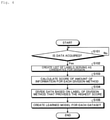
- Fig. 4 is a flowchart illustrating an example of the flow of processing performed by the information processing apparatus according to the first embodiment.
- step S101 when the acquisition unit 13a of the information processing apparatus 10 acquires data (step S101), the calculation unit 13b creates a list of labels that serve as candidates for division (step S102). Then, the calculation unit 13b calculates the score of the amount of information for each division method (step S103).
- the division unit 13c divides the data based on the label of the division method that provides the highest score (step S104). After that, the creation unit 13d creases a learned model for each dataset (step S105).
- the information processing apparatus 10 calculates, with respect to datasets into which data is divided based on individual labels serving as candidates for an index based on which the data is to be divided, the amount of information for each of division methods that use the respective labels. Then, the information processing apparatus 10 divides the data into a plurality of datasets based on the division method that provides the highest amount of information of the calculated amounts of information. Next, with use of the thus divided datasets, the information processing apparatus 10 creates a learned model for each dataset. Therefore, the information processing apparatus 10 can determine an appropriate data division method at a low learning cost.
- the information processing apparatus 10 calculates the amount of mutual information for each multi-label using the MINE, and can therefore calculate the amount of mutual information for each label without involving estimation of the probability distribution p(x) from a dataset x.
- the information processing apparatus 10 can reduce the calculation cost.
- the information processing apparatus 10 estimates the probability of occurrence of detection target data using the learned models created by the creation unit 13d, and if the probability of occurrence is lower than a predetermined threshold value, the information processing apparatus 10 detects an anomaly.
- the information processing apparatus 10 can detect an anomaly in, for example, an IoT device with high accuracy.
- FIG. 5 is a diagram for explaining the effects of the first embodiment.
- f ⁇ ⁇ f1, f2 ⁇ and V f ⁇ ⁇ 0,1 ⁇ will be described for the sake of simplicity of description.
- the detection system has a data acquiring apparatus 100, a score calculator 200, a learning machine 300, and a detector 400.
- the data acquiring apparatus 100 has an acquisition unit 110 and a division unit 120.
- the score calculator 200 has a calculation unit 210.
- the learning machine 300 has a creation unit 310.
- the detector 400 has a detection unit 410.
- the acquisition unit 110 of the data acquiring apparatus 100 acquires traffic data as learning data or detection target data. Upon acquiring the data, the acquisition unit 110 sends the acquired data to the score calculator. If detection target data is acquired, the acquisition unit 110 sends the acquired detection target data to the detector 400.
- the calculation unit 210 of the score calculator 200 Upon receiving the traffic data, the calculation unit 210 of the score calculator 200 creates a list of labels serving as candidates for division. Then, as in the first embodiment, the calculation unit 210 calculates the amount of mutual information scores and sends the calculated scores to the data acquiring apparatus 100.
- the division unit 120 of the data acquiring apparatus 100 Upon receiving the calculated scores, the division unit 120 of the data acquiring apparatus 100 divides the data into a plurality of dataset based on a division method that provides the highest amount of information, of the calculated amounts of information. Then, the division unit 120 sends the datasets to the learning machine 300.
- the creation unit 310 of the learning machine 300 Upon receiving the datasets, the creation unit 310 of the learning machine 300 creates, with use of the received datasets, a learned model for each dataset. Then, the creation unit 310 sends the created learned models to the detector 400.
- the detection unit 410 of the detector 400 estimates the probability of occurrence of detection target data newly detected by the acquisition unit 13a, and if the probability of occurrence is lower than a predetermined threshold value, the detection unit 410 detects an anomaly.
- the plurality of apparatuses have the functional units (the acquisition unit 110, the division unit 120, the calculation unit 210, the creation unit 310, and the detection unit 410) in a distributed manner.
- the detection system according to the other embodiment achieves similar effects to those of the first embodiment.
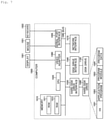
- Fig. 7 is a diagram showing a computer that executes the creation program.
- a computer 1000 has, for example, a memory 1010, a CPU 1020, a hard disk drive interface 1030, a disk drive interface 1040, a serial port interface 1050, a video adapter 1060, and a network interface 1070, and these units are connected to each other via a bus 1080.
- the memory 1010 includes a ROM (Read Only Memory) 1011 and a RAM 1012.
- the ROM 1011 stores, for example, a boot program such as a BIOS (Basic Input Output System) .
- the hard disk drive interface 1030 is connected to a hard disk drive 1090.
- the disk drive interface 1040 is connected to a disk drive 1100.
- a removable storage medium such as a magnetic disk or an optical disk, is inserted into the disk drive 1100.
- the serial port interface 1050 is connected to, for example, a mouse 1110 and a keyboard 1120.
- the video adapter 1060 is connected to, for example, a display 1130.
- the hard disk drive 1090 stores, for example, an OS 1091, an application program 1092, a program module 1093, and program data 1094. That is to say, the above-described creation program is stored in, for example, the hard disk drive 1090 as a program module containing instructions to be executed by the computer 1000.
- the various kinds of data described in the foregoing embodiments are stored as program data in, for example, the memory 1010 or the hard disk drive 1090.
- the CPU 1020 loads the program module 1093 or the program data 1094 stored in the memory 1010 or the hard disk drive 1090 into the RAM 1012 as necessary, and executes various processing procedures.
- program module 1093 and the program data 1094 related to the creation program need not be stored in the hard disk drive 1090, and may also be stored in, for example, a removable storage medium and loaded by the CPU 1020 via a disk drive or the like.
- the program module 1093 and the program data 1094 related to the creation program may also be stored in another computer that is connected via a network (a LAN (Local Area Network), a WAN (Wide Area Network), or the like) and loaded by the CPU 1020 via the network interface 1070.
- a network a LAN (Local Area Network), a WAN (Wide Area Network), or the like
Landscapes
- Engineering & Computer Science (AREA)
- Theoretical Computer Science (AREA)
- Physics & Mathematics (AREA)
- General Physics & Mathematics (AREA)
- General Engineering & Computer Science (AREA)
- Computing Systems (AREA)
- Software Systems (AREA)
- Data Mining & Analysis (AREA)
- Artificial Intelligence (AREA)
- Mathematical Physics (AREA)
- Evolutionary Computation (AREA)
- General Health & Medical Sciences (AREA)
- Biophysics (AREA)
- Computational Linguistics (AREA)
- Health & Medical Sciences (AREA)
- Molecular Biology (AREA)
- Computer Security & Cryptography (AREA)
- Biomedical Technology (AREA)
- Life Sciences & Earth Sciences (AREA)
- Databases & Information Systems (AREA)
- Mathematical Analysis (AREA)
- Computer Networks & Wireless Communication (AREA)
- Computer Vision & Pattern Recognition (AREA)
- Pure & Applied Mathematics (AREA)
- Mathematical Optimization (AREA)
- Computational Mathematics (AREA)
- Algebra (AREA)
- Probability & Statistics with Applications (AREA)
- Computer Hardware Design (AREA)
- Medical Informatics (AREA)
- Signal Processing (AREA)
- Debugging And Monitoring (AREA)
- Information Retrieval, Db Structures And Fs Structures Therefor (AREA)
- Image Analysis (AREA)
- Data Exchanges In Wide-Area Networks (AREA)
- Complex Calculations (AREA)
- Hardware Redundancy (AREA)
- Communication Control (AREA)
Abstract
Description
- The present invention relates to an information processing apparatus, a creation method, and a creation program.
- A conventionally known approach to anomaly-based anomaly detection using unsupervised learning is to learn probability distributions of normal data from the normal data and create models. Here, if a learned model is created without dividing data, the detection performance degrades, but the learning cost decreases, and also the model can be reused. On the other hand, if a learned model is created by dividing data based on a certain index such as IP address, the detection performance improves, but the learning cost increases, and the model cannot be reused. Thus, there are trade-offs. Furthermore, there also exists a method of performing an exhaustive check regarding various division granularities to find an appropriate division granularity that does not degrade the detection performance.
- Non Patent Literature 1: D. P. Kingma, M. Welling, "Auto-Encoding Variational Bayes," 1.3.2014. [online], [searched on May 15, 2019], Internet (https://arxiv.org/pdf/1312.6114.pdf
- However, the aforementioned method of performing an exhaustive check regarding various division granularities to find an appropriate division granularity that does not degrade the detection performance requires a high learning cost, and therefore, there is a problem in that it is difficult to determine an appropriate data division method at a low learning cost.
- In order to address the above-described problem and achieve an object, an information processing apparatus of the present invention includes: a calculation unit configured to calculate, with respect to datasets into which data is divided based on individual labels serving as candidates for an index when the data is divided, an amount of information for each of division methods that use the respective labels; a division unit configured to divide the data into a plurality of datasets based on the division method that provides the highest amount of information, of the amounts of information calculated by the calculation unit; and a creation unit configured to create, with use of the datasets divided by the division unit, a learned model for each of the dataset.
- The present invention has the effect of making it possible to determine an appropriate data division method at a low learning cost.
-
- [
Fig. 1 ]
Fig. 1 is a diagram showing an example of the configuration of a detection system according to a first embodiment. - [
Fig. 2 ]
Fig. 2 is a diagram showing an example of the configuration of an information processing apparatus according to the first embodiment. - [
Fig. 3 ]
Fig. 3 shows an example of traffic data. - [
Fig. 4 ]
Fig. 4 is a flowchart illustrating an example of the flow of processing performed by the information processing apparatus according to the first embodiment. - [
Fig. 5 ]
Fig. 5 is a diagram for explaining the effects of the first embodiment. - [
Fig. 6 ]
Fig. 6 is a diagram showing an example of the configuration of a detection system according to another embodiment. - [
Fig. 7 ]
Fig. 7 is a diagram showing a computer that executes a creation program. - Hereinafter, embodiments of an information processing apparatus, a creation method, and a creation program according to the present application will be described in detail based on the drawings. Note that the information processing apparatus, the creation method, and the creation program according to the present application are not limited to the following embodiments.
- In an embodiment below, the configuration of an
information processing apparatus 10 according to a first embodiment and the flow of processing performed by theinformation processing apparatus 10 will be described in this order, and finally, the effects of the first embodiment will be described. - First, the configuration of a detection system according to the first embodiment will be described using
Fig. 1. Fig. 1 is a diagram showing an example of the configuration of the detection system according to the first embodiment. As shown inFig. 1 , adetection system 1 has theinformation processing apparatus 10, agateway 20, anddevices 30, and thegateway 20 is connected to anexternal network 40. - The
information processing apparatus 10 acquires normal-state data and detection target data regarding thedevices 30, learns the acquired normal-state data, and performs anomaly detection on the acquired detection target data. For example, theinformation processing apparatus 10 acquires logs and the like of communications that are performed between theexternal network 40 and thedevices 30 and that pass through thegateway 20. Thedevices 30 each may be, for example, an IoT device, such as a surveillance camera or a wearable device . For example, in the case where adevice 30 is a surveillance camera, theinformation processing apparatus 10 can acquire traffic data at the time when the resolution of the surveillance camera is changed, as normal-state data. - Next, the configuration of the
information processing apparatus 10 will be described usingFig. 2. Fig. 2 is a diagram showing an example of the configuration of theinformation processing apparatus 10 according to the first embodiment. As shown inFig. 2 , theinformation processing apparatus 10 has an input/output unit 11, a communication unit 12, a control unit 13, and astorage unit 14. - The input/
output unit 11 receives data input from a user. Examples of the input/output unit 11 include input devices, such as a mouse and a keyboard, and display devices, such as a display and a touch screen. The communication unit 12 performs data communication with other apparatuses via a network. For example, the communication unit 12 is an NIC (Network Interface Card) . The communication unit 12 performs data communication with thegateway 20, for example. - The
storage unit 14 is a storage device, such as an HDD (Hard Disk Drive), an SSD (Solid State Drive), or an optical disk. Note that thestorage unit 14 may also be a data-rewritable semiconductor memory, such as a RAM (Random Access Memory), a flash memory, or an NVSRAM (Non Volatile Static Random Access Memory). Thestorage unit 14 stores an OS (Operating System) and various programs that are executed by theinformation processing apparatus 10. Furthermore, thestorage unit 14 stores various kinds of information that are used to execute the programs. In addition, thestorage unit 14 has a learned model storage unit 14a. The learned model storage unit 14a stores parameters and the like of learned models. - The control unit 13 controls the entire
information processing apparatus 10. The control unit 13 is, for example, an electronic circuit, such as a CPU (Central Processing Unit), a GPU (Graphics Processing Unit), a TPU (Tensor Processing Unit), or an MPU (MicroProcessing Unit), or an integrated circuit, such as an ASIC (Application Specific Integrated Circuit) or an FPGA (Field Programmable Gate Array). The control unit 13 has an internal memory for storing programs that specify various processing procedures, as well as control data, and executes processing using the internal memory. The control unit 13 functions as various processing units by various programs running. For example, the control unit 13 has anacquisition unit 13a, acalculation unit 13b, a division unit 13c, a creation unit 13d, and adetection unit 13e. - The
acquisition unit 13a acquires traffic data as learning data or detection target data. For example, theacquisition unit 13a may acquire traffic data from thedevices 30 in real time, or may be configured to acquire traffic data that is input automatically or manually at predetermined times. - Here, a specific example of the traffic data acquired by the
acquisition unit 13a will be described usingFig. 3. Fig. 3 shows an example of the traffic data. As illustrated inFig. 3 , for example, theacquisition unit 13a acquires the following data and the like as the traffic data. The first item is "Src IP" that indicates source IP address. The second item is "Dst IP" that indicates destination IP address. The third item is "Src Port" that indicates source IP address. The fourth item is "Dst Port" that indicates destination IP address. The fifth item is "Up packet" that indicates information (e.g., the number of bytes in a packet, etc.) regarding upstream packets sent from thedevices 30 toward theexternal network 40. The sixth item is "Down packet" that indicates information regarding upstream packets sent from thedevices 30 toward theexternal network 40. The seventh item is "Time" that indicates the time at which packets are sent or received. - The
calculation unit 13b calculates, with respect to datasets into which data is divided based on individual labels serving as candidates for an index when the data is divided, the amount of information for each of division methods that use the respective labels. For example, upon receiving the traffic data acquired by theacquisition unit 13a, thecalculation unit 13b creates a list of labels serving as the candidates for division. Note that the label list may be set manually in advance. - Then, the
calculation unit 13b, for example, calculates the score of the amount of mutual information with respect to a label f using an equation (1) below. Hereinafter, let "f" denote a label, and "Vf" be a value taken by the label f. Note that, although the second term requires a high calculation cost, it is a common term that does not depend on f and therefore may be ignored in the calculation here. - [Math. 1]


- Note that it is assumed that the distribution of "x|vfvf" in the calculation of the amount of mutual information is already known. For estimation of the distribution of "x|vfvf", a VAE (Variational AutoEncoder) may be used as a method for performing probability density estimation from sampling (see
Reference 1 below). - However, when the
calculation unit 13b estimates the distribution of "x|vfvf" using the VAE, calculation is costly. For this reason, a MINE (Mutual Information Neural Estimation), which is a method for calculating the amount of mutual information from sampling, may be used (seeReference 2 below) . Thecalculation unit 13b may be configured to calculate the amount of mutual information for each label using the MINE. Since thecalculation unit 13b can calculate the amount of mutual information for each label using the MINE without involving estimation of the probability distribution p(x) from a dataset x, the calculation cost can be reduced. - The division unit 13c divides the data into a plurality of datasets based on the division method that provides the highest amount of information, of the amounts of information calculated by the
calculation unit 13b. Thus, for example, when there exist division methods f1 and f2 using respective labels, the division unit 13c compares I(x,vf1) and I(x,vf2) and divides the data based on the label that provides the higher amount of information. That is to say, the division unit 13c divides the data into vf datasets. Note that a label, for example, f1, is not limited to a label consisting of a single item, such as Src IP, and may also be constituted by a tuple, such as (Src IP, Dst Port). In addition, when the difference between the scores of the amount of information of the labels calculated by thecalculation unit 13b is small, the division unit 13c may divide the data into large datasets such that the number of models is small. - The creation unit 13d creates, with use of the datasets divided by the division unit 13c, a learned model for each dataset. For example, the creation unit 13d generates, for each of the divided datasets, a learned model for estimating the probability distribution p(x) from a dataset x by probability density estimation, and stores the learned model in the learned model storage unit 14a. Note that p(x) may be a logarithm, such as log p(x).
- The
detection unit 13e estimates the probability of occurrence of detection target data using the learned models learned by the creation unit 13d, and if the probability of occurrence is lower than a predetermined threshold value, thedetection unit 13e detects an anomaly. - For example, when the
acquisition unit 13a has acquired new data x', thedetection unit 13e calculates the occurrence probability p(x') using the learned models, and then outputs a report regarding an anomaly, or outputs an alert, if the occurrence probability p(x') is lower than a preset threshold value. - Next, an example of processing procedures of the
information processing apparatus 10 according to the first embodiment will be described usingFig. 4. Fig. 4 is a flowchart illustrating an example of the flow of processing performed by the information processing apparatus according to the first embodiment. - As illustrated in
Fig. 4 , when theacquisition unit 13a of theinformation processing apparatus 10 acquires data (step S101), thecalculation unit 13b creates a list of labels that serve as candidates for division (step S102). Then, thecalculation unit 13b calculates the score of the amount of information for each division method (step S103). - Subsequently, the division unit 13c divides the data based on the label of the division method that provides the highest score (step S104). After that, the creation unit 13d creases a learned model for each dataset (step S105).
- As described above, the
information processing apparatus 10 according to the first embodiment calculates, with respect to datasets into which data is divided based on individual labels serving as candidates for an index based on which the data is to be divided, the amount of information for each of division methods that use the respective labels. Then, theinformation processing apparatus 10 divides the data into a plurality of datasets based on the division method that provides the highest amount of information of the calculated amounts of information. Next, with use of the thus divided datasets, theinformation processing apparatus 10 creates a learned model for each dataset. Therefore, theinformation processing apparatus 10 can determine an appropriate data division method at a low learning cost. - Moreover, the
information processing apparatus 10 according to the first embodiment calculates the amount of mutual information for each multi-label using the MINE, and can therefore calculate the amount of mutual information for each label without involving estimation of the probability distribution p(x) from a dataset x. Thus, theinformation processing apparatus 10 can reduce the calculation cost. - Moreover, the
information processing apparatus 10 according to the first embodiment estimates the probability of occurrence of detection target data using the learned models created by the creation unit 13d, and if the probability of occurrence is lower than a predetermined threshold value, theinformation processing apparatus 10 detects an anomaly. Thus, theinformation processing apparatus 10 can detect an anomaly in, for example, an IoT device with high accuracy. - Here, with use of
Fig. 5 , the results of an experiment that was performed using theinformation processing apparatus 10 of the first embodiment are shown, and the effects of the embodiment will be described.Fig. 5 is a diagram for explaining the effects of the first embodiment. In the example shown inFig. 5 , a case where f ∈ {f1, f2} and Vf ∈ {0,1} will be described for the sake of simplicity of description. A case is considered in which, in the case of f1, a Gaussian distribution of N(0, 1) is obtained when v = 0, and a Gaussian distribution of N(-1,1) is obtained when v = 1, while in the case of f2, a distribution obtained from N(0,1)+N(-1,1) is normalized both when v = 0 and when v = 1. As can be seen fromFig. 1 , when data is compiled using f2, the two distributions are the same. Therefore, it is meaningless to divide the data using f2 and learn the distributions, and it can be understood that it is better to divide the data using f1 and create learned models. Table 1 below shows the results of calculation of scores for f1 and f2 respectively. As shown in Table 1, the score of f1 was better than the score of f2, as intended. -
Table 1 factor: f1, -1.4041003344854974 factor: f2, -5.4578209944355605 - In the first embodiment above, a case has been described in which the
information processing apparatus 10 has theacquisition unit 13a, thecalculation unit 13b, the division unit 13c, the creation unit 13d, and thedetection unit 13e; however, the present invention is not limited to this, and the functions of the various units may be distributed to a plurality of apparatuses. Here, a detection system according to another embodiment will be described usingFig. 6 . As illustrated inFig. 6 , the detection system according to the other embodiment has adata acquiring apparatus 100, ascore calculator 200, alearning machine 300, and adetector 400. Thedata acquiring apparatus 100 has an acquisition unit 110 and a division unit 120. Thescore calculator 200 has a calculation unit 210. The learningmachine 300 has a creation unit 310. Thedetector 400 has a detection unit 410. - The acquisition unit 110 of the
data acquiring apparatus 100 acquires traffic data as learning data or detection target data. Upon acquiring the data, the acquisition unit 110 sends the acquired data to the score calculator. If detection target data is acquired, the acquisition unit 110 sends the acquired detection target data to thedetector 400. - Upon receiving the traffic data, the calculation unit 210 of the
score calculator 200 creates a list of labels serving as candidates for division. Then, as in the first embodiment, the calculation unit 210 calculates the amount of mutual information scores and sends the calculated scores to thedata acquiring apparatus 100. - Upon receiving the calculated scores, the division unit 120 of the
data acquiring apparatus 100 divides the data into a plurality of dataset based on a division method that provides the highest amount of information, of the calculated amounts of information. Then, the division unit 120 sends the datasets to thelearning machine 300. - Upon receiving the datasets, the creation unit 310 of the
learning machine 300 creates, with use of the received datasets, a learned model for each dataset. Then, the creation unit 310 sends the created learned models to thedetector 400. - The detection unit 410 of the
detector 400, with use of the learned models created by the creation unit 310, estimates the probability of occurrence of detection target data newly detected by theacquisition unit 13a, and if the probability of occurrence is lower than a predetermined threshold value, the detection unit 410 detects an anomaly. - As described above, in the detection system according to the other embodiment, the plurality of apparatuses have the functional units (the acquisition unit 110, the division unit 120, the calculation unit 210, the creation unit 310, and the detection unit 410) in a distributed manner. The detection system according to the other embodiment achieves similar effects to those of the first embodiment.
- The components of the apparatuses illustrated in the drawings are conceptual representation of functions, and need not be physically configured in the manner as illustrated in the drawings. In other words, specific forms of distribution and integration of the apparatuses are not limited to those illustrated in the drawings, and the entirety or a portion of the individual apparatuses may be functionally or physically distributed or integrated in suitable units depending on various loads or use conditions. Furthermore, all or suitable part of the processing functions implemented by the apparatuses may be realized by a CPU and a program analyzed and executed by the CPU, or may be realized by hardware using a wired logic.
- Moreover, of the processing steps described herein in the embodiments, all or part of the processing steps that have been described as being performed automatically may also be performed manually.
- Alternatively, all or part of the processing steps that have been described as being performed manually may also be performed automatically using a known method. In addition, the processing procedures, control procedures, specific names, and information including various kinds of data and parameters described hereinabove or illustrated in the drawings can be suitably changed unless otherwise stated.
- It is also possible to create a program that describes processing executed by the information processing apparatus described in the foregoing embodiment and is written in a computer-executable language. For example, it is also possible to create a creation program that describes processing executed by the
information processing apparatus 10 according to the embodiment and is written in a computer-executable language. In this case, similar effects to those of the foregoing embodiment can be achieved by a computer executing the creation program. Furthermore, processing similar to that of the foregoing embodiment may be also realized by recording the creation program in a computer-readable recording medium, and causing a computer to load and execute the creation program recorded in this recording medium. -
Fig. 7 is a diagram showing a computer that executes the creation program. As illustrated inFig. 7 , acomputer 1000 has, for example, amemory 1010, aCPU 1020, a harddisk drive interface 1030, adisk drive interface 1040, aserial port interface 1050, avideo adapter 1060, and anetwork interface 1070, and these units are connected to each other via a bus 1080. - As illustrated in
Fig. 7 , thememory 1010 includes a ROM (Read Only Memory) 1011 and aRAM 1012. TheROM 1011 stores, for example, a boot program such as a BIOS (Basic Input Output System) . As illustrated inFig. 7 , the harddisk drive interface 1030 is connected to ahard disk drive 1090. As illustrated inFig. 7 , thedisk drive interface 1040 is connected to a disk drive 1100. For example, a removable storage medium, such as a magnetic disk or an optical disk, is inserted into the disk drive 1100. As illustrated inFig. 7 , theserial port interface 1050 is connected to, for example, a mouse 1110 and a keyboard 1120. As illustrated inFig. 7 , thevideo adapter 1060 is connected to, for example, a display 1130. - Here, as illustrated in
Fig. 7 , thehard disk drive 1090 stores, for example, anOS 1091, anapplication program 1092, aprogram module 1093, andprogram data 1094. That is to say, the above-described creation program is stored in, for example, thehard disk drive 1090 as a program module containing instructions to be executed by thecomputer 1000. - Moreover, the various kinds of data described in the foregoing embodiments are stored as program data in, for example, the
memory 1010 or thehard disk drive 1090. TheCPU 1020 loads theprogram module 1093 or theprogram data 1094 stored in thememory 1010 or thehard disk drive 1090 into theRAM 1012 as necessary, and executes various processing procedures. - Note that the
program module 1093 and theprogram data 1094 related to the creation program need not be stored in thehard disk drive 1090, and may also be stored in, for example, a removable storage medium and loaded by theCPU 1020 via a disk drive or the like. Alternatively, theprogram module 1093 and theprogram data 1094 related to the creation program may also be stored in another computer that is connected via a network (a LAN (Local Area Network), a WAN (Wide Area Network), or the like) and loaded by theCPU 1020 via thenetwork interface 1070. -
- 1
- Detection system
- 10
- Information processing apparatus
- 11
- Input/output unit
- 12
- Communication unit
- 13
- Control unit
- 13a
- Acquisition unit
- 13b
- Calculation unit
- 13c
- Division unit
- 13d
- Creation unit
- 13e
- Detection unit
- 14
- Storage unit
- 14a
- Learned model storage unit
- 20
- Gateway
- 30
- Device
- 40
- External network
- 100
- Data acquiring apparatus
- 110
- Acquisition unit
- 120
- Division unit
- 200
- Score calculator
- 210
- Calculation unit
- 300
- Learning machine
- 310
- Creation unit
- 400
- Detector
- 410
- Detection unit
Claims (5)
- An information processing apparatus comprising:a calculation unit configured to calculate, with respect to datasets into which data is divided based on individual labels serving as candidates for an index when the data is divided, an amount of information for each of division methods that use respective labels;a division unit configured to divide the data into a plurality of datasets based on the division method that provides highest amount of information, of amounts of information calculated by the calculation unit; anda creation unit configured to create, with use of the datasets divided by the division unit, a learned model for each of the datasets.
- The information processing apparatus according to claim 1, wherein the calculation unit calculates the amounts of information for the respective labels using a MINE (Mutual Information Neural Estimation).
- The information processing apparatus according to claim 1, further including: a detection unit configured to estimate probability of occurrence of detection target data using the learned models created by the creation unit, and detect an anomaly when the probability of occurrence is lower than a predetermined threshold value.
- A creation method executed by an information processing apparatus, the creation method comprising the steps of:calculating, with respect to datasets into which data is divided based on individual labels serving as candidates for an index when the data is divided, an amount of information for each of division methods that use respective labels;dividing the data into a plurality of datasets based on the division method that provides highest amount of information, of amounts of information calculated in the calculating step; andcreating, with use of the datasets divided in the dividing step, a learned model for each of the datasets.
- A creation program that causes a computer to execute the steps of:calculating, with respect to datasets into which data is divided based on individual labels serving as candidates for an index when the data is divided, an amount of information for each of division methods that use respective labels;dividing the data into a plurality of datasets based on the division method that provides highest amount of information, of amounts of information calculated in the calculating step; andcreating, with use of the datasets divided in the dividing step, a learned model for each of the datasets.
Applications Claiming Priority (1)
| Application Number | Priority Date | Filing Date | Title |
|---|---|---|---|
| PCT/JP2019/019963 WO2020234977A1 (en) | 2019-05-20 | 2019-05-20 | Information processing device, creation method, and creation program |
Publications (2)
| Publication Number | Publication Date |
|---|---|
| EP3955178A1 true EP3955178A1 (en) | 2022-02-16 |
| EP3955178A4 EP3955178A4 (en) | 2022-11-30 |
Family
ID=73458178
Family Applications (1)
| Application Number | Title | Priority Date | Filing Date |
|---|---|---|---|
| EP19930091.4A Ceased EP3955178A4 (en) | 2019-05-20 | 2019-05-20 | INFORMATION PROCESSING DEVICE, CREATION METHOD AND CREATION PROGRAM |
Country Status (6)
| Country | Link |
|---|---|
| US (1) | US20220230085A1 (en) |
| EP (1) | EP3955178A4 (en) |
| JP (1) | JP7207530B2 (en) |
| CN (1) | CN113874888A (en) |
| AU (1) | AU2019446476B2 (en) |
| WO (1) | WO2020234977A1 (en) |
Families Citing this family (2)
| Publication number | Priority date | Publication date | Assignee | Title |
|---|---|---|---|---|
| US11556855B2 (en) * | 2020-03-31 | 2023-01-17 | Sap Se | Variational autoencoding for anomaly detection |
| CN117396868A (en) | 2021-06-07 | 2024-01-12 | 日本电信电话株式会社 | Estimation device, estimation method and estimation procedure |
Family Cites Families (9)
| Publication number | Priority date | Publication date | Assignee | Title |
|---|---|---|---|---|
| JP3973789B2 (en) * | 1999-03-09 | 2007-09-12 | 三菱電機株式会社 | Element distribution search method, vector quantization method, pattern recognition method, speech recognition method, speech recognition apparatus, and recording medium on which a program for determining a recognition result is recorded |
| US9141914B2 (en) * | 2011-10-31 | 2015-09-22 | Hewlett-Packard Development Company, L.P. | System and method for ranking anomalies |
| JP6516531B2 (en) * | 2015-03-30 | 2019-05-22 | 株式会社メガチップス | Clustering device and machine learning device |
| CN108431834A (en) * | 2015-12-01 | 2018-08-21 | 首选网络株式会社 | The generation method of abnormality detection system, method for detecting abnormality, abnormality detecting program and the model that learns |
| US10193913B2 (en) * | 2016-08-04 | 2019-01-29 | Cisco Technology, Inc. | Joint anomaly detection across IOT devices |
| RU2635902C1 (en) * | 2016-08-05 | 2017-11-16 | Общество С Ограниченной Ответственностью "Яндекс" | Method and system of selection of training signs for algorithm of machine training |
| JP6599294B2 (en) * | 2016-09-20 | 2019-10-30 | 株式会社東芝 | Abnormality detection device, learning device, abnormality detection method, learning method, abnormality detection program, and learning program |
| US20190310618A1 (en) * | 2018-04-06 | 2019-10-10 | Hitachi, Ltd. | System and software for unifying model-based and data-driven fault detection and isolation |
| KR101940029B1 (en) * | 2018-07-11 | 2019-01-18 | 주식회사 마키나락스 | Anomaly detection |
-
2019
- 2019-05-20 CN CN201980096519.5A patent/CN113874888A/en active Pending
- 2019-05-20 WO PCT/JP2019/019963 patent/WO2020234977A1/en not_active Ceased
- 2019-05-20 US US17/611,910 patent/US20220230085A1/en active Pending
- 2019-05-20 JP JP2021519921A patent/JP7207530B2/en active Active
- 2019-05-20 AU AU2019446476A patent/AU2019446476B2/en active Active
- 2019-05-20 EP EP19930091.4A patent/EP3955178A4/en not_active Ceased
Also Published As
| Publication number | Publication date |
|---|---|
| AU2019446476B2 (en) | 2023-11-02 |
| JP7207530B2 (en) | 2023-01-18 |
| US20220230085A1 (en) | 2022-07-21 |
| EP3955178A4 (en) | 2022-11-30 |
| CN113874888A (en) | 2021-12-31 |
| JPWO2020234977A1 (en) | 2020-11-26 |
| AU2019446476A1 (en) | 2021-12-16 |
| WO2020234977A1 (en) | 2020-11-26 |
Similar Documents
| Publication | Publication Date | Title |
|---|---|---|
| US12166779B2 (en) | Device and method for anomaly detection on an input stream of events | |
| US11068377B2 (en) | Classifying warning messages generated by software developer tools | |
| US8751417B2 (en) | Trouble pattern creating program and trouble pattern creating apparatus | |
| CN111160021A (en) | Log template extraction method and device | |
| US20180212986A1 (en) | Network attack detection method and device | |
| CN114037478A (en) | Advertisement abnormal flow detection method and system, electronic equipment and readable storage medium | |
| US10936948B2 (en) | Efficient updating of a model used for data learning | |
| CN107862046A (en) | A kind of tax commodity code sorting technique and system based on short text similarity | |
| US12282384B2 (en) | Systems and methods for detecting drift | |
| CN110750412B (en) | Log abnormity detection method | |
| US11074406B2 (en) | Device for automatically detecting morpheme part of speech tagging corpus error by using rough sets, and method therefor | |
| US10769866B2 (en) | Generating estimates of failure risk for a vehicular component | |
| US20220230085A1 (en) | Information processing apparatus, generating method, and generating program | |
| CN113761115A (en) | Method, device, equipment and medium for detecting emergency | |
| US20210081821A1 (en) | Information processing device and information processing method | |
| US11366659B2 (en) | Method and system for automated classification of variables using unsupervised distribution agnostic clustering | |
| US11551436B2 (en) | Method and processing unit for computer-implemented analysis of a classification model | |
| CN113010721A (en) | Picture auditing method and device, electronic equipment and storage medium | |
| CN111708884A (en) | Text classification method and device and electronic equipment | |
| WO2024189629A1 (en) | Methods and apparatuses for determining anomalies in a data set of network performance metrics | |
| JP7331938B2 (en) | LEARNING DEVICE, ESTIMATION DEVICE, LEARNING METHOD, AND LEARNING PROGRAM | |
| US20220199204A1 (en) | Iterative state detection for molecular dynamics data | |
| CN114398971A (en) | Method for detecting network traffic classification abnormity based on DBSCAN | |
| US12602928B2 (en) | Mask propagation for video segmentation | |
| US20210105203A1 (en) | Information processing apparatus and non-transitory computer readable medium |
Legal Events
| Date | Code | Title | Description |
|---|---|---|---|
| STAA | Information on the status of an ep patent application or granted ep patent |
Free format text: STATUS: THE INTERNATIONAL PUBLICATION HAS BEEN MADE |
|
| PUAI | Public reference made under article 153(3) epc to a published international application that has entered the european phase |
Free format text: ORIGINAL CODE: 0009012 |
|
| STAA | Information on the status of an ep patent application or granted ep patent |
Free format text: STATUS: REQUEST FOR EXAMINATION WAS MADE |
|
| 17P | Request for examination filed |
Effective date: 20211112 |
|
| AK | Designated contracting states |
Kind code of ref document: A1 Designated state(s): AL AT BE BG CH CY CZ DE DK EE ES FI FR GB GR HR HU IE IS IT LI LT LU LV MC MK MT NL NO PL PT RO RS SE SI SK SM TR |
|
| DAV | Request for validation of the european patent (deleted) | ||
| DAX | Request for extension of the european patent (deleted) | ||
| A4 | Supplementary search report drawn up and despatched |
Effective date: 20221027 |
|
| RIC1 | Information provided on ipc code assigned before grant |
Ipc: G06F 16/906 20190101ALI20221021BHEP Ipc: G06N 3/04 20060101ALI20221021BHEP Ipc: G06N 3/08 20060101ALI20221021BHEP Ipc: H04L 9/40 20220101ALI20221021BHEP Ipc: G06N 20/00 20190101AFI20221021BHEP |
|
| STAA | Information on the status of an ep patent application or granted ep patent |
Free format text: STATUS: EXAMINATION IS IN PROGRESS |
|
| 17Q | First examination report despatched |
Effective date: 20240417 |
|
| RAP3 | Party data changed (applicant data changed or rights of an application transferred) |
Owner name: NTT, INC. |
|
| REG | Reference to a national code |
Ref country code: DE Ref legal event code: R003 |
|
| STAA | Information on the status of an ep patent application or granted ep patent |
Free format text: STATUS: THE APPLICATION HAS BEEN REFUSED |
|
| 18R | Application refused |
Effective date: 20251022 |