EP3955145A1 - Blockchain-based electronic signature method and apparatus - Google Patents
Blockchain-based electronic signature method and apparatus Download PDFInfo
- Publication number
- EP3955145A1 EP3955145A1 EP21182646.6A EP21182646A EP3955145A1 EP 3955145 A1 EP3955145 A1 EP 3955145A1 EP 21182646 A EP21182646 A EP 21182646A EP 3955145 A1 EP3955145 A1 EP 3955145A1
- Authority
- EP
- European Patent Office
- Prior art keywords
- user
- electronic signature
- signature
- biometric information
- bound
- Prior art date
- Legal status (The legal status is an assumption and is not a legal conclusion. Google has not performed a legal analysis and makes no representation as to the accuracy of the status listed.)
- Granted
Links
Images


Classifications
-
- G—PHYSICS
- G06—COMPUTING OR CALCULATING; COUNTING
- G06F—ELECTRIC DIGITAL DATA PROCESSING
- G06F21/00—Security arrangements for protecting computers, components thereof, programs or data against unauthorised activity
- G06F21/30—Authentication, i.e. establishing the identity or authorisation of security principals
- G06F21/31—User authentication
- G06F21/33—User authentication using certificates
-
- H—ELECTRICITY
- H04—ELECTRIC COMMUNICATION TECHNIQUE
- H04L—TRANSMISSION OF DIGITAL INFORMATION, e.g. TELEGRAPHIC COMMUNICATION
- H04L9/00—Cryptographic mechanisms or cryptographic arrangements for secret or secure communications; Network security protocols
- H04L9/32—Cryptographic mechanisms or cryptographic arrangements for secret or secure communications; Network security protocols including means for verifying the identity or authority of a user of the system or for message authentication, e.g. authorization, entity authentication, data integrity or data verification, non-repudiation, key authentication or verification of credentials
- H04L9/3247—Cryptographic mechanisms or cryptographic arrangements for secret or secure communications; Network security protocols including means for verifying the identity or authority of a user of the system or for message authentication, e.g. authorization, entity authentication, data integrity or data verification, non-repudiation, key authentication or verification of credentials involving digital signatures
-
- G—PHYSICS
- G06—COMPUTING OR CALCULATING; COUNTING
- G06F—ELECTRIC DIGITAL DATA PROCESSING
- G06F21/00—Security arrangements for protecting computers, components thereof, programs or data against unauthorised activity
- G06F21/30—Authentication, i.e. establishing the identity or authorisation of security principals
- G06F21/31—User authentication
- G06F21/32—User authentication using biometric data, e.g. fingerprints, iris scans or voiceprints
-
- G—PHYSICS
- G06—COMPUTING OR CALCULATING; COUNTING
- G06F—ELECTRIC DIGITAL DATA PROCESSING
- G06F21/00—Security arrangements for protecting computers, components thereof, programs or data against unauthorised activity
- G06F21/60—Protecting data
- G06F21/64—Protecting data integrity, e.g. using checksums, certificates or signatures
-
- H—ELECTRICITY
- H04—ELECTRIC COMMUNICATION TECHNIQUE
- H04L—TRANSMISSION OF DIGITAL INFORMATION, e.g. TELEGRAPHIC COMMUNICATION
- H04L63/00—Network architectures or network communication protocols for network security
- H04L63/08—Network architectures or network communication protocols for network security for authentication of entities
- H04L63/0861—Network architectures or network communication protocols for network security for authentication of entities using biometrical features, e.g. fingerprint, retina-scan
-
- H—ELECTRICITY
- H04—ELECTRIC COMMUNICATION TECHNIQUE
- H04L—TRANSMISSION OF DIGITAL INFORMATION, e.g. TELEGRAPHIC COMMUNICATION
- H04L63/00—Network architectures or network communication protocols for network security
- H04L63/12—Applying verification of the received information
- H04L63/126—Applying verification of the received information the source of the received data
-
- H—ELECTRICITY
- H04—ELECTRIC COMMUNICATION TECHNIQUE
- H04L—TRANSMISSION OF DIGITAL INFORMATION, e.g. TELEGRAPHIC COMMUNICATION
- H04L9/00—Cryptographic mechanisms or cryptographic arrangements for secret or secure communications; Network security protocols
- H04L9/32—Cryptographic mechanisms or cryptographic arrangements for secret or secure communications; Network security protocols including means for verifying the identity or authority of a user of the system or for message authentication, e.g. authorization, entity authentication, data integrity or data verification, non-repudiation, key authentication or verification of credentials
- H04L9/321—Cryptographic mechanisms or cryptographic arrangements for secret or secure communications; Network security protocols including means for verifying the identity or authority of a user of the system or for message authentication, e.g. authorization, entity authentication, data integrity or data verification, non-repudiation, key authentication or verification of credentials involving a third party or a trusted authority
-
- H—ELECTRICITY
- H04—ELECTRIC COMMUNICATION TECHNIQUE
- H04L—TRANSMISSION OF DIGITAL INFORMATION, e.g. TELEGRAPHIC COMMUNICATION
- H04L9/00—Cryptographic mechanisms or cryptographic arrangements for secret or secure communications; Network security protocols
- H04L9/32—Cryptographic mechanisms or cryptographic arrangements for secret or secure communications; Network security protocols including means for verifying the identity or authority of a user of the system or for message authentication, e.g. authorization, entity authentication, data integrity or data verification, non-repudiation, key authentication or verification of credentials
- H04L9/3226—Cryptographic mechanisms or cryptographic arrangements for secret or secure communications; Network security protocols including means for verifying the identity or authority of a user of the system or for message authentication, e.g. authorization, entity authentication, data integrity or data verification, non-repudiation, key authentication or verification of credentials using a predetermined code, e.g. password, passphrase or PIN
- H04L9/3231—Biological data, e.g. fingerprint, voice or retina
-
- H—ELECTRICITY
- H04—ELECTRIC COMMUNICATION TECHNIQUE
- H04L—TRANSMISSION OF DIGITAL INFORMATION, e.g. TELEGRAPHIC COMMUNICATION
- H04L9/00—Cryptographic mechanisms or cryptographic arrangements for secret or secure communications; Network security protocols
- H04L9/32—Cryptographic mechanisms or cryptographic arrangements for secret or secure communications; Network security protocols including means for verifying the identity or authority of a user of the system or for message authentication, e.g. authorization, entity authentication, data integrity or data verification, non-repudiation, key authentication or verification of credentials
- H04L9/3236—Cryptographic mechanisms or cryptographic arrangements for secret or secure communications; Network security protocols including means for verifying the identity or authority of a user of the system or for message authentication, e.g. authorization, entity authentication, data integrity or data verification, non-repudiation, key authentication or verification of credentials using cryptographic hash functions
- H04L9/3239—Cryptographic mechanisms or cryptographic arrangements for secret or secure communications; Network security protocols including means for verifying the identity or authority of a user of the system or for message authentication, e.g. authorization, entity authentication, data integrity or data verification, non-repudiation, key authentication or verification of credentials using cryptographic hash functions involving non-keyed hash functions, e.g. modification detection codes [MDCs], MD5, SHA or RIPEMD
-
- H—ELECTRICITY
- H04—ELECTRIC COMMUNICATION TECHNIQUE
- H04L—TRANSMISSION OF DIGITAL INFORMATION, e.g. TELEGRAPHIC COMMUNICATION
- H04L9/00—Cryptographic mechanisms or cryptographic arrangements for secret or secure communications; Network security protocols
- H04L9/32—Cryptographic mechanisms or cryptographic arrangements for secret or secure communications; Network security protocols including means for verifying the identity or authority of a user of the system or for message authentication, e.g. authorization, entity authentication, data integrity or data verification, non-repudiation, key authentication or verification of credentials
- H04L9/3263—Cryptographic mechanisms or cryptographic arrangements for secret or secure communications; Network security protocols including means for verifying the identity or authority of a user of the system or for message authentication, e.g. authorization, entity authentication, data integrity or data verification, non-repudiation, key authentication or verification of credentials involving certificates, e.g. public key certificate [PKC] or attribute certificate [AC]; Public key infrastructure [PKI] arrangements
-
- H—ELECTRICITY
- H04—ELECTRIC COMMUNICATION TECHNIQUE
- H04L—TRANSMISSION OF DIGITAL INFORMATION, e.g. TELEGRAPHIC COMMUNICATION
- H04L9/00—Cryptographic mechanisms or cryptographic arrangements for secret or secure communications; Network security protocols
- H04L9/50—Cryptographic mechanisms or cryptographic arrangements for secret or secure communications; Network security protocols using hash chains, e.g. blockchains or hash trees
-
- G—PHYSICS
- G06—COMPUTING OR CALCULATING; COUNTING
- G06V—IMAGE OR VIDEO RECOGNITION OR UNDERSTANDING
- G06V40/00—Recognition of biometric, human-related or animal-related patterns in image or video data
- G06V40/30—Writer recognition; Reading and verifying signatures
-
- G—PHYSICS
- G06—COMPUTING OR CALCULATING; COUNTING
- G06V—IMAGE OR VIDEO RECOGNITION OR UNDERSTANDING
- G06V40/00—Recognition of biometric, human-related or animal-related patterns in image or video data
- G06V40/40—Spoof detection, e.g. liveness detection
- G06V40/45—Detection of the body part being alive
Definitions
- the present specification relates to the field of computer applications, and in particular, to a blockchain-based electronic signature method and apparatus.
- the blockchain technology also referred to as a distributed ledger technology, is an emerging technology in which several computing devices participate in "book-keeping" and jointly maintain a complete distributed database.
- the blockchain technology has characteristics of decentralization, openness, and transparency, each computing device can participate in database recording, and rapid data synchronization can be performed between computing devices, so that the blockchain technology has been widely used in many fields.
- a blockchain-based electronic signature method applied to a server includes:
- a blockchain-based electronic signature method applied to an electronic signature client to which one or more legal signature users are bound is disclosed, and the method includes:
- a blockchain-based electronic signature apparatus applied to a server includes:
- a blockchain-based electronic signature apparatus applied to an electronic signature client to which one or more legal signature users are bound is disclosed, and the apparatus includes:
- the biometric information is used to verify the identity of the user participating in the signature before the electronic signature is performed, it is guaranteed that the sent electronic signature must come from the user himself/herself, thus preventing the electronic signature from being stolen and counterfeited.
- the completed electronic signature will be sent to the blockchain for deposit, and the blockchain itself has the characteristics of being open and transparent and difficult to tamper with; therefore, it may curb a denial behavior of the user of not admitting the electronic signature issued by the user himself/herself.
- first, second, third, etc. may be used to describe various information in the present specification, the information should not be limited to these terms. These terms are only used to distinguish the same type of information from each other.
- first information may also be referred to as second information, and similarly, the second information may also be referred to as the first information.
- word “if” as used herein may be interpreted as "at the time of” or "when” or "in response to determination.”
- the present specification aims to propose an electronic signature solution that can guarantee that users cannot deny and is difficult to be stolen or counterfeited.
- a user when handling a network access service at a business hall of an Internet Service Provider (ISP), a user is usually required to sign his/her name on a client terminal such as a tablet or handwriting pad, or sign the name on a paper contract which is then scanned for storage, so as to confirm that the processing of the above network access service is approved by the user himself/herself.
- ISP Internet Service Provider
- an electronic signature solution is proposed in the present specification, in which identity of a signature user is authenticated with the aid of the biometric technology, an electronic signature is performed after the authentication succeeds, and the completed signature is published to a blockchain for deposit.
- a legal signature user may be bound to an electronic signature client in advance, and store his/her own biometric information and the above binding relationship on a server, so that the identity of the signature user is authenticated through the biometric information in the subsequent process.
- a collected electronic signature may be published to a blockchain through the server to complete deposit.
- the signature user must succeed in identity authentication before signing. If the signature user is not a user who is bound to the electronic signature client used, he/she will be failed in the biometric information authentication, and therefore cannot perform the signature action. Therefore, the electronic signature in the above solution is difficult to be counterfeited or stolen.
- the completed electronic signature will be published to the blockchain for deposit, and the blockchain itself has the characteristics of being decentralized, open, and transparent, and difficult to tamper with; therefore, the electronic signature in the above solution cannot be denied once it is signed.
- the blockchain is a data structure that can be used for deposit, and is generally classified into three types: Public Blockchain, Private Blockchain, and Consortium Blockchain. In addition, there may also be a combination of the above types, for example, private blockchain + consortium blockchain, consortium blockchain + public blockchain, and the like.
- the public blockchain is represented by Bitcoin and Ethereum. Participants who join the public blockchain (also referred to as nodes in the blockchain) can read data records on the blockchain, participate in transactions, compete for book-keeping rights of new blocks, and the like. Moreover, each node can freely join or exit the network and perform related operations.
- the private blockchain is the opposite.
- a write permission of the network is controlled by an organization or institution, and a data read permission is regulated by the organization.
- a private blockchain may be a weakly centralized system with strict restrictions on nodes and a small number of nodes. This type of blockchain is more suitable for internal use by a specific institution.
- the consortium blockchain is a blockchain between the public blockchain and the private blockchain, which may achieve "partial decentralization.”
- Each node in the consortium blockchain usually has a corresponding entity or organization.
- the nodes are authorized to join the network and form an interests-related consortium to jointly maintain the operation of the blockchain.
- a blockchain is usually composed of several blocks. Timestamps corresponding to creation time of blocks are recorded in these blocks respectively, and all the blocks strictly follow the timestamps recorded in the blocks to form a time-ordered data chain.
- node devices in the blockchain perform consensus processing on the received transaction, and after a consensus is reached, a node device serving as a book-keeping node in the blockchain packages the transaction into the block and performs persistent deposit in the blockchain.
- Consensus algorithms supported in the blockchain may include:
- all node devices that compete for the book-keeping right may execute a transaction after receiving the transaction.
- One of the node devices competing for the book-keeping right may win in this round and become the book-keeping node.
- the book-keeping node may package the received transaction together with other transactions to generate the latest block, and send the generated latest block or a block header of the latest block to other node devices for consensus.
- a node device with the book-keeping right has been agreed before this round of book-keeping. Therefore, after a node device receives a transaction, if it is not the book-keeping node of this round, it may send the transaction to the book-keeping node. For the book-keeping node of this round, the transaction may be executed during or before the process of packaging the transaction together with other transactions to generate the latest block. After the latest block is generated, the book-keeping node may send the latest block or a block header of the latest block to other node devices for consensus.
- the book-keeping node of this round can package the received transaction to generate the latest block, and send the generated latest block or a block header of the latest block to other node devices for consensus verification.
- the latest block or the block header of the latest block is received, if it is verified by the other node device that there is no problem, the latest block may be appended to the end of the original blockchain to complete the book-keeping process of the blockchain.
- other nodes may also execute the transaction contained in the block.
- publishing the electronic signature completed by the signature user to the blockchain for deposit may achieve the effect of public and persistent deposit.
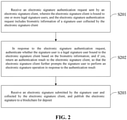
- FIG. 2 a flowchart of a blockchain-based electronic signature method proposed in the present specification at a server side is shown.
- the above method may include the following steps:
- S201 an electronic signature authentication request sent by an electronic signature client is received, wherein the electronic signature client is bound to one or more legal signature users, and the electronic signature authentication request includes biometric information of a signature user collected by the electronic signature client.
- an electronic signature submitted by the signature user and collected by the electronic signature client is received, and the electronic signature is published to a blockchain for deposit.
- the above biometric information may include any information that can reflect inherent physiological characteristics and/or behavioral features of a human body and can be used for identity recognition. It may include image information such as a fingerprint, an iris, and a face, may also include voice information, gait information, and the like, and may also include a combination of the above multiple types of biometric information, and the like. Therefore, the type of biometric information to be used does not need to be specifically limited in the present specification, and those skilled in the art may choose the biometric information to be used by themselves according to specific requirements.
- the above biometric information may include a facial image.
- the image may be a static single frame image, or it may be a multi-frame image or even a video.
- the multi-frame image or video carries more information, and therefore, the above biometric information may be made more reliable.
- the above electronic signature includes any information that may be stored in a computer, can identify the identity of a user, and is used to indicate the corresponding user's confirmation of something.
- the signature may include a name or a preset text such as "Read” and "Agreed” of the user presented in handwriting.
- the signature may include a seal, encryption hardware, a password private key, a dynamic password, and the like unique to the user.
- the user's imprint on a contract with a company's official seal may also be regarded as a special form of signature, and the above imprint is recorded in a computer system by scanning, photographing, and the like, which may be regarded as an electronic signature.
- the above electronic signature client may include any device or software that can interact with a signature user so that the signature user can use it to enter a signature and has the function of collecting biometric information.
- a tablet computer with a front camera and a touch screen can acquire a facial image of a signature user by the camera and regard it as biometric information, and can also collect a signature handwriting written by the user by touching the touch screen, so it may be regarded as an electronic signature client.
- an APP with a human voice collection function and a signature scanning function can collect the user's speech as biometric information through its human voice collection function, and can also scan an image of a paper signature to complete entering of the user signature, and therefore it may also be regarded as an electronic signature client.
- the above server may include any form of server that can provide functions such as sending and receiving, authentication, and storage involved in the above solution. It may be a specific server, a server cluster, or a distributed cloud server. It is understandable that the above server may be interpreted as server hardware or server software. The specific implementation is not specifically limited in the present specification. Those skilled in the art can complete detailed designs with reference to related technologies and specific requirements.
- the above blockchain may include any form of blockchain, either a public blockchain, a private blockchain, or a consortium blockchain. Since different types of blockchains have different advantages and disadvantages, those skilled in the art may choose the blockchain according to their specific needs. The type of the blockchain to be used in the above solution does not need to be limited in the present specification.
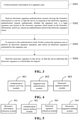
- the above method may include the following steps: In S301, biometric information of a signature user is collected.
- an electronic signature authentication request carrying the biometric information is sent to a server, so that the server, in response to the electronic signature authentication request, authenticates whether the signature user is a legal signature user bound to the electronic signature client based on the biometric information; and if yes, returns an authentication result to the electronic signature client.
- the signature user in response to the authentication result, is further prompted to perform an electronic signature operation, and an electronic signature submitted by the signature user is collected.
- the electronic signature is sent to the server, so that the server publishes the electronic signature to a blockchain for deposit.
- the electronic signature method may include two parts: an authentication stage and a signature stage.
- the above authentication stage may specifically include the following steps: In S101, biometric information is collected.
- the above client may first collect biometric information of a signature user.
- the specific method of collection may vary according to different types of biometric information. For example, in the case of using a facial image as the biometric information, the collection of a facial image of the signature user may be completed by calling a camera. In the case of using voice record as the biometric information, the collection of a voice signal of the signature user may be completed by calling a pickup.
- the specific method used to collect the above biometric information, as well as detailed software and hardware designs, may be completed by those skilled in the art with reference to relevant technical documents according to specific needs, which do not need to be limited in detail in the present specification.
- the electronic signature client may send an authentication request carrying the biometric information to the server to request the server to perform subsequent operations based on the biometric information.
- the above authentication request is not limited to a single message or request, but may also include a group of messages that complete the above functions.
- the authentication request and the biometric information are encapsulated in two or more messages respectively, or the above two or more messages as a whole are regarded as the above authentication request carrying the biometric information.
- the biometric information is authenticated.
- the electronic signature client may be bound to one or more legal signature users in advance, and store the above binding relationships. It is understandable that the electronic signature client may naturally declare its own identity, that is, an identifier of the electronic signature client, to the server in the process of information exchange with the server, which may be reflected in any step of the information exchange, or client identity confirmation information may be sent separately. How to confirm the identity of the electronic signature client does not need to be limited in detail in the present specification.
- the legal signature user having a binding relationship with it may be found correspondingly. Further, according to the biometric information carried in the authentication request sent by the electronic signature client, it may be determined whether the user indicated by the biometric information carried in the authentication request, that is, the signature user, is a legal signature user bound to the electronic signature client.
- the biometric information carried in the authentication request sent by the above electronic signature client may be matched with biometric information of a legal signature user bound to the above electronic signature client that is pre-stored in the server; and if the matching succeeds, it may be determined that the signature user is the legal signature user bound to the electronic signature client.
- biometric information of the legal signature user in the server is only an example implementation.
- the biometric information of the legal signature user may also be stored in another location, and the above task of determining whether the signature user is a legal signature user may be completed indirectly.
- a biometric information database may be preset in the server, and the identity of the signature user may be determined by searching the biometric information database for the biometric information carried in the authentication request, which may be further combined with the above binding relationship between the legal signature user and the electronic signature client to complete the judgment on whether the signature user is a legal signature user bound to the above electronic signature client. More feasible implementations may be determined by those skilled in the art according to specific needs by themselves, which will not be repeated in the present specification.
- the server may return the authentication result to the electronic signature client.
- the authentication result may be in plain text, or encrypted or encoded.
- return information should carry corresponding return code, and the return information carrying the return code should also be understood as a special form of the above authentication result.
- Those skilled in the art can determine the specifically used communication protocol and the used status code to indicate different meanings according to specific needs, which do not need to be limited in detail here in the present specification.
- the authentication stage ends.
- the subsequent signature stage may be entered, thus ensuring that the electronic signature cannot be counterfeited or stolen.
- an electronic signature client may be bound to multiple legal signature users, so that multiple persons may share a device or authorized signature may be performed.
- a legal signature user A with a disability on both hands can authorize user B to become a legal signature user of the electronic signature client that has been bound to A, so that user B can succeed in the above biometric information authentication instead of himself/herself, and then complete the subsequent signature action.
- the authority management logic of the specific implementation may be obtained by those skilled in the art with reference to the relevant technical documents to complete the design, which does not need to be limited in detail in the present specification.
- the above signature stage may include the following steps: In S105, the user is prompted to perform an electronic signature operation.
- the above electronic signature client may prompt the signature user to perform an electronic signature operation in response to the above authentication result.
- the above prompt method may include one of the following manners such as a text field, a picture, a pop-up window, a notification, and a prompt sound, or a combination of multiple manners. Those skilled in the art can determine the used form of prompting method according to specific needs, which does not need to be further limited in the present specification.
- the electronic signature client may collect the electronic signature submitted by the user.
- the collection means of the electronic signature may correspond to the form and characteristics of the electronic signature itself. For example, if the handwriting of a handwritten name is used as the electronic signature, a touch screen or a stylus/screen may be required as an input device, or a camera may need to be called to complete entering of the signature handwriting on a paper document. If a USB hardware key is used as the electronic signature, a corresponding USB communication module may be required to complete the electronic signature collection. Those skilled in the art may obtain the specifically used method for collecting the electronic signature with reference to related technologies to complete the specific design, which is not further limited in the present specification.
- the electronic signature client may send the electronic signature to the above server.
- the electronic signature client may send the electronic signature to the above server.
- Those skilled in the art may refer to related technologies to complete specific designs, which is not further limited in the present specification.
- the electronic signature is deposited on a blockchain.
- the above server may publish the electronic signature to the blockchain for deposit.
- the server may be directly used as an on-blockchain node of the blockchain to broadcast a corresponding deposit transaction in the blockchain, and may also indirectly complete the above publishing and depositing steps by communicating with the node on the above blockchain.
- Those skilled in the art may refer to related technologies to complete the specific design, which is not further limited in the present specification.
- the blockchain itself has the characteristics of being open, transparent, and difficult to tamper with, as long as the signature user submits the electronic signature through the above method, deposit information in the corresponding blockchain may become a credible evidence proving that the electronic signature does exist. Therefore, the user cannot deny the existence of the previously submitted electronic signature. Moreover, in the above entire scheme, only the legal signature user can submit the electronic signature, so the user cannot deny the identity of the submitter of the electronic signature. Therefore, compared with related art, the electronic signature in this solution has higher credibility.
- the legal signature user may be pre-bound to the electronic signature client for subsequent use.
- the electronic signature client may send a binding request of the legal signature user to the server, and the binding request may carry the collected biometric information of a user to be bound and its identity identifier, so that the server can verify the identity identifier and biometric information of the user to be bound to determine whether the two indicate the same natural person. If yes, the above biometric information may be bound to the electronic signature client, and the above binding relationship may be stored.
- the process may be directly completed by the above server. In other cases, the process may also be completed indirectly through a third-party certification authority.
- the specific implementation method may be selected by a person skilled in the art according to the actual situation.
- the above server may send a verification request to the third-party certification authority, the verification request carrying the biometric information and the identity identifier of the user to be bound, so that the third-party certification authority, in response to the verification request, may inquiry biometric information corresponding to the identity identifier, and after the biometric information of the user to be bound is matched with the biometric information obtained by the inquiry, return a result of the matching. After that, it can be determined, according to the result of the matching, whether the biometric information of the user to be bound and the identity identifier of the user to be bound indicate the same natural person.
- the third-party certification authority in the above example may be a public security network, or another service provider that can provide a service for inquiring correspondences between biometric information and identity identifiers, which may be specifically selected by a developer according to specific needs, and does not need to be limited in the present specification.
- the electronic signature client or server may use liveness detection to ensure that the signature user is a real alive user.
- the above liveness detection may include a dynamic detection focusing on responses of a signature user, and a static detection focusing on biometric information itself.
- the biometric information is preset as a facial image in the form of a video, then, each time the biometric information is collected, a randomly generated password may be output to the user, and the user may be asked to read the password, so that a captured video will contain mouth shape change information when the user reads the password. If the mouth shape change information matches the above randomly generated password, it is determined that the user succeeds in the liveness recognition.
- the above detection process may be attributed to dynamic detection that focuses on user interaction and participation. Based on this idea, those skilled in the art can apply relevant technical means to design other forms of dynamic liveness detection methods, which are not further limited in the present specification.
- the collected facial image may be compared with existing facial images on the Internet, or it may be determined whether the collected facial image is an existing image through watermark checking, thereby determining whether the user is an alive user. Specifically, if a watermark is found on the collected facial image, it may be determined that the facial image is an existing image instead of a facial image captured in real time, which proves that the user is not an alive user. If the collected facial image is the same as the existing facial image on the Internet, it may be determined that the facial image is not a facial image taken in real time, which also proves that the user is not an alive user.
- the specific algorithms for judging the watermark and identical images may be obtained with reference to relevant technical literature, which do not need to be repeated in the present specification.
- Applying the above liveness detection method can ensure that the signature user is a real alive user, thereby ensuring that the collected biometric information is submitted by a real alive user, and to a certain extent avoiding the problem that some users fool the biometric recognition mechanism by stealing biometric information such as pictures and fingerprints of others.
- the above server may detect whether the binding request is a network attack, thereby shielding the above network attack and improving the security of the server.
- common network attacks may include repeated requests, invalid requests, and the like with a quantity that exceeds a threshold.
- a corresponding detection method may be a blacklist-based or feature-based detection. Those skilled in the art may choose and design the specific network attack detection method to be adopted according to specific needs, which does not need to be specifically limited in the present specification.
- the quantity of binding requests issued by an IP address exceeds a preset threshold, it can be determined that the IP is launching a network attack on the server, and the IP is placed in the blacklist. When a binding request from the IP is received subsequently, it may be blocked directly.
- the field may be added to the above feature database in advance, and subsequently, once it is found that the binding request contains this field, the binding request may be determined as a network attack and then blocked.
- the above electronic signature client may add other information to the electronic signature before sending the electronic signature to the server.
- the specific method of addition may be repackaging the above other information to generate a new electronic signature. It is also possible to embed the above information in an electronic signature by means of digital watermarking, etc.
- relevant technical documents which are not further limited in the present specification.
- the above electronic signature may also include a signature moment and/or recognized signature content.
- the above information is added to the electronic signature and participates in subsequent deposit. Then, when inquiring is needed, the above signature moment and/or the recognized signature content may be found as well by querying the electronic signature, which facilitates realization of functions such as information statistics and verification.
- the electronic signature is published to the blockchain for deposit.
- the electronic signature may be directly stored in a distributed database of the blockchain.
- the electronic signature may be hashed, and the obtained hash value is stored only in the distributed database of the blockchain.
- plaintext storage is convenient to increase transparency and facilitates publicity and supervision, but it may cause a waste of resources on the blockchain; however, storing the hash value may also meet the functional requirements of deposit and verification, but the original text cannot be directly obtained.
- an off-chain database storing the original text of the original electronic signature may be used cooperatively.
- Those skilled in the art may design the specific deposit method according to specific needs, which does not need to be specifically limited in the present specification.
- the above process of publishing the electronic signature to the blockchain for deposit may include the process of hashing the electronic signature, and publishing the obtained hash value of the electronic signature to the blockchain for deposit.
- the above process of publishing the electronic signature to the blockchain for deposit may include the process of encrypting the electronic signature, and publishing the encrypted electronic signature to the blockchain for deposit.
- a blockchain-based electronic signature apparatus is further proposed in the present specification, which is applied to the server and the electronic signature client respectively.
- FIG. 4 a structural diagram of a blockchain-based electronic signature apparatus according to the present specification applied to a server is shown.
- the apparatus includes the following modules.
- Authentication request receiving module 401 is configured to receive an electronic signature authentication request sent by an electronic signature client, wherein the electronic signature client is bound to one or more legal signature users, and the electronic signature authentication request includes biometric information of a signature user collected by the electronic signature client.
- Signature user authentication module 402 is configured to, in response to the electronic signature authentication request, authenticate whether the signature user is a legal signature user bound to the electronic signature client based on the biometric information; and if yes, return an authentication result to the electronic signature client, so that the electronic signature client further prompts the signature user to perform an electronic signature operation in response to the authentication result.
- Electronic signature deposit module 403 is configured to receive an electronic signature submitted by the signature user and collected by the electronic signature client, and publish the electronic signature to a blockchain for deposit.
- the above apparatus may further include a binding request receiving module and a first binding module.
- the binding request receiving module may be configured to receive a binding request of the legal signature user sent by the electronic signature client, wherein the binding request may include an identity identifier of a user to be bound and biometric information of the user to be bound collected by the electronic signature client.
- the above first binding module may be configured to, in response to the binding request, determine whether the biometric information of the user to be bound and the identity identifier of the user to be bound indicate the same natural person; and if the same natural person is indicated, bind the biometric information of the user to be bound to the electronic signature client, and store a binding relationship.
- the above first binding module may further send a verification request to a third-party certification authority, the verification request carrying the biometric information and the identity identifier of the user to be bound, so that the third-party certification authority, in response to the verification request, inquires biometric information corresponding to the identity identifier, and after the biometric information of the user to be bound is matched with the biometric information obtained by the inquiry, returns a result of the matching. After that, it can be determined, according to the result of the matching, whether the biometric information of the user to be bound and the identity identifier of the user to be bound indicate the same natural person.
- the third-party certification authority in the above example may be a public security network, or another service provider that can provide a service for inquiring correspondences between biometric information and identity identifiers, which may be specifically selected by a developer according to specific needs, and does not need to be limited in the present specification.
- a biometric information sample of a legal signature user bound to the electronic signature client is stored in the server.
- the above signature user authentication module 402 may further match the above biometric information with the biometric information sample stored in the server; and if the matching succeeds, the above signature user may be determined as the legal signature user bound to the electronic signature client.
- the above biometric information may be a facial image.
- the above electronic signature may include a signature handwriting of the user.
- the above electronic signature may further include a signature moment and/or recognized signature content.
- FIG. 5 a structural diagram of a blockchain-based electronic signature apparatus applied to an electronic signature client according to the present specification is shown.
- the electronic signature client is bound to one or more legal signature users.
- the apparatus includes the following modules.
- Biometric information collection module 501 is configured to collect biometric information of a signature user.
- Authentication request sending module 502 is configured to send an electronic signature authentication request carrying the biometric information to a server, so that the server, in response to the electronic signature authentication request, authenticates whether the signature user is a legal signature user bound to the electronic signature client based on the biometric information; and if yes, returns an authentication result to the electronic signature client.
- Electronic signature collection module 503 is configured to, in response to the authentication result, further prompt the signature user to perform an electronic signature operation, and collect an electronic signature submitted by the signature user.
- Electronic signature sending module 504 is configured to send the electronic signature to the server, so that the server publishes the electronic signature to a blockchain for deposit.
- the above process of authenticating, based on the above biometric information, whether the above signature user is a legal signature user bound to the above electronic signature client may specifically include matching the above biometric information with the biometric information sample stored in the server; and if the matching succeeds, determining the above signature user as the legal signature user bound to the electronic signature client.
- the above apparatus may further include a second binding module.
- the module may first collect biometric information of a user to be bound, and acquire identity identifier of the above user to be bound; send a binding request of a legal signature user to the server, the binding request carrying the identity identifier of the user to be bound and the biometric information of the user to be bound, so that the server, in response to the binding request, determines whether the biometric information of the user to be bound and the identity identifier of the user to be bound indicate the same natural person, and in a case that the same natural person is indicated, binds the biometric information of the user to be bound to the electronic signature client, and stores a binding relationship.
- the above process of determining whether the biometric information of the user to be bound and the identity identifier of the user to be bound indicate the same natural person may include first sending a verification request to a third-party certification authority, the verification request carrying the biometric information and the identity identifier of the user to be bound, so that the third-party certification authority, in response to the verification request, inquires biometric information corresponding to the identity identifier, and after the biometric information of the user to be bound is matched with the biometric information obtained by the inquiry, returns a result of the matching. After that, it can be determined, according to the result of the matching, whether the biometric information of the user to be bound and the identity identifier of the user to be bound indicate the same natural person.
- the above process of publishing the electronic signature to the blockchain for deposit may include encrypting the electronic signature, and further publishing the encrypted electronic signature to the blockchain for deposit.
- the above biometric information may be a facial image.
- the above electronic signature may include a signature handwriting of the user.
- the above electronic signature may further include a signature moment and/or recognized signature content.
- a computer device is further provided in the embodiments of the present specification, which includes at least a memory, a processor, and a computer program stored on the memory and executable on the processor, wherein the processor, when executing the program, implements the foregoing blockchain-based electronic signature method applied to the server.
- FIG. 6 is a schematic diagram of a more specific hardware structure of a computing device according to an embodiment of the present specification.
- the device may include: processor 601, memory 602, input/output interface 603, communication interface 604, and bus 605.
- processor 601, memory 602, input/output interface 603, and communication interface 604 realize mutual communication connection in the device through bus 605.
- Processor 601 may be implemented by a general-purpose Central Processing Unit (CPU), a microprocessor, an Application Specific Integrated Circuit (ASIC), or one or more integrated circuits, and for executing related programs to implement the technical solutions provided by the embodiments of the present specification.
- CPU Central Processing Unit
- ASIC Application Specific Integrated Circuit
- Memory 602 may be implemented by a Read Only Memory (ROM), a Random Access Memory (RAM), a static storage device, a dynamic storage device, etc.
- Memory 602 may store an operating system and other application programs.
- ROM Read Only Memory
- RAM Random Access Memory
- static storage device static storage device
- dynamic storage device etc.
- Memory 602 may store an operating system and other application programs.
- Input/output interface 603 is configured to be connected to an input/output module to realize information input and output.
- the input/output module may be configured as a component in the device (not shown in the drawing), or may also be externally connected to the device to provide corresponding functions.
- An input device may include a keyboard, a mouse, a touch screen, a microphone, various sensors, etc.
- an output device may include a display, a speaker, a vibrator, an indicator light, etc.
- Communication interface 604 is configured to be connected to a communication module (not shown in the drawing) to implement communication interaction between the device and other devices.
- the communication module may realize communication in a wired mode (such as a USB and a network cable), or in a wireless mode (such as a mobile network, WIFI, and Bluetooth).
- Bus 605 includes an access and transmits information between all components (such as processor 601, memory 602, input/output interface 603, and communication interface 604) of the device.
- the above device only shows processor 601, memory 602, input/output interface 603, communication interface 604, and bus 605, the device may also include other components necessary to achieve normal operation in a specific implementation process.
- the above device may also include only the components necessary to implement the solutions of the embodiments of the present specification, rather than including all the components shown in the figures.
- a computer device is further provided in the embodiments of the present specification, which includes at least a memory, a processor, and a computer program stored on the memory and executable on the processor, wherein the processor, when executing the program, implement the foregoing blockchain-based electronic signature method applied to an electronic signature client.
- FIG. 7 is a schematic diagram of a more specific hardware structure of a computing device according to an embodiment of the present specification.
- the device may include: processor 701, memory 702, input/output interface 703, communication interface 704, and bus 705.
- processor 701, memory 702, input/output interface 703, and communication interface 704 realize mutual communication connection in the device through bus 705.
- Processor 701 may be implemented by a general-purpose Central Processing Unit (CPU), a microprocessor, an Application Specific Integrated Circuit (ASIC), or one or more integrated circuits, and for executing related programs to implement the technical solutions provided by the embodiments of the present specification.
- CPU Central Processing Unit
- ASIC Application Specific Integrated Circuit
- Memory 702 may be implemented by a Read Only Memory (ROM), a Random Access Memory (RAM), a static storage device, a dynamic storage device, etc.
- Memory 702 may store an operating system and other application programs.
- ROM Read Only Memory
- RAM Random Access Memory
- static storage device static storage device
- dynamic storage device etc.
- Memory 702 may store an operating system and other application programs.
- Input/output interface 703 is configured to be connected to an input/output module to realize information input and output.
- the input/output module may be configured as a component in the device (not shown in the drawing), or may also be externally connected to the device to provide corresponding functions.
- An input device may include a keyboard, a mouse, a touch screen, a microphone, various sensors, etc.
- an output device may include a display, a speaker, a vibrator, an indicator light, etc.
- Communication interface 704 is configured to be connected to a communication module (not shown in the drawing) to implement communication interaction between the device and other devices.
- the communication module may realize communication in a wired mode (such as a USB and a network cable), or in a wireless mode (such as a mobile network, WIFI, and Bluetooth).
- Bus 705 includes an access and transmits information between all components (such as processor 701, memory 702, input/output interface 703, and communication interface 704) of the device.
- the above device only shows processor 701, memory 702, input/output interface 703, communication interface 704, and bus 705, the device may also include other components necessary to achieve normal operation in a specific implementation process.
- the above device may also include only the components necessary to implement the solutions of the embodiments of the present specification, rather than including all the components shown in the figures.
- a computer-readable storage medium on which a computer program is stored is further provided in the embodiments of the present specification, and the program, when executed by a processor, performs the foregoing blockchain-based electronic signature method applied to a server.
- a computer-readable storage medium on which a computer program is stored is further provided in the embodiments of the present specification, and the program, when executed by a processor, performs the foregoing blockchain-based electronic signature method applied to an electronic signature client.
- the computer-readable medium includes permanent and non-permanent, removable and non-removable media, and can store information by any method or technology.
- the information may be computer-readable instructions, data structures, program modules, or other data.
- Examples of computer storage media include, but are not limited to, a phase change memory (PRAM), a static random access memory (SRAM), a dynamic random access memory (DRAM), other types of random access memories (RAM), read-only memories (ROM), electrically erasable programmable read-only memories (EEPROM), flash memories or other memory technologies, read-only compact disc read-only memories (CD-ROM), digital versatile disks (DVD) or other optical storage, magnetic tape cassettes, magnetic tape magnetic disk storage or other magnetic storage devices, or any other non-transmission media, and the computer storage media may be used to store information that may be accessed by computing devices.
- the computer-readable medium does not include transitory computer readable media (transitory media), such as a modulated data signal and a carrier.
- the system, apparatus, module, or unit explained in the above embodiments may be specifically implemented by a computer chip or entity, or implemented by a product having a certain function.
- a typical implementation device is a computer, and the specific form of the computer may be a personal computer, a laptop computer, a cellular phone, a camera phone, a smart phone, a personal digital assistant, a media player, a navigation device, an email sending and receiving device, a game console, a tablet computer, a wearable device, or a combination of any of these devices.
- the embodiments in the present specification are described in a progressive manner.
- the same or similar parts between the embodiments may be referred to by each other.
- Each embodiment focuses on differences from other embodiments.
- the apparatus embodiment is described relatively simply since it is basically similar to the method embodiment, and part of the description of the method embodiment may be referenced for relevant parts.
- the apparatus embodiment described above is only schematic, wherein the modules described as separate components may or may not be physically separated, and the functions of the modules may be implemented in the same or multiple pieces of software and/or hardware when the solutions of the embodiments of the present specification are implemented. Part or all of the modules may also be selected according to actual needs to achieve the purpose of the solution of the present embodiment. Those of ordinary skill in the art may understand and implement without creative effort.
Landscapes
- Engineering & Computer Science (AREA)
- Computer Security & Cryptography (AREA)
- Signal Processing (AREA)
- Computer Networks & Wireless Communication (AREA)
- Theoretical Computer Science (AREA)
- General Engineering & Computer Science (AREA)
- Computer Hardware Design (AREA)
- Software Systems (AREA)
- General Physics & Mathematics (AREA)
- Physics & Mathematics (AREA)
- Health & Medical Sciences (AREA)
- General Health & Medical Sciences (AREA)
- Biomedical Technology (AREA)
- Biodiversity & Conservation Biology (AREA)
- Life Sciences & Earth Sciences (AREA)
- Computing Systems (AREA)
- Bioethics (AREA)
- Financial Or Insurance-Related Operations Such As Payment And Settlement (AREA)
- Collating Specific Patterns (AREA)
Abstract
Description
- The present specification relates to the field of computer applications, and in particular, to a blockchain-based electronic signature method and apparatus.
- The blockchain technology, also referred to as a distributed ledger technology, is an emerging technology in which several computing devices participate in "book-keeping" and jointly maintain a complete distributed database. The blockchain technology has characteristics of decentralization, openness, and transparency, each computing device can participate in database recording, and rapid data synchronization can be performed between computing devices, so that the blockchain technology has been widely used in many fields.
- In view of the above, a blockchain-based electronic signature method and apparatus are disclosed in the present specification.
- According to a first aspect of embodiments of the present specification, a blockchain-based electronic signature method applied to a server is disclosed, and the method includes:
- receiving an electronic signature authentication request sent by an electronic signature client, wherein the electronic signature client is bound to one or more legal signature users, and the electronic signature authentication request includes biometric information of a signature user collected by the electronic signature client;
- in response to the electronic signature authentication request, authenticating whether the signature user is a legal signature user bound to the electronic signature client based on the biometric information; and if yes, returning an authentication result to the electronic signature client, so that the electronic signature client further prompts the signature user to perform an electronic signature operation in response to the authentication result; and
- receiving an electronic signature submitted by the signature user and collected by the electronic signature client, and publishing the electronic signature to a blockchain for deposit.
- According to a second aspect of the embodiments of the present specification, a blockchain-based electronic signature method applied to an electronic signature client to which one or more legal signature users are bound is disclosed, and the method includes:
- collecting biometric information of a signature user;
- sending an electronic signature authentication request carrying the biometric information to a server, so that the server, in response to the electronic signature authentication request, authenticates whether the signature user is a legal signature user bound to the electronic signature client based on the biometric information; and if yes, returns an authentication result to the electronic signature client;
- in response to the authentication result, further prompting the signature user to perform an electronic signature operation, and collecting an electronic signature submitted by the signature user; and
- sending the electronic signature to the server, so that the server publishes the electronic signature to a blockchain for deposit.
- According to a third aspect of embodiments of the present specification, a blockchain-based electronic signature apparatus applied to a server is disclosed, and the apparatus includes:
- an authentication request receiving module configured to receive an electronic signature authentication request sent by an electronic signature client, wherein the electronic signature client is bound to one or more legal signature users, and the electronic signature authentication request includes biometric information of a signature user collected by the electronic signature client;
- a signature user authentication module configured to, in response to the electronic signature authentication request, authenticate whether the signature user is a legal signature user bound to the electronic signature client based on the biometric information; and if yes, return an authentication result to the electronic signature client, so that the electronic signature client further prompts the signature user to perform an electronic signature operation in response to the authentication result; and
- an electronic signature deposit module configured to receive an electronic signature submitted by the signature user and collected by the electronic signature client, and publish the electronic signature to a blockchain for deposit.
- According to a fourth aspect of the embodiments of the present specification, a blockchain-based electronic signature apparatus applied to an electronic signature client to which one or more legal signature users are bound is disclosed, and the apparatus includes:
- a biometric information collection module configured to collect biometric information of a signature user;
- an authentication request sending module configured to send an electronic signature authentication request carrying the biometric information to a server, so that the server, in response to the electronic signature authentication request, authenticates whether the signature user is a legal signature user bound to the electronic signature client based on the biometric information; and if yes, returns an authentication result to the electronic signature client;
- an electronic signature collection module configured to, in response to the authentication result, further prompt the signature user to perform an electronic signature operation, and collect an electronic signature submitted by the signature user; and
- an electronic signature sending module configured to send the electronic signature to the server, so that the server publishes the electronic signature to a blockchain for deposit.
- In the above technical solutions, on the one hand, because the biometric information is used to verify the identity of the user participating in the signature before the electronic signature is performed, it is guaranteed that the sent electronic signature must come from the user himself/herself, thus preventing the electronic signature from being stolen and counterfeited.
- On the other hand, the completed electronic signature will be sent to the blockchain for deposit, and the blockchain itself has the characteristics of being open and transparent and difficult to tamper with; therefore, it may curb a denial behavior of the user of not admitting the electronic signature issued by the user himself/herself.
- The accompanying drawings herein are incorporated into the specification and constitute a part of the present specification, show embodiments consistent with the present specification, and are used to explain the principles together with the text of the present specification.
-
FIG. 1 is an interactive flowchart of a blockchain-based electronic signature method according to the present specification; -
FIG. 2 is a flowchart of a blockchain-based electronic signature method according to the present specification; -
FIG. 3 is another flowchart of a blockchain-based electronic signature method according to the present specification; -
FIG. 4 is a structural diagram of a blockchain-based electronic signature apparatus according to the present specification; -
FIG. 5 is another structural diagram of a blockchain-based electronic signature apparatus according to the present specification; -
FIG. 6 is a schematic structural diagram of a computing device configured to perform electronic signature according to the present specification; and -
FIG. 7 is a schematic structural diagram of another computing device configured to perform electronic signature according to the present specification. - In order to enable those skilled in the art to better understand the technical solutions in one or more embodiments in the present specification, the technical solutions in the one or more embodiments of the present specification will be described clearly and completely with reference to the accompanying drawings in the one or more embodiments of the present specification. It is apparent that the described embodiments are merely some of rather than all the embodiments of the present application. Based on the one or more embodiments in the present specification, all other embodiments obtained by a person of ordinary skill in the art without creative efforts shall fall within the protection scope of the present specification.
- When the following description involves the accompanying drawings, the same numerals in the different accompanying drawings indicate the same or similar elements, unless otherwise indicated. The implementation modes described in the following example embodiments do not represent all implementation modes consistent with the present specification. Instead, they are merely examples of systems and methods consistent with some aspects of the present specification as detailed in the appended claims.
- The terminology used in the present specification is for the purpose of describing particular embodiments only, and is not intended to limit the present specification. The singular forms "a," "said," and "the" used in the present specification and the appended claims are also intended to include plural forms, unless other meanings are clearly indicated in the context. It should also be understood that the term "and/or" as used herein refers to and encompasses any or all possible combinations of one or more associated listed items.
- It should be understood that although the terms first, second, third, etc. may be used to describe various information in the present specification, the information should not be limited to these terms. These terms are only used to distinguish the same type of information from each other. For example, without departing from the scope of the present specification, first information may also be referred to as second information, and similarly, the second information may also be referred to as the first information. Depending on the context, the word "if" as used herein may be interpreted as "at the time of" or "when" or "in response to determination."
- The present specification aims to propose an electronic signature solution that can guarantee that users cannot deny and is difficult to be stolen or counterfeited.
- In daily life, users often need to use signatures to confirm services when handling services. However, once a user's signature feature is stolen, there may be an error in which a signature of another person is also approved. This further leads to decline in credibility of the signature, even a real signature user may deny a previous signature.
- For example, when handling a network access service at a business hall of an Internet Service Provider (ISP), a user is usually required to sign his/her name on a client terminal such as a tablet or handwriting pad, or sign the name on a paper contract which is then scanned for storage, so as to confirm that the processing of the above network access service is approved by the user himself/herself.
- However, once the above signatures are counterfeited or stolen by others, it may cause losses to users and merchants. Moreover, since the signatures may be counterfeited, the credibility of the signatures may decline, and some users may deny previous signatures with the excuse that the signatures are stolen by others, and this will further cause the loss of merchants' interests.
- Therefore, an electronic signature method that can guarantee that users cannot deny and is difficult to be stolen or counterfeited is in urgent need.
- Based on the above problems, an electronic signature solution is proposed in the present specification, in which identity of a signature user is authenticated with the aid of the biometric technology, an electronic signature is performed after the authentication succeeds, and the completed signature is published to a blockchain for deposit.
- During implementation, a legal signature user may be bound to an electronic signature client in advance, and store his/her own biometric information and the above binding relationship on a server, so that the identity of the signature user is authenticated through the biometric information in the subsequent process. After the signature is completed, a collected electronic signature may be published to a blockchain through the server to complete deposit.
- In the above solution, on the one hand, the signature user must succeed in identity authentication before signing. If the signature user is not a user who is bound to the electronic signature client used, he/she will be failed in the biometric information authentication, and therefore cannot perform the signature action. Therefore, the electronic signature in the above solution is difficult to be counterfeited or stolen.
- On the other hand, the completed electronic signature will be published to the blockchain for deposit, and the blockchain itself has the characteristics of being decentralized, open, and transparent, and difficult to tamper with; therefore, the electronic signature in the above solution cannot be denied once it is signed.
- The blockchain is a data structure that can be used for deposit, and is generally classified into three types: Public Blockchain, Private Blockchain, and Consortium Blockchain. In addition, there may also be a combination of the above types, for example, private blockchain + consortium blockchain, consortium blockchain + public blockchain, and the like.
- The most decentralized one is the public blockchain. The public blockchain is represented by Bitcoin and Ethereum. Participants who join the public blockchain (also referred to as nodes in the blockchain) can read data records on the blockchain, participate in transactions, compete for book-keeping rights of new blocks, and the like. Moreover, each node can freely join or exit the network and perform related operations.
- The private blockchain is the opposite. A write permission of the network is controlled by an organization or institution, and a data read permission is regulated by the organization. In simple terms, a private blockchain may be a weakly centralized system with strict restrictions on nodes and a small number of nodes. This type of blockchain is more suitable for internal use by a specific institution.
- The consortium blockchain is a blockchain between the public blockchain and the private blockchain, which may achieve "partial decentralization." Each node in the consortium blockchain usually has a corresponding entity or organization. The nodes are authorized to join the network and form an interests-related consortium to jointly maintain the operation of the blockchain.
- Based on basic characteristics of the blockchain, a blockchain is usually composed of several blocks. Timestamps corresponding to creation time of blocks are recorded in these blocks respectively, and all the blocks strictly follow the timestamps recorded in the blocks to form a time-ordered data chain.
- For real data generated in the physical world, it may be constructed into a standard transaction format supported by a blockchain, and then published to the blockchain. Node devices in the blockchain perform consensus processing on the received transaction, and after a consensus is reached, a node device serving as a book-keeping node in the blockchain packages the transaction into the block and performs persistent deposit in the blockchain.
- Consensus algorithms supported in the blockchain may include:
- a first type of consensus algorithm, that is, a consensus algorithm that node devices need to compete for the book-keeping right of each round of book-keeping cycle; for example, a consensus algorithms such as Proof of Work (POW), Proof of Stake (POS), and Delegated Proof of Stake (DPOS); and
- a second type of consensus algorithm, that is, a consensus algorithm that pre-selects a book-keeping node for each round of book-keeping cycle (without the need of competing for the book-keeping right); for example, a consensus algorithm such as Practical Byzantine Fault Tolerance (PBFT).
- In the blockchain network using the first type of consensus algorithm, all node devices that compete for the book-keeping right may execute a transaction after receiving the transaction. One of the node devices competing for the book-keeping right may win in this round and become the book-keeping node. The book-keeping node may package the received transaction together with other transactions to generate the latest block, and send the generated latest block or a block header of the latest block to other node devices for consensus.
- In the blockchain network using the second type of consensus algorithm, a node device with the book-keeping right has been agreed before this round of book-keeping. Therefore, after a node device receives a transaction, if it is not the book-keeping node of this round, it may send the transaction to the book-keeping node. For the book-keeping node of this round, the transaction may be executed during or before the process of packaging the transaction together with other transactions to generate the latest block. After the latest block is generated, the book-keeping node may send the latest block or a block header of the latest block to other node devices for consensus.
- As described above, regardless of the consensus algorithm adopted by the blockchain, the book-keeping node of this round can package the received transaction to generate the latest block, and send the generated latest block or a block header of the latest block to other node devices for consensus verification. After the latest block or the block header of the latest block is received, if it is verified by the other node device that there is no problem, the latest block may be appended to the end of the original blockchain to complete the book-keeping process of the blockchain. In the process of verifying a new block or block header sent by the book-keeping node, other nodes may also execute the transaction contained in the block.
- As can be seen, publishing the electronic signature completed by the signature user to the blockchain for deposit may achieve the effect of public and persistent deposit.
- The present specification is described below through specific embodiments in combination with specific application scenarios.
- Please refer to
FIG. 2 , a flowchart of a blockchain-based electronic signature method proposed in the present specification at a server side is shown. In this example, the above method may include the following steps:
In S201, an electronic signature authentication request sent by an electronic signature client is received, wherein the electronic signature client is bound to one or more legal signature users, and the electronic signature authentication request includes biometric information of a signature user collected by the electronic signature client. - In S202, in response to the electronic signature authentication request, whether the signature user is a legal signature user bound to the electronic signature client is authenticated based on the biometric information; and if yes, an authentication result is returned to the electronic signature client, so that the electronic signature client further prompts the signature user to perform an electronic signature operation in response to the authentication result.
- In S203, an electronic signature submitted by the signature user and collected by the electronic signature client is received, and the electronic signature is published to a blockchain for deposit.
- The above biometric information may include any information that can reflect inherent physiological characteristics and/or behavioral features of a human body and can be used for identity recognition. It may include image information such as a fingerprint, an iris, and a face, may also include voice information, gait information, and the like, and may also include a combination of the above multiple types of biometric information, and the like. Therefore, the type of biometric information to be used does not need to be specifically limited in the present specification, and those skilled in the art may choose the biometric information to be used by themselves according to specific requirements.
- In the illustrated implementation, the above biometric information may include a facial image. Specifically, the image may be a static single frame image, or it may be a multi-frame image or even a video. The multi-frame image or video carries more information, and therefore, the above biometric information may be made more reliable.
- The above electronic signature includes any information that may be stored in a computer, can identify the identity of a user, and is used to indicate the corresponding user's confirmation of something. In a narrow sense, the signature may include a name or a preset text such as "Read" and "Agreed" of the user presented in handwriting. In a broad sense, the signature may include a seal, encryption hardware, a password private key, a dynamic password, and the like unique to the user. For example, the user's imprint on a contract with a company's official seal may also be regarded as a special form of signature, and the above imprint is recorded in a computer system by scanning, photographing, and the like, which may be regarded as an electronic signature.
- The above electronic signature client may include any device or software that can interact with a signature user so that the signature user can use it to enter a signature and has the function of collecting biometric information. For example, a tablet computer with a front camera and a touch screen can acquire a facial image of a signature user by the camera and regard it as biometric information, and can also collect a signature handwriting written by the user by touching the touch screen, so it may be regarded as an electronic signature client.
- For another example, an APP with a human voice collection function and a signature scanning function can collect the user's speech as biometric information through its human voice collection function, and can also scan an image of a paper signature to complete entering of the user signature, and therefore it may also be regarded as an electronic signature client.
- The above server may include any form of server that can provide functions such as sending and receiving, authentication, and storage involved in the above solution. It may be a specific server, a server cluster, or a distributed cloud server. It is understandable that the above server may be interpreted as server hardware or server software. The specific implementation is not specifically limited in the present specification. Those skilled in the art can complete detailed designs with reference to related technologies and specific requirements.
- The above blockchain may include any form of blockchain, either a public blockchain, a private blockchain, or a consortium blockchain. Since different types of blockchains have different advantages and disadvantages, those skilled in the art may choose the blockchain according to their specific needs. The type of the blockchain to be used in the above solution does not need to be limited in the present specification.
- It is understandable that if the above method is specifically applied to the above electronic signature client, please refer to
FIG. 3 , a flowchart of the above blockchain-based electronic signature method at a client side is shown. In this example, the above method may include the following steps:
In S301, biometric information of a signature user is collected. - In S302, an electronic signature authentication request carrying the biometric information is sent to a server, so that the server, in response to the electronic signature authentication request, authenticates whether the signature user is a legal signature user bound to the electronic signature client based on the biometric information; and if yes, returns an authentication result to the electronic signature client.
- In S303, in response to the authentication result, the signature user is further prompted to perform an electronic signature operation, and an electronic signature submitted by the signature user is collected.
- In S304, the electronic signature is sent to the server, so that the server publishes the electronic signature to a blockchain for deposit.
- For the convenience of description, please refer to
FIG. 1 , an interactive flowchart of a blockchain-based electronic signature method according to an embodiment of the present specification is shown. The electronic signature method may include two parts: an authentication stage and a signature stage. The above authentication stage may specifically include the following steps:
In S101, biometric information is collected. - In the present specification, the above client may first collect biometric information of a signature user. Specifically, the specific method of collection may vary according to different types of biometric information. For example, in the case of using a facial image as the biometric information, the collection of a facial image of the signature user may be completed by calling a camera. In the case of using voice record as the biometric information, the collection of a voice signal of the signature user may be completed by calling a pickup. The specific method used to collect the above biometric information, as well as detailed software and hardware designs, may be completed by those skilled in the art with reference to relevant technical documents according to specific needs, which do not need to be limited in detail in the present specification.
- In S102, an authentication request carrying the biometric information is sent.
- In the present specification, after the above biometric information is collected, the electronic signature client may send an authentication request carrying the biometric information to the server to request the server to perform subsequent operations based on the biometric information. It is understandable that the above authentication request is not limited to a single message or request, but may also include a group of messages that complete the above functions. For example, the authentication request and the biometric information are encapsulated in two or more messages respectively, or the above two or more messages as a whole are regarded as the above authentication request carrying the biometric information.
- In S103, the biometric information is authenticated.
- In the present specification, the electronic signature client may be bound to one or more legal signature users in advance, and store the above binding relationships. It is understandable that the electronic signature client may naturally declare its own identity, that is, an identifier of the electronic signature client, to the server in the process of information exchange with the server, which may be reflected in any step of the information exchange, or client identity confirmation information may be sent separately. How to confirm the identity of the electronic signature client does not need to be limited in detail in the present specification.
- In the present specification, on the premise that the identity of the electronic signature client is known, the legal signature user having a binding relationship with it may be found correspondingly. Further, according to the biometric information carried in the authentication request sent by the electronic signature client, it may be determined whether the user indicated by the biometric information carried in the authentication request, that is, the signature user, is a legal signature user bound to the electronic signature client.
- In an illustrated implementation, the biometric information carried in the authentication request sent by the above electronic signature client may be matched with biometric information of a legal signature user bound to the above electronic signature client that is pre-stored in the server; and if the matching succeeds, it may be determined that the signature user is the legal signature user bound to the electronic signature client.
- It is understandable that storing the biometric information of the legal signature user in the server is only an example implementation. In a practical application, the biometric information of the legal signature user may also be stored in another location, and the above task of determining whether the signature user is a legal signature user may be completed indirectly.
- In another implementation, a biometric information database may be preset in the server, and the identity of the signature user may be determined by searching the biometric information database for the biometric information carried in the authentication request, which may be further combined with the above binding relationship between the legal signature user and the electronic signature client to complete the judgment on whether the signature user is a legal signature user bound to the above electronic signature client. More feasible implementations may be determined by those skilled in the art according to specific needs by themselves, which will not be repeated in the present specification.
- In S104, an authentication result is returned.
- In the present specification, if the above authentication result is yes, the server may return the authentication result to the electronic signature client. The authentication result may be in plain text, or encrypted or encoded. For example, if agreed in advance, if the above authentication result is yes, return information should carry corresponding return code, and the return information carrying the return code should also be understood as a special form of the above authentication result. Those skilled in the art can determine the specifically used communication protocol and the used status code to indicate different meanings according to specific needs, which do not need to be limited in detail here in the present specification.
- So far, the authentication stage ends. Through the above authentication stage, it is ensured that only when the signature user succeeds in the authentication, that is, the signature user is indeed a legal signature user bound to the electronic signature client, the subsequent signature stage may be entered, thus ensuring that the electronic signature cannot be counterfeited or stolen.
- It is understandable that an electronic signature client may be bound to multiple legal signature users, so that multiple persons may share a device or authorized signature may be performed. For example, a legal signature user A with a disability on both hands can authorize user B to become a legal signature user of the electronic signature client that has been bound to A, so that user B can succeed in the above biometric information authentication instead of himself/herself, and then complete the subsequent signature action. The authority management logic of the specific implementation may be obtained by those skilled in the art with reference to the relevant technical documents to complete the design, which does not need to be limited in detail in the present specification.
- The above signature stage may include the following steps:
In S105, the user is prompted to perform an electronic signature operation. - In the present specification, the above electronic signature client may prompt the signature user to perform an electronic signature operation in response to the above authentication result. Specifically, the above prompt method may include one of the following manners such as a text field, a picture, a pop-up window, a notification, and a prompt sound, or a combination of multiple manners. Those skilled in the art can determine the used form of prompting method according to specific needs, which does not need to be further limited in the present specification.
- In S106, an electronic signature is collected.
- In the present specification, the electronic signature client may collect the electronic signature submitted by the user. Specifically, the collection means of the electronic signature may correspond to the form and characteristics of the electronic signature itself. For example, if the handwriting of a handwritten name is used as the electronic signature, a touch screen or a stylus/screen may be required as an input device, or a camera may need to be called to complete entering of the signature handwriting on a paper document. If a USB hardware key is used as the electronic signature, a corresponding USB communication module may be required to complete the electronic signature collection. Those skilled in the art may obtain the specifically used method for collecting the electronic signature with reference to related technologies to complete the specific design, which is not further limited in the present specification.
- In S107, the electronic signature is sent.
- In the present specification, after the electronic signature client collects the electronic signature submitted by the above signature user, it may send the electronic signature to the above server. Those skilled in the art may refer to related technologies to complete specific designs, which is not further limited in the present specification.
- In S108, the electronic signature is deposited on a blockchain.
- In the present specification, after the above server receives the electronic signature from the electronic signature client, it may publish the electronic signature to the blockchain for deposit. In a specific implementation, the server may be directly used as an on-blockchain node of the blockchain to broadcast a corresponding deposit transaction in the blockchain, and may also indirectly complete the above publishing and depositing steps by communicating with the node on the above blockchain. Those skilled in the art may refer to related technologies to complete the specific design, which is not further limited in the present specification.
- Because the blockchain itself has the characteristics of being open, transparent, and difficult to tamper with, as long as the signature user submits the electronic signature through the above method, deposit information in the corresponding blockchain may become a credible evidence proving that the electronic signature does exist. Therefore, the user cannot deny the existence of the previously submitted electronic signature. Moreover, in the above entire scheme, only the legal signature user can submit the electronic signature, so the user cannot deny the identity of the submitter of the electronic signature. Therefore, compared with related art, the electronic signature in this solution has higher credibility.
- The above is a feasible process of a blockchain-based electronic signature method disclosed in the present specification. In practical applications, the above method may also be combined with the following specific implementations to further obtain additional technical effects.
- In the present specification, the legal signature user may be pre-bound to the electronic signature client for subsequent use. Specifically, the electronic signature client may send a binding request of the legal signature user to the server, and the binding request may carry the collected biometric information of a user to be bound and its identity identifier, so that the server can verify the identity identifier and biometric information of the user to be bound to determine whether the two indicate the same natural person. If yes, the above biometric information may be bound to the electronic signature client, and the above binding relationship may be stored.
- Through the above solution, it may be ensured that the biometric information submitted by the user bound to the electronic signature client matches the user, so that the problem of stealing the identity or biometric information of others for maliciously binding may be avoided.
- It is understandable that, in the above process of determining whether the biometric information of the user to be bound and the identity identifier of the user to be bound indicate the same natural person, when the server is preset with a database that can be used to query the correspondence between the biometric information and the identity identifier, the process may be directly completed by the above server. In other cases, the process may also be completed indirectly through a third-party certification authority. The specific implementation method may be selected by a person skilled in the art according to the actual situation.
- In an illustrated implementation, the above server may send a verification request to the third-party certification authority, the verification request carrying the biometric information and the identity identifier of the user to be bound, so that the third-party certification authority, in response to the verification request, may inquiry biometric information corresponding to the identity identifier, and after the biometric information of the user to be bound is matched with the biometric information obtained by the inquiry, return a result of the matching. After that, it can be determined, according to the result of the matching, whether the biometric information of the user to be bound and the identity identifier of the user to be bound indicate the same natural person.
- It is understandable that the third-party certification authority in the above example may be a public security network, or another service provider that can provide a service for inquiring correspondences between biometric information and identity identifiers, which may be specifically selected by a developer according to specific needs, and does not need to be limited in the present specification.
- In the present specification, before the biometric information is authenticated, the electronic signature client or server may use liveness detection to ensure that the signature user is a real alive user. Specifically, the above liveness detection may include a dynamic detection focusing on responses of a signature user, and a static detection focusing on biometric information itself.
- For example, the biometric information is preset as a facial image in the form of a video, then, each time the biometric information is collected, a randomly generated password may be output to the user, and the user may be asked to read the password, so that a captured video will contain mouth shape change information when the user reads the password. If the mouth shape change information matches the above randomly generated password, it is determined that the user succeeds in the liveness recognition.
- The above detection process may be attributed to dynamic detection that focuses on user interaction and participation. Based on this idea, those skilled in the art can apply relevant technical means to design other forms of dynamic liveness detection methods, which are not further limited in the present specification.
- For another example, the collected facial image may be compared with existing facial images on the Internet, or it may be determined whether the collected facial image is an existing image through watermark checking, thereby determining whether the user is an alive user. Specifically, if a watermark is found on the collected facial image, it may be determined that the facial image is an existing image instead of a facial image captured in real time, which proves that the user is not an alive user. If the collected facial image is the same as the existing facial image on the Internet, it may be determined that the facial image is not a facial image taken in real time, which also proves that the user is not an alive user. The specific algorithms for judging the watermark and identical images may be obtained with reference to relevant technical literature, which do not need to be repeated in the present specification.
- It is understandable that the above detection process may be attributed to static detection that focuses on biometric information itself. Based on this idea, those skilled in the art may apply relevant technical means to design other forms of static liveness detection methods to be applicable to biometric information in various forms, which is not further limited in the present specification.
- Applying the above liveness detection method can ensure that the signature user is a real alive user, thereby ensuring that the collected biometric information is submitted by a real alive user, and to a certain extent avoiding the problem that some users fool the biometric recognition mechanism by stealing biometric information such as pictures and fingerprints of others.
- In the present specification, after receiving the above binding request, the above server may detect whether the binding request is a network attack, thereby shielding the above network attack and improving the security of the server. Specifically, in the above scenario, common network attacks may include repeated requests, invalid requests, and the like with a quantity that exceeds a threshold. A corresponding detection method may be a blacklist-based or feature-based detection. Those skilled in the art may choose and design the specific network attack detection method to be adopted according to specific needs, which does not need to be specifically limited in the present specification.
- For example, within a preset period of time, if the quantity of binding requests issued by an IP address exceeds a preset threshold, it can be determined that the IP is launching a network attack on the server, and the IP is placed in the blacklist. When a binding request from the IP is received subsequently, it may be blocked directly.
- For another example, if it is known that a certain type of network attack will contain a specific field, the field may be added to the above feature database in advance, and subsequently, once it is found that the binding request contains this field, the binding request may be determined as a network attack and then blocked.
- In the present specification, the above electronic signature client may add other information to the electronic signature before sending the electronic signature to the server. The specific method of addition may be repackaging the above other information to generate a new electronic signature. It is also possible to embed the above information in an electronic signature by means of digital watermarking, etc. For specific implementation methods, those skilled in the art may refer to relevant technical documents, which are not further limited in the present specification.
- In an illustrated implementation, the above electronic signature may also include a signature moment and/or recognized signature content. The above information is added to the electronic signature and participates in subsequent deposit. Then, when inquiring is needed, the above signature moment and/or the recognized signature content may be found as well by querying the electronic signature, which facilitates realization of functions such as information statistics and verification.
- In the present specification, the electronic signature is published to the blockchain for deposit. The electronic signature may be directly stored in a distributed database of the blockchain. Alternatively, the electronic signature may be hashed, and the obtained hash value is stored only in the distributed database of the blockchain. Specifically, plaintext storage is convenient to increase transparency and facilitates publicity and supervision, but it may cause a waste of resources on the blockchain; however, storing the hash value may also meet the functional requirements of deposit and verification, but the original text cannot be directly obtained. In order to realize the inquiry for the original electronic signature, an off-chain database storing the original text of the original electronic signature may be used cooperatively. Those skilled in the art may design the specific deposit method according to specific needs, which does not need to be specifically limited in the present specification.
- In an illustrated implementation, the above process of publishing the electronic signature to the blockchain for deposit may include the process of hashing the electronic signature, and publishing the obtained hash value of the electronic signature to the blockchain for deposit.
- In an illustrated implementation, the above process of publishing the electronic signature to the blockchain for deposit may include the process of encrypting the electronic signature, and publishing the encrypted electronic signature to the blockchain for deposit.
- Corresponding to the implementation of the above process, a blockchain-based electronic signature apparatus is further proposed in the present specification, which is applied to the server and the electronic signature client respectively.
- Please refer to
FIG. 4 , a structural diagram of a blockchain-based electronic signature apparatus according to the present specification applied to a server is shown. The apparatus includes the following modules. - Authentication
request receiving module 401 is configured to receive an electronic signature authentication request sent by an electronic signature client, wherein the electronic signature client is bound to one or more legal signature users, and the electronic signature authentication request includes biometric information of a signature user collected by the electronic signature client. - Signature
user authentication module 402 is configured to, in response to the electronic signature authentication request, authenticate whether the signature user is a legal signature user bound to the electronic signature client based on the biometric information; and if yes, return an authentication result to the electronic signature client, so that the electronic signature client further prompts the signature user to perform an electronic signature operation in response to the authentication result. - Electronic
signature deposit module 403 is configured to receive an electronic signature submitted by the signature user and collected by the electronic signature client, and publish the electronic signature to a blockchain for deposit. - In an illustrated implementation, the above apparatus may further include a binding request receiving module and a first binding module.
- The binding request receiving module may be configured to receive a binding request of the legal signature user sent by the electronic signature client, wherein the binding request may include an identity identifier of a user to be bound and biometric information of the user to be bound collected by the electronic signature client.
- The above first binding module may be configured to, in response to the binding request, determine whether the biometric information of the user to be bound and the identity identifier of the user to be bound indicate the same natural person; and if the same natural person is indicated, bind the biometric information of the user to be bound to the electronic signature client, and store a binding relationship.
- In a shown implementation, the above first binding module may further send a verification request to a third-party certification authority, the verification request carrying the biometric information and the identity identifier of the user to be bound, so that the third-party certification authority, in response to the verification request, inquires biometric information corresponding to the identity identifier, and after the biometric information of the user to be bound is matched with the biometric information obtained by the inquiry, returns a result of the matching. After that, it can be determined, according to the result of the matching, whether the biometric information of the user to be bound and the identity identifier of the user to be bound indicate the same natural person.
- It is understandable that the third-party certification authority in the above example may be a public security network, or another service provider that can provide a service for inquiring correspondences between biometric information and identity identifiers, which may be specifically selected by a developer according to specific needs, and does not need to be limited in the present specification.
- In an illustrated implementation, a biometric information sample of a legal signature user bound to the electronic signature client is stored in the server. In this example, the above signature
user authentication module 402 may further match the above biometric information with the biometric information sample stored in the server; and if the matching succeeds, the above signature user may be determined as the legal signature user bound to the electronic signature client. - In an illustrated implementation, the above biometric information may be a facial image.
- In an illustrated implementation, the above electronic signature may include a signature handwriting of the user.
- In an illustrated implementation, the above electronic signature may further include a signature moment and/or recognized signature content.
- Please refer to
FIG. 5 , a structural diagram of a blockchain-based electronic signature apparatus applied to an electronic signature client according to the present specification is shown. The electronic signature client is bound to one or more legal signature users. The apparatus includes the following modules. - Biometric
information collection module 501 is configured to collect biometric information of a signature user. - Authentication request sending module 502 is configured to send an electronic signature authentication request carrying the biometric information to a server, so that the server, in response to the electronic signature authentication request, authenticates whether the signature user is a legal signature user bound to the electronic signature client based on the biometric information; and if yes, returns an authentication result to the electronic signature client.
- Electronic
signature collection module 503 is configured to, in response to the authentication result, further prompt the signature user to perform an electronic signature operation, and collect an electronic signature submitted by the signature user. - Electronic
signature sending module 504 is configured to send the electronic signature to the server, so that the server publishes the electronic signature to a blockchain for deposit. - In an illustrated implementation, the above process of authenticating, based on the above biometric information, whether the above signature user is a legal signature user bound to the above electronic signature client may specifically include matching the above biometric information with the biometric information sample stored in the server; and if the matching succeeds, determining the above signature user as the legal signature user bound to the electronic signature client.
- In an illustrated implementation, the above apparatus may further include a second binding module. The module may first collect biometric information of a user to be bound, and acquire identity identifier of the above user to be bound; send a binding request of a legal signature user to the server, the binding request carrying the identity identifier of the user to be bound and the biometric information of the user to be bound, so that the server, in response to the binding request, determines whether the biometric information of the user to be bound and the identity identifier of the user to be bound indicate the same natural person, and in a case that the same natural person is indicated, binds the biometric information of the user to be bound to the electronic signature client, and stores a binding relationship.
- In an illustrated implementation, the above process of determining whether the biometric information of the user to be bound and the identity identifier of the user to be bound indicate the same natural person may include first sending a verification request to a third-party certification authority, the verification request carrying the biometric information and the identity identifier of the user to be bound, so that the third-party certification authority, in response to the verification request, inquires biometric information corresponding to the identity identifier, and after the biometric information of the user to be bound is matched with the biometric information obtained by the inquiry, returns a result of the matching. After that, it can be determined, according to the result of the matching, whether the biometric information of the user to be bound and the identity identifier of the user to be bound indicate the same natural person.
- In an illustrated implementation, the above process of publishing the electronic signature to the blockchain for deposit may include encrypting the electronic signature, and further publishing the encrypted electronic signature to the blockchain for deposit.
- In an illustrated implementation, the above biometric information may be a facial image.
- In an illustrated implementation, the above electronic signature may include a signature handwriting of the user.
- In an illustrated implementation, the above electronic signature may further include a signature moment and/or recognized signature content.
- A computer device is further provided in the embodiments of the present specification, which includes at least a memory, a processor, and a computer program stored on the memory and executable on the processor, wherein the processor, when executing the program, implements the foregoing blockchain-based electronic signature method applied to the server.
-
FIG. 6 is a schematic diagram of a more specific hardware structure of a computing device according to an embodiment of the present specification. The device may include:processor 601,memory 602, input/output interface 603,communication interface 604, andbus 605.Processor 601,memory 602, input/output interface 603, andcommunication interface 604 realize mutual communication connection in the device throughbus 605. -
Processor 601 may be implemented by a general-purpose Central Processing Unit (CPU), a microprocessor, an Application Specific Integrated Circuit (ASIC), or one or more integrated circuits, and for executing related programs to implement the technical solutions provided by the embodiments of the present specification. -
Memory 602 may be implemented by a Read Only Memory (ROM), a Random Access Memory (RAM), a static storage device, a dynamic storage device, etc.Memory 602 may store an operating system and other application programs. When the technical solutions provided by the embodiments of the present specification are implemented by software or firmware, related program code is stored inmemory 602 and is called and executed byprocessor 601. - Input/
output interface 603 is configured to be connected to an input/output module to realize information input and output. The input/output module may be configured as a component in the device (not shown in the drawing), or may also be externally connected to the device to provide corresponding functions. An input device may include a keyboard, a mouse, a touch screen, a microphone, various sensors, etc., and an output device may include a display, a speaker, a vibrator, an indicator light, etc. -
Communication interface 604 is configured to be connected to a communication module (not shown in the drawing) to implement communication interaction between the device and other devices. The communication module may realize communication in a wired mode (such as a USB and a network cable), or in a wireless mode (such as a mobile network, WIFI, and Bluetooth). -
Bus 605 includes an access and transmits information between all components (such asprocessor 601,memory 602, input/output interface 603, and communication interface 604) of the device. - It should be noted that although the above device only shows
processor 601,memory 602, input/output interface 603,communication interface 604, andbus 605, the device may also include other components necessary to achieve normal operation in a specific implementation process. In addition, those skilled in the art may understand that the above device may also include only the components necessary to implement the solutions of the embodiments of the present specification, rather than including all the components shown in the figures. - A computer device is further provided in the embodiments of the present specification, which includes at least a memory, a processor, and a computer program stored on the memory and executable on the processor, wherein the processor, when executing the program, implement the foregoing blockchain-based electronic signature method applied to an electronic signature client.
-
FIG. 7 is a schematic diagram of a more specific hardware structure of a computing device according to an embodiment of the present specification. The device may include:processor 701,memory 702, input/output interface 703,communication interface 704, andbus 705.Processor 701,memory 702, input/output interface 703, andcommunication interface 704 realize mutual communication connection in the device throughbus 705. -
Processor 701 may be implemented by a general-purpose Central Processing Unit (CPU), a microprocessor, an Application Specific Integrated Circuit (ASIC), or one or more integrated circuits, and for executing related programs to implement the technical solutions provided by the embodiments of the present specification. -
Memory 702 may be implemented by a Read Only Memory (ROM), a Random Access Memory (RAM), a static storage device, a dynamic storage device, etc.Memory 702 may store an operating system and other application programs. When the technical solutions provided by the embodiments of the present specification are implemented by software or firmware, related program code is stored inmemory 702 and is called and executed byprocessor 701. - Input/
output interface 703 is configured to be connected to an input/output module to realize information input and output. The input/output module may be configured as a component in the device (not shown in the drawing), or may also be externally connected to the device to provide corresponding functions. An input device may include a keyboard, a mouse, a touch screen, a microphone, various sensors, etc., and an output device may include a display, a speaker, a vibrator, an indicator light, etc. -
Communication interface 704 is configured to be connected to a communication module (not shown in the drawing) to implement communication interaction between the device and other devices. The communication module may realize communication in a wired mode (such as a USB and a network cable), or in a wireless mode (such as a mobile network, WIFI, and Bluetooth). -
Bus 705 includes an access and transmits information between all components (such asprocessor 701,memory 702, input/output interface 703, and communication interface 704) of the device. - It should be noted that although the above device only shows
processor 701,memory 702, input/output interface 703,communication interface 704, andbus 705, the device may also include other components necessary to achieve normal operation in a specific implementation process. In addition, those skilled in the art may understand that the above device may also include only the components necessary to implement the solutions of the embodiments of the present specification, rather than including all the components shown in the figures. - A computer-readable storage medium on which a computer program is stored is further provided in the embodiments of the present specification, and the program, when executed by a processor, performs the foregoing blockchain-based electronic signature method applied to a server.
- A computer-readable storage medium on which a computer program is stored is further provided in the embodiments of the present specification, and the program, when executed by a processor, performs the foregoing blockchain-based electronic signature method applied to an electronic signature client.
- The computer-readable medium includes permanent and non-permanent, removable and non-removable media, and can store information by any method or technology. The information may be computer-readable instructions, data structures, program modules, or other data. Examples of computer storage media include, but are not limited to, a phase change memory (PRAM), a static random access memory (SRAM), a dynamic random access memory (DRAM), other types of random access memories (RAM), read-only memories (ROM), electrically erasable programmable read-only memories (EEPROM), flash memories or other memory technologies, read-only compact disc read-only memories (CD-ROM), digital versatile disks (DVD) or other optical storage, magnetic tape cassettes, magnetic tape magnetic disk storage or other magnetic storage devices, or any other non-transmission media, and the computer storage media may be used to store information that may be accessed by computing devices. As defined herein, the computer-readable medium does not include transitory computer readable media (transitory media), such as a modulated data signal and a carrier.
- It may be known from the description of the above implementations that those skilled in the art may clearly understand that the embodiments of the present specification may be implemented by means of software plus a necessary general hardware platform. Based on this understanding, the technical solutions of the embodiments of the present specification in essence or a part thereof making contributions to the prior art may be embodied in the form of software products, and the computer software products may be stored in a storage medium, such as ROM/RAM, magnetic disks, optical disks, etc., and include a plurality of instructions to enable a computer device (which may be a personal computer, server, or network device) to perform the methods described in the embodiments of the present specification or some parts of the embodiments.
- The system, apparatus, module, or unit explained in the above embodiments may be specifically implemented by a computer chip or entity, or implemented by a product having a certain function. A typical implementation device is a computer, and the specific form of the computer may be a personal computer, a laptop computer, a cellular phone, a camera phone, a smart phone, a personal digital assistant, a media player, a navigation device, an email sending and receiving device, a game console, a tablet computer, a wearable device, or a combination of any of these devices.
- The embodiments in the present specification are described in a progressive manner. The same or similar parts between the embodiments may be referred to by each other. Each embodiment focuses on differences from other embodiments. In particular, the apparatus embodiment is described relatively simply since it is basically similar to the method embodiment, and part of the description of the method embodiment may be referenced for relevant parts. The apparatus embodiment described above is only schematic, wherein the modules described as separate components may or may not be physically separated, and the functions of the modules may be implemented in the same or multiple pieces of software and/or hardware when the solutions of the embodiments of the present specification are implemented. Part or all of the modules may also be selected according to actual needs to achieve the purpose of the solution of the present embodiment. Those of ordinary skill in the art may understand and implement without creative effort.
- The above is only specific implementations of the embodiments of the present specification. It should be pointed out that for those of ordinary skill in the art, several improvements and retouches may further be made without departing from the principles of the embodiments of the present specification. These improvements and retouches should also be regarded as the scope of protection of the embodiments of the present specification.
Claims (15)
- A blockchain-based electronic signature method, applied to a server, the method comprising:receiving an electronic signature authentication request sent by an electronic signature client, wherein the electronic signature client is bound to one or more legal signature users, and the electronic signature authentication request comprises biometric information of a signature user collected by the electronic signature client;in response to the electronic signature authentication request, authenticating whether the signature user is a legal signature user bound to the electronic signature client based on the biometric information; and if yes, returning an authentication result to the electronic signature client, so that the electronic signature client further prompts the signature user to perform an electronic signature operation in response to the authentication result; andreceiving an electronic signature submitted by the signature user and collected by the electronic signature client, and publishing the electronic signature to a blockchain for deposit.
- The method according to claim 1, wherein the server stores a biometric information sample of a legal signature user bound to the electronic signature client; and
the authenticating whether the signature user is a legal signature user bound to the electronic signature client based on the biometric information comprises:
matching the biometric information with the biometric information sample stored on the server; and if the matching is successful, determining that the signature user is a legal signature user bound to the electronic signature client. - The method according to claim 1, further comprising:receiving a binding request of the legal signature user sent by the electronic signature client, wherein the binding request comprises an identity identifier of a user to be bound and biometric information of the user to be bound collected by the electronic signature client; andin response to the binding request, determining whether the biometric information of the user to be bound and the identity identifier of the user to be bound indicate the same natural person; and if the same natural person is indicated, binding the biometric information of the user to be bound to the electronic signature client, and storing a binding relationship.
- The method according to claim 3, wherein the determining whether the biometric information of the user to be bound and the identity identifier of the user to be bound indicate the same natural person comprises:sending a verification request to a third-party certification authority, the verification request carrying the biometric information and the identity identifier of the user to be bound, so that the third-party certification authority, in response to the verification request, inquires biometric information corresponding to the identity identifier, and after the biometric information of the user to be bound is matched with the biometric information obtained by the inquiry, returns a result of the matching; anddetermining whether the biometric information of the user to be bound and the identity identifier of the user to be bound indicate the same natural person according to the result of the matching.
- The method according to claim 1, wherein
the publishing the electronic signature to a blockchain for deposit comprises:
encrypting the electronic signature, and further publishing the encrypted electronic signature to the blockchain for deposit. - The method according to claim 1, wherein the biometric information is a facial image.
- The method according to claim 1, wherein the electronic signature comprises a signature handwriting of a user.
- The method according to claim 7, wherein the electronic signature further comprises any one piece of information or a combination of several pieces of information shown in the following:a signature moment; andrecognized signature content.
- A blockchain-based electronic signature method, applied to an electronic signature client to which one or more legal signature users are bound; the method comprising:collecting biometric information of a signature user;sending an electronic signature authentication request carrying the biometric information to a server, so that the server, in response to the electronic signature authentication request, authenticates whether the signature user is a legal signature user bound to the electronic signature client based on the biometric information; and if yes, returns an authentication result to the electronic signature client;in response to the authentication result, further prompting the signature user to perform an electronic signature operation, and collecting an electronic signature submitted by the signature user; andsending the electronic signature to the server, so that the server publishes the electronic signature to a blockchain for deposit.
- The method according to claim 9, wherein the server stores a biometric information sample of a legal signature user bound to the electronic signature client; and
the authenticating whether the signature user is a legal signature user bound to the electronic signature client based on the biometric information comprises:
matching the biometric information with the biometric information sample stored on the server; and if the matching is successful, determining that the signature user is a legal signature user bound to the electronic signature client. - The method according to claim 9, further comprising:collecting biometric information of a user to be bound, and acquiring an identity identifier of the user to be bound; andsending a binding request of a legal signature user to the server, the binding request carrying the identity identifier of the user to be bound and the biometric information of the user to be bound, so that the server, in response to the binding request, determines whether the biometric information of the user to be bound and the identity identifier of the user to be bound indicate the same natural person, and in a case that the same natural person is indicated, binds the biometric information of the user to be bound to the electronic signature client, and stores a binding relationship.
- The method according to claim 11, wherein the determining whether the biometric information of the user to be bound and the identity identifier of the user to be bound indicate the same natural person comprises:sending a verification request to a third-party certification authority, the verification request carrying the biometric information and the identity identifier of the user to be bound, so that the third-party certification authority, in response to the verification request, inquires biometric information corresponding to the identity identifier, and after the biometric information of the user to be bound is matched with the biometric information obtained by the inquiry, returns a result of the matching; anddetermining whether the biometric information of the user to be bound and the identity identifier of the user to be bound indicate the same natural person according to the result of the matching.
- The method according to claim 9, wherein
the publishing the electronic signature to a blockchain for deposit comprises:
encrypting the electronic signature, and further publishing the encrypted electronic signature to the blockchain for deposit. - The method according to claim 9, wherein the biometric information is a facial image, and the electronic signature comprises a signature handwriting of a user.
- A computer device, comprising at least a memory, a processor, and a computer program stored on the memory and executable on the processor, wherein the processor, when executing the program, implements the method according to any one of claims 1 to 8, or wherein the processor, when executing the program, implements the method according to any one of claims 9 to 14.
Applications Claiming Priority (1)
| Application Number | Priority Date | Filing Date | Title |
|---|---|---|---|
| CN202010817872.2A CN111737675A (en) | 2020-08-14 | 2020-08-14 | A blockchain-based electronic signature method and device |
Publications (3)
| Publication Number | Publication Date |
|---|---|
| EP3955145A1 true EP3955145A1 (en) | 2022-02-16 |
| EP3955145B1 EP3955145B1 (en) | 2025-03-05 |
| EP3955145B8 EP3955145B8 (en) | 2025-04-16 |
Family
ID=72658451
Family Applications (1)
| Application Number | Title | Priority Date | Filing Date |
|---|---|---|---|
| EP21182646.6A Active EP3955145B8 (en) | 2020-08-14 | 2021-06-30 | Blockchain-based electronic signature method and apparatus |
Country Status (3)
| Country | Link |
|---|---|
| US (1) | US11356279B2 (en) |
| EP (1) | EP3955145B8 (en) |
| CN (1) | CN111737675A (en) |
Cited By (2)
| Publication number | Priority date | Publication date | Assignee | Title |
|---|---|---|---|---|
| CN116112176A (en) * | 2022-12-27 | 2023-05-12 | 天翼物联科技有限公司 | Internet of things signature authentication method, system and storage medium based on block chain |
| CN116389005A (en) * | 2023-04-11 | 2023-07-04 | 重庆易保全网络科技有限公司 | Electronic signing method and signing system based on distributed multi-storage nodes |
Families Citing this family (9)
| Publication number | Priority date | Publication date | Assignee | Title |
|---|---|---|---|---|
| CN112258189A (en) * | 2020-12-03 | 2021-01-22 | 支付宝(杭州)信息技术有限公司 | Block chain-based subscription management method and device and electronic equipment |
| CN114693438B (en) * | 2020-12-25 | 2024-05-28 | 成都质数斯达克科技有限公司 | Service processing method, device, electronic equipment and readable storage medium |
| CN113221165B (en) * | 2021-05-11 | 2022-04-22 | 支付宝(杭州)信息技术有限公司 | User element authentication method and device based on block chain |
| CN115761035A (en) * | 2021-08-30 | 2023-03-07 | 中国移动通信集团重庆有限公司 | A signature generation method, device, equipment and computer storage medium |
| CN115271749B (en) * | 2022-05-27 | 2025-07-25 | 湖南丰汇银佳科技股份有限公司 | Valuable article safety encryption traceability system |
| CN116346347B (en) * | 2022-12-08 | 2026-02-27 | 上海杉互健康科技有限公司 | Electronic signature methods, systems, devices, and storage media based on multi-factor authentication |
| EP4690154A1 (en) * | 2023-04-03 | 2026-02-11 | Securiport LLC | Liveness detection |
| CN117421605B (en) * | 2023-10-27 | 2024-04-30 | 绍兴清研微科技有限公司 | Gait recognition method and system based on block chain technology |
| CN121967505A (en) * | 2023-12-31 | 2026-05-01 | 陈军 | Communication session method, system and storage medium |
Citations (3)
| Publication number | Priority date | Publication date | Assignee | Title |
|---|---|---|---|---|
| US10671712B1 (en) * | 2017-03-01 | 2020-06-02 | United Services Automobile Association (Usaa) | Virtual notarization using cryptographic techniques and biometric information |
| US20200258176A1 (en) * | 2017-03-31 | 2020-08-13 | Syngrafii Inc. | Systems and methods for executing and delivering electronic documents |
| CN111931152A (en) * | 2020-09-17 | 2020-11-13 | 支付宝(杭州)信息技术有限公司 | Block chain-based electronic signature verification method and device and block chain-based electronic signature verification device and device |
Family Cites Families (10)
| Publication number | Priority date | Publication date | Assignee | Title |
|---|---|---|---|---|
| EP2224368B1 (en) * | 2001-06-18 | 2013-01-09 | Daon Holdings Limited | An electronic data vault providing biometrically protected electronic signatures |
| US20200067705A1 (en) * | 2018-08-23 | 2020-02-27 | Averon Us, Inc. | Methods, apparatuses, and computer program products for frictionless electronic signature management |
| US11159321B2 (en) * | 2018-12-19 | 2021-10-26 | Alclear, Llc | Digital notarization using a biometric identification service |
| KR102810469B1 (en) * | 2019-10-07 | 2025-05-21 | 삼성전자주식회사 | Electronic device and method for blockchain address management thereof |
| CN110968842A (en) * | 2019-11-19 | 2020-04-07 | 南通大学 | Digital copyright protection method based on block chain technology |
| CN111163154B (en) * | 2019-12-26 | 2023-03-24 | 衡水海博云科技有限公司 | Robot identity card functional component and implementation method thereof |
| CN111355591A (en) * | 2020-02-27 | 2020-06-30 | 北京数资科技有限公司 | Block chain account safety management method based on real-name authentication technology |
| US11626997B2 (en) * | 2020-03-06 | 2023-04-11 | Vaultie, Inc. | System and method for authenticating digitally signed documents |
| CN111460499B (en) * | 2020-03-31 | 2022-03-15 | 中国电子科技集团公司第三十研究所 | A privacy-preserving Merkletree-based blockchain user attribute set verification method |
| CN111460509B (en) * | 2020-04-16 | 2024-02-02 | 福建首众信息科技有限公司 | Electronic signature application method based on blockchain |
-
2020
- 2020-08-14 CN CN202010817872.2A patent/CN111737675A/en active Pending
-
2021
- 2021-06-28 US US17/360,324 patent/US11356279B2/en active Active
- 2021-06-30 EP EP21182646.6A patent/EP3955145B8/en active Active
Patent Citations (3)
| Publication number | Priority date | Publication date | Assignee | Title |
|---|---|---|---|---|
| US10671712B1 (en) * | 2017-03-01 | 2020-06-02 | United Services Automobile Association (Usaa) | Virtual notarization using cryptographic techniques and biometric information |
| US20200258176A1 (en) * | 2017-03-31 | 2020-08-13 | Syngrafii Inc. | Systems and methods for executing and delivering electronic documents |
| CN111931152A (en) * | 2020-09-17 | 2020-11-13 | 支付宝(杭州)信息技术有限公司 | Block chain-based electronic signature verification method and device and block chain-based electronic signature verification device and device |
Cited By (3)
| Publication number | Priority date | Publication date | Assignee | Title |
|---|---|---|---|---|
| CN116112176A (en) * | 2022-12-27 | 2023-05-12 | 天翼物联科技有限公司 | Internet of things signature authentication method, system and storage medium based on block chain |
| CN116389005A (en) * | 2023-04-11 | 2023-07-04 | 重庆易保全网络科技有限公司 | Electronic signing method and signing system based on distributed multi-storage nodes |
| CN116389005B (en) * | 2023-04-11 | 2024-02-06 | 重庆易保全网络科技有限公司 | Electronic signing method and signing system based on distributed multi-storage nodes |
Also Published As
| Publication number | Publication date |
|---|---|
| EP3955145B8 (en) | 2025-04-16 |
| US11356279B2 (en) | 2022-06-07 |
| CN111737675A (en) | 2020-10-02 |
| EP3955145B1 (en) | 2025-03-05 |
| US20220052855A1 (en) | 2022-02-17 |
Similar Documents
| Publication | Publication Date | Title |
|---|---|---|
| EP3955145B1 (en) | Blockchain-based electronic signature method and apparatus | |
| US12126715B2 (en) | Methods and systems of providing verification of information using a centralized or distributed ledger | |
| US10885207B2 (en) | Method, apparatus, and electronic device for blockchain-based recordkeeping | |
| Bambacht et al. | Web3: A decentralized societal infrastructure for identity, trust, money, and data | |
| US20200092102A1 (en) | Secure biometric authentication using electronic identity | |
| CN110417790B (en) | Block chain real-name system queuing system and method | |
| TW202103028A (en) | Method, device and system for face data acquisition and verification | |
| CN111159308B (en) | Transaction record sharing method, device and electronic device based on blockchain network | |
| CN108768991B (en) | Real person authentication method and system | |
| EP3928488A1 (en) | System and apparatus for providing authenticable electronic communication | |
| CN110674531A (en) | Residential information management method, device, server and medium based on blockchain | |
| Olaniyi et al. | A secure electronic voting system using multifactor authentication and blockchain technologies | |
| Obaidat et al. | Protecting the integrity of elections using biometrics | |
| CN116366343A (en) | Blockchain-based data verification method and device | |
| HK40038364A (en) | Electronic signature method and device based on block chain | |
| Ajish et al. | Secure Online Voting Using Biometric Authentication and Public Key Encryption | |
| CN119384814B (en) | System and method for authentication in metauniverse and online services using identity non-homogenous tokens | |
| CN118233127A (en) | Verification system, verification method, and verification program | |
| CN118862028A (en) | Authentication method, electronic device and computer-readable storage medium |
Legal Events
| Date | Code | Title | Description |
|---|---|---|---|
| PUAI | Public reference made under article 153(3) epc to a published international application that has entered the european phase |
Free format text: ORIGINAL CODE: 0009012 |
|
| STAA | Information on the status of an ep patent application or granted ep patent |
Free format text: STATUS: THE APPLICATION HAS BEEN PUBLISHED |
|
| AK | Designated contracting states |
Kind code of ref document: A1 Designated state(s): AL AT BE BG CH CY CZ DE DK EE ES FI FR GB GR HR HU IE IS IT LI LT LU LV MC MK MT NL NO PL PT RO RS SE SI SK SM TR |
|
| STAA | Information on the status of an ep patent application or granted ep patent |
Free format text: STATUS: REQUEST FOR EXAMINATION WAS MADE |
|
| 17P | Request for examination filed |
Effective date: 20220802 |
|
| RBV | Designated contracting states (corrected) |
Designated state(s): AL AT BE BG CH CY CZ DE DK EE ES FI FR GB GR HR HU IE IS IT LI LT LU LV MC MK MT NL NO PL PT RO RS SE SI SK SM TR |
|
| STAA | Information on the status of an ep patent application or granted ep patent |
Free format text: STATUS: EXAMINATION IS IN PROGRESS |
|
| 17Q | First examination report despatched |
Effective date: 20221017 |
|
| RIC1 | Information provided on ipc code assigned before grant |
Ipc: H04L 9/40 20220101ALI20240124BHEP Ipc: H04L 9/00 20220101ALI20240124BHEP Ipc: H04L 9/32 20060101ALI20240124BHEP Ipc: G06F 21/32 20130101AFI20240124BHEP |
|
| GRAP | Despatch of communication of intention to grant a patent |
Free format text: ORIGINAL CODE: EPIDOSNIGR1 |
|
| STAA | Information on the status of an ep patent application or granted ep patent |
Free format text: STATUS: GRANT OF PATENT IS INTENDED |
|
| INTG | Intention to grant announced |
Effective date: 20240304 |
|
| GRAJ | Information related to disapproval of communication of intention to grant by the applicant or resumption of examination proceedings by the epo deleted |
Free format text: ORIGINAL CODE: EPIDOSDIGR1 |
|
| STAA | Information on the status of an ep patent application or granted ep patent |
Free format text: STATUS: EXAMINATION IS IN PROGRESS |
|
| INTC | Intention to grant announced (deleted) | ||
| GRAP | Despatch of communication of intention to grant a patent |
Free format text: ORIGINAL CODE: EPIDOSNIGR1 |
|
| STAA | Information on the status of an ep patent application or granted ep patent |
Free format text: STATUS: GRANT OF PATENT IS INTENDED |
|
| INTG | Intention to grant announced |
Effective date: 20240926 |
|
| GRAS | Grant fee paid |
Free format text: ORIGINAL CODE: EPIDOSNIGR3 |
|
| GRAA | (expected) grant |
Free format text: ORIGINAL CODE: 0009210 |
|
| STAA | Information on the status of an ep patent application or granted ep patent |
Free format text: STATUS: THE PATENT HAS BEEN GRANTED |
|
| P01 | Opt-out of the competence of the unified patent court (upc) registered |
Free format text: CASE NUMBER: APP_1925/2025 Effective date: 20250113 |
|
| AK | Designated contracting states |
Kind code of ref document: B1 Designated state(s): AL AT BE BG CH CY CZ DE DK EE ES FI FR GB GR HR HU IE IS IT LI LT LU LV MC MK MT NL NO PL PT RO RS SE SI SK SM TR |
|
| REG | Reference to a national code |
Ref country code: GB Ref legal event code: FG4D |
|
| REG | Reference to a national code |
Ref country code: CH Ref legal event code: EP |
|
| REG | Reference to a national code |
Ref country code: IE Ref legal event code: FG4D |
|
| REG | Reference to a national code |
Ref country code: DE Ref legal event code: R096 Ref document number: 602021027031 Country of ref document: DE |
|
| REG | Reference to a national code |
Ref country code: CH Ref legal event code: PK Free format text: BERICHTIGUNG B8 |
|
| RAP2 | Party data changed (patent owner data changed or rights of a patent transferred) |
Owner name: ANT BLOCKCHAIN TECHNOLOGY (SHANGHAI) CO., LTD. |
|
| REG | Reference to a national code |
Ref country code: DE Ref legal event code: R081 Ref document number: 602021027031 Country of ref document: DE Owner name: ANT BLOCKCHAIN TECHNOLOGY (SHANGHAI) CO., LTD., CN Free format text: FORMER OWNER: ALIPAY (HANGZHOU) INFORMATION TECHNOLOGY CO., LTD., HANGZHOU, ZHEJIANG, CN |
|
| PG25 | Lapsed in a contracting state [announced via postgrant information from national office to epo] |
Ref country code: RS Free format text: LAPSE BECAUSE OF FAILURE TO SUBMIT A TRANSLATION OF THE DESCRIPTION OR TO PAY THE FEE WITHIN THE PRESCRIBED TIME-LIMIT Effective date: 20250605 |
|
| PG25 | Lapsed in a contracting state [announced via postgrant information from national office to epo] |
Ref country code: FI Free format text: LAPSE BECAUSE OF FAILURE TO SUBMIT A TRANSLATION OF THE DESCRIPTION OR TO PAY THE FEE WITHIN THE PRESCRIBED TIME-LIMIT Effective date: 20250305 |
|
| PGFP | Annual fee paid to national office [announced via postgrant information from national office to epo] |
Ref country code: DE Payment date: 20250507 Year of fee payment: 5 |
|
| REG | Reference to a national code |
Ref country code: NL Ref legal event code: MP Effective date: 20250305 |
|
| PG25 | Lapsed in a contracting state [announced via postgrant information from national office to epo] |
Ref country code: ES Free format text: LAPSE BECAUSE OF FAILURE TO SUBMIT A TRANSLATION OF THE DESCRIPTION OR TO PAY THE FEE WITHIN THE PRESCRIBED TIME-LIMIT Effective date: 20250305 |
|
| REG | Reference to a national code |
Ref country code: LT Ref legal event code: MG9D |
|
| PG25 | Lapsed in a contracting state [announced via postgrant information from national office to epo] |
Ref country code: NO Free format text: LAPSE BECAUSE OF FAILURE TO SUBMIT A TRANSLATION OF THE DESCRIPTION OR TO PAY THE FEE WITHIN THE PRESCRIBED TIME-LIMIT Effective date: 20250605 |
|
| PG25 | Lapsed in a contracting state [announced via postgrant information from national office to epo] |
Ref country code: HR Free format text: LAPSE BECAUSE OF FAILURE TO SUBMIT A TRANSLATION OF THE DESCRIPTION OR TO PAY THE FEE WITHIN THE PRESCRIBED TIME-LIMIT Effective date: 20250305 |
|
| PG25 | Lapsed in a contracting state [announced via postgrant information from national office to epo] |
Ref country code: LV Free format text: LAPSE BECAUSE OF FAILURE TO SUBMIT A TRANSLATION OF THE DESCRIPTION OR TO PAY THE FEE WITHIN THE PRESCRIBED TIME-LIMIT Effective date: 20250305 |
|
| PG25 | Lapsed in a contracting state [announced via postgrant information from national office to epo] |
Ref country code: GR Free format text: LAPSE BECAUSE OF FAILURE TO SUBMIT A TRANSLATION OF THE DESCRIPTION OR TO PAY THE FEE WITHIN THE PRESCRIBED TIME-LIMIT Effective date: 20250606 Ref country code: BG Free format text: LAPSE BECAUSE OF FAILURE TO SUBMIT A TRANSLATION OF THE DESCRIPTION OR TO PAY THE FEE WITHIN THE PRESCRIBED TIME-LIMIT Effective date: 20250305 |
|
| REG | Reference to a national code |
Ref country code: AT Ref legal event code: MK05 Ref document number: 1773566 Country of ref document: AT Kind code of ref document: T Effective date: 20250305 |
|
| PG25 | Lapsed in a contracting state [announced via postgrant information from national office to epo] |
Ref country code: NL Free format text: LAPSE BECAUSE OF FAILURE TO SUBMIT A TRANSLATION OF THE DESCRIPTION OR TO PAY THE FEE WITHIN THE PRESCRIBED TIME-LIMIT Effective date: 20250305 |
|
| PG25 | Lapsed in a contracting state [announced via postgrant information from national office to epo] |
Ref country code: SE Free format text: LAPSE BECAUSE OF FAILURE TO SUBMIT A TRANSLATION OF THE DESCRIPTION OR TO PAY THE FEE WITHIN THE PRESCRIBED TIME-LIMIT Effective date: 20250305 |
|
| PG25 | Lapsed in a contracting state [announced via postgrant information from national office to epo] |
Ref country code: SM Free format text: LAPSE BECAUSE OF FAILURE TO SUBMIT A TRANSLATION OF THE DESCRIPTION OR TO PAY THE FEE WITHIN THE PRESCRIBED TIME-LIMIT Effective date: 20250305 |
|
| PG25 | Lapsed in a contracting state [announced via postgrant information from national office to epo] |
Ref country code: PT Free format text: LAPSE BECAUSE OF FAILURE TO SUBMIT A TRANSLATION OF THE DESCRIPTION OR TO PAY THE FEE WITHIN THE PRESCRIBED TIME-LIMIT Effective date: 20250707 |
|
| PG25 | Lapsed in a contracting state [announced via postgrant information from national office to epo] |
Ref country code: IT Free format text: LAPSE BECAUSE OF FAILURE TO SUBMIT A TRANSLATION OF THE DESCRIPTION OR TO PAY THE FEE WITHIN THE PRESCRIBED TIME-LIMIT Effective date: 20250305 Ref country code: PL Free format text: LAPSE BECAUSE OF FAILURE TO SUBMIT A TRANSLATION OF THE DESCRIPTION OR TO PAY THE FEE WITHIN THE PRESCRIBED TIME-LIMIT Effective date: 20250305 |
|
| PG25 | Lapsed in a contracting state [announced via postgrant information from national office to epo] |
Ref country code: AT Free format text: LAPSE BECAUSE OF FAILURE TO SUBMIT A TRANSLATION OF THE DESCRIPTION OR TO PAY THE FEE WITHIN THE PRESCRIBED TIME-LIMIT Effective date: 20250305 |
|
| PG25 | Lapsed in a contracting state [announced via postgrant information from national office to epo] |
Ref country code: CZ Free format text: LAPSE BECAUSE OF FAILURE TO SUBMIT A TRANSLATION OF THE DESCRIPTION OR TO PAY THE FEE WITHIN THE PRESCRIBED TIME-LIMIT Effective date: 20250305 |
|
| PG25 | Lapsed in a contracting state [announced via postgrant information from national office to epo] |
Ref country code: RO Free format text: LAPSE BECAUSE OF FAILURE TO SUBMIT A TRANSLATION OF THE DESCRIPTION OR TO PAY THE FEE WITHIN THE PRESCRIBED TIME-LIMIT Effective date: 20250305 |
|
| PG25 | Lapsed in a contracting state [announced via postgrant information from national office to epo] |
Ref country code: SK Free format text: LAPSE BECAUSE OF FAILURE TO SUBMIT A TRANSLATION OF THE DESCRIPTION OR TO PAY THE FEE WITHIN THE PRESCRIBED TIME-LIMIT Effective date: 20250305 |
|
| PG25 | Lapsed in a contracting state [announced via postgrant information from national office to epo] |
Ref country code: IS Free format text: LAPSE BECAUSE OF FAILURE TO SUBMIT A TRANSLATION OF THE DESCRIPTION OR TO PAY THE FEE WITHIN THE PRESCRIBED TIME-LIMIT Effective date: 20250705 |
|
| REG | Reference to a national code |
Ref country code: DE Ref legal event code: R097 Ref document number: 602021027031 Country of ref document: DE |
|
| PLBE | No opposition filed within time limit |
Free format text: ORIGINAL CODE: 0009261 |
|
| STAA | Information on the status of an ep patent application or granted ep patent |
Free format text: STATUS: NO OPPOSITION FILED WITHIN TIME LIMIT |
|
| PG25 | Lapsed in a contracting state [announced via postgrant information from national office to epo] |
Ref country code: DK Free format text: LAPSE BECAUSE OF FAILURE TO SUBMIT A TRANSLATION OF THE DESCRIPTION OR TO PAY THE FEE WITHIN THE PRESCRIBED TIME-LIMIT Effective date: 20250305 |
|
| REG | Reference to a national code |
Ref country code: CH Ref legal event code: L10 Free format text: ST27 STATUS EVENT CODE: U-0-0-L10-L00 (AS PROVIDED BY THE NATIONAL OFFICE) Effective date: 20260114 |
|
| REG | Reference to a national code |
Ref country code: CH Ref legal event code: H13 Free format text: ST27 STATUS EVENT CODE: U-0-0-H10-H13 (AS PROVIDED BY THE NATIONAL OFFICE) Effective date: 20260127 |
|
| PG25 | Lapsed in a contracting state [announced via postgrant information from national office to epo] |
Ref country code: MC Free format text: LAPSE BECAUSE OF FAILURE TO SUBMIT A TRANSLATION OF THE DESCRIPTION OR TO PAY THE FEE WITHIN THE PRESCRIBED TIME-LIMIT Effective date: 20250305 |
|
| 26N | No opposition filed |
Effective date: 20251208 |
|
| PG25 | Lapsed in a contracting state [announced via postgrant information from national office to epo] |
Ref country code: LU Free format text: LAPSE BECAUSE OF NON-PAYMENT OF DUE FEES Effective date: 20250630 |
|
| GBPC | Gb: european patent ceased through non-payment of renewal fee |
Effective date: 20250630 |
|
| REG | Reference to a national code |
Ref country code: BE Ref legal event code: MM Effective date: 20250630 |
|
| PG25 | Lapsed in a contracting state [announced via postgrant information from national office to epo] |
Ref country code: GB Free format text: LAPSE BECAUSE OF NON-PAYMENT OF DUE FEES Effective date: 20250630 |
|
| PG25 | Lapsed in a contracting state [announced via postgrant information from national office to epo] |
Ref country code: IE Free format text: LAPSE BECAUSE OF NON-PAYMENT OF DUE FEES Effective date: 20250630 |
|
| PG25 | Lapsed in a contracting state [announced via postgrant information from national office to epo] |
Ref country code: BE Free format text: LAPSE BECAUSE OF NON-PAYMENT OF DUE FEES Effective date: 20250630 |
|
| PG25 | Lapsed in a contracting state [announced via postgrant information from national office to epo] |
Ref country code: FR Free format text: LAPSE BECAUSE OF NON-PAYMENT OF DUE FEES Effective date: 20250630 |
|
| PG25 | Lapsed in a contracting state [announced via postgrant information from national office to epo] |
Ref country code: CH Free format text: LAPSE BECAUSE OF NON-PAYMENT OF DUE FEES Effective date: 20250630 |