EP3954692A1 - Method for modifying amino group in molecule with oxazoline quaternary ammonium salt and use thereof - Google Patents
Method for modifying amino group in molecule with oxazoline quaternary ammonium salt and use thereof Download PDFInfo
- Publication number
- EP3954692A1 EP3954692A1 EP20787011.4A EP20787011A EP3954692A1 EP 3954692 A1 EP3954692 A1 EP 3954692A1 EP 20787011 A EP20787011 A EP 20787011A EP 3954692 A1 EP3954692 A1 EP 3954692A1
- Authority
- EP
- European Patent Office
- Prior art keywords
- substituted
- unsubstituted
- compound
- nmr
- mhz
- Prior art date
- Legal status (The legal status is an assumption and is not a legal conclusion. Google has not performed a legal analysis and makes no representation as to the accuracy of the status listed.)
- Withdrawn
Links
- -1 oxazoline quaternary ammonium salt Chemical class 0.000 title claims abstract description 34
- 238000000034 method Methods 0.000 title claims abstract description 30
- 125000003277 amino group Chemical group 0.000 title claims abstract description 19
- 102000004169 proteins and genes Human genes 0.000 claims abstract description 13
- 108090000623 proteins and genes Proteins 0.000 claims abstract description 13
- 108090000765 processed proteins & peptides Proteins 0.000 claims abstract description 11
- 239000003153 chemical reaction reagent Substances 0.000 claims abstract description 6
- 239000000523 sample Substances 0.000 claims abstract description 6
- 150000001875 compounds Chemical class 0.000 claims description 159
- IJGRMHOSHXDMSA-UHFFFAOYSA-N Atomic nitrogen Chemical compound N#N IJGRMHOSHXDMSA-UHFFFAOYSA-N 0.000 claims description 36
- 239000011669 selenium Substances 0.000 claims description 34
- 125000000217 alkyl group Chemical group 0.000 claims description 27
- 125000003118 aryl group Chemical group 0.000 claims description 24
- QVGXLLKOCUKJST-UHFFFAOYSA-N atomic oxygen Chemical compound [O] QVGXLLKOCUKJST-UHFFFAOYSA-N 0.000 claims description 20
- 229910052760 oxygen Inorganic materials 0.000 claims description 20
- 239000001301 oxygen Substances 0.000 claims description 20
- 125000004435 hydrogen atom Chemical class [H]* 0.000 claims description 19
- BUGBHKTXTAQXES-UHFFFAOYSA-N Selenium Chemical compound [Se] BUGBHKTXTAQXES-UHFFFAOYSA-N 0.000 claims description 18
- NINIDFKCEFEMDL-UHFFFAOYSA-N Sulfur Chemical compound [S] NINIDFKCEFEMDL-UHFFFAOYSA-N 0.000 claims description 18
- 229910052796 boron Inorganic materials 0.000 claims description 18
- 229910052739 hydrogen Inorganic materials 0.000 claims description 18
- 239000001257 hydrogen Substances 0.000 claims description 18
- 229910052757 nitrogen Inorganic materials 0.000 claims description 18
- 229910052711 selenium Inorganic materials 0.000 claims description 18
- 229910052717 sulfur Inorganic materials 0.000 claims description 18
- 239000011593 sulfur Substances 0.000 claims description 18
- LRHPLDYGYMQRHN-UHFFFAOYSA-N N-Butanol Chemical group CCCCO LRHPLDYGYMQRHN-UHFFFAOYSA-N 0.000 claims description 17
- ZOXJGFHDIHLPTG-UHFFFAOYSA-N Boron Chemical compound [B] ZOXJGFHDIHLPTG-UHFFFAOYSA-N 0.000 claims description 16
- OAICVXFJPJFONN-UHFFFAOYSA-N Phosphorus Chemical compound [P] OAICVXFJPJFONN-UHFFFAOYSA-N 0.000 claims description 16
- XUIMIQQOPSSXEZ-UHFFFAOYSA-N Silicon Chemical compound [Si] XUIMIQQOPSSXEZ-UHFFFAOYSA-N 0.000 claims description 16
- 229910052698 phosphorus Inorganic materials 0.000 claims description 16
- 239000011574 phosphorus Substances 0.000 claims description 16
- 229910052699 polonium Inorganic materials 0.000 claims description 16
- HZEBHPIOVYHPMT-UHFFFAOYSA-N polonium atom Chemical compound [Po] HZEBHPIOVYHPMT-UHFFFAOYSA-N 0.000 claims description 16
- 229910052710 silicon Inorganic materials 0.000 claims description 16
- 239000010703 silicon Substances 0.000 claims description 16
- 125000001424 substituent group Chemical group 0.000 claims description 16
- 229910052714 tellurium Inorganic materials 0.000 claims description 16
- PORWMNRCUJJQNO-UHFFFAOYSA-N tellurium atom Chemical compound [Te] PORWMNRCUJJQNO-UHFFFAOYSA-N 0.000 claims description 16
- 229910001868 water Inorganic materials 0.000 claims description 16
- 238000006243 chemical reaction Methods 0.000 claims description 15
- 239000002904 solvent Substances 0.000 claims description 14
- 238000002372 labelling Methods 0.000 claims description 13
- 125000004429 atom Chemical group 0.000 claims description 12
- XLYOFNOQVPJJNP-UHFFFAOYSA-N water Substances O XLYOFNOQVPJJNP-UHFFFAOYSA-N 0.000 claims description 11
- 229910052736 halogen Inorganic materials 0.000 claims description 10
- 150000002367 halogens Chemical class 0.000 claims description 10
- 125000002887 hydroxy group Chemical group [H]O* 0.000 claims description 10
- 125000004093 cyano group Chemical group *C#N 0.000 claims description 9
- 125000003545 alkoxy group Chemical group 0.000 claims description 8
- 125000003282 alkyl amino group Chemical group 0.000 claims description 8
- 125000004414 alkyl thio group Chemical group 0.000 claims description 8
- 150000001408 amides Chemical class 0.000 claims description 8
- 125000001769 aryl amino group Chemical group 0.000 claims description 8
- 125000005110 aryl thio group Chemical group 0.000 claims description 8
- 125000004104 aryloxy group Chemical group 0.000 claims description 8
- 125000000449 nitro group Chemical group [O-][N+](*)=O 0.000 claims description 8
- 239000000654 additive Substances 0.000 claims description 7
- 230000000996 additive effect Effects 0.000 claims description 7
- 125000000623 heterocyclic group Chemical group 0.000 claims description 7
- 239000002253 acid Substances 0.000 claims description 6
- 125000003368 amide group Chemical group 0.000 claims description 6
- 125000001072 heteroaryl group Chemical group 0.000 claims description 6
- OAKJQQAXSVQMHS-UHFFFAOYSA-N Hydrazine Chemical class NN OAKJQQAXSVQMHS-UHFFFAOYSA-N 0.000 claims description 5
- QJGQUHMNIGDVPM-UHFFFAOYSA-N nitrogen group Chemical group [N] QJGQUHMNIGDVPM-UHFFFAOYSA-N 0.000 claims description 5
- 150000001450 anions Chemical class 0.000 claims description 4
- 125000000753 cycloalkyl group Chemical group 0.000 claims description 4
- 125000000592 heterocycloalkyl group Chemical group 0.000 claims description 4
- 125000002924 primary amino group Chemical group [H]N([H])* 0.000 claims description 4
- 102000004196 processed proteins & peptides Human genes 0.000 claims description 4
- 239000000010 aprotic solvent Substances 0.000 claims description 3
- 125000005842 heteroatom Chemical group 0.000 claims description 3
- 150000007529 inorganic bases Chemical class 0.000 claims description 3
- 150000007530 organic bases Chemical class 0.000 claims description 3
- 125000001997 phenyl group Chemical group [H]C1=C([H])C([H])=C(*)C([H])=C1[H] 0.000 claims description 3
- 239000003586 protic polar solvent Substances 0.000 claims description 3
- 230000002194 synthesizing effect Effects 0.000 claims description 3
- 238000003786 synthesis reaction Methods 0.000 abstract description 4
- 230000015572 biosynthetic process Effects 0.000 abstract description 2
- XPXMKIXDFWLRAA-UHFFFAOYSA-N hydrazinide Chemical compound [NH-]N XPXMKIXDFWLRAA-UHFFFAOYSA-N 0.000 abstract 1
- 239000003550 marker Substances 0.000 abstract 1
- 238000002360 preparation method Methods 0.000 description 141
- HEDRZPFGACZZDS-MICDWDOJSA-N Trichloro(2H)methane Chemical compound [2H]C(Cl)(Cl)Cl HEDRZPFGACZZDS-MICDWDOJSA-N 0.000 description 81
- 238000005160 1H NMR spectroscopy Methods 0.000 description 67
- 238000001644 13C nuclear magnetic resonance spectroscopy Methods 0.000 description 61
- 239000012038 nucleophile Substances 0.000 description 60
- OKKJLVBELUTLKV-MZCSYVLQSA-N Deuterated methanol Chemical compound [2H]OC([2H])([2H])[2H] OKKJLVBELUTLKV-MZCSYVLQSA-N 0.000 description 49
- DTCBBVNOGHRHOH-UHFFFAOYSA-N COC(CSC1=NC2=CC=CC=C2C=C1)OC Chemical compound COC(CSC1=NC2=CC=CC=C2C=C1)OC DTCBBVNOGHRHOH-UHFFFAOYSA-N 0.000 description 27
- SMWDFEZZVXVKRB-UHFFFAOYSA-N anhydrous quinoline Natural products N1=CC=CC2=CC=CC=C21 SMWDFEZZVXVKRB-UHFFFAOYSA-N 0.000 description 19
- LLDVAHHSKIAJSQ-UHFFFAOYSA-N 2-(2,2-dimethoxyethoxy)quinoline Chemical compound C1=CC=CC2=NC(OCC(OC)OC)=CC=C21 LLDVAHHSKIAJSQ-UHFFFAOYSA-N 0.000 description 17
- MTSSKVOTEMRJRN-UHFFFAOYSA-N 2-(2,2-dimethoxyethylselanyl)quinoline Chemical compound COC(C[Se]C1=NC2=CC=CC=C2C=C1)OC MTSSKVOTEMRJRN-UHFFFAOYSA-N 0.000 description 15
- 229960000208 pralmorelin Drugs 0.000 description 13
- DEQANNDTNATYII-OULOTJBUSA-N (4r,7s,10s,13r,16s,19r)-10-(4-aminobutyl)-19-[[(2r)-2-amino-3-phenylpropanoyl]amino]-16-benzyl-n-[(2r,3r)-1,3-dihydroxybutan-2-yl]-7-[(1r)-1-hydroxyethyl]-13-(1h-indol-3-ylmethyl)-6,9,12,15,18-pentaoxo-1,2-dithia-5,8,11,14,17-pentazacycloicosane-4-carboxa Chemical group C([C@@H](N)C(=O)N[C@H]1CSSC[C@H](NC(=O)[C@H]([C@@H](C)O)NC(=O)[C@H](CCCCN)NC(=O)[C@@H](CC=2C3=CC=CC=C3NC=2)NC(=O)[C@H](CC=2C=CC=CC=2)NC1=O)C(=O)N[C@H](CO)[C@H](O)C)C1=CC=CC=C1 DEQANNDTNATYII-OULOTJBUSA-N 0.000 description 12
- 108010016076 Octreotide Proteins 0.000 description 12
- ZMANZCXQSJIPKH-UHFFFAOYSA-N Triethylamine Chemical compound CCN(CC)CC ZMANZCXQSJIPKH-UHFFFAOYSA-N 0.000 description 12
- 229960001494 octreotide acetate Drugs 0.000 description 12
- OKKJLVBELUTLKV-UHFFFAOYSA-N Methanol Chemical compound OC OKKJLVBELUTLKV-UHFFFAOYSA-N 0.000 description 9
- 239000000047 product Substances 0.000 description 9
- LWIHDJKSTIGBAC-UHFFFAOYSA-K tripotassium phosphate Chemical compound [K+].[K+].[K+].[O-]P([O-])([O-])=O LWIHDJKSTIGBAC-UHFFFAOYSA-K 0.000 description 8
- JUJWROOIHBZHMG-UHFFFAOYSA-N Pyridine Chemical compound C1=CC=NC=C1 JUJWROOIHBZHMG-UHFFFAOYSA-N 0.000 description 7
- 125000000539 amino acid group Chemical group 0.000 description 7
- 239000003814 drug Substances 0.000 description 7
- 230000000694 effects Effects 0.000 description 7
- 108020001612 μ-opioid receptors Proteins 0.000 description 7
- NOESYZHRGYRDHS-UHFFFAOYSA-N insulin Chemical compound N1C(=O)C(NC(=O)C(CCC(N)=O)NC(=O)C(CCC(O)=O)NC(=O)C(C(C)C)NC(=O)C(NC(=O)CN)C(C)CC)CSSCC(C(NC(CO)C(=O)NC(CC(C)C)C(=O)NC(CC=2C=CC(O)=CC=2)C(=O)NC(CCC(N)=O)C(=O)NC(CC(C)C)C(=O)NC(CCC(O)=O)C(=O)NC(CC(N)=O)C(=O)NC(CC=2C=CC(O)=CC=2)C(=O)NC(CSSCC(NC(=O)C(C(C)C)NC(=O)C(CC(C)C)NC(=O)C(CC=2C=CC(O)=CC=2)NC(=O)C(CC(C)C)NC(=O)C(C)NC(=O)C(CCC(O)=O)NC(=O)C(C(C)C)NC(=O)C(CC(C)C)NC(=O)C(CC=2NC=NC=2)NC(=O)C(CO)NC(=O)CNC2=O)C(=O)NCC(=O)NC(CCC(O)=O)C(=O)NC(CCCNC(N)=N)C(=O)NCC(=O)NC(CC=3C=CC=CC=3)C(=O)NC(CC=3C=CC=CC=3)C(=O)NC(CC=3C=CC(O)=CC=3)C(=O)NC(C(C)O)C(=O)N3C(CCC3)C(=O)NC(CCCCN)C(=O)NC(C)C(O)=O)C(=O)NC(CC(N)=O)C(O)=O)=O)NC(=O)C(C(C)CC)NC(=O)C(CO)NC(=O)C(C(C)O)NC(=O)C1CSSCC2NC(=O)C(CC(C)C)NC(=O)C(NC(=O)C(CCC(N)=O)NC(=O)C(CC(N)=O)NC(=O)C(NC(=O)C(N)CC=1C=CC=CC=1)C(C)C)CC1=CN=CN1 NOESYZHRGYRDHS-UHFFFAOYSA-N 0.000 description 6
- IAZDPXIOMUYVGZ-UHFFFAOYSA-N Dimethylsulphoxide Chemical compound CS(C)=O IAZDPXIOMUYVGZ-UHFFFAOYSA-N 0.000 description 5
- 239000000556 agonist Substances 0.000 description 5
- 238000003556 assay Methods 0.000 description 5
- 150000003242 quaternary ammonium salts Chemical class 0.000 description 5
- HRNLPPBUBKMZMT-SSSXJSFTSA-N (2s)-6-amino-2-[[(2s)-2-[[(2s)-2-[[(2s)-2-[[(2r)-2-[[(2r)-2-aminopropanoyl]amino]-3-naphthalen-2-ylpropanoyl]amino]propanoyl]amino]-3-(1h-indol-3-yl)propanoyl]amino]-3-phenylpropanoyl]amino]hexanamide Chemical group C([C@H](NC(=O)[C@H](CC=1C2=CC=CC=C2NC=1)NC(=O)[C@H](C)NC(=O)[C@@H](CC=1C=C2C=CC=CC2=CC=1)NC(=O)[C@H](N)C)C(=O)N[C@@H](CCCCN)C(N)=O)C1=CC=CC=C1 HRNLPPBUBKMZMT-SSSXJSFTSA-N 0.000 description 4
- 229940024606 amino acid Drugs 0.000 description 4
- 238000005859 coupling reaction Methods 0.000 description 4
- 229940079593 drug Drugs 0.000 description 4
- LBAQSKZHMLAFHH-UHFFFAOYSA-N ethoxyethane;hydron;chloride Chemical compound Cl.CCOCC LBAQSKZHMLAFHH-UHFFFAOYSA-N 0.000 description 4
- 108010085742 growth hormone-releasing peptide-2 Proteins 0.000 description 4
- 210000005228 liver tissue Anatomy 0.000 description 4
- 238000001819 mass spectrum Methods 0.000 description 4
- FORVAIDSGSLRPX-RGMNGODLSA-N methyl (2s)-2,6-diaminohexanoate;hydrochloride Chemical group Cl.COC(=O)[C@@H](N)CCCCN FORVAIDSGSLRPX-RGMNGODLSA-N 0.000 description 4
- 229910000160 potassium phosphate Inorganic materials 0.000 description 4
- 235000011009 potassium phosphates Nutrition 0.000 description 4
- UMJSCPRVCHMLSP-UHFFFAOYSA-N pyridine Natural products COC1=CC=CN=C1 UMJSCPRVCHMLSP-UHFFFAOYSA-N 0.000 description 4
- 125000002943 quinolinyl group Chemical group N1=C(C=CC2=CC=CC=C12)* 0.000 description 4
- 238000012360 testing method Methods 0.000 description 4
- XOFLBQFBSOEHOG-UUOKFMHZSA-N γS-GTP Chemical compound C1=2NC(N)=NC(=O)C=2N=CN1[C@@H]1O[C@H](COP(O)(=O)OP(O)(=O)OP(O)(O)=S)[C@@H](O)[C@H]1O XOFLBQFBSOEHOG-UUOKFMHZSA-N 0.000 description 4
- CSCPPACGZOOCGX-UHFFFAOYSA-N Acetone Chemical compound CC(C)=O CSCPPACGZOOCGX-UHFFFAOYSA-N 0.000 description 3
- WEVYAHXRMPXWCK-UHFFFAOYSA-N Acetonitrile Chemical compound CC#N WEVYAHXRMPXWCK-UHFFFAOYSA-N 0.000 description 3
- CRTOWCYFLLFBNO-UHFFFAOYSA-N COC(COC1=NC2=CC=C(C=C2C=C1)C1=CC=C(C=C1)OC)OC Chemical group COC(COC1=NC2=CC=C(C=C2C=C1)C1=CC=C(C=C1)OC)OC CRTOWCYFLLFBNO-UHFFFAOYSA-N 0.000 description 3
- YMWUJEATGCHHMB-UHFFFAOYSA-N Dichloromethane Chemical compound ClCCl YMWUJEATGCHHMB-UHFFFAOYSA-N 0.000 description 3
- LFQSCWFLJHTTHZ-UHFFFAOYSA-N Ethanol Chemical compound CCO LFQSCWFLJHTTHZ-UHFFFAOYSA-N 0.000 description 3
- LYCAIKOWRPUZTN-UHFFFAOYSA-N Ethylene glycol Chemical compound OCCO LYCAIKOWRPUZTN-UHFFFAOYSA-N 0.000 description 3
- PEDCQBHIVMGVHV-UHFFFAOYSA-N Glycerine Chemical compound OCC(O)CO PEDCQBHIVMGVHV-UHFFFAOYSA-N 0.000 description 3
- 102000004877 Insulin Human genes 0.000 description 3
- 108090001061 Insulin Proteins 0.000 description 3
- ZMXDDKWLCZADIW-UHFFFAOYSA-N N,N-Dimethylformamide Chemical compound CN(C)C=O ZMXDDKWLCZADIW-UHFFFAOYSA-N 0.000 description 3
- KWYUFKZDYYNOTN-UHFFFAOYSA-M Potassium hydroxide Chemical compound [OH-].[K+] KWYUFKZDYYNOTN-UHFFFAOYSA-M 0.000 description 3
- VYPSYNLAJGMNEJ-UHFFFAOYSA-N Silicium dioxide Chemical compound O=[Si]=O VYPSYNLAJGMNEJ-UHFFFAOYSA-N 0.000 description 3
- HEMHJVSKTPXQMS-UHFFFAOYSA-M Sodium hydroxide Chemical compound [OH-].[Na+] HEMHJVSKTPXQMS-UHFFFAOYSA-M 0.000 description 3
- YXFVVABEGXRONW-UHFFFAOYSA-N Toluene Chemical compound CC1=CC=CC=C1 YXFVVABEGXRONW-UHFFFAOYSA-N 0.000 description 3
- 238000002835 absorbance Methods 0.000 description 3
- RAXXELZNTBOGNW-UHFFFAOYSA-N imidazole Natural products C1=CNC=N1 RAXXELZNTBOGNW-UHFFFAOYSA-N 0.000 description 3
- 230000005764 inhibitory process Effects 0.000 description 3
- 229940125396 insulin Drugs 0.000 description 3
- 239000000543 intermediate Substances 0.000 description 3
- 210000004185 liver Anatomy 0.000 description 3
- 239000000203 mixture Substances 0.000 description 3
- 102000051367 mu Opioid Receptors Human genes 0.000 description 3
- 230000008707 rearrangement Effects 0.000 description 3
- 239000000243 solution Substances 0.000 description 3
- OFGVZFQUFJYSGS-CPDXTSBQSA-N (2s)-2-[[(2s)-2-[[(2s)-2-[[(2s)-6-amino-2-[[(2s,3s)-2-[[(2s)-2-amino-3-hydroxypropanoyl]amino]-3-methylpentanoyl]amino]hexanoyl]amino]-3-methylbutanoyl]amino]propanoyl]amino]-3-methylbutanoic acid Chemical group OC[C@H](N)C(=O)N[C@@H]([C@@H](C)CC)C(=O)N[C@@H](CCCCN)C(=O)N[C@@H](C(C)C)C(=O)N[C@@H](C)C(=O)N[C@@H](C(C)C)C(O)=O OFGVZFQUFJYSGS-CPDXTSBQSA-N 0.000 description 2
- VEGGTWZUZGZKHY-GJZGRUSLSA-N (2s)-2-[[(2s)-2-amino-3-methylbutanoyl]amino]-5-(carbamoylamino)-n-[4-(hydroxymethyl)phenyl]pentanamide Chemical compound NC(=O)NCCC[C@H](NC(=O)[C@@H](N)C(C)C)C(=O)NC1=CC=C(CO)C=C1 VEGGTWZUZGZKHY-GJZGRUSLSA-N 0.000 description 2
- RMUZHNLMFGYVHP-YYLIZZNMSA-N (2s)-2-[[(2s)-2-amino-3-methylbutanoyl]amino]-5-(carbamoylamino)-n-[4-(hydroxymethyl)phenyl]pentanamide;hydrochloride Chemical group Cl.NC(=O)NCCC[C@H](NC(=O)[C@@H](N)C(C)C)C(=O)NC1=CC=C(CO)C=C1 RMUZHNLMFGYVHP-YYLIZZNMSA-N 0.000 description 2
- NGRNLZCYRVFRFP-UHFFFAOYSA-M 12-pyridin-1-ium-1-yldodecyl 2-methylprop-2-enoate;bromide Chemical compound [Br-].CC(=C)C(=O)OCCCCCCCCCCCC[N+]1=CC=CC=C1 NGRNLZCYRVFRFP-UHFFFAOYSA-M 0.000 description 2
- KAESVJOAVNADME-UHFFFAOYSA-N 1H-pyrrole Natural products C=1C=CNC=1 KAESVJOAVNADME-UHFFFAOYSA-N 0.000 description 2
- YUGOYQFGEBRGRC-UHFFFAOYSA-N 2-(2,2-dimethoxyethoxy)-7-(2-fluorophenyl)-4-methylquinoline Chemical group COC(COC1=NC2=CC(=CC=C2C(=C1)C)C1=C(C=CC=C1)F)OC YUGOYQFGEBRGRC-UHFFFAOYSA-N 0.000 description 2
- IOOMXAQUNPWDLL-UHFFFAOYSA-N 2-[6-(diethylamino)-3-(diethyliminiumyl)-3h-xanthen-9-yl]-5-sulfobenzene-1-sulfonate Chemical compound C=12C=CC(=[N+](CC)CC)C=C2OC2=CC(N(CC)CC)=CC=C2C=1C1=CC=C(S(O)(=O)=O)C=C1S([O-])(=O)=O IOOMXAQUNPWDLL-UHFFFAOYSA-N 0.000 description 2
- ZYZNZBKTJDYJKQ-UHFFFAOYSA-N 2-amino-n-methylacetamide;hydrochloride Chemical compound Cl.CNC(=O)CN ZYZNZBKTJDYJKQ-UHFFFAOYSA-N 0.000 description 2
- VHYFNPMBLIVWCW-UHFFFAOYSA-N 4-Dimethylaminopyridine Chemical compound CN(C)C1=CC=NC=C1 VHYFNPMBLIVWCW-UHFFFAOYSA-N 0.000 description 2
- QTBSBXVTEAMEQO-UHFFFAOYSA-N Acetic acid Chemical compound CC(O)=O QTBSBXVTEAMEQO-UHFFFAOYSA-N 0.000 description 2
- CIWBSHSKHKDKBQ-JLAZNSOCSA-N Ascorbic acid Chemical compound OC[C@H](O)[C@H]1OC(=O)C(O)=C1O CIWBSHSKHKDKBQ-JLAZNSOCSA-N 0.000 description 2
- VKJGBAJNNALVAV-UHFFFAOYSA-M Berberine chloride (TN) Chemical compound [Cl-].C1=C2CC[N+]3=CC4=C(OC)C(OC)=CC=C4C=C3C2=CC2=C1OCO2 VKJGBAJNNALVAV-UHFFFAOYSA-M 0.000 description 2
- VUOZRGNKFIQAJS-UHFFFAOYSA-N COC(COC1=NC2=C(C=CC=C2C=C1)C)OC Chemical group COC(COC1=NC2=C(C=CC=C2C=C1)C)OC VUOZRGNKFIQAJS-UHFFFAOYSA-N 0.000 description 2
- MDTWENHGYDEEAR-UHFFFAOYSA-N COC(COC1=NC2=CC(=CC=C2C=C1)C1=CC=CC=C1)OC Chemical group COC(COC1=NC2=CC(=CC=C2C=C1)C1=CC=CC=C1)OC MDTWENHGYDEEAR-UHFFFAOYSA-N 0.000 description 2
- AQSASRJDBIXFDA-UHFFFAOYSA-N COC(CSC1=NC2=CC(=CC=C2C(=C1)C)C1=C(C=CC=C1)F)OC Chemical group COC(CSC1=NC2=CC(=CC=C2C(=C1)C)C1=C(C=CC=C1)F)OC AQSASRJDBIXFDA-UHFFFAOYSA-N 0.000 description 2
- QEMJYCHPRHFWLD-UHFFFAOYSA-N COC1=CC=C(C=C1)C2=CC3=C(C=C2)N=C(C=C3)SCC(OC)OC Chemical group COC1=CC=C(C=C1)C2=CC3=C(C=C2)N=C(C=C3)SCC(OC)OC QEMJYCHPRHFWLD-UHFFFAOYSA-N 0.000 description 2
- ZHNUHDYFZUAESO-UHFFFAOYSA-N Formamide Chemical compound NC=O ZHNUHDYFZUAESO-UHFFFAOYSA-N 0.000 description 2
- 239000004472 Lysine Substances 0.000 description 2
- KDXKERNSBIXSRK-UHFFFAOYSA-N Lysine Natural products NCCCCC(N)C(O)=O KDXKERNSBIXSRK-UHFFFAOYSA-N 0.000 description 2
- JLTDJTHDQAWBAV-UHFFFAOYSA-N N,N-dimethylaniline Chemical compound CN(C)C1=CC=CC=C1 JLTDJTHDQAWBAV-UHFFFAOYSA-N 0.000 description 2
- 206010028980 Neoplasm Diseases 0.000 description 2
- DLSWIYLPEUIQAV-UHFFFAOYSA-N Semaglutide Chemical group CCC(C)C(NC(=O)C(Cc1ccccc1)NC(=O)C(CCC(O)=O)NC(=O)C(CCCCNC(=O)COCCOCCNC(=O)COCCOCCNC(=O)CCC(NC(=O)CCCCCCCCCCCCCCCCC(O)=O)C(O)=O)NC(=O)C(C)NC(=O)C(C)NC(=O)C(CCC(N)=O)NC(=O)CNC(=O)C(CCC(O)=O)NC(=O)C(CC(C)C)NC(=O)C(Cc1ccc(O)cc1)NC(=O)C(CO)NC(=O)C(CO)NC(=O)C(NC(=O)C(CC(O)=O)NC(=O)C(CO)NC(=O)C(NC(=O)C(Cc1ccccc1)NC(=O)C(NC(=O)CNC(=O)C(CCC(O)=O)NC(=O)C(C)(C)NC(=O)C(N)Cc1cnc[nH]1)C(C)O)C(C)O)C(C)C)C(=O)NC(C)C(=O)NC(Cc1c[nH]c2ccccc12)C(=O)NC(CC(C)C)C(=O)NC(C(C)C)C(=O)NC(CCCNC(N)=N)C(=O)NCC(=O)NC(CCCNC(N)=N)C(=O)NCC(O)=O DLSWIYLPEUIQAV-UHFFFAOYSA-N 0.000 description 2
- CDBYLPFSWZWCQE-UHFFFAOYSA-L Sodium Carbonate Chemical compound [Na+].[Na+].[O-]C([O-])=O CDBYLPFSWZWCQE-UHFFFAOYSA-L 0.000 description 2
- 102000004535 Tankyrases Human genes 0.000 description 2
- 108010017601 Tankyrases Proteins 0.000 description 2
- WYURNTSHIVDZCO-UHFFFAOYSA-N Tetrahydrofuran Chemical compound C1CCOC1 WYURNTSHIVDZCO-UHFFFAOYSA-N 0.000 description 2
- MQGGXGKQSVEQHR-KKUMJFAQSA-N Tyr-Ser-Leu Chemical group CC(C)C[C@@H](C(O)=O)NC(=O)[C@H](CO)NC(=O)[C@@H](N)CC1=CC=C(O)C=C1 MQGGXGKQSVEQHR-KKUMJFAQSA-N 0.000 description 2
- DHKHKXVYLBGOIT-UHFFFAOYSA-N acetaldehyde Diethyl Acetal Natural products CCOC(C)OCC DHKHKXVYLBGOIT-UHFFFAOYSA-N 0.000 description 2
- 150000001241 acetals Chemical class 0.000 description 2
- CSCPPACGZOOCGX-WFGJKAKNSA-N acetone d6 Chemical compound [2H]C([2H])([2H])C(=O)C([2H])([2H])[2H] CSCPPACGZOOCGX-WFGJKAKNSA-N 0.000 description 2
- 239000004480 active ingredient Substances 0.000 description 2
- 150000001412 amines Chemical class 0.000 description 2
- 239000002246 antineoplastic agent Substances 0.000 description 2
- 229910052794 bromium Inorganic materials 0.000 description 2
- 230000004663 cell proliferation Effects 0.000 description 2
- 229960001927 cetylpyridinium chloride Drugs 0.000 description 2
- YMKDRGPMQRFJGP-UHFFFAOYSA-M cetylpyridinium chloride Chemical compound [Cl-].CCCCCCCCCCCCCCCC[N+]1=CC=CC=C1 YMKDRGPMQRFJGP-UHFFFAOYSA-M 0.000 description 2
- 239000000460 chlorine Substances 0.000 description 2
- 229910052801 chlorine Inorganic materials 0.000 description 2
- MVPPADPHJFYWMZ-UHFFFAOYSA-N chlorobenzene Chemical compound ClC1=CC=CC=C1 MVPPADPHJFYWMZ-UHFFFAOYSA-N 0.000 description 2
- 229940125904 compound 1 Drugs 0.000 description 2
- 229940126214 compound 3 Drugs 0.000 description 2
- 230000008878 coupling Effects 0.000 description 2
- 238000010168 coupling process Methods 0.000 description 2
- 125000004122 cyclic group Chemical group 0.000 description 2
- 239000000645 desinfectant Substances 0.000 description 2
- 239000012530 fluid Substances 0.000 description 2
- 229910052731 fluorine Inorganic materials 0.000 description 2
- 238000004128 high performance liquid chromatography Methods 0.000 description 2
- 125000001183 hydrocarbyl group Chemical group 0.000 description 2
- 125000002883 imidazolyl group Chemical group 0.000 description 2
- 238000000338 in vitro Methods 0.000 description 2
- 229910052740 iodine Inorganic materials 0.000 description 2
- AWJUIBRHMBBTKR-UHFFFAOYSA-N iso-quinoline Natural products C1=NC=CC2=CC=CC=C21 AWJUIBRHMBBTKR-UHFFFAOYSA-N 0.000 description 2
- 230000002503 metabolic effect Effects 0.000 description 2
- 238000012986 modification Methods 0.000 description 2
- 230000004048 modification Effects 0.000 description 2
- 125000002971 oxazolyl group Chemical group 0.000 description 2
- BWHMMNNQKKPAPP-UHFFFAOYSA-L potassium carbonate Chemical compound [K+].[K+].[O-]C([O-])=O BWHMMNNQKKPAPP-UHFFFAOYSA-L 0.000 description 2
- BDERNNFJNOPAEC-UHFFFAOYSA-N propan-1-ol Chemical compound CCCO BDERNNFJNOPAEC-UHFFFAOYSA-N 0.000 description 2
- 238000006462 rearrangement reaction Methods 0.000 description 2
- 238000002390 rotary evaporation Methods 0.000 description 2
- 229920006395 saturated elastomer Polymers 0.000 description 2
- 239000002002 slurry Substances 0.000 description 2
- 239000011734 sodium Substances 0.000 description 2
- TUAZNHHHYVBVBR-NHKADLRUSA-N (1s,3s,5s)-2-[(2s)-2-amino-2-(3-hydroxy-1-adamantyl)acetyl]-2-azabicyclo[3.1.0]hexane-3-carbonitrile;hydrochloride Chemical group Cl.C1C(C2)CC(C3)CC2(O)CC13[C@H](N)C(=O)N1[C@H](C#N)C[C@@H]2C[C@@H]21 TUAZNHHHYVBVBR-NHKADLRUSA-N 0.000 description 1
- NLAYLURYAOXTTE-UHFFFAOYSA-N (2-oxopiperidin-3-yl)azanium;chloride Chemical group Cl.NC1CCCNC1=O NLAYLURYAOXTTE-UHFFFAOYSA-N 0.000 description 1
- SDDDEENAJBZGLB-QRPNPIFTSA-N (2s)-2-amino-n-methyl-2-phenylacetamide;hydrochloride Chemical group Cl.CNC(=O)[C@@H](N)C1=CC=CC=C1 SDDDEENAJBZGLB-QRPNPIFTSA-N 0.000 description 1
- UHWFDFLWTAIHRE-DFWYDOINSA-N (2s)-2-amino-n-methylpropanamide;hydrochloride Chemical group Cl.CNC(=O)[C@H](C)N UHWFDFLWTAIHRE-DFWYDOINSA-N 0.000 description 1
- JYEUMXHLPRZUAT-UHFFFAOYSA-N 1,2,3-triazine Chemical group C1=CN=NN=C1 JYEUMXHLPRZUAT-UHFFFAOYSA-N 0.000 description 1
- WSLDOOZREJYCGB-UHFFFAOYSA-N 1,2-Dichloroethane Chemical compound ClCCCl WSLDOOZREJYCGB-UHFFFAOYSA-N 0.000 description 1
- ODIRBFFBCSTPTO-UHFFFAOYSA-N 1,3-selenazole Chemical group C1=C[se]C=N1 ODIRBFFBCSTPTO-UHFFFAOYSA-N 0.000 description 1
- RYHBNJHYFVUHQT-UHFFFAOYSA-N 1,4-Dioxane Chemical compound C1COCCO1 RYHBNJHYFVUHQT-UHFFFAOYSA-N 0.000 description 1
- LIUAALCHBQSCCX-UHFFFAOYSA-N 1-azoniabicyclo[2.2.2]octane-2-carboxylate Chemical group C1CN2C(C(=O)O)CC1CC2 LIUAALCHBQSCCX-UHFFFAOYSA-N 0.000 description 1
- VSTXCZGEEVFJES-UHFFFAOYSA-N 1-cycloundecyl-1,5-diazacycloundec-5-ene Chemical compound C1CCCCCC(CCCC1)N1CCCCCC=NCCC1 VSTXCZGEEVFJES-UHFFFAOYSA-N 0.000 description 1
- NOJLDWPMMXBWDW-UHFFFAOYSA-N 2-(2,2-dimethoxyethoxy)-4-methylquinoline Chemical group COC(COC1=NC2=CC=CC=C2C(=C1)C)OC NOJLDWPMMXBWDW-UHFFFAOYSA-N 0.000 description 1
- JOQPSELSQZADDK-UHFFFAOYSA-N 2-(2,2-dimethoxyethoxy)-6-[4-(trifluoromethyl)phenyl]quinoline Chemical group COC(COC1=NC2=CC=C(C=C2C=C1)C1=CC=C(C=C1)C(F)(F)F)OC JOQPSELSQZADDK-UHFFFAOYSA-N 0.000 description 1
- YTQQBUFZRHZVJB-UHFFFAOYSA-N 2-(2,2-dimethoxyethylselanyl)-6-(4-methoxyphenyl)quinoline Chemical compound COC1=CC=C(C=C1)C=1C=C2C=CC(=NC2=CC1)[Se]CC(OC)OC YTQQBUFZRHZVJB-UHFFFAOYSA-N 0.000 description 1
- KFZLWPMJUXBNEX-UHFFFAOYSA-N 2-(2,2-dimethoxyethylselanyl)-6-fluoroquinoline Chemical compound FC=1C=C2C=CC(=NC2=CC1)[Se]CC(OC)OC KFZLWPMJUXBNEX-UHFFFAOYSA-N 0.000 description 1
- HMKHFNBZSRATIC-UHFFFAOYSA-N 2-(2,2-dimethoxyethylselanyl)-7-iodoquinoline Chemical compound COC(C[Se]C1=NC2=C(C=CC(=C2)I)C=C1)OC HMKHFNBZSRATIC-UHFFFAOYSA-N 0.000 description 1
- LBVCATXREPUKFO-UHFFFAOYSA-N 2-(2,2-dimethoxyethylselanyl)quinoline-6-carbonitrile Chemical compound C(#N)C=1C=C2C=CC(=NC2=CC1)[Se]CC(OC)OC LBVCATXREPUKFO-UHFFFAOYSA-N 0.000 description 1
- HDBMIDJFXOYCGK-UHFFFAOYSA-N 2-aminobutanamide;hydrochloride Chemical group Cl.CCC(N)C(N)=O HDBMIDJFXOYCGK-UHFFFAOYSA-N 0.000 description 1
- UKAMWVYNAVUZEA-UHFFFAOYSA-N 2-butylnaphthalene Chemical group C1=CC=CC2=CC(CCCC)=CC=C21 UKAMWVYNAVUZEA-UHFFFAOYSA-N 0.000 description 1
- 150000005642 2-chloroquinolines Chemical class 0.000 description 1
- PBYMYAJONQZORL-UHFFFAOYSA-N 2-methylisoquinoline Natural products C1=CC=C2C(C)=NC=CC2=C1 PBYMYAJONQZORL-UHFFFAOYSA-N 0.000 description 1
- ARQFPWWYRNBJMQ-UHFFFAOYSA-N 3-chloro-2-(2,2-dimethoxyethoxy)-1H-isoquinoline Chemical group COC(CON1C(Cl)=CC2=CC=CC=C2C1)OC ARQFPWWYRNBJMQ-UHFFFAOYSA-N 0.000 description 1
- NJPJGSUXFVAQEB-UHFFFAOYSA-N 3-chloro-2-(2,2-dimethoxyethylsulfanyl)-1H-isoquinoline Chemical group COC(CSN1C(Cl)=CC2=CC=CC=C2C1)OC NJPJGSUXFVAQEB-UHFFFAOYSA-N 0.000 description 1
- AFMHJTDJPSVUHS-UHFFFAOYSA-N 4-[2-(2,2-dimethoxyethoxy)quinolin-6-yl]benzonitrile Chemical group COC(COC1=NC2=CC=C(C=C2C=C1)C1=CC=C(C=C1)C#N)OC AFMHJTDJPSVUHS-UHFFFAOYSA-N 0.000 description 1
- 229960000549 4-dimethylaminophenol Drugs 0.000 description 1
- WDNPVFPSCOMOBQ-UHFFFAOYSA-N 6-chloro-2-(2,2-dimethoxyethoxy)quinoline Chemical group COC(COC(C=CC1=C2)=NC1=CC=C2Cl)OC WDNPVFPSCOMOBQ-UHFFFAOYSA-N 0.000 description 1
- ZLBCEPYXTPZPPT-UHFFFAOYSA-N 6-chloro-2-(2,2-dimethoxyethylsulfanyl)quinoline Chemical group COC(CSC(C=CC1=C2)=NC1=CC=C2Cl)OC ZLBCEPYXTPZPPT-UHFFFAOYSA-N 0.000 description 1
- PPOQMSJVMJCEAI-UHFFFAOYSA-N 7-(2-fluorophenyl)-4-methyl-1h-quinolin-2-one Chemical compound C=1C=C2C(C)=CC(=O)NC2=CC=1C1=CC=CC=C1F PPOQMSJVMJCEAI-UHFFFAOYSA-N 0.000 description 1
- ZCYVEMRRCGMTRW-UHFFFAOYSA-N 7553-56-2 Chemical compound [I] ZCYVEMRRCGMTRW-UHFFFAOYSA-N 0.000 description 1
- OGQKANZWLQCBMP-UHFFFAOYSA-N 8-bromo-2-(2,2-dimethoxyethoxy)quinoline Chemical group COC(COC1=NC2=C(C=CC=C2C=C1)Br)OC OGQKANZWLQCBMP-UHFFFAOYSA-N 0.000 description 1
- QTBSBXVTEAMEQO-UHFFFAOYSA-M Acetate Chemical compound CC([O-])=O QTBSBXVTEAMEQO-UHFFFAOYSA-M 0.000 description 1
- QGZKDVFQNNGYKY-UHFFFAOYSA-O Ammonium Chemical compound [NH4+] QGZKDVFQNNGYKY-UHFFFAOYSA-O 0.000 description 1
- 208000004429 Bacillary Dysentery Diseases 0.000 description 1
- 108091003079 Bovine Serum Albumin Proteins 0.000 description 1
- CPELXLSAUQHCOX-UHFFFAOYSA-M Bromide Chemical compound [Br-] CPELXLSAUQHCOX-UHFFFAOYSA-M 0.000 description 1
- WKBOTKDWSSQWDR-UHFFFAOYSA-N Bromine atom Chemical compound [Br] WKBOTKDWSSQWDR-UHFFFAOYSA-N 0.000 description 1
- YUAIKYHNXQZYQL-UHFFFAOYSA-N C(#N)C=1C=C2C=CC(=NC2=CC1)SCC(OC)OC Chemical compound C(#N)C=1C=C2C=CC(=NC2=CC1)SCC(OC)OC YUAIKYHNXQZYQL-UHFFFAOYSA-N 0.000 description 1
- ANRKDZDJSJFSOY-UHFFFAOYSA-N C(=O)(O)C1=C2C=CC(=NC2=CC=C1)SCC(OC)OC Chemical compound C(=O)(O)C1=C2C=CC(=NC2=CC=C1)SCC(OC)OC ANRKDZDJSJFSOY-UHFFFAOYSA-N 0.000 description 1
- KMPUPNONWBTFLP-UHFFFAOYSA-N C(=O)(O)C1=CC=C2C=CC(=NC2=C1)SCC(OC)OC Chemical compound C(=O)(O)C1=CC=C2C=CC(=NC2=C1)SCC(OC)OC KMPUPNONWBTFLP-UHFFFAOYSA-N 0.000 description 1
- GPDZZBCADXGDDW-UHFFFAOYSA-N C(=O)(O)C=1C=C2C=CC(=NC2=CC1)SCC(OC)OC Chemical compound C(=O)(O)C=1C=C2C=CC(=NC2=CC1)SCC(OC)OC GPDZZBCADXGDDW-UHFFFAOYSA-N 0.000 description 1
- CLNZONBPZQZXAH-UHFFFAOYSA-N C(=O)(O)C=1C=CC=C2C=CC(=NC12)SCC(OC)OC Chemical compound C(=O)(O)C=1C=CC=C2C=CC(=NC12)SCC(OC)OC CLNZONBPZQZXAH-UHFFFAOYSA-N 0.000 description 1
- WDAIGLPKTZQQLL-QYLSDACOSA-N CC(C(CO)NC([C@H](CSSC[C@@H](C(N[C@@H](Cc1ccccc1)C(N[C@H](Cc1c[nH]c2c1cccc2)C(N[C@@H](CCCCNc1ccc(cc(cc2)C(O)=O)c2n1)C(N[C@H]1[C@@H](C)O)=O)=O)=O)=O)NC([C@@H](Cc2ccccc2)N)=O)NC1=O)=O)O Chemical compound CC(C(CO)NC([C@H](CSSC[C@@H](C(N[C@@H](Cc1ccccc1)C(N[C@H](Cc1c[nH]c2c1cccc2)C(N[C@@H](CCCCNc1ccc(cc(cc2)C(O)=O)c2n1)C(N[C@H]1[C@@H](C)O)=O)=O)=O)=O)NC([C@@H](Cc2ccccc2)N)=O)NC1=O)=O)O WDAIGLPKTZQQLL-QYLSDACOSA-N 0.000 description 1
- ZUORZSBRWZARHL-ZGKIZTJVSA-N CC(C(CO)NC([C@H](CSSC[C@@H](C(N[C@@H](Cc1ccccc1)C(N[C@H](Cc1c[nH]c2c1cccc2)C(N[C@@H](CCCCNc1nc(cc(cc2)C#C)c2cc1)C(N[C@H]1[C@@H](C)O)=O)=O)=O)=O)NC([C@@H](Cc2ccccc2)N)=O)NC1=O)=O)O Chemical compound CC(C(CO)NC([C@H](CSSC[C@@H](C(N[C@@H](Cc1ccccc1)C(N[C@H](Cc1c[nH]c2c1cccc2)C(N[C@@H](CCCCNc1nc(cc(cc2)C#C)c2cc1)C(N[C@H]1[C@@H](C)O)=O)=O)=O)=O)NC([C@@H](Cc2ccccc2)N)=O)NC1=O)=O)O ZUORZSBRWZARHL-ZGKIZTJVSA-N 0.000 description 1
- LWWDWGZOWMHQSM-SNVBAGLBSA-N CC[C@H](C(N)=O)Nc1nc2ccccc2cc1 Chemical compound CC[C@H](C(N)=O)Nc1nc2ccccc2cc1 LWWDWGZOWMHQSM-SNVBAGLBSA-N 0.000 description 1
- BEYHYNJZRFQQFG-UHFFFAOYSA-N CNC(CNc1ccc(ccc(-c2ccccc2)c2)c2n1)=O Chemical compound CNC(CNc1ccc(ccc(-c2ccccc2)c2)c2n1)=O BEYHYNJZRFQQFG-UHFFFAOYSA-N 0.000 description 1
- FEWMZLVJSHFRPK-UHFFFAOYSA-N CNC(CNc1nc2ccccc2cc1)=O Chemical compound CNC(CNc1nc2ccccc2cc1)=O FEWMZLVJSHFRPK-UHFFFAOYSA-N 0.000 description 1
- MTYQNMQZQKJLAX-UHFFFAOYSA-N COC(CNc1nc2ccccc2cc1)=O Chemical compound COC(CNc1nc2ccccc2cc1)=O MTYQNMQZQKJLAX-UHFFFAOYSA-N 0.000 description 1
- FEYBZEXNOAVVBC-UHFFFAOYSA-N COC(CSC1=NC2=C(C=CC(=C2)I)C=C1)OC Chemical compound COC(CSC1=NC2=C(C=CC(=C2)I)C=C1)OC FEYBZEXNOAVVBC-UHFFFAOYSA-N 0.000 description 1
- PHYZKHFPJCCDNX-UHFFFAOYSA-N COC(CSC1=NC2=C(C=CC=C2C=C1)Br)OC Chemical group COC(CSC1=NC2=C(C=CC=C2C=C1)Br)OC PHYZKHFPJCCDNX-UHFFFAOYSA-N 0.000 description 1
- WNEKLJSSINLWKK-UHFFFAOYSA-N COC(CSC1=NC2=C(C=CC=C2C=C1)C)OC Chemical group COC(CSC1=NC2=C(C=CC=C2C=C1)C)OC WNEKLJSSINLWKK-UHFFFAOYSA-N 0.000 description 1
- JYACAMBFMLZSNV-UHFFFAOYSA-N COC(CSC1=NC2=CC(=CC=C2C=C1)C1=CC=CC=C1)OC Chemical group COC(CSC1=NC2=CC(=CC=C2C=C1)C1=CC=CC=C1)OC JYACAMBFMLZSNV-UHFFFAOYSA-N 0.000 description 1
- LJRWNWFXLCOJIQ-UHFFFAOYSA-N COC(CSC1=NC2=CC=C(C=C2C=C1)C1=CC=C(C=C1)C#N)OC Chemical group COC(CSC1=NC2=CC=C(C=C2C=C1)C1=CC=C(C=C1)C#N)OC LJRWNWFXLCOJIQ-UHFFFAOYSA-N 0.000 description 1
- XCEPTIHKWGOWHB-UHFFFAOYSA-N COC(CSC1=NC2=CC=C(C=C2C=C1)C1=CC=C(C=C1)C(F)(F)F)OC Chemical group COC(CSC1=NC2=CC=C(C=C2C=C1)C1=CC=C(C=C1)C(F)(F)F)OC XCEPTIHKWGOWHB-UHFFFAOYSA-N 0.000 description 1
- XPNHSCAOMSYAIQ-UHFFFAOYSA-N COC(CSC1=NC2=CC=CC=C2C(=C1)C)OC Chemical group COC(CSC1=NC2=CC=CC=C2C(=C1)C)OC XPNHSCAOMSYAIQ-UHFFFAOYSA-N 0.000 description 1
- HKJNXKCKEBTOED-ZQRQZVKFSA-N COC([C@H](Cc1c[nH]c2ccccc12)Nc1nc2ccccc2cc1)O Chemical compound COC([C@H](Cc1c[nH]c2ccccc12)Nc1nc2ccccc2cc1)O HKJNXKCKEBTOED-ZQRQZVKFSA-N 0.000 description 1
- KVVNGYOPBLOYKZ-SECBINFHSA-N C[C@H](C(NC)=O)Nc1nc(cccc2)c2cc1 Chemical compound C[C@H](C(NC)=O)Nc1nc(cccc2)c2cc1 KVVNGYOPBLOYKZ-SECBINFHSA-N 0.000 description 1
- RZLZFYFGCMNVCR-HUIVQXBBSA-N C[C@H](C(N[C@H](Cc1cc(cccc2)c2cc1)C(N[C@@H](Cc1c[nH]c2c1cccc2)C(N[C@H](Cc1ccccc1)C(N[C@@H](CCCCNc1nc(cccc2)c2cc1)C(N)=O)=O)=O)=O)=O)N Chemical compound C[C@H](C(N[C@H](Cc1cc(cccc2)c2cc1)C(N[C@@H](Cc1c[nH]c2c1cccc2)C(N[C@H](Cc1ccccc1)C(N[C@@H](CCCCNc1nc(cccc2)c2cc1)C(N)=O)=O)=O)=O)=O)N RZLZFYFGCMNVCR-HUIVQXBBSA-N 0.000 description 1
- PPEOSQYJMJRFEL-VHTLKPCUSA-N C[C@H](C(N[C@H](Cc1cc(cccc2)c2cc1)C(N[C@@H](Cc1c[nH]c2ccccc12)C(N[C@H](Cc1ccccc1)C(N[C@@H](CCCCNc(cc1)nc(cc2)c1cc2C(O)=O)C(N)=O)=O)=O)=O)=O)N Chemical compound C[C@H](C(N[C@H](Cc1cc(cccc2)c2cc1)C(N[C@@H](Cc1c[nH]c2ccccc12)C(N[C@H](Cc1ccccc1)C(N[C@@H](CCCCNc(cc1)nc(cc2)c1cc2C(O)=O)C(N)=O)=O)=O)=O)=O)N PPEOSQYJMJRFEL-VHTLKPCUSA-N 0.000 description 1
- VDKADDUHXLWINV-VHTLKPCUSA-N C[C@H](C(N[C@H](Cc1cc2ccccc2cc1)C(N[C@@H](Cc1c[nH]c2ccccc12)C(N[C@H](Cc1ccccc1)C(N[C@@H](CCCCNc(cc1)nc(cc2)c1cc2I)C(N)=O)=O)=O)=O)=O)N Chemical compound C[C@H](C(N[C@H](Cc1cc2ccccc2cc1)C(N[C@@H](Cc1c[nH]c2ccccc12)C(N[C@H](Cc1ccccc1)C(N[C@@H](CCCCNc(cc1)nc(cc2)c1cc2I)C(N)=O)=O)=O)=O)=O)N VDKADDUHXLWINV-VHTLKPCUSA-N 0.000 description 1
- 208000024172 Cardiovascular disease Diseases 0.000 description 1
- AWNPFOZSQWZAQJ-UHFFFAOYSA-N Cc1cccc(cc2)c1nc2NCC(NC)=O Chemical compound Cc1cccc(cc2)c1nc2NCC(NC)=O AWNPFOZSQWZAQJ-UHFFFAOYSA-N 0.000 description 1
- VEXZGXHMUGYJMC-UHFFFAOYSA-M Chloride anion Chemical compound [Cl-] VEXZGXHMUGYJMC-UHFFFAOYSA-M 0.000 description 1
- ZAMOUSCENKQFHK-UHFFFAOYSA-N Chlorine atom Chemical compound [Cl] ZAMOUSCENKQFHK-UHFFFAOYSA-N 0.000 description 1
- KRKNYBCHXYNGOX-UHFFFAOYSA-K Citrate Chemical compound [O-]C(=O)CC(O)(CC([O-])=O)C([O-])=O KRKNYBCHXYNGOX-UHFFFAOYSA-K 0.000 description 1
- RBNPOMFGQQGHHO-UWTATZPHSA-N D-glyceric acid Chemical compound OC[C@@H](O)C(O)=O RBNPOMFGQQGHHO-UWTATZPHSA-N 0.000 description 1
- FHZPGIUBXYVUOY-VWGYHWLBSA-N Dermorphin Chemical group C([C@H](N)C(=O)N[C@H](C)C(=O)N[C@@H](CC=1C=CC=CC=1)C(=O)NCC(=O)N[C@@H](CC=1C=CC(O)=CC=1)C(=O)N1[C@@H](CCC1)C(=O)N[C@@H](CO)C(N)=O)C1=CC=C(O)C=C1 FHZPGIUBXYVUOY-VWGYHWLBSA-N 0.000 description 1
- 101800002242 Dermorphin Proteins 0.000 description 1
- FEWJPZIEWOKRBE-JCYAYHJZSA-N Dextrotartaric acid Chemical compound OC(=O)[C@H](O)[C@@H](O)C(O)=O FEWJPZIEWOKRBE-JCYAYHJZSA-N 0.000 description 1
- 208000004232 Enteritis Diseases 0.000 description 1
- OBQYAVQOVJISQD-UHFFFAOYSA-N FC=1C=C2C=CC(=NC2=CC1)SCC(OC)OC Chemical compound FC=1C=C2C=CC(=NC2=CC1)SCC(OC)OC OBQYAVQOVJISQD-UHFFFAOYSA-N 0.000 description 1
- KRHYYFGTRYWZRS-UHFFFAOYSA-M Fluoride anion Chemical compound [F-] KRHYYFGTRYWZRS-UHFFFAOYSA-M 0.000 description 1
- PXGOKWXKJXAPGV-UHFFFAOYSA-N Fluorine Chemical compound FF PXGOKWXKJXAPGV-UHFFFAOYSA-N 0.000 description 1
- 206010017915 Gastroenteritis shigella Diseases 0.000 description 1
- 108010021844 H-Tyr-Ser-Leu-OH Proteins 0.000 description 1
- 238000006736 Huisgen cycloaddition reaction Methods 0.000 description 1
- 206010058467 Lung neoplasm malignant Diseases 0.000 description 1
- AFVFQIVMOAPDHO-UHFFFAOYSA-N Methanesulfonic acid Chemical compound CS(O)(=O)=O AFVFQIVMOAPDHO-UHFFFAOYSA-N 0.000 description 1
- 238000006845 Michael addition reaction Methods 0.000 description 1
- FXHOOIRPVKKKFG-UHFFFAOYSA-N N,N-Dimethylacetamide Chemical compound CN(C)C(C)=O FXHOOIRPVKKKFG-UHFFFAOYSA-N 0.000 description 1
- 150000001204 N-oxides Chemical class 0.000 description 1
- 229910002651 NO3 Inorganic materials 0.000 description 1
- RBXJQOMKTCUJAL-WBLJZJPTSA-N N[C@H](Cc1c[nH]cn1)C(N[C@H](Cc1cc(cccc2)c2cc1)C(N[C@@H](Cc1c[nH]c2c1cccc2)C(N[C@H](Cc1ccccc1)C(N[C@@H](CCCCNc1nc(cccc2)c2cc1)C(N)=O)=O)=O)=O)=O Chemical compound N[C@H](Cc1c[nH]cn1)C(N[C@H](Cc1cc(cccc2)c2cc1)C(N[C@@H](Cc1c[nH]c2c1cccc2)C(N[C@H](Cc1ccccc1)C(N[C@@H](CCCCNc1nc(cccc2)c2cc1)C(N)=O)=O)=O)=O)=O RBXJQOMKTCUJAL-WBLJZJPTSA-N 0.000 description 1
- NHNBFGGVMKEFGY-UHFFFAOYSA-N Nitrate Chemical compound [O-][N+]([O-])=O NHNBFGGVMKEFGY-UHFFFAOYSA-N 0.000 description 1
- CTQNGGLPUBDAKN-UHFFFAOYSA-N O-Xylene Chemical compound CC1=CC=CC=C1C CTQNGGLPUBDAKN-UHFFFAOYSA-N 0.000 description 1
- 102400000050 Oxytocin Human genes 0.000 description 1
- XNOPRXBHLZRZKH-UHFFFAOYSA-N Oxytocin Natural products N1C(=O)C(N)CSSCC(C(=O)N2C(CCC2)C(=O)NC(CC(C)C)C(=O)NCC(N)=O)NC(=O)C(CC(N)=O)NC(=O)C(CCC(N)=O)NC(=O)C(C(C)CC)NC(=O)C1CC1=CC=C(O)C=C1 XNOPRXBHLZRZKH-UHFFFAOYSA-N 0.000 description 1
- 101800000989 Oxytocin Proteins 0.000 description 1
- 229910019142 PO4 Inorganic materials 0.000 description 1
- UIIMBOGNXHQVGW-DEQYMQKBSA-M Sodium bicarbonate-14C Chemical compound [Na+].O[14C]([O-])=O UIIMBOGNXHQVGW-DEQYMQKBSA-M 0.000 description 1
- FAPWRFPIFSIZLT-UHFFFAOYSA-M Sodium chloride Chemical compound [Na+].[Cl-] FAPWRFPIFSIZLT-UHFFFAOYSA-M 0.000 description 1
- QAOWNCQODCNURD-UHFFFAOYSA-L Sulfate Chemical compound [O-]S([O-])(=O)=O QAOWNCQODCNURD-UHFFFAOYSA-L 0.000 description 1
- FZWLAAWBMGSTSO-UHFFFAOYSA-N Thiazole Chemical group C1=CSC=N1 FZWLAAWBMGSTSO-UHFFFAOYSA-N 0.000 description 1
- IYUKFAFDFHZKPI-AENDTGMFSA-N [(2r)-1-methoxy-1-oxopropan-2-yl]azanium;chloride Chemical group Cl.COC(=O)[C@@H](C)N IYUKFAFDFHZKPI-AENDTGMFSA-N 0.000 description 1
- MKINSHAGISCSSV-UHFFFAOYSA-N [3,3-dimethyl-1-(methylamino)-1-oxobutan-2-yl]azanium;chloride Chemical group Cl.CNC(=O)C(N)C(C)(C)C MKINSHAGISCSSV-UHFFFAOYSA-N 0.000 description 1
- 230000001476 alcoholic effect Effects 0.000 description 1
- 125000000129 anionic group Chemical group 0.000 description 1
- 125000005428 anthryl group Chemical group [H]C1=C([H])C([H])=C2C([H])=C3C(*)=C([H])C([H])=C([H])C3=C([H])C2=C1[H] 0.000 description 1
- 239000003242 anti bacterial agent Substances 0.000 description 1
- 230000001093 anti-cancer Effects 0.000 description 1
- 230000001028 anti-proliverative effect Effects 0.000 description 1
- 230000000259 anti-tumor effect Effects 0.000 description 1
- 229940027983 antiseptic and disinfectant quaternary ammonium compound Drugs 0.000 description 1
- 239000002216 antistatic agent Substances 0.000 description 1
- 229940072107 ascorbate Drugs 0.000 description 1
- 235000010323 ascorbic acid Nutrition 0.000 description 1
- 239000011668 ascorbic acid Substances 0.000 description 1
- 238000003149 assay kit Methods 0.000 description 1
- 125000002785 azepinyl group Chemical group 0.000 description 1
- 230000001580 bacterial effect Effects 0.000 description 1
- 229940077388 benzenesulfonate Drugs 0.000 description 1
- SRSXLGNVWSONIS-UHFFFAOYSA-M benzenesulfonate Chemical compound [O-]S(=O)(=O)C1=CC=CC=C1 SRSXLGNVWSONIS-UHFFFAOYSA-M 0.000 description 1
- YBHILYKTIRIUTE-UHFFFAOYSA-N berberine Chemical compound C1=C2CC[N+]3=CC4=C(OC)C(OC)=CC=C4C=C3C2=CC2=C1OCO2 YBHILYKTIRIUTE-UHFFFAOYSA-N 0.000 description 1
- QISXPYZVZJBNDM-UHFFFAOYSA-N berberine Natural products COc1ccc2C=C3N(Cc2c1OC)C=Cc4cc5OCOc5cc34 QISXPYZVZJBNDM-UHFFFAOYSA-N 0.000 description 1
- 229940093265 berberine Drugs 0.000 description 1
- GDTBXPJZTBHREO-UHFFFAOYSA-N bromine Substances BrBr GDTBXPJZTBHREO-UHFFFAOYSA-N 0.000 description 1
- 239000000872 buffer Substances 0.000 description 1
- FJDQFPXHSGXQBY-UHFFFAOYSA-L caesium carbonate Chemical compound [Cs+].[Cs+].[O-]C([O-])=O FJDQFPXHSGXQBY-UHFFFAOYSA-L 0.000 description 1
- 229910000024 caesium carbonate Inorganic materials 0.000 description 1
- 238000004364 calculation method Methods 0.000 description 1
- 201000011510 cancer Diseases 0.000 description 1
- 239000006143 cell culture medium Substances 0.000 description 1
- 208000015114 central nervous system disease Diseases 0.000 description 1
- 238000005119 centrifugation Methods 0.000 description 1
- 238000001311 chemical methods and process Methods 0.000 description 1
- 238000007385 chemical modification Methods 0.000 description 1
- 239000007795 chemical reaction product Substances 0.000 description 1
- 239000003638 chemical reducing agent Substances 0.000 description 1
- 238000004440 column chromatography Methods 0.000 description 1
- 210000002808 connective tissue Anatomy 0.000 description 1
- 239000006184 cosolvent Substances 0.000 description 1
- 230000003013 cytotoxicity Effects 0.000 description 1
- 231100000135 cytotoxicity Toxicity 0.000 description 1
- 238000013461 design Methods 0.000 description 1
- 206010012601 diabetes mellitus Diseases 0.000 description 1
- 125000002576 diazepinyl group Chemical group N1N=C(C=CC=C1)* 0.000 description 1
- 238000007865 diluting Methods 0.000 description 1
- 238000010790 dilution Methods 0.000 description 1
- 239000012895 dilution Substances 0.000 description 1
- 229940113088 dimethylacetamide Drugs 0.000 description 1
- 201000010099 disease Diseases 0.000 description 1
- 208000037265 diseases, disorders, signs and symptoms Diseases 0.000 description 1
- 238000005553 drilling Methods 0.000 description 1
- 125000004185 ester group Chemical group 0.000 description 1
- 125000001495 ethyl group Chemical group [H]C([H])([H])C([H])([H])* 0.000 description 1
- 238000001704 evaporation Methods 0.000 description 1
- 238000002474 experimental method Methods 0.000 description 1
- 239000012091 fetal bovine serum Substances 0.000 description 1
- 239000011737 fluorine Substances 0.000 description 1
- 125000002541 furyl group Chemical group 0.000 description 1
- 239000003365 glass fiber Substances 0.000 description 1
- 150000004820 halides Chemical class 0.000 description 1
- 208000019691 hematopoietic and lymphoid cell neoplasm Diseases 0.000 description 1
- XMBWDFGMSWQBCA-UHFFFAOYSA-N hydrogen iodide Chemical compound I XMBWDFGMSWQBCA-UHFFFAOYSA-N 0.000 description 1
- COQRGFWWJBEXRC-UHFFFAOYSA-N hydron;methyl 2-aminoacetate;chloride Chemical group Cl.COC(=O)CN COQRGFWWJBEXRC-UHFFFAOYSA-N 0.000 description 1
- 238000001727 in vivo Methods 0.000 description 1
- 125000001041 indolyl group Chemical group 0.000 description 1
- 239000003112 inhibitor Substances 0.000 description 1
- 239000011630 iodine Substances 0.000 description 1
- 125000000959 isobutyl group Chemical group [H]C([H])([H])C([H])(C([H])([H])[H])C([H])([H])* 0.000 description 1
- 125000001449 isopropyl group Chemical group [H]C([H])([H])C([H])(*)C([H])([H])[H] 0.000 description 1
- 229930013397 isoquinoline alkaloid Natural products 0.000 description 1
- 125000002183 isoquinolinyl group Chemical group C1(=NC=CC2=CC=CC=C12)* 0.000 description 1
- 238000005567 liquid scintillation counting Methods 0.000 description 1
- 201000007270 liver cancer Diseases 0.000 description 1
- 208000014018 liver neoplasm Diseases 0.000 description 1
- 201000005202 lung cancer Diseases 0.000 description 1
- 208000020816 lung neoplasm Diseases 0.000 description 1
- 125000003588 lysine group Chemical group [H]N([H])C([H])([H])C([H])([H])C([H])([H])C([H])([H])C([H])(N([H])[H])C(*)=O 0.000 description 1
- VZCYOOQTPOCHFL-UPHRSURJSA-N maleic acid Chemical compound OC(=O)\C=C/C(O)=O VZCYOOQTPOCHFL-UPHRSURJSA-N 0.000 description 1
- 230000007246 mechanism Effects 0.000 description 1
- 239000012528 membrane Substances 0.000 description 1
- 108020004084 membrane receptors Proteins 0.000 description 1
- 102000006240 membrane receptors Human genes 0.000 description 1
- 230000004060 metabolic process Effects 0.000 description 1
- XNFNGGQRDXFYMM-PPHPATTJSA-N methyl (2s)-2-amino-3-(1h-indol-3-yl)propanoate;hydrochloride Chemical group Cl.C1=CC=C2C(C[C@H](N)C(=O)OC)=CNC2=C1 XNFNGGQRDXFYMM-PPHPATTJSA-N 0.000 description 1
- VXYFARNRGZWHTJ-FVGYRXGTSA-N methyl (2s)-2-amino-3-(4-hydroxyphenyl)propanoate;hydrochloride Chemical group Cl.COC(=O)[C@@H](N)CC1=CC=C(O)C=C1 VXYFARNRGZWHTJ-FVGYRXGTSA-N 0.000 description 1
- NDBQJIBNNUJNHA-DFWYDOINSA-N methyl (2s)-2-amino-3-hydroxypropanoate;hydrochloride Chemical group Cl.COC(=O)[C@@H](N)CO NDBQJIBNNUJNHA-DFWYDOINSA-N 0.000 description 1
- KUGLDBMQKZTXPW-JEDNCBNOSA-N methyl (2s)-2-amino-3-methylbutanoate;hydrochloride Chemical group Cl.COC(=O)[C@@H](N)C(C)C KUGLDBMQKZTXPW-JEDNCBNOSA-N 0.000 description 1
- SWVMLNPDTIFDDY-FVGYRXGTSA-N methyl (2s)-2-amino-3-phenylpropanoate;hydrochloride Chemical group Cl.COC(=O)[C@@H](N)CC1=CC=CC=C1 SWVMLNPDTIFDDY-FVGYRXGTSA-N 0.000 description 1
- MEVUPUNLVKELNV-JEDNCBNOSA-N methyl (2s)-2-amino-4-methylsulfanylbutanoate;hydrochloride Chemical group Cl.COC(=O)[C@@H](N)CCSC MEVUPUNLVKELNV-JEDNCBNOSA-N 0.000 description 1
- GHUZQKWQRZMUBT-UHFFFAOYSA-N methyl 4-[2-(2,2-dimethoxyethoxy)quinolin-6-yl]benzoate Chemical group COC(COC1=NC2=C(C=C1)C=C(C=C2)C3=CC=C(C=C3)C(=O)OC)OC GHUZQKWQRZMUBT-UHFFFAOYSA-N 0.000 description 1
- ZCMYQMZLLSCZPZ-UHFFFAOYSA-N methyl 4-[2-(2,2-dimethoxyethylsulfanyl)quinolin-6-yl]benzoate Chemical group COC(CSC1=NC2=C(C=C1)C=C(C=C2)C3=CC=C(C=C3)C(=O)OC)OC ZCMYQMZLLSCZPZ-UHFFFAOYSA-N 0.000 description 1
- 150000004702 methyl esters Chemical class 0.000 description 1
- 125000002496 methyl group Chemical group [H]C([H])([H])* 0.000 description 1
- MGCQZNBCJBRZDT-UHFFFAOYSA-N midodrine hydrochloride Chemical group [H+].[Cl-].COC1=CC=C(OC)C(C(O)CNC(=O)CN)=C1 MGCQZNBCJBRZDT-UHFFFAOYSA-N 0.000 description 1
- 125000004108 n-butyl group Chemical group [H]C([H])([H])C([H])([H])C([H])([H])C([H])([H])* 0.000 description 1
- 125000004123 n-propyl group Chemical group [H]C([H])([H])C([H])([H])C([H])([H])* 0.000 description 1
- 125000001624 naphthyl group Chemical group 0.000 description 1
- 238000005935 nucleophilic addition reaction Methods 0.000 description 1
- 238000010534 nucleophilic substitution reaction Methods 0.000 description 1
- 238000005457 optimization Methods 0.000 description 1
- SFJGCXYXEFWEBK-UHFFFAOYSA-N oxazepine Chemical group O1C=CC=CC=N1 SFJGCXYXEFWEBK-UHFFFAOYSA-N 0.000 description 1
- AICOOMRHRUFYCM-ZRRPKQBOSA-N oxazine, 1 Chemical compound C([C@@H]1[C@H](C(C[C@]2(C)[C@@H]([C@H](C)N(C)C)[C@H](O)C[C@]21C)=O)CC1=CC2)C[C@H]1[C@@]1(C)[C@H]2N=C(C(C)C)OC1 AICOOMRHRUFYCM-ZRRPKQBOSA-N 0.000 description 1
- XNOPRXBHLZRZKH-DSZYJQQASA-N oxytocin Chemical group C([C@H]1C(=O)N[C@H](C(N[C@@H](CCC(N)=O)C(=O)N[C@@H](CC(N)=O)C(=O)N[C@@H](CSSC[C@H](N)C(=O)N1)C(=O)N1[C@@H](CCC1)C(=O)N[C@@H](CC(C)C)C(=O)NCC(N)=O)=O)[C@@H](C)CC)C1=CC=C(O)C=C1 XNOPRXBHLZRZKH-DSZYJQQASA-N 0.000 description 1
- 229960001723 oxytocin Drugs 0.000 description 1
- 239000012450 pharmaceutical intermediate Substances 0.000 description 1
- 230000000144 pharmacologic effect Effects 0.000 description 1
- 238000009522 phase III clinical trial Methods 0.000 description 1
- 239000003444 phase transfer catalyst Substances 0.000 description 1
- 125000005561 phenanthryl group Chemical group 0.000 description 1
- NBIIXXVUZAFLBC-UHFFFAOYSA-K phosphate Chemical compound [O-]P([O-])([O-])=O NBIIXXVUZAFLBC-UHFFFAOYSA-K 0.000 description 1
- 239000010452 phosphate Substances 0.000 description 1
- 230000001766 physiological effect Effects 0.000 description 1
- 229920000642 polymer Polymers 0.000 description 1
- 238000012805 post-processing Methods 0.000 description 1
- 229910000027 potassium carbonate Inorganic materials 0.000 description 1
- 235000011118 potassium hydroxide Nutrition 0.000 description 1
- 230000008569 process Effects 0.000 description 1
- 230000035755 proliferation Effects 0.000 description 1
- 238000000159 protein binding assay Methods 0.000 description 1
- 125000003373 pyrazinyl group Chemical group 0.000 description 1
- 125000004076 pyridyl group Chemical group 0.000 description 1
- 125000000168 pyrrolyl group Chemical group 0.000 description 1
- 150000003856 quaternary ammonium compounds Chemical class 0.000 description 1
- 239000002994 raw material Substances 0.000 description 1
- 239000011535 reaction buffer Substances 0.000 description 1
- 238000011160 research Methods 0.000 description 1
- 125000006413 ring segment Chemical group 0.000 description 1
- YGSDEFSMJLZEOE-UHFFFAOYSA-M salicylate Chemical compound OC1=CC=CC=C1C([O-])=O YGSDEFSMJLZEOE-UHFFFAOYSA-M 0.000 description 1
- 229960001860 salicylate Drugs 0.000 description 1
- 229960004973 saxagliptin hydrochloride Drugs 0.000 description 1
- 238000000926 separation method Methods 0.000 description 1
- 201000005113 shigellosis Diseases 0.000 description 1
- 239000000377 silicon dioxide Substances 0.000 description 1
- 229910000029 sodium carbonate Inorganic materials 0.000 description 1
- 239000011780 sodium chloride Substances 0.000 description 1
- 235000011121 sodium hydroxide Nutrition 0.000 description 1
- 239000001488 sodium phosphate Substances 0.000 description 1
- 229910000162 sodium phosphate Inorganic materials 0.000 description 1
- 235000011008 sodium phosphates Nutrition 0.000 description 1
- 238000000638 solvent extraction Methods 0.000 description 1
- 239000000126 substance Substances 0.000 description 1
- KDYFGRWQOYBRFD-UHFFFAOYSA-L succinate(2-) Chemical compound [O-]C(=O)CCC([O-])=O KDYFGRWQOYBRFD-UHFFFAOYSA-L 0.000 description 1
- 239000006228 supernatant Substances 0.000 description 1
- 125000000999 tert-butyl group Chemical group [H]C([H])([H])C(*)(C([H])([H])[H])C([H])([H])[H] 0.000 description 1
- YLQBMQCUIZJEEH-UHFFFAOYSA-N tetrahydrofuran Natural products C=1C=COC=1 YLQBMQCUIZJEEH-UHFFFAOYSA-N 0.000 description 1
- NYERMPLPURRVGM-UHFFFAOYSA-N thiazepine Chemical group S1C=CC=CC=N1 NYERMPLPURRVGM-UHFFFAOYSA-N 0.000 description 1
- 125000000335 thiazolyl group Chemical group 0.000 description 1
- 239000002562 thickening agent Substances 0.000 description 1
- 125000001544 thienyl group Chemical group 0.000 description 1
- VZCYOOQTPOCHFL-UHFFFAOYSA-N trans-butenedioic acid Natural products OC(=O)C=CC(O)=O VZCYOOQTPOCHFL-UHFFFAOYSA-N 0.000 description 1
- RYFMWSXOAZQYPI-UHFFFAOYSA-K trisodium phosphate Chemical compound [Na+].[Na+].[Na+].[O-]P([O-])([O-])=O RYFMWSXOAZQYPI-UHFFFAOYSA-K 0.000 description 1
- JFJZZMVDLULRGK-URLMMPGGSA-O tubocurarine Chemical compound C([C@H]1[N+](C)(C)CCC=2C=C(C(=C(OC3=CC=C(C=C3)C[C@H]3C=4C=C(C(=CC=4CCN3C)OC)O3)C=21)O)OC)C1=CC=C(O)C3=C1 JFJZZMVDLULRGK-URLMMPGGSA-O 0.000 description 1
- 239000012224 working solution Substances 0.000 description 1
- 239000008096 xylene Substances 0.000 description 1
Images


Classifications
-
- C—CHEMISTRY; METALLURGY
- C07—ORGANIC CHEMISTRY
- C07K—PEPTIDES
- C07K1/00—General methods for the preparation of peptides, i.e. processes for the organic chemical preparation of peptides or proteins of any length
- C07K1/107—General methods for the preparation of peptides, i.e. processes for the organic chemical preparation of peptides or proteins of any length by chemical modification of precursor peptides
- C07K1/1072—General methods for the preparation of peptides, i.e. processes for the organic chemical preparation of peptides or proteins of any length by chemical modification of precursor peptides by covalent attachment of residues or functional groups
- C07K1/1077—General methods for the preparation of peptides, i.e. processes for the organic chemical preparation of peptides or proteins of any length by chemical modification of precursor peptides by covalent attachment of residues or functional groups by covalent attachment of residues other than amino acids or peptide residues, e.g. sugars, polyols, fatty acids
-
- C—CHEMISTRY; METALLURGY
- C07—ORGANIC CHEMISTRY
- C07K—PEPTIDES
- C07K1/00—General methods for the preparation of peptides, i.e. processes for the organic chemical preparation of peptides or proteins of any length
- C07K1/13—Labelling of peptides
-
- C—CHEMISTRY; METALLURGY
- C07—ORGANIC CHEMISTRY
- C07D—HETEROCYCLIC COMPOUNDS
- C07D215/00—Heterocyclic compounds containing quinoline or hydrogenated quinoline ring systems
- C07D215/02—Heterocyclic compounds containing quinoline or hydrogenated quinoline ring systems having no bond between the ring nitrogen atom and a non-ring member or having only hydrogen atoms or carbon atoms directly attached to the ring nitrogen atom
- C07D215/16—Heterocyclic compounds containing quinoline or hydrogenated quinoline ring systems having no bond between the ring nitrogen atom and a non-ring member or having only hydrogen atoms or carbon atoms directly attached to the ring nitrogen atom with hetero atoms or with carbon atoms having three bonds to hetero atoms with at the most one bond to halogen, e.g. ester or nitrile radicals, directly attached to ring carbon atoms
- C07D215/38—Nitrogen atoms
-
- C—CHEMISTRY; METALLURGY
- C07—ORGANIC CHEMISTRY
- C07D—HETEROCYCLIC COMPOUNDS
- C07D217/00—Heterocyclic compounds containing isoquinoline or hydrogenated isoquinoline ring systems
- C07D217/22—Heterocyclic compounds containing isoquinoline or hydrogenated isoquinoline ring systems with hetero atoms or with carbon atoms having three bonds to hetero atoms with at the most one bond to halogen, e.g. ester or nitrile radicals, directly attached to carbon atoms of the nitrogen-containing ring
-
- C—CHEMISTRY; METALLURGY
- C07—ORGANIC CHEMISTRY
- C07D—HETEROCYCLIC COMPOUNDS
- C07D401/00—Heterocyclic compounds containing two or more hetero rings, having nitrogen atoms as the only ring hetero atoms, at least one ring being a six-membered ring with only one nitrogen atom
- C07D401/02—Heterocyclic compounds containing two or more hetero rings, having nitrogen atoms as the only ring hetero atoms, at least one ring being a six-membered ring with only one nitrogen atom containing two hetero rings
- C07D401/12—Heterocyclic compounds containing two or more hetero rings, having nitrogen atoms as the only ring hetero atoms, at least one ring being a six-membered ring with only one nitrogen atom containing two hetero rings linked by a chain containing hetero atoms as chain links
-
- C—CHEMISTRY; METALLURGY
- C07—ORGANIC CHEMISTRY
- C07K—PEPTIDES
- C07K1/00—General methods for the preparation of peptides, i.e. processes for the organic chemical preparation of peptides or proteins of any length
- C07K1/107—General methods for the preparation of peptides, i.e. processes for the organic chemical preparation of peptides or proteins of any length by chemical modification of precursor peptides
- C07K1/113—General methods for the preparation of peptides, i.e. processes for the organic chemical preparation of peptides or proteins of any length by chemical modification of precursor peptides without change of the primary structure
-
- C—CHEMISTRY; METALLURGY
- C07—ORGANIC CHEMISTRY
- C07K—PEPTIDES
- C07K5/00—Peptides containing up to four amino acids in a fully defined sequence; Derivatives thereof
- C07K5/04—Peptides containing up to four amino acids in a fully defined sequence; Derivatives thereof containing only normal peptide links
- C07K5/06—Dipeptides
- C07K5/06008—Dipeptides with the first amino acid being neutral
- C07K5/06017—Dipeptides with the first amino acid being neutral and aliphatic
- C07K5/06034—Dipeptides with the first amino acid being neutral and aliphatic the side chain containing 2 to 4 carbon atoms
- C07K5/06052—Val-amino acid
-
- C—CHEMISTRY; METALLURGY
- C07—ORGANIC CHEMISTRY
- C07K—PEPTIDES
- C07K5/00—Peptides containing up to four amino acids in a fully defined sequence; Derivatives thereof
- C07K5/04—Peptides containing up to four amino acids in a fully defined sequence; Derivatives thereof containing only normal peptide links
- C07K5/06—Dipeptides
- C07K5/06139—Dipeptides with the first amino acid being heterocyclic
-
- C—CHEMISTRY; METALLURGY
- C07—ORGANIC CHEMISTRY
- C07K—PEPTIDES
- C07K5/00—Peptides containing up to four amino acids in a fully defined sequence; Derivatives thereof
- C07K5/04—Peptides containing up to four amino acids in a fully defined sequence; Derivatives thereof containing only normal peptide links
- C07K5/08—Tripeptides
- C07K5/0802—Tripeptides with the first amino acid being neutral
- C07K5/0812—Tripeptides with the first amino acid being neutral and aromatic or cycloaliphatic
-
- C—CHEMISTRY; METALLURGY
- C07—ORGANIC CHEMISTRY
- C07K—PEPTIDES
- C07K7/00—Peptides having 5 to 20 amino acids in a fully defined sequence; Derivatives thereof
- C07K7/04—Linear peptides containing only normal peptide links
- C07K7/06—Linear peptides containing only normal peptide links having 5 to 11 amino acids
-
- C—CHEMISTRY; METALLURGY
- C07—ORGANIC CHEMISTRY
- C07B—GENERAL METHODS OF ORGANIC CHEMISTRY; APPARATUS THEREFOR
- C07B2200/00—Indexing scheme relating to specific properties of organic compounds
- C07B2200/07—Optical isomers
Definitions
- Quaternary ammonium compounds are widely used in the fields of medicine and chemical industry, for example, as an antibacterial agent, a disinfectant, a soft antistatic agent, a flocculant, a demulsifier, a drilling fluid, a VES fracturing fluid, a drag reducer, a thickener, an anionic synergist, a phase transfer catalyst, etc.
- an azole quaternary ammonium salt is a very important reagent for organic synthesis. It can undergo 1,3-dipolar cycloaddition reaction, and can be used to prepare an azacarbene compound, or a pharmaceutical intermediate, etc. As an important reagent in organic synthesis, an azole quaternary ammonium salt can undergo reactions such as nucleophilic addition, Michael addition, 1,3-dipolar addition, nucleophilic substitution, or ⁇ -shift rearrangement.
- this class of compounds have various physiological activities, for example, 12-methacryloyloxydodecylpyridinium bromide (MDPB) and cetylpyridinium chloride (CPC) can be used as oral disinfectants; 3-alkylpyridine quaternary ammonium salt polymer obtained from marine organisms has activity against lung cancer.
- MDPB 12-methacryloyloxydodecylpyridinium bromide
- CPC cetylpyridinium chloride
- Berberine hydrochloride also known as berberinum
- an active ingredient of traditional Chinese medicine is an isoquinoline alkaloid having an isoquinoline quaternary ammonium salt (also known as benzopyridine quaternary ammonium salt) moiety in its molecular structure, has wide clinical use in treatment of enteritis, bacillary dysentery, etc., and modern studies have revealed that it also has pharmacological effects in the treatment of diseases such as tumors, diabetes, cardiovascular diseases, central nervous system diseases.
- a novel oxazolinepyridinium quaternary ammonium salt core skeleton was further discovered after in-depth study on the mechanism of the acetal rearrangement reaction, and the core skeleton was applied to click chemistry coupling reaction of amino compounds for the first time, and a series of regioselective reaction products controlled by different nucleophiles were thus obtained ( Sci Rep. 2017, 7, 41287 ; CN107759614A ).
- an oxazoline aryl isoquinoline quaternary ammonium salt compound DCZ0358 with good anti-hematological tumor activity in vivo and in vitro was further discovered ( Cancer Lett. 2018, 421: 135-144 ).
- none of these studies involved the coupling reaction of such zoliniums with amino acid residues.
- One technical purpose of the present invention is to provide a method for modifying or labeling an amino group in a molecule.
- the present invention provides a method for modifying or labeling an amino group in a molecule, wherein a zolinium represented by the following formula 1 is used to modify or label the amino group in the molecule,
- ring B is a 5- or 6-membered ring
- Q and U are each independently selected from oxygen, sulfur and selenium
- R 1 represents two or more substituents on ring B, two adjacent substituents of which may connect to each other together with the atoms on the ring B to form a substituted or unsubstituted aryl
- R 2 and R 3 are each independently selected from hydrogen, substituted or unsubstituted alkyl, and substituted or unsubstituted aryl
- R 4 is a substituted or unsubstituted alkyl.
- the molecule includes amino acid esters, amino amides, and peptides/proteins.
- the method comprises, in the presence or absence of an additive, reacting the zolinium represented by Formula 1 with a molecule containing an amino group in a solvent to prepare a product of which the amino group is labeled or modified.
- the method is carried out by a reaction represented by the following scheme I:
- Each of R 6 independently represents hydrogen, hydroxyl, amino, mercapto, nitro, cyano, substituted or unsubstituted amide, substituted or unsubstituted alkyl, substituted or unsubstituted alkoxy, substituted or unsubstituted alkylthio, substituted or unsubstituted alkylamino, substituted or unsubstituted aryl, substituted or unsubstituted aryloxy, substituted or unsubstituted arylthio, substituted or unsubstituted arylamino, or halogen; or
- n is 1 or 5; W is oxygen or nitrogen; R 5 is hydrogen or substituted or unsubstituted alkyl; R 6 is amino, substituted or unsubstituted amido, substituted or unsubstituted alkyl, or substituted or unsubstituted phenyl.
- the solvent includes but is not limited to any one or a combination of two or more solvents of aprotic solvents and protic solvents.
- the aprotic solvent is preferably a solvent which is miscible with water in a ratio of 10% or more (water/solvent), including but not limited to toluene, acetone, dichloromethane, 1,2-dichloroethane, tetrahydrofuran, acetonitrile, xylene, chlorobenzene, dioxane, dimethyl sulfoxide, dimethyl formamide, dimethyl acetamide, etc.;
- the protic solvent includes but is not limited to n-butanol, n-propanol, ethanol, methanol, glycerol, ethylene glycol, water, etc., preferably, the solvent is selected from n-butanol and water.
- the additive includes, but are not limited to, organic bases or inorganic bases.
- the organic base includes, but are not limited to, triethylamine, DMAP (N,N-dimethylaniline), DBU (1,8-diazabicycloundec-7-ene), imidazole, pyridine, etc., most preferably is triethylamine; and the inorganic base includes, but are not limited to, potassium carbonate, sodium carbonate, cesium carbonate, sodium bicarbonate, sodium hydroxide, potassium hydroxide, potassium phosphate, sodium phosphate, etc., most preferably is potassium phosphate.
- the reaction is performed at -80°C to 200°C, preferably at 0°C to 50°C, for 0.1 minute to 72 hours.
- the present invention provides use of the zolinium represented by the following formula 1 in modifying or labeling an amino group in a molecule, wherein, each substituent in Formula 1 is defined as above.
- the modification or labeling is applied in fields of synthesizing pharmaceutical molecules, developing probe molecules and diagnostic labeling reagents, and the like.
- a common quaternary ammonium salt in the art such as a N-acyl pyridine quaternary ammonium salt, a N-oxide pyridine, a N-alkyl pyridine quaternary ammonium salt, etc.
- the zolinium described in the present invention can specifically react with an amino acid residue to give a product coupling an amino group at N-ortho position.
- the zolinium of the present invention reacts with an amino group of a complicated peptide molecule, it does not react with the active group such as alcoholic hydroxyl, phenolic hydroxyl, amido, disulfide bond, cyano group and ester group in the structure of the complicated peptide molecule, and thus has good group compatibility. Therefore, the present method for coupling the zolinium with the amino acid residue has economic and site selective advantages, and therefore, it has great application potential in fields of synthesizing pharmaceutical molecules, developing probe molecules and diagnostic labeling reagents, and the like.
- the active group such as alcoholic hydroxyl, phenolic hydroxyl, amido, disulfide bond, cyano group and ester group
- substituted in the term “substituted or unsubstituted” refers to being substituted with one or more substituents selected from halogen, aryl, heteroaryl, alkyl, hydroxyl, mercapto, selanyl, amino and amido.
- halogen refers to fluorine, chlorine, bromine or iodine.
- alkyl refers to a C1 to C20 linear or branched alkyl, preferably a C1 to C10 linear or branched alkyl, still preferably a C1 to C6 linear or branched alkyl, more preferably methyl, ethyl, n-propyl, isopropyl, n-butyl, isobutyl, or tert-butyl.
- cycloalkyl refers to a saturated ring system having 3-7 ring atoms.
- heterocycloalkyl refers to a saturated or partially unsaturated ring system containing 1-5 atoms independently selected from oxygen (O), sulfur (S), selenium (Se), tellurium (Te), polonium (Po), nitrogen (N), phosphorus (P), boron (B) and silicon (Si).
- heteroaryl refers to a 5-7 membered heteroaryl containing 1-5 heteroatoms selected from oxygen (O), sulfur (S), selenium (Se), tellurium (Te), polonium (Po), nitrogen (N), phosphorus (P), boron (B) and silicon (Si).
- the term "5-, 6- or 7-membered nitrogen-containing heterocyclic ring” includes nitrogen-containing saturated or unsaturated heterocyclic rings, such as pyridine ring, pyrazine ring, triazine ring, oxazole ring, thiazole ring, selenazole ring, imidazole ring, azepine ring, diazepine ring, oxazepine ring, thiazepine ring, and selenazepine ring.
- nitrogen-containing saturated or unsaturated heterocyclic rings such as pyridine ring, pyrazine ring, triazine ring, oxazole ring, thiazole ring, selenazole ring, imidazole ring, azepine ring, diazepine ring, oxazepine ring, thiazepine ring, and selenazepine ring.
- each substituent is defined as above.
- R 7 represents hydrogen, a substituted or unsubstituted alkyl, or a substituted or unsubstituted aryl; or R 7 connects to R 4 ;
- U' represents oxygen (O), sulfur (S), selenium (Se), tellurium (Te), polonium (Po), nitrogen (N), phosphorus (P), boron (B) or silicon (Si).
- Compound 4 may be prepared following the method in the literature ( Li Bo et al., Discovery of N-substituted 3-arylisoquinolone derivatives as antitumor agents originating from O-substituted 3-arylisoquinolines via [2,3] or [3,3] rearrangement , Eur. J. Med. Chem., 2014, 77: 204-210 ). Specifically, Compound 4 was dissolved in an acid, such as dry hydrochloric acid ether, and the system was reacted overnight while being kept dry. The excess acid, such as the hydrochloric acid ether, was removed by rotary evaporation to obtain Compound 1.
- an acid such as dry hydrochloric acid ether
- Compound 1 was added into a solution of Compound 3 in n-butanol or water at room temperature, or Compound 1 was dissolved in n-butanol or water, and then Compound 3 was added thereto. With or without the addition of an additive (such as triethylamine or potassium phosphate, etc), the mixture was stirred overnight. After the reaction was completed, the product 2 was obtained after post-processing steps such as solvent extraction and separation.
- an additive such as triethylamine or potassium phosphate, etc
- 2-(2,2-dimethoxyethoxy)quinoline, 2-(2,2-dimethoxyethylthio)quinoline or 2-(2,2-dimethoxyethylseleno)quinoline (0.13mmol) was prepared using a substituted or unsubstituted 2-chloroquinoline or 2-chloroisoquinoline compound as a raw material following the method in the literature ( Li, Bo et al., Discovery of N-substituted 3-arylisoquinolone derivatives as antitumor agents originating from O-substituted 3-arylisoquinolines via [2,3] or [3,3] rearrangement , Eur. J. Med. Chem., 2014, 77: 204-210 ).
- Compound 2-3 was obtained by the same preparation method in example 1 except that the nucleophile was replaced with 2-amino-N,3,3-trimethylbutanamide hydrochloride, with a yield of 66%.
- Compound 2-5 was obtained by the same preparation method in example 1 except that the nucleophile was replaced with (S)-2-amino-N-methyl-2-phenylpropionamide hydrochloride, with a yield of 72%.
- Compound 2-13 was obtained by the same preparation method in example 1 except that the nucleophile was replaced with D-threonine methyl ester hydrochloride, with a yield of 66%.
- Compound 2-20 was obtained by the same preparation method in example 1 except that 2-(2,2-dimethoxyethoxy)quinoline was replaced with 2-(2,2-dimethoxyethoxy)-8-methylquinoline, and the nucleophile was replaced with lysine methyl ester hydrochloride, with a yield of 56%.
- Compound 2-21 was obtained by the same preparation method in example 1 except that 2-(2,2-dimethoxyethoxy)quinoline was replaced with 2-(2,2-dimethoxyethoxy)-7-phenylquinoline, and the nucleophile was replaced with lysine methyl ester hydrochloride, with a yield of 40%.
- Compound 2-22 was obtained by the same preparation method in example 1 except that 2-(2,2-dimethoxyethoxy)quinoline was replaced with 2-(2,2-dimethoxyethoxy)-6-(4-methoxyphenyl)quinoline, and the nucleophile was replaced with lysine methyl ester hydrochloride, with a yield of 42%.
- Compound 2-23 was obtained by the same preparation method in example 1 except that 2-(2,2-dimethoxyethoxy)quinoline or 2-(2,2-dimethoxyethylthio)quinoline was replaced with 2-(2,2-dimethoxyethoxy)-4-methylquinoline or 2-(2,2-dimethoxyethylthio)-4-methylquinoline, with a yield of 91%.
- Compound 2-24 was obtained by the same preparation method in example 1 except that 2-(2,2-dimethoxyethoxy)quinoline or 2-(2,2-dimethoxyethylthio)quinoline was replaced with 2-(2,2-dimethoxyethoxy)-8-methylquinoline or 2-(2,2-dimethoxyethylthio)-8-methylquinoline, with a yield of 45%.
- Compound 2-25 was obtained by the same preparation method in example 1 except that 2-(2,2-dimethoxyethoxy)quinoline or 2-(2,2-dimethoxyethylthio)quinoline was replaced with 2-(2,2-dimethoxyethoxy)-6-chloroquinoline or 2-(2,2-dimethoxyethylthio)-6-chloroquinoline, with a yield of 53%.
- Compound 2-26 was obtained by the same preparation method in example 1 except that 2-(2,2-dimethoxyethoxy)quinoline or 2-(2,2-dimethoxyethylthio)quinoline was replaced with 2-(2,2-dimethoxyethoxy)-8-bromoquinoline or 2-(2,2-dimethoxyethylthio)-8-bromoquinoline, with a yield of 42%.
- Compound 2-27 was obtained by the same preparation method in example 1 except that 2-(2,2-dimethoxyethoxy)quinoline or 2-(2,2-dimethoxyethylthio)quinoline was replaced with 3-chloro-2-(2,2-dimethoxyethoxy)isoquinoline or 3-chloro-2-(2,2-dimethoxyethylthio)isoquinoline, with a yield of 52%.
- Compound 2-28 was obtained by the same preparation method in example 1 except that 2-(2,2-dimethoxyethoxy)quinoline or 2-(2,2-dimethoxyethylthio)quinoline was replaced with 2-(2,2-dimethoxyethoxy)-7-phenylquinoline or 2-(2,2-dimethoxyethylthio)-7-phenylquinoline, with a yield of 75%.
- Compound 2-29 was obtained by the same preparation method in example 1 except that 2-(2,2-dimethoxyethoxy)quinoline or 2-(2,2-dimethoxyethylthio)quinoline was replaced with 2-(2,2-dimethoxyethoxy)-6-(4-methoxyphenyl)quinoline or 2-(2,2-dimethoxyethylthio)-6-(4-methoxyphenyl)quinoline, with a yield of 54%.
- Compound 2-30 was obtained by the same preparation method in example 1 except that 2-(2,2-dimethoxyethoxy)quinoline or 2-(2,2-dimethoxyethylthio)quinoline was replaced with 2-(2,2-dimethoxyethoxy)-6-(4-trifluoromethylphenyl)quinoline or 2-(2,2-dimethoxyethylthio)-6-(4-trifluoromethylphenyl)quinoline, with a yield of 65%.
- Compound 2-31 was obtained by the same preparation method in example 1 except that 2-(2,2-dimethoxyethoxy)quinoline or 2-(2,2-dimethoxyethylthio)quinoline was replaced with 2-(2,2-dimethoxyethoxy)-6-(4-cyanophenyl)quinoline or 2-(2,2-dimethoxyethylthio)-6-(4-cyanophenyl)quinoline, with a yield of 78%.
- Compound 2-32 was obtained by the same preparation method in example 1 except that 2-(2,2-dimethoxyethoxy)quinoline or 2-(2,2-dimethoxyethylthio)quinoline was replaced with methyl 4-(2-(2,2-dimethoxyethoxy)quinolin-6-yl)benzoate or methyl 4-(2-(2,2-dimethoxyethylthio)quinolin-6-yl)benzoate, with a yield of 57%.
- Compound 2-33 was obtained by the same preparation method in example 1 except that 2-(2,2-dimethoxyethoxy)quinoline or 2-(2,2-dimethoxyethylthio)quinoline was replaced with 2-(2,2-dimethoxyethoxy)-7-(2-fluorophenyl)-4-methylquinoline or 2-(2,2-dimethoxyethylthio)-7-(2-fluorophenyl)-4-methylquinoline, with a yield of 70%.
- the present method is useful in chemical modifications of various complicated molecules containing an amino acid residue with good selectivity, as illustrated by the following preparation examples in which various complicated molecules containing an amino acid residue were reacted with a zolinium.
- Compound 2-34 was obtained by the same preparation method in example 1 except that the nucleophile was replaced with 2-amino-N-(2-(2,5-dimethoxyphenyl)-2-hydroxyethyl)acetamide hydrochloride, with a yield of 72%.
- Compound 2-36 was obtained by the same preparation method in example 1 except that the nucleophile was replaced with (S)-2-((S)-2-amino-3-methylbutamido)-N-(4-(hydroxymethyl)phenyl)-5-ureidopentanamide hydrochloride, with a yield of 56%.
- Compound 2-40 was obtained by the same preparation method in example 1 except that 2-(2,2-dimethoxyethoxy)quinoline or 2-(2,2-dimethoxyethylthio)quinoline was replaced with 2-(2,2-dimethoxyethoxy)-7-(2-fluorophenyl)-4-methylquinoline or 2-(2,2-dimethoxyethylthio)-7-(2-fluorophenyl)-4-methylquinoline, and the nucleophile was replaced with (S)-2-((S)-2-amino-3-methylbutamido)-N-(4-(hydroxymethyl)phenyl)-5-ureidopentanamide hydrochloride, with a yield of 52%.
- Compound 2-41 was obtained by the same preparation method in example 1 except that 2-(2,2-dimethoxyethoxy)quinoline was used and the nucleophile was replaced with octreotide acetate hydrochloride, with a yield of 41%.
- Compound 2-42 was obtained by the same preparation method in example 1 except that 2-(2,2-dimethoxyethoxy)-6-(4-methoxyphenyl)quinoline was used and the nucleophile was replaced with octreotide acetate hydrochloride, with a yield of 40%.
- Compound 2-43 was obtained by the same preparation method in example 1 except that 2-(2,2-dimethoxyethylthio)quinoline or 2-(2,2-dimethoxyethylseleno)quinoline was used and the nucleophile was replaced with octreotide acetate hydrochloride, with a yield of 33%-41%.
- Compound 2-44 was obtained by the same preparation method in example 1 except that 6-fluoro-2-(2,2-dimethoxyethylthio)quinoline or 6-fluoro-2-(2,2-dimethoxyethylseleno)quinoline was used and the nucleophile was replaced with octreotide acetate hydrochloride, with a yield of 47%-52%.
- Compound 2-45 was obtained by the same preparation method in example 1 except that 6-alkynyl-3-benzyl-2-(2,2-dimethoxyethylthio)quinoline or 6-alkynyl-3-benzyl-2-(2,2-dimethoxyethylseleno)quinoline was used and the nucleophile was replaced with octreotide acetate hydrochloride, with a yield of 40%.
- Compound 2-46 was obtained by the same preparation method in example 1 except that 6-alkynyl-2-(2,2-dimethoxyethylthio)quinoline or 6-alkynyl-2-(2,2-dimethoxyethylseleno)quinoline was used and the nucleophile was replaced with octreotide acetate hydrochloride, with a yield of 45%-78%.
- Compound 2-47 was obtained by the same preparation method in example 1 except that 2-(2,2-dimethoxyethylthio)quinoline or 2-(2,2-dimethoxyethylseleno)quinoline was used and the nucleophile was replaced with pralmorelin, with a yield of 50%-93%.
- Compound 2-48 was obtained by the same preparation method in example 1 except that 6-alkynyl-2-(2,2-dimethoxyethylthio)quinoline or 6-alkynyl-2-(2,2-dimethoxyethylseleno)quinoline was used and the nucleophile was replaced with pralmorelin, with a yield of 48%-90%.
- Compound 2-49 was obtained by the same preparation method in example 1 except that 2-(2,2-dimethoxyethylthio)quinoline or 2-(2,2-dimethoxyethylseleno)quinoline was used and the nucleophile was replaced with hexapeptide-10, with a yield of 40%-83%.
- Compound 2-50 was obtained by the same preparation method in example 1 except that 6-alkynyl-2-(2,2-dimethoxyethylthio)quinoline or 6-alkynyl-2-(2,2-dimethoxyethylseleno)quinoline was used and the nucleophile was replaced with hexapeptide-10, with a yield of 40%-90%.
- Compound 2-51 was obtained by the same preparation method in example 1 except that 2-(2,2-dimethoxyethylthio)quinoline or 2-(2,2-dimethoxyethylseleno)quinoline was used and the nucleophile was replaced with arginine-pralmorelin, with a yield of 45%-57%.
- Compound 2-52 was obtained by the same preparation method in example 1 except that 2-(2,2-dimethoxyethylthio)quinoline or 2-(2,2-dimethoxyethylseleno)quinoline was used and the nucleophile was replaced with histidine-pralmorelin, with a yield of 42%-91%.
- Compound 2-53 was obtained by the same preparation method in example 1 except that 2-(2,2-dimethoxyethylthio)quinoline or 2-(2,2-dimethoxyethylseleno)quinoline was used and the nucleophile was replaced with phenylalanine-pralmorelin, with a yield of 43%-47%.
- Compound 2-54 was obtained by the same preparation method in example 1 except that 2-(2,2-dimethoxyethylthio)quinoline or 2-(2,2-dimethoxyethylseleno)quinoline was used and the nucleophile was replaced with serine-pralmorelin, with a yield of 40%-86%.
- Compound 2-55 was obtained by the same preparation method in example 1 except that 2-(2,2-dimethoxyethylthio)quinoline or 2-(2,2-dimethoxyethylseleno)quinoline was used and the nucleophile was replaced with tryptophan-pralmorelin, with a yield of 41%-98%.
- Compound 2-56 was obtained by the same preparation method in example 1 except that 2-(2,2-dimethoxyethylthio)quinoline or 2-(2,2-dimethoxyethylseleno)quinoline was used and the nucleophile was replaced with glycine-pralmorelin, with a yield of 35%-83%.
- Compound 2-57 was obtained by the same preparation method in example 1 except that 2-(2,2-dimethoxyethylthio)quinoline or 2-(2,2-dimethoxyethylseleno)quinoline was used and the nucleophile was replaced with cysteine-pralmorelin, with a yield of 55%.
- Compound 2-58 was obtained by the same preparation method in example 1 except that 2-(2,2-dimethoxyethylthio)quinoline or 2-(2,2-dimethoxyethylseleno)quinoline was used and the nucleophile was replaced with aspartic acid-pralmorelin, with a yield of 93%-97%.
- Compound 2-59 was obtained by the same preparation method in example 1 except that 2-(2,2-dimethoxyethylthio)quinoline or 2-(2,2-dimethoxyethylseleno)quinoline was used and the nucleophile was replaced with tyrosine-pralmorelin, with a yield of 69%-90%.
- Compound 2-60 was obtained by the same preparation method in example 1 except that 6-p-methoxyphenyl-2-(2,2-dimethoxyethylthio)quinoline or 6-p-methoxyphenyl-2-(2,2-dimethoxyethylseleno)quinoline was used and the nucleophile was replaced with octreotide acetate hydrochloride, with a yield of 39%-46%.
- Compound 2-61 was obtained by the same preparation method in example 1 except that 6-cyano-2-(2,2-dimethoxyethylthio)quinoline or 6-cyano-2-(2,2-dimethoxyethylseleno)quinoline was used and the nucleophile was replaced with octreotide acetate hydrochloride, with a yield of 58%.
- Compound 2-62 was obtained by the same preparation method in example 1 except that 6-carboxyl-2-(2,2-dimethoxyethylthio)quinoline was used and the nucleophile was replaced with octreotide acetate hydrochloride, with a yield of 60%.
- Compound 2-63 was obtained by the same preparation method in example 1 except that 5-carboxyl-2-(2,2-dimethoxyethylthio)quinoline was used and the nucleophile was replaced with octreotide acetate hydrochloride, with a yield of 12%.
- Compound 2-64 was obtained by the same preparation method in example 1 except that 8-carboxyl-2-(2,2-dimethoxyethylthio)quinoline was used and the nucleophile was replaced with octreotide acetate hydrochloride, with a yield of 59%.
- Compound 2-65 was obtained by the same preparation method in example 1 except that 7-alkynyl-2-(2,2-dimethoxyethylthio)quinoline was used and the nucleophile was replaced with octreotide acetate hydrochloride, with a yield of 32%.
- Compound 2-66 was obtained by the same preparation method in example 1 except that 7-iodo-2-(2,2-dimethoxyethylthio)quinoline or 7-iodo-2-(2,2-dimethoxyethylseleno)quinoline was used and the nucleophile was replaced with pralmorelin, with a yield of 27%-36%.
- Compound 2-67 was obtained by the same preparation method in example 1 except that 7-carboxyl-2-(2,2-dimethoxyethylthio)quinoline was used and the nucleophile was replaced with pralmorelin, with a yield of 77%.
- Compound 2-68 was obtained by the same preparation method in example 1 except that 2-(2,2-dimethoxyethylthio)quinoline or 2-(2,2-dimethoxyethylseleno)quinoline was used and the nucleophile was replaced with semaglutide backbone (H-His7-Aib8-Glu9-Gly10-Thr11-Phe12-Thr13-Ser14-Asp15-Val16-Ser17-Ser18-Tyr19-Leu20-Glu21-Gly22-Gln23-Ala24-Ala25-Lys26-Glu27-Phe28-Ile29-Ala30-Trp31-Leu32-Val3 3-Arg34-Gly35-Arg36-Gly37-OH).
- the structure of the product was identified by biological mass spectrum ( Fig. 1 ), and the molecular weight 3522.7392 is the molecular weight of the quinolinated semaglutide backbone product.
- Compound 2-69 was obtained by the same preparation method in example 1 except that 2-(2,2-dimethoxyethylthio)quinoline or 2-(2,2-dimethoxyethylseleno)quinoline was used and the nucleophile was replaced with insulin.
- the structure of the product was identified by the biological mass spectrum ( Fig. 2 ), and the molecular weight 5930.6892 is the molecular weight of the quinolinated insulin product.
- Biological test example 1 cell proliferation inhibition assay: Hepatocarcinoma BEL-7402 and SMMC-7721 cells were purchased from American Standard Bacterial Bank. All cell lines were stored in a cell culture medium containing 10% fetal bovine serum in a humid environment at 37 °C and 5% CO 2 . The two kinds of hepatocarcinoma cells were seeded in 96-well plates overnight. The assay were performed using a final highest concentration of 100 ⁇ M, 10-fold dilution, 6 gradients and 3 duplicates, and the cells were treated for 72 hours and three independent repeated experiments were carried out. The antiproliferative activity of the compound was determined by Sulforhodamine B (SRB) method.
- SRB Sulforhodamine B
- Tyroserleutide has already been in a phase III clinical trial for treatment of liver cancer.
- YSL, YSL-M (tyroserleucide methyl ester) and the Compound 2-39 which is modified with quinolinyl group were tested for their anti-cancer activities on hepatocarcinoma BEL-7402 and SMMC-7721 cells.
- the results shows that the Compound 2-39 has better cytotoxicities than the unmodified drugs on both BEL-7402 and SMMC-7721 cells, which indicates that the introduction of quinolinyl in a peptide can enhance its activity.
- Biological test example 2 [ 35 S]GTP ⁇ S binding assay): Protein concentration was detected using BCA protein concentration assay kit: 10 ⁇ l of protein standard was prepared into a final concentration of 0.5 mg/ml. 0, 1, 2, 4, 8, 12, 16, or 20 ⁇ l of BSA standard protein was taken and added together with the sample to be tested to a 96-well plate, and supplemented to 20 ⁇ l with the solution for diluting the standard. 200 ⁇ l of BCA working solution was added to each well and placed at 37 °C for 30 min. The absorbance at A562 wavelength was measured with a microplate reader. The protein concentration was calculated based on the standard curve.
- the prepared membrane receptor was diluted to the required concentration with the reaction buffer (R.B), and the samples were added as shown in Table 2 (unit: ⁇ l).
- Table 2 R.B [ 35 S]GTP ⁇ S 0.1-0.2 nM GTP ⁇ S 20 ⁇ M GDP 40 ⁇ M agonist protein 20-30 ⁇ g NS binding 30 10 10 0 0 50 basal 30 10 0 10 0 50 agonist 20 10 0 10 10 50
- ⁇ -opioid receptor (MOR) agonist activities of derorphin and its quinolinylated compound 2-38 are shown in Table 3 below.
- Table 3 ⁇ -Opioid Receptor (MOR) Agonist Activity Assay Compound name/No (MOR) (mean ⁇ sem) EC 50 (nM) Emax(%) derorphin 61.3 ⁇ 10.6 218.8 ⁇ 7.1 2-38 223.9 ⁇ 25.1 202.7 ⁇ 5.1
- Derorphin is a clinically used ⁇ -opioid receptor (MOR) agonist. From the above results in Table 3, it can be seen that the quinolinylated compound 2-38 has an activity comparable to that of derorphin.
- Biological test example 3 liver tissue metabolism assay: 5 g of a fresh pig liver from which adhering fat and connective tissue were removed, was washed with a cold saline, absorbed water on its surface with a filter paper and weighed. The liver was cut into pieces with a scissors, added with an appropriate amount of a PBS buffer, and homogenized with a homogenizer at a frequency of 30/s for 4 minutes to prepare 20 ml of a slurry. The compound 2-40 to be tested (at a final concentration of 1 mg/ml with a co-solvent (1% DMSO)) was added into the 20 ml pig liver slurry, stirred thoroughly and left stand.
- a co-solvent 1% DMSO
- the gradient condition used was from 50% A (MeOH) and 50% B (H 2 O + 0.2% CH 3 COOH) to 95% A and 5% B in 16 minutes.
- the absorbance values at 210, 254 and 280 nm were collected using a UV-DAD detector.
- the concentration of the compound 2-40 in liver tissue over time is shown in Fig. 3 .
- 7-(2-fluorophenyl)-4-methylquinoline-2(1H)-one is a tankyrase (TNKS) inhibitor with an IC 50 value of 0.052 ⁇ M. It can be easily coupled to (S)-2-((S)-2-amino-3-methylbutamido)-N-(4-(hydroxymethyl)phenyl)-5-ureidopentanamide (Val-Cit-PAB-OH) by using the method developed in the present application to obtain the compound 2-40. As shown in Fig. 3 , the compound 2-40 shows good metabolic stability in the in vitro liver tissue metabolic stability assay.
- TNKS tankyrase
- the present application provides a new bioorthogonal chemistry method for the preparation of small molecule-peptide coupled drugs. This method may be used in various applications and has great application potential in the modification of drugs, especially peptide drugs.
Landscapes
- Chemical & Material Sciences (AREA)
- Organic Chemistry (AREA)
- Molecular Biology (AREA)
- General Health & Medical Sciences (AREA)
- Proteomics, Peptides & Aminoacids (AREA)
- Health & Medical Sciences (AREA)
- Life Sciences & Earth Sciences (AREA)
- Biochemistry (AREA)
- Biophysics (AREA)
- Medicinal Chemistry (AREA)
- Genetics & Genomics (AREA)
- Analytical Chemistry (AREA)
- General Chemical & Material Sciences (AREA)
- Chemical Kinetics & Catalysis (AREA)
- Plural Heterocyclic Compounds (AREA)
- Pharmaceuticals Containing Other Organic And Inorganic Compounds (AREA)
- Organic Low-Molecular-Weight Compounds And Preparation Thereof (AREA)
Abstract
Description
- The application belongs to the field of bioorthogonal chemistry, and specifically, relates to a method for modifying or labeling an amino group in a molecule with the zolinium and use thereof.
- Quaternary ammonium salt is a compound in which all the four hydrogen atoms in the ammonium ion are replaced by hydrocarbyl groups. The four hydrocarbyl groups can be the same or different from each other; and the anion is mostly a halide(F, Cl, Br, I) or an acid radical (such as HSO4-, RCOO-, etc.). Quaternary ammonium compounds are widely used in the fields of medicine and chemical industry, for example, as an antibacterial agent, a disinfectant, a soft antistatic agent, a flocculant, a demulsifier, a drilling fluid, a VES fracturing fluid, a drag reducer, a thickener, an anionic synergist, a phase transfer catalyst, etc.
- Among quaternary ammonium salts, an azole quaternary ammonium salt is a very important reagent for organic synthesis. It can undergo 1,3-dipolar cycloaddition reaction, and can be used to prepare an azacarbene compound, or a pharmaceutical intermediate, etc. As an important reagent in organic synthesis, an azole quaternary ammonium salt can undergo reactions such as nucleophilic addition, Michael addition, 1,3-dipolar addition, nucleophilic substitution, or σ-shift rearrangement. In addition, this class of compounds have various physiological activities, for example, 12-methacryloyloxydodecylpyridinium bromide (MDPB) and cetylpyridinium chloride (CPC) can be used as oral disinfectants; 3-alkylpyridine quaternary ammonium salt polymer obtained from marine organisms has activity against lung cancer. Berberine hydrochloride (also known as berberinum), an active ingredient of traditional Chinese medicine, is an isoquinoline alkaloid having an isoquinoline quaternary ammonium salt (also known as benzopyridine quaternary ammonium salt) moiety in its molecular structure, has wide clinical use in treatment of enteritis, bacillary dysentery, etc., and modern studies have revealed that it also has pharmacological effects in the treatment of diseases such as tumors, diabetes, cardiovascular diseases, central nervous system diseases.
- Li, Bo et al., initially discovered a new acetal rearrangement reaction and a novel class of N-substituted aryl isoquinolinone compounds with good anti-tumor activity prepared thereby (Eur. J. Med. Chem., 2014, 77: 204-210 ) during previous research on a structural optimization design and synthesis of berberine, an active ingredient of traditional Chinese medicine (Eur. J. Med. Chem., 2013, 70, 677). A novel oxazolinepyridinium quaternary ammonium salt core skeleton was further discovered after in-depth study on the mechanism of the acetal rearrangement reaction, and the core skeleton was applied to click chemistry coupling reaction of amino compounds for the first time, and a series of regioselective reaction products controlled by different nucleophiles were thus obtained (Sci Rep. 2017, 7, 41287 ;
CN107759614A - One technical purpose of the present invention is to provide a method for modifying or labeling an amino group in a molecule.
- In one aspect, the present invention provides a method for modifying or labeling an amino group in a molecule, wherein a zolinium represented by the following
formula 1 is used to modify or label the amino group in the molecule,
- In
formula 1, - Ring B represents a substituted or unsubstituted 5-, 6- or 7-membered nitrogen-containing heterocyclic ring;
- Q and U each independently represent oxygen (O), sulfur (S), selenium (Se), tellurium (Te), polonium (Po), nitrogen (N), phosphorus (P), boron (B) or silicon (Si);
- R1 represents 1-5 substituents on the ring B, which are each independently selected from hydrogen, hydroxyl, amino, mercapto, nitro, cyano, substituted or unsubstituted amide, substituted or unsubstituted alkyl, substituted or unsubstituted alkoxy, substituted or unsubstituted alkylthio, substituted or unsubstituted alkylamino, substituted or unsubstituted aryl, substituted or unsubstituted aryloxy, substituted or unsubstituted arylthio, substituted or unsubstituted arylamino, and halogen; alternatively, when R1 represents two or more substituents on the ring B, two adjacent substituents of which may connect to each other together with the atoms on the ring B to form a substituted or unsubstituted aryl, a substituted or unsubstituted 5-7 membered cycloalkyl, a substituted or unsubstituted 5-7 membered heterocycloalkyl containing 1-5 atoms independently selected from oxygen (O), sulfur (S), selenium (Se), tellurium (Te), polonium (Po), nitrogen (N), phosphorus (P), boron (B) and silicon (Si), or a substituted or unsubstituted 5-7 membered heteroaryl containing 1-5 atoms independently selected from oxygen (O), sulfur (S), selenium (Se), tellurium (Te), polonium (Po), nitrogen (N), phosphorus (P), boron (B) and silicon (Si);
- R2 and R3 each independently represent hydrogen, hydroxyl, amino, mercapto, nitro, cyano, substituted or unsubstituted amide, substituted or unsubstituted alkyl, substituted or unsubstituted alkoxy, substituted or unsubstituted alkylthio, substituted or unsubstituted alkylamino, substituted or unsubstituted aryl, substituted or unsubstituted aryloxy, substituted or unsubstituted arylthio, substituted or unsubstituted arylamino, or halogen;
- R4 represents hydrogen, a substituted or unsubstituted alkyl, or a substituted or unsubstituted aryl;
- Y is an acid anion selected from inorganic acid ions, organic acid ions and halide ions, including but not limited to nitrate, sulfate, phosphate, methanesulfonate, benzenesulfonate, acetate, tartarate, citrate, maleate, succinate, salicylate, glycerate, ascorbate, fluoride, chloride, bromide and iodide.
- Preferably, in
formula 1, ring B is a 5- or 6-membered ring; Q and U are each independently selected from oxygen, sulfur and selenium; R1 represents two or more substituents on ring B, two adjacent substituents of which may connect to each other together with the atoms on the ring B to form a substituted or unsubstituted aryl; R2 and R3 are each independently selected from hydrogen, substituted or unsubstituted alkyl, and substituted or unsubstituted aryl; R4 is a substituted or unsubstituted alkyl. - Specifically, in the method, the molecule includes amino acid esters, amino amides, and peptides/proteins.
- Specifically, the method comprises, in the presence or absence of an additive, reacting the zolinium represented by Formula 1 with a molecule containing an amino group in a solvent to prepare a product of which the amino group is labeled or modified.
- In an embodiment, the method is carried out by a reaction represented by the following scheme I:

- In Scheme I, in the presence or absence of an additive, the zolinium represented by
formula 1 reacts with the compound represented byformula 3 in a solvent to prepare a product represented byFormula 2 of which the amino group is modified, - wherein, in
formula 3, - n represents an integer of 1-6;
- R5 represents hydrogen, substituted or unsubstituted alkyl, or substituted or unsubstituted aryl;
- Each of R6 independently represents hydrogen, hydroxyl, amino, mercapto, nitro, cyano, substituted or unsubstituted amide, substituted or unsubstituted alkyl, substituted or unsubstituted alkoxy, substituted or unsubstituted alkylthio, substituted or unsubstituted alkylamino, substituted or unsubstituted aryl, substituted or unsubstituted aryloxy, substituted or unsubstituted arylthio, substituted or unsubstituted arylamino, or halogen; or
- R5 and R6 connect to each other to form a 5-7 membered heterocycle containing 1-3 heteroatoms selected from oxygen (O), sulfur (S), selenium (Se), tellurium (Te), polonium (Po), nitrogen (N), phosphorus (P), boron (B) and silicon (Si);
- W represents oxygen (O), sulfur (S), selenium (Se), tellurium (Te), polonium (Po), nitrogen (N), phosphorus (P), boron (B), or silicon (Si).
- wherein, in
formula 2, ring B, R1, R5, R6, W and n are defined as above. - Preferably, in
formula 3, n is 1 or 5; W is oxygen or nitrogen; R5 is hydrogen or substituted or unsubstituted alkyl; R6 is amino, substituted or unsubstituted amido, substituted or unsubstituted alkyl, or substituted or unsubstituted phenyl. - Specifically, in the above method, the solvent includes but is not limited to any one or a combination of two or more solvents of aprotic solvents and protic solvents. The aprotic solvent is preferably a solvent which is miscible with water in a ratio of 10% or more (water/solvent), including but not limited to toluene, acetone, dichloromethane, 1,2-dichloroethane, tetrahydrofuran, acetonitrile, xylene, chlorobenzene, dioxane, dimethyl sulfoxide, dimethyl formamide, dimethyl acetamide, etc.; the protic solvent includes but is not limited to n-butanol, n-propanol, ethanol, methanol, glycerol, ethylene glycol, water, etc., preferably, the solvent is selected from n-butanol and water.
- Specifically, in the above method, the additive includes, but are not limited to, organic bases or inorganic bases. The organic base includes, but are not limited to, triethylamine, DMAP (N,N-dimethylaniline), DBU (1,8-diazabicycloundec-7-ene), imidazole, pyridine, etc., most preferably is triethylamine; and the inorganic base includes, but are not limited to, potassium carbonate, sodium carbonate, cesium carbonate, sodium bicarbonate, sodium hydroxide, potassium hydroxide, potassium phosphate, sodium phosphate, etc., most preferably is potassium phosphate.
- Specifically, in the above method, the reaction is performed at -80°C to 200°C, preferably at 0°C to 50°C, for 0.1 minute to 72 hours.
- In another aspect, the present invention provides use of the zolinium represented by the following
formula 1 in modifying or labeling an amino group in a molecule,
Formula 1 is defined as above. - Specifically, in the method, the molecule includes amino acid esters, amino amides, peptides and proteins. In the case of a peptide/protein, the modifying or labeling specifically refers to modifying or labeling α-amino group of an amino acid radical, or ε-amino group of a lysine radical in the peptide/protein.
- In an embodiment, the modification or labeling is applied in fields of synthesizing pharmaceutical molecules, developing probe molecules and diagnostic labeling reagents, and the like.
- It is difficult for a common quaternary ammonium salt in the art, such as a N-acyl pyridine quaternary ammonium salt, a N-oxide pyridine, a N-alkyl pyridine quaternary ammonium salt, etc., to react with an amino acid residue under reaction conditions for the method of the present invention. In contrast, the zolinium described in the present invention can specifically react with an amino acid residue to give a product coupling an amino group at N-ortho position. In addition, when the zolinium of the present invention reacts with an amino group of a complicated peptide molecule, it does not react with the active group such as alcoholic hydroxyl, phenolic hydroxyl, amido, disulfide bond, cyano group and ester group in the structure of the complicated peptide molecule, and thus has good group compatibility. Therefore, the present method for coupling the zolinium with the amino acid residue has economic and site selective advantages, and therefore, it has great application potential in fields of synthesizing pharmaceutical molecules, developing probe molecules and diagnostic labeling reagents, and the like.
-
-
Fig. 1 shows a mass spectrum of Compound 2-68. -
Fig. 2 shows a mass spectrum of Compound 2-69. -
Fig. 3 shows a graph of concentration vs. time of Compound 2-40 in liver tissue. - As used herein, the "substituted" in the term "substituted or unsubstituted" refers to being substituted with one or more substituents selected from halogen, aryl, heteroaryl, alkyl, hydroxyl, mercapto, selanyl, amino and amido.
- As used herein, the term "halogen" refers to fluorine, chlorine, bromine or iodine.
- As used herein, the term "alkyl" refers to a C1 to C20 linear or branched alkyl, preferably a C1 to C10 linear or branched alkyl, still preferably a C1 to C6 linear or branched alkyl, more preferably methyl, ethyl, n-propyl, isopropyl, n-butyl, isobutyl, or tert-butyl.
- As used herein, the term "cycloalkyl" refers to a saturated ring system having 3-7 ring atoms.
- As used herein, the term "heterocycloalkyl" refers to a saturated or partially unsaturated ring system containing 1-5 atoms independently selected from oxygen (O), sulfur (S), selenium (Se), tellurium (Te), polonium (Po), nitrogen (N), phosphorus (P), boron (B) and silicon (Si).
- As used herein, the term "amido" refers to a C1 to C4 amido, preferably formamido.
- As used herein, the term "aryl" refers to a 5-7 membered aryl, preferably phenyl, furyl, thienyl, pyrrolyl, pyridyl, indolyl, quinolinyl, isoquinolinyl, imidazolyl, oxazolyl, thiazolyl, naphthyl, anthryl, or phenanthryl.
- As used herein, the term "heteroaryl" refers to a 5-7 membered heteroaryl containing 1-5 heteroatoms selected from oxygen (O), sulfur (S), selenium (Se), tellurium (Te), polonium (Po), nitrogen (N), phosphorus (P), boron (B) and silicon (Si).
- In the definition of Ring B, the term "5-, 6- or 7-membered nitrogen-containing heterocyclic ring" includes nitrogen-containing saturated or unsaturated heterocyclic rings, such as pyridine ring, pyrazine ring, triazine ring, oxazole ring, thiazole ring, selenazole ring, imidazole ring, azepine ring, diazepine ring, oxazepine ring, thiazepine ring, and selenazepine ring.
- The present invention will be further described below with reference to specific examples, but the present invention is not limited thereto.
-

- In the above reaction scheme, each substituent is defined as above. In addition, R7 represents hydrogen, a substituted or unsubstituted alkyl, or a substituted or unsubstituted aryl; or R7 connects to R4; U' represents oxygen (O), sulfur (S), selenium (Se), tellurium (Te), polonium (Po), nitrogen (N), phosphorus (P), boron (B) or silicon (Si).
- Compound 4 may be prepared following the method in the literature (Li Bo et al., Discovery of N-substituted 3-arylisoquinolone derivatives as antitumor agents originating from O-substituted 3-arylisoquinolines via [2,3] or [3,3] rearrangement , Eur. J. Med. Chem., 2014, 77: 204-210 ). Specifically, Compound 4 was dissolved in an acid, such as dry hydrochloric acid ether, and the system was reacted overnight while being kept dry. The excess acid, such as the hydrochloric acid ether, was removed by rotary evaporation to obtain
Compound 1. Then,Compound 1 was added into a solution ofCompound 3 in n-butanol or water at room temperature, orCompound 1 was dissolved in n-butanol or water, and then Compound 3 was added thereto. With or without the addition of an additive (such as triethylamine or potassium phosphate, etc), the mixture was stirred overnight. After the reaction was completed, theproduct 2 was obtained after post-processing steps such as solvent extraction and separation. - Example 1 Preparation of Compound 2-1

- 2-(2,2-dimethoxyethoxy)quinoline, 2-(2,2-dimethoxyethylthio)quinoline or 2-(2,2-dimethoxyethylseleno)quinoline (0.13mmol) was prepared using a substituted or unsubstituted 2-chloroquinoline or 2-chloroisoquinoline compound as a raw material following the method in the literature (Li, Bo et al., Discovery of N-substituted 3-arylisoquinolone derivatives as antitumor agents originating from O-substituted 3-arylisoquinolines via [2,3] or [3,3] rearrangement , Eur. J. Med. Chem., 2014, 77: 204-210 ). Then it was dissolved in dry hydrochloric acid ether (5 ml), and reacted overnight while being kept dry. The excess hydrochloric acid ether was removed by rotary evaporation to obtain an intermediate 1. a) the obtained intermediate 1 was directly dissolved in n-butanol or water (10ml), and added with 2-amino-N-methylacetamide hydrochloride (0.26mmol) as an amine nucleophile; or b) the obtained intermediate 1 was added to a solution of the amine nucleophile 2-amino-N-methylacetamide hydrochloride (0.26 mmol) in n-butanol or water. With or without addition of triethylamine or potassium phosphate (0.26mmol), the mixture was stirred to complete the reaction, and then directly evaporated off the solvent under reduced pressure to obtain a residue, or extracted with n-butanol prior to evaporating the solvent under reduced pressure. The residue was separated by reversed-phase silica column chromatography to obtain a product 2-1 with a yield of 95%. 1H NMR (400 MHz, CDCl3) δ 7.86 (d, J=8.9 Hz, 1H), 7.72 (d, J=8.4 Hz, 1H), 7.63 (d, J=8.0 Hz, 1H), 7.57 (t, J=7.5 Hz, 1H), 7.31-7.25 (m, 1H), 6.96 (s, 1H), 6.71 (d, J=8.9 Hz, 1H), 5.67 (s, 1H), 4.24 (s, 2H), 2.84 (d, J=4.9 Hz, 3H), 2.24 (s, 1H). 13C NMR (125 MHz, CDCl3) δ 171.3, 156.0, 147.4, 137.8, 129.8, 127.5, 126.2, 123.7, 122.8, 111.9, 45.9, 26.2. HRMS (ESI): Calculated for C12H14N3O [M+H]+: 216.1060, Found: 216.1060.
- Example 2 Preparation of Compound 2-2

- Compound 2-2 was obtained by the same preparation method in example 1 except that the nucleophile was replaced with (S)-2-amino-N-methylpropionamide hydrochloride, with a yield of 92%. 1H NMR (600 MHz, CDCl3) δ 7.80 (d, J=8.8 Hz, 1H), 7.67 (d, J=8.3 Hz, 1H), 7.59 (d, J=7.9 Hz, 1H), 7.53 (t, J=7.3 Hz, 1H), 7.27-7.21 (m, 1H), 7.10 (s, 1H), 6.61 (d, J=8.8 Hz, 1H), 5.28 (d, J=5.9 Hz, 1H), 4.72 (p, J=6.7 Hz, 1H), 2.78 (d, J=4.9 Hz, 3H), 1.52 (d, J=7.0 Hz, 3H). 13C NMR (150 MHz, CDCl3) δ 174.3, 155.8, 147.4, 137.6, 129.7, 127.5, 126.1, 123.6, 122.6, 112.0, 50.7, 26.1, 18.1. HRMS (ESI): Calculated for C13H16N3O [M+H]+: 230.1288, Found: 230.1288.
- Example 3 Preparation of Compound 2-3

- Compound 2-3 was obtained by the same preparation method in example 1 except that the nucleophile was replaced with 2-amino-N,3,3-trimethylbutanamide hydrochloride, with a yield of 66%. 1H NMR (400 MHz, CDCl3) δ 7.82 (d, J=8.9 Hz, 1H), 7.69 (d, J=8.4 Hz, 1H), 7.61 (s, 1H), 7.57-7.52 (m, 1H), 7.25 (t, J=8.0 Hz, 1H), 6.70 (d, J=8.9 Hz, 1H), 6.44 (s, 1H), 5.68 (s, 1H), 4.50 (d, J=7.8 Hz, 1H), 2.80 (d, J=4.9 Hz, 3H), 1.14 (s, 9H). 13C NMR (125 MHz, CDCl3) δ 172.6, 156.3, 147.1, 137.8, 129.7, 127.5, 125.7, 123.6, 122.5, 112.0, 34.4, 27.0, 26.1. HRMS (ESI): Calculated for C16H22N3O [M+H]+: 272.1757, Found: 272.1756.
- Example 4 Preparation of Compound 2-4

- Compound 2-4 was obtained by the same preparation method in example 1 except that the nucleophile was replaced with (S)-2-amino-N-methyl-2-phenylacetamide hydrochloride, with a yield of 63%. 1H NMR (400 MHz, MeOD4) δ 7.88 (d, J=8.9 Hz, 1H), 7.66-7.60 (m, 2H), 7.57-7.47 (m, 3H), 7.42-7.36 (m, 2H), 7.36-7.30 (m, 1H), 5.69 (s, 1H), 2.77 (s, 3H). 13C NMR (125 MHz, MeOD4) δ 173.8, 156.1, 147.5, 138.6, 136.8, 128.9, 128.3, 127.7, 127.5, 127.1, 125.6, 123.7, 122.0, 112.4, 59.7, 25.1. HRMS (ESI): Calculated for C18H18N3O [M+H]+: 292.144, Found: 292.145.
- Example 5 Preparation of Compound 2-5

- Compound 2-5 was obtained by the same preparation method in example 1 except that the nucleophile was replaced with (S)-2-amino-N-methyl-2-phenylpropionamide hydrochloride, with a yield of 72%. 1H NMR (400 MHz, Acetone-d 6) δ 7.86 (s, 1H), 7.63 (d, J=8.3 Hz, 2H), 7.50 (t, J=7.5 Hz, 1H), 7.41 (s, 1H), 7.33 (d, J=7.5 Hz, 2H), 7.25 (t, J=7.5 Hz, 2H), 7.17 (s, 2H), 6.88 (d, J=8.9 Hz, 1H), 6.50 (s, 1H), 5.11-5.02 (m, 1H), 3.30 (dd, J=13.8, 5.9 Hz, 1H), 3.13 (dd, J=13.7, 7.8 Hz, 1H), 2.70 (d, J=4.7 Hz, 3H). 13C NMR (125 MHz, Acetone-d 6) δ 205.2, 172.3, 156.2, 147.8, 138.5, 136.7, 129.3, 129.0, 128.1, 127.4, 126.2, 126.1, 123.6, 121.8, 113.1, 56.0, 38.0, 25.2. HRMS (ESI): Calculated for C19H20N3O [M+H]+: 306.1601, Found: 306.1597.
- Example 6 Preparation of Compound 2-6

- Compound 2-6 was obtained by the same preparation method in example 1 except that the nucleophile was replaced with 3-aminopiperidin-2-one hydrochloride, with a yield of 28%. 1H NMR (500 MHz, CDCl3) δ 7.76 (d, J=8.8 Hz, 1H), 7.69 (d, J=8.3 Hz, 1H), 7.57 (d, J=7.9 Hz, 1H), 7.55-7.49 (m, 1H), 7.21 (t, J=7.4 Hz, 1H), 6.71 (d, J=8.8 Hz, 1H), 6.34 (s, 0H), 5.86 (s, 0H), 4.60 (dt, J=11.3, 6.0 Hz, 2H), 3.39 (dd, J=7.3, 4.2 Hz, 2H), 2.90 (dd, J=12.4, 5.0 Hz, 2H), 2.02 (dddt, J=33.9, 13.7, 9.0, 4.5 Hz, 2H), 1.66 (qd, J=11.7, 3.4 Hz, 1H). 13C NMR (125 MHz, CDCl3) δ 173.2, 156.1, 147.8, 136.8, 129.2, 127.4, 126.5, 123.6, 122.2, 113.1, 52.0, 41.8, 27.5, 21.2. HRMS (ESI): Calculated for C14H16N3O [M+H]+: 242.1288, Found: 242.1286.
- Example 7 Preparation of Compound 2-7

- Compound 2-7 was obtained by the same preparation method in example 1 except that the nucleophile was replaced with 2-aminobutanamide hydrochloride, with a yield of 85%. 1H NMR (400 MHz, DMSO-d 6) δ 7.85 (d, J=8.9 Hz, 1H), 7.62 (d, J=7.9 Hz, 1H), 7.48-7.43 (m, 3H), 7.15 (ddd, J=8.1, 4.8, 3.2 Hz, 1H), 7.06 (d, J=7.8 Hz, 1H), 6.99 (s, 1H), 6.93 (d, J=8.9 Hz, 1H), 4.54 (q, J=6.9 Hz, 1H), 1.90-1.76 (m, 1H), 1.76-1.63 (m, 1H), 0.94 (t, J=7.4 Hz, 3H). 13C NMR (125 MHz, DMSO-d 6) δ 175.1, 157.0, 148.0, 136.6, 129.4, 127.9, 126.0, 123.5, 121.7, 113.9, 55.4, 25.8, 10.8. HRMS (ESI): Calculated for C13H16N3O [M+H]+: 230.1288, Found: 230.1288.
- Example 8 Preparation of Compound 2-8

- Compound 2-8 was obtained by the same preparation method in example 1 except that the nucleophile was replaced with glycine methyl ester hydrochloride, with a yield of 95%. 1H NMR (400 MHz, CDCl3) δ 7.83 (d, J=8.9 Hz, 1H), 7.71 (d, J=8.4 Hz, 1H), 7.60 (d, J=7.9 Hz, 1H), 7.57-7.51 (m, 1H), 7.23 (t, 1H), 6.72 (d, 1H), 5.24 (s, 1H), 4.38 (d, J=5.1 Hz, 2H), 3.80 (s, 3H). 13C NMR (125 MHz, CDCl3) δ 171.8, 155.7, 147.6, 137.4, 129.5, 127.4, 126.4, 123.7, 122.5, 112.1, 52.3, 43.3, 29.7. HRMS (ESI): Calculated for C12H13N2O2 [M+H]+: 217.0973, Found: 217.0972.
- Example 9 Preparation of Compound 2-9

- Compound 2-9 was obtained by the same preparation method in example 1 except that the nucleophile was replaced with D-alanine methyl ester hydrochloride, with a yield of 93%. 1H NMR (400 MHz, CDCl3) δ 7.81 (d, J=8.8 Hz, 1H), 7.68 (d, J=8.3 Hz, 1H), 7.59 (d, J=8.8 Hz, 1H), 7.53 (t, J=7.7 Hz, 1H), 7.25-7.21 (m, 1H), 6.67 (d, J=8.8 Hz, 1H), 5.27 (s, 1H), 4.90 (p, J=7.1 Hz, 1H), 3.77 (s, 3H), 1.56 (d, J=7.1 Hz, 3H). 13C NMR (125 MHz, CDCl3) δ 175.0, 155.3, 147.4, 137.4, 129.5, 127.4, 126.4, 123.6, 122.5, 112.0, 52.3, 49.7, 18.6. HRMS (ESI): Calculated for C13H15N2O2 [M+H]+: 231.1128, Found: 231.1129.
- Example 10 Preparation of Compound 2-10

- Compound 2-10 was obtained by the same preparation method in example 1 except that the nucleophile was replaced with L-valine methyl ester hydrochloride, with a yield of 91%. 1H NMR (400 MHz, CDCl3) δ 7.76 (d, J=8.8 Hz, 1H), 7.67 (d, J=8.4 Hz, 1H), 7.56 (d, J=8.8 Hz, 1H), 7.54-7.49 (m, 1H), 7.24-7.19 (m, 1H), 6.67 (d, J=8.8 Hz, 1H), 5.21 (d, J=7.5 Hz, 1H), 4.87 (dd, J=8.3, 5.4 Hz, 1H), 3.75 (s, 3H), 1.05 (dd, J=6.8, 3.4 Hz, 6H). 13C NMR (125 MHz, CDCl3) δ 174.1, 156.1, 147.7, 137.2, 129.4, 127.3, 126.5, 123.7, 122.3, 112.1, 59.0, 51.9, 31.3, 19.1, 18.5. HRMS (ESI): Calculated for C13H15N2O2 [M+H]+: 231.1128, Found: 231.1129.
- Example 11 Preparation of Compound 2-11

- Compound 2-11 was obtained by the same preparation method in example 1 except that the nucleophile was replaced with L-isoleucine methyl ester hydrochloride, with a yield of 82%. 1H NMR (400 MHz, CDCl3) δ 7.83 (d, J=8.8 Hz, 1H), 7.69 (d, J=8.4 Hz, 1H), 7.60 (d, J=7.9 Hz, 1H), 7.54 (t, J=7.1 Hz, 1H), 7.24 (t, J=7.4 Hz, 1H), 6.70 (dd, J=8.9, 4.5 Hz, 1H), 5.11 (s, 1H), 4.93 (dd, J=8.3, 5.5 Hz, 1H), 3.77 (s, 3H), 2.10-2.00 (m, 1H), 1.71-1.54 (m, 2H), 1.05-1.00 (m, 6H). HRMS (ESI): Calculated for C16H21N2O2 [M+H]+: 273.1598, Found: 273.1603.
- Example 12 Preparation of Compound 2-12

- Compound 2-12 was obtained by the same preparation method in example 1 except that the nucleophile was replaced with L-serine methyl ester hydrochloride, with a yield of 88%. 1H NMR (400 MHz, CDCl3) δ 7.86 (d, J=8.9 Hz, 1H), 7.68 (d, J=8.4 Hz, 1H), 7.62 (d, J=7.9 Hz, 1H), 7.59-7.53 (m, 1H), 7.28-7.25 (m, 1H), 6.77 (d, J=8.9 Hz, 1H), 5.87 (s, 1H), 4.97 (s, 1H), 4.26 (dd, J=10.9, 2.6 Hz, 1H), 3.98 (dd, J=10.9, 6.2 Hz, 1H), 3.85 (s, 3H). 13C NMR (150 MHz, CDCl3) δ 171.8, 155.6, 146.2, 138.2, 130.0, 127.5, 125.6, 123.5, 123.0, 112.5, 65.5, 58.0, 52.9. HRMS (ESI): Calculated for C13H15N2O3 [M+H]+: 247.1081, Found: 247.1077.
- Example 13 Preparation of Compound 2-13

- Compound 2-13 was obtained by the same preparation method in example 1 except that the nucleophile was replaced with D-threonine methyl ester hydrochloride, with a yield of 66%. 1H NMR (400 MHz, CDCl3) δ 7.86 (d, J=8.8 Hz, 1H), 7.68 (d, J=8.3 Hz, 1H), 7.62 (dd, J=8.0, 1.2 Hz, 1H), 7.55 (ddd, J=8.4, 7.0, 1.5 Hz, 1H), 7.28-7.24 (m, 1H), 6.77 (d, J=8.8 Hz, 1H), 5.51 (s, 1H), 4.96 (dd, J=7.3, 3.8 Hz, 1H), 4.40 (qd, J=6.4, 3.7 Hz, 1H), 3.82 (s, 3H), 1.35 (d, J=6.4 Hz, 3H). 13C NMR (150 MHz, CDCl3) δ 172.8, 156.0, 147.1, 137.6, 129.6, 127.4, 126.3, 123.8, 122.7, 112.4, 69.3, 59.9, 52.5, 20.4. HRMS (ESI): Calculated for C14H17N2O3 [M+H]+: 261.1234, Found: 261.1228.
- Example 14 Preparation of Compound 2-14

- Compound 2-14 was obtained by the same preparation method in example 1 except that the nucleophile was replaced with L-methionine methyl ester hydrochloride, with a yield of 96%. 1H NMR (400 MHz, CDCl3) δ 7.82 (d, J=8.8 Hz, 1H), 7.68 (d, J=8.4 Hz, 1H), 7.59 (d, J=7.9 Hz, 1H), 7.53 (t, J=7.7 Hz, 1H), 7.24 (t, J=7.4 Hz, 1H), 6.70 (d, J=8.8 Hz, 1H), 5.42 (s, 1H), 5.06 (q, J=7.2 Hz, 1H), 3.78 (s, 3H), 2.65 (td, J=7.9, 3.4 Hz, 2H), 2.35 (dq, J=13.5, 7.4 Hz, 1H), 2.16 (dd, J=14.3, 7.5 Hz, 1H). 13C NMR (125 MHz, CDCl3) δ 173.9, 155.4, 147.3, 137.5, 129.6, 127.4, 126.4, 123.7, 122.6, 112.0, 53.2, 52.4, 32.0, 30.3, 15.5. HRMS (ESI): Calculated for C15H19N2O2S [M+H]+: 291.1162, Found: 291.1167.
- Example 15 Preparation of Compound 2-15

- Compound 2-15 was obtained by the same preparation method in example 1 except that the nucleophile was replaced with L-phenylalanine methyl ester hydrochloride, with a yield of 61%. 1H NMR (400 MHz, CDCl3) δ 7.82 (dd, J=8.8, 2.4 Hz, 1H), 7.75 (d, J=8.1 Hz, 1H), 7.62 (d, J=7.7 Hz, 1H), 7.60-7.54 (m, 1H), 7.35-7.26 (m, 4H), 7.21 (d, J=7.3 Hz, 2H), 6.65 (dd, J=8.8, 2.7 Hz, 1H), 5.27-5.21 (m, 1H), 5.19 (s, 1H), 3.77 (d, J=2.8 Hz, 3H), 3.39 (ddd, J=13.7, 5.5, 2.4 Hz, 1H), 3.27 (ddd, J=13.9, 5.7, 2.5 Hz, 1H). 13C NMR (125 MHz, CDCl3) δ 173.3, 155.1, 147.1, 137.6, 136.6, 130.4, 129.6, 129.4, 128.5, 127.4, 126.9, 126.2, 123.6, 122.6, 112.1, 55.1, 52.2. HRMS (ESI): Calculated for C19H19N2O2 [M+H]+: 307.1441, Found: 307.1437.
- Example 16 Preparation of Compound 2-16

- Compound 2-16 was obtained by the same preparation method in example 1 except that the nucleophile was replaced with L-tyrosine methyl ester hydrochloride, with a yield of 63%. 1H NMR (400 MHz, CDCl3) δ 7.85 (d, J=8.9 Hz, 1H), 7.73 (d, J=8.5 Hz, 1H), 7.61 (dd, J=8.0, 1.2 Hz, 1H), 7.54 (ddd, J=8.4, 7.0, 1.5 Hz, 1H), 7.26 (ddd, J=8.0, 7.0, 1.1 Hz, 1H), 6.97 (d, J=8.5 Hz, 2H), 6.68 (d, J=8.5 Hz, 2H), 6.64 (d, J=8.9 Hz, 1H), 5.47 (s, 1H), 5.03 (s, 1H), 3.75 (s, 3H), 3.25 (dd, J=13.9, 5.3 Hz, 1H), 3.13 (dd, J=13.9, 6.4 Hz, 1H). 13C NMR (125 MHz, CDCl3) δ 173.6, 155.5, 155.5, 147.0, 138.1, 130.4, 129.9, 127.5, 127.3, 125.8, 123.6, 122.7, 115.6, 111.5, 55.5, 52.3, 37.2. HRMS (ESI): Calculated for C19H19N2O3 [M+H]+: 323.139, Found: 323.1388.
- Example 17 Preparation of Compound 2-17
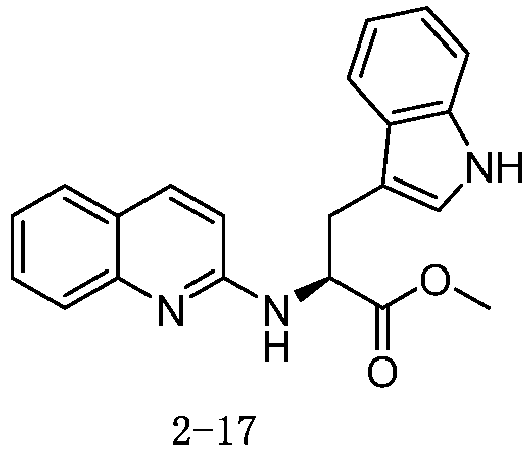
- Compound 2-17 was obtained by the same preparation method in example 1 except that the nucleophile was replaced with L-tryptophan methyl ester hydrochloride, with a yield of 70%. 1H NMR (400 MHz, CDCl3) δ 8.27 (s, 1H), 7.80 (d, J=8.9 Hz, 1H), 7.76 (d, J=8.4 Hz, 1H), 7.61 (d, J=7.9 Hz, 2H), 7.59-7.54 (m, 1H), 7.35 (d, J=8.1 Hz, 1H), 7.28-7.24 (m, 1H), 7.20 (t, J=7.1 Hz, 1H), 7.13 (t, J=7.5 Hz, 1H), 7.01 (d, J=2.1 Hz, 1H), 6.57 (d, J=8.8 Hz, 1H), 5.34-5.29 (m, 1H), 5.27 (d, J=8.2 Hz, 1H), 3.73 (s, 3H), 3.54 (dd, J=14.6, 5.2 Hz, 1H), 3.45 (dd, J=14.6, 5.6 Hz, 1H). 13C NMR (125 MHz, CDCl3) δ 173.9, 155.4, 147.5, 137.4, 136.2, 129.5, 127.8, 127.4, 126.4, 123.6, 122.9, 122.5, 122.1, 119.6, 118.8, 112.2, 111.2, 110.7, 54.6, 52.2, 27.9. HRMS (ESI): Calculated for C21H20N3O2 [M+H]+: 346.155, Found: 346.156.
- Example 18 Preparation of Compound 2-18

- Compound 2-18 was obtained by the same preparation method in example 1 except that the nucleophile was replaced with lysine methyl ester hydrochloride, with a yield of 53%. 1H NMR (400 MHz, D2O) δ 7.94 (s, 1H), 7.63 (t, 1H), 7.59 (d, J=7.5 Hz, 1H), 7.53 (s, 1H), 7.35 (t, J=7.6 Hz, 1H), 6.76 (s, 1H), 4.06 (t, J=6.4 Hz, 1H), 3.70 (s, 3H), 3.33 (t, J=6.7 Hz, 2H), 2.00-1.80 (m, 2H), 1.67 (p, J=7.2 Hz, 2H), 1.55-1.34 (m, 2H). 13C NMR (125 MHz, D2O) δ 170.6, 152.5, 141.9, 135.6, 132.5, 128.7, 125.4, 121.1, 117.0, 113.8, 53.6, 52.7, 41.6, 29.4, 26.9, 21.7. HRMS (ESI): Calculated for C 6H22N3O2 [M+H]+: 288.1707, Found: 288.17.
- Example 19 Preparation of Compound 2-19

- Compound 2-19 was obtained by the same preparation method in example 1 except that the nucleophile was replaced with lysine formamide, with a yield of 80%. 1H NMR (500 MHz, Chloroform-d) δ 7.80 (d, J=8.8 Hz, 1H), 7.65 (d, J=8.2 Hz, 1H), 7.57 (dd, J=8.0, 1.4 Hz, 1H), 7.51 (ddd, J=8.4, 6.9, 1.5 Hz, 1H), 7.22-7.17 (m, 1H), 6.63 (d, J=8.9 Hz, 1H), 3.56-3.49 (m, 2H), 3.40-3.33 (m, 1H), 2.80 (d, J=4.9 Hz, 3H), 1.73-1.58 (m, 6H).
- Example 20 Preparation of Compound 2-20

- Compound 2-20 was obtained by the same preparation method in example 1 except that 2-(2,2-dimethoxyethoxy)quinoline was replaced with 2-(2,2-dimethoxyethoxy)-8-methylquinoline, and the nucleophile was replaced with lysine methyl ester hydrochloride, with a yield of 56%. 1H NMR (400 MHz, MeOD4) δ 8.44 (s, 1H), 7.77 (d, J=7.9 Hz, 1H), 7.68 (d, J=7.5 Hz, 1H), 7.44 (t, J=7.7 Hz, 1H), 7.31 (s, 1H), 4.10 (t, J=6.4 Hz, 1H), 3.86 (s, 3H), 3.63 (t, J=8.1 Hz, 2H), 2.65 (s, 3H), 2.11-1.93 (m, 2H), 1.81 (ddd, J=28.3, 14.9, 6.4 Hz, 2H), 1.71-1.55 (m, 2H). 13C NMR (125 MHz, MeOD4) δ 169.2, 161.5, 153.5, 144.8, 134.0, 126.5, 124.7, 121.0, 108.7, 52.0, 52.0, 41.6, 29.4, 21.5, 15.1. HRMS (ESI): Calculated for C17H24N3O2 [M+H]+: 302.1863, Found: 302.1867.
- Example 21 Preparation of Compound 2-21

- Compound 2-21 was obtained by the same preparation method in example 1 except that 2-(2,2-dimethoxyethoxy)quinoline was replaced with 2-(2,2-dimethoxyethoxy)-7-phenylquinoline, and the nucleophile was replaced with lysine methyl ester hydrochloride, with a yield of 40%. 1H NMR (400 MHz, MeOD4) δ 8.42 (s, 1H), 8.15 (s, 1H), 8.10 (d, J=9.5 Hz, 1H), 7.95 (s, 1H), 7.73 (d, J=7.3 Hz, 2H), 7.51 (t, J=7.6 Hz, 2H), 7.42 (t, J=7.4 Hz, 1H), 7.25 (d, J=9.4 Hz, 1H), 3.84 (s, 3H), 2.99 (t, J=7.4 Hz, 2H), 2.28-2.16 (m, 1H), 2.10-1.97 (m, 1H), 1.84-1.72 (m, 2H), 1.64 (dt, J=16.6, 8.5 Hz, 2H). 13C NMR (125 MHz, MeOD4) δ 170.2, 161.2, 153.0, 138.5, 135.2, 131.3, 128.5, 127.5, 126.4, 125.8, 121.8, 117.6, 54.6, 51.8, 38.6, 30.3, 26.3, 22.0. HRMS (ESI): Calculated for C22H26N3O2 [M+H]+: 364.202, Found: 364.2024.
- Example 22 Preparation of Compound 2-22

- Compound 2-22 was obtained by the same preparation method in example 1 except that 2-(2,2-dimethoxyethoxy)quinoline was replaced with 2-(2,2-dimethoxyethoxy)-6-(4-methoxyphenyl)quinoline, and the nucleophile was replaced with lysine methyl ester hydrochloride, with a yield of 42%. 1H NMR (400 MHz, MeOD4) δ 8.39 (s, 1H), 8.05 (d, J=11.0 Hz, 2H), 7.91 (s, 1H), 7.66 (d, J=8.8 Hz, 2H), 7.23 (d, J=9.4 Hz, 1H), 7.05 (d, J=8.8 Hz, 2H), 3.86 (s, 3H), 3.84 (s, 3H), 2.98 (t, J=7.5 Hz, 2H), 2.20 (s, 1H), 2.02 (s, 1H), 1.82-1.73 (m, 2H), 1.63 (dt, J=14.2, 7.2 Hz, 2H). 13C NMR (125 MHz, MeOD4) δ 170.2, 159.7, 152.8, 138.2, 134.7, 130.9, 130.8, 127.5, 127.4, 124.9, 121.8, 117.5, 113.9, 54.6, 54.1, 51.8, 38.6, 30.3, 26.3, 22.0. HRMS (ESI): Calculated for C23H28N3O3 [M+H]+: 394.2125, Found: 394.2122.
- Example 23 Preparation of Compound 2-23

- Compound 2-23 was obtained by the same preparation method in example 1 except that 2-(2,2-dimethoxyethoxy)quinoline or 2-(2,2-dimethoxyethylthio)quinoline was replaced with 2-(2,2-dimethoxyethoxy)-4-methylquinoline or 2-(2,2-dimethoxyethylthio)-4-methylquinoline, with a yield of 91%. 1H NMR (400 MHz, CDCl3) δ 7.81 (s, 1H), 7.73 (s, 1H), 7.58 (s, 1H), 7.30 (s, 1H), 7.05 (s, 1H), 6.55 (s, 1H), 5.63 (s, 1H), 4.21 (s, 2H), 2.83 (d, J=4.5 Hz, 3H), 2.56 (s, 3H). 13C NMR (125 MHz, DMSO-d 6) δ 170.9, 156.7, 147.8, 144.1, 129.3, 126.4, 124.2, 123.8, 121.9, 113.5, 44.3, 26.0, 18.7. HRMS (ESI) : Calculated for C13H16N3O [M+H]+: 230.1288, Found: 230.1291.
- Example 24 Preparation of Compound 2-24

- Compound 2-24 was obtained by the same preparation method in example 1 except that 2-(2,2-dimethoxyethoxy)quinoline or 2-(2,2-dimethoxyethylthio)quinoline was replaced with 2-(2,2-dimethoxyethoxy)-8-methylquinoline or 2-(2,2-dimethoxyethylthio)-8-methylquinoline, with a yield of 45%. 1H NMR (400 MHz, CDCl3) δ 7.85 (d, J=8.8 Hz, 1H), 7.50 (dd, J=8.0, 1.4 Hz, 1H), 7.46 (d, J=7.1 Hz, 0H), 7.24 (s, 2H), 7.19 (dd, J=7.9, 7.1 Hz, 1H), 6.72 (d, J=8.8 Hz, 1H), 5.50 (s, 1H), 4.22 (d, J=5.2 Hz, 2H), 2.83 (d, J=4.9 Hz, 3H), 2.65 (s, 3H). 13C NMR (125 MHz, CDCl3) δ 171.9, 155.2, 146.1, 138.0, 134.0, 130.1, 125.5, 123.4, 122.5, 111.6, 46.5, 26.0, 17.9. HRMS (ESI) : Calculated for C13H16N3O [M+H]+: 230.1288, Found: 230.1291.
- Example 25 Preparation of Compound 2-25

- Compound 2-25 was obtained by the same preparation method in example 1 except that 2-(2,2-dimethoxyethoxy)quinoline or 2-(2,2-dimethoxyethylthio)quinoline was replaced with 2-(2,2-dimethoxyethoxy)-6-chloroquinoline or 2-(2,2-dimethoxyethylthio)-6-chloroquinoline, with a yield of 53%. 1H NMR (400 MHz, MeOD4) δ 7.86 (d, J=9.0 Hz, 1H), 7.65 (s, 1H), 7.59 (d, J=9.0 Hz, 1H), 7.46 (d, J=8.9 Hz, 1H), 6.88 (d, J=8.8 Hz, 1H), 4.13 (s, 2H), 2.76 (s, 3H). 13C NMR (125 MHz, DMSO-d 6) δ 170.6, 157.3, 146.6, 135.9, 129.6, 128.0, 126.6, 125.6, 124.4, 114.9, 44.3, 26.0. HRMS (ESI): Calculated for C12H13ClN3O [M+H]+: 250.0742, Found: 250.0739.
- Example 26 Preparation of Compound 2-26

- Compound 2-26 was obtained by the same preparation method in example 1 except that 2-(2,2-dimethoxyethoxy)quinoline or 2-(2,2-dimethoxyethylthio)quinoline was replaced with 2-(2,2-dimethoxyethoxy)-8-bromoquinoline or 2-(2,2-dimethoxyethylthio)-8-bromoquinoline, with a yield of 42%. 1H NMR (400 MHz, CDCl3) δ 7.90 (dd, J=7.6, 1.2 Hz, 1H), 7.81 (d, J=8.9 Hz, 1H), 7.59 (dd, J=7.9, 1.1 Hz, 1H), 7.13 (t, J=7.8 Hz, 1H), 6.76 (d, J=8.9 Hz, 1H), 6.10 (s, 1H), 4.23 (d, J=6.0 Hz, 2H), 2.85 (d, J=4.9 Hz, 3H). 13C NMR (125 MHz, CDCl3) δ 171.5, 156.7, 144.4, 137.9, 133.1, 127.3, 124.8, 123.0, 121.2, 113.2, 46.8, 26.0. HRMS (ESI): Calculated for C12H13BrN3O [M+H]+: 294.0237, Found: 294.0245.
- Example 27 Preparation of Compound 2-27

- Compound 2-27 was obtained by the same preparation method in example 1 except that 2-(2,2-dimethoxyethoxy)quinoline or 2-(2,2-dimethoxyethylthio)quinoline was replaced with 3-chloro-2-(2,2-dimethoxyethoxy)isoquinoline or 3-chloro-2-(2,2-dimethoxyethylthio)isoquinoline, with a yield of 52%. 1H NMR (400 MHz, CDCl3) δ 7.86 (d, J=8.4 Hz, 1H), 7.65-7.58 (m, 2H), 7.50-7.42 (m, 1H), 7.01 (s, 1H), 6.49 (s, 1H), 6.39 (s, 1H), 4.29 (d, J=5.0 Hz, 2H), 2.91 (d, J=4.8 Hz, 3H). 13C NMR (125 MHz, CDCl3) δ 170.5, 154.7, 143.8, 138.7, 130.8, 126.4, 126.2, 122.0, 116.6, 109.4, 45.4, 26.3. HRMS (ESI) Calculated for C12H13ClN3O [M+H]+: 250.0742, Found: 250.0739.
- Example 28 Preparation of Compound 2-28

- Compound 2-28 was obtained by the same preparation method in example 1 except that 2-(2,2-dimethoxyethoxy)quinoline or 2-(2,2-dimethoxyethylthio)quinoline was replaced with 2-(2,2-dimethoxyethoxy)-7-phenylquinoline or 2-(2,2-dimethoxyethylthio)-7-phenylquinoline, with a yield of 75%. 1H NMR (400 MHz, CDCl3) δ 7.90 (d, J=8.8 Hz, 1H), 7.82 (t, 2H), 7.76 (d, J=9.1 Hz, 1H), 7.67 (d, J=8.0 Hz, 2H), 7.47 (t, J=7.6 Hz, 2H), 7.36 (t, J=7.4 Hz, 1H), 6.83 (s, 1H), 6.72 (d, J=8.8 Hz, 1H), 5.50 (s, 1H), 4.23 (d, J=5.1 Hz, 2H), 2.84 (d, J=4.9 Hz, 2H). 13C NMR (125 MHz, CDCl3) δ 171.2, 156.0, 146.7, 140.7, 138.0, 135.7, 129.3, 128.9, 127.1, 127.1, 126.5, 125.4, 123.9, 112.3, 45.9, 26.2. HRMS (ESI) : Calculated for C18H18N3O [M+H]+: 292.1444, Found: 292.1449.
- Example 29 Preparation of Compound 2-29

- Compound 2-29 was obtained by the same preparation method in example 1 except that 2-(2,2-dimethoxyethoxy)quinoline or 2-(2,2-dimethoxyethylthio)quinoline was replaced with 2-(2,2-dimethoxyethoxy)-6-(4-methoxyphenyl)quinoline or 2-(2,2-dimethoxyethylthio)-6-(4-methoxyphenyl)quinoline, with a yield of 54%. 1H NMR (400 MHz, DMSO-d 6) δ 7.91 (d, J=9.0 Hz, 1H), 7.87 (d, J=1.9 Hz, 1H), 7.75 (dd, J=8.7, 2.0 Hz, 1H), 7.65 (d, J=8.7 Hz, 2H), 7.51 (d, 1H), 7.28 (t, J=5.5 Hz, 1H), 7.01 (d, J=8.7 Hz, 2H), 6.89 (d, J=8.9 Hz, 1H), 4.00 (d, J=5.5 Hz, 2H), 3.78 (s, 3H), 2.60 (d, J=4.0 Hz, 3H). 13C NMR (125 MHz, DMSO-d 6) δ 170.8, 159.0, 157.0, 147.1, 136.9, 133.3, 132.8, 128.1, 128.0, 126.6, 124.7, 123.8, 114.8, 114.1, 55.6, 44.5, 26.0. HRMS (ESI): Calculated for C19H20N3O2 [M+H]+: 322.155, Found: 322.1549.
- Example 30 Preparation of Compound 2-30

- Compound 2-30 was obtained by the same preparation method in example 1 except that 2-(2,2-dimethoxyethoxy)quinoline or 2-(2,2-dimethoxyethylthio)quinoline was replaced with 2-(2,2-dimethoxyethoxy)-6-(4-trifluoromethylphenyl)quinoline or 2-(2,2-dimethoxyethylthio)-6-(4-trifluoromethylphenyl)quinoline, with a yield of 65%. 1H NMR (400 MHz, DMSO-d 6) δ 8.06 (d, J=1.8 Hz, 1H), 7.96 (t, 3H), 7.86 (dd, J=8.7, 2.0 Hz, 1H), 7.80 (d, J=8.3 Hz, 2H), 7.57 (d, 1H), 7.41 (t, J=5.8 Hz, 1H), 6.93 (d, J=8.9 Hz, 1H), 4.02 (d, J=5.4 Hz, 2H), 2.60 (d, J=3.9 Hz, 3H). 13C NMR (125 MHz, DMSO-d 6) δ 170.6, 157.5, 148.1, 144.4, 137.1, 131.7, 128.3, 127.5, 126.8, 126.3, 126.2, 126.2, 126.2, 123.8, 114.5, 44.4, 26.0. HRMS (ESI): Calculated for C19H17FN3O [M+H]+: 360.1318, Found: 360.1317.
- Example 31 Preparation of Compound 2-31

- Compound 2-31 was obtained by the same preparation method in example 1 except that 2-(2,2-dimethoxyethoxy)quinoline or 2-(2,2-dimethoxyethylthio)quinoline was replaced with 2-(2,2-dimethoxyethoxy)-6-(4-cyanophenyl)quinoline or 2-(2,2-dimethoxyethylthio)-6-(4-cyanophenyl)quinoline, with a yield of 78%. 1H NMR (400 MHz, DMSO-d 6) δ 8.11 (s, 1H), 7.94 (dt, J=19.1, 9.6 Hz, 7H), 7.59 (d, J=8.8 Hz, 1H), 7.49 (t, J=5.6 Hz, 1H), 6.96 (d, J=9.1 Hz, 1H), 4.04 (d, J=5.2 Hz, 2H), 2.62 (d, J=4.4 Hz, 3H). 13C NMR (125 MHz, DMSO-d 6) δ 170.6, 157.6, 148.3, 144.9, 137.1, 133.3, 131.3, 128.2, 127.6, 126.9, 126.5, 123.7, 119.5, 114.5, 109.7, 44.4, 26.0. HRMS (ESI): Calculated for C19H17N4O [M+H]+: 317.1397, Found: 317.1401.
- Example 32 Preparation of Compound 2-32

- Compound 2-32 was obtained by the same preparation method in example 1 except that 2-(2,2-dimethoxyethoxy)quinoline or 2-(2,2-dimethoxyethylthio)quinoline was replaced with methyl 4-(2-(2,2-dimethoxyethoxy)quinolin-6-yl)benzoate or methyl 4-(2-(2,2-dimethoxyethylthio)quinolin-6-yl)benzoate, with a yield of 57%. 1H NMR (400 MHz, DMSO-d 6) δ 8.09 (d, J=2.0 Hz, 1H), 8.05 (d, J=8.4 Hz, 2H), 7.98 (d, J=8.9 Hz, 1H), 7.94-7.88 (m, 4H), 7.59 (d, J=8.7 Hz, 1H), 7.44 (t, J=5.5 Hz, 1H), 6.95 (d, J=8.9 Hz, 1H), 4.04 (d, J=5.6 Hz, 2H), 3.88 (s, 3H), 2.62 (d, J=4.6 Hz, 3H). 13C NMR (125 MHz, DMSO-d 6) δ 170.7, 166.6, 157.5, 148.1, 145.0, 137.1, 131.9, 130.3, 128.3, 128.2, 127.0, 126.8, 126.3, 123.8, 114.4, 56.5, 52.6, 26.0. HRMS (ESI): Calculated for C20H20N3O3 [M+H]+: 350.1499, Found: 350.1501.
- Example 33 Preparation of Compound 2-33

- Compound 2-33 was obtained by the same preparation method in example 1 except that 2-(2,2-dimethoxyethoxy)quinoline or 2-(2,2-dimethoxyethylthio)quinoline was replaced with 2-(2,2-dimethoxyethoxy)-7-(2-fluorophenyl)-4-methylquinoline or 2-(2,2-dimethoxyethylthio)-7-(2-fluorophenyl)-4-methylquinoline, with a yield of 70%. 1H NMR (400 MHz, CDCl3) δ 7.86 (d, J=8.9 Hz, 1H), 7.68 (d, J=8.4 Hz, 1H), 7.62 (d, J=7.9 Hz, 1H), 7.59-7.53 (m, 1H), 7.28-7.25 (m, 1H), 6.77 (d, J=8.9 Hz, 1H), 5.87 (s, 1H), 4.97 (s, 1H), 4.26 (dd, J=10.9, 2.6 Hz, 1H), 3.98 (dd, J=10.9, 6.2 Hz, 1H), 3.85 (s, 3H). 13C NMR (125 MHz, CDCl3) δ 171.8, 155.6, 146.2, 138.2, 130.0, 127.5, 125.6, 123.5, 123.0, 112.5, 65.5, 58.0, 52.9. HRMS (ESI): Calculated for C13H15N2O3 [M+H]+: 247.1077, Found: 247.1081.
- The present method is useful in chemical modifications of various complicated molecules containing an amino acid residue with good selectivity, as illustrated by the following preparation examples in which various complicated molecules containing an amino acid residue were reacted with a zolinium.
- Example 34 Preparation of Compound 2-34

- Compound 2-34 was obtained by the same preparation method in example 1 except that the nucleophile was replaced with 2-amino-N-(2-(2,5-dimethoxyphenyl)-2-hydroxyethyl)acetamide hydrochloride, with a yield of 72%. 1H NMR (500 MHz, MeOD4) δ 7.88 (d, J=8.9 Hz, 1H), 7.62 (t, J=8.0 Hz, 2H), 7.53-7.48 (m, 1H), 7.24 (t, 1H), 7.00 (d, 1H), 6.81 (d, 1H), 6.75 (d, 1H), 6.70 (dd, J=8.9, 3.1 Hz, 1H), 5.08 (dd, J=7.1, 4.3 Hz, 1H), 4.12 (s, 2H), 3.72 (s, 3H), 3.68 (s, 3H), 3.56 (dd, 1H), 3.39 (dd, 1H). 13C NMR (126 MHz, MeOD4) δ 172.5, 156.8, 153.8, 150.3, 147.3, 137.2, 131.1, 129.1, 127.2, 125.4, 123.7, 122.0, 112.5, 112.3, 111.1, 66.7, 54.9, 54.6, 45.1, 44.6. HRMS (ESI): Calculated for C21H24N3O4 [M+H]+: 382.1761, Found: 382.1761.
- Example 35 Preparation of Compound 2-35

- Compound 2-35 was obtained by the same preparation method in example 1 except that the nucleophile was replaced with saxagliptin hydrochloride, with a yield of 46%. 1H NMR (400 MHz, CDCl3) δ 7.58-7.46 (m, 5H), 7.22 (t, J=7.3 Hz, 1H), 6.65 (d, J=8.7 Hz, 1H), 5.94 (d, J=9.5 Hz, 1H), 5.27 (d, J=9.4 Hz, 1H), 5.00 (dd, J=10.6, 2.4 Hz, 1H), 4.63 (td, J=6.2, 2.6 Hz, 1H), 2.75 (s, 1H), 2.51 (ddd, J=13.8, 10.7, 5.8 Hz, 1H), 2.36 (dd, J=13.7, 2.4 Hz, 1H), 2.32-2.23 (m, 3H), 2.07 (d, J=11.6 Hz, 1H), 2.00-1.92 (m, 2H), 1.86 (dd, J=25.7, 12.0 Hz, 2H), 1.73 (q, J=14.1 Hz, 6H), 1.59 (d, J=14.3 Hz, 3H), 1.28 (s, 2H), 1.18 (s, 1H), 1.17-1.11 (m, 1H). 13C NMR (126 MHz, CDCl3) δ 171.7, 156.6, 147.5, 136.9, 129.2, 127.5, 126.1, 123.8, 122.2, 119.5, 113.2, 68.7, 58.9, 46.2, 45.3, 44.6, 44.2, 40.7, 38.3, 38.0, 37.7, 35.5, 30.6, 30.4, 30.3, 17.5, 13.7. HRMS (ESI): Calculated for C27H31N4O2 [M+H]+: 443.2432, Found: 443.2442.
- Example 36 Preparation of Compound 2-36

- Compound 2-36 was obtained by the same preparation method in example 1 except that the nucleophile was replaced with (S)-2-((S)-2-amino-3-methylbutamido)-N-(4-(hydroxymethyl)phenyl)-5-ureidopentanamide hydrochloride, with a yield of 56%. 1H NMR (400 MHz, MeOD4) δ 7.87 (d, J=8.9 Hz, 1H), 7.63-7.58 (m, 2H), 7.47 (ddd, J=8.4, 7.0, 1.4 Hz, 1H), 7.39 (d, J=8.5 Hz, 2H), 7.25 (d, J=8.6 Hz, 2H), 7.22-7.17 (m, 1H), 6.91 (d, J=8.9 Hz, 1H), 4.58-4.53 (m, 3H), 4.49 (d, J=7.5 Hz, 1H), 3.37 (s, 2H), 3.09 (dt, J=13.3, 6.7 Hz, 1H), 2.99 (dt, J=13.5, 6.7 Hz, 1H), 2.30-2.19 (m, 1H), 1.94-1.84 (m, 1H), 1.80-1.68 (m, 1H), 1.60-1.43 (m, 2H), 1.11 (d, J=6.9 Hz, 3H), 1.09 (d, J=6.8 Hz, 3H). 13C NMR (126 MHz, MeOD4) δ 174.4, 170.9, 160.8, 157.0, 147.4, 137.4, 137.0, 136.9, 129.0, 127.1, 127.1, 125.4, 123.6, 121.9, 120.0, 112.6, 63.4, 60.9, 53.4, 48.4, 30.4, 29.3, 26.3, 18.7, 17.9. HRMS (ESI): Calculated for C27H35N6O4 [M+H]+: 507.2724, Found: 507.2714.
- Example 37 Preparation of Compound 2-37

- Compound 2-37 was obtained by the same preparation method in example 1 except that the nucleophile was replaced with oxytocin, with a yield of 42%. 1H NMR (400 MHz, MeOD4-d 4) δ 8.36 (d, J=9.2 Hz, 1H), 7.96 (d, J=7.8 Hz, 1H), 7.89 (t, J=7.8 Hz, 1H), 7.74 (d, J=8.3 Hz, 1H), 7.61 (t, J=7.4 Hz, 1H), 7.00 (d, 4H), 6.18 (s, 1H), 5.17 (s, 1H), 4.87 (d, J=6.8 Hz, 2H), 4.50-4.42 (m, 1H), 4.31 (dd, J=9.4, 5.4 Hz, 1H), 4.07 (d, J=6.5 Hz, 1H), 3.95 (d, J=7.6 Hz, 1H), 3.91 (d, 7=17.1 Hz, 1H), 3.81 (d, J=8.4 Hz, 1H), 3.76 (d, J=17.0 Hz, 1H), 3.68 (dt, J=10.4, 5.7 Hz, 1H), 3.42 (dt, J=13.6, 4.3 Hz, 2H), 3.37 (s, 4H), 2.91 (s, 1H), 2.71 (s, 1H), 2.39 (t, J=6.9 Hz, 2H), 2.31-2.14 (m, 3H), 2.03-1.83 (m, 4H), 1.68 (qd, J=9.7, 9.3, 5.1 Hz, 4H), 1.37-1.24 (m, 1H), 1.05 (d, J=6.7 Hz, 3H), 1.00 (t, J=7.4 Hz, 3H), 0.94 (d, J=6.3 Hz, 3H), 0.91 (d, J=6.1 Hz, 3H). 13C NMR (125 MHz, MeOD4) δ 176.6, 173.7, 173.5, 173.2, 172.9, 172.1, 168.4, 167.7, 157.7, 157.4, 155.6, 133.1, 129.8, 128.7, 127.2, 125.9, 121.8, 117.7, 115.8, 114.4, 113.5, 61.0, 60.8, 55.8, 54.9, 53.6, 53.0, 52.3, 50.6, 48.5, 48.2, 41.9, 39.7, 37.7, 35.7, 31.4, 29.0, 25.6, 24.5, 24.5, 22.1, 20.5, 14.6, 10.2. HRMS (ESI): Calculated for C52H70N13O12S2 [M+H]+: 1132.4742, Found: 1132.4742.
- Example 38 Preparation of Compound 2-38
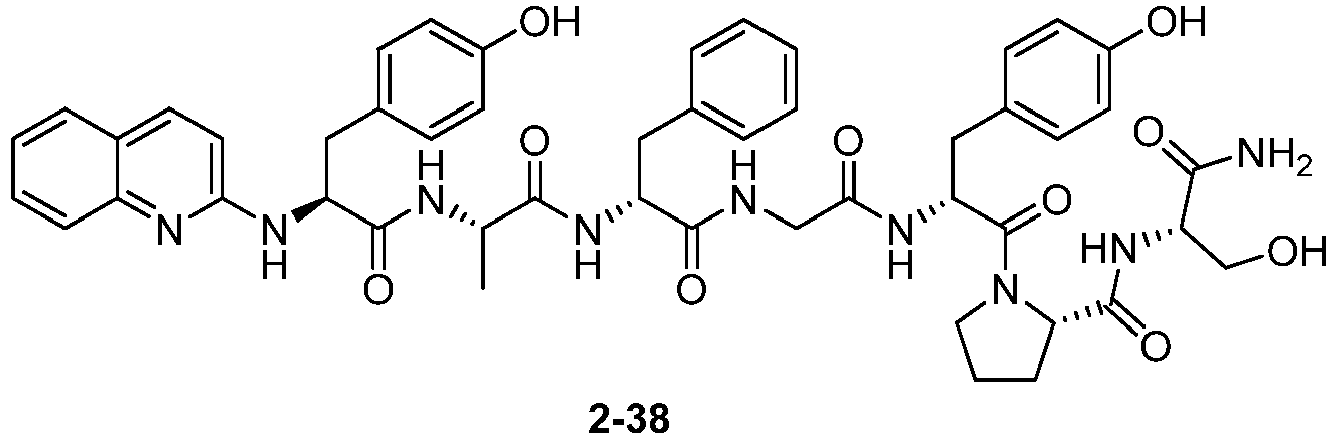
- Compound 2-38 was obtained by the same preparation method in example 1 except that the nucleophile was replaced with dermorphin, with a yield of 47%. 1H NMR (400 MHz, DMSO-d 6) δ 9.25 (s, 1H), 9.17 (s, 1H), 8.27 (d, J=8.0 Hz, 1H), 8.20 (s, 1H), 8.12 (d, J=8.6 Hz, 1H), 8.00 (d, J=6.9 Hz, 1H), 7.82 (d, J=8.9 Hz, 1H), 7.75 (d, J=7.4 Hz, 1H), 7.59 (d, J=7.6 Hz, 1H), 7.49 (d, J=7.8 Hz, 1H), 7.46-7.38 (m, 1H), 7.18 (dd, J=13.4, 5.1 Hz, 5H), 7.12 (d, J=7.5 Hz, 3H), 7.10-7.05 (m, 3H), 6.85 (d, J=8.9 Hz, 1H), 6.66 (d, J=8.2 Hz, 2H), 6.62 (d, J=8.0 Hz, 2H), 4.91 (t, J=5.3 Hz, 1H), 4.74 (d, J=4.4 Hz, 1H), 4.60 (s, 1H), 4.47 (s, 1H), 4.35 (d, J=6.0 Hz, 1H), 4.26-4.04 (m, 2H), 3.78-3.69 (m, 1H), 3.68-3.54 (m, 4H), 2.97 (d, J=10.9 Hz, 3H), 2.87-2.76 (m, 1H), 2.69-2.60 (m, 1H), 2.57 (d, J=I2.8 Hz, 1H), 1.93 (d, J=51.9 Hz, 4H), 0.82 (d, J=6.9 Hz, 3H). 13C NMR (125 MHz, DMSO-d 6) δ 172.5, 172.3, 172.3, 171.6, 171.6, 171.0, 168.8, 156.6, 156.3, 156.1, 147.9, 138.2, 136.8, 130.7, 130.6, 129.6, 129.5, 128.8, 128.4, 128.1, 127.8, 126.6, 126.2, 123.5, 121.9, 115.5, 115.3, 113.6, 62.0, 60.4, 56.5, 55.5, 54.1, 53.1, 48.5, 47.4, 42.0, 38.1, 37.5, 36.7, 29.3, 24.9, 18.8. HRMS (ESI): Calculated for C49H54N9O10 [M+H]+: 928.3999, Found: 928.3993.
- Example 39 Preparation of Compound 2-39

- Compound 2-39 was obtained by the same preparation method in example 1 except that the nucleophile was replaced with tyroserleutide, with a yield of 56%. 1H NMR (400 MHz, DMSO-d 6) δ 9.16 (s, 1H), 8.20 (d, J=7.9 Hz, 1H), 7.98 (d, J=7.9 Hz, 1H), 7.84 (d, J=8.9 Hz, 1H), 7.60 (d, J=7.9 Hz, 1H), 7.50-7.42 (m, 2H), 7.21 (d, J=7.6 Hz, 1H), 7.17 (s, 1H), 7.13 (d, J=7.6 Hz, 2H), 6.85 (d, J=8.9 Hz, 1H), 6.62 (d, J=7.6 Hz, 2H), 4.84 (t, J=5.0 Hz, 1H), 4.76 (s, 1H), 4.31 (dd, J=14.0, 7.0 Hz, 2H), 4.15 (d, J=5.0 Hz, 1H), 3.61 (s, 3H), 3.19-3.17 (m, 3H), 1.58-1.44 (m, 2H), 1.41-1.35 (m, 2H), 0.81-0.75 (m, 6H). 13C NMR (125 MHz, DMSO-d 6) δ 173.1, 173.1, 170.5, 156.8, 156.1, 147.9, 136.8, 130.6, 129.4, 129.0, 127.9, 126.2, 123.5, 121.9, 115.3, 113.6, 62.1, 56.7, 55.3, 52.3, 50.6, 49.1, 37.2, 24.5, 23.1, 21.7. HRMS (ESI): Calculated for C28H35N4O6 [M+H]+: 523.2551, Found: 523.2554.
- Example 40 Preparation of Compound 2-40

- Compound 2-40 was obtained by the same preparation method in example 1 except that 2-(2,2-dimethoxyethoxy)quinoline or 2-(2,2-dimethoxyethylthio)quinoline was replaced with 2-(2,2-dimethoxyethoxy)-7-(2-fluorophenyl)-4-methylquinoline or 2-(2,2-dimethoxyethylthio)-7-(2-fluorophenyl)-4-methylquinoline, and the nucleophile was replaced with (S)-2-((S)-2-amino-3-methylbutamido)-N-(4-(hydroxymethyl)phenyl)-5-ureidopentanamide hydrochloride, with a yield of 52%. 1H NMR (500 MHz, MeOD-d 4) δ 7.88 (d, J=8.4 Hz, 1H), 7.80 (s, 1H), 7.51 (t, J=7.8 Hz, 1H), 7.44 (d, J=8.4 Hz, 1H), 7.42-7.37 (m, 1H), 7.33 (d, J=8.5 Hz, 2H), 7.28 (t, J=7.5 Hz, 1H), 7.24-7.21 (m, 1H), 7.20 (d, J=8.4 Hz, 2H), 6.82 (s, 1H), 4.56 (dd, J=9.0, 5.1 Hz, 1H), 4.52 (s, 2H), 4.48 (d, J=7.4 Hz, 1H), 3.11-3.04 (m, 1H), 3.01-2.94 (m, 1H), 2.61 (s, 3H), 2.31-2.22 (m, 1H), 1.89 (dt, J=14.3, 6.6 Hz, 1H), 1.78-1.68 (m, 1H), 1.57-1.47 (m, 2H), 1.13 (d, J=6.8 Hz, 3H), 1.11 (d, J=6.8 Hz, 3H). 13C NMR (125 MHz, MeOD4-d 4) δ 175.8, 172.3, 162.2, 160.3, 158.7, 148.8, 146.2, 138.8, 138.3, 137.9, 132.1, 130.5, 130.4, 128.4, 127.4, 125.7, 124.8, 124.6, 124.1, 121.5, 117.2, 117.0, 114.2, 64.8, 62.4, 54.8, 31.7, 30.7, 27.7, 20.1, 19.3, 18.7. HRMS (ESI): Calculated for C34H40FN6O4 [M+H]+: 615.309, Found: 615.3081.
- Example 41 Preparation of Compound 2-41

- Compound 2-41 was obtained by the same preparation method in example 1 except that 2-(2,2-dimethoxyethoxy)quinoline was used and the nucleophile was replaced with octreotide acetate hydrochloride, with a yield of 41%. 1H NMR (500 MHz, Methanol-d 4) δ 8.27 (d, J=9.4 Hz, 1H), 7.85 (d, J=7.9 Hz, 1H), 7.78 (dd, J=14.4, 7.1 Hz, 2H), 7.53 (d, J=7.8 Hz, 1H), 7.48 (d, J=7.9 Hz, 1H), 7.40-7.36 (m, 3H), 7.27-7.22 (m, 3H), 7.19 (t, J=7.9 Hz, 4H), 7.16-7.10 (m, 3H), 7.04 (t, J=7.4 Hz, 1H), 7.00 (s, 1H), 5.25 (d, J=9.4 Hz, 2H), 4.68 (dd, J=8.8, 6.2 Hz, 1H), 4.49 (d, J=5.6 Hz, 1H), 4.40-4.31 (m, 1H), 4.23 (dd, J=11.0, 5.3 Hz, 1H), 4.17 (dd, J=6.4, 2.8 Hz, 1H), 4.02 (dd, J=10.9, 3.2 Hz, 1H), 3.89-3.85 (m, 1H), 3.74 (s, 2H), 3.50 (d, J=9.2 Hz, 1H), 3.33 (s, 2H), 3.18-2.90 (m, 8H), 2.86 (dd, J=13.8, 5.2 Hz, 1H), 2.61 (dq, J=18.7, 12.4, 9.4 Hz, 2H), 1.35-1.23 (m, 9H), 0.64-0.43 (m, 2H). HRMS (ESI): Calculated for C58H72N11O10S2 [M+H]+: 1146.49, Found: 1146.4891.
- Example 42 Preparation of Compound 2-42

- Compound 2-42 was obtained by the same preparation method in example 1 except that 2-(2,2-dimethoxyethoxy)-6-(4-methoxyphenyl)quinoline was used and the nucleophile was replaced with octreotide acetate hydrochloride, with a yield of 40%. 1H NMR (500 MHz, Methanol-d 4) δ 8.35 (d, J=9.4 Hz, 1H), 8.23 (d, J=8.7 Hz, 1H), 8.14-8.00 (m, 2H), 7.81 (d, J=9.0 Hz, 1H), 7.71-7.64 (m, 2H), 7.51 (d, J=8.0 Hz, 1H), 7.42 (d, J=7.6 Hz, 2H), 7.39 (d, J=8.1 Hz, 1H), 7.31 (t, J=7.5 Hz, 2H), 7.27-7.19 (m, 5H), 7.18-7.13 (m, 2H), 7.08 (dd, J=8.4, 6.7 Hz, 3H), 7.02 (s, 1H), 5.30 (t, J=I2.2 Hz, 2H), 4.71 (dd, J=8.9, 6.0 Hz, 1H), 4.54-4.47 (m, 1H), 4.44-4.33 (m, 1H), 4.25 (dd, J=10.9, 5.4 Hz, 1H), 4.23-4.16 (m, 1H), 4.06 (dd, J=11.0, 3.5 Hz, 1H), 3.89 (s, 4H), 3.77 (d, J=5.2 Hz, 2H), 3.54 (dd, J=14.0, 5.0 Hz, 1H), 3.39 (s, 2H), 3.23-2.94 (m, 8H), 2.89 (dd, J=13.8, 5.3 Hz, 1H), 2.65 (tt, J=20.1, 10.6 Hz, 2H), 1.28 (m, 9H), 0.69-0.50 (m, 2H). HRMS (ESI): Calculated for C65H7gN1O11S2 [M+H]+: 1252.5318, Found: 1252.5299.
- Example 43 Preparation of Compound 2-43

- Compound 2-43 was obtained by the same preparation method in example 1 except that 2-(2,2-dimethoxyethylthio)quinoline or 2-(2,2-dimethoxyethylseleno)quinoline was used and the nucleophile was replaced with octreotide acetate hydrochloride, with a yield of 33%-41%. 1H NMR (500 MHz, Methanol-d 4) δ 7.84 (d, J=9.1 Hz, 1H), 7.68 (d, J=8.4 Hz, 1H), 7.61 (dd, J=8.0, 1.5 Hz, 1H), 7.53-7.49 (m, 1H), 7.48-7.42 (m, 1H), 7.36-7.24 (m, 11H), 7.20 (m, 1H), 7.05 (m, 2H), 6.95 (s, 1H), 6.74 (d, J=9.0 Hz, 1H), 5.19 (m, 1H), 5.13 (m, 1H), 4.69 (m, 1H), 4.47 (d, J=5.2 Hz, 1H), 4.43-4.34 (m, 1H), 4.17 (m, 1H), 4.08 (m, 1H), 4.01 (m, 1H), 3.86 (m, 1H), 3.82-3.76 (m, 1H), 3.73 (m, 1H), 3.67 (m, 1H), 3.32-3.25 (m, 2H), 3.16-3.09 (m, 2H), 3.07-2.85 (m, 7H), 2.83-2.76 (m, 1H), 1.78 (m, 1H), 1.42-1.31 (m, 3H), 1.28 (d, J=6.4 Hz, 3H), 1.21 (d, J=6.4 Hz, 3H), 0.80-0.60 (m, 2H). 13C NMR (125 MHz, Methanol-d 4) δ 174.44, 174.20, 173.98, 171.47, 171.41, 169.10, 157.46, 147.27, 137.07, 136.87, 136.66, 136.57, 129.24, 129.15, 129.08, 128.33, 128.08, 127.32, 127.04, 126.64, 126.52, 124.11, 123.13, 121.56, 121.16, 118.53, 117.82, 112.71, 111.12, 108.59, 67.02, 65.79, 61.31, 59.77, 56.37, 56.27, 55.80, 54.97, 54.26, 52.64, 52.46, 44.38 , 42.03, 40.71, 40.43, 39.29, 30.40, 28.48, 25.87, 22.70, 19.02, 18.81. HRMS (ESI): Calculated for C58H72N11O10S2 [M+H]+: 1146.4900, Found: 1146.4894.
- Example 44 Preparation of Compound 2-44

- Compound 2-44 was obtained by the same preparation method in example 1 except that 6-fluoro-2-(2,2-dimethoxyethylthio)quinoline or 6-fluoro-2-(2,2-dimethoxyethylseleno)quinoline was used and the nucleophile was replaced with octreotide acetate hydrochloride, with a yield of 47%-52%. 1H NMR (600 MHz, Methanol-d 4) δ 7.79 (d, J=9.0 Hz, 1H), 7.68-7.62 (m, 1H), 7.42 (dd, J=7.4, 1.3 Hz, 1H), 7.34-7.26 (m, 11H), 7.22 (dd, J=8.0, 1.6 Hz, 2H), 7.02 (m, 2H), 6.92 (s, 1H), 6.75 (d, J=9.0 Hz, 1H), 5.14 (m, 2H), 4.65 (m, 1H), 4.44 (d, J=5.3 Hz, 1H), 4.41-4.32 (m, 1H), 4.14 (m, 1H), 4.09-4.05 (m, 1H), 4.02-3.93 (m, 2H), 3.81 (m, 1H), 3.72-3.61 (m, 2H), 3.26 (m, 2H), 3.16 (m, 1H), 3.09 (m, 1H), 3.03-2.85 (m, 7H), 2.77 (m, 1H), 1.75 (m, 1H), 1.43-1.30 (m, 3H), 1.25 (d, J=6.4 Hz, 3H), 1.18 (d, J=6.5 Hz, 3H), 0.65 (m, 2H). 13C NMR (150 MHz, Methanol-d 4) δ 174.35, 174.07, 171.69, 171.36, 171.33, 171.22, 168.85, 158.44, 157.01, 156.86, 144.04, 136.54, 136.41, 136.17, 135.57, 129.09, 128.93, 128.41, 127.97, 126.94, 126.43, 126.02, 125.96, 123.22, 123.16, 123.02, 121.04, 118.40, 117.87, 117.70, 113.76, 110.99, 110.74, 110.60, 108.46, 66.89, 65.68, 61.12, 59.63, 56.17, 55.05, 54.86, 54.11, 52.73, 52.29, 44.21, 42.02, 40.52, 39.16, 39.09, 30.25, 28.31, 25.72, 22.58, 18.86, 18.68. HRMS (ESI): Calculated for C58H71FN11O10S2 [M+H]+: 1164.4805, Found: 1164.482.
- Example 45 Preparation of Compound 2-45

- Compound 2-45 was obtained by the same preparation method in example 1 except that 6-alkynyl-3-benzyl-2-(2,2-dimethoxyethylthio)quinoline or 6-alkynyl-3-benzyl-2-(2,2-dimethoxyethylseleno)quinoline was used and the nucleophile was replaced with octreotide acetate hydrochloride, with a yield of 40%. 1H NMR (600 MHz, Methanol-d 4) δ 7.66 (d, J=1.9 Hz, 1H), 7.62 (d, J=8.6 Hz, 1H), 7.52-7.46 (m, 2H), 7.44-7.38 (m, 1H), 7.36-7.17 (m, 16H), 7.04-6.96 (m, 2H), 6.88 (s, 1H), 5.21-5.09 (m, 2H), 4.71-4.60 (m, 1H), 4.43 (d, J=5.4 Hz, 1H), 4.38-4.31 (m, 1H), 4.16-4.11 (m, 1H), 4.08-4.04 (m, 1H), 3.98-3.90 (m, 4H), 3.83-3.78 (m, 1H), 3.71-3.61 (m, 2H), 3.41 (s, 1H), 3.34 (t, J=3.7 Hz, 2H), 3.18-3.12 (m, 1H), 3.11-3.06 (m, 1H), 3.03-2.85 (m, 7H), 2.79-2.72 (m, 1H), 1.74-1.63 (m, 1H), 1.34-1.28 (m, 1H), 1.27-1.25 (m, 2H), 1.23 (d, J=6.4 Hz, 3H), 1.18 (d, J=6.5 Hz, 3H), 0.65-0.45 (m, 2H). HRMS (ESI): Calculated for C67H78N11O10S2 [M+H]+: 1260.5369, Found: 1260.5374.
- Example 46 Preparation of Compound 2-46

- Compound 2-46 was obtained by the same preparation method in example 1 except that 6-alkynyl-2-(2,2-dimethoxyethylthio)quinoline or 6-alkynyl-2-(2,2-dimethoxyethylseleno)quinoline was used and the nucleophile was replaced with octreotide acetate hydrochloride, with a yield of 45%-78%. 1H NMR (600 MHz, Methanol-d 4) δ 7.77 (d, J=9.0 Hz, 1H), 7.72 (d, J=1.9 Hz, 1H), 7.59 (d, J=8.6 Hz, 1H), 7.52 (dd, J=8.7, 1.9 Hz, 1H), 7.42 (dd, J=7.7, 1.3 Hz, 1H), 7.34-7.22 (m, 11H), 7.03 (m, 2H), 6.93 (s, 1H), 6.73 (d, J=9.0 Hz, 1H), 5.13 (m, 2H), 4.65 (m, 1H), 4.43 (d, J=5.3 Hz, 1H), 4.40-4.32 (m, 1H), 4.14 (m, 1H), 4.06 (m, 1H), 3.98 (m, 1H), 3.89 (t, J=7.1 Hz, 1H), 3.81 (m, 1H), 3.69 (m, 1H), 3.64 (m, 1H), 3.43 (s, 1H), 3.27 (m, 2H), 3.12 (m, 2H), 3.03-2.89 (m, 7H), 2.77 (m, 1H), 1.75 (m, 1H), 1.43-1.30 (m, 3H), 1.25 (d, J=6.4 Hz, 3H), 1.18 (d, J=6.5 Hz, 3H), 0.81-0.58 (m, 2H). 13C NMR (125 MHz, Methanol-d 4) δ 174.02, 173.75, 172.10 , 171.02, 170.99 ,170.90, 168.55, 157.54, 147.13, 136.20, 136.08, 135.98, 135.65 , 131.67, 130.82, 128.71, 128.59, 128.00, 127.61, 126.58, 126.45, 126.07, 124.06, 122.67, 122.27, 120.70, 118.06, 117.35, 114.79, 110.64, 108.13, 82.82, 75.87, 66.51, 65.32, 60.79, 59.30, 55.84, 54.94, 54.52, 53.78, 52.31, 51.94, 43.87, 41.55 , 40.12, 39.17, 38.82, 29.89, 27.94, 25.37, 22.22, 18.52, 18.32. HRMS (ESI): Calculated for C60H72N11O10S2 [M+H]+: 1170.49, Found: 1170.4902.
- Example 47 Preparation of Compound 2-47

- Compound 2-47 was obtained by the same preparation method in example 1 except that 2-(2,2-dimethoxyethylthio)quinoline or 2-(2,2-dimethoxyethylseleno)quinoline was used and the nucleophile was replaced with pralmorelin, with a yield of 50%-93%. 1H NMR (600 MHz, Methanol-d4) δ 7.72 (d, J=9.0 Hz, 1H), 7.69-7.65 (m, 1H), 7.60-7.51 (m, 3H), 7.49 (dd, J=8.0, 1.4 Hz, 1H), 7.43 (s, 1H), 7.42-7.37 (m, 1H), 7.35 (d, J=7.9 Hz, 1H), 7.33-7.28 (m, 2H), 7.23 (d, J=8.2 Hz, 1H), 7.16-6.99 (m, 8H), 6.96-6.89 (m, 1H), 6.81 (s, 1H), 6.65 (d, J=9.0 Hz, 1H), 4.54-4.50 (m, 1H), 4.49-4.44 (m, 1H), 4.31-4.26 (m, 1H), 4.03-3.98 (m, 1H), 3.52 (q, J=7.0 Hz, 1H), 3.33-3.21 (m, 2H), 3.04-2.97 (m, 1H), 2.97-2.92 (m, 1H), 2.90-2.85 (m, 1H), 2.84-2.77 (m, 2H), 2.66-2.61 (m, 1H), 1.74-1.63 (m,1H), 1.52-1.37 (m, 3H), 1.18 (d, J=7.1 Hz, 3H), 1.07-0.98 (m, 2H). 13C NMR (125 MHz, Methanol-d 4) δ 176.63, 175.74, 172.74, 172.29, 171.88, 157.58, 147.59, 136.83, 136.60, 134.18, 133.43, 132.46, 129.06, 128.95, 128.18, 128.13 , 127.62 , 127.58, 127.36, 127.21, 127.14, 127.06, 126.55, 125.64, 125.23, 124.43, 123.28, 123.15, 121.38, 121.10, 118.56, 117.82, 112.61, 111.05, 109.18, 55.66, 54.66, 54.39, 53.23, 49.88, 40.64, 37.28, 36.64, 30.89, 28.45, 27.01, 22.99, 19.63. HRMS (ESI): Calculated for C51H56N9O5 [M+H]+: 874.4399, Found: 874.4393.
- Example 48 Preparation of Compound 2-48

- Compound 2-48 was obtained by the same preparation method in example 1 except that 6-alkynyl-2-(2,2-dimethoxyethylthio)quinoline or 6-alkynyl-2-(2,2-dimethoxyethylseleno)quinoline was used and the nucleophile was replaced with pralmorelin, with a yield of 48%-90%. 1H NMR (600 MHz, Methanol-d 4) δ 7.76 (dd, J=9.1, 3.6 Hz, 2H), 7.71 (d, J=1.9 Hz, 1H), 7.69-7.65 (m, 2H), 7.57-7.53 (m, 2H), 7.51 (dd, J=8.6, 1.9 Hz, 1H), 7.45 (m, 1H), 7.43-7.39 (m, 2H), 7.32 (m, 1H), 7.24-7.20 (m, 3H), 7.17-7.14 (m, 1H), 7.11 (m, 3H), 7.02 (m, 1H), 6.92 (s, 1H), 6.76 (d, J=9.0 Hz, 1H), 4.61 (dd, J=8.8, 5.9 Hz, 1H), 4.57 (dd, J=7.9, 6.4 Hz, 1H), 4.38 (dd, J=8.7, 7.0 Hz, 1H), 4.10 (m, 1H), 3.80-3.75 (m, 1H), 3.45 (s, 1H), 3.42-3.32 (m, 2H), 3.07 (m, 2H), 2.98 (m, 1H), 2.90 (m, 2H), 2.72 (m, 1H), 1.82-1.74 (m, 1H), 1.62-1.49 (m, 3H), 1.34 (d, J=7.0 Hz, 3H), 1.17-1.08 (m, 2H). 13C NMR (150 MHz, Methanol-d4) δ 176.09, 172.84, 172.53, 171.20, 170.31, 157.51, 146.48, 136.85, 136.58, 136.48, 134.21, 133.47, 132.50, 132.37, 131.33, 128.97, 128.20, 127.74, 127.56, 127.39, 127.21, 127.19, 126.96, 126.60, 125.75, 125.34, 123.93, 123.25, 122.56, 121.08, 118.53, 117.89, 115.62, 111.04, 109.34, 83.12, 76.61, 55.85, 55.09, 54.16, 53.33, 48.73, 40.70, 36.95, 36.49, 30.69, 28.20, 27.37, 23.01, 16.30 . HRMS (ESI): Calculated for C53H55N9NaO5 [M+Na]+: 920.4218, Found: 920.4221.
- Example 49 Preparation of Compound 2-49

- Compound 2-49 was obtained by the same preparation method in example 1 except that 2-(2,2-dimethoxyethylthio)quinoline or 2-(2,2-dimethoxyethylseleno)quinoline was used and the nucleophile was replaced with hexapeptide-10, with a yield of 40%-83%. 1H NMR (500 MHz, Methanol-d 4) δ 7.82 (d, J=9.0 Hz, 1H), 7.63 (d, J=8.4 Hz, 1H), 7.59 (dd, J=7.9, 1.5 Hz, 1H), 7.49 (m, 1H), 7.20-7.14 (m, 1H), 6.78 (d, J=9.0 Hz, 1H), 4.48 (d, J=7.1 Hz, 1H), 4.43 (dd, J=9.3, 5.3 Hz, 1H), 4.31 (d, J=6.3 Hz, 1H), 4.26 (d, J=7.0 Hz, 1H), 4.18 (d, J=5.1 Hz, 1H), 3.74 (m, 1H), 3.66 (m, 1H), 3.55 (m, 1H), 3.46 (m, 2H), 2.16 (m, 2H), 1.97-1.84 (m, 2H), 1.80-1.65 (m, 3H), 1.55 (m, 3H), 1.38 (d, J=7.1 Hz, 3H), 1.23 (m, 1H), 1.01-0.88 (m, 18H). 13C NMR (125 MHz, Methanol-d 4) δ 176.80, 174.98, 172.87, 172.40, 171.65, 157.62, 147.62, 136.81, 129.01, 127.21, 124.45, 123.16, 121.34, 112.72, 64.50, 60.12, 58.63, 58.29, 55.93, 53.59, 49.22, 40.66, 39.06, 36.62, 31.29, 30.61, 28.49, 24.58, 23.24, 18.82, 18.55, 17.32, 17.10, 16.67, 14.70, 10.36. HRMS (ESI): Calculated for C37H59N8O8 [M+H]+: 743.445, Found: 743.4437.
- Example 50 Preparation of Compound 2-50

- Compound 2-50 was obtained by the same preparation method in example 1 except that 6-alkynyl-2-(2,2-dimethoxyethylthio)quinoline or 6-alkynyl-2-(2,2-dimethoxyethylseleno)quinoline was used and the nucleophile was replaced with hexapeptide-10, with a yield of 40%-90%. 1H NMR (600 MHz, Methanol-d 4) δ 7.79-7.76 (m, 1H), 7.71 (d, J=1.8 Hz, 1H), 7.54 (d, J=8.6 Hz, 1H), 7.50 (dd, J=8.6, 1.9 Hz, 1H), 6.78 (d, J=9.0 Hz, 1H), 4.49-4.39 (m, 2H), 4.28 (d, J=6.7 Hz, 1H), 4.21 (d, J=7.0 Hz, 1H), 4.18 (d, J=4.9 Hz, 1H), 3.72-3.67 (m, 1H), 3.59 (s, 1H), 3.55-3.54 (m, 1H), 3.47-3.43 (m, 2H), 3.43-3.42 (m, 1H), 2.17-2.09 (m, 2H), 1.86 (m, 2H), 1.69 (m, 3H), 1.55-1.50 (m, 2H), 1.47 (d, J=9.1 Hz, 1H), 1.34 (d, J=7.1 Hz, 3H), 1.22-1.16 (m, 1H), 0.96-0.90 (m, 18H). HRMS (ESI): Calculated for C39H59N8O8 [M+H]+: 767.445, Found: 767.4458.
- Example 51 Preparation of Compound 2-51

- Compound 2-51 was obtained by the same preparation method in example 1 except that 2-(2,2-dimethoxyethylthio)quinoline or 2-(2,2-dimethoxyethylseleno)quinoline was used and the nucleophile was replaced with arginine-pralmorelin, with a yield of 45%-57%. 1H NMR (600 MHz, Methanol-d 4) δ 7.83 (d, J=9.0 Hz, 1H), 7.77 (dd, J=7.5, 1.9 Hz, 1H), 7.71 (d, J=8.5 Hz, 2H), 7.67-7.63 (m, 1H), 7.62-7.58 (m, 2H), 7.50 (m, 1H), 7.45-7.39 (m, 3H), 7.35-7.31 (m, 1H), 7.28 (dd, J=8.5, 1.7 Hz, 1H), 7.24-7.18 (m, 3H), 7.15 (d, J=7.4 Hz, 1H), 7.12-7.08 (m, 3H), 7.03 (m, 1H), 6.89 (s, 1H), 6.77 (d, J=9.0 Hz, 1H), 4.70 (m, 1H), 4.55 (m, 1H), 4.34 (m, 1H), 4.03 (m, 1H), 3.57 (m, 1H),3.36 (qm, J=7.3 Hz, 2H), 3.14-2.94 (m, 5H), 2.92-2.81 (m, 2H), 2.64 (m, 1H), 1.85-1.74 (m, 1H), 1.64 (m, 2H), 1.54 (m, 3H), 1.47-1.35 (m, 2H), 1.17-1.05 (m, 2H). 13C NMR (125 MHz, Methanol-d4) δ 175.71, 172.51, 172.38, 171.97, 171.05, 156.69, 156.45, 145.54, 137.12, 136.05, 135.85, 133.75, 132.97, 132.00, 129.05, 128.43, 127.72, 127.24, 127.06, 126.94, 126.73, 126.70, 126.50, 126.15, 125.27, 124.86, 122.89, 122.87, 122.40, 121.43, 120.58, 118.06, 117.41, 112.13, 110.55, 108.75, 55.55, 54.29, 53.66, 53.14, 52.52, 40.33, 40.01, 36.72, 35.93, 30.12, 29.30, 27.75, 27.06, 23.16, 22.62HRMS (ESI): Calculated for C54H63N12O5 [M+H]+: 959.5039, Found: 959.5025.
- Example 52 Preparation of Compound 2-52

- Compound 2-52 was obtained by the same preparation method in example 1 except that 2-(2,2-dimethoxyethylthio)quinoline or 2-(2,2-dimethoxyethylseleno)quinoline was used and the nucleophile was replaced with histidine-pralmorelin, with a yield of 42%-91%. 1H NMR (600 MHz, Methanol-d 4) δ 7.84 (d, J=9.0 Hz, 1H), 7.77-7.72 (m, 1H), 7.65 (dd, J=8.3, 3.0 Hz, 3H), 7.60 (dd, J=7.9, 1.4 Hz, 1H), 7.57 (s, 1H), 7.55-7.49 (m, 2H), 7.45 (d, J=7.9 Hz, 1H), 7.42-7.36 (m, 2H), 7.32 (d, J=8.1 Hz, 1H), 7.21 (m, 4H), 7.16-7.06 (m, 4H), 7.03 (m, 1H), 6.92 (s, 1H), 6.81 (s, 1H), 6.77 (d, J=9.0 Hz, 1H), 4.65 (dd, J=8.5, 6.0 Hz, 1H), 4.60-4.52 (m, 1H), 4.37 (m, 1H), 4.10 (m, 1H), 3.79 (m, 1H), 3.34 (m, 2H), 3.10 (m, 1H), 3.04 (m, 1H), 3.00-2.81 (m, 5H), 2.66 (m, 1H), 1.82-1.72 (m, 1H), 1.54 (m, 3H), 1.11 (m, 2H). 13C NMR (125 MHz, Methanol-d 4) δ 175.74, 175.43, 172.37, 172.17, 171.07, 170.56, 155.86, 144.10, 137.77, 136.08, 135.96, 134.90, 133.60, 132.95, 131.99, 131.33, 129.45, 128.46, 127.67, 127.21, 127.07, 127.04, 126.90, 126.73, 126.67, 126.48, 126.07, 125.22, 124.82, 122.79, 122.15, 121.96, 121.89, 120.60, 118.05, 117.40, 116.44, 112.15, 110.56, 108.90, 55.36, 54.39, 53.82, 52.90, 47.95, 40.47, 36.78, 35.93, 30.10, 29.28, 27.58, 26.88, 22.48.HRMS (ESI): Calculated for C54H58N11O5 [M+H]+: 940.4617, Found: 940.4643.
- Example 53 Preparation of Compound 2-53

- Compound 2-53 was obtained by the same preparation method in example 1 except that 2-(2,2-dimethoxyethylthio)quinoline or 2-(2,2-dimethoxyethylseleno)quinoline was used and the nucleophile was replaced with phenylalanine-pralmorelin, with a yield of 43%-47%. 1H NMR (600 MHz, Methanol-d 4) δ 7.79 (d, J=9.1 Hz, 1H), 7.72-7.67 (m, 1H), 7.61-7.52 (m, 4H), 7.45 (m, 2H), 7.37 (d, J=7.9 Hz, 1H), 7.35-7.31 (m, 2H), 7.25 (d, J=8.1 Hz, 1H), 7.16 (m, 6H), 7.11-7.05 (m, 4H), 7.03 (dd, J=7.6, 5.9 Hz, 3H), 6.96 (m, 1H), 6.81 (s, 1H), 6.70 (d, J=9.0 Hz, 1H), 4.59 (m, 1H), 4.47 m, 1H), 4.30 (dd, J=8.5, 7.0 Hz, 1H), 4.05 (m, 1H), 3.66 (dd, J=8.6, 4.9 Hz, 1H), 3.32-3.28 (m, 1H), 3.27-3.25 (m, 1H), 3.06-2.79 (m, 6H), 2.63 (m, 2H), 1.75-1.65 (m, 1H), 1.46 (m, 3H), 1.09-0.99 (m, 2H). 13C NMR (150 MHz, Methanol-d 4) δ 176.01, 172.86, 172.44, 171.20, 156.34, 138.20, 136.57, 136.50, 135.15, 134.05, 133.46, 132.51, 129.96, 129.07, 128.96, 128.54, 128.18, 127.74, 127.60, 127.41, 127.23, 127.18, 127.09, 127.00, 126.57, 125.75, 125.34, 123.28, 122.69, 122.48, 122.43, 121.08, 118.53, 117.87, 112.83, 111.05, 109.23, 55.86, 54.81, 54.69, 54.28, 53.17, 40.96, 38.35, 37.27, 36.32, 30.63, 27.99, 27.39, 22.91.HRMS (ESI): Calculated for C57H60N9O5 [M+H]+: 950.4712, Found: 950.4708.
- Example 54 Preparation of Compound 2-54

- Compound 2-54 was obtained by the same preparation method in example 1 except that 2-(2,2-dimethoxyethylthio)quinoline or 2-(2,2-dimethoxyethylseleno)quinoline was used and the nucleophile was replaced with serine-pralmorelin, with a yield of 40%-86%. 1H NMR (600 MHz, Methanol-d 4) δ 7.82 (d, J=9.0 Hz, 1H), 7.75 (dd, J=6.1, 3.4 Hz, 1H), 7.66-7.58 (m, 4H), 7.53-7.49 (m, 2H), 7.46 (m, 1H), 7.40 (m, 2H), 7.33 (m, 1H), 7.23-7.10 (m, 6H), 7.09-7.05 (m, 2H), 7.04 (m, 1H), 6.94 (s, 1H), 6.75 (d, J=9.0 Hz, 1H), 4.66 (m, 1H), 4.51 (m, 1H), 4.41 (m, 1H), 4.14 (m, 1H), 3.68 (d, J=5.5 Hz, 2H), 3.57 (m, 1H), 3.36 (m, 2H), 3.15 (m, 1H), 3.07-3.00 (m, 1H), 2.99-2.84 (m, 3H), 2.74 (m, 1H), 1.79 (m, 1H), 1.63-1.50 (m, 3H), 1.16 (m, 2H). 13C NMR (125 MHz, Methanol-d 4) δ 175.84, 172.82, 172.31, 171.58, 170.76, 156.82, 137.66, 136.62, 136.53, 134.13, 133.46, 132.48, 129.59, 128.96, 128.17, 127.66, 127.51, 127.44, 127.34, 127.23, 127.14, 126.98, 126.54, 125.66, 125.27, 123.26, 122.87, 122.01, 121.12, 118.54, 117.87, 112.71, 111.07, 109.30, 56.92, 55.53, 55.36, 54.82, 54.57, 53.22, 40.84, 37.15, 36.49, 30.79, 28.22, 27.12, 22.95. HRMS (ESI): Calculated for C51H56N9O6 [M+H]+: 890.4348, Found: 890.4356.
- Example 55 Preparation of Compound 2-55

- Compound 2-55 was obtained by the same preparation method in example 1 except that 2-(2,2-dimethoxyethylthio)quinoline or 2-(2,2-dimethoxyethylseleno)quinoline was used and the nucleophile was replaced with tryptophan-pralmorelin, with a yield of 41%-98%. 1H NMR (600 MHz, Methanol-d 4) δ 7.81 (d, J=9.1 Hz, 1H), 7.73 (dd, J=6.2, 3.4 Hz, 1H), 7.65-7.61 (m, 1H), 7.61-7.57 (m, 2H), 7.57-7.53 (m, 2H), 7.50 (m, 1H), 7.45 (m, 1H), 7.38 (m, 3H), 7.33 (m, 2H), 7.24-7.17 (m, 3H), 7.16-7.02 (m, 8H), 6.99 (m, 1H), 6.90 (s, 1H), 6.73 (d, J=9.0 Hz, 1H), 4.66 (dd, J=7.8, 6.3 Hz, 1H), 4.53 (dd, J=7.8, 6.4 Hz, 1H), 4.38 (dd, J=8.5, 7.0 Hz, 1H), 4.12 (m, 1H), 3.82 (dd, J=7.6, 5.3 Hz, 1H), 3.36-3.31 (m, 1H), 3.28 (m, 1H), 3.17 (m, 1H), 3.05-2.97 (m, 3H), 2.96-2.88 (m, 3H), 2.69 (m, 1H), 1.80-1.71 (m, 1H), 1.50 (m, 3H), 1.15-1.02 (m, 2H). 13C NMR (125 MHz, Methanol-d 4) δ 175.85, 172.90, 172.51, 171.38, 156.89, 145.98, 137.57, 136.75, 136.60, 136.51, 133.95, 133.41, 132.46, 129.54, 128.95, 128.18, 127.64, 127.57, 127.42, 127.38, 127.25, 127.20, 127.13, 127.03, 126.56, 125.66, 125.27, 124.13, 123.38, 123.29, 122.90, 121.94, 121.30, 121.11, 118.71, 118.56, 117.87, 117.84, 112.68, 111.14, 111.08, 109.28, 107.60, 55.78, 54.65, 54.40, 54.03, 53.27, 40.80, 37.35, 36.41, 30.68, 28.55, 28.16, 27.29, 22.95. HRMS (ESI): Calculated for C59H61N10O5 [M+H]+: 989.4821, Found: 989.4829.
- Example 56 Preparation of Compound 2-56

- Compound 2-56 was obtained by the same preparation method in example 1 except that 2-(2,2-dimethoxyethylthio)quinoline or 2-(2,2-dimethoxyethylseleno)quinoline was used and the nucleophile was replaced with glycine-pralmorelin, with a yield of 35%-83%. 1H NMR (600 MHz, Methanol-d 4) δ 7.96 (d, J=9.2 Hz, 1H), 7.78-7.75 (m, 1H), 7.72 (d, J=8.4 Hz, 1H), 7.70-7.65 (m, 3H), 7.60 (m, 1H), 7.54 (d, J=1.6 Hz, 1H), 7.45 (m, 1H), 7.43-7.39 (m, 2H), 7.34-7.31 (m, 2H), 7.24-7.20 (m, 3H), 7.15 (m, 1H), 7.11 (m, 3H), 7.03 (m, 1H), 6.91 (s, 1H), 6.87 (d, J=9.2 Hz, 1H), 4.68 (dd, J=8.5, 6.0 Hz, 1H), 4.55 (dd, J=7.8, 6.7 Hz, 1H), 4.38 (dd, J=8.5, 6.9 Hz, 1H), 4.13 (m, 1H), 3.60-3.48 (m, 2H), 3.39 (m, 2H), 3.06 (m, 2H), 2.92 (m, 3H), 2.71 (m, 1H), 1.85-1.76 (m, 1H), 1.58 (m, 3H), 1.19-1.11 (m, 2H). 13C NMR (125 MHz, Methanol-d 4) δ 175.93, 172.88, 172.43, 171.37, 166.52, 139.37, 138.65, 136.58, 136.53, 134.03, 133.47, 132.50, 130.68, 128.96, 128.17, 127.87, 127.70, 127.51, 127.37, 127.22, 127.16, 126.95, 126.53, 125.73, 125.34, 123.26, 122.30, 121.09, 118.52, 117.86, 113.04, 111.06, 109.26, 55.77, 54.85, 54.35, 53.15, 41.27, 40.21, 37.37, 36.40, 30.54, 27.73, 27.29, 22.83. HRMS (ESI): Calculated for C50H53N9NaO5 [M+Na]+: 882.4062, Found: 882.4056.
- Example 57 Preparation of Compound 2-57

- Compound 2-57 was obtained by the same preparation method in example 1 except that 2-(2,2-dimethoxyethylthio)quinoline or 2-(2,2-dimethoxyethylseleno)quinoline was used and the nucleophile was replaced with cysteine-pralmorelin, with a yield of 55%. 1H NMR (600 MHz, Methanol-d 4) δ 8.31-8.15 (m, 1H), 8.06 (d, J=9.4 Hz, 1H), 7.88 (d, J=8.5 Hz, 1H), 7.81-7.68 (m, 3H), 7.68-7.62 (m, 2H), 7.56 (s, 1H), 7.49-7.42 (m, 2H), 7.39 (m, 2H), 7.30 (d, J=8.2 Hz, 1H), 7.22 (m, 3H), 7.14 (d, J=7.8 Hz, 3H), 7.07 (t, J=7.6 Hz, 1H), 7.00 (d, J=7.4 Hz, 1H), 6.94 (s, 1H), 4.64 (dd, J=9.0, 5.8 Hz, 1H), 4.55 (dd, J=8.3, 6.2 Hz, 1H), 4.42 (t, J=7.8 Hz, 1H), 4.19 (m, 1H), 4.00 (m, 1H), 3.52-3.36 (m, 2H), 3.09 (m, 2H), 3.02-2.83 (m, 5H), 2.78 (m, 1H), 1.81 (m, 1H), 1.65 (m, 3H), 1.31-1.18 (m, 2H). 13C NMR (125 MHz, Methanol-d 4) δ 175.46, 172.51, 172.03, 170.89, 167.01, 152.28, 141.24, 136.22, 136.10, 135.59, 133.68, 132.98, 132.01, 131.79, 128.58, 128.03, 127.72, 127.31, 127.08, 126.86, 126.78, 126.71, 126.45, 126.00, 125.30, 124.90, 124.84, 122.85, 120.87, 120.63, 118.08, 117.45, 116.70, 113.38, 110.61, 108.92, 55.39, 54.84, 53.98, 52.57, 41.59, 36.41, 36.02, 29.94, 26.78, 26.50, 24.70, 22.23. HRMS (ESI): Calculated for C51H56N9O5S[M+H]+: 906.4120, Found: 906.4116.
- Example 58 Preparation of Compound 2-58

- Compound 2-58 was obtained by the same preparation method in example 1 except that 2-(2,2-dimethoxyethylthio)quinoline or 2-(2,2-dimethoxyethylseleno)quinoline was used and the nucleophile was replaced with aspartic acid-pralmorelin, with a yield of 93%-97%. 1H NMR (500 MHz, Methanol-d 4) δ 7.76 (dd, J=9.2, 3.6 Hz, 2H), 7.71-7.60 (m, 3H), 7.57 (dd, J=7.9, 1.5 Hz, 1H), 7.52 (s, 1H), 7.48 (t, J=7.9 Hz, 2H), 7.40 (m, 2H), 7.35 (d, J=8.1 Hz, 1H), 7.33-7.13 (m, 6H), 7.13-7.09 (m, 2H), 7.04 (t, J=7.5 Hz, 1H), 6.99 (s, 1H), 6.73 (d, J=9.0 Hz, 1H), 4.56 (dd, J=8.1, 5.9 Hz, 1H), 4.52-4.41 (m, 2H), 4.18 (m, 1H), 3.57 (dd, J=7.6, 5.4 Hz, 1H), 3.37 (m, 2H), 3.19 (m, 1H), 3.11 (m, 1H), 3.08-2.92 (m, 3H), 2.90-2.82 (m, 1H), 2.56 (m, 1H), 2.35 (m, 1H), 1.80 (m, 1H), 1.58 (m, 3H), 1.26-1.14 (m, 2H). 13C NMR (125 MHz, Methanol-d 4) δ 177.48, 176.00, 175.80, 172.85, 172.32, 172.16, 157.59, 147.62, 136.78, 136.62, 134.30, 133.48, 132.45, 129.00, 128.15, 127.64, 127.52, 127.36, 127.31, 127.21, 127.11, 126.48, 125.58, 125.17, 124.44, 123.33, 123.15, 121.32, 121.07, 118.50, 117.91, 112.66, 111.04, 109.49, 55.53, 55.04, 54.78, 53.42, 52.56, 42.65, 40.65, 37.26, 36.66, 30.96, 28.48, 26.86, 23.05. HRMS (ESI): Calculated for C52H54N9O7 [M-H]-: 916.4152, Found: 916.4158.
- Example 59 Preparation of Compound 2-59
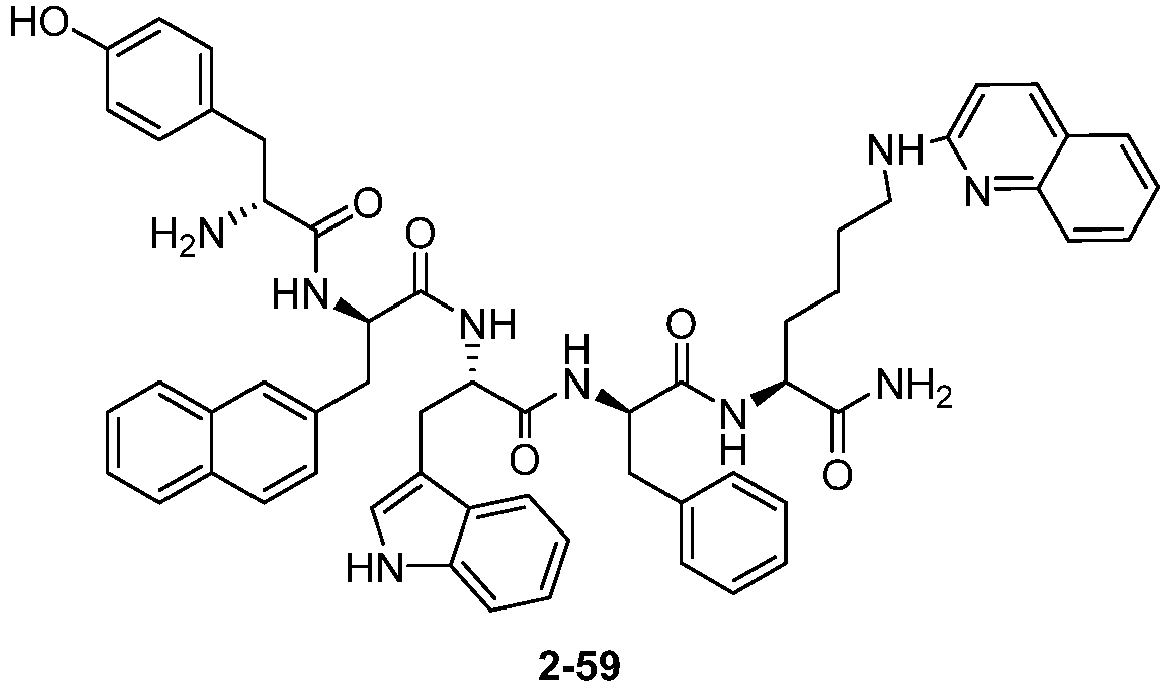
- Compound 2-59 was obtained by the same preparation method in example 1 except that 2-(2,2-dimethoxyethylthio)quinoline or 2-(2,2-dimethoxyethylseleno)quinoline was used and the nucleophile was replaced with tyrosine-pralmorelin, with a yield of 69%-90%. 1H NMR (500 MHz, DMSO-d 6) δ 10.83 (d, J=2.4 Hz, 1H), 9.18 (s, 1H), 8.57 (d, J=8.0 Hz, 1H), 8.44 (d, J=8.1 Hz, 1H), 8.14 (d, J=8.4 Hz, 1H), 7.93 (d, J=8.2 Hz, 1H), 7.82-7.69 (m, 3H), 7.58 (dd, J=7.9, 1.4 Hz, 1H), 7.49 (d, J=8.2 Hz, 1H), 7.47-7.42 (m, 1H), 7.41-7.36 (m, 2H), 7.36-7.30 (m, 5H), 7.29-7.23 (m, 3H), 7.21 (d, J=2.4 Hz, 1H), 7.19-7.06 (m, 4H), 7.00 (s, 2H), 6.95-6.88 (m, 3H), 6.74 (d, J=8.9 Hz, 1H), 6.66 (m, 3H), 4.71 (m, 1H), 4.62 (m, 1H), 4.52 (m, 1H), 4.19 (m, 1H), 4.11 (m, 1H), 3.19 (d, J=3.8 Hz, 2H), 3.01 (m, 1H), 2.89-2.76 (m, 3H), 2.75-2.65 (m, 3H), 2.39 (m, 1H), 1.67 (m, 1H), 1.52 (m, 3H), 1.24 (m, 2H). 13C NMR (125 MHz, Methanol-d 4) δ 174.03, 173.61, 172.24, 171.30, 170.49, 157.45, 156.33, 148.43, 138.19, 136.66, 136.45, 135.01, 133.10, 132.09, 130.66, 129.88, 129.35, 128.55, 128.42, 128.01, 127.86, 127.70, 127.61, 127.31, 126.74, 126.01, 125.65, 124.71, 123.23, 121.37, 119.34, 118.73, 115.51, 113.57, 111.82, 110.54, 56.34, 54.73, 53.97, 53.05, 52.60, 40.76, 38.75, 38.43, 32.21, 28.95, 28.45, 23.34. HRMS (ESI): Calculated for C57H60N9O6[M+H]+: 966.4661, Found: 966.4668.
- Example 60 Preparation of Compound 2-60

- Compound 2-60 was obtained by the same preparation method in example 1 except that 6-p-methoxyphenyl-2-(2,2-dimethoxyethylthio)quinoline or 6-p-methoxyphenyl-2-(2,2-dimethoxyethylseleno)quinoline was used and the nucleophile was replaced with octreotide acetate hydrochloride, with a yield of 39%-46%. 1H NMR (600 MHz, Methanol-d 4) δ 7.87 (d, J=8.9 Hz, 1H), 7.77 (d, J=2.2 Hz, 1H), 7.76-7.72 (m, 1H), 7.70 (d, J=8.6 Hz, 1H), 7.63-7.58 (m, 2H), 7.43 (dd, J=7.7, 1.3 Hz, 1H), 7.34 (d, J=8.1 Hz, 1H), 7.32-7.28 (m, 4H), 7.26 (m, 3H), 7.24-7.21 (m, 3H), 7.04 (m, 2H), 7.01-6.99 (m, 2H), 6.93 (s, 1H), 6.74 (m, 1H), 5.19-5.12 (m, 1H), 5.11-5.05 (m, 1H), 4.64 (m, 1H), 4.43 (d, J=5.2 Hz, 1H), 4.39-4.35 (m, 1H), 4.14 (m, 1H), 4.05 (dd, J=6.5, 3.3 Hz, 1H), 3.99 (m, 1H), 3.85-3.81 (m, 4H), 3.74-3.62 (m, 3H), 3.12-2.75 (m, 10H), 1.76 (m, 1H), 1.48-1.32 (m, 3H), 1.26 (d, J=6.4 Hz, 3H), 1.18 (d, J=6.5 Hz, 3H), 0.79-0.62 (m, 2H).13C NMR (150 MHz, Methanol-d4) δ 174.82, 174.40, 174.16, 171.44, 171.37, 171.33, 169.01, 158.98, 157.40, 146.50, 137.27, 136.99, 136.55, 136.46, 134.12, 133.04, 129.02, 128.96, 128.13, 128.02, 127.95, 127.34, 126.93, 126.39, 126.35, 124.56, 124.25, 123.25, 123.02, 121.05, 118.41, 117.71, 113.79, 112.98,111.01, 108.47, 66.86, 65.62, 61.18, 59.69, 56.28, 56.16, 55.96, 54.85, 54.24, 54.18, 52.41, 52.33, 44.23, 41.78, 40.82, 40.58, 39.17, 30.27, 28.43, 25.72, 22.61, 18.90, 18.69. HRMS (ESI): Calculated for C65H78N11O11S2 [M+H]+: 1252.5318, Found: 1252.5313.
- Example 61 Preparation of Compound 2-61

- Compound 2-61 was obtained by the same preparation method in example 1 except that 6-cyano-2-(2,2-dimethoxyethylthio)quinoline or 6-cyano-2-(2,2-dimethoxyethylseleno)quinoline was used and the nucleophile was replaced with octreotide acetate hydrochloride, with a yield of 58%. 1H NMR (500 MHz, Methanol-d 4) δ 8.01 (d, J=1.8 Hz, 1H), 7.85 (d, J=9.3 Hz, 1H), 7.71-7.66 (m, 2H), 7.46-7.43 (m, 1H), 7.34-7.25 (m, 11H), 7.10-7.02 (m, 2H), 6.95 (s, 1H), 6.82 (d, J=9.1 Hz, 1H), 5.16 (m, 2H), 4.67 (m, 1H), 4.46 (d, J=5.3 Hz, 1H), 4.42-4.35 (m, 1H), 4.17 (m, 1H), 4.08 (dd, J=6.5, 3.2 Hz, 1H), 4.02 (m, 1H), 3.84 (dd, J=6.1, 3.3 Hz, 1H), 3.81 (m, 1H), 3.73 (m, 1H), 3.67 (m, 1H), 3.13 (m, 2H), 3.07-2.85 (m, 7H), 2.80 (m, 1H), 1.79 (m, 1H), 1.50-1.36 (m, 3H), 1.28 (d, J=6.3 Hz, 3H), 1.21 (d, J=6.5 Hz, 3H), 0.81-0.68 (m, 2H). 13C NMR (125 MHz, Methanol-d 4) δ 174.45, 174.15, 173.81, 171.49, 171.43, 171.38, 169.11, 158.99, 150.30, 140.19, 136.76, 136.65, 136.54, 136.37, 133.04, 130.53, 129.15, 129.04, 128.35, 128.05, 127.04, 126.68, 126.51, 125.77, 123.15, 122.75, 121.16, 119.09, 118.53, 117.83, 116.37, 111.09, 108.63, 103.50, 67.00, 65.79, 61.30, 59.75, 56.35, 56.25, 55.75, 54.96, 54.18, 52.67, 44.36, 42.08, 40.45, 40.32, 39.24, 30.31, 28.29, 25.85, 22.64, 19.00, 18.79. HRMS (ESI): Calculated for C59H71N12O10S2 [M+H]+: 1171.4852, Found: 1171.4837.
- Example 62 Preparation of Compound 2-62

- Compound 2-62 was obtained by the same preparation method in example 1 except that 6-carboxyl-2-(2,2-dimethoxyethylthio)quinoline was used and the nucleophile was replaced with octreotide acetate hydrochloride, with a yield of 60%. 1H NMR (500 MHz, Methanol-d 4) δ 8.22 (d, J=2.0 Hz, 1H), 8.10 (dd, J=8.6, 2.1 Hz, 1H), 7.87 (d, J=9.0 Hz, 1H), 7.61 (d, J=8.7 Hz, 1H), 7.43 (d, J=7.6 Hz, 1H), 7.28 (m, 11H), 7.07-7.00 (m, 2H), 6.94 (s, 1H), 6.73 (d, J=9.0 Hz, 1H), 5.12 (m, 1H), 5.05 (dd, J=7.4, 3.5 Hz, 1H), 4.65 (m, 1H), 4.43 (d, J=5.0 Hz, 1H), 4.42-4.36 (m, 1H), 4.14 (m, 1H), 4.05 (dd, J=6.5, 3.3 Hz, 1H), 3.96 (m, 1H), 3.83 (dd, J=6.2, 3.3 Hz, 1H), 3.72 (m, 1H), 3.69-3.61 (m, 2H), 3.21-2.72 (m, 10H), 1.74 (m, 1H), 1.38 (m, 3H), 1.26 (d, J=6.3 Hz, 3H), 1.19 (d, J=6.5 Hz, 3H), 0.78-0.59 (m, 2H).13C NMR (125 MHz, Methanol-d 4) δ 175.10, 174.54, 174.33, 173.93, 171.50, 171.43, 169.02, 158.13, 149.03, 137.65, 137.46, 136.60, 136.52, 130.94, 130.09, 129.07, 129.03, 128.96, 128.17, 128.03, 126.99, 126.47, 126.36, 123.40, 123.08, 122.12, 121.11, 118.46, 117.75, 112.78, 111.09, 108.51, 66.88, 65.70, 61.25, 59.81, 56.37, 56.27, 56.10, 54.94, 54.36, 52.40, 52.38, 44.17, 41.59, 41.00, 40.62, 39.28, 30.32, 28.43, 25.81, 22.69, 18.97, 18.76. HRMS (ESI): Calculated for C59H72N11O12S2 [M+H]+: 1190.4798, Found: 1190.4801.
- Example 63 Preparation of Compound 2-63

- Compound 2-63 was obtained by the same preparation method in example 1 except that 5-carboxyl-2-(2,2-dimethoxyethylthio)quinoline was used and the nucleophile was replaced with octreotide acetate hydrochloride, with a yield of 12%. 1H NMR (600 MHz, Methanol-d 4) δ 8.55 (m, 1H), 7.66-7.63 (m, 1H), 7.44 (d, J=4.8 Hz, 2H), 7.42 (d, J=7.7 Hz, 1H), 7.30 (m, 7H), 7.26-7.23 (m, 4H), 7.07-7.00 (m, 2H), 6.93 (s, 1H), 6.72 (d, J=9.3 Hz, 1H), 5.11 (m, 1H), 5.04 (m, 1H), 4.65 (m, 1H), 4.42 (d, J=5.1 Hz, 1H), 4.40-4.35 (m, 1H), 4.12 (m, 1H), 4.04 (m, 1H), 3.94 (m, 1H), 3.83 (m, 1H), 3.71 (m, 1H), 3.65 (m, 2H), 3.26 (m, 2H), 3.11 (m, 1H), 3.05-2.89 (m, 7H), 2.83-2.75 (m, 2H), 1.78-1.66 (m, 1H), 1.43-1.31 (m, 3H), 1.26 (d, J=6.4 Hz, 3H), 1.18 (d, J=6.4 Hz, 3H), 0.73-0.57 (m, 2H). 13C NMR (150 MHz, Methanol-d 4) δ 175.38, 174.65, 174.11, 173.93, 171.09, 171.02, 170.99, 168.58, 156.77, 151.77, 147.20, 138.14, 137.03, 136.18, 136.12, 135.48, 128.65, 128.63, 127.75, 127.61, 126.57, 126.05, 125.95, 124.64, 122.67, 120.69, 120.60, 119.83, 118.05, 117.32, 111.98, 110.68, 108.08, 66.45, 65.27, 60.82, 59.39, 55.95, 55.88, 55.67, 54.52, 53.99, 51.99, 51.95 , 43.77, 41.15, 40.57, 40.19, 38.88, 29.91, 28.09, 25.40, 22.28, 18.55, 18.34. HRMS (ESI): Calculated for C59H72N11O12 S2[M+H]+: 1190.4798, Found: 1190.4831.
- Example 64 Preparation of Compound 2-64

- Compound 2-64 was obtained by the same preparation method in example 1 except that 8-carboxyl-2-(2,2-dimethoxyethylthio)quinoline was used and the nucleophile was replaced with octreotide acetate hydrochloride, with a yield of 59%. 1H NMR (500 MHz, Methanol-d 4) δ 8.32 (d, J=1.5 Hz, 1H), 7.84 (d, J=9.0 Hz, 1H), 7.77 (dd, J=8.2, 1.7 Hz, 1H), 7.58 (d, J=8.2 Hz, 1H), 7.43 (d, J=7.9 Hz, 1H), 7.35-7.24 (m, 11H), 7.08-7.00 (m, 2H), 6.98 (s, 1H), 6.75 (d, J=9.0 Hz, 1H), 5.12 (m, 1H), 5.05 (m, 1H), 4.70-4.67 (m, 1H), 4.46-4.39 (m, 2H), 4.15 (m, 1H), 4.07 (m, 1H), 3.95 (m, 1H), 3.86 (m, 1H), 3.74 (m, 1H), 3.71-3.64 (m, 2H), 3.31 (d, J=7.2 Hz, 2H), 3.15 (m, 1H), 3.07-2.81 (m, 9H), 1.73 (m, 1H), 1.45-1.36 (m, 3H), 1.29 (d, J=6.2 Hz, 3H), 1.21 (d, J=6.4 Hz, 3H), 0.77-0.60 (m, 2H). 13C NMR (125 MHz, Methanol-d 4) δ 175.04, 174.59, 174.45, 174.23, 171.59, 171.48, 171.45, 169.00, 157.69, 147.25, 139.06, 137.44, 136.63, 136.53, 136.45, 129.08, 128.20, 128.06, 127.04, 126.50, 126.45, 126.41, 125.68, 124.30, 123.17, 122.14, 121.12, 118.47, 117.75, 113.28, 111.20, 108.51, 66.87, 65.76, 61.28, 59.89, 56.42, 56.37, 56.11, 54.97, 54.53, 52.41, 44.13, 41.44, 40.98, 40.67, 39.32, 30.37, 28.49, 25.88, 22.73, 19.01, 18.81.HRMS (ESI): Calculated for C59H72N11O12 S2[M+H]+: 1190.4798, Found: 1190.4814.
- Example 65 Preparation of Compound 2-65

- Compound 2-65 was obtained by the same preparation method in example 1 except that 7-alkynyl-2-(2,2-dimethoxyethylthio)quinoline was used and the nucleophile was replaced with octreotide acetate hydrochloride, with a yield of 32%. 1H NMR (500 MHz, Methanol-d 4) δ 7.81 (d, J=9.0 Hz, 1H), 7.79 (d, J=1.4 Hz, 1H), 7.57 (d, J=8.1 Hz, 1H), 7.47-7.43 (m, 1H), 7.34-7.25 (m, 12H), 7.06 (m, 2H), 6.96 (s, 1H), 6.75 (d, J=9.0 Hz, 1H), 5.18 (m, 1H), 5.11 (m, 1H), 4.70-4.67 (m, 1H), 4.46 (d, J=5.2 Hz, 1H), 4.40 (d, J=6.0 Hz, 1H), 4.20-4.16 (m, 1H), 4.07 (dd, J=6.5, 3.3 Hz, 1H), 4.00 (m, 1H), 3.86 (m, 1H), 3.76-3.70 (m, 2H), 3.67 (d, J=5.0 Hz, 1H), 3.57 (s, 1H), 3.29 (m, 2H), 3.12-2.85 (m, 10H), 1.77 (m, 1H), 1.49-1.35 (m, 3H), 1.28 (d, J=6.3 Hz, 3H), 1.21 (d, J=6.5 Hz, 3H), 0.81-0.64 (m, 2H). 13C NMR (125 MHz, Methanol-d 4) δ 174.72, 174.47, 174.23, 171.46, 171.42, 169.09, 157.96, 147.25, 137.26, 136.64, 136.55, 136.37, 129.11, 129.06, 128.23, 128.09, 128.05, 127.42, 127.02, 126.48, 124.27, 123.25, 123.13, 121.15, 118.51, 117.80, 113.68, 111.09, 108.58, 83.34, 77.89, 66.95, 65.75, 61.29, 59.77, 56.38, 56.27, 56.01, 54.95, 54.28, 52.53, 52.43, 44.33, 41.88, 40.82, 40.58, 39.27, 30.36, 28.37, 25.84, 22.69, 18.99, 18.79. HRMS (ESI): Calculated for C60H72N11O10S2 [M+H]+: 1170.49, Found: 1170.4897.
- Example 66 Preparation of Compound 2-66

- Compound 2-66 was obtained by the same preparation method in example 1 except that 7-iodo-2-(2,2-dimethoxyethylthio)quinoline or 7-iodo-2-(2,2-dimethoxyethylseleno)quinoline was used and the nucleophile was replaced with pralmorelin, with a yield of 27%-36%. 1H NMR (500 MHz, Methanol-d 4) δ 7.94 (d, J=2.1 Hz, 1H), 7.83-7.75 (m, 1H), 7.73-7.65 (m, 4H), 7.54 (d, J=1.6 Hz, 1H), 7.48-7.45 (m, 1H), 7.45-7.42 (m, 2H), 7.39 (d, J=8.8 Hz, 1H), 7.35 (d, J=8.1 Hz, 1H), 7.28-7.21 (m, 3H), 7.20-7.16 (m, 1H), 7.13 (m, 3H), 7.05 (m, 1H), 6.93 (s, 1H), 6.74 (d, J=9.0 Hz, 1H), 4.63 (dd, J=8.6, 6.0 Hz, 1H), 4.58 (dd, J=7.8, 6.3 Hz, 1H), 4.41 (dd, J=8.5, 7.0 Hz, 1H), 4.19-4.10 (m, 1H), 3.61 (q, J=7.0 Hz, 1H), 3.39 (dd, J=14.5, 7.2 Hz, 2H), 3.10 (,m 2H), 2.99 (dd, J=13.8, 8.5 Hz, 1H), 2.93 (dd, J=14.1, 8.1 Hz, 2H), 2.76 (dd, J=13.4, 7.1 Hz, 1H), 1.87-1.75 (m, 1H), 1.63-1.48 (m, 3H), 1.28 (d, J=7.0 Hz, 3H), 1.21-1.10 (m, 2H). 13C NMR (125 MHz, Methanol-d 4) δ 175.97 , 172.77 , 172.56, 172.40, 171.42 , 157.74 , 146.87, 137.52 , 136.59 , 136.49, 135.82 , 135.56 , 134.16 , 133.45 , 132.49 , 128.94 , 128.18 , 127.68 , 127.53 , 127.38 , 127.19, 127.17 , 126.97 , 126.56 , 125.71 , 125.30 , 125.19, 123.24 , 121.09 , 118.54 , 117.85 , 113.53, 111.03 , 109.26 , 55.73 , 54.88 , 54.23 , 53.30 , 49.14 , 40.52 , 37.11 , 36.53 , 30.77 , 28.35 , 27.25 , 22.99 , 17.50 . HRMS (ESI): Calculated for C51H55IN9O5 [M+H]+: 1000.3365, Found: 1000.3354.
- Example 67 Preparation of Compound 2-67

- Compound 2-67 was obtained by the same preparation method in example 1 except that 7-carboxyl-2-(2,2-dimethoxyethylthio)quinoline was used and the nucleophile was replaced with pralmorelin, with a yield of 77%. 1H NMR (500 MHz, Methanol-d 4) δ 8.32 (s, 1H), 8.13 (d, J=8.8 Hz, 1H), 7.94 (d, J=9.1 Hz, 1H), 7.83-7.76 (m, 1H), 7.74-7.65 (m, 3H), 7.57 (s, 1H), 7.48 (d, J=7.9 Hz, 1H), 7.44 (p, J=5.4 Hz, 2H), 7.34 (d, J=8.1 Hz, 1H), 7.26 (m, 3H), 7.19 (d, J=7.3 Hz, 1H), 7.14 (d, J=7.5 Hz, 3H), 7.04 (d, J=7.4 Hz, 1H), 6.94 (s, 1H), 6.85 (d, J=9.1 Hz, 1H), 4.68-4.64 (m, 1H), 4.60 (dd, J=7.9, 6.5 Hz, 1H), 4.41 (dd, J=8.6, 7.0 Hz, 1H), 4.15 (dd, J=10.2, 4.2 Hz, 1H), 3.81 (q, J=7.1 Hz, 1H), 3.43 (m2H), 3.10 (m, 2H), 3.03-2.98 (m, 1H), 2.97-2.89 (m, 2H), 2.78-2.71 (m, 1H), 1.89-1.75 (m, 1H), 1.59 (m, 3H), 1.38 (d, J=7.1 Hz, 3H), 1.17 (m, 2H). 13C NMR (125 MHz, Methanol-d 4) δ 176.01 , 172.81, 172.46, 171.14, 170.02, 136.57, 136.46, 134.15, 133.45 , 132.49 , 130.21 , 128.93 , 128.17 , 127.72 , 127.51 , 127.36 , 127.16 , 126.91 , 126.57 , 125.74 , 125.33 , 123.21 , 121.86, 121.07 , 118.51 , 117.86 , 111.02 , 109.31 , 55.78 , 55.05 , 54.15 , 53.22 , 48.68 , 40.80 , 36.96 , 36.45 , 30.61 , 28.01 , 27.34 , 22.90 , 16.15 . HRMS (ESI): Calculated for C52H56N9O7 [M+H]+: 918.4297, Found: 918.4318.
- Example 68 Preparation of Compound 2-68 (H-His7-Aib8-Glu9-Gly10-Thr11-Phe12-Thr13-Ser14-Asp15-Val16-Ser17-Ser18-Tyr19-Leu20-Glu21-Gly22-Gln23-Ala24-Ala25-Lys26(quinolinyl)-Glu27-Phe28-Ile29-Ala30-Trp31-Leu32-Val33-Arg34-Gly35-Arg36-Gly37-OH)
- Compound 2-68 was obtained by the same preparation method in example 1 except that 2-(2,2-dimethoxyethylthio)quinoline or 2-(2,2-dimethoxyethylseleno)quinoline was used and the nucleophile was replaced with semaglutide backbone (H-His7-Aib8-Glu9-Gly10-Thr11-Phe12-Thr13-Ser14-Asp15-Val16-Ser17-Ser18-Tyr19-Leu20-Glu21-Gly22-Gln23-Ala24-Ala25-Lys26-Glu27-Phe28-Ile29-Ala30-Trp31-Leu32-Val3 3-Arg34-Gly35-Arg36-Gly37-OH). The structure of the product was identified by biological mass spectrum (
Fig. 1 ), and the molecular weight 3522.7392 is the molecular weight of the quinolinated semaglutide backbone product. - Example 69 Preparation of Compound 2-69 (quinolinated insulin)
- Compound 2-69 was obtained by the same preparation method in example 1 except that 2-(2,2-dimethoxyethylthio)quinoline or 2-(2,2-dimethoxyethylseleno)quinoline was used and the nucleophile was replaced with insulin. The structure of the product was identified by the biological mass spectrum (
Fig. 2 ), and the molecular weight 5930.6892 is the molecular weight of the quinolinated insulin product. - Biological test example 1 (cell proliferation inhibition assay):
Hepatocarcinoma BEL-7402 and SMMC-7721 cells were purchased from American Standard Bacterial Bank. All cell lines were stored in a cell culture medium containing 10% fetal bovine serum in a humid environment at 37 °C and 5% CO2. The two kinds of hepatocarcinoma cells were seeded in 96-well plates overnight. The assay were performed using a final highest concentration of 100 µM, 10-fold dilution, 6 gradients and 3 duplicates, and the cells were treated for 72 hours and three independent repeated experiments were carried out. The antiproliferative activity of the compound was determined by Sulforhodamine B (SRB) method. Then the absorbance OD value at a wavelength of 510 nm was measured on a Synergy H4 Hybrid reader (BioTek, Winooski, VT, USA) by using Gen5.0 software (BioTek). The IC50 value was calculated using the software Prism 5 (GraphPad Software, Inc). The test results are shown in Table 1.Table 1 Hepatocarcinoma cell proliferation inhibition results of selected compounds Compound name/No. Proliferation inhibition IC50 (µM) BEL-7402 SMMC-7721 YSL >100 >100 YSL-M >100 >100 2-39 52.57±2.47 63.30±6.35 - Tyroserleutide (YSL) has already been in a phase III clinical trial for treatment of liver cancer. YSL, YSL-M (tyroserleucide methyl ester) and the Compound 2-39 which is modified with quinolinyl group were tested for their anti-cancer activities on hepatocarcinoma BEL-7402 and SMMC-7721 cells. The results shows that the Compound 2-39 has better cytotoxicities than the unmodified drugs on both BEL-7402 and SMMC-7721 cells, which indicates that the introduction of quinolinyl in a peptide can enhance its activity.
- Biological test example 2 ([35S]GTPγS binding assay):
Protein concentration was detected using BCA protein concentration assay kit: 10 µl of protein standard was prepared into a final concentration of 0.5 mg/ml. 0, 1, 2, 4, 8, 12, 16, or 20 µl of BSA standard protein was taken and added together with the sample to be tested to a 96-well plate, and supplemented to 20 µl with the solution for diluting the standard. 200 µl of BCA working solution was added to each well and placed at 37 °C for 30 min. The absorbance at A562 wavelength was measured with a microplate reader. The protein concentration was calculated based on the standard curve. - The prepared membrane receptor was diluted to the required concentration with the reaction buffer (R.B), and the samples were added as shown in Table 2 (unit: µl).
Table 2 R.B [35S]GTPγS 0.1-0.2 nM GTPγS 20 µM GDP 40 µM agonist protein 20-30 µg NS binding 30 10 10 0 0 50 basal 30 10 0 10 0 50 agonist 20 10 0 10 10 50 - The reaction tube was incubated in a 27 °C water bath for 1 hour, and the mixture was filtered through a glass fiber membrane under reduced pressure and liquid scintillation counting was performed. The following equation was used to perform calculation:

- The µ-opioid receptor (MOR) agonist activities of derorphin and its quinolinylated compound 2-38 are shown in Table 3 below.
Table 3 µ-Opioid Receptor (MOR) Agonist Activity Assay Compound name/No (MOR) (mean±sem) EC50(nM) Emax(%) derorphin 61.3±10.6 218.8±7.1 2-38 223.9±25.1 202.7±5.1 - Derorphin is a clinically used µ-opioid receptor (MOR) agonist. From the above results in Table 3, it can be seen that the quinolinylated compound 2-38 has an activity comparable to that of derorphin.
- Biological test example 3 (liver tissue metabolism assay):
5 g of a fresh pig liver from which adhering fat and connective tissue were removed, was washed with a cold saline, absorbed water on its surface with a filter paper and weighed. The liver was cut into pieces with a scissors, added with an appropriate amount of a PBS buffer, and homogenized with a homogenizer at a frequency of 30/s for 4 minutes to prepare 20 ml of a slurry. The compound 2-40 to be tested (at a final concentration of 1 mg/ml with a co-solvent (1% DMSO)) was added into the 20 ml pig liver slurry, stirred thoroughly and left stand. 1ml of samples were withdrawn twice at six time points: 0.25 hour, 0.5 hour, 1 hour, 1.5 hour, 2 hour and 3 hour, respectively, and added with methanol (500 µl) to stop the reaction. After centrifugation (1000 rpm, 6 minutes), the supernatant was separated and extracted twice with 750 µl of water-saturated n-butanol. The extracted samples were then analyzed by HPLC. The HPLC analysis was performed on an Agilent Zorbax SB-C18 column (5 µm, 4.6x250 mm) with a flow rate of 1 mL/min at 25 °C. The gradient condition used was from 50% A (MeOH) and 50% B (H2O + 0.2% CH3COOH) to 95% A and 5% B in 16 minutes. The absorbance values at 210, 254 and 280 nm were collected using a UV-DAD detector. The concentration of the compound 2-40 in liver tissue over time is shown inFig. 3 . - 7-(2-fluorophenyl)-4-methylquinoline-2(1H)-one is a tankyrase (TNKS) inhibitor with an IC50 value of 0.052 µM. It can be easily coupled to (S)-2-((S)-2-amino-3-methylbutamido)-N-(4-(hydroxymethyl)phenyl)-5-ureidopentanamide (Val-Cit-PAB-OH) by using the method developed in the present application to obtain the compound 2-40. As shown in
Fig. 3 , the compound 2-40 shows good metabolic stability in the in vitro liver tissue metabolic stability assay. - In conclusion, the present application provides a new bioorthogonal chemistry method for the preparation of small molecule-peptide coupled drugs. This method may be used in various applications and has great application potential in the modification of drugs, especially peptide drugs.
Claims (10)
- A method for modifying or labeling the amino group(s) in the molecule(s) wherein the zolinium(s) represented by the following formula 1 is used to modify or label the amino group(s) in the molecule(s),
 In the above formula 1,Ring B represents a substituted or unsubstituted 5-, 6- or 7-membered nitrogen-containing heterocyclic ring;Q and U each independently represent oxygen (O), sulfur (S), selenium (Se), tellurium (Te), polonium (Po), nitrogen (N), phosphorus (P), boron (B) or silicon (Si);R1 represents 1-5 substituents on the ring B, which are each independently selected from hydrogen, hydroxyl, amino, mercapto, nitro, cyano, substituted or unsubstituted amide, substituted or unsubstituted alkyl, substituted or unsubstituted alkoxy, substituted or unsubstituted alkylthio, substituted or unsubstituted alkylamino, substituted or unsubstituted aryl, substituted or unsubstituted aryloxy, substituted or unsubstituted arylthio, substituted or unsubstituted arylamino, and halogen; or, when R1 represents two or more substituents on the ring B, two adjacent substituents of which may connect to each other together with the atoms on the ring B to form a substituted or unsubstituted aryl, a substituted or unsubstituted 3-7 membered cycloalkyl, a substituted or unsubstituted 5-7 membered heterocycloalkyl containing 1-5 atoms independently selected from oxygen (O), sulfur (S), selenium (Se), tellurium (Te), polonium (Po), nitrogen (N), phosphorus (P), boron (B) and silicon (Si), or a substituted or unsubstituted 5-7 membered heteroaryl containing 1-5 atoms independently selected from oxygen (O), sulfur (S), selenium (Se), tellurium (Te), polonium (Po), nitrogen (N), phosphorus (P), boron (B) and silicon (Si);R2 and R3 each independently represent hydrogen, hydroxyl, amino, mercapto, nitro, cyano, substituted or unsubstituted amide, substituted or unsubstituted alkyl, substituted or unsubstituted alkoxy, substituted or unsubstituted alkylthio, substituted or unsubstituted alkylamino, substituted or unsubstituted aryl, substituted or unsubstituted aryloxy, substituted or unsubstituted arylthio, substituted or unsubstituted arylamino, or halogen;R4 represents hydrogen, a substituted or unsubstituted alkyl, or a substituted or unsubstituted aryl; andY is an acid anion selected from inorganic acid ions, organic acid ions and halide ions.
 - The method of claim 1, wherein,in formula 1,Ring B is a 5- or 6-membered ring;Q and U are each independently selected from oxygen, sulfur and selenium;R1 represents two or more substituents on ring B, two adjacent substituents of which may connect to each other together with the atoms on the ring B to form a substituted or unsubstituted aryl ring;R2 and R3 are each independently selected from hydrogen, substituted or unsubstituted alkyl, and substituted or unsubstituted aryl; andR4 is a substituted or unsubstituted alkyl.
- The method of claim 1, wherein, the molecule includes amino acid esters, amino amides, peptides or proteins.
- The method of claim 1, wherein, in the presence or absence of an additive, the zolinium(s) represented by Formula 1 reacts with the molecule(s) containing the amino group(s) in a solvent to prepare a product of which the amino group(s) is(are) labeled or modified.
- The method of claim 4, wherein, the method is carried out by a reaction represented by the following reaction scheme I:
 In Reaction scheme I, in the presence or absence of an additive, the zolinium(s) represented by formula 1 reacts with the compound represented by formula 3 in a solvent to prepare a product represented by Formula 2 of which the amino group is modified,wherein, in formula 3,n represents an integer of 1-6;R5 represents hydrogen, a substituted or unsubstituted alkyl, or a substituted or unsubstituted aryl;Each of R6 independently represents hydrogen, hydroxyl, amino, mercapto, nitro, cyano, substituted or unsubstituted amide, substituted or unsubstituted alkyl, substituted or unsubstituted alkoxy, substituted or unsubstituted alkylthio, substituted or unsubstituted alkylamino, substituted or unsubstituted aryl, substituted or unsubstituted aryloxy, substituted or unsubstituted arylthio, substituted or unsubstituted arylamino, or halogen; orR5 and R6 connect to each other to form a 5-7 membered heterocycle containing 1-3 heteroatoms selected from oxygen (O), sulfur (S), selenium (Se), tellurium (Te), polonium (Po), nitrogen (N), phosphorus (P), boron (B) and silicon (Si);W represents oxygen (O), sulfur (S), selenium (Se), tellurium (Te), polonium (Po), nitrogen (N), phosphorus (P), boron (B), or silicon (Si).wherein, in formula 2, ring B, R1, R5, R6, W, and n are defined as those in formula 1 and formula 3.
 - The method of claim 5, wherein,n is 1 or 5;W is oxygen or nitrogen;R5 is hydrogen, or a substituted or unsubstituted alkyl; andR6 is amino, a substituted or unsubstituted amido, a substituted or unsubstituted alkyl, or a substituted or unsubstituted phenyl.
- The method of claim 5, wherein, the solvent includes any one or a combination of two or more solvents of aprotic solvents and protic solvents, preferably, the solvent is n-butanol or water, and/or
the additive includes organic bases or inorganic bases. - Use of the zolinium(s) represented by the following formula 1 for modifying or labeling the amino group(s) in the molecule(s),
 In the above formula 1,Ring B represents a substituted or unsubstituted 5-, 6- or 7-membered nitrogen-containing heterocyclic ring;Q and U each independently represent oxygen (O), sulfur (S), selenium (Se), tellurium (Te), polonium (Po), nitrogen (N), phosphorus (P), boron (B) or silicon (Si);R1 represents 1-5 substituents on the ring B, which are each independently selected from hydrogen, hydroxyl, amino, mercapto, nitro, cyano, substituted or unsubstituted amide, substituted or unsubstituted alkyl, substituted or unsubstituted alkoxy, substituted or unsubstituted alkylthio, substituted or unsubstituted alkylamino, substituted or unsubstituted aryl, substituted or unsubstituted aryloxy, substituted or unsubstituted arylthio, substituted or unsubstituted arylamino, and halogen; alternatively, when R1 represents two or more substituents on the ring B, two adjacent substituents of which may connect to each other together with the atoms on the ring B to form a substituted or unsubstituted aryl, a substituted or unsubstituted 3-7 membered cycloalkyl, a substituted or unsubstituted 5-7 membered heterocycloalkyl containing 1-5 atoms independently selected from oxygen (O), sulfur (S), selenium (Se), tellurium (Te), polonium (Po), nitrogen (N), phosphorus (P), boron (B) and silicon (Si), or a substituted or unsubstituted 5-7 membered heteroaryl containing 1-5 atoms independently selected from oxygen (O), sulfur (S), selenium (Se), tellurium (Te), polonium (Po), nitrogen (N), phosphorus (P), boron (B) and silicon (Si);R2 and R3 each independently represent hydrogen, hydroxyl, amino, mercapto, nitro, cyano, substituted or unsubstituted amide, substituted or unsubstituted alkyl, substituted or unsubstituted alkoxy, substituted or unsubstituted alkylthio, substituted or unsubstituted alkylamino, substituted or unsubstituted aryl, substituted or unsubstituted aryloxy, substituted or unsubstituted arylthio, substituted or unsubstituted arylamino, or halogen;R4 represents hydrogen, a substituted or unsubstituted alkyl, or a substituted or unsubstituted aryl;Y is an acid anion selected from inorganic acid ions, organic acid ions and halide ions.
 - Use of claim 8, wherein, the molecule includes amino acid esters, amino amides, peptides or proteins.
- Use of claim 8, wherein, the modifying or labeling is applied in fields of synthesizing pharmaceutical molecules, developing probe molecules and diagnostic labeling reagents.
Applications Claiming Priority (2)
| Application Number | Priority Date | Filing Date | Title |
|---|---|---|---|
| CN201910276925 | 2019-04-08 | ||
| PCT/CN2020/081983 WO2020207279A1 (en) | 2019-04-08 | 2020-03-30 | Method for modifying amino group in molecule with oxazoline quaternary ammonium salt and use thereof |
Publications (2)
| Publication Number | Publication Date |
|---|---|
| EP3954692A1 true EP3954692A1 (en) | 2022-02-16 |
| EP3954692A4 EP3954692A4 (en) | 2022-09-07 |
Family
ID=72751895
Family Applications (1)
| Application Number | Title | Priority Date | Filing Date |
|---|---|---|---|
| EP20787011.4A Withdrawn EP3954692A4 (en) | 2019-04-08 | 2020-03-30 | Method for modifying amino group in molecule with oxazoline quaternary ammonium salt and use thereof |
Country Status (4)
| Country | Link |
|---|---|
| US (1) | US20220177515A1 (en) |
| EP (1) | EP3954692A4 (en) |
| CN (1) | CN111793025B (en) |
| WO (1) | WO2020207279A1 (en) |
Families Citing this family (2)
| Publication number | Priority date | Publication date | Assignee | Title |
|---|---|---|---|---|
| CN117229297B (en) * | 2022-06-08 | 2025-07-25 | 中国科学院上海药物研究所 | Styryl quinoline oxazoline ammonium analogue, and pharmaceutical composition, preparation method and application thereof |
| WO2025024414A2 (en) * | 2023-07-26 | 2025-01-30 | Duke University | Allosteric modulators of the beta1-adrenergic receptor and methods of using same |
Family Cites Families (1)
| Publication number | Priority date | Publication date | Assignee | Title |
|---|---|---|---|---|
| CN107759614B (en) * | 2016-08-16 | 2023-01-24 | 中国科学院上海药物研究所 | A class of oxazolopyridine quaternary ammonium salt compounds, their preparation method and use |
-
2020
- 2020-03-30 WO PCT/CN2020/081983 patent/WO2020207279A1/en not_active Ceased
- 2020-03-30 EP EP20787011.4A patent/EP3954692A4/en not_active Withdrawn
- 2020-03-30 US US17/594,199 patent/US20220177515A1/en not_active Abandoned
- 2020-03-30 CN CN202010236788.1A patent/CN111793025B/en not_active Expired - Fee Related
Also Published As
| Publication number | Publication date |
|---|---|
| WO2020207279A1 (en) | 2020-10-15 |
| EP3954692A4 (en) | 2022-09-07 |
| CN111793025B (en) | 2022-09-23 |
| CN111793025A (en) | 2020-10-20 |
| US20220177515A1 (en) | 2022-06-09 |
Similar Documents
| Publication | Publication Date | Title |
|---|---|---|
| AU2023200095B2 (en) | Sulfur(VI) fluoride compounds and methods for the preparation thereof | |
| ES2947438T3 (en) | Transglutaminase 2 (TG2) inhibitors | |
| JP2020506227A (en) | LSD1 inhibitor, its production method and application | |
| EP3330254A2 (en) | Method and process for preparation and production of deuterated omega-diphenylurea | |
| JP7138768B2 (en) | Dimethylphosphine oxide compound | |
| US20220177515A1 (en) | Method for modifying amino group in molecule with the zolinium and use thereof | |
| CN102659785A (en) | 2-amino-6-aminomethylpurine compound and preparation method and application thereof | |
| WO2018041260A1 (en) | Bromodomain recognition protein inhibitor and preparation method therefor and use thereof | |
| CN103930388B (en) | The precursor of novel glutamate derivative | |
| KR102481328B1 (en) | S1P1 agonists and their applications | |
| ES2999070T3 (en) | A substituted tetrahydroisoquinoline derivative as a d1 positive allosteric modulator | |
| TW201813956A (en) | Method for preparing phenylalanine compound | |
| HK40104062A (en) | Sulfur (vi) fluoride compounds and their use in click-reaction | |
| WO2010051129A2 (en) | New imidazolidinedione derivatives as antimalarial agents, preparation thereof, and methods of use | |
| NZ617331B2 (en) | Novel precursors of glutamate derivatives | |
| HK40096273A (en) | A substituted tetrahydroisoquinoline derivative as a d1 positive allosteric modulator | |
| NZ751226B2 (en) | Aryl-2,2'-tandem bisthiazole compound and preparation method and use thereof | |
| CA3030772A1 (en) | Processes for making, and methods of using, glycopyrronium compounds |
Legal Events
| Date | Code | Title | Description |
|---|---|---|---|
| STAA | Information on the status of an ep patent application or granted ep patent |
Free format text: STATUS: THE INTERNATIONAL PUBLICATION HAS BEEN MADE |
|
| PUAI | Public reference made under article 153(3) epc to a published international application that has entered the european phase |
Free format text: ORIGINAL CODE: 0009012 |
|
| STAA | Information on the status of an ep patent application or granted ep patent |
Free format text: STATUS: REQUEST FOR EXAMINATION WAS MADE |
|
| 17P | Request for examination filed |
Effective date: 20211103 |
|
| AK | Designated contracting states |
Kind code of ref document: A1 Designated state(s): AL AT BE BG CH CY CZ DE DK EE ES FI FR GB GR HR HU IE IS IT LI LT LU LV MC MK MT NL NO PL PT RO RS SE SI SK SM TR |
|
| DAV | Request for validation of the european patent (deleted) | ||
| DAX | Request for extension of the european patent (deleted) | ||
| A4 | Supplementary search report drawn up and despatched |
Effective date: 20220804 |
|
| RIC1 | Information provided on ipc code assigned before grant |
Ipc: C07D 213/64 20060101ALI20220729BHEP Ipc: C07D 498/04 20060101AFI20220729BHEP |
|
| STAA | Information on the status of an ep patent application or granted ep patent |
Free format text: STATUS: THE APPLICATION IS DEEMED TO BE WITHDRAWN |
|
| 18D | Application deemed to be withdrawn |
Effective date: 20230303 |