EP3954561B1 - Wind deflector assembly - Google Patents
Wind deflector assembly Download PDFInfo
- Publication number
- EP3954561B1 EP3954561B1 EP20191148.4A EP20191148A EP3954561B1 EP 3954561 B1 EP3954561 B1 EP 3954561B1 EP 20191148 A EP20191148 A EP 20191148A EP 3954561 B1 EP3954561 B1 EP 3954561B1
- Authority
- EP
- European Patent Office
- Prior art keywords
- area
- wind deflector
- deflector assembly
- density
- deflecting material
- Prior art date
- Legal status (The legal status is an assumption and is not a legal conclusion. Google has not performed a legal analysis and makes no representation as to the accuracy of the status listed.)
- Active
Links
Images




Classifications
-
- B—PERFORMING OPERATIONS; TRANSPORTING
- B60—VEHICLES IN GENERAL
- B60J—WINDOWS, WINDSCREENS, NON-FIXED ROOFS, DOORS, OR SIMILAR DEVICES FOR VEHICLES; REMOVABLE EXTERNAL PROTECTIVE COVERINGS SPECIALLY ADAPTED FOR VEHICLES
- B60J7/00—Non-fixed roofs; Roofs with movable panels, e.g. rotary sunroofs
- B60J7/22—Wind deflectors for open roofs
-
- B—PERFORMING OPERATIONS; TRANSPORTING
- B60—VEHICLES IN GENERAL
- B60J—WINDOWS, WINDSCREENS, NON-FIXED ROOFS, DOORS, OR SIMILAR DEVICES FOR VEHICLES; REMOVABLE EXTERNAL PROTECTIVE COVERINGS SPECIALLY ADAPTED FOR VEHICLES
- B60J7/00—Non-fixed roofs; Roofs with movable panels, e.g. rotary sunroofs
- B60J7/22—Wind deflectors for open roofs
- B60J7/226—Wind deflectors for open roofs immovably attached to vehicle roof section
-
- B—PERFORMING OPERATIONS; TRANSPORTING
- B60—VEHICLES IN GENERAL
- B60J—WINDOWS, WINDSCREENS, NON-FIXED ROOFS, DOORS, OR SIMILAR DEVICES FOR VEHICLES; REMOVABLE EXTERNAL PROTECTIVE COVERINGS SPECIALLY ADAPTED FOR VEHICLES
- B60J7/00—Non-fixed roofs; Roofs with movable panels, e.g. rotary sunroofs
- B60J7/02—Non-fixed roofs; Roofs with movable panels, e.g. rotary sunroofs of sliding type, e.g. comprising guide shoes
- B60J7/04—Non-fixed roofs; Roofs with movable panels, e.g. rotary sunroofs of sliding type, e.g. comprising guide shoes with rigid plate-like element or elements, e.g. open roofs with harmonica-type folding rigid panels
- B60J7/043—Sunroofs e.g. sliding above the roof
-
- B—PERFORMING OPERATIONS; TRANSPORTING
- B60—VEHICLES IN GENERAL
- B60J—WINDOWS, WINDSCREENS, NON-FIXED ROOFS, DOORS, OR SIMILAR DEVICES FOR VEHICLES; REMOVABLE EXTERNAL PROTECTIVE COVERINGS SPECIALLY ADAPTED FOR VEHICLES
- B60J7/00—Non-fixed roofs; Roofs with movable panels, e.g. rotary sunroofs
- B60J7/02—Non-fixed roofs; Roofs with movable panels, e.g. rotary sunroofs of sliding type, e.g. comprising guide shoes
- B60J7/04—Non-fixed roofs; Roofs with movable panels, e.g. rotary sunroofs of sliding type, e.g. comprising guide shoes with rigid plate-like element or elements, e.g. open roofs with harmonica-type folding rigid panels
- B60J7/043—Sunroofs e.g. sliding above the roof
- B60J7/0435—Sunroofs e.g. sliding above the roof pivoting upwardly to vent mode and moving at the outside of the roof to fully open mode
Definitions
- the invention relates to a wind deflector assembly for use in an open roof construction for a vehicle according to the preamble of claim 1.
- wind deflector assemblies in open roof constructions can be moved from an in-effective position below the surface of the fixed roof to an effective position above the surface of the fixed roof.
- a spring or the like usually biases the movement of the wind deflector assembly from the ineffective position towards the effective position.
- the movement back from the effective position to the in-effective position is usually done under the influence of the closure means.
- the flexible wind deflecting material extends between a lower connecting part which is attached to the stationary part and an upper connecting part with which the flexible wind deflecting material is connected to the wind deflector upper elongate member. The wind deflecting material is kept taut in between these parts.
- the flexible wind deflecting material extends in lateral direction along the front edge of the roof opening and in the corner areas of the roof opening the flexible wind deflecting material extends with a substantially radius shape following the radius shaped corners of the upper elongate member and continuous rearwards towards the hinge member of the wind deflector assembly. Also in these corner areas the flexible wind deflecting material needs to be taut. Especially in the corner areas and the rearward parts of the flexible wind deflecting net, it may happen that under vehicle dynamic circumstances, the flexible wind deflecting material may not be taut enough and will start to flutter causing aero acoustic noises which are not desirable.
- DE 10 2007 051 878 A1 discloses a wind deflector according to the preamble of claim 1. In one embodiment, it has a frontal part having a weaving density and two lateral parts having a higher weaving density and a higher stiffness.
- DE 10 2010 048 964 A1 discloses a wind deflector provided on each end with a strip of stiffening material formed in one piece with a frame for the netting and extending through the lateral part and a partly along the frontal part of the netting.
- the wind deflector assembly has the features of the characterizing portion of claim 1.
- the wind deflecting material and the frontal part and left hand and the right-hand lateral parts of the wind deflecting material are made stiffer such that the lateral parts of the wind deflecting material may be stiffer in the effective position of the wind deflector assembly and do not flutter under dynamic circumstances. Also, due to these lateral parts being stiffer, it may not be clamped between the closure means and the seal attached to the aperture edge when the closure means closes the roof opening.
- the second area is strip shaped and woven with a second weaving density which is a higher density as part of the flexible wind deflecting material which limits the strip shaped second area.
- the flexible wind deflecting material is a product made of woven material in a weaving process whereby in the first and second area and as later on described optionally in a third area, the material is woven in a different weaving density, whereby the first, second and possibly third areas are one woven product and each of the areas are integrated in the product and as such interconnected to each other via the weaving process.
- the higher weaving density in the second area and, as later on described, third area as opposed to the first area is that the flexible wind deflecting material is less flexible and therefor more stiff which results in a reinforcing area in the flexible wind deflecting material.
- the higher weaving density gives a lower permeability to air which may influence the aero acoustic performance in a positive manner.
- the second area extends continuously along the frontal and lateral parts of the flexible wind deflecting material.
- the second area may extend not only in the lateral part but also extend completely along the frontal part.
- the second area is bound by at least a third area having a third weaving density.
- This third area may extend adjacently below or above the stripe shaped second area.
- the third area may comprise a density that is different to the first and the second area, to improve the stiffness of the flexible wind deflecting material further and so to meet requirements of aeroacoustics and folding behaviour of the flexible wind deflecting material.
- said first weaving density of said first area is lower than the second and third weaving density of the second respectively third area and wherein the second density of the second area is higher than the third density of the third area or the second density of the second area is lower than the third density of the third area. Since the strip shaped second area will be smaller in width compared to the first or third areas extending adjacently below or above, it may be conceivable that in order to establish an required stiffness of the flexible wind deflecting material to meet the aero acoustic and folding requirements, the densities of the second and third areas are adjusted such that either the second area has the highest weaving density or the third area has the highest density.
- the second area has a height H2 in the range of 2 mm to 12 mm and preferably in the range of 4 mm to 8 mm and in particular having a height of ca. 6 mm.
- the third area has a height H3 in the range of 2 mm to 16 mm and more preferably in the range of 6 mm to 10 mm and in particular having a height of ca. 8 mm.
- the second and if applicable third area may be subjected to certain styling requirements. So an optimum dimension of the height of the second and third areas may be depending on the stiffness applied by the second respectively third area and at the same time, the styling requirements and these may thus influence the height of the second and third areas.
- the strip shaped second area has a varying height extending along the flexible wind deflector material. This may be conceivable when, in the lateral parts, the strip shaped second areas and if applicable the third areas in the flexible wind deflecting material extending towards the end of the net near the hinge member need to be made thinner because of the lack of the space in the net.
- the lateral part of the strip shaped second area extends at least partly under an angle with regard to the frontal part of the strip shaped second area.
- the frontal part of the net and the lateral part of the net may extend at an angle towards each other.
- This angled condition may be explained best, imagining the net in isolated condition, lying on a flat surface, whereby the frontal part extends in an angle with the lateral part. This may imply that for reinforcing reasons of the lateral part of the net the second area and if applicable the third areas extend also under an angle. Such an angle may also be implied for styling reasons.
- the flexible wind deflecting material is directly moulded to the upper elongate member.
- the upper connecting part may be omitted and to directly mould the flexible wind deflecting material to the upper elongate member.
- a vehicle roof having an open roof construction with a roof opening 2 which can be opened and closed by a closure means 5.
- This closure means 5 is part of the open roof construction of the vehicle.
- the closure means 5 is a rigid at least partly transparent panel, made of glass, plastic or the like.
- the open roof construction further comprises a wind deflector assembly 1 and a stationary part 4 with which the open roof construction is mounted to the body of the vehicle.
- the wind deflector assembly 1 which is placed near the front edge of the roof opening 2, is capable of being stored in an ineffective position below the surface of the fixed roof 3 of the vehicle and below the closure means 5 and is capable of being extended to an effective position whereby a part of the wind deflector assembly 1 is above the surface of the fixed roof 3 and whereby the closure means 5 is in an open position.
- the wind deflector assembly 1 For influencing the air flow pattern above the roof opening 2 when the closure means 5 is in its open position, the wind deflector assembly 1 is extended partly above the surface of the fixed roof 3 to an effective position.
- the wind deflector assembly 1 comprises a flexible wind deflecting material 9 attached on an upper end with an upper connecting part 11 to the upper elongate member 6 and on a lower end with lower connecting part 10 to the stationary part 4 and extending substantially along the front area of the roof opening 2.
- the flexible wind deflecting material 9 is permeable to air.
- air flowing through the flexible wind deflecting material 9 becomes turbulent at the lee side of the wind deflecting material 9 due to the narrow openings in this material. This turbulent airflow avoids or at least reduces the phenomena of buffeting when the closure means 5 is in its opened position.
- the wind deflector assembly 1 comprises further an upper elongated member 6 extending in transverse direction and connected on each lateral end to arms 7, 7'.
- the left and right arms 7, 7' are pivotally connected to the stationary part 4 by means of hinge members 8, 8'.
- a biasing device 18, 18' is provided at each arm 7, 7' which biases the wind deflector arms 7, 7' relative to the stationary part 4 in an upward direction.
- the flexible wind deflecting material 9 extends from lower connecting part 10, with which it is connected to the stationary part 4, towards an upper connecting part 11 with which it is connected to the upper elongated member 6.
- the flexible wind deflecting material comprises a frontal part 12 extending in transverse direction along the front part of the roof opening 2 and a lateral part 13, 13' extending from the frontal part 12 towards the end part 14, 14'. Furthermore, a first area 15 having a first density 15' is shown, for the greater part extending in the frontal part 12 of the flexible wind deflecting material 9 but also partly in the lateral parts 13,13'. A second strip shaped area 16 having a second density 16' is shown partly in the frontal part 12 and the lateral parts 13, 13'.
- Each of these strip-shaped second areas 16 are woven into the base material, being the flexible wind deflecting material 9 having the first density 15'.
- strip-shaped second areas 16 are bound by flexible wind deflecting material 9 having another density, in this case bounded by the first area 15 having the first density 15'.
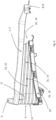
- FIG. 4 a side view of the wind deflector assembly 1 is shown.
- the lateral part 13, 13' is shown extending between the lower connecting part 10 with which it is connected to the stationary part 4 and an upper connecting part 11 with which it is connected to the upper elongate member 6.
- the strip shaped second areas 16 extend towards the end part of the net 14, 14'. In this view the second areas 16 extend substantially parallel to the upper elongate member 6. However, these strip shape second areas 16 may also extend under an angle with the upper elongate member 6, e.g. in a plane more horizontally or in a plane more vertically.
- FIG. 5 another embodiment is shown.
- the frontal part 12 and the lateral parts 13, 13' are equipped with strip shaped second areas 16 having a second density 16', extending from one end part 14 continuously to the opposite end part 14' of the flexible wind deflecting material 9.
- the strip shaped areas 16 are bound by either first areas 15 having a first density 15'.
- each of the second areas 16 having a second density 16' are bound on one edge by a first area 15 having a first density 15' and on the opposite edge by a third area 17 having a third density 17'.
- FIG. 6 another embodiment is shown whereby the strip shaped second areas 16 having a second density 16' are bound by a third area 17 having a third density 17'.
- Said third density 17 may have a density which is lower than the second density 16', but higher than the first density 15' or may be higher than the first and second densities 15', 16'.
- the height H2 which may also be referred to as width H2 of the second area 16 may lie in a range of between 2 mm and 12 mm and preferably in the range of between 4 mm and 8 mm and in particular having a height of ca. 6 mm.
- a height H3 which may also be referred to as width H3 of the third area 17, lies in the range of 2 mm to 16 mm and more preferably in the range of 6 mm to 10 mm and in particular having a height of ca. 8 mm.
- the ranges of dimensions for height H3 may also be used.
- Both the second and third area 16, 17 extend from one end 14 of the flexible wind deflecting material 9 to an opposite end 14' on the frontal part 12. It is conceivable that due to the lack of height of the lateral part 13, 13' near the end part 14, 14', the second area 16 may not extend all the way to the end part.
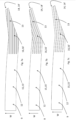
- the flexible wind deflecting material 9 taken in isolation from its fixings to the upper elongated member 6 and stationary part 4 and the lower and upper fixing parts 10, 11, when laid on a flat plane, show a particular outer contour which is given by the 3D geometry of the wind deflector assembly 1.
- Fig. 7a the strip shaped second area 16 extends perpendicular to the weaving directions W of the wind deflecting material 9.
- the strip shaped second area 16 extends parallel to the lower edge of the flexible wind deflecting material 9 such that the second areas 16 extend under an angle with the weaving direction W in the frontal part 12 and under another angle in the lateral parts 13, 13'.
- the strip shaped second area 16 in the lateral part 13, 13' extends under yet another angle to the weaving direction W.
- the strip shaped second area 16 is also tapered and changes in the height H2 dimension extending towards the end part 14, 14'. It could be conceivable that in such case the first or third areas (15, 17) that bound the second area 16 are tapered too, such that dimension H3 also changes in height towards the end parts 14, 14'.
Landscapes
- Engineering & Computer Science (AREA)
- Mechanical Engineering (AREA)
- Tents Or Canopies (AREA)
- Body Structure For Vehicles (AREA)
- Air Bags (AREA)
Description
- The invention relates to a wind deflector assembly for use in an open roof construction for a vehicle according to the preamble of
claim 1. - Usually, wind deflector assemblies in open roof constructions can be moved from an in-effective position below the surface of the fixed roof to an effective position above the surface of the fixed roof. A spring or the like usually biases the movement of the wind deflector assembly from the ineffective position towards the effective position. The movement back from the effective position to the in-effective position is usually done under the influence of the closure means. In the effective position of the wind deflector assembly, the flexible wind deflecting material extends between a lower connecting part which is attached to the stationary part and an upper connecting part with which the flexible wind deflecting material is connected to the wind deflector upper elongate member. The wind deflecting material is kept taut in between these parts.
- The flexible wind deflecting material extends in lateral direction along the front edge of the roof opening and in the corner areas of the roof opening the flexible wind deflecting material extends with a substantially radius shape following the radius shaped corners of the upper elongate member and continuous rearwards towards the hinge member of the wind deflector assembly. Also in these corner areas the flexible wind deflecting material needs to be taut. Especially in the corner areas and the rearward parts of the flexible wind deflecting net, it may happen that under vehicle dynamic circumstances, the flexible wind deflecting material may not be taut enough and will start to flutter causing aero acoustic noises which are not desirable. So, in these areas and in the lateral ends of the frontal part of the wind deflector material it may be required to stiffen the net with reinforcing counter measures. During the movement of the wind deflector assembly from an effective to an ineffective position, the tension in the wind deflecting material gradually reduces and is eventually completely withdrawn. In such situations in driving conditions the flexible wind deflecting material may hang loose and may be subject to the wind force, whereby the net may be pushed by the wind in between edges of the seal attached to edge of the roof opening and the closure means when the closure means drives into its closing position.
-
DE 10 2007 051 878 A1 discloses a wind deflector according to the preamble ofclaim 1. In one embodiment, it has a frontal part having a weaving density and two lateral parts having a higher weaving density and a higher stiffness. -
DE 10 2010 048 964 A1 discloses a wind deflector provided on each end with a strip of stiffening material formed in one piece with a frame for the netting and extending through the lateral part and a partly along the frontal part of the netting. - It is an object of the present invention to provide an improved wind deflector assembly.
- For this purpose, the wind deflector assembly has the features of the characterizing portion of
claim 1. - Due to this second area having a second weaving density the wind deflecting material and the frontal part and left hand and the right-hand lateral parts of the wind deflecting material are made stiffer such that the lateral parts of the wind deflecting material may be stiffer in the effective position of the wind deflector assembly and do not flutter under dynamic circumstances. Also, due to these lateral parts being stiffer, it may not be clamped between the closure means and the seal attached to the aperture edge when the closure means closes the roof opening.
- When the closure means closes the roof opening and engages the wind deflector arms by means of a slide pad attached to the lower side of the closure means, the wind deflector assembly is pushed downwards whereby it moves around its movable hinge member of the wind deflector arms with the stationary part. The second area is strip shaped and woven with a second weaving density which is a higher density as part of the flexible wind deflecting material which limits the strip shaped second area. The flexible wind deflecting material is a product made of woven material in a weaving process whereby in the first and second area and as later on described optionally in a third area, the material is woven in a different weaving density, whereby the first, second and possibly third areas are one woven product and each of the areas are integrated in the product and as such interconnected to each other via the weaving process.
- The effect of the higher weaving density in the second area and, as later on described, third area as opposed to the first area is that the flexible wind deflecting material is less flexible and therefor more stiff which results in a reinforcing area in the flexible wind deflecting material. Next to this, the higher weaving density gives a lower permeability to air which may influence the aero acoustic performance in a positive manner.
- In another embodiment the second area extends continuously along the frontal and lateral parts of the flexible wind deflecting material. In case the folding behaviour of a flexible wind deflecting material not having any reinforcing strips may lead to clamping problems not only in the lateral part, but also in the frontal part, the second area may extend not only in the lateral part but also extend completely along the frontal part.
- In yet another embodiment the second area is bound by at least a third area having a third weaving density. This third area may extend adjacently below or above the stripe shaped second area. The third area may comprise a density that is different to the first and the second area, to improve the stiffness of the flexible wind deflecting material further and so to meet requirements of aeroacoustics and folding behaviour of the flexible wind deflecting material.
- In yet another embodiment said first weaving density of said first area is lower than the second and third weaving density of the second respectively third area and wherein the second density of the second area is higher than the third density of the third area or the second density of the second area is lower than the third density of the third area. Since the strip shaped second area will be smaller in width compared to the first or third areas extending adjacently below or above, it may be conceivable that in order to establish an required stiffness of the flexible wind deflecting material to meet the aero acoustic and folding requirements, the densities of the second and third areas are adjusted such that either the second area has the highest weaving density or the third area has the highest density.
- In another aspect of the invention is that the second area has a height H2 in the range of 2 mm to 12 mm and preferably in the range of 4 mm to 8 mm and in particular having a height of ca. 6 mm. and the third area has a height H3 in the range of 2 mm to 16 mm and more preferably in the range of 6 mm to 10 mm and in particular having a height of ca. 8 mm. Next to the reinforcing effect that the second area implies, there is also another effect, namely that the second and if present the third area of the flexible wind deflecting material in the effective position of wind deflector assembly is visible from the inside and outside of the vehicle. This means that the second and if applicable third area may be subjected to certain styling requirements. So an optimum dimension of the height of the second and third areas may be depending on the stiffness applied by the second respectively third area and at the same time, the styling requirements and these may thus influence the height of the second and third areas.
- According to another embodiment the strip shaped second area has a varying height extending along the flexible wind deflector material. This may be conceivable when, in the lateral parts, the strip shaped second areas and if applicable the third areas in the flexible wind deflecting material extending towards the end of the net near the hinge member need to be made thinner because of the lack of the space in the net.
- According to another aspect of the lateral part of the strip shaped second area extends at least partly under an angle with regard to the frontal part of the strip shaped second area. Depending on the position of the upper elongate member relative to lower connecting part, when the wind deflector assembly is in its effective position, the frontal part of the net and the lateral part of the net may extend at an angle towards each other. This angled condition may be explained best, imagining the net in isolated condition, lying on a flat surface, whereby the frontal part extends in an angle with the lateral part. This may imply that for reinforcing reasons of the lateral part of the net the second area and if applicable the third areas extend also under an angle. Such an angle may also be implied for styling reasons.
- According to another embodiment the flexible wind deflecting material is directly moulded to the upper elongate member. In such embodiment the upper connecting part may be omitted and to directly mould the flexible wind deflecting material to the upper elongate member.
- Further details and advantages of the invention follow from the below description with reference to the drawings in which:
-
Fig. 1 is a schematic perspective view of a vehicle roof having an open roof construction comprising the wind deflector assembly according to the invention. -
Fig. 2 is a schematic perspective view of the open roof construction showing the wind deflector assembly in a preferred embodiment. -
Fig. 3 is a schematic perspective view of the wind deflector assembly. -
Fig. 4 is a side view of the wind deflector assembly. -
Fig. 5 is a schematic perspective view of the wind deflector assembly in an alternative embodiment. -
Fig. 6 is a view of a corner of the wind deflector assembly. -
Figs. 7a, 7b, 7c are views of the flexible wind defecting material having two different contour shapes when stretched out in one flat plane. - Referring to
Fig. 1 a vehicle roof is shown having an open roof construction with aroof opening 2 which can be opened and closed by a closure means 5. This closure means 5 is part of the open roof construction of the vehicle. The closure means 5 is a rigid at least partly transparent panel, made of glass, plastic or the like. The open roof construction further comprises awind deflector assembly 1 and astationary part 4 with which the open roof construction is mounted to the body of the vehicle. Thewind deflector assembly 1, which is placed near the front edge of theroof opening 2, is capable of being stored in an ineffective position below the surface of thefixed roof 3 of the vehicle and below the closure means 5 and is capable of being extended to an effective position whereby a part of thewind deflector assembly 1 is above the surface of thefixed roof 3 and whereby the closure means 5 is in an open position. - For influencing the air flow pattern above the roof opening 2 when the closure means 5 is in its open position, the
wind deflector assembly 1 is extended partly above the surface of thefixed roof 3 to an effective position. Thewind deflector assembly 1 comprises a flexiblewind deflecting material 9 attached on an upper end with an upper connectingpart 11 to the upperelongate member 6 and on a lower end with lower connectingpart 10 to thestationary part 4 and extending substantially along the front area of theroof opening 2. The flexiblewind deflecting material 9 is permeable to air. When thewind deflector assembly 1 is extended in its effective position, air flowing through the flexiblewind deflecting material 9 becomes turbulent at the lee side of thewind deflecting material 9 due to the narrow openings in this material. This turbulent airflow avoids or at least reduces the phenomena of buffeting when the closure means 5 is in its opened position. - Referring further to
Figs. 2 and3 thewind deflector assembly 1 comprises further an upperelongated member 6 extending in transverse direction and connected on each lateral end toarms 7, 7'. The left andright arms 7, 7' are pivotally connected to thestationary part 4 by means ofhinge members 8, 8'. A biasingdevice 18, 18' is provided at eacharm 7, 7' which biases thewind deflector arms 7, 7' relative to thestationary part 4 in an upward direction. The flexiblewind deflecting material 9 extends from lower connectingpart 10, with which it is connected to thestationary part 4, towards an upper connectingpart 11 with which it is connected to the upperelongated member 6. The flexible wind deflecting material comprises afrontal part 12 extending in transverse direction along the front part of theroof opening 2 and alateral part 13, 13' extending from thefrontal part 12 towards theend part 14, 14'. Furthermore, a first area 15 having a first density 15' is shown, for the greater part extending in thefrontal part 12 of the flexiblewind deflecting material 9 but also partly in thelateral parts 13,13'. A second strip shaped area 16 having a second density 16' is shown partly in thefrontal part 12 and thelateral parts 13, 13'. - Each of these strip-shaped second areas 16 are woven into the base material, being the flexible
wind deflecting material 9 having the first density 15'. - These strip-shaped second areas 16 are bound by flexible
wind deflecting material 9 having another density, in this case bounded by the first area 15 having the first density 15'. - Referring to
Fig. 4 a side view of thewind deflector assembly 1 is shown. Thelateral part 13, 13' is shown extending between the lower connectingpart 10 with which it is connected to thestationary part 4 and an upper connectingpart 11 with which it is connected to the upperelongate member 6. - The strip shaped second areas 16 extend towards the end part of the net 14, 14'. In this view the second areas 16 extend substantially parallel to the upper
elongate member 6. However, these strip shape second areas 16 may also extend under an angle with the upperelongate member 6, e.g. in a plane more horizontally or in a plane more vertically. - Referring to
Fig. 5 , another embodiment is shown. Here thefrontal part 12 and thelateral parts 13, 13' are equipped with strip shaped second areas 16 having a second density 16', extending from oneend part 14 continuously to the opposite end part 14' of the flexiblewind deflecting material 9. The strip shaped areas 16 are bound by either first areas 15 having a first density 15'. However, it is conceivable that each of the second areas 16 having a second density 16' are bound on one edge by a first area 15 having a first density 15' and on the opposite edge by a third area 17 having a third density 17'. - Referring to
Fig. 6 another embodiment is shown whereby the strip shaped second areas 16 having a second density 16' are bound by a third area 17 having a third density 17'. Said third density 17 may have a density which is lower than the second density 16', but higher than the first density 15' or may be higher than the first and second densities 15', 16'. The height H2 which may also be referred to as width H2 of the second area 16 may lie in a range of between 2 mm and 12 mm and preferably in the range of between 4 mm and 8 mm and in particular having a height of ca. 6 mm. A height H3, which may also be referred to as width H3 of the third area 17, lies in the range of 2 mm to 16 mm and more preferably in the range of 6 mm to 10 mm and in particular having a height of ca. 8 mm. In case the strip shaped second areas 16 are bound by first areas 15, the ranges of dimensions for height H3 may also be used. - Both the second and third area 16, 17 extend from one
end 14 of the flexiblewind deflecting material 9 to an opposite end 14' on thefrontal part 12. It is conceivable that due to the lack of height of thelateral part 13, 13' near theend part 14, 14', the second area 16 may not extend all the way to the end part. - Referring to
Figs. 7a, 7b and 7c , the flexiblewind deflecting material 9 taken in isolation from its fixings to the upperelongated member 6 andstationary part 4 and the lower and upper fixingparts wind deflector assembly 1. - In
Fig. 7a the strip shaped second area 16 extends perpendicular to the weaving directions W of thewind deflecting material 9. - In
Fig. 7b the strip shaped second area 16 extends parallel to the lower edge of the flexiblewind deflecting material 9 such that the second areas 16 extend under an angle with the weaving direction W in thefrontal part 12 and under another angle in thelateral parts 13, 13'. - In
Fig. 7c the strip shaped second area 16 extends parallel to the upper edge of the flexiblewind deflecting material 9. - Similarly the strip shaped second area 16 in the
lateral part 13, 13' extends under yet another angle to the weaving direction W. - As the
lateral part 13, 13' inFigs. 7a, b, c are tapered towards theend part 14, 14', it may be conceivable that the strip shaped second area 16 is also tapered and changes in the height H2 dimension extending towards theend part 14, 14'. It could be conceivable that in such case the first or third areas (15, 17) that bound the second area 16 are tapered too, such that dimension H3 also changes in height towards theend parts 14, 14'. - The invention is not limited to the embodiments described before which may be varied widely within the scope of the invention as defined in the appended claims.
Claims (11)
- A wind deflector assembly (1) for use in an open roof construction for a vehicle having a roof opening (2) in its fixed roof (3), the open roof construction comprising:a stationary part (4), andat least a closure means (5) movably connected with the stationary part (4) and adapted to close the roof opening (2) in the fixed roof (3) and to selectively open it;the wind deflector assembly (1) being positioned near the front of the roof opening (2) and being movable between an ineffective position below the fixed roof (3) and an effective position above the fixed roof (3),the wind deflector assembly (1) comprising:an upper elongate member (6) having arms (7, 7') extending in a rearward direction, each of which are movably connected to the stationary part (4), by means of a hinge member (8, 8'),a flexible wind deflecting material (9) attached by means of a lower connecting part (10) to the stationary part (4) and by means of an upper connecting part (11) to the upper elongate member (6) to keep the flexible wind deflecting material (9) taut in at least the effective position,said flexible wind deflecting material (9) comprising a frontal part (12) extending substantially along the front of the roof opening (2) and further a lateral part (13, 13') extending from the frontal part (12) to an end part (14, 14') of the flexible wind deflecting material (9) near the hinge member (8, 8'),wherein said flexible wind deflecting material (9) comprises a first area (15) having a first weaving density (15'),the flexible wind deflecting material further comprises at least a second area (16) having a higher weaving density (16') leading to a higher stiffness, characterized in that the first and second areas are one woven product and each of the areas are integrated in the product and interconnected to each other via the weaving process, said second area (16) being shaped as a strip and extending at least partly in the frontal part (12) and in the lateral part (13, 13') and being bound on both sides by flexible wind deflecting material (9) having a different weaving density.
- The wind deflector assembly of claim 1, wherein the second area (16) extends continuously along the frontal and lateral parts (12; 13, 13') of the flexible wind deflecting material (9).
- The wind deflector assembly according to any of the previous claims, wherein the second area (16) is bound by at least a third area (17) having a third weaving density (17').
- The wind deflector assembly of claim 3, wherein said first weaving density (15') of said first area (15) is lower than the second and third weaving density (16', 17') of the second respectively third area (16, 17) and wherein the second density (16') of the second area (16) is higher than the third density (17') of the third area (17).
- The wind deflector assembly of claim 3, wherein said first weaving density (15') of the first area (15) is lower than the second and third weaving density (16', 17') of the second area respectively third area (16, 17) and wherein the second density (16') of the second area (16) is lower than the third density (17') of the third area (17).
- The wind deflector assembly according to any of the previous claims, wherein the second area (16) has a height H2 in the range of 2 mm to 12 mm and preferably in the range of 4 mm to 8 mm and in particular having a height of ca. 6 mm.
- The wind deflector assembly of claim 3, wherein the third area (17) has a height H3 in the range of 2 mm to 16 mm and more preferably in the range of 6 mm to 10 mm and in particular having a height of ca. 8 mm.
- The wind deflector assembly of any of the previous claims, wherein the lateral part (13, 13') of the strip shaped second area (16) extends at least partly under an angle with regard to the frontal part (12) of the strip shaped second area (16').
- The wind deflector assembly of any of the previous claims, wherein the flexible wind deflecting material (9) is directly moulded to the upper elongate member (6).
- The wind deflector assembly of claim 6, wherein the height H2 varies along the flexible wind deflector material (9).
- Open roof construction comprising the wind deflector assembly of any of the preceding claims.
Priority Applications (3)
| Application Number | Priority Date | Filing Date | Title |
|---|---|---|---|
| EP20191148.4A EP3954561B1 (en) | 2020-08-14 | 2020-08-14 | Wind deflector assembly |
| US17/399,413 US11772470B2 (en) | 2020-08-14 | 2021-08-11 | Wind deflector assembly |
| CN202110921746.6A CN114074537B (en) | 2020-08-14 | 2021-08-12 | air guide plate assembly |
Applications Claiming Priority (1)
| Application Number | Priority Date | Filing Date | Title |
|---|---|---|---|
| EP20191148.4A EP3954561B1 (en) | 2020-08-14 | 2020-08-14 | Wind deflector assembly |
Publications (2)
| Publication Number | Publication Date |
|---|---|
| EP3954561A1 EP3954561A1 (en) | 2022-02-16 |
| EP3954561B1 true EP3954561B1 (en) | 2023-11-15 |
Family
ID=72087975
Family Applications (1)
| Application Number | Title | Priority Date | Filing Date |
|---|---|---|---|
| EP20191148.4A Active EP3954561B1 (en) | 2020-08-14 | 2020-08-14 | Wind deflector assembly |
Country Status (3)
| Country | Link |
|---|---|
| US (1) | US11772470B2 (en) |
| EP (1) | EP3954561B1 (en) |
| CN (1) | CN114074537B (en) |
Family Cites Families (7)
| Publication number | Priority date | Publication date | Assignee | Title |
|---|---|---|---|---|
| DE19524790C1 (en) * | 1995-07-07 | 1996-09-05 | Webasto Karosseriesysteme | Wind deflector arrangement for openings in vehicle rooves |
| EP0887217B1 (en) * | 1997-06-26 | 2005-03-30 | ORIS FAHRZEUGTEILE HANS RIEHLE GmbH | Windstop device |
| DE10131090A1 (en) * | 2001-06-27 | 2003-02-20 | Siemens Ag | Car finder method involves first mobile radio terminal detecting location information representing position, transmitting information to second mobile radio terminal on request |
| DE102004037646B4 (en) * | 2004-08-02 | 2006-05-18 | Webasto S.P.A., Venaria | Wind deflector for a vehicle roof |
| DE102005054187B4 (en) * | 2005-11-14 | 2008-08-28 | Webasto Ag | Wind deflector in the automotive sector |
| DE102007051878B4 (en) * | 2007-10-30 | 2014-02-13 | Webasto Ag | wind deflector |
| DE102010048964B4 (en) * | 2010-10-20 | 2015-08-06 | Webasto SE | Sunroof wind deflector and its manufacture |
-
2020
- 2020-08-14 EP EP20191148.4A patent/EP3954561B1/en active Active
-
2021
- 2021-08-11 US US17/399,413 patent/US11772470B2/en active Active
- 2021-08-12 CN CN202110921746.6A patent/CN114074537B/en active Active
Also Published As
| Publication number | Publication date |
|---|---|
| US20220048371A1 (en) | 2022-02-17 |
| EP3954561A1 (en) | 2022-02-16 |
| US11772470B2 (en) | 2023-10-03 |
| CN114074537A (en) | 2022-02-22 |
| CN114074537B (en) | 2026-03-31 |
Similar Documents
| Publication | Publication Date | Title |
|---|---|---|
| JP5443624B2 (en) | Wind deflector and manufacturing method thereof | |
| US6834914B2 (en) | Wind deflector for a vehicle roof | |
| JP5922789B2 (en) | Automobile roof side blinds that can be opened and openable car roofs with side blinds | |
| JP4586212B2 (en) | Wind deflector for vehicle roof | |
| CN102442183A (en) | Deflector device for a sunroof device | |
| US9248728B2 (en) | Deflector device for vehicle | |
| US20090309393A1 (en) | Wind deflector | |
| EP3954561B1 (en) | Wind deflector assembly | |
| US20180319253A1 (en) | Vehicle vent assembly with noise damping flap | |
| US7837258B2 (en) | Wind deflector in motor vehicles | |
| CN112384395B (en) | Deflector device | |
| JP4024871B2 (en) | A vehicle with a sliding canvas sunroof and a spoiler located in front of it | |
| US6234567B1 (en) | Vehicle roof with a roof cutout as well as a wind deflecting profile therefor | |
| US6793278B2 (en) | Draft deflector for an opening of a motor vehicle roof | |
| US6299245B1 (en) | Wind deflector and sunshade stopping system, and method of using same | |
| EP4101669B1 (en) | Roof system having a wind deflector assembly | |
| JP6401395B2 (en) | Roofs for automobiles, especially passenger cars | |
| US20060186693A1 (en) | Sealing mechanism for convertible top of vehicle | |
| JP3545159B2 (en) | Seal structure at the front of the car body | |
| JP7136413B2 (en) | deflector device | |
| JPS5923606Y2 (en) | automotive ventilation structure | |
| US20220001731A1 (en) | Upper vehicle-body structure for vehicle | |
| US10569626B2 (en) | Deflector device for vehicle sunroof | |
| US7422274B2 (en) | Roof for a motor vehicle | |
| JPH07137535A (en) | Vehicle window device |
Legal Events
| Date | Code | Title | Description |
|---|---|---|---|
| PUAI | Public reference made under article 153(3) epc to a published international application that has entered the european phase |
Free format text: ORIGINAL CODE: 0009012 |
|
| STAA | Information on the status of an ep patent application or granted ep patent |
Free format text: STATUS: THE APPLICATION HAS BEEN PUBLISHED |
|
| AK | Designated contracting states |
Kind code of ref document: A1 Designated state(s): AL AT BE BG CH CY CZ DE DK EE ES FI FR GB GR HR HU IE IS IT LI LT LU LV MC MK MT NL NO PL PT RO RS SE SI SK SM TR |
|
| STAA | Information on the status of an ep patent application or granted ep patent |
Free format text: STATUS: REQUEST FOR EXAMINATION WAS MADE |
|
| 17P | Request for examination filed |
Effective date: 20220809 |
|
| RBV | Designated contracting states (corrected) |
Designated state(s): AL AT BE BG CH CY CZ DE DK EE ES FI FR GB GR HR HU IE IS IT LI LT LU LV MC MK MT NL NO PL PT RO RS SE SI SK SM TR |
|
| RIC1 | Information provided on ipc code assigned before grant |
Ipc: B60J 7/22 20060101AFI20230504BHEP |
|
| GRAP | Despatch of communication of intention to grant a patent |
Free format text: ORIGINAL CODE: EPIDOSNIGR1 |
|
| STAA | Information on the status of an ep patent application or granted ep patent |
Free format text: STATUS: GRANT OF PATENT IS INTENDED |
|
| INTG | Intention to grant announced |
Effective date: 20230727 |
|
| GRAS | Grant fee paid |
Free format text: ORIGINAL CODE: EPIDOSNIGR3 |
|
| GRAA | (expected) grant |
Free format text: ORIGINAL CODE: 0009210 |
|
| STAA | Information on the status of an ep patent application or granted ep patent |
Free format text: STATUS: THE PATENT HAS BEEN GRANTED |
|
| AK | Designated contracting states |
Kind code of ref document: B1 Designated state(s): AL AT BE BG CH CY CZ DE DK EE ES FI FR GB GR HR HU IE IS IT LI LT LU LV MC MK MT NL NO PL PT RO RS SE SI SK SM TR |
|
| REG | Reference to a national code |
Ref country code: CH Ref legal event code: EP Ref country code: GB Ref legal event code: FG4D |
|
| REG | Reference to a national code |
Ref country code: DE Ref legal event code: R096 Ref document number: 602020020988 Country of ref document: DE |
|
| REG | Reference to a national code |
Ref country code: IE Ref legal event code: FG4D |
|
| REG | Reference to a national code |
Ref country code: LT Ref legal event code: MG9D |
|
| REG | Reference to a national code |
Ref country code: NL Ref legal event code: MP Effective date: 20231115 |
|
| PG25 | Lapsed in a contracting state [announced via postgrant information from national office to epo] |
Ref country code: GR Free format text: LAPSE BECAUSE OF FAILURE TO SUBMIT A TRANSLATION OF THE DESCRIPTION OR TO PAY THE FEE WITHIN THE PRESCRIBED TIME-LIMIT Effective date: 20240216 |
|
| PG25 | Lapsed in a contracting state [announced via postgrant information from national office to epo] |
Ref country code: IS Free format text: LAPSE BECAUSE OF FAILURE TO SUBMIT A TRANSLATION OF THE DESCRIPTION OR TO PAY THE FEE WITHIN THE PRESCRIBED TIME-LIMIT Effective date: 20240315 |
|
| PG25 | Lapsed in a contracting state [announced via postgrant information from national office to epo] |
Ref country code: LT Free format text: LAPSE BECAUSE OF FAILURE TO SUBMIT A TRANSLATION OF THE DESCRIPTION OR TO PAY THE FEE WITHIN THE PRESCRIBED TIME-LIMIT Effective date: 20231115 |
|
| REG | Reference to a national code |
Ref country code: AT Ref legal event code: MK05 Ref document number: 1631463 Country of ref document: AT Kind code of ref document: T Effective date: 20231115 |
|
| PG25 | Lapsed in a contracting state [announced via postgrant information from national office to epo] |
Ref country code: NL Free format text: LAPSE BECAUSE OF FAILURE TO SUBMIT A TRANSLATION OF THE DESCRIPTION OR TO PAY THE FEE WITHIN THE PRESCRIBED TIME-LIMIT Effective date: 20231115 |
|
| PG25 | Lapsed in a contracting state [announced via postgrant information from national office to epo] |
Ref country code: AT Free format text: LAPSE BECAUSE OF FAILURE TO SUBMIT A TRANSLATION OF THE DESCRIPTION OR TO PAY THE FEE WITHIN THE PRESCRIBED TIME-LIMIT Effective date: 20231115 |
|
| PG25 | Lapsed in a contracting state [announced via postgrant information from national office to epo] |
Ref country code: ES Free format text: LAPSE BECAUSE OF FAILURE TO SUBMIT A TRANSLATION OF THE DESCRIPTION OR TO PAY THE FEE WITHIN THE PRESCRIBED TIME-LIMIT Effective date: 20231115 |
|
| PG25 | Lapsed in a contracting state [announced via postgrant information from national office to epo] |
Ref country code: NL Free format text: LAPSE BECAUSE OF FAILURE TO SUBMIT A TRANSLATION OF THE DESCRIPTION OR TO PAY THE FEE WITHIN THE PRESCRIBED TIME-LIMIT Effective date: 20231115 Ref country code: LT Free format text: LAPSE BECAUSE OF FAILURE TO SUBMIT A TRANSLATION OF THE DESCRIPTION OR TO PAY THE FEE WITHIN THE PRESCRIBED TIME-LIMIT Effective date: 20231115 Ref country code: IS Free format text: LAPSE BECAUSE OF FAILURE TO SUBMIT A TRANSLATION OF THE DESCRIPTION OR TO PAY THE FEE WITHIN THE PRESCRIBED TIME-LIMIT Effective date: 20240315 Ref country code: GR Free format text: LAPSE BECAUSE OF FAILURE TO SUBMIT A TRANSLATION OF THE DESCRIPTION OR TO PAY THE FEE WITHIN THE PRESCRIBED TIME-LIMIT Effective date: 20240216 Ref country code: ES Free format text: LAPSE BECAUSE OF FAILURE TO SUBMIT A TRANSLATION OF THE DESCRIPTION OR TO PAY THE FEE WITHIN THE PRESCRIBED TIME-LIMIT Effective date: 20231115 Ref country code: BG Free format text: LAPSE BECAUSE OF FAILURE TO SUBMIT A TRANSLATION OF THE DESCRIPTION OR TO PAY THE FEE WITHIN THE PRESCRIBED TIME-LIMIT Effective date: 20240215 Ref country code: AT Free format text: LAPSE BECAUSE OF FAILURE TO SUBMIT A TRANSLATION OF THE DESCRIPTION OR TO PAY THE FEE WITHIN THE PRESCRIBED TIME-LIMIT Effective date: 20231115 Ref country code: PT Free format text: LAPSE BECAUSE OF FAILURE TO SUBMIT A TRANSLATION OF THE DESCRIPTION OR TO PAY THE FEE WITHIN THE PRESCRIBED TIME-LIMIT Effective date: 20240315 |
|
| PG25 | Lapsed in a contracting state [announced via postgrant information from national office to epo] |
Ref country code: SE Free format text: LAPSE BECAUSE OF FAILURE TO SUBMIT A TRANSLATION OF THE DESCRIPTION OR TO PAY THE FEE WITHIN THE PRESCRIBED TIME-LIMIT Effective date: 20231115 Ref country code: RS Free format text: LAPSE BECAUSE OF FAILURE TO SUBMIT A TRANSLATION OF THE DESCRIPTION OR TO PAY THE FEE WITHIN THE PRESCRIBED TIME-LIMIT Effective date: 20231115 Ref country code: PL Free format text: LAPSE BECAUSE OF FAILURE TO SUBMIT A TRANSLATION OF THE DESCRIPTION OR TO PAY THE FEE WITHIN THE PRESCRIBED TIME-LIMIT Effective date: 20231115 Ref country code: NO Free format text: LAPSE BECAUSE OF FAILURE TO SUBMIT A TRANSLATION OF THE DESCRIPTION OR TO PAY THE FEE WITHIN THE PRESCRIBED TIME-LIMIT Effective date: 20240215 Ref country code: LV Free format text: LAPSE BECAUSE OF FAILURE TO SUBMIT A TRANSLATION OF THE DESCRIPTION OR TO PAY THE FEE WITHIN THE PRESCRIBED TIME-LIMIT Effective date: 20231115 Ref country code: HR Free format text: LAPSE BECAUSE OF FAILURE TO SUBMIT A TRANSLATION OF THE DESCRIPTION OR TO PAY THE FEE WITHIN THE PRESCRIBED TIME-LIMIT Effective date: 20231115 |
|
| PG25 | Lapsed in a contracting state [announced via postgrant information from national office to epo] |
Ref country code: DK Free format text: LAPSE BECAUSE OF FAILURE TO SUBMIT A TRANSLATION OF THE DESCRIPTION OR TO PAY THE FEE WITHIN THE PRESCRIBED TIME-LIMIT Effective date: 20231115 |
|
| PG25 | Lapsed in a contracting state [announced via postgrant information from national office to epo] |
Ref country code: CZ Free format text: LAPSE BECAUSE OF FAILURE TO SUBMIT A TRANSLATION OF THE DESCRIPTION OR TO PAY THE FEE WITHIN THE PRESCRIBED TIME-LIMIT Effective date: 20231115 |
|
| PG25 | Lapsed in a contracting state [announced via postgrant information from national office to epo] |
Ref country code: SK Free format text: LAPSE BECAUSE OF FAILURE TO SUBMIT A TRANSLATION OF THE DESCRIPTION OR TO PAY THE FEE WITHIN THE PRESCRIBED TIME-LIMIT Effective date: 20231115 |
|
| PG25 | Lapsed in a contracting state [announced via postgrant information from national office to epo] |
Ref country code: SM Free format text: LAPSE BECAUSE OF FAILURE TO SUBMIT A TRANSLATION OF THE DESCRIPTION OR TO PAY THE FEE WITHIN THE PRESCRIBED TIME-LIMIT Effective date: 20231115 Ref country code: SK Free format text: LAPSE BECAUSE OF FAILURE TO SUBMIT A TRANSLATION OF THE DESCRIPTION OR TO PAY THE FEE WITHIN THE PRESCRIBED TIME-LIMIT Effective date: 20231115 Ref country code: RO Free format text: LAPSE BECAUSE OF FAILURE TO SUBMIT A TRANSLATION OF THE DESCRIPTION OR TO PAY THE FEE WITHIN THE PRESCRIBED TIME-LIMIT Effective date: 20231115 Ref country code: IT Free format text: LAPSE BECAUSE OF FAILURE TO SUBMIT A TRANSLATION OF THE DESCRIPTION OR TO PAY THE FEE WITHIN THE PRESCRIBED TIME-LIMIT Effective date: 20231115 Ref country code: EE Free format text: LAPSE BECAUSE OF FAILURE TO SUBMIT A TRANSLATION OF THE DESCRIPTION OR TO PAY THE FEE WITHIN THE PRESCRIBED TIME-LIMIT Effective date: 20231115 Ref country code: DK Free format text: LAPSE BECAUSE OF FAILURE TO SUBMIT A TRANSLATION OF THE DESCRIPTION OR TO PAY THE FEE WITHIN THE PRESCRIBED TIME-LIMIT Effective date: 20231115 Ref country code: CZ Free format text: LAPSE BECAUSE OF FAILURE TO SUBMIT A TRANSLATION OF THE DESCRIPTION OR TO PAY THE FEE WITHIN THE PRESCRIBED TIME-LIMIT Effective date: 20231115 |
|
| REG | Reference to a national code |
Ref country code: DE Ref legal event code: R097 Ref document number: 602020020988 Country of ref document: DE |
|
| PLBE | No opposition filed within time limit |
Free format text: ORIGINAL CODE: 0009261 |
|
| STAA | Information on the status of an ep patent application or granted ep patent |
Free format text: STATUS: NO OPPOSITION FILED WITHIN TIME LIMIT |
|
| 26N | No opposition filed |
Effective date: 20240819 |
|
| PG25 | Lapsed in a contracting state [announced via postgrant information from national office to epo] |
Ref country code: SI Free format text: LAPSE BECAUSE OF FAILURE TO SUBMIT A TRANSLATION OF THE DESCRIPTION OR TO PAY THE FEE WITHIN THE PRESCRIBED TIME-LIMIT Effective date: 20231115 |
|
| PG25 | Lapsed in a contracting state [announced via postgrant information from national office to epo] |
Ref country code: SI Free format text: LAPSE BECAUSE OF FAILURE TO SUBMIT A TRANSLATION OF THE DESCRIPTION OR TO PAY THE FEE WITHIN THE PRESCRIBED TIME-LIMIT Effective date: 20231115 |
|
| REG | Reference to a national code |
Ref country code: CH Ref legal event code: PL |
|
| PG25 | Lapsed in a contracting state [announced via postgrant information from national office to epo] |
Ref country code: LU Free format text: LAPSE BECAUSE OF NON-PAYMENT OF DUE FEES Effective date: 20240814 |
|
| GBPC | Gb: european patent ceased through non-payment of renewal fee |
Effective date: 20240814 |
|
| PG25 | Lapsed in a contracting state [announced via postgrant information from national office to epo] |
Ref country code: CH Free format text: LAPSE BECAUSE OF NON-PAYMENT OF DUE FEES Effective date: 20240831 Ref country code: MC Free format text: LAPSE BECAUSE OF FAILURE TO SUBMIT A TRANSLATION OF THE DESCRIPTION OR TO PAY THE FEE WITHIN THE PRESCRIBED TIME-LIMIT Effective date: 20231115 |
|
| REG | Reference to a national code |
Ref country code: BE Ref legal event code: MM Effective date: 20240831 |
|
| PG25 | Lapsed in a contracting state [announced via postgrant information from national office to epo] |
Ref country code: GB Free format text: LAPSE BECAUSE OF NON-PAYMENT OF DUE FEES Effective date: 20240814 |
|
| PG25 | Lapsed in a contracting state [announced via postgrant information from national office to epo] |
Ref country code: BE Free format text: LAPSE BECAUSE OF NON-PAYMENT OF DUE FEES Effective date: 20240831 |
|
| PG25 | Lapsed in a contracting state [announced via postgrant information from national office to epo] |
Ref country code: IE Free format text: LAPSE BECAUSE OF NON-PAYMENT OF DUE FEES Effective date: 20240814 |
|
| PG25 | Lapsed in a contracting state [announced via postgrant information from national office to epo] |
Ref country code: FI Free format text: LAPSE BECAUSE OF FAILURE TO SUBMIT A TRANSLATION OF THE DESCRIPTION OR TO PAY THE FEE WITHIN THE PRESCRIBED TIME-LIMIT Effective date: 20231115 |
|
| PGFP | Annual fee paid to national office [announced via postgrant information from national office to epo] |
Ref country code: DE Payment date: 20250827 Year of fee payment: 6 |
|
| PGFP | Annual fee paid to national office [announced via postgrant information from national office to epo] |
Ref country code: FR Payment date: 20250825 Year of fee payment: 6 |
|
| PG25 | Lapsed in a contracting state [announced via postgrant information from national office to epo] |
Ref country code: CY Free format text: LAPSE BECAUSE OF FAILURE TO SUBMIT A TRANSLATION OF THE DESCRIPTION OR TO PAY THE FEE WITHIN THE PRESCRIBED TIME-LIMIT; INVALID AB INITIO Effective date: 20200814 |
|
| PG25 | Lapsed in a contracting state [announced via postgrant information from national office to epo] |
Ref country code: HU Free format text: LAPSE BECAUSE OF FAILURE TO SUBMIT A TRANSLATION OF THE DESCRIPTION OR TO PAY THE FEE WITHIN THE PRESCRIBED TIME-LIMIT; INVALID AB INITIO Effective date: 20200814 |