EP3954140B1 - Method and system for providing and using ultra-wideband local area networks (lans) - Google Patents
Method and system for providing and using ultra-wideband local area networks (lans) Download PDFInfo
- Publication number
- EP3954140B1 EP3954140B1 EP20787188.0A EP20787188A EP3954140B1 EP 3954140 B1 EP3954140 B1 EP 3954140B1 EP 20787188 A EP20787188 A EP 20787188A EP 3954140 B1 EP3954140 B1 EP 3954140B1
- Authority
- EP
- European Patent Office
- Prior art keywords
- uwb
- lan
- beacon
- tag
- anchors
- Prior art date
- Legal status (The legal status is an assumption and is not a legal conclusion. Google has not performed a legal analysis and makes no representation as to the accuracy of the status listed.)
- Active
Links
Images



Classifications
-
- G—PHYSICS
- G01—MEASURING; TESTING
- G01C—MEASURING DISTANCES, LEVELS OR BEARINGS; SURVEYING; NAVIGATION; GYROSCOPIC INSTRUMENTS; PHOTOGRAMMETRY OR VIDEOGRAMMETRY
- G01C21/00—Navigation; Navigational instruments not provided for in groups G01C1/00 - G01C19/00
- G01C21/20—Instruments for performing navigational calculations
- G01C21/206—Instruments for performing navigational calculations specially adapted for indoor navigation
-
- G—PHYSICS
- G01—MEASURING; TESTING
- G01S—RADIO DIRECTION-FINDING; RADIO NAVIGATION; DETERMINING DISTANCE OR VELOCITY BY USE OF RADIO WAVES; LOCATING OR PRESENCE-DETECTING BY USE OF THE REFLECTION OR RERADIATION OF RADIO WAVES; ANALOGOUS ARRANGEMENTS USING OTHER WAVES
- G01S1/00—Beacons or beacon systems transmitting signals having a characteristic or characteristics capable of being detected by non-directional receivers and defining directions, positions, or position lines fixed relatively to the beacon transmitters; Receivers co-operating therewith
- G01S1/02—Beacons or beacon systems transmitting signals having a characteristic or characteristics capable of being detected by non-directional receivers and defining directions, positions, or position lines fixed relatively to the beacon transmitters; Receivers co-operating therewith using radio waves
- G01S1/68—Marker, boundary, call-sign, or like beacons transmitting signals not carrying directional information
-
- G—PHYSICS
- G01—MEASURING; TESTING
- G01S—RADIO DIRECTION-FINDING; RADIO NAVIGATION; DETERMINING DISTANCE OR VELOCITY BY USE OF RADIO WAVES; LOCATING OR PRESENCE-DETECTING BY USE OF THE REFLECTION OR RERADIATION OF RADIO WAVES; ANALOGOUS ARRANGEMENTS USING OTHER WAVES
- G01S13/00—Systems using the reflection or reradiation of radio waves, e.g. radar systems; Analogous systems using reflection or reradiation of waves whose nature or wavelength is irrelevant or unspecified
- G01S13/74—Systems using reradiation of radio waves, e.g. secondary radar systems; Analogous systems
-
- H—ELECTRICITY
- H04—ELECTRIC COMMUNICATION TECHNIQUE
- H04B—TRANSMISSION
- H04B1/00—Details of transmission systems, not covered by a single one of groups H04B3/00 - H04B13/00; Details of transmission systems not characterised by the medium used for transmission
- H04B1/69—Spread spectrum techniques
- H04B1/7163—Spread spectrum techniques using impulse radio
-
- H—ELECTRICITY
- H04—ELECTRIC COMMUNICATION TECHNIQUE
- H04W—WIRELESS COMMUNICATION NETWORKS
- H04W4/00—Services specially adapted for wireless communication networks; Facilities therefor
- H04W4/02—Services making use of location information
- H04W4/029—Location-based management or tracking services
-
- H—ELECTRICITY
- H04—ELECTRIC COMMUNICATION TECHNIQUE
- H04W—WIRELESS COMMUNICATION NETWORKS
- H04W4/00—Services specially adapted for wireless communication networks; Facilities therefor
- H04W4/30—Services specially adapted for particular environments, situations or purposes
- H04W4/33—Services specially adapted for particular environments, situations or purposes for indoor environments, e.g. buildings
-
- H—ELECTRICITY
- H04—ELECTRIC COMMUNICATION TECHNIQUE
- H04W—WIRELESS COMMUNICATION NETWORKS
- H04W72/00—Local resource management
- H04W72/04—Wireless resource allocation
- H04W72/044—Wireless resource allocation based on the type of the allocated resource
- H04W72/0446—Resources in time domain, e.g. slots or frames
-
- H—ELECTRICITY
- H04—ELECTRIC COMMUNICATION TECHNIQUE
- H04W—WIRELESS COMMUNICATION NETWORKS
- H04W84/00—Network topologies
- H04W84/18—Self-organising networks, e.g. ad-hoc networks or sensor networks
Definitions
- the subject matter described herein relates to ultra-wide-band communications. More particularly, the subject matter described herein relates to methods, systems, and computer readable media for providing and using ultra-wide-band (UWB) local area networks (LANs).
- UWB ultra-wide-band
- LANs local area networks
- RADAR Radio Detection and Ranging
- World War II World War II to measure distance, counting the time between radio transmission of a pulse and reception of the echo (radio time-of-flight).
- RADAR uses a high-powered radio signal with enough energy that the signal reflected by a passive metal object at a distance still had enough energy to be received back at the RADAR transceiver. Because of the distances involved, thousands of feet to miles, the precision of the timers used in RADAR didn't have to be very good.
- the speed of a radio message is about 5.4 microseconds per mile.
- a RADAR set with a one-megahertz counter would count about 5.4 ticks per mile.
- RADAR only worked in long distances and with very poor precision compared to the size of an indoor stage.
- transponder Some modern aircraft tracking systems use a scheme with an active transmitter called a transponder.
- the transponder notices the RADAR radio signal pulse and immediately transmits a complex radio message containing useful information about the aircraft.
- This supplemental information could even include the latitude and longitude of the aircraft, measured using global positioning system (GPS) equipment, giving redundant information back to the aircraft tracking network.
- GPS global positioning system
- RADAR is too high energy and GPS is dependent on radio line-of-site with orbiting satellites.
- the transponder mechanism would be useful, if the time-delay between radio signal pulse and transponder response was knowable, and if the time-of-flight could be measured with much greater precision than 70-year-old RADAR technology.
- radio devices have become smaller and more sophisticated.
- IC integrated circuit
- Document WO2018203001A1 discloses a handover method for a tag in a wireless sensor network having a cellular architecture using UWB (Ultra Wide Band) transmission.
- UWB Ultra Wide Band
- the subject matter described herein can be implemented in software in combination with hardware and/or firmware.
- the subject matter described herein can be implemented in software executed by a processor.
- the subject matter described herein can be implemented using a non-transitory computer readable medium having stored thereon computer executable instructions that when executed by a processor of a computer control the computer to perform steps.
- Exemplary computer readable media suitable for implementing the subject matter described herein include non-transitory computer-readable media, such as disk memory devices, chip memory devices, programmable logic devices, and application specific integrated circuits.
- a computer readable medium that implements the subject matter described herein may be located on a single device or computing platform or may be distributed across multiple devices or computing platforms.
- This specification describes methods, systems, and computer readable media for time-slotted ultra-wide-band (UWB) object tracking.
- the methods, systems, and computer readable media can be used, for example, to establish the location of mobile assets inside a facility (e.g., one or more buildings) and relay that information to a remote computer system such as a cloud service.
- a facility e.g., one or more buildings
- a remote computer system such as a cloud service
- anchors are power-rich (e.g., alternating current (AC) powered from a wall socket) but do not have wired network connections.
- tags may be power-rich but can be configured to accommodate battery power.
- the deployment of anchors and tags in a facility could include large numbers of anchors and tags, e.g., hundreds of anchors and hundreds of tags. In some examples, each tag's proximity to several anchors is measured frequently, for example, between every two and every 60 seconds.
- the system can be configured to report that a tag was recently detected in the facility.
- the rate of that reporting, and the rate of tag precision locating can be adjustable with consideration of factors such as battery life and tag density.
- FIG. 1 is a block diagram of an example system 100 for UWB object tracking.
- System 100 includes at least three anchors 102, 104, and 106.
- Each of anchors 102, 104, and 106 can include at least one processor, a UWB radio, and a timing system.
- System 100 includes several tags each secured to an object for tracking.
- Figure 1 shows two tags 108 and 110 secured to two objects 112 and 114.
- tags 108 and 110 can include at least one processor, a UWB radio, and a timing system.
- the tag timing systems are synchronized to the anchor timing systems.
- anchors 102, 104, and 106 and tags 108 and 110 form an UWB local area network (LAN) 116.
- LAN local area network
- anchors 102, 104, and 106 and tags 108 and 110 perform time-slotted UWB ranging.
- anchors 102, 104, and 106 can perform time-slotted UWB ranging during designated time windows, one for each tag.
- anchors 102, 104, and 106 sequentially transmit UWB transmissions in designated time slots of the time window, one time slot for each anchor, as specified by an order of operation.
- the tag assigned to the time window receives the UWB transmissions and responds to each transmission by sending a responsive UWB transmission.
- Anchors 102, 104, and 106 receive the responsive UWB transmissions and determine time-of-flight measurements for the responsive UWB transmissions. Then, each anchor of anchors 102, 104, and 106 determines a distance between the anchor and the tag assigned to the time window based on the time-of-flight measurements.
- System 100 can include a site master 118.
- Site master 118 is a computer system configured for synchronizing the tag timing systems and the anchor timing systems.
- Site master 118 can communicate with the LAN 116, e.g., by way of a WiFi router 120.
- System 100 can include a gateway 122.
- Gateway 122 is a computer system configured for communicating with a data communications network 124, such as the Internet, to communicate with a location system 126.
- Location system 126 is a computer system configured for receiving ranging information from anchors 102, 104, and 106 and determining tag locations.
- Location system 126 can also be configured for assigning tags to time windows, designating time slots within the time windows, and for specifying an order of operation for anchors to transmit in the time slots within the time windows.
- gateway 122 can be configured to act as a time source, or another device on the WiFi network could be configured to act as a time source.
- one of anchors 102, 104, and 106 can be configured to act as a time source, e.g., by the WiFi network or some other appropriate radio (or wired) network.
- an anchor acting as a time source can provide a source time via UWB network 116.
- System 100 can include a user device 128, e.g., a user computer or mobile phone or tablet.
- a user 130 can use the user device 128 to determine the location of the objects 112 and 114.
- anchors 102, 104, and 106 can transmit ranging information for tags 108 and 110 to location system 126 by way of gateway 122, and location system 126 can receive and respond to location requests from user device 128.
- location system 126 maintains data associating tag identifiers with object identifiers and assigned time windows. For example, when user 130 secures tag 108 to object 112, a tag identifier for tag 108 can be associated with an object identifier for object 112 in a database stored at location system 126. Location system 126 can then associate the assigned time window for tag 108 with the tag identifier and the object identifier. When user 130 requests the location of object 112, user 130 can supply the object identifier in a request message. Location system 126 can look up the tag identifier and the assigned time window for the tag identifier. Location system 126 can then respond with the tag location based on the ranging message exchange during the assigned time window for the tag identifier.
- anchors 102, 104, and 106 report ranging distances to location system 126 (or another appropriate computer system), for example, by transmitting ranging distances to gateway 122 by way of Wi-Fi router 120, and location system 126 determines tag locations based on the reported ranging distances from the anchors.
- the tags can be used to track mobile phones.
- some mobile phones may have embedded UWB radios that can be used as the tags shown in Figure 1 .
- object 112 is a mobile phone and that tag 108 is implemented on the processor of the mobile phone and an embedded UWB radio of the mobile phone.
- the mobile phone can, for example, register with site master 118 and the location of the mobile phone can be tracked using tag 108.
- the anchors are located on walls, e.g., so the staff doesn't trip over them. Since the tag is mobile, it is unlikely that the anchors will be in the ideal positions relative to the tag. Instead, system 100 can be configured to use more than 3 anchors in any ranging attempt, and system 100 can select those anchors to be relative to where the tag is located. Then, system 100 can appropriately weight the ranging responses based on the actual angles presented at the time of calculation.
- Figures 2A-2D depict example systems that include multiple UWB LANs to illustrate the process of identifying which anchors to use to locate a tag.
- the process includes creating sets of anchors, e.g., sets of up to 16 anchors, as UWB LANs, and then associating the tag with one of the sets so that set of anchors may perform ranging with the tag.
- a centralized system e.g., a site master, is configured for maintaining the assignment of all the anchors and UWB LANS and sending configuration information to the anchors.
- the tag associates with one UWB LANs on-the-fly.
- a UWB LAN is a set of anchors that includes a LAN master anchor which is surrounded by at least some of the anchors.
- the LAN master anchor is configured transmitting a UWB beacon to identify the UWB LAN to one or more candidate tags to join the UWB LAN.
- the tags are configured for determining to associate with one of the UWB LANs based on received beacons.
- a UWB LAN includes:
- the LAN master being near the center of each UWB LAN, is relevant to the tag's selection of a UWB LAN because if the tag is in range of the LAN master, the tag is, by design, very likely to be within range of at least 2 other anchors which surround the LAN master. This spacing and signaling range can be one of the system requirements.
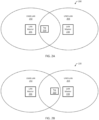
- FIG. 2A is a block diagram of an example system 200 that includes a first UWB LAN 202 and a second UWB LAN 204.
- UWB LAN 202 includes a LAN master anchor 206 which is surrounded by at least some of the anchors of UWB LAN 202.
- UWB LAN 204 also includes a LAN master anchor 208 which is surrounded by at least some of the anchors UWB LAN 204.
- System 200 also includes a tag 210.
- tag 210 is within range of both UWB LAN 202 and UWB LAN 204.
- Tag 210 will receive a beacon from both LAN master 206 and LAN master 208.
- Tag 210 is physically closed to LAN master 206 than it is to LAN master 208.
- tag 210 will determine to associate with UWB LAN 202.
- tag 210 can use its UWB ranging capabilities to calculate a distance to each of LAN master 206 and LAN master 208 and select LAN master 206 as a result of the distance to LAN master 206 being smaller than the distance to LAN master 208.
- a beacon includes information specifying an available capacity of the LAN master transmitting the beacon, and tags can be configured to used the available capacity in selecting LANs. For example, a tag could determine to associate with a LAN having a greater capacity even if another LAN is closer in distance.
- a beacon includes a list of tag identifiers for tags associated with the LAN.
- FIG. 2C is a block diagram of an example system 240 where tag 210 has moved out of range of both UWB LAN 202 and UWB LAN 204. If tag 210 does not hear a beacon from any LAN master, tag 210 will not be able to associate with a UWB LAN. Tag 210 may fail to be tracked.
- Figure 2D is a block diagram of an example system 260 where two UWB LANs are non-overlapping, which allows the re-usage of time slots in performing time-slotted UWB ranging.
- System 260 uses a small window of time (e.g., once every several seconds) to perform UWB ranging with tags and anchors of a single UWB LAN.
- System 260 enables multiple non-overlapping time-windows, enabling multiple LANs to do ranging in the same several second period.
- Each anchor may be a member of any non-overlapping time-windows in physically overlapping LANs (e.g., UWB LAN 202 and UWB LAN 204 in Figure 2A ).
- the System 260 allows for more UWB LANs than there are time-windows.
- the physical LAN is physically separated from each other same-time-window LAN by virtue of being at least a threshold distance away from each other same-time-window LAN.
- the tag When a tag listens for the LAN master beacons, the tag will either get a clear copy of one LAN master beacon, or will hear no LAN master. If two LAN masters are close to the tag but in the same time-window, the tag will not get a clear copy.
- the system is configured such that the tag will associate with a UWB LAN where the tag gets a clear copy of the beacon from the LAN master. If more than one LAN master beacon is received (in different time-windows), the tag can determine which UWB LAN to associate with based on the received beacons. In some examples, the UWB LANs will be deployed to overlap with each other, such that anchors wills serve in more than one LAN, and those overlapping LANs will necessarily be on separate time-windows.
- system 260 includes a first UWB LAN 262 and a second UWB LAN 264 that is non-overlapping with the first UWB LAN 262.
- a distance 274 between UWB LAN 264 and UWB LAN 262 ensures that no tag will hear UWB ranging messages from both UWB LAN 262 and UWB LAN 264.
- the threshold distance to ensure non-overlapping UWB transmissions can be based on, e.g., the signal strengths of the UWB transmissions and the presence or absence of physical barriers such as walls.
- UWB LAN 262 includes a LAN master 266 that can send a beacon in a same time slot as the LAN master 268 of UWB LAN 264. Moreover, anchors of UWB LAN 262 can perform time-slotted UWB ranging on a tag 270 in the same time slots that anchors of UWB LAN 264 can perform time-slotted UWB ranging on tag 272 that is at a distance from tag 270.
- Figure 3 is a diagram of an example system 300 including several UWB LANS, some of which are overlapping and some of which are not. Overlapping UWB LANs are configured such that transmissions are time-slotted to not overlap. Non-overlapping UWB LANS can share time slots.
- Tag T001 receives LAN master beacons from four different LAN masters, LM01, LM03, LM04, and LM05. Each of those LAN masters is configured to transmit its beacon in a unique time slot. Tag T001 will determine which UWB LAN to associate with based on the beacons.
- system 300 includes six different UWB LANs; however, only four different time windows are needed to perform UWB ranging.
- the UWB LAN surrounding LM01 and the UWB LAN surrounding LM08 can share a time window.
- the UWB LAN surrounding LM04 and the UWB LAN surrounding LM06 can share a time window.
- Anchors can be in more than one UWB LAN but they can only be in each time window once. For example, consider anchor a065. Anchor a065 is in the UWB LAN surrounding LM03, the UWB LAN surrounding LM04, and the UWB LAN surround LM05. There is at least one LAN master in each UWB LAN and it is in range of every anchor in its UWB LAN.
- Figure 4A is a timeline 400 illustrating example repeating epochs of the system 100 of Figure 1 .
- Figure 4A shows three epochs 402, 403, and 404.
- Each epoch is a time interval in which all system behaviors take place once.
- anchors 102, 104, and 106 complete message exchanges for, e.g., distributing time synchronization, performing UWB ranging on tags, and transmitting LAN master beacons and responsive tag messages to associate with UWB LANs.
- An epoch has a suitable duration for all system behaviors to take place once, e.g., two seconds.
- an epoch can include six time windows, and up to six tags can be assigned to the six time windows.
- a time window can include enough time for, e.g., 300 ranging exchanges.
- Figure 4B is a timeline 420 illustrating example assigned time slots for LAN master anchors of overlapping UWB LANS to transmit beacons for the system 200 of Figure 2A .
- LAN master 206 is assigned to transmit its beacon at time t2
- LAN master 208 is assigned to transmit its beacon at time t4.
- Tag 210 is configured to listen at times t2 and t4, and tag 210 is assigned to transmit its join message at time t8, which allows time for each LAN master to transmit its beacon and for tag 210 to determine which UWB LAN to associate with based on the beacons.
- the tags are configured to only transmit a join message to a LAN master when changing LANs. Once a tag is recognized by a LAN master as being associated with a LAN, the tag will not send further join messages to the LAN master until, e.g., it goes out of range of the LAN, or it determines that a newly available LAN is an improvement, or the LAN master sends a message (e.g., a beacon) that does not include the tag. Then the tag will try to join a LAN by sending a join message.
- a message e.g., a beacon
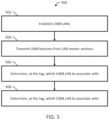
- Figure 5 is a flow diagram of an example method 500 for locating UWB devices. Method 500 can be performed by the system 100 of Figure 1 .
- Method 500 includes establishing UWB LANs, including at least a first UWB LAN and a second UWB LAN (502).
- Establishing the UWB LANs can include initializing the anchors and tags.
- Initializing the anchors and tags can include, e.g., assigning anchors designated time slots to perform UWB ranging, and assigning time slots to anchors for distributing time synchronization information.
- Method 500 includes transmitting, from each LAN master of the UWB LANs, a beacon to identify the UWB LAN to one or more candidate tags to join the UWB LAN (504).
- Method 500 includes determining, at a tag, which of the UWB LANs to join based on the received beacons from the LAN master (506).
- Method 500 includes associating, at the tag, with a selected UWB LAN by sending a responsive message to the LAN master and participating UWB ranging with anchors of the UWB LAN (508).
Landscapes
- Engineering & Computer Science (AREA)
- Radar, Positioning & Navigation (AREA)
- Remote Sensing (AREA)
- Computer Networks & Wireless Communication (AREA)
- Signal Processing (AREA)
- Physics & Mathematics (AREA)
- General Physics & Mathematics (AREA)
- Automation & Control Theory (AREA)
- Mobile Radio Communication Systems (AREA)
Description
- The subject matter described herein relates to ultra-wide-band communications. More particularly, the subject matter described herein relates to methods, systems, and computer readable media for providing and using ultra-wide-band (UWB) local area networks (LANs).
- Many systems make use of signal strength to guess at how far away a calibrated (transmit signal level) sender is located. Being able to accurately measure the actual distance between devices would be valuable but, until recently, no practical scheme existed which could perform that function with useful precision in small areas.
- RADAR (Radio Detection and Ranging) has been used since World War II to measure distance, counting the time between radio transmission of a pulse and reception of the echo (radio time-of-flight). RADAR uses a high-powered radio signal with enough energy that the signal reflected by a passive metal object at a distance still had enough energy to be received back at the RADAR transceiver. Because of the distances involved, thousands of feet to miles, the precision of the timers used in RADAR didn't have to be very good. The speed of a radio message is about 5.4 microseconds per mile. A RADAR set with a one-megahertz counter would count about 5.4 ticks per mile. RADAR only worked in long distances and with very poor precision compared to the size of an indoor stage.
- Some modern aircraft tracking systems use a scheme with an active transmitter called a transponder. The transponder notices the RADAR radio signal pulse and immediately transmits a complex radio message containing useful information about the aircraft. This supplemental information could even include the latitude and longitude of the aircraft, measured using global positioning system (GPS) equipment, giving redundant information back to the aircraft tracking network.
- The challenge of tracking equipment inside a building isn't solved by RADAR or GPS. RADAR is too high energy and GPS is dependent on radio line-of-site with orbiting satellites. However, the transponder mechanism would be useful, if the time-delay between radio signal pulse and transponder response was knowable, and if the time-of-flight could be measured with much greater precision than 70-year-old RADAR technology.
- In the ensuing 70 years, radio devices have become smaller and more sophisticated. We can now purchase integrated circuit (IC) radios which cost as little as $1 and which are far more sensitive than the old equipment, and which deliver digital data and receive signal strength. These radio IC chips have been used by tracking systems to provide location resolution with several meter precision. Time-of-flight measurement was still not practical until very recently.
- Accordingly, in light of these difficulties associated with conventional solutions, there exists a need for methods, systems, and computer readable media for providing and using ultra-wide-band (UWB) local area networks (LANs).
- Document
WO2018203001A1 discloses a handover method for a tag in a wireless sensor network having a cellular architecture using UWB (Ultra Wide Band) transmission. - The solution is specified by the features of independent claims 1 and 8, and the dependent claims.
- The subject matter described herein can be implemented in software in combination with hardware and/or firmware. For example, the subject matter described herein can be implemented in software executed by a processor. In one exemplary implementation, the subject matter described herein can be implemented using a non-transitory computer readable medium having stored thereon computer executable instructions that when executed by a processor of a computer control the computer to perform steps. Exemplary computer readable media suitable for implementing the subject matter described herein include non-transitory computer-readable media, such as disk memory devices, chip memory devices, programmable logic devices, and application specific integrated circuits. In addition, a computer readable medium that implements the subject matter described herein may be located on a single device or computing platform or may be distributed across multiple devices or computing platforms.
-
-
Figure 1 is a block diagram of an example system for UWB object tracking; -
Figures 2A-2D depict example systems that include multiple UWB LANs; -
Figure 3 is a diagram of an example system including several UWB LANS, some of which are overlapping and some of which are not; -
Figure 4A is a timeline illustrating example repeating epochs; -
Figure 4B is a timeline illustrating example assigned time slots for LAN master anchors of overlapping UWB LANS to transmit beacons; and -
Figure 5 is a flow diagram of an example method for locating UWB devices. - This specification describes methods, systems, and computer readable media for time-slotted ultra-wide-band (UWB) object tracking. The methods, systems, and computer readable media can be used, for example, to establish the location of mobile assets inside a facility (e.g., one or more buildings) and relay that information to a remote computer system such as a cloud service.
- The systems described in this specification can be used, for example, to generate a range from each of several fixed stations, called "anchors," to each of many mobile stations, called "tags." The location information can be delivered to, for example, an Internet-connected gateway device. In some examples, anchors are power-rich (e.g., alternating current (AC) powered from a wall socket) but do not have wired network connections. Tags may be power-rich but can be configured to accommodate battery power.
- The deployment of anchors and tags in a facility could include large numbers of anchors and tags, e.g., hundreds of anchors and hundreds of tags. In some examples, each tag's proximity to several anchors is measured frequently, for example, between every two and every 60 seconds.
- In some examples, only some parts of the facility will be populated with anchors, so tag location might not be available from all locations within the facility. However, the system can be configured to report that a tag was recently detected in the facility. The rate of that reporting, and the rate of tag precision locating can be adjustable with consideration of factors such as battery life and tag density.
-
Figure 1 is a block diagram of anexample system 100 for UWB object tracking.System 100 includes at least threeanchors anchors -
System 100 includes several tags each secured to an object for tracking. For purposes of illustration,Figure 1 shows twotags objects tags anchors tags - In operation,
anchors tags anchors anchors Anchors anchors -
System 100 can include asite master 118.Site master 118 is a computer system configured for synchronizing the tag timing systems and the anchor timing systems.Site master 118 can communicate with theLAN 116, e.g., by way of aWiFi router 120. -
System 100 can include agateway 122.Gateway 122 is a computer system configured for communicating with adata communications network 124, such as the Internet, to communicate with alocation system 126.Location system 126 is a computer system configured for receiving ranging information fromanchors Location system 126 can also be configured for assigning tags to time windows, designating time slots within the time windows, and for specifying an order of operation for anchors to transmit in the time slots within the time windows. - Although
system 100 is depicted as havingsite master 118, in some examples, another appropriate system can act as a time source forsystem 100. For example,gateway 122 can be configured to act as a time source, or another device on the WiFi network could be configured to act as a time source. In some examples, one ofanchors UWB network 116. -
System 100 can include auser device 128, e.g., a user computer or mobile phone or tablet. Auser 130 can use theuser device 128 to determine the location of theobjects tags location system 126 by way ofgateway 122, andlocation system 126 can receive and respond to location requests fromuser device 128. - In some examples,
location system 126 maintains data associating tag identifiers with object identifiers and assigned time windows. For example, whenuser 130 securestag 108 to object 112, a tag identifier fortag 108 can be associated with an object identifier forobject 112 in a database stored atlocation system 126.Location system 126 can then associate the assigned time window fortag 108 with the tag identifier and the object identifier. Whenuser 130 requests the location ofobject 112,user 130 can supply the object identifier in a request message.Location system 126 can look up the tag identifier and the assigned time window for the tag identifier.Location system 126 can then respond with the tag location based on the ranging message exchange during the assigned time window for the tag identifier. - In general, anchors 102, 104, and 106 report ranging distances to location system 126 (or another appropriate computer system), for example, by transmitting ranging distances to
gateway 122 by way of Wi-Fi router 120, andlocation system 126 determines tag locations based on the reported ranging distances from the anchors. - In some examples, the tags can be used to track mobile phones. For example, some mobile phones may have embedded UWB radios that can be used as the tags shown in
Figure 1 . Suppose thatobject 112 is a mobile phone and that tag 108 is implemented on the processor of the mobile phone and an embedded UWB radio of the mobile phone. Then, the mobile phone can, for example, register withsite master 118 and the location of the mobile phone can be tracked usingtag 108. - If a population of anchors includes a distribution across a large facility, and if the ranging results should be delivered rapidly and often, it can be useful to configure
system 100 to use the most relevant anchors to perform ranging with a tag. Ideally the tag will be tracked only by 3 Anchors which fully surround the tag, and at 120-degree angles from one another, from the tag's perspective. In practice, the tag location tracking will be adequate if it is in range of 3 anchors where the angle between anchors is wider than, e.g., 20 degrees or so. - In some examples, the anchors are located on walls, e.g., so the staff doesn't trip over them. Since the tag is mobile, it is unlikely that the anchors will be in the ideal positions relative to the tag. Instead,
system 100 can be configured to use more than 3 anchors in any ranging attempt, andsystem 100 can select those anchors to be relative to where the tag is located. Then,system 100 can appropriately weight the ranging responses based on the actual angles presented at the time of calculation. -
Figures 2A-2D depict example systems that include multiple UWB LANs to illustrate the process of identifying which anchors to use to locate a tag. In general, the process includes creating sets of anchors, e.g., sets of up to 16 anchors, as UWB LANs, and then associating the tag with one of the sets so that set of anchors may perform ranging with the tag. A centralized system, e.g., a site master, is configured for maintaining the assignment of all the anchors and UWB LANS and sending configuration information to the anchors. The tag associates with one UWB LANs on-the-fly. - In general, a UWB LAN is a set of anchors that includes a LAN master anchor which is surrounded by at least some of the anchors. The LAN master anchor is configured transmitting a UWB beacon to identify the UWB LAN to one or more candidate tags to join the UWB LAN. The tags are configured for determining to associate with one of the UWB LANs based on received beacons.
- For example, in some systems, a UWB LAN includes:
- a set of up to 16 anchors
- where one anchor is designated LAN master.
- The LAN master is more-or-less in the physical middle of the set; and
- the other anchors surround the LAN master such that the furthest are at a distance which is slightly further than the anchor to tag UWB range, but still within the anchor to anchor UWB range.
- The tag is in range of the LAN if it the tag is in UWB range of the LAN master for that UWB LAN.
- The facility could have many sets of up to 16 anchors, with an individual anchor participating in up to several different overlapping UWB LANs.
- The LAN master, being near the center of each UWB LAN, is relevant to the tag's selection of a UWB LAN because if the tag is in range of the LAN master, the tag is, by design, very likely to be within range of at least 2 other anchors which surround the LAN master. This spacing and signaling range can be one of the system requirements.
- The tag is configured to identify, for itself, which LAN is most appropriate to support the tag. This is performed by having the LAN masters send out a beacon (typically a UWB message) at a known time (scheduled by a centralized device, e.g., the
location system 126 ofFigure 1 ), and to have the tag listen for the beacon to each of the LAN masters. The tag will choose which UWB LAN it will associate with based on, e.g., the beacon strengths or other information present in the beacon messages or both. If the tag remains in range of the last LAN master whose LAN's ranging it last participated in, it will remain associated with that UWB LAN. If it is no longer within range of the prior UWB LAN, it will re-associate (using UWB messages) with a new UWB LAN. -
Figure 2A is a block diagram of anexample system 200 that includes afirst UWB LAN 202 and asecond UWB LAN 204.UWB LAN 202 includes aLAN master anchor 206 which is surrounded by at least some of the anchors ofUWB LAN 202.UWB LAN 204 also includes aLAN master anchor 208 which is surrounded by at least some of theanchors UWB LAN 204.System 200 also includes atag 210. - As shown in
Figure 2A ,tag 210 is within range of bothUWB LAN 202 andUWB LAN 204.Tag 210 will receive a beacon from bothLAN master 206 andLAN master 208.Tag 210, however, is physically closed toLAN master 206 than it is toLAN master 208. Based on the received beacons,tag 210 will determine to associate withUWB LAN 202. For example, tag 210 can use its UWB ranging capabilities to calculate a distance to each ofLAN master 206 andLAN master 208 andselect LAN master 206 as a result of the distance toLAN master 206 being smaller than the distance toLAN master 208. - In some examples, a beacon includes information specifying an available capacity of the LAN master transmitting the beacon, and tags can be configured to used the available capacity in selecting LANs. For example, a tag could determine to associate with a LAN having a greater capacity even if another LAN is closer in distance. In some examples, a beacon includes a list of tag identifiers for tags associated with the LAN.
-
Figure 2B is a block diagram of anexample system 220 wheretag 210 has moved such that it is closer toLAN master 208.Tag 210 will receive a beacon from bothLAN master 206 andLAN master 208. Based on the received beacons,tag 210 may determine to associate withUWB LAN 204 instead ofUWB LAN 202. In some examples,tag 210 is configured to remain associated with an existing LAN until the existing LAN association deteriorates (e.g., the LAN master is so far away that ranging is not possible) or another LAN is significantly better (e.g., has a greater capacity or is closer in distance or both). -
Figure 2C is a block diagram of anexample system 240 wheretag 210 has moved out of range of bothUWB LAN 202 andUWB LAN 204. Iftag 210 does not hear a beacon from any LAN master,tag 210 will not be able to associate with a UWB LAN.Tag 210 may fail to be tracked. - However, in some examples, the entire facility, while not necessarily blanketed by UWB coverage, is fully covered by the WiFi network (or is better covered by the WiFi network than by UWB coverage). After a configured timeout,
tag 210 will turn on its WiFi radio and associate with the WiFi network. Once associated, tag 210 calls a centralized system available on the WiFi network, e.g., a gateway, a site master, or another appropriate system. As shown inFigure 2C ,tag 210 calls thegateway 122 ofFigure 1 over theWiFi Router 120 ofFigure 1 . - Once contact is made, tag 210 will use the WiFi network to send its last known UWB LAN association (e.g., by sending a UWB LAN identifier provided by a LAN master). In some examples,
tag 210 sends operational statistics and any useful sensor data, possibly including barometric data, and inertial navigational information, depending on the capabilities and configuration oftag 210. -
Gateway 122 or another system can provide, e.g., time synchronization information and instructions to tag 210. The instructions can be, e.g., to perform some function or to lettag 210 perform a default behavior. The default behavior can be to use the time synchronization information to listen for LAN master beacons. After some preset-number of cycles, failing to hear a LAN master beacon,tag 210 will time-out again and once-again callsite master 118 via the WiFi network. This sequence of timing-out of listening to UWB and reverting to WiFi can change dynamically to preserve the battery oftag 210. - In some examples, if an anchor or tag can't find the configured WIFI network, it is configured to search out an alternate network whose SSID and security-code is pre-programmed into the anchors and tags at production time. This preprogrammed network exists in a test fixture, e.g., in a factory, or would be locally operated in a portable fixture that deployment staff can carry around the facility. On finding the alternate factory-network, the device is configured to fetch a configuration page and get the assignment of the customer network. IN this manner, the system can configure newly installed equipment with the on-site facility network. The system can also use this process to factory or field upgrade the built-in firmware of the devices.
-
Figure 2D is a block diagram of anexample system 260 where two UWB LANs are non-overlapping, which allows the re-usage of time slots in performing time-slotted UWB ranging. -
System 260, using the time synchronization between UWB devices, uses a small window of time (e.g., once every several seconds) to perform UWB ranging with tags and anchors of a single UWB LAN.System 260 enables multiple non-overlapping time-windows, enabling multiple LANs to do ranging in the same several second period. Each anchor may be a member of any non-overlapping time-windows in physically overlapping LANs (e.g.,UWB LAN 202 andUWB LAN 204 inFigure 2A ). -
System 260 allows for more UWB LANs than there are time-windows. The physical LAN is physically separated from each other same-time-window LAN by virtue of being at least a threshold distance away from each other same-time-window LAN. - When a tag listens for the LAN master beacons, the tag will either get a clear copy of one LAN master beacon, or will hear no LAN master. If two LAN masters are close to the tag but in the same time-window, the tag will not get a clear copy. The system is configured such that the tag will associate with a UWB LAN where the tag gets a clear copy of the beacon from the LAN master. If more than one LAN master beacon is received (in different time-windows), the tag can determine which UWB LAN to associate with based on the received beacons. In some examples, the UWB LANs will be deployed to overlap with each other, such that anchors wills serve in more than one LAN, and those overlapping LANs will necessarily be on separate time-windows.
- As shown in
Figure 2D ,system 260 includes afirst UWB LAN 262 and asecond UWB LAN 264 that is non-overlapping with thefirst UWB LAN 262. Adistance 274 betweenUWB LAN 264 andUWB LAN 262 ensures that no tag will hear UWB ranging messages from bothUWB LAN 262 andUWB LAN 264. The threshold distance to ensure non-overlapping UWB transmissions can be based on, e.g., the signal strengths of the UWB transmissions and the presence or absence of physical barriers such as walls. -
UWB LAN 262 includes aLAN master 266 that can send a beacon in a same time slot as theLAN master 268 ofUWB LAN 264. Moreover, anchors ofUWB LAN 262 can perform time-slotted UWB ranging on atag 270 in the same time slots that anchors ofUWB LAN 264 can perform time-slotted UWB ranging ontag 272 that is at a distance fromtag 270. -
Figure 3 is a diagram of anexample system 300 including several UWB LANS, some of which are overlapping and some of which are not. Overlapping UWB LANs are configured such that transmissions are time-slotted to not overlap. Non-overlapping UWB LANS can share time slots. - For example, consider tag T001. Tag T001 receives LAN master beacons from four different LAN masters, LM01, LM03, LM04, and LM05. Each of those LAN masters is configured to transmit its beacon in a unique time slot. Tag T001 will determine which UWB LAN to associate with based on the beacons.
- As shown in
Figure 3 ,system 300 includes six different UWB LANs; however, only four different time windows are needed to perform UWB ranging. For example, the UWB LAN surrounding LM01 and the UWB LAN surrounding LM08 can share a time window. Similarly, the UWB LAN surrounding LM04 and the UWB LAN surrounding LM06 can share a time window. - Anchors can be in more than one UWB LAN but they can only be in each time window once. For example, consider anchor a065. Anchor a065 is in the UWB LAN surrounding LM03, the UWB LAN surrounding LM04, and the UWB LAN surround LM05. There is at least one LAN master in each UWB LAN and it is in range of every anchor in its UWB LAN.
-
Figure 4A is atimeline 400 illustrating example repeating epochs of thesystem 100 ofFigure 1 .Figure 4A shows threeepochs - An epoch has a suitable duration for all system behaviors to take place once, e.g., two seconds. For example, an epoch can include six time windows, and up to six tags can be assigned to the six time windows. A time window can include enough time for, e.g., 300 ranging exchanges.
-
Figure 4B is atimeline 420 illustrating example assigned time slots for LAN master anchors of overlapping UWB LANS to transmit beacons for thesystem 200 ofFigure 2A .LAN master 206 is assigned to transmit its beacon at time t2, andLAN master 208 is assigned to transmit its beacon at time t4.Tag 210 is configured to listen at times t2 and t4, andtag 210 is assigned to transmit its join message at time t8, which allows time for each LAN master to transmit its beacon and fortag 210 to determine which UWB LAN to associate with based on the beacons. - In general, the tags are configured to only transmit a join message to a LAN master when changing LANs. Once a tag is recognized by a LAN master as being associated with a LAN, the tag will not send further join messages to the LAN master until, e.g., it goes out of range of the LAN, or it determines that a newly available LAN is an improvement, or the LAN master sends a message (e.g., a beacon) that does not include the tag. Then the tag will try to join a LAN by sending a join message.
-
Figure 5 is a flow diagram of anexample method 500 for locating UWB devices.Method 500 can be performed by thesystem 100 ofFigure 1 . -
Method 500 includes establishing UWB LANs, including at least a first UWB LAN and a second UWB LAN (502). Establishing the UWB LANs can include initializing the anchors and tags. Initializing the anchors and tags can include, e.g., assigning anchors designated time slots to perform UWB ranging, and assigning time slots to anchors for distributing time synchronization information. -
Method 500 includes transmitting, from each LAN master of the UWB LANs, a beacon to identify the UWB LAN to one or more candidate tags to join the UWB LAN (504).Method 500 includes determining, at a tag, which of the UWB LANs to join based on the received beacons from the LAN master (506).Method 500 includes associating, at the tag, with a selected UWB LAN by sending a responsive message to the LAN master and participating UWB ranging with anchors of the UWB LAN (508). - Although specific examples and features have been described above, these examples and features are not intended to limit the scope of the present disclosure, even where only a single example is described with respect to a particular feature. Examples of features provided in the disclosure are intended to be illustrative rather than restrictive unless stated otherwise. The above description is intended to cover such alternatives, modifications, and equivalents as would be apparent to a person skilled in the art having the benefit of this disclosure.
Claims (14)
- A system (100) for locating ultra-wide-band, UWB, devices, the system comprising:
a plurality of UWB local area networks, LANs (116), including at least a first UWB LAN and a second UWB LAN, each UWB LAN comprising:a plurality of anchors (102, 104, 106) configured for performing UWB ranging; anda LAN master anchor surrounded by at least some of the plurality of anchors, wherein the LAN master anchor is configured for transmitting a UWB beacon to identify the UWB LAN to one or more candidate tags to join the UWB LAN; anda tag (108, 110) securable to an object (112, 114) for tracking, wherein the tag comprises a WiFi radio, wherein the tag is configured for:receiving a first UWB beacon from a first LAN master of the first UWB LAN;receiving a second UWB beacon from a second LAN master of the second UWB LAN; anddetermining to associate with one of the UWB LANs based on the first UWB beacon and the second UWB beacon; andactivating the WiFi radio after a specified amount of time has passed and the tag has not received a UWB beacon from any of the UWB LANs and sending a report to a gateway using the WiFi network. - The system of claim 1, wherein the tag is configured for transmitting, in response to determining to associate with the first UWB LAN, a join message to the first LAN master, thereby causing a first plurality of anchors of the first UWB LAN to perform UWB ranging on the tag.
- The system of claim 1, wherein each LAN master anchor is configured to transmit the UWB beacon at a scheduled time unique to the UWB LAN for the LAN master anchor.
- The system of claim 1, wherein the first UWB LAN and the second UWB LAN are physically overlapping and the system comprises at least one overlapping anchor configured for participating in time-slotted UWB ranging in both the first UWB LAN and the second UWB LAN.
- The system of claim 1, wherein the first UWB LAN and the second UWB LAN are physically separated and wherein the anchors of the first UWB LAN are configured for performing time-slotted UWB ranging in at least some of the same time windows as the anchors of the second UWB LAN.
- The system of claim 1, wherein determining to associate with the first UWB LAN based on the first UWB beacon and the second UWB beacon comprises comparing a first signal strength of the first UWB beacon and a second signal strength of the second UWB beacon and determining to associate with the first UWB LAN in response to determining that the first signal strength is greater than the second signal strength or wherein determining to associate with the first UWB LAN based on the first UWB beacon and the second UWB beacon comprises using message contents of the first UWB beacon and the second UWB beacon.
- The system of claim 1, wherein the tag is configured for periodically receiving the first UWB beacon and the second UWB beacon and, at a later time when the tag has moved relative to the first UWB LAN master anchor and the second UWB LAN master, determining to re-associate with the second UWB LAN based on the first UWB beacon and the second UWB beacon.
- A method for locating ultra-wide-band, UWB, devices, the method comprising:establishing a plurality of UWB local area networks, LANs, including at least a first UWB LAN and a second UWB LAN, each UWB LAN comprising:a plurality of anchors configured for performing UWB ranging; and a LAN master anchor surrounded by at least some of the plurality of anchors, wherein the LAN master anchor is configured for transmitting a UWB beacon to identify the UWB LAN to one or more candidate tags to join the UWB LAN; anda tag securable to an object for tracking, wherein the tag comprises a WiFi radio;wherein the method comprises:
associating, by the tag, with one of the UWB LANS, wherein the tag comprises a WiFi radio, wherein associating with one of the UWB LANs comprises:receiving (504), by the tag, a first UWB beacon from a first LAN master of the first UWB LAN;receiving (504), by the tag, a second UWB beacon from a second LAN master of the second UWB LAN;determining (506), by the tag, to associate with the first UWB LAN based on the first UWB beacon and the second UWB beacon; andactivating, by the tag, the WiFi radio after a specified amount of time has passed and the tag has not received a UWB beacon from any of the UWB LANs; and sending, by the tag,
a report to a gateway using the WiFi network. - The method of claim 9, wherein associating with one of the UWB LANs comprises transmitting, in response to determining to associate with the first UWB LAN, a join message to the first LAN master, thereby causing a first plurality of anchors of the first UWB LAN to perform UWB ranging on the tag.
- The method of claim 9, wherein each LAN master anchor is configured to transmit the UWB beacon at a scheduled time unique to the UWB LAN for the LAN master anchor.
- The method of claim 9, wherein the first UWB LAN and the second UWB LAN are physically overlapping and the method comprises participating, by at least one overlapping anchor, in time-slotted UWB ranging in both the first UWB LAN and the second UWB LAN.
- The method of claim 9, wherein the first UWB LAN and the second UWB LAN are physically separated and wherein the method comprises performing, by anchors of the first UWB LAN, time-slotted UWB ranging in at least some of the same time windows as the anchors of the second UWB LAN.
- The method of claim 9, wherein determining to associate with the first UWB LAN based on the first UWB beacon and the second UWB beacon comprises comparing a first signal strength of the first UWB beacon and a second signal strength of the second UWB beacon and determining to associate with the first UWB LAN in response to determining that the first signal strength is greater than the second signal strength or wherein determining to associate with the first UWB LAN based on the first UWB beacon and the second UWB beacon comprises using message contents of the first UWB beacon and the second UWB beacon .
- The method of claim 9, comprising periodically receiving the first UWB beacon and the second UWB beacon and, at a later time when the tag has moved relative to the first UWB LAN master anchor and the second UWB LAN master, determining to re-associate with the second UWB LAN based on the first UWB beacon and the second UWB beacon.
Applications Claiming Priority (2)
| Application Number | Priority Date | Filing Date | Title |
|---|---|---|---|
| US16/383,301 US10484833B1 (en) | 2019-04-12 | 2019-04-12 | Methods, systems and computer readable media for providing and using ultra wideband local area networks (LANs) |
| PCT/US2020/027119 WO2020210268A1 (en) | 2019-04-12 | 2020-04-07 | Methods, systems, and computer readable media for providing and using ultra-wideband local area networks (lans) |
Publications (3)
| Publication Number | Publication Date |
|---|---|
| EP3954140A1 EP3954140A1 (en) | 2022-02-16 |
| EP3954140A4 EP3954140A4 (en) | 2022-11-23 |
| EP3954140B1 true EP3954140B1 (en) | 2024-08-21 |
Family
ID=68536230
Family Applications (1)
| Application Number | Title | Priority Date | Filing Date |
|---|---|---|---|
| EP20787188.0A Active EP3954140B1 (en) | 2019-04-12 | 2020-04-07 | Method and system for providing and using ultra-wideband local area networks (lans) |
Country Status (3)
| Country | Link |
|---|---|
| US (1) | US10484833B1 (en) |
| EP (1) | EP3954140B1 (en) |
| WO (1) | WO2020210268A1 (en) |
Families Citing this family (8)
| Publication number | Priority date | Publication date | Assignee | Title |
|---|---|---|---|---|
| US11026067B2 (en) * | 2019-01-11 | 2021-06-01 | Sensormatic Electronics, LLC | Power efficient ultra-wideband (UWB) tag for indoor positioning |
| US10567035B1 (en) | 2019-03-06 | 2020-02-18 | Clairvoyant Networks, LLC | Methods, systems, and computer readable media for distribution of time synchronization information to ultra-wide-band devices |
| CN112637948B (en) * | 2019-10-09 | 2023-04-14 | 深圳市优必选科技股份有限公司 | A positioning method, system, positioning label and base station |
| US11714166B2 (en) * | 2020-03-26 | 2023-08-01 | Nxp B.V. | Key fob localization inside vehicle |
| IT202000014089A1 (en) | 2020-06-12 | 2021-12-12 | Esteco S P A | METHOD AND COMPUTERIZED SYSTEM FOR LOCATION OF TARGETS IN A SPACE |
| CN115348348A (en) * | 2021-05-14 | 2022-11-15 | Oppo广东移动通信有限公司 | Information processing method, terminal and storage medium |
| KR20230090732A (en) | 2021-12-15 | 2023-06-22 | 삼성전자주식회사 | Operating method of user terminal for ultra wide band(uwb) network configuration and user terminal thereof |
| US12340472B2 (en) | 2022-09-02 | 2025-06-24 | Adeia Guides Inc. | Systems and methods for managing network devices using augmented reality |
Family Cites Families (47)
| Publication number | Priority date | Publication date | Assignee | Title |
|---|---|---|---|---|
| US6829534B2 (en) | 1999-04-23 | 2004-12-07 | Global Locate, Inc. | Method and apparatus for performing timing synchronization |
| US7649925B2 (en) | 1999-06-14 | 2010-01-19 | Time Domain Corporation | Time transfer utilizing ultra wideband signals |
| US7023833B1 (en) | 1999-09-10 | 2006-04-04 | Pulse-Link, Inc. | Baseband wireless network for isochronous communication |
| US7088795B1 (en) | 1999-11-03 | 2006-08-08 | Pulse-Link, Inc. | Ultra wide band base band receiver |
| AU2001271297A1 (en) | 2000-06-12 | 2001-12-24 | Larry W. Fullerton | A method for specifying non-temporal pulse characteristics |
| US7313127B2 (en) | 2002-04-19 | 2007-12-25 | General Electric Company | Method and apparatus for synchronizing a radio telemetry system by way of transmitted-reference, delay-hopped ultra-wideband pilot signal |
| JP4223923B2 (en) | 2003-11-06 | 2009-02-12 | 株式会社日立製作所 | Positioning method, positioning system and radio base station |
| KR100917940B1 (en) | 2004-02-17 | 2009-09-21 | 자디 인코포레이티드 | Ultra wide band navigation system with mobile base stations |
| US20050271120A1 (en) | 2004-06-02 | 2005-12-08 | Lockheed Martin Corporation | Detector for time-hopped impulse radio |
| TW200644509A (en) | 2005-03-02 | 2006-12-16 | Koninkl Philips Electronics Nv | Ranging based association for UWB wireless PAN devices |
| JP4829571B2 (en) | 2005-09-09 | 2011-12-07 | 株式会社日立製作所 | Receiver and positioning distance measuring system |
| US20070081505A1 (en) * | 2005-10-12 | 2007-04-12 | Harris Corporation | Hybrid RF network with high precision ranging |
| US7605696B2 (en) | 2005-12-21 | 2009-10-20 | Cary Quatro | System and method for real time location tracking and communications |
| US7515092B2 (en) | 2007-01-17 | 2009-04-07 | Honeywell International Inc. | Sub-frame synchronized residual radar |
| EP2053755A1 (en) | 2007-10-25 | 2009-04-29 | Commissariat A L'energie Atomique | Method of and apparatus for synchronisation |
| JP4592743B2 (en) | 2007-12-28 | 2010-12-08 | 古野電気株式会社 | Synchronization device and synchronization method |
| US20090231136A1 (en) | 2008-03-12 | 2009-09-17 | Binay Sugla | Tags and tag-based systems and methods for locating and tracking objects |
| US8659477B2 (en) | 2008-10-09 | 2014-02-25 | Panasonic Corporation | Base station device and distance measuring method |
| JP5385107B2 (en) * | 2009-03-19 | 2014-01-08 | 富士フイルム株式会社 | Radiation imaging system, radiation converter, processing device, radiation converter and processing device selection device, program, radiation converter and processing device selection method, and radiation image imaging method |
| ES2374485T3 (en) | 2009-03-19 | 2012-02-17 | Fraunhofer-Gesellschaft zur Förderung der angewandten Forschung e.V. | METHOD AND APPARATUS FOR ESTIMATING CLOCK DEVIATIONS, FOR VIRTUAL SYNCHRONIZATION OF FREE-RUNNING CLOCKS AND TO DETERMINE THE POSITION OF A MOBILE OBJECT. |
| US8456282B2 (en) | 2009-05-01 | 2013-06-04 | L-3 Communications Integrated Systems L.P. | Synchronization of devices in a RFID communications environment |
| US8477046B2 (en) * | 2009-05-05 | 2013-07-02 | Advanced Technologies Group, LLC | Sports telemetry system for collecting performance metrics and data |
| EP2290870B1 (en) | 2009-09-01 | 2012-12-05 | EPFL Ecole Polytechnique Fédérale de Lausanne | Method for estimating and correcting a drift between clocks of a receiving transceiver and a corresponding emitting transceiver, and receiver for implementing said method |
| EP2565817A1 (en) | 2011-08-30 | 2013-03-06 | Nokia Corporation | Method and apparatus for close proximity device discovery |
| EP2605032B1 (en) | 2011-12-15 | 2018-03-21 | Commissariat à l'Énergie Atomique et aux Énergies Alternatives | Localization method and system using non-regenerative UWB relays |
| CN103188791B (en) | 2011-12-28 | 2016-07-13 | 华为终端有限公司 | A kind of localization method, client and alignment system |
| US9366755B2 (en) | 2012-03-21 | 2016-06-14 | Secure Care Products, Llc | Object movement and location detection system and method thereof |
| WO2014009981A1 (en) | 2012-07-12 | 2014-01-16 | Datalogic S.P.A. | Synchronization of a real-time uwb locating system |
| US20140253388A1 (en) | 2013-03-08 | 2014-09-11 | Qualcomm Incorporated | Synchronization of anchor units in a position location tracking system |
| CN104053229B (en) | 2013-03-14 | 2018-09-28 | 南京中兴软件有限责任公司 | Mobile terminal, localization method and device |
| US9519047B2 (en) | 2013-04-03 | 2016-12-13 | Kerry L. Davis | System and method of implementing asynchronously-clocked fixed-location devices for a distance determination by a roaming client device |
| LT3005233T (en) | 2013-06-04 | 2018-05-25 | Isolynx, Llc | Object tracking system optimization and tools |
| US9726750B2 (en) | 2013-08-26 | 2017-08-08 | Specialty Electrical, Llc | Method and apparatus for multi-mode tracking and display of personnel locations in a graphical model |
| US20150087331A1 (en) | 2013-09-25 | 2015-03-26 | Samsung Electronics Co., Ltd. | Method and apparatus of wi-fi-based positioning |
| US10942250B2 (en) | 2014-03-03 | 2021-03-09 | Rosemount Inc. | Positioning system |
| US10111044B2 (en) * | 2015-05-29 | 2018-10-23 | Verity Studios Ag | Methods and systems for scheduling the transmission of localization signals and operating self-localizing apparatus |
| US20160357193A1 (en) | 2015-06-02 | 2016-12-08 | 5D Robotics, Inc. | Mobile ultra wide band constellations |
| US9810767B1 (en) | 2015-06-16 | 2017-11-07 | Michael Hamilton | Location estimation system |
| US20170244444A1 (en) | 2015-11-25 | 2017-08-24 | 5D Robotics, Inc. | Mobile localization in vehicle-to-vehicle environments |
| US10444323B2 (en) | 2016-03-08 | 2019-10-15 | Position Imaging, Inc. | Expandable, decentralized position tracking systems and methods |
| EP3430419B1 (en) | 2016-03-14 | 2024-04-10 | Commonwealth Scientific and Industrial Research Organisation | Estimating locations of mobile devices in a wireless tracking system |
| WO2018031971A1 (en) | 2016-08-12 | 2018-02-15 | 5D Robotics, Inc. | Ultra-wide band radar and positional node integration |
| US20180045807A1 (en) | 2016-08-12 | 2018-02-15 | 5D Robotics, Inc. | Global Positioning System and Ultra Wide Band Universal Positioning Node Consellation integration |
| US10064148B2 (en) | 2017-01-20 | 2018-08-28 | M2 Robots, Inc. | Ultra-wide band positioning system |
| EP3370083B1 (en) | 2017-03-02 | 2020-08-26 | Nxp B.V. | Processing module and associated method |
| US10420999B2 (en) | 2017-03-27 | 2019-09-24 | Intel Corporation | Sensor-derived object flight performance tracking |
| FR3066064B1 (en) * | 2017-05-05 | 2019-07-05 | Maple High Tech | HANDOVER METHOD FOR LABEL IN A WIRELESS SENSOR NETWORK |
-
2019
- 2019-04-12 US US16/383,301 patent/US10484833B1/en active Active
-
2020
- 2020-04-07 EP EP20787188.0A patent/EP3954140B1/en active Active
- 2020-04-07 WO PCT/US2020/027119 patent/WO2020210268A1/en not_active Ceased
Also Published As
| Publication number | Publication date |
|---|---|
| WO2020210268A1 (en) | 2020-10-15 |
| US10484833B1 (en) | 2019-11-19 |
| EP3954140A4 (en) | 2022-11-23 |
| EP3954140A1 (en) | 2022-02-16 |
Similar Documents
| Publication | Publication Date | Title |
|---|---|---|
| EP3954140B1 (en) | Method and system for providing and using ultra-wideband local area networks (lans) | |
| US10924157B2 (en) | Methods, systems, and computer readable media for distribution of time synchronization information to ultra-wide-band devices | |
| JP6940214B2 (en) | Positioning system | |
| KR100734998B1 (en) | Transponder subsystem for supporting location awareness in wireless networks | |
| US11567164B2 (en) | Intercepting an uplink signal to assist in timing or positioning calculations | |
| RU2556241C2 (en) | Method and device for measurements of positioning in transmission systems with multiple antennas | |
| US20070041352A1 (en) | Elevator calling mechanism and method | |
| JP2022511642A (en) | Systems and methods that support uplink and downlink positioning procedures in wireless networks | |
| EP3911971B1 (en) | Methods, systems, and computer readable media for time-slotted ultra-wide-band object tracking | |
| EP3391672B1 (en) | Methods and devices for finding rfid tags | |
| US6885969B2 (en) | Location estimation in partially synchronized networks | |
| CN108307297A (en) | Use the indoor location and tracking of multi-band wireless network system | |
| CN102224430A (en) | Network-centric determination of node processing delay | |
| WO2010151401A1 (en) | A wireless terminal and method for managing the receipt of position reference signals for use in determining a location | |
| CN103444246A (en) | Cooperative localisation of radio apparatuses | |
| CN102858010A (en) | Positioning method and device for mobile terminal | |
| CN116437442A (en) | Equipment positioning method, device, network element equipment and storage medium | |
| CN114245315A (en) | Terminal positioning method and device | |
| KR20220023677A (en) | Electronic device and method, performed by electronic device, of obtaining location information | |
| US20230350052A1 (en) | Locating a mobile radio-enabled tag | |
| EP2745136A1 (en) | Methods and arrangements for high accuracy positioning | |
| EP4304211A1 (en) | Contact tracing for low power asset trackers | |
| WO2025058839A1 (en) | System and methods for untracked navigation using ultra-wideband devices | |
| WO2024184729A1 (en) | Localization of passive backscatters for positioning | |
| WO2024184707A1 (en) | Localization of backscatterer using other backscatterer |
Legal Events
| Date | Code | Title | Description |
|---|---|---|---|
| STAA | Information on the status of an ep patent application or granted ep patent |
Free format text: STATUS: THE INTERNATIONAL PUBLICATION HAS BEEN MADE |
|
| PUAI | Public reference made under article 153(3) epc to a published international application that has entered the european phase |
Free format text: ORIGINAL CODE: 0009012 |
|
| STAA | Information on the status of an ep patent application or granted ep patent |
Free format text: STATUS: REQUEST FOR EXAMINATION WAS MADE |
|
| 17P | Request for examination filed |
Effective date: 20211012 |
|
| AK | Designated contracting states |
Kind code of ref document: A1 Designated state(s): AL AT BE BG CH CY CZ DE DK EE ES FI FR GB GR HR HU IE IS IT LI LT LU LV MC MK MT NL NO PL PT RO RS SE SI SK SM TR |
|
| DAV | Request for validation of the european patent (deleted) | ||
| DAX | Request for extension of the european patent (deleted) | ||
| A4 | Supplementary search report drawn up and despatched |
Effective date: 20221025 |
|
| RIC1 | Information provided on ipc code assigned before grant |
Ipc: H04W 84/18 20090101ALI20221019BHEP Ipc: G01S 13/74 20060101ALI20221019BHEP Ipc: H04W 4/33 20180101ALI20221019BHEP Ipc: G01S 1/68 20060101ALI20221019BHEP Ipc: G01C 21/20 20060101ALI20221019BHEP Ipc: H04B 1/7163 20110101ALI20221019BHEP Ipc: H04W 72/04 20090101ALI20221019BHEP Ipc: H04W 4/029 20180101AFI20221019BHEP |
|
| RIC1 | Information provided on ipc code assigned before grant |
Ipc: H04W 84/18 20090101ALI20240131BHEP Ipc: G01S 13/74 20060101ALI20240131BHEP Ipc: H04W 4/33 20180101ALI20240131BHEP Ipc: G01S 1/68 20060101ALI20240131BHEP Ipc: G01C 21/20 20060101ALI20240131BHEP Ipc: H04B 1/7163 20110101ALI20240131BHEP Ipc: H04W 72/04 20090101ALI20240131BHEP Ipc: H04W 4/029 20180101AFI20240131BHEP |
|
| GRAP | Despatch of communication of intention to grant a patent |
Free format text: ORIGINAL CODE: EPIDOSNIGR1 |
|
| STAA | Information on the status of an ep patent application or granted ep patent |
Free format text: STATUS: GRANT OF PATENT IS INTENDED |
|
| INTG | Intention to grant announced |
Effective date: 20240313 |
|
| GRAS | Grant fee paid |
Free format text: ORIGINAL CODE: EPIDOSNIGR3 |
|
| GRAA | (expected) grant |
Free format text: ORIGINAL CODE: 0009210 |
|
| STAA | Information on the status of an ep patent application or granted ep patent |
Free format text: STATUS: THE PATENT HAS BEEN GRANTED |
|
| AK | Designated contracting states |
Kind code of ref document: B1 Designated state(s): AL AT BE BG CH CY CZ DE DK EE ES FI FR GB GR HR HU IE IS IT LI LT LU LV MC MK MT NL NO PL PT RO RS SE SI SK SM TR |
|
| REG | Reference to a national code |
Ref country code: GB Ref legal event code: FG4D |
|
| REG | Reference to a national code |
Ref country code: CH Ref legal event code: EP |
|
| REG | Reference to a national code |
Ref country code: IE Ref legal event code: FG4D |
|
| REG | Reference to a national code |
Ref country code: DE Ref legal event code: R096 Ref document number: 602020036296 Country of ref document: DE |
|
| REG | Reference to a national code |
Ref country code: LT Ref legal event code: MG9D |
|
| REG | Reference to a national code |
Ref country code: NL Ref legal event code: MP Effective date: 20240821 |
|
| PG25 | Lapsed in a contracting state [announced via postgrant information from national office to epo] |
Ref country code: NO Free format text: LAPSE BECAUSE OF FAILURE TO SUBMIT A TRANSLATION OF THE DESCRIPTION OR TO PAY THE FEE WITHIN THE PRESCRIBED TIME-LIMIT Effective date: 20241121 |
|
| REG | Reference to a national code |
Ref country code: AT Ref legal event code: MK05 Ref document number: 1716765 Country of ref document: AT Kind code of ref document: T Effective date: 20240821 |
|
| PG25 | Lapsed in a contracting state [announced via postgrant information from national office to epo] |
Ref country code: FI Free format text: LAPSE BECAUSE OF FAILURE TO SUBMIT A TRANSLATION OF THE DESCRIPTION OR TO PAY THE FEE WITHIN THE PRESCRIBED TIME-LIMIT Effective date: 20240821 Ref country code: NL Free format text: LAPSE BECAUSE OF FAILURE TO SUBMIT A TRANSLATION OF THE DESCRIPTION OR TO PAY THE FEE WITHIN THE PRESCRIBED TIME-LIMIT Effective date: 20240821 Ref country code: PL Free format text: LAPSE BECAUSE OF FAILURE TO SUBMIT A TRANSLATION OF THE DESCRIPTION OR TO PAY THE FEE WITHIN THE PRESCRIBED TIME-LIMIT Effective date: 20240821 Ref country code: GR Free format text: LAPSE BECAUSE OF FAILURE TO SUBMIT A TRANSLATION OF THE DESCRIPTION OR TO PAY THE FEE WITHIN THE PRESCRIBED TIME-LIMIT Effective date: 20241122 Ref country code: PT Free format text: LAPSE BECAUSE OF FAILURE TO SUBMIT A TRANSLATION OF THE DESCRIPTION OR TO PAY THE FEE WITHIN THE PRESCRIBED TIME-LIMIT Effective date: 20241223 |
|
| PG25 | Lapsed in a contracting state [announced via postgrant information from national office to epo] |
Ref country code: BG Free format text: LAPSE BECAUSE OF FAILURE TO SUBMIT A TRANSLATION OF THE DESCRIPTION OR TO PAY THE FEE WITHIN THE PRESCRIBED TIME-LIMIT Effective date: 20240821 |
|
| PG25 | Lapsed in a contracting state [announced via postgrant information from national office to epo] |
Ref country code: LV Free format text: LAPSE BECAUSE OF FAILURE TO SUBMIT A TRANSLATION OF THE DESCRIPTION OR TO PAY THE FEE WITHIN THE PRESCRIBED TIME-LIMIT Effective date: 20240821 |
|
| PG25 | Lapsed in a contracting state [announced via postgrant information from national office to epo] |
Ref country code: AT Free format text: LAPSE BECAUSE OF FAILURE TO SUBMIT A TRANSLATION OF THE DESCRIPTION OR TO PAY THE FEE WITHIN THE PRESCRIBED TIME-LIMIT Effective date: 20240821 Ref country code: IS Free format text: LAPSE BECAUSE OF FAILURE TO SUBMIT A TRANSLATION OF THE DESCRIPTION OR TO PAY THE FEE WITHIN THE PRESCRIBED TIME-LIMIT Effective date: 20241221 |
|
| PG25 | Lapsed in a contracting state [announced via postgrant information from national office to epo] |
Ref country code: HR Free format text: LAPSE BECAUSE OF FAILURE TO SUBMIT A TRANSLATION OF THE DESCRIPTION OR TO PAY THE FEE WITHIN THE PRESCRIBED TIME-LIMIT Effective date: 20240821 |
|
| PG25 | Lapsed in a contracting state [announced via postgrant information from national office to epo] |
Ref country code: RS Free format text: LAPSE BECAUSE OF FAILURE TO SUBMIT A TRANSLATION OF THE DESCRIPTION OR TO PAY THE FEE WITHIN THE PRESCRIBED TIME-LIMIT Effective date: 20241121 Ref country code: ES Free format text: LAPSE BECAUSE OF FAILURE TO SUBMIT A TRANSLATION OF THE DESCRIPTION OR TO PAY THE FEE WITHIN THE PRESCRIBED TIME-LIMIT Effective date: 20240821 |
|
| PG25 | Lapsed in a contracting state [announced via postgrant information from national office to epo] |
Ref country code: RS Free format text: LAPSE BECAUSE OF FAILURE TO SUBMIT A TRANSLATION OF THE DESCRIPTION OR TO PAY THE FEE WITHIN THE PRESCRIBED TIME-LIMIT Effective date: 20241121 Ref country code: PT Free format text: LAPSE BECAUSE OF FAILURE TO SUBMIT A TRANSLATION OF THE DESCRIPTION OR TO PAY THE FEE WITHIN THE PRESCRIBED TIME-LIMIT Effective date: 20241223 Ref country code: PL Free format text: LAPSE BECAUSE OF FAILURE TO SUBMIT A TRANSLATION OF THE DESCRIPTION OR TO PAY THE FEE WITHIN THE PRESCRIBED TIME-LIMIT Effective date: 20240821 Ref country code: NO Free format text: LAPSE BECAUSE OF FAILURE TO SUBMIT A TRANSLATION OF THE DESCRIPTION OR TO PAY THE FEE WITHIN THE PRESCRIBED TIME-LIMIT Effective date: 20241121 Ref country code: NL Free format text: LAPSE BECAUSE OF FAILURE TO SUBMIT A TRANSLATION OF THE DESCRIPTION OR TO PAY THE FEE WITHIN THE PRESCRIBED TIME-LIMIT Effective date: 20240821 Ref country code: LV Free format text: LAPSE BECAUSE OF FAILURE TO SUBMIT A TRANSLATION OF THE DESCRIPTION OR TO PAY THE FEE WITHIN THE PRESCRIBED TIME-LIMIT Effective date: 20240821 Ref country code: IS Free format text: LAPSE BECAUSE OF FAILURE TO SUBMIT A TRANSLATION OF THE DESCRIPTION OR TO PAY THE FEE WITHIN THE PRESCRIBED TIME-LIMIT Effective date: 20241221 Ref country code: HR Free format text: LAPSE BECAUSE OF FAILURE TO SUBMIT A TRANSLATION OF THE DESCRIPTION OR TO PAY THE FEE WITHIN THE PRESCRIBED TIME-LIMIT Effective date: 20240821 Ref country code: GR Free format text: LAPSE BECAUSE OF FAILURE TO SUBMIT A TRANSLATION OF THE DESCRIPTION OR TO PAY THE FEE WITHIN THE PRESCRIBED TIME-LIMIT Effective date: 20241122 Ref country code: FI Free format text: LAPSE BECAUSE OF FAILURE TO SUBMIT A TRANSLATION OF THE DESCRIPTION OR TO PAY THE FEE WITHIN THE PRESCRIBED TIME-LIMIT Effective date: 20240821 Ref country code: ES Free format text: LAPSE BECAUSE OF FAILURE TO SUBMIT A TRANSLATION OF THE DESCRIPTION OR TO PAY THE FEE WITHIN THE PRESCRIBED TIME-LIMIT Effective date: 20240821 Ref country code: BG Free format text: LAPSE BECAUSE OF FAILURE TO SUBMIT A TRANSLATION OF THE DESCRIPTION OR TO PAY THE FEE WITHIN THE PRESCRIBED TIME-LIMIT Effective date: 20240821 Ref country code: AT Free format text: LAPSE BECAUSE OF FAILURE TO SUBMIT A TRANSLATION OF THE DESCRIPTION OR TO PAY THE FEE WITHIN THE PRESCRIBED TIME-LIMIT Effective date: 20240821 |
|
| PG25 | Lapsed in a contracting state [announced via postgrant information from national office to epo] |
Ref country code: DK Free format text: LAPSE BECAUSE OF FAILURE TO SUBMIT A TRANSLATION OF THE DESCRIPTION OR TO PAY THE FEE WITHIN THE PRESCRIBED TIME-LIMIT Effective date: 20240821 Ref country code: SM Free format text: LAPSE BECAUSE OF FAILURE TO SUBMIT A TRANSLATION OF THE DESCRIPTION OR TO PAY THE FEE WITHIN THE PRESCRIBED TIME-LIMIT Effective date: 20240821 Ref country code: RO Free format text: LAPSE BECAUSE OF FAILURE TO SUBMIT A TRANSLATION OF THE DESCRIPTION OR TO PAY THE FEE WITHIN THE PRESCRIBED TIME-LIMIT Effective date: 20240821 |
|
| PG25 | Lapsed in a contracting state [announced via postgrant information from national office to epo] |
Ref country code: EE Free format text: LAPSE BECAUSE OF FAILURE TO SUBMIT A TRANSLATION OF THE DESCRIPTION OR TO PAY THE FEE WITHIN THE PRESCRIBED TIME-LIMIT Effective date: 20240821 |
|
| PG25 | Lapsed in a contracting state [announced via postgrant information from national office to epo] |
Ref country code: CZ Free format text: LAPSE BECAUSE OF FAILURE TO SUBMIT A TRANSLATION OF THE DESCRIPTION OR TO PAY THE FEE WITHIN THE PRESCRIBED TIME-LIMIT Effective date: 20240821 |
|
| PG25 | Lapsed in a contracting state [announced via postgrant information from national office to epo] |
Ref country code: IT Free format text: LAPSE BECAUSE OF FAILURE TO SUBMIT A TRANSLATION OF THE DESCRIPTION OR TO PAY THE FEE WITHIN THE PRESCRIBED TIME-LIMIT Effective date: 20240821 Ref country code: SK Free format text: LAPSE BECAUSE OF FAILURE TO SUBMIT A TRANSLATION OF THE DESCRIPTION OR TO PAY THE FEE WITHIN THE PRESCRIBED TIME-LIMIT Effective date: 20240821 |
|
| REG | Reference to a national code |
Ref country code: DE Ref legal event code: R097 Ref document number: 602020036296 Country of ref document: DE |
|
| PLBE | No opposition filed within time limit |
Free format text: ORIGINAL CODE: 0009261 |
|
| STAA | Information on the status of an ep patent application or granted ep patent |
Free format text: STATUS: NO OPPOSITION FILED WITHIN TIME LIMIT |
|
| PGFP | Annual fee paid to national office [announced via postgrant information from national office to epo] |
Ref country code: DE Payment date: 20250430 Year of fee payment: 6 |
|
| PGFP | Annual fee paid to national office [announced via postgrant information from national office to epo] |
Ref country code: GB Payment date: 20250423 Year of fee payment: 6 |
|
| PGFP | Annual fee paid to national office [announced via postgrant information from national office to epo] |
Ref country code: FR Payment date: 20250425 Year of fee payment: 6 |
|
| 26N | No opposition filed |
Effective date: 20250522 |
|
| PG25 | Lapsed in a contracting state [announced via postgrant information from national office to epo] |
Ref country code: SE Free format text: LAPSE BECAUSE OF FAILURE TO SUBMIT A TRANSLATION OF THE DESCRIPTION OR TO PAY THE FEE WITHIN THE PRESCRIBED TIME-LIMIT Effective date: 20240821 |
|
| REG | Reference to a national code |
Ref country code: CH Ref legal event code: H13 Free format text: ST27 STATUS EVENT CODE: U-0-0-H10-H13 (AS PROVIDED BY THE NATIONAL OFFICE) Effective date: 20251125 |
|
| PG25 | Lapsed in a contracting state [announced via postgrant information from national office to epo] |
Ref country code: LU Free format text: LAPSE BECAUSE OF NON-PAYMENT OF DUE FEES Effective date: 20250407 |
|
| PG25 | Lapsed in a contracting state [announced via postgrant information from national office to epo] |
Ref country code: MC Free format text: LAPSE BECAUSE OF FAILURE TO SUBMIT A TRANSLATION OF THE DESCRIPTION OR TO PAY THE FEE WITHIN THE PRESCRIBED TIME-LIMIT Effective date: 20240821 |
|
| REG | Reference to a national code |
Ref country code: BE Ref legal event code: MM Effective date: 20250430 |
|
| PG25 | Lapsed in a contracting state [announced via postgrant information from national office to epo] |
Ref country code: BE Free format text: LAPSE BECAUSE OF NON-PAYMENT OF DUE FEES Effective date: 20250430 |
|
| PG25 | Lapsed in a contracting state [announced via postgrant information from national office to epo] |
Ref country code: CH Free format text: LAPSE BECAUSE OF NON-PAYMENT OF DUE FEES Effective date: 20250430 |
|
| PG25 | Lapsed in a contracting state [announced via postgrant information from national office to epo] |
Ref country code: IE Free format text: LAPSE BECAUSE OF NON-PAYMENT OF DUE FEES Effective date: 20250407 |