EP3952405A1 - Information sending method, user terminal and computer-readable storage medium - Google Patents
Information sending method, user terminal and computer-readable storage medium Download PDFInfo
- Publication number
- EP3952405A1 EP3952405A1 EP20783139.7A EP20783139A EP3952405A1 EP 3952405 A1 EP3952405 A1 EP 3952405A1 EP 20783139 A EP20783139 A EP 20783139A EP 3952405 A1 EP3952405 A1 EP 3952405A1
- Authority
- EP
- European Patent Office
- Prior art keywords
- information
- priority
- pucch
- determining
- carrying
- Prior art date
- Legal status (The legal status is an assumption and is not a legal conclusion. Google has not performed a legal analysis and makes no representation as to the accuracy of the status listed.)
- Withdrawn
Links
- 238000000034 method Methods 0.000 title claims abstract description 48
- 230000004044 response Effects 0.000 claims description 50
- 230000000737 periodic effect Effects 0.000 claims description 30
- 238000004891 communication Methods 0.000 abstract description 10
- 230000005540 biological transmission Effects 0.000 description 4
- 238000010586 diagram Methods 0.000 description 2
- 238000005516 engineering process Methods 0.000 description 1
- 238000012986 modification Methods 0.000 description 1
- 230000004048 modification Effects 0.000 description 1
- 230000008054 signal transmission Effects 0.000 description 1
Images
Classifications
-
- H—ELECTRICITY
- H04—ELECTRIC COMMUNICATION TECHNIQUE
- H04L—TRANSMISSION OF DIGITAL INFORMATION, e.g. TELEGRAPHIC COMMUNICATION
- H04L1/00—Arrangements for detecting or preventing errors in the information received
- H04L1/12—Arrangements for detecting or preventing errors in the information received by using return channel
- H04L1/16—Arrangements for detecting or preventing errors in the information received by using return channel in which the return channel carries supervisory signals, e.g. repetition request signals
- H04L1/18—Automatic repetition systems, e.g. Van Duuren systems
- H04L1/1829—Arrangements specially adapted for the receiver end
- H04L1/1854—Scheduling and prioritising arrangements
-
- H—ELECTRICITY
- H04—ELECTRIC COMMUNICATION TECHNIQUE
- H04W—WIRELESS COMMUNICATION NETWORKS
- H04W24/00—Supervisory, monitoring or testing arrangements
- H04W24/04—Arrangements for maintaining operational condition
-
- H—ELECTRICITY
- H04—ELECTRIC COMMUNICATION TECHNIQUE
- H04W—WIRELESS COMMUNICATION NETWORKS
- H04W72/00—Local resource management
- H04W72/50—Allocation or scheduling criteria for wireless resources
- H04W72/56—Allocation or scheduling criteria for wireless resources based on priority criteria
-
- H—ELECTRICITY
- H04—ELECTRIC COMMUNICATION TECHNIQUE
- H04L—TRANSMISSION OF DIGITAL INFORMATION, e.g. TELEGRAPHIC COMMUNICATION
- H04L1/00—Arrangements for detecting or preventing errors in the information received
- H04L1/12—Arrangements for detecting or preventing errors in the information received by using return channel
- H04L1/16—Arrangements for detecting or preventing errors in the information received by using return channel in which the return channel carries supervisory signals, e.g. repetition request signals
- H04L1/18—Automatic repetition systems, e.g. Van Duuren systems
- H04L1/1812—Hybrid protocols; Hybrid automatic repeat request [HARQ]
-
- H—ELECTRICITY
- H04—ELECTRIC COMMUNICATION TECHNIQUE
- H04L—TRANSMISSION OF DIGITAL INFORMATION, e.g. TELEGRAPHIC COMMUNICATION
- H04L5/00—Arrangements affording multiple use of the transmission path
- H04L5/003—Arrangements for allocating sub-channels of the transmission path
- H04L5/0053—Allocation of signalling, i.e. of overhead other than pilot signals
-
- H—ELECTRICITY
- H04—ELECTRIC COMMUNICATION TECHNIQUE
- H04L—TRANSMISSION OF DIGITAL INFORMATION, e.g. TELEGRAPHIC COMMUNICATION
- H04L5/00—Arrangements affording multiple use of the transmission path
- H04L5/003—Arrangements for allocating sub-channels of the transmission path
- H04L5/0053—Allocation of signalling, i.e. of overhead other than pilot signals
- H04L5/0055—Physical resource allocation for ACK/NACK
-
- H—ELECTRICITY
- H04—ELECTRIC COMMUNICATION TECHNIQUE
- H04L—TRANSMISSION OF DIGITAL INFORMATION, e.g. TELEGRAPHIC COMMUNICATION
- H04L5/00—Arrangements affording multiple use of the transmission path
- H04L5/003—Arrangements for allocating sub-channels of the transmission path
- H04L5/0053—Allocation of signalling, i.e. of overhead other than pilot signals
- H04L5/0057—Physical resource allocation for CQI
-
- H—ELECTRICITY
- H04—ELECTRIC COMMUNICATION TECHNIQUE
- H04L—TRANSMISSION OF DIGITAL INFORMATION, e.g. TELEGRAPHIC COMMUNICATION
- H04L5/00—Arrangements affording multiple use of the transmission path
- H04L5/003—Arrangements for allocating sub-channels of the transmission path
- H04L5/0058—Allocation criteria
- H04L5/0064—Rate requirement of the data, e.g. scalable bandwidth, data priority
-
- H—ELECTRICITY
- H04—ELECTRIC COMMUNICATION TECHNIQUE
- H04W—WIRELESS COMMUNICATION NETWORKS
- H04W72/00—Local resource management
- H04W72/04—Wireless resource allocation
- H04W72/044—Wireless resource allocation based on the type of the allocated resource
- H04W72/0453—Resources in frequency domain, e.g. a carrier in FDMA
-
- H—ELECTRICITY
- H04—ELECTRIC COMMUNICATION TECHNIQUE
- H04W—WIRELESS COMMUNICATION NETWORKS
- H04W72/00—Local resource management
- H04W72/20—Control channels or signalling for resource management
- H04W72/21—Control channels or signalling for resource management in the uplink direction of a wireless link, i.e. towards the network
-
- H—ELECTRICITY
- H04—ELECTRIC COMMUNICATION TECHNIQUE
- H04W—WIRELESS COMMUNICATION NETWORKS
- H04W72/00—Local resource management
- H04W72/50—Allocation or scheduling criteria for wireless resources
- H04W72/54—Allocation or scheduling criteria for wireless resources based on quality criteria
- H04W72/542—Allocation or scheduling criteria for wireless resources based on quality criteria using measured or perceived quality
-
- H—ELECTRICITY
- H04—ELECTRIC COMMUNICATION TECHNIQUE
- H04W—WIRELESS COMMUNICATION NETWORKS
- H04W72/00—Local resource management
- H04W72/50—Allocation or scheduling criteria for wireless resources
- H04W72/56—Allocation or scheduling criteria for wireless resources based on priority criteria
- H04W72/566—Allocation or scheduling criteria for wireless resources based on priority criteria of the information or information source or recipient
-
- H—ELECTRICITY
- H04—ELECTRIC COMMUNICATION TECHNIQUE
- H04L—TRANSMISSION OF DIGITAL INFORMATION, e.g. TELEGRAPHIC COMMUNICATION
- H04L1/00—Arrangements for detecting or preventing errors in the information received
- H04L1/0001—Systems modifying transmission characteristics according to link quality, e.g. power backoff
- H04L1/0023—Systems modifying transmission characteristics according to link quality, e.g. power backoff characterised by the signalling
- H04L1/0027—Scheduling of signalling, e.g. occurrence thereof
-
- H—ELECTRICITY
- H04—ELECTRIC COMMUNICATION TECHNIQUE
- H04L—TRANSMISSION OF DIGITAL INFORMATION, e.g. TELEGRAPHIC COMMUNICATION
- H04L1/00—Arrangements for detecting or preventing errors in the information received
- H04L1/0001—Systems modifying transmission characteristics according to link quality, e.g. power backoff
- H04L1/0023—Systems modifying transmission characteristics according to link quality, e.g. power backoff characterised by the signalling
- H04L1/0028—Formatting
- H04L1/0031—Multiple signaling transmission
-
- H—ELECTRICITY
- H04—ELECTRIC COMMUNICATION TECHNIQUE
- H04W—WIRELESS COMMUNICATION NETWORKS
- H04W74/00—Wireless channel access
- H04W74/08—Non-scheduled access, e.g. ALOHA
- H04W74/0866—Non-scheduled access, e.g. ALOHA using a dedicated channel for access
- H04W74/0875—Non-scheduled access, e.g. ALOHA using a dedicated channel for access with assigned priorities based access
Definitions
- the present disclosure generally relates to wireless communication technology field, and more particularly, to an information sending method, user terminal and computer-readable storage medium.
- the New Radio (NR) R15 formulates a plurality of uplink physical channels or priority criteria for confliction handling of signal. On each symbol, only one physical channel or one signal transmission is supported.
- the R16 supports multiple Transmission Reception Point (multi-TRP) transmission, that is, there are a plurality of transmission points communicate with a user terminal.
- multi-TRP Transmission Reception Point
- no specific solution is given on the basis that physical channels of a plurality of communication links conflict.
- a method is provided when a collision occurs in physical channels of a plurality of communication links.
- a method for sending information including: determining whether physical channels in target information exist channels collision, in response to detecting an instruction for sending target information; determining a priority corresponding to each physical channel in the target information, in response to existing channel collision in the target information; and processing the target information based on the priority of each physical channel in the target channel, and sending the target information, said processing the target information comprises: multiplexing information carried by a physical channel having a lower priority in the target information to a physical channel having a higher priority in the target information; or, discarding the information carried by a physical channel having a low priority in the target information.
- said determining whether physical channels in the target information exist channel collision includes: determining the physical channels in the target information exist channel collision, in response to detecting at least two physical channels overlap on the same symbol in the target information.
- said determining the priority corresponding to each physical channel in the target information includes: determining the priority corresponding to each physical channel in the target information based on channel types and information carried by the physical channels.
- said determining the priority corresponding to each physical channel in the target information based on channel types and information carried by physical channels includes at least one of the following: determining a priority of a PUCCH carrying HARQ-ACK information is higher than a priority of a PUSCH carrying CSI information but not carrying HARQ-ACK information; determining a priority of a PUCCH carrying HARQ-ACK information is higher than a priority of a PUSCH carrying neither CSI information nor HARQ-ACK information; and determining a priority of a PUSCH carrying HARQ-ACK information is higher than a priority of a PUCCH carrying arbitrary information.
- the CSI information carried by the PUSCH includes at least one of the following: periodic CSI information, semi-persistent CSI information, and a non-periodic CSI report.
- a time interval between triggering a PUCCH with the non-periodic CSI report and carrying a PUSCH with the non-periodic CSI report is greater than a preset time threshold, in response to the CSI information carried by the PUSCH being the non-periodic CSI report.
- said processing the target information includes: multiplexing the CSI information carried by the PUSCH to the PUCCH carrying the HARQ-ACK information; or discarding the PUSCH carrying CSI information but not carrying HARQ-ACK information.
- said processing the target information comprises: discarding the PUSCH carrying neither CSI information nor HARQ-ACK information.
- said processing the target information includes: discarding the PUCCH carrying arbitrary information; or multiplexing the CSI information carried by the PUCCH to the PUSCH carrying the HARQ-ACK information,
- said determining a priority corresponding to each physical channel in the target information according to channel type and information carried by physical channel includes at least one of the following: determining a priority of a PUCCH carrying HARQ-ACK information is higher than a priority of a PUCCH carrying CSI information but not carrying HARQ-ACK information; and determining a priority of a PUCCH carrying CSI information and HARQ-ACK information is higher than a priority of a PUCCH carrying HARQ-ACK information only.
- said processing the target information includes: discarding the PUCCH carrying the CSI information but not the HARQ-ACK information; or multiplexing the CSI information carried by the PUCCH carrying the CSI information but not the HARQ-ACK information to the PUCCH carrying the HARQ-ACK information.
- said processing the target information includes: discarding the PUCCH carrying the HARQ-ACK information only.
- said determining the priority corresponding to each physical channel in the target information includes: determining a priority corresponding to each physical channel in the target information according to resource types corresponding to the physical channel.
- said determining the priority corresponding to each physical channel in the target information according to resource types corresponding to the physical channel includes: determining a priority of a public PUCCH is higher than a priority of a non-public PUCCH.
- said processing the target information includes: discarding the non-public PUCCH; or multiplexing the information carried by the non-public PUCCH to the public PUCCH.
- said determining the priority corresponding to each physical channel in the target information includes: determining the priority corresponding to each physical channel in the target information according to cell indexes corresponding to the physical channels.
- said determining the priority corresponding to each physical channel in the target information according to the cell indexes corresponding to the physical channels includes at least one of the following: determining a priority of a public PUCCH with a minimum cell index is higher than a priority of a public PUCCH with a high cell index; and determining a priority of a non-public PUCCH with a minimum cell index is higher than a priority of a non-public PUCCH with a high cell index.
- said processing the target information includes: discarding the public PUCCH with the high cell index; or multiplexing the information carried by the public PUCCH with the high cell index to the public PUCCH with the minimum cell index.
- said processing the target information includes: discarding the non-public PUCCH with the high cell index; or multiplexing the information carried by the non-public PUCCH with the high cell index to the non-public PUCCH with the minimum cell index.
- a user terminal including: a judging circuitry, adapted to determine whether physical channels in target information exist channel collision, in response to detecting an instruction for sending target information; a determining circuitry, adapted to determine a priority corresponding to each physical channel in the target information, in response to existing channel collision in the target information; a processing circuitry, adapted to process the target information based on the priority of each physical channel in the target channel; said processing the target information comprises: multiplexing information carried by a physical channel having a lower priority in the target information to a physical channel having a higher priority in the target information; or, discarding the information carried by a physical channel having a low priority in the target information; and a sending circuitry, adapted to send processed target information.
- the judging circuitry is adapted to determine the physical channels in the target information exist channel collision, in response to detecting at least two physical channels overlap on the same symbol in the target information.
- the determining circuitry is adapted to determine the priority corresponding to each physical channel in the target information according to channel types and information carried by physical channels.
- the determining circuitry is adapted to perform at least one of the following: determining a priority of a PUCCH carrying HARQ-ACK information is higher than a priority of a PUSCH carrying CSI information but not carrying HARQ-ACK information; determining a priority of a PUCCH carrying HARQ-ACK information is higher than a priority of a PUSCH carrying neither CSI information nor HARQ-ACK information; and determining a priority of a PUSCH carrying HARQ-ACK information is higher than a priority of a PUCCH carrying arbitrary information.
- the CSI information carried by the PUSCH includes at least one of the following: periodic CSI information, semi-persistent CSI information, and a non-periodic CSI report.
- a time interval between triggering a PUCCH with the non-periodic CSI report and carrying a PUSCH with the non-periodic CSI report is greater than a preset time interval, in response to the CSI information carried by the PUSCH being the non-periodic CSI report.
- the processing circuitry is adapted to multiplex the CSI information carried by the PUSCH to the PUCCH carrying the HARQ-ACK information; or discard the PUSCH carrying CSI information but not carrying HARQ-ACK information, in response to the determining circuitry determining the priority of a PUCCH carrying HARQ-ACK information is higher than the priority of a PUSCH carrying CSI information but not carrying HARQ-ACK information.
- the processing circuitry is adapted to discard the PUSCH carrying neither CSI information nor HARQ-ACK information, in response to the determining circuitry determining the priority of a PUCCH carrying HARQ-ACK information is higher than the priority of a PUSCH carrying neither CSI information nor HARQ-ACK information.
- the processing circuitry is adapted to discard the PUCCH carrying arbitrary information; or multiplex the CSI information carried by the PUCCH to the PUSCH carrying the HARQ-ACK information, in response to the determining circuitry determining the priority of a PUSCH carrying HARQ-ACK information is higher than the priority of a PUCCH carrying arbitrary information.
- the determining circuitry is adapted to perform at least one of the following: determining a priority of a PUCCH carrying HARQ-ACK information is higher than a priority of a PUCCH carrying CSI information but not carrying HARQ-ACK information; and determining a priority of a PUCCH carrying CSI information and HARQ-ACK information is higher than a priority of a PUCCH carrying HARQ-ACK information only.
- the processing circuitry is adapted to discard the PUCCH carrying the CSI information but not carrying the HARQ-ACK information; or multiplex the CSI information carried by the PUCCH carrying the CSI information but not the HARQ-ACK information to the PUCCH carrying the HARQ-ACK information, in response to the determining circuitry determining the priority of a PUCCH carrying HARQ-ACK information is higher than the priority of a PUCCH carrying CSI information but not carrying HARQ-ACK information.
- the processing circuitry is adapted to discard the PUCCH carrying the HARQ-ACK information only, in response to the determining circuitry determining the priority of a PUCCH carrying CSI information and HARQ-ACK information is higher than the priority of a PUCCH carrying HARQ-ACK information only.
- the determining circuitry is adapted to determine a priority corresponding to each physical channel in the target information according to resource type corresponding to the physical channel.
- the determining circuitry is adapted to determine a priority of a public PUCCH is higher than a priority of a non-public PUCCH.
- the processing circuitry is adapted to discard the non-public PUCCH; or multiplex the information carried by the non-public PUCCH to the public PUCCH, in response to the determining circuitry determining the priority of a public PUCCH is higher than the priority of a non-public PUCCH.
- the determining circuitry is adapted to determining the priority corresponding to each physical channel in the target information according to cell indexes corresponding to the physical channels.
- the determining circuitry is adapted to perform at least one of the following: determining a priority of a public PUCCH with a minimum cell index is higher than a priority of a public PUCCH with a high cell index; and determining a priority of a non-public PUCCH with a minimum cell index is higher than a priority of a non-public PUCCH with a high cell index.
- the processing circuitry is adapted to discard the public PUCCH with the high cell index; or multiplex the information carried by the public PUCCH with the high cell index to the public PUCCH with the minimum cell index, in response to the determining circuitry determining the priority of a public PUCCH with the minimum cell index is higher than the priority of a public PUCCH with the high cell index.
- the processing circuitry is adapted to discard the non-public PUCCH with the high cell index; or multiplex the information carried by the non-public PUCCH with the high cell index to the non-public PUCCH with the minimum cell index, in response to the determining circuitry determining the priority of a non-public PUCCH with the minimum cell index is higher than the priority of a non-public PUCCH with the high cell index.
- a computer-readable storage medium having computer instructions stored therein is provided, the computer-readable storage medium is a non-volatile storage medium or a non-transitory storage medium, wherein once the computer instructions are executed, the above method is performed.
- a user terminal comprising a memory and a processor
- the memory has computer instructions stored therein, and the above method is performed, on the basis that the processor executes the computer instructions.
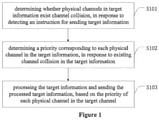
- a method for sending information is provided, with reference to FIG. 1 , the method is described below in detail in S101, S102, S103, and S104.
- instruction information is sent to a user terminal by a base station to instruct the user terminal to send target information.
- the user terminal can be instructed implicitly by the base station to send the target information, or the user terminal can be instructed explicitly by the base station to send the target information.
- a user terminal is instructed to send target information by a base station through information such as Downlink Control Information (DCI).
- DCI Downlink Control Information
- target information includes a plurality of physical channels.
- information in the target information may exist collision. Therefore, in embodiments of the present invention, whether physical channels in the target information exist channel collision is determined first, if the physical channels exist channel collision, S102 is executed.
- determining a priority corresponding to each physical channel in the target information when there is a channel collision of physical channels in the target information, determining a priority corresponding to each physical channel in the target information.
- a priority corresponding to each physical channel in the target information may be determined based on channel types and information carried by physical channels.
- the channel types carried by physical channels may include one of Physical Uplink Shared Channels (PUSCH) and Physical Uplink Control Channels (PUCCH).
- a target information when physical channels in a target information include a PUSCH and a PUCCH, one of the following ways can be used to determine a priority corresponding to each physical channel in the target information:
- a priority of the PUCCH carrying HARQ-ACK information is determined higher than a priority of the PUSCH carrying CSI information but not carrying HARQ-ACK information.
- a priority of the PUCCH carrying HARQ-ACK information is determined higher than a priority of the PUSCH carrying neither CSI information nor HARQ-ACK information.
- a priority of the PUSCH carrying HARQ-ACK information is determined higher than a priority of the PUCCH carrying any information. That is, in the target information, as long as the PUSCH carries HARQ-ACK information, the PUSCH at this time has a highest priority.
- any one or more of the above methods can be used to determine a priority of the PUSCH and a priority of the PUCCH which carry different information.
- one of the above methods can be used only to determine the priority of the PUSCH and the PUCCH which carry different information, or two or more of the above methods can be used to determine a priority of the PUSCH and a priority of the PUCCH which carry different information.
- CSI information carried by a PUSCH may include at least one of the following: periodic CSI information, semi-persistent CSI information, and a non-periodic CSI report.
- periodic CSI information When CSI information carried by the PUSCH is a non-periodic CSI report, a time interval between triggering a PUCCH with the non-periodic CSI report and carrying a PUSCH with the non-periodic CSI report is greater than a preset time threshold.
- a preset time threshold may be a specified value in an existing communication protocol.
- a physical channel in a target information include PUCCHs
- one of the following ways can be used to determine a priority corresponding to each physical channel in the target information:
- a priority of a PUCCH carrying HARQ-ACK information is determined higher than a priority of a PUCCH carrying CSI information but not carrying HARQ-ACK information; and a priority of a PUCCH carrying CSI information and HARQ-ACK information is determined higher than a priority of a PUCCH carrying HARQ-ACK information only.
- information carried by each physical channel in a target information may be the same, but corresponding to different resource types. Therefore, when determining a priority corresponding to each physical channel in the target information, a priority corresponding to each physical channel in the target information can be determined according to resource types corresponding to the physical channels.
- a priority of a public PUCCH is determined higher than a priority of a non-public PUCCH.
- the priority corresponding to each physical channel in the target information can be determined according to cell indexes corresponding to the physical channels.
- a priority of a public PUCCH with a minimum cell index is determined higher than a priority of a public PUCCH with a high cell index; and a priority of a non-public PUCCH with a minimum cell index is determined higher than a priority of a non-public PUCCH with a high cell index.
- one of the above methods can be used only to determine priorities of PUCCHs carrying different information, or two or more of the above methods can be used to determine priorities of PUCCHs carries different information.
- the target information after determining a priority of each physical channel in the target information, the target information can be processed, and the processed target information can be sent to a network side.
- processing the target information includes multiplexing information carried by a physical channel with a lower priority in the target information to a physical channel with a higher priority in the target information; or, discarding the information carried by the physical channel with the low priority in the target information.
- the CSI information carried by the PUSCH can be multiplexed to the PUCCH carrying the HARQ-ACK information; or the PUSCH carrying CSI information but not carrying HARQ-ACK information can be discarded.
- the PUSCH carrying neither CSI information nor HARQ-ACK information can be discarded.
- the PUCCH carrying arbitrary information can be discarded; or the CSI information carried by the PUCCH can be multiplexed to the PUSCH carrying the HARQ-ACK information.
- the PUCCH carrying the CSI information but not carrying the HARQ-ACK information can be discarded; or the CSI information carried by the PUCCH carrying the CSI information but not carrying the HARQ-ACK information can be multiplexed to the PUCCH carrying the HARQ-ACK information.
- the PUCCH carrying the HARQ-ACK information only can be discarded.
- the non-public PUCCH can be discarded; or the information carried by the non-public PUCCH can be multiplexed to the public PUCCH.
- the public PUCCH with the high cell index can be discarded; or the information carried by the public PUCCH with the high cell index can be multiplexed to the public PUCCH with the minimum cell index.
- the non-public PUCCH with the high cell index can be discarded; or the information carried by the non-public PUCCH with the high cell index can be multiplexed to the non-public PUCCH with the minimum cell index.
- the target information when physical channels in the target information exist channel collision, based on the priority of each physical channel in the target channel, information carried by a physical channel with a low priority in the target information is multiplexed to a physical channel with a high priority in the target information, or the information carried by a physical channel with a low priority in the target information is discarded, so that if a plurality of physical channels exist channel collision, the collision physical channels can be processed accordingly, and the performance of the communication system can be improved.
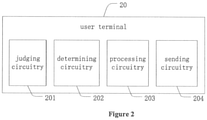
- a user terminal 20 including: a judging circuitry 201, a determining circuitry 202, a processing circuitry 203 and a sending circuitry 204, wherein:
- the judging circuitry 201 is adapted to determine whether physical channels in target information exist channel collision, if an instruction for sending target information is detected.
- the determining circuitry 202 is adapted to determine a priority corresponding to each physical channel in the target information, if existing channel collision in the target information.
- the processing circuitry 203 is adapted to process the target information, based on the priority of each physical channel in the target information, includes: multiplexing information carried by a physical channel with a lower priority in the target information to a physical channel with a higher priority in the target information; or, discarding the information carried by the physical channel with the low priority in the target information.
- the sending circuitry 204 is adapted to send processed target information.
- the judging circuitry 201 can be adapted to determine physical channels in the target information exist channel collision, ifat least two physical channels overlap on the same symbol in the target information.
- the determining circuitry 202 is adapted to determine the priority corresponding to each physical channel in the target information according to channel types and information carried by physical channels.
- the determining circuitry 202 is adapted to perform at least one of the following: determining a priority of a PUCCH carrying HARQ-ACK information is higher than a priority of a PUSCH carrying CSI information but not carrying HARQ-ACK information; determining a priority of a PUCCH carrying HARQ-ACK information is higher than a priority of a PUSCH carrying neither CSI information nor HARQ-ACK information; and determining a priority of a PUSCH carrying HARQ-ACK information is higher than a priority of a PUCCH carrying arbitrary information.
- the CSI information carried by the PUSCH includes at least one of the following: periodic CSI information, semi-persistent CSI information, and a non-periodic CSI report.
- a time interval between a time point of triggering a PUCCH with the non-periodic CSI report and a time point of carrying a PUSCH with the non-periodic CSI report is greater than a preset time threshold.
- the processing circuitry 203 is adapted to multiplex the CSI information carried by the PUSCH to the PUCCH carrying the HARQ-ACK information; or discard the PUSCH carrying CSI information but not carrying HARQ-ACK information, if the determining circuitry determines the priority of a PUCCH carrying HARQ-ACK information is higher than the priority of a PUSCH carrying CSI information but not carrying HARQ-ACK information.
- the processing circuitry 203 is adapted to discard the PUSCH carrying neither CSI information nor HARQ-ACK information, if the determining circuitry determines the priority of a PUCCH carrying HARQ-ACK information is higher than the priority of a PUSCH carrying neither CSI information nor HARQ-ACK information.
- the processing circuitry 203 is adapted to discard the PUCCH carrying any information; or multiplex the CSI information carried by the PUCCH to the PUSCH carrying the HARQ-ACK information, if the determining circuitry determines the priority of a PUSCH carrying HARQ-ACK information is higher than the priority of a PUCCH carrying any information.
- the determining circuitry 202 is adapted to perform at least one of the following: determining a priority of a PUCCH carrying HARQ-ACK information is higher than a priority of a PUCCH carrying CSI information but not carrying HARQ-ACK information; and determining a priority of a PUCCH carrying CSI information and HARQ-ACK information is higher than a priority of a PUCCH carrying HARQ-ACK information only.
- the processing circuitry 203 is adapted to discard the PUCCH carrying the CSI information but not carrying the HARQ-ACK information; or multiplex the CSI information carried by the PUCCH carrying the CSI information but not the HARQ-ACK information to the PUCCH carrying the HARQ-ACK information, if the determining circuitry determines the priority of a PUCCH carrying HARQ-ACK information is higher than the priority of a PUCCH carrying CSI information but not carrying HARQ-ACK information.
- the processing circuitry 203 is adapted to discard the PUCCH carrying the HARQ-ACK information only, if the determining circuitry determines the priority of a PUCCH carrying CSI information and HARQ-ACK information is higher than the priority of a PUCCH carrying HARQ-ACK information only.
- the determining circuitry 202 is adapted to determine a priority corresponding to each physical channel in the target information, according to resource types corresponding to the physical channel.
- the determining circuitry 202 is adapted to determine a priority of a public PUCCH is higher than a priority of a non-public PUCCH.
- the processing circuitry 203 is adapted to discard the non-public PUCCH ; or multiplex the information carried by the non-public PUCCH to the public PUCCH, if the determining circuitry determines the priority of a public PUCCH is higher than the priority of a non-public PUCCH.
- the determining circuitry 202 is adapted to determining the priority corresponding to each physical channel in the target information, according to cell indexes corresponding to physical channels.
- the determining circuitry 202 is adapted to perform at least one of the following: determining a priority of a public PUCCH with a minimum cell index is higher than a priority of a public PUCCH with a high cell index; and determining a priority of a non-public PUCCH with a minimum cell index is higher than a priority of a non-public PUCCH with a high cell index.
- the processing circuitry 203 is adapted to discard the public PUCCH with the high cell index; or multiplex the information carried by the public PUCCH with the high cell index to the public PUCCH with the minimum cell index, on the basis that the determining circuitry determines the priority of a public PUCCH with the minimum cell index is higher than the priority of a public PUCCH with the high cell index.
- the processing circuitry 203 is adapted to discard the non-public PUCCH with the high cell index ; or multiplex the information carried by the non-public PUCCH with the high cell index to the non-public PUCCH with the minimum cell index, if the determining circuitry determines the priority of a non-public PUCCH with the minimum cell index is higher than the priority of a non-public PUCCH with the high cell index.
- a computer-readable storage medium having computer instructions stored therein is provided, the computer-readable storage medium is a non-volatile storage medium or a non-transitory storage medium, wherein once the computer instructions are executed, the above method is performed.
- a user terminal comprising a memory and a processor
- the memory has computer instructions stored therein, and the above method is performed, on the basis that the processor executes the computer instructions.
- the program can be stored in a computer-readable storage medium, and the storage medium may include: ROM, RAM, magnetic disk or CD, etc.
Landscapes
- Engineering & Computer Science (AREA)
- Signal Processing (AREA)
- Computer Networks & Wireless Communication (AREA)
- Quality & Reliability (AREA)
- Mobile Radio Communication Systems (AREA)
Abstract
Description
- This application claims priority to
Chinese Patent Application No. 201910247923.X, filed on March 29, 2019 - The present disclosure generally relates to wireless communication technology field, and more particularly, to an information sending method, user terminal and computer-readable storage medium.
- Under single transmission reception point and single carrier, the New Radio (NR) R15 formulates a plurality of uplink physical channels or priority criteria for confliction handling of signal. On each symbol, only one physical channel or one signal transmission is supported.
- The R16 supports multiple Transmission Reception Point (multi-TRP) transmission, that is, there are a plurality of transmission points communicate with a user terminal. However, in the R16, no specific solution is given on the basis that physical channels of a plurality of communication links conflict.
- According to embodiments in the present disclosure, a method is provided when a collision occurs in physical channels of a plurality of communication links.
- In an embodiment of the present disclosure, a method for sending information is provided, including: determining whether physical channels in target information exist channels collision, in response to detecting an instruction for sending target information; determining a priority corresponding to each physical channel in the target information, in response to existing channel collision in the target information; and processing the target information based on the priority of each physical channel in the target channel, and sending the target information, said processing the target information comprises: multiplexing information carried by a physical channel having a lower priority in the target information to a physical channel having a higher priority in the target information; or, discarding the information carried by a physical channel having a low priority in the target information.
- In some embodiment, said determining whether physical channels in the target information exist channel collision includes: determining the physical channels in the target information exist channel collision, in response to detecting at least two physical channels overlap on the same symbol in the target information.
- In some embodiment, said determining the priority corresponding to each physical channel in the target information includes: determining the priority corresponding to each physical channel in the target information based on channel types and information carried by the physical channels.
- In some embodiment, said determining the priority corresponding to each physical channel in the target information based on channel types and information carried by physical channels includes at least one of the following: determining a priority of a PUCCH carrying HARQ-ACK information is higher than a priority of a PUSCH carrying CSI information but not carrying HARQ-ACK information; determining a priority of a PUCCH carrying HARQ-ACK information is higher than a priority of a PUSCH carrying neither CSI information nor HARQ-ACK information; and determining a priority of a PUSCH carrying HARQ-ACK information is higher than a priority of a PUCCH carrying arbitrary information.
- In some embodiment, the CSI information carried by the PUSCH includes at least one of the following: periodic CSI information, semi-persistent CSI information, and a non-periodic CSI report.
- In some embodiment, a time interval between triggering a PUCCH with the non-periodic CSI report and carrying a PUSCH with the non-periodic CSI report is greater than a preset time threshold, in response to the CSI information carried by the PUSCH being the non-periodic CSI report.
- In some embodiment, in response to determining the priority of a PUCCH carrying HARQ-ACK information is higher than the priority of a PUSCH carrying CSI information but not carrying HARQ-ACK information, said processing the target information includes: multiplexing the CSI information carried by the PUSCH to the PUCCH carrying the HARQ-ACK information; or discarding the PUSCH carrying CSI information but not carrying HARQ-ACK information.
- In some embodiment, in response to determining the priority of a PUCCH carrying HARQ-ACK information is higher than the priority of a PUSCH carrying neither CSI information nor HARQ-ACK information, said processing the target information comprises: discarding the PUSCH carrying neither CSI information nor HARQ-ACK information.
- In some embodiment, in response to determining the priority of a PUSCH carrying HARQ-ACK information is higher than the priority of a PUCCH carrying arbitrary information, said processing the target information includes: discarding the PUCCH carrying arbitrary information; or multiplexing the CSI information carried by the PUCCH to the PUSCH carrying the HARQ-ACK information,
- In some embodiment, said determining a priority corresponding to each physical channel in the target information according to channel type and information carried by physical channel includes at least one of the following: determining a priority of a PUCCH carrying HARQ-ACK information is higher than a priority of a PUCCH carrying CSI information but not carrying HARQ-ACK information; and determining a priority of a PUCCH carrying CSI information and HARQ-ACK information is higher than a priority of a PUCCH carrying HARQ-ACK information only.
- In some embodiment, in response to determining the priority of a PUCCH carrying HARQ-ACK information is higher than the priority of a PUCCH carrying CSI information but not carrying HARQ-ACK information, said processing the target information includes: discarding the PUCCH carrying the CSI information but not the HARQ-ACK information; or multiplexing the CSI information carried by the PUCCH carrying the CSI information but not the HARQ-ACK information to the PUCCH carrying the HARQ-ACK information.
- In some embodiment, in response to determining the priority of a PUCCH carrying CSI information and HARQ-ACK information is higher than the priority of a PUCCH carrying HARQ-ACK information only, said processing the target information includes: discarding the PUCCH carrying the HARQ-ACK information only.
- In some embodiment, said determining the priority corresponding to each physical channel in the target information includes: determining a priority corresponding to each physical channel in the target information according to resource types corresponding to the physical channel.
- In some embodiment, said determining the priority corresponding to each physical channel in the target information according to resource types corresponding to the physical channel includes: determining a priority of a public PUCCH is higher than a priority of a non-public PUCCH.
- In some embodiment, in response to determining the priority of a public PUCCH is higher than the priority of a non-public PUCCH, said processing the target information includes: discarding the non-public PUCCH; or multiplexing the information carried by the non-public PUCCH to the public PUCCH.
- In some embodiment, said determining the priority corresponding to each physical channel in the target information includes: determining the priority corresponding to each physical channel in the target information according to cell indexes corresponding to the physical channels.
- In some embodiment, said determining the priority corresponding to each physical channel in the target information according to the cell indexes corresponding to the physical channels includes at least one of the following: determining a priority of a public PUCCH with a minimum cell index is higher than a priority of a public PUCCH with a high cell index; and determining a priority of a non-public PUCCH with a minimum cell index is higher than a priority of a non-public PUCCH with a high cell index.
- In some embodiment, in response to determining the priority of a public PUCCH with the minimum cell index is higher than the priority of a public PUCCH with a high cell index, said processing the target information includes: discarding the public PUCCH with the high cell index; or multiplexing the information carried by the public PUCCH with the high cell index to the public PUCCH with the minimum cell index.
- In some embodiment, in response to determining the priority of a non-public PUCCH with the minimum cell index is higher than the priority of a non-public PUCCH with the high cell index, said processing the target information includes: discarding the non-public PUCCH with the high cell index; or multiplexing the information carried by the non-public PUCCH with the high cell index to the non-public PUCCH with the minimum cell index.
- In an embodiment of the present disclosure, a user terminal is provided, including: a judging circuitry, adapted to determine whether physical channels in target information exist channel collision, in response to detecting an instruction for sending target information; a determining circuitry, adapted to determine a priority corresponding to each physical channel in the target information, in response to existing channel collision in the target information; a processing circuitry, adapted to process the target information based on the priority of each physical channel in the target channel; said processing the target information comprises: multiplexing information carried by a physical channel having a lower priority in the target information to a physical channel having a higher priority in the target information; or, discarding the information carried by a physical channel having a low priority in the target information; and a sending circuitry, adapted to send processed target information.
- In some embodiment, the judging circuitry is adapted to determine the physical channels in the target information exist channel collision, in response to detecting at least two physical channels overlap on the same symbol in the target information.
- In some embodiment, the determining circuitry is adapted to determine the priority corresponding to each physical channel in the target information according to channel types and information carried by physical channels.
- In some embodiment, the determining circuitry is adapted to perform at least one of the following: determining a priority of a PUCCH carrying HARQ-ACK information is higher than a priority of a PUSCH carrying CSI information but not carrying HARQ-ACK information; determining a priority of a PUCCH carrying HARQ-ACK information is higher than a priority of a PUSCH carrying neither CSI information nor HARQ-ACK information; and determining a priority of a PUSCH carrying HARQ-ACK information is higher than a priority of a PUCCH carrying arbitrary information.
- In some embodiment, the CSI information carried by the PUSCH includes at least one of the following: periodic CSI information, semi-persistent CSI information, and a non-periodic CSI report.
- In some embodiment, a time interval between triggering a PUCCH with the non-periodic CSI report and carrying a PUSCH with the non-periodic CSI report is greater than a preset time interval, in response to the CSI information carried by the PUSCH being the non-periodic CSI report.
- In some embodiment, the processing circuitry is adapted to multiplex the CSI information carried by the PUSCH to the PUCCH carrying the HARQ-ACK information; or discard the PUSCH carrying CSI information but not carrying HARQ-ACK information, in response to the determining circuitry determining the priority of a PUCCH carrying HARQ-ACK information is higher than the priority of a PUSCH carrying CSI information but not carrying HARQ-ACK information.
- In some embodiment, the processing circuitry is adapted to discard the PUSCH carrying neither CSI information nor HARQ-ACK information, in response to the determining circuitry determining the priority of a PUCCH carrying HARQ-ACK information is higher than the priority of a PUSCH carrying neither CSI information nor HARQ-ACK information.
- In some embodiment, the processing circuitry is adapted to discard the PUCCH carrying arbitrary information; or multiplex the CSI information carried by the PUCCH to the PUSCH carrying the HARQ-ACK information, in response to the determining circuitry determining the priority of a PUSCH carrying HARQ-ACK information is higher than the priority of a PUCCH carrying arbitrary information.
- In some embodiment, the determining circuitry is adapted to perform at least one of the following: determining a priority of a PUCCH carrying HARQ-ACK information is higher than a priority of a PUCCH carrying CSI information but not carrying HARQ-ACK information; and determining a priority of a PUCCH carrying CSI information and HARQ-ACK information is higher than a priority of a PUCCH carrying HARQ-ACK information only.
- In some embodiment, the processing circuitry is adapted to discard the PUCCH carrying the CSI information but not carrying the HARQ-ACK information; or multiplex the CSI information carried by the PUCCH carrying the CSI information but not the HARQ-ACK information to the PUCCH carrying the HARQ-ACK information, in response to the determining circuitry determining the priority of a PUCCH carrying HARQ-ACK information is higher than the priority of a PUCCH carrying CSI information but not carrying HARQ-ACK information.
- In some embodiment, the processing circuitry is adapted to discard the PUCCH carrying the HARQ-ACK information only, in response to the determining circuitry determining the priority of a PUCCH carrying CSI information and HARQ-ACK information is higher than the priority of a PUCCH carrying HARQ-ACK information only.
- In some embodiment, the determining circuitry is adapted to determine a priority corresponding to each physical channel in the target information according to resource type corresponding to the physical channel.
- In some embodiment, the determining circuitry is adapted to determine a priority of a public PUCCH is higher than a priority of a non-public PUCCH.
- In some embodiment, the processing circuitry is adapted to discard the non-public PUCCH; or multiplex the information carried by the non-public PUCCH to the public PUCCH, in response to the determining circuitry determining the priority of a public PUCCH is higher than the priority of a non-public PUCCH.
- In some embodiment, the determining circuitry is adapted to determining the priority corresponding to each physical channel in the target information according to cell indexes corresponding to the physical channels.
- In some embodiment, the determining circuitry is adapted to perform at least one of the following: determining a priority of a public PUCCH with a minimum cell index is higher than a priority of a public PUCCH with a high cell index; and determining a priority of a non-public PUCCH with a minimum cell index is higher than a priority of a non-public PUCCH with a high cell index.
- In some embodiment, the processing circuitry is adapted to discard the public PUCCH with the high cell index; or multiplex the information carried by the public PUCCH with the high cell index to the public PUCCH with the minimum cell index, in response to the determining circuitry determining the priority of a public PUCCH with the minimum cell index is higher than the priority of a public PUCCH with the high cell index.
- In some embodiment, the processing circuitry is adapted to discard the non-public PUCCH with the high cell index; or multiplex the information carried by the non-public PUCCH with the high cell index to the non-public PUCCH with the minimum cell index, in response to the determining circuitry determining the priority of a non-public PUCCH with the minimum cell index is higher than the priority of a non-public PUCCH with the high cell index.
- In an embodiment of the present disclosure, a computer-readable storage medium having computer instructions stored therein is provided, the computer-readable storage medium is a non-volatile storage medium or a non-transitory storage medium, wherein once the computer instructions are executed, the above method is performed.
- In an embodiment of the present disclosure, a user terminal comprising a memory and a processor is provided, the memory has computer instructions stored therein, and the above method is performed, on the basis that the processor executes the computer instructions.
- Embodiments of the present disclosure have following benefits:
- When physical channels in target information exist channel collision, based on the priority of each physical channel in the target information, information carried by a physical channel with a low priority in the target information is multiplexed to a physical channel with a high priority in the target information, or the information carried by a physical channel with a low priority in the target information is discarded, so that if a plurality of physical channels exist channel collision, the collision physical channels can be processed accordingly, and the performance of the communication system can be improved.
-
-
Figure 1 schematically illustrates a process diagram of a method for sending information according to an embodiment of the present disclosure; -
Figure 2 schematically illustrates a structural diagram of a user terminal according to an embodiment of the present disclosure. - As described in background, there is a need for a method when physical channels of a plurality of communication links conflict in R16.
- In embodiments of the present disclosure, when physical channels in the target information exist channel collision, multiplexing information carried by a physical channel with a lower priority in the target information to a physical channel with a higher priority in the target information; or, discarding the information carried by the physical channel with the low priority in the target information based on the priority of each physical channel in the target channel, so that if a plurality of physical channels exist channel collision, the collisional physical channels can be processed accordingly, and the performance of the communication system can be improved.
- In order to clarify the object, characteristic and advantages of embodiments of the present disclosure, embodiments of the present disclosure will be described clearly in detail in conjunction with accompanying drawings.
- In an embodiment of the present disclosure, a method for sending information is provided, with reference to
FIG. 1 , the method is described below in detail in S101, S102, S103, and S104. - In S101, determining whether physical channels in target information exist channel collision, in response to detecting an instruction for sending target information.
- In some embodiment, instruction information is sent to a user terminal by a base station to instruct the user terminal to send target information. The user terminal can be instructed implicitly by the base station to send the target information, or the user terminal can be instructed explicitly by the base station to send the target information. In practical applications, a user terminal is instructed to send target information by a base station through information such as Downlink Control Information (DCI).
- After receiving instruction information sent by a base station, a requirement of sending target information to the base station is received by the user terminal.
- In embodiments of the present disclosure, target information includes a plurality of physical channels. When an instruction for sending the target information is detected by a user terminal, and the target information needs to be sent at the same time, information in the target information may exist collision. Therefore, in embodiments of the present invention, whether physical channels in the target information exist channel collision is determined first, if the physical channels exist channel collision, S102 is executed.
- In embodiments of the present disclosure, when at least two physical channels overlap on a same symbol in target information is detected, it can be determined that there are channel collision of physical channels in the target information.
- In S102, determining a priority corresponding to each physical channel in the target information, in response to existing channel collision in the target information.
- In some embodiment, when there is a channel collision of physical channels in the target information, determining a priority corresponding to each physical channel in the target information.
- In embodiments of the present disclosure, a priority corresponding to each physical channel in the target information may be determined based on channel types and information carried by physical channels. The channel types carried by physical channels may include one of Physical Uplink Shared Channels (PUSCH) and Physical Uplink Control Channels (PUCCH).
- In some embodiment, when physical channels in a target information include a PUSCH and a PUCCH, one of the following ways can be used to determine a priority corresponding to each physical channel in the target information:
- If the PUCCH carries HARQ-ACK information, and the PUSCH carries CSI information and does not carry HARQ-ACK information, a priority of the PUCCH carrying HARQ-ACK information is determined higher than a priority of the PUSCH carrying CSI information but not carrying HARQ-ACK information.
- If the PUCCH carries HARQ-ACK information, and the PUSCH does not carry CSI information or HARQ-ACK information, a priority of the PUCCH carrying HARQ-ACK information is determined higher than a priority of the PUSCH carrying neither CSI information nor HARQ-ACK information.
- If the PUSCH carries HARQ-ACK information, a priority of the PUSCH carrying HARQ-ACK information is determined higher than a priority of the PUCCH carrying any information. That is, in the target information, as long as the PUSCH carries HARQ-ACK information, the PUSCH at this time has a highest priority.
- That is, when physical channels in target information include a PUSCH and a PUCCH, any one or more of the above methods can be used to determine a priority of the PUSCH and a priority of the PUCCH which carry different information.
- In other words, when physical channels in target information include a PUSCH and a PUCCH, one of the above methods can be used only to determine the priority of the PUSCH and the PUCCH which carry different information, or two or more of the above methods can be used to determine a priority of the PUSCH and a priority of the PUCCH which carry different information.
- In embodiments of the present invention, CSI information carried by a PUSCH may include at least one of the following: periodic CSI information, semi-persistent CSI information, and a non-periodic CSI report. When CSI information carried by the PUSCH is a non-periodic CSI report, a time interval between triggering a PUCCH with the non-periodic CSI report and carrying a PUSCH with the non-periodic CSI report is greater than a preset time threshold. In some embodiment, a preset time threshold may be a specified value in an existing communication protocol.
- In some embodiment, when a physical channel in a target information include PUCCHs, one of the following ways can be used to determine a priority corresponding to each physical channel in the target information:
- A priority of a PUCCH carrying HARQ-ACK information is determined higher than a priority of a PUCCH carrying CSI information but not carrying HARQ-ACK information; and a priority of a PUCCH carrying CSI information and HARQ-ACK information is determined higher than a priority of a PUCCH carrying HARQ-ACK information only.
- In other words, when physical channels in target information include PUCCHs carrying different information, one of the above methods can be used to determine the priority corresponding to each physical channel.
- In some embodiment, information carried by each physical channel in a target information may be the same, but corresponding to different resource types. Therefore, when determining a priority corresponding to each physical channel in the target information, a priority corresponding to each physical channel in the target information can be determined according to resource types corresponding to the physical channels.
- In embodiments of the present disclosure, a priority of a public PUCCH is determined higher than a priority of a non-public PUCCH.
- In some embodiment, when determining a priority corresponding to each physical channel in the target information, the priority corresponding to each physical channel in the target information can be determined according to cell indexes corresponding to the physical channels.
- In embodiments of the present disclosure, a priority of a public PUCCH with a minimum cell index is determined higher than a priority of a public PUCCH with a high cell index; and a priority of a non-public PUCCH with a minimum cell index is determined higher than a priority of a non-public PUCCH with a high cell index.
- In other words, when physical channels in target information include PUCCHs carrying different information, one of the above methods can be used only to determine priorities of PUCCHs carrying different information, or two or more of the above methods can be used to determine priorities of PUCCHs carries different information.
- In S103, processing the target information and sending the target information, based on the priority of each physical channel in the target channel.
- In some embodiment, after determining a priority of each physical channel in the target information, the target information can be processed, and the processed target information can be sent to a network side.
- In embodiments of the present disclosure, processing the target information includes multiplexing information carried by a physical channel with a lower priority in the target information to a physical channel with a higher priority in the target information; or, discarding the information carried by the physical channel with the low priority in the target information.
- In embodiments of the present disclosure, when determining the priority of a PUCCH carrying HARQ-ACK information is higher than the priority of a PUSCH carrying CSI information but not carrying HARQ-ACK information, the CSI information carried by the PUSCH can be multiplexed to the PUCCH carrying the HARQ-ACK information; or the PUSCH carrying CSI information but not carrying HARQ-ACK information can be discarded.
- When determining the priority of a PUCCH carrying HARQ-ACK information is higher than the priority of a PUSCH carrying neither CSI information nor HARQ-ACK information, the PUSCH carrying neither CSI information nor HARQ-ACK information can be discarded.
- When determining the priority of a PUSCH carrying HARQ-ACK information is higher than the priority of a PUCCH carrying any information, the PUCCH carrying arbitrary information can be discarded; or the CSI information carried by the PUCCH can be multiplexed to the PUSCH carrying the HARQ-ACK information.
- When determining the priority of a PUCCH carrying HARQ-ACK information is higher than the priority of a PUCCH carrying CSI information but not carrying HARQ-ACK information, the PUCCH carrying the CSI information but not carrying the HARQ-ACK information can be discarded; or the CSI information carried by the PUCCH carrying the CSI information but not carrying the HARQ-ACK information can be multiplexed to the PUCCH carrying the HARQ-ACK information.
- When determining the priority of a PUCCH carrying CSI information and HARQ-ACK information is higher than the priority of a PUCCH carrying HARQ-ACK information only, the PUCCH carrying the HARQ-ACK information only can be discarded.
- When determining the priority of a public PUCCH is higher than the priority of a non-public PUCCH, the non-public PUCCH can be discarded; or the information carried by the non-public PUCCH can be multiplexed to the public PUCCH.
- When determining the priority of a public PUCCH with the minimum cell index is higher than the priority of a public PUCCH with a high cell index, the public PUCCH with the high cell index can be discarded; or the information carried by the public PUCCH with the high cell index can be multiplexed to the public PUCCH with the minimum cell index.
- When determining the priority of a non-public PUCCH with the minimum cell index is higher than the priority of a non-public PUCCH with the high cell index, the non-public PUCCH with the high cell index can be discarded; or the information carried by the non-public PUCCH with the high cell index can be multiplexed to the non-public PUCCH with the minimum cell index.
- According to embodiments of the present disclosure, when physical channels in the target information exist channel collision, based on the priority of each physical channel in the target channel, information carried by a physical channel with a low priority in the target information is multiplexed to a physical channel with a high priority in the target information, or the information carried by a physical channel with a low priority in the target information is discarded, so that if a plurality of physical channels exist channel collision, the collision physical channels can be processed accordingly, and the performance of the communication system can be improved.
- Referring to
FIG. 2 , in an embodiment of the present disclosure, auser terminal 20 is provided, including: a judgingcircuitry 201, a determiningcircuitry 202, aprocessing circuitry 203 and a sendingcircuitry 204, wherein: - The judging
circuitry 201 is adapted to determine whether physical channels in target information exist channel collision, if an instruction for sending target information is detected. - The determining
circuitry 202 is adapted to determine a priority corresponding to each physical channel in the target information, if existing channel collision in the target information. - The
processing circuitry 203 is adapted to process the target information, based on the priority of each physical channel in the target information, includes: multiplexing information carried by a physical channel with a lower priority in the target information to a physical channel with a higher priority in the target information; or, discarding the information carried by the physical channel with the low priority in the target information. - The sending
circuitry 204 is adapted to send processed target information. - In some embodiment, the judging
circuitry 201 can be adapted to determine physical channels in the target information exist channel collision, ifat least two physical channels overlap on the same symbol in the target information. - In some embodiment, the determining
circuitry 202 is adapted to determine the priority corresponding to each physical channel in the target information according to channel types and information carried by physical channels. - In some embodiment, the determining
circuitry 202 is adapted to perform at least one of the following: determining a priority of a PUCCH carrying HARQ-ACK information is higher than a priority of a PUSCH carrying CSI information but not carrying HARQ-ACK information; determining a priority of a PUCCH carrying HARQ-ACK information is higher than a priority of a PUSCH carrying neither CSI information nor HARQ-ACK information; and determining a priority of a PUSCH carrying HARQ-ACK information is higher than a priority of a PUCCH carrying arbitrary information. - In some embodiment, the CSI information carried by the PUSCH includes at least one of the following: periodic CSI information, semi-persistent CSI information, and a non-periodic CSI report.
- In some embodiment, if the CSI information carried by the PUSCH is the non-periodic CSI report, a time interval between a time point of triggering a PUCCH with the non-periodic CSI report and a time point of carrying a PUSCH with the non-periodic CSI report is greater than a preset time threshold.
- In some embodiment, the
processing circuitry 203 is adapted to multiplex the CSI information carried by the PUSCH to the PUCCH carrying the HARQ-ACK information; or discard the PUSCH carrying CSI information but not carrying HARQ-ACK information, if the determining circuitry determines the priority of a PUCCH carrying HARQ-ACK information is higher than the priority of a PUSCH carrying CSI information but not carrying HARQ-ACK information. - In some embodiment, the
processing circuitry 203 is adapted to discard the PUSCH carrying neither CSI information nor HARQ-ACK information, if the determining circuitry determines the priority of a PUCCH carrying HARQ-ACK information is higher than the priority of a PUSCH carrying neither CSI information nor HARQ-ACK information. - In some embodiment, the
processing circuitry 203 is adapted to discard the PUCCH carrying any information; or multiplex the CSI information carried by the PUCCH to the PUSCH carrying the HARQ-ACK information, if the determining circuitry determines the priority of a PUSCH carrying HARQ-ACK information is higher than the priority of a PUCCH carrying any information. - In some embodiment, the determining
circuitry 202 is adapted to perform at least one of the following: determining a priority of a PUCCH carrying HARQ-ACK information is higher than a priority of a PUCCH carrying CSI information but not carrying HARQ-ACK information; and determining a priority of a PUCCH carrying CSI information and HARQ-ACK information is higher than a priority of a PUCCH carrying HARQ-ACK information only. - In some embodiment, the
processing circuitry 203 is adapted to discard the PUCCH carrying the CSI information but not carrying the HARQ-ACK information; or multiplex the CSI information carried by the PUCCH carrying the CSI information but not the HARQ-ACK information to the PUCCH carrying the HARQ-ACK information, if the determining circuitry determines the priority of a PUCCH carrying HARQ-ACK information is higher than the priority of a PUCCH carrying CSI information but not carrying HARQ-ACK information. - In some embodiment, the
processing circuitry 203 is adapted to discard the PUCCH carrying the HARQ-ACK information only, if the determining circuitry determines the priority of a PUCCH carrying CSI information and HARQ-ACK information is higher than the priority of a PUCCH carrying HARQ-ACK information only. - In some embodiment, the determining
circuitry 202 is adapted to determine a priority corresponding to each physical channel in the target information, according to resource types corresponding to the physical channel. - In some embodiment, the determining
circuitry 202 is adapted to determine a priority of a public PUCCH is higher than a priority of a non-public PUCCH. - In some embodiment, the
processing circuitry 203 is adapted to discard the non-public PUCCH ; or multiplex the information carried by the non-public PUCCH to the public PUCCH, if the determining circuitry determines the priority of a public PUCCH is higher than the priority of a non-public PUCCH. - In some embodiment, the determining
circuitry 202 is adapted to determining the priority corresponding to each physical channel in the target information, according to cell indexes corresponding to physical channels. - In some embodiment, the determining
circuitry 202 is adapted to perform at least one of the following: determining a priority of a public PUCCH with a minimum cell index is higher than a priority of a public PUCCH with a high cell index; and determining a priority of a non-public PUCCH with a minimum cell index is higher than a priority of a non-public PUCCH with a high cell index. - In some embodiment, the
processing circuitry 203 is adapted to discard the public PUCCH with the high cell index; or multiplex the information carried by the public PUCCH with the high cell index to the public PUCCH with the minimum cell index, on the basis that the determining circuitry determines the priority of a public PUCCH with the minimum cell index is higher than the priority of a public PUCCH with the high cell index. - In some embodiment, the
processing circuitry 203 is adapted to discard the non-public PUCCH with the high cell index ; or multiplex the information carried by the non-public PUCCH with the high cell index to the non-public PUCCH with the minimum cell index, if the determining circuitry determines the priority of a non-public PUCCH with the minimum cell index is higher than the priority of a non-public PUCCH with the high cell index. - In an embodiment of the present disclosure, a computer-readable storage medium having computer instructions stored therein is provided, the computer-readable storage medium is a non-volatile storage medium or a non-transitory storage medium, wherein once the computer instructions are executed, the above method is performed.
- In an embodiment of the present disclosure, a user terminal comprising a memory and a processor is provided, the memory has computer instructions stored therein, and the above method is performed, on the basis that the processor executes the computer instructions.
- Those skilled in the art can understand that all or part of the various methods of the above-mentioned embodiments can be accomplished by a program instructing relevant hardware. The program can be stored in a computer-readable storage medium, and the storage medium may include: ROM, RAM, magnetic disk or CD, etc.
- Although the present disclosure is disclosed as above, the present disclosure is not limited to this. Those skilled in the art can make various changes and modifications without departing from the spirit and scope of the present disclosure. Therefore, the protection scope of the present disclosure should be subject to the scope defined by the claims.
Claims (40)
- A method for sending information, characterized by comprising:determining whether physical channels in target information exist channel collision, in response to detecting an instruction for sending target information;determining a priority corresponding to each physical channel in the target information, in response to existing channel collision in the target information; andprocessing the target information based on the priority of each physical channel in the target channel, and sending the target information, wherein said processing the target information comprises: multiplexing information carried by a physical channel having a lower priority in the target information to a physical channel having a higher priority in the target information; or, discarding the information carried by a physical channel having a low priority in the target information.
- The method according to claim 1, characterized in that said determining whether physical channels in the target information exist channel collision comprises:
determining the physical channels in the target information exist channel collision, in response to detecting at least two physical channels overlap on a same symbol in the target information. - The method according to claim 1, characterized in that said determining the priority corresponding to each physical channel in the target information comprises:
determining the priority corresponding to each physical channel in the target information based on channel types and information carried by the physical channels. - The method according to claim 3, characterized in that said determining the priority corresponding to each physical channel in the target information based on the channel types and information carried by the physical channels comprises at least one of the following:determining a priority of a PUCCH carrying HARQ-ACK information is higher than a priority of a PUSCH carrying CSI information but not carrying HARQ-ACK information;determining a priority of a PUCCH carrying HARQ-ACK information is higher than a priority of a PUSCH carrying neither CSI information nor HARQ-ACK information; anddetermining a priority of a PUSCH carrying HARQ-ACK information is higher than a priority of a PUCCH carrying arbitrary information.
- The method according to claim 4, characterized in that the CSI information carried by the PUSCH comprises at least one selected from a group consisting of: periodic CSI information, semi-persistent CSI information, and a non-periodic CSI report,
- The method according to claim 5, characterized in that a time interval between triggering a PUCCH with the non-periodic CSI report and carrying a PUSCH with the non-periodic CSI report is greater than a preset time threshold, in response to the CSI information carried by the PUSCH being the non-periodic CSI report.
- The method according to claim 4, characterized in that in response to determining the priority of the PUCCH carrying HARQ-ACK information is higher than the priority of the PUSCH carrying CSI information but not carrying HARQ-ACK information, said processing the target information comprises:multiplexing the CSI information carried by the PUSCH to the PUCCH carrying the HARQ-ACK information; ordiscarding the PUSCH carrying CSI information but not carrying HARQ-ACK information.
- The method according to claim 4, characterized in that in response to determining the priority of the PUCCH carrying HARQ-ACK information is higher than the priority of the PUSCH carrying neither CSI information nor HARQ-ACK information, said processing the target information comprises:
discarding the PUSCH carrying neither CSI information nor HARQ-ACK information. - The method according to claim 4, characterized in that in response to determining the priority of the PUSCH carrying HARQ-ACK information is higher than the priority of the PUCCH carrying arbitrary information, said processing the target information comprises:discarding the PUCCH carrying arbitrary information; ormultiplexing the CSI information carried by the PUCCH to the PUSCH carrying the HARQ-ACK information.
- The method according to claim 3, characterized in that said determining the priority corresponding to each physical channel in the target information according to channel type and information carried by physical channel comprises at least one of the following:determining a priority of a PUCCH carrying HARQ-ACK information is higher than a priority of a PUCCH carrying CSI information but not carrying HARQ-ACK information; anddetermining a priority of a PUCCH carrying CSI information and HARQ-ACK information is higher than a priority of a PUCCH carrying HARQ-ACK information only.
- The method according to claim 10, characterized in that in response to determining the priority of the PUCCH carrying HARQ-ACK information is higher than the priority of the PUCCH carrying CSI information but not carrying HARQ-ACK information, said processing the target information comprises:discarding the PUCCH carrying the CSI information but not carrying the HARQ-ACK information; ormultiplexing the CSI information carried by the PUCCH carrying the CSI information but not carrying the HARQ-ACK information to the PUCCH carrying the HARQ-ACK information.
- The method according to claim 10, characterized in that in response to determining the priority of a PUCCH carrying CSI information and HARQ-ACK information is higher than the priority of a PUCCH carrying HARQ-ACK information only, said processing the target information comprises:
discarding the PUCCH carrying the HARQ-ACK information only. - The method according to claim 1, characterized in that said determining the priority corresponding to each physical channel in the target information comprises:
determining the priority corresponding to each physical channel in the target information according to resource types corresponding to the physical channels. - The method according to claim 13, characterized in that said determining the priority corresponding to each physical channel in the target information according to resource types corresponding to the physical channels comprises:
determining a priority of a public PUCCH is higher than a priority of a non-public PUCCH. - The method according to claim 14, characterized in that in response to determining the priority of the public PUCCH is higher than the priority of the non-public PUCCH, said processing the target information comprises:discarding the non-public PUCCH; ormultiplexing the information carried by the non-public PUCCH to the public PUCCH.
- The method according to claim 1, characterized in that said determining the priority corresponding to each physical channel in the target information comprises:
determining the priority corresponding to each physical channel in the target information according to cell indexes corresponding to the physical channels. - The method according to claim 16, characterized in that said determining the priority corresponding to each physical channel in the target information according to the cell indexes corresponding to the physical channels comprises at least one of the following:determining a priority of a public PUCCH with a minimum cell index is higher than a priority of a public PUCCH with a high cell index; anddetermining a priority of a non-public PUCCH with a minimum cell index is higher than a priority of a non-public PUCCH with a high cell index.
- The method according to claim 17, characterized in that in response to determining the priority of the public PUCCH with the minimum cell index is higher than the priority of the public PUCCH with a high cell index, said processing the target information comprises:discarding the public PUCCH with the high cell index; ormultiplexing the information carried by the public PUCCH with the high cell index to the public PUCCH with the minimum cell index.
- The method according to claim 17, characterized in that in response to determining the priority of the non-public PUCCH with the minimum cell index is higher than the priority of the non-public PUCCH with the high cell index, said processing the target information comprises:discarding the non-public PUCCH with the high cell index; ormultiplexing the information carried by the non-public PUCCH with the high cell index to the non-public PUCCH with the minimum cell index.
- A user terminal, characterized by comprising:a judging circuitry, adapted to determine whether physical channels in target information exist channel collision, in response to detecting an instruction for sending target information;a determining circuitry, adapted to determine a priority corresponding to each physical channel in the target information, in response to existing channel collision in the target information;a processing circuitry, adapted to process the target information based on the priority of each physical channel in the target channel; said processing the target information comprises: multiplexing information carried by a physical channel having a lower priority in the target information to a physical channel having a higher priority in the target information; or, discarding the information carried by a physical channel having a low priority in the target information; anda sending circuitry, adapted to send processed target information.
- The user terminal according to claim 20, characterized in that the judging circuitry is adapted to determine the physical channels in the target information exist channel collision, in response to detecting at least two physical channels overlap on a same symbol in the target information.
- The user terminal according to claim 20, characterized in that the determining circuitry is adapted to determine the priority corresponding to each physical channel in the target information according to channel types and information carried by the physical channels.
- The user terminal according to claim 22, characterized in that the determining circuitry is adapted to perform at least one of the following:determining a priority of a PUCCH carrying HARQ-ACK information is higher than a priority of a PUSCH carrying CSI information but not carrying HARQ-ACK information;determining a priority of a PUCCH carrying HARQ-ACK information is higher than a priority of a PUSCH carrying neither CSI information nor HARQ-ACK information; anddetermining a priority of a PUSCH carrying HARQ-ACK information is higher than a priority of a PUCCH carrying arbitrary information.
- The user terminal according to claim 23, characterized in that the CSI information carried by the PUSCH comprises at least one selected from a group consisting of:
periodic CSI information, semi-persistent CSI information, and a non-periodic CSI report. - The user terminal according to claim 24, characterized in that a time interval between triggering a PUCCH with the non-periodic CSI report and carrying a PUSCH with the non-periodic CSI report is greater than a preset time threshold, in response to the CSI information carried by the PUSCH being the non-periodic CSI report.
- The user terminal according to claim 23, characterized in that the processing circuitry is adapted to multiplex the CSI information carried by the PUSCH to the PUCCH carrying the HARQ-ACK information; or discard the PUSCH carrying CSI information but not carrying HARQ-ACK information, in response to the determining circuitry determining the priority of the PUCCH carrying HARQ-ACK information is higher than the priority of the PUSCH carrying CSI information but not carrying HARQ-ACK information.
- The user terminal according to claim 23, characterized in that the processing circuitry is adapted to discard the PUSCH carrying neither CSI information nor HARQ-ACK information, in response to the determining circuitry determining the priority of the PUCCH carrying HARQ-ACK information is higher than the priority of the PUSCH carrying neither CSI information nor HARQ-ACK information.
- The user terminal according to claim 23, characterized in that the processing circuitry is adapted to discard the PUCCH carrying arbitrary information; or multiplex the CSI information carried by the PUCCH to the PUSCH carrying the HARQ-ACK information, in response to the determining circuitry determining the priority of the PUSCH carrying HARQ-ACK information is higher than the priority of a PUCCH carrying arbitrary information.
- The user terminal according to claim 22, characterized in that the determining circuitry is adapted to perform at least one of the following:determining a priority of a PUCCH carrying HARQ-ACK information is higher than a priority of a PUCCH carrying CSI information but not carrying HARQ-ACK information; anddetermining a priority of a PUCCH carrying CSI information and HARQ-ACK information is higher than a priority of a PUCCH carrying HARQ-ACK information only.
- The user terminal according to claim 29, characterized in that the processing circuitry is adapted to discard the PUCCH carrying the CSI information but not carrying the HARQ-ACK information; or multiplex the CSI information carried by the PUCCH carrying the CSI information but not the HARQ-ACK information to the PUCCH carrying the HARQ-ACK information, in response to the determining circuitry determining the priority of the PUCCH carrying HARQ-ACK information is higher than the priority of the PUCCH carrying CSI information but not carrying HARQ-ACK information.
- The user terminal according to claim 29, characterized in that the processing circuitry is adapted to discard the PUCCH carrying the HARQ-ACK information only, in response to the determining circuitry determining the priority of a PUCCH carrying CSI information and HARQ-ACK information is higher than the priority of a PUCCH carrying HARQ-ACK information only.
- The user terminal according to claim 20, characterized in that the determining circuitry is adapted to determine the priority corresponding to each physical channel in the target information according to resource types corresponding to the physical channels.
- The user terminal according to claim 32, characterized in that the determining circuitry is adapted to determine a priority of a public PUCCH is higher than a priority of a non-public PUCCH.
- The user terminal according to claim 33, characterized in that the processing circuitry is adapted to discard the non-public PUCCH; or multiplex the information carried by the non-public PUCCH to the public PUCCH, in response to the determining circuitry determining the priority of the public PUCCH is higher than the priority of the non-public PUCCH.
- The user terminal according to claim 20, characterized in that the determining circuitry is adapted to determining the priority corresponding to each physical channel in the target information according to cell indexes corresponding to the physical channels.
- The user terminal according to claim 35, characterized in that the determining circuitry is adapted to perform at least one of the following: determining a priority of a public PUCCH with a minimum cell index is higher than a priority of a public PUCCH with a high cell index; and determining a priority of a non-public PUCCH with a minimum cell index is higher than a priority of a non-public PUCCH with a high cell index.
- The user terminal according to claim 36, characterized in that the processing circuitry is adapted to discard the public PUCCH with the high cell index; or multiplex the information carried by the public PUCCH with the high cell index to the public PUCCH with the minimum cell index, in responses to that the determining circuitry determines the priority of the public PUCCH with the minimum cell index is higher than the priority of the public PUCCH with the high cell index.
- The user terminal according to claim 36, characterized in that the processing circuitry is adapted to discard the non-public PUCCH with the high cell index; or multiplex the information carried by the non-public PUCCH with the high cell index to the non-public PUCCH with the minimum cell index, in responses to that the determining circuitry determines the priority of the non-public PUCCH with the minimum cell index is higher than the priority of the non-public PUCCH with the high cell index.
- A computer-readable storage medium having computer instructions stored therein, the computer-readable storage medium is a non-volatile storage medium or a non-transitory storage medium, characterized in that once the computer instructions are executed, the method based on any one of claims 1 to 19 is performed.
- A user terminal comprising a memory and a processor, characterized in that the memory has computer instructions stored therein, and the method based on any one of claims 1 to 19 is performed, on the basis that the processor executes the computer instructions.
Applications Claiming Priority (2)
| Application Number | Priority Date | Filing Date | Title |
|---|---|---|---|
| CN201910247923.XA CN111294843B (en) | 2019-03-29 | 2019-03-29 | Information sending method, user terminal and computer readable storage medium |
| PCT/CN2020/078816 WO2020199877A1 (en) | 2019-03-29 | 2020-03-11 | Information sending method, user terminal and computer-readable storage medium |
Publications (2)
| Publication Number | Publication Date |
|---|---|
| EP3952405A1 true EP3952405A1 (en) | 2022-02-09 |
| EP3952405A4 EP3952405A4 (en) | 2023-01-11 |
Family
ID=71028893
Family Applications (1)
| Application Number | Title | Priority Date | Filing Date |
|---|---|---|---|
| EP20783139.7A Withdrawn EP3952405A4 (en) | 2019-03-29 | 2020-03-11 | INFORMATION TRANSMITTING METHOD, USER TERMINAL AND COMPUTER READABLE STORAGE MEDIUM |
Country Status (4)
| Country | Link |
|---|---|
| US (1) | US12063678B2 (en) |
| EP (1) | EP3952405A4 (en) |
| CN (1) | CN111294843B (en) |
| WO (1) | WO2020199877A1 (en) |
Families Citing this family (3)
| Publication number | Priority date | Publication date | Assignee | Title |
|---|---|---|---|---|
| CN111294843B (en) | 2019-03-29 | 2021-12-24 | 北京紫光展锐通信技术有限公司 | Information sending method, user terminal and computer readable storage medium |
| US20230232408A1 (en) * | 2020-06-19 | 2023-07-20 | Ntt Docomo, Inc. | Terminal, radio communication method, and base station |
| CN114930960A (en) * | 2020-11-27 | 2022-08-19 | 北京小米移动软件有限公司 | Uplink control information transmission method, device and storage medium |
Family Cites Families (13)
| Publication number | Priority date | Publication date | Assignee | Title |
|---|---|---|---|---|
| GB8606217D0 (en) | 1986-03-13 | 1986-04-16 | Univ Strathclyde | Local area network priority control system |
| US7233602B2 (en) * | 2001-03-22 | 2007-06-19 | Oxford Semiconductor, Inc. | Coordination architecture for wireless communication devices using multiple protocols |
| US8520491B2 (en) | 2010-04-01 | 2013-08-27 | Nokia Siemens Networks Oy | Periodic channel state information signaling with carrier aggregation |
| CN102013954B (en) * | 2010-07-08 | 2011-12-07 | 华为技术有限公司 | Channel state information reporting method and user equipment |
| US9930677B2 (en) | 2010-12-07 | 2018-03-27 | Sharp Kabushiki Kaisha | Prioritizing multiple channel state information (CSI) reporting with carrier aggregation |
| WO2013162247A1 (en) * | 2012-04-24 | 2013-10-31 | 엘지전자 주식회사 | Method and device for transmitting uplink control information |
| US10271325B2 (en) | 2014-11-17 | 2019-04-23 | Telefonaktiebolaget Lm Ericsson (Publ) | Channel access in listen before talk systems |
| US10623147B2 (en) * | 2015-12-18 | 2020-04-14 | Lg Electronics Inc. | Method for transmitting uplink control information and user apparatus for carrying out same |
| ES2993486T3 (en) | 2016-02-02 | 2024-12-30 | Nec Corp | Method and device for resource allocation |
| US11122612B2 (en) * | 2017-06-15 | 2021-09-14 | Samsung Electronics Co., Ltd. | Logical channel mapping to grant free transmission |
| CN109392097B (en) * | 2017-08-04 | 2020-10-30 | 维沃移动通信有限公司 | A data transmission method and device |
| CN111182626A (en) * | 2018-11-09 | 2020-05-19 | 北京展讯高科通信技术有限公司 | Information sending method, user terminal, and computer-readable storage medium |
| CN111294843B (en) | 2019-03-29 | 2021-12-24 | 北京紫光展锐通信技术有限公司 | Information sending method, user terminal and computer readable storage medium |
-
2019
- 2019-03-29 CN CN201910247923.XA patent/CN111294843B/en active Active
-
2020
- 2020-03-11 EP EP20783139.7A patent/EP3952405A4/en not_active Withdrawn
- 2020-03-11 WO PCT/CN2020/078816 patent/WO2020199877A1/en not_active Ceased
- 2020-03-11 US US17/600,026 patent/US12063678B2/en active Active
Also Published As
| Publication number | Publication date |
|---|---|
| US20220191883A1 (en) | 2022-06-16 |
| WO2020199877A1 (en) | 2020-10-08 |
| CN111294843A (en) | 2020-06-16 |
| CN111294843B (en) | 2021-12-24 |
| EP3952405A4 (en) | 2023-01-11 |
| US12063678B2 (en) | 2024-08-13 |
Similar Documents
| Publication | Publication Date | Title |
|---|---|---|
| US11737101B2 (en) | Uplink information sending method and apparatus, base station, and user equipment | |
| RU2571096C2 (en) | Method and apparatus for transmitting data | |
| JP2023510448A (en) | Transmission method, device, first communication node, second communication node, and medium | |
| KR20210065166A (en) | Beam failure reporting | |
| EP3641212A1 (en) | Transmission of sounding reference signals for adaptively configured tdd communication systems | |
| US10284351B2 (en) | Method and apparatus for transmitting uplink control information (UCI) in wireless communication system | |
| JP2023521676A (en) | Spatial parameter determination method and apparatus | |
| WO2021159487A1 (en) | A method and apparatus for harq-ack codebook determination for frame-based equipment operation | |
| US12063678B2 (en) | Information sending method, user terminal and computer-readable storage medium | |
| US12081483B2 (en) | Information sending method, user terminal and computer-readable storage medium | |
| US20180263029A1 (en) | Method For Transmitting PUSCH In LAA-LTE System And User Equipment | |
| EP3637915B1 (en) | Message sending method and device | |
| US11405923B2 (en) | Method and device for sending downlink control information, and method and device for detecting downlink control information | |
| US10863495B2 (en) | PUSCH transmission method and device, and DCI indication method and device | |
| EP3496496B1 (en) | Method and apparatus for transmitting information | |
| KR102887474B1 (en) | Device and Method for Handling a Hybrid Automatic Repeat Request Transmission | |
| WO2018050205A1 (en) | Uplink control channel transmission in unlicensed communication spectrum | |
| EP3606192A1 (en) | Information transmission processing method and device, node, storage medium and processor | |
| KR102627046B1 (en) | Device and Method for Handling Physical Uplink Control Channel Collision | |
| CN113630224A (en) | Beam indication method and device and computer readable storage medium | |
| CN114765486B (en) | Method, device, system and base station for repeated transmission of uplink information |
Legal Events
| Date | Code | Title | Description |
|---|---|---|---|
| STAA | Information on the status of an ep patent application or granted ep patent |
Free format text: STATUS: THE INTERNATIONAL PUBLICATION HAS BEEN MADE |
|
| PUAI | Public reference made under article 153(3) epc to a published international application that has entered the european phase |
Free format text: ORIGINAL CODE: 0009012 |
|
| STAA | Information on the status of an ep patent application or granted ep patent |
Free format text: STATUS: REQUEST FOR EXAMINATION WAS MADE |
|
| 17P | Request for examination filed |
Effective date: 20211028 |
|
| AK | Designated contracting states |
Kind code of ref document: A1 Designated state(s): AL AT BE BG CH CY CZ DE DK EE ES FI FR GB GR HR HU IE IS IT LI LT LU LV MC MK MT NL NO PL PT RO RS SE SI SK SM TR |
|
| DAV | Request for validation of the european patent (deleted) | ||
| DAX | Request for extension of the european patent (deleted) | ||
| A4 | Supplementary search report drawn up and despatched |
Effective date: 20221208 |
|
| RIC1 | Information provided on ipc code assigned before grant |
Ipc: H04W 72/12 20090101ALI20221202BHEP Ipc: H04W 24/04 20090101AFI20221202BHEP |
|
| STAA | Information on the status of an ep patent application or granted ep patent |
Free format text: STATUS: THE APPLICATION HAS BEEN WITHDRAWN |
|
| 18W | Application withdrawn |
Effective date: 20250303 |