EP3951998A1 - Secondary cell system - Google Patents
Secondary cell system Download PDFInfo
- Publication number
- EP3951998A1 EP3951998A1 EP20785378.9A EP20785378A EP3951998A1 EP 3951998 A1 EP3951998 A1 EP 3951998A1 EP 20785378 A EP20785378 A EP 20785378A EP 3951998 A1 EP3951998 A1 EP 3951998A1
- Authority
- EP
- European Patent Office
- Prior art keywords
- secondary cell
- cell system
- battery
- battery groups
- cells
- Prior art date
- Legal status (The legal status is an assumption and is not a legal conclusion. Google has not performed a legal analysis and makes no representation as to the accuracy of the status listed.)
- Pending
Links
Images



Classifications
-
- H—ELECTRICITY
- H02—GENERATION; CONVERSION OR DISTRIBUTION OF ELECTRIC POWER
- H02J—ELECTRIC POWER NETWORKS; CIRCUIT ARRANGEMENTS OR SYSTEMS FOR SUPPLYING OR DISTRIBUTING ELECTRIC POWER; SYSTEMS FOR STORING ELECTRIC ENERGY
- H02J7/00—Circuit arrangements for charging or discharging batteries or for supplying loads from batteries
- H02J7/50—Circuit arrangements for charging or discharging batteries or for supplying loads from batteries acting upon multiple batteries simultaneously or sequentially
- H02J7/52—Circuit arrangements for charging or discharging batteries or for supplying loads from batteries acting upon multiple batteries simultaneously or sequentially for charge balancing, e.g. equalisation of charge between batteries
- H02J7/56—Active balancing, e.g. using capacitor-based, inductor-based or DC-DC converters
-
- H—ELECTRICITY
- H02—GENERATION; CONVERSION OR DISTRIBUTION OF ELECTRIC POWER
- H02J—ELECTRIC POWER NETWORKS; CIRCUIT ARRANGEMENTS OR SYSTEMS FOR SUPPLYING OR DISTRIBUTING ELECTRIC POWER; SYSTEMS FOR STORING ELECTRIC ENERGY
- H02J7/00—Circuit arrangements for charging or discharging batteries or for supplying loads from batteries
- H02J7/50—Circuit arrangements for charging or discharging batteries or for supplying loads from batteries acting upon multiple batteries simultaneously or sequentially
- H02J7/575—Parallel/serial switching of connection of batteries to charge or load circuit
-
- B—PERFORMING OPERATIONS; TRANSPORTING
- B60—VEHICLES IN GENERAL
- B60L—PROPULSION OF ELECTRICALLY-PROPELLED VEHICLES; SUPPLYING ELECTRIC POWER FOR AUXILIARY EQUIPMENT OF ELECTRICALLY-PROPELLED VEHICLES; ELECTRODYNAMIC BRAKE SYSTEMS FOR VEHICLES IN GENERAL; MAGNETIC SUSPENSION OR LEVITATION FOR VEHICLES; MONITORING OPERATING VARIABLES OF ELECTRICALLY-PROPELLED VEHICLES; ELECTRIC SAFETY DEVICES FOR ELECTRICALLY-PROPELLED VEHICLES
- B60L58/00—Methods or circuit arrangements for monitoring or controlling batteries or fuel cells, specially adapted for electric vehicles
- B60L58/10—Methods or circuit arrangements for monitoring or controlling batteries or fuel cells, specially adapted for electric vehicles for monitoring or controlling batteries
- B60L58/18—Methods or circuit arrangements for monitoring or controlling batteries or fuel cells, specially adapted for electric vehicles for monitoring or controlling batteries of two or more battery modules
- B60L58/22—Balancing the charge of battery modules
-
- H—ELECTRICITY
- H01—ELECTRIC ELEMENTS
- H01M—PROCESSES OR MEANS, e.g. BATTERIES, FOR THE DIRECT CONVERSION OF CHEMICAL ENERGY INTO ELECTRICAL ENERGY
- H01M10/00—Secondary cells; Manufacture thereof
- H01M10/42—Methods or arrangements for servicing or maintenance of secondary cells or secondary half-cells
- H01M10/425—Structural combination with electronic components, e.g. electronic circuits integrated to the outside of the casing
-
- H—ELECTRICITY
- H02—GENERATION; CONVERSION OR DISTRIBUTION OF ELECTRIC POWER
- H02J—ELECTRIC POWER NETWORKS; CIRCUIT ARRANGEMENTS OR SYSTEMS FOR SUPPLYING OR DISTRIBUTING ELECTRIC POWER; SYSTEMS FOR STORING ELECTRIC ENERGY
- H02J1/00—Circuit arrangements for DC mains or DC distribution networks
- H02J1/08—Three-wire DC power distribution systems; Systems having more than three wires
- H02J1/082—DC supplies with two or more different DC voltage levels
-
- H—ELECTRICITY
- H02—GENERATION; CONVERSION OR DISTRIBUTION OF ELECTRIC POWER
- H02J—ELECTRIC POWER NETWORKS; CIRCUIT ARRANGEMENTS OR SYSTEMS FOR SUPPLYING OR DISTRIBUTING ELECTRIC POWER; SYSTEMS FOR STORING ELECTRIC ENERGY
- H02J2105/00—Networks for supplying or distributing electric power characterised by their spatial reach or by the load
- H02J2105/30—Networks for supplying or distributing electric power characterised by their spatial reach or by the load the load networks being external to vehicles, i.e. exchanging power with vehicles
-
- H—ELECTRICITY
- H02—GENERATION; CONVERSION OR DISTRIBUTION OF ELECTRIC POWER
- H02J—ELECTRIC POWER NETWORKS; CIRCUIT ARRANGEMENTS OR SYSTEMS FOR SUPPLYING OR DISTRIBUTING ELECTRIC POWER; SYSTEMS FOR STORING ELECTRIC ENERGY
- H02J7/00—Circuit arrangements for charging or discharging batteries or for supplying loads from batteries
- H02J7/34—Parallel operation in networks using both storage and other DC sources, e.g. providing buffering
- H02J7/345—Parallel operation in networks using both storage and other DC sources, e.g. providing buffering using capacitors as storage or buffering devices
-
- Y—GENERAL TAGGING OF NEW TECHNOLOGICAL DEVELOPMENTS; GENERAL TAGGING OF CROSS-SECTIONAL TECHNOLOGIES SPANNING OVER SEVERAL SECTIONS OF THE IPC; TECHNICAL SUBJECTS COVERED BY FORMER USPC CROSS-REFERENCE ART COLLECTIONS [XRACs] AND DIGESTS
- Y02—TECHNOLOGIES OR APPLICATIONS FOR MITIGATION OR ADAPTATION AGAINST CLIMATE CHANGE
- Y02E—REDUCTION OF GREENHOUSE GAS [GHG] EMISSIONS, RELATED TO ENERGY GENERATION, TRANSMISSION OR DISTRIBUTION
- Y02E60/00—Enabling technologies; Technologies with a potential or indirect contribution to GHG emissions mitigation
- Y02E60/10—Energy storage using batteries
-
- Y—GENERAL TAGGING OF NEW TECHNOLOGICAL DEVELOPMENTS; GENERAL TAGGING OF CROSS-SECTIONAL TECHNOLOGIES SPANNING OVER SEVERAL SECTIONS OF THE IPC; TECHNICAL SUBJECTS COVERED BY FORMER USPC CROSS-REFERENCE ART COLLECTIONS [XRACs] AND DIGESTS
- Y02—TECHNOLOGIES OR APPLICATIONS FOR MITIGATION OR ADAPTATION AGAINST CLIMATE CHANGE
- Y02T—CLIMATE CHANGE MITIGATION TECHNOLOGIES RELATED TO TRANSPORTATION
- Y02T10/00—Road transport of goods or passengers
- Y02T10/60—Other road transportation technologies with climate change mitigation effect
- Y02T10/70—Energy storage systems for electromobility, e.g. batteries
Definitions
- the present invention relates to a secondary cell system capable of repeating charging and discharging.
- the present invention relates to a secondary cell system to be installed in a vehicle or the like to supply high-voltage electric power.
- Secondary cell systems to be installed in vehicles are required to have high reliability and durability.
- the reliability of conventional secondary cell systems is improved by installing two cell modules, a secondary cell capable of supplying power at 24V or higher, and a secondary cell capable of supplying 12V of power.
- the secondary cell capable of supplying power at 24V or higher is used as a primary side cell to supply power required for normal operation, and in case a problem occurs in the secondary cell on the primary side or in the generator, power is supplied from a secondary cell as an emergency power supply to resume control of the vehicle.
- lead storage batteries are often used as the secondary cells.
- Patent Document 1 discloses a technique of using a lead storage battery to provide a highly reliable vehicular power source system.
- the vehicular power source system of Patent Document 1 discloses a configuration in which a hybrid power source and a lead storage battery are connected in parallel.
- the hybrid power source is configured with a secondary battery and a capacitor connected in parallel, and a power source controlling portion controls power supply of the hybrid power source and the lead storage battery.
- Patent Document 1 International Patent Publication No. WO2015/015743
- Lead storage batteries can be produced from cheap materials, and are highly stable secondary cells that can endure discharging of large currents.
- lead since lead is used in the electrodes, the secondary cell system as a whole tends to become heavier.
- sulfuric acid is used as the electrolyte solution, the danger in case of damage to the cell has been pointed out. There is therefore a demand for providing a highly reliable secondary cell system without using a lead storage battery.
- the present invention was made in view of the above problem, and has an object of providing a highly reliable secondary cell system in which a power supply is multiplexed without using a lead storage battery.
- the invention according to Claim 1 relates to a secondary cell system having two or more battery groups consisting of a plurality of cells connected in series, each of the battery groups being connected in parallel.
- the secondary cell system according to the present invention is characterized in that there are provided open/close switches configured to disconnect each of the battery groups from a circuit of the secondary cell system.
- the secondary cell system according to the present invention preferably includes an active balancer connected in parallel to the battery groups.
- the secondary cell system according to the present invention preferably has the open/close switches configured to disconnect each of the battery groups from the circuit of the secondary cell system provided at connection portions between each of the battery groups and the active balancer.
- the secondary cell system according to the present invention has two or more battery groups consisting of a plurality of cells connected in series, each of the battery groups being connected in parallel.
- the power supply can be multiplexed by the battery groups connected in parallel, which improves reliability of the secondary cell system.
- an operation of the open/close switches disconnects only the battery group in which a problem has occurred, allowing for charging and discharging to continue in a reduced state.
- the secondary cell system according to the present invention enables multiplexing of the power supply, there is no need for a secondary side battery. This means there is no need for a lead storage battery, which have conventionally often been used as secondary side batteries. By eliminating the need for a lead storage battery, the secondary cell system as a whole becomes lighter, and the system can be configured at a cheaper cost.
- a "cell” is the smallest unit constituting a battery.
- the cell has an anode, a cathode, and an electrolyte filled between the electrodes, and is also referred to as a unit cell.
- a battery referred to as a "cell” in the present embodiment is a secondary cell capable of charging and discharging.
- known cells include lithium-ion cells, nickel-hydride cells, ELDC cells, etc.
- lithium-ion cells in particular are preferably used.
- a battery group is a serial connection of two or more cells.
- these battery groups particularly an integrated combination of cells adjusted to have a specific voltage and capacity is also referred to as a battery module or a battery pack.
- an active balancer is a means that is connected to a plurality of cells and adjusts the charge and discharge state of each cell to balance control the voltage and capacity in order to prevent overcharging or overdischarging.
- the active balancer performs control to, for example, temporarily store power of a cell with a high state of charge in a capacitor, and redistribute the power to a cell with a low state of charge.
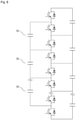
- Fig. 8 shows an example configuration of an active balancer preferably used in the present invention.
- the active balancer of Fig. 8 includes capacitors Cr and a half-bridge circuit that performs switching. The capacitors are connected to two adjacent cells via the half-bridge circuit.
- the capacitors Cr may also be connected via the half-bridge circuit to adjacent cell groups included in a battery group.
- the capacitors Cr are connected in an alternately switching manner to one cell and another cell. If there is a potential difference between the connected cell and capacitor at this time, charge moves from the cell to the capacitor, or from the capacitor to the cell, whereby the charge is automatically balanced so that the potential difference between the cell and the capacitor is eliminated.
- a secondary cell system 10 capable of outputting 48V constitutes a secondary cell system for a vehicle supplying power with a voltage of 12V.
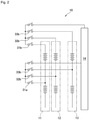
- Fig. 1 schematically shows an outline of a secondary cell system 10 connected to a generator 2 and a load 3.
- the secondary cell system 10 includes a plurality of battery groups 11, 12, 13, and an active balancer 14 connected in parallel to the battery groups.
- the battery groups 11, 12, 13 are connected in parallel to each other.
- the battery groups 11, 12, 13 include a plurality of cells 21, each of which has the same capacity and voltage.
- the plurality of cells 21 are connected in series within each battery group 11, 12, 13.
- Fig. 1 shows, as an example, a configuration including 16 cells connected in series within each of the battery groups 11, 12, 13.
- cells 21 are combined into respective units of four cells, and the ends of each cell group consisting of four cells 21 are provided with output terminals.
- each of the battery groups 11, 12, 13 will have an output voltage of 48V.
- the output voltage will be 12V.
- power is supplied in parallel from one cell group of each of the battery groups 11, 12, 13, resulting in a supply of 12V of power to the load 3.
- the number of cells combined within the battery groups and the number of cells arranged in series within the battery groups merely constitute one example, and the number of cells to combine and the total number to be arranged in series is not limited to the embodiment shown in Fig. 1 .
- Fig. 2 schematically shows an electrical connection mode of the battery groups 11, 12, 13 in the secondary cell system 10 and the active balancer 14 connected in parallel to the battery groups.
- Open/close switches 31a, 31b are arranged between the battery group 11 and the active balancer 14, in order to disconnect the battery group 11 from the secondary cell system if a problem occurs in the battery group 11.
- open/close switches 32a, 32b are arranged between the battery group 12 and the active balancer 14.
- Open/close switches 33a, 33b are arranged between the battery group 12 and the active balancer 14.
- the open/close switches be arranged in particular at the high-voltage side of the battery groups 11, 12, 13, and at the output location to the load 3.
- an open/close switch for disconnecting the active balancer 14 from the secondary cell system, which makes it easy to deal with problems in the active balancer 14 as well.
- Fig. 3 schematically shows a state in which the battery group 11 is disconnected by the open/close switches 31a, 31b when a problem has occurred in the battery group 11.
- the battery group 11 By opening the open/close switches 31a, 31b, the battery group 11 is disconnected, while the battery groups 12, 13 can continue to discharge to supply power and allow the load 3 to operate.
- 12V of power can be supplied to the load 3 even after the battery group 11 has been disconnected.
- the secondary cell system 10 provides a highly reliable system without the need for a secondary side battery.
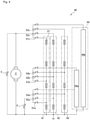
- Fig. 4 shows a circuit diagram of a secondary cell system 40 that embodies the present invention.
- the secondary cell system 40 of Fig. 4 is charged by a generator 2. After being charged, the secondary cell system 40 discharges to loads 3, 5.
- the load 3 is supplied with electricity at a voltage of 12V, and the load 5 is supplied with electricity at a voltage of 48V.
- the secondary cell system 40 includes a plurality of battery groups 41, 42, 43 arranged in parallel with each other, and an active balancer 44 connected in parallel to the battery groups.
- Each of the battery groups 41, 42, 43 includes 16 cells 21, each of which has the same capacity and voltage.
- the cells 21 are combined into respective units of four cells, and the ends of each of the four cell groups consisting of four cells 21 are provided with output terminals.
- the active balancer 44 is composed of a first balancer 44a that adjusts the balance of two adjacent cell groups within the battery groups 41, 42, 43 in particular, and a second balancer 44b that adjusts the balance of the battery groups 41, 42, 43 in their entirety.
- open/close switches 51a, 51b are arranged between the battery group 41 and the active balancer 44a. Further, an open/close switch 51c is arranged between the battery group 41 and the active balancer 44b. By opening all of the open/close switches 51a, 51b, 51c, the battery group 41 is disconnected from the secondary cell system 40.
- open/close switches 52a, 52b, 52c are provided in order to disconnect the battery group 42 from the secondary cell system 40 if a problem occurs in the battery group 42.
- open/close switches 53a, 53b, 53c are provided in order to disconnect the battery group 43 from the secondary cell system 40 if a problem occurs in the battery group 43.
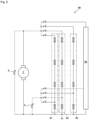
- Fig. 5 shows a circuit diagram of a secondary cell system 60 which is a second example.
- This example differs from Example 1 in that, instead of an active balancer, a DC-DC converter 64 is arranged in parallel with the battery groups 41, 42, 43.
- the DC-DC converter 64 is a chopper DC-DC converter, or an isolated DC-DC converter employing a transformer, and functions as a circuit for receiving power from all cells of the battery groups and supplying power to the battery groups connected by the open/close switches 52a, 52b, 52c and to the load 3.
- the DC-DC converter 64 is respectively connected to three terminals of the of the battery groups 41, 42, 43. That is to say, it is connected to a high-voltage side terminal and a low-voltage side terminal of the battery groups 41, 42, 43, and a terminal in a position that divides the four cell groups within the battery groups 41, 42, 43 into one and three cells. Open/close switches are respectively arranged on the path connecting to the high-voltage side and on the path connecting to the terminal dividing the cell groups. Due to this connection mode, the voltage adjustment function of the DC-DC converter 64 functions equivalently to an active balancer that balances the voltage of the connected high-voltage side and low-voltage side within the battery groups 41, 42, 43 to a ratio of 3:1.
- the secondary cell system 60 is also able to disconnect only the battery group in which a problem has occurred, while allowing the other battery groups operating normally to discharge, thereby supplying power to the loads.
- Fig. 6 shows a configuration of a conventional secondary cell system 100.
- the secondary cell system 100 of Fig. 6 has one battery group 101, containing a plurality of cells connected in series, and a DC-DC converter 102 connected in parallel, and supplies power to a load after adjusting the voltage. Since the secondary cell system 100 does not multiplex the power supply, it is highly likely that supply of power to the load will stop if a problem occurs in the battery group 101.
- Fig. 7 shows a configuration of a conventional secondary cell system 110.
- the secondary cell system 110 of Fig. 7 has one battery group 111, containing a plurality of cells connected in series, and an active balancer 112 connected in parallel, and further includes a lead storage battery 113 as a secondary side battery.
- the configuration of the secondary cell system 110 requires the lead storage battery 113 to improve reliability.
- the secondary cell system according to the present invention has two or more battery groups consisting of a plurality of cells connected in series, and the battery groups are connected to each other in parallel, which makes it possible to multiplex the power supply and improve reliability of the secondary cell system.
- the configuration of the secondary cell system described in the present Examples may be modified as necessary.
- the number of cells to be connected and the number of cells to be combined may be modified as necessary according to the required output voltage.
- the number of battery groups to be connected in parallel may be increased in order to improve reliability.
- the configuration of the active balancer or DC-DC converter may also be modified as necessary.
- the secondary cell system according to the present invention may be preferably installed in any industrial machine.
Landscapes
- Engineering & Computer Science (AREA)
- Power Engineering (AREA)
- Charge And Discharge Circuits For Batteries Or The Like (AREA)
- Secondary Cells (AREA)
Abstract
Description
- The present invention relates to a secondary cell system capable of repeating charging and discharging. In particular, the present invention relates to a secondary cell system to be installed in a vehicle or the like to supply high-voltage electric power.
- Secondary cell systems to be installed in vehicles are required to have high reliability and durability. When supplying electric power at a voltage of 12V to, for example, a vehicle, the reliability of conventional secondary cell systems is improved by installing two cell modules, a secondary cell capable of supplying power at 24V or higher, and a secondary cell capable of supplying 12V of power. In other words, the secondary cell capable of supplying power at 24V or higher is used as a primary side cell to supply power required for normal operation, and in case a problem occurs in the secondary cell on the primary side or in the generator, power is supplied from a secondary cell as an emergency power supply to resume control of the vehicle. Currently, in this type of secondary cell system, lead storage batteries are often used as the secondary cells.
-
Patent Document 1 discloses a technique of using a lead storage battery to provide a highly reliable vehicular power source system. The vehicular power source system ofPatent Document 1 discloses a configuration in which a hybrid power source and a lead storage battery are connected in parallel. The hybrid power source is configured with a secondary battery and a capacitor connected in parallel, and a power source controlling portion controls power supply of the hybrid power source and the lead storage battery. - Patent Document 1: International Patent Publication No.
WO2015/015743 - Lead storage batteries can be produced from cheap materials, and are highly stable secondary cells that can endure discharging of large currents. On the other hand, since lead is used in the electrodes, the secondary cell system as a whole tends to become heavier. In addition, since sulfuric acid is used as the electrolyte solution, the danger in case of damage to the cell has been pointed out. There is therefore a demand for providing a highly reliable secondary cell system without using a lead storage battery.
- The present invention was made in view of the above problem, and has an object of providing a highly reliable secondary cell system in which a power supply is multiplexed without using a lead storage battery.
- The invention according to
Claim 1 relates to a secondary cell system having two or more battery groups consisting of a plurality of cells connected in series, each of the battery groups being connected in parallel. The secondary cell system according to the present invention is characterized in that there are provided open/close switches configured to disconnect each of the battery groups from a circuit of the secondary cell system. - The secondary cell system according to the present invention preferably includes an active balancer connected in parallel to the battery groups.
- The secondary cell system according to the present invention preferably has the open/close switches configured to disconnect each of the battery groups from the circuit of the secondary cell system provided at connection portions between each of the battery groups and the active balancer.
- The secondary cell system according to the present invention has two or more battery groups consisting of a plurality of cells connected in series, each of the battery groups being connected in parallel. The power supply can be multiplexed by the battery groups connected in parallel, which improves reliability of the secondary cell system.
- In the secondary cell system according to the present invention, even if a problem occurs in one of the plurality of battery groups connected in parallel, an operation of the open/close switches disconnects only the battery group in which a problem has occurred, allowing for charging and discharging to continue in a reduced state.
- Since the secondary cell system according to the present invention enables multiplexing of the power supply, there is no need for a secondary side battery. This means there is no need for a lead storage battery, which have conventionally often been used as secondary side batteries. By eliminating the need for a lead storage battery, the secondary cell system as a whole becomes lighter, and the system can be configured at a cheaper cost.
-
- [
Fig. 1] Fig. 1 is a block diagram schematically showing a summary of a secondary cell system according to an embodiment of the present invention; - [
Fig. 2] Fig. 2 schematically shows a connection state of battery groups and an active balancer of a secondary cell system according to an embodiment of the present invention; - [
Fig. 3] Fig. 3 schematically shows a disconnected state of an open/close switch when a problem has occurred in one of the battery groups; - [
Fig. 4] Fig. 4 schematically shows a secondary cell system according to Example 1; - [
Fig. 5] Fig. 5 schematically shows a secondary cell system according to Example 2; - [
Fig. 6] Fig. 6 schematically shows a secondary cell system according to Comparative Example 1; - [
Fig. 7] Fig. 7 schematically shows a secondary cell system according to Comparative Example 2; and - [
Fig. 8] Fig. 8 shows an example of a configuration of an active balancer preferably used in the present invention. - Preferred embodiments of the secondary cell system according to the present invention will be described below.
- In the present invention, a "cell" is the smallest unit constituting a battery. The cell has an anode, a cathode, and an electrolyte filled between the electrodes, and is also referred to as a unit cell. A battery referred to as a "cell" in the present embodiment is a secondary cell capable of charging and discharging. Depending on structure, known cells include lithium-ion cells, nickel-hydride cells, ELDC cells, etc. In the secondary cell system according to the present invention, lithium-ion cells in particular are preferably used.
- In the present invention, a battery group is a serial connection of two or more cells. Of these battery groups, particularly an integrated combination of cells adjusted to have a specific voltage and capacity is also referred to as a battery module or a battery pack.
- In the present invention, an active balancer is a means that is connected to a plurality of cells and adjusts the charge and discharge state of each cell to balance control the voltage and capacity in order to prevent overcharging or overdischarging. The active balancer performs control to, for example, temporarily store power of a cell with a high state of charge in a capacitor, and redistribute the power to a cell with a low state of charge.
Fig. 8 shows an example configuration of an active balancer preferably used in the present invention. The active balancer ofFig. 8 includes capacitors Cr and a half-bridge circuit that performs switching. The capacitors are connected to two adjacent cells via the half-bridge circuit. The capacitors Cr may also be connected via the half-bridge circuit to adjacent cell groups included in a battery group. In the mode of connection shown inFig. 8 , the capacitors Cr are connected in an alternately switching manner to one cell and another cell. If there is a potential difference between the connected cell and capacitor at this time, charge moves from the cell to the capacitor, or from the capacitor to the cell, whereby the charge is automatically balanced so that the potential difference between the cell and the capacitor is eliminated. - A preferred embodiment of a
secondary cell system 10 according to the present invention is described below with reference toFigs. 1 to 3 . In the present embodiment, asecondary cell system 10 capable of outputting 48V constitutes a secondary cell system for a vehicle supplying power with a voltage of 12V. -
Fig. 1 schematically shows an outline of asecondary cell system 10 connected to agenerator 2 and aload 3. Thesecondary cell system 10 includes a plurality ofbattery groups active balancer 14 connected in parallel to the battery groups. Thebattery groups battery groups cells 21, each of which has the same capacity and voltage. The plurality ofcells 21 are connected in series within eachbattery group Fig. 1 shows, as an example, a configuration including 16 cells connected in series within each of thebattery groups battery groups cells 21 are combined into respective units of four cells, and the ends of each cell group consisting of fourcells 21 are provided with output terminals. - For example, if 3V cells are applied as the
cells 21 in thesecondary cell system 10 shown inFig. 1 , each of thebattery groups cells 21 is selected and power is output from its output terminal, the output voltage will be 12V. InFig. 1 , power is supplied in parallel from one cell group of each of thebattery groups load 3. It should be noted, however, that the number of cells combined within the battery groups and the number of cells arranged in series within the battery groups merely constitute one example, and the number of cells to combine and the total number to be arranged in series is not limited to the embodiment shown inFig. 1 . -
Fig. 2 schematically shows an electrical connection mode of thebattery groups secondary cell system 10 and theactive balancer 14 connected in parallel to the battery groups. Open/close switches battery group 11 and theactive balancer 14, in order to disconnect thebattery group 11 from the secondary cell system if a problem occurs in thebattery group 11. Similarly, open/close switches 32a, 32b are arranged between thebattery group 12 and theactive balancer 14. Open/close switches 33a, 33b are arranged between thebattery group 12 and theactive balancer 14. - Of the electrical connection locations of the
respective battery groups active balancer 14, it is preferable that the open/close switches be arranged in particular at the high-voltage side of thebattery groups load 3. In addition, there is provided an open/close switch for disconnecting theactive balancer 14 from the secondary cell system, which makes it easy to deal with problems in theactive balancer 14 as well. -
Fig. 3 schematically shows a state in which thebattery group 11 is disconnected by the open/close switches battery group 11. By opening the open/close switches battery group 11 is disconnected, while thebattery groups load 3 to operate. In this case, since the battery groups are connected in parallel, 12V of power can be supplied to theload 3 even after thebattery group 11 has been disconnected. By multiplexing the power supply in this way, thesecondary cell system 10 provides a highly reliable system without the need for a secondary side battery. -
Fig. 4 shows a circuit diagram of asecondary cell system 40 that embodies the present invention. Thesecondary cell system 40 ofFig. 4 is charged by agenerator 2. After being charged, thesecondary cell system 40 discharges toloads load 3 is supplied with electricity at a voltage of 12V, and theload 5 is supplied with electricity at a voltage of 48V. - The
secondary cell system 40 includes a plurality ofbattery groups active balancer 44 connected in parallel to the battery groups. Each of thebattery groups cells 21, each of which has the same capacity and voltage. Thecells 21 are combined into respective units of four cells, and the ends of each of the four cell groups consisting of fourcells 21 are provided with output terminals. - The
active balancer 44 is composed of afirst balancer 44a that adjusts the balance of two adjacent cell groups within thebattery groups second balancer 44b that adjusts the balance of thebattery groups - In order to disconnect the
battery group 41 from thesecondary cell system 40 if a problem occurs in thebattery group 41, open/close switches battery group 41 and theactive balancer 44a. Further, an open/close switch 51c is arranged between thebattery group 41 and theactive balancer 44b. By opening all of the open/close switches battery group 41 is disconnected from thesecondary cell system 40. - Similarly, open/
close switches battery group 42 from thesecondary cell system 40 if a problem occurs in thebattery group 42. In addition, open/close switches battery group 43 from thesecondary cell system 40 if a problem occurs in thebattery group 43. - Thus, if a problem occurs in any of the
battery groups loads -
Fig. 5 shows a circuit diagram of a secondary cell system 60 which is a second example. This example differs from Example 1 in that, instead of an active balancer, a DC-DC converter 64 is arranged in parallel with thebattery groups DC converter 64 is a chopper DC-DC converter, or an isolated DC-DC converter employing a transformer, and functions as a circuit for receiving power from all cells of the battery groups and supplying power to the battery groups connected by the open/close switches load 3. - The DC-
DC converter 64 is respectively connected to three terminals of the of thebattery groups battery groups battery groups DC converter 64 functions equivalently to an active balancer that balances the voltage of the connected high-voltage side and low-voltage side within thebattery groups - If a problem occurs in any of the
battery groups - As a comparative example of the present invention,
Fig. 6 shows a configuration of a conventionalsecondary cell system 100. Thesecondary cell system 100 ofFig. 6 has onebattery group 101, containing a plurality of cells connected in series, and a DC-DC converter 102 connected in parallel, and supplies power to a load after adjusting the voltage. Since thesecondary cell system 100 does not multiplex the power supply, it is highly likely that supply of power to the load will stop if a problem occurs in thebattery group 101. - As a comparative example of the present invention,
Fig. 7 shows a configuration of a conventionalsecondary cell system 110. Thesecondary cell system 110 ofFig. 7 has onebattery group 111, containing a plurality of cells connected in series, and anactive balancer 112 connected in parallel, and further includes alead storage battery 113 as a secondary side battery. The configuration of thesecondary cell system 110 requires thelead storage battery 113 to improve reliability. - As described above, the secondary cell system according to the present invention has two or more battery groups consisting of a plurality of cells connected in series, and the battery groups are connected to each other in parallel, which makes it possible to multiplex the power supply and improve reliability of the secondary cell system.
- The configuration of the secondary cell system described in the present Examples may be modified as necessary. For example, the number of cells to be connected and the number of cells to be combined may be modified as necessary according to the required output voltage. In addition, the number of battery groups to be connected in parallel may be increased in order to improve reliability. The configuration of the active balancer or DC-DC converter may also be modified as necessary.
- In addition to vehicles, the secondary cell system according to the present invention may be preferably installed in any industrial machine.
-
- 2 Generator
- 3, 5 Load
- 10, 40, 60, 100, 110 Secondary cell system
- 11, 12, 13, 41, 42, 43 Battery group
- 21 Cell
- 31a, 31b, 32a, 32b, 33a, 33b Open/close switch
- 51a, 51b, 51c, 52a, 52b, 52c, 53a, 53b, 53c Open/close switch
- 14, 44, 112 Active balancer
- 64, 102 DC-DC converter
- Cr Capacitor
Claims (3)
- A secondary cell system having two or more battery groups consisting of a plurality of cells connected in series, each of the battery groups being connected in parallel, wherein there are provided open/close switches configured to disconnect each of the battery groups from a circuit of the secondary cell system.
- The secondary cell system according to Claim 1, further comprising an active balancer connected in parallel to the battery groups.
- The secondary cell system according to Claim 2, wherein the open/close switches configured to disconnect each of the battery groups from the circuit of the secondary cell system are provided at connection portions between each of the battery groups and the active balancer.
Applications Claiming Priority (2)
| Application Number | Priority Date | Filing Date | Title |
|---|---|---|---|
| JP2019070526A JP7323745B2 (en) | 2019-04-02 | 2019-04-02 | Secondary battery system |
| PCT/JP2020/005289 WO2020202810A1 (en) | 2019-04-02 | 2020-02-12 | Secondary cell system |
Publications (2)
| Publication Number | Publication Date |
|---|---|
| EP3951998A1 true EP3951998A1 (en) | 2022-02-09 |
| EP3951998A4 EP3951998A4 (en) | 2022-12-14 |
Family
ID=72668215
Family Applications (1)
| Application Number | Title | Priority Date | Filing Date |
|---|---|---|---|
| EP20785378.9A Pending EP3951998A4 (en) | 2019-04-02 | 2020-02-12 | SECONDARY CELL SYSTEM |
Country Status (5)
| Country | Link |
|---|---|
| US (1) | US12149103B2 (en) |
| EP (1) | EP3951998A4 (en) |
| JP (1) | JP7323745B2 (en) |
| CN (1) | CN113454830B (en) |
| WO (1) | WO2020202810A1 (en) |
Families Citing this family (1)
| Publication number | Priority date | Publication date | Assignee | Title |
|---|---|---|---|---|
| WO2026048658A1 (en) * | 2024-08-30 | 2026-03-05 | 株式会社Gsユアサ | Power storage device |
Family Cites Families (16)
| Publication number | Priority date | Publication date | Assignee | Title |
|---|---|---|---|---|
| JP4244531B2 (en) | 2001-05-11 | 2009-03-25 | 株式会社デンソー | Control method for power supply device for multiple voltage output type vehicle |
| JP2011072153A (en) | 2009-09-28 | 2011-04-07 | Sanyo Electric Co Ltd | Vehicular power supply device, vehicle equipped with the same, and method for equalizing capacity of power vehicular supply device |
| US8928283B2 (en) * | 2009-10-14 | 2015-01-06 | Fdk Corporation | Electricity storage system having a plurality of series-connected storage cells |
| JP5143185B2 (en) | 2010-02-08 | 2013-02-13 | 三洋電機株式会社 | Power supply |
| TWI431896B (en) * | 2011-04-15 | 2014-03-21 | 新普科技股份有限公司 | Battery balancing circuit and balancing method thereof and battery module activation method |
| CN103035965B (en) * | 2011-09-30 | 2015-09-09 | 登丰微电子股份有限公司 | Battery voltage balancer and battery device |
| US9496739B2 (en) * | 2011-12-16 | 2016-11-15 | Electrochem Solutions, Inc. | Balancing discharge in parallel battery configurations |
| JP2013219994A (en) | 2012-04-12 | 2013-10-24 | Toyota Industries Corp | Battery equalization device and method |
| JP2013247690A (en) | 2012-05-23 | 2013-12-09 | Toyota Industries Corp | Voltage equalization device |
| JP5892024B2 (en) | 2012-10-01 | 2016-03-23 | 株式会社豊田自動織機 | Power supply device and battery module switching method |
| JP2015015777A (en) * | 2013-07-03 | 2015-01-22 | ソニー株式会社 | Power storage device and method for controlling power storage device |
| CN105324274B (en) | 2013-07-31 | 2017-08-25 | 三洋电机株式会社 | Automotive power supply system |
| JP2015122864A (en) | 2013-12-24 | 2015-07-02 | 株式会社豊田自動織機 | Relay error detection method |
| WO2016063760A1 (en) * | 2014-10-23 | 2016-04-28 | 株式会社豊田自動織機 | Power supply device, protective device, and protection method |
| JP6802723B2 (en) * | 2017-01-31 | 2020-12-16 | 株式会社デンソーテン | Power storage device and power storage control method |
| PL3360719T3 (en) | 2017-02-09 | 2021-04-19 | Samsung Sdi Co., Ltd | Dual power supply |
-
2019
- 2019-04-02 JP JP2019070526A patent/JP7323745B2/en active Active
-
2020
- 2020-02-12 CN CN202080015252.5A patent/CN113454830B/en active Active
- 2020-02-12 WO PCT/JP2020/005289 patent/WO2020202810A1/en not_active Ceased
- 2020-02-12 US US17/437,488 patent/US12149103B2/en active Active
- 2020-02-12 EP EP20785378.9A patent/EP3951998A4/en active Pending
Also Published As
| Publication number | Publication date |
|---|---|
| CN113454830A (en) | 2021-09-28 |
| WO2020202810A1 (en) | 2020-10-08 |
| US12149103B2 (en) | 2024-11-19 |
| US20220158461A1 (en) | 2022-05-19 |
| JP2020171107A (en) | 2020-10-15 |
| EP3951998A4 (en) | 2022-12-14 |
| CN113454830B (en) | 2024-07-05 |
| JP7323745B2 (en) | 2023-08-09 |
Similar Documents
| Publication | Publication Date | Title |
|---|---|---|
| US12068633B2 (en) | Vehicle-mounted power supply system | |
| US8410755B2 (en) | Fault tolerant modular battery management system | |
| KR101541960B1 (en) | An energy storage system using high frequency link type dc-dc converter | |
| US11691536B2 (en) | Power system for a vehicle | |
| US20260066684A1 (en) | Battery system supporting plurality of operation modes according to soc | |
| US20240047978A1 (en) | Power storage system | |
| US12596154B2 (en) | Battery system and method for controlling a battery system | |
| US12149103B2 (en) | Secondary cell system | |
| KR101856628B1 (en) | Apparatus and Method for Emergency Controlling Energy Storage System | |
| US10763677B2 (en) | Charging/discharging of battery energy storage system using 3-phase transformer | |
| KR102527375B1 (en) | Live state exchangeable power conversion device, control method thereof and energy storage system | |
| EP4353518A1 (en) | High voltage junction device for a high voltage battery of an electric vehicle and high voltage battery system | |
| JP7515994B2 (en) | Charging/discharging system and charging/discharging method | |
| US20250096581A1 (en) | Battery power supply architecture | |
| KR102743706B1 (en) | Uninterruptible battery charge system | |
| JP7790804B1 (en) | Combined battery pack and heterogeneous battery mixed combined battery pack | |
| EP4579999A1 (en) | Backup power supply for a bms controller | |
| CN115940355A (en) | Battery Module and Energy Storage System | |
| HU183041B (en) | Circuit arrangement for supplying direct current | |
| WO2020202849A1 (en) | Battery module including balancer |
Legal Events
| Date | Code | Title | Description |
|---|---|---|---|
| STAA | Information on the status of an ep patent application or granted ep patent |
Free format text: STATUS: THE INTERNATIONAL PUBLICATION HAS BEEN MADE |
|
| PUAI | Public reference made under article 153(3) epc to a published international application that has entered the european phase |
Free format text: ORIGINAL CODE: 0009012 |
|
| STAA | Information on the status of an ep patent application or granted ep patent |
Free format text: STATUS: REQUEST FOR EXAMINATION WAS MADE |
|
| 17P | Request for examination filed |
Effective date: 20210820 |
|
| AK | Designated contracting states |
Kind code of ref document: A1 Designated state(s): AL AT BE BG CH CY CZ DE DK EE ES FI FR GB GR HR HU IE IS IT LI LT LU LV MC MK MT NL NO PL PT RO RS SE SI SK SM TR |
|
| DAV | Request for validation of the european patent (deleted) | ||
| DAX | Request for extension of the european patent (deleted) | ||
| REG | Reference to a national code |
Ref country code: DE Ref legal event code: R079 Free format text: PREVIOUS MAIN CLASS: H01M0010440000 Ipc: H02J0007000000 |
|
| A4 | Supplementary search report drawn up and despatched |
Effective date: 20221115 |
|
| RIC1 | Information provided on ipc code assigned before grant |
Ipc: H02J 1/08 20060101ALI20221109BHEP Ipc: H02J 7/00 20060101AFI20221109BHEP |
|
| STAA | Information on the status of an ep patent application or granted ep patent |
Free format text: STATUS: EXAMINATION IS IN PROGRESS |
|
| 17Q | First examination report despatched |
Effective date: 20251111 |