EP3951972B1 - Method and apparatus for manufacturing a unit cell - Google Patents
Method and apparatus for manufacturing a unit cell Download PDFInfo
- Publication number
- EP3951972B1 EP3951972B1 EP20899643.9A EP20899643A EP3951972B1 EP 3951972 B1 EP3951972 B1 EP 3951972B1 EP 20899643 A EP20899643 A EP 20899643A EP 3951972 B1 EP3951972 B1 EP 3951972B1
- Authority
- EP
- European Patent Office
- Prior art keywords
- separator
- electrode
- adhesive
- upper separator
- nozzle
- Prior art date
- Legal status (The legal status is an assumption and is not a legal conclusion. Google has not performed a legal analysis and makes no representation as to the accuracy of the status listed.)
- Active
Links
Images








Classifications
-
- H—ELECTRICITY
- H01—ELECTRIC ELEMENTS
- H01M—PROCESSES OR MEANS, e.g. BATTERIES, FOR THE DIRECT CONVERSION OF CHEMICAL ENERGY INTO ELECTRICAL ENERGY
- H01M10/00—Secondary cells; Manufacture thereof
- H01M10/04—Construction or manufacture in general
- H01M10/0404—Machines for assembling batteries
-
- H—ELECTRICITY
- H01—ELECTRIC ELEMENTS
- H01M—PROCESSES OR MEANS, e.g. BATTERIES, FOR THE DIRECT CONVERSION OF CHEMICAL ENERGY INTO ELECTRICAL ENERGY
- H01M50/00—Constructional details or processes of manufacture of the non-active parts of electrochemical cells other than fuel cells, e.g. hybrid cells
- H01M50/40—Separators; Membranes; Diaphragms; Spacing elements inside cells
- H01M50/46—Separators, membranes or diaphragms characterised by their combination with electrodes
- H01M50/461—Separators, membranes or diaphragms characterised by their combination with electrodes with adhesive layers between electrodes and separators
-
- H—ELECTRICITY
- H01—ELECTRIC ELEMENTS
- H01M—PROCESSES OR MEANS, e.g. BATTERIES, FOR THE DIRECT CONVERSION OF CHEMICAL ENERGY INTO ELECTRICAL ENERGY
- H01M10/00—Secondary cells; Manufacture thereof
- H01M10/04—Construction or manufacture in general
- H01M10/0436—Small-sized flat cells or batteries for portable equipment
-
- H—ELECTRICITY
- H01—ELECTRIC ELEMENTS
- H01M—PROCESSES OR MEANS, e.g. BATTERIES, FOR THE DIRECT CONVERSION OF CHEMICAL ENERGY INTO ELECTRICAL ENERGY
- H01M10/00—Secondary cells; Manufacture thereof
- H01M10/04—Construction or manufacture in general
- H01M10/0468—Compression means for stacks of electrodes and separators
-
- Y—GENERAL TAGGING OF NEW TECHNOLOGICAL DEVELOPMENTS; GENERAL TAGGING OF CROSS-SECTIONAL TECHNOLOGIES SPANNING OVER SEVERAL SECTIONS OF THE IPC; TECHNICAL SUBJECTS COVERED BY FORMER USPC CROSS-REFERENCE ART COLLECTIONS [XRACs] AND DIGESTS
- Y02—TECHNOLOGIES OR APPLICATIONS FOR MITIGATION OR ADAPTATION AGAINST CLIMATE CHANGE
- Y02E—REDUCTION OF GREENHOUSE GAS [GHG] EMISSIONS, RELATED TO ENERGY GENERATION, TRANSMISSION OR DISTRIBUTION
- Y02E60/00—Enabling technologies; Technologies with a potential or indirect contribution to GHG emissions mitigation
- Y02E60/10—Energy storage using batteries
-
- Y—GENERAL TAGGING OF NEW TECHNOLOGICAL DEVELOPMENTS; GENERAL TAGGING OF CROSS-SECTIONAL TECHNOLOGIES SPANNING OVER SEVERAL SECTIONS OF THE IPC; TECHNICAL SUBJECTS COVERED BY FORMER USPC CROSS-REFERENCE ART COLLECTIONS [XRACs] AND DIGESTS
- Y02—TECHNOLOGIES OR APPLICATIONS FOR MITIGATION OR ADAPTATION AGAINST CLIMATE CHANGE
- Y02P—CLIMATE CHANGE MITIGATION TECHNOLOGIES IN THE PRODUCTION OR PROCESSING OF GOODS
- Y02P70/00—Climate change mitigation technologies in the production process for final industrial or consumer products
- Y02P70/50—Manufacturing or production processes characterised by the final manufactured product
Definitions
- the present invention relates to a unit cell and a method and apparatus for manufacturing the same and, more specifically, to: a unit cell in which electrodes (a negative electrode, a positive electrode) are bonded to a separator using an adhesive unlike a lamination method using heat and pressure according to the related art, thereby preventing the electrodes and the separator from moving; and a method and apparatus for manufacturing the same.
- Secondary batteries are rechargeable unlike primarily batteries, and also, the possibility of compact size and high capacity is high. Thus, recently, many studies on secondary batteries are being carried out. As technology development and demands for mobile devices increase, the demands for secondary batteries as energy sources are rapidly increasing.
- Such a secondary battery is configured such that an electrode assembly is accommodated in a battery case (a pouch, a can, and the like).
- the electrode assembly mounted inside the battery case is repeatedly chargeable and dischargeable because of its structure in which a positive electrode/a separator/a negative electrode are stacked.
- the electrode assembly is manufactured in various methods, but a method is generally used, in which a unit cell 4 is manufactured in advance and then a plurality of unit cells 4 are stacked to manufacture the electrode assembly.
- FIG. 1 schematically illustrating a state in which a unit cell is manufactured through a method according to the related art
- a method for manufacturing a unit cell 4 according to the related art is configured such that a positive electrode 1, a separator 3 at a relatively upper position, a negative electrode 2, and a separator 3 at a relatively lower position, which have been stacked in this order from the upper side and wound in a roll shape, are continuously unwound and supplied.
- the separators 3 are continuously supplied without disconnection, the negative electrode 2 is supplied between the separators 3, and the positive electrode 1 is supplied above the upper separator 3. These electrodes, which have been cut into a predetermined size, are input at constant intervals. Here, input timing is controlled so that the negative electrode 2 and the positive electrode 1 are stacked vertically corresponding to each other. Thus, the separators 3 are continuously connected, but the negative electrode 2 and the positive electrode 1 continuously pass through a laminating device while spaced a certain distance from a neighboring negative electrode 2 and a neighboring positive electrode 1.
- the electrodes (the positive and negative electrodes) may be moved away from original right positions or damaged while being heated and pressed. Also, when the heating is not uniform, adhesion force between the electrodes 1 and 2 and the separator 3 may become irregular.
- main objects of the present invention are to provide: a method and apparatus for manufacturing a unit cell, which may solve the problem occurring in a laminating process of the related art; and a unit cell manufactured by the above method and apparatus.
- the present invention provides: a method and apparatus for manufacturing a unit cell, in which an electrode is bonded (laminated) to a separator by an adhesive; and a unit cell which may be manufactured by the above method and apparatus.
- a method for manufacturing a unit cell according to the embodiment comprises: a step of continuously conveying and supplying, in a longitudinal direction, a lower separator which is located at a relatively lower position; a step of applying an adhesive to a portion of a top surface of the lower separator; a step of mounting, on the lower separator, one electrode of a negative electrode or a positive electrode which is cut into a predetermined size and located on one side of the lower separator; a step of continuously conveying and supplying an upper separator which is located at a relatively upper position; and a step of applying an adhesive to a portion of one surface of the upper separator, wherein the upper separator is supplied from the upper side in a direction perpendicular to a traveling direction of the lower separator, and is horizontally conveyed while the adhesive is applied so that the adhesive is applied vertically from the upper side, and wherein the upper separator is stacked on the electrode such that one surface of the upper separator on which
- the upper separator is conveyed along a nip roller pressing the lower separator and the electrode and a guide roller disposed above the nip roller, and both surfaces of the upper separator are reversed.
- the adhesive is applied onto the one surface, and the upper separator is input between the nip roller and the electrode such that the one surface on which the adhesive has been applied covers the top surface of the electrode.
- the method further comprises a step of further applying an adhesive to a portion of the top surface of the upper separator after the upper separator is stacked on the electrode.
- the method comprises a step of further mounting an electrode onto the top surface of the upper separator on which the adhesive has been applied, wherein the electrode mounted on the top surface of the upper separator has a different polarity from the electrode stacked between the upper separator and the lower separator.
- the method may comprise a step of allowing the lower separator, the electrode, the upper separator, and the electrode, which are stacked in this order from the lower side to the upper side, to pass through between a pair of auxiliary nip rollers, thereby pressing the lower separator, the electrode, the upper separator, and the electrode.
- An apparatus for manufacturing a unit cell comprises: a lower reel from which a lower separator located at a relatively lower position is unwound; a first nozzle configured to apply an adhesive to a top surface of the unwound lower separator; an upper reel from which an upper separator located at a relatively upper position is unwound; a second nozzle configured to apply an adhesive to one surface of the unwound upper separator; a guide roller configured to change a conveyance direction of the upper separator so that the upper separator unwound from the upper reel passes horizontally under the second nozzle; and a nip roller configured to input the upper separator onto an electrode such that, after passing through the guide roller, the one surface of the upper separator on which the adhesive has been applied faces downward and is bonded to a top surface of the electrode mounted on the top surface of the lower separator; a first gripper configured to mount the electrode, which is cut into a predetermined size and located on one side of the lower separator, on the top surface of the lower
- the apparatus may comprise a first vision which is disposed above the electrode and captures an image of a position, in which the electrode is mounted by the first gripper, prior to bonding the electrode to the lower separator.
- the nip roller is disposed on each of both sides of a first stack, which is formed by stacking the lower separator, the electrode, the upper separator in this order, and presses the first stack while rotating.
- the nip roller and the guide roller are spaced a certain distance from each other, and the upper separator remains horizontal while the upper separator is conveyed between the nip roller and the guide roller.
- the apparatus may comprise an auxiliary nip roller which is disposed on each of both sides of a second stack, which is formed by mounting the lower separator, the electrode, the upper separator, and the electrode in this order from the lower side below, and presses the second stack while rotating.
- the apparatus may comprise a second vision configured to capture an image of a position, in which the electrode is mounted by the second gripper, prior to mounting the electrode onto the upper separator.
- each of the first nozzle, the second nozzle, and the third nozzle comprises a plurality of nipples having ends through which the adhesives are applied, and the nipples of each of the first nozzle, the second nozzle, and the third nozzle are spaced apart from each other so that nipples disposed outside apply the adhesives in the vicinity of an edge of the electrode, and a nipple disposed between the nipples applies the adhesives to the vicinity of the center of the electrode, wherein spray speeds and spray amounts of the adhesives, which are sprayed from the nipples of each of the first nozzle, the second nozzle, and the third nozzle, may be individually controlled.
- the heat and pressure may not be applied or may be applied much weaker than the related art when the electrode and the separator are laminated, the distortion between the separator and the electrode may be prevented, and the deformation of the electrode and the separator, the damage thereto, and the like may be prevented.
- the separators are bonded to each other, or the separator is bonded to the electrode, whereby the electrode may be fixed. That is, according to the properties of the electrode such as size and thickness, the adhesive is applied to the region to which the electrode is mounted, and thus the separator may directly fix and prevent the electrode from moving, or the separators stacked on both sides of the electrode are bonded to each other, whereby the electrode may be prevented from moving.
- the adhesive may be partially applied to only very small regions such as the corners of the electrode in the manufacturing method of the present invention, when this method is additionally applied to the lamination process of the related art in which the heat and pressure are applied, the position of the electrode may be temporarily fixed before the lamination process is conducted.
- the adhesive is ejected in the form of small particles and thus may be dispersed and impregnated between coating layers on the surface of the separator.
- the electrodes (the positive electrode, the negative electrode) may be input through the visions and the grippers, the electrode may be input and mounted to more accurate position compared to the method in which a cutting speed of a cutter is controlled.
- the optimal bonding state may be provided according to the usage of the unit cell and the characteristics of the separator and the electrode.
- the present invention relates to a method for manufacturing a unit cell in which a certain number of separators 30 and electrodes (a positive electrode 10 and a negative electrode 20) are alternately stacked.
- a certain number of separators 30 and electrodes a positive electrode 10 and a negative electrode 20
- FIG. 2 is a view schematically illustrating a state in which manufacturing is being carried out through a manufacturing method not covered by the present invention
- FIG. 3 is a view schematically illustrating a state in which an adhesive is sprayed in the form of mist
- FIG. 4 is a view schematically illustrating a state in which an adhesive is sprayed in the form of droplets.
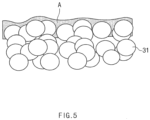
- FIG. 5 is a view illustrating a state in which an adhesive is impregnated into a surface of a coating layer of a separator
- FIG. 6 is a view illustrating positions (a) to (f) in which an adhesive may be applied with respect to an electrode.
- a method for manufacturing a unit cell not covered by the present invention comprises an adhesive applying step, an electrode inputting step, and the stacking step. Also, the unit cell has a structure in which a certain number of a negative electrode 20, a separator 30, and a positive electrode 10 are stacked repeatedly.
- separators that is, a lower separator 30a and an upper separator 30b wound in a roll shape are individually unwound from two places and continuously provided.
- electrodes a positive electrode or a negative electrode
- separators 30a and 30b are input and stacked between the separators 30a and 30b or on a top surface of the upper separator 30b placed at an upper position.
- the unit cell provided in the embodiment may have a structure in which the positive electrode 10/the upper separator 30b/the negative electrode 20/ the lower separator 30a are stacked in this order from the upper side or a structure having the order of the negative electrode 20/the upper separator 30b/the positive electrode 10/the lower separator 30a.
- the separators 30a and 30b are provided respectively from at least two places, and thus two or more sheets of separators are continuously input.
- the adhesive applying step of applying an adhesive A on surfaces of the separators 30a and 30b is performed, prior to inputting the positive electrode 10 and the negative electrode 20, that is, before the electrode inputting step is completed.
- the adhesive A applied to the separators 30a and 30b may be applied to positions for directly bonding the electrodes 10 and 20 to the separators 30a and 30b or positions for bonding the separators 30a and 30b to each other.
- the electrodes 10 and 20 may be prevented from moving.
- the negative electrode 20 is located between the lower separator 30a at the lower position and the upper separator 30b at the upper position.
- the negative electrode 20 may be prevented from moving, when bonded to at least one separator of the lower separator 30a at the lower position or the upper separator 30b at the upper position.
- the lower separator 30a at the lower position and the upper separator 30b at the upper position are bonded to each other with the negative electrode 20 therebetween along edges of the negative electrode 20, a space, in which the negative electrode 20 is movable, is restricted, and thus, the negative electrode 20 may be prevented from moving.
- the adhesive A has to be applied to contact portions between the upper separator 30b and the positive electrode 10 so as to restrict the movement the positive electrode 10.
- the adhesive A is applied to a region except for a region in which the negative electrode 20 is stacked, and thus the separators 30a and 30b with the negative electrode 20 therebetween may be bonded to each other in the stacking step, or the adhesive A is applied to a region of any one separator of the two separators 30a and 30b on which the negative electrode 20 is stacked, and thus the separators 30a and 30b and the negative electrode 20 may be bonded to each other in at least a portion of the contact surfaces.
- the adhesive A is applied to a top surface of the upper separator 30b corresponding to a region in which the positive electrode 10 is positioned.
- each of the positive electrode 10 and the negative electrode 20 used in the present invention has a rectangular shape with two short sides being relatively short and two long sides being relatively longer, and are stacked such that the long sides are parallel to the width direction of the separators 30a and 30b.
- the adhesive A may be applied to only a certain region of the separators 30a and 30b along edges of the electrodes 10 and 20, but the region is not in contact with the electrodes 10 and 20.
- the adhesive A may be selectively applied or not applied to an electrode tab that protrudes from the electrodes 10 and 20.
- the adhesive A may be applied only to regions in which both the short sides of the electrodes 10 and 20 are placed so that the electrodes 10 and 20 and the separators 30a and 30b are bonded to each other only at both the short sides of the electrodes 10 and 20.
- the adhesive A may be applied to regions, in which the separators 30a and 30b come into contact with each other, as well as regions in which the separators 30a and 30b contact to the electrodes 10 and 20 so that all of the contact surfaces of the separators 30a and 30b and the electrodes 10 and 20 are bonded to each other.
- the adhesive A may be applied only to regions in which four vertices of the electrodes 10 and 20 are to be positioned. Also, as in (f), additional adhesive application may be made in a region between both the short sides or between both the long sides of the electrodes 10 and 20 as well as regions in which the short sides and the long sides are to be positioned.
- the stacking step is made by stacking the separators 30a and 30b and the electrodes 10 and 20. That is, in the stacking step, the two sheets of separators 30a and 30b and the electrodes 10 and 20 are alternately positioned and stacked.
- a roller passing step may be further selectively performed, in which, so that the separator 30 on which the adhesive A has been applied is further efficiently bonded to the electrode or the separator provided together, the stacked separators and electrodes are pressed by facing nip rollers 50a and 50b while passing therethrough.
- the nip rollers 50a and 50b press the electrodes 10 and 20 and the separators 30a and 30b with pressure much less than that of a laminating method according to the related art. Also, the pressing may be made at a lower temperature without heating. Through the method described above, damage to the electrodes 10 and 20 and the separators 30a and 30b or shortcircuits thereof may be prevented.
- the separators 30a and 30b and the electrodes 10 and 20 are cut by a cutter 60c into an individual unit cell 40 in which a certain number of the separators 30a and 30b and the electrodes 10 and 20 are alternately stacked.
- the cutter 60c may have a size greater than that of each of cutters 60a and 60b that cut the negative electrode 20 and the positive electrode 10.
- a spray jet method in which adhesive particles and compressed air are sprayed together.
- a pipe 72 receiving an adhesive A is inserted into a housing 71 having a space provided therein.
- the adhesive A passes through the pipe 72 and is ejected through a nozzle 71a of the housing 71, compressed air is injected through a line 73 connected to the housing 71, and the adhesive A is discharged with the compressed air through the nozzle 71a.
- an adhesive A is sprayed in the form of fine droplets by a change in pressure inside a pressure chamber.
- a spray device 80 has a housing 81 which has a space provided therein, and a wall 82 on one side thereof is moved to cause a change in volume inside the pressure chamber.
- the adhesive A is filled into the pressure chamber, the adhesive A is not discharged through a discharge port 81a due to viscosity thereof in a state in which the adhesive A is filled.
- the wall 82 moves in a direction for reducing the volume of the pressure chamber, the pressure inside the pressure chamber is increased, and the adhesive A is discharged to the outside through the discharge port 81a and then applied onto the separator 30. Then, when the wall 82 is restored to the original state thereof, the discharging of the adhesive A is stopped. That is, the principal that the adhesive A is applied is similar to the principal that ink is ejected in an inkjet printer.
- the adhesive A applied through the spray jet method or the inkjet spray method described above may be applied in the form of small particles at predetermined positions and with predetermined amounts.
- the adhesive A is uniformly applied to the surface of the coating layer 31 of the separator and then permeates evenly an overall area on which the adhesive has been applied. Therefore, optimal adhesion force may be attained without loss of the adhesive A.
- the present invention provides a manufacturing method in which an electrode may be input more accurately, and an adhesive A may be applied more precisely in the vertical direction (that is, from the top to the bottom) so that a spray direction is not affected by gravity.
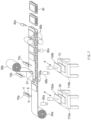
- FIG. 7 is a view schematically illustrating a state in which a unit cell is being manufactured through a manufacturing method according to the first embodiment of the present invention by a manufacturing apparatus according to a second embodiment described later
- FIG. 8 is a view schematically illustrating a state when the state of FIG. 7 is viewed from the side
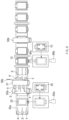
- FIG. 9 is a view schematically illustrating a state when the state of the FIG. 7 is viewed from the top to the bottom.
- the manufacturing method of the embodiment of the present invention also provides a method for manufacturing a unit cell 40 by stacking an electrode 10 and 20 and separators 30a and 30b.
- An adhesive A is applied in advance when electrodes 10 and 20 are mounted on the separators 30a and 30b, thereby preventing the electrodes 10 and 20 from moving even though not using an expensive separator.
- a method for manufacturing a unit cell comprises: a step of continuously conveying and supplying, in a longitudinal direction, a lower separator 30a which is located at a relatively lower position; a step of applying an adhesive A to a portion of a top surface of the lower separator 30a; a step of mounting, on the lower separator, one electrode of a negative electrode 20 or a positive electrode 10 which is cut into a predetermined size and located on one side of the lower separator 30a; a step of continuously conveying and supplying an upper separator 30b which is located at a relatively upper position; and a step of applying an adhesive A to a portion of one surface of the upper separator 30b.
- the upper separator 30b is supplied from the upper side in a direction (from the upper side to the lower side in FIG. 7 ) perpendicular to a traveling direction (from the left side to the right side in FIG. 7 ) of the lower separator 30a, and is horizontally (the left and right direction in FIG. 7 ) conveyed while the adhesive A is applied so that the adhesive A is applied vertically from the upper side.
- the upper separator 30b is stacked on the electrode such that the one surface of the upper separator 30b on which the adhesive A has been applied is placed on a top surface of the electrode.
- the upper separator 30b is conveyed along a nip roller 50a pressing the lower separator 30a and the negative electrode 20 and a guide roller 51 disposed above the nip roller 50a, and both surfaces thereof are reversed. That is, when the one surface of the upper separator 30b is laid horizontally while conveyed along the guide roller 51, the adhesive A is applied onto the one surface, and the upper separator 30b is input between the nip roller 50a and the negative electrode 20 such that the one surface on which the adhesive A has been applied covers the top surface of the negative electrode 20. That is, in the embodiment, the upper separator 30b is input as being turned upside down after the adhesive A is applied.
- the upper separator 30b is stacked on the negative electrode 20, there is further provided a step of further applying an adhesive to a portion of the top surface of the upper separator 30b. Also, after the step of further applying the adhesive A to the portion of the top surface of the upper separator 30b, there is provided a step of further mounting the positive electrode 10 onto the top surface of the upper separator 30b on which the adhesive A has been applied.
- the electrode mounted on the top surface of the upper separator 30b is the positive electrode 10, which has a different polarity from the negative electrode 20 stacked between the upper separator 30b and the lower separator 30a. That is, when the electrode placed between the upper separator 30b and the lower separator 30a is the negative electrode 20, the electrode stacked on the upper separator 30b is the positive electrode 10, or vice versa.
- the separators 30a and 30b between the electrodes may be cut by a cutter 60c, thereby manufacturing an individual unit cell 40.
- the present invention provides a manufacturing apparatus capable of performing the manufacturing method according to the first embodiment.
- an apparatus for manufacturing a unit cell comprises: a lower reel from which a lower separator 30a located at a relatively lower position is unwound; a first nozzle 70a which applies an adhesive to at least a portion of a top surface, facing upward, of the unwound lower separator 30a; an upper reel from which an upper separator 30b located at a relatively upper position is unwound; a second nozzle 70b which applies an adhesive to at least a portion of one surface, facing upward, of the unwound upper separator 30b; a guide roller 51 which changes the conveyance direction of the upper separator 30b so that the upper separator 30b unwound from the upper reel passes horizontally under the second nozzle 70b; and a nip roller 50a which inputs the upper separator 30b onto an electrode (a negative electrode 20 in the drawing) such that, after passing through the guide roller 51, the one surface of the upper separator 30b on which the adhesive has been applied by the
- the upper reel and the lower reel may comprise rotary devices (not shown) for rotating and unwinding the lower separator 30a and the upper separator 30b and power devices connected to the rotary devices.
- the first nozzle 70a, the second nozzle 70b, and a third nozzle 70c described later may spray the adhesive A through not only the spray method or inkjet method described in the first embodiment, but also various spray methods such as a dispensing method or a screen printing method.
- the spray method may change depending on chemical properties of the adhesive being sprayed, and the first nozzle 70a, the second nozzle 70b, and the third nozzle 70c may spray adhesives having different characteristics.
- the first nozzle 70a is located before a position in which the negative electrode 20 is stacked
- the second nozzle 70b is located between the guide roller 51 and the position in which the negative electrode 20 is stacked
- the third nozzle 70c is located after a position of the guide roller 51.
- the first nozzle 70a, the second nozzle 70b, and the third nozzle 70c are illustrated as spraying adhesives in a direction perpendicular, i.e., at 90 degrees to the surfaces of the separators 30a and 30b, but the spray angles of the first nozzle 70a, the second nozzle 70b, and the third nozzle 70c may be adjusted according to the surfaces of the separators 30a and 30b on which the adhesive is sprayed.
- refrigerating and air conditioning devices, sensor devices, lighting devices, electric control devices, and the like may be disposed during a manufacturing process, and these devices may interfere with the nozzles 70a,70b, and 70c.
- the spray angles of the nozzles 70a, 70b, and 70c may be controlled to various angles (for example, 30 degrees, 45 degrees, and 60 degrees, 135 degrees, 150 degrees, or the like).
- the nozzles 70a, 70b, and 70c may be disposed such that the adhesive is sprayed upward from below the separators 30a and 30b.
- the conveyance path of the upper separator 30b may change depending on a path on which the guide roller 51 is disposed, and here, the second nozzle 70b may be disposed below the upper separator 30b and configured such that the adhesive is sprayed from the lower side toward the upper side.
- a polyurethane-based adhesive a polyolefin adhesive, a poly urethane reactive (PUR)-based adhesive, an acrylic adhesive, or the like may be selected, or a mixture of two or more thereof may be used.
- thermosetting or photocurable components may be further added to shorten drying time.
- each of the negative electrode 20 and the positive electrode 10 provided in the embodiment is manufactured by applying slurry of an active material, a conductive material, and a binder onto an electrode collector and then drying and pressing the resultant. Also, after the electrode is manufactured in a separate processing line, the electrode is cut into a predetermined size and then provided.
- the negative electrode 20 may be provided in a state of being stored in a first magazine provided on one side on which the lower separator 30a is disposed
- the positive electrode 10 may be provided in a state of being stored in a second magazine which is spaced apart from the first magazine on the one side on which the lower separator 30a is disposed.
- the negative electrode 20 and the positive electrode 10 provided in a state of being stored in the first magazine and the second magazine may be moved one by one to tables 110a and 110b, respectively, or may be moved directly on the lower separator 30a and the upper separator 30b by a first gripper 100a and a second gripper 100b without going through the tables 110a and 110b.
- first gripper 100a and the second gripper 100b are provided in the embodiment so that the negative electrode 20 and the positive electrode 10, which have been cut into a certain size, are conveyed onto the separators 30a and 30b.
- each of the first gripper 100a and the second gripper 100b has the structure of tongs and is configured to move the negative electrode 20 and the positive electrode 10 while gripping the same.
- the gripper may be configured to convey the negative electrode 20 and the positive electrode 10 by vacuumsuctioning the surfaces of the electrodes, moving the same to a desired position, and then releasing the vacuum state.
- the negative electrode 20 and the positive electrode 10 may be conveyed onto the lower separator 30a to which the adhesive is applied from the first nozzle 70a and the upper separator 30b to which the adhesive is applied from the third nozzle 70c, respectively.
- the upper separator 30b vertically conveyed downward above the lower separator 30a changes in direction through the guide roller 51. That is, the guide roller 51 changes the conveyance direction when the upper separator 30b is unwound and conveyed so that one surface of the upper separator 30b faces upward.
- the upper separator 30b is turned upside down through the nip roller 50a, and the surface, on which the adhesive is sprayed, is stacked on the negative electrode 20.
- the upper separator 30b passes through between the nip roller 50a and the guide roller 51, the upper separator 30b remains horizontal, and the adhesive is applied or sprayed thereon.
- an auxiliary nip roller 50b is further disposed, and the auxiliary nip roller 50b is also disposed vertically in a pair.
- the adhesive A is applied onto the upper separator 30b, and the positive electrode 10 is input. Then, the upper separator 30b and the positive electrode 10 pass through therebetween.
- the manufacturing apparatus provided in the embodiment may be further provided with a first vision 90a, a second vision 90b, and a third vision 90c.
- the first vision 90a is disposed above the negative electrode 20 and captures an image of a position, in which the negative electrode 20 is mounted by the first gripper 100a, before the negative electrode 20 reaches the lower separator 30a
- the second vision 90b is disposed above the positive electrode 10 and captures an image of a position, in which the positive electrode 10 is mounted by the second gripper 100b, before the positive electrode 10 reaches the upper separator 30b
- the third vision 90c is further disposed at a selected position on a path through which the separators 30a and 30b are conveyed, and captures images of the stack states and conveyance states of the negative electrode 20, the positive electrode 10, and the separators 30a and 30b.
- the first vision 90a, the second vision 90b, and the third vision 90c capture images of the conveyance states of the grippers 100a and 100b and the electrodes 10 and 20, and are configured to transmit the captured image signals to computing device (not shown) that controls operation of each device.
- the computing device controls the operation of the grippers 100a and 100b, the nozzles 70a, 70b, and 70c, and the upper reel and the lower reel.
- the first vision 90a, the second vision 90b, and the third vision 90c may comprise image capturing elements such as a charge coupled device (CCD) or a complementary metal-oxide semiconductor (CMOS), and may capture in real-time images of states before and after the negative electrode 20 and the positive electrode 10 are mounted to the lower separator 30a and the upper separator 30b and a moving state thereof while stacked.
- the computing device compares the acquired images with images stored in advance for good products of the negative electrode 20 and the positive electrode 10, and thus, the size and shape of each of the negative electrode 20 and the positive electrode 10, whether there is a position failure, whether there is damage, or the like may be identified.
- first vision 90a, the second vision 90b, and the third vision 90c are not fixed but coupled to a sliding device (not shown), and/or are configured such that camera angle and zoom may be adjusted.
- the negative electrode 20 and the positive electrode 10 may be monitored in real time while moving.
- a separate light source 91 may be added in the vicinity of the lower separator 30a and the upper separator 30b so that the image quality is further improved while the images are captured by the first vision 90a, the second vision 90b, and the third vision 90c.
- each of the first nozzle 70a, the second nozzle 70b, and the third nozzle 70c is provided with a plurality of nipples ⁇ , ⁇ , and ⁇ having ends through which adhesives A are applied.
- each of the first nozzle 70a, the second nozzle 70b, and the third nozzle 70c are spaced apart from each other so that nipples ⁇ and ⁇ disposed outside apply the adhesives in the vicinity of an edge of the electrode (the positive electrode and the negative electrode), and a nipple ⁇ disposed between the nipples ⁇ and ⁇ applies the adhesives to the vicinity of the center of the electrode.
- the spray speeds, spray amounts, spray areas, and the like of the adhesives A, which are sprayed from the nipples ⁇ , ⁇ , and ⁇ of each of the first nozzle 70a, the second nozzle 70b, and the third nozzle 70c, may be individually controlled.
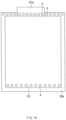
- FIG. 10 is a view showing points a to which the adhesive is applied by the first nozzle 70a before the negative electrode 20 is stacked on the lower separator 30a
- FIG. 11 is a view (in a state in which the upper separator 30b is stacked on the negative electrode) showing points a to which the adhesive is applied by the first nozzle 70a and the second nozzle 70b after the upper separator 30b is stacked on the negative electrode 20
- FIG. 12 is a view showing points a to which the adhesive is applied by the third nozzle 70c before the positive electrode 10 is stacked on the top surface of the upper separator 30b stacked on the negative electrode 20.
- adhesive-applied regions a formed on both the long sides (both sides in FIG. 11 ) of the negative electrode 20 in FIG. 11 are regions on which the adhesive is sprayed onto the upper separator 30b by the second nozzle 70b
- adhesive-applied regions a, in which the adhesive is sprayed inside the positive electrode 10 in FIG. 12 are regions on which the adhesive is sprayed onto the top surface of the upper separator 30b before the positive electrode 10 is stacked on the upper separator 30b.
- adhesive-applied regions a may also be made more dense in an area in which a positive electrode tab 10a is positioned.
Landscapes
- Chemical & Material Sciences (AREA)
- Chemical Kinetics & Catalysis (AREA)
- Electrochemistry (AREA)
- General Chemical & Material Sciences (AREA)
- Engineering & Computer Science (AREA)
- Manufacturing & Machinery (AREA)
- Secondary Cells (AREA)
- Cell Separators (AREA)
Description
- The present invention relates to a unit cell and a method and apparatus for manufacturing the same and, more specifically, to: a unit cell in which electrodes (a negative electrode, a positive electrode) are bonded to a separator using an adhesive unlike a lamination method using heat and pressure according to the related art, thereby preventing the electrodes and the separator from moving; and a method and apparatus for manufacturing the same.
- Secondary batteries are rechargeable unlike primarily batteries, and also, the possibility of compact size and high capacity is high. Thus, recently, many studies on secondary batteries are being carried out. As technology development and demands for mobile devices increase, the demands for secondary batteries as energy sources are rapidly increasing.
- Such a secondary battery is configured such that an electrode assembly is accommodated in a battery case (a pouch, a can, and the like). The electrode assembly mounted inside the battery case is repeatedly chargeable and dischargeable because of its structure in which a positive electrode/a separator/a negative electrode are stacked. The electrode assembly is manufactured in various methods, but a method is generally used, in which a
unit cell 4 is manufactured in advance and then a plurality ofunit cells 4 are stacked to manufacture the electrode assembly. - That is, referring to
FIG. 1 schematically illustrating a state in which a unit cell is manufactured through a method according to the related art, a method for manufacturing aunit cell 4 according to the related art is configured such that a positive electrode 1, aseparator 3 at a relatively upper position, anegative electrode 2, and aseparator 3 at a relatively lower position, which have been stacked in this order from the upper side and wound in a roll shape, are continuously unwound and supplied. - Here, the
separators 3 are continuously supplied without disconnection, thenegative electrode 2 is supplied between theseparators 3, and the positive electrode 1 is supplied above theupper separator 3. These electrodes, which have been cut into a predetermined size, are input at constant intervals. Here, input timing is controlled so that thenegative electrode 2 and the positive electrode 1 are stacked vertically corresponding to each other. Thus, theseparators 3 are continuously connected, but thenegative electrode 2 and the positive electrode 1 continuously pass through a laminating device while spaced a certain distance from a neighboringnegative electrode 2 and a neighboring positive electrode 1. - While passing through the laminating device, spaces between the positive electrode 1, the
separator 3, and thenegative electrode 2 are heated and pressed bynip rollers 5. That is, the laminating (bonding) is made by heating and pressing, and then, theseparators 3 are cut, whereby anindividual unit cell 4 is manufactured. - However, in the method according to the related art described above, the electrodes (the positive and negative electrodes) may be moved away from original right positions or damaged while being heated and pressed. Also, when the heating is not uniform, adhesion force between the
electrodes 1 and 2 and theseparator 3 may become irregular. - Further prior art is described in
EP 2 866 290 A1 - Thus, main objects of the present invention are to provide: a method and apparatus for manufacturing a unit cell, which may solve the problem occurring in a laminating process of the related art; and a unit cell manufactured by the above method and apparatus.
- To achieve the above-described objects, the present invention provides: a method and apparatus for manufacturing a unit cell, in which an electrode is bonded (laminated) to a separator by an adhesive; and a unit cell which may be manufactured by the above method and apparatus.
- The present invention provides a method for manufacturing a unit cell according to another embodiment. A method for manufacturing a unit cell according to the embodiment comprises: a step of continuously conveying and supplying, in a longitudinal direction, a lower separator which is located at a relatively lower position; a step of applying an adhesive to a portion of a top surface of the lower separator; a step of mounting, on the lower separator, one electrode of a negative electrode or a positive electrode which is cut into a predetermined size and located on one side of the lower separator; a step of continuously conveying and supplying an upper separator which is located at a relatively upper position; and a step of applying an adhesive to a portion of one surface of the upper separator, wherein the upper separator is supplied from the upper side in a direction perpendicular to a traveling direction of the lower separator, and is horizontally conveyed while the adhesive is applied so that the adhesive is applied vertically from the upper side, and wherein the upper separator is stacked on the electrode such that one surface of the upper separator on which the adhesive has been applied is placed on a top surface of the electrode.
- The upper separator is conveyed along a nip roller pressing the lower separator and the electrode and a guide roller disposed above the nip roller, and both surfaces of the upper separator are reversed. When the one surface of the upper separator is laid horizontally while conveyed along the guide roller, the adhesive is applied onto the one surface, and the upper separator is input between the nip roller and the electrode such that the one surface on which the adhesive has been applied covers the top surface of the electrode.
- The method further comprises a step of further applying an adhesive to a portion of the top surface of the upper separator after the upper separator is stacked on the electrode. After the step of further applying the adhesive to the portion of the top surface of the upper separator, the method comprises a step of further mounting an electrode onto the top surface of the upper separator on which the adhesive has been applied, wherein the electrode mounted on the top surface of the upper separator has a different polarity from the electrode stacked between the upper separator and the lower separator.
- The method may comprise a step of allowing the lower separator, the electrode, the upper separator, and the electrode, which are stacked in this order from the lower side to the upper side, to pass through between a pair of auxiliary nip rollers, thereby pressing the lower separator, the electrode, the upper separator, and the electrode.
- An apparatus for manufacturing a unit cell according to the present invention comprises: a lower reel from which a lower separator located at a relatively lower position is unwound; a first nozzle configured to apply an adhesive to a top surface of the unwound lower separator; an upper reel from which an upper separator located at a relatively upper position is unwound; a second nozzle configured to apply an adhesive to one surface of the unwound upper separator; a guide roller configured to change a conveyance direction of the upper separator so that the upper separator unwound from the upper reel passes horizontally under the second nozzle; and a nip roller configured to input the upper separator onto an electrode such that, after passing through the guide roller, the one surface of the upper separator on which the adhesive has been applied faces downward and is bonded to a top surface of the electrode mounted on the top surface of the lower separator; a first gripper configured to mount the electrode, which is cut into a predetermined size and located on one side of the lower separator, on the top surface of the lower separator on which the adhesive has been applied, wherein the upper separator is stacked such that the surface of the upper separator, on which the adhesive has been applied, is placed as a bottom surface by the nip roller so as to come into contact with the electrode, and the apparatus further comprises a third nozzle configured to apply an adhesive to a top surface of the upper separator after the upper separator is stacked on the electrode, and a second gripper configured to mount an electrode, which is cut into a predetermined size and located on one side of the upper separator and which has a different polarity from the electrode stacked below the upper separator, on the top surface of the upper separator on which the adhesive has been applied.
- The apparatus may comprise a first vision which is disposed above the electrode and captures an image of a position, in which the electrode is mounted by the first gripper, prior to bonding the electrode to the lower separator.
- The nip roller is disposed on each of both sides of a first stack, which is formed by stacking the lower separator, the electrode, the upper separator in this order, and presses the first stack while rotating.
- The nip roller and the guide roller are spaced a certain distance from each other, and the upper separator remains horizontal while the upper separator is conveyed between the nip roller and the guide roller.
- The apparatus may comprise an auxiliary nip roller which is disposed on each of both sides of a second stack, which is formed by mounting the lower separator, the electrode, the upper separator, and the electrode in this order from the lower side below, and presses the second stack while rotating.
- The apparatus may comprise a second vision configured to capture an image of a position, in which the electrode is mounted by the second gripper, prior to mounting the electrode onto the upper separator.
- In addition, in the embodiment, each of the first nozzle, the second nozzle, and the third nozzle comprises a plurality of nipples having ends through which the adhesives are applied, and the nipples of each of the first nozzle, the second nozzle, and the third nozzle are spaced apart from each other so that nipples disposed outside apply the adhesives in the vicinity of an edge of the electrode, and a nipple disposed between the nipples applies the adhesives to the vicinity of the center of the electrode, wherein spray speeds and spray amounts of the adhesives, which are sprayed from the nipples of each of the first nozzle, the second nozzle, and the third nozzle, may be individually controlled.
- In the method for manufacturing the electrode assembly according to the present invention having the above-described technical features, because the heat and pressure may not be applied or may be applied much weaker than the related art when the electrode and the separator are laminated, the distortion between the separator and the electrode may be prevented, and the deformation of the electrode and the separator, the damage thereto, and the like may be prevented.
- In the present invention, according to the application position of the adhesive, the separators are bonded to each other, or the separator is bonded to the electrode, whereby the electrode may be fixed. That is, according to the properties of the electrode such as size and thickness, the adhesive is applied to the region to which the electrode is mounted, and thus the separator may directly fix and prevent the electrode from moving, or the separators stacked on both sides of the electrode are bonded to each other, whereby the electrode may be prevented from moving.
- In addition, since the adhesive may be partially applied to only very small regions such as the corners of the electrode in the manufacturing method of the present invention, when this method is additionally applied to the lamination process of the related art in which the heat and pressure are applied, the position of the electrode may be temporarily fixed before the lamination process is conducted.
- In the present invention, the adhesive is ejected in the form of small particles and thus may be dispersed and impregnated between coating layers on the surface of the separator.
- Also, since the electrodes (the positive electrode, the negative electrode) may be input through the visions and the grippers, the electrode may be input and mounted to more accurate position compared to the method in which a cutting speed of a cutter is controlled.
- In addition, since the application amount may be controlled in a specific region of the unit cell according to the present invention, the optimal bonding state may be provided according to the usage of the unit cell and the characteristics of the separator and the electrode.
-
-
FIG. 1 is a view schematically illustrating a state in which a unit cell is being manufactured through a method according to the related art. -
FIG. 2 is a view schematically illustrating a state in which manufacturing is being carried out through a manufacturing method not covered by the present invention. -
FIG. 3 is a view schematically illustrating a state in which an adhesive is sprayed in the form of mist. -
FIG. 4 is a view schematically illustrating a state in which an adhesive is sprayed in the form of droplets. -
FIG. 5 is a view illustrating a state in which an adhesive is impregnated into a surface of a coating layer of a separator. -
FIG. 6 is a view illustrating positions (a) to (f) in which an adhesive may be applied with respect to an electrode. -
FIG. 7 is a view schematically illustrating a state in which a unit cell is being manufactured through a manufacturing method according to a first embodiment of the present invention by a manufacturing apparatus according to a second embodiment. -
FIG. 8 is a view schematically illustrating a state when the state ofFIG. 7 is viewed from the side. -
FIG. 9 is a view schematically illustrating a state when the state of theFIG. 7 is viewed from the top to the bottom. -
FIG. 10 is a view showing points 'a' to which an adhesive is applied by a first nozzle before the negative electrode is stacked on the lower separator. -
FIG. 11 is a view (in a state in which anupper separator 30b is stacked on a negative electrode) showing points to which an adhesive is applied by a first nozzle and a second nozzle after an upper separator is stacked on a negative electrode. -
FIG. 12 is a view showing points to which an adhesive is applied by a third nozzle before a positive electrode is stacked on a top surface of an upper separator stacked on a negative electrode. - Hereinafter, embodiments of the present invention will be described in detail with reference to the accompanying drawings so that those skilled in the art can easily carry out the present invention. However, the present invention may be modified in various different forms within the scope as defined by the appended claims, and is not limited to the exemplary embodiments described herein.
- A part irrelevant to the description will be omitted to clearly describe the present invention, and the same or similar elements will be designated by the same reference numerals throughout the specification.
- Also, terms or words used in this specification and claims should not be restrictively interpreted as ordinary meanings or dictionary-based meanings, but should be interpreted as meanings and concepts conforming to the scope of the present invention on the basis of the principle that an inventor can properly define the concept of a term to describe and explain his or her invention in the best ways.
- The present invention relates to a method for manufacturing a unit cell in which a certain number of separators 30 and electrodes (a
positive electrode 10 and a negative electrode 20) are alternately stacked. Hereinafter, the present invention will be described in more detail with reference to the accompanying drawings. -
FIG. 2 is a view schematically illustrating a state in which manufacturing is being carried out through a manufacturing method not covered by the present invention,FIG. 3 is a view schematically illustrating a state in which an adhesive is sprayed in the form of mist, andFIG. 4 is a view schematically illustrating a state in which an adhesive is sprayed in the form of droplets. Also,FIG. 5 is a view illustrating a state in which an adhesive is impregnated into a surface of a coating layer of a separator, andFIG. 6 is a view illustrating positions (a) to (f) in which an adhesive may be applied with respect to an electrode. - A method for manufacturing a unit cell not covered by the present invention comprises an adhesive applying step, an electrode inputting step, and the stacking step. Also, the unit cell has a structure in which a certain number of a
negative electrode 20, a separator 30, and apositive electrode 10 are stacked repeatedly. - First, in the electrode inputting step, separators (that is, a
lower separator 30a and anupper separator 30b) wound in a roll shape are individually unwound from two places and continuously provided. Also, electrodes (a positive electrode or a negative electrode), which have been cut into an appropriate size bycutter separators upper separator 30b placed at an upper position. - That is, according to input sequences and input positions of the electrodes, the unit cell provided in the embodiment may have a structure in which the
positive electrode 10/theupper separator 30b/thenegative electrode 20/ thelower separator 30a are stacked in this order from the upper side or a structure having the order of thenegative electrode 20/theupper separator 30b/thepositive electrode 10/thelower separator 30a. - Here, the
separators separators positive electrode 10 and thenegative electrode 20, that is, before the electrode inputting step is completed. - In the adhesive applying step, the adhesive A applied to the
separators electrodes separators separators electrodes - That is, making an explanation with respect to the
negative electrode 20 stacked between theseparators negative electrode 20 is located between thelower separator 30a at the lower position and theupper separator 30b at the upper position. - The
negative electrode 20 may be prevented from moving, when bonded to at least one separator of thelower separator 30a at the lower position or theupper separator 30b at the upper position. In addition, when thelower separator 30a at the lower position and theupper separator 30b at the upper position are bonded to each other with thenegative electrode 20 therebetween along edges of thenegative electrode 20, a space, in which thenegative electrode 20 is movable, is restricted, and thus, thenegative electrode 20 may be prevented from moving. - However, since there is the
upper separator 30b only below thepositive electrode 10 placed as the uppermost layer, the adhesive A has to be applied to contact portions between theupper separator 30b and thepositive electrode 10 so as to restrict the movement thepositive electrode 10. - That is, in the adhesive applying step, the adhesive A is applied to a region except for a region in which the
negative electrode 20 is stacked, and thus theseparators negative electrode 20 therebetween may be bonded to each other in the stacking step, or the adhesive A is applied to a region of any one separator of the twoseparators negative electrode 20 is stacked, and thus theseparators negative electrode 20 may be bonded to each other in at least a portion of the contact surfaces. On the other hand, with respect to a place in which thepositive electrode 10 is positioned, the adhesive A is applied to a top surface of theupper separator 30b corresponding to a region in which thepositive electrode 10 is positioned. - Referring to
FIG. 6 illustrating positions (a) to (f) in which the adhesive A may be applied with respect to the electrode (a region indicated by dots inFIG. 6 represents a position in which the adhesive is applied), each of thepositive electrode 10 and thenegative electrode 20 used in the present invention has a rectangular shape with two short sides being relatively short and two long sides being relatively longer, and are stacked such that the long sides are parallel to the width direction of theseparators - Also, as illustrated in (a), the adhesive A may be applied to only a certain region of the
separators electrodes electrodes electrodes - Also, as in (b), the adhesive A may be applied only to regions in which both the short sides of the
electrodes electrodes separators electrodes separators separators electrodes separators electrodes - Furthermore, as in (d) and (e), the adhesive A may be applied only to regions in which four vertices of the
electrodes electrodes - In such a state in which the adhesive A is applied to the
separators separators electrodes separators electrodes - In addition, after the stacking step, a roller passing step may be further selectively performed, in which, so that the separator 30 on which the adhesive A has been applied is further efficiently bonded to the electrode or the separator provided together, the stacked separators and electrodes are pressed by facing nip
rollers - The nip
rollers electrodes separators electrodes separators - In addition, after the adhesive applying step, the
separators electrodes cutter 60c into anindividual unit cell 40 in which a certain number of theseparators electrodes cutter 60c may have a size greater than that of each ofcutters negative electrode 20 and thepositive electrode 10. - Here, two types of methods are provided as a method for applying an adhesive.
- Referring to
FIG. 3 , provided is a spray jet method in which adhesive particles and compressed air are sprayed together. - In a
spray device 70 according to this method, apipe 72 receiving an adhesive A is inserted into ahousing 71 having a space provided therein. When the adhesive A passes through thepipe 72 and is ejected through anozzle 71a of thehousing 71, compressed air is injected through aline 73 connected to thehousing 71, and the adhesive A is discharged with the compressed air through thenozzle 71a. - When the adhesive A is discharged with the compressed air, particles are split into mist by the compressed air and then applied, in the split state, to surfaces of the
separators - Referring to
FIG. 4 , in this method, an adhesive A is sprayed in the form of fine droplets by a change in pressure inside a pressure chamber. - That is, a
spray device 80 has ahousing 81 which has a space provided therein, and awall 82 on one side thereof is moved to cause a change in volume inside the pressure chamber. When the adhesive A is filled into the pressure chamber, the adhesive A is not discharged through adischarge port 81a due to viscosity thereof in a state in which the adhesive A is filled. However, when thewall 82 moves in a direction for reducing the volume of the pressure chamber, the pressure inside the pressure chamber is increased, and the adhesive A is discharged to the outside through thedischarge port 81a and then applied onto the separator 30. Then, when thewall 82 is restored to the original state thereof, the discharging of the adhesive A is stopped. That is, the principal that the adhesive A is applied is similar to the principal that ink is ejected in an inkjet printer. - The adhesive A applied through the spray jet method or the inkjet spray method described above may be applied in the form of small particles at predetermined positions and with predetermined amounts. Thus, as illustrated in an enlarged view of
FIG. 5 showing a state in which an adhesive is impregnated into a surface of acoating layer 31 of the separator, the adhesive A is uniformly applied to the surface of thecoating layer 31 of the separator and then permeates evenly an overall area on which the adhesive has been applied. Therefore, optimal adhesion force may be attained without loss of the adhesive A. - As one embodiment, the present invention provides a manufacturing method in which an electrode may be input more accurately, and an adhesive A may be applied more precisely in the vertical direction (that is, from the top to the bottom) so that a spray direction is not affected by gravity.
-
FIG. 7 is a view schematically illustrating a state in which a unit cell is being manufactured through a manufacturing method according to the first embodiment of the present invention by a manufacturing apparatus according to a second embodiment described later,FIG. 8 is a view schematically illustrating a state when the state ofFIG. 7 is viewed from the side, andFIG. 9 is a view schematically illustrating a state when the state of theFIG. 7 is viewed from the top to the bottom. - Similar to the manufacturing method described for illustrative purposes above, the manufacturing method of the embodiment of the present invention also provides a method for manufacturing a
unit cell 40 by stacking anelectrode separators electrodes separators electrodes - A method for manufacturing a unit cell according to the embodiment comprises: a step of continuously conveying and supplying, in a longitudinal direction, a
lower separator 30a which is located at a relatively lower position; a step of applying an adhesive A to a portion of a top surface of thelower separator 30a; a step of mounting, on the lower separator, one electrode of anegative electrode 20 or apositive electrode 10 which is cut into a predetermined size and located on one side of thelower separator 30a; a step of continuously conveying and supplying anupper separator 30b which is located at a relatively upper position; and a step of applying an adhesive A to a portion of one surface of theupper separator 30b. - Here, the
upper separator 30b is supplied from the upper side in a direction (from the upper side to the lower side inFIG. 7 ) perpendicular to a traveling direction (from the left side to the right side inFIG. 7 ) of thelower separator 30a, and is horizontally (the left and right direction inFIG. 7 ) conveyed while the adhesive A is applied so that the adhesive A is applied vertically from the upper side. Theupper separator 30b is stacked on the electrode such that the one surface of theupper separator 30b on which the adhesive A has been applied is placed on a top surface of the electrode. - The
upper separator 30b is conveyed along anip roller 50a pressing thelower separator 30a and thenegative electrode 20 and aguide roller 51 disposed above thenip roller 50a, and both surfaces thereof are reversed. That is, when the one surface of theupper separator 30b is laid horizontally while conveyed along theguide roller 51, the adhesive A is applied onto the one surface, and theupper separator 30b is input between thenip roller 50a and thenegative electrode 20 such that the one surface on which the adhesive A has been applied covers the top surface of thenegative electrode 20. That is, in the embodiment, theupper separator 30b is input as being turned upside down after the adhesive A is applied. - After the
upper separator 30b is stacked on thenegative electrode 20, there is further provided a step of further applying an adhesive to a portion of the top surface of theupper separator 30b. Also, after the step of further applying the adhesive A to the portion of the top surface of theupper separator 30b, there is provided a step of further mounting thepositive electrode 10 onto the top surface of theupper separator 30b on which the adhesive A has been applied. - The electrode mounted on the top surface of the
upper separator 30b is thepositive electrode 10, which has a different polarity from thenegative electrode 20 stacked between theupper separator 30b and thelower separator 30a. That is, when the electrode placed between theupper separator 30b and thelower separator 30a is thenegative electrode 20, the electrode stacked on theupper separator 30b is thepositive electrode 10, or vice versa. - There is further provided a step of allowing the
lower separator 30a, the electrode, theupper separator 30b, and the electrode, which are stacked in this order from the lower side to the upper side, to pass through between a pair of auxiliary niprollers 50b, thereby pressing thelower separator 30a, the electrode, theupper separator 30b, and the electrode. - Also, the
separators cutter 60c, thereby manufacturing anindividual unit cell 40. - As a second embodiment, the present invention provides a manufacturing apparatus capable of performing the manufacturing method according to the first embodiment.
- Referring to
FIGS. 7 to 9 , an apparatus for manufacturing a unit cell according to the embodiment comprises: a lower reel from which alower separator 30a located at a relatively lower position is unwound; afirst nozzle 70a which applies an adhesive to at least a portion of a top surface, facing upward, of the unwoundlower separator 30a; an upper reel from which anupper separator 30b located at a relatively upper position is unwound; asecond nozzle 70b which applies an adhesive to at least a portion of one surface, facing upward, of the unwoundupper separator 30b; aguide roller 51 which changes the conveyance direction of theupper separator 30b so that theupper separator 30b unwound from the upper reel passes horizontally under thesecond nozzle 70b; and anip roller 50a which inputs theupper separator 30b onto an electrode (anegative electrode 20 in the drawing) such that, after passing through theguide roller 51, the one surface of theupper separator 30b on which the adhesive has been applied by thesecond nozzle 70b faces downward and is bonded to a top surface of the electrode mounted on one surface of thelower separator 30a. - Here, the upper reel and the lower reel may comprise rotary devices (not shown) for rotating and unwinding the
lower separator 30a and theupper separator 30b and power devices connected to the rotary devices. - The
negative electrode 20 is mounted on the top surface of thelower separator 30a unwound from the lower reel, and theupper separator 30b unwound from the upper reel is stacked on thenegative electrode 20. Accordingly, thelower separator 30a, thenegative electrode 20, and theupper separator 30b are stacked in this order. - The
first nozzle 70a, thesecond nozzle 70b, and athird nozzle 70c described later may spray the adhesive A through not only the spray method or inkjet method described in the first embodiment, but also various spray methods such as a dispensing method or a screen printing method. - Here, the spray method may change depending on chemical properties of the adhesive being sprayed, and the
first nozzle 70a, thesecond nozzle 70b, and thethird nozzle 70c may spray adhesives having different characteristics. With respect to the conveyance direction of thelower separator 30a (that is, with respect toFIG. 7 ), thefirst nozzle 70a is located before a position in which thenegative electrode 20 is stacked, thesecond nozzle 70b is located between theguide roller 51 and the position in which thenegative electrode 20 is stacked, and thethird nozzle 70c is located after a position of theguide roller 51. - Here, in the drawing, the
first nozzle 70a, thesecond nozzle 70b, and thethird nozzle 70c are illustrated as spraying adhesives in a direction perpendicular, i.e., at 90 degrees to the surfaces of theseparators first nozzle 70a, thesecond nozzle 70b, and thethird nozzle 70c may be adjusted according to the surfaces of theseparators nozzles nozzles - Also, according to circumstances, when the sprayed adhesive has sufficient viscosity and thus does not flow down, the
nozzles separators upper separator 30b may change depending on a path on which theguide roller 51 is disposed, and here, thesecond nozzle 70b may be disposed below theupper separator 30b and configured such that the adhesive is sprayed from the lower side toward the upper side. - Also, as the adhesive A used in the present invention, a polyurethane-based adhesive, a polyolefin adhesive, a poly urethane reactive (PUR)-based adhesive, an acrylic adhesive, or the like may be selected, or a mixture of two or more thereof may be used. Also, thermosetting or photocurable components may be further added to shorten drying time.
- Here, each of the
negative electrode 20 and thepositive electrode 10 provided in the embodiment is manufactured by applying slurry of an active material, a conductive material, and a binder onto an electrode collector and then drying and pressing the resultant. Also, after the electrode is manufactured in a separate processing line, the electrode is cut into a predetermined size and then provided. - That is, the
negative electrode 20 may be provided in a state of being stored in a first magazine provided on one side on which thelower separator 30a is disposed, and thepositive electrode 10 may be provided in a state of being stored in a second magazine which is spaced apart from the first magazine on the one side on which thelower separator 30a is disposed. - The
negative electrode 20 and thepositive electrode 10 provided in a state of being stored in the first magazine and the second magazine may be moved one by one to tables 110a and 110b, respectively, or may be moved directly on thelower separator 30a and theupper separator 30b by afirst gripper 100a and asecond gripper 100b without going through the tables 110a and 110b. - That is, the
first gripper 100a and thesecond gripper 100b are provided in the embodiment so that thenegative electrode 20 and thepositive electrode 10, which have been cut into a certain size, are conveyed onto theseparators first gripper 100a and thesecond gripper 100b has the structure of tongs and is configured to move thenegative electrode 20 and thepositive electrode 10 while gripping the same. However, the gripper may be configured to convey thenegative electrode 20 and thepositive electrode 10 by vacuumsuctioning the surfaces of the electrodes, moving the same to a desired position, and then releasing the vacuum state. - Thus, the
negative electrode 20 and thepositive electrode 10 may be conveyed onto thelower separator 30a to which the adhesive is applied from thefirst nozzle 70a and theupper separator 30b to which the adhesive is applied from thethird nozzle 70c, respectively. - Here, the
upper separator 30b vertically conveyed downward above thelower separator 30a changes in direction through theguide roller 51. That is, theguide roller 51 changes the conveyance direction when theupper separator 30b is unwound and conveyed so that one surface of theupper separator 30b faces upward. - Also, when the
second nozzle 70b sprays the adhesive on the surface, facing upward, of theupper separator 30b, theupper separator 30b is turned upside down through thenip roller 50a, and the surface, on which the adhesive is sprayed, is stacked on thenegative electrode 20. Here, while theupper separator 30b passes through between thenip roller 50a and theguide roller 51, theupper separator 30b remains horizontal, and the adhesive is applied or sprayed thereon. - The
nip roller 50a is also further disposed below thelower separator 30a. Thus, the pair of niprollers 50a disposed vertically may press thelower separator 30a, thenegative electrode 20, and theupper separator 30b in the stacking direction. - In addition, in the embodiment, an
auxiliary nip roller 50b is further disposed, and the auxiliary niproller 50b is also disposed vertically in a pair. The adhesive A is applied onto theupper separator 30b, and thepositive electrode 10 is input. Then, theupper separator 30b and thepositive electrode 10 pass through therebetween. - After passing through the auxiliary nip
rollers 50b, a region between the neighboringpositive electrodes 10 is cut by thecutter 60c, whereby anindividual unit cell 40 may be manufactured. - Here, the manufacturing apparatus provided in the embodiment may be further provided with a
first vision 90a, asecond vision 90b, and athird vision 90c. - The
first vision 90a is disposed above thenegative electrode 20 and captures an image of a position, in which thenegative electrode 20 is mounted by thefirst gripper 100a, before thenegative electrode 20 reaches thelower separator 30a, and thesecond vision 90b is disposed above thepositive electrode 10 and captures an image of a position, in which thepositive electrode 10 is mounted by thesecond gripper 100b, before thepositive electrode 10 reaches theupper separator 30b. Also, thethird vision 90c is further disposed at a selected position on a path through which theseparators negative electrode 20, thepositive electrode 10, and theseparators - The
first vision 90a, thesecond vision 90b, and thethird vision 90c capture images of the conveyance states of the grippers 100a and 100b and theelectrodes nozzles first vision 90a, thesecond vision 90b, and thethird vision 90c may comprise image capturing elements such as a charge coupled device (CCD) or a complementary metal-oxide semiconductor (CMOS), and may capture in real-time images of states before and after thenegative electrode 20 and thepositive electrode 10 are mounted to thelower separator 30a and theupper separator 30b and a moving state thereof while stacked. Also, the computing device compares the acquired images with images stored in advance for good products of thenegative electrode 20 and thepositive electrode 10, and thus, the size and shape of each of thenegative electrode 20 and thepositive electrode 10, whether there is a position failure, whether there is damage, or the like may be identified. - Also, the
first vision 90a, thesecond vision 90b, and thethird vision 90c are not fixed but coupled to a sliding device (not shown), and/or are configured such that camera angle and zoom may be adjusted. Thus, thenegative electrode 20 and thepositive electrode 10 may be monitored in real time while moving. - In addition, a separate
light source 91 may be added in the vicinity of thelower separator 30a and theupper separator 30b so that the image quality is further improved while the images are captured by thefirst vision 90a, thesecond vision 90b, and thethird vision 90c. - Also, in the embodiment, each of the
first nozzle 70a, thesecond nozzle 70b, and thethird nozzle 70c is provided with a plurality of nipples α, β, and γ having ends through which adhesives A are applied. - The nipples α, β, and γ of each of the
first nozzle 70a, thesecond nozzle 70b, and thethird nozzle 70c are spaced apart from each other so that nipples α and γ disposed outside apply the adhesives in the vicinity of an edge of the electrode (the positive electrode and the negative electrode), and a nipple β disposed between the nipples α and γ applies the adhesives to the vicinity of the center of the electrode. - The spray speeds, spray amounts, spray areas, and the like of the adhesives A, which are sprayed from the nipples α, β, and γ of each of the
first nozzle 70a, thesecond nozzle 70b, and thethird nozzle 70c, may be individually controlled. -
FIG. 10 is a view showing points a to which the adhesive is applied by thefirst nozzle 70a before thenegative electrode 20 is stacked on thelower separator 30a,FIG. 11 is a view (in a state in which theupper separator 30b is stacked on the negative electrode) showing points a to which the adhesive is applied by thefirst nozzle 70a and thesecond nozzle 70b after theupper separator 30b is stacked on thenegative electrode 20, andFIG. 12 is a view showing points a to which the adhesive is applied by thethird nozzle 70c before thepositive electrode 10 is stacked on the top surface of theupper separator 30b stacked on thenegative electrode 20. - Referring to
FIGS. 10 to 12 , the adhesive may be sprayed onto thelower separator 30a through thefirst nozzle 70a in a predetermined size. Here, regions a on which the adhesive is sprayed may be dense in a region in which annegative electrode tab 20a protrudes, with respect to the short sides (an upper end side and a lower end side inFIG. 10 ) on both sides of thenegative electrode 20. That is, the nipple β on the center among the nipples α, β, and γ of thefirst nozzle 70a does not apply the adhesive, but only the nipples α and γ on both sides apply the adhesive. The spray speed of the nipple α positioned on thenegative electrode tab 20a is made greater than that of the nipple γ on the opposite side, and thus, adhesive-applied regions a may be made relatively more dense. - Also, adhesive-applied regions a formed on both the long sides (both sides in
FIG. 11 ) of thenegative electrode 20 inFIG. 11 are regions on which the adhesive is sprayed onto theupper separator 30b by thesecond nozzle 70b, and adhesive-applied regions a, in which the adhesive is sprayed inside thepositive electrode 10 inFIG. 12 , are regions on which the adhesive is sprayed onto the top surface of theupper separator 30b before thepositive electrode 10 is stacked on theupper separator 30b. Here, adhesive-applied regions a may also be made more dense in an area in which apositive electrode tab 10a is positioned. - Those with ordinary skill in the technical field to which the present invention pertains will understand that the present invention may be implemented in other specific forms without changing the technical idea or essential features. Thus, the above-described embodiments are to be considered illustrative and not restrictive to all aspects. The scope of the present invention is defined by the appended claims rather than the detailed description.
-
- 10: Positive electrode
- 20: Negative electrode
- 30: Separator (30a: Lower separator, 30b: Upper separator)
- 40: Unit cell
- 50a:
Nip roller 50b: Auxiliary nip roller - 51: Guide roller
- 60a, 60b, 60c: Cutter
- 70, 80: nozzle, 70a: First nozzle, 70b: Second nozzle, 70c: Third nozzle
- 90a: First vision, 90b: Second vision, 90c: Third vision
- 100a: First gripper, 100b: Second gripper
- 110a, 110b: Table
Claims (12)
- A method for manufacturing a unit cell (40), the method comprising: a step of continuously conveying and supplying, in a longitudinal direction, a lower separator (30a) which is located at a relatively lower position;a step of applying an adhesive (A) to a portion of a top surface of the lower separator (30a);a step of mounting, on the lower separator (30a), one electrode of a negative electrode (20) or a positive electrode (10) which is cut into a predetermined size and located on one side of the lower separator (30a);a step of continuously conveying and supplying an upper separator (30b) which is located at a relatively upper position; anda step of applying an adhesive (A) to a portion of one surface of the upper separator (30b),wherein the upper separator (30b) is supplied from the upper side in a direction perpendicular to a traveling direction of the lower separator (30a), and is horizontally conveyed while the adhesive (A) is applied so that the adhesive (A) is applied vertically from the upper side, and wherein the upper separator (30b) is stacked on the electrode (20) such that one surface of the upper separator (30b) on which the adhesive (A) has been applied is placed on a top surface of the electrode (20).
- The method of claim 1, wherein the upper separator (30b) is conveyed along a nip roller (50a) pressing the lower separator (30a) and the electrode (20) and a guide roller (51) disposed above the nip roller (50a), and both surfaces of the upper separator (30b) are reversed, and
wherein, when the one surface of the upper separator (30b) is laid horizontally while conveyed along the guide roller (51), the adhesive (A) is applied onto the one surface, and the upper separator (30b) is input between the nip roller (50a) and the electrode (20) such that the one surface on which the adhesive (A) has been applied covers the top surface of the electrode (20). - The method of claim 2, further comprising a step of further applying an adhesive (A) to a portion of the top surface of the upper separator (30b) after the upper separator (30b) is stacked on the electrode (20).
- The method of claim 3, comprising, after the step of further applying the adhesive (A) to the portion of the top surface of the upper separator (30b), a step of further mounting an electrode (10) onto the top surface of the upper separator (30b) on which the adhesive (A) has been applied,
wherein the electrode (10) mounted on the top surface of the upper separator (30b) has a different polarity from the electrode (20) stacked between the upper separator (30b) and the lower separator (30a). - The method of claim 4, comprising a step of allowing the lower separator (30a), the electrode (20), the upper separator (30b), and the electrode (10), which are stacked in this order from the lower side to the upper side, to pass through between a pair of auxiliary nip rollers (50b), thereby pressing the lower separator (30a), the electrode (20), the upper separator (30b), and the electrode (10).
- An apparatus for manufacturing a unit cell (40), the apparatus comprising:a lower reel from which a lower separator (30a) located at a relatively lower position is unwound;a first nozzle (70a) configured to apply an adhesive (A) to a top surface of the unwound lower separator (30a);an upper reel from which an upper separator (30b) located at a relatively upper position is unwound;a second nozzle (70b) configured to apply an adhesive (A) to one surface of the unwound upper separator (30b);a guide roller (51) configured to change a conveyance direction of the upper separator (30b) so that the upper separator (30b) unwound from the upper reel passes horizontally under the second nozzle (70b);a nip roller (50a) configured to input the upper separator (30b) onto an electrode (20) such that, after passing through the guide roller (51), the one surface of the upper separator (30b) on which the adhesive (A) has been applied faces downward and is bonded to a top surface of the electrode (20) mounted on the top surface of the lower separator (30a); anda first gripper (100a) configured to mount the electrode (20), which is cut into a predetermined size and located on one side of the lower separator (30a), on the top surface of the lower separator (30a) on which the adhesive (A) has been applied,wherein the upper separator (30b) is stacked such that the surface of the upper separator (30b), on which the adhesive (A) has been applied, is placed as a bottom surface by the nip roller (50a) so as to come into contact with the electrode (20), andwherein the apparatus further comprises:a third nozzle (70c) configured to apply an adhesive (A) to a top surface of the upper separator (30b) after the upper separator (30b) is stacked on the electrode (20), anda second gripper (100b) configured to mount an electrode (10), which is cut into a predetermined size and located on one side of the upper separator (30b) and which has a different polarity from the electrode (20) stacked below the upper separator (30b), on the top surface of the upper separator (30b) on which the adhesive (A) has been applied.
- The apparatus of claim 6, comprising a first vision (90a) which is disposed above the electrode (20) and captures an image of a position, in which the electrode (20) is mounted by the first gripper (100a), prior to bonding the electrode (20) to the lower separator (30a).
- The apparatus of claim 6, wherein the nip roller (50a) is disposed on each of both sides of a first stack, which is formed by stacking the lower separator (30a), the electrode (20), the upper separator (30b) in this order, and presses the first stack while rotating.
- The apparatus of claim 8, wherein the nip roller (50a) and the guide roller (51) are spaced a certain distance from each other, and the upper separator (30b) remains horizontal while the upper separator (30b) is conveyed between the nip roller (50a) and the guide roller (51).
- The apparatus of claim 6, comprising an auxiliary nip roller (50b) which is disposed on each of both sides of a second stack, which is formed by mounting the lower separator (30a), the electrode (20), the upper separator (30b), and the electrode (10) in this order from the lower side below, and presses the second stack while rotating.
- The apparatus of claim 6, comprising a second vision (90b) configured to capture an image of a position, in which the electrode (10) is mounted by the second gripper (100b), prior to mounting the electrode (10) onto the upper separator (30b).
- The apparatus of any one of claims 6 to 11, wherein each of the first nozzle (70a), the second nozzle (70b), and the third nozzle (70c) comprises a plurality of nipples (α, β, γ) having ends through which the adhesives (A) are applied, andthe nipples (α, β, γ) of each of the first nozzle (70a), the second nozzle (70b), and the third nozzle (70c) are spaced apart from each other so that nipples (α, γ) disposed outside apply the adhesives (A) in the vicinity of an edge of the electrode (10, 20), and a nipple (β) disposed between the nipples (α, γ) applies the adhesives (A) to the vicinity of the center of the electrode (10, 20),wherein spray speeds and spray amounts of the adhesives (A), which are sprayed from the nipples (α, β, γ) of each of the first nozzle (70a), the second nozzle (70b), and the third nozzle (70c), are individually controlled.
Applications Claiming Priority (3)
| Application Number | Priority Date | Filing Date | Title |
|---|---|---|---|
| KR20190164069 | 2019-12-10 | ||
| KR1020200151975A KR102812884B1 (en) | 2019-12-10 | 2020-11-13 | Unit cell, manufacturing method and apparatus therefor |
| PCT/KR2020/016609 WO2021118105A1 (en) | 2019-12-10 | 2020-11-23 | Unit cell, and method and apparatus for manufacturing same |
Publications (3)
| Publication Number | Publication Date |
|---|---|
| EP3951972A1 EP3951972A1 (en) | 2022-02-09 |
| EP3951972A4 EP3951972A4 (en) | 2024-06-12 |
| EP3951972B1 true EP3951972B1 (en) | 2025-05-21 |
Family
ID=76330077
Family Applications (1)
| Application Number | Title | Priority Date | Filing Date |
|---|---|---|---|
| EP20899643.9A Active EP3951972B1 (en) | 2019-12-10 | 2020-11-23 | Method and apparatus for manufacturing a unit cell |
Country Status (5)
| Country | Link |
|---|---|
| US (1) | US20220200038A1 (en) |
| EP (1) | EP3951972B1 (en) |
| ES (1) | ES3034159T3 (en) |
| HU (1) | HUE072388T2 (en) |
| WO (1) | WO2021118105A1 (en) |
Families Citing this family (11)
| Publication number | Priority date | Publication date | Assignee | Title |
|---|---|---|---|---|
| KR102849367B1 (en) | 2020-03-25 | 2025-08-25 | 주식회사 엘지에너지솔루션 | The Apparatus And The Method For Manufacturing Unit Cell |
| KR20220011029A (en) | 2020-07-20 | 2022-01-27 | 주식회사 엘지에너지솔루션 | The Apparatus And The Method For Manufacturing Unit Cell |
| CN116261794A (en) | 2020-11-18 | 2023-06-13 | 株式会社Lg新能源 | Secondary battery and manufacturing method thereof |
| EP4199235B1 (en) | 2021-05-24 | 2025-08-20 | LG Energy Solution, Ltd. | Unit cell and battery cell including the same |
| JP7735635B2 (en) | 2021-05-24 | 2025-09-09 | エルジー エナジー ソリューション リミテッド | Unit cell and battery cell including the same |
| JP7654934B2 (en) | 2021-06-11 | 2025-04-02 | エルジー エナジー ソリューション リミテッド | Unit cell and battery cell including the same |
| KR102863478B1 (en) * | 2021-08-23 | 2025-09-22 | 주식회사 엘지에너지솔루션 | Method for preparing unit cell and manufacturing device for the same |
| US12294047B2 (en) * | 2022-08-17 | 2025-05-06 | Rivian Ip Holdings, Llc | Laminator for battery assembly |
| JP2024123561A (en) * | 2023-03-01 | 2024-09-12 | プライムプラネットエナジー&ソリューションズ株式会社 | Method for manufacturing an electricity storage device |
| WO2025141499A1 (en) * | 2023-12-27 | 2025-07-03 | Dw Energy Llc | System and method for battery stacking and singulating a film material |
| EP4726821A1 (en) * | 2024-10-11 | 2026-04-15 | LG Energy Solution, Ltd. | A system and a method for manufacturing a secondary battery assembly |
Family Cites Families (14)
| Publication number | Priority date | Publication date | Assignee | Title |
|---|---|---|---|---|
| KR100388648B1 (en) * | 2001-05-23 | 2003-06-25 | 주식회사 코캄엔지니어링 | Automated manufacturing system of lithium secondary cell |
| US7455882B2 (en) * | 2004-09-13 | 2008-11-25 | The Gillette Company | Method of applying adhesive to electrochemical cell components |
| KR101084075B1 (en) * | 2009-11-03 | 2011-11-16 | 삼성에스디아이 주식회사 | Secondary Battery and Manufacturing Method Thereof |
| JP2012209054A (en) * | 2011-03-29 | 2012-10-25 | Nec Corp | Electrode laminate of laminated battery and manufacturing method of electrode laminate |
| JP5291811B2 (en) * | 2012-01-11 | 2013-09-18 | 東レエンジニアリング株式会社 | Secondary battery manufacturing method and manufacturing apparatus |
| KR101532730B1 (en) * | 2013-01-16 | 2015-06-30 | 주식회사 엘지화학 | Manufacturing apparatus for electrode assembly |
| PL2882027T3 (en) * | 2013-05-23 | 2020-09-07 | Lg Chem, Ltd. | ELECTRODE ASSEMBLY AND RADICAL UNIT FOR HIM |
| TWI521775B (en) * | 2013-06-28 | 2016-02-11 | Lg化學股份有限公司 | Electrode assembly manufacturing method including separator cutting process |
| KR101586881B1 (en) * | 2013-08-29 | 2016-01-19 | 주식회사 엘지화학 | Electrode assembly for cell of polymer lithium secondary battery |
| JP6700435B2 (en) * | 2017-01-20 | 2020-05-27 | 株式会社エンビジョンAescジャパン | Monocell manufacturing method |
| JPWO2018154777A1 (en) * | 2017-02-27 | 2019-07-11 | 日産自動車株式会社 | Method of manufacturing monocell |
| JP6801792B2 (en) * | 2017-08-21 | 2020-12-16 | 株式会社豊田自動織機 | Equipment for manufacturing electrodes with separators and methods for manufacturing electrodes with separators |
| EP3852179B1 (en) * | 2018-09-12 | 2026-04-08 | Zeon Corporation | Laminate for secondary battery and secondary battery, and methods of producing same |
| CN110556495A (en) * | 2019-08-22 | 2019-12-10 | 惠州锂威新能源科技有限公司 | A lithium-ion battery diaphragm and a lithium-ion battery containing the diaphragm |
-
2020
- 2020-11-23 US US17/603,136 patent/US20220200038A1/en active Pending
- 2020-11-23 EP EP20899643.9A patent/EP3951972B1/en active Active
- 2020-11-23 WO PCT/KR2020/016609 patent/WO2021118105A1/en not_active Ceased
- 2020-11-23 ES ES20899643T patent/ES3034159T3/en active Active
- 2020-11-23 HU HUE20899643A patent/HUE072388T2/en unknown
Also Published As
| Publication number | Publication date |
|---|---|
| US20220200038A1 (en) | 2022-06-23 |
| HUE072388T2 (en) | 2025-11-28 |
| EP3951972A4 (en) | 2024-06-12 |
| ES3034159T3 (en) | 2025-08-13 |
| WO2021118105A1 (en) | 2021-06-17 |
| EP3951972A1 (en) | 2022-02-09 |
Similar Documents
| Publication | Publication Date | Title |
|---|---|---|
| EP3951972B1 (en) | Method and apparatus for manufacturing a unit cell | |
| CN113632274B (en) | Unit battery and method and apparatus for manufacturing the same | |
| US7055570B2 (en) | Automated manufacturing system of lithium secondary battery | |
| KR102253132B1 (en) | Method For Manufacturing Unit Cell of Secondary Cell And The Apparatus And System Using the Same | |
| CN108780877A (en) | The manufacturing method of electrochemical appliance and electrode for electrochemical device | |
| KR102861581B1 (en) | Electrode assembly, electrode assembly manufacturing equipment and manufacturing method for electrode assembly | |
| KR20220151454A (en) | Manufacturing apparatus of separator for secondary battery | |
| JP7485314B2 (en) | Apparatus and method for manufacturing unit cells | |
| KR102709536B1 (en) | Manufacturing method for electrode assembly | |
| KR102710171B1 (en) | Manufacturing method for electrode assembly and electrode assembly manufacturing equipment | |
| JP7835366B2 (en) | Electrode supply device, electrode assembly manufacturing device utilizing the same, electrode supply method, and electrode assembly manufacturing method utilizing the same | |
| KR20220020154A (en) | Method and apparatus for manufacturing unit cell | |
| JP7806989B2 (en) | Electrode supply device, electrode assembly manufacturing device using the same, electrode supply method, and electrode assembly manufacturing method using the same | |
| JP2025132946A (en) | Battery electrode manufacturing equipment, battery electrode manufacturing method | |
| JP2025042938A (en) | Apparatus for manufacturing electrodes for secondary battery cells, method for manufacturing electrodes for secondary battery cells, and secondary battery cells | |
| KR20240109188A (en) | Electrode supply device, electrode assembly manufacturing device using same, electrode supply method, and electrode assembly manufacturing method using same | |
| JP2025516722A (en) | Electrode supplying device, electrode assembly manufacturing device using the same, electrode supplying method, and electrode assembly manufacturing method using the same | |
| KR20250002872A (en) | Electrode supply device, electrode assembly manufacturing device using same, electrode supply method and electrode assembly manufacturing method using same | |
| KR20240088385A (en) | Electrode assembly and manufacturing method for electrode assembly | |
| CN117355969A (en) | Electrode assembly, its manufacturing equipment and its manufacturing method | |
| KR20240065839A (en) | Electrode assembly, manufacturing method for electrode assembly and electrode assembly manufacturing equipment | |
| CN120435768A (en) | Electrode production device, battery cell including electrode produced using the same, and battery pack and vehicle including the battery cell |
Legal Events
| Date | Code | Title | Description |
|---|---|---|---|
| STAA | Information on the status of an ep patent application or granted ep patent |
Free format text: STATUS: THE INTERNATIONAL PUBLICATION HAS BEEN MADE |
|
| PUAI | Public reference made under article 153(3) epc to a published international application that has entered the european phase |
Free format text: ORIGINAL CODE: 0009012 |
|
| STAA | Information on the status of an ep patent application or granted ep patent |
Free format text: STATUS: REQUEST FOR EXAMINATION WAS MADE |
|
| 17P | Request for examination filed |
Effective date: 20211025 |
|
| AK | Designated contracting states |
Kind code of ref document: A1 Designated state(s): AL AT BE BG CH CY CZ DE DK EE ES FI FR GB GR HR HU IE IS IT LI LT LU LV MC MK MT NL NO PL PT RO RS SE SI SK SM TR |
|
| RAP3 | Party data changed (applicant data changed or rights of an application transferred) |
Owner name: LG ENERGY SOLUTION, LTD. |
|
| DAV | Request for validation of the european patent (deleted) | ||
| DAX | Request for extension of the european patent (deleted) | ||
| A4 | Supplementary search report drawn up and despatched |
Effective date: 20240514 |
|
| RIC1 | Information provided on ipc code assigned before grant |
Ipc: H01M 50/46 20210101ALI20240507BHEP Ipc: H01M 10/04 20060101AFI20240507BHEP |
|
| STAA | Information on the status of an ep patent application or granted ep patent |
Free format text: STATUS: EXAMINATION IS IN PROGRESS |
|
| 17Q | First examination report despatched |
Effective date: 20241001 |
|
| GRAP | Despatch of communication of intention to grant a patent |
Free format text: ORIGINAL CODE: EPIDOSNIGR1 |
|
| STAA | Information on the status of an ep patent application or granted ep patent |
Free format text: STATUS: GRANT OF PATENT IS INTENDED |
|
| INTG | Intention to grant announced |
Effective date: 20250221 |
|
| GRAS | Grant fee paid |
Free format text: ORIGINAL CODE: EPIDOSNIGR3 |
|
| GRAA | (expected) grant |
Free format text: ORIGINAL CODE: 0009210 |
|
| STAA | Information on the status of an ep patent application or granted ep patent |
Free format text: STATUS: THE PATENT HAS BEEN GRANTED |
|
| P01 | Opt-out of the competence of the unified patent court (upc) registered |
Free format text: CASE NUMBER: APP_13949/2025 Effective date: 20250321 |
|
| AK | Designated contracting states |
Kind code of ref document: B1 Designated state(s): AL AT BE BG CH CY CZ DE DK EE ES FI FR GB GR HR HU IE IS IT LI LT LU LV MC MK MT NL NO PL PT RO RS SE SI SK SM TR |
|
| REG | Reference to a national code |
Ref country code: GB Ref legal event code: FG4D |
|
| REG | Reference to a national code |
Ref country code: CH Ref legal event code: EP |
|
| REG | Reference to a national code |
Ref country code: DE Ref legal event code: R096 Ref document number: 602020051860 Country of ref document: DE |
|
| REG | Reference to a national code |
Ref country code: IE Ref legal event code: FG4D |
|
| REG | Reference to a national code |
Ref country code: ES Ref legal event code: FG2A Ref document number: 3034159 Country of ref document: ES Kind code of ref document: T3 Effective date: 20250813 |
|
| REG | Reference to a national code |
Ref country code: NL Ref legal event code: MP Effective date: 20250521 |
|
| PG25 | Lapsed in a contracting state [announced via postgrant information from national office to epo] |
Ref country code: FI Free format text: LAPSE BECAUSE OF FAILURE TO SUBMIT A TRANSLATION OF THE DESCRIPTION OR TO PAY THE FEE WITHIN THE PRESCRIBED TIME-LIMIT Effective date: 20250521 Ref country code: PT Free format text: LAPSE BECAUSE OF FAILURE TO SUBMIT A TRANSLATION OF THE DESCRIPTION OR TO PAY THE FEE WITHIN THE PRESCRIBED TIME-LIMIT Effective date: 20250922 |
|
| REG | Reference to a national code |
Ref country code: LT Ref legal event code: MG9D |
|
| PG25 | Lapsed in a contracting state [announced via postgrant information from national office to epo] |
Ref country code: NO Free format text: LAPSE BECAUSE OF FAILURE TO SUBMIT A TRANSLATION OF THE DESCRIPTION OR TO PAY THE FEE WITHIN THE PRESCRIBED TIME-LIMIT Effective date: 20250821 Ref country code: GR Free format text: LAPSE BECAUSE OF FAILURE TO SUBMIT A TRANSLATION OF THE DESCRIPTION OR TO PAY THE FEE WITHIN THE PRESCRIBED TIME-LIMIT Effective date: 20250822 |
|
| PG25 | Lapsed in a contracting state [announced via postgrant information from national office to epo] |
Ref country code: PL Free format text: LAPSE BECAUSE OF FAILURE TO SUBMIT A TRANSLATION OF THE DESCRIPTION OR TO PAY THE FEE WITHIN THE PRESCRIBED TIME-LIMIT Effective date: 20250521 Ref country code: NL Free format text: LAPSE BECAUSE OF FAILURE TO SUBMIT A TRANSLATION OF THE DESCRIPTION OR TO PAY THE FEE WITHIN THE PRESCRIBED TIME-LIMIT Effective date: 20250521 |
|
| PG25 | Lapsed in a contracting state [announced via postgrant information from national office to epo] |
Ref country code: BG Free format text: LAPSE BECAUSE OF FAILURE TO SUBMIT A TRANSLATION OF THE DESCRIPTION OR TO PAY THE FEE WITHIN THE PRESCRIBED TIME-LIMIT Effective date: 20250521 |
|
| PG25 | Lapsed in a contracting state [announced via postgrant information from national office to epo] |
Ref country code: HR Free format text: LAPSE BECAUSE OF FAILURE TO SUBMIT A TRANSLATION OF THE DESCRIPTION OR TO PAY THE FEE WITHIN THE PRESCRIBED TIME-LIMIT Effective date: 20250521 |
|
| PG25 | Lapsed in a contracting state [announced via postgrant information from national office to epo] |
Ref country code: RS Free format text: LAPSE BECAUSE OF FAILURE TO SUBMIT A TRANSLATION OF THE DESCRIPTION OR TO PAY THE FEE WITHIN THE PRESCRIBED TIME-LIMIT Effective date: 20250821 |
|
| PG25 | Lapsed in a contracting state [announced via postgrant information from national office to epo] |
Ref country code: IS Free format text: LAPSE BECAUSE OF FAILURE TO SUBMIT A TRANSLATION OF THE DESCRIPTION OR TO PAY THE FEE WITHIN THE PRESCRIBED TIME-LIMIT Effective date: 20250921 |
|
| PG25 | Lapsed in a contracting state [announced via postgrant information from national office to epo] |
Ref country code: LV Free format text: LAPSE BECAUSE OF FAILURE TO SUBMIT A TRANSLATION OF THE DESCRIPTION OR TO PAY THE FEE WITHIN THE PRESCRIBED TIME-LIMIT Effective date: 20250521 |
|
| REG | Reference to a national code |
Ref country code: HU Ref legal event code: AG4A Ref document number: E072388 Country of ref document: HU |
|
| PGFP | Annual fee paid to national office [announced via postgrant information from national office to epo] |
Ref country code: HU Payment date: 20251127 Year of fee payment: 6 |
|
| REG | Reference to a national code |
Ref country code: AT Ref legal event code: MK05 Ref document number: 1797585 Country of ref document: AT Kind code of ref document: T Effective date: 20250521 |
|
| PGFP | Annual fee paid to national office [announced via postgrant information from national office to epo] |
Ref country code: DE Payment date: 20251020 Year of fee payment: 6 |
|
| PGFP | Annual fee paid to national office [announced via postgrant information from national office to epo] |
Ref country code: GB Payment date: 20251023 Year of fee payment: 6 |
|
| PG25 | Lapsed in a contracting state [announced via postgrant information from national office to epo] |
Ref country code: AT Free format text: LAPSE BECAUSE OF FAILURE TO SUBMIT A TRANSLATION OF THE DESCRIPTION OR TO PAY THE FEE WITHIN THE PRESCRIBED TIME-LIMIT Effective date: 20250521 Ref country code: SM Free format text: LAPSE BECAUSE OF FAILURE TO SUBMIT A TRANSLATION OF THE DESCRIPTION OR TO PAY THE FEE WITHIN THE PRESCRIBED TIME-LIMIT Effective date: 20250521 Ref country code: DK Free format text: LAPSE BECAUSE OF FAILURE TO SUBMIT A TRANSLATION OF THE DESCRIPTION OR TO PAY THE FEE WITHIN THE PRESCRIBED TIME-LIMIT Effective date: 20250521 |
|
| PGFP | Annual fee paid to national office [announced via postgrant information from national office to epo] |
Ref country code: FR Payment date: 20251021 Year of fee payment: 6 |
|
| PGFP | Annual fee paid to national office [announced via postgrant information from national office to epo] |
Ref country code: BE Payment date: 20251020 Year of fee payment: 6 |
|
| PG25 | Lapsed in a contracting state [announced via postgrant information from national office to epo] |
Ref country code: CZ Free format text: LAPSE BECAUSE OF FAILURE TO SUBMIT A TRANSLATION OF THE DESCRIPTION OR TO PAY THE FEE WITHIN THE PRESCRIBED TIME-LIMIT Effective date: 20250521 |
|
| PG25 | Lapsed in a contracting state [announced via postgrant information from national office to epo] |
Ref country code: EE Free format text: LAPSE BECAUSE OF FAILURE TO SUBMIT A TRANSLATION OF THE DESCRIPTION OR TO PAY THE FEE WITHIN THE PRESCRIBED TIME-LIMIT Effective date: 20250521 |
|
| PG25 | Lapsed in a contracting state [announced via postgrant information from national office to epo] |
Ref country code: SK Free format text: LAPSE BECAUSE OF FAILURE TO SUBMIT A TRANSLATION OF THE DESCRIPTION OR TO PAY THE FEE WITHIN THE PRESCRIBED TIME-LIMIT Effective date: 20250521 Ref country code: RO Free format text: LAPSE BECAUSE OF FAILURE TO SUBMIT A TRANSLATION OF THE DESCRIPTION OR TO PAY THE FEE WITHIN THE PRESCRIBED TIME-LIMIT Effective date: 20250521 |
|
| PG25 | Lapsed in a contracting state [announced via postgrant information from national office to epo] |
Ref country code: IT Free format text: LAPSE BECAUSE OF FAILURE TO SUBMIT A TRANSLATION OF THE DESCRIPTION OR TO PAY THE FEE WITHIN THE PRESCRIBED TIME-LIMIT Effective date: 20250521 |
|
| PGFP | Annual fee paid to national office [announced via postgrant information from national office to epo] |
Ref country code: ES Payment date: 20251215 Year of fee payment: 6 |
|
| REG | Reference to a national code |
Ref country code: DE Ref legal event code: R097 Ref document number: 602020051860 Country of ref document: DE |
|
| PLBE | No opposition filed within time limit |
Free format text: ORIGINAL CODE: 0009261 |
|
| STAA | Information on the status of an ep patent application or granted ep patent |
Free format text: STATUS: NO OPPOSITION FILED WITHIN TIME LIMIT |
|
| REG | Reference to a national code |
Ref country code: CH Ref legal event code: L10 Free format text: ST27 STATUS EVENT CODE: U-0-0-L10-L00 (AS PROVIDED BY THE NATIONAL OFFICE) Effective date: 20260402 |
|
| 26N | No opposition filed |
Effective date: 20260224 |