EP3951618A1 - Information processing device, program, and information presentation system - Google Patents
Information processing device, program, and information presentation system Download PDFInfo
- Publication number
- EP3951618A1 EP3951618A1 EP20779588.1A EP20779588A EP3951618A1 EP 3951618 A1 EP3951618 A1 EP 3951618A1 EP 20779588 A EP20779588 A EP 20779588A EP 3951618 A1 EP3951618 A1 EP 3951618A1
- Authority
- EP
- European Patent Office
- Prior art keywords
- smell
- description
- sample
- descriptions
- taste
- Prior art date
- Legal status (The legal status is an assumption and is not a legal conclusion. Google has not performed a legal analysis and makes no representation as to the accuracy of the status listed.)
- Ceased
Links
Images



Classifications
-
- G—PHYSICS
- G06—COMPUTING OR CALCULATING; COUNTING
- G06F—ELECTRIC DIGITAL DATA PROCESSING
- G06F16/00—Information retrieval; Database structures therefor; File system structures therefor
- G06F16/90—Details of database functions independent of the retrieved data types
- G06F16/903—Querying
- G06F16/9038—Presentation of query results
-
- G—PHYSICS
- G06—COMPUTING OR CALCULATING; COUNTING
- G06F—ELECTRIC DIGITAL DATA PROCESSING
- G06F16/00—Information retrieval; Database structures therefor; File system structures therefor
- G06F16/90—Details of database functions independent of the retrieved data types
- G06F16/904—Browsing; Visualisation therefor
Definitions
- the present invention relates to a technique for describing a smell or taste of an object.
- Patent Document 1 discloses a method in which a subject smells a smell is asked a question about memories associated with the smell, and a numerical value is assigned to the answer, and is recorded.
- an information processing device including: a position specifying unit that specifies a location of an object that stimulates a user's sense of smell or taste; and a display control unit that displays, in a display area corresponding to the identified position of the object, one or more descriptions relating to the sense of smell or taste stimulated by the object, each of the descriptions being displayed by a predetermined appearance.
- the display control unit may display the one or more descriptions by an appearance that corresponds to a relationship between the object and the one or more descriptions relating to the sense of smell or taste stimulated by the object.
- the display control unit may display the one or more descriptions by an appearance that corresponds to a relationship between the user's preference for smell or taste and the one or more descriptions relating to the smell or taste stimulated by the object.
- the display control unit may display the one or more descriptions in an appearance that corresponds to an attribute of the sense of smell or taste stimulated by the object.
- the display control unit may display the one or more descriptions in an appearance that corresponds to the attribute of the one or more descriptions relating to the sense of smell or taste stimulated by the object.
- the display control unit may display a relational image, which is an image showing a relationship between the selected one or more descriptions and other objects that correspond to the sense of smell or taste associated with the one or more descriptions.
- the display control unit may display the relational image by an appearance that accords with the sense of smell or taste associated with the selected one or more descriptions and the user's preference for the sense of smell or taste.
- an information providing system including: an input device; a display device; and an information processing device including an specifying unit that specifies a location of an object that stimulates a user's sense of smell or taste; and a display control unit that displays, in a display area corresponding to the identified position of the object, one or more descriptions relating to the sense of smell or taste stimulated by the object, each of the descriptions being displayed by a predetermined appearance.
- a relationship between a smell or taste of an object and a verbal description of the smell or taste can be understood visually.
- the information providing system 1 is a system for providing information to enable a user to visually understand a relationship between a smell of an object and a verbal description of the smell.
- the information providing system 1 includes an information processing device 10, a projector 20, a sensor 40, and plural samples 60.
- the information processing device 10, the projector 20 and the sensor 40 communicate with each other via wired or wireless connections.
- the information processing device 10 is an example of an information processing device according to the present invention, and is a device that controls other devices in the information providing system 1.
- the projector 20 is an example of a display device that displays information to a user.
- the sensor 40 is an example of an input device that receives an input from a user.
- Each of the plural samples 60 is an object that emits a smell that stimulates the user's sense of smell.
- sample 60 may be a natural product that emits a smell (e.g., a lavender plant) or an artificial product that contains the smell of lavender (e.g., an extract of lavender in volatile liquid form, a sheet impregnated with the liquid, or the like).
- the sample 60 is a cylindrical vial that is sealed with a lid and contains a liquid in the form of an extract oil that emits a smell of a natural product.
- Each sample 60 has a label or tag that includes the name of the sample (e.g., the name of the plant "lavender"). By referring to the label or tag name, the user is able to visually identify each sample.
- FIG. 2 is a side view illustrating a structure of the information providing system 1. More specifically, FIG. 2 is a view illustrating a positional relationship of the projector 20, the sensor 40, and the sample 60 as viewed from a horizontal direction.
- the sensor 40 is constituted of, for example, a thin rectangular plate, an upper surface of which is a flat sensing surface.
- the sample 60 has a tag 61, which is a storage medium for storing identification information (hereinafter referred to as a "sample ID”) for specifying each sample 60.
- the sensor device 40 When the sample 60 is placed on the sensing surface, the sensor device 40 reads the sample ID stored in the tag 61 of the sample 60 by using, for example, a short-range wireless communication standard, referred to as Near Field Communication (NFC), and detects the position where the sample 60 is placed (i.e., the position where the tag 61 is read on the sensing surface).
- NFC Near Field Communication
- the sensor device 40 also functions as a touch screen, and for example, when the sensing surface is touched by a user's finger or a predetermined stylus, the touched position on the sensing surface is detected.
- the position where the sample 60 is placed or the position at which it is touched by the user is described as X, Y coordinates in a two-dimensional coordinate plane wherein a specified position of the sensing surface serves as an origin.
- the projector 20 is installed above the sensor 40 (for example, on a ceiling of a room). As indicated by the dashed line in FIG. 2 , the projector device 20 covers an entire area of the sensing surface of the sensor 40, and is capable of projecting an image to any position on the sensing surface defined by the above X, Y coordinates. In other words, the sensing surface of the sensor device 40 also functions as a display surface on which an image is displayed.
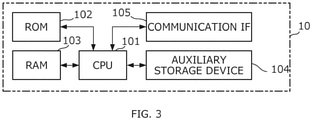
- FIG. 3 is a diagram illustrating a hardware configuration of the information processing device 10.
- the information processing device 10 is a computer that includes a CPU (Central Processing Unit) 101, a ROM (Read Only Memory) 102, a RAM (Random Access Memory) 103, an auxiliary storage device 104, and a communication IF (Interface) 105.
- a CPU Central Processing Unit
- ROM Read Only Memory
- RAM Random Access Memory
- auxiliary storage device 104 a communication IF (Interface) 105.
- the CPU 101 is a processor that performs various operations.
- the ROM 102 is a non-volatile memory that stores, for example, a program and data used for booting the information processing device 10.
- the RAM 103 is a volatile memory that functions as a work area when the CPU 101 executes the program.
- the auxiliary storage device 104 is a non-volatile storage device such as, for example, a HDD (Hard Disk Drive) or an SSD (Solid State Drive), and stores a program and data used in the information processing device 10. By executing the program, the CPU 101 realizes the functions described below and also executes the operations described below.
- the communication IF 105 is an interface that performs communication in accordance with a predetermined communication standard.
- the communication standard may be a standard for wired communication or a standard for wireless communication.
- the information processing device 10 may include other elements, such as, for example, a display device such as a liquid crystal display and an input device such as a keyboard.
- the auxiliary storage device 104 stores a description database (hereinafter, simply referred to as a description DB) as shown in FIG. 4 .
- each sample ID includes one or more descriptions (i.e., one or more descriptions that describe the smell of the sample 60, and are displayed as characters) that describe the smell sense stimulated by the sample 60 in correspondence with the sample ID.
- the description acts to convey a smell of the sample 60 to others when the user smells the smell of the sample 60.
- the description may consist of any component part of language, such as, for example, a noun or an adjective; and may also include direct and indirect descriptions of the smell.
- a direct description is one that is customarily used to evoke a sense of a smell, such as “sweet” or “fruity,” for example, while an indirect description is one that is not customarily used to describe a smell, such as “spring,” “morning,” or “walk.”
- Indirect descriptions may function as descriptions that are secondary and complementary to direct descriptions. Indirect descriptions may also consist of abstract terms.
- the Description DB includes appearance information for displaying each description.
- the appearance information includes information corresponding to, for example, a position at which the description is displayed relative to smell from an object (sample 60), the distance between the position at which the description is displayed and the sample 60, the direction of the display position of the description relative to the sample 60, the color in which the description is displayed, the size at which the description is displayed, the font with which the description is displayed, the modification with which the description is displayed, the time at which the description is displayed, the time period of displaying the description, the movement of the description (including spatial or temporal changes of the description), or the language used for the description, and so on.
- This display information depends on a relationship between the sample 60 and its description.
- the relationship between the sample 60 and its description consists of an intensity and an amount of a smell (more specifically, components contained in the smell of the sample) as described by the description of the sample 60; or a level of abstraction of the description relative to the smell.
- the description "sweet” may be displayed proximate to a sample 60 that has a strong sweet smell, or the description "sweet” may be prominently displayed in large characters or in a strong color on the sample 60 that has a strong sweet smell, or the description "sweet” may be prominently displayed on the sample 60 that has a strong sweet smell by movement as in vibration.
- the description "sweet” may be displayed proximate to the sample, while the description "fruity” may be displayed farther away from the sample.
- a distance between the sample 60 and its description may be changed dependent on a level of abstraction of the description, such that a direct description is displayed proximate to the sample and an indirect description is displayed farther away from the sample
- a description is displayed as visual information such that a relationship between the sample 60 and its description (specifically, a strength of a relationship and a characteristic of the relationship) are displayed for ease of visual recognition.
- the sample 60 having the sample ID "ID001,” “sweet” is recorded as description 1
- "fresh” is recorded as description 2
- “flower” is recorded as description 3, and so on.
- the visual information of the description 1, “sweet,” has the following characteristics: a distance between the position at which the description is displayed and the sample is “2 units” (1 unit is a length determined in relation to the sensing surface), the color is “red,” the font is “Gothic,” the size is “25 points,” and the movement is “blinking.”
- FIG. 5 is a block diagram showing an exemplary functional configuration of the information processing device 10.
- the functions of a sample identification unit 11, a location identification unit 12, a description DB storage unit 13, and a display control unit 14 are implemented.
- the sample specifying unit 11 specifies the sample 60 that is placed on the sensing surface based on the read sample ID stored in the tag 61 of the sample 60.
- the position specifying unit 12 specifies the position on the sensing surface at which the sample 60 is placed (i.e., the position at which the sample 60 is placed on the sensor (device) 40) based on the position at which the sample ID stored in the tag 61 of the sample 60 was read (i.e., the position at which the operation to place the sample 60 was performed on the sensor (device) 40).
- the position-specifying unit 12 specifies a position of the sensing surface that was touched.
- the display control unit 14 controls the projector (device) 20 to display one or more descriptions of the sense of smell stimulated by the sample 60 identified by the sample identification unit 11 in the display area corresponding to the position of the sample 60 identified by the position identification unit 12. At this time, the display control unit 14 displays the descriptions in accordance by the appearance information that corresponds to the samples identified by the sample identification unit 11 in the description DB that is stored in the description DB storage unit 13.
- the display area corresponding to the position of the sample 60 is, for example, an area on the sensing surface that is within a determined distance from the position of that sample 60, and a specific example, is a circular area within a radius of 10 centimeters centered at a position of the sample 60 on the sensing surface.
- the display area corresponding to the position of the sample 60 is not limited to this example, and may be an area that a user is able to recognize as a sample to which the displayed description relates.
- the display control unit 14 displays a related image, which is an image that shows a relationship between the selected description and other samples 60 corresponding to the olfactory sensation associated with the description, as will be described in detail later with reference to FIG. 10 .
- the user selects samples 60 of interest by referring to the names of the samples shown on the samples 60, and places the samples on the sensing surface of the sensor 40.
- FIG. 7 a plan view is shown that illustrates from above a view of the sensing surface of the sensor 40.
- the sample specifying unit 11 of the information processing device 10 specifies (at step S11 in FIG. 6 ) which sample(s) 60 is/are placed on the sensing surface based on the reading of the sample ID by the sensor 40.
- the location specifying unit 12 of the information processing device 10 specifies (at step S12) for each sample 60 the position at which the sample 60 is placed on the sensing surface based on the reading position of the sample ID by the sensor 40.
- the order of the processing at steps S11 and S12 may be changed from those of the example in FIG. 6 , or the processes may be performed substantially simultaneously.
- samples 60a to 60g placed on the sensing surface of the sensor (device) 40 the user selects a sample (here, sample 60g), for which the user wishes to know a description relating to a smell of the sample, and places the selected sample at a predetermined position on the sensing surface.
- the predetermined position is a closed area indicated by a dashed line image displayed on the sensing surface by the projector (device) 20 as shown in FIG. 7 , and is referred to as an "analysis target position A.”
- the position, shape, and size of the analysis target position A may be determined at will, but it is necessary for the user to know or to be informed in advance by means of display, voice guidance, or the like an area on the sensing surface that is the analysis target position A.
- the sample 60g is placed at the analysis target position A on the sensing surface.
- the position specifying unit 12 determines that the sample 60g is at the analysis target position on the sensing surface (at step S13 in FIG. 6 ; YES). It is of note that regarding the state shown in FIG. 7 , since the position specifying unit 12 determines that none of the samples 60 is at the analysis target position on the sensing surface (at step S13 in FIG. 6 ; NO), the process remains in a standby state while the process (at step S11) relating to the identification of the samples 60 and the process (at step S12) relating to the identification of the position of the samples 60 are performed.
- the display control unit 14 searches (at step S14 in FIG. 6 ) for descriptions corresponding to the sample ID in the description DB, by using the sample ID of the sample 60G as a search key. Further, the display control unit 14 determines (at step S15 in FIG. 6 ) an appearance corresponding to each of the searched descriptions by referring to the description DB. Then, the display control unit 14 controls the projector (device) 20 to display (at step S16 in FIG. 6 ) the descriptions retrieved at step S14 in the display area corresponding to the position of the sample 60g identified by the position identification unit 12, in accordance by the appearance determined at step S15.
- the descriptions relating to the smell of the sample 60g are displayed, for example, inside a circle centered on the position of the sample 60g, and having a size as illustrated in FIG. 9 .
- each description is displayed by an appearance that corresponds to the relationship between the description and the sample 60g, as described above.
- the user is able to determine how to describe the smell of the sample 60g.
- the user is also able to determine the relationship between the smell of the sample 60g and each description by referring to the appearance with which each description is displayed. For example, in the example shown in FIG.
- the user can see that the smell of the sample 60g is a smell that is typically described as “sweet,” but also contains smell components that are described as “fresh,” “gorgeous,” “relaxing,” “mellow,” “flower,” and “fruit,” and also that these smells can be used to describe “spring,” “morning,” “ pink,” “walk,” and “light,” and are associated with such concepts.
- the user selects the description by touching the description displayed on the sensing surface.
- the display control unit 14 specifies the description selected by the user based on the position touched by the user and a display position of each of a description. At this time, it is preferable to display the description with a specific background color, or to highlight the description so that the user can easily identify which description has been selected.
- the display control unit 14 searches, in the description DB, for a sample ID that is associated with the selected description among the group of sample IDs identified at step S11. If a sample ID that is associated with the selected description is found by the search, the display control unit 14 determines that a sample related to the selected description is to be placed on the sensing surface (at step S18; YES), and controls (at step S19) the projector (device) 20 to display a relational image.
- the relational image is, for example, a line-shaped image connecting a display position of the description selected by the user via the sensing surface and at a position where the sample corresponding to the found sample ID is placed.
- relational images R1 and R2 connected with the description "sweet” are selected by the user along with other samples described by the description “sweet” (here, samples 60a and 60d) are displayed, as illustrated in FIG. 10 . From these relational images R1 and R2, the user can see that, in addition to the sample 60g, there are also samples 60a and 60d that correspond to smells described as "sweet.”
- Appearances such as color, thickness, size, movement, etc., of the relational image are based on the relationship between the description selected by the user and the other samples described by the description. For example, when the relationship between the description selected by the user and the other samples described by the description is strong, a color, thickness, size, movement, etc. are displayed in such a way that the relational image is more prominent, and vice versa when the relationship is weak.
- the relational image R1 connecting the description "sweet" and the sample 60d is depicted as a thicker image than the relational image R2 connecting the description "sweet” with the sample 60a.
- the relationship between the description selected by the user and the other samples described by the description is determined based on the appearance determined in the description DB.
- the appearance corresponding to the description "sweet” and the sample 60d in the description DB is one used when the relationship is stronger than that of the appearance corresponding to the description "sweet” and the sample 60a.
- the user can obtain such information by touching another description on the sensing surface (at step S20; NO). If the user touches another description, the above steps S17 to S19 are executed for the another description. Then, if the user wishes to know the description for the new sample 60, the user performs (at step S20; YES) the predetermined operation to terminate the process and replaces the sample at the analysis target position A. As a result, the above steps S11 to S19 are repeated for another description. In this way, the user can try various samples of smells and view their corresponding descriptions.
- the above-described embodiment enables a user to understand a visual relationship between a smell of an object and a description of its smell.
- the present invention is applicable not only to olfactory objects but also to gustatory objects (e.g. wine, Japanese rice wine, spices, seasonings, and so on.).
- the present invention may be implemented by replacing smell in the embodiments with taste.
- each displayed description may be determined in accordance with a relationship between the description and the user who views the displayed description.
- the relationship between the description and the user includes, for example, a degree of agreement between the smell described by the description and the user's preference for the smell, and a history of the user's use of the description as a description of the smell.
- a degree of agreement between the smell described by the description and the user's preference for the smell and a history of the user's use of the description as a description of the smell.
- an example of the description "sweet” is displayed proximate to the sample 60 at the analysis target position A, with the description "sweet” displayed in a large format or a strong color, or the description "sweet” is displayed in a conspicuous manner by use of movement such as vibration.
- user preferences for smells are collected and stored in a database in advance in an auxiliary storage device 104 or the like, and the display control unit 14 refers to the database.
- the description "sweet” is displayed proximate to the sample 60 placed at the analysis target position A, or the description "sweet” displayed in a conspicuous manner by use of movement such as vibration.
- a history of descriptions used by the user to describe the smell is collected in advance and stored in a database in the auxiliary storage device 104 or the like, and the display control unit 14 refers to the database.
- the appearance by which each description is displayed may be determined in accordance with an attribute of the smell described by the description.
- the attributes of a smell may include, for example, a top note, a middle note, or a lower note, the strength/weakness of the stimulus of the smell, and the degree of interest, specialness, or rarity of the smell.
- the top note, the middle note, and the lower note of the smell may change over time, for example, when a first smell is recognized, a next smell is recognized, and then a further next smell is recognized.
- the appearance in which each description is displayed may be determined in accordance with an attribute of the description.
- the attributes of the description include, for example, an image corresponding? to the description, a language component of the description, a character (Japanese hiragana, Japanese katakana, Japanese kanji, alphabet, etc.) used in denoting the description, a number of characters/words constituting the description, and the like.
- the description "sweet" may be displayed in a warm color.
- the display control unit 14 may display the relational image by an appearance in accordance with a user's preference for the smell described by the description selected by the user on the sensing surface. For example, in the relational image connecting the description "sweet” selected by the user and the other samples described by the description, the appearance such as the color, thickness, size, movement, etc. thereof is changed according to the user's preference for the "sweet” smell. Specifically, if the user prefers a "sweet" smell, the color, thickness, size, movement, etc. of the relational image may be made more prominent.
- the user's preferences for smells are collected and put into a database in advance and stored in the auxiliary storage device 104 or the like, and the display control unit 14 refers to the database.
- the relational image is not limited to the linear image illustrated in FIG. 10 , and may be any image that shows that the description selected by the user and the sample described by the description are related. For example, a first circular image enclosing the description "sweet" selected by the user and a second circular image enclosing the position of the other sample 60 described by the description "sweet” may be used as the relational image.
- the display device and the input device are not limited to the projector (device) 20 and the sensor (device) 40 illustrated in FIG. 1 .
- the display(device) 20 is not limited to a device that projects an image onto the sensing surface of the sensor (device) 40, which is an input device, as described in the embodiments.
- the input device itself may be a display device.
- the display device may also be a device that displays an image on a wall surface (including cases where the image is projected onto the wall surface or where the wall surface itself is a display).
- the display device may also be a display device that realizes so-called augmented reality.
- the input device may be a device that detects a user's operation by use of image recognition technology.
- a description related to the sample 60 is displayed.
- a description related to the sample 60 may be displayed if the user opens the lid of a small bottle containing aromatic oil corresponding to the sample 60.
- a natural object may be placed on a plate and covered with a transparent cover, and if the user removes the transparent cover, a description related to the smell of the natural object may be displayed.
- Not only one sample 60 may be placed at the analysis target position, and plural samples may be placed there at the same time. In this case, a description for each of the samples will be displayed in a display area corresponding to the position of each of the samples 60.
- the visual appearance of the displayed description may be two-dimensional or three-dimensional.
- the displayed "description" is not limited to text, and may also be a color, an abstract form, or an image such as of that of a person/scene.
- the present invention may be provided as an information processing method that includes processing steps executed by the information processing device 10.
- the present invention may also be provided as a program that is executed by the information processing device 10.
- Such a program may be provided on a recording medium such as an optical disk, or may be provided via a network such as the Internet, and then installed and executed on the computer.
Landscapes
- Engineering & Computer Science (AREA)
- Databases & Information Systems (AREA)
- Theoretical Computer Science (AREA)
- Physics & Mathematics (AREA)
- Data Mining & Analysis (AREA)
- General Engineering & Computer Science (AREA)
- General Physics & Mathematics (AREA)
- Computational Linguistics (AREA)
- Health & Medical Sciences (AREA)
- Life Sciences & Earth Sciences (AREA)
- User Interface Of Digital Computer (AREA)
- Molecular Biology (AREA)
- General Health & Medical Sciences (AREA)
- Biophysics (AREA)
- Pathology (AREA)
- Biomedical Technology (AREA)
- Heart & Thoracic Surgery (AREA)
- Neurology (AREA)
- Surgery (AREA)
- Medical Informatics (AREA)
- Animal Behavior & Ethology (AREA)
- Neurosurgery (AREA)
- Public Health (AREA)
- Veterinary Medicine (AREA)
- Physiology (AREA)
- Information Retrieval, Db Structures And Fs Structures Therefor (AREA)
Abstract
Description
- The present invention relates to a technique for describing a smell or taste of an object.
- Smells are known to provide various benefits to humans by stimulating the limbic system, which has a role in controlling emotion, behavior and memory. For example,
Patent Document 1 discloses a method in which a subject smells a smell is asked a question about memories associated with the smell, and a numerical value is assigned to the answer, and is recorded. - [Patent Document 1]
JP 2016-180830 A - Generally, it is difficult for people to accurately describe a smell to themselves or to others. This is because most people are not required to describe smells and thus they lack a working vocabulary to do so. Moreover, people tend not to able to clearly recognize a correspondence between a smell and a description to be used for the smell. This limitation also applies to describing taste.
- It is thus an object of the present invention to provide via visual representation a relationship between a smell or a taste of an object and a verbal description of the smell or taste.
- To solve the problems, according to one aspect of the invention, there is provided an information processing device including: a position specifying unit that specifies a location of an object that stimulates a user's sense of smell or taste; and a display control unit that displays, in a display area corresponding to the identified position of the object, one or more descriptions relating to the sense of smell or taste stimulated by the object, each of the descriptions being displayed by a predetermined appearance.
- The display control unit may display the one or more descriptions by an appearance that corresponds to a relationship between the object and the one or more descriptions relating to the sense of smell or taste stimulated by the object.
- The display control unit may display the one or more descriptions by an appearance that corresponds to a relationship between the user's preference for smell or taste and the one or more descriptions relating to the smell or taste stimulated by the object.
- The display control unit may display the one or more descriptions in an appearance that corresponds to an attribute of the sense of smell or taste stimulated by the object.
- The display control unit may display the one or more descriptions in an appearance that corresponds to the attribute of the one or more descriptions relating to the sense of smell or taste stimulated by the object.
- When any of the one or more of the displayed descriptions is selected by the user, the display control unit may display a relational image, which is an image showing a relationship between the selected one or more descriptions and other objects that correspond to the sense of smell or taste associated with the one or more descriptions.
- The display control unit may display the relational image by an appearance that accords with the sense of smell or taste associated with the selected one or more descriptions and the user's preference for the sense of smell or taste.
- According to another aspect of the invention, there is provided a program for causing a computer to implement: a position specifying unit that specifies a location of an object that stimulates a user's sense of smell or taste, and a display control unit that displays, in a display area corresponding to the identified position of the object, one or more descriptions relating to the sense of smell or taste stimulated by the object, wherein each of the one or more descriptions is displayed by a predetermined appearance.
- According to yet another aspect of the invention, there is provided an information providing system including: an input device; a display device; and an information processing device including an specifying unit that specifies a location of an object that stimulates a user's sense of smell or taste; and a display control unit that displays, in a display area corresponding to the identified position of the object, one or more descriptions relating to the sense of smell or taste stimulated by the object, each of the descriptions being displayed by a predetermined appearance.
- According to the present invention, a relationship between a smell or taste of an object and a verbal description of the smell or taste can be understood visually.
-
-
FIG. 1 is a block diagram illustrating the overall configuration of an information providing system according to one embodiment of the invention. -
FIG. 2 is a side view illustrating the structure of the information providing system. -
FIG. 3 is a block diagram illustrating an example of a hardware configuration of an information processing device according to an embodiment of the invention. -
FIG. 4 is an example of the Description DB stored by the information processor. -
FIG. 5 is a block diagram illustrating an example of the functional configuration of an information processing device. -
FIG. 6 is a flowchart illustrating an example of the operation of the information processing device. -
FIG. 7 is a plan view illustrating a sensing surface of a sensor device viewed from above when the information providing system is used. -
FIG. 8 is a plan view illustrating the sensing surface of the sensor device viewed from above when the information providing system is used. -
FIG. 9 is a plan view illustrating the sensing surface of the sensor device viewed from above when the information providing system is used. -
FIG. 10 is a plan view illustrating the sensing surface of the sensor device viewed from above when the information providing system is used. - The overall configuration of the
information providing system 1 according to one embodiment of the invention will now be described. Theinformation providing system 1 is a system for providing information to enable a user to visually understand a relationship between a smell of an object and a verbal description of the smell. As shown inFIG. 1 , theinformation providing system 1 includes aninformation processing device 10, aprojector 20, asensor 40, andplural samples 60. Theinformation processing device 10, theprojector 20 and thesensor 40 communicate with each other via wired or wireless connections. Theinformation processing device 10 is an example of an information processing device according to the present invention, and is a device that controls other devices in theinformation providing system 1. Theprojector 20 is an example of a display device that displays information to a user. Thesensor 40 is an example of an input device that receives an input from a user. Each of theplural samples 60 is an object that emits a smell that stimulates the user's sense of smell. For example,sample 60 may be a natural product that emits a smell (e.g., a lavender plant) or an artificial product that contains the smell of lavender (e.g., an extract of lavender in volatile liquid form, a sheet impregnated with the liquid, or the like). In this embodiment, thesample 60 is a cylindrical vial that is sealed with a lid and contains a liquid in the form of an extract oil that emits a smell of a natural product. Eachsample 60 has a label or tag that includes the name of the sample (e.g., the name of the plant "lavender"). By referring to the label or tag name, the user is able to visually identify each sample. -
FIG. 2 is a side view illustrating a structure of theinformation providing system 1. More specifically,FIG. 2 is a view illustrating a positional relationship of theprojector 20, thesensor 40, and thesample 60 as viewed from a horizontal direction. Thesensor 40 is constituted of, for example, a thin rectangular plate, an upper surface of which is a flat sensing surface. Thesample 60 has atag 61, which is a storage medium for storing identification information (hereinafter referred to as a "sample ID") for specifying eachsample 60. When thesample 60 is placed on the sensing surface, thesensor device 40 reads the sample ID stored in thetag 61 of thesample 60 by using, for example, a short-range wireless communication standard, referred to as Near Field Communication (NFC), and detects the position where thesample 60 is placed (i.e., the position where thetag 61 is read on the sensing surface). Thesensor device 40 also functions as a touch screen, and for example, when the sensing surface is touched by a user's finger or a predetermined stylus, the touched position on the sensing surface is detected. The position where thesample 60 is placed or the position at which it is touched by the user is described as X, Y coordinates in a two-dimensional coordinate plane wherein a specified position of the sensing surface serves as an origin. - The
projector 20 is installed above the sensor 40 (for example, on a ceiling of a room). As indicated by the dashed line inFIG. 2 , theprojector device 20 covers an entire area of the sensing surface of thesensor 40, and is capable of projecting an image to any position on the sensing surface defined by the above X, Y coordinates. In other words, the sensing surface of thesensor device 40 also functions as a display surface on which an image is displayed. -
FIG. 3 is a diagram illustrating a hardware configuration of theinformation processing device 10. Theinformation processing device 10 is a computer that includes a CPU (Central Processing Unit) 101, a ROM (Read Only Memory) 102, a RAM (Random Access Memory) 103, anauxiliary storage device 104, and a communication IF (Interface) 105. - The
CPU 101 is a processor that performs various operations. TheROM 102 is a non-volatile memory that stores, for example, a program and data used for booting theinformation processing device 10. TheRAM 103 is a volatile memory that functions as a work area when theCPU 101 executes the program. Theauxiliary storage device 104 is a non-volatile storage device such as, for example, a HDD (Hard Disk Drive) or an SSD (Solid State Drive), and stores a program and data used in theinformation processing device 10. By executing the program, theCPU 101 realizes the functions described below and also executes the operations described below. The communication IF 105 is an interface that performs communication in accordance with a predetermined communication standard. The communication standard may be a standard for wired communication or a standard for wireless communication. In addition to the configuration illustrated inFIG. 3 , theinformation processing device 10 may include other elements, such as, for example, a display device such as a liquid crystal display and an input device such as a keyboard. - The
auxiliary storage device 104 stores a description database (hereinafter, simply referred to as a description DB) as shown inFIG. 4 . In the description DB, each sample ID includes one or more descriptions (i.e., one or more descriptions that describe the smell of thesample 60, and are displayed as characters) that describe the smell sense stimulated by thesample 60 in correspondence with the sample ID. In other words, the description acts to convey a smell of thesample 60 to others when the user smells the smell of thesample 60. The description may consist of any component part of language, such as, for example, a noun or an adjective; and may also include direct and indirect descriptions of the smell. Here, a direct description is one that is customarily used to evoke a sense of a smell, such as "sweet" or "fruity," for example, while an indirect description is one that is not customarily used to describe a smell, such as "spring," "morning," or "walk." Indirect descriptions may function as descriptions that are secondary and complementary to direct descriptions. Indirect descriptions may also consist of abstract terms. - Further, the Description DB includes appearance information for displaying each description. The appearance information includes information corresponding to, for example, a position at which the description is displayed relative to smell from an object (sample 60), the distance between the position at which the description is displayed and the
sample 60, the direction of the display position of the description relative to thesample 60, the color in which the description is displayed, the size at which the description is displayed, the font with which the description is displayed, the modification with which the description is displayed, the time at which the description is displayed, the time period of displaying the description, the movement of the description (including spatial or temporal changes of the description), or the language used for the description, and so on. - This display information depends on a relationship between the
sample 60 and its description. The relationship between thesample 60 and its description consists of an intensity and an amount of a smell (more specifically, components contained in the smell of the sample) as described by the description of thesample 60; or a level of abstraction of the description relative to the smell. For example, the description "sweet" may be displayed proximate to asample 60 that has a strong sweet smell, or the description "sweet" may be prominently displayed in large characters or in a strong color on thesample 60 that has a strong sweet smell, or the description "sweet" may be prominently displayed on thesample 60 that has a strong sweet smell by movement as in vibration. Also, for example, for a sample that has both a strong sweet smell and a weak fruity smell, the description "sweet" may be displayed proximate to the sample, while the description "fruity" may be displayed farther away from the sample. This is an example of an appearance that changes dependent on a relationship between thesample 60 and its description. In addition, when a direct description and an indirect description are associated with a particular sample, a distance between thesample 60 and its description may be changed dependent on a level of abstraction of the description, such that a direct description is displayed proximate to the sample and an indirect description is displayed farther away from the sample this is also an example of an appearance that changes dependent on a relationship between thesample 60 and its description. In short, a description is displayed as visual information such that a relationship between thesample 60 and its description (specifically, a strength of a relationship and a characteristic of the relationship) are displayed for ease of visual recognition. - In the example shown in
FIG. 4 , thesample 60 having the sample ID "ID001," "sweet" is recorded asdescription 1, "fresh" is recorded asdescription 2, and "flower" is recorded as description 3, and so on. Among these descriptions, the visual information of thedescription 1, "sweet," has the following characteristics: a distance between the position at which the description is displayed and the sample is "2 units" (1 unit is a length determined in relation to the sensing surface), the color is "red," the font is "Gothic," the size is "25 points," and the movement is "blinking." -
FIG. 5 is a block diagram showing an exemplary functional configuration of theinformation processing device 10. In theinformation processing device 10, the functions of asample identification unit 11, alocation identification unit 12, a descriptionDB storage unit 13, and adisplay control unit 14 are implemented. - When a
sample 60 is placed on the sensing surface of the sensor (device) 40, thesample specifying unit 11 specifies thesample 60 that is placed on the sensing surface based on the read sample ID stored in thetag 61 of thesample 60. - When the
sample 60 is placed on the sensing surface of the sensor (device) 40, theposition specifying unit 12 specifies the position on the sensing surface at which thesample 60 is placed (i.e., the position at which thesample 60 is placed on the sensor (device) 40) based on the position at which the sample ID stored in thetag 61 of thesample 60 was read (i.e., the position at which the operation to place thesample 60 was performed on the sensor (device) 40). In addition, when the sensing surface of the sensor (device) 40 is touched by a user, the position-specifyingunit 12 specifies a position of the sensing surface that was touched. - The
display control unit 14 controls the projector (device) 20 to display one or more descriptions of the sense of smell stimulated by thesample 60 identified by thesample identification unit 11 in the display area corresponding to the position of thesample 60 identified by theposition identification unit 12. At this time, thedisplay control unit 14 displays the descriptions in accordance by the appearance information that corresponds to the samples identified by thesample identification unit 11 in the description DB that is stored in the descriptionDB storage unit 13. The display area corresponding to the position of thesample 60 is, for example, an area on the sensing surface that is within a determined distance from the position of thatsample 60, and a specific example, is a circular area within a radius of 10 centimeters centered at a position of thesample 60 on the sensing surface. However, the display area corresponding to the position of thesample 60 is not limited to this example, and may be an area that a user is able to recognize as a sample to which the displayed description relates. - Further, when any of the one or more displayed descriptions is selected by the user, the
display control unit 14 displays a related image, which is an image that shows a relationship between the selected description andother samples 60 corresponding to the olfactory sensation associated with the description, as will be described in detail later with reference toFIG. 10 . - An exemplary operation of the present embodiment will now be described with reference to the flowchart shown in
FIG. 6 . First, the user selectssamples 60 of interest by referring to the names of the samples shown on thesamples 60, and places the samples on the sensing surface of thesensor 40. - In
FIG. 7 a plan view is shown that illustrates from above a view of the sensing surface of thesensor 40. In this example, sevensamples 60a to 60g are placed on the sensing surface of thesensor 40. At this time, thesample specifying unit 11 of theinformation processing device 10 specifies (at step S11 inFIG. 6 ) which sample(s) 60 is/are placed on the sensing surface based on the reading of the sample ID by thesensor 40. Further, thelocation specifying unit 12 of theinformation processing device 10 specifies (at step S12) for eachsample 60 the position at which thesample 60 is placed on the sensing surface based on the reading position of the sample ID by thesensor 40. At this step, it is identified that thesamples 60a to 60g have been placed at the respective positions illustrated inFIG. 7 . The order of the processing at steps S11 and S12 may be changed from those of the example inFIG. 6 , or the processes may be performed substantially simultaneously. - Among
samples 60a to 60g placed on the sensing surface of the sensor (device) 40, the user selects a sample (here,sample 60g), for which the user wishes to know a description relating to a smell of the sample, and places the selected sample at a predetermined position on the sensing surface. The predetermined position is a closed area indicated by a dashed line image displayed on the sensing surface by the projector (device) 20 as shown inFIG. 7 , and is referred to as an "analysis target position A." The position, shape, and size of the analysis target position A may be determined at will, but it is necessary for the user to know or to be informed in advance by means of display, voice guidance, or the like an area on the sensing surface that is the analysis target position A. - As shown in
FIG. 8 , thesample 60g is placed at the analysis target position A on the sensing surface. At this time, theposition specifying unit 12 determines that thesample 60g is at the analysis target position on the sensing surface (at step S13 inFIG. 6 ; YES). It is of note that regarding the state shown inFIG. 7 , since theposition specifying unit 12 determines that none of thesamples 60 is at the analysis target position on the sensing surface (at step S13 inFIG. 6 ; NO), the process remains in a standby state while the process (at step S11) relating to the identification of thesamples 60 and the process (at step S12) relating to the identification of the position of thesamples 60 are performed. - When it is determined that the sample 60G is in the analysis target position, the
display control unit 14 searches (at step S14 inFIG. 6 ) for descriptions corresponding to the sample ID in the description DB, by using the sample ID of the sample 60G as a search key. Further, thedisplay control unit 14 determines (at step S15 inFIG. 6 ) an appearance corresponding to each of the searched descriptions by referring to the description DB. Then, thedisplay control unit 14 controls the projector (device) 20 to display (at step S16 inFIG. 6 ) the descriptions retrieved at step S14 in the display area corresponding to the position of thesample 60g identified by theposition identification unit 12, in accordance by the appearance determined at step S15. - According to the above processes, the descriptions relating to the smell of the
sample 60g are displayed, for example, inside a circle centered on the position of thesample 60g, and having a size as illustrated inFIG. 9 . At this time, each description is displayed by an appearance that corresponds to the relationship between the description and thesample 60g, as described above. By opening the lid of thesample 60g and smelling the smell of thesample 60g while viewing descriptions, the user is able to determine how to describe the smell of thesample 60g. At the same time, the user is also able to determine the relationship between the smell of thesample 60g and each description by referring to the appearance with which each description is displayed. For example, in the example shown inFIG. 9 , the user can see that the smell of thesample 60g is a smell that is typically described as "sweet," but also contains smell components that are described as "fresh," "gorgeous," "relaxing," "mellow," "flower," and "fruit," and also that these smells can be used to describe "spring," "morning," " pink," "walk," and "light," and are associated with such concepts. - Further, if there is a description among the displayed group of descriptions that the user is interested in or wishes to better to understand, the user selects the description by touching the description displayed on the sensing surface. When the user touches the description (at step S17 in
FIG. 6 ; YES), thedisplay control unit 14 specifies the description selected by the user based on the position touched by the user and a display position of each of a description. At this time, it is preferable to display the description with a specific background color, or to highlight the description so that the user can easily identify which description has been selected. - Then, the
display control unit 14 searches, in the description DB, for a sample ID that is associated with the selected description among the group of sample IDs identified at step S11. If a sample ID that is associated with the selected description is found by the search, thedisplay control unit 14 determines that a sample related to the selected description is to be placed on the sensing surface (at step S18; YES), and controls (at step S19) the projector (device) 20 to display a relational image. The relational image is, for example, a line-shaped image connecting a display position of the description selected by the user via the sensing surface and at a position where the sample corresponding to the found sample ID is placed. - According to the above processes, relational images R1 and R2 connected with the description "sweet" are selected by the user along with other samples described by the description "sweet" (here,
samples FIG. 10 . From these relational images R1 and R2, the user can see that, in addition to thesample 60g, there are alsosamples - Appearances such as color, thickness, size, movement, etc., of the relational image are based on the relationship between the description selected by the user and the other samples described by the description. For example, when the relationship between the description selected by the user and the other samples described by the description is strong, a color, thickness, size, movement, etc. are displayed in such a way that the relational image is more prominent, and vice versa when the relationship is weak. In the example shown in
FIG. 10 , since thesample 60d has a strong relationship to the description "sweet," the relational image R1 connecting the description "sweet" and thesample 60d is depicted as a thicker image than the relational image R2 connecting the description "sweet" with thesample 60a. The relationship between the description selected by the user and the other samples described by the description is determined based on the appearance determined in the description DB. In the example shown inFIG. 10 , the appearance corresponding to the description "sweet" and thesample 60d in the description DB is one used when the relationship is stronger than that of the appearance corresponding to the description "sweet" and thesample 60a. - If the user wishes to obtain further information about another description, the user can obtain such information by touching another description on the sensing surface (at step S20; NO). If the user touches another description, the above steps S17 to S19 are executed for the another description. Then, if the user wishes to know the description for the
new sample 60, the user performs (at step S20; YES) the predetermined operation to terminate the process and replaces the sample at the analysis target position A. As a result, the above steps S11 to S19 are repeated for another description. In this way, the user can try various samples of smells and view their corresponding descriptions. - The above-described embodiment enables a user to understand a visual relationship between a smell of an object and a description of its smell.
- The present invention is not limited to the above described embodiments. The above described embodiments may be modified as follows. Further, two or more items described in the following modifications may be combined.
- The present invention is applicable not only to olfactory objects but also to gustatory objects (e.g. wine, Japanese rice wine, spices, seasonings, and so on.). In other words, the present invention may be implemented by replacing smell in the embodiments with taste.
- The appearance of each displayed description may be determined in accordance with a relationship between the description and the user who views the displayed description. The relationship between the description and the user includes, for example, a degree of agreement between the smell described by the description and the user's preference for the smell, and a history of the user's use of the description as a description of the smell. For example, for a user who prefers a "sweet" smell, an example of the description "sweet" is displayed proximate to the
sample 60 at the analysis target position A, with the description "sweet" displayed in a large format or a strong color, or the description "sweet" is displayed in a conspicuous manner by use of movement such as vibration. In this case, user preferences for smells are collected and stored in a database in advance in anauxiliary storage device 104 or the like, and thedisplay control unit 14 refers to the database. - For example, for a user who has frequently used the description "sweet" in the past, the description "sweet" is displayed proximate to the
sample 60 placed at the analysis target position A, or the description "sweet" displayed in a conspicuous manner by use of movement such as vibration. In this case, a history of descriptions used by the user to describe the smell is collected in advance and stored in a database in theauxiliary storage device 104 or the like, and thedisplay control unit 14 refers to the database. - The appearance by which each description is displayed may be determined in accordance with an attribute of the smell described by the description. The attributes of a smell may include, for example, a top note, a middle note, or a lower note, the strength/weakness of the stimulus of the smell, and the degree of interest, specialness, or rarity of the smell. The top note, the middle note, and the lower note of the smell may change over time, for example, when a first smell is recognized, a next smell is recognized, and then a further next smell is recognized. For instance, there can be envisaged an example of displaying descriptions corresponding to a top note, a middle note, and a lower note in order or distance from a position ranging from proximate to far from the
sample 60 placed at the analysis target position A; or an example of switching the display of descriptions corresponding to a top note, a middle note, and a lower note in chronological order may be applied. In addition, an example in which descriptions that relate to highly stimulating smells or rare smells are displayed in a specific color, font, or movement, may be applied. - The appearance in which each description is displayed may be determined in accordance with an attribute of the description. The attributes of the description include, for example, an image corresponding? to the description, a language component of the description, a character (Japanese hiragana, Japanese katakana, Japanese kanji, alphabet, etc.) used in denoting the description, a number of characters/words constituting the description, and the like. For example, the description "sweet" may be displayed in a warm color.
- When displaying the relational image (see
FIG. 10 ), thedisplay control unit 14 may display the relational image by an appearance in accordance with a user's preference for the smell described by the description selected by the user on the sensing surface. For example, in the relational image connecting the description "sweet" selected by the user and the other samples described by the description, the appearance such as the color, thickness, size, movement, etc. thereof is changed according to the user's preference for the "sweet" smell. Specifically, if the user prefers a "sweet" smell, the color, thickness, size, movement, etc. of the relational image may be made more prominent. In this case, the user's preferences for smells are collected and put into a database in advance and stored in theauxiliary storage device 104 or the like, and thedisplay control unit 14 refers to the database. The relational image is not limited to the linear image illustrated inFIG. 10 , and may be any image that shows that the description selected by the user and the sample described by the description are related. For example, a first circular image enclosing the description "sweet" selected by the user and a second circular image enclosing the position of theother sample 60 described by the description "sweet" may be used as the relational image. - The display device and the input device are not limited to the projector (device) 20 and the sensor (device) 40 illustrated in
FIG. 1 . For example, the display(device) 20 is not limited to a device that projects an image onto the sensing surface of the sensor (device) 40, which is an input device, as described in the embodiments. However, for example, the input device itself may be a display device. The display device may also be a device that displays an image on a wall surface (including cases where the image is projected onto the wall surface or where the wall surface itself is a display). The display device may also be a display device that realizes so-called augmented reality. Specifically, when thesample 60 is captured by an imaging device of a smartphone, tablet, or glass-type wearable device, a corresponding group of descriptions may be displayed around thesample 60 in the captured image. The input device may be a device that detects a user's operation by use of image recognition technology. - In the embodiment, where the
sample 60 is placed at the analysis target position A to be analyzed, a description related to thesample 60 is displayed. However, for example, a description related to thesample 60 may be displayed if the user opens the lid of a small bottle containing aromatic oil corresponding to thesample 60. Similarly, for example, a natural object may be placed on a plate and covered with a transparent cover, and if the user removes the transparent cover, a description related to the smell of the natural object may be displayed. - Not only one
sample 60 may be placed at the analysis target position, and plural samples may be placed there at the same time. In this case, a description for each of the samples will be displayed in a display area corresponding to the position of each of thesamples 60. - The visual appearance of the displayed description may be two-dimensional or three-dimensional. The displayed "description" is not limited to text, and may also be a color, an abstract form, or an image such as of that of a person/scene.
- The present invention may be provided as an information processing method that includes processing steps executed by the
information processing device 10. The present invention may also be provided as a program that is executed by theinformation processing device 10. Such a program may be provided on a recording medium such as an optical disk, or may be provided via a network such as the Internet, and then installed and executed on the computer. - Although the present invention has been described in detail above, it will be apparent to those skilled in the art that the present invention is not limited to the embodiments described herein. The invention can be implemented as modified and altered without departing from the purpose and scope of the invention as determined by the description in the claims. Avccordingly, the description herein is for illustrative purposes only and is not limitative of the present invention.
- 1...Information providing system, 20...Projector, 40...Sensor, 60...Sample, 61...Tag, 101...CPU, 102...ROM, 103...RAM, 104...auxiliary storage device, 105...communication IF, 11...
sample identification unit 12...position identification unit, 13...Description DB storage unit, 14...Display control section.
Claims (9)
- An information processing device comprising:a position specifying unit that specifies a location of an object that stimulates a user's sense of smell or taste; anda display control unit that displays, in a display area corresponding to the identified position of the object, one or more descriptions relating to the sense of smell or taste stimulated by the object, each of the descriptions being displayed by a predetermined appearance.
- The information processing device according to Claim 1, wherein the display control unit displays the one or more descriptions by an appearance that corresponds to a relationship between the object and the one or more descriptions relating to the sense of smell or taste stimulated by the object.
- The information processing device according to Claim 1 or 2, wherein
the display control unit displays the one or more descriptions by an appearance that corresponds to a relationship between the user's preference for smell or taste and the one or more descriptions relating to the smell or taste stimulated by the object. - The information processing device according to any one of Claims 1 to 3, wherein
the display control unit displays the one or more descriptions in an appearance that corresponds to an attribute of the sense of smell or taste stimulated by the object. - The information processing device according to any one of Claims 1 to 4, wherein
the display control unit displays the one or more descriptions in an appearance that corresponds to the attribute of the one or more descriptions relating to the sense of smell or taste stimulated by the object. - The information processing device according to any one of Claims 1 to 5, wherein
when any of the one or more of the displayed descriptions is selected by the user, the display control unit displays a relational image, which is an image showing a relationship between the selected one or more descriptions and other objects that correspond to the sense of smell or taste associated with the one or more descriptions. - The information processing device according to Claim 6, wherein the display control unit displays the relational image by an appearance that accords with the sense of smell or taste associated with the selected one or more descriptions and the user's preference for the sense of smell or taste.
- A program for causing a computer to implement:a position specifying unit that specifies a location of an object that stimulates a user's sense of smell or taste, anda display control unit that displays, in a display area corresponding to the identified position of the object, one or more descriptions relating to the sense of smell or taste stimulated by the object, wherein each of the one or more descriptions is displayed by a predetermined appearance.
- An information providing system comprising:an input device;a display device; andan information processing device includingan specifying unit that specifies a location of an object that stimulates a user's sense of smell or taste; anda display control unit that displays, in a display area corresponding to the identified position of the object, one or more descriptions relating to the sense of smell or taste stimulated by the object, each of the descriptions being displayed by a predetermined appearance.
Applications Claiming Priority (2)
| Application Number | Priority Date | Filing Date | Title |
|---|---|---|---|
| JP2019061619 | 2019-03-27 | ||
| PCT/JP2020/012831 WO2020196445A1 (en) | 2019-03-27 | 2020-03-24 | Information processing device, program, and information presentation system |
Publications (2)
| Publication Number | Publication Date |
|---|---|
| EP3951618A1 true EP3951618A1 (en) | 2022-02-09 |
| EP3951618A4 EP3951618A4 (en) | 2022-12-28 |
Family
ID=72609852
Family Applications (1)
| Application Number | Title | Priority Date | Filing Date |
|---|---|---|---|
| EP20779588.1A Ceased EP3951618A4 (en) | 2019-03-27 | 2020-03-24 | INFORMATION PROCESSING DEVICE, PROGRAM AND INFORMATION PRESENTATION SYSTEM |
Country Status (5)
| Country | Link |
|---|---|
| US (1) | US12681994B2 (en) |
| EP (1) | EP3951618A4 (en) |
| JP (1) | JP7483685B2 (en) |
| CN (1) | CN113906415A (en) |
| WO (1) | WO2020196445A1 (en) |
Families Citing this family (2)
| Publication number | Priority date | Publication date | Assignee | Title |
|---|---|---|---|---|
| CN114118260B (en) * | 2021-11-24 | 2025-05-09 | 东北电力大学 | A method for analyzing machine olfactory enhancement or machine taste inhibition |
| CN116660566B (en) * | 2023-07-26 | 2023-10-17 | 四川徕伯益自动化技术有限公司 | Position identification method, system, terminal and medium for sample liquid |
Family Cites Families (37)
| Publication number | Priority date | Publication date | Assignee | Title |
|---|---|---|---|---|
| GB2378257A (en) * | 2001-07-31 | 2003-02-05 | Hewlett Packard Co | Camera with scent and taste representation means |
| EP1764708A4 (en) * | 2004-05-12 | 2007-11-14 | Ajikaori Senryaku Kenkyusyo Co | Sense database |
| JP2006113254A (en) * | 2004-10-14 | 2006-04-27 | Matsushita Electric Ind Co Ltd | Information presentation device and cooking support system |
| US20080191864A1 (en) * | 2005-03-31 | 2008-08-14 | Ronen Wolfson | Interactive Surface and Display System |
| US20070178046A1 (en) * | 2005-12-05 | 2007-08-02 | Herz Rachel S | System for correlating odors and tastes to objective elements |
| JP4426563B2 (en) * | 2006-12-25 | 2010-03-03 | 大日本印刷株式会社 | Information provision system |
| EP2101171A4 (en) | 2006-12-27 | 2014-04-30 | Intelligent Sensor Technology Inc | Taste recognizing device and taste recognizing system using same |
| US20080160147A1 (en) * | 2007-01-03 | 2008-07-03 | Tormey Peter J | Method for marketing food and beverages |
| GB0911523D0 (en) * | 2009-07-03 | 2009-08-12 | Scent & Aroma Technology Sytems Ltd | Aroma training apparatus and method |
| US20130120771A1 (en) * | 2011-11-14 | 2013-05-16 | Shen Wang | Image Processing For Images With Aroma Information |
| JP6024515B2 (en) * | 2013-02-28 | 2016-11-16 | ソニー株式会社 | Information processing apparatus and storage medium |
| WO2015114785A1 (en) | 2014-01-30 | 2015-08-06 | 楽天株式会社 | Attribute display system, attribute display method, and attribute display program |
| WO2015173871A1 (en) * | 2014-05-12 | 2015-11-19 | 富士通株式会社 | Product-information output method, program, and control device |
| JP2016180830A (en) | 2015-03-24 | 2016-10-13 | 富士ゼロックス株式会社 | Image forming apparatus |
| JP6359770B2 (en) * | 2015-06-12 | 2018-07-18 | 株式会社ソニー・インタラクティブエンタテインメント | Information processing device |
| US10198722B2 (en) * | 2015-07-15 | 2019-02-05 | Toshiba Tec Kabushiki Kaisha | Commodity-sales-data processing apparatus, commodity-sales-data processing method, and computer-readable storage medium |
| US20170131689A1 (en) * | 2015-11-06 | 2017-05-11 | International Business Machines Corporation | Communication of physical scents and scent representations |
| KR101720266B1 (en) * | 2016-03-04 | 2017-03-28 | 피움랩스 주식회사 | Fragrance discharge apparatus |
| EP3493083A4 (en) * | 2016-07-26 | 2019-08-14 | FUJIFILM Corporation | CONTENT SEARCHING DEVICE, ITS OPERATING METHOD, PROGRAMMING THEREOF, AND CONTENT SEARCHING SYSTEM |
| KR102150282B1 (en) * | 2017-07-13 | 2020-09-01 | 한국전자통신연구원 | Apparatus and method for generation of olfactory information related to multimedia contents |
| JP6467615B1 (en) * | 2017-08-07 | 2019-02-13 | 株式会社Tree Field | Beverage production apparatus and control method |
| WO2019044341A1 (en) * | 2017-08-29 | 2019-03-07 | 株式会社ブロードエッジ・リキュエール | Computer system for proposing wine for consumption with food and method and program to be executed in said computer system |
| JP2019082904A (en) * | 2017-10-31 | 2019-05-30 | ソニー株式会社 | Information processor, information processing method and program |
| KR102108535B1 (en) | 2017-11-23 | 2020-06-16 | 오연재 | Method for Processing Food Information using Augmented Reality |
| GB201721558D0 (en) * | 2017-12-21 | 2018-02-07 | Givaudan Sa | Method of creating an organic composition |
| US11238051B2 (en) * | 2018-01-05 | 2022-02-01 | Coravin, Inc. | Method and apparatus for characterizing and determining relationships between items and moments |
| JP2019192091A (en) * | 2018-04-27 | 2019-10-31 | 京セラドキュメントソリューションズ株式会社 | Food information providing system |
| CA3098956C (en) * | 2018-05-04 | 2023-07-25 | Givaudan Sa | Interactive aroma dispensing system |
| WO2020027281A1 (en) * | 2018-08-02 | 2020-02-06 | パナソニック インテレクチュアル プロパティ コーポレーション オブ アメリカ | Information presenting method, information presenting system, and information presenting program |
| CN112771471A (en) * | 2018-09-20 | 2021-05-07 | 张恒中 | System and method for adding odor information to digital photo |
| CN109325383B (en) | 2018-10-31 | 2022-06-07 | 惠州高盛达科技有限公司 | Product packaging label identification method and system |
| KR101988844B1 (en) * | 2019-01-08 | 2019-06-12 | 주식회사 딥센트 | Aroma diffusing system |
| KR102225718B1 (en) * | 2019-01-08 | 2021-03-10 | 재단법인대구경북과학기술원 | Device and method for sharing olfactory sense data between real world and online world |
| US20200258137A1 (en) * | 2019-02-08 | 2020-08-13 | Alibaba Group Holding Limited | Apparatus, Method, and Non-Transitory Computer-Readable Medium for Content Recommendations |
| EP3931786A4 (en) * | 2019-03-12 | 2022-11-23 | Inculab LLC | PERSONAL TASTE RECOMMENDATION SYSTEMS AND METHODS |
| WO2021059642A1 (en) * | 2019-09-25 | 2021-04-01 | ソニー株式会社 | Information processing device, control method, and program |
| EP4075413A4 (en) * | 2019-12-13 | 2023-11-22 | Japan Tobacco, Inc. | INFORMATION PROCESSING APPARATUS, PROGRAM AND INFORMATION PROCESSING METHOD |
-
2020
- 2020-03-24 US US17/442,167 patent/US12681994B2/en active Active
- 2020-03-24 CN CN202080037094.3A patent/CN113906415A/en active Pending
- 2020-03-24 JP JP2021509413A patent/JP7483685B2/en active Active
- 2020-03-24 WO PCT/JP2020/012831 patent/WO2020196445A1/en not_active Ceased
- 2020-03-24 EP EP20779588.1A patent/EP3951618A4/en not_active Ceased
Also Published As
| Publication number | Publication date |
|---|---|
| CN113906415A (en) | 2022-01-07 |
| JPWO2020196445A1 (en) | 2020-10-01 |
| US12681994B2 (en) | 2026-07-14 |
| WO2020196445A1 (en) | 2020-10-01 |
| EP3951618A4 (en) | 2022-12-28 |
| JP7483685B2 (en) | 2024-05-15 |
| US20220218263A1 (en) | 2022-07-14 |
Similar Documents
| Publication | Publication Date | Title |
|---|---|---|
| US12235899B2 (en) | Sensor based semantic object generation | |
| US10534801B2 (en) | Map screen determining method and apparatus | |
| Dong et al. | Eye tracking to explore the potential of enhanced imagery basemaps in web mapping | |
| AU2011276637B2 (en) | Systems and methods for improving visual attention models | |
| KR20140033218A (en) | Content development and distribution using cognitive sciences database | |
| EP2665005A2 (en) | Method for supporting collection of an object comprised in a generated image, and a recording medium able to be read by terminal devices and computers | |
| US11289084B2 (en) | Sensor based semantic object generation | |
| US11861151B2 (en) | Information processing device, program, and information providing system | |
| US12093594B2 (en) | Information processing device, program, and information providing system | |
| JP2019160193A (en) | Learning support system, learning support method and learning support program | |
| US20220218263A1 (en) | Information processing device, program, and information providing system | |
| JP7319888B2 (en) | Information processing device, program and information processing system | |
| EP3379452B1 (en) | Information processing apparatus, method and computer program product | |
| JP7285106B2 (en) | Information processing device, program and information providing system | |
| CN112930514A (en) | Method and system for generating animated images for presentation via a dynamic keyboard interface | |
| KR20140094057A (en) | Method and system for interpreting symbolic codes | |
| Hine et al. | Carry-over effects in face recognition: Processing mode or attentional window? | |
| Benda et al. | Usability and accessibility analysis of Czech agrarian portals. | |
| Meng | Towards individualization of mapmaking and mobility of map use | |
| CN116419027A (en) | Data display method, device and system and multimedia playing equipment | |
| Ferreira | From Object to Emotion: The Aesthetics of Human-Computer Interaction |
Legal Events
| Date | Code | Title | Description |
|---|---|---|---|
| STAA | Information on the status of an ep patent application or granted ep patent |
Free format text: STATUS: THE INTERNATIONAL PUBLICATION HAS BEEN MADE |
|
| PUAI | Public reference made under article 153(3) epc to a published international application that has entered the european phase |
Free format text: ORIGINAL CODE: 0009012 |
|
| STAA | Information on the status of an ep patent application or granted ep patent |
Free format text: STATUS: REQUEST FOR EXAMINATION WAS MADE |
|
| 17P | Request for examination filed |
Effective date: 20211027 |
|
| AK | Designated contracting states |
Kind code of ref document: A1 Designated state(s): AL AT BE BG CH CY CZ DE DK EE ES FI FR GB GR HR HU IE IS IT LI LT LU LV MC MK MT NL NO PL PT RO RS SE SI SK SM TR |
|
| DAV | Request for validation of the european patent (deleted) | ||
| DAX | Request for extension of the european patent (deleted) | ||
| A4 | Supplementary search report drawn up and despatched |
Effective date: 20221129 |
|
| RIC1 | Information provided on ipc code assigned before grant |
Ipc: G06F 16/9038 20190101ALI20221123BHEP Ipc: G06F 16/904 20190101AFI20221123BHEP |
|
| STAA | Information on the status of an ep patent application or granted ep patent |
Free format text: STATUS: EXAMINATION IS IN PROGRESS |
|
| 17Q | First examination report despatched |
Effective date: 20230720 |
|
| REG | Reference to a national code |
Ref country code: DE Ref legal event code: R003 |
|
| STAA | Information on the status of an ep patent application or granted ep patent |
Free format text: STATUS: THE APPLICATION HAS BEEN REFUSED |
|
| 18R | Application refused |
Effective date: 20240911 |