EP3951583A1 - Information processing device and duplication rate estimation program - Google Patents
Information processing device and duplication rate estimation program Download PDFInfo
- Publication number
- EP3951583A1 EP3951583A1 EP21182374.5A EP21182374A EP3951583A1 EP 3951583 A1 EP3951583 A1 EP 3951583A1 EP 21182374 A EP21182374 A EP 21182374A EP 3951583 A1 EP3951583 A1 EP 3951583A1
- Authority
- EP
- European Patent Office
- Prior art keywords
- data
- duplication
- group
- rate
- deduplication
- Prior art date
- Legal status (The legal status is an assumption and is not a legal conclusion. Google has not performed a legal analysis and makes no representation as to the accuracy of the status listed.)
- Granted
Links
Images






Classifications
-
- G—PHYSICS
- G06—COMPUTING OR CALCULATING; COUNTING
- G06F—ELECTRIC DIGITAL DATA PROCESSING
- G06F3/00—Input arrangements for transferring data to be processed into a form capable of being handled by the computer; Output arrangements for transferring data from processing unit to output unit, e.g. interface arrangements
- G06F3/06—Digital input from, or digital output to, record carriers, e.g. RAID, emulated record carriers or networked record carriers
- G06F3/0601—Interfaces specially adapted for storage systems
- G06F3/0602—Interfaces specially adapted for storage systems specifically adapted to achieve a particular effect
- G06F3/0604—Improving or facilitating administration, e.g. storage management
- G06F3/0605—Improving or facilitating administration, e.g. storage management by facilitating the interaction with a user or administrator
-
- G—PHYSICS
- G06—COMPUTING OR CALCULATING; COUNTING
- G06F—ELECTRIC DIGITAL DATA PROCESSING
- G06F3/00—Input arrangements for transferring data to be processed into a form capable of being handled by the computer; Output arrangements for transferring data from processing unit to output unit, e.g. interface arrangements
- G06F3/06—Digital input from, or digital output to, record carriers, e.g. RAID, emulated record carriers or networked record carriers
- G06F3/0601—Interfaces specially adapted for storage systems
- G06F3/0628—Interfaces specially adapted for storage systems making use of a particular technique
- G06F3/0638—Organizing or formatting or addressing of data
- G06F3/064—Management of blocks
- G06F3/0641—De-duplication techniques
-
- G—PHYSICS
- G06—COMPUTING OR CALCULATING; COUNTING
- G06F—ELECTRIC DIGITAL DATA PROCESSING
- G06F3/00—Input arrangements for transferring data to be processed into a form capable of being handled by the computer; Output arrangements for transferring data from processing unit to output unit, e.g. interface arrangements
- G06F3/06—Digital input from, or digital output to, record carriers, e.g. RAID, emulated record carriers or networked record carriers
- G06F3/0601—Interfaces specially adapted for storage systems
- G06F3/0602—Interfaces specially adapted for storage systems specifically adapted to achieve a particular effect
- G06F3/0604—Improving or facilitating administration, e.g. storage management
-
- G—PHYSICS
- G06—COMPUTING OR CALCULATING; COUNTING
- G06F—ELECTRIC DIGITAL DATA PROCESSING
- G06F3/00—Input arrangements for transferring data to be processed into a form capable of being handled by the computer; Output arrangements for transferring data from processing unit to output unit, e.g. interface arrangements
- G06F3/06—Digital input from, or digital output to, record carriers, e.g. RAID, emulated record carriers or networked record carriers
- G06F3/0601—Interfaces specially adapted for storage systems
- G06F3/0602—Interfaces specially adapted for storage systems specifically adapted to achieve a particular effect
- G06F3/0608—Saving storage space on storage systems
-
- G—PHYSICS
- G06—COMPUTING OR CALCULATING; COUNTING
- G06F—ELECTRIC DIGITAL DATA PROCESSING
- G06F3/00—Input arrangements for transferring data to be processed into a form capable of being handled by the computer; Output arrangements for transferring data from processing unit to output unit, e.g. interface arrangements
- G06F3/06—Digital input from, or digital output to, record carriers, e.g. RAID, emulated record carriers or networked record carriers
- G06F3/0601—Interfaces specially adapted for storage systems
- G06F3/0628—Interfaces specially adapted for storage systems making use of a particular technique
- G06F3/0638—Organizing or formatting or addressing of data
- G06F3/0644—Management of space entities, e.g. partitions, extents, pools
-
- G—PHYSICS
- G06—COMPUTING OR CALCULATING; COUNTING
- G06F—ELECTRIC DIGITAL DATA PROCESSING
- G06F3/00—Input arrangements for transferring data to be processed into a form capable of being handled by the computer; Output arrangements for transferring data from processing unit to output unit, e.g. interface arrangements
- G06F3/06—Digital input from, or digital output to, record carriers, e.g. RAID, emulated record carriers or networked record carriers
- G06F3/0601—Interfaces specially adapted for storage systems
- G06F3/0668—Interfaces specially adapted for storage systems adopting a particular infrastructure
- G06F3/067—Distributed or networked storage systems, e.g. storage area networks [SAN], network attached storage [NAS]
Definitions
- the embodiment discussed herein is related to an information processing device and a duplication rate estimation program.
- usage cost is determined based on the size of data. Therefore, the usage cost depends on a data deduplication rate by deduplication. If the deduplication rate is large, the size of data can be reduced by deduplication, and the usage cost can be reduced. For example, in a case of 1 peta byte (PB) data, if the reduction rate is different by 10%, 100 tera bytes (TB) of storage becomes unnecessary. Therefore, when using paid storage, it is important to estimate the deduplication rate.
- PB peta byte
- TB tera bytes
- This information processing device calculates a deduplication rate when a plurality of pools is integrated so that the user can estimate in advance the size of a physical area required after integration.
- This information processing device has a duplication number calculation unit and a deduplication rate calculation unit.
- the duplication number calculation unit calculates the number of duplications of unit data of two pools and the total number of reference counts of the two pools.
- the deduplication rate calculation unit calculates the deduplication rate using the number of duplications and the total number of reference counts.
- This storage system divides data into a plurality of pieces of chunk data in the deduplication process, follows a sampling cycle that means selection of one chunk data for every N pieces of chunk data on average, and selects one or more of the plurality of pieces of chunk data. Then, this storage system calculates a fingerprint such as a hash value for each of one or more pieces of feature chunk data which is the selected one or more pieces of chunk data, and determines whether or not the data including the feature chunk data is duplicated. Furthermore, the storage system changes the sampling cycle based on a result of past deduplication processes.
- One aspect of the embodiment is to estimate the deduplication rate accurately in a short time.
- an information processing device includes: a management unit configured to extract part of data from estimation target data as a plurality of pieces of sample data and manage a number of duplications of the extracted plurality of pieces of sample data; a classification unit configured to classify the plurality of pieces of sample data into a first group and a second group based on the number of duplications, the first group having a number of duplications equal to or less that a predetermined number, the second group having a number of duplications more than a predetermined number; a first calculation unit configured to calculate a first deduplication rate for sample data classified into the first group; a second calculation unit configured to calculate a second deduplication rate for sample data classified into the second group; and a synthesis unit configured to calculate a deduplication rate of the estimation target data based on the first deduplication rate and the second deduplication rate.
- the embodiment may accurately estimate the deduplication rate in a short time.
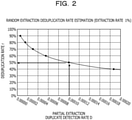
- FIGs. 1A , 1B , and 2 are diagrams for explaining estimation of the deduplication rate based on the m multiplex model.
- the m multiplex model is a model in which m pieces of the same data A are included in the original data before deduplication, as illustrated in FIG. 1A .
- m pieces of data becomes one piece of data due to deduplication.
- x is the ratio of scanned data to original data.
- scanning is reading data from the original data in order to estimate the deduplication rate.
- Scans are done in chunk units. The size of a chunk is variable. x is, for example, 0.01. Looking at each chunk, the probability of being scanned is x.
- each chunk is one of not scanned and thus not detected as duplicate, scanned but the same data is not scanned and thus not detected as duplicate, or the same data is scanned and thus detected as duplicate.
- the probability that chunks will not be scanned and will not be detected as duplicate is (1 - x) ⁇ m because the probability of not being scanned is 1 - x.
- " ⁇ " represents exponentiation.
- the probability that chunks will be scanned and the same data will not be detected as duplicate is m ⁇ x ⁇ (1 - x) ⁇ (m - 1).
- " ⁇ " represents multiplication.
- the probability that chunks will be scanned and the same data will be duplicated as duplicate is 1 - (1 - x) ⁇ m - m ⁇ x ⁇ (1 - x) ⁇ (m - 1) by subtracting the above-described two probabilities from 1.
- Equation (1) when the measured value is substituted for D and a fixed value such as 0.01 is substituted for x, Equation (1) is an equation for m, and m may be calculated by solving this equation.
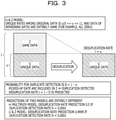
- FIG. 3 is a diagram for explaining a U & Z model.
- the U & Z model is a model such that a unique ratio among original data is u (0 ⁇ u ⁇ 1), and data of the remaining ratio (1 - u) are exactly the same (for example, all 0).
- U is a set of unique data
- Z is a set of the same data.
- the model of the original data is the U & Z model
- the predicted value of the deduplication rate will be largely different.
- the model of the original data is a simple model and the deduplication rate is predicted by partial scanning, accuracy of a predicted value is poor. Accordingly, it is conceivable to complicate the model of the original data to improve the accuracy of the predicted value.
- FIG. 4 illustrates an example of a complicated model.
- the amount of unique data is D(1)
- the amount of two-multiplexed data is D(2),...
- the amount of most multiplexed data is D(M)
- “1..M” represents "from 1 to M”.
- the probability that data with a degree of duplication m is detected as duplicate in n multiple times by partial scanning at a ratio of x is C(m, n), x ⁇ n, (1 - x) ⁇ (m - n).
- C(m, n) is m!/ ⁇ (m - n)!n! ⁇ .
- Equations (2-1) to (2-M) normal curve approximation is performed for C(m, n), and when exponentiation of x or (1 - x) is calculated after taking the logarithm, each term may be calculated by three exp calculations and about 10 arithmetic operations regardless of m and n. Furthermore, since the coefficient matrix is a triangular matrix, this simultaneous equation may be solved relatively easily.
- a duplication rate estimation device classifies the chunks detected by the scan into "chunks that are duplicated many times" and “chunks that are duplicated only a few times", and uses a different estimation method for each group.
- the duplication rate estimation device scans at the ratio x of all data, counts the number of duplications of each chunk, and divides the entire scanned chunk into a group having a duplication count of N or less and a group having a duplication count of N + 1 or more.
- FIG. 6 is a diagram for explaining a method of estimating the deduplication rate by the duplication rate estimation device according to the embodiment.
- N 3 as an example.
- the duplication rate estimation device according to the embodiment divides the entire scanned chunk into a group of major chunks having a duplication count of four or more and a group of minor chunks having a duplication count of three or less.
- the duplication rate estimation device estimates the deduplication rate by solving the simultaneous equations of Equations (2-1) to (2-M) for the group of minor chunks, and estimates the deduplication rate using other methods for the group of major chunks.
- the duplication rate estimation device for a group of major chunks, for example, the ratio of the number of types of chunks in the group to the total number of chunks in the group is set as the deduplication rate.
- the duplication rate estimation device according to the embodiment estimates the overall deduplication rate by adding up estimation results of the two groups.
- the duplication rate estimation device solves the simultaneous equations of Equations (2-1) to (2-M) to estimate the deduplication rate only for the group of minor chunks, and thus M may be reduced and the calculation cost may be reduced.
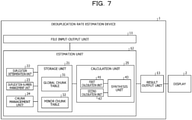
- FIG. 7 is a diagram illustrating a functional configuration of the duplication rate estimation device according to the embodiment.
- the duplication rate estimation device 1 according to the embodiment includes a file input-output unit 11, an estimation unit 12, and a result output unit 13.
- the file input-output unit 11 acquires data at the ratio x from estimation target data.
- the file input-output unit 11 acquires the data at the ratio x as a plurality of chunks.
- the file input-output unit 11 reads chunks from, for example, a file stored on a local disk.
- the file input-output unit 11 may read chunks via a network attached storage (NAS) interface such as network file system (NFS) or server message block (SMB).
- NAS network attached storage
- NFS network file system
- SMB server message block
- the estimation unit 12 calculates the deduplication rate of the estimation target data using a plurality of chunks read by the file input-output unit 11.
- the result output unit 13 displays the deduplication rate calculated by the estimation unit 12 on a display 2.
- the result output unit 13 may write the deduplication rate to a file.
- the estimation unit 12 includes a storage unit 21, a duplication determination unit 22, a duplication number management unit 23, a chunk management unit 24, and a calculation unit 25.
- the storage unit 21 stores information regarding chunks using a global chunk table 31 and a minor chunk table 32.
- the global chunk table 31 is a table used for managing the number of duplications of chunks.
- the minor chunk table 32 is a table used to manage the number of chunk types included in a group of minor chunks.
- FIGs. 8A and 8B are diagrams illustrating an example of respective records included in the global chunk table 31 and the minor chunk table 32.
- FIG. 8A illustrates records included in the global chunk table 31
- FIG. 8B illustrates records included in the minor chunk table 32.
- the records included in the global chunk table 31 include hash values and the number of duplications.
- the hash value is a value calculated from chunks using a hash function.
- the number of duplications is the number of duplications of chunks corresponding to the hash value.
- the hash value is the key.
- the records included in the minor chunk table 32 include the number of duplications and the number of types of hash values.
- the number of duplications is the number of duplications of chunks included in the minor chunk table 32.
- the number of types of hash values is the number of types of hash values (chunks) in which a duplicating number is the number of duplications.
- the duplication determination unit 22 calculates the hash value of a chunk read by the file input-output unit 11 and determines whether or not the calculated hash value is registered in the global chunk table 31, to thereby determine whether or not chunks are duplicated.
- the duplication number management unit 23 manages the number of duplications for every chunk using the global chunk table 31.
- the duplication number management unit 23 adds one to the number of duplications corresponding to the hash value.
- the duplication determination unit 22 determines that the calculated hash value is not registered in the global chunk table 31
- the hash value is registered in the global chunk table 31 and the corresponding number of duplications is set to one.
- the chunk management unit 24 divides the entire chunk into a group of minor chunks and a group of major chunks based on the number of duplications, and manages information of chunks.
- the chunk management unit 24 reads one record at a time from the global chunk table 31 to create and manage a minor chunk table 32. Furthermore, the chunk management unit 24 calculates the total number of chunks belonging to the major group and the number of types of chunks belonging to the major group.
- the calculation unit 25 calculates the deduplication rate of the estimation target data based on the information managed by the chunk management unit 24.
- the calculation unit 25 has a first calculation unit 41, a second calculation unit 42, and a synthesis unit 43.
- the first calculation unit 41 calculates the deduplication rate by solving the simultaneous equations of Equations (2-1) to (2-M) for the group of minor chunks.
- the first calculation unit 41 reads one record at a time from the minor chunk table 32 and creates simultaneous equations.
- the second calculation unit 42 calculates the ratio of the number of types of chunks in the group to the total number of chunks in the group as the deduplication rate for the group of major chunks.
- the synthesis unit 43 calculates a weighted average based on the deduplication rate calculated by the first calculation unit 41 and the number of chunks of the deduplication rate calculated by the second calculation unit 42, thereby calculating the deduplication rate of the estimation target data.
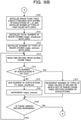
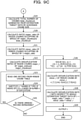
- FIGs. 9A to 9C are flowcharts illustrating a flow of processing by the duplication rate estimation device 1.
- the duplication rate estimation device 1 acquires the total amount A of estimation target data (step S1) and defines the ratio of scan amount x (step S2).
- the duplication rate estimation device 1 may accept a value input by the user using a keyboard or a mouse as x.
- the duplication rate estimation device 1 initializes the global chunk table 31 (step S3). For example, the duplication rate estimation device 1 puts the global chunk table 31 in a state having no records. Then, the duplication rate estimation device 1 randomly samples chunks (sample data) from the estimation target data (step S4).
- the duplication rate estimation device 1 hashes the chunks (step S5), and determines whether or not the hashed value is a hash value registered in the global chunk table 31 (step S6). Then, when the hashed value is a hash value registered in the global chunk table 31, the duplication rate estimation device 1 increments (increases by one) the number of duplications of records corresponding to the registered hash value (step S7). On the other hand, when the hashed value is not a hash value registered in the global chunk table 31, the duplication rate estimation device 1 newly creates a record including the hashed value in the global chunk table 31 (step S8). At that time, the duplication rate estimation device 1 sets the number of duplications of the created records to one.
- the duplication rate estimation device 1 determines whether or not the total size of the processed chunks is less than A ⁇ x (step S9) and, when it is less than A ⁇ x, returns to step S4. On the other hand, when the total size of the processed chunks is not less than A ⁇ x, the duplication rate estimation device 1 initializes the minor chunk table 32 as illustrated in FIG. 9B (step S10). Specifically, the duplication rate estimation device 1 creates N records with the number of duplications of 1..N, and initializes the number of types of hash values of each record with zero.
- the duplication rate estimation device 1 initializes the total number of major chunks major_chunknum with zero (step S11), and initializes the number of types of major chunks major_entnum with zero (step S12). Then, the duplication rate estimation device 1 reads one record from the global chunk table 31 (step S13), and determines whether or not the number of duplications is N or less (step S14).
- the duplication rate estimation device 1 adds the number of duplications to the major_chunknum (step S15) and increments the major_entnum (step S16).
- the duplication rate estimation device 1 increments the number of types of hash values of the record in which the key of the minor chunk table 32 matches the number of duplications (step S17).
- the duplication rate estimation device 1 determines whether or not there is any unread record remaining in the global chunk table 31 (step S18) and, when there is an unread record remaining, returns to step S13. On the other hand, when there is no unread record remaining, the duplication rate estimation device 1 calculates the total number of chunks total_chunknum generated from the estimation target data by A/average chunk size as illustrated in FIG. 9C (step S19).
- the duplication rate estimation device 1 calculates a ratio major_ratio of the major chunks occupying in the whole by major_chunknum/total_chunknum (step S20), and calculates a ratio minor_ratio of the minor chunks occupying in the whole by 1-major_ratio (step S21). Then, the duplication rate estimation device 1 calculates the deduplication rate major_r of major chunks by major_entnum/major_chunknum (step S22).
- the duplication rate estimation device 1 reads one record from the minor chunk table 32 (step S23), and substitutes n * number of types of hashes into E(n, x) based on the number n of duplications of the read record (step S24).
- "*" indicates multiplication.
- the duplication rate estimation device 1 determines whether or not there is any unread record remaining in the minor chunk table 32 (step S25) and, when there is an unread record remaining, returns to step S23.
- the duplication rate estimation device 1 calculates the deduplication rate by dividing it into a group of major chunks and a group of minor chunks, and thus the calculation cost may be suppressed.
- the file input-output unit 11 acquires data at the ratio x from the estimation target data as a plurality of chunks. Then, the duplication determination unit 22 calculates a hash value of the chunks read by the file input-output unit 11 and determines whether or not the calculated hash value is duplicated. Then, the duplication number management unit 23 manages the number of duplications for every chunk based on a determination result of the duplication determination unit 22. Then, the chunk management unit 24 divides the entire chunk into a group of minor chunks and a group of major chunks based on the number of duplications.
- the first calculation unit 41 calculates the deduplication rate for the group of minor chunks
- the second calculation unit 42 calculates the deduplication rate for the group of major chunks.
- the synthesis unit 43 calculates the deduplication rate of the estimation target data based on the deduplication rate calculated by the first calculation unit 41 and the deduplication rate calculated by the second calculation unit 42. Therefore, the duplication rate estimation device 1 may accurately estimate the deduplication rate in a short time.
- the first calculation unit 41 estimates D(1) to D(N) for a group of minor chunks, and calculates the deduplication rate based on the estimated D(1) to D(N), and thus the deduplication rate of the group of minor chunks may be estimated with high accuracy.
- the first calculation unit 41 estimates D(1) to D(N) using the expected value E(n, x) of the amount of data detected n multiple times by partial scanning of the ratio x, and thus D(1) to D(N) may be estimated with high accuracy.
- the first calculation unit 41 solves the simultaneous equations of Equations (2-1) to (2-M) for the group of minor chunks to calculate the deduplication rate, and thus the deduplication rate of the group of minor chunks may be estimated with high accuracy.
- the second calculation unit 42 calculates the deduplication rate for the group of major chunks based on the number of types of chunks in the group and the total number of chunks in the group, and thus the deduplication rate of the group of major chunks may be estimated.
- duplication rate estimation device 1 has been described in the embodiment, a duplication rate estimation program having a similar function may be obtained by implementing a configuration of the duplication rate estimation device 1 by software. Accordingly, a computer that executes a duplication rate estimation program will be described.
- FIG. 10 is a diagram illustrating a hardware configuration of a computer that executes a duplication rate estimation program according to the embodiment.
- the computer 50 includes a main memory 51, a central processing unit (CPU) 52 that is an example of a processor, a local area network (LAN) interface 53, and a hard disk drive (HDD) 54.
- a computer 50 includes a super input output (10) 55, a digital visual interface (DVI) 56, and an optical disk drive (ODD) 57.
- DVI digital visual interface
- ODD optical disk drive
- the main memory 51 is a memory that stores a program, a halfway result of execution of the program, and the like.
- the CPU 52 is a central processing unit that reads and executes the program from the main memory 51.
- the CPU 52 includes a chipset having a memory controller.
- the LAN interface 53 is an interface for connecting the computer 50 to another computer via a LAN.
- the HDD 54 is a disk device that stores programs and data
- the super IO 55 is an interface for connecting an input device such as a mouse and a keyboard.
- the DVI 56 is an interface for connecting a liquid crystal display device
- the ODD 57 is a device for reading and writing data to and from a digital versatile disc (DVD) or compact disc recordable (CD-R).
- the LAN interface 53 is connected to the CPU 52 by PCI express (PCIe), and the HDD 54 and the ODD 57 are connected to the CPU 52 by serial advanced technology attachment (SATA).
- the super IO 55 is connected to the CPU 52 by low pin count (LPC).
- the duplication rate estimation program executed by the computer 50 is stored in a CD-R that is an example of a recording medium that can be read by the computer 50, is read from the CD-R by the ODD 57, and is installed to the computer 50.
- the duplication rate estimation program is stored in a database or the like of another computer system connected via the LAN interface 53, is read from these databases, and is installed to the computer 50.
- the installed duplication rate estimation program is stored in the HDD 54, is read to the main memory 51, and is executed by the CPU 52.
Landscapes
- Engineering & Computer Science (AREA)
- Theoretical Computer Science (AREA)
- Human Computer Interaction (AREA)
- Physics & Mathematics (AREA)
- General Engineering & Computer Science (AREA)
- General Physics & Mathematics (AREA)
- Information Retrieval, Db Structures And Fs Structures Therefor (AREA)
Abstract
Description
- The embodiment discussed herein is related to an information processing device and a duplication rate estimation program.
- When paid storage such as cloud storage is used, usage cost is determined based on the size of data. Therefore, the usage cost depends on a data deduplication rate by deduplication. If the deduplication rate is large, the size of data can be reduced by deduplication, and the usage cost can be reduced. For example, in a case of 1 peta byte (PB) data, if the reduction rate is different by 10%, 100 tera bytes (TB) of storage becomes unnecessary. Therefore, when using paid storage, it is important to estimate the deduplication rate.
- Note that as a conventional technology, there is an information processing device that calculates a deduplication rate when a plurality of pools is integrated so that the user can estimate in advance the size of a physical area required after integration. This information processing device has a duplication number calculation unit and a deduplication rate calculation unit. The duplication number calculation unit calculates the number of duplications of unit data of two pools and the total number of reference counts of the two pools. The deduplication rate calculation unit calculates the deduplication rate using the number of duplications and the total number of reference counts.
- Furthermore, as a conventional technology, there is a storage system that achieves both reduction of data reduction effect and improvement of deduplication performance. This storage system divides data into a plurality of pieces of chunk data in the deduplication process, follows a sampling cycle that means selection of one chunk data for every N pieces of chunk data on average, and selects one or more of the plurality of pieces of chunk data. Then, this storage system calculates a fingerprint such as a hash value for each of one or more pieces of feature chunk data which is the selected one or more pieces of chunk data, and determines whether or not the data including the feature chunk data is duplicated. Furthermore, the storage system changes the sampling cycle based on a result of past deduplication processes.
- [PTL 1]
Japanese Laid-open Patent Publication No. 2019-16293 -
- It is conceivable to actually perform deduplication in order to estimate the deduplication rate. However, there is a problem that it takes time to actually perform deduplication. For example, when deduplicating 1 PB data, if the data is read at 100 mega bytes (MB)/sec, it is estimated that it takes 1015/108 seconds = 107 seconds = 107/(60 × 60 × 24) days = 105/(36 × 24) days, for example, 100 days or more just for reading the data.
- One aspect of the embodiment is to estimate the deduplication rate accurately in a short time.
- According to an aspect of the embodiments, an information processing device includes: a management unit configured to extract part of data from estimation target data as a plurality of pieces of sample data and manage a number of duplications of the extracted plurality of pieces of sample data; a classification unit configured to classify the plurality of pieces of sample data into a first group and a second group based on the number of duplications, the first group having a number of duplications equal to or less that a predetermined number, the second group having a number of duplications more than a predetermined number; a first calculation unit configured to calculate a first deduplication rate for sample data classified into the first group; a second calculation unit configured to calculate a second deduplication rate for sample data classified into the second group; and a synthesis unit configured to calculate a deduplication rate of the estimation target data based on the first deduplication rate and the second deduplication rate.
- In one aspect, the embodiment may accurately estimate the deduplication rate in a short time.
-
-
FIGs. 1A and 1B are first diagrams for explaining estimation of a deduplication rate based on an m multiplex model; -
FIG. 2 is a second diagram for explaining the estimation of the deduplication rate based on the m multiplex model; -
FIG. 3 is a diagram for explaining a U & Z model; -
FIG. 4 is a diagram illustrating an example of a complicated model; -
FIG. 5 is a diagram illustrating expected values E(n, x) for n = 1, 2,..., M; -
FIG. 6 is a diagram for explaining a method of estimating the deduplication rate by a duplication rate estimation device according to the embodiment; -
FIG. 7 is a diagram illustrating a functional configuration of the duplication rate estimation device according to the embodiment; -
FIGs. 8A and 8B are diagrams illustrating an example of respective records included in a global chunk table and a minor chunk table; -
FIG. 9A is a first flowchart illustrating a flow of processing by the duplication rate estimation device; -
FIG. 9B is a second flowchart illustrating a flow of processing by the duplication rate estimation device; -
FIG. 9C is a third flowchart illustrating a flow of processing by the duplication rate estimation device; and -
FIG. 10 is a diagram illustrating a hardware configuration of a computer that executes a duplication rate estimation program according to the embodiment. - Hereinafter, an embodiment of an information processing device and a duplication rate estimation program disclosed by the present application will be described in detail based on the drawings. Note that the present embodiment does not limit the technology disclosed.
- First, accuracy when a deduplication rate is estimated based on a simple model will be described with reference to
FIGs. 1A to 3 .FIGs. 1A ,1B , and2 are diagrams for explaining estimation of the deduplication rate based on the m multiplex model. Here, the m multiplex model is a model in which m pieces of the same data A are included in the original data before deduplication, as illustrated inFIG. 1A . In the m multiplex model, m pieces of data becomes one piece of data due to deduplication. The deduplication rate is r = 1/m. - It is assumed that x is the ratio of scanned data to original data. Here, scanning is reading data from the original data in order to estimate the deduplication rate. Scans are done in chunk units. The size of a chunk is variable. x is, for example, 0.01. Looking at each chunk, the probability of being scanned is x.
- As illustrated in
FIG. 1B , each chunk is one of not scanned and thus not detected as duplicate, scanned but the same data is not scanned and thus not detected as duplicate, or the same data is scanned and thus detected as duplicate. - The probability that chunks will not be scanned and will not be detected as duplicate is (1 - x)^m because the probability of not being scanned is 1 - x. "^" represents exponentiation. The probability that chunks will be scanned and the same data will not be detected as duplicate is m·x·(1 - x)^(m - 1). "·" represents multiplication. The probability that chunks will be scanned and the same data will be duplicated as duplicate is 1 - (1 - x)^m - m·x·(1 - x)^(m - 1) by subtracting the above-described two probabilities from 1.
- When it is assumed that D is the rate of duplicate detection in the actual scan, as followings Equation (1).

- In Equation (1), when the measured value is substituted for D and a fixed value such as 0.01 is substituted for x, Equation (1) is an equation for m, and m may be calculated by solving this equation.
- Since the left side of Equation (1) is a monotonic function for m, m may be calculated by performing an approximate search using m as a parameter without solving the equation of Equation (1). Furthermore, since r = 1/m, r may be calculated from m.
FIG. 2 is a graph illustrating the relationship between D and r when x = 0.01. FromFIG. 2 , when D = 0.0001, a deduplication rate r is 0.5. -
FIG. 3 is a diagram for explaining a U & Z model. As illustrated inFIG. 3 , the U & Z model is a model such that a unique ratio among original data is u (0 ≤ u ≤ 1), and data of the remaining ratio (1 - u) are exactly the same (for example, all 0). InFIG. 3 , U is a set of unique data and Z is a set of the same data. When the model of the original data is the U & Z model, the same data is deduplicated and the deduplication rate r = u. Furthermore, probability that picked up data is included in Z = probability D to be detected as duplicate = 1 - u. Therefore, the deduplication rate r = 1 - D, and when D = 0.0001, the deduplication rate r = 0.9999. - Thus, if the model of original data is different, the predicted value of the deduplication rate will be largely different. For example, if the model of the original data is a simple model and the deduplication rate is predicted by partial scanning, accuracy of a predicted value is poor. Accordingly, it is conceivable to complicate the model of the original data to improve the accuracy of the predicted value.
-
FIG. 4 illustrates an example of a complicated model. As illustrated inFIG. 4 , assuming that the amount of unique data is D(1), the amount of two-multiplexed data is D(2),..., and the amount of most multiplexed data is D(M), the amount of data of the original data is ΣD(m) (m = 1..M). Here, "1..M" represents "from 1 to M". The amount of data after deduplication from the original data is Σ(1/m)D(m) (m = 1..M). Therefore, a deduplication rate r may be predicted by predicting the amount of data D(m) (m = 1..M) for every degree of duplication while performing partial scanning. r = {Σ(1/m)D(m)}/{ΣD(m)}. Note that in this equation of r, (m = 1..M) is omitted. - The amount of data D(m) (m = 1..M) is predicted as follows. The probability that data with a degree of duplication m is detected as duplicate in n multiple times by partial scanning at a ratio of x is C(m, n), x^n, (1 - x)^(m - n). Here, C(m, n) is m!/{(m - n)!n!}.
- Therefore, the expected value E(n, x) of the amount of data detected n multiple times by partial scanning at a ratio x is E(n, x) = Σ_{m = n..M}D(m)C(m, n)·x^n·(1 - x)^(m - n). Here, Σ_{m = n..M} represents the sum of m changed from n to N.
FIG. 5 is a diagram illustrating the expected value E(n, x) for n = 1, 2,..., M. As illustrated inFIG. 5 , Equations (2-1) to (2-M) are simultaneous linear equations for the variables D(m) (m = 1..M), and by solving these simultaneous equations, the deduplication rate r may be calculated. - In Equations (2-1) to (2-M), normal curve approximation is performed for C(m, n), and when exponentiation of x or (1 - x) is calculated after taking the logarithm, each term may be calculated by three exp calculations and about 10 arithmetic operations regardless of m and n. Furthermore, since the coefficient matrix is a triangular matrix, this simultaneous equation may be solved relatively easily.
- However, for example, in the case of deduplication in which the total data of 1 PB is divided by a chunk length of 32 kilo bytes (KB) on average, the maximum value of M is 1 PB/32 KB = 32 G. Therefore, in order to solve the simultaneous equations of Equations (2-1) to (2-M), it is necessary to calculate the inverse matrix of a huge size of 32 G × 32 G, which cannot be calculated by a general server.
- In this manner, if the model of original data is complicated, the deduplication rate r may be calculated with high accuracy, but the calculation cost increases. Accordingly, a duplication rate estimation device according to the embodiment classifies the chunks detected by the scan into "chunks that are duplicated many times" and "chunks that are duplicated only a few times", and uses a different estimation method for each group.
- It is part of data that are duplicated many times that makes it difficult to estimate the deduplication rate using the simultaneous equations of Equations (2-1) to (2-M). Those that are duplicated only a few times have a relatively small proportion that contributes to an error in the overall expected value calculation. The larger the m, the larger the coefficient, and the more m is involved in many n. Accordingly, the duplication rate estimation device according to the embodiment scans at the ratio x of all data, counts the number of duplications of each chunk, and divides the entire scanned chunk into a group having a duplication count of N or less and a group having a duplication count of N + 1 or more.
-
FIG. 6 is a diagram for explaining a method of estimating the deduplication rate by the duplication rate estimation device according to the embodiment. InFIG. 6 , N = 3 as an example. As illustrated inFIG. 6 , the duplication rate estimation device according to the embodiment divides the entire scanned chunk into a group of major chunks having a duplication count of four or more and a group of minor chunks having a duplication count of three or less. - Then, the duplication rate estimation device according to the embodiment estimates the deduplication rate by solving the simultaneous equations of Equations (2-1) to (2-M) for the group of minor chunks, and estimates the deduplication rate using other methods for the group of major chunks. In the duplication rate estimation device according to the embodiment, for a group of major chunks, for example, the ratio of the number of types of chunks in the group to the total number of chunks in the group is set as the deduplication rate. Then, the duplication rate estimation device according to the embodiment estimates the overall deduplication rate by adding up estimation results of the two groups.
- In this manner, the duplication rate estimation device according to the embodiment solves the simultaneous equations of Equations (2-1) to (2-M) to estimate the deduplication rate only for the group of minor chunks, and thus M may be reduced and the calculation cost may be reduced.
- Next, a functional configuration of the duplication rate estimation device according to the embodiment will be described.
FIG. 7 is a diagram illustrating a functional configuration of the duplication rate estimation device according to the embodiment. As illustrated inFIG. 7 , the duplicationrate estimation device 1 according to the embodiment includes a file input-output unit 11, an estimation unit 12, and aresult output unit 13. - The file input-output unit 11 acquires data at the ratio x from estimation target data. The file input-output unit 11 acquires the data at the ratio x as a plurality of chunks. The file input-output unit 11 reads chunks from, for example, a file stored on a local disk. The file input-output unit 11 may read chunks via a network attached storage (NAS) interface such as network file system (NFS) or server message block (SMB).
- The estimation unit 12 calculates the deduplication rate of the estimation target data using a plurality of chunks read by the file input-output unit 11.
- The
result output unit 13 displays the deduplication rate calculated by the estimation unit 12 on adisplay 2. Theresult output unit 13 may write the deduplication rate to a file. - The estimation unit 12 includes a
storage unit 21, aduplication determination unit 22, a duplicationnumber management unit 23, achunk management unit 24, and acalculation unit 25. - The
storage unit 21 stores information regarding chunks using a global chunk table 31 and a minor chunk table 32. The global chunk table 31 is a table used for managing the number of duplications of chunks. The minor chunk table 32 is a table used to manage the number of chunk types included in a group of minor chunks. -
FIGs. 8A and 8B are diagrams illustrating an example of respective records included in the global chunk table 31 and the minor chunk table 32.FIG. 8A illustrates records included in the global chunk table 31, andFIG. 8B illustrates records included in the minor chunk table 32. - As illustrated in
FIG. 8A , the records included in the global chunk table 31 include hash values and the number of duplications. The hash value is a value calculated from chunks using a hash function. The number of duplications is the number of duplications of chunks corresponding to the hash value. In the global chunk table 31, the hash value is the key. - As illustrated in
FIG. 8B , the records included in the minor chunk table 32 include the number of duplications and the number of types of hash values. The number of duplications is the number of duplications of chunks included in the minor chunk table 32. The number of types of hash values is the number of types of hash values (chunks) in which a duplicating number is the number of duplications. - Returning to
FIG. 7 , theduplication determination unit 22 calculates the hash value of a chunk read by the file input-output unit 11 and determines whether or not the calculated hash value is registered in the global chunk table 31, to thereby determine whether or not chunks are duplicated. - The duplication
number management unit 23 manages the number of duplications for every chunk using the global chunk table 31. When theduplication determination unit 22 determines that the calculated hash value is registered in the global chunk table 31, the duplicationnumber management unit 23 adds one to the number of duplications corresponding to the hash value. On the other hand, when theduplication determination unit 22 determines that the calculated hash value is not registered in the global chunk table 31, the hash value is registered in the global chunk table 31 and the corresponding number of duplications is set to one. - The
chunk management unit 24 divides the entire chunk into a group of minor chunks and a group of major chunks based on the number of duplications, and manages information of chunks. Thechunk management unit 24 reads one record at a time from the global chunk table 31 to create and manage a minor chunk table 32. Furthermore, thechunk management unit 24 calculates the total number of chunks belonging to the major group and the number of types of chunks belonging to the major group. - The
calculation unit 25 calculates the deduplication rate of the estimation target data based on the information managed by thechunk management unit 24. Thecalculation unit 25 has a first calculation unit 41, a second calculation unit 42, and asynthesis unit 43. - The first calculation unit 41 estimates the deduplication rate r by estimating the amount of data D(m) (m = 1..N) for every degree of duplication for a group of minor chunks. The first calculation unit 41 uses the expected value E(n, x) of the amount of data detected n multiple times in partial scanning at the ratio x for the group of minor chunks to estimate the amount of data D(m) (m = 1..N).
- For example, the first calculation unit 41 calculates the deduplication rate by solving the simultaneous equations of Equations (2-1) to (2-M) for the group of minor chunks. The first calculation unit 41 reads one record at a time from the minor chunk table 32 and creates simultaneous equations.
- The second calculation unit 42 calculates the ratio of the number of types of chunks in the group to the total number of chunks in the group as the deduplication rate for the group of major chunks.
- The
synthesis unit 43 calculates a weighted average based on the deduplication rate calculated by the first calculation unit 41 and the number of chunks of the deduplication rate calculated by the second calculation unit 42, thereby calculating the deduplication rate of the estimation target data. - Next, a flow of processing by the duplication
rate estimation device 1 will be described with reference toFIGs. 9A to 9C. FIGs. 9A to 9C are flowcharts illustrating a flow of processing by the duplicationrate estimation device 1. As illustrated inFIG. 9A , the duplicationrate estimation device 1 acquires the total amount A of estimation target data (step S1) and defines the ratio of scan amount x (step S2). Note that the duplicationrate estimation device 1 may accept a value input by the user using a keyboard or a mouse as x. - Then, the duplication
rate estimation device 1 initializes the global chunk table 31 (step S3). For example, the duplicationrate estimation device 1 puts the global chunk table 31 in a state having no records. Then, the duplicationrate estimation device 1 randomly samples chunks (sample data) from the estimation target data (step S4). - Then, the duplication
rate estimation device 1 hashes the chunks (step S5), and determines whether or not the hashed value is a hash value registered in the global chunk table 31 (step S6). Then, when the hashed value is a hash value registered in the global chunk table 31, the duplicationrate estimation device 1 increments (increases by one) the number of duplications of records corresponding to the registered hash value (step S7). On the other hand, when the hashed value is not a hash value registered in the global chunk table 31, the duplicationrate estimation device 1 newly creates a record including the hashed value in the global chunk table 31 (step S8). At that time, the duplicationrate estimation device 1 sets the number of duplications of the created records to one. - Then, the duplication
rate estimation device 1 determines whether or not the total size of the processed chunks is less than A·x (step S9) and, when it is less than A·x, returns to step S4. On the other hand, when the total size of the processed chunks is not less than A·x, the duplicationrate estimation device 1 initializes the minor chunk table 32 as illustrated inFIG. 9B (step S10). Specifically, the duplicationrate estimation device 1 creates N records with the number of duplications of 1..N, and initializes the number of types of hash values of each record with zero. - Then, the duplication
rate estimation device 1 initializes the total number of major chunks major_chunknum with zero (step S11), and initializes the number of types of major chunks major_entnum with zero (step S12). Then, the duplicationrate estimation device 1 reads one record from the global chunk table 31 (step S13), and determines whether or not the number of duplications is N or less (step S14). - Then, when the number of duplications is not N or less, the duplication
rate estimation device 1 adds the number of duplications to the major_chunknum (step S15) and increments the major_entnum (step S16). On the other hand, when the number of duplications are N or less, the duplicationrate estimation device 1 increments the number of types of hash values of the record in which the key of the minor chunk table 32 matches the number of duplications (step S17). - Then, the duplication
rate estimation device 1 determines whether or not there is any unread record remaining in the global chunk table 31 (step S18) and, when there is an unread record remaining, returns to step S13. On the other hand, when there is no unread record remaining, the duplicationrate estimation device 1 calculates the total number of chunks total_chunknum generated from the estimation target data by A/average chunk size as illustrated inFIG. 9C (step S19). - Then, the duplication
rate estimation device 1 calculates a ratio major_ratio of the major chunks occupying in the whole by major_chunknum/total_chunknum (step S20), and calculates a ratio minor_ratio of the minor chunks occupying in the whole by 1-major_ratio (step S21). Then, the duplicationrate estimation device 1 calculates the deduplication rate major_r of major chunks by major_entnum/major_chunknum (step S22). - Then, the duplication
rate estimation device 1 reads one record from the minor chunk table 32 (step S23), and substitutes n * number of types of hashes into E(n, x) based on the number n of duplications of the read record (step S24). Here, "*" indicates multiplication. Then, the duplicationrate estimation device 1 determines whether or not there is any unread record remaining in the minor chunk table 32 (step S25) and, when there is an unread record remaining, returns to step S23. - On the other hand, when there is no unread record remaining in the minor chunk table 32, the duplication
rate estimation device 1 solves E(n, x) = Σ_{m = n..M}D(m)C(m, n)·x^n·(1 - x)^(m - n) for D(m) (step S26). Then, the duplicationrate estimation device 1 calculates the deduplication rate minor_r of the minor chunks by minor_r = {Σ(1/m)·D(m)}/{ΣD(m)} (step S27). - Then, the duplication
rate estimation device 1 calculates the deduplication rate r with respect to the whole estimation target data by r = major_ratio * major_r + minor_ratio * minor_r (step S28). Then, the duplicationrate estimation device 1 outputs r (step S29). - In this manner, the duplication
rate estimation device 1 calculates the deduplication rate by dividing it into a group of major chunks and a group of minor chunks, and thus the calculation cost may be suppressed. - As described above, in the embodiment, the file input-output unit 11 acquires data at the ratio x from the estimation target data as a plurality of chunks. Then, the
duplication determination unit 22 calculates a hash value of the chunks read by the file input-output unit 11 and determines whether or not the calculated hash value is duplicated. Then, the duplicationnumber management unit 23 manages the number of duplications for every chunk based on a determination result of theduplication determination unit 22. Then, thechunk management unit 24 divides the entire chunk into a group of minor chunks and a group of major chunks based on the number of duplications. Then, the first calculation unit 41 calculates the deduplication rate for the group of minor chunks, and the second calculation unit 42 calculates the deduplication rate for the group of major chunks. Then, thesynthesis unit 43 calculates the deduplication rate of the estimation target data based on the deduplication rate calculated by the first calculation unit 41 and the deduplication rate calculated by the second calculation unit 42. Therefore, the duplicationrate estimation device 1 may accurately estimate the deduplication rate in a short time. - Furthermore, in the embodiment, the first calculation unit 41 estimates D(1) to D(N) for a group of minor chunks, and calculates the deduplication rate based on the estimated D(1) to D(N), and thus the deduplication rate of the group of minor chunks may be estimated with high accuracy.
- Furthermore, in the embodiment, the first calculation unit 41 estimates D(1) to D(N) using the expected value E(n, x) of the amount of data detected n multiple times by partial scanning of the ratio x, and thus D(1) to D(N) may be estimated with high accuracy.
- For example, in the embodiment, the first calculation unit 41 solves the simultaneous equations of Equations (2-1) to (2-M) for the group of minor chunks to calculate the deduplication rate, and thus the deduplication rate of the group of minor chunks may be estimated with high accuracy.
- Furthermore, in the embodiment, the second calculation unit 42 calculates the deduplication rate for the group of major chunks based on the number of types of chunks in the group and the total number of chunks in the group, and thus the deduplication rate of the group of major chunks may be estimated.
- Note that although the duplication
rate estimation device 1 has been described in the embodiment, a duplication rate estimation program having a similar function may be obtained by implementing a configuration of the duplicationrate estimation device 1 by software. Accordingly, a computer that executes a duplication rate estimation program will be described. -
FIG. 10 is a diagram illustrating a hardware configuration of a computer that executes a duplication rate estimation program according to the embodiment. As illustrated inFIG. 10 , thecomputer 50 includes amain memory 51, a central processing unit (CPU) 52 that is an example of a processor, a local area network (LAN)interface 53, and a hard disk drive (HDD) 54. Furthermore, acomputer 50 includes a super input output (10) 55, a digital visual interface (DVI) 56, and an optical disk drive (ODD) 57. - The
main memory 51 is a memory that stores a program, a halfway result of execution of the program, and the like. TheCPU 52 is a central processing unit that reads and executes the program from themain memory 51. TheCPU 52 includes a chipset having a memory controller. - The
LAN interface 53 is an interface for connecting thecomputer 50 to another computer via a LAN. TheHDD 54 is a disk device that stores programs and data, and thesuper IO 55 is an interface for connecting an input device such as a mouse and a keyboard. TheDVI 56 is an interface for connecting a liquid crystal display device, and theODD 57 is a device for reading and writing data to and from a digital versatile disc (DVD) or compact disc recordable (CD-R). - The
LAN interface 53 is connected to theCPU 52 by PCI express (PCIe), and theHDD 54 and theODD 57 are connected to theCPU 52 by serial advanced technology attachment (SATA). Thesuper IO 55 is connected to theCPU 52 by low pin count (LPC). - Then, the duplication rate estimation program executed by the
computer 50 is stored in a CD-R that is an example of a recording medium that can be read by thecomputer 50, is read from the CD-R by theODD 57, and is installed to thecomputer 50. Alternatively, the duplication rate estimation program is stored in a database or the like of another computer system connected via theLAN interface 53, is read from these databases, and is installed to thecomputer 50. Then, the installed duplication rate estimation program is stored in theHDD 54, is read to themain memory 51, and is executed by theCPU 52.
Claims (9)
- An information processing device comprising:a management unit configured to extract part of data from estimation target data as a plurality of pieces of sample data and manage a number of duplications of the extracted plurality of pieces of sample data;a classification unit configured to classify the plurality of pieces of sample data into a first group and a second group based on the number of duplications, the first group having a number of duplications equal to or less that a predetermined number, the second group having a number of duplications more than a predetermined number;a first calculation unit configured to calculate a first deduplication rate for sample data classified into the first group;a second calculation unit configured to calculate a second deduplication rate for sample data classified into the second group; anda synthesis unit configured to calculate a deduplication rate of the estimation target data based on the first deduplication rate and the second deduplication rate.
- The information processing device according to claim 1, wherein the first calculation unit estimates an amount of data for each degree of duplication from one to the predetermined number using the sample data classified into the first group, and calculates the first deduplication rate based on the estimated amount of data for each degree of duplication.
- The information processing device according to claim 2, wherein the first calculation unit estimates the amount of data for each degree of duplication from one to the predetermined number based on an expected value of the amount of data for every degree of duplication of the plurality of pieces of sample data.
- The information processing device according to claim 3, wherein the first calculation unit creates simultaneous equations with the amount of data for each degree of duplication as a variable for the expected value, and solves the created simultaneous equations to estimate the amount of data for each degree of duplication from one to the predetermined number.
- The information processing device according to any one of claims 1 to 4, wherein the second calculation unit calculates the second deduplication rate based on a total number and types of the sample data classified into the second group.
- A duplication rate estimation program in which a computer performs processing of:extracting part of data from estimation target data as a plurality of pieces of sample data;managing a number of duplications of the extracted plurality of pieces of sample data;classifying the plurality of pieces of sample data into a first group and a second group based on the number of duplications, the first group having a number of duplications equal to or less that a predetermined number, the second group having a number of duplications more than a predetermined number;calculating a first deduplication rate for sample data classified into the first group;calculating a second deduplication rate for sample data classified into the second group; andcalculating a deduplication rate of the estimation target data based on the first deduplication rate and the second deduplication rate.
- The duplication rate estimation program according to claim 6, wherein the process further includes estimating an amount of data for each degree of duplication from one to the predetermined number using the sample data classified into the first group, wherein
the calculating the first deduplication rate includes calculating the first deduplication rate based on the estimated amount of data for each degree of duplication. - The duplication rate estimation program according to claim 7, wherein the estimating includes estimating the amount of data for each degree of duplication from one to the predetermined number based on an expected value of the amount of data for every degree of duplication of the plurality of pieces of sample data.
- The duplication rate estimation program according to claim 8, wherein the process further includes
creating simultaneous equations with the amount of data for each degree of duplication as a variable for the expected value, wherein
the estimating includes estimating the amount of data for each degree of duplication from one to the predetermined number by solving the created simultaneous equations.
Applications Claiming Priority (1)
| Application Number | Priority Date | Filing Date | Title |
|---|---|---|---|
| JP2020134377A JP7476715B2 (en) | 2020-08-07 | 2020-08-07 | Information processing device and duplication rate estimation program |
Publications (2)
| Publication Number | Publication Date |
|---|---|
| EP3951583A1 true EP3951583A1 (en) | 2022-02-09 |
| EP3951583B1 EP3951583B1 (en) | 2025-10-15 |
Family
ID=76744602
Family Applications (1)
| Application Number | Title | Priority Date | Filing Date |
|---|---|---|---|
| EP21182374.5A Active EP3951583B1 (en) | 2020-08-07 | 2021-06-29 | Information processing device and duplication rate estimation program |
Country Status (3)
| Country | Link |
|---|---|
| US (1) | US12299305B2 (en) |
| EP (1) | EP3951583B1 (en) |
| JP (1) | JP7476715B2 (en) |
Families Citing this family (2)
| Publication number | Priority date | Publication date | Assignee | Title |
|---|---|---|---|---|
| US11921644B2 (en) * | 2022-05-20 | 2024-03-05 | Western Digital Technologies, Inc. | Optimizing huge page management |
| CN117891408A (en) * | 2024-01-26 | 2024-04-16 | 三星(中国)半导体有限公司 | Method for deduplicating data of storage device and storage device |
Citations (4)
| Publication number | Priority date | Publication date | Assignee | Title |
|---|---|---|---|---|
| WO2016181479A1 (en) | 2015-05-12 | 2016-11-17 | 株式会社日立製作所 | Storage system and storage control method |
| US20170199895A1 (en) * | 2016-01-13 | 2017-07-13 | International Business Machines Corporation | Sampling-based deduplication estimation |
| US10162867B2 (en) * | 2016-01-13 | 2018-12-25 | International Business Machines Corporation | Low memory sampling-based estimation of distinct elements and deduplication |
| JP2019016293A (en) | 2017-07-10 | 2019-01-31 | 富士通株式会社 | Information processing apparatus, deduplication rate specifying method, and deduplication rate specifying program |
Family Cites Families (12)
| Publication number | Priority date | Publication date | Assignee | Title |
|---|---|---|---|---|
| US8140491B2 (en) * | 2009-03-26 | 2012-03-20 | International Business Machines Corporation | Storage management through adaptive deduplication |
| JP5303038B2 (en) * | 2009-09-18 | 2013-10-02 | 株式会社日立製作所 | Storage system that eliminates duplicate data |
| US9542413B2 (en) * | 2011-10-06 | 2017-01-10 | Hitachi, Ltd. | Stored data deduplication method, stored data deduplication apparatus, and deduplication program |
| JP5923999B2 (en) | 2012-01-30 | 2016-05-25 | 富士通株式会社 | Storage management method and storage management apparatus |
| US8578112B2 (en) * | 2012-02-23 | 2013-11-05 | Hitachi, Ltd. | Data management system and data management method |
| US9424285B1 (en) * | 2012-12-12 | 2016-08-23 | Netapp, Inc. | Content-based sampling for deduplication estimation |
| CA2898667C (en) * | 2013-08-19 | 2019-01-15 | Huawei Technologies Co., Ltd. | Data object processing method and apparatus |
| US9658774B2 (en) | 2014-07-09 | 2017-05-23 | Hitachi, Ltd. | Storage system and storage control method |
| US20160034201A1 (en) * | 2014-08-04 | 2016-02-04 | International Business Machines Corporation | Managing de-duplication using estimated benefits |
| US10572171B2 (en) | 2016-02-29 | 2020-02-25 | Hitachi, Ltd. | Storage system |
| US10747726B2 (en) * | 2016-03-08 | 2020-08-18 | International Business Machines Corporation | Deduplication ratio estimation using an expandable basis set |
| US10108544B1 (en) * | 2016-09-26 | 2018-10-23 | EMC IP Holding Company LLC | Dynamic duplication estimation for garbage collection |
-
2020
- 2020-08-07 JP JP2020134377A patent/JP7476715B2/en active Active
-
2021
- 2021-06-29 EP EP21182374.5A patent/EP3951583B1/en active Active
- 2021-07-08 US US17/370,003 patent/US12299305B2/en active Active
Patent Citations (4)
| Publication number | Priority date | Publication date | Assignee | Title |
|---|---|---|---|---|
| WO2016181479A1 (en) | 2015-05-12 | 2016-11-17 | 株式会社日立製作所 | Storage system and storage control method |
| US20170199895A1 (en) * | 2016-01-13 | 2017-07-13 | International Business Machines Corporation | Sampling-based deduplication estimation |
| US10162867B2 (en) * | 2016-01-13 | 2018-12-25 | International Business Machines Corporation | Low memory sampling-based estimation of distinct elements and deduplication |
| JP2019016293A (en) | 2017-07-10 | 2019-01-31 | 富士通株式会社 | Information processing apparatus, deduplication rate specifying method, and deduplication rate specifying program |
Non-Patent Citations (1)
| Title |
|---|
| ANONYMOUS: "Frequency Distributions and Histograms", 17 January 2019 (2019-01-17), pages 1 - 2, XP055867534, Retrieved from the Internet <URL:https://web.archive.org/web/20190117131819/http://mathcenter.oxford.emory.edu/site/math117/frequencyDistributionsAndHistograms/> [retrieved on 20211130] * |
Also Published As
| Publication number | Publication date |
|---|---|
| US12299305B2 (en) | 2025-05-13 |
| JP2022030385A (en) | 2022-02-18 |
| US20220043592A1 (en) | 2022-02-10 |
| JP7476715B2 (en) | 2024-05-01 |
| EP3951583B1 (en) | 2025-10-15 |
Similar Documents
| Publication | Publication Date | Title |
|---|---|---|
| US10592667B1 (en) | Methods and apparatus for detecting malware samples with similar image sets | |
| He et al. | Benchmarking deep learning models and automated model design for COVID-19 detection with chest CT scans | |
| US10789225B2 (en) | Column weight calculation for data deduplication | |
| US10423624B2 (en) | Event log analysis | |
| US10198455B2 (en) | Sampling-based deduplication estimation | |
| CN108959004B (en) | Disk failure prediction method, device, equipment and computer readable storage medium | |
| US20160092479A1 (en) | Data de-duplication | |
| US20160034201A1 (en) | Managing de-duplication using estimated benefits | |
| CN101706825A (en) | Replicated data deleting method based on file content types | |
| JP2009122851A (en) | Technique for classifying data | |
| Laurenson | Performance analysis of file carving tools | |
| EP3951583B1 (en) | Information processing device and duplication rate estimation program | |
| US9280551B2 (en) | De-duplication deployment planning | |
| US10430383B1 (en) | Efficiently estimating data compression ratio of ad-hoc set of files in protection storage filesystem with stream segmentation and data deduplication | |
| US10303794B2 (en) | Query performance prediction | |
| US20210343421A1 (en) | Data model processing in machine learning employing feature selection using sub-population analysis | |
| US20190213198A1 (en) | Similarity analyses in analytics workflows | |
| CN112951311A (en) | Hard disk fault prediction method and system based on variable weight random forest | |
| US20260064286A1 (en) | Optimizing data placement based on data temperature and lifetime prediction | |
| CN113971403B (en) | Entity identification method and system considering text semantic information | |
| CN108763253B (en) | Big data visualization system and method for investment portfolio | |
| Sakai | Evaluating information retrieval metrics based on bootstrap hypothesis tests | |
| Jeong et al. | High-speed searching target data traces based on statistical sampling for digital forensics | |
| Karresand et al. | Creating a map of user data in NTFS to improve file carving | |
| JP5379749B2 (en) | Document classification apparatus, document classification method, program thereof, and recording medium |
Legal Events
| Date | Code | Title | Description |
|---|---|---|---|
| PUAI | Public reference made under article 153(3) epc to a published international application that has entered the european phase |
Free format text: ORIGINAL CODE: 0009012 |
|
| STAA | Information on the status of an ep patent application or granted ep patent |
Free format text: STATUS: THE APPLICATION HAS BEEN PUBLISHED |
|
| AK | Designated contracting states |
Kind code of ref document: A1 Designated state(s): AL AT BE BG CH CY CZ DE DK EE ES FI FR GB GR HR HU IE IS IT LI LT LU LV MC MK MT NL NO PL PT RO RS SE SI SK SM TR |
|
| STAA | Information on the status of an ep patent application or granted ep patent |
Free format text: STATUS: REQUEST FOR EXAMINATION WAS MADE |
|
| 17P | Request for examination filed |
Effective date: 20220525 |
|
| RBV | Designated contracting states (corrected) |
Designated state(s): AL AT BE BG CH CY CZ DE DK EE ES FI FR GB GR HR HU IE IS IT LI LT LU LV MC MK MT NL NO PL PT RO RS SE SI SK SM TR |
|
| RAP1 | Party data changed (applicant data changed or rights of an application transferred) |
Owner name: FSAS TECHNOLOGIES INC. |
|
| STAA | Information on the status of an ep patent application or granted ep patent |
Free format text: STATUS: EXAMINATION IS IN PROGRESS |
|
| 17Q | First examination report despatched |
Effective date: 20250306 |
|
| GRAP | Despatch of communication of intention to grant a patent |
Free format text: ORIGINAL CODE: EPIDOSNIGR1 |
|
| STAA | Information on the status of an ep patent application or granted ep patent |
Free format text: STATUS: GRANT OF PATENT IS INTENDED |
|
| INTG | Intention to grant announced |
Effective date: 20250528 |
|
| GRAS | Grant fee paid |
Free format text: ORIGINAL CODE: EPIDOSNIGR3 |
|
| GRAA | (expected) grant |
Free format text: ORIGINAL CODE: 0009210 |
|
| STAA | Information on the status of an ep patent application or granted ep patent |
Free format text: STATUS: THE PATENT HAS BEEN GRANTED |
|
| P01 | Opt-out of the competence of the unified patent court (upc) registered |
Free format text: CASE NUMBER: UPC_APP_3701_3951583/2025 Effective date: 20250819 |
|
| AK | Designated contracting states |
Kind code of ref document: B1 Designated state(s): AL AT BE BG CH CY CZ DE DK EE ES FI FR GB GR HR HU IE IS IT LI LT LU LV MC MK MT NL NO PL PT RO RS SE SI SK SM TR |
|
| REG | Reference to a national code |
Ref country code: GB Ref legal event code: FG4D Ref country code: CH Ref legal event code: F10 Free format text: ST27 STATUS EVENT CODE: U-0-0-F10-F00 (AS PROVIDED BY THE NATIONAL OFFICE) Effective date: 20251015 |
|
| REG | Reference to a national code |
Ref country code: DE Ref legal event code: R096 Ref document number: 602021040313 Country of ref document: DE |
|
| REG | Reference to a national code |
Ref country code: IE Ref legal event code: FG4D |
|
| REG | Reference to a national code |
Ref country code: NL Ref legal event code: MP Effective date: 20251015 |
|
| REG | Reference to a national code |
Ref country code: AT Ref legal event code: MK05 Ref document number: 1847536 Country of ref document: AT Kind code of ref document: T Effective date: 20251015 |
|
| PG25 | Lapsed in a contracting state [announced via postgrant information from national office to epo] |
Ref country code: NL Free format text: LAPSE BECAUSE OF FAILURE TO SUBMIT A TRANSLATION OF THE DESCRIPTION OR TO PAY THE FEE WITHIN THE PRESCRIBED TIME-LIMIT Effective date: 20251015 |
|
| PG25 | Lapsed in a contracting state [announced via postgrant information from national office to epo] |
Ref country code: ES Free format text: LAPSE BECAUSE OF FAILURE TO SUBMIT A TRANSLATION OF THE DESCRIPTION OR TO PAY THE FEE WITHIN THE PRESCRIBED TIME-LIMIT Effective date: 20251015 |
|
| REG | Reference to a national code |
Ref country code: LT Ref legal event code: MG9D |
|
| PG25 | Lapsed in a contracting state [announced via postgrant information from national office to epo] |
Ref country code: NO Free format text: LAPSE BECAUSE OF FAILURE TO SUBMIT A TRANSLATION OF THE DESCRIPTION OR TO PAY THE FEE WITHIN THE PRESCRIBED TIME-LIMIT Effective date: 20260115 |
|
| PG25 | Lapsed in a contracting state [announced via postgrant information from national office to epo] |
Ref country code: AT Free format text: LAPSE BECAUSE OF FAILURE TO SUBMIT A TRANSLATION OF THE DESCRIPTION OR TO PAY THE FEE WITHIN THE PRESCRIBED TIME-LIMIT Effective date: 20251015 Ref country code: FI Free format text: LAPSE BECAUSE OF FAILURE TO SUBMIT A TRANSLATION OF THE DESCRIPTION OR TO PAY THE FEE WITHIN THE PRESCRIBED TIME-LIMIT Effective date: 20251015 Ref country code: HR Free format text: LAPSE BECAUSE OF FAILURE TO SUBMIT A TRANSLATION OF THE DESCRIPTION OR TO PAY THE FEE WITHIN THE PRESCRIBED TIME-LIMIT Effective date: 20251015 |
|
| PG25 | Lapsed in a contracting state [announced via postgrant information from national office to epo] |
Ref country code: RS Free format text: LAPSE BECAUSE OF FAILURE TO SUBMIT A TRANSLATION OF THE DESCRIPTION OR TO PAY THE FEE WITHIN THE PRESCRIBED TIME-LIMIT Effective date: 20260115 |
|
| PG25 | Lapsed in a contracting state [announced via postgrant information from national office to epo] |
Ref country code: IS Free format text: LAPSE BECAUSE OF FAILURE TO SUBMIT A TRANSLATION OF THE DESCRIPTION OR TO PAY THE FEE WITHIN THE PRESCRIBED TIME-LIMIT Effective date: 20260215 |
|
| PG25 | Lapsed in a contracting state [announced via postgrant information from national office to epo] |
Ref country code: PT Free format text: LAPSE BECAUSE OF FAILURE TO SUBMIT A TRANSLATION OF THE DESCRIPTION OR TO PAY THE FEE WITHIN THE PRESCRIBED TIME-LIMIT Effective date: 20260216 |
|
| PG25 | Lapsed in a contracting state [announced via postgrant information from national office to epo] |
Ref country code: PL Free format text: LAPSE BECAUSE OF FAILURE TO SUBMIT A TRANSLATION OF THE DESCRIPTION OR TO PAY THE FEE WITHIN THE PRESCRIBED TIME-LIMIT Effective date: 20251015 |
|
| PG25 | Lapsed in a contracting state [announced via postgrant information from national office to epo] |
Ref country code: LV Free format text: LAPSE BECAUSE OF FAILURE TO SUBMIT A TRANSLATION OF THE DESCRIPTION OR TO PAY THE FEE WITHIN THE PRESCRIBED TIME-LIMIT Effective date: 20251015 |
|
| PG25 | Lapsed in a contracting state [announced via postgrant information from national office to epo] |
Ref country code: BG Free format text: LAPSE BECAUSE OF FAILURE TO SUBMIT A TRANSLATION OF THE DESCRIPTION OR TO PAY THE FEE WITHIN THE PRESCRIBED TIME-LIMIT Effective date: 20251015 |