EP3951442A1 - Polymerizable composition for optical member, optical member, and method for producing optical member - Google Patents
Polymerizable composition for optical member, optical member, and method for producing optical member Download PDFInfo
- Publication number
- EP3951442A1 EP3951442A1 EP20783046.4A EP20783046A EP3951442A1 EP 3951442 A1 EP3951442 A1 EP 3951442A1 EP 20783046 A EP20783046 A EP 20783046A EP 3951442 A1 EP3951442 A1 EP 3951442A1
- Authority
- EP
- European Patent Office
- Prior art keywords
- polymerizable composition
- compound
- optical component
- polythiol compound
- thio
- Prior art date
- Legal status (The legal status is an assumption and is not a legal conclusion. Google has not performed a legal analysis and makes no representation as to the accuracy of the status listed.)
- Withdrawn
Links
- 239000000203 mixture Substances 0.000 title claims abstract description 65
- 230000003287 optical effect Effects 0.000 title claims abstract description 57
- 238000004519 manufacturing process Methods 0.000 title claims description 7
- 150000001875 compounds Chemical class 0.000 claims abstract description 76
- 229920006295 polythiol Polymers 0.000 claims abstract description 58
- -1 (thio)cyanate compound Chemical class 0.000 claims abstract description 34
- 125000001931 aliphatic group Chemical group 0.000 claims abstract description 33
- 229920000582 polyisocyanurate Polymers 0.000 claims abstract description 31
- 239000011495 polyisocyanurate Substances 0.000 claims abstract description 31
- 150000002903 organophosphorus compounds Chemical class 0.000 claims description 5
- 150000001491 aromatic compounds Chemical class 0.000 claims description 4
- 239000000047 product Substances 0.000 description 25
- 239000000758 substrate Substances 0.000 description 16
- 238000000465 moulding Methods 0.000 description 13
- 238000010438 heat treatment Methods 0.000 description 11
- 239000004033 plastic Substances 0.000 description 11
- 229920003023 plastic Polymers 0.000 description 11
- 238000006116 polymerization reaction Methods 0.000 description 11
- 230000009477 glass transition Effects 0.000 description 10
- 238000000034 method Methods 0.000 description 9
- 238000006243 chemical reaction Methods 0.000 description 8
- 239000002685 polymerization catalyst Substances 0.000 description 8
- RIOQSEWOXXDEQQ-UHFFFAOYSA-N triphenylphosphine Chemical compound C1=CC=CC=C1P(C=1C=CC=CC=1)C1=CC=CC=C1 RIOQSEWOXXDEQQ-UHFFFAOYSA-N 0.000 description 8
- 239000010410 layer Substances 0.000 description 6
- 239000002904 solvent Substances 0.000 description 6
- 238000006467 substitution reaction Methods 0.000 description 6
- RUDUCNPHDIMQCY-UHFFFAOYSA-N [3-(2-sulfanylacetyl)oxy-2,2-bis[(2-sulfanylacetyl)oxymethyl]propyl] 2-sulfanylacetate Chemical compound SCC(=O)OCC(COC(=O)CS)(COC(=O)CS)COC(=O)CS RUDUCNPHDIMQCY-UHFFFAOYSA-N 0.000 description 5
- 239000000654 additive Substances 0.000 description 5
- 125000003396 thiol group Chemical group [H]S* 0.000 description 5
- IJGRMHOSHXDMSA-UHFFFAOYSA-N Atomic nitrogen Chemical compound N#N IJGRMHOSHXDMSA-UHFFFAOYSA-N 0.000 description 4
- 230000000996 additive effect Effects 0.000 description 4
- 150000007824 aliphatic compounds Chemical class 0.000 description 4
- 125000004185 ester group Chemical group 0.000 description 4
- 239000011347 resin Substances 0.000 description 4
- 229920005989 resin Polymers 0.000 description 4
- CEUQYYYUSUCFKP-UHFFFAOYSA-N 2,3-bis(2-sulfanylethylsulfanyl)propane-1-thiol Chemical compound SCCSCC(CS)SCCS CEUQYYYUSUCFKP-UHFFFAOYSA-N 0.000 description 3
- UPMLOUAZCHDJJD-UHFFFAOYSA-N 4,4'-Diphenylmethane Diisocyanate Chemical compound C1=CC(N=C=O)=CC=C1CC1=CC=C(N=C=O)C=C1 UPMLOUAZCHDJJD-UHFFFAOYSA-N 0.000 description 3
- 230000003667 anti-reflective effect Effects 0.000 description 3
- 239000003795 chemical substances by application Substances 0.000 description 3
- 125000004122 cyclic group Chemical group 0.000 description 3
- 230000006866 deterioration Effects 0.000 description 3
- PKKGKUDPKRTKLJ-UHFFFAOYSA-L dichloro(dimethyl)stannane Chemical compound C[Sn](C)(Cl)Cl PKKGKUDPKRTKLJ-UHFFFAOYSA-L 0.000 description 3
- 239000012948 isocyanate Substances 0.000 description 3
- 150000002513 isocyanates Chemical class 0.000 description 3
- 150000002540 isothiocyanates Chemical class 0.000 description 3
- 125000004430 oxygen atom Chemical group O* 0.000 description 3
- 230000035515 penetration Effects 0.000 description 3
- 230000000379 polymerizing effect Effects 0.000 description 3
- 229920002578 polythiourethane polymer Polymers 0.000 description 3
- 229910052717 sulfur Inorganic materials 0.000 description 3
- 125000004434 sulfur atom Chemical group 0.000 description 3
- DVKJHBMWWAPEIU-UHFFFAOYSA-N toluene 2,4-diisocyanate Chemical compound CC1=CC=C(N=C=O)C=C1N=C=O DVKJHBMWWAPEIU-UHFFFAOYSA-N 0.000 description 3
- 229910019142 PO4 Inorganic materials 0.000 description 2
- 239000002253 acid Substances 0.000 description 2
- 125000003118 aryl group Chemical group 0.000 description 2
- 125000006226 butoxyethyl group Chemical group 0.000 description 2
- WQJONRMBVKFKOB-UHFFFAOYSA-N cyanatosulfanyl cyanate Chemical compound N#COSOC#N WQJONRMBVKFKOB-UHFFFAOYSA-N 0.000 description 2
- 238000011156 evaluation Methods 0.000 description 2
- 125000005842 heteroatom Chemical group 0.000 description 2
- 150000002391 heterocyclic compounds Chemical class 0.000 description 2
- 238000002347 injection Methods 0.000 description 2
- 239000007924 injection Substances 0.000 description 2
- 238000005259 measurement Methods 0.000 description 2
- 239000012528 membrane Substances 0.000 description 2
- 229910052757 nitrogen Inorganic materials 0.000 description 2
- NBIIXXVUZAFLBC-UHFFFAOYSA-K phosphate Chemical compound [O-]P([O-])([O-])=O NBIIXXVUZAFLBC-UHFFFAOYSA-K 0.000 description 2
- 239000010452 phosphate Substances 0.000 description 2
- 239000005056 polyisocyanate Substances 0.000 description 2
- 229920001228 polyisocyanate Polymers 0.000 description 2
- 229920001343 polytetrafluoroethylene Polymers 0.000 description 2
- 239000004810 polytetrafluoroethylene Substances 0.000 description 2
- 239000011148 porous material Substances 0.000 description 2
- 238000010926 purge Methods 0.000 description 2
- 239000013074 reference sample Substances 0.000 description 2
- 230000000630 rising effect Effects 0.000 description 2
- 238000007789 sealing Methods 0.000 description 2
- 238000003756 stirring Methods 0.000 description 2
- QXRRAZIZHCWBQY-UHFFFAOYSA-N 1,1-bis(isocyanatomethyl)cyclohexane Chemical compound O=C=NCC1(CN=C=O)CCCCC1 QXRRAZIZHCWBQY-UHFFFAOYSA-N 0.000 description 1
- FKTHNVSLHLHISI-UHFFFAOYSA-N 1,2-bis(isocyanatomethyl)benzene Chemical compound O=C=NCC1=CC=CC=C1CN=C=O FKTHNVSLHLHISI-UHFFFAOYSA-N 0.000 description 1
- XSCLFFBWRKTMTE-UHFFFAOYSA-N 1,3-bis(isocyanatomethyl)cyclohexane Chemical compound O=C=NCC1CCCC(CN=C=O)C1 XSCLFFBWRKTMTE-UHFFFAOYSA-N 0.000 description 1
- VGHSXKTVMPXHNG-UHFFFAOYSA-N 1,3-diisocyanatobenzene Chemical compound O=C=NC1=CC=CC(N=C=O)=C1 VGHSXKTVMPXHNG-UHFFFAOYSA-N 0.000 description 1
- ROHUXHMNZLHBSF-UHFFFAOYSA-N 1,4-bis(isocyanatomethyl)cyclohexane Chemical compound O=C=NCC1CCC(CN=C=O)CC1 ROHUXHMNZLHBSF-UHFFFAOYSA-N 0.000 description 1
- DFPJRUKWEPYFJT-UHFFFAOYSA-N 1,5-diisocyanatopentane Chemical compound O=C=NCCCCCN=C=O DFPJRUKWEPYFJT-UHFFFAOYSA-N 0.000 description 1
- LEAAXJONQWQISB-UHFFFAOYSA-N 2,5-bis(isocyanatomethyl)bicyclo[2.2.1]heptane Chemical compound C1C2C(CN=C=O)CC1C(CN=C=O)C2 LEAAXJONQWQISB-UHFFFAOYSA-N 0.000 description 1
- FOLVZNOYNJFEBK-UHFFFAOYSA-N 3,5-bis(isocyanatomethyl)bicyclo[2.2.1]heptane Chemical compound C1C(CN=C=O)C2C(CN=C=O)CC1C2 FOLVZNOYNJFEBK-UHFFFAOYSA-N 0.000 description 1
- 239000005057 Hexamethylene diisocyanate Substances 0.000 description 1
- 241000511976 Hoya Species 0.000 description 1
- 239000005058 Isophorone diisocyanate Substances 0.000 description 1
- GCTFWCDSFPMHHS-UHFFFAOYSA-M Tributyltin chloride Chemical compound CCCC[Sn](Cl)(CCCC)CCCC GCTFWCDSFPMHHS-UHFFFAOYSA-M 0.000 description 1
- XSQUKJJJFZCRTK-UHFFFAOYSA-N Urea Chemical compound NC(N)=O XSQUKJJJFZCRTK-UHFFFAOYSA-N 0.000 description 1
- ISKQADXMHQSTHK-UHFFFAOYSA-N [4-(aminomethyl)phenyl]methanamine Chemical compound NCC1=CC=C(CN)C=C1 ISKQADXMHQSTHK-UHFFFAOYSA-N 0.000 description 1
- KXBFLNPZHXDQLV-UHFFFAOYSA-N [cyclohexyl(diisocyanato)methyl]cyclohexane Chemical compound C1CCCCC1C(N=C=O)(N=C=O)C1CCCCC1 KXBFLNPZHXDQLV-UHFFFAOYSA-N 0.000 description 1
- UKLDJPRMSDWDSL-UHFFFAOYSA-L [dibutyl(dodecanoyloxy)stannyl] dodecanoate Chemical compound CCCCCCCCCCCC(=O)O[Sn](CCCC)(CCCC)OC(=O)CCCCCCCCCCC UKLDJPRMSDWDSL-UHFFFAOYSA-L 0.000 description 1
- 150000001334 alicyclic compounds Chemical class 0.000 description 1
- 125000003545 alkoxy group Chemical group 0.000 description 1
- 125000000217 alkyl group Chemical group 0.000 description 1
- 238000000137 annealing Methods 0.000 description 1
- 239000003963 antioxidant agent Substances 0.000 description 1
- 230000003078 antioxidant effect Effects 0.000 description 1
- 239000012298 atmosphere Substances 0.000 description 1
- 125000002619 bicyclic group Chemical group 0.000 description 1
- OHJMTUPIZMNBFR-UHFFFAOYSA-N biuret Chemical compound NC(=O)NC(N)=O OHJMTUPIZMNBFR-UHFFFAOYSA-N 0.000 description 1
- GDTBXPJZTBHREO-UHFFFAOYSA-N bromine Substances BrBr GDTBXPJZTBHREO-UHFFFAOYSA-N 0.000 description 1
- 229910052794 bromium Inorganic materials 0.000 description 1
- 125000001246 bromo group Chemical group Br* 0.000 description 1
- 239000004202 carbamide Substances 0.000 description 1
- 150000001717 carbocyclic compounds Chemical class 0.000 description 1
- 150000001718 carbodiimides Chemical class 0.000 description 1
- 239000007795 chemical reaction product Substances 0.000 description 1
- 239000000460 chlorine Substances 0.000 description 1
- 229910052801 chlorine Inorganic materials 0.000 description 1
- 125000001309 chloro group Chemical group Cl* 0.000 description 1
- KWTSZCJMWHGPOS-UHFFFAOYSA-M chloro(trimethyl)stannane Chemical compound C[Sn](C)(C)Cl KWTSZCJMWHGPOS-UHFFFAOYSA-M 0.000 description 1
- 238000001816 cooling Methods 0.000 description 1
- RJGHQTVXGKYATR-UHFFFAOYSA-L dibutyl(dichloro)stannane Chemical compound CCCC[Sn](Cl)(Cl)CCCC RJGHQTVXGKYATR-UHFFFAOYSA-L 0.000 description 1
- 239000012975 dibutyltin dilaurate Substances 0.000 description 1
- KORSJDCBLAPZEQ-UHFFFAOYSA-N dicyclohexylmethane-4,4'-diisocyanate Chemical compound C1CC(N=C=O)CCC1CC1CCC(N=C=O)CC1 KORSJDCBLAPZEQ-UHFFFAOYSA-N 0.000 description 1
- 238000006471 dimerization reaction Methods 0.000 description 1
- DOHQOGRRQASQAR-UHFFFAOYSA-L dimethyltin(2+);dibromide Chemical compound C[Sn](C)(Br)Br DOHQOGRRQASQAR-UHFFFAOYSA-L 0.000 description 1
- 238000004043 dyeing Methods 0.000 description 1
- 230000000694 effects Effects 0.000 description 1
- 238000000227 grinding Methods 0.000 description 1
- 229910052736 halogen Inorganic materials 0.000 description 1
- 125000005843 halogen group Chemical group 0.000 description 1
- RRAMGCGOFNQTLD-UHFFFAOYSA-N hexamethylene diisocyanate Chemical compound O=C=NCCCCCCN=C=O RRAMGCGOFNQTLD-UHFFFAOYSA-N 0.000 description 1
- 238000003384 imaging method Methods 0.000 description 1
- IQPQWNKOIGAROB-UHFFFAOYSA-N isocyanate group Chemical group [N-]=C=O IQPQWNKOIGAROB-UHFFFAOYSA-N 0.000 description 1
- NIMLQBUJDJZYEJ-UHFFFAOYSA-N isophorone diisocyanate Chemical compound CC1(C)CC(N=C=O)CC(C)(CN=C=O)C1 NIMLQBUJDJZYEJ-UHFFFAOYSA-N 0.000 description 1
- ZBKFYXZXZJPWNQ-UHFFFAOYSA-N isothiocyanate group Chemical group [N-]=C=S ZBKFYXZXZJPWNQ-UHFFFAOYSA-N 0.000 description 1
- 239000002346 layers by function Substances 0.000 description 1
- 239000000463 material Substances 0.000 description 1
- 238000000691 measurement method Methods 0.000 description 1
- 238000002156 mixing Methods 0.000 description 1
- 238000012986 modification Methods 0.000 description 1
- 230000004048 modification Effects 0.000 description 1
- 125000000449 nitro group Chemical group [O-][N+](*)=O 0.000 description 1
- 150000003003 phosphines Chemical class 0.000 description 1
- 230000000704 physical effect Effects 0.000 description 1
- 238000005498 polishing Methods 0.000 description 1
- 238000002360 preparation method Methods 0.000 description 1
- 239000005871 repellent Substances 0.000 description 1
- 239000000243 solution Substances 0.000 description 1
- 150000005846 sugar alcohols Polymers 0.000 description 1
- 230000000930 thermomechanical effect Effects 0.000 description 1
- DFNPRTKVCGZMMC-UHFFFAOYSA-M tributyl(fluoro)stannane Chemical compound CCCC[Sn](F)(CCCC)CCCC DFNPRTKVCGZMMC-UHFFFAOYSA-M 0.000 description 1
- YFRLQYJXUZRYDN-UHFFFAOYSA-K trichloro(methyl)stannane Chemical compound C[Sn](Cl)(Cl)Cl YFRLQYJXUZRYDN-UHFFFAOYSA-K 0.000 description 1
- 238000005829 trimerization reaction Methods 0.000 description 1
- 239000006097 ultraviolet radiation absorber Substances 0.000 description 1
Classifications
-
- C—CHEMISTRY; METALLURGY
- C08—ORGANIC MACROMOLECULAR COMPOUNDS; THEIR PREPARATION OR CHEMICAL WORKING-UP; COMPOSITIONS BASED THEREON
- C08G—MACROMOLECULAR COMPOUNDS OBTAINED OTHERWISE THAN BY REACTIONS ONLY INVOLVING UNSATURATED CARBON-TO-CARBON BONDS
- C08G18/00—Polymeric products of isocyanates or isothiocyanates
- C08G18/06—Polymeric products of isocyanates or isothiocyanates with compounds having active hydrogen
- C08G18/70—Polymeric products of isocyanates or isothiocyanates with compounds having active hydrogen characterised by the isocyanates or isothiocyanates used
- C08G18/72—Polyisocyanates or polyisothiocyanates
- C08G18/74—Polyisocyanates or polyisothiocyanates cyclic
- C08G18/76—Polyisocyanates or polyisothiocyanates cyclic aromatic
- C08G18/7657—Polyisocyanates or polyisothiocyanates cyclic aromatic containing two or more aromatic rings
- C08G18/7664—Polyisocyanates or polyisothiocyanates cyclic aromatic containing two or more aromatic rings containing alkylene polyphenyl groups
- C08G18/7671—Polyisocyanates or polyisothiocyanates cyclic aromatic containing two or more aromatic rings containing alkylene polyphenyl groups containing only one alkylene bisphenyl group
-
- C—CHEMISTRY; METALLURGY
- C08—ORGANIC MACROMOLECULAR COMPOUNDS; THEIR PREPARATION OR CHEMICAL WORKING-UP; COMPOSITIONS BASED THEREON
- C08G—MACROMOLECULAR COMPOUNDS OBTAINED OTHERWISE THAN BY REACTIONS ONLY INVOLVING UNSATURATED CARBON-TO-CARBON BONDS
- C08G18/00—Polymeric products of isocyanates or isothiocyanates
- C08G18/06—Polymeric products of isocyanates or isothiocyanates with compounds having active hydrogen
- C08G18/28—Polymeric products of isocyanates or isothiocyanates with compounds having active hydrogen characterised by the compounds used containing active hydrogen
- C08G18/30—Low-molecular-weight compounds
- C08G18/38—Low-molecular-weight compounds having heteroatoms other than oxygen
- C08G18/3855—Low-molecular-weight compounds having heteroatoms other than oxygen having sulfur
- C08G18/3876—Low-molecular-weight compounds having heteroatoms other than oxygen having sulfur containing mercapto groups
-
- C—CHEMISTRY; METALLURGY
- C08—ORGANIC MACROMOLECULAR COMPOUNDS; THEIR PREPARATION OR CHEMICAL WORKING-UP; COMPOSITIONS BASED THEREON
- C08G—MACROMOLECULAR COMPOUNDS OBTAINED OTHERWISE THAN BY REACTIONS ONLY INVOLVING UNSATURATED CARBON-TO-CARBON BONDS
- C08G18/00—Polymeric products of isocyanates or isothiocyanates
- C08G18/06—Polymeric products of isocyanates or isothiocyanates with compounds having active hydrogen
- C08G18/08—Processes
- C08G18/16—Catalysts
- C08G18/22—Catalysts containing metal compounds
- C08G18/24—Catalysts containing metal compounds of tin
- C08G18/242—Catalysts containing metal compounds of tin organometallic compounds containing tin-carbon bonds
-
- C—CHEMISTRY; METALLURGY
- C08—ORGANIC MACROMOLECULAR COMPOUNDS; THEIR PREPARATION OR CHEMICAL WORKING-UP; COMPOSITIONS BASED THEREON
- C08G—MACROMOLECULAR COMPOUNDS OBTAINED OTHERWISE THAN BY REACTIONS ONLY INVOLVING UNSATURATED CARBON-TO-CARBON BONDS
- C08G18/00—Polymeric products of isocyanates or isothiocyanates
- C08G18/06—Polymeric products of isocyanates or isothiocyanates with compounds having active hydrogen
- C08G18/70—Polymeric products of isocyanates or isothiocyanates with compounds having active hydrogen characterised by the isocyanates or isothiocyanates used
- C08G18/72—Polyisocyanates or polyisothiocyanates
- C08G18/74—Polyisocyanates or polyisothiocyanates cyclic
- C08G18/76—Polyisocyanates or polyisothiocyanates cyclic aromatic
- C08G18/7614—Polyisocyanates or polyisothiocyanates cyclic aromatic containing only one aromatic ring
- C08G18/7621—Polyisocyanates or polyisothiocyanates cyclic aromatic containing only one aromatic ring being toluene diisocyanate including isomer mixtures
-
- C—CHEMISTRY; METALLURGY
- C08—ORGANIC MACROMOLECULAR COMPOUNDS; THEIR PREPARATION OR CHEMICAL WORKING-UP; COMPOSITIONS BASED THEREON
- C08K—Use of inorganic or non-macromolecular organic substances as compounding ingredients
- C08K5/00—Use of organic ingredients
- C08K5/49—Phosphorus-containing compounds
- C08K5/50—Phosphorus bound to carbon only
-
- C—CHEMISTRY; METALLURGY
- C08—ORGANIC MACROMOLECULAR COMPOUNDS; THEIR PREPARATION OR CHEMICAL WORKING-UP; COMPOSITIONS BASED THEREON
- C08K—Use of inorganic or non-macromolecular organic substances as compounding ingredients
- C08K5/00—Use of organic ingredients
- C08K5/49—Phosphorus-containing compounds
- C08K5/51—Phosphorus bound to oxygen
- C08K5/52—Phosphorus bound to oxygen only
- C08K5/524—Esters of phosphorous acids, e.g. of H3PO3
-
- G—PHYSICS
- G02—OPTICS
- G02B—OPTICAL ELEMENTS, SYSTEMS OR APPARATUS
- G02B1/00—Optical elements characterised by the material of which they are made; Optical coatings for optical elements
- G02B1/04—Optical elements characterised by the material of which they are made; Optical coatings for optical elements made of organic materials, e.g. plastics
- G02B1/041—Lenses
-
- G—PHYSICS
- G02—OPTICS
- G02C—SPECTACLES; SUNGLASSES OR GOGGLES INSOFAR AS THEY HAVE THE SAME FEATURES AS SPECTACLES; CONTACT LENSES
- G02C7/00—Optical parts
- G02C7/02—Lenses; Lens systems ; Methods of designing lenses
Definitions
- the present invention relates to a polymerizable composition for an optical component, an optical component, and a method for producing the optical component.
- a cured product obtained by curing a polymerizable composition containing a polyiso(thio)cyanate compound and a polythiol compound is widely used as various optical components such as lenses (refer to Patent Literature 1, for example).
- Patent Literature 1 JP 7-252207 A
- the optical component is used, for example, as a substrate for various optical products.
- the optical products are usually produced by forming one or more functional films (for example, a hard coat, an antireflective film, and the like) on the optical component (substrate).
- the functional film is formed by various film forming methods, and many film forming methods involve a heat treatment. If an optical component which is a substrate has poor heat resistance, the quality of an optical product may be deteriorated due to deformation and/or deterioration of the substrate by the heat treatment.
- a functional film formed on the substrate cannot conform to the deformation of the substrate, and cracks may be generated in the functional film.
- the substrate is to be subjected to a heated treatment at a heating temperature at which the substrate can withstand in order to prevent such deterioration in quality, film forming conditions are restricted, and usable film forming materials are also limited.
- a polymerizable composition for an optical component that contains a polyiso(thio)cyanate compound and a polythiol compound and can be used for producing an optical component excellent in heat resistance.
- An aspect of the present invention relates to a polymerizable composition for an optical component (hereinafter, simply referred to as "polymerizable composition") containing a polyiso(thio)cyanate compound and a polythiol compound, wherein the polythiol compound contains a trifunctional aliphatic polythiol compound and a tetrafunctional aliphatic polythiol compound.
- the polymerizable composition contains, as a polythiol compound, a trifunctional aliphatic polythiol compound and a tetrafunctional aliphatic polythiol compound.
- An optical component formed of such a composition can have excellent heat resistance as compared with conventional optical components having the same refractive index.
- an optical component obtained by curing a polymerizable composition containing a polyiso(thio)cyanate compound and a polythiol compound, which has excellent heat resistance.
- the polymerizable composition contains a polyiso(thio)cyanate compound and a polythiol compound. These compounds will be further described in detail below.
- the "polyiso(thio)cyanate compound” refers to a compound having two or more iso(thio)cyanate groups per molecule.
- the "iso(thio)cyanate” means isocyanate and/or isothiocyanate.
- the isocyanate is sometimes referred to as isocyanate, and isothiocyanate is sometimes referred to as isothiocyanate.
- the "polythiol compound” refers to a compound having two or more thiol groups per molecule.
- some compounds that can be used as components of the polymerizable composition have two or more isomers. For such compounds, a mixture of two or more isomers may be used, or one of two or more isomers may be used alone.
- the polyiso(thio)cyanate compound can be, for example, an aliphatic compound, an alicyclic compound, an aromatic compound, a heterocyclic compound, or the like.
- the number of iso(thio)cyanate groups contained in the polyiso(thio)cyanate compound is two or more, preferably two to four, and more preferably two or three per molecule.
- polyiso(thio)cyanate compound examples include aliphatic polyisocyanate compounds such as hexamethylene diisocyanate, 1,5-pentane diisocyanate, isophorone diisocyanate, bis(isocyanatomethyl) cyclohexane, dicyclohexylmethane diisocyanate, 2,5-bis(isocyanatomethyl)-bicyclo [2.2.1]heptane, 2,6-bis(isocyanatomethyl)-bicyclo [2.2.1]heptane, bis(4-isocyanatocyclohexyl) methane, 1,3-bis(isocyanatomethyl) cyclohexane, or 1,4-bis(isocyanatomethyl) cyclohexane; and aromatic polyisocyanate compounds such as xylylene diisocyanate, 1,3-diisocyanatobenzene, tolylene diisocyanate, or diphenylmethan
- a halogen substitution product of the polyiso(thio)cyanate compound such as a chlorine substitution product thereof or a bromine substitution product thereof, an alkyl substitution product thereof, an alkoxy substitution product thereof, a prepolymer type modified product thereof with a nitro substitution product or a polyhydric alcohol, a carbodiimide modified product thereof, a urea modified product thereof, a biuret modified product thereof, a dimerization or trimerization reaction product thereof, and the like can be used.
- the polyiso(thio)cyanate compound only one polyiso(thio)cyanate compound may be used, or two or more polyiso(thio)cyanate compounds may be mixed to be used.
- the polymerizable composition can contain a cyclic structure-containing compound as a polyiso(thio)cyanate compound.
- the cyclic structure-containing compound may be a carbocyclic compound, a heterocyclic compound, a monocyclic compound, or a bicyclic or higher polycyclic compound.
- the polyiso(thio)cyanate compound may include a plurality of cyclic structures.
- the polyiso(thio)cyanate compound can be an aromatic compound (aromatic polyiso(thio)cyanate compound).
- the content of the polyiso(thio)cyanate compound in the polymerizable composition can be, for example, more than 0 mass% and 60.00 mass% or less, and preferably in a range of 40.00 to 60.00 mass% with respect to the mass (100 mass%) of the polymerizable composition.
- the mass of the polymerizable composition means the mass excluding the solvent when the polymerizable composition contains the solvent.
- the polymerizable composition contains, as a polythiol compound, a trifunctional aliphatic polythiol compound and a tetrafunctional aliphatic polythiol compound.
- the polymerizable composition can contain one or two or more trifunctional aliphatic polythiol compounds, and can contain one or two or more tetrafunctional aliphatic polythiol compounds.
- the aliphatic compound also includes a compound containing a hetero atom and a compound containing an ester bond. Examples of the hetero atom include a sulfur atom and an oxygen atom.
- one of the two aliphatic polythiol compounds contains an ester bond and the other does not contain an ester bond. More preferably, the tetrafunctional aliphatic polythiol compound contains an ester bond and the trifunctional aliphatic polythiol compound does not contain an ester bond.
- the trifunctional aliphatic polythiol compound is an aliphatic compound having three thiol groups contained in one molecule.
- the trifunctional aliphatic polythiol compound preferably contains one or more sulfide bonds (-S-) in one molecule, and more preferably contains one to three sulfide bonds (-S-) in one molecule from the viewpoint of improving the refractive index of the optical component.
- Specific examples thereof include 4-mercaptomethyl-1,8-dimercapto-3,6-dithiaoctane (described below).
- the tetrafunctional aliphatic polythiol compound is an aliphatic compound having four thiol groups contained in one molecule.
- the tetrafunctional aliphatic polythiol compound preferably contains one or more ester groups in one molecule, more preferably one to four ester groups, still more preferably two to four ester groups, and still even more preferably three or four ester groups from the viewpoint of further improving the heat resistance of the optical component.
- the tetrafunctional aliphatic polythiol compound may not contain a sulfide bond or may contain one or more sulfide bonds in one molecule. In an aspect, the tetrafunctional aliphatic polythiol compound preferably does not contain a sulfide bond.
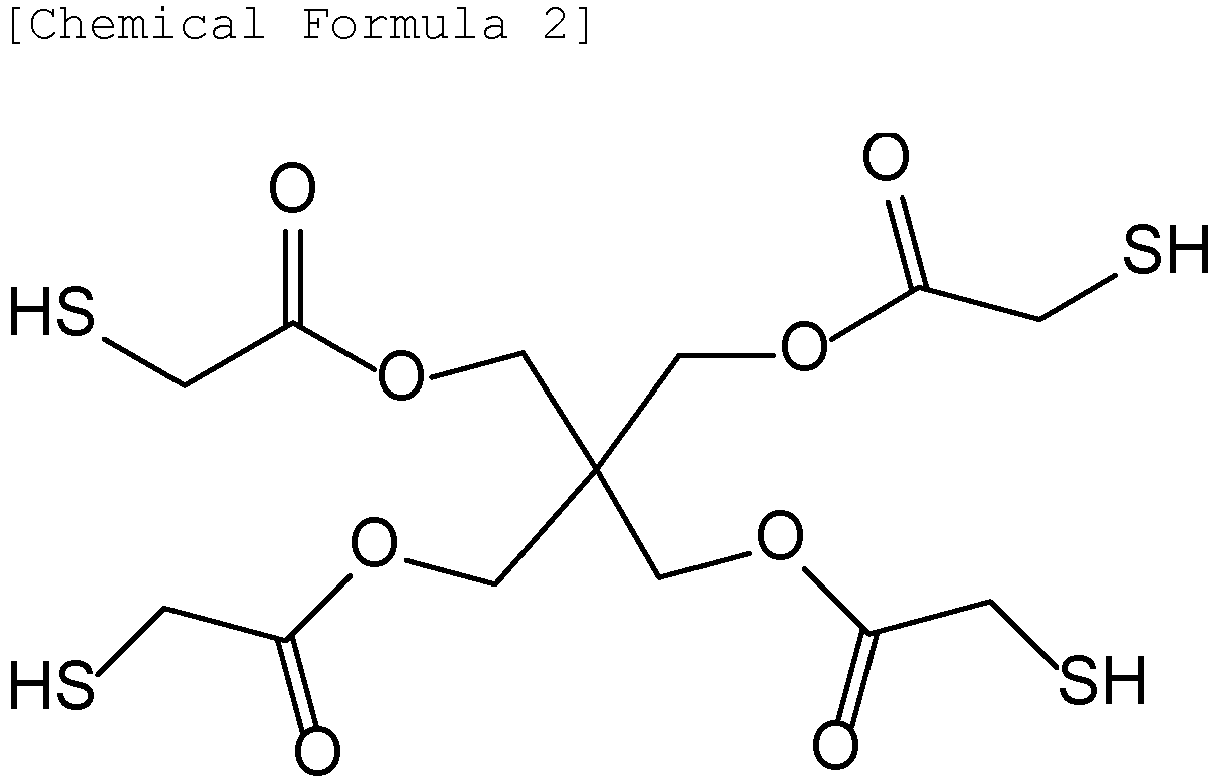
- Specific examples of the tetrafunctional aliphatic polythiol compound include pentaerythritol tetrakis(2-mercaptoacetate) (described below).
- the content of the polythiol compound in the polymerizable composition can be, for example, 20.00 to 80.00 mass%, and preferably 30.00 to 70.00 mass%, with respect to the mass (100 mass%) of the polymerizable composition.
- the content of the trifunctional aliphatic polythiol compound is preferably 20.00 to 80.00 mass%, and more preferably 40.00 to 70.00 mass% when the total amount of the polythiol compound is 100 mass%.
- the content of the tetrafunctional aliphatic polythiol compound is preferably 20.00 to 80.00 mass%, and more preferably 30.00 to 60.00 mass% when the total amount of the polythiol compound is 100 mass%.
- the polymerizable composition can optionally contain, in addition to the polyiso(thio)cyanate compound and the polythiol compound, one or more known components such as an additive and a polymerization catalyst which are generally used for producing an optical component as necessary.
- an additive include various additives such as an ultraviolet absorber, an antioxidant, and a release agent.
- an organic phosphorus compound such as a phosphine derivative can also be used as an additive. The amount of the additive used can be set appropriately.
- the polymerizable composition preferably contains, as a polymerization catalyst, a polymerization catalyst that catalyzes a thiourethanization reaction between a polyiso(thio)cyanate compound and a polythiol compound.
- a polymerization catalyst that catalyzes a thiourethanization reaction include known polymerization catalysts of organotin compounds such as dibutyltin diacetate, dibutyltin dilaurate, dibutyltin dichloride, dimethyltin dichloride, monomethyltin trichloride, trimethyltin chloride, tributyltin chloride, tributyltin fluoride, and dimethyltin dibromide.
- the polymerizable composition can contain, for example, the polymerization catalyst that catalyzes a thiourethanization reaction in an amount of 0.005 to 0.50 mass% with respect to the mass (100 mass%) of the polymerizable composition.
- the polymerizable composition can be prepared by simultaneously or sequentially mixing the various components described above at the same time or in any order.
- the preparation method is not particularly limited, and any known method for preparing a polymerizable composition can be adopted.
- the polymerizable composition may be prepared without adding a solvent, or may be prepared by adding an optional amount of the solvent.
- As the solvent it is possible to use one or more known solvents that can be used in the polymerizable composition.
- the polyiso(thio)cyanate compound and the polythiol compound described above are all polymerizable compounds, and by polymerizing these compounds, the polymerizable composition can be cured to obtain a cured product (polythiourethane resin).
- the polythiourethane resin is a resin having a plurality of bonds represented by the following Formula 1 in the molecule thereof: where Z represents an oxygen atom or a sulfur atom.
- Z represents an oxygen atom or a sulfur atom.
- a reaction between the thiol group and the isocyanate group forms the bond in which Z is an oxygen atom.
- a reaction between the thiol group and the isothiocyanate group forms the bond in which Z is a sulfur atom.
- the "thiourethane bond” in the present invention and the present specification means a bond represented by the above Formula 1.
- * indicates the position where the thiourethane bond is bonded to another adjacent structure.
- the polythiourethane resin obtained by polymerizing the polymerizable compound contained in the polymerizable composition can be used as various optical components.
- the optical component include various lenses such as a spectacle lens, a telescope lens, a binocular lens, a microscope lens, an endoscope lens, and an imaging system lens of various cameras.
- the "lens” in the present invention and the present specification includes a "lens substrate" in which one or more layers are optionally layered.
- cast polymerization is preferable for producing a cured product (also referred to as "plastic lens") having a lens shape.
- a polymerizable composition is injected into a cavity of a molding die having two molds facing each other with a predetermined gap and a cavity formed by closing the gap, and the polymerizable compound contained in the polymerizable composition is polymerized (curing reaction) in the cavity to obtain a cured product.
- a molding die usable for cast polymerization for example, refer to paragraphs 0012 to 0014 and Fig. 1 of JP 2009-262480 A . Note that the publication describes a molding die in which the gap between the two molds is closed with a gasket as a sealing member, but a tape can also be used as the sealing member.
- the cast polymerization can be performed as follows.
- the polymerizable composition is injected into a molding die cavity from an injection port formed on a side surface of the molding die. After injection, by polymerizing (curing reaction) the polymerizable compound contained in the polymerizable composition by heating, the polymerizable composition is cured to obtain a cured product having an internal shape of the cavity transferred thereon.
- the polymerization condition is not particularly limited, and can be appropriately set depending on the composition of a polymerizable composition or the like.
- a molding die having a polymerizable composition injected into a cavity can be heated at a heating temperature of 20 to 150°C for about 1 to 72 hours, but the polymerization condition is not limited thereto.
- the temperature such as a heating temperature for cast polymerization refers to a temperature of an atmosphere in which a molding die is placed. Further, it is possible to raise the temperature at an optional temperature rising rate during heating, and to lower the temperature (cooling) at an optional temperature falling rate.
- the cured product inside the cavity is released from the molding die.
- the cured product can be released from the molding die by removing the upper and lower molds forming the cavity and a gasket or a tape in any order as usually performed in cast polymerization.
- the cured product released from the molding die can be used as an optical component after posttreatment as necessary, and can be used as, for example, various lenses (for example, lens substrate).
- the cured product used as a lens substrate of a spectacle lens can be usually subjected to a post-step such as annealing, a dyeing treatment, a grinding step such as a rounding step, a polishing step, or a step of forming a coat layer such as a primer coat layer for improving impact resistance or a hard coat layer for improving surface hardness after releasing.
- various functional layers such as an antireflective layer and a water-repellent layer can be formed on the lens substrate.
- a known technique can be applied to any of these steps. In this way, a spectacle lens of which a lens substrate is the cured product can be obtained. Further, by mounting this spectacle lens in a frame, spectacles can be obtained.
- An aspect of the present invention relates to an optical component that is a cured product obtained by curing the above polymerizable composition.
- an aspect of the present invention relates to a method for producing an optical component, including curing the polymerizable composition by a curing treatment.
- the curing treatment can be heat treatment or light irradiation, and is preferably heat treatment.
- the curing treatment and the polymerizable composition and the like to be subjected to the curing treatment refer to the above description.
- the optical component can have excellent heat resistance.
- the optical component having excellent heat resistance has, for example, little deformation and/or deterioration of the optical component as the substrate even if the heat treatment is performed in a film forming step of forming one or more various functional films on the optical component, which is preferable.
- Examples of an index of the heat resistance include a glass transition temperature (Tg).
- the glass transition temperature (Tg) in the present invention and the present specification refers to a glass transition temperature measured by a thermomechanical analysis (TMA) penetration method according to JIS K7196-2012. For a specific measurement method, refer to Examples described later.
- TMA thermomechanical analysis
- a high glass transition temperature is preferable from the viewpoint of heat resistance.
- PETMA pentaerythritol tetrakis(2-mercaptoacetate)
- 33.3 g of 4-mercaptomethyl-1,8-dimercapto-3,6-dithiaoctane were added as a polythiol compound, and the mixture was stirred under reduced pressure for 20 minutes at 0.13 kPa (1.0 Torr) to prepare a polymerizable composition containing a polyiso(thio)cyanate compound and a polythiol compound.
- This polymerizable composition was injected into the cavity of the molding die through a polytetrafluoroethylene membrane filter having a pore diameter of 1.0 ⁇ m, and cast polymerization was performed for 24 hours at a temperature program from an initial temperature of 25°C to a final temperature of 120°C to produce a plastic lens having a center thickness of 2 mm.
- PETMA pentaerythritol tetrakis(2-mercaptoacetate)
- 4-mercaptomethyl-1,8-dimercapto-3,6-dithiaoctane were added as a polythiol compound, and the mixture was stirred under reduced pressure for 20 minutes at 0.13 kPa (1.0 Torr) to prepare a polymerizable composition containing a polyiso(thio)cyanate compound and a polythiol compound.
- This polymerizable composition was injected into the cavity of the molding die through a polytetrafluoroethylene membrane filter having a pore diameter of 1.0 ⁇ m, and cast polymerization was performed for 24 hours at a temperature program from an initial temperature of 25°C to a final temperature of 120°C to produce a plastic lens having a center thickness of 2 mm.
- the refractive index ne of each of the plastic lens of Example 1 and the plastic lens of Example 2 was measured with a precision refractometer KPR-2000, manufactured by Kalnew Optical Industrial Co., Ltd., and the refractive index ne was 1.67 in both Examples.
- the plastic lenses of Examples 1 and 2 were released from the molding die and then subjected to measurement of glass transition temperature.
- the glass transition temperature was measured by a penetration method using a thermal instrument analyzer TMA8310, manufactured by Rigaku Corporation. The temperature rising rate at the time of measurement was 10 K/min, and an indenter having a diameter of 0.5 mm was used as an indenter for the penetration method.
- TMA8310 thermal instrument analyzer
- EYNOA manufactured by HOYA Corporation
- a commercially available plastic spectacle lens having a refractive index ne of 1.67 was prepared, and the glass transition temperature of the lens was measured by the above method.
- the measured glass transition temperatures are shown in Table 1.
- the plastic lenses of Examples 1 and 2 have a high glass transition temperature and excellent heat resistance as compared with commercially available plastic spectacle lenses having the same refractive index.
- the plastic lens having excellent heat resistance is suitable as a lens substrate for forming one or more functional films (for example, a hard coat, an antireflective film, or the like) on the plastic lens by a film forming method involving a heat treatment to produce a spectacle lens.
- a functional films for example, a hard coat, an antireflective film, or the like
- a polymerizable composition for an optical component containing a polyiso(thio)cyanate compound and a polythiol compound wherein the polythiol compound contains a trifunctional aliphatic polythiol compound and a tetrafunctional aliphatic polythiol compound.
- the polymerizable composition can be used for producing an optical component having excellent heat resistance.
- the tetrafunctional aliphatic polythiol compound can contain an ester bond.
- the trifunctional aliphatic polythiol compound can be a compound not containing an ester bond.
- the trifunctional aliphatic polythiol compound can contain a sulfide bond.
- the polyiso(thio)cyanate compound can be an aromatic compound.
- the polymerizable composition can further contain an organic phosphorus compound.
- the optical component can be a lens.
- the lens can be a spectacle lens.
- an optical component that is a cured product obtained by curing the above polymerizable composition.
- a method for producing an optical component including curing the polymerizable composition by a curing treatment.
- An aspect of the present invention is useful in the field of producing various optical components such as a spectacle lens.
Landscapes
- Chemical & Material Sciences (AREA)
- Health & Medical Sciences (AREA)
- Organic Chemistry (AREA)
- Chemical Kinetics & Catalysis (AREA)
- Medicinal Chemistry (AREA)
- Polymers & Plastics (AREA)
- Physics & Mathematics (AREA)
- General Physics & Mathematics (AREA)
- Optics & Photonics (AREA)
- Ophthalmology & Optometry (AREA)
- General Health & Medical Sciences (AREA)
- Inorganic Chemistry (AREA)
- Polyurethanes Or Polyureas (AREA)
- Eyeglasses (AREA)
Abstract
Description
- The present invention relates to a polymerizable composition for an optical component, an optical component, and a method for producing the optical component.
- A cured product obtained by curing a polymerizable composition containing a polyiso(thio)cyanate compound and a polythiol compound is widely used as various optical components such as lenses (refer to Patent Literature 1, for example).
- Patent Literature 1:
JP 7-252207 A - One of the physical properties desired for the optical component is to have excellent heat resistance. This is due to the following reason, for example. The optical component is used, for example, as a substrate for various optical products. The optical products are usually produced by forming one or more functional films (for example, a hard coat, an antireflective film, and the like) on the optical component (substrate). The functional film is formed by various film forming methods, and many film forming methods involve a heat treatment. If an optical component which is a substrate has poor heat resistance, the quality of an optical product may be deteriorated due to deformation and/or deterioration of the substrate by the heat treatment. For example, when the substrate is deformed, a functional film formed on the substrate cannot conform to the deformation of the substrate, and cracks may be generated in the functional film. Meanwhile, if the substrate is to be subjected to a heated treatment at a heating temperature at which the substrate can withstand in order to prevent such deterioration in quality, film forming conditions are restricted, and usable film forming materials are also limited.
- According to an aspect of the present invention, there is provided a polymerizable composition for an optical component that contains a polyiso(thio)cyanate compound and a polythiol compound and can be used for producing an optical component excellent in heat resistance.
- An aspect of the present invention relates to a polymerizable composition for an optical component (hereinafter, simply referred to as "polymerizable composition") containing a polyiso(thio)cyanate compound and a polythiol compound, wherein the polythiol compound contains a trifunctional aliphatic polythiol compound and a tetrafunctional aliphatic polythiol compound.
- The polymerizable composition contains, as a polythiol compound, a trifunctional aliphatic polythiol compound and a tetrafunctional aliphatic polythiol compound. An optical component formed of such a composition can have excellent heat resistance as compared with conventional optical components having the same refractive index.
- According to an aspect of the present invention, there is provided an optical component obtained by curing a polymerizable composition containing a polyiso(thio)cyanate compound and a polythiol compound, which has excellent heat resistance.
- The polymerizable composition contains a polyiso(thio)cyanate compound and a polythiol compound. These compounds will be further described in detail below.
- In the present invention and the present specification, the "polyiso(thio)cyanate compound" refers to a compound having two or more iso(thio)cyanate groups per molecule. The "iso(thio)cyanate" means isocyanate and/or isothiocyanate. The isocyanate is sometimes referred to as isocyanate, and isothiocyanate is sometimes referred to as isothiocyanate. The "polythiol compound" refers to a compound having two or more thiol groups per molecule. In addition, some compounds that can be used as components of the polymerizable composition have two or more isomers. For such compounds, a mixture of two or more isomers may be used, or one of two or more isomers may be used alone.
- The polyiso(thio)cyanate compound can be, for example, an aliphatic compound, an alicyclic compound, an aromatic compound, a heterocyclic compound, or the like. The number of iso(thio)cyanate groups contained in the polyiso(thio)cyanate compound is two or more, preferably two to four, and more preferably two or three per molecule.
- Specific examples of the polyiso(thio)cyanate compound include aliphatic polyisocyanate compounds such as hexamethylene diisocyanate, 1,5-pentane diisocyanate, isophorone diisocyanate, bis(isocyanatomethyl) cyclohexane, dicyclohexylmethane diisocyanate, 2,5-bis(isocyanatomethyl)-bicyclo [2.2.1]heptane, 2,6-bis(isocyanatomethyl)-bicyclo [2.2.1]heptane, bis(4-isocyanatocyclohexyl) methane, 1,3-bis(isocyanatomethyl) cyclohexane, or 1,4-bis(isocyanatomethyl) cyclohexane; and aromatic polyisocyanate compounds such as xylylene diisocyanate, 1,3-diisocyanatobenzene, tolylene diisocyanate, or diphenylmethane diisocyanate. Furthermore, a halogen substitution product of the polyiso(thio)cyanate compound such as a chlorine substitution product thereof or a bromine substitution product thereof, an alkyl substitution product thereof, an alkoxy substitution product thereof, a prepolymer type modified product thereof with a nitro substitution product or a polyhydric alcohol, a carbodiimide modified product thereof, a urea modified product thereof, a biuret modified product thereof, a dimerization or trimerization reaction product thereof, and the like can be used. As the polyiso(thio)cyanate compound, only one polyiso(thio)cyanate compound may be used, or two or more polyiso(thio)cyanate compounds may be mixed to be used. In an aspect, the polymerizable composition can contain a cyclic structure-containing compound as a polyiso(thio)cyanate compound. The cyclic structure-containing compound may be a carbocyclic compound, a heterocyclic compound, a monocyclic compound, or a bicyclic or higher polycyclic compound. Moreover, the polyiso(thio)cyanate compound may include a plurality of cyclic structures. In an aspect, the polyiso(thio)cyanate compound can be an aromatic compound (aromatic polyiso(thio)cyanate compound).
- The content of the polyiso(thio)cyanate compound in the polymerizable composition can be, for example, more than 0 mass% and 60.00 mass% or less, and preferably in a range of 40.00 to 60.00 mass% with respect to the mass (100 mass%) of the polymerizable composition. In the present invention and the present specification, the mass of the polymerizable composition means the mass excluding the solvent when the polymerizable composition contains the solvent.
- The polymerizable composition contains, as a polythiol compound, a trifunctional aliphatic polythiol compound and a tetrafunctional aliphatic polythiol compound. The polymerizable composition can contain one or two or more trifunctional aliphatic polythiol compounds, and can contain one or two or more tetrafunctional aliphatic polythiol compounds. In the present invention and the present specification, the aliphatic compound also includes a compound containing a hetero atom and a compound containing an ester bond. Examples of the hetero atom include a sulfur atom and an oxygen atom. Preferably, one of the two aliphatic polythiol compounds contains an ester bond and the other does not contain an ester bond. More preferably, the tetrafunctional aliphatic polythiol compound contains an ester bond and the trifunctional aliphatic polythiol compound does not contain an ester bond.
- The trifunctional aliphatic polythiol compound is an aliphatic compound having three thiol groups contained in one molecule. The trifunctional aliphatic polythiol compound preferably contains one or more sulfide bonds (-S-) in one molecule, and more preferably contains one to three sulfide bonds (-S-) in one molecule from the viewpoint of improving the refractive index of the optical component. Specific examples thereof include 4-mercaptomethyl-1,8-dimercapto-3,6-dithiaoctane (described below).

- The tetrafunctional aliphatic polythiol compound is an aliphatic compound having four thiol groups contained in one molecule. The tetrafunctional aliphatic polythiol compound preferably contains one or more ester groups in one molecule, more preferably one to four ester groups, still more preferably two to four ester groups, and still even more preferably three or four ester groups from the viewpoint of further improving the heat resistance of the optical component. The tetrafunctional aliphatic polythiol compound may not contain a sulfide bond or may contain one or more sulfide bonds in one molecule. In an aspect, the tetrafunctional aliphatic polythiol compound preferably does not contain a sulfide bond. Specific examples of the tetrafunctional aliphatic polythiol compound include pentaerythritol tetrakis(2-mercaptoacetate) (described below).
- The content of the polythiol compound in the polymerizable composition can be, for example, 20.00 to 80.00 mass%, and preferably 30.00 to 70.00 mass%, with respect to the mass (100 mass%) of the polymerizable composition. The content of the trifunctional aliphatic polythiol compound is preferably 20.00 to 80.00 mass%, and more preferably 40.00 to 70.00 mass% when the total amount of the polythiol compound is 100 mass%. Meanwhile, the content of the tetrafunctional aliphatic polythiol compound is preferably 20.00 to 80.00 mass%, and more preferably 30.00 to 60.00 mass% when the total amount of the polythiol compound is 100 mass%.
- The polymerizable composition can optionally contain, in addition to the polyiso(thio)cyanate compound and the polythiol compound, one or more known components such as an additive and a polymerization catalyst which are generally used for producing an optical component as necessary. Examples of the additive include various additives such as an ultraviolet absorber, an antioxidant, and a release agent. Further, an organic phosphorus compound such as a phosphine derivative can also be used as an additive. The amount of the additive used can be set appropriately.
- Further, the polymerizable composition preferably contains, as a polymerization catalyst, a polymerization catalyst that catalyzes a thiourethanization reaction between a polyiso(thio)cyanate compound and a polythiol compound. Examples of the polymerization catalyst that catalyzes a thiourethanization reaction include known polymerization catalysts of organotin compounds such as dibutyltin diacetate, dibutyltin dilaurate, dibutyltin dichloride, dimethyltin dichloride, monomethyltin trichloride, trimethyltin chloride, tributyltin chloride, tributyltin fluoride, and dimethyltin dibromide. The polymerizable composition can contain, for example, the polymerization catalyst that catalyzes a thiourethanization reaction in an amount of 0.005 to 0.50 mass% with respect to the mass (100 mass%) of the polymerizable composition.
- The polymerizable composition can be prepared by simultaneously or sequentially mixing the various components described above at the same time or in any order. The preparation method is not particularly limited, and any known method for preparing a polymerizable composition can be adopted. Further, the polymerizable composition may be prepared without adding a solvent, or may be prepared by adding an optional amount of the solvent. As the solvent, it is possible to use one or more known solvents that can be used in the polymerizable composition.
- The polyiso(thio)cyanate compound and the polythiol compound described above are all polymerizable compounds, and by polymerizing these compounds, the polymerizable composition can be cured to obtain a cured product (polythiourethane resin). The polythiourethane resin is a resin having a plurality of bonds represented by the following Formula 1 in the molecule thereof:

- For example, cast polymerization is preferable for producing a cured product (also referred to as "plastic lens") having a lens shape. In cast polymerization, a polymerizable composition is injected into a cavity of a molding die having two molds facing each other with a predetermined gap and a cavity formed by closing the gap, and the polymerizable compound contained in the polymerizable composition is polymerized (curing reaction) in the cavity to obtain a cured product. For details of a molding die usable for cast polymerization, for example, refer to paragraphs 0012 to 0014 and Fig. 1 of
JP 2009-262480 A - In an aspect, the cast polymerization can be performed as follows. The polymerizable composition is injected into a molding die cavity from an injection port formed on a side surface of the molding die. After injection, by polymerizing (curing reaction) the polymerizable compound contained in the polymerizable composition by heating, the polymerizable composition is cured to obtain a cured product having an internal shape of the cavity transferred thereon. The polymerization condition is not particularly limited, and can be appropriately set depending on the composition of a polymerizable composition or the like. As an example, a molding die having a polymerizable composition injected into a cavity can be heated at a heating temperature of 20 to 150°C for about 1 to 72 hours, but the polymerization condition is not limited thereto. In the present invention and the present specification, the temperature such as a heating temperature for cast polymerization refers to a temperature of an atmosphere in which a molding die is placed. Further, it is possible to raise the temperature at an optional temperature rising rate during heating, and to lower the temperature (cooling) at an optional temperature falling rate. After completion of the polymerization (curing reaction), the cured product inside the cavity is released from the molding die. The cured product can be released from the molding die by removing the upper and lower molds forming the cavity and a gasket or a tape in any order as usually performed in cast polymerization. The cured product released from the molding die can be used as an optical component after posttreatment as necessary, and can be used as, for example, various lenses (for example, lens substrate). As an example, the cured product used as a lens substrate of a spectacle lens can be usually subjected to a post-step such as annealing, a dyeing treatment, a grinding step such as a rounding step, a polishing step, or a step of forming a coat layer such as a primer coat layer for improving impact resistance or a hard coat layer for improving surface hardness after releasing. Further, various functional layers such as an antireflective layer and a water-repellent layer can be formed on the lens substrate. A known technique can be applied to any of these steps. In this way, a spectacle lens of which a lens substrate is the cured product can be obtained. Further, by mounting this spectacle lens in a frame, spectacles can be obtained.
- An aspect of the present invention relates to an optical component that is a cured product obtained by curing the above polymerizable composition.
- Further, an aspect of the present invention relates to a method for producing an optical component, including curing the polymerizable composition by a curing treatment.
- The curing treatment can be heat treatment or light irradiation, and is preferably heat treatment. For details of the curing treatment and the polymerizable composition and the like to be subjected to the curing treatment, refer to the above description.
- The optical component can have excellent heat resistance. The optical component having excellent heat resistance has, for example, little deformation and/or deterioration of the optical component as the substrate even if the heat treatment is performed in a film forming step of forming one or more various functional films on the optical component, which is preferable. Examples of an index of the heat resistance include a glass transition temperature (Tg). The glass transition temperature (Tg) in the present invention and the present specification refers to a glass transition temperature measured by a thermomechanical analysis (TMA) penetration method according to JIS K7196-2012. For a specific measurement method, refer to Examples described later. A high glass transition temperature is preferable from the viewpoint of heat resistance.
- Hereinafter, the present invention will be described in more detail with Examples, but the present invention is not limited to aspects indicated by Examples. Operation and evaluation described below were performed in air at room temperature (about 20 to 25°C) unless otherwise specified.
- In a 300 ml eggplant-shaped flask, 48.2 g of tolylene diisocyanate (TDI) as a polyiso(thio)cyanate compound, 0.3 g of triphenylphosphine (TPP) as an organic phosphorus compound, 0.15 g of butoxyethyl acid phosphate as a release agent (JP-506H, manufactured by Johoku Chemical Co., Ltd), and 0.02 g of dimethyltin dichloride as a polymerization catalyst were charged, and stirring was continued for one hour under nitrogen purge at 20°C. When these components were completely dissolved, 18.5 g of pentaerythritol tetrakis(2-mercaptoacetate) (PETMA) and 33.3 g of 4-mercaptomethyl-1,8-dimercapto-3,6-dithiaoctane were added as a polythiol compound, and the mixture was stirred under reduced pressure for 20 minutes at 0.13 kPa (1.0 Torr) to prepare a polymerizable composition containing a polyiso(thio)cyanate compound and a polythiol compound.
- This polymerizable composition was injected into the cavity of the molding die through a polytetrafluoroethylene membrane filter having a pore diameter of 1.0 µm, and cast polymerization was performed for 24 hours at a temperature program from an initial temperature of 25°C to a final temperature of 120°C to produce a plastic lens having a center thickness of 2 mm.
- In a 300 ml eggplant-shaped flask, 56.5 g of diphenylmethane diisocyanate (MDI) as a polyiso(thio)cyanate compound, 0.3 g of triphenylphosphine (TPP) as an organic phosphorus compound, 0.15 g of butoxyethyl acid phosphate as a release agent (JP-506H, manufactured by Johoku Chemical Co., Ltd), and 0.02 g of dimethyltin dichloride as a polymerization catalyst were charged, and stirring was continued for one hour under nitrogen purge at 20°C. When these components were completely dissolved, 21.7 g of pentaerythritol tetrakis(2-mercaptoacetate) (PETMA) and 21.7 g of 4-mercaptomethyl-1,8-dimercapto-3,6-dithiaoctane were added as a polythiol compound, and the mixture was stirred under reduced pressure for 20 minutes at 0.13 kPa (1.0 Torr) to prepare a polymerizable composition containing a polyiso(thio)cyanate compound and a polythiol compound.
- This polymerizable composition was injected into the cavity of the molding die through a polytetrafluoroethylene membrane filter having a pore diameter of 1.0 µm, and cast polymerization was performed for 24 hours at a temperature program from an initial temperature of 25°C to a final temperature of 120°C to produce a plastic lens having a center thickness of 2 mm.
- The refractive index ne of each of the plastic lens of Example 1 and the plastic lens of Example 2 was measured with a precision refractometer KPR-2000, manufactured by Kalnew Optical Industrial Co., Ltd., and the refractive index ne was 1.67 in both Examples.
- The plastic lenses of Examples 1 and 2 were released from the molding die and then subjected to measurement of glass transition temperature. The glass transition temperature was measured by a penetration method using a thermal instrument analyzer TMA8310, manufactured by Rigaku Corporation. The temperature rising rate at the time of measurement was 10 K/min, and an indenter having a diameter of 0.5 mm was used as an indenter for the penetration method. As a reference sample lens, EYNOA, manufactured by HOYA Corporation, a commercially available plastic spectacle lens having a refractive index ne of 1.67, was prepared, and the glass transition temperature of the lens was measured by the above method. The measured glass transition temperatures are shown in Table 1. The results shown in Table 1 demonstrate that the plastic lenses of Examples 1 and 2 have a high glass transition temperature and excellent heat resistance as compared with commercially available plastic spectacle lenses having the same refractive index. As described above, the plastic lens having excellent heat resistance is suitable as a lens substrate for forming one or more functional films (for example, a hard coat, an antireflective film, or the like) on the plastic lens by a film forming method involving a heat treatment to produce a spectacle lens.
[Table 1] Glass transition temperature Example 1 123°C Example 2 105°C Reference sample lens 102°C - Finally, the above-described aspects will be summarized.
- According to an aspect, there is provided a polymerizable composition for an optical component containing a polyiso(thio)cyanate compound and a polythiol compound, wherein the polythiol compound contains a trifunctional aliphatic polythiol compound and a tetrafunctional aliphatic polythiol compound.
- The polymerizable composition can be used for producing an optical component having excellent heat resistance.
- In an aspect, the tetrafunctional aliphatic polythiol compound can contain an ester bond.
- In an aspect, the trifunctional aliphatic polythiol compound can be a compound not containing an ester bond.
- In an aspect, the trifunctional aliphatic polythiol compound can contain a sulfide bond.
- In an aspect, the polyiso(thio)cyanate compound can be an aromatic compound.
- In an aspect, the polymerizable composition can further contain an organic phosphorus compound.
- In an aspect, the optical component can be a lens.
- In an aspect, the lens can be a spectacle lens.
- According to an aspect, there is provided an optical component that is a cured product obtained by curing the above polymerizable composition.
- According to an aspect, there is provided a method for producing an optical component, including curing the polymerizable composition by a curing treatment.
- The various aspects described in this specification can be combined in two or more in any combination.
- The embodiment disclosed herein is an example in every respect and should not be restrictively understood. The scope of the present invention is defined not by the above description but by claims, and intends to include all modifications within meaning and a scope equal to claims.
- An aspect of the present invention is useful in the field of producing various optical components such as a spectacle lens.
Claims (10)
- A polymerizable composition for an optical component, comprising:a polyiso(thio)cyanate compound; anda polythiol compound, whereinthe polythiol compound contains a trifunctional aliphatic polythiol compound and a tetrafunctional aliphatic polythiol compound.
- The polymerizable composition for an optical component according to claim 1, wherein the tetrafunctional aliphatic polythiol compound contains an ester bond.
- The polymerizable composition for an optical component according to claim 1 or 2, wherein the trifunctional aliphatic polythiol compound does not contain an ester bond.
- The polymerizable composition for an optical component according to any one of claims 1 to 3, wherein the trifunctional aliphatic polythiol compound contains a sulfide bond.
- The polymerizable composition for an optical component according to any one of claims 1 to 4, wherein the polyiso(thio)cyanate compound is an aromatic compound.
- The polymerizable composition for an optical component according to any one of claims 1 to 5, further comprising an organic phosphorus compound.
- The polymerizable composition for an optical component according to any one of claims 1 to 6, wherein the optical component is a lens.
- The polymerizable composition for an optical component according to claim 7, wherein the lens is a spectacle lens.
- An optical component which is a cured product obtained by curing the polymerizable composition for an optical component according to any one of claims 1 to 8.
- A method for producing an optical component, comprising:
curing the polymerizable composition for an optical component according to any one of claims 1 to 8 by a curing treatment.
Applications Claiming Priority (2)
| Application Number | Priority Date | Filing Date | Title |
|---|---|---|---|
| JP2019066068A JP2020166103A (en) | 2019-03-29 | 2019-03-29 | Polymerizable composition for optical members, optical members and methods for manufacturing optical members |
| PCT/JP2020/014266 WO2020203867A1 (en) | 2019-03-29 | 2020-03-27 | Polymerizable composition for optical member, optical member, and method for producing optical member |
Publications (2)
| Publication Number | Publication Date |
|---|---|
| EP3951442A1 true EP3951442A1 (en) | 2022-02-09 |
| EP3951442A4 EP3951442A4 (en) | 2023-09-27 |
Family
ID=72668869
Family Applications (1)
| Application Number | Title | Priority Date | Filing Date |
|---|---|---|---|
| EP20783046.4A Withdrawn EP3951442A4 (en) | 2019-03-29 | 2020-03-27 | Polymerizable composition for optical member, optical member, and method for producing optical member |
Country Status (4)
| Country | Link |
|---|---|
| US (1) | US20220185941A1 (en) |
| EP (1) | EP3951442A4 (en) |
| JP (1) | JP2020166103A (en) |
| WO (1) | WO2020203867A1 (en) |
Families Citing this family (1)
| Publication number | Priority date | Publication date | Assignee | Title |
|---|---|---|---|---|
| CN120399186A (en) * | 2025-07-01 | 2025-08-01 | 江苏视科新材料股份有限公司 | Optical material composition with adjustable refractive index and preparation method thereof |
Family Cites Families (9)
| Publication number | Priority date | Publication date | Assignee | Title |
|---|---|---|---|---|
| US5114740A (en) * | 1989-01-13 | 1992-05-19 | Ford Motor Company | Method and apparatus for providing antistatic protection to plastic lenses |
| US5608115A (en) | 1994-01-26 | 1997-03-04 | Mitsui Toatsu Chemicals, Inc. | Polythiol useful for preparing sulfur-containing urethane-based resin and process for producing the same |
| JP2007246690A (en) * | 2006-03-16 | 2007-09-27 | Seiko Epson Corp | Manufacturing method of optical substrate |
| JP5197135B2 (en) | 2008-04-28 | 2013-05-15 | Hoya株式会社 | Method for producing dyed plastic lens |
| WO2016031975A1 (en) * | 2014-08-29 | 2016-03-03 | ホヤ レンズ タイランド リミテッド | Optical resin composition, optical element obtained by curing optical resin composition, and plastic lens for eyeglasses |
| JP6693669B2 (en) * | 2015-03-12 | 2020-05-13 | ホヤ レンズ タイランド リミテッドHOYA Lens Thailand Ltd | Method for storing isocyanate compound |
| US10519060B2 (en) * | 2015-08-06 | 2019-12-31 | Mitsui Chemicals, Inc. | Process for producing polymerizable composition for optical material and polymerizable composition for optical material |
| JP6306102B2 (en) * | 2016-07-29 | 2018-04-04 | ホヤ レンズ タイランド リミテッドHOYA Lens Thailand Ltd | Resin composition |
| KR20170037936A (en) * | 2017-03-30 | 2017-04-05 | 주식회사 케이오씨솔루션 | Optical Polythiourethane Lens Composition Comprising Polymerizable New Catalyst |
-
2019
- 2019-03-29 JP JP2019066068A patent/JP2020166103A/en active Pending
-
2020
- 2020-03-27 US US17/442,994 patent/US20220185941A1/en not_active Abandoned
- 2020-03-27 EP EP20783046.4A patent/EP3951442A4/en not_active Withdrawn
- 2020-03-27 WO PCT/JP2020/014266 patent/WO2020203867A1/en not_active Ceased
Also Published As
| Publication number | Publication date |
|---|---|
| JP2020166103A (en) | 2020-10-08 |
| US20220185941A1 (en) | 2022-06-16 |
| EP3951442A4 (en) | 2023-09-27 |
| WO2020203867A1 (en) | 2020-10-08 |
Similar Documents
| Publication | Publication Date | Title |
|---|---|---|
| EP3381892B1 (en) | Method for producing polythiol compound, method for producing curable composition, and method for producing cured product | |
| US20210079163A1 (en) | Polymerizable composition for optical component, optical component, and method for producing optical component | |
| US20210079164A1 (en) | Polymerizable composition for optical component and optical component | |
| US20210079165A1 (en) | Cured product for optical component and optical component | |
| US20190062489A1 (en) | Method for producing cured product, cured product, and eyeglass lens substrate | |
| US20190062490A1 (en) | Method for producing cured product, cured product, and eyeglass lens substrate | |
| WO2020004533A1 (en) | Polythiourethane resin for optical member and optical member | |
| EP3778687B1 (en) | Method for producing polymerizable composition | |
| US20190062488A1 (en) | Method for producing cured product, cured product, and eyeglass lens substrate | |
| US20220185941A1 (en) | Polymerizable composition for optical component, optical component, and method for producing optical component | |
| US20220120936A1 (en) | Polymerizable composition for optical material, optical material, and method for producing optical material | |
| EP4692053A1 (en) | Polythiol, polymerizable composition for optical materials, optical material, and methods for producing those products | |
| EP3778170A1 (en) | Method for manufacturing optical member | |
| EP4733341A1 (en) | Polymerizable composition and method for producing same, resin, molded body, optical material, and lens | |
| EP3859430A1 (en) | Optical member resin production method | |
| EP3858883A1 (en) | Polymerizable composition for optical members |
Legal Events
| Date | Code | Title | Description |
|---|---|---|---|
| STAA | Information on the status of an ep patent application or granted ep patent |
Free format text: STATUS: THE INTERNATIONAL PUBLICATION HAS BEEN MADE |
|
| PUAI | Public reference made under article 153(3) epc to a published international application that has entered the european phase |
Free format text: ORIGINAL CODE: 0009012 |
|
| STAA | Information on the status of an ep patent application or granted ep patent |
Free format text: STATUS: REQUEST FOR EXAMINATION WAS MADE |
|
| 17P | Request for examination filed |
Effective date: 20210924 |
|
| AK | Designated contracting states |
Kind code of ref document: A1 Designated state(s): AL AT BE BG CH CY CZ DE DK EE ES FI FR GB GR HR HU IE IS IT LI LT LU LV MC MK MT NL NO PL PT RO RS SE SI SK SM TR |
|
| DAV | Request for validation of the european patent (deleted) | ||
| DAX | Request for extension of the european patent (deleted) | ||
| A4 | Supplementary search report drawn up and despatched |
Effective date: 20230828 |
|
| RIC1 | Information provided on ipc code assigned before grant |
Ipc: G02C 7/02 20060101ALI20230822BHEP Ipc: G02C 7/00 20060101ALI20230822BHEP Ipc: C08G 18/38 20060101ALI20230822BHEP Ipc: G02B 1/04 20060101AFI20230822BHEP |
|
| STAA | Information on the status of an ep patent application or granted ep patent |
Free format text: STATUS: THE APPLICATION IS DEEMED TO BE WITHDRAWN |
|
| 18D | Application deemed to be withdrawn |
Effective date: 20240326 |