EP3951409B1 - Secondary cell inspection method and secondary cell inspection device - Google Patents
Secondary cell inspection method and secondary cell inspection device Download PDFInfo
- Publication number
- EP3951409B1 EP3951409B1 EP21789494.8A EP21789494A EP3951409B1 EP 3951409 B1 EP3951409 B1 EP 3951409B1 EP 21789494 A EP21789494 A EP 21789494A EP 3951409 B1 EP3951409 B1 EP 3951409B1
- Authority
- EP
- European Patent Office
- Prior art keywords
- secondary battery
- voltage
- model
- model parameter
- sampling period
- Prior art date
- Legal status (The legal status is an assumption and is not a legal conclusion. Google has not performed a legal analysis and makes no representation as to the accuracy of the status listed.)
- Active
Links
Images


Classifications
-
- G—PHYSICS
- G01—MEASURING; TESTING
- G01R—MEASURING ELECTRIC VARIABLES; MEASURING MAGNETIC VARIABLES
- G01R31/00—Arrangements for testing electric properties; Arrangements for locating electric faults; Arrangements for electrical testing characterised by what is being tested not provided for elsewhere
- G01R31/36—Arrangements for testing, measuring or monitoring the electrical condition of accumulators or electric batteries, e.g. capacity or state of charge [SoC]
- G01R31/378—Arrangements for testing, measuring or monitoring the electrical condition of accumulators or electric batteries, e.g. capacity or state of charge [SoC] specially adapted for the type of battery or accumulator
-
- G—PHYSICS
- G01—MEASURING; TESTING
- G01R—MEASURING ELECTRIC VARIABLES; MEASURING MAGNETIC VARIABLES
- G01R23/00—Arrangements for measuring frequencies; Arrangements for analysing frequency spectra
- G01R23/16—Spectrum analysis; Fourier analysis
-
- G—PHYSICS
- G01—MEASURING; TESTING
- G01R—MEASURING ELECTRIC VARIABLES; MEASURING MAGNETIC VARIABLES
- G01R31/00—Arrangements for testing electric properties; Arrangements for locating electric faults; Arrangements for electrical testing characterised by what is being tested not provided for elsewhere
- G01R31/36—Arrangements for testing, measuring or monitoring the electrical condition of accumulators or electric batteries, e.g. capacity or state of charge [SoC]
- G01R31/367—Software therefor, e.g. for battery testing using modelling or look-up tables
-
- G—PHYSICS
- G01—MEASURING; TESTING
- G01R—MEASURING ELECTRIC VARIABLES; MEASURING MAGNETIC VARIABLES
- G01R31/00—Arrangements for testing electric properties; Arrangements for locating electric faults; Arrangements for electrical testing characterised by what is being tested not provided for elsewhere
- G01R31/36—Arrangements for testing, measuring or monitoring the electrical condition of accumulators or electric batteries, e.g. capacity or state of charge [SoC]
- G01R31/374—Arrangements for testing, measuring or monitoring the electrical condition of accumulators or electric batteries, e.g. capacity or state of charge [SoC] with means for correcting the measurement for temperature or ageing
-
- G—PHYSICS
- G01—MEASURING; TESTING
- G01R—MEASURING ELECTRIC VARIABLES; MEASURING MAGNETIC VARIABLES
- G01R31/00—Arrangements for testing electric properties; Arrangements for locating electric faults; Arrangements for electrical testing characterised by what is being tested not provided for elsewhere
- G01R31/36—Arrangements for testing, measuring or monitoring the electrical condition of accumulators or electric batteries, e.g. capacity or state of charge [SoC]
- G01R31/382—Arrangements for monitoring battery or accumulator variables, e.g. SoC
-
- G—PHYSICS
- G01—MEASURING; TESTING
- G01R—MEASURING ELECTRIC VARIABLES; MEASURING MAGNETIC VARIABLES
- G01R31/00—Arrangements for testing electric properties; Arrangements for locating electric faults; Arrangements for electrical testing characterised by what is being tested not provided for elsewhere
- G01R31/36—Arrangements for testing, measuring or monitoring the electrical condition of accumulators or electric batteries, e.g. capacity or state of charge [SoC]
- G01R31/382—Arrangements for monitoring battery or accumulator variables, e.g. SoC
- G01R31/3842—Arrangements for monitoring battery or accumulator variables, e.g. SoC combining voltage and current measurements
-
- G—PHYSICS
- G01—MEASURING; TESTING
- G01R—MEASURING ELECTRIC VARIABLES; MEASURING MAGNETIC VARIABLES
- G01R31/00—Arrangements for testing electric properties; Arrangements for locating electric faults; Arrangements for electrical testing characterised by what is being tested not provided for elsewhere
- G01R31/36—Arrangements for testing, measuring or monitoring the electrical condition of accumulators or electric batteries, e.g. capacity or state of charge [SoC]
- G01R31/385—Arrangements for measuring battery or accumulator variables
- G01R31/3865—Arrangements for measuring battery or accumulator variables related to manufacture, e.g. testing after manufacture
-
- G—PHYSICS
- G01—MEASURING; TESTING
- G01R—MEASURING ELECTRIC VARIABLES; MEASURING MAGNETIC VARIABLES
- G01R31/00—Arrangements for testing electric properties; Arrangements for locating electric faults; Arrangements for electrical testing characterised by what is being tested not provided for elsewhere
- G01R31/36—Arrangements for testing, measuring or monitoring the electrical condition of accumulators or electric batteries, e.g. capacity or state of charge [SoC]
- G01R31/396—Acquisition or processing of data for testing or for monitoring individual cells or groups of cells within a battery
-
- H—ELECTRICITY
- H01—ELECTRIC ELEMENTS
- H01M—PROCESSES OR MEANS, e.g. BATTERIES, FOR THE DIRECT CONVERSION OF CHEMICAL ENERGY INTO ELECTRICAL ENERGY
- H01M10/00—Secondary cells; Manufacture thereof
- H01M10/42—Methods or arrangements for servicing or maintenance of secondary cells or secondary half-cells
- H01M10/4285—Testing apparatus
-
- G—PHYSICS
- G01—MEASURING; TESTING
- G01R—MEASURING ELECTRIC VARIABLES; MEASURING MAGNETIC VARIABLES
- G01R31/00—Arrangements for testing electric properties; Arrangements for locating electric faults; Arrangements for electrical testing characterised by what is being tested not provided for elsewhere
- G01R31/36—Arrangements for testing, measuring or monitoring the electrical condition of accumulators or electric batteries, e.g. capacity or state of charge [SoC]
- G01R31/389—Measuring internal impedance, internal conductance or related variables
-
- Y—GENERAL TAGGING OF NEW TECHNOLOGICAL DEVELOPMENTS; GENERAL TAGGING OF CROSS-SECTIONAL TECHNOLOGIES SPANNING OVER SEVERAL SECTIONS OF THE IPC; TECHNICAL SUBJECTS COVERED BY FORMER USPC CROSS-REFERENCE ART COLLECTIONS [XRACs] AND DIGESTS
- Y02—TECHNOLOGIES OR APPLICATIONS FOR MITIGATION OR ADAPTATION AGAINST CLIMATE CHANGE
- Y02E—REDUCTION OF GREENHOUSE GAS [GHG] EMISSIONS, RELATED TO ENERGY GENERATION, TRANSMISSION OR DISTRIBUTION
- Y02E60/00—Enabling technologies; Technologies with a potential or indirect contribution to GHG emissions mitigation
- Y02E60/10—Energy storage using batteries
Definitions
- the present invention relates to a technique for inspecting a secondary battery such as a lithium-ion battery.
- an AC impedance analysis method based on a frequency response analysis (FRA) method is well known, and a method of applying an equivalent circuit model to decompose the secondary battery into time-constant elements in order to interpret various internal reactions of the secondary battery is established.
- FFA frequency response analysis
- Patent Literature 2 discloses an internal impedance diagnostic system for estimating cell impedance parameters from an impedance equivalent circuit model including the application or detection of a time-varying current signal through a cell, measurement of voltage and current variations, application of an adaptive filter on the sampled data to identify the m-order transfer function for the measured system, constructing a set of simultaneous equations, extracting individual impedance parameter values from the equations, running diagnostic tests and algorithms to analyze the change in cell impedance values and computing accurate cell related estimation parameters and conditions.
- pass/fail determination criteria are set from a statistical population distribution in the mass production line or the like, such settings are possible only when the inspection conditions are fixed, and there were hardly any methods of being able to determine pass/fail of a secondary battery on the market.
- the object of the present invention is to provide a secondary battery inspection device or the like capable of improving inspection accuracy while simplifying the inspection of a secondary battery.
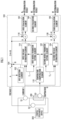
- a secondary battery inspection device 100 as one embodiment of the present invention illustrated in FIG. 1 is composed of a processor (arithmetic processing unit), a memory (storage device), an I/O circuit, and the like.
- a program software
- the memory or a storage device separate from this memory a program (software) is stored and held in addition to various data such as parameters for defining a secondary battery model. For example, each of plural identifiers for identifying a secondary battery or the type of a target machine element (identified by the standard and specifications) in which this secondary battery is installed, and each of plural secondary battery models are stored and held in the memory in association with each other.
- the processor reads necessary program and data from the memory, and executes arithmetic processing according to the program based on the data to execute arithmetic processing or a task to be described later.
- the secondary battery inspection device 100 includes an OCV detection element 102, a subtraction element 104, a temperature compensation element 110, a first sampling period output element 111, a first model parameter setting element 112, a first voltage estimation element 114, a first division element 116, a second sampling period output element 121, a second model parameter setting element 122, a second voltage estimation element 124, a second division element 126, a first evaluation element 142, a second evaluation element 144, and a third evaluation element 146.
- Each of the secondary battery models is a model representing voltage V(t) output from a secondary battery 200 when current I(t) is input to the secondary battery 200.
- the voltage V(t) is defined by equation (01) using an open circuit voltage OCV of the secondary battery 200 and a transfer function H(t) of the internal resistance.
- V t OCV + H t ⁇ I t
- H 0 (t),” “H i (t),” “H W (t),” and “H L (t)” are defined by parameters representing the characteristics of the internal resistance of the secondary battery.
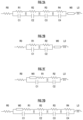
- FIG. 2A an example of an equivalent circuit of the internal resistance of the secondary battery 200 is illustrated.
- the number, m, of RC parallel circuits connected in series is "4.”
- the number, m, of RC parallel circuits connected in series may be smaller than 4, or may be larger than 4.
- the Warburg impedance W 0 may also be connected in series with a resistance R in at least any one of RC parallel circuits (for example, in the first RC parallel circuit). Further, each capacitor C may be replaced with a CPE (Constant Phase Element). In addition, the coil L may be omitted.
- the transfer function H 0 (z) of the resistance R 0 is defined by equation (10).
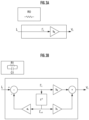
- FIG. 3A a block diagram representing the transfer function H 0 (z) of the resistance R 0 is illustrated.
- H 0 z R 0
- the dependency of R 0 on temperature ⁇ is predetermined according to the equation (10) based on the measurement results of Nyquist plots of a reference secondary battery at different temperatures ⁇ (see FIG. 4 ), respectively.
- the coefficient R 0 is defined as a dependent variable or a function when the temperature ⁇ for defining the transfer function H 0 (z) of the resistance R 0 is taken as the main variable.
- the transfer function H i (z) of the i-th RC parallel circuit is defined by equation (20) as an IIR (Infinite Impulse Response) system.
- IIR Infinite Impulse Response
- FIG. 3B a block diagram representing the transfer function H i (z) of the i-th RC parallel circuit is illustrated.
- H i z b 0 + b i z ⁇ 1 / 1 + a i z ⁇ 1
- H i (s) of the i-th RC parallel circuit in an s region is expressed by equation (21).
- each of coefficients b 0 , b i , and a i in the IIR transfer function is defined by each of equations (221) to (223), respectively.
- b 0 R i / 1 + 2 ⁇ i / T
- b i R i / 1 + 2 ⁇ i / T
- a i ⁇ 1 + 1 ⁇ 2 ⁇ i / T / 1 + 2 ⁇ i / T
- each of the coefficients b 0 , b i , and a i that define the transfer function H i (z) of the i-th RC parallel circuit is defined as a dependent variable or a multivariable function when the temperature ⁇ and sampling frequency T are taken as main variables.
- the transfer function H L (z) of the coil L is defined by equation (30) as the transfer function of the IIR system.
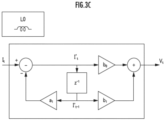
- FIG. 3C a block diagram representing the transfer function H L (z) of the coil L is illustrated.
- H L z 2 L 0 / T 1 ⁇ z ⁇ 1 / 1 + z ⁇ 1
- H L (s) of the coil L in the s region is expressed by equation (31).
- H L s sL 0
- each of the coefficients b 0 , b i , and a i in the IIR transfer function is defined by each of equations (321) to (323), respectively.
- b 0 2 L 0 / T
- b i ⁇ 2 L 0 / T
- a i ⁇ 1
- each of the coefficients b 0 and b i that define the transfer function H i (z) of the coil L is defined as a dependent variable or a multivariable function when the temperature ⁇ and sampling frequency T are taken as main variables.
- the transfer function H W (z) of the Warburg impedance W 0 is defined by equation (40) as a transfer function of a FIR (Finite Impulse Response) system.
- H W (s) of the Warburg impedance W 0 in the s region is represented by equation (41).
- H W s R W tanh sT W p / sT W p
- H W z R W tanh 2 T W / T 1 ⁇ z ⁇ 1 / 1 + z ⁇ 1 p / 2 T W / T 1 ⁇ z ⁇ 1 / 1 + z ⁇ 1 p
- n is, for example, about several tens to 1000
- H W (z) of the Warburg impedance W 0 as an FIR transfer function as in equation (40).
- each of the coefficients h k that define the transfer function H W (z) of the Warburg impedance W 0 is defined as a dependent variable or a multivariable function when the temperature ⁇ and sampling frequency T are taken as main variables.
- FIG. 4 an example of Nyquist plots representing the measurement results of a complex impedance Z of the secondary battery 200 is illustrated together with an approximate curve of the plots.
- the horizontal axis is the real part ReZ of the complex impedance Z
- the vertical axis is the imaginary part -ImZ of the complex impedance Z.
- ReZ lower frequency complex impedance Z is represented as ReZ increases.
- a section in a region of -ImZ ⁇ 0 (first evaluation section) surrounded by the dot-and-dash line in FIG. 4 corresponds to the impedance of wiring inductance L 0 of the electrodes and the like of the secondary battery 200 (see FIG. 3B ).
- the approximate curve of the complex impedance Z of the secondary battery which is represented by solid Nyquist plots in FIG. 4 is determined under the assumption that the transfer function H(t) of the equivalent circuit model of the internal resistance of the secondary battery is defined according to the equation (02).
- values of parameters R 0 (see the equation (10)), R i and C i (see the equation (21)), L 0 (see the equation (31)), R W , T W , and p (see the equation (41)) are determined at each temperature ⁇ .
- the value of the open circuit voltage OCV in each secondary battery model is identified by the measured value of the open circuit voltage OCV (see the equation (01)).
- secondary battery models are established by the parameter values for various types of secondary batteries 200.
- the impulse current I(t), the voltage V(t), and the temperature ⁇ (t) of the secondary battery 200 are measured by a current sensor S1, a voltage sensor S2, and a temperature sensor S0, respectively, when the impulse current I(t) is applied by a charge/discharge device 300 to the secondary battery 200 to be inspected.
- the measurement result of the temperature ⁇ (t) of the secondary battery 200 is input to the temperature compensation element 110, and a temperature compensation model parameter according to the measurement result is output from the temperature compensation element 110.
- values R 0 ( ⁇ ), R i ( ⁇ ), C i ( ⁇ ), L 0 ( ⁇ ), R W ( ⁇ ), T W ( ⁇ ), and p( ⁇ ) of the parameters R 0 (see the equation (10)), R i and C i (see the equation (21)), L 0 (see the equation (31)), and R W and T W (see the equation (41)) according to the temperature ⁇ are determined.
- These model parameters can be determined as average values of a good product population from mass-produced products of secondary batteries, and used as a reference model for pass/fail determination.
- the temperature compensation model parameter is input from the temperature compensation element 110 to the first model parameter setting element 112, and the IIR model parameters b 0 ( ⁇ , T 1 ), b i ( ⁇ , T 1 ), and a i ( ⁇ , T 1 ) are determined by the first model parameter setting element 112 based on the temperature compensation model parameters R i ( ⁇ ) and C i ( ⁇ ) according to the first sampling period T 1 (see the equations (221) to (223)).
- the IIR model parameters b 0 ( ⁇ , T 1 ), b i ( ⁇ , T 1 ), and a i ( ⁇ , T 1 ) are determined by the first model parameter setting element 112 based on the temperature compensation model parameter L 0 ( ⁇ ) according to the first sampling period T 1 (see the equations (321) to (323)).
- the FIR model parameter h k ( ⁇ , T 1 ) is determined by the first model parameter setting element 112 based on the temperature compensation model parameters R W ( ⁇ , T 1 ), T W ( ⁇ , T 1 ), and p( ⁇ , T 1 ) according to the first sampling period T 1 (see the equation (40)).
- the voltage V(t) of the secondary battery 200 is inferred by the first voltage estimation element 114 based on the measurement result of the impulse current I(t) of the secondary battery 200 according to the secondary battery model defined by the transfer function H(t) according to the first sampling period T 1 as a short period (for example, about 10 ms) (see the equation (01)).
- the first voltage estimation element 114 based on the measurement result of the impulse current I(t) of the secondary battery 200 according to the secondary battery model defined by the transfer function H(t) according to the first sampling period T 1 as a short period (for example, about 10 ms) (see the equation (01)).
- the measured values of the voltage V of the secondary battery 200 at the time of discharge are illustrated by the dotted line
- approximate curves representing the measured values of the OCV of the secondary battery 200 in each first sampling period T 1 are illustrated by the dashed line
- approximate curves representing the estimation results of the voltage V(t) of the secondary battery 200 in each first sampling period T 1 by the first voltage estimation element 114 are illustrated by the solid line, respectively. Since the open circuit voltage OCV is not considered in the secondary battery model, the estimation results D of the voltage V(t) of the secondary battery 200 in each first sampling period T 1 by the first voltage estimation element 114 is inferred based on the OCV (see FIG. 5A, FIG. 5B /down arrow D).
- the temperature compensation model parameter is input from the temperature compensation element 110 to the second model parameter setting element 122, and the IIR model parameters b 0 ( ⁇ , T 2 ), b i ( ⁇ , T 2 ), and a i ( ⁇ , T 2 ) are determined by the second model parameter setting element 122 based on the temperature compensation model parameters R i ( ⁇ ) and C i ( ⁇ ) according to the second sampling period T 2 (see the equations (221) to (223)).
- the IIR model parameters b 0 ( ⁇ , T 2 ), b i ( ⁇ , T 2 ), and a i ( ⁇ , T 2 ) are determined by the second model parameter setting element 122 based on the temperature compensation model parameter L 0 ( ⁇ ) according to the second sampling period T 2 (see the equations (321) to (323)).
- the FIR model parameter h k ( ⁇ , T 2 ) is determined by the second model parameter setting element 122 based on the temperature compensation model parameters R W ( ⁇ , T 2 ), T W ( ⁇ , T 2 ), and p( ⁇ , T 2 ) according to the second sampling period T 2 (see the equation (40)).
- the voltage V(t) of the secondary battery 200 is inferred by the second voltage estimation element 124 based on the measurement result of the impulse current I(t) of the secondary battery 200 according to the secondary battery model defined by the transfer function H(t) according to the second sampling period T 2 as a long period (for example, about 1 s) (see the equation (01)).
- the measured values of the voltage V of the secondary battery 200 at the time of discharge are illustrated by the solid line
- an approximate curve representing the measured values of the OCV of the secondary battery 200 in each second sampling period T 2 is illustrated by the dashed line
- an approximate curve representing the estimation result of the voltage V(t) of the secondary battery 200 in each second sampling period T 2 by the second voltage estimation element 124 is illustrated by the solid line. Since the open circuit voltage OCV is not considered in the secondary battery model, the estimation result E of the voltage V(t) of the secondary battery 200 by the second voltage estimation element 124 is inferred based on the OCV (see FIG. 5C /down arrow E).
- the difference C is illustrated by the down arrow C in each of FIG. 5A, FIG. 5B , and FIG. 5C , which represents a difference between the measured value (solid line) of the voltage V of the secondary battery 200 at the time of discharge and the measured value dotted line) of the OCV.
- the difference C is input from the subtraction element 104 to the division element 116, and the estimation result D of the voltage V(t) of the secondary battery 200 is input from the first voltage estimation element 114 to calculate a ratio C/D of both inputs.
- connection resistance component R 0 and the inductance element L 0 of the secondary battery 200 in the first evaluation section is evaluated by the first evaluation element 142 based on a statistical index value, such as an average value of the input, a variance value, a deviation value, or an intermediate value of the maximum value and the minimum value.
- a statistical index value such as an average value of the input, a variance value, a deviation value, or an intermediate value of the maximum value and the minimum value.
- a tolerance level can be set to the calculated value of C/D for pass/fail determination.
- the difference C is input from the subtraction element 104 to the division element 126, and the estimation result E of the voltage V(t) of the secondary battery 200 is input from the second voltage estimation element 124 to calculate a ratio of C/E of both inputs.
- the evaluation results of the first evaluation element 142, the second evaluation element 144, and the third evaluation element 146 are output to an output interface wired or wirelessly connected to the secondary battery inspection device 100.
- Each of the first evaluation element 142, the second evaluation element 144, and the third evaluation element 146 can make the determination with one measurement to estimate which component of the secondary battery is the cause of a failure depending on the combination of the determination results.
- the pass/fail determination of the secondary battery be simply made but also it can be estimated which of components of the secondary battery causes a problem by one measurement.
- the evaluation results may be transmitted from the secondary battery inspection device 100 to a client such as a smartphone, a tablet terminal, or a personal computer, and output to and displayed on an output interface (display) that constitutes part of the client.
- a client such as a smartphone, a tablet terminal, or a personal computer
- an output interface display
- 100...secondary battery inspection device 102...OCV detection element (voltage recognition element), 104... subtraction element, 110... temperature compensation element, 112...first model parameter setting element, 114...first voltage estimation element, 122...second model parameter setting element, 124...second voltage estimation element, 200...secondary battery, 300...charge/discharge device.
Landscapes
- Physics & Mathematics (AREA)
- General Physics & Mathematics (AREA)
- Manufacturing & Machinery (AREA)
- Engineering & Computer Science (AREA)
- Chemical Kinetics & Catalysis (AREA)
- Chemical & Material Sciences (AREA)
- Mathematical Physics (AREA)
- Electrochemistry (AREA)
- General Chemical & Material Sciences (AREA)
- Secondary Cells (AREA)
- Tests Of Electric Status Of Batteries (AREA)
- Testing Electric Properties And Detecting Electric Faults (AREA)
- Investigating Or Analyzing Materials By The Use Of Electric Means (AREA)
- Hybrid Cells (AREA)
Description
- The present invention relates to a technique for inspecting a secondary battery such as a lithium-ion battery.
- As a method of inspecting the internal state of a secondary battery, an AC impedance analysis method based on a frequency response analysis (FRA) method is well known, and a method of applying an equivalent circuit model to decompose the secondary battery into time-constant elements in order to interpret various internal reactions of the secondary battery is established.
-
Patent Literature 2 discloses an internal impedance diagnostic system for estimating cell impedance parameters from an impedance equivalent circuit model including the application or detection of a time-varying current signal through a cell, measurement of voltage and current variations, application of an adaptive filter on the sampled data to identify the m-order transfer function for the measured system, constructing a set of simultaneous equations, extracting individual impedance parameter values from the equations, running diagnostic tests and algorithms to analyze the change in cell impedance values and computing accurate cell related estimation parameters and conditions. -
- Patent Literature 1:
Japanese Patent No. 5924617 - Patent Literature 2:
GB 2 532 726 A - However, multipoint measurements from a high frequency range of about 10 kHz up to a low frequency range of about 10 mHz to 100 mHz are required for the AC impedance analysis. Therefore, the inspection of the secondary battery takes a long time. Further, since a dedicated measuring device is required, it is difficult to put the method into practical use in such a scene that a short takt time is prerequisite such as a mass production line. Although an inspection machine having a certain degree of accuracy in a short time is required upon mass production shipment inspection of secondary batteries and product acceptance inspection, since the characteristics of each battery is changing depending on the operating state of the battery (such as voltage (SOC), operating current, and battery temperature), inspection must be performed by setting constant conditions. Therefore, an inspection device with good reproducibility is desired. Although pass/fail determination criteria are set from a statistical population distribution in the mass production line or the like, such settings are possible only when the inspection conditions are fixed, and there were hardly any methods of being able to determine pass/fail of a secondary battery on the market.
- Therefore, the object of the present invention is to provide a secondary battery inspection device or the like capable of improving inspection accuracy while simplifying the inspection of a secondary battery.
- The secondary battery inspection device and the secondary battery inspection method according to the present invention are defined in the appended claims.
-
-
FIG. 1 is an explanatory diagram related to the configuration of a secondary battery inspection device as one embodiment of the present invention. -
FIG. 2A is a first illustrated diagram of an equivalent circuit of the internal resistance of a secondary battery. -
FIG. 2B is a second illustrated diagram of the equivalent circuit of the internal resistance of the secondary battery. -
FIG. 2C is a third illustrated diagram of the equivalent circuit of the internal resistance of the secondary battery. -
FIG. 2D is a fourth illustrated diagram of the equivalent circuit of the internal resistance of the secondary battery. -
FIG. 3A is a diagram representing a transfer function of a connection resistance component R0 of the secondary battery. -
FIG. 3B is a diagram representing an IIR transfer function of the i-th RC parallel circuit composed of a charge transfer resistance Ri and a capacitor Ci. -
FIG. 3C is a diagram representing an IIR transfer function of an inductance component L. -
FIG. 3D is a diagram representing an FIR transfer function of a Warburg impedance W0. -
FIG. 4 is an explanatory chart related to Nyquist plots of the secondary battery. -
FIG. 5A is an explanatory chart related to a first evaluation index according to a first sampling period. -
FIG. 5B is an explanatory chart related to a second evaluation index according to the first sampling period. -
FIG. 5C is an explanatory chart related to a third evaluation index according to a second sampling period. - A secondary
battery inspection device 100 as one embodiment of the present invention illustrated inFIG. 1 is composed of a processor (arithmetic processing unit), a memory (storage device), an I/O circuit, and the like. In the memory or a storage device separate from this memory, a program (software) is stored and held in addition to various data such as parameters for defining a secondary battery model. For example, each of plural identifiers for identifying a secondary battery or the type of a target machine element (identified by the standard and specifications) in which this secondary battery is installed, and each of plural secondary battery models are stored and held in the memory in association with each other. The processor reads necessary program and data from the memory, and executes arithmetic processing according to the program based on the data to execute arithmetic processing or a task to be described later. - The secondary
battery inspection device 100 includes anOCV detection element 102, asubtraction element 104, atemperature compensation element 110, a first sampling period output element 111, a first modelparameter setting element 112, a firstvoltage estimation element 114, afirst division element 116, a second sampling period output element 121, a second modelparameter setting element 122, a secondvoltage estimation element 124, asecond division element 126, afirst evaluation element 142, asecond evaluation element 144, and athird evaluation element 146. - Each of the secondary battery models is a model representing voltage V(t) output from a
secondary battery 200 when current I(t) is input to thesecondary battery 200. The voltage V(t) is defined by equation (01) using an open circuit voltage OCV of thesecondary battery 200 and a transfer function H(t) of the internal resistance.
- The transfer function H(t) of an equivalent circuit model of the internal resistance of the secondary battery is defined by equation (02).
[Math. 1]
- "H0(t)," "Hi(t)," "HW(t)," and "HL(t)" are defined by parameters representing the characteristics of the internal resistance of the secondary battery.
- In
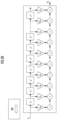
FIG. 2A , an example of an equivalent circuit of the internal resistance of thesecondary battery 200 is illustrated. In this example, the equivalent circuit of the internal resistance is defined by a series circuit of a connection resistance component R0, the i-th RC parallel circuit (i = 1, 2, ..., m) composed of charge transfer resistances Ri and capacitors Ci, a Warburg impedance W0, and a coil L. InFIG. 2A , the number, m, of RC parallel circuits connected in series is "4." As illustrated inFIG. 2B , the number, m, of RC parallel circuits connected in series may be smaller than 4, or may be larger than 4. As illustrated inFIG. 2C and FIG. 2D , respectively, the Warburg impedance W0 may also be connected in series with a resistance R in at least any one of RC parallel circuits (for example, in the first RC parallel circuit). Further, each capacitor C may be replaced with a CPE (Constant Phase Element). In addition, the coil L may be omitted. - The transfer function H0(z) of the resistance R0 is defined by equation (10). In
FIG. 3A , a block diagram representing the transfer function H0(z) of the resistance R0 is illustrated.
- The dependency of R0 on temperature θ is predetermined according to the equation (10) based on the measurement results of Nyquist plots of a reference secondary battery at different temperatures θ (see
FIG. 4 ), respectively. In other words, the coefficient R0 is defined as a dependent variable or a function when the temperature θ for defining the transfer function H0(z) of the resistance R0 is taken as the main variable. - The transfer function Hi(z) of the i-th RC parallel circuit is defined by equation (20) as an IIR (Infinite Impulse Response) system. In
FIG. 3B , a block diagram representing the transfer function Hi(z) of the i-th RC parallel circuit is illustrated.
- A transfer function Hi(s) of the i-th RC parallel circuit in an s region is expressed by equation (21).

- When the transfer function Hi(s) is bilinear-transformed (s → (2/T)(1-z-1)/(1 + z-1) (where T is a sampling period)), the transfer function Hi(z) of the i-th RC parallel circuit in a z region is expressed by equation (22).
Hi(z) = {Ri/(1 + 2τi/T) + Ri/(1 + 2τi/T)z-1} /{1+(1 - 2τi/T)/(1 + 2τi/T)z-1} - From a comparison between the equations (20) and (22), each of coefficients b0, bi, and ai in the IIR transfer function is defined by each of equations (221) to (223), respectively.


- The dependencies of Ri and Ci on temperature θ are predetermined according to the equation (21) based on the measurement results of Nyquist plots of the secondary battery at different temperatures θ (see
FIG. 4 ), respectively. In other words, each of the coefficients b0, bi, and ai that define the transfer function Hi(z) of the i-th RC parallel circuit is defined as a dependent variable or a multivariable function when the temperature θ and sampling frequency T are taken as main variables. - The transfer function HL(z) of the coil L is defined by equation (30) as the transfer function of the IIR system. In
FIG. 3C , a block diagram representing the transfer function HL(z) of the coil L is illustrated.
- A transfer function HL(s) of the coil L in the s region is expressed by equation (31).

- When the transfer function HL(s) is bilinear-transformed, the transfer function HL(z) of the coil L in the z region is represented by equation (32).

- From a comparison between the equations (30) and (32), each of the coefficients b0, bi, and ai in the IIR transfer function is defined by each of equations (321) to (323), respectively.


- The dependence of L0 on temperature θ is predetermined according to the equation (31) based on the measurement results of Nyquist plots of the reference secondary battery at each of different temperatures θ (see
FIG. 4 ), respectively. In other words, each of the coefficients b0 and bi that define the transfer function Hi(z) of the coil L is defined as a dependent variable or a multivariable function when the temperature θ and sampling frequency T are taken as main variables. - The transfer function HW(z) of the Warburg impedance W0 is defined by equation (40) as a transfer function of a FIR (Finite Impulse Response) system. In
FIG. 3D , a block diagram representing the transfer function HW(z) of the Warburg impedance W0 is illustrated.
[Math. 2]
- A transfer function HW(s) of the Warburg impedance W0 in the s region is represented by equation (41).

- When the transfer function HL(s) is bilinear-transformed, the transfer function HW(z) of the Warburg impedance W0 in the z region is represented by equation (42).

- Thus, from a comparison between the equations (40) and (42), it is found to be difficult to determine each of the coefficient hk in the FIR transfer function, respectively. Therefore, the dependencies of RW, TW, and p on temperature θ are determined according to the equation (41) based on the measurement results of Nyquist plots of the reference secondary battery at each of different temperatures θ (see
FIG. 4 ), respectively. Then, the equation (42) is subjected to inverse-FFT transform to be extracted as the coefficients of delay elements zk (k = 0 to n, where n is, for example, about several tens to 1000) in order to approximately define the transfer function HW(z) of the Warburg impedance W0 as an FIR transfer function as in equation (40). This is derived from the fact that the influence of the Warburg impedance W0 is reflected on a low frequency side in the Nyquist plots. In other words, each of the coefficients hk that define the transfer function HW(z) of the Warburg impedance W0 is defined as a dependent variable or a multivariable function when the temperature θ and sampling frequency T are taken as main variables. - In
FIG. 4 , an example of Nyquist plots representing the measurement results of a complex impedance Z of thesecondary battery 200 is illustrated together with an approximate curve of the plots. The horizontal axis is the real part ReZ of the complex impedance Z, and the vertical axis is the imaginary part -ImZ of the complex impedance Z. In a region of -ImZ > 0, lower frequency complex impedance Z is represented as ReZ increases. - A value of ReZ when -ImZ = 0 (
FIG. 4 (first evaluation section)) corresponds to the connection resistance component R0 of the secondary battery 200 (seeFIG. 3A ). A section in a region of -ImZ < 0 (first evaluation section) surrounded by the dot-and-dash line inFIG. 4 corresponds to the impedance of wiring inductance L0 of the electrodes and the like of the secondary battery 200 (seeFIG. 3B ). A crushed semicircular shaped section in a region of -ImZ > 0 (second evaluation section) surrounded by the long dashed double-dotted line inFIG. 4 corresponds to reaction resistance and electric double layer (impedance of the first to the m-th RC parallel circuits) at the electrode interface of the secondary battery 200 (seeFIG. 3C ). The radius tends to be smaller as the temperature T of thesecondary battery 200 increases. The influence of the Warburg impedance W0 of thesecondary battery 200 is reflected in an approximately linear section standing up at about 45° in a low frequency range in a region of ImZ > 0 (third evaluation section) surrounded by the dashed line inFIG. 4 (seeFIG. 3D ). - The approximate curve of the complex impedance Z of the secondary battery, which is represented by solid Nyquist plots in
FIG. 4 is determined under the assumption that the transfer function H(t) of the equivalent circuit model of the internal resistance of the secondary battery is defined according to the equation (02). Thus, values of parameters R0 (see the equation (10)), Ri and Ci (see the equation (21)), L0 (see the equation (31)), RW, TW, and p (see the equation (41)) are determined at each temperature θ. The value of the open circuit voltage OCV in each secondary battery model is identified by the measured value of the open circuit voltage OCV (see the equation (01)). Then, secondary battery models are established by the parameter values for various types ofsecondary batteries 200. - An inspection method of the
secondary battery 200 executed by the secondarybattery inspection device 100 having the configuration mentioned above will be described. - The impulse current I(t), the voltage V(t), and the temperature θ(t) of the
secondary battery 200 are measured by a current sensor S1, a voltage sensor S2, and a temperature sensor S0, respectively, when the impulse current I(t) is applied by a charge/discharge device 300 to thesecondary battery 200 to be inspected.
the measurement result of the temperature θ(t) of thesecondary battery 200 is input to thetemperature compensation element 110, and a temperature compensation model parameter according to the measurement result is output from thetemperature compensation element 110. Specifically, values R0(θ), Ri(θ), Ci(θ), L0(θ), RW(θ), TW(θ), and p(θ) of the parameters R0 (see the equation (10)), Ri and Ci (see the equation (21)), L0 (see the equation (31)), and RW and TW (see the equation (41)) according to the temperature θ are determined. These model parameters can be determined as average values of a good product population from mass-produced products of secondary batteries, and used as a reference model for pass/fail determination. - The temperature compensation model parameter is input from the
temperature compensation element 110 to the first modelparameter setting element 112, and the IIR model parameters b0(θ, T1), bi(θ, T1), and ai(θ, T1) are determined by the first modelparameter setting element 112 based on the temperature compensation model parameters Ri(θ) and Ci(θ) according to the first sampling period T1 (see the equations (221) to (223)). The IIR model parameters b0(θ, T1), bi(θ, T1), and ai(θ, T1) are determined by the first modelparameter setting element 112 based on the temperature compensation model parameter L0(θ) according to the first sampling period T1 (see the equations (321) to (323)). The FIR model parameter hk(θ, T1) is determined by the first modelparameter setting element 112 based on the temperature compensation model parameters RW(θ, T1), TW(θ, T1), and p(θ, T1) according to the first sampling period T1 (see the equation (40)). - The voltage V(t) of the
secondary battery 200 is inferred by the firstvoltage estimation element 114 based on the measurement result of the impulse current I(t) of thesecondary battery 200 according to the secondary battery model defined by the transfer function H(t) according to the first sampling period T1 as a short period (for example, about 10 ms) (see the equation (01)). InFIG. 5A and FIG. 5B , the measured values of the voltage V of thesecondary battery 200 at the time of discharge are illustrated by the dotted line, approximate curves representing the measured values of the OCV of thesecondary battery 200 in each first sampling period T1 are illustrated by the dashed line, and approximate curves representing the estimation results of the voltage V(t) of thesecondary battery 200 in each first sampling period T1 by the firstvoltage estimation element 114 are illustrated by the solid line, respectively. Since the open circuit voltage OCV is not considered in the secondary battery model, the estimation results D of the voltage V(t) of thesecondary battery 200 in each first sampling period T1 by the firstvoltage estimation element 114 is inferred based on the OCV (seeFIG. 5A, FIG. 5B /down arrow D). - The temperature compensation model parameter is input from the
temperature compensation element 110 to the second modelparameter setting element 122, and the IIR model parameters b0(θ, T2), bi(θ, T2), and ai(θ, T2) are determined by the second modelparameter setting element 122 based on the temperature compensation model parameters Ri(θ) and Ci(θ) according to the second sampling period T2 (see the equations (221) to (223)). The IIR model parameters b0(θ, T2), bi(θ, T2), and ai(θ, T2) are determined by the second modelparameter setting element 122 based on the temperature compensation model parameter L0(θ) according to the second sampling period T2 (see the equations (321) to (323)). The FIR model parameter hk(θ, T2) is determined by the second modelparameter setting element 122 based on the temperature compensation model parameters RW(θ, T2), TW(θ, T2), and p(θ, T2) according to the second sampling period T2 (see the equation (40)). - The voltage V(t) of the
secondary battery 200 is inferred by the secondvoltage estimation element 124 based on the measurement result of the impulse current I(t) of thesecondary battery 200 according to the secondary battery model defined by the transfer function H(t) according to the second sampling period T2 as a long period (for example, about 1 s) (see the equation (01)). InFIG. 5C , the measured values of the voltage V of thesecondary battery 200 at the time of discharge are illustrated by the solid line, an approximate curve representing the measured values of the OCV of thesecondary battery 200 in each second sampling period T2 is illustrated by the dashed line, and an approximate curve representing the estimation result of the voltage V(t) of thesecondary battery 200 in each second sampling period T2 by the secondvoltage estimation element 124 is illustrated by the solid line. Since the open circuit voltage OCV is not considered in the secondary battery model, the estimation result E of the voltage V(t) of thesecondary battery 200 by the secondvoltage estimation element 124 is inferred based on the OCV (seeFIG. 5C /down arrow E). - The voltage V(t) of the
secondary battery 200 is input to the secondarybattery inspection device 100, and the open circuit voltage OCV(t) of thesecondary battery 200 is detected by theOCV detection element 102 based on input A concerned. Then, a difference C = A - B of input A = V(t) and output B = OCV(t) of theOCV detection element 102 is output by thesubtraction element 104. The difference C is illustrated by the down arrow C in each ofFIG. 5A, FIG. 5B , andFIG. 5C , which represents a difference between the measured value (solid line) of the voltage V of thesecondary battery 200 at the time of discharge and the measured value dotted line) of the OCV. - The difference C is input from the
subtraction element 104 to thedivision element 116, and the estimation result D of the voltage V(t) of thesecondary battery 200 is input from the firstvoltage estimation element 114 to calculate a ratio C/D of both inputs. - C/D at each point of time in a first period (see
FIG. 5A /region surrounded by the dashed box) immediately after the impulse current I(t) starts flowing from thedivision element 116 is input to thefirst evaluation element 142, and the connection resistance component R0 and the inductance element L0 of thesecondary battery 200 in the first evaluation section is evaluated by thefirst evaluation element 142 based on a statistical index value, such as an average value of the input, a variance value, a deviation value, or an intermediate value of the maximum value and the minimum value. Here, since contribution by L0 is only the impedance on the imaginary axis and there is no contribution as the resistance value, the component to be evaluated is only R0 after all. The closer C/D to 1, the smaller the change in the connection resistance component R0 of thesecondary battery 200 is evaluated compared with the initial state or the good product population. - C/D at each point of time in a second period (see
FIG. 5B /region surrounded by the dashed box) longer than the first period and starting at the elapse of the first period after the impulse current I(t) starts flowing from thedivision element 116 is input to thesecond evaluation element 144, and the reaction resistance and electric double layer (impedance of the first to the m-th RC parallel circuits) at the electrode interface of thesecondary battery 200 in the second evaluation section are evaluated by thesecond evaluation element 144 based on the statistical index value of the input. The closer the C/D to 1, the smaller the change in the reaction resistance and electric double layer (impedance of the first to the m-th RC parallel circuits) at the electrode interface of thesecondary battery 200 is evaluated compared with the initial state or the good product population. A tolerance level can be set to the calculated value of C/D for pass/fail determination. - The difference C is input from the
subtraction element 104 to thedivision element 126, and the estimation result E of the voltage V(t) of thesecondary battery 200 is input from the secondvoltage estimation element 124 to calculate a ratio of C/E of both inputs. - C/E at each point of time in a third period (see
FIG. 5C /region surrounded by the dashed box) longer than the second period and starting at the elapse of the first period after the impulse current I(t) starts flowing from thedivision element 126 is input to thethird evaluation element 146, and the Warburg impedance W0 of thesecondary battery 200 in the third evaluation section is evaluated by thethird evaluation element 146 based on the statistical index value of the input. The closer C/E to 1, the smaller the change in the Warburg impedance W0 of thesecondary battery 200 is evaluated compared with the initial state or the good product population. A tolerance level can be set to the calculated value of C/E for pass/fail determination.. - The evaluation results of the
first evaluation element 142, thesecond evaluation element 144, and thethird evaluation element 146 are output to an output interface wired or wirelessly connected to the secondarybattery inspection device 100. - Each of the
first evaluation element 142, thesecond evaluation element 144, and thethird evaluation element 146 can make the determination with one measurement to estimate which component of the secondary battery is the cause of a failure depending on the combination of the determination results. - According to the secondary
battery inspection device 100 of the present invention and the secondary battery inspection method executed thereby, for example, as illustrated in Table 1, when the determination result of C/D related to the first evaluation section has a relation to a first determination reference value γ1 as expressed in equation (51), it is evaluated to be "OK (the resistance value of the cell constituent material is within a reference range)," while when the determination result of C/D does not have the relation expressed in the equation (51), it is evaluated to be "NG (the resistance value of the cell constituent material exceeds the reference)."
- Further, as illustrated in Table 1, when the determination result of C/D related to the second evaluation section has a relation to a second determination reference value γ2 as expressed in equation (52), it is evaluated to be "OK (there is no abnormality in reactivity between the positive electrode and the negative electrode)," while when the determination result of C/D does not have the relation expressed in the equation (52), it is evaluated to be "NG (there is abnormality in reactivity between the positive electrode and the negative electrode)."

- Further, as illustrated in Table 1, when the determination result of C/E related to the third evaluation section has a relation to a third determination reference value γ3 as expressed in equation (53), it is evaluated to be "OK (there is no shortage of electrolyte, no deterioration of the electrolyte, or the like)," while when the determination result of C/E does not have the relation expressed in the equation (53), it is evaluated to be "NG (there is a shortage of electrolyte, a deterioration of the electrolyte, or the like)."

- Thus, according to the present invention, not only can the pass/fail determination of the secondary battery be simply made but also it can be estimated which of components of the secondary battery causes a problem by one measurement.
- The evaluation results may be transmitted from the secondary
battery inspection device 100 to a client such as a smartphone, a tablet terminal, or a personal computer, and output to and displayed on an output interface (display) that constitutes part of the client. Thus, since a defect factor can also be estimated while facilitating the inspection of thesecondary battery 200, not only can the inspection accuracy be improved, but also a user of the client who engages in the production process can get smooth feedback.[Table 1] Individual Abnormality Content Determination Result in First Evaluation Section Determination Result in Second Evaluation Section Determination Result in Third Evaluation Section Assumed Factor Determination Reference γ1 Determination Reference γ2 Determination Reference γ3 Abnormality of Ro NG NG NG Increased Resistance of Cell Constituent Material (Contact Failure or Electrical Resistance) Abnormality of Rn, Cn OK NG NG Abnormality in Reactivity of Positive Electrode and Negative Electrode Abnormality of WO OK OK NG Ion Diffusion Reaction in Electrode, Such as Shortage or Deterioration of Electrolyte - 100...secondary battery inspection device, 102...OCV detection element (voltage recognition element), 104... subtraction element, 110... temperature compensation element, 112...first model parameter setting element, 114...first voltage estimation element, 122...second model parameter setting element, 124...second voltage estimation element, 200...secondary battery, 300...charge/discharge device.
Claims (4)
- A secondary battery inspection device comprising:a voltage recognition element configured to recognize a measurement result of voltage of a secondary battery when an impulse current flows into the secondary battery;a model parameter setting element configured to identify, based on a sampling period, a value of a model parameter of a secondary battery model in which impedance of internal resistance of the secondary battery is expressed by transfer functions respectively representing an IIR system and an FIR system;a voltage estimation element which, when the impulse current is input to a specified model as the secondary battery model the value of the model parameter of which is identified by the model parameter setting element, is configured to estimate a model output voltage as a voltage change form output from the specified model; andan evaluation element which is configured to evaluate based on a ratio (C/D) which is a ratio of a difference (C) between a measured value of the voltage of the secondary battery recognized by the voltage recognition element with respect to an estimation result (D) estimated by the voltage estimation element in each first sampling period as a short period, whether or not a resistance value of a cell constituent material of the secondary battery according to the first sampling period is within a reference range, whether or not a reactivity of a positive electrode or a negative electrode is abnormal, and to evaluate, based on a ratio (C/E) which is a ratio of the difference (C) between the measured value of the voltage of the secondary battery recognized by the voltage recognition element with respect to an estimation result (E) estimated by the voltage estimation element in each second sampling period as a long period, whether or not there is a shortage or a deterioration of an electrolytic solution of the secondary battery according to the second sampling period.
- The secondary battery inspection device according to claim 1, whereinthe model parameter setting element individually identifies the value of the model parameter based on each of a plurality of sampling periods, respectively,the voltage estimation element estimates a plurality of model output voltages as voltage change forms respectively output from a plurality of specified models when the impulse current is input to the plurality of specified models as individual secondary battery models with the values of the model parameter identified by the model parameter setting element, andthe evaluation element evaluates a plurality of performances of the secondary battery respectively according to respective of the plurality of sampling periods based on the measurement result of the voltage of the secondary battery recognized by the voltage recognition element, and respective of the plurality of specified model output voltages estimated by the voltage estimation element.
- The secondary battery inspection device according to claim 1 or 2, further comprisinga temperature compensation element which recognizes a measurement result of temperature of the secondary battery,wherein the model parameter setting element corrects the value of the model parameter based on the measurement result of the temperature of the secondary battery recognized by the temperature compensation element.
- A secondary battery inspection method comprising:a voltage recognition process of recognizing a measurement result of voltage of a secondary battery when an impulse current flows into the secondary battery;a model parameter setting process of identifying, based on a sampling period, a value of a model parameter of a secondary battery model in which impedance of internal resistance of the secondary battery is expressed by transfer functions respectively representing an IIR system and an FIR system;a voltage estimation process in which, when the impulse current is input to a specified model as the secondary battery model the value of the model parameter of which is identified in the model parameter setting process, a model output voltage as a voltage change form output from the specified model is estimated; andan evaluation process of evaluating, based on a ratio (C/D) which is a ratio of a difference (C) between a measured value of the voltage of the secondary battery recognized by the voltage recognition element with respect to an estimation result (D) estimated by the voltage estimation element in each first sampling period as a short period whether or not a resistance value of a cell constituent material of the secondary battery according to the first sampling period is within a reference range, whether or not a reactivity of a positive electrode or a negative electrode is abnormal, and to evaluate, based on a ratio (C/E) which is a ratio of the difference (C) between the measured value of the voltage of the secondary battery recognized by the voltage recognition element with respect to an estimation result (E) estimated by the voltage estimation element in each second sampling period as a long period, whether or not there is a shortage or a deterioration of an electrolytic solution of the secondary battery according to the second sampling period.
Priority Applications (1)
| Application Number | Priority Date | Filing Date | Title |
|---|---|---|---|
| HRP20250870TT HRP20250870T1 (en) | 2020-04-13 | 2021-03-19 | METHOD AND DEVICE FOR CHECKING A SECONDARY BATTERY CELL |
Applications Claiming Priority (2)
| Application Number | Priority Date | Filing Date | Title |
|---|---|---|---|
| JP2020071765A JP6997473B2 (en) | 2020-04-13 | 2020-04-13 | Secondary battery inspection method and secondary battery inspection device |
| PCT/JP2021/011440 WO2021210346A1 (en) | 2020-04-13 | 2021-03-19 | Secondary cell inspection method and secondary cell inspection device |
Publications (3)
| Publication Number | Publication Date |
|---|---|
| EP3951409A1 EP3951409A1 (en) | 2022-02-09 |
| EP3951409A4 EP3951409A4 (en) | 2023-06-21 |
| EP3951409B1 true EP3951409B1 (en) | 2025-06-04 |
Family
ID=78079692
Family Applications (1)
| Application Number | Title | Priority Date | Filing Date |
|---|---|---|---|
| EP21789494.8A Active EP3951409B1 (en) | 2020-04-13 | 2021-03-19 | Secondary cell inspection method and secondary cell inspection device |
Country Status (10)
| Country | Link |
|---|---|
| US (1) | US12169225B2 (en) |
| EP (1) | EP3951409B1 (en) |
| JP (1) | JP6997473B2 (en) |
| KR (2) | KR20210149795A (en) |
| CN (1) | CN113826020B (en) |
| CA (1) | CA3141786C (en) |
| DK (1) | DK3951409T3 (en) |
| HR (1) | HRP20250870T1 (en) |
| TW (1) | TWI774291B (en) |
| WO (1) | WO2021210346A1 (en) |
Families Citing this family (4)
| Publication number | Priority date | Publication date | Assignee | Title |
|---|---|---|---|---|
| JP7266907B2 (en) * | 2021-08-06 | 2023-05-01 | 東洋システム株式会社 | BATTERY PERFORMANCE EVALUATION DEVICE AND BATTERY PERFORMANCE EVALUATION METHOD |
| JP7652518B2 (en) * | 2021-11-03 | 2025-03-27 | エルジー エナジー ソリューション リミテッド | Apparatus and method for estimating impedance spectrum of battery, and system including same |
| WO2024134867A1 (en) * | 2022-12-23 | 2024-06-27 | 株式会社日立ハイテク | Battery diagnosis device, battery diagnosis method |
| JP7449008B1 (en) * | 2023-03-08 | 2024-03-13 | 東洋システム株式会社 | In-vehicle secondary battery diagnostic device |
Family Cites Families (20)
| Publication number | Priority date | Publication date | Assignee | Title |
|---|---|---|---|---|
| JPS5924617B2 (en) | 1980-04-25 | 1984-06-11 | 古河電気工業株式会社 | Underwater cable installation method |
| US20030206021A1 (en) * | 1997-07-25 | 2003-11-06 | Laletin William H. | Method and apparatus for measuring and analyzing electrical or electrochemical systems |
| US9397370B2 (en) * | 1999-06-25 | 2016-07-19 | The Board Of Trustees Of The University Of Illinois | Single and multiple cell battery with built-in controller |
| EP1933158B1 (en) * | 2005-09-16 | 2018-04-25 | The Furukawa Electric Co., Ltd. | Secondary cell degradation judgment method, secondary cell degradation judgment device, and power supply system |
| US9366732B2 (en) | 2009-09-04 | 2016-06-14 | Board Of Regents, The University Of Texas System | Estimation of state-of-health in batteries |
| JP5924617B2 (en) | 2012-06-05 | 2016-05-25 | 学校法人同志社 | Equivalent circuit synthesis method and apparatus, and circuit diagnostic method |
| JP5810116B2 (en) * | 2013-03-14 | 2015-11-11 | 古河電気工業株式会社 | Secondary battery state detection device and secondary battery state detection method |
| US9880061B2 (en) * | 2013-06-14 | 2018-01-30 | Hrl Laboratories, Llc | Methods and apparatus for sensing the internal temperature of an electrochemical device |
| US10222426B2 (en) | 2013-06-14 | 2019-03-05 | Hrl Laboratories, Llc | Double-pulse technique for on-line diagnostics of electrochemical systems |
| US9132745B1 (en) * | 2014-03-17 | 2015-09-15 | Ford Global Technologies, Llc | Frequency based battery model parameter estimation |
| JP2016090330A (en) * | 2014-10-31 | 2016-05-23 | カルソニックカンセイ株式会社 | Battery parameter estimation device |
| GB2532726A (en) | 2014-11-24 | 2016-06-01 | Thunot Andre | Cell internal impedance diagnostic system |
| WO2016129248A1 (en) * | 2015-02-13 | 2016-08-18 | パナソニックIpマネジメント株式会社 | Secondary battery state-of-charge estimating device and secondary battery state-of-charge estimating method |
| WO2017002953A1 (en) | 2015-07-02 | 2017-01-05 | 学校法人同志社 | Data extracting device, data extracting method, and data extracting program |
| CA3095272C (en) * | 2018-03-28 | 2021-11-30 | Toyo System Co., Ltd. | Degradation state determination device and degradation state determination method |
| WO2020145402A1 (en) | 2019-01-11 | 2020-07-16 | マレリ株式会社 | System identifying method and system identifying device |
| JP6842212B1 (en) | 2019-12-26 | 2021-03-17 | 東洋システム株式会社 | Battery performance evaluation method and battery performance evaluation device |
| JP6842213B1 (en) | 2019-12-27 | 2021-03-17 | 東洋システム株式会社 | Simulated battery construction method and simulated battery construction device |
| JP6887700B1 (en) * | 2020-01-20 | 2021-06-16 | 東洋システム株式会社 | Battery performance evaluation device, electronic device, charger and battery performance evaluation method |
| JP7090949B1 (en) * | 2021-05-19 | 2022-06-27 | 東洋システム株式会社 | Battery status determination method and battery status determination device |
-
2020
- 2020-04-13 JP JP2020071765A patent/JP6997473B2/en active Active
-
2021
- 2021-03-19 DK DK21789494.8T patent/DK3951409T3/en active
- 2021-03-19 KR KR1020217036069A patent/KR20210149795A/en not_active Ceased
- 2021-03-19 US US17/609,854 patent/US12169225B2/en active Active
- 2021-03-19 KR KR1020257041420A patent/KR20260003382A/en active Pending
- 2021-03-19 WO PCT/JP2021/011440 patent/WO2021210346A1/en not_active Ceased
- 2021-03-19 CA CA3141786A patent/CA3141786C/en active Active
- 2021-03-19 CN CN202180003289.0A patent/CN113826020B/en active Active
- 2021-03-19 EP EP21789494.8A patent/EP3951409B1/en active Active
- 2021-03-19 HR HRP20250870TT patent/HRP20250870T1/en unknown
- 2021-03-29 TW TW110111304A patent/TWI774291B/en active
Also Published As
| Publication number | Publication date |
|---|---|
| TW202201019A (en) | 2022-01-01 |
| US12169225B2 (en) | 2024-12-17 |
| CA3141786C (en) | 2023-06-20 |
| JP2021167798A (en) | 2021-10-21 |
| CA3141786A1 (en) | 2021-10-21 |
| KR20260003382A (en) | 2026-01-06 |
| JP6997473B2 (en) | 2022-02-04 |
| DK3951409T3 (en) | 2025-09-08 |
| HRP20250870T1 (en) | 2025-10-10 |
| KR20210149795A (en) | 2021-12-09 |
| CN113826020A (en) | 2021-12-21 |
| TWI774291B (en) | 2022-08-11 |
| US20230034016A1 (en) | 2023-02-02 |
| EP3951409A1 (en) | 2022-02-09 |
| EP3951409A4 (en) | 2023-06-21 |
| WO2021210346A1 (en) | 2021-10-21 |
| CN113826020B (en) | 2024-03-12 |
Similar Documents
| Publication | Publication Date | Title |
|---|---|---|
| EP3951409B1 (en) | Secondary cell inspection method and secondary cell inspection device | |
| US11686699B2 (en) | System and method for anomaly detection and total capacity estimation of a battery | |
| US11422194B2 (en) | Battery diagnosis apparatus and battery diagnosis method based on current pulse method | |
| EP1422804A2 (en) | Apparatus and method for estimating charge rate of secondary cell | |
| CN109581225A (en) | The energy state evaluation method and battery management system of battery on-line parameter identification | |
| JP2012042457A (en) | Battery state estimation device | |
| JP2016090346A (en) | Battery diagnostic device and battery diagnostic method | |
| CN107037363A (en) | A kind of battery ac impedance spectroscopy measuring method based on state filtering | |
| CN117607704A (en) | A micro-short-circuit fault diagnosis method for lithium-ion battery packs considering inconsistency | |
| CN117222904A (en) | Battery state estimation device, power system | |
| Lohmann et al. | Employing real automotive driving data for electrochemical impedance spectroscopy on lithium-ion cells | |
| Lin | Analytic derivation of battery SOC estimation error under sensor noises | |
| CN119414275A (en) | A method and system for evaluating the health status of a lithium battery | |
| CN116840688A (en) | Lithium ion battery charge state estimation method | |
| Li et al. | A fast identification method for internal short circuit resistance in lithium-ion battery based on voltage drop | |
| US10768238B2 (en) | Inspection method of electrical storage device and manufacturing method thereof | |
| JP7041848B2 (en) | Deterioration determination method for lithium-ion secondary batteries | |
| JP6057127B2 (en) | Battery pack insulation resistance test method | |
| Tinnemeyer | Multiple model impedance spectroscopy techniques for testing electrochemical systems | |
| CN115902639B (en) | Battery health state online detection method based on regional linear distance | |
| EP4624958A1 (en) | Impedance detection device and impedance detection method | |
| Aras et al. | Parameter Identification of an Electrical Battery Model using DC-IR Data. | |
| Sunil et al. | Improved Linear Estimation of Battery Open-Circuit Voltage and RC Model Parameters from Pulse-Relaxation Data | |
| CN121500155A (en) | A method and system for online detection of battery internal resistance and polarization characteristics | |
| CN121559367A (en) | Micro-short circuit on-line quantitative diagnosis method and system for energy storage battery |
Legal Events
| Date | Code | Title | Description |
|---|---|---|---|
| REG | Reference to a national code |
Ref country code: HR Ref legal event code: TUEP Ref document number: P20250870T Country of ref document: HR |
|
| STAA | Information on the status of an ep patent application or granted ep patent |
Free format text: STATUS: THE INTERNATIONAL PUBLICATION HAS BEEN MADE |
|
| PUAI | Public reference made under article 153(3) epc to a published international application that has entered the european phase |
Free format text: ORIGINAL CODE: 0009012 |
|
| STAA | Information on the status of an ep patent application or granted ep patent |
Free format text: STATUS: REQUEST FOR EXAMINATION WAS MADE |
|
| 17P | Request for examination filed |
Effective date: 20211103 |
|
| AK | Designated contracting states |
Kind code of ref document: A1 Designated state(s): AL AT BE BG CH CY CZ DE DK EE ES FI FR GB GR HR HU IE IS IT LI LT LU LV MC MK MT NL NO PL PT RO RS SE SI SK SM TR |
|
| REG | Reference to a national code |
Ref country code: DE Ref legal event code: R079 Free format text: PREVIOUS MAIN CLASS: G01R0031392000 Ipc: G01R0031382000 Ref country code: DE Ref legal event code: R079 Ref document number: 602021031858 Country of ref document: DE Free format text: PREVIOUS MAIN CLASS: G01R0031392000 Ipc: G01R0031382000 |
|
| A4 | Supplementary search report drawn up and despatched |
Effective date: 20230523 |
|
| RIC1 | Information provided on ipc code assigned before grant |
Ipc: G01R 31/389 20190101ALN20230516BHEP Ipc: G01R 31/367 20190101ALN20230516BHEP Ipc: H01M 10/42 20060101ALI20230516BHEP Ipc: G01R 31/374 20190101ALI20230516BHEP Ipc: G01R 31/385 20190101ALI20230516BHEP Ipc: G01R 31/382 20190101AFI20230516BHEP |
|
| DAV | Request for validation of the european patent (deleted) | ||
| DAX | Request for extension of the european patent (deleted) | ||
| STAA | Information on the status of an ep patent application or granted ep patent |
Free format text: STATUS: EXAMINATION IS IN PROGRESS |
|
| 17Q | First examination report despatched |
Effective date: 20241016 |
|
| GRAP | Despatch of communication of intention to grant a patent |
Free format text: ORIGINAL CODE: EPIDOSNIGR1 |
|
| STAA | Information on the status of an ep patent application or granted ep patent |
Free format text: STATUS: GRANT OF PATENT IS INTENDED |
|
| INTG | Intention to grant announced |
Effective date: 20250120 |
|
| RIC1 | Information provided on ipc code assigned before grant |
Ipc: G01R 31/389 20190101ALN20250110BHEP Ipc: G01R 31/367 20190101ALN20250110BHEP Ipc: H01M 10/42 20060101ALI20250110BHEP Ipc: G01R 31/374 20190101ALI20250110BHEP Ipc: G01R 31/385 20190101ALI20250110BHEP Ipc: G01R 31/382 20190101AFI20250110BHEP |
|
| P01 | Opt-out of the competence of the unified patent court (upc) registered |
Free format text: CASE NUMBER: APP_8796/2025 Effective date: 20250220 |
|
| GRAS | Grant fee paid |
Free format text: ORIGINAL CODE: EPIDOSNIGR3 |
|
| GRAA | (expected) grant |
Free format text: ORIGINAL CODE: 0009210 |
|
| STAA | Information on the status of an ep patent application or granted ep patent |
Free format text: STATUS: THE PATENT HAS BEEN GRANTED |
|
| AK | Designated contracting states |
Kind code of ref document: B1 Designated state(s): AL AT BE BG CH CY CZ DE DK EE ES FI FR GB GR HR HU IE IS IT LI LT LU LV MC MK MT NL NO PL PT RO RS SE SI SK SM TR |
|
| REG | Reference to a national code |
Ref country code: GB Ref legal event code: FG4D |
|
| REG | Reference to a national code |
Ref country code: CH Ref legal event code: EP |
|
| REG | Reference to a national code |
Ref country code: DE Ref legal event code: R096 Ref document number: 602021031858 Country of ref document: DE |
|
| REG | Reference to a national code |
Ref country code: IE Ref legal event code: FG4D |
|
| REG | Reference to a national code |
Ref country code: DK Ref legal event code: T3 Effective date: 20250901 |
|
| REG | Reference to a national code |
Ref country code: SE Ref legal event code: TRGR |
|
| REG | Reference to a national code |
Ref country code: NL Ref legal event code: MP Effective date: 20250604 |
|
| PG25 | Lapsed in a contracting state [announced via postgrant information from national office to epo] |
Ref country code: FI Free format text: LAPSE BECAUSE OF FAILURE TO SUBMIT A TRANSLATION OF THE DESCRIPTION OR TO PAY THE FEE WITHIN THE PRESCRIBED TIME-LIMIT Effective date: 20250604 Ref country code: ES Free format text: LAPSE BECAUSE OF FAILURE TO SUBMIT A TRANSLATION OF THE DESCRIPTION OR TO PAY THE FEE WITHIN THE PRESCRIBED TIME-LIMIT Effective date: 20250604 |
|
| REG | Reference to a national code |
Ref country code: LT Ref legal event code: MG9D Ref country code: HR Ref legal event code: T1PR Ref document number: P20250870 Country of ref document: HR |
|
| PG25 | Lapsed in a contracting state [announced via postgrant information from national office to epo] |
Ref country code: GR Free format text: LAPSE BECAUSE OF FAILURE TO SUBMIT A TRANSLATION OF THE DESCRIPTION OR TO PAY THE FEE WITHIN THE PRESCRIBED TIME-LIMIT Effective date: 20250905 |
|
| PG25 | Lapsed in a contracting state [announced via postgrant information from national office to epo] |
Ref country code: PL Free format text: LAPSE BECAUSE OF FAILURE TO SUBMIT A TRANSLATION OF THE DESCRIPTION OR TO PAY THE FEE WITHIN THE PRESCRIBED TIME-LIMIT Effective date: 20250604 |
|
| PG25 | Lapsed in a contracting state [announced via postgrant information from national office to epo] |
Ref country code: BG Free format text: LAPSE BECAUSE OF FAILURE TO SUBMIT A TRANSLATION OF THE DESCRIPTION OR TO PAY THE FEE WITHIN THE PRESCRIBED TIME-LIMIT Effective date: 20250604 |
|
| PG25 | Lapsed in a contracting state [announced via postgrant information from national office to epo] |
Ref country code: RS Free format text: LAPSE BECAUSE OF FAILURE TO SUBMIT A TRANSLATION OF THE DESCRIPTION OR TO PAY THE FEE WITHIN THE PRESCRIBED TIME-LIMIT Effective date: 20250904 |
|
| PG25 | Lapsed in a contracting state [announced via postgrant information from national office to epo] |
Ref country code: LV Free format text: LAPSE BECAUSE OF FAILURE TO SUBMIT A TRANSLATION OF THE DESCRIPTION OR TO PAY THE FEE WITHIN THE PRESCRIBED TIME-LIMIT Effective date: 20250604 |
|
| PG25 | Lapsed in a contracting state [announced via postgrant information from national office to epo] |
Ref country code: NL Free format text: LAPSE BECAUSE OF FAILURE TO SUBMIT A TRANSLATION OF THE DESCRIPTION OR TO PAY THE FEE WITHIN THE PRESCRIBED TIME-LIMIT Effective date: 20250604 |
|
| PG25 | Lapsed in a contracting state [announced via postgrant information from national office to epo] |
Ref country code: PT Free format text: LAPSE BECAUSE OF FAILURE TO SUBMIT A TRANSLATION OF THE DESCRIPTION OR TO PAY THE FEE WITHIN THE PRESCRIBED TIME-LIMIT Effective date: 20251006 |
|
| PG25 | Lapsed in a contracting state [announced via postgrant information from national office to epo] |
Ref country code: IS Free format text: LAPSE BECAUSE OF FAILURE TO SUBMIT A TRANSLATION OF THE DESCRIPTION OR TO PAY THE FEE WITHIN THE PRESCRIBED TIME-LIMIT Effective date: 20251004 |
|
| PG25 | Lapsed in a contracting state [announced via postgrant information from national office to epo] |
Ref country code: SM Free format text: LAPSE BECAUSE OF FAILURE TO SUBMIT A TRANSLATION OF THE DESCRIPTION OR TO PAY THE FEE WITHIN THE PRESCRIBED TIME-LIMIT Effective date: 20250604 |
|
| PG25 | Lapsed in a contracting state [announced via postgrant information from national office to epo] |
Ref country code: CZ Free format text: LAPSE BECAUSE OF FAILURE TO SUBMIT A TRANSLATION OF THE DESCRIPTION OR TO PAY THE FEE WITHIN THE PRESCRIBED TIME-LIMIT Effective date: 20250604 |
|
| PG25 | Lapsed in a contracting state [announced via postgrant information from national office to epo] |
Ref country code: EE Free format text: LAPSE BECAUSE OF FAILURE TO SUBMIT A TRANSLATION OF THE DESCRIPTION OR TO PAY THE FEE WITHIN THE PRESCRIBED TIME-LIMIT Effective date: 20250604 |
|
| PG25 | Lapsed in a contracting state [announced via postgrant information from national office to epo] |
Ref country code: SK Free format text: LAPSE BECAUSE OF FAILURE TO SUBMIT A TRANSLATION OF THE DESCRIPTION OR TO PAY THE FEE WITHIN THE PRESCRIBED TIME-LIMIT Effective date: 20250604 Ref country code: RO Free format text: LAPSE BECAUSE OF FAILURE TO SUBMIT A TRANSLATION OF THE DESCRIPTION OR TO PAY THE FEE WITHIN THE PRESCRIBED TIME-LIMIT Effective date: 20250604 |
|
| REG | Reference to a national code |
Ref country code: DE Ref legal event code: R097 Ref document number: 602021031858 Country of ref document: DE |
|
| REG | Reference to a national code |
Ref country code: HR Ref legal event code: ODRP Ref document number: P20250870 Country of ref document: HR Payment date: 20260220 Year of fee payment: 6 |
|
| PGFP | Annual fee paid to national office [announced via postgrant information from national office to epo] |
Ref country code: SE Payment date: 20260330 Year of fee payment: 6 |
|
| PLBE | No opposition filed within time limit |
Free format text: ORIGINAL CODE: 0009261 |
|
| STAA | Information on the status of an ep patent application or granted ep patent |
Free format text: STATUS: NO OPPOSITION FILED WITHIN TIME LIMIT |
|
| PGFP | Annual fee paid to national office [announced via postgrant information from national office to epo] |
Ref country code: NO Payment date: 20260327 Year of fee payment: 6 Ref country code: DK Payment date: 20260325 Year of fee payment: 6 Ref country code: DE Payment date: 20260310 Year of fee payment: 6 |
|
| PGFP | Annual fee paid to national office [announced via postgrant information from national office to epo] |
Ref country code: HR Payment date: 20260220 Year of fee payment: 6 Ref country code: AT Payment date: 20260326 Year of fee payment: 6 |
|
| REG | Reference to a national code |
Ref country code: CH Ref legal event code: L10 Free format text: ST27 STATUS EVENT CODE: U-0-0-L10-L00 (AS PROVIDED BY THE NATIONAL OFFICE) Effective date: 20260416 |
|
| PGFP | Annual fee paid to national office [announced via postgrant information from national office to epo] |
Ref country code: FR Payment date: 20260317 Year of fee payment: 6 |