EP3950786A1 - Organopolysiloxane modified with lactate silyl at both ends and method for producing same - Google Patents
Organopolysiloxane modified with lactate silyl at both ends and method for producing same Download PDFInfo
- Publication number
- EP3950786A1 EP3950786A1 EP20784873.0A EP20784873A EP3950786A1 EP 3950786 A1 EP3950786 A1 EP 3950786A1 EP 20784873 A EP20784873 A EP 20784873A EP 3950786 A1 EP3950786 A1 EP 3950786A1
- Authority
- EP
- European Patent Office
- Prior art keywords
- group
- lactate
- silyl
- independently
- general formula
- Prior art date
- Legal status (The legal status is an assumption and is not a legal conclusion. Google has not performed a legal analysis and makes no representation as to the accuracy of the status listed.)
- Pending
Links
- 0 CC*(C)C1(CC1)C(C1)CC1C(C(C)C(C1)CC1C(C)(CC)CCC1C*(C)C1)=C1CCCC1 Chemical compound CC*(C)C1(CC1)C(C1)CC1C(C(C)C(C1)CC1C(C)(CC)CCC1C*(C)C1)=C1CCCC1 0.000 description 1
Images

Classifications
-
- C—CHEMISTRY; METALLURGY
- C08—ORGANIC MACROMOLECULAR COMPOUNDS; THEIR PREPARATION OR CHEMICAL WORKING-UP; COMPOSITIONS BASED THEREON
- C08G—MACROMOLECULAR COMPOUNDS OBTAINED OTHERWISE THAN BY REACTIONS ONLY INVOLVING UNSATURATED CARBON-TO-CARBON BONDS
- C08G77/00—Macromolecular compounds obtained by reactions forming a linkage containing silicon with or without sulfur, nitrogen, oxygen or carbon in the main chain of the macromolecule
- C08G77/48—Macromolecular compounds obtained by reactions forming a linkage containing silicon with or without sulfur, nitrogen, oxygen or carbon in the main chain of the macromolecule in which at least two but not all the silicon atoms are connected by linkages other than oxygen atoms
- C08G77/50—Macromolecular compounds obtained by reactions forming a linkage containing silicon with or without sulfur, nitrogen, oxygen or carbon in the main chain of the macromolecule in which at least two but not all the silicon atoms are connected by linkages other than oxygen atoms by carbon linkages
-
- C—CHEMISTRY; METALLURGY
- C08—ORGANIC MACROMOLECULAR COMPOUNDS; THEIR PREPARATION OR CHEMICAL WORKING-UP; COMPOSITIONS BASED THEREON
- C08G—MACROMOLECULAR COMPOUNDS OBTAINED OTHERWISE THAN BY REACTIONS ONLY INVOLVING UNSATURATED CARBON-TO-CARBON BONDS
- C08G77/00—Macromolecular compounds obtained by reactions forming a linkage containing silicon with or without sulfur, nitrogen, oxygen or carbon in the main chain of the macromolecule
- C08G77/04—Polysiloxanes
- C08G77/14—Polysiloxanes containing silicon bound to oxygen-containing groups
-
- C—CHEMISTRY; METALLURGY
- C08—ORGANIC MACROMOLECULAR COMPOUNDS; THEIR PREPARATION OR CHEMICAL WORKING-UP; COMPOSITIONS BASED THEREON
- C08G—MACROMOLECULAR COMPOUNDS OBTAINED OTHERWISE THAN BY REACTIONS ONLY INVOLVING UNSATURATED CARBON-TO-CARBON BONDS
- C08G77/00—Macromolecular compounds obtained by reactions forming a linkage containing silicon with or without sulfur, nitrogen, oxygen or carbon in the main chain of the macromolecule
- C08G77/04—Polysiloxanes
- C08G77/14—Polysiloxanes containing silicon bound to oxygen-containing groups
- C08G77/18—Polysiloxanes containing silicon bound to oxygen-containing groups to alkoxy or aryloxy groups
-
- C—CHEMISTRY; METALLURGY
- C08—ORGANIC MACROMOLECULAR COMPOUNDS; THEIR PREPARATION OR CHEMICAL WORKING-UP; COMPOSITIONS BASED THEREON
- C08G—MACROMOLECULAR COMPOUNDS OBTAINED OTHERWISE THAN BY REACTIONS ONLY INVOLVING UNSATURATED CARBON-TO-CARBON BONDS
- C08G77/00—Macromolecular compounds obtained by reactions forming a linkage containing silicon with or without sulfur, nitrogen, oxygen or carbon in the main chain of the macromolecule
- C08G77/04—Polysiloxanes
- C08G77/38—Polysiloxanes modified by chemical after-treatment
-
- C—CHEMISTRY; METALLURGY
- C08—ORGANIC MACROMOLECULAR COMPOUNDS; THEIR PREPARATION OR CHEMICAL WORKING-UP; COMPOSITIONS BASED THEREON
- C08K—Use of inorganic or non-macromolecular organic substances as compounding ingredients
- C08K5/00—Use of organic ingredients
- C08K5/54—Silicon-containing compounds
- C08K5/541—Silicon-containing compounds containing oxygen
- C08K5/5415—Silicon-containing compounds containing oxygen containing at least one Si—O bond
- C08K5/5419—Silicon-containing compounds containing oxygen containing at least one Si—O bond containing at least one Si—C bond
-
- C—CHEMISTRY; METALLURGY
- C08—ORGANIC MACROMOLECULAR COMPOUNDS; THEIR PREPARATION OR CHEMICAL WORKING-UP; COMPOSITIONS BASED THEREON
- C08K—Use of inorganic or non-macromolecular organic substances as compounding ingredients
- C08K5/00—Use of organic ingredients
- C08K5/54—Silicon-containing compounds
- C08K5/541—Silicon-containing compounds containing oxygen
- C08K5/5425—Silicon-containing compounds containing oxygen containing at least one C=C bond
-
- C—CHEMISTRY; METALLURGY
- C08—ORGANIC MACROMOLECULAR COMPOUNDS; THEIR PREPARATION OR CHEMICAL WORKING-UP; COMPOSITIONS BASED THEREON
- C08L—COMPOSITIONS OF MACROMOLECULAR COMPOUNDS
- C08L83/00—Compositions of macromolecular compounds obtained by reactions forming in the main chain of the macromolecule a linkage containing silicon with or without sulfur, nitrogen, oxygen or carbon only; Compositions of derivatives of such polymers
- C08L83/04—Polysiloxanes
-
- C—CHEMISTRY; METALLURGY
- C08—ORGANIC MACROMOLECULAR COMPOUNDS; THEIR PREPARATION OR CHEMICAL WORKING-UP; COMPOSITIONS BASED THEREON
- C08G—MACROMOLECULAR COMPOUNDS OBTAINED OTHERWISE THAN BY REACTIONS ONLY INVOLVING UNSATURATED CARBON-TO-CARBON BONDS
- C08G77/00—Macromolecular compounds obtained by reactions forming a linkage containing silicon with or without sulfur, nitrogen, oxygen or carbon in the main chain of the macromolecule
- C08G77/04—Polysiloxanes
- C08G77/12—Polysiloxanes containing silicon bound to hydrogen
-
- C—CHEMISTRY; METALLURGY
- C08—ORGANIC MACROMOLECULAR COMPOUNDS; THEIR PREPARATION OR CHEMICAL WORKING-UP; COMPOSITIONS BASED THEREON
- C08G—MACROMOLECULAR COMPOUNDS OBTAINED OTHERWISE THAN BY REACTIONS ONLY INVOLVING UNSATURATED CARBON-TO-CARBON BONDS
- C08G77/00—Macromolecular compounds obtained by reactions forming a linkage containing silicon with or without sulfur, nitrogen, oxygen or carbon in the main chain of the macromolecule
- C08G77/04—Polysiloxanes
- C08G77/14—Polysiloxanes containing silicon bound to oxygen-containing groups
- C08G77/16—Polysiloxanes containing silicon bound to oxygen-containing groups to hydroxy groups
Definitions
- the present invention relates to an organopolysiloxane modified with lactate silyl at both ends capable of being hydrolyzed by moisture in the air at room temperature (25°C ⁇ 15°C) to release a lactate ester, and a method for producing the same.
- organopolysiloxane in which both molecular chain ends are modified with silanol groups or alkoxy groups is conventionally used.
- a dealcoholization type As a condensation curing type of a room-temperature-vulcanizing (RTV) silicone rubber composition, a dealcoholization type, a deoxime type, a deacetic acid type, and the like are generally known, and are used in various applications.
- the dealcoholization type is widely used in electrical and electronic component fixing adhesive agents or coating agents, automotive adhesives, and the like. Since the deoxime type and the deacetic acid type are relatively fast in curability, they are mainly used in sealing agents for building material in many cases. However, since a gas produced as a by-product during curing has a toxic or irritating odor, they have a safety problem. In addition, since the deoxime type and the deacetic acid type have a concern about corrosiveness to an adherend, attention needs to be paid at the time of use.
- Patent Document 1 JP No. 5399392 .
- Patent Document 1 shows that a room-temperature-vulcanizing (RTV) silicone rubber composition including polydimethylsiloxane having silanol groups at both molecular chain ends and ethyl lactate silane is superior to conventional deoxime-type and the like, in terms of human body health and environment.
- RTV room-temperature-vulcanizing
- the room-temperature-vulcanizing (RTV) silicone rubber composition has a very slow curing rate (very long curing time).
- Patent Document 2 JP-T 2018-515634 .
- the production method is divided into three steps, and the number of steps is increased.
- the present invention has been made to improve the above circumstances, and an object of the present invention is to provide an organopolysiloxane modified with lactate silyl at both ends particularly useful as a raw material siloxane of a room-temperature-vulcanizing (RTV) silicone rubber composition.
- RTV room-temperature-vulcanizing
- an organopolysiloxane modified with lactate silyl at both ends represented by the following general formula (1): wherein R 1 , R 2 , and R 3 are each independently an unsubstituted or substituted monovalent hydrocarbon group having 1 to 10 carbon atoms, m is an integer of 10 or more, a is independently 2 or 3, and X is an alkylene group having 2 to 4 carbon atoms or an oxygen atom, is preferable as a surface treatment agent for inorganic materials, a coating agent for water repellent treatment, particularly as a raw material siloxane of a room-temperature-vulcanizing (RTV) silicone rubber composition, and have completed the present invention.
- RTV room-temperature-vulcanizing
- the present invention provides the following organopolysiloxane modified with lactate silyl at both ends and a method for producing the same.
- the organopolysiloxane modified with lactate silyl at both ends of the present invention is effective as a surface treatment agent for inorganic materials, a coating agent for water repellent treatment, and particularly as a raw material siloxane of a room-temperature-vulcanizing (RTV) silicone rubber composition, and it is expected that the step for producing a room-temperature-vulcanizing (RTV) silicone rubber composition is simplified by using the present compound.
- RTV room-temperature-vulcanizing
- the organopolysiloxane modified with lactate silyl at both ends of the present invention is a linear diorganopolysiloxane capped at both molecular chain ends with a hydrolyzable group-containing silyl group (lactate silyl group) capable of desorbing a lactic acid ester, represented by the following general formula (1): wherein R 1 , R 2 , and R 3 are each independently an unsubstituted or substituted monovalent hydrocarbon group having 1 to 10 carbon atoms, m is an integer of 10 or more, a is independently 2 or 3, and X is an alkylene group having 2 to 4 carbon atoms or an oxygen atom.
- R 1 is independently an unsubstituted or substituted monovalent hydrocarbon group having 1 to 10 carbon atoms, preferably 1 to 8 carbon atoms, and more preferably 1 to 6 carbon atoms, and is, for example, an alkyl group such as a methyl group, an ethyl group, a propyl group, an isopropyl group, a butyl group, an isobutyl group, a sec-butyl group, a tert-butyl group, a pentyl group, a hexyl group, a heptyl group, an octyl group, a 2-ethylhexyl group, a nonyl group, or a decyl group; a cyclic alkyl group such as a cyclopentyl group, or a cyclohexyl group; an alkenyl group such as a vinyl group, an allyl group, or a propenyl
- m is an integer of 10 or more, usually 10 to 2,500, preferably 20 to 2,000, more preferably 50 to 1,200, and further preferably about 100 to 800, and preferably an integer such that the viscosity of the diorganopolysiloxane at 25°C is in the range of 25 to 30,000 mPa ⁇ s, preferably in the range of 50 to 100,000 mPa ⁇ s, and more preferably in the range of 500 to 80,000 mPa ⁇ s.
- m value (the degree of polymerization) indicating the number of repetitions of the diorganosiloxane unit or molecular weight
- m value the degree of polymerization
- the viscosity can be measured by a rotational viscometer (for example, a BL type, a BH type, a BS type, a cone and plate type, a rheometer, or the like) (the same applies hereinafter).
- R 2 and R 3 are each independently an unsubstituted or substituted monovalent hydrocarbon group having 1 to 10 carbon atoms, preferably 1 to 8 carbon atoms, and more preferably 1 to 6 carbon atoms, and are, for example, an alkyl group such as a methyl group, an ethyl group, a propyl group, an isopropyl group, a butyl group, an isobutyl group, a sec-butyl group, a tert-butyl group, a pentyl group, a hexyl group, a heptyl group, an octyl group, a 2-ethylhexyl group, a nonyl group, or a decyl group; a cyclic alkyl group such as a cyclopentyl group, or a cyclohexyl group; an alkenyl group such as a vinyl group, or an allyl group;
- R 2 is preferably a methyl group, an ethyl group, or a vinyl group
- R 3 is preferably a methyl group or an ethyl group.
- R 2 and R 3 may be the same or different, and R 3 s may be the same or different from each other.
- a 2 or 3.
- a methine carbon to which a methyl group is bonded can be an asymmetric center, but may be any of (R) form, (S) form, and racemate.
- organopolysiloxane modified with lactate silyl at both ends represented by the general formula (1)
- organopolysiloxanes modified with lactate silyl at both ends represented by the following general formulas (2) and (3): wherein R 1 , R 2 , R 3 , and m are the same as described above, n is independently 0, 1, or 2 and preferably 0 or 1, a1 is independently 2 or 3 and preferably 2, and a2 is independently 2 or 3 and preferably 3.
- One example of a method for producing the organopolysiloxane modified with lactate silyl at both ends represented by the general formula (1) is a method for producing an organopolysiloxane modified with lactate silyl at both ends represented by the formula (2) by a condensation reaction of an organopolysiloxane having one silanol group (hydroxyl group bonded to a silicon atom) at each of both molecular chain ends and an organosilane compound having three or four lactate groups in a molecule in the presence of a primary amine having a specific boiling point
- another example is a method for producing an organopolysiloxane modified with lactate silyl at both ends represented by the formula (3) by a hydrosilylation addition reaction of an organopolysiloxane having one SiH group (hydrogen atom bonded to a silicon atom) at each of both molecular chain ends and an organosilane compound having two or three lactate groups and at least one (one or two) alken
- an organopolysiloxane modified with lactate silyl at both ends represented by the general formula (2) it can be produced by a condensation reaction of:
- Component (A) is an organopolysiloxane having one silanol group (hydroxyl group bonded to a silicon atom) at each of both ends (two in the molecule) represented by the following general formula (4): wherein R 1 and m are the same as described above.
- R 1 and m are the same as those in the general formulas (1) and (2), and examples of R 1 are the same as those exemplified for R 1 in the formula (1), and R 1 is preferably a methyl group, a phenyl group, or a 3,3,3-trifluoropropyl group. R 1 may be the same group or different groups.
- organopolysiloxane having silanol groups at both ends represented by the formula (4) include those shown below: wherein m is the same as described above.
- R 2 and R 3 are the same as those of the general formulas (1) and (2), and examples of which are the same as those exemplified for R 2 and R 3 in the formula (1).
- R 2 is preferably a methyl group, an ethyl group, or a vinyl group
- R 3 is preferably a methyl group or an ethyl group.
- R 2 and R 3 may be the same or different, and R 3 s may be the same or different from each other.
- b is 3 or 4
- a1 is 2 or 3 and particularly preferably 2.
- a methine carbon to which a methyl group of the formula (5) is bonded can be an asymmetric center, but may be any of (R) form, (S) form, and racemate.
- component (B) examples include methyltris(ethyl lactate)silane, vinyltris(ethyl lactate)silane, ethyltris(ethyl lactate)silane, n-propyltris(ethyl lactate)silane, n-butyltris(ethyl lactate)silane, methyltris(methyl lactate)silane, vinyltris(methyl lactate)silane, ethyltris(methyl lactate)silane, n-propyltris(methyl lactate)silane, n-butyltris(methyl lactate)silane, methyltris(n-propyl lactate)silane, vinyltris(n-propyl lactate)silane, ethyltris(n-propyl lactate)silane, n-propyl lactate)silane, n-butyltris(methyl lactate)silane,
- methyltris(ethyl lactate)silane, vinyltris(ethyl lactate)silane, methyltris(methyl lactate)silane, and vinyltris(methyl lactate)silane are preferable, and methyltris(ethyl lactate)silane and vinyltris(ethyl lactate)silane are particularly preferable.
- the component (B) may be used singly or in combination of two or more kinds thereof.
- the amount of the component (B) to be used it is desirable to perform the reaction at a ratio such that the molar ratio of the hydroxyl groups bonded to the silicon atoms (silanol groups) in the component (A) and the component (B) (SiOH groups of (A):(B)) is about 1:1 to 1:50, preferably 1:1.8 to 1:30, and more preferably 1:2 to 1:10.
- a composition containing the component (A) and the component (B) contains a very small amount of moisture, and the lactate group of the component (B) may be consumed. Therefore, it is preferable to use an excessive amount of the component (B) relative to the hydroxyl group (silanol group) in the component (A).
- Component (C) is a primary amine having a boiling point of 30 to 100°C and preferably 30 to 80°C, and is a component used as a catalyst for a condensation reaction of the component (A) and the component (B).
- the component (C) may be used alone or as a mixture of two or more kinds.
- the component (C) is easy to handle because it is liquid at room temperature. Since the boiling point is 100°C or less, it can be completely removed by heating under reduced pressure or the like after completion of the reaction.
- More specific examples thereof include propylamine (boiling point: 48°C), isopropylamine (boiling point: 33°C), butylamine (boiling point: 78°C), isobutylamine (boiling point: 68 to 69°C), sec-butylamine (boiling point: 63°C), tert-butylamine (boiling point: 44.5°C), allylamine (boiling point: 96 to 98°C), and the like.
- Isopropylamine (boiling point: 33°C) is particularly preferable.
- the amount of the component (C) to be used is preferably 0.01 to 25 parts by weight and more preferably 0.05 to 10 parts by weight per 100 parts by weight of the component (A). If the amount of the component (C) is too small, the reaction may not proceed efficiently, and if the amount is too large, it is not economically preferable.
- the components (A), (B), and (C) are mixed at the above-described compounding ratio to carry out a condensation reaction.
- Reaction conditions can be usually set to a temperature range of 60 to 180°C and preferably 80 to 110°C for 60 to 600 minutes and preferably 180 to 420 minutes under atmospheric pressure.
- Component (D) is an organopolysiloxane having one SiH group (hydrogen atom bonded to a silicon atom) at each of both ends (two in the molecule) represented by the following general formula (6): wherein R 1 and m are the same as described above.
- R 1 and m are the same as those in the general formulas (1) and (3), and examples of R 1 are the same as those exemplified for R 1 in the formula (1), and R 1 is preferably a methyl group, a phenyl group, or a 3,3,3-trifluoropropyl group. R 1 may be the same group or different groups.
- organopolysiloxane having SiH groups hydrogen atoms bonded to silicon atoms
- formula (6) Specific examples of the organopolysiloxane having SiH groups (hydrogen atoms bonded to silicon atoms) at both ends represented by the formula (6) include those shown below (dimethylpolysiloxane capped at both molecular chain ends with dimethylhydrogensiloxy groups): wherein m is the same as described above.
- R 2 and R 3 are the same as those of the general formulas (1) and (3), and examples of which are the same as those exemplified for R 2 and R 3 in the formula (1).
- R 2 is preferably a monovalent hydrocarbon group excluding an aliphatic unsaturated hydrocarbon group such as an alkenyl group (an alkyl group, an aryl group, etc.), and more preferably a methyl group or an ethyl group (that is, in the formula (7), the number of alkenyl groups bonded to the silicon atom in the molecule is preferably one).
- R 3 is preferably a methyl group or an ethyl group.
- R 2 and R 3 may be the same or different, and R 3 s may be the same or different from each other.
- n 0, 1, or 2 and preferably 0 or 1.
- a2 is 2 or 3 and particularly preferably 3.
- a methine carbon to which a methyl group of the formula (7) is bonded can be an asymmetric center, but may be any of (R) form, (S) form, and racemate.
- component (E) examples include vinyltris(ethyl lactate)silane, allyltris(ethyl lactate)silane, methylvinylbis(ethyl lactate)silane, ethylvinylbis(ethyl lactate)silane, vinyltris(methyl lactate)silane, allyltris(methyl lactate)silane, methylvinylbis(methyl lactate)silane, ethylvinylbis(methyl lactate)silane, and the like.
- vinyltris(ethyl lactate)silane and vinyltris(methyl lactate)silane are particularly preferable.
- the component (E) may be used singly or in combination of two or more kinds thereof.
- the reaction it is desirable to perform the reaction at a ratio such that the molar ratio of the SiH groups in the component (D) and the alkenyl groups bonded to silicon atoms in the component (E) (SiH groups in the component (D) : silicon atom-bonded alkenyl groups in the component (E)) is 1:1 to 1:50, preferably 1:1.8 to 1:30, and more preferably 1:2 to 1:10.
- the molar ratio of the silicon atom-bonded alkenyl groups in the component (E) to the SiH group in the component (D) is too small, unreacted component (D) may remain, and if the molar ratio is too large, a large amount of unreacted component (E) may remain after completion of the reaction, so that a large load may be applied to the next step.
- the platinum group metal catalyst as component (F) is not particularly limited as long as it has an action of promoting an addition reaction (hydrosilylation reaction) between the SiH group-containing organopolysiloxane as the component (D) and the alkenyl group-containing organosilane compound as the component (E).
- a conventionally known hydrosilylation reaction catalyst can be used.
- platinum group metal catalysts such as chloroplatinic acid, alcohol-modified chloroplatinic acid, coordination compounds of chloroplatinic acid with olefins, vinylsiloxane or an acetylene compound, tetrakis(triphenylphosphine)palladium, and chlorotris(triphenylphosphine)rhodium, and the like, and platinum compounds are particularly preferable.
- Compounding amount of the component (F) may be an effective amount, and is preferably 0.1 to 1,000 ppm and more preferably 10 to 100 ppm in terms of weight of platinum group metal atoms per the SiH group-containing organopolysiloxane as the component (D). If the amount of the component (F) is too small, the reaction may not proceed efficiently, and if the amount is too large, it is not economically preferable.
- the components (D), (E), and (F) are mixed at the above-described compounding ratio to carry out an addition reaction.
- Reaction conditions can be usually set to a temperature range of 60 to 180°C and preferably 90 to 150°C for 5 to 600 minutes and preferably 180 to 360 minutes under atmospheric pressure.
- the organopolysiloxane modified with lactate silyl at both ends of the present invention is useful mainly as a main agent (base polymer) such as a surface treatment agent for inorganic materials and a coating agent for water repellent treatment.
- a main agent base polymer
- it is useful as a raw material siloxane of a delactic acid ester type room-temperature-vulcanizing (RTV) silicone rubber composition used for these applications.
- the present invention is described specifically with reference to Examples, but the present invention is not limited to the following Examples.
- room temperature is 25°C
- Me represents a methyl group
- Et represents an ethyl group.
- the degree of polymerization indicates a number average degree of polymerization in GPC analysis using toluene as a developing solvent.
- a 1-liter three-necked flask equipped with a stirrer, a thermometer, and a Dimroth condenser was charged with 100.0 g of dimethylpolysiloxane having silanol groups at both molecular chain ends represented by the following formula: 6.7 g of vinyltris(ethyl lactate)silane, and 0.080 g of isopropylamine, and the mixture was mixed and stirred at a rotation speed of 200 rpm at 100°C for 6 hours. Thereafter, heating was performed at 140°C for 5 hours under a reduced pressure of 1.3 kPa to remove volatile components. Finally, the inside of the system was cooled to room temperature, and the pressure was returned to atmospheric pressure to obtain a target compound (organopolysiloxane modified with lactate silyl at both molecular chain ends) represented by the following formula (8).
- a target compound organopolysiloxane modified with lactate silyl at both molecular chain ends
- FIG. 1 shows results of 29 Si-NMR measurement.
- ethyl lactate silyl group ethyl lactate silyl group
- Example 9 The same operation was carried out as in Example 1, except that the amount of silane component to be added was changed to 6.6 g of methyltris(ethyl lactate)silane to obtain a target compound (organopolysiloxane modified with lactate silyl at both molecular chain ends) represented by the following formula (9).
- the target compound represented by the formula (9) was subjected to 29 Si-NMR measurement to perform structural analysis.
- FIG. 2 shows results of 29 Si-NMR measurement.
- Example 1 it could be confirmed that the end silanol group of the dimethylpolysiloxane reacted with methyltris(ethyl lactate)silane and was almost completely capped with a hydrolyzable group-containing silyl group capable of desorbing the lactic acid ester.
- a 1-liter three-necked flask equipped with a stirrer, a thermometer, and a Dimroth condenser was charged with 100.0 g of dimethylpolysiloxane having SiH groups at both molecular chain ends (dimethylpolysiloxane capped at both molecular chain ends with dimethylhydrogensiloxy groups) represented by the following formula: and a platinum catalyst (chloroplatinic acid-vinylsiloxane complex, 10 ppm per the dimethylpolysiloxane as the weight of platinum atoms), and the temperature was raised to 90°C.
- 5.1 g of vinyltris(ethyl lactate)silane was added to a dropping funnel, and dropping was performed.
- a target compound (organopolysiloxane modified with lactate silyl at both molecular chain ends) represented by the following formula (10) was obtained.
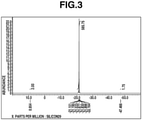
- FIG. 3 shows results of 29 Si-NMR measurement.
Landscapes
- Chemical & Material Sciences (AREA)
- Health & Medical Sciences (AREA)
- Chemical Kinetics & Catalysis (AREA)
- Medicinal Chemistry (AREA)
- Polymers & Plastics (AREA)
- Organic Chemistry (AREA)
- General Chemical & Material Sciences (AREA)
- Silicon Polymers (AREA)
Abstract
Description
- The present invention relates to an organopolysiloxane modified with lactate silyl at both ends capable of being hydrolyzed by moisture in the air at room temperature (25°C±15°C) to release a lactate ester, and a method for producing the same.
- As a raw material siloxane of a room-temperature-vulcanizin g (RTV) silicone rubber composition, organopolysiloxane in which both molecular chain ends are modified with silanol groups or alkoxy groups is conventionally used.
- As a condensation curing type of a room-temperature-vulcanizing (RTV) silicone rubber composition, a dealcoholization type, a deoxime type, a deacetic acid type, and the like are generally known, and are used in various applications. For example, the dealcoholization type is widely used in electrical and electronic component fixing adhesive agents or coating agents, automotive adhesives, and the like. Since the deoxime type and the deacetic acid type are relatively fast in curability, they are mainly used in sealing agents for building material in many cases. However, since a gas produced as a by-product during curing has a toxic or irritating odor, they have a safety problem. In addition, since the deoxime type and the deacetic acid type have a concern about corrosiveness to an adherend, attention needs to be paid at the time of use.
- As a recent new curing technology, a room-temperature-vulcanizing (RTV) silicone rubber composition of a delactic acid ester type by a condensation reaction has been disclosed (Patent Document 1:
JP No. 5399392 - In order to solve this problem, a silicone rubber composition with a molar ratio of aminosilane and a tin compound in the composition of 1:1 to 50:1 is disclosed (Patent Document 2:
JP-T 2018-515634 -
- Patent Document 1:
JP No. 5399392 - Patent Document 2:
JP-T 2018-515634 - The present invention has been made to improve the above circumstances, and an object of the present invention is to provide an organopolysiloxane modified with lactate silyl at both ends particularly useful as a raw material siloxane of a room-temperature-vulcanizing (RTV) silicone rubber composition.
- As a result of diligent efforts to achieve the above object, the present inventors have found that an organopolysiloxane modified with lactate silyl at both ends represented by the following general formula (1):

is preferable as a surface treatment agent for inorganic materials, a coating agent for water repellent treatment, particularly as a raw material siloxane of a room-temperature-vulcanizing (RTV) silicone rubber composition, and have completed the present invention. - That is, the present invention provides the following organopolysiloxane modified with lactate silyl at both ends and a method for producing the same.
- [1] An organopolysiloxane modified with lactate silyl at both ends having the following general formula (1):

- [2] An organopolysiloxane modified with lactate silyl at both ends having the following general formula (2):

- [3] An organopolysiloxane modified with lactate silyl at both ends having the following general formula (3):

- [4] A method for producing an organopolysiloxane modified with lactate silyl at both ends having the following general formula (2) according to [2],

comprising carrying out a condensation reaction of:- (A) an organopolysiloxane having silanol groups at both ends having the following general formula (4):

- (B) an organosilane compound having the following general formula (5):

- (C) a primary amine having a boiling point of 30 to 100°C.
- (A) an organopolysiloxane having silanol groups at both ends having the following general formula (4):
- [5] A method for producing an organopolysiloxane modified with lactate silyl at both ends having the following general formula (3) according to [3],

- (D) an organopolysiloxane having SiH groups at both ends having the following general formula (6):

- (E) an organosilane compound having the following general formula (7):

- (F) a platinum group metal catalyst.
- (D) an organopolysiloxane having SiH groups at both ends having the following general formula (6):
- The organopolysiloxane modified with lactate silyl at both ends of the present invention is effective as a surface treatment agent for inorganic materials, a coating agent for water repellent treatment, and particularly as a raw material siloxane of a room-temperature-vulcanizing (RTV) silicone rubber composition, and it is expected that the step for producing a room-temperature-vulcanizing (RTV) silicone rubber composition is simplified by using the present compound.
-
- [
FIG. 1] FIG. 1 is a 29Si-NMR spectrum diagram of an organopolysiloxane modified with lactate silyl at both ends obtained in Example 1 of the present invention. - [
FIG. 2] FIG. 2 is a 29Si-NMR spectrum diagram of an organopolysiloxane modified with lactate silyl at both ends obtained in Example 2 of the present invention. - [
FIG. 3] FIG. 3 is a 29Si-NMR spectrum diagram of an organopolysiloxane modified with lactate silyl at both ends obtained in Example 3 of the present invention. - Hereinafter, the present invention is described in detail.
- The organopolysiloxane modified with lactate silyl at both ends of the present invention is a linear diorganopolysiloxane capped at both molecular chain ends with a hydrolyzable group-containing silyl group (lactate silyl group) capable of desorbing a lactic acid ester, represented by the following general formula (1):

- In the formula (1), R1 is independently an unsubstituted or substituted monovalent hydrocarbon group having 1 to 10 carbon atoms, preferably 1 to 8 carbon atoms, and more preferably 1 to 6 carbon atoms, and is, for example, an alkyl group such as a methyl group, an ethyl group, a propyl group, an isopropyl group, a butyl group, an isobutyl group, a sec-butyl group, a tert-butyl group, a pentyl group, a hexyl group, a heptyl group, an octyl group, a 2-ethylhexyl group, a nonyl group, or a decyl group; a cyclic alkyl group such as a cyclopentyl group, or a cyclohexyl group; an alkenyl group such as a vinyl group, an allyl group, or a propenyl group; an aryl group such as a phenyl group, or a tolyl group; a group in which hydrogen atoms of these groups are partially substituted with halogen atoms, for example, a 3,3,3-trifluoropropyl group, or the like. Among them, a methyl group, a phenyl group, a 3,3,3-trifluoropropyl group, and the like are particularly preferable. A plurality of R1s in the general formula (1) may be the same group or different groups.
- Also, in the formula (1), m is an integer of 10 or more, usually 10 to 2,500, preferably 20 to 2,000, more preferably 50 to 1,200, and further preferably about 100 to 800, and preferably an integer such that the viscosity of the diorganopolysiloxane at 25°C is in the range of 25 to 30,000 mPa·s, preferably in the range of 50 to 100,000 mPa·s, and more preferably in the range of 500 to 80,000 mPa·s.
- In the present invention, m value (the degree of polymerization) indicating the number of repetitions of the diorganosiloxane unit or molecular weight can be usually determined as the polystyrene-equivalent number average degree of polymerization (or numerical average molecular weight) in gel permeation chromatography (GPC) analysis using toluene or the like as a developing solvent or the like (the same applies hereinafter). Also, the viscosity can be measured by a rotational viscometer (for example, a BL type, a BH type, a BS type, a cone and plate type, a rheometer, or the like) (the same applies hereinafter).
- Further, in the formula (1), R2 and R3 are each independently an unsubstituted or substituted monovalent hydrocarbon group having 1 to 10 carbon atoms, preferably 1 to 8 carbon atoms, and more preferably 1 to 6 carbon atoms, and are, for example, an alkyl group such as a methyl group, an ethyl group, a propyl group, an isopropyl group, a butyl group, an isobutyl group, a sec-butyl group, a tert-butyl group, a pentyl group, a hexyl group, a heptyl group, an octyl group, a 2-ethylhexyl group, a nonyl group, or a decyl group; a cyclic alkyl group such as a cyclopentyl group, or a cyclohexyl group; an alkenyl group such as a vinyl group, or an allyl group; an aryl group such as a phenyl group, or a tolyl group; a group in which hydrogen atoms of these groups are partially substituted with halogen atoms, for example, a 3,3,3-trifluoropropyl group, or the like. Among them, R2 is preferably a methyl group, an ethyl group, or a vinyl group, and R3 is preferably a methyl group or an ethyl group. R2 and R3 may be the same or different, and R3s may be the same or different from each other.
- a is 2 or 3.
- In addition, in the hydrolyzable group represented in parentheses to which a of the formula (1) is attached, a methine carbon to which a methyl group is bonded can be an asymmetric center, but may be any of (R) form, (S) form, and racemate.
- Examples of the organopolysiloxane modified with lactate silyl at both ends represented by the general formula (1) include organopolysiloxanes modified with lactate silyl at both ends represented by the following general formulas (2) and (3):


- One example of a method for producing the organopolysiloxane modified with lactate silyl at both ends represented by the general formula (1) is a method for producing an organopolysiloxane modified with lactate silyl at both ends represented by the formula (2) by a condensation reaction of an organopolysiloxane having one silanol group (hydroxyl group bonded to a silicon atom) at each of both molecular chain ends and an organosilane compound having three or four lactate groups in a molecule in the presence of a primary amine having a specific boiling point, and another example is a method for producing an organopolysiloxane modified with lactate silyl at both ends represented by the formula (3) by a hydrosilylation addition reaction of an organopolysiloxane having one SiH group (hydrogen atom bonded to a silicon atom) at each of both molecular chain ends and an organosilane compound having two or three lactate groups and at least one (one or two) alkenyl group bonded to a silicon atom in the presence of a platinum group metal catalyst.
- Specifically, as a method for producing an organopolysiloxane modified with lactate silyl at both ends represented by the general formula (2),
it can be produced by a condensation reaction of: - (A) an organopolysiloxane having silanol groups at both ends represented by the following general formula (4):

- (B) an organosilane compound represented by the following general formula (5):

- (C) a primary amine having a boiling point of 30 to 100°C.
- Hereinafter, the production method is described in detail.
- Component (A) is an organopolysiloxane having one silanol group (hydroxyl group bonded to a silicon atom) at each of both ends (two in the molecule) represented by the following general formula (4):

- In the formula (4), R1 and m are the same as those in the general formulas (1) and (2), and examples of R1 are the same as those exemplified for R1 in the formula (1), and R1 is preferably a methyl group, a phenyl group, or a 3,3,3-trifluoropropyl group. R1 may be the same group or different groups.
- Specific examples of the organopolysiloxane having silanol groups at both ends represented by the formula (4) include those shown below:

- Component (B) is a hydrolyzable organosilane compound having three or four hydrolyzable groups (lactate groups) in a molecule (that is, tri-lactate (organo)silane or tetralactate silane) capable of desorbing a lactic acid ester represented by -O-CH(CH3)-C(=O)O-R3 (R3 is the same as described above) in one molecule represented by the following general formula (5):

- In the formula (5), R2 and R3 are the same as those of the general formulas (1) and (2), and examples of which are the same as those exemplified for R2 and R3 in the formula (1). Among them, R2 is preferably a methyl group, an ethyl group, or a vinyl group, and R3 is preferably a methyl group or an ethyl group. R2 and R3 may be the same or different, and R3s may be the same or different from each other.
b is 3 or 4, and a1 in the general formula (2) is in a relationship of b = a1 + 1, and is particularly preferably 3. a1 is 2 or 3 and particularly preferably 2. - In addition, a methine carbon to which a methyl group of the formula (5) is bonded can be an asymmetric center, but may be any of (R) form, (S) form, and racemate.
- Specific examples of the component (B) include methyltris(ethyl lactate)silane, vinyltris(ethyl lactate)silane, ethyltris(ethyl lactate)silane, n-propyltris(ethyl lactate)silane, n-butyltris(ethyl lactate)silane, methyltris(methyl lactate)silane, vinyltris(methyl lactate)silane, ethyltris(methyl lactate)silane, n-propyltris(methyl lactate)silane, n-butyltris(methyl lactate)silane, methyltris(n-propyl lactate)silane, vinyltris(n-propyl lactate)silane, ethyltris(n-propyl lactate)silane, n-propyltris(n-propyl lactate)silane, n-butyltris(n-propyl lactate)silane, and the like.
- Among them, methyltris(ethyl lactate)silane, vinyltris(ethyl lactate)silane, methyltris(methyl lactate)silane, and vinyltris(methyl lactate)silane are preferable, and methyltris(ethyl lactate)silane and vinyltris(ethyl lactate)silane are particularly preferable.
- The component (B) may be used singly or in combination of two or more kinds thereof.
- With respect to the amount of the component (B) to be used, it is desirable to perform the reaction at a ratio such that the molar ratio of the hydroxyl groups bonded to the silicon atoms (silanol groups) in the component (A) and the component (B) (SiOH groups of (A):(B)) is about 1:1 to 1:50, preferably 1:1.8 to 1:30, and more preferably 1:2 to 1:10. Usually, a composition containing the component (A) and the component (B) contains a very small amount of moisture, and the lactate group of the component (B) may be consumed. Therefore, it is preferable to use an excessive amount of the component (B) relative to the hydroxyl group (silanol group) in the component (A). If the amount of the component (B) is too small, unreacted component (A) may remain, and if the amount is too large, a large amount of unreacted component (B) may remain after completion of the reaction, so that a large load may be applied to the next step.
- Component (C) is a primary amine having a boiling point of 30 to 100°C and preferably 30 to 80°C, and is a component used as a catalyst for a condensation reaction of the component (A) and the component (B). The component (C) may be used alone or as a mixture of two or more kinds. The component (C) is easy to handle because it is liquid at room temperature. Since the boiling point is 100°C or less, it can be completely removed by heating under reduced pressure or the like after completion of the reaction.
- More specific examples thereof include propylamine (boiling point: 48°C), isopropylamine (boiling point: 33°C), butylamine (boiling point: 78°C), isobutylamine (boiling point: 68 to 69°C), sec-butylamine (boiling point: 63°C), tert-butylamine (boiling point: 44.5°C), allylamine (boiling point: 96 to 98°C), and the like. Isopropylamine (boiling point: 33°C) is particularly preferable.
- The amount of the component (C) to be used is preferably 0.01 to 25 parts by weight and more preferably 0.05 to 10 parts by weight per 100 parts by weight of the component (A). If the amount of the component (C) is too small, the reaction may not proceed efficiently, and if the amount is too large, it is not economically preferable.
- In the organopolysiloxane modified with lactate silyl at both ends represented by the formula (2), the components (A), (B), and (C) are mixed at the above-described compounding ratio to carry out a condensation reaction. Reaction conditions can be usually set to a temperature range of 60 to 180°C and preferably 80 to 110°C for 60 to 600 minutes and preferably 180 to 420 minutes under atmospheric pressure.
- Next, as a specific method for producing an organopolysiloxane modified with lactate silyl at both ends represented by the following general formula (3):

- (D) an organopolysiloxane having one SiH group (hydrogen atom bonded to a silicon atom) at each of both ends (two in the molecule) represented by the following general formula (6):

- (E) an organosilane compound having two or three lactate groups and at least one (one or two) alkenyl group bonded to a silicon atom having 2 to 4 carbon atoms in a molecule represented by the following general formula (7):

- (F) a platinum group metal catalyst.
- Hereinafter, the production method is described in detail.
- Component (D) is an organopolysiloxane having one SiH group (hydrogen atom bonded to a silicon atom) at each of both ends (two in the molecule) represented by the following general formula (6):

- In the formula (6), R1 and m are the same as those in the general formulas (1) and (3), and examples of R1 are the same as those exemplified for R1 in the formula (1), and R1 is preferably a methyl group, a phenyl group, or a 3,3,3-trifluoropropyl group. R1 may be the same group or different groups.
- Specific examples of the organopolysiloxane having SiH groups (hydrogen atoms bonded to silicon atoms) at both ends represented by the formula (6) include those shown below (dimethylpolysiloxane capped at both molecular chain ends with dimethylhydrogensiloxy groups):

- Component (E) is a hydrolyzable organosilane compound having at least one (one or two), preferably one alkenyl group bonded to a silicon atom having 2 to 4 carbon atoms such as a vinyl group in the molecule represented by the following general formula (7), and having two or three, preferably three hydrolyzable groups (lactate groups) capable of desorbing a lactic acid ester represented by -O-CH(CH3)-C(=O)O-R3 (R3 is the same as described above):

- In the formula (7), R2 and R3 are the same as those of the general formulas (1) and (3), and examples of which are the same as those exemplified for R2 and R3 in the formula (1). Among them, R2 is preferably a monovalent hydrocarbon group excluding an aliphatic unsaturated hydrocarbon group such as an alkenyl group (an alkyl group, an aryl group, etc.), and more preferably a methyl group or an ethyl group (that is, in the formula (7), the number of alkenyl groups bonded to the silicon atom in the molecule is preferably one). R3 is preferably a methyl group or an ethyl group. R2 and R3 may be the same or different, and R3s may be the same or different from each other.
- n is 0, 1, or 2 and preferably 0 or 1. a2 is 2 or 3 and particularly preferably 3.
- In addition, a methine carbon to which a methyl group of the formula (7) is bonded can be an asymmetric center, but may be any of (R) form, (S) form, and racemate.
- Specific examples of the component (E) include vinyltris(ethyl lactate)silane, allyltris(ethyl lactate)silane, methylvinylbis(ethyl lactate)silane, ethylvinylbis(ethyl lactate)silane, vinyltris(methyl lactate)silane, allyltris(methyl lactate)silane, methylvinylbis(methyl lactate)silane, ethylvinylbis(methyl lactate)silane, and the like.
- Among them, vinyltris(ethyl lactate)silane and vinyltris(methyl lactate)silane are particularly preferable.
- The component (E) may be used singly or in combination of two or more kinds thereof.
- With respect to the amount of the component (E) to be used, it is desirable to perform the reaction at a ratio such that the molar ratio of the SiH groups in the component (D) and the alkenyl groups bonded to silicon atoms in the component (E) (SiH groups in the component (D) : silicon atom-bonded alkenyl groups in the component (E)) is 1:1 to 1:50, preferably 1:1.8 to 1:30, and more preferably 1:2 to 1:10. If the molar ratio of the silicon atom-bonded alkenyl groups in the component (E) to the SiH group in the component (D) is too small, unreacted component (D) may remain, and if the molar ratio is too large, a large amount of unreacted component (E) may remain after completion of the reaction, so that a large load may be applied to the next step.
- The platinum group metal catalyst as component (F) is not particularly limited as long as it has an action of promoting an addition reaction (hydrosilylation reaction) between the SiH group-containing organopolysiloxane as the component (D) and the alkenyl group-containing organosilane compound as the component (E).
- As the component (F), for example, a conventionally known hydrosilylation reaction catalyst can be used. Specific examples thereof include platinum group metal catalysts such as chloroplatinic acid, alcohol-modified chloroplatinic acid, coordination compounds of chloroplatinic acid with olefins, vinylsiloxane or an acetylene compound, tetrakis(triphenylphosphine)palladium, and chlorotris(triphenylphosphine)rhodium, and the like, and platinum compounds are particularly preferable.
- Compounding amount of the component (F) may be an effective amount, and is preferably 0.1 to 1,000 ppm and more preferably 10 to 100 ppm in terms of weight of platinum group metal atoms per the SiH group-containing organopolysiloxane as the component (D). If the amount of the component (F) is too small, the reaction may not proceed efficiently, and if the amount is too large, it is not economically preferable.
- In the organopolysiloxane modified with lactate silyl at both ends represented by the formula (3), the components (D), (E), and (F) are mixed at the above-described compounding ratio to carry out an addition reaction. Reaction conditions can be usually set to a temperature range of 60 to 180°C and preferably 90 to 150°C for 5 to 600 minutes and preferably 180 to 360 minutes under atmospheric pressure.
- The organopolysiloxane modified with lactate silyl at both ends of the present invention is useful mainly as a main agent (base polymer) such as a surface treatment agent for inorganic materials and a coating agent for water repellent treatment. In particular, it is useful as a raw material siloxane of a delactic acid ester type room-temperature-vulcanizing (RTV) silicone rubber composition used for these applications.
- Hereinafter, the present invention is described specifically with reference to Examples, but the present invention is not limited to the following Examples. In the following Examples, room temperature is 25°C, Me represents a methyl group, and Et represents an ethyl group. In addition, the degree of polymerization indicates a number average degree of polymerization in GPC analysis using toluene as a developing solvent.
- A 1-liter three-necked flask equipped with a stirrer, a thermometer, and a Dimroth condenser was charged with 100.0 g of dimethylpolysiloxane having silanol groups at both molecular chain ends represented by the following formula:


- 29Si-NMR measurement was performed on the target compound represented by the formula (8) to perform structural analysis.
-
FIG. 1 shows results of 29Si-NMR measurement. A peak (around -10 ppm) derived from a silanol group at a dimethylpolysiloxane end which had been present before the reaction disappeared, and instead of this, a peak (around -67 ppm) suggesting generation of a hydrolyzable group-containing silyl group (ethyl lactate silyl group) capable of desorbing a lactic acid ester was observed. It could be confirmed that the end silanol group of the dimethylpolysiloxane reacted with vinyltris(ethyl lactate)silane and was almost completely capped with a hydrolyzable group-containing silyl group capable of desorbing the lactic acid ester. - The same operation was carried out as in Example 1, except that the amount of silane component to be added was changed to 6.6 g of methyltris(ethyl lactate)silane to obtain a target compound (organopolysiloxane modified with lactate silyl at both molecular chain ends) represented by the following formula (9).

- The target compound represented by the formula (9) was subjected to 29Si-NMR measurement to perform structural analysis.
-
FIG. 2 shows results of 29Si-NMR measurement. A peak (around -10 ppm) derived from a silanol group at a dimethylpolysiloxane end which had been present before the reaction disappeared, and instead of this, a peak (around -52 ppm) suggesting generation of a hydrolyzable group-containing silyl group capable of desorbing a lactic acid ester was observed. As in Example 1, it could be confirmed that the end silanol group of the dimethylpolysiloxane reacted with methyltris(ethyl lactate)silane and was almost completely capped with a hydrolyzable group-containing silyl group capable of desorbing the lactic acid ester. - A 1-liter three-necked flask equipped with a stirrer, a thermometer, and a Dimroth condenser was charged with 100.0 g of dimethylpolysiloxane having SiH groups at both molecular chain ends (dimethylpolysiloxane capped at both molecular chain ends with dimethylhydrogensiloxy groups) represented by the following formula:


- 29Si-NMR measurement was performed on the target compound represented by the formula (10) to perform structural analysis.
-
FIG. 3 shows results of 29Si-NMR measurement. A peak (around -6 ppm) derived from a SiH group at a dimethylpolysiloxane end which had been present before the reaction disappeared, and instead of this, a peak (around 9.0 ppm) suggesting generation of a hydrolyzable group-containing silyl group (ethyl lactate silyl group) capable of desorbing a lactic acid ester was observed. It could be confirmed that the end SiH group of the dimethylpolysiloxane reacted with vinyltris(ethyl lactate)silane and was almost completely capped with a hydrolyzable group-containing silyl group capable of desorbing the lactic acid ester.
Claims (5)
- An organopolysiloxane modified with lactate silyl at both ends having the following general formula (1):

- An organopolysiloxane modified with lactate silyl at both ends having the following general formula (2):

- An organopolysiloxane modified with lactate silyl at both ends having the following general formula (3):

- A method for producing an organopolysiloxane modified with lactate silyl at both ends having the following general formula (2) according to claim 2,

comprising carrying out a condensation reaction of:(A) an organopolysiloxane having silanol groups at both ends having the following general formula (4): (B) an organosilane compound having the following general formula (5):
 (C) a primary amine having a boiling point of 30 to 100°C.
 - A method for producing an organopolysiloxane modified with lactate silyl at both ends having the following general formula (3) according to claim 3,

comprising carrying out an addition reaction of:(D) an organopolysiloxane having SiH groups at both ends having the following general formula (6): (E) an organosilane compound having the following general formula (7):
 (F) a platinum group metal catalyst.
Applications Claiming Priority (2)
| Application Number | Priority Date | Filing Date | Title |
|---|---|---|---|
| JP2019071485 | 2019-04-03 | ||
| PCT/JP2020/013535 WO2020203607A1 (en) | 2019-04-03 | 2020-03-26 | Organopolysiloxane modified with lactate silyl at both ends and method for producing same |
Publications (2)
| Publication Number | Publication Date |
|---|---|
| EP3950786A1 true EP3950786A1 (en) | 2022-02-09 |
| EP3950786A4 EP3950786A4 (en) | 2023-01-04 |
Family
ID=72667784
Family Applications (1)
| Application Number | Title | Priority Date | Filing Date |
|---|---|---|---|
| EP20784873.0A Pending EP3950786A4 (en) | 2019-04-03 | 2020-03-26 | ORGANOPOLYSILOXANE MODIFIED WITH SILYL LACTATE AT BOTH ENDS AND METHOD FOR PRODUCTION THEREOF |
Country Status (5)
| Country | Link |
|---|---|
| US (1) | US12378365B2 (en) |
| EP (1) | EP3950786A4 (en) |
| JP (1) | JP7424369B2 (en) |
| CN (1) | CN113631638B (en) |
| WO (1) | WO2020203607A1 (en) |
Families Citing this family (1)
| Publication number | Priority date | Publication date | Assignee | Title |
|---|---|---|---|---|
| PL4332109T3 (en) * | 2022-08-31 | 2026-01-26 | Henkel Ag & Co. Kgaa | Silanes and curable compositions containing them |
Family Cites Families (17)
| Publication number | Priority date | Publication date | Assignee | Title |
|---|---|---|---|---|
| DE3210337A1 (en) | 1982-03-20 | 1983-09-22 | Consortium für elektrochemische Industrie GmbH, 8000 München | SILANES, METHOD FOR THE PRODUCTION AND MEASURES THAT HAVE BEEN PREPARED USING THE SILANES |
| JPS6151056A (en) * | 1984-08-16 | 1986-03-13 | Toray Silicone Co Ltd | Organopolysiloxane composition coatable after curing at room temperature |
| WO2006098408A1 (en) * | 2005-03-17 | 2006-09-21 | Dow Corning Toray Co., Ltd. | Dihydroxycarboxylic acid amide group-containing organopolysiloxane and method for producing same |
| ES2425174T3 (en) | 2007-08-31 | 2013-10-11 | Nitrochemie Aschau Gmbh | Hardener for silicone rubber masses |
| JP2012136587A (en) * | 2010-12-24 | 2012-07-19 | Dow Corning Toray Co Ltd | Polysiloxane-hydrocarbylene aminohydrocarbylene multiblock copolymer and method for producing the same |
| EP2774672A1 (en) * | 2013-03-04 | 2014-09-10 | Nitrochemie Aschau GmbH | Catalyst for the cross-linking of silicon rubbers |
| DE202015009122U1 (en) * | 2015-03-17 | 2016-11-07 | Henkel Ag & Co. Kgaa | Silanes and curable compositions containing these silanes as crosslinkers |
| DE202015009134U1 (en) * | 2015-03-17 | 2016-10-24 | Henkel Ag & Co. Kgaa | Curable silicone compositions |
| CN105238342A (en) | 2015-11-13 | 2016-01-13 | 广州市白云化工实业有限公司 | Organic silicon cementing compound and preparation method thereof |
| EP3323844A1 (en) | 2016-11-17 | 2018-05-23 | Henkel AG & Co. KGaA | Curable compositions based on silicon-containing polymers using phosphazenes as catalysts |
| EP3392313A1 (en) | 2017-04-21 | 2018-10-24 | Nitrochemie Aschau GmbH | Curable silicone rubber substances |
| CN107523257A (en) | 2017-09-29 | 2017-12-29 | 山东三泽硅胶有限公司 | A kind of cold curing demulsification acetoacetic ester type silicone sealant |
| WO2019069706A1 (en) | 2017-10-06 | 2019-04-11 | 信越化学工業株式会社 | Method for manufacturing room-temperature-curable organopolysiloxane composition, room-temperature-curable organopolysiloxane composition, and article |
| MX2020012216A (en) | 2018-05-18 | 2021-01-29 | Henkel Ag & Co Kgaa | CURING SILICONE COMPOSITIONS. |
| ES2955777T3 (en) | 2018-11-30 | 2023-12-07 | Henkel Ag & Co Kgaa | Curable polyorganosiloxanes with protected end groups |
| CN113811578B (en) | 2019-05-09 | 2023-08-11 | 信越化学工业株式会社 | Room temperature curable organopolysiloxane composition, silicone rubber, and article |
| KR102388688B1 (en) | 2020-10-23 | 2022-04-20 | 비씨엔씨 주식회사 | Synthetic quartz manufacturing method |
-
2020
- 2020-03-26 CN CN202080025478.3A patent/CN113631638B/en active Active
- 2020-03-26 US US17/600,626 patent/US12378365B2/en active Active
- 2020-03-26 EP EP20784873.0A patent/EP3950786A4/en active Pending
- 2020-03-26 WO PCT/JP2020/013535 patent/WO2020203607A1/en not_active Ceased
- 2020-03-26 JP JP2021511896A patent/JP7424369B2/en active Active
Also Published As
| Publication number | Publication date |
|---|---|
| EP3950786A4 (en) | 2023-01-04 |
| CN113631638B (en) | 2023-09-22 |
| JPWO2020203607A1 (en) | 2020-10-08 |
| US12378365B2 (en) | 2025-08-05 |
| CN113631638A (en) | 2021-11-09 |
| JP7424369B2 (en) | 2024-01-30 |
| WO2020203607A1 (en) | 2020-10-08 |
| US20220098371A1 (en) | 2022-03-31 |
Similar Documents
| Publication | Publication Date | Title |
|---|---|---|
| US10968317B2 (en) | Method for hydrosilylation of aliphatically unsaturated alkoxysilanes and hydrogen terminated organosiloxane oligomers to prepare alkoxysilyl terminated polymers useful for functionalizing polyorganosiloxanes using an iridium catalyst | |
| US11098163B2 (en) | Method for hydrosilylation of aliphatically unsaturated alkoxysilanes and hydrogen terminated organosiloxane oligomers to prepare alkoxysilyl terminated polymers useful for functionalizing polyorganosiloxanes using a rhodium catalyst | |
| JP6497390B2 (en) | Room temperature curable organopolysiloxane composition and molded article which is a cured product of the room temperature curable organopolysiloxane composition | |
| JP5891948B2 (en) | Heavy release additive for release sheet, polyorganosiloxane composition for release sheet, and release sheet | |
| JP6187681B2 (en) | Novel bis (alkoxysilyl-vinylene) group-containing silicon compound and method for producing the same | |
| JPWO2014097574A1 (en) | Novel alkoxysilyl-ethylene group-terminated silicon-containing compound, room temperature curable organopolysiloxane composition, and molded product obtained by curing the composition | |
| WO2014097573A1 (en) | Novel ethynyl-group-containing organopolysiloxane compound, method for producing straight-chain organopolysiloxane compound containing ethynyl group at both molecular chain ends, method for producing alkoxysilyl-ethynyl-group-terminated organosiloxane polymer, room-temperature-curable composition, and molded article that is cured product of same | |
| EP0682068B1 (en) | Adhesion promoting compositions and curable organosiloxane compositions containing same | |
| EP0721952B1 (en) | Adhesion additives and curable organosiloxane compositions containing same | |
| JP2024117823A (en) | Two-component room temperature fast curing organopolysiloxane composition, cured product and article of said composition, and method for curing room temperature fast curing organopolysiloxane composition | |
| EP2042559B1 (en) | Addition curable silicone rubber composition and cured product thereof | |
| EP3950786A1 (en) | Organopolysiloxane modified with lactate silyl at both ends and method for producing same | |
| WO2022246363A1 (en) | Processes for making polysiloxazanes and using same for producing amino-functional polyorganosiloxanes | |
| JP2012193257A (en) | Two-liquid mixing type room-temperature curable organopolysiloxane composition | |
| JP2021178897A (en) | Manufacturing method of organopolysiloxane crude rubber, and, silicone rubber composition using crude rubber | |
| WO2024024453A1 (en) | Modifier composed of bis-silane compound, method for producing same, and use thereof | |
| JP2026001941A (en) | Organosilicon Compounds | |
| JP2020037640A (en) | Method for producing organopolysiloxane having cyclosiloxane structure at terminal of molecular chain |
Legal Events
| Date | Code | Title | Description |
|---|---|---|---|
| STAA | Information on the status of an ep patent application or granted ep patent |
Free format text: STATUS: THE INTERNATIONAL PUBLICATION HAS BEEN MADE |
|
| PUAI | Public reference made under article 153(3) epc to a published international application that has entered the european phase |
Free format text: ORIGINAL CODE: 0009012 |
|
| STAA | Information on the status of an ep patent application or granted ep patent |
Free format text: STATUS: REQUEST FOR EXAMINATION WAS MADE |
|
| 17P | Request for examination filed |
Effective date: 20210928 |
|
| AK | Designated contracting states |
Kind code of ref document: A1 Designated state(s): AL AT BE BG CH CY CZ DE DK EE ES FI FR GB GR HR HU IE IS IT LI LT LU LV MC MK MT NL NO PL PT RO RS SE SI SK SM TR |
|
| DAV | Request for validation of the european patent (deleted) | ||
| DAX | Request for extension of the european patent (deleted) | ||
| A4 | Supplementary search report drawn up and despatched |
Effective date: 20221207 |
|
| RIC1 | Information provided on ipc code assigned before grant |
Ipc: C08K 5/5425 20060101ALI20221201BHEP Ipc: C08K 5/5419 20060101ALI20221201BHEP Ipc: C08G 77/50 20060101ALI20221201BHEP Ipc: C08G 77/38 20060101ALI20221201BHEP Ipc: C08G 77/14 20060101AFI20221201BHEP |
|
| GRAP | Despatch of communication of intention to grant a patent |
Free format text: ORIGINAL CODE: EPIDOSNIGR1 |
|
| STAA | Information on the status of an ep patent application or granted ep patent |
Free format text: STATUS: GRANT OF PATENT IS INTENDED |