EP3950690A1 - Pyrroloheterocyclic derivative, preparation method therefor, and application thereof in medicine - Google Patents
Pyrroloheterocyclic derivative, preparation method therefor, and application thereof in medicine Download PDFInfo
- Publication number
- EP3950690A1 EP3950690A1 EP20783525.7A EP20783525A EP3950690A1 EP 3950690 A1 EP3950690 A1 EP 3950690A1 EP 20783525 A EP20783525 A EP 20783525A EP 3950690 A1 EP3950690 A1 EP 3950690A1
- Authority
- EP
- European Patent Office
- Prior art keywords
- compound
- group
- formula
- alkyl
- pharmaceutically acceptable
- Prior art date
- Legal status (The legal status is an assumption and is not a legal conclusion. Google has not performed a legal analysis and makes no representation as to the accuracy of the status listed.)
- Withdrawn
Links
- 239000003814 drug Substances 0.000 title claims abstract description 17
- 238000002360 preparation method Methods 0.000 title claims abstract description 13
- 239000008194 pharmaceutical composition Substances 0.000 claims abstract description 25
- 150000001875 compounds Chemical class 0.000 claims description 164
- 239000000203 mixture Substances 0.000 claims description 75
- -1 cyano, amino Chemical group 0.000 claims description 72
- 125000000217 alkyl group Chemical group 0.000 claims description 71
- 125000000623 heterocyclic group Chemical group 0.000 claims description 59
- 150000003839 salts Chemical class 0.000 claims description 56
- 125000000753 cycloalkyl group Chemical group 0.000 claims description 54
- 125000002887 hydroxy group Chemical group [H]O* 0.000 claims description 48
- 229910052736 halogen Inorganic materials 0.000 claims description 43
- 150000002367 halogens Chemical group 0.000 claims description 43
- 125000004435 hydrogen atom Chemical group [H]* 0.000 claims description 43
- 125000003545 alkoxy group Chemical group 0.000 claims description 35
- 125000002768 hydroxyalkyl group Chemical group 0.000 claims description 32
- 125000001072 heteroaryl group Chemical group 0.000 claims description 31
- 238000000034 method Methods 0.000 claims description 25
- 125000003118 aryl group Chemical group 0.000 claims description 23
- 125000001424 substituent group Chemical group 0.000 claims description 23
- 125000000449 nitro group Chemical group [O-][N+](*)=O 0.000 claims description 22
- 125000004169 (C1-C6) alkyl group Chemical group 0.000 claims description 20
- 206010028980 Neoplasm Diseases 0.000 claims description 20
- 125000004093 cyano group Chemical group *C#N 0.000 claims description 19
- 125000001188 haloalkyl group Chemical group 0.000 claims description 18
- 125000006239 protecting group Chemical group 0.000 claims description 18
- 125000004438 haloalkoxy group Chemical group 0.000 claims description 15
- 125000002924 primary amino group Chemical group [H]N([H])* 0.000 claims description 15
- 201000011510 cancer Diseases 0.000 claims description 13
- 230000002401 inhibitory effect Effects 0.000 claims description 13
- 125000004043 oxo group Chemical group O=* 0.000 claims description 13
- 125000006577 C1-C6 hydroxyalkyl group Chemical group 0.000 claims description 10
- 125000001313 C5-C10 heteroaryl group Chemical group 0.000 claims description 9
- 125000004103 aminoalkyl group Chemical group 0.000 claims description 9
- 201000010099 disease Diseases 0.000 claims description 9
- 208000037265 diseases, disorders, signs and symptoms Diseases 0.000 claims description 9
- 125000002496 methyl group Chemical group [H]C([H])([H])* 0.000 claims description 8
- 239000000546 pharmaceutical excipient Substances 0.000 claims description 8
- 206010035226 Plasma cell myeloma Diseases 0.000 claims description 7
- 125000004191 (C1-C6) alkoxy group Chemical group 0.000 claims description 6
- 230000002378 acidificating effect Effects 0.000 claims description 6
- 206010009944 Colon cancer Diseases 0.000 claims description 5
- 201000001441 melanoma Diseases 0.000 claims description 5
- 125000003226 pyrazolyl group Chemical group 0.000 claims description 5
- 238000011282 treatment Methods 0.000 claims description 5
- 125000005913 (C3-C6) cycloalkyl group Chemical group 0.000 claims description 4
- 206010003571 Astrocytoma Diseases 0.000 claims description 4
- 206010005003 Bladder cancer Diseases 0.000 claims description 4
- 208000003174 Brain Neoplasms Diseases 0.000 claims description 4
- 206010006187 Breast cancer Diseases 0.000 claims description 4
- 208000026310 Breast neoplasm Diseases 0.000 claims description 4
- 206010008342 Cervix carcinoma Diseases 0.000 claims description 4
- 208000001333 Colorectal Neoplasms Diseases 0.000 claims description 4
- 208000032612 Glial tumor Diseases 0.000 claims description 4
- 206010018338 Glioma Diseases 0.000 claims description 4
- 206010061218 Inflammation Diseases 0.000 claims description 4
- 208000008839 Kidney Neoplasms Diseases 0.000 claims description 4
- 206010058467 Lung neoplasm malignant Diseases 0.000 claims description 4
- 206010025323 Lymphomas Diseases 0.000 claims description 4
- 208000001894 Nasopharyngeal Neoplasms Diseases 0.000 claims description 4
- 206010061306 Nasopharyngeal cancer Diseases 0.000 claims description 4
- 206010029260 Neuroblastoma Diseases 0.000 claims description 4
- 206010033128 Ovarian cancer Diseases 0.000 claims description 4
- 206010061535 Ovarian neoplasm Diseases 0.000 claims description 4
- 206010061902 Pancreatic neoplasm Diseases 0.000 claims description 4
- 206010060862 Prostate cancer Diseases 0.000 claims description 4
- 208000000236 Prostatic Neoplasms Diseases 0.000 claims description 4
- 206010038389 Renal cancer Diseases 0.000 claims description 4
- 206010039491 Sarcoma Diseases 0.000 claims description 4
- 208000000102 Squamous Cell Carcinoma of Head and Neck Diseases 0.000 claims description 4
- 208000024770 Thyroid neoplasm Diseases 0.000 claims description 4
- 208000007097 Urinary Bladder Neoplasms Diseases 0.000 claims description 4
- 208000006105 Uterine Cervical Neoplasms Diseases 0.000 claims description 4
- 125000004202 aminomethyl group Chemical group [H]N([H])C([H])([H])* 0.000 claims description 4
- 201000010881 cervical cancer Diseases 0.000 claims description 4
- 208000019065 cervical carcinoma Diseases 0.000 claims description 4
- 239000003085 diluting agent Substances 0.000 claims description 4
- 201000000459 head and neck squamous cell carcinoma Diseases 0.000 claims description 4
- 125000004029 hydroxymethyl group Chemical group [H]OC([H])([H])* 0.000 claims description 4
- 230000004054 inflammatory process Effects 0.000 claims description 4
- 201000010982 kidney cancer Diseases 0.000 claims description 4
- 208000032839 leukemia Diseases 0.000 claims description 4
- 201000007270 liver cancer Diseases 0.000 claims description 4
- 208000014018 liver neoplasm Diseases 0.000 claims description 4
- 201000005202 lung cancer Diseases 0.000 claims description 4
- 208000020816 lung neoplasm Diseases 0.000 claims description 4
- 208000015486 malignant pancreatic neoplasm Diseases 0.000 claims description 4
- 201000000050 myeloid neoplasm Diseases 0.000 claims description 4
- 201000002528 pancreatic cancer Diseases 0.000 claims description 4
- 208000008443 pancreatic carcinoma Diseases 0.000 claims description 4
- 230000002062 proliferating effect Effects 0.000 claims description 4
- 201000002510 thyroid cancer Diseases 0.000 claims description 4
- 201000005112 urinary bladder cancer Diseases 0.000 claims description 4
- 125000000278 alkyl amino alkyl group Chemical group 0.000 claims description 3
- 239000003937 drug carrier Substances 0.000 claims description 3
- 125000006533 methyl amino methyl group Chemical group [H]N(C([H])([H])[H])C([H])([H])* 0.000 claims description 2
- 230000002265 prevention Effects 0.000 claims description 2
- 208000015634 Rectal Neoplasms Diseases 0.000 claims 1
- 208000029742 colonic neoplasm Diseases 0.000 claims 1
- 206010038038 rectal cancer Diseases 0.000 claims 1
- 201000001275 rectum cancer Diseases 0.000 claims 1
- 239000012824 ERK inhibitor Substances 0.000 abstract description 5
- 229940124597 therapeutic agent Drugs 0.000 abstract 1
- 239000000243 solution Substances 0.000 description 156
- 238000006243 chemical reaction Methods 0.000 description 130
- YMWUJEATGCHHMB-UHFFFAOYSA-N Dichloromethane Chemical compound ClCCl YMWUJEATGCHHMB-UHFFFAOYSA-N 0.000 description 96
- 238000004949 mass spectrometry Methods 0.000 description 69
- XEKOWRVHYACXOJ-UHFFFAOYSA-N Ethyl acetate Chemical compound CCOC(C)=O XEKOWRVHYACXOJ-UHFFFAOYSA-N 0.000 description 60
- 230000002829 reductive effect Effects 0.000 description 43
- 238000004440 column chromatography Methods 0.000 description 38
- 239000003480 eluent Substances 0.000 description 38
- XLYOFNOQVPJJNP-UHFFFAOYSA-N water Substances O XLYOFNOQVPJJNP-UHFFFAOYSA-N 0.000 description 34
- OKKJLVBELUTLKV-UHFFFAOYSA-N Methanol Chemical compound OC OKKJLVBELUTLKV-UHFFFAOYSA-N 0.000 description 33
- OKKJLVBELUTLKV-MZCSYVLQSA-N Deuterated methanol Chemical compound [2H]OC([2H])([2H])[2H] OKKJLVBELUTLKV-MZCSYVLQSA-N 0.000 description 30
- 239000012074 organic phase Substances 0.000 description 29
- 239000000706 filtrate Substances 0.000 description 28
- 238000012360 testing method Methods 0.000 description 26
- WYURNTSHIVDZCO-UHFFFAOYSA-N Tetrahydrofuran Chemical compound C1CCOC1 WYURNTSHIVDZCO-UHFFFAOYSA-N 0.000 description 22
- DTQVDTLACAAQTR-UHFFFAOYSA-N Trifluoroacetic acid Chemical compound OC(=O)C(F)(F)F DTQVDTLACAAQTR-UHFFFAOYSA-N 0.000 description 22
- 238000005160 1H NMR spectroscopy Methods 0.000 description 21
- VYPSYNLAJGMNEJ-UHFFFAOYSA-N Silicium dioxide Chemical compound O=[Si]=O VYPSYNLAJGMNEJ-UHFFFAOYSA-N 0.000 description 20
- 239000002904 solvent Substances 0.000 description 20
- HEDRZPFGACZZDS-MICDWDOJSA-N Trichloro(2H)methane Chemical compound [2H]C(Cl)(Cl)Cl HEDRZPFGACZZDS-MICDWDOJSA-N 0.000 description 19
- 239000012300 argon atmosphere Substances 0.000 description 18
- RYHBNJHYFVUHQT-UHFFFAOYSA-N 1,4-Dioxane Chemical compound C1COCCO1 RYHBNJHYFVUHQT-UHFFFAOYSA-N 0.000 description 17
- IAZDPXIOMUYVGZ-UHFFFAOYSA-N Dimethylsulphoxide Chemical compound CS(C)=O IAZDPXIOMUYVGZ-UHFFFAOYSA-N 0.000 description 17
- 125000004432 carbon atom Chemical group C* 0.000 description 17
- 230000000694 effects Effects 0.000 description 17
- SCVFZCLFOSHCOH-UHFFFAOYSA-M potassium acetate Chemical compound [K+].CC([O-])=O SCVFZCLFOSHCOH-UHFFFAOYSA-M 0.000 description 16
- NXQGGXCHGDYOHB-UHFFFAOYSA-L cyclopenta-1,4-dien-1-yl(diphenyl)phosphane;dichloropalladium;iron(2+) Chemical compound [Fe+2].Cl[Pd]Cl.[CH-]1C=CC(P(C=2C=CC=CC=2)C=2C=CC=CC=2)=C1.[CH-]1C=CC(P(C=2C=CC=CC=2)C=2C=CC=CC=2)=C1 NXQGGXCHGDYOHB-UHFFFAOYSA-L 0.000 description 15
- 238000004809 thin layer chromatography Methods 0.000 description 14
- ZMXDDKWLCZADIW-UHFFFAOYSA-N N,N-Dimethylformamide Chemical compound CN(C)C=O ZMXDDKWLCZADIW-UHFFFAOYSA-N 0.000 description 12
- PMZURENOXWZQFD-UHFFFAOYSA-L Sodium Sulfate Chemical compound [Na+].[Na+].[O-]S([O-])(=O)=O PMZURENOXWZQFD-UHFFFAOYSA-L 0.000 description 12
- UIIMBOGNXHQVGW-UHFFFAOYSA-M Sodium bicarbonate Chemical class [Na+].OC([O-])=O UIIMBOGNXHQVGW-UHFFFAOYSA-M 0.000 description 12
- FAPWRFPIFSIZLT-UHFFFAOYSA-M Sodium chloride Chemical compound [Na+].[Cl-] FAPWRFPIFSIZLT-UHFFFAOYSA-M 0.000 description 12
- 125000002619 bicyclic group Chemical group 0.000 description 12
- PFKFTWBEEFSNDU-UHFFFAOYSA-N carbonyldiimidazole Chemical compound C1=CN=CN1C(=O)N1C=CN=C1 PFKFTWBEEFSNDU-UHFFFAOYSA-N 0.000 description 12
- RAXXELZNTBOGNW-UHFFFAOYSA-N imidazole Natural products C1=CNC=N1 RAXXELZNTBOGNW-UHFFFAOYSA-N 0.000 description 12
- 125000003367 polycyclic group Chemical group 0.000 description 11
- 125000006413 ring segment Chemical group 0.000 description 11
- YLQBMQCUIZJEEH-UHFFFAOYSA-N tetrahydrofuran Natural products C=1C=COC=1 YLQBMQCUIZJEEH-UHFFFAOYSA-N 0.000 description 11
- 108010007457 Extracellular Signal-Regulated MAP Kinases Proteins 0.000 description 10
- 102000007665 Extracellular Signal-Regulated MAP Kinases Human genes 0.000 description 10
- 102000018471 Proto-Oncogene Proteins B-raf Human genes 0.000 description 10
- 108010091528 Proto-Oncogene Proteins B-raf Proteins 0.000 description 10
- FJDQFPXHSGXQBY-UHFFFAOYSA-L caesium carbonate Chemical compound [Cs+].[Cs+].[O-]C([O-])=O FJDQFPXHSGXQBY-UHFFFAOYSA-L 0.000 description 10
- 229910000024 caesium carbonate Inorganic materials 0.000 description 10
- 210000004027 cell Anatomy 0.000 description 10
- 238000002474 experimental method Methods 0.000 description 10
- 125000005842 heteroatom Chemical group 0.000 description 10
- 238000000338 in vitro Methods 0.000 description 10
- 239000000758 substrate Substances 0.000 description 10
- QTBSBXVTEAMEQO-UHFFFAOYSA-N Acetic acid Chemical compound CC(O)=O QTBSBXVTEAMEQO-UHFFFAOYSA-N 0.000 description 9
- MESGGMWOOVVIGW-LJQANCHMSA-N CC1=CN=C(N=C1C2=CN3C(=C2)CN(C3=O)[C@H](CO)C4=CC(=C(C=C4)F)Cl)NC5=CC=NN5C Chemical compound CC1=CN=C(N=C1C2=CN3C(=C2)CN(C3=O)[C@H](CO)C4=CC(=C(C=C4)F)Cl)NC5=CC=NN5C MESGGMWOOVVIGW-LJQANCHMSA-N 0.000 description 9
- WKBMRZDYCZPLFO-LJQANCHMSA-N CC1=CN=C(N=C1C2=CN3C(=C2)CN(C3=O)[C@H](CO)C4=CC(=CC=C4)Cl)NC5=CC=NN5C Chemical compound CC1=CN=C(N=C1C2=CN3C(=C2)CN(C3=O)[C@H](CO)C4=CC(=CC=C4)Cl)NC5=CC=NN5C WKBMRZDYCZPLFO-LJQANCHMSA-N 0.000 description 9
- 241000699670 Mus sp. Species 0.000 description 9
- KEAYESYHFKHZAL-UHFFFAOYSA-N Sodium Chemical compound [Na] KEAYESYHFKHZAL-UHFFFAOYSA-N 0.000 description 9
- ZMANZCXQSJIPKH-UHFFFAOYSA-N Triethylamine Chemical compound CCN(CC)CC ZMANZCXQSJIPKH-UHFFFAOYSA-N 0.000 description 9
- 239000003153 chemical reaction reagent Substances 0.000 description 9
- 239000002829 mitogen activated protein kinase inhibitor Substances 0.000 description 9
- 239000012312 sodium hydride Substances 0.000 description 9
- 229910000104 sodium hydride Inorganic materials 0.000 description 9
- 239000007858 starting material Substances 0.000 description 9
- GQNPKXNIHOJKAI-SSQCYJAOSA-N C1C(CC(C1O)F)NC2=NC=C(C(=N2)C3=CN4C(=C3)CN(C4=O)[C@H](CO)C5=CC(=CC=C5)Cl)Cl Chemical compound C1C(CC(C1O)F)NC2=NC=C(C(=N2)C3=CN4C(=C3)CN(C4=O)[C@H](CO)C5=CC(=CC=C5)Cl)Cl GQNPKXNIHOJKAI-SSQCYJAOSA-N 0.000 description 8
- IAPCRLSYLOVVNK-HXUWFJFHSA-N CC1=CN=C(N=C1C2=CN3C(=C2)CCN(C3=O)[C@H](CO)C4=CC(=CC=C4)Cl)NC5=CC=NN5C Chemical compound CC1=CN=C(N=C1C2=CN3C(=C2)CCN(C3=O)[C@H](CO)C4=CC(=CC=C4)Cl)NC5=CC=NN5C IAPCRLSYLOVVNK-HXUWFJFHSA-N 0.000 description 8
- VXOKMSNYMXNIAX-GOSISDBHSA-N CN1C(=CC=N1)NC2=NC=C(C(=N2)C3=CN4C(=C3)CN(C4=O)[C@H](CO)C5=CC(=CC=C5)Cl)Cl Chemical compound CN1C(=CC=N1)NC2=NC=C(C(=N2)C3=CN4C(=C3)CN(C4=O)[C@H](CO)C5=CC(=CC=C5)Cl)Cl VXOKMSNYMXNIAX-GOSISDBHSA-N 0.000 description 8
- 102000004190 Enzymes Human genes 0.000 description 8
- 108090000790 Enzymes Proteins 0.000 description 8
- 239000004480 active ingredient Substances 0.000 description 8
- 229910052739 hydrogen Inorganic materials 0.000 description 8
- 239000001257 hydrogen Substances 0.000 description 8
- 230000005764 inhibitory process Effects 0.000 description 8
- 235000011056 potassium acetate Nutrition 0.000 description 8
- BCNZYOJHNLTNEZ-UHFFFAOYSA-N tert-butyldimethylsilyl chloride Chemical compound CC(C)(C)[Si](C)(C)Cl BCNZYOJHNLTNEZ-UHFFFAOYSA-N 0.000 description 8
- UOGHACSDYDMUKP-HXUWFJFHSA-N CC1=CN=C(N=C1C2=CN3C(=C2)CN(C3=O)[C@H](CO)C4=CC(=CC(=C4)F)OC)NC5=CC=NN5C Chemical compound CC1=CN=C(N=C1C2=CN3C(=C2)CN(C3=O)[C@H](CO)C4=CC(=CC(=C4)F)OC)NC5=CC=NN5C UOGHACSDYDMUKP-HXUWFJFHSA-N 0.000 description 7
- IEGIHBPFEABTHR-LJQANCHMSA-N CC1=CN=C(N=C1C2=CN3C(=C2)CN(C3=O)[C@H](CO)C4=CC(=CC=C4)Cl)NC(C)C Chemical compound CC1=CN=C(N=C1C2=CN3C(=C2)CN(C3=O)[C@H](CO)C4=CC(=CC=C4)Cl)NC(C)C IEGIHBPFEABTHR-LJQANCHMSA-N 0.000 description 7
- QMXTUGNOGIAGDE-LJQANCHMSA-N CN1C(=CC=N1)NC2=NC=CC(=N2)C3=CN4C(=C3)CN(C4=O)[C@H](CO)C5=CC(=C(C=C5)Cl)F Chemical compound CN1C(=CC=N1)NC2=NC=CC(=N2)C3=CN4C(=C3)CN(C4=O)[C@H](CO)C5=CC(=C(C=C5)Cl)F QMXTUGNOGIAGDE-LJQANCHMSA-N 0.000 description 7
- VEXZGXHMUGYJMC-UHFFFAOYSA-N Hydrochloric acid Chemical compound Cl VEXZGXHMUGYJMC-UHFFFAOYSA-N 0.000 description 7
- UFHFLCQGNIYNRP-UHFFFAOYSA-N Hydrogen Chemical compound [H][H] UFHFLCQGNIYNRP-UHFFFAOYSA-N 0.000 description 7
- 125000004429 atom Chemical group 0.000 description 7
- 229910052799 carbon Inorganic materials 0.000 description 7
- 229940079593 drug Drugs 0.000 description 7
- 230000035755 proliferation Effects 0.000 description 7
- 239000003643 water by type Substances 0.000 description 7
- UZRVECRDNGTAPK-LJQANCHMSA-N 2-[(1S)-1-(3-chloro-4-fluorophenyl)-2-hydroxyethyl]-6-[2-[(2-methylpyrazol-3-yl)amino]pyrimidin-4-yl]-1H-pyrrolo[1,2-c]imidazol-3-one Chemical compound CN1C(=CC=N1)NC2=NC=CC(=N2)C3=CN4C(=C3)CN(C4=O)[C@H](CO)C5=CC(=C(C=C5)F)Cl UZRVECRDNGTAPK-LJQANCHMSA-N 0.000 description 6
- PLTJNRDNZQOBDO-HXUWFJFHSA-N CC1=CC(=CC=C1)[C@@H](CO)N2CC3=CC(=CN3C2=O)C4=NC(=NC=C4)NC5=CC=NN5C Chemical compound CC1=CC(=CC=C1)[C@@H](CO)N2CC3=CC(=CN3C2=O)C4=NC(=NC=C4)NC5=CC=NN5C PLTJNRDNZQOBDO-HXUWFJFHSA-N 0.000 description 6
- RAWSHCFBXIUKJY-LJQANCHMSA-N CC1=CN=C(N=C1C2=CN3C(=C2)CN(C3=O)[C@H](CN)C4=CC(=CC=C4)Cl)NC5=CC=NN5C Chemical compound CC1=CN=C(N=C1C2=CN3C(=C2)CN(C3=O)[C@H](CN)C4=CC(=CC=C4)Cl)NC5=CC=NN5C RAWSHCFBXIUKJY-LJQANCHMSA-N 0.000 description 6
- XXKUJOYSMJRULC-HXUWFJFHSA-N CC1=CN=C(N=C1C2=CN3C(=C2)CN(C3=O)[C@H](CNC)C4=CC(=CC=C4)Cl)NC5=CC=NN5C Chemical compound CC1=CN=C(N=C1C2=CN3C(=C2)CN(C3=O)[C@H](CNC)C4=CC(=CC=C4)Cl)NC5=CC=NN5C XXKUJOYSMJRULC-HXUWFJFHSA-N 0.000 description 6
- SYWNALRLVNLCOC-KPZWWZAWSA-N C[C@@H](CO)NC1=NC=C(C(=N1)C2=CN3C(=C2)CN(C3=O)[C@H](CO)C4=CC(=CC=C4)Cl)Cl Chemical compound C[C@@H](CO)NC1=NC=C(C(=N1)C2=CN3C(=C2)CN(C3=O)[C@H](CO)C4=CC(=CC=C4)Cl)Cl SYWNALRLVNLCOC-KPZWWZAWSA-N 0.000 description 6
- SYWNALRLVNLCOC-KZULUSFZSA-N C[C@H](CO)NC1=NC=C(C(=N1)C2=CN3C(=C2)CN(C3=O)[C@H](CO)C4=CC(=CC=C4)Cl)Cl Chemical compound C[C@H](CO)NC1=NC=C(C(=N1)C2=CN3C(=C2)CN(C3=O)[C@H](CO)C4=CC(=CC=C4)Cl)Cl SYWNALRLVNLCOC-KZULUSFZSA-N 0.000 description 6
- 125000003282 alkyl amino group Chemical group 0.000 description 6
- IPWKHHSGDUIRAH-UHFFFAOYSA-N bis(pinacolato)diboron Chemical compound O1C(C)(C)C(C)(C)OB1B1OC(C)(C)C(C)(C)O1 IPWKHHSGDUIRAH-UHFFFAOYSA-N 0.000 description 6
- 239000000872 buffer Substances 0.000 description 6
- 125000000000 cycloalkoxy group Chemical group 0.000 description 6
- 229910052757 nitrogen Inorganic materials 0.000 description 6
- 210000002381 plasma Anatomy 0.000 description 6
- 230000019491 signal transduction Effects 0.000 description 6
- 229910000033 sodium borohydride Inorganic materials 0.000 description 6
- 239000012279 sodium borohydride Substances 0.000 description 6
- RJJLTGSKFNJQCZ-SECBINFHSA-N (2s)-2-amino-2-(3-methylphenyl)ethanol Chemical compound CC1=CC=CC([C@H](N)CO)=C1 RJJLTGSKFNJQCZ-SECBINFHSA-N 0.000 description 5
- VAVHMEQFYYBAPR-ITWZMISCSA-N (e,3r,5s)-7-[4-(4-fluorophenyl)-1-phenyl-2-propan-2-ylpyrrol-3-yl]-3,5-dihydroxyhept-6-enoic acid Chemical compound CC(C)C1=C(\C=C\[C@@H](O)C[C@@H](O)CC(O)=O)C(C=2C=CC(F)=CC=2)=CN1C1=CC=CC=C1 VAVHMEQFYYBAPR-ITWZMISCSA-N 0.000 description 5
- LEZQOGFQDMABLK-RUZDIDTESA-N 2-[(1S)-2-[tert-butyl(dimethyl)silyl]oxy-1-(3-methylphenyl)ethyl]-6-[2-[(2-methylpyrazol-3-yl)amino]pyrimidin-4-yl]-1H-pyrrolo[1,2-c]imidazol-3-one Chemical compound CC(C)(C)[Si](C)(C)OC[C@H](C1=CC=CC(C)=C1)N(CC1=CC(C2=NC(NC3=CC=NN3C)=NC=C2)=CN11)C1=O LEZQOGFQDMABLK-RUZDIDTESA-N 0.000 description 5
- NLXLAEXVIDQMFP-UHFFFAOYSA-N Ammonia chloride Chemical class [NH4+].[Cl-] NLXLAEXVIDQMFP-UHFFFAOYSA-N 0.000 description 5
- TXYDDQVPVDOULC-HXUWFJFHSA-N C1COCCC1NC2=NC=C(C(=N2)C3=CN4C(=C3)CN(C4=O)[C@H](CO)C5=CC(=CC=C5)Cl)Cl Chemical compound C1COCCC1NC2=NC=C(C(=N2)C3=CN4C(=C3)CN(C4=O)[C@H](CO)C5=CC(=CC=C5)Cl)Cl TXYDDQVPVDOULC-HXUWFJFHSA-N 0.000 description 5
- CYSWUSAYJNCAKA-FYJFLYSWSA-N ClC1=C(C=CC=2N=C(SC=21)OCC)OC1=CC=C(C=N1)/C=C/[C@H](C)NC(C)=O Chemical compound ClC1=C(C=CC=2N=C(SC=21)OCC)OC1=CC=C(C=N1)/C=C/[C@H](C)NC(C)=O CYSWUSAYJNCAKA-FYJFLYSWSA-N 0.000 description 5
- 101000876610 Dictyostelium discoideum Extracellular signal-regulated kinase 2 Proteins 0.000 description 5
- PEDCQBHIVMGVHV-UHFFFAOYSA-N Glycerine Chemical compound OCC(O)CO PEDCQBHIVMGVHV-UHFFFAOYSA-N 0.000 description 5
- 101001052493 Homo sapiens Mitogen-activated protein kinase 1 Proteins 0.000 description 5
- 108040008097 MAP kinase activity proteins Proteins 0.000 description 5
- 102000019149 MAP kinase activity proteins Human genes 0.000 description 5
- 102100024193 Mitogen-activated protein kinase 1 Human genes 0.000 description 5
- 108091000080 Phosphotransferase Proteins 0.000 description 5
- 125000003342 alkenyl group Chemical group 0.000 description 5
- 125000004414 alkyl thio group Chemical group 0.000 description 5
- 125000000304 alkynyl group Chemical group 0.000 description 5
- 125000005366 cycloalkylthio group Chemical group 0.000 description 5
- 125000004468 heterocyclylthio group Chemical group 0.000 description 5
- 238000005984 hydrogenation reaction Methods 0.000 description 5
- 229910052760 oxygen Inorganic materials 0.000 description 5
- 102000020233 phosphotransferase Human genes 0.000 description 5
- 238000000746 purification Methods 0.000 description 5
- 239000011550 stock solution Substances 0.000 description 5
- 229910052717 sulfur Inorganic materials 0.000 description 5
- ILMRJRBKQSSXGY-UHFFFAOYSA-N tert-butyl(dimethyl)silicon Chemical compound C[Si](C)C(C)(C)C ILMRJRBKQSSXGY-UHFFFAOYSA-N 0.000 description 5
- 150000003573 thiols Chemical group 0.000 description 5
- AKTVCAKKIDWHDC-CQSZACIVSA-N (1S)-2-[tert-butyl(dimethyl)silyl]oxy-1-(3-fluoro-5-methoxyphenyl)ethanamine Chemical compound CC(C)(C)[Si](C)(C)OC[C@H](C1=CC(F)=CC(OC)=C1)N AKTVCAKKIDWHDC-CQSZACIVSA-N 0.000 description 4
- OXZZZMAZIHLYEM-AREMUKBSSA-N (1S)-N-[2-[4-bromo-1-(4-methylphenyl)sulfonylpyrrol-2-yl]ethyl]-2-[tert-butyl(dimethyl)silyl]oxy-1-(3-chlorophenyl)ethanamine Chemical compound CC(C)(C)[Si](C)(C)OC[C@H](C1=CC(Cl)=CC=C1)NCCC1=CC(Br)=CN1S(C1=CC=C(C)C=C1)(=O)=O OXZZZMAZIHLYEM-AREMUKBSSA-N 0.000 description 4
- HBENZIXOGRCSQN-VQWWACLZSA-N (1S,2S,6R,14R,15R,16R)-5-(cyclopropylmethyl)-16-[(2S)-2-hydroxy-3,3-dimethylpentan-2-yl]-15-methoxy-13-oxa-5-azahexacyclo[13.2.2.12,8.01,6.02,14.012,20]icosa-8(20),9,11-trien-11-ol Chemical compound N1([C@@H]2CC=3C4=C(C(=CC=3)O)O[C@H]3[C@@]5(OC)CC[C@@]2([C@@]43CC1)C[C@@H]5[C@](C)(O)C(C)(C)CC)CC1CC1 HBENZIXOGRCSQN-VQWWACLZSA-N 0.000 description 4
- DPRJPRMZJGWLHY-HNGSOEQISA-N (e,3r,5s)-7-[5-(4-fluorophenyl)-3-propan-2-yl-1-pyrazin-2-ylpyrazol-4-yl]-3,5-dihydroxyhept-6-enoic acid Chemical compound OC(=O)C[C@H](O)C[C@H](O)/C=C/C=1C(C(C)C)=NN(C=2N=CC=NC=2)C=1C1=CC=C(F)C=C1 DPRJPRMZJGWLHY-HNGSOEQISA-N 0.000 description 4
- YIMAEGFFVLIEGZ-HSZRJFAPSA-N 2-[(1S)-2-[tert-butyl(dimethyl)silyl]oxy-1-(3-chlorophenyl)ethyl]-6-(4,4,5,5-tetramethyl-1,3,2-dioxaborolan-2-yl)-3,4-dihydropyrrolo[1,2-c]pyrimidin-1-one Chemical compound CC(C)(C)[Si](C)(C)OC[C@H](C1=CC(Cl)=CC=C1)N(CCC1=CC(B2OC(C)(C)C(C)(C)O2)=CN11)C1=O YIMAEGFFVLIEGZ-HSZRJFAPSA-N 0.000 description 4
- OJZLFFVCYVYROA-XMMPIXPASA-N 2-[(1S)-2-[tert-butyl(dimethyl)silyl]oxy-1-(3-chlorophenyl)ethyl]-6-[5-methyl-2-(propan-2-ylamino)pyrimidin-4-yl]-1H-pyrrolo[1,2-c]imidazol-3-one Chemical compound CC(C)NC1=NC=C(C)C(C(C=C2CN3[C@H](CO[Si](C)(C)C(C)(C)C)C4=CC(Cl)=CC=C4)=CN2C3=O)=N1 OJZLFFVCYVYROA-XMMPIXPASA-N 0.000 description 4
- XEPAHWMHKVINEJ-UHFFFAOYSA-N 2-[(3,4-difluorophenyl)methyl]-6-(4,4,5,5-tetramethyl-1,3,2-dioxaborolan-2-yl)-1H-pyrrolo[1,2-c]imidazol-3-one Chemical compound CC1(C)OB(C(C=C2CN3CC(C=C4)=CC(F)=C4F)=CN2C3=O)OC1(C)C XEPAHWMHKVINEJ-UHFFFAOYSA-N 0.000 description 4
- HMWCBCUVGAYFFB-UHFFFAOYSA-N 2-[4-bromo-1-(4-methylphenyl)sulfonylpyrrol-2-yl]acetaldehyde Chemical compound CC(C=C1)=CC=C1S(N1C(CC=O)=CC(Br)=C1)(=O)=O HMWCBCUVGAYFFB-UHFFFAOYSA-N 0.000 description 4
- JESRNIJXVIFVOV-UHFFFAOYSA-N 2-methylpyrazol-3-amine Chemical compound CN1N=CC=C1N JESRNIJXVIFVOV-UHFFFAOYSA-N 0.000 description 4
- XKRFYHLGVUSROY-UHFFFAOYSA-N Argon Chemical compound [Ar] XKRFYHLGVUSROY-UHFFFAOYSA-N 0.000 description 4
- NUNIPVIHYXZNFE-LJQANCHMSA-N CC1=CN=C(N=C1C2=CN3C(=C2)CN(C3=O)[C@H](CO)C4=CC(=C(C=C4)Cl)F)NC5=CC=NN5C Chemical compound CC1=CN=C(N=C1C2=CN3C(=C2)CN(C3=O)[C@H](CO)C4=CC(=C(C=C4)Cl)F)NC5=CC=NN5C NUNIPVIHYXZNFE-LJQANCHMSA-N 0.000 description 4
- WWQRLEMWZNOQKO-UHFFFAOYSA-N Cn1nccc1Nc1nccc(Cl)n1 Chemical compound Cn1nccc1Nc1nccc(Cl)n1 WWQRLEMWZNOQKO-UHFFFAOYSA-N 0.000 description 4
- RTZKZFJDLAIYFH-UHFFFAOYSA-N Diethyl ether Chemical compound CCOCC RTZKZFJDLAIYFH-UHFFFAOYSA-N 0.000 description 4
- 102000043136 MAP kinase family Human genes 0.000 description 4
- 108091054455 MAP kinase family Proteins 0.000 description 4
- TWRXJAOTZQYOKJ-UHFFFAOYSA-L Magnesium chloride Chemical compound [Mg+2].[Cl-].[Cl-] TWRXJAOTZQYOKJ-UHFFFAOYSA-L 0.000 description 4
- 238000005481 NMR spectroscopy Methods 0.000 description 4
- KDLHZDBZIXYQEI-UHFFFAOYSA-N Palladium Chemical compound [Pd] KDLHZDBZIXYQEI-UHFFFAOYSA-N 0.000 description 4
- CDBYLPFSWZWCQE-UHFFFAOYSA-L Sodium Carbonate Chemical compound [Na+].[Na+].[O-]C([O-])=O CDBYLPFSWZWCQE-UHFFFAOYSA-L 0.000 description 4
- 239000007900 aqueous suspension Substances 0.000 description 4
- 238000001514 detection method Methods 0.000 description 4
- 239000000796 flavoring agent Substances 0.000 description 4
- 235000013355 food flavoring agent Nutrition 0.000 description 4
- 235000003599 food sweetener Nutrition 0.000 description 4
- 238000004128 high performance liquid chromatography Methods 0.000 description 4
- 239000007788 liquid Substances 0.000 description 4
- 239000004530 micro-emulsion Substances 0.000 description 4
- 239000011259 mixed solution Substances 0.000 description 4
- CUHWSTDKNWOEFE-UHFFFAOYSA-N n-(2-methylpyrazol-3-yl)formamide Chemical compound CN1N=CC=C1NC=O CUHWSTDKNWOEFE-UHFFFAOYSA-N 0.000 description 4
- VLKZOEOYAKHREP-UHFFFAOYSA-N n-Hexane Chemical compound CCCCCC VLKZOEOYAKHREP-UHFFFAOYSA-N 0.000 description 4
- 239000000843 powder Substances 0.000 description 4
- 230000008569 process Effects 0.000 description 4
- 239000000523 sample Substances 0.000 description 4
- 239000000741 silica gel Substances 0.000 description 4
- 229910002027 silica gel Inorganic materials 0.000 description 4
- 239000000126 substance Substances 0.000 description 4
- 239000000725 suspension Substances 0.000 description 4
- 239000003765 sweetening agent Substances 0.000 description 4
- 239000003826 tablet Substances 0.000 description 4
- 230000004614 tumor growth Effects 0.000 description 4
- 239000000080 wetting agent Substances 0.000 description 4
- VPMIAOSOTOODMY-KJAPKAAFSA-N (4r)-6-[(e)-2-[6-tert-butyl-4-(4-fluorophenyl)-2-propan-2-ylpyridin-3-yl]ethenyl]-4-hydroxyoxan-2-one Chemical compound C([C@H](O)C1)C(=O)OC1/C=C/C=1C(C(C)C)=NC(C(C)(C)C)=CC=1C1=CC=C(F)C=C1 VPMIAOSOTOODMY-KJAPKAAFSA-N 0.000 description 3
- BKMMTJMQCTUHRP-VKHMYHEASA-N (S)-2-aminopropan-1-ol Chemical compound C[C@H](N)CO BKMMTJMQCTUHRP-VKHMYHEASA-N 0.000 description 3
- WEVYAHXRMPXWCK-UHFFFAOYSA-N Acetonitrile Chemical compound CC#N WEVYAHXRMPXWCK-UHFFFAOYSA-N 0.000 description 3
- 0 C[C@](CO)Nc(nc1-c(cc2CN3[C@](C*)c4cccc(Cl)c4)c[n]2C3=O)ncc1Cl Chemical compound C[C@](CO)Nc(nc1-c(cc2CN3[C@](C*)c4cccc(Cl)c4)c[n]2C3=O)ncc1Cl 0.000 description 3
- IAZDPXIOMUYVGZ-WFGJKAKNSA-N Dimethyl sulfoxide Chemical compound [2H]C([2H])([2H])S(=O)C([2H])([2H])[2H] IAZDPXIOMUYVGZ-WFGJKAKNSA-N 0.000 description 3
- LFQSCWFLJHTTHZ-UHFFFAOYSA-N Ethanol Chemical compound CCO LFQSCWFLJHTTHZ-UHFFFAOYSA-N 0.000 description 3
- QUSNBJAOOMFDIB-UHFFFAOYSA-N Ethylamine Chemical compound CCN QUSNBJAOOMFDIB-UHFFFAOYSA-N 0.000 description 3
- WMFOQBRAJBCJND-UHFFFAOYSA-M Lithium hydroxide Chemical compound [Li+].[OH-] WMFOQBRAJBCJND-UHFFFAOYSA-M 0.000 description 3
- AFVFQIVMOAPDHO-UHFFFAOYSA-N Methanesulfonic acid Chemical compound CS(O)(=O)=O AFVFQIVMOAPDHO-UHFFFAOYSA-N 0.000 description 3
- 208000034578 Multiple myelomas Diseases 0.000 description 3
- KWYUFKZDYYNOTN-UHFFFAOYSA-M Potassium hydroxide Chemical compound [OH-].[K+] KWYUFKZDYYNOTN-UHFFFAOYSA-M 0.000 description 3
- 206010041067 Small cell lung cancer Diseases 0.000 description 3
- HEMHJVSKTPXQMS-UHFFFAOYSA-M Sodium hydroxide Chemical compound [OH-].[Na+] HEMHJVSKTPXQMS-UHFFFAOYSA-M 0.000 description 3
- YXFVVABEGXRONW-UHFFFAOYSA-N Toluene Chemical compound CC1=CC=CC=C1 YXFVVABEGXRONW-UHFFFAOYSA-N 0.000 description 3
- SRVFFFJZQVENJC-IHRRRGAJSA-N aloxistatin Chemical compound CCOC(=O)[C@H]1O[C@@H]1C(=O)N[C@@H](CC(C)C)C(=O)NCCC(C)C SRVFFFJZQVENJC-IHRRRGAJSA-N 0.000 description 3
- 230000008901 benefit Effects 0.000 description 3
- 238000004113 cell culture Methods 0.000 description 3
- 230000004663 cell proliferation Effects 0.000 description 3
- 239000003086 colorant Substances 0.000 description 3
- 238000007405 data analysis Methods 0.000 description 3
- 239000002270 dispersing agent Substances 0.000 description 3
- 229910052731 fluorine Inorganic materials 0.000 description 3
- 239000011737 fluorine Substances 0.000 description 3
- 238000009472 formulation Methods 0.000 description 3
- 239000008187 granular material Substances 0.000 description 3
- JFOZKMSJYSPYLN-QHCPKHFHSA-N lifitegrast Chemical compound CS(=O)(=O)C1=CC=CC(C[C@H](NC(=O)C=2C(=C3CCN(CC3=CC=2Cl)C(=O)C=2C=C3OC=CC3=CC=2)Cl)C(O)=O)=C1 JFOZKMSJYSPYLN-QHCPKHFHSA-N 0.000 description 3
- 239000000463 material Substances 0.000 description 3
- 230000001404 mediated effect Effects 0.000 description 3
- 230000035772 mutation Effects 0.000 description 3
- 208000002154 non-small cell lung carcinoma Diseases 0.000 description 3
- 231100000252 nontoxic Toxicity 0.000 description 3
- 230000003000 nontoxic effect Effects 0.000 description 3
- 239000012071 phase Substances 0.000 description 3
- 239000003755 preservative agent Substances 0.000 description 3
- 229920006395 saturated elastomer Polymers 0.000 description 3
- 208000000587 small cell lung carcinoma Diseases 0.000 description 3
- 239000000375 suspending agent Substances 0.000 description 3
- JOXIMZWYDAKGHI-UHFFFAOYSA-N toluene-4-sulfonic acid Chemical compound CC1=CC=C(S(O)(=O)=O)C=C1 JOXIMZWYDAKGHI-UHFFFAOYSA-N 0.000 description 3
- 210000004881 tumor cell Anatomy 0.000 description 3
- 208000029729 tumor suppressor gene on chromosome 11 Diseases 0.000 description 3
- VXVRUNGNHPHTND-CYBMUJFWSA-N (1S)-2-[tert-butyl(dimethyl)silyl]oxy-1-(3-chlorophenyl)ethanamine Chemical compound CC(C)(C)[Si](C)(C)OC[C@H](C1=CC(Cl)=CC=C1)N VXVRUNGNHPHTND-CYBMUJFWSA-N 0.000 description 2
- KSWIEOCMINVGJW-LJQANCHMSA-N (1S)-N-[(4-bromo-1H-pyrrol-2-yl)methyl]-2-[tert-butyl(dimethyl)silyl]oxy-1-(3-fluoro-5-methoxyphenyl)ethanamine Chemical compound CC(C)(C)[Si](C)(C)OC[C@H](C1=CC(F)=CC(OC)=C1)NCC1=CC(Br)=CN1 KSWIEOCMINVGJW-LJQANCHMSA-N 0.000 description 2
- FANCTJAFZSYTIS-IQUVVAJASA-N (1r,3s,5z)-5-[(2e)-2-[(1r,3as,7ar)-7a-methyl-1-[(2r)-4-(phenylsulfonimidoyl)butan-2-yl]-2,3,3a,5,6,7-hexahydro-1h-inden-4-ylidene]ethylidene]-4-methylidenecyclohexane-1,3-diol Chemical compound C([C@@H](C)[C@@H]1[C@]2(CCCC(/[C@@H]2CC1)=C\C=C\1C([C@@H](O)C[C@H](O)C/1)=C)C)CS(=N)(=O)C1=CC=CC=C1 FANCTJAFZSYTIS-IQUVVAJASA-N 0.000 description 2
- GHYOCDFICYLMRF-UTIIJYGPSA-N (2S,3R)-N-[(2S)-3-(cyclopenten-1-yl)-1-[(2R)-2-methyloxiran-2-yl]-1-oxopropan-2-yl]-3-hydroxy-3-(4-methoxyphenyl)-2-[[(2S)-2-[(2-morpholin-4-ylacetyl)amino]propanoyl]amino]propanamide Chemical compound C1(=CCCC1)C[C@@H](C(=O)[C@@]1(OC1)C)NC([C@H]([C@@H](C1=CC=C(C=C1)OC)O)NC([C@H](C)NC(CN1CCOCC1)=O)=O)=O GHYOCDFICYLMRF-UTIIJYGPSA-N 0.000 description 2
- KAFZOLYKKCWUBI-HPMAGDRPSA-N (2s)-2-[[(2s)-2-[[(2s)-1-[(2s)-3-amino-2-[[(2s)-2-[[(2s)-2-(3-cyclohexylpropanoylamino)-4-methylpentanoyl]amino]-5-methylhexanoyl]amino]propanoyl]pyrrolidine-2-carbonyl]amino]-5-(diaminomethylideneamino)pentanoyl]amino]butanediamide Chemical compound N([C@@H](CC(C)C)C(=O)N[C@@H](CCC(C)C)C(=O)N[C@@H](CN)C(=O)N1[C@@H](CCC1)C(=O)N[C@@H](CCCN=C(N)N)C(=O)N[C@@H](CC(N)=O)C(N)=O)C(=O)CCC1CCCCC1 KAFZOLYKKCWUBI-HPMAGDRPSA-N 0.000 description 2
- HEMKHTRHHXHZEJ-DDWIOCJRSA-N (2s)-2-amino-2-(3-chloro-4-fluorophenyl)ethanol;hydrochloride Chemical compound Cl.OC[C@@H](N)C1=CC=C(F)C(Cl)=C1 HEMKHTRHHXHZEJ-DDWIOCJRSA-N 0.000 description 2
- HLXHAXFWWGYXQW-MRVPVSSYSA-N (2s)-2-amino-2-(3-chlorophenyl)ethanol Chemical compound OC[C@@H](N)C1=CC=CC(Cl)=C1 HLXHAXFWWGYXQW-MRVPVSSYSA-N 0.000 description 2
- NAZAQFAQNOECEK-SECBINFHSA-N (2s)-2-amino-2-(3-fluoro-5-methoxyphenyl)ethanol Chemical compound COC1=CC(F)=CC([C@H](N)CO)=C1 NAZAQFAQNOECEK-SECBINFHSA-N 0.000 description 2
- PHLZUDXEBCQHKM-UHFFFAOYSA-N (3,4-difluorophenyl)methanamine Chemical compound NCC1=CC=C(F)C(F)=C1 PHLZUDXEBCQHKM-UHFFFAOYSA-N 0.000 description 2
- PHDIJLFSKNMCMI-ITGJKDDRSA-N (3R,4S,5R,6R)-6-(hydroxymethyl)-4-(8-quinolin-6-yloxyoctoxy)oxane-2,3,5-triol Chemical compound OC[C@@H]1[C@H]([C@@H]([C@H](C(O1)O)O)OCCCCCCCCOC=1C=C2C=CC=NC2=CC=1)O PHDIJLFSKNMCMI-ITGJKDDRSA-N 0.000 description 2
- QFLWZFQWSBQYPS-AWRAUJHKSA-N (3S)-3-[[(2S)-2-[[(2S)-2-[5-[(3aS,6aR)-2-oxo-1,3,3a,4,6,6a-hexahydrothieno[3,4-d]imidazol-4-yl]pentanoylamino]-3-methylbutanoyl]amino]-3-(4-hydroxyphenyl)propanoyl]amino]-4-[1-bis(4-chlorophenoxy)phosphorylbutylamino]-4-oxobutanoic acid Chemical compound CCCC(NC(=O)[C@H](CC(O)=O)NC(=O)[C@H](Cc1ccc(O)cc1)NC(=O)[C@@H](NC(=O)CCCCC1SC[C@@H]2NC(=O)N[C@H]12)C(C)C)P(=O)(Oc1ccc(Cl)cc1)Oc1ccc(Cl)cc1 QFLWZFQWSBQYPS-AWRAUJHKSA-N 0.000 description 2
- FOLCUFKJHSQMEL-BIXPGCQOSA-N (4-butylcyclohexyl) N-[(2S)-4-methyl-1-oxo-1-[[(2S)-1-oxo-3-[(3S)-2-oxopyrrolidin-3-yl]propan-2-yl]amino]pentan-2-yl]carbamate Chemical compound CCCCC1CCC(CC1)OC(=O)N[C@@H](CC(C)C)C(=O)N[C@@H](C[C@@H]2CCNC2=O)C=O FOLCUFKJHSQMEL-BIXPGCQOSA-N 0.000 description 2
- UXKLQDCALAWFIU-VKNDCNMPSA-N (6r,7r)-1-[(4s,5r)-4-acetyloxy-5-methyl-3-methylidene-6-phenylhexyl]-4,7-dihydroxy-6-tetradecoxy-2,8-dioxabicyclo[3.2.1]octane-3,4,5-tricarboxylic acid Chemical compound C([C@@H](C)[C@H](OC(C)=O)C(=C)CCC12[C@H](O)[C@H](C(O2)(C(O)=O)C(O)(C(O1)C(O)=O)C(O)=O)OCCCCCCCCCCCCCC)C1=CC=CC=C1 UXKLQDCALAWFIU-VKNDCNMPSA-N 0.000 description 2
- VGNCBRNRHXEODV-XXVHXNRLSA-N (6r,7r)-1-[(4s,5r)-4-acetyloxy-5-methyl-3-methylidene-6-phenylhexyl]-6-dodecoxy-4,7-dihydroxy-2,8-dioxabicyclo[3.2.1]octane-3,4,5-tricarboxylic acid Chemical compound C([C@@H](C)[C@H](OC(C)=O)C(=C)CCC12[C@H](O)[C@H](C(O2)(C(O)=O)C(O)(C(O1)C(O)=O)C(O)=O)OCCCCCCCCCCCC)C1=CC=CC=C1 VGNCBRNRHXEODV-XXVHXNRLSA-N 0.000 description 2
- JNPGUXGVLNJQSQ-BGGMYYEUSA-M (e,3r,5s)-7-[4-(4-fluorophenyl)-1,2-di(propan-2-yl)pyrrol-3-yl]-3,5-dihydroxyhept-6-enoate Chemical compound CC(C)N1C(C(C)C)=C(\C=C\[C@@H](O)C[C@@H](O)CC([O-])=O)C(C=2C=CC(F)=CC=2)=C1 JNPGUXGVLNJQSQ-BGGMYYEUSA-M 0.000 description 2
- 125000005918 1,2-dimethylbutyl group Chemical group 0.000 description 2
- YCGQPIRMLGEWMW-UHFFFAOYSA-N 1-[1-butyl-4-(3-methoxyphenyl)-2-oxo-1,8-naphthyridin-3-yl]-3-[4-[(dimethylamino)methyl]-2,6-di(propan-2-yl)phenyl]urea;hydrochloride Chemical compound Cl.CC(C)C=1C=C(CN(C)C)C=C(C(C)C)C=1NC(=O)NC=1C(=O)N(CCCC)C2=NC=CC=C2C=1C1=CC=CC(OC)=C1 YCGQPIRMLGEWMW-UHFFFAOYSA-N 0.000 description 2
- UNILWMWFPHPYOR-KXEYIPSPSA-M 1-[6-[2-[3-[3-[3-[2-[2-[3-[[2-[2-[[(2r)-1-[[2-[[(2r)-1-[3-[2-[2-[3-[[2-(2-amino-2-oxoethoxy)acetyl]amino]propoxy]ethoxy]ethoxy]propylamino]-3-hydroxy-1-oxopropan-2-yl]amino]-2-oxoethyl]amino]-3-[(2r)-2,3-di(hexadecanoyloxy)propyl]sulfanyl-1-oxopropan-2-yl Chemical compound O=C1C(SCCC(=O)NCCCOCCOCCOCCCNC(=O)COCC(=O)N[C@@H](CSC[C@@H](COC(=O)CCCCCCCCCCCCCCC)OC(=O)CCCCCCCCCCCCCCC)C(=O)NCC(=O)N[C@H](CO)C(=O)NCCCOCCOCCOCCCNC(=O)COCC(N)=O)CC(=O)N1CCNC(=O)CCCCCN\1C2=CC=C(S([O-])(=O)=O)C=C2CC/1=C/C=C/C=C/C1=[N+](CC)C2=CC=C(S([O-])(=O)=O)C=C2C1 UNILWMWFPHPYOR-KXEYIPSPSA-M 0.000 description 2
- GIKMWFAAEIACRF-UHFFFAOYSA-N 2,4,5-trichloropyrimidine Chemical compound ClC1=NC=C(Cl)C(Cl)=N1 GIKMWFAAEIACRF-UHFFFAOYSA-N 0.000 description 2
- DQXNTSXKIUZJJS-UHFFFAOYSA-N 2,4-dichloro-5-methylpyrimidine Chemical compound CC1=CN=C(Cl)N=C1Cl DQXNTSXKIUZJJS-UHFFFAOYSA-N 0.000 description 2
- OWGWFJFCAFIPEZ-JOCHJYFZSA-N 2-[(1S)-2-[tert-butyl(dimethyl)silyl]oxy-1-(3-chlorophenyl)ethyl]-6-(4,4,5,5-tetramethyl-1,3,2-dioxaborolan-2-yl)-1H-pyrrolo[1,2-c]imidazol-3-one Chemical compound CC(C)(C)[Si](C)(C)OC[C@H](C1=CC(Cl)=CC=C1)N(CC1=CC(B2OC(C)(C)C(C)(C)O2)=CN11)C1=O OWGWFJFCAFIPEZ-JOCHJYFZSA-N 0.000 description 2
- KECBBYQHUURFEF-GAJHUEQPSA-N 2-[(1S)-2-[tert-butyl(dimethyl)silyl]oxy-1-(3-chlorophenyl)ethyl]-6-[5-chloro-2-[[(2S)-1-hydroxypropan-2-yl]amino]pyrimidin-4-yl]-1H-pyrrolo[1,2-c]imidazol-3-one Chemical compound C[C@@H](CO)NC(N=C1C(C=C2CN3[C@H](CO[Si](C)(C)C(C)(C)C)C4=CC(Cl)=CC=C4)=CN2C3=O)=NC=C1Cl KECBBYQHUURFEF-GAJHUEQPSA-N 0.000 description 2
- LHWSMGOADSSTFG-XMMPIXPASA-N 2-[(1S)-2-[tert-butyl(dimethyl)silyl]oxy-1-(3-chlorophenyl)ethyl]-6-[5-methyl-2-[(2-methylpyrazol-3-yl)amino]pyrimidin-4-yl]-1H-pyrrolo[1,2-c]imidazol-3-one Chemical compound CC(C)(C)[Si](C)(C)OC[C@H](C1=CC(Cl)=CC=C1)N(CC1=CC(C2=NC(NC3=CC=NN3C)=NC=C2C)=CN11)C1=O LHWSMGOADSSTFG-XMMPIXPASA-N 0.000 description 2
- IOOWNWLVCOUUEX-WPRPVWTQSA-N 2-[(3r,6s)-2-hydroxy-3-[(2-thiophen-2-ylacetyl)amino]oxaborinan-6-yl]acetic acid Chemical compound OB1O[C@H](CC(O)=O)CC[C@@H]1NC(=O)CC1=CC=CS1 IOOWNWLVCOUUEX-WPRPVWTQSA-N 0.000 description 2
- PPSMYAUEJRADFE-HXUWFJFHSA-N 2-[(5r)-4-[2-[3-(6-methylpyridin-3-yl)oxyphenyl]acetyl]-8-(trifluoromethyl)-1,2,3,5-tetrahydropyrido[2,3-e][1,4]diazepin-5-yl]acetic acid Chemical compound C1=NC(C)=CC=C1OC1=CC=CC(CC(=O)N2[C@@H](C3=CC=C(N=C3NCC2)C(F)(F)F)CC(O)=O)=C1 PPSMYAUEJRADFE-HXUWFJFHSA-N 0.000 description 2
- RYWCQJDEHXJHRI-XJMXIVSISA-N 2-[3-[5-[6-[3-[3-(carboxymethyl)phenyl]-4-[(2r,3s,4s,5s,6r)-3,4,5-trihydroxy-6-(hydroxymethyl)oxan-2-yl]oxyphenyl]hexyl]-2-[(2r,3s,4s,5s,6r)-3,4,5-trihydroxy-6-(hydroxymethyl)oxan-2-yl]oxyphenyl]phenyl]acetic acid Chemical compound O[C@H]1[C@@H](O)[C@H](O)[C@@H](CO)O[C@@H]1OC(C(=C1)C=2C=C(CC(O)=O)C=CC=2)=CC=C1CCCCCCC(C=C1C=2C=C(CC(O)=O)C=CC=2)=CC=C1O[C@@H]1[C@@H](O)[C@@H](O)[C@H](O)[C@@H](CO)O1 RYWCQJDEHXJHRI-XJMXIVSISA-N 0.000 description 2
- 125000006176 2-ethylbutyl group Chemical group [H]C([H])([H])C([H])([H])C([H])(C([H])([H])*)C([H])([H])C([H])([H])[H] 0.000 description 2
- 125000004493 2-methylbut-1-yl group Chemical group CC(C*)CC 0.000 description 2
- 125000005916 2-methylpentyl group Chemical group 0.000 description 2
- MWDVCHRYCKXEBY-LBPRGKRZSA-N 3-chloro-n-[2-oxo-2-[[(1s)-1-phenylethyl]amino]ethyl]benzamide Chemical compound N([C@@H](C)C=1C=CC=CC=1)C(=O)CNC(=O)C1=CC=CC(Cl)=C1 MWDVCHRYCKXEBY-LBPRGKRZSA-N 0.000 description 2
- 125000003542 3-methylbutan-2-yl group Chemical group [H]C([H])([H])C([H])(*)C([H])(C([H])([H])[H])C([H])([H])[H] 0.000 description 2
- 125000005917 3-methylpentyl group Chemical group 0.000 description 2
- IHXMBSMQTMOSAT-UHFFFAOYSA-N 4-amino-2-fluorocyclopentan-1-ol Chemical compound NC1CC(O)C(F)C1 IHXMBSMQTMOSAT-UHFFFAOYSA-N 0.000 description 2
- LXDGVUNHWAPAIM-UHFFFAOYSA-N 4-bromo-1-(4-methylphenyl)sulfonylpyrrole-2-carbaldehyde Chemical compound C1=CC(C)=CC=C1S(=O)(=O)N1C(C=O)=CC(Br)=C1 LXDGVUNHWAPAIM-UHFFFAOYSA-N 0.000 description 2
- RFQYNGQAZZSGFM-UHFFFAOYSA-N 4-bromo-1h-pyrrole-2-carbaldehyde Chemical compound BrC1=CNC(C=O)=C1 RFQYNGQAZZSGFM-UHFFFAOYSA-N 0.000 description 2
- LNJDDVBIRAYOIZ-UHFFFAOYSA-N 4-bromo-2-(2-methoxyethenyl)-1-(4-methylphenyl)sulfonylpyrrole Chemical compound CC(C=C1)=CC=C1S(N1C(C=COC)=CC(Br)=C1)(=O)=O LNJDDVBIRAYOIZ-UHFFFAOYSA-N 0.000 description 2
- NWXRZMQQXAUTRU-UHFFFAOYSA-N 4-bromo-N-[(3,4-difluorophenyl)methyl]-1H-pyrrole-2-carboxamide Chemical compound C1=C(F)C(F)=CC=C1CNC(=O)C1=CC(Br)=CN1 NWXRZMQQXAUTRU-UHFFFAOYSA-N 0.000 description 2
- QZXWPYARYIQHIS-UHFFFAOYSA-N 4-chloro-5-methyl-2-methylsulfanylpyrimidine Chemical compound CSC1=NC=C(C)C(Cl)=N1 QZXWPYARYIQHIS-UHFFFAOYSA-N 0.000 description 2
- HIHOEGPXVVKJPP-JTQLQIEISA-N 5-fluoro-2-[[(1s)-1-(5-fluoropyridin-2-yl)ethyl]amino]-6-[(5-methyl-1h-pyrazol-3-yl)amino]pyridine-3-carbonitrile Chemical compound N([C@@H](C)C=1N=CC(F)=CC=1)C(C(=CC=1F)C#N)=NC=1NC=1C=C(C)NN=1 HIHOEGPXVVKJPP-JTQLQIEISA-N 0.000 description 2
- FCBOUJYKAGWYQM-DEOSSOPVSA-N 6-[[(2s)-1-hydroxy-3-phenylpropan-2-yl]amino]-n-(2-phenoxyethyl)-2-(3,4,5-trimethoxyphenyl)pyridine-3-carboxamide Chemical compound COC1=C(OC)C(OC)=CC(C=2C(=CC=C(N[C@H](CO)CC=3C=CC=CC=3)N=2)C(=O)NCCOC=2C=CC=CC=2)=C1 FCBOUJYKAGWYQM-DEOSSOPVSA-N 0.000 description 2
- RTFGQVHTGSBKAH-GOSISDBHSA-N 6-bromo-2-[(1S)-2-[tert-butyl(dimethyl)silyl]oxy-1-(3-chlorophenyl)ethyl]-1H-pyrrolo[1,2-c]imidazol-3-one Chemical compound CC(C)(C)[Si](C)(C)OC[C@H](C1=CC(Cl)=CC=C1)N(CC1=CC(Br)=CN11)C1=O RTFGQVHTGSBKAH-GOSISDBHSA-N 0.000 description 2
- KLNXSVMJPZNMPX-LJQANCHMSA-N 6-bromo-2-[(1S)-2-[tert-butyl(dimethyl)silyl]oxy-1-(3-fluoro-5-methoxyphenyl)ethyl]-1H-pyrrolo[1,2-c]imidazol-3-one Chemical compound CC(C)(C)[Si](C)(C)OC[C@H](C1=CC(F)=CC(OC)=C1)N(CC1=CC(Br)=CN11)C1=O KLNXSVMJPZNMPX-LJQANCHMSA-N 0.000 description 2
- CIWBSHSKHKDKBQ-JLAZNSOCSA-N Ascorbic acid Chemical compound OC[C@H](O)[C@H]1OC(=O)C(O)=C1O CIWBSHSKHKDKBQ-JLAZNSOCSA-N 0.000 description 2
- IJGRMHOSHXDMSA-UHFFFAOYSA-N Atomic nitrogen Chemical compound N#N IJGRMHOSHXDMSA-UHFFFAOYSA-N 0.000 description 2
- REDUQXCPUSNJOL-UHFFFAOYSA-N C(C1=CC=CC=C1)NC(CN(C(C1=CC=C(C=C1)C(C)C)=O)CC1=CC=C(C=C1)C(NO)=O)=O Chemical compound C(C1=CC=CC=C1)NC(CN(C(C1=CC=C(C=C1)C(C)C)=O)CC1=CC=C(C=C1)C(NO)=O)=O REDUQXCPUSNJOL-UHFFFAOYSA-N 0.000 description 2
- FYPQXRBPMYZHPC-LJQANCHMSA-N CN1C(=CC=N1)NC2=NC=CC(=N2)C3=CN4C(=C3)CN(C4=O)[C@H](CO)C5=CC(=CC=C5)F Chemical compound CN1C(=CC=N1)NC2=NC=CC(=N2)C3=CN4C(=C3)CN(C4=O)[C@H](CO)C5=CC(=CC=C5)F FYPQXRBPMYZHPC-LJQANCHMSA-N 0.000 description 2
- WUZBOJXXYMKMMF-UHFFFAOYSA-N COC1=CC2=NC=3N(C(N(C(C=3N2C=C1)=O)CCC)=O)CCCCNC(=O)C1=CC=C(C=C1)S(=O)(=O)F Chemical compound COC1=CC2=NC=3N(C(N(C(C=3N2C=C1)=O)CCC)=O)CCCCNC(=O)C1=CC=C(C=C1)S(=O)(=O)F WUZBOJXXYMKMMF-UHFFFAOYSA-N 0.000 description 2
- OKTJSMMVPCPJKN-UHFFFAOYSA-N Carbon Chemical compound [C] OKTJSMMVPCPJKN-UHFFFAOYSA-N 0.000 description 2
- VBFRCIFOBMXWRO-UHFFFAOYSA-N ClC1=NC(=NC=C1C)NC1=CC=NN1C Chemical compound ClC1=NC(=NC=C1C)NC1=CC=NN1C VBFRCIFOBMXWRO-UHFFFAOYSA-N 0.000 description 2
- QBXVXKRWOVBUDB-GRKNLSHJSA-N ClC=1C(=CC(=C(CN2[C@H](C[C@H](C2)O)C(=O)O)C1)OCC1=CC(=CC=C1)C#N)OCC1=C(C(=CC=C1)C1=CC2=C(OCCO2)C=C1)C Chemical compound ClC=1C(=CC(=C(CN2[C@H](C[C@H](C2)O)C(=O)O)C1)OCC1=CC(=CC=C1)C#N)OCC1=C(C(=CC=C1)C1=CC2=C(OCCO2)C=C1)C QBXVXKRWOVBUDB-GRKNLSHJSA-N 0.000 description 2
- XTHFKEDIFFGKHM-UHFFFAOYSA-N Dimethoxyethane Chemical compound COCCOC XTHFKEDIFFGKHM-UHFFFAOYSA-N 0.000 description 2
- PXGOKWXKJXAPGV-UHFFFAOYSA-N Fluorine Chemical compound FF PXGOKWXKJXAPGV-UHFFFAOYSA-N 0.000 description 2
- 241001465754 Metazoa Species 0.000 description 2
- JGFZNNIVVJXRND-UHFFFAOYSA-N N,N-Diisopropylethylamine (DIPEA) Chemical compound CCN(C(C)C)C(C)C JGFZNNIVVJXRND-UHFFFAOYSA-N 0.000 description 2
- LRHPLDYGYMQRHN-UHFFFAOYSA-N N-Butanol Chemical compound CCCCO LRHPLDYGYMQRHN-UHFFFAOYSA-N 0.000 description 2
- MZRVEZGGRBJDDB-UHFFFAOYSA-N N-Butyllithium Chemical compound [Li]CCCC MZRVEZGGRBJDDB-UHFFFAOYSA-N 0.000 description 2
- HPKJGHVHQWJOOT-ZJOUEHCJSA-N N-[(2S)-3-cyclohexyl-1-oxo-1-({(2S)-1-oxo-3-[(3S)-2-oxopyrrolidin-3-yl]propan-2-yl}amino)propan-2-yl]-1H-indole-2-carboxamide Chemical compound C1C(CCCC1)C[C@H](NC(=O)C=1NC2=CC=CC=C2C=1)C(=O)N[C@@H](C[C@H]1C(=O)NCC1)C=O HPKJGHVHQWJOOT-ZJOUEHCJSA-N 0.000 description 2
- TZYWCYJVHRLUCT-VABKMULXSA-N N-benzyloxycarbonyl-L-leucyl-L-leucyl-L-leucinal Chemical compound CC(C)C[C@@H](C=O)NC(=O)[C@H](CC(C)C)NC(=O)[C@H](CC(C)C)NC(=O)OCC1=CC=CC=C1 TZYWCYJVHRLUCT-VABKMULXSA-N 0.000 description 2
- NBIIXXVUZAFLBC-UHFFFAOYSA-N Phosphoric acid Chemical compound OP(O)(O)=O NBIIXXVUZAFLBC-UHFFFAOYSA-N 0.000 description 2
- 239000012980 RPMI-1640 medium Substances 0.000 description 2
- 229910020008 S(O) Inorganic materials 0.000 description 2
- PXIPVTKHYLBLMZ-UHFFFAOYSA-N Sodium azide Chemical compound [Na+].[N-]=[N+]=[N-] PXIPVTKHYLBLMZ-UHFFFAOYSA-N 0.000 description 2
- WQDUMFSSJAZKTM-UHFFFAOYSA-N Sodium methoxide Chemical compound [Na+].[O-]C WQDUMFSSJAZKTM-UHFFFAOYSA-N 0.000 description 2
- QAOWNCQODCNURD-UHFFFAOYSA-N Sulfuric acid Chemical compound OS(O)(=O)=O QAOWNCQODCNURD-UHFFFAOYSA-N 0.000 description 2
- 239000007983 Tris buffer Substances 0.000 description 2
- XMKUOFGNFDREAF-HXUWFJFHSA-N [(2S)-2-(3-chlorophenyl)-2-[6-[5-methyl-2-[(2-methylpyrazol-3-yl)amino]pyrimidin-4-yl]-3-oxo-1H-pyrrolo[1,2-c]imidazol-2-yl]ethyl] methanesulfonate Chemical compound CC1=CN=C(NC2=CC=NN2C)N=C1C(C=C1CN2[C@H](COS(C)(=O)=O)C3=CC(Cl)=CC=C3)=CN1C2=O XMKUOFGNFDREAF-HXUWFJFHSA-N 0.000 description 2
- 230000009471 action Effects 0.000 description 2
- 239000013543 active substance Substances 0.000 description 2
- 239000000427 antigen Substances 0.000 description 2
- 102000036639 antigens Human genes 0.000 description 2
- 108091007433 antigens Proteins 0.000 description 2
- 230000006907 apoptotic process Effects 0.000 description 2
- 239000007864 aqueous solution Substances 0.000 description 2
- 229910052786 argon Inorganic materials 0.000 description 2
- 238000003556 assay Methods 0.000 description 2
- 239000012298 atmosphere Substances 0.000 description 2
- DWRYNYYSALLCKV-UHFFFAOYSA-N benzyl N-(3-fluoro-4-hydroxycyclopentyl)carbamate Chemical compound C1C(F)C(O)CC1NC(=O)OCC1=CC=CC=C1 DWRYNYYSALLCKV-UHFFFAOYSA-N 0.000 description 2
- AHOIJSOQNVPADG-UHFFFAOYSA-N benzyl n-(6-oxabicyclo[3.1.0]hexan-3-yl)carbamate Chemical compound C1C2OC2CC1NC(=O)OCC1=CC=CC=C1 AHOIJSOQNVPADG-UHFFFAOYSA-N 0.000 description 2
- KSCRVOKQPYZBHZ-IXPOFIJOSA-N benzyl n-[(2s)-1-[[(2s)-1-[[(2s)-1-(1,3-benzothiazol-2-yl)-1-oxo-3-[(3s)-2-oxopyrrolidin-3-yl]propan-2-yl]amino]-4-methyl-1-oxopentan-2-yl]amino]-3-methyl-1-oxobutan-2-yl]carbamate Chemical compound N([C@H](C(=O)N[C@@H](CC(C)C)C(=O)N[C@@H](C[C@H]1C(NCC1)=O)C(=O)C=1SC2=CC=CC=C2N=1)C(C)C)C(=O)OCC1=CC=CC=C1 KSCRVOKQPYZBHZ-IXPOFIJOSA-N 0.000 description 2
- 238000004166 bioassay Methods 0.000 description 2
- 230000004071 biological effect Effects 0.000 description 2
- 239000006143 cell culture medium Substances 0.000 description 2
- 238000012054 celltiter-glo Methods 0.000 description 2
- AEULIVPVIDOLIN-UHFFFAOYSA-N cep-11981 Chemical compound C1=C2C3=C4CNC(=O)C4=C4C5=CN(C)N=C5CCC4=C3N(CC(C)C)C2=CC=C1NC1=NC=CC=N1 AEULIVPVIDOLIN-UHFFFAOYSA-N 0.000 description 2
- 229940125904 compound 1 Drugs 0.000 description 2
- 229940125797 compound 12 Drugs 0.000 description 2
- 229940126214 compound 3 Drugs 0.000 description 2
- 229940125898 compound 5 Drugs 0.000 description 2
- 238000010790 dilution Methods 0.000 description 2
- 239000012895 dilution Substances 0.000 description 2
- 238000005516 engineering process Methods 0.000 description 2
- 125000001495 ethyl group Chemical group [H]C([H])([H])C([H])([H])* 0.000 description 2
- 235000011187 glycerol Nutrition 0.000 description 2
- 150000002430 hydrocarbons Chemical group 0.000 description 2
- 238000001727 in vivo Methods 0.000 description 2
- 239000003112 inhibitor Substances 0.000 description 2
- 239000007972 injectable composition Substances 0.000 description 2
- 229940102223 injectable solution Drugs 0.000 description 2
- 150000007529 inorganic bases Chemical class 0.000 description 2
- 125000000959 isobutyl group Chemical group [H]C([H])([H])C([H])(C([H])([H])[H])C([H])([H])* 0.000 description 2
- 125000004491 isohexyl group Chemical group C(CCC(C)C)* 0.000 description 2
- 125000001972 isopentyl group Chemical group [H]C([H])([H])C([H])(C([H])([H])[H])C([H])([H])C([H])([H])* 0.000 description 2
- 125000001449 isopropyl group Chemical group [H]C([H])([H])C([H])(*)C([H])([H])[H] 0.000 description 2
- JJWLVOIRVHMVIS-UHFFFAOYSA-N isopropylamine Chemical compound CC(C)N JJWLVOIRVHMVIS-UHFFFAOYSA-N 0.000 description 2
- 230000000155 isotopic effect Effects 0.000 description 2
- 238000000021 kinase assay Methods 0.000 description 2
- 238000002372 labelling Methods 0.000 description 2
- 230000000670 limiting effect Effects 0.000 description 2
- 238000001294 liquid chromatography-tandem mass spectrometry Methods 0.000 description 2
- ZCSHNCUQKCANBX-UHFFFAOYSA-N lithium diisopropylamide Chemical compound [Li+].CC(C)[N-]C(C)C ZCSHNCUQKCANBX-UHFFFAOYSA-N 0.000 description 2
- 239000007937 lozenge Substances 0.000 description 2
- 229910001629 magnesium chloride Inorganic materials 0.000 description 2
- 238000004519 manufacturing process Methods 0.000 description 2
- 239000002609 medium Substances 0.000 description 2
- BDAGIHXWWSANSR-UHFFFAOYSA-N methanoic acid Natural products OC=O BDAGIHXWWSANSR-UHFFFAOYSA-N 0.000 description 2
- SJFNDMHZXCUXSA-UHFFFAOYSA-M methoxymethyl(triphenyl)phosphanium;chloride Chemical compound [Cl-].C=1C=CC=CC=1[P+](C=1C=CC=CC=1)(COC)C1=CC=CC=C1 SJFNDMHZXCUXSA-UHFFFAOYSA-M 0.000 description 2
- 125000002950 monocyclic group Chemical group 0.000 description 2
- QAPTWHXHEYAIKG-RCOXNQKVSA-N n-[(1r,2s,5r)-5-(tert-butylamino)-2-[(3s)-2-oxo-3-[[6-(trifluoromethyl)quinazolin-4-yl]amino]pyrrolidin-1-yl]cyclohexyl]acetamide Chemical compound CC(=O)N[C@@H]1C[C@H](NC(C)(C)C)CC[C@@H]1N1C(=O)[C@@H](NC=2C3=CC(=CC=C3N=CN=2)C(F)(F)F)CC1 QAPTWHXHEYAIKG-RCOXNQKVSA-N 0.000 description 2
- PHVXTQIROLEEDB-UHFFFAOYSA-N n-[2-(2-chlorophenyl)ethyl]-4-[[3-(2-methylphenyl)piperidin-1-yl]methyl]-n-pyrrolidin-3-ylbenzamide Chemical compound CC1=CC=CC=C1C1CN(CC=2C=CC(=CC=2)C(=O)N(CCC=2C(=CC=CC=2)Cl)C2CNCC2)CCC1 PHVXTQIROLEEDB-UHFFFAOYSA-N 0.000 description 2
- MUJNAWXXOJRNGK-UHFFFAOYSA-N n-[3-(6-methyl-1,2,3,4-tetrahydrocarbazol-9-yl)propyl]cyclohexanamine Chemical compound C1=2CCCCC=2C2=CC(C)=CC=C2N1CCCNC1CCCCC1 MUJNAWXXOJRNGK-UHFFFAOYSA-N 0.000 description 2
- CJPMSUUANYLPET-UHFFFAOYSA-N n-[3-[[5-cyclopropyl-2-(4-morpholin-4-ylanilino)pyrimidin-4-yl]amino]propyl]cyclobutanecarboxamide Chemical compound C1CCC1C(=O)NCCCNC(C(=CN=1)C2CC2)=NC=1NC(C=C1)=CC=C1N1CCOCC1 CJPMSUUANYLPET-UHFFFAOYSA-N 0.000 description 2
- 125000004108 n-butyl group Chemical group [H]C([H])([H])C([H])([H])C([H])([H])C([H])([H])* 0.000 description 2
- 125000001280 n-hexyl group Chemical group C(CCCCC)* 0.000 description 2
- 125000000740 n-pentyl group Chemical group [H]C([H])([H])C([H])([H])C([H])([H])C([H])([H])C([H])([H])* 0.000 description 2
- 125000004123 n-propyl group Chemical group [H]C([H])([H])C([H])([H])C([H])([H])* 0.000 description 2
- 125000001971 neopentyl group Chemical group [H]C([*])([H])C(C([H])([H])[H])(C([H])([H])[H])C([H])([H])[H] 0.000 description 2
- 239000012299 nitrogen atmosphere Substances 0.000 description 2
- 239000003921 oil Substances 0.000 description 2
- 239000012053 oil suspension Substances 0.000 description 2
- 235000019198 oils Nutrition 0.000 description 2
- 150000007530 organic bases Chemical class 0.000 description 2
- PFGVNLZDWRZPJW-OPAMFIHVSA-N otamixaban Chemical compound C([C@@H](C(=O)OC)[C@@H](C)NC(=O)C=1C=CC(=CC=1)C=1C=C[N+]([O-])=CC=1)C1=CC=CC(C(N)=N)=C1 PFGVNLZDWRZPJW-OPAMFIHVSA-N 0.000 description 2
- 125000003538 pentan-3-yl group Chemical group [H]C([H])([H])C([H])([H])C([H])(*)C([H])([H])C([H])([H])[H] 0.000 description 2
- 239000003208 petroleum Substances 0.000 description 2
- 125000003386 piperidinyl group Chemical group 0.000 description 2
- 229920001223 polyethylene glycol Polymers 0.000 description 2
- BWHMMNNQKKPAPP-UHFFFAOYSA-L potassium carbonate Chemical compound [K+].[K+].[O-]C([O-])=O BWHMMNNQKKPAPP-UHFFFAOYSA-L 0.000 description 2
- LPNYRYFBWFDTMA-UHFFFAOYSA-N potassium tert-butoxide Chemical compound [K+].CC(C)(C)[O-] LPNYRYFBWFDTMA-UHFFFAOYSA-N 0.000 description 2
- 125000000719 pyrrolidinyl group Chemical group 0.000 description 2
- 210000000664 rectum Anatomy 0.000 description 2
- 230000001105 regulatory effect Effects 0.000 description 2
- 238000011160 research Methods 0.000 description 2
- TZSZZENYCISATO-WIOPSUGQSA-N rodatristat Chemical compound CCOC(=O)[C@@H]1CC2(CN1)CCN(CC2)c1cc(O[C@H](c2ccc(Cl)cc2-c2ccccc2)C(F)(F)F)nc(N)n1 TZSZZENYCISATO-WIOPSUGQSA-N 0.000 description 2
- 125000002914 sec-butyl group Chemical group [H]C([H])([H])C([H])([H])C([H])(*)C([H])([H])[H] 0.000 description 2
- 238000010898 silica gel chromatography Methods 0.000 description 2
- DVWOYOSIEJRHKW-UIRZNSHLSA-M sodium (2S)-2-[[(2S)-2-[[(4,4-difluorocyclohexyl)-phenylmethoxy]carbonylamino]-4-methylpentanoyl]amino]-1-hydroxy-3-[(3S)-2-oxopyrrolidin-3-yl]propane-1-sulfonate Chemical compound FC1(CCC(CC1)C(OC(=O)N[C@H](C(=O)N[C@H](C(S(=O)(=O)[O-])O)C[C@H]1C(NCC1)=O)CC(C)C)C1=CC=CC=C1)F.[Na+] DVWOYOSIEJRHKW-UIRZNSHLSA-M 0.000 description 2
- 229910000029 sodium carbonate Inorganic materials 0.000 description 2
- MFRIHAYPQRLWNB-UHFFFAOYSA-N sodium tert-butoxide Chemical compound [Na+].CC(C)(C)[O-] MFRIHAYPQRLWNB-UHFFFAOYSA-N 0.000 description 2
- 125000003003 spiro group Chemical group 0.000 description 2
- 239000000829 suppository Substances 0.000 description 2
- 239000006188 syrup Substances 0.000 description 2
- 235000020357 syrup Nutrition 0.000 description 2
- 125000000999 tert-butyl group Chemical group [H]C([H])([H])C(*)(C([H])([H])[H])C([H])([H])[H] 0.000 description 2
- 125000001981 tert-butyldimethylsilyl group Chemical group [H]C([H])([H])[Si]([H])(C([H])([H])[H])[*]C(C([H])([H])[H])(C([H])([H])[H])C([H])([H])[H] 0.000 description 2
- 125000001973 tert-pentyl group Chemical group [H]C([H])([H])C([H])([H])C(*)(C([H])([H])[H])C([H])([H])[H] 0.000 description 2
- 125000001712 tetrahydronaphthyl group Chemical group C1(CCCC2=CC=CC=C12)* 0.000 description 2
- 125000001412 tetrahydropyranyl group Chemical group 0.000 description 2
- LWIHDJKSTIGBAC-UHFFFAOYSA-K tripotassium phosphate Chemical compound [K+].[K+].[K+].[O-]P([O-])([O-])=O LWIHDJKSTIGBAC-UHFFFAOYSA-K 0.000 description 2
- LENZDBCJOHFCAS-UHFFFAOYSA-N tris Chemical compound OCC(N)(CO)CO LENZDBCJOHFCAS-UHFFFAOYSA-N 0.000 description 2
- CXNIUSPIQKWYAI-UHFFFAOYSA-N xantphos Chemical compound C=12OC3=C(P(C=4C=CC=CC=4)C=4C=CC=CC=4)C=CC=C3C(C)(C)C2=CC=CC=1P(C=1C=CC=CC=1)C1=CC=CC=C1 CXNIUSPIQKWYAI-UHFFFAOYSA-N 0.000 description 2
- AOSZTAHDEDLTLQ-AZKQZHLXSA-N (1S,2S,4R,8S,9S,11S,12R,13S,19S)-6-[(3-chlorophenyl)methyl]-12,19-difluoro-11-hydroxy-8-(2-hydroxyacetyl)-9,13-dimethyl-6-azapentacyclo[10.8.0.02,9.04,8.013,18]icosa-14,17-dien-16-one Chemical compound C([C@@H]1C[C@H]2[C@H]3[C@]([C@]4(C=CC(=O)C=C4[C@@H](F)C3)C)(F)[C@@H](O)C[C@@]2([C@@]1(C1)C(=O)CO)C)N1CC1=CC=CC(Cl)=C1 AOSZTAHDEDLTLQ-AZKQZHLXSA-N 0.000 description 1
- CYPYTURSJDMMMP-WVCUSYJESA-N (1e,4e)-1,5-diphenylpenta-1,4-dien-3-one;palladium Chemical compound [Pd].[Pd].C=1C=CC=CC=1\C=C\C(=O)\C=C\C1=CC=CC=C1.C=1C=CC=CC=1\C=C\C(=O)\C=C\C1=CC=CC=C1.C=1C=CC=CC=1\C=C\C(=O)\C=C\C1=CC=CC=C1 CYPYTURSJDMMMP-WVCUSYJESA-N 0.000 description 1
- GLGNXYJARSMNGJ-VKTIVEEGSA-N (1s,2s,3r,4r)-3-[[5-chloro-2-[(1-ethyl-6-methoxy-2-oxo-4,5-dihydro-3h-1-benzazepin-7-yl)amino]pyrimidin-4-yl]amino]bicyclo[2.2.1]hept-5-ene-2-carboxamide Chemical compound CCN1C(=O)CCCC2=C(OC)C(NC=3N=C(C(=CN=3)Cl)N[C@H]3[C@H]([C@@]4([H])C[C@@]3(C=C4)[H])C(N)=O)=CC=C21 GLGNXYJARSMNGJ-VKTIVEEGSA-N 0.000 description 1
- SZUVGFMDDVSKSI-WIFOCOSTSA-N (1s,2s,3s,5r)-1-(carboxymethyl)-3,5-bis[(4-phenoxyphenyl)methyl-propylcarbamoyl]cyclopentane-1,2-dicarboxylic acid Chemical compound O=C([C@@H]1[C@@H]([C@](CC(O)=O)([C@H](C(=O)N(CCC)CC=2C=CC(OC=3C=CC=CC=3)=CC=2)C1)C(O)=O)C(O)=O)N(CCC)CC(C=C1)=CC=C1OC1=CC=CC=C1 SZUVGFMDDVSKSI-WIFOCOSTSA-N 0.000 description 1
- SHAHPWSYJFYMRX-GDLCADMTSA-N (2S)-2-(4-{[(1R,2S)-2-hydroxycyclopentyl]methyl}phenyl)propanoic acid Chemical compound C1=CC([C@@H](C(O)=O)C)=CC=C1C[C@@H]1[C@@H](O)CCC1 SHAHPWSYJFYMRX-GDLCADMTSA-N 0.000 description 1
- BKMMTJMQCTUHRP-GSVOUGTGSA-N (2r)-2-aminopropan-1-ol Chemical compound C[C@@H](N)CO BKMMTJMQCTUHRP-GSVOUGTGSA-N 0.000 description 1
- ZPXAEESIPIUPTJ-MRVPVSSYSA-N (2s)-2-amino-2-(3-fluorophenyl)ethanol Chemical compound OC[C@@H](N)C1=CC=CC(F)=C1 ZPXAEESIPIUPTJ-MRVPVSSYSA-N 0.000 description 1
- BLNCONOUQXEUCP-MRVPVSSYSA-N (2s)-2-amino-2-(4-chloro-3-fluorophenyl)ethanol Chemical compound OC[C@@H](N)C1=CC=C(Cl)C(F)=C1 BLNCONOUQXEUCP-MRVPVSSYSA-N 0.000 description 1
- AJASJZNNGLIKBY-MRVPVSSYSA-N (2s)-2-amino-2-(4-chlorophenyl)ethanol Chemical compound OC[C@@H](N)C1=CC=C(Cl)C=C1 AJASJZNNGLIKBY-MRVPVSSYSA-N 0.000 description 1
- IWZSHWBGHQBIML-ZGGLMWTQSA-N (3S,8S,10R,13S,14S,17S)-17-isoquinolin-7-yl-N,N,10,13-tetramethyl-2,3,4,7,8,9,11,12,14,15,16,17-dodecahydro-1H-cyclopenta[a]phenanthren-3-amine Chemical compound CN(C)[C@H]1CC[C@]2(C)C3CC[C@@]4(C)[C@@H](CC[C@@H]4c4ccc5ccncc5c4)[C@@H]3CC=C2C1 IWZSHWBGHQBIML-ZGGLMWTQSA-N 0.000 description 1
- 125000006570 (C5-C6) heteroaryl group Chemical group 0.000 description 1
- IGVKWAAPMVVTFX-BUHFOSPRSA-N (e)-octadec-5-en-7,9-diynoic acid Chemical compound CCCCCCCCC#CC#C\C=C\CCCC(O)=O IGVKWAAPMVVTFX-BUHFOSPRSA-N 0.000 description 1
- WSLDOOZREJYCGB-UHFFFAOYSA-N 1,2-Dichloroethane Chemical compound ClCCCl WSLDOOZREJYCGB-UHFFFAOYSA-N 0.000 description 1
- YFVKHKCZBSGZPE-UHFFFAOYSA-N 1-(1,3-benzodioxol-5-yl)-2-(propylamino)propan-1-one Chemical compound CCCNC(C)C(=O)C1=CC=C2OCOC2=C1 YFVKHKCZBSGZPE-UHFFFAOYSA-N 0.000 description 1
- ONBQEOIKXPHGMB-VBSBHUPXSA-N 1-[2-[(2s,3r,4s,5r)-3,4-dihydroxy-5-(hydroxymethyl)oxolan-2-yl]oxy-4,6-dihydroxyphenyl]-3-(4-hydroxyphenyl)propan-1-one Chemical compound O[C@@H]1[C@H](O)[C@@H](CO)O[C@H]1OC1=CC(O)=CC(O)=C1C(=O)CCC1=CC=C(O)C=C1 ONBQEOIKXPHGMB-VBSBHUPXSA-N 0.000 description 1
- GPAAEZIXSQCCES-UHFFFAOYSA-N 1-methoxy-2-(2-methoxyethoxymethoxymethoxy)ethane Chemical compound COCCOCOCOCCOC GPAAEZIXSQCCES-UHFFFAOYSA-N 0.000 description 1
- SDTORDSXCYSNTD-UHFFFAOYSA-N 1-methoxy-4-[(4-methoxyphenyl)methoxymethyl]benzene Chemical compound C1=CC(OC)=CC=C1COCC1=CC=C(OC)C=C1 SDTORDSXCYSNTD-UHFFFAOYSA-N 0.000 description 1
- IIZPXYDJLKNOIY-JXPKJXOSSA-N 1-palmitoyl-2-arachidonoyl-sn-glycero-3-phosphocholine Chemical compound CCCCCCCCCCCCCCCC(=O)OC[C@H](COP([O-])(=O)OCC[N+](C)(C)C)OC(=O)CCC\C=C/C\C=C/C\C=C/C\C=C/CCCCC IIZPXYDJLKNOIY-JXPKJXOSSA-N 0.000 description 1
- 125000003562 2,2-dimethylpentyl group Chemical group [H]C([H])([H])C([H])([H])C([H])([H])C(C([H])([H])[H])(C([H])([H])[H])C([H])([H])* 0.000 description 1
- 125000003660 2,3-dimethylpentyl group Chemical group [H]C([H])([H])C([H])([H])C([H])(C([H])([H])[H])C([H])(C([H])([H])[H])C([H])([H])* 0.000 description 1
- 125000003764 2,4-dimethylpentyl group Chemical group [H]C([H])([H])C([H])(C([H])([H])[H])C([H])([H])C([H])(C([H])([H])[H])C([H])([H])* 0.000 description 1
- DRJNSAZAYKTCIV-XMMPIXPASA-N 2-[(1S)-2-[tert-butyl(dimethyl)silyl]oxy-1-(3-chloro-4-fluorophenyl)ethyl]-6-[5-methyl-2-[(2-methylpyrazol-3-yl)amino]pyrimidin-4-yl]-1H-pyrrolo[1,2-c]imidazol-3-one Chemical compound CC(C)(C)[Si](C)(C)OC[C@H](C(C=C1)=CC(Cl)=C1F)N(CC1=CC(C2=NC(NC3=CC=NN3C)=NC=C2C)=CN11)C1=O DRJNSAZAYKTCIV-XMMPIXPASA-N 0.000 description 1
- PUHDPTNIQYPQOT-HSZRJFAPSA-N 2-[(1S)-2-[tert-butyl(dimethyl)silyl]oxy-1-(3-chlorophenyl)ethyl]-6-[5-chloro-2-[(2-methylpyrazol-3-yl)amino]pyrimidin-4-yl]-1H-pyrrolo[1,2-c]imidazol-3-one Chemical compound CC(C)(C)[Si](C)(C)OC[C@H](C1=CC(Cl)=CC=C1)N(CC1=CC(C2=NC(NC3=CC=NN3C)=NC=C2Cl)=CN11)C1=O PUHDPTNIQYPQOT-HSZRJFAPSA-N 0.000 description 1
- MBEGKPLVGGHPJU-RUZDIDTESA-N 2-[(1S)-2-[tert-butyl(dimethyl)silyl]oxy-1-(3-chlorophenyl)ethyl]-6-[5-methyl-2-[(2-methylpyrazol-3-yl)amino]pyrimidin-4-yl]-3,4-dihydropyrrolo[1,2-c]pyrimidin-1-one Chemical compound CC(C)(C)[Si](C)(C)OC[C@H](C1=CC(Cl)=CC=C1)N(CCC1=CC(C2=NC(NC3=CC=NN3C)=NC=C2C)=CN11)C1=O MBEGKPLVGGHPJU-RUZDIDTESA-N 0.000 description 1
- CYIICVHSBMPFKO-RUZDIDTESA-N 2-[(1S)-2-[tert-butyl(dimethyl)silyl]oxy-1-(3-fluoro-5-methoxyphenyl)ethyl]-6-[5-methyl-2-[(2-methylpyrazol-3-yl)amino]pyrimidin-4-yl]-1H-pyrrolo[1,2-c]imidazol-3-one Chemical compound CC1=CN=C(N=C1C2=CN3C(=C2)CN(C3=O)[C@H](CO[Si](C)(C)C(C)(C)C)C4=CC(=CC(=C4)F)OC)NC5=CC=NN5C CYIICVHSBMPFKO-RUZDIDTESA-N 0.000 description 1
- 125000003229 2-methylhexyl group Chemical group [H]C([H])([H])C([H])([H])C([H])([H])C([H])([H])C([H])(C([H])([H])[H])C([H])([H])* 0.000 description 1
- 125000004336 3,3-dimethylpentyl group Chemical group [H]C([H])([H])C([H])([H])C(C([H])([H])[H])(C([H])([H])[H])C([H])([H])C([H])([H])* 0.000 description 1
- NHQDETIJWKXCTC-UHFFFAOYSA-N 3-chloroperbenzoic acid Chemical compound OOC(=O)C1=CC=CC(Cl)=C1 NHQDETIJWKXCTC-UHFFFAOYSA-N 0.000 description 1
- 125000004337 3-ethylpentyl group Chemical group [H]C([H])([H])C([H])([H])C([H])(C([H])([H])C([H])([H])[H])C([H])([H])C([H])([H])* 0.000 description 1
- 125000003469 3-methylhexyl group Chemical group [H]C([H])([H])C([H])([H])C([H])([H])C([H])(C([H])([H])[H])C([H])([H])C([H])([H])* 0.000 description 1
- OSWFIVFLDKOXQC-UHFFFAOYSA-N 4-(3-methoxyphenyl)aniline Chemical compound COC1=CC=CC(C=2C=CC(N)=CC=2)=C1 OSWFIVFLDKOXQC-UHFFFAOYSA-N 0.000 description 1
- WIBJFLAPPUYODA-UHFFFAOYSA-N 4-chloro-5-methyl-2-methylsulfonylpyrimidine Chemical compound CC1=CN=C(S(C)(=O)=O)N=C1Cl WIBJFLAPPUYODA-UHFFFAOYSA-N 0.000 description 1
- TZKBVRDEOITLRB-UHFFFAOYSA-N 4-methyl-n-[4-[(4-methylpiperazin-1-yl)methyl]-3-(trifluoromethyl)phenyl]-3-[2-(1h-pyrazolo[3,4-b]pyridin-5-yl)ethynyl]benzamide Chemical compound C1CN(C)CCN1CC(C(=C1)C(F)(F)F)=CC=C1NC(=O)C1=CC=C(C)C(C#CC=2C=C3C=NNC3=NC=2)=C1 TZKBVRDEOITLRB-UHFFFAOYSA-N 0.000 description 1
- HNEPQVVEQAZGHQ-UHFFFAOYSA-N 6-bromo-2-[(3,4-difluorophenyl)methyl]-1H-pyrrolo[1,2-c]imidazol-3-one Chemical compound O=C(N(CC(C=C1)=CC(F)=C1F)C1)N2C1=CC(Br)=C2 HNEPQVVEQAZGHQ-UHFFFAOYSA-N 0.000 description 1
- ZCYVEMRRCGMTRW-UHFFFAOYSA-N 7553-56-2 Chemical compound [I] ZCYVEMRRCGMTRW-UHFFFAOYSA-N 0.000 description 1
- JYSLFQTWNRYWJT-UHFFFAOYSA-N 8-(3,5-dichlorophenyl)sulfanyl-9-[3-(propan-2-ylamino)propyl]purin-6-amine Chemical compound N=1C2=C(N)N=CN=C2N(CCCNC(C)C)C=1SC1=CC(Cl)=CC(Cl)=C1 JYSLFQTWNRYWJT-UHFFFAOYSA-N 0.000 description 1
- QTBSBXVTEAMEQO-UHFFFAOYSA-M Acetate Chemical compound CC([O-])=O QTBSBXVTEAMEQO-UHFFFAOYSA-M 0.000 description 1
- 102000008096 B7-H1 Antigen Human genes 0.000 description 1
- 108010074708 B7-H1 Antigen Proteins 0.000 description 1
- WKBOTKDWSSQWDR-UHFFFAOYSA-N Bromine atom Chemical compound [Br] WKBOTKDWSSQWDR-UHFFFAOYSA-N 0.000 description 1
- SUZSRBOHCXPCRF-JIGNBWRXSA-N C/C=C(/C=CC=C1)\C1=N/C Chemical compound C/C=C(/C=CC=C1)\C1=N/C SUZSRBOHCXPCRF-JIGNBWRXSA-N 0.000 description 1
- PDBIEEUIFZLQEK-UHFFFAOYSA-N CC1=CN=C(N=C1C2=CN3C(=C2)CN(C3=O)CC4=CC(=C(C=C4)F)F)NC5=CC=NN5C Chemical compound CC1=CN=C(N=C1C2=CN3C(=C2)CN(C3=O)CC4=CC(=C(C=C4)F)F)NC5=CC=NN5C PDBIEEUIFZLQEK-UHFFFAOYSA-N 0.000 description 1
- WJFSVLUYQLECMD-OAHLLOKOSA-N CC1=CN=C(N=C1C2=CN3C(=C2)CN(C3=O)[C@H](C)C4=CC(=CC=C4)Cl)NC5=CC=NN5C Chemical compound CC1=CN=C(N=C1C2=CN3C(=C2)CN(C3=O)[C@H](C)C4=CC(=CC=C4)Cl)NC5=CC=NN5C WJFSVLUYQLECMD-OAHLLOKOSA-N 0.000 description 1
- UNXNCWQFELCKHX-LJQANCHMSA-N CN1C(=CC=N1)NC2=NC=CC(=N2)C3=CN4C(=C3)CN(C4=O)[C@H](CO)C5=CC(=CC=C5)Cl Chemical compound CN1C(=CC=N1)NC2=NC=CC(=N2)C3=CN4C(=C3)CN(C4=O)[C@H](CO)C5=CC(=CC=C5)Cl UNXNCWQFELCKHX-LJQANCHMSA-N 0.000 description 1
- DJTKFDDIUSFVEV-LJQANCHMSA-N CN1C(=CC=N1)NC2=NC=CC(=N2)C3=CN4C(=C3)CN(C4=O)[C@H](CO)C5=CC=C(C=C5)Cl Chemical compound CN1C(=CC=N1)NC2=NC=CC(=N2)C3=CN4C(=C3)CN(C4=O)[C@H](CO)C5=CC=C(C=C5)Cl DJTKFDDIUSFVEV-LJQANCHMSA-N 0.000 description 1
- KLBQBUUFUWBFTF-GAGCMDECSA-N C[n]1nccc1Nc1nccc(-c(cc2CN3[C@H](CO)C(C4)C=CC(F)=C4Cl)c[n]2C3=O)n1 Chemical compound C[n]1nccc1Nc1nccc(-c(cc2CN3[C@H](CO)C(C4)C=CC(F)=C4Cl)c[n]2C3=O)n1 KLBQBUUFUWBFTF-GAGCMDECSA-N 0.000 description 1
- KLWPJMFMVPTNCC-UHFFFAOYSA-N Camptothecin Natural products CCC1(O)C(=O)OCC2=C1C=C3C4Nc5ccccc5C=C4CN3C2=O KLWPJMFMVPTNCC-UHFFFAOYSA-N 0.000 description 1
- BHNHHSOHWZKFOX-UHFFFAOYSA-N Cc1cc2ccccc2[nH]1 Chemical compound Cc1cc2ccccc2[nH]1 BHNHHSOHWZKFOX-UHFFFAOYSA-N 0.000 description 1
- 238000003734 CellTiter-Glo Luminescent Cell Viability Assay Methods 0.000 description 1
- ZAMOUSCENKQFHK-UHFFFAOYSA-N Chlorine atom Chemical compound [Cl] ZAMOUSCENKQFHK-UHFFFAOYSA-N 0.000 description 1
- 229940126657 Compound 17 Drugs 0.000 description 1
- 102100039498 Cytotoxic T-lymphocyte protein 4 Human genes 0.000 description 1
- YZCKVEUIGOORGS-OUBTZVSYSA-N Deuterium Chemical compound [2H] YZCKVEUIGOORGS-OUBTZVSYSA-N 0.000 description 1
- 206010059866 Drug resistance Diseases 0.000 description 1
- 108010010803 Gelatin Proteins 0.000 description 1
- 101000889276 Homo sapiens Cytotoxic T-lymphocyte protein 4 Proteins 0.000 description 1
- 101000801643 Homo sapiens Retinal-specific phospholipid-transporting ATPase ABCA4 Proteins 0.000 description 1
- 229940124647 MEK inhibitor Drugs 0.000 description 1
- 206010064912 Malignant transformation Diseases 0.000 description 1
- 241000124008 Mammalia Species 0.000 description 1
- 239000012359 Methanesulfonyl chloride Substances 0.000 description 1
- FXHOOIRPVKKKFG-UHFFFAOYSA-N N,N-Dimethylacetamide Chemical compound CN(C)C(C)=O FXHOOIRPVKKKFG-UHFFFAOYSA-N 0.000 description 1
- OPFJDXRVMFKJJO-ZHHKINOHSA-N N-{[3-(2-benzamido-4-methyl-1,3-thiazol-5-yl)-pyrazol-5-yl]carbonyl}-G-dR-G-dD-dD-dD-NH2 Chemical compound S1C(C=2NN=C(C=2)C(=O)NCC(=O)N[C@H](CCCN=C(N)N)C(=O)NCC(=O)N[C@H](CC(O)=O)C(=O)N[C@H](CC(O)=O)C(=O)N[C@H](CC(O)=O)C(N)=O)=C(C)N=C1NC(=O)C1=CC=CC=C1 OPFJDXRVMFKJJO-ZHHKINOHSA-N 0.000 description 1
- ZNSPHKJFQDEABI-NZQKXSOJSA-N Nc1nc(O[C@H](c2ccc(Cl)cc2-c2ccccc2)C(F)(F)F)cc(n1)N1CCC2(CN[C@@H](C2)C(O)=O)CC1 Chemical compound Nc1nc(O[C@H](c2ccc(Cl)cc2-c2ccccc2)C(F)(F)F)cc(n1)N1CCC2(CN[C@@H](C2)C(O)=O)CC1 ZNSPHKJFQDEABI-NZQKXSOJSA-N 0.000 description 1
- GRYLNZFGIOXLOG-UHFFFAOYSA-N Nitric acid Chemical compound O[N+]([O-])=O GRYLNZFGIOXLOG-UHFFFAOYSA-N 0.000 description 1
- BUYSBGXSOVOLBJ-DEDYPNTBSA-N O/C=C(\c1cccc(Cl)c1)/N(Cc1cc(-c(nc(NC2CCOCC2)nc2)c2Cl)c[n]11)C1=O Chemical compound O/C=C(\c1cccc(Cl)c1)/N(Cc1cc(-c(nc(NC2CCOCC2)nc2)c2Cl)c[n]11)C1=O BUYSBGXSOVOLBJ-DEDYPNTBSA-N 0.000 description 1
- 108700020796 Oncogene Proteins 0.000 description 1
- 102100040678 Programmed cell death protein 1 Human genes 0.000 description 1
- 101710089372 Programmed cell death protein 1 Proteins 0.000 description 1
- 102100033617 Retinal-specific phospholipid-transporting ATPase ABCA4 Human genes 0.000 description 1
- VMHLLURERBWHNL-UHFFFAOYSA-M Sodium acetate Chemical compound [Na+].CC([O-])=O VMHLLURERBWHNL-UHFFFAOYSA-M 0.000 description 1
- 210000001744 T-lymphocyte Anatomy 0.000 description 1
- 102000040945 Transcription factor Human genes 0.000 description 1
- 108091023040 Transcription factor Proteins 0.000 description 1
- YZCKVEUIGOORGS-NJFSPNSNSA-N Tritium Chemical compound [3H] YZCKVEUIGOORGS-NJFSPNSNSA-N 0.000 description 1
- LNUFLCYMSVYYNW-ZPJMAFJPSA-N [(2r,3r,4s,5r,6r)-2-[(2r,3r,4s,5r,6r)-6-[(2r,3r,4s,5r,6r)-6-[(2r,3r,4s,5r,6r)-6-[[(3s,5s,8r,9s,10s,13r,14s,17r)-10,13-dimethyl-17-[(2r)-6-methylheptan-2-yl]-2,3,4,5,6,7,8,9,11,12,14,15,16,17-tetradecahydro-1h-cyclopenta[a]phenanthren-3-yl]oxy]-4,5-disulfo Chemical compound O([C@@H]1[C@@H](COS(O)(=O)=O)O[C@@H]([C@@H]([C@H]1OS(O)(=O)=O)OS(O)(=O)=O)O[C@@H]1[C@@H](COS(O)(=O)=O)O[C@@H]([C@@H]([C@H]1OS(O)(=O)=O)OS(O)(=O)=O)O[C@@H]1[C@@H](COS(O)(=O)=O)O[C@H]([C@@H]([C@H]1OS(O)(=O)=O)OS(O)(=O)=O)O[C@@H]1C[C@@H]2CC[C@H]3[C@@H]4CC[C@@H]([C@]4(CC[C@@H]3[C@@]2(C)CC1)C)[C@H](C)CCCC(C)C)[C@H]1O[C@H](COS(O)(=O)=O)[C@@H](OS(O)(=O)=O)[C@H](OS(O)(=O)=O)[C@H]1OS(O)(=O)=O LNUFLCYMSVYYNW-ZPJMAFJPSA-N 0.000 description 1
- 230000002159 abnormal effect Effects 0.000 description 1
- 238000010521 absorption reaction Methods 0.000 description 1
- 150000001242 acetic acid derivatives Chemical class 0.000 description 1
- 239000012445 acidic reagent Substances 0.000 description 1
- 230000004913 activation Effects 0.000 description 1
- 125000001931 aliphatic group Chemical group 0.000 description 1
- 125000004453 alkoxycarbonyl group Chemical group 0.000 description 1
- 229910000147 aluminium phosphate Inorganic materials 0.000 description 1
- 238000004458 analytical method Methods 0.000 description 1
- 238000010171 animal model Methods 0.000 description 1
- 239000003963 antioxidant agent Substances 0.000 description 1
- 230000003078 antioxidant effect Effects 0.000 description 1
- 235000006708 antioxidants Nutrition 0.000 description 1
- 235000010323 ascorbic acid Nutrition 0.000 description 1
- 229960005070 ascorbic acid Drugs 0.000 description 1
- 239000011668 ascorbic acid Substances 0.000 description 1
- 125000002393 azetidinyl group Chemical group 0.000 description 1
- WPYMKLBDIGXBTP-UHFFFAOYSA-N benzoic acid Chemical class OC(=O)C1=CC=CC=C1 WPYMKLBDIGXBTP-UHFFFAOYSA-N 0.000 description 1
- 239000011230 binding agent Substances 0.000 description 1
- 230000008827 biological function Effects 0.000 description 1
- 210000004369 blood Anatomy 0.000 description 1
- 239000008280 blood Substances 0.000 description 1
- GDTBXPJZTBHREO-UHFFFAOYSA-N bromine Substances BrBr GDTBXPJZTBHREO-UHFFFAOYSA-N 0.000 description 1
- 229910052794 bromium Inorganic materials 0.000 description 1
- VSJKWCGYPAHWDS-FQEVSTJZSA-N camptothecin Chemical compound C1=CC=C2C=C(CN3C4=CC5=C(C3=O)COC(=O)[C@]5(O)CC)C4=NC2=C1 VSJKWCGYPAHWDS-FQEVSTJZSA-N 0.000 description 1
- 229940127093 camptothecin Drugs 0.000 description 1
- 239000002775 capsule Substances 0.000 description 1
- 150000001721 carbon Chemical group 0.000 description 1
- 125000003178 carboxy group Chemical group [H]OC(*)=O 0.000 description 1
- 239000003054 catalyst Substances 0.000 description 1
- 230000024245 cell differentiation Effects 0.000 description 1
- 210000003855 cell nucleus Anatomy 0.000 description 1
- 230000009134 cell regulation Effects 0.000 description 1
- 239000006285 cell suspension Substances 0.000 description 1
- PBAYDYUZOSNJGU-UHFFFAOYSA-N chelidonic acid Natural products OC(=O)C1=CC(=O)C=C(C(O)=O)O1 PBAYDYUZOSNJGU-UHFFFAOYSA-N 0.000 description 1
- 239000003795 chemical substances by application Substances 0.000 description 1
- 238000004296 chiral HPLC Methods 0.000 description 1
- 229910052801 chlorine Inorganic materials 0.000 description 1
- 239000000460 chlorine Substances 0.000 description 1
- IJOOHPMOJXWVHK-UHFFFAOYSA-N chlorotrimethylsilane Chemical compound C[Si](C)(C)Cl IJOOHPMOJXWVHK-UHFFFAOYSA-N 0.000 description 1
- 235000019868 cocoa butter Nutrition 0.000 description 1
- 229940110456 cocoa butter Drugs 0.000 description 1
- 229940125773 compound 10 Drugs 0.000 description 1
- 229940126543 compound 14 Drugs 0.000 description 1
- 229940125758 compound 15 Drugs 0.000 description 1
- 229940125876 compound 15a Drugs 0.000 description 1
- 229940126142 compound 16 Drugs 0.000 description 1
- 229940125782 compound 2 Drugs 0.000 description 1
- 229940125810 compound 20 Drugs 0.000 description 1
- 229940126086 compound 21 Drugs 0.000 description 1
- 125000001995 cyclobutyl group Chemical group [H]C1([H])C([H])([H])C([H])(*)C1([H])[H] 0.000 description 1
- 125000002188 cycloheptatrienyl group Chemical group C1(=CC=CC=CC1)* 0.000 description 1
- 125000000582 cycloheptyl group Chemical group [H]C1([H])C([H])([H])C([H])([H])C([H])([H])C([H])(*)C([H])([H])C1([H])[H] 0.000 description 1
- 125000003678 cyclohexadienyl group Chemical group C1(=CC=CCC1)* 0.000 description 1
- 125000000596 cyclohexenyl group Chemical group C1(=CCCCC1)* 0.000 description 1
- 125000000113 cyclohexyl group Chemical group [H]C1([H])C([H])([H])C([H])([H])C([H])(*)C([H])([H])C1([H])[H] 0.000 description 1
- 125000000640 cyclooctyl group Chemical group [H]C1([H])C([H])([H])C([H])([H])C([H])([H])C([H])(*)C([H])([H])C([H])([H])C1([H])[H] 0.000 description 1
- 125000002433 cyclopentenyl group Chemical group C1(=CCCC1)* 0.000 description 1
- 125000001511 cyclopentyl group Chemical group [H]C1([H])C([H])([H])C([H])([H])C([H])(*)C1([H])[H] 0.000 description 1
- 125000001559 cyclopropyl group Chemical group [H]C1([H])C([H])([H])C1([H])* 0.000 description 1
- 210000000805 cytoplasm Anatomy 0.000 description 1
- 230000003436 cytoskeletal effect Effects 0.000 description 1
- 210000004292 cytoskeleton Anatomy 0.000 description 1
- 210000001151 cytotoxic T lymphocyte Anatomy 0.000 description 1
- 238000010511 deprotection reaction Methods 0.000 description 1
- 229910052805 deuterium Inorganic materials 0.000 description 1
- 238000011161 development Methods 0.000 description 1
- 230000018109 developmental process Effects 0.000 description 1
- 238000002059 diagnostic imaging Methods 0.000 description 1
- MHDVGSVTJDSBDK-UHFFFAOYSA-N dibenzyl ether Chemical compound C=1C=CC=CC=1COCC1=CC=CC=C1 MHDVGSVTJDSBDK-UHFFFAOYSA-N 0.000 description 1
- 235000005911 diet Nutrition 0.000 description 1
- 230000037213 diet Effects 0.000 description 1
- 235000014113 dietary fatty acids Nutrition 0.000 description 1
- 230000004069 differentiation Effects 0.000 description 1
- 125000004852 dihydrofuranyl group Chemical group O1C(CC=C1)* 0.000 description 1
- 125000005047 dihydroimidazolyl group Chemical group N1(CNC=C1)* 0.000 description 1
- 125000005052 dihydropyrazolyl group Chemical group N1(NCC=C1)* 0.000 description 1
- 125000005054 dihydropyrrolyl group Chemical group [H]C1=C([H])C([H])([H])C([H])([H])N1* 0.000 description 1
- 208000037765 diseases and disorders Diseases 0.000 description 1
- 239000007884 disintegrant Substances 0.000 description 1
- 238000009826 distribution Methods 0.000 description 1
- VSJKWCGYPAHWDS-UHFFFAOYSA-N dl-camptothecin Natural products C1=CC=C2C=C(CN3C4=CC5=C(C3=O)COC(=O)C5(O)CC)C4=NC2=C1 VSJKWCGYPAHWDS-UHFFFAOYSA-N 0.000 description 1
- 239000000890 drug combination Substances 0.000 description 1
- 239000000839 emulsion Substances 0.000 description 1
- CCNWZGXOWHXIJE-UHFFFAOYSA-N ethoxyethane;oxane Chemical compound CCOCC.C1CCOCC1 CCNWZGXOWHXIJE-UHFFFAOYSA-N 0.000 description 1
- 229960001617 ethyl hydroxybenzoate Drugs 0.000 description 1
- 239000004403 ethyl p-hydroxybenzoate Substances 0.000 description 1
- 235000010228 ethyl p-hydroxybenzoate Nutrition 0.000 description 1
- NUVBSKCKDOMJSU-UHFFFAOYSA-N ethylparaben Chemical compound CCOC(=O)C1=CC=C(O)C=C1 NUVBSKCKDOMJSU-UHFFFAOYSA-N 0.000 description 1
- 238000011156 evaluation Methods 0.000 description 1
- 230000029142 excretion Effects 0.000 description 1
- 239000000194 fatty acid Substances 0.000 description 1
- 229930195729 fatty acid Natural products 0.000 description 1
- 239000000945 filler Substances 0.000 description 1
- 235000013305 food Nutrition 0.000 description 1
- 235000019253 formic acid Nutrition 0.000 description 1
- 125000002485 formyl group Chemical group [H]C(*)=O 0.000 description 1
- 230000006870 function Effects 0.000 description 1
- 125000002541 furyl group Chemical group 0.000 description 1
- 239000008273 gelatin Substances 0.000 description 1
- 229920000159 gelatin Polymers 0.000 description 1
- 235000019322 gelatine Nutrition 0.000 description 1
- 235000011852 gelatine desserts Nutrition 0.000 description 1
- JAXFJECJQZDFJS-XHEPKHHKSA-N gtpl8555 Chemical compound OC(=O)C[C@H](N)C(=O)N[C@@H](CCC(O)=O)C(=O)N[C@@H](C(C)C)C(=O)N[C@@H](C(C)C)C(=O)N1CCC[C@@H]1C(=O)N[C@H](B1O[C@@]2(C)[C@H]3C[C@H](C3(C)C)C[C@H]2O1)CCC1=CC=C(F)C=C1 JAXFJECJQZDFJS-XHEPKHHKSA-N 0.000 description 1
- 239000007902 hard capsule Substances 0.000 description 1
- 230000036541 health Effects 0.000 description 1
- UQEAIHBTYFGYIE-UHFFFAOYSA-N hexamethyldisiloxane Chemical compound C[Si](C)(C)O[Si](C)(C)C UQEAIHBTYFGYIE-UHFFFAOYSA-N 0.000 description 1
- 150000002431 hydrogen Chemical class 0.000 description 1
- IXCSERBJSXMMFS-UHFFFAOYSA-N hydrogen chloride Substances Cl.Cl IXCSERBJSXMMFS-UHFFFAOYSA-N 0.000 description 1
- 229910000041 hydrogen chloride Inorganic materials 0.000 description 1
- 239000008172 hydrogenated vegetable oil Substances 0.000 description 1
- 125000002632 imidazolidinyl group Chemical group 0.000 description 1
- 125000002883 imidazolyl group Chemical group 0.000 description 1
- 210000002865 immune cell Anatomy 0.000 description 1
- 125000003392 indanyl group Chemical group C1(CCC2=CC=CC=C12)* 0.000 description 1
- 230000008595 infiltration Effects 0.000 description 1
- 238000001764 infiltration Methods 0.000 description 1
- 239000004615 ingredient Substances 0.000 description 1
- 229940102213 injectable suspension Drugs 0.000 description 1
- 238000002347 injection Methods 0.000 description 1
- 239000007924 injection Substances 0.000 description 1
- 238000007918 intramuscular administration Methods 0.000 description 1
- 238000001990 intravenous administration Methods 0.000 description 1
- 238000010253 intravenous injection Methods 0.000 description 1
- 239000011630 iodine Substances 0.000 description 1
- 229910052740 iodine Inorganic materials 0.000 description 1
- ZLVXBBHTMQJRSX-VMGNSXQWSA-N jdtic Chemical compound C1([C@]2(C)CCN(C[C@@H]2C)C[C@H](C(C)C)NC(=O)[C@@H]2NCC3=CC(O)=CC=C3C2)=CC=CC(O)=C1 ZLVXBBHTMQJRSX-VMGNSXQWSA-N 0.000 description 1
- 239000000787 lecithin Substances 0.000 description 1
- 235000010445 lecithin Nutrition 0.000 description 1
- 229940067606 lecithin Drugs 0.000 description 1
- 239000012669 liquid formulation Substances 0.000 description 1
- 230000036212 malign transformation Effects 0.000 description 1
- 230000007246 mechanism Effects 0.000 description 1
- 238000002844 melting Methods 0.000 description 1
- 230000008018 melting Effects 0.000 description 1
- 230000002503 metabolic effect Effects 0.000 description 1
- 230000004060 metabolic process Effects 0.000 description 1
- UKVIEHSSVKSQBA-UHFFFAOYSA-N methane;palladium Chemical compound C.[Pd] UKVIEHSSVKSQBA-UHFFFAOYSA-N 0.000 description 1
- 229940098779 methanesulfonic acid Drugs 0.000 description 1
- QARBMVPHQWIHKH-UHFFFAOYSA-N methanesulfonyl chloride Chemical compound CS(Cl)(=O)=O QARBMVPHQWIHKH-UHFFFAOYSA-N 0.000 description 1
- NSPJNIDYTSSIIY-UHFFFAOYSA-N methoxy(methoxymethoxy)methane Chemical compound COCOCOC NSPJNIDYTSSIIY-UHFFFAOYSA-N 0.000 description 1
- 230000005012 migration Effects 0.000 description 1
- 238000013508 migration Methods 0.000 description 1
- 238000002156 mixing Methods 0.000 description 1
- 125000002757 morpholinyl group Chemical group 0.000 description 1
- WHQSYGRFZMUQGQ-UHFFFAOYSA-N n,n-dimethylformamide;hydrate Chemical compound O.CN(C)C=O WHQSYGRFZMUQGQ-UHFFFAOYSA-N 0.000 description 1
- GVOISEJVFFIGQE-YCZSINBZSA-N n-[(1r,2s,5r)-5-[methyl(propan-2-yl)amino]-2-[(3s)-2-oxo-3-[[6-(trifluoromethyl)quinazolin-4-yl]amino]pyrrolidin-1-yl]cyclohexyl]acetamide Chemical compound CC(=O)N[C@@H]1C[C@H](N(C)C(C)C)CC[C@@H]1N1C(=O)[C@@H](NC=2C3=CC(=CC=C3N=CN=2)C(F)(F)F)CC1 GVOISEJVFFIGQE-YCZSINBZSA-N 0.000 description 1
- KSERXGMCDHOLSS-LJQANCHMSA-N n-[(1s)-1-(3-chlorophenyl)-2-hydroxyethyl]-4-[5-chloro-2-(propan-2-ylamino)pyridin-4-yl]-1h-pyrrole-2-carboxamide Chemical compound C1=NC(NC(C)C)=CC(C=2C=C(NC=2)C(=O)N[C@H](CO)C=2C=C(Cl)C=CC=2)=C1Cl KSERXGMCDHOLSS-LJQANCHMSA-N 0.000 description 1
- 125000003136 n-heptyl group Chemical group [H]C([H])([H])C([H])([H])C([H])([H])C([H])([H])C([H])([H])C([H])([H])C([H])([H])* 0.000 description 1
- 125000001624 naphthyl group Chemical group 0.000 description 1
- 229910017604 nitric acid Inorganic materials 0.000 description 1
- 231100000344 non-irritating Toxicity 0.000 description 1
- 239000000346 nonvolatile oil Substances 0.000 description 1
- 239000007764 o/w emulsion Substances 0.000 description 1
- 238000011369 optimal treatment Methods 0.000 description 1
- AHVQYHFYQWKUKB-UHFFFAOYSA-N oxan-4-amine Chemical compound NC1CCOCC1 AHVQYHFYQWKUKB-UHFFFAOYSA-N 0.000 description 1
- 125000002971 oxazolyl group Chemical group 0.000 description 1
- 229910052763 palladium Inorganic materials 0.000 description 1
- 230000002093 peripheral effect Effects 0.000 description 1
- 230000003285 pharmacodynamic effect Effects 0.000 description 1
- 125000001997 phenyl group Chemical group [H]C1=C([H])C([H])=C(*)C([H])=C1[H] 0.000 description 1
- 230000026731 phosphorylation Effects 0.000 description 1
- 238000006366 phosphorylation reaction Methods 0.000 description 1
- 125000004193 piperazinyl group Chemical group 0.000 description 1
- 125000005547 pivalate group Chemical class 0.000 description 1
- 230000036470 plasma concentration Effects 0.000 description 1
- 235000010482 polyoxyethylene sorbitan monooleate Nutrition 0.000 description 1
- 229920000053 polysorbate 80 Polymers 0.000 description 1
- 150000004032 porphyrins Chemical class 0.000 description 1
- 229910000027 potassium carbonate Inorganic materials 0.000 description 1
- 235000011181 potassium carbonates Nutrition 0.000 description 1
- 229910000160 potassium phosphate Inorganic materials 0.000 description 1
- 235000011009 potassium phosphates Nutrition 0.000 description 1
- 238000002953 preparative HPLC Methods 0.000 description 1
- 238000004237 preparative chromatography Methods 0.000 description 1
- 108090000765 processed proteins & peptides Proteins 0.000 description 1
- 239000000651 prodrug Substances 0.000 description 1
- 229940002612 prodrug Drugs 0.000 description 1
- 239000000047 product Substances 0.000 description 1
- QELSKZZBTMNZEB-UHFFFAOYSA-N propylparaben Chemical compound CCCOC(=O)C1=CC=C(O)C=C1 QELSKZZBTMNZEB-UHFFFAOYSA-N 0.000 description 1
- 125000003373 pyrazinyl group Chemical group 0.000 description 1
- GRJJQCWNZGRKAU-UHFFFAOYSA-N pyridin-1-ium;fluoride Chemical compound F.C1=CC=NC=C1 GRJJQCWNZGRKAU-UHFFFAOYSA-N 0.000 description 1
- 125000004076 pyridyl group Chemical group 0.000 description 1
- 125000000714 pyrimidinyl group Chemical group 0.000 description 1
- 125000000168 pyrrolyl group Chemical group 0.000 description 1
- 230000007420 reactivation Effects 0.000 description 1
- 239000001632 sodium acetate Substances 0.000 description 1
- 235000017281 sodium acetate Nutrition 0.000 description 1
- 229910000030 sodium bicarbonate Inorganic materials 0.000 description 1
- 235000017557 sodium bicarbonate Nutrition 0.000 description 1
- 235000017550 sodium carbonate Nutrition 0.000 description 1
- AKHNMLFCWUSKQB-UHFFFAOYSA-L sodium thiosulfate Chemical class [Na+].[Na+].[O-]S([O-])(=O)=S AKHNMLFCWUSKQB-UHFFFAOYSA-L 0.000 description 1
- 239000007901 soft capsule Substances 0.000 description 1
- 239000007787 solid Substances 0.000 description 1
- 235000012424 soybean oil Nutrition 0.000 description 1
- 239000003549 soybean oil Substances 0.000 description 1
- 230000004936 stimulating effect Effects 0.000 description 1
- 238000007920 subcutaneous administration Methods 0.000 description 1
- 238000006467 substitution reaction Methods 0.000 description 1
- 239000006228 supernatant Substances 0.000 description 1
- 230000004083 survival effect Effects 0.000 description 1
- 238000001308 synthesis method Methods 0.000 description 1
- 238000003786 synthesis reaction Methods 0.000 description 1
- FGTJJHCZWOVVNH-UHFFFAOYSA-N tert-butyl-[tert-butyl(dimethyl)silyl]oxy-dimethylsilane Chemical compound CC(C)(C)[Si](C)(C)O[Si](C)(C)C(C)(C)C FGTJJHCZWOVVNH-UHFFFAOYSA-N 0.000 description 1
- 238000010998 test method Methods 0.000 description 1
- 125000003718 tetrahydrofuranyl group Chemical group 0.000 description 1
- 125000004187 tetrahydropyran-2-yl group Chemical group [H]C1([H])OC([H])(*)C([H])([H])C([H])([H])C1([H])[H] 0.000 description 1
- 125000005958 tetrahydrothienyl group Chemical group 0.000 description 1
- CZDYPVPMEAXLPK-UHFFFAOYSA-N tetramethylsilane Chemical group C[Si](C)(C)C CZDYPVPMEAXLPK-UHFFFAOYSA-N 0.000 description 1
- 125000003831 tetrazolyl group Chemical group 0.000 description 1
- 230000001225 therapeutic effect Effects 0.000 description 1
- 238000011285 therapeutic regimen Methods 0.000 description 1
- 125000001113 thiadiazolyl group Chemical group 0.000 description 1
- 125000000335 thiazolyl group Chemical group 0.000 description 1
- 239000002562 thickening agent Substances 0.000 description 1
- 125000001544 thienyl group Chemical group 0.000 description 1
- 125000004568 thiomorpholinyl group Chemical group 0.000 description 1
- 210000001519 tissue Anatomy 0.000 description 1
- LGSAOJLQTXCYHF-UHFFFAOYSA-N tri(propan-2-yl)-tri(propan-2-yl)silyloxysilane Chemical compound CC(C)[Si](C(C)C)(C(C)C)O[Si](C(C)C)(C(C)C)C(C)C LGSAOJLQTXCYHF-UHFFFAOYSA-N 0.000 description 1
- 125000001425 triazolyl group Chemical group 0.000 description 1
- WILBTFWIBAOWLN-UHFFFAOYSA-N triethyl(triethylsilyloxy)silane Chemical compound CC[Si](CC)(CC)O[Si](CC)(CC)CC WILBTFWIBAOWLN-UHFFFAOYSA-N 0.000 description 1
- FTVLMFQEYACZNP-UHFFFAOYSA-N trimethylsilyl trifluoromethanesulfonate Chemical compound C[Si](C)(C)OS(=O)(=O)C(F)(F)F FTVLMFQEYACZNP-UHFFFAOYSA-N 0.000 description 1
- 229910052722 tritium Inorganic materials 0.000 description 1
- XMTVPWPWVYPLDO-UHFFFAOYSA-N trityloxysilane Chemical compound C=1C=CC=CC=1C(C=1C=CC=CC=1)(O[SiH3])C1=CC=CC=C1 XMTVPWPWVYPLDO-UHFFFAOYSA-N 0.000 description 1
- 230000005909 tumor killing Effects 0.000 description 1
- 235000015112 vegetable and seed oil Nutrition 0.000 description 1
- 239000008158 vegetable oil Substances 0.000 description 1
- 239000003981 vehicle Substances 0.000 description 1
Classifications
-
- C—CHEMISTRY; METALLURGY
- C07—ORGANIC CHEMISTRY
- C07D—HETEROCYCLIC COMPOUNDS
- C07D487/00—Heterocyclic compounds containing nitrogen atoms as the only ring hetero atoms in the condensed system, not provided for by groups C07D451/00 - C07D477/00
- C07D487/02—Heterocyclic compounds containing nitrogen atoms as the only ring hetero atoms in the condensed system, not provided for by groups C07D451/00 - C07D477/00 in which the condensed system contains two hetero rings
- C07D487/04—Ortho-condensed systems
-
- A—HUMAN NECESSITIES
- A61—MEDICAL OR VETERINARY SCIENCE; HYGIENE
- A61P—SPECIFIC THERAPEUTIC ACTIVITY OF CHEMICAL COMPOUNDS OR MEDICINAL PREPARATIONS
- A61P29/00—Non-central analgesic, antipyretic or antiinflammatory agents, e.g. antirheumatic agents; Non-steroidal antiinflammatory drugs [NSAID]
-
- A—HUMAN NECESSITIES
- A61—MEDICAL OR VETERINARY SCIENCE; HYGIENE
- A61K—PREPARATIONS FOR MEDICAL, DENTAL OR TOILETRY PURPOSES
- A61K31/00—Medicinal preparations containing organic active ingredients
- A61K31/33—Heterocyclic compounds
- A61K31/395—Heterocyclic compounds having nitrogen as a ring hetero atom, e.g. guanethidine or rifamycins
- A61K31/495—Heterocyclic compounds having nitrogen as a ring hetero atom, e.g. guanethidine or rifamycins having six-membered rings with two or more nitrogen atoms as the only ring heteroatoms, e.g. piperazine or tetrazines
- A61K31/505—Pyrimidines; Hydrogenated pyrimidines, e.g. trimethoprim
- A61K31/506—Pyrimidines; Hydrogenated pyrimidines, e.g. trimethoprim not condensed and containing further heterocyclic rings
-
- A—HUMAN NECESSITIES
- A61—MEDICAL OR VETERINARY SCIENCE; HYGIENE
- A61K—PREPARATIONS FOR MEDICAL, DENTAL OR TOILETRY PURPOSES
- A61K31/00—Medicinal preparations containing organic active ingredients
- A61K31/33—Heterocyclic compounds
- A61K31/395—Heterocyclic compounds having nitrogen as a ring hetero atom, e.g. guanethidine or rifamycins
- A61K31/495—Heterocyclic compounds having nitrogen as a ring hetero atom, e.g. guanethidine or rifamycins having six-membered rings with two or more nitrogen atoms as the only ring heteroatoms, e.g. piperazine or tetrazines
- A61K31/505—Pyrimidines; Hydrogenated pyrimidines, e.g. trimethoprim
- A61K31/519—Pyrimidines; Hydrogenated pyrimidines, e.g. trimethoprim ortho- or peri-condensed with heterocyclic rings
-
- A—HUMAN NECESSITIES
- A61—MEDICAL OR VETERINARY SCIENCE; HYGIENE
- A61P—SPECIFIC THERAPEUTIC ACTIVITY OF CHEMICAL COMPOUNDS OR MEDICINAL PREPARATIONS
- A61P35/00—Antineoplastic agents
-
- C—CHEMISTRY; METALLURGY
- C07—ORGANIC CHEMISTRY
- C07D—HETEROCYCLIC COMPOUNDS
- C07D471/00—Heterocyclic compounds containing nitrogen atoms as the only ring hetero atoms in the condensed system, at least one ring being a six-membered ring with one nitrogen atom, not provided for by groups C07D451/00 - C07D463/00
- C07D471/02—Heterocyclic compounds containing nitrogen atoms as the only ring hetero atoms in the condensed system, at least one ring being a six-membered ring with one nitrogen atom, not provided for by groups C07D451/00 - C07D463/00 in which the condensed system contains two hetero rings
- C07D471/04—Ortho-condensed systems
Definitions
- the present disclosure belongs to the field of medicine, and relates to a pyrroloheterocyclic derivative, preparation method thereof, and application thereof in medicine.
- the present disclosure relates to a pyrroloheterocyclic derivative of formula (I), a method for preparing the same, a pharmaceutical composition comprising the same, a use thereof as an ERK inhibitor for treating ERK-mediated diseases and disorders or for inhibiting the MAPK-ERK signal pathway.
- MAPK Mitogen-activated protein kinase
- ERK extracellular signal regulated kinase
- the exogenous stimulating signal is transmitted to the ERK, and the activated ERK is transferred into the cell nucleus to regulate the activity of transcription factors, thereby regulating the biological functions of cells such as cell proliferation, differentiation and apoptosis, or to involve in the regulation of cell morphology and the redistribution of cytoskeleton by phosphorylation of cytoskeletal components in the cytoplasm.
- B-RAF/MEK inhibitors not only inhibit tumor growth, but also regulate the immune microenvironment of tumors.
- B-RAF/MEK inhibitors can enhance the expression of tumor-specific antigens, improve the recognition and killing of tumors by antigen-specific T cells, and promote the migration and infiltration of immune cells.
- the expression of PD-L1 in tumor tissues is enhanced.
- checkpoint molecules such as PD-1 antibody, CTLA4 antibody
- it is more effective in inhibiting tumor growth than B-RAF/MEK inhibitors used alone ( Boni A et al., Cancer Research, 2010, 70(13), 5213-5219 ).
- ERK inhibitors are similar to B-RAF/MEK inhibitors, and their combination with checkpoint antibodies can regulate the tumor microenvironment, improve the function of cytotoxic T cells, and achieve the effect of inhibiting tumor growth.
- BVD-523 developed by BioMed Valley Discoveries is in clinical phase II
- MK-8353 developed by Merck
- Astex-029 developed by Astex are in clinical phase I.
- Relevant patents include WO1999061440A1 , WO2001056557A2 , WO2001056993A2 , WO2001057022A2 , WO2002022601A1 , WO2012118850A1 , WO2013018733A1 , WO2014179154A2 , WO2015103133A1 , WO2016192063A1 , WO2017180817A1 , and WO2018049127A1 .
- the object of the present disclosure is to provide a compound of formula (I):
- R 1 is selected from the group consisting of hydrogen atom, halogen, alkyl, alkoxy, haloalkyl, haloalkoxy, hydroxy, hydroxyalkyl, cyano, amino, aminoalkyl and nitro.
- the compound of formula (I) is a compound of formula (I-P):
- R 4 is hydrogen atom.
- n is 1 or 2.
- the compound of formula (I) is a compound of formula (II):
- the compound of formula (I) is a compound of formula (II-P):
- R 1 is selected from the group consisting of hydrogen atom, alkyl, hydroxy, aminoalkyl, alkylaminoalkyl and hydroxyalkyl; preferably, R 1 is selected from the group consisting of hydrogen atom, C 1-6 alkyl, hydroxy, aminoC 1-6 alkyl, C 1-6 alkylaminoC 1-6 alkyl and C 1-6 hydroxyalkyl; and more preferably, R 1 is selected from the group consisting of hydrogen atom, methyl, hydroxymethyl, aminomethyl and methylaminomethyl.
- R 1 is selected from the group consisting of hydrogen atom, alkyl, hydroxy, aminoalkyl and hydroxyalkyl; preferably, R 1 is selected from the group consisting of hydrogen atom, C 1-6 alkyl, hydroxy, aminoC 1-6 alkyl and C 1-6 hydroxyalkyl; and more preferably, R 1 is selected from the group consisting of hydrogen atom, methyl, hydroxymethyl and aminomethyl.
- the compound of formula (I) is a compound of formula (III):
- the compound of formula (I) is a compound of formula (III-P):
- R 2 is selected from the group consisting of hydrogen atom, halogen and alkyl; preferably, R 2 is selected from the group consisting of hydrogen atom, halogen and C 1-6 alkyl; and more preferably, R 2 is C 1-6 alkyl.
- R 3 is selected from the group consisting of alkyl, hydroxyalkyl, cycloalkyl, heterocyclyl and heteroaryl, wherein the alkyl, cycloalkyl, heterocyclyl and heteroaryl are each optionally further substituted by one or more substituents selected from the group consisting of alkyl, alkoxy, oxo, halogen, amino, cyano, nitro, hydroxy and hydroxyalkyl; and preferably, R 3 is selected from the group consisting of C 1-6 alkyl, C 1-6 hydroxyalkyl, C 3-6 cycloalkyl, 3 to 8 membered heterocyclyl and 5 to 10 membered heteroaryl, wherein the C 1-6 alkyl, C 3-6 cycloalkyl
- R 3 is a heteroaryl, wherein the heteroaryl is optionally further substituted by one or more substituents selected from the group consisting of alkyl, alkoxy, oxo, halogen, amino, cyano, nitro, hydroxy and hydroxyalkyl; preferably, R 3 is a 5 to 10 membered heteroaryl, wherein the 5 to 10 membered heteroaryl is optionally further substituted by one or more substituents selected from the group consisting of C 1-6 alkyl, C 1-6 alkoxy, oxo, halogen, amino, cyano, nitro, hydroxy and C 1-6 hydroxyalkyl; and preferably, R 3 is a pyrazolyl, wherein the pyrazolyl is optionally substituted by
- R 5 is selected from the group consisting of hydrogen atom, alkyl, alkoxy and halogen; and preferably, R 5 is selected from the group consisting of hydrogen atom, C 1-6 alkyl, C 1-6 alkoxy and halogen.
- R 6 is a hydrogen atom.
- m is 1 or 2.
- z is 0 or 1.
- Typical compounds of the present disclosure include, but are not limited to: Example No. Structure and name of the compound 1 ( S )-2-(1-(3-Fluoro-5-methoxyphenyl)-2-hydroxyethyl)-6-(5-methyl-2-((1-methyl-1 H -pyrazol-5-yl)amino)pyrimidin-4-yl)-1 H -pyrrolo[1,2-c]imidazol-3(2 H )-one 2 ( S )-6-(5-Chloro-2-((1-methyl-1 H -pyrazol-5-yl)amino)pyrimidin-4-yl)-2-(1 -(3-chlorophenyl)-2-hydroxyethyl)-1 H -pyrrolo[1,2- c ]imidazol-3(2 H )-one 3 ( S )-2-(1-(3-Chlorophenyl)-2-hydroxyethyl)-6-(5-methyl-2-((1-
- the present disclosure relates to a compound of formula (IIIA):
- the present disclosure relates to a compound of formula (III-PA):
- Typical compounds of formula (IIIA) of the present disclosure include, but are not limited to: Example No. Structure and name of the compound 1g ( S )-2-(2-(( tert -Butyldimethylsilyl)oxy)-1-(3-fluoro-5-methoxyphenyl)ethy l)-6-(5-methyl-2-((1-methyl-1 H -pyrazol-5-yl)amino)pyrimidin-4-yl)-1 H -pyr rolo[1,2- c ]imidazol-3(2 H )-one 2i ( S )-2-(2-(( tert -Butyldimethylsilyl)oxy)-1-(3-chlorophenyl)ethyl)-6-(5-chlo ro-2-((1-methyl-1 H -pyrazol-5-yl)amino)pyrimidin-4-yl)-1 H -pyrrolo[1,2- c ]i midazol-3(
- the present disclosure relates to a method for preparing the compound of formula (III), comprising a step of:
- the present disclosure relates to a method for preparing the compound of formula (III-P), comprising a step of:
- the present disclosure relates to a pharmaceutical composition, comprising a therapeutically effective amount of the compound of formula (I) or formula (II) or formula (III) or the stereoisomer, tautomer, mesomer, racemate, enantiomer, diastereomer thereof, or mixture thereof, or the pharmaceutically acceptable salt thereof, and one or more pharmaceutically acceptable carriers, diluents or excipients.
- the present disclosure further relates to a use of the compound of formula (I) or formula (II) or formula (III) or the stereoisomer, tautomer, mesomer, racemate, enantiomer, diastereomer thereof, or mixture thereof, or the pharmaceutically acceptable salt thereof or the pharmaceutical composition comprising the same in the preparation of a medicament for inhibiting ERK.
- the present disclosure further relates to a use of the compound of formula (I) or formula (II) or formula (III) or the stereoisomer, tautomer, mesomer, racemate, enantiomer, diastereomer thereof, or mixture thereof, or the pharmaceutically acceptable salt thereof or the pharmaceutical composition comprising the same in the preparation of a medicament for the treatment or prevention of cancer, inflammation, or other proliferative diseases, and preferably cancer; wherein the cancer is selected from the group consisting of melanoma, liver cancer, kidney cancer, lung cancer (such as non-small cell lung cancer or small cell lung cancer), nasopharyngeal cancer, colorectal cancer, pancreatic cancer, cervical cancer, ovarian cancer, breast cancer, bladder cancer, prostate cancer, leukemia, head and neck squamous cell carcinoma, carcinoma of uterine cervix, thyroid cancer, lymphoma, sarcoma, neuroblastoma, brain tumor, myeloma (such as multiple myeloma
- the present disclosure also relates to a method for inhibiting ERK, comprising a step of administering to a patient in need thereof a therapeutically effective amount of the compound of formula (I) or formula (II) or formula (III) or the stereoisomer, tautomer, mesomer, racemate, enantiomer, diastereomer thereof, or mixture thereof, or the pharmaceutically acceptable salt thereof or the pharmaceutical composition comprising the same.
- the present disclosure also relates to a method for treating or preventing ERK-mediated diseases, comprising a step of administering to a patient in need thereof a therapeutically effective amount of the compound of formula (I) or formula (II) or formula (III) or the stereoisomer, tautomer, mesomer, racemate, enantiomer, diastereomer thereof, or mixture thereof, or the pharmaceutically acceptable salt thereof or the pharmaceutical composition comprising the same.
- the present disclosure also relates to a method for treating or preventing cancer, inflammation, or other proliferative diseases, and preferably cancer, comprising a step of administering to a patient in need thereof a therapeutically effective amount of the compound of formula (I) or formula (II) or formula (III) or the stereoisomer, tautomer, mesomer, racemate, enantiomer, diastereomer thereof, or mixture thereof, or the pharmaceutically acceptable salt thereof or the pharmaceutical composition comprising the same, wherein the cancer is selected from the group consisting of melanoma, liver cancer, kidney cancer, lung cancer (such as non-small cell lung cancer or small cell lung cancer), nasopharyngeal cancer, colorectal cancer, pancreatic cancer, cervical cancer, ovarian cancer, breast cancer, bladder cancer, prostate cancer, leukemia, head and neck squamous cell carcinoma, carcinoma of uterine cervix, thyroid cancer, lymphoma, sarcoma, neuroblastoma, brain tumor, mye
- the present disclosure also relates to a compound of formula (I) or formula (II) or formula (III) or the stereoisomer, tautomer, mesomer, racemate, enantiomer, diastereomer thereof, or mixture thereof, or the pharmaceutically acceptable salt thereof or the pharmaceutical composition comprising the same, for use as a medicament.
- the present disclosure also relates to a compound of formula (I) or formula (II) or formula (III) or the stereoisomer, tautomer, mesomer, racemate, enantiomer, diastereomer thereof, or mixture thereof, or the pharmaceutically acceptable salt thereof or the pharmaceutical composition comprising the same, for use as an ERK inhibitor.
- the present disclosure also relates to a compound of formula (I) or formula (II) or formula (III) or the stereoisomer, tautomer, mesomer, racemate, enantiomer, diastereomer thereof, or mixture thereof, or the pharmaceutically acceptable salt thereof or the pharmaceutical composition comprising the same, for use in treating or preventing ERK-mediated diseases.
- the present disclosure also relates to a compound of formula (I) or formula (II) or formula (III) or the stereoisomer, tautomer, mesomer, racemate, enantiomer, diastereomer thereof, or mixture thereof, or the pharmaceutically acceptable salt thereof or the pharmaceutical composition comprising the same, for use in treating or preventing cancer, inflammation, or other proliferative diseases, and preferably cancer, wherein the cancer is selected from the group consisting of melanoma, liver cancer, kidney cancer, lung cancer (such as non-small cell lung cancer or small cell lung cancer), nasopharyngeal cancer, colorectal cancer, pancreatic cancer, cervical cancer, ovarian cancer, breast cancer, bladder cancer, prostate cancer, leukemia, head and neck squamous cell carcinoma, carcinoma of uterine cervix, thyroid cancer, lymphoma, sarcoma, neuroblastoma, brain tumor, myeloma (such as multiple myeloma), astrocytoma and
- the active compound can be prepared in a form suitable for administration by any appropriate route, and the active compound is preferably in a unit dose form, or in a form in which the patient can self-administer in a single dose.
- the unit dose of the compound or composition of the present disclosure can be expressed in the form of tablets, capsules, cachets, bottled syrups, powders, granules, lozenges, suppositories, regenerated powders or liquid formulations.
- the dosage of the compound or composition used in the treatment method of the present disclosure will generally vary according to the severity of the disease, the weight of the patient, and the relative efficacy of the compound.
- a suitable unit dose can be 0.1 to 1000 mg.
- the pharmaceutical composition of the present disclosure can also comprise one or more auxiliaries including a filler (diluent), binder, wetting agent, disintegrant, excipient and the like.
- auxiliaries including a filler (diluent), binder, wetting agent, disintegrant, excipient and the like.
- the composition can comprise 0.1 to 99% by weight of the active compound.
- the pharmaceutical composition containing the active ingredient can be in a form suitable for oral administration, for example, a tablet, troche, lozenge, aqueous or oily suspension, dispersible powder or granule, emulsion, hard or soft capsule, syrup or elixir.
- An oral composition can be prepared according to any known method in the art for the preparation of pharmaceutical composition.
- Such a composition can contain one or more ingredient(s) selected from the group consisting of sweeteners, flavoring agents, colorants and preservatives, in order to provide a pleasing and palatable pharmaceutical formulation.
- the tablet contains the active ingredient in admixture with nontoxic, pharmaceutically acceptable excipients suitable for the manufacture of tablets.
- An aqueous suspension comprises an active ingredient in admixture with excipients suitable for the manufacture of an aqueous suspension.
- the aqueous suspension can also comprise one or more preservatives such as ethyl paraben or n-propyl paraben, one or more colorants, one or more flavoring agents, and one or more sweeteners.
- An oil suspension can be formulated by suspending the active ingredient in a vegetable oil.
- the oil suspension can contain a thickener.
- the aforementioned sweeteners and flavoring agents can be added to provide a palatable formulation.
- the active ingredient in admixture with the dispersants or wetting agents, suspending agents or one or more preservatives can be prepared as dispersible powders or granules suitable for the preparation of an aqueous suspension by adding water. Suitable dispersants or wetting agents and suspending agents are exemplified by those already mentioned above. Additional excipients, such as sweeteners, flavoring agents and colorants, can also be added. These compositions can be preserved by adding an antioxidant such as ascorbic acid.
- composition of the present disclosure can also be in the form of an oil-in-water emulsion.
- the pharmaceutical composition can be in the form of a sterile injectable aqueous solution.
- Acceptable vehicles or solvents that can be used are water, Ringer's solution or isotonic sodium chloride solution.
- the sterile injectable formulation can be a sterile injectable oil-in-water micro-emulsion in which the active ingredient is dissolved in the oil phase.
- the active ingredient is dissolved in a mixture of soybean oil and lecithin.
- the oil solution is then added into a mixture of water and glycerol, and processed to form a micro-emulsion.
- the injectable solution or micro-emulsion can be introduced into a patient's bloodstream by local bolus injection.
- the solution and micro-emulsion are preferably administrated in a manner that maintains a constant circulating concentration of the compound of the present invention.
- a continuous intravenous delivery device can be used.
- An example of such a device is Deltec CADD-PLUS. TM. 5400 intravenous injection pump.
- the pharmaceutical composition can be in the form of a sterile injectable aqueous or oily suspension for intramuscular and subcutaneous administration.
- a suspension can be formulated with suitable dispersants or wetting agents and suspending agents as described above according to known techniques.
- the sterile injectable formulation can also be a sterile injectable solution or suspension prepared in a nontoxic parenterally acceptable diluent or solvent.
- sterile fixed oils can easily be used as a solvent or suspending medium.
- the compound of the present disclosure can be administered in the form of a suppository for rectal administration.
- These pharmaceutical compositions can be prepared by mixing the drug with a suitable non-irritating excipient that is solid at ordinary temperatures, but liquid in the rectum, thereby melting in the rectum to release the drug.
- suitable non-irritating excipient include cocoa butter, glycerin gelatin, hydrogenated vegetable oils, mixtures of polyethylene glycols with various molecular weights and fatty acid esters of polyethylene glycols.
- the dosage of a drug depends on a variety of factors including but not limited to, the following factors: activity of a specific compound, age of the patient, weight of the patient, general health of the patient, behavior of the patient, diet of the patient, administration time, administration route, excretion rate, drug combination and the like.
- the optimal treatment such as treatment mode, daily dose of the compound of formula (I) or the type of pharmaceutically acceptable salt thereof can be verified by traditional therapeutic regimens.
- alkyl refers to a saturated aliphatic hydrocarbon group, which is a straight or branched chain group comprising 1 to 20 carbon atoms, preferably an alkyl having 1 to 12 carbon atoms, and more preferably an alkyl having 1 to 6 carbon atoms.
- Non-limiting examples include methyl, ethyl, n-propyl, isopropyl, n-butyl, isobutyl, tert -butyl, sec-butyl, n-pentyl, 1,1-dimethylpropyl, 1,2-dimethylpropyl, 2,2-dimethylpropyl, 1-ethylpropyl, 2-methylbutyl, 3-methylbutyl, n-hexyl, 1-ethyl-2-methylpropyl, 1,1,2-trimethylpropyl, 1,1-dimethylbutyl, 1,2-dimethylbutyl, 2,2-dimethylbutyl, 1,3-dimethylbutyl, 2-ethylbutyl, 2-methylpentyl, 3-methylpentyl, 4-methylpentyl, 2,3-dimethylbutyl, n-heptyl, 2-methylhexyl, 3-methylhexyl, 4-methylhexyl, 5-methylhexyl
- the alkyl group is a lower alkyl having 1 to 6 carbon atoms, and non-limiting examples include methyl, ethyl, n-propyl, isopropyl, n-butyl, isobutyl, tert -butyl, sec -butyl, n-pentyl, 1,1-dimethylpropyl, 1,2-dimethylpropyl, 2,2-dimethylpropyl, 1-ethylpropyl, 2-methylbutyl, 3-methylbutyl, n-hexyl, 1-ethyl-2-methylpropyl, 1,1,2-trimethylpropyl, 1,1-dimethylbutyl, 1,2-dimethylbutyl, 2,2-dimethylbutyl, 1,3-dimethylbutyl, 2-ethylbutyl, 2-methylpentyl, 3-methylpentyl, 4-methylpentyl, 2,3-dimethylbutyl and the like.
- the alkyl can be substituted or unsubstituted. When substituted, the substituent group(s) can be substituted at any available connection point.
- the substituent group(s) is preferably one or more groups independently selected from the group consisting of alkyl, alkenyl, alkynyl, alkoxy, alkylthio, alkylamino, halogen, thiol, hydroxy, nitro, cyano, cycloalkyl, heterocyclyl, aryl, heteroaryl, cycloalkoxy, heterocycloalkoxy, cycloalkylthio, heterocyclylthio and oxo.
- cycloalkyl refers to a saturated or partially unsaturated monocyclic or polycyclic hydrocarbon substituent group having 3 to 20 carbon atoms, preferably 3 to 12 carbon atoms, more preferably 3 to 8 carbon atoms, and most preferably 3 to 6 carbon atoms (for example 3, 4, 5 or 6 carbon atoms).
- Non-limiting examples of monocyclic cycloalkyl include cyclopropyl, cyclobutyl, cyclopentyl, cyclopentenyl, cyclohexyl, cyclohexenyl, cyclohexadienyl, cycloheptyl, cycloheptatrienyl, cyclooctyl and the like, preferably cycloalkyl.
- Polycyclic cycloalkyl includes a cycloalkyl having a spiro ring, fused ring or bridged ring.
- spiro cycloalkyl refers to a 5 to 20 membered polycyclic group with individual rings connected through one shared carbon atom (called a spiro atom), wherein the rings can contain one or more double bonds, but none of the rings has a completely conjugated ⁇ -electron system.
- the spiro cycloalkyl is preferably a 6 to 14 membered spiro cycloalkyl, and more preferably a 7 to 10 membered spiro cycloalkyl.
- the spiro cycloalkyl can be divided into a mono-spiro cycloalkyl, di-spiro cycloalkyl, or poly-spiro cycloalkyl, and the spiro cycloalkyl is preferably a mono-spiro cycloalkyl or di-spiro cycloalkyl, and more preferably a 4-membered/4-membered, 4-membered/5-membered, 4-membered/6-membered, 5-membered/5-membered, or 5-membered/6-membered mono-spiro cycloalkyl.
- spiro cycloalkyl include:
- fused cycloalkyl refers to a 5 to 20 membered all-carbon polycyclic group, wherein each ring in the system shares an adjacent pair of carbon atoms with another ring, one or more rings can contain one or more double bonds, but none of the rings has a completely conjugated ⁇ -electron system.
- the fused cycloalkyl is preferably a 6 to 14 membered fused cycloalkyl, and more preferably a 7 to 10 membered fused cycloalkyl.
- the fused cycloalkyl can be divided into a bicyclic, tricyclic, tetracyclic or polycyclic fused cycloalkyl, and the fused cycloalkyl is preferably a bicyclic or tricyclic fused cycloalkyl, and more preferably a 5-membered/5-membered, or 5-membered/6-membered bicyclic fused cycloalkyl.
- fused cycloalkyl include:
- bridged cycloalkyl refers to a 5 to 20 membered all-carbon polycyclic group, wherein every two rings in the system share two disconnected carbon atoms, the rings can have one or more double bonds, but none of the rings has a completely conjugated ⁇ -electron system.
- the bridged cycloalkyl is preferably a 6 to 14 membered bridged cycloalkyl, and more preferably a 7 to 10 membered bridged cycloalkyl.
- the bridged cycloalkyl can be divided into a bicyclic, tricyclic, tetracyclic or polycyclic bridged cycloalkyl, and the bridged cycloalkyl is preferably a bicyclic, tricyclic or tetracyclic bridged cycloalkyl, and more preferably a bicyclic or tricyclic bridged cycloalkyl.
- bridged cycloalkyl include:
- the cycloalkyl (including monocyclic cycloalkyl, spiro cycloalkyl, fused cycloalkyl and bridged cycloalkyl) ring can be fused to the ring of aryl, heteroaryl or heterocyclyl, wherein the ring bound to the parent structure is cycloalkyl.
- Non-limiting examples include indanyl, tetrahydronaphthyl, benzocycloheptyl and the like, and preferably benzocyclopentyl, tetrahydronaphthyl.
- the cycloalkyl can be optionally substituted or unsubstituted.
- the substituent group(s) is preferably one or more groups independently selected from the group consisting of alkyl, alkenyl, alkynyl, alkoxy, alkylthio, alkylamino, halogen, thiol, hydroxy, nitro, cyano, cycloalkyl, heterocyclyl, aryl, heteroaryl, cycloalkoxy, heterocycloalkoxy, cycloalkylthio, heterocyclylthio and oxo.
- alkoxy refers to an -O-(alkyl) or an -O-(unsubstituted cycloalkyl) group, wherein the alkyl or cycloalkyl is as defined above.
- alkoxy include methoxy, ethoxy, propoxy, butoxy, cyclopropyloxy, cyclobutyloxy, cyclopentyloxy, cyclohexyloxy.
- the alkoxy can be optionally substituted or unsubstituted.
- the substituent group(s) is preferably one or more groups independently selected from the group consisting of hydrogen atom, halogen, alkyl, alkoxy, haloalkyl, hydroxy, hydroxyalkyl, cyano, amino, nitro, cycloalkyl, heterocyclyl, aryl and heteroaryl.
- heterocyclyl refers to a 3 to 20 membered saturated or partially unsaturated monocyclic or polycyclic hydrocarbon substituent group, wherein one or more ring atoms are heteroatoms selected from the group consisting of N, O, S, S(O) and S(O) 2 , but excluding -O-O-, -O-S- or -S-S- in the ring, with the remaining ring atoms being carbon atoms.
- the heterocyclyl has 3 to 12 ring atoms wherein 1 to 4 atoms are heteroatoms; preferably, 3 to 8 ring atoms wherein 1 to 3 atoms are heteroatoms; and preferably 3 to 6 ring atoms wherein 1 to 3 atoms are heteroatoms.
- Non-limiting examples of monocyclic heterocyclyl include azetidinyl, pyrrolidinyl, imidazolidinyl, tetrahydrofuranyl, tetrahydropyranyl, tetrahydrothienyl, dihydroimidazolyl, dihydrofuranyl, dihydropyrazolyl, dihydropyrrolyl, piperidinyl, piperazinyl, morpholinyl, thiomorpholinyl, homopiperazinyl and the like, and preferably tetrahydropyranyl, piperidinyl, pyrrolidinyl.
- Polycyclic heterocyclyl includes a heterocyclyl having a spiro ring, fused ring or bridged ring.
- spiro heterocyclyl refers to a 5 to 20 membered polycyclic heterocyclyl group with individual rings connected through one shared atom (called a spiro atom), wherein one or more ring atoms are heteroatoms selected from the group consisting of N, O, S, S(O) and S(O) 2 , with the remaining ring atoms being carbon atoms, where the rings can contain one or more double bonds, but none of the rings has a completely conjugated ⁇ -electron system.
- the spiro heterocyclyl is preferably a 6 to 14 membered spiro heterocyclyl, and more preferably a 7 to 11 membered spiro heterocyclyl.
- the spiro heterocyclyl is divided into a mono-spiro heterocyclyl, di-spiro heterocyclyl, or poly-spiro heterocyclyl, and the spiro heterocyclyl is preferably a mono-spiro heterocyclyl or di-spiro heterocyclyl, and more preferably a 4-membered/4-membered, 4-membered/5-membered, 4-membered/6-membered, 5-membered/5-membered, or 5-membered/6-membered mono-spiro heterocyclyl.
- spiro heterocyclyl include:
- fused heterocyclyl refers to a 5 to 20 membered polycyclic heterocyclyl group, wherein each ring in the system shares an adjacent pair of atoms with another ring, wherein one or more rings can contain one or more double bonds, but none of the rings has a completely conjugated ⁇ -electron system, and wherein one or more ring atoms are heteroatoms selected from the group consisting of N, O and S(O) m (wherein m is an integer of 0 to 2), with the remaining ring atoms being carbon atoms.
- the fused heterocyclyl is preferably a 6 to 14 membered fused heterocyclyl, and more preferably a 7 to 11 membered fused heterocyclyl.
- the fused heterocyclyl can be divided into a bicyclic, tricyclic, tetracyclic or polycyclic fused heterocyclyl, and the fused heterocyclyl is preferably a bicyclic or tricyclic fused heterocyclyl, and more preferably a 5-membered/5-membered or 5-membered/6-membered bicyclic fused heterocyclyl.
- fused heterocyclyl include:
- bridged heterocyclyl refers to a 5 to 14 membered polycyclic heterocyclyl group, wherein every two rings in the system share two disconnected atoms, wherein the rings can have one or more double bonds, but none of the rings has a completely conjugated ⁇ -electron system, and wherein one or more ring atoms are heteroatoms selected from the group consisting of N, O and S(O) m (wherein m is an integer of 0 to 2), with the remaining ring atoms being carbon atoms.
- the bridged heterocyclyl is preferably a 6 to 14 membered bridged heterocyclyl, and more preferably a 7 to 11 membered bridged heterocyclyl.
- the bridged heterocyclyl can be divided into a bicyclic, tricyclic, tetracyclic or polycyclic bridged heterocyclyl, and the bridged heterocyclyl is preferably a bicyclic, tricyclic or tetracyclic bridged heterocyclyl, and more preferably a bicyclic or tricyclic bridged heterocyclyl.
- bridged heterocyclyl include:
- heterocyclyl including monocyclic heterocyclyl, spiro heterocyclyl, fused heterocyclyl and bridged heterocyclyl
- ring can be fused to the ring of aryl, heteroaryl or cycloalkyl, wherein the ring bound to the parent structure is heterocyclyl.
- Non-limiting examples thereof include: and the like.
- the heterocyclyl can be optionally substituted or unsubstituted.
- the substituent group(s) is preferably one or more groups independently selected from the group consisting of alkyl, alkenyl, alkynyl, alkoxy, alkylthio, alkylamino, halogen, thiol, hydroxy, nitro, cyano, cycloalkyl, heterocyclyl, aryl, heteroaryl, cycloalkoxy, heterocycloalkoxy, cycloalkylthio, heterocyclylthio and oxo.
- aryl refers to a 6 to 20 membered all-carbon monocyclic ring or polycyclic fused ring ( i.e. each ring in the system shares an adjacent pair of carbon atoms with another ring in the system) having a conjugated ⁇ -electron system, preferably a 6 to 10 membered aryl, and more preferably a 6 membered aryl, for example, phenyl and naphthyl.
- the aryl ring can be fused to the ring of heteroaryl, heterocyclyl or cycloalkyl, wherein the ring bound to the parent structure is aryl ring.
- Non-limiting examples thereof include:
- the aryl can be substituted or unsubstituted.
- the substituent group(s) is preferably one or more groups independently selected from the group consisting of alkyl, alkenyl, alkynyl, alkoxy, alkylthio, alkylamino, halogen, thiol, hydroxy, nitro, cyano, cycloalkyl, heterocyclyl, aryl, heteroaryl, cycloalkoxy, heterocycloalkoxy, cycloalkylthio and heterocyclylthio.
- heteroaryl refers to a 5 to 20 membered heteroaromatic system having 1 to 4 heteroatoms selected from the group consisting of O, S and N.
- the heteroaryl is preferably a 5 to 10 membered heteroaryl having 1 to 3 heteroatoms, more preferably a 5 or 6 membered heteroaryl having 1 to 3 heteroatoms.
- Non-limiting examples include: for example, pyrazolyl, imidazolyl, furyl, thienyl, thiazolyl, oxazolyl, pyrrolyl, triazolyl, tetrazolyl, pyridyl, pyrimidinyl, thiadiazolyl, pyrazinyl and the like.
- the heteroaryl ring can be fused to the ring of aryl, heterocyclyl or cycloalkyl, wherein the ring bound to the parent structure is heteroaryl ring.
- Non-limiting examples thereof include:
- the heteroaryl can be optionally substituted or unsubstituted.
- the substituent group(s) is preferably one or more groups independently selected from the group consisting of alkyl, alkenyl, alkynyl, alkoxy, alkylthio, alkylamino, halogen, thiol, hydroxy, nitro, cyano, cycloalkyl, heterocyclyl, aryl, heteroaryl, cycloalkoxy, heterocycloalkoxy, cycloalkylthio and heterocyclylthio.
- cycloalkyloxy refers to a -O-cycloalkyl group, wherein the cycloalkyl is as defined above.
- haloalkyl refers to an alkyl group substituted by halogen(s), wherein the alkyl is as defined above.
- haloalkoxy refers to an alkoxy group substituted by halogen(s), wherein the alkoxy is as defined above.
- hydroxyalkyl refers to an alkyl group substituted by hydroxy(s), wherein the alkyl is as defined above.
- aminoalkyl refers to an alkyl group substituted by amino(s), where the alkyl is as defined above.
- alkylaminoalkyl refers to an alkyl group substituted by alkylamino(s), where the alkyl is as defined above.
- hydroxy refers to an -OH group.
- halogen refers to fluorine, chlorine, bromine or iodine.
- amino refers to a -NH 2 group.
- cyano refers to a -CN group.
- nitro refers to a -NO 2 group.
- alkoxycarbonyl refers to a -C(O)O(alkyl) or -C(O)O(cycloalkyl) group, wherein the alkyl and cycloalkyl are as defined above.
- Optional or “optionally” means that the event or circumstance described subsequently can, but need not, occur, and such a description includes the situation in which the event or circumstance does or does not occur.
- the heterocyclyl optionally substituted by an alkyl means that an alkyl group can be, but need not be, present, and such a description includes the situation of the heterocyclyl being substituted by an alkyl and the heterocyclyl being not substituted by an alkyl.
- Substituted refers to one or more hydrogen atoms in a group, preferably up to 5, and more preferably 1 to 3 hydrogen atoms, independently substituted by a corresponding number of substituents, wherein each substituent has independent options (that is, the substituents can be identical or different). It goes without saying that the substituents only exist in their possible chemical position. The person skilled in the art is able to determine whether the substitution is possible or impossible by experiments or theory without excessive effort. For example, the combination of amino or hydroxy having free hydrogen and carbon atoms having unsaturated bonds (such as olefinic) may be unstable.
- pharmaceutical composition refers to a mixture of one or more of the compounds described herein or physiologically/pharmaceutically acceptable salts or prodrugs thereof with other chemical components, and other components such as physiologically/pharmaceutically acceptable carriers and excipients.
- the purpose of the pharmaceutical composition is to facilitate administration of a compound to an organism, which is conducive to the absorption of the active ingredient so as to show biological activity.
- a “pharmaceutically acceptable salt” refers to a salt of the compound of the present disclosure, which is safe and effective in mammals and has the desired biological activity.
- the compound of the present disclosure can also comprise isotopic derivatives thereof.
- isotopic derivatives refers to compounds that differ in structure only in the presence of one or more isotopically enriched atoms.
- a compound having the structure of the present disclosure except replacing hydrogen with “deuterium” or “tritium”, or replacing fluorine with an 18 F-fluorine labeling ( 18 F isotope), or replacing carbon with 11 C-, 13 C-, or 14 C-enriched carbon ( 11 C-, 13 C-, or 14 C-carbon labeling; 11 C-, 13 C-, or 14 C-isotope) is within the scope of the present disclosure.
- Such compounds can be used, for example, as analytical tools or probes in biological assays, or as tracers for in vivo diagnostic imaging of disease, or as tracers for pharmacodynamics, pharmacokinetics or receptor studies.
- Deuterated compounds can generally retain activity comparable to non-deuterated compounds, and when deuterated at certain specific sites, the resulting compounds can achieve better metabolic stability, thereby obtaining certain therapeutic advantages (such as increased in vivo half-life or reduced dosage requirements).
- the term "therapeutically effective amount” refers to a sufficient amount of a drug or agent that is non-toxic but can achieve the desired effect.
- the determination of the effective amount varies from person to person, depending on the age and general condition of the recipient, and also on the specific active substance. The appropriate effective amount in a case can be determined by the person skilled in the art according to routine experiments.
- a method for preparing the compound of formula (III) or the stereoisomer, tautomer, mesomer, racemate, enantiomer, diastereomer thereof, or mixture thereof, or the pharmaceutically acceptable salt thereof according to the present disclosure comprising the following steps of:
- the present disclosure relates to a method for preparing the compound of formula (III-P), comprising the following steps of:
- the reagent that provides an acidic condition includes, but is not limited to, hydrogen chloride, trifluoroacetic acid, formic acid, acetic acid, hydrochloric acid, sulfuric acid, methanesulfonic acid, nitric acid, phosphoric acid, p -toluenesulfonic acid, Me 3 SiCl and TMSOT f ; and preferably trifluoroacetic acid.
- the reagent that provides an alkaline condition includes organic bases and inorganic bases.
- the organic bases include, but are not limited to, triethylamine, N,N-diisopropylethylamine, n -butyllithium, lithium diisopropylamide, potassium acetate, sodium tert -butoxide and potassium tert -butoxide.
- the inorganic bases include, but are not limited to, sodium hydride, potassium phosphate, sodium carbonate, sodium acetate, potassium acetate, potassium carbonate, cesium carbonate, sodium hydroxide, lithium hydroxide and potassium hydroxide.
- the deprotection reaction to remove the hydroxy protecting group is well known in the art, and the hydroxy protecting group is, for example, the protecting group described in Protecting Group in Organic Synthesis by T. Greene et al. It is generally preferred to use tetrahydropyran-2-yl and tert -butyldimethylsilyl as hydroxy protecting groups; and preferably, tert- butyldimethylsilyl (TBS).
- the hydroxy protecting reagent includes, but is not limited to: methoxymethyl ether, 2-methoxyethoxymethyl ether, tetrahydropyran ether, benzyl ether, p-methoxybenzyl ether, trimethylsilyl ether, triethylsilyl ether, triisopropylsilyl ether, tert -butyldimethylsilyl ether, tert -butyldimethylchlorosilane, triphenylmethylsilyl ether, acetate, substituted acetate, pivaloate, benzoate, methanesulfonate and p-toluenesulfonate; preferably tert -butyldimethylchlorosilane (TBSCl).
- TBSCl tert -butyldimethylchlorosilane
- the above reactions are preferably carried out in a solvent.
- the solvent used includes, but is not limited to: acetic acid, methanol, ethanol, n-butanol, toluene, tetrahydrofuran, dichloromethane, petroleum ether, ethyl acetate, n-hexane, dimethyl sulfoxide, 1,4-dioxane, 1,2-dimethoxyethane, water and N,N-dimethylformamide and mixtures thereof; and preferably, dichloromethane.
- NMR nuclear magnetic resonance
- MS mass spectrometry
- MS is determined by an Agilent 1200 /1290 DAD- 6110/6120 Quadrupole MS liquid chromatograph/mass spectrometer (manufacturer: Agilent, MS model: 6110/6120 Quadrupole MS), waters ACQuity UPLC-QD/SQD (manufacturer: waters, MS model: waters ACQuity Qda Detector/waters SQ Detector), THERMO Ultimate 3000-Q Exactive (manufacturer: THERMO, MS model: THERMO Q Exactive).
- HPLC High performance liquid chromatography
- Chiral HPLC is determined on an Agilent 1260 DAD high performance liquid chromatograph.
- CombiFlash rapid preparation instrument used is Combiflash Rf200 (TELEDYNE ISCO).
- Yantai Huanghai HSGF254 or Qingdao GF254 silica gel plate is used as the thin layer silica gel chromatography (TLC) plate.
- TLC thin layer silica gel chromatography
- the dimension of the silica gel plate used in TLC is 0.15 mm to 0.2 mm, and the dimension of the silica gel plate used in product purification is 0.4 mm to 0.5 mm.
- Yantai Huanghai 200 to 300 mesh silica gel is generally used as a carrier for silica gel column chromatography.
- the average kinase inhibition rates and IC 50 values are determined by a NovoStar microplate reader (BMG Co., Germany).
- the known starting materials of the present disclosure can be prepared by the known methods in the art, or can be purchased from ABCR GmbH & Co. KG, Acros Organics, Aldrich Chemical Company, Accela ChemBio Inc., Dari Chemical Company etc.
- the reactions can be carried out under argon atmosphere or nitrogen atmosphere.
- argon atmosphere or "nitrogen atmosphere” means that a reaction flask is equipped with an argon or nitrogen balloon (about1 L).
- Hydrogen atmosphere means that a reaction flask is equipped with a hydrogen balloon (about1 L).
- Pressurized hydrogenation reaction is performed on a Parr 3916EKX hydrogenation instrument and a Qinglan QL-500 hydrogen generator or HC2-SS hydrogenation instrument.
- reaction system In hydrogenation reactions, the reaction system is generally vacuumed and filled with hydrogen, and the above operation is repeated three times.
- CEM Discover-S 908860 type microwave reactor is used in microwave reactions. Unless otherwise stated, the solution refers to an aqueous solution.
- reaction temperature is room temperature from 20°C to 30°C.
- the reaction process in the examples is monitored by thin layer chromatography (TLC).
- TLC thin layer chromatography
- the developing solvent used in the reactions, the eluent system in column chromatography and the developing solvent system in thin layer chromatography for purification of the compounds include: A: dichloromethane/methanol system, B: n-hexane/ethyl acetate system, and C: petroleum ether/ethyl acetate system.
- the ratio of the volume of the solvent is adjusted according to the polarity of the compounds, and a small quantity of alkaline reagent such as triethylamine or acidic reagent such as acetic acid can also be added for adjustment.
- N -(1-Methyl-1 H -pyrazol-5-yl)carboxamide 1j (270 mg, 2.15 mmol, prepared by the well-known method disclosed in " Bioorganic and Medicinal Chemistry, 1997, 5(3), 557-567 ") was dissolved in N,N -dimethylformamide, followed by the addition of sodium hydride (60%, 250 mg, 6.5 mmol) at 0°C, and the reaction solution was stirred for 0.5 hours. Compound 1i (445 mg, 2.15 mmol) was added, and the reaction solution was further reacted for 2 hours. 20 mL of water was added, and the reaction solution was extracted with ethyl acetate (20 mL ⁇ 3). The organic phases were combined and concentrated under reduced pressure, and the resulting residues were purified by thin layer chromatography with developing solvent system C to obtain the title compound 1f (240 mg), yield: 49.7 %.
- compound 2d (4.0 g, 8.51 mmol) was dissolved in 50 mL of 1,4-dioxane, followed by the addition of 4,4,4',4',5,5,5',5'-octamethyl-2,2'-bis(1,3,2-dioxaborolane) (3.24 g, 12.76 mmol), potassium acetate (3.34 g, 34.04 mmol) and [1,1'-bis(diphenylphosphino)ferrocene]palladium (II) dichloride (1.24 g, 1.70 mmol) successively.
- the reaction solution was stirred for 2 hours at 90°C, cooled, and filtered through Celite. The filtrate was concentrated, and the residues were purified by column chromatography with eluent system C to obtain the title compound 2e (2.0 g), yield: 45%.
- Example 2 The synthetic route of Example 2 was applied, with the replacement of starting compound 2h in Step 6 with compound tetrahydro-2 H -pyran-4-amine (Shanghai Bide Pharmatech Ltd.), to obtain compound 5 (12 mg).
- Example 5 The synthetic route in Example 5 was applied with the replacement of the starting compound 5a in Step 1 with ( R )-2-aminopropane-1-ol, to obtain compound 8 (17 mg).
- N -(1-Methyl-1 H -pyrazol-5-yl)formamide 1j (324.82 mg, 2.60 mmol) was dissolved in 15 mL of N,N -dimethylformamide, followed by the addition of sodium hydride (60%, 311.47 mg, 7.79 mmol) at 0°C, and the reaction solution was stirred for 0.5 hours.
- Compound 10a 500 mg, 2.60 mmol
- was added was added, and the reaction solution was further reacted for 2 hours.
- 20 mL of water was added, and the reaction solution was extracted with ethyl acetate (20 mL ⁇ 3).
- the organic phases were combined and concentrated under reduced pressure, and the residues were purified by thin layer chromatography with developing solvent system C to obtain the compound 10b (270 mg), yield: 49.6%.
- Example 6 The synthetic route in Example 6 was applied with the replacement of the starting compound 6a in Step 1 with ( S )-2-amino-2-(3-fluoro-4-chlorophenyl)ethan-1-ol, to obtain compound 14 (15 mg).
- Example 6 The synthetic route in Example 6 was applied with the replacement of the starting compound If in Step 5 with compound 10b , to obtain compound 16 (20 mg).
- Example 15 The synthetic route in Example 15 was applied with the replacement of the starting compound ( S )-2-amino-2-(3-methylphenyl)ethan-1-ol 15a in Step 1 with ( S )-2-amino-2-(3-fluorophenyl)ethan-1-ol, to obtain compound 19 (50 mg).
- Example 14 The synthetic route in Example 14 was applied with the replacement of the starting compound If in Step 5 with compound 10b , to obtain compound 20 (50 mg).
- Example 15 The synthetic route in Example 15 was applied with the replacement of the starting compound 15a in Step 1 with ( S )-2-amino-2-(4-chlorophenyl)ethan-1-ol, to obtain compound 21 (10 mg).
- Test example 1 ERK1 enzyme activity test
- the purpose of this experiment is to detect the inhibitory ability of the compounds on the ERK1 enzyme activity, and evaluate the in vitro activity of the compounds based on the IC 50 .
- the ADP-Glo TM Kinase Assay Kit is used in this experiment. Under the action of the enzyme, the substrate is phosphorylated and ADP is produced at the same time.
- the ADP-Glo reagent is added to remove the unreacted ATP in the reaction system, and the ADP produced by the reaction is detected with the kinase detection reagent. In the presence of the compound, the inhibition rate of the compound is calculated by measuring the signal value.
- ERK1 (1879-KS-010, R&D) and substrate (AS-61777, anaspec) were formulated into 0.75 ng/ ⁇ l and 100 ⁇ L respectively in the buffer (40 mM Tris, 20 mM MgCl2, 0.1 mg/ml BSA, 50 ⁇ M DTT), and then the enzyme solution and the substrate solution were prepared into a mixed solution at a volume ratio of 2:1 for later use.
- ATP was diluted to 300 ⁇ M with the buffer.
- the compound was dissolved in DMSO to prepare a stock solution with an initial concentration of 20 mM, and then Bravo (SGC120TH34702, Agilent Technologies) was used to dilute the stock solution to desired concentrations.
- a 3 ⁇ L of a mixed solution of enzyme and substrate, and 1 ⁇ L of different concentrations of the compound were added to each well of the 384-well plate, and the plate was incubated at 30°C for 10 minutes, and finally 1 ⁇ L of 300 ⁇ M ATP solution was added to each well, and the plate was incubated at 30°C for 2 hours. Then 5 ⁇ L of ADP-Glo was added, and the plate was incubated at 30°C for 40 minutes. Then 10 ⁇ L of Kinase detection buffer was added, and the plate was incubated at 30°C for 40 minutes. The 384-well plate was taken out and placed in a microplate reader (BMG labtech, PHERAstar FS), and the chemiluminescence was measured by the microplate reader.
- a microplate reader BMG labtech, PHERAstar FS
- the compounds of the present disclosure have a significant inhibitory effect on the ERK1 enzyme activity.
- Test example 2 ERK2 enzyme activity test
- the purpose of this experiment is to detect the inhibitory ability of the compounds on the ERK2 enzyme activity, and evaluate the in vitro activity of the compounds based on the IC 50 .
- the ADP-Glo TM Kinase Assay Kit is used in this experiment. Under the action of the enzyme, the substrate is phosphorylated and ADP is produced at the same time.
- the ADP-Glo reagent is added to remove the unreacted ATP in the reaction system, and the ADP produced by the reaction is detected by the kinase detection reagent. In the presence of the compound, the inhibition rate of the compound is calculated by measuring the signal value.
- ERK2 (1879-KS-010, R&D) and substrate (custom peptide, Gill Biochemical) were formulated into 0.75 ng/ ⁇ l and 1500 ng in the buffer (40 mM Tris, 20 mM MgCl2, 0.1 mg/ml BSA, 50 ⁇ M DTT), and then the enzyme solution and the substrate solution were prepared into a mixed solution at a volume ratio of 2:1 for later use.
- ATP was diluted to 500 ⁇ M with the buffer.
- the compound was dissolved in DMSO to prepare a stock solution with an initial concentration of 20 mM, and then Bravo (SGC120TH34702, Agilent Technologies) was used to dilute the stock solution to desired concentrations.
- a 3 ⁇ L of a mixed solution of enzyme and substrate, and 1 ⁇ L of different concentrations of the compound were added to each well of the 384-well plate, and the plate was incubated at 30°C for 10 minutes, and finally 1 ⁇ L of 500 ⁇ M ATP solution was added to each well, and the plate was incubated at 30°C for 2 hours. Then 5 ⁇ L of ADP-Glo was added, and the plate was incubated at 30°C for 40 minutes. Then 10 ⁇ L of kinase detection buffer was added, and the plate was incubated at 30°C for 40 minutes. The 384-well plate was taken out and placed in a microplate reader (BMG labtech, PHERAstar FS), and the chemiluminescence was measured by the microplate reader.
- a microplate reader BMG labtech, PHERAstar FS
- the compounds of the present disclosure have a significant inhibitory effect on the ERK2 enzyme activity.
- Test example 3 In Vitro Proliferation Inhibition Test of Compounds on Colo205 Tumor Cells
- the purpose of this experiment is to test the inhibitory activity of the compounds on the proliferation of Colo205 cells (CCL-222, ATCC) in vitro.
- the cells were treated in vitro with different concentrations of the compounds. After 3 days of culture, the cell proliferation was tested with CTG (CellTiter-Glo ® Luminescent Cell Viability Assay, Promega, Catalog No. G7573) reagent, and the in vitro activity of the compounds was evaluated according to the IC 50 value.
- Colo205 cells were digested, centrifuged and then resuspended. The single cell suspension was mixed well, and the density of viable cells was adjusted to 5.0 ⁇ 10 4 cells/ml with cell culture medium (RPMI1640+2% FBS), and 95 ⁇ l/well was added to a 96-well cell culture plate. Only 100 ⁇ l medium was added to the peripheral wells of the 96-well plate. The culture plate was incubated in an incubator for 24 hours (37°C, 5% CO 2 ) ⁇
- the compound was dissolved in DMSO and prepared into a stock solution with an initial concentration of 20 mM.
- the initial concentration of the small molecule compound was 2 mM, and then 4-fold diluted into 9 points, and the 10 th point is DMSO.
- Another 96-well plate was taken and 90 ⁇ l of cell culture medium (RPMI1640+2% FBS) was added to each well, then 10 ⁇ l of different concentrations of the test sample was added to each well.
- the mixture was mixed well, and then 5uL of different concentrations of the test sample was added to the cell culture plate with duplicate well for each sample.
- the culture plate was incubated in an incubator for 3 days (37°C, 5% CO 2 ).
- the 96-well cell culture plate was taken out, 50 ⁇ L CTG solution was added to each well, and the plate was incubated for 10 minutes at room temperature.
- a microplate reader BMG labtech, PHERAstar FS
- chemiluminescence was measured with the microplate reader.
- Table 3 The IC 50 value of the inhibition of the present compounds on in vitro Colo205 tumor cell proliferation
- Test Example 4 Pharmacokinetics assay of the compounds of the present disclosure in mice
- mice were used as test animals.
- the drug concentration in plasma at different time points was determined by LC/MS/MS method after intragastrical administration of the compounds of Example 3, Example 10, Example 15 and Example 20 to mice.
- the pharmacokinetic behavior of the compounds of the present disclosure was studied in mice , and the pharmacokinetic characteristics were evaluated.
- Example 3 Compounds of Example 3, Example 10, Example 15 and Example 20.
- mice Male, equally divided into 4 groups were purchased from Shanghai Jiesijie Laboratory Animal Co., LTD. (Certificate No.: SCXK(Shanghai)2013-0006).
- test compound A certain amount of the test compound was weighed and dissolved by the addition of 5% of DMSO and 5% of tween 80. Then 90% of normal saline were added to prepare a 0.1 mg/mL colorless, clear and transparent solution.
- mice were intragastrically administered the test compound at a dosage of 2 mg/kg and a volume of 0.2ml/10g.
- mice were intragastrically administered the test compounds. 0.1 ml of blood was taken before the administration and at 0.25, 0.5, 1.0, 2.0, 4.0, 6.0, 8.0, 11.0 and 24.0 hours after the administration. The samples were stored in heparinized tubes, and centrifuged for 10 minutes at 3500 rpm to separate the blood plasma. The plasma samples were stored at -20°C.
- the content of the test compound in the plasma of mice after intragastrical administration of the test compound at different concentrations was determined: 25 ⁇ L of rat plasma at each time point after the administration was taken, followed by the addition of 50 ⁇ L of the internal standard camptothecin solution (National Institutes for Food and Drug Control of China) and 200 ⁇ L of acetonitrile. The resulting solution was vortex-mixed for 5 minutes, and centrifuged for 10 minutes (4000 rpm). 4 ⁇ L of the supernatant was taken from the plasma samples for LC/MS/MS analysis.
Landscapes
- Chemical & Material Sciences (AREA)
- Health & Medical Sciences (AREA)
- Organic Chemistry (AREA)
- General Health & Medical Sciences (AREA)
- Public Health (AREA)
- Veterinary Medicine (AREA)
- Medicinal Chemistry (AREA)
- Animal Behavior & Ethology (AREA)
- Life Sciences & Earth Sciences (AREA)
- Pharmacology & Pharmacy (AREA)
- Nuclear Medicine, Radiotherapy & Molecular Imaging (AREA)
- Chemical Kinetics & Catalysis (AREA)
- General Chemical & Material Sciences (AREA)
- Epidemiology (AREA)
- Rheumatology (AREA)
- Pain & Pain Management (AREA)
- Pharmaceuticals Containing Other Organic And Inorganic Compounds (AREA)
- Nitrogen Condensed Heterocyclic Rings (AREA)
Abstract
Description
- The present disclosure belongs to the field of medicine, and relates to a pyrroloheterocyclic derivative, preparation method thereof, and application thereof in medicine. In particular, the present disclosure relates to a pyrroloheterocyclic derivative of formula (I), a method for preparing the same, a pharmaceutical composition comprising the same, a use thereof as an ERK inhibitor for treating ERK-mediated diseases and disorders or for inhibiting the MAPK-ERK signal pathway.
- The proliferation, differentiation, metabolism and apoptosis of normal cells are strictly regulated by cell signal transduction pathways in the body. Mitogen-activated protein kinase (MAPK) plays an extremely important role in the signal transduction pathway, and extracellular signal regulated kinase (ERK) is a member of the MAPK family. Through the RAS-RAF-MEK-ERK step, the exogenous stimulating signal is transmitted to the ERK, and the activated ERK is transferred into the cell nucleus to regulate the activity of transcription factors, thereby regulating the biological functions of cells such as cell proliferation, differentiation and apoptosis, or to involve in the regulation of cell morphology and the redistribution of cytoskeleton by phosphorylation of cytoskeletal components in the cytoplasm.
- Mutations in RAS and RAF genes cause the continuous activation of the MAPK-ERK signaling pathway, which promotes malignant transformation and abnormal proliferation of cells, and eventually produces tumors (Roberts PJ et al., Oncogene, 2007, 26(22), 3291-3310). The combination of a MEK inhibitor and a B-RAF inhibitor can further enhance the effect of the B-RAF inhibitor on tumor growth, and can significantly improve the disease-free progression and overall survival rate of melanoma patients with BRAFV600E and V600K mutations (Frederick DT et al., Clinical Cancer Research, 2013.19(5), 1225-1231). Although the combination of B-RAF/MEK inhibitors can inhibit tumors, their efficacy is short-lived. Most patients will develop drug resistance within 2-18 months, and tumors will further deteriorate. The mechanism of resistance to B-RAF/MEK inhibitors is very complex, and is mostly directly related to the reactivation of the ERK signaling pathway (Smalley I et al., Cancer Discovery, 2018, 8(2), 140-142). Therefore, the development of new ERK inhibitors is effective not only for patients with mutations in the MAPK signaling pathway, but also for patients with resistance to B-RAF/MEK inhibitors.
- B-RAF/MEK inhibitors not only inhibit tumor growth, but also regulate the immune microenvironment of tumors. B-RAF/MEK inhibitors can enhance the expression of tumor-specific antigens, improve the recognition and killing of tumors by antigen-specific T cells, and promote the migration and infiltration of immune cells. In animal models, after treatment with B-RAF/MEK inhibitors, the expression of PD-L1 in tumor tissues is enhanced. When combined with antibodies to checkpoint molecules (such as PD-1 antibody, CTLA4 antibody), it is more effective in inhibiting tumor growth than B-RAF/MEK inhibitors used alone (Boni A et al., Cancer Research, 2010, 70(13), 5213-5219). Studies have shown that ERK inhibitors are similar to B-RAF/MEK inhibitors, and their combination with checkpoint antibodies can regulate the tumor microenvironment, improve the function of cytotoxic T cells, and achieve the effect of inhibiting tumor growth.
- At present, many compounds have been developed. Among them, BVD-523 developed by BioMed Valley Discoveries is in clinical phase II, MK-8353 developed by Merck and Astex-029 developed by Astex are in clinical phase I. Relevant patents include
WO1999061440A1 ,WO2001056557A2 ,WO2001056993A2 ,WO2001057022A2 ,WO2002022601A1 ,WO2012118850A1 ,WO2013018733A1 ,WO2014179154A2 ,WO2015103133A1 ,WO2016192063A1 ,WO2017180817A1 , andWO2018049127A1 . - The object of the present disclosure is to provide a compound of formula (I):

- or a stereoisomer, tautomer, mesomer, racemate, enantiomer, diastereomer thereof, or mixture thereof, or a pharmaceutically acceptable salt thereof,
- wherein:
- R1 is selected from the group consisting of hydrogen atom, halogen, alkyl, alkoxy, haloalkyl, haloalkoxy, hydroxy, hydroxyalkyl, cyano, amino, aminoalkyl and nitro, wherein the alkyl is optionally substituted by one or more substituents selected from the group consisting of NR7R8, alkoxy, halogen, cyano, nitro, hydroxy and hydroxyalkyl;
- each R2 is identical or different and each is independently selected from the group consisting of hydrogen atom, halogen, alkyl, alkoxy, haloalkyl, haloalkoxy, hydroxy, hydroxyalkyl, cyano, amino and nitro;
- R3 is selected from the group consisting of hydrogen atom, halogen, alkyl, alkoxy, haloalkyl, haloalkoxy, hydroxy, hydroxyalkyl, cyano, amino, nitro, cycloalkyl, heterocyclyl, aryl and heteroaryl, wherein the alkyl, cycloalkyl, heterocyclyl, aryl and heteroaryl are each optionally further substituted by one or more substituents selected from the group consisting of alkyl, alkoxy, oxo, halogen, amino, cyano, nitro, hydroxy, hydroxyalkyl, cycloalkyl, heterocyclyl, aryl and heteroaryl;
- R4 is selected from the group consisting of hydrogen atom, halogen, alkyl, alkoxy, haloalkyl, haloalkoxy, hydroxy, hydroxyalkyl, cyano, amino and nitro;
- each R5 is identical or different and each is independently selected from the group consisting of hydrogen atom, halogen, alkyl, alkoxy, haloalkyl, haloalkoxy, hydroxy, hydroxyalkyl, cyano, amino, nitro, cycloalkyl, heterocyclyl, aryl and heteroaryl;
- R6 is selected from the group consisting of hydrogen atom, halogen, alkyl, alkoxy, haloalkyl, haloalkoxy, hydroxy, hydroxyalkyl, cyano, amino and nitro;
- R7 and R8 are identical or different and are each independently selected from the group consisting of hydrogen atom, alkyl, hydroxyalkyl and haloalkyl;
- m is selected from the group consisting of 0, 1, 2, 3, 4 and 5;
- n is selected from the group consisting of 0, 1, 2 and 3;
- z is selected from the group consisting of 0, 1, 2, 3 and 4; and
- Q is selected from the group consisting of 0, 1 and 2.
- In a preferred embodiment of the present disclosure, in the compound of formula (I) or the stereoisomer, tautomer, mesomer, racemate, enantiomer, diastereomer thereof, or mixture thereof, or the pharmaceutically acceptable salt thereof, R1 is selected from the group consisting of hydrogen atom, halogen, alkyl, alkoxy, haloalkyl, haloalkoxy, hydroxy, hydroxyalkyl, cyano, amino, aminoalkyl and nitro.
- In a preferred embodiment of the present disclosure, the compound of formula (I) is a compound of formula (I-P):

- or a stereoisomer, tautomer, mesomer, racemate, enantiomer, diastereomer thereof, or mixture thereof, or a pharmaceutically acceptable salt thereof,
- wherein R1 to R6, m, n, z and Q are as defined in formula (I).
- In a preferred embodiment of the present disclosure, in the compound of formula (I) or the stereoisomer, tautomer, mesomer, racemate, enantiomer, diastereomer thereof, or mixture thereof, or the pharmaceutically acceptable salt thereof, R4 is hydrogen atom. In a preferred embodiment of the present disclosure, in the compound of formula (I) or the stereoisomer, tautomer, mesomer, racemate, enantiomer, diastereomer thereof, or mixture thereof, or the pharmaceutically acceptable salt thereof, n is 1 or 2.
- In a preferred embodiment of the present disclosure, the compound of formula (I) is a compound of formula (II):
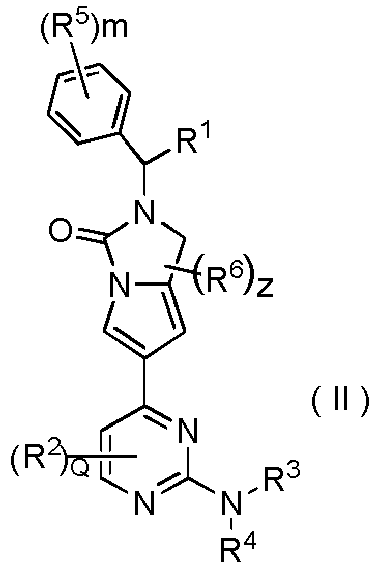
- or a stereoisomer, tautomer, mesomer, racemate, enantiomer, diastereomer thereof, or mixture thereof, or a pharmaceutically acceptable salt thereof,
- wherein R1 to R6, m, z and Q are as defined in formula (I).
- In a preferred embodiment of the present disclosure, the compound of formula (I) is a compound of formula (II-P):

- or a stereoisomer, tautomer, mesomer, racemate, enantiomer, diastereomer thereof, or mixture thereof, or a pharmaceutically acceptable salt thereof,
- wherein R1 to R6, m, z and Q are as defined in formula (I).
- In a preferred embodiment of the present disclosure, in the compound of formula (I) or the stereoisomer, tautomer, mesomer, racemate, enantiomer, diastereomer thereof, or mixture thereof, or the pharmaceutically acceptable salt thereof, R1 is selected from the group consisting of hydrogen atom, alkyl, hydroxy, aminoalkyl, alkylaminoalkyl and hydroxyalkyl; preferably, R1 is selected from the group consisting of hydrogen atom, C1-6 alkyl, hydroxy, aminoC1-6 alkyl, C1-6 alkylaminoC1-6 alkyl and C1-6 hydroxyalkyl; and more preferably, R1 is selected from the group consisting of hydrogen atom, methyl, hydroxymethyl, aminomethyl and methylaminomethyl.
- In a preferred embodiment of the present disclosure, in the compound of formula (I) or the stereoisomer, tautomer, mesomer, racemate, enantiomer, diastereomer thereof, or mixture thereof, or the pharmaceutically acceptable salt thereof, R1 is selected from the group consisting of hydrogen atom, alkyl, hydroxy, aminoalkyl and hydroxyalkyl; preferably, R1 is selected from the group consisting of hydrogen atom, C1-6 alkyl, hydroxy, aminoC1-6 alkyl and C1-6 hydroxyalkyl; and more preferably, R1 is selected from the group consisting of hydrogen atom, methyl, hydroxymethyl and aminomethyl.
- In a preferred embodiment of the present disclosure, the compound of formula (I) is a compound of formula (III):

- or a stereoisomer, tautomer, mesomer, racemate, enantiomer, diastereomer thereof, or mixture thereof, or a pharmaceutically acceptable salt thereof,
- wherein:
- p is selected from the group consisting of 0, 1, 2 and 3, and preferably 1;
- R2, R3, R5, R6, m, n, z and Q are as defined in formula (I).
- In a preferred embodiment of the present disclosure, the compound of formula (I) is a compound of formula (III-P):

- or a stereoisomer, tautomer, mesomer, racemate, enantiomer, diastereomer thereof, or mixture thereof, or a pharmaceutically acceptable salt thereof,
- wherein:
R2, R3, R5, R6, m, n, z, p and Q are as defined in formula (III). - In a preferred embodiment of the present disclosure, in the compound of formula (I) or the stereoisomer, tautomer, mesomer, racemate, enantiomer, diastereomer thereof, or mixture thereof, or the pharmaceutically acceptable salt thereof, R2 is selected from the group consisting of hydrogen atom, halogen and alkyl; preferably, R2 is selected from the group consisting of hydrogen atom, halogen and C1-6 alkyl; and more preferably, R2 is C1-6 alkyl.
- In a preferred embodiment of the present disclosure, in the compound of formula (I) or the stereoisomer, tautomer, mesomer, racemate, enantiomer, diastereomer thereof, or mixture thereof, or the pharmaceutically acceptable salt thereof, R3 is selected from the group consisting of alkyl, hydroxyalkyl, cycloalkyl, heterocyclyl and heteroaryl, wherein the alkyl, cycloalkyl, heterocyclyl and heteroaryl are each optionally further substituted by one or more substituents selected from the group consisting of alkyl, alkoxy, oxo, halogen, amino, cyano, nitro, hydroxy and hydroxyalkyl; and preferably, R3 is selected from the group consisting of C1-6 alkyl, C1-6 hydroxyalkyl, C3-6 cycloalkyl, 3 to 8 membered heterocyclyl and 5 to 10 membered heteroaryl, wherein the C1-6 alkyl, C3-6 cycloalkyl, 3 to 8 membered heterocyclyl and 5 to 10 membered heteroaryl are each optionally further substituted by one or more substituents selected from the group consisting of C1-6 alkyl, C1-6 alkoxy, oxo, halogen, amino, cyano, nitro, hydroxy and C1-6 hydroxyalkyl.
- In a preferred embodiment of the present disclosure, in the compound of formula (I) or the stereoisomer, tautomer, mesomer, racemate, enantiomer, diastereomer thereof, or mixture thereof, or the pharmaceutically acceptable salt thereof, R3 is a heteroaryl, wherein the heteroaryl is optionally further substituted by one or more substituents selected from the group consisting of alkyl, alkoxy, oxo, halogen, amino, cyano, nitro, hydroxy and hydroxyalkyl; preferably, R3 is a 5 to 10 membered heteroaryl, wherein the 5 to 10 membered heteroaryl is optionally further substituted by one or more substituents selected from the group consisting of C1-6 alkyl, C1-6 alkoxy, oxo, halogen, amino, cyano, nitro, hydroxy and C1-6 hydroxyalkyl; and preferably, R3 is a pyrazolyl, wherein the pyrazolyl is optionally substituted by C1-6 alkyl, and preferably methyl.
- In a preferred embodiment of the present disclosure, in the compound of formula (I) or the stereoisomer, tautomer, mesomer, racemate, enantiomer, diastereomer thereof, or mixture thereof, or the pharmaceutically acceptable salt thereof, R5 is selected from the group consisting of hydrogen atom, alkyl, alkoxy and halogen; and preferably, R5 is selected from the group consisting of hydrogen atom, C1-6 alkyl, C1-6 alkoxy and halogen.
- In a preferred embodiment of the present disclosure, in the compound of formula (I) or the stereoisomer, tautomer, mesomer, racemate, enantiomer, diastereomer thereof, or mixture thereof, or the pharmaceutically acceptable salt thereof, R6 is a hydrogen atom.
- In a preferred embodiment of the present disclosure, in the compound of formula (I) or the stereoisomer, tautomer, mesomer, racemate, enantiomer, diastereomer thereof, or mixture thereof, or the pharmaceutically acceptable salt thereof, m is 1 or 2.
- In a preferred embodiment of the present disclosure, in the compound of formula (I) or the stereoisomer, tautomer, mesomer, racemate, enantiomer, diastereomer thereof, or mixture thereof, or the pharmaceutically acceptable salt thereof, z is 0 or 1.
- Typical compounds of the present disclosure include, but are not limited to:
Example No. Structure and name of the compound 1 
(S)-2-(1-(3-Fluoro-5-methoxyphenyl)-2-hydroxyethyl)-6-(5-methyl-2-((1-methyl-1H-pyrazol-5-yl)amino)pyrimidin-4-yl)-1H-pyrrolo[1,2-c]imidazol-3(2H)-one 2 
(S)-6-(5-Chloro-2-((1-methyl-1H-pyrazol-5-yl)amino)pyrimidin-4-yl)-2-(1 -(3-chlorophenyl)-2-hydroxyethyl)-1H-pyrrolo[1,2-c]imidazol-3(2H)-one 3 
(S)-2-(1-(3-Chlorophenyl)-2-hydroxyethyl)-6-(5-methyl-2-((1-methyl-1H-pyrazol-5-yl)amino)pyrimidin-4-yl)-1H-pyrrolo[1,2-c]imidazol-3(2H)-one 4 
(S)-6-(5-Chloro-2-((tetrahydro-2H-pyran-4-yl)amino)pyrimidin-4-yl)-2-(1 -(3-chlorophenyl)-2-hydroxyethyl)-1H-pyrrolo[1,2-c]imidazol-3(2H)-one 5 
6-(5-Chloro-2-(((S)-1-hydroxypropan-2-yl)amino)pyrimidin-4-yl)-2-((S)-1 -(3-chlorophenyl)-2-hydroxyethyl)-1H-pyrrolo[1,2-c]imidazol-3(2H)-one 6 
(S)-2-(1-(3-Chloro-4-fluorophenyl)-2-hydroxyethyl)-6-(5-methyl-2-((1-me thyl-1H-pyrazol-5-yl)amino)pyrimidin-4-yl)-1H-pyrrolo[1,2-c]imidazol-3(2 H)-one 7 
6-(5-Chloro-2-((3-fluoro-4-hydroxycyclopentyl)amino)pyrimidin-4-yl)-2-( (S)-1-(3-chlorophenyl)-2-hydroxyethyl)-1H-pyrrolo[1,2-c]imidazol-3(2H)-o ne 8 
6-(5-Chloro-2-(((R)-1-hydroxypropan-2-yl)amino)pyrimidin-4-yl)-2-((S)-1 -(3-chlorophenyl)-2-hydroxyethyl)-1,2-dihydro-3H-pyrrolo[1,2-c]imidazol-3 -one 9 
(S)-2-(1-(3-Chlorophenyl)-2-hydroxyethyl)-6-(5-methyl-2-((1-methyl-1H-pyrazol-5-yl)amino)pyrimidin-4-yl)-3,4-dihydropyrrolo[1,2-c]pyrimidin-1(2 H)-one 10 
(S)-2-(1-(3-Chlorophenyl)-2-hydroxyethyl)-6-(2-((1-methyl-1H-pyrazol-5-yl)amino)pyrimidin-4-yl)-1,2-dihydro-3H-pyrrolo[1,2-c]imidazol-3-one 11 
(S)-2-(2-Amino-1-(3-chlorophenyl)ethyl)-6-(5-methyl-2-((1-methyl-1H-py razol-5-yl)amino)pyrimidin-4-yl)-1H-pyrrolo[1,2-c]imidazol-3(2H)-one 12 
(R)-2-(1-(3-Chlorophenyl)ethyl)-6-(5-methyl-2-((1-methyl-1H-pyrazol-5-yl)amino)pyrimidin-4-yl)-1H-pyrrolo[1,2-c]imidazol-3(2H)-one 13 
(S)-2-(1-(3-Chlorophenyl)-2-(methylamino)ethyl)-6-(5-methyl-2-((1-meth yl-1H-pyrazol-5-yl)amino)pyrimidin-4-yl)-1H-pyrrolo[1,2-c]imidazol-3(2H) -one 14 
(S)-2-(1-(4-Chloro-3-fluorophenyl)-2-hydroxyethyl)-6-(5-methyl-2-((1-me thyl-1H-pyrazol-5-yl)amino)pyrimidin-4-yl)-1H-pyrrolo[1,2-c]imidazo1-3(2 H)-one 15 
(S)-2-(2-Hydroxy-1-(m-tolyl)ethyl)-6-(2-((1-methyl-1H-pyrazol-5-yl)amin o)pyrimidin-4-yl)-1H-pyrrolo[1,2-c]imidazol-3(2H)-one 16 
(S)-2-(1-(3-Chloro-4-fluorophenyl)-2-hydroxyethyl)-6-(2-((1-methyl-1H-p yrazol-5-yl)amino)pyrimidin-4-yl)-1H-pyrrolo[1,2-c]imidazol-3(2H)-one 17 
(S)-2-(1-(3-Chlorophenyl)-2-hydroxyethyl)-6-(2-(isopropylamino)-5-meth ylpyrimidin-4-yl)-1H-pyrrolo[1,2-c]imidazol-3(2H)-one 18 
2-(3,4-Difluorobenzyl)-6-(5-methyl-2-((1-methyl-1H-pyrazol-5-yl)amino) pyrimidin-4-yl)-1H-pyrrolo[1,2-c]imidazol-3(2H)-one 19 
(S)-2-(1-(3-Fluorophenyl)-2-hydroxyethyl)-6-(2-((1-methyl-1H-pyrazol-5-yl)amino)pyrimidin-4-yl)-1H-pyrrolo[1,2-c]imidazol-3(2H)-one 20 
(S)-2-(1-(3-Fluoro-4-chlorophenyl)-2-hydroxyethyl)-6-(2-((1-methyl-1H-pyr azol-5-yl)amino)pyrimidin-4-yl)-1H-pyrrolo[1,2-c]imidazol-3(2H)-one 21 
(S)-2-(1-(4-Chlorophenyl)-2-hydroxyethyl)-6-(2-((1-methyl-1H-pyrazol-5-yl )amino)pyrimidin-4-yl)-1H-pyrrolo[1,2-c]imidazol-3(2H)-one - In another aspect, the present disclosure relates to a compound of formula (IIIA):

- or a stereoisomer, tautomer, mesomer, racemate, enantiomer, diastereomer thereof, or mixture thereof, or a pharmaceutically acceptable salt thereof,
- wherein:
- Rw is a hydroxy protecting group; and
- R2, R3, R5, R6, m, n, p, Q and z are as defined in formula (III).
- In another aspect, the present disclosure relates to a compound of formula (III-PA):

- or a stereoisomer, tautomer, mesomer, racemate, enantiomer, diastereomer thereof, or mixture thereof, or a pharmaceutically acceptable salt thereof,
- wherein:
- Rw is a hydroxy protecting group; and
- R2, R3, R5, R6, m, n, p, Q and z are as defined in formula (III).
- Typical compounds of formula (IIIA) of the present disclosure include, but are not limited to:
Example No. Structure and name of the compound 1g 
(S)-2-(2-((tert-Butyldimethylsilyl)oxy)-1-(3-fluoro-5-methoxyphenyl)ethy l)-6-(5-methyl-2-((1-methyl-1H-pyrazol-5-yl)amino)pyrimidin-4-yl)-1H-pyr rolo[1,2-c]imidazol-3(2H)-one 2i 
(S)-2-(2-((tert-Butyldimethylsilyl)oxy)-1-(3-chlorophenyl)ethyl)-6-(5-chlo ro-2-((1-methyl-1H-pyrazol-5-yl)amino)pyrimidin-4-yl)-1H-pyrrolo[1,2-c]i midazol-3(2H)-one 3a 
(S)-2-(2-((tert-Butyldimethylsilyl)oxy)-1-(3-chlorophenyl)ethyl)-6-(5-met hyl-2-((1-methyl-1H-pyrazol-5-yl)amino)pyrimidin-4-yl)-1H-pyrrolo[1,2-c]i midazol-3(2H)-one 5b 
2-((S)-2-((tert-Butyldimethylsilyl)oxy)-1-(3-chlorophenyl)ethyl)-6-(5-chlo ro-2-(((S)-1-hydroxypropan-2-yl)amino)pyrimidin-4-yl)-1,2-dihydro-3H-pyr rolo[1,2-c]imidazol-3-one 6f 
(S)-2-(2-((tert-Butyldimethylsilyl)oxy)-1-(3-chloro-4-fluorophenyl)ethyl)-6-(5-methyl-2-((1-methyl-1H-pyrazol-5-yl)amino)pyrimidin-4-yl)-1,2-dihyd ro-3H-pyrrolo[1,2-c]imidazol-3-one 9i 
(S)-2-(2-((tert-Butyldimethylsilyl)oxy)-1-(3-chlorophenyl)ethyl)-6-(5-met hyl-2-((1-methyl-1H-pyrazol-5-yl)amino)pyrimidin-4-yl)-3,4-dihydropyrrol o[1,2-c]pyrimidin-1(2H)-one 10c 
(S)-2-(2-((tert-Butyldimethylsilyl)oxy)-1-(3-chlorophenyl)ethyl)-6-(2-((1-methyl-1H-pyrazol-5-yl)amino)pyrimidin-4-yl)-1,2-dihydro-3H-pyrrolo[1,2-c]imidazol-3(2H)-one 15f 
(S)-2-(2-((tert-Butyldimethylsilyl)oxy)-1-(m-tolyl)ethyl)-6-(2-((1-methyl-1H-pyrazol-5-yl)amino)pyrimidin-4-yl)-1H-pyrrolo[1,2-c]imidazol-3(2H)-o ne 17d 
(S)-2-(2-((tert-Butyldimethylsilyl)oxy)-1-(3-chlorophenyl)ethyl)-6-(2-(iso propylamino)-5-methylpyrimidin-4-yl)-1H-pyrrolo[1,2-c]imidazol-3(2H)-on e - In another aspect, the present disclosure relates to a method for preparing the compound of formula (III), comprising a step of:

- removing the hydroxy protecting group Rw from a compound of formula (IIIA) under an acidic condition to obtain the compound of formula (III),
- wherein:
- the hydroxy protecting group Rw is preferably TBS; and
- R2, R3, R5, R6, m, n, p, Q and z are as defined in formula (III).
- In another aspect, the present disclosure relates to a method for preparing the compound of formula (III-P), comprising a step of:

- removing the hydroxy protecting group Rw from a compound of formula (III-PA) under an acidic condition to obtain the compound of formula (III-P),
- wherein:
- the hydroxy protecting group Rw is preferably TBS; and
- R2, R3, R5, R6, m, n, p, Q and z are as defined in formula (III).
- In another aspect, the present disclosure relates to a pharmaceutical composition, comprising a therapeutically effective amount of the compound of formula (I) or formula (II) or formula (III) or the stereoisomer, tautomer, mesomer, racemate, enantiomer, diastereomer thereof, or mixture thereof, or the pharmaceutically acceptable salt thereof, and one or more pharmaceutically acceptable carriers, diluents or excipients.
- The present disclosure further relates to a use of the compound of formula (I) or formula (II) or formula (III) or the stereoisomer, tautomer, mesomer, racemate, enantiomer, diastereomer thereof, or mixture thereof, or the pharmaceutically acceptable salt thereof or the pharmaceutical composition comprising the same in the preparation of a medicament for inhibiting ERK.
- The present disclosure further relates to a use of the compound of formula (I) or formula (II) or formula (III) or the stereoisomer, tautomer, mesomer, racemate, enantiomer, diastereomer thereof, or mixture thereof, or the pharmaceutically acceptable salt thereof or the pharmaceutical composition comprising the same in the preparation of a medicament for the treatment or prevention of cancer, inflammation, or other proliferative diseases, and preferably cancer; wherein the cancer is selected from the group consisting of melanoma, liver cancer, kidney cancer, lung cancer (such as non-small cell lung cancer or small cell lung cancer), nasopharyngeal cancer, colorectal cancer, pancreatic cancer, cervical cancer, ovarian cancer, breast cancer, bladder cancer, prostate cancer, leukemia, head and neck squamous cell carcinoma, carcinoma of uterine cervix, thyroid cancer, lymphoma, sarcoma, neuroblastoma, brain tumor, myeloma (such as multiple myeloma), astrocytoma and glioma.
- The present disclosure also relates to a method for inhibiting ERK, comprising a step of administering to a patient in need thereof a therapeutically effective amount of the compound of formula (I) or formula (II) or formula (III) or the stereoisomer, tautomer, mesomer, racemate, enantiomer, diastereomer thereof, or mixture thereof, or the pharmaceutically acceptable salt thereof or the pharmaceutical composition comprising the same.
- The present disclosure also relates to a method for treating or preventing ERK-mediated diseases, comprising a step of administering to a patient in need thereof a therapeutically effective amount of the compound of formula (I) or formula (II) or formula (III) or the stereoisomer, tautomer, mesomer, racemate, enantiomer, diastereomer thereof, or mixture thereof, or the pharmaceutically acceptable salt thereof or the pharmaceutical composition comprising the same.
- The present disclosure also relates to a method for treating or preventing cancer, inflammation, or other proliferative diseases, and preferably cancer, comprising a step of administering to a patient in need thereof a therapeutically effective amount of the compound of formula (I) or formula (II) or formula (III) or the stereoisomer, tautomer, mesomer, racemate, enantiomer, diastereomer thereof, or mixture thereof, or the pharmaceutically acceptable salt thereof or the pharmaceutical composition comprising the same, wherein the cancer is selected from the group consisting of melanoma, liver cancer, kidney cancer, lung cancer (such as non-small cell lung cancer or small cell lung cancer), nasopharyngeal cancer, colorectal cancer, pancreatic cancer, cervical cancer, ovarian cancer, breast cancer, bladder cancer, prostate cancer, leukemia, head and neck squamous cell carcinoma, carcinoma of uterine cervix, thyroid cancer, lymphoma, sarcoma, neuroblastoma, brain tumor, myeloma (such as multiple myeloma), astrocytoma and glioma.
- The present disclosure also relates to a compound of formula (I) or formula (II) or formula (III) or the stereoisomer, tautomer, mesomer, racemate, enantiomer, diastereomer thereof, or mixture thereof, or the pharmaceutically acceptable salt thereof or the pharmaceutical composition comprising the same, for use as a medicament.
- The present disclosure also relates to a compound of formula (I) or formula (II) or formula (III) or the stereoisomer, tautomer, mesomer, racemate, enantiomer, diastereomer thereof, or mixture thereof, or the pharmaceutically acceptable salt thereof or the pharmaceutical composition comprising the same, for use as an ERK inhibitor.
- The present disclosure also relates to a compound of formula (I) or formula (II) or formula (III) or the stereoisomer, tautomer, mesomer, racemate, enantiomer, diastereomer thereof, or mixture thereof, or the pharmaceutically acceptable salt thereof or the pharmaceutical composition comprising the same, for use in treating or preventing ERK-mediated diseases.
- The present disclosure also relates to a compound of formula (I) or formula (II) or formula (III) or the stereoisomer, tautomer, mesomer, racemate, enantiomer, diastereomer thereof, or mixture thereof, or the pharmaceutically acceptable salt thereof or the pharmaceutical composition comprising the same, for use in treating or preventing cancer, inflammation, or other proliferative diseases, and preferably cancer, wherein the cancer is selected from the group consisting of melanoma, liver cancer, kidney cancer, lung cancer (such as non-small cell lung cancer or small cell lung cancer), nasopharyngeal cancer, colorectal cancer, pancreatic cancer, cervical cancer, ovarian cancer, breast cancer, bladder cancer, prostate cancer, leukemia, head and neck squamous cell carcinoma, carcinoma of uterine cervix, thyroid cancer, lymphoma, sarcoma, neuroblastoma, brain tumor, myeloma (such as multiple myeloma), astrocytoma and glioma.
- The active compound can be prepared in a form suitable for administration by any appropriate route, and the active compound is preferably in a unit dose form, or in a form in which the patient can self-administer in a single dose. The unit dose of the compound or composition of the present disclosure can be expressed in the form of tablets, capsules, cachets, bottled syrups, powders, granules, lozenges, suppositories, regenerated powders or liquid formulations.
- The dosage of the compound or composition used in the treatment method of the present disclosure will generally vary according to the severity of the disease, the weight of the patient, and the relative efficacy of the compound. However, as a general guide, a suitable unit dose can be 0.1 to 1000 mg.
- In addition to the active compound, the pharmaceutical composition of the present disclosure can also comprise one or more auxiliaries including a filler (diluent), binder, wetting agent, disintegrant, excipient and the like. Depending on the administration mode, the composition can comprise 0.1 to 99% by weight of the active compound.
- The pharmaceutical composition containing the active ingredient can be in a form suitable for oral administration, for example, a tablet, troche, lozenge, aqueous or oily suspension, dispersible powder or granule, emulsion, hard or soft capsule, syrup or elixir. An oral composition can be prepared according to any known method in the art for the preparation of pharmaceutical composition. Such a composition can contain one or more ingredient(s) selected from the group consisting of sweeteners, flavoring agents, colorants and preservatives, in order to provide a pleasing and palatable pharmaceutical formulation. The tablet contains the active ingredient in admixture with nontoxic, pharmaceutically acceptable excipients suitable for the manufacture of tablets.
- An aqueous suspension comprises an active ingredient in admixture with excipients suitable for the manufacture of an aqueous suspension. The aqueous suspension can also comprise one or more preservatives such as ethyl paraben or n-propyl paraben, one or more colorants, one or more flavoring agents, and one or more sweeteners.
- An oil suspension can be formulated by suspending the active ingredient in a vegetable oil. The oil suspension can contain a thickener. The aforementioned sweeteners and flavoring agents can be added to provide a palatable formulation.
- The active ingredient in admixture with the dispersants or wetting agents, suspending agents or one or more preservatives can be prepared as dispersible powders or granules suitable for the preparation of an aqueous suspension by adding water. Suitable dispersants or wetting agents and suspending agents are exemplified by those already mentioned above. Additional excipients, such as sweeteners, flavoring agents and colorants, can also be added. These compositions can be preserved by adding an antioxidant such as ascorbic acid.
- The pharmaceutical composition of the present disclosure can also be in the form of an oil-in-water emulsion.
- The pharmaceutical composition can be in the form of a sterile injectable aqueous solution. Acceptable vehicles or solvents that can be used are water, Ringer's solution or isotonic sodium chloride solution. The sterile injectable formulation can be a sterile injectable oil-in-water micro-emulsion in which the active ingredient is dissolved in the oil phase. For example, the active ingredient is dissolved in a mixture of soybean oil and lecithin. The oil solution is then added into a mixture of water and glycerol, and processed to form a micro-emulsion. The injectable solution or micro-emulsion can be introduced into a patient's bloodstream by local bolus injection. Alternatively, the solution and micro-emulsion are preferably administrated in a manner that maintains a constant circulating concentration of the compound of the present invention. In order to maintain this constant concentration, a continuous intravenous delivery device can be used. An example of such a device is Deltec CADD-PLUS. TM. 5400 intravenous injection pump.
- The pharmaceutical composition can be in the form of a sterile injectable aqueous or oily suspension for intramuscular and subcutaneous administration. Such a suspension can be formulated with suitable dispersants or wetting agents and suspending agents as described above according to known techniques. The sterile injectable formulation can also be a sterile injectable solution or suspension prepared in a nontoxic parenterally acceptable diluent or solvent. Moreover, sterile fixed oils can easily be used as a solvent or suspending medium.
- The compound of the present disclosure can be administered in the form of a suppository for rectal administration. These pharmaceutical compositions can be prepared by mixing the drug with a suitable non-irritating excipient that is solid at ordinary temperatures, but liquid in the rectum, thereby melting in the rectum to release the drug. Such materials include cocoa butter, glycerin gelatin, hydrogenated vegetable oils, mixtures of polyethylene glycols with various molecular weights and fatty acid esters of polyethylene glycols.
- It is well known to those skilled in the art that the dosage of a drug depends on a variety of factors including but not limited to, the following factors: activity of a specific compound, age of the patient, weight of the patient, general health of the patient, behavior of the patient, diet of the patient, administration time, administration route, excretion rate, drug combination and the like. In addition, the optimal treatment, such as treatment mode, daily dose of the compound of formula (I) or the type of pharmaceutically acceptable salt thereof can be verified by traditional therapeutic regimens.
- Unless otherwise stated, the terms used in the specification and claims have the meanings described below.
- The term "alkyl" refers to a saturated aliphatic hydrocarbon group, which is a straight or branched chain group comprising 1 to 20 carbon atoms, preferably an alkyl having 1 to 12 carbon atoms, and more preferably an alkyl having 1 to 6 carbon atoms. Non-limiting examples include methyl, ethyl, n-propyl, isopropyl, n-butyl, isobutyl, tert-butyl, sec-butyl, n-pentyl, 1,1-dimethylpropyl, 1,2-dimethylpropyl, 2,2-dimethylpropyl, 1-ethylpropyl, 2-methylbutyl, 3-methylbutyl, n-hexyl, 1-ethyl-2-methylpropyl, 1,1,2-trimethylpropyl, 1,1-dimethylbutyl, 1,2-dimethylbutyl, 2,2-dimethylbutyl, 1,3-dimethylbutyl, 2-ethylbutyl, 2-methylpentyl, 3-methylpentyl, 4-methylpentyl, 2,3-dimethylbutyl, n-heptyl, 2-methylhexyl, 3-methylhexyl, 4-methylhexyl, 5-methylhexyl, 2,3-dimethylpentyl, 2,4-dimethylpentyl, 2,2-dimethylpentyl, 3,3-dimethylpentyl, 2-ethylpentyl, 3-ethylpentyl, n-octyl, 2,3-dimethylhexyl, 2,4-dimethylhexyl, 2,5-dimethylhexyl, 2,2-dimethylhexyl, 3,3-dimethylhexyl, 4,4-dimethylhexyl, 2-ethylhexyl, 3-ethylhexyl, 4-ethylhexyl, 2-methyl-2-ethylpentyl, 2-methyl-3-ethylpentyl, n-nonyl, 2-methyl-2-ethylhexyl, 2-methyl-3-ethylhexyl, 2,2-diethylpentyl, n-decyl, 3,3-diethylhexyl, 2,2-diethylhexyl, and various branched isomers thereof. More preferably, the alkyl group is a lower alkyl having 1 to 6 carbon atoms, and non-limiting examples include methyl, ethyl, n-propyl, isopropyl, n-butyl, isobutyl, tert-butyl, sec-butyl, n-pentyl, 1,1-dimethylpropyl, 1,2-dimethylpropyl, 2,2-dimethylpropyl, 1-ethylpropyl, 2-methylbutyl, 3-methylbutyl, n-hexyl, 1-ethyl-2-methylpropyl, 1,1,2-trimethylpropyl, 1,1-dimethylbutyl, 1,2-dimethylbutyl, 2,2-dimethylbutyl, 1,3-dimethylbutyl, 2-ethylbutyl, 2-methylpentyl, 3-methylpentyl, 4-methylpentyl, 2,3-dimethylbutyl and the like. The alkyl can be substituted or unsubstituted. When substituted, the substituent group(s) can be substituted at any available connection point. The substituent group(s) is preferably one or more groups independently selected from the group consisting of alkyl, alkenyl, alkynyl, alkoxy, alkylthio, alkylamino, halogen, thiol, hydroxy, nitro, cyano, cycloalkyl, heterocyclyl, aryl, heteroaryl, cycloalkoxy, heterocycloalkoxy, cycloalkylthio, heterocyclylthio and oxo.
- The term "cycloalkyl" refers to a saturated or partially unsaturated monocyclic or polycyclic hydrocarbon substituent group having 3 to 20 carbon atoms, preferably 3 to 12 carbon atoms, more preferably 3 to 8 carbon atoms, and most preferably 3 to 6 carbon atoms (for example 3, 4, 5 or 6 carbon atoms). Non-limiting examples of monocyclic cycloalkyl include cyclopropyl, cyclobutyl, cyclopentyl, cyclopentenyl, cyclohexyl, cyclohexenyl, cyclohexadienyl, cycloheptyl, cycloheptatrienyl, cyclooctyl and the like, preferably cycloalkyl. Polycyclic cycloalkyl includes a cycloalkyl having a spiro ring, fused ring or bridged ring.
- The term "spiro cycloalkyl" refers to a 5 to 20 membered polycyclic group with individual rings connected through one shared carbon atom (called a spiro atom), wherein the rings can contain one or more double bonds, but none of the rings has a completely conjugated π-electron system. The spiro cycloalkyl is preferably a 6 to 14 membered spiro cycloalkyl, and more preferably a 7 to 10 membered spiro cycloalkyl. According to the number of the spiro atoms shared between the rings, the spiro cycloalkyl can be divided into a mono-spiro cycloalkyl, di-spiro cycloalkyl, or poly-spiro cycloalkyl, and the spiro cycloalkyl is preferably a mono-spiro cycloalkyl or di-spiro cycloalkyl, and more preferably a 4-membered/4-membered, 4-membered/5-membered, 4-membered/6-membered, 5-membered/5-membered, or 5-membered/6-membered mono-spiro cycloalkyl. Non-limiting examples of spiro cycloalkyl include:

- The term "fused cycloalkyl" refers to a 5 to 20 membered all-carbon polycyclic group, wherein each ring in the system shares an adjacent pair of carbon atoms with another ring, one or more rings can contain one or more double bonds, but none of the rings has a completely conjugated π-electron system. The fused cycloalkyl is preferably a 6 to 14 membered fused cycloalkyl, and more preferably a 7 to 10 membered fused cycloalkyl. According to the number of membered rings, the fused cycloalkyl can be divided into a bicyclic, tricyclic, tetracyclic or polycyclic fused cycloalkyl, and the fused cycloalkyl is preferably a bicyclic or tricyclic fused cycloalkyl, and more preferably a 5-membered/5-membered, or 5-membered/6-membered bicyclic fused cycloalkyl. Non-limiting examples of fused cycloalkyl include:

- The term "bridged cycloalkyl" refers to a 5 to 20 membered all-carbon polycyclic group, wherein every two rings in the system share two disconnected carbon atoms, the rings can have one or more double bonds, but none of the rings has a completely conjugated π-electron system. The bridged cycloalkyl is preferably a 6 to 14 membered bridged cycloalkyl, and more preferably a 7 to 10 membered bridged cycloalkyl. According to the number of membered rings, the bridged cycloalkyl can be divided into a bicyclic, tricyclic, tetracyclic or polycyclic bridged cycloalkyl, and the bridged cycloalkyl is preferably a bicyclic, tricyclic or tetracyclic bridged cycloalkyl, and more preferably a bicyclic or tricyclic bridged cycloalkyl. Non-limiting examples of bridged cycloalkyl include:
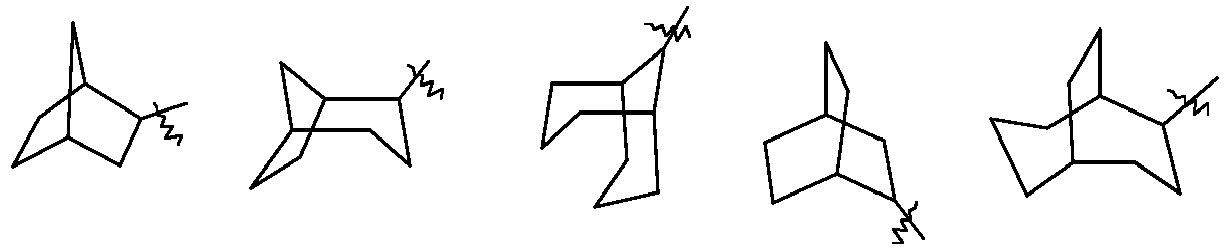

- The cycloalkyl (including monocyclic cycloalkyl, spiro cycloalkyl, fused cycloalkyl and bridged cycloalkyl) ring can be fused to the ring of aryl, heteroaryl or heterocyclyl, wherein the ring bound to the parent structure is cycloalkyl. Non-limiting examples include indanyl, tetrahydronaphthyl, benzocycloheptyl and the like, and preferably benzocyclopentyl, tetrahydronaphthyl.
- The cycloalkyl can be optionally substituted or unsubstituted. When substituted, the substituent group(s) is preferably one or more groups independently selected from the group consisting of alkyl, alkenyl, alkynyl, alkoxy, alkylthio, alkylamino, halogen, thiol, hydroxy, nitro, cyano, cycloalkyl, heterocyclyl, aryl, heteroaryl, cycloalkoxy, heterocycloalkoxy, cycloalkylthio, heterocyclylthio and oxo.
- The term "alkoxy" refers to an -O-(alkyl) or an -O-(unsubstituted cycloalkyl) group, wherein the alkyl or cycloalkyl is as defined above. Non-limiting examples of alkoxy include methoxy, ethoxy, propoxy, butoxy, cyclopropyloxy, cyclobutyloxy, cyclopentyloxy, cyclohexyloxy. The alkoxy can be optionally substituted or unsubstituted. When substituted, the substituent group(s) is preferably one or more groups independently selected from the group consisting of hydrogen atom, halogen, alkyl, alkoxy, haloalkyl, hydroxy, hydroxyalkyl, cyano, amino, nitro, cycloalkyl, heterocyclyl, aryl and heteroaryl.
- The term "heterocyclyl" refers to a 3 to 20 membered saturated or partially unsaturated monocyclic or polycyclic hydrocarbon substituent group, wherein one or more ring atoms are heteroatoms selected from the group consisting of N, O, S, S(O) and S(O)2, but excluding -O-O-, -O-S- or -S-S- in the ring, with the remaining ring atoms being carbon atoms. Preferably, the heterocyclyl has 3 to 12 ring atoms wherein 1 to 4 atoms are heteroatoms; preferably, 3 to 8 ring atoms wherein 1 to 3 atoms are heteroatoms; and preferably 3 to 6 ring atoms wherein 1 to 3 atoms are heteroatoms. Non-limiting examples of monocyclic heterocyclyl include azetidinyl, pyrrolidinyl, imidazolidinyl, tetrahydrofuranyl, tetrahydropyranyl, tetrahydrothienyl, dihydroimidazolyl, dihydrofuranyl, dihydropyrazolyl, dihydropyrrolyl, piperidinyl, piperazinyl, morpholinyl, thiomorpholinyl, homopiperazinyl and the like, and preferably tetrahydropyranyl, piperidinyl, pyrrolidinyl. Polycyclic heterocyclyl includes a heterocyclyl having a spiro ring, fused ring or bridged ring.
- The term "spiro heterocyclyl" refers to a 5 to 20 membered polycyclic heterocyclyl group with individual rings connected through one shared atom (called a spiro atom), wherein one or more ring atoms are heteroatoms selected from the group consisting of N, O, S, S(O) and S(O)2, with the remaining ring atoms being carbon atoms, where the rings can contain one or more double bonds, but none of the rings has a completely conjugated π-electron system. The spiro heterocyclyl is preferably a 6 to 14 membered spiro heterocyclyl, and more preferably a 7 to 11 membered spiro heterocyclyl. According to the number of the spiro atoms shared between the rings, the spiro heterocyclyl is divided into a mono-spiro heterocyclyl, di-spiro heterocyclyl, or poly-spiro heterocyclyl, and the spiro heterocyclyl is preferably a mono-spiro heterocyclyl or di-spiro heterocyclyl, and more preferably a 4-membered/4-membered, 4-membered/5-membered, 4-membered/6-membered, 5-membered/5-membered, or 5-membered/6-membered mono-spiro heterocyclyl. Non-limiting examples of spiro heterocyclyl include:


- The term "fused heterocyclyl" refers to a 5 to 20 membered polycyclic heterocyclyl group, wherein each ring in the system shares an adjacent pair of atoms with another ring, wherein one or more rings can contain one or more double bonds, but none of the rings has a completely conjugated π-electron system, and wherein one or more ring atoms are heteroatoms selected from the group consisting of N, O and S(O)m (wherein m is an integer of 0 to 2), with the remaining ring atoms being carbon atoms. The fused heterocyclyl is preferably a 6 to 14 membered fused heterocyclyl, and more preferably a 7 to 11 membered fused heterocyclyl. According to the number of membered rings, the fused heterocyclyl can be divided into a bicyclic, tricyclic, tetracyclic or polycyclic fused heterocyclyl, and the fused heterocyclyl is preferably a bicyclic or tricyclic fused heterocyclyl, and more preferably a 5-membered/5-membered or 5-membered/6-membered bicyclic fused heterocyclyl. Non-limiting examples of fused heterocyclyl include:


- The term "bridged heterocyclyl" refers to a 5 to 14 membered polycyclic heterocyclyl group, wherein every two rings in the system share two disconnected atoms, wherein the rings can have one or more double bonds, but none of the rings has a completely conjugated π-electron system, and wherein one or more ring atoms are heteroatoms selected from the group consisting of N, O and S(O)m (wherein m is an integer of 0 to 2), with the remaining ring atoms being carbon atoms. The bridged heterocyclyl is preferably a 6 to 14 membered bridged heterocyclyl, and more preferably a 7 to 11 membered bridged heterocyclyl. According to the number of membered rings, the bridged heterocyclyl can be divided into a bicyclic, tricyclic, tetracyclic or polycyclic bridged heterocyclyl, and the bridged heterocyclyl is preferably a bicyclic, tricyclic or tetracyclic bridged heterocyclyl, and more preferably a bicyclic or tricyclic bridged heterocyclyl. Non-limiting examples of bridged heterocyclyl include:


- The heterocyclyl (including monocyclic heterocyclyl, spiro heterocyclyl, fused heterocyclyl and bridged heterocyclyl) ring can be fused to the ring of aryl, heteroaryl or cycloalkyl, wherein the ring bound to the parent structure is heterocyclyl. Non-limiting examples thereof include:

- The heterocyclyl can be optionally substituted or unsubstituted. When substituted, the substituent group(s) is preferably one or more groups independently selected from the group consisting of alkyl, alkenyl, alkynyl, alkoxy, alkylthio, alkylamino, halogen, thiol, hydroxy, nitro, cyano, cycloalkyl, heterocyclyl, aryl, heteroaryl, cycloalkoxy, heterocycloalkoxy, cycloalkylthio, heterocyclylthio and oxo.
- The term "aryl" refers to a 6 to 20 membered all-carbon monocyclic ring or polycyclic fused ring (i.e. each ring in the system shares an adjacent pair of carbon atoms with another ring in the system) having a conjugated π-electron system, preferably a 6 to 10 membered aryl, and more preferably a 6 membered aryl, for example, phenyl and naphthyl. The aryl ring can be fused to the ring of heteroaryl, heterocyclyl or cycloalkyl, wherein the ring bound to the parent structure is aryl ring. Non-limiting examples thereof include:


- The aryl can be substituted or unsubstituted. When substituted, the substituent group(s) is preferably one or more groups independently selected from the group consisting of alkyl, alkenyl, alkynyl, alkoxy, alkylthio, alkylamino, halogen, thiol, hydroxy, nitro, cyano, cycloalkyl, heterocyclyl, aryl, heteroaryl, cycloalkoxy, heterocycloalkoxy, cycloalkylthio and heterocyclylthio.
- The term "heteroaryl" refers to a 5 to 20 membered heteroaromatic system having 1 to 4 heteroatoms selected from the group consisting of O, S and N. The heteroaryl is preferably a 5 to 10 membered heteroaryl having 1 to 3 heteroatoms, more preferably a 5 or 6 membered heteroaryl having 1 to 3 heteroatoms. Non-limiting examples include: for example, pyrazolyl, imidazolyl, furyl, thienyl, thiazolyl, oxazolyl, pyrrolyl, triazolyl, tetrazolyl, pyridyl, pyrimidinyl, thiadiazolyl, pyrazinyl and the like. The heteroaryl ring can be fused to the ring of aryl, heterocyclyl or cycloalkyl, wherein the ring bound to the parent structure is heteroaryl ring. Non-limiting examples thereof include:


- The heteroaryl can be optionally substituted or unsubstituted. When substituted, the substituent group(s) is preferably one or more groups independently selected from the group consisting of alkyl, alkenyl, alkynyl, alkoxy, alkylthio, alkylamino, halogen, thiol, hydroxy, nitro, cyano, cycloalkyl, heterocyclyl, aryl, heteroaryl, cycloalkoxy, heterocycloalkoxy, cycloalkylthio and heterocyclylthio.
- The term "cycloalkyloxy" refers to a -O-cycloalkyl group, wherein the cycloalkyl is as defined above.
- The term "haloalkyl" refers to an alkyl group substituted by halogen(s), wherein the alkyl is as defined above.
- The term "haloalkoxy" refers to an alkoxy group substituted by halogen(s), wherein the alkoxy is as defined above.
- The term "hydroxyalkyl" refers to an alkyl group substituted by hydroxy(s), wherein the alkyl is as defined above.
- The term "aminoalkyl" refers to an alkyl group substituted by amino(s), where the alkyl is as defined above.
- The term "alkylaminoalkyl" refers to an alkyl group substituted by alkylamino(s), where the alkyl is as defined above.
- The term "hydroxy" refers to an -OH group.
- The term "halogen" refers to fluorine, chlorine, bromine or iodine.
- The term "amino" refers to a -NH2 group.
- The term "cyano" refers to a -CN group.
- The term "nitro" refers to a -NO2 group.
- The term "formyl" refers to a -C(O)H group.
- The term "carboxy" refers to a -C(O)OH group.
- The term "alkoxycarbonyl" refers to a -C(O)O(alkyl) or -C(O)O(cycloalkyl) group, wherein the alkyl and cycloalkyl are as defined above.
- "Optional" or "optionally" means that the event or circumstance described subsequently can, but need not, occur, and such a description includes the situation in which the event or circumstance does or does not occur. For example, "the heterocyclyl optionally substituted by an alkyl" means that an alkyl group can be, but need not be, present, and such a description includes the situation of the heterocyclyl being substituted by an alkyl and the heterocyclyl being not substituted by an alkyl.
- "Substituted" refers to one or more hydrogen atoms in a group, preferably up to 5, and more preferably 1 to 3 hydrogen atoms, independently substituted by a corresponding number of substituents, wherein each substituent has independent options (that is, the substituents can be identical or different). It goes without saying that the substituents only exist in their possible chemical position. The person skilled in the art is able to determine whether the substitution is possible or impossible by experiments or theory without excessive effort. For example, the combination of amino or hydroxy having free hydrogen and carbon atoms having unsaturated bonds (such as olefinic) may be unstable.
- The term "pharmaceutical composition" refers to a mixture of one or more of the compounds described herein or physiologically/pharmaceutically acceptable salts or prodrugs thereof with other chemical components, and other components such as physiologically/pharmaceutically acceptable carriers and excipients. The purpose of the pharmaceutical composition is to facilitate administration of a compound to an organism, which is conducive to the absorption of the active ingredient so as to show biological activity.
- A "pharmaceutically acceptable salt" refers to a salt of the compound of the present disclosure, which is safe and effective in mammals and has the desired biological activity.
- The compound of the present disclosure can also comprise isotopic derivatives thereof. The term "isotopic derivatives" refers to compounds that differ in structure only in the presence of one or more isotopically enriched atoms. For example, a compound having the structure of the present disclosure except replacing hydrogen with "deuterium" or "tritium", or replacing fluorine with an 18F-fluorine labeling (18F isotope), or replacing carbon with 11C-, 13C-, or 14C-enriched carbon (11C-, 13C-, or 14C-carbon labeling; 11C-, 13C-, or 14C-isotope) is within the scope of the present disclosure. Such compounds can be used, for example, as analytical tools or probes in biological assays, or as tracers for in vivo diagnostic imaging of disease, or as tracers for pharmacodynamics, pharmacokinetics or receptor studies. Deuterated compounds can generally retain activity comparable to non-deuterated compounds, and when deuterated at certain specific sites, the resulting compounds can achieve better metabolic stability, thereby obtaining certain therapeutic advantages (such as increased in vivo half-life or reduced dosage requirements).
- For drugs or pharmacologically active agents, the term "therapeutically effective amount" refers to a sufficient amount of a drug or agent that is non-toxic but can achieve the desired effect. The determination of the effective amount varies from person to person, depending on the age and general condition of the recipient, and also on the specific active substance. The appropriate effective amount in a case can be determined by the person skilled in the art according to routine experiments.
- In order to achieve the object of the present disclosure, the present disclosure applies the following technical solutions:
Scheme I - A method for preparing the compound of formula (III) or the stereoisomer, tautomer, mesomer, racemate, enantiomer, diastereomer thereof, or mixture thereof, or the pharmaceutically acceptable salt thereof according to the present disclosure, comprising the following steps of:

- removing the hydroxy protecting group Rw from a compound of formula (IIIA) under an acidic condition in a solvent to obtain the compound of formula (III),
- wherein:
- the hydroxy protecting group Rw is preferably TBS; and
- R2, R3, R5, R6, m, n, p, Q and z are as defined in formula (III).
- In another aspect, the present disclosure relates to a method for preparing the compound of formula (III-P), comprising the following steps of:

- removing the hydroxy protecting group Rw from a compound of formula (III-PA) under an acidic condition in a solvent to obtain the compound of formula (III-P),
- wherein:
- the hydroxy protecting group Rw is preferably TBS; and
- R2, R3, R5, R6, m, n, p, Q and z are as defined in formula (III).
- The reagent that provides an acidic condition includes, but is not limited to, hydrogen chloride, trifluoroacetic acid, formic acid, acetic acid, hydrochloric acid, sulfuric acid, methanesulfonic acid, nitric acid, phosphoric acid, p-toluenesulfonic acid, Me3SiCl and TMSOTf; and preferably trifluoroacetic acid.
- The reagent that provides an alkaline condition includes organic bases and inorganic bases. The organic bases include, but are not limited to, triethylamine, N,N-diisopropylethylamine, n-butyllithium, lithium diisopropylamide, potassium acetate, sodium tert-butoxide and potassium tert-butoxide. The inorganic bases include, but are not limited to, sodium hydride, potassium phosphate, sodium carbonate, sodium acetate, potassium acetate, potassium carbonate, cesium carbonate, sodium hydroxide, lithium hydroxide and potassium hydroxide.
- The deprotection reaction to remove the hydroxy protecting group is well known in the art, and the hydroxy protecting group is, for example, the protecting group described in Protecting Group in Organic Synthesis by T. Greene et al. It is generally preferred to use tetrahydropyran-2-yl and tert-butyldimethylsilyl as hydroxy protecting groups; and preferably, tert- butyldimethylsilyl (TBS).
- The hydroxy protecting reagent includes, but is not limited to: methoxymethyl ether, 2-methoxyethoxymethyl ether, tetrahydropyran ether, benzyl ether, p-methoxybenzyl ether, trimethylsilyl ether, triethylsilyl ether, triisopropylsilyl ether, tert-butyldimethylsilyl ether, tert-butyldimethylchlorosilane, triphenylmethylsilyl ether, acetate, substituted acetate, pivaloate, benzoate, methanesulfonate and p-toluenesulfonate; preferably tert-butyldimethylchlorosilane (TBSCl).
- The above reactions are preferably carried out in a solvent. The solvent used includes, but is not limited to: acetic acid, methanol, ethanol, n-butanol, toluene, tetrahydrofuran, dichloromethane, petroleum ether, ethyl acetate, n-hexane, dimethyl sulfoxide, 1,4-dioxane, 1,2-dimethoxyethane, water and N,N-dimethylformamide and mixtures thereof; and preferably, dichloromethane.
- The details of one or more embodiments of the present disclosure are set forth in the above specification. Although any methods and materials similar or identical to those described herein can be used to perform or test the present disclosure, the preferred methods and materials are described below. Through the specification and claims, other features, purposes and advantages of the present disclosure will be apparent. In the specification and claims, unless the context clearly indicates otherwise, the singular form includes the plural referent. Unless otherwise defined, all technical and scientific terms used herein have the general meanings understood by the person of ordinary skill in the art to which the present disclosure belongs. All patents and publications cited in the specification are incorporated by reference. The following examples are provided to more fully illustrate the preferred embodiments of the present disclosure. These examples should not be construed as limiting the scope of the present disclosure in any way, and the scope of the present disclosure is defined by the claims.
- The structures of the compounds are identified by nuclear magnetic resonance (NMR) and/or mass spectrometry (MS). NMR shifts (δ) are given in 10-6 (ppm). NMR is determined by a Bruker AVANCE-400 machine. The solvents for determination are deuterated-dimethyl sulfoxide (DMSO-d6 ), deuterated-chloroform (CDCl3) and deuterated-methanol (CD3OD), and the internal standard is tetramethylsilane (TMS).
- MS is determined by an Agilent 1200 /1290 DAD- 6110/6120 Quadrupole MS liquid chromatograph/mass spectrometer (manufacturer: Agilent, MS model: 6110/6120 Quadrupole MS), waters ACQuity UPLC-QD/SQD (manufacturer: waters, MS model: waters ACQuity Qda Detector/waters SQ Detector), THERMO Ultimate 3000-Q Exactive (manufacturer: THERMO, MS model: THERMO Q Exactive).
- High performance liquid chromatography (HPLC) is determined on an Agilent HPLC 1200DAD, Agilent HPLC 1200VWD and Waters HPLC e2695-2489 high pressure liquid chromatograph.
- Chiral HPLC is determined on an Agilent 1260 DAD high performance liquid chromatograph.
- Preparative chromatography is carried out on Waters 2545-2767, Waters 2767-SQ Detecor2, Shimadzu LC-20AP and Gilson GX-281 preparative chromatographs.
- Chiral preparation is carried out on a Shimadzu LC-20AP preparative chromatograph.
- CombiFlash rapid preparation instrument used is Combiflash Rf200 (TELEDYNE ISCO).
- Yantai Huanghai HSGF254 or Qingdao GF254 silica gel plate is used as the thin layer silica gel chromatography (TLC) plate. The dimension of the silica gel plate used in TLC is 0.15 mm to 0.2 mm, and the dimension of the silica gel plate used in product purification is 0.4 mm to 0.5 mm.
- Yantai Huanghai 200 to 300 mesh silica gel is generally used as a carrier for silica gel column chromatography.
- The average kinase inhibition rates and IC50 values are determined by a NovoStar microplate reader (BMG Co., Germany).
- The known starting materials of the present disclosure can be prepared by the known methods in the art, or can be purchased from ABCR GmbH & Co. KG, Acros Organics, Aldrich Chemical Company, Accela ChemBio Inc., Dari Chemical Company etc.
- Unless otherwise stated, the reactions can be carried out under argon atmosphere or nitrogen atmosphere.
- "Argon atmosphere" or "nitrogen atmosphere" means that a reaction flask is equipped with an argon or nitrogen balloon (about1 L).
- "Hydrogen atmosphere" means that a reaction flask is equipped with a hydrogen balloon (about1 L).
- Pressurized hydrogenation reaction is performed on a Parr 3916EKX hydrogenation instrument and a Qinglan QL-500 hydrogen generator or HC2-SS hydrogenation instrument.
- In hydrogenation reactions, the reaction system is generally vacuumed and filled with hydrogen, and the above operation is repeated three times.
- CEM Discover-S 908860 type microwave reactor is used in microwave reactions. Unless otherwise stated, the solution refers to an aqueous solution.
- Unless otherwise stated, the reaction temperature is room temperature from 20°C to 30°C.
- The reaction process in the examples is monitored by thin layer chromatography (TLC). The developing solvent used in the reactions, the eluent system in column chromatography and the developing solvent system in thin layer chromatography for purification of the compounds include: A: dichloromethane/methanol system, B: n-hexane/ethyl acetate system, and C: petroleum ether/ethyl acetate system. The ratio of the volume of the solvent is adjusted according to the polarity of the compounds, and a small quantity of alkaline reagent such as triethylamine or acidic reagent such as acetic acid can also be added for adjustment.
-

- (S)-2-Amino-2-(3-fluoro-5-methoxyphenyl)ethan-1-ol 1k (2 g, 10.8 mmol, Shanghai Haohong Biomedical Technology Co., Ltd.) and imidazole (1.47 g, 21.6 mmol) were dissolved in 80 mL of dichloromethane, followed by the addition of tert-butyldimethylchlorosilane (TBSCl, 2.44 g, 16.19 mmol) in an ice bath. The reaction solution was stirred for 14 hours, followed by the addition of water, and extracted with dichloromethane (80 mL×3). The organic phases were combined, washed with saturated sodium chloride solution, dried over anhydrous sodium sulfate, and filtered. The filtrate was concentrated under reduced pressure, and the residues were purified by column chromatography with eluent system C to obtain the title compound 1a (2.0 g), yield: 61.8%.
- MS m/z (ESI): 300.2 [M+1].
- (S)-2-((tert-Butyldimethylsilyl)oxy)-1-(3-fluoro-5-methoxyphenyl)ethan-1-amine 1a (516 mg, 1.72 mmol) and compound 4-bromo-1H-pyrrole-2-carbaldehyde 1b (300 mg, 1.72 mmol, Shanghai Bide Pharmatech Ltd.) were stirred and reacted for 3 hours. The reaction solution was diluted with 5 mL methanol, and cool to 0°C. Sodium borohydride (65 mg, 1.72 mmol) was added, and the reaction solution was stirred for 2 hours. Water was added, and the reaction solution was concentrated under reduced pressure. Water was added, and the reaction solution was extracted with ethyl acetate (10 mL×2). The organic phases were combined, washed with saturated sodium chloride solution, dried over anhydrous sodium sulfate, and filtered. The filtrate was concentrated under reduced pressure, and the residues were purified by column chromatography with eluent system C to obtain the title compound 1c (500 mg), yield: 63%.
- MS m/z (ESI): 457.1 [M+1].
- Compound 1c (400 mg, 0.9 mmol) was dissolved in 40 mL of tetrahydrofuran, followed by the addition of N,N'-carbonyldiimidazole (219 mg, 1.36 mmol) in an ice bath, and the reaction solution was stirred for 0.5 hours. Sodium hydride (60%, 69 mg, 1.8 mmol) was added, and the reaction solution was stirred for 14 hours, followed by the addition of saturated ammonium chloride solution. The reaction solution was concentrated under reduced pressure, and the residues were purified by column chromatography with eluent system C to obtain the title compound 1d (400 mg), yield: 94%.
- MS m/z (ESI): 483.2 [M+1].
- Compound 1d (360 mg, 0.75 mmol) was dissolved in 50 mL of 1,4-dioxane under argon atmosphere, followed by the addition of 4,4,4',4',5,5,5',5'-octamethyl-2,2'-bis(1,3,2-dioxaborolane) (189 mg, 0.76 mmol), potassium acetate (219 mg, 2.23 mmol) and [1,1'-bis(diphenylphosphino)ferrocene]palladium (II) dichloride (109 g, 0.15 mmol) successively. The reaction solution was stirred for 2 hours at 90°C, cooled, and filtered through Celite. The filtrate was concentrated, and the residues were purified by column chromatography with eluent system C to obtain the title compound 1e (100 mg), yield: 25%.
- MS m/z (ESI): 531.4 [M+1].
- 4-Chloro-5-methyl-2-(methylthio)pyrimidine 1h (500 mg, 2.86 mmol, Shanghai Bide Pharmatech Ltd.) was dissolved in 10 mL of dichloromethane, followed by the addition of m-chloroperoxybenzoic acid (1.270 g, 6.3 mmol), and the reaction solution was stirred for 2 hours. The reaction solution was washed with saturated sodium thiosulfate solution and saturated sodium chloride solution, dried over anhydrous sodium sulfate, and filtered. The filtrate was concentrated under reduced pressure to obtain the crude title compound 1i (445 mg), which was directly used in the next step without purification.
- MS m/z (ESI): 207.2 [M+1].
- N-(1-Methyl-1H-pyrazol-5-yl)carboxamide 1j (270 mg, 2.15 mmol, prepared by the well-known method disclosed in " Bioorganic and Medicinal Chemistry, 1997, 5(3), 557-567") was dissolved in N,N-dimethylformamide, followed by the addition of sodium hydride (60%, 250 mg, 6.5 mmol) at 0°C, and the reaction solution was stirred for 0.5 hours. Compound 1i (445 mg, 2.15 mmol) was added, and the reaction solution was further reacted for 2 hours. 20 mL of water was added, and the reaction solution was extracted with ethyl acetate (20 mL×3). The organic phases were combined and concentrated under reduced pressure, and the resulting residues were purified by thin layer chromatography with developing solvent system C to obtain the title compound 1f (240 mg), yield: 49.7 %.
- MS m/z (ESI): 224.3 [M+1].
- A mixture of compound 1e (100 mg, 0.19 mmol), compound 1f (42 mg, 0.19 mmol), [1,1'-bis(diphenylphosphino)ferrocene]palladium (II) dichloride (28 mg, 0.04 mmol) and cesium carbonate (123 mg, 0.4 mmol) was suspended in 30 mL of 1,4-dioxane and 4 mL of water under argon atmosphere. The reaction solution was heated to 80°C, and stirred for 14 hours. The reaction solution was cooled, and filtered through Celite. The filtrate was collected, and extracted with ethyl acetate (20 mL×3). The organic phases were combined, concentrated under reduced pressure, and the residues were purified by column chromatography with eluent system A to obtain the title compound 1g (80 mg), yield: 72%.
- MS m/z (ESI): 592.1 [M+1].
- Compound 1g (80 mg, 0.14 mmol) was dissolved in 20 mL of dichloromethane, followed by the dropwise addition of 5 mL of trifluoroacetic acid. After the addition was completed, the reaction solution was stirred for 4 hours. The pH was adjusted to 7 with saturated sodium bicarbonate solution, and the reaction solution was extracted with dichloromethane (20 mL×2). The organic phases were combined, concentrated under reduced pressure, and the residues were purified by column chromatography with eluent system A to obtain the title compound 1 (18 mg), yield: 28%.
- MS m/z (ESI): 478.3 [M+1].
- 1H NMR (400 MHz, CD3OD): δ 8.21 (s, 1H), 7.71 (s, 1H), 7.43 (d, 1H), 6.79-6.68 (m, 4H), 6.32 (d, 1H), 5.23-5.22 (m, 1H), 4.64 (d, 1H), 4.39-4.35 (m, 1H), 4.18-4.08 (m, 2H), 3.81 (s, 3H), 3.75 (s, 3H), 2.40 (s, 3H).
-


- (S)-2-Amino-2-(3-chlorophenyl)ethan-1-ol 2a (4 g, 23.3 mmol, Shanghai Bide Pharmatech Ltd.) and imidazole (3.2 g, 46.6 mmol) were dissolved in 80 mL of dichloromethane, followed by the addition of tert-butyldimethylchlorosilane (5.2 g, 35 mmol) in an ice bath, and the reaction solution was stirred for 14 hours. Water was added, and the reaction solution was extracted with dichloromethane (80 mL×3). The organic phases were combined, washed with saturated sodium chloride solution, dried over anhydrous sodium sulfate, and filtered. The filtrate was concentrated under reduced pressure, and the residues were purified by column chromatography with eluent system C to obtain the title compound 2b (6.5 g), yield: 97%.
- MS m/z (ESI): 286.1 [M+1].
- Compound 1b (2.37 g, 13.62 mmol) and compound 2b (3.9 g, 13.64 mmol) were stirred and reacted for 3 hours. The reaction solution was diluted with 100 mL of methanol, cooled to 0°C, followed by the addition of sodium borohydride (516 mg, 13.64 mmol), and stirred for 2 hours. Water was added, and the reaction solution was concentrated under reduced pressure. Water was added, and the reaction solution was extracted with ethyl acetate (40 mL×3). The organic phases were combineed, washed with saturated sodium chloride solution, dried over anhydrous sodium sulfate, and filtered. The filtrate was concentrated under reduced pressure, and the residues were purified by column chromatography with eluent system C to obtain the title compound 2c (4.8 g), yield: 79%.
- MS m/z (ESI): 444.2 [M+1].
- Compound 2c (4.8 g, 10.81 mmol) was dissolved in 100 mL of tetrahydrofuran, followed by the addition of N,N'-carbonyldiimidazole (2.45 g, 15.11 mmol) in an ice bath, and the reaction solution was stirred for 0.5 hours. Sodium hydride (60%, 621 mg, 16.22 µmol) was added, and the reaction solution was stirred for 14 hours at room temperature, followed by the addition of saturated ammonium chloride solution. The reaction solution was concentrated under reduced pressure, and the residues were purified by column chromatography with eluent system C to obtain the title compound 2d (4.0 g), yield: 78%.
- MS m/z (ESI): 469.1 [M+1].
- Under argon atmosphere, compound 2d (4.0 g, 8.51 mmol) was dissolved in 50 mL of 1,4-dioxane, followed by the addition of 4,4,4',4',5,5,5',5'-octamethyl-2,2'-bis(1,3,2-dioxaborolane) (3.24 g, 12.76 mmol), potassium acetate (3.34 g, 34.04 mmol) and [1,1'-bis(diphenylphosphino)ferrocene]palladium (II) dichloride (1.24 g, 1.70 mmol) successively. The reaction solution was stirred for 2 hours at 90°C, cooled, and filtered through Celite. The filtrate was concentrated, and the residues were purified by column chromatography with eluent system C to obtain the title compound 2e (2.0 g), yield: 45%.
- MS m/z (ESI): 517.2 [M+1].
- A mixture of compound 2e (430 mg, 0.83 mmol), 2,4,5-trichloropyrimidine 2f (183 mg, 0.99 mmol, Shanghai Bide Pharmatech Ltd.), [1,1'-bis(diphenylphosphino)ferrocene]palladium (II) dichloride (60 mg, 0.08 mmol) and sodium carbonate (175 mg, 1.65 mmol) was suspended in 2 mL of 1,4-dioxane and 1 mL of water under argon atmosphere. The reaction system was purged with argon, and stirred for 1.5 hours in microwave reactor at 85°C. The reaction solution was cooled, and filtered through Celite. The filtrate was collected, and extracted with ethyl acetate (10 mL×3). The organic phases were combined and concentrated, and the residues were purified by thin layer chromatography with developing solvent system C to obtain the title compound 2g (200 mg), yield: 44%.
- MS m/z (ESI): 537.1 [M+1].
- Compound 2g (100 mg, 0.18 mmol) was dissolved in 1 mL of 1,4-dioxane under an argon atmosphere, followed by the addition of tris(dibenzylideneacetone)dipalladium (25 mg, 27.30 µmol), 4,5-bis(diphenylphosphino)-9,9-dimethylxanthene (32 mg, 55.30 µmol), cesium carbonate (121 mg, 0.37 mmol) and 1-methyl-1H-pyrazol-5-amine 2h (36 mg, 0.37 mmol, Shanghai Bide Pharmatech Ltd.), and the reaction solution was stirred for 1 hour at 100°C in microwave reactor. The reaction solution was cool and filtered through Celite. The filtrate was concentrated, and the residues were purified by thin layer chromatography with developing solvent system A to obtain the title compound 2i (50 mg), yield: 44%.
- MS m/z (ESI): 597.9 [M+1].
- Compound 2i (50 mg, 83.52 µmol) was dissolved in 3 mL of dichloromethane, followed by the addition of 1 mL of trifluoroacetic acid dropwise. After the addition was completed, the reaction solution was stirred for 3 hours. The pH was adjusted to 7 with saturated sodium bicarbonate solution, and the reaction solution was extracted with dichloromethane (10 mL×2). The organic phases were combined and concentrated, and the residues were purified by column chromatography with eluent system A to obtain the title compound 2 (16 mg), yield: 39%.
- MS m/z (ESI): 484.0 [M+1].
- 1H NMR (400 MHz, CD3OD): δ 8.35 (s, 1H), 8.08 (s, 1H), 7.49-7.42 (m, 2H), 7.36 (m, 3H), 6.83 (s, 1H), 6.36 (d, 1H), 5.24 (dd, 1H), 4.64 (d, 1H), 4.34 (d, 1H), 4.25-4.15 (m, 1H), 4.12-4.04 (m, 1H), 3.76 (s, 3H).
-


- A mixture of compound 1f (800 mg, 3.57 mmol), compound 2e (2.03 g, 3.93 mmol), [1,1'-bis(diphenylphosphino)ferrocene]palladium (II) dichloride (392 mg, 0.54 mmol) and cesium carbonate (2.33 g, 7.15 mmol) was suspended in 30 mL of 1,4-dioxane and 4 mL of water under argon atmosphere. The reaction solution was heated to 80°C, and stirred for 14 hours. The reaction solution was cooled, and filtered through Celite. The filtrate was collected, and extracted with ethyl acetate (40 mL×3). The organic phases were combined and concentrated, and the residues were purified by column chromatography with eluent system A to obtain the title compound 3a (1.2 g), yield: 58%.
- MS m/z (ESI): 578.3 [M+1].
- Compound 3a (1.2 g, 2.07 mmol) was dissolved in 20 mL of dichloromethane, followed by the addition of 5 mL of trifluoroacetic acid dropwise. After the addition was completed, the reaction solution was stirred for 4 hours. The pH was adjusted to 7 with saturated sodium bicarbonate solution, and the reaction solution was extracted with dichloromethane (20 mL×2). The organic phases were combined and concentrated, and the residues were purified by column chromatography with eluent system A to obtain the title compound 3 (600 mg), yield: 62%.
- MS m/z (ESI): 464.2 [M+1].
- 1H NMR (400 MHz, CD3OD): δ 8.21 (s, 1H), 7.71 (s, 1H), 7.46 (s, 2H), 7.42-7.30 (m, 3H), 6.75 (s, 1H), 6.36 (s, 1H), 5.26 (dd, 1H), 4.66 (d, 1H), 4.36 (d, 1H), 4.26-4.16 (m, 1H), 4.14-4.02 (m, 1H), 3.76 (s, 3H), 2.39 (s, 3H).
-

- The synthetic route of Example 2 was applied, with the replacement of starting compound 2h in Step 6 with compound tetrahydro-2H-pyran-4-amine (Shanghai Bide Pharmatech Ltd.), to obtain compound 5 (12 mg).
- MS m/z (ESI): 488.0 [M+1].
- 1H NMR (400 MHz, CDCl3): δ 8.24 (s, 1H), 8.13 (s, 1H), 7.44-7.33 (m, 3H), 7.27 (s, 1 H), 6.82 (s, 1H), 5.17 (dd, 1H), 5.10 (d, 1H), 4.49 (d, 1H), 4.38-4.18 (m, 3H), 4.04 (d, 1H), 4.02 (d, 1H), 3.66-3.50 (m, 2H), 2.09 (d, 2H), 1.3 -1.28 (m, 2H).
-

- Compound 2g (30 mg, 55.77 µmol) and (S)-2-aminopropan-1-ol 5a (21 mg, 279.59 µmol, Shanghai Bide Pharmatech Ltd.) were dissolved in 1 mL of tetrahydrofuran, and the reaction solution was stirred for 1 hour at 110°C in microwave reactor. The reaction solution was concentrated under reduced pressure to obtain the crude title compound 5b (32 mg), which was directly used in the next step.
- MS m/z (ESI): 576.2 [M+1].
- Compound 5b (30 mg, 52.03 µmol) was dissolved in 3 mL of dichloromethane, followed by the addition of 1 mL of trifluoroacetic acid dropwise. After the addition was completed, the reaction solution was stirred for 3 hours. The pH was adjusted to 7 with saturated sodium bicarbonate solution, and the reaction solution was extracted with dichloromethane (5 mL×2). The organic phases were combined and concentrated, and the residues were purified by column chromatography with eluent system A to obtain the title compound 5 (10.8 mg), yield: 44%.
- MS m/z (ESI): 462.0 [M+1].
- 1H NMR (400 MHz, CD3OD): δ 8.24 (s, 1H), 8.15 (s, 1H), 7.46 (s, 1H), 7.40-7.34 (m, 3H), 6.93 (s, 1H), 5.26 (dd, 1H), 4.67 (d, 1H), 4.37 (d, 1H), 4.24-4.06 (m, 3H), 3.67-3.56 (m, 2H), 1.27 (d, 3H).
-


- (S)-2-Amino-2-(3-chloro-4-fluorophenyl)ethan-1-ol hydrochloride 6a (250 mg, 1.1 mmol, Shanghai Bide Pharmatech Ltd.) was dissolved in 10 mL of dichloromethane, followed by the addition of imidazole (225.84 mg, 3.3174 mmol). The reaction solution was cooled to 0°C, followed by the addition of tert-butyldimethylchlorosilane (250 mg, 1.7 mmol), and stirred for 14 hours. 20 mL of water was added, and the reaction solution was extracted with dichloromethane, dried over anhydrous sodium sulfate, and filtered. The filtrate was concentrated under reduced pressure, and the residues were purified by column chromatography with eluent system C to obtain the title compound 6b (290 mg), yield: 86%.
- MS m/z (ESI): 304.1 [M+1].
- Compound 6b (290 mg, 0.95 mmol) and compound 1b (166.05 mg, 0.95 mmol) were stirred and reacted for 3 hours, followed by the addition of 5 mL of methanol. The reaction solution was cooled to 0°C, followed by the addition of sodium borohydride (36 mg, 0.95 mmol), and stirred for 2 hours. Water was added, and the reaction solution was concentrated under reduced pressure. Water was added, and the reaction solution was extracted with ethyl acetate. The organic phases were combined, washed with saturated sodium chloride solution, dried over anhydrous sodium sulfate, and filtered. The filtrate was concentrated under reduced pressure, and the residues were purified by column chromatography with eluent system C to obtain the title compound 6c (300 mg), yield: 68%.
- MS m/z (ESI): 459.1 [M-1].
- Compound 6c (300 mg, 0.65 mmol) was dissolved in 40 mL of tetrahydrofuran, followed by the addition of N,N'-carbonyldiimidazole (147 mg, 0.91 mmol) in ice bath, and the reaction solution was stirred for 0.5 hours. Sodium hydride (60%, 37 mg, 0.97 mmol) was added, and the reaction solution was stirred for 14 hours at room temperature, followed by the addition of saturated ammonium chloride solution. The reaction solution was concentrated under reduced pressure, and the residues were purified by column chromatography with eluent system C to obtain the title compound 6d (300 mg), yield: 94%.
- MS m/z (ESI): 487.2 [M+1].
- Compound 6d (300 mg, 0.61 mmol) was dissolved in 50 mL of dioxane under argon atmosphere, followed by the addition of 4,4,4',4',5,5,5',5'-octamethyl-2,2'-bis(1,3,2-dioxaborolane) (254 mg, 0.92 mmol), potassium acetate (181 mg, 1.84 mmol) and [1,1'-bis(diphenylphosphino)ferrocene]palladium (II) dichloride (90 mg, 1.23mmol) successively. The reaction solution was stirred for 2 hours at 90°C, cooled, and filtered through Celite. The filtrate was concentrated, and the residues were purified by column chromatography with eluent system C to obtain the title compound 6e (120 mg), yield: 36%.
- MS m/z (ESI): 534.1 [M+1].
- A mixture of compound 1f (50 mg, 0.22 mmol), compound 6e (120 mg, 0.22 mmol), [1,1'-bis(diphenylphosphino)ferrocene]palladium (II) dichloride (33 mg, 0.04 mmol) and cesium carbonate (146 mg, 0.45 mmol) was suspended in 30 mL of 1,4-dioxane and 6 mL of water under an argon atmosphere, and the reaction solution was heated to 80°C, and stirred for 14 hours. The reaction solution was cooled, and filtered through Celite. The filtrate was collected, and extracted with ethyl acetate (15 mL×2). The organic phases were combined and concentrated under reduced pressure, and the residues were purified by column chromatography with eluent system A to obtain the title compound 6f (100 mg), yield: 74%.
- MS m/z (ESI): 596.1 [M+1].
- Compound 6f (100 mg, 0.17 mmol) was dissolved in 3 mL of dichloromethane, followed by the addition of 1 mL of trifluoroacetic acid dropwise. After the addition was completed, the reaction solution was stirred for 4 hours. The pH was adjusted to 7 with saturated sodium bicarbonate solution, and the reaction solution was extracted with dichloromethane (15 mL×2). The organic phases were combined and concentrated under reduced pressure, and the residues were purified by thin layer chromatography with developing solvent system A to obtain the title compound 6 (15 mg), yield: 18%.
- MS m/z (ESI): 482.2 [M+1].
- 1H NMR (400 MHz, CD3OD): δ 8.19 (s, 1H), 7.55 (s, 1H), 7.52-7.44 (m, 2H), 7.41 (d, 1H), 7.22-7.13 (m, 1H), 6.54 (s, 1H), 6.14 (d, 1H), 5.14 (dd, 1H), 4.42 (d, 1H), 4.32 (dd, 1H), 4.23 - 4.12 (m, 2H), 3.78 (s, 3H), 2.33 (s, 3H).
-

- Benzyl (6-oxabicyclo[3.1.0]hexan-3-yl)carbamate 7a (1 g, 4.28 mmol, prepared by the well-known method disclosed in " Tetrahedron, 56 (2000) 9633-9640") and hydrogen fluoride pyridine complex (1.06 g, 6.41 mmol, purity 60%) were dissolved in 1,2-dichloroethane (5 mL), and the reaction solution was stirred for 4 hours. The reaction solution was washed with saturated aqueous sodium bicarbonate solution and saturated sodium chloride, dried over anhydrous sodium sulfate, and filtered. The filtrate was concentrated under reduced pressure, and the residues were purified by thin layer chromatography with developing solvent system C to obtain the compound 7b (500 mg), yield: 46%.
- MS m/z (ESI): 253.6 [M+1].
- Compound 7b (150 mg, 592.25 µmol) and 10% palladium-carbon hydrogenation catalyst (wet) (30 mg, 281.90 µmol) were dissolved in 5 mL of methanol under a hydrogen atmosphere. The reaction solution was stirred for 16 hours and filtered. The filtrate was concentrated under reduced pressure to obtain the crude compound 7c (150 mg), which was directly used in the next reaction.
- The synthetic route in Example 2 was applied with the replacement of the starting compound 2h in Step 6 with compound 7c, to obtain compound 7 (5 mg).
- MS m/z (ESI): 506.1 [M+1].
- 1H NMR (400 MHz, CDCl3): δ 8.18 (s, 1H), 8.07 (d, 1H), 7.36 (d, 3H), 7.27 (d, 1H), 6.79 (s, 1H), 5.62 (d, 1H), 5.19 (td, 1H), 4.96 (dd, 1H), 4.50 (d, 2H), 4.38-4.15 (m, 4H), 2.60-2.48 (m, 1H), 2.46-2.29 (m, 2H), 1.85 (d, 2H).
-

- The synthetic route in Example 5 was applied with the replacement of the starting compound 5a in Step 1 with (R)-2-aminopropane-1-ol, to obtain compound 8 (17 mg).
- MS m/z (ESI): 462.0 [M+1].
- 1H NMR (400 MHz, CD3OD): δ 8.23 (s, 1H), 8.15 (s, 1H), 7.45 (s, 1H), 7.42-7.30 (m, 3H), 6.92 (s, 1H), 5.25 (dd, 1H), 4.67 (d, 1H), 4.36 (d, 1H), 4.24 - 4.04 (m, 3H), 3.62 (t, 2H), 1.27 (d, 3H).
-
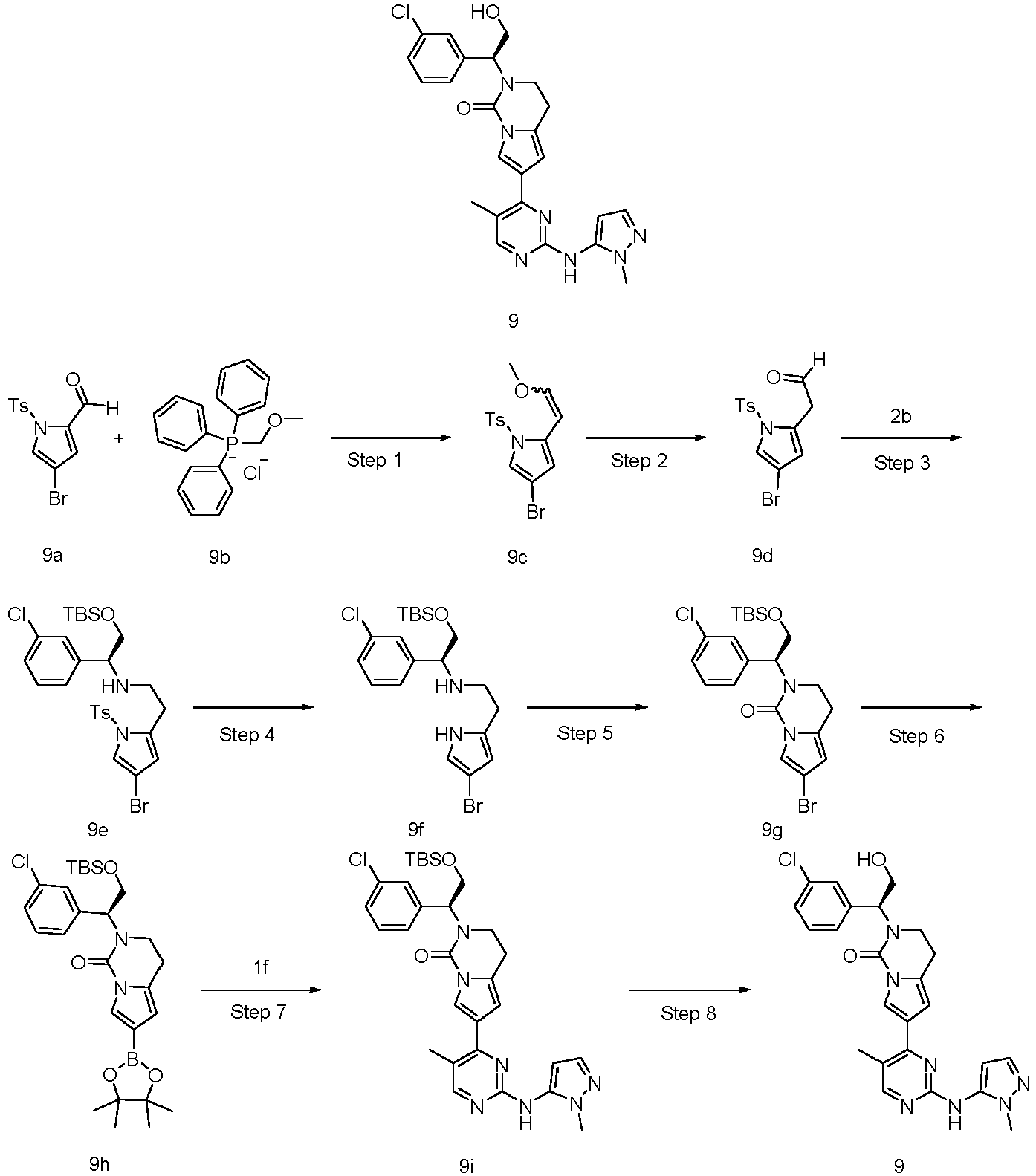
- (Methoxymethyl)triphenylphosphonium chloride 9b (8.36 g, 24.37 mmol) was dissolved in 150 mL of tetrahydrofuran, and the resulting solution was cooled to 0°C. Potassium tert-butoxide (2.74 g, 24.37 mmol) was added, and the reaction solution was stirred for 20 minutes. 4-Bromo-1-tosyl-1H-pyrrole-2-carbaldehyde 9a (4.0 g, 612.19 mmol, prepared by the well-known method disclosed in " Journal of Porphyrins and Phthalocyanines, 2009, 13(10), 1098-1110"), and the reaction solution was stirred overnight, followed by the addition of water. The reaction solution was concentrated under reduced pressure, and the residues were purified by column chromatography with eluent system C to obtain the title compound 9c (4.0 g), yield: 92%.
- MS m/z (ESI): 356.0 [M+1].
- Compound 9c (3 g, 8.42 mmol) was dissolved in 10 mL tetrahydrofuran, followed by the addition of 10 mL concentrated hydrochloric acid, and the reaction solution was stirred for 3 hours. The pH was adjusted to 7 with saturated sodium bicarbonate. The reaction solution was extracted with ethyl acetate (50 mL×2), and the organic phase was concentrated to obtain the title crude compound 9d (2.88 g), which was directly used in the next step without purification.
- MS m/z (ESI): 342.2 [M+1].
- The crude compound 9d (2.88 g, 8.42 mmol) and compound 2b (2 g, 6.99 mmol) were dissolved in 20 mL methanol, and the reaction solution was stirred for 1 hour. Sodium borohydride (396 mg, 10.48 mmol) was added, and the reaction solution was stirred for 14 hours at room temperature, and quenched with water. The reaction solution was concentrated under reduced pressure, and the residues were purified by column chromatography with eluent system C to obtain the title compound 9e (2.2 g), yield: 51.4%.
- MS m/z (ESI): 611.1 [M+1].
- Compound 9e (500 mg, 0.82 mmol) was dissolved in 5 mL of tetrahydrofuran, followed by the addition of a solution of sodium methoxide in methanol (441 mg, 8.16 mmol, 50%) at 0°C, and the reaction solution was stirred for 4 hours. The pH was adjusted to 7 with 2 N hydrochloric acid, and the reaction solution was extracted with ethyl acetate (10 mL×2). The organic phase was concentrated under reduced pressure, and the residues were purified by thin layer chromatography with developing solvent system C to obtain the compound 9f (280 mg), yield: 74.8%.
- MS m/z (ESI): 459.1 [M+1].
- Compound 9f (280 mg, 0.61 mmol) was dissolved in 10 mL of tetrahydrofuran, followed by the addition of N,N'-carbonyldiimidazole (198 mg, 1.22 mmol), and the reaction solution was stirred for 30 minutes. Sodium hydride (60%, 47 mg, 1.23 mmol) was added, and the reaction solution was stirred for 14 hours, followed by the addition of water. The reaction solution was concentrated under reduced pressure, and the residues were purified by thin layer chromatography with developing solvent system C to obtain the compound 9g (220 mg), yield: 74%.
- MS m/z (ESI): 483.1[M+1],
- Compound 9g (220 mg, 0.45 mmol) was dissolved in 3 mL of 1,4-dioxane under argon atmosphere, followed by the addition of 4,4,4',4',5,5,5',5'-octamethyl-2,2'-bis(1,3,2-dioxaborolane) (173 mg, 0.68 mmol), potassium acetate (178 mg, 1.81 mmol) and [1,1'-bis(diphenylphosphino)ferrocene]palladium (II) dichloride (33 mg, 0.05 mmol) successively. The reaction solution was stirred for 4 hours at 90°C, cooled, and filtered through Celite. The filtrate was concentrated to obtain the title crude compound 9h (240 mg), which was directly used in the next step without purification.
- MS m/z (ESI): 530.9 [M+1].
- Compound 1f (100 mg, 0.45 mmol) was dissolved in 6 mL of dioxane under an argon atmosphere, followed by the addition of 9h (241 mg, 0.45 mmol), cesium carbonate (291 mg, 0.89 mmol) and [1,1'-bis(diphenylphosphino)ferrocene]palladium (II) dichloride (65 mg, 0.088 mmol) successively. The reaction solution was stirred for 1.5 hours in microwave reactor at 85°C, cooled, and filtered through Celite. The filtrate was concentrated, and the residues were purified by column chromatography with eluent system A to obtain the title compound 9i (100 mg), yield: 37.7%.
- MS m/z (ESI): 592.2[M+1],
- Compound 9i (100 mg, 0.17 mmol) was dissolved in 3 mL of dichloromethane, followed by the addition of 1 mL of trifluoroacetic acid dropwise. After the addition was completed, the reaction solution was stirred for 4 hours. The pH was adjusted to 7 with saturated sodium bicarbonate solution, and the reaction solution was extracted with dichloromethane (50 mL×2). The organic phases were combined and concentrated, and the residues were purified by column chromatography with eluent system A to obtain the title compound 9 (22 mg), yield: 27%.
- MS m/z (ESI): 478.2 [M+1].
- 1H NMR (400 MHz, CD3OD): δ 8.18 (s, 1H), 7.88 (s, 1H), 7.46-7.43 (m, 2H), 7.39-7.34 (m, 3H), 6.62 (s, 1H), 6.31 (s, 1H), 5.72-5.69 (m, 1H), 4.15-4.14 (d, 2H), 3.74 (s, 3H), 3.66-3.60 (m, 1H), 3.35 (m, 1H), 3.04-3.00 (m, 1H), 2.99-2.88 (m, 1H), 2.38 (s, 3H).
-

- N-(1-Methyl-1H-pyrazol-5-yl)formamide 1j (324.82 mg, 2.60 mmol) was dissolved in 15 mL of N,N-dimethylformamide, followed by the addition of sodium hydride (60%, 311.47 mg, 7.79 mmol) at 0°C, and the reaction solution was stirred for 0.5 hours. Compound 10a (500 mg, 2.60 mmol) was added, and the reaction solution was further reacted for 2 hours. 20 mL of water was added, and the reaction solution was extracted with ethyl acetate (20 mL×3). The organic phases were combined and concentrated under reduced pressure, and the residues were purified by thin layer chromatography with developing solvent system C to obtain the compound 10b (270 mg), yield: 49.6%.
- MS m/z (ESI): 210.3 [M+1].
- A mixture of compound 2e (98.6 mg, 0.19 mmol), 4-chloro-N-(1-methyl-1H-pyrazol-5-yl)pyrimidin-2-amine 10b, [1,1'-bis(diphenylphosphino)ferrocene]palladium (II) dichloride (28 mg, 0.02 mmol) and cesium carbonate (124 mg, 0.2 mmol) was suspended in 20 mL of 1,4-dioxane and 4 mL of water under argon atmosphere. The reaction solution was heated to 80°C, and stirred for 14 hours. The reaction solution was cooled, and filtered through Celite. The filtrate was collected, and extracted with ethyl acetate (20 mL×3). The organic phases were combined, concentrated under reduced pressure, and the residues were purified by column chromatography with eluent system A to obtain the title compound 10c (100 mg), yield: 92%.
- MS m/z (ESI): 564.3 [M+1].
- Compound 10c (100 mg, 0.17 mmol) was dissolved in 20 mL of dichloromethane, followed by the addition of 1 mL of trifluoroacetic acid dropwise. After the addition was completed, the reaction solution was stirred for 4 hours. The pH was adjusted to 7 with saturated sodium bicarbonate solution, and the reaction solution was extracted with dichloromethane (20 mL×2). The organic phases were combined, concentrated under reduced pressure, and the residues were purified by column chromatography with eluent system A to obtain the title compound 10 (15 mg), yield: 18%.
- MS m/z (ESI): 450.1 [M+1].
- 1H NMR (400 MHz, CDCl3): δ 8.33 (d, 1H), 7.72 (s, 1H), 7.48 (d, 1H), 7.41-7.33 (m, 3H), 7.28-7.24 (m, 1H), 7.18 (s, 1H), 6.92 (d, 1H), 6.51 (s, 1H), 6.32 (d, 1H), 5.17 (dd, 1H), 4.46 (d, 1H), 4.32 (dd, 1H), 4.27-4.17 (m, 3H), 3.82 (s, 3H).
-

- Compound 3 (12.0 mg, 0.026 mmol) was dissolved in 10 mL of dichloromethane, followed by the addition of triethylamine (8.0 mg, 0.079 mmol) and methanesulfonyl chloride (6.0 mg, 0.052 mmol) successively, and the reaction solution was stirred for 30 minutes. A small amount of water was added, and the reaction solution was concentrated under reduced pressure to obtain the title compound 11a (14 mg), yield: 99%.
- MS m/z (ESI): 542.0[M+1],
- Compound 11a (14 mg, 0.026 mmol) was dissolved in 7 mL of N,N-dimethylformamide, followed by the addition of sodium azide (8.4 mg, 0.130 mmol). After the addition was completed, the reaction solution was stirred for 3 hours at 70°C. Water was added, and the reaction solution was extracted with dichloromethane (10 mL×2). The organic phases were combined, wash withed saturated sodium chloride solution, dried over anhydrous sodium sulfate, filtered, and concentrated under reduced pressure to obtain compound 11b (12 mg), yield: 95%.
- MS m/z (ESI): 489.0[M+1].
- Compound 11b (17 mg, 0.035 mmol) was dissolved in 5 mL of methanol, followed by the addition of palladium on carbon (42 mg, 0.35 mmol, 10% palladium). The reaction system was purged with hydrogen three times, and stirred for 30 minutes. The reaction solution was filtered, concentrated under reduced pressure, and the residues were purified by preparative HPLC to obtain compound 11 (1.0 mg), yield: 6%, compound 12 (1.0mg), yield: 6%, and compound 13 (1.0 mg), yield: 6%.
- MS m/z (ESI): 463.2[M+1].
- 1H NMR (400 MHz, CD3OD): δ 8.23 (s, 1H), 7.75 (s, 1H), 7.60 (s, 1H), 7.52 (s, 1H), 7.47-7.42 (m, 3H), 6.74(s, 1H), 6.33 (s, 1H), 5.37-5.34 (dd, 1H), 4.56-4.52 (d, 1H), 4.36 (d, 1H), 4.26-4.16 (m, 1H), 4.14-4.02 (m, 1H), 3.76 (s, 3H), 2.39 (s, 3H).
- MS m/z (ESI): 448.1[M+1].
- 1H NMR (400 MHz, CD3OD): δ 8.23 (s, 1H), 7.74 (s, 1H), 7.60 (s, 1H), 7.53 (s, 1H), 7.45-7.34 (m, 3H), 6.75 (s, 1H), 6.42 (s, 1H), 5.45-5.40 (dd, 1H), 4.58-4.54 (d, 1H), 4.20-4.16 (d, 1H), 3.77 (s, 3H), 2.41 (s, 3H), 1.74-1.72 (d, 3H).
- MS m/z (ESI): 477.2[M+1].
- 1H NMR (400MHz, CDCl3) δ 8.15 (s, 1H), 7.93 (s, 1H), 7.58 (s, 1H), 7.46 (s, 1H), 7.42-7.27 (m, 4H), 6.61 (s, 1H), 6.28 (s, 1H), 5.39 (d, 1H), 4.41 (d, 1H), 4.21 (d, 1H), 3.81 (s, 3H), 3.68-3.52 (m, 2H), 2.35 (s, 3H), 2.07-2.01 (m, 3H).
-

- The synthetic route in Example 6 was applied with the replacement of the starting compound 6a in Step 1 with (S)-2-amino-2-(3-fluoro-4-chlorophenyl)ethan-1-ol, to obtain compound 14 (15 mg).
- MS m/z (ESI): 482.2 [M+1].
- 1H NMR (400 MHz, CDCl3) δ 8.19 (s, 1H), 7.61-7.48 (m, 2H), 7.47-7.36 (m, 2H), 7.22 (d, 1H), 7.13 (d, 1H), 6.56 (s, 1H), 6.15 (s, 1H), 5.15 (dd, 1H), 4.42 (d, 1H), 4.32 (dd, 1H), 4.26 - 4.13 (m, 2H), 3.78 (s, 3H), 2.33 (s, 3H).
-


- (S)-2-Amino-2-(m-tolyl)ethan-1-ol 15a (3 g, 19.8 mmol, Shanghai Bide Pharmatech Ltd.) was dissolved in 100 mL of dichloromethane, followed by the addition of imidazole (4 g, 58.7 mol). The reaction solution was cooled to 0°C, followed by the addition of tert-butyldimethylchlorosilane (3.9 g, 25.9 mmol), and stirred for 14 hours. 100 mL of water was added, and the reaction solution was extracted with dichloromethane, dried over anhydrous sodium sulfate, and filtered. The filtrate was concentrated under reduced pressure, and the residues were purified by column chromatography with eluent system C to obtain the title compound 15b (5 g), yield: 95%.
- MS m/z (ESI): 266.2 [M+1].
- Compound 15b (5 g, 19.5 mmol) and compound 1b (3.4 g, 19.5 mmol) were stirred and reacted for 3 hours. 50 mL methanol was added, and the reaction solution was cooled to 0°C, followed by the addition of sodium borohydride (800 mg, 21.1 mmol) and stirred for 2 hours. Water was added, and the reaction solution was concentrated under reduced pressure. Water was added, and the reaction solution was extracted with ethyl acetate. The organic phases were combined, washed with saturated sodium chloride solution, dried over anhydrous sodium sulfate, and filtered. The filtrate was concentrated under reduced pressure, and the residues were purified by column chromatography with eluent system C to obtain the title compound 15c (7.3 g), yield: 88%.
- MS m/z (ESI): 423.1 [M+1].
- Compound 15c (7.3 g, 17.2 mmol) was dissolved in 150 mL of tetrahydrofuran, followed by the addition of N,N'-carbonyldiimidazole (8.4 g, 51.7 mmol) in an ice bath, and the reaction solution was stirred for 0.5 hours. Sodium hydride (60%, 2 g, 51.7 mmol) was added, and the reaction solution was stirred for 14 hours at room temperature, followed by the addition of saturated ammonium chloride solution. The reaction solution was concentrated under reduced pressure, and the residues were purified by column chromatography with eluent system C to obtain the title compound 15d (7 g), yield: 90%.
- MS m/z (ESI): 450.1 [M+1].
- Compound 15d (7 g, 15.5 mmol) was dissolved in 100 mL of dioxane under argon atmosphere, followed by the addition of 4,4,4',4',5,5,5',5'-octamethyl-2,2'-bis(1,3,2-dioxaborolane) (5.9 g, 23.3 mmol), potassium acetate (3.1 g, 31.1 mmol) and [1,1'-bis(diphenylphosphino)ferrocene]palladium (II) dichloride (2.3 g, 2.1 mmol) successively. The reaction solution was stirred for 2 hours at 90°C, cooled, and filtered through Celite. The filtrate was concentrated, and the residues were purified by column chromatography with eluent system C to obtain the title compound 15e (4 g), yield: 51.7%.
- MS m/z (ESI): 497.2 [M+1].
- A mixture of compound 10b (550 mg, 2.62 mmol), compound 15e (1.56 g, 3.15 mmol), [1,1'-bis(diphenylphosphino)ferrocene]palladium (II) dichloride (1.7 g, 0.26 mmol) and cesium carbonate (1.7 g, 5.2 mmol) was suspended in 30 mL of 1,4-dioxane and 6 mL of water under argon atmosphere. The reaction solution was heated to 80°C, and stirred for 14 hours. The reaction solution was cooled, and filtered through Celite. The filtrate was collected, and extracted with ethyl acetate (15 mL×2). The organic phases were combined and concentrated under reduced pressure, and the residues were purified by column chromatography with eluent system A to obtain the title compound 15f (1.4 g), yield: 98%.
- MS m/z (ESI): 544.2 [M+1].
- Compound 15f (1.3 g, 2.4 mmol) was dissolved in 10 mL of dichloromethane, followed by the dropwise addition of 3 mL of trifluoroacetic acid. After the addition was completed, the reaction solution was stirred for 4 hours. The pH was adjusted to 7 with saturated sodium bicarbonate solution, and the reaction solution was extracted with dichloromethane (30 mL×2). The organic phases were combined and concentrated under reduced pressure, and the residues were purified by thin layer chromatography with developing solvent system A to obtain the compound 15 (500 mg), yield: 48.6%.
- MS m/z (ESI): 430.1 [M+1].
- 1H NMR (400 MHz, CD3OD) δ 8.29 (d, 1H), 7.80 (s, 1H), 7.43 (d, 1H), 7.32-7.24 (m, 1H), 7.21 (s, 1H), 7.19-7.12 (m, 2H), 7.10 (d, 1H), 6.63 (s, 1H), 6.31 (d, 1H), 5.23 (dd, 1H), 4.61 (d, 1H), 4.29 (d, 1H), 4.19 (dd, 1H), 4.11-3.99 (m, 1H), 3.74 (s, 3H), 2.34 (s, 3H).
-

- The synthetic route in Example 6 was applied with the replacement of the starting compound If in Step 5 with compound 10b, to obtain compound 16 (20 mg).
- MS m/z (ESI): 468.0 [M+1].
- 1H NMR (400 MHz, CDCl3) δ 8.31 (d, 1H), 7.69 (s, 1H), 7.51-7.42 (m, 2H), 7.33 (s, 1H), 7.26-7.22 (m, 1H), 7.21-7.13 (m, 1H), 6.90 (d, 1H), 6.49 (s, 1H), 6.30 (s, 1H), 5.14 (dd, 1H), 4.45 (d, 1H), 4.35-4.24 (m, 1H), 4.24-4.13 (m, 2H), 3.80 (s, 3H).
-

- A mixture of 2,4-dichloro-5-methylpyrimidine 17a (76.3 mg, 0.47 mmol, Shanghai Bide Pharmatech Ltd.), compound 2e (220 mg, 0.43 mmol), [1,1'-bis(diphenylphosphino)ferrocene]palladium (II) dichloride (62.3 mg, 0.08 mmol) and cesium carbonate (277.3 mg, 0.85 mmol) was suspended in 10 mL of 1,4-dioxane and 2 mL of water under argon atmosphere. The reaction solution was heated to 80°C, and stirred for 14 hours. The reaction solution was cooled, and filtered through Celite. The filtrate was collected, and extracted with ethyl acetate (10 mL×3). The organic phases were combined and concentrated, and the residues were purified by column chromatography with eluent system A to obtain the title compound 17b (100 mg), yield: 45.4%.
- MS m/z (ESI): 517.1 [M+1].
- Compound 17b (80 mg, 154.5 µmol) and isopropylamine 17c (91.4 mg, 1.5 mmol, Shanghai Bide Pharmatech Ltd.) were dissolved in 2 mL of N,N-dimethylacetamide, and the reaction solution was stirred for 6 hours at 150°C in microwave reactor. The reaction solution was concentrated under reduced pressure, and the residues were purified by column chromatography with eluent system A to obtain the title compound 17d (20 mg), yield: 24%.
- Compound 17d (20 mg, 37 µmol) was dissolved in 5 mL of dichloromethane, followed by the addition of 0.5 mL of trifluoroacetic acid dropwise. After the addition was completed, the reaction solution was stirred for 1 hour. The pH was adjusted to 7 with saturated sodium bicarbonate solution, and the reaction solution was extracted with dichloromethane (20 mL×2). The organic phases were combined and concentrated, and the residues were purified by column chromatography with eluent system A to obtain the title compound 17 (5 mg), yield: 32%.
- MS m/z (ESI): 426.2 [M+1].
- 1H NMR (400 MHz, CDCl3) δ 8.08 (s, 1H), 7.61 (s, 1H), 7.34 (d, 3H), 7.25 (d, 2H), 6.70 (s, 1H), 5.13 (dd, 1H), 4.45 (d, 1H), 4.36-4.25 (m, 2H), 4.23-4.14 (m, 2H), 2.30 (s, 3H), 1.26 (d, 6H).
-

- Compound (3,4-difluorophenyl)methanamine 18a (863 mg, 6.0 mmol) and compound 1b (1 g, 5.7 mmol) were stirred and reacted for 3 hours. 20 mL of methanol was added, and the reaction solution was cool to 0°C. Sodium borohydride (361 mg, 5.7 mmol) was added, and the reaction solution was stirred for 2 hours. Water was added, and the reaction solution was concentrated under reduced pressure. Water was added, and the reaction solution was extracted with ethyl acetate. The organic phases were combined, washed with saturated sodium chloride solution, dried over anhydrous sodium sulfate, and filtered. The filtrate was concentrated under reduced pressure, and the residues were purified by column chromatography with eluent system C to obtain the title compound 18b (1.7 g), yield: 98.2%.
- MS m/z (ESI): 301.0 [M+1].
- Compound 18b (0.5 g, 1.7 mmol) was dissolved in 50 mL of tetrahydrofuran, followed by the addition of N,N'-carbonyldiimidazole (286 mg, 2.0 mmol) in an ice bath, and the reaction solution was stirred for 0.5 hours. Sodium hydride (60%, 15 mg, 0.63 mmol) was added, and the reaction solution was stirred for 14 hours at room temperature, followed by the addition of saturated ammonium chloride solution. The reaction solution was concentrated under reduced pressure, and the residues were purified by column chromatography with eluent system C to obtain the title compound 18c (220 mg), yield: 40.5%.
- MS m/z (ESI): 327.0 [M+1].
- Compound 18c (100 mg, 0.31 mmol) was dissolved in 10 mL of dioxane under argon atmosphere, followed by the addition of 4,4,4',4',5,5,5',5'-octamethyl-2,2'-bis(1,3,2-dioxaborolane) (95 mg, 0.37 mmol), potassium acetate (60 mg, 0.61 mmol) and [1,1'-bis(diphenylphosphino)ferrocene]palladium (II) dichloride (22 mg, 30 µmol) successively. The reaction solution was stirred for 2 hours at 90°C, cooled, and filtered through Celite. The filtrate was concentrated, and the residues were purified by column chromatography with eluent system C to obtain the title compound 18d (28 mg), yield: 24.5%.
- MS m/z (ESI): 375.0 [M+1].
- A mixture of compound 18d (27 mg, 72 µmol), compound If (15 mg, 67 µmol), [1,1'-bis(diphenylphosphino)ferrocene]palladium (II) dichloride (6 mg, 8.2 µmol) and cesium carbonate (18 mg, 130 µmol) was suspended in 5 mL of 1,4-dioxane and 1 mL of water under argon atmosphere. The reaction solution was heated to 80°C, and stirred for 14 hours. The reaction solution was cooled, and filtered through Celite. The filtrate was collected, and extracted with ethyl acetate (10 mL×2). The organic phases were combined and concentrated under reduced pressure, and the residues were purified by column chromatography with eluent system A to obtain the title compound 18 (10 mg), yield: 34%.
- MS m/z (ESI): 435.9 [M+1].
- 1H NMR (400 MHz, CD3OD) δ 8.23 (s, 1H), 7.80 (s, 1H), 7.63-7.54 (m, 1H), 7.36-7.22 (m, 2H), 7.19 (s, 1H), 6.75 (s, 1H), 6.48 (d, 1H), 4.69 (s, 2H), 4.41 (s, 2H), 3.80 (s, 3H), 2.42 (s, 3H).
-
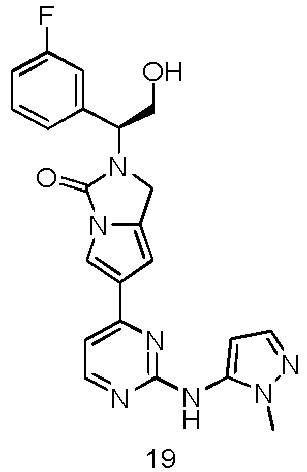
- The synthetic route in Example 15 was applied with the replacement of the starting compound (S)-2-amino-2-(3-methylphenyl)ethan-1-ol 15a in Step 1 with (S)-2-amino-2-(3-fluorophenyl)ethan-1-ol, to obtain compound 19 (50 mg).
- MS m/z (ESI): 434.1 [M+1].
- 1H NMR (400 MHz, CD3OD) δ 8.29 (d, 1H), 7.81 (s, 1H), 7.51-7.34 (m, 2H), 7.28-7.15 (m, 2H), 7.14-6.99 (m, 2H), 6.65 (s, 1H), 6.32 (d, 1H), 5.26 (dd, 1H), 4.64 (d, 1H), 4.34 (d, 1H), 4.26-4.14 (m, 1H), 4.13-4.03 (m, 1H), 3.75 (s, 3H).
-

- The synthetic route in Example 14 was applied with the replacement of the starting compound If in Step 5 with compound 10b, to obtain compound 20 (50 mg).
- MS m/z (ESI): 468.1 [M+1].
- 1H NMR (400MHz, CD3OD) δ 8.29 (d, 1H), 7.81 (s, 1H), 7.49 (t, 1H), 7.44 (d, 1H), 7.35 (dd, 1H), 7.22 (d, 1H), 7.10 (d, 1H), 6.65 (s, 1H), 6.32 (d, 1H), 5.24 (dd, 1H), 4.64 (d, 1H), 4.36 (d, 1H), 4.21-4.13 (m, 1H), 4.11-4.03 (m, 1H), 3.75 (s, 3H).
-

- The synthetic route in Example 15 was applied with the replacement of the starting compound 15a in Step 1 with (S)-2-amino-2-(4-chlorophenyl)ethan-1-ol, to obtain compound 21 (10 mg).
- MS m/z (ESI): 450.1 [M+1].
- 1H NMR (400 MHz, CDCl3) δ 8.33 (d, 1H), 7.75 (s, 1H), 7.48 (d, 1H), 7.42-7.35 (m, 2H), 7.31 (d, 2H), 6.94 (d, 1H), 6.54 (s, 1H), 6.35 (s, 1H), 5.14 (dd, 1H), 4.44 (d, 1H), 4.30 (dd, 1H), 4.25-4.14 (m, 2H), 3.82 (s, 3H).
- Test example 1: ERK1 enzyme activity test
- The purpose of this experiment is to detect the inhibitory ability of the compounds on the ERK1 enzyme activity, and evaluate the in vitro activity of the compounds based on the IC50. The ADP-Glo™ Kinase Assay Kit is used in this experiment. Under the action of the enzyme, the substrate is phosphorylated and ADP is produced at the same time. The ADP-Glo reagent is added to remove the unreacted ATP in the reaction system, and the ADP produced by the reaction is detected with the kinase detection reagent. In the presence of the compound, the inhibition rate of the compound is calculated by measuring the signal value.
- Formulation of enzyme and substrate: ERK1 (1879-KS-010, R&D) and substrate (AS-61777, anaspec) were formulated into 0.75 ng/µl and 100 µL respectively in the buffer (40 mM Tris, 20 mM MgCl2, 0.1 mg/ml BSA, 50 µM DTT), and then the enzyme solution and the substrate solution were prepared into a mixed solution at a volume ratio of 2:1 for later use. ATP was diluted to 300 µM with the buffer. The compound was dissolved in DMSO to prepare a stock solution with an initial concentration of 20 mM, and then Bravo (SGC120TH34702, Agilent Technologies) was used to dilute the stock solution to desired concentrations. Finally, a 3µL of a mixed solution of enzyme and substrate, and 1µL of different concentrations of the compound (the initial concentration is 50 µM, 4-fold dilution) were added to each well of the 384-well plate, and the plate was incubated at 30°C for 10 minutes, and finally 1µL of 300 µM ATP solution was added to each well, and the plate was incubated at 30°C for 2 hours. Then 5 µL of ADP-Glo was added, and the plate was incubated at 30°C for 40 minutes. Then 10 µL of Kinase detection buffer was added, and the plate was incubated at 30°C for 40 minutes. The 384-well plate was taken out and placed in a microplate reader (BMG labtech, PHERAstar FS), and the chemiluminescence was measured by the microplate reader.
- Microsoft Excel, Graphpad Prism 5 was used to process and analyze the data. The IC50 value of the compound was obtained, and the results are shown in Table 1 below.
Table 1 The IC50 value of the inhibition of the present compounds on ERK1 enzyme activity Example No. IC50 (nM) 1 9 3 3 5 10 6 14 9 12 10 5 13 2 15 5 16 70 19 24 20 30 21 67 - Conclusion: The compounds of the present disclosure have a significant inhibitory effect on the ERK1 enzyme activity.
- The purpose of this experiment is to detect the inhibitory ability of the compounds on the ERK2 enzyme activity, and evaluate the in vitro activity of the compounds based on the IC50. The ADP-Glo™ Kinase Assay Kit is used in this experiment. Under the action of the enzyme, the substrate is phosphorylated and ADP is produced at the same time. The ADP-Glo reagent is added to remove the unreacted ATP in the reaction system, and the ADP produced by the reaction is detected by the kinase detection reagent. In the presence of the compound, the inhibition rate of the compound is calculated by measuring the signal value.
- Formulation of enzyme and substrate: ERK2 (1879-KS-010, R&D) and substrate (custom peptide, Gill Biochemical) were formulated into 0.75 ng/µl and 1500 ng in the buffer (40 mM Tris, 20 mM MgCl2, 0.1 mg/ml BSA, 50 µM DTT), and then the enzyme solution and the substrate solution were prepared into a mixed solution at a volume ratio of 2:1 for later use. ATP was diluted to 500 µM with the buffer. The compound was dissolved in DMSO to prepare a stock solution with an initial concentration of 20 mM, and then Bravo (SGC120TH34702, Agilent Technologies) was used to dilute the stock solution to desired concentrations. Finally, a 3µL of a mixed solution of enzyme and substrate, and 1µL of different concentrations of the compound (the initial concentration is 50 µM, 4-fold dilution) were added to each well of the 384-well plate, and the plate was incubated at 30°C for 10 minutes, and finally 1µL of 500 µM ATP solution was added to each well, and the plate was incubated at 30°C for 2 hours. Then 5 µL of ADP-Glo was added, and the plate was incubated at 30°C for 40 minutes. Then 10 µL of kinase detection buffer was added, and the plate was incubated at 30°C for 40 minutes. The 384-well plate was taken out and placed in a microplate reader (BMG labtech, PHERAstar FS), and the chemiluminescence was measured by the microplate reader.
- Microsoft Excel, Graphpad Prism 5 was used to process and analyze the data. The IC50 value of the compound was obtained, and the results are shown in Table 2 below.
Table 2 The IC50 value of the inhibition of the present compounds on ERK2 enzyme activity Example No. IC50 (nM) 1 2 2 3 3 2 4 6 5 7 6 10 7 63 8 39 9 6 10 7 11 18 12 45 13 2 14 5 15 5 16 44 18 16 19 20 20 18 21 45 - Conclusion: The compounds of the present disclosure have a significant inhibitory effect on the ERK2 enzyme activity.
- The purpose of this experiment is to test the inhibitory activity of the compounds on the proliferation of Colo205 cells (CCL-222, ATCC) in vitro. The cells were treated in vitro with different concentrations of the compounds. After 3 days of culture, the cell proliferation was tested with CTG (CellTiter-Glo® Luminescent Cell Viability Assay, Promega, Catalog No. G7573) reagent, and the in vitro activity of the compounds was evaluated according to the IC50 value.
- In the following, taking the in vitro proliferation inhibition test method of Colo205 cells as an example, the method in the present disclosure for testing the in vitro proliferation inhibitory activity of the compounds of the present disclosure is described. This method is also applicable to, but not limited to, the in vitro proliferation inhibitory activity test on other tumor cells.
- Colo205 cells were digested, centrifuged and then resuspended. The single cell suspension was mixed well, and the density of viable cells was adjusted to 5.0×10⁴ cells/ml with cell culture medium (RPMI1640+2% FBS), and 95µl/well was added to a 96-well cell culture plate. Only 100 µl medium was added to the peripheral wells of the 96-well plate. The culture plate was incubated in an incubator for 24 hours (37°C, 5% CO2)·
- The compound was dissolved in DMSO and prepared into a stock solution with an initial concentration of 20 mM. The initial concentration of the small molecule compound was 2 mM, and then 4-fold diluted into 9 points, and the 10th point is DMSO. Another 96-well plate was taken and 90 µl of cell culture medium (RPMI1640+2% FBS) was added to each well, then 10 µl of different concentrations of the test sample was added to each well. The mixture was mixed well, and then 5uL of different concentrations of the test sample was added to the cell culture plate with duplicate well for each sample. The culture plate was incubated in an incubator for 3 days (37°C, 5% CO2). The 96-well cell culture plate was taken out, 50µL CTG solution was added to each well, and the plate was incubated for 10 minutes at room temperature. In a microplate reader (BMG labtech, PHERAstar FS), chemiluminescence was measured with the microplate reader.
- Microsoft Excel, Graphpad Prism 5 was used to process and analyze the data. The example results are shown in Table 3 below.
Table 3 The IC50 value of the inhibition of the present compounds on in vitro Colo205 tumor cell proliferation Example No. IC50 (nM) 1 90 2 32 3 26 4 82 5 81 6 74 7 158 9 77 10 62 13 99 14 92 15 55 16 180 19 101 20 68 21 120 - Mice were used as test animals. The drug concentration in plasma at different time points was determined by LC/MS/MS method after intragastrical administration of the compounds of Example 3, Example 10, Example 15 and Example 20 to mice. The pharmacokinetic behavior of the compounds of the present disclosure was studied in mice , and the pharmacokinetic characteristics were evaluated.
- Compounds of Example 3, Example 10, Example 15 and Example 20.
- Thirty-six C57 mice (female, equally divided into 4 groups) were purchased from Shanghai Jiesijie Laboratory Animal Co., LTD. (Certificate No.: SCXK(Shanghai)2013-0006).
- A certain amount of the test compound was weighed and dissolved by the addition of 5% of DMSO and 5% of tween 80. Then 90% of normal saline were added to prepare a 0.1 mg/mL colorless, clear and transparent solution.
- After an overnight fast, C57 mice were intragastrically administered the test compound at a dosage of 2 mg/kg and a volume of 0.2ml/10g.
- The mice were intragastrically administered the test compounds. 0.1 ml of blood was taken before the administration and at 0.25, 0.5, 1.0, 2.0, 4.0, 6.0, 8.0, 11.0 and 24.0 hours after the administration. The samples were stored in heparinized tubes, and centrifuged for 10 minutes at 3500 rpm to separate the blood plasma. The plasma samples were stored at -20°C.
- The content of the test compound in the plasma of mice after intragastrical administration of the test compound at different concentrations was determined: 25 µL of rat plasma at each time point after the administration was taken, followed by the addition of 50 µL of the internal standard camptothecin solution (National Institutes for Food and Drug Control of China) and 200 µL of acetonitrile. The resulting solution was vortex-mixed for 5 minutes, and centrifuged for 10 minutes (4000 rpm). 4 µL of the supernatant was taken from the plasma samples for LC/MS/MS analysis.
- Pharmacokinetic parameters of the compounds of the present disclosure are shown below:
Example No. Pharmacokinetics assay in mice Plasma concentration Area under curve Half-life Residence time Clearance Apparent distribution volume Cmax (ng /mL) AUC (ng /mL∗h) T1/2 (h) MRT (h) CLz/F (ml/min/kg) Vz/F (ml/kg) Example 3 604 2472 3.51 4.05 13.5 4097 Example 10 1023 3441 3.66 3.47 9.69 3067 Example 15 816 3705 2.74 3.3 9 2134 Example 20 1540 7632 3.73 4.95 4.37 1411 - Conclusion: The compounds of the present disclosure are well absorbed, and have a significant pharmacokinetic advantage.
Claims (21)
- A compound of general formula (I):
 or a stereoisomer, tautomer, mesomer, racemate, enantiomer, diastereomer thereof, or mixture thereof, or a pharmaceutically acceptable salt thereof,wherein:R1 is selected from the group consisting of hydrogen atom, halogen, alkyl, alkoxy, haloalkyl, haloalkoxy, hydroxy, hydroxyalkyl, cyano, amino, aminoalkyl and nitro, wherein the alkyl is optionally substituted by one or more substituents selected from the group consisting of NR7R8, alkoxy, halogen, cyano, nitro, hydroxy and hydroxyalkyl;R2 is identical or different and each is independently selected from the group consisting of hydrogen atom, halogen, alkyl, alkoxy, haloalkyl, haloalkoxy, hydroxy, hydroxyalkyl, cyano, amino and nitro;R3 is selected from the group consisting of hydrogen atom, halogen, alkyl, alkoxy, haloalkyl, haloalkoxy, hydroxy, hydroxyalkyl, cyano, amino, nitro, cycloalkyl, heterocyclyl, aryl and heteroaryl, wherein the alkyl, cycloalkyl, heterocyclyl, aryl and heteroaryl are each optionally further substituted by one or more substituents selected from the group consisting of alkyl, alkoxy, oxo, halogen, amino, cyano, nitro, hydroxy, hydroxyalkyl, cycloalkyl, heterocyclyl, aryl and heteroaryl;R4 is selected from the group consisting of hydrogen atom, halogen, alkyl, alkoxy, haloalkyl, haloalkoxy, hydroxy, hydroxyalkyl, cyano, amino and nitro;R5 is identical or different and each is independently selected from the group consisting of hydrogen atom, halogen, alkyl, alkoxy, haloalkyl, haloalkoxy, hydroxy, hydroxyalkyl, cyano, amino, nitro, cycloalkyl, heterocyclyl, aryl and heteroaryl;R6 is selected from the group consisting of hydrogen atom, halogen, alkyl, alkoxy, haloalkyl, haloalkoxy, hydroxy, hydroxyalkyl, cyano, amino and nitro;R7 and R8 are identical or different and are each independently selected from the group consisting of hydrogen atom, alkyl, hydroxyalkyl and haloalkyl;m is selected from the group consisting of 0, 1, 2, 3, 4 and 5;n is selected from the group consisting of 0, 1, 2 and 3;z is selected from the group consisting of 0, 1, 2, 3 and 4; andQ is selected from the group consisting of 0, 1 and 2.
 - The compound of general formula (I) or the stereoisomer, tautomer, mesomer, racemate, enantiomer, diastereomer thereof, or mixture thereof, or the pharmaceutically acceptable salt thereof according to claim 1, wherein R1 is selected from the group consisting of hydrogen atom, halogen, alkyl, alkoxy, haloalkyl, haloalkoxy, hydroxy, hydroxyalkyl, cyano, amino, aminoalkyl and nitro.
- The compound of general formula (I) according to claims 1 or 2, being a compound of general formula (I-P):
 or a stereoisomer, tautomer, mesomer, racemate, enantiomer, diastereomer thereof, or mixture thereof, or a pharmaceutically acceptable salt thereof,wherein R1 to R6, m, n, z and Q are as defined in claims 1 or 2.
 - The compound of formula (I) or the stereoisomer, tautomer, mesomer, racemate, enantiomer, diastereomer thereof, or mixture thereof, or the pharmaceutically acceptable salt thereof according to any one of claims 1 to 3, wherein R4 is hydrogen atom.
- The compound of formula (I) or the stereoisomer, tautomer, mesomer, racemate, enantiomer, diastereomer thereof, or mixture thereof, or the pharmaceutically acceptable salt thereof according to any one of claims 1 to 4, wherein n is 1 or 2.
- The compound of formula (I) according to claims 1 or 2, being a compound of formula (II) or formula (II-P):
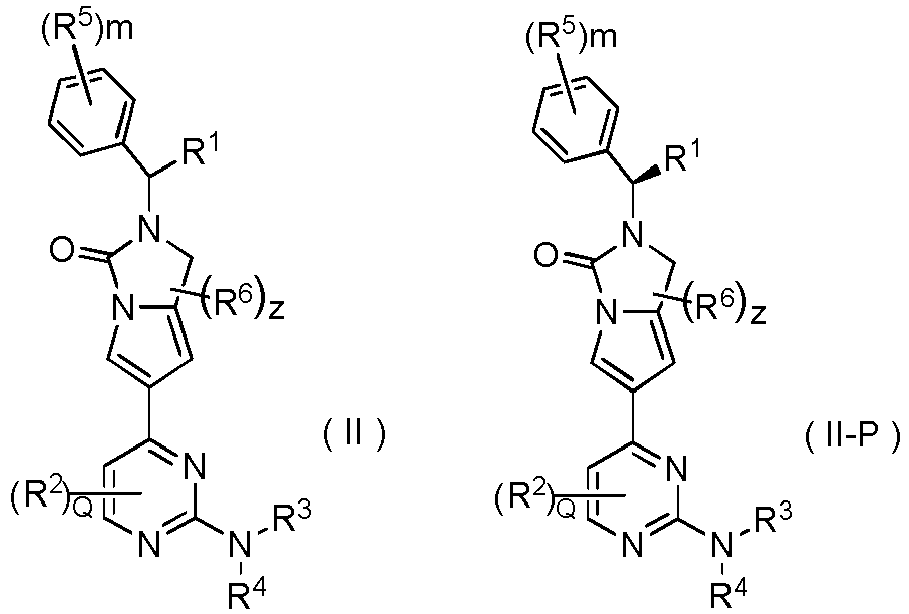 or a stereoisomer, tautomer, mesomer, racemate, enantiomer, diastereomer thereof, or mixture thereof, or a pharmaceutically acceptable salt thereof,wherein R1 to R6, m, z and Q are as defined in claims 1 or 2.
 - The compound of formula (I) or the stereoisomer, tautomer, mesomer, racemate, enantiomer, diastereomer thereof, or mixture thereof, or the pharmaceutically acceptable salt thereof according to any one of claims 1 to 6, wherein R1 is selected from the group consisting of hydrogen atom, alkyl, hydroxy, aminoalkyl, alkylaminoalkyl and hydroxyalkyl; preferably, R1 is selected from the group consisting of hydrogen atom, C1-6 alkyl, hydroxy, aminoC1-6 alkyl, C1-6 alkylaminoC1-6 alkyl and C1-6 hydroxyalkyl; and more preferably, R1 is selected from the group consisting of hydrogen atom, methyl, hydroxymethyl, aminomethyl and methylaminomethyl.
- The compound of formula (I) or the stereoisomer, tautomer, mesomer, racemate, enantiomer, diastereomer thereof, or mixture thereof, or the pharmaceutically acceptable salt thereof according to any one of claims 1 to 7, wherein R1 is selected from the group consisting of hydrogen atom, alkyl, hydroxy, aminoalkyl and hydroxyalkyl; preferably, R1 is selected from the group consisting of hydrogen atom, C1-6 alkyl, hydroxy, aminoC1-6 alkyl and C1-6 hydroxyalkyl; and more preferably, R1 is selected from the group consisting of hydrogen atom, methyl, hydroxymethyl and aminomethyl.
- The compound of formula (I) according to claims 1 or 2, being a compound of formula (III) or formula (III-P):
 or a stereoisomer, tautomer, mesomer, racemate, enantiomer, diastereomer thereof, or mixture thereof, or a pharmaceutically acceptable salt thereof,wherein:p is selected from the group consisting of 0, 1, 2 and 3, and preferably 1;R2, R3, R5, R6, m, n, z and Q are as defined in claims 1 or 2.
 - The compound of formula (I) or the stereoisomer, tautomer, mesomer, racemate, enantiomer, diastereomer thereof, or mixture thereof, or the pharmaceutically acceptable salt thereof according to any one of claims 1 to 9, wherein R2 is selected from the group consisting of hydrogen atom, halogen and alkyl; preferably, R2 is selected from the group consisting of hydrogen atom, halogen and C1-6 alkyl; and more preferably, R2 is C1-6 alkyl.
- The compound of formula (I) or the stereoisomer, tautomer, mesomer, racemate, enantiomer, diastereomer thereof, or mixture thereof, or the pharmaceutically acceptable salt thereof according to any one of claims 1 to 10, wherein R3 is selected from the group consisting of alkyl, hydroxyalkyl, cycloalkyl, heterocyclyl and heteroaryl, wherein the alkyl, cycloalkyl, heterocyclyl and heteroaryl are each optionally further substituted by one or more substituents selected from the group consisting of alkyl, alkoxy, oxo, halogen, amino, cyano, nitro, hydroxy and hydroxyalkyl; and preferably, R3 is selected from the group consisting of C1-6 alkyl, C1-6 hydroxyalkyl, C3-6 cycloalkyl, 3 to 8 membered heterocyclyl and 5 to 10 membered heteroaryl, wherein the C1-6 alkyl, C3-6 cycloalkyl, 3 to 8 membered heterocyclyl and 5 to 10 membered heteroaryl are each optionally further substituted by one or more substituents selected from the group consisting of C1-6 alkyl, C1-6 alkoxy, oxo, halogen, amino, cyano, nitro, hydroxy and C1-6 hydroxyalkyl.
- The compound of formula (I) or the stereoisomer, tautomer, mesomer, racemate, enantiomer, diastereomer thereof, or mixture thereof, or the pharmaceutically acceptable salt thereof according to any one of claims 1 to 11, wherein R3 is a heteroaryl, wherein the heteroaryl is optionally further substituted by one or more substituents selected from the group consisting of alkyl, alkoxy, oxo, halogen, amino, cyano, nitro, hydroxy and hydroxyalkyl; preferably, R3 is a 5 to 10 membered heteroaryl, wherein the 5 to 10 membered heteroaryl is optionally further substituted by one or more substituents selected from the group consisting of C1-6 alkyl, C1-6 alkoxy, oxo, halogen, amino, cyano, nitro, hydroxy and C1-6 hydroxyalkyl; and preferably, R3 is a pyrazolyl, wherein the pyrazolyl is optionally substituted by C1-6 alkyl, and preferably methyl.
- The compound of formula (I) or the stereoisomer, tautomer, mesomer, racemate, enantiomer, diastereomer thereof, or mixture thereof, or the pharmaceutically acceptable salt thereof according to any one of claims 1 to 12, wherein R5 is selected from the group consisting of hydrogen atom, alkyl, alkoxy and halogen; and preferably, R5 is selected from the group consisting of hydrogen atom, C1-6 alkyl, C1-6 alkoxy and halogen.
- The compound of formula (I) or the stereoisomer, tautomer, mesomer, racemate, enantiomer, diastereomer thereof, or mixture thereof, or the pharmaceutically acceptable salt thereof according to any one of claims 1 to 13, wherein R6 is a hydrogen atom.
- The compound of formula (I) or the stereoisomer, tautomer, mesomer, racemate, enantiomer, diastereomer thereof, or mixture thereof, or the pharmaceutically acceptable salt thereof according to any one of claims 1 to 14, selected from the group consisting of:


- A compound of formula (IIIA) or formula (III-PA):
 or a stereoisomer, tautomer, mesomer, racemate, enantiomer, diastereomer thereof, or mixture thereof, or a pharmaceutically acceptable salt thereof,wherein:Rw is a hydroxy protecting group; andR2, R3, R5, R6, m, n, p, Q and z are as defined in claim 9.
 - The compound of formula (IIIA) or formula (III-PA) according to claim 16, selected from the group consisting of:


- A method for preparing the compound of formula (III) or formula (III-P) according to claim 9, comprising a step of:
 removing the hydroxy protecting group Rw from a compound of formula (IIIA) or formula (III-PA) under an acidic condition to obtain the compound of formula (III) or formula (III-P);wherein:the hydroxy protecting group Rw is preferably TBS; andR2, R3, R5, R6, m, n, p, Q and z are as defined in claim 9.
 - A pharmaceutical composition comprising a therapeutically effective amount of the compound of formula (I) or the stereoisomer, tautomer, mesomer, racemate, enantiomer, diastereomer thereof, or mixture thereof, or the pharmaceutically acceptable salt thereof according to any one of claims 1 to 15, and one or more pharmaceutically acceptable carriers, diluents or excipients.
- Use of the compound of formula (I) or the stereoisomer, tautomer, mesomer, racemate, enantiomer, diastereomer thereof, or mixture thereof, or the pharmaceutically acceptable salt thereof according to any one of claims 1 to 15 or the pharmaceutical composition according to claim 19 in the preparation of a medicament for inhibiting ERK.
- Use of the compound of formula (I) or the stereoisomer, tautomer, mesomer, racemate, enantiomer, diastereomer thereof, or mixture thereof, or the pharmaceutically acceptable salt thereof according to any one of claims 1 to 15 or the pharmaceutical composition according to claim 19 in the preparation of a medicament for the treatment or prevention of cancer, inflammation, or other proliferative diseases, and preferably cancer; wherein the cancer is selected from the group consisting of melanoma, liver cancer, kidney cancer, lung cancer, nasopharyngeal cancer, colorectal cancer, colon cancer, rectal cancer, pancreatic cancer, cervical cancer, ovarian cancer, breast cancer, bladder cancer, prostate cancer, leukemia, head and neck squamous cell carcinoma, carcinoma of uterine cervix, thyroid cancer, lymphoma, sarcoma, neuroblastoma, brain tumor, myeloma, astrocytoma and glioma.
Applications Claiming Priority (3)
| Application Number | Priority Date | Filing Date | Title |
|---|---|---|---|
| CN201910247297 | 2019-03-29 | ||
| CN202010194720 | 2020-03-19 | ||
| PCT/CN2020/081591 WO2020200069A1 (en) | 2019-03-29 | 2020-03-27 | Pyrroloheterocyclic derivative, preparation method therefor, and application thereof in medicine |
Publications (2)
| Publication Number | Publication Date |
|---|---|
| EP3950690A1 true EP3950690A1 (en) | 2022-02-09 |
| EP3950690A4 EP3950690A4 (en) | 2022-12-07 |
Family
ID=72664469
Family Applications (1)
| Application Number | Title | Priority Date | Filing Date |
|---|---|---|---|
| EP20783525.7A Withdrawn EP3950690A4 (en) | 2019-03-29 | 2020-03-27 | PYRROLOHETEROCYCLIC DERIVATIVE, PROCESS FOR PRODUCTION THEREOF AND APPLICATION THEREOF IN MEDICINE |
Country Status (11)
| Country | Link |
|---|---|
| US (1) | US20220185818A1 (en) |
| EP (1) | EP3950690A4 (en) |
| JP (1) | JP2022528083A (en) |
| KR (1) | KR20210146956A (en) |
| CN (1) | CN113544131B (en) |
| AU (1) | AU2020251621A1 (en) |
| BR (1) | BR112021018924A2 (en) |
| CA (1) | CA3135070A1 (en) |
| MX (1) | MX2021011823A (en) |
| TW (1) | TW202102505A (en) |
| WO (1) | WO2020200069A1 (en) |
Families Citing this family (6)
| Publication number | Priority date | Publication date | Assignee | Title |
|---|---|---|---|---|
| WO2021110169A1 (en) * | 2019-12-06 | 2021-06-10 | 南京明德新药研发有限公司 | Thiazololactam compound as erk inhibitor and use thereof |
| WO2022068860A1 (en) * | 2020-09-29 | 2022-04-07 | 江苏恒瑞医药股份有限公司 | Crystal form of pyrrolo heterocyclic derivative and preparation method therefor |
| CN114315837B (en) * | 2020-09-29 | 2023-06-16 | 江苏恒瑞医药股份有限公司 | Crystalline forms of ERK inhibitors and methods of making the same |
| WO2022253186A1 (en) * | 2021-06-02 | 2022-12-08 | 南京明德新药研发有限公司 | Crystal form of dimethyl substituted thiazolopyrrolone compound and preparation method therefor |
| WO2022268065A1 (en) * | 2021-06-22 | 2022-12-29 | Fochon Biosciences, Ltd. | Compounds as erk inhibitors |
| CN118871442A (en) * | 2022-03-28 | 2024-10-29 | 江苏恒瑞医药股份有限公司 | A crystalline form of a fumarate of a pyrroloheterocyclic derivative and a preparation method thereof |
Family Cites Families (16)
| Publication number | Priority date | Publication date | Assignee | Title |
|---|---|---|---|---|
| JP2002516325A (en) | 1998-05-26 | 2002-06-04 | スミスクライン・ビーチャム・コーポレイション | New substituted imidazole compounds |
| CA2369502A1 (en) | 2000-02-05 | 2001-08-09 | Vertex Pharmaceuticals Incorporated | Compositions useful as inhibitors of erk |
| KR20010111298A (en) | 2000-02-05 | 2001-12-17 | 버텍스 파마슈티칼스 인코포레이티드 | Pyrazole compositions useful as inhibitors of erk |
| JP4739632B2 (en) | 2000-02-05 | 2011-08-03 | バーテックス ファーマシューティカルズ インコーポレイテッド | Pyrazole compositions useful as inhibitors of ERK |
| WO2002022605A1 (en) | 2000-09-15 | 2002-03-21 | Vertex Pharmaceuticals Incorporated | Pyrazole compounds useful as protein kinase inhibitors |
| EP2681215B1 (en) | 2011-02-28 | 2015-04-22 | Array Biopharma, Inc. | Serine/threonine kinase inhibitors |
| JP2013010719A (en) * | 2011-06-30 | 2013-01-17 | Dainippon Sumitomo Pharma Co Ltd | Benzimidazolone and oxindole derivative, and pharmaceutical application of them |
| EP2727920B1 (en) | 2011-07-29 | 2016-11-02 | FUJIFILM Corporation | 1,5-naphthyridine derivative or salt thereof |
| TW201348226A (en) * | 2012-02-28 | 2013-12-01 | Amgen Inc | Amides as Pim inhibitors |
| WO2014179154A2 (en) | 2013-04-30 | 2014-11-06 | Merck Sharp & Dohme Corp. | Novel compounds that are erk inhibitors |
| BR112016015235A2 (en) | 2013-12-30 | 2017-08-08 | Genentech Inc | COMPOUND, PHARMACEUTICAL COMPOSITION, PROTEIN KINASE ERK ACTIVITY INHIBITION METHOD AND TREATMENT METHOD |
| TWI704151B (en) * | 2014-12-22 | 2020-09-11 | 美商美國禮來大藥廠 | Erk inhibitors |
| CN107849046B (en) * | 2015-06-03 | 2020-06-12 | 常州捷凯医药科技有限公司 | Heterocyclic compounds as ERK inhibitors |
| BR112017026159A2 (en) * | 2015-06-15 | 2018-08-14 | Asana Biosciences, Llc | heterocyclic erk1 and erk2 inhibitors and their use in cancer treatment |
| WO2017180817A1 (en) | 2016-04-15 | 2017-10-19 | Musc Foundation For Research Development | Treatment of septicemia and ards with erk inhibitors |
| JP7201586B6 (en) | 2016-09-08 | 2024-02-08 | サビラ バイオサイエンシズ エルエルシー | 1,2-dithiolane compounds useful in neuroprotective, autoimmune and cancer diseases and conditions |
-
2020
- 2020-03-27 BR BR112021018924A patent/BR112021018924A2/en not_active IP Right Cessation
- 2020-03-27 KR KR1020217033781A patent/KR20210146956A/en not_active Ceased
- 2020-03-27 AU AU2020251621A patent/AU2020251621A1/en not_active Abandoned
- 2020-03-27 WO PCT/CN2020/081591 patent/WO2020200069A1/en not_active Ceased
- 2020-03-27 MX MX2021011823A patent/MX2021011823A/en unknown
- 2020-03-27 US US17/600,043 patent/US20220185818A1/en not_active Abandoned
- 2020-03-27 CA CA3135070A patent/CA3135070A1/en active Pending
- 2020-03-27 EP EP20783525.7A patent/EP3950690A4/en not_active Withdrawn
- 2020-03-27 TW TW109110555A patent/TW202102505A/en unknown
- 2020-03-27 CN CN202080019049.5A patent/CN113544131B/en active Active
- 2020-03-27 JP JP2021557719A patent/JP2022528083A/en active Pending
Also Published As
| Publication number | Publication date |
|---|---|
| AU2020251621A1 (en) | 2021-11-04 |
| JP2022528083A (en) | 2022-06-08 |
| WO2020200069A1 (en) | 2020-10-08 |
| CN113544131B (en) | 2024-03-15 |
| MX2021011823A (en) | 2021-10-22 |
| CN113544131A (en) | 2021-10-22 |
| BR112021018924A2 (en) | 2022-02-01 |
| US20220185818A1 (en) | 2022-06-16 |
| TW202102505A (en) | 2021-01-16 |
| KR20210146956A (en) | 2021-12-06 |
| EP3950690A4 (en) | 2022-12-07 |
| CA3135070A1 (en) | 2020-10-08 |
Similar Documents
| Publication | Publication Date | Title |
|---|---|---|
| CN115605479B (en) | Pyridone pyrimidine derivatives, preparation methods thereof and their application in medicine | |
| EP3950690A1 (en) | Pyrroloheterocyclic derivative, preparation method therefor, and application thereof in medicine | |
| EP3061747B1 (en) | Pyridic ketone derivatives, method of preparing same, and pharmaceutical application thereof | |
| EP3287461B1 (en) | Imidazo isoindole derivative, preparation method therefor and medical use thereof | |
| EP3575301A1 (en) | Heteroaryl[4,3-c]pyrimidine-5-amine derivative, preparation method therefor, and medical uses thereof | |
| KR102653823B1 (en) | CD73 inhibitor, method of making and use thereof | |
| HUE028555T2 (en) | Pyrazoloquinoline derivative as pde9 inhibitors | |
| EP4063363A1 (en) | Pyrazolo-heteroaryl derivative, preparation method therefor, and medical use thereof | |
| EP4223754A1 (en) | Compound as akt kinase inhibitor | |
| EP3750891A1 (en) | Pyrazolo[1,5-a][1,3,5]triazine-2-amine derivative, preparation method therefor and medical use thereof | |
| CN113825757B (en) | Substituted fused bicyclic derivatives, their preparation methods and their applications in medicine | |
| CN113518779B (en) | Thienoheterocyclic derivatives, their preparation methods and their applications in medicine | |
| JP2024511389A (en) | Uses and methods of heterocyclic compounds to treat diseases associated with kinase drug resistance mutations | |
| CN114423759A (en) | Condensed heteroaryl derivative, preparation method and application thereof in medicine | |
| EP4261211A1 (en) | Dihydroisoquinolinone derivative and application thereof | |
| CN115867552B (en) | Imidazolopyrimidine derivatives, preparation methods thereof and their application in medicine | |
| CN118027066A (en) | A thienopyrimidinone compound, and preparation method and use thereof | |
| HK40059622A (en) | Pyrroloheterocyclic derivative, preparation method therefor, and application thereof in medicine | |
| CN118496224A (en) | Imidazopyridine heterocyclic compound with cyclin dependent kinase inhibition activity, preparation method and medical application thereof | |
| TW202128707A (en) | Fused tetracyclic derivatives, preparation method and medical use thereof | |
| CN120098001A (en) | Thiophene compounds as cyclin-dependent kinase inhibitors and preparation methods and medical uses thereof | |
| KR20260051399A (en) | Heteroaryl compounds, methods for manufacturing the same, and medical applications thereof | |
| CN117865988A (en) | A tetracyclic compound, preparation method and use thereof | |
| IL301273A (en) | Heteroaromatic compounds and uses thereof | |
| HK40064826A (en) | Substituted fused bicyclic derivative, preparation method therefor, and application thereof in medicines |
Legal Events
| Date | Code | Title | Description |
|---|---|---|---|
| STAA | Information on the status of an ep patent application or granted ep patent |
Free format text: STATUS: THE INTERNATIONAL PUBLICATION HAS BEEN MADE |
|
| PUAI | Public reference made under article 153(3) epc to a published international application that has entered the european phase |
Free format text: ORIGINAL CODE: 0009012 |
|
| STAA | Information on the status of an ep patent application or granted ep patent |
Free format text: STATUS: REQUEST FOR EXAMINATION WAS MADE |
|
| 17P | Request for examination filed |
Effective date: 20210923 |
|
| AK | Designated contracting states |
Kind code of ref document: A1 Designated state(s): AL AT BE BG CH CY CZ DE DK EE ES FI FR GB GR HR HU IE IS IT LI LT LU LV MC MK MT NL NO PL PT RO RS SE SI SK SM TR |
|
| DAV | Request for validation of the european patent (deleted) | ||
| DAX | Request for extension of the european patent (deleted) | ||
| RAP3 | Party data changed (applicant data changed or rights of an application transferred) |
Owner name: SHANGHAI HENGRUI PHARMACEUTICAL CO., LTD. Owner name: JIANGSU HENGRUI PHARMACEUTICALS CO., LTD. |
|
| A4 | Supplementary search report drawn up and despatched |
Effective date: 20221108 |
|
| RIC1 | Information provided on ipc code assigned before grant |
Ipc: A61P 29/00 20060101ALI20221102BHEP Ipc: A61P 35/00 20060101ALI20221102BHEP Ipc: A61K 31/519 20060101ALI20221102BHEP Ipc: A61K 31/4188 20060101ALI20221102BHEP Ipc: C07D 487/04 20060101AFI20221102BHEP |
|
| STAA | Information on the status of an ep patent application or granted ep patent |
Free format text: STATUS: THE APPLICATION IS DEEMED TO BE WITHDRAWN |
|
| 18D | Application deemed to be withdrawn |
Effective date: 20241001 |