EP3950661A1 - Hole transport material, synthesis thereof, and solar cell - Google Patents
Hole transport material, synthesis thereof, and solar cell Download PDFInfo
- Publication number
- EP3950661A1 EP3950661A1 EP20189226.2A EP20189226A EP3950661A1 EP 3950661 A1 EP3950661 A1 EP 3950661A1 EP 20189226 A EP20189226 A EP 20189226A EP 3950661 A1 EP3950661 A1 EP 3950661A1
- Authority
- EP
- European Patent Office
- Prior art keywords
- cpda
- compound
- spiro
- ometad
- htm
- Prior art date
- Legal status (The legal status is an assumption and is not a legal conclusion. Google has not performed a legal analysis and makes no representation as to the accuracy of the status listed.)
- Granted
Links
- 0 *C(C(Br)=C1Br)(C(Br)=C1Br)Br Chemical compound *C(C(Br)=C1Br)(C(Br)=C1Br)Br 0.000 description 4
Images



Classifications
-
- C—CHEMISTRY; METALLURGY
- C07—ORGANIC CHEMISTRY
- C07C—ACYCLIC OR CARBOCYCLIC COMPOUNDS
- C07C217/00—Compounds containing amino and etherified hydroxy groups bound to the same carbon skeleton
- C07C217/78—Compounds containing amino and etherified hydroxy groups bound to the same carbon skeleton having amino groups and etherified hydroxy groups bound to carbon atoms of six-membered aromatic rings of the same carbon skeleton
- C07C217/80—Compounds containing amino and etherified hydroxy groups bound to the same carbon skeleton having amino groups and etherified hydroxy groups bound to carbon atoms of six-membered aromatic rings of the same carbon skeleton having amino groups and etherified hydroxy groups bound to carbon atoms of non-condensed six-membered aromatic rings
- C07C217/82—Compounds containing amino and etherified hydroxy groups bound to the same carbon skeleton having amino groups and etherified hydroxy groups bound to carbon atoms of six-membered aromatic rings of the same carbon skeleton having amino groups and etherified hydroxy groups bound to carbon atoms of non-condensed six-membered aromatic rings of the same non-condensed six-membered aromatic ring
- C07C217/92—Compounds containing amino and etherified hydroxy groups bound to the same carbon skeleton having amino groups and etherified hydroxy groups bound to carbon atoms of six-membered aromatic rings of the same carbon skeleton having amino groups and etherified hydroxy groups bound to carbon atoms of non-condensed six-membered aromatic rings of the same non-condensed six-membered aromatic ring the nitrogen atom of at least one of the amino groups being further bound to a carbon atom of a six-membered aromatic ring
-
- C—CHEMISTRY; METALLURGY
- C07—ORGANIC CHEMISTRY
- C07C—ACYCLIC OR CARBOCYCLIC COMPOUNDS
- C07C209/00—Preparation of compounds containing amino groups bound to a carbon skeleton
- C07C209/66—Preparation of compounds containing amino groups bound to a carbon skeleton from or via metallo-organic compounds
-
- C—CHEMISTRY; METALLURGY
- C07—ORGANIC CHEMISTRY
- C07C—ACYCLIC OR CARBOCYCLIC COMPOUNDS
- C07C211/00—Compounds containing amino groups bound to a carbon skeleton
- C07C211/43—Compounds containing amino groups bound to a carbon skeleton having amino groups bound to carbon atoms of six-membered aromatic rings of the carbon skeleton
- C07C211/54—Compounds containing amino groups bound to a carbon skeleton having amino groups bound to carbon atoms of six-membered aromatic rings of the carbon skeleton having amino groups bound to two or three six-membered aromatic rings
-
- H—ELECTRICITY
- H10—SEMICONDUCTOR DEVICES; ELECTRIC SOLID-STATE DEVICES NOT OTHERWISE PROVIDED FOR
- H10K—ORGANIC ELECTRIC SOLID-STATE DEVICES
- H10K85/00—Organic materials used in the body or electrodes of devices covered by this subclass
- H10K85/50—Organic perovskites; Hybrid organic-inorganic perovskites [HOIP], e.g. CH3NH3PbI3
-
- H—ELECTRICITY
- H10—SEMICONDUCTOR DEVICES; ELECTRIC SOLID-STATE DEVICES NOT OTHERWISE PROVIDED FOR
- H10K—ORGANIC ELECTRIC SOLID-STATE DEVICES
- H10K85/00—Organic materials used in the body or electrodes of devices covered by this subclass
- H10K85/60—Organic compounds having low molecular weight
- H10K85/631—Amine compounds having at least two aryl rest on at least one amine-nitrogen atom, e.g. triphenylamine
-
- C—CHEMISTRY; METALLURGY
- C07—ORGANIC CHEMISTRY
- C07C—ACYCLIC OR CARBOCYCLIC COMPOUNDS
- C07C2601/00—Systems containing only non-condensed rings
- C07C2601/12—Systems containing only non-condensed rings with a six-membered ring
- C07C2601/16—Systems containing only non-condensed rings with a six-membered ring the ring being unsaturated
-
- H—ELECTRICITY
- H10—SEMICONDUCTOR DEVICES; ELECTRIC SOLID-STATE DEVICES NOT OTHERWISE PROVIDED FOR
- H10K—ORGANIC ELECTRIC SOLID-STATE DEVICES
- H10K30/00—Organic devices sensitive to infrared radiation, light, electromagnetic radiation of shorter wavelength or corpuscular radiation
- H10K30/10—Organic devices sensitive to infrared radiation, light, electromagnetic radiation of shorter wavelength or corpuscular radiation comprising heterojunctions between organic semiconductors and inorganic semiconductors
-
- H—ELECTRICITY
- H10—SEMICONDUCTOR DEVICES; ELECTRIC SOLID-STATE DEVICES NOT OTHERWISE PROVIDED FOR
- H10K—ORGANIC ELECTRIC SOLID-STATE DEVICES
- H10K30/00—Organic devices sensitive to infrared radiation, light, electromagnetic radiation of shorter wavelength or corpuscular radiation
- H10K30/10—Organic devices sensitive to infrared radiation, light, electromagnetic radiation of shorter wavelength or corpuscular radiation comprising heterojunctions between organic semiconductors and inorganic semiconductors
- H10K30/15—Sensitised wide-bandgap semiconductor devices, e.g. dye-sensitised TiO2
- H10K30/151—Sensitised wide-bandgap semiconductor devices, e.g. dye-sensitised TiO2 the wide bandgap semiconductor comprising titanium oxide, e.g. TiO2
-
- H—ELECTRICITY
- H10—SEMICONDUCTOR DEVICES; ELECTRIC SOLID-STATE DEVICES NOT OTHERWISE PROVIDED FOR
- H10K—ORGANIC ELECTRIC SOLID-STATE DEVICES
- H10K30/00—Organic devices sensitive to infrared radiation, light, electromagnetic radiation of shorter wavelength or corpuscular radiation
- H10K30/50—Photovoltaic [PV] devices
-
- H—ELECTRICITY
- H10—SEMICONDUCTOR DEVICES; ELECTRIC SOLID-STATE DEVICES NOT OTHERWISE PROVIDED FOR
- H10K—ORGANIC ELECTRIC SOLID-STATE DEVICES
- H10K50/00—Organic light-emitting devices
- H10K50/10—OLEDs or polymer light-emitting diodes [PLED]
- H10K50/14—Carrier transporting layers
- H10K50/15—Hole transporting layers
- H10K50/155—Hole transporting layers comprising dopants
-
- Y—GENERAL TAGGING OF NEW TECHNOLOGICAL DEVELOPMENTS; GENERAL TAGGING OF CROSS-SECTIONAL TECHNOLOGIES SPANNING OVER SEVERAL SECTIONS OF THE IPC; TECHNICAL SUBJECTS COVERED BY FORMER USPC CROSS-REFERENCE ART COLLECTIONS [XRACs] AND DIGESTS
- Y02—TECHNOLOGIES OR APPLICATIONS FOR MITIGATION OR ADAPTATION AGAINST CLIMATE CHANGE
- Y02E—REDUCTION OF GREENHOUSE GAS [GHG] EMISSIONS, RELATED TO ENERGY GENERATION, TRANSMISSION OR DISTRIBUTION
- Y02E10/00—Energy generation through renewable energy sources
- Y02E10/50—Photovoltaic [PV] energy
- Y02E10/549—Organic PV cells
Definitions
- the field of the invention relates to hole transport materials (HTMs) and their use in perovskite based solar cells (PSCs).
- HTMs hole transport materials
- PSCs perovskite based solar cells
- the invention relates to a molecule having a structure comprising a core flanked by four arylamine moieties, its synthesis, and the use of said compound in an HTM layer of a PSC.
- the invention relates also to a PSC, specifically a hybrid metal halide perovskite based solar cell, incorporating such an HTM.
- Hybrid metal halide perovskite materials have been successfully used as light absorbing layer in solar cells due to their facile preparation process as well as their excellent optoelectronic properties [1] .
- the power conversion efficiency (PCE) of perovskite solar cells (PSCs) reached about 23-25% during the past few years [2] .
- Hole transporting materials (HTMs) are critically important for high performance of the PSCs to construct effective hole-extraction and electron blocking layer [3] . Besides high hole-mobility and well aligned energy levels, the production cost is also becoming more important for HTMs now that the field of PSCs is moving from the academia to industrial commercialization [4] .
- Organic small molecule HTMs have been widely studied due to their advantages of a well-defined chemical structure [5] , tunable energy levels for different perovskite active materials [6] , and good batch-to batch reproducibility [7] .
- Spiro-OMeTAD was the most widely used small molecule HTM exhibiting power conversion efficiencies (PCE) exceeding 24% [8] .
- PCE power conversion efficiencies
- those performances came with the cost of a difficult synthesis of the Spiro-OMeTAD molecule because of its 9,9'-spirobifluorene core (Spiro) [9] , together with poor operational stability that is accompanied with lowered glass-transition temperature ( T g ) upon introducing dopants [10] .
- the invention is made in view of the aforementioned problems and drawbacks in the related art.
- the invention provides a compound having a structure comprising a substituted cyclopentadiene core flanked by four arylamine based moieties, having one of formulas (I) and (II)
- R x is selected from C1-C20 linear or branched alkyl chains.
- M - represents a counterion.
- counterions M - are: F - , I - , Br - , Cl - , [N(CN) 2 ] - , [N(SO 2 CF 3 ) 2 ] - , [PF 6 ] - , [BF 4 ] - , [NO 3 ] - , [C(CN) 3 ] - , [B(CN) 4 ] - , [CF 3 COO] - , [ClO 4 ] -
- n 0 to 20.
- R' is selected from C1-C20 alkyl, C2-C20 alkenyl, C2-C20 alkynyl, C4-C20 aryl, and C1-C20 fluoroalkyl group, wherein said alkyl, alkenyl, alkynyl, and fluoroalkyl, if they comprise 3 or more carbons may be linear, branched or cyclic and wherein aryl group may be substituted;
- R x1 or R x2 are selected from -H, -OR x3 , --SR X3 , --R X3 ;
- R x3 is selected from C1-C20 linear or branched alkyl chains or alkoxy chains.
- R x1 or R x2 are selected from -H, -OR x3 , --SR X3 , --R X3
- R x3 is selected from C1-C20 linear or branched alkyl chains, alkoxy chains.
- R x1 or R x2 are selected from -H, -OR x3 , --SR X3 , --R X3
- R x3 is selected from C1-C20 linear or branched alkyl chains, alkoxy chains.
- the invention provides a compound, 4,4',4",4"'-(5,5-dimethoxycyclopenta-1,3-diene-1,2,3,4-tetrayl)tetrakis(N,N-bis(4-methoxyphenyl)aniline (CPDA 1), having the formula (A)
- the invention thus provides CPDA 1, comprising cyclopentadiene dimethyl acetale as a new core element flanked by four triarylamine moieties as a novel HTM for PSCs.
- CPDA 1 surpasses spiro-OMeTAD in points mentioned above by a record PCE of 23.1% for non-Spiro PSC, substantially higher stability and low-cost.
- the invention proposes a process for synthetizing CPDA 1.
- This process comprises a step consisting in a fourfold Suzuki cross-coupling reaction starting from commercially available tetrabromocyclopentadiene dimethyl acetale and a triarylamine boronic ester.
- dimethyl acetale can be efficiently prepared in two steps and the boronic ester in three steps according to literature procedures [12] .
- the complete elaborated synthetic procedure over six steps delivers CPDA 1 in good overall yields of 52% starting from industrial-level chemicals.
- Figure 1 shows the chemical structure of CPDA 1 and, in comparison the structure of the known compound Spiro-OMeTAD.
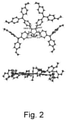
- Figure 2 shows a single crystal X-ray structure analysis of CPDA 1 showing the molecular geometry comprising torsion angles between the inner phenyl rings and the central cyclopentadiene dimethyl acetale core unit.
- Single crystals suitable for X-ray diffraction measurements were obtained by antisolvent vapor-assisted crystallization by slow diffusion of n -hexane into a dichloromethane solution of CPDA 1.
- Figure 2 the molecular geometry of CPDA 1 including torsion angles between the inner phenylene rings and the central cyclopentadiene dimethyl acetale core is shown in front and side view.
- the spiro-carbon of the central CPDA unit is nearly ideally tetrahedral and the methoxy groups are only slightly distorted by 2-7° ( Figure 2 , bottom).
- the molecular packing motif of CPDA 1 in the (-101) plane is dominated by CH-O interactions of methoxy groups. In the perpendicular direction several CH-C and CH-O intermolecular interactions stabilize the antiparallel oriented molecules in the adjacent planes.
- the short contacts involving hydrogen atoms in herringbone-type interaction that is related to the packing tendency of CPDA 1 is supposed to favour better hopping conduction of holes in the HTL of PSC.
- Another reasonable chromophore is represented by the 4,4'-bis (4-methoxyphenyl) stilbene unit, which as trans- isomer shows two absorption bands at 398 nm and 305 nm. It is known for cyclopentadienone acetales that in comparison to the corresponding cyclopentadienes the longest wavelength band is bathochromically shifted due to spiro-conjugation [15] . Therefore, the inventors address the band at lowest energy at 454 nm in the absorption spectrum of CPDA 1 to the spiro-conjugated cyclopentadiene acetale structure.
- the absorption onset corresponds to an optical energy gap of 2.37 eV and an emission maximum is found at 577 nm.
- Such an amorphous behaviour endows CPDA 1 good film forming ability, which is potentially important to fabricate thin, yet confocal HTM layers for efficient PSCs.
- CPDA 1 and Spiro-OMeTAD exhibit three reversible redox peaks.
- CPDA 1 black line
- Spiro-OMeTAD grey line
- Spiro-OMeTAD grey line
- Spiro-OMeTAD grey line
- the HOMO level of CPDA 1 was calculated to be -5.23 eV and -5.24 eV for Spiro-OMeTAD.
- the LUMO level of Spiro-OMeTAD and CPDA 1 was respectively found to be -2.22 and -2.82 eV upon combination of the HOMO level and the optical band gap.
- the energy level diagram for device components shows in Figure 5
- the HOMO level of CPDA 1 is more positive than the valence band of the perovskite layer, which makes it suited for hole extraction from the HTM/perovskite interface.
- the LUMO level is lying high enough to prevent back-electron transfer from the cathodic electrode to the perovskite layer [16] .
- CPDA 1 in PSCs are verified firstly by time-resolved photoluminescence to obtain insights of hole-extraction and also compared with Spiro-OMeTAD.
- the decay lifetimes of pristine perovskite films, perovskite films coated with CPDA 1 and Spiro-OMeTAD were 104.7 ns, 31.1 ns and 42.3 ns, respectively.
- Both CPDA 1 and Spiro-OMeTAD can effectively extract holes generated from the excitation of perovskite, while CPDA 1 favours slightly faster hole extraction, which presumably favours higher fill factor for the corresponding PSCs [17] .
- thermograms of CPDA 1 permit to determine T g to be 120 °C, which is identical with that of spiro-MeOTAD [18] . Further heating indicated exothermic crystallization in the range of 170-205 °C (supported by optical microscopy), and finally a broad melting point peaking at 257 °C was identified.
- DSCs of CPDA 1 containing the additives lithium bis(trifluoromethanesulfonyl) imid (LiTFSI) and 4- tert -butylpyridine (4- t BP) were measured.
- T g (120-125 °C) and the melting point (257 °C) of CPDA 1 are only marginally influenced by the additives, while the T g of Spiro-OMeTAD with dopants dropped to ⁇ 70 °C [19] , which is harmful for the PSCs at operational conditions.
- HTM CPDA 1 is thermally stable and decomposition, which is attended by the loss of a methoxy group, started at a temperature of 280 °C (95% mass loss) measured by thermal gravimetric analysis.
- Cesium iodide (CsI) was purchased from TCI Co. Ltd.
- Lead iodide (PbI 2 ) was purchased from Alfa Co. Ltd.
- Formamidinium iodide (FAI), Methylammonium bromide (MABr), and 2,2',7,7'-Tetrakis[N,N-di(4-methoxyphenyl)amino]-9,9'-spirobifluorene (spiro-OMeTAD) were purchased from Dyesol.
- Ultradry dimethylformamide (DMF), ultradry dimethyl sulfoxide (DMSO) and ultradry chlorobenzene (CB) were purchased from Acros.
- Li-TFSI lithium bistrifluorosulfonyl imide
- acetyl acetone phenethylamine and titanium diisopropoxide bis(acetylacetonate)
- 75 weight % in IPA were purchased from Sigma-Aldrich. All the chemicals were used as received without further purification.
- CPDA 1 may be roughly estimated to between about 4-10 CHF/g, whereas the cost of spiro-OMeTAD is of about 100 CHF / g.
- FTO Conductive glass
- Nippon Sheet Glass was purchased from Nippon Sheet Glass, and titanium dioxide paste (30 NR-D) was purchased from Dyesol.
- An etched fluorine doped tin oxide (FTO) conducting glass was consecutively cleaned using Hellmanex (2%, deionized water), acetone and ethanol by sonicating for 10-15 min for each solvent.
- Hellmanex 2%, deionized water
- acetone acetone
- ethanol ethanol
- ITO indium-doped tin oxide
- the glass was further cleaned by UV-ozone for 15 min.
- Compact TiO 2 layer was deposited on top of FTO glass using the spray pyrolysis method (O 2 as the carrier gas):
- the substrate was preheated to 450 °C; a precursor solution was diluted 0.6 mL titaniumdiisopropoxide bis(acetylacetonate), 75 wt % in IPA and 0.4 mL acetyl acetone with 9 mL dry ethanol.
- the FTO/c-TiO 2 substrate was heat at 450°C for 5 min before cooling down to ambient temperature.
- mesoporous TiO 2 (m-TiO 2 ) layer was coated on the compact TiO 2 (c-TiO 2 ) substrate by spin-coating for 20 s at 4000 rpm with a ramp rate of 2000 rpm s -1 , using the commercial TiO 2 paste (30NRD, Dyesol) diluted with anhydrous ethanol at a weight ratio of 1:6. After drying at 80 °C, the as-prepared FTO/c-TiO 2 /TiO 2 paste was sintered at 450 °C for 30 min under dry air flow, yielding FTO/c-TiO 2 / m-TiO 2 , which was then deposited with perovskite freshly.
- the perovskite active layer was deposited using an antisolvent method, with CB as the antisolvent.
- the perovskite precursor solution was deposited on the freshly prepared FTO/c-TiO 2 /m-TiO 2 substrate, and a two-step spin-coating method was applied.
- the first step was carried out at 2000 rpm with an acceleration rate of 200 rpm/s for 10 s.
- the second step followed at 6000 rpm with an acceleration rate of 2000 rpm/s for 30 s.
- CB 100 ⁇ L
- the substrate was annealed at 120 °C for 20 min.
- the preparation of the perovskite layer was carried out in a dry air-filled glove box with the relative humidity about 2%.
- the gold electrode was thermally evaporated on the surface of the Spiro-OMeTAD, respectively CPDA 1, with the shadow mask with an aperture area of 5 mm by 5 mm.
- the thickness of the gold electrode was adjusted to 80 nm, and the evaporation speed was adjusted to 0.01 nm s-1 at the first 10 nm, 0.02 nm s-1 for the thickness between 10 nm and 20 nm and 0.08 nm s -1 for the rest 60 nm.
- the structures obtained are illustrated by the cross-section SEM photos of Figure 6 .
- the CPDA 1 HTM layer is thinner than the Spiro-OMeTAD layer of the PSC at the right.
- the inventive PSC needs less HTM.
- Example 3 Photovoltaic performance measurements.
- PSCs are fabricated with a standard structure of Glass/FTO/compact-TiO 2 /mesoscopic-TiO 2 /perovskite/HTM/gold as disclosed in example 2 hereabove.
- IPCE IPCE was recorded with a commercial apparatus (Aekeo-Ariadne, Cicci Research s.r.l.) based on a 300-W Xenon lamp. Operational stability of the cells was measured under a white light-emitting diode lamp with biologic MPG2 potentiostat and was performed under N 2 gas flow. The device area was masked to around 0.16 cm 2 . The spectral mismatch between AM 1.5G and the solar simulator was calibrated by a Schott K113 Tempax filter, whose light intensity was calibrated with a silicon diode. The light intensity was around 83 mW cm -2 , and the actual current was adjusted according to in-time calibration result from the silicon diode. The ambient stability data were acquired from the tracking of a unencapsulated device exposed to open air. The relative humidity of the ambient atmosphere varies from 40-60%. Relative humidity was monitored by Sigma-Aldrich Humidity/Temperature Pen 445580.
- the CPDA 1 based device was scanned in both reverse (RVS) and forward (FWS) way and the obtained PV parameters showed less hysteresis compared to PSC with Spiro-OMeTAD as HTM.
- the observed slight outperformance of CPDA 1 based PSC is in agreement with the aforementioned results together with reduced HTL thickness for CPDA 1.
- the stabilized power output at the maximum power point (MPP) stability of champion PSCs with CPDA 1 and Spiro-OMeTAD HTMs were monitored under dehumidified ambient air (10% RH). Within the first 5 min, CPDA 1 based PSC presents a stable power output of 22.98% (see inset of Figure 7 ), which is approaching the PCE obtained from backward J-V scan.
- LiTFSI Lithium bis(trifluoromethanesulfonyl)imide
- t-BP tert-butyl pyridine
- Figure 8B shows images of water droplets on the surface of the respective perovskite films. An increased contact angle from 85.1° to 69.6° for CPDA 1 based sample as compared to Spiro-OMeTAD was observed.
- PSCs based on Spiro-OMeTAD HTL generally exhibit poor stability under heat stress due to the lowered T g after doping.
- Figure 8C shows that at an ageing temperature of 60 °C, both PSC exhibit good stability, that after 470 h CPDA 1 PSC showed no decay and Spiro-OMeTAD less than 10%. While at elevated temperature of 80 °C, Spiro-OMeTAD based PSC dropped significantly by ⁇ 30% within 250 h, in contrast to ⁇ 10% for PSC with CPDA 1 HTM.
- the new organic small molecule HTM herein named CPDA 1 shows electrochemical properties very close to spiro-OMeTAD indicating a high compatibility with PSC systems.
- the implementation of the CPD core helped to red shift the absorption onset of the films as well as provide a flexible spatial configuration of the molecule, which is essential for optimum film forming properties.
- Transient and steady state emission analysis as well as hole mobility measurements indicate that the new HTM allows a better charge extraction, transport and separation than the spiro-OMeTAD reference compound.
- PSCs based on the new CPDA 1 show an impressive PCE close to 23% with lower hysteresis than its analogue.
Landscapes
- Chemical & Material Sciences (AREA)
- Organic Chemistry (AREA)
- Engineering & Computer Science (AREA)
- Materials Engineering (AREA)
- Physics & Mathematics (AREA)
- Spectroscopy & Molecular Physics (AREA)
- Heterocyclic Carbon Compounds Containing A Hetero Ring Having Oxygen Or Sulfur (AREA)
- Photovoltaic Devices (AREA)
- Inorganic Chemistry (AREA)
- Electromagnetism (AREA)
Abstract
Description
- The field of the invention relates to hole transport materials (HTMs) and their use in perovskite based solar cells (PSCs).
- More particularly the invention relates to a molecule having a structure comprising a core flanked by four arylamine moieties, its synthesis, and the use of said compound in an HTM layer of a PSC. The invention relates also to a PSC, specifically a hybrid metal halide perovskite based solar cell, incorporating such an HTM.
- Hybrid metal halide perovskite materials have been successfully used as light absorbing layer in solar cells due to their facile preparation process as well as their excellent optoelectronic properties[1]. The power conversion efficiency (PCE) of perovskite solar cells (PSCs) reached about 23-25% during the past few years[2]. Hole transporting materials (HTMs) are critically important for high performance of the PSCs to construct effective hole-extraction and electron blocking layer[3]. Besides high hole-mobility and well aligned energy levels, the production cost is also becoming more important for HTMs now that the field of PSCs is moving from the academia to industrial commercialization[4]. Organic small molecule HTMs have been widely studied due to their advantages of a well-defined chemical structure[5], tunable energy levels for different perovskite active materials[6], and good batch-to batch reproducibility[7]. Spiro-OMeTAD was the most widely used small molecule HTM exhibiting power conversion efficiencies (PCE) exceeding 24%[8]. However, those performances came with the cost of a difficult synthesis of the Spiro-OMeTAD molecule because of its 9,9'-spirobifluorene core (Spiro)[9], together with poor operational stability that is accompanied with lowered glass-transition temperature (T g) upon introducing dopants[10]. Considerable means and efforts were invested into developing low cost and synthetically accessible cores for hole transporting materials that would yield stable and highly efficient devices when incorporated into PSC[11], While none deliver better photovoltaic performance as compared to Spiro based HTMs with PCE > 23%. For such a reason, the developments of novel HTMs surpassing spiro-OMeTAD in PSC in terms of i) efficiency, ii) long-term stability under thermal and light stress, iii) high glass transition temperature upon doping and iv) low-cost is an important objective.
- The invention is made in view of the aforementioned problems and drawbacks in the related art.
- In its broadest sense, the invention provides a compound having a structure comprising a substituted cyclopentadiene core flanked by four arylamine based moieties, having one of formulas (I) and (II)

- wherein Z = CH2-, or O or S or Se,
- wherein R1 is selected from C1-C20 linear or branched alkyl chains or alkoxy chains of formula

- Where X = (CH2)nNRx 3+ M-; PRx 3+M-; SO3Rx.
- Where Rx is selected from C1-C20 linear or branched alkyl chains.
- Where M- represents a counterion. Examples of counterions M- are: F-, I-, Br-, Cl-, [N(CN)2]-, [N(SO2CF3)2]-, [PF6]-, [BF4]-, [NO3]-, [C(CN)3]-, [B(CN)4]-, [CF3COO]-, [ClO4]-
- Where n = 0 to 20.
- wherein Ar1, Ar2, Ar3 and Ar4 are identical or different moieties selected from aromatic or heteroaromatic ring systems having one or more aromatic rings comprising 5 to 40 ring atoms and one or more of the atoms independently selected from C, N, O, S, Se, and groups, SiR'2, or NR'; wherein R' is selected from C1-C20 alkyl, C2-C20 alkenyl, C2-C20 alkynyl, C4-C20 unsubstituted and substituted aryl, and C1-C20 fluoroalkyl group, wherein said alkyl, alkenyl, alkynyl, and fluoroalkyl, if they comprise 3 or more carbons may be linear, branched or cyclic.
- wherein the said one or more aromatic rings may further be substituted by one or more moieties independently selected from H, keto (=O) group, fluoro group, C1-C20 alkyl, C1-C20 alkoxy, C2-C20 alkenyl and C2-C20 alkynyl group.
- According to an embodiment, Ar1, Ar2, Ar3 or Ar4 are identically or independently one from the other selected from the group consisting of

- wherein said aromatic ring may be further substituted by one or more moieties independently selected from H, keto (=O) group, fluoro group, C1-C20 alkyl, C1-C20 alkoxy, C2-C20 alkenyl and C2-C20 alkynyl group.
- For example, Arn1-Arn2 (n =1, 2, 3, 4) are identically or independently one from the other selected from the group consisting of

- Where Rx1 or Rx2 are selected from -H, -ORx3, --SRX3, --RX3;
- Where Rx3 is selected from C1-C20 linear or branched alkyl chains or alkoxy chains.
- Or, Arn1, Arn2 (n =1, 2, 3, 4)

- Where Rx1 or Rx2 are selected from -H, -ORx3, --SRX3, --RX3
- Where X = N or P, where Y = O or S.
- Where Rx3 is selected from C1-C20 linear or branched alkyl chains, alkoxy chains.
- Or, Arn1 + Arn2 (n = 1, 2, 3, 4)

- Where Rx1 or Rx2 are selected from -H, -ORx3, --SRX3, --RX3
- Where X = N or P, where Y = O or S.
- Where Rx3 is selected from C1-C20 linear or branched alkyl chains, alkoxy chains.
- Where the two dashed-lines are prone to represent C-N bond that is connected to the central N atom in the arylamine moietie structure, for example:

- As a preferred embodiment, the invention provides a compound, 4,4',4",4"'-(5,5-dimethoxycyclopenta-1,3-diene-1,2,3,4-tetrayl)tetrakis(N,N-bis(4-methoxyphenyl)aniline (CPDA 1), having the formula (A)

- The invention thus provides
CPDA 1, comprising cyclopentadiene dimethyl acetale as a new core element flanked by four triarylamine moieties as a novel HTM for PSCs. - CPDA 1 surpasses spiro-OMeTAD in points mentioned above by a record PCE of 23.1% for non-Spiro PSC, substantially higher stability and low-cost.
- Under another aspect, the invention proposes a process for synthetizing
CPDA 1. This process comprises a step consisting in a fourfold Suzuki cross-coupling reaction starting from commercially available tetrabromocyclopentadiene dimethyl acetale and a triarylamine boronic ester. - On the other hand, dimethyl acetale can be efficiently prepared in two steps and the boronic ester in three steps according to literature procedures[12]. The complete elaborated synthetic procedure over six steps delivers CPDA 1 in good overall yields of 52% starting from industrial-level chemicals.
- Further features and advantages of the invention will appear to those skilled in the art from the dependent claims and from the detailed description of preferred embodiments in relation with the appended drawings.
-
-
Figure 1 shows the chemical structure ofCPDA 1 and, in comparison the structure of the known compound Spiro-OMeTAD, -
Figure 2 shows a single crystal X-ray structure analysis ofCPDA 1 in front (top) and side (bottom) view, -
Figure3 shows UV-PL spectra of CPDA1 and Spiro-OMeTAD HTM films, -
Figure 4 shows cyclic voltammograms of CPDA1 and Spiro-OMeTAD, -
Figure 5 is an energy level diagram of CPDA1 and Spiro-OMeTAD based devices, -
Figure 6 show cross-section SEM photos ofPSCs with CPDA1 (left) and Spiro-OMeTAD (right) as HTM, the scale bar representing 200nm, -
Figure 7 shows I-V curves of PSCs with CPDA1 and Spiro-OMeTAD, -
Figure 8 : A, C, D show ageing effects under operating conditions of PSCs with CPDA1 and Spiro-OMeTAD respectively, and B is images of water droplets on the surface of perovskite film coated with Spiro-OMeTAD (top) and CPDA 1 (bottom), -
Figure 9 shows IPCE curves and integrated photocurrent of PSCs withCPDA 1 and Spiro-OMeTAD HTMs. -
Figure 1 shows the chemical structure ofCPDA 1 and, in comparison the structure of the known compound Spiro-OMeTAD. -
Figure 2 shows a single crystal X-ray structure analysis ofCPDA 1 showing the molecular geometry comprising torsion angles between the inner phenyl rings and the central cyclopentadiene dimethyl acetale core unit. Single crystals suitable for X-ray diffraction measurements were obtained by antisolvent vapor-assisted crystallization by slow diffusion of n-hexane into a dichloromethane solution ofCPDA 1. InFigure 2 the molecular geometry ofCPDA 1 including torsion angles between the inner phenylene rings and the central cyclopentadiene dimethyl acetale core is shown in front and side view. The inner phenylene rings of the four triarylamine substituents attached at the 2,5-position of the CPDA unit showed rather small torsion angles of around 11.5° whereas the respective phenylenes at the 3,4-positions are strongly distorted from planarity by 65° and 109° (Figure 2 , top). As a consequence, the corresponding bond lengths are shorter for the 2,5-connection (1.464 Å and 1.458 Å) compared to the 3,4-substitution (1.481 Å and 1.479 Å) indicating a higher - pi-conjugation in this pathway. The spiro-carbon of the central CPDA unit is nearly ideally tetrahedral and the methoxy groups are only slightly distorted by 2-7° (Figure 2 , bottom). It is worth mentioning that the molecular packing motif ofCPDA 1 in the (-101) plane is dominated by CH-O interactions of methoxy groups. In the perpendicular direction several CH-C and CH-O intermolecular interactions stabilize the antiparallel oriented molecules in the adjacent planes. The short contacts involving hydrogen atoms in herringbone-type interaction that is related to the packing tendency ofCPDA 1 is supposed to favour better hopping conduction of holes in the HTL of PSC. - The optical properties of
CPDA 1 by UV-Vis and fluorescence spectroscopy in dichloromethane solution are shown inFigure 3 . The absorption spectrum showed absorption maxima at λ1 = 304 nm λ2 = 396 nm λ3 = 454 nm. Absorption spectrum of Spiro-OMeTAD is also shown as a comparison. The inventors assign the strongest high-energy absorption to the triarylamine chromophores in accordance with bis(4-methoxyphenyl)-amine, which shows an absorption maximum at 298 nm[13]. Another reasonable chromophore is represented by the 4,4'-bis (4-methoxyphenyl) stilbene unit, which as trans-isomer shows two absorption bands at 398 nm and 305 nm. It is known for cyclopentadienone acetales that in comparison to the corresponding cyclopentadienes the longest wavelength band is bathochromically shifted due to spiro-conjugation[15]. Therefore, the inventors address the band at lowest energy at 454 nm in the absorption spectrum ofCPDA 1 to the spiro-conjugated cyclopentadiene acetale structure. The absorption onset corresponds to an optical energy gap of 2.37 eV and an emission maximum is found at 577 nm. The corresponding absorption maxima of thin films ofCPDA 1 are not or only marginally red-shifted (λ1 = 304 nm, λ2 = 402 nm, λ3 = 460 nm, Eg = 2.30 eV) indicating rather amorphous character and low degree of aggregation. Such an amorphous behaviour endowsCPDA 1 good film forming ability, which is potentially important to fabricate thin, yet confocal HTM layers for efficient PSCs. - The cyclic voltammograms of
CPDA 1 and Spiro-OMeTAD are shown inFigure 4 . Spiro-OMeTAD andCPDA 1 both exhibit three reversible redox peaks. CPDA 1 (black line) has to very close electron transfer occurring around 0 V vs. Fc/Fc+ followed by a more distant reversible redox event around 0.3 V vs. Fc/Fc+. Spiro-OMeTAD (grey line) also has two very closely located electron transfer around 0 V vs. Fc/Fc+. The HOMO level ofCPDA 1 was calculated to be -5.23 eV and -5.24 eV for Spiro-OMeTAD. The LUMO level of Spiro-OMeTAD andCPDA 1 was respectively found to be -2.22 and -2.82 eV upon combination of the HOMO level and the optical band gap. As the energy level diagram for device components shows inFigure 5 , the HOMO level ofCPDA 1 is more positive than the valence band of the perovskite layer, which makes it suited for hole extraction from the HTM/perovskite interface. The LUMO level is lying high enough to prevent back-electron transfer from the cathodic electrode to the perovskite layer[16]. - The performance of
CPDA 1 in PSCs are verified firstly by time-resolved photoluminescence to obtain insights of hole-extraction and also compared with Spiro-OMeTAD. The decay lifetimes of pristine perovskite films, perovskite films coated withCPDA 1 and Spiro-OMeTAD were 104.7 ns, 31.1 ns and 42.3 ns, respectively. BothCPDA 1 and Spiro-OMeTAD can effectively extract holes generated from the excitation of perovskite, whileCPDA 1 favours slightly faster hole extraction, which presumably favours higher fill factor for the corresponding PSCs[17]. - Differential scanning calorimetry thermograms of
CPDA 1 permit to determine T g to be 120 °C, which is identical with that of spiro-MeOTAD[18]. Further heating indicated exothermic crystallization in the range of 170-205 °C (supported by optical microscopy), and finally a broad melting point peaking at 257 °C was identified. In order to investigate the phase transition behaviour and thermal stability of the operative photoactive layer in the solar cells, DSCs ofCPDA 1 containing the additives lithium bis(trifluoromethanesulfonyl) imid (LiTFSI) and 4-tert-butylpyridine (4-tBP) were measured. Interestingly, T g (120-125 °C) and the melting point (257 °C) ofCPDA 1 are only marginally influenced by the additives, while the T g of Spiro-OMeTAD with dopants dropped to ∼ 70 °C[19], which is harmful for the PSCs at operational conditions. In addition,HTM CPDA 1 is thermally stable and decomposition, which is attended by the loss of a methoxy group, started at a temperature of 280 °C (95% mass loss) measured by thermal gravimetric analysis. - Cesium iodide (CsI) was purchased from TCI Co. Ltd. Lead iodide (PbI2) was purchased from Alfa Co. Ltd. Formamidinium iodide (FAI), Methylammonium bromide (MABr), and 2,2',7,7'-Tetrakis[N,N-di(4-methoxyphenyl)amino]-9,9'-spirobifluorene (spiro-OMeTAD) were purchased from Dyesol. Ultradry dimethylformamide (DMF), ultradry dimethyl sulfoxide (DMSO) and ultradry chlorobenzene (CB) were purchased from Acros. lithium bistrifluorosulfonyl imide (Li-TFSI), acetyl acetone, phenethylamine and titanium diisopropoxide bis(acetylacetonate), 75 weight % in IPA were purchased from Sigma-Aldrich. All the chemicals were used as received without further purification.
-
- a) Synthesis of 1,2,3,4-tetrabromo-5,5-dimethoxycyclopentadiene according to reference 1:

- b) Synthesis of 4-methoxy-N-(4-methoxyphenyl)-N-(4-(4,4,5,5-tetramethyl-1,3,2-dioxaborolan-2-yl)phenyl)aniline according to bibliographic references 2-4:

- c) Synthesis of 4,4',4",4"'-(S,5-dimethoxycyclopenta-1,3-diene-1,2,3,4-tetrayl)tetrakis(N,N-bis(4-methoxyphenyl)aniline),
CPDA 1. A 2 M potassium phosphate solution was freshly prepared and degassed with argon for 2 h. Dry THF was degassed for 1 h with argon. 1,2,3,4-Tetrabromo-5,5-dimethoxycyclopenta-1,3-diene (50 mg, 113 µmol), 4-methoxy-N-(4-methoxyphenyl)-N-(4-(4,4,5,5-tetramethyl-1,3,2-dioxaborolan-2-yl)phenyl)aniline (195 mg, 452 µmol), tetrakis(triphenylphosphane)palladium(0) (20 mg, 17µmol) were filled into a Schlenk-tube and were evacuated for 1 h. THF (3 ml) was added and the solution was degassed for 5 minutes. K3PO4 (850 µl, 2 M, 1.70 mmol) was added and the solution was degassed for another minute. The Schlenk-tube was sealed and the solution was heated to 80 °C for 72 h. The reaction mixture was cooled to room temperature, water was added, and the organic phase was extracted with diethyl ether and dried with magnesium sulfate. The crude product was purified by flash column chromatography with silica gel which was deactivated by triethyl amine. An eluent mixture of petrol ether:diethyl ether (1:1) and 3% triethylamine was used which was later changed to petrol ether:diethyl ether:toluene (2:2:1). The product was precipitated from DCM/PE andCPDA 1 was isolated as an orange solid (112 mg, 84 µmol, 73.9%). Mp 266 °C (DSC); 1H NMR (400 MHz, CD2Cl2) δ 7.42-7.36 (m, 4H), 7.10-7.02 (m, 8H), 7.03-6.96 (m, 8H), 6.88-6.79 (m, 8H), 6.83-6.76 (m, 10H), 6.78-6.69 (m, 4H), 6.73-6.65 (m, 4H), 3.78 (s, 6H), 3.76 (s, 6H), 3.19 (s, 6H); 13C NMR (101 MHz, CD2Cl2) δ 156.71, 156.40, 148.08, 147.78, 144.02, 141.36, 141.02, 133.88, 130.87, 129.41, 128.94, 127.55, 126.91, 125.79, 120.54, 119.03, 115.49, 115.12, 115.10, 55.96, 55.94, 50.89; HR-FTICR-MALDI: m/z: calcd. for C87H78N4O10: 1338.57179; found: 1338.57156 [M+] (δm/m= 0.12 ppm). - Based on usual prices of the afore mentioned reagents and on the labour involved by the above described synthesis and purification procedures, the fabrication costs of
CPDA 1 may be roughly estimated to between about 4-10 CHF/g, whereas the cost of spiro-OMeTAD is of about 100 CHF / g. - Conductive glass, FTO (10 ohms/sq), was purchased from Nippon Sheet Glass, and titanium dioxide paste (30 NR-D) was purchased from Dyesol. An etched fluorine doped tin oxide (FTO) conducting glass was consecutively cleaned using Hellmanex (2%, deionized water), acetone and ethanol by sonicating for 10-15 min for each solvent. Instead of fluorine-doped tin oxide (FTO), indium-doped tin oxide (ITO) and so on could be used. After drying with compressed air, the glass was further cleaned by UV-ozone for 15 min. Compact TiO2 layer was deposited on top of FTO glass using the spray pyrolysis method (O2 as the carrier gas): The substrate was preheated to 450 °C; a precursor solution was diluted 0.6 mL titaniumdiisopropoxide bis(acetylacetonate), 75 wt % in IPA and 0.4 mL acetyl acetone with 9 mL dry ethanol. After spray pyrolysis, the FTO/c-TiO2 substrate was heat at 450°C for 5 min before cooling down to ambient temperature. Next, mesoporous TiO2 (m-TiO2) layer was coated on the compact TiO2 (c-TiO2) substrate by spin-coating for 20 s at 4000 rpm with a ramp rate of 2000 rpm s-1, using the commercial TiO2 paste (30NRD, Dyesol) diluted with anhydrous ethanol at a weight ratio of 1:6. After drying at 80 °C, the as-prepared FTO/c-TiO2/TiO2 paste was sintered at 450 °C for 30 min under dry air flow, yielding FTO/c-TiO2/ m-TiO2, which was then deposited with perovskite freshly.
- Perovskite precursor solution was prepared by dissolving a mixture of PbI2 (1.60 mmol, 735.3 mg), FAI (1.31 mmol, 224.4 mg), MABr (0.15 mmol, 16.2 mg), and CsI (0.08 mmol, 19.8 mg) Cs0.05FA0.85MA0.10Pb(I0.97Br0.03)3 with 5% excess of PbI2 in 1 mL of mixed solution of DMF and DMSO [DMF (v):DMSO (v) = 4:1] under mild heating condition at ∼70 °C to assist dissolving. The perovskite active layer was deposited using an antisolvent method, with CB as the antisolvent. The perovskite precursor solution was deposited on the freshly prepared FTO/c-TiO2/m-TiO2 substrate, and a two-step spin-coating method was applied. The first step was carried out at 2000 rpm with an acceleration rate of 200 rpm/s for 10 s. The second step followed at 6000 rpm with an acceleration rate of 2000 rpm/s for 30 s. CB (100 µL) was slowly dripped at the 15 s before the second step end. After this, the substrate was annealed at 120 °C for 20 min. The preparation of the perovskite layer was carried out in a dry air-filled glove box with the relative humidity about 2%.
-
- Comparative layer: Spiro-OMeTAD was dissolved in CB with a concentration of 77.6 mM, 1 mL Spiro-OMeTAD solution was doped by 20.6 µL Li-TFSI (520 mg/mL in Acetonitrile) and 35.5 µL t-BP. The mixed Spiro-OMeTAD solution was spin coated on the surface of the perovskite at 4000 rpm for 20 s with an acceleration rate of 2000 rpm/s.
-
CPDA 1 was dissolved in CB with a concentration of 15 mM; 1mL CPDA 1 solution was doped by 2.5 µL Li-TFSI (520 mg/mL in Acetonitrile) and 6.6 µL tBP. The mixed CPDA1 solution was spin coated on the surface of the perovskite at 4000 rpm for 20 s with an acceleration rate of 2000 rpm/s. - The gold electrode was thermally evaporated on the surface of the Spiro-OMeTAD, respectively
CPDA 1, with the shadow mask with an aperture area of 5 mm by 5 mm. The thickness of the gold electrode was adjusted to 80 nm, and the evaporation speed was adjusted to 0.01 nm s-1 at the first 10 nm, 0.02 nm s-1 for the thickness between 10 nm and 20 nm and 0.08 nm s-1 for the rest 60 nm. - The structures obtained are illustrated by the cross-section SEM photos of
Figure 6 . To note that in the left PSC, comprisingCPDA 1 as HTM, theCPDA 1 HTM layer is thinner than the Spiro-OMeTAD layer of the PSC at the right. Thus the inventive PSC needs less HTM. - To investigate the application of
CPDA 1 in solar cells, PSCs are fabricated with a standard structure of Glass/FTO/compact-TiO2/mesoscopic-TiO2/perovskite/HTM/gold as disclosed in example 2 hereabove. - Current-voltage characteristics were recorded under ambient temperature and air conditions. The PSCs were measured using a 300-W Xenon light source from Oriel. The spectral mismatch between AM 1.5G and the solar simulator was calibrated by a Schott K113 Tempax filter (Prazosopms Glas & Optik GmbH). A silicon photodiode was used as light intensity calibrator for each measurement. Keithley 2400 was used for the current-voltage scan by applying an external voltage bias and measuring the response current with a scan rate of 50 mV/s. The cells were masked with a black metal mask with an area of 0.16 cm2. IPCE was recorded with a commercial apparatus (Aekeo-Ariadne, Cicci Research s.r.l.) based on a 300-W Xenon lamp. Operational stability of the cells was measured under a white light-emitting diode lamp with biologic MPG2 potentiostat and was performed under N2 gas flow. The device area was masked to around 0.16 cm2. The spectral mismatch between AM 1.5G and the solar simulator was calibrated by a Schott K113 Tempax filter, whose light intensity was calibrated with a silicon diode. The light intensity was around 83 mW cm-2, and the actual current was adjusted according to in-time calibration result from the silicon diode. The ambient stability data were acquired from the tracking of a unencapsulated device exposed to open air. The relative humidity of the ambient atmosphere varies from 40-60%. Relative humidity was monitored by Sigma-Aldrich Humidity/Temperature Pen 445580.
- The current density-voltage (J-V) curves of devices based on CPDA 1 (black curve) and Spiro-OMeTAD (grey curve), measured under AM 1.5G irradiation are displayed in
Figure 7 and the corresponding photovoltaic parameters summarized in Table 1. A representative cell with a PCE of 23.1% was fabricated usingCPDA 1 as HTM. This device produced a V OC of 1099 mV, a fill factor (FF) of 82.1% and a J SC of 25.6 mA cm-2. PSCs based Spiro-OMeTAD, fabricated under the same condition for reference, obtained a slightly lower PCE of 22.6%. TheCPDA 1 based device was scanned in both reverse (RVS) and forward (FWS) way and the obtained PV parameters showed less hysteresis compared to PSC with Spiro-OMeTAD as HTM. The observed slight outperformance ofCPDA 1 based PSC is in agreement with the aforementioned results together with reduced HTL thickness forCPDA 1. The stabilized power output at the maximum power point (MPP) stability of champion PSCs withCPDA 1 and Spiro-OMeTAD HTMs were monitored under dehumidified ambient air (10% RH). Within the first 5 min,CPDA 1 based PSC presents a stable power output of 22.98% (see inset ofFigure 7 ), which is approaching the PCE obtained from backward J-V scan. However, the output PCE of Spiro-OMeTAD HTM based PSC decrease from 22.50% to 21.87%, implying better operational stability of device based onCPDA 1 HTM. The incident photon-to-current conversion efficiencies (IPCE) of the champion devices based onCPDA 1 and Spiro-OMeTAD are shown inFigure 9 . The integrated photocurrents are in good agreement with the corresponding JSC values measured from J-V curves (Table 1).Table 1 PV parameters of PSCs HTM in PSC V OC J SC c) [mA/cm2] J SC d) [mA/cm2] FF [%] PCEe) [%] PCEf) [%] CPDA 1 Rvsa)1.099 25.60 24.98 0.821 23.10 22.98 CPDA 1 FWSb)1.093 25.61 0.816 22.84 Spiro-OMeTAD RVS 1.091 25.54 24.78 0.810 22.57 21.87 Spiro-OMeTAD FWS 1.081 25.56 0.805 22.24 a) reverse scan; b) forward scan; c) JSC determined from the IV measurement; d) JSC determined from IPCE; e) PCE determined from the IV measurement; f) PCE determined from 300s MPP tracking. - Operational stability devices based on
CPDA 1 and Spiro-OMeTAD without encapsulation was performed under 1 sun irradiation and under nitrogen atmosphere (N2). The results are shown inFigure 8A . After 500 hours, the device based onCPDA 1 HTM retained 90% of its initial efficiency, in contrast to 65% for the one with Spiro-OMeTAD. In addition, fast decay within the first 50 h up to 18% (burn-in) was observed, in agreement of the stable power output measurement as shown inFigure 7 .CPDA 1 HTM based PSCs exhibit superior operational stability as compared to Spiro-OMeTAD, which is of great importance for industrial application for the advanced PSC technique. Due to the reduced hydrophilic dopant Lithium bis(trifluoromethanesulfonyl)imide (LiTFSI) and tert-butyl pyridine (t-BP) that is introduced intoCPDA 1 HTL, one observes better resistivity ofCPDA 1 based PSCs as compared to Spiro-OMeTAD. - Contact angle measurement were performed for perovskite film coated with
CPDA 1 or Spiro-OMeTAD HTL, and the results are shown inFigure 8B: Figure 8B shows images of water droplets on the surface of the respective perovskite films. An increased contact angle from 85.1° to 69.6° forCPDA 1 based sample as compared to Spiro-OMeTAD was observed. - The stability of the PSCs based on both HTMs stored in ambient atmosphere with an RH (relative humidity) of 40-60%, were monitored and the results are shown in
Figure 8C . The better stability for PSC based onCPDA 1 may be attributed to less moisture uptake that is related to minor amount of hydrophilic dopant. - PSCs based on Spiro-OMeTAD HTL generally exhibit poor stability under heat stress due to the lowered T g after doping.
Figure 8C shows that at an ageing temperature of 60 °C, both PSC exhibit good stability, that after 470 h CPDA 1 PSC showed no decay and Spiro-OMeTAD less than 10%. While at elevated temperature of 80 °C, Spiro-OMeTAD based PSC dropped significantly by ∼30% within 250 h, in contrast to ∼10% for PSC withCPDA 1 HTM. Due to the low T g of Spiro-OMeTAD (< 80 °C), the Spiro-OMeTAD HTL suffered from film deformation that is related to glass transition, while the high T g ofCPDA 1 HTL of 120 °C assured minor degradation by forming a robust film against heat stress. - In conclusion, the new organic small molecule HTM herein named
CPDA 1 shows electrochemical properties very close to spiro-OMeTAD indicating a high compatibility with PSC systems. The implementation of the CPD core helped to red shift the absorption onset of the films as well as provide a flexible spatial configuration of the molecule, which is essential for optimum film forming properties. Transient and steady state emission analysis as well as hole mobility measurements indicate that the new HTM allows a better charge extraction, transport and separation than the spiro-OMeTAD reference compound. PSCs based on thenew CPDA 1 show an impressive PCE close to 23% with lower hysteresis than its analogue. Stability studies performed under ambient, heated and humid conditions all showed thatCPDA 1 is over performing spiro-OMeTAD. Furthermore the production cost ofCPDA 1 is about 10 times lower than that of spiro-OMeTAD, contributing to render PSCs more affordable. -
- [1] a)Y. Wang, T. Wu, J. Barbaud, W. Kong, D. Cui, H. Chen, X. Yang, L. Han, X. Yang, L. Han, L. Han, Science 2019, 365, 687; b)E. H. Jung, N. J. Jeon, E. Y. Park, C. S. Moon, T.-Y Yang, J. H. Noh, J. Seo, C. S. Moon, J. H. Noh, T. J. Shin, Nature 2019, 567, 511; c)S. Bai, P. Da, C. Li, Z. Wang, Z. Yuan, F. Fu, M. Kawecki, X. Liu, N. Sakai, J. T.-W. Wang, S. Huettner, S. Buecheler, M. Fahlman, F. Gao, H. J. Snaith, Nature 2019, 571, 245; d)H. Zhu, Y. Liu, F. T. Eickemeyer, L. Pan, D. Ren, M. A. Ruiz-Preciado, B. Carlsen, B. Yang, X. Dong, Z. Wang, H. Liu, S. Wang, S. M. Zakeeruddin, A. Hagfeldt, M. I. Dar, X. Li, M. Grätzel, Advanced Materials, n/a, 1907757.
- [2] NREL, National Renewable Energy Laboratory, https://www.nrel.gov/pv/cell-efficiency.html, 2019.
- [3] a)Y. Li, K. R. Scheel, R. G. Clevenger, W. Shou, H. Pan, K. V. Kilway, Z. Peng, Adv. Energy Mater. 2018 , Ahead of Print; b)C. Lu, I. T. Choi, J. Kim, H. K. Kim, J. Mater. Chem. A 2017 , Ahead of Print.
- [4] a)X. Liu, F. Zhang, Z. Liu, Y. Xiao, S. Wang, X. Li, Journal of ; b)W. Yu, Q. Yang, J. Zhang, D. Tu, X. Wang, X. Liu, G. Li, X. Guo, C. Li, ACS Appl Mater Interfaces 2019 ; c)H. D. Pham, T. T. Do, J. Kim, C. Charbonneau, S. Manzhos, K. Feron, W. C. Tsoi, J. R. Durrant, S. M. Jain, P. Sonar, Adv. Energy Mater. 2018 , Ahead of Print.
- [5] P. M. Sonar, H. D. Pham, K. Kazumasa Hayasaka, H. Matsui, S. Tokito, J. Kim, S. M. Jain, J. Durrant, W. Tsoi, T. M. Watson, N. Motta, T. T. Do, K. Feron, S. Manzhos, J. Mater. Chem. C 2017 , Ahead of Print.
- [6] a)K. Guo, M. Wu, S. Yang, Z. Wang, J. Li, X. Liang, F. Zhang, Z. Liu, Z. Wang, Sol. , n/a; b)C. Yin, J. Lu, Y Xu, Y Yun, K. Wang, J. Li, L. Jiang, J. Sun, A. D. Scully, F. Huang, J. Zhong, J. Wang, Y.-B. Cheng, T. Qin, W. Huang, Adv. Energy Mater. 2018 , Ahead of Print.
- [7] a)S. S. Reddy, K. Gunasekar, J. H. Heo, S. H. Im, C. S. Kim, D. H. Kim, J. H. Moon, J. Y Lee, M. Song, S. H. Jin, Advanced Materials 2016, 28, 686; b)T. H. Schloemer, T. S. Gehan, J. A. Christians, D. G. Mitchell, A. Dixon, Z. Li, K. Zhu, J. J. Berry, J. M. Luther, A. Sellinger, ACS Energy Lett. 2019 , Ahead of Print.
- [8] H. Min, M. Kim, S.-U. Lee, H. Kim, G. Kim, K. Choi, J. H. Lee, S. I. Seok, Science 2019, 366, 749.
- [9] S. Daskeviciute, N. Sakai, M. Franckevicius, M. Daskeviciene, A. Magomedov, V. Jankauskas, H. J. Snaith, V. Getautis, Adv. Sci. (Weinheim, Ger.) 2018 , 5, n/a.
- [10] T. Malinauskas, D. Tomkute-Luksiene, R. Sens, M. Daskeviciene, R. Send, H. Wonneberger, V. Jankauskas, I. Bruder, V. Getautis, ACS Applied Materials & Interfaces 2015, 7, 11107.
- [11] a)D. Li, Y. Li, Y. Li, Q. Meng, J.-Y Shao, L.-Y Deng, Y.-W. Zhong, Chem Commun (Camb) 2018, 54, 1651; b)F. Zhang, S. Wang, H. Zhu, X. Liu, H. Liu, X. Li, Y Xiao, S. M. Zakeeruddin, M. Gratzel, ACS Energy Lett. 2018 , Ahead of Print; c)R. Grisorio, B. Roose, S. Colella, A. Listorti, G. P. Suranna, A. Abate, ACS Energy Lett. 2017 , Ahead of Print; d)F. Zhang, C. Yi, P. Wei, X. Bi, J. Luo, G. Jacopin, S. Wang, X. Li, Y Xiao, S. M. Zakeeruddin, M. Grätzel, Advanced Energy Materials 2016 , n/a; e)Z. a. Li, Z. Zhu, C.-C. Chueh, J. Luo, A. K. Y Jen, ; f)W. Zhu, C. Shen, Y Wu, H. Zhang, E. Li, W. Zhang, X. Xu, W. Wu, H. Tian, Angew Chem Int Ed Engl 2019 ; g)P. M. Sonar, H. D. Pham, S. M. Jain, L. Meng, S. Manzhos, K. Feron, S. Pitchaimuthu, Z. Liu, N. Motta, H. Wang, J. Durrant, J. Mater. Chem. A 2019 , Ahead of Print; h)M. Saliba, S. Orlandi, T. Matsui, S. Aghazada, M. Cavazzini, J.-P. Correa-Baena, P. Gao, R. Scopelliti, E. Mosconi, K.-H. Dahmen, F. De Angelis, A. Abate, A. Hagfeldt, G. Pozzi, M. Graetzel, M. K. Nazeeruddin, .
- [12] a)A. Mahendran, P. Gopinath, R. Breslow, Tetrahedron Letters 2015, 56, 4833; b)A. A. Kelkar, N. M. Patil, R. V. Chaudhari, Tetrahedron Letters 2002, 43, 7143; c)K. Rakstys, A. Abate, M. I. Dar, P. Gao, V. Jankauskas, G. Jacopin, E. Kamarauskas, S. Kazim, S. Ahmad, M. Grätzel, M. K. Nazeeruddin, Journal of the American Chemical Society 2015, 137, 16172; d)L. Chen, B. Zhang, Y Cheng, Z. Xie, L. Wang, X. Jing, F. Wang, Advanced .
- [13] H. Li, C. Lambert, Chemistry - .
- [14] S. Barlow, C. Risko, S.-J. Chung, N. M. Tucker, V. Coropceanu, S. C. Jones, Z. Levi, J.-L. Brédas, S. R. Marder, Journal of the American Chemical Society 2005, 127, 16900.
- [15] a)W. Lilienblum, R. W. Hoffmann, Chemische Berichte 1977, 110, 3405; b)H. Dürr, R. Gleiter, Angewandte Chemie International Edition in English 1978, 17, 559.
- [16] J. Wu, C. Liu, M. Hu, X. Deng, W. Tan, Y. Tian, B. Xu, J. Mater. Chem. A 2018 , Ahead of Print.
- [17] F. Qi, X. Deng, X. Wu, L. Huo, Y. Xiao, X. Lu, Z. Zhu, A. K. Y. Jen, Adv. Energy Mater. 2019, 9, 1902600pp.
- [18] U. Bach, D. Lupo, P. Comte, J. E. Moser, F. Weissortel, J. Salbeck, H. Spreitzer, M. Gratzel, Nature 1998, 395, 583.
- [19] N. J. Jeon, H. Na, E. H. Jung, T.-Y Yang, Y. G. Lee, G. Kim, H.-W. Shin, S. Il Seok, J. Lee, J. Seo, Nat. Energy 2018 , Ahead of Print.
Claims (15)
- A compound having a structure comprising a substituted cyclopentadiene core flanked by four arylamine based moieties, having one of the formulas (I) and (II),
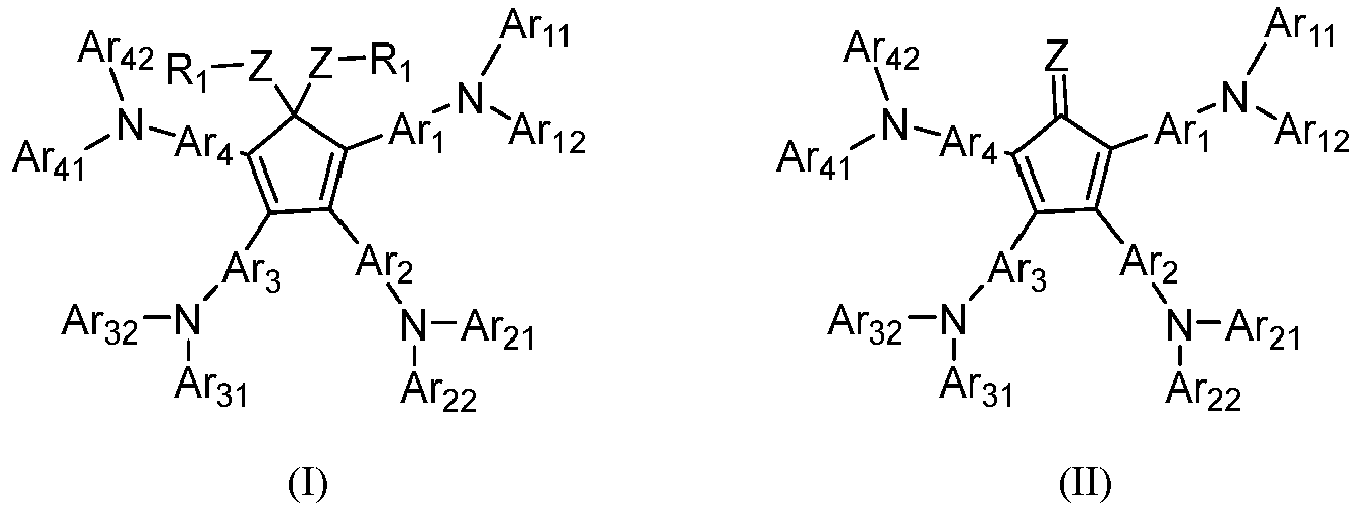 - wherein Z = -CH2-, or O or S or Se,- wherein R1 is selected from C1-C20 linear or branched alkyl chains or alkoxy chains of formula
 - where X = (CH2)nNRx 3+ M-; PRx 3+M-; SO3Rx.;- where Rx is selected from C1-C20 linear or branched alkyl chains;- where M- represents a counterion; and- where n = 0 to 20.
 - A compound as claimed in claim 1, wherein Ar1, Ar2, Ar3 and Ar4 are identical or different moieties selected from aromatic or heteroaromatic ring systems having one or more aromatic rings comprising 5 to 40 ring atoms and one or more of the atoms or groups independently selected from C, N, O, S, Se, SiR'2, or NR' wherein R' is selected from C1-C20 alkyl, C2-C20 alkenyl, C2-C20 alkynyl, C4-C20 unsubstituted and substituted aryl, and C1-C20 fluoroalkyl group, wherein said alkyl, alkenyl, alkynyl, and fluoroalkyl, if they comprise 3 or more carbons may be linear, branched or cyclic.
- A compound as claimed in claim 2, wherein said one or more aromatic rings is further substituted by one or more moieties independently selected from H, keto (=O) group, fluoro group, C1-C20 alkyl, C1-C20 alkoxy, C2-C20 alkenyl and C2-C20 alkynyl group.
- A compound as claimed in claim 2, wherein Ar1, Ar2, Ar3 or Ar4 are identically or independently one from the other selected from the group consisting of

- A compound as claimed in one of the preceding claims, wherein Arn1-Arn2 (with n =1, 2, 3, or 4) are identical or different moieties selected from aromatic or heteroaromatic ring systems having one or more aromatic rings comprising 5 to 40 ring atoms and one or more of the atoms or groups independently selected from C, N, O, S, Se, SiR'2, or NR', wherein R' is selected from C1-C20 alkyl, C2-C20 alkenyl, C2-C20 alkynyl, C4-C20 unsubstituted and substituted aryl, and C1-C20 fluoroalkyl group, wherein said alkyl, alkenyl, alkynyl, and fluoroalkyl, if they comprise 3 or more carbons may be linear, branched or cyclic.
- A compound as claimed in claim 5, wherein said aromatic ring may further be substituted by one or more moieties independently selected from H, keto (=O) group, fluoro group, C1-C20 alkyl, C1-C20 alkoxy, C2-C20 alkenyl and C2-C20 alkynyl group.
- A compound as claimed in claim 5 or 6, wherein Arn1-Arn2(n =1, 2, 3, 4) are, identically or independently one from the other, selected from

or selected from where Rx1 or Rx2 are selected from -H, -ORx3, --SRX3, --RX3 ;where X = N or P, where Y = O or S, and where Rx3 is selected from C1-C20 linear or branched alkyl chains, alkoxy chains;or selected from
 where Rx1 or Rx2 are selected from -H, -ORx3, --SRX3, --RX3 ;where X = N or P, where Y = O or S;where Rx3 is selected from C1-C20 linear or branched alkyl chains, alkoxy chains; andwhere the two dashed-lines are prone to represent C-N bond that is connected to the central N atom in the arylamine moiety.
 - A compound as claimed in claim 1, wherein said counterion is selected from F-, I-, Br-, Cl-, [N(CN)2]-, [N(SO2CF3)2]-, [PF6]-, [BF4]-, [NO3]-, [C(CN)3]-, [B(CN)4]-, [CF3COO]-, or [ClO4]-.
- A compound as claimed in claim 1, wherein said compound is 4,4',4",4"'-(5,5-dimethoxycyclopenta-1,3-diene-1,2,3,4-tetrayl)tetrakis(N,N-bis(4-methoxyphenyl)aniline (CPDA 1), having the formula (A)

- A process for synthetizing a compound as claimed in anyone of claims 1 - 9, comprising a step consisting in a fourfold Suzuki cross-coupling reaction, reacting a tetrabromocyclopentadiene dimethyl acetale and a triarylamine boronic ester.
- A process as claimed in claim 10, for synthesizing the compound of claim 9, comprising a step consisting in a fourfold Suzuki cross-coupling reaction, reacting 1,2,3,4-tetrabromo-5,5-dimethoxycyclopenta-1,3-diene and 4-methoxy-N-(4-methoxyphenyl)-N-(4-(4,4,5,5-tetramethyl-1,3, 2-dioxaborolan-2-yl)phenyl)aniline in the presence of tetrakis(triphenylphosphane)palladium.
- A solid state solar cell comprising- a glass substrate surface coated with transparent metal oxide,- a semi-conducting metal oxide layer deposited on top of said glass substrate with transparent metal oxide layer, forming a transparent/semiconductive metal oxide substrate,- a perovskite photo-absorption layer deposited on the transparent/semiconductive metal oxide substrate,- a hole transport material (HTM) layer deposited on the surface of the perovskite layer,- a counter-electrode,wherein said hole transport material (HTM) layer comprises a compound as claimed in any one of claims 1 to 9.
- A solid state solar cell as claimed in claim 12, wherein said hole transport material (HTM) layer further comprises a dopant.
- A solid state solar cell as claimed in claim 12, wherein said dopant is lithium bis(trifluoromethanesulfonyl)imide (Li-TFSI) or zinc bis(trifluoromethanesulfonyl)imide (Zn(TFSI)2).
- A solid state solar cell as claimed in claim 12 or 13, wherein said metal oxide layer comprises a compact c-TiO2 layer deposited on top of said FTO glass layer, and a mesoporous m-TiO2 layer coated on the compact TiO2 layer, forming a FTO/c-TiO2/m-TiO2 substrate.
Priority Applications (2)
| Application Number | Priority Date | Filing Date | Title |
|---|---|---|---|
| EP20189226.2A EP3950661B1 (en) | 2020-08-03 | 2020-08-03 | Hole transport material, synthesis thereof, and solar cell |
| US17/391,140 US11680035B2 (en) | 2020-08-03 | 2021-08-02 | Hole transport material, synthesis thereof, and solar cell |
Applications Claiming Priority (1)
| Application Number | Priority Date | Filing Date | Title |
|---|---|---|---|
| EP20189226.2A EP3950661B1 (en) | 2020-08-03 | 2020-08-03 | Hole transport material, synthesis thereof, and solar cell |
Publications (3)
| Publication Number | Publication Date |
|---|---|
| EP3950661A1 true EP3950661A1 (en) | 2022-02-09 |
| EP3950661B1 EP3950661B1 (en) | 2024-06-19 |
| EP3950661C0 EP3950661C0 (en) | 2024-06-19 |
Family
ID=71944004
Family Applications (1)
| Application Number | Title | Priority Date | Filing Date |
|---|---|---|---|
| EP20189226.2A Active EP3950661B1 (en) | 2020-08-03 | 2020-08-03 | Hole transport material, synthesis thereof, and solar cell |
Country Status (2)
| Country | Link |
|---|---|
| US (1) | US11680035B2 (en) |
| EP (1) | EP3950661B1 (en) |
Family Cites Families (3)
| Publication number | Priority date | Publication date | Assignee | Title |
|---|---|---|---|---|
| US5681664A (en) * | 1994-08-04 | 1997-10-28 | Toyo Ink Manufacturing Co., Ltd. | Hole-transporting material and use thereof |
| JP3606025B2 (en) * | 1996-12-16 | 2005-01-05 | 東洋インキ製造株式会社 | Organic electroluminescence device material and organic electroluminescence device using the same |
| US6541129B1 (en) * | 1998-09-09 | 2003-04-01 | Idemitsu Kosan Co., Ltd. | Organic electroluminescence device and phenylenediamine derivative |
-
2020
- 2020-08-03 EP EP20189226.2A patent/EP3950661B1/en active Active
-
2021
- 2021-08-02 US US17/391,140 patent/US11680035B2/en active Active
Non-Patent Citations (33)
| Title |
|---|
| A. A. KELKARN. M. PATILR. V CHAUDHARI, TETRAHEDRON LETTERS, vol. 43, 2002, pages 7143 |
| A. MAHENDRANP. GOPINATHR. BRESLOW, TETRAHEDRON LETTERS, vol. 56, 2015, pages 4833 |
| C. LUI. T. CHOIJ. KIMH. K. KIM, J. MATER. CHEM. A, 2017 |
| D. LIY LIY LIQ. MENGJ.-Y SHAOL.-Y DENGY-W. ZHONG, CHEM COMMUN (CAMB, vol. 54, 2018, pages 1651 |
| DONG SHI ET AL: "Spiro-OMeTAD single crystals: Remarkably enhanced charge-carrier transport via mesoscale ordering", SCIENCE, vol. 2, no. 4, 22 April 2016 (2016-04-22), US, pages e1501491, XP055766569, ISSN: 0036-8075, DOI: 10.1126/sciadv.1501491 * |
| E. H. JUNGN. J. JEONE. Y PARKC. S. MOONT.-Y YANGJ. H. NOHJ. SEOC. S. MOONJ. H. NOHT. J. SHIN, NATURE, vol. 571, 2019, pages 245 |
| F. QIX. DENGX. WUL. HUOY. XIAOX. LUZ. ZHUA. K. Y. JEN, ADV. ENERGY MATER., vol. 9, 2019, pages 1902600 |
| F. ZHANGC. YIP. WEIX. BIJ. LUOG. JACOPINS. WANGX. LIY XIAOS. M. ZAKEERUDDIN, ADVANCED ENERGY MATERIALS, vol. 6, 2016, pages 1601165 |
| F. ZHANGS. WANGH. ZHUX. LIUH. LIUX. LIY XIAOS. M. ZAKEERUDDINM. GRATZEL, ACS ENERGY LETT., 2018 |
| H. D. PHAMT. T. DOJ. KIMC. CHARBONNEAUS. MANZHOSK. FERONW. C. TSOIJ. R. DURRANTS. M. JAINP. SONAR, ADV. ENERGY MATER., 2018 |
| H. DIIRRR. GLEITER, ANGEWANDTE CHEMIE INTERNATIONAL EDITION IN ENGLISH, vol. 17, 1978, pages 559 |
| H. LIC. LAMBERT, CHEMISTRY - A EUROPEAN JOURNAL, vol. 12, 2006, pages 1144 |
| J. WUC. LIUM. HUX. DENGW. TANY. TIANB. XU, J. MATER. CHEM. A, 2018 |
| K. GUOM. WUS. YANGZ. WANGJ. LIX. LIANGF. ZHANGZ. LIUZ. WANG, SOL. RRL, vol. 3, 2019 |
| K. RAKSTYSA. ABATEM. I. DARP. GAOV JANKAUSKASG. JACOPINE. KAMARAUSKASS. KAZIMS. AHMADM. GRATZEL, JOURNAL OF THE AMERICAN CHEMICAL SOCIETY, vol. 137, 2015, pages 16172 |
| L. CHENB. ZHANGY CHENGZ. XIEL. WANGX. JINGF. WANG, ADVANCED FUNCTIONAL MATERIALS, vol. 20, 2010, pages 3143 |
| M. SALIBAS. ORLANDIT. MATSUIS. AGHAZADAM. CAVAZZINIJ.-P. CORREA-BAENAP. GAOR. SCOPELLITIE. MOSCONIK.-H. DAHMEN, NATURE ENERGY, vol. 1, 2016, pages 15017 |
| N. J. JEONH. NAE. H. JUNGT.-Y YANGY G. LEEG. KIMH.-W. SHINS. II SEOKJ. LEEJ. SEO, NAT. ENERGY, 2018 |
| P. M. SONARH. D. PHAMK. KAZUMASA HAYASAKAH. MATSUIS. TOKITOJ. KIMS. M. JAINJ. DURRANTW. TSOIT. M. WATSON, J. MATER. CHEM. C, 2017 |
| P. M. SONARH. D. PHAMS. M. JAINL. MENGS. MANZHOSK. FERONS. PITCHAIMUTHUZ. LIUN. MOTTAH. WANG, J. MATER. CHEM. A, 2019 |
| R. GRISORIOB. ROOSES. COLELLAA. LISTORTIG. P. SURANNAA. ABATE, ACS ENERGY LETT., 2017 |
| S. BARLOWC. RISKOS.-J. CHUNGN. M. TUCKERV COROPCEANUS. C. JONESZ. LEVIJ.-L. BREDASS. R. MARDER, JOURNAL OF THE AMERICAN CHEMICAL SOCIETY, vol. 127, 2005, pages 16900 |
| S. DASKEVICIUTEN. SAKAIM. FRANCKEVICIUSM. DASKEVICIENEA. MAGOMEDOVV JANKAUSKASH. J. SNAITHV GETAUTIS, ADV. SCI. (WEINHEIM, GER.), vol. 5, 2018 |
| S. S. REDDYK. GUNASEKARJ. H. HEOS. H. IMC. S. KIMD. H. KIMJ. H. MOONJ. Y LEEM. SONGS. H. JIN, ADVANCED MATERIALS, vol. 28, 2016, pages 1907757 |
| T. H. SCHLOEMERT. S. GEHANJ. A. CHRISTIANSD. G. MITCHELLA. DIXONZ. LIK. ZHUJ. J. BERRYJ. M. LUTHERA. SELLINGER, ACS ENERGY LETT., 2019 |
| T. MALINAUSKASD. TOMKUTE-LUKSIENER. SENSM. DASKEVICIENER. SENDH. WONNEBERGERV JANKAUSKASI. BRUDERV GETAUTIS, ACS APPLIED MATERIALS & INTERFACES, vol. 7, 2015, pages 11107 |
| U. BACHD. LUPOP. COMTEJ. E. MOSERF. WEISSORTELJ. SALBECKH. SPREITZERM. GRATZEL, NATURE, vol. 395, 1998, pages 583 |
| W. LILIENBLUMR. W. HOFFMANN, CHEMISCHE BERICHTE, vol. 110, 1977, pages 3405 |
| W. YUQ. YANGJ. ZHANGD. TUX. WANGX. LIUG. LIX. GUOC. LI, ACS APPL MATER INTERFACES, 2019 |
| W. ZHUC. SHENY WUH. ZHANGE. LIW. ZHANGX. XUW. WUH. TIAN, ANGEW CHEM INT ED ENGL, 2019 |
| X. LIUF. ZHANGZ. LIUY XIAOS. WANGX. LI, JOURNAL OF MATERIALS CHEMISTRY C, vol. 5, 2017, pages 11429 |
| Y LIK. R. SCHEELR. G. CLEVENGERW. SHOUH. PANK. V KILWAYZ. PENG, ADV. ENERGY MATER, 2018 |
| Y. WANGT. WUJ. BARBAUDW. KONGD. CUIH. CHENX. YANGL. HANX. YANGL. HAN, SCIENCE, vol. 366, 2019, pages 749 |
Also Published As
| Publication number | Publication date |
|---|---|
| US11680035B2 (en) | 2023-06-20 |
| EP3950661B1 (en) | 2024-06-19 |
| EP3950661C0 (en) | 2024-06-19 |
| US20220033342A1 (en) | 2022-02-03 |
Similar Documents
| Publication | Publication Date | Title |
|---|---|---|
| Abdellah et al. | Facile and low-cost synthesis of a novel dopant-free hole transporting material that rivals Spiro-OMeTAD for high efficiency perovskite solar cells | |
| Gangala et al. | Spiro-linked organic small molecules as hole-transport materials for perovskite solar cells | |
| Krishna et al. | Novel hole transporting materials based on triptycene core for high efficiency mesoscopic perovskite solar cells | |
| Liu et al. | Influence of π-linker on triphenylamine-based hole transporting materials in perovskite solar cells | |
| Kazim et al. | A dopant free linear acene derivative as a hole transport material for perovskite pigmented solar cells | |
| Chou et al. | Zinc porphyrin–ethynylaniline conjugates as novel hole-transporting materials for perovskite solar cells with power conversion efficiency of 16.6% | |
| Wang et al. | Defect passivation by amide-based hole-transporting interfacial layer enhanced perovskite grain growth for efficient p–i–n perovskite solar cells | |
| Hua et al. | Effects of various π-conjugated spacers in thiadiazole [3, 4-c] pyridine-cored panchromatic organic dyes for dye-sensitized solar cells | |
| US20160226011A1 (en) | Inverted solar cell and process for producing the same | |
| Lee et al. | Facile synthesis of spiro-core-based hole-transporting material for high-performance and stable perovskite solar cells | |
| KR101607594B1 (en) | organic-inorganic hybride solar cells having organinc semiconductor compound and manufacturing method thereof | |
| Abdellah et al. | Novel dopant-free hole-transporting materials for efficient perovskite solar cells | |
| JP7735108B2 (en) | Compound, hole transport material for photoelectric conversion element, and photoelectric conversion element and solar cell using the same | |
| Zhao et al. | Synthesis and characterization of triphenylamine modified azobenzene dyes | |
| Nishimura et al. | Additive-free, cost-effective hole-transporting materials for perovskite solar cells based on vinyl triarylamines | |
| Lin et al. | Molecularly engineered cyclopenta [2, 1-b; 3, 4-b′] dithiophene-based hole-transporting materials for high-performance perovskite solar cells with efficiency over 19% | |
| CN104485424A (en) | Hole-transporting molecule and use in solar cell | |
| KR20150123312A (en) | Novel compound and photoelectric conversion element using same | |
| Zhang et al. | Two dimethoxyphenylamine-substituted carbazole derivatives as hole-transporting materials for efficient inorganic-organic hybrid perovskite solar cells | |
| Pegu et al. | Dimers of diethynyl-conjugated zinc-phthalocyanine as hole selective layers for perovskite solar cell fabrication | |
| Shi et al. | Molecular structure simplification of the most common hole transport materials in perovskite solar cells | |
| Huang et al. | Molecularly engineered thienyl-triphenylamine substituted zinc phthalocyanine as dopant free hole transporting materials in perovskite solar cells | |
| ES2575511A1 (en) | New compound and its use as hollow transport material | |
| Wu et al. | Simple and low-cost thiophene and benzene-conjugated triaryamines as hole-transporting materials for perovskite solar cells | |
| KR101290406B1 (en) | Compounds with hole conducting property, their use as co-adsorbent materials, and dye-sensitized solar cell comprising the same |
Legal Events
| Date | Code | Title | Description |
|---|---|---|---|
| PUAI | Public reference made under article 153(3) epc to a published international application that has entered the european phase |
Free format text: ORIGINAL CODE: 0009012 |
|
| STAA | Information on the status of an ep patent application or granted ep patent |
Free format text: STATUS: THE APPLICATION HAS BEEN PUBLISHED |
|
| AK | Designated contracting states |
Kind code of ref document: A1 Designated state(s): AL AT BE BG CH CY CZ DE DK EE ES FI FR GB GR HR HU IE IS IT LI LT LU LV MC MK MT NL NO PL PT RO RS SE SI SK SM TR |
|
| STAA | Information on the status of an ep patent application or granted ep patent |
Free format text: STATUS: REQUEST FOR EXAMINATION WAS MADE |
|
| 17P | Request for examination filed |
Effective date: 20220704 |
|
| RBV | Designated contracting states (corrected) |
Designated state(s): AL AT BE BG CH CY CZ DE DK EE ES FI FR GB GR HR HU IE IS IT LI LT LU LV MC MK MT NL NO PL PT RO RS SE SI SK SM TR |
|
| RAP3 | Party data changed (applicant data changed or rights of an application transferred) |
Owner name: ECOLE POLYTECHNIQUE FEDERALE DE LAUSANNE (EPFL) |
|
| REG | Reference to a national code |
Ref country code: DE Ref legal event code: R079 Free format text: PREVIOUS MAIN CLASS: C07C0209660000 Ipc: H10K0030400000 Ref document number: 602020032548 Country of ref document: DE |
|
| RIC1 | Information provided on ipc code assigned before grant |
Ipc: C07C 217/92 20060101ALI20231123BHEP Ipc: C07C 209/66 20060101AFI20231123BHEP |
|
| RIC1 | Information provided on ipc code assigned before grant |
Ipc: H10K 30/86 20230101ALI20231129BHEP Ipc: H10K 30/40 20230101AFI20231129BHEP |
|
| GRAP | Despatch of communication of intention to grant a patent |
Free format text: ORIGINAL CODE: EPIDOSNIGR1 |
|
| RIC1 | Information provided on ipc code assigned before grant |
Ipc: C07C 217/22 20060101ALI20231211BHEP Ipc: C07C 209/66 20060101ALI20231211BHEP Ipc: H10K 30/86 20230101ALI20231211BHEP Ipc: H10K 30/40 20230101AFI20231211BHEP |
|
| STAA | Information on the status of an ep patent application or granted ep patent |
Free format text: STATUS: GRANT OF PATENT IS INTENDED |
|
| INTG | Intention to grant announced |
Effective date: 20240118 |
|
| GRAS | Grant fee paid |
Free format text: ORIGINAL CODE: EPIDOSNIGR3 |
|
| GRAA | (expected) grant |
Free format text: ORIGINAL CODE: 0009210 |
|
| STAA | Information on the status of an ep patent application or granted ep patent |
Free format text: STATUS: THE PATENT HAS BEEN GRANTED |
|
| AK | Designated contracting states |
Kind code of ref document: B1 Designated state(s): AL AT BE BG CH CY CZ DE DK EE ES FI FR GB GR HR HU IE IS IT LI LT LU LV MC MK MT NL NO PL PT RO RS SE SI SK SM TR |
|
| REG | Reference to a national code |
Ref country code: GB Ref legal event code: FG4D |
|
| REG | Reference to a national code |
Ref country code: CH Ref legal event code: EP |
|
| REG | Reference to a national code |
Ref country code: DE Ref legal event code: R096 Ref document number: 602020032548 Country of ref document: DE |
|
| U01 | Request for unitary effect filed |
Effective date: 20240705 |
|
| U07 | Unitary effect registered |
Designated state(s): AT BE BG DE DK EE FI FR IT LT LU LV MT NL PT SE SI Effective date: 20240716 |
|
| U20 | Renewal fee for the european patent with unitary effect paid |
Year of fee payment: 5 Effective date: 20240725 |
|
| PG25 | Lapsed in a contracting state [announced via postgrant information from national office to epo] |
Ref country code: HR Free format text: LAPSE BECAUSE OF FAILURE TO SUBMIT A TRANSLATION OF THE DESCRIPTION OR TO PAY THE FEE WITHIN THE PRESCRIBED TIME-LIMIT Effective date: 20240619 |
|
| PG25 | Lapsed in a contracting state [announced via postgrant information from national office to epo] |
Ref country code: GR Free format text: LAPSE BECAUSE OF FAILURE TO SUBMIT A TRANSLATION OF THE DESCRIPTION OR TO PAY THE FEE WITHIN THE PRESCRIBED TIME-LIMIT Effective date: 20240920 |
|
| PG25 | Lapsed in a contracting state [announced via postgrant information from national office to epo] |
Ref country code: NO Free format text: LAPSE BECAUSE OF FAILURE TO SUBMIT A TRANSLATION OF THE DESCRIPTION OR TO PAY THE FEE WITHIN THE PRESCRIBED TIME-LIMIT Effective date: 20240919 Ref country code: HR Free format text: LAPSE BECAUSE OF FAILURE TO SUBMIT A TRANSLATION OF THE DESCRIPTION OR TO PAY THE FEE WITHIN THE PRESCRIBED TIME-LIMIT Effective date: 20240619 Ref country code: GR Free format text: LAPSE BECAUSE OF FAILURE TO SUBMIT A TRANSLATION OF THE DESCRIPTION OR TO PAY THE FEE WITHIN THE PRESCRIBED TIME-LIMIT Effective date: 20240920 Ref country code: RS Free format text: LAPSE BECAUSE OF FAILURE TO SUBMIT A TRANSLATION OF THE DESCRIPTION OR TO PAY THE FEE WITHIN THE PRESCRIBED TIME-LIMIT Effective date: 20240919 |
|
| PG25 | Lapsed in a contracting state [announced via postgrant information from national office to epo] |
Ref country code: PL Free format text: LAPSE BECAUSE OF FAILURE TO SUBMIT A TRANSLATION OF THE DESCRIPTION OR TO PAY THE FEE WITHIN THE PRESCRIBED TIME-LIMIT Effective date: 20240619 |
|
| PG25 | Lapsed in a contracting state [announced via postgrant information from national office to epo] |
Ref country code: IS Free format text: LAPSE BECAUSE OF FAILURE TO SUBMIT A TRANSLATION OF THE DESCRIPTION OR TO PAY THE FEE WITHIN THE PRESCRIBED TIME-LIMIT Effective date: 20241019 |
|
| PG25 | Lapsed in a contracting state [announced via postgrant information from national office to epo] |
Ref country code: CZ Free format text: LAPSE BECAUSE OF FAILURE TO SUBMIT A TRANSLATION OF THE DESCRIPTION OR TO PAY THE FEE WITHIN THE PRESCRIBED TIME-LIMIT Effective date: 20240619 |
|
| PG25 | Lapsed in a contracting state [announced via postgrant information from national office to epo] |
Ref country code: RO Free format text: LAPSE BECAUSE OF FAILURE TO SUBMIT A TRANSLATION OF THE DESCRIPTION OR TO PAY THE FEE WITHIN THE PRESCRIBED TIME-LIMIT Effective date: 20240619 Ref country code: SK Free format text: LAPSE BECAUSE OF FAILURE TO SUBMIT A TRANSLATION OF THE DESCRIPTION OR TO PAY THE FEE WITHIN THE PRESCRIBED TIME-LIMIT Effective date: 20240619 |
|
| PG25 | Lapsed in a contracting state [announced via postgrant information from national office to epo] |
Ref country code: ES Free format text: LAPSE BECAUSE OF FAILURE TO SUBMIT A TRANSLATION OF THE DESCRIPTION OR TO PAY THE FEE WITHIN THE PRESCRIBED TIME-LIMIT Effective date: 20240619 Ref country code: SM Free format text: LAPSE BECAUSE OF FAILURE TO SUBMIT A TRANSLATION OF THE DESCRIPTION OR TO PAY THE FEE WITHIN THE PRESCRIBED TIME-LIMIT Effective date: 20240619 |
|
| PG25 | Lapsed in a contracting state [announced via postgrant information from national office to epo] |
Ref country code: SM Free format text: LAPSE BECAUSE OF FAILURE TO SUBMIT A TRANSLATION OF THE DESCRIPTION OR TO PAY THE FEE WITHIN THE PRESCRIBED TIME-LIMIT Effective date: 20240619 Ref country code: SK Free format text: LAPSE BECAUSE OF FAILURE TO SUBMIT A TRANSLATION OF THE DESCRIPTION OR TO PAY THE FEE WITHIN THE PRESCRIBED TIME-LIMIT Effective date: 20240619 Ref country code: RO Free format text: LAPSE BECAUSE OF FAILURE TO SUBMIT A TRANSLATION OF THE DESCRIPTION OR TO PAY THE FEE WITHIN THE PRESCRIBED TIME-LIMIT Effective date: 20240619 Ref country code: PL Free format text: LAPSE BECAUSE OF FAILURE TO SUBMIT A TRANSLATION OF THE DESCRIPTION OR TO PAY THE FEE WITHIN THE PRESCRIBED TIME-LIMIT Effective date: 20240619 Ref country code: IS Free format text: LAPSE BECAUSE OF FAILURE TO SUBMIT A TRANSLATION OF THE DESCRIPTION OR TO PAY THE FEE WITHIN THE PRESCRIBED TIME-LIMIT Effective date: 20241019 Ref country code: ES Free format text: LAPSE BECAUSE OF FAILURE TO SUBMIT A TRANSLATION OF THE DESCRIPTION OR TO PAY THE FEE WITHIN THE PRESCRIBED TIME-LIMIT Effective date: 20240619 Ref country code: CZ Free format text: LAPSE BECAUSE OF FAILURE TO SUBMIT A TRANSLATION OF THE DESCRIPTION OR TO PAY THE FEE WITHIN THE PRESCRIBED TIME-LIMIT Effective date: 20240619 |
|
| PG25 | Lapsed in a contracting state [announced via postgrant information from national office to epo] |
Ref country code: MC Free format text: LAPSE BECAUSE OF FAILURE TO SUBMIT A TRANSLATION OF THE DESCRIPTION OR TO PAY THE FEE WITHIN THE PRESCRIBED TIME-LIMIT Effective date: 20240619 |
|
| PLBE | No opposition filed within time limit |
Free format text: ORIGINAL CODE: 0009261 |
|
| STAA | Information on the status of an ep patent application or granted ep patent |
Free format text: STATUS: NO OPPOSITION FILED WITHIN TIME LIMIT |
|
| 26N | No opposition filed |
Effective date: 20250320 |
|
| PG25 | Lapsed in a contracting state [announced via postgrant information from national office to epo] |
Ref country code: IE Free format text: LAPSE BECAUSE OF NON-PAYMENT OF DUE FEES Effective date: 20240803 |
|
| PGFP | Annual fee paid to national office [announced via postgrant information from national office to epo] |
Ref country code: TR Payment date: 20250728 Year of fee payment: 6 |
|
| U21 | Renewal fee for the european patent with unitary effect paid with additional fee |
Year of fee payment: 6 Effective date: 20250908 |
|
| PGFP | Annual fee paid to national office [announced via postgrant information from national office to epo] |
Ref country code: GB Payment date: 20250820 Year of fee payment: 6 |
|
| PGFP | Annual fee paid to national office [announced via postgrant information from national office to epo] |
Ref country code: CH Payment date: 20250908 Year of fee payment: 6 |
|
| PG25 | Lapsed in a contracting state [announced via postgrant information from national office to epo] |
Ref country code: CY Free format text: LAPSE BECAUSE OF FAILURE TO SUBMIT A TRANSLATION OF THE DESCRIPTION OR TO PAY THE FEE WITHIN THE PRESCRIBED TIME-LIMIT; INVALID AB INITIO Effective date: 20200803 |
|
| PG25 | Lapsed in a contracting state [announced via postgrant information from national office to epo] |
Ref country code: HU Free format text: LAPSE BECAUSE OF FAILURE TO SUBMIT A TRANSLATION OF THE DESCRIPTION OR TO PAY THE FEE WITHIN THE PRESCRIBED TIME-LIMIT; INVALID AB INITIO Effective date: 20200803 |