EP3949938A1 - Method for manufacturing block body for dental prostheses, and method for manufacturing dental prosthesis - Google Patents
Method for manufacturing block body for dental prostheses, and method for manufacturing dental prosthesis Download PDFInfo
- Publication number
- EP3949938A1 EP3949938A1 EP19922438.7A EP19922438A EP3949938A1 EP 3949938 A1 EP3949938 A1 EP 3949938A1 EP 19922438 A EP19922438 A EP 19922438A EP 3949938 A1 EP3949938 A1 EP 3949938A1
- Authority
- EP
- European Patent Office
- Prior art keywords
- mass
- block
- temperature
- glass blank
- crystals
- Prior art date
- Legal status (The legal status is an assumption and is not a legal conclusion. Google has not performed a legal analysis and makes no representation as to the accuracy of the status listed.)
- Pending
Links
- 239000011521 glass Substances 0.000 claims abstract 9
- 239000013078 crystal Substances 0.000 claims abstract 6
- WVMPCBWWBLZKPD-UHFFFAOYSA-N dilithium oxido-[oxido(oxo)silyl]oxy-oxosilane Chemical compound [Li+].[Li+].[O-][Si](=O)O[Si]([O-])=O WVMPCBWWBLZKPD-UHFFFAOYSA-N 0.000 claims abstract 6
- PAZHGORSDKKUPI-UHFFFAOYSA-N lithium metasilicate Chemical compound [Li+].[Li+].[O-][Si]([O-])=O PAZHGORSDKKUPI-UHFFFAOYSA-N 0.000 claims abstract 2
- 229910052912 lithium silicate Inorganic materials 0.000 claims abstract 2
- 238000002844 melting Methods 0.000 claims abstract 2
- 230000008018 melting Effects 0.000 claims abstract 2
- 238000000034 method Methods 0.000 claims 10
- VYPSYNLAJGMNEJ-UHFFFAOYSA-N Silicium dioxide Chemical compound O=[Si]=O VYPSYNLAJGMNEJ-UHFFFAOYSA-N 0.000 claims 2
- 238000003754 machining Methods 0.000 claims 2
- FUJCRWPEOMXPAD-UHFFFAOYSA-N Li2O Inorganic materials [Li+].[Li+].[O-2] FUJCRWPEOMXPAD-UHFFFAOYSA-N 0.000 claims 1
- PNEYBMLMFCGWSK-UHFFFAOYSA-N aluminium oxide Inorganic materials [O-2].[O-2].[O-2].[Al+3].[Al+3] PNEYBMLMFCGWSK-UHFFFAOYSA-N 0.000 claims 1
- 229910052681 coesite Inorganic materials 0.000 claims 1
- 229910052593 corundum Inorganic materials 0.000 claims 1
- 229910052906 cristobalite Inorganic materials 0.000 claims 1
- XUCJHNOBJLKZNU-UHFFFAOYSA-M dilithium;hydroxide Chemical compound [Li+].[Li+].[OH-] XUCJHNOBJLKZNU-UHFFFAOYSA-M 0.000 claims 1
- 238000010438 heat treatment Methods 0.000 claims 1
- 239000000377 silicon dioxide Substances 0.000 claims 1
- 238000010583 slow cooling Methods 0.000 claims 1
- 229910052682 stishovite Inorganic materials 0.000 claims 1
- 229910052905 tridymite Inorganic materials 0.000 claims 1
- 229910001845 yogo sapphire Inorganic materials 0.000 claims 1
Images

Classifications
-
- A—HUMAN NECESSITIES
- A61—MEDICAL OR VETERINARY SCIENCE; HYGIENE
- A61C—DENTISTRY; APPARATUS OR METHODS FOR ORAL OR DENTAL HYGIENE
- A61C13/00—Dental prostheses; Making same
- A61C13/08—Artificial teeth; Making same
-
- A—HUMAN NECESSITIES
- A61—MEDICAL OR VETERINARY SCIENCE; HYGIENE
- A61C—DENTISTRY; APPARATUS OR METHODS FOR ORAL OR DENTAL HYGIENE
- A61C13/00—Dental prostheses; Making same
- A61C13/0003—Making bridge-work, inlays, implants or the like
- A61C13/0006—Production methods
-
- A—HUMAN NECESSITIES
- A61—MEDICAL OR VETERINARY SCIENCE; HYGIENE
- A61C—DENTISTRY; APPARATUS OR METHODS FOR ORAL OR DENTAL HYGIENE
- A61C13/00—Dental prostheses; Making same
- A61C13/0003—Making bridge-work, inlays, implants or the like
- A61C13/0022—Blanks or green, unfinished dental restoration parts
-
- A—HUMAN NECESSITIES
- A61—MEDICAL OR VETERINARY SCIENCE; HYGIENE
- A61K—PREPARATIONS FOR MEDICAL, DENTAL OR TOILETRY PURPOSES
- A61K6/00—Preparations for dentistry
- A61K6/80—Preparations for artificial teeth, for filling teeth or for capping teeth
- A61K6/831—Preparations for artificial teeth, for filling teeth or for capping teeth comprising non-metallic elements or compounds thereof, e.g. carbon
- A61K6/833—Glass-ceramic composites
-
- C—CHEMISTRY; METALLURGY
- C03—GLASS; MINERAL OR SLAG WOOL
- C03B—MANUFACTURE, SHAPING, OR SUPPLEMENTARY PROCESSES
- C03B32/00—Thermal after-treatment of glass products not provided for in groups C03B19/00, C03B25/00 - C03B31/00 or C03B37/00, e.g. crystallisation, eliminating gas inclusions or other impurities; Hot-pressing vitrified, non-porous, shaped glass products
- C03B32/02—Thermal crystallisation, e.g. for crystallising glass bodies into glass-ceramic articles
-
- C—CHEMISTRY; METALLURGY
- C03—GLASS; MINERAL OR SLAG WOOL
- C03C—CHEMICAL COMPOSITION OF GLASSES, GLAZES OR VITREOUS ENAMELS; SURFACE TREATMENT OF GLASS; SURFACE TREATMENT OF FIBRES OR FILAMENTS MADE FROM GLASS, MINERALS OR SLAGS; JOINING GLASS TO GLASS OR OTHER MATERIALS
- C03C10/00—Devitrified glass ceramics, i.e. glass ceramics having a crystalline phase dispersed in a glassy phase and constituting at least 50% by weight of the total composition
-
- C—CHEMISTRY; METALLURGY
- C03—GLASS; MINERAL OR SLAG WOOL
- C03C—CHEMICAL COMPOSITION OF GLASSES, GLAZES OR VITREOUS ENAMELS; SURFACE TREATMENT OF GLASS; SURFACE TREATMENT OF FIBRES OR FILAMENTS MADE FROM GLASS, MINERALS OR SLAGS; JOINING GLASS TO GLASS OR OTHER MATERIALS
- C03C10/00—Devitrified glass ceramics, i.e. glass ceramics having a crystalline phase dispersed in a glassy phase and constituting at least 50% by weight of the total composition
- C03C10/0018—Devitrified glass ceramics, i.e. glass ceramics having a crystalline phase dispersed in a glassy phase and constituting at least 50% by weight of the total composition containing SiO2, Al2O3 and monovalent metal oxide as main constituents
- C03C10/0027—Devitrified glass ceramics, i.e. glass ceramics having a crystalline phase dispersed in a glassy phase and constituting at least 50% by weight of the total composition containing SiO2, Al2O3 and monovalent metal oxide as main constituents containing SiO2, Al2O3, Li2O as main constituents
-
- C—CHEMISTRY; METALLURGY
- C03—GLASS; MINERAL OR SLAG WOOL
- C03C—CHEMICAL COMPOSITION OF GLASSES, GLAZES OR VITREOUS ENAMELS; SURFACE TREATMENT OF GLASS; SURFACE TREATMENT OF FIBRES OR FILAMENTS MADE FROM GLASS, MINERALS OR SLAGS; JOINING GLASS TO GLASS OR OTHER MATERIALS
- C03C3/00—Glass compositions
- C03C3/04—Glass compositions containing silica
- C03C3/076—Glass compositions containing silica with 40% to 90% silica, by weight
-
- C—CHEMISTRY; METALLURGY
- C03—GLASS; MINERAL OR SLAG WOOL
- C03C—CHEMICAL COMPOSITION OF GLASSES, GLAZES OR VITREOUS ENAMELS; SURFACE TREATMENT OF GLASS; SURFACE TREATMENT OF FIBRES OR FILAMENTS MADE FROM GLASS, MINERALS OR SLAGS; JOINING GLASS TO GLASS OR OTHER MATERIALS
- C03C3/00—Glass compositions
- C03C3/04—Glass compositions containing silica
- C03C3/076—Glass compositions containing silica with 40% to 90% silica, by weight
- C03C3/083—Glass compositions containing silica with 40% to 90% silica, by weight containing aluminium oxide or an iron compound
-
- C—CHEMISTRY; METALLURGY
- C03—GLASS; MINERAL OR SLAG WOOL
- C03C—CHEMICAL COMPOSITION OF GLASSES, GLAZES OR VITREOUS ENAMELS; SURFACE TREATMENT OF GLASS; SURFACE TREATMENT OF FIBRES OR FILAMENTS MADE FROM GLASS, MINERALS OR SLAGS; JOINING GLASS TO GLASS OR OTHER MATERIALS
- C03C3/00—Glass compositions
- C03C3/04—Glass compositions containing silica
- C03C3/076—Glass compositions containing silica with 40% to 90% silica, by weight
- C03C3/097—Glass compositions containing silica with 40% to 90% silica, by weight containing phosphorus, niobium or tantalum
-
- C—CHEMISTRY; METALLURGY
- C03—GLASS; MINERAL OR SLAG WOOL
- C03C—CHEMICAL COMPOSITION OF GLASSES, GLAZES OR VITREOUS ENAMELS; SURFACE TREATMENT OF GLASS; SURFACE TREATMENT OF FIBRES OR FILAMENTS MADE FROM GLASS, MINERALS OR SLAGS; JOINING GLASS TO GLASS OR OTHER MATERIALS
- C03C4/00—Compositions for glass with special properties
- C03C4/0007—Compositions for glass with special properties for biologically-compatible glass
- C03C4/0021—Compositions for glass with special properties for biologically-compatible glass for dental use
-
- C—CHEMISTRY; METALLURGY
- C04—CEMENTS; CONCRETE; ARTIFICIAL STONE; CERAMICS; REFRACTORIES
- C04B—LIME, MAGNESIA; SLAG; CEMENTS; COMPOSITIONS THEREOF, e.g. MORTARS, CONCRETE OR LIKE BUILDING MATERIALS; ARTIFICIAL STONE; CERAMICS; REFRACTORIES; TREATMENT OF NATURAL STONE
- C04B35/00—Shaped ceramic products characterised by their composition; Ceramics compositions; Processing powders of inorganic compounds preparatory to the manufacturing of ceramic products
- C04B35/01—Shaped ceramic products characterised by their composition; Ceramics compositions; Processing powders of inorganic compounds preparatory to the manufacturing of ceramic products based on oxide ceramics
-
- C—CHEMISTRY; METALLURGY
- C04—CEMENTS; CONCRETE; ARTIFICIAL STONE; CERAMICS; REFRACTORIES
- C04B—LIME, MAGNESIA; SLAG; CEMENTS; COMPOSITIONS THEREOF, e.g. MORTARS, CONCRETE OR LIKE BUILDING MATERIALS; ARTIFICIAL STONE; CERAMICS; REFRACTORIES; TREATMENT OF NATURAL STONE
- C04B35/00—Shaped ceramic products characterised by their composition; Ceramics compositions; Processing powders of inorganic compounds preparatory to the manufacturing of ceramic products
- C04B35/01—Shaped ceramic products characterised by their composition; Ceramics compositions; Processing powders of inorganic compounds preparatory to the manufacturing of ceramic products based on oxide ceramics
- C04B35/16—Shaped ceramic products characterised by their composition; Ceramics compositions; Processing powders of inorganic compounds preparatory to the manufacturing of ceramic products based on oxide ceramics based on silicates other than clay
-
- C—CHEMISTRY; METALLURGY
- C04—CEMENTS; CONCRETE; ARTIFICIAL STONE; CERAMICS; REFRACTORIES
- C04B—LIME, MAGNESIA; SLAG; CEMENTS; COMPOSITIONS THEREOF, e.g. MORTARS, CONCRETE OR LIKE BUILDING MATERIALS; ARTIFICIAL STONE; CERAMICS; REFRACTORIES; TREATMENT OF NATURAL STONE
- C04B35/00—Shaped ceramic products characterised by their composition; Ceramics compositions; Processing powders of inorganic compounds preparatory to the manufacturing of ceramic products
- C04B35/622—Forming processes; Processing powders of inorganic compounds preparatory to the manufacturing of ceramic products
- C04B35/653—Processes involving a melting step
-
- C—CHEMISTRY; METALLURGY
- C03—GLASS; MINERAL OR SLAG WOOL
- C03C—CHEMICAL COMPOSITION OF GLASSES, GLAZES OR VITREOUS ENAMELS; SURFACE TREATMENT OF GLASS; SURFACE TREATMENT OF FIBRES OR FILAMENTS MADE FROM GLASS, MINERALS OR SLAGS; JOINING GLASS TO GLASS OR OTHER MATERIALS
- C03C2205/00—Compositions applicable for the manufacture of vitreous enamels or glazes
- C03C2205/06—Compositions applicable for the manufacture of vitreous enamels or glazes for dental use
-
- C—CHEMISTRY; METALLURGY
- C04—CEMENTS; CONCRETE; ARTIFICIAL STONE; CERAMICS; REFRACTORIES
- C04B—LIME, MAGNESIA; SLAG; CEMENTS; COMPOSITIONS THEREOF, e.g. MORTARS, CONCRETE OR LIKE BUILDING MATERIALS; ARTIFICIAL STONE; CERAMICS; REFRACTORIES; TREATMENT OF NATURAL STONE
- C04B2235/00—Aspects relating to ceramic starting mixtures or sintered ceramic products
- C04B2235/02—Composition of constituents of the starting material or of secondary phases of the final product
- C04B2235/30—Constituents and secondary phases not being of a fibrous nature
- C04B2235/32—Metal oxides, mixed metal oxides, or oxide-forming salts thereof, e.g. carbonates, nitrates, (oxy)hydroxides, chlorides
- C04B2235/3201—Alkali metal oxides or oxide-forming salts thereof
- C04B2235/3203—Lithium oxide or oxide-forming salts thereof
-
- C—CHEMISTRY; METALLURGY
- C04—CEMENTS; CONCRETE; ARTIFICIAL STONE; CERAMICS; REFRACTORIES
- C04B—LIME, MAGNESIA; SLAG; CEMENTS; COMPOSITIONS THEREOF, e.g. MORTARS, CONCRETE OR LIKE BUILDING MATERIALS; ARTIFICIAL STONE; CERAMICS; REFRACTORIES; TREATMENT OF NATURAL STONE
- C04B2235/00—Aspects relating to ceramic starting mixtures or sintered ceramic products
- C04B2235/02—Composition of constituents of the starting material or of secondary phases of the final product
- C04B2235/30—Constituents and secondary phases not being of a fibrous nature
- C04B2235/32—Metal oxides, mixed metal oxides, or oxide-forming salts thereof, e.g. carbonates, nitrates, (oxy)hydroxides, chlorides
- C04B2235/3217—Aluminum oxide or oxide forming salts thereof, e.g. bauxite, alpha-alumina
Definitions
- the present disclosure relates to a method of producing a block for dental prostheses, and a method of producing a dental prosthesis.
- CAD/CAM Computer-aided design/Computer-aided manufacturing
- a designed shape of a dental prosthesis is converted into a given data format to be treated as digital data, and the data is transmitted to a processing machine; thereby, in the processing machine, machining such as cutting and grinding is automatically carried out on the basis of the data, to make a dental prosthesis. This makes it possible to rapidly provide dental prostheses.
- dental prostheses have strength, hardness, chemical durability in the oral environment, and the aesthetics (coloring, texture) same as natural teeth all of which are the basic functions as dental prostheses.
- dental prostheses In addition to this, it is also important to machine complex shapes of rough surfaces dental prostheses have in a short time without any faults such as chipping. A material that can be processed in such a short time makes it possible to further rapidly make dental prostheses.
- PTL 1 discloses the material for a dental prosthesis which includes given components, to thereby achieve the improvement of the foregoing basic functions and cutting ability.
- An object of the present disclosure is to provide a method of producing a block for dental prostheses with good machinability.
- One aspect of the present disclosure is a method of producing a block for dental prostheses before machining to form a dental prosthesis, the method comprising: exposing a glass blank at a temperature lower than the temperature at which crystals of lithium metasilicate are generated, to an atmosphere at a temperature equal to or higher than the temperature at which crystals of lithium disilicate are generated and lower than the melting point of the crystals of lithium disilicate, to heat the glass blank so that the main crystalline phase of the glass blank is of lithium disilicate.
- Slow cooling may be included after said exposing to heat the glass blank.
- the temperature of the atmosphere may be 750°C to 900°C.
- Said exposing the glass blank to the atmosphere may be putting the glass blank in a heating apparatus.
- the block may comprise: 60 mass% to 80 mass% of SiO 2 ; 10 mass% to 20 mass% of Li 2 O; and 3 mass% to 15 mass% of Al 2 O 3 .
- Another aspect of the present disclosure is a method of producing a dental prosthesis, the method comprising: producing a block for dental prostheses by the above described producing method, to machine the block. This machining may be cutting.
- a block for dental prostheses with good machinability is obtained.
- This block for dental prostheses (hereinafter may be referred to as "block") is in the form of a rectangular column, a round column, or a board (disk).
- the shape of the block is changed to form a dental prosthesis or a dental prosthesis is cut out from the block, by machining such as cutting and grinding.
- a dental prosthesis in the form of a rectangular column or a board (disk) can be made by cutting.
- Blocks in the form of a rectangular column may be mainly used for cutting out a single dental prosthesis.
- Blocks in the form of a board may be used for cutting out a plurality of dental prostheses from one block.
- Fig. 1 is an external perspective view of a block 10 of a rectangular column.
- the rectangular column may have the width W, the depth D, and the height H within the range of 10 mm to 35 mm each.
- the block in the case of a block in the form of a board, the block may be formed to have the thickness within the range of 10 mm to 35 mm.
- its material may be constituted of the following components:
- the block contains less than 60 mass% or more than 80 mass% of SiO 2 , it is difficult to obtain a homogeneous block. More preferably, 65 mass% to 75 mass% of SiO 2 is contained.
- the block contains less than 10 mass% or more than 20 mass% of Li 2 O, it is difficult to obtain a homogeneous block, and machinability tends to deteriorate. More preferably, 12 mass% to 18 mass% of Li 2 O is contained.
- the block contains less than 3 mass% of Al 2 O 3 on the one hand, machinability tends to deteriorate while lithium disilicate precipitates to constitute a main crystalline phase.
- the main crystalline phase is not of lithium disilicate, which leads to a tendency to lower strength. More preferably, 3 mass% to 7 mass% of Al 2 O 3 is contained.
- the block for dental prostheses may contain the following components in addition to the foregoing components.
- the components listed here are not necessarily contained as can be seen from the fact that the amounts thereof may be 0 mass%. It means that at least any one of them may be contained.
- the block may contain 0 mass% to 15 mass% of a component for adjusting the melting temperature. This makes it possible to have a suitable melting temperature in production described later.
- the block may contain more than 15 mass% of some respective components. The improvement of the effect thereof however has its limits.
- Specific examples of materials for the component for adjusting the melting temperature include oxides of Na, K, Ca, Sr, Ba, Mg, Rb, Cs, Fr, Be and Ra, which are further preferably as follows:
- the block may also contain 0 mass% to 10 mass% of a component for forming crystal nuclei. This leads to efficient generation of nuclei to form crystals of lithium disilicate.
- the upper limit is 10 mass% because the improvement of the effect thereof has its limits even if the block contains more than 10 mass% of such a compound.
- examples of compounds to function as materials for the component for forming crystal nuclei include oxides of Zr, P and Ti (ZrO 2 , P 2 O 5 and TiO 2 ).
- the block preferably contains 0 mass% to 10 mass% of at least one selected from ZrO 2 , P 2 O 5 and TiO 2 in total.
- the materials for the block may further include a known coloring material in view of improving aesthetics.
- a known coloring material include at least one selected from V 2 O 5 , CeO 2 , Er 2 O 3 , MnO, Fe 2 O 3 and Tb 4 O 7 .
- the making method of the present embodiment includes a melting step, a step of making a glass blank, a step of heat treatment, and a processing step.
- each of the above described components is molten at a temperature from 1100°C to 1600°C. This makes it possible to obtain molten glass for the block for dental prostheses. This melting is preferably carried out for several hours in order to obtain sufficient homogeneity.
- the step of making a glass blank is a step of obtaining a glass blank having a shape similar to the block for dental prostheses.
- the molten glass obtained in the melting step is poured into a mold and cooled to a temperature lower than the temperature at which crystals of lithium metasilicate are generated, preferably at most 400°C, more preferably at most 100°C, and further preferably room temperature, to obtain the glass blank.
- the cooling is carried out in a slow temperature change in order to prevent change in quality of, and cracks in materials.
- the step of heat treatment is a step of heating the glass blank obtained in the step of making a glass blank to a temperature equal to or higher than the temperature at which crystals of lithium disilicate are generated and lower than the melting point of the crystals, and more preferably to a temperature within a range of 750°C to 900°C.
- the glass blank which is cooled in the step of making a glass blank to a temperature lower than the temperature at which crystals of lithium metasilicate are generated, preferably at most 400°C, more preferably at most 100°C, and further preferably room temperature, is heated by, for example, putting the glass blank in a heating apparatus such as a furnace for exposing the glass blank to an atmosphere at a temperature equal to or higher than the temperature at which crystals of lithium disilicate are generated and lower than the melting point of the crystals, and more preferably at a temperature within a range of 750°C to 900°C.
- the heating is carried out until the main crystalline phase in the glass blank is of lithium disilicate.
- the heating time is not limited, but may be at least 20 minutes.
- the upper limit of this time is not particularly limited, and may be at most 6 hours.
- the heating temperature lower than the temperature at which crystals of lithium disilicate are generated may lead to failure to obtain a lithium disilicate blank whose main crystalline phase is of lithium disilicate.
- the heating temperature equal to or higher than the melting point of crystals of lithium disilicate may lead to softening.
- This cooling is carried out in the furnace, and preferably is slow cooling in a slow temperature change in natural cooling in the furnace.
- main crystalline phase means a crystalline phase, the precipitation rate of crystals of which is the highest in crystalline phases observed on analysis by an X-ray diffractometer.
- the step of heat treatment rapid heating to a temperature within a predetermined range is necessary as described above.
- the temperature is not necessarily kept fixed as long as being within a predetermined range, and may change.
- the processing step is a step of machining the obtained block for dental prostheses, to process the block to have a shape of a dental prosthesis.
- the machining method is not particularly limited, and examples thereof include cutting and grinding. This makes it possible to obtain a dental prosthesis.
- This processing can be carried out under good conditions for productivity. That is, conventional blocks for dental prostheses whose main crystalline phase is of lithium disilicate are difficult to be efficiently cut because of their poor machinability. Therefore, a block easy to process whose main crystalline phase is not of lithium disilicate (such as a block whose main crystalline phase is of lithium metasilicate) is prepared to be machined, and a step of improving the strength has to follow after the machining, that is, further heat-treating the block to change the main crystalline phase thereof into of lithium disilicate.
- a block easy to process whose main crystalline phase is not of lithium disilicate such as a block whose main crystalline phase is of lithium metasilicate
- a block whose main crystalline phase is of lithium disilicate can be cut and/or ground under the same or better conditions as or than those for processing on a block easy to process whose main crystalline phase is of lithium metasilicate. Heat treatment after processing is not necessary either, which can lead to a dental prosthesis without change in shape as the accuracy of machining is kept.
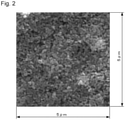
- Fig. 2 shows a partially enlarged cross section of the block 10 which is taken along the broken line shown by the reference sign A1 in Fig. 1 .
- This drawing is an enlarged view of a field of view of a length (width direction) of 5 ⁇ m and a breadth (depth direction) of 5 ⁇ m. Such a drawing may be obtained from a scanning electron microscope (SEM) image.
- SEM scanning electron microscope
- the main crystalline phase of the block 10 is of lithium disilicate as described above.
- the proportion of the total area of crystals having a length of at least 0.5 ⁇ m in the crystals of the block 10 appearing within the field of view shown in Fig. 2 , to the area of the field of view shown in Fig. 2 (5 ⁇ m ⁇ 5 ⁇ m) is preferably, but is not necessarily, at most 21%.
- the producing method of the present embodiment has only to make it possible to lower this proportion compared to conventional making methods. This proportion is preferably at most 10%, and further preferably at most 1%.
- the crystals to be extracted from the appearing crystals which have a length of at least 0.5 ⁇ m, may be limited to crystals of lithium disilicate only.
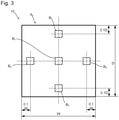
- the block 10 shown in Fig. 1 is an example here. Three cross sections that are along the center A 1 , and along the two edge portions A 2 and A 3 that are along the places 10% from the end faces to the full length H, in the direction of the largest amount (the height direction in the example in Fig. 1 ) are obtained. Fig. 3 shows the cross section along the center A 1 among the three cross sections.
- FIG. 2 An image by a scanning electron microscope having the field of view of 5 ⁇ m ⁇ 5 ⁇ m as shown in Fig. 2 is obtained for each of the center Bi, two end portions B 2 that are adjacent to each other across the center B 1 in the width direction W at the positions 10% from the end portions to the total width W, and two end portions B 3 that are adjacent to each other across the center B 1 in the depth direction D at the positions 10% from the end portions to the total depth D; B 1 to B 3 are shown by the broken lines.
- This is applied to the cross sections along the center A 1 , the end portion A 2 , and the end portion A 3 . Therefore, five for each cross section, that is, fifteen of such images in total are obtained.
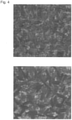
- the upper part of Fig. 4 shows an example of the obtained images.
- crystals having a length of at least 0.5 ⁇ m are extracted from the crystals appearing in the lower part of Fig. 4 , to obtain the total area S of the extracted crystals for each image.
- the total area S is divided by the area So of the field of view of the image (5 ⁇ m ⁇ 5 ⁇ m) to be represented in percentages, to obtain the proportion for each individual image.
- the respective proportions for the fifteen images are obtained.
- the area of voids to that of the observation range of 60 ⁇ m in length (width direction) ⁇ 60 ⁇ m in breadth (depth direction) is preferably at most 2% on average, for each of the fifteen parts where the foregoing proportions are measured.
- no particulate matter in the coloring material is visually seen in a micrograph at magnification ⁇ 200 for each of the fifteen parts where the foregoing proportions are measured.
- void and particulate matter may generate the interface with a base material to influence machinability.
- the presence of any particulate matter in the coloring material may cause color irregularities in dental prostheses.
- Such a block for dental prostheses can be surely realized by melting to mold the materials as described above, but not by powder molding.
- the foregoing block for dental prostheses, and the dental prosthesis made by processing the block can have strength, hardness, chemical durability in the oral environment, and the aesthetics (coloring, texture) same as natural teeth all of which are the basic functions as dental prostheses.
- machinability is improved, which makes it possible to carry out machining without any faults under the same or better processing conditions as or than those for conventional blocks for dental prostheses from ceramic for cutting although strength such that heat treatment after processing is not necessary is obtained.
- the block was a rectangular parallelepiped having the width W of 14 mm, the depth D of 12 mm and the height H of 18 mm.
- the materials shown in Table 1 were mixed according to the proportions therein and molten at 1300°C for 3 hours, to obtain molten glass (melting step).
- the obtained molten glass was poured into a mold and cooled to room temperature, to form a glass blank (step of making a glass blank).
- the glass blank was put into a furnace preheated to the heat-treating temperature shown in Table 1, to be kept at this heat-treating temperature for 30 minutes (rapid heat treatment). Thereafter the resultant was slowly cooled to room temperature (cooling step), to obtain the block.
- each of the blocks according to Comparative Examples 1 to 4 was made by conventional heat treatment as follows.
- the materials shown in Table 1 were mixed according to the proportions therein and molten at 1300°C for 3 hours, to obtain molten glass (melting step).
- the obtained molten glass was poured into a mold and cooled to room temperature, to form a glass blank (step of making a glass blank).
- the obtained glass blank was heated and kept at 650°C for 60 minutes, and then heated to 850°C to be kept for 10 minutes (conventional heat treatment). Thereafter the resultant was slowly cooled to room temperature (cooling step), to obtain the block.
- Table 1 shows the content of each component in terms of mass%. As can be seen from Table 1, the components other than coloring materials are the same in Example 1 and Comparative Example 1, Example 2 and Comparative Example 2, Example 3 and Comparative Example 3, and Example 4 and Comparative Example 4 respectively.
- Table 1 also shows the type of heat treatment, heat-treating temperature in the case of rapid heating, the type of the main crystalline phase of the obtained block ("LDS" represents lithium disilicate, and "LS” represents lithium metasilicate), the proportion (%) of crystals having a length of at least 0.5 ⁇ m, which was obtained by the above described method, and machinability. Blanks in rows of component in Table 1 show that the corresponding content was 0 mass%.
- the main crystal was measured by means of an X-ray diffractometer (Empyrean TM ; manufactured by Spectris Co., Ltd.); as a result of a quantitative analysis by the Rietveld refinement, a crystalline phase the precipitation rate of crystals of which was the highest in the observed crystalline phases was defined as the main crystalline phase.
- Proportion is the foregoing proportion of crystals having a length of at least 0.5 ⁇ m, and is the proportion (%) of the area obtained by the above described method.
- Example 1 and Comparative Example 1 Example 2 and Comparative Example 2, Example 3 and Comparative Example 3, and Example 4 and Comparative Example 4.
- Comparative Example 5 lithium disilicate could not be obtained as the main crystalline phase.
- Comparative Example 6 softening occurred.
Landscapes
- Chemical & Material Sciences (AREA)
- Health & Medical Sciences (AREA)
- Engineering & Computer Science (AREA)
- Life Sciences & Earth Sciences (AREA)
- Ceramic Engineering (AREA)
- Oral & Maxillofacial Surgery (AREA)
- Organic Chemistry (AREA)
- Materials Engineering (AREA)
- Animal Behavior & Ethology (AREA)
- Public Health (AREA)
- Chemical Kinetics & Catalysis (AREA)
- General Chemical & Material Sciences (AREA)
- Geochemistry & Mineralogy (AREA)
- General Health & Medical Sciences (AREA)
- Epidemiology (AREA)
- Veterinary Medicine (AREA)
- Manufacturing & Machinery (AREA)
- Dentistry (AREA)
- Structural Engineering (AREA)
- Crystallography & Structural Chemistry (AREA)
- Molecular Biology (AREA)
- Plastic & Reconstructive Surgery (AREA)
- Dispersion Chemistry (AREA)
- Thermal Sciences (AREA)
- Physics & Mathematics (AREA)
- Inorganic Chemistry (AREA)
- Dental Preparations (AREA)
- Glass Compositions (AREA)
- Dental Prosthetics (AREA)
- Re-Forming, After-Treatment, Cutting And Transporting Of Glass Products (AREA)
Abstract
Description
- The present disclosure relates to a method of producing a block for dental prostheses, and a method of producing a dental prosthesis.
- According to recent technological developments in CAD/CAM (Computer-aided design/Computer-aided manufacturing), in making a dental prosthesis, a designed shape of a dental prosthesis is converted into a given data format to be treated as digital data, and the data is transmitted to a processing machine; thereby, in the processing machine, machining such as cutting and grinding is automatically carried out on the basis of the data, to make a dental prosthesis. This makes it possible to rapidly provide dental prostheses.
- It is demanded that such dental prostheses have strength, hardness, chemical durability in the oral environment, and the aesthetics (coloring, texture) same as natural teeth all of which are the basic functions as dental prostheses.
- In addition to this, it is also important to machine complex shapes of rough surfaces dental prostheses have in a short time without any faults such as chipping. A material that can be processed in such a short time makes it possible to further rapidly make dental prostheses.
- PTL 1 discloses the material for a dental prosthesis which includes given components, to thereby achieve the improvement of the foregoing basic functions and cutting ability.
- PTL 1
WO2016/031399 - An object of the present disclosure is to provide a method of producing a block for dental prostheses with good machinability.
- One aspect of the present disclosure is a method of producing a block for dental prostheses before machining to form a dental prosthesis, the method comprising: exposing a glass blank at a temperature lower than the temperature at which crystals of lithium metasilicate are generated, to an atmosphere at a temperature equal to or higher than the temperature at which crystals of lithium disilicate are generated and lower than the melting point of the crystals of lithium disilicate, to heat the glass blank so that the main crystalline phase of the glass blank is of lithium disilicate.
- Slow cooling may be included after said exposing to heat the glass blank.
- In said exposing to heat the glass blank, the temperature of the atmosphere may be 750°C to 900°C.
- Said exposing the glass blank to the atmosphere may be putting the glass blank in a heating apparatus.
- The block may comprise: 60 mass% to 80 mass% of SiO2; 10 mass% to 20 mass% of Li2O; and 3 mass% to 15 mass% of Al2O3.
- Another aspect of the present disclosure is a method of producing a dental prosthesis, the method comprising: producing a block for dental prostheses by the above described producing method, to machine the block. This machining may be cutting.
- According to the present disclosure, a block for dental prostheses with good machinability is obtained.
-
-
Fig. 1 is an external perspective view of a block fordental prostheses 10. -
Fig. 2 shows a partially enlarged cross section such that crystals can be seen. -
Fig. 3 is an explanatory view of a method of measuring proportion. -
Fig. 4 is another explanatory view of the method of measuring proportion. - Examples of specific embodiments will be hereinafter described. The present invention is not limited to these embodiments.
- First, a block for dental prostheses which is made by a method of producing a block for dental prostheses according to one embodiment will be described. This block for dental prostheses (hereinafter may be referred to as "block") is in the form of a rectangular column, a round column, or a board (disk). The shape of the block is changed to form a dental prosthesis or a dental prosthesis is cut out from the block, by machining such as cutting and grinding. Among them, a dental prosthesis in the form of a rectangular column or a board (disk) can be made by cutting. Blocks in the form of a rectangular column may be mainly used for cutting out a single dental prosthesis. Blocks in the form of a board may be used for cutting out a plurality of dental prostheses from one block.
-
Fig. 1 is an external perspective view of ablock 10 of a rectangular column. The rectangular column may have the width W, the depth D, and the height H within the range of 10 mm to 35 mm each. In contrast, in the case of a block in the form of a board, the block may be formed to have the thickness within the range of 10 mm to 35 mm. - This leads to the block of which a dental prosthesis is easy to be made by cutting.
- For making the block according to the present embodiment, its material may be constituted of the following components:
- 60 mass% to 80 mass% of SiO2;
- 10 mass% to 20 mass% of Li2O; and
- 3 mass% to 15 mass% of Al2O3.
- Each of the foregoing components are as follows.
- When the block contains less than 60 mass% or more than 80 mass% of SiO2, it is difficult to obtain a homogeneous block. More preferably, 65 mass% to 75 mass% of SiO2 is contained.
- When the block contains less than 10 mass% or more than 20 mass% of Li2O, it is difficult to obtain a homogeneous block, and machinability tends to deteriorate. More preferably, 12 mass% to 18 mass% of Li2O is contained.
- When the block contains less than 3 mass% of Al2O3 on the one hand, machinability tends to deteriorate while lithium disilicate precipitates to constitute a main crystalline phase. When the block contains more than 15 mass% of Al2O3 on the other hand, the main crystalline phase is not of lithium disilicate, which leads to a tendency to lower strength. More preferably, 3 mass% to 7 mass% of Al2O3 is contained.
- Further, the block for dental prostheses may contain the following components in addition to the foregoing components. The components listed here are not necessarily contained as can be seen from the fact that the amounts thereof may be 0 mass%. It means that at least any one of them may be contained.
- The block may contain 0 mass% to 15 mass% of a component for adjusting the melting temperature. This makes it possible to have a suitable melting temperature in production described later. The block may contain more than 15 mass% of some respective components. The improvement of the effect thereof however has its limits. Specific examples of materials for the component for adjusting the melting temperature (melting temperature adjusting materials) include oxides of Na, K, Ca, Sr, Ba, Mg, Rb, Cs, Fr, Be and Ra, which are further preferably as follows:
- Na2O: at most 2.8 mass%;
- K2O: at most 10 mass%;
- CaO: at most 3 mass%;
- SrO: at most 10 mass%;
- BaO: at most 10 mass%;
- MgO: at most 3 mass%;
- Rb2O: at most 2.8 mass%;
- Cs2O: at most 2.8 mass%;
- Fr2O: at most 2.8 mass%;
- BeO: at most 3 mass%; and
- RaO: at most 10 mass%.
- The block may also contain 0 mass% to 10 mass% of a component for forming crystal nuclei. This leads to efficient generation of nuclei to form crystals of lithium disilicate. The upper limit is 10 mass% because the improvement of the effect thereof has its limits even if the block contains more than 10 mass% of such a compound. Here, examples of compounds to function as materials for the component for forming crystal nuclei (crystal nuclei forming materials) include oxides of Zr, P and Ti (ZrO2, P2O5 and TiO2). At this time, the block preferably contains 0 mass% to 10 mass% of at least one selected from ZrO2, P2O5 and TiO2 in total.
- The materials for the block may further include a known coloring material in view of improving aesthetics. Examples thereof include at least one selected from V2O5, CeO2, Er2O3, MnO, Fe2O3 and Tb4O7.
- Next, an embodiment of a method of making a dental prosthesis will be described. This encompasses the embodiment of the method of making the block for dental prostheses. The making method of the present embodiment includes a melting step, a step of making a glass blank, a step of heat treatment, and a processing step.
- In the melting step, each of the above described components is molten at a temperature from 1100°C to 1600°C. This makes it possible to obtain molten glass for the block for dental prostheses. This melting is preferably carried out for several hours in order to obtain sufficient homogeneity.
- The step of making a glass blank is a step of obtaining a glass blank having a shape similar to the block for dental prostheses. The molten glass obtained in the melting step is poured into a mold and cooled to a temperature lower than the temperature at which crystals of lithium metasilicate are generated, preferably at most 400°C, more preferably at most 100°C, and further preferably room temperature, to obtain the glass blank. The cooling is carried out in a slow temperature change in order to prevent change in quality of, and cracks in materials.
- The step of heat treatment is a step of heating the glass blank obtained in the step of making a glass blank to a temperature equal to or higher than the temperature at which crystals of lithium disilicate are generated and lower than the melting point of the crystals, and more preferably to a temperature within a range of 750°C to 900°C.
- Since rapid heating is preferable in this step, the glass blank, which is cooled in the step of making a glass blank to a temperature lower than the temperature at which crystals of lithium metasilicate are generated, preferably at most 400°C, more preferably at most 100°C, and further preferably room temperature, is heated by, for example, putting the glass blank in a heating apparatus such as a furnace for exposing the glass blank to an atmosphere at a temperature equal to or higher than the temperature at which crystals of lithium disilicate are generated and lower than the melting point of the crystals, and more preferably at a temperature within a range of 750°C to 900°C. The heating is carried out until the main crystalline phase in the glass blank is of lithium disilicate. Thus, the heating time is not limited, but may be at least 20 minutes. The upper limit of this time is not particularly limited, and may be at most 6 hours.
- The heating temperature lower than the temperature at which crystals of lithium disilicate are generated may lead to failure to obtain a lithium disilicate blank whose main crystalline phase is of lithium disilicate. In contrast, the heating temperature equal to or higher than the melting point of crystals of lithium disilicate may lead to softening.
- After the rapid heating, heating is stopped, and cooling to room temperature is carried out, which leads to obtainment of the block for dental prostheses whose main crystalline phase is of lithium disilicate. This cooling is carried out in the furnace, and preferably is slow cooling in a slow temperature change in natural cooling in the furnace.
- Here, "main crystalline phase" means a crystalline phase, the precipitation rate of crystals of which is the highest in crystalline phases observed on analysis by an X-ray diffractometer.
- In the step of heat treatment, rapid heating to a temperature within a predetermined range is necessary as described above. The temperature is not necessarily kept fixed as long as being within a predetermined range, and may change.
- The processing step is a step of machining the obtained block for dental prostheses, to process the block to have a shape of a dental prosthesis. The machining method is not particularly limited, and examples thereof include cutting and grinding. This makes it possible to obtain a dental prosthesis.
- This processing can be carried out under good conditions for productivity. That is, conventional blocks for dental prostheses whose main crystalline phase is of lithium disilicate are difficult to be efficiently cut because of their poor machinability. Therefore, a block easy to process whose main crystalline phase is not of lithium disilicate (such as a block whose main crystalline phase is of lithium metasilicate) is prepared to be machined, and a step of improving the strength has to follow after the machining, that is, further heat-treating the block to change the main crystalline phase thereof into of lithium disilicate.
- In contrast, according to the present embodiment, even a block whose main crystalline phase is of lithium disilicate can be cut and/or ground under the same or better conditions as or than those for processing on a block easy to process whose main crystalline phase is of lithium metasilicate. Heat treatment after processing is not necessary either, which can lead to a dental prosthesis without change in shape as the accuracy of machining is kept.
- The block made by the producing method of the present embodiment has the following structure.
Fig. 2 shows a partially enlarged cross section of theblock 10 which is taken along the broken line shown by the reference sign A1 inFig. 1 . This drawing is an enlarged view of a field of view of a length (width direction) of 5 µm and a breadth (depth direction) of 5 µm. Such a drawing may be obtained from a scanning electron microscope (SEM) image. - The main crystalline phase of the
block 10 is of lithium disilicate as described above. - The proportion of the total area of crystals having a length of at least 0.5 µm in the crystals of the
block 10 appearing within the field of view shown inFig. 2 , to the area of the field of view shown inFig. 2 (5 µm × 5 µm) is preferably, but is not necessarily, at most 21%. The producing method of the present embodiment has only to make it possible to lower this proportion compared to conventional making methods. This proportion is preferably at most 10%, and further preferably at most 1%. - The crystals to be extracted from the appearing crystals, which have a length of at least 0.5 µm, may be limited to crystals of lithium disilicate only.
- This makes it possible to cut and/or grind the block whose main crystalline phase is of lithium disilicate under the same or better conditions as or than those for processing conventional blocks that are easy to process (such as a block whose main crystalline phase is of lithium metasilicate). This does not require heat treatment after processing which is, for example, necessary for a block whose main crystalline phase is of lithium metasilicate, which can lead to a dental prosthesis without change in shape as the accuracy of machining is kept.
- The proportion as described above is obtained as follows.
- The
block 10 shown inFig. 1 is an example here. Three cross sections that are along the center A1, and along the two edge portions A2 and A3 that are along theplaces 10% from the end faces to the full length H, in the direction of the largest amount (the height direction in the example inFig. 1 ) are obtained.Fig. 3 shows the cross section along the center A1 among the three cross sections. - An image by a scanning electron microscope having the field of view of 5 µm × 5 µm as shown in
Fig. 2 is obtained for each of the center Bi, two end portions B2 that are adjacent to each other across the center B1 in the width direction W at thepositions 10% from the end portions to the total width W, and two end portions B3 that are adjacent to each other across the center B1 in the depth direction D at thepositions 10% from the end portions to the total depth D; B1 to B3 are shown by the broken lines. This is applied to the cross sections along the center A1, the end portion A2, and the end portion A3. Therefore, five for each cross section, that is, fifteen of such images in total are obtained. The upper part ofFig. 4 shows an example of the obtained images. - Next, as shown in the lower part of
Fig. 4 , crystals having a length of at least 0.5 µm (painted parts in the lower part ofFig. 4 ) are extracted from the crystals appearing in the lower part ofFig. 4 , to obtain the total area S of the extracted crystals for each image. Next, the total area S is divided by the area So of the field of view of the image (5 µm × 5 µm) to be represented in percentages, to obtain the proportion for each individual image. Thus, the respective proportions for the fifteen images are obtained. - The mean value of these respective proportions is calculated to be defined as the proportion.
- Here, preferably, no void is seen in the block for dental prostheses. Since the influence of a few voids is believed to be slight, the area of voids to that of the observation range of 60 µm in length (width direction) × 60 µm in breadth (depth direction) is preferably at most 2% on average, for each of the fifteen parts where the foregoing proportions are measured.
- Preferably, no particulate matter in the coloring material is visually seen in a micrograph at magnification ×200 for each of the fifteen parts where the foregoing proportions are measured.
- These void and particulate matter may generate the interface with a base material to influence machinability. The presence of any particulate matter in the coloring material may cause color irregularities in dental prostheses.
- Such a block for dental prostheses can be surely realized by melting to mold the materials as described above, but not by powder molding.
- The foregoing block for dental prostheses, and the dental prosthesis made by processing the block can have strength, hardness, chemical durability in the oral environment, and the aesthetics (coloring, texture) same as natural teeth all of which are the basic functions as dental prostheses. In addition to this, machinability is improved, which makes it possible to carry out machining without any faults under the same or better processing conditions as or than those for conventional blocks for dental prostheses from ceramic for cutting although strength such that heat treatment after processing is not necessary is obtained.
- In each of Examples 1 to 7 and Comparative Examples 1 to 6, a block was prepared according to the making method by the above described melt molding, to make a dental prosthesis by cutting, and machinability then was evaluated. In each example, the contained components and heat-treating temperature were changed.
- The block was a rectangular parallelepiped having the width W of 14 mm, the depth D of 12 mm and the height H of 18 mm.
- Each of the blocks according to Examples 1 to 7 and Comparative Examples 5 and 6 was made by rapid heat treatment as follows.
- In each example, the materials shown in Table 1 were mixed according to the proportions therein and molten at 1300°C for 3 hours, to obtain molten glass (melting step). Next, the obtained molten glass was poured into a mold and cooled to room temperature, to form a glass blank (step of making a glass blank). Then, the glass blank was put into a furnace preheated to the heat-treating temperature shown in Table 1, to be kept at this heat-treating temperature for 30 minutes (rapid heat treatment). Thereafter the resultant was slowly cooled to room temperature (cooling step), to obtain the block.
- In contrast, each of the blocks according to Comparative Examples 1 to 4 was made by conventional heat treatment as follows.
- In each example, the materials shown in Table 1 were mixed according to the proportions therein and molten at 1300°C for 3 hours, to obtain molten glass (melting step). Next, the obtained molten glass was poured into a mold and cooled to room temperature, to form a glass blank (step of making a glass blank). Then, the obtained glass blank was heated and kept at 650°C for 60 minutes, and then heated to 850°C to be kept for 10 minutes (conventional heat treatment). Thereafter the resultant was slowly cooled to room temperature (cooling step), to obtain the block.
- Table 1 shows the content of each component in terms of mass%. As can be seen from Table 1, the components other than coloring materials are the same in Example 1 and Comparative Example 1, Example 2 and Comparative Example 2, Example 3 and Comparative Example 3, and Example 4 and Comparative Example 4 respectively.
- Table 1 also shows the type of heat treatment, heat-treating temperature in the case of rapid heating, the type of the main crystalline phase of the obtained block ("LDS" represents lithium disilicate, and "LS" represents lithium metasilicate), the proportion (%) of crystals having a length of at least 0.5 µm, which was obtained by the above described method, and machinability. Blanks in rows of component in Table 1 show that the corresponding content was 0 mass%.
- The main crystal was measured by means of an X-ray diffractometer (Empyrean™; manufactured by Spectris Co., Ltd.); as a result of a quantitative analysis by the Rietveld refinement, a crystalline phase the precipitation rate of crystals of which was the highest in the observed crystalline phases was defined as the main crystalline phase.
- "Proportion" is the foregoing proportion of crystals having a length of at least 0.5 µm, and is the proportion (%) of the area obtained by the above described method.
- For "machinability", two conventional blocks for processing were prepared as References 1 and 2. Each block was as follows:
- (Reference 1) a block whose main crystalline phase was of lithium metasilicate, containing 72.3 mass% of SiO2, 15.0 mass% of Li2O, and 1.6 mass% of Al2O3; and
- (Reference 2) a block including almost the same proportion of a crystalline phase of lithium metasilicate and a crystalline phase of lithium disilicate, containing 56.3 mass% of SiO2, 14.7 mass% of Li2O, and 2.1 mass% of Al2O3.
- For Examples and Comparative Examples, the degrees of the processing time, wear and tear on a tool, and chipping when the blocks were processed by a ceramic processing machine (CEREC™ MC XL; manufactured by Sirona Dental Systems, Inc.) compared to the blocks of References 1 and 2 were each evaluated. Blocks whose evaluation results of the processing time, wear and tear on a tool, and chipping were all better than those of the blocks of References 1 and 2 were represented as "good", and blocks whose evaluation results of any of the processing time, wear and tear on a tool, and chipping were worse than those of the blocks of References 1 and 2 were represented as "bad".


- As can be seen from Table 1, machinability of the blocks for dental prostheses of Examples are good although the main crystalline phase thereof was of lithium disilicate. In Examples, "proportion" was suppressed lower than the proportions in Comparative Examples.
- It is also found that different producing steps lead to largely different machinability and proportion although the components other than coloring materials are the same in Example 1 and Comparative Example 1, Example 2 and Comparative Example 2, Example 3 and Comparative Example 3, and Example 4 and Comparative Example 4. In Comparative Example 5, lithium disilicate could not be obtained as the main crystalline phase. In Comparative Example 6, softening occurred.
- The blocks of any of Examples and Comparative Examples had necessary strength, and satisfied the above described preferred requirements concerning voids and particulate matters.
- 10 block for dental prostheses
Claims (7)
- A method of producing a block for dental prostheses before machining to form a dental prosthesis, the method comprising:
exposing a glass blank at a temperature lower than a temperature at which crystals of lithium metasilicate are generated, to an atmosphere at a temperature equal to or higher than a temperature at which crystals of lithium disilicate are generated and lower than a melting point of the crystals of lithium disilicate, to heat the glass blank so that a main crystalline phase of the glass blank is of lithium disilicate. - The method according to claim 1, further comprising slow cooling after said exposing to heat the glass blank.
- The method according to claim 1 or 2, wherein the temperature of the atmosphere is 750°C to 900°C.
- The method according to any one of claims 1 to 3, wherein said exposing the glass blank to the atmosphere is putting the glass blank in a heating apparatus.
- The method according to any one of claims 1 to 4, wherein the block comprises:60 mass% to 80 mass% of SiO2;10 mass% to 20 mass% of Li2O; and3 mass% to 15 mass% of Al2O3.
- A method of producing a dental prosthesis, the method comprising:
producing a block for dental prostheses by the producing method according to any one of claims 1 to 5, to machine the block. - The method according to claim 6, wherein said machining is cutting.
Applications Claiming Priority (2)
| Application Number | Priority Date | Filing Date | Title |
|---|---|---|---|
| JP2019069330 | 2019-03-29 | ||
| PCT/JP2019/050162 WO2020202666A1 (en) | 2019-03-29 | 2019-12-20 | Method for manufacturing block body for dental prostheses, and method for manufacturing dental prosthesis |
Publications (2)
| Publication Number | Publication Date |
|---|---|
| EP3949938A1 true EP3949938A1 (en) | 2022-02-09 |
| EP3949938A4 EP3949938A4 (en) | 2023-01-25 |
Family
ID=72668465
Family Applications (1)
| Application Number | Title | Priority Date | Filing Date |
|---|---|---|---|
| EP19922438.7A Pending EP3949938A4 (en) | 2019-03-29 | 2019-12-20 | Method for manufacturing block body for dental prostheses, and method for manufacturing dental prosthesis |
Country Status (5)
| Country | Link |
|---|---|
| US (1) | US20220183803A1 (en) |
| EP (1) | EP3949938A4 (en) |
| JP (2) | JP7478093B2 (en) |
| CN (2) | CN117843241A (en) |
| WO (1) | WO2020202666A1 (en) |
Families Citing this family (1)
| Publication number | Priority date | Publication date | Assignee | Title |
|---|---|---|---|---|
| JP7517739B2 (en) * | 2021-06-25 | 2024-07-17 | ハス コーポレーション | Bulk blocks for dental prosthesis manufacturing |
Family Cites Families (13)
| Publication number | Priority date | Publication date | Assignee | Title |
|---|---|---|---|---|
| US6420288B2 (en) * | 1997-11-10 | 2002-07-16 | Ivoclar Ag | Process for the preparation of shaped translucent lithium disilicate glass ceramic products |
| DE19750794A1 (en) | 1997-11-10 | 1999-06-17 | Ivoclar Ag | Process for the preparation of shaped translucent lithium disilicate glass-ceramic products |
| DE202009019061U1 (en) * | 2009-12-23 | 2016-02-23 | Degudent Gmbh | Lithium metasilicate glass-ceramic and its use |
| JP5989770B2 (en) * | 2011-06-22 | 2016-09-07 | ヴィタ ツァーンファブリク ハー.ラウター ゲーエムベーハー ウント コー.カーゲー | Dental restoration material, method for producing the same, and glass ceramic |
| JP6681659B2 (en) * | 2011-10-14 | 2020-04-15 | イフォクレール ヴィヴァデント アクチェンゲゼルシャフトIvoclar Vivadent AG | Lithium silicate glass ceramic and lithium silicate glass containing divalent metal oxide |
| EP2868634B1 (en) * | 2013-11-05 | 2021-07-07 | Ivoclar Vivadent AG | Lithium disilicate apatite glass ceramic with transition metal oxide |
| RU2732011C2 (en) * | 2014-08-27 | 2020-09-10 | ДжиСи КОРПОРЕЙШН | Method for production of dental prosthesis, method for production of workpiece from lithium disilicate for dental prosthesis and workpiece from lithium dicumate for dental prosthesis |
| AU2016267306B2 (en) * | 2015-05-25 | 2019-02-14 | Gc Corporation | Material for dental prosthesis, block body for producing dental prosthesis, and dental prosthesis |
| EP3135641B1 (en) * | 2015-08-25 | 2024-07-03 | Ivoclar Vivadent AG | Lithium silicate glass ceramic with alpha quartz |
| KR101796196B1 (en) * | 2015-08-26 | 2017-11-13 | 주식회사 하스 | Dental glass-ceramics block bonded Abutment and preparation method thereof |
| JP6993093B2 (en) | 2016-03-31 | 2022-01-13 | 株式会社松風 | Lithium silicate glass composition containing no Al2O3 |
| DE102016119935A1 (en) | 2016-10-19 | 2018-04-19 | Degudent Gmbh | Method for producing a dental restoration |
| KR101975548B1 (en) * | 2017-03-07 | 2019-05-08 | 주식회사 하스 | Method for preparing glass-ceramics, capable of adjusting machinability or translucency through change in temperature of heat treatment |
-
2019
- 2019-12-20 EP EP19922438.7A patent/EP3949938A4/en active Pending
- 2019-12-20 US US17/442,756 patent/US20220183803A1/en active Pending
- 2019-12-20 CN CN202311708323.1A patent/CN117843241A/en active Pending
- 2019-12-20 JP JP2020503333A patent/JP7478093B2/en active Active
- 2019-12-20 WO PCT/JP2019/050162 patent/WO2020202666A1/en not_active Ceased
- 2019-12-20 CN CN201980094697.4A patent/CN113677310B/en active Active
-
2023
- 2023-01-27 JP JP2023010814A patent/JP7665663B2/en active Active
Also Published As
| Publication number | Publication date |
|---|---|
| JP7665663B2 (en) | 2025-04-21 |
| JP2023058538A (en) | 2023-04-25 |
| JPWO2020202666A1 (en) | 2021-04-30 |
| EP3949938A4 (en) | 2023-01-25 |
| CN117843241A (en) | 2024-04-09 |
| JP7478093B2 (en) | 2024-05-02 |
| CN113677310A (en) | 2021-11-19 |
| WO2020202666A1 (en) | 2020-10-08 |
| US20220183803A1 (en) | 2022-06-16 |
| CN113677310B (en) | 2024-01-02 |
Similar Documents
| Publication | Publication Date | Title |
|---|---|---|
| JP6347792B2 (en) | Method for producing dental prosthesis, method for producing lithium disilicate blank for dental prosthesis, and lithium disilicate blank for dental prosthesis | |
| EP1206223B1 (en) | Method for producing a dental prosthesis | |
| WO2015155038A1 (en) | Glass ceramic comprising a quartz-mix crystal phase | |
| US12575916B2 (en) | Block for dental prostheses | |
| JP6732868B2 (en) | Dental prosthesis material, dental prosthesis production block, and dental prosthesis | |
| DE69521416T2 (en) | GLASS MATERIAL, REPLACEMENT MATERIAL FOR LIVING TISSUE AND TOOTH REINFORCING MATERIAL | |
| EP0975305A2 (en) | Machinable leucite-containing porcelain compositions and methods of manufacture | |
| US20220183803A1 (en) | Method of producing block for dental prostheses, and method of producing dental prosthesis | |
| US11166795B2 (en) | Method for producing dental prosthesis, method for producing lithium disilicate blank for dental prosthesis and lithium disilicate blank for dental prosthesis | |
| CN113574026A (en) | A kind of pre-sintered porcelain block for dental restoration, its preparation method and application | |
| JP6537256B2 (en) | Glass block, method of manufacturing glass block, and method of manufacturing dental prosthesis | |
| JP2016108180A (en) | Glass ceramic | |
| JP2016108179A (en) | Glass ceramic |
Legal Events
| Date | Code | Title | Description |
|---|---|---|---|
| STAA | Information on the status of an ep patent application or granted ep patent |
Free format text: STATUS: THE INTERNATIONAL PUBLICATION HAS BEEN MADE |
|
| PUAI | Public reference made under article 153(3) epc to a published international application that has entered the european phase |
Free format text: ORIGINAL CODE: 0009012 |
|
| STAA | Information on the status of an ep patent application or granted ep patent |
Free format text: STATUS: REQUEST FOR EXAMINATION WAS MADE |
|
| 17P | Request for examination filed |
Effective date: 20210930 |
|
| AK | Designated contracting states |
Kind code of ref document: A1 Designated state(s): AL AT BE BG CH CY CZ DE DK EE ES FI FR GB GR HR HU IE IS IT LI LT LU LV MC MK MT NL NO PL PT RO RS SE SI SK SM TR |
|
| DAV | Request for validation of the european patent (deleted) | ||
| DAX | Request for extension of the european patent (deleted) | ||
| REG | Reference to a national code |
Ref country code: DE Ref legal event code: R079 Free format text: PREVIOUS MAIN CLASS: A61K0006849000 Ipc: A61C0013000000 |
|
| A4 | Supplementary search report drawn up and despatched |
Effective date: 20230102 |
|
| RIC1 | Information provided on ipc code assigned before grant |
Ipc: C04B 35/653 20060101ALI20221220BHEP Ipc: C04B 35/16 20060101ALI20221220BHEP Ipc: C03C 10/00 20060101ALI20221220BHEP Ipc: C03C 4/00 20060101ALI20221220BHEP Ipc: C03C 3/097 20060101ALI20221220BHEP Ipc: C03C 3/083 20060101ALI20221220BHEP Ipc: A61K 6/833 20200101ALI20221220BHEP Ipc: A61C 13/00 20060101AFI20221220BHEP |
|
| P01 | Opt-out of the competence of the unified patent court (upc) registered |
Effective date: 20230528 |
|
| TPAC | Observations filed by third parties |
Free format text: ORIGINAL CODE: EPIDOSNTIPA |