EP3948679B1 - Energy-based associative memory neural networks - Google Patents
Energy-based associative memory neural networks Download PDFInfo
- Publication number
- EP3948679B1 EP3948679B1 EP20727262.6A EP20727262A EP3948679B1 EP 3948679 B1 EP3948679 B1 EP 3948679B1 EP 20727262 A EP20727262 A EP 20727262A EP 3948679 B1 EP3948679 B1 EP 3948679B1
- Authority
- EP
- European Patent Office
- Prior art keywords
- associative memory
- neural network
- parameters
- objective function
- writing
- Prior art date
- Legal status (The legal status is an assumption and is not a legal conclusion. Google has not performed a legal analysis and makes no representation as to the accuracy of the status listed.)
- Active
Links
Images


Classifications
-
- G—PHYSICS
- G06—COMPUTING OR CALCULATING; COUNTING
- G06N—COMPUTING ARRANGEMENTS BASED ON SPECIFIC COMPUTATIONAL MODELS
- G06N3/00—Computing arrangements based on biological models
- G06N3/02—Neural networks
- G06N3/08—Learning methods
- G06N3/084—Backpropagation, e.g. using gradient descent
-
- G—PHYSICS
- G06—COMPUTING OR CALCULATING; COUNTING
- G06N—COMPUTING ARRANGEMENTS BASED ON SPECIFIC COMPUTATIONAL MODELS
- G06N3/00—Computing arrangements based on biological models
- G06N3/02—Neural networks
- G06N3/04—Architecture, e.g. interconnection topology
-
- G—PHYSICS
- G06—COMPUTING OR CALCULATING; COUNTING
- G06N—COMPUTING ARRANGEMENTS BASED ON SPECIFIC COMPUTATIONAL MODELS
- G06N3/00—Computing arrangements based on biological models
- G06N3/02—Neural networks
- G06N3/04—Architecture, e.g. interconnection topology
- G06N3/044—Recurrent networks, e.g. Hopfield networks
- G06N3/0442—Recurrent networks, e.g. Hopfield networks characterised by memory or gating, e.g. long short-term memory [LSTM] or gated recurrent units [GRU]
-
- G—PHYSICS
- G06—COMPUTING OR CALCULATING; COUNTING
- G06N—COMPUTING ARRANGEMENTS BASED ON SPECIFIC COMPUTATIONAL MODELS
- G06N3/00—Computing arrangements based on biological models
- G06N3/02—Neural networks
- G06N3/04—Architecture, e.g. interconnection topology
- G06N3/0464—Convolutional networks [CNN, ConvNet]
-
- G—PHYSICS
- G06—COMPUTING OR CALCULATING; COUNTING
- G06N—COMPUTING ARRANGEMENTS BASED ON SPECIFIC COMPUTATIONAL MODELS
- G06N3/00—Computing arrangements based on biological models
- G06N3/02—Neural networks
- G06N3/08—Learning methods
- G06N3/088—Non-supervised learning, e.g. competitive learning
-
- G—PHYSICS
- G06—COMPUTING OR CALCULATING; COUNTING
- G06N—COMPUTING ARRANGEMENTS BASED ON SPECIFIC COMPUTATIONAL MODELS
- G06N3/00—Computing arrangements based on biological models
- G06N3/02—Neural networks
- G06N3/08—Learning methods
- G06N3/092—Reinforcement learning
-
- G—PHYSICS
- G06—COMPUTING OR CALCULATING; COUNTING
- G06N—COMPUTING ARRANGEMENTS BASED ON SPECIFIC COMPUTATIONAL MODELS
- G06N3/00—Computing arrangements based on biological models
- G06N3/02—Neural networks
- G06N3/08—Learning methods
- G06N3/0985—Hyperparameter optimisation; Meta-learning; Learning-to-learn
-
- G—PHYSICS
- G06—COMPUTING OR CALCULATING; COUNTING
- G06N—COMPUTING ARRANGEMENTS BASED ON SPECIFIC COMPUTATIONAL MODELS
- G06N3/00—Computing arrangements based on biological models
- G06N3/004—Artificial life, i.e. computing arrangements simulating life
- G06N3/006—Artificial life, i.e. computing arrangements simulating life based on simulated virtual individual or collective life forms, e.g. social simulations or particle swarm optimisation [PSO]
-
- G—PHYSICS
- G06—COMPUTING OR CALCULATING; COUNTING
- G06N—COMPUTING ARRANGEMENTS BASED ON SPECIFIC COMPUTATIONAL MODELS
- G06N5/00—Computing arrangements using knowledge-based models
- G06N5/01—Dynamic search techniques; Heuristics; Dynamic trees; Branch-and-bound
Definitions
- This specification relates to processing data using machine learning models.
- Machine learning models receive an input and generate an output, e.g., a predicted output, based on the received input.
- Some machine learning models are parametric models and generate the output based on the received input and on values of the parameters of the model.
- Some machine learning models are deep models that employ multiple layers of models to generate an output for a received input.
- a deep neural network is a deep machine learning model that includes an output layer and one or more hidden layers that each apply a non-linear transformation to a received input to generate an output.
- Xie et al. "Cooperative Training of Descriptor and Generator Networks," arXiv:1609.09408, 29th October 2018, available at https://arxiv.org/abs/1609.09408 discloses cooperative training of two generative models for image modeling and synthesis. Both models are parametrized by convolutional neural networks (ConvNets).
- the first model is a deep energy-based model, whose energy function is defined by a bottom-up ConvNet, which maps the observed image to the energy, named the descriptor network.
- the second model is a generator network, which is a non-linear version of factor analysis. It is defined by a top-down ConvNet, which maps the latent factors to the observed image.
- the maximum likelihood learning algorithms of both models involve MCMC sampling such as Langevin dynamics.
- the two learning algorithms can be interwoven into a cooperative learning algorithm that can train both models simultaneously.
- the generator model generates initial synthesized examples to initialize a finite-step MCMC that samples and trains the energy-based descriptor model.
- the generator model learns from how the MCMC changes its synthesized examples. That is, the descriptor model teaches the generator model by MCMC, so that the generator model accumulates the MCMC transitions and reproduces them by direct ancestral sampling.
- Xie et al. "A Theory of Generative ConvNet,” arXiv:1602.03264, 31st May 2016, available at https://arxiv.org/abs/1602.03264 discloses a generative random field model, called generative ConvNet, which can be derived from discriminative ConvNet, by assuming a ConvNet for multi-category classification and assuming one of the categories is a base category generated by a reference distribution.
- the non-linearity in the ConvNet is Rectified Linear Unit (ReLU) and the reference distribution is Gaussian white noise.
- a generative ConvNet model is an energy-based model. The model is piecewise Gaussian, and the means of the Gaussian pieces are defined by an auto-encoder, where the filters in the bottom-up encoding become the basis functions in the top-down decoding, and the binary activation variables detected by the filters in the bottom-up convolution process become the coefficients of the basis functions in the top-down deconvolution process.
- the Langevin dynamics for sampling the generative ConvNet is driven by the reconstruction error of this auto-encoder.
- the contrastive divergence learning of the generative ConvNet reconstructs the training images by the auto-encoder.
- This specification describes an associative memory system implemented as computer programs on one or more computers in one or more locations that can store data in, and subsequently retrieve data from, an associative memory neural network.
- the associative memory neural network may be said to "store” a data element if the parameters of the associative memory neural network encode information that enables the data element to be retrieved, i.e., approximately or exactly reconstructed.
- Storing a data element in the associative memory neural network may be referred to as "writing" the data element to the associative memory neural network.
- Retrieving a data element from the associative memory neural network may be referred to as "reading" the data element from the associative memory neural network.
- a system comprising an associative memory neural network having a plurality of associative memory parameters that is configured to process an input to generate an output that defines an energy corresponding to the input.
- the system includes a reading subsystem i.e. a subsystem to retrieve stored information, i.e. a data element, from the associative memory neural network.
- the reading subsystem is configured to perform operations including receiving a given input, as described later a query data element, and retrieving from the associative memory neural network a target input that is associated with the given input, as described later a retrieved data element. The retrieving is performed by iteratively adjusting the given input using the associative memory neural network.
- the retrieving comprises, at each of one or more iterations, processing the given input, using the associative memory neural network and in accordance with current values of the associative memory parameters, to generate an energy corresponding to the given input.
- the retrieving further comprises determining a gradient of a reading objective function that depends on the energy corresponding to the given input with respect to the given input, and using the gradient to adjust the given input e.g. using any gradient descent/ascent process to optimize the reading objective function.
- the retrieving further comprises providing the given input after a final iteration of the one or more iterations as the target input that is associated with the given input.
- the associative memory neural network implements an energy model having attractors which locally optimize, e.g. minimize, an energy which is represented by a real scalar value.
- Information is stored in the parameters, e.g. weights, of the associative memory neural network as local optima, e.g. minima, of the energy correspond to stored data elements.
- the retrieval uses gradient descent to find an attractor i.e. a local minimum of the energy, starting from an initial given input i.e. the query data element.
- the reading objective function is an objective function which depends on the energy corresponding to the given input at an iteration (no specific form is required).
- the gradient descent adjusts the query data element towards a stored data element to provide the retrieved data element.
- the given input may each include either image data or audio data e.g. digitized sound data.
- the system also includes a writing subsystem as recited in claim 1.
- This performs operations including determining gradients of a writing objective function that depends on the energy corresponding to each of the inputs, with respect to a specified subset of the associative memory parameters; and using the gradients to adjust the current values of the specified subset of the associative memory parameters. That is, in implementations only some of the associative memory parameters may be adjusted i.e. the specified subset of parameters e.g. those of one or more of the highest layers (the layers furthest from the input).
- the writing objective function also includes a term dependent on a gradient of the energy, i.e. on a magnitude of the gradient of the energy, and may include a term which limits deviation from the initial associative memory parameters.
- One or both of the writing subsystem and the reading subsystem may write data to and/or read data from the associative memory neural network by performing truncated gradient descent, i.e., that terminates after (at most) a predetermined number of gradient descent iterations on the writing objective function and/or reading objective function.
- the system may be trained using meta-learning. For example the system may be trained so that the associative memory parameters define a good starting point for past optimization. More specifically the system may be trained by writing and reading data elements and backpropagating gradients of a reconstruction error function to provide initial values for the associative memory parameters. This is facilitated by using a writing objective function as previously described. Then only one or a few further gradient descent (or ascent) steps may be needed during reading or writing.
- the reconstruction error objective function may characterize a similarity between a training input stored using the writing subsystem and a training input which is a retrieved input provided by the reading subsystem (in response e.g. to an incomplete or distorted version of the training input).
- the reading subsystem has one or more reading subsystem parameters that are used in retrieving target inputs from the associative memory neural network and the writing subsystem has one or more writing subsystem parameters that are used in storing inputs using the associative memory neural network.
- the reading objective function may also have one or more reading objective function parameters, and the writing objective function may have one or more writing objective function parameters.
- the system may include a training subsystem that is configured to jointly train one or more of: the reading subsystem parameters, the writing subsystem parameters, the reading objective function parameters, the writing objective function parameters, and the associative memory parameters based on a reconstruction error objective function e.g. using meta-learning techniques.
- the associative memory system described in this specification can compress data more efficiently, and retrieve stored data at least as accurately, as some conventional memory systems. By enabling efficient data compression and accurate data retrieval, the associative memory system facilitates more efficient use of computational resources (e.g., memory).
- computational resources e.g., memory
- the associative memory system implements a memory (data store) that allows data to be efficiently compressed (stored) and retrieved.
- the associative memory system can write data to and read data from the associative memory neural network by performing truncated gradient descent, i.e., that terminates after (at most) a predetermined number of gradient descent iterations rather than, e.g., when a convergence criterion is satisfied.
- truncated gradient descent to write and read data enables the associative memory system to implement fast write and read operations that are performed over a predetermined number of gradient descent iterations.
- the parameters of the associative memory system can be trained using meta-learning techniques to enable truncated gradient descent to converge sufficiently fast that data elements can be read from the associative memory neural network with an acceptable reconstruction error, as will be described in more detail below.
- the associative memory system facilitates more efficient use of computational resources (e.g., computing power).
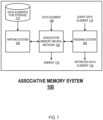
- FIG. 1 shows an example associative memory system 100.
- the associative memory system 100 is an example of a system implemented as computer programs on one or more computers in one or more locations in which the systems, components, and techniques described below are implemented.
- the associative memory system 100 includes an associative memory neural network 102, a writing system 104, and a reading system 106, which will each be described in more detail next.
- the associative memory neural network 102 is configured to receive a data element 108, and to process the data element 108 in accordance with values of a set of associative memory neural network parameters to generate a corresponding energy 110.
- the data element 108 may include one or more of: image data and audio data.
- the energy 110 is represented as a scalar numerical value.
- the system 100 may train the neural network 102 to generate an energy value 110 for a data element 108.
- the energy value may be interpreted as characterizing a likelihood that the data element 108 is stored in the neural network 102, as will be described in more detail below.
- the neural network 102 may have any appropriate neural network architecture that enables it to process data elements 108 to generate corresponding energy values 110.
- the neural network 102 may be a convolutional neural network, i.e., that includes one or more convolutional neural network layers, that is configured to process images.
- the neural network 102 may be a convolutional neural network or a recurrent neural network (i.e., with one or more recurrent neural network layers, e.g., long short-term memory (LSTM) neural network layers) that is configured to process audio data.
- LSTM long short-term memory
- the neural network 102 may include any appropriate types of neural network layers, e.g., convolutional neural network layers, recurrent neural network layers, pooling neural network layers, and/or attention neural network layers.
- the output layer of the neural network 102 includes a single neuron that outputs scalar energy values 110 corresponding to data elements 108 processed by the neural network 102.
- the neural network 102 may have one or more layers including a tanh activation function.
- the writing system 104 is configured to store a set of one or more data elements 112 in the neural network 102 by training the neural network 102 on the data elements 112 to optimize an objective function, referred to herein as a "writing" objective function.
- the writing objective function may encourage the neural network 102 to minimize (or, alternatively, maximize) the energy values 110 generated for the data elements 112 being stored in the neural network 102.
- the writing objective function may encourage the energy values 110 for the data elements 112 being stored to be local minima of the energy values generated by the neural network 102.
- E ( x ; ⁇ ) denotes the energy value generated by the neural network 102 for data element x in accordance with the neural network parameter values ⁇
- ⁇ ⁇ E x ⁇ 2 2 denotes a magnitude of the gradient of the energy value E ( x ; ⁇ ) with respect to the neural network parameters ⁇
- ⁇ denotes the initial values of the neural network parameters (e.g., prior to being trained to optimize the writing objective function)
- ⁇ and ⁇ are constant terms.
- Equation (1) may encourage the energy values corresponding to the data values being stored to be local minima of the energy values generated by the neural network 102, which facilitates subsequent retrieval of the data values from the neural network, as will be described in more detail below.
- the term ⁇ ⁇ ⁇ ⁇ 2 2 in equation (1) may limit the deviation of the parameter values ⁇ from their initial values ⁇ , which may improve the stability of the optimization of the writing objective function.
- the writing objective function in equation (1) is provided for illustrative purposes only, and other writing objective functions are possible.
- the writing system 104 may train the neural network 102 on the data elements 112 to optimize the writing objective function over one or more iterations using gradient descent.
- ⁇ denotes the initial values of the neural network parameters
- ⁇ ( t ) denotes a learning rate parameter for iteration t
- N denotes the number of data elements 112 being stored in the neural network 102
- ⁇ ⁇ ( x i , ⁇ ( t ) ) denotes a gradient of the writing objective function, evaluated for data element x i (i.e., the i -th data element being stored) and parameter values ⁇ ( t ) , with
- the learning rate ⁇ ( t ) scales the gradients of the writing objective function.
- the values of the neural network parameters after the final iteration of gradient descent may be understood as storing the data elements 112.
- the writing system 104 may use an alternative gradient descent optimization rule (i.e., other than the one specified in equation (3)), e.g., a Nesterov momentum gradient descent optimization rule ( Nesterov, "A method for solving the convex programming problem with convergence rate O(1/k ⁇ 2)", Dokl. akad. nauk Sssr, vol. 269, pp. 543-547, 1983 ).
- the writing system 104 may perform truncated gradient descent, i.e., by performing a predetermined number of gradient descent iterations (e.g., five iterations, or any other appropriate number of iterations) to store the data elements 112 in the neural network parameters.
- a predetermined number of gradient descent iterations e.g., five iterations, or any other appropriate number of iterations
- the writing system may compute the gradients of the writing objective function (e.g., ⁇ ⁇ ( x i , ⁇ ( t ) ) in equation (3)) with respect to only a proper subset of the neural network parameters.
- certain terms in the writing objective function e.g., the gradient term ⁇ ⁇ E x ⁇ 2 2 and the difference term ⁇ ⁇ ⁇ ⁇ 2 2 in equation (1)
- the proper subset of the neural network parameters may e.g., the parameters of one or more "highest" layers of the neural network 102.
- the reading system 106 is used to retrieve (approximate or exact) reconstructions of the data elements 112 from the neural network 102, i.e., after the writing system 104 has stored the data elements 112 in the neural network 102. More specifically, the reading system 106 is configured to process a "query" data element 114 to generate a "retrieved" data element 116.
- the query data element 114 is an incomplete or distorted version of a given data element 112 stored in the neural network 102, and the retrieved data element 116 may be an (approximate or exact) reconstruction of the given data element 112.
- the reading system 106 To generate a retrieved data element 116 corresponding to a query data element 114, the reading system 106 iteratively adjusts the query data element 114 to optimize an objective function, referred to herein as "reading" objective function. After the last update iteration, the reading system 106 provides the (adjusted) query data element 114 as the retrieved data element 116.
- the reading objective function may encourage the query data element 114 to minimize (or, alternatively, maximize) the energy value generated by the neural network 102 by processing the query data element 114.
- the reading objective function may encourage the query data element 114 to achieve a local minimum of the energy values generated by the neural network 102.
- the reading objective function ( x ) for a query data element x may be given by: where E ( x ; ⁇ ) denotes the energy value generated by the neural network 102 by processing the query data element x in accordance with the neural network parameters ⁇ .
- the reading objective function in equation (4) is provided for illustrative purposes only, and other reading objective functions are possible.
- the reading system 106 may iteratively adjust the query data element 114 to optimize the reading objective function using gradient descent over one or more iterations.
- the learning rate ⁇ ( k ) scales the gradients of the reading objective function.
- the gradient ⁇ x ( x ( k ) ) may be computed, e.g., by backpropagating a gradient of the reading objective function through the neural network 102 to the data element x ( k ) provided as input to the neural network 102.
- the reading system 106 provides the (adjusted) query data element 114 as the retrieved data element 116.
- the reading system 106 may use an alternative gradient descent optimization rule (i.e., other than the one specified in equation (6)), e.g., a Nesterov momentum gradient descent optimization rule.
- the writing system 104 and the reading system 106 may perform write/read operations by truncated gradient descent, i.e., by performing a predetermined number of iterations of gradient descent to optimize a writing/reading objective function.
- the speed of convergence of the truncated gradient descent operations performed by the writing system 104 and the reading system 106 may be impacted by the values of the system parameters, e.g.: the initial values of the associative memory neural network parameters (i.e., denoted by ⁇ in equation (2)), parameters of the reading system 106 (e.g., the learning rate parameters ⁇ ⁇ ( k ) ⁇ referenced in equation (6)), parameters of the writing system (e.g., the learning rate parameters ⁇ ⁇ ( t ) ⁇ referenced in equation (3)), parameters of the reading objective function, and parameters of the writing objective function (e.g., the ⁇ , ⁇ parameters referenced in equation (1)).
- the system parameters e.g.: the initial values of the associative memory neural network
- the training engine may determine final values of the system parameters by adjusting the values of the system parameters, starting from initial values of the system parameters, over multiple training iterations.
- the training engine may determine the initial values of the system parameters in any appropriate manner. For example, the training engine may randomly sample the initial values of the neural network parameters from a probability distribution, e.g., a standard Normal distribution.
- Training the system parameters to optimize a reconstruction error objective function may enable the truncated gradient descent operations performed by the system 100 to converge sufficiently fast to allow data elements to be read from the neural network with an acceptable reconstruction error.
- An example meta-learning technique that can be used to train the system parameters to optimize a reconstruction error objective function is the model-agnostic meta-learning (MAML) technique described with reference to: Chelsea Finn et al.: "Model-agnostic meta-learning for fast adaptation of deep networks," ICML'17: Proceedings of the 34th International Conference on Machine Learning, Volume 70, August 2017, pages 1126-1135 .
- MAML model-agnostic meta-learning
- the system 100 can be used in any of a variety of applications. A few example applications of the system 100 are described in more detail next.
- the system 100 may implement image up-scaling operations.
- the writing system 104 may store an input image in the neural network 102, and in response to receiving a query image that is a lower resolution representation of the input image, the reading system 106 may process the query image to generate a reconstruction of the (higher resolution) input image.
- the system 100 may implement a key-value data store.
- the writing system 104 may store an input data element that includes a "key” and a "value" in the neural network 102.
- the reading system 106 may process a query data element that includes only the key to generate a reconstruction of the input data element (i.e., including the value).
- the key and the value can each be image data, or audio data.
- the respective portions of the input data element that correspond to the key and the value do not need to be prespecified. That is, the reading system 106 can receive a query data element that includes an arbitrary portion of an input data element stored in the neural network 102 by the writing system 104, and can then retrieve the entire input data element from the neural network 102.
- the system 100 may implement image search operations.
- the writing system 104 may store a set of input images in the neural network 102.
- the reading system 106 may process a query image to generate a reconstruction of a given input image that shares one or more characteristics of the query image (e.g., the query image and the given input image may both depict the same person).
- the system 100 can be used by a reinforcement learning agent being a robotic agent that is interacting with a real-world environment.
- the system 100 when used by a simulated agent interacting with a simulated environment does not fall within the scope of the claims.
- the agent uses the writing system 104 to store experience tuples that each include: (i) an observation characterizing a state of the environment, (ii) an action performed by the agent in response to the observation, and (iii) a reward received by the agent as a result of performing the action.
- the agent uses the reading system to process a query experience tuple that includes only an observation and an action to generate a complete experience tuple, i.e., including a reconstruction of the reward received as a result of performing the action in response to the observation.
- the agent uses the complete experience tuple in selecting actions to be performed in response to observations.
- FIG. 2 shows: (i) a graph 202 that illustrates the energy values E ( x ; ⁇ ) generated by an associative memory neural network in accordance with initial neural network parameter values ⁇ , and (ii) a graph 204 that illustrates the energy values E ( x ; ⁇ ) generated by the associative memory neural network in accordance with neural network parameter values ⁇ after the writing system writes the set of data elements ⁇ x 1 , x 2 , x 3 ⁇ to the associative memory neural network.
- the horizontal axis represents the space of possible data elements and the vertical axis represents energy values generated by the associative memory neural network by processing data elements. Referring to graph 204, it can be appreciated that the data elements written to the associative memory neural network achieve local minima of the energy values generated by the associative memory neural network.
- the graph 204 further illustrates a sequence of energy values 206-A-D generated by the associative memory neural network for a query data element 208 that is provided to a reading system.
- the reading system iteratively adjusts the query data element by gradient descent to optimize a reading objective function, and in doing so, minimizes the energy value generated by the associative memory neural network by processing the query data element.
- the reading system may output the retrieved data element 210 ("read( x ; ⁇ )"); it can be appreciated that the retrieved data element 116 is closely approximates the stored data element x 3 .
- FIG. 3 shows a table that illustrates the evolution of query data elements provided to a reading system, e.g., the reading system 106 described with reference to FIG 1 , over multiple iterations of gradient descent to optimize a reading objective function.
- a reading system e.g., the reading system 106 described with reference to FIG 1
- Each row of the table shows: a query data element 302 that is a distorted version of an original data element 304 that was stored in an associative memory neural network by a writing system (e.g., the writing system 104 of FIG 1 ) and modified versions of the query data element over five iterations of gradient descent (306-314) performed by the reading system.
- a writing system e.g., the writing system 104 of FIG 1
- modified versions of the query data element over five iterations of gradient descent (306-314) performed by the reading system.
- FIG. 4 is a flow diagram of an example process 400 for reading data elements from an associative memory neural network.
- the process 400 will be described as being performed by a system of one or more computers located in one or more locations.
- an associative memory system e.g., the associative memory system 100 of FIG. 1 , appropriately programmed in accordance with this specification, can perform the process 400.
- the system receives a query data element (given input) (402).
- the system retrieves a target data element (target input) that is associated with the query data element from the associative memory neural network by performing steps 404 - 408, which are described in more detail next, at each of one or more iterations.
- the system determines a gradient of a reading objective function that depends on the energy corresponding to the query data element with respect to the query data element (406).
- the system uses the gradient to adjust the query data element (408).
- the system returns to step 404; otherwise, the system provides the query data element as the target data element that is associated with the query data element (410).
- FIG. 5 is a flow diagram of an example process 500 for writing data elements to an associative memory neural network.
- the process 500 will be described as being performed by a system of one or more computers located in one or more locations.
- an associative memory system e.g., the associative memory system 100 of FIG. 1 , appropriately programmed in accordance with this specification, can perform the process 500.
- the system receives one or more data elements (inputs) to be stored (502).
- the system stores the data elements using the associative memory neural network by performing steps 504-508, which are described in more detail next, at each of one or more iterations.
- the system processes each of the data elements, using an associative memory neural network and in accordance with current values of the associative memory neural network parameters, to generate a respective energy value corresponding to each of the data elements (504).
- the system determines gradients of a writing objective function that depends on the respective energy value corresponding to each of the data elements e.g. with respect to a specified subset of the associative memory neural network parameters (506).
- the system uses the gradients to adjust the current values of the specified subset of the associative memory neural network parameters (508).
- the system returns to step 504; otherwise, the system provides the final values of the associative memory neural network parameters (510).
- Embodiments of the subject matter and the functional operations described in this specification can be implemented in digital electronic circuitry, in tangibly-embodied computer software or firmware, in computer hardware, including the structures disclosed in this specification and their structural equivalents, or in combinations of one or more of them.
- Embodiments of the subject matter described in this specification can be implemented as one or more computer programs, i.e., one or more modules of computer program instructions encoded on a tangible non-transitory storage medium for execution by, or to control the operation of, data processing apparatus.
- the computer storage medium can be a machine-readable storage device, a machine-readable storage substrate, a random or serial access memory device, or a combination of one or more of them.
- the program instructions can be encoded on an artificially-generated propagated signal, e.g., a machine-generated electrical, optical, or electromagnetic signal, that is generated to encode information for transmission to suitable receiver apparatus for execution by a data processing apparatus.
- data processing apparatus refers to data processing hardware and encompasses all kinds of apparatus, devices, and machines for processing data, including by way of example a programmable processor, a computer, or multiple processors or computers.
- the apparatus can also be, or further include, special purpose logic circuitry, e.g., an FPGA (field programmable gate array) or an ASIC (application-specific integrated circuit).
- the apparatus can optionally include, in addition to hardware, code that creates an execution environment for computer programs, e.g., code that constitutes processor firmware, a protocol stack, a database management system, an operating system, or a combination of one or more of them.
- a computer program which may also be referred to or described as a program, software, a software application, an app, a module, a software module, a script, or code, can be written in any form of programming language, including compiled or interpreted languages, or declarative or procedural languages; and it can be deployed in any form, including as a stand-alone program or as a module, component, subroutine, or other unit suitable for use in a computing environment.
- a program may, but need not, correspond to a file in a file system.
- a program can be stored in a portion of a file that holds other programs or data, e.g., one or more scripts stored in a markup language document, in a single file dedicated to the program in question, or in multiple coordinated files, e.g., files that store one or more modules, sub-programs, or portions of code.
- a computer program can be deployed to be executed on one computer or on multiple computers that are located at one site or distributed across multiple sites and interconnected by a data communication network.
- engine is used broadly to refer to a software-based system, subsystem, or process that is programmed to perform one or more specific functions.
- an engine will be implemented as one or more software modules or components, installed on one or more computers in one or more locations. In some cases, one or more computers will be dedicated to a particular engine; in other cases, multiple engines can be installed and running on the same computer or computers.
- the processes and logic flows described in this specification can be performed by one or more programmable computers executing one or more computer programs to perform functions by operating on input data and generating output.
- the processes and logic flows can also be performed by special purpose logic circuitry, e.g., an FPGA or an ASIC, or by a combination of special purpose logic circuitry and one or more programmed computers.
- Computers suitable for the execution of a computer program can be based on general or special purpose microprocessors or both, or any other kind of central processing unit.
- a central processing unit will receive instructions and data from a read-only memory or a random access memory or both.
- the essential elements of a computer are a central processing unit for performing or executing instructions and one or more memory devices for storing instructions and data.
- the central processing unit and the memory can be supplemented by, or incorporated in, special purpose logic circuitry.
- a computer will also include, or be operatively coupled to receive data from or transfer data to, or both, one or more mass storage devices for storing data, e.g., magnetic, magneto-optical disks, or optical disks.
- a computer need not have such devices.
- a computer can be embedded in another device, e.g., a mobile telephone, a personal digital assistant (PDA), a mobile audio or video player, a game console, a Global Positioning System (GPS) receiver, or a portable storage device, e.g., a universal serial bus (USB) flash drive, to name just a few.
- PDA personal digital assistant
- GPS Global Positioning System
- USB universal serial bus
- Computer-readable media suitable for storing computer program instructions and data include all forms of non-volatile memory, media and memory devices, including by way of example semiconductor memory devices, e.g., EPROM, EEPROM, and flash memory devices; magnetic disks, e.g., internal hard disks or removable disks; magneto-optical disks; and CD-ROM and DVD-ROM disks.
- semiconductor memory devices e.g., EPROM, EEPROM, and flash memory devices
- magnetic disks e.g., internal hard disks or removable disks
- magneto-optical disks e.g., CD-ROM and DVD-ROM disks.
- embodiments of the subject matter described in this specification can be implemented on a computer having a display device, e.g., a CRT (cathode ray tube) or LCD (liquid crystal display) monitor, for displaying information to the user and a keyboard and a pointing device, e.g., a mouse or a trackball, by which the user can provide input to the computer.
- a display device e.g., a CRT (cathode ray tube) or LCD (liquid crystal display) monitor
- keyboard and a pointing device e.g., a mouse or a trackball
- Other kinds of devices can be used to provide for interaction with a user as well; for example, feedback provided to the user can be any form of sensory feedback, e.g., visual feedback, auditory feedback, or tactile feedback; and input from the user can be received in any form, including acoustic, speech, or tactile input.
- a computer can interact with a user by sending documents to and receiving documents from a device that is used by the user; for example, by sending web pages to a web browser on a user's device in response to requests received from the web browser.
- a computer can interact with a user by sending text messages or other forms of message to a personal device, e.g., a smartphone that is running a messaging application, and receiving responsive messages from the user in return.
- Data processing apparatus for implementing machine learning models can also include, for example, special-purpose hardware accelerator units for processing common and compute-intensive parts of machine learning training or production, i.e., inference, workloads.
- Machine learning models can be implemented and deployed using a machine learning framework, e.g., a TensorFlow framework, a Microsoft Cognitive Toolkit framework, an Apache Singa framework, or an Apache MXNet framework.
- a machine learning framework e.g., a TensorFlow framework, a Microsoft Cognitive Toolkit framework, an Apache Singa framework, or an Apache MXNet framework.
- Embodiments of the subject matter described in this specification can be implemented in a computing system that includes a back-end component, e.g., as a data server, or that includes a middleware component, e.g., an application server, or that includes a front-end component, e.g., a client computer having a graphical user interface, a web browser, or an app through which a user can interact with an implementation of the subject matter described in this specification, or any combination of one or more such back-end, middleware, or front-end components.
- the components of the system can be interconnected by any form or medium of digital data communication, e.g., a communication network. Examples of communication networks include a local area network (LAN) and a wide area network (WAN), e.g., the Internet.
- LAN local area network
- WAN wide area network
Landscapes
- Engineering & Computer Science (AREA)
- Theoretical Computer Science (AREA)
- Physics & Mathematics (AREA)
- Data Mining & Analysis (AREA)
- General Health & Medical Sciences (AREA)
- Biomedical Technology (AREA)
- Biophysics (AREA)
- Computational Linguistics (AREA)
- Life Sciences & Earth Sciences (AREA)
- Evolutionary Computation (AREA)
- Artificial Intelligence (AREA)
- Molecular Biology (AREA)
- Computing Systems (AREA)
- General Engineering & Computer Science (AREA)
- General Physics & Mathematics (AREA)
- Mathematical Physics (AREA)
- Software Systems (AREA)
- Health & Medical Sciences (AREA)
- Image Analysis (AREA)
Description
- This specification relates to processing data using machine learning models.
- Machine learning models receive an input and generate an output, e.g., a predicted output, based on the received input. Some machine learning models are parametric models and generate the output based on the received input and on values of the parameters of the model.
- Some machine learning models are deep models that employ multiple layers of models to generate an output for a received input. For example, a deep neural network is a deep machine learning model that includes an output layer and one or more hidden layers that each apply a non-linear transformation to a received input to generate an output. Xie et al., "Cooperative Training of Descriptor and Generator Networks," arXiv:1609.09408, 29th October 2018, available at https://arxiv.org/abs/1609.09408 discloses cooperative training of two generative models for image modeling and synthesis. Both models are parametrized by convolutional neural networks (ConvNets). The first model is a deep energy-based model, whose energy function is defined by a bottom-up ConvNet, which maps the observed image to the energy, named the descriptor network. The second model is a generator network, which is a non-linear version of factor analysis. It is defined by a top-down ConvNet, which maps the latent factors to the observed image. The maximum likelihood learning algorithms of both models involve MCMC sampling such as Langevin dynamics. The two learning algorithms can be interwoven into a cooperative learning algorithm that can train both models simultaneously. Within each iteration of the cooperative learning algorithm, the generator model generates initial synthesized examples to initialize a finite-step MCMC that samples and trains the energy-based descriptor model. After that, the generator model learns from how the MCMC changes its synthesized examples. That is, the descriptor model teaches the generator model by MCMC, so that the generator model accumulates the MCMC transitions and reproduces them by direct ancestral sampling. Xie et al., "A Theory of Generative ConvNet," arXiv:1602.03264, 31st May 2016, available at https://arxiv.org/abs/1602.03264 discloses a generative random field model, called generative ConvNet, which can be derived from discriminative ConvNet, by assuming a ConvNet for multi-category classification and assuming one of the categories is a base category generated by a reference distribution. The non-linearity in the ConvNet is Rectified Linear Unit (ReLU) and the reference distribution is Gaussian white noise. A generative ConvNet model is an energy-based model. The model is piecewise Gaussian, and the means of the Gaussian pieces are defined by an auto-encoder, where the filters in the bottom-up encoding become the basis functions in the top-down decoding, and the binary activation variables detected by the filters in the bottom-up convolution process become the coefficients of the basis functions in the top-down deconvolution process. The Langevin dynamics for sampling the generative ConvNet is driven by the reconstruction error of this auto-encoder. The contrastive divergence learning of the generative ConvNet reconstructs the training images by the auto-encoder.
- This specification describes an associative memory system implemented as computer programs on one or more computers in one or more locations that can store data in, and subsequently retrieve data from, an associative memory neural network. As used throughout this specification, the associative memory neural network may be said to "store" a data element if the parameters of the associative memory neural network encode information that enables the data element to be retrieved, i.e., approximately or exactly reconstructed. Storing a data element in the associative memory neural network may be referred to as "writing" the data element to the associative memory neural network. Retrieving a data element from the associative memory neural network may be referred to as "reading" the data element from the associative memory neural network.
- According to a first aspect there is provided a system comprising an associative memory neural network having a plurality of associative memory parameters that is configured to process an input to generate an output that defines an energy corresponding to the input. The system includes a reading subsystem i.e. a subsystem to retrieve stored information, i.e. a data element, from the associative memory neural network. The reading subsystem is configured to perform operations including receiving a given input, as described later a query data element, and retrieving from the associative memory neural network a target input that is associated with the given input, as described later a retrieved data element. The retrieving is performed by iteratively adjusting the given input using the associative memory neural network.
- The retrieving comprises, at each of one or more iterations, processing the given input, using the associative memory neural network and in accordance with current values of the associative memory parameters, to generate an energy corresponding to the given input. The retrieving further comprises determining a gradient of a reading objective function that depends on the energy corresponding to the given input with respect to the given input, and using the gradient to adjust the given input e.g. using any gradient descent/ascent process to optimize the reading objective function. The retrieving further comprises providing the given input after a final iteration of the one or more iterations as the target input that is associated with the given input.
- The associative memory neural network implements an energy model having attractors which locally optimize, e.g. minimize, an energy which is represented by a real scalar value. Information is stored in the parameters, e.g. weights, of the associative memory neural network as local optima, e.g. minima, of the energy correspond to stored data elements. The retrieval uses gradient descent to find an attractor i.e. a local minimum of the energy, starting from an initial given input i.e. the query data element. Thus the reading objective function is an objective function which depends on the energy corresponding to the given input at an iteration (no specific form is required). The gradient descent adjusts the query data element towards a stored data element to provide the retrieved data element. The query data element is an incomplete or distorted version of the retrieved data element. Implementations of the described techniques facilitate the storage of complex, high-dimensional data elements such as natural images.
- Thus the given input (the query data element), and the target input (the retrieved data element), may each include either image data or audio data e.g. digitized sound data.
- The system also includes a writing subsystem as recited in
claim 1. This performs operations including determining gradients of a writing objective function that depends on the energy corresponding to each of the inputs, with respect to a specified subset of the associative memory parameters; and using the gradients to adjust the current values of the specified subset of the associative memory parameters. That is, in implementations only some of the associative memory parameters may be adjusted i.e. the specified subset of parameters e.g. those of one or more of the highest layers (the layers furthest from the input). The writing objective function also includes a term dependent on a gradient of the energy, i.e. on a magnitude of the gradient of the energy, and may include a term which limits deviation from the initial associative memory parameters. - One or both of the writing subsystem and the reading subsystem may write data to and/or read data from the associative memory neural network by performing truncated gradient descent, i.e., that terminates after (at most) a predetermined number of gradient descent iterations on the writing objective function and/or reading objective function.
- In implementations the system may be trained using meta-learning. For example the system may be trained so that the associative memory parameters define a good starting point for past optimization. More specifically the system may be trained by writing and reading data elements and backpropagating gradients of a reconstruction error function to provide initial values for the associative memory parameters. This is facilitated by using a writing objective function as previously described. Then only one or a few further gradient descent (or ascent) steps may be needed during reading or writing.
- The reconstruction error objective function may characterize a similarity between a training input stored using the writing subsystem and a training input which is a retrieved input provided by the reading subsystem (in response e.g. to an incomplete or distorted version of the training input).
- For example, in implementations the reading subsystem has one or more reading subsystem parameters that are used in retrieving target inputs from the associative memory neural network and the writing subsystem has one or more writing subsystem parameters that are used in storing inputs using the associative memory neural network. In implementations the reading objective function may also have one or more reading objective function parameters, and the writing objective function may have one or more writing objective function parameters. The system may include a training subsystem that is configured to jointly train one or more of: the reading subsystem parameters, the writing subsystem parameters, the reading objective function parameters, the writing objective function parameters, and the associative memory parameters based on a reconstruction error objective function e.g. using meta-learning techniques.
- Particular embodiments of the subject matter described in this specification can be implemented so as to realize one or more of the following advantages.
- The associative memory system described in this specification can compress data more efficiently, and retrieve stored data at least as accurately, as some conventional memory systems. By enabling efficient data compression and accurate data retrieval, the associative memory system facilitates more efficient use of computational resources (e.g., memory).
- The associative memory system implements a memory (data store) that allows data to be efficiently compressed (stored) and retrieved. For example, the associative memory system can write data to and read data from the associative memory neural network by performing truncated gradient descent, i.e., that terminates after (at most) a predetermined number of gradient descent iterations rather than, e.g., when a convergence criterion is satisfied. Using truncated gradient descent to write and read data enables the associative memory system to implement fast write and read operations that are performed over a predetermined number of gradient descent iterations. The parameters of the associative memory system can be trained using meta-learning techniques to enable truncated gradient descent to converge sufficiently fast that data elements can be read from the associative memory neural network with an acceptable reconstruction error, as will be described in more detail below. By enabling fast write and read operations, the associative memory system facilitates more efficient use of computational resources (e.g., computing power).
- The details of one or more embodiments of the subject matter of this specification are set forth in the accompanying drawings and the description below. Other features, aspects, and advantages of the subject matter will become apparent from the description, the drawings, and the claims.
-
-
FIG. 1 shows an example associative memory system. -
FIG. 2 shows graphs that illustrate the energy values generated by an associative memory neural network. -
FIG. 3 shows a table that illustrates the evolution of query data elements over multiple iterations of gradient descent to optimize a reading objective function. -
FIG. 4 is a flow diagram of an example process for reading data elements from an associative memory neural network. -
FIG. 5 is a flow diagram of an example process for writing data elements to an associative memory neural network. - Like reference numbers and designations in the various drawings indicate like elements.
-
FIG. 1 shows an exampleassociative memory system 100. Theassociative memory system 100 is an example of a system implemented as computer programs on one or more computers in one or more locations in which the systems, components, and techniques described below are implemented. - The
associative memory system 100 includes an associative memoryneural network 102, awriting system 104, and areading system 106, which will each be described in more detail next. - The associative memory
neural network 102 is configured to receive adata element 108, and to process thedata element 108 in accordance with values of a set of associative memory neural network parameters to generate acorresponding energy 110. - The
data element 108 may include one or more of: image data and audio data. - The
energy 110 is represented as a scalar numerical value. Thesystem 100 may train theneural network 102 to generate anenergy value 110 for adata element 108. The energy value may be interpreted as characterizing a likelihood that thedata element 108 is stored in theneural network 102, as will be described in more detail below. - The
neural network 102 may have any appropriate neural network architecture that enables it to processdata elements 108 to generate corresponding energy values 110. For example, theneural network 102 may be a convolutional neural network, i.e., that includes one or more convolutional neural network layers, that is configured to process images. As another example, theneural network 102 may be a convolutional neural network or a recurrent neural network (i.e., with one or more recurrent neural network layers, e.g., long short-term memory (LSTM) neural network layers) that is configured to process audio data. Generally, theneural network 102 may include any appropriate types of neural network layers, e.g., convolutional neural network layers, recurrent neural network layers, pooling neural network layers, and/or attention neural network layers. In some implementations, the output layer of theneural network 102 includes a single neuron that outputsscalar energy values 110 corresponding todata elements 108 processed by theneural network 102. Theneural network 102 may have one or more layers including a tanh activation function. - The
writing system 104 is configured to store a set of one ormore data elements 112 in theneural network 102 by training theneural network 102 on thedata elements 112 to optimize an objective function, referred to herein as a "writing" objective function. The writing objective function may encourage theneural network 102 to minimize (or, alternatively, maximize) theenergy values 110 generated for thedata elements 112 being stored in theneural network 102. For example, the writing objective function may encourage theenergy values 110 for thedata elements 112 being stored to be local minima of the energy values generated by theneural network 102. - The writing objective function(x, θ) for a data element x (i.e., that is being stored) may be given by, e.g.:


neural network 102 for data element x in accordance with the neural network parameter values θ,
θ denotes the initial values of the neural network parameters (e.g., prior to being trained to optimize the writing objective function), and α and β are constant terms. - The terms E(x; θ) and

neural network 102, which facilitates subsequent retrieval of the data values from the neural network, as will be described in more detail below. The term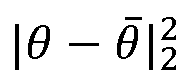
θ , which may improve the stability of the optimization of the writing objective function. The writing objective function in equation (1) is provided for illustrative purposes only, and other writing objective functions are possible. - To store the
data elements 112 in theneural network 102, thewriting system 104 may train theneural network 102 on thedata elements 112 to optimize the writing objective function over one or more iterations using gradient descent. For example, the values θ (t) of the neural network parameters at each iteration t may be given by:

θ denotes the initial values of the neural network parameters, η (t) denotes a learning rate parameter for iteration t, N denotes the number ofdata elements 112 being stored in theneural network 102, and ∇ θ(xi , θ (t)) denotes a gradient of the writing objective function, evaluated for data element xi (i.e., the i-th data element being stored) and parameter values θ (t), with respect to the neural network parameters. The learning rate η (t) scales the gradients of the writing objective function. The values of the neural network parameters after the final iteration of gradient descent may be understood as storing thedata elements 112. In some cases, thewriting system 104 may use an alternative gradient descent optimization rule (i.e., other than the one specified in equation (3)), e.g., a Nesterov momentum gradient descent optimization rule (Nesterov, "A method for solving the convex programming problem with convergence rate O(1/k^2)", Dokl. akad. nauk Sssr, vol. 269, pp. 543-547, 1983). Thewriting system 104 may perform truncated gradient descent, i.e., by performing a predetermined number of gradient descent iterations (e.g., five iterations, or any other appropriate number of iterations) to store thedata elements 112 in the neural network parameters. - In some implementations, the writing system may compute the gradients of the writing objective function (e.g., ∇ θ(xi , θ (t)) in equation (3)) with respect to only a proper subset of the neural network parameters. Moreover, certain terms in the writing objective function (e.g., the gradient term
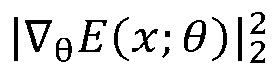

neural network 102. The height of a given neural network layer may refer to the number of intermediate layers between the given neural network layer and the input layer. Updating only a proper subset of the neural network parameters based on the writing objective function may improve the performance of the system, e.g., by enabling the remaining neural network layers to perform feature extraction that is invariant to the data elements stored in the neural network. - The
reading system 106 is used to retrieve (approximate or exact) reconstructions of thedata elements 112 from theneural network 102, i.e., after thewriting system 104 has stored thedata elements 112 in theneural network 102. More specifically, thereading system 106 is configured to process a "query"data element 114 to generate a "retrieved"data element 116. Thequery data element 114 is an incomplete or distorted version of a givendata element 112 stored in theneural network 102, and the retrieveddata element 116 may be an (approximate or exact) reconstruction of the givendata element 112. - To generate a retrieved
data element 116 corresponding to aquery data element 114, thereading system 106 iteratively adjusts thequery data element 114 to optimize an objective function, referred to herein as "reading" objective function. After the last update iteration, thereading system 106 provides the (adjusted)query data element 114 as the retrieveddata element 116. - The reading objective function may encourage the
query data element 114 to minimize (or, alternatively, maximize) the energy value generated by theneural network 102 by processing thequery data element 114. For example, the reading objective function may encourage thequery data element 114 to achieve a local minimum of the energy values generated by theneural network 102. The reading objective function(x) for a query data element x may be given by:

neural network 102 by processing the query data element x in accordance with the neural network parameters θ. The reading objective function in equation (4) is provided for illustrative purposes only, and other reading objective functions are possible. - To generate the retrieved
data element 116, thereading system 106 may iteratively adjust thequery data element 114 to optimize the reading objective function using gradient descent over one or more iterations. The value x (k+1) of the query data element at iteration (k + 1) may be given by:
 (x (k)) denotes a gradient of the reading objective function, evaluated for data element x (k) , with respect to data element x (k). The learning rate γ (k) scales the gradients of the reading objective function. The gradient ∇x(x (k)) may be computed, e.g., by backpropagating a gradient of the reading objective function through the
neural network 102 to the data element x (k) provided as input to theneural network 102. After the last update iteration, thereading system 106 provides the (adjusted)query data element 114 as the retrieveddata element 116. In some cases, thereading system 106 may use an alternative gradient descent optimization rule (i.e., other than the one specified in equation (6)), e.g., a Nesterov momentum gradient descent optimization rule. Thereading system 106 may perform truncated gradient descent, i.e., by performing a predetermined number of gradient descent iterations (e.g., five iterations, or any other appropriate number of iterations) to generate the retrieveddata element 116. - The
writing system 104, as described above, may train theneural network 102 to encourage the storeddata elements 112 to correspond to local minima of the energy values generated by theneural network 102. By iteratively adjusting aquery data element 114 to encourage its energy value to achieve a local minimum, thereading system 106 may cause thequery data element 114 to converge to a corresponding data element stored in theneural network 102.FIG. 2 provides an illustration of the storing data elements in, and subsequently retrieving data elements from, a neural network. - The
writing system 104 and thereading system 106 may perform write/read operations by truncated gradient descent, i.e., by performing a predetermined number of iterations of gradient descent to optimize a writing/reading objective function. The speed of convergence of the truncated gradient descent operations performed by thewriting system 104 and thereading system 106 may be impacted by the values of the system parameters, e.g.: the initial values of the associative memory neural network parameters (i.e., denoted byθ in equation (2)), parameters of the reading system 106 (e.g., the learning rate parameters {γ (k)} referenced in equation (6)), parameters of the writing system (e.g., the learning rate parameters {η (t)} referenced in equation (3)), parameters of the reading objective function, and parameters of the writing objective function (e.g., the α, β parameters referenced in equation (1)). - A training engine can use machine learning training techniques, referred to as "meta-learning" techniques, to train the system parameters to optimize a reconstruction error objective function. The reconstruction error objective function may characterize an error between: (i) input data elements that are written to the
neural network 102, and (ii) corresponding retrieved data elements that are read from theneural network 102, e.g., based on incomplete or distorted versions of the input data elements. For example, the reconstruction error objective functionfor a set of input (training) data elements


reading system 106 by processing
writing system 104 has written the set of input data elements X to theneural network 102. An incomplete or distorted version of a data element may be generated, e.g., by adding random noise to the data element or by masking a portion of the data element. Masking a portion of a data element may refer to replacing a portion of the data element by default (i.e., predefined) data. The reconstruction error objective function in equation (7) is provided for illustrative purposes only, and other reconstruction error objective functions are possible. - The training engine may determine final values of the system parameters by adjusting the values of the system parameters, starting from initial values of the system parameters, over multiple training iterations. The training engine may determine the initial values of the system parameters in any appropriate manner. For example, the training engine may randomly sample the initial values of the neural network parameters from a probability distribution, e.g., a standard Normal distribution.
- Training the system parameters to optimize a reconstruction error objective function may enable the truncated gradient descent operations performed by the
system 100 to converge sufficiently fast to allow data elements to be read from the neural network with an acceptable reconstruction error. An example meta-learning technique that can be used to train the system parameters to optimize a reconstruction error objective function is the model-agnostic meta-learning (MAML) technique described with reference to: Chelsea Finn et al.: "Model-agnostic meta-learning for fast adaptation of deep networks," ICML'17: Proceedings of the 34th International Conference on Machine Learning, Volume 70, August 2017, pages 1126-1135. - The
system 100 can be used in any of a variety of applications. A few example applications of thesystem 100 are described in more detail next. - In one example, the
system 100 may implement image up-scaling operations. In particular, thewriting system 104 may store an input image in theneural network 102, and in response to receiving a query image that is a lower resolution representation of the input image, thereading system 106 may process the query image to generate a reconstruction of the (higher resolution) input image. - In another example, the
system 100 may implement a key-value data store. In particular, thewriting system 104 may store an input data element that includes a "key" and a "value" in theneural network 102. Subsequently, thereading system 106 may process a query data element that includes only the key to generate a reconstruction of the input data element (i.e., including the value). The key and the value can each be image data, or audio data. In some cases, the respective portions of the input data element that correspond to the key and the value do not need to be prespecified. That is, thereading system 106 can receive a query data element that includes an arbitrary portion of an input data element stored in theneural network 102 by thewriting system 104, and can then retrieve the entire input data element from theneural network 102. - In another example, the
system 100 may implement image search operations. In particular, thewriting system 104 may store a set of input images in theneural network 102. Thereading system 106 may process a query image to generate a reconstruction of a given input image that shares one or more characteristics of the query image (e.g., the query image and the given input image may both depict the same person). - In another example, the
system 100 can be used by a reinforcement learning agent being a robotic agent that is interacting with a real-world environment. Thesystem 100 when used by a simulated agent interacting with a simulated environment does not fall within the scope of the claims. The agent uses thewriting system 104 to store experience tuples that each include: (i) an observation characterizing a state of the environment, (ii) an action performed by the agent in response to the observation, and (iii) a reward received by the agent as a result of performing the action. The agent uses the reading system to process a query experience tuple that includes only an observation and an action to generate a complete experience tuple, i.e., including a reconstruction of the reward received as a result of performing the action in response to the observation. The agent uses the complete experience tuple in selecting actions to be performed in response to observations. -
FIG. 2 shows: (i) agraph 202 that illustrates the energy values E(x;θ ) generated by an associative memory neural network in accordance with initial neural network parameter valuesθ , and (ii) a graph 204 that illustrates the energy values E(x; θ) generated by the associative memory neural network in accordance with neural network parameter values θ after the writing system writes the set of data elements {x 1, x 2, x 3} to the associative memory neural network. In each graph, the horizontal axis represents the space of possible data elements and the vertical axis represents energy values generated by the associative memory neural network by processing data elements. Referring to graph 204, it can be appreciated that the data elements written to the associative memory neural network achieve local minima of the energy values generated by the associative memory neural network. - The graph 204 further illustrates a sequence of energy values 206-A-D generated by the associative memory neural network for a
query data element 208 that is provided to a reading system. The reading system iteratively adjusts the query data element by gradient descent to optimize a reading objective function, and in doing so, minimizes the energy value generated by the associative memory neural network by processing the query data element. After a final iteration of gradient descent, the reading system may output the retrieved data element 210 ("read(x ; θ)"); it can be appreciated that the retrieveddata element 116 is closely approximates the stored data element x 3. -
FIG. 3 shows a table that illustrates the evolution of query data elements provided to a reading system, e.g., thereading system 106 described with reference toFIG 1 , over multiple iterations of gradient descent to optimize a reading objective function. Each row of the table shows: aquery data element 302 that is a distorted version of anoriginal data element 304 that was stored in an associative memory neural network by a writing system (e.g., thewriting system 104 ofFIG 1 ) and modified versions of the query data element over five iterations of gradient descent (306-314) performed by the reading system. -
FIG. 4 is a flow diagram of anexample process 400 for reading data elements from an associative memory neural network. For convenience, theprocess 400 will be described as being performed by a system of one or more computers located in one or more locations. For example, an associative memory system, e.g., theassociative memory system 100 ofFIG. 1 , appropriately programmed in accordance with this specification, can perform theprocess 400. - The system receives a query data element (given input) (402).
- The system retrieves a target data element (target input) that is associated with the query data element from the associative memory neural network by performing steps 404 - 408, which are described in more detail next, at each of one or more iterations.
- The system processes the query data element, using the associative memory neural network and in accordance with current values of the associative memory parameters, to generate an energy corresponding to the query data element (404).
- The system determines a gradient of a reading objective function that depends on the energy corresponding to the query data element with respect to the query data element (406).
- The system uses the gradient to adjust the query data element (408).
- If the current iteration is not the final iteration, the system returns to step 404; otherwise, the system provides the query data element as the target data element that is associated with the query data element (410).
-
FIG. 5 is a flow diagram of an example process 500 for writing data elements to an associative memory neural network. For convenience, the process 500 will be described as being performed by a system of one or more computers located in one or more locations. For example, an associative memory system, e.g., theassociative memory system 100 ofFIG. 1 , appropriately programmed in accordance with this specification, can perform the process 500. - The system receives one or more data elements (inputs) to be stored (502).
- The system stores the data elements using the associative memory neural network by performing steps 504-508, which are described in more detail next, at each of one or more iterations.
- The system processes each of the data elements, using an associative memory neural network and in accordance with current values of the associative memory neural network parameters, to generate a respective energy value corresponding to each of the data elements (504).
- The system determines gradients of a writing objective function that depends on the respective energy value corresponding to each of the data elements e.g. with respect to a specified subset of the associative memory neural network parameters (506).
- The system uses the gradients to adjust the current values of the specified subset of the associative memory neural network parameters (508).
- If the current iteration is not the final iteration, the system returns to step 504; otherwise, the system provides the final values of the associative memory neural network parameters (510).
- This specification uses the term "configured" in connection with systems and computer program components. For a system of one or more computers to be configured to perform particular operations or actions means that the system has installed on it software, firmware, hardware, or a combination of them that in operation cause the system to perform the operations or actions. For one or more computer programs to be configured to perform particular operations or actions means that the one or more programs include instructions that, when executed by data processing apparatus, cause the apparatus to perform the operations or actions.
- Embodiments of the subject matter and the functional operations described in this specification can be implemented in digital electronic circuitry, in tangibly-embodied computer software or firmware, in computer hardware, including the structures disclosed in this specification and their structural equivalents, or in combinations of one or more of them. Embodiments of the subject matter described in this specification can be implemented as one or more computer programs, i.e., one or more modules of computer program instructions encoded on a tangible non-transitory storage medium for execution by, or to control the operation of, data processing apparatus. The computer storage medium can be a machine-readable storage device, a machine-readable storage substrate, a random or serial access memory device, or a combination of one or more of them. Alternatively or in addition, the program instructions can be encoded on an artificially-generated propagated signal, e.g., a machine-generated electrical, optical, or electromagnetic signal, that is generated to encode information for transmission to suitable receiver apparatus for execution by a data processing apparatus.
- The term "data processing apparatus" refers to data processing hardware and encompasses all kinds of apparatus, devices, and machines for processing data, including by way of example a programmable processor, a computer, or multiple processors or computers. The apparatus can also be, or further include, special purpose logic circuitry, e.g., an FPGA (field programmable gate array) or an ASIC (application-specific integrated circuit). The apparatus can optionally include, in addition to hardware, code that creates an execution environment for computer programs, e.g., code that constitutes processor firmware, a protocol stack, a database management system, an operating system, or a combination of one or more of them.
- A computer program, which may also be referred to or described as a program, software, a software application, an app, a module, a software module, a script, or code, can be written in any form of programming language, including compiled or interpreted languages, or declarative or procedural languages; and it can be deployed in any form, including as a stand-alone program or as a module, component, subroutine, or other unit suitable for use in a computing environment. A program may, but need not, correspond to a file in a file system. A program can be stored in a portion of a file that holds other programs or data, e.g., one or more scripts stored in a markup language document, in a single file dedicated to the program in question, or in multiple coordinated files, e.g., files that store one or more modules, sub-programs, or portions of code. A computer program can be deployed to be executed on one computer or on multiple computers that are located at one site or distributed across multiple sites and interconnected by a data communication network.
- In this specification the term "engine" is used broadly to refer to a software-based system, subsystem, or process that is programmed to perform one or more specific functions. Generally, an engine will be implemented as one or more software modules or components, installed on one or more computers in one or more locations. In some cases, one or more computers will be dedicated to a particular engine; in other cases, multiple engines can be installed and running on the same computer or computers.
- The processes and logic flows described in this specification can be performed by one or more programmable computers executing one or more computer programs to perform functions by operating on input data and generating output. The processes and logic flows can also be performed by special purpose logic circuitry, e.g., an FPGA or an ASIC, or by a combination of special purpose logic circuitry and one or more programmed computers.
- Computers suitable for the execution of a computer program can be based on general or special purpose microprocessors or both, or any other kind of central processing unit. Generally, a central processing unit will receive instructions and data from a read-only memory or a random access memory or both. The essential elements of a computer are a central processing unit for performing or executing instructions and one or more memory devices for storing instructions and data. The central processing unit and the memory can be supplemented by, or incorporated in, special purpose logic circuitry. Generally, a computer will also include, or be operatively coupled to receive data from or transfer data to, or both, one or more mass storage devices for storing data, e.g., magnetic, magneto-optical disks, or optical disks. However, a computer need not have such devices. Moreover, a computer can be embedded in another device, e.g., a mobile telephone, a personal digital assistant (PDA), a mobile audio or video player, a game console, a Global Positioning System (GPS) receiver, or a portable storage device, e.g., a universal serial bus (USB) flash drive, to name just a few.
- Computer-readable media suitable for storing computer program instructions and data include all forms of non-volatile memory, media and memory devices, including by way of example semiconductor memory devices, e.g., EPROM, EEPROM, and flash memory devices; magnetic disks, e.g., internal hard disks or removable disks; magneto-optical disks; and CD-ROM and DVD-ROM disks.
- To provide for interaction with a user, embodiments of the subject matter described in this specification can be implemented on a computer having a display device, e.g., a CRT (cathode ray tube) or LCD (liquid crystal display) monitor, for displaying information to the user and a keyboard and a pointing device, e.g., a mouse or a trackball, by which the user can provide input to the computer. Other kinds of devices can be used to provide for interaction with a user as well; for example, feedback provided to the user can be any form of sensory feedback, e.g., visual feedback, auditory feedback, or tactile feedback; and input from the user can be received in any form, including acoustic, speech, or tactile input. In addition, a computer can interact with a user by sending documents to and receiving documents from a device that is used by the user; for example, by sending web pages to a web browser on a user's device in response to requests received from the web browser. Also, a computer can interact with a user by sending text messages or other forms of message to a personal device, e.g., a smartphone that is running a messaging application, and receiving responsive messages from the user in return.
- Data processing apparatus for implementing machine learning models can also include, for example, special-purpose hardware accelerator units for processing common and compute-intensive parts of machine learning training or production, i.e., inference, workloads.
- Machine learning models can be implemented and deployed using a machine learning framework, e.g., a TensorFlow framework, a Microsoft Cognitive Toolkit framework, an Apache Singa framework, or an Apache MXNet framework.
- Embodiments of the subject matter described in this specification can be implemented in a computing system that includes a back-end component, e.g., as a data server, or that includes a middleware component, e.g., an application server, or that includes a front-end component, e.g., a client computer having a graphical user interface, a web browser, or an app through which a user can interact with an implementation of the subject matter described in this specification, or any combination of one or more such back-end, middleware, or front-end components. The components of the system can be interconnected by any form or medium of digital data communication, e.g., a communication network. Examples of communication networks include a local area network (LAN) and a wide area network (WAN), e.g., the Internet.
- The computing system can include clients and servers. A client and server are generally remote from each other and typically interact through a communication network. The relationship of client and server arises by virtue of computer programs running on the respective computers and having a client-server relationship to each other. In some embodiments, a server transmits data, e.g., an HTML page, to a user device, e.g., for purposes of displaying data to and receiving user input from a user interacting with the device, which acts as a client. Data generated at the user device, e.g., a result of the user interaction, can be received at the server from the device.
- While this specification contains many specific implementation details, these should not be construed as limitations on the scope of any invention or on the scope of what may be claimed, but rather as descriptions of features that may be specific to particular embodiments of particular inventions. Certain features that are described in this specification in the context of separate embodiments can also be implemented in combination in a single embodiment. Conversely, various features that are described in the context of a single embodiment can also be implemented in multiple embodiments separately or in any suitable subcombination. Moreover, although features may be described above as acting in certain combinations and even initially be claimed as such, one or more features from a claimed combination can in some cases be excised from the combination, and the claimed combination may be directed to a subcombination or variation of a subcombination. However, such combinations form part of the invention only if they fall within the scope of the appended claims.
- Similarly, while operations are depicted in the drawings and recited in the claims in a particular order, this should not be understood as requiring that such operations be performed in the particular order shown or in sequential order, or that all illustrated operations be performed, to achieve desirable results. In certain circumstances, multitasking and parallel processing may be advantageous. Moreover, the separation of various system modules and components in the embodiments described above should not be understood as requiring such separation in all embodiments, and it should be understood that the described program components and systems can generally be integrated together in a single software product or packaged into multiple software products.
- Particular embodiments of the subject matter have been described. Other embodiments are within the scope of the following claims. For example, the actions recited in the claims can be performed in a different order and still achieve desirable results. As one example, the processes depicted in the accompanying figures do not necessarily require the particular order shown, or sequential order, to achieve desirable results. In some cases, multitasking and parallel processing may be advantageous.
Claims (13)
- A system (100) comprising:an associative memory neural network (102) having a plurality of associative memory parameters that is configured to process an input (108) to generate an output that defines an energy (110) corresponding to the input, wherein the associative memory neural network (102) is configured to implement an energy model that has attractors which locally optimize an energy which is represented by a real scalar value and that stores inputs in the associative memory parameters as local optima of the energy model; anda reading subsystem (106) that is configured to perform operations comprising:receiving a given input (114) being a partially known or distorted representation of a target input;retrieving the target input (116) that is associated with the received given input (114) from the associative memory neural network (102) by adjusting the given input (114) using the associative memory neural network (102), comprising, at each of one or more iterations:processing the given input (114), using the associative memory neural network (102) and in accordance with current values of the associative memory parameters, to generate an energy (110) corresponding to the given input (114);determining a gradient of a reading objective function that depends on the energy (110) corresponding to the given input (114) with respect to the given input (114); andusing the gradient to adjust the given input (114); andproviding the given input after a final iteration of the one or more iterations as the target input (116) that is associated with the received given input (114);the system (100) further comprising a writing subsystem (104) that is configured to perform operations comprising:receiving one or more inputs to be stored (112);storing the inputs (112) using the associative memory neural network (102), comprising, at each of one or more iterations:processing each of the inputs (112), using the associative memory neural network (102) and in accordance with current values of the plurality of associative memory parameters, to generate a respective energy (110) corresponding to each of the inputs (112);determining gradients of a writing objective function that depends on the energy (110) corresponding to each of the inputs (112) with respect to a specified subset of the associative memory parameters; andusing the gradients to adjust the current values of the specified subset of the associative memory parameters; andwherein the writing objective function depends on a respective gradient of the energy (110) corresponding to each of the inputs (112) with respect to the specified subset of the associative memory parameters; and wherein the writing objective function depends on a respective magnitude of the gradient of the energy (110) corresponding to each of the inputs (112) with respect to the specified subset of associative memory parameters,wherein either:i) the given input and target input each comprise an image, orii) the given input and target input each comprise digitized audio, oriii) the given input comprises an observation characterizing a state of a real-world environment, and an action performed by a reinforcement learning robotic agent in response to the observation, andthe target input comprises the observation, the action, and a reconstruction of a reward received by the robotic agent as a result of performing the action, and whereinthe observation, the action, and the reconstruction of the reward are used by the reinforcement learning robotic agent in selecting the actions to be performed in response to the observations.
- The system of claim 1, wherein the writing objective function depends on a difference between (i) current values of the specified subset of the associative memory parameters, and (ii) initial values of the specified subset of the associative memory parameters.
- The system of any one of claims 1 and 2, wherein the specified subset of the associative memory parameters is a proper subset of the associative memory parameters; and optionallywherein the specified subset of the associative memory parameters comprises only the associative memory parameters corresponding to a proper subset of a set of neural network layers of the associative memory neural network (102); and optionallywherein the proper subset of the set of neural network layers of the associative memory neural network (102) comprise one or more highest layers of the associative memory neural network (102).
- The system of any preceding claim, wherein the associative memory neural network (102) comprises one or more convolutional neural network layers; and/or
wherein the associative memory neural network (102) comprises one or more recurrent neural network layers. - The system of any preceding claim, wherein using the gradient to adjust the given input (114) by the reading subsystem (106) comprises using the gradient to adjust the given input (114) in accordance with a gradient descent optimization rule by the reading subsystem (106); and optionally
wherein the gradient descent optimization rule is a Nesterov momentum gradient descent optimization rule. - The system of any preceding claim, wherein:the reading subsystem (106) has one or more reading subsystem parameters that are used in retrieving target inputs from the associative memory neural network (102), the writing subsystem (104) has one or more writing subsystem parameters that are used in storing inputs using the associative memory neural network (102), the reading objective function has one or more reading objective function parameters, and the writing objective function has one or more writing objective function parameters; andthe system (100) further comprises a training subsystem that is configured to jointly train the reading subsystem parameters, the writing subsystem parameters, the reading objective function parameters, the writing objective function parameters, and the associative memory parameters based on a reconstruction error objective function using meta-learning techniques.
- The system of claim 6, wherein the reconstruction error objective function characterizes a similarity between: (i) a training input that is stored using the associative memory neural network (102) by the writing subsystem (104), and (ii) a retrieved input that is provided by the reading subsystem (106) as the training input.
- The system of any one of claims 6-7, wherein using reading subsystem parameters in retrieving a target input from the associative memory neural network (102) comprises scaling the gradients of the reading objective function using reading subsystem parameters; and/or
wherein using the writing subsystem parameters to store an input using the associative memory neural network (102) comprises scaling the gradients of the writing objective function using writing subsystem parameters. - The system of any one of claims 6-8, wherein the meta-learning technique is a model-agnostic meta-learning (MAML) technique.
- The system of any preceding claim, wherein the reading subsystem (106) is configured to perform a predetermined number of iterations to retrieve the target input (116) that is associated with the given input (114).
- The system of any preceding claim, wherein the writing subsystem (104) is configured to perform a predetermined number of iterations to store the inputs (112) using the associative memory neural network (102).
- A method performed by one or more data processing apparatus implementing the respective system (100) of any one of claims 1-11 and comprising the operations of the respective implemented system.
- One or more non-transitory computer storage media storing instructions that when executed by one or more computers cause the one or more computers to implement the respective system (100) of any one of claims 1-11 and perform the operations of the respective implemented system.
Applications Claiming Priority (2)
| Application Number | Priority Date | Filing Date | Title |
|---|---|---|---|
| US201962852196P | 2019-05-23 | 2019-05-23 | |
| PCT/EP2020/063971 WO2020234299A1 (en) | 2019-05-23 | 2020-05-19 | Energy-based associative memory neural networks |
Publications (2)
| Publication Number | Publication Date |
|---|---|
| EP3948679A1 EP3948679A1 (en) | 2022-02-09 |
| EP3948679B1 true EP3948679B1 (en) | 2025-07-02 |
Family
ID=70779766
Family Applications (1)
| Application Number | Title | Priority Date | Filing Date |
|---|---|---|---|
| EP20727262.6A Active EP3948679B1 (en) | 2019-05-23 | 2020-05-19 | Energy-based associative memory neural networks |
Country Status (3)
| Country | Link |
|---|---|
| US (1) | US12277487B2 (en) |
| EP (1) | EP3948679B1 (en) |
| WO (1) | WO2020234299A1 (en) |
Citations (1)
| Publication number | Priority date | Publication date | Assignee | Title |
|---|---|---|---|---|
| US20160162805A1 (en) * | 2014-12-03 | 2016-06-09 | Samsung Electronics Co., Ltd. | Method and apparatus for classifying data, and method and apparatus for segmenting region of interest (roi) |
-
2020
- 2020-05-19 WO PCT/EP2020/063971 patent/WO2020234299A1/en not_active Ceased
- 2020-05-19 EP EP20727262.6A patent/EP3948679B1/en active Active
- 2020-05-19 US US17/441,463 patent/US12277487B2/en active Active
Patent Citations (1)
| Publication number | Priority date | Publication date | Assignee | Title |
|---|---|---|---|---|
| US20160162805A1 (en) * | 2014-12-03 | 2016-06-09 | Samsung Electronics Co., Ltd. | Method and apparatus for classifying data, and method and apparatus for segmenting region of interest (roi) |
Non-Patent Citations (1)
| Title |
|---|
| JIANWEN XIE ET AL: "A Theory of Generative ConvNet", ARXIV.ORG, CORNELL UNIVERSITY LIBRARY, 201 OLIN LIBRARY CORNELL UNIVERSITY ITHACA, NY 14853, 10 February 2016 (2016-02-10), XP080682705 * |
Also Published As
| Publication number | Publication date |
|---|---|
| US12277487B2 (en) | 2025-04-15 |
| WO2020234299A1 (en) | 2020-11-26 |
| US20220180147A1 (en) | 2022-06-09 |
| EP3948679A1 (en) | 2022-02-09 |
Similar Documents
| Publication | Publication Date | Title |
|---|---|---|
| US20240242125A1 (en) | Learning data augmentation policies | |
| EP3782080B1 (en) | Neural networks for scalable continual learning in domains with sequentially learned tasks | |
| JP7483751B2 (en) | Training machine learning models using unsupervised data augmentation | |
| EP3398119B1 (en) | Generative neural networks for generating images using a hidden canvas | |
| EP3884426B1 (en) | Action classification in video clips using attention-based neural networks | |
| US20240238967A1 (en) | Domain Adaptation Using Simulation to Simulation Transfer | |
| US20210004677A1 (en) | Data compression using jointly trained encoder, decoder, and prior neural networks | |
| US20240152809A1 (en) | Efficient machine learning model architecture selection | |
| US10824946B2 (en) | Training neural networks using posterior sharpening | |
| US20220230065A1 (en) | Semi-supervised training of machine learning models using label guessing | |
| JP2025534328A (en) | Discrete token processing using diffusion models | |
| WO2023158881A1 (en) | Computationally efficient distillation using generative neural networks | |
| US20240403636A1 (en) | Self-attention based neural networks for processing network inputs from multiple modalities | |
| JP7698093B1 (en) | Reinforcement learning with preference feedback | |
| US20250036958A1 (en) | Training generative neural networks through reinforced self-training | |
| US12277487B2 (en) | Energy-based associative memory neural networks | |
| US20250165756A1 (en) | Resource-efficient diffusion models | |
| US20240289619A1 (en) | Gradient-free structured pruning of neural networks | |
| WO2023121950A1 (en) | Performing classification using post-hoc augmentation | |
| CN119848239A (en) | Medical equipment knowledge interaction method, device, computer equipment and storage medium |
Legal Events
| Date | Code | Title | Description |
|---|---|---|---|
| STAA | Information on the status of an ep patent application or granted ep patent |
Free format text: STATUS: UNKNOWN |
|
| STAA | Information on the status of an ep patent application or granted ep patent |
Free format text: STATUS: THE INTERNATIONAL PUBLICATION HAS BEEN MADE |
|
| PUAI | Public reference made under article 153(3) epc to a published international application that has entered the european phase |
Free format text: ORIGINAL CODE: 0009012 |
|
| STAA | Information on the status of an ep patent application or granted ep patent |
Free format text: STATUS: REQUEST FOR EXAMINATION WAS MADE |
|
| 17P | Request for examination filed |
Effective date: 20211004 |
|
| AK | Designated contracting states |
Kind code of ref document: A1 Designated state(s): AL AT BE BG CH CY CZ DE DK EE ES FI FR GB GR HR HU IE IS IT LI LT LU LV MC MK MT NL NO PL PT RO RS SE SI SK SM TR |
|
| DAV | Request for validation of the european patent (deleted) | ||
| DAX | Request for extension of the european patent (deleted) | ||
| P01 | Opt-out of the competence of the unified patent court (upc) registered |
Effective date: 20230505 |
|
| STAA | Information on the status of an ep patent application or granted ep patent |
Free format text: STATUS: EXAMINATION IS IN PROGRESS |
|
| 17Q | First examination report despatched |
Effective date: 20240813 |
|
| REG | Reference to a national code |
Ref country code: DE Ref legal event code: R079 Free format text: PREVIOUS MAIN CLASS: G06N0003040000 Ipc: G06N0003084000 Ref document number: 602020053779 Country of ref document: DE |
|
| GRAP | Despatch of communication of intention to grant a patent |
Free format text: ORIGINAL CODE: EPIDOSNIGR1 |
|
| STAA | Information on the status of an ep patent application or granted ep patent |
Free format text: STATUS: GRANT OF PATENT IS INTENDED |
|
| RIC1 | Information provided on ipc code assigned before grant |
Ipc: G06N 3/092 20230101ALI20241206BHEP Ipc: G06N 3/088 20230101ALI20241206BHEP Ipc: G06N 3/0464 20230101ALI20241206BHEP Ipc: G06N 3/0442 20230101ALI20241206BHEP Ipc: G06N 5/01 20230101ALI20241206BHEP Ipc: G06N 3/006 20230101ALI20241206BHEP Ipc: G06N 3/084 20230101AFI20241206BHEP |
|
| INTG | Intention to grant announced |
Effective date: 20250109 |
|
| GRAS | Grant fee paid |
Free format text: ORIGINAL CODE: EPIDOSNIGR3 |
|
| GRAA | (expected) grant |
Free format text: ORIGINAL CODE: 0009210 |
|
| STAA | Information on the status of an ep patent application or granted ep patent |
Free format text: STATUS: THE PATENT HAS BEEN GRANTED |
|
| AK | Designated contracting states |
Kind code of ref document: B1 Designated state(s): AL AT BE BG CH CY CZ DE DK EE ES FI FR GB GR HR HU IE IS IT LI LT LU LV MC MK MT NL NO PL PT RO RS SE SI SK SM TR |
|
| REG | Reference to a national code |
Ref country code: GB Ref legal event code: FG4D |
|
| REG | Reference to a national code |
Ref country code: CH Ref legal event code: EP |
|
| REG | Reference to a national code |
Ref country code: DE Ref legal event code: R096 Ref document number: 602020053779 Country of ref document: DE |
|
| REG | Reference to a national code |
Ref country code: IE Ref legal event code: FG4D |
|
| REG | Reference to a national code |
Ref country code: CH Ref legal event code: W10 Free format text: ST27 STATUS EVENT CODE: U-0-0-W10-W00 (AS PROVIDED BY THE NATIONAL OFFICE) Effective date: 20251105 Ref country code: NL Ref legal event code: MP Effective date: 20250702 |
|
| RAP2 | Party data changed (patent owner data changed or rights of a patent transferred) |
Owner name: GDM HOLDING LLC |
|
| PG25 | Lapsed in a contracting state [announced via postgrant information from national office to epo] |
Ref country code: PT Free format text: LAPSE BECAUSE OF FAILURE TO SUBMIT A TRANSLATION OF THE DESCRIPTION OR TO PAY THE FEE WITHIN THE PRESCRIBED TIME-LIMIT Effective date: 20251103 |
|
| PG25 | Lapsed in a contracting state [announced via postgrant information from national office to epo] |
Ref country code: NL Free format text: LAPSE BECAUSE OF FAILURE TO SUBMIT A TRANSLATION OF THE DESCRIPTION OR TO PAY THE FEE WITHIN THE PRESCRIBED TIME-LIMIT Effective date: 20250702 |
|
| REG | Reference to a national code |
Ref country code: AT Ref legal event code: MK05 Ref document number: 1810085 Country of ref document: AT Kind code of ref document: T Effective date: 20250702 |
|
| PG25 | Lapsed in a contracting state [announced via postgrant information from national office to epo] |
Ref country code: IS Free format text: LAPSE BECAUSE OF FAILURE TO SUBMIT A TRANSLATION OF THE DESCRIPTION OR TO PAY THE FEE WITHIN THE PRESCRIBED TIME-LIMIT Effective date: 20251102 |
|
| PG25 | Lapsed in a contracting state [announced via postgrant information from national office to epo] |
Ref country code: NO Free format text: LAPSE BECAUSE OF FAILURE TO SUBMIT A TRANSLATION OF THE DESCRIPTION OR TO PAY THE FEE WITHIN THE PRESCRIBED TIME-LIMIT Effective date: 20251002 |
|
| REG | Reference to a national code |
Ref country code: LT Ref legal event code: MG9D |
|
| PG25 | Lapsed in a contracting state [announced via postgrant information from national office to epo] |
Ref country code: AT Free format text: LAPSE BECAUSE OF FAILURE TO SUBMIT A TRANSLATION OF THE DESCRIPTION OR TO PAY THE FEE WITHIN THE PRESCRIBED TIME-LIMIT Effective date: 20250702 |
|
| PG25 | Lapsed in a contracting state [announced via postgrant information from national office to epo] |
Ref country code: FI Free format text: LAPSE BECAUSE OF FAILURE TO SUBMIT A TRANSLATION OF THE DESCRIPTION OR TO PAY THE FEE WITHIN THE PRESCRIBED TIME-LIMIT Effective date: 20250702 |
|
| PG25 | Lapsed in a contracting state [announced via postgrant information from national office to epo] |
Ref country code: HR Free format text: LAPSE BECAUSE OF FAILURE TO SUBMIT A TRANSLATION OF THE DESCRIPTION OR TO PAY THE FEE WITHIN THE PRESCRIBED TIME-LIMIT Effective date: 20250702 |
|
| PG25 | Lapsed in a contracting state [announced via postgrant information from national office to epo] |
Ref country code: GR Free format text: LAPSE BECAUSE OF FAILURE TO SUBMIT A TRANSLATION OF THE DESCRIPTION OR TO PAY THE FEE WITHIN THE PRESCRIBED TIME-LIMIT Effective date: 20251003 |
|
| PG25 | Lapsed in a contracting state [announced via postgrant information from national office to epo] |
Ref country code: CZ Free format text: LAPSE BECAUSE OF FAILURE TO SUBMIT A TRANSLATION OF THE DESCRIPTION OR TO PAY THE FEE WITHIN THE PRESCRIBED TIME-LIMIT Effective date: 20250702 Ref country code: SE Free format text: LAPSE BECAUSE OF FAILURE TO SUBMIT A TRANSLATION OF THE DESCRIPTION OR TO PAY THE FEE WITHIN THE PRESCRIBED TIME-LIMIT Effective date: 20250702 |
|
| PG25 | Lapsed in a contracting state [announced via postgrant information from national office to epo] |
Ref country code: LV Free format text: LAPSE BECAUSE OF FAILURE TO SUBMIT A TRANSLATION OF THE DESCRIPTION OR TO PAY THE FEE WITHIN THE PRESCRIBED TIME-LIMIT Effective date: 20250702 |
|
| PG25 | Lapsed in a contracting state [announced via postgrant information from national office to epo] |
Ref country code: BG Free format text: LAPSE BECAUSE OF FAILURE TO SUBMIT A TRANSLATION OF THE DESCRIPTION OR TO PAY THE FEE WITHIN THE PRESCRIBED TIME-LIMIT Effective date: 20250702 Ref country code: PL Free format text: LAPSE BECAUSE OF FAILURE TO SUBMIT A TRANSLATION OF THE DESCRIPTION OR TO PAY THE FEE WITHIN THE PRESCRIBED TIME-LIMIT Effective date: 20250702 |
|
| REG | Reference to a national code |
Ref country code: DE Ref legal event code: R081 Ref document number: 602020053779 Country of ref document: DE Owner name: GDM HOLDING LLC (N.D.GES.D.STAATES DELAWARE), , US Free format text: FORMER OWNER: DEEPMIND TECHNOLOGIES LIMITED, LONDON, GB |
|
| PG25 | Lapsed in a contracting state [announced via postgrant information from national office to epo] |
Ref country code: RS Free format text: LAPSE BECAUSE OF FAILURE TO SUBMIT A TRANSLATION OF THE DESCRIPTION OR TO PAY THE FEE WITHIN THE PRESCRIBED TIME-LIMIT Effective date: 20251002 |
|
| PG25 | Lapsed in a contracting state [announced via postgrant information from national office to epo] |
Ref country code: ES Free format text: LAPSE BECAUSE OF FAILURE TO SUBMIT A TRANSLATION OF THE DESCRIPTION OR TO PAY THE FEE WITHIN THE PRESCRIBED TIME-LIMIT Effective date: 20250702 |
|
| PG25 | Lapsed in a contracting state [announced via postgrant information from national office to epo] |
Ref country code: SM Free format text: LAPSE BECAUSE OF FAILURE TO SUBMIT A TRANSLATION OF THE DESCRIPTION OR TO PAY THE FEE WITHIN THE PRESCRIBED TIME-LIMIT Effective date: 20250702 |
|
| PG25 | Lapsed in a contracting state [announced via postgrant information from national office to epo] |
Ref country code: DK Free format text: LAPSE BECAUSE OF FAILURE TO SUBMIT A TRANSLATION OF THE DESCRIPTION OR TO PAY THE FEE WITHIN THE PRESCRIBED TIME-LIMIT Effective date: 20250702 |
|
| PG25 | Lapsed in a contracting state [announced via postgrant information from national office to epo] |
Ref country code: IT Free format text: LAPSE BECAUSE OF FAILURE TO SUBMIT A TRANSLATION OF THE DESCRIPTION OR TO PAY THE FEE WITHIN THE PRESCRIBED TIME-LIMIT Effective date: 20250702 |
|
| PG25 | Lapsed in a contracting state [announced via postgrant information from national office to epo] |
Ref country code: EE Free format text: LAPSE BECAUSE OF FAILURE TO SUBMIT A TRANSLATION OF THE DESCRIPTION OR TO PAY THE FEE WITHIN THE PRESCRIBED TIME-LIMIT Effective date: 20250702 Ref country code: SK Free format text: LAPSE BECAUSE OF FAILURE TO SUBMIT A TRANSLATION OF THE DESCRIPTION OR TO PAY THE FEE WITHIN THE PRESCRIBED TIME-LIMIT Effective date: 20250702 |
|
| PLBE | No opposition filed within time limit |
Free format text: ORIGINAL CODE: 0009261 |
|
| STAA | Information on the status of an ep patent application or granted ep patent |
Free format text: STATUS: NO OPPOSITION FILED WITHIN TIME LIMIT |