EP3945449A1 - Rfid transponder having modifiable settings - Google Patents
Rfid transponder having modifiable settings Download PDFInfo
- Publication number
- EP3945449A1 EP3945449A1 EP20187996.2A EP20187996A EP3945449A1 EP 3945449 A1 EP3945449 A1 EP 3945449A1 EP 20187996 A EP20187996 A EP 20187996A EP 3945449 A1 EP3945449 A1 EP 3945449A1
- Authority
- EP
- European Patent Office
- Prior art keywords
- rfid
- settings
- command
- transponder
- rfid transponder
- Prior art date
- Legal status (The legal status is an assumption and is not a legal conclusion. Google has not performed a legal analysis and makes no representation as to the accuracy of the status listed.)
- Granted
Links
Images



Classifications
-
- G—PHYSICS
- G06—COMPUTING OR CALCULATING; COUNTING
- G06K—GRAPHICAL DATA READING; PRESENTATION OF DATA; RECORD CARRIERS; HANDLING RECORD CARRIERS
- G06K7/00—Methods or arrangements for sensing record carriers, e.g. for reading patterns
- G06K7/0008—General problems related to the reading of electronic memory record carriers, independent of its reading method, e.g. power transfer
-
- G—PHYSICS
- G06—COMPUTING OR CALCULATING; COUNTING
- G06K—GRAPHICAL DATA READING; PRESENTATION OF DATA; RECORD CARRIERS; HANDLING RECORD CARRIERS
- G06K7/00—Methods or arrangements for sensing record carriers, e.g. for reading patterns
- G06K7/10—Methods or arrangements for sensing record carriers, e.g. for reading patterns by electromagnetic radiation, e.g. optical sensing; by corpuscular radiation
- G06K7/10009—Methods or arrangements for sensing record carriers, e.g. for reading patterns by electromagnetic radiation, e.g. optical sensing; by corpuscular radiation sensing by radiation using wavelengths larger than 0.1 mm, e.g. radio-waves or microwaves
- G06K7/10198—Methods or arrangements for sensing record carriers, e.g. for reading patterns by electromagnetic radiation, e.g. optical sensing; by corpuscular radiation sensing by radiation using wavelengths larger than 0.1 mm, e.g. radio-waves or microwaves setting parameters for the interrogator, e.g. programming parameters and operating modes
-
- G—PHYSICS
- G06—COMPUTING OR CALCULATING; COUNTING
- G06K—GRAPHICAL DATA READING; PRESENTATION OF DATA; RECORD CARRIERS; HANDLING RECORD CARRIERS
- G06K17/00—Methods or arrangements for effecting co-operative working between equipments covered by two or more of main groups G06K1/00 - G06K15/00, e.g. automatic card files incorporating conveying and reading operations
- G06K17/0022—Methods or arrangements for effecting co-operative working between equipments covered by two or more of main groups G06K1/00 - G06K15/00, e.g. automatic card files incorporating conveying and reading operations arrangements or provisions for transferring data to distant stations, e.g. from a sensing device
- G06K17/0029—Methods or arrangements for effecting co-operative working between equipments covered by two or more of main groups G06K1/00 - G06K15/00, e.g. automatic card files incorporating conveying and reading operations arrangements or provisions for transferring data to distant stations, e.g. from a sensing device the arrangement being specially adapted for wireless interrogation of grouped or bundled articles tagged with wireless record carriers
-
- G—PHYSICS
- G06—COMPUTING OR CALCULATING; COUNTING
- G06K—GRAPHICAL DATA READING; PRESENTATION OF DATA; RECORD CARRIERS; HANDLING RECORD CARRIERS
- G06K19/00—Record carriers for use with machines and with at least a part designed to carry digital markings
- G06K19/06—Record carriers for use with machines and with at least a part designed to carry digital markings characterised by the kind of the digital marking, e.g. shape, nature, code
- G06K19/067—Record carriers with conductive marks, printed circuits or semiconductor circuit elements, e.g. credit or identity cards also with resonating or responding marks without active components
- G06K19/07—Record carriers with conductive marks, printed circuits or semiconductor circuit elements, e.g. credit or identity cards also with resonating or responding marks without active components with integrated circuit chips
- G06K19/0723—Record carriers with conductive marks, printed circuits or semiconductor circuit elements, e.g. credit or identity cards also with resonating or responding marks without active components with integrated circuit chips the record carrier comprising an arrangement for non-contact communication, e.g. wireless communication circuits on transponder cards, non-contact smart cards or RFIDs
-
- G—PHYSICS
- G06—COMPUTING OR CALCULATING; COUNTING
- G06K—GRAPHICAL DATA READING; PRESENTATION OF DATA; RECORD CARRIERS; HANDLING RECORD CARRIERS
- G06K7/00—Methods or arrangements for sensing record carriers, e.g. for reading patterns
- G06K7/10—Methods or arrangements for sensing record carriers, e.g. for reading patterns by electromagnetic radiation, e.g. optical sensing; by corpuscular radiation
- G06K7/10009—Methods or arrangements for sensing record carriers, e.g. for reading patterns by electromagnetic radiation, e.g. optical sensing; by corpuscular radiation sensing by radiation using wavelengths larger than 0.1 mm, e.g. radio-waves or microwaves
- G06K7/10257—Methods or arrangements for sensing record carriers, e.g. for reading patterns by electromagnetic radiation, e.g. optical sensing; by corpuscular radiation sensing by radiation using wavelengths larger than 0.1 mm, e.g. radio-waves or microwaves arrangements for protecting the interrogation against piracy attacks
-
- G—PHYSICS
- G06—COMPUTING OR CALCULATING; COUNTING
- G06K—GRAPHICAL DATA READING; PRESENTATION OF DATA; RECORD CARRIERS; HANDLING RECORD CARRIERS
- G06K7/00—Methods or arrangements for sensing record carriers, e.g. for reading patterns
- G06K7/10—Methods or arrangements for sensing record carriers, e.g. for reading patterns by electromagnetic radiation, e.g. optical sensing; by corpuscular radiation
- G06K7/10009—Methods or arrangements for sensing record carriers, e.g. for reading patterns by electromagnetic radiation, e.g. optical sensing; by corpuscular radiation sensing by radiation using wavelengths larger than 0.1 mm, e.g. radio-waves or microwaves
- G06K7/10297—Methods or arrangements for sensing record carriers, e.g. for reading patterns by electromagnetic radiation, e.g. optical sensing; by corpuscular radiation sensing by radiation using wavelengths larger than 0.1 mm, e.g. radio-waves or microwaves arrangements for handling protocols designed for non-contact record carriers such as RFIDs NFCs, e.g. ISO/IEC 14443 and 18092
-
- G—PHYSICS
- G06—COMPUTING OR CALCULATING; COUNTING
- G06K—GRAPHICAL DATA READING; PRESENTATION OF DATA; RECORD CARRIERS; HANDLING RECORD CARRIERS
- G06K7/00—Methods or arrangements for sensing record carriers, e.g. for reading patterns
- G06K7/10—Methods or arrangements for sensing record carriers, e.g. for reading patterns by electromagnetic radiation, e.g. optical sensing; by corpuscular radiation
- G06K7/10009—Methods or arrangements for sensing record carriers, e.g. for reading patterns by electromagnetic radiation, e.g. optical sensing; by corpuscular radiation sensing by radiation using wavelengths larger than 0.1 mm, e.g. radio-waves or microwaves
- G06K7/10316—Methods or arrangements for sensing record carriers, e.g. for reading patterns by electromagnetic radiation, e.g. optical sensing; by corpuscular radiation sensing by radiation using wavelengths larger than 0.1 mm, e.g. radio-waves or microwaves using at least one antenna particularly designed for interrogating the wireless record carriers
- G06K7/10346—Methods or arrangements for sensing record carriers, e.g. for reading patterns by electromagnetic radiation, e.g. optical sensing; by corpuscular radiation sensing by radiation using wavelengths larger than 0.1 mm, e.g. radio-waves or microwaves using at least one antenna particularly designed for interrogating the wireless record carriers the antenna being of the far field type, e.g. HF types or dipoles
Definitions
- the present disclosure relates to a radio frequency identification (RFID) transponder. Furthermore, the present disclosure relates to a corresponding method of operating an RFID transponder.
- RFID radio frequency identification
- RFID transponders are widely used, in different areas of industry and commerce and for various purposes.
- RFID transponders may for example be embodied as so-called RFID tags or RFID cards.
- NFC near field communication
- RFID transponders are regarded as a specific type of RFID transponders.
- the principles described herein may also be applied to NFC transponders.
- RFID transponders may have predefined settings in order to meet, for example, safety regulations in various countries or regions around the world. Such predefined settings may be difficult to change, resulting in a limited functionality that can be offered by RFID transponders of the kind set forth.
- a radio frequency identification (RFID) transponder comprising: a receiver configured to receive a command from an external RFID reader, wherein the command is a first command transmitted by the RFID reader during a communication session and wherein said command comprises a at least one parameter indicative of one or more modifiable settings of the RFID transponder; and a controller configured to modify the settings of the RFID transponder in accordance with a value of said parameter.
- RFID radio frequency identification
- the parameter is specific to a predefined country or geographical region.
- the command is a broadcast command.
- the modifiable settings include hardware settings of the RFID transponder.
- the hardware settings include transmitter settings and/or receiver settings.
- the hardware settings include modulator settings.
- the hardware settings include voltage limiter settings.
- the hardware settings include charge pump settings.
- the modifiable settings include settings indicative of an internal state of the RFID transponder.
- the modifiable settings include a frequency bandwidth in which the RFID transponder operates.
- the RFID transponder is an RFID tag or an RFID card.
- a communication system comprises an RFID transponder of the kind set forth and the RFID reader, wherein said RFID reader is configured to transmit the command to the RFID transponder.
- a method of operating a radio frequency identification (RFID) transponder comprising: receiving, by a receiver comprised in the RFID transponder, a command from an external RFID reader, wherein the command is a first command transmitted by the RFID reader during a communication session and wherein said command comprises a at least one parameter indicative of one or more modifiable settings of the RFID transponder; and modifying, by a controller comprised in the RFID transponder, the settings of the RFID transponder in accordance with a value of said parameter.
- RFID radio frequency identification
- the parameter is specific to a predefined country or geographical region.
- the command is a broadcast command.
- RFID transponders are widely used, in different areas of industry and commerce and for various purposes.
- RFID transponders may for example be embodied as so-called RFID tags or RFID cards.
- NFC near field communication
- RFID transponders are regarded as a specific type of RFID transponders.
- the principles described herein may also be applied to NFC transponders.
- RFID transponders may have predefined settings in order to meet, for example, safety regulations in various countries or regions around the world. Such predefined settings may be difficult to change, resulting in a limited functionality that can be offered by RFID transponders of the kind set forth.
- RFID communication may be based, for example, on inductive coupling, capacitive coupling or radiative coupling.
- the communication between an RFID reader and an RFID transponder, such as an RFID tag is often realized by means of load modulation and can be split into a forward link and a return link. More specifically, the RFID reader may transmit commands to the RFID transponder through a forward link, and the RFID transponder may transmit responses to those commands back to the RFID reader through a return link.
- the RFID transponder contains a modulator, which load modulates a carrier signal. Different types of load modulation exist, for example active load modulation (ALM) and passive load modulation (PLM).
- ALM active load modulation
- PLM passive load modulation
- the return link may also be referred to as a backscatter signal or more concisely as "backscatter”.
- RFID transponders may have predefined settings which are difficult to change. For instance, all wireless products have to ensure that country-specific regulations are met. Typically this is achieved by a specific country-dependent user configuration, a country-specific hardware configuration, or by limiting the power to a level which fulfills all regulations (i.e., in the USA, UHF regulations allow 3dB - two times - more power). This may result in an overhead in terms of development effort. Furthermore, in order to meet all regulations the performance of the device may be negatively affected, in particular in circumstances in which strict rules do not apply. Furthermore, a user may still be able to change the configuration and thereby violate a regulation. As an example, in RFID systems tags are typically designed to fulfill worldwide requirements (i.e., country regulations as well as reader-specific requirements. This may result in a non-optimal performance as well as an increased customer effect to ensure that all requirements are met.
- worldwide requirements i.e., country regulations as well as reader-specific requirements. This may result in a non-optimal performance as well as an increased customer
- Fig. 1 shows an illustrative embodiment of an RFID transponder 100.
- the RFID transponder 100 includes a receiver 102 and a controller 104.
- the receiver 102 is configured to receive a command from an external RFID reader (not shown), wherein the command is a first command transmitted by the RFID reader during a communication session and wherein said command comprises at least one parameter indicative of one or more modifiable settings of the RFID transponder 100.
- the controller 104 is configured to modify the settings of the RFID transponder 100 in accordance with a value of said parameter. In this way, the settings can easily be modified to achieve a trade-off between performance and compliance with various regulations. More specifically, the settings can be modified at the beginning of a communication session between the RFID reader and the RFID transponder.
- the parameter is specific to a predefined country or geographical region. In this way, the compliance with country-specific or region-specific regulations can be ensured.
- the command is a broadcast command. In this way, the RFID transponder can easily be managed by a broadcasting reader. As mentioned above, the broadcast is effectively the first command sent by the RFID reader during a communication session.
- the modifiable settings include hardware settings of the RFID transponder.
- the hardware settings include transmitter settings and/or receiver settings. It is noted that the transmitter and receiver of a transponder may also be combined in a single unit referred to as a transceiver. In that case, the hardware settings may include transceiver settings. Furthermore, it is noted that the transmitter settings and/or receiver settings can easily be modified.
- the strength of the signal transmitted by the RFID transponder's transmitter can be limited by the controller, to avoid that the signal strength exceeds a prescribed maximum strength.
- the transmitter includes the transistors or devices for enabling communication with the RFID reader, such as the back modulator or the amplifier of the RFID transponder.
- the hardware settings include modulator settings. By modifying the settings of the RFID transponder's modulator, for instance the modulation strength, the compliance with regulations and requirements of the kind set forth may be further facilitated. Furthermore, the hardware settings may include voltage limiter settings and/or charge pump settings. The modification of these settings further facilitates the aforementioned compliance with various regulations and requirements.
- the modifiable settings include settings indicative of an internal state of the RFID transponder.
- modifying settings indicative of the internal state may include changing the configuration of a state machine, for example by applying other states and/or combinations of states. In this way, the operation of the RFID transponder can easily be adapted.
- the modifiable settings include a frequency bandwidth in which the RFID transponder operates. Country-specific or region-specific regulations often prescribe a frequency bandwidth in which an RFID transponder should operate. Thus, in accordance with the present disclosure, this frequency bandwidth may easily be adjusted in response to receiving a command which carries information about the country or regions in which the RFID transponder should operate.
- the RFID transponder is an RFID tag or an RFID card.
- Fig. 2 shows an illustrative embodiment of a method 200 of operating an RFID transponder.
- the method 200 comprises the following steps: at 202, receiving, by a receiver comprised in an RFID transponder, a command from an external RFID reader, wherein said command comprises at least one parameter indicative of one or more modifiable settings of the RFID transponder, and at 204, modifying, by a controller comprised in the RFID transponder, the settings of the RFID transponder in accordance with a value of said parameter.
- the settings can easily be modified to achieve a trade-off between performance and compliance with various regulations.
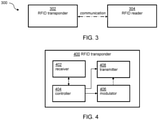
- Fig. 3 shows an illustrative embodiment of a communication system 300.
- the communication system 300 comprises an RFID transponder 302 of the kind set forth and an RFID reader 304.
- the RFID reader 304 is configured to transmit a command to the RFID transponder.
- said command comprises a parameter indicative of one or more modifiable settings of the RFID transponder 302.
- the RFID transponder 302 comprises a receiver (not shown) configured to receive the command.
- the RFID transponder 302 comprises a controller (not shown) configured to modify the settings of the RFID transponder 302 in accordance with a value of said parameter.
- Fig. 4 shows another illustrative embodiment of an RFID transponder 400.
- the RFID transponder 400 comprises a receiver 402, a controller 404, a modulator 406 and a transmitter 408.
- the receiver 402 is configured to receive a command from an external RFID reader (not shown).
- the command comprises a parameter indicative of one or more modifiable settings of the RFID transponder 400.
- the controller 404 is configured to modify the settings of the RFID transponder 400 in accordance with a value of said parameter.
- the parameter may indicate a maximum modulation strength of the transponder 400, a maximum strength of signals transmitted by the transmitter 408, and/or charge pump settings that influence the extent to which a voltage derived from a signal received by the receiver 402 is boosted by a charge pump (not shown).
- the charge pump settings may define the number of charge pump stages that are used to boost said voltage.
- the charge pump may be integrated into the receiver 402, in which case the charge pump settings may be regarded as a specific example of modifiable receiver settings.
- the controller 404 may change the modulation strength of the transponder 400 by controlling the transmitter 408.
- the modulator 406 typically generates a modulation pattern, while the transmitter 408 performs signal shaping and level shifting and thus regulates the strength of the transmitted, modulated signal.
- the controller 404 may control the transmitter 408 in such a way that the transmitter 408 does not transmit signals that exceed a predefined maximum signal strength, provided that such a maximum signal strength is directly specified by the parameter. Accordingly, both a specified maximum modulation strength and a specified maximum signal strength may trigger the controller 404 to cause the transmitter 408 to reduce the strength of the transmitted signals.
- Fig. 5 shows an illustrative embodiment of a command transmission 500.
- a transmitter 502 on the reader side broadcasts a command 506, which is received by a receiver 504 on the transponder side.
- the transponder may for example be a ultra-high frequency (UHF) RFID transponder.
- the broadcast command 506 is a first command sent by the transmitter 502 during a communication session, and it includes a settings parameter, i.e. a parameter indicative of one or more modifiable settings of the RFID transponder.
- the settings parameter may be indicative of country-specific or region-specific settings, or settings specific to a particular type of reader or application.
- the broadcast command 506 may be a first command in a communication session between the reader and the transponder, according to a predefined communication protocol.
- the first command may be an uncoded command or a coded command.
- coding a command may include encrypting a command or applying a cover code to the command.
- the receiver 504 may decode the command including the settings parameter, or merely extract the settings parameter from the command if the command is uncoded.
- a controller of the transponder may modify or configure for example the hardware settings, internal state, return link strength, charge pump state and/or another device setting in dependence on the value of the settings parameter. The modified settings may then be retained until the next communication session, for example.
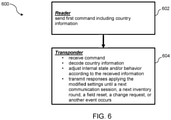
- Fig. 6 shows an illustrative embodiment of a transponder settings modification 600.
- the settings modification 600 includes sending 602, by a reader, a first command of a communication session with a transponder.
- the first command includes country information, i.e. a settings parameter which is indicative of country-specific settings of the transponder.
- the settings modification 600 includes various steps 604 performed by the transponder. These steps 604 include receiving the command, decoding or extracting the country information, adjusting the internal state and/or transponder behavior (e.g. as influenced by hardware settings of the transponder) according to the received information, and transmitting responses to the reader while applying the modified settings until a next communication session, a next inventory round, a field reset, a change request, or another event occurs.
- Fig. 7A shows an illustrative embodiment of a UHF RFID tag settings modification 700.
- the settings modification 700 includes sending 702, by a reader, a first command of a communication session with a transponder.
- the first command includes information that the system operates in the United States of America.
- the settings modification 700 includes various steps 704 performed by the transponder. These steps 704 include receiving the command, decoding or extracting the country information, adjusting the backscatter strength and the voltage limiter strength to fulfill USA-specific limitations, and transmitting responses to the reader while applying the modified settings until a next communication session, a next inventory round, a field reset, a change request, or another event occurs.
- Fig. 7B shows another illustrative embodiment of a UHF RFID tag settings modification 706.
- the settings modification 706 includes sending 708, by a reader, a first command of a communication session with a transponder.
- the first command includes information that the system operates in the European Union.
- the settings modification 706 includes various steps 710 performed by the transponder. These steps 710 include receiving the command, decoding or extracting the country information, adjusting backscatter strength (i.e., reducing the strength) to fulfill EU-specific limitations, and transmitting responses to the reader while applying the modified setting until a next communication session, a next inventory round, a field reset, a change request, or another event occurs.
- backscatter strength i.e., reducing the strength
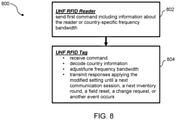
- Fig. 8 shows a further illustrative embodiment of a UHF RFID tag settings modification 800.
- the settings modification 800 includes sending 802, by a reader, a first command of a communication session with a transponder.
- the first command includes information about the reader (e.g., technical specifications) or a country-specific frequency bandwidth.
- the settings modification 800 includes various steps 804 performed by the transponder. These steps 804 include receiving the command, decoding or extracting the reader-specific or country-specific information, adjusting or tuning the frequency bandwidth in accordance with said information, and transmitting responses to the reader while applying the modified setting until a next communication session, a next inventory round, a field reset, a change request, or another event occurs.
Landscapes
- Engineering & Computer Science (AREA)
- Physics & Mathematics (AREA)
- Toxicology (AREA)
- Health & Medical Sciences (AREA)
- General Physics & Mathematics (AREA)
- Theoretical Computer Science (AREA)
- Artificial Intelligence (AREA)
- Computer Vision & Pattern Recognition (AREA)
- General Health & Medical Sciences (AREA)
- Electromagnetism (AREA)
- Computer Networks & Wireless Communication (AREA)
- Computer Security & Cryptography (AREA)
- Computer Hardware Design (AREA)
- Microelectronics & Electronic Packaging (AREA)
- General Engineering & Computer Science (AREA)
- Near-Field Transmission Systems (AREA)
Abstract
Description
- The present disclosure relates to a radio frequency identification (RFID) transponder. Furthermore, the present disclosure relates to a corresponding method of operating an RFID transponder.
- Nowadays, radio frequency identification (RFID) transponders are widely used, in different areas of industry and commerce and for various purposes. RFID transponders may for example be embodied as so-called RFID tags or RFID cards. It is noted that, in the present disclosure, near field communication (NFC) transponders are regarded as a specific type of RFID transponders. Thus, the principles described herein may also be applied to NFC transponders. RFID transponders may have predefined settings in order to meet, for example, safety regulations in various countries or regions around the world. Such predefined settings may be difficult to change, resulting in a limited functionality that can be offered by RFID transponders of the kind set forth.
- In accordance with a first aspect of the present disclosure, a radio frequency identification (RFID) transponder is provided, comprising: a receiver configured to receive a command from an external RFID reader, wherein the command is a first command transmitted by the RFID reader during a communication session and wherein said command comprises a at least one parameter indicative of one or more modifiable settings of the RFID transponder; and a controller configured to modify the settings of the RFID transponder in accordance with a value of said parameter.
- In one or more embodiments, the parameter is specific to a predefined country or geographical region.
- In one or more embodiments, the command is a broadcast command.
- In one or more embodiments, the modifiable settings include hardware settings of the RFID transponder.
- In one or more embodiments, the hardware settings include transmitter settings and/or receiver settings.
- In one or more embodiments, the hardware settings include modulator settings.
- In one or more embodiments, the hardware settings include voltage limiter settings.
- In one or more embodiments, the hardware settings include charge pump settings.
- In one or more embodiments, the modifiable settings include settings indicative of an internal state of the RFID transponder.
- In one or more embodiments, the modifiable settings include a frequency bandwidth in which the RFID transponder operates.
- In one or more embodiments, the RFID transponder is an RFID tag or an RFID card.
- In one or more embodiments, a communication system comprises an RFID transponder of the kind set forth and the RFID reader, wherein said RFID reader is configured to transmit the command to the RFID transponder.
- In accordance with a second aspect of the present disclosure, a method of operating a radio frequency identification (RFID) transponder is conceived, comprising: receiving, by a receiver comprised in the RFID transponder, a command from an external RFID reader, wherein the command is a first command transmitted by the RFID reader during a communication session and wherein said command comprises a at least one parameter indicative of one or more modifiable settings of the RFID transponder; and modifying, by a controller comprised in the RFID transponder, the settings of the RFID transponder in accordance with a value of said parameter.
- In one or more embodiments, the parameter is specific to a predefined country or geographical region.
- In one or more embodiments, the command is a broadcast command.
- Embodiments will be described in more detail with reference to the appended drawings, in which:
-
Fig. 1 shows an illustrative embodiment of an RFID transponder; -
Fig. 2 shows an illustrative embodiment of a method of operating an RFID transponder; -
Fig. 3 shows an illustrative embodiment of a communication system; -
Fig. 4 shows another illustrative embodiment of an RFID transponder; -
Fig. 5 shows an illustrative embodiment of a command transmission; -
Fig. 6 shows an illustrative embodiment of a transponder settings modification; -
Fig. 7A shows an illustrative embodiment of a UHF RFID tag settings modification; -
Fig. 7B shows another illustrative embodiment of a UHF RFID tag settings modification; -
Fig. 8 shows a further illustrative embodiment of a UHF RFID tag settings modification. - Nowadays, radio frequency identification (RFID) transponders are widely used, in different areas of industry and commerce and for various purposes. RFID transponders may for example be embodied as so-called RFID tags or RFID cards. It is noted that, in the present disclosure, near field communication (NFC) transponders are regarded as a specific type of RFID transponders. Thus, the principles described herein may also be applied to NFC transponders. RFID transponders may have predefined settings in order to meet, for example, safety regulations in various countries or regions around the world. Such predefined settings may be difficult to change, resulting in a limited functionality that can be offered by RFID transponders of the kind set forth.
- RFID communication may be based, for example, on inductive coupling, capacitive coupling or radiative coupling. The communication between an RFID reader and an RFID transponder, such as an RFID tag, is often realized by means of load modulation and can be split into a forward link and a return link. More specifically, the RFID reader may transmit commands to the RFID transponder through a forward link, and the RFID transponder may transmit responses to those commands back to the RFID reader through a return link. The RFID transponder contains a modulator, which load modulates a carrier signal. Different types of load modulation exist, for example active load modulation (ALM) and passive load modulation (PLM). The return link may also be referred to as a backscatter signal or more concisely as "backscatter".
- As mentioned above, RFID transponders may have predefined settings which are difficult to change. For instance, all wireless products have to ensure that country-specific regulations are met. Typically this is achieved by a specific country-dependent user configuration, a country-specific hardware configuration, or by limiting the power to a level which fulfills all regulations (i.e., in the USA, UHF regulations allow 3dB - two times - more power). This may result in an overhead in terms of development effort. Furthermore, in order to meet all regulations the performance of the device may be negatively affected, in particular in circumstances in which strict rules do not apply. Furthermore, a user may still be able to change the configuration and thereby violate a regulation. As an example, in RFID systems tags are typically designed to fulfill worldwide requirements (i.e., country regulations as well as reader-specific requirements. This may result in a non-optimal performance as well as an increased customer effect to ensure that all requirements are met.
-
Fig. 1 shows an illustrative embodiment of anRFID transponder 100. TheRFID transponder 100 includes areceiver 102 and acontroller 104. Thereceiver 102 is configured to receive a command from an external RFID reader (not shown), wherein the command is a first command transmitted by the RFID reader during a communication session and wherein said command comprises at least one parameter indicative of one or more modifiable settings of theRFID transponder 100. Furthermore, thecontroller 104 is configured to modify the settings of theRFID transponder 100 in accordance with a value of said parameter. In this way, the settings can easily be modified to achieve a trade-off between performance and compliance with various regulations. More specifically, the settings can be modified at the beginning of a communication session between the RFID reader and the RFID transponder. In other words, all responses transmitted by the RFID transponders will be transmitted using the modified settings, until for instance the settings are modified again at the beginning of the next communication session. Since the command is the first command sent by the RFID reader during a communication session, it effectively initiates the communication session and ensures that the correct settings are used during the entire session. Accordingly, in this way, the performance of the RFID transponder may be optimized during the whole communication session. - In one or more embodiments, the parameter is specific to a predefined country or geographical region. In this way, the compliance with country-specific or region-specific regulations can be ensured. Furthermore, in a practical implementation, the command is a broadcast command. In this way, the RFID transponder can easily be managed by a broadcasting reader. As mentioned above, the broadcast is effectively the first command sent by the RFID reader during a communication session.
- In one or more embodiments, the modifiable settings include hardware settings of the RFID transponder. By modifying hardware settings of the RFID transponder, the compliance with regulations or other requirements (such as technical requirements on the RFID transponders imposed by the reader infrastructure, for example) may be easily ensured. In a practical implementation, the hardware settings include transmitter settings and/or receiver settings. It is noted that the transmitter and receiver of a transponder may also be combined in a single unit referred to as a transceiver. In that case, the hardware settings may include transceiver settings. Furthermore, it is noted that the transmitter settings and/or receiver settings can easily be modified. For instance, the strength of the signal transmitted by the RFID transponder's transmitter can be limited by the controller, to avoid that the signal strength exceeds a prescribed maximum strength. In the context of the present disclosure, the transmitter includes the transistors or devices for enabling communication with the RFID reader, such as the back modulator or the amplifier of the RFID transponder.
- Furthermore, in one or more embodiments, the hardware settings include modulator settings. By modifying the settings of the RFID transponder's modulator, for instance the modulation strength, the compliance with regulations and requirements of the kind set forth may be further facilitated. Furthermore, the hardware settings may include voltage limiter settings and/or charge pump settings. The modification of these settings further facilitates the aforementioned compliance with various regulations and requirements.
- In one or more embodiments, the modifiable settings include settings indicative of an internal state of the RFID transponder. In the context of the present disclosure, modifying settings indicative of the internal state may include changing the configuration of a state machine, for example by applying other states and/or combinations of states. In this way, the operation of the RFID transponder can easily be adapted. Furthermore, in one or more embodiments, the modifiable settings include a frequency bandwidth in which the RFID transponder operates. Country-specific or region-specific regulations often prescribe a frequency bandwidth in which an RFID transponder should operate. Thus, in accordance with the present disclosure, this frequency bandwidth may easily be adjusted in response to receiving a command which carries information about the country or regions in which the RFID transponder should operate. In a practical implementation, the RFID transponder is an RFID tag or an RFID card.
-
Fig. 2 shows an illustrative embodiment of amethod 200 of operating an RFID transponder. Themethod 200 comprises the following steps: at 202, receiving, by a receiver comprised in an RFID transponder, a command from an external RFID reader, wherein said command comprises at least one parameter indicative of one or more modifiable settings of the RFID transponder, and at 204, modifying, by a controller comprised in the RFID transponder, the settings of the RFID transponder in accordance with a value of said parameter. As mentioned above, in this way, the settings can easily be modified to achieve a trade-off between performance and compliance with various regulations. -
Fig. 3 shows an illustrative embodiment of acommunication system 300. Thecommunication system 300 comprises anRFID transponder 302 of the kind set forth and anRFID reader 304. TheRFID reader 304 is configured to transmit a command to the RFID transponder. In accordance with the present disclosure, said command comprises a parameter indicative of one or more modifiable settings of theRFID transponder 302. TheRFID transponder 302 comprises a receiver (not shown) configured to receive the command. Furthermore, theRFID transponder 302 comprises a controller (not shown) configured to modify the settings of theRFID transponder 302 in accordance with a value of said parameter. -
Fig. 4 shows another illustrative embodiment of anRFID transponder 400. TheRFID transponder 400 comprises areceiver 402, acontroller 404, amodulator 406 and atransmitter 408. Thereceiver 402 is configured to receive a command from an external RFID reader (not shown). The command comprises a parameter indicative of one or more modifiable settings of theRFID transponder 400. Thecontroller 404 is configured to modify the settings of theRFID transponder 400 in accordance with a value of said parameter. For example, the parameter may indicate a maximum modulation strength of thetransponder 400, a maximum strength of signals transmitted by thetransmitter 408, and/or charge pump settings that influence the extent to which a voltage derived from a signal received by thereceiver 402 is boosted by a charge pump (not shown). For instance, the charge pump settings may define the number of charge pump stages that are used to boost said voltage. The charge pump may be integrated into thereceiver 402, in which case the charge pump settings may be regarded as a specific example of modifiable receiver settings. It is noted that thecontroller 404 may change the modulation strength of thetransponder 400 by controlling thetransmitter 408. More specifically, themodulator 406 typically generates a modulation pattern, while thetransmitter 408 performs signal shaping and level shifting and thus regulates the strength of the transmitted, modulated signal. Similarly, thecontroller 404 may control thetransmitter 408 in such a way that thetransmitter 408 does not transmit signals that exceed a predefined maximum signal strength, provided that such a maximum signal strength is directly specified by the parameter. Accordingly, both a specified maximum modulation strength and a specified maximum signal strength may trigger thecontroller 404 to cause thetransmitter 408 to reduce the strength of the transmitted signals. -
Fig. 5 shows an illustrative embodiment of acommand transmission 500. Atransmitter 502 on the reader side broadcasts acommand 506, which is received by areceiver 504 on the transponder side. The transponder may for example be a ultra-high frequency (UHF) RFID transponder. Thebroadcast command 506 is a first command sent by thetransmitter 502 during a communication session, and it includes a settings parameter, i.e. a parameter indicative of one or more modifiable settings of the RFID transponder. The settings parameter may be indicative of country-specific or region-specific settings, or settings specific to a particular type of reader or application. Thebroadcast command 506 may be a first command in a communication session between the reader and the transponder, according to a predefined communication protocol. It is noted that the first command may be an uncoded command or a coded command. In the context of the present disclosure, coding a command may include encrypting a command or applying a cover code to the command. Furthermore, it is noted that not only the parameter value may differ between various countries, regions, readers or applications, but also the command itself may differ between them. Thereceiver 504 may decode the command including the settings parameter, or merely extract the settings parameter from the command if the command is uncoded. Subsequently, a controller of the transponder may modify or configure for example the hardware settings, internal state, return link strength, charge pump state and/or another device setting in dependence on the value of the settings parameter. The modified settings may then be retained until the next communication session, for example. -
Fig. 6 shows an illustrative embodiment of atransponder settings modification 600. Thesettings modification 600 includes sending 602, by a reader, a first command of a communication session with a transponder. The first command includes country information, i.e. a settings parameter which is indicative of country-specific settings of the transponder. Furthermore, thesettings modification 600 includesvarious steps 604 performed by the transponder. Thesesteps 604 include receiving the command, decoding or extracting the country information, adjusting the internal state and/or transponder behavior (e.g. as influenced by hardware settings of the transponder) according to the received information, and transmitting responses to the reader while applying the modified settings until a next communication session, a next inventory round, a field reset, a change request, or another event occurs. -
Fig. 7A shows an illustrative embodiment of a UHF RFIDtag settings modification 700. Thesettings modification 700 includes sending 702, by a reader, a first command of a communication session with a transponder. The first command includes information that the system operates in the United States of America. Furthermore, thesettings modification 700 includesvarious steps 704 performed by the transponder. Thesesteps 704 include receiving the command, decoding or extracting the country information, adjusting the backscatter strength and the voltage limiter strength to fulfill USA-specific limitations, and transmitting responses to the reader while applying the modified settings until a next communication session, a next inventory round, a field reset, a change request, or another event occurs. -
Fig. 7B shows another illustrative embodiment of a UHF RFIDtag settings modification 706. Thesettings modification 706 includes sending 708, by a reader, a first command of a communication session with a transponder. The first command includes information that the system operates in the European Union. Furthermore, thesettings modification 706 includesvarious steps 710 performed by the transponder. Thesesteps 710 include receiving the command, decoding or extracting the country information, adjusting backscatter strength (i.e., reducing the strength) to fulfill EU-specific limitations, and transmitting responses to the reader while applying the modified setting until a next communication session, a next inventory round, a field reset, a change request, or another event occurs. -
Fig. 8 shows a further illustrative embodiment of a UHF RFIDtag settings modification 800. Thesettings modification 800 includes sending 802, by a reader, a first command of a communication session with a transponder. The first command includes information about the reader (e.g., technical specifications) or a country-specific frequency bandwidth. Furthermore, thesettings modification 800 includesvarious steps 804 performed by the transponder. Thesesteps 804 include receiving the command, decoding or extracting the reader-specific or country-specific information, adjusting or tuning the frequency bandwidth in accordance with said information, and transmitting responses to the reader while applying the modified setting until a next communication session, a next inventory round, a field reset, a change request, or another event occurs. - It is noted that the embodiments above have been described with reference to different subject-matters. In particular, some embodiments may have been described with reference to method-type claims whereas other embodiments may have been described with reference to apparatus-type claims. However, a person skilled in the art will gather from the above that, unless otherwise indicated, in addition to any combination of features belonging to one type of subject-matter also any combination of features relating to different subject-matters, in particular a combination of features of the method-type claims and features of the apparatus-type claims, is considered to be disclosed with this document.
- Furthermore, it is noted that the drawings are schematic. In different drawings, similar or identical elements are provided with the same reference signs. Furthermore, it is noted that in an effort to provide a concise description of the illustrative embodiments, implementation details which fall into the customary practice of the skilled person may not have been described. It should be appreciated that in the development of any such implementation, as in any engineering or design project, numerous implementation-specific decisions must be made in order to achieve the developers' specific goals, such as compliance with system-related and business-related constraints, which may vary from one implementation to another. Moreover, it should be appreciated that such a development effort might be complex and time consuming, but would nevertheless be a routine undertaking of design, fabrication, and manufacture for those of ordinary skill.
- Finally, it is noted that the skilled person will be able to design many alternative embodiments without departing from the scope of the appended claims. In the claims, any reference sign placed between parentheses shall not be construed as limiting the claim. The word "comprise(s)" or "comprising" does not exclude the presence of elements or steps other than those listed in a claim. The word "a" or "an" preceding an element does not exclude the presence of a plurality of such elements. Measures recited in the claims may be implemented by means of hardware comprising several distinct elements and/or by means of a suitably programmed processor. In a device claim enumerating several means, several of these means may be embodied by one and the same item of hardware. The mere fact that certain measures are recited in mutually different dependent claims does not indicate that a combination of these measures cannot be used to advantage.
-
- 100
- RFID transponder
- 102
- receiver
- 104
- controller
- 200
- method of operating an RFID transponder
- 202
- receiving, by a receiver comprised in an RFID transponder, a command from an external RFID reader, wherein the command is a first command transmitted by the RFID reader during a communication session and wherein said command comprises at least one parameter indicative of one or more modifiable settings of the RFID transponder
- 204
- modifying, by a controller comprised in the RFID transponder, the settings of the RFID transponder in accordance with a value of said parameter
- 300
- communication system
- 302
- RFID transponder
- 304
- RFID reader
- 400
- RFID transponder
- 402
- receiver
- 404
- controller
- 406
- modulator
- 408
- transmitter
- 500
- command transmission
- 502
- transmitter (reader side)
- 504
- receiver (transponder side)
- 506
- broadcast command
- 600
- transponder settings modification
- 602
- command transmission by a reader
- 604
- operations performed by the transponder
- 700
- UHF RFID tag settings modification
- 702
- command transmission by a UHF RFID reader
- 704
- operations performed by the UHF RFID tag
- 706
- UHF RFID tag settings modification
- 708
- command transmission by a UHF RFID reader
- 710
- operations performed by the UHF RFID tag
- 800
- UHF RFID tag settings modification
- 802
- command transmission by a UHF RFID reader
- 804
- operations performed by the UHF RFID tag
Claims (15)
- A radio frequency identification, RFID, transponder, comprising:a receiver configured to receive a command from an external RFID reader, wherein the command is a first command transmitted by the RFID reader during a communication session and wherein said command comprises at least one parameter indicative of one or more modifiable settings of the RFID transponder;a controller configured to modify the settings of the RFID transponder in accordance with a value of said parameter.
- The RFID transponder of claim 1, wherein the parameter is specific to a predefined country or geographical region.
- The RFID transponder of any preceding claim, wherein the command is a broadcast command.
- The RFID transponder of any preceding claim, wherein the modifiable settings include hardware settings of the RFID transponder.
- The RFID transponder of claim 4, wherein the hardware settings include transmitter settings and/or receiver settings.
- The RFID transponder of claim 4 or 5, wherein the hardware settings include modulator settings.
- The RFID transponder of any one of claims 4 to 6, wherein the hardware settings include voltage limiter settings.
- The RFID transponder of any one of claims 4 to 7, wherein the hardware settings include charge pump settings.
- The RFID transponder of any preceding claim, wherein the modifiable settings include settings indicative of an internal state of the RFID transponder.
- The RFID transponder of any preceding claim, wherein the modifiable settings include a frequency bandwidth in which the RFID transponder operates.
- The RFID transponder of any preceding claim, being an RFID tag or an RFID card.
- A communication system comprising the RFID transponder of any preceding claim and the RFID reader, wherein said RFID reader is configured to transmit the command to the RFID transponder.
- A method of operating a radio frequency identification, RFID, transponder, comprising:receiving, by a receiver comprised in the RFID transponder, a command from an external RFID reader, wherein the command is a first command transmitted by the RFID reader during a communication session and wherein said command comprises at least one parameter indicative of one or more modifiable settings of the RFID transponder;modifying, by a controller comprised in the RFID transponder, the settings of the RFID transponder in accordance with a value of said parameter.
- The method of claim 13, wherein the parameter is specific to a predefined country or geographical region.
- The method of claim 13 or 14, wherein the command is a broadcast command.
Priority Applications (3)
| Application Number | Priority Date | Filing Date | Title |
|---|---|---|---|
| EP20187996.2A EP3945449B1 (en) | 2020-07-27 | 2020-07-27 | Rfid transponder having modifiable settings |
| US17/305,071 US11875214B2 (en) | 2020-07-27 | 2021-06-30 | RFID transponder having modifiable settings |
| CN202110803460.8A CN113988093A (en) | 2020-07-27 | 2021-07-16 | RFID transponder with modifiable settings |
Applications Claiming Priority (1)
| Application Number | Priority Date | Filing Date | Title |
|---|---|---|---|
| EP20187996.2A EP3945449B1 (en) | 2020-07-27 | 2020-07-27 | Rfid transponder having modifiable settings |
Publications (2)
| Publication Number | Publication Date |
|---|---|
| EP3945449A1 true EP3945449A1 (en) | 2022-02-02 |
| EP3945449B1 EP3945449B1 (en) | 2026-03-11 |
Family
ID=71833278
Family Applications (1)
| Application Number | Title | Priority Date | Filing Date |
|---|---|---|---|
| EP20187996.2A Active EP3945449B1 (en) | 2020-07-27 | 2020-07-27 | Rfid transponder having modifiable settings |
Country Status (3)
| Country | Link |
|---|---|
| US (1) | US11875214B2 (en) |
| EP (1) | EP3945449B1 (en) |
| CN (1) | CN113988093A (en) |
Citations (5)
| Publication number | Priority date | Publication date | Assignee | Title |
|---|---|---|---|---|
| US5450492A (en) * | 1990-05-01 | 1995-09-12 | Disys Corporation | Transponder system with variable frequency transmission |
| US5751223A (en) * | 1995-03-22 | 1998-05-12 | International Computers Limited | Electronic identification system |
| US20030133435A1 (en) * | 2001-08-03 | 2003-07-17 | Atmel Germany Gmbh | Method of transmitting data with optimized transmission rate using packet header that defines data encoding parameters |
| DE102005059507A1 (en) * | 2004-12-13 | 2006-07-27 | Atmel Germany Gmbh | Method for locating a backscatter-based transponder |
| US20080106381A1 (en) * | 2006-11-08 | 2008-05-08 | Adamec Andrew J | Method and system for tuning an rfid interrogator |
Family Cites Families (55)
| Publication number | Priority date | Publication date | Assignee | Title |
|---|---|---|---|---|
| US7616094B2 (en) * | 1994-09-09 | 2009-11-10 | Intermec Ip Corp. | Radio frequency identification system with write broadcast capability |
| US5883582A (en) * | 1997-02-07 | 1999-03-16 | Checkpoint Systems, Inc. | Anticollision protocol for reading multiple RFID tags |
| US6147606A (en) * | 1998-03-26 | 2000-11-14 | Intermec Ip Corp. | Apparatus and method for radio frequency transponder with improved read distance |
| US6535109B1 (en) * | 1998-12-01 | 2003-03-18 | Texas Instruments Sensors And Controls, Inc. | System and method for communicating with multiple transponders |
| US6727810B1 (en) * | 1999-10-12 | 2004-04-27 | Instantel, Inc. | Method of detecting objects within range of a receiver |
| US6236315B1 (en) * | 1999-10-19 | 2001-05-22 | Lucent Technologies Inc. | Method and apparatus for improving the interrogation range of an RF tag |
| JP2005500516A (en) | 2001-06-14 | 2005-01-06 | アールエフ・コード・インコーポレーテッド | Wireless identification system and protocol |
| US6891474B1 (en) * | 2001-08-01 | 2005-05-10 | Tagsense, Inc. | Electromagnetic identification label for anti-counterfeiting, authentication, and tamper-protection |
| US6763996B2 (en) * | 2001-09-18 | 2004-07-20 | Motorola, Inc. | Method of communication in a radio frequency identification system |
| US20030174070A1 (en) * | 2002-03-13 | 2003-09-18 | Garrod J. Kelly | Wireless supervisory control and data acquisition |
| KR100402233B1 (en) * | 2002-06-11 | 2003-10-17 | Digitalsis Co Ltd | Apparatus and method for arbitrating communication between transponders having controller and plural mobile objects |
| JP3614157B2 (en) * | 2002-07-30 | 2005-01-26 | オムロン株式会社 | RFID tag and method for adjusting resonance frequency in RFID tag |
| US6707376B1 (en) * | 2002-08-09 | 2004-03-16 | Sensormatic Electronics Corporation | Pulsed power method for increased read range for a radio frequency identification reader |
| KR100929090B1 (en) | 2003-01-22 | 2009-11-30 | 삼성전자주식회사 | Wireless-terminal for auto-managing national code and method for storing and searching phone number using the wireless-terminal |
| JP4062519B2 (en) * | 2003-02-25 | 2008-03-19 | 株式会社エヌ・ティ・ティ・ドコモ | Tag grouping system, tag grouping method |
| US8060010B2 (en) * | 2003-10-29 | 2011-11-15 | Nxp B.V. | Communication partner appliance with automatic send mode activation |
| US7551076B2 (en) * | 2003-11-06 | 2009-06-23 | Honeywell International Inc. | Object locator feature as part of a security system |
| GB2410867B (en) * | 2004-02-06 | 2009-04-08 | Btg Int Ltd | Selection and arbitration method and system |
| US7639135B2 (en) * | 2004-10-28 | 2009-12-29 | Microstrain, Inc. | Identifying substantially related objects in a wireless sensor network |
| US20060092040A1 (en) * | 2004-11-02 | 2006-05-04 | Fishkin Kenneth P | Detecting activity of RFID objects via multiple tags/readers |
| CN101128839B (en) * | 2005-03-30 | 2010-06-23 | 三星电子株式会社 | RFID tag reading system and method using password |
| US8115630B2 (en) * | 2005-08-25 | 2012-02-14 | Bae Systems Information And Electronic Systems Integration Inc. | Coherent multichip RFID tag and method and apparatus for creating such coherence |
| US8154385B2 (en) * | 2005-08-31 | 2012-04-10 | Impinj, Inc. | Local processing of received RFID tag responses |
| JP5027398B2 (en) * | 2005-09-27 | 2012-09-19 | ルネサスエレクトロニクス株式会社 | IC tag identification method |
| US20070075840A1 (en) * | 2005-09-30 | 2007-04-05 | Brandt David D | RF-networked sensor system and method |
| US20070096909A1 (en) * | 2005-10-28 | 2007-05-03 | Matthew Lally | Interactive networking device |
| KR100690296B1 (en) * | 2005-11-03 | 2007-03-09 | 삼성전자주식회사 | Apparatus and method for changing information of RFID tag in portable terminal |
| US7696751B2 (en) * | 2005-12-08 | 2010-04-13 | Koninklijke Philips Electronics N. V. | Method and apparatus for ferrous object and/or magnetic field detection for MRI safety |
| JP2007219585A (en) * | 2006-02-14 | 2007-08-30 | Seiko Epson Corp | Contactless communication system and contactless communication system |
| US9087226B2 (en) * | 2006-06-09 | 2015-07-21 | Intelleflex Corporation | System, method and computer program product for calibrating interrogator signal strength and/or tag response range setting |
| KR100842958B1 (en) * | 2006-10-19 | 2008-07-01 | 한국정보통신대학교 산학협력단 | Query Tree-based Tag Recognition Method of RFID System |
| US20080290995A1 (en) * | 2007-03-30 | 2008-11-27 | Skyetek, Inc. | System and method for optimizing communication between an rfid reader and an rfid tag |
| US8207828B2 (en) | 2007-04-27 | 2012-06-26 | International Business Machines Corporation | Method and system using RFID tags for system re-configuration |
| US20090134973A1 (en) * | 2007-11-26 | 2009-05-28 | Robert Sandler | Plug & Play and Security Via RFID For Handheld Devices |
| US20090146787A1 (en) * | 2007-12-10 | 2009-06-11 | Electronics And Telecommunications Research Institute | Method and device for setting rfid parameter |
| US8698629B1 (en) * | 2008-02-21 | 2014-04-15 | Impinj, Inc. | RFID readers with encapsulating commands |
| US8988197B2 (en) * | 2008-09-03 | 2015-03-24 | Checkpoint Systems, Inc. | RFID repeater for range extension in modulated backscatter systems |
| TWI379242B (en) * | 2009-02-25 | 2012-12-11 | Champtek Inc | Single-direction active rfid tag and method for setting parameter for the same |
| US8860551B2 (en) * | 2009-03-23 | 2014-10-14 | International Business Machines Corporation | Automated RFID reader detection |
| US20100277320A1 (en) * | 2009-06-30 | 2010-11-04 | Gold Steven K | RFID Keypad Assemblies |
| US8365983B2 (en) * | 2009-11-20 | 2013-02-05 | Intel Corporation | Radio-frequency reconfigurations of microelectronic systems in commercial packages |
| JP2011259038A (en) * | 2010-06-04 | 2011-12-22 | Toshiba Tec Corp | Rfid device and control program therefor |
| JP5263263B2 (en) * | 2010-11-01 | 2013-08-14 | オムロン株式会社 | RFID system |
| EP2458531A1 (en) * | 2010-11-25 | 2012-05-30 | 9Solutions Oy | Asset control in location tracking system |
| KR101216841B1 (en) * | 2011-07-08 | 2012-12-28 | 엘에스산전 주식회사 | Shelf-shaped rfid system |
| US9026041B2 (en) * | 2011-11-10 | 2015-05-05 | Avery Dennison Corporation | Portable radio-frequency repeater |
| US9646185B2 (en) | 2012-01-30 | 2017-05-09 | Nxp B.V. | System and method for managing RFID tags |
| EP2713305B1 (en) * | 2012-09-27 | 2017-08-02 | Siemens Aktiengesellschaft | Method and read/write device for configuring a write/reader in an RFID assembly |
| KR102018527B1 (en) * | 2012-10-18 | 2019-09-05 | 한국전자통신연구원 | System for simultaneous identification of massive RFID tags for HF band |
| US9117154B2 (en) * | 2012-11-05 | 2015-08-25 | Lincoln Global, Inc. | Radio frequency identification (RFID) toggle switch |
| NL2010287C2 (en) * | 2013-02-12 | 2014-08-13 | Lely Patent Nv | Method and system for localising and displaying positions of autonomously mobile objects. |
| US20170124361A1 (en) * | 2015-11-02 | 2017-05-04 | Symbol Technologies, Llc | Arrangement for, and method of, configuring an rfid reader to scan rfid tags in compliance with regulations of a particular regulatory region of operation |
| US9990518B2 (en) | 2016-11-04 | 2018-06-05 | Intermec, Inc. | Systems and methods for controlling radio-frequency indentification (RFID) tag communication |
| US20180349777A1 (en) * | 2017-06-02 | 2018-12-06 | International Business Machines Corporation | Conducting forward reasoning in production system |
| EP3742341B1 (en) * | 2019-05-20 | 2022-07-27 | Nxp B.V. | Rfid transponder and method of operating the same |
-
2020
- 2020-07-27 EP EP20187996.2A patent/EP3945449B1/en active Active
-
2021
- 2021-06-30 US US17/305,071 patent/US11875214B2/en active Active
- 2021-07-16 CN CN202110803460.8A patent/CN113988093A/en active Pending
Patent Citations (5)
| Publication number | Priority date | Publication date | Assignee | Title |
|---|---|---|---|---|
| US5450492A (en) * | 1990-05-01 | 1995-09-12 | Disys Corporation | Transponder system with variable frequency transmission |
| US5751223A (en) * | 1995-03-22 | 1998-05-12 | International Computers Limited | Electronic identification system |
| US20030133435A1 (en) * | 2001-08-03 | 2003-07-17 | Atmel Germany Gmbh | Method of transmitting data with optimized transmission rate using packet header that defines data encoding parameters |
| DE102005059507A1 (en) * | 2004-12-13 | 2006-07-27 | Atmel Germany Gmbh | Method for locating a backscatter-based transponder |
| US20080106381A1 (en) * | 2006-11-08 | 2008-05-08 | Adamec Andrew J | Method and system for tuning an rfid interrogator |
Also Published As
| Publication number | Publication date |
|---|---|
| US20220027581A1 (en) | 2022-01-27 |
| US11875214B2 (en) | 2024-01-16 |
| EP3945449B1 (en) | 2026-03-11 |
| CN113988093A (en) | 2022-01-28 |
Similar Documents
| Publication | Publication Date | Title |
|---|---|---|
| US8063769B2 (en) | Dual band antenna and methods for use therewith | |
| US8207825B2 (en) | RFID reader with receiver clock derived from transmitter output | |
| US11960955B1 (en) | Fast frequency switching for RFID applications | |
| EP2283584B1 (en) | Radio frequency communication device and method for operating the same | |
| US7982611B1 (en) | Dealing with rogue RFID readers using reader attributes | |
| US20090009295A1 (en) | Transceiver with far field and near field operation and methods for use therewith | |
| US7825806B2 (en) | Optimizing RFID reader duty cycle or power to preserve battery life | |
| US7994921B2 (en) | Method for wireless data transmission and a transponder | |
| US20120161930A1 (en) | Cross-read resolution method for use in a radio frequency identification system | |
| KR100988813B1 (en) | Multi Mode RFID Reader Structure | |
| US7479874B2 (en) | Verification of singulated RFID tags by RFID readers | |
| US8552841B2 (en) | Communication method having selectable response signal strength levels | |
| US11875214B2 (en) | RFID transponder having modifiable settings | |
| EP3809329B1 (en) | Clock recovery in an rfid transponder | |
| EP3742341B1 (en) | Rfid transponder and method of operating the same | |
| US8354916B2 (en) | Radio interrogator system and radio communication method therefor | |
| JP7751471B2 (en) | Waveform shaping to prevent overshoot and undershoot | |
| EP1877952B1 (en) | Circuit for a communication device and method of controlling a transmission | |
| CN110414287B (en) | Modulation depth adjusting method and device | |
| US11126906B2 (en) | Transponder and corresponding operating method | |
| EP3899777B1 (en) | An rfid system with improved signal transmission characteristics | |
| CN214623667U (en) | Card reading device | |
| EP3816860A1 (en) | Rfid transponder and method of operating an rfid transponder | |
| US20080117054A1 (en) | Controlling method for a radio-frequency identification system and a transmission device thereof | |
| HK1133105A (en) | Multi-mode rfid reader architecture |
Legal Events
| Date | Code | Title | Description |
|---|---|---|---|
| PUAI | Public reference made under article 153(3) epc to a published international application that has entered the european phase |
Free format text: ORIGINAL CODE: 0009012 |
|
| STAA | Information on the status of an ep patent application or granted ep patent |
Free format text: STATUS: THE APPLICATION HAS BEEN PUBLISHED |
|
| AK | Designated contracting states |
Kind code of ref document: A1 Designated state(s): AL AT BE BG CH CY CZ DE DK EE ES FI FR GB GR HR HU IE IS IT LI LT LU LV MC MK MT NL NO PL PT RO RS SE SI SK SM TR |
|
| STAA | Information on the status of an ep patent application or granted ep patent |
Free format text: STATUS: REQUEST FOR EXAMINATION WAS MADE |
|
| 17P | Request for examination filed |
Effective date: 20220802 |
|
| RBV | Designated contracting states (corrected) |
Designated state(s): AL AT BE BG CH CY CZ DE DK EE ES FI FR GB GR HR HU IE IS IT LI LT LU LV MC MK MT NL NO PL PT RO RS SE SI SK SM TR |
|
| STAA | Information on the status of an ep patent application or granted ep patent |
Free format text: STATUS: EXAMINATION IS IN PROGRESS |
|
| 17Q | First examination report despatched |
Effective date: 20230301 |
|
| GRAP | Despatch of communication of intention to grant a patent |
Free format text: ORIGINAL CODE: EPIDOSNIGR1 |
|
| STAA | Information on the status of an ep patent application or granted ep patent |
Free format text: STATUS: GRANT OF PATENT IS INTENDED |
|
| INTG | Intention to grant announced |
Effective date: 20251128 |
|
| GRAS | Grant fee paid |
Free format text: ORIGINAL CODE: EPIDOSNIGR3 |
|
| GRAA | (expected) grant |
Free format text: ORIGINAL CODE: 0009210 |
|
| STAA | Information on the status of an ep patent application or granted ep patent |
Free format text: STATUS: THE PATENT HAS BEEN GRANTED |
|
| AK | Designated contracting states |
Kind code of ref document: B1 Designated state(s): AL AT BE BG CH CY CZ DE DK EE ES FI FR GB GR HR HU IE IS IT LI LT LU LV MC MK MT NL NO PL PT RO RS SE SI SK SM TR |
|
| REG | Reference to a national code |
Ref country code: CH Ref legal event code: F10 Free format text: ST27 STATUS EVENT CODE: U-0-0-F10-F00 (AS PROVIDED BY THE NATIONAL OFFICE) Effective date: 20260311 Ref country code: GB Ref legal event code: FG4D |
|
| REG | Reference to a national code |
Ref country code: DE Ref legal event code: R096 Ref document number: 602020068312 Country of ref document: DE |
|
| REG | Reference to a national code |
Ref country code: IE Ref legal event code: FG4D |
|
| PG25 | Lapsed in a contracting state [announced via postgrant information from national office to epo] |
Ref country code: RS Free format text: LAPSE BECAUSE OF FAILURE TO SUBMIT A TRANSLATION OF THE DESCRIPTION OR TO PAY THE FEE WITHIN THE PRESCRIBED TIME-LIMIT Effective date: 20260611 |
|
| PG25 | Lapsed in a contracting state [announced via postgrant information from national office to epo] |
Ref country code: ES Free format text: LAPSE BECAUSE OF FAILURE TO SUBMIT A TRANSLATION OF THE DESCRIPTION OR TO PAY THE FEE WITHIN THE PRESCRIBED TIME-LIMIT Effective date: 20260311 |
|
| PG25 | Lapsed in a contracting state [announced via postgrant information from national office to epo] |
Ref country code: GR Free format text: LAPSE BECAUSE OF FAILURE TO SUBMIT A TRANSLATION OF THE DESCRIPTION OR TO PAY THE FEE WITHIN THE PRESCRIBED TIME-LIMIT Effective date: 20260612 |
|
| REG | Reference to a national code |
Ref country code: LT Ref legal event code: MG9D |
|
| PG25 | Lapsed in a contracting state [announced via postgrant information from national office to epo] |
Ref country code: LT Free format text: LAPSE BECAUSE OF FAILURE TO SUBMIT A TRANSLATION OF THE DESCRIPTION OR TO PAY THE FEE WITHIN THE PRESCRIBED TIME-LIMIT Effective date: 20260311 |
|
| PG25 | Lapsed in a contracting state [announced via postgrant information from national office to epo] |
Ref country code: NO Free format text: LAPSE BECAUSE OF FAILURE TO SUBMIT A TRANSLATION OF THE DESCRIPTION OR TO PAY THE FEE WITHIN THE PRESCRIBED TIME-LIMIT Effective date: 20260611 |
|
| PG25 | Lapsed in a contracting state [announced via postgrant information from national office to epo] |
Ref country code: SE Free format text: LAPSE BECAUSE OF FAILURE TO SUBMIT A TRANSLATION OF THE DESCRIPTION OR TO PAY THE FEE WITHIN THE PRESCRIBED TIME-LIMIT Effective date: 20260311 Ref country code: FI Free format text: LAPSE BECAUSE OF FAILURE TO SUBMIT A TRANSLATION OF THE DESCRIPTION OR TO PAY THE FEE WITHIN THE PRESCRIBED TIME-LIMIT Effective date: 20260311 |
|
| REG | Reference to a national code |
Ref country code: NL Ref legal event code: MP Effective date: 20260311 |
|
| PG25 | Lapsed in a contracting state [announced via postgrant information from national office to epo] |
Ref country code: HR Free format text: LAPSE BECAUSE OF FAILURE TO SUBMIT A TRANSLATION OF THE DESCRIPTION OR TO PAY THE FEE WITHIN THE PRESCRIBED TIME-LIMIT Effective date: 20260311 |
|
| PGFP | Annual fee paid to national office [announced via postgrant information from national office to epo] |
Ref country code: FR Payment date: 20260619 Year of fee payment: 7 |
|
| PG25 | Lapsed in a contracting state [announced via postgrant information from national office to epo] |
Ref country code: LV Free format text: LAPSE BECAUSE OF FAILURE TO SUBMIT A TRANSLATION OF THE DESCRIPTION OR TO PAY THE FEE WITHIN THE PRESCRIBED TIME-LIMIT Effective date: 20260311 |
|
| PG25 | Lapsed in a contracting state [announced via postgrant information from national office to epo] |
Ref country code: BG Free format text: LAPSE BECAUSE OF FAILURE TO SUBMIT A TRANSLATION OF THE DESCRIPTION OR TO PAY THE FEE WITHIN THE PRESCRIBED TIME-LIMIT Effective date: 20260311 |