EP3945420A1 - Method and apparatus for data processing, server and storage medium - Google Patents
Method and apparatus for data processing, server and storage medium Download PDFInfo
- Publication number
- EP3945420A1 EP3945420A1 EP21165580.8A EP21165580A EP3945420A1 EP 3945420 A1 EP3945420 A1 EP 3945420A1 EP 21165580 A EP21165580 A EP 21165580A EP 3945420 A1 EP3945420 A1 EP 3945420A1
- Authority
- EP
- European Patent Office
- Prior art keywords
- event
- user
- user event
- queue
- processed
- Prior art date
- Legal status (The legal status is an assumption and is not a legal conclusion. Google has not performed a legal analysis and makes no representation as to the accuracy of the status listed.)
- Pending
Links
Images



Classifications
-
- G—PHYSICS
- G06—COMPUTING OR CALCULATING; COUNTING
- G06F—ELECTRIC DIGITAL DATA PROCESSING
- G06F9/00—Arrangements for program control, e.g. control units
- G06F9/06—Arrangements for program control, e.g. control units using stored programs, i.e. using an internal store of processing equipment to receive or retain programs
- G06F9/46—Multiprogramming arrangements
- G06F9/466—Transaction processing
-
- G—PHYSICS
- G06—COMPUTING OR CALCULATING; COUNTING
- G06F—ELECTRIC DIGITAL DATA PROCESSING
- G06F9/00—Arrangements for program control, e.g. control units
- G06F9/06—Arrangements for program control, e.g. control units using stored programs, i.e. using an internal store of processing equipment to receive or retain programs
- G06F9/46—Multiprogramming arrangements
- G06F9/54—Interprogram communication
- G06F9/542—Event management; Broadcasting; Multicasting; Notifications
-
- G—PHYSICS
- G06—COMPUTING OR CALCULATING; COUNTING
- G06F—ELECTRIC DIGITAL DATA PROCESSING
- G06F9/00—Arrangements for program control, e.g. control units
- G06F9/06—Arrangements for program control, e.g. control units using stored programs, i.e. using an internal store of processing equipment to receive or retain programs
- G06F9/46—Multiprogramming arrangements
- G06F9/48—Program initiating; Program switching, e.g. by interrupt
- G06F9/4806—Task transfer initiation or dispatching
- G06F9/4843—Task transfer initiation or dispatching by program, e.g. task dispatcher, supervisor, operating system
- G06F9/4881—Scheduling strategies for dispatcher, e.g. round robin, multi-level priority queues
- G06F9/4887—Scheduling strategies for dispatcher, e.g. round robin, multi-level priority queues involving deadlines, e.g. rate based, periodic
-
- G—PHYSICS
- G06—COMPUTING OR CALCULATING; COUNTING
- G06F—ELECTRIC DIGITAL DATA PROCESSING
- G06F13/00—Interconnection of, or transfer of information or other signals between, memories, input/output devices or central processing units
- G06F13/14—Handling requests for interconnection or transfer
- G06F13/16—Handling requests for interconnection or transfer for access to memory bus
- G06F13/1668—Details of memory controller
-
- G—PHYSICS
- G06—COMPUTING OR CALCULATING; COUNTING
- G06F—ELECTRIC DIGITAL DATA PROCESSING
- G06F9/00—Arrangements for program control, e.g. control units
- G06F9/06—Arrangements for program control, e.g. control units using stored programs, i.e. using an internal store of processing equipment to receive or retain programs
- G06F9/46—Multiprogramming arrangements
- G06F9/50—Allocation of resources, e.g. of the central processing unit [CPU]
- G06F9/5005—Allocation of resources, e.g. of the central processing unit [CPU] to service a request
- G06F9/5027—Allocation of resources, e.g. of the central processing unit [CPU] to service a request the resource being a machine, e.g. CPUs, Servers, Terminals
- G06F9/5038—Allocation of resources, e.g. of the central processing unit [CPU] to service a request the resource being a machine, e.g. CPUs, Servers, Terminals considering the execution order of a plurality of tasks, e.g. taking priority or time dependency constraints into consideration
Definitions
- the present disclosure relates to the technical field of data processing, and more particularly, to a method and apparatus for data processing, a server and a storage medium.
- the present disclosure provides a method and apparatus for data processing, a server and a storage medium.
- a method for data processing which may include:
- the method may further include:
- the determining the priority of the user event in the same event queue may include:
- the reading the user event from the event queue through the multiple processes and processing the user event may include:
- the reading the user event from the event queue through the multiple processes and processing the user event may include: reading the user event from different event queues in a polling mode through the multiple processes and processing the user event.
- the method may further include: randomly sorting the different event queues.
- the reading the user event from the different event queues in the polling mode through the multiple processes and processing the user event comprises: reading the user event from the randomly sorted different event queues in the polling mode through the multiple processes and processing the user event.
- the event attribute may include a user identifier that indicates a user to which the user event belongs; and user events with different user identifiers correspond to different event queues.
- the storing the user event to be processed into the event queue corresponding to the event attribute of the user event to be processed may include:
- the reading the user event from the event queue through the multiple processes and processing the user event may include: reading, in a script call mode, the user event from the event queue through the multiple processes and processing the user event.
- the method may further include: adding one or more event queues when a capacity expansion condition is met.
- the method may further include:
- an apparatus for data processing which may include:
- the apparatus may further include:
- the determination module is configured to acquire time information of the user event in the same event queue; and determine the priority of the user event in the same event queue based on time corresponding to the time information, wherein the priority is positively correlated with the time corresponding to the time information of the user event.
- the processing module is configured to read the user event from a head of an event queue through one process in the multiple processes, and determine whether trigger time for reading the user event is reached; and process the read user event when the trigger time for reading the user event is reached.
- the processing module is configured to read the user event from different event queues in a polling mode through the multiple processes and process the user event.
- the apparatus may further include: a sorting module, configured to randomly sort the different event queues.
- a sorting module configured to randomly sort the different event queues.
- the processing module is configured to read the user event from the randomly sorted different event queues in the polling mode through the multiple processes and process the user event.
- the event attribute may include a user identifier that indicates a user to which the user event belongs; and user events with different user identifiers correspond to different event queues.
- the storage module is configured to process the user identifier of the user event to be processed through a consistent hashing algorithm to obtain a hash value; and store the user event to be processed into the event queue corresponding to the hash value.
- the processing module is configured to read, in a script call mode, the user event from the event queue through the multiple processes and processing the user event.
- the apparatus may further include: a capacity expansion module, configured to add one or more event queues when a capacity expansion condition is met.
- a capacity expansion module configured to add one or more event queues when a capacity expansion condition is met.
- the apparatus may further include: a capacity reduction module, configured to forbid storing the user event into one or more event queues when a capacity reduction condition is met; and delete the event queue in response to the user event in the event queue being processed.
- a capacity reduction module configured to forbid storing the user event into one or more event queues when a capacity reduction condition is met; and delete the event queue in response to the user event in the event queue being processed.
- a server which may include:
- a storage medium which stores instructions that, when executed by a processor of a server, cause the server to implement the method for data processing as described in the first aspect.
- a distributed processing architecture user events with different event attributes are stored into different event queues, and the user events are read from the event queues through multiple processes and then are processed, i.e., a distributed storage and distributed processing mode is used.
- the user events are dispersed to different event queues through the distributed storage, therefore, compared with a mode in which all user events are stored in an event queue, the operations (reading, sorting and the like) for the user events in each event queue can improve the speed of operating the user events.
- the user events in rest event queues can still be operated, i.e., the abnormal scheduling of the whole user events caused by a single-point fault of data can be reduced.
- the distributed processing i.e., different user events are processed through multiple processes, the scheduling speed for each user event can be improved, and when one process is damaged, rest processes can still process the user events.
- the present disclosure can improve the speed of processing a user event, and can further improve the stability of a server platform.
- Fig. 1 is a flowchart of a method for data processing according to an embodiment. As shown in Fig. 1 , the method for data processing may include the following operations.
- the user event to be processed is stored into an event queue corresponding to an event attribute of the user event to be processed, user events with different event attributes corresponding to different event queues.
- the user event is read from the event queue through multiple processes and is processed.
- the method for data processing is implemented by an apparatus for data processing.
- the apparatus for data processing may be a server platform.
- the server platform may adopt to receive a user event to be processed and process the user event.
- the distributed architecture may be a server cluster.
- the user event pushed by a server supporting each third-party application may be accessed.
- the third-party applications may be those applications from cooperative service providers, such as Taobao applications, Meituan applications, mail applications or notebook applications or the like.
- user events may include at least one of the followings:
- a user event may be an order event which is an order that is generated based on a shopping action of a user and is to be paid.
- a user event may be a schedule reminding event or a conference event which is set based on a user's schedule.
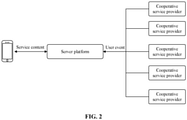
- Fig. 2 is an architecture diagram of a server platform according to an embodiment.
- different cooperative service providers can be accessed on the server platform, user events pushed by each cooperative service provider can be pushed to the server platform, and the server platform can process the user events and send a processing result to a mobile phone of a user.
- messages may be displayed on a secondary screen of a mobile phone of a user, and a sorting result of the messages may be a result after the server platform sorts user events.
- the user event to be processed by the server platform may be received by any server on the server platform.
- the any server may be a master server, and each subserver on the server platform may work based on an instruction of the master server.
- the server platform may be from different cooperative service providers and different users, a data volume of the user events may be very large. A great number of user events, however, cannot be processed immediately. Hence, there is a need for increased memory for storing the received user events, so as to balance a capability of receiving the user events and a capability of processing the user events.
- the server platform stores the user event to be processed into the event queue.
- user events with different event attributes are stored into different event queues based on the event attributes of the user events to be processed.
- the event attributes of the user event may include at least one of the followings:
- the event attribute may include a user identifier indicating a user to which the user event belongs; and user events with different user identifiers correspond to different event queues.
- the operation that the user event to be processed is stored into the event queue corresponding to the event attribute of the user event to be processed may include that:
- the user identifier of the user event to be processed may be processed through the consistent hashing algorithm to obtain the hash value, and the user event to be processed is stored into the event queue corresponding to the hash value.
- the user identifier of the user event may be processed through the consistent hashing algorithm to obtain the hash value, and the user event to be processed is stored into the event queue corresponding to the hash value.
- the calculated hash value is 2, and the user event is stored into the second event queue.
- the present disclosure can quickly store a user event into a corresponding event queue, so that the performance of the server platform is improved.
- user events may be stored into different event queues based on types of the user events. For example, an express event may be stored into an event queue, a take-out order may be stored into an event queue, and a Taobao order may be stored into another event queue, etc.
- user events may be stored into different event queues based on time information of the user events. For example, user events received within a preset time difference range may be stored into a same event queue, and user events having a large difference in receiving time may be stored into different event queues.
- the time information of the user event may further include time information contained in the user event beside the receiving time of the user event. For example, the user event is to remind the user of taking an express at 4 p.m., and the 4 p.m. today belongs to the time information contained in the user event.
- the time information of the user event may further include prompt time of the server platform. For example, it is agreed that the server platform gives a prompt a predetermined duration (such as ten minutes) early based on the time information contained in the user event.
- a Remote Dictionary Server (Redis) database may be used, and a group of ordered structured Redis Zset are initially allocated as the event queue.
- Redis supports master-slave synchronization and data may be synchronized from the master server to any number of slave servers, the user event may be backed up based on the Redis to reduce the probability of data loss due to damage of the server.
- the server platform reads the user event from the event queue through the multiple processes and processes the user event, and deletes the processed user event. Different processes may be used to process user events from different event queues, and may also be used to process different user events from a same event queue.
- one process may correspond to one piece of memory in one server, and each piece of memory in the server may read user events in different event queues for processing.
- one process may further correspond to one server, i.e., the server platform may process user events in each event queue through different servers.
- a received user event may be cached to an event queue and the user event may be taken from the event queue and then is processed.
- This is called a producer-consumer mode.
- the operation of submitting a task is equivalent to the producer, and the operation of executing the task is equivalent to the consumer.
- a process or server receiving orders from Taobao acts as the producer, and a process or server processing the orders is equivalent to the consumer.
- the user events to be processed are stored into different event queues based on the attributes of the user events.
- Fig. 3 is a structural example diagram of user event scheduling according to an embodiment.
- user events generated by an event producer are stored into different event queues, and different consumers take the user events from the event queues and process the user events.
- Different user events in the same event queue may be processed by different consumers, and different consumers may also process events from different event queues.
- a user event to be processed may be scheduled by a Java-based conventional stand-alone task scheduling method (such as Timer), or the user event to be processed may also be scheduled based on a time wheel scheduling algorithm.
- a Java-based conventional stand-alone task scheduling method such as Timer
- the conventional stand-alone task scheduling method based on Java may cause large performance consumption and does not support a distributed mode.
- the scheduling algorithm based on the time wheel does also not support the distributed mode either and may result in belated scheduling.
- a distributed processing architecture user events with different event attributes are stored into different event queues, and the user events are read from the event queues through multiple processes for processing, i.e., a distributed storage and distributed processing mode is used.
- the user events are dispersed to different event queues, therefore, compared with a mode in which all user events are stored in one event queue, the operations (reading, sorting and the like) for the user events in each event queue can improve the speed of operating the user events.
- the user events in rest event queues may still be executed, i.e., abnormal scheduling caused by a single-point fault of data can be reduced for the whole user event scheduling.
- the speed of scheduling each user event can be improved, and when one process is damaged, the user events may still be processed by rest processes. It may be understood that in combination with the distributed storage and the distributed processing, the present disclosure can improve the speed of processing user events and can further improve the stability of the server platform.
- the method may further include the following operations.
- a priority of the user event in a same event queue is determined.
- a position of the user event in the same event queue is adjusted according to the priority.
- the user event enters the same event queue from a tail of the same event queue, and is taken out by the multiple processes from a head of the same event queue.
- the user event in the same event queue may be dynamically sorted, i.e., the position of the user event in the same event queue may be adjusted according to the priority.
- the priority may be represented by a score, and the higher the score, the higher the priority.
- a queue is a special linear table and only allows for a deletion operation (deleting after reading a user event for processing) at the front end of the table and an insertion operation (inserting a user event) at the rear end of the table, therefore, a sequential order for processing user events in an event queue can be dynamically adjusted by dynamically sorting priorities, so that the intelligence of the server platform is improved.
- a priority of a user event may be determined based on an event attribute of the user event and a position of the user event in the event queue may be determined. For example, when a user identifier belongs to an important user, a user event associated with the user identifier may be set with a higher priority. For another example, when the user event is a conference reminding event, the conference reminding event may be set with a higher priority; or, when the user event is a clothes pick-up reminding event, and the clothes pick-up reminding event may be set with a higher priority when the server platform determines based on a weather application that the weather gets bad.
- a user event is a flight reminding event for reminding that the flight will take off at 10 p.m. today
- another user event is an express reminding event for reminding that the express will be delivered at 4 p.m. today
- a priority of the express reminding event may be set to be higher than that of the flight reminding event.
- the operation that the priority of the user event in the same event queue is determined may include the following operations.
- Time information of the user event in the same event queue is acquired.
- the priority of the user event in the same event queue is determined based on time corresponding to the time information.
- the priority is positively correlated with the time corresponding to the time information of the user event.
- the priority of the user event may be determined based on the event attribute of the user event.
- the priority of the user event is determined based on the time information of the user event. The earlier the time is, the higher the priority of the user event is.
- the time information of the user event may refer to time information contained in the user event, such as event information in the above described express reminding event and flight reminding event.
- the server platform may make intelligent analysis on the user event, and extract the time information contained in the user event.
- a jump-table sorting method may be used for sorting.
- N the N is greater than 1
- the average time complexity is not greater than log(N) based on the jump-table sorting method.
- time information included in the user event may reflect the sequential order that the event is executed, therefore, the present disclosure may set a higher priority for a user event that occurs earlier based on time information of the user event, such that an execution sequence of user events can be arranged reasonably and upgraded intelligence is achieved.
- the operation that the user event is read from the event queue through the multiple processes and is then processed may include the following operations.
- the user event is read from a head of one event queue through one process in the multiple processes, and whether trigger time for reading the user event is reached is determined.
- the read user event is processed when the trigger time for reading the user event is reached.
- a user event may be read from the head of an event queue in each process, whether a trigger time for reading the user event is reached may be determined, and the read user event may be processed when the trigger time is reached.
- the user event is a timing task, such as sending a consumption record table of a last month to a user at 10 a.m. on the 1st day of each month.
- the server platform may send the consumption record table of the last month to the user.
- the operation that the user event is read from the event queue through the multiple processes and is then processed may include that: the user event is read from different event queues in a polling mode through the multiple processes and the user event is processed.
- the user events are read from different event queues in the polling mode and are processed in the multiple processes.
- the four processes may process the user events in the event queues in sequences of ABCD, BCDE, CDEA, DEAB and EABC.
- the above sequences form one round.
- a new round is re-started according to the sequences.
- the method may further include that: multiple event queues are randomly sorted.
- the operation that the user event is read from the different event queues in the polling mode through the multiple processes and the user event is processed may include that: the user event is read from the randomly sorted different event queues in the polling mode through the multiple processes and the user event is processed.
- the event queues may be randomly sorted in advance such that each event queue can be processed as much as possible.
- the arrangement sequence of the event queues during initial polling is ABCDE
- the arrangement sequence of the event queues during next polling may be BCAED.
- a Shuffle function may be used to randomly sort the event queues.
- the operation that the user event is read from the event queue through the multiple processes and is processed may include that: the user event is read in a script call mode from the event queue through the multiple processes and is processed.
- the executed program when the user event is read from the event queue through the multiple processes and is processed, the executed program may be not interfered by other programs based on the script call mode.
- the script call mode can improve the atomicity of the program in execution, i.e., improve the stability of the process.
- Lua script call mode when the Redis database is used, a Lua script call mode may be used.
- the sample code for Lua script call is as follows:
- the ZRANGEBYSCORE instruction is acquiring a user event from the Zset structure based on a score, i.e., acquiring a user event according to a priority.
- KEYS[1] is the name of an event queue.
- ARGV[1] is a lower limit of the score.
- ARGV[2] is an upper limit of the score.
- the method may further include that: one or more event queues are added when a capacity expansion condition is met.
- one or more event queues may be added when the capacity expansion condition is met.
- Meeting the capacity expansion condition may be that the number of user events in the event queue is greater than a first number threshold.
- one or more event queues may be added, and a part of user events in the event queue exceeding the first number threshold are stored into the newly added event queue.
- the multiple processes take the user event from different event queues including the newly added event queue and process the user event, so that the capacity expansion can be implemented simply.
- the duration that the number of user events in the event queue is greater than the first number threshold exceeds a first duration threshold
- one or more event queues are newly added. With the determination based on the duration, whether the capacity expansion is needed is determined so as to improve the necessity for capacity expansion and the stability of the server platform.
- a Redis cluster node may be first added, and a new event queue is established; then, the consumer (process) is upgraded, i.e., the consumer is enabled to know the newly added queue (the new queue is empty at this time); and further, the producer is upgraded, i.e., the memory of the user event is upgraded, and the user event is re-allocated, such that the user event is written to the newly added event queue. After the user event is re-allocated, the user event may be processed by using different processes.
- the capacity expansion may occur in the working process of the server platform.
- the capacity expansion there may be a case where multiple user events of one user occur in different event queues and are processed by different processes. As the process may read and process the user event based on the time sequence, the probability that the sequence for processing the user event is wrong is relatively low.
- the capacity expansion of the platform may be accomplished by stopping the present work of the server platform.
- the process may also be added when the capacity expansion condition is met.
- Meeting the capacity expansion condition may be that the time for reading the user event exceeds a first predetermined duration.
- the process may be added by adding the server to process the user event, and the process may also be added by the present server to process the user event.
- the distributed processing architecture facilitates the dynamic expansion on the capacity of the server platform and has the characteristics of flexibility and good expansibility.
- the method may further include that:
- storing the user event into one or more event queues is forbidden when the capacity reduction condition is met, and the event queue is deleted in response to the user event in the event queue being processed.
- Meeting the capacity reduction condition may be that the number of user events in the event queue is smaller than a second number threshold.
- storing the user event to the event queue may be forbidden.
- the duration that the number of user events in the event queue is smaller than the second number threshold exceeds a second duration threshold
- storing the user event to the event queue is forbidden. It may be understood that whether the capacity reduction is needed may be determined based on the duration so as to improve the necessity for capacity reduction and the stability of the server platform.
- the Redis database when used, it is first to upgrade the consumer such that the user event is not written to the target event queue with the number of user events smaller than the second number threshold, then to upgrade the consumer to not to read the target queue after the user event in the target queue is consumed completely (processed completely), and at last to delete the target event queue.
- processes may also be reduced when the capacity reduction condition is met.
- Meeting the capacity reduction condition may be that the time for not reading a user event exceeds a second predetermined duration.
- processes may be reduced by reducing servers, and processes for processing the user event may also be reduced by closing a part of processes in the servers.
- both the capacity reduction condition and the capacity expansion condition in the present disclosure may also cause the capacity reduction and capacity expansion due to adjustment of hardware.
- the server platform may detect that the number of servers is increased or the memory is increased and thus the capacity expansion condition is met; and when the number of servers on the server platform is reduced or the memory of the server is reduced, the server platform may detect that the number of servers is reduced or the memory is reduced and thus the capacity reduction condition is met.
- the distributed processing architecture facilitates the dynamic reduction on the capacity of the server platform and has the characteristics of flexibility and good expansibility.
- Fig. 4 is a diagram of an apparatus for data processing according to an embodiment.
- the apparatus may further include:
- the apparatus may further include:
- the user event enters the event queue from a tail of the event queue, and is taken out by the multiple processes from a head of the event queue.
- the determination module 105 is configured to acquire time information of the user event in the same event queue, and determine the priority of the user event in the same event queue based on time corresponding to the time information. The priority is positively correlated with the time corresponding to the time information of the user event.
- the processing module 103 is configured to read the user event from a head of an event queue through one process in the multiple processes, determine whether trigger time for reading the user event is reached, and process the read user event when the trigger time for reading the user event is reached.
- the processing module 103 is configured to read the user event from different event queues in a polling mode through the multiple processes and process the user event.
- the apparatus may further include: a sorting module 107, configured to randomly sort the different event queues.
- the processing module 103 is configured to read the user event from the randomly sorted different event queues in the polling mode through the multiple processes and process the user event.
- the event attribute may include a user identifier indicating a user to which the user event belongs; and user events with different user identifiers correspond to different event queues.
- the storage module 102 is configured to process the user identifier of the user event to be processed through a consistent hashing algorithm to obtain a hash value, and store the user event to be processed into the event queue corresponding to the hash value.
- the processing module 103 is configured to read, in a script call mode, the user event from the event queue through the multiple processes and process the user event.
- the apparatus may further include: a capacity expansion module 108, configured to add one or more event queues when a capacity expansion condition is met.
- the apparatus may further include: a capacity reduction module 109, configured to forbid storing the user event into one or more event queues when a capacity reduction condition is met, and delete the event queue in response to the user event in the event queue being processed.
- a capacity reduction module 109 configured to forbid storing the user event into one or more event queues when a capacity reduction condition is met, and delete the event queue in response to the user event in the event queue being processed.
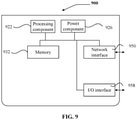
- Fig. 9 is a block diagram of a server 900 according to an embodiment.
- the server 900 includes a processing component 922, and further includes one or more processors, and a memory resource represented by a memory 932 and configured to store an instruction that may be executed by the processing component 922, such as an application program.
- the application program stored in the memory 932 may include one or more modules, with each module corresponding to one group of instructions.
- the processing component 922 is configured to execute the instruction to execute the above information processing method.
- the server 900 may further include a power component 926, configured to execute power management of the device 900, a wired or wireless network interface 950 configured to connect the device 900 to the network, and an Input/Output (I/O) interface 958.
- the device 900 may operate an operation system stored in the memory 932, for example, Android, iOS, Windows ServerTM, Mac OS XTM, UnixTM, LinuxTM, FreeBSDTM and so on.
- a non-temporary computer readable storage medium including an instruction is further provided, for example, the memory 932 including the instruction; and the instruction may be executed by the processing component 922 of the server 900 to complete the above method.
- the non-transitory computer-readable storage medium may be a Read Only Memory (ROM), a Random Access Memory (RAM), a Compact Disc Read-Only Memory (CD-ROM), a magnetic tape, a floppy disc, an optical data storage device and the like.
- a non-temporary computer-readable storage medium which stores instructions that, when executed by a processor of a server, cause the server to execute a method including:
Landscapes
- Engineering & Computer Science (AREA)
- Theoretical Computer Science (AREA)
- Software Systems (AREA)
- Physics & Mathematics (AREA)
- General Engineering & Computer Science (AREA)
- General Physics & Mathematics (AREA)
- Multimedia (AREA)
- Telephonic Communication Services (AREA)
- Information Transfer Between Computers (AREA)
Abstract
Description
- The present disclosure relates to the technical field of data processing, and more particularly, to a method and apparatus for data processing, a server and a storage medium.
- With the development of Internet communications, scales of Internet systems become increasingly large, the number of user tasks is ever-growing and the tasks also become more and more complex. Particularly in a distributed environment, there are multiple service systems, and each service system has a requirement on user tasks. When all user tasks are scheduled in their respective systems, the complexity of the service systems is increased on one hand, and the management is inconvenient on the other hand. Hence, there is a need for a task platform that can manage and schedule dispersive tasks uniformly.
- For management of tasks, how to fast execute the tasks by an effective scheduling policy and improve the stability of a task platform is a problem to be solved urgently.
- The present disclosure provides a method and apparatus for data processing, a server and a storage medium.
- According to a first aspect of the embodiments of the present disclosure, a method for data processing is provided, which may include:
- receiving a user event to be processed;
- storing the user event to be processed into an event queue corresponding to an event attribute of the user event to be processed, wherein user events with different event attributes correspond to different event queues;
- reading the user event from the event queue through multiple processes and processing the user event; and
- deleting the processed user event from the event queue.
- Optionally, the method may further include:
- determining a priority of the user event in a same event queue; and
- adjusting a position of the user event in the same event queue according to the priority,
- wherein the user event enters the event queue from a tail of the event queue, and is taken out by the multiple processes from a head of the event queue.
- Optionally, the determining the priority of the user event in the same event queue may include:
- acquiring time information of the user event in the same event queue; and
- determining the priority of the user event in the same event queue based on time corresponding to the time information, wherein the priority is positively correlated with the time corresponding to the time information of the user event.
- Optionally, the reading the user event from the event queue through the multiple processes and processing the user event may include:
- reading the user event from a head of an event queue through one process in the multiple processes, and determining whether trigger time for reading the user event is reached; and
- processing the read user event when the trigger time for reading the user event is reached.
- Optionally, the reading the user event from the event queue through the multiple processes and processing the user event may include:
reading the user event from different event queues in a polling mode through the multiple processes and processing the user event. - Optionally, the method may further include:
randomly sorting the different event queues. - The reading the user event from the different event queues in the polling mode through the multiple processes and processing the user event comprises:
reading the user event from the randomly sorted different event queues in the polling mode through the multiple processes and processing the user event. - Optionally, the event attribute may include a user identifier that indicates a user to which the user event belongs; and user events with different user identifiers correspond to different event queues.
- Optionally, the storing the user event to be processed into the event queue corresponding to the event attribute of the user event to be processed may include:
- processing the user identifier of the user event to be processed through a consistent hashing algorithm to obtain a hash value; and
- storing the user event to be processed into the event queue corresponding to the hash value.
- Optionally, the reading the user event from the event queue through the multiple processes and processing the user event may include:
reading, in a script call mode, the user event from the event queue through the multiple processes and processing the user event. - Optionally, the method may further include:
adding one or more event queues when a capacity expansion condition is met. - Optionally, the method may further include:
- forbidding storing the user event into one or more event queues when a capacity reduction condition is met; and
- deleting the event queue in response to the user event in the event queue being processed.
- According to a second aspect of the embodiments of the present disclosure, an apparatus for data processing is provided, which may include:
- a receiving module, configured to receive a user event to be processed;
- a storage module, configured to store the user event to be processed into an event queue corresponding to an event attribute of the user event to be processed, user events with different event attributes corresponding to different event queues;
- a processing module, configured to read the user event from the event queue through multiple processes and process the user event; and
- a deletion module, configured to delete the processed user event from the event queue.
- Optionally, the apparatus may further include:
- a determination module, configured to determine a priority of the user event in a same event queue; and
- an adjustment module, configured to adjust a position of the user event in the same event queue according to the priority,
- wherein the user event enters the event queue from a tail of the event queue, and is taken out by the multiple processes from a head of the event queue.
- Optionally, the determination module is configured to acquire time information of the user event in the same event queue; and determine the priority of the user event in the same event queue based on time corresponding to the time information, wherein the priority is positively correlated with the time corresponding to the time information of the user event.
- Optionally, the processing module is configured to read the user event from a head of an event queue through one process in the multiple processes, and determine whether trigger time for reading the user event is reached; and process the read user event when the trigger time for reading the user event is reached.
- Optionally, the processing module is configured to read the user event from different event queues in a polling mode through the multiple processes and process the user event.
- Optionally, the apparatus may further include:
a sorting module, configured to randomly sort the different event queues. - The processing module is configured to read the user event from the randomly sorted different event queues in the polling mode through the multiple processes and process the user event.
- Optionally, the event attribute may include a user identifier that indicates a user to which the user event belongs; and user events with different user identifiers correspond to different event queues.
- Optionally, the storage module is configured to process the user identifier of the user event to be processed through a consistent hashing algorithm to obtain a hash value; and store the user event to be processed into the event queue corresponding to the hash value.
- Optionally, the processing module is configured to read, in a script call mode, the user event from the event queue through the multiple processes and processing the user event.
- Optionally, the apparatus may further include:
a capacity expansion module, configured to add one or more event queues when a capacity expansion condition is met. - Optionally, the apparatus may further include:
a capacity reduction module, configured to forbid storing the user event into one or more event queues when a capacity reduction condition is met; and delete the event queue in response to the user event in the event queue being processed. - According to a third aspect of the embodiments of the present disclosure, a server is provided, which may include:
- a processor; and
- a memory, configured to store instructions executable by the processor,
- wherein the processor is configured to execute the method for data processing as described in the first aspect.
- According to a fourth aspect of the embodiments of the present disclosure, a storage medium is provided, which stores instructions that, when executed by a processor of a server, cause the server to implement the method for data processing as described in the first aspect.
- The technical solutions provided by the embodiments of the present disclosure may have the following beneficial effects.
- In the embodiments of the present disclosure, based on a distributed processing architecture, user events with different event attributes are stored into different event queues, and the user events are read from the event queues through multiple processes and then are processed, i.e., a distributed storage and distributed processing mode is used. On one hand, the user events are dispersed to different event queues through the distributed storage, therefore, compared with a mode in which all user events are stored in an event queue, the operations (reading, sorting and the like) for the user events in each event queue can improve the speed of operating the user events. In addition, when an event queue is abnormal, the user events in rest event queues can still be operated, i.e., the abnormal scheduling of the whole user events caused by a single-point fault of data can be reduced. On the other hand, with the distributed processing, i.e., different user events are processed through multiple processes, the scheduling speed for each user event can be improved, and when one process is damaged, rest processes can still process the user events.
- It may be understood that in combination with the distributed storage and the distributed processing, the present disclosure can improve the speed of processing a user event, and can further improve the stability of a server platform.
- It is to be understood that the above general descriptions and detailed descriptions below are only exemplary and explanatory and not intended to limit the present disclosure.
- The accompanying drawings, which are incorporated in and constitute a part of this specification, illustrate embodiments consistent with the present disclosure and, together with the description, serve to explain the principles of the present disclosure.
-
Fig. 1 is a flowchart of a method for data processing according to an embodiment. -
Fig. 2 is an architecture diagram of a server platform according to an embodiment. -
Fig. 3 is a structural example diagram of user event scheduling according to an embodiment. -
Fig. 4 is a diagram of an apparatus for data processing according to an embodiment. -
Fig. 5 is a diagram of the apparatus for data processing based onFig. 4 . -
Fig. 6 is a diagram of the apparatus for data processing based onFig. 4 . -
Fig. 7 is a diagram of the apparatus for data processing based onFig. 4 . -
Fig. 8 is a diagram of the apparatus for data processing based onFig. 4 . -
Fig. 9 is a block diagram of a server according to an embodiment. - Reference will now be made in detail to exemplary embodiments, examples of which are illustrated in the accompanying drawings. The following description refers to the accompanying drawings in which the same numbers in different drawings represent the same or similar elements unless otherwise represented. The implementations set forth in the following description of exemplary embodiments do not represent all implementations consistent with the present disclosure. Instead, they are merely examples of apparatuses and methods consistent with aspects related to the present disclosure as recited in the appended claims.
-
Fig. 1 is a flowchart of a method for data processing according to an embodiment. As shown inFig. 1 , the method for data processing may include the following operations. - In S 11, a user event to be processed is received.
- In S12, the user event to be processed is stored into an event queue corresponding to an event attribute of the user event to be processed, user events with different event attributes corresponding to different event queues.
- In S13, the user event is read from the event queue through multiple processes and is processed.
- In S14, the processed user event is deleted from the event queue.
- In the embodiment of the present disclosure, the method for data processing is implemented by an apparatus for data processing. The apparatus for data processing may be a server platform. The server platform may adopt to receive a user event to be processed and process the user event. The distributed architecture may be a server cluster.
- Based on the server platform of the present disclosure, the user event pushed by a server supporting each third-party application may be accessed. For example, the third-party applications may be those applications from cooperative service providers, such as Taobao applications, Meituan applications, mail applications or notebook applications or the like.
- In the embodiment of the present disclosure, user events may include at least one of the followings:
- an event to be processed, which is triggered by a user operation; and
- an event to be processed, which prompts a user of executing a preset operation.
- For example, a user event may be an order event which is an order that is generated based on a shopping action of a user and is to be paid.
- For another example, a user event may be a schedule reminding event or a conference event which is set based on a user's schedule.
-
Fig. 2 is an architecture diagram of a server platform according to an embodiment. As shown inFig. 2 , different cooperative service providers can be accessed on the server platform, user events pushed by each cooperative service provider can be pushed to the server platform, and the server platform can process the user events and send a processing result to a mobile phone of a user. For example, messages may be displayed on a secondary screen of a mobile phone of a user, and a sorting result of the messages may be a result after the server platform sorts user events. - In operation S11, the user event to be processed by the server platform may be received by any server on the server platform. The any server may be a master server, and each subserver on the server platform may work based on an instruction of the master server.
- As the user events received by the server platform may be from different cooperative service providers and different users, a data volume of the user events may be very large. A great number of user events, however, cannot be processed immediately. Hence, there is a need for increased memory for storing the received user events, so as to balance a capability of receiving the user events and a capability of processing the user events.
- In operation S12, the server platform stores the user event to be processed into the event queue. During storage, user events with different event attributes are stored into different event queues based on the event attributes of the user events to be processed. The event attributes of the user event may include at least one of the followings:
- a user identifier corresponding to the user event;
- an event type of the user event; and
- time information of the user event.
- In an embodiment, the event attribute may include a user identifier indicating a user to which the user event belongs; and user events with different user identifiers correspond to different event queues.
- In an embodiment, the operation that the user event to be processed is stored into the event queue corresponding to the event attribute of the user event to be processed may include that:
- the user identifier of the user event to be processed is processed through a consistent hashing algorithm to obtain a hash value; and
- the user event to be processed is stored into the event queue corresponding to the hash value.
- In the embodiment, the user identifier of the user event to be processed may be processed through the consistent hashing algorithm to obtain the hash value, and the user event to be processed is stored into the event queue corresponding to the hash value. In this way, there is no need to compare the user identifier of the user event with the user identifier of each event queue one by one, but just the user event is stored into the event queue corresponding to the hash value based on the calculated hash value. For example, the calculated hash value is 2, and the user event is stored into the second event queue.
- It may be understood that based on the consistent hashing algorithm, the present disclosure can quickly store a user event into a corresponding event queue, so that the performance of the server platform is improved.
- In an embodiment, user events may be stored into different event queues based on types of the user events. For example, an express event may be stored into an event queue, a take-out order may be stored into an event queue, and a Taobao order may be stored into another event queue, etc.
- In an embodiment, user events may be stored into different event queues based on time information of the user events. For example, user events received within a preset time difference range may be stored into a same event queue, and user events having a large difference in receiving time may be stored into different event queues. The time information of the user event may further include time information contained in the user event beside the receiving time of the user event. For example, the user event is to remind the user of taking an express at 4 p.m., and the 4 p.m. today belongs to the time information contained in the user event. In addition, the time information of the user event may further include prompt time of the server platform. For example, it is agreed that the server platform gives a prompt a predetermined duration (such as ten minutes) early based on the time information contained in the user event.
- It is to be noted that when the user event to be processed is stored into the event queue, a Remote Dictionary Server (Redis) database may be used, and a group of ordered structured Redis Zset are initially allocated as the event queue. As the Redis supports master-slave synchronization and data may be synchronized from the master server to any number of slave servers, the user event may be backed up based on the Redis to reduce the probability of data loss due to damage of the server.
- In operations S13 to S14, the server platform reads the user event from the event queue through the multiple processes and processes the user event, and deletes the processed user event. Different processes may be used to process user events from different event queues, and may also be used to process different user events from a same event queue.
- In the embodiment of the present disclosure, one process may correspond to one piece of memory in one server, and each piece of memory in the server may read user events in different event queues for processing. In addition, one process may further correspond to one server, i.e., the server platform may process user events in each event queue through different servers.
- In the present disclosure, a received user event may be cached to an event queue and the user event may be taken from the event queue and then is processed. This is called a producer-consumer mode. The operation of submitting a task is equivalent to the producer, and the operation of executing the task is equivalent to the consumer. For example, during the double 11 shopping carnival, a process or server receiving orders from Taobao acts as the producer, and a process or server processing the orders is equivalent to the consumer. In the producer-consumer mode in the present disclosure, the user events to be processed are stored into different event queues based on the attributes of the user events.
-
Fig. 3 is a structural example diagram of user event scheduling according to an embodiment. As shown inFig. 3 , user events generated by an event producer are stored into different event queues, and different consumers take the user events from the event queues and process the user events. Different user events in the same event queue may be processed by different consumers, and different consumers may also process events from different event queues. - In an embodiment, a user event to be processed may be scheduled by a Java-based conventional stand-alone task scheduling method (such as Timer), or the user event to be processed may also be scheduled based on a time wheel scheduling algorithm. However, the conventional stand-alone task scheduling method based on Java may cause large performance consumption and does not support a distributed mode. The scheduling algorithm based on the time wheel does also not support the distributed mode either and may result in belated scheduling.
- In view of this, in the present disclosure, with the use of a distributed processing architecture, user events with different event attributes are stored into different event queues, and the user events are read from the event queues through multiple processes for processing, i.e., a distributed storage and distributed processing mode is used. On one hand, based on the distributed storage, the user events are dispersed to different event queues, therefore, compared with a mode in which all user events are stored in one event queue, the operations (reading, sorting and the like) for the user events in each event queue can improve the speed of operating the user events. In addition, when an event queue is abnormal, the user events in rest event queues may still be executed, i.e., abnormal scheduling caused by a single-point fault of data can be reduced for the whole user event scheduling. On the other hand, based on the distributed processing, i.e., different user events are processed through multiple processes, the speed of scheduling each user event can be improved, and when one process is damaged, the user events may still be processed by rest processes. It may be understood that in combination with the distributed storage and the distributed processing, the present disclosure can improve the speed of processing user events and can further improve the stability of the server platform.
- In an embodiment, the method may further include the following operations.
- A priority of the user event in a same event queue is determined.
- A position of the user event in the same event queue is adjusted according to the priority.
- The user event enters the same event queue from a tail of the same event queue, and is taken out by the multiple processes from a head of the same event queue.
- In the embodiment, the user event in the same event queue may be dynamically sorted, i.e., the position of the user event in the same event queue may be adjusted according to the priority. For example, the priority may be represented by a score, and the higher the score, the higher the priority.
- A queue is a special linear table and only allows for a deletion operation (deleting after reading a user event for processing) at the front end of the table and an insertion operation (inserting a user event) at the rear end of the table, therefore, a sequential order for processing user events in an event queue can be dynamically adjusted by dynamically sorting priorities, so that the intelligence of the server platform is improved.
- It is to be noted that, in the embodiments of the present disclosure, a priority of a user event may be determined based on an event attribute of the user event and a position of the user event in the event queue may be determined. For example, when a user identifier belongs to an important user, a user event associated with the user identifier may be set with a higher priority. For another example, when the user event is a conference reminding event, the conference reminding event may be set with a higher priority; or, when the user event is a clothes pick-up reminding event, and the clothes pick-up reminding event may be set with a higher priority when the server platform determines based on a weather application that the weather gets bad. In another example, a user event is a flight reminding event for reminding that the flight will take off at 10 p.m. today, and another user event is an express reminding event for reminding that the express will be delivered at 4 p.m. today, a priority of the express reminding event may be set to be higher than that of the flight reminding event.
- In an embodiment, the operation that the priority of the user event in the same event queue is determined may include the following operations.
- Time information of the user event in the same event queue is acquired.
- The priority of the user event in the same event queue is determined based on time corresponding to the time information. The priority is positively correlated with the time corresponding to the time information of the user event.
- As described above, the priority of the user event may be determined based on the event attribute of the user event. In the embodiment, the priority of the user event is determined based on the time information of the user event. The earlier the time is, the higher the priority of the user event is. The time information of the user event may refer to time information contained in the user event, such as event information in the above described express reminding event and flight reminding event.
- In the embodiment of the present disclosure, the server platform may make intelligent analysis on the user event, and extract the time information contained in the user event. When the priority of the user event is sorted based on the acquired time information, a jump-table sorting method may be used for sorting. When N (the N is greater than 1) user events are provided in the time queue, the average time complexity is not greater than log(N) based on the jump-table sorting method.
- It may be understood that the time information included in the user event may reflect the sequential order that the event is executed, therefore, the present disclosure may set a higher priority for a user event that occurs earlier based on time information of the user event, such that an execution sequence of user events can be arranged reasonably and upgraded intelligence is achieved.
- In an embodiment, the operation that the user event is read from the event queue through the multiple processes and is then processed may include the following operations.
- The user event is read from a head of one event queue through one process in the multiple processes, and whether trigger time for reading the user event is reached is determined.
- The read user event is processed when the trigger time for reading the user event is reached.
- In the embodiment of the present disclosure, a user event may be read from the head of an event queue in each process, whether a trigger time for reading the user event is reached may be determined, and the read user event may be processed when the trigger time is reached. For example, the user event is a timing task, such as sending a consumption record table of a last month to a user at 10 a.m. on the 1st day of each month. After the process reads the user event at the head of the event queue, it may be determined that the trigger time of the user event is at 10 a.m. on the 1st day. When 10 a.m. on the 1st day comes, the server platform may send the consumption record table of the last month to the user.
- In an embodiment, the operation that the user event is read from the event queue through the multiple processes and is then processed may include that:
the user event is read from different event queues in a polling mode through the multiple processes and the user event is processed. - In the embodiment, in order to enable user events in each event queue to be processed as much as possible, the user events are read from different event queues in the polling mode and are processed in the multiple processes.
- For example, for five event queues sorted in a ABCDE sequence, when there are four processes, the four processes may process the user events in the event queues in sequences of ABCD, BCDE, CDEA, DEAB and EABC. The above sequences form one round. Upon the completion of processing of one round, a new round is re-started according to the sequences.
- In an embodiment, the method may further include that:
multiple event queues are randomly sorted. - The operation that the user event is read from the different event queues in the polling mode through the multiple processes and the user event is processed may include that:
the user event is read from the randomly sorted different event queues in the polling mode through the multiple processes and the user event is processed. - In the embodiment, before the user event is read from the different event queues in the polling mode and processed, the event queues may be randomly sorted in advance such that each event queue can be processed as much as possible.
- For example, the arrangement sequence of the event queues during initial polling is ABCDE, and the arrangement sequence of the event queues during next polling may be BCAED.
- In the embodiment of the present disclosure, a Shuffle function may be used to randomly sort the event queues.
- In an embodiment, the operation that the user event is read from the event queue through the multiple processes and is processed may include that:
the user event is read in a script call mode from the event queue through the multiple processes and is processed. - In the embodiment of the present disclosure, when the user event is read from the event queue through the multiple processes and is processed, the executed program may be not interfered by other programs based on the script call mode. Hence, the script call mode can improve the atomicity of the program in execution, i.e., improve the stability of the process.
- For example, when the Redis database is used, a Lua script call mode may be used. The sample code for Lua script call is as follows:
    Local result =
    redis.call('ZRANGEBYSCORE', KEYS[1],ARGV[1],ARGV[2],"LIMIT",0,5)\n" +
        "for k, v in pairs(result) do\n" +
        " redis.call('ZREM',KEYS[1],v)\n" +
        "end\n" +
        "return result"
one or more event queues are added when a capacity expansion condition is met.
- storing the user event into one or more event queues is forbidden when a capacity reduction condition is met; and
- the event queue is deleted in response to the user event in the event queue being processed.
- a
receiving module 101, configured to receive a user event to be processed; - a
storage module 102, configured to store the user event to be processed into an event queue corresponding to an event attribute of the user event to be processed, user events with different event attributes corresponding to different event queues; - a
processing module 103, configured to read the user event from the event queue through multiple processes and process the user event; and - a
deletion module 104, configured to delete the processed user event from the event queue.
- a
determination module 105, configured to determine a priority of the user event in a same event queue; and - an adjustment module 106, configured to adjust a position of the user event in the same event queue according to the priority.
a
a
a
- receiving a user event to be processed;
- storing the user event to be processed into an event queue corresponding to an event attribute of the user event to be processed. User events with different event attributes correspond to different event queues;
- reading the user event from the event queue through multiple processes and processing the user event; and
- deleting the processed user event from the event queue.
Claims (15)
- A method for data processing, comprising:receiving (S11) a user event to be processed;storing (S12) the user event to be processed into an event queue corresponding to an event attribute of the user event to be processed, wherein user events with different event attributes correspond to different event queues;reading (S13) the user event from the event queue through multiple processes and processing the user event; anddeleting (S14) the processed user event from the event queue.
- The method of claim 1, further comprising:determining a priority of the user event in a same event queue; andadjusting a position of the user event in the same event queue according to the priority,wherein the user event enters the event queue from a tail of the event queue and is taken out by the multiple processes from a head of the event queue.
- The method of claim 2, wherein determining the priority of the user event in the same event queue comprises:acquiring time information of the user event in the same event queue; anddetermining the priority of the user event in the same event queue based on time corresponding to the time information, wherein the priority is positively correlated with the time corresponding to the time information of the user event.
- The method of claim 1, wherein reading the user event from the event queue through the multiple processes and processing the user event comprises:reading the user event from a head of an event queue through one process in the multiple processes, and determining whether trigger time for reading the user event is reached; and processing the read user event when the trigger time for reading the user event is reached; orreading, in a script call mode, the user event from the event queue through the multiple processes and processing the user event.
- The method of claim 1, wherein reading the user event from the event queue through the multiple processes and processing the user event comprises:
reading the user event from different event queues in a polling mode through the multiple processes and processing the user event. - The method of claim 5, further comprising:randomly sorting the different event queues;wherein reading the user event from the different event queues in the polling mode through the multiple processes and processing the user event comprises:
reading the user event from the randomly sorted different event queues in the polling mode through the multiple processes and processing the user event. - The method of claim 1, wherein the event attribute comprises a user identifier indicating a user to which the user event belongs; and user events with different user identifiers correspond to different event queues.
- The method of claim 7, wherein storing the user event to be processed into the event queue corresponding to the event attribute of the user event to be processed comprises:processing the user identifier of the user event to be processed through a consistent hashing algorithm to obtain a hash value; andstoring the user event to be processed into the event queue corresponding to the hash value.
- The method of claim 1, further comprising:adding one or more event queues when a capacity expansion condition is met; orforbidding storing the user event into one or more event queues when a capacity reduction condition is met, and deleting the event queue in response to the user event in the event queue being processed.
- An apparatus for data processing, comprising:a receiving module(101), configured to receive a user event to be processed;a storage module(102), configured to store the user event to be processed into an event queue corresponding to an event attribute of the user event to be processed, wherein user events with different event attributes correspond to different event queues;a processing module(103), configured to read the user event from the event queue through multiple processes and process the user event; anda deletion module(104), configured to delete the processed user event from the event queue.
- The apparatus of claim 10, further comprising:a determination module(105), configured to determine a priority of the user event in a same event queue; andan adjustment module(106), configured to adjust a position of the user event in the same event queue according to the priority,wherein the user event enters the event queue from a tail of the event queue and is taken out by the multiple processes from a head of the event queue.
- The apparatus of claim 11, wherein
the determination module(105) is configured to acquire time information of the user event in the same event queue; and determine the priority of the user event in the same event queue based on time corresponding to the time information, wherein the priority is positively correlated with the time corresponding to the time information of the user event. - The apparatus of claim 10, whereinthe processing module(103) is configured to read the user event from a head of an event queue through one process in the multiple processes, and determine whether trigger time for reading the user event is reached; and process the read user event when the trigger time for reading the user event is reached; orthe storage module(102) is configured to process the user identifier of the user event to be processed through a consistent hashing algorithm to obtain a hash value; and store the user event to be processed into the event queue corresponding to the hash value; orthe processing module(103) is configured to read, in a script call mode, the user event from the event queue through the multiple processes and processing the user event; orthe apparatus further comprises a capacity expansion module(108) configured to add one or more event queues when a capacity expansion condition is met; orthe apparatus further comprises a capacity reduction module(109) configured to forbid storing the user event into one or more event queues when a capacity reduction condition is met; and delete the event queue in response to the user event in the event queue being processed.
- The apparatus of claim 10, wherein
the processing module(103) is configured to read the user event from different event queues in a polling mode through the multiple processes and process the user event. - A server, compri sing:a processor; anda memory, configured to store instructions executable by the processor,wherein the processor is configured to implement the method for data processing according to any one of claims 1 to 9.
Applications Claiming Priority (1)
| Application Number | Priority Date | Filing Date | Title |
|---|---|---|---|
| CN202010763403.7A CN111880910A (en) | 2020-07-31 | 2020-07-31 | Data processing method and device, server and storage medium |
Publications (1)
| Publication Number | Publication Date |
|---|---|
| EP3945420A1 true EP3945420A1 (en) | 2022-02-02 |
Family
ID=73205966
Family Applications (1)
| Application Number | Title | Priority Date | Filing Date |
|---|---|---|---|
| EP21165580.8A Pending EP3945420A1 (en) | 2020-07-31 | 2021-03-29 | Method and apparatus for data processing, server and storage medium |
Country Status (3)
| Country | Link |
|---|---|
| US (1) | US11822961B2 (en) |
| EP (1) | EP3945420A1 (en) |
| CN (1) | CN111880910A (en) |
Families Citing this family (5)
| Publication number | Priority date | Publication date | Assignee | Title |
|---|---|---|---|---|
| CN113010012A (en) * | 2021-03-09 | 2021-06-22 | 湖北亿咖通科技有限公司 | Method for configuring virtual character in vehicle-mounted entertainment system and computer storage medium |
| CN115267236B (en) * | 2021-04-29 | 2025-09-19 | 深圳市帝迈生物技术有限公司 | Control method of sample injection device, related device and computer readable storage medium |
| CN116107769A (en) * | 2021-11-11 | 2023-05-12 | 内蒙古蒙商消费金融股份有限公司 | An event-driven method, device, electronic device, and readable storage medium |
| CN115129761B (en) * | 2022-09-02 | 2022-12-23 | 杭州雅拓信息技术有限公司 | Method, system and equipment for realizing real-time window calculation based on Redis |
| US12613755B2 (en) * | 2023-08-04 | 2026-04-28 | Ebay Inc. | Replicated time wheel delay event scheduling |
Citations (2)
| Publication number | Priority date | Publication date | Assignee | Title |
|---|---|---|---|---|
| US20170168879A1 (en) * | 2015-12-11 | 2017-06-15 | Successfactors, Inc. | Event Handling in a Cloud Data Center |
| US20180165138A1 (en) * | 2016-12-13 | 2018-06-14 | Salesforce.Com, Inc. | Multi user threaded executor |
Family Cites Families (17)
| Publication number | Priority date | Publication date | Assignee | Title |
|---|---|---|---|---|
| US5640563A (en) * | 1992-01-31 | 1997-06-17 | International Business Machines Corporation | Multi-media computer operating system and method |
| US6360219B1 (en) * | 1998-12-16 | 2002-03-19 | Gemstone Systems, Inc. | Object queues with concurrent updating |
| US20030099254A1 (en) * | 2000-03-03 | 2003-05-29 | Richter Roger K. | Systems and methods for interfacing asynchronous and non-asynchronous data media |
| US6904124B2 (en) * | 2001-01-31 | 2005-06-07 | General Electric Company | Indirect programming of detector framing node |
| CN100488265C (en) * | 2005-07-20 | 2009-05-13 | 华为技术有限公司 | Concurrent method for treating calling events |
| US7596644B2 (en) * | 2006-01-11 | 2009-09-29 | Solarflare Communications, Inc. | Transmit rate pacing system and method |
| US20130024875A1 (en) * | 2011-07-22 | 2013-01-24 | Yilin Wang | Event System And Methods For Using Same |
| US20140278641A1 (en) * | 2013-03-15 | 2014-09-18 | Fiserv, Inc. | Systems and methods for incident queue assignment and prioritization |
| CN104426926B (en) * | 2013-08-21 | 2019-03-29 | 腾讯科技(深圳)有限公司 | Method and device for processing data released regularly |
| CN105573840B (en) * | 2015-12-08 | 2019-06-14 | 东软集团股份有限公司 | The event-handling method and device of work flow operation phase |
| US10313219B1 (en) * | 2016-11-08 | 2019-06-04 | Sprint Communications Company L.P. | Predictive intelligent processor balancing in streaming mobile communication device data processing |
| US11218419B1 (en) * | 2016-12-06 | 2022-01-04 | Amazon Technologies, Inc. | Execution request prioritization by context |
| US10489220B2 (en) * | 2017-01-26 | 2019-11-26 | Microsoft Technology Licensing, Llc | Priority based scheduling |
| CN107885590A (en) * | 2017-11-30 | 2018-04-06 | 百度在线网络技术(北京)有限公司 | Task processing method and device for smart machine |
| CN110532067A (en) * | 2018-05-25 | 2019-12-03 | 杭州海康威视数字技术股份有限公司 | Event processing method, apparatus, device and storage medium |
| US11102139B1 (en) * | 2018-09-05 | 2021-08-24 | Amazon Technologies, Inc. | Shared queue management utilizing shuffle sharding |
| CN111416858B (en) * | 2020-03-16 | 2023-04-07 | 广州市百果园信息技术有限公司 | Media resource processing platform, method, device and server |
-
2020
- 2020-07-31 CN CN202010763403.7A patent/CN111880910A/en active Pending
-
2021
- 2021-03-26 US US17/214,121 patent/US11822961B2/en active Active
- 2021-03-29 EP EP21165580.8A patent/EP3945420A1/en active Pending
Patent Citations (2)
| Publication number | Priority date | Publication date | Assignee | Title |
|---|---|---|---|---|
| US20170168879A1 (en) * | 2015-12-11 | 2017-06-15 | Successfactors, Inc. | Event Handling in a Cloud Data Center |
| US20180165138A1 (en) * | 2016-12-13 | 2018-06-14 | Salesforce.Com, Inc. | Multi user threaded executor |
Also Published As
| Publication number | Publication date |
|---|---|
| US11822961B2 (en) | 2023-11-21 |
| CN111880910A (en) | 2020-11-03 |
| US20220035666A1 (en) | 2022-02-03 |
Similar Documents
| Publication | Publication Date | Title |
|---|---|---|
| EP3945420A1 (en) | Method and apparatus for data processing, server and storage medium | |
| CN109104336B (en) | Service request processing method and device, computer equipment and storage medium | |
| US20200133750A1 (en) | Methods, apparatus and computer programs for managing persistence | |
| WO2021180025A1 (en) | Message processing method and apparatus, electronic device and medium | |
| US20020144003A1 (en) | Inter-thread communications between different components using double buffer | |
| CN112346829A (en) | Method and equipment for task scheduling | |
| CN107688626B (en) | Slow query log processing method and device and electronic equipment | |
| CN106331065A (en) | Proxy application for host system with service container and system | |
| US5394549A (en) | Task spawning responsive to relational database conditions and operations | |
| CN103888619A (en) | Message processing method and system thereof | |
| CN110764894A (en) | Timed task management method, device, equipment and storage medium | |
| CN114900531A (en) | Data synchronization method, device and system | |
| CN113127564A (en) | Parameter synchronization method and device | |
| US11243979B1 (en) | Asynchronous propagation of database events | |
| CN109842621A (en) | A kind of method and terminal reducing token storage quantity | |
| CN115623019B (en) | Distributed operation flow scheduling execution method and system | |
| CN117312051A (en) | File backup method, device, equipment and storage medium | |
| US7441252B2 (en) | Cache control device, and method and computer program for the same | |
| CN111078418B (en) | Operation synchronization method, device, electronic equipment and computer readable storage medium | |
| CN111399999B (en) | Computer resource processing method, device, readable storage medium and computer equipment | |
| CN116405543B (en) | A method, device, equipment and medium for dynamic scheduling of microservices | |
| CN116132528B (en) | Flight management message pushing method and device and electronic equipment | |
| CN114281525B (en) | Transaction task asynchronous deleting method, device, equipment and readable storage medium | |
| CN114281550A (en) | Request processing method and device, computer equipment and computer readable storage medium | |
| CN114449031A (en) | Information acquisition method, device, equipment and storage medium |
Legal Events
| Date | Code | Title | Description |
|---|---|---|---|
| PUAI | Public reference made under article 153(3) epc to a published international application that has entered the european phase |
Free format text: ORIGINAL CODE: 0009012 |
|
| STAA | Information on the status of an ep patent application or granted ep patent |
Free format text: STATUS: THE APPLICATION HAS BEEN PUBLISHED |
|
| AK | Designated contracting states |
Kind code of ref document: A1 Designated state(s): AL AT BE BG CH CY CZ DE DK EE ES FI FR GB GR HR HU IE IS IT LI LT LU LV MC MK MT NL NO PL PT RO RS SE SI SK SM TR |
|
| STAA | Information on the status of an ep patent application or granted ep patent |
Free format text: STATUS: REQUEST FOR EXAMINATION WAS MADE |
|
| 17P | Request for examination filed |
Effective date: 20220727 |
|
| RBV | Designated contracting states (corrected) |
Designated state(s): AL AT BE BG CH CY CZ DE DK EE ES FI FR GB GR HR HU IE IS IT LI LT LU LV MC MK MT NL NO PL PT RO RS SE SI SK SM TR |
|
| STAA | Information on the status of an ep patent application or granted ep patent |
Free format text: STATUS: EXAMINATION IS IN PROGRESS |
|
| 17Q | First examination report despatched |
Effective date: 20240216 |