EP3945288B1 - Runway overrun awareness alerting system with trending indicator - Google Patents
Runway overrun awareness alerting system with trending indicator Download PDFInfo
- Publication number
- EP3945288B1 EP3945288B1 EP21187986.1A EP21187986A EP3945288B1 EP 3945288 B1 EP3945288 B1 EP 3945288B1 EP 21187986 A EP21187986 A EP 21187986A EP 3945288 B1 EP3945288 B1 EP 3945288B1
- Authority
- EP
- European Patent Office
- Prior art keywords
- aircraft
- runway
- awareness
- overrun
- display
- Prior art date
- Legal status (The legal status is an assumption and is not a legal conclusion. Google has not performed a legal analysis and makes no representation as to the accuracy of the status listed.)
- Active
Links
Images




Classifications
-
- G—PHYSICS
- G01—MEASURING; TESTING
- G01C—MEASURING DISTANCES, LEVELS OR BEARINGS; SURVEYING; NAVIGATION; GYROSCOPIC INSTRUMENTS; PHOTOGRAMMETRY OR VIDEOGRAMMETRY
- G01C23/00—Combined instruments indicating more than one navigational value, e.g. for aircraft; Combined measuring devices for measuring two or more variables of movement, e.g. distance, speed or acceleration
- G01C23/005—Flight directors
-
- B—PERFORMING OPERATIONS; TRANSPORTING
- B64—AIRCRAFT; AVIATION; COSMONAUTICS
- B64D—EQUIPMENT FOR FITTING IN OR TO AIRCRAFT; FLIGHT SUITS; PARACHUTES; ARRANGEMENT OR MOUNTING OF POWER PLANTS OR PROPULSION TRANSMISSIONS IN AIRCRAFT
- B64D43/00—Arrangements or adaptations of instruments
-
- B—PERFORMING OPERATIONS; TRANSPORTING
- B64—AIRCRAFT; AVIATION; COSMONAUTICS
- B64D—EQUIPMENT FOR FITTING IN OR TO AIRCRAFT; FLIGHT SUITS; PARACHUTES; ARRANGEMENT OR MOUNTING OF POWER PLANTS OR PROPULSION TRANSMISSIONS IN AIRCRAFT
- B64D45/00—Aircraft indicators or protectors not otherwise provided for
- B64D45/04—Landing aids; Safety measures to prevent collision with earth's surface
- B64D45/08—Landing aids; Safety measures to prevent collision with earth's surface optical
-
- G—PHYSICS
- G08—SIGNALLING
- G08G—TRAFFIC CONTROL SYSTEMS
- G08G5/00—Traffic control systems for aircraft
- G08G5/20—Arrangements for acquiring, generating, sharing or displaying traffic information
- G08G5/21—Arrangements for acquiring, generating, sharing or displaying traffic information located onboard the aircraft
-
- G—PHYSICS
- G08—SIGNALLING
- G08G—TRAFFIC CONTROL SYSTEMS
- G08G5/00—Traffic control systems for aircraft
- G08G5/20—Arrangements for acquiring, generating, sharing or displaying traffic information
- G08G5/26—Transmission of traffic-related information between aircraft and ground stations
-
- G—PHYSICS
- G08—SIGNALLING
- G08G—TRAFFIC CONTROL SYSTEMS
- G08G5/00—Traffic control systems for aircraft
- G08G5/30—Flight plan management
-
- G—PHYSICS
- G08—SIGNALLING
- G08G—TRAFFIC CONTROL SYSTEMS
- G08G5/00—Traffic control systems for aircraft
- G08G5/50—Navigation or guidance aids
- G08G5/54—Navigation or guidance aids for approach or landing
-
- G—PHYSICS
- G08—SIGNALLING
- G08G—TRAFFIC CONTROL SYSTEMS
- G08G5/00—Traffic control systems for aircraft
- G08G5/50—Navigation or guidance aids
- G08G5/56—Navigation or guidance aids for two or more aircraft
-
- G—PHYSICS
- G08—SIGNALLING
- G08G—TRAFFIC CONTROL SYSTEMS
- G08G5/00—Traffic control systems for aircraft
- G08G5/70—Arrangements for monitoring traffic-related situations or conditions
- G08G5/72—Arrangements for monitoring traffic-related situations or conditions for monitoring traffic
- G08G5/723—Arrangements for monitoring traffic-related situations or conditions for monitoring traffic from the aircraft
Definitions
- the subject matter disclosed herein is directed generally to aircraft display systems and more particularly to symbology for primary flight displays (PFD).
- PFD primary flight displays
- Runway overruns are a threat to aircraft landing on, or taking off from, an airport runway.
- an aircraft on approach to a runway at a given airspeed and angle of attack (which in turn may be affected by winds over the runway and other external factors) will touch down at a particular point along the runway. If there is not enough runway remaining between this landing point and the end of the runway for the aircraft to decelerate after touchdown, overrun may result: the aircraft may exit the runway at its far end, resulting in damage to the aircraft, injury to passengers and crew, or worse.
- Conventional runway overrun prevention systems provide visual and/or aural warnings of a potential excursion, but these systems may integrate visual warnings into an already complex primary flight display (PFD) or navigational display.
- PFD primary flight display
- US 2014/257601 A1 describes a runway overrun monitor.
- US2017/275020 A1 discloses a device for displaying a symbology for assisting the piloting of an aircraft during a phase of landing on a runway including a Runway Overrun Warning function.
- ROAAS runway overrun awareness alerting system
- the dynamic graphic element is revised based on revisions to the trending overrun probability.
- the ROAAS determines trending position states of the aircraft based on information received from the aircraft flight management system (FMS), from onboard sensors, or from the engine indicator and crew alerting system (EICAS).
- FMS aircraft flight management system
- EICAS engine indicator and crew alerting system
- the ROAAS determines trending energy states of the aircraft based on data received from the FMS, the onboard sensors, or the EICAS.
- the ROAAS receives runway data from the runway's ground control station or from some other source external to the aircraft.
- the aircraft display system includes synthetic vision system (SVS) or enhanced vision system (EVS) content displaying the environment in the vicinity of the runway (e.g., from the aircraft's perspective).
- SVS synthetic vision system
- EVS enhanced vision system
- the display system superimposes the PFD, other navigational instrumentation, and the dynamic graphic element over the SVS/EVS content.
- the dynamic graphic element includes dynamic shape and color components (e.g., the current predicted trend corresponding to the current color and/or shape).
- revisions in the predicted trend are indicated by a change in the shape, size, and/or color of the dynamic graphic element.
- the dynamic graphic element changes shape or size in unison with the color change.
- the dynamic graphic element is displayed within a region of the display surface not otherwise occupied by a displayed PFD component or navigational instrument.
- a letter following a reference numeral is intended to reference an embodiment of the feature or element that may be similar, but not necessarily identical, to a previously described element or feature bearing the same reference numeral (e.g., 1, 1a, 1b).
- reference numeral e.g. 1, 1a, 1b
- Such shorthand notations are used for purposes of convenience only and should not be construed to limit the disclosure in any way unless expressly stated to the contrary.
- any reference to “one embodiment” or “some embodiments” means that a particular element, feature, structure, or characteristic described in connection with the embodiment is included in at least one embodiment disclosed herein.
- the appearances of the phrase “in some embodiments” in various places in the specification are not necessarily all referring to the same embodiment, and embodiments may include one or more of the features expressly described or inherently present herein, or any combination or sub-combination of two or more such features, along with any other features which may not necessarily be expressly described or inherently present in the instant disclosure.
- the PFD 100 incorporates a runway overrun awareness alert system 120 (ROAAS).
- ROAAS runway overrun awareness alert system 120
- the ROAAS 120 monitors the trending energy state of the aircraft along with its trending position and heading relative to the runway compared with the parameters of the runway itself (e.g., the length and orientation of the runway, environmental conditions that may affect the landing).
- the ROAAS 120 monitors the energy state of the aircraft along with its position and heading relative to the runway and the parameters of the runway itself (e.g., length, orientation, weather or environmental conditions). If, for example, one or more conditions or combinations of conditions meet or exceed predetermined threshold levels, the display of ROAAS symbology may be triggered.
- the aircraft state indicates an angle of attack consistent with approach and landing, but airspeed may be in excess of a speed consistent with the current aircraft position relative to the runway, and a tailwind may be present. Based on these observations, the ROAAS 120 may conclude that the likelihood of a runway overrun is nonzero, and that the threshold for ROAAS symbology display has been crossed. Should the aircraft abort the attempted landing and go around for a subsequent attempt, the ROAAS 120 may conclude that display conditions no longer exist and cease display of ROAAS symbology.
- the ROAAS 120 predicts an evolving trend in the likely landing point of the aircraft relative to the runway 116. Based on the trending landing point and aircraft energy state, the ROAAS 120 further predicts the likely trend toward, or away from, a runway excursion or overrun on the part of the aircraft.
- the ROAAS 120 sends the predicted likelihood back to the EVS/SVS system for display to the pilot via the PFD 100.
- the PDF 100 may incorporate runway excursion warnings, these warnings may only serve to warn the pilot of conditions consistent with a likely excursion when these conditions already exist (as opposed to, e.g., proactive prevention of excursion conditions).
- runway excursion warnings may be incorporated into other display elements of the PDF (e.g., the EVS-generated runway 122 corresponding to the runway 116, which may flash red to warn of a potential excursion) and therefore may not be as quickly and easily digested by the pilot.
- the ROAAS 120 is displayed separate from, and not integrated into, any other instruments, indicators, or SVS/EVS elements displayed by the PDF 100.
- the graphic representation displayed by the PDF 100 represents a trend indicator determined by the ROAAS 120 and capable of displaying to the pilot at a glance (e.g., via the pilot's peripheral vision) whether the relationship between the aircraft and the runway 116 is improving (e.g., trending towards a safe landing) or declining (e.g., trending towards a runway overrun).
- the graphic representation dynamically changes in shape, and optionally also in size, and/or color as the contributing factors, including the aircraft airspeed, angle of attack, and position/heading relative to the runway, driving the trends in position state, energy state, predicted landing point, and overrun probability continuously change.
- the ROAAS 120 may be displayed within the PFD 100 as a dynamic vertical bar 124 configured to change appearance in real time to reflect the evolving trend toward or away from runway excursion or overrun. For example, as the energy state of the aircraft trends upward or downward (along with any other external conditions accessible to the ROAAS 120) the ROAAS may display the current excursion likelihood as it trends toward or away from increased certainty of overrun, e.g., by changing the height and/or color of the dynamic vertical bar 124 in real time. For example, the dynamic vertical bar 124 reaching the top of its allotted space 126 may indicate to the pilot conditions consistent with a near-certain runway overrun (and that the pilot's best remaining option may be to abort the landing and fly around for another approach). By displaying a dynamic trend indicator, the ROAAS 120 may present to the pilot at a glance visual feedback as to the effect of his/her actions toward, or away from, a safe landing on the intended runway.
- the aircraft 200 may include a flight management system 202 (FMS), aircraft-based sensors 204, and engine indicator/crew alerting system 206 (EICAS).
- FMS flight management system
- EICAS engine indicator/crew alerting system
- the ROAAS 120 may be embodied aboard the aircraft 200 and may communicate with other sources, both onboard and external to the aircraft, to receive updated aircraft data. As noted above, the ROAAS 120 may consider multiple data sources and their effect on each other to determine whether display conditions exist and, once display conditions are determined to exist, to continually evaluate whether conditions persist or, for example, have been resolved by pilot action.
- the ROAAS 120 may receive continual updates from the flight management system 202 (FMS) with respect to the position of the aircraft and its progress relative to the flight plan of the aircraft (or, e.g., relative to the current flight segment or phase). Further, the FMS 202 may provide runway, instrument approach, beacon or waypoint data, and other navigational database data to the ROAAS 120.
- FMS flight management system 202
- the ROAAS 120 may receive additional aircraft performance data from aircraft-based sensors 204 (e.g., airspeed indicators, altimeters, angle of attack sensors, barometers) and engine indicator/crew alerting systems 206 (EICAS).
- aircraft-based sensors 204 e.g., airspeed indicators, altimeters, angle of attack sensors, barometers
- EICAS engine indicator/crew alerting systems 206
- the EICAS 206 may provide updates as to the current and evolving states of aircraft engines, fuel systems, hydraulic and pneumatic systems, and aircraft components not in direct communication with navigation systems but whose performance regardless may affect the energy state of the aircraft.
- the ROAAS 120 may receive some information from external sources 208 not onboard the aircraft.
- the ROAAS 120 may receive position, runway, or weather data from ground-based facilities (e.g., wind pattern data measured by ground facilities proximate to the runway 116).
- the ROAAS 120 may determine that conditions exist that warrant display of the ROAAS symbology within the PFD 100. For example, the ROAAS 120 may be displayed as long as these conditions continue to exist (e.g., until the aircraft has touched down or remedial action on the part of the pilot or crew sufficiently changes the observed conditions).
- the ROAAS 120a-f similarly to the ROAAS 120 of FIG. 1 , may incorporate dynamic shape and color changes to indicate trending toward or away from a certain runway excursion or overrun on the part of the aircraft (200, FIG. 2 ).
- the dynamic vertical bars 124b-f of the respective ROAAS 120a-f may be situated within their allotted spaces 126 (e.g., as drawn or otherwise displayed by the EVS/SVS system onto the PFD (100, FIG. 1 ).
- the ROAAS 120a may be displayed when the likelihood of runway excursion is nominally zero, e.g., when the aircraft 200 is not on approach.
- the ROAAS 120a may be displayed as an allotted space 126 without a visible dynamic vertical bar 124.
- the ROAAS 120b may be displayed within the PFD 100 to indicate a trend toward a possible runway excursion, e.g., predicted landing points of the aircraft 200 where the actual likelihood of excursion or overrun may be slight but no longer nonzero.
- the dynamic vertical bar may rise (124b) but to a relatively low height (e.g., relative to the full height of the allotted space 126) and may be rendered in a green or greenish color to indicate to the pilot a change of state relative to the ROAAS 120a, e.g., predicted landing points within acceptable distance of the end of the runway and thus a likelihood of runway excursion that remains relatively low (and may not yet indicate remedial action), but wherein the likelihood of excursion may continue to trend upward if corrective action is not taken.
- the ROAAS 120c-d may represent further changes in state from the ROAAS 120b, e.g., if the predicted landing points continue to trend into a part of the runway where the likelihood of overrun is more probable.
- the ROAAS 120c may include a dynamic vertical bar 124c increasing in height and gradually shading in color from green to yellow (e.g., yellow-green, green-yellow) to indicate an upward trending likelihood of excursion.
- the ROAAS 120d may include a still higher dynamic vertical bar 124d of a substantially yellow color.
- the ROAAS 120e-f may indicate continued upward trends in the likelihood of excursion.
- the dynamic vertical bar 124e of the ROAAS 120e may further increase in height and shade from yellow to red (e.g., red-orange, orangered), indicating the gradually increasing likelihood of runway excursion.
- red e.g., red-orange, orangered
- the dynamic vertical bar 124f may be at or near its maximum height relative to its allotted space 126, and may be colored fully red to indicate a likelihood of runway excursion nearing certainty, and that may warrant either a runway excursion alert or immediate corrective action on the part of the pilot.
- the ROAAS 300 may be implemented and may function similarly to the ROAAS 120, 120a-f of FIGS. 1 through 3A , except that the ROAAS 300 and/or its component symbologies may be condensed or otherwise altered for some configurations of PFD (100, FIG. 1 ), e.g., condensed PFD with less available free space than the PFD 100.
- the ROAAS 120, 300 may be represented by any other appropriate graphic combinations of real-time dynamic shape and color changes not explicitly disclosed herein.
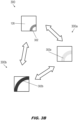
- the ROAAS 300 may display the trending likelihood of runway excursion as a dynamic arc 302 that, similarly to the dynamic vertical bar (124, 124b-f) of the ROAAS 120, 120a-f, changes color and shape in real time within its allotted space 126 to reflect upward and downward trends of the likelihood of runway excursion by the aircraft (200, FIG. 2 ) (e.g., toward or away from a certain runway excursion or overrun).
- the ROAAS 300 may represent relatively low excursion probabilities as a green arc of relatively small size (e.g., proximate to the center of the arc).
- the ROAAS 300a-b may be implemented and may function similarly to the ROAAS 300, but may respectively reflect landing points trending toward an increasingly more probable runway excursion.
- the dynamic arc 302 of the ROAAS 300 may grow into a larger arc 302a shading toward yellow, as the ROAAS 300a indicates a growing likelihood of excursion, and a still larger arc 302b shading toward red as the ROAAS 300b indicates likely landing points trending toward near certain excursion.
- the ROAAS 300a may shift back toward the smaller, greener dynamic arc 300 of the ROAAS 300, e.g., if corrective action is taken causing the predicted landing points to trend away from runway excursion.
- the PFD 100 is disclosed.
- the ROAAS 120, 300 of FIGS. 1 through 3B may be displayed in an area of the PFD 100 not otherwise dedicated to aircraft instruments or to PFD components.
- the placement of the ROAAS 120, 300 may be based on observed pilot scan patterns of the PFD 100. It is contemplated that the pilot may construct a multidimensional model of the aircraft energy state in real time, based on multiple discrete and easily assimilated data points. Based on this evolving real time model, the pilot may make more informed decisions regarding, e.g., whether to continue or abort a landing or descent in progress (and if to abort, at what point to do so).
- the pilot's scanning pattern with respect to the PFD may include starting at the attitude indicator 102 to check pitch and roll information, scanning left (402) to check the airspeed indicator 104, scanning center (404) and then right (406) to monitor the altimeter 106, returning to center (408) and then scanning down (410) to the turn coordinator 110 and horizontal situation indicator 112.
- the ROAAS 120, 300 may be positioned relative to the PFD 100 such that the ROAAS appears at the periphery of the pilot's scan pattern where its information may be easily captured in the pilot's peripheral vision.
- the PFD 100a may be implemented and may function similarly to the PFD 100 of FIGS. 1 through 4A , except that the ROAAS 120, 300 may be displayed in other otherwise undedicated areas (412, 414, 416) of the PFD.
- the ROAAS 120, 300 may be positioned in other parts within the PFD 100a that may fall within the periphery of the pilot's scan pattern.
- embodiments of the methods disclosed herein may include one or more of the steps described herein. Further, such steps may be carried out in any desired order and two or more of the steps may be carried out simultaneously with one another. Two or more of the steps disclosed herein may be combined in a single step, and in some embodiments, one or more of the steps may be carried out as two or more sub-steps. Further, other steps or sub-steps may be carried in addition to, or as substitutes to one or more of the steps disclosed herein.
Landscapes
- Engineering & Computer Science (AREA)
- Aviation & Aerospace Engineering (AREA)
- Physics & Mathematics (AREA)
- General Physics & Mathematics (AREA)
- Radar, Positioning & Navigation (AREA)
- Remote Sensing (AREA)
- Traffic Control Systems (AREA)
Description
- The instant application is related to the concurrently filed
U.S. Patent Application Serial No. 16/939.600 having docket number 127818US01. - The subject matter disclosed herein is directed generally to aircraft display systems and more particularly to symbology for primary flight displays (PFD).
- Runway overruns are a threat to aircraft landing on, or taking off from, an airport runway. For example, an aircraft on approach to a runway at a given airspeed and angle of attack (which in turn may be affected by winds over the runway and other external factors) will touch down at a particular point along the runway. If there is not enough runway remaining between this landing point and the end of the runway for the aircraft to decelerate after touchdown, overrun may result: the aircraft may exit the runway at its far end, resulting in damage to the aircraft, injury to passengers and crew, or worse. Conventional runway overrun prevention systems provide visual and/or aural warnings of a potential excursion, but these systems may integrate visual warnings into an already complex primary flight display (PFD) or navigational display.
US 2014/257601 A1 describes a runway overrun monitor.US2017/275020 A1 discloses a device for displaying a symbology for assisting the piloting of an aircraft during a phase of landing on a runway including a Runway Overrun Warning function. - An aircraft-based runway overrun awareness alerting system (ROAAS) is disclosed and defined in
claim 1. - In some embodiments, the dynamic graphic element is revised based on revisions to the trending overrun probability.
- In some embodiments, the ROAAS determines trending position states of the aircraft based on information received from the aircraft flight management system (FMS), from onboard sensors, or from the engine indicator and crew alerting system (EICAS).
- In some embodiments, the ROAAS determines trending energy states of the aircraft based on data received from the FMS, the onboard sensors, or the EICAS.
- In some embodiments, the ROAAS receives runway data from the runway's ground control station or from some other source external to the aircraft.
- In some embodiments, the aircraft display system includes synthetic vision system (SVS) or enhanced vision system (EVS) content displaying the environment in the vicinity of the runway (e.g., from the aircraft's perspective). The display system superimposes the PFD, other navigational instrumentation, and the dynamic graphic element over the SVS/EVS content.
- In some embodiments, the dynamic graphic element includes dynamic shape and color components (e.g., the current predicted trend corresponding to the current color and/or shape).
- In some embodiments, revisions in the predicted trend are indicated by a change in the shape, size, and/or color of the dynamic graphic element.
- In some embodiments, the dynamic graphic element changes shape or size in unison with the color change.
- In some embodiments, the dynamic graphic element is displayed within a region of the display surface not otherwise occupied by a displayed PFD component or navigational instrument.
- This Summary is provided solely as an introduction to subject matter that is fully described in the Detailed Description and Drawings. The Summary should not be considered to describe essential features nor be used to determine the scope of the Claims. Moreover, it is to be understood that both the foregoing Summary and the following Detailed Description are example and explanatory only and are not necessarily restrictive of the subject matter claimed.
- The detailed description is described with reference to the accompanying figures. The use of the same reference numbers in different instances in the description and the figures may indicate similar or identical items. Various embodiments or examples ("examples") of the present disclosure are disclosed in the following detailed description and the accompanying drawings. The drawings are not necessarily to scale. In general, operations of disclosed processes may be performed in an arbitrary order, unless otherwise provided in the claims. In the drawings:
-
FIG. 1 is a block diagram illustrating a primary flight display (PFD) incorporating a runway overrun awareness alert system (ROAAS) according to example embodiments of this disclosure; -
FIG. 2 is a block diagram of the ROAAS ofFIG. 1 and embodying aircraft; -
FIGS. 3A and3B illustrate components and operations of the ROAAS ofFIG. 1 ; -
FIG. 4A is an illustration of scanning patterns for the PFD ofFIG. 1 ; - and
FIG. 4B is an illustration of alternative placements of the ROAAS ofFIG. 1 within the PFD. - Before explaining one or more embodiments of the disclosure in detail, it is to be understood that the embodiments are not limited in their application to the details of construction and the arrangement of the components or steps or methodologies set forth in the following description or illustrated in the drawings. In the following detailed description of embodiments, numerous specific details may be set forth in order to provide a more thorough understanding of the disclosure. However, it will be apparent to one of ordinary skill in the art having the benefit of the instant disclosure that the embodiments disclosed herein may be practiced without some of these specific details. In other instances, well-known features may not be described in detail to avoid unnecessarily complicating the instant disclosure.
- As used herein a letter following a reference numeral is intended to reference an embodiment of the feature or element that may be similar, but not necessarily identical, to a previously described element or feature bearing the same reference numeral (e.g., 1, 1a, 1b). Such shorthand notations are used for purposes of convenience only and should not be construed to limit the disclosure in any way unless expressly stated to the contrary.
- Further, unless expressly stated to the contrary, "or" refers to an inclusive or and not to an exclusive or. For example, a condition A or B is satisfied by any one of the following: A is true (or present) and B is false (or not present), A is false (or not present) and B is true (or present), and both A and B are true (or present).
- In addition, use of "a" or "an" may be employed to describe elements and components of embodiments disclosed herein. This is done merely for convenience and "a" and "an" are intended to include "one" or "at least one," and the singular also includes the plural unless it is obvious that it is meant otherwise.
- Finally, as used herein any reference to "one embodiment" or "some embodiments" means that a particular element, feature, structure, or characteristic described in connection with the embodiment is included in at least one embodiment disclosed herein. The appearances of the phrase "in some embodiments" in various places in the specification are not necessarily all referring to the same embodiment, and embodiments may include one or more of the features expressly described or inherently present herein, or any combination or sub-combination of two or more such features, along with any other features which may not necessarily be expressly described or inherently present in the instant disclosure.
- Referring to
FIG. 1 , a primary flight display (PFD) 100 is disclosed. The PFD 100 may includeattitude indicator 102,airspeed indicator 104,altimeter 106,vertical speed indicator 108,turn coordinator 110,horizontal situation indicator 112, andartificial horizon 114. - In embodiments, the PFD 100 may be embodied aboard an aircraft on approach to a
runway 116. For example, the PFD 100 may incorporate, or may be a display component of, an enhanced vision system (EVS) and/or a synthetic vision system (SVS), such that aircraft instruments and/or PFD components (e.g., theattitude indicator 102,airspeed indicator 104,altimeter 106,vertical speed indicator 108,turn coordinator 110,horizontal situation indicator 112, and artificial horizon 114) are graphically superimposed over an enhanced-vision representation 118 of the environment surrounding the runway 116 (including, e.g., terrain, runway or airport facilities, and explanatory symbology noting natural or manmade features or proximate aircraft). - While the aircraft on approach to the
runway 116, the pilot monitors multiple indicators simultaneously while controlling the descent of the aircraft. The energy state of the aircraft may similarly be in constant flux from moment to moment, based on, e.g., the current airspeed, altitude, angle of attack, or factors external to the aircraft, such as shifting wind patterns over therunway 116. Accordingly, the pilot may be aiming for a particular landing point or region of therunway 116 in order to allow sufficient runway to decelerate or stop after touching down, but the actual likelihood of achieving the intended landing point (e.g., as opposed to leaving insufficient runway and risking a runway excursion or overrun) may vary along with internal and external conditions. - The PFD 100 incorporates a runway overrun awareness alert system 120 (ROAAS). For example, while on approach to the
runway 116, the ROAAS 120 monitors the trending energy state of the aircraft along with its trending position and heading relative to the runway compared with the parameters of the runway itself (e.g., the length and orientation of the runway, environmental conditions that may affect the landing). In embodiments. While on approach to therunway 116, the ROAAS 120 monitors the energy state of the aircraft along with its position and heading relative to the runway and the parameters of the runway itself (e.g., length, orientation, weather or environmental conditions). If, for example, one or more conditions or combinations of conditions meet or exceed predetermined threshold levels, the display of ROAAS symbology may be triggered. The aircraft state indicates an angle of attack consistent with approach and landing, but airspeed may be in
excess of a speed consistent with the current aircraft position relative to the runway, and a tailwind may be present. Based on these observations, theROAAS 120 may conclude that the likelihood of a runway overrun is nonzero, and that the threshold for ROAAS symbology display has been crossed. Should the aircraft abort the attempted landing and go around for a subsequent attempt, theROAAS 120 may conclude that display conditions no longer exist and cease display of ROAAS symbology. - Based on trends in the aircraft energy state, the
ROAAS 120 predicts an evolving trend in the likely landing point of the aircraft relative to therunway 116. Based on the trending landing point and aircraft energy state, theROAAS 120 further predicts the likely trend toward, or away from, a runway excursion or overrun on the part of the aircraft. TheROAAS 120 sends the predicted likelihood back to the EVS/SVS system for display to the pilot via thePFD 100. For example, while thePDF 100 may incorporate runway excursion warnings, these warnings may only serve to warn the pilot of conditions consistent with a likely excursion when these conditions already exist (as opposed to, e.g., proactive prevention of excursion conditions). Further, runway excursion warnings may be incorporated into other display elements of the PDF (e.g., the EVS-generatedrunway 122 corresponding to therunway 116, which may flash red to warn of a potential excursion) and therefore may not be as quickly and easily digested by the pilot. - It is contemplated that the
ROAAS 120 may provide a concise, discrete assessment of trending runway excursion likelihood that the pilot, in conjunction with other data provided by the PFD 100 (e.g., airspeed, angle of attack, altitude), may rapidly assimilate while managing the descent and landing phases. For example, the predictive ability of theROAAS 120 may be enhanced by more robust runway data (e.g., runway conditions, weather conditions) or even performance data relevant to the aircraft or aircraft type, e.g., prior flight performance during approach and landing phases under similar conditions, braking performance and methods. - The
ROAAS 120 is displayed separate from, and not integrated into, any other instruments, indicators, or SVS/EVS elements displayed by thePDF 100. The graphic representation displayed by thePDF 100 represents a trend indicator determined by theROAAS 120 and capable of displaying to the pilot at a glance (e.g., via the pilot's peripheral vision) whether the relationship between the aircraft and therunway 116 is improving (e.g., trending towards a safe landing) or declining (e.g., trending towards a runway overrun). The graphic representation dynamically changes in shape, and optionally also in size, and/or color as the contributing factors, including the aircraft airspeed, angle of attack, and position/heading relative to the runway, driving the trends in position state, energy state, predicted landing point, and overrun probability continuously change. - In embodiments, the
ROAAS 120 may be displayed within thePFD 100 as a dynamicvertical bar 124 configured to change appearance in real time to reflect the evolving trend toward or away from runway excursion or overrun. For example, as the energy state of the aircraft trends upward or downward (along with any other external conditions accessible to the ROAAS 120) the ROAAS may display the current excursion likelihood as it trends toward or away from increased certainty of overrun, e.g., by changing the height and/or color of the dynamicvertical bar 124 in real time. For example, the dynamicvertical bar 124 reaching the top of its allottedspace 126 may indicate to the pilot conditions consistent with a near-certain runway overrun (and that the pilot's best remaining option may be to abort the landing and fly around for another approach). By displaying a dynamic trend indicator, theROAAS 120 may present to the pilot at a glance visual feedback as to the effect of his/her actions toward, or away from, a safe landing on the intended runway. - Referring to
FIG. 2 , theaircraft 200 is disclosed. Theaircraft 200 may include a flight management system 202 (FMS), aircraft-basedsensors 204, and engine indicator/crew alerting system 206 (EICAS). - In embodiments, the
ROAAS 120 may be embodied aboard theaircraft 200 and may communicate with other sources, both onboard and external to the aircraft, to receive updated aircraft data. As noted above, theROAAS 120 may consider multiple data sources and their effect on each other to determine whether display conditions exist and, once display conditions are determined to exist, to continually evaluate whether conditions persist or, for example, have been resolved by pilot action. - For example, the
ROAAS 120 may receive continual updates from the flight management system 202 (FMS) with respect to the position of the aircraft and its progress relative to the flight plan of the aircraft (or, e.g., relative to the current flight segment or phase). Further, theFMS 202 may provide runway, instrument approach, beacon or waypoint data, and other navigational database data to theROAAS 120. - In embodiments, the
ROAAS 120 may receive additional aircraft performance data from aircraft-based sensors 204 (e.g., airspeed indicators, altimeters, angle of attack sensors, barometers) and engine indicator/crew alerting systems 206 (EICAS). For example, theEICAS 206 may provide updates as to the current and evolving states of aircraft engines, fuel systems, hydraulic and pneumatic systems, and aircraft components not in direct communication with navigation systems but whose performance regardless may affect the energy state of the aircraft. - In embodiments, the
ROAAS 120 may receive some information fromexternal sources 208 not onboard the aircraft. For example, theROAAS 120 may receive position, runway, or weather data from ground-based facilities (e.g., wind pattern data measured by ground facilities proximate to the runway 116). - In embodiments, based on a continual evaluation of these diverse data sources, the
ROAAS 120 may determine that conditions exist that warrant display of the ROAAS symbology within thePFD 100. For example, theROAAS 120 may be displayed as long as these conditions continue to exist (e.g., until the aircraft has touched down or remedial action on the part of the pilot or crew sufficiently changes the observed conditions). - Referring to
FIG. 3A , theROAAS 120a-f, similarly to theROAAS 120 ofFIG. 1 , may incorporate dynamic shape and color changes to indicate trending toward or away from a certain runway excursion or overrun on the part of the aircraft (200,FIG. 2 ). - In embodiments, the dynamic
vertical bars 124b-f of therespective ROAAS 120a-f may be situated within their allotted spaces 126 (e.g., as drawn or otherwise displayed by the EVS/SVS system onto the PFD (100,FIG. 1 ). For example, theROAAS 120a may be displayed when the likelihood of runway excursion is nominally zero, e.g., when theaircraft 200 is not on approach. In embodiments, theROAAS 120a may be displayed as an allottedspace 126 without a visible dynamicvertical bar 124. - In embodiments, the
ROAAS 120b may be displayed within thePFD 100 to indicate a trend toward a possible runway excursion, e.g., predicted landing points of theaircraft 200 where the actual likelihood of excursion or overrun may be slight but no longer nonzero. For example, the dynamic vertical bar may rise (124b) but to a relatively low height (e.g., relative to the full height of the allotted space 126) and may be rendered in a green or greenish color to indicate to the pilot a change of state relative to theROAAS 120a, e.g., predicted landing points within acceptable distance of the end of the runway and thus a likelihood of runway excursion that remains relatively low (and may not yet indicate remedial action), but wherein the likelihood of excursion may continue to trend upward if corrective action is not taken. - In embodiments, the
ROAAS 120c-d may represent further changes in state from theROAAS 120b, e.g., if the predicted landing points continue to trend into a part of the runway where the likelihood of overrun is more probable. For example, theROAAS 120c may include a dynamicvertical bar 124c increasing in height and gradually shading in color from green to yellow (e.g., yellow-green, green-yellow) to indicate an upward trending likelihood of excursion. Similarly, theROAAS 120d may include a still higher dynamicvertical bar 124d of a substantially yellow color. - In embodiments, the
ROAAS 120e-f may indicate continued upward trends in the likelihood of excursion. For example, the dynamicvertical bar 124e of theROAAS 120e may further increase in height and shade from yellow to red (e.g., red-orange, orangered), indicating the gradually increasing likelihood of runway excursion. When theROAAS 120f is displayed, the dynamicvertical bar 124f may be at or near its maximum height relative to its allottedspace 126, and may be colored fully red to indicate a likelihood of runway excursion nearing certainty, and that may warrant either a runway excursion alert or immediate corrective action on the part of the pilot. - Referring now to
FIG. 3B , theROAAS 300 may be implemented and may function similarly to theROAAS FIGS. 1 through 3A , except that theROAAS 300 and/or its component symbologies may be condensed or otherwise altered for some configurations of PFD (100,FIG. 1 ), e.g., condensed PFD with less available free space than thePFD 100. In embodiments, theROAAS - In embodiments, the
ROAAS 300 may display the trending likelihood of runway excursion as adynamic arc 302 that, similarly to the dynamic vertical bar (124, 124b-f) of theROAAS space 126 to reflect upward and downward trends of the likelihood of runway excursion by the aircraft (200,FIG. 2 ) (e.g., toward or away from a certain runway excursion or overrun). For example, theROAAS 300 may represent relatively low excursion probabilities as a green arc of relatively small size (e.g., proximate to the center of the arc). - In embodiments, the
ROAAS 300a-b may be implemented and may function similarly to theROAAS 300, but may respectively reflect landing points trending toward an increasingly more probable runway excursion. For example, thedynamic arc 302 of theROAAS 300 may grow into alarger arc 302a shading toward yellow, as theROAAS 300a indicates a growing likelihood of excursion, and a stilllarger arc 302b shading toward red as theROAAS 300b indicates likely landing points trending toward near certain excursion. In some embodiments, theROAAS 300a may shift back toward the smaller, greenerdynamic arc 300 of theROAAS 300, e.g., if corrective action is taken causing the predicted landing points to trend away from runway excursion. - Referring to
FIG. 4A , thePFD 100 is disclosed. - In embodiments, the
ROAAS FIGS. 1 through 3B may be displayed in an area of thePFD 100 not otherwise dedicated to aircraft instruments or to PFD components. For example, the placement of theROAAS PFD 100. It is contemplated that the pilot may construct a multidimensional model of the aircraft energy state in real time, based on multiple discrete and easily assimilated data points. Based on this evolving real time model, the pilot may make more informed decisions regarding, e.g., whether to continue or abort a landing or descent in progress (and if to abort, at what point to do so). For example, the pilot's scanning pattern with respect to the PFD may include starting at theattitude indicator 102 to check pitch and roll information, scanning left (402) to check theairspeed indicator 104, scanning center (404) and then right (406) to monitor thealtimeter 106, returning to center (408) and then scanning down (410) to theturn coordinator 110 andhorizontal situation indicator 112. In embodiments, theROAAS PFD 100 such that the ROAAS appears at the periphery of the pilot's scan pattern where its information may be easily captured in the pilot's peripheral vision. - Referring also to
FIG. 4B , thePFD 100a may be implemented and may function similarly to thePFD 100 ofFIGS. 1 through 4A , except that theROAAS ROAAS PFD 100a that may fall within the periphery of the pilot's scan pattern. - It is to be understood that embodiments of the methods disclosed herein may include one or more of the steps described herein. Further, such steps may be carried out in any desired order and two or more of the steps may be carried out simultaneously with one another. Two or more of the steps disclosed herein may be combined in a single step, and in some embodiments, one or more of the steps may be carried out as two or more sub-steps. Further, other steps or sub-steps may be carried in addition to, or as substitutes to one or more of the steps disclosed herein.
Claims (9)
- An aircraft-based runway overrun awareness alerting system (120), comprising:one or more processors installable aboard an aircraft and configured for:determining a plurality of sequential position states corresponding to the aircraft, each position state associated with an inflight position of the aircraft and a direction of the aircraft;determining one or more runway attributes corresponding to a runway proximate to the aircraft;determining a plurality of sequential energy states of the aircraft, wherein each energy state includes an angle of attack and an airspeed;predicting, based on the plurality of position states, the plurality of energy states, and the one or more runway attributes, a plurality of sequential landing points on the proximate runway, and whether, given the plurality of energy states and the plurality of position states, the predicted landing point is trending forward or backward relative the runway;predicting, based on at least the plurality of landing points and the plurality of energy states, at least one trend corresponding to a runway overrun probability;
andrevising at least one of the plurality of landing points and the predicted trend based on one or more of a change in the plurality of position states and a change in the plurality of energy states,
andat least one display device in communication with the one or more processors, the display device configured to:display, within a display surface, one or more of a primary flight display "PFD" component and a navigational instrument corresponding to the aircraft;
anddisplay at least one dynamic graphic representation corresponding to the predicted trend, the dynamic graphic representation not integrated with the one or more of the PFD component and the navigational instrument and wherein the dynamic graphic representation is configured to change in shape to reflect trending away towards a safe landing or toward a runway overrun. - The aircraft-based runway overrun awareness alerting system of any preceding claim, wherein the one or more processors are configured to determine the one or more position states based on position information received from one or more of an aircraft sensor, a flight management system "FMS", and an engine indicator and crew alerting system "EICAS".
- The aircraft-based runway overrun awareness alerting system of any preceding claim, wherein the one or more processors are configured to determine the energy state based on data received from one or more of an aircraft sensor, a flight management system "FMS", and an engine indicator and crew alerting system "EICAS".
- The aircraft-based runway overrun awareness alerting system of claim 1, wherein the one or more processors are configured to receive the one or more runway attributes from at least one source external to the aircraft.
- The aircraft-based runway overrun awareness alerting system of any preceding claim, wherein the display device is configured to:generate at least one of a synthetic vision display or an enhanced vision display associated with an environment proximate to the runway;
andsuperimpose the one or more of the PFD components, the navigational instruments, and the dynamic graphic representation over the synthetic vision display or the enhanced vision display. - The aircraft-based runway overrun awareness alerting system of any preceding claim, wherein the dynamic graphic representation comprises the dynamic shape and a color element.
- The aircraft-based runway overrun awareness alerting system of claim 6, wherein the revising of the runway overrun probability corresponds to:a size change of the dynamic shape,
anda color change of the color element. - The aircraft-based runway overrun awareness alerting system of claim 7, wherein the size change corresponds to the color change.
- The aircraft-based runway overrun awareness alerting system of any preceding claim, wherein the at least one display device is configured to display the dynamic graphic representation within at least one region of the display surface not including a displayed PFD component or navigational instrument.
Applications Claiming Priority (1)
| Application Number | Priority Date | Filing Date | Title |
|---|---|---|---|
| US16/939,600 US11545037B2 (en) | 2020-07-27 | 2020-07-27 | Runway overrun awareness alerting system with trending indicator |
Publications (2)
| Publication Number | Publication Date |
|---|---|
| EP3945288A1 EP3945288A1 (en) | 2022-02-02 |
| EP3945288B1 true EP3945288B1 (en) | 2025-05-14 |
Family
ID=77367229
Family Applications (1)
| Application Number | Title | Priority Date | Filing Date |
|---|---|---|---|
| EP21187986.1A Active EP3945288B1 (en) | 2020-07-27 | 2021-07-27 | Runway overrun awareness alerting system with trending indicator |
Country Status (2)
| Country | Link |
|---|---|
| US (1) | US11545037B2 (en) |
| EP (1) | EP3945288B1 (en) |
Families Citing this family (5)
| Publication number | Priority date | Publication date | Assignee | Title |
|---|---|---|---|---|
| GB2606212A (en) * | 2021-04-29 | 2022-11-02 | Airbus Operations Ltd | Aircraft landing event system and method |
| US12159547B2 (en) | 2022-05-24 | 2024-12-03 | Rockwell Collins, Inc. | Ground-based system and method for autonomous runway overrun prediction, prevention and monitoring |
| US12462696B2 (en) * | 2023-01-16 | 2025-11-04 | Rockwell Collins, Inc. | Multiparameter weighted landing runway detection algorithm |
| US12512004B2 (en) * | 2023-04-11 | 2025-12-30 | Honeywell International Inc. | Stopping indicator system on three-dimensional vehicle display |
| US20250336304A1 (en) * | 2024-04-26 | 2025-10-30 | Honeywell International Inc. | Systems and methods for reducing a likelihood of using a go around maneuver while landing an aerial vehicle |
Family Cites Families (11)
| Publication number | Priority date | Publication date | Assignee | Title |
|---|---|---|---|---|
| US8560150B1 (en) | 2010-07-07 | 2013-10-15 | The Boeing Company | Methods and systems for landing decision point |
| US9527601B2 (en) | 2013-02-05 | 2016-12-27 | Honeywell International Inc. | Method and apparatus for generating a virtual inner marker for an aircraft landing approach |
| US9221554B2 (en) | 2013-03-06 | 2015-12-29 | Gulfstream Aerospace Corporation | Runway overrun monitor |
| US9082301B2 (en) * | 2013-10-28 | 2015-07-14 | The Boeing Company | Aircraft stopping performance display and warning |
| US9499279B2 (en) | 2014-09-26 | 2016-11-22 | Honeywell International Inc. | System and method for displaying runway approach information |
| US9399524B2 (en) | 2014-10-21 | 2016-07-26 | Honeywell International Inc. | System and method for displaying runway landing information |
| FR3049265B1 (en) | 2016-03-24 | 2019-09-13 | Airbus Operations | METHOD AND DEVICE FOR DISPLAYING A HELP SYMBOL FOR AIDING AN AIRCRAFT DURING A LANDING PHASE |
| US10214300B2 (en) * | 2016-11-10 | 2019-02-26 | Honeywell International Inc. | System and method for displaying runway overrun information |
| US10854091B2 (en) * | 2018-07-03 | 2020-12-01 | Honeywell International Inc. | Energy management visualization methods and systems |
| US11275388B2 (en) | 2018-11-13 | 2022-03-15 | Honeywell International Inc. | Systems and methods for an enhanced stable approach monitor |
| US20200168108A1 (en) * | 2018-11-26 | 2020-05-28 | Honeywell International Inc. | Systems and methods for creating and using a contextual model applicable to predicting aircraft warning conditions and analyzing aircraft performance |
-
2020
- 2020-07-27 US US16/939,600 patent/US11545037B2/en active Active
-
2021
- 2021-07-27 EP EP21187986.1A patent/EP3945288B1/en active Active
Also Published As
| Publication number | Publication date |
|---|---|
| US20220028281A1 (en) | 2022-01-27 |
| US11545037B2 (en) | 2023-01-03 |
| EP3945288A1 (en) | 2022-02-02 |
Similar Documents
| Publication | Publication Date | Title |
|---|---|---|
| EP3945289B1 (en) | Runway overrun awareness alerting system with discrete indicator | |
| EP3945288B1 (en) | Runway overrun awareness alerting system with trending indicator | |
| US10134289B2 (en) | Methods and systems facilitating stabilized descent to a diversion airport | |
| US9858823B1 (en) | Interactive flight plan | |
| US10096253B2 (en) | Methods and systems for presenting diversion destinations | |
| EP2696171B1 (en) | Aircraft systems and methods for displaying weather information along a flight path | |
| US6650972B1 (en) | Estimation, transmission, receipt, and presentation of vehicle specific environmental conditions and hazards information | |
| US9884690B2 (en) | Methods and systems for conveying destination viability | |
| EP2830032B1 (en) | Aircraft flight deck display, system and method for displaying integrated minimum safe altitude and minimum vectoring altitude information on a display device in an aircraft | |
| US8600587B1 (en) | System and method for determining an object threat level | |
| US7667621B2 (en) | Primary flight display (PFD) including weather information and terrain awareness | |
| US10839701B2 (en) | Methods and systems for stabilized approach energy management | |
| EP3477260B1 (en) | Aircraft systems and methods for approach stabilization | |
| US20210383703A1 (en) | Gliding vertical margin guidance methods and systems | |
| US9443435B2 (en) | Vision system for an aircraft approaching a landing runway and associated vision method | |
| US8780091B2 (en) | Methods and systems for controlling an information display | |
| US10242582B1 (en) | Visualization of glide distance for increased situational awareness | |
| US11320842B2 (en) | Systems and methods for optimized cruise vertical path | |
| EP2200005B1 (en) | Method and system for managing traffic advisory information | |
| EP3628976B1 (en) | Systems and methods for dynamic readouts for primary flight displays | |
| US20200193848A1 (en) | Aviation weather control system | |
| US11156461B1 (en) | System and method for optimizing hold and divert operations | |
| US10399698B2 (en) | Systems and methods for smart vision runway landing display | |
| EP3920161B1 (en) | Gliding vertical margin guidance methods and systems | |
| EP4152298B1 (en) | Helideck flight path tool for portable and installed aircraft displays |
Legal Events
| Date | Code | Title | Description |
|---|---|---|---|
| PUAI | Public reference made under article 153(3) epc to a published international application that has entered the european phase |
Free format text: ORIGINAL CODE: 0009012 |
|
| STAA | Information on the status of an ep patent application or granted ep patent |
Free format text: STATUS: THE APPLICATION HAS BEEN PUBLISHED |
|
| AK | Designated contracting states |
Kind code of ref document: A1 Designated state(s): AL AT BE BG CH CY CZ DE DK EE ES FI FR GB GR HR HU IE IS IT LI LT LU LV MC MK MT NL NO PL PT RO RS SE SI SK SM TR |
|
| STAA | Information on the status of an ep patent application or granted ep patent |
Free format text: STATUS: REQUEST FOR EXAMINATION WAS MADE |
|
| 17P | Request for examination filed |
Effective date: 20220727 |
|
| RBV | Designated contracting states (corrected) |
Designated state(s): AL AT BE BG CH CY CZ DE DK EE ES FI FR GB GR HR HU IE IS IT LI LT LU LV MC MK MT NL NO PL PT RO RS SE SI SK SM TR |
|
| STAA | Information on the status of an ep patent application or granted ep patent |
Free format text: STATUS: EXAMINATION IS IN PROGRESS |
|
| 17Q | First examination report despatched |
Effective date: 20240119 |
|
| GRAP | Despatch of communication of intention to grant a patent |
Free format text: ORIGINAL CODE: EPIDOSNIGR1 |
|
| STAA | Information on the status of an ep patent application or granted ep patent |
Free format text: STATUS: GRANT OF PATENT IS INTENDED |
|
| INTG | Intention to grant announced |
Effective date: 20241217 |
|
| GRAS | Grant fee paid |
Free format text: ORIGINAL CODE: EPIDOSNIGR3 |
|
| GRAA | (expected) grant |
Free format text: ORIGINAL CODE: 0009210 |
|
| STAA | Information on the status of an ep patent application or granted ep patent |
Free format text: STATUS: THE PATENT HAS BEEN GRANTED |
|
| AK | Designated contracting states |
Kind code of ref document: B1 Designated state(s): AL AT BE BG CH CY CZ DE DK EE ES FI FR GB GR HR HU IE IS IT LI LT LU LV MC MK MT NL NO PL PT RO RS SE SI SK SM TR |
|
| REG | Reference to a national code |
Ref country code: GB Ref legal event code: FG4D |
|
| REG | Reference to a national code |
Ref country code: CH Ref legal event code: EP |
|
| REG | Reference to a national code |
Ref country code: DE Ref legal event code: R096 Ref document number: 602021030700 Country of ref document: DE |
|
| REG | Reference to a national code |
Ref country code: IE Ref legal event code: FG4D |
|
| PGFP | Annual fee paid to national office [announced via postgrant information from national office to epo] |
Ref country code: GB Payment date: 20250619 Year of fee payment: 5 |
|
| PGFP | Annual fee paid to national office [announced via postgrant information from national office to epo] |
Ref country code: FR Payment date: 20250619 Year of fee payment: 5 |
|
| REG | Reference to a national code |
Ref country code: NL Ref legal event code: MP Effective date: 20250514 |
|
| PG25 | Lapsed in a contracting state [announced via postgrant information from national office to epo] |
Ref country code: FI Free format text: LAPSE BECAUSE OF FAILURE TO SUBMIT A TRANSLATION OF THE DESCRIPTION OR TO PAY THE FEE WITHIN THE PRESCRIBED TIME-LIMIT Effective date: 20250514 Ref country code: ES Free format text: LAPSE BECAUSE OF FAILURE TO SUBMIT A TRANSLATION OF THE DESCRIPTION OR TO PAY THE FEE WITHIN THE PRESCRIBED TIME-LIMIT Effective date: 20250514 Ref country code: PT Free format text: LAPSE BECAUSE OF FAILURE TO SUBMIT A TRANSLATION OF THE DESCRIPTION OR TO PAY THE FEE WITHIN THE PRESCRIBED TIME-LIMIT Effective date: 20250915 |
|
| PGFP | Annual fee paid to national office [announced via postgrant information from national office to epo] |
Ref country code: DE Payment date: 20250620 Year of fee payment: 5 |
|
| REG | Reference to a national code |
Ref country code: LT Ref legal event code: MG9D |
|
| PG25 | Lapsed in a contracting state [announced via postgrant information from national office to epo] |
Ref country code: NO Free format text: LAPSE BECAUSE OF FAILURE TO SUBMIT A TRANSLATION OF THE DESCRIPTION OR TO PAY THE FEE WITHIN THE PRESCRIBED TIME-LIMIT Effective date: 20250814 Ref country code: GR Free format text: LAPSE BECAUSE OF FAILURE TO SUBMIT A TRANSLATION OF THE DESCRIPTION OR TO PAY THE FEE WITHIN THE PRESCRIBED TIME-LIMIT Effective date: 20250815 |
|
| PG25 | Lapsed in a contracting state [announced via postgrant information from national office to epo] |
Ref country code: NL Free format text: LAPSE BECAUSE OF FAILURE TO SUBMIT A TRANSLATION OF THE DESCRIPTION OR TO PAY THE FEE WITHIN THE PRESCRIBED TIME-LIMIT Effective date: 20250514 Ref country code: PL Free format text: LAPSE BECAUSE OF FAILURE TO SUBMIT A TRANSLATION OF THE DESCRIPTION OR TO PAY THE FEE WITHIN THE PRESCRIBED TIME-LIMIT Effective date: 20250514 |
|
| REG | Reference to a national code |
Ref country code: AT Ref legal event code: MK05 Ref document number: 1795109 Country of ref document: AT Kind code of ref document: T Effective date: 20250514 |
|
| PG25 | Lapsed in a contracting state [announced via postgrant information from national office to epo] |
Ref country code: BG Free format text: LAPSE BECAUSE OF FAILURE TO SUBMIT A TRANSLATION OF THE DESCRIPTION OR TO PAY THE FEE WITHIN THE PRESCRIBED TIME-LIMIT Effective date: 20250514 |
|
| PG25 | Lapsed in a contracting state [announced via postgrant information from national office to epo] |
Ref country code: HR Free format text: LAPSE BECAUSE OF FAILURE TO SUBMIT A TRANSLATION OF THE DESCRIPTION OR TO PAY THE FEE WITHIN THE PRESCRIBED TIME-LIMIT Effective date: 20250514 |
|
| PG25 | Lapsed in a contracting state [announced via postgrant information from national office to epo] |
Ref country code: AT Free format text: LAPSE BECAUSE OF FAILURE TO SUBMIT A TRANSLATION OF THE DESCRIPTION OR TO PAY THE FEE WITHIN THE PRESCRIBED TIME-LIMIT Effective date: 20250514 |
|
| PG25 | Lapsed in a contracting state [announced via postgrant information from national office to epo] |
Ref country code: RS Free format text: LAPSE BECAUSE OF FAILURE TO SUBMIT A TRANSLATION OF THE DESCRIPTION OR TO PAY THE FEE WITHIN THE PRESCRIBED TIME-LIMIT Effective date: 20250814 |
|
| PG25 | Lapsed in a contracting state [announced via postgrant information from national office to epo] |
Ref country code: IS Free format text: LAPSE BECAUSE OF FAILURE TO SUBMIT A TRANSLATION OF THE DESCRIPTION OR TO PAY THE FEE WITHIN THE PRESCRIBED TIME-LIMIT Effective date: 20250914 |
|
| PG25 | Lapsed in a contracting state [announced via postgrant information from national office to epo] |
Ref country code: LV Free format text: LAPSE BECAUSE OF FAILURE TO SUBMIT A TRANSLATION OF THE DESCRIPTION OR TO PAY THE FEE WITHIN THE PRESCRIBED TIME-LIMIT Effective date: 20250514 |
|
| PG25 | Lapsed in a contracting state [announced via postgrant information from national office to epo] |
Ref country code: DK Free format text: LAPSE BECAUSE OF FAILURE TO SUBMIT A TRANSLATION OF THE DESCRIPTION OR TO PAY THE FEE WITHIN THE PRESCRIBED TIME-LIMIT Effective date: 20250514 Ref country code: SM Free format text: LAPSE BECAUSE OF FAILURE TO SUBMIT A TRANSLATION OF THE DESCRIPTION OR TO PAY THE FEE WITHIN THE PRESCRIBED TIME-LIMIT Effective date: 20250514 |
|
| PG25 | Lapsed in a contracting state [announced via postgrant information from national office to epo] |
Ref country code: CZ Free format text: LAPSE BECAUSE OF FAILURE TO SUBMIT A TRANSLATION OF THE DESCRIPTION OR TO PAY THE FEE WITHIN THE PRESCRIBED TIME-LIMIT Effective date: 20250514 |
|
| PG25 | Lapsed in a contracting state [announced via postgrant information from national office to epo] |
Ref country code: EE Free format text: LAPSE BECAUSE OF FAILURE TO SUBMIT A TRANSLATION OF THE DESCRIPTION OR TO PAY THE FEE WITHIN THE PRESCRIBED TIME-LIMIT Effective date: 20250514 |
|
| PG25 | Lapsed in a contracting state [announced via postgrant information from national office to epo] |
Ref country code: RO Free format text: LAPSE BECAUSE OF FAILURE TO SUBMIT A TRANSLATION OF THE DESCRIPTION OR TO PAY THE FEE WITHIN THE PRESCRIBED TIME-LIMIT Effective date: 20250514 Ref country code: SK Free format text: LAPSE BECAUSE OF FAILURE TO SUBMIT A TRANSLATION OF THE DESCRIPTION OR TO PAY THE FEE WITHIN THE PRESCRIBED TIME-LIMIT Effective date: 20250514 |
|
| PG25 | Lapsed in a contracting state [announced via postgrant information from national office to epo] |
Ref country code: IT Free format text: LAPSE BECAUSE OF FAILURE TO SUBMIT A TRANSLATION OF THE DESCRIPTION OR TO PAY THE FEE WITHIN THE PRESCRIBED TIME-LIMIT Effective date: 20250514 |
|
| REG | Reference to a national code |
Ref country code: DE Ref legal event code: R097 Ref document number: 602021030700 Country of ref document: DE |
|
| REG | Reference to a national code |
Ref country code: CH Ref legal event code: H13 Free format text: ST27 STATUS EVENT CODE: U-0-0-H10-H13 (AS PROVIDED BY THE NATIONAL OFFICE) Effective date: 20260224 |
|
| PG25 | Lapsed in a contracting state [announced via postgrant information from national office to epo] |
Ref country code: LU Free format text: LAPSE BECAUSE OF NON-PAYMENT OF DUE FEES Effective date: 20250727 |
|
| PLBE | No opposition filed within time limit |
Free format text: ORIGINAL CODE: 0009261 |
|
| STAA | Information on the status of an ep patent application or granted ep patent |
Free format text: STATUS: NO OPPOSITION FILED WITHIN TIME LIMIT |
|
| REG | Reference to a national code |
Ref country code: CH Ref legal event code: L10 Free format text: ST27 STATUS EVENT CODE: U-0-0-L10-L00 (AS PROVIDED BY THE NATIONAL OFFICE) Effective date: 20260325 |
|
| REG | Reference to a national code |
Ref country code: BE Ref legal event code: MM Effective date: 20250731 |
|
| PG25 | Lapsed in a contracting state [announced via postgrant information from national office to epo] |
Ref country code: BE Free format text: LAPSE BECAUSE OF NON-PAYMENT OF DUE FEES Effective date: 20250731 |
|
| 26N | No opposition filed |
Effective date: 20260217 |
|
| PG25 | Lapsed in a contracting state [announced via postgrant information from national office to epo] |
Ref country code: CH Free format text: LAPSE BECAUSE OF NON-PAYMENT OF DUE FEES Effective date: 20250731 |