EP3944933A1 - Method for learning robot task and robot system using the same - Google Patents
Method for learning robot task and robot system using the same Download PDFInfo
- Publication number
- EP3944933A1 EP3944933A1 EP21185393.2A EP21185393A EP3944933A1 EP 3944933 A1 EP3944933 A1 EP 3944933A1 EP 21185393 A EP21185393 A EP 21185393A EP 3944933 A1 EP3944933 A1 EP 3944933A1
- Authority
- EP
- European Patent Office
- Prior art keywords
- robot
- task
- information
- learning
- controller
- Prior art date
- Legal status (The legal status is an assumption and is not a legal conclusion. Google has not performed a legal analysis and makes no representation as to the accuracy of the status listed.)
- Pending
Links
Images






Classifications
-
- G—PHYSICS
- G05—CONTROLLING; REGULATING
- G05B—CONTROL OR REGULATING SYSTEMS IN GENERAL; FUNCTIONAL ELEMENTS OF SUCH SYSTEMS; MONITORING OR TESTING ARRANGEMENTS FOR SUCH SYSTEMS OR ELEMENTS
- G05B19/00—Program-control systems
- G05B19/02—Program-control systems electric
- G05B19/42—Recording and playback systems, i.e. in which the program is recorded from a cycle of operations, e.g. the cycle of operations being manually controlled, after which this record is played back on the same machine
- G05B19/427—Teaching successive positions by tracking the position of a joystick or handle to control the positioning servo of the tool head, leader-follower control
-
- B—PERFORMING OPERATIONS; TRANSPORTING
- B25—HAND TOOLS; PORTABLE POWER-DRIVEN TOOLS; MANIPULATORS
- B25J—MANIPULATORS; CHAMBERS PROVIDED WITH MANIPULATION DEVICES
- B25J13/00—Controls for manipulators
- B25J13/02—Hand grip control means
- B25J13/025—Hand grip control means comprising haptic means
-
- B—PERFORMING OPERATIONS; TRANSPORTING
- B25—HAND TOOLS; PORTABLE POWER-DRIVEN TOOLS; MANIPULATORS
- B25J—MANIPULATORS; CHAMBERS PROVIDED WITH MANIPULATION DEVICES
- B25J13/00—Controls for manipulators
- B25J13/006—Controls for manipulators by means of a wireless system for controlling one or several manipulators
-
- B—PERFORMING OPERATIONS; TRANSPORTING
- B25—HAND TOOLS; PORTABLE POWER-DRIVEN TOOLS; MANIPULATORS
- B25J—MANIPULATORS; CHAMBERS PROVIDED WITH MANIPULATION DEVICES
- B25J13/00—Controls for manipulators
- B25J13/08—Controls for manipulators by means of sensing devices, e.g. viewing or touching devices
- B25J13/085—Force or torque sensors
-
- B—PERFORMING OPERATIONS; TRANSPORTING
- B25—HAND TOOLS; PORTABLE POWER-DRIVEN TOOLS; MANIPULATORS
- B25J—MANIPULATORS; CHAMBERS PROVIDED WITH MANIPULATION DEVICES
- B25J13/00—Controls for manipulators
- B25J13/08—Controls for manipulators by means of sensing devices, e.g. viewing or touching devices
- B25J13/087—Controls for manipulators by means of sensing devices, e.g. viewing or touching devices for sensing other physical parameters, e.g. electrical or chemical properties
-
- B—PERFORMING OPERATIONS; TRANSPORTING
- B25—HAND TOOLS; PORTABLE POWER-DRIVEN TOOLS; MANIPULATORS
- B25J—MANIPULATORS; CHAMBERS PROVIDED WITH MANIPULATION DEVICES
- B25J13/00—Controls for manipulators
- B25J13/08—Controls for manipulators by means of sensing devices, e.g. viewing or touching devices
- B25J13/088—Controls for manipulators by means of sensing devices, e.g. viewing or touching devices with position, velocity or acceleration sensors
-
- B—PERFORMING OPERATIONS; TRANSPORTING
- B25—HAND TOOLS; PORTABLE POWER-DRIVEN TOOLS; MANIPULATORS
- B25J—MANIPULATORS; CHAMBERS PROVIDED WITH MANIPULATION DEVICES
- B25J9/00—Program-controlled manipulators
- B25J9/16—Program controls
- B25J9/1628—Program controls characterised by the control loop
- B25J9/163—Program controls characterised by the control loop learning, adaptive, model based, rule based expert control
-
- B—PERFORMING OPERATIONS; TRANSPORTING
- B25—HAND TOOLS; PORTABLE POWER-DRIVEN TOOLS; MANIPULATORS
- B25J—MANIPULATORS; CHAMBERS PROVIDED WITH MANIPULATION DEVICES
- B25J9/00—Program-controlled manipulators
- B25J9/16—Program controls
- B25J9/1656—Program controls characterised by programming, planning systems for manipulators
-
- B—PERFORMING OPERATIONS; TRANSPORTING
- B25—HAND TOOLS; PORTABLE POWER-DRIVEN TOOLS; MANIPULATORS
- B25J—MANIPULATORS; CHAMBERS PROVIDED WITH MANIPULATION DEVICES
- B25J9/00—Program-controlled manipulators
- B25J9/16—Program controls
- B25J9/1694—Program controls characterised by use of sensors other than normal servo-feedback from position, speed or acceleration sensors, perception control, multi-sensor controlled systems, sensor fusion
- B25J9/1697—Vision controlled systems
-
- B—PERFORMING OPERATIONS; TRANSPORTING
- B25—HAND TOOLS; PORTABLE POWER-DRIVEN TOOLS; MANIPULATORS
- B25J—MANIPULATORS; CHAMBERS PROVIDED WITH MANIPULATION DEVICES
- B25J9/00—Program-controlled manipulators
- B25J9/16—Program controls
- B25J9/1679—Program controls characterised by the tasks executed
- B25J9/1689—Teleoperation
-
- G—PHYSICS
- G05—CONTROLLING; REGULATING
- G05B—CONTROL OR REGULATING SYSTEMS IN GENERAL; FUNCTIONAL ELEMENTS OF SUCH SYSTEMS; MONITORING OR TESTING ARRANGEMENTS FOR SUCH SYSTEMS OR ELEMENTS
- G05B2219/00—Program-control systems
- G05B2219/30—Nc systems
- G05B2219/36—Nc in input of data, input key till input tape
- G05B2219/36455—Sensor, tactile feedback, operator feels forces of tool on workpiece
-
- G—PHYSICS
- G05—CONTROLLING; REGULATING
- G05B—CONTROL OR REGULATING SYSTEMS IN GENERAL; FUNCTIONAL ELEMENTS OF SUCH SYSTEMS; MONITORING OR TESTING ARRANGEMENTS FOR SUCH SYSTEMS OR ELEMENTS
- G05B2219/00—Program-control systems
- G05B2219/30—Nc systems
- G05B2219/39—Robotics, robotics to robotics hand
- G05B2219/39311—Multilayer, MNN, four layer perceptron, sigmoidal neural network
-
- G—PHYSICS
- G05—CONTROLLING; REGULATING
- G05B—CONTROL OR REGULATING SYSTEMS IN GENERAL; FUNCTIONAL ELEMENTS OF SUCH SYSTEMS; MONITORING OR TESTING ARRANGEMENTS FOR SUCH SYSTEMS OR ELEMENTS
- G05B2219/00—Program-control systems
- G05B2219/30—Nc systems
- G05B2219/39—Robotics, robotics to robotics hand
- G05B2219/39319—Force control, force as reference, active compliance
-
- G—PHYSICS
- G05—CONTROLLING; REGULATING
- G05B—CONTROL OR REGULATING SYSTEMS IN GENERAL; FUNCTIONAL ELEMENTS OF SUCH SYSTEMS; MONITORING OR TESTING ARRANGEMENTS FOR SUCH SYSTEMS OR ELEMENTS
- G05B2219/00—Program-control systems
- G05B2219/30—Nc systems
- G05B2219/40—Robotics, robotics mapping to robotics vision
- G05B2219/40391—Human to robot skill transfer
-
- G—PHYSICS
- G05—CONTROLLING; REGULATING
- G05B—CONTROL OR REGULATING SYSTEMS IN GENERAL; FUNCTIONAL ELEMENTS OF SUCH SYSTEMS; MONITORING OR TESTING ARRANGEMENTS FOR SUCH SYSTEMS OR ELEMENTS
- G05B2219/00—Program-control systems
- G05B2219/30—Nc systems
- G05B2219/40—Robotics, robotics mapping to robotics vision
- G05B2219/40619—Haptic, combination of tactile and proprioceptive sensing
-
- G—PHYSICS
- G05—CONTROLLING; REGULATING
- G05B—CONTROL OR REGULATING SYSTEMS IN GENERAL; FUNCTIONAL ELEMENTS OF SUCH SYSTEMS; MONITORING OR TESTING ARRANGEMENTS FOR SUCH SYSTEMS OR ELEMENTS
- G05B2219/00—Program-control systems
- G05B2219/30—Nc systems
- G05B2219/45—Nc applications
- G05B2219/45216—Tapping
Definitions
- the present invention relates to a method for learning a robot task by using a remote control device, and a robot system using the same.
- a robot technology is concentrated to a method to perform simple and repetitive tasks rapidly and precisely. This causes a difficulty in flexibly dealing with a demand of automation using a robot in a new industry field such as electrical and electronic fields and a logistics field. For instance, it is improper to apply the conventional robot technology for performing a uniform task repetitively to manufacture electric and electronic components, due to a difficulty in standardizing processes, a high difficulty of a task, and a very short lifespan of a production line. Further, in case of a logistics service field, a robot task cannot be standardized, and handling various situations is required.
- a robot which performs a delivery service should lift delivery products of various weights, and the robot should perform a proper control according to a weight of each delivery product.
- Different types of tasks require different "force information", and a robot has a difficulty in performing various tasks requiring different force information according to types of the tasks.
- a robot should move with pressing butter by a dessert knife.
- a result of the 'task to spread butter on bread' becomes different according to a pressing force.
- the result of the task may become different according to the degree of toughness of the butter, the degree of toughness of the bread, etc.
- force information may be required. More specifically, in case of 'a task to detach scotch tape on a desk' or 'a task to remove stains on a desk by using a towel', etc., the task may be expressed more precisely through information such as a size or a direction of a required force.
- an intelligent robot technology to make a robot learn a task attracts attention.
- Methods to make a robot learn a task which are being actively researched may include a teaching pendant method, a kinesthetic teaching method, a teleoperation method, a hard coding method, etc.
- the teaching pendant method is to store information of a position and a posture, and describes a task learning method.
- the kinesthetic teaching method has a problem that a robot has a difficulty in discerning whether a force transmitted from a person is for teaching or is required for a task, because the person moves with holding the robot.
- an aspect of the present disclosure is to provide a new learning model which allows a robot to effectively learn and perform various and complicated tasks.
- Another aspect of the present disclosure is to provide a method for learning a robot task based on force information, and a system using the same.
- the present invention is to provide a method and a system capable of newly defining a robot task based on information of a force generated at the time of performing the robot task. Also, the present invention is to provide a method and a system capable of performing a learning more effectively by a multi-joint robot having a high degree of freedom.
- the present invention is to provide a learning method and a system capable of reflecting an intention of a user who teaches a robot such that a task is autonomously performed by reflecting an external environment.
- the present invention is to provide a method capable of reflecting an external environment at the time of teaching a task, and a learning method and a system capable of effectively acquiring learning data.
- the present invention is to provide a field technology for conveniently instructing a new task according to a changed task environment in an industry field or a service field.
- a robot system of the present invention uses a process that an expert demonstrates a task by using a haptic manipulating device which transfers a force, and a robot device learns the task.
- the robot system includes: a robot device configured to perform a task, and to detect force information related to the task; an interface device formed to be manipulable to teach the robot device, and configured to output a haptic feedback based on the force information while teaching of the task to the robot device is performed; a sensing unit configured to sense first information related to a task environment of the robot device, and second information related to a driving state of the robot device, while the teaching is performed by the interface device for outputting the haptic feedback; and a learning unit configured to learn a motion of the robot device related to the task, by using the first information and the second information, such that the robot device autonomously performs the task.
- the sensing unit may detect an external force applied to the robot device while the teaching is performed by the interface device. And the interface device may output the haptic feedback based on the external force.
- the haptic feedback may be implemented as the interface device transmits a force corresponding to the external force to a user, for teaching of the task to the robot device based on the force information.
- the first information and the second information may be information that the task environment and the driving state are changed according to teaching of the task to the robot device based on the force information.
- the robot device may include: a lower controller configured to receive a teaching command of the task, from the interface device; a driving unit configured to perform a driving according to the teaching command, under control of the lower controller; and an upper controller configured to drive the driving unit by controlling the lower controller.
- the lower controller may control the driving unit by receiving the teaching command from the interface device, and may transmit the force information to the interface device as haptic information.
- the learning unit may derive at least a part of the upper controller by performing learning of the task based on the first information and the second information.
- the upper controller may generate a control command with respect to the lower controller such that the robot device autonomously performs the task based on the learning.
- the upper controller may be provided with a first controller preset to drive the robot device, and a second controller derived by the learning and interworked with the first controller.
- the first information and the second information may be stored in database as time series data together with the teaching command, and the learning unit may derive the upper controller by using the time series data.
- the driving unit may be provided with a motor driven in a quasi-direct-drive manner.
- the sensing unit may detect the force information by sensing a force applied to an output terminal of the motor as electric energy of an input terminal.
- a robot device which can undergo teaching of a task through an interface device according to the present invention, learning data is obtained to learn another controller, while teaching of a task is performed through one controller.
- the robot device includes: a first controller configured to receive a teaching command of the task, from the interface device; a driving unit having a multi-joint, and configured to perform a driving according to the teaching command, under control of the first controller; a sensing unit configured to sense first information related to a task environment of the robot device, and second information related to a driving state of the robot device, while the driving unit is driven under control of the first controller; and a second controller configured to drive the driving unit by controlling the first controller.
- the robot device performs learning of the task by using the first information and the second information.
- the second controller generates a control command with respect to the first controller such that the robot device autonomously performs the task based on the learning.
- the present invention also provides a method for learning a robot task.
- the method for learning a robot task includes: performing teaching of a robot task based on an external manipulation of an interface device; transmitting a driving command corresponding to the manipulation to a robot device by the interface device, and outputting a haptic feedback by receiving information related to a force generated from the robot task, from the robot device; sensing first information related to a task environment of the robot device, and second information related to a driving state of the robot device, while the robot device performs the robot task according to the driving command; and performing learning of the robot task by using the first information and the second information.
- a robot task is defined based on force information between the robot and the external environment, such that the robot easily learns various and complicated tasks.
- the present invention may implement a learning method which handles a change of a task environment more flexibly.
- a definition of a robot task using information about a posture and a position has a problem that a new modeling should be derived when an external environment changes.
- a new type of robot task is defined based on force information, such a problem can be solved.
- an expert performs teaching of the robot by having feedback from a force applied to the robot in a substantial environment. That is, task teaching based on a force may be performed in various environments.
- the robot acquires information required for a task in a substantial environment, and utilizes to learning. Accordingly, the robot may learn a task requiring force information.
- a person's physical intelligence may be converted into a language of the robot (first information and second information) for learning. And how to behave by a person according to a task environment (first information) may be analogized and learned through various information (first information and second information) in the teaching step.
- first information since the robot may learn an expert's task command, a multi-joint robot may perform a more effective learning.
- a plurality of tasks can be handled flexibly at various situations, since learning is performed by using a high degree of freedom of the multi-joint robot. In this case, the robot may perform a new task rapidly, by using learning information on a past task as learning information on a new task.
- past learning data and learning results are used, and learning is performed based on information obtained as the robot directly performs a task through an expert and a haptic device. Therefore, the learning by the robot may be performed only through a small number of teachings and demonstrations. Further, as a teaching may be performed by using a haptic device without each programming to operate the robot at each different task, time and efforts taken for a learning by the robot may be reduced. Further, in the present invention, the lower controller transceives information with the interface device in the teaching step, and the upper controller is derived in the learning step based on the information obtained in the teaching step. This can allow a learning and a robot control to be performed more efficiently.
- the upper controller may be implemented as a common middleware, and may be provided as task programs for different robots. This may allow a replacement of the robot, a change of a task plan, or observance of a safety standard by the robot, to be performed more easily.
- a singular representation may include a plural representation unless it represents a definitely different meaning from the context.
- the present invention is to provide a method for learning a robot task by using a remote controller (or an interface device) having a haptic function, and a system using the same.
- the haptic is a computer tactile technique, and more particularly, means a technique to allow a user to feel a tactile sense, a force, a sense of movement, etc. through a user input unit.
- the tactile sense, the force, the sense of movement may be implemented by air injection, a temperature control, etc.
- the haptic may be implemented to allow a user to feel through a muscle sense such as a finger and an arm.
- a haptic feedback explained in the present invention means a technique to allow a user to feel a tactile sense, a force, a sense of movement, etc., by using a feedback through an input device.
- the present invention is to allow a user of a remote controller for a robot to recognize a force generated from the robot at a substantial operation environment, by outputting a haptic feedback to the remote controller.
- the robot indicates a machine (i) having a similar function to a human, or a mechanical device (ii) which is programmable by one or more computer programs and which automatically performs a complex series of actions.
- the robot may mean a machine having a form and having an ability to think by itself.
- the robot in this specification may be an industrial robot which performs an assembly, a welding, a handling, etc. at a manufacturing process in a functional aspect, or an intelligent robot to recognize environments and having a function to determine by itself, etc.
- the robot in this specification may be configured to perform a plurality of functions not a single function in a composite manner.
- the robot in this specification may be an android robot similar to a human in shape and behavior, a humanoid robot similar to a human in a body structure, a cyborg that a part of a human body has been remodeled into a machine, etc.
- the robot in this specification may include a service robot for personal and private use such as a cleaning robot, an entertaining robot, an education robot and a rehabilitation robot, a service robot for professional use such as a leading (conducting) robot, a firefighting robot, a medical robot, a delivery robot, a disaster rescue robot, a moving robot, a housework robot and a kitchen robot, an industrial robot such as a welding robot, a painting robot and a transfer robot, a military robot such as a fight robot and a patrol robot, etc.
- a service robot for personal and private use such as a cleaning robot, an entertaining robot, an education robot and a rehabilitation robot
- a service robot for professional use such as a leading (conducting) robot, a firefighting robot, a medical robot, a delivery robot, a disaster rescue robot, a moving robot, a housework robot and a kitchen robot, an industrial robot such as a welding robot, a painting robot and a transfer robot, a military robot such as a fight robot and
- the robot in this specification may be provided with an actuator, a control system, an end effector, a manipulator, a sensor, etc.
- the robot of the present invention may be configured as a multi-joint robot (an articulated robot) having a manipulator of a multi-joint in order to have a proper form to perform various tasks. Further, the present invention provides a new learning model for a robot to safely perform various and complicated tasks, by providing a new type of learning method of a multi-joint robot.
- a new learning method of a robot is explained on the basis of structures of a driving unit having a multi-joint and an interface device.
- the present invention is not limited to this. That is, the embodiments to be explained hereinafter may be applicable to any type of structure or learning method of a robot.
- FIGS. 1A and 1B are conceptual views for explaining a method for learning a robot task and a task execution according to the present invention.
- a user teaches a task required in a specific operation environment, to a robot.
- the operation environment is an environment for the robot to perform an operation, which may include various environmental factors around the robot.
- the operation environment may be understood as a meaning which includes all of materials related to an operation to be performed by the robot, tools, an operation target, etc.
- a user may teach a robot an operation to drive (hammer) a nail into a tree, in order to perform a specific task.
- the user may be a specialist for a task or a specialist for teaching of the robot, and may remotely control the robot by using an interface device.
- the "user" referred in this specification is not limited to a specialist, but may be any subject which can control a robot by using an interface device.
- the "teaching" which means leading a robot by teaching may be replaced by instructing, guiding, etc.
- the interface device may generate a driving command and transfer to the robot, according to a user's manipulation. For instance, the interface device transfers the driving command to a remote controller through a communication with the robot.
- a task operation environment (or a specific task environment) may be an object such as the tree, a position of the tree, a material of the tree, a restriction on a posture of the robot, etc.
- the present invention proposes a method to learn a task requiring force information by a robot which can control a force, by using a haptic device as an interface device.
- the interface device is configured to output a force generated when the robot hammers a nail as a haptic feedback.
- the interface device may be provided with a haptic module.
- the user teaches an operation to drive a nail (a nailing operation) to the robot in a remote control manner, with substantially feeling a force generated from the robot at the time of the operation. More specifically, the robot performs a substantial task in a demonstrating manner. Here, the user feels a substantial force generated from the corresponding task through the interface device, and manipulates the interface device for the demonstration.
- the robot senses learning data from the teaching of the task, and may establish database including the sensed learning data.
- the robot may learn the task through a machine learning by using the established database.
- a controller, or a control program or a task execution policy, etc. are derived through the learning. And the robot autonomously performs a task which was being performed and a task similar to the past task, by utilizing the learning result, even if there is no teaching by the user.
- the robot may perform a task to drive a nail into a concrete wall.
- the task to drive a nail into a concrete wall has different environments in that the object is arranged vertically unlike the tree which is arranged horizontally, a larger force is required to drive a nail, etc.
- the robot may autonomously perform the corresponding task even if the task environment change, because it understood the user's behavior intention under teaching of the task.
- the present invention is not limited to the same type of processes as those in this embodiment. It will be obvious to those skilled in the art that the embodiment may be implemented in another form.
- teaching of a task to drive a nail into a tree which is arranged vertically may be performed.
- the robot may be requested to drive a nail into concrete not a tree.
- an object a target of the task is changed into the concrete from the tree, which means that the task environment is changed.
- the robot of the present invention may derive task information required in the changed task environment from the previously learned task information (e.g., force information), for the task in the changed task environment. For instance, in case of driving a nail into concrete, a larger force is required than in the case to drive a nail into a tree. And the robot of the present invention may derive force information required for the new task, based on learning.
- the previously learned task information e.g., force information
- the present invention provides a new definition of a robot task, and a method to learn various tasks by a robot.
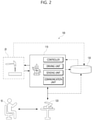
- FIG. 2 is a conceptual view for explaining an overview of a robot system according to the present invention.
- FIG. 3 is a block diagram for explaining a structure of a robot device of FIG. 2 .
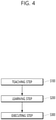
- FIG. 4 is a flowchart for representatively showing a method for learning a robot task according to the present invention.
- a robot system 100 may include at least one of a robot device 110, an interface device 120 and database 130. And the robot system is combined with a user 10 and a task environment 20 to thus implement a learning method of FIG. 4 .
- the learning method of the present invention may include a teaching step (S100), a learning step (S200), and an executing step (S300).
- the user may teach the robot device 110 while performing a task by manipulating the robot device 110 through the interface device 120.
- the user 10 may perform a task by manipulating the robot device 110 through the interface device 120 having a haptic function.
- the user may be a specialist of a task, or a specialist of robot teaching.
- the task environment 20 means an environment including an object required for a task, which may be indicated to include an object, a tool or surrounding circumstances.
- the task environment 20 may include a delivery product (object), a storage box (tool) at the time of a delivery, and a place (a surrounding environment) such as inside and outside a building, a passage (a hallway), stairs and an elevator.
- the task environment 20 may include the tree, the nail (the object), a tool (a hammer), and the surrounding environment where the tree is arranged.
- the robot device 110 may be included in the task environment 20 as itself.
- a size of the robot device 110, a moving range, etc. may be the task environment 20.
- the task may be defined as an operation to implement a specific object or a target in a desired state (a position, a posture, etc.).
- a desired state a position, a posture, etc.
- the task may be an operation to carry the delivery product to a desired position and to transfer to the recipient.
- the task may be an operation to apply a force to the nail in a vertical direction, and to drive the nail into the tree which is arranged on the floor in a horizontal direction.
- the interface device 120 may be a haptic remote controller as a learning teaching device.
- the interface device 120 may be a device used when the user performs a task by manipulating the robot device 110, and configured to provide a haptic feedback such that the user 10 recognizes a reciprocal operation between the robot and the task environment occurring during the task.
- the interface device 120 is formed to be manipulable for teaching of the robot device 110, and is configured to output a haptic feedback based on the force information while teaching of the task to the robot device 110 is performed.
- the interface device 120 may be a device having more than 6 degrees of freedom, and each degree of freedom may be a moving structure by an actuator.
- the interface device 120 is further provided with a device to receive a haptic feedback.
- the interface device 120 may be provided with a haptic module to output a haptic feedback.
- the haptic module may be provided in two or more in number according to a combination of haptic functions of the interface device 120.
- the interface device 120 may be provided with a wireless communication unit for communications with the robot device 110, and an output unit for receiving information from the robot and transferring to the user.
- the wireless communication unit may be configured as modules for wireless communications with the robot device 110, and the output unit may be a display device for outputting image information received from the robot device, etc.
- the display device may be a 3D display, a mixed reality display, a VR device, etc.
- the robot device 110 is configured to perform a task, and to detect force information related to the task.
- the robot device 110 may be one of the various types of robots aforementioned with reference to FIG. 1 .
- the robot device 110 includes a device (a driving unit of the robot) for changing a task environment, and may be provided with a device (a sensor, etc.) for recognizing the task environment.
- the robot device 110 may include a wireless communication unit 111, a sensing unit 112, a driving unit 113, a controller 114, a memory 115, an interface unit 116, a power supply unit 117, etc.
- the robot device 110 of this specification may have greater or fewer components than the above components.
- the sensing unit 112 and the controller 114 may exist inside or outside the robot device 110. That is, it is possible that one part of the wireless communication unit 111, the sensing unit 112, the driving unit 113, the controller 114, the memory 115, the interface unit 116 and the power supply unit 117 is configured as the robot device 110, and another part is implemented as an additional device.
- the wireless communication unit 111 is replaced by a wired communication unit, and the robot device and the interface device are provided with an additional wired communication unit.
- the robot device and the interface device may include a communication using a memory within a single system, as well as wired/wireless communications.
- the wireless communication unit 111 performs wireless communications between the robot device 110 and the interface device 120, between the robot device 110 and another robot device, or between the robot device 110 and an external server. Further, the wireless communication unit 111 may include one or more modules which connect the robot device 110 to one or more networks. To facilitate such communications, the wireless communication unit 111 may include a wireless Internet module 111a, a short-range communication module 111b, a location information module 111c, etc.
- the wireless Internet module 111a is a module for wireless internet access, and may be internally or externally coupled to the robot device.
- the wireless Internet module 111a is configured to transmit and/or receive wireless signals via communication networks according to wireless Internet technologies.
- the short-range communication module 111b is a module to perform short-range communications, and may support short-range communications of the robot device. Suitable technologies for implementing such short-range communications may include at least one of BLUETOOTH TM , Radio Frequency IDentification (RFID), Infrared Data Association (IrDA), Ultra-WideBand (UWB), ZigBee, Near Field Communication (NFC), Wireless-Fidelity (Wi-Fi), Wi-Fi Direct, Wireless USB(Wireless Universal Serial Bus), and the like.
- RFID Radio Frequency IDentification
- IrDA Infrared Data Association
- UWB Ultra-WideBand
- ZigBee Near Field Communication
- NFC Near Field Communication
- Wi-Fi Wireless-Fidelity
- Wi-Fi Direct Wireless USB(Wireless Universal Serial Bus)
- the location information module 111c is a module for obtaining a position (or a current position) of the robot device 110, and may be at least one of a Global Position System (GPS) module and a Wi-Fi module.
- the location information module 111c may obtain position information by being combined with the sensing unit 112.
- the location information module 111c may be configured to receive information required in an optical sensor module, a lidar module, an inertia sensor module, an image module and a fusion sensor module.
- the sensing unit 112 may include one or more sensors for sensing at least one of force information generated from a task, internal information of the robot device (especially, a driving state of the robot), peripheral environment information around the robot device, position information of the robot device, and user information.
- the force information generated from the task may be an external force applied to the robot device 110, for instance.
- the external force may be measured by using a force-torque sensor, or may be calculated through an estimation using a state of the robot such as a current applied to a motor, etc.
- the driving state of the robot may be an angle of the motor, an acceleration, an angular speed, a torque or a current applied to the motor, etc.
- the sensing unit 112 may be provided with a current sensor 112a for sensing a current applied to the motor, and an encoder 112b for sensing an angle of the motor.
- the sensing unit 112 may be provided with an IMU sensor for sensing an acceleration and an angular speed, a torque sensor for sensing a torque applied to the motor, etc.
- Surrounding environment information of the robot device 110 may include the task environment 20.
- the sensing unit 112 may measure data such as a distance from an object and a temperature of the task environment, by using specific sensors. Further, the sensing unit 112 may be provided with a camera 112c in order to obtain information by using a vision processing.
- the sensors for sensing the task environment 20 may be provided inside or outside the robot device 110. For instance, in case of capturing a surrounding situation with the robot device 110, the sensors may be provide outside the robot device.
- an image sensor, a camera, etc. may be additionally provided outside the robot device 110 at the robot system 100, in order to obtain information in the teaching step (S100) regardless of the configuration of the sensing unit 112.
- the driving unit 113 is configured to perform a driving according to a teaching command of the user under control of the controller 114.
- the driving unit 113 may be provided with at least one of an end effector 113a, a manipulator 113b and an actuator 113c.
- the end effector 113a is an end device of a robot arm designed to reciprocally operate with the environments, which may be a gripper, a pincette, a knife, etc. It is also possible that the end effector 113a is separately provided from the robot device 110 to thus serve as a peripheral device of the robot, an accessory, etc.
- the manipulator 113b may be a device to integrate links, joints, other structural factors and a mechanism to a body and arms of the robot device.
- the manipulator 113b may be provided to have a plurality of joints which perform a rotary motion of the motor.
- the manipulator 113b and the end effector 113a may form arms more than 6 degrees of freedom, and hands more than 1 degree of freedom.
- the arms and the hands may exist as a plurality of pairs such that the robot of the present invention is implemented as a robot having two arms or a plurality of arms.
- the actuator 113c is a device to convert electric, chemical or thermal energy into a rotary or linear motion, and may be a motor, a pneumatic cylinder, artificial muscles, etc.
- the actuator 113c may be provided with a motor driven in a Quasi-Direct-Drive (QDD) manner.
- QDD Quasi-Direct-Drive
- a force applied to an output terminal can be detected by a sensor of an input terminal.
- the sensor of the input end may be included in the sensing unit 112. That is, the sensing unit 112 may detect the force information by sensing a force applied to the output end of the motor as electric energy of the input end.
- an external force may be detected by the current sensor of the motor driven in the QDD manner, or a torque may be predicted by controlling a current of the motor.
- An external force generated from a robot task may be calculated through an estimation using a state of the robot, such as a current applied to the motor.
- the present invention is not limited to this. For instance, it is possible to control a torque by utilizing a torque measuring sensor to joints together with the motor, rather than in the QDD manner.
- the robot device 110 of the present invention may include a memory 115, an interface unit 116 and a power supply unit 117.
- the memory 115 may store programs to support operations of the controller 114 and temporarily store input/output data (for example, a driving command, etc.).
- the interface unit 116 may serve as a passage to connect the robot device 110 with an external device.
- the interface unit 116 may be a connection port, a port, a power source terminal, etc.
- the power supply unit 117 may be a device to receive external power and internal power and to supply the power to the respective components included in the robot device 110.
- the power supply unit 117 may be a device to generate electric energy in the robot device 110 and to supply the electric energy to each component.
- the controller 114 controls an operation to perform a task, and an overall operation of the robot device 110.
- the controller 114 may be provided with a first controller and a second controller.
- the first controller may be a lower controller 114b, and the second controller may be an upper controller 114a.
- the present invention is not limited to this.
- the first controller may be the upper controller, and the second controller may be the lower controller.
- the first and second controllers are configured in parallel, not as the upper and lower controllers.
- the lower controller 114b may be configured as one or more controllers.
- the lower controller 114b may include at least one of a position controller, a speed controller and a current controller.
- the driving unit 113 performs a driving according to a teaching command of the user under control of the lower controller 114b.
- the lower controller 114b controls the driving unit 113 by receiving a teaching command of the task from the interface device 120.
- the lower controller 114b may control the driving unit 113 by receiving a driving command for the task from the upper controller 114a.
- the upper controller 114a may be a controller for driving the driving unit 113 by controlling the lower controller 114b, and detailed descriptions thereof will be explained later.
- the lower controller 114b may receive a command from the interface device 120 or the upper controller 114a, and may calculate a torque or a current to be applied to the motor by using sensing data. Based on the calculated result, the motor, etc. may be driven by a position controller, a speed controller, a current controller, etc. And a driving command may be determined by one or more parameters.
- the driving command does not contain task information. That is, the lower controller 114b performs a command to move a specific motor to a specific position, to apply a specific amount of current to a specific motor, etc.
- the lower controller 114b is a controller which performs a reciprocal operation between an external environment and a force through the motor, and controls the actuator 113c such as the motor based on a command received from the upper controller 114a or the interface device 120.
- the lower controller 114b receives a driving command from the interface device 120 to thus control the actuator 113c such as the motor.
- the robot system 100 of the present invention may include database 130.
- the database 130 may sense a state of the robot and task environment information, and may detect a command transmitted to the lower controller 114b from the interface device 120 to thus store as time series data.
- the database 130 may store not only information in the teaching step (S100), but also past data. For instance, a policy (a methodology) derived from past learning may be stored together.
- a learning unit 140 may perform a learning by using the database 130. And at least a part of the upper controller 114a may be derived as a result in the learning step (S200).
- the robot system 100 may further include the learning unit 140.
- the learning unit 140 learns a motion(or an operation) of the robot device 110 related to the task, by using the database 130, such that the robot device 110 autonomously performs the task.
- the learning unit 140 may be separately configured from the robot device 110, or may be provided in the robot device 110. It is also possible that the learning unit 140 is provided at an additional server together with the database 130.
- the learning step (S200) may be a step of storing information generated in the teaching step (S100) (sensing data and an internal state of the robot), etc. at the database 130, and of deriving a policy (e.g., the upper controller) for performing a corresponding task through a learning using the stored data.
- a policy e.g., the upper controller
- an objective function to derive the upper controller may be a condition that a task performed as the user manipulates the robot through the interface device, and a task performed by using the learned upper controller have the same result.
- the learning step (S200) is not necessary performed after the teaching step (S100).
- the teaching step (S100) is performed prior to the learning step (S200).
- the teaching step (S100) may be performed such that at least a part thereof is overlapped with the learning step (S200) on the basis of a time flow.
- the upper controller 114a may be provided at the controller 114 of the robot device 110. Also, the upper controller 114a may be divided into a plurality of controllers, and may be transformed into various types. For instance, the upper controller 114b may be implemented as one of systems used in an artificial intelligence (Al) technology.
- Al artificial intelligence
- the upper controller 114a may be provided with at least one of a hierarchical controller, a finite state machine, and a behavior tree.
- the upper controller may be implemented by a programming language such as Gen, Python, Lisp-language, Julia and C/C++, and by Al deep learning framework (TensorFlow), Pytorch, Theano, etc.
- the upper controller 114a may be provided with a part learned from data as a result in the learning step (S200), and a pre-programmed part regardless of a learning, respectively.
- the upper controller 114a may receive a type of a task to be performed, calculate information about a next behavior from the current state information, and transmit to the lower controller 114b.
- the robot device 110 autonomously performs a task in the executing step (S300) by using a learned policy or the derived upper controller 114a.
- the upper controller 114a transmits a command to the lower controller 114b in one direction, as a result in the learning step (S200).
- a period of the upper controller 114a and a period of the lower controller 114b may be differently set.
- the behavior may be a posture of the end effector of the robot device, or a torque (or a current) of the motor.
- the behavior may be a state-torque function expressed as a vector field, or may be a subset of a parameter set which constitutes the lower controller.
- the interface device 120 having a haptic function an expert has feedback from a force applied to the robot in a substantial environment, and performs teaching of the robot. And as a plurality of information sensed through the teaching of the robot is learned, the upper controller 114a is derived. This may implement a methodology to make the robot which can control a force learn a task requiring force information, by using a haptic device.
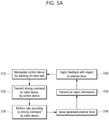
- FIGS. 5A and 5B are a detailed flowchart of the teaching step of FIG. 4 , and a conceptual view for explaining a concept of teaching, respectively.
- FIGS. 6A and 6B are a detailed flowchart of the learning step of FIG. 4 , and a conceptual view for explaining a concept of learning, respectively.
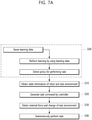
- FIGS. 7A and 7B are a detailed flowchart of the executing step of FIG. 4 , and a conceptual view for explaining a concept of execution, respectively.
- the method to learn a robot task according to the present invention may be categorized into details as shown in FIG. 5A .
- teaching of a robot task is performed based on an external manipulation of the interface device 120. That is, a manipulating device is controlled for teaching of a robot task by an expert (S110).
- the expert may be implemented variously, such as a user, an expert of a task, an expert of robot teaching and an operator, and will be referred to as an expert for convenience of explanations.
- advance preparations for robot teaching by the expert may be performed. For instance, once a robot task is determined, a detailed task environment setting or a teaching plan setting for teaching the robot and making the robot learn, etc. may be performed.
- the interface device 120 may be configured as multi joints in a similar size to human arms or robot arms.
- the interface device may be provided with the function or structure aforementioned with reference to FIGS. 1 to 4 .
- a driving command is generated from the interface device 120 and is transmitted to the robot device 110 (S120). That is, the interface device 120 transmits a driving command corresponding to the manipulation, to the robot device 110.
- the present invention is not limited to this. That is, it may be also possible that the interface device 120 transmits information about the movement to the robot device 110, and the robot device 110 generates a driving command.
- the information about the movement may be transmitted to the robot device 110, through a data communication using the interface device 120 and the wireless communication unit of the robot device 110.
- the information about the movement is transmitted to the lower controller 114b (refer to FIGS. 2 and 3 ) of the robot device 110.
- a controller or an algorithm based on kinematics information of the interface device 120 and the robot device 110 may be provided in order to describe the expert's manipulation or movement by the robot device 110.
- the robot device performs a task according to a driving command (S130). More specifically, once a command for performing an operation is input to the lower controller 114b of the robot device 110, the lower controller 114b performs a task by controlling the driving unit 113 of the robot device 110. For instance, the sensing unit 112 of the robot device 110 senses a task environment, a current state of the motor, etc. And the lower controller 114b receives the task environment or the current state of the motor from the sensing unit 112 to thus calculate an operation for performing a task, thereby controlling the motor in correspondence thereto.
- the motor may be the QDD type of motor aforementioned with reference to FIGS. 1 to 4 , or other type of motor.
- a task environment is changed though a reciprocal operation with a force.
- a change of the task environment may be a change of a protruded height of a nail from a tree at the time of hammering the nail into the tree, for instance.
- sensors of the sensing unit 112 sense a generated external force (S140). Further, the sensing unit 112 may sense a state or a change of the task operation.
- the interface device 120 receives information about a force generated from the robot task from the robot device 110, thereby outputting a haptic feedback.
- the sensing unit 112 detects an external force applied to the robot device 110, and the interface device 120 outputs the haptic feedback based on the external force.
- information about an external force or a state or a change of a task environment, inputted from the sensor, is transmitted to the expert through the interface device 120.
- the information may be transmitted to the interface device 120 as haptic information (S150).
- the haptic information may be data informing the external force or the state or the change of the task environment.
- the lower controller 114b may transmit the force information to the interface device 120 as haptic information.
- a reaction force (F1) is generated to thus be applied to the robot.
- Data of the reaction force (F1) may be transmitted to the interface device as force information.
- the interface device applies a force (F2) corresponding to the reaction force (F1) to its part grasped by the expert's hand in a vertical direction, such that the expert feels the reaction force (F1) at the time of the nailing task.
- the reaction force is explained as an example.
- various types of external forces, a material of an object, a rough degree (roughness) of a surface, a weight of the hammer, etc. may be generated. And such external forces may be included in the force information.
- the interface device 120 transmits a force corresponding to the external force to the user by the haptic feedback, in order to teach the robot device 110 based on the force information.
- a driving command to drive the haptic module for the haptic feedback is generated from the interface device 120.
- the haptic information may be a control command with respect to the interface device 120, derived from the data.
- the haptic module is driven by using the control command.
- the interface device 120 outputs a haptic feedback with respect to the external force (S160).
- the haptic module may be provided with a plurality of actuators or devices. And the interface device 120 may transmit data on a force or an environment change through the actuators or the devices such that the expert feels.
- the expert who has received the haptic feedback controls the manipulating device for teaching the robot task, by reflecting the force (S110).
- the expert may receive information required for teaching from the interface device 120, or may feel by directly viewing a task environment.
- a reciprocal operation with the task environment is performed only through the robot. That is, an environment change can be performed only through the robot device.
- the learning step (S200) of FIG. 4 is performed.
- the learning step (S200) may be categorized into details as shown in FIG. 6A .
- the learning step (S200) may include a data storing step and a policy (a methodology) learning step.
- learning data is sensed (S210). More specifically, while the robot device 110 performs the robot task according to a driving command transferred to the robot device 110 by the interface device 120, may be sensed first information related to a task environment of the robot device 110, and second information related to a driving state of the robot device 110.
- the sensing of the first and second information is performed by the sensing unit 112, while teaching of the task to the robot device is performed by the interface device 120 which outputs a haptic feedback.
- the learning data does not necessarily include the first and second information, but may include one of the first and second information.
- the sensed first and second information may be collected as data required to check the expert's behavior intention.
- the first and second information may be information that the task environment and the driving state are changed according to teaching of the task to the robot device 110 based on the force information.
- the behavior intention means a plan for a task performed by doing a specific operation at a specific situation.
- the behavior intention may be embodied by the upper controller 114a derived through a learning.
- a driving command transferred to the robot device 110 may be stored in the database 130.
- the task environment 20 and a driving state of the robot device 110 may be stored in the database 130.
- the descriptions explained with reference to FIGS. 1 to 4 may be applied to the task environment 20 and the driving state.
- the first information may include at least one of a capturing image, a distance from an object and a temperature of the task environment.
- the second information may include at least one of an angle of the motor, an acceleration, an angular speed, and a torque or a current applied to the motor.
- the capturing image may be obtained by a camera provided separately from the robot device 110, etc.
- the temperature of the task environment may be obtained by a temperature measuring device provided separately from the robot device 110.
- a policy learning step is performed.
- the data storing step and the policy learning step may be sequentially performed as illustrated in the specification, but are not limited to this. For instance, it is also possible that the policy learning step is performed while the data storing step is performed.
- a step of learning the robot task by using the first and second information is performed. That is, at least a part of the controller 114 (refer to FIG. 3 ) of the robot device 110 is derived through a learning of the robot task.
- the learning unit 140 learns a motion(or operation) of the robot device 110 related to the task, based on the first and second information, such that the robot device 110 autonomously performs the task. For instance, as the learning unit 140 performs learning of the task, at least a part of the upper controller 114a may be derived. In this case, the first information and the second information are stored in the database 130 as time series data together with the teaching command, and the learning unit 140 derives the upper controller 114a by using the time series data.
- This step may be a process of deriving the upper controller 114a such that a task performed by the expert is performed only by the upper controller 114a without the expert. In this case, it is possible that a part of the upper controller 114a is derived.
- the upper controller 114a may be divided into a first controller and a second controller.
- the first controller is a preset part to drive the robot device, which may be a part pre-programmed regardless of the learning.
- the second controller may be a part derived from the learning and interworked with the first controller. That is, the second controller may be a part derived from data as a result in the learning step.
- learning is performed by using the obtained learning data (S220), and a policy to perform a task is derived through the learning (S230).
- the learning may be performed by using not only recent data, but also past information.
- a policy (a methodology) derived from past data or past learning may be stored together in the database 130.
- the learning may be performed by various algorithms, and may be performed by at least one of an imitation learning, a meta learning, a reinforcement learning and an inverse reinforcement learning, for instance.
- the upper controller 114a generates a control command with respect to the lower controller 114b such that the robot device 110 autonomously performs the task based on the learning.
- the robot device 110 autonomously performs the task through the controller 114.
- the executing step (S300) of FIG. 4 is performed.
- the executing step (S300) may be categorized into details as shown in FIG. 7A .
- the robot device 110 performs a task which has been performed by the expert, by using the upper controller 114a obtained in the learning step (S200), without the expert.
- the robot device 110 may perform the task because it understood the expert's behavior intention.
- the robot device 110 may autonomously perform a task to drive a nail into a concrete wall as shown in FIG. 7B .
- the robot device may carry a heavier delivery product by lifting above its head with a larger force.
- the executing step (S300) will be explained in more detail.
- a task to be performed by the upper controller 114a obtained in the learning step (S200) is set.
- Such a setting can be performed in any form which discerns a task.
- natural numbers may be set to corresponding tasks, respectively. More specifically, 1 may be a task to drive a nail, and 2 may be a task to carry a delivery product. In this case, if 1 is set, the robot device recognizes a command to perform a task to drive a nail.
- the upper controller 114a transmits an operation command to be performed to the lower controller 114b, by using current state information of the robot device and a task environment.
- the robot device 110 obtains state information of the robot device and state information of a task environment (S310), and the controllers generate a task command by using such information (S320). More specifically, if 1 is set and a command to drive a nail is recognized, the robot device 110 recognizes a concrete wall as state information of a task environment, and recognizes a position of the end effector 113a or a current posture of the manipulator 113b (refer to FIG. 3 ), etc. as state information of the robot device 110. Such information acquisition may be performed by the sensing unit 112 (refer to FIG. 3 .) of the robot device 110.
- the upper controller 114a generates an operation command for a task, and transmits to the lower controller 114b.
- the operation command may be transmitted in the form of a goal position of the end effector 113a of the robot device 110, a posture of the end effector 113a, a posture of the manipulator 113b, a motor torque, a motor current, a state-motor torque function, etc.
- the operation command may be implemented as one of the above various forms, or may be represented as a combination thereof.
- the upper controller 114a recognizes a position to drive a nail (a nailing position), and calculates operations of the end effector 113a and the manipulator 113b for driving a nail into a wall, thereby generating an operation command.
- the lower controller 114b having received the operation command applies a torque to perform the operation command received from the upper controller 114a, to the motor, based on the state information of the robot device 110 and the state information of the task environment 20. Like this, an operation to drive a nail into a wall is performed by the lower controller 114b.
- the robot device 110 senses an external force and a change of the task environment (S330), and autonomously performs a task (S340). More specifically, the moved motor causes a change of the task environment, and an external force generated at this time and the change of the task environment may be recognized by the sensing unit 112.
- the sensing unit 112 transmits information required by the lower controller 114b and the upper controller 114a, to the lower controller 114b and the upper controller 114a, after a processing to an object recognition, an estimation of a position or a posture, etc. For instance, in case of driving a nail into a wall, the robot device 110 recognizes that a nail is driven (inserted) less under the same force, than in case of driving a nail into a tree.
- the upper controller 114a transmits a motor torque to drive a nail with a larger force to the lower controller 114b, as an operation command, thereby autonomously performing a task to drive a nail into a concrete wall.
- the robot device 110 performs a task to drive a nail into different concrete walls. After performing a task to drive a nail into one concrete wall (refer to FIG. 1B ), the robot device may perform a task to drive a nail to another concrete wall (refer to FIG. 7B ) with a similar force, by recognizing that said another concrete wall is similar to said one concrete wall.
- a robot task is defined based on force information between the robot and the external environment, such that the robot easily learns various and complicated tasks.
- the present invention may implement a method to learn to handle a change of an external force of the robot more flexibly, according to a change of a task environment.
- the aforementioned method to learn a robot task and the robot system according to the present invention may be modified in various manners.
- the aforementioned method to learn a robot task and the robot system may be applied to learning of 1: N or a robot task control.
- a modified embodiment or other embodiment of the present invention will be explained with reference to FIGS. 8 and 9 .
- the same or similar reference numerals will be provided to the same or similar configurations as or to those of the aforementioned embodiment, and detailed explanations thereof will be replaced by the aforementioned ones.
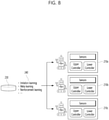
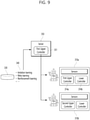
- FIGS. 8 and 9 are conceptual views showing other embodiments of a method for learning a robot task and a robot system using the same according to the present invention.
- the robot system may be provided with a plurality of robot devices 210a, 210b, 210c.
- a policy learned by a learning unit 240 may be derived as an upper controller of each of the robot devices.
- the robot system may include at least one of a robot device, an interface device and database, like the robot system aforementioned with reference to FIG. 2 . And such the robot system implements the learning method of FIGS. 4 to 7A , by being combined with a user and a task environment.
- the robot device is provided in plurality.
- the robot system may be provided with a first robot device 210a, a second robot device 210b and a third robot device 210c.
- Each of the first robot device 210a, the second robot device 210b and the third robot device 210c may be provided with the components of the robot device aforementioned with reference to FIG. 3 . It is possible that each of the first robot device 210a, the second robot device 210b and the third robot device 210c is commonly provided with a sensing unit, an upper controller and a lower controller, but is selectively provided with other components. For instance, driving units of the first robot device 210a, the second robot device 210b and the third robot device 210c may have different structures.
- the robot devices are robots for professional services
- the first robot device 210a may be a leading (conducting) robot
- the second robot device 210b may be a firefighting robot
- the third robot device 210c may be a delivery robot.
- each of the first robot device 210a, the second robot device 210b and the third robot device 210c may be learned so as to be suitable to an individual task, by utilizing the teaching step and the learning step of the present invention. Accordingly, different policies may be mounted to the upper controllers of the first robot device 210a, the second robot device 210b and the third robot device 210c. Further, each of the lower controllers of the first robot device 210a, the second robot device 210b and the third robot device 210c may be configured to be suitable for usage of the robot.
- a policy learned by the learning unit may be derived from an additional server, as a part of the controller.
- the robot system may include a robot device, an interface device and database, like the robot system aforementioned with reference to FIG. 2 . And such the robot system implements the learning method of FIGS. 4 to 7A , by being combined with a user and a task environment.
- a server 350 is configured to control a plurality of robot devices.
- the robot system may be provided with a server 350, a first robot device 310a, and a second robot device 310b.
- an upper controller may include a first upper controller 351, and a second upper controller 314a.
- the first upper controller 351 is a controller positioned at the server 350, and may be derived by the learning method of FIGS. 4 to 7A .
- the second upper controller 314a is a controller provided at the robot device 310a, and may be a part pre-programmed regardless of a learning.
- a policy derived by learning is positioned at the server 350 as the first upper controller 351, and is used to control the first robot device 310a and the second robot device 310b through wireless or wired communications.
- a task command transmitted from the server 350 is transferred to the second upper controllers 314a of the first robot device 310a and the second robot device 310b, and the second upper controllers 314a transmit an operation command to be performed to the lower controllers 314b.
- the first robot device 310a obtains state information of the robot device and state information of a task environment, and transmits such information to the server 350. Then, the first upper controller 351 of the server 350 generates a task command, and transmits to the second upper controller 314a. Then, the second upper controller 314a converts the task command into a concrete form, such as a target position of an end effector of the first robot device 310a, a posture of the end effector, a posture of a manipulator, a motor torque, a motor current, and a state-motor torque function, and transfers to the lower controller 314b.
- a concrete form such as a target position of an end effector of the first robot device 310a, a posture of the end effector, a posture of a manipulator, a motor torque, a motor current, and a state-motor torque function
- the server 350 may transfer the task command to the second robot device 310b instead of the first robot device 310a, because it recognizes that the second robot device 310b is positioned closer to a task place than the first robot device 310a.
- the second robot device 310b may perform a corresponding task by the processes aforementioned with taking the first robot device as an example.
- a result of learning using one robot device may be utilized to be duplicated to another robot device, for a process.
- a task may be learned by the first robot device, a result of the learning may be derived as the first upper controller, and the first upper controller may be commonly applied to the first robot device and the second robot device.
- the method to learn a robot task and the robot system of the present invention can be modified into a method to learn a robot task in a one to N manner, and a robot system using the same.
- a new learning model for a robot to safely perform various and complicated tasks or a new method and a new system to learn a robot task based on force information.
- a robot task is defined based on force information between the robot and the external environment, such that the robot easily learns various and complicated tasks. Further, the present invention may implement a learning method to more flexibly handle a change of an external force of a robot according to a change of a task environment..
- a definition of a robot task using information about a posture and a position has a problem that a new modeling should be derived when an external environment changes.
- a new type of robot task is defined based on force information, such a problem can be solved.
- an expert performs teaching of the robot by having feedback from a force applied to the robot in a substantial environment. That is, task teaching based on a force may be performed in various environments.
- the robot acquires information required for a task in a substantial environment, and utilizes to learning. Accordingly, the robot may learn a task requiring force information.
- a multi-joint robot may perform a more effective learning. This may allow a plurality of tasks to be handled flexibly at various situations, by using a high degree of freedom of the multi-joint robot. In this case, the robot may perform a new task rapidly, by using past learning information together. Further, as teaching may be performed by using a haptic device without each programming, time and efforts taken for a learning may be reduced.
- the lower controller transceives information with the interface device in the teaching step, and the upper controller is derived in the learning step, based on the information obtained in the teaching step.
- the upper controller may be implemented as a common middleware, and may be provided as task programs for different robots. This may allow a replacement of the robot, a change of a task plan, or observance of a safety standard by the robot, to be performed more easily.
Landscapes
- Engineering & Computer Science (AREA)
- Robotics (AREA)
- Mechanical Engineering (AREA)
- Human Computer Interaction (AREA)
- Computer Networks & Wireless Communication (AREA)
- Automation & Control Theory (AREA)
- Physics & Mathematics (AREA)
- General Physics & Mathematics (AREA)
- Manipulator (AREA)
Abstract
Description
- Pursuant to 35 U.S.C. § 119(a), this application claims the benefit of the earlier filing date and the right of priority to Korean Patent Application No.
10-2020-0095258, filed on July 30, 2020 - The present invention relates to a method for learning a robot task by using a remote control device, and a robot system using the same.
- Due to an aging society around the world, social problems such as decrease of the working population and increase of labor costs are generated. Because of such problems, necessity of automation in the whole industry is highly required, and automation through a robot is being spotlighted as a solution. According to such a trend, there is a high tendency to replace a manpower by a robot in many fields of the society.
- However, in the conventional robot manufacturing market, a robot technology is concentrated to a method to perform simple and repetitive tasks rapidly and precisely. This causes a difficulty in flexibly dealing with a demand of automation using a robot in a new industry field such as electrical and electronic fields and a logistics field. For instance, it is improper to apply the conventional robot technology for performing a uniform task repetitively to manufacture electric and electronic components, due to a difficulty in standardizing processes, a high difficulty of a task, and a very short lifespan of a production line. Further, in case of a logistics service field, a robot task cannot be standardized, and handling various situations is required. For instance, a robot which performs a delivery service should lift delivery products of various weights, and the robot should perform a proper control according to a weight of each delivery product. Different types of tasks require different "force information", and a robot has a difficulty in performing various tasks requiring different force information according to types of the tasks.
- Further, in case of a housework service field, various situations may occur, and force information is required in this case. More specifically, many tasks performed in a daily life space may require information related to a force in order to express the tasks. For instance, in order to perform a 'task to spread butter on bread', a robot should move with pressing butter by a dessert knife. Here, a result of the 'task to spread butter on bread' becomes different according to a pressing force. Also, the result of the task may become different according to the degree of toughness of the butter, the degree of toughness of the bread, etc.
- As another example, in case of expressing a task to be performed by a robot, force information may be required. More specifically, in case of 'a task to detach scotch tape on a desk' or 'a task to remove stains on a desk by using a towel', etc., the task may be expressed more precisely through information such as a size or a direction of a required force. Recently, an intelligent robot technology to make a robot learn a task attracts attention. Methods to make a robot learn a task which are being actively researched may include a teaching pendant method, a kinesthetic teaching method, a teleoperation method, a hard coding method, etc.
- However, such methods are improper to make a robot learn a task requiring force information.
- More specifically, the teaching pendant method is to store information of a position and a posture, and describes a task learning method. The kinesthetic teaching method has a problem that a robot has a difficulty in discerning whether a force transmitted from a person is for teaching or is required for a task, because the person moves with holding the robot.
- In case of the teleoperation method, force information cannot be contained in a task because only information on a person's posture is transferred to a robot. Further, in case of the hard coding method, flexibility for a complicated task is low, and each task should undergo a programming process.
- Accordingly, there still exist needs to a new type of method to learn a robot task capable of solving such problems, and a robot system capable of performing a task requiring force information.
- Therefore, an aspect of the present disclosure is to provide a new learning model which allows a robot to effectively learn and perform various and complicated tasks.
- Another aspect of the present disclosure is to provide a method for learning a robot task based on force information, and a system using the same.
- More specifically, the present invention is to provide a method and a system capable of newly defining a robot task based on information of a force generated at the time of performing the robot task. Also, the present invention is to provide a method and a system capable of performing a learning more effectively by a multi-joint robot having a high degree of freedom.
- The present invention is to provide a learning method and a system capable of reflecting an intention of a user who teaches a robot such that a task is autonomously performed by reflecting an external environment.
- Further, the present invention is to provide a method capable of reflecting an external environment at the time of teaching a task, and a learning method and a system capable of effectively acquiring learning data.
- Further, the present invention is to provide a field technology for conveniently instructing a new task according to a changed task environment in an industry field or a service field.
- In order to achieve these and other advantages and in accordance with the purpose of this specification, a robot system of the present invention uses a process that an expert demonstrates a task by using a haptic manipulating device which transfers a force, and a robot device learns the task.
- More specifically, the robot system includes: a robot device configured to perform a task, and to detect force information related to the task; an interface device formed to be manipulable to teach the robot device, and configured to output a haptic feedback based on the force information while teaching of the task to the robot device is performed; a sensing unit configured to sense first information related to a task environment of the robot device, and second information related to a driving state of the robot device, while the teaching is performed by the interface device for outputting the haptic feedback; and a learning unit configured to learn a motion of the robot device related to the task, by using the first information and the second information, such that the robot device autonomously performs the task.
- Further, in the present invention, the sensing unit may detect an external force applied to the robot device while the teaching is performed by the interface device. And the interface device may output the haptic feedback based on the external force.
- The haptic feedback may be implemented as the interface device transmits a force corresponding to the external force to a user, for teaching of the task to the robot device based on the force information. In this case, the first information and the second information may be information that the task environment and the driving state are changed according to teaching of the task to the robot device based on the force information.
- In the robot system according to the present invention, the robot device may include: a lower controller configured to receive a teaching command of the task, from the interface device; a driving unit configured to perform a driving according to the teaching command, under control of the lower controller; and an upper controller configured to drive the driving unit by controlling the lower controller.
- The lower controller may control the driving unit by receiving the teaching command from the interface device, and may transmit the force information to the interface device as haptic information.
- The learning unit may derive at least a part of the upper controller by performing learning of the task based on the first information and the second information. In this case, the upper controller may generate a control command with respect to the lower controller such that the robot device autonomously performs the task based on the learning. Also, the upper controller may be provided with a first controller preset to drive the robot device, and a second controller derived by the learning and interworked with the first controller.
- In the robot system according to the present invention, the first information and the second information may be stored in database as time series data together with the teaching command, and the learning unit may derive the upper controller by using the time series data.
- The driving unit may be provided with a motor driven in a quasi-direct-drive manner. And the sensing unit may detect the force information by sensing a force applied to an output terminal of the motor as electric energy of an input terminal.
- In a robot device which can undergo teaching of a task through an interface device according to the present invention, learning data is obtained to learn another controller, while teaching of a task is performed through one controller.
- More specifically, the robot device includes: a first controller configured to receive a teaching command of the task, from the interface device; a driving unit having a multi-joint, and configured to perform a driving according to the teaching command, under control of the first controller; a sensing unit configured to sense first information related to a task environment of the robot device, and second information related to a driving state of the robot device, while the driving unit is driven under control of the first controller; and a second controller configured to drive the driving unit by controlling the first controller. Here, the robot device performs learning of the task by using the first information and the second information. And the second controller generates a control command with respect to the first controller such that the robot device autonomously performs the task based on the learning.
- The present invention also provides a method for learning a robot task. The method for learning a robot task includes: performing teaching of a robot task based on an external manipulation of an interface device; transmitting a driving command corresponding to the manipulation to a robot device by the interface device, and outputting a haptic feedback by receiving information related to a force generated from the robot task, from the robot device; sensing first information related to a task environment of the robot device, and second information related to a driving state of the robot device, while the robot device performs the robot task according to the driving command; and performing learning of the robot task by using the first information and the second information.
- In the method for learning a robot task and the robot system according to the present invention, a robot task is defined based on force information between the robot and the external environment, such that the robot easily learns various and complicated tasks. Thus, the present invention may implement a learning method which handles a change of a task environment more flexibly.
- A definition of a robot task using information about a posture and a position has a problem that a new modeling should be derived when an external environment changes. However, in the present invention, as a new type of robot task is defined based on force information, such a problem can be solved.
- Further, in the present invention, as the interface device having a haptic function is used, an expert performs teaching of the robot by having feedback from a force applied to the robot in a substantial environment. That is, task teaching based on a force may be performed in various environments. In this case, the robot acquires information required for a task in a substantial environment, and utilizes to learning. Accordingly, the robot may learn a task requiring force information.
- In this case, a person's physical intelligence may be converted into a language of the robot (first information and second information) for learning. And how to behave by a person according to a task environment (first information) may be analogized and learned through various information (first information and second information) in the teaching step. Further, in the present invention, since the robot may learn an expert's task command, a multi-joint robot may perform a more effective learning. In the present invention, a plurality of tasks can be handled flexibly at various situations, since learning is performed by using a high degree of freedom of the multi-joint robot. In this case, the robot may perform a new task rapidly, by using learning information on a past task as learning information on a new task.
- Like this, in the present invention, past learning data and learning results are used, and learning is performed based on information obtained as the robot directly performs a task through an expert and a haptic device. Therefore, the learning by the robot may be performed only through a small number of teachings and demonstrations. Further, as a teaching may be performed by using a haptic device without each programming to operate the robot at each different task, time and efforts taken for a learning by the robot may be reduced. Further, in the present invention, the lower controller transceives information with the interface device in the teaching step, and the upper controller is derived in the learning step based on the information obtained in the teaching step. This can allow a learning and a robot control to be performed more efficiently.
- Further, in the present invention, since data obtained from various sensors is used, learning of the upper controller capable of flexibly handling various situations can be performed.
- In this case, the upper controller may be implemented as a common middleware, and may be provided as task programs for different robots. This may allow a replacement of the robot, a change of a task plan, or observance of a safety standard by the robot, to be performed more easily.
-
-
FIGS. 1A and1B are conceptual views for explaining a method for learning a robot task and a task execution according to the present invention; -
FIG. 2 is a conceptual view for explaining an overview of a robot system according to the present invention; -
FIG. 3 is a block diagram for explaining a structure of a robot device ofFIG. 2 ; -
FIG. 4 is a flowchart for representatively showing a method for learning a robot task according to the present invention; -
FIGS. 5A and5B are a detailed flowchart of a teaching step ofFIG. 4 , and a conceptual view for explaining a concept of teaching, respectively; -
FIGS. 6A and6B are a detailed flowchart of a learning step ofFIG. 4 , and a conceptual view for explaining a concept of learning, respectively; -
FIGS. 7A and7B are a detailed flowchart of an executing step ofFIG. 4 , and a conceptual view for explaining a concept of execution, respectively; and -
FIGS. 8 and9 are conceptual views showing other embodiments of a method for learning a robot task and a robot system using the same according to the present invention. - Description will now be given in detail according to exemplary embodiments disclosed herein, with reference to the accompanying drawings. For the sake of brief description with reference to the drawings, the same or equivalent components may be provided with the same or similar reference numbers, and description thereof will not be repeated. In general, a suffix such as "module" and "unit" may be used to refer to elements or components. Use of such a suffix herein is merely intended to facilitate description of the specification, and the suffix itself is not intended to give any special meaning or function. In the present disclosure, that which is well-known to one of ordinary skill in the relevant art has generally been omitted for the sake of brevity. The accompanying drawings are used to help easily understand various technical features and it should be understood that the embodiments presented herein are not limited by the accompanying drawings. As such, the present disclosure should be construed to extend to any alterations, equivalents and substitutes in addition to those which are particularly set out in the accompanying drawings.
- It will be understood that although the terms first, second, etc. may be used herein to describe various elements, these elements should not be limited by these terms. These terms are generally only used to distinguish one element from another.
- It will be understood that when an element is referred to as being "connected with" another element, the element can be connected with the other element or intervening elements may also be present. In contrast, when an element is referred to as being "directly connected with" another element, there are no intervening elements present.
- A singular representation may include a plural representation unless it represents a definitely different meaning from the context.
- Terms such as "include" or "has" are used herein and should be understood that they are intended to indicate an existence of features, numbers, steps, functions, several components, or combinations thereof, disclosed in the specification, and it is also understood that greater or fewer features, numbers, steps, functions, several components, or combinations thereof may likewise be utilized.
- The present invention is to provide a method for learning a robot task by using a remote controller (or an interface device) having a haptic function, and a system using the same.
- Here, the haptic is a computer tactile technique, and more particularly, means a technique to allow a user to feel a tactile sense, a force, a sense of movement, etc. through a user input unit. In this case, the tactile sense, the force, the sense of movement may be implemented by air injection, a temperature control, etc. As another example, the haptic may be implemented to allow a user to feel through a muscle sense such as a finger and an arm. Also, a haptic feedback explained in the present invention means a technique to allow a user to feel a tactile sense, a force, a sense of movement, etc., by using a feedback through an input device.
- Like this, the present invention is to allow a user of a remote controller for a robot to recognize a force generated from the robot at a substantial operation environment, by outputting a haptic feedback to the remote controller.
- In this specification, the robot indicates a machine (i) having a similar function to a human, or a mechanical device (ii) which is programmable by one or more computer programs and which automatically performs a complex series of actions. As another example, the robot may mean a machine having a form and having an ability to think by itself.
- Particularly, the robot in this specification may be an industrial robot which performs an assembly, a welding, a handling, etc. at a manufacturing process in a functional aspect, or an intelligent robot to recognize environments and having a function to determine by itself, etc. Alternatively, the robot in this specification may be configured to perform a plurality of functions not a single function in a composite manner.
- Further, the robot in this specification may be an android robot similar to a human in shape and behavior, a humanoid robot similar to a human in a body structure, a cyborg that a part of a human body has been remodeled into a machine, etc.
- Alternatively, in the aspect of use, the robot in this specification may include a service robot for personal and private use such as a cleaning robot, an entertaining robot, an education robot and a rehabilitation robot, a service robot for professional use such as a leading (conducting) robot, a firefighting robot, a medical robot, a delivery robot, a disaster rescue robot, a moving robot, a housework robot and a kitchen robot, an industrial robot such as a welding robot, a painting robot and a transfer robot, a military robot such as a fight robot and a patrol robot, etc.
- Meanwhile, in order to implement the aforementioned functions or uses, the robot in this specification may be provided with an actuator, a control system, an end effector, a manipulator, a sensor, etc.
- The robot of the present invention may be configured as a multi-joint robot (an articulated robot) having a manipulator of a multi-joint in order to have a proper form to perform various tasks. Further, the present invention provides a new learning model for a robot to safely perform various and complicated tasks, by providing a new type of learning method of a multi-joint robot.
- In the embodiments of the present invention, a new learning method of a robot is explained on the basis of structures of a driving unit having a multi-joint and an interface device. However, the present invention is not limited to this. That is, the embodiments to be explained hereinafter may be applicable to any type of structure or learning method of a robot.
-
FIGS. 1A and1B are conceptual views for explaining a method for learning a robot task and a task execution according to the present invention. - As shown in
FIG. 1A , a user teaches a task required in a specific operation environment, to a robot. - Here, the operation environment is an environment for the robot to perform an operation, which may include various environmental factors around the robot. Especially, the operation environment may be understood as a meaning which includes all of materials related to an operation to be performed by the robot, tools, an operation target, etc.
- Hereinafter, the present invention will be explained with taking a specific task and a specific task environment as a concrete example.
- For instance, as the specific task, "driving (hammering) a nail into a tree" will be defined.
- In the present invention, a user may teach a robot an operation to drive (hammer) a nail into a tree, in order to perform a specific task. The user may be a specialist for a task or a specialist for teaching of the robot, and may remotely control the robot by using an interface device. The "user" referred in this specification is not limited to a specialist, but may be any subject which can control a robot by using an interface device.
- In this specification, the "teaching" which means leading a robot by teaching may be replaced by instructing, guiding, etc.
- The interface device may generate a driving command and transfer to the robot, according to a user's manipulation. For instance, the interface device transfers the driving command to a remote controller through a communication with the robot.
- As shown, the robot performs a task to drive a nail into a tree according to a user's manipulation. In this case, a task operation environment (or a specific task environment) may be an object such as the tree, a position of the tree, a material of the tree, a restriction on a posture of the robot, etc.
- The present invention proposes a method to learn a task requiring force information by a robot which can control a force, by using a haptic device as an interface device.
- Thus, the interface device is configured to output a force generated when the robot hammers a nail as a haptic feedback. For this, the interface device may be provided with a haptic module.
- The user teaches an operation to drive a nail (a nailing operation) to the robot in a remote control manner, with substantially feeling a force generated from the robot at the time of the operation. More specifically, the robot performs a substantial task in a demonstrating manner. Here, the user feels a substantial force generated from the corresponding task through the interface device, and manipulates the interface device for the demonstration.
- In this case, the robot senses learning data from the teaching of the task, and may establish database including the sensed learning data. The robot may learn the task through a machine learning by using the established database.
- A controller, or a control program or a task execution policy, etc. are derived through the learning. And the robot autonomously performs a task which was being performed and a task similar to the past task, by utilizing the learning result, even if there is no teaching by the user.
- As shown in
FIG. 1B , as a result of the learning, the robot may perform a task to drive a nail into a concrete wall. The task to drive a nail into a concrete wall has different environments in that the object is arranged vertically unlike the tree which is arranged horizontally, a larger force is required to drive a nail, etc. However, the robot may autonomously perform the corresponding task even if the task environment change, because it understood the user's behavior intention under teaching of the task. - However, the present invention is not limited to the same type of processes as those in this embodiment. It will be obvious to those skilled in the art that the embodiment may be implemented in another form. For instance, in a teaching step, teaching of a task to drive a nail into a tree which is arranged vertically may be performed. In a substantial task process, the robot may be requested to drive a nail into concrete not a tree. In this case, an object, a target of the task is changed into the concrete from the tree, which means that the task environment is changed. In the case that the task environment is changed, the robot of the present invention may derive task information required in the changed task environment from the previously learned task information (e.g., force information), for the task in the changed task environment. For instance, in case of driving a nail into concrete, a larger force is required than in the case to drive a nail into a tree. And the robot of the present invention may derive force information required for the new task, based on learning.
- For implementation of the method to learn a robot task and the task execution aforementioned with reference to
FIGS. 1A and1B , the present invention provides a new definition of a robot task, and a method to learn various tasks by a robot. - Like this, the present invention is to provide a new definition of a robot task, and a methodology to learn various tasks. Hereinafter, a method to learn a robot task and a robot system according to the present invention will be explained in more detail with reference to the attached drawings.
FIG. 2 is a conceptual view for explaining an overview of a robot system according to the present invention.FIG. 3 is a block diagram for explaining a structure of a robot device ofFIG. 2 . AndFIG. 4 is a flowchart for representatively showing a method for learning a robot task according to the present invention. - In the following descriptions, "a system to make a single robot learn and a learning method" are explained as examples. However, the present invention may be also applicable to a system to make a plurality of robots learn and a learning method.
- Referring to
FIG. 2 , arobot system 100 according to the present invention may include at least one of arobot device 110, aninterface device 120 anddatabase 130. And the robot system is combined with auser 10 and atask environment 20 to thus implement a learning method ofFIG. 4 . - Referring to
FIG. 4 , the learning method of the present invention may include a teaching step (S100), a learning step (S200), and an executing step (S300). - In the teaching step (S100), the user may teach the
robot device 110 while performing a task by manipulating therobot device 110 through theinterface device 120. - Referring to
FIG. 2 , in the teaching step (S100), theuser 10 may perform a task by manipulating therobot device 110 through theinterface device 120 having a haptic function. As aforementioned, the user may be a specialist of a task, or a specialist of robot teaching. - The
task environment 20 means an environment including an object required for a task, which may be indicated to include an object, a tool or surrounding circumstances. For instance, in a case that a home-delivery product is transferred to a recipient in a building, thetask environment 20 may include a delivery product (object), a storage box (tool) at the time of a delivery, and a place (a surrounding environment) such as inside and outside a building, a passage (a hallway), stairs and an elevator. As another example, in case of driving a nail into a tree as aforementioned, thetask environment 20 may include the tree, the nail (the object), a tool (a hammer), and the surrounding environment where the tree is arranged. - In this case, the
robot device 110 may be included in thetask environment 20 as itself. For instance, a size of therobot device 110, a moving range, etc. may be thetask environment 20. - In this embodiment, the task may be defined as an operation to implement a specific object or a target in a desired state (a position, a posture, etc.). For instance, in case of carrying a home-delivery product to a recipient in a building, the task may be an operation to carry the delivery product to a desired position and to transfer to the recipient. As another example, in case of driving a nail into a tree as aforementioned, the task may be an operation to apply a force to the nail in a vertical direction, and to drive the nail into the tree which is arranged on the floor in a horizontal direction.
- The
interface device 120 may be a haptic remote controller as a learning teaching device. For instance, theinterface device 120 may be a device used when the user performs a task by manipulating therobot device 110, and configured to provide a haptic feedback such that theuser 10 recognizes a reciprocal operation between the robot and the task environment occurring during the task. - For this, the
interface device 120 is formed to be manipulable for teaching of therobot device 110, and is configured to output a haptic feedback based on the force information while teaching of the task to therobot device 110 is performed. - As such an example, the
interface device 120 may be a device having more than 6 degrees of freedom, and each degree of freedom may be a moving structure by an actuator. In addition to such a configuration for manipulation, theinterface device 120 is further provided with a device to receive a haptic feedback. - For instance, the
interface device 120 may be provided with a haptic module to output a haptic feedback. Also, the haptic module may be provided in two or more in number according to a combination of haptic functions of theinterface device 120. - The
interface device 120 may be provided with a wireless communication unit for communications with therobot device 110, and an output unit for receiving information from the robot and transferring to the user. - The wireless communication unit may be configured as modules for wireless communications with the
robot device 110, and the output unit may be a display device for outputting image information received from the robot device, etc. In this case, the display device may be a 3D display, a mixed reality display, a VR device, etc. - The
robot device 110 is configured to perform a task, and to detect force information related to the task. - The
robot device 110 may be one of the various types of robots aforementioned with reference toFIG. 1 . Therobot device 110 includes a device (a driving unit of the robot) for changing a task environment, and may be provided with a device (a sensor, etc.) for recognizing the task environment. - As such an example, referring to
FIG. 3 , therobot device 110 may include awireless communication unit 111, asensing unit 112, adriving unit 113, acontroller 114, amemory 115, aninterface unit 116, apower supply unit 117, etc. However, therobot device 110 of this specification may have greater or fewer components than the above components. For instance, thesensing unit 112 and thecontroller 114 may exist inside or outside therobot device 110. That is, it is possible that one part of thewireless communication unit 111, thesensing unit 112, the drivingunit 113, thecontroller 114, thememory 115, theinterface unit 116 and thepower supply unit 117 is configured as therobot device 110, and another part is implemented as an additional device. It is also possible that thewireless communication unit 111 is replaced by a wired communication unit, and the robot device and the interface device are provided with an additional wired communication unit. In this case, the robot device and the interface device may include a communication using a memory within a single system, as well as wired/wireless communications. - The
wireless communication unit 111 performs wireless communications between therobot device 110 and theinterface device 120, between therobot device 110 and another robot device, or between therobot device 110 and an external server. Further, thewireless communication unit 111 may include one or more modules which connect therobot device 110 to one or more networks. To facilitate such communications, thewireless communication unit 111 may include awireless Internet module 111a, a short-range communication module 111b, alocation information module 111c, etc. - The
wireless Internet module 111a is a module for wireless internet access, and may be internally or externally coupled to the robot device. Thewireless Internet module 111a is configured to transmit and/or receive wireless signals via communication networks according to wireless Internet technologies. - The short-
range communication module 111b is a module to perform short-range communications, and may support short-range communications of the robot device. Suitable technologies for implementing such short-range communications may include at least one of BLUETOOTH™, Radio Frequency IDentification (RFID), Infrared Data Association (IrDA), Ultra-WideBand (UWB), ZigBee, Near Field Communication (NFC), Wireless-Fidelity (Wi-Fi), Wi-Fi Direct, Wireless USB(Wireless Universal Serial Bus), and the like. - The
location information module 111c is a module for obtaining a position (or a current position) of therobot device 110, and may be at least one of a Global Position System (GPS) module and a Wi-Fi module. Thelocation information module 111c may obtain position information by being combined with thesensing unit 112. In this case, thelocation information module 111c may be configured to receive information required in an optical sensor module, a lidar module, an inertia sensor module, an image module and a fusion sensor module. - The
sensing unit 112 may include one or more sensors for sensing at least one of force information generated from a task, internal information of the robot device (especially, a driving state of the robot), peripheral environment information around the robot device, position information of the robot device, and user information. - The force information generated from the task may be an external force applied to the
robot device 110, for instance. In this case, the external force may be measured by using a force-torque sensor, or may be calculated through an estimation using a state of the robot such as a current applied to a motor, etc. - The driving state of the robot may be an angle of the motor, an acceleration, an angular speed, a torque or a current applied to the motor, etc. Thus, the
sensing unit 112 may be provided with acurrent sensor 112a for sensing a current applied to the motor, and anencoder 112b for sensing an angle of the motor. Further, thesensing unit 112 may be provided with an IMU sensor for sensing an acceleration and an angular speed, a torque sensor for sensing a torque applied to the motor, etc. - Surrounding environment information of the
robot device 110 may include thetask environment 20. For this, thesensing unit 112 may measure data such as a distance from an object and a temperature of the task environment, by using specific sensors. Further, thesensing unit 112 may be provided with acamera 112c in order to obtain information by using a vision processing. Like this, the sensors for sensing thetask environment 20 may be provided inside or outside therobot device 110. For instance, in case of capturing a surrounding situation with therobot device 110, the sensors may be provide outside the robot device. - As another example, an image sensor, a camera, etc. may be additionally provided outside the
robot device 110 at therobot system 100, in order to obtain information in the teaching step (S100) regardless of the configuration of thesensing unit 112. - The driving
unit 113 is configured to perform a driving according to a teaching command of the user under control of thecontroller 114. For instance, the drivingunit 113 may be provided with at least one of anend effector 113a, amanipulator 113b and anactuator 113c. - The
end effector 113a is an end device of a robot arm designed to reciprocally operate with the environments, which may be a gripper, a pincette, a knife, etc. It is also possible that theend effector 113a is separately provided from therobot device 110 to thus serve as a peripheral device of the robot, an accessory, etc. - The
manipulator 113b may be a device to integrate links, joints, other structural factors and a mechanism to a body and arms of the robot device. In case of a multi-joint robot, themanipulator 113b may be provided to have a plurality of joints which perform a rotary motion of the motor. - In this case, the
manipulator 113b and theend effector 113a may form arms more than 6 degrees of freedom, and hands more than 1 degree of freedom. And the arms and the hands may exist as a plurality of pairs such that the robot of the present invention is implemented as a robot having two arms or a plurality of arms. - Further, the
actuator 113c is a device to convert electric, chemical or thermal energy into a rotary or linear motion, and may be a motor, a pneumatic cylinder, artificial muscles, etc. - The
actuator 113c may be provided with a motor driven in a Quasi-Direct-Drive (QDD) manner. In the QDD manner, a force applied to an output terminal can be detected by a sensor of an input terminal. - In this case, the sensor of the input end may be included in the
sensing unit 112. That is, thesensing unit 112 may detect the force information by sensing a force applied to the output end of the motor as electric energy of the input end. - Like this, an external force may be detected by the current sensor of the motor driven in the QDD manner, or a torque may be predicted by controlling a current of the motor. An external force generated from a robot task may be calculated through an estimation using a state of the robot, such as a current applied to the motor. However, the present invention is not limited to this. For instance, it is possible to control a torque by utilizing a torque measuring sensor to joints together with the motor, rather than in the QDD manner.
- The
robot device 110 of the present invention may include amemory 115, aninterface unit 116 and apower supply unit 117. - The
memory 115 may store programs to support operations of thecontroller 114 and temporarily store input/output data (for example, a driving command, etc.). Theinterface unit 116 may serve as a passage to connect therobot device 110 with an external device. For instance, theinterface unit 116 may be a connection port, a port, a power source terminal, etc. Thepower supply unit 117 may be a device to receive external power and internal power and to supply the power to the respective components included in therobot device 110. Alternatively, thepower supply unit 117 may be a device to generate electric energy in therobot device 110 and to supply the electric energy to each component. - The
controller 114 controls an operation to perform a task, and an overall operation of therobot device 110. - Referring to
FIG. 3 , thecontroller 114 may be provided with a first controller and a second controller. - In this embodiment, the first controller may be a
lower controller 114b, and the second controller may be anupper controller 114a. However, the present invention is not limited to this. For instance, the first controller may be the upper controller, and the second controller may be the lower controller. As another example, it is also possible that the first and second controllers are configured in parallel, not as the upper and lower controllers. - The
lower controller 114b may be configured as one or more controllers. For instance, thelower controller 114b may include at least one of a position controller, a speed controller and a current controller. In this case, the drivingunit 113 performs a driving according to a teaching command of the user under control of thelower controller 114b. - For instance, the
lower controller 114b controls the drivingunit 113 by receiving a teaching command of the task from theinterface device 120. Alternatively, thelower controller 114b may control the drivingunit 113 by receiving a driving command for the task from theupper controller 114a. In this case, theupper controller 114a may be a controller for driving thedriving unit 113 by controlling thelower controller 114b, and detailed descriptions thereof will be explained later. - More specifically, the
lower controller 114b may receive a command from theinterface device 120 or theupper controller 114a, and may calculate a torque or a current to be applied to the motor by using sensing data. Based on the calculated result, the motor, etc. may be driven by a position controller, a speed controller, a current controller, etc. And a driving command may be determined by one or more parameters. - In this case, the driving command does not contain task information. That is, the
lower controller 114b performs a command to move a specific motor to a specific position, to apply a specific amount of current to a specific motor, etc. - In conclusion, the
lower controller 114b is a controller which performs a reciprocal operation between an external environment and a force through the motor, and controls theactuator 113c such as the motor based on a command received from theupper controller 114a or theinterface device 120. Like this, in the teaching step (S100), thelower controller 114b receives a driving command from theinterface device 120 to thus control theactuator 113c such as the motor. - Referring to
FIG. 2 back, therobot system 100 of the present invention may includedatabase 130. Thedatabase 130 may sense a state of the robot and task environment information, and may detect a command transmitted to thelower controller 114b from theinterface device 120 to thus store as time series data. - The
database 130 may store not only information in the teaching step (S100), but also past data. For instance, a policy (a methodology) derived from past learning may be stored together. - In the learning step (S200) of
FIG. 4 , a learning unit 140 (refer toFIG. 6B ) may perform a learning by using thedatabase 130. And at least a part of theupper controller 114a may be derived as a result in the learning step (S200). For this, therobot system 100 may further include thelearning unit 140. - The
learning unit 140 learns a motion(or an operation) of therobot device 110 related to the task, by using thedatabase 130, such that therobot device 110 autonomously performs the task. For instance, thelearning unit 140 may be separately configured from therobot device 110, or may be provided in therobot device 110. It is also possible that thelearning unit 140 is provided at an additional server together with thedatabase 130. - The learning step (S200) may be a step of storing information generated in the teaching step (S100) (sensing data and an internal state of the robot), etc. at the
database 130, and of deriving a policy (e.g., the upper controller) for performing a corresponding task through a learning using the stored data. - Here, an objective function to derive the upper controller may be a condition that a task performed as the user manipulates the robot through the interface device, and a task performed by using the learned upper controller have the same result.
- In this case, the learning step (S200) is not necessary performed after the teaching step (S100). In the present invention, the teaching step (S100) is performed prior to the learning step (S200). However, for instance, the teaching step (S100) may be performed such that at least a part thereof is overlapped with the learning step (S200) on the basis of a time flow.
- Referring to
FIG. 3 , theupper controller 114a may be provided at thecontroller 114 of therobot device 110. Also, theupper controller 114a may be divided into a plurality of controllers, and may be transformed into various types. For instance, theupper controller 114b may be implemented as one of systems used in an artificial intelligence (Al) technology. - As such an example, the
upper controller 114a may be provided with at least one of a hierarchical controller, a finite state machine, and a behavior tree. The upper controller may be implemented by a programming language such as Gen, Python, Lisp-language, Julia and C/C++, and by Al deep learning framework (TensorFlow), Pytorch, Theano, etc. In this case, theupper controller 114a may be provided with a part learned from data as a result in the learning step (S200), and a pre-programmed part regardless of a learning, respectively. - In the executing step (S300) of
FIG. 4 , theupper controller 114a may receive a type of a task to be performed, calculate information about a next behavior from the current state information, and transmit to thelower controller 114b. Like this, therobot device 110 autonomously performs a task in the executing step (S300) by using a learned policy or the derivedupper controller 114a. - The
upper controller 114a transmits a command to thelower controller 114b in one direction, as a result in the learning step (S200). Thus, a period of theupper controller 114a and a period of thelower controller 114b may be differently set. - In this case, the
upper controller 114a contains information related to a task, and may be expressed as a series of sequences for performing a motion. As such an example, theupper controller 114a may be expressed as follows.
- x: Data obtained from a sensor (a state of the robot and a task environment)
- u: Behavior (a command in the aspect of the lower controller)
- x t:1: A state from 1 second to t seconds
- Here, the behavior may be a posture of the end effector of the robot device, or a torque (or a current) of the motor. Alternatively, the behavior may be a state-torque function expressed as a vector field, or may be a subset of a parameter set which constitutes the lower controller.
- Like this, in the present invention, as the
interface device 120 having a haptic function is used, an expert has feedback from a force applied to the robot in a substantial environment, and performs teaching of the robot. And as a plurality of information sensed through the teaching of the robot is learned, theupper controller 114a is derived. This may implement a methodology to make the robot which can control a force learn a task requiring force information, by using a haptic device. - Hereinafter, a method to learn a robot task will be explained in more detail with reference to the attached drawings, by referring to the
aforementioned robot system 100 of the present invention.FIGS. 5A and5B are a detailed flowchart of the teaching step ofFIG. 4 , and a conceptual view for explaining a concept of teaching, respectively.FIGS. 6A and6B are a detailed flowchart of the learning step ofFIG. 4 , and a conceptual view for explaining a concept of learning, respectively. AndFIGS. 7A and7B are a detailed flowchart of the executing step ofFIG. 4 , and a conceptual view for explaining a concept of execution, respectively. - The method to learn a robot task according to the present invention may be categorized into details as shown in
FIG. 5A . - Firstly, teaching of a robot task is performed based on an external manipulation of the
interface device 120. That is, a manipulating device is controlled for teaching of a robot task by an expert (S110). The expert may be implemented variously, such as a user, an expert of a task, an expert of robot teaching and an operator, and will be referred to as an expert for convenience of explanations. - In this case, advance preparations for robot teaching by the expert may be performed. For instance, once a robot task is determined, a detailed task environment setting or a teaching plan setting for teaching the robot and making the robot learn, etc. may be performed.
- As shown in
FIG. 5B , theinterface device 120 may be configured as multi joints in a similar size to human arms or robot arms. Alternatively, the interface device may be provided with the function or structure aforementioned with reference toFIGS. 1 to 4 . - Next, when the expert manipulates the
interface device 120 by movement in a grasping manner, a driving command is generated from theinterface device 120 and is transmitted to the robot device 110 (S120). That is, theinterface device 120 transmits a driving command corresponding to the manipulation, to therobot device 110. However, the present invention is not limited to this. That is, it may be also possible that theinterface device 120 transmits information about the movement to therobot device 110, and therobot device 110 generates a driving command. - More specifically, the information about the movement may be transmitted to the
robot device 110, through a data communication using theinterface device 120 and the wireless communication unit of therobot device 110. Next, the information about the movement is transmitted to thelower controller 114b (refer toFIGS. 2 and3 ) of therobot device 110. In this case, a controller or an algorithm based on kinematics information of theinterface device 120 and therobot device 110 may be provided in order to describe the expert's manipulation or movement by therobot device 110. - Then, the robot device performs a task according to a driving command (S130). More specifically, once a command for performing an operation is input to the
lower controller 114b of therobot device 110, thelower controller 114b performs a task by controlling thedriving unit 113 of therobot device 110. For instance, thesensing unit 112 of therobot device 110 senses a task environment, a current state of the motor, etc. And thelower controller 114b receives the task environment or the current state of the motor from thesensing unit 112 to thus calculate an operation for performing a task, thereby controlling the motor in correspondence thereto. In this case, the motor may be the QDD type of motor aforementioned with reference toFIGS. 1 to 4 , or other type of motor. - Like this, once hardware components, i.e., the
end effector 113a (refer toFIG. 3 ) and themanipulator 113b (refer toFIG. 3 ) move through the motor, a task environment is changed though a reciprocal operation with a force. Such a change of the task environment may be a change of a protruded height of a nail from a tree at the time of hammering the nail into the tree, for instance. Detailed descriptions thereof will be replaced by the aforementioned ones. Here, sensors of thesensing unit 112 sense a generated external force (S140). Further, thesensing unit 112 may sense a state or a change of the task operation. - Next, the
interface device 120 receives information about a force generated from the robot task from therobot device 110, thereby outputting a haptic feedback. - Like this, while the expert's teaching is performed by the
interface device 120, thesensing unit 112 detects an external force applied to therobot device 110, and theinterface device 120 outputs the haptic feedback based on the external force. - More specifically, information about an external force or a state or a change of a task environment, inputted from the sensor, is transmitted to the expert through the
interface device 120. First of all, the information may be transmitted to theinterface device 120 as haptic information (S150). The haptic information may be data informing the external force or the state or the change of the task environment. In this case, thelower controller 114b may transmit the force information to theinterface device 120 as haptic information. - For instance, referring to
FIG. 5B , if the robot device hits a nail with a hammer in order to drive the nail into a tree, a reaction force (F1) is generated to thus be applied to the robot. Data of the reaction force (F1) may be transmitted to the interface device as force information. The interface device applies a force (F2) corresponding to the reaction force (F1) to its part grasped by the expert's hand in a vertical direction, such that the expert feels the reaction force (F1) at the time of the nailing task. In this specification, the reaction force is explained as an example. However, in the task environment, various types of external forces, a material of an object, a rough degree (roughness) of a surface, a weight of the hammer, etc. may be generated. And such external forces may be included in the force information. - Like this, the
interface device 120 transmits a force corresponding to the external force to the user by the haptic feedback, in order to teach therobot device 110 based on the force information. - A driving command to drive the haptic module for the haptic feedback is generated from the
interface device 120. As another example, the haptic information may be a control command with respect to theinterface device 120, derived from the data. In this case, the haptic module is driven by using the control command. - As the haptic module is driven, the
interface device 120 outputs a haptic feedback with respect to the external force (S160). For instance, the haptic module may be provided with a plurality of actuators or devices. And theinterface device 120 may transmit data on a force or an environment change through the actuators or the devices such that the expert feels. - Like this, the expert who has received the haptic feedback controls the manipulating device for teaching the robot task, by reflecting the force (S110).
- The expert may receive information required for teaching from the
interface device 120, or may feel by directly viewing a task environment. Here, a reciprocal operation with the task environment is performed only through the robot. That is, an environment change can be performed only through the robot device. - After the aforementioned teaching step (S100), the learning step (S200) of
FIG. 4 is performed. In the method to learn a robot task of the present invention, the learning step (S200) may be categorized into details as shown inFIG. 6A . - Referring to
FIG. 6A , the learning step (S200) may include a data storing step and a policy (a methodology) learning step. - First of all, once the
robot device 110 performs a task according to a driving command in the teaching step (S100), learning data is sensed (S210). More specifically, while therobot device 110 performs the robot task according to a driving command transferred to therobot device 110 by theinterface device 120, may be sensed first information related to a task environment of therobot device 110, and second information related to a driving state of therobot device 110. - The sensing of the first and second information is performed by the
sensing unit 112, while teaching of the task to the robot device is performed by theinterface device 120 which outputs a haptic feedback. The learning data does not necessarily include the first and second information, but may include one of the first and second information. - The sensed first and second information may be collected as data required to check the expert's behavior intention. For this, the first and second information may be information that the task environment and the driving state are changed according to teaching of the task to the
robot device 110 based on the force information. Here, the behavior intention means a plan for a task performed by doing a specific operation at a specific situation. And the behavior intention may be embodied by theupper controller 114a derived through a learning. - Referring to
FIG. 2 together withFIG. 6B , if the expert moves therobot device 110 by using theinterface device 120 and therobot device 110 performs a task, a driving command transferred to therobot device 110 may be stored in thedatabase 130. Also, thetask environment 20 and a driving state of therobot device 110 may be stored in thedatabase 130. Here, the descriptions explained with reference toFIGS. 1 to 4 may be applied to thetask environment 20 and the driving state. As an example, the first information may include at least one of a capturing image, a distance from an object and a temperature of the task environment. And the second information may include at least one of an angle of the motor, an acceleration, an angular speed, and a torque or a current applied to the motor. - As shown in
FIG. 6B , the capturing image may be obtained by a camera provided separately from therobot device 110, etc. As another example, the temperature of the task environment may be obtained by a temperature measuring device provided separately from therobot device 110. - After the aforementioned data storing step, a policy learning step is performed. The data storing step and the policy learning step may be sequentially performed as illustrated in the specification, but are not limited to this. For instance, it is also possible that the policy learning step is performed while the data storing step is performed.
- More specifically, a step of learning the robot task by using the first and second information is performed. That is, at least a part of the controller 114 (refer to
FIG. 3 ) of therobot device 110 is derived through a learning of the robot task. - More specifically, the
learning unit 140 learns a motion(or operation) of therobot device 110 related to the task, based on the first and second information, such that therobot device 110 autonomously performs the task. For instance, as thelearning unit 140 performs learning of the task, at least a part of theupper controller 114a may be derived. In this case, the first information and the second information are stored in thedatabase 130 as time series data together with the teaching command, and thelearning unit 140 derives theupper controller 114a by using the time series data. - This step may be a process of deriving the
upper controller 114a such that a task performed by the expert is performed only by theupper controller 114a without the expert. In this case, it is possible that a part of theupper controller 114a is derived. As aforementioned with reference toFIG. 3 , theupper controller 114a may be divided into a first controller and a second controller. The first controller is a preset part to drive the robot device, which may be a part pre-programmed regardless of the learning. The second controller may be a part derived from the learning and interworked with the first controller. That is, the second controller may be a part derived from data as a result in the learning step. - In the learning step (S200), learning is performed by using the obtained learning data (S220), and a policy to perform a task is derived through the learning (S230). Here, the learning may be performed by using not only recent data, but also past information. For this, a policy (a methodology) derived from past data or past learning may be stored together in the
database 130. - The learning may be performed by various algorithms, and may be performed by at least one of an imitation learning, a meta learning, a reinforcement learning and an inverse reinforcement learning, for instance.
- Then, the
upper controller 114a generates a control command with respect to thelower controller 114b such that therobot device 110 autonomously performs the task based on the learning. - For instance, after at least a part of the
controller 114 of therobot device 110 is derived through the aforementioned learning of the robot task, therobot device 110 autonomously performs the task through thecontroller 114. - That is, after the aforementioned learning step (S200), the executing step (S300) of
FIG. 4 is performed. In the method to learn a robot task of the present invention, the executing step (S300) may be categorized into details as shown inFIG. 7A . - More specifically, in the executing step (S300), the
robot device 110 performs a task which has been performed by the expert, by using theupper controller 114a obtained in the learning step (S200), without the expert. Especially, even if a task environment in the executing step (S300) is different from that in the teaching step (S100), therobot device 110 may perform the task because it understood the expert's behavior intention. As one example, if the expert teaches a task to drive a nail into a tree which is put on a floor as shown inFIG. 5B , therobot device 110 may autonomously perform a task to drive a nail into a concrete wall as shown inFIG. 7B . - As another example, if the expert teaches a task to carry a delivery product by lifting above the head of the robot device for safety, the robot device may carry a heavier delivery product by lifting above its head with a larger force. Hereinafter, the executing step (S300) will be explained in more detail.
- First of all, a task to be performed by the
upper controller 114a obtained in the learning step (S200) is set. Such a setting can be performed in any form which discerns a task. For instance, natural numbers may be set to corresponding tasks, respectively. More specifically, 1 may be a task to drive a nail, and 2 may be a task to carry a delivery product. In this case, if 1 is set, the robot device recognizes a command to perform a task to drive a nail. - Next, the
upper controller 114a transmits an operation command to be performed to thelower controller 114b, by using current state information of the robot device and a task environment. For instance, therobot device 110 obtains state information of the robot device and state information of a task environment (S310), and the controllers generate a task command by using such information (S320). More specifically, if 1 is set and a command to drive a nail is recognized, therobot device 110 recognizes a concrete wall as state information of a task environment, and recognizes a position of theend effector 113a or a current posture of themanipulator 113b (refer toFIG. 3 ), etc. as state information of therobot device 110. Such information acquisition may be performed by the sensing unit 112 (refer toFIG. 3 .) of therobot device 110. - The
upper controller 114a generates an operation command for a task, and transmits to thelower controller 114b. Here, the operation command may be transmitted in the form of a goal position of theend effector 113a of therobot device 110, a posture of theend effector 113a, a posture of themanipulator 113b, a motor torque, a motor current, a state-motor torque function, etc. And the operation command may be implemented as one of the above various forms, or may be represented as a combination thereof. As a concrete example, theupper controller 114a recognizes a position to drive a nail (a nailing position), and calculates operations of theend effector 113a and themanipulator 113b for driving a nail into a wall, thereby generating an operation command. - The
lower controller 114b having received the operation command applies a torque to perform the operation command received from theupper controller 114a, to the motor, based on the state information of therobot device 110 and the state information of thetask environment 20. Like this, an operation to drive a nail into a wall is performed by thelower controller 114b. - Here, the
robot device 110 senses an external force and a change of the task environment (S330), and autonomously performs a task (S340). More specifically, the moved motor causes a change of the task environment, and an external force generated at this time and the change of the task environment may be recognized by thesensing unit 112. Thesensing unit 112 transmits information required by thelower controller 114b and theupper controller 114a, to thelower controller 114b and theupper controller 114a, after a processing to an object recognition, an estimation of a position or a posture, etc. For instance, in case of driving a nail into a wall, therobot device 110 recognizes that a nail is driven (inserted) less under the same force, than in case of driving a nail into a tree. Thus, theupper controller 114a transmits a motor torque to drive a nail with a larger force to thelower controller 114b, as an operation command, thereby autonomously performing a task to drive a nail into a concrete wall. - Further, in this case, as shown in
FIGS. 1B and7B , it is also possible that therobot device 110 performs a task to drive a nail into different concrete walls. After performing a task to drive a nail into one concrete wall (refer toFIG. 1B ), the robot device may perform a task to drive a nail to another concrete wall (refer toFIG. 7B ) with a similar force, by recognizing that said another concrete wall is similar to said one concrete wall. - In the aforementioned method to learn a robot task and the robot system according to the present invention, a robot task is defined based on force information between the robot and the external environment, such that the robot easily learns various and complicated tasks. Thus, the present invention may implement a method to learn to handle a change of an external force of the robot more flexibly, according to a change of a task environment.
- The aforementioned method to learn a robot task and the robot system according to the present invention may be modified in various manners. For instance, the aforementioned method to learn a robot task and the robot system may be applied to learning of 1: N or a robot task control. Hereinafter, a modified embodiment or other embodiment of the present invention will be explained with reference to
FIGS. 8 and9 . In the following modified embodiment or other embodiment, the same or similar reference numerals will be provided to the same or similar configurations as or to those of the aforementioned embodiment, and detailed explanations thereof will be replaced by the aforementioned ones. -
FIGS. 8 and9 are conceptual views showing other embodiments of a method for learning a robot task and a robot system using the same according to the present invention. - Referring to the drawings, the robot system may be provided with a plurality of
robot devices FIG. 8 , in the robot system, a policy learned by alearning unit 240 may be derived as an upper controller of each of the robot devices. - For instance, the robot system may include at least one of a robot device, an interface device and database, like the robot system aforementioned with reference to
FIG. 2 . And such the robot system implements the learning method ofFIGS. 4 to 7A , by being combined with a user and a task environment. - However, in this embodiment, the robot device is provided in plurality. For example, the robot system may be provided with a
first robot device 210a, asecond robot device 210b and athird robot device 210c. - Each of the
first robot device 210a, thesecond robot device 210b and thethird robot device 210c may be provided with the components of the robot device aforementioned with reference toFIG. 3 . It is possible that each of thefirst robot device 210a, thesecond robot device 210b and thethird robot device 210c is commonly provided with a sensing unit, an upper controller and a lower controller, but is selectively provided with other components. For instance, driving units of thefirst robot device 210a, thesecond robot device 210b and thethird robot device 210c may have different structures. Specifically, the robot devices are robots for professional services, and thefirst robot device 210a may be a leading (conducting) robot, thesecond robot device 210b may be a firefighting robot, and thethird robot device 210c may be a delivery robot. - In this case, each of the
first robot device 210a, thesecond robot device 210b and thethird robot device 210c may be learned so as to be suitable to an individual task, by utilizing the teaching step and the learning step of the present invention. Accordingly, different policies may be mounted to the upper controllers of thefirst robot device 210a, thesecond robot device 210b and thethird robot device 210c. Further, each of the lower controllers of thefirst robot device 210a, thesecond robot device 210b and thethird robot device 210c may be configured to be suitable for usage of the robot. - As another example, referring to
FIG. 9 , in the robot system, a policy learned by the learning unit may be derived from an additional server, as a part of the controller. - For instance, the robot system may include a robot device, an interface device and database, like the robot system aforementioned with reference to
FIG. 2 . And such the robot system implements the learning method ofFIGS. 4 to 7A , by being combined with a user and a task environment. - However, in this embodiment, a
server 350 is configured to control a plurality of robot devices. For instance, the robot system may be provided with aserver 350, afirst robot device 310a, and asecond robot device 310b. - In this case, an upper controller may include a first
upper controller 351, and a secondupper controller 314a. The firstupper controller 351 is a controller positioned at theserver 350, and may be derived by the learning method ofFIGS. 4 to 7A . On the contrary, the secondupper controller 314a is a controller provided at therobot device 310a, and may be a part pre-programmed regardless of a learning. In this embodiment, a policy derived by learning is positioned at theserver 350 as the firstupper controller 351, and is used to control thefirst robot device 310a and thesecond robot device 310b through wireless or wired communications. - In this case, a task command transmitted from the
server 350 is transferred to the secondupper controllers 314a of thefirst robot device 310a and thesecond robot device 310b, and the secondupper controllers 314a transmit an operation command to be performed to thelower controllers 314b. - For instance, if a task to drive a nail is set to the
first robot device 310a, thefirst robot device 310a obtains state information of the robot device and state information of a task environment, and transmits such information to theserver 350. Then, the firstupper controller 351 of theserver 350 generates a task command, and transmits to the secondupper controller 314a. Then, the secondupper controller 314a converts the task command into a concrete form, such as a target position of an end effector of thefirst robot device 310a, a posture of the end effector, a posture of a manipulator, a motor torque, a motor current, and a state-motor torque function, and transfers to thelower controller 314b. Here, theserver 350 may transfer the task command to thesecond robot device 310b instead of thefirst robot device 310a, because it recognizes that thesecond robot device 310b is positioned closer to a task place than thefirst robot device 310a. Thesecond robot device 310b may perform a corresponding task by the processes aforementioned with taking the first robot device as an example. Like this, in this embodiment, it is possible for the server to efficiently manage the plurality of robots. - Further, in this embodiment, a result of learning using one robot device may be utilized to be duplicated to another robot device, for a process. For instance, a task may be learned by the first robot device, a result of the learning may be derived as the first upper controller, and the first upper controller may be commonly applied to the first robot device and the second robot device.
- As shown in this embodiment, the method to learn a robot task and the robot system of the present invention can be modified into a method to learn a robot task in a one to N manner, and a robot system using the same.
- As aforementioned, in the present invention, there is provided a new learning model for a robot to safely perform various and complicated tasks, or a new method and a new system to learn a robot task based on force information.
- More specifically, in the present invention, a robot task is defined based on force information between the robot and the external environment, such that the robot easily learns various and complicated tasks. Further, the present invention may implement a learning method to more flexibly handle a change of an external force of a robot according to a change of a task environment..
- A definition of a robot task using information about a posture and a position has a problem that a new modeling should be derived when an external environment changes. However, in the present invention, as a new type of robot task is defined based on force information, such a problem can be solved.
- Further, in the present invention, as the interface device having a haptic function is used, an expert performs teaching of the robot by having feedback from a force applied to the robot in a substantial environment. That is, task teaching based on a force may be performed in various environments. In this case, the robot acquires information required for a task in a substantial environment, and utilizes to learning. Accordingly, the robot may learn a task requiring force information.
- Further, in the present invention, since the robot may learn an expert's task command, a multi-joint robot may perform a more effective learning. This may allow a plurality of tasks to be handled flexibly at various situations, by using a high degree of freedom of the multi-joint robot. In this case, the robot may perform a new task rapidly, by using past learning information together. Further, as teaching may be performed by using a haptic device without each programming, time and efforts taken for a learning may be reduced.
- Further, in the present invention, the lower controller transceives information with the interface device in the teaching step, and the upper controller is derived in the learning step, based on the information obtained in the teaching step. This can allow a learning and a robot control to be performed more efficiently. In this case, the upper controller may be implemented as a common middleware, and may be provided as task programs for different robots. This may allow a replacement of the robot, a change of a task plan, or observance of a safety standard by the robot, to be performed more easily.
- The configurations and methods of the method to learn a robot task and the robot system in the aforesaid embodiments may not be limitedly applied, but such embodiments may be configured by a selective combination of all or part of the embodiments so as to implement many variations.
Claims (15)
- A robot system, comprising:a robot device (110, 210a, 210b, 210c, 310a, 310b) configured to perform a task, and to detect force information related to the task;an interface device (120) formed to be manipulable to teach the robot device (110, 210a, 210b, 210c, 310a, 310b), and configured to output a haptic feedback based on the force information while teaching of the task to the robot device (110, 210a, 210b, 210c, 310a, 310b) is performed;a sensing unit (112) configured to sense first information related to a task environment of the robot device (110, 210a, 210b, 210c, 310a, 310b), and second information related to a driving state of the robot device (110, 210a, 210b, 210c, 310a, 310b), while the teaching is performed by the interface device (120) for outputting the haptic feedback; anda learning unit (140, 240) configured to learn a motion of the robot device (110, 210a, 210b, 210c, 310a, 310b) related to the task, by using the first information and the second information, such that the robot device (110, 210a, 210b, 210c, 310a, 310b) autonomously performs the task.
- The robot system of claim 1, wherein the sensing unit (112) detects an external force applied to the robot device (110, 210a, 210b, 210c, 310a, 310b) while the teaching is performed by the interface device (120), and
wherein the interface device (120) outputs the haptic feedback based on the external force. - The robot system of claim 2, wherein the haptic feedback is implemented as the interface device (120) transmits a force corresponding to the external force to a user for teaching of the task to the robot device (110, 210a, 210b, 210c, 310a, 310b) based on the force information.
- The robot system of claim 3, wherein the first information and the second information are information that the task environment and the driving state are changed according to teaching of the task to the robot device (110, 210a, 210b, 210c, 310a, 310b) based on the force information.
- The robot system of any previous claims, wherein the robot device (110, 210a, 210b, 210c, 310a, 310b) includes:a lower controller (114b) configured to receive a teaching command of the task, from the interface device (120);a driving unit (113) configured to perform a driving according to the teaching command, under control of the lower controller (114b); andan upper controller (114a) configured to drive the driving unit (113) by controlling the lower controller (114b).
- The robot system of claim 5, wherein the lower controller (114b) controls the driving unit (113) by receiving the teaching command from the interface device (120), and transmits the force information to the interface device (120) as haptic information.
- The robot system of claim 5 or claim 6, wherein the learning unit (140, 240) derives at least a part of the upper controller by performing learning of the task based on the first information and the second information.
- The robot system of claim 7, wherein the upper controller (114a) generates a control command with respect to the lower controller (114b) such that the robot device (110, 210a, 210b, 210c, 310a, 310b) autonomously performs the task based on the learning.
- The robot system of claim 7 or claim 8, wherein the upper controller (114a) is provided with a first controller (351) preset to drive the robot device (310a, 310b), and a second controller (314b) derived by the learning and interworked with the first controller (351).
- The robot system of any of claims 5 to 9, wherein the first information and the second information are stored in database (130) as time series data together with the teaching command, and
wherein the learning unit (140, 240) derives the upper controller (114a) by using the time series data. - The robot system of any of claims 5 to 10, wherein the driving unit (113) is provided with a motor driven in a quasi-direct-drive manner.
- The robot system of claim 11, wherein the sensing unit (112) detects the force information by sensing a force applied to an output terminal of the motor as electric energy of an input terminal.
- The robot system of any of the previous claims, wherein the first information includes at least one of a capturing image, a distance from an object and a temperature of the task environment, and
wherein the second information includes at least one of an angle of the motor, an acceleration, an angular speed, and a torque or a current applied to the motor. - A method for learning a robot task, comprising:performing teaching of a robot task based on an external manipulation of an interface device;transmitting a driving command corresponding to the manipulation to a robot device by the interface device, and outputting a haptic feedback by receiving information related to a force generated from the robot task, from the robot device;sensing first information related to a task environment of the robot device, and second information related to a driving state of the robot device, while the robot device performs the robot task according to the driving command; andperforming learning of the robot task by using the first information and the second information.
- The method of claim 14, further comprising;
deriving at least a part of a controller of the robot device through learning of the task, and autonomously performing the task by the robot device through the controller.
Applications Claiming Priority (1)
| Application Number | Priority Date | Filing Date | Title |
|---|---|---|---|
| KR1020200095258A KR102386009B1 (en) | 2020-07-30 | 2020-07-30 | Method for learning robot task and robot system using the same |
Publications (1)
| Publication Number | Publication Date |
|---|---|
| EP3944933A1 true EP3944933A1 (en) | 2022-02-02 |
Family
ID=76920602
Family Applications (1)
| Application Number | Title | Priority Date | Filing Date |
|---|---|---|---|
| EP21185393.2A Pending EP3944933A1 (en) | 2020-07-30 | 2021-07-13 | Method for learning robot task and robot system using the same |
Country Status (4)
| Country | Link |
|---|---|
| US (1) | US12214495B2 (en) |
| EP (1) | EP3944933A1 (en) |
| JP (1) | JP7230128B2 (en) |
| KR (2) | KR102386009B1 (en) |
Families Citing this family (9)
| Publication number | Priority date | Publication date | Assignee | Title |
|---|---|---|---|---|
| US12466071B2 (en) * | 2021-05-05 | 2025-11-11 | Sanctuary Cognitive Systems Corporation | Robots, tele-operation systems, and methods of operating the same |
| KR102673389B1 (en) * | 2022-04-11 | 2024-06-10 | 네이버랩스 주식회사 | Method, computer system, and computer program for automating data-driven robot painting task |
| WO2023177131A1 (en) * | 2022-03-15 | 2023-09-21 | 네이버랩스 주식회사 | Method, computer system, and computer program for robot skill learning |
| JP7652127B2 (en) * | 2022-04-13 | 2025-03-27 | トヨタ自動車株式会社 | Information processing device, information processing method, program, and trained model |
| KR102843905B1 (en) * | 2022-07-07 | 2025-08-06 | 주식회사 케이티 | Autonomous driving robot, method for autonomous driving robot operating, autonomous driving robot platform server and method for control of autonomous driving robot using a user terminal |
| KR20240109625A (en) | 2023-01-04 | 2024-07-12 | 한국전자기술연구원 | Remote robot control method and system using reinforcement learning |
| KR20250092452A (en) | 2023-12-15 | 2025-06-24 | 한국전자기술연구원 | Robotic control system and method based on reinforcement learning |
| CN117733864B (en) * | 2023-12-29 | 2025-10-24 | 西安矩动智能科技有限公司 | A robot control system and a control method thereof |
| WO2025155646A1 (en) * | 2024-01-17 | 2025-07-24 | Standard Bots Company | Devices, systems, and methods for transferring physical skills to robots |
Citations (5)
| Publication number | Priority date | Publication date | Assignee | Title |
|---|---|---|---|---|
| US20130345872A1 (en) * | 2012-06-21 | 2013-12-26 | Rethink Robotics, Inc. | User interfaces for robot training |
| US20150127150A1 (en) * | 2013-11-01 | 2015-05-07 | Brain Corporation | Apparatus and methods for haptic training of robots |
| US20160243701A1 (en) * | 2015-02-23 | 2016-08-25 | Kindred Systems Inc. | Facilitating device control |
| US9919424B1 (en) * | 2015-07-27 | 2018-03-20 | X Development Llc | Analog control switch for end-effector |
| US20180154519A1 (en) * | 2016-12-02 | 2018-06-07 | National Taipei University Of Technology | Robot teaching system and control method thereof |
Family Cites Families (19)
| Publication number | Priority date | Publication date | Assignee | Title |
|---|---|---|---|---|
| JP2000006068A (en) * | 1998-06-25 | 2000-01-11 | Nippon Telegr & Teleph Corp <Ntt> | Human-robot collaboration control method and apparatus, and recording medium recording program |
| US10178431B2 (en) | 2014-07-28 | 2019-01-08 | Adobe Inc. | Hybrid stream delivery |
| US9849595B2 (en) * | 2015-02-06 | 2017-12-26 | Abb Schweiz Ag | Contact force limiting with haptic feedback for a tele-operated robot |
| EP3075496B1 (en) | 2015-04-02 | 2022-05-04 | Honda Research Institute Europe GmbH | Method for improving operation of a robot |
| US9862099B1 (en) * | 2015-06-22 | 2018-01-09 | X Development Llc | Haptic controller with touch-sensitive control knob |
| US10589428B1 (en) * | 2015-10-01 | 2020-03-17 | Verily Life Sciences Llc | Automatic distribution of control functions between multiple knob controllers based on proximity and relative positioning of the knobs |
| US10201903B1 (en) * | 2015-10-22 | 2019-02-12 | Verily Life Sciences Llc | Punch-in / punch-out smoothing for takeover of automated movement with haptic controller |
| US10919152B1 (en) * | 2017-05-30 | 2021-02-16 | Nimble Robotics, Inc. | Teleoperating of robots with tasks by mapping to human operator pose |
| JP6680730B2 (en) * | 2017-08-08 | 2020-04-15 | ファナック株式会社 | Control device and learning device |
| US10843330B2 (en) * | 2017-12-07 | 2020-11-24 | Sarcos Corp. | Resistance-based joint constraint for a master robotic system |
| US11331796B2 (en) * | 2018-02-12 | 2022-05-17 | Brain Corporation | Autonomous multi-tasking modular robotic system |
| JP7483321B2 (en) * | 2018-02-13 | 2024-05-15 | キヤノン株式会社 | Control device, control method, robot system, article manufacturing method, display device, program, and recording medium |
| EP3782768B1 (en) * | 2018-04-15 | 2024-10-09 | University of Tsukuba | Behavior estimation device, behavior estimation method, and behavior estimation program |
| KR102094360B1 (en) * | 2018-06-11 | 2020-03-30 | 동국대학교 산학협력단 | System and method for predicting force based on image |
| US20200039064A1 (en) * | 2018-08-06 | 2020-02-06 | The Regents Of The University Of California | Low-Cost Compliant Robot Arm and System for Manipulation |
| JP7401184B2 (en) | 2018-08-10 | 2023-12-19 | 川崎重工業株式会社 | robot system |
| JPWO2020158642A1 (en) * | 2019-01-31 | 2021-12-02 | ソニーグループ株式会社 | Robot control device, robot control method, and program |
| JP7239399B2 (en) * | 2019-06-19 | 2023-03-14 | ファナック株式会社 | Adjustment support device |
| WO2021005878A1 (en) * | 2019-07-11 | 2021-01-14 | ソニー株式会社 | Information processing device, information processing method, and information processing program |
-
2020
- 2020-07-30 KR KR1020200095258A patent/KR102386009B1/en active Active
-
2021
- 2021-07-13 EP EP21185393.2A patent/EP3944933A1/en active Pending
- 2021-07-22 US US17/382,569 patent/US12214495B2/en active Active
- 2021-07-27 JP JP2021122297A patent/JP7230128B2/en active Active
-
2022
- 2022-04-07 KR KR1020220043532A patent/KR102513727B1/en active Active
Patent Citations (5)
| Publication number | Priority date | Publication date | Assignee | Title |
|---|---|---|---|---|
| US20130345872A1 (en) * | 2012-06-21 | 2013-12-26 | Rethink Robotics, Inc. | User interfaces for robot training |
| US20150127150A1 (en) * | 2013-11-01 | 2015-05-07 | Brain Corporation | Apparatus and methods for haptic training of robots |
| US20160243701A1 (en) * | 2015-02-23 | 2016-08-25 | Kindred Systems Inc. | Facilitating device control |
| US9919424B1 (en) * | 2015-07-27 | 2018-03-20 | X Development Llc | Analog control switch for end-effector |
| US20180154519A1 (en) * | 2016-12-02 | 2018-06-07 | National Taipei University Of Technology | Robot teaching system and control method thereof |
Non-Patent Citations (1)
| Title |
|---|
| CHUNG HYUK PARK ET AL: "Transfer of skills between human operators through haptic training with robot coordination", 2010 IEEE INTERNATIONAL CONFERENCE ON ROBOTICS AND AUTOMATION : ICRA 2010 ; ANCHORAGE, ALASKA, USA, 3 - 8 MAY 2010, IEEE, PISCATAWAY, NJ, USA, 3 May 2010 (2010-05-03), pages 229 - 235, XP031743097, ISBN: 978-1-4244-5038-1 * |
Also Published As
| Publication number | Publication date |
|---|---|
| KR102386009B1 (en) | 2022-04-13 |
| US20220032451A1 (en) | 2022-02-03 |
| KR20220015132A (en) | 2022-02-08 |
| US12214495B2 (en) | 2025-02-04 |
| JP2022027567A (en) | 2022-02-10 |
| KR20220046540A (en) | 2022-04-14 |
| KR102513727B1 (en) | 2023-03-23 |
| JP7230128B2 (en) | 2023-02-28 |
Similar Documents
| Publication | Publication Date | Title |
|---|---|---|
| US12214495B2 (en) | Method for learning robot task and robot system using the same | |
| Kim et al. | Adaptable workstations for human-robot collaboration: A reconfigurable framework for improving worker ergonomics and productivity | |
| Martens et al. | A friend for assisting handicapped people | |
| Dean-Leon et al. | TOMM: Tactile omnidirectional mobile manipulator | |
| US20170249561A1 (en) | Robot learning via human-demonstration of tasks with force and position objectives | |
| Si et al. | Adaptive compliant skill learning for contact-rich manipulation with human in the loop | |
| Ghalamzan et al. | Human-in-the-loop optimisation: Mixed initiative grasping for optimally facilitating post-grasp manipulative actions | |
| Gienger et al. | Human-robot cooperative object manipulation with contact changes | |
| Peternel et al. | Human arm posture optimisation in bilateral teleoperation through interface reconfiguration | |
| Zhou et al. | A bilateral dual-arm teleoperation robot system with a unified control architecture | |
| Pan et al. | Survey on recent advances in planning and control for collaborative robotics | |
| Schraft et al. | Man-Machine-Interaction and co-operation for mobile and assisting robots | |
| Rahal et al. | Haptic-guided grasping to minimise torque effort during robotic telemanipulation | |
| KR102333782B1 (en) | Interface apparatus and method for bilateral teleoperation of robot | |
| Salah et al. | Smartphone sensor-based development and implementation of a remotely controlled robot arm | |
| Hagenow et al. | Versatile demonstration interface: Toward more flexible robot demonstration collection | |
| Stopp et al. | The manufacturing assistant: Safe, interactive teaching of operation sequences | |
| CN114434439A (en) | Control device and method, robot control system, and computer-readable storage medium | |
| Nuhel et al. | Designing and performance-analysis of a 3 DOF robotic manipulator arm and its higher order integration for 7 DOF robotic arm | |
| Sharan et al. | Design and Development of a Robotic Arm for an Assistive Robot using ROS | |
| Al Akkad | Exploiting two ambidextrous robotic arms for achieving cooperative tasks | |
| Raihan et al. | Manipulation and analysis of a 4-dof robotic arm using a peer-peer messaging system | |
| Kim | A human-embodied drone for dexterous aerial manipulation | |
| Jennings | Manipulator control in collaborative assembly | |
| Li et al. | Integrating Ergonomics and Manipulability for Upper Limb Postural Optimization in Bimanual Human-Robot Collaboration |
Legal Events
| Date | Code | Title | Description |
|---|---|---|---|
| PUAI | Public reference made under article 153(3) epc to a published international application that has entered the european phase |
Free format text: ORIGINAL CODE: 0009012 |
|
| STAA | Information on the status of an ep patent application or granted ep patent |
Free format text: STATUS: THE APPLICATION HAS BEEN PUBLISHED |
|
| AK | Designated contracting states |
Kind code of ref document: A1 Designated state(s): AL AT BE BG CH CY CZ DE DK EE ES FI FR GB GR HR HU IE IS IT LI LT LU LV MC MK MT NL NO PL PT RO RS SE SI SK SM TR |
|
| RAP3 | Party data changed (applicant data changed or rights of an application transferred) |
Owner name: NAVER LABS CORPORATION |
|
| RIN1 | Information on inventor provided before grant (corrected) |
Inventor name: LEE, SUNGPYO Inventor name: LEE, HOJI Inventor name: PARK, CHANGWOO Inventor name: LEE, TAEYOON Inventor name: OH, JAESUNG Inventor name: PYO, JINWON Inventor name: KO, MIHYUN Inventor name: MYUNG, HYOSHIN Inventor name: CHOI, KEUNJUN |
|
| STAA | Information on the status of an ep patent application or granted ep patent |
Free format text: STATUS: REQUEST FOR EXAMINATION WAS MADE |
|
| 17P | Request for examination filed |
Effective date: 20220802 |
|
| RBV | Designated contracting states (corrected) |
Designated state(s): AL AT BE BG CH CY CZ DE DK EE ES FI FR GB GR HR HU IE IS IT LI LT LU LV MC MK MT NL NO PL PT RO RS SE SI SK SM TR |
|
| STAA | Information on the status of an ep patent application or granted ep patent |
Free format text: STATUS: EXAMINATION IS IN PROGRESS |
|
| 17Q | First examination report despatched |
Effective date: 20230703 |
|
| RAP1 | Party data changed (applicant data changed or rights of an application transferred) |
Owner name: NAVER CORPORATION |