EP3944828A1 - Surgical access assembly having pre-filled air chamber - Google Patents
Surgical access assembly having pre-filled air chamber Download PDFInfo
- Publication number
- EP3944828A1 EP3944828A1 EP21187343.5A EP21187343A EP3944828A1 EP 3944828 A1 EP3944828 A1 EP 3944828A1 EP 21187343 A EP21187343 A EP 21187343A EP 3944828 A1 EP3944828 A1 EP 3944828A1
- Authority
- EP
- European Patent Office
- Prior art keywords
- collar
- cannula member
- elongated cannula
- surgical access
- balloon anchor
- Prior art date
- Legal status (The legal status is an assumption and is not a legal conclusion. Google has not performed a legal analysis and makes no representation as to the accuracy of the status listed.)
- Withdrawn
Links
- 239000012530 fluid Substances 0.000 claims description 31
- 238000000034 method Methods 0.000 claims description 19
- 230000002401 inhibitory effect Effects 0.000 claims description 4
- 210000000683 abdominal cavity Anatomy 0.000 description 12
- 208000005646 Pneumoperitoneum Diseases 0.000 description 5
- 238000012978 minimally invasive surgical procedure Methods 0.000 description 3
- 210000003815 abdominal wall Anatomy 0.000 description 2
- 210000000056 organ Anatomy 0.000 description 2
- 238000001356 surgical procedure Methods 0.000 description 2
- 241001631457 Cannula Species 0.000 description 1
- 238000004891 communication Methods 0.000 description 1
- 238000010276 construction Methods 0.000 description 1
- 238000005516 engineering process Methods 0.000 description 1
- 238000002324 minimally invasive surgery Methods 0.000 description 1
- 230000000149 penetrating effect Effects 0.000 description 1
- 239000000523 sample Substances 0.000 description 1
- 210000001835 viscera Anatomy 0.000 description 1
Images

Classifications
-
- A—HUMAN NECESSITIES
- A61—MEDICAL OR VETERINARY SCIENCE; HYGIENE
- A61B—DIAGNOSIS; SURGERY; IDENTIFICATION
- A61B17/00—Surgical instruments, devices or methods
- A61B17/34—Trocars; Puncturing needles
- A61B17/3417—Details of tips or shafts, e.g. grooves, expandable, bendable; Multiple coaxial sliding cannulas, e.g. for dilating
- A61B17/3421—Cannulas
-
- A—HUMAN NECESSITIES
- A61—MEDICAL OR VETERINARY SCIENCE; HYGIENE
- A61B—DIAGNOSIS; SURGERY; IDENTIFICATION
- A61B17/00—Surgical instruments, devices or methods
- A61B17/34—Trocars; Puncturing needles
- A61B17/3417—Details of tips or shafts, e.g. grooves, expandable, bendable; Multiple coaxial sliding cannulas, e.g. for dilating
- A61B17/3421—Cannulas
- A61B17/3423—Access ports, e.g. toroid shape introducers for instruments or hands
-
- A—HUMAN NECESSITIES
- A61—MEDICAL OR VETERINARY SCIENCE; HYGIENE
- A61B—DIAGNOSIS; SURGERY; IDENTIFICATION
- A61B17/00—Surgical instruments, devices or methods
- A61B17/34—Trocars; Puncturing needles
- A61B17/3498—Valves therefor, e.g. flapper valves, slide valves
-
- A—HUMAN NECESSITIES
- A61—MEDICAL OR VETERINARY SCIENCE; HYGIENE
- A61B—DIAGNOSIS; SURGERY; IDENTIFICATION
- A61B17/00—Surgical instruments, devices or methods
- A61B17/34—Trocars; Puncturing needles
- A61B17/3417—Details of tips or shafts, e.g. grooves, expandable, bendable; Multiple coaxial sliding cannulas, e.g. for dilating
- A61B17/3421—Cannulas
- A61B17/3423—Access ports, e.g. toroid shape introducers for instruments or hands
- A61B2017/3425—Access ports, e.g. toroid shape introducers for instruments or hands for internal organs, e.g. heart ports
-
- A—HUMAN NECESSITIES
- A61—MEDICAL OR VETERINARY SCIENCE; HYGIENE
- A61B—DIAGNOSIS; SURGERY; IDENTIFICATION
- A61B17/00—Surgical instruments, devices or methods
- A61B17/34—Trocars; Puncturing needles
- A61B2017/348—Means for supporting the trocar against the body or retaining the trocar inside the body
- A61B2017/3482—Means for supporting the trocar against the body or retaining the trocar inside the body inside
- A61B2017/3484—Anchoring means, e.g. spreading-out umbrella-like structure
- A61B2017/3486—Balloon
-
- A—HUMAN NECESSITIES
- A61—MEDICAL OR VETERINARY SCIENCE; HYGIENE
- A61B—DIAGNOSIS; SURGERY; IDENTIFICATION
- A61B17/00—Surgical instruments, devices or methods
- A61B17/34—Trocars; Puncturing needles
- A61B2017/348—Means for supporting the trocar against the body or retaining the trocar inside the body
- A61B2017/3492—Means for supporting the trocar against the body or retaining the trocar inside the body against the outside of the body
-
- A—HUMAN NECESSITIES
- A61—MEDICAL OR VETERINARY SCIENCE; HYGIENE
- A61B—DIAGNOSIS; SURGERY; IDENTIFICATION
- A61B90/00—Instruments, implements or accessories specially adapted for surgery or diagnosis and not covered by any of the groups A61B1/00 - A61B50/00, e.g. for luxation treatment or for protecting wound edges
- A61B90/03—Automatic limiting or abutting means, e.g. for safety
- A61B2090/033—Abutting means, stops, e.g. abutting on tissue or skin
- A61B2090/036—Abutting means, stops, e.g. abutting on tissue or skin abutting on tissue or skin
Definitions
- the present technology is generally related to surgical access devices and more particularly to a surgical access assembly having a pre-filled fluid chamber that is adjustable by a set of collars for use in a minimally invasive surgical procedure.
- Minimally invasive surgical procedures including both endoscopic and laparoscopic procedures permit surgery to be performed on organs, tissues, and vessels far removed from an opening within the tissue.
- laparoscopic procedures the abdominal cavity is insufflated with an insufflation fluid, e.g., CO 2 , to create a pneumoperitoneum thereby providing access to the underlying organs.
- a laparoscopic instrument is introduced through a cannula accessing the abdominal cavity to perform one or more surgical tasks.
- An interior of the cannula usually includes a seal to establish a substantially fluid-tight seal about the instrument to preserve the integrity of the pneumoperitoneum.
- the cannula which is subjected to the pressurized environment, i.e., the pneumoperitoneum, may exhibit a tendency to back out of the incision in the abdominal wall particularly during manipulation of the instrument within the cannula.
- Conventional cannulas may incorporate an inflatable balloon at the end of the cannula in an effort to resist withdrawal of the cannula from the tissue site.
- pumps or syringes containing air are coupled to the cannula and actuated to either inflate or deflate the balloon.
- the present disclosure relates to a surgical access assembly including a balloon cannula for providing access to a surgical cavity within a patient (e.g., an abdominal cavity) having a collar coupled to the balloon cannula for inflating a balloon of the balloon cannula via a pre-filled air chamber.
- the present disclosure provides a surgical access assembly including an elongated cannula member having a proximal end portion and a distal end portion, a balloon anchor coupled to the distal end portion of the elongated cannula member, a sleeve of the balloon anchor extending proximally along an outer surface of the elongated cannula member, a chamber defined between the sleeve of the balloon anchor and the outer surface of the elongated cannula member, and a first collar coupled to the elongated cannula member.
- the first collar is slidable along the elongated cannula member and engageable with the sleeve of the balloon anchor.
- a second collar is disposed proximal to the first collar and coupled to the elongated cannula member, the second collar is slidable along the elongated cannula member and engageable with the sleeve of the balloon anchor.
- the chamber may be a pre-filled with fluid.
- the first collar may be translated distally along the elongated cannula member from a first position at the proximal end portion to a second position at the distal end portion.
- translating the first collar towards the second position may cause the fluid to be transferred from the chamber to the balloon anchor thereby expanding the balloon anchor.
- the second collar may be translated distally along the elongated cannula member towards the second position of the first collar until the second collar abuts the first collar.
- the second collar may be configured to prevent proximal movement of the first collar.
- translating the second collar towards the first position may deflate the balloon anchor.
- the first collar may be translated proximally along the elongated cannula member towards the first position causing the fluid to be transferred from the balloon anchor to the chamber.
- the surgical access assembly may further include a cannula housing coupled to the proximal end portion of the elongated cannula member.
- the disclosure provides a method of actuating a balloon anchor of a surgical access assembly including sliding a first collar distally along an elongated cannula member of the surgical access assembly and engaging the first collar with the sleeve such that a fluid in a chamber is transferred to the balloon anchor thereby expanding the balloon anchor.
- the surgical access assembly includes a balloon anchor disposed in a distal region thereof, the balloon anchor having a sleeve extending proximally along an outer surface of the elongated cannula member defining a chamber therebetween.
- the method may further include sliding a second collar distally along the elongated cannula member of the surgical access assembly such that the second collar abuts the first collar thereby inhibiting proximal movement of the first collar.
- the method may further include sliding the second collar proximally along the elongated cannula member to retreat from the first collar thereby allowing proximal movement of the first collar and sliding the first collar proximally along the elongated cannula member towards the second collar thereby deflating the balloon anchor.
- engagement of the first collar with the sleeve may collapse the sleeve.
- distal refers to that portion of the surgical access assembly or component thereof, farther from the user
- proximal refers to that portion of the surgical access assembly, or component thereof, closer to the user.
- the term "clinician” refers to a doctor, nurse, surgeon, or other care provider and may include support personnel.
- well-known functions, or construction are not described in detail to avoid obscuring the disclosure in unnecessary detail.
- the present disclosure provides a surgical access assembly having top and bottom movable collars, a collapsible outer sleeve, and an elongated cannula member, the collapsible outer sleeve and the elongated cannula member define a chamber therebetween that is pre-filled with a fluid for use with a balloon anchor.
- the pre-filled fluid is forced distally towards the balloon anchor.
- the fluid in the balloon of the balloon anchor is maintained.
- the fluid may be released from the balloon of the balloon anchor. In this way, a clinician may no longer need to attach an extra component, such as, for example a syringe or pump, to the balloon anchor to inflate or deflate the balloon of the balloon anchor.
- FIG. 1A which illustrates a surgical access assembly 1 that generally includes a surgical access assembly or cannula assembly 100, having a top movable collar or top collar 160 and a bottom movable collar or bottom collar 180 for use with the cannula assembly 100.
- the cannula assembly 100 is intended to permit access to an insufflated abdominal cavity during a laparoscopic procedure to permit the introduction of a surgical instrument for performing various surgical tasks on internal organs within the cavity.
- the surgical instrument may be a surgical instrument such as laparoscopic or endoscopic clip appliers, graspers, dissectors, retractors, staplers, laser probes, photographic devices, tubes, endoscopes and laparoscopes, electro-surgical devices and the like.
- An obturator (not explicitly shown) may be positioned in the cannula assembly 100 to facilitate access to the abdominal cavity.
- the obturator may be any conventional obturator having a penetrating tip configured to penetrate tissue.
- the cannula assembly 100 includes a cannula housing 110, an elongated cannula member 120 extending distally from the cannula housing 110, a valve 130, and an expandable member or balloon anchor 140 formed with a collapsible outer sleeve or sleeve 128.
- the cannula housing 110 is dimensioned for engagement by the clinician and may include or more internal seals (not shown) adapted to establish a seal about a surgical instrument introduced therethrough.
- the cannula housing 110 also may include an insufflation connector 115 (e.g., a luer connector) for connecting to a source of insufflation fluid (not shown) for delivery within, e.g., the abdominal cavity.
- the elongated cannula member 120 defines a longitudinal passageway 122 to permit passage of the surgical instrument.
- the longitudinal passageway 122 is also in fluid communication with the insufflation connector 115 to convey insufflation fluids into the abdominal cavity to establish and/or maintain the pneumoperitoneum.
- the bottom collar 180 of the cannula assembly 100 includes an inner portion dimensioned to slidably receive both the elongated cannula member 120 and a first end portion 128a of the sleeve 128.
- the bottom collar 180 is slidable along the elongated cannula member 120 to adjust the height of the bottom collar 180 and engage the sleeve 128 of the balloon anchor 140 along the elongated cannula member 120.
- the top collar 160 of the cannula assembly 100 includes an inner portion dimensioned to slidably receive the elongated cannula member 120 and a portion of the sleeve 128.
- the top collar 160 is slidable along the elongated cannula member 120 to inhibit proximal movement of the bottom collar 180.
- the top collar 160 may be releasably engageable, i.e., lockable, along the elongated cannula member 120 to retain position of the top collar 160 and thereby act as a limit stop for proximal movement of the bottom collar 180.
- the sleeve 128 includes the first end portion 128a and a second end portion 128b with the second end portion 128b of the sleeve 128 extending from the balloon anchor 140 proximally along an outer surface of the elongated cannula member 120 to the first end portion 128a along the proximal end portion of the elongated cannula member 120 defining a fluid-tight seal or a chamber 124.
- the chamber 124 is configured to store a fluid (e.g., air) and may be pre-filled with a set amount of the fluid.
- the cannula assembly 100 may not include the valve 130.
- the top and bottom collar 160, 180 may be positioned closer to the cannula housing 110 and the first end portion 128a of the sleeve 128 may form a fluid-tight seal closer to the cannula housing 110 on the elongated shaft, thus providing for additional amount of the fluid within the chamber 124 and more control of height adjustment and the fluid pressure within the balloon anchor 140.
- the surgical access assembly 1 may be used in a minimally invasive surgery to provide access to an underlying cavity, e.g., an abdominal cavity.
- the abdominal cavity 30 is insufflated to establish a pneumoperitoneum.
- the obturator is positioned within the cannula assembly 100 and the assembled unit is advanced, while the balloon anchor 140 is in a deflated state, through a layer of tissue 10, until the top collar 180 engages the first layer of tissue 10 ( FIG. 3 ).
- the bottom collar 180 upon positioning the balloon anchor 140 adjacent the abdominal wall, the bottom collar 180 is slid distally along the elongated cannula member 120 until to the bottom collar 180 is set at a desired height. Upon sliding of the bottom collar 180, the bottom collar 180 engages the sleeve 128 thereby collapsing the sleeve 128 and transferring fluid in the chamber 124 to the balloon anchor 140.
- the fluid supplied to the balloon anchor 140 causes the balloon anchor 140 to expand and inflate ( FIG. 3 ).
- the top collar 160 is slid distally until the top collar 160 abuts the bottom collar 180, thereby inhibiting proximal movement of the bottom collar 180.
- fluid pressure is maintained in the balloon anchor 140 via the top and bottom collars 160, 180, which prevents the fluid pressure from escaping the balloon anchor 140 back into the chamber 124.
- the top collar 160 is slid proximally towards the cannula housing 110 to retreat from the bottom collar 180, thereby allowing proximal movement of the bottom collar 180.
- the bottom collar 180 is slid proximally towards the top collar 160, and the cannula assembly 110 is slowly withdrawn from the abdominal cavity through the tissue layer thereby transferring fluid from the balloon anchor 140 into the chamber 124 causing the sleeve 128 to expand and the balloon anchor 140 to fully deflate or at least partially deflate.
- the cannula assembly 100 may be fully withdrawn from the abdominal cavity 30 through the tissue layer 10.
Landscapes
- Health & Medical Sciences (AREA)
- Surgery (AREA)
- Life Sciences & Earth Sciences (AREA)
- Biomedical Technology (AREA)
- Nuclear Medicine, Radiotherapy & Molecular Imaging (AREA)
- Engineering & Computer Science (AREA)
- Pathology (AREA)
- Heart & Thoracic Surgery (AREA)
- Medical Informatics (AREA)
- Molecular Biology (AREA)
- Animal Behavior & Ethology (AREA)
- General Health & Medical Sciences (AREA)
- Public Health (AREA)
- Veterinary Medicine (AREA)
- Surgical Instruments (AREA)
Abstract
Description
- The present technology is generally related to surgical access devices and more particularly to a surgical access assembly having a pre-filled fluid chamber that is adjustable by a set of collars for use in a minimally invasive surgical procedure.
- Minimally invasive surgical procedures including both endoscopic and laparoscopic procedures permit surgery to be performed on organs, tissues, and vessels far removed from an opening within the tissue. In laparoscopic procedures, the abdominal cavity is insufflated with an insufflation fluid, e.g., CO2, to create a pneumoperitoneum thereby providing access to the underlying organs. A laparoscopic instrument is introduced through a cannula accessing the abdominal cavity to perform one or more surgical tasks. An interior of the cannula usually includes a seal to establish a substantially fluid-tight seal about the instrument to preserve the integrity of the pneumoperitoneum.
- While minimally invasive surgical procedures have proven to be quite effective in surgery, several limitations remain. For example, the cannula, which is subjected to the pressurized environment, i.e., the pneumoperitoneum, may exhibit a tendency to back out of the incision in the abdominal wall particularly during manipulation of the instrument within the cannula. Conventional cannulas may incorporate an inflatable balloon at the end of the cannula in an effort to resist withdrawal of the cannula from the tissue site. Typically, pumps or syringes containing air are coupled to the cannula and actuated to either inflate or deflate the balloon.
- The present disclosure relates to a surgical access assembly including a balloon cannula for providing access to a surgical cavity within a patient (e.g., an abdominal cavity) having a collar coupled to the balloon cannula for inflating a balloon of the balloon cannula via a pre-filled air chamber.
- In one aspect, the present disclosure provides a surgical access assembly including an elongated cannula member having a proximal end portion and a distal end portion, a balloon anchor coupled to the distal end portion of the elongated cannula member, a sleeve of the balloon anchor extending proximally along an outer surface of the elongated cannula member, a chamber defined between the sleeve of the balloon anchor and the outer surface of the elongated cannula member, and a first collar coupled to the elongated cannula member. The first collar is slidable along the elongated cannula member and engageable with the sleeve of the balloon anchor.
- In aspects, a second collar is disposed proximal to the first collar and coupled to the elongated cannula member, the second collar is slidable along the elongated cannula member and engageable with the sleeve of the balloon anchor.
- In aspects, the chamber may be a pre-filled with fluid.
- In aspects, the first collar may be translated distally along the elongated cannula member from a first position at the proximal end portion to a second position at the distal end portion.
- In aspects, translating the first collar towards the second position may cause the fluid to be transferred from the chamber to the balloon anchor thereby expanding the balloon anchor.
- In aspects, the second collar may be translated distally along the elongated cannula member towards the second position of the first collar until the second collar abuts the first collar.
- In aspects, the second collar may be configured to prevent proximal movement of the first collar.
- In aspects, translating the second collar towards the first position may deflate the balloon anchor.
- In aspects, the first collar may be translated proximally along the elongated cannula member towards the first position causing the fluid to be transferred from the balloon anchor to the chamber.
- In aspects, the surgical access assembly may further include a cannula housing coupled to the proximal end portion of the elongated cannula member.
- In another aspect, the disclosure provides a method of actuating a balloon anchor of a surgical access assembly including sliding a first collar distally along an elongated cannula member of the surgical access assembly and engaging the first collar with the sleeve such that a fluid in a chamber is transferred to the balloon anchor thereby expanding the balloon anchor. The surgical access assembly includes a balloon anchor disposed in a distal region thereof, the balloon anchor having a sleeve extending proximally along an outer surface of the elongated cannula member defining a chamber therebetween.
- In aspects, the method may further include sliding a second collar distally along the elongated cannula member of the surgical access assembly such that the second collar abuts the first collar thereby inhibiting proximal movement of the first collar.
- In aspects, the method may further include sliding the second collar proximally along the elongated cannula member to retreat from the first collar thereby allowing proximal movement of the first collar and sliding the first collar proximally along the elongated cannula member towards the second collar thereby deflating the balloon anchor.
- In aspects, engagement of the first collar with the sleeve may collapse the sleeve.
-
-
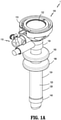
FIG. 1A is a perspective view of a surgical access assembly according to an aspect of the disclosure including a cannula, a valve, top and bottom movable collars, and a balloon anchor; -
FIG. 1B is a perspective view of the surgical access assembly, with the valve removed according to another aspect of the disclosure; -
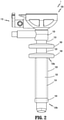
FIG. 2 is a side view of the surgical access assembly ofFIG. 1A ; and -
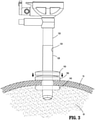
FIG. 3 is a side view of the surgical access assembly ofFIG. 1A , wherein the surgical access assembly is inserted into a patient and the balloon anchor is inflated. - Embodiments of the presently disclosed surgical access assembly are described in detail with reference to the drawings, in which like reference numerals designate identical or corresponding elements in each of the several views. As used herein, the term "distal" refers to that portion of the surgical access assembly or component thereof, farther from the user, while the term "proximal" refers to that portion of the surgical access assembly, or component thereof, closer to the user.
- As used herein, the term "clinician" refers to a doctor, nurse, surgeon, or other care provider and may include support personnel. In the following description, well-known functions, or construction are not described in detail to avoid obscuring the disclosure in unnecessary detail.
- In general, the present disclosure provides a surgical access assembly having top and bottom movable collars, a collapsible outer sleeve, and an elongated cannula member, the collapsible outer sleeve and the elongated cannula member define a chamber therebetween that is pre-filled with a fluid for use with a balloon anchor. Upon distal translation of the bottom movable collar, the pre-filled fluid is forced distally towards the balloon anchor. Upon distal translation of the top movable collar, the fluid in the balloon of the balloon anchor is maintained. Upon proximal translation of the top and bottom movable collars, the fluid may be released from the balloon of the balloon anchor. In this way, a clinician may no longer need to attach an extra component, such as, for example a syringe or pump, to the balloon anchor to inflate or deflate the balloon of the balloon anchor.
- Referring initially to
FIG. 1A , which illustrates asurgical access assembly 1 that generally includes a surgical access assembly orcannula assembly 100, having a top movable collar ortop collar 160 and a bottom movable collar orbottom collar 180 for use with thecannula assembly 100. Thecannula assembly 100 is intended to permit access to an insufflated abdominal cavity during a laparoscopic procedure to permit the introduction of a surgical instrument for performing various surgical tasks on internal organs within the cavity. The surgical instrument may be a surgical instrument such as laparoscopic or endoscopic clip appliers, graspers, dissectors, retractors, staplers, laser probes, photographic devices, tubes, endoscopes and laparoscopes, electro-surgical devices and the like. An obturator (not explicitly shown) may be positioned in thecannula assembly 100 to facilitate access to the abdominal cavity. The obturator may be any conventional obturator having a penetrating tip configured to penetrate tissue. - The
cannula assembly 100 includes acannula housing 110, anelongated cannula member 120 extending distally from thecannula housing 110, avalve 130, and an expandable member orballoon anchor 140 formed with a collapsible outer sleeve orsleeve 128. Thecannula housing 110 is dimensioned for engagement by the clinician and may include or more internal seals (not shown) adapted to establish a seal about a surgical instrument introduced therethrough. Thecannula housing 110 also may include an insufflation connector 115 (e.g., a luer connector) for connecting to a source of insufflation fluid (not shown) for delivery within, e.g., the abdominal cavity. Theelongated cannula member 120 defines alongitudinal passageway 122 to permit passage of the surgical instrument. Thelongitudinal passageway 122 is also in fluid communication with theinsufflation connector 115 to convey insufflation fluids into the abdominal cavity to establish and/or maintain the pneumoperitoneum. - With reference to
FIG. 2 , thebottom collar 180 of thecannula assembly 100 includes an inner portion dimensioned to slidably receive both theelongated cannula member 120 and afirst end portion 128a of thesleeve 128. Thebottom collar 180 is slidable along theelongated cannula member 120 to adjust the height of thebottom collar 180 and engage thesleeve 128 of theballoon anchor 140 along theelongated cannula member 120. - The
top collar 160 of thecannula assembly 100 includes an inner portion dimensioned to slidably receive theelongated cannula member 120 and a portion of thesleeve 128. Thetop collar 160 is slidable along theelongated cannula member 120 to inhibit proximal movement of thebottom collar 180. In aspects, thetop collar 160 may be releasably engageable, i.e., lockable, along theelongated cannula member 120 to retain position of thetop collar 160 and thereby act as a limit stop for proximal movement of thebottom collar 180. - The
sleeve 128 includes thefirst end portion 128a and asecond end portion 128b with thesecond end portion 128b of thesleeve 128 extending from theballoon anchor 140 proximally along an outer surface of theelongated cannula member 120 to thefirst end portion 128a along the proximal end portion of theelongated cannula member 120 defining a fluid-tight seal or achamber 124. Thechamber 124 is configured to store a fluid (e.g., air) and may be pre-filled with a set amount of the fluid. - With quick reference to
FIG. 1B , thecannula assembly 100 may not include thevalve 130. The top andbottom collar cannula housing 110 and thefirst end portion 128a of thesleeve 128 may form a fluid-tight seal closer to thecannula housing 110 on the elongated shaft, thus providing for additional amount of the fluid within thechamber 124 and more control of height adjustment and the fluid pressure within theballoon anchor 140. - In operation, the
surgical access assembly 1 may be used in a minimally invasive surgery to provide access to an underlying cavity, e.g., an abdominal cavity. In one methodology, theabdominal cavity 30 is insufflated to establish a pneumoperitoneum. The obturator is positioned within thecannula assembly 100 and the assembled unit is advanced, while theballoon anchor 140 is in a deflated state, through a layer oftissue 10, until thetop collar 180 engages the first layer of tissue 10 (FIG. 3 ). - Referring to
FIGS. 2 and3 , upon positioning theballoon anchor 140 adjacent the abdominal wall, thebottom collar 180 is slid distally along theelongated cannula member 120 until to thebottom collar 180 is set at a desired height. Upon sliding of thebottom collar 180, thebottom collar 180 engages thesleeve 128 thereby collapsing thesleeve 128 and transferring fluid in thechamber 124 to theballoon anchor 140. The fluid supplied to theballoon anchor 140 causes theballoon anchor 140 to expand and inflate (FIG. 3 ). Once fluid is supplied to theballoon anchor 140, thetop collar 160 is slid distally until thetop collar 160 abuts thebottom collar 180, thereby inhibiting proximal movement of thebottom collar 180. Thus, fluid pressure is maintained in theballoon anchor 140 via the top andbottom collars balloon anchor 140 back into thechamber 124. - To deflate and withdraw the
cannula assembly 100 from theabdominal cavity 30, while minimizing damage to thetissue layer 10, thetop collar 160 is slid proximally towards thecannula housing 110 to retreat from thebottom collar 180, thereby allowing proximal movement of thebottom collar 180. Thebottom collar 180 is slid proximally towards thetop collar 160, and thecannula assembly 110 is slowly withdrawn from the abdominal cavity through the tissue layer thereby transferring fluid from theballoon anchor 140 into thechamber 124 causing thesleeve 128 to expand and theballoon anchor 140 to fully deflate or at least partially deflate. Once deflated, thecannula assembly 100 may be fully withdrawn from theabdominal cavity 30 through thetissue layer 10. - It should be understood that various aspects disclosed herein may be combined in different combinations than the combinations specifically presented in the description and accompanying drawings. It should also be understood that, depending on the example, certain acts or events of any of the processes or methods described herein may be performed in a different sequence, may be added, merged, or left out altogether (e.g., all described acts or events may not be necessary to carry out the techniques). In addition, while certain aspects of this disclosure are described as being performed by a single module or unit for purposes of clarity, it should be understood that the techniques of this disclosure may be performed by a combination of units or modules associated with, for example, a medical device.
- The invention may be described by reference to the following numbered paragraphs:-
- 1. A surgical access assembly comprising:
- an elongated cannula member having a proximal end portion and a distal end portion;
- a balloon anchor coupled to the distal end portion of the elongated cannula member, a sleeve of the balloon anchor extending proximally along an outer surface of the elongated cannula member;
- a chamber defined between the sleeve of the balloon anchor and the outer surface of the elongated cannula member; and
- a first collar coupled to the elongated cannula member, the first collar slidable along the elongated cannula member and engageable with the sleeve of the balloon anchor.
- 2. The surgical access assembly of
paragraph 1, further including a second collar disposed proximal to the first collar and coupled to the elongated cannula member, the second collar slidable along the elongated cannula member and engageable with the sleeve of the balloon anchor. - 3. The surgical access assembly of paragraph 2, wherein the chamber is a pre-filled with fluid.
- 4. The surgical access assembly of paragraph 3, wherein the first collar is translated distally along the elongated cannula member from a first position at the proximal end portion to a second position at the distal end portion.
- 5. The surgical access assembly of paragraph 4, wherein translating the first collar towards the second position causes the fluid to be transferred from the chamber to the balloon anchor thereby expanding the balloon anchor.
- 6. The surgical access assembly of paragraph 5, wherein the second collar is translated distally along the elongated cannula member towards the second position of the first collar of the until the second collar abuts the first collar.
- 7. The surgical access assembly of paragraph 5, wherein the second collar is configured to prevent proximal movement of the first collar.
- 8. The surgical access assembly of paragraph 6, wherein translating the second collar towards the first position of the first collar deflates the balloon anchor.
- 9. The surgical access assembly of paragraph 8, wherein the first collar is translated proximally along the elongated cannula member towards the first position causing the fluid to be transferred from the balloon anchor to the chamber.
- 10. The surgical access assembly of paragraph 2, further including a cannula housing coupled to the proximal end portion of the elongated cannula member.
- 11. A method of actuating a balloon anchor of a surgical access assembly comprising:
- sliding a first collar distally along an elongated cannula member of the surgical access assembly, the surgical access assembly including a balloon anchor disposed in a distal region thereof, the balloon anchor having a sleeve extending proximally along an outer surface of the elongated cannula member defining a chamber therebetween; and
- engaging the first collar with the sleeve such that a fluid in the chamber is transferred to the balloon anchor thereby expanding the balloon anchor.
- 12. The method of paragraph 11, further including:
sliding a second collar distally along the elongated cannula member of the surgical access assembly such that the second collar abuts the first collar thereby inhibiting proximal movement of the first collar. - 13. The method of paragraph 12, further including:
- sliding the second collar proximally along the elongated cannula member to retreat from the first collar thereby allowing proximal movement of the first collar; and
- sliding the first collar proximally along the elongated cannula member towards the second collar thereby deflating the balloon anchor.
- 14. The method of paragraph 12, wherein engagement of the first collar with the sleeve collapses the sleeve.
Claims (14)
- A surgical access assembly comprising:an elongated cannula member having a proximal end portion and a distal end portion;a balloon anchor coupled to the distal end portion of the elongated cannula member, a sleeve of the balloon anchor extending proximally along an outer surface of the elongated cannula member;a chamber defined between the sleeve of the balloon anchor and the outer surface of the elongated cannula member; anda first collar coupled to the elongated cannula member, the first collar slidable along the elongated cannula member and engageable with the sleeve of the balloon anchor.
- The surgical access assembly of claim 1, further including a second collar disposed proximal to the first collar and coupled to the elongated cannula member, the second collar slidable along the elongated cannula member and engageable with the sleeve of the balloon anchor.
- The surgical access assembly of claim 2, wherein the chamber is a pre-filled with fluid.
- The surgical access assembly of claim 3, wherein the first collar is translated distally along the elongated cannula member from a first position at the proximal end portion to a second position at the distal end portion.
- The surgical access assembly of claim 4, wherein translating the first collar towards the second position causes the fluid to be transferred from the chamber to the balloon anchor thereby expanding the balloon anchor.
- The surgical access assembly of claim 5, wherein the second collar is translated distally along the elongated cannula member towards the second position of the first collar of the until the second collar abuts the first collar.
- The surgical access assembly of claim 5 or claim 6, wherein the second collar is configured to prevent proximal movement of the first collar.
- The surgical access assembly of claim 6, wherein translating the second collar towards the first position of the first collar deflates the balloon anchor.
- The surgical access assembly of claim 8, wherein the first collar is translated proximally along the elongated cannula member towards the first position causing the fluid to be transferred from the balloon anchor to the chamber.
- The surgical access assembly of claim 2, further including a cannula housing coupled to the proximal end portion of the elongated cannula member.
- A method of actuating a balloon anchor of a surgical access assembly comprising:sliding a first collar distally along an elongated cannula member of the surgical access assembly, the surgical access assembly including a balloon anchor disposed in a distal region thereof, the balloon anchor having a sleeve extending proximally along an outer surface of the elongated cannula member defining a chamber therebetween; andengaging the first collar with the sleeve such that a fluid in the chamber is transferred to the balloon anchor thereby expanding the balloon anchor.
- The method of claim 11, further including:
sliding a second collar distally along the elongated cannula member of the surgical access assembly such that the second collar abuts the first collar thereby inhibiting proximal movement of the first collar. - The method of claim 12, further including:sliding the second collar proximally along the elongated cannula member to retreat from the first collar thereby allowing proximal movement of the first collar; andsliding the first collar proximally along the elongated cannula member towards the second collar thereby deflating the balloon anchor.
- The method of claim 12, wherein engagement of the first collar with the sleeve collapses the sleeve.
Applications Claiming Priority (1)
| Application Number | Priority Date | Filing Date | Title |
|---|---|---|---|
| US16/941,222 US11839404B2 (en) | 2020-07-28 | 2020-07-28 | Surgical access assembly having pre-filled air chamber |
Publications (1)
| Publication Number | Publication Date |
|---|---|
| EP3944828A1 true EP3944828A1 (en) | 2022-02-02 |
Family
ID=77042789
Family Applications (1)
| Application Number | Title | Priority Date | Filing Date |
|---|---|---|---|
| EP21187343.5A Withdrawn EP3944828A1 (en) | 2020-07-28 | 2021-07-23 | Surgical access assembly having pre-filled air chamber |
Country Status (2)
| Country | Link |
|---|---|
| US (1) | US11839404B2 (en) |
| EP (1) | EP3944828A1 (en) |
Citations (4)
| Publication number | Priority date | Publication date | Assignee | Title |
|---|---|---|---|---|
| US5147316A (en) * | 1990-11-19 | 1992-09-15 | Castillenti Thomas A | Laparoscopic trocar with self-locking port sleeve |
| US20040116894A1 (en) * | 2002-11-12 | 2004-06-17 | Delegge Rebecca | Anchor for implanted devices and method of using same |
| US20180271557A1 (en) * | 2017-03-22 | 2018-09-27 | Covidien Lp | Cannula assembly |
| US20200107859A1 (en) * | 2017-06-03 | 2020-04-09 | 5Rmed Technology (Chengdu) Co., Ltd | Cannula comprising movable & inflatable balloon |
Family Cites Families (155)
| Publication number | Priority date | Publication date | Assignee | Title |
|---|---|---|---|---|
| US397060A (en) | 1889-01-29 | Island | ||
| US512456A (en) | 1894-01-09 | Garland b | ||
| US1213005A (en) | 1914-12-22 | 1917-01-16 | Victor Czeskleba | Obstetrical instrument. |
| US2936760A (en) | 1956-09-10 | 1960-05-17 | Davol Rubber Co | Positive pressure catheter |
| US2912981A (en) | 1958-04-10 | 1959-11-17 | Frank J Keough | Inflatable retention catheter |
| US3050066A (en) | 1958-12-31 | 1962-08-21 | Wilbur R Koehn | Retention catheters |
| US3039468A (en) | 1959-01-07 | 1962-06-19 | Joseph L Price | Trocar and method of treating bloat |
| US3253594A (en) | 1963-07-30 | 1966-05-31 | Frank E Matthews | Peritoneal cannula |
| US3397699A (en) | 1966-05-05 | 1968-08-20 | Gerald C. Kohl | Retaining catheter having resiliently biased wing flanges |
| US3545443A (en) | 1968-09-26 | 1970-12-08 | Amir H Ansari | Suprapubic cystostomy needle |
| US3896816A (en) | 1971-05-03 | 1975-07-29 | Martin Mattler | Disposable catheter |
| US3774596A (en) | 1971-06-29 | 1973-11-27 | G Cook | Compliable cavity speculum |
| US3713447A (en) | 1971-08-16 | 1973-01-30 | E Adair | Suprapubic shunt |
| US3800788A (en) | 1972-07-12 | 1974-04-02 | N White | Antral catheter for reduction of fractures |
| USRE29207E (en) | 1973-06-25 | 1977-05-10 | Population Research Incorporated | Dispensing method and apparatus |
| US3882852A (en) | 1974-01-11 | 1975-05-13 | Manfred Sinnreich | Surgical dilators having insufflating means |
| US3961632A (en) | 1974-12-13 | 1976-06-08 | Moossun Mohamed H | Stomach intubation and catheter placement system |
| US4083369A (en) | 1976-07-02 | 1978-04-11 | Manfred Sinnreich | Surgical instruments |
| US4217889A (en) | 1976-09-15 | 1980-08-19 | Heyer-Schulte Corporation | Flap development device and method of progressively increasing skin area |
| US4243050A (en) | 1977-12-13 | 1981-01-06 | Littleford Philip O | Method for inserting pacemaker electrodes and the like |
| US4345606A (en) | 1977-12-13 | 1982-08-24 | Littleford Philip O | Split sleeve introducers for pacemaker electrodes and the like |
| US4327709A (en) | 1978-03-06 | 1982-05-04 | Datascope Corp. | Apparatus and method for the percutaneous introduction of intra-aortic balloons into the human body |
| US4276874A (en) | 1978-11-15 | 1981-07-07 | Datascope Corp. | Elongatable balloon catheter |
| US4312353A (en) | 1980-05-09 | 1982-01-26 | Mayfield Education And Research Fund | Method of creating and enlarging an opening in the brain |
| US4411654A (en) | 1981-04-30 | 1983-10-25 | Baxter Travenol Laboratories, Inc. | Peelable catheter with securing ring and suture sleeve |
| US4416267A (en) | 1981-12-10 | 1983-11-22 | Garren Lloyd R | Method and apparatus for treating obesity |
| US4899747A (en) | 1981-12-10 | 1990-02-13 | Garren Lloyd R | Method and appartus for treating obesity |
| US4496345A (en) | 1982-08-30 | 1985-01-29 | Hasson Harrith M | Ballooned cannula |
| US4490137A (en) | 1982-09-30 | 1984-12-25 | Moukheibir Nabil W | Surgically implantable peritoneal dialysis apparatus |
| US4644936A (en) | 1982-11-19 | 1987-02-24 | Iabp | Percutaneous intra-aortic balloon and method for using same |
| US4581025A (en) | 1983-11-14 | 1986-04-08 | Cook Incorporated | Sheath |
| US4574806A (en) | 1984-10-01 | 1986-03-11 | Cordis Corporation | Tunnelling device for peripheral vascular reconstruction |
| US4596559A (en) | 1984-11-02 | 1986-06-24 | Fleischhacker John J | Break-away handle for a catheter introducer set |
| US4701163A (en) | 1984-11-05 | 1987-10-20 | Medical Innovations Corporation | Gastrostomy feeding device |
| US4685447A (en) | 1985-03-25 | 1987-08-11 | Pmt Corporation | Tissue expander system |
| US4608965A (en) | 1985-03-27 | 1986-09-02 | Anspach Jr William E | Endoscope retainer and tissue retracting device |
| US4596554A (en) | 1985-04-19 | 1986-06-24 | Dastgeer Ghulam M | Colo-rectal evacuator |
| US4917088A (en) | 1985-05-02 | 1990-04-17 | C. R. Bard, Inc. | Balloon dilation probe |
| US4738666A (en) | 1985-06-11 | 1988-04-19 | Genus Catheter Technologies, Inc. | Variable diameter catheter |
| US4654030A (en) | 1986-02-24 | 1987-03-31 | Endotherapeutics | Trocar |
| US4769038A (en) | 1986-03-18 | 1988-09-06 | C. R. Bard, Inc. | Prostheses and techniques and repair of inguinal and femoral hernias |
| US4798205A (en) | 1986-05-08 | 1989-01-17 | Cox-Uphoff International | Method of using a subperiosteal tissue expander |
| IL78756A0 (en) | 1986-05-12 | 1986-08-31 | Biodan Medical Systems Ltd | Catheter and probe |
| US4854316A (en) | 1986-10-03 | 1989-08-08 | Davis Emsley A | Apparatus and method for repairing and preventing para-stomal hernias |
| US5030206A (en) | 1986-10-17 | 1991-07-09 | United States Surgical Corporation | Trocar |
| US4802479A (en) | 1986-10-31 | 1989-02-07 | C. R. Bard, Inc. | Hand-held instrument for implanting, dispensing, and inflating an inflatable membrane |
| US4793348A (en) | 1986-11-15 | 1988-12-27 | Palmaz Julio C | Balloon expandable vena cava filter to prevent migration of lower extremity venous clots into the pulmonary circulation |
| US5030227A (en) | 1988-06-02 | 1991-07-09 | Advanced Surgical Intervention, Inc. | Balloon dilation catheter |
| JPS63158064A (en) | 1986-12-23 | 1988-07-01 | テルモ株式会社 | Blood vessel dilating catheter |
| US4784133A (en) | 1987-01-28 | 1988-11-15 | Mackin Robert A | Working well balloon angioscope and method |
| US4779611A (en) | 1987-02-24 | 1988-10-25 | Grooters Ronald K | Disposable surgical scope guide |
| US4772266A (en) | 1987-05-04 | 1988-09-20 | Catheter Technology Corp. | Catheter dilator/sheath assembly and method |
| GB2205751A (en) | 1987-06-04 | 1988-12-21 | Femcare Ltd | Insertion of catheters |
| JPS642662A (en) | 1987-06-25 | 1989-01-06 | Nippon Sherwood Kk | Easy split plastic cannula excellent in stability |
| US4800901A (en) | 1987-09-09 | 1989-01-31 | Lior Rosenberg | Balloon-type Tissue expansion device |
| US4931042A (en) | 1987-10-26 | 1990-06-05 | Endotherapeutics | Trocar assembly with improved latch |
| DE3809127C1 (en) | 1988-03-18 | 1989-04-13 | B. Braun Melsungen Ag, 3508 Melsungen, De | |
| US4869717A (en) | 1988-04-25 | 1989-09-26 | Adair Edwin Lloyd | Gas insufflation needle with instrument port |
| US4840613A (en) | 1988-04-27 | 1989-06-20 | Menlo Care, Inc. | Protective sheath for catheter assembly |
| US4861334A (en) | 1988-06-24 | 1989-08-29 | Nawaz Arain | Self-retaining gastrostomy tube |
| US5215526A (en) | 1988-07-06 | 1993-06-01 | Ethicon, Inc. | Safety trocar |
| US6120437A (en) | 1988-07-22 | 2000-09-19 | Inbae Yoon | Methods for creating spaces at obstructed sites endoscopically and methods therefor |
| US5514091A (en) | 1988-07-22 | 1996-05-07 | Yoon; Inbae | Expandable multifunctional manipulating instruments for various medical procedures |
| US5159925A (en) | 1988-09-09 | 1992-11-03 | Gynelab, Inc. | Cauterizing apparatus and method for laparoscopic cholecystostomy, gallbladder ablation and treatment of benign prostate hypertrophy |
| US5183463A (en) | 1989-02-03 | 1993-02-02 | Elie Debbas | Apparatus for locating a breast mass |
| US5137512A (en) | 1989-03-17 | 1992-08-11 | Scimed Life Systems, Inc. | Multisegment balloon protector for dilatation catheter |
| US5176697A (en) | 1989-04-06 | 1993-01-05 | Hasson Harrith M | Laparoscopic cannula |
| US5002557A (en) | 1989-04-06 | 1991-03-26 | Hasson Harrith M | Laparoscopic cannula |
| US5147302A (en) | 1989-04-21 | 1992-09-15 | Scimed Life Systems, Inc. | Method of shaping a balloon of a balloon catheter |
| US5116318A (en) | 1989-06-06 | 1992-05-26 | Cordis Corporation | Dilatation balloon within an elastic sleeve |
| US5009643A (en) | 1989-08-09 | 1991-04-23 | Richard Wolf Medical Instruments Corp. | Self-retaining electrically insulative trocar sleeve and trocar |
| US5104383A (en) | 1989-10-17 | 1992-04-14 | United States Surgical Corporation | Trocar adapter seal and method of use |
| US5330497A (en) | 1989-11-22 | 1994-07-19 | Dexide, Inc. | Locking trocar sleeve |
| US5232451A (en) | 1989-11-22 | 1993-08-03 | Dexide, Inc. | Locking trocar sleeve |
| US5122122A (en) | 1989-11-22 | 1992-06-16 | Dexide, Incorporated | Locking trocar sleeve |
| US5074871A (en) | 1989-12-07 | 1991-12-24 | Evi Corporation | Catheter atherotome |
| US5141494A (en) | 1990-02-15 | 1992-08-25 | Danforth Biomedical, Inc. | Variable wire diameter angioplasty dilatation balloon catheter |
| US5514153A (en) | 1990-03-02 | 1996-05-07 | General Surgical Innovations, Inc. | Method of dissecting tissue layers |
| US5345927A (en) | 1990-03-02 | 1994-09-13 | Bonutti Peter M | Arthroscopic retractors |
| US5163949A (en) | 1990-03-02 | 1992-11-17 | Bonutti Peter M | Fluid operated retractors |
| CA2044867C (en) | 1990-06-25 | 1999-10-12 | James J. Rudnick | Direct vision prostate balloon catheter |
| US5250025A (en) | 1990-08-15 | 1993-10-05 | Intramed Laboratories | Percutaneous access catheter and method of use |
| US5188596A (en) | 1990-09-27 | 1993-02-23 | Mentor Corporation | Transparent prostate dilation balloon and scope |
| CA2052310A1 (en) | 1990-10-09 | 1992-04-10 | Thomas L. Foster | Surgical access sheath |
| WO1992006638A1 (en) | 1990-10-10 | 1992-04-30 | W.L. Gore & Associates, Inc. | A laparoscopy surgical instrument |
| US5122155A (en) | 1990-10-11 | 1992-06-16 | Eberbach Mark A | Hernia repair apparatus and method of use |
| US5141515A (en) | 1990-10-11 | 1992-08-25 | Eberbach Mark A | Apparatus and methods for repairing hernias |
| US5116357A (en) | 1990-10-11 | 1992-05-26 | Eberbach Mark A | Hernia plug and introducer apparatus |
| FR2668695B1 (en) | 1990-11-06 | 1995-09-29 | Ethnor | ENDOSCOPIC SURGICAL INSTRUMENT FOR MOVING TISSUES OR ORGANS. |
| US5359995A (en) | 1991-02-04 | 1994-11-01 | Sewell Jr Frank | Method of using an inflatable laparoscopic retractor |
| US5188630A (en) | 1991-03-25 | 1993-02-23 | Christoudias George C | Christoudias endospongestick probe |
| DE9106553U1 (en) | 1991-04-10 | 1991-08-08 | Wisap Gesellschaft für wissenschaftlichen Apparatebau mbH, 8029 Sauerlach | Abdominal cavity expander |
| US5209725A (en) | 1991-04-11 | 1993-05-11 | Roth Robert A | Prostatic urethra dilatation catheter system and method |
| US5201742A (en) | 1991-04-16 | 1993-04-13 | Hasson Harrith M | Support jig for a surgical instrument |
| US5158545A (en) | 1991-05-02 | 1992-10-27 | Brigham And Women's Hospital | Diameter expansion cannula |
| US5632761A (en) | 1991-05-29 | 1997-05-27 | Origin Medsystems, Inc. | Inflatable devices for separating layers of tissue, and methods of using |
| US5779728A (en) | 1991-05-29 | 1998-07-14 | Origin Medsystems, Inc. | Method and inflatable chamber apparatus for separating layers of tissue |
| US5361752A (en) | 1991-05-29 | 1994-11-08 | Origin Medsystems, Inc. | Retraction apparatus and methods for endoscopic surgery |
| US5728119A (en) | 1991-05-29 | 1998-03-17 | Origin Medsystems, Inc. | Method and inflatable chamber apparatus for separating layers of tissue |
| US5383889A (en) | 1991-05-29 | 1995-01-24 | Origin Medsystems, Inc. | Tethered everting balloon retractor for hollow bodies and method of using |
| US5704372A (en) | 1991-05-29 | 1998-01-06 | Origin Medsystems, Inc. | Endoscopic inflatable retraction devices for separating layers of tissue, and methods of using |
| US5431173A (en) | 1991-05-29 | 1995-07-11 | Origin Medsystems, Inc. | Method and apparatus for body structure manipulation and dissection |
| US5468248A (en) | 1991-05-29 | 1995-11-21 | Origin Medsystems, Inc. | Endoscopic inflatable retraction devices for separating layers of tissue |
| US6361543B1 (en) | 1991-05-29 | 2002-03-26 | Sherwood Services Ag | Inflatable devices for separating layers of tissue, and methods of using |
| US5370134A (en) | 1991-05-29 | 1994-12-06 | Orgin Medsystems, Inc. | Method and apparatus for body structure manipulation and dissection |
| US5803901A (en) | 1991-05-29 | 1998-09-08 | Origin Medsystems, Inc. | Inflatable devices for separating layers of tissue and methods of using |
| US5098392A (en) | 1991-06-28 | 1992-03-24 | Fleischhacker John J | Locking dilator for peel away introducer sheath |
| US5183033A (en) | 1991-07-15 | 1993-02-02 | Wilk Peter J | Surgical instrument assembly and apparatus and surgical method |
| US5234454A (en) | 1991-08-05 | 1993-08-10 | Akron City Hospital | Percutaneous intragastric balloon catheter and method for controlling body weight therewith |
| US5222970A (en) | 1991-09-06 | 1993-06-29 | William A. Cook Australia Pty. Ltd. | Method of and system for mounting a vascular occlusion balloon on a delivery catheter |
| US5232446A (en) | 1991-10-30 | 1993-08-03 | Scimed Life Systems, Inc. | Multi-sinus perfusion balloon dilatation catheter |
| JPH07500758A (en) | 1991-11-06 | 1995-01-26 | ユーン、インバエ | surgical instrument stabilizer |
| US5226890A (en) | 1991-11-13 | 1993-07-13 | United States Surgical Corporation | Tissue gripping device |
| EP0613351B1 (en) | 1991-11-19 | 1997-03-05 | Origin Medsystems, Inc. | Endoscopic inflatable retraction devices for separating layers of tissue |
| US5308327A (en) | 1991-11-25 | 1994-05-03 | Advanced Surgical Inc. | Self-deployed inflatable retractor |
| US5147374A (en) | 1991-12-05 | 1992-09-15 | Alfredo Fernandez | Prosthetic mesh patch for hernia repair |
| US5176692A (en) | 1991-12-09 | 1993-01-05 | Wilk Peter J | Method and surgical instrument for repairing hernia |
| US5258026A (en) | 1992-02-06 | 1993-11-02 | Johnson Gerald W | Endoscopic augmentation mammoplasty and instruments therefor |
| US6432121B1 (en) | 1992-06-02 | 2002-08-13 | General Surgical Innovations, Inc. | Apparatus and method for guiding placement of a minimally invasive surgical instrument |
| US5772680A (en) | 1992-06-02 | 1998-06-30 | General Surgical Innovations, Inc. | Apparatus and method for developing an anatomic space for laparoscopic procedures with laparoscopic visualization |
| US6312442B1 (en) | 1992-06-02 | 2001-11-06 | General Surgical Innovations, Inc. | Method for developing an anatomic space for laparoscopic hernia repair |
| US5730756A (en) | 1992-06-02 | 1998-03-24 | General Surgical Innovations, Inc. | Method for developing an anatomic space for laparoscopic procedures with laparoscopic visualization |
| US5607443A (en) | 1992-06-02 | 1997-03-04 | General Surgical Innovations, Inc. | Expansible tunneling apparatus for creating an anatomic working space with laparoscopic observation |
| US5540711A (en) | 1992-06-02 | 1996-07-30 | General Surgical Innovations, Inc. | Apparatus and method for developing an anatomic space for laparoscopic procedures with laparoscopic visualization |
| US6540764B1 (en) | 1992-06-02 | 2003-04-01 | General Surgical Innovations, Inc. | Apparatus and method for dissecting tissue layers |
| US5269753A (en) | 1992-07-14 | 1993-12-14 | Wilk Peter J | Method for use in laparoscopic hernia repair |
| US5397311A (en) | 1992-09-09 | 1995-03-14 | Menlo Care, Inc. | Bloodless splittable introducer |
| US5346504A (en) | 1992-11-19 | 1994-09-13 | Ethicon, Inc. | Intraluminal manipulator with a head having articulating links |
| US5439476A (en) | 1993-02-04 | 1995-08-08 | Trigonon, Inc. | Inflatable laparoscopic retractor |
| US5407433A (en) | 1993-02-10 | 1995-04-18 | Origin Medsystems, Inc. | Gas-tight seal accommodating surgical instruments with a wide range of diameters |
| US5569183A (en) | 1994-06-01 | 1996-10-29 | Archimedes Surgical, Inc. | Method for performing surgery around a viewing space in the interior of the body |
| US5540658A (en) | 1994-06-27 | 1996-07-30 | Innerdyne, Inc. | Transcervical uterine access and sealing device |
| US5690668A (en) | 1994-06-29 | 1997-11-25 | General Surgical Innovations, Inc. | Extraluminal balloon dissection |
| US5713869A (en) | 1995-03-08 | 1998-02-03 | Morejon; Orlando | Trocar assembly |
| US5607441A (en) | 1995-03-24 | 1997-03-04 | Ethicon Endo-Surgery, Inc. | Surgical dissector |
| US5738628A (en) | 1995-03-24 | 1998-04-14 | Ethicon Endo-Surgery, Inc. | Surgical dissector and method for its use |
| US5593418A (en) | 1995-05-19 | 1997-01-14 | General Surgical Innovations, Inc. | Methods and devices for harvesting blood vessels with balloons |
| US5601581A (en) | 1995-05-19 | 1997-02-11 | General Surgical Innovations, Inc. | Methods and devices for blood vessel harvesting |
| US5993472A (en) | 1995-05-22 | 1999-11-30 | General Surgical Innovations, Inc. | Balloon dissecting instruments |
| US6179854B1 (en) | 1995-05-22 | 2001-01-30 | General Surgical Innovations, Inc. | Apparatus and method for dissecting and retracting elongate structures |
| US5893866A (en) | 1995-05-22 | 1999-04-13 | General Surgical Innovations, Inc. | Balloon dissecting instruments |
| US5968065A (en) | 1995-07-13 | 1999-10-19 | Origin Medsystems, Inc. | Tissue separation cannula |
| WO1997034532A1 (en) | 1996-03-20 | 1997-09-25 | General Surgical Innovations, Inc. | Method and apparatus for combined dissection and retraction |
| US5968068A (en) | 1996-09-12 | 1999-10-19 | Baxter International Inc. | Endovascular delivery system |
| US5810867A (en) | 1997-04-28 | 1998-09-22 | Medtronic, Inc. | Dilatation catheter with varied stiffness |
| US5836913A (en) | 1997-05-02 | 1998-11-17 | Innerdyne, Inc. | Device and method for accessing a body cavity |
| JPH1147143A (en) | 1997-05-27 | 1999-02-23 | Ethicon Endo Surgery Inc | Ultrasonic trocar assembly |
| US5928193A (en) | 1997-10-03 | 1999-07-27 | Boston Scientific Corporation | Balloon catheterization |
| US6592602B1 (en) | 1999-10-08 | 2003-07-15 | General Surgical Innovations, Inc. | Balloon dissection apparatus |
| US6796960B2 (en) | 2001-05-04 | 2004-09-28 | Wit Ip Corporation | Low thermal resistance elastic sleeves for medical device balloons |
| CA2447100A1 (en) | 2001-05-31 | 2002-12-05 | Tyco Healthcare Group Lp | Balloon cannula with over-center clamp |
| ES2389919T3 (en) | 2002-10-04 | 2012-11-05 | Tyco Healthcare Group Lp | Cannula balloon dissector |
| US7300448B2 (en) * | 2002-10-04 | 2007-11-27 | Tyco Healthcare Group Lp | Balloon dissector with cannula |
| US7998113B2 (en) * | 2008-09-30 | 2011-08-16 | Tyco Healthcare Group Lp | Medical device having prefilled balloon |
| US20190059937A1 (en) * | 2017-08-24 | 2019-02-28 | Covidien Lp | Surgical cannula assembly |
-
2020
- 2020-07-28 US US16/941,222 patent/US11839404B2/en active Active
-
2021
- 2021-07-23 EP EP21187343.5A patent/EP3944828A1/en not_active Withdrawn
Patent Citations (4)
| Publication number | Priority date | Publication date | Assignee | Title |
|---|---|---|---|---|
| US5147316A (en) * | 1990-11-19 | 1992-09-15 | Castillenti Thomas A | Laparoscopic trocar with self-locking port sleeve |
| US20040116894A1 (en) * | 2002-11-12 | 2004-06-17 | Delegge Rebecca | Anchor for implanted devices and method of using same |
| US20180271557A1 (en) * | 2017-03-22 | 2018-09-27 | Covidien Lp | Cannula assembly |
| US20200107859A1 (en) * | 2017-06-03 | 2020-04-09 | 5Rmed Technology (Chengdu) Co., Ltd | Cannula comprising movable & inflatable balloon |
Also Published As
| Publication number | Publication date |
|---|---|
| US20220031352A1 (en) | 2022-02-03 |
| US11839404B2 (en) | 2023-12-12 |
Similar Documents
| Publication | Publication Date | Title |
|---|---|---|
| US11864792B2 (en) | Cannula assembly | |
| US12232766B2 (en) | Surgical access device including dual lumen cannula for anchor inflation and deflation | |
| US20080086166A1 (en) | Minimally Invasive Surgical Assembly with Balloon Instrument | |
| US11839404B2 (en) | Surgical access assembly having pre-filled air chamber | |
| US11576701B2 (en) | Surgical access assembly having a pump | |
| EP3895639B1 (en) | Protective sheath for use with a surgical instrument having an expandable body | |
| US11432846B2 (en) | Surgical access device including alternating cutout fluid flow pathway for anchor inflation and deflation | |
| US20230200848A1 (en) | Surgical access device including variable length cannula | |
| US20210259730A1 (en) | Surgical access assembly having a button inflator | |
| US11141191B2 (en) | Surgical access assembly | |
| US11844549B2 (en) | Surgical access device including a universal fluid flow valve | |
| US20210299416A1 (en) | Balloon cannula including a plurality of balloons | |
| US20210315607A1 (en) | Detachably mountable camera assembly for a cannula assembly | |
| US20110082340A1 (en) | Foam collar for surgical access devices |
Legal Events
| Date | Code | Title | Description |
|---|---|---|---|
| PUAI | Public reference made under article 153(3) epc to a published international application that has entered the european phase |
Free format text: ORIGINAL CODE: 0009012 |
|
| STAA | Information on the status of an ep patent application or granted ep patent |
Free format text: STATUS: THE APPLICATION HAS BEEN PUBLISHED |
|
| AK | Designated contracting states |
Kind code of ref document: A1 Designated state(s): AL AT BE BG CH CY CZ DE DK EE ES FI FR GB GR HR HU IE IS IT LI LT LU LV MC MK MT NL NO PL PT RO RS SE SI SK SM TR |
|
| STAA | Information on the status of an ep patent application or granted ep patent |
Free format text: STATUS: REQUEST FOR EXAMINATION WAS MADE |
|
| 17P | Request for examination filed |
Effective date: 20220726 |
|
| RBV | Designated contracting states (corrected) |
Designated state(s): AL AT BE BG CH CY CZ DE DK EE ES FI FR GB GR HR HU IE IS IT LI LT LU LV MC MK MT NL NO PL PT RO RS SE SI SK SM TR |
|
| STAA | Information on the status of an ep patent application or granted ep patent |
Free format text: STATUS: EXAMINATION IS IN PROGRESS |
|
| 17Q | First examination report despatched |
Effective date: 20230921 |
|
| GRAP | Despatch of communication of intention to grant a patent |
Free format text: ORIGINAL CODE: EPIDOSNIGR1 |
|
| STAA | Information on the status of an ep patent application or granted ep patent |
Free format text: STATUS: GRANT OF PATENT IS INTENDED |
|
| INTG | Intention to grant announced |
Effective date: 20240426 |
|
| STAA | Information on the status of an ep patent application or granted ep patent |
Free format text: STATUS: THE APPLICATION IS DEEMED TO BE WITHDRAWN |
|
| 18D | Application deemed to be withdrawn |
Effective date: 20240827 |